The Broad Ax
Saturday, December 6, 1902
Chicago, Illinois
Page text (machine-generated)
THE BROAD AX
HEW TO THE LINE.
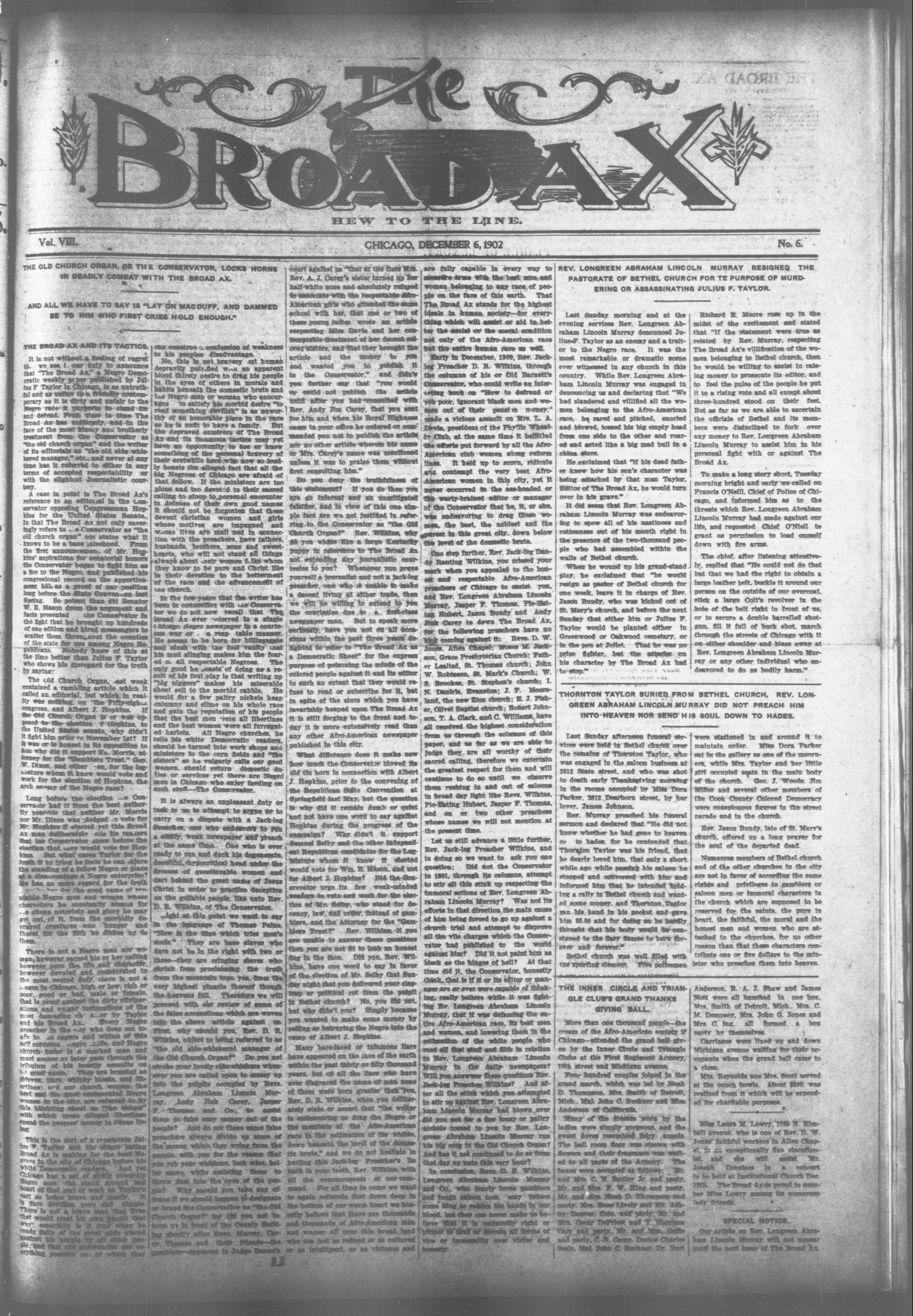
THE BROAD AX AND ITS TACTICS.
It is not without a feeling of regret th. we see I. our duty to announce that "The Broad Ax," a Negro Democratic weekly paper published by Julius F Taylor in Chicago, is as untruthful and as unfair to a friendly contemporary as it is dirty and unfair to the Negro race. It purports to stand for and defend. From time to time The Broad Ax has uniformly, and in the face of the most kinny and brotherly treatment from the Conservator as "the old church organ" and the writer of its editorials as "the old side whiskered manager," etc., and never at any time has it referred to either in any terms of accepted respectability or with the slightest Journalistic courtesy.
A case in point is The Broad Ax's reference to an editorial in the Conservator opposing Congressman Hopkins for the United States Senate. In that The Broad Ax not only sneeringly refers to e Conservator as "the old church organ" one states what it knows to be a base falsehood. From the first announcement of Mr. Hopkins' aspirations for senatorial honors the Conservator began to fight him as a foe to the Negro, and published his congressional record on the apportionment bill as a proof of our position long before the State Convention last Spring. So potent than did Senator W. E. Mason deem the argument and facts presented the Conservator in the fight that he brought up hundreds of one edition and hired messengers to scatter them throughout the counties of the state for use among Negro Republicans. Nobody knew of this at the time better than Julius F. Taylor who shows his disregard for the truth by saying:
The Old Church Organ, last week contained a rambling article which it called an editorial, but which in reality was nothing, on "the Fifty-eighth congress, and Albert J. Hopkins. If the Old Church Organ is or was opposed to the election of Hopkins, to the United States senate, why didn't it fight him prior to November 1st? If it was or is honest in its opposition to him why did it support Ea. Morris, attorney for the "Gamblers Trust." Geo. W. Dixon, and other men, for the legislature whom it knew would vote and work for the election of Hopkins, the arch enemy of the Negro race?
Long before the election e Conservator had it from the best authority possible that neither Mr. Morris nor Mr. Dixon was dledged o vote for Mr. Hopkins it elected yet this Broad Ax man deliberately eils its readers that the Conservator knew before the election that they would vote for Hopkins. But what cares Taylor for the truth if by lying he feels he can injure the standing of a fellow Negro or place at a disadvantage a Negro enterprise? He has no more regard for the truth for the good name of renutable Negro men and women whose characters he constantly assails for cheap notoriously and glory he may get out of it, from the morbidly depraved creatures who hunger and thirst for the fifth he dishes up to them.
There is not a Negro man nor woman, however sacred his or her calling however pure the life and character, however devoted and consecrated to the most sacred duty, there is not a Negro in Chicago high or low, rich or poor, good or bad, male or female, that is proof against the dirty vitriolations and vulgar insinuations of the most damaging character by Taylor and his Broad Ax. Every Negro preacher in the city who does not toady to be capers and whims of this self confesse. Negro side, and Negro church-hater is a marked man and must sooner or later pass through the tribulum of his beauty assaults on his good name. They are branded as thieves, llare, whisky bloats, and libertines; and our church women, the best and the most consecrated Negro women in the city, are referred to by this blighting sheet as "the sisters" with which these alleged libertines spend the peoples' money in ritous living.
This is the sort of a reputation Julius P. Taylor and his Negro hating Broad Ax is making for the best Negroes in the city of Chicago before his white Democratic readers. And yet Chicago has a set of sickly cowardly Negro men who stand around and boast of that sort of work on Taylor's art as being brave and manly. It is dare devilism pure and simple. There is not a brave man that lives that would treat his own people that way; especially is it true when he reads daily of the great odds placed against his people by all other people, and that the governaries use everything possible on of which they
to his peoples disadvantage.
No, this is not bravery but human depravity putrified with an apparent blood thirsty desire to drag his people in the eyes of others in morals and habits beneath the domestic brute and the Negro man or woman who encourages to satisfy his morbid desire "to read something devilish" is as nuworthy of an honorable place in the race as he is unfit to have a family. But the depraved admirers of The Broad Ax and its infamous tactics may yet have an opportunity to see or know something of the personal bravery of their erstwhile hero who now so loudly boasts the alleged fact that all the big Negroes of Chicago are afraid of that fellow. If the ministers are too plous and too devoted to their sacred calling to stoop to personal encounter in defense of their own good names it should not be forgotten that these devout christian women and girls whose motives are impugned and whose lives are mall ned in connection with the preachers, have fathers, husbands, brothers, sons and sweethearts, who will not stand all things always about their women folks whom they know to be pure and Christ like in their devotion to the betterment of the race and the advancement of the church.
In the few years that the writer has been in connection with the Conservator we do not now recall that The knoad Ax ever referred to a single Chicago Negro newspaper in a courteous way or a resp table manner. He seems to be born for billinggate and slush with the fool vanity that his mud slinging makes him the feared o. all respectable Negroes. The only good he coasts of doing as a result of his foul play is that writing up "big niggers" makes his miserable sheet sell to the morbid rabble. He would for a few paltry nickels heap calumny and slime on his whole race and gain the reputation of his people that the best men were all libertines and the best women were all furragated harlots. All Negro churches, he tells his white Democratic readers, should be turned into work shops and ministers to the corn fields and "the sisters" as he vulgarly calls our good women, should return domestic duties or services yet there are Negro men in Chicago who enjoy feeding on such stuff--The Conservator.
It is always an unpleasant duty or task to us to attempt to argue or to carry on a dispute with a Jack-leg Preacher, one who endeavors to run a sleekly, weak newspaper and preach at the same time. One who is ever ready to run and duck his degenerate, deceitful, hypocritical head under the dresses of questionable women and dart behind the great name of Jesus Christ in order to practice deception on the gullible people, like unto Rev. D. R. Wilkins, of The Conservator.
Light at this point we want to say in the language of Thomas Paine, "Now is the time which tries men's souls." They are base slaves who dare not be in the right with two or three—they are cringing slaves who shrink from proclaiming the truth from the mountain tops, yes, from the very highest pinacle thereof though the heavens fall. Therefore we will proceed with our review of some of the false accusations which are woven into the above article against us. First, why should you, Rev. D. R. Wilkins, object to being referred to as "the old side-whiskered manager of the Old Church Organ?" Do you not stroke your lovely side-whiskers whenever you are called upon to mosey up into the pulplits occupied by Revs. Longreen Abraham Lincoln Murray, Andy Jink Carey, Jasper F. Thomas and Co., to assist them to fake easy money out of the people? And do not these same false preachers always divide up some of the money which they wring from the people, with you for the reason that you rub your whiskers, look wise, holler amen, while assisting them to throw dust into the eyes of the people? Why should you take any offense if we should happen to designate or brand the Conservative as "the Old Church Organ?" for did you not inform us in front of the County Building shortly after Revs. Murray, Carey, Thomas and their friends—the gamblers—appeared in Judge Dunne's
court against us "that at the time Mrs. Rev. A. J. Carey's sister turned up her half-white nose and absolutely refused to associate with the respectable afro-American girls who attended the same school with her, that one or two of these young ladies wrote an article respecting Miss Davis and her contemptable treatment of her decent colored sisters, and that they brought the article and the money to you and wanted you to publish it in the Conservator," and didn't you further say that "you would or could not publish the article until after you had consulted with Rev. Andy Jim Carey, that you sent for him and when his Royal Highness came to your office he ordered or commanded you not to publish the article nor no other article wherein his name or Mrs. Carey's name was mentioned unless it was to praise them without first consulting him."
Do you deny the truthfulness of this statement? If you do then you are an infernal and an unmitigated falsifier, and in view of this one simple fact are we not justified in referring to the Conservator as "the Old Church Organ?" Rev. Wilkins, why do you whine like a large Kentucky puppy in reference to The Broad Ax not extending any journalistic courtesies to you? Whenever you prove yourself a journalist and not a jack-leg preacher, one who is unable to make a decent living at either trade, then we will be willing to extend to you the courtesies due to a first-class newspaper man. But to speak more seriously, have you not on all occasions within the past three years delighted to refer to "The Broad Ax as a Democratic Sheet" for the express purpose of poisoning the minds of the colored people against it and its editor to such an extent that they would refuse to read or subscribe for it, but in spite of the slurs which you have invariably heaped upon The Broad Ax it is still forging to the front and today it is more extensively read than any other Afro-American newspaper published in this city.
What difference does it make now how much the Conservator blowed its old tin horn in connection with Albert J. Hopkins, prior to the convening of the Republican State Convention at Springfield last May, but the question is why did it remain dumb or quiet and not have one word to say against Hopkins during the progress of the campaign? Why didn't it support Samuel Selby and the other independent Republican candidates for the Legislature whom it knew if elected would vote for Wm. E. Mason, and not for Albert J. Hopkins? Did the Conservator urge its few weak-minded readers to vote and work for the election of Mr. Selby, who stood for decency, law, and order, instead of gamblers, and the Attorney for the "Gamblers Trust?" Rev. Wilkins, if you are unable to answer these questions then you are not fit to look an honest dog in the face. Did you, Rev. Wilkins, have one word to say in favor of the election of Mr. Selby that Sunday night that you delivered your clap-trap or political rot from the pulpit in Bethel church? No, you did not, but why didn't you? Simply because you wanted to make some money by selling or betraying the Negro into the camp of Albert J. Hopkins.
Many bare-faced or infamous liars have appeared on the face of the earth within the past thirty or fifty thousand years, but of all the liars who have ever disgraced the name of man none of them were born greater than you, Rev. D. R. Wilkins, when you deliberately state or assert that "the writer is endeavoring to drag the Negro or the members of the Afro-American race in the estimation of the whites, down beneath the level of the domestic brute," and we do not hesitate in hurling this Jack-leg Preacher's lie back in your teeth, Rev. Wilkins, with all the venomousness at our command. For all time to come we want to again reiterate that down deep in the bottom of our warm heart we honestly believe that there are thousands and thousands of Afro-American men and women all over this broad land who are just as refined or as cultured or as intelligent, or as virtuous and
are fully capable in every way to measure arms with the best men and women belonging to any race of people on the face of this earth. That The Broad Ax stands for the highest ideals in human society—for everything which will assist or aid to better the social or the moral condition not only of the Afro-American race but the entire human race as well. Early in December, 1900, Rev. Jackleg Preacher D. R. Wilkins, through the columns of his or Old Barnett's Conservator, who could write an interesting book on "How to defraud or rob poor, ignorant black men and women out of their pension money," made a vicious assault on Mrs. L. A. Devin, president of the Phyllis Wheatly Club, at the same time it belittled the efforts put forward by all the Afro-American club women along reform lines. It held up to scorn, ridicule and contempt the very best Afro-American women in this city, yet it never occurred to the ass-headed or the warty-brained editor or manager of the Conservator that he, it, or she, was endeavoring to drag these women, the best, the noblest and the furthest in this great city, down below the level of the domestic brute.
One step further, Rev. Jack-leg Dandy Ranting Wilkins, you missed your mark when you appealed to the honest and respectable Afro-American preachers of Chicago to assist you, and Rev. Longreen Abraham Lincoln Murray, Jasper F. Thomas, Pie-Eating Hubert, Jason Bundy and Andy Jink Carey to down The Broad Ax, for the following preachers have no kick coming against it: Revs. D. W. Jones, Allen Chapel; Moses M. Jackson, Grace Presbyterian Church; Father Lealted, St. Thomas church; John W. Robinson, St. Mark's Church; W. S. Brookes, St. Stephen's church; I. N. Daniels, Evanston; J. F. Moorland, the new Zion church; E. J. Fisher, Olivet Baptist church; Robert Johnson, T. A. Clark, and C. Williams, have all received the highest consideration from us through the columns of this paper, and as far as we are able to judge they are all worthy of their sacred calling, therefore we entertain the greatest respect for them and will continue to do so until we observe them rushing in and out of saloons in broad day light like Revs. Wilkins, Pie-Eating Hubert, Jasper F. Thomas, and on or two other preachers whose names we will not mention at the present time.
In conclusion, Reva. D. R. Wilkins, Longgreen Abraham Lincoln Murray and Co., who dearly loves gamblers and tough saloon men, may induce some thug to redden his hands in our blood, but they can never make us believe that it is eminently right or proper to laud or elevate all forms of vice or immorality over virtue and honesty.
REV. LONGREEN ABRAHAM LINCOLN MURRAY RESIGNED THE PASTORATE OF BETHEL CHURCH FOR TE PURPOSE OF MURDERING OR ASSASSINATING JULIUS F. TAYLOR.
Last Sunday morning and at the evening services Rev. Longreen Abraham Lincoln Murray denounced Julius-F. Taylor as an enemy and a traitor to the Negro race. It was the most remarkable or dramatic scene ever witnessed in any church in this country. While Rev. Longreen Abraham Lincoln Murray was engaged in denouncing us and declaring that "We had slandered and villified all the women belonging to the Afro-American race, he rared and pitched, snorted and blowed, tossed his big empty head from one side to the other and roared and acted like a big mad bull in a china store.
He exclaimed that "if his dead father knew how his son's character was being attacked by that man Taylor, Editor of The Broad Ax, he would turn over in his grave."
It did seem that Rev. Longreen Abraham Lincoln Murray was endeavoring to spew all of his nastiness and rottenness out of his mouth right in the presence of the two-thousand people who had assembled within the walls of Bethel church.
When he wound up his grand-stand play, he exclaimed that "he would resign as pastor of Bethel church for one week, leave it in charge of Rev. Jason Bundy, who was kicked out of St. Mary's church, and before the next Sunday that either him or Julius F. Taylor would be planted either in Greenwood or Oakwood cemetary, or in the pen at Joliet. That he was no prize fighter, but the attacker on his character by The Broad Ax had to stop."
Last Sunday afternoon funeral services were held in Bethel church over the remains of Thornton Taylor, who was engaged in the saloon business at 2812 State street, and who was shot to death early Thanksgiving morning in the rooms occupied by Miss Dora Parker, 2813 Dearborn street, by her lover, James Johnson.
Rev. Murray preached his funeral sermon and declared that "He did not know whether he had gone to heaven or to hades, for he contended that Thoraton Taylor was his friend, that he dearly loved him, that only a short while ago while passing his saloon he stopped and conversed with him and informed him that he intended holding a rally in Bethel church and wanted some money, and Thornton Taylor ran his hand in his pocket and gave him $5.00 and for doing so he hardly thought that his body would be consigned to the flary flames to burn forever and forever."
Bethel church was well filled with the sporting element. Five policemen
THE INNER CIRCLE AND TRIANGLE CLUB'S GRAND THANKS GIVING BALL
More than one thousand people—the cream of the Afro-American society if Chicago—attended the grand ball given by the Inner Circle and Triangle Clubs at the First Regiment Armory, 16th street and Michigan avenue.
Four hundred couples joined in the grand march, which was led by Noah D. Thompson, Mrs. Smith of Detroit, Mich., Maj. John C. Buckner and Miss Anderson of California.
Many of the dresses worn by the ladies were simply gorgeous, and the sweet doves resembled fairy angels. The ball room floor was rinsed with flowers and their fragrance was wafted to all parts of the Armory. The boxes were occupied as follows: Mr. and Mrs. C. H. Smiley Jr. and party, Mr. and Mrs. F. W. King and party, Mr. and Mrs. Noah D. Thompson and party, Mrs. Rose Lively and Mr. Ashby; Denver, Colo. and party, Mr. and Mrs. Oscar DePriest and T. Harrison Carr and party, Mr. and Mrs. Cuffe and party, C.-N. Camp, Doctor Charles Seals, Mal John C. Buckner, Dr. Bart
Richard E. Moore rose up in the midst of the excitement and stated that "If the statement were true as related by Rev. Murray, respecting The Broad Ax's villification of the women belonging to Bethel church, then he would be willing to assist in raising money to prosecute its editor, and to feel the pulse of the people he put it to a rising vote and all except about three-hundred stood on their feet. But as far as we are able to ascertain the officials of Bethel and its members were disinclined to fork over any money to Rev. Longgreen Abraham Lincoln Murray to assist him in his personal fight with or against The Broad Ax.
To make a long story short, Tuesday morning bright and early we called on Francis O'Neill, Chief of Police of Chicago, and informed him as to the threats which Rev. Longreen Abraham Lincoln Murray had made against our life, and requested Chief O'Neill to grant us permission to load ourself down with fire arms.
The chief, after listening attentively, replied that "He could not do that but that we had the right to obtain a large leather belt, buckle it around our person on the outside of our overcoat, stick a large Colt's revolver in the hole of the belt right in front of us, or to secure a double barrelled shotgun, fill it full of buck shot, march through the streets of Chicago with it on either shoulder and blaze away at Rev. Longreen Abraham Lincoln Murray or any other individual who endeavored to do us bodily harm."
were stationed in and around it to maintain order. Miss Dora Parker sat in the gallery as one of the mourners, while Mrs. Taylor and her little girl occupied seats in the main body of the church. Geo. J. Woods, Jim Miller and several other members of the Cook County Colored Democracy were conspicuous figures in the street parade and in the church.
Rev. Jason Bundy, late of St. Mary's church, offered up a long prayer for the soul of the departed dead.
Numerous members of Bethel church and of the other churches in the city are not in favor of according the same rights and privileges to gamblers or saloon men or immoral characters in the church which are supposed to be reserved for the saints, the pure in heart, the faithful, the moral and the honest men and women who are attached to the churches, for no other reason than that these characters contribute one or five dollars to the minister who preaches them into heaven.
Anderson, R. A. J. Shaw and James Nott were all bunched in one box, Mrs. Smith of Detroit, Mich.. Mrs. C. M. Dempsey, Mrs. John G. Jones and Mrs. C. Ing. all formed a box party by themselves.
Carriages were lined up and down Michigan avenue waiting for their occupants when the grand ball came to a close.
Mrs. Reynolds ane Mrs. Scott served at the punch bowls. About $800. was realized from it which will be expended for charitable purposes.
Miss Laura M. Lowry, 1769 N. Kimball avenue, who is one of Rev. D. W. Jones' faithful workers in Allen Chapel, is an exceptionally fine elocutionist, and she will assist Mr. Joseph Donklass in a concert to be held at Institutional Church Dec. 12th. The Broad Ax is proud to number Miss Lowry among its numerous lady friends.
Will promulgate and all times uphold the true principle of Democracy, but Catholics, Protestants, Priests, Indigents, Farmers, Single Taxure, Republican, Knight of Labor, or any one else can have their say, so long as their language is proper and responsibility is fixed.
The Broad Ax is a newspaper whose platform is broad enough for all, ever claiming the editorial right to speak its own mind.
Local communications will receive attention. Write only on one side of the paper.
Subscriptions must be paid in advance.
One Year.....$2.00
Six Months.....1.00
Advertising rates made known on application.
Address all communications to
Entered at the Post Office at Chicago, Ill., as Second-class Matter.
President Roosevelt has improved a good opportunity to state his position as to the treatment of the people of the Negro race in our political system. It seems that Dr. Crum, a citizen who has more or less Negro blood in his arteries, mingled, probably, with more or less very blue patrician blood, is a candidate for the office of collector of the port of Charleston, S. C.
Two white citizens wrote to the president protesting against this appointment of Dr. Crum partly because of certain alleged facts indicating his unfitness for the office, but chiefly because he is a Negro. The president wrote a reply and has permitted its publication.
Whatever may be said of the reply and its publication as affecting Mr. Roosevelt's political prospects, it certainly is, in itself, highly creditable to his head and his heart.
As to the specific charges made against Dr. Crum, Mr. Roosevelt says that they "are entitled to the utmost consideration" and that he will go over them carefully before taking any action.
But the race objection to Dr. Crum is another affair. Those who raise it say in substance that it is sufficient in itself; that the least trace of Negro in a man should forever bar him from every political office; that where once such man is in any political office, high or low, there is "Negro domination."
Mr. Roosevelt dissents from all that. He holds that race in itself should be no bar to appointment or election to office. If a colored applicant or candidate possesses the requisite qualifications in knowledge, ability and character the fact of his race should not count against him.
"I cannot consent," says Mr. Roosevelt, "to take the position that the door of hope—the door of opportunity—is to be shut upon any man, no matter how worthy, purely upon the grounds of race or color."
It is well said. Let us be thankful that we have a president who has the disposition and the courage to say it, and let us not entertain the thought that he was actuated by any personal motive. It is worth much to have the influence of the chief magistrate on the right side.
The fashion—it is hardly more than a fashion—of treating every Negro, regardless of his merits, as both a social and a political pariah is a wrong to the Negro race of which America have reason to be deeply ashamed. It is a fashion which does not prevail in the most enlightened countries of Europe, aristocratic as they are.
It is more than shameful—it is dangerous. We have in this country some 8,500,000 people who have more or less of the Negro in them. For better or for worse they are here to stay. It behooves us, therefore, to consider what may happen if, as Mr. Roosevelt puts it, "it is to be declared that under no circumstances shall any man of color, no matter how upright and honest, no matter how good a citizen, no matter how fair his dealings with his fellows, be permitted to hold any office under the government."
It is fair to presume that intelligent and reasonable white men in the south to a great extent view the matter much as the president does, and that those who insist on treating the blacks as political pariahs are mossbacks who belong to a dead generation and who are themselves fast "fading into the imperceptible."—The Chicago Chronicle.
The Broad Ax heartily desires to thank the great Chicago Chronicle for possessing the courage to speak out in favor of worthy Afro-American citizens being permitted to enjoy all the rights and privileges accorded to other Americans.
Ex-city Attorney A. J. Ryan, 100 Washington street, has spent the past two months in New York City, returned to the city Monday and he will remain home until after the holidays.
All through the winter of 1900 and 1901 Rev. Jasper F. Thomas flooded the trustees of Olivet Baptist church with printer's bills for the benefit of Rev. Jack-leg Wilkins, who attempts to manage or conduct the old Church Organ and finally when the trustees discovered that the side whiskered fighting elder or Col, from Kentucky was grabbing on to money which did not rightfully belong to him nor to Jasper F. Thomas, they closed in on him and choked him off, and yet The Conservator or its side whiskered manager objects to the name of the Old Church Organ.
Thursday evening a joint debate was held in Allen Chapel as to the advisability of the "Negro race migrating en mass to Africa." Ex-senator T. T. Allain, spoke in favor of the Afro-Americans remaining in this country, carried off the honors. The debate was very lively and the program rendered in connection with it was quite interesting. It was our pleasure to act as one of the Judges and our vote was cast in favor of moving over to Africa. A fine turkey supper was served by the tidy looking or bewitching single and married ladies belonging to the chapel. Rev. Jones and all hands seemed to enjoy the deabte and the other exercises which to say the least were quite instructive.
Edward H. Morris, Attorney for the "Gamblers Trust," who is one of the most brilliant Afro-American lawyers in this country, stood up in the midst of two thousand people in Bethel church and offered his professional services free of charge to it and to Rev. Longreen Abraham Lincoln Murray if he would swear out a warrant for the arrest of Rev. Jack-leg Wilkins of the Old Church Organ.. At the time that he was engaged in showing up Longreen's black record in its columns and sinking him below the level of the brute in the estimation of the whites. But Rev. Longreen Abraham Lincoln Murray was too much of a coward to sign his name to the warrant and Col. Morris says "that he could not pull him into the courts with ten yokes of oxen and twenty big Kentucky mules and for that reason he is constrained to believe that something is not altogether right with Rev. Longreen Abraham Lincoln Murray."
BEAUTIFUL TROPICAL FISHES.
The collection of tropical fishes for various aquariums throughout the world, and especially for the American aquariums, is now a recognized industry in the Bermudes, says the Philadelphia Press.
It is carried on at all seasons, though for obvious reasons the fish are shipped north only in the summer months. As there are more than 150 varieties of fish in Bermudan waters, and every variety is found in abundance, it is not a difficult problem to secure good specimens. Only a few varieties reach this country, for the reason that tropical fish, as a rule, are unable to stand the trials of transportation. The ones on exhibition are the finest that can be caught. The native fishermen go far and wide in search of specimens, for the aquarium will pay only for the best.
Possibly the most voracious fish they have to deal with are the groupers and morays. The groupers have peculiar habits. During the month of June, which is their spawning or "snapping" season, they gather at two spots on the south coast, known as "grouper grounds," and rarely are caught elsewhere. Not many tropical fish are as ferocious as the moray, but most of the larger varieties are truly sporting fish.
WORKING IN THE DARK.
Discovers of Mining Bedro the Invention of a Lamp Suitable for Underground Use.
The difficulties under which coal mining operations were carried on before the scientist Davy had invented his safety lamp must have been very great. In many mines the only alternative the medieval miner had to pitch darkness was the phosphorescent gleam from dried fish. The miner's implements, originally of stone or hard oak, gradually improved; but he was forced to work in almost complete darkness until Sir Humphrey Davy by his remarkable invention enabled him to light his way through the tunnels he had excavated with comparative safety, says a mining journal.
Agricola, an author who wrote about the middle of the sixteenth century, has left an elaborate treatise on coal mining as it was practiced during the middle ages. From this we learn that the horsegin, which survives to the present day in some of the mining districts of Great Britain and northern Europe, was the engine chiefly employed both for lifting the coal and for getting rid of the water. This latter object was also sometimes effected by means of pump turned by windmills or by tunnels driven with great labor so an outlet at a lower level.
THE SEVENTH ANNIVERSARY OF THE BROAD It is with pleasure that we are able to announce that the Seventh Anniversary or the Christmas edition of The Broad Ax will consist of ten thousand copies. It will be printed on fine aberdeen book paper. It will contain articles on the "Race Problem in this country" and other interesting subjects by Doctor Howard S. Taylor, Prosecuting Attorney of Chicago. Prof. W. H. Councill, Normal, Ala. Miss Ida C. Sweet, Ex-Pres. of the Chicago Woman's Club, Theodore W. Jones Ex-Commissioner of Cook County. Miss Cornella Bowen, Principal of the Mt. Meigs Colored Institute Waugh, Ala., Col. Clark Irvine, Orego
Hew It Has Fallen Upon the People with Prosperous Times.
With the Introduction of Modern Conveniences and the Country's Growth in Richness, Even the Fiat Dweller Lives High,
The growth of luxurious living in America was very slow during the first 50 years of the republic. Indeed, up to the breaking out of our civil war the inequalities of fortune were not so marked as to make those who lived sumptuously according to the standards of those days seem so far removed from the merely well-to-do as to be almost in another world. In the earlier days, any sober and industrious man could prosper, even though he did not perform merely manual labor. There was work for every one to do, and no one was more in demand than Mr. Jack-of-all-trades, who now walks superfluous in the dusty highway, with no one to applaud his adaptability, none to need his ingenious services. Food was plenty, land was cheap, rents were low. Be honest and you will be happy, was not mere cant; it was the solemn and the grateful truth. Pretty nearly every one lived well, but pretty nearly all lived plainly. With better houses, with better water supplies, with improved lamps for illumination and then with the introduction of illuminating gas, and most of all with the greater wealth which came at the end of the civil war, the growth of luxurious living began taking tremendous strides. Luxury with poor light after sunset, luxury with few, of the means of personal cleanliness, does not mean much to us nowadays. Why, a man in a Harlem flat at $600 a year can command more of the kind of luxury just mentioned than say the dissolute Charles II. ever dreamed of. But the wealth that comes with new fortunes to new people was really what began the race which may be called the Millionaire Stakes for all ages, says a writer in Ainslee's Magazine.
Before these stakes were opened there were a few fortunes in this country. Some were made in the trade with the east, some were made in strictly domestic commerce, some were founded in piracy, and other adventures by sea, but the greatest number and the most stable were those which came from the shrewd investments in land which was enhanced in value by the growth of cities. Even up to the time that the newly rich began to splurge, the owners of the fortunes just mentioned were pretty generally tolerably plain people, who lived very quietly and looked upon those who made unusual display as too vulgar to come inside the sacred pale which called itself society. In New York, this class of people at the time mentioned lived in the neighborhood of Washington Square; in Philadelphia, toward the foot of Walnut street, and in Boston, in that ever sacred Beacon street. They were slow but sure. They had no doubt about their position, or the propriety with which they maintained their dignity. They did what they pleased, but they did not please to be in the least fantastic, theatric, ostentatious or conspicuous. And until the newly rich had arrived, with the manifest intention to stay permanently, there were none with either the ambition or the ability to dispute this supremacy, which was maintained not by an aggressiveness, but by the passive power of inertia.
Not Well Posted.
Just how much the average Englishman knows about this country was illustrated in Washington a day or two ago. James Blackie, a traveler from London, asked the clerk in his hotel how far it was to Michigan, as he wished to call on a friend there. The clerk inquired to what part of Michigan Mr. Blackle wished to go. The traveler did not know exactly, but said: "I can easily find out in what part of the city he lives when I get there." "What city?" inquired the clerk. "Why, the city of Michigan, of course," said the intelligent Briton.
Swedish Courtney.
When a train leaves a platform or a steamboat, pier in Sweden, all the lookers on lift their hats to the departing passengers and how to them, a compliment returned by the travelers. If you address the poorest person in the street you must lift your hat. A gentleman passing a lady on the stairs of a hotel must do the same. To enter the shop or a bank with one's hat on is a terrible breach of good manners. If you enter or leave a coffee room you must bow to all the occupants.
Strength of the Sean.
An average Nautisher is as strong as two Hindus.
R THE CHRISTMAS EDITION OF D AX.
n, Mo. Mrs. L. A. Davis, National organizer of the Association of Colored Women's Clubs. Dan Morgan Smith Jr. late candidate for Congress in the 3rd Congressional District, and others.
It will contain short sketches of some of the most prominent Afro-American business and professional men of this city. Now is the time to get in on the ground floor and secure advertising space and write-ups in the Seventh anniversary or Christmas edition of The Broad Ax, for it will reach high water mark in Negro journals in the West.
ENGLISH AT FOREIGN HOTELS.
Words Put Together in a Fashion What is something Fearful and Wonderful to Contemplate.
Many games of the curious English of foreign hotel keepers have been given to the public. Among the best, says Stray Stories, is the tale of the host of a well-known establishment in Greece, who was wont to greet his guests in an effusive manner with: "What you prepare—a bif-tak or a chick-hen?"
Their astonishment at the mastery of the language was frequently deepened when, upon their return to the hotel a few hours later, they found nothing prepared. It was his only English sentence, and he did not understand a word of it.
This, however, is not quite equal to the placard in the possession of a naval officer just returned from Egypt. He procured it at a cafe chantant in Alexandria. It was printed in several languages, and this is the English part: "Every of the consumations of the coldness, one piastre besides. Every of the claim to be addressed directly of the direction. During of the repetitions the price of consumations to be the same that in every the other's coffee."
With the aid of the parallel passages in other languages the meaning is found as follows: "All iceed drinks one piastre extra. All complaints should be made at the office. Nothwithstanding the performance the prices will be the same as those of other cafes."
THE FINISH AT MONTE CARLO.
One sees only the appearances of luxury and of gayety in this glittering community. Despair would make a blot upon it. Those who have lost their fortunes disappear like magic, and while the newspapers announce on their first page, "Monsieur le Duc has left the azure coast and has returned to his sumptuous apartments," the poor devil goes to conceal his shame in some little shanty lost in the ocean of Parisian room, says Harper's Weekly. But all have not the courage to go away. Many stay. Of such not a word is heard. The cold, the rain, the fog, ruin, and death are and ought to be, according to the announcement of the company and the press, wholly unknown in this favored spot. Orange trees always in flower, palms trees always green, and the sky always blue, a continual fete, winners, fortunate gamblers, nobles, millionaires, counts, dukes, grand dukes, highnesses, and princes, princes, princes—that, is what people want at Monte Carlo. A pistol shot is never heard, never wakes an echo, never causes a scandal. The walks where the cactuses stretch out in perspective toward the sea are always clean and well sanded. One never sees a drop of blood.
THE TURKISH POST OFFICE
An Institution That Regards with Suspicion Anything of a Foreign Nature,
The Turk suspects everybody and everything, and no private act, no solicition is safe from his intrusion. Every telegram sent from the public offices is at once reported to the authorities. No one can safely send a letter by the Turkish post unless he is willing to have it opened and read, and take the chances of having it confiscated if the censor finds anything that can be twisted into an insult to Mohammedanism, says Outing. As a result of this condition and the inability of foreigners residing in Turkey to communicate with any certainty with their friends, some of the great European nations have established post offices of their own in Turkish cities, in which they employ only Europeans, use their own stamps, and watch their mail bags until they pass beyond the prying eyes of the Turks. In Salonica there are no fewer than five post offices—British, Austrian, French, Servian and Turkish; in Constantinople, six. If one wishes to be sure of his mail, he must inquire at four of them at least; and if he really wants to have his letters reach their destination, he must send them through some post office other than Turkish.
Peast on Butternies. Millions of butterflies are eaten every year by the Australian aborigines. The insects congregate in vast quantities on the rocks of the Bugong mountains, and the natives secure them by kindling fires of damp wood, and thus suffocating them. Then they are gathered in baskets, baked, sifted to remove the wings, and finally pressed into cakes.
Speaks in High Terns of the Enterprise and Adaptability of the Average American and His Accomplishments.
Americans are known, in whatever quarter of the world chance happens to throw them, by their marvelous self-reliance and independence. A typical American is never at a loss what to do with himself, writes Wu Ting-Fang in Success. If, by some enchantment he were whisked away over night and set down in the middle of Timbuctoo, he would, doubtless, when he should awake the next morning, be astonished, but before luncheon he would be busily engaged in some business enterprise, so readily does he adapt himself to circumstances. In every instance he knows how to take care of himself, but perhaps the real secret of his success is that he knows how to make the most of his opportunities.
An American student usually realizes that education is the stepping stone to achievement. He studies with the expectation of fitting himself for the profession or occupation he is ultimately to enter. He makes the most of himself as a student, that he may be able to make the most of himself in his chosen career. All through his course of study this idea is instilled into his mind, and the consequence is that he leaves his college or university well prepared to enter upon life's activities. He is sure of himself. I may also add that the schools of the United States, both public and collegiate, are the crowning glory of this young and great republic. No words can bestow upon them too high praise. No estimate can be put upon the good which they are accomplishing in training young women as well as young men for future usefulness. Systematic education is reaching its highest form in this country. Its results are so practical that the country cannot help but advance.
The intelligence of the average American is worthy of note. This, I take it, is due in large measure not only to the excellent schools, but also to the innumerable newspapers and other publications. I have found, in all parts of the country, that in every town of any size there is published a daily paper, and that the metropolitan publications circulate in the homes of the most remote corners of the land.
The abilities to seize his opportunities, which is characteristic of the American, is seen in the business enterprises of the country. Its industrial machinery is adjusted to the production of its wealth on a scale of unprecedented magnitude. This is a valuable condition. American brains and American capital are reaching out to control the markets of the world, and, with good reason, other nations are watching the efforts with keen interest. China is but awakening to its vast possibilities, and more and more will she welcome the American merchant and American commerce within her borders. American enterprise is now building a railway from Hankow to Canton, and, no doubt, other roads will soon be building. China's rivers and harbors are to be improved, and there will be more and more demand for American steel, rails and other products.
STATUES HAVE SMALLPOX
Epidemde of Disease Among Bromne Figures in Athens-How They Are Affected.
A most extraordinary disease, extremely infectious and resembling smallpox among human beings, has broken out among the statues in the Egyptian room of the National museum here, says an Athens (Greece) correspondent of the New York Times. A few days ago the distinguished politician and archaeologist, Mr. Stephanos Skouloudes, noticed some strange green marks on one of the bronze statues of the famous Egyptian collection presented to the museum in 1881 by Mr. Demetrios, of Alexandria. He at once communicated his discovery to the curator, who called in experts to examine the statue in question. They pronounced the marks to be due to an infectious complaint, to which bronze is liable, and which gradually spreads from the surface of the object affected to the inside, till the whole crumbles away into dust. The other bronze statues in the same room were then inspected, with the result that they were all found to be more or less tainted with the disease, while five of them had taken it in a most aggravated form. These five are the statues of Anta, the goddess of war; of Maout, wife of Jupiter Ammon; of Isis, and two statues of Osiris, one of them of the greatest value. Worse that that, the infection has spread to the Mycensean room, which contains the results of the late Dr. Schliemann's excavations in 1876. There a dagger, which was found in the fourth and finest of the six tombs, has fallen a victim to the malady. Altogether about fifty statues are badly affected, and the loss will be enormous unless the plague can be stayed. A leading Athenian chemist pronounces the cause of the malady to be the presence of salt in the bronze of which the statues are made, and his remedy is to extract it by means of baths. Mr. Momphamatos, the minister under whose department the museum comes, is taking steps to save the bronzes.
A Product of the Maine Forest Which Is Regarded by the Lumbermen as Very Good.
"Did ye ever eat hot gingerbread with soap in 1.?" asked Frank Brown, the oldest camp cook on the West Branch, who, according to the New York Sun, boasts that he has made more than 2,000 barrels of float into cream of tartar bread in the course of 26 winters in the forest. "Ef ye hainn't o't it, you don't know what's good.
"Why, a lumberman would no more think of eating gingerbread without soap into it than he would think of drinking new rum without molasses. They always go together—soap into the gingerbread and molasses into the rum, and both are just about as good as is made.
"My rule is to dissolve a hunk of hard soap as big as a hen's egg in a gallon of water, then pour in a gallon of molasses, a half pound of baking powder and stir in the flour until the dough will almost run. Then grease yer pans, slap in the mixture and chuck it into a red-hot oven."
"When it comes out all golden brown and full of sweet bubbles that smoke when you break them open—the man who won't eat such food isn't fit to live or die.
"You can't tell me that soap gingerbread ain't fit to eat. I've eat it more than 25 years, and I'm just as sound to-day as I was when I first tasted the food."
INCREASE IN SUICIDES
Figures Collected by an Insurance Company Prove That Self-Murder Grows More Common.
In the Spectator, an insurance journal, the statistician of an insurance company gives an analysis of the suicide record for the year 1901. His figures are taken from 50 cities, and show an average slight increase over the ratio for the preceding decade of nearly one per cent., from 15.7 to 16.6 per 100,000 population. He estimates an approximate annual mortality by suicide of 10,000 in the country as a whole. The implied conclusion is that a further increase in the rate of suicidal tendency in the cities of this country may be expected during the next decade, and the suicide question, like arson in fire insurance, is thus becoming more and more one of the utmost importance to life insurance companies.
He also gives another table showing the experience of one company for the last 55 years, dividing it into two periods, including males only, as the female suicide statistics are too insignificant to be tabulated. This shows a percentage of suicides in the total mortality of 2.4 in the later as compared with 1.9 in the earlier period. The age of suicides seems also to have lessened, as the suicides under 45 increased from 2.1 per cent. to 3.9 per cent in the later period, and there was an actual decrease of those in advanced life.
OUR SHOES IN MEXICO.
They Are Much Liked by the Bodies But the Prices Are Excessively High.
According to United States Consul Canada at Vera Cruz, trade conditions in that part of Mexico have undergone a great change within the past ten years, especially with respect to American shoes. In former years it was impossible to buy anything in Vera Cruz in the line of shoe leather except that of native stock and manufacture, and ready-made shoes for Americans were not to be had at all.
United States shoes have, however, within a very short time made a name for themselves, and, the consul says, were it not for the excessively high prices asked for them they would surely drive all others out of the market. As it is, however, he adds, only the better classes can enjoy the luxury of our shoes, and the great mass of the people is debarred from that privilege. The principal obstacle to a heavier business is the high import duty and the fluctuations in the value of silver. The duty on the cheapest shoes is the same as on the finest productions.
GAVE A LARGE REWARD.
So Thought the Bostower and the Young Hero Who Received the Money.
"The following story will illustrate a number of things," said the Detroit ship owner who narrated it, "but chiefly will it show how the value of money varies with the supply.
"A boy was telling me of his prowess as a swimmer. He could dive, too.
"Once,' said he, 'I dived down to the bottom of the river and pulled a little boy out."
"An' I tell you,' he continued, his pa was glad! He give me a dollar-an-a-quarter.' "Both the father and the hero live in a neighborhood the occupants of which are sometimes known as 'wharf rats'—the neighborhood or the doeks. I have no doubt," concluded the ship owner, according to the Detroit Free Press, "that the dollar-and-a-quarter was as large to the man as to the boy."
A Japanese M. P., Mr. Tanka by name, has been sentenced to 15 days' confinement and a fine of ten shillings for yawning in parliament. The crown prosecutor maintained that in an assembly where order has to be maintained, even an act of a physiological nature should be controlled. As the defendant, however, had yawned in order to annoy the government, the defense was even more punishable.
exe in Parigtaay oh
re OO
fecory in Sete, Germany,
i surplus bos swale tuck
ge to afford thedat near.
bethe: eae Sie oe
Sher
evadled to 28d fnémy four to
glare © month to Pi
yichest farm én the world is an
worth $288,00 of New
jirafashionable isttict, be-
met End evente and
I+ is tilled 2 end
arta’ , rt me
During the the site
covered by @ a" reoruit-
quton. “Tree
> cores ee car-
on the some —experi-
fishing? “in pone
results. In three days 117 balibut
00 large cod were Gsught at «
ae of lange efuapilties
istence of of
ie cha Cee akes
‘are not to be Sound om the coast
Norway. ; ° oe
sy 2 rectele ght eivestoue Bia
po heat, but it 4s found that of the
consumed only «ix per cent.
eonverted into Might, while 95 per
goce into heat. A lamp immersed
water will bring the water to «
and many cases of fire have beer
by carelessness in letting in-
Iymmsdie substances rest in contact
yith the lamp. * ry
Prof. Jemes Dewar, president of the
gausl meeting of the British Asso
fstion for the Adveheement..6f Sci
ace st Belfast, has pointed out in the
pokiest language that while English.
pen have repeatedly discovered scien
fe principles and tawe of great im
prtsnce, the Germans and American:
save been making the practical eppli
ations of them, leering England be
ind in reaping the advantages.
COMPLAIN OF STAMPS. “
Recently Sent Out by Pest Odiece
Department That Steck
~*~ feo Well, were
Many complaints have been made
the post office authorities that the
sold in books of 24 and 48 have
4 wey of sticking to the paraffin
that wee suppesed to protect
mucilage on them. An investiga-
was made, with the result thata
7 was issued suthorizing the re-
ption of stamps so glued to the
im books.
It was explained thet “by mistake”
contrector who mads ‘the books
used a poor quality of paraffin pa-
. Postmasters were instructed to
te the department at Washing-
ton all books of stamps made with this
quality of paredin fiy leaves
which they had om hand. Under this
jorder about $12,000 worth of damaged
books have been purmed in, and it is
+ that there will be little more
ible of the kind. .
‘This is not the only stamp troubieof
the post office. Partioularty from the
south end along the Atlantic coast
there came many complainte that the
ordinary one an@ twocent stemps
stuck to everything they touched. A
aot of 20 0c eee
New York post/olfict “this week.
They had been semé loose in « letter
from the south end ware hopelessiy
fined to the papet. bP
wrong with or
‘hoormelly wet im the south
along the coast has not been de
termined. There is no provision for
‘the redemption by postmastere 6!
damaged individual stamps.
‘The duel, thongh prohibited by law,
‘tll exists in Switecriand, but the
is confined to the students in
the Swise Germén universities. Even
eee nos tek oe Baas wey
ee
‘the presi@ent to abolish the duel alto-
fy Tin aeoepeapteiges aoe bes
el
ys — of the vote took
amiting the
plac = Zloken near ‘Berae.
tute, in face, nobody
py re of the “affair;
teldéom interfere, for they look upos
Sin, ee re
‘a sporting. snd. s
is ate tae mody he ver bees
triouel ta ‘gBairs of bor-
«. suet ie vernon witht aon
tutes for ‘this food and thats Lasserts
a coral Se oe eee
hacking your new health
SS a agra
im end sees
. “Bat it may alee be Meek ae meubetl
ee OO —
I en 7
hat was the use im
nicyt Be een oppeesane Foe
Pein inga4' Sask ea hs
"2 ee
ee See
Eulel of. ma Cee
oul om must “s -bonght
Ne your nea
‘Séelpkia Preas, Be eS = ee
i C = ry. BA <
awe: se | s <3
@entage ef Suictdes—Chionse
¥ «= Weks Tena a
ly shmfiied off thie mortel eoil in:
/ some
pales cn
gui theresults: San Fran-
er 100,000 of oe
peppery rye Sagoo
and that city does, in fact, come next
‘with 9 ratio of 240, followed by the
neighboring city of Milwaukee, whose
wells to B8a ee tetsane tor the
scene of the self-destruction of 21.8
Persons per 100,000 of population, and
‘Cincinnati followed close » with. 1.2.
New Haven is next with 20.8, and then
at aco en
though greater New York as a
whole is well down the fist with a ratio
Te ‘This is less than Roches-
er, Indianapolis, Philadelphia, Pitts-
burg, Baltimore, Boston, Detroit,
Omaha and Louisville, besides all of
those specifically emumerated above.
As to the foreign cities, Paris leads the
list with a ratio of 4% followed by
Berlin 36, Vienna 28 and London 23.
ea ee
than 'in any other country, 31.1 1%,-
Austria 21.2, in France'ts.7, in the Ger-
man empire 14.3, and Sweden, Norway,
Belgium, Great Britein, Italy, the
United States and Spain followed in
the order given. ,
The table referring to American
cities is somewhat difficult to explain.
Why the city of the golden gate, and
California, with its glorious climate,
its sunshine, its fruit and ite flowers.
should show the greatest number of
suicides seems « mystery, unless the
presence of a large Chinese population
explains it. The high suicide: rate
of Chicago is, perhaps, accounted for
by the rush and struggle of that great
city and the large foreign clement it
contains—a foreign element, more-
over, which comes mainly from those
countries where suicide is most fre-
quent. The same is perhaps true of
Milwaukee and of Cincinnati. The high
rate at New Orleans may possibly be
attributed to its relation to France
and the ideas and traditions brought
here from Paris, the suicide capital of
the world. But New York city ensts
a cloud over some of these explans-
tions. Here are the large foreign pop-
ulations, the stress and strain of liv-
ing and workihg, the poverty, the ex.
citement. Yet Philadelphia, the
sleeping eity of the humorous para.
graphers, has a higher ratio of sui-
tides than greater New York. “And
how is it to be explained that New
Haven leads alt the ‘other New Eng:
land cities in the number of suicides‘
St.Paul and Minneapolis lie side by
aide, but in Minneapolis the ratio is
114 and in St. Paul it is but 65. It
seems that the conclusions must be
that there is no method insuicide mad:
Bess and that the effort to reduce it t<
- rule is doomed to failure. ;
CARP OUSTING WILD DUCK.
Useless Themscives, They Have De-
stroyed the Wild Rice Ficiés
t= Owtaric, Canséa.
‘The singular complaint comes from
various parts of northern Ontario that
fish are responsible for the disappear-
ance of certain kinds of game. Inbo-
eslities which were formerly noted for
the excellent duck shooting which they
offered the birds ere néw not to be had
at all.
” The ducks, geese and other aquatic
birds were formerly in the habit of
frequenting the large fields of wild rice
ip the Jakee and streams of parts of
Qntario, but now these fields have been,
ip. many instances, destroyed by the
German carp, which has found its way
into these waters. The vegetsrian diet
of this detestable fish not only ruins
flavor of ite own flesh, but exhausts
e food supply of some of the most
forms of fésthered game,
says the New York Sun. _
The Ontario inspector of fish-
erles, who has been im north-
ern OQnterio for the iast few
weeks, reports thst the German
carp hes not only become danger-
ous to otifer fish, as has been frequent-
dy claimed, but that in Cook's bay, Lake
Simeoe, where there were formeriy
hundreds of acres of wild rice, pot a
spear of that plant is to be geen to-day.
The same is true of the Holland river,
“pores of rice. The cérp have ester it
_. The almost incredible part of tt is
‘that the fish have catirely destroyed
the fields in one year. — aquatic
es ee es Se pees Sees
2 y all their usual t grounds
Re : r search of others.
that the carp have attacked the beds
_ of wild celery, and that they, too, are
tt to be seen what the ef-
oot. of thie wholesale destruction of
ee are oes oe oe
overeeet of the district declares
thet ft-ia ag whether’ the
as , other Seb. bu
3 noo Stal Pe caer wisher au:
ghia Mabe ‘ thei
ae oe Sas bese eae ieee
me ee Se nha See i
eee et ee
La <2 ay ee ae PS,
re is eh ag :
gules ting aie wakes
at Braconash, Norwich, Engiaaa =
PUNGENT PARAGRAPHS.
Why Go they call it ‘en erm of
seer eames?
shore, Tignes. News.
a ‘Catastrophe.—“8o your
fz ; Iwee
Steer iocipun oes Poeee.
et Ea oto eres Sea
historic man use?” asked the
Ostend. “Probably be used 4 moun-
tein range.”—Philadeiphia Record. —
SThey¢ @ men robbing the pub-
Tie 2 New England town.”
Kaye , punish him?” “Made
read.all the historical novels."—
“How eweet it would be to lrealone
‘with you in yonder lighthouse!” he
‘whispered, tenderly. “Yes,” she mur-
mured; abstrectedly, “end do light
housekeeping.”—Smart Set.
Beryi—“Weill, all I've got to say ie
thet Ethel is « two-faced creature.”
Sibyl—“Yes, and she'd look better if
she'd ‘wee the other face instead of
the present one!"—Baltimore Her-
ald.
Beetem—“Pshaw! I must have $20
by nodn to-dey, and I left all my money
@t home in my other clothes. Can't
you help me out?” Wiseman—“Sure.
Pll lend you carfare to go home for it.”
—Philadelphia Press.
Barnee—“I hear your house was
‘broken into t’ other night and lots of
silver plate and jewelry stolen.”
Shed4—“Yes! but the rascals entirely
overléoked the ten tons of coal in the
cellar."—Boston Transcript.
A Satisfactory Man—New Man—
“Here are some poetic contributions
which came in to-dey’s meil. Iam not
up on poetry.” Editor—‘Good! |
don’t want you to be up on it. I want
you to be down on it.”—N. Y. Weekly.
END OF A STAGE CAREER.
Bow One Man's Admication for the
Stage Was the Cause of Mis
Bemasa Nese.
“Bly wife tells me that our 18-year-
old boy is stage-struck,” said « man,
smoking his after dinner cigar over
om nother man’s piszra, according
to the Detroit Free Press. “She is
worried about it, but I tell her to
take it easy—it will all come right.
I was stage-struck once myself, and
that’s how I came to have this hand-
some Roman nose, and to be s re-
spected and prosperous lewyer.”
“Roman nose,” repeated the other
man, “I can't see the connection be-
tween a Roman nose and your being
stage-struck.”
“Well, the connection is there, ell
right," continued the other msn,
fondly caressing the little arch in the
middie of his latge, ornamental! nose.
“At 77 I was badly stage-struck; and,
of course, my psrents bitterly
Scat aca eotea ion ty eet,
The fever continued to increase, how-
ever, and with two other young.men
of the same age, I secretly organized
an smateur comic troupe to go on
the road when the time was ripe. As
a starter we decided to try our grest
entertainment on a country town not
many ntiles away. We eloped with
our ottiit, guitars and geudy ward-
-robes ome day, and had no trouble
in getting together a pretty fair au-
dience that night, at ten cents each.
The songs, dances and dialogues went
off all right. They were really fun-
ny, I believe, “even now; but at the
close of the entertainment I met
with bed luck.
“In going out to announce another
appesrance the next week I clumsily
caught my foot in the folds of our
impromptu drop-curtain, and pulled
the heavy curtain pole or roller down
on my straight Grecisn nose—the
pride of my mother’s family, and
mine by inheritance.
“I was assisted to my father’s roof
the next day, with a fractured nose
and two very black eyes. By the time
I was well again my ardor for the
atage had abated; and I believe my
of Roman nose, and eke
yather admires it.” 9
‘The Comserve Seances.
‘Thie de the season of the year when
haette of the Tintion leborer bogies
to think of laying in her winter stock
ot consefve. ~Conserva ie « dish with-
ae no Itelian family would
of passing the winter. Every
year sbout this time the sverage Ital-
ian housewife may be seen buying
large quantities of tometoes. The
tomatoce need not be overchcice and
Sempre mene tns Soe 57 me Ser:
ter conserva they make. tomatoes
are teken home, put in a press and
then squeezed until every drop of juice
hes beenextracted. The pulp which re-
smsinesisapread upona board and placed
in the sun to dry. When it has at-
jare for the winter, It is used for mak-
ing sandwiches end sometimes forms
the staple of the laborer’s meal —Lon-
dor Exchange. 2
‘Ghemee Saved the Chamnics.
Iike many another popular ‘él,
Cresceus wse of humbie origin, and
worked unusually bard for hie bonors.
Hie trainer, the celebrated horseman,
John MeCartacy, fells us that,esa colt,
Lreaceus “was plain locking, awkward
fad Me momeais pa vs Reve
‘the appesrance of a coming cham-
phen.” & yearling, the colt injured
George H. Ketcham, s wealthy young
business man. of Toledo, 0. who had
_gecount of failing health. or-
; bao ge Sgpredag lah a yrs
ne. farm superintendent
orders, the colt was eilowe:
go Pum in the paddock several Cays and
{ft recovered before he remembered the
r ere. ot Mr. Ketcham. Thur it was
on hg sda grap Sa iste. 2008.
Ke greatest trotting barse the warls
Recent Court Baling on This Method
ef Compelling Arcased Pernons
go Tell What They Kaow. 4
Bere f a recent court dedizion in
of Columbia, ‘va. United States,
ee eee ree 2 elena Oe
legal rights of secused persons 7
Se eee tae
are: :
Where an offer, having « prisoner
tf , etid to him: “You have
been me 8 pock of lies; now,
ee eee ne
upon en terse ieqean ra,
it was ‘that the confession was in-
Te
it im end t6 submit to the
jury the question whether or not it
was voluntary. U; the law, as
crease Giiibinsecs ciatibenca. 50
forced, cannot be used against = per-
et coe Cee
crime. @weatbox method of ob-
taining confessions to be used against
the parties making them is not sanc-
tioned Dy the court. The eourt said
that words of exhortation to a confes-
sion seemed often to be innocent
enough, and cited the following, all
_of which had been held sufficient to
vitiate the confessions, “You are un-
Ger suspicion and you had better tel!
all you know,” “It would be better
for you to spesk out,” “You had bet-
ter tell the truth” and “You had as
well tell all about it.”
TWO DECADES OF BIG SHIPS.
Some ef the Great Occoan Liners Thet
Have Been Buikt Within tho
Rest Pew Years.
~ & striking illustration of the repidi-
‘ty with which marine architecture has
developed during recent years is to
be had im the case of the old Anchor
Hiner City'of Rome, which was built
im 1881, and for 12 years enjoyed the
distinction of being the largest At-
lantic steamship. She is being towed
now in England to an obscure port to
be broken into junk, says the Wash-
ington Star. . It is with difficulty that
one recalls the City of Rome as a
holder of records of any kind, al-
though when she was in her primie her
mame was familiar to the people on
both sides of the ocean.. When she was
@isplaced from top rank in point of
size by the Lucania and the Campania,
im 1893, there was much marveling and
many predictions that these vessels
would for a long time hold the head
of the lists. But once the era of big
vessela opened it produced a rapid suc-
cession of “largest ships,” and during
the past five years there hts been such
an impetus in the steamship building
line, especially in Germany, that the
announcement of shother monster ex-
cites comparatively little attention.
Just at present the Oceanic and the
Celtic are the largest vessels in serv-
foe, and alongside of them the City
of Rome would seem = pygmy.
MARY LEITER’S ELEPHANTS.
Vormer Chieage @tri Owns More of
fhe Big Antmals Than day
4 Other Caacasian.
Lady Qurson, too, has one distine-
tion thet is unique. She is the possessor
of more elephants than any other An-
glo-Saxon or European in the world,
for more than one of her dusky ad-
mirers has sent her ladyship an ele-
plant, sometimes two, says London
Household Words. One of these is an
immense creature, with the kind of
wonderful sagacity about which we all
reed in school readers in the days of
our youth. Ite unwieldy form, with
Lady Curson in 8 white and gold bow-
Gab on ite back, is often to be seen in
the native bamars, and when the beast
sees anything for which it has s fancy
that article is promptly handed up to
ite mistress. Ome day last year he
made a very queer present, nothing
less than s emali brown baby two or
three years old. It was the son of the
great beast'e keeper, and no sooner
did the elephant see it trotting along
with ite mother than he seized it gen-
tly and lifted it into the air. The next
moment Lady Curson was gezing in as-
tonishment upon s small brown baby
clothed in « string of beads. Needless
pe ang, 0 Seseomiet S xisher ant hog:
oer of ‘
Kiek on Mamners.
fre bad manners on the increase
among us? Riding the other day ons
guburben train there were five men
sitting without their coate within the
immediate range of the writer's vision,
and i wae not en inordinately warm
day, ether, ays Harper's Weekly.
One of these gentlemen bad gone 20
tar es to roll up his sleeves and take
off his colier, @ pair of red suspend-
ars being much fs evidence. There
were iso three women in the seme
car who divested themselves of gloves
and hate with the utmost upconcern,
and who were possibly prepared to go
further, bad the thermometer been
few degrees higher. Five, or even
eonfined car
—
‘Woman insure against being old
maids in Denmark, says the New
York Mail and Express. If they mar-
ry before they are 40 what they have
paid goes to the lees fortunate, and
these last are pensioned for the re-
sine A Seite Eons wep nue Be
on whet they paid im
ee
colin te one rm
b wage
borer bse been eo reduced that be is
riarving; to death ona pittanes of from
three te 16 cents « day.
oe 7
‘BnGex of Clehalinces.
‘The French person pecs
ax ia of jm a year; the
’ ABOUT MEN AND WOMES.
Both Have Their Failings, Bet, 4
cording to This Writer, Hen Ave -
> et a Disadvantage. 1
Sra loo prety, thet tabon
we , the 2
papers have never guessed this, sayeo
facetious writer.
‘They are fond of dressing, except st
dances and dinner parties. A greet
traveler once met a lady friend, whom
be had not seen for many yeary, 36
dance. “Why, how you have altered,”
said the lady. “I declare I should not
have known you from Adam.” “Nor
you,” retorted the man, “from Ere.”
Another hobby is talking. They are
quite as garrulous when sober ss men
are when in their cups, and their con-
versation is often just as well worth
bearing. .
As a rule, they have more beart than
Bead. This is apt to render them
thoughtless. A woman will welk to
the end of « street, then tarn sharply
round without looking to see whether
there is anyone immediately behind
ber, and as a consequence, gouge your
eye out with the end of her sunshade.
Sometimes she will beg your pardon,
but I have known one to just fiip the
eye of the ferrule into the gutter and
sail serencly o& without saying *
word.
Men are what women marry. They
Grink and smoke and swear, and have
ever 60 many pockets, but won't go t
ebureh. Perhaps if they wore bonnets
they might. They are more >logical
than women, and also more soological
Both men end women have sprung
from monkeys, but the women certaiz
ly enprane farther then the men.
VERY STRONG TOBACCO. ,
Perique, Grows in the South and Put
Up in Ropes, ls Teo Powersal
L fer Mest tmokers ;
Tn many of the tobsecconiste’ shops
perique tobaceo, chopped into grane-
lated form, ie displayed for use by
pipe smokers. This is the same per-
ique that has been grown by French-
men and Spaniards in Louisiana since
before our revolutionary wer, says the
New York Herald. It is a jet diack,
intensely strong tobscco, fsmous for
ite flavor end its ability to wreck the
7h iP grown and. made in Ot. James’
perish, Louisiana, and the crop only
amounts to sbout 100,009 pounds 6
year,
‘The makers follow the primitive
processes which were in use 150 years
ago. The stems are taken from the
leaves and the latter put into s box,
under s heavy gradual pressure. This
causes the juice to run out, even
through the wood of the boxes. Aa
gradual process of fermentetion and
curing takes place.
At the and of three months the to
bacco is rolled into “carrots” and
wrapped in cloths, tightly bound witb
ropes. It ie left in that way for s
year before it is ready for market.
The flavor of perique is considered
Gelicious by all pipe smokers, but is
too strong. The tendency of smokers
, 4s continually toward lighter ané
lighter tobacco, and perique is now
used slmost solely for mixing wit
wery mild tobeccos to flavor it.
A NINETY-YEAR-OLD BABY,
Giant Fortsise in the Hew York See
‘That Is One of the Fow Relies
me ef the Pleecene Age.
‘All things considered, the biggest
baby among all the wild animals
owned by the New York Zoological so-
ciety is an infant tast is not an animal
at all, but a reptile—one of the herd of
testudo, or giant tortoises, natives of
the Galagapos islands, says Womaws
Home Compenion. With his fourcom-
panions he forms one of the few relics
we have left to us of the life of the
Pleoosne age; these tortoises are the
sole survivors of the prehistoric rep-
tiles. oh ree eee sen
est in the herd; weighs only 6
poupds. His exact age is not positive-
ly known, but it is variously estimeted
that he must have seen from 80 td 100
years. Sik hee es s
baby, but he is « ehilé in arms com
pared with his relstive—e testudo
vicina—who carries on her broad back
(it is four feet three inches by four
feet_seven and one-half inches) the
weight of something over four cen-
turies, and who tips the seale at Sas
pounds
Americans ta Canséa, .
‘A newspaper correspondent whic
says that he has watched the changes
in the population of Canads for &©
years denies that there has been
very large immigration from the Unt
ted States to the western provinces,
EN es Ee ae
the census is regulary pad-
ded. He says that the reports claimed
an increase of 1,000,000 all of foreigz
birth between 1881 and 1891, whilé the
statistics of immigration showed that
pe! oaks tating oa
entered that
Ne doch snc bemiee tae tease tense,
300 of 20,000 Americans have settled
@ western Canada, - ;
—_——
See Yonnnent Gestese’ Sete
Mot for's century has the Garter
been bestowed upon so young s maz
as the duke of Mariborough, Consuelo
Vanderbilt’s husband: Four of hie
seven predecessors in the dukedom
got the Garter, ae did six of the seven
dukes of Rutland, six of the 11 dukes
of Bedford, four of thé ten dukes of
Leeds, and all of the eight dukes of
Devonshire, ‘
—————
‘an ue moat Be Withee De
tends the name .
men in aaa.
Sew Breeé, of Dogs Whetped by
Wolves That Are Superter toe
the Tending of Vices,
German shepherds, having bad dif
fieulty in getting dogs that were not
lazy and pampered, the German Col-
tie club attempted to improve the
breed. The tet Sepe S Oe oe
were collected and bred with
from the Ardennes, with the result
that @ stronger race of sheep dogs
came into existence, Two specimens
of these dogs hare been brought to
this country by Samuel W. Portycs,
« St. Louis railroad man, who is =
dog fancier. These dogs, says the
New York Herald of recent date, are
very much like the wolf in their sp
pearance. They have the pointed
ear, the keen eye and the restless
ways of their wild ancestors. The
elder of the two, Stella, is two years
old and is of+a tawny yellow color.
Wolf is well-named, for he has all
the characteristics of his grandmoth-
er, @ she wolf. He is nine months
old. Both of the dogs have been
trained to take care of sheep, snd
they van round up a flock in short
order. Like the wolf, they refuse to
sleep but m daytime and never so
happy as when circling around their
charges at night. '
Bringing of the specimens to this
They were purchased from sheph:
in the neighborhood of Mannheim.
who were not inclined to part with
them until « lgrge sum had been of.
fered, as they seid that animals of
any real waluse were searee.
DESERT PLANT RESERVOIRS.
A Rpcctes of Cactus That sc¥es Up
Water im s Stronghold With-
on Sate. Ene |
Many 2 traveler in desert nnds, when
ee ate esemiaee
saved by the plant known as the water
or fishhook eactus. During the moist
season it stores up a large quantity of
water for the subsequent dry one,
when all the ground is parched with
heat, and only channels filled with
stones mark the course of former riv-
ulets, says the Portland Telegram.
So well has this cactus provided for
the safety of ita precious liquid that
it fe no easy task to obtain it, The ex-
terior skin is more impenetrable than
the toughest leather, and, besides, it
ie protected with long wiry spines
curved into hooks st the end, yet so
strong gnd springy that ifs large
rock be thrown againet them they re-
main uninjured. If the spines be
burned off one may, by long and tedi-
ous effort, eut through the rind with s
stout knife; otherwise nothing but an
ax will enable him to get at the interior
of this well-ermored plant.
When the top ie removed and s hol
low made by scooping out some of the
soft inner part, it immediately fills
with water—cool and refreshing,
though a blistering sun may have been
beating upon the tough skin sbove it
all day. The water when first obtained
has 8 whitish or smoky tint, but when
settled is as clear as orystal .
TATTOOING FOR HORSES.
an a Beans of Identifying
the Animals. o.*
Owners of purebred registered an-
imals are often bothered by the quee-
tion of how best to mark them, to dis-
tinguish them in case they stray, and
to establish their identity under any
circumstances. The central experi-
ment farm st Ottawa, Ont, suggests
tattooing in plase of the more usual
branding. The branding iron not only
frequently leaves an unsightly end die
figuring sear, but it fails to serve every
purpose, since it indicates the owner
rather than particularly identifies the
animal. The tag.and button devices
sommonly used in the ear are usually
& source of annoyance, @ue to the
aptitude they displsy for attaching
themselves to everything they may be
brushed againet.
Various Hve stock sesceiations, esys
the Springfield Republican, have de
vised at one time and another more or
Jess ingenious, snd lese or more satis-
factory devices to insure ientifice-
tion, but nearly alf are open to the ob-
jection that they fail in 6 sbort time
40 serve the end in view.
Lattice German Bands. :
Where do the “little German bands”
come from? A writer in Blackwood’s
Magazine anys: “Inhabitants of the
northwest Palatinate generally sre of
a roving disposition. The sboe hawk-
ere of Pirtmasens, the brush dealers of
Romberg and the showmen end ped-
@lere of Karisberg are to be met with
all over the valley of the Rhine. But
these must yield the palm in numbers
and enterprise to the musikanten, of
the Herts mountains, who have made
the whole world their own. They are
pot en eS oe =
they fo ‘were, go to
England, the Cape, Aeoeins! the
states, Canada, Brasil, Argedtina, and
one baad hae ventured 40 far ae Chili.
I ae eee oe
4id not come from district. - The
one wee from Nassau, the other from
Ptorsheim, in Boden.”
ne Se
‘Beueet How Sealeadess. =
The Zealander te universally
nents Peaiebeas trise te steal from
travelers. Hotel room doors are never,
locked; many heave no leeks. Hats
ecate and vallees are left around in-
, and the ownerselways
find thes where they put it
bof nor th® chembermaid hold
chnionidhen: Tuy te every @hhig sick
of them, end do it cheerfully. Asthers
are ae indoor robbers, Siaae
‘there many highwey robbers,
percentage of mardere i@ very small: