The Broad Ax
Saturday, December 13, 1902
Chicago, Illinois
Page text (machine-generated)
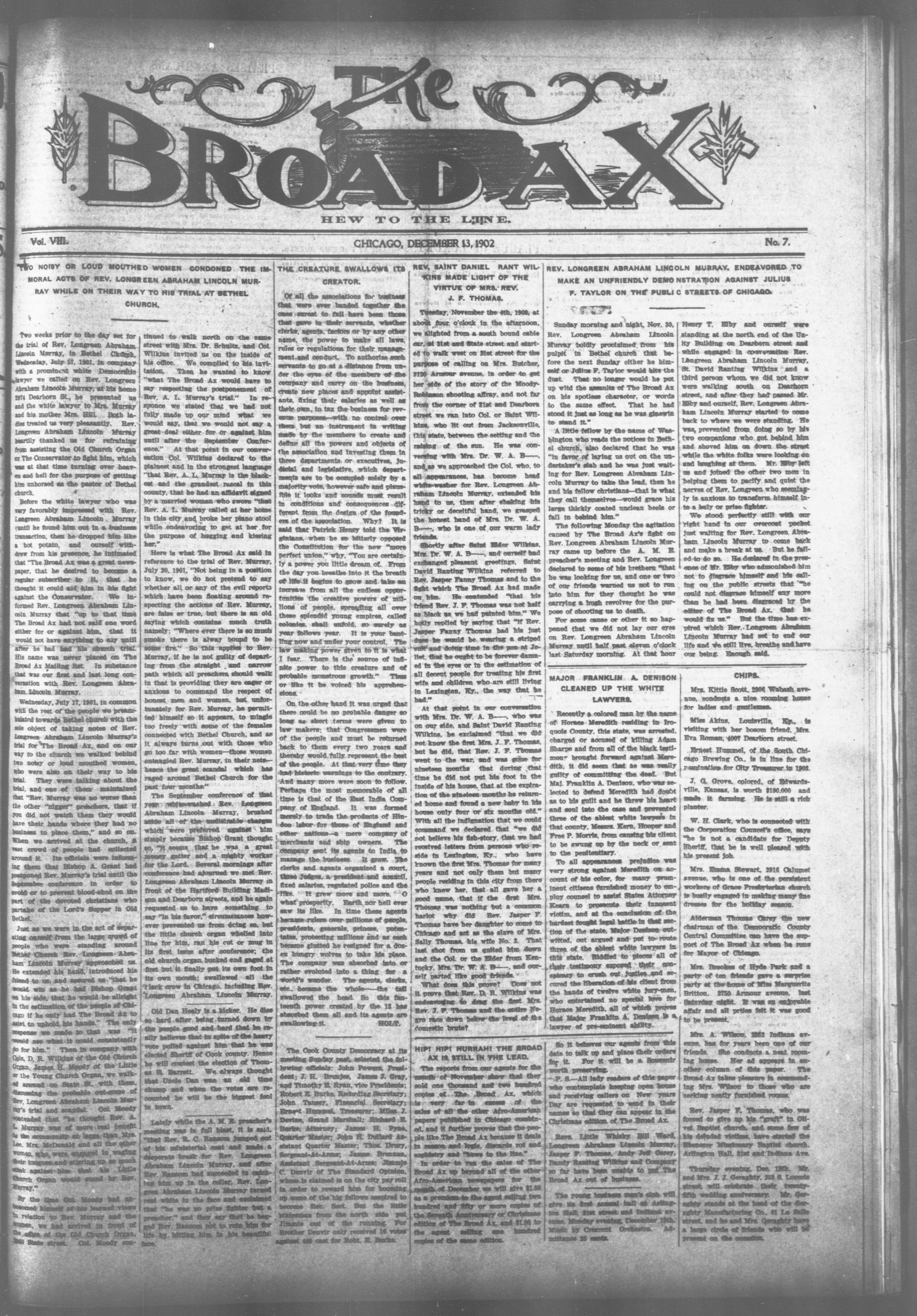
Two weeks prior to the day set for the trial of Rev. Longreen Abraham Lincoln Murray, in Bethel Church, Wednesday, July 17, 1901, in company with a prominent white Democratic lawyer we called on Rev. Longreen Abraham Lincoln Murray, at his home 2974 Dearborn St., he presented us and the white lawyer to Mrs. Murray and his mother Mrs. Hill. Both ladies treated us very pleasantly. Rev. Longreen Abraham Lincoln Murray heartily thanked us for refraining from assisting the Old Church Organ or The Conservator to fight him, which was at that time turning over heaven and hell for the purpose of getting him unhorsed as the pastor of Bethel church.
tinued to walk north on the same street with Mrs. Dr. Schultz, and Col. Wilkins invited us on the inside of his office. We complied to his invitation. Then he wanted to know "what The Broad Ax would have to say respecting the postponement of Rev. A. L. Murray's trial." In response we stated that we had not fully made up our mind what we would say, that we would not say a great deal either for or against him until after the September Conference." At that point in our conversation Col. Wilkins declared to the plainest and in the strongest language "that Rev. A. L. Murray is the blackest and the grandest rascal in this county, that he had an affidavit signed by a married woman who swore "that Rev. A. L. Murray called at her home in this city and broke her piano stool while endeavoring to get at her for the purpose of hugging and kissing her."
Here is what The Broad Ax said in reference to the trial of Rev. Murray, July 20, 1901, "Not being in a position to know, we do not pretend to say whether all or any of the evil reports which have been floating around respecting the actions of Rev. Murray, are false or true, but there is an old saying which contains much truth namely: "Where ever there is so much smoke there is alway bound to be some fire." So this applies to Rev. Murray, if he is not guilty of departing from the straight and narrow path which all preachers should walk in that is providing they are eager or anxious to command the respect of honest men and women, but unfortunately for Rev. Murray, he permitted himself so it appears, to mingle too freely with some of the females connected with Bethel Church, and as it always turns out with those who go too far with women—those women entangled Rev. Murray, in their nets—hence the great scandal which has raged around Bethel Church for the past four months."
The September conference of that year white washed Rev. Longreen Abraham Lincoln Murray, brushed aside all of the undicirable charges which were preferred against him simply because Bishop Grant thought so, "it seems that he was a great money getter and a mighty worker for the Lord. Several mornings after conference had adjourned we met Rev. Longreen Abraham Lincoln Murray in front of the Hartford Building Madigon and Dearborn streets, and he again requested us to have something to say "in his favor," circumstances however prevented us from doing so, but the little church organ whelled into line for him, ran his cut or mug in its first issue after conference; the old church organ bucked end gaged at first but it finally put its own foot in its own mouth; swallowed all the black crow in Chicago. Including Rev. Longreen Abraham Lincoln Murray.
HEW TO THE LINE.
Of all the associations for business that were ever banded together the ones surest to fall have been those that gave to their servants, whether clerks, agents, factors or by any other name, the power to make all laws, rules or regulations for their management and conduct. To authorize such servants to go at a distance from under the eyes of the members of the company and carry on the business, create new places and appoint assistants, fixing their salaries as well as their own, to tax the business for revenue purposes—with no control over them but an instrument in writing made by the members to create and define all the powers and objects of the association and investing them in three departments or executives, judicial and legislative, which departments are to be occupied solely by a majority vote, however safe and plausible it looks and sounds must result in conditions and consequences different from the design of the founders of the association. Why? It is said that Patrick Henry told the Virginians, when he so bitterly opposed the Constitution for the new "more perfect union," why, "You are certainly a power you little dream of. From the day you breathe into it the breath of life it begins to grow and take an increase from all the endless opportunities the creative powers of millions of people, spreading all over these splendid young empires, called colonies, shall unfold, so surely as year follows year. It is your bantling now and under your control. The law making power given to it is what I fear. There is the source of infinite power to this creature and of probable monstrous growth." Thus or like it he voiced his apprehensions.
On the other hand it was urged that there could be no probable danger so long as short terms were given to law makers; that Congressmen were of the people and must be returned back to them every two years and thereby would fully represent the best of the people. At that very time they had historic warnings to the contrary. And many more were soon to follow. Perhaps the most memorable of all time is that of the East India Company of England. It was formed merely to trade the products of Hindoo labor for those of England and other nations—a mere company of merchants and ship owners. The company sent its agents to India to manage the business. It grew. The clerks and agents organized a court, three judges, a president and council, fixed salaries, regulated police and the like. It grew more and more. O what prosperity. Earth nor hell ever saw its like. In time these agents became rulers over millions of people, presidents, generals, princes, potentates, protecting millions and as each became glutted he resigned for a dozen hungry wolves to take his place. The company was absorbed into or rather evolved into a thing for a world's wonder. The agents, clerks, etc., became the whole—the tall swallowed the head. So this fainteenth power created by the 12 has absorbed them all and its agents are swallowing it. HOLT.
The Cook County Democracy at its meeting Sunday past, selected the following officials: John Powers, President; J. H. Brunjee, James J. Gray, and Timothy E. Ryan, vice Presidents; Robert E. Burke, Recording Secretary; John Tansey, Financial Secretary; Ernest Hummel, Treasurer; Miles J. Devine, Grand Marshall; Richard E. Burke, Attorney; James H. Pyne, Quarter Master; John H. Dullard Assistant Quarter Master; Thos. Drury, Sergeant-At-Arms; James Brennan, Assistant Sergeant-At-Arms; Jimmie C. Denvir of The Standard Opinion, whom is claimed is on the city pay roll in order to reward him for booming up some of the big fellows aspired to become Rec. Sect. But the little statesman from the north side put Jimmie out of the running. For Brother Denvir only received 16 votes against 480 cast for Robt. E. Burke.
REV. SAINT DANIEL RANT WILKINS MADE LIGHT OF THE VIRTUE OF MRS. REV.
Tuesday, November the 4th, 1908, at about four o'clock in the afternoon, we alighted from a south bound cable car, at $1st and State street and started to walk west on $1st street for the purpose of calling on Mrs. Butcher, 3120 Armour avenue, in order to get her side of the story of the Moody-Robinson shooting affray, and not far from the corner of $1st and Dearborn street we ran into Col. or Saint Wilkins, who hit out from Jacksonville, this state, between the setting and the raising of the sun. He was conversing with Mrs. Dr. W. A. B——, and as we approached the Col. who, to all appearances, has become head white-washer for Rev. Longreen Abraham Lincoln Murray, extended his hand to us, then after shaking his tricky or deceitful hand, we grasped the honest hand of Mrs. Dr. W. A. B——, who is one of our warm lady friends.
Shortly after Saint Elder Wilkins, Mrs. Dr. W. A. B——, and ourself had exchanged pleasant greetings, Saint David Ranting Wilkins referred to Rev. Jasper Fanny Thomas and to the fight which The Broad Ax had made on him. He contended "that his friend Rev. J. F. Thomas was not half as black as we had painted him." We hotly replied by saying that "If Rev. Jasper Fanny Thomas had his just dues he would be wearing a striped suit and doing time in the pen at Joliet, that he ought to be forever damned in the eyes or in the estimation of all decent people for treating his first wife and children who are still living in Lexington, Ky., the way that he had."
At that point in our conversation with Mrs. Dr. W. A. B——, who was on our side, and Saint David Ranting Wilkins, he exclaimed "that we did not know the first Mrs. J. F. Thomas, but he did, that Rev. J. F. Thomas went to the war, and was gone for nineteen months that during that time he did not put his foot in the inside of his house, that at the expiration of the nineteen months he returned home and found a new baby in his house only four or six months old." With all the indignation that we could command we declared that "we did not believe his fish-story, that we had received letters from persons who reside in Lexington, Ky., who have known the first Mrs. Thomas for many years and not only them but many people residing in this city from there who knew her, that all gave her a good name, that if the first Mrs. Thomas was nothing but a common harlot why did Rev. Jasper F. Thomas have her daughter to come to Chicago and act as the slave of Mrs. Sally Thomas, his wife No. 2. That last shot from us quited him down and the Col. or the Elder from Kentucky, Mrs. Dr. W. A. B——, and oneself parted like good friends.
What does this prove? Does not it prove that Rev. D. R. Wilkins was endeavouring to drag the first Mrs. Rev. J. P. Thomas and the entire Negro race down below the level of the domestic brute?
HIP! HIP! HURRAH! THE BROAD AX IS STILL IN THE LEAD.
The reports from our agents for the month of November show that they sold one thousand and two hundred copies of The Broad Ax, which is very far in excess of the sales of all the other Afro-American papers published in Chicago combined, and it further proves that the people like The Broad Ax because it deals in reason and logic, discards rot and sophistry and "hews to the line."
In order to run the sales of The Broad Ax up beyond all of the other Afro-American newspapers for the month of December we will give $1.50 as a premium to the agent selling two hundred and fifty or more copies of the Seventh Anniversary or Christmas edition of The Broad Ax, and $1.00 to the agent selling one hundred copies of the same edition.
REV. LONGREEN ABRAHAM LINCOLN MURRAY, ENDEAVORED TO MAKE AN UNFRIENDLY DEMONSTRATION AGAINST JULIUS F. TAYLOR ON THE PUBLIC STREETS OF CHICAGO.
Sunday morning and night, Nov. 30, Rev. Longreen Abraham Lincoln Murray boldly proclaimed, from his pulpit in Bethel church that before the next Sunday either he himself or Julius F, Taylor would bite the dust. That no longer would he put up wilt the assaults of The Broad Ax on his spotless character, or words to the same effect. That he had stood it just as long as he was ginewin to stand it."
A little fellow by the name of Washington who reads the notices in Bethel church, also declared that he was "in favor of laying us out on the undertaker's slab and he was just waiting for Rev. Longreen Abraham Lincoln Murray to take the lead, then he and his fellow christians—that is what they call themselves—would grace his large thickly coated unclean heels or fall in behind him."
The following Monday the agitation caused by The Broad Ax's fight on Rev. Longreen Abraham Lincoln Murray came up before the A. M. E. preacher's meeting and Rev. Longreen declared to some of his brethern "that he was looking for us, and one or two of our friends warned us not to run into him for they thought he was carrying a hugh revolver for the purpose of shooting us to death.
For some cause or other it so happened that we did not lay our eyes on Rev. Longreen Abraham Lincoln Murray until half past eleven o'clock last Saturday morning. At that hour
MAJOR FRANKLIN A. DENISON CLEANED UP THE WHITE LAWYERS.
Recently a colored man by the name of Horace Meredith residing in Iroquois County, this state, was arrested, charged or accused of killing Adam Sharpe and from all of the black testimony brought forward against Meredith, it did seem that he was really guilty of committing the deed. But Maj. Franklin A. Denison, who was selected to defend Meredith had doubt as to his guilt and he threw his heart and soul into the case and prevented three of the ablest white lawyers in that county, Messrs. Kern, Hooper and Free P. Morris, from causing his client to be swung up by the neck or sent to the penitentiary.
To all appearances prejudice was very strong against Meredith on account of his color, for many prominent citizens furnished money to employ counsel to assist State Attorney Kearn to prosecute their innocent victim, and at the conclusion of the hardest fought legal battle in that section of the state, Major Denison outwitted, out argued and put to route three of the ablest white lawyers in this state. Riddled to pieces all of their testimony exposed their conspiracy to crush out justice and secured the liberation of his client from the hands of twelve white jury-men, who entertained no special love for Horace Meredith, all of which proves that Major Franklin A. Denison is a lawyer of pre-eminent ability.
Henry T. Elby and ourself were standing at the north end of the Unity Building on Dearborn street and while engaged in conversation Rev. Longreen Abraham Lincoln Murray, St. David Ranting Wilkins and a third person whom we did not know were walking south on Dearborn street, and after they had passed Mr. Elby and ourself, Rev. Longreen Abraham Lincoln Murray started to come back to where we were standing. He was, prevented from doing so by his two companions who got behind him and shoved him on down the street while the white folks were looking on and laughing at them. Mr. Elby left us and joined the other two men in helping them to pacify and quiet the nerves of Rev. Longreen who seemingly is anxious to transform himself into a bully or prize fighter.
We stood perfectly still with our right hand in our overcoat pocket just waiting for Rev. Longgreen Abraham Lincoln Murray to come back and make a break at us. But he failed to do so. He declared in the presence of Mr. Elby who admonished him not to disgrace himself and his calling on the public streets that "he could not disgrace himself any more than he had been disgraced by the editor of The Broad Ax, that he would fix us." But the time has expired which Rev. Longgreen Abraham Lincoln Murray had set to end our life and we still live, breathe and have our being. Enough said.
THE BROAD AX.
Will promulgate and at all times uphold the true
principles of Democracy, but Catholics, Protestants,
Priests, Indigents, Farmers, Single Taxers, Republi-
cans, Knights of Labor, or any one else can have
their say, so long as their language is proper and
responsibility is fixed.
The Broad Ax is a newspaper whose platform is
broad enough for all, ever claiming the editorial
right to speak its own mind.
Local communications will receive attention.
Write only on one side of the paper.
Subscriptions must be paid in advance.
One Year ..... $2.00
Six Months ..... 1.00
Advertising rates made known on application.
Address all communication to
THE BROAD AX
8040 Armour Avenue, "Chicago.
JULIUS F. TAYLOR, Editor and Publisher.
Entered at the Post Office at Chicago,
Ill., as Second-class Matter.
ADVICE FOR A WAITER.
How a Diner Made Sure That the Man Would Remember Him Next Time.
One Chicago man, laboring under the disadvantage of extreme provocation, recently found a novel way of informing an arrogant waiter that his method of serving was wholly unsatisfactory, says the Chicago Tribune.
The meal had been an exasperating one. Whenever the waiter was wanted he could not be found. When he was not wanted he was hovering about the table attempting to hear what was being said. The host and his friends had been compelled to ask emphatically for every accompaniment of the meal, even down to knives, forks and spoons, so by the time the coffee and cheese had been shoved aside they were in anything but a pleasant frame of mind. Still, throughout the meal the man who was doing the honors retained his composure, and did not once find fault with the waiter in the latter's presence. But he was reserving his ammunition for future delivery.
He asked for his check. The waiter brought it with a gracious bow and it was paid. Then the host arose with considerable dignity, and, reaching in his pocket, extracted a quarter, which he handed to the anxious looking whiter.
"Now," asked the host, after he had paid the customary tip, "do you think you would remember me if I came in here again?"
"O, yes, sir, yes, sir, I'm sure I would," replied the waiter, with a suave smile of satisfaction.
"Well," continued the exasperated guest, "I want you to remember me. Take one more good look at me, so you will make no mistake. And if you ever see me in this place in the future you will keep just as far away from me as the walls will allow. If you should attempt to wait on me again, I give you fair warning that I'll bounce one of these oak chairs off the top of your head."
With this parting shot the outraged guest wheeled on his heel and walked briskly from the place. The waiter did not recover for half an hour.
DICTATING SORE THROAT
A Curious Malady Which Afflicts Many Persons Who Employ Steadographers In Their Office.
Dictating sore throat is an affection of the vocal cords that business men get from the odd, strained, high voices that they use in dictating to their stenographers. "I don't know why it is," a physician said the other day, "but nearly every man when he dictates puts his natural, easy voice aside and uses a high-pitched, feverish note that plays the very deuce with the vocal cords as it grates over them. A man of big interests will dictate over 100 letters a day at times. His throat is so sore when he is done that he has to take some oleaginous and soothing medicine.
"The disease is distinctly a modern one," said the physician, according to the Philadelphia Record, "a sign of these complex modern times, and it has been called, for want of a better name, dictating sore throat. The only cure for it is to teach men to dictate in their natural voices (a thing that seems to be impossible) or to compal them to cause dictating altogether."
LEFT IN DEPOSIT BOXES.
Some Strange Revolutions Are Made When They Are Opened by Vault Officials.
It often happens that deposit boxes rented in bank vaults are opened on account of arrears in payment on the part of the renters, who cannot be found. Then strange are the revolutions of a box's contents.
A young woman had a box in a downtown bank and failed to pay its second year's rent. As she had disappeared from her former residence the box was opened recently. All it contained was a pair of baby shoes.
Another box rented by a man disclosed, on being opened for the usual reason, a diamond brooch worth at least $400. The bank has held the brooch for three months, in the belief that the man or his hairs will one day claim it.
Often these boxes contain interesting letters—letters from an aged mother to her son, says the Philadelphia Record, from a young man to his sweetheart, from a grateful pensioner to his benefactor.
```markdown
```
Nobody seems to know what cause it is which produces those delicate and beautiful lines in maple, known as bird's-eye. Some people think they come from the hundreds of little branches which shoot out over the trunk of the tree as soon as a clearing is made around it. Expert timbermen say that is not the case. The only way to tell a bird's-eye maple tree is to cut it. There are no outward signs by which one can judge. The Railroad Gazette tells a story of the late George M. Pullman. Many years ago he was offered a mahogany log for $3,000, to be cut into veneers. It was supposed to be a very fine piece of wood, but this could only be determined by cutting it. He declined the offer, but agreed to take the log cut into veneers for what it was worth. The owner had it sawed and was paid $7,000 for his veneers. Anyone who can discover the secret of determining the interior nature of wood from the outside will have a fortune.
OPERATING MARIONETTES.
Remarkable Ingenuity and Skill Displayed by One Man in the Business.
"The ingenuity of some of the handlers of marionettes," said a showman, "is incredible. I know a man who conducts a marionette theater, wherein an orchestra of eight pieces plays under marionette leadership, while in the boxes a dozen marionette spectators laugh and applaud, and on the stage a marionette drama briskly enacts itself.
"The conductor of all this stands, exposed to the waist, at the back of the stage, and apparently he is motionless, though really each finger of both hands and the majority of the toes of both feet are working with unexampled rapidity. For each marionette is connected by a string with a toe or a finger of the operator, and this string sometimes has as many as ten or fifteen branches, joined to the manikin's face, body, arms, legs, etc., so that it may dance, smile, wave its arms and do a number of other lifelike things. One of these figures, indeed, is connected by 32 strings to the operator.
"It is bewildering to think of the number of strings there must be altogether," concluded the showman, according to the Philadelphia Record, "and really it is impossible to conceive of the dexterity and the thought required in the artistic manipulation of a band of marionettes."
BEAUTIFUL TROPICAL FISHES.
Many Fine Specimens Gathered in the Bermudas for the Aquariums of All Lands.
The collection of tropical fishes for various aquariums throughout the world, and especially for the American aquariums, is now a recognized industry in the Bermudas, says the Philadelphia Press.
It is carried on at all seasons, though for obvious reasons the fish are shipped north only in the summer months. As there are more than 150 varieties of fish in Bermudan waters, and every variety is found in abundance, it is not a difficult problem to secure good specimens. Only a few varieties reach this country, for the reason that tropical fish, as a rule, are unable to stand the trials of transportation. The ones on exhibition are the finest that can be caught. The native fishermen go far and wide in search of specimens, for the aquarium will pay only for the best.
Possibly the most voracious fish they have to deal with are the groupers and morays. The groupers have peculiar habits. During the month of June, which is their spawning or "snapping" season, they gather at two spots on the south coast, known as "grouper grounds," and rarely are caught elsewhere. Not many tropical fish are as ferocious as the moray, but most of the longer varieties are truly sporting fish.
WORKING IN THE DARK.
Discounforts of Mining Before the Invention of a Lamp Suitable for Underground Use.
The difficulties under which coal mining operations were carried on before the scientist Davy had invented his safety lamp must have been very great. In many mines the only alternative the medieval miner had to pitch darkness was the phosphorescent gleam from dried fish. The miner's implements, originally of stone or hard oak, gradually improved, but he was forced to work in almost complete darkness until Sir Humphrey Davy by his remarkable invention enabled him to light his way through the tunnels he had excavated with comparative safety, says a mining journal.
Agricola, an author who wrote about the middle of the sixteenth century, has left an elaborate treatise on coal mining as it was practiced during the middle ages. From this we learn that the horsegin; which survives to the present day in some of the mining districts of Great Britain and northern Europe, was the engine chiefly employed both for lifting the coal and for getting rid of the water. This latter object was also sometimes effected by means of pumps turned by windmills or by tunnels driven with great labor to an outlet at a lower level.
THE SEVENTH ANNIVERSARY OR THE CHRISTMAS EDITION OF THE BROAD AX
It is with pleasure that we are able to announce that the Seventh Anniversary or the Christmas edition of The Broad Ax will consist of ten thousand copies. It will be printed on fine aberdeen book paper. It will contain articles on the "Race Problem in this country" and other interesting subjects by Doctor Howard S. Taylor, Prosecuting Attorney of Chicago. Prof. W. H. Councill, Normal, Ala. Miss Ida C. Sweet, Ex-Pres. of the Chicago Woman's Club. Theodore W. Jones Ex-Commissioner of Cook County. Miss Cornella Bowen, Principal of the Mt. Melgs Colored Institute Waugh, Ala., Col. Clark Irvine, Oregon, Mo. Mrs. L. A. Davis, National organizer of the Association of Colored Women's Clubs. Dan Morgan Smith Jr. late candidate for Congress in the 3rd Congressional District, and others.
It will contain short sketches of some of the most prominent Afro-American business and professional men of this city. Now is the time to get in on the ground floor and secure advertising space and write-ups in the Seventh anniversary or Christmas edition of The Broad Ax, for it will reach high water mark in Negro Journalism in the West.
PLAGUE OF LUXURY.
How It Has Fallen Upon the People with Prosperous Times.
With the Introduction of Modern Conveniences and the Country's Growth in Kitchen, Even the Flat Dweller Lives High.
The growth of luxurious living in America was very slow during the first 50 years of the republic. Indeed, up to the breaking out of our civil war the inequalities of fortune were not so marked as to make those who lived sumptuously according to the standards of those days seem so far removed from the merely well-to-do as to be almost in another world. In the earlier days, any sober and industrious man could prosper, even though he did not perform merely manual labor. There was work for every one to do, and no one was more in demand than Mr. Jack-of-all-trades, who now walks superfluous in the dusty highway, with no one to applaud his adaptability, none to need his ingenious services. Food was plenty, land was cheap, rents were low. Be honest and you will be happy, was not mere cant; it was the solemn and the grateful truth. Pretty nearly every one lived well, but pretty nearly all lived plainly. With better houses, with better water supplies, with improved lamps for illumination and then with the introduction of illuminating gas, and most of all with the greater wealth which came at the end of the civil war, the growth of luxurious living began taking tremendous strides. Luxury with poor light after sunset, luxury with few, of the means of personal cleanliness, does not mean much to us nowadays. Why, a man in a Harlem flat at $600 a year can command more of the kind of luxury just mentioned than say the dissolute Charles II. ever dreamed of. But the wealth that comes with new fortunes to new people was really what began the race which may be called the Millionaire Stakes for all ages, says a writer in Ainslee's Magazine.
Before these stakes were opened there were a few fortunes in this country. Some were made in the trade with the east, some were made in strictly domestic commerce, some were founded in piracy, and other adventures by sea, but the greatest number and the most stable were those which came from the shrewd investments in land which was enhanced in value by the growth of cities. Even up to the time that the newly rich began to splurge, the owners of the fortunes just mentioned were pretty generally tolerably plain people, who lived very quietly and looked upon those who made unusual display as too vulgar to come inside the sacred pale which called itself society. In New York, this class of people at the time mentioned lived in the neighborhood of Washington Square; in Philadelphia, toward the foot of Walnut street, and in Boston, in that ever sacred Beacon street. They were slow but sure. They had no doubt about their position, or the propriety with which they maintained their dignity. They did what they pleased, but they did not please to be in the least fantastic, theatric, ostentatious or conspicuous. And until the newly rich had arrived, with the manifest intention to stay permanently, there were none with either the ambition or the ability to dispute this supremacy, which was maintained not by an aggressiveness, but by the passive power of inertia.
Set Well Posted.
Just how much the average Englishman knows about this country was illustrated in Washington a day or two ago. James Blackie, a traveler from London, saked the alerk in his hotel how far it was to Michigan, as he wished to call on a friend there. The clerk inquired to what part of Michigan Mr. Blackde wished to go. The traveler did not know exactly, but said: "I can easily find out in what part of the city he lives when I get there." "What city?" inquired the clerk. "Why, the city of Michigan, of course," said the intelligent Briton.
When a train leaves a platform or a steamboat pier in Sweden, all the lookers on lift their hats to the departing passengers and bow to them, a compliment returned by the travelers. If you address the poorest person in the street you must lift your hat. A gentleman passing a lady on the stairs of a hotel must do the same. To enter the shop or a bank with one's hat on is a terrible breach of good manners. If you enter or leave a coffee room you must bow to all the occupants.
Strength of the Saxon.
An average Bottleholder is as strong as
two Hindus.
ENGLISH AT FOREIGN HOTELS.
Words Put Together in a Fashion What Is Something Fearful and Wonderful to Contemplate,
Many gems of the curious English of foreign hotel keepers have been given to the public. Among the best, says Stray Stories, is the tale of the host of a well-known establishment in Greece, who was wont to greet his guests in an effusive manner with: "What you prepare—a hiftak or a chiek-hen?"
Their astonishment at the mastery of the language was frequently deepened when, upon their return to the hotel a few hours later, they found nothing prepared. It was his only English sentence, and he did not understand a word of it.
This, however, is not quite equal to the placard in the possession of a naval officer just returned from Egypt. He procured it at a safe chantant in Alexandria. It was printed in several languages, and this is the English part: "Every of the consumations of the coldness, one piastre besides. Every of the claim to be addressed directly of the direction. During of the repetitions the price of consumations to be the same that in every the other's coffee."
With the aid of the parallel passages in other languages the meaning is found as follows: "All iced drinks one piastre extra. All complaints should be made at the office. Nothwithstanding the performance the prices will be the same as those of other cafea."
THE FINISH AT MONTE CARLO.
Those Who Lose Their All at the Gaming Tables Go Biscewhere with Their Misery.
One sees only the appearances of luxury and of gayety in this glittering community. Despair would make a blot upon it. Those who have lost their fortunes, disappear like magic, and while the newspapers announce on their first page, "Monsieur le Duc has left the azure coast and has returned to his sumptuous apartments," the poor devil goes to conceal his shame in some little shanty lost in the ocean of Parisian room, says Harper's Weekly. But all have not the courage to go away. Many stay. Of such not a word is heard. The cold, the rain, the fog, ruin, and death are and ought to be, according to the announcement of the company and the press, wholly unknown in this favored spot. Orange trees always in flower, palms trees always green, and the sky always blue, a continual fete, winners, fortunate gamblers, nobles, millionaires, counts, dukes, grand dukes, highnesses, and princes, princes, princes—that is what people want at Monte Carlo. A pistol shot is never heard, never wakes an echo, never causes a scandal. The walks where the cactuses stretch out in perspective toward the sea are always clean and well sanded. One never sees a drop of blood.
THE TURKISH POST OFFICE
An Institution That Regards with Suspicion Anything of a Foreign Nature.
The Turk suspects everybody and everything, and no private act, no solicition is safe from his intrusion. Every telegram sent from the public offices is at once reported to the authorities. No one can safely send a letter by the Turkish post unless he is willing to have it opened and read, and take the chances of having it confiscated if the censor finds anything that can be twisted into an insult to Mohammedanism, says Outing. As a result of this condition and the inability of foreigners residing in Turkey to communicate with any certainty with their friends, some of the great European nations have established post offices of their own in Turkish cities, in which they employ only Europeans, use their own stamps, and watch their mail bags until they pass beyond the prying eyes of the Turks. In Salonica there are no fewer, than five post offices—British, Austrian, French, Serbian and Turkish; in Constantinople, six. If one wishes to be sure of his mail, he must inquire at four of them at least; and if he really wants to have his letters reach their destination, he must send them through some post offices other than Turkish.
Millions of butterflies are eaten every year by the Australian aborigines. The insects congregate in vast quantities on the rocks of the Bugong mountains, and the natives secure them by kindling fires of damp wood, and thus suffocating them. Then they are gathered in baskets, baked, sifted to remove the wings, and finally pressed into cakes.
China's Late Minister, Wu Ting Fang, Gives His Impressions.
Americans are known, in whatever quarter of the world chance happens to throw them, by their marvelous self-reliance and independence. A typical American is never at a loss what to do with himself, writes Wu Ting-Fang in Success. If, by some enchantment he were whisked away over night and set down in the middle of Timbuctoo, he would, doubtless, when he should awake the next morning, be astonished, but before luncheon he would be busily engaged in some business enterprise, so readily does he adapt himself to circumstances. In every instance he knows how to take care of himself, but perhaps the real secret of his success is that he knows how to make the most of his opportunities.
An American student usually realizes that education is the stepping-stone to achievement. He studies with the expectation of fitting himself for the profession or occupation he is ultimately to enter. He makes the most of himself as a student, that he may be able to make the most of himself in his chosen career. All through his course of study this idea is instilled into his mind, and the consequence is that he leaves his college or university well prepared to enter upon life's activities. He is sure of himself. I may also add that the schools of the United States, both public and collegiate, are the crowning glory of this young and great republic. No words can bestow upon them too high praise. No estimate can be put upon the good which they are accomplishing in training young women as well as young men for future usefulness. Systematic education is reaching its highest form in this country. Its results are so practical that the country cannot help but advance.
The intelligence of the average American is worthy of note. This, I take it, is due in large measure not only to the excellent schools, but also to the innumerable newspapers and other publications. I have found, in all parts of the country, that in every town of any size there is published a daily paper, and that the metropolitan publications circulate in the homes of the most remote corners of the land.
The abilities to seize his opportunities, which is characteristic of the American, is seen in the business enterprises of the country. Its industrial machinery is adjusted to the production of its wealth on a scale of unprecedented magnitude. This is a valuable condition. American brains and American capital are reaching out to control the markets of the world, and, with good reason, other nations are watching the efforts with keen interest. China is but awakening to its vast possibilities, and more and more will she welcome the American merchant and American commerce within her borders. American enterprise is now building a railway from Hankow to Canton, and, no doubt, other roads will soon be building. China's rivers and harbors are to be improved, and there will be more and more demand for American steel, rails and other products.
STATUES HAVE SMALLPOX
Epidemic of Disease Among Bronze Figures in Athens-How They Are Affected.
A most extraordinary disease, extremely infectious and resembling smallpox among human beings, has broken out among the statues in the Egyptian room of the National museum here, says an Athena (Greece) correspondent of the New York Times. A few days ago the distinguished politician and archaeologist, Mr. Stephanos Skouloudes, noticed some strange green marks on one of the bronze statues of the famous Egyptian collection presented to the museum in 1881 by Mr. Demetrios, of Alexandria. He at once communicated his discovery to the curator, who called in experts to examine the statue in question. They pronounced the marks to be due to an infectious complaint, to which bronze is liable, and which gradually spreads from the surface of the object affected to the inside, till the whole crumbles away into dust. The other bronze statues in the same room were then inspected, with the result that they were all found to be more or less tainted with the disease, while five of them had taken it in a most aggravated form. These five are the statues of Anta, the goddess of war; of Maout, wife of Jupiter Ammon; of Isis, and two statues of Osiris, one of them of the greatest value. Worse that that, the infection has spread to the Mycenaean room, which contains the results of the late Dr. Schliemann's excavations in 1876. There a dagger, which was found in the fourth and finest of the six tombs, has fallen a victim to the malady. Altogether about fifty statues are badly affected, and the loss will be enormous unless the plague can be stayed. A leading Athenian chemist pronounces the cause of the malady to be the presence of salt in the bronze of which the statues are made, and his remedy is to extract it by means of baths. Mr. Momphematos, the minister under whose department the museum comes, is taking steps to save the bronze.
A Product of the Maine Forest Which Is Regarded by the Lumbermen as Very Good.
"Did ye ever eat hot gingerbread with soap in i..'" asked Frank Brown, the oldest camp cook on the West Branch, who, according to the New York Sun, boasts that he has made more than 2,000 barrels of flour into cream of tartar bread in the course of 26 winters in the forest. "If ye hain't o't it, you don't know what's good.
"Why, a lumberman would no more think of eating gingerbread without soap into it than he would think of drinking new rum without molasses. They always go together—soap into the gingerbread and molasses into the rum, and both are just about as good as is made.
"My rule is to dissolve a hunk of hard soap as big as a hen's egg in a gallon of water, then pour in a gallon of molasses, a half pound of baking powder and stir in the flour until the dough will almost run. Then grease yer pans, slap in the mixture and chuck it into a red-hot oven.
"When it comes out all golden brown and full of sweet bubbles that smoke when you break them open—the man who won't eat such food isn't fit to live or die.
"You can't tell me that soap gingerbread ain't fit to eat. I've eat it more than 25 years, and I'm just as sound to-day as I was when I first tasted the food."
INCREASE IN SUICIDES
Figures Collected by an Insurance Company Prove That Self-Murder Grows More Common.
In the Spectator, an insurance journal, the statistician of an insurance company gives an analysis of the suicide record for the year 1901. His figures are taken from 50 cities, and show an average slight increase over the ratio for the preceding decade of nearly one per cent., from 15.7 to 16.6 per 100,000 population. He estimates an approximate annual mortality by suicide of 10,000 in the country as a whole. The implied conclusion is that a further increase in the rate of suicidal tendency in the cities of this country may be expected during the next decade, and the suicide question, like arson in fire insurance, is thus becoming more and more one of the utmost importance to life insurance companies.
He also gives another table showing the experience of one company for the last 55 years, dividing it into two periods, including males only, as the female suicide statistics are too insignificant to be tabulated. This shows a percentage of suicides in the total mortality of 2.4 in the later as compared with 1.9 in the earlier period. The age of suicides seems also to have lessened, as the suicides under 45 increased from 2.1 per cent, to 3.9 per cent in the later period, and there was an actual decrease of those in advanced life.
OUR SHOES IN MEXICO.
They Are Much Liked by the Natives But the Prices Are Successively High.
According to United States Consul Canada at Vera Cruz, trade conditions in that part of Mexico have undergone a great change within the past ten years, especially with respect to American shoes. In former years it was impossible to buy anything in Vera Cruz in the line of shoe leather except that of native stock and manufacture, and ready-made shoes for Americans were not to be had at all.
United States shoes have, however, within a very short time made a name for themselves, and, the consul says, were it not for the excessively high prices asked for them they would surely drive all others out of the market. As it is, however, he adds, only the better classes can enjoy the luxury of our shoes, and the great mass of the people is debarred from that privilege. The principal obstacle to a heavier business is the high import duty and the fluctuations in the value of silver. The duty on the cheapest shoes is the same as on the finest productions.
GAVE A LARGE REWARD.
Be Thought the Bestower and the Young Here Who Received the Money.
"The following story will illustrate a number of things," said the Detroit ship owner who narrated it, "but chiefly will it show how the value of money varies with the supply.
"A boy was telling me of his prowess as a swimmer. He could dive, too.
"Once,' said he, 'I dived down to the bottom of the river and pulled a little boy out."
"Bravo!' said I.
"An' I tell you,' he continued, 'his pa was glad! He give me a dollar-en-a-quarter.'
"Both the father and the hero live in a neighborhood the occupants of which are sometimes known as 'wharf rata'—the neighborhood or the docks. I have no doubt," concluded the ship owner, according to the Detroit Free Press, "that the dollar-and-a-quarter was as large to the man as to the boy."
A Japanese M. P., Mr. Tanka by name, has been sentenced to 15 days' confinement and a fine of ten shillings for yawning in parliament. The crown prosecutor maintained that in an assembly where order has to be maintained, even an act of a physiological nature should be controlled. As the defendant, however, had yawned in order to annoy the government, the defence was even more punishable.
rT}
gare in Per b factories. ”
's oulp FS x
ee age ae
son on
faye cory
ite surplus ste, Fs
2 to afford thet rere tm
d bathe per week, =
German So in 7m
tee street CF inductors, who
eee
E golisrs & month to their |
richest farm im the world is an
‘worth $288,000im: New
ultra-fashionable dis de
ae 2 1 ated Seay
give It and
produce is sold et the Dearest mar.
During the civil war the site
govered by @ government réoruit-
station
jreseareh steamer belonging to the
jan government recently dr
on the North sea some ¢xperi-
fishings which yielded impor
results. In three days 117 halibut
30 lerge cod were caught at «
of 200 fathoms, thus proving
esirtence of large quantities of
fishes at a time of the year when
‘sre not to be found on the coast
Norway.
Msny people imagine thet the in-
t electric light gives out little
po heat, but it is found thet of the
merey consumed only six per cent.
| converted into light, while 95 per
eat. goes into heat. A lamp immersed
ip water will bring the weter to «
il, and many casew Of fire have been
mused by carelessness fm letting in-
giummable substances rest in contact
with the lamp.
Prof. Jemes Dewar, president of the
nus] meeting of the British Asso-
dstion for the Advancement of Sci-
nce et Belfast, has pointed out in the
poldest language thet while English-
pen have repeatedly discovered scien-
fe principles and lawe of great im-
portance, the Germans and Americans
save been making the practical eppli-
ations of them, leaving England be-
nd in reaping the advantages.
COMPLAIN OF STAMPS.
Lat Recently Sent Out by Post OGice
. Department That Stuck 3
= Tee Well, as Pe
| Many complaints have been made
to the post office euthorities that the
stamps sold in books of 24 and 48 heve
‘bad « wey of sticking to the paraffin
paper that wae supposed to protect
the mucilage on them. An investiga-
tion was made, with the result that a
cireular was issued authorizing the re-
demption of stampe so glued to the
sheets in books.
It was explained thet “by mistake”
the contrector who made the books
bed used a poor quality of paraffin pa-
per. Postmasters were instructed to
return to the department at Washing-
ton ell books of stamps made with this
inferior quality of perafiin fly leaves
which they had om hamd. Under this
order about $12,000 worth of damaged
books have been turned in, and it is
thought that there will be little more
trouble of the kind. . -
This is not the only stamp trouble of
the post office. Particularty from the
south end along the Atlantic coast
there came many compleints that the
ordinary one end two-cent stamps
suck to everything they touched. A
theet of 50 or more was turned in at
the New York post office, this week.
They had Been gemt loose, in a letter
from the south and were hopelessly
glued to the paper, e
Whether the trouble is due to some
thing wrong with the mucilage or the
aboormelly wet sesson jin the south
and along the coast has not been de
ee: There to aejgeeeen i
redemption by postmasters
damaged individual siamese. i“ i itis
Decling f& Switsectané.
The duel, though prohibited by lew,
still exists in Switzerland, but the
practice is confined to the etudente in
the Swiss German universities. Even
these fire-eaters are beginning to real-
ise the absurdity of the prectice, for
© meeting wee held ot Zurich lately
st which student delegates from ell
parts were present, to discuss the duel
4nd courte of honor. A'proposition by
the president to ebolish the duel altc-
gether wae rejected by « large major-
ity. The consequence wes thet a large
number of duele which were previous
ly arranged and whose principles were
awaiting the result of the vote took
place ot Bremgurten, nesr Berne.
Many students received severe rapier
cute, chiefly im the face, but nobody
eee ee The police,
though they know practice exists,
and are often aware ‘of the “effair,”
eeldom interfere, for they look upon
the duel, as practiced by the students,
asa sporting end harmless matter.
ltée certain that nobody has ever been
seriously hurt in these affairs of hon-
0? —Loadon Times.
The Ingentous Inventor.
“The marke? ie overzun with substi-
tutes for this food and that,” asserts
the capitalist. “I see no justification
for backing your new health food.”
ee ee
im end suggeste:
“But it may also be used as «.eubsti-
tute for coal.” ae ee SS
Then the capitalist displays unusus!
‘ctivity in sendihg for patent attor-
Deys and clerks to drew up articles
*f partnership —N. ¥, Times, 3
Qbeoseeoe
dora gene aeenteie ie
walecp? Se eosin aeeadachaspom
intings.” ~~ Se er Le
Ku é
ye
Kuicher—“Gee} what. lot of ‘em
rose go, You meme eo
ndelghe ee
GOLDEN GATE CITY LEADS.
é : ess '
San Freneiem Shows tho Leqwest Peo
contage of Sutciftes—Chienge
Remks Thind.
‘The number of people who volun
‘Werily shuffied off this mortal cail in
Sots
clive lends Sith the aegese reso Do
= are eee?
100,000 of population. Next comes
Tatung been lonking tor" Cheage,
and that city does, in fact, come next
with @ ratio of 249, followed by the
Sel EO at Hiiwasinos, Srbeee
‘i 22.2.. New Orleans was the
scene of the self-destruction of 21.8
Persons per 100,000 of population, and
Cincinnati followed’ close with 41.2,
‘New Haven is next with 20.9, and then
comes the borough of Manhattan with
30.8, though greater New York as a
whole is well down the fist with a ratio
of only 18.4.» This is less than Roches-
ter, Indianapolis, Philadelphia, Pitts
burg, Baltimore, Boston, Detroit,
Omshs and Louisville, besides all of
those specifically enumerated above.
As'to the foreign cities, Paris leads the
list with @ ratio of 42, 2ellowed by
Berlin 36, Vienna 28 and London 23.
There were more suicides in Saxony
than ip any other country, 31.1 per 100,-
000. In Denmark the ratio was 25.8, in
Austria 21.2, in France 15,7, in the Ger-
man empire 14.3, and Sweden, Norway,
Beigium, Great Britain, Ttaly, the
United States and Spain followed in
the order given. .
The table referring to American
cities is somewhat difficult to explain.
Why the city of the golden gate, and
California, with its glorious climate,
its sunshine, its fruit and ite flowers,
should show the greatest number of
suicides seems a mystery, unless the
presence of a large Chinese population
explains ft. The high suicide rate
of Chicago is, perhaps, accounted for
by the rush and struggle of that great
city and the large foreign element it
contains—a foreign element, more-
over, which comes mainly from those
countries where suicide is most fre-
quent, The same is perhaps true of
Milwaukee and of Cincinnati. The high
rate at New Orleans may possibly be
attributed to its relation to France
and the ideas and traditions brought
here from Paris, the suicide capital of
the world. But New York city casts
a cloud over some of these explena-
tions. Here are the large foreign pop-
ulations, the stress and strain of liv-
ing and working, the poverty, the ex-
citement.. Yet Philadelphia, the
sleeping city of the humorous pere-
gtaphers, has a higher ratio of sui-
cides than greater New York. And
how is it to bé explained that New
Haven leads all the other New Eng-
land cities in the number of suicides?
St. Paul and Minneapolis lie side by
side, but in Minneapolis the ratio is
11.4 and in St. Paul it is but 65. It
séems that the conclusions must be
that there is no method in suicide mad-
ness and that the effort to reduce it to
Tale is doomed tofaijure. _
CARP OUSTING WILD DUCK.
Useless Themselves; They Have De-
streved the Wild Rice Fields
i Owtartc, Canaséa,
‘The singular complaint comes from
‘various parts of northern Ontario that
fish are responsible for the disappear-
ance of certain kinds of game. In lo-
ealities which were formerly noted for
the excellent duck shooting which they
offered the birdsere new not to be had
‘et ell. ,
The ducks, geese and other aquatic
‘birds were formerly in the habit of
frequenting the large fields of wild rice
im the lekee and streams of parts of
Ontario, but now these fields have been,
im many instances, destroyed by the
German carp, which hes found its way
into these waters. The vegetarian diet
of this detestable fish not only ruins
the flavor of itsown flesh, but exhausts
the food supply.of some of the most
@esirable forms of feathered game,
gaye the New York Sun. .
The Ontario inspector of fish-
eries, who has been in north-
ern. Ontario for the last few
weeks, reports thet the German
carp has not only became danger-
ous to other fish, as has been frequent-
lyclaimed, but that in Cook's bay, Lake
Simeoce, where there were formerly
hundreds: of acres of wild rice, not o
spear of thet plant is to be seen to-day.
The same is true of the Holland river,
where there were at one time 1,500
acres of ripe. The carp have eaten it
Toot, branch and seed.
The almost incredible part of it fs
that the fish have entirely destroyed
the fields in one year. The aquatic
that all their usus] feeding grounds
have disappeared, cut short their visit
and move away in search of others.
“The local sportsmen complain, too,
of wild celery, and that they, too,are
“Tt remeins to be seen what the ef-
fect ‘of this wholesale destruction of
Scenes
‘tected and developed without the rice
‘pede. He does not accuse the carp of
tates that = mate
ie inet tae
eemeee ts nee oneee
ep ae See ie eis
‘of muskallonge tre eee ie er
epewning purposes. OS eee ee
4 Monster Hashreom. ;
Weigtli three pounds four ounces,
cireumference forty-five inches, is the
Hescription of smother ‘monster
teushroom which has been gathered
et Breconash, Norwich, England.
ine ana eben apr te
Ue sea?” it hugs the
me I guess."—Indianspolis News.
Z . Catastrophe.—“So your
akiet matoe great bin?’ “Wal, bard
Swe gense t ee ag
target.”—Detroit Free Press.
| “What kind of « stove did the pre-
historic man use?” asked the little
Ostend. “Probably be used « moun-
tein range.”—Philadelphia Record.
. “They caughte man robbing the pub-
lic brary till in a New England town.”
“How did they punish him?” “Made
him read all the historical novels.”—
Clewand Plain Dealer.
a aes it would be to Hveslone
you yonder lighthouse!” he
whispered, tenderly. “Yes,” she mur-
mured, abstractedly, “end do light
housekeeping.”—Smart Set.
Bery—"“Well, all I've got to say ie
thet Ethel is a two-faced creature.”
Sibyl—“Yes, and she'd look better if
she'd use the other face instead of
er present one!”—Baltimore Her-
Beetem—“Pshaw! I must have $20
by noon to-day, and i left all my money
at home in my other clothes. Can’t
you help me out?” Wiseman—‘“Sure.
Tivlend you carfare to go home for it.”
—Philedelphia Press.
Barnese—“I hear your house was
broken into t’ other night end lots of
silver plate and jewelry stolen.”
Shedé—“Yes! but the rascals entirely
overlooked the ten tons of coal in the
cellar."—Boston Transcript.
A Satisfactory Man—New Man—
“Here are some poetic contributions
which came in to-day’s meil. Iam not
up on poetry.” Editor—“Good! 1
don’t want you to be up on it. I want
you to be down on it.”—N. Y. Weekly.
END OF 4 STAGE CAREER.
Sew One Man's Admirativn tor the
Senge Was the Cause ef Mis
Remaa HKeee
“My wife tells me that our 15-year-
old boy is stage-struck,” said s man,
smoking his after dinner cigar over
om another man's piazza, according
to the Detroit Free Press. “She is
worried about ft, but I tell her to
take it easy—it will all come right.
I was stage-struck once myself, and
that's how I came to have this hand-
some Roman nose, and to be a re
spected and prosperous lawyer.”
“Roman nose,” repeated the other
man, “I can't see the connection be-
tween a Roman nose and your being
stage-struck.” ’
“Well, the connection is there, all
right,” continued the other msn,
fondly caressing the little arch in the
middle of his large, ornamental nose.
“At 17 Iwas badly stage-struck; and,
of course, my parents bitterly op-
posed all such notions om my part.
The fever continued to increase, how-
ever, and with two other young. men
of the same age, I secretly organized
an amateur comic troupe to go on
the road when the time was ripe. As
a starter we decided to try our grest
entertainment on a country town not
many ‘miles away. We eloped with
our outét, guitars and gaudy ward-
robes one day, and had no trouble
im getting together « pretty fair au-
dience that night, at ten cents each.
The songs, dances and dialogues went
off all right. They were really fun-
ny, I believe, even now; but at the
close of the entertainment I met
with bad luck.
“In going out to ennounce another
sppesrance the next week I clumsily
saught my foot in the folds of our
impromptu drop-curtain, and . pulled
the heavy curtain pole or roller down
on my straight Grecian nose—the
pride of my mother's family, and
mine by inheritance.
“I was assisted to my father’s root
the next day, with « fractured nose
and two very black eyes. By the time
I was well again my erdor for the
stage had abated; and I believe my
eon will get over the mania, too. My
wife, however, has not heard the
story of the Roman nose, and she
rather edmires it.” es
. ‘The Comserva Season,
‘This ip the season of the year when
the wife of the Italian laborer begins
to think of laying in her winter stock
of conserva. Conserva is « dish with-
out which no Italian family would
think of passing the winter. Every
year about this time the average Ital-
fan housewife may be seen buying
large quantities of tomatoes. The
tomatoes need not be overchoice and
sometimes the softer they are the bet-
ter conserva they make. The tomatoes
are taken home, put in « press and
then squeezed until every drop of jnice
has been extracted. The pulp which re-
msinsis spread upon a board and placed
dm the oun to Gry. When it has at-
tained the consistency of putty it is
scraped together and placed in airtight
jare for the winter. It is used for mak-
ing eendwiches and sometimes forme
the staple of the laborer’s meal —Lon-
don Exchange.
Chances Gaved the Chameics.
Téke many another popular idol,
Crescets wae of humble origin, and
‘worked unususily bard for hie honors.
His trainer, the celebrated horseman,
John McCartney, tells us that, asacolt,
Cresceus “was plain looking, awkward
in all his movements and had little of
the appearance of = coming cham-
pion.” As a yearling, the colt injured
himeelf so badly that “his owner, Mr.
George H. Ketcham, a wealthy young
businese man, of Toledo, 0.. who had
engaged in the horse breeding busi-
ness on account of failing health, or-
dered the oolt killed, says the National
‘Magazine. The farm superintendent
forgot his orders, the colt was allowed
to run in the paddock several days and
‘it recovered before he remembered the
; of Mr. Ketcham. Thus it was
the greatest trotting horse the worl
in an .
of Oompeliling Aseased Porsowe
‘go Fell What They Kacw. j
Bere i @ recent court dedision in
ee eee
of Columbia, va. United States,
Oe ees cee oe
legal rights of secused persons the s0-
called “sweatbox” methods of the po-
lice are:
Where an officer, having « prisoner
im eustody, ssid to him: “You have
been telling me & pack of lies; now,
you had better tell the truth,” where-
upon the prisoner made a confession,
it was held that the confession was in-
voluntary, and it was error to admit
it im evidense and to submit to the
jury the question whether or not it
was voluntary. Under the law, as
properly administered, a confession, if
foreed, cannot be used against 8 per-
son charged with the commission of
crime. The sweatbox method of obd-
taining confessions to be used against
the parties making them is not sanc-
tioned by the court. The court said
that words of exhortation to a confes-
sion seemed often to be innocent
enough, and cited the following, all
of which had been held sufficient to
vitinte the confessions. “You are un-
der suspicion and you had better tell
all you know,” “It would be better
for you to speak out,” “You had bet-
ter tell the truth” and “You had as
well tell all about it.” -
TWO DECADES OF BIG SHIPS.
—_—
Gome of the Great Ocean Liners That
Mave Been Built Within the
hast Few Years.
A striking illustration of the rapidi-
ty With which marine architecture has
developed during recent years is to
be had in the case of the old Anchor
Miner City of Rome, which was built
im 1881, and for 12 years enjoyed the
Gintinction of being the largest At-
haat ee She is being’ towed
now in England to an obscugeport to
be broken into junk, says the Wash-
ington Star. It is with difficulty that
one recalls the City of Rome as a
holder of records of any kind, sl-
though when she was in her prime ber
name was familiar to the people on
both sides of the ocean. When she was
@isplaced from top rank in point of
size by the Lucania and the Campania,
in 1893, there was much marveling and
many predictions that these vessels
would for s long time hold the head
of the lists. But once the era of big
veasela opened it produced a rapid suc-
cession of “largest ships,” and during
the past five years there has been such
an impetus in the steamship building
Hine, especially in Germany, that the
announcement of apothet monster ex-
cites comparatively little attention.
Just at present the Oceanic and the
Celtie are the largest vessels in serv:
fee, and slongside of them the City
of Rome would seem a pygmy.
MARY LEITER'S ELEPHANTS.
Wormer Chieage Giri Owns More of
the Big Animals Than day
“ Other Cascacian.
Ledy Curson, too, has one distine-
tion that is unique. She is the possessor
of more elephants than any other An-
glo-Saxon or European in the world,
for more than one of her dusky ad-
mirers has sent her ladyship an ele-
pliant, sometimes two, says London
Household Words. One of these is an
immense creature, with the kind of
wonderful sagacity about which we all
reed in school readers in the days of
our youth. Its unwieldy form, with
Lady Cursos in a white and gold how-
dab on its back, is often to be seen in
the native bazaars, and when the beast
sees anything for which it has a fancy
that article is promptly handed up to
ite mistress. One day last year he
made s very queer present, nothing
less than a-emall brown baby two or
three years old. It was the son of the
great beast’s keeper, and no sooner
did the elephant see it trotting along
with its mother than he seized it gen-
tly and lifted it into the air. The next
moment Lady Curson was gazing in as-
tonishment apon s small brown baby
clothed in a string of beads. Needless
to say, it deseended a richer and hep
wuler babr.
Kick on Mamzers.
Are bad manners on the inerease
among us? Riding the other dey ons
guburben train there were five men
sitting without their coats within the
immediate range of the writer's vigion,
and it waé not en inordinately warm
day, either, sys Harper's Weekly.
One of these gentlemen had gone so
tar as to roll up his sleeves and take
off his collar, s psir of red suspend-
ars being much in evidence. There
were algo three women in the same
car who divested themselves of gloves
and hate with the utmost unconcern,
and who were possibly prepared to go
further, had the thermometer been 8
few degrees higher. Five, or even
ae ae ee ook $e
eonfined to the car and to
the day coaches of immigrant trains
tudes Gta Melen
‘Woman insure against being off
meids in Denmark, ssys the New
York Mail and Express. If they mar-
ry before they are 40 what they have
paid goes to the less fortunste, and
these last are pensioned for the re-
mainder of their lives on a, scale pro-
portioned on what they paid im
(Starving in Gakcta.
Im Galicia the wage of the farm le-
borer hee been so reduced that he is
starving to death on a pittenee of from
three to 16 cepts « day.
iinet eee
six pounds of soap in = year; the
Beth Bave Their Failiags, Bet, Ae
eoréing to This Writer, Men Ave -
I et & Disadvastege. i
Women were put here to make the
world look pretty, though the fashion
papers have never guessed thia, says s
facetious writer.
They are fond of dressing, except ot
dances and dhuner parties. A greet
traveler once met é lady friend, whom
be had not seen for many years ate
dance. “Why, how you have sitered,”
éaid the lady. “I declare I should not
have known you from Adam.” “Nor!
you,” retorted the man, “from Bve.”
Another hobby is talking. They are
quite as gsrrulous when sober as men
are when in their cups, and their con-
versation is often just se well worth
bearing.
Asa rule, they have more heart then
head. This is apt to render them
thoughtless. A woman will welk to
the end of & street, then turn sharply
round without looking to see whether
there ie anyone immedistely behind
her, and as a consequence, gouge your
eye out with the end of her sunshade.
Sometimes she will beg your pardon,
Dut I have known one to just fip the
eye of the ferrule into the gutter and
sail serenely o& without saying *
word.
Mea are what women marry. They
érink and smoke and swesr, and heve
ever so many pockets, but won't go t
ebureh. Perhaps if they wore bonnets
they might. They are more >logical
than women, and also more zoological
Both men and women have sprung
from monkeys, but the women certei
ly sprang farther then the mea.
VERY STRONG TOBACCO. ,
Postens, Grows in the South and Pet
Dp in Ropes, ls Tee Poweortal
Pt ‘Sew Mest Smokers. :
Tm many of the tobscconists’ shops
perique tobsceo, chopped into grane-
lated form, is displayed for use by
pipe smokers. -This is the same per
igqne that bas been grown by Freneb-
men and Spaniards in Lovisiana since
before our revolutionary wer, saye the
New York Herald. It is « jet black,
intensely strong tobaeeo, famous for
ite flavor end its ability te wreak the
berves.
Tt fe grown and made in 6. James’
parish, ‘Louisiana, and the erop only
‘amounts to sbout 100,000 pounds «
year,
The makers follow the primitive
processes which were in use 150 years
ago. The stems are taken from the
leaves and the latter put into s box,
under a heavy gradual pressure. This
causes the juice to run out, even
through the wood of the boxes. A
gradual process of fermentation and
curing takes place
At the end of three months the to-
bacco is rolled into “earrote” and
wrapped in cloths, tightly bound with
ropes. It is left in that way for 6
year before it is ready for market.
The flavor of périque is considered
Gelicious by all pipe smokers, but is
too strong. The tendency of smokers
fs continually toward lighter and
lighter tobaceo, and perique is now
used almost solely for mixing with
wary mild tobdaccos to faror it.
A NINETY-YEAR-OLD BABY.
@tant Tortoise in the Kew York Seo
‘That Is One of the Fow Relies
Ih ef the Plecesene Age.
‘All things considered, the biggest
baby among all the wild animals
owned by the New York Zoological so-
ciety is an infant that is not an animal
at all, but a reptile—one of the herd of
testudo, or giant tortoises, natives of
the Galagapos islands, says Woman's
Home Companion. With his fourcom-
panions he forms one of the few relics
we heve left to us of the life of the
Pleocene age; these tortoises are the
sole survivors of the prehistoric rep-
tiles. The young testudo is the small-
eat in the herd; he weighs ae
pounds. His exact age is not
ly known, but it is variously estimated
that he must have seen from 8 to 100
years. That seems rather old for «
baby, but he is « child in arms com
pered with his relative—s testudo
vicins—who carries on her broad back
(it is four feet three inches by four
feet seven and one-half inches) the
weight of something over four cen-
turies, and who tips the seale at 388
counda
Americans tn Canada,
A newspaper correspondent who
eays that he bas watched the changes
in the population.of Canada for 60
years denies that there has been
very large immigration from the Unt
ted States to the western provinces,
and makes the additional charge that
the Canadian census is regularly pad
Ged. He says that the reports claimed
an increase of 1,000,000 all of foreign
pred magico tambo»
statistics of immigration that
but 38,000 persons of foreign birth had
entered Canada during that period.
He does not believe that more than 20,-
300 or 30,000 Americans have settled
@ western Canada. ¢
‘Tae Youngest Garteres Deeks.
Kot for a century has the Garter
been bestowed upon so young a man
ae the duke of Marlborough, Consuelo
Vanderbilt's busbaod. Four of hie
seven predecessors in the dukedom
got the Garter, ar did six of the seven
éukes of Rutland, six of the 11 dukes
of Bedford, four of the ten dukes of
Leeds, and all of the sight dukes of
Deronshirn F
* ‘De Wet's Kinemen.
Gen. De Wet, the Boer lesder, eon-
tends that the name of De Witt or De-
te so as hin, Thevefeck
was the same as his. Ther
be Se Save msay Silent Wee
men in s
Bow Breed of Dogs Whetped ty
Weives That Are Saperice ton
the Teadiag of Mice, i
German shepherds, having hed ai
fieulty in getting dogs that were not
lasy end pampered, the German Col-
lie" club attempted to improve the
breed. The best dogs in the country
were collected and bred with wolves
from the Ardennes, with the result
that s stronger race of sheep dogs
came into existence. Two specimens
of these dogs have been brought to
this country by Samuel W. Portyce,
& St. Louis railroad man, who is 6
dog fancier. These dogs, says the
New York Herald of recent date, are
very much like the wolf in their ap
pearance. They have the pointed
ear, the keen eye and the restless
ways of their wild ancestors. The
elder of the two, Stella, ie two years
old end is of « tawny yellow color.
Wolf is well-named, for he has all
the charseteristies of bis grandmoth-
er, s she wolf. He is nine months
old. Both of the dogs have been
trained to take care of sheep, snd
they can round up « flock in short
order. Like the wolf, they refuse to
sleep but & daytime and never so
happy as when circling around their
see sabtiean we
of the
country was attended with difficulty.
They were purchased from shepherds
fm the neighborhood of Mannheim,
who were not inclined to part with
them until s large sum had been of-
fered, as they said thet animals of
any real value were scarce. ns,
DESERT PLANT RESERVOIRS.
bs Saestad, ot Gaetan tend becven Up
‘Water im a Stronghold With
Many o traveler in desert nds, when
in of dying from thirst hasbeen
ened begtina plat harsaren Gatentee
or fizahhook eactus. During the moist
season it stores up a large quantity of
weter for the subsequent dry one,
when all the ground is perehed with
hest, and only channels filled with
stones mark the course of former riv-
uleta, says the Portland Telegram. -
Go well has this cactus provided for
the safety of its precious liquid that
®& im no easy task to obtain it. The ex-
terion skin is more impenetrable than
the toughest leather, and, besides, it
ie protected with long wiry spines
curved into hooks at the end, yet so
strong and springy that if large
rock be thrown agsinet them they re
main uninjured. If the spines be
burned off one may, by long and tedt-
ous effort, eut through the rind with «
stout knife; otherwise nothing but an
ax will enable him to get at the imterior
of this well-armored plant.
When the top ie removed and s hob
low made by seocoping out some of the
soft inner part, it immediately fills
with water—cool and refreshing,
though s blistering sun may have beep
beating upon the tough skin shove it
all day. The water when first obtained
has s whitieh or smoky tint, but when
eettled ie as clear as crystal ‘
TATTOOING FOR HORSES. .
29 8 Beans of idonthtrimg
the Animals.
Owners of purebred registered an-
tmais are often bothered by the ques
tion of how best to mark them, to dis-
tinguieh them in case they stray, and
to establish their identity under any
circumstances. The central experi
ment farm st Ottews, Ont., suggests
tattooing in place of the more usual
branding. The branding iron not only
frequently leaves an unsightly and die
figuring sear, but it fails to serve every
purpose, since it indicates the owner
rather then particularly identifies the
animal. The tag and button devices
sommonly used in the ear are usually
& source of annoyance, @us to the
aptitude they display for attaching
themselves to everything they mag be
brushed against.
Various Hve stock aescelations, asys
the Springfield Republican, have de-
vise@ at one time and another more or
less ingenious, and less or more ssti>
factory devices to ineure identifies
tion, but nearly all are open to the ob-
jection that they fail im e sbost thme
to serve the end in view. :
Little German Bands. .
‘Where do the “little German bands”
eome from? A writer in Biackwood's
Magazine says: “Inhabitants of the
northwest Palatinete generally sre of
a roving disposition. The shoe hewk-
ere of Pirtmasena, the brush dealers of
Romberg and the showmen and ped-
dlers of Karleberg are to be met with
ali over the valley of the Rhine. But
these must yield the palm in numbers
and enterprise to the mumikanten, of
the Harts mountsins, who have made
the whole world their own. They are
pot so oftem seen om the sontinent es
they formerly were, but they go to
England, the Cape, Australia, the
states, Canada, Brasil, Argettine, and
one band hee ventured es far as Chili
X eps Sees only See tetra
id not come from district. The
‘one wee from Nassas, the otbes from
Ptorsheim, in Baden.”
a
rr
The New Zesleader i»
be ab
Lr ert Hotel room doors are naver,
locked; many hevs no leeks. Hats,
prenrternther cand pe femeaesa in-
ownerwalways
tnd ay gary were ty pe
Neither. the waiter, nor ths bell
boy, nor the chambermeid bold
tintegvelen: They 40 everything euked
of them, and do jt cheerfully. A» there
are 20 indoor robbers, neither are
there many highwsy robbers, and tha
pereentage of murders ie very ane:
Oak of Elder D. R. Wilking, so it is claimed, will shortly start a new newspaper in opposition to the present old church organ, and some say it will be run for the purpose of covering up or over the dirty or immoral tracks of all the preachers in Chicago who are inclined to wander away from the throne of grace.
Mrs. Marguerite Emanuel, 5303 Grove Avenue, special agent for The Broad Ax, is on the sick list, but she will be ready for business the first of the week and we hope all those who have promised to pay their subscriptions to her will have their money ready and waiting when she calls.
The few of the many thousand readers of The Broad Ax whom we came in contact with the past week, all admit that it was a hot baby, that it smeared Elders Wilkins, Carey, Thomas, Murray, Jason Bundy and Company all over with mud.
Attorney T. Webster Brown, Ashland Blk, attends Bethel church and early in the spring of 1891 he proffered his professional services free of charge to Rev. Longreen Abraham Lincoln Murray to assist him to go into the courts and prosecute Rev. D. R. Wilkins, and the old church organ for attempting to blacken his character. But Rev. Longreen Abraham Lincoln Murray, so it has been intimated by Mr. Brown, could not be induced to stick his large flighty or shallow brained head inside the court house, and he acted as though something was rotten in Denmark.
Street Care as Disseminators of Infectious Maladies
Victated Air and Disseminations Bomber Threats. Convoyments Fruitful Sources of Contagion. Head of Sirtung and Bomber.
In the larger cities of this country the street car is as potent a factor in the dissemination of communicable diseases as many of those usually catalogued in the standard works of hygiene. In these larger centers of population the condition is one of an excessive number of passengers crowded into a limited number of cars. In some cities this continues throughout the entire day, and in all of them during the morning and evening hours. During the period of congested traffic, the cars are crowded to the limit, every seat being occupied, and the cisles and rear platforms literally packed with all classes of our variegated population, says the Integrate Medical Journal.
The ventilation of these care is inferior, both on account of instention to this important matter on the part of the builders of this class of rolling stock, and also because the passengers differ so widely as to the proper temperature and circulation necessary to their comfort.
Tuberculosis is undoubtedly propagated through the medium of these cases, which become infected by the promiscuous expectoration indulged in by consumptives, notwithstanding notices of warning. Hannum, of Cleveland, recently examined 25 specimens of sputum found in street cases (15 from the interiors and ten from the rear platforms): the tubercle bacillus was present in three instances. Other specimens showed the pneumococcus and the bacillus influenzae.
These conditions, the person to person contract, and the breathing of vitiated air frequently laden with contagious exhalations and with dust from dried sputum, are most favorable to the distribution of contagious diseases. Of course, it is only problematical as to the number of small-pox cases which were infected through these conditions during the recent epidemic, but it is certain that but few better opportunities of infection are offered than through the street-car contact of all classes. Other transmissible diseases can very easily be, and no doubt are, communicated in the same way.
The solution of this problem is not easy. Street railway companies are not inclined to relieve the present situation without compulsion. Health officers, however, have authority over the sanitation of these public convenances. This authority in most municipalities gives sufficient power to prevent undue overcrowding of cars when such prevention would be for the protection of public health. When necessary, as in times of a general epidemic, such authority should be exercised. Under all circumstances regular disinfection of street cars should be practiced in an efficient manner. In this way the cars can be made biologically clean, and the health of the community better protected. There is just as much occasion for this procedure as there is for the disinfection of Pullman cars, now energetically practiced at different points. Investigation has developed the fact that there is but one city in the country, Philadelphia, where any pretence is made of disinfection of street cars. The Union Traction company of that city disinfects its cars with carbolic acid. This possibly answers for the killing of bacterial life on the floors and walls of the cars, but does no good for the contaminated places where dust has settled, and which nothing but a gasone agent would reach.
CHEAP FUEL IN GERMANY.
Briggertion Mode of Fuel and the Dust and Waste of Coal Mines, Generally Used.
Among the several branches of German industry which deserve the attention of Americans by reason of their economy, their recovery or utilization of some raw material which exists unused in this country, or because they invoke the most intelligent application of scientific knowledge to technical processes, may be reckoned the manufacture of briquettes from brown coal, peat and the dust and waste of coal mines.
Briquettes form the principal domestic fuel of Berlin and other cities and districts in Germany; they are used for locomotive and other steam firing, and are employed for heating in various processes of manufacture. For all those uses they have three tangible advantages: They are clean and convenient to handle; they light easily and quickly, and burn with a clear, intense flame; they make practically no smoke, and are, withal, the cheapest form of fuel for most purposes.
Like most other important German industries, the briquette manufacture is controlled by a syndicate which includes among its members thirty-one firms and companies, or more than nine-tenths of all the producers in the country, and regulates the output and prices for each year. From the official report of the syndicate for 1901, which has recently appeared, it is learned that the total output during last year was 1,566,985 tons, to which is to be added the product of makers outside the syndicate, consumed at works, small retail sales, etc., making a grand total of 1,648,416 tons.
The average selling price in large quantities was $3.16 a ton.
AUTOCARS IN ENGLAND.
There Is a Strict Enforcement of the Law to Make Owners Responsible of Others.
In one respect, at least, the persecution of the automobilists is indirectly serving a useful purpose; reports London Truth. The majority of the victims belong to a class which has hitherto had little sympathy with the discontent of humbler folks at the quality of justice' justice. Now that the wealthy motorist is coming into personal contact with this kind of justice, he is beginning to revise his opinions. He sees that policemen are capable of making grievous mistakes and even deliberate misstatements, and that magistrates often exhibit the greatest incompetence and allow their judgments to be awayed by the most stupid prejudices.
It then occure to the motorist that poachers and other delinquents may sometimes have equally good cause to complain of police evidence and magisterial bias, and so he comes finally to the conclusion that the administration of the law by the Great Unpaid is, after all, not undeserving of the continuely that has so long been poured upon it.
FRIENDLY ADVICE FREE.
From on and after this date all AfroAmericans, who are confined in the Cook County jail, and the other penal institutions of this county, who have been tricked or defrauded out of their money by scheming and unscrupulous white and black lawyers or alleged lawyers under the pretense of signing their bonds or securing their release or freedom are requested to communicate with Julius F. Taylor, editor of The Broad Ax, 5040 Armour av, City.
AGENTS FOR THE BROAD AX.
From on and after this gate The Broad Ax can be found on sale at the following places:
B. H. Faulkner, dealer in cigars and tobacco, 3104 State street.
A. G. Marshall, news stand and book store, 3004 State street.
A. F. Tervalon's Cigar Store and News Stand, 2826 State street.
Edward Felix's Cigar Store, 258 30th street, N. E. Corner Armour Ave.
J. A. Geary's Confectionery and Cigar Store, 4800 State St.
T. B. Hall's Cigar Store and Laundry office, 281 29th St.
Mrs. H. Hart, Cigar and Confectionery Store, 417 R. 35th St.
C. E. Hunter's News Stand and Cigar Store, 154 W. 51st St., near Dearborn.
J. E. Webb's Cigar Store, 280, 29th Street.
Turner William's Cigar and News Stand, 2903 Armour Ave.
J. F. Bradbury's News Depot, 2970 State Street.
William Goetz, dealer in cigars and tobacco, 411 M. 36th street.
Corrigan's Cigar Store and News Stand, 2804 State street.
C. C. McLain, R. R. ticket broker and News Stand, 432 Dearborn Street.
M. H. Watts, dealer in cigars and tobacco, 3742 State street.
News items and advertisements left at these places will find their way into the columns of The Broad Ax.
A. D. GASH
Attorney at Law
84-86 La Salle Street, Chicago.
Suite 615 to 619.
Telephone Main 3077.
JOHN E. OWENS
Attorney at Law,
Downtown Auburn Blvd.
80 S. Clark Street, CHICAGO
FREDERICK W. JOB
ATTORNEY AT LAW
632 MARQUETTE BUILDING
Telephone 2310 Central
CHICAGO
ATTORNEY·AT·LAW
Room 6, 128 LaSalle St.,
CHICAGO
RESIDENCE 2623 WABASH AVE
William Howard Fitzgerald
LAWYER
Room 402 Reaper Block. - CHICAGO
JOSEPH A. MOlNERNEY
LAWYER
BORTH 700-700
CHICAGO OPERA HOUSE
CHICAGO
Beauregard F. Moseley,
LAWYER.
Practice in all Courts.
Main Office 6256 Halsted St,
Down Town Office 260 S. Clark St., Room 401
Hours from 12 to 2 P. M.
Phone: 1863 Marriage.
ISRAEL COWEN
ATTORNEY AT LAW
615 TACOMA BUILDING
Phone Main 717. 9 CHICAGO
WILLIAM RITCHIE
ATTORNEY AND COUNSELOR.
Suite 819-630 Oxford Building
84 LA SALLE ST., CHICAGO
Telephone Main 1646.
Telephone Tardis 707 Bedfordson, 319 Garfield Bd.
JOHN FITZGERALD
JUSTICE OF THE PEACE
4707 E. HALGUND STREET,
CHICAGO
J. GRAY LUCAS
ATTORNEY-AT-LAW
Suite 412 Real Estate Board Bldg
59. Dearborn St. Cor. Randolph
CHICAGO.
Phone Randolph 55
Telephone Main 751
CHARLES L. WEBB
Court Reporter,
311 Ogglen Bldg. 34 Clark St.,
General Steenographer Chicago.
S. A. McELWEE
...LAWYER...
36 S. Clark St., CHICAGO.
Room 708 Ogden Building
Beidance, 3168 Forest Av.
Robert M. Mitchell
Attorney at Law
Suite 9, No. 77 South Clark St.
CHICAGO
ALBERT B. GEORGE
LAWYER
CAMPAIGN BUTTONS
AND BADGES.....
61 La Salle St., CHICAGO
Telephone Main 4495
ALEX I. WYATT,
JEWELER AND OPTICIAN
Manufacturer of
OPTICAL AND REFRAOTING GOODS
Watches and Jewelry Repaired, Prices
Reasonable. Mysa Tested Free. .....
98 E. Madison St. near Dearborn Chicago
BERNARD J. MAGUIRE,
BUFFET.
430 STATE ST., Cor Polk.
IMPORTED WINES, LIQUORS
AND CIGARS A SPECIALTY,
TEL. 973 Harrison, CHICAGO
Dry Goods, Gents' Furnishings and Shoes
GO TO
THOMAS & HARRIS
TWO BIG STORES
5101-3 Wentworth Ave.
5650-4 S. Halsted Street
FOR SALE. Three story brick building, lot 25x 125, vacant lot adjoining same length, brick cottage rear of corner lot. Rent $80 per month. This property is located on Halsted street near 35th and it is a great bargain at $18,000. For further particulars call on or address Julius F. Taylor, 5040 Armour avenue, Chicago.
WONDERFUL DISCOVERY Curly Hair Made Straight By
TAKEN FROM LIFE:
BEFORE AND AFTER TREATMENT
ORIGINAL
OZONIZED OX MARROW
(Copyrighted.)
This wonderful hair pomade in the only safe preparation is the best that makes kinky or curly hair straight as shown above. It isishes the scals and prevents the hair from falling out or breaking off, cures dandruff and makes the hair grow long and silky. Sold over forty years and used by thousands. Warranted harmless. Testimonials free on request. It was the first preparation ever sold for straightening kinky hair. Beware of imitations. Get the Original Omnibred Ox Marrow as the genuine never fails to keep the hair straight, soft and beautiful. A toilet necessity for ladies, gentleman and children. M elegantly perfumed. The great advantage of this wonderful pomade is that by its use you can straighten your own hair at home. Owing to its superior and lasting qualities it is the best and most economical. It is not possible for anybody to produce a preparation equal to it. Full directions with every bottle. Only 50 cents. Sold by druggists and dealers or send us 50 cents for one bottle or 50, 50 for three bottles. We pay all express charges. Send postal or express money order. Write your name and address plainly to
OZONIZED OX MARROW CO.
96 Wabash Avenue, Chicago, Illinois.
Don't imagine that all hair preparations are alike. Quite the contrary. Some never do what is claimed for them. The Original Ozonized Ox Marrow has been on the market for so long that there is no doubt it will do everything we claim for it. It is the most genteel preparation that any one can use on their hair. It is most delicately perfumed and when thoroughly rubbed into the scalp and well brushed through the hair it cannot fall to cure dandruff and make the hair straight, soft and beautiful. It invigorates the scalp producing new growth and stops the hair from falling out. Try a bottle and you will be sure to be pleased. Only 50 cents, express paid, to any address in the United States. Druggists also sell it. Address: Ozonized Ox Marrow Co., 76 Wabash Ave., Chicago, Illinois.
MRS. A. WILSON.
Nicely furnished rooms to rent for gentlemen. Reasonable rates, 2252 Indiana avenue.
Rooms for Rent.
Elegantly furnished rooms for rent with bath and gas at 2232 Wabash avenue.
ROOMS FOR RENT.
Two comodious nically furnished rooms for rent to gentleman only. Inquire at 2623 Wabash avenue.
ILLINOIS BRICK CO.
WILLIAM G. KUESTER,
SUPERINTENDENT.
1994 N. Western Ave., Cl
N. Western Ave., Ch
1994 N. Western Ave., Chicago.
Telephone Lake View 270. HOHENADEL B
HENADEL BR
211-213 Madison Street
CHICAGO
Telephone Main 3360
Manufacturers of ... UNIF
Policemen, Firemen,
Letter Carriers,
Elevatormen,
Janitors, Wagonmen
GEO. C. CAL
PRODUCE CO
Butter, Poultry, Eg
217 SOUTH WATER STREET,
JACOB F.
Market and
Telephone
81st and State Sts.
J.M. Higginb
226 East 25th Street
F. W. BOYD
COAL, WO
MOVING AND EXPRESSING
All Orders Promptly Attended
Telephone
Blue 28g
4656 Arm
Jas. J. Mc
SAMPLE
IMPORTED
WINES, LIQUOR
8402 SOUTH HALSTED STREET
A. JOSEPH
GREAT NO
SALE AND EXG
Driving, Draft and Ge
Always
1107 Milwaukee Ave. Near Robey St.
Telephone West, 1028.
BARNEY
House and F
MOVER of
HEAVY MA
Smoke Stacks, Cup
Erected. Hoisting
kinds of Beams
architect
Office. 31 South
TELEPHONE
UNIFORM CALL
FOR
Firemen,
Barriers,
Watermen,
Janitors, Wagonmen,
Street Car Employees,
Telegraph Messengers,
Railroad Empires,
Bellboys, Waters
GEO. C. CALLAHAN & CO.
PRODUCE COMMISSION
Butter, Poultry, Eggs, Game, Veal, Eto.
WATER STREET,
COB FEINBEN
Market and Grocer
Telephone 565 South
State Sts.
Higginbothan
Mason
Genre
25th Street
W. BOYD
DEALER
WOAL, WOOD AND
EXPRESSING
Promptly Attended to
Cash on Delivery
4656 Armour Avenue, CHI
as. J. McCormick
SAMPLE ROOM
IMPORTED AND DOMESTIC
WINES, LIQUORS AND CIGARS
HALSTED STREET.
GREAT NORTHERN
FIRE AND EXCHANGE STAIRS
Solving, Draft and General Business Horse
Always on Hand
Avenue, Near Robey St.
New West, 1028.
BARNEY BENSO
Fire and Fire Wreath
MOVER of All Kinds of
HEAVY MACHINERY
Stacks, Cupolas and Moors.
Hoisting and Placing
Kinds of Beams and Girders
architectural work.
31 South Canal St.,
TELEPHONE MAIN 8928
manufacturers of... UNIFORM CAPS
Policemen, Firemen, Street Car Employees,
Letter Carriers, Telegraph Messengers,
Elevatormen, Railroad Employees,
Janitors, Wagonmen, Bellboys, Watchmen,
GEO. C. CALLAHAN & CO.
PRODUCE COMMISSION
Butter, Poultry, Eggs, Game, Veal, Eto.
217 SOUTH WATER STREET, CHICAGO
JACOB FEINBERG
Market and Grocery
F. W. BOTD DEALER IN COAL, WOOD AND ICE MOVING AND EXPRESSING Cash on Delivery All Orders Promptly Attended to Telephone Blue 289 4656 Armour Avenue, CHICAGO.
SAMPLE ROOM
IMPORTED AND DOMESTIC WINES, LIQUORS AND CIGARS 8402 SOUTH HALSTED STREET.
GREAT NORTHERN SALE AND EXCHANGE STABLE. Driving, Draft and General Business Horses Always on Hand 1197 Milwaukee Ave. Near Robey St. Telephone West, 1028. OHIOAGO, IN
BARNEY BENSON,
HEAVY MACHINERY. Smoke Stacks, Cupolas and Monuments Erected. Hoisting and Placing of all kinds of Beams and Girders for architectural work. Office. 31 South Canal St., Chicago TELEPHONE MAIN 4098
AGENTS AND CORRESPONDENTS WANTED.
The Broad Ax desires to engage agents and regular correspondents in all the leading cities and towns in Illinois and throughout the other sections of the country. The highest commissions paid to live hustlers Sample copies furnished. For further information address Julius F. Taylor 5040 Armour avenue, Chicago, Ill.
---
---
Ave., Chicago
DEL BROS.
ORM CAPS
FOR
Street Car Employees,
Telegraph Messengers,
Railroad Employees,
Beilboys, Watchmen,
LAHAN & CO.
COMMISSION
age, Game, Veal, Eto.
CHICAGO
EINBERG
d Grocery
565 South
DEALER IN
FOOD AND ICE
to Cash on Delivery
our Avenue, CHICAGO.
Cormick,
THE ROOM
DOMESTIC
RS AND CIGARS
CHICAGO
JOHNPE SCHAU
NORTHERN
CHANGE STABLE.
General Business Horse
on Hand
CHICAGO, IL
BENSON,
Fire Wrecking.
All Kinds of
MACHINERY.
Dolas and Monuments
and Placing of all
and Girders for
natural work.
Canal St., Chicago
MAIN 4928
HOUSE AND LOT WANTED. Anyone having a good house and lot for sale on easy payments located between 59th and 69 Halsted and Ashland avenue, will find it to their advantage to address Julius F. Taylor, 5040 Armour avenue, Chicago.
```markdown
```
CHICAGO Mason and General Contractor