The Broad Ax
Saturday, February 14, 1903
Chicago, Illinois
Page text (machine-generated)
REVS. LITTLE BILLY WARD, ABRAHAM LINCOLN MURRAY, ARCHIBALD JAMES CAREY, JASPER F. THOMAS, AND D. R. WILKINS WERE UNSUCCESSFUL IN GETTING THE BROAD AX EXCLUDED FROM THE UNITED STATES MAILS.
Vol. VIII.
Saturday, November 29, 1902, the Old Church Organ contained a very bitter article or harangue against Julius F. Taylor. It was the aim and the object of the article, which, it is claimed, was inspired or written by Revs. Abraham Lincoln Murray and Archibald James Carey, to incite some hot-headed fool to shoot or stab us to death. Then on Sunday morning and evening, November 30, after the appearance of the article referred to, Rev. Abraham Lincoln Murray Jeclared from his pulpit or platform in Bethel Church that "he would resign as its pastor for one week in order to murder or to assissinate the writer. These two incidents coming so close together leads one to believe that Rev. Abraham Lincoln Murray and Elder D. R. Wilkins were working hand in hand with the sole object of inducing some of their blind followers to end our existence.
According to the statement of Little Bill Ward, Monday, Dec. 1st., two days after the article appeared in the Old Church Organ against us and one day after Rev. Abraham Lincoln Murray had threatened to redden his large mule-team hands in our blood, Revs. Abraham Lincoln Murray, Archibald James Carey, and R. R. Wilkins called on him at his office, 130 Dearborn street, for the purpose of asserting if he could not devise some scheme to get or to have The Broad Ax excluded from the United States malls. While Little Billy had a light "jag on" he claimed that "he was to receive one hundred dollars for the work or the effort which he would put forth in that direction, that after he had received forty dollars from them he bestirred himself; that the first move he made, so he states, after receiving the forty dollars was to call on Inspector Stuart, of the Post Office Department, for the purpose of convincing that wide-awake and worthy official that "The Broad Ax, at one time printed the words "fat leg," therefore it was obscene literature and it ought to be excluded from the United States malls.
Ward, while under his spell, or while he was engaged in tusseling with the spirits, says "that Captain or Inspector Stuart gave him no consideration whatever, then the idea flashed across his deluded or weak mind that "Inspector Stuart was a Republican and a G. A. R. man, that the editor of The Broad Ax, being a Democrat, that his so-called preachers or divines would experience no trouble in persuading the good Inspector to throw The Broad Ax out of the mails. So little Bill ran up and down the streets until he found Revs. Abraham Lincoln Murray, Archibald James Carey, David Jacksonville Wilkins, and some claim that these preachers resurrected old Pap Jasper F. Thomas, who thinks he has a strong kick coming against The Broad Ax, and had him to accompany them at the time they called on Inspector Stuart. The preachers, with Little Ward at their head, insisted that "fat leg and preacher" was not very nice reading, that it was obscene literature, and for that reason The Broad Ax should not be transferred through the United States mails. Inspector Stuart grew impatient with them and he finally said, "a leg is a leg and that is all there is about it, that the editor of The Broad Ax had violated none of the Rules or Regulations of the Postal Laws, that he had no power to place his seal of condemnation upon it."
Receiving no comfort from Inspector Stuart, Ward and his little band of holy men or preachers called on Judge Peter S. Grosscup to see if his honor could help them out. It is said by Ward that Judge Grosscup very sadly informed them that "there was nothing that he could do in the matter, that even if The Broad Ax did mix "a fat leg, a female and a preacher" up together, still he could do nothing with its editor for doing so, that if he had written the article which they (the preachers) thought
was obscene literature he might not have used the words "fat leg" but he declared that all natural persons possess two legs and it makes no difference whether they are fat or lean that the government officials could not punish editors and publishers of newspapers for referring to fat legs." From Judge Grosscup's court Little Billy Ward led his sanctified saints into the rooms occupied by United States District Attorney Bethea, and they urged that official after he had glanced at many marked copies of The Broad Ax which they carried with them, "to instruct or request one of the United States Commissioners to issue a warrant for our arrest and hold us over to the February term of the United States Grand Jury, but District Attorney Bethea informed Little Ward and his crowd of old time Bible beaters that "he could do nothing for them, that if Julius F. Taylor had wronged or libeled either one of them through the columns of The Broad Ax, then the best or only remedy was to go before the Grand Jury of Cook county and secure an indictment against him."
So, on Monday, December 15, the first day of the December term of the Grand Jury, Little Ward, whom Judge Smith came near sending to jail for robbing women out of their money, and his whisky drinkers and women lovers appeared in front of the Grand Jury rooms. They were met by Assistant State's Attorney Howard O. Sprogle, and they informed him that "they wanted to get us indicted on nineteen different points or counts." Mr. Sprogle said "he would not let them go before the Grand Jury with so many counts or points but if they would go home and cut them down to one or two they could come before the Grand Jury on Saturday, December 20, and on that date Little Billy Ward and Rev. Abraham Lincoln Murray were ushered into the presence of the Grand Jurors, while Jacksonville D. R. Wilkins, who is a side whiskered shake-in-the-grass stood on the outside and did the cussing or the praying.
Sunday night, Feb. 1st, Rev. Abraham Lincoln Murray stood up in his pulpit in Bethel Church and declared that "he hated to break his engagement, that he had promised to be in Indianapolis, Ind., that very same night, that he would rather put a pistol to his head and blow his brains out" or words to the same effect, "rather than to be unable to fulfill his appointments, that the only reason why he was not able to be in Indianapolis that night was that he had to be in Judge Neely's court the next morning (Monday, Feb. 2), and assist his Colonel and Little Billy Ward to send Julius F. Taylor to jail or to the "pen" at Joliet."
Last Thursday james Davis, who for the past ten years worked for Mr. A. S. Gage of the Wellington Hotel, died at the Wesley Hospital, and funeral services were held over his remains Sunday from Johnson's undertaking rooms, 27th and State streets. Mr. Gage was present and he not only supplied the flowers but he also paid all his funeral expenses, sai dhe states that "he never had in his employ any person black or white who was more faithful in every way than James Davis." who for ten long years cheerfully performed his duties to the entire satisfaction of Mr. Gage, who has in many ways proven his friendship for worthy Afro-Americans.
Mrs. Emma Stewart, 2916 Calumet avenue, was last Thursday robbed of all her fine dresses and other wearing apparel. It appears that Mrs. Stewart, who is a first-class dressmaker, was out of the house delivering some new dresses to her customers and while doing so the robbers broke in her home and made away with all her gowns and finery. Up to this writing she has not located her things.
HEW TO THE LINE.
CHICAGO, FEBRUARY 14, 1903
[Image of a person with a bald head and a dark suit]
M. C. H.
Who was the greatest Afro-American so far Spra time in this country, for over fifty years. .H burdens of oppressed humanity—the great se his country are being more appreciated each d into eternity.
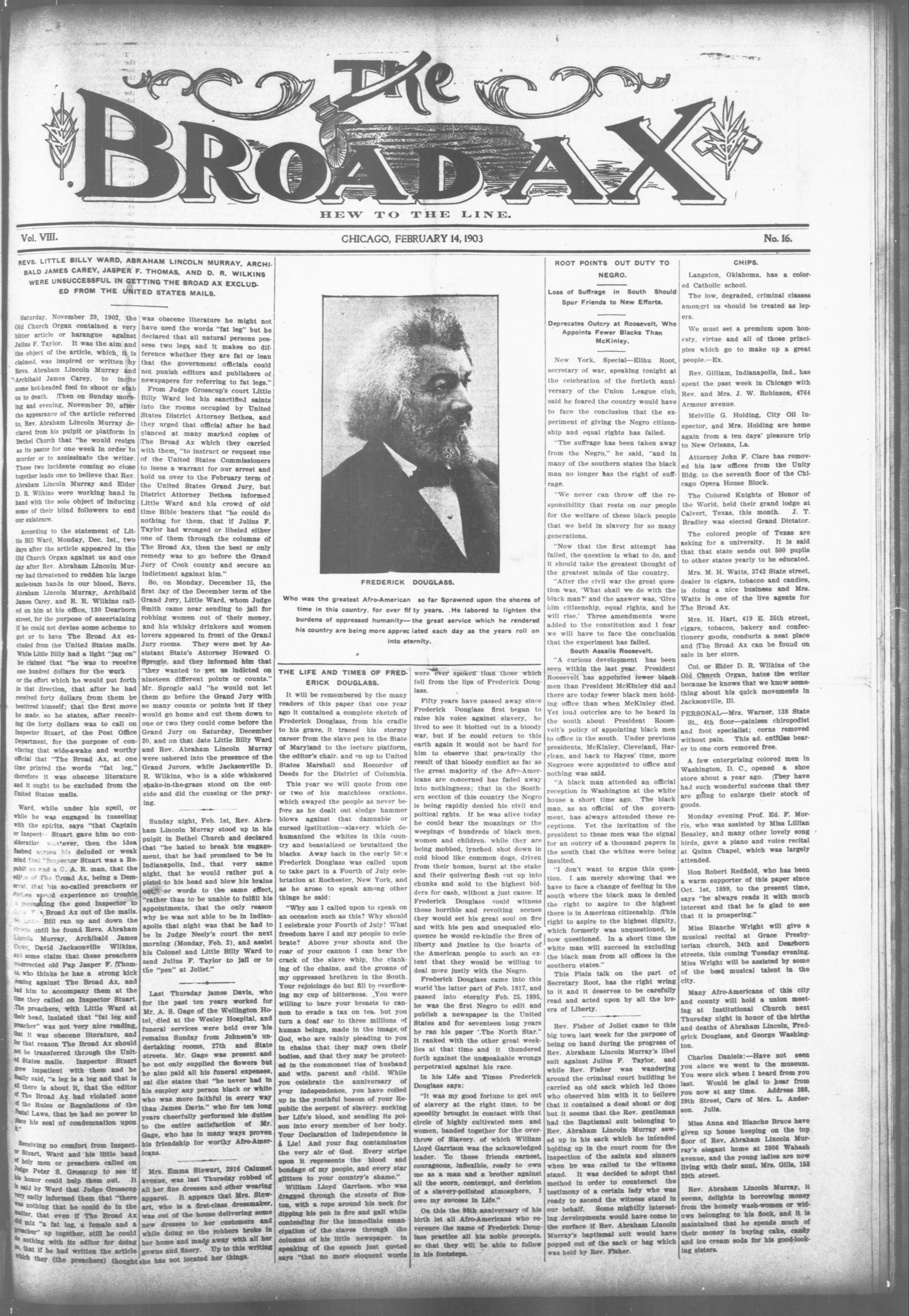
Who was the greatest Afro-American so far Sprawned upon the shores of time in this country, for over fifty years. .He labored to lighten the burdens of oppressed humanity—the great service which he rendered his country are being more appreciated each day as the years roll on into eternity.
THE LIFE AND TIMES OF FREDERICK DOUGLASS.
It will be remembered by the many readers of this paper that one year ago it contained a complete sketch of Frederick Douglass, from his cradle to his grave, it traced his stormy career from the slave pen in the State of Maryland to the lecture platform, the editor's chair, and on up to United States Marshall and Recorder of Deeds for the District of Columbia. This year we will quote from one or two of his matchless orations, which swayed the people as never before as he dealt out sledge hammer blows against that damnable or cursed institution—slavery, which dehumanized the whites in this country and beastalized or brutalized the blacks. Away back in the early 50:s Frederick Douglass was called upon to take part in a Fourth of July celebration at Rochester, New York, and as he arose to speak among other things he said:
"Why am I called upon to speak on an occasion such as this? Why should I celebrate your Fourth of July! What freedom have I and my people to celebrate? Above your shouts and the roar of your cannon I can hear the crack of the slave whip, the clanking of the chains, and the groans of my oppressed brethren in the South. Your rejoicings do but fill to overflowing my cup of bitterness. You were willing to bare your breasts to cannon to evade a tax on tea, but you turn a deaf ear to three millions of human beings, made in the image, of God, who are vainly pleading to you in chains that they may own their bodies, and that they may be protected in the commonest ties of husband and wife, parent and child. While you celebrate the anniversary of your independence, you have coiled up in the youthful bosom of your Republic the serpent of slavery, sucking her Life's blood, and sending its poison into every member of her body. Your Declaration of Independence is a Lie! And your flag contaminates the very air of God. Every stripe upon it represents the blood and bondage of my people, and every star glitters to your country's shame."
William Lloyd Garrison. who was dragged through the streets of Boston, with a rope around his neck for dipping his pen in fire and gall while contending for the immediate emancipation of the slaves through the columns of his little newspaper. in speaking of the speech just quoted says "that no more eloquent words
so far Sprawned upon the shores of tity years. .He labored to lighten the the great service which he rendered iated each day as the years roll on ernity.
were ever spoken than those which fell from the lips of Frederick Douglass.
Fifty years have passed away since Frederick Douglass first began to raise his voice against slavery, he lived to see it blotted out in a bloody war, but if he could return to this earth again it would not be hard for him to observe that practically the result of that bloody conflict as far as the great majority of the Afro-Americans are concerned has faded away into nothingness; that in the Southern section of this country the Negro is being rapidly denied his civil and political rights. If he was alive today he could hear the moanings or the weepings of hundreds of black men, women and children. while they are being mobbed, lynched. shot down in cold blood like common dogs, driven from their homes, burnt at the stake and their quivering flesh cut up into chunks and sold to the highest bidders for cash, without a just cause. If Frederick Douglass could witness these horrible and revolting scenes they would set his great soul on fire and with his pen and unequaled eloquence he would re-kindle the fires of liberty and justice in the hearts of the American people to such an extent that they would be willing to deal more justly with the Negro.
Frederick Douglass came into this world the latter part of Feb. 1817, and passed into eternity Feb. 25, 1895, he was the first Negro to edit and publish a newspaper in the United States and for seventeen long years he ran his paper '.The North Star." It ranked with the other great weeklies at that time and it thundered forth against the unspeakable wrongs perpetrated against his race.
In his Life and Times Frederick Douglass says:
"It was my good fortune to get out of slavery at the right time, to be speedily brought in contact with that circle of highly cultivated men and women, banded together for the overthrow of Slavery. of which William Lloyd Garrison was the acknowledged leader. To these friends earnest, courageous, inflexible, ready to own me as a man and a brother against all the scorn, contempt, and derision of a slavery-polluted atmosphere, I owe my success in Life."
On this the 86th anniversary of his birth let all Afro-Americans who reverence the name of Frederick Douglass practice all his noble precepts, so that they will be able to follow in his footsteps.
Loss of Suffrage in South Should Spur Friends to New Efforts.
Deprecates Outcry at Roosevelt, Who Appoints Fewer Blacks Than McKinley.
New York, Special—Elihu Root, secretary of war, speaking tonight at the celebration of the fortieth anniversary of the Union League club, said he feared the country would have to face the conclusion that the experiment of giving the Negro citizenship and equal rights has failed.
"The suffrage has been taken away from the Negro," he said, "and in many of the southern states the black man no longer has the right of suffrage.
"After the civil war the great question was, 'What shall we do with the black man?' and the answer was, 'Give him citizenship, equal rights, and he will rise.' Three amendments were added to the constitution and I fear we will have to face the conclusion that the experiment has failed.
"A curious development has been seen within the last year. President Roosevelt has appointed fewer black men than President McKinley did and there are today fewer black men holding office than when McKinley died. Yet loud outcries are to be heard in the south about President Roosevelt's policy of appointing black men to office in the south. Under previous presidents, McKinley, Cleveland, Harrison, and back to Hayes' time, more Negroes were appointed to office and nothing was said.
"A black man attended an official reception in Washington at the white house a short time ago. The black man, as an official of the government, has always attended these receptions. Yet the invitation of the president to these men was the signal for an outcry of a thousand papers in the south that the whites were being insulted.
"I don't want to argue this question. I am merely showing that we have to face a change of feeling in the south where the black man is denied the right to aspire to the highest there is in American citizenship. (This right to aspire to the highest dignity, which formerly was unquestioned, is now questioned. In a short time the white man will succeed in excluding the black man from all offices in the southern states."
This Plain talk on the part of Secretary Root, has the right wring to it and it deserves to be carefully read and acted upon by all the lovers of Liberty.
Rev. Fisher of Joliet came to this big town last week for the purpose of being on hand during the progress of Rev. Abraham Lincoln Murray's libel suit against Julius F. Taylor, and while Rev. Fisher was wandering around the criminal court building he carried an old sack which led those who observed him with it to believe that it contained a dead shoat or dog but it seems that the Rev. gentleman had the Baptismal suit belonging to Rev. Abraham Lincoln Murray sewed up in his sack which he infended holding up in the court room for the inspection of the saints and sinners when he was called to the witness stand. It was decided to adopt that method in order to counteract the testimony of a certain lady who was ready to ascend the witness stand in our behalf. Some mightily interesting developments would have come to the surface if Rev. Abraham Lincoln Murray's baptismal suit would have popped out of the sack or bag which was held by Rev. Fisher.
---
No. 16.
CHIPS.
No.16.
Langston, Oklahoma, has a colored Catholic school.
The low, degraded, criminal classes amongst us should be treated as lepers.
We must set a premium upon honesty, virtue and all of those principles which go to make up a great people.—Ex.
Rev. Gilliam, Indianapolis, Ind., has spent the past week in Chicago with Rev. and Mrs. J. W. Robinson, 4764 Armour avenue.
Melville G. Holding, City Oil Inspector, and Mrs. Holding are home again from a ten days' pleasure trip to New Orleans, La.
Attorney John F. Clare has removed his law offices from the Unity Bldg. to the seventh floor of the Chicago Opera House Block.
The Colored Knights of Honor of the World, held their grand lodge at Calvert, Texas, this month. J. T. Bradley was elected Grand Dictator.
The colored people of Texas are asking for a university. It is said that that state sends out 500 pupils to other states yearly to be educated.
Mrs. M. H. Watts, 3742 State street, dealer in cigars, tobacco and candies, is doing a nice business and Mrs. Watts is one of the live agents for The Broad Ax.
Mrs. H. Hart, 419 E. 35th street, cigars, tobacco, bakery and confectionery goods, conducts a neat place and (The Broad Ax can be found on sale in her store.
Col. or Elder D. R. Wilkins of the Old Church Organ, hates the writer because he knows that we know something about his quick movements in Jacksonville, Ill.
PERSONAL—Mrs. Warner, 138 State St., 4th floor—painless chiropodist and foot specialist; corns removed without pain. This ad. entitles bearer to one corn removed free.
A few enterprising colored men in Washington, D. C., opened a shoe store about a year ago. (They have had such wonderful success that they are going to enlarge their stock of goods.
Monday evening Prof. Ed. F. Morris, who was assisted by Miss Lillian Beasley, and many other lovely song birds, gave a piano and voice recital at Quinn Chapel, which was largely attended.
Hon Robert Redfield, who has been a warm supporter of this paper since Oct. 1st, 1899, to the present time, says "he always reads it with much interest and that he is glad to see that it is prospering."
Miss Blanche Wright will give a musical recital at Grace Presbyterian church, 34th and Dearborn streets, this coming Tuesday evening. Miss Wright will be assisted by some of the best musical talent in the city.
Many Afro-Americans of this city and county will hold a union meeting at Institutional Church next Thursday night in honor of the births and deaths of Abraham Lincoln, Frederick Douglass, and George Washington.
Charles Daniels:—Have not seen you since we went to the museum. You were sick when I heard from you last. Would be glad to hear from you now at any time. Address 288, 29th Street, Care of Mrs. L. Anderson. Julia.
Miss Anna and Blanche Bruce have given up house keeping on the top floor of Rev. Abraham Lincoln Murray's elegant home at 2806 Wabash avenue, and the young ladies are now living with their aunt, Mrs. Gills, 153 39th street.
Rev. Abraham Lincoln Murray, it seems, delights in borrowing money from the homely wash-women or widows belonging to his flock, and it is maintained that he spends much of their money in buying cake, candy and ice cream soda for his good-looking sisters.
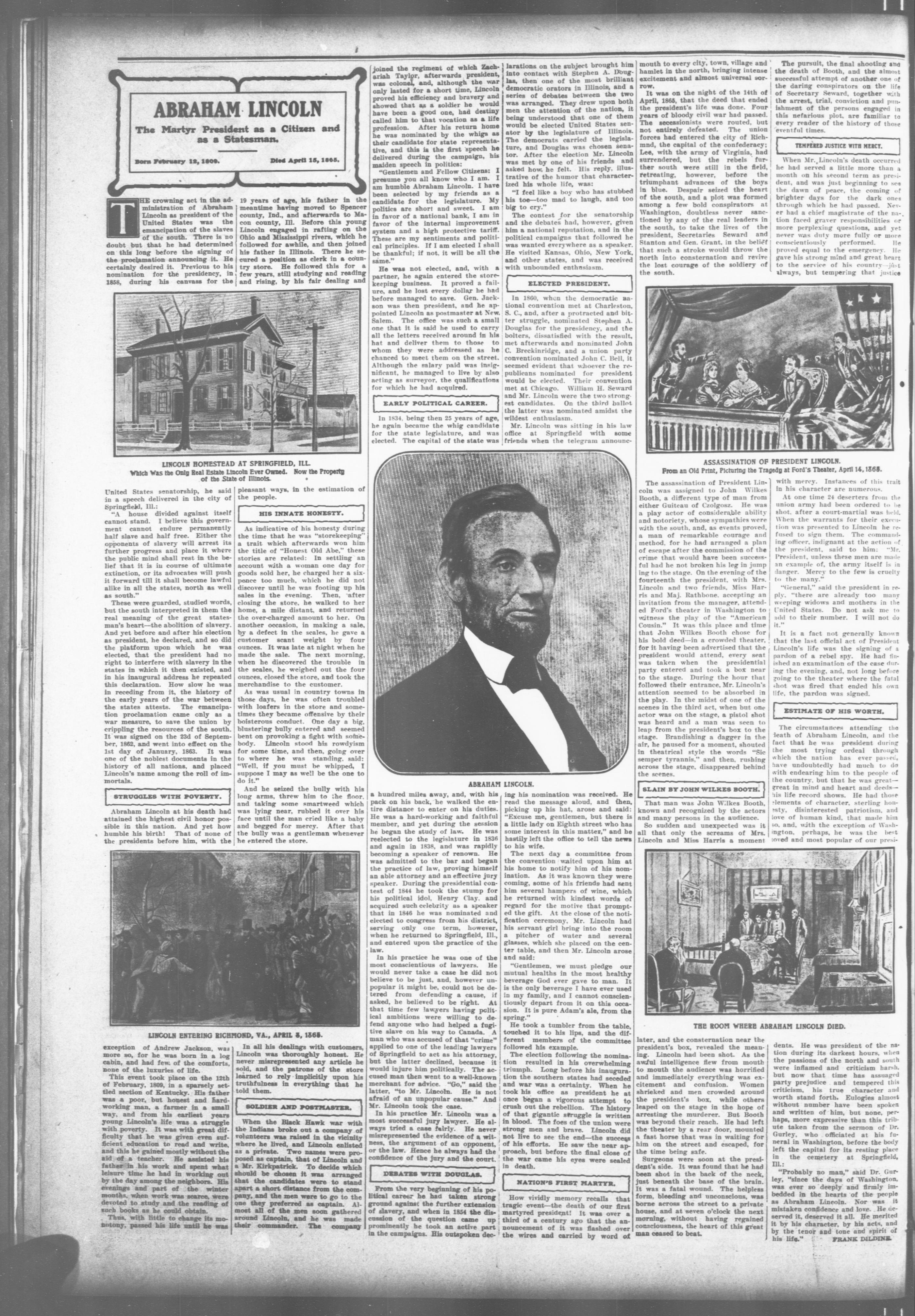
ABRAHAM LINCOLN
The Martyr President as a Citizen and as a Statesman.
Born February 12, 1809. Died April 15, 1865.
THE HOME OF THE MIDDLE SCHOOL FOR YOUNG PERSONS
LINCOLN HOMESTEAD AT SPRINGFIELD, ILL. Which Was the Onlip Real Estate Lincoln Ever Owned. Now the Property of the State of Illinois.
LINGOLN ENTERING RICHMOND, VA., APRIL 8, 1868.
THE crowning act in the administration of Abraham Lincoln as president of the United States was the emancipation of the slaves of the south. There is no doubt but that he had determined on this long before the signing of the proclamation announcing it. He certainly desired it. Previous to his nomination for the presidency, in 1858, during his canvass for the
LINGOLN HOMESTEAD
Which Was the Only Real Estate Line
of the State
United States senatorship, he said in a speech delivered in the city of Springfield, Ill.: "A house divided against itself cannot stand. I believe this government cannot endure permanently half slave and half free. Either the opponents of slavery will arrest its further progress and place it where the public mind shall rest in the belief that it is in course of ultimate extinction, or its advocates will push it forward till it shall become lawful alike in all the states, north as well as south."
These were guarded, studied words, but the south interpreted in them the real meaning of the great statesman's heart—the abolition of slavery. And yet before and after his election as president, he declared, and so did the platform upon which he was elected, that the president had no right to interfere with slavery in the states in which it then existed, and in his inaugural address he repeated this declaration. How slow he was in receding from it, the history of the early years of the war between the states attests. The emancipation proclamation came only as a war measure, to save the union by crippling the resources of the south. It was signed on the 23d of September, 1862, and went into effect on the 1st day of January, 1863. It was one of the noblest documents in the history of all nations, and placed Lincoln's name among the roll of immortals.
STRUGGLES WITH POVENTY.
Abraham Lincoln at his death had attained the highest civil honor possible in this nation. And yet how humble his birth! That of none of the presidents before him, with the
LINGOLN ENTERING RICHN
exception of Andrew Jackson, was more so, for he was born in a log cabin, and had few. of the comforts, none of the luxuries of life.
This event took place on the 12th of February, 1809, in a sparsely settled section of Kentucky. His father was a poor, but honest and hardworking man, a farmer in a small way, and from his earliest years young Lincoln's life was a struggle with poverty. It was with great difficulty that he was given even sufficient education to read and write, and this he gained mostly without the aid of a teacher. He assisted his father in his work and spent what leisure time he had in working out by the day among the neighbors. His evenings and part of the winter months, when work was scarce, were devoted to study and the reading of such books as he could obtain.
Thus, with little to change its monotony, passed his life until he was
19 years of age, his father in the meantime having moved to Spencer county, Ind., and afterwards to Macon county, Ill. Before this young Lincoln engaged in rafting on the Ohio and Mississippi rivers, which he followed for awhile, and then joined his father in Illinois. There he secured a position as clerk in a country store. He followed this for a few years, still studying and reading and rising, by his fair dealing and
D AT SPRINGFIELD, ILL.
Lincoln Ever Owned. Now the Property
state of Illinois.
pleasant ways, in the estimation of the people.
HIS INNATE HONESTY.
As indicative of his honesty during the time that he was "storekeeping" a trait which afterwards won him the title of "Honest Old Abe," these stories are related: In settling an account with a woman one day for goods sold her, he charged her a sixpence too much, which he did not discover until he was footing up his sales in the evening. Then, after closing the store, he walked to her home, a mile distant, and returned the over-charged amount to her. On another occasion, in making a sale, by a defect in the scales, he gave a customer scant weight by four ounces. It was late at night when he made the sale. The next morning, when he discovered the trouble in the scales, he weighed out the four ounces, closed the store, and took the merchandise to the customer.
As was usual in country towns in those days, he was often troubled with loafers in the store and sometimes they became offensive by their boisterous conduct. One day a big, blustering bully entered and seemed bent on provoking a fight with somebody. Lincoln stood his rowdyism for some time, and then, going over to where he was standing, said: "Well, if you must be whipped, I suppose I may as well be the one to do it."
And he seized the bully with his long arms, threw him to the floor, and taking some smartweed which was lying near, rubbed it over his face until the man cried like a baby and begged for mercy. After that the bully was a gentleman whenever he entered the store.
MOND, VA., APRIL 8, 1865.
In all his dealings with customers, Lincoln was thoroughly honest. He never misrepresented any article he sold, and the patrons of the store learned to rely implicitly upon his truthfulness in everything that he told them.
SOLDIER AND POSTMASTER
When the Black Hawk war with the Indians broke out a company of volunteers was raised in the vicinity where he lived, and Lincoln enlisted as a private. Two names were proposed as captain, that of Lincoln and a Mr. Kirkpatrick. To decide which should be chosen it was arranged that the candidates were to stand apart a short distance from the company, and the men were to go to the one they preferred as captain. Almost all of the men soon gathered around Lincoln, and he was made their commander. The company
```markdown
```
joined the regiment of which Zachariah Taylor, afterwards president, was colonel, and, although the war only lasted for a short time, Lincoln proved his efficiency and bravery and showed that as a soldier he would have been a good one, had destiny called him to that vocation as a life profession. After his return home he was nominated by the whigs as their candidate for state representative, and this is the first speech he delivered during the campaign, his maiden speech in politics:
"Gentlemen and Fellow Citizens: I presume you all know who I am. I am humble Abraham Lincoln. I have been selected by my friends as a candidate for the legislature. My politics are short and sweet. I am in favor of a national bank, I am in favor of the internal improvement system and a high protective tariff. These are my sentiments and political principles. If I am elected I shall be thankful; if not, it will be all the same."
He was not elected, and, with a partner, he again entered the store-keeping business. It proved a failure, and he lost every dollar he had before managed to save. Gen. Jackson was then president, and he appointed Lincoln as postmaster at New Salem. The office was such a small one that it is said he used to carry all the letters received around in his hat and deliver them to those to whom they were addressed as he chanced to meet them on the street. Although the salary paid was insignificant, he managed to live by also acting as surveyor, the qualifications for which he had acquired.
EARLY POLITICAL CAREER
In 1834, being then 25 years of age, he again became the whig candidate for the state legislature, and was elected. The capital of the state was
ABRAHAM
A. B.
ABRAHAM LINGOLN.
a hundred miles away, and, with his pack on his back, he walked the entire distance to enter on his duties. He was a hard-working and faithful member, and yet during the session he began the study of law. He was reelected to the legislature in 1836 and again in 1838, and was rapidly becoming a speaker of renown. He was admitted to the bar and began the practice of law, proving himself an able attorney and an effective jury speaker. During the presidential contest of 1844 he took the stump for his political idol, Henry Clay, and acquired such celebrity as a speaker that in 1846 he was nominated and elected to congress from his district, serving only one term, however, when he returned to Springfield, Ill., and entered upon the practice of the law.
In his practice he was one of the most conscientious of lawyers. He would never take a case he did not believe to be just, and, however unpopular it might be, could not be detered from defending a cause, if asked, he believed to be right. At that time few lawyers having political ambitions were willing to defend anyone who had helped a fugitive slave on his way to Canada. A man who was accused of that "crime" applied to one of the leading lawyers of Springfield to act as his attorney, but the latter declined, because it would injure him politically. The accused man then went to a well-known merchant for advice. "Go," said the latter, "to Mr. Lincoln. He is not afraid of an unpopular cause." And Mr. Lincoln took the case.
In his practice Mr. Lincoln was a most successful jury lawyer. He always tried a case fairly. He never misrepresented the evidence of a witness, the argument of an opponent, or the law. Hence he always had the confidence of the jury and the court.
DEBATES WITH DOUGLAS
From the very beginning of his political career he had taken strong ground against the further extension of slavery, and when in 1854 the discussion of the question came up prominently he took an active part in the campaigns. His outspoken dec-
larations on the subject brought him into contact with Stephen A. Douglas, then one of the most brilliant democratic orators in Illinois, and a series of debates between the two was arranged. They drew upon both men the attention of the nation, it being understood that one of them would be elected United States senator by the legislature of Illinois. The democrats carried the legislature, and Douglas was chosen senator. After the election Mr. Lincoln was met by one of his friends and asked how, he felt. His reply, illustrative of the humor that characterized his whole life, was:
"I feel like a boy who has stubbed his toe—too mad to laugh, and too big to cry."
The contest for the senatorship and the debates had, however, given him a national reputation, and in the political campaigns that followed he was wanted everywhere as a speaker. He visited Kansas, Ohio, New York, and other states, and was received with unbounded enthusiasm.
In 1860, when the democratic national convention met at Charleston, S. C., and, after a protracted and bitter struggle, nominated Stephen A. Douglas for the presidency, and the bolters, dissatisfied with the result, met afterwards and nominated John C. Breckinridge, and a union party convention nominated John C. Bell, it seemed evident that whoever the republicans nominated for president would be elected. Their convention met at Chicago. William H. Seward and Mr. Lincoln were the two strongest candidates. On the third ballot the latter was nominated amidst the wildest enthusiasm.
Mr. Lincoln was sitting in his law office at Springfield with some friends when the telegram announce-
LINGOLN.
ing his nomination was received. He read the message aloud, and then, picking up his hat, arose and said: "Excuse me, gentlemen, but there is a little lady on Eighth street who has some interest in this matter," and he hastily left the office to tell the news to his wife.
The next day a committee from the convention waited upon him at his home to notify him of his nomination. As it was known they were coming, some of his friends had sent him several hampers of wine, which he returned with kindest words of regard for the motive that prompted the gift. At the close of the notification ceremony, Mr. Lincoln had his servant girl bring into the room a pitcher of water and several glasses, which she placed on the center table, and then Mr. Lincoln arose and said:
"Gentlemen, we must pledge our mutual healths in the most healthy beverage God ever gave to man. It is the only beverage I have ever used in my family, and I cannot consciously depart from it on this occasion. It is pure Adam's ale, from the spring."
He took a tumbler from the table, touched it to his lips, and the different members of the committee followed his example.
The election following the nomination resulted in his overwhelming triumph. Long before his inauguration the southern states had seceded and war was a certainty. When he took his office as president he at once began a vigorous attempt to crush out the rebellion. The history of that gigantic struggle is written in blood. The foes of the union were strong men and brave. Lincoln did not live to see the end—the success of his efforts. He saw the near approach, but before the final close of the war came his eyes were sealed in death.
NATION'S FIRST MARTYR
How vividly memory recalls that tragic event—the death of our first martyred president! It was over a third of a century ago that the announcement of it was flashed over the wires and carried by word of
ELECTED PRESIDENT.
mouth to every city, town, village and hamlet in the north, bringing intense excitement and almost universal sorrow.
It was on the night of the 14th of April, 1865, that the deed that ended the president's life was done. Four years of bloody civil war had passed. The secessionists were routed, but not entirely defeated. The union forces had entered the city of Richmond, the capital of the confederacy; Lee, with the army of Virginia, had surrendered, but the rebels further south were still in the field, retreating, however, before the triumphant advances of the boys in blue. Despair seized the heart of the south, and a plot was formed among a few bold conspirators at Washington, doubtless never sanctioned by any of the real leaders in the south, to take the lives of the president, Secretaries Seward and Stanton and Gen. Grant, in the belief that such a stroke would throw the north into consternation and revive the lost courage of the soldiery of the south.
ASSASSINATION OF
From an Old Print, Picturing the Tra
Abe Lincoln
The assassination of President Lincoln was assigned to John Wilkes Booth, a different type of man from either Guiteau of Czolgosz. He was a play actor of considerable ability and notoriety, whose sympathies were with the south, and, as events proved, a man of remarkable courage and method, for he had arranged a plan of escape after the commission of the crime that would have been successful had he not broken his leg in jumping to the stage. On the evening of the fourteenth the president, with Mrs. Lincoln and two friends, Miss Harris and Maj. Rathbone, accepting an invitation from the manager, attended Ford's theater in Washington to witness the play of the "American Cousin." It was this place and time that John Wilkes Booth chose for his bold deed—in a crowded theater, for it having been advertised that the president would attend, every seat was taken when the presidential party entered and took a box near to the stage. During the hour that followed their entrance, Mr. Lincoln's attention seemed to be absorbed in the play. In the midst of one of the scenes in the third act, when but one actor was on the stage, a pistol shot was heard and a man was seen to leap from the president's box to the stage. Brandishing a dagger in the air, he paused for a moment, shouted in theatrical style the words "Sic semper tyrannis," and then, rushing across the stage, disappeared behind the scenes.
SLAIN BY JOHN WILKES BOOTH.
That man was John Wilkes Booth, known and recognized by the actors and many persons in the audience. So sudden and unexpected was it all that only the screams of Mrs. Lincoln and Miss Harris a moment
lancôme and miss marvis a moment
A
THE ROOM WHERE ABRAHAM LINGOLN DIED.
later, and the consternation near the president's box, revealed the meaning. Lincoln had been shot. As the awful intelligence flew from mouth to mouth the audience was horrified and immediately everything was excitement and confusion. Women shrieked and men crowded around the president's box, while others leaped on the stage in the hope of arresting the murderer. But Booth was beyond their reach. He had left the theater by a rear door, mounted a fast horse that was in waiting for him on the street and escaped, for the time being safe.
Surgeons were soon at the president's side. It was found that he had been shot in the back of the neck, just beneath the base of the brain. It was a fatal wound. The helpless form, bleeding and unconscious, was borne across the street to a private house, and at seven o'clock the next morning, without having regained consciousness, the heart of this great man ceased to beat.
---
The pursuit, the final shooting and the death of Booth, and the almost successful attempt of another one of the daring conspirators on the life of Secretary Seward, together with the arrest, trial, conviction and punishment of the persons engaged in this nefarious plot, are familiar to every reader of the history of those eventful times.
TEMPERED JUSTICE WITH MERCY
When Mr. Lincoln's death occurred he had served a little more than a month on his second term as president, and was just beginning to see the dawn of peace, the coming of brighter days for the dark ones through which he had passed. Never had a chief magistrate of the nation faced graver responsibilities or more perplexing questions, and yet never was duty more fully or more conscientiously performed. He proved equal to the emergency. He gave his strong mind and great heart to the service of his country—just always, but tempering that justice
PRESIDENT LINGOLN.
gedy at Ford's Theater, April 14, 1868.
with mercy. Instances of this trait in his character are numerous.
At one time 24 deserters from the union army had been ordered to be shot, after a court-martial was held. When the warrants for their execution was presented to Lincoln he refused to sign them. The commanding officer, indignant at the action of the president, said to him: "Mr. President, unless these men are made an example of, the army itself is in danger. Mercy to the few is cruelty to the many."
"General," said the president in reply. "there are already too many weeping widows and mothers in the United States. Do not ask me to add to their number. I will not do it."
It is a fact not generally known that the last official act of President Lincoln's life was the signing of a pardon of a rebel spy. He had finished an examination of the case during the evening, and, not long before going to the theater where the fatal shot was fired that ended his own life, the pardon was signed.
ESTIMATE OF HIS WORTH
The circumstances attending the death of Abraham Lincoln, and the fact that he was president during the most trying ordeal through which the nation has ever passed, have undoubtedly had much to do with endearing him to the people of the country, but that he was great—great in mind and heart and deeds—his life record shows. He had those elements of character, sterling honesty, disinterested patriotism, and love of human kind, that made him so, and, with the exception of Washington, perhaps, he was the best loved and most popular of our presi-
the most popular of our pre
dents. He was president of the nation during its darkest hours, when the passions of the north and south were inflamed and criticism harsh, but now that time has assuaged party prejudice and tempered this criticism, his true character and worth stand forth. Eulogies almost without number have been spoken and written of him, but none, perhaps, more expressive than this tribute taken from the sermon of Dr. Gurley, who officiated at his funeral in Washington, before the body left the capital for its resting place in the cemetery at Springfield, Ill.:
"Probably no man," said Dr. Gurley, "since the days of Washington, was ever so deeply and firmly imbedded in the hearts of the people as Abraham Lineol. Nor was it mistaken confidence and love. He deserved it, deserved it all. He merited it by his character, by his acts, and by the tenor and tone and spirit of his life." FRANK DILDINE.
```markdown
```
Senator Pettus, of Alabama, is wearing a pair of eyeglasses he purchased in 1865.
Ex-Secretary James D. Long has been made a member of the Mayflower Descendants. He is descended from Mary Chilton, who first set foot on Plymouth Rock.
A friend met Congressman Ruppert, of New York, and said: "Jake, I came away from home without any money this morning. Let me have a couple of dollars, will you? I want to get shaved." "Say," observed the congressman as he handed over the money, "who shaves you—Pierpont Morgan?"
Congressman Crumpacker, of Indiana, while in Indianapolis recently, secured for one of his constituents a position in the filerooms of the state capitol. He requested the man to come on at once. The constituent hastened to Indianapolis. He carried with him a satchel full of files of every variety that a machinist could devise.
Senator Hoar heard the other day that an old lady in reduced circumstances had a fine portrait of Daniel Webster. The senator, who owns the largest and finest collection of Websteriana in the country, hurried to the address given and shortly owned the painting, which is from the brush of Chester Harding, well known in art circles 60 years ago. He thinks it is one of the finest portraits of Webster in existence.
Secretary Moody was addressing a meeting in Haverhill, Mass., defending the administration's Philippine policy. Growing thirsty in his earnestness, he reached over, poured out a glass of water and drank it down. Ere long he felt the necessity for another drink and reached over to the table without looking at it. His hand came in contact with the pitcher and, not troubling about a glass, he raised the pitcher, drank deep and set it down again. He did not realize what he had done until he heard the ripple of laughter which greeted his action.
When Secretary Moody was under repairs, necessitated by the shake-up he sustained by jumping from a carriage in Annapolis. President Roosevelt called to see him. It happened that a new servant answered the door. He did not know Mr. Roosevelt, and he said the secretary was not in. "Oh, he'll see me," said the chief magistrate, good-naturedly. "I dunno, sah," said the servant. "Who is you?" "The president." "President ob what?" asked the colored man, suspiciously. Just then another servant came to the door and Mr. Roosevelt was allowed to enter.
FOREIGN FACTS AND FANCIES
Owing to the increased price of coal several British boards of guardians have decided to give an extra sixpence weekly to the recipients of outdoor relief.
France is going to have a new coin, a 25 centimes piece, or five cents. It will be of nickel, larger than a franc but smaller than a copper sou, with a smooth edge.
The oyster scare in England has obtained a firm hold in London. The sales of oysters at Billingsgate have fallen off to the extent of many thousands of pounds.
A total of 2,704 conscripts from Alsace-Lorraine have failed to join the colors, and have been declared outlaws in consequence. All their property reverts to the crown. The imports of the Transvaal for the first ten months of 1902 as compared with 1901 show an extraordinary increase, having developed from 2,500,000 to 9,250,000 sterling.
Two milk women were fined at Anton, in France, for watering their milk. A local trust was then formed and prices were raised 50 per cent. A milk strike has resulted. The magistrates who imposed the fines have been boycotted; they can only get milk by having it bought for them surreptitiously.
NEWS FROM ANIMAL LAND.
Most curious of all eaters is the hydra—a strange creature that can be turned inside out without impairing its appetite or its power to eat.
The silk worms produced from one ounce of egg will consume from 1,700 pounds to 2,400 pounds of mulberry leaves during the 40 days of their life.
It is possible the compass of hearing possessed by some animals lies in the range of air vibrations above our own, that they can hear no sounds as low as the highest note that is audible to us, as we can hear none as high
The forage of the whalebone whale is jelly fish. He has simply to open his mouth and paddle leisurely along to take them in by the wagon load, says Scientific American. The sperm whale, on the contrary, captures huge devil fish weighing often several tons. Like his brother, the whalebone whale he must be constantly on the lookout for food. Otherwise he would starve. As many as 14 seals have been taken from a 30-foot "killer."
NOVELTIES FOR THE HOME.
A large waste paper basket is in the shape of an urn and is deep rose in color.
A wise and contented looking pig of metal with a small receptacle set in his back is supposed to hold matches.
Odd in basketry is a work basket in the shape of an automobile. It is of green and white and is really a perfect little model.
An odd-looking pin was spied among other odd novelties that is in imitation of a latch key. It is not beautiful, but it's odd and inexpensive.
WOMEN'S CLUBS THRIVE.
Pessimists Say They Are a Fad, But They Go On Increasing in Numbers.
The latest edition of the official directory of the woman's clubs of Chicago shows that the pessimists who say that women's clubs are a fad, and that they die soon after they are created because of the members being extremely fickle in their allegiance to their clubs, are entirely and totally wrong, says the Chicago Tribune.
There have been four editions of the official directory. The first one printed, which covered the years 1899-1900, reveals that there were 66 clubs at that time. The next year's directory shows that the number of clubs had leaped to 112. Then the pessimist would naturally expect that the directory of the following year would indicate a slump back to something like the number of clubs given in the first directory. But the book for the year 1901-1902 reports 97 clubs in existence, and the new directory for the year 1902-1903 gives the names of 95 clubs.
A comparison of the book just issued with the one first published shows that almost all the clubs given in the first volume are alive and prosperous. The biggest change was between the years 1900 and 1901 and 1901 and 1902, when the number of clubs slumped from 112 to 97. An examination of the directories of these dates will show that few of the clubs actually died, but after the phenomenal jump from 66 to 112 it was found that many of the clubs could do better by merging under one name.
GOOD WESTERN ENGLISH.
Only Part of the United States That Gives the "R" Its Real
That which the rest of the country accepts as the standard of correct pronunciation, though seldom attaining it, characterizes the speech of the majority of the people of the west. The west is the only section that does not badly misuse R., says Leslie's Weekly. It is perhaps incorrect to say the east and south misuse R. They hardly use it at all. In the east and many parts of the south R is, in effect, an auxiliary vowel except at the beginning of words. It merely lengthens the preceding vowel. Occasionally it receives a distinct vowel sound, that of Italian A.
In many parts of the south it is not heard at all. While the Georgian says "befoah," his Alabama neighbors say "befo,'" deposing R from its position as a vowel, or vowel modifier.
In the west, R is sounded with an approximation of correctness. Yet even the westerners do not give it its full value, as do the Irish and Scotch. Their strong enunciation of the letter sounds harsh to us, yet the letter is intended to be pronounced and its use differentiates words liable to be confused by the ear.
The Anglo-Saxon seems to be doing his best to depose R. Were it not for the influence of the Irish and Scotch, R would not be little more than a written letter, as silent as initial H in Spanish.
CREATING A WATERFALL.
Great Piece of Engineering That Has Been Accomplished at Niagara.
When the waters of the Niagara river were made to flow over turbines to give electric power and light to the city of Buffalo it was considered a great revolutionary feat of engineering, says an account of "The Greatest of Power Dams," in Leslie's Monthly. But at Niagara the dam and the all were there from the beginning. The power was ready in the rough—it had only to be applied to the machinery. When, however, it was proposed to utilize the speed and force of the Hudson river and to turn them into the power that lights towns, runs street railways and vitalizes factory plants the problem was a different one. The river was there, but the fall had to be created, and to do this it would be necessary to build one of the largest dams ever constructed, a wall, in fact, 1,400 feet long and 154 feet high, at certain points. No such barrier, great or small, had ever been placed across a river of a volume and flow equal to that of the Hudson just above Glens Falls, N. Y., yet this has now been successfully accomplished.
AGE OF CRIMINALITY.
When Criminal Responsibility of Children Begins in the Diferent Countries.
With reference to New York's special police court for childish offenders, it is noteworthy that both British and American law fix the same age of criminality. In defiance of theology the legal codes of all nations regard man as sinless by birth. Before attaining a certain age he is regarded as incapable of crime.
In England and America this age is seven years, and before this a child cannot be prosecuted. After his seventh birthday a child is accountable for its deeds, but if under 14 the prosecution must show that he was acting with criminal intent. The same age of criminality is held in Russia and Portugal. In France and Belgium a child must be eight years old before being prosecuted. In Italy and Spain a further year of grace is accorded.
In Norway, Greece, Austria, Denmark, Holland and Switzerland, says the London Chronicle, the age is ten. The little German can play pranks with impunity until 12 years old, while in Sweden no prosecution is allowed when the offender is under 16.
HISTORICAL SIDE LIGHTS.
The oldest house in England stands near St. Alban's Abbey, in Hertfordshire, about 20 miles from London. This house is said to be more than 1,000 years old, and is still fit for habitation.
The date of the Deluge is given variously by various chronologists. According to Usher it occurred in B. C. 2348. But 14 other authorities place the cataclysm as follows: One in the thirty-second century, five in the thirty-first century, one in the twenty-ninth century, one in the twenty-sixth century, four in the twenty-third century and two in the twenty-second century B. C.
The proposed American statute for the abolition of kissing, and a fine of five dollars for each indulgence in unhygienic osculation is not new. The old Puritan blue laws of Massachusetts forbade the exchange of kisses in public as a breach of good behavior. Milan has a similar ordinance against kisses or other amatory demonstration in public places. It dates from the time of the Sforzas.
The latest bit of antiquity brought to light by the excavations at Chebba, in Tunis, is a superb mosaic six feet high by six feet eight inches broad, and represents Silenus on his donkey. The beast is restive under the weight, and rears on his hind legs, refusing to proceed, while a cloven-hoofed satyr is pulling its ears. A faun is twisting the ass's tail and belaboring its sides—to no purpose.
The lava streams from the eruption of Vesuvius in 1858 were so hot 12 years later that steam issued from their cracks and crevices. Those that flowed from Etna in 1787 were found to be steaming hot just below the crust as late as 1840. The volcano Jorullo in Mexico poured forth in 1759 lava that 87 years later gave off columns of steaming vapor. In 1780 it was found that a stick thrust into the crevices instantly ignited, although no discomfort was experienced in walking on the hardened crust.
THOUSANDS OF MILES AWAY.
Cannilbalism has recently increased in New Guinea in consequence of the prolonged drought.
Many cotton mills are now in operation in Bombay, and others will soon start. It is said that the whole yarn supply of India, and a great part of that of China and Japan, is furnished by Bombay mills.
In China the down of the thistle is gathered and mixed with raw silk so ingeniously that even experts are deceived when the fabric is woven. It is also used to stuff cushions as a substitute for eiderdown, and a very good substitute it makes.
The irrigation works recommended by the geological survey give interest to the report on the irrigation works of India. The net revenue to the government was 7.36 per cent. on an outlay of $110,000,000. The value of the crops raised on the irrigated area during the year is estimated at $135,000.000, a sum in excess of the capital outlay.
When a death from plague has taken place in a Chinese house it is not unusual for the body to be carried out and left either in the street or in a boat in the harbor. In Hong Kong 308 such cases occurred in 1901, and they to a great extent account for the annual recurrence of the disease, as of necessity the houses from which the bodies came are not disinfected.
SCIENCE SIFTINGS.
The average straight-ahead motion of the stars is now put at 21 miles a second. Prof. Henry A. Ward, collector of meteorites, of Chicago, has just added an interesting specimen that fell near Bath Furnace, Ky., on November 15. His collection ranks fourth in the world, and he has one meteor presented to him by the shah of Persia.
The expansion of metals on heating is a serious disadvantage for many purposes. The new alloy of iron with 36 per cent. of nickel is claimed to expand less than 1-12,000,000, for an increase of one degree C., while the expansion of iron is 1-80,000 for one degree C. The alloy is recommended for clock pendulums, measures, etc.
The thought of space, compared with which our immeasurable sidereal system dwindles to a point, is too overwhelming to be dwelt upon, is one of Herbert Spencer's latest reflections. "Of late years the consciousness that without origin or cause infinite space has ever existed and must ever exist, produces in me a feeling from which I shrink."
AUTOMOBILE NOTES.
Motor cars have been adopted for scouting purposes by the Swiss military authorities. Banker Henri De Rothschild, of Paris, says that in ten years from now there will not be a single vehicle drawn by horses in Paris, as everything will be hauled by motor conveyances. The honor of possessing the largest membership of any automobile club in the world rests with the Automobile Club of Great Britain and Ireland, which has now no less than 2,180 members.
A queer race between a balloon and automobiles took place recently in England, 12 motor cars taking part in the cross-country chase. Two of the automobiles were near when the balloon came down. Gelatine masks for automobile riders, with mica plates to protect the eyes, are a new Parisian invention. The masks are colored and cover the chin and throat; they fasten behind the head with straps.
ZOMODONE, THE NEWEST AND MOST RAPID HAIR GROWER IN EXISTENCE.
Makes the Hair grow with lightning-like rapidity. No waiting for results. ZOMODONE prevents Falling Hair, Grey Hair, Brittle Hair, Curly Hair, Harsh Hair, and Scurf. Cures Dandruff, Itch, Tetter, Eczema, and Ring-Worm. No more Bald Heads, Scanty Partings, Splitting Ends, and Bald Temples. ZOMODONE grows long, luxuriant, soft, fine, silky Hair. Makes the Hair grow down to and below the waist line in most every instance in which it is used. ZOMODONE is a direct Hair food, and softens and lengthens the Hair, so that it can be arranged in any style desired. Not a fraud or a fake, to get your money, but an honest remedy, tried and true. ZOMODONE acts quickly; results are seen at once. If you want Hair down to your waist, send in your order right now—do not delay. No free samples sent; a sample is not sufficient to do good. Price, 50c., or 3 bottles (a complete treatment) for $1.00, or will send four complete treatments for $3.00.
AGENTS WANTED. Everything is in favor of the Agent. LIBERAL CREDIT EXTENDED. This is an unprecedented chance to make money. Write quick for territory and particulars. Address
THE HELEN MARTIN TOILET CO., 910 E. Leigh St., Richmond, Va.
In writing to the Helen Martin Toilet Co., please motion this paper...
VERMONT WRESTLERS.
No State in the Union Has Furnished More Square-Hold and Side- Hold Good Ones.
"When I was a boy in Vermont," said Representative Cy. Sulloway, of New Hampshire, reports the Washington Star, "it was my ambition and that of nearly every farmer's boy in the state, as far as I knew, to be considered a champion wrestler. Probably no state in the union has furnished as many good square-hold and side-hold wrestlers as the Green Mountain state. Most of us boys learned wrestling at school, the wrestling bouts usually taking place at recess. Even the schoolmaster took a hand in the game and would try his skill against the larger boys, and if he happened to be thrown he lost prestige among his scholars. But it was at town meetings that the greatest exhibitions of skill and strength took place. The best wrestlers in the townships rallied at these gatherings, and the people seemed to take more interest in the outcome of the bouts than in the results at the polls. The science of square-hold and side-hold wrestling has almost died out in the state nowadays. Boys and young men seem to fancy football, golf and baseball, but there are some fine specimens of manhood yet in the state, and it takes a pretty good man to lay even a modern Vermonter on his back."
ELUSIVE BACILLI
Scientists Find Much Difficulty in Destroying Germs of Typhoid Tuberculosis.
---
It is one of the disappointments of the medical profession since the bacteria theory of many diseases has been fully established that all efforts to find an antidote for the tubercule typhoid bacillus have failed, says a special to the St. Louis Globe-Democrat. An antitoxin has been provided for the diphtheria bacillus, because the person of this bacillus passes out of its cell and is soluble. The person of typhoid tuberculosis is intracellular and remains there, and cannot be reached under ordinary conditions. Recent experiments by bacteriologists, with the assistance of Prof. Dewar, of the effects of extreme cold upon the bacilli show that they survive at the lowest temperature attainable. It was discovered, however, that when frozen in liquid air the bacilli became extremely brittle, so that they could be triturated into exceedingly fine powder and their cellular character thus destroyed. It is possible to experiment with antidotes upon their poisonous contents, and it is hoped before long that this method will lead to the discovery of a treatment which will destroy the germs of typhoid tuberculosis in the human body.
Alaska's Great Mountain.
The claim of Mount McKinley, the culminating peak of the Alaskan range, to be regarded as the loftiest point in North America, is sustained by the report of an exploring party, made by one of its members, Mr. A. H. Brooks. The party made a journey of 800 miles on foot in Alaska during the season just passed. Mr. D. L. Reaburn, the topographer of the expedition, believes that the measurements of mountain heights which were made have a probable error not exceeding 100 feet. According to these measurements Mount McKinley's elevation definitely exceeds 20,000 feet; that of Mount Foraker is 17,000 feet.
Electricity in Germany.
In Germany, electricity, among other curious results, has rehabilitated the discarded windmill. At Nereshelm a windmill supplies power for 36 incandescent lamps that light a large paint factory. Another in Schleswig-Holstein keeps up a steady current of 30 volts. At Dusseldorf a windmill winds up a heavy weight, of which the descent works a powerful dynamo.
Through a Glass
"So Prof. Armerook is dead. I suppose he studied too hard."
"No, the thirst he died of was not for knowledge."
"Well, at any rate, it was spiritual over-exertion."—N. Y. Herald.
Frustrated Reform:
Reformer—My boy, if you smoke cigarettes you will never grow to be a big man like me.
The Kid—What do I care! Napoleon was a small man, wasn't he?—Puck.
The Wisdom of Alice
The Wisdom of Alice.
Mother—Wry, Alice, don't you love your baby brother?
Alice—What's the use? He wouldn't know it, if I did.—Town Topics.
Deceitful Man.
Nell—He said I was his pearl.
Belle—I guess he wanted to string you.—Philadelphia Record.
Actual Results from Baldness After Only 4 Months Use of ZOMODONE.
Inside Is a Vacuum.
Cholly Masher (to the photographer)
—Be sure and show the collar and eyeglass—and don't forget to give the cane the correct pose.
Photographer—Certainly not. Now, hold steady. All right! It's done, sir.
Cholly—Done, is it? Are you quite sure you have taken the best side of my head?
Photographer—Quite sure, sir. I took the outside—Tit-Bits.
A Hard Times Love Affair:
She—This narrow band of gold is very sweet, of course; but you—you said you intended to bring me a cluster diamond ring.
He—Y-e-s, but afterward it occurred to me that such a ring would hide those lovely dimples in your fingers.
She—Oh, you darling.—N. Y. Weekly.
No Deception.
Beggar—Please, sor, me an' me family are famished for the want of meat and drink, an'—
Jenkins—Cut it out! I gave you a dime the last time you told me that story, and you made for the nearest saloon.
Beggar—True fer ye. 'Twas me that was famished fur the drink.—Philadelphia Press.
Not Interested.
First Citizen—There is to be a big meeting to-night, a great outpouring of the masses to devise ways and means to reform the city government, so that its affairs may be administered with strict economy. Come along. Second Citizen—Um—I'd rather not. Fact is, I am after an office myself.— N.Y. Weekly.
Encouraging.
He watched the love scene enacted on the stage and shook his head regretfully. "I wish I could do it like that," he said. "There's nothing like trying, Harry," suggested the girl at his side. Shortly thereafter they went into executive session.—Chicago Post.
On the Way.
"How does you like de new preacher?" asked Mr. Erastus Pinkley. "Very much," answered Miss Miami Brown. "He's got a good staht. He knows a heap o' words, an'jes' as soon as he gits 'em arranged in de proper order he'll hab a mighty fine sermon." —Washington Star.
Still in Doubt.
Adorer—I know I am poor, but I will insure my life for $20,000, which, at six per cent. interest, will give you enough to live on comfortably in case anything should happen to me."
Miss Flightie (doubtfully)—Do you think it would be enough to support another husband?—N. Y. Weekly.
Her Innocent Query.
Miss Plumpleigh—Will you take an order for coal?
Dealer—Well, we art supplying only our old customtrs.
Miss Plumpleigh (shyly)—About—how old do they have to be?—Somerville Journal.
The Wishing Habit.
Clarence—I wish I had lots of money.
Uncle Tom—If one could get what he wished for, I think I should wish for common sense, not for money.
Clarence — Naturally, everybody wishes for what he hasn't got.—Tit-Bita.
From Experience.
"Henry," said the woman with compressed lips, "do you remember that we first met by accident on a railroad?" "Yes," replied the henpecked man sadly, "railroad accidents always turn out disastrously." — Chicago Daily News.
Must Be a Freak
"He certainly has a remarkable head on his shoulders."
"I hadn't noticed it."
"Hadn't noticed what?"
"That he hasn't any neck."—Cleveland Plain Dealer.
A. Burst of Cander.
"I suppose you have some scheme for annihilating the trusts?" "Great Scott, no," answered Senator Sorghum, "do you suppose I want to kill the goose that lays the golden eggs?"—Washington Star.
The Modern Paradox
Jaggles—The cost of living is increasing all the time. Waggles—Yes, indeed! If the necessaries of life keep going up, it won't be long before we'll have to fall back on the luxuries—Puck.
Peanuts.
Teacher—Now, Johnny, can you tell me how peanuts grow?
Johnny—Why, they don't grow at all. I've watched the man at the corner make them with a little tin box lots of times.—N. Y. Times.
Where He Caught Him.
One day a man was brought before a judge for stealing a cheese from a grocer's door, and the principal witness, a carter, told how he had seen the man take the cheese and had run up and held him.
"Then you caught him in the nefarious act?" said the judge.
"The what, sir?" said the witness.
"You caught him in the nefarious act, I say," repeated the judge.
"Not me," was the reply; "I caught him by the scruff of the neck."—Tit-Bits.
One Woman.
There is one woman, mild and fair,
Discreet and sweet (confound her!),
Though I'm a manly man, I swear
I'd like to beat and pound her!
I'd smile to know that cumb'ring care
Both hand and foot had bound her,
And yet the pains I take, and bear,
To coax and get around her!
Because, the sorry truth I'll own,
She is my sweetheart's chaperon.
—Town Topics.
SHE FURNISHED THE WILL.
OCC
He—So your husband has given up smoking? It requires a pretty strong will to accomplish that!
She—Well, I'd have you understand that I have a strong will!—Der Floh.
Woman.
She knows a secret, but I will not plead;
Patient I wait the leisure of her deed;
Long ere the evening's done I know full well
I'll hear the story, for she'll have to tell.
—Detroit, Free Press.
Untempted.
"I am glad to note," said the friend, "that gambling is a vice that has no temptation for you." "None whatever," answered Senator Sorghum. "I am unable to find any excuse for a man's risking his money when there are so many sure things lying around begging for attention."—Washington Star.
Preferred It Shallow
Jeweler—The inscription you wish engraved on the inside of this ring, I understand, is "Ernest to Irene?"
Young Man (with embarrassment)—Yes, that's right. But—er—don't cut the "Irene" deep. — Cincinnati Enquirer.
Such a Bargain.
"I wouldn't give two cents for a cigar like that!" he exclaimed, as he tried for the fourth time to light one.
"But I didn't, George," protested his tearful little wife. "I only gave 99 cents for 50 of them".—Cleveland Plain Dealer.
Extortion from the Inexperienced.
"It cost me $1,000 to get my divorce," said the Boston woman.
"You were swindled," replied the woman from Chicago.
"That's about twice as much as I ever paid for any of mine."—Philadelphia Record.
Too Late.
"Can't you hurry a bit, Clara? We must catch the Sawyers and congratulate them on their marriage."
"There's no use hurrying for that—it's too late to congratulate them, anyhow; they've been married a month."—Life.
A rite for Better Things.
The roads are not passable,
Not even jackassable;
And the people who travel them
Should turn out and gravel them.
—Shady Corner (O.) Gazette.
Study in Mathematics.
Pushquill—I hear that Bounderman jilted that rich Skinnerly girl to marry an artist's model.
Inksling—Yes; extraordinary taste Gave up a fortune of six figures for a fortune of one.—N. Y. Herald.
His Preference.
Aunt—So you don't want to be president of the United States?
Little Harold—Naw! A president might make more money than a pirate, but he don't have half as much fun. Chicago American.
End of Happiness.
She—After 30 years' courtship a couple have just married at Leeds, England.
He—Isn't that too bad, after so many happy years.—Yonkers Statesman.
President and Treasurer,THOMAS CAREY. Vice-President, JOHN SHELHAMER. Secretary, WILLIAM SULLIVAN.
45th and Robey Sts.
Yards running winter and summer, equipped with the latest improved Wolf Dryer.
Output of Winter Yards ..... 140,000 per day
Output of Summer Yards..... 300,000 per day
Telephone Yards 128.
Will promulgate and at all times uphold the true principles of Democracy, but Catholics, Protestants, Priests, Infidels, Farmers, Single Taxers, Republicans, Knights of Labor, or any one else can have their say, so long as their language is proper and responsibility is fixed.
The Broad Ax is a newspaper whose platform is broad enough for all, ever claiming the editorial right to speak its own mind.
Local communications will receive attention. Write only on one side of the paper.
Subscriptions must be paid in advance.
One Year.....$2.00
Six Months.....1.00
JULIUS F. TAYLOR, Editor and Publisher. Entered at the Post Office at Chicago, III., as Second-class Matter.
CHIPS.
Mrs. B. Johnson, who is one of the hard workers in Bethel Church, was in Judge Neely's court last Wednesday ready to take the witness stand and swear that Rev. Abraham Lincoln Murray "is a bright shining angel, that if he only had wings he would fly on to heaven."
J. C. Campbell, 145 West 47th St., who runs one of the best cigar, tobacco and staple grocery stores in the Town of Lake, is full of business night and day and he and Mrs. Campbell are both well liked by the hundreds of Afro-Americans who frequent their store.
Rev Abraham Lincoln Murray is beginning to fully realize that Little Billy Ward, who is noted for obtaining money from women, then falling to get divorces for them. and Col. or Elder D. R. Wilkins have been using him as a "cats-paw" to pull horse-chestnuts out of the fire for them.
Mr. Charles F. Cooke, Secretary of the Cooke Brewing Company, is a warm supporter of Mayor Carter H. Harrison, and some of the wise ones say that "Charley" Cooke will be the next Treasurer of Chicago. His nomination as such would lead Mayor Harrison and the rest of the ticket on to victory.
Sunday, Feb. 15th, the members and friends of the Brean Baptist church will hold services in their new church 48th and Dearborn street. Three services will be held during the day, and Rev. E. J. Fisher of Olivet Baptist church. and several other ministers will assist its pastor Rev. Braddon to conduct the services.
Rev. or Elder Wilkins has from all appearances come over on the side of the Devil for, they say, "he will never rest contented until he has the pleasure of seeing Julius F. Taylor landed in the Cook county jail. Being a good christian, Elder Wilkins is sure he would die happily if he could only put his feet on our neck and compel us to fall down and worship him and Rev. Abraham Lincoln Murray.
Lieutenant William P. Clancy, who was for a long time stationed at the Stock Yards Police Station, has been promoted by Chief O'Neill, and from now on it will be Captain Clancy instead of Lieutenant Clancy. The Captain will be in command of the tenth district (Desplaines Street). Chief O'Neill displayed sound judgement by conferring higher police honors upon William P. Clancy.
Senator Mark Hanna, of Ohio, lately introduced a bill in the United States Senate, which provides for the payment of a pension to all exslaves, and while we never expect to live long enough to see Senator Hanna's measure enacted into law, nevertheless the ex-Confederates of the South seem to be in favor of their former slaves receiving a pension from the United States government.
Telephone Main 751
CHARLES L. WEBB Court Reporter,
311 Ogden Bldg. 34 Clark St.,
General Stenographer Chicago.
Mr. P. G. Lewis, who is one of the good sisters of Bethel Church, allowed last Wednesday that "she did not wade through the mud and snow in order to reach the Criminal Court building to listen to the lawyers for Rev. Abraham Lincoln Murray talk politics," but Mrs. Lewis, according to her statement, went over to the North Side to learn something about Rev. Abraham Lincoln Murray getting tangled up with the women.
Wednesday evening last, after our good christian brother, Rev. Abraham Lincoln Murray, and his followers returned to the South Side from Judge Neely's court, they held a meeting in Bethel Church and many of them prayed unto their Lord to open the right eye of Judge Neely so that he could see more clearly how to rule in favor of the monkey-headed Col. who was present, Rev. Abraham Lincoln Murray, and against Julius F. Taylor.
SPECIAL NOTICE!
Our article "On President Roosevelt, and the Negro" will not appear until the next issue of The Broad Ax.
SPECIAL NOTICE.
SPECIAL NOTICE.
To the directors of the A. W. Settlers Company, you are hereby notified that a special meeting will be held on February 17, at 77 S. Clark street, Room 7, at 8 p. m.
H. W. KNIGHT, Pres.
Joe Brown, Secy.
A. W. Settles, Treas.
AGENTS FOR THE BROAD AX.
From on and after this date The Broad Ax can be found on sale at the following places:
The Afro-American News Office, 3104 State Street.
A. G. Marshall, news stand and book store, 3604 State street.
A. F. Tervalon's Cigar Store and News Stand, 2826 State street.
Edward Felix's Cigar Store, 398 30th street, N. E. Corner Armour Ave.
J. A. Geary's Confectionery and Cigar Store, 4800 State St.
T. B. Hall's Cigar Store and Laundry office, 281 29th St.
Mrs. H. Hart, Cigar and Confectionery Store, 417 E. 35th St.
C. E. Hunter's News Stand and Cigar Store, 134 W. 51st St., near Dearborn.
J. E. Webb's Cigar Store, 280, 29th Street.
Turner William's Cigar and News Stand, 2903 Armour Ave.
J. F. Bradbury's News Depot, 2970 State Street.
William Goetz, dealer in cigars and tobacco, 411 E. 36th street.
M. H. Watts, dealer in cigars and tobacco, 3742 State street.
J. C. Campbell, 145 W. 47th street., Cigars, Tobacco, Staple Groceries.
Wm. H. Monroe, cigar and newsstand, 486 State street.
H. N. Drake, 3246 State Street, Cigar Store and News Stand.
L. Levy, 506, 37th Street, dealer in Cigars and Tobacco.
The Chicago Shoe Shining Parlor, 3123 Cottage Grove Ave.
Walter W. Booker, 109 Washington Avenue, Hannibal, Mo.
News items and advertisements left at these places will find their way into the columns of The Broad Ax.
AGENTS AND CORRESPONDENTS
The Broad Ax desires to engage agents and regular correspondents in all the leading cities and towns in Illinois and throughout the other sections of the country. The highest commissions paid to live hustlers Sample copies furnished. For further information address Julius F. Taylor 5040 Armour avenue, Chicago, Ill.
ROOMS FOR RENT.
ROOMS FOR RENT.
Two comodious nicely furnished rooms for rent to gentlemen only. Inquire at 2623 Wabash avenue.
ATTORNEYS AT LAW
SUITE 318-320 REAPER BLOCK
Clark and Washington Sta.
Telephone, Main 940. CHICAGO.
A. D. GASH
Attorney at Law,
84-86 La Salle Street, Chicago.
Suite 615 to 619,
Telephone Main 3077.
JOHN E. OWENS
Attorney at Law,
DUTTE 621 ASHLAND BLOCK,
80 B. Clark Street, CHICAGO
FREDERICK W. JOB
ATTORNEY AT LAW
832 MARQUETTE BUILDING
Telephone 2310 Central
CHICAGO
TELEPHONE MAIN 2804
FEDERICO M. BARRIOS
Attorney & Counsellor at Law
Suite 501 Firmentch Bldg.
N. E. Cor. Fifth Avenue
and Washington Street
Chicago.
ATTORNEY-AT-LAW
Room 6,128 LaSalle St.,
CHICAGO
RESIDENCE 2623 WABASH AVE
William Howard Fitzgerald
LAWYER
Room 402 Reaper Block, CHICAGO
JOSEPH A. McINERNEY
LAWYER
SUITE 700-708
CHICAGO OPERA HOUSE CHICAGO.
Beauregard F. Moseley,
LAWYER.
Practice in all Courts.
Main Office 6256 Halsted St,
Down Town Office 260 S. Clark St., Room 401
Hours from 12 to 3 P. M.
Phone: 808 Harrison.
WILLIAM RITCHIE
ATTORNEY AND COUNSELOR.
Suite 619-620 Oxford Building
84 LA SALLE ST., CHICAGO
Telephone Main 1646.
Robert M. Mitchell
Attorney at Law Suite 9, No. 77 South Clark St. CHICAGO
JOHN F. WATERS. C. H. JOHNSON
WATERS & JOHNSON
Lawyers
Practice Limited to the Trial of Personal Injury Cases
Suite 801 Kedzie Building
120 E. Randolph St.
Telephone Central 4293 CHICAGO
Wellington Tender WI Residence, MN Glenfield BA
JOHN PITZGERALD
JUSTICE OF THE PEACE
STOT & HALGUND STREET,
....CHICAGO
J. GRAY LUCAS
ATTORNEY-AT-LAW
Suite 412 Real Estate Board Bldg
59 Dearborn St. Cor. Randolph
CHICAGO.
J. E. JONES
LAWYER
79 Clark Street
Room 9 Chicago
JAMES E. WHITE
LAWYER
Residence 4232 Wabash Ave
Suite 411-59 Dearborn St.
Tel Main 1690 Chicago
S. A. McELWEE
...LAWYER...
36 S. Clark St., CHICAGO.
Room 708 Ogden Building
Residence, 3153 Forest Av.
ALBERT B. GEORGE
LAWYER.
400 Ashland Block, Chicago.
---
Fifty-First St. and Armour Ave.
RAIL YARDS: 151st St. & L. S. & M. S. Ry.
152nd St. and Armour Ave.
CHICAGO
Phoenix Oil & Mineral Co.
OF ARIZONA
$200,000 CAPITAL
Pays dividends 1 per cent. monthly or
12 per cent per annum.
Stock now selling at 10c per share,
full paid and non-assessable. For
further particulars address
THE DAVIS INVESTMENT COMPANY
614 First National Bank Bldg., Chicago
'Phone Central 3036.
Face Massage, Shampooing, Scalp Treating
Mrs. Warner
Chiropodist and Manicuring
Removes Corns Without Pain
Medicated Foot Baths and Foot Massage
138 State St., 4th Floor, Chicago
Mrs. Florence Miller
FASHIONABLE
DRESSMAKER
Perfect Fit Guaranteed
Prices Reasonable
3151 State Street CHICAGO
MRS. A. G. MARSHALL
BAKERY, Confectionery, Groceries,
Notions and Stationery, Imported
and Domestic Cigars, Tobaccos,
Etc. Milk, Cream, Butter and Eggs.
{ OPEN EVENINGS }
{ UNTIL 9:30 P.M. }
3604 State Street, CHICAGO.
Telephone Blue 4632 Work Called for
and Delivered.
A. HOFFMAN,
CLEANER, DYER
AND PRESSER.
Suits Sponged and Pressed 35c
5125 State St. Expert Workmanship
Moderate Prices.
WONDERFUL DISCOVERY Curly Hair Made Straight By
TAKEN FROM LIFE:
BEFORE AND AFTER TREATMENT.
ORIGINAL
OZONIZED OX MARROW
(Copyrighted)
This wonderful hair pomade is the only safe preparation in the world that makes kinky or curly hair straight as shown above. It nourishes the scalp and prevents the hair from falling out or breaking off, cures dandruff and makes the hair grow long and silky. Sold over forty years and used by thousands. Warranted harmless. Testimonials free on request. It was the first preparation ever sold for straightening kinky hair. Beware of imitation. Given by OX MARROW. Ozonized OX Marrow as the genuine new hair fails to keep the hair straight, soft and beautiful. Toilet necessity for ladies, gentlemen and children elegantly perfumed. The great advantage of this wonderful pomade is that by its use you can straighten your own hair at home. Owing to its superior and lasting qualities it is the best and most economical. It is not possible for anybody to produce a preparation equal to it. Full directions with every bottle. Only 50 cents. Sold by druggists and dealers or send us 50 cents for one bottle or $1.40 for three bottles. We pay all express charges. Send postal or express money order. Write your name and address plainly to
OZONIZED OX MARROW CO,
70 Wabash Avenue, Chicago, Illinois.
Don't imagine that all hair preparations are alike. Quite the contrary. Some never do what is claimed for them. The Original Ozonized Ox Marrow has been on the market for so long that there is no doubt it will do everything we claim for it. It is the most genteel preparation that any one can use on their hair. It is most delicately perfumed and when thoroughly rubbed into the scalp and well brushed through the hair it cannot fail to cure dandruff and make the hair straight, soft and beautiful. It invigorates the scalp producing new growth and stops the hair from falling out. Try a bottle and you will be sure to be pleased. Only 50 cents, express paid, to any address in the United States. Druggists also sell it. Address: Ozonized Ox Marrow Co., 76 Wabash Ave., Chicago, Illinois.
Nicely furnished rooms to rent for gentlemen. Reasonable rates, 2252 Indiana aveune.
Rooms for Rent.
Elegantly furnished rooms for rent with bath and gas at 3232 Wabash avenue.
Mrs. Kittle Scott.
Choice furnished rooms to rent to ladies and gentlemen. 2807 Wabash Ave.
ILLINOIS BRICK CO.
WILLIAM C. KUESTER,
SUPERINTENDENT.
N. Western Ave., Ch
1994 N. Western Ave., Chicago.
Telephone Lake View 270. HENADEL BF
HOHENADEL BROS.
211-213 Madison Street
CHICAGO
Telephone Main 2300
UNIFORM CAR
FOR
Hiremen,
Barriers,
Astormen,
Janitors, Wagonmen,
Street Car Employees,
Telegraph Messengers,
Railroad Employees,
Bellboys, Waters
COB FEINBEN
market and Grocer
Manufacturers of... UNIFORM CAPS
Policemen, Firemen, Street Car Employes,
Letter Carriers, Telegraph Messengers,
Elevatormen, Railroad Employes,
Janitors, Wagonmen, Bellboys, Watchmen, Eta
JACOB FEINBERG
d State Sts. CHI
31st and State Sts. CHICAGO
John J. Bradley
Real Estate, Insurance and Loans Property managed. Abstracts examined. Renting. Legal papers prepared. 4709 South Halsted Street Chicago
Ladies' and Gents' Clothing
Fashionable Dressmaking, Ladies' Tailoring, Dress Goods and Trimmings Furnished
JACKETS AND CLOAKS
Phone Calumet 7761 CASH OR EASY TERMS
Open from 8 a. m. till 9 p. m.
3285 State Street Chicago
226 East 25th Street - - - CHICAGO
MOVING AND EXPRESSING Cash on Delivery All Orders Promptly Attended to Telephone 4656 Armour Avenue, CHICAGO. Blue 289
SAMPLE ROOM
IMPORTED AND DOMESTIG WINES, LIQUORS AND CIGARS 8462 SOUTH HALSTED STREET. CHICAGO
Driving, Draft and General Business Horses
Always on Hand
1197 Milwaukee Ave. Near Robey St.
Telephone West, 1028. OHIOAGO, Ill
BARNEY BENSON,
Smoke Stacks, Cupolas and Monuments Erected. Hoisting and Placing of all kinds of Beams and Girders for architectural work. Office, 31 South Canal St., Chicago TELEPHONE MAIN 4928.
Telephone 565 South
J.M.Higginbothan
Chicago
BROSS
Street
CAPS
Employees,
Messengers,
and Employes,
News, Watchmen, Bts.
BERG
grocery
CHICAGO
Notary Public
Hudley
and Loans
legal papers prepared.
Chicago
ER
Clothing
Hammings Furnished
OAKS
FOR EASY TERMS
Chicago
Mason and General Contractor
CHICAGO
ALER IN
ND ICE