The Broad Ax
Saturday, February 28, 1903
Chicago, Illinois
Page text (machine-generated)
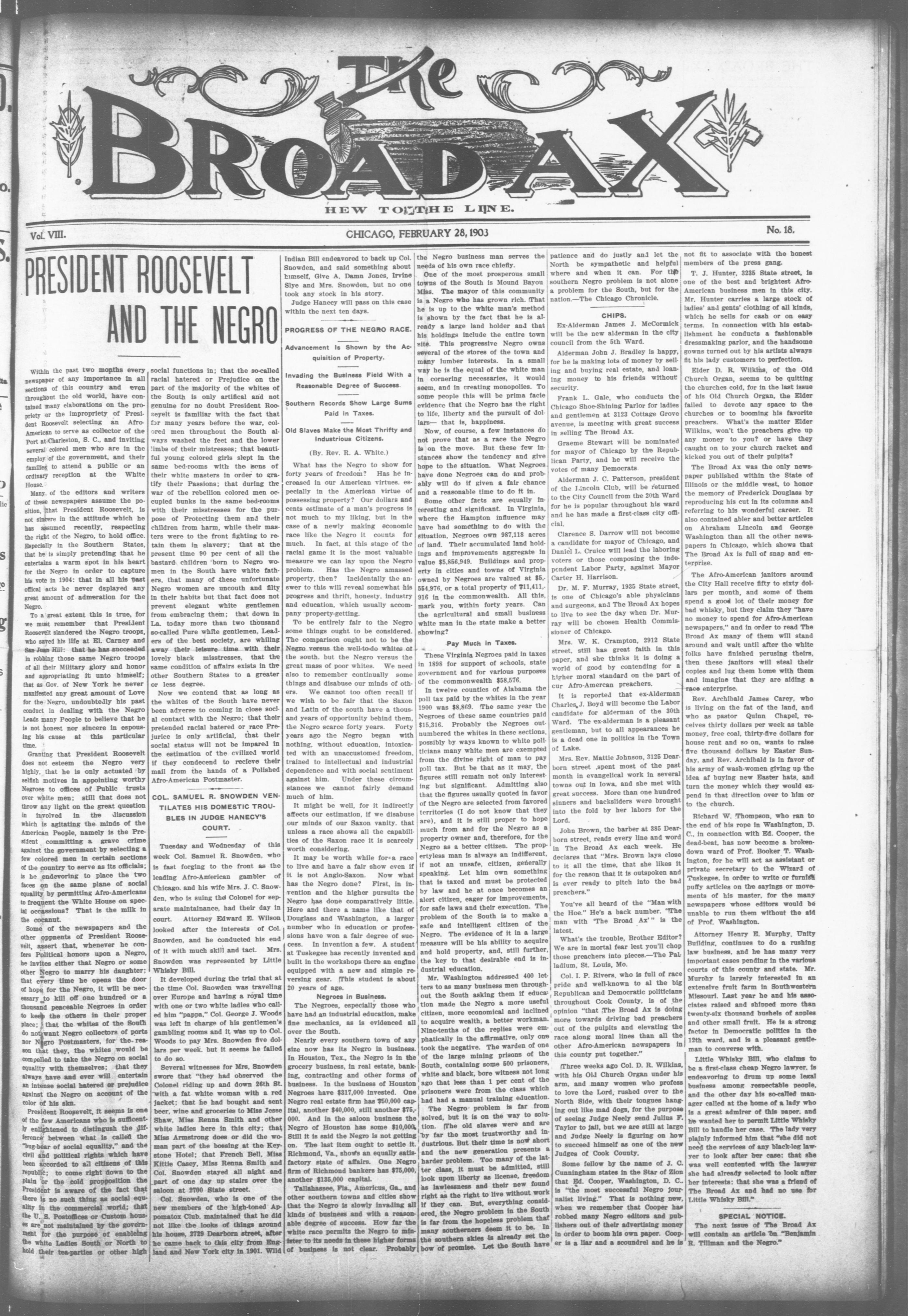
PRESIDENT ROOSEVELT AND THE NEGRO
Vol. VIII.
Within the past two months every newspaper of any importance in all sections of this country and even throughout the old world, have contained many elaborations on the propriety or the impropriety of President Roosevelt selecting an AfroAmerican to serve as collector of the Port at Charleston, S. C., and inviting several colored men who are in the employ of the government, and their families to attend a public or an ordinary reception at the White House.
Many of the editors and writers of these newspapers assume the position, that President Roosevelt, is not sincere in the attitude which he has assumed recently, respecting the right of the Negro, to hold office. Especially in the Southern States, that he is simply pretending that he entertains a warm spot in his heart for the Negro in order to capture his vote in 1904: that in all his past offical acts he never dsplayed any great amount of admeration for the Negro.
To a great extent this is true, for we must remember that President Roosevelt slandered the Negro troops, who saved his life at El. Carney and San Juan Hill: that he has succeeded in robbing those same Negro troops of all their Military glory and honor and appropriating it unto himself; that as Gov. of New York he never manifested any great amount of Love for the Negro, undoubtedly his past conduct in dealing with the Negro Leads many People to believe that he is not honest nor sincere in espousing his cause at this particular time.
Granting that President Roosevelt does not esteem the Negro very highly, that he is only actuated by selfish motives in appointing worthy Negroes to offices of Public trusts over white men; still that does not throw any light on the great question in involved in the discussion which is agitating the minds of the American People, namely is the President committing a grave crime against the government by selecting a few colored men in certain sections of the country to serve as its officials; is he endevoring to place the two faces on the same plane of social equality by permitting Afro-Americans to frequent the White House on special occassions? That is the milk in the cocanut.
Some of the newspapers and the other oppnents of President Roosevelt, assert that, whenever he confers Political honors upon a Negro, he invites either that Negro or some other Negro to marry his daughter; that every time he opens the door of hope for the Negro, it will be necessary to kill off one hundred or a thousand peaceable Negroes in order to keep the others in their proper place; that the whites of the South do not want Negro collectors of ports nor Negro Postmasters, for the reason that they, the whites would be compelled to take the Negro on social equality with themselves; that they always have and ever will entertain an intense social hatered or prejudice against the Negro on account of the color of his skin.
President Roosevelt, it seems is one of the few Americans who is sufficiently enlightened to distinguish the difference between what is called the "bug-bear of social equality," and the civil and political rights which have been accorded to all citizens of this republic; to come right down to the plain or the cold proproposition the President is aware of the fact that there is no such thing as social equality in the commercial world; that the U. S. Postoffices or Custom houses are not maintained by the government for the purpose of enabling the white Ladies South or North to hold their tea-parties or other high
social functions in; that the so-called racial hatered or Prejudice on the part of the majority of the whites of the South is only artificial and not genuine for no doubt President Rooseyelt is familiar with the fact that for many years before the war, colored men throughout the South always washed the feet and the lower limbs of their mistresses; that beautiful young colored girls slept in the same bed-rooms with the sons of their white masters in order to gratify their Passions; that during the war of the rebellion colored men occupied bunks in the same bed-rooms with their misstresses for the purpose of Protecting them and their children from harm, while their masters were to the front fighting to retain them in slavery; that at the present time 90 per cent of all the bastard children born to Negro women in the South have white fathers, that many of these unfortunate Negro women are uncouth and filly in their habits but that fact does not prevent elegant white gentlemen from embracing them; that down in La. today more than two thousand so-called Pure white gentlemen, Leaders of the best society, are whiling away their leisure time with their lovely black misstresses, that the same condition of affairs exists in the other Southern States to a greater or less degree.
Now we contend that as long as the whites of the South have never been adverse to coming in close social contact with the Negro; that their pretended racial hatered or race Prejurice is only artificial, that their social status will not be impared in the estimation of the civilized world if they condecend to recieve their mail from the hands of a Polished Afro-American Postmaster.
COURT
Tuesday and Wednesday of this week Col. Samuel R. Snowden, who is fast forging to the front as the leading Afro-American gambler of Chicago. and his wife Mrs. J. C. Snowden, who is suing the Colonel for separate maintainance, had their day in court. Attorney Edward E. Wilson looked after the interests of Col. Snowden, and he conducted his end of it with much skill and tact. Mrs. Snowden was represented by Little Whisky Bill.
It developed during the trial that at the time Col. Snowden was traveling over Europe and having a royal time with one or two white ladies who called him "pappa," Col. George J. Woods was left in charge of his gentlemen's gambling rooms and it was up to Col. Woods to pay Mrs. Snowden five dollars per week. but it seems he failed to do so.
Several witnesses for Mrs, Snowden swore that "they had observed the Colonel riding up and down 26th St. with a fat white woman with a red jacket; that he had bought and sent beer, wine and groceries to Miss Jesse Shaw, Miss Renna Smith and other white ladies here in this city; that Miss Armstrong does or did the woman part of the bossing at the Keystone Hotel; that French Bell, Miss Kittle Casey, Miss Renna Smith and Col. Snowden stayed all night and part of one day up stairs over the saloon at 2700 State street.
Col. Snowden, who is one of the new members of the high-toned Appomatox Club. maintained that he did not like the looks of things around his house, 2729 Dearborn street, after he came back to this city from England and New York city in 1901. Wild
HEW TO THE LINE.
CHICAGO, FEBRUARY 28, 1903
Indian Bill endeavored to back up Col. Snowden, and said something about himself, Give A. Damn Jones, Irvine Slye and Mrs. Snowden, but no one took any stock in his story.
Judge Hanecy will pass on this case within the next ten days.
PROGRESS OF THE NEGRO RACE.
Advancement Is Shown by the Acquisition of Property.
Invading the Business Field With a Reasonable Degree of Success.
Southern Records Show Large Sums Paid in Taxes.
Old Slaves Make the Most Thrifty and Industrious Citizens.
(By. Rev. R. A. White.)
What has the Negro to show for forty years of freedom? Has he increased in our American virtues, especially in the American virtue of possessing property? Our dollars and cents estimate of a man's progress is not much to my liking, but in the case of a newly making economic race like the Negro it counts for much. In fact, at this stage of the racial game it is the most valuable measure we can lay upon the Negro problem. Has the Negro amassed property, then? Incidentally the answer to this will reveal somewhat his progress and thrift, honesty, industry and education, which usually accompany property-getting.
To be entirely fair to the Negro some things ought to be considered. The comparison ought not to be the Negro versus the well-to-do whites of the south. but the Negro versus the great mass of poor whites. We need also to remember continually some things and disabuse our minds of others. We cannot too often recall if we wish to be fair that the Saxon and Latin of the south have a thousand years of opportunity behind them, the Negro scarce forty years. Forty years ago the Negro began with nothing, without education, intoxicated with an unaccustomed freedom, trained to intellectual and industrial dependence and with social sentiment against him. Under these circumstances we cannot fairly demand much of him.
It might be well, for it indirectly affects our estimation, if we disabuse our minds of our Saxon vanity. that unless a race shows all the capabilities of the Saxon race it is scarcely worth considering.
It may be worth while for a race to live and have a fair show even if it is not Anglo-Saxon. Now what has the Negro done? First, in invention and the higher pursuits the Negro has done comparatively little. Here and there a name like that of Douglass and Washington, a larger number who in education or professions have won a fair degree of success. In invention a few. A student at Tuskegee has recently invented and built in the workshops there an engine equipped with a new and simple reversing gear. This student is about 20 years of age.
Negroes in Business.
The Negroes, especially those who have had an industrial education, make fine mechanics, as is evidenced all over the South.
Nearly every southern town of any size now has its Negro in business. In Houston, Tex., the Negro is in the grocery business, in real estate, banking, contracting and other forms of business. In the business of Houston Negroes have $317,000 invested. One Negro real estate firm has $50,000 capital, another $40,000, still another $75,000. And in the saloon business the Negro of Houston has some $10,000. Still it is said the Negro is not getting on. The last item ought to settle it. Richmond, Va., shows an equally satisfactory state of affairs. One Negro firm of Richmond bankers has $75,000, another $135,000 capital.
Tallahassee, Fla., Americus, Ga., and other southern towns and cities show that the Negro is slowly invading all kinds of business and with a reasonable degree of success. How far the white race permits the Negro to minister to its needs in these higher forms of business is not clear. Probably
the Negro business man serves the needs of his own race chiefly.
One of the most prosperous small towns of the South is Mound Bayou Miss. The mayor of this community is a Negro who has grown rich. That he is up to the white man's method is shown by the fact that he is already a large land holder and that his holdings include the entire town site. This progressive Negro owns several of the stores of the town and many lumber interests. In a small way he is the equal of the white man in cornering necessaries, it would seem, and in creating monopolies. To some people this will be prima facie evidence that the Negro has the right to life, liberty and the pursuit of dollars—that is, happiness.
Now, of course, a few instances do not prove that as a race the Negro is on the move. But these few instances show the tendency and give hope to the situation. What Negroes have done Negroes can do and probably will do if given a fair chance and a reasonable time to do it in.
Some other facts are equally interesting and significant. In Virginia, where the Hampton influence may have had something to do with the situation, Negroes own 987,118 acres of land. Their accumulated land holdings and improvements aggregate in value $5,856,949. Buildings and property in cities and towns of Virginia owned by Negroes are valued at $5, 554,976, or a total property of $11,411, 916 in the commonwealth. All this, mark you, within forty years. Can the agricultural and small business white man in the state make a better showing?
Pay Much in Taxes.
These Virginia Negroes paid in taxes in 1898 for support of schools, state government and for various purposes of the commonwealth $58,576.
In twelve counties of Alabama the poll tax paid by the whites in the year 1900 was $8,869. The same year the Negroes of these same countries paid $15,316. Probably the Negroes outnumbered the whites in these sections, possibly by ways known to white politicians many white men are exempted from the divine right of man to pay poll tax. But be that as it may, the figures still remain not only interesting but significant. Admitting also that the figures usually quoted in favor of the Negro are selected from favored territories (I do not know that they are), and it is still proper to hope much from and for the Negro as a property owner and, therefore, for the Negro as a better citizen. The propertyless man is always an indifferent, if not an unsafe, citizen, generally speaking. Let him own something that is taxed and must be protected by law and he at once becomes an alert citizen, eager for improvements, for safe laws and their execution. The problem of the South is to make a safe and intelligent citizen of the Negro. The evidence of it in a large measure will be his ability to acquire and hold property, and, still further, the key to that desirable end is industrial education.
Mr. Washington addressed 400 letters to as many business men throughout the South asking them if education made the Negro a more useful citizen, more economical and inclined to acquire wealth, a better workman. Nine-tenths of the replies were emphatically in the affirmative, only one took the negative. The warden of one of the large mining prisons of the South, containing some 500 prisoners, white and black, bore witness not long ago that less than 1 per cent of the prisoners were from the class which had had a manual training education. The Negro problem is far from solved, but it is on the way to solution. The old slaves were and are by far the most trustworthy and industrious. But their time is now short and the new generation presents a harder problem. Too many of the latter class, it must be admitted, still look upon liberty as license, freedom as lawlessness and their new found right as the right to live without work if they can. But, everything considered, the Negro problem in the South is far from the hopeless problem that many southerners deem it to be. In the southern skies is already set the bow of promise. Let the South have
patience and do justly and let the North be sympathetic and helpful where and when it can. For the southern Negro problem is not alone a problem for the South, but for the nation.—The Chicago Chronicle.
CHIPS.
Ex-Alderman James J. McCormick will be the new alderman in the city council from the 5th Ward.
Alderman John J. Bradley is happy, for he is making lots of money by selling and buying real estate, and loaning money to his friends without security.
Frank L. Gale, who conducts the Chicago Shoe-Shining Parlor for ladies and gentlemen at 3123 Cottage Grove avenue, is meeting with great success in selling The Broad Ax.
Graeme Stewart will be nominated for mayor of Chicago by the Republican Party, and he will receive the votes of many Democrats. Alderman J. C. Patterson, president of the Lincoln Club, will be returned to the City Council from the 20th Ward for he is popular throughout his ward and he has made a first-class city official.
Clarence S. Darrow will not become a candidate for mayor of Chicago, and Daniel L. Cruice will lead the laboring voters or those composing the independent Labor Party, against Mayor Carter H. Harrison. Dr. M. F. Murray, 1935 State street, is one of Chicago's able physicians and surgeons, and The Broad Ax hopes to live to see the day when Dr. Murray will be chosen Health Commissioner of Chicago.
Mrs. W. K. Crampton, 2912 State street, still has great faith in this paper, and she thinks it is doing a world of good by contending for a higher moral standard on the part of cur Afro-American preachers. It is reported that ex-Alderman Charles J. Boyd will become the Labor candidate for alderman of the 30th Ward. The ex-alderman is a pleasant gentleman, but to all appearances he is a dead one in politics in the Town of Lake.
Mrs. Rev. Mattie Johnson, 3125 Dearborn street ,spent most of the past month in evangelical work in several towns out in Iowa, and she met with great success. More than one hundred sinners and backsliders were brought into the fold by her labors for the Lord.
John Brown, the barber at 385 Dearborn street, reads every line and word in The Broad Ax each week. He declares that "Mrs. Brown lays close to it all the time, that she likes it for the reason that it is outspoken and is ever ready to pitch into the bad preachers."
You've all heard of the "Man with the Hoe." He's a back number. "The man with 'The Broad Ax'" is the latest
What's the trouble, Brother Editor? We are in mortal fear lest you'll chop those preachers into pieces.—The Palladium, St. Louis, Mo. Col. I. P. Rivers, who is full of race pride and well-known to al the big Republican and Democratic politicians throughout Cook County, is of the opinion "that The Broad Ax is doing more towards driving bad preachers out of the pulpits and elevating the race along moral lines than all the other Afro-American newspapers in this county put together."
(Three weeks ago Col. D. R. Wilkins, with his Old Church Organ under his arm, and many women who profess to love the Lord, rushed over to the North Side, with their tongues hanging out like mad dogs, for the purpose of seeing Judge Neely send Julius F. Taylor to jail, but we are still at large and Judge Neely is figuring on how to succeed himself as one of the new Judges of Cook County.
Some fellow by the name of J. C. Cunningham states in the Star of Zion that Ed. Cooper, Washington, D. C. is "the most successful Negro journalist living." That is nothing new, when we remember that Cooper has robbed many Negro editors and publishers out of their advertising money in order to boom his own paper. Cooper is a liar and a scoundrel and he is
No.18.
not fit to associate with the honest members of the press gang. T. J. Hunter, 3235 State street, is one of the best and brightest AfroAmerican business men in this city. Mr. Hunter carries a large stock of ladies' and gents' clothing of all kinds, which he sells for cash or on easy terms. In connection with his establishment he conducts a fashionable dressmaking parlor, and the handsome gowns turned out by his artists always fit his lady customers to perfection.
Elder D. R. Wilkins, of the Old Church Organ, seems to be quitting the churches cold, for in the last issue of his Old Church Organ, the Elder failed to devote any space to the churches or to booming his favorite preachers. What's the matter Elder Wilkins, won't the preachers give up any money to you? or have they caught on to your church racket and kicked you out of their pulpits?
The Broad Ax was the only newspaper published within the State of Illinois or the middle west, to honor the memory of Frederick Douglass by reproducing his cut in its columns and referring to his wonderful career. It also contained abler and better articles on Abraham Lincoln and George Washington than all the other newspapers in Chicago, which shows that The Broad Ax is full of snap and enterprise.
The Afro-American janitors around the City Hall receive fifty to sixty dollars per month, and some of them spend a good lot of their money for bad whisky, but they claim they "have no money to spend for Afro-American newspapers," and in order to read The Broad Ax many of them will stand around and wait until after the white folks have finished perusing theirs, then these janitors will steal their copies and lug them home with them and imagine that they are aiding a race enterprise.
Rev. Archibald James Carey, who is living on the fat of the land, and who as pastor Quinn Chapel, receives thirty dollars per week as table money, free coal, thirty-five dollars for house rent and so on, wants to raise five thousand dollars by Easter Sunday, and Rev. Archibald is in favor of his army of wash-women giving up the idea af buying new Easter hats, and turn the money which they would expend in that direction over to him or to the church.
Richard W. Thompson, who ran to the end of his rope in Washington, D. C., in connection with Ed. Cooper, the dead-beat, has now become a broken-down ward of Prof. Booker T. Washington, for he will act as assistant or private secretary to the Wizard of Tuskegee, in order to write or furnish puffy articles on the sayings or movements of his master, for the many newspapers whose editors would be unable to run them without the aid of Prof. Washington.
Attorney Henry E. Murphy, Unity Building, continues to do a rushing law business, and he has many very important cases pending in the various courts of this county and state. Mr. Murphy is largely interested in an extensive fruit farm in Southwestern Missouri. Last year he and his associates raised and shipped more than twenty-six thousand bushels of apples and other small fruit. He is a strong factor in Democratic politics in the 12th ward, and is a pleasant gentleman to converse with.
Little Whisky Bill, who claims to be a first-class cheap Negro lawyer, is endeavoring to drum up some legal business among respectable people, and the other day his so-called manager called at the home of a lady who is a great admirer of this paper, and he wanted her to permit Little Whisky Bill to handle her case. The lady very plainly informed him that "she did not need the services of any black-leg lawyer to look after her case: that she was well contented with the lawyer she had already selected to look after her interests: that she was a friend of The Broad Ax and had no use for Little Whisky Bill."
SPECIAL NOTICE.
The next issue of The Broad Ax will contain an article on "Benjamin R. Tillman and the Negro."
Will promulgate and at all times uphold the true principles of Democracy, but Catholics, Protestants, Priests, Infidels, Farmers, Single Texers, Republicans, Knights of Labor, or any one else can have their say, so long as their language is proper and responsibility is fixed. The Broad Ax is a newspaper whose platform is broad enough for all, ever claiming the editorial right to speak its own mind. Local communications will receive attention. Write only on one side of the paper. Subscriptions must be paid in advance.
JULIUS F. TAYLOR, Editor and Publisher.
Entered at the Post Office at Chicago, Ill., as Second-class Matter.
Plain Food on Royal Tables.
There is a considerable list of illustrious persons who have been content with the simplest pleasures of the table. It was not thought undignified at Windsor in Queen Victoria's time to serve apple tart for luncheon, or the homeliest pudding. The apple tart was served on silver plate, but it remained apple tart for all that. In India, however, such unaffected dainties do not harmonize with viceregal splendor. It is related that the viceroy's eye lighted one day upon a dish at which he gazed for a moment with incredulity. "What is this?" he demanded at last. A trembling retainer gasped that it was rice pudding. No less a personage than the viceroy's consort had ordered the humble pudding which eminent statesmen may be seen eating at their clubs with undisguised enjoyment any day of the parliamentary session. But the viceroy frowned. "Take it away," he said. "Never let me see such a thing again." This is how the orient differs from the occident. Rice pudding might have ruined the dignity of the viceregal table in native opinion.—London Chronicle.
All Mixed Up
"Is it correct to say that Gen. Blazes received a reception?"
"Er—no—well it doesn't sound just right, but"
"Well, the citizens gave him one didn't they?"
"Yes."
"And he received it, didn't he?"
"Well, he didn't refuse it, anyhow; but, see here! He was received by the citizens, wasn't he?"
"Yes."
"How could he receive and be received at the same time?"
"Yes; but when they gave him the reception he received them all and shook hands with them, didn't he?"
"To be sure, and they received him with a reception at which he received them and accepted their congratulations with a cordial reception—oh, hang this language, anyhow!"—Washington Times.
Weighing a Perfume
An Italian physicist, Signor Salvioni, has devised a microbalance of such extreme delicacy that it clearly demonstrates the loss of weight of musk by volatilization. Thus the invisible perfume floating off in the air is indirectly weighed. The essential part of the apparatus is a very thin thread of glass, fixed at one end and extended horizontally. The microscopic objects to be weighed are placed upon the glass thread near its free end, and the amount of flexure produced is observed with a microscope magnifying 100 diameters. A mote weighing one-thousandth of a milligram perceptibly bends the thread.—Science Siftings.
German Benefactress
Representatives of all the kings of Europe marched in the funeral procession of the late Baroness von Cohn-Oppenheim, daughter of the old Emperor William's banker. The baroness was a benefactress on a grand scale and did more for literature and art than all the princes of Germany together. Some time ago, when a number of poor people lost money in a bank in which she was interested, she paid their claims, amounting to $2,000,000, in full.—London Mail.
Wasn't Quite Sure.
Mrs. Nextdoor—Your daughter has improved wonderfully in her piano playing.
Mrs. Homer—I'm glad to hear you say so—if you are really sincere.
"Why, what do you mean?"
"Well, you see, we didn't know whether she was improving or whether we were merely getting used to it."—Chicago Daily News.
Analogy
The Investigator-When a man is going to do a mean thing and knows he is going to do it why does he approach it by degrees?
The Casuist-On the same principle, I suppose, by which a singer slides down the whole gamut before he attacks his lowest note.-Chicago Tribune.
England's Roast Beef.
The widespread impression that most of the "roast beef of old England" is supplied from the shambles of Chicago, may find a rude shock in fresh English statistics, which show that seven-tenths of the beef consumed in England is produced on its farms.—Indianapolis News.
Absolutely Prohibitive.
Wyzaker—My dear young friend, you should never speak until after you have thought twice.
Thoughtless Theodore — What! Would you deprive me forever from the privilege of speech.—Baltimore American.
"DOUBLE-QUICK" LOANS.
Great Sums Often Raised by Wall Street Banks on Very Short Notice.
An interesting question often asked in Wall street concerns the amount of capital that a large bank could raise at an hour's notice. That is, how much accommodation could a bank extend a customer unexpectedly confronted with pressing need, or for the purpose of financing a great deal. A banker of international experience is authority for the statement that Wall street's facilities in this regard are superior to London's, in that a large undertaking could be financed here with much greater dispatch than on the other side, says the New York Post.
Said an officer of one of Wall street's most important banks: "It is no trouble at all nowadays to raise $5,000,000 or $6,000,000 within an hour. I have seen it done too often to think for a moment that it would tax seriously a large bank's resources. Five times that sum, say $25,000,000, can be raised at 24 hours' notice. It has been done. Of course, no one bank could do it, but the great Wall street institutions are linked together in such a way as to provide almost unlimited resources for the financing of any safe deal. The large banks think little of $1,000,000 or $2,000,000 loans these days, whereas in former years they attracted general attention, for such large amounts were released only after considerable negotiations. But that has all changed now."
TESTS OF THE HUMAN VOICE.
Experiment Proves That It Is Not Always as Recognizable as Is Commonly Believed.
Many persons imagine that the human voice is as easily recognizable as the human countenance; they think that they could never be mistaken in the voices of their friends; but in the branch telephone exchange of a big business house the other day an experiment proved that this was not altogether true, says the Philadelphia Record. One of the employes of the house took his place at the exchange, and, as various persons called for various members, he guessed who was speaking. Out of ten guesses, six were wrong. He erred in the case of his own brother's voice, mistaking it for that of the proprietor. He was sure that he had detected a fellow clerk on account of the pronunciation of coffee—"cawfee"—that he believed to be peculiar to this person, but the event proved that there were others in the building who also pronounced coffee in that odd way. The girl at the exchange said that she never attempted to tell people by their voices, especially over the 'phone. "When you make a mistake it is so embarrassing," she murmured. "A roguish voice says: 'Do you know who it is?' You answer: 'Yes, it's Harry.' Whereupon the disappointed reply comes: 'No, it is Jack.' That makes you feel small."
SET IN HIS WAYS
Negro Farmer Who Had His Own Ideas About Crops and Stuck to Them.
"As an illustration of the need of new ideas in farming, and of the effect which the long-continued cultivation of a single crop has upon one," says Booker T. Washington, in Everybody's Magazine, "I remember that some years ago I called an old negro farmer into my office and explained to him in detail how he could make $30 an acre on his land, if he would plant a portion of it in sweet potatoes; whereas, if he planted cotton, as he had been doing for years, at best he could make only $15 per acre. As I explained the difference step by step, he agreed with me at every point, and when I came near to the end of my argument I began to congratulate myself that I had converted at least one man from the one-crop system to better methods. Finally, with what I fear was the air of one who felt that he had won his case, I asked the farmer what he was going to cultivate on his land the coming year. The old fellow scratched his head and said that as he was getting old, and had been growing cotton all his life, he reckoned he would grow it to the end of his few remaining years, although he agreed with me that he could double the product of his land by planting sweet potatoes on it."
A WORKING EMPEROR.
Kaiser Wilhelm Takes Matters Great and Small Into His Own Autocratic Hands.
The world discovered long ago that the emperor of Germany is not a mere figurehead. He takes matters of state, great and small, into his autocratic hands, and settles them in business-like fashion. A case in point is a story told by a London M. A. P. of an English professor in a small German university, who fell into a dispute with another professor. Finally the head of the department said:
"We must write to the kaiser about it."
"Surely, you would not trouble his majesty about such a small matter!"
"Indeed, I will, and he will settle it."
The Englishman expected that one of the kaiser's secretaries would send a formal and useless reply. But in a few days the chief professor showed the Englishman a letter, written at the kaiser's dictation, saying that his majesty would in six weeks be visiting in the neighborhood of the university, and would make a call on the professors and consult them about the dispute.
At the time appointed the emperor came, discussed the matter patiently with great tact and judgment, and finally settled it to the satisfaction of all parties.
Time Was No Object.
A shrewd old farmer named Uncle Harvey was approached by a bright, breezy young man who was selling incubators. The salesman gave Uncle Harvey the usual eloquent arguments. There was not another such incubator to be found, the prices were remarkably low, and so on.
Uncle Harvey did not respond. The young man talked himself out and made no impression. Finally he said: "You don't seem to appreciate these incubators."
"No," said Uncle Harvey.
"But just think of the time they will save!"
Unele Harvey gave him one cold look and said: "What do you suppose I care for a hen's time?"—Green Bag.
The Pfarmigan's Black Tail.
The ptarmigan's Black Tail.
One of the most entertaining of recent chapters in natural history is that which relates to the many curious means that birds and other animals possess of deceiving the eyes of their enemies. Mr. E. Sandys, in writing of upland game-birds, calls attention to a remarkable and beautiful instance. When the ptarmigan puts on its winter dress it has a black tail. One might suppose that this would attract attention to the bird crouching on the snow, but, in fact, it serves for concealment. Every projection on a snow field casts a dark shadow, and that is what the tail of the motionless ptarmigan looks like, the body of the bird resembling a mere hump on the white background.—Nature.
The Monument Was a Misfit
A stately granite shaft had been erected in the cemetery of a Massachusetts town in memory of a man whose life had been anything but praiseworthy. None the less the monument was one of the sights to be shown to a stranger, and one day a former resident of the town who had been away for many years returned and was taken to see the granite obelisk. He was no stranger to the faults and failings of the man whom it eulogized with its gilded inscription, and after silent contemplation of the shaft on all sides he said: "Well, if it's for goodness it's too big, and if it's for badness it's not big enough."—New Haven Chronicle.
How Do They Let Down?
A story which will go straight to the hearts of shooting men is told of a clerical gentleman who was invited to join a shooting party. In the course of the day the host felt himself prodded in the back, and, turning round, found the amiable cleric poking at him with the muzzle of his gun, and his look of interrogation was met with the remark: "Can you tell me how to let down these beastly things?" alluding to the hammer of the gun, which was at full cock and loaded. London Mail.
Stopped by Squirrels.
A half dozen men worked all one day in a Greenwood (Me.) mill recently trying to get it started, and two of them continued the next day. In despair they took the engine to pieces. Inside the cylinder were several parts of nuts, bits of bark and other fine stuff. A squirrel had gone in through the exhaust pipe and had discovered an excellent place for a winter storehouse.—N. Y. Sun.
Narrow Escape.
Something went wrong with Alice the other day and she raised her hand as if to strike her mother.
"Why, Alice!" her mother exclaimed. "You weren't going to strike me, were you?"
"Well," returned Alice, "before I thought who you were, I was."—Somerville Journal.
It Depends.
Shopper—I want to get a vase that doesn't cost too—
Floorwalker — Yes, madam. Chinaware department, fourth aisle in the basement.
"Where did you say the "vawses" are to be found?"
"Art department, madam; second floor, front."—Philadelphia Press.
A New Occupation.
An enterprising draper in New York employs an assistant who is particularly expert in arranging cravats in the most fashionable shapes. The assistant attends weddings and helps the bridegroom and best man to properly adjust their ties for so auspicious an occasion.—New York Sun.
Uncle Reuben Says:
I ar' allus ready to receive good advice from my feller-men, but at de same time when a pusson comes to me an' says that Truth should be a lamp to guide my footsteps I'm goin' to be mighty careful 'bout tradin' mewls wid him.—Detroit Free Press.
Between Friends
Miss Elderleigh-I'll let you into a secret, if you'll promise not to tell it. Miss Youngerly-All right. "I'm engaged." "Oh, fudge! Suppose I do tell it, no one will believe it."-Chicago Daily News.
Softleigh—Are you quite sure Miss Banks is not in?
The Maid—Of course I am. She gave me one of your photographs in order to make me doubly sure.—Chicago Daily News.
Another Catch.
Jolkley—Say, you know the story of the eye of a needle, don't you? Polkley—No. What is it? "That's the hole of it."—Philadelphia Press.
dead I don't want to be alive.
Mrs. Bacon—Well, don't worry;
you won't be.—Others. Statesman
A CHICKEN-SOJP PLANT.
Hospital Patient's Unique Provision for Plenty of the Prescribed Luxury.
Mrs. H. C. Lounsbery, who was chief nurse at the Sternberg hospital at Chickamauga park, contributes to the American Journal of Nursing some amusing reminiscences of hospital life. A lady had given her a hundred dollars to spend for luxuries for the sick soldiers.
While the doctor was making his rounds one morning he said to the nurse in the patient's hearing: "This man may have some chicken soup tomorrow if his temperature keeps down to normal."
The next day there was a great "peep-peeping" under the man's bed. The nurse investigated, and found that he had a dozen tiny chickens there in a box. The patient explained that the doctor had said he might have chicken soup, and he had bought these chickens for four dollars from a darky who had passed through the ward. He wanted to be sure his soup was made from real chickens.
"But," said the nurse, "these are too little to cook."
"Well, yes," said the man. "but they'll grow, and I reckoned the boys would bring the crumbs to feed 'em." The case was brought to Mrs. Lounsbery, who shuddered at the idea of bringing up chickens under the bed of a typhoid-fever patient. She bought the chickens and gave the man his four dollars, and then sent him some canned chicken soup. But she says she always thought he felt aggrieved that she did allow him to maintain his private poultry-yard.
FEW GRATE-FIRES IN HOTELS.
A Feature That Always Attracts the Patronage of Englishmen and Canadians.
A clerk in a once fashionable hotel, where nearly all distinguished English visitors used to go when they came to New York, was talking the other night about the falling off in custom in many down-town hostelries, reports the Times. "For many years," he said, "the down-town hotels kept up the grate fires, while the more modern hotels up-town abolished the grates and had nothing but steam heat. The Englishman will go every time where he can get a grate fire. Steam radiators are an abomination to him. When the down-town hotels began to make improvements and did away with grate fires they made a grand mistake. English and Canadian visitors particularly, when they saw that it was steam heat or nothing, went to the larger hotels, where they could see more people and get more for their money than in the down-town hotels. Steam heat is, of course, very much more convenient and less expensive for the hotel keeper, but guests object to it for many reasons, injury to health and noise from clanging pipes being the chief causes of complaint."
THEY BURN ALL LETTERS.
Chinamen Invariably Commit Writings to the Flames as Soon as Read
Of all the quaint industries which furnish a livelihood for a corps of workers there is none more worthy of comment than the sacred furnace of Mon-War, erected and supported by the religious fervor and reverential sentiment with which the Chinese regard their letters and papers. In every Chinatown, however small, a building dedicated to Confucius can be found, and to every almond-eyed celestial that building is sacred—sacred from the inscription over the door to the blue smoke that curls up and mingles with the fog, for it, is the oven wherein are incinerated all the letters, newspapers and old books of the Chinese quarter, says Leslie's Weekly.
Every scrap of paper upon which a Chinese character has been written or printed, when its purpose in the business or social world has been accomplished, is burned in a perfumed blaze and the ashes are disposed of with reverential care.
Novel Church Services.
Religious services held in absolute darkness are an experiment begun a few weeks ago in London. The purpose was not novelty or notoriety, but a desire to answer the objection raised by poorly dressed people against going to any place where their shabby clothes made them feel uncomfortable. The experiment was made at St. James', in Clerkenwell. A large sheet was hung across the eastern end of the church, and upon this the words and music of the hymns, the prayers and responses were thrown by a lime-light lantern.
The Useful Newspaper
Many claims have been made on behalf of the modern newspaper. It is now held forward as the only reasonable cure both of cold and poverty. If you stretch it over you at night, it is better than a warming pan, better than an eiderdown quilt. If you roll it up into wet balls and put it on the fire, it does instead of coals.
Color of Truth.
An American chemist has invented a tube for truth. You speak into it; the chemical solution changes color according to the tension of your emotion, and truth and mendacity are described as being quite distinct and vivid colors.
Renetrigted Boers
Eighty-five per cent. of the Boers who have been repatriated in the Orange River colony have started to work on farms.
Her Letter and Her Answer.
"Would you be kind enough to return my photograph?" she wrote. "I gave it to you in a moment of girlish folly, and I have since had occasion to regret that I was so thoughtless in such matters."
Of course she pictured that photograph framed and hung up in his room, and was inclined to think that he would part with it with deep regret. Just why she wanted it returned is immaterial. Of course he had offended her in some way, but it is unnecessary to inquire how.
The answer to her note came the following day.
"I regret," it read, "that I am unable at this late day to pick out your photograph. However, I send you my entire collection, numbering a little over 500, and would request that you would return all except your own by express at my expense."—N. Y. Times.
Uninsured Treasures.
It is startling to think that, while almost any tradesman's shop that might be burned down is covered by insurance, the British museum, if it were burned down to-morrow, would not cost the insurance companies one half-pennny. Neither would the houses of parliament. They stand for three millions sterling, but not one single sovereign of this vast sum is covered by insurance. Three thousand pounds a year is spent on a force of police and firemen to protect the houses of parliament by day and night, and the British museum pays the rent of a fireman's house in Coram street, but that is the full cost of the precautions against fire in these places. The British museum, believing that prevention is better than cure, has no artificial light on its innermost recesses. St. James' Gazette.
How Elephants Are Caught.
Baldly, this is the way these men will work. The Chittagong beaters must surround the herd stealthily, each of the two parties making a wide, semicircular detour, dropping two men every 50 feet. When the divisions meet beyond the game there will be a ring, round about, of coolies posted within shouting distance of each other. It is the duty of this ring to hem the herd in for days by gunfire, and gongbeating and flames at night. Meanwhile, a great log stockade is to be built. Then the wild herd is to be driven into it, with how much craft and chance of failure only an elephant catcher knows. Once in, the game is won.—Everybody's Magazine.
The Real Biscuit China.
One stormy day a vessel was loading potatoes. A cart from the country came alongside, and the driver proceeded to empty his load.
When he had finished he was invited by the mate to warm and dry himself by the galley fire, and to eat a piece of pork and a ship's biscuit, the latter as hard as iron. The driver ate the pork without touching the biscuit. When he had finished he handed back the biscuit to the mate with the remark:
"Many thanks, sailor man; there's your plate."—Cleveland Leader.
Not According to Contract.
Station Master—I think some one will get into trouble on account of that train starting three minutes late.
Assistant—Why? Any of the passengers complaining?
"No; but the restaurant man says he'll make it hot for whoever is responsible. The passengers have had time to eat what they paid for."—Stray Stories.
Dialogues of the Day.
Renewed Taxpayer—Well, that war with Germany didn't last very long. Naval Contractor—No; just long enough to get me some more contracts for battleships. Taxpayer begins to think he is "releaved" in the sense in which a pickpocket "relieves" a man of his watch. N. Y. Post.
"I am afraid," said Maud, thoughtfully, "that Willie Wibbles will never come here again."
"Did he go away in a rage?" asked Mamie.
"Well, some of him did. Just before he started my dear little dachshund bit a piece out of him."—Stray Stories.
Canastle Comment.
Landlady-I think I'll drop in at the food exposition this afternoon. Old Boarder-It will only be a waste of time, madam.
"Why do you think so?" "It will be impossible to find any cheaper kinds of food than you are giving us now."—Chicago Daily News.
Lean of Two Exile
Yeast—Why does that fellow walk on the railway? The train might come along and kill him. Crimsonbeak—Yes; but I suppose the poor fellow is afraid of the automobiles.—Stray Stories.
British Sweets in Turkey
Colored sweets of British manufacture may now be imported into Turkey. It has taken nearly two years to persuade the Turkish authorities that such sweets contain nothing injurious.—N. Y. Sun.
After the Record
"Kind lady, I ain't had a bite to eat fer t'ree weeks."
"Dear me! How interesting! How long do you suppose you can keep it up?"—Chicago American.
An Honest Man
An honest man would rather be underrated than overrated.—Chicago Daily News.
There has never been a reduction in the wages of bn. Chicago Daily News.
GOSSIP OF THE GREENROOM
The garden scene of "Faust" is to be acted in vaudeville. Francesca da Rimini will be one of the characters in London's "Dante," a forthcoming Irving production. An attempt to represent a burning house on the stage of the theater at Marysborough, Victoria, ended in an unexpected sensation. The scenery actually took fire, and before the flames could be subdued many of the audience had fainted, and others had rushed for the doors, with the result that several persons were injured.
Sarah Bernhardt frequently "composes" the costumes which are used in her theatrical productions. On the eve of an important event of this character she has a corps of girls in a workroom pinning dress materials lace materials and general trimmings on manikins. Once in awhile madam personally superintends these operations, and even the forewoman bows to her opinion.
A tragic little story of theatrical life comes from Hungary. Julia Pakey and Julius Bardos, both American players, were engaged to be married. The man broke the engagement. They were acting together in a play in which the heroine shoots the hero. The actress loaded the revolver with bullets, and in the scene of the play shot her faithless lover, who was playing the hero, dead. The curtain was lowered immediately. Before the other actors could reach the stage, the murdress had killed herself.
The fad for drama founded on Japanese and Chinese themes still continues. In England a new play, called "The Heart of O Hana San," has just been produced. It tells of an Englishman living in Nagasaki with a Japanese wife who was formerly a geisha girl. His uncle dies and he comes into a title and estate. He must go back to England and give up his Japanese wife. She returns to the teahouse, refusing his offered money, and, during a dance for the amusement of the English guests, falls dead from poison.
IN VARIOUS STATES
Trackwalkers of certain Massachusetts railroads are now required to wind a registering clock at certain points every hour, and records are kept, to be examined weekly by the superintendent. Dr. Barnett A. Elzas, of Charleston, has begun an examination of the state records of South Carolina with a view, to studying the part the Jews took in the early history of that commonwealth.
Members of the Montana legislature are protesting because a railroad in that state issued passes to them good only for 60 days, the term of the session, when each for the most part does little traveling.
Delegate Rodey, of New Mexico, has been astonished to find that a great many people in the eastern states think that New Mexico is a foreign country. A friend of his who runs a big store in the territory was in New York recently and went into a wholesale house to purchase goods. He told a lordly looking attendant that the goods were for shipment to New Mexico. "The export department is on the next floor," said the New Yorker, which so enraged the would-be purchaser that he left the place after giving the astonished attendant a rather sulphurous lesson in geography.
WELL ALONG IN YEARS
The Grand Duke Michael, grand- uncle of the present czar, lately reached 70 years of age. He is the first male member of the Romanoff family to do so. John H. Dick, an octogenarian resident of St. Paul, was sent to the poorhouse the other day at his own request. He owns a valuable Stradivarius violin, the sale of which would place him above want, but he refused to part with it.
George Sanger, the English circus and menagerie man, started his show with a trick pony which he purchased for $40. That was a good many years ago, for Mr. Sanger is now 75, rich and the owner of a circus and menagerie worth over half a million.
Miss Elizabeth Coombes Adams, granddaughter of John Adams, second president of the United States, celebrated her ninety-sixth birthday the other day at her home in Quincy, Mass. Miss Adams attended every presidential inauguration from that of John Quincy Adams to that of Grover Cleveland. Her father, Thomas Boylston Adams, was the fifth and last son of President Adams.
THE UNITED KINGDOM
London now has 21,369 lunatics. The number has increased 50 per cent. since 1891.
In Ireland there are 211,000 widows as compared with only 88,000 widowers.
London has 30 King streets and the same number of Queen streets or roads.
Six hundred and eighty thousand acres of Lincolnshire is land reclaimed from the sea.
Eighteen pounds ten shillings was paid in London recently for a Charles L pound piece coined at Oxford.
Two hundred insurance companies do business in England. Of these 42 are fire, 81 life, 14 industrial life, 19 marine, and 44 accident. The Bank of England began operations on January 1, 1695, at Grocers' hall, Poultry. In 1696 it stopped payment altogether for a time. In 1745 it had to pay claims in sixpences in order to keep afloat.
a Th 7
uM wtber—Do you mean to tell. me
gst your husband is. omt -balf ‘the
time until after midnight?
Daughter—More than half.
“gpd you never scold?”
“Never.” y
“| sm amazed.’
«you forget that my husband is
a poet.”
Ewhat of thet, pray?”
«When he comes home early, he al-
ways insists on reading his poems
poe” N- Y. Weekly.
sa and Caleulatiug. «+
She hesitated and asked for a little
tive for consultation.
“why, certainly,” he said. “There
js 20 hurry about this matter. If
you desire to consult your parents—”
“Don't you believe it for a moment,”
she interrupted firmly. “I want to
consult Bradstreets.”
‘And he threw up the sponge and
went out into the night.—N. Y. Her-
ald. ae a ES
Nothing to Worry About.
Husband—Darling. 1 believe that I
am failing.
Wife (in alarm)—Gracious! How
often I have warned you, George,
against your foolish speculations!
‘Husband—I don't mean in business,
dear; 1 mean I'm failing in health.
Wife (relieved)—Oh, is that all?—
Tit-Bits.
In the Easays.
“Can't I sell you an encyclopedia?”
asks the affable agent of the short-
haired woman who meete him at the
door.
“] believe not.” she answers, slowly
closing the door; “I believe not. Iam
president of our culture club, and I
pave heard al! there is in all the ency-
clopedias several times over.”—Judge.
Utterly Hopeless.
He—Suppose I should ask your
father if I could marry you? Do
you think I would stand any chance?
She—No; your case would be hope-
less.
He—Do you think he would really
say no?
She—Not that; but he would leave
it to me.—Tit-Bits.
lt Distressed Him.
“What makes Bilkins look so sad?”
“He has just been successfully
treated for loss of memory.”
“Why should that make him look
sad?”
“Because he is now able to remem-
ber what he owes.”—Brooklyn Eagle.
aad wnat CHAT ace.
Hazsel—Young Banker seemed to
be greatly taken with me at the ball
last night. He danced with me four
times.
Helen—Oh, well, that doesn’t prove
anything. It was a charity ball, you
must remember.—N. Y. Times.
Example at Hand.
“Want to learn how to weave bask-
ets, do you?” said Mr. Upjoba, irrita-
bly. “What queer freaks you some-
times take!”
“Why. yes,” plecidly replied Mrs. Up-
john. “I think I took one when I mar-
Tied you.”"—Chicago Tribune.
le These Up-to-Date Times.
Mrs. Biffery Biff—You should be
happy. You have such a kind hus-
band.
Mrs. Quittem—Yes; I like him very
much now, and we are getting along
splendidly since we don’t live to
gether—Chicago Journal.
A Sueplelion of the Idle.
Se ee ee ee ae
I don’ know much geometry,
But dis I will declare:
De man dat's always hangin’ round
Is seldom on de square.
Washington Star.
AGENTS FOR THE BROAD AX.
From on and after this date The
Broad Ax can ve found on sale at tne
joliowing places:
The Afro-American News Office,
7104 State Street.
A. G. Marshall, news stand and book
Sere, 3604 State street.
A. F. Teivaion'’s Cigar ‘tore anc
News Stand, 2826 State street.
Edward Felix’s Cigar Store, 338
doth street, N. E. Corner Armour Ave.
J. A. Geary’s Confectionery and Ci-
gar Store, 4800 State St.
T. B. Hall's Cigar Store and
Laundry office, 281 29th St.
Mrs. H. Hart, Cigar and Confection-
ery Store, 417 E. 35th St.
C. E. Hunter's News Stand and “-
gar Store, 134 W. Bist St, mear Dear-
burn.
J. E. Webb's Cigar Store, 280, 29th
Street,
Turner William's Cigar and News
Stand. 29083 Armour Ave.
J. F. Bradbury's News Depct, 2970
State Street.
Wiliam Goetz, dealer in cigars and
lebacco, 411 Z, 36th street.
M. HL. Watts, dealer in cigars and to-
‘co, 3742 State street.
1. C. Campbell, 145 W. 47th street.,
Cigars, Tobaceo, Staple Groceries.
Wm. H. Monroe, cigar and news
Stand, 486 State street.
H. N. Drake, 3246 State Street, ct
tr Store and News Stand.
L. Levy, 506, 87th Street, dealer in
Cigars and Tobacco.
The Chicago Shoe*Shining Parlor,
3123 Cottage Grove Ave.
Geo. Bisine, cigars, tobscco and
Tews stand, 3420 Dearborn street.
Walter W. Booker, 109 Washington
Avenue, Hannibal, Mo.
News items and advertisements ieft
t these places wil! find their way
into the columns of The Broad Ax
TOLD OF PUBLIC MEN.
Herbert W. Bowen, minister to Ven-
ezuela; Judge Taft, governor of the
Philipines, and Judge Hunt, governor
of Porto Rico, were classmates at Yale
and were close friends.
Senator McComas was pressing an
amendment to a pending bill when
there were about half a score of other
members on the floor. It came toa
vote at length and only Mr. McComas
responded to the call for ayes. Noone
voted “no” and President Pro Tem.
Frye gravely proclaimed: “The aye
has it.”
_ Among the many hobbies of Sena-
tor George F. Hoar are his fondness
for trolley trips and dime novels. The
senator's favorite time for reading
hair-raising publications is while trav-
eling, and he declares he gets keen en-
joyment out of the plots and impossi-
ble characters. The senator is as well
a student of history. At his home in
Worcester he lives im an atmosphere
of history. One of his chief means
of recreation in Washington is a long
trolley trip.
President Roosevelt was telling a
friend about his mail, which averages
500 or 600 letters a day: “One of the
most remarkable letters I ever re-
ceived,” he said, “arrived on the morn-
ing the first full accounts of the Mar-
tinique disaster were printed in the
newspapers. The writer said he saw
that the American consul at Marti-
nique had been burned to death. He
applied for the place and wound up
with this sentence: “I make thisearly
application so as to get in ahead of
those loathsome creatures, the office-
seekers.’”
Tn connection with the recent visit
to Washington of Bill Sewall, the pres
ident’s Maine guide, a story is told o'
& moose hunt in which they were com-
panions some years ago. They were
camping in the woods ard one morn.
ing Mr. Roosevelt saw a moose not fa:
from the camp. He grabbed his rifle
and fired. Sewall came running ur
and said: “You've got him. How dic
it happen?” “Why, I aimed at his
breast and hit the vital spot, I sup
pose.” was the answer. “Well, you
done fine, anyhow,” said Bill. “You
shot him in the eye.”
INDIVIDUALITIES
Abraham Lincoln, the oldest male
survivor of the family from which
descended the president, is living at
Lacy Springs, Va.
Five millionaires died in the Unit-
ed Kingdom during the past financial
year. Of these the largest fortune
was left by Earl Fitzwilliam; it
amounted to £2,949,000.
James Kerr, an artist whose paint-
ings have been prominently hung in
the Paris salon, was found crippled
and nearly frozen to death near De-
troit, Minn, recently, and, being out
of his mind, was sent to the insane
asylum at Fergus Falls. He was once
wealthy, and his work was in de-
mand at high prices.
Tata, a Parsee multi-millionaire of
Bombay, is reported as entertaining
the ambition to rival J. Pierpont
Morgan as an organizer of a huge
steel trust. His scheme eompre-
hends the development of the iron
ore deposits of central India, and he
is said to have secured the favor of
the Indian government and leading
commercial interests of India.
Lloyd Griscom, en route by way of
his native land to his new post as
minister to Japan, has reached Lon.
don from Teheran. He says the shah
of Persia has queer ideas about ge
ography. The ruler expressed a de.
sire to visit the United States and
asked if he could go all the way by
the Siberian railroad or if it took
more than one day to cross the At
lantic. He was greatly distressed
when Minister Griscom enlightened
a.
INDUSTRIAL ITEMS.
The rubber factories of the United
States use annually 60,000,000 pounds
of crude material.
Great Britain has 11,121 mines and
quarries. From these was dug last
year over 275,000,000 tons of minerals
and ores.
Ten years ago the rate for ore
shipments from Marquette to Cleve-
land was $4.50 per ton; now the rate
varies from 40 and 60 cents per ton.
British coal mines possess only 400
coal cutting machines. Those of the
United States have already 3.500, and
the number is increasing at the rate
of 300 a year.
The most highly concentrated ir-
dustry is the making of collars and
cuffs, of which 99.6 per cent. is with-
in New York state and 85.3 per cent.
is in the single city of Troy.
Thousands of tons of straw pro-
duced in raising fiax for its seed in
Minnesota and the Dakotas has hith-
erto been burned. It is now found to
‘be valuable for making both binding
twine and paper ptlp.
WHERE THE KAISER RULES.
The number of trusts in Germany
exceeds 400.
Readings from the Bible are now
given in Berlin by professional reciters.
The manufacture of glass in Ger-
many has become a thriving industry.
The number of factories has reached
400 and they give employment ‘to
about 35,000 workmen.
There was recently held in Ger-
many a competitive exhibition of the
work of journeymen shoemakers. In
the United States the cutter is the
‘only skilled workman in the shoe in-
dustry.
Germany has built the finest, fastest
graphically a no
other country is so largely dependent
on others for the raw materials which
guter into the making of a ship.
Ber Honey House.
An Iowa woman who was cleaning
house one day accidentally knocked out
a brick and some mortar from the side
of a Hittle used roum. In doing so she
came upon a curious humming sound
and a delicate odor. She reported the
circumstance to her sons, and two of
them climbed up the outside of the
house and removed some of the weath-
er boards to investigate the phenome-
non. They were much astonished to
find that the whole sifie of the house
nearly had been filled in by the bees
with honey and honeycomb. Taking
down the remaining boards, they care-
fully extracted the material, stored it
in a convenient place for the winter.
and ate honey on their muffins for
many months thereafter.—N. Y. Her-
‘ald.
| “Liberty” Losing Pepaularity.
The statue of Liberty which “en-
lightens the world” from a small is-
land in the upper New York bay, is
not so popular as she was in the days
of her youth. A dozen years ago 88,-
000 visitors made use of the small
steam ferryboat that plies between
the Battery and her resting place,
while the past year saw but 40,000.
The men in charge of the statue and
the boat—a private corporation—have
become weary of their task and have
requested the war department to take
it over. Secretary Root has taken the
matter into consideration. The gov.
ernment will doubtless take care here-
after of this lady from France, while
the excursion line will be run by
some private concern.—Washingtor
Star.
QBeeatnecnen of Alaska.
The remarkable resources of Alaska
give so much promise of rapid develop-
ment that popular interest in our far
northern territory is continually
growing. In order to assist in form-
ing a clear conception of the vast ex:
tent of Alaska, Mr. A. H. Brooks, of
the United States geological survey,
has prepared a map in which Alaska is
represented superposed upon the
United States, with its northern edge
lying upon Lake Superior, and along
the border between Minnesota and
Canada. In this position Alaska cov-
ers, in whole or in part, 23 states and
territories. The area of Alaska is al.
®iost one-fifth as much as that of all
the rest of the United States.—Youth’s
Companion.
SNataral Colered Silks.
Recent experiments in France have
shown that the yellow and green
colors possessed by the silk spun by
certain caterpillars are due to the
coloring matter derived from food,
and passed through the blood of the
spinners. By impregnating leaves
with artificial colors the experiment-
ers have caused some species of cat-
erpillars to produce silk of bright
orange-yellow and fine rose hues.
By the aid of the spectroscope the
presence and nature of colored pig-
ments in the blood of the little ani-
mals was established.
Strance Tribe of Eskimos.
The remnant of a strange tribe of
Eskimos has been discovered on South-
amptan island, at the north end of
Hudson bay. There people had never
seen a white man until recentiy. Their
huts are built of the great jaws of
whales, covered with skins. Inthe mid
dle is an elevation, on which is a stone
lamp used for light ng. heating, cook-
ing, melting snow ind drying clothes.
The tribe is almost extinct, only some
16 being left.—Chicago Journal.
Hans and Gretchen.
Hans and Gretchen are not more per-
fect children than their American
cousins, but if ever you meet them in
their fatherland, you may be sure you
will find them polite to strangers,
obedient and deferential to their el-
ders, quiet and unassuming in their
manners, hard workers, excellent schol-
ars, and ready for fun whenever they
find time to enjoy it.—St. Nicholas.
A BRawk's Strange Act.
A strange tale is told of a hawk at
the menagerie in Central park, New
York. Two birds live in the samie cage,
and some time back one of them de-
veloped a tumor in the leg. The other
bird thereupon attacked the tumor
with its claws and succeeded in laac-
ing it—Cleveland Leader.
Too Many for Him.
Caller (at post office)—Any ledders
‘vor me?
Post Office Clerk—What name?
| “Wodjazynski Gezyjoczkaskrowsk.”
| “I don’t know. Will you please step
inside and look over the letters your-
self?”—Chicago Tribune.
Gently Hinting.
Lenders—Do you ever think of that
ten doi/ars you borrowed of me?
Burroughs—Don't worry, I still have
it in mind.
Lenders—Don't you think it about
time that you relieved your mind?—
Stray Stories.
Fish Polson.
In view of the frequent deaths fol-
lowing the eating of some kinds of
raw smoked fish, the Academy of St.
Petersburg offers 7,500 rubles in prizes
for the best treatise on fish poison. —
Science.
Eskimos Have No Religion.
Mr. Hanbury, the recently returned
Aretic explorer who has been studying
the Eskimos, says they have no reli-
gion—not even a belief in a supreme
being. —N. ¥. Sun.
Cowbells Seare Tigers.
Swiss cowbelis have been introduced
into the Himalayas as a protection for
cattle against tigers. The tigers are
said to rum as soon as they hear the
bells.—London News.
Keep It te Yourselt.
It is bad enough to know youares
fool, but it is far worse to let others
know it.—Chicago Daily News.
ZOMOD ONE ee aaa eee
3 HAIR GROWER IN EXISTENCE. #
ZOMODONE quovenis Falling Hak Grey el, Bede Hiair Gury fae, Harsh air,
and Seurf. Cures Dandroff, teh, otter, Eczema, and oe ‘No more Bald
Heads, cnt eee and Bald Temples. MODONE grows long,
luxuriant, fine, y Hair. Makes the Hair ww down to and below the waist
line in most every instance in which it is used. ZOMODONE is a direct Hair food,
ond cxtens and lengthens the Hale, 00 thet 0 con be armngne Sel and wan
Not a fraud or a to get your money, but an honest remedy, tri and true.
ZOMODONE acts q + results are seen at once. If you want Hair down to your
Waist, nod in your rier ight noy.do not delay. No free samples sent; & sam-
pee te nt to good. Price, 50c., or 8 bottles (a complete treatment)
00, or will send four complete treatments for $3.00,
dee nee ts ne AGENTS, Cpt ETERS. PS tat
rs a CREDIT. an LIBERAY
Siamese" THE HELEN MARTIN TOILET CO., 910 E. Leigh St, Richmond, Va.
In writing to the Helen .. please paper...
An Innovation.
Delia—Any unique features at
Clara’s luncheon?
Celia—Yes, indeed; every fork and
spoon on the table was swiped from
some hotel on their wedding trip.—
Detroit Free Press.
Neo Cause for Alarm.
Insurance Agent—Now that you have
a wife, don’t you think you ought
to take out a life policy?
Newed—Oh, I guess not. I don’t
think she is going tc prove dangerous.
—Chicago Daily News.
: Serebbing the Landscape.
| Hubbub—How bright and clean
everything looks out here.
| Subbub—Yes. We had a couple of
| detectives scouring the country last
week.—Philadelphia Record.
| aed the Others Are.
People who have occasion to be
stuck up hardly ever are.—Wasbing-
ton (la.) Democrat.
Not the Usual Result.
“How can you afford to give away
these salt pickles with your meals?”
asked the man who dined cheaply at
the little German restaurant around
the corner.
“Ab, but you forget they make the
awful thirst,” said the proprietor.
“The awful thirst makes trade at the
bar. Is it not the clever idea?”
“It certainly does make one thirs-
ty,” said the man at the table. “I fee!
those I've eaten already. Bring me—"
The proprietor’s face was a study in
expectancy.
“Bring me another glass of water)"
—wN. Y. Tribune.
Where He Caucht Him.
One day a man was brought beforea
judge for stealing a cheese from a
grocer’s door, and the principal wit-
ness, a carter, told how he had seen the
man take the cheese and had run up
and held him.
“Then you caught him in the nefari-
ous act?” said the judge.
“The what, sir?” said the witness.
“You caught him in the nefarious
act, I say,” repeated the judge.
_ “Not me,” was the reply; “I caught
dim by the scruff of the neck.”—Tit-
Bits.
An Eviction.
Cassidy—Phwat are ye climbin’ up
there fur, man alive?
Casey—Oi'll tear down thot bird-
house from me wall if Oi break me
neck fur it.
Cassidy—Would ye ruin the poor
birds’ bit av a home?
Casey—Sh! ‘Tis sparrows thot’s in
it, an’ it’s jist Oi'm learning thot
they're English.—Philadelphia Press.
Hearing from Tompkins.
Dickson—Remember that brilliant
young fellow Tompkins who was in
our class at college? Wonder what be-
came of him. I always thought the
world would hear from Tompkins.
| Richardson—It did. He became an
auctioneer, afterward traveled as a
barker for a sideshow and is now beat-
ing the bass drum for the Salvation
Army.—Kansas City Journal.
Wonderfal Woman.
“Horatius!” said the professor’s
wife, “I don't believe you've heard
a word that I've said, and here I've
been talking for half an hour!”
“Well,” said the pondering profes-
sor, “who could believe it? You seem
just as fresh as when you started.”—
Stray Stories. ;
‘Where Hats Are Uskzown.
Although hats were first manufac-
tured in England by Spaniards as far
back as 1510, there are parts of Spain
where the hat is unknown except in
pictures. The men, when they need a
covering, tie up their heads, and the
women use flowers.—Detroit Free
Press.
An Early Morning Thought.
_ Patience—What are your thoughts
when you first awake in the morning?
- Patrice—Well, this morning, I
thought that the man who invented
‘the alarm clock was, to say the least,
ny mean old thing.—Yonkers States-
man.
Am Atrocity.
“Isn't that story you told rather
out of date?”
“It is,” answered the man who has
no sense of shame. “In fact, I should
go so far as to say that it is in its anec-
dotage.”—Washington Star.
Sleighing and Slaying.
The Druggist—Have you done much
sleighing this winter, doctor?
The Doctor (absently)—No. Have
lost only one patient so far—Chicago
Daily News.
Homely People.
Some folks are so homely that you
really feel sort of comfortable and
good looking by the side of them.—
Washington (Ia.) Democrat.
GRREROTS LAD.
s
/ = i
kx: Ie \
A ,
ae Y
— &.- NN —_
ya
aoe =\.
Kind Old Gentleman—Little boy, do
you smoke cigarettes?
Little Boy—No, sir; but I kin give
yer a chew.—Chicago Journal.
Matter of Sex.
Man wants but little here beiow,
But women folks are queer;
They want the big, round earth, because
They think it's woman's sphere.
—Cincinnati Enquirer.
Easier. é
Capt. Braveman— lil lead the van.
You will bring up the rear.
Private Hooligaa--Say. cap, what's
the matter wid me bringin’ up the rear
an” gettiv’ in the van wid it?—N, Y.
Herald.
There Are Exceptions.
“4 is said thet ali parsons’ sons turn
out to be worthless. Do you believe
it?”,
“Oh, dear, no! Some parsons have
no sons, you know.”—London hing.
Admirations.
“How did you like my story?” asked
the young author.
“Why—er——” said the girl with the
fluffy hair, “the binding was perfectly
lovely.”"—Washington Star.
Her idea of It.
Louise—He’s such a manly man!
Mary—What do you mean by that?
Louise—Why, he dresses well, you
know, and smokes a pipe, and—and
that sort of thing.—Detroit Free Press
Williag to Try It.
“And you asked her father for her
hand?”
“Tea.”
“Was he violent?”
“Very. He said I must be an idiot
to think of sugh a thing.”
“What did you reply?”
“I told him that, of course, he
knew his own family beter than I did,
but that I was willing to take my
chance.”—Stray Stories.
. A Queer Bequest.
The following paragraph appears
in a will recently lodged for probate
in Melbourne, Australia: “I be
queath unto my dear son Jobn the
feather bed, bedstead and wire mat-
tress used by him, for his own use
absolutely, and he is to divide witt.
his brother the oil painting of their
mother’s father.”—London News.
Death and Worse.
Woolly Wiggins—Gee, but I'd hate
to be in a shipwreck.
Tattered Tucker—Oh, dere’s worse
tings.
“I don’t know. Didn't you never
hear about de bodies bein’ ‘washed
ashore? Tink of dat.”—Kansas City
Journal.
2 Meswek.
“What do you think is the most
extraordinary invention of the age?”
“The phonograph,” answered Mrs.
Meekton, promptly; “the way that
machire stands and talks back to Hen-
rietta positively takes my breath
away.”—Washington Star.
Unpleasant Either Way.
Husband—I don’t think we would
better accept the Pinktons’ invitation
to dinner, because if we go we are not
in a position to return it.
Wife—But if we don’t they'll know
that is the reason.—Stray Stories.
‘The Banner Corn State.
Missouri is now credited with the
greatest corn yield, estimated last year
at 315,000,000 bushels. lowa is a close
second, with 300,000,000 bushels, and
Kansas and Nebraska follow. — Suc-
cess.
The Hamble Cousumer.
| She—Have you ordered the coal?
He—My dear, I have begged, en-
treated and supplicated the dealer
to send some. In times like these 1
wouldn't think of ordering it.—Puck
His Engaging Remark.
| Mr. Dumhead—Nelson was coming
to call, but I told him you would be
engaged this evening—
Miss Olemade (rapturously)—0O,
William!—Princeton Tiger.
Pet's Diclomacr.
In one of the large manufacturing
establishments in this city an Irish-
man was employed to watch one of
the entrances.
One day the superintendent saw
the Irishman was neglecting his
duty, and told him to go to the office
and get his money, as his services
were no longer needed.
The superintendent went away on
business that day, and was gone
about a week or ten days. :
| On his return he happened to te
passing this same place, and was qur-
prised to find the Irishman he had
discharged still acting as watchman.
He said: “I thought I discharged
you a couple of weeks ago.”
“Sure,” says the Irishwan.
“Well, why didn’t you get out when
you were told?”
“Oh, I know when I got a good
boss, if you don't know when you
have a good man.”
Needless to say, he is still there.—
Philadelphia Ledger.
Doctors and Physical Culture.
A wise man, when ill, does not try
to cure himself—though he may dear-
ly love to prescribe for the dyspepsias,
the colds or the neuralgias of his
friends—but seeks the aid of a trusted
physician. He feels there is something
mysterious in the way medicines act,
and fears that in his ignorance he may
blunderingly do himself harm rather
than good by self-prescribing. But ex-
ercise, dieting, bathing—these, he
thinks, are so simple that anyone can
use them without the trouble of con-
sulting a doctor. And here his wisdom
forsakes him. The action of these
physical remedies is just as complex,
just as productive of good when prop-
erly directed, and just as certain to
do harm when wrongly applied as is
the working of drugs in the system.—
Dr. Thomas Stedman, in Everybody's
Magazine. .
BSBQmertean Taventions In Syria.
Last summer, for the first time, the
whirr of reaping machines was heard
in the grain fields of the ancient land
of Syria. The machines came from
Chicago, and when, a little later, a
steam thrashing machine, made in In-
diana, was set to work in Coele-Syria,
there was some excitement among the
native farmers. Before the reapers
appeared on the plain of Esdraelon
American windmills had been intro-
duced, and later in the yeara flour mill,
with machinery and an oil motor en-
gine from Indianapolis, began grinding
wheat in Lebanon. So the year 1902
is a notable one in the advance of prac-
tical science over the old Bible lands.—
Youth’s Companion.
Natore’s “Dried Garden.”
A collection of plants, pressed,
mounted on paper, and arranged sys-
tematically, is most commonly spoken
of as a herbarium. This term is from
tbe Latin herba, which means a green
stalk or blade (a grass-like plant), and
suggests fields and pasturage. As the
ture’s “dried garden” is in the fields
and meadows, down in the ravines, on
the hillsides, and by the roadsides. It
is this real outdoor nature’s “dried
garden” that we should especially no-
tice this February, as we near the end
of winter.—St. Nicholas.
Stupid Man.
She (over ‘phone)—Those wrappers
I spoke of are more expensive than
I thought—$s.98 and $10.98. One is
made of French flannel and the other
of lady's cloth, but they’re both
| pretty.
| He—But which is the more expen-
| sive?
She—why, the $10.98 one, of course.
| Stupid! —Philadelphia Press.
There Is a Difference.
The Irrepressible Child—Ma, is
there any difference between leve!
and flat?
| His Mother—No, dear.
The [. C.—Then why did pa get
angry when Mr. Jones said he was a
flathead, and then feel good when he
heard that Mr. Smith said he was
level headed?—Columbia Jester.
Geass.
“What part of speech is the word
‘marriage?’” asked the girl on the
piazza of the Hardened Wretch.
And he, being himself a married man,
replied:
“It’s a subordinate conjunction.”
The examination paper read: Parse
the word Pennsylvania in the sen-
tence: “A hold-up occurred the other
night in Pennsylvania.”
The bright boy answered that it was
an abstract noun, being the name ofa
state, but Mr. Cassatt, when asked
about it, thought it a proper noun in
the objective case, being the object of
“hold-up.”
“The woman and the man were mar-
ried yesterday—parse woman.”
And the answer of the boy was:
“A preposition, governing ‘man.’”—
N. Y. Times.
~ American Brick Co. -
President and Treasurer, THOMAS CAREY.
: Mer Pee doy WILLIAM SULLIVAN
MANUFACTURERS OF
Gommonr and Sewer Brick
z Office and Yards:
45th and Robey Sts.
yt
faa ee
Telephone Yards 128.
CHIPS.
SA 5. veurcs fnurecay
Born of Slave parents in Merico
Mo.; educated in the common schools
of Missouri and Illinois, school teach
er in the south for several years
among his own people, with a scien.
tific education at Knox college, Gales.
burg, and 2 law course at Blooming.
ton, ML; editor of a weekly paper
published in the interest of his race,
judge advocate in the United States
apmy in Cuba, is the record made by
Rev. Mr. Jameson, pastor of the Af-
rean Methodist Episcopal church at
Madison, Wis., the first colored man
to officiate as chaplain of the legisla-
ture of Wisconsin. —Ex.
United States Senator B. R. Tillman
delivered himgelf of a long-winded
spéech in the Senate the other day
on the “Race Question,” in which he
said that “he would vote to confirm
Booker T. Washington as secretary of
anything. Let us have a Negro—a
genuine Negro, not a mulatto or
hybrid. Then let us make them off-
cers of the army and navy. Let us
give them a pro rato share of all the
good jobs, wherever they exist, with-
out regard to local conditions.” If|
Senator {Tillman would be willing to
yote to confirm Prof. B. T. Washing-|
ton as member of the President's cab-
snr apne awloarg
ton is a pure Negro, then Senator Till-
man is an ignorant fool, for he ought |
to know that Prof. Washington is al-/
most as white as he himself is; that,
at certain hours of the day or night)
Washington would have no more trou-
ble in passing for pure white than Till-
man. We agree with Old Ben when
he states “that capable Negroes ought
to be. made officers in the army and
navy and share in all the good jobs
wherever they exist without regard
to local conditions,” for such a policy
would be in harmony with our Demo-
cratic form of government.
Never Resting.
“Isn't that merely idle gossip?”
“Gossip, my dear,” answered Mis:
Cayenne, “is never idle. It is the
most industrious thing on earth.”—
Washington Star.
Next.
Teacher—James, give me the defini-
tion of occur.
James—A cur is a dirty yellow
dog wot ain't got no place to go to.
—Golden Days.
Provided For.
Pat—Hov yez made a will?
Mike—Yis. Oj lift everything to the
doctor that saves me loife—N. Y.
Timés.
An Imposibility.
Naggsby—Is society really growing
‘worse?
Waggsby—No, but it’s still trying
to.—Baltimore American.
‘Their Way.
Stella—Are they on speaking terms?
Bella—No; they only kiss.—N. ¥ |
Facts. '
Facts do not depend on feelings. —
Bam's Horn.
Strange South African Animals.
A naturalist at Hanover, Cape Col-
ony, describes many remarkable smal!
animals which abound there. Among
them is a gecko, called by the Dutch
farmers “getje,” whose large tail
comes off with a slight touch, and re-
mains jumping about on the ground,
attracting the attention of an enemy,
while the animal itself slinks away,
and eventually grows a new tail.
Among the solifugee is a most ex-
traordinary animal resembling «4
spider, sometimes nearly three inches
long, and of which Mr. Cronwright
Schreiner says that he knows “no
creature which for its size is so ter-
ribly armed.” Its disproportionately
large head is made up mainly of a dou-
ble pair of nippers of great power.
The “jacht spinnekop,” as the Dutch
call the animal, hunts for its living
and is a fierce fighter. Sometimes it
will kill a scorpion. There are many
trapdoor spiders that display great
ingenuity, and several poisonous spe-
cies of dreadful appearance.—Nature.
Telephone Main 755
CHARLES L. WEBB
Court Reporter,
311 Ogden Bidg. 34 Clark 8t.,
General Stenographer Chicago.
Idealism.
But few would frown and few would wee;
Down here beneath God's azure dome
If people always tried to keep
‘Their company manners on at home.
Chicago Record-Herald.
A Pleasant Prospect.
Mrs. Crawford—She married « car-
penter.
Mrs. Crabshaw—Isn't that just love-
ly! Now she can have shelves put up
whenever she wishes, without having
to ask the landlord over and over
again.—Puck.
The Middleman.
Mrs. Reuben—You're a big fool to
pay a hundred dollars for that gold
brick.
Reuben—Don't worry. I'll sell that
there brick to Si Hopkins fer two
hundred. He's twict as big a fool
as I be.—N. Y. Journal.
a ee RR ca
Miss Johnson—He admits dat he
gambles—but says he only does it
to try to git money ‘nough fo’ us to
git mahried on!
Miss Jackson—Wal, ah reckon dat's
de trufe! Dey say he’s jes’ de cheer-
fullest loser in Blackville!—Puck.
Net Se Very Hick.
| “I have been told,” said the new pa-
tient, “that you are the highest av-
_ thority on appendicitis.”
| “Oh! I don’t know,” replied the emi-
nent surgeon, “I only charge $1,000 per
operation.”"—Catholic Standard and
‘Times.
| The Light That Failed.
Mrs. A.—When I was engaged to my
husband he was the very light of my
existence.
Mrs. D.—And now—?
Mrs. A.—The light goes out every
night.—Brooklyn Life.
Asked and Answered.
“What,” asked the youth from Lud-
low, “is the great secret of success?”
“The great secret of success,” replied
the Norwood philosopher, “is to find
something you can’t do—then don’t do
it.”—Cincinnati Enquirer. |
Like Most af iea_
“A good name is to be chosen
rather than great riches.”
“Oh, no doubt. But I'll go after
the riches first and strive for the
good name sfterward.”—Chicago
Post.
| Wise Beyond His Years.
_ “Now, Johnny,” said the teacher,
who had been describing a warshir
to the class, “how is the deck divid.
ed?”
“A deck is divided,” replied the
bright boy, “into spades, hearts, dia-
monds and clubs.” — Philadelphia
Press.
The Original Girl.
She's quite original, they say,
A blythe and winsome elf;
She plays Beethovenin a way
He didn’t know himself.
—Washington Star.
WOULD CAUSE A RELAPSE.
Zi \ a .
| io 2
* h '
I LN
| “I'm sorry, but I really can't let
You see my wife if you wear that
beautiful new hat! She's quite sick,
-and the doctor has expressly said
that nothing must be allowed to ex-
cite her!”"—Meggendorfer Blaetter.
AGENTS AND CORRESPONDENTS
WANTED.
The Broad Ax desires to engage
agents and regular correspondents in|
all the leading cities and towns in Il-
‘Tinols and throughout the other sec-
dons of the country. The highest
commissions paid to live hustlers
Sample copies furnished. For further
information address Julius F. Taylor
5040 Armour aveane, Chicago, Ml.
ROOMS FOR RENT.
Two comodious nicely furnished
rooms for rent to gentlemen only. In-
quire at 2623 Wabash avenue.
| DEVINE & O'CONNELL
| ATTORNEYS AT LAW
| SUITE 318-320 REAPER BLOCK
Clark and Washington S's
Telephone, Main 940. CHICAGO,
A. D. GASH
Attorney at Law,
me Te
Telephone Mata 3077.
{
| JOH E. OWENS
| Attorney at Law,
Owrrs 621 Aswiame Biocx,
| €0 B Olerk Street, - - OMICAGO
| FREDERICK W. JOB
» ° ATTORNEY AT LAW
=
ceohene 20 Conte CHICAGO
TELEPHONE Man 2804
FEDERICO M. BARRIOS
Attorney & Counsellor at Law
| Suite 501 Firmenich Bldg.
EF crcssingnee sireet Chicago.
LAWRENCE A. NEWBY
ATTORNEY-AT-LAW
Room 6, {28 LaSalle St.,
| CHICAGO
RESIDENCE 2623 WABASH AVE
| SEIsits noe Blass ced Eigedacatd
‘Willias Howard Fitzgerald
LAWYER
Room 402 Reaper Bick, - CMCAGO
PPP PEE EE TETr TITY
JOSEPH A. McINERNEY
LAWYER
Beauregard F. Moseley,
| LAWYER.
Main Otfice 6256 Halsted St,
Fess fes pes? =
_ WILLIAM RITCHIE
ATTORNEY AND COUNSELOR.
Buite 519-890 Oxford Building
4 LASALLE ST., CHICAGO
Telephone Main 1646.
Robert M. Mitchell
Attorney at Law
Saite 9, No. 77 South Clark St,
CHICAGO
Joux F. Warzrs. C. H. Jonnson
WATERS & JOHNSON
Lawyers
Practice Limited to the Trial of Personal Injury Cases
Sulte 801 Kedzie Building
120 E. Randolph St.
Telephone Central 4293 CHICAGO
JOHN FITZGERALD
WSTICE OF THE PEACE:
670" 6. HALSTED sTmume,
CHICAGO
Jd. GRAY LUCAS —
ATTORNEY-AT-LAW
Suite 412 Real Estate Board Bidg
5® Dearborn St. Cor. Randolph
CHICAGO.
Phone Raadoiph 55
*# J.E. JONES »
LAWYER
79 Clark Street
Room 9 Chicago
* JAMES £. WHITE «
LAWYER
Residence 4282 Wabash Ave
Suite 411-59 Dearborn St.
Tel Main 1690 Chicago
S. A. McCELWEE
-. LAWYER...
36S. Clark St., CHICAGO,
Room 706 Ogden Buliding
Residence, 3183 Forest Av.
ALBERT 8. GEORGE
LAWYER. ‘
(23 Ashland Bicek, Ohleage.
—St on
ILLINOIS BRICK CO.
WILLIAM C. KUESTER,
SUPERINTENDENT.
1994 N. Western Ave., Chicago.
Telephone Lake View 270.
Established 1877. Phone Oakland 1330-1551
JohnJ. Dunn
wreiesaie JPCOALS
sat WOOD
Fifty-First St. and Armour Ave.
Rar. Yanpe: | $10 91-8 18 oar ae.
CHICAGO
Phenix (il & Mineral Co.
oF anizOna
$200,000 CAPITAL
Pays diviaends 1 per cent. monthly or
12 per cent per annum.
_ Stock now selling at 10c per share,
fall paid and non-assessable. For
further particulars address
THE DAVIS INVESTMENT COMPANY
614 First National Bank Bldg., Chicago
"Phone Central 3096,
Face Massage, Shampooing, Scalp Treating
Mrs, Warner
Chiropodist and Manicuring
Removes Corns Without Pain
Medicated Foot Baths and Foot Massage
138 State St, 4th Floor, Chicago
| / en
HOHENADEL BROS.
21 — a Street
“a UNIFORII CAPS
Policemen, Firemen, oer
Er aeamen, Ela Err Bts
Mrs. Florence Miller
FASHIONABLE
DRESSMAKER
Perfect Fit Guaranteed
Prices Reasonable
‘UST State Street CHICAGO
JACOB FEINBERG
Market and Grocery
Telephone 565 South
81st and State Sts. CHICAGO
_ A. G. MARSHALL
, Confectionery, Groceries,
B) oon Danae Cigars, Tobaccos,
Etc. Milk, Cream, Butter and Eggs.
ser ite he ee
3604 State Strest, CHICAGO.
Tel. Yards 693 Nota’y Public
John J. Bradley
Real Estate, Insurance and Loans
Property managed. Abstracts ex mined. Renting. Legal papers prepared.
4709 South Halsted Screet - : Chicago
eer eee wes Denrens
A. HOFFMAN,
CLEANER, DYER
AND PRESSER.
Suits Sponged and Pressed =5c
5125 State St. a
T.J. RONTER
. 9 9 e
Ladies’ and Gents’ Clothing
OF ALL KINDS
Fashionable Dressmaking, Ladies’ Tailoring, Dress Goods and Trimmings Furnished
TACHETS AND CLOAEHS
Phone Calumet 7761 CASH OR EASY TERMS
Open from 8 a. m. till 9 p. m.
8285 State Street Chicago
SSS SS SS SSS SS SSS SSS
3
A
As
4 N RF
2
iv
4
%
4 Curly Hair Made Straight By
¥
4
%
2
4
4
2
"3
3
¥
4
¥ a: >
"3 TAKEN FROM LIFE:
a ‘BEFORE AND AFTER TREATMENT.
y ORIGINAL
4
Z OZONIZED OX MARROW
, (Copyrighted)
¥; This wonderful hair pomade is theonly safe
¢ preparation in the world that makes kisky oF
, iy hair straight as shown above. It pour-
isbes the scalp and prevents the hair from
J falling out or breaking of, cures dandruff and
eae eet ieiaee Suny, old over
A warnloas Testimonials free on request. i
was the first preparation ever sold for
straightening kinky hair. Beware of imita-
Hons. Get the briginal Ozontzed Ox
Marrow as the genuine never fails to keep
pin soft and beautiful. A toilet
——, for gentlemen and children.
Eiseaatly'perfamed. The great advantage of
this fal pomade is oer
can straighten your own hair at home. ing
oe, and es oe itis the
best lost economica! 't Is not possible
for anybody to produce a preparation equalto
ac Fulldirections with every bottle. Only 50
cents. Sold by Erseriats and donlese or cond
us S@ cents for one or $1.40 for three
bottles, LO Bend
postal or express, or order. ‘rite your
Bame and addresé plaiuly to
5 OZONIZED OX MARROW CO.,
Z76 Wabash Avenue, Chicago, Ulinois.
aa
| s 8 Mason and
J.M.Higginbothan ==
co . Contractor
————E EEE
226 East 25th Street - - - CHICAGO
F. W. BOYD _dEAtERIN_
COAL, WOOD AND ICE
MOVING AND EXPRESSING :
All Orders Promptly Attended to | cash on Delivery
_ oe 4656 Armour Avenue, CHICAGO.
VY“aui LOLOpPHnome yraras 718
| k H
M. JUNK, Proprietor J
JOS. P. JUNE, Manager
3700-3710 South Halsted Street
and 897 to 929 Thirty seventh Street
CHICAGO
a -
Don’t imagine that all hair prepara.
tions are alike. Quite the contrary
Some never do what is claimed fo
them. The Original Ozonized Ox Mar-
row has been on the :narket for ac
long that there is no doubt it will do
everything we claim for it. It is the
most genteel preparation that any one
can use on their hair. It is most deli-
cately perfumed and when thoroughly
rubbed into the scalp and well brushed
through the hair it cannot fall to cure
dandruff and make the hair straight,
soft and beautiful. It invigorates the
scalp producing new growth and stops
the hair from falling out. Try a bottle
and you will be sure to be pleased.
Only 50 cents, express paid, to any ad-
dress in the United States. Druggists
also sell it Address: Ozonized Ox
Marrow Co., 76 Wabash Ave., Chicago,
‘Minots,
Jas. J. McCormick, _
SAMPLE ROOM
whian, seamen. seis tits
SALE AND EXCHANGE STABLE.
10 tec tete
MRS. A. WILSON.
Nicely furnished rooms to rent for
gentlemen. Reasonable rates, 2253
Indiana aveune.
Rooms for Rent.
Elegantly furnished rooms for rent
with bath and gas at 3232 Wabash
avenue.
SEE
| Mrs. Kittie Scott.
Choice furnished rooms to rent to
Indies and gentlemen. 2807 Wabash
Ave.