The Broad Ax
Saturday, March 7, 1903
Chicago, Illinois
Page text (machine-generated)
BENJAMIN R. TILLMAN AND THE NEGRO
Vol. VII.
For some unexplainable cause or reason the "Race Problem" in this country has again been forced to the center of the stage. Within the past month it has been discussed with much more vigor by men and women in all the walks of life than it has been in many years previous. It seems that the American people are gradually deviding up on the "Negro Question or the Race Problem." Likq two contending armies the friends of the Negro maintain that he is entitled to enjoy the same civil and political rights which are accorded to all other American citizens. His enemies, or those who are not in sympathy with him are firmly of the opinion that he does not possess those elements which will we make him the equal of his white brother therefore it was a crime to enfranchise him. That he should be permitted to revert back to that same condition of servetude, which surrounded him prior to the breaking out of the war of the rebellion.
United States Senator Benjamin R. Tillman of South Carolina, is the acknowledged leader of the reactionary forces, which are fully determined to over-ride the Constitution of the United States, in order to strike at the manhood of the Negro and to curtail his civil and political rights. In speaking on the "Race Problem" the other day, in the United States senate, Senator Tillman declared that "the people of the North had no more use for the Negro at close quarters than he had. He cited instances of assaults by Negroes on white women, and declared that the more the Northern people find out about the Negro the less use they have for him. The ballot of the Negro, he maintained, was a menace to good government, and the people of the North are coming to realize that the enfranchisement of him bordered on a crime. He regarded it as his duty, he said to his state to stand forever opposed to any idea of political or social equality on the part of the Negro with the whites." If the president's door of hope policy, he vehemently declared, is, that in time South Carolina should become a state of mulattos and in this event he predicted that there would be more blood shed than was ever shed before."
Such rot or talk on the part of Senator Tillman and his followers might frighten all persons who are absolutely devoid of reason or logic, but no sensible individual could or would take any stock in such hogwash, for it is presumed that Senator Tillman is unaware of the fact that he is conveying the impression to all the world that "the white women of the South are so weak minded that they would all want to leave their elegant homes and marry the very first Negro who should happen to be appointed to a federal position in the South.
If Senator Tillman's views on the social equality business are correct than it may not be wrong to state that the whites of the South are not superior to the blacks, that their so-called racial hatred or prejudice is not really skin deep, that the two races are simply kept apart by force or by artificial means that the proud Virginian was stating that which was true when he stood up in the United States senate a few years ago and boasted "that the best Anglo-Saxon blood in that grand old commonwealth flowed through the veins of more than four hundred thousand Negroes residing on its soil." If the Negro is only an animal, and if there is a vast difference between the blood of the white and the black race how do you account for this fact Senator Tillman?
Senator Tillman, and his associates should never elaborate very extensively
sively in relation to Negroes attempting to assault white women for the record shows that from the close of the war in 1865, to the present time more than thirty-five thousand black men, women and children have been ruthlessly and foully murdered in the South. They have been burned alive for quarreling with white men, for making threats, for miscegenation. They have been mobbed and lynched for consorting with immoral white women and of that entire or vast number, who have met such'appalling deaths less than four hundred have been suspicioned of attempting to outrage respectable females belonging to the white race.
The record of the so-called white men of the South in reference to Negro women is far different from this for it is a wellknown fact that for a period of two hundred and fifty years more than one million females belonging to the Colored race were degraded by compulsion, and were driven by the merciless lash to commit adultery and fornication--to live in the murky and unrestrained passions of the flesh, that rushed on through the open slucles of libertinism and shame. They were used as breeders to furnish slaves for the auction block. Even today no decent or respectable Colored women in the South have any moral rights which white men are bound to respect, for they look upon all goodlooking Colored women as their common property. It may be just as well if Senator Tillman and his supporters to do a little thinking along this line before they do so much blowing.
They ought to be able to observe that whenever a vile Negro attempts to assault a highly respectable white woman he is practicing the moral precepts, which he learned or acquired from his former master. For it is said, that crime begets crime, and vice begets vice. No sane person can expect to dip up a bucketful of cool, clear, sparkling water from the stream which has been polluted for so many ages.
Possibly the greatest amount of wisdom was not displayed at the time the Negro was enfranchised, but if a grave crime was committed in his behalf by placing the ballot in his hand," a far greater crime is committed against humanity and against the government every time ignorant white men cast their ballots for pernicious measures which only benefit the few and not the majority of the people; there is no excuse for ignorance among white voters for Senator Tillman and his confreres claim that they have two thousand years the best of the Negro in all those things which leads on up to the highest civilization. If this is true, Senator Tillman and his adherents have a mighty poor way of displaying it. There is, however, some excuse for ignorance on the part of the Negro, especially in this country, for since its foundation the greater portion of his earnings have been expended in helping to educate the sons and daughters of the white men, who are now his bitterest enemies and who are resorting to the most reprehensible methods in order to circumscribe his rights and liberties and to retard his progress. We maintain that if the Negro must or shall be deprived of the ballot on account of his ignorance, that at the same time it should be stricken from the hands of ignorant white men.
In short if Senator Tillman's idea is to prevail in this country, respecting the civil and the political rights of the Negro, then the most humane way to forever settle the "Race Problem" on this continent would be for its officials to command all the Negroes to appear at a given point and exterminate them like so many rats and strew their dead bodies up and
HEW TO THE LINE.
down the seacoast as a warning to Negroes residing in other sections of the world, not to land on these beautiful shores for this is a white man's government.
```markdown
```
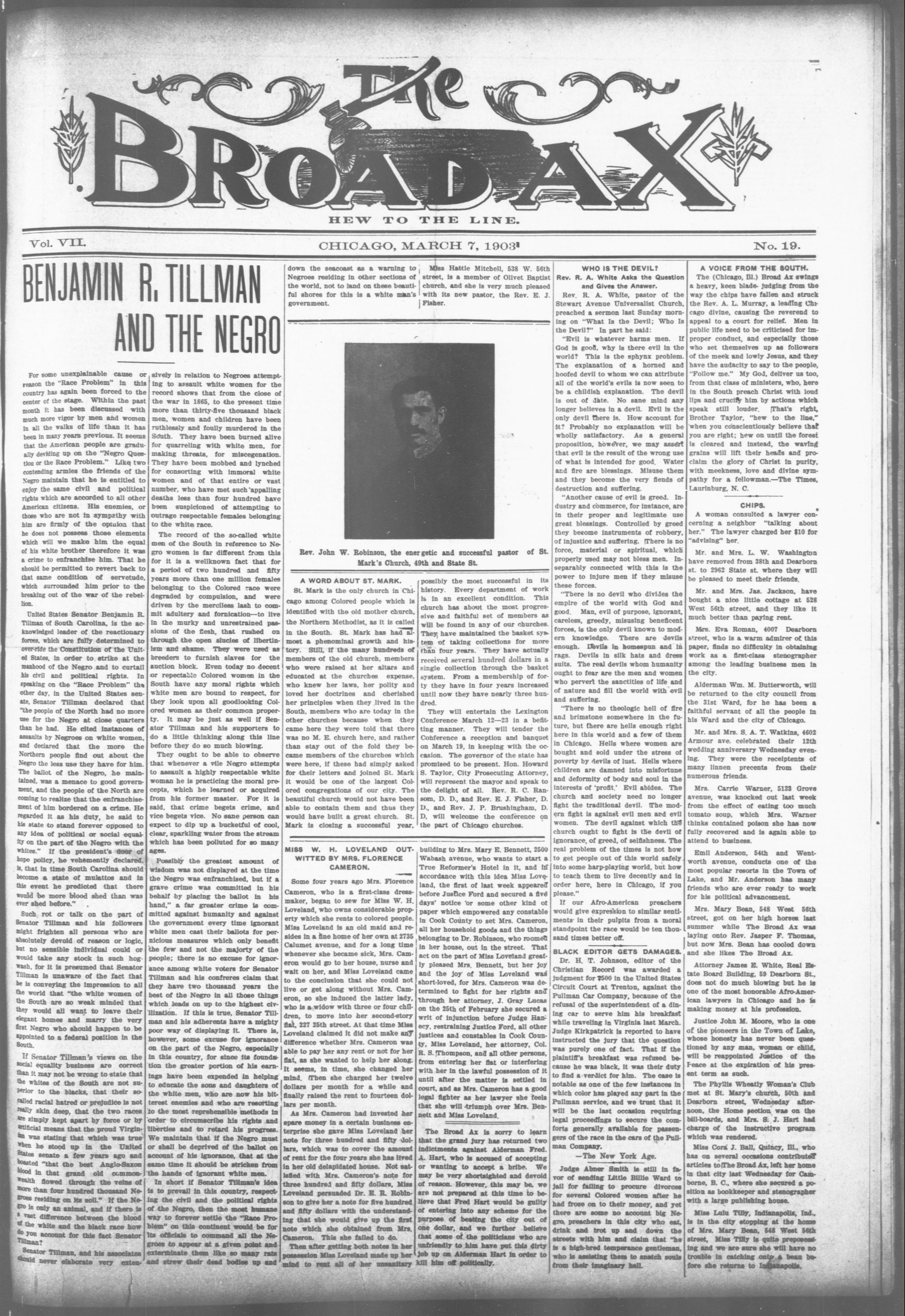
Rev. John W. Robinson, the energetic and successful pastor of St. Mark's Church, 49th and State St.
A WORD ABOUT ST. MARK.
St. Mark is the only church in Chicago among Colored people which is identified with the old mother church, the Northern Methodist, as it is called in the South. St. Mark has had almost a phenominal growth and history. Still, if the many hundreds of members of the old church, members who were raised at her altars and educated at the churches expense, who knew her laws, her polity and loved her doctrines and cherished her principles when they lived in the South, members who are today in the other churches because when they came here they were told that there was no M. E. church here, and rather than stay out of the fold they became members of the churches which were here, if these had simply asked for their letters and joined St. Mark it would be one of the largest Colored congregations of our city. The beautiful church would not have been able to contain them and thus they would have built a great church. St. Mark is closing a successful year.
MISS W. H. LOVELAND OUTWITTED BY MRS. FLORENCE CAMERON.
Some four years ago Mrs. Florence Cameron, who is a first-class dressmaker, began to sew for Miss W. H. Loveland, who owns considerable property which she rents to colored people. Miss Loveland is an old maid and resides in a fine home of her own at 2735 Calumet avenue, and for a long time whenever she became sick, Mrs. Cameron would go to her house, nurse and wait on her, and Miss Loveland came to the conclusion that she could not live or get along without Mrs. Cameron, so she induced the latter lady, who is a widow with three or four children, to move into her second-story flat, 227 25th street. At that time Miss Loveland claimed it did not make any difference whether Mrs. Cameron was able to pay her any rent or not for her flat, as she wanted to help her along. It seems, in time, she changed her mind. Then she charged her twelve dollars per month for a while and finally raised the rent to fourteen dollars per month.
As Mrs. Cameron had invested her spare money in a certain business enterprise she gave Miss Loveland her note for three hundred and fifty dollars, which was to cover the amount of rent for the four years she has lived in her old delapidated house. Not satisfied with Mrs. Cameron's note for three hundred and fifty dollars, Miss Loveland persuaded Dr. E. R. Robinson to give her a note for five hundred and fifty dollars with the understanding that she would give up the first note which she obtained from Mrs. Cameron. This she failed to do. Then after getting both notes in her possession Miss Loveland made up her mind to rent all of her unsanitary
Miss Hattie Mitchell, 538 W. 56th street, is a member of Olivet Baptist church, and she is very much pleased with its new pastor, the Rev. E. J. Fisher.
possibly the most successful in its history. Every department of work is in an excellent condition. This church has about the most progressive and faithful set of members as will be found in any of our churches. They have maintained the basket system of taking collections for more than four years. They have actually received several hundred dollars in a single collection through the basket system. From a membership of forty they have in four years increased until now they have nearly three hundred.
They will entertain the Lexington Conference March 12-23 in a befitting manner. They will tender the Conference a reception and banquet on March 19, in keeping with the occasion. The governor of the state has promised to be present. Hon. Howard S. Taylor, City Prosecuting Attorney, will represent the mayor and speak to the delight of all. Rev. R. C. Ransom, D. D., and Rev. E. J. Fisher, D. D., and Rev. J. P. Brushingham, D. D. will welcome the conference on the part of Chicago churches.
building to Mrs. Mary E. Bennett, 2500 Wabash avenue, who wants to start a True Reformer's Hotel in it, and in accordance with this idea Miss Loveland, the first of last week appeared before Justice Ford and secured a five days' notice 'or some other kind of paper which empowered any constable in Cook County to set Mrs. Cameron, all her household goods and the things belonging to Dr. Robinson, who roomed in her house, out in the street. That act on the part of Miss Loveland greatly pleased Mrs. Bennett, but her joy and the joy of Miss Loveland was short-loved, for Mrs. Cameron was determined to fight for her rights and through her attorney, J. Gray Lucas on the 25th of February she secured a writ of injunction before Judge Hanecy, restraining Justice Ford, all other justices and constables in Cook County, Miss Loveland, her attorney, Col. R. S. Thompson, and all other persons, from entering her flat or interfering with her in the lawful possession of it until after the matter is settled in court, and as Mrs. Cameron has a good legal fighter as her lawyer she feels that she will triumph over Mrs. Bennett and Miss Loveland.
The Broad Ax is sorry to learn that the grand jury has returned two indictments against Alderman Fred. A. Hart, who is accused of accepting or wanting to accept a bribe. We may be very shortsighted and devoid of reason. However, this may be, we are not prepared at this time to believe that Fred Hart would be guilty of entering into any scheme for the purpose of beating the city out of one dollar, and we further believe that some of the politicians who are unfriendly to him have put this dirty job up on Alderman Hart in order to kill him off politically.
WHO IS THE DEVIL?
Rev. R. A. White Asks the Question and Gives the Answer.
Rev. R. A. White, pastor of the Stewart Avenue Universalist Church, preached a sermon last Sunday morning on "What Is the Devil; Who Is the Devil?" In part he said:
"Evil is whatever harms men. If God is good, why is there evil in the world? This is the sphynx problem. The explanation of a horned and hoofed devil to whom we can attribute all of the world's evils is now seen to be a childish explanation. The devil is out of date. No sane mind any longer believes in a devil. Evil is the only devil there is. How account for it? Probably no explanation will be wholly satisfactory. As a general proposition, however, we may assert that evil is the result of the wrong use of what is intended for good. Water and fire are blessings. Misuse them and they become the very fiends of destruction and suffering.
"Another cause of evil is greed. Industry and commerce, for instance, are in their proper and legitimate use great blessings. Controlled by greed they become instruments of robbery, of injustice and suffering. There is no force, material or spiritual, which properly used may not bless men. Inseparably connected with this is the power to injure men if they misuse these forces.
"There is no devil who divides the empire of the world with God and good. Man, evil of purpose, ignorant, careless, greedy, misusing beneficent forces, is the only devil known to modern knowledge. There are devils enough. Devils in homespun and in rags. Devils in silk hats and dress suits. The real devils whom humanity ought to fear are the men and women who pervert the sanctities of life and of nature and fill the world with evil and suffering.
"There is no theologic hell of fire and brimstone somewhere in the future, but there are hells enough right here in this world and a few of them in Chicago. Hells where women are bought and sold under the stress of poverty by devils of lust. Hells where children are damned into misfortune and deformity of body and soul in the interests of 'profit.' Evil abides. The church and society need no longer fight the traditional devil. The modern fight is against evil men and evil women. The devil against which the church ought to fight is the devil of ignorance, of greed, of selfishness. The real problem of the times is not how to get people out of this world safely into some harp-playing world, but how to teach them to live decently and in order here, here in Chicago, if you please."
If our Afro-American preachers would give expression to similar sentiments in their pulpits from a moral standpoint the race would be ten thousand times better off.
BLACK EDITOR GETS DAMAGES. Dr. H. T. Johnson, editor of the Christian Record was awarded a judgment for $500 in the United States Circuit Court at Trenton, against the Pullman Car Company, because of the refusal of the superintendent of a dining car to serve him his breakfast while traveling in Virginia last March. Judge Kirkpatrick is reported to have instructed the jury that the question was purely one of fact. That if the plaintiff's breakfast was refused because he was black, it was their duty to find a verdict for him. The case is notable as one of the few instances in which color has played any part in the Pullman service, and we trust that it will be the last occasion requiring legal proceedings to secure the comforts generally available for passengers of the race in the cars of the Pullman Company.
-The New York Age.
Judge Abner Smith is still in favor of sending Little Billie Ward to jail for failing to procure divorces for several Colored women after he had froze on to their money, and yet there are some no account big Negro preachers in this city who eat, drink and trot up and down the streets with him and claim that "he is a high-bred temperance gentleman, who is assisting them to snatch souls from their imaginary hell.
No.19.
The (Chicago, Ill.) Broad Ax swings a heavy, keen blade- judging from the way the chips have fallen and struck the Rev. A. L. Murray, a leading Chicago divine, causing the reverend to appeal to a court for relief. Men in public life need to be criticised for improper conduct, and especially those who set themselves up as followers of the meek and lowly Jesus, and they have the audacity to say to the people, "Follow me." My God, deliver us too, from that class of ministers, who, here in the South preach Christ with loud lips and crucify him by actions which speak still louder. That's right, Brother Taylor, "hew to the line," when you conscientiously believe that you are right; hew on until the forest is cleared and instead, the waving grains will lift their heads and proclaim the glory of Christ in purity, with meekness, love and divine sympathy for a fellowman.—The Times, Laurinburg, N. C.
CHIPS.
A woman consulted a lawyer concerning a neighbor "talking about her." The lawyer charged her $10 for "advising" her.
Mr. and Mrs. L. W. Washington have removed from 38th and Dearborn st. to 2962 State st. where they will be pleased to meet their friends.
Mr. and Mrs. Jas. Jackson, have bought a nice little cottage at 528 West 56th street, and they like it much better than paying rent.
Mrs. Eva Roman, 4007 Dearborn street, who is a warm admirer of this paper, finds no difficulty in obtaining work as a first-class stenographer among the leading business men in the city.
Alderman Wm. M. Butterworth, will be returned to the city council from the 31st Ward, for he has been a faithful servant of all the people in his Ward and the city of Chicago.
Mr. and Mrs. S. A. T. Watkins, 4602 Armour ave. celebrated their 12th wedding anniversary Wednesday evening. They were the receiptents of many linnen precents from their numerous friends.
Mrs. Carrie Warner, 5133 Grove avenue, was knocked out last week from the effect of eating too much tomato soup, which Mrs. Warner thinks contained poison she has now fully recovered and is again able to attend to business.
Emil Anderson, 54th and Wentworth avenue, conducts one of the most popular resorts in the Town of Lake, and Mr. Anderson has many friends who are ever ready to work for his political advancement.
Mrs. Mary Bean, 548 West 56th street, got on her high horses last summer while The Broad Ax was laying onto Rev. Jasper F. Thomas, but now Mrs. Bean has cooled down and she likes The Broad Ax.
Attorney James E. White, Real Estate Board Building, 59 Dearborn St., does not do much blowing but he is one of the most honorable Afro-American lawyers in Chicago and he is making money at his profession.
Justice John M. Moore, who is one of the pioneers in the Town of Lake, whose honesty has never been questioned by any man, woman or child, will be reappointed Justice of the Peace at the expiration of his present term as such.
The Phyllis Wheatly Woman's Club met at St. Mary's church, 50th and Dearborn street, Wednesday afternoon, the Home section was on the bill-boards, and Mrs. S. J. Hart had charge of the instructive program which was rendered.
Miss Cora J. Ball, Quincy, Ill., who has on several occasions contributed articles to The Broad Ax, left her home in that city last Wednesday for Camborne, B. C., where she secured a position as bookkeeper and stenographer with a large publishing house.
Miss Lulu Tilly, Indianapolis, Ind., is in the city stopping at the home of Mrs. Mary Bean, 548 West 56th street, Miss Tilly is quite prepossessing and we are sure she will have no trouble in catching onto a beau before she returns to Indianapolis.
THE BROAD AX.
PUBLISHED WEEKLY.
Will promulgate and at all times uphold the true principles of Democracy, but Oatholica, Protestants, Priests, Indigela, Farmers, Single Taxes, Republicans, Knights of Labor, or any one else can have their say, so long as their language is proper and responsibility is fixed.
The Broad Ax is a newspaper whose platform is broad enough for all, ever claiming the editorial right to speak its own mind.
Local communications will receive attention. Write only on one side of the paper.
Subscriptions must be paid in advance.
Advertising rates made known on application Address all communications to
JULIUS F. TAYLOR, Editor and Publisher
Entered at the Post Office at Chicago, Ill., as Second-class Matter.
Old Peterby is rich and stingy. In the event of his death his nephew is to inherit his property. A friend of the family said to the old gentleman:
"I hear your nephew is going to marry. On that occasion you ought to do something to make him happy."
"I will," said Mr. Peterby. "I'll pretend that I am dangerously ill."—Tit-Bite.
Somewhat Broken
"Was Mrs. Murphy pleased when she heard her husband's voice on the phonograph?" "Very much so."
"But the record was scratched and his speech sounded incoherently." "Yes; she said it sounded just like him talking when he came home from the club."—Chicago Daily News.
Miss Chellus—Automobiling is her fad, now, I hear.
Miss Speitz—Ah! yes; because it improves her looks at least 50 per cent.
Miss Chellus—The idea! How?
Miss Speitz—Because she wears a mask half the time.—Philadelphia Press.
Sad Forgetfulness.
Dr. Stork—Samantha, I believe I am losing my memory.
Samantha—What is the matter now, doctor?
Dr. Stork (greatly perplexed)—Why, for the life of me, I can't remember whether those Jonekes ordered boy or girl—N. Y. Herald.
The Worst of It.
Amelia—I don't see how you could permit him to say such dreadful things!
Clara—It was awfully embarrassing. And the worst of it was we were in the dark, and, of course, he couldn't see I was blushing.—Town Topics.
Old Saying Revised.
"That man is a public benefactor," remarked the observer of events and things, "who can make only one corn grow where two grew before."—Yonkers Statesman.
The Anti-Trust Bills.
They're passing anti-trust bills,
So why should poor men fret?
They're passing 'em in clusters—
But no trust's busted yet.
Chicago Record-Herald
SQUARE WORK
Teacher—Johnnie, compare "good." Johnnie—The good that we learn from you, ma'am, is incomparable. N. Y. Sun.
Twin Awkwards.
There are two ungraceful objects You can't lose, to save your life;
They're a fellow with a needle,
And a woman with a knife.
-Baltimore News.
A Mystery.
"I never could understand why a woman puts anything on her face. She deceives no one but herself."
Gladys—So she married him just because he owned an "auto?"
Penelope—Oh, no! Because he never got mad when it broke down.—Puck.
Repelling the Boarders.
Across the deck appeared the swarthy face of the leading boarder.
His eyes had a fierce glare.
"Draw!" I cried.
Still he said nothing—only continued to look at me as if to read my inmost soul.
Now, to either side of him, I could see the other boarders. They all seemed to be waiting his lead.
The one between the leader and myself dropped his hand. This must have been the cue, for I saw the leading boarder's eye brighten.
Looking carefully at it, He said: "Give me three cards."
I stood pat.
Then the boarding house game was over, for I had won all the money.
—N. Y. Times.
MUSIC AND DRAMA.
Emperor William is collaborating with Joseph Lauff, the court poet, on a drama entitled "Under the Helmet." The hero is the great elector, Frederick William of Brandenburg, who died in 1688.
John Lawrence Toole, the London comedian, has a healthy contempt for the pretentious sudden rich, and rarely if ever conceals his views on this subject. Once he was being photographed in his disreputable make-up as old Eccles in "Caste." Without changing his clothes he walked half a mile to the house of a parvenue notorious for his pomposity and pride of purse. Toole rang the bell and the door was opened by a gorgeous flunkey. "Please tell your master," said Toole, "that his brother from the workhouse has called." Before the footman could recover from his astonishment Toole had shuffled away.
A certain comic opera soprano in New York is causing much annoyance to Mrs. John Jacob Astor by imitating that young fashion leader in every way possible. In dress, walk, equipage, and manner does the stage celebrity show this "sincereest form of flattery." The climax came last week when the woman of fashion added to her stable accouterments of a horse cover of fine seal leather with the Astor crest wrought inconspicuously in brass in one corner. Everyone waited for the burlesque queen to do likewise. The next time she appeared her horse was covered by the leather trappings. But the crest was as big as a saucer.
Mrs. Langtry attended a reception in New York last week and roused much envy among fashionables who were present because of her beautiful complexion, which is really a marvel. Subsequently a rather faded beauty exclaimed: "How on earth does she do it? Why, she's 50 if she's a minute." Another grande dame, who spoke as though she knew, gave this explanation: "It's Jersey, her birthplace. You know Mrs. Langtry spends six or eight weeks every season on her farm there. She wears a short skirt and thick boots—sometimes no boots at all—goes about in a sunbonnet and lives like a farm girl. The fog of the island does the rest."
FIGHTING TUBERCULOSIS
Dr. Flick in a lecture on tuberculosis warned especially against moving into houses previously occupied by consumptives which had not been disinfected, and also against the employment of consumptive servants, and emphasized the efficacy of cleanliness as a preventive measure.
The royal commission which has been investigating tuberculosis recommends rigid laws. Some of the points proposed are: Reporting of cases, compulsory confinement of recalcitrant patients in special institutions, prohibition of infected persons from acting as nurses, teachers or physicians, erection of municipal phthisis hospitals, the state bearing half the cost and the extremely poor being treated free of charge.
In his warfare against consumption Health Commissioner Lederle, of New York, is having thousands of leaflets on the subject printed in every language spoken in that city, including Chinese. These leaflets, which will be distributed among the poor in every tenement district, contain simple instructions by the observance of which the danger of infection may, to a great extent, be avoided. Dr. Lederle will also send trained nurses among the tenement-house consumptives to care for and instruct the afflicted and their associates.
FACTS FOR STAR-GAZERS
A day in the planet Eros is five and a half hours.
The earth passed through the tail of the great comet of 1861. It took four hours to cross it.
It is suggested by Prof. Pickering that the streaks which radiate from lunar craters—one from Tycho is 1,700 miles long—are caused by pumice thrown out by the volcano.
No comet is likely to injure the earth, even if it does strike it; for Prof. Babenet has lately calculated that the substance of which comets are made is several million times lighter than air.
Krypton, one of the monatomic gases recently discovered to be a constituent of air by Ramsey, has the same spectroscopic lines as the aurora borealis, and its accumulation at the pole is thought to be the cause of the aurora.
The suggestion recently made that life was first introduced to our world by germs borne by meteorites is not new. Its recrudescence may be a result of the recently published statements that many microbes retain life while in liquid air, which is assumed to be as cold as interstellar space.
PLANT LIFE
Nearly 80 per cent. of all flowers are white.
New Zealand has an ivy tree which has a thick, short trunk and heavy branches. It is not a climbing plant.
By applying glucose or glycerin to their roots a French scientist declares that he has been able to stimulate the growth of plants.
The largest collection of orchids in the world is at Schonbrunn, near Vienna. It comprises more than 25,000 examples of 1,200 species and varieties.
Flowering plants may be forced to blossom at any time by exposing them to ether fumes for two days twice, with an interval of two days between, and then placing for two weeks in a house.
The Constitution at Fault.
"I tell you," said the first reformer, "we ought to start an agitation to curb the prize-fighting evil by means of a constitutional amendment."
"But," objects the second reformer, "that would react upon all of us."
"In what way?"
"Doesn't the constitution guarantee the right of free speech?"—Judge.
SHERIFF
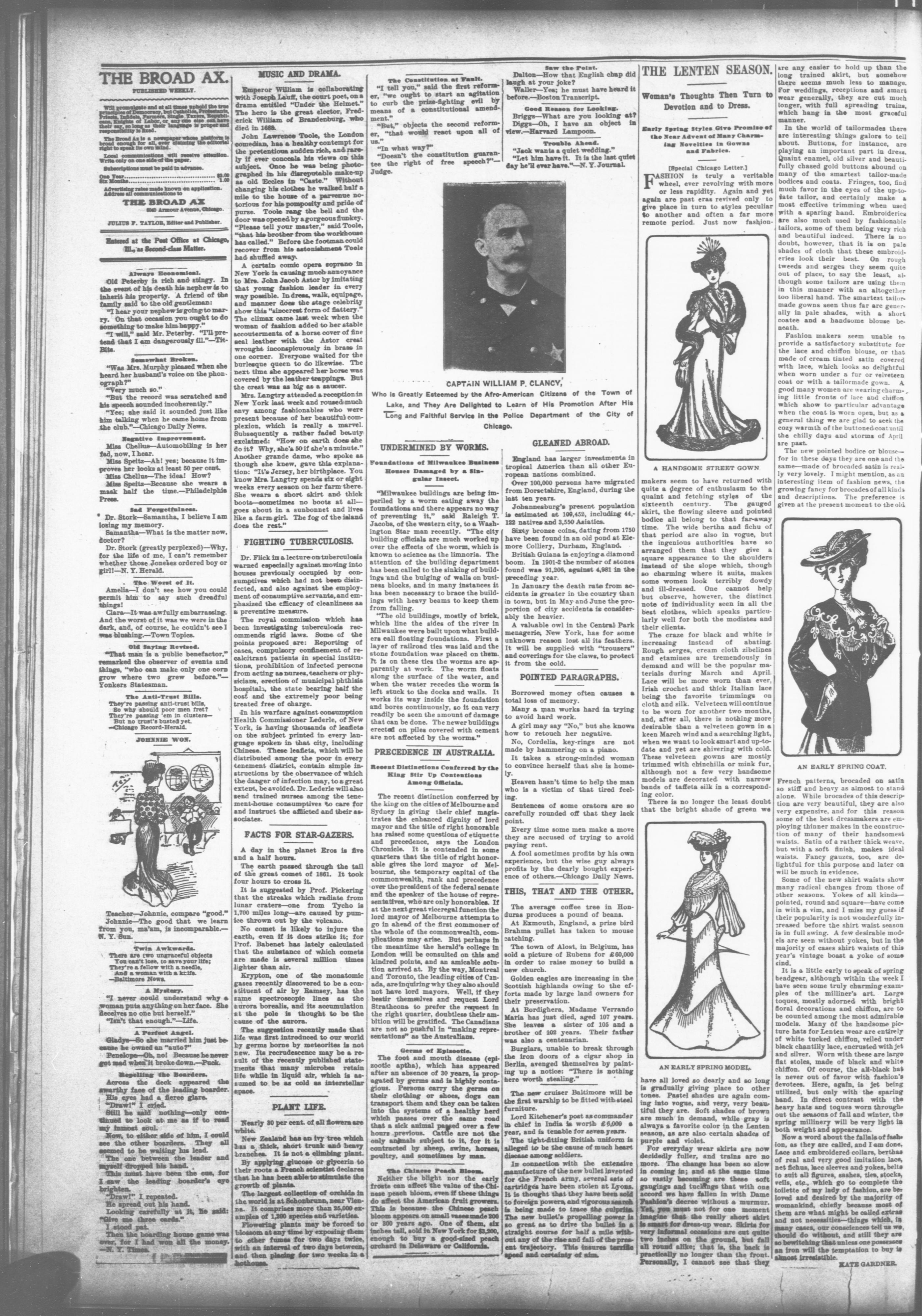
CAPTAIN WILLIAM P. CLANCY, Who is Greatly Esteemed by the Afro-American Citizens of the Town of Lake, and They Are Delighted to Learn of His Promotion After His Long and Faithful Service In the Police Department of the City of Chicago.
UNDERMINED BY WORMS.
Foundations of Milwaukee Business Houses Damaged by a Singular Insect.
"Milwaukee buildings are being imperiled by a worm eating away the foundations and there appears no way of preventing it," said Raleigh T. Jacobs, of the western city, to a Washington Star man recently. "The city building officials are much worked up over the effects of the worm, which is known to science as the limnoria. The attention of the building department has been called to the sinking of buildings and the bulging of walls on business blocks, and in many instances it has been necessary to brace the buildings with heavy beams to keep them from falling.
"The old buildings, mostly of brick, which line the sides of the river in Milwaukee were built upon what builders call floating foundations. First a layer of railroad ties was laid and the stone foundation was placed on them. It is on these ties the worms are apparently at work. The worm floats along the surface of the water, and when the water recedes the worm is left stuck to the docks and walls. It works its way inside the foundation and bores continuously, so it can very readily be seen the amount of damage that can be done. The newer buildings erected on piles covered with cement are not affected by the worms."
PRECEDENCE IN AUSTRALIA.
Recent Distinctions Conferred by the King Stir Up Contentions Among Officials.
The recent distinction conferred by the king on the cities of Melbourne and Sydney in giving their chief magistrates the enhanced dignity of lord mayor and the title of right honorable has raised some questions of etiquette and precedence, says the London Chronicle. It is contended in some quarters that the title of right honorable gives the lord mayor of Melbourne, the temporary capital of the commonwealth, rank and precedence over the president of the federal senate and the speaker of the house of representatives, who are only honorables. If at the next great viceregal function the lord mayor of Melbourne attempts to go in ahead of the first commoner of the whole of the commonwealth, complications may arise. But perhaps in the meantime the herald's college in London will be consulted on this and kindred points, and an amicable solution arrived at. By the way, Montreal and Toronto, the leading cities of Canada, are inquiring why they also should not have lord mayors. Well, if they bestir themselves and request Lord Strathecona to prefer the request in the right quarter, doubtless their ambition will be gratified. The Canadians are not so pushful in "making representations" as the Australians.
Germs of Enisette
The foot and mouth disease (epizootic aptha), which has appeared after an absence of 30 years, is propagated by germs and is highly contagious. Persons carry the germs on their clothing or shoes, dogs can transport them and they can be taken into the systems of a healthy herd which passes over the same road that a sick animal passed over a few hours previous. Cattle are not the only animals subject to it, for it is contracted by sheep, swine, horses, poultry, and sometimes by man.
The Chinese Peach Bloom
Neither the blight nor the early frosts can affect the value of the Chinese peach bloom, even if these things do affect the American fruit growers. This is because the Chinese peach bloom appears on small vases made 200 or 300 years ago. One of them, six inches tall, sold in New York for $3,200, enough to buy a good-sized peach orchard in Delaware or California.
"In what way?"
Dalton—How that English chap did laugh at your joke?
Waller—Yes; he must have heard it before.—Boston Transcript.
Good Reason for Looking.
Briggs—What are you looking at?
Diggs—Oh, I have an object in view.—Harvard Lampoon.
"Jack wants a quiet wedding." "Let him have it. It is the last quiet day he'll ever have."—N. Y. Journal.
GLEANED ABROAD.
England has larger investments in tropical America than all other European nations combined.
Over 100,000 persons have migrated from Dorsetshire, England, during the last ten years.
Johannesburg's present population is estimated at 109,452, including 44,122 natives and 3,550 Asiatics.
Sixty bronze coins, dating from 1750 have been found in an old pond at Elemore Colliery, Durham, England.
British Guiana is enjoying a diamond boom. In 1901-2 the number of stones found was 91,206, against 4,981 in the preceding year.
In January the death rate from accidents is greater in the country than in town, but in May and June the proportion of city accidents is considerably the heavier. A valuable owl in the Central Park menagerie, New York, has for some unknown reason lost all its feathers. It will be supplied with "trousers" and coverings for the claws, to protect it from the cold.
POINTED PARAGRAPHS.
Borrowed money often causes a total loss of memory.
Many a man works hard in trying to avoid hard work.
A girl may say "No," but she knows how to retouch her negative.
No, Cordelia, key-rings are not made by hammering on a piano.
It takes a strong-minded woman to convince herself that she is homely.
Heaven hasn't time to help the man who is a victim of that tired feeling.
Sentences of some orators are so carefully rounded off that they lack point. Every time some men make a move they are accused of trying to avoid paying rent. A fool sometimes profits by his own experience, but the wise guy always profits by the dearly bought experience of others.—Chicago Daily News.
THIS, THAT AND THE OTHER.
The average coffee tree in Honduras produces a pound of beans. At Exmouth, England, a prize bird Brahma pullet has taken to mouse catching. The town of Alost, in Belgium, has sold a picture of Rubens for £60,000 in order to raise money to build a new church. Golden eagles are increasing in the Scottish highlands owing to the efforts made by large land owners for their preservation.
At Bordighera, Madame Verrando Maria has just died, aged 107 years. She leaves a sister of 105 and a brother of 102 years. Their father was also a centenarian.
Burglars, unable to break through the iron doors of a cigar shop in Berlin, avenged themselves by painting up a notice: "There is nothing here worth stealing."
The new cruiser Baltimore will be the first warship to be fitted with steel furniture.
Lord Kitchener's post as commander in chief in India is worth £6,000 a year, and is tenable for seven years.
The tight-fitting British uniform is alleged to be the cause of much heart disease among soldiers.
In connection with the extensive manufacture of the new bullet invented for the French army, several sets of cartridges have been stolen at Lyons. It is thought that they have been sold to foreign powers, and vigorous search is being made to trace the culprits. The new bullet's propelling power is so great as to drive the bullet in a straight course for half a mile without any of the rise and fall of the present trajectory. This insures terrific speed and certainty of aim.
Saw the Point.
Trouble Ahead.
THE LENTEN SEASON.
Woman's Thoughts Then Turn to Devotion and to Dress.
Early Spring Styles Give Promise of the Near Advent of Many Charming Novelties in Gowns and Fabrics.
FASHION is truly a veritable wheel, ever revolving with more
1 wheel, ever revolving with more or less rapidity. Again and yet again are past eras revived only to give place in turn to styles peculiar to another and often a far more remote period. Just now fashion-
.
A HANDSOME STREET GOWN
makers seem to have returned with quite a degree of enthusiasm to the quaint and fetching styles of the sixteenth century. The gauged skirt, the flowing sleeve and pointed bodice all belong to that far-away time. The wide bertha and fichu of that period are also in vogue, but the ingenious authorities have so arranged them that they give a square appearance to the shoulders instead of the slope which, though so charming where it suits, makes some women look terribly dowdy and ill-dressed. One cannot help but observe, however, the distinct note of individuality seen in all the best clothes, which speaks particularly well for both the modistes and their clients.
The craze for black and white is increasing instead of abating. Rough serges, cream cloth zibelines and etamines are tremendously in demand and will be the popular materials during March and April. Lace will be more worn than ever, Irish crochet and thick Italian lace being the favorite trimmings on cloth and silk. Velveteen will continue to be worn for another two months, and, after all, there is nothing more desirable than a velveteen gown in a keen March wind and a searching light, when we want to look smart and up-to-date and yet are shivering with cold. These velveteen gowns are mostly trimmed with chinchilla or mink fur, although not a few very handsome models are decorated with narrow bands of taffeta silk in a corresponding color.
There is no longer the least doubt that the bright shade of green we
```markdown
```
AN EARLY SPRING MODEL. have all loved so dearly and so long is gradually giving place to other tones. Pastel shades are again coming into vogue, and very, very beautiful they are. Soft shades of brown are much in demand, while gray is always a favorite color in the Lenten season, as are also certain shades of purple and violet.
For everyday wear skirts are now decidedly fuller, and trains are no more. The change has been so slow in coming in; and at the same time so vastly becoming are these soft gaugings and tuckings that with one accord we have fallen in with Dame Fashion's decree without a murmur. Yet, you must not for one moment imagine that the really short skirt is smart for dress-up wear. Skirts for very informal occasions are cut quite two inches on the ground, but fall all round alike; that is, the back is practically no longer than the front. Personally, I cannot see that they
are any easier to hold up than the long trained skirt, but somehow there seems much less to manage. For weddings, receptions and smart wear generally, they are cut much longer, with full spreading trains, which hang in the most graceful manner.
In the world of tailormades there are interesting things galore to tell about. Buttons, for instance, are playing an important part in dress. Quaint enamel, old silver and beautifully chased gold buttons abound on many of the smartest tailor-made bodices and coats. Fringes, too, find much favor in the eyes of the up-to-date tailor, and certainly make a most effective trimming when used with a sparing hand. Embroideries are also much used by fashionable tailors, some of them being very rich and beautiful indeed. There is no doubt, however, that it is on pale shades of cloth that these embroideries look their best. On rough tweeds and serges they seem quite out of place, to say the least, although some tailors are using them in this manner with an altogether too liberal hand. The smartest tailormade gowns seen thus far are generally in pale shades, with a short coatee and a handsome blouse beneath.
Fashion makers seem unable to provide a satisfactory substitute for the lace and chiffon blouse, or that made of cream tinted satin covered with lace, which looks so delightful when worn under a fur or velveteen coat or with a tailormade gown. A good many women are wearing charming little fronts of lace and chiffon which show to particular advantage when the coat is worn open, but as a general thing we are glad to seek the cozy warmth of the buttoned coat until the chilly days and storms of April are past.
The new pointed bodice or blouse for in these days they are one and the same—made of brocaded satin is really very lovely. I might mention, as an interesting item of fashion news, the growing fancy for brocades of all kinds and descriptions. The preference is given at the present moment to the old
```markdown
```
AN EARLY SPRING COAT.
French patterns, brocaded on satin so stiff and heavy as almost to stand alone. While brocades of this description are very beautiful, they are also very expensive, and for this reason some of the best dressmakers are employing thinner makes in the construction of many of their handsomest waists. Satin of a rather thick weave, but with a soft finish, makes ideal waists. Fancy gauzes, too, are delightful for this purpose and later on will be much in evidence.
Some of the new shirt waists show many radical changes from those of other seasons. Yokes of all kinds—pointed, round and square—have come in with a vim, and I miss my guess if their popularity is not wonderfully increased before the shirt waist season is in full swing. A few desirable models are seen without yokes, but in the majority of cases shirt waists of this year's vintage boast a yoke of some kind.
It is a little early to speak of spring headgear, although within the week I have seen some truly charming examples of the milliner's art. Large toques, mostly adorned with bright floral decorations and chiffon, are to be counted among the most admirable models. Many of the handsome picture hats for Lenten wear are entirely of white tucked chiffon, veiled under black chantilly lace, encrusted with jet and silver. Worn with these are large flat stoles, made of black and white chiffon. Of course, the all-black hat is never out of favor with fashion's devotees. Here, again, is jet being utilized, but only with the sparing hand. In direct contrast with the heavy hats and toques worn throughout the seasons of fall and winter, the spring millinery will be very light in both weight and appearance.
Now a word about the fallals of fashion, as they are called, and I am done, Lace and embroidered collars, berthas of real and very good imitation lace, net fichus, lace sleeves and yokes, belts to suit all figures, sashes, ties, stocks, veils, etc., which go to complete the toilette of my lady of fashion, are beloved and desired by the majority of womankind, chiefly because most of them are what might be called extras and not necessities—things which, in many cases, our consciences tell us we should do without, and still they are so bewitching that unless one possesses an iron will the temptation to buy is almost irresistible.
KATE GARDNER.
THE FACE AND THE COLLAR.
A Stout Man May Make Himself Look Thin by Adopting the Proper Neckwear.
Men who do not want to look any fatter in the face than they can help have an easy means of accomplishing their purpose. Not all of them are aware of the effect that may be created by the form of a collar or cravat, says the New York Sun.
"The stout man who wants to look as thin as he can," said the haberdasher's clerk, "ought to wear a tie of the kind known as the four-in-hand. Preferably it should be dark in color and drawn tight. That carries down the line of the face and lengthens it to a degree that tends to make the face look thinner.
"Another aid to making a man look thin is in the height of his collar. Stout men who want to look thin should wear high collars and closed ones. Any collar that opens in front makes one look stouter under nearly every circumstance. Such collars are becoming to the thin men.
"The fat man should avoid the kind of tie that has a horizontal effect. This will add pounds to his appearance—in his face at least.
"On the contrary, this cross effect will make the thin man look stout. The broad plastron scarfs, as they are called, have little effect on a man's looks one way or the other. When he wears them it is the collar that makes the difference.
"He should, therefore, see that he wears a high one that does not open, if he wants to look as thin as possible, whereas if he wants to seem stouter, an open collar will produce that effect for him."
SCULPTURED IN A MACKINTOSH
Costly Statue in an Indiana Cemetery That Is Decidedly Out of the Ordinary.
Standing in Mount Hope cemetery at Logansport, Ind., is one of the queerest monuments ever erected to the memory of any individual, says the Cincinnati Enquirer. It is over the grave of William H. Reighter. The statue part of the monument represents Mr. Reighter as he was attired when stricken dead by heart disease.
Mr. Reighter was a ditch contractor and prominent in his locality. It was on a rainy day that death came, and he was well prepared for the weather. He was wearing a broad-brimmed hat, a mackintosh over his suit of clothes, and his trousers legs were in his rubber boots.
The members of the family, wishing to remember him as he looked when last he bid them good-by, employed a man about the same size and build as Mr. Reighter to have his photograph taken in the clothes last worn by the deceased, and when he had carried out his idea they replaced the head on the photograph with the head of a likeness of Mr. Reighter.
The picture was sent to a sculptor in Italy, with the request that a life-sized statue be made from it in Italian marble. The statue is true to life. It cost $5,000.
PHOTOGRAPHS ON FRUIT.
Explanation of the Manner in Which They Are Made by French Artists.
Apples upon the surface of which are perfectly reproduced the photographs of the emperor and empress of Russia and of the president of the French republic have been shown in France, says a consular report. Before photography was employed images were produced by means of figures cut from paper and stuck on the surface. When the paper was removed the image appeared light and the fruit dark, or vice versa, according to the manner in which the paper was cut and applied.
At present, however, photographs are reproduced with all their details. Strong negative electrotypes are employed, having great resistance and reproduced on thin films. The films are obtained by photographing the subject many times. The film is held in place by two rubber rings or is stuck by some matter that will not obstruct the rays of light, such as albumen or the white of an egg.
English Not Sensitive
An Englishman gives his impressions of Boston in the New York Independent, and suggests that Bostonians need never hesitate to display revolutionary relics to their English friends from any fear lest those reminders of national defeats may awaken painful feelings. He says his countrymen are hardened to that sort of thing, for they cannot even cross the English channel without remembering that Calais was a British possession for centuries.
Forage Crop and Fertility
Those states which are noted for the production of forage crops not only have maintained the original fertility of the soil, but they spend for commercial fertilizers less than one per cent. of the annual value of their crops, while those states which pay least attention to forage crops have impoverished the soil and spend annually for fertilizers from five to nine per cent. of the total value of their crops.
Germany's City Governments. The governments of German cities were, prior to the law of 1892, which Hennarck championed, notoriously corrupt through spoils of politics, but are to-day the models of efficiency and honesty. The prominent features of the law which caused their deliverance are home rule, compulsory service of the citizens in municipal affairs, long tenure of office and civil service.
LAND LOST TO TEXAS
As a Result of the Recent Surveys of the Lone Star State's Disputed Boundaries.
"Three portions of the boundary lines of the state of Texas are under dispute, and in each instance the territory of the lone star state is cut into," said Marshall T. Golden to a Washington Star man, recently. "There was recently filed in the land office of the state report of the work under the act of congress requiring the secretary of the interior to establish the 100th meridian which forms a part of the eastern boundary of Texas. It was at first believed that Texas would gain an eight-mile strip from Indian territory, but on the contrary, according to the report, Texas will probably loose a strip three-quarters of a mile wide. Should this report be considered as final people holding property on what was always considered the Texas side will lose their title as a Texas deed to the land will not be legal.
"The same condition prevails along the entire panhandle on the western end of the state. Surveyors have fixed the 103d meridian so as to cut off a strip three miles wide, embracing 300,000 acres, from the lone star state and it has recently been brought to light that New Mexico disputes the boundary line extending from the westernmost point of Texas, and the lone star state is about to lose more land to New Mexico."
INFORMED ON CLOCKS.
Not to Be Wondered At That This Man Knew How to Make Them Run.
A fad more or less general is the collection of old clocks, from the tall grandfather variety to the curious timekeepers of foreign make. The garrets of old farmhouses from Maine to the Carolinas have been ransacked for the former, and there is many a man and woman in New York who keeps an eye on the pawnshops of the foreign districts for curious and ancient things from abroad.
"It is almost impossible to keep them all running," complained a woman who has two dozen aged and valuable clocks scattered through her Madison avenue home. "They seem to be in good order and run along for awhile, then all of a sudden they stop for no reason at all.
"I have found an old German who knows more about the ways of old clocks than any one in the city. I sent him my German prize a few weeks ago, and when it did not come back after the usual period of waiting I went to his shop. What do you think I found him reading?"
The friend did not have the slightest idea, says the New York Tribune. "It was a little German volume with a title something like this: 'Thirteen Hundred Reasons Why a Clock in Perfect Order Won't Run.'"
BOOKS AND THE GENTLEMAN.
What the Man of Means Does and Does Not Do with the Volumes He Purchases.
Whatever the quality of American literature and however low the standard of culture which severe critics find among us, the fact remains that Americans buy more books than people of any other nation. But we are not above receiving benefit from some hints for the wealthy and cultivated, which the London Author quotes from a German publisher, says Youth's Companion.
A gentleman, he says, does not give his daughter a dowry of half a million and forget to provide her with a bookcase. He does not have a full cellar and empty book shelves. He does not borrow good books which he is in a position to buy.
A gentleman does not cut books with his fingers or touch them with soiled hands. He does not talk about the latest literature when he is acquainted only with what has been said about it in the newspapers. He does not make presents only of things which are without intellectual value.
Finally, he does not buy only cheap editions when he can afford better, or depend entirely for his reading on the daily journals or illustrated weeklies.
FLOOR OF THE PACIFIC.
Lofty Submarine Mountains Beside Which the Andes Would Look Lake Hillocks.
If the waters of the Pacific could be drained, there would be revealed a vast stretch of territory comprising enormous plateaus, great valleys for which no parallels exist on the land surface—lofty mountains, beside which the Himalaya and the Andes would look like hillocks, and tremendous hollows or basins, only to be compared with those on the face of the moon, says Leslie's Monthly.
While there are great mountains, and huge basins or "deeps," the plateau areas are by far the most extensive. Relatively speaking, the floor of the Pacific as now at last revealed on the plateau areas, is level. There are undulations and depressions, but the general area is about the same depth below the surface. Soundings develop a mean depth of from 2,500 to 2,700 fathoms. In shoaler spots there is a mean depth of from 2,300 to 2,400 fathoms. Deeper spots show from 2,800 to 2,900 fathoms.
Eastest Bicycle Record.
The fastest bicycle record is that of an American, who made a mile in a minute in the suction of a railway train, planks having been laid upon the ties to furnish a track. Now a Frenchman has made 50 miles in an hour riding behind a motor pacing machine having a wind shield.
BREAK THE NEWS GENTLY.
Turkish Papers Have a Queer Way of Carrying Out the Edicts of the Sultan.
There is no such thing as "yellow journalism" in Turkey; the journalism of that country is of the bleached variety. The sultan of Turkey has a censor who is a censor net. He has views, and his views "go."
Sometime ago a traveling company attempted to play "Othello" in Constantinople, and the play was presented to the censor as a mere matter of form. It was not supposed that he would find any objection to it, but he did, and a very serious objection, moreover. He objected strongly to the statement that Othello, was sent to Cyprus, for the political reason that as the island belonged to Turkey no Venetian had a right there, and the manager of the company had to send Othello to some other island before the performance was allowed.
It is a rule of the sultan that no ruler can die what is called a violent death, and the newspapers have to state such occurrences in a very careful manner. The Fourth Estate has found in a newspaper of Turin some examples of the methods employed to evade the facts of royal assassinations. When King Humbert was assassinated at Menza, the Turkish newspapers announced this sad event in this form: "King Humbert left the hall amid the frantic cheers of the people. The king, much affected, bowed several times, and to all appearances was immediately dead." Now that was an extremely clever way of stating a distressing fact.
THE PULOUERIES OF MEXICO.
Picturesque Resorts of the City Which Attract the Tourists' Attention.
"The pulqueries of the City of Mexico are a unique feature of the life in that country that never fail to catch the eye of the tourist and attract the attention of visitors," said A. S. Chewning, of El Paso, Tex., to a Washington Star man. "There are nearly a thousand such places and they dispense many carloads of pulque every day. These pulque shops are open every day in the year, and surely present a picturesque appearance. The walls are decorated with the most extraordinary pictures, representing bull fights and prize fights. The extraction of the pulque from the stems is done by hollowing out a sort of cup in one end and letting the sap flow into it, which is done very quickly. Then it is emptied into a gourd, which is carried by the pulque dealer. A plant will yield from three to ten gallons. Every pulque shop in the City of Mexico has a name peculiarly its own, such as 'Delights of Life,' 'The Smile,' 'The Charmer,' 'The Hope,' 'The Rainbow,' 'The Image of Jesus,' 'The Inspiration' and a lot of others of a similar nature. Pulque when taken in large quantities is intoxicating. It forms the principal drink of the Mexicans, and is a thin, whitish fluid, with the odor of sour milk."
ORIGINATED RAILWAY MAIL.
The Great Service First Thought Of by a Postmaster at 84.
"I ran across an old memorandum in looking through the files the other day that showed very clearly the origin of the vast railway mail service now in vogue in the United States," said a post office official to a Washington Star man.
"The man who started what is now an elaborate system was the postmaster at St. Joseph, Mo., at the time, appointed to the position by President Buchanan. His idea grew out of the old 'pony express,' which also had its origin in St. Joseph. He evolved an ingenious system of boxes for handling his mail expeditiously on the arrival of the 'express' by rigging up a lot of partitions in an old dry goods box, and labeled each hole with the name of an office served by the 'express,' on the arrival of the 'rider' he would sort out his mail and tie up the packages in the different partitions. When baggage cars were first in vogue, the bale-box idea was used, and, crude as it was, it added greatly to the rapidity with which the mail could be handled. From this crude beginning has been evolved the most elaborate railway mail service in the entire world, and from the one man who originated it it now takes nearly 30,000 men to carry it on."
SNUFF, BUT NO TAKERS
Uncle Sam Buys Five Pounds Yearly for the Members of Congress.
Ever since the United States senate held its first session, snuff has been provided for the members. The secretary of the senate buys five pounds every year. The snuff is kept in two boxes, one on each side of the entrances from the lobby. Any member who wants a pinch is free to take it.
There are no snuff takers in the present senate although in the old days, of course, nearly every senator took it. The snuff in the present boxes stands untouched from one year's end to the other, but it is always there and always fresh. The snuff is provided under an old rule that has never been abrogated.
In the last report of the expenditure of the contingent fund of the senate stands this item: "Five pounds of Copenhagen snuff, $29.60.
Germany's Shipa.
Germany has built the finest, fastest vessels afloat, although she is not geographically a maritime country, and no other country is so largely dependent on others for the raw materials which enter into the making of a ship.
During a big revival a sinner was greatly worked up. While the preacher was exhorting, the sinner arose in the audience and, with his face flushed with emotion, said:
"Dear friends, I feel the spirit moving me to confess what a bad man I've been, but I can't do it while the grand jury is in session."
"The Lord will forgive you," shouted the preacher.
"I know it, I know it," said the sinner, "but He isn't on the grand jury."—Atchison Globe.
A Sad Teille.
An infant from sunny Marseilles
Each night fills the air with its weilles,
While its poor French papa
And its petite mamma
Weep enough to fill several peilles.
—Brooklyn Liffe.
A
"When Mr. Casey died he left all he had to the orphan asylum."
"Indeed! That was nice of him. What did he leave?"
"His 12 children."—Chicago Journal.
For a Change.
The summer time will soon draw near
And 'twill be rather nice
To drop this bother o'er the coal
And worry o'er the ice.
—Washington Star.
Before the First Chewing.
Little Darling—That was a white
sugar almond I gave oo, Mr. Squeams;
does oo like it?
Crusty Old Bachelor (who is trying
very hard to swallow the dainty in
question)—Very much indeed, thank you.
Little Darling—It was pink, once.— Tit-Bits.
Had Had Enough.
Miss Youngman—But when he did finally come home, I should think you'd have been sufficiently curious, at least, to ask him what had kept him out so late.
Mrs. Klubman—Yes, but I had surfeited myself with fiction while I waited up for him. — Philadelphia Press.
Foresight.
He—Now, I always said we needed coaling stations—
His Admiring Wife—You did, indeed, Henry! I'm sure I remember your saying something of that kind long before there was any thought of a strike.—Puck.
Another Instance.
"Then they didn't arrest her for stealing?"
"No; they found she was in affluent circumstances, and called it a case of kleptomania."
"I see. Circumstances alter cases."—Chicago Tribune.
"Br'er Thomas say dis worl' ain't bright enough fer him."
"Yes; en de trouble is, ever' time he look 'cross Jordan's stormy banks, he sees de next worl' blazin'!"—Atlanta Constitution.
The Net Available
Would-Be Contributor—You did not read all my article that you rejected. I pasted a few of the pages together and they weren't opened. Editor—Do I have to eat a whole egg to know that it is bad?—N. Y. Times.
Knew the Brother
Struggling Pastor—Brother Skinflint intends to give our new chapel a beautiful memorial window. Wife—He probably wants something to look at when the contribution box goes around.—N. Y. Weekly.
Better Left Unsold
Mrs. Homer—You can't go home while it is raining so. Stay and have dinner with us. Mr. Witless—Oh, no, thank you. It isn't as bad as all that.—Chicago Daily News.
Distant Relative
Jack—You don't mean to say that pretty girl we just passed is your sister?
Tom—Yes; I'm her brother by refusal.—Cincinnati Enquirer.
Dick—Did you ever get the last word with your wife? Charles—Oh, yes; but I have to say it to myself when I get out on the street—Detroit Free Press.
"But why does she want to study law?"
"Oh, she thinks there is economy in being able to try her own breach of promise suits."—Chicago Post.
Very Much Interested.
"Did the young man give you any encouragement, Constance?"
"Oh, yes, papa; he asked me what sort of a cook we had."—Yonkers Statesman.
He Slept in Peace. Miles—Did you encounter any of the big bugs while in New York? Giles—No, I stopped at a new hotel.—Chlcago Daily News. How They Get There. "What is it that makes men great, papa?"
"Persistent advertising, my son."— Cleveland Plain Dealer.
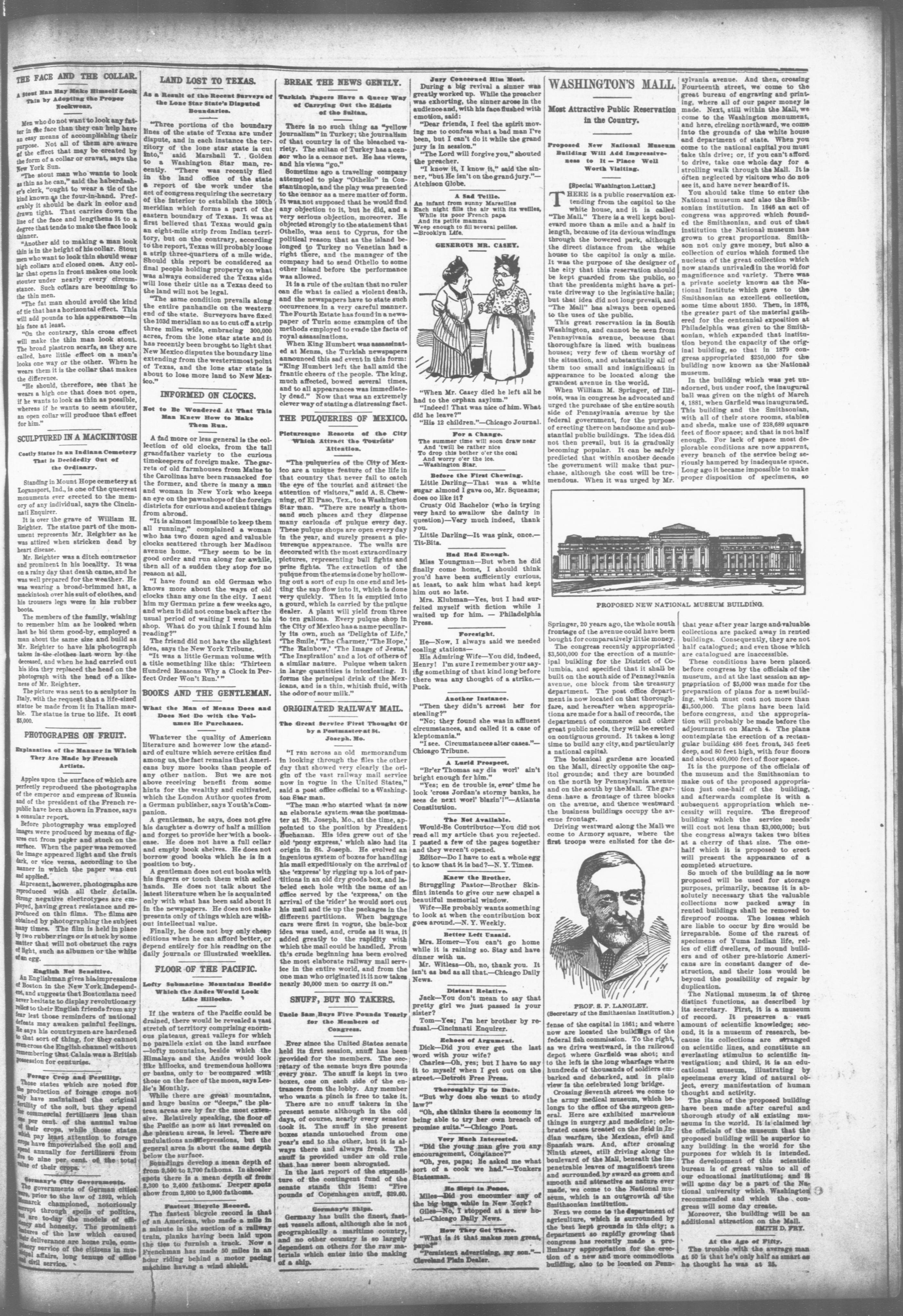
PROPOSED NEW NATIONAL MUSEUM BUILDING.
WASHINGTON'S MALL
WASHINGTON'S MALL
Most Attractive Public Reservation in the Country.
Proposed New National Museum Building Will Add Impressiveness to It - Place Well Worth Visiting.
[Special Washington Letter.]
THERE is a public reservation extending from the capitol to the
tending from the capitol to the white house, and it is called "The Mall." There is a well kept boulevard more than a mile and a half in length, because of its devious windings through the bowered park, although the direct distance from the white house to the capitol is only a mile. It was the purpose of the designer of the city that this reservation should be kept guarded from the public, so that the presidents might have a private driveway to the legislative halls; but that idea did not long prevail, and "The Mall" has always been opened to the uses of the public.
This great reservation is in South Washington, and cannot be seen from Pennsylvania avenue, because that thoroughfare is lined with business houses; very few of them worthy of the situation, and substantially all of them too small and insignificant in appearance to be located along the grandest avenue in the world.
When William M. Springer, of Illinois, was in congress he advocated and urged the purchase of the entire south side of Pennsylvania avenue by the federal government, for the purpose of erecting there on handsome and substantial public buildings. The idea did not then prevail, but it is gradually becoming popular. It can be safely predicted that within another decade the government will make that purchase, although the cost will be tremendous. When it was urged by Mr.
PROPOSED NEW NATION
Springer, 20 years ago, the whole south frontage of the avenue could have been bought for comparatively little money.
The congress recently appropriated $3,500,000 for the erection of a municipal building for the District of Columbia, and specified that it shall be built on the south side of Pennsylvania avenue, one block from the treasury department. The post office department is now located on that thoroughfare, and hereafter when appropriations are made for a hall of records, the department of commerce and other great public needs, they will be erected on contiguous ground. It takes a long time to build any city, and particularly a national capital.
The botanical gardens are located on the Mall, directly opposite the capitol grounds; and they are bounded on the north by Pennsylvania avenue and on the south by the Mall. The gardens have a frontage of three blocks on the avenue, and thence westward the business buildings occupy the avenue frontage. Driving westward along the Mall we come to Armory square, where the first troops were enlisted for the de
N.
PROF. S. P. LANGLEY. (Secretary of the Smithsonian Institution.) fense of the capital in 1861; and where now are located the buildings of the federal fish commission. To the right, as we drive westward, is the railroad depot where Garfield was shot; and to the left is the long wharfage where hundreds of thousands of soldiers embarked and debarked, and in plain view is the celebrated long bridge.
Crossing Seventh street we come to the army medical museum, which belongs to the office of the surgeon general. Here are exhibited marvelous things in surgery and medicine; celebrated cases treated on the field in Indian warfare, the Mexican, civil and Spanish wars. And, after crossing Ninth street, still driving along the boulevard of the Mall, beneath the impenetrable leaves of magnificent trees and surrounded by sward as green and smooth and attractive as nature ever made, we come to the National museum, which is an outgrowth of the Smithsonian institution.
Next we come to the department of agriculture, which is surrounded by the best kept grounds in this city; a department so rapidly growing that congress has recently made a preliminary appropriation for the erection of a new and more commodious building, also to be located on Penn-
sylvania avenue. And then, crossing Fourteenth street, we come to the great bureau of engraving and printing, where all of our paper money is made. Next, still within the Mall, we come to the Washington monument, and here, circling northward, we come into the grounds of the white house and department of state. When you come to the national capital you must take this drive; or, if you can't afford to drive, take one whole day for a strolling walk through the Mall. It is often neglected by visitors who do not see it, and have never heard of it.
You should take time to enter the National museum and also the Smithsonian institution. In 1846 an act of congress was approved which founded the Smithsonian, and out of that institution the National museum has grown to great proportions. Smithson not only gave money, but also a collection of curios which formed the nucleus of the great collection which now stands unrivaled in the world for magnificence and variety. There was a private society known as the National Institute which gave to the Smithsonian an excellent collection, some time about 1850. Then, in 1876, the greater part of the material gathered for the centennial exposition at Philadelphia was given to the Smithsonian, which expanded that institution beyond the capacity of the original building, so that in 1879 congress appropriated $250,000 for the building now known as the National museum.
In the building which was yet unadorned, but under roof, the inaugural ball was given on the night of March 4, 1881, when Garfield was inaugurated. This building and the Smithsonian, with all of their store rooms, stables and sheds, make use of 238,689 square feet of floor space; and that is not half enough. For lack of space most deplorable conditions are now apparent, every branch of the service being seriously hampered by inadequate space. Long ago it became impossible to make proper disposition of specimens, so
that year after year large and valuable collections are packed away in rented buildings. Consequently, they are not half catalogued; and even those which are catalogued are inaccessible.
These conditions have been placed before congress by the officials of the museum, and at the last session an appropriation of $5,000 was made for the preparation of plans for a new building, which must cost not more than $1,500,000. The plans have been laid before congress, and the appropriation will probably be made before the adjournment on March 4. The plans contemplate the erection of a rectangular building 486 feet front, 345 feet deep, and 80 feet high, with four floors and about 400,000 feet of floor space.
It is the purpose of the officials of the museum and the Smithsonian to make out of the proposed appropriation just one-half of the building, and afterwards complete it with a subsequent appropriation which necessity will require. The fireproof building which the service needs will cost not less than $3,000,000; but the congress always takes two bites at a cherry of that size. The onehalf which it is proposed to erect will present the appearance of a completed structure.
So much of the building as is now proposed will be used for storage purposes, primarily, because it is absolutely necessary that the valuable collections now packed away in rented buildings shall be removed to fireproof rooms. The losses which are liable to occur by fire would be irreparable. Some of the rarest of specimens of Yuma Indian life, relics of cliff dwellers, of mound builders and of other pre-historic Americans are in constant danger of destruction, and their loss would be beyond the possibility of repair by duplication.
The National museum is of three distinct functions, as described by its secretary. First, it is a museum of record. It preserves a vast amount of scientific knowledge; second, it is a museum of research, because its collections are arranged on scientific lines, and constitute an everlasting stimulus to scientific investigation; and third, it is an educational museum, illustrating by specimens every kind of natural object, every manifestation of human thought and activity.
The plans of the proposed building have been made after careful and thorough study of all existing museums in the world. It is claimed by the officials of the museum that the proposed building will be superior to any building in the world for the purposes for which it is intended. The development of this scientific bureau is of great value to all of our educational institutions; and it will some day be a part of the National university which Washington recommended and which the congress will some day create.
Moreover, the building will be an additional attraction on the Mall. SMITH D. FRY.
At the Age of Fifty.
The trouble with the average man at 50 is that he's only half as smart as he thought he was at 25.
“a
~ American Brick Co. -
MANUFACTURERS OF
Gommon and Sewer Brick
Office and Yards:
45th and Robey Sts.
San dank ingens Wale
eee os Betis ate a gee aoa
_ ¥elephone Yards 128.
CHIPS. e
Several of the Colored clerks in the
Pension Office at Washington were
promoted December 15. John H. Cook
of Minnesota and John B. Hayman
of North Carolina, went from $1,300
to $1,400 and Edward 8. Wood of Mis-
sissippi, was raised to $1,200 per az-
num.
Thursday, March 12, will be prest-
dent's day with the lL B. W. Wo
man’s Club, at which time the presi
dents of all the clubs are cordiaily
invited to attend and take part in the
discussion. Subject, “What Shall We
Do to Make Our Clubs More Inter
esting.”
Enos Bond, 6241 South May street,
who is the oldest Afro-American
Democrat in the Town of Lake is
confined to his bed with a severe at-
tack of pneumonia. The many friends
of Mr. Bond sincerely hope that he
will epeedily be restored to good
health.
Rey. D. R. Wilkins of the Old Church
Organ is either marired or is thinking
about splicing up with a widow, for
lately Elder Witkins has been house-
hunting, end any one who is not alto
gether blind would take him for a
marired man for he delights in lead-
ing a young boy around by the hand.
It is reported that owing to the
great fight which The Broad Ax has
made on the bad or the immoral
preachers of this city “that some for-
ty or fifty married women have
joined hands and have fully made up
their minds not to let their daughters
attend services in these churches for
they are fearful that they may be
ruined by the bad preachers.”
Those deceitful Negroes who are
telling the white men of the South
that the Negroes with a few excep
tions are satisfied with jim crow cars
and disfranchising laws are lying, and
the white men know it. Who can be
satisfied to be humiliatei? Those ly-
ing, grinning and traitorous Negroes
if no one were looking at them would
steal a cent off of a dead man’s eyes.
—Ex.
‘Wil Prof. Booker T. Washington
please stand up and led us in prayer?
Gov, Richard Yates, whom we have
always regarded as a little 2x4 politi-
can came to town last week with the
intention of shooting Mr. Harden,
editor of The Clubfellow, to death, be-
cause he had stated in his paper “that
Mrs, Yates, was not a grand dame”
but when the Gov, looked into the
mouth of the large gun which eJitor
Harden pointed at him he grew real
white in the face and beat a hasty
retreat from his office, and with all
his ignorance Little Dickey boy Yates,
found one editor whom he could not
bluff worth a cent.
To hell with all Negroes and white
people who say there are no colored
ladies. This world is filled with them.
We have women whose character
stands out like the noonday sun. We
have colored girls who live by the
sweat of their brow and yet they are
respectable, virtuous and honest. We
have good colored women. Women
who would grace the homes as purity
of the purest. The colored women
who are trying to live right and decent
ought to be encouraged. The colored
men ought to throw around them the
strong arm of protection and the great
threshold of their common hit. See
that purity is kept pure, that virtue is
made sacred and nobility gets the
highest praise.—The World, Oklahoma
City, Oki. ‘
MUSEUM WITHIN A MUSEUM.
‘Peunsyivania histitution Has « Small
But Valeable Collection of
Sixth Cevwtury Relics.
It is a long reach from the sixth cen-
tury before Christ to the present day,
but the University of Pennsylvania
museum has just incorporated s mus-
eum of that date which was discovered
by Prof. Helprecht. The museum is
not very big, being entirely contained
‘ima large earthen jar, but the contents
are very valuable fiom an historical
standpoint, and show that the ideas of
the early curator were very much like
those of present curators, reports the
Philadelphia Record. Whether the
specimens were excavated or pur-
chased is not known, but they undoubt-
edly represent a collection which must
have been made during the time of Bel-
shazzar, since it was found in one of
the upper strata at Nippur. The best
specimen in the jar is an inscription
containing the titles of Sargon the
First, who lived about 3800 B.C. There
is a black stone votive tablet of Ur-
Gur, 2700 B, C., which tells that this
king built the great: wall eround the
city of Nippur. Them there ise terra-
cotta brick stamp of Bur-Sin, which is
the first yet found of thet king. An-
other tablet states that the large hall
of the temple was called Emakh. and
also that there were 24 oi‘ hershrines to
gods in the temple besides: the ones that
have been found of Bel and his consort
Beltis. An interesting tablet gives
some astronomical observations on
Virgo and Scorpion. The iittle mus-
eum contains 19 pieces in all, and the
collection will be placed separately in
the university museum. . . oo
AGENTS FOR THE BROAD A).
From on and after this date The
Broad Ax can be found on sale at in
following places:
The Afro-American News Office,
2164 State Street.
A. G. Marshall, news stand and book
store, 3604 State street.
A. F. Tervalon’s Cigar Store ana
News Stand, 2826 State street.
Edward Felix’s Cigar Store, 348
30th street, N. E. Corner Armour Ave.
J. A. Geary’s Confectionery and Ci-
gar Store, 4800 State St.
T. B. Hall's Cigar Store and
Laundry office, 281 29th St.
Mrs, H. Hart, Cigar and Confection-
ery Store, 417 E. 35th St.
C. E. Hunter’s News Stand and “i-
gar Store, 134 W. 5ist St, near Dear-
born.
. J. E. Webb’s Cigar Store, 280, 29th
Street. vit
Turner William’s Cigar and News
Stand, 2903 Armour Ave.
J. F. Bradbury's News Depct, 2970
State Street.
William Goetz, dealer in cigars and
tobacco, 411 E. 36th street.
M. H. Watts, dealer in cigars and to-
bacco, 3742 State street.
J. C. Campbell, 145 W. 47th street.,
Cigars, Tobacco, Staple Groceries.
‘Wm. H. Monroe, cigar and news-
stand, 486 State street.
H. N. Drake, 3246 State Street, Ci-
gar Store and News Stand.
L. Levy, 506, 37th Street, dealer in
Cigars and Tobacco.
The Chicago Shoe Shining Parlor,
3123 Cottage Grove Ave.
Geo. Blaine, cigars. tobacco and
news stand, 3420 Dearborn street.
Walter W. Booker, 109 Washington
Avenue, Hannibal, Mo.
News items and advertisements ieft
at these places will find their way
into the columns of The Broad Ax.
AGENTS AND CORRESPONDENTS
WANTED.
The Broad Ax desires to engage
agents and regular correspondents in
all the leading cities and towns in [I-
linois and throughout the other sec-
dons of the country. The highest
commissions paid to live hustlers
Sample copies furnished. For further
information address Julius F. Taylor
5040 Armour avenue, Chicago, IL
St eaters’
ROOMS FOR RENT.
‘Two comodious nicely furnished
rooms for rent to gentlemen only. In-
quire at 2623 Wabash avenue.
mB) A6 8 © ROC
DEVINE & O'CONNELL
ATTORBEYS AT LAW
SUITE 318-320 REAPER BLOCK
Cissk end Washington Sts.
Telephone, Main 948. cmicago,
A. D. GASH
—Atiesary 28 Saree
a
Telephone Main 3077,
08H F. OWENS
Attorney at Lav,
Ourss 6c: Aswtamp Bioce,
(86 ClarkSt om, - - GHicade
FREDERICK W._ JOB
ATTORERY AT La
a P
eriautnstoseen CHICAGO
‘TaLermons Mann 2804
FEDERICO M. BARRIOS
Attorney & Counsellor at Law
Suite 501 Firmentch Bldg.
=e. Cor. Fifth ——— Chicago.
LAWRENCE A. NEWBY
ATTORNEY AT LAW
Room 55, 155 Washington St.
CHICAGO
William Howard Fitzgerald
LAWYER
leg @hepr ited, - GUe
SEP
JOSEPH A. MclNERNEY
LAWYER
Burra NS—™S
Quresee Ovmas Hoven @nIcaco
WILLIAM RITCHIE
ATTORNEY AND COUNSELOR.
| Suite 519-650 Oxford Building
4 LASALLE ST., CHICAGO
‘Telephone Main 1646. J
Robert M. Mitchell
) Attorney at Law
Suite 9, No. 77 South Clark St.
CHICAGO
Jou» F. Warzrs. Cc. H. Jounson
WATERS & JOHNSON
Lawyers
Practice Limited to the Trial of Personal Iajery Cases
“120 E. Randolph St.
Telephone Oentral 4283. OHICAGO
[ Satenetee _Basttence, 220 Gentetd BA,
JOHN FITZGERALD
SOOTICE OF THE PEAGE-
SYS? 5 BALOWRD @Pmaruee,
: —emeaeo
J. GRAY LUCAS
ATTORNEY-AT-Law
Suite 412 Real Estate Board Bldg
5® Dearborn St. Cor. Randolph
CHICAGO.
Phone Rasdelph 55
CHARLES L. WEBB
COURT REPORTER
77 South Olark 8t., Room 9
OHICAGO.
General Stenographer
# J.E. JONES
LAWYER
79 Clark Street
Room 9 — Chicago
* JAMES £. WHITE «
LAWYER
Residence 4232 Wabash Ave
Suite 411-59 Dearborn St.
Tel Main 1690 - Chicago
S. A. McELWEE
...LAWYER...
Sei
ALBERT ae @nonee
LAWYER.
28 Achinnd Bhook, Ghlenge.
ILLINOIS BRICK CO.
WILLIAM C. KUESTER,
SUPERINTENDENT.
1994 N. Western Ave., Chicago,
Telephone Lake View 270.
HOHENADEL BROS.
211-2 _ ——— Street
“a UNIFORII CAPS
Pelicemen, Firemen, ea Car Employes,
a i Eleed Emr Bts
‘Established 1877. Phone Oakland 1550-1551
J ohnJ. Dunn
waeicsaie JJCOALS
mt WOOD
Fifty-First St. and Armour Ave.
Ram ‘Yanps:{ pa ey ass - =
CHICAGO
Phenix (il & Mineral Co.
OF AmizONA
$200,000 CAPITAL
Pays(diviaends 1 per cent. monthly or
12 per cent. per annum.
Stock now selling at 10c per share,
full paid and non-assessable. For
further particulars address
THE DAVIES INVESTMENT COMPARY
614 First National Bank Bldg,, Chicago
"Phone Central 3028,
Face Massage, Shampooing, Scalp Treating
Mrs, Warner
Chiropodist and Manicuring
Zz Removes Corns Without Pain
Medicated Foot Baths and Foot Massage
138 State St, 4th Floor, Chicago
re
reerene tnd Delivered
A. HOFFMAN,
CLEANER, DYER
AND PRESSER,
Suits Sponged and Pressed 35¢
5125 State St. Expert Workmanship
JACOB FEINBERG
Market and Grocery
Telephone 565 South
8ist and State Sts. CHICAGO
THE LITTLE FINGERNAIL, >
mt Was Were Leng Many Years Age,
Bat Hew BH Is Carcetullg
Beatreurcé - wr
Forty years ago in certain parts of
the United States it was the custom to
grow long nails. I well remember
some of the swells and puffers who de-
voted more atteation to their little
finger nails than they did to their
teeth, and often have I seen the fifth
digit with s claw on it en inch ands
quarter in length. The nail was car-
ried in a stall, and on occasion was
split after the manner of « steel or
quill pen, so that its wearer could sign
his name to s check with it, says a
writer in the New York Press. The
trimming of nails today is an art
which gives employment to many pret-
ty women who style themselves mani-
cures. Nearly every first-class, up-to-
date barber shop hae its manicure,
who delights the man needing a shave
or hair cut with an innocent flirtation.
She dresses gerishly and has a strut
on her that would arouse the envy of 3
seddle-astride fox chaseress. 7.
| Tel. Yards 693 Notary Public
John J. Bradley
Real Estate, Insurance and Loans
Property managed. Abstracts examined. Renting. Legal papers prepared.
4709 South Halsted Street : : Chicago
TT. J. BONTEF
Ladies’ and Gents’ Clothing
Fashionable Dressmaking, tetat cone cmeas and Trimmings Furnished
JACKETS AND CLOAEKS
Phone Calumet 7761 CASH OR FASY TERMS
Open from 8 a.- m. till 9 p. m.
«$885 State Street Chicago
s ‘ Mason and
General
JM. Higsinbothan o=-
226 East 25th Street - - - CHICAGO
Wew Chamee for Bachelors.
The National Dressmakers’ associa-
tion will hereafter endeavor ta find
husbands for worthy seamstresses
who are unable to conclude matrimon-
ial negotiations without help. This is
® praiseworthy enterprise, says the
Qhicago Record-Herald, and should
be looked into by all bachelors who
are charitably disposed. cl Sao:
mn nl
Teurists iz Italy, ~~~
Of 954,000 foreign tourists wlio vis
ited Italy during the year ended June
13, 65,000 were English. Itis estimated
that the visitors spent $70,000,000 dur.
ing theirstayinthecountry,
aoe
Te KNertheran Norway
Trondtjem, the northernmost town
of any size in Norway, is as far from
Berlina as Rome ia. . => ee
F. W. BOYD _SEALERIN—
COAL, WOOD AND ICE
MOVING AND EXPRESSING ;
All Orders Promptly Attended to | Cash on Delivery
oe 4656 Armour Avenue, CHICAGO.
i WONDERFUL
i DISCOVERY
g Carly Hair Made Straight By
ORIGINAL
OZONIZED 0X MARROW
copereieta an vena tnat abet
scxiuens 38 shown above. Is nour-
eee
was the first preparation ever for J
eee
straightea your own hair at y
fee) * forthros J
fami Ps.
awa Telephone!Yards 718)
| k H
M. JUNE, Propristor J
‘ JOS. P. JUNK, Manager
3700-3710 South Halsted Street
and 897 to 929 Thirty seventh Street
CHICAGO
___Jas. J. MeCormick,
SAMPLE ROOM
ca einige can AND CIGARS a
MRS. A. WILSON.
Nicely furnished rooms to rent for
gentlemen. Reasonable rates, 2253
Indiana aveune.
Roome for Rent.
4 J0eEPE ecg eee et aS a
GRABAT NONRTHARD
SALE AND EXCHANGE STABLE.
Driving, Draft ee Business Herees
$007 mepmoetee Ace. Boce Satay 7 sali
Elegantly furnished rooms for rent
with bath and gas at 3233 Wabash
avenve.
———
Mrs. Kittie Scott.
Choice furnished rooms to rent to
ladies and gentlemen. 2307 Wabash
Arve.