The Broad Ax
Saturday, March 21, 1903
Chicago, Illinois
Page text (machine-generated)
THE BROAD AX
THEODORE W. JONES THROWS' ANOTHER BOMB INTO OLIVET BAPTIST CHURCH
Vol. VIII.
Editor Julius F. Taylor:—
When a certain lawyer of this city began suit against the Olivet Baptist Church, in order to collect fees for services rendered, the Rev. E. J. Fisher claimed that an undue advantage had been taken of the Church, in that suit had been commenced before any demand for payment had been made. The Reverend gentleman contended that in this he had been "humilated, disgraced and injured." Since the church owed me a small bill of $185.00, which it had neglected to pay, and being desirous of obtaining the same without giving needless offense to its over sensitive pastor, I decided to make a demand in writing, both public and private, which I did. Last Sabbath, from his pulpit, the Reverend gentleman "chewed the rag" for more than an hour because of that demand. He claimed as before, that he had been "humiliated, disgraced, ill-treated and misrepresented." Since there are many other claims to be pressed for payments, will not this nervous old man inform the creditors how they may collect their bills with out throwing him into a state of nervous prostration? As for myself, I wish to say, that I never intended to "jar" him, hence I addressed S. A. Griffin, Chairman of the Board of Trustees; but since Fisher claims to out rank the regularly elected officers, and assumes to be the active chairman of the Board of Trustees, Chairman of the Board of Deacons, Chairman of six different auxiliary societies and leader of the Choir, in other words, the "whole thing"—it is impossible to touch any department of the Church without "humiliating the pastor." When action for debt is commenced without demand, he is "humiliated;" when a demand is made he is "humiliated." I am of the opinion that it humiliates Rev. Fisher to see any one get a dollar to which he is entitled Fisher wants to hog it all.
Let me support the opinion just expressed by a few facts. But before doing so, let me say that Fisher draws the princely salary of $160 per month for spending about three fourths of his time in Chicago, the other fourth in the South attending to private business. Meanwhile the Church pays an additional salary to the Minister who supplies the pulpit during the pastor's absence.—Aside from paying the preacher $160 every 30 days for the remnant of a month, the church also pays the insignificant salary of $8.00 per month to the organist, who has a widowed mother to support; and $2.50 per month to the chorister. The fact that both of these persons are ladies, far too poorly paid already, did not prevent this unmanly and greedy man from trying to have those meager salaries reduced that he might be the more sure of getting his $160 each month. He would grind the face of the poor in order to get the lion's share for himself.
Rev. Fisher is "humiliated" again because I asserted through the columns of The Broad Ax, that he had done comparatively nothing. In order to prove that he had really done something worthy of emulation he read a report to the effect that he had raised and paid out nearly $800.00 on debts contracted before his arrival, and had taken into the church 150 souls, many of whom he had already baptized, and would baptize the others. It is but fair that the Doctor should have full credit for just what he has done, but he ought not to have credit for what others have done. Now I make bold to say that Rev. E. J. Fisher has done absolutely nothing worthy of notice. When a minister goes out among the people, white and black alike, and by his unaided personal efforts raises hundreds and thousands of dollars, as some ministers have done, he should be given credit for whatever sum he paid over to the Treasurer. If Fisher has ever collected any money in this way and paid it over to the Treasurer, let him show a receipt for the same. He has sim-
ply stood still, while the activities of the church have gone on without his aid.
Let us examine the other part of his report. Out of the 150 members which he alleges to have taken into the church, about 100 of that number are only watch-care members, and I am informed that under the present administration they count for little. Hence Fisher has taken in about 50 substantial members and baptized 25 converts. The pastor boasts from his pulpit that aside from being a minister, "he is a carpenter," a "jack-leg lawyer," and also a "business man." The business end of the proposition to which I wish to call public attention is, that this preacher has drawn $789.00 in salary. Hence for every bona fide member taken into the church, the people have paid the preacher at the rate of $15.78 per head, or for every convert thus far baptized the church has paid $31.56 per capita. Is it any wonder that this "jackleg lawyer" threatens to baptize more people? Now, as a business man I think, that upon the meager amount of stock in brains, and upon the limited supply of real christian endeavor, which this man has brought to Chicago, he has made a very profitable investment.
On last Sabbath evening Dr. Fisher held up a package which he said contained valuable papers belonging to the church, which he had secured from E. H. Morris, with the further statement: "This is the way I do business." Now as a matter of fact, Fisher has not secured anything from Mr. Morris, having never met that gentleman in his life. It transpired, however, that the valuable package consisted of a receipt in full for judgement and court costs just paid to the constable, and a warranty deed to property in which the church has long since lost all claim and title. The warranty deed to property that has passed out of the possession of the original owners is of no more value than a cancelled postage stamp, and Fisher knows it. He knew it when he held that worthless deed in his hand. He knew, when he declared those papers to be valuable, that he was "conning" the people. But according to his own statement that is the way he does business. But again, if those papers are valuable, do you suppose that Mr. Morris would have sued, or that the constable would have threatened, to make his execution by levying on the church organ and other property already mortgaged? Mr. Morris simply would have kept those valuable papers, until his fees were paid, or else would have converted them into money. Fisher solemnly declared from his pulpit that he secured those papers from Mr. Morris, when at the same time he doesn't know Mr. Morris, never met him, and never spoke to him, in his life. When the money was paid, and the so-called valuable papers turned over, Morris was in Springfield, Ill., and Fisher was in Chicago. These are facts that cannot be gainsaid. Now the public may judge as to whether the Rev. E. J. Fisher, of Nashville, Tenn., is a great man, or a great fool; a great christian, or a great knave; a great Doctor of Divinity, or a great liar. If he lied, then he has a peculiar weakness for lying, and no minister can long succeed, when the intelligence of the people is directed toward this particular weakness.
It has been said that a man who lies in one instance, will lie in another, that if he is false in one thing, he is false in everything. Now let us see if this principle will hold good in the case of E. J. Fisher, D. D. But first let me explain that, when this modern Annias came to Chicago, he found me a member of a citizen's Committee which had helped to open for him the closed doors of Olivet Baptist Church. In trying to curry favor, and to convince me that he was just the man
HEW TO THE LINE.
CHICAGO, MARCH 21, 1903
to fill the vacancy, a great preacher and a counter part of Jesus Christ, he confidently told me that he had known Rev. J. F. Thomas for years, that he also knew Rev. A. J. Carey in the South; that both of those men knew him, and knew what he could do. Then, in a great brust of egotism, he assured me that if he was given the pastorate of Olievt Baptist Church neither of the ministers referred to would remain in Chicago 60 days. Soon thereafter Dr. Fisher was given the pastorate of the church for which he had begged upon bended knee; but the Reverend gentlemen above named have not taken to themselves wings and flown away. Indeed they do not seem to be at all alarmed over his advent, or in any way disturbed about his stay. His 60 days have run into almost 6 months, and he has not yet succeeded in putting Thomas "on the bum," or Carey "on the hog train," and if present—indications are not entirely misleading. Fisher himself will be the first one to pack his grip and steal away.
THEODORE W. JONES,
2209 Cottage Grove Ave.
DEATH OF MISS AMELIA M. SCOTT.
Friday evening, March 13th, Miss Amelia M. Scott, daughter of Mr. and Mrs. David Scott, 5042 Armour Ave., passed away after a long and severe illness. Miss Scott graduated from the Town of Lake high School with high honors less than two years ago. She was very ambitious. The flower of the family and was highly esteemed by a large circle of friends, who remained true to her to the last moment.
Just before pulling the vall aside and stepping into the next world, Miss Scott called her parents, sisters, brother and friends around her and bad them all "not to cry nor grieve after her that she was prepared to die and would meet them all on the other Shore." Those beautiful words spoken by her touched the hearts of those who stood around her bed-side and it enabled them all to bear up more bravely under their great loss and sorrow.
Funeral services were held over her remains at Quinn Chapel, Monday morning and interment at Oakwood. Rev. A. J. Carey, who was assisted by Rev's. Alfred Miller, G. M. Tillman, W. S. Brooks and Jesse Bass, spoke very touchingly of her many noble and excellent traits of character and Rev. Carey and those who assisted him assured her parents, relatives and friends that her Soul would find favor in the sight of the Lord.
The following young ladies and gentlemen acted as pall beares. Miss Berneice Spradling, Miss Mae Pitts, Miss Theodoshia Hardy, Miss Bessie Bacon, Miss Sadie Bradford, and Messrs Cave Renfroe, Sloan, Booth, Worthington and Caldwell.
Many beautiful flowers were presented by Mr. and Mrs. W. E. Moore, Mr. and Mrs. Piersaul, Ellsworth Cave, W. C. Kirkling, Miss Clara Green, Miss Sadie Thomas, Mrs. Harper, Mr. and Mrs. C. H. Harrison, Miss Louise Rose, Hattie B. Turner, the boys progressive club of Englewood, B. A. Clark, Dolly Scott. Louise Kirkling and Mrs. J. F. Taylor.
Miss Scott was a noble example of the highest type of our young AfroAmerican womanhood and if her life with its high aims and hopes and with her firm determination to cultivate virtue, the ture and the beautiful could have been prolonged her influence would have enduced or persuaded many other young women to live useful lives and thereby to become valuable adjuncts in assisting to inculcate the best and the noblest virtues into the hearts of humanity.
SPECIAL NOTICE.
Our article on "Booker T. Washington and the Disfranchisement of the Negro in the South" will not appear until the next issue of The Broad Ax.
John E. Owens will make a winning race for City Attorney of Chicago.
M. B.
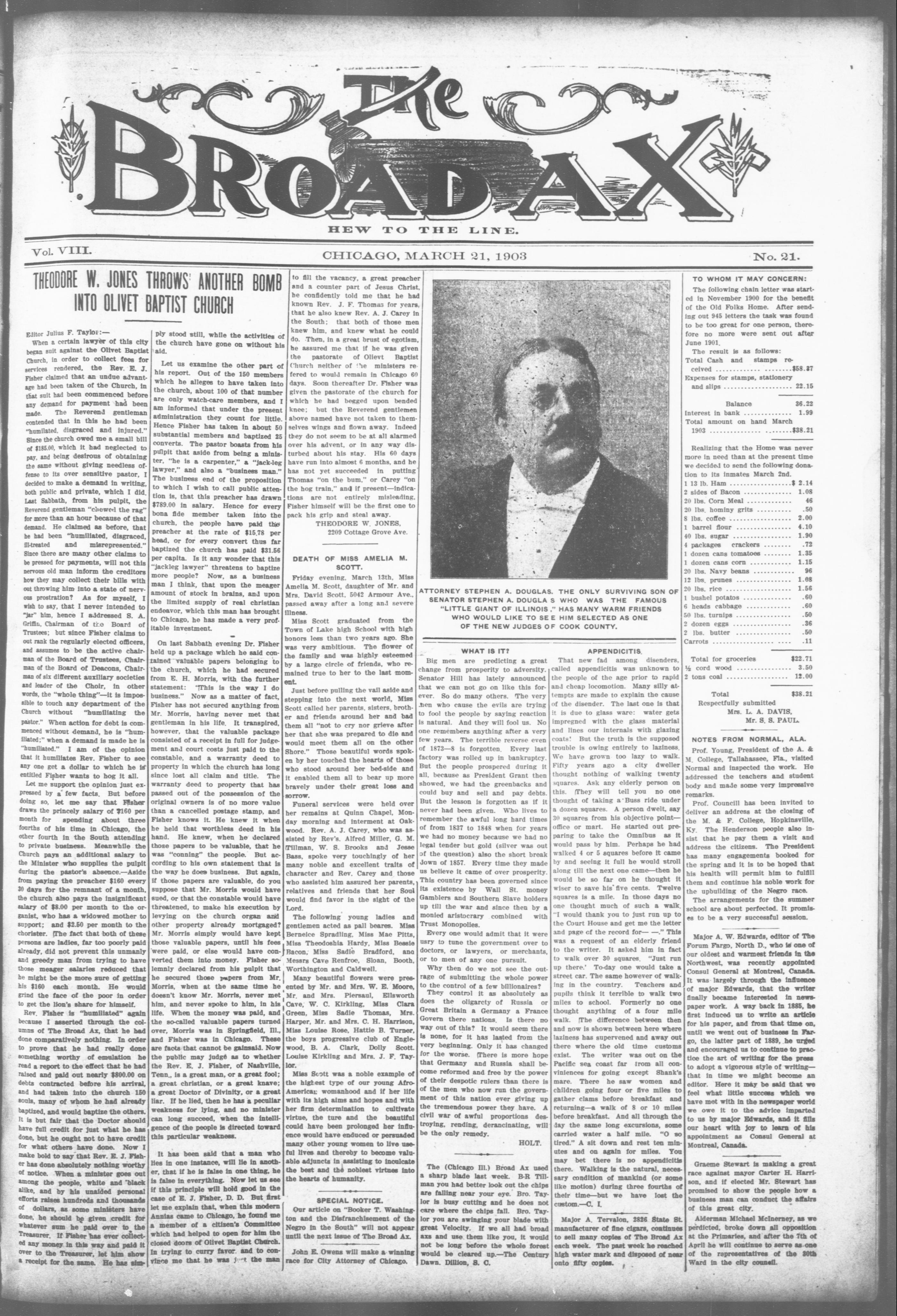
ATTORNEY STEPHEN A. DOUGLAS. THE ONLY SURVIVING SON OF SENATOR STEPHEN A. DOUGLAS WHO WAS THE FAMOUS "LITTLE GIANT OF ILLINOIS," HAS MANY WARM FRIENDS WHO WOULD LIKE TO SEE HIM SELECTED AS ONE OF THE NEW JUDGES OF COOK COUNTY.
WHAT IS IT?
Big men are predicting a great change from prosperity to adversity. Senator Hill has lately announced that we can not go on like this forever. So do many others. The very men who cause the evils are trying to fool the people by saying reaction is natural. And they will fool us. No one remembers anything after a very few years. The terrible reverse even of 1873—8 is forgotten. Every last factory was rolled up in bankruptcy. But the people prospered during it all, because as President Grant then showed, we had the greenbacks and could buy and sell and pay debts. But the lesson is forgotten as if it never had been given. Who lives to remember the awful long hard times of from 1837 to 1848 when for years we had no money because we had no legal tender but gold (silver was out of the question) also the short break down of 1857. Every time they made us believe it came of over prosperity. This country has been governed since its existence by Wall St. money Gamblers and Southern Slave holders up till the war and since then by a monied aristocracy combined with Trust Monopolies.
Every one would admit that it were usry to tune the government over to doctors, or lawyers, or merchants, or to men of any one pursuit.
Why then do we not see the outrage of submitting the whole power to the control of a few billionaires? They control it as absolutely as does the oligarchy of Russia or Great Britain a Germany a France Govern there nations. Is there no way out of this? It would seem there is none, for it has lasted from the very beginning. Only it has changed for the worse. There is more hope that Germany and Russia shall become reformed and free by the power of their despotic rulers than there is of the men who now run the government of this nation ever giving up the tremendous power they have. A civil war of awful proportions destroying, rending, derancinating, will be the only remedy.
The (Chicago Ill.) Broad Ax used a sharp blade last week. B-R Tillman you had better look out the chips are falling near your eye. Bro. Taylor is busy cutting and he does not care where the chips fall. Bro. Taylor you are swinging your blade with great Velocity. If we all had broad axs and use them like you, it would not be long before the whole forest would be cleared up.-The Century Dawn. Dillion. S. C.
APPENDICITIS
That new fad among disenders, called appendicitis was unknown to the people of the age prior to rapid and cheap locomotion. Many silly attempts are made to explain the cause of the disender. The last one is that it is due to glass ware: water gets impregned with the glass material and lines our internals with glazing coats! But the truth is the supposed trouble is owing entirely to laziness. We have grown too lazy to walk. Fifty years ago a city dweller thought nothing of walking twenty squares. Ask any elderly person on this. They will tell you no one thought of taking a Buss ride under a dozen squares. A person dwelt, say 30 squares from his objective point—office or mart. He started out preparing to take the Omnibus as it would pass by him. Perhaps he had walked 4 or 5 squares before it came by and seeing it full he would stroll along till the next one came—then he would be so far on he thought it wiser to save his five cents. Twelve squares is a mile. In those days no one thought much of such a walk. "I would thank you to just run up to the Court House and get me the letter and page of the record for—." This was a request of an elderly friend to the writer. It asked him in fact to walk over 30 squares. "Just run up there.' To-day one would take a street car. The same however of walking in the country. Teachers and pupils think it terrible to walk two miles to school. Formerly no one thought anything of a four mile walk. The difference between then and now is shown between here where laziness has supervened and away out there where the old time customs exist. The writer was out on the Pacific sea coast far from all conviniences for going except Shank's mare. There he saw women and children going four or five miles to gather clams before breakfast and returning—a walk of 8 or 10 miles before breakfast. And all through the day the same long excursions, some carried water a half mile. "O so tired." A sit down and rest ten minutes and on again for miles. You may bet there is no appendicitis there. Walking is the natural, necessary condition of mankind (or some like motion) during three fourths of their time—but we have lost the custom.—C. I.
Major A. Tervalon, 2826 State St. manufacturer of fine cigars, continues to sell many copies of The Broad Ax each week. The past week he reached high water mark and disposed of near onto fifty copies.
No.21.
TO WHOM IT MAY CONCERN:
The following chain letter was started in November 1900 for the benefit of the Old Folks Home. After sending out 945 letters the task was found to be too great for one person, therefore no more were sent out after June 1901.
The result is as follows:
Total Cash and stamps received ..... $58.37
Expenses for stamps, stationery and slips ..... 22.15
Realizing that the Home was never more in need than at the present time we decided to send the following donation to its inmates March 2nd.
1 13 lb. Ham ..... $ 2.14
2 sides of Bacon ..... 1.08
20 lbs. Corn Meal ..... 46
20 lbs. hominy grits ..... .50
8 lbs. coffee ..... 2.00
1 barrel flour ..... 4.10
40 lbs. sugar ..... 1.90
4 packages crackers ..... .72
1 dozen cans tomatoes ..... 1.35
1 dozen cans corn ..... 1.15
20 lbs. Navy beans ..... 96
12 lbs. prunes ..... 1.08
20 lbs. rice ..... 1.56
1 bushel potatoes ..... .60
6 heads cabbage ..... .60
50 lbs. turnips ..... .50
2 dozen eggs ..... .36
2 lbs. butter ..... .50
Carrots ..... .11
Total for groceries $22.71
½ cord wood ..... 3.50
2 tons coal ..... 12.00
NOTES FROM NORMAL, ALA.
Prof. Young, President of the A. & M. College, Tallahassee, Fla., visited Normal and inspected the work. He addressed the teachers and student body and made some very impressive remarks.
Prof. Councill has been invited to deliver an address at the closing of the M. & F. College, Hopkinsville, Ky. The Henderson people also insist that he pay them a visit and address the citizens. The President has many engagements booked for the spring and it is to be hoped that his health will permit him to fulfill them and continue his noble work for the upbuilding of the Negro race. The arrangements for the summer school are about perfected. It promises to be a very successful session.
Major A. W. Edwards, editor of The Forum Fargo, North D., who is one of our oldest and warmest friends in the Northwest, was recently appointed Consul General at Montreal, Canada. It was largely through the influence of major Edwards, that the writer finally became interested in newspaper work. A way back in 1835, he first induced us to write an article for his paper, and from that time on, until we went out of business in Fargo, the latter part of 1889, he urged and encouraged us to continue to practice the art of writing for the press to adopt a vigorous style of writing—that in time we might become an editor. Here it may be said that we feel what little success which we have met with in the newspaper world we owe it to the advice imparted to us by major Edwards, and it fills our heart with joy to learn of his appointment as Consul General at Montreal, Canada.
Graeme Stewart is making a great race against mayor Carter H. Harrison, and if elected Mr. Stewart has promised to show the people how a business man can conduct the affairs of this great city. Alderman Michael McInerney, as we perdicted, broke down all opposition at the Primaries, and after the 7th of April he will continue to serve as one of the representatives of the 30th Ward in the city council.
— aa ,
a :
THE BROAD AX.
PUBLISHED WEEKLY.
Eee eee oe
their say, co long 00 Shir language is proper and
at ee oe
Wriecaly co cosmaeetGe nen: mation.
Subscriptions must be paid tn advance.
ele 8
Aédreee af comomnmonssogg to vem
THE BROAD AX
‘04 Armour Avemue, Ohicago.
JULIUS F. TAYLOR, Baitor and Publisher.
Entered at the Post Office at Chicago,
«DL, as Becond-class Matter.
SEAMLESS TOY BALLOONS.
A= American Novelty Lately added
te the Long List of the
Street Trade.
“Look at that,” said a wholesale
dealer in street novelties. “The very
latest and newest and biggest thin,
in the market to-day.”
He picked out of a box on the
counter a little, loosely folded rub
Ber bag about two inches long and
having at one end a little neck, which
be drew over a nipple on a machine
something like a bicycle pump, and
expanded the bag into a red rubber
globe; it was a child's toy balloon,
and a perfect sphere in shape, says
the New York Sun.
“There it is,” he said, “a seamless
gas balloon, the first ever made any-
where, and this produced in the
United States. Up to now all the
toy balloons sold in the world have
come from Belgium, France and
England. We import, all told, a mil-
lion gross a year, and these ballons
all have seams in them. They are
made in sections and united on a
machine something like a sewing ma-
chine, except that instead of needles
it has little hammers which hammer
the seams together.
“There is a certain percentage of
loss on them. Now, these modern
American balloons, seamless, per-
fectly round, are not only superior
in every way to the foreign balloon,
but they cam be made cheaper, and
are far more durable, and I expect
we shall put the English, Belgian
and French makers of toy balloons
out of business. We are already
turning these new balloons out here
and there’s a factory for making
’em with a capacity of a thousands
hands, now under way.
“That’s the high novelty in this
trade to-day, the American seamless
toy balloon.”
THE RED MAN’S AUTOMOBILE.
Big, Fat Indians Pushed Around in
Baby Carriages by Their Long-
Suffering Squaws.
This is the season of the year
when the Indian chiefs come in from
the reservations to see the Great
Father, says the New, York World's
Washington correspondent. There
aTe.a score of them in the city now.
A group of half a dozen standing on
the curb watching an automobile re-
called to some Texans who were pass-
ing the story Col. Bill Sterrett used
to tell about. the man who went into
the Indian Territory to sell baby
carriages.
Everybody said he was crazy. It
was admitted that there was a fine
crop of babies in the territory, but
Ro one could see what the squaws,
who were used to packing their off-
springs on their backs, could do with
baby.
Bill orders beran to, come beck
fisst for dozens, and then for car
loads, and finally Sterrett went up
to investigate. He went into one of
‘the Indian villages.
“And I'll be dashed,” said Col. Bal,
“if I didn’t see a dozen big, fat In-
dians sitting in baby carriages, all
scrouged up, while the squaws were
pushing them around. The baby car-
age en eel anaes ne Semen
lieve.,that baby, carriages were
right Find ot pionmnre Figs for the
man.’
‘Five Miles of Rope Required to Sound
= Spot One Hundred Miles
Tte ‘sotndings ‘made In the Moser
‘Bastin “and in Fonga-Kermadec Deep,
were accompanied by great excite
mest... It-was on a beautifully clear
Ps 1e twentieth of February, that
4 Albs soe apeccocted wicnis 8 Bt.
tle ore ‘fin 100 mfles of Guam, re-
Port LedieW Monthly. The vessel Iny
to, and prepsrations were made for
one of thé frequent soundings. At
paatidbe glance: wet. broken ay 8
vt. eahinery of the cage
machinery, c e engine
lan ‘to work and slowly the
wiré ‘rope bégan to sink beneath the
‘wiitér.. Feot- by foot, fathom
fsthem,.it slid. from. the ship.
Senet. two thousand, three and
: four fathoms disep-
miles of rope!
It wes an anxious moment, for the
strain caused by the immense length
apd weight of the wire rope on
or the hy
LIFE OF FUR TRAPPERS.
fhey Have Plenty of Pure Air, Whole-
seme Food and Good Times
im Their Camps.
| “You admire furs,” commented an
old trapper, as he sat contentedly
{smoking his pipe, relates the New
| York Tribune; “you should go where
we get them. Ah, that is the life—
as plain, wholesome food, and
after the season’s work, that
| brigade of fur-loaded canoes going
| eff down the lakes. Every canoe is
loaded, you know, almost to the gun-
wale, and they string out one behind
the other, a long line of them. They
usually start out early in the morn-
ing and paddle, paddle, paddle, hour
after hour, down the stream, through
that lake, and so into civilization.
“But they don't forget to eat—oh,
no! About noon they go ashore.
They ‘snub’ the canoes to overhang-
ing trees and hunt around for a good
flat rock on which to start their fire.
But those fellows don't take an hour
for luncheon. Time is too valuable
to them. They take a drink of tea,
a bite of pork—that is about all.
Then they are off again. The men
spell each other at the paddles, and
occasionally the canoes are bunched
by steersmen for a good smoke.
“When night comes the brigade
goes ashore and pitch their camp.
Tents are put up, camp fires lighted
and the supper prepared, great clouds
of black flies and mosquitoes hover-
ing around. Some of the men busy
themselves preparing the great brown
fiapjacks for the next day, while
others dry their moccasins or get
their blankets ready to bunk in.
Perhaps a canoe has to be patched
the next morning before the start
can be made.
“Oh, it is a great life up there in the
wilds of Canada, where they get the
furs. You should try it.”
AN ARCTIC MEAL.
The Eskimo Method of Preparing 8
Supper on « Polar Sheet
of Ice.
Dogs were unhitched and fastened,
as usual, and then each of the Eskimos
climbed over the icefoot with his snow
knife and disappeared behind the para-
pet, where the other two were already
cutting snow blocks. I fastened my
dogs, got out their ration of pemmi-
can, cut it up, and fed them, standing
up with whip in hand to see that there
was no bullying, and that each dog got
his share, says Outing.
Then I unpacked the cooker, oil can
and kitchen box, passing them up the
icefoot as high as I could reagh. I did
not wait for the completion of the igloo
to commence my preparations for sup-
per, but with a fewstrokes of the spade
excavated a niche in the snowbank, put
the codker in out of the wind, filled the
lamp with oil and the boiler with ice,
placed a few snow blocks around it for
still better shelter, and lighted up.
By the time the igloo was completed
Chad enough water melted for the tes,
and supper was entirely ready by the
time my men had fed the dogs; and
they lost no time in freeing their cloth-
ing of snow and joining me in the igloo.
Still less time was consumed in putting
away the tea and biscuit and penmmi-
can, and less again in falling off to
jreamless slumber.
OPENING “BUCKING” SAFES.
Professionals Who Right Matters
‘When the Strong Boxes Get
Out of Order.
The broncho buster of the western
plains has a counterpart in New
York, though his business is not to
tame recalcitrant mustangs, but to
open “bucking” safes, says a New
York exchange. Every big concern
dealing in strong boxes employs a
professional safe breaker against
those frequent and often costly oc-
casions when the safe sold to some
consumer “gets out of whack.” The
work of opening a bucking safe is
usually a matter of minutes with the
professional, but occasionally he is
obliged to send for a half ton of tools
before he is enabled to procure the
magic sesame. Often a half hundred
clerks are kept idle for hours and
business managers spin around like
tops while the safe breaker leisurely
pothers about with the combination.
When the safe or vault is finally
opened it is usually discovered that
some one connected with the firm is
to blame for altering the combina-
tion and then keeping the matter to.
himself. The professional safe opener
Saweenty ‘hee xcalis freee out of
town, on these occasions he usual-
ly finds that some merchant who
has just bought his safe changed the
combination and then forgot it.
Cest of Wireless Messages.
The average rate of transmission
by Atlantic cable is 34 words a min-
ute. Marconi promises 200 words s
minute through the air. The cable
companies charge 25 cents a word.
Marconi’s contract with Canada stip-
julates ten cents a word as the max-
imum cost, and his prophecy is that
‘the rate will be one cent.
America Invades India.
The Times, of Bombay, India, says:
“Already there are sigms, very dis-
tant that the Americans have com-
eae pene att athe 8
merce country in earnest. To
cg
aie
8 : Suit is
Miesroke of Locktaew.
| Kitasato, a Japanese microscopist,
Grst showed that the pin-shaped mi-
strobe of lockjaw lives in the earth.
{m Order that it may multiply and
péison the blood it must be deep in
& wound so thet air does, not reach
Wiendish Revenge.
ot fon eae Sees
ite’s sleeping
ment, slipped inside, and Sie
the room thoroughly, but found noth-
“Spare Bante he soliloguized) “IU
a ie
get some satisfaction out of him,
anyway!”
Thereupon he set the alarm clock
on the bureau for the hour of three
and softly departed—Chicago Trib-
une.
Tt. Oftes Se.
“I understand that old Goldust car
ries $80,000 in Hfe insurance.”
“I shouldn't wonder,”
“He must consider his life of very
great value.”
“Quite likely; but that doesn’t make
it so.”
“No?”
“Oh, no. It merely shows that he is
worth more dead than alive, so far as
the community is concerned.”—N. Y.
Herald.
Sailing Under False Colors.
Church—Who is that who just went
| inte the room?
Gotham—That is my wife.
“Your wife?”
“That’s what I said.”
“But your wife used to have dark
hair, and the hair of that woman who
just sailed into the room is light.”
“Yes; my wife seems anxious to sail
under false colors.”—Yonkers States
man.
A Reasonable Supposition.
“Good gracious!” exclaimed Mrs.
Snarleton, throwing down the paper,
“they've printed a picture of that
homely Miss Ramsey under the head
of ‘Popular Society Beauties.’”
“Humph!” replied Mr. Snarleton,
“it was reported some time ago that
her father was working on a scheme
from which he expected to make mil-
lions. He must have carried it
through.”—Chicago Record-Herald.
Uncle Reuben Says:
It seems to be one of de easiest
things on airth to mortgage a piece of
land and spend de money in gwine to
de circus an’ eatin’ fried chickens, an’]
reckon dis world would come pow-
erful near bein’ Heaven if de interest
on dat mortgage didn’t suddenly fal)
due an’ bump a man all over to once
an’ make him realize dat dis am a vale
of tears.—Detroit Free Press. |
BPeaemine tm t¢he (ts
teacher (trying to enlarge John
ny’s vocabulary) — Now, Johnny
what is the name of the place I tolc
you about awhile ago where yout
father sends cream to be made inte
butter?
_ Johnny — The creamatory!—N. Y.
Times.
The Genesis of a Name.
“Why,” asked the daughter with the
dreamy eyes, “why do they call it the
honeymoon, mamma?”
“Because,” answered the mother
with the drawn lines about her mouth,
“because it is a sort of sweet lunacy,
I suppose.”—N. Y. Herald.
Pessliac.
“Now, phwat wud ye do in a case
loike thot?”
“Loike phwat?”
_ “Th’ walkin’ diligate tills me to
sthroike, an’ me ould woman orders
me to ka-ape on wur-rkin’.”—Wom-
an’s Home Companion.
His Proposal.
He didn’t fall upon his knees
‘When his love he went to proffer,
But stood erect with manly ease,
And made a standing offer.
—N. Y. Times.
THERE ARE OTHERS.
eas
PP Sy } pH)
ID\CAN ‘| }
«| Sy (
we
Be
“Why do they call him ‘judge?””
“He once acted in that capacity in a
horse show.”—Louisville Courier-Jour-
nal.
Ané Thet's So —
T've often wished that I might be
Passed down to fame in sculptured stone;
ree Geen f one ee
—Baltimore News.
Bypothetical Case.
Johnny—'Sposin’ I should accident-
ally tip over a jar of preserves, would
it be wrong if I ate "em?
Mother—Johnny, bring me my slip-
per.—Chicago American.
Seasoning.
“Does your cook season things high-
ly?
“T should say so. Evenher
tion is peppery."--Philedelphia Bulle-
tin.
Ané the Girl Turns the Crank,
Softly—Love makes the world igo
round!
Snortly—Yes, there’s no crank eqnal,
P a lover—Harvard: Lampoon.
Ne Chance to Talk.
Mrs. Gumms—Does your husband
ever talk of his mother’s cocking?
Mrs. Gobang—Nct # word. His father
died of dyspepsia.—Brooklyn Life.
Reliable Advice.
“Do you know what I can take for
indigestion after dinner, doctor?”
“Yes; pie.”—Yonkers Statesman.,
Included All the Days.
Little Johnnie bad been told ee
ashort in which he shoulé
say sométilbg about the days of thi
The little fellow thought a few min
— and then triumphantly produce¢
“Monday father and I killed a bear
and there was meat enough tolast over
Toesday, Wedhesday, Thursday, Fri
day, Saturday and Sunday.”—Cin-
cinnatj Enguirer.
Bx perience.
“Mo barber, please, for me,”
Ee sishing said; “I do not care
For such a service now—you see,
My mother used to cut my hair.”
—Chieago Record-Herald.
THD RIVALS.
7
Long Man—She’s accepted me.
Short Man—What, a lanky fellow like
you?
Long Man—Well, you see, I was on
my knees at the time.—TheSketch.
‘The Likeness.
_ ‘The portrait tumbled from the wall
And hit the young man’s head.
“A striking likeness!" That was all
The rueful punster said.
—N. Y. Herald.
Change in Prospect.
Hayes—I hear that pretty little
widow across the way has changed
the epitaph on her late husband's
tombstone.
Dayes—Going to marry again?
“Looks like it. She has cut out
the words ‘Parted but for a time,’ and.
substituted ‘Parted forevermore.’ "—
Philadelphia Telegraph.
Eptitled to the Beat.
“Why don’t you give us a little
Greek and Latin occasionally?”
asked a country farmer of the new
minister.
“Why, do you understand those
languages?”
“No; but we pay for the best and
we ought to have it.”—Tit-Bits.
Unintentional.
“Charley says that I make biscuit
just like his mother used to make,”
said young Mrs. Torkins.
“Indeed!” said the thoughtless wom-
an; “I always understood that his
mother was a very inferior cook.”—
Weshington Star. |
Incurable Case. |
Husband (vituperatively)—I was an
idiot when I married you, Mary.
Wife (quietly)—Yes, Tom, I knew
you were. But what could Ido? You
seemed my only chance, and I thought
then that you might improve a little
with time.—Tit-Bits,
Concentration.
“Then,” said his friend, “a number
of trusts will be consolidated into
one?”
“Exactly,” replied the magnate. “We
might as well dispense with superfiu-
ous trusts.”—Brooklyn ife.
Why He Wept.
Gladys—Papa read your book of
poems and wept over every line.
Her Affianced—He did?
Gladys—Yes. He said he couldn't
help but weep to think such a lobster
was coming into the family.—Judge.
A Case for Symeathe_
“And she refused him? Does he
seem much depressed?”
“Oh, yes! He told my brother it
was the turning point in his career.’
“Yes? The turning-down point!”
—Puck.
His Jadement.
“T've been told,” said the amateur,
“that I'm a good actor. What do
you think of that?”
“I think there are some awful Hars
in this world.”"—Chicago Post.
The Same 014 Bice.
“Do you really believe you are
the only girl he ever loved?”
“Of course not, but one has to pre-
tend to believe those stories, you
know.”—Chicago American.
Varioeus States of Felicity.
Bustacia— How pleased Eleazor
looks to-night.
Edmonia—Yes; she’s either had s
proposal or some man has sent her a
‘box of Candy.—Detroit Free Press.
s Knew the Sex,
Wife—I found out something to-da
‘that I promised never to tell. :
Husband— Well, goabead; Pm Usten-
ing.—Chieago Daily News.
Mike L. Géttacsin—There’s a man
can drink a gallon of whisky a day.
Rush Kettle—Gee! he must ha:
money —Pennsylvenia Punch Bowl.
———
A Prank Ooiaies_
Mrs. Server—What. did you think
of the eggs on toast?
Mr. Honestboarder—tI felt sorry for
the toast.—Brooklyn Life.
CURIOUS LITTLE TALES.
“Jake,” said one of those impe
‘Cunious old friends who haunt the
corridors of the Washington hotel:
to Representative Ruppert, of New
York, “I wish you would lend me
$10.” “M-m,” said Ruppert, “where
will you be in half an hour?” “Right
at your elbow,” replied the impecuni.
ous friend, “unless I should drog
dead meantime.”
Andrew Carnegie is reported to
have said that some years ago he
wanted to cross a mountain in Penn-
slyvania and a youngster offered to
take him over for 50 cents. Mr. Car-
negie thought the price was too
great, but, after long argument, paid
it, “not because the trip was worth
it,” as the story goes, “but because
T had to get on the other side of the
mountain. Mr. Carnegie said: “I pre-
dicted that the boy would some day
make a fortune and he has. His name
is Charles M. Schwab.”
Someone called up the French em-
bassy in Washington by telephone
and said he wished to know some-
thing about Marquis De Chambrun's
wife. He was informed that’ there
are four De Chambruns and he an-
swered that he meant the one who
married an American girl. The con-
versation proceeded thus: “Three of
them married American girls.” “I'm
after the one who married a girl
from Cincinnati.” “Two of them
married girls from Cincinnati.”
“Great heavens! Which one is coming
here to join the embassy staff?”
“The Marquis De Chambrun.” “I
mean his wife.” “He hasn't any wife;
he is a bachelor.”
Little love is lost between Pader-
ewski, the famous pianist, and Moritz
Rosenthal, his professional rival, who
continues to amaze German audiences
by his wonderful command of the in-
strument. Rosenthal is called “the
demon pianist” because of the as-
tonishing speed with which he plays.
Paderewski once heard of a particu-
larly brilliant performance given by
Rosenthal. He smiled serenely and
said: “Oh, yes, but any conservative
pupil with a good technique can do
that.” Of course this remark was
repeated to Rosenthal, who some
time later heard a talented amateur
was playing in London. “Oh, that
must be Paderewski,” he said, calmly.
AMERICAN PROGRESS.
The Homestead mills produce, with
about 4,000 men, three times as much
steel as the Krupp works. produce
with 15,000 men.
One hundred and seven thousand
tone of American peanuts were bought
at Marseilles in 1902 for use in making
olive oil soap.
Marseillgs the great market for olive
oil, imported in December 2,909 tons of
cotton seed oil. Nearly all of it was
from the United States.
The total value of the 1902 exports
of manufacturers, as shown by the fig-
ures of the treasury bureau of statis-
tics, is $410,650,967, againat $305,104,-
030 im 1901, an increase of $105,546,946.
An Ameriean professor, after visit-
ing @ large technological institute in
Germany, said that the school and its
equipment was ahead of anything at
home. When this compliment was re-
peated afterward to a prominent in-
structor in the institute he replied: |
“Why, that is exactly what I said of
your technical schools after my trip
to America, and that is the only way I
could get the money to make ours what
it is to-day.”
The electrical fan is increasing ‘in
popularity as @ purveyor of comfort,
both at home and in the equatorial
regions, so that the American output
for the coming summer is estimated
by the Electrical World at 150,000. Not
only does it serve to mitigate the heat
of summer, but in a great many in-
stances it answers the purpose of
sanitation and ventilation so economi-
cally and efficiently that few other
appliances can compare with it.
TOLD OF THE LADIES.
A Berlin woman bequeathed her
Property to a cat.
Worcester has 703 women who
make needles, and 1,044 female nail-
makers.
Mrs, L. Goodman, the oldest living
woman artist, is 90. She has painted
apward of 1,200 portraits.
For the first time on record a
young lady has won the literary med-
jeal scholarship at Queen’s college,
Galway.
A German professor has been in-
vestigating the causes of insanity
among women and has come to the
conclusion that if women are ad-
mitted into competition with men
the inevitable result will be a tre
mendous increase of insanity among
the women.. He finds that the per-
centage of women teachers who be-
come insane is almost double that
of the men teachers.
There has just died at the Hermit.
age, President Jackson’s old home,
some 12 miles out from Nashville,
Tenn., old Uncle Alfred, Gen. Jack-
son's coachman. Uncle Alfred was
born on the Hermitage farm in 1903,
There, in the front hall of the house,
he and Gracey were married many
years ago, and in the same place his
funeral services were held. A large
number of prominent people were
Present, and the funeral services were
conducted by three eminent white
clergymen. In accordance with an oft
expressed wish, he was buried near
the place where the dust of his be
loved genera] rests. He left @ son,
Gus, who was 60 years old at the time
ft his father’s death —Ex. |
FROM A DOCTOR’S NOTEBOor
The ordinary weight of a humay
heart is nine and a quarter Ounces,
"Phe record weight is 40 ounces 13
drams.
A Freneh physician has success,
used hypnotic suggestion to cae
vices of idiots.
The end of cholera infantum Waits
upon the growth of the simple prac.
tice of sterilizing baby’s milk ang
bottle.
Tests in tenement houses show
that im five minutes after Sweeping
2,500 germs settled om a saucer three
inches across. In the same length of
time before sweeping 75 germs set
tled on the saucer.
A writer in Charities places the
number of crippled children who ap
plied for relief at the New York hos
pitals: during the visit-of Dr. Lorex,
at 8,000, nearly all of whom were
sent away bechuse of the inadequacy
of the hospitals for their care.
A simple method of taking castor
oil, according to Medical News, with.
out producing any nauseating effects,
is to instruct the patient to wash out
the mouth with water as hot as can
be borne, and then swallow the oil,
and follow this by rinsing out the
mouth well with hot water. The first
swallow of the water cleanses the
mouth, makes the membranes hot,
so that the-oil does not stick and con.
sequently slips down easily.
That the diphtheria anti-toxin
serum. is specific for that dread
disease is a fact which has for some
time rested upon a broad basis of
satisfactory experience. As much,
unfortunately, at this time cannot be
said for any of the other sernms,
The serums for erysipelas, loekjaw,
pneumonia, and puerperal fever have,
by no means, risen to the expecta-
tions of the physician, and tuberen-
lin, perhaps owing to the difficulty in
getting it free from bacteria, is lit-
tle used except in testing cattle for
tubherculosia.
RAILWAY RUMBLES.
On the railroads in Canada it is
necessary to keep over 600 snow
plows in operation every winter.
The Iinois Central raflway has
paid to the state in taxes under its
eharter, which calls for seven per
cent. of gross receipts, $20,589,166
since completion of the road in 1855.
The Pennsylvania Railroad com-
pany has ordered 5,000 tons of nickel
steel rails. These will cost about
$74 a ton, while ordinary or standard
rails eost $28 a ton. There rails are
to be used on some of the heary
curves in the Alleghany mountains,
Pittsburg division and the midde
divisions.
P. A. B. Widener, the Philadelphis
traction magnate, controls thousands
of miles of steel railroad in America.
but he cannot ride in a trolley car
without suffering from an exact imi-
tation of seasickness. Once he made
a desperate effort to overcome this
weakness. Accompanied by W. L
Elkins, his partner, he went for a
32-mile ride and stuck at it until the
trip was ended. By that time he was
in a state of complete collapse. He
came back on the steam railroad and
has not ventured on a trolley car
since.
IN OUR LARGER CITIES.
| The official valuation of the Phils-
delphia city hall and grounds is $13,
604,000
The St. Louis public library hes
48 branch stations, Boston’s 21, and
Chicago’s nearly 70.
An abstract of the recent New Or-
leans census develops the fact that
there are 15,000 more women in the
city than men.
The valuation of the park lands of
the Greater New York is now put at
$300,000.0000; of Chicago, at $65,000,000;
Boston, $53,000,000; Philadelphia, $22,-
000,000; San Franciseo, $12,000,000; St.
Louis, $8,000,000.
Sheriff Dickmann, of St. Louis, has
refused to issue permits to citizens to
witness executions in the jail of that
city, and hereafter all executions will
be conducted in private, only the num-
ber of persons required by taw to be
present being permitted within the
jail precincts on such-oceasions.
| THE ODD AND CURIOUS.
Soldiers are employed in Jerusalem
as tex collectors.
As arulegray horsesattaina greater
age than those of any other color.
The ‘word post can be transposed
more times then it bas ietters—viz.,
Post, spot, stop, pots, and tops.
In North Weles the Weleh word for
“now’ is “rwan.” In South Wales it is
“rwan” spelt backwards—viz., “nawr.”
Personally fitted “dog dlenkets of
sealskin can-now be had for $00 each in
New-York if) meade without handker-
chief pocket.
Through. mice nibbling .« hole:in »
gaspipe in.an aviary nearly the whole
of a valuable collection of birds was
suffocated at King’s Lynn, in Eng-
land.
CANADIAN INTERESTS.
The Manitoba potato crop amounted
to 3,459,325 birshels,’and the root crop
‘to: 3,880,905 bushels. There are 1,824
threshing outfits im the provinee.
Senator ‘Werk, whois a member of
‘the Canadian parliament and who ex-
pecte this year to attend to his legisla-
Salle ¢ beaters. so'praueiing tos oldest
a . ‘the t
legislator In the world. he is in his
eeewess a
the-legisietors for the provinee
New Brunswick for upward of 60 years.
He was opelkneaabes the provinces
Were confederated into the dominion.
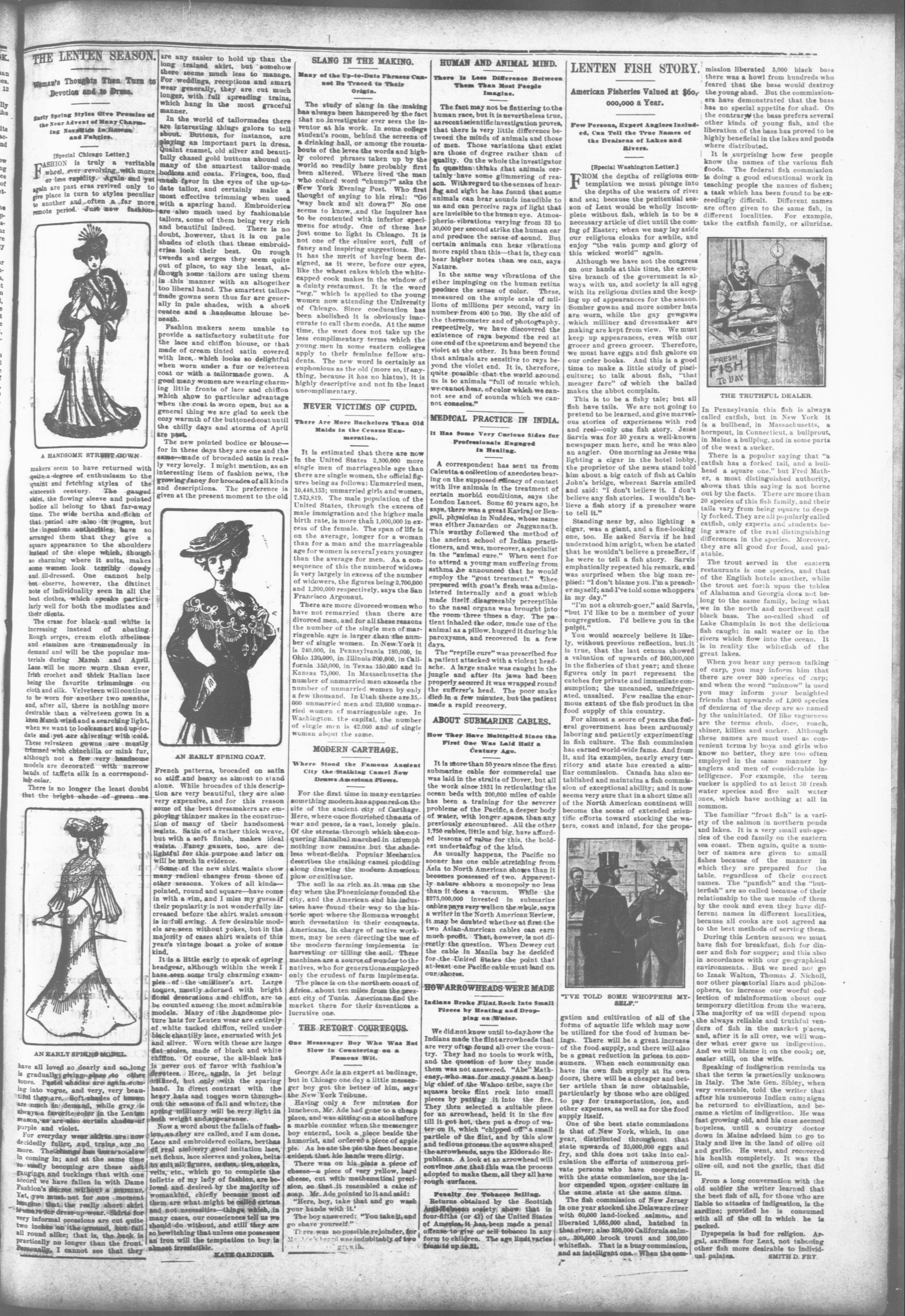
Early Spring Styles Give Promise of the Near Advent of Many Charming Novelties in Gowns and Fabrics.
FASHION is truly a veritable wheel, ever revolving with more or less rapidity. Again and yet again are past eras revived only to give place in turn to styles peculiar to another and often a far more remote period. Just new fashion
```markdown
```
A HANDSOME STREET/GOWN
makers seem to have returned with quite a degree of enthusiasm to the quaint and fetching styles of the sixteenth century. The gauged skirt, the flowing sleeve and pointed bodice all belong to that far-away time. The wide bertha and fichu of that period are also in vogue, but the ingenious authorities have so arranged them that they give a square appearance to the shoulders instead of the slope which, though so charming where it suits, makes some women look terribly dowdy and ill-dressed. One cannot help but observe, however, the distinct note of individuality seen in all the best clothes, which speaks particularly well for both the modistes and their clients.
The craze for black and white is increasing instead of abating. Rough serges, cream cloth zibelines and etamines are tremendously in demand and will be the popular materials during March and April. Lace will be more worn than ever, Irish crochet and thick Italian lace being the favorite trimmings on cloth and silk. Velveteen will continue to be worn for another two months, and, after all, there is nothing more desirable than a velveteen gown in a keen March wind and a searching light, when we want to look smart and up-to-date and yet are shivering with cold. These velveteen gowns are mostly trimmed with chinchilla or mink fur, although not a few very handsome models are decorated with narrow bands of taffeta silk in a corresponding color.
There is no longer the least doubt that the bright shade of green we
```markdown
```
AN EARLY SPRING MODEL have all loved so dearly and so long is gradually giving place to other tones. Pastel shades are again coming into vogue, and very, very beautiful they are. Soft shades of brown are much in demand, while gray is always a favorite color in the Lenten season, as are also certain shades of purple and violet.
For everyday wear skirts are now decidedly fuller, and trains are no more. The change has been so slow in coming in; and at the same time so vastly becoming are these soft gaugings and tuckings that with one accord we have fallen in with Dame Fashion's decree without a murmur. Yet, you must not for one moment imagine that the really short skirt is smart for dress-up wear. Skirts for very informal occasions are cut quite two inches on the ground, but fall all round alike; that is, the back is practically no longer than the front. Personally, I cannot see that they
are any easier to hold up than the long trained skirt, but somehow there seems much less to manage. For weddings, receptions and smart wear generally, they are cut much longer, with full spreading trains, which hang in the most graceful manner.
In the world of tailormades there are interesting things galore to tell about. Buttons, for instance, are playing an important part in dress. Quaint enamel, old silver and beautifully chased gold buttons abound on many of the smartest tailor-made bodices and coats. Fringes, too, find much favor in the eyes of the up-to-date tailor, and certainly make a most effective trimming when used with a sparing hand. Embroideries are also much used by fashionable tailors, some of them being very rich and beautiful indeed. There is no doubt, however, that it is on pale shades of cloth that these embroideries look their best. On rough tweeds and serges they seem quite out of place, to say the least, although some tailors are using them in this manner with an altogether too liberal hand. The smartest tailormade gowns seen thus far are generally in pale shades, with a short coatee and a handsome blouse beneath.
Fashion makers seem unable to provide a satisfactory substitute for the lace and chiffon blouse, or that made of cream tinted satin covered with lace, which looks so delightful when worn under a fur or velveteen coat or with a tailormade gown. A good many women are wearing charming little fronts of lace and chiffon which show to particular advantage when the coat is worn open, but as a general thing we are glad to seek the cozy warmth of the buttoned coat until the chilly days and storms of April are past.
The new pointed bodice or blouse for in these days they are one and the same made of brocaded satin is really very lovely. I might mention, as an interesting item of fashion news, the growing fancy for brocades of all kinds and descriptions. The preference is given at the present moment to the old
A
AN EARLY SPRING COAT.
French patterns, brocaded on satin so stiff and heavy as almost to stand alone. While brocades of this description are very beautiful, they are also very expensive, and for this reason some of the best dressmakers are employing thinner makes in the construction of many of their handsomest waists. Satin of a rather thick weave, but with a soft finish, makes ideal waists. Fancy gauzes, too, are delightful for this purpose and later on will be much in evidence.
Some of the new shirt waists show many radical changes from those of other seasons. Yokes of all kinds—pointed, round and square—have come in with a vim, and I miss my guess if their popularity is not wonderfully increased before the shirt waist season is in full swing. A few desirable models are seen without yokes, but in the majority of cases shirt waists of this year's vintage boast a yoke of some kind.
It is a little early to speak of spring headgear, although within the week I have seen some truly charming examples of the milliner's art. Large toques, mostly adorned with bright floral decorations and chiffon, are to be counted among the most admirable models. Many of the handsome picture hats for Lenten wear are entirely of white tucked chiffon, veiled under black chantilly lace, encrusted with jet and silver. Worn with these are large flat stoles, made of black and white chiffon. Of course, the all-black hat is never out of favor with fashion's deyotees. Here, again, is jet being utilized, but only with the sparing hand. In direct contrast with the heavy hats and toques worn throughout the seasons of fall and winter, the spring millinery will be very light in both weight and appearance.
Now a word about the fallals of fashion, as they are called, and I am done. Lace and embroidered collars, berthas of real and very good imitation lace, net fichus, lace sleeves and yokes, belts to suit all figures, sashes, ties, stocks, vells, etc., which go to complete the toilette of my lady of fashion, are below and desired by the majority of womankind, chiefly because most of them are what might be called extras and not necessities—things which, in many cases, our consciences tell us we should do without, and still they are so bewitching that unless one possesses an iron will the temptation to buy is almost irresistible.
KATE GARDNER
SLANG IN THE MAKING.
Many of the Up-to-Date Phrases Cannot Be Traced to Their Origin.
The study of slang in the making has always been hampered by the fact that no investigator ever sees the inventor at his work. In some college student's room, behind the screens of a drinking hall, or among the roustabouts of the levee the words and highly colored phrases taken up by the world so readily have probably first been altered. Where lived the man who coined word "chump?" asks the New York Evening Post. Who first thought of saying to his rival: "Go'way back and sit down?" No one seems to know, and the inquirer has to be contented with inferior specimens for study. One of these has just come to light in Chicago. It is not one of the elusive sort, full of fancy and inspiring suggestions. But it has the merit of having been designed, as it were, before our eyes, like the wheat cakes which the white-capped cook makes in the window of a dainty restaurant. It is the word "seg," which is applied to the young women now attending the University of Chicago. Since coeducation has been abolished it is obviously inaccurate to call them coeds. At the same time, the west does not take up the less complimentary terms which the young men in some eastern colleges apply to their feminine fellow students. The new word is certainly as euphonious as the old (more so, if anything, because it has no hiatus), it is highly descriptive and not in the least uncomplimentary.
NEVER VICTIMS OF CUPID.
There Are More Bachelors Than Old Maids in the Census Enumeration.
It is estimated that there are now in the United States 2,500,000 more single men of marriageable age than there are single women, the official figures being as follows: Unmarried men, 10,448,153; unmarried girls and women, 7,573,819. The male population of the United States, through the excess of male immigration and the higher male birth rate, is more than 1,000,000 in excess of the female. The span of life is on the average, longer for a woman than for a man and the marriageable age for women is several years younger than the average for men. As a consequence of this the number of widows is very largely in excess of the number of widowers, the figures being 2,700,000 and 1,200,000 respectively, says the San Francisco Argonaut.
There are more divorced women who have not remarried than there are divorced men, and for all these reasons the number of the single men of marriageable age is larger than the number of single women. In New York it is 240,000, in Pennsylvania 180,000, in Ohio 120,000, in Illinois 200,000, in California 150,000, in Texas 150,000 and in Kansas 75,000. In Massachusetts the number of unmarried men exceeds the number of unmarried women by only a few thousand. In Utah there are 35.000 unmarried men and 23,000 unmarried women of marriageable age. In Washington, the capital, the number of single men is 42,000 and of single women about the same.
MODERN CARTHAGE.
Where Stood the Famous Ancient City the Stalking Camel Now Draws American Flows.
For the first time in many centuries something modern has appeared on the site of the ancient city of Carthage. Here, where once flourished the arts of war and peace, is a vast, lonely plain. Of the streets through which the conquering Hannibal marched in triumph nothing now remains but the shadeless wheat-fields. Popular Mechanics describes the stalking camel plodding along drawing the modern American plow or cultivator.
The soil is as rich as it was on the day when the Phoenicians founded the city, and the American and his industries have found their way to the historic spot where the Romans wrought such devastation in their conquests. Americans, in charge of native workmen, may be seen directing the use of the modern farming implements in harvesting or tilling the soil. These machines are a source of wonder to the natives, who for generations employed only the crudest of farm implements.
The place is on the northern coast of Africa, about ten miles from the present city of Tunis. Americans find the market there for their inventions a lucrative one.
THE RETORT COURTEOUS
One Messenger Boy Who Was Not Slow in Countering on a Famous Wit.
George Ade is an expert at badinage, but in Chicago one day a little messenger boy got the better of him, says the New York Tribune.
Having only a few minutes for luncheon, Mr. Ade had gone to a cheap place, and was sitting on a stool before a marble counter when the messenger boy entered, took a place beside the humorist, and ordered a piece of apple pie. As he ate the pie the fact became evident that his hands were dirty.
There was on his plate a piece of cheese—a piece of very yellow, hard cheese, cut with mathematical precision, so that it resembled a cake of soap. Mr. Ade pointed to it and said: "Here, boy, take that and go wash your hands with it."
The boy answered: "You take it, and go shave yourself." There was no possible rejoinder, for Mr. Ace's beard was indubitably of two growth.
HUMAN AND ANIMAL MIND.
There Is Less Difference Between Them Than Most People Imagine.
The fact may not be flattering to the human race, but it is nevertheless true, as recent scientific investigation proves, that there is very little difference between the minds of animals and those of men. Those variations that exist are those of degree rather than of quality. On the whole the investigator in question thinks that animals certainly have some glimmering of reason. With regard to the senses of hearing and sight he has found that some animals can hear sounds inaudible to us and can perceive rays of light that are invisible to the human eye. Atmospheric vibrations varying from 33 to 30,000 per second strike the human ear and produce the sense of sound. But certain animals can hear vibrations more rapid than this—that is, they can hear higher notes than we can, says Nature.
In the same way vibrations of the ether impinging on the human retina produce the sense of color. These, measured on the ample scale of millions of millions per second, vary in number from 400 to 700. By the aid of the thermometer and of photography, respectively, we have discovered the existence of rays beyond the red at one end of the spectrum and beyond the violet at the other. It has been found that animals are sensitive to rays beyond the violet end. It is, therefore, quite possible that the world around us is to animals "full of music which we cannot hear, of color which we cannot see and of sounds which we cannot conceive."
MEDICAL PRACTICE IN INDIA
It Has Some Very Curious Sides for Professionals Engaged in Healing.
A correspondent has sent us from Calentta a collection of anecdotes bearing on the supposed efficacy of contact with live animals in the treatment of certain morbid conditions, says the London Lancet. Some 60 years ago, he says, there was a great Kaviraj or Bengali, physician in Nuddea, whose name was either Janardan or Jaggannath. This worthy followed the method of the ancient school of Indian practitioners, and was, moreover, a specialist in the "animal cure." When sent for to attend a young man suffering from asthma he announced that he would employ the "goat treatment." Ghee prepared with goat's flesh was administered internally and a goat which made itself disagreeably perceptible to the nasal organs was brought into the room three times a day. The patient inhaled the odor, made use of the animal as a pillow, hugged it during his paroxysms, and recovered in a few days.
The "reptile cure" was prescribed for a patient attacked with a violent headache. A large snake was caught in the jungle and after its jaws had been properly secured it was wrapped round the sufferer's head. The poor snake died in a few minutes, but the patient made a rapid recovery.
ABOUT SUBMARINE CABLES.
How They Have Multiplied Since the First One Was Laid Half a Century Ago.
It is more than 50 years since the first submarine cable for commercial use was laid in the straits of Dover, but all the work since 1851 in reticulating the ocean beds with 200,000 miles of cable has been a training for the severer probleme of the Pacific, a deeper body of water, with longer spans, than any previously encountered. All the other 1,750 cables, little and big, have afforded lessons of value for this, the boldest undertaking of the kind.
As usually happens, the Pacific no sooner has one cable stretching from Asia to North American shores than it becomes possessed of two. Apparently nature abhors a monopoly no less than it does a vacuum. While the $275,000,000 invested in submarine cables pays very well on the whole, says a writer in the North American Review, it may be doubted whether at first the two Asian-American cables can earn much profit. That, however, is not directly the question. When Dewey cut the cable in Manila bay he decided for the United States the point that at least one Pacific cable must land on our shores.
HOW ARROWHEADS WERE MADE
Indians Broke Flint Rock Into Small Pieces by Heating and Dropping on Water.
We did not know until to-day how the Indians made the flint arrowheads that are very often found all over the country. They had no tools to work with, and the question of how they made them was not answered. "Abe" Matheney, who was for many years a heap big chief of the Wahoo tribe, says the squaws broke flint rock into small pieces by putting it into the fire. They then selected a suitable piece for an arrowhead, held it in the fire till it got hot, then put a drop of water on it, which "chipped off" a small particle of the flint, and by this slow and tedious process the squaws shaped the arrowheads, says the Eldorado Republican. A look at an arrowhead will convince one that this was the process adopted to make them, all they all have rough surfaces.
Returns obtained by the Scottish Anti-Tobacco society show that in four-fifths (or 43) of the United States of America it has been made a penal offense to give or sell tobacco in any form to children. The age limit varies from 14 up to 21.
LENTEN FISH STORY.
American Fisheries Valued at $60,000,000 a Year.
Few Persons, Expert Anglers Included, Can Tell the True Names of the Denizens of Lakes and Rivers.
FROM the depths of religious contemplation we must plunge into the depths of the waters of river and sea; because the penitential season of Lent would be wholly incomplete without fish, which is to be a necessary article of diet until the coming of Easter; when we may lay aside our religious cloaks for awhile, and enjoy "the vain pomp and glory of this wicked world" again.
Although we have not the congress on our hands at this time, the executive branch of the government is always with us, and society is all agog with its religious duties and the keeping up of appearances for the season. Somber gowns and more somber hats are worn, while the gay gewgaws which milliner and dressmaker are making are kept from view. We must keep up appearances, even with our grocer and green grocer. Therefore, we must have eggs and fish galore on our order books. And this is a good time to make a little study of pisciculture; to talk about fish, "that meager fare" of which the ballad makes the abbot complain.
This is to be a fishy tale; but all fish have tails. We are not going to pretend to be learned, and give marvelous stories of experiences with rod and reel—only one fish story. Jesse Sarvis was for 30 years a well-known newspaper man here, and he was also an angler. One morning as Jesse was lighting a cigar in the hotel lobby, the proprietor of the news stand told him about a big catch of fish at Cabin John's bridge, whereat Sarvis smiled and said: "I don't believe it. I don't believe any fish stories. I wouldn't believe a fish story if a preacher were to tell it."
Standing near by, also lighting a cigar, was a giant, and a fine-looking one, too. He asked Sarvis if he had understood him aright, when he stated that he wouldn't believe a preacher, if he were to tell a fish story. Sarvis emphatically repeated his remark, and was surprised when the big man replied: "I don't blame you. I'm a preacher myself; and I've told some whoppers in my day."
"I'm not a church-goer," said Sarvis, "but I'd like to be a member of your congregation. I'd believe you in the pulpit."
You would scarcely believe it likely, without previous reflection, but it is true, that the last census showed a valuation of upwards of $60,000,000 in the fisheries of that year; and these figures only in part represent the catches for private and immediate consumption; the uncanned, unrefrigerated, unsalted. Few realize the enormous extent of the fish product in the food supply of this country.
For almost a score of years the federal government has been arduously laboring and patiently experimenting in fish culture. The fish commission has earned world-wide fame. And from it, and its examples, nearly every territory and state has created a similar commission. Canada has also established and maintains a fish commission of exceptional ability; and it now seems very sure that in a short time all of the North American continent will become the scene of extended scientific efforts toward stocking the waters, coast and inland, for the propa-
A
"IVE TOLD SOME WHOPPERS MYSELF."
gation and cultivation of all of the forms of aquatic life which may now be utilized for the food of human beings. There will be a great increase of the food supply, and there will also be a great reduction in prices to consumers. When each community can have its own fish supply at its own doors, there will be a cheaper and better article than is now obtainable, particularly by those who are obliged to pay for transportation, ice, and other expenses, as well as for the food supply itself.
One of the best state commissions is that of New York, which, in one year, distributed throughout that state upwards of 35,000,000 eggs and fry, and this does not take into calculation the efforts of numerous private persons who have cooperated with the state commission, nor the labor expended upon oyster culture in the same state at the same time.
The fish commission of New Jersey in one year stocked the Delaware river with 60,000 land-locked salmon, and liberated 1,665,000 shad, hatched in that river; also 250,000 California salmon, 200,000 brook trout and 100,000 whitefish. That is a busy commission, and an intelligent one. When the com-
mission liberated 5,000 black bass there was a howl from hundreds who feared that the bass would destroy the young shad. But the commissioners have demonstrated that the bass has no special appetite for shad. On the contrary the bass prefers several other kinds of young fish, and the liberation of the bass has proved to be highly beneficial in the lakes and ponds where distributed.
It is surprising how few people know the names of the various fish foods. The federal fish commission is doing a good educational work in teaching people the names of fishes; a task which has been found to be exceedingly difficult. Different names are often given to the same fish, in different localities. For example, take the catfish family, or siluridae.
FRESH
FISH
To DAY
THE TRUTHFUL DEALER.
In Pennsylvania this fish is always called catfish, but in New York it is a bullhead, in Massachusetts, a hornpout, in Connecticut, a bullprout, in Maine a bullplug, and in some parts of the west a sucker.
There is a popular saying that "a catfish has a forked tail, and a bullhead a square one." but Fred Mather, a most distinguished authority, shows that this saying is not borne out by the facts. There are more than 20 species of this fish family, and their tails vary from being square to deeply forked. They are all popularly called catfish, only experts and students being aware of the real distinguishing differences in the species. Moreover, they are all good for food, and palatable.
The trout served in the eastern restaurants is one species, and that of the English hotels another, while the trout set forth upon the tables of Alabama and Georgia does not belong to the same family, being what we in the north and northwest call black bass. The so-called shad of Lake Champlain is not the delicious fish caught in salt water or in the rivers which flow into the ocean. It is in reality the whitefish of the great lakes.
When you hear any person talking of carp, you may inform him that there are over 500 species of carp; and when the word "minnow" is used you may inform your benighted friends that upwards of 1,000 species of denizens of the deep are so named by the uninitiated. Of like vagueness are the terms chub, dace, roach, shiner, killies and sucker. Although these names are most used as convenient terms by boys and girls who know no better, they are too often employed in the same manner by anglers and men of considerable intelligence. For example, the term sucker is applied to at least 50 fresh water species and five salt water ones, which have nothing at all in common.
The familiar "frost fish" is a variety of the salmon in northern ponds and lakes. It is a very small sub-species of the cod family on the eastern sea coast. Then again, quite a number of names are given to small fishes because of the manner in which they are prepared for the table, regardless of their correct names. The "panfish" and the "butterfish" are so called because of their relationship to the use made of them by the cook and even they have different names in different localities, because all cooks are not agreed as to the best methods of serving them.
During this Lenten season we must have fish for breakfast, fish for dinner and fish for supper; and this also in accordance with our geographical environments. But we need not go to Izaak Walton, Thomas J. Nicholl, nor other piscatorial liars and philosophers, to increase our woeful collection of misinformation about our temporary dietition from the waters. The majority of us will depend upon the always reliable and truthful vendors of fish in the market places, and, after it is all over, we will wonder what ever gave us indigestion. And we will blame it on the cook; or, easier still, on the wife.
Speaking of indigestion reminds us that the term is practically unknown in Italy. The late Gen. Sibley, when very venerable, told the writer that after his numerous Indian campaigns he returned to civilization, and became a victim of indigestion. He was fast growing old, and his case seemed hopeless, until a country doctor down in Maine advised him to go to Italy and live in the land of olive oil and garlic. He went, and recovered his health completely. It was the olive oil, and not the garlic, that did it.
From a long conversation with the old soldier the writer learned that the best fish of all, for those who are liable to attacks of indigestion, is the sardine; provided he is consumed with all of the oil in which he is packed.
Dyspepsia is bad for religion. Argal, sardines for Lent, not tabcoing other fish more desirable to individual palates. SMITH D. FRY.
President and Treasurer, THOMAS CAREY. Vice-President, JOHN SHELHAMER. Secretary, WILLIAM SULLIVAN.
Ernest Hummel, the Prince of the German Americans in this county, will surely be elected City Treasurer of Chicago.
Alderman Michael Zimmer, 12th Ward, has been re-nominated and as far as his calling and election it is all over with him right now, but the shouting.
Dr. A. M. Brown, physician and surgeon who recently arrived in this city from the South, has opened an office, corner 27th and State sts., and Doctor Brown is meeting with success.
They say that Rev. Archibald James Carey hates Attorney Edward H. Morris because lawyer Morris obtained a judgement against himself, and Quinn Chapel for almost one hundred dollars.
Alderman J. C. Patterson, 20th Ward, never knows how to turn any of his constituents down if he can help it, and that is one reason why the voters of his ward will stand by him on the day of election.
Charles R. Jackson, the Afro-American postmaster at Darien, Ga., gets a salary of $1,500 per year. He was first appointed by President McKinley and re-appointed by President Roosevelt. Not a single Democrat in Darien objected.
Joseph P. Junk, with the assistance of his friends, won the Jay last Saturday over Alderman Fred. Hart, in the 29th Ward, and Mr. Junk, and his supporters feel sure that Alderman Hart and his followers will help to swell his majority over his Republican opponent.
The latter part of April a "Layman's Congress will be held in this city under the auspieces of the Men's Forum of Institutional Church, at which time the "Needs of the Negro church will be discussed" from various points of view. It will be attended by delegates from all sections of the country.
Judge Hanecy has refused to grant any relief to Col. Samuel R. Snowden and Mrs. J. C. Snowden in their suits for separate maintenance and divorce but the judge has ordered Col. Snowden to pay five dollars per week towards the support of his son and to pay Mrs. Snowden's lawyers a very small fee.
L. A. Mitchell, and several other Afro-American socialists, have organized the Negro Economic League which meets every Sunday evening at Robey Hall, Robey St. and Austin Ave.—Free Discussions of Economics, Religion and Politics. Mr. Mitchell is one of the best workers in the ranks of socialism and he stands high in the council of his party.
Mayor Carter H. Harrison is again at the head of the Democratic party, and for the fourth time he has received the nomination as the cheif, officer of this city. His associates on the ticket, Ernest Hummel, City Treasurer, John J. Boehm, for city clerk, John E. Owens for city Attorney. Many of the leading politicians claim that it is a strong ticket, that it will be elected by a large majority.
Col. Robert E. Burke, Charley Martin, Fred Eldred, Hon. Thomas Gahan, City clerk William Loeffler and many other old time leaders of Democracy, were run over and crushed out by the new machine at the primaries and in the city convention Monday. It has been many a day since so many leaders of the Democratic party were slaughtered and their political hides hung up on the fence to dry. It is very hard to tell what the outcome of this killing off process will be. It may be the means of defeating mayor Carter H. Harrison and all his associates on the city ticket.
Rev. Archibald James Carey, says: "he must have five thousand dollars by easter Sunday in order to save Quinn Chapel, that if he is unable to collect in that amount he will have to give up the checks for the money which has already been turned into the banks for Quinn." By giving out this impression Rev. Archibald James Carey, may fool the
Wash-Women who contributes the largest Porton of the thirty-five dollars which is expended to pay his house rent and to buy him free coal and so on, but the Rev. gentleman cannot fool anyone who is able to count two.
Sheriff Thomas E. Barrett, scored a great victory over President Foreman and the other Republican members of the Board of county commissioners. For Judge Hanecy has decided that the county commissioners must restore to the office of Sheriff Barrett, the sixty-eight Deputies, and Bailiffs, which the commissioners had lopped off from his office, that the commissioners are not greater than all the Judges of this county, that the cheriffs of the numerous counties of Ill. rank up by the Gov. of the state, and if the commissioners fail to comply to the rulings of Judge Hanecy, they may spend sometime in the Cook County Jail.
Bishop B. W. Arnett, who collected one hundred dollars some years ago from Wash Women in order to buy the Bible, which major McKinley kissed when he first assumed the duties as President of the United States, was in this city the past week, and Bishop Arnett, stated to one of our friends that "he was not in favor of A. M. E. Preachers, going before Grand Juries, or into the criminal courts for the purpose of settling their fights with newspaper men, that if Preachers walk up right, they will never have any occasion to resort to the courts in order to protect their character." There is a whole lot of truth in those utterances by Bishop Arnett.
During the month of January the States Attorneys office was instrumental in having Walter S. Bogle, President of the Crescent Coal and Mining Company and some eight or ten other coal merchants indicted by a special grand jury and after over ten thousand dollars of the tax-payer's money had been expended in a fruitless effort to convict them, judge Chetlain instructed the jury to turn Mr. Boyle and his associates loose. This act may teach Col. Charles S. Deneen, and some of his thick headed assistants a lesson, long to be remembered, and perhaps in the future they will refrain from consuming the time of the grand jury, and expending the tax-payer's money in a mad effort to white wash immoral Negro Preachers and would-be robbing lawyers.
From on and after this date The Broad Ax can be found on sale at the following places:
The Afro-American News Office, 3104 State Street.
A. G. Marshall, news stand and book store, 3604 State street.
A. F. Tervalon's Cigar Store and News Stand, 2826 State street.
Edward Felix's Cigar Store, 368 30th street, N. E. Corner Armour Ave.
J. A. Geary's Confectionery and Cigar Store, 4800 State St.
T. B. Hall's Cigar Store and Laundry office, 281 29th St.
Mrs. H. Hart, Cigar and Confectionery Store, 417 E. 35th St.
C. E. Hunter's News Stand and Cigar Store, 134 W. 51st St., near Dearborn.
J. E. Webb's Cigar Store, 280, 29th Street.
Turner William's Cigar and News Stand, 2903 Armour Ave.
J. F. Bradbury's News Depot, 2970 State Street.
William Goetz, dealer in cigars and tobacco, 411 E. 36th street.
M. H. Watts, dealer in cigars and tobacco, 3742 State street.
J. C. Campbell, 145 W. 47th street., Cigars, Tobacco, Staple Groceries.
Wm. H. Monroe, cigar and newsstand, 486 State street.
H. N. Drake, 3246 State Street, Cigar Store and News Stand.
L. Levy, 506, 37th Street, dealer in Cigars and Tobacco.
The Chicago Shoe Shining Parlor, 3123 Cottage Grove Ave.
DEVINE & O'CONNELL
ATTORNEYS AT LAW
SUITE 318-320 REAPER BLOCK Clark and Washington Stas
A. D. GASH
Attorney at Law,
84-86 La Salle Street, Chicago.
Suite 615 30 619,
Telephone Main 3077.
JOHN F. OWENS
Attorney at Law,
Duttr 621 ASHLAND BLOCK,
80 B. Clark St 306, • • CHICAGO
FREDERICK W JOB
ATTORNEY AT LAW
822 MARQUETTE BUILDING
Telephone 2310 Central
CHICAGO
TELEPHONE MAIN 2804
FEDERICO M. BARRIOS
Attorney & Counsellor at Law
Suite 501 Firmenich Bldg.
N. H. Cor. Fifth Avenue
and Washington Street Chicago.
LAWRENCE A. NEWBY ATTORNEY AT LAW Room 55,155 Washington St. CHICAGO
William Howard Fitzgerald
LAWYER
Room 402 Reaper Block, CHICAGO
PHONES Office, Main 1157
Res. Brown 42
STEPHEN A. DOUGLAS
LAWYER
Suite 200, 123-125 LA Salle Street
CHICAGO
JOSEPH A. McINERNEY
LAWYER
SUITE 706-708
CHICAGO OPERA HOCAR
CHICAGO
WILLIAM RITCHIE
ATTORNEY AND COUNSELOR.
Suite 510-520 Oxford Building
84 LA SALLE ST., CHICAGO
Telephone Main 1646.
Robert M. Mitchell
Attorney at Law
Suite 9, No. 77 South Clark St.
CHICAGO
JOHN F. WATERS. C. H. JOHNSON
WATERS & JOHNSON
Lawyers
Practice Limited to the Trial of Personal Injury Cases
Suite 801 Kedzie Building
120 E. Randolph St.
Telephone Central 4298 OHICAGO
Telephone Tardis 701 Residence, 138 Garfield Bd,
JOHN FITZGERALD
JUSTICE OF THE PEACE
4787 S. HALSTED STREET,
.....CHICAGO
J. GRAY LUCAS
ATTORNEY-AT-LAW
Suite 412 Real Estate Board Bldg
59 Dearborn St. Cor. Randolph
CHICAGO.
Phone Randolph 55
J. E. JONES
LAWYER
79 Clark Street
Room 9 Chicago
JAMES E. WHITE
LAWYER
Residence 4232 Wabash Ave
Suite 411-59 Dearborn St.
Tel Main 1690 Chicago
S. A. McELWEE
Established 1877. Phone Oakland 1550-1551
John J. Dunn
Wholesale and Retail Dealer in...
COAL &
WOOD
Fifty-First St. and Armour Ave.
RAIL YARDS: 51st St. & L. S. & M. S. Ry.
52nd St. and Armour Ave.
CHJCAGO
Phoenix Oil & Mineral Co.
OF ARIZONA
$200,000 CAPITAL
Pays dividends 1 per cent. monthly or
12 per cent per annum.
Stock now selling at 10c per share,
full paid and non-assessable. For
further particulare address
THE DAVIES INVESTMENT COMPANY
614 First National Bank Bldg., Chicago
'Phone Central 3026,
Face Massage, Shampooing, Scalp Treating
Mrs. Warner
Chiropodist and Manicuring Removes Corns Without Pain Medicated Foot Baths and Foot Massage 138 State St., 4th Floor, Chicago
Telephone Blue 4632
Work Called for
and Delivered...
A. HOFFMAN,
CLEANER, DYER
AND PRESSER.
Suits Sponged and Pressed 35c
5125 State St.
Expert Workmanship
Moderate Prices.
Mrs. Florence Miller
FASHIONABLE
DRESSMAKER
PERFECT FIT GUARANTEED
PRICES REASONABLE
3151 State Street CHICAGO.
CHARLES L. WEBB COURT REPORTER 77 South Clark St., Room 9 CHICAGO. General Stenographer
WONDERFUL DISCOVERY Curly Hair Made Straight By
TAKEN FROM LIFE:
BEFORE AND AFTER TREATMENT.
ORIGINAL
OZONIZED OX MARROW
(Copyrighted)
This wonderful hair pomade is the only safe preparation in the world that makes kinky or curly hair soft and shiny. It ishes the scalp, prevents the hair from falling out or breaking off, cures dandruff and makes the hair grow long and silky. Sold over forty years and used by thousands. Warranted harmless. It was the first preparation ever sold for straightening kinky hair. Beware of imitations. Get the Original Ozonized Hair Conditioner. Keep the hair straight, soft and beautiful, giving it that healthy, life-like appearance so much desired. A toilet necessity for ladies, gentlemen and children. Elegantly perfumed. Owing to its superior and lasting qualities it is the best and most economical. It is not possible for anybody to produce a preparation equal to directions with every bottle. Only 50 cents. Sold by dumplers and dealers or send us 50 cents for one bottle or $1.40 for three bottles. We pay all express charges. Send postal or express money order. Please mention name of this paper when ordering. Write your name and address plainly to
OZONIZED OX MARROW CO.,
76 Wabash Ave., Chicago, Illinois.
Geo. Blaine, cigars, tobacco and news stand, 3420 Dearborn street.
W.M. Cross, Cigar and News stand, 3530 State street.
T. H. Smith, 419 36th street, Cigar store store, News stand and Bakery.
Whiteley Bros., 2724 State street, cigars, and news stand.
Mrs. Florence Granger, 2940 Dearborn Street. Cigars, Laundry Office and News Stand.
News. items and advertisements left at these places will find their way into the columns of The Broad Ax.
ROOMS FOR RENT.
Two comodious nicely furnished rooms for rent to gentlemen only. Inquire at 2623 Wabash avenue.
MR8. A. WILSON.
Nicely furnished rooms to rent for gentlemen. Reasonable rates, 2252 Indiana avenue.
Rooms for Rent.
Elegantly furnished rooms for rent with bath and gas at 3232 Wabash avenue.
Mrs. Kittle Scott.
Choice furnished rooms to rent to ladies and gentlemen. 2807 Wabash Ave.
ILLINOIS BRICK CO.
ILLINOIS BRICK CO.
WILLIAM C. KUESTER,
SUPERINTENDENT.
N. Western Ave., Ch
1994 N. Western Ave., Chicago.
Telephone Lake View 270. HENADEL BR
HOHENADEL BROS.
211-213 Madison Street
CHICAGO
Telephone Main J300
UNIFORM CAR
FOR
Firemen,
Barriers,
Motormen,
Janitors, Wagonmen,
Street Car Employees,
Telegraph Messeng
Railroad Empl
Bellboys, Wat
COB FEINBEN
market and Grocer
Manufacturers of... UNIFORM CAPS
Pollicemen, Firemen,
Letter Carriers,
Elevatormen,
Janitors, Wagonmen,
Street Car Employees,
Telegraph Messengers,
Railroad Employees,
Bellboys, Watchmen, Eta
JACOB FEINBERG
d State Sts. CHI
31st and State Sts. CHICAGO
John J. Bradley
Real Estate, Insurance and Loans Property managed. Abstracts examined. Renting. Legal papers prepared. 4709 South Halsted Street Chicago
Ladies' and Gents' Clothing
OF ALL KINDS
Fashionable Dressmaking, Ladies' Tailoring, Dress Goods and Trimmings Furnished
JACKETS AND CLOAKS
Phone Calumet 7761 CASH OR FASY TERMS
Open from 8 a. m. till 9 p. m.
3285 State Street Chicago
226 East 25th Street - - - CHICAGO
F. W. BOYD DEALER IN COAL, WOOD AND ICE MOVING AND EXPRESSING All Orders Promptly Attended to Cash on Delivery Telephone Blue 285 4656 Armour Avenue, CHICAGO.
M. JUNK, Proprietor JOS. P. JUNK, Manager 3700-3710 South Halsted Street and 897 to 929 Thirty seventh Street CHICAGO
IMPORTED AND DOMESTIG
WINES, LIQUORS AND CIGARS
8402 SOUTH HALSTED STREET. CHICAGO.
A JOSEPH JOSEPH SCHAUM
Telephone 565 South
Chicago
BROS.
reet
CAPS
Employees,
Messengers,
and Employees,
vs, Watchmen, Etc.
BERG
cery
CHICAGO
Notary Public
Hodley
and Loans
legal papers prepared.
Chicago
ER
Clothing
mings Furnished
AKS
FOR FASY TERMS
Chicago
Mason and General Contractor
CHICAGO ALER IN ND ICE