The Broad Ax
Saturday, May 16, 1903
Chicago, Illinois
Page text (machine-generated)
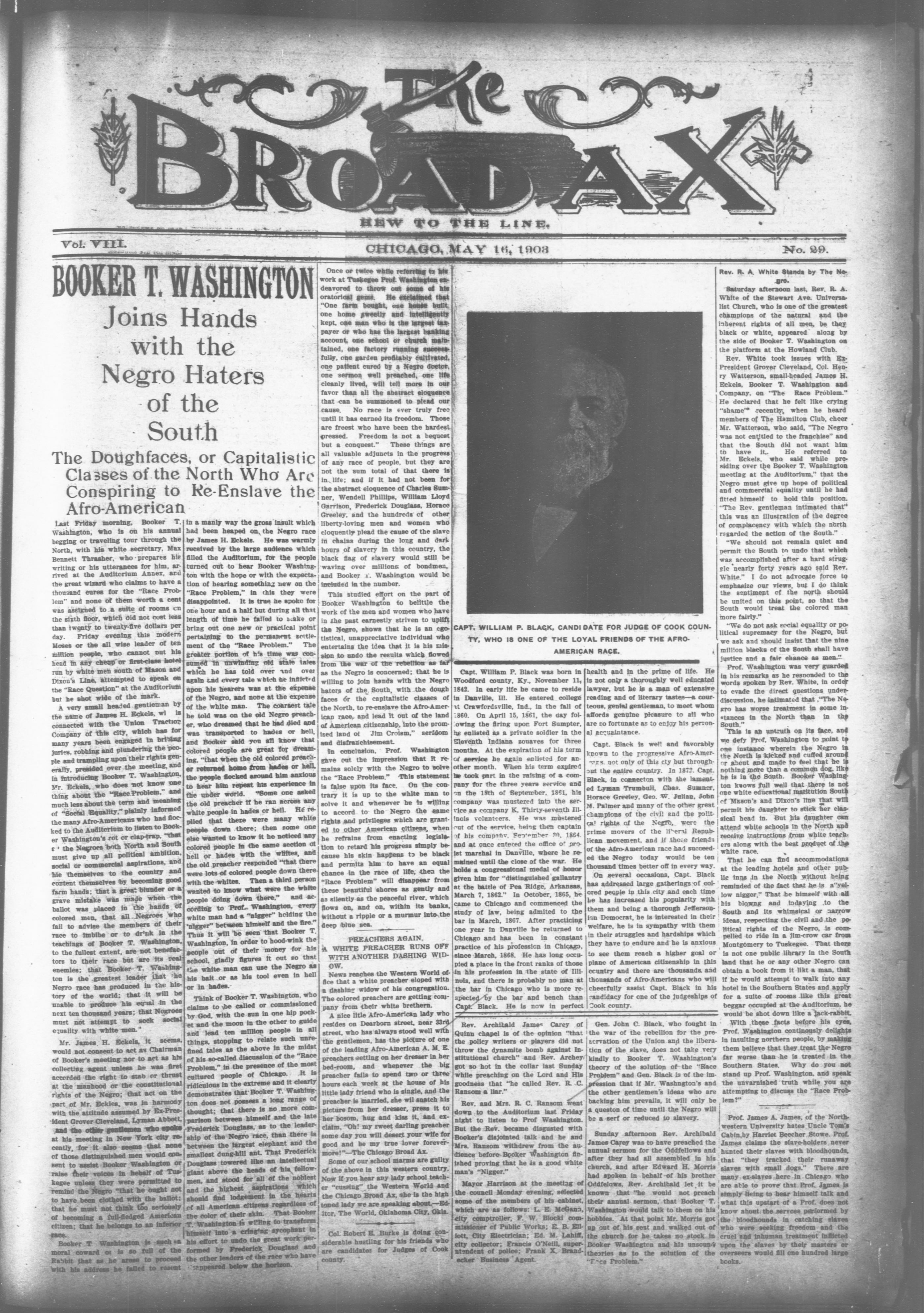
BOOKER T. WASHINGTON Joins Hands with the Negro Haters of the South
The Doughfaces, or Capitalistic Classes of the North Who Are Conspiring to Re-Enslave the Afro-American
Last Friday morning, Booker T. Washington, who is on his annual begging or traveling tour through the North, with his white secretary, Max Bennett Thrasher, who prepares his writing or his utterances for him, arrived at the Auditorium Annex, and the great wizard who claims to have a thousand cures for the "Race Problem" and none of them worth a cent was assigned to a suite of rooms on the sixth floor, which did not cost less than twenty to twenty-five dollars per day. Friday evening this modern Moses or the all wise leader of ten million people, who cannot out his head in any cheap or first-class hotel run by white men south of Mason and Dixon's Line, attempted to speak on the "Race Question" at the Auditorium but he shot wide of the mark.
A very small headed gentleman by the name of James H. Eckels, wl is connected with the Union Traction Company of this city, which has for many years been engaged in brising juries, robbing and plundering the people and trampling upon their rights generally, presided over the meeting, and in introducing Booker T. Washington, Mr. Eckels, who does not know one thing about the "Race Problem," and much less about the term and meaning of "Social Equality," plainly informed the many Afro-Americans who had flocked to the Auditorium to listen to Booker Washington's rot or clap-trap, "that's the Negroes both North and South must give up all political ambition, social or commercial aspirations, and he themselves to the country and content themselves by becoming good farm hands; that a great blunder or a grave mistake was made when the ballot was placed in the hands of colored men, that all Negroes who fail to advise the members of their race to imbibe or to drink in the teachings of Booker T. Washington, to the fullest extent, are not benefactors to their race but are its real enemies; that Booker T. Washington is the greatest leader that the Negro race has produced in the history of the world; that it will be unable to produce his equal in the next ten thousand years; that Negroes must not attempt to seek social equality with white men."
Mr. James H. Eckels, it seems, would not consent to act as Chairman of Booker's meeting nor to act as his collecting agent unless he was first accorded the right to stab or thrust at the manhood or the constitutional rights of the Negro; that act on the part of Mr. Eckles, was in harmony with the attitude assumed by Ex-President Grover Cleveland, Lyman Abbott, and the other gentlemen who spoke at his meeting in New York city recently, for it also seems that none of those distinguished men would consent to assist Booker Washington or raise their voices in hebalf of Tuskegee unless they were permitted to remind the Negro "that he ought not to have been clothed with the ballot; that he must not think too seriously of becoming a full-fledged American citizen; that he belongs to an inferior race.
Booker T. Washington is such a moral coward or is so full of the Rabbit that as he arose to proceed with his address he failed to resent
in a manly way the gross insult which had been heaped on the Negro race by James H. Eckels. He was warmly received by the large audience which filled the Auditorium, for the people turned out to hear Booker Washington with the hope or with the expectation of hearing something new on the "Race Problem," in this they were disappointed. It is true he spoke for one hour and a half but during all that length of time he failed to make or bring out one new or practical point pertaining to the permanent settlement of the "Race Problem." The greater portion of his time was consumed in unwinding old stale tales which he has told over and over again and every tale which he inflicted upon his hearers was at the expense of the Negro, and none at the expense of the white man. The coarsest tale he told was on the old Negro preacher, who dreamed that he had died and was transported to hades or hell, and Booker said you all know that colored people are great for dreaming, "that when the old colored preacher returned home from hades or hell, the people flocked around him anxious to hear him repeat his experience in the under world. "Some one asked the old preacher if he ran across any white people in hades or hell. He replied that there were many white people down there; then some one else wanted to know it he noticed any colored people in the same section of hell or hades with the whites, and the old preacher responded "that there were lots of colored people down there with the whites. Then a third person wanted to know what were the white people doing down there," and according to Prof. Washington, every white man had a "nigger" holding the 'nigger' between himself and the fire." Thus it will be seen that Booker T. Washington, in order to hood-wink the people out of their money for his school, gladly figures it out so that the white man can use the Negro as his bait or as his tool even in hell or in hades.
Think of Booker T. Washington, who claims to be called or commissioned by God, with the sun in one hip pocket and the moon in the other to guide and lead ten million people in all things, stopping to relate such unrefined tales as the above in the midst of his so-called discussion of the "Race Problem," in the presence of the most cultured people of Chicago. It is ridiculous in the extreme and it clearly demonstrates that Booker T. Washington does not possess a long range of thought; that there is no more comparison between himself and the late Frederick Douglass, as to the leadership of the Negro race, than there is between the largest elephant and the smallest dung-hill ant. That Frederick Douglass towered like an intellectual giant above the heads of his fellowmen, and stood for all of the noblest and the highest aspirations which should find lodgement in the hearts of all American citizens regardless of the color of their skin. That Booker T. Washington is willing to transform himself into a cringing sycophant in his effort to undo the great work performed by Frederick Douglass and the other leaders of the race who have disappeared below the horizon.
HEW TO THE LINE.
Once or twice while referring to his work at Tuskegee Prof. Washington endeavored to throw out some of his oratorical gems. He exclaimed that "One farm bought, one house built one home sweetly and intelligently kept, one man who is the largest taxpayer or who has the largest banking account, one school or church maintained, one factory running successfully, one garden profitably cultivated, one patient cured by a Negro doctor, one sermon well preached, one life cleanly lived, will tell more in our favor than all the abstract eloquence that can be summoned to plead our cause. No race is ever truly free until it has earned its freedom. Those are freest who have been the hardest pressed. Freedom is not a bequest but a conquest." These things are all valuable adjuncts in the progress of any race of people, but they are not the sum total of that there is in life; and if it had not been for the abstract eloquence of Charles Sumner, Wendell Phillips, William Lloyd Garrison, Frederick Douglass, Horace Greeley, and the hundreds of other liberty-loving men and women who eloquently plead the cause of the slave in chains during the long and dark hours of slavery in this country, the black flag of slavery would still be waving over millions of bondmen, and Booker I. Washington would be included in the number.
This studied effort on the part of Booker Washington to belittle the work of the men and women who have in the past earnestly striven to uplift the Negro, shows that he is an egoistical, unappreciative individual who entertains the idea that it is his mission to undo the results which flowed from the war of the rebellion as far as the Negro is concerned; that he is willing to join hands with the Negro haters of the. South, with the dough faces or the capitalistic classes of the North, to re-enslave the Afro-American race, and lead it out of the land of American citizenship, into the promised land of Jim Croism," serfdom and disfranchisement.
In conclusion, Prof. Washington gave out the impression that it remains solely with the Negro to solve the "Race Problem." This statement is false upon its face. On the contrary it is up to the white man to solve it and whenever he is willing to accord to the Negro the same rights and privileges which are granted to other American citizens, when he refrains from enacting legislation to retard his progress simply because his skin happens to be black and permits him to have an equal chance in the race of life; then the "Race Problem" will disappear from these beautiful shores as gently and as silently as the peaceful river, which flows on, and on, within its banks, without a ripple or a murmur into the deep blue sea.
PREACHERS AGAIN.
A WHITE PREACHER RUNS OFF WITH ANOTHER DASHING WIDOW.
News reaches the Western World of fice that a white preacher eloped with a dashing widow of his congregation. The colored preachers are getting company from their white brethern.
A nice little Afro-American lady who resides on Dearborn street, near 33rd street, who has always stood well with the gentlemen, has the picture of one of the leading Afro-American A. M. E. preachers setting on her dresser in her bed-room, and whenever the big preacher fails to spend two or three hours each week at the house of his little lady friend who is single, and the preacher is married, she wil snatch his picture from her dresser, press it to her bosom, hug and kiss it, and exclaim, "Oh! my sweet darling preacher some day you will desert your wife for good and be my true lover forevermore!"—The Chicago Broad Ax.
Some of our school marms are guilty of the above in this western country. Now if you hear any lady school teacher "cussing" the Western World and the Chicago Broad Ax, she is the high toned lady we are speaking about.—Editor, The World, Oklahoma City, Okla.
Col. Robert E. Burke is doing considerable hustling for his friends who are candidates for Judges of Cook county.
[Name]
CAPT. WILLIAM P. BLAGK, CANDIDATE FOR JUDGE OF COOK COUN TY, WHO IS ONE OF THE LOYAL FRIENDS OF THE AFRO AMERICAN RACE.
Capt. William P. Black was born in Woodford county, Ky., November 11, 1842. In early life he came to reside in Danville, Ill. He entered college at Crawfordsville, Ind., in the fall of 1860. On April 15, 1861, the day following the firing upon Fort Sumpter, he enlisted as a private soldier in the Eleventh Indiana zouaves for three months. At the expiration of his term of service he again enlisted for another month. When his term expired he took part in the raising of a company for the three years service and on the 18th of September, 1861, his company was mustered into the service as company K, Thirty-seventh Illinois volunteers. He was mustered out of the service, being then captain of his company. September 30, 1864. and at once entered the office of proist marshal in Danville, where he remained until the close of the war. He holds a congressional medal of honor given him for "distinguished gallantry at the battle of Pea Ridge, Arkansas, March 7, 1862." In October, 1865, he came to Chicago and commenced the study of law, being admitted to the bar in March, 1867. After practicing one year in Danville he returned to Chicago and has been in constant practice of his profession in Chicago, since March, 1868. He has long occupied a place in the front ranks of those in his profession in the state of Illinois, and there is probably no man at the bar in Chicago who is more respected by the bar and bench than Capt. Black. He is now in perfect
Rev. Archibald James Carey of Quinn chapel is of the opinion "that the policy writers or players did not throw the dynamite bomb against Institutional church" and Rev. Archey got so hot in the collar last Sunday while preaching on the Lord and His goodness that "he called Rev. R. C. Ransom a liar."
Rev. and Mrs. R. C. Ransom went down to the Auditorium last Friday night to listen to Prof Washington. But the Rev. became disgusted with Booker's disjointed talk and he and Mrs. Ransom withdrew from the audience before Booker Washington finished proving that he is a good white man's "Nigger."
Mayor Harrison at the meeting of the council Monday evening, selected some of the members of his cabinet, which are as follows: L. E. McGann, city comptroller, F. W. Blocki commissioner of Public Works; E. B. Elliott, City Electrician; Ed. M. Lahiff, city collector; Francis O'Neill, superintendent of police; Frank X. Brandecker Business Agent.
health and in the prime of life. He is not only a thoroughly well educated lawyer, but he is a man of extensive reading and of literary tastes—a courteous, genial gentleman, to meet whom affords genuine pleasure to all who are so fortunate as to enjoy his personal acquaintance.
Capt. Black is well and favorably known to the progressive Afro-Americans, not only of this city but throughout the entire country. In 1872. Capt. Black, in connection with the lamented Lyman Trumbull, Chas. Sumner, Horace Greeley, Geo. W. Julian, John M. Palmer and many of the other great champions of the civil and the political rights of the Negro, were the prime movers of the liberal Republican movement, and if those friends of the Afro-American race had succeeded the Negro today would be ten thousand times better off in every way. On several occasions, Capt. Black has addressed large gatherings of colored people in this city and each time he has increased his popularity with them and being a thorough Jeffersonian Democrat, he is interested in their welfare, he is in sympathy with them in their struggles and hardships which they have to endure and he is anxious to see them reach a higher goal on plane of American citizenship in this country and there are thousands and thousands of Afro-Americans who will cheerfully assist Capt. Black in his candidacy for one of the judgeships of Cook county.
Gen. John C. Black, who fought in the war of the rebellion for the preservation of the Union and the liberation of the slave, does not take very kindly to Booker T. Washington's theory of the solution of the "Race Problem" and Gen. Black is of the impression that if Mr. Washington's and the other gentlemen's ideas who are backing him prevails, it will only be a question of time until the Negro will be a serf or reduced to slavery.
Sunday afternoon Rev. Archibald James Carey was to have preached the annual sermon for the Oddfellows and after they had all assembled in his church, and after Edward H. Morris had spoken in behalf of his brother Oddfelows, Rev. Archibald let it be known that "he would not preach their annual sermon, that Booker T. Washington would talk to them on his hobbies. At that point Mr. Morris got up out of his seat and walked out of the church for he takes no stock in Booker Washington and his unsound theories as to the solution of the "Face Problem."
No. 29.
Rev. R. A. White Stands by The Negro. Saturday afternoon last, Rev. R. A. White of the Stewart Ave. Universalist Church, who is one of the greatest champions of the natural and the inherent rights of all men, be they black or white, appeared along by the side of Booker T. Washington on the platform at the Howland Club.
Rev. White took issues with Ex-President Grover Cleveland, Col. Henry Watterson, small-headed James H. Eckels, Booker T. Washington and Company, on "The Race Problem." He declared that he felt like crying "shame" recently, when he heard members of The Hamilton Club, cheer Mr. Watterson, who said, "The Negro was not entitled to the franchise" and that the South did not want him to have it. He referred to Mr. Eckels, who said while presiding over the Booker T. Washington meeting at the Auditorium," that the Negro must give up hope of political and commercial equality until he had fitted himself to hold this position. "The Rev. gentleman intimated that" this was an illustration of the degree of complacency with which the north regarded the action of the South."
"We should not remain quiet and permit the South to undo that which was accomplished after a hard struggle nearly forty years ago said Rev. White." I do not advocate force to emphasize our views, but I do think the sentiment of the north should be united on this point, so that the South would treat the colored man more fairly."
"We do not ask social equality or political supremacy for the Negro, but we ask and should insist that the nine million blacks of the South shall have justice and a fair chance as men."
Prof. Washington was very guarded in his remarks as he responded to the words spoken by Rev. White, in order to evade the direct questions under discussion, he intimated that, "The Negro has worse treatment in some instances in the North than in the South."
This is an untruth on its face, and we defy Prof. Washington to point to one instance wherein the Negro in the North is kicked and cuffed around or about and made to feel that he is nothing more than a common dog, like he is in the South. Booker Washington knows full well that there is not one white educational institution South of Mason's and Dixon's line that will permit his daughter to stick her classical head in. But his daughter can attend white schools in the North and receive instructions from white teachers along with the best product of the white race.
That he can find accommodations at the leading hotels and other public inns in the North without being reminded of the fact that he is a "yellow nigger." That he himself with all his blowng and todaying to the South and its whimsical or narrow ideas, respecting the civil and the political rights of the Negro, is compelled to ride in a jim-crow car from Montgomery to Tuskegee. That there is not one public library in the South land that he or any other Negro can obtain a book from it likt a man, that if he would attempt to walk into any hotel in the Southern States and apply for a suite of rooms like this great beggar occupied at the Auditorium, he would be shot down like a jack-rabbit
With these facts before his eyes, Prof. Washington continuously delights in insulting northern people, by making them believe that they treat the Negro far worse than he is treated in the Southern States. Why do you not stand up Prof. Washington, and speak the unvarnished truth while you are attempting to discuss the "Race Problem?"
Prof. James A. James, of the Northwestern University hates Uncle Tom's Cabin, by Harriet Beecher Stowe. Prof. James claims the slave-holders never hunted their slaves with bloodhounds, that "they tracked their runaway slaves with small dogs." There are many ex-slaves here in Chicago who are able to prove that Prof. James is simply lying to hear himself talk and what this upstart of a Prof. does not know about the services performed by the bloodhounds in catching slaves who were seeking freedom and the cruel and inhuman treatment inflicted upon the slaves by their masters or overseers would fill one hundred large books.
THE BROAD AX
Will promulgate and at all times uphold the true principles of Democracy, but Catholics, Protestants, Freeth, Infidels, Farmers, Singles Taxes, Republicans, Knights of Labor, or any one else can have their say, so long as their language is proper and responsibility is fixed.
The Broad Ax is a newspaper whose platform is broad enough for all, ever claiming the editorial right to speak its own mind.
Local communications will receive attention. Write only on one side of the paper.
THE BROAD AX
6040 Armous Avenue, Chicago
JULIUS F. TAYLOR, Editor and Publisher
Entered at the Post Office at Chicago, Ill., as Second-class Matter.
MUSEUM WITHIN A MUSEUM
Pennsylvania Institution Has a Small
It is a long reach from the sixth century before Christ to the present day, but the University of Pennsylvania museum has just incorporated a museum of that date which was discovered by Prof. Helprecht. The museum is not very big, being entirely contained in a large earthen jar, but the contents are very valuable from an historical standpoint, and show that the ideas of the early curator were very much like those of present curators, reports the Philadelphia Record. Whether the specimens were excavated or purchased is not known, but they undoubtedly represent a collection which must have been made during the time of Belahazzar, since it was found in one of the upper strata at Nippur. The best specimen in the jar is an inscription containing the titles of Sargon the First, who lived about 3800 B.C. There is a black stone votive tablet of UrGur, 2700 B.C., which tells that this king built the great wall around the city of Nippur. Then there is a terracotta brick stamp of Bur-Sin, which is the first yet found of that king. Another tablet states that the large hall of the temple was called Emakh, and also that there were 24 other shrines to gods in the temple besides the ones that have been found of Bel and his consort Beltis. An interesting tablet gives some astronomical observations on Virgo and Scorpion. The little museum contains 19 pieces in all, and the collection will be placed separately in the university museum.
The weather man doth prophesy,
Because our minds it pleases;
But, none the less, a cloud sails by,
And does just what it pleases.
—Washington Star.
HE WAS THE GOOSE.
A
Mrs. Newlywed—But even if my hat did cost $100, don't you think it is perfectly killing?
Mr.Newlywed—Yes,killing the goose that laid the golden egg that bought it—N. Y. Times.
Browninsky—That fellow Blank is rather dense, isn't he?
Smithovich—Well, I guess yes. The only time he ever gets next is in a barber shop.—Cincinnati Enquirer.
Applicant—I'm a graduate of a correspondence school, sir.
Merchant—Well, I won't count that against you. I'll give you a trial, young man.—Puck.
A Panacea.
Jones—So you think smoking is good for a headache?
Smith—Yes. My mother-in-law always leaves the room when I smoke. Judge.
Mike—How did Casey lose his job as postman?
Pat—He stopped wurrk the first tome he blew his whistle.—N. Y Times.
One Day Guzzled Right.
"Now, Johnny, can you tell me who built the ark?"
"No."
"That's right, Johnny—it was Noah. Ella, give Johnny the prize picture card."—Baltimore News.
"You are discharged," said Judge Henpeck to the bigamist in the dock. "The possession of two mother-in-law is, in the opinion of this court, sufficient punishment for your crime.—N. Y. Herald.
His Preference.
Philosopher—You say 13 is an unlucky number; now, would you rather have $13 or $13?
Flaneur—I'd rather have $14, dear boy.—Town Topics.
Two Points of View. He—Did you ever notice how high Miss Neurich carries her head? She—Yes, poor girl; she has a neck like a giraffe—Chicago Daily News.
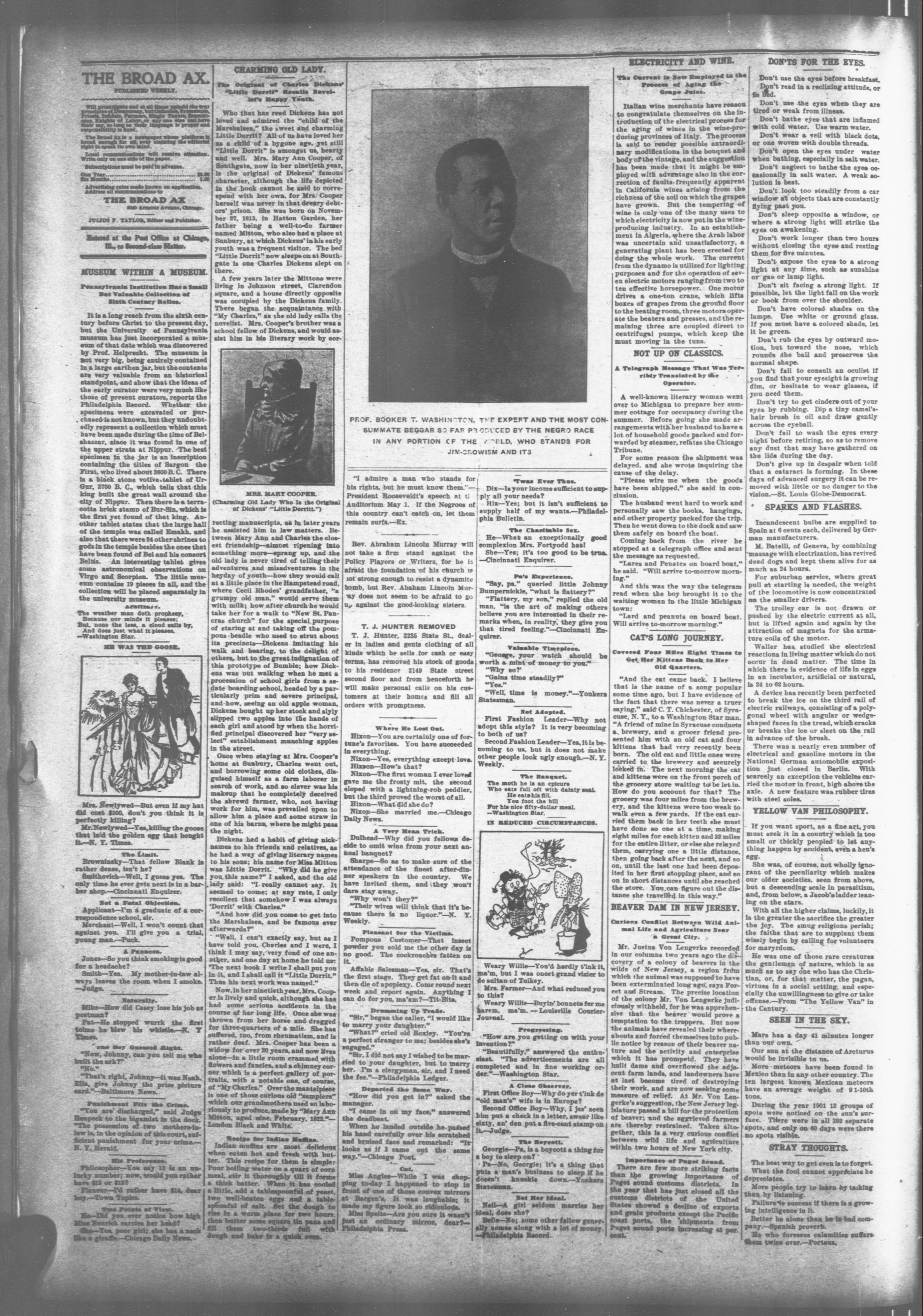
CHARMING OLD LADY.
The Original of Charles Dickens' "Little Dorrit" Recalls Novelist's Happy Youth.
Who that has read Dickens has not loved and admired the "child of the Marshallsea," the sweet and charming Little Dorrit? All of us have loved her as a child of a bygone age, yet still "Little Dorrit" is amongst us, hearty and well. Mrs. Mary Ann Cooper, of Southgate, now in her ninetieth year, is the original of Dickens' famous character, although the life depicted in the book cannot be said to correspond with her own, for Mrs. Cooper herself was never in that dreary debtors' prison. She was born on November 27, 1813, in Hatton Garden, her father being a well-to-do farmer named Mitton, who also had a place at Sunbury, at which Dickens' in his early youth was a frequent visitor. The bed "Little Dorrit" now sleeps on at Southgate is one Charles Dickens slept on there.
A few years later the Mittons were living in Johnson street, Clarendon square, and a house directly opposite was occupied by the Dickens family. There began the acquaintance with "My Charles," as the old lady calls the novelist. Mrs. Cooper's brother was a school fellow of Dickens, and would assist him in his literary work by cor-
[Illustration of a monk seated in a chair, wearing a robe and a hood.]
MRS. MARY COOPER
(Charming Old Lady Who Is the Original of Dickens" "Little Dorritt.")
recting manuscripts, as in later years he assisted him in law matters. Between Mary Ann and Charles the closest friendship—almost ripening into something more—sprang up, and the old lady is never tired of telling their adventures and misadventures in the heyday of youth—how they would call at a little place in the Hampstead road, where Cecil Rhodes' grandfather, "a grumpy old man," would serve them with milk; how after church he would take her for a walk to "New St. Pancras church" for the special purpose of staring at and taking off the pomous beadle who used to strut about its precincts—Dickens imitating his walk and bearing, to the delight of others, but to the great indignation of this prototype of Bumble; how Dickens was out walking when he met a procession of school girls from a sedate boarding school, headed by a particularly prim and severe principal, and how, seeing an old apple woman, Dickens bought up her stock and slyly alipped two apples into the hands of each girl and stood by when the horrified principal discovered her "very select" establishment munching apples in the street.
Once when staying at Mrs. Cooper's home at Sunbury, Charles went out, and borrowing some old clothes, disguised himself as a farm laborer in search of work, and so clever was his makeup that he completely deceived the shrewd farmer, who, not having work for him, was prevailed upon to allow him a place and some straw in one of his barns, where he might pass the night.
Dickens had a habit of giving nicknames to his friends and relatives, as he had a way of giving literary names to his sons; his name for Miss Mitton was Little Dorrit. "Why did he give you this name?" I asked, and the old lady said: "I really cannot say. It seemed to come; at any rate, I only recollect that somehow I was always 'Dorrit' with Charles."
"And how did you come to get into the Marshalsea, and be famous ever afterwards?"
"Well, I can't exactly say, but as I have told you, Charles and I were, I think I may say, very fond of one another, and one day at home he told us: 'The next book I write I shall put you in-it, and I shall call it "Little Dorrit." Thus his next work was named.'
Now, in her ninetieth year, Mrs. Cooper is lively and quick, although she has had some serious accidents in the course of her long life. Once she was thrown from her horse and dragged for three-quarters of a mile. She has suffered, too, from rheumatism, and is rather deaf. Mrs. Cooper has been a widow for over 20 years, and now lives alone—in a little room crammed with flowers and fancies, and a chimney corner which is a perfect gallery of portraits, with a notable one, of course, of "My Charles." Over the mantelpiece is one of those curious old "samplers" which our grandmothers used so laboriously to produce, made by "Mary Ann Mitton, aged nine, February, 1822."—London Black and White.
Indian muffins are most delicious when eaten hot and fresh with butter. This recipe for them is simple: Pour boiling water on a quart of corn meal, stir it thoroughly till it forms a thick batter. When it has cooled a little, add a tablespoonful of yeast, two well-beaten eggs and a tablespoonful of salt. Set the dough to rise in a warm place for two hours, then butter some square tin pans and fill them two-thirds full with dough and bake in a quick oven.
P.
"I admire a man who stands for his rights, but he must know them." President Rooseveldt's speech at tj Auditorium May 1. If the Negroes of this country can't catch on, let them remain surfs.—Ex.
---
Rev. Abraham Lincoln Murray will not take a firm stand against the Policy Players or Writers, for he is afraid the foundation of his church is not strong enough to resist a dynamite bomb, but Rev. Abaham Lincoln Murray does not seem to be afraid to go up, against the good-looking sisters.
T. J. HUNTER REMOVED
T. J. Hunter, 3235 State St., dealer in ladies and gents clothing of all kinds which he sells for cash or easy terms, has removed his stock of goods to his residence 3149 State street second floor and from henceforth he will make personal calls on his customers at their homes and fill all orders with promptness.
Where He Lost Out
Hixon—You are certainly one of fortune's favorites. You have succeeded in everything.
Nixon—Yes, everything except love.
Hixon—How's that?
Nixon—The first woman I ever loved gave me the frosty mit, the second eloped with a lightning-rob peddler, but the third proved the worst of all.
Hixon—What did she do?
Nixon—She married me.—Chicago Daily News.
A Very Mean Trick.
Dulhead—Why did you fellows decide to omit wine from your next annual banquet?
Sharpe—So as to make sure of the attendance of the finest after-dinner speakers in the country. We have invited them, and they won't dare stay away.
"Why won't they?"
"Their wives will think that it's because there is no liquor."—N. Y. Weekly.
Pleasant for the Vietimes.
Pompous Customer—That insect powder you sold me the other day is no good. The cockroaches fatten on it.
Affable Salesman—Yes, sir. That's the first stage. They get fat on it and then die of apoplexy. Come round next week and report again. Anything I can do for you, ma'am?—Tit-Bita.
Drumming Up Trade.
"Sir," began the caller, "I would like to marry your daughter."
"What?" cried old Roxley. "You're a perfect stranger to me; besides she's engaged."
"Sir, I did not say I wished to be married to your daughter, but to marry her. I'm a clergyman, air, and I need the fee."—Philadelphia Ledger.
"I came in on my face," answered the deadbeat.
When he landed outside he-passed his hand carefully over his scratched and bruised face and remarked: "It looks as if I came out the same way."—Chicago Post.
Cat.
Miss Angles—While I was shopping to-day I happened to stop in front of one of those convex mirrors at Bargen's. It was laughable; it made my figure look so ridiculous.
Miss Speitz—Are you sure it wasn't just an ordinary mirror, dear?—Philadelphia Press.
"Twas Ever Thus.
Dix—Is your income sufficient to supply all your needs?
Hix—Yes; but it isn't sufficient to supply half of my wants.—Philadelphia Bulletin.
The Charitable Sex.
He—What an exceptionally good complexion Mrs. Fortyodd has!
She—Yes; it's too good to be true.
Cincinnati Enquirer.
Pa's Experience.
"Say, pa." queried little Johnny Bumpernickle, "what is flattery?"
"Flattery, my son," replied the old man, "is the art of making others believe you are interested in their remarks when, in reality, they give you that tired feeling."—Cincinnati Enquirer.
"George, your watch should be worth a mint of money to you."
"Why so?"
"Gains time steadily?"
"Yes."
"Well, time is money."—Yonkers Statesman.
First Fashion Leader—Why not adopt this style? It is very becoming to both of us?
Second Fashion Leader—Yes, it is becoming to us, but it does not make other people look ugly enough.—N. Y. Weekly.
The Banquet.
The moth he is an epicure
Who eats full oft with dainty seal.
He eats his fill.
You foot the bill
For his nice fifty-dollar meal.
—Washington Star.
IN REDUCED CIRCUMSTANCES.
2
Weary Willie—You'd hardly tink it, ma'm, but I was once grand vizier to de sultan of Toikey.
Mrs. Farmer—And what reduced you to this?
Weary Willie—Buyin' bonnets fer me harem, ma'm. — Louisville Courier-Journal.
"How are you getting on with your invention?"
"Beautifully," answered the enthusiast. "The advertisements are all completed and in fine working order."—Washington Star.
A Close Observer.
First Office Boy—Why do yer t'ink de "old man's" wife is in Europe?
Second Office Boy—Why, I Jes' seen him put a check in a letter, swear like sixty, an' den put a five-cent stamp on it.—Judge.
Georgie—Pa, is a boycott a thing for a boy to sleep on?
Pa-No, Georgie; it's a thing that puts a man's business to sleep if he doesn't knuckle down.-Yonkers Statesman.
Nell—A girl seldom marries her ideal, does she?
Belle—No; some other fellow generally comes along with a lot of money.
—Philadelphia Record.
ELECTRICITY AND WINE.
The Current is Now Employed in the Process of Aging the Grape Juice.
Italian wine merchants have reason to congratulate themselves on the introduction of the electrical process for the aging of wines in the wine-producing provinces of Italy. The process is said to render possible extraordinary modifications in the bouquet and body of the vintage, and the suggestion has been made that it might be employed with advantage also in the correction of faults frequently apparent in California wines arising from the richness of the soil on which the grapes have grown. But the tempering of wine is only one of the many uses to which electricity is now put in the wine-producing industry. In an establishment in Algeria, where the Arab labor was uncertain and unsatisfactory, a generating plant has been erected for doing the whole work. The current from the dynamo is utilized for lighting purposes and for the operation of seven electric motors ranging from two to ten effective horsepower. One motor drives a one-ton crane, which lifts boxes of grapes from the ground floor to the beating room, three motors operate the beaters and presses, and the remaining three are coupled direct to centrifugal pumps, which keep the must moving in the tuns.
NOT UP ON CLASSICS
A Telegraph Message That Was Terribly Translated by the Operator.
A well-known literary woman went over to Michigan to prepare her summer cottage for occupancy during the summer. Before going she made arrangements with her husband to have a lot of household goods packed and forwarded by steamer, relates the Chicago Tribune.
For some reason the shipment was delayed, and she wrote inquiring the cause of the delay.
"Please wire me when the goods have been shipped," she said in conclusion.
The husband went hard to work and personally saw the books, hangings, and other property packed for the trip. Then he went down to the dock and saw them safely on board the boat.
Coming back from the river he stopped at a telegraph office and sent the message as requested.
"Lares and Penates on board boat," he said. "Will arrive to-morrow morning."
And this was the way the telegram read when the boy brought it to the waiting woman in the little Michigan town:
"Lard and peanuts on board boat. Will arrive to-morrow morning."
CAT'S LONG JOURNEY.
Covered Four Miles Eight Times to Get Her Kjttens Back to Her Old Quarters.
"And the cat came back. I believe that is the name of a song popular some time ago, but I have evidence of the fact that there was never a truer saying," said C. T. Chichester, of Syracuse, N. Y., to a Washington Star man. "A friend of mine in Syracuse conducts a brewery, and a grocer friend presented him with an old cat and four kittens that had very recently been born. The old cat and little ones were carried to the brewery and securely locked in. The next morning the cat and kittens were on the front porch of the grocery store waiting to be let in. How do you account for that? The grocery was four miles from the brewery, and the kittens were too weak to walk even a few yards. If the cat carried them back in her teeth she must have done so one at a time, making eight miles for each kitten and 32 miles for the entire litter, or else she relayed them, carrying one a little distance, then going back after the next, and so on, until the last one had been deposited in her first stopping place, and so on in short distances until she reached the store. You can figure out the distance she travelled in this way."
BEAVER DAM IN NEW JERSEY.
Carlous Conflict Between Wild Animal Life and Agriculture Near a Great City.
Mr. Justus Von Lengerke recorded in our columns two years ago the discovery of a colony of beavers in the wilds of New Jersey, a region from which the animal was supposed to have been exterminated long ago, says Forest and Stream. The precise location of the colony Mr. Von Lengerke judiciously withheld, for he was apprehensive that the beaver would prove a temptation to the trappers. But now the animals have revealed their whereabouts and forced themselves into public notice by reason of their beaver nature and the activity and enterprise which it has prompted. They have built dams and overflowed the adjacent farm lands, and landowners have at last become tired of destroying their work, and are now seeking some measure of relief. At Mr. Von Lengerke's suggestion, the New Jersey legislature passed a bill for the protection of beaver; and the aggrieved farmers are thereby restrained. Taken altogether, this is a very curious conflict between wild life and agriculture within two hours of New York city.
Importance of Pugat Sound
There are few more striking facts than the growing importance of Puget sound customs districts. In the year that has just closed all the customs districts of the United States showed a decline of exports and grain products except the Pacific coast ports, the shipments from Puget sound ports increasing 45 per cent.
Don't use the eyes before breakfast.
Don't read in a reclining attitude, or in bed.
Don't use the eyes when they are tired or weak from illness.
Don't bathe eyes that are inflamed with cold water. Use warm water.
Don't wear a veil with black dots, or one woven with double threads.
Don't open the eyes under water when bathing, especially in salt water.
Don't neglect to bathe the eyes occasionally in salt water. A weak solution is best.
Don't look too steadily from a car window at objects that are constantly flying past you.
Don't sleep opposite a window, or where a strong light will strike the eyes on awakening.
Don't work longer than two hours without closing the eyes and resting them for five minutes.
Don't expose the eyes to a strong light at any time, such as sunshine or gas or lamp light.
Don't sit facing a strong light. If possible, let the light fall on the work or book from over the shoulder. Don't have colored shades on the lamps. Use white or ground glass. If you must have a colored shade, let it be green. Don't rub the eyes by outward motion, but toward the nose, which rounds the ball and preserves the normal shape. Don't fail to consult an oculist if you find that your eyesight is growing dim, or hesitate to wear glasses, if you need them.
Don't try to get cinders out of your eyes by rubbing. Dip a tiny camel's hair brush in oil and draw gently across the eyeball.
Don't fail to wash the eyes every night before retiring, so as to remove any dust that may have gathered on the lids during the day.
Don't give up in despair when told that a cataract is forming. In these days of advanced surgery it can be removed with little or no danger to the vision.—St. Louis Globe-Democrat.
* SPARKS AND FLASHES
Incandescent bulbs are supplied to Spain at 6 cents each, delivered by German manufacturers.
M. Batelli, of Geneva, by combining massage with electrization, has revived dead dogs and kept them alive for as much as 24 hours.
For suburban service, where great pull at starting is needed, the weight of the locomotive is now concentrated on the smaller drivers.
The trolley car is not drawn or pushed by the electric current at all, but is lifted again and again by the attraction of magnets for the armature coils of the motor.
Waller has studied the electrical reactions in living matter which do not occur in dead matter. The time in which there is evidence of life in eggs in an incubator, artificial or natural, is 24 to 62 hours. A device has recently been perfected to break the ice on the third rail of electric railways, consisting of a polygonal wheel with angular or wedgeshaped faces in the tread, which cracks or breaks the ice or sleet on the rail in advance of the brush.
There was a nearly even number of electrical and gasoline motors in the National German automobile exposition just closed in Berlin. With scarcely an exception the vehicles carried the motor in front, high above the axle. A new feature was rubber tires with steel soles.
YELLOW VAN PHILOSOPHY.
If you want sport, as a fine art, you must seek it in a country which is too small or thickly peopled to let anything happen by accident, even a hen's egg.
She was, of course, not wholly ignorant of the peculiarity which makes our older societies, seen from above, but a descending scale in parasitism, and, from below, a Jacob's ladder leaning on the stars.
With all the higher claims, luckily, it is the greater the sacrifice the greater the joy. The smug religions perish; the faiths that are to supplant them wisely begin by calling for volunteers for maryrdom.
He was one of those rare creatures the gentlemen of nature, which is as much as to say one who has the Christian, or, for that matter, the pagan, virtues in a social setting, and especially the unwillingness to give or take offense.—From "The Yellow Van" in the Century.
SEEN IN THE SKY.
Mars has a day 41 minutes longer than our own.
Our sun at the distance of Arcturus would be invisible to us.
More meteors have been found in Mexico than in any other country. The ten largest known Mexican meteors have an average weight of 91-10th tons.
During the year 1901 12 groups of spots were noticed on the sun's surface. There were in all 392 separate spots, and only on 60 days were there no spots visible.
STRAY THOUGHTS
The best way to get even is to forget. What the fool cannot appreciate he depreciates.
More people try to learn by talking than by listening.
Failure is success if there is a growing intelligence in it.
Better be alone than be in bad company.—Spanish proverb.
He who foresees calamities suffers them twice over.—Porteus.
Mouldy Mike—I'm gettin' along slick now. Always asks her work at me trade, and never gits offered any.
Weary William—What do you pretend to be?
"A tombstone carver."
"And don't you ever git offered a job?"
"Naw. I keeps away from towns wots got trolley cars."—N. Y. Weekly.
The Only Way Out.
If an S and an I and an O and a U,
With an X at the end, spell Su,
And an E and A Y and E spell an I,
Pray, what is the speller to do?
Then if also an S and an I and a G
An an H E D spell clide,
There is nothing much left for the speller to do
But to go and commit Slouxeyesighed.
-Tt-Bits.
AFTER THE FARMER'S DAY.
"Oi tell ye what, Casey, that fellow Rafferty should be kicked to death by jackass—an' begob, Old loike to be the wan to do it!"—Ally Sloper.
The Rose Vine.
The sun flung a kiss to the vine by the wall. Where it lived all austere in the shadow of gloom.
And it shuddered at thought of politeness so small;
There Are Others
The other day a young man gave a reason for not dancing, the spirit of which might be made to apply to a good many failures in life.
"I should like to dance," he said, "and I should dance, only the music puts me out and the girl gets in my way."—Tit-Bits.
Something New.
"Yes," said the museum manager, "I've engaged a living skeleton and a fat freak that are positively unique." "But living skeletons and fat women are such chestnuts—" "Ah! You've said it. These are a living skeleton woman and a fat man." —Philadelphia Press.
Takes Issue.
"It's a mistake to say the course of true love never did run smooth," reflected Mr. Meekun. "In thousands of cases it does run smooth—until it reaches the ocean of matrimony, which I'll admit, is sometimes rough enough."—Chicago Tribune.
Cutting It Short.
"How would you like your hair cut, sir?" asked the barber, "with the scissors or clippers?"
"Both," replied the victim. "Use the scissors on my hair and the clippers on your conversation."—Cincinnati Enquirer.
Oldhand—Got an automobile, have you? Strange I never see you on the road.
B. Ginner—That's because as soon as I land there I pick myself up and scramble back into the machine.—Philadelphia Press.
Aeronautical.
"Pa, what's the difference between a balloon and an airship?"
"Why, my son, a balloon goes straight up, but nobody can tell where an airship is going until the earth bumps into it."—N. Y. Herald.
Began Early in Life.
Bacon-I understand J. Pierpont
Morgan began watering stock at a very early age.
Egbert-Can that be possible?
"Yes; he worked on a farm as a boy."-Yonkers Statesman.
No Reform Wanted.
"I think they ought to enforce the law which requires that oleomargarine shall be distinctly labeled as such."
"Heavens, no! Let us keep some of our illusions."—Judge.
One Little Favor.
She—No, it can never be. I do not love you enough to be your wife. But, before you go, I want to ask one favor. He (dejectedly)—Well what?
She—Please do not marry any one else.—N. Y. Weekly.
Quite a Difference.
Mrs. Bacon—Ready and willing are synonymous terms, are they not?
Mr. Bacon—Not always. For instance, you are always willing to go to the theater, but you're not always ready.—Tit-Bits.
Softleigh—I say, doctah, do you—aw
—believe that liquor really affects a man's brain?
Physician—Yes, if he has any. Otherwise it affects his legs.—Cincinnati Enquirer.
"Well, I suppose Rockereller lives according to his lights."
"I don't know. Sometimes I think other people's lights have more to do with it."—Detroit Free Press.
It Did It Gladly.
"Well, that lets me out," grinned the Shobo, pointing to the open gate.—Corneil Widow.
WOMAN PRESS FEEDER.
Annie Peglow Operates Two Big Cylinders in a St. Louis Office and Delegation to Union.
Annie Peglow, of No. 3016 Missouri avenue, claims to be the only woman pressman in the United States, says the St. Louis Republic.
For five years she has operated two cylinder presses at 314 North Third street. The firm considers her one of its best workmen.
Miss Peglow entered the employ of the company 20 years ago as a press feeder. At that time women press feeders were a novelty, but since many girls have entered that branch of the printing business, and now some of the larger printing companies hire hundreds of women press feeders. Running a cylinder press was never thought of as woman's work until it occurred to Miss Peglow. None has tried it since. She was an enthusiastic printer and she determined to learn all about the business.
"I just 'nosed' about until I 'caught on', then I began to try and convince my boss that I was as good a pressman as any of the men and finally I got a trial, which proved successful, and here I am," is the way she explains her presence before her two big machines. She belongs to Pressmen's Union No. 6. In order to allow her to enter the union the international body of pressmen allowed their constitution to be amended so as to admit her. It caused quite a little discussion at the time.
Miss Peglow does not attend the meetings of her local, however. She leaves the transaction of all union business to the men and abides by their decisions. She does not attend the meetings because she is the only woman member and her presence there alone, she thinks, would appear too bold. Every morning at 8 o'clock she appears before her machines, dons her blue calico dress, which is made of cloth similar to the goods used in jumpers and overalls, and superintends the turning out of the large printed sheets.
She excels in color work which embraces two, three or more colors, and is considered especially good in dainty work, which she is always consulted about by the heads of the firm.
Although elbowing men all day long in pursuit of her duties, Miss Peglow says she cannot agree with Mrs. Claxon and her ideas on the "Ideal Wife" or the deterioration of chivalry.
"I do not think," said she, "because a woman works for a living that it de-
A
MISS PEGLOW AT WORK tracts a particle from her womanly graces; neither do I think that a woman that works is not as good a housewife as the girl who spends all her time at home. I think to get out in the world and work serves to broaden one's ideas, and I am sure some of the workers appreciate their homes a great deal more from the fact that they are at home so little. To work shows one how fortunate the woman who does not have to work really is. "As to men losing their chivalry—I don't believe it; at least, I have not experienced it; and I meet a great many men in my business every day."
TO KEEP PRETTY HANDS.
If You Pay Attention to This Bunch of "Don'ts" You Can Have Them the Year Around.
Don't visit your manicure too often. Too much manicuring is worse than not enough.
Don't polish nails too highly; they should have only a natural gloss. Too much polishing makes them tender.
Don't polish nails without first rubbing on a little rose-tinted paste. Use the palm of the hand to polish.
Don't cut nails without first holding them in warm water or sweet oil.
Don't cut them too often, or they
Don't cut them too often, or they will become thick and ugly.
Don't cut the cuticle or any part of the flesh around the nails.
Don't out the nails in points, but let them be carefully arched.
Don't use a file or emery paper on the flat surface of the nail, but only on the edge, to level it.
Don't dry the hands with a towel, but with a silk handkerchief, which absorbs moisture more readily.
Don't neglect to press back the skin around the nail after washing the hands, so that the crescent, or halfmoon will show.
Don't use ammonia in the bath without applying a cold cream afterward.
Don't use lemon juice too often on the hands. Try white vinegar instead. Lemon juice shrivels and yellows the surface. Don't wear gloves every night, or the hands will become yellow. Occasional use of gloves, however, is advisable.
Don't let the hands hang down, or the blood will fill and stretch the veins. Don't forget that warm feet have much to do with white hands. When the feet are habitually cold, the hands are always red or blue.—Washington Star
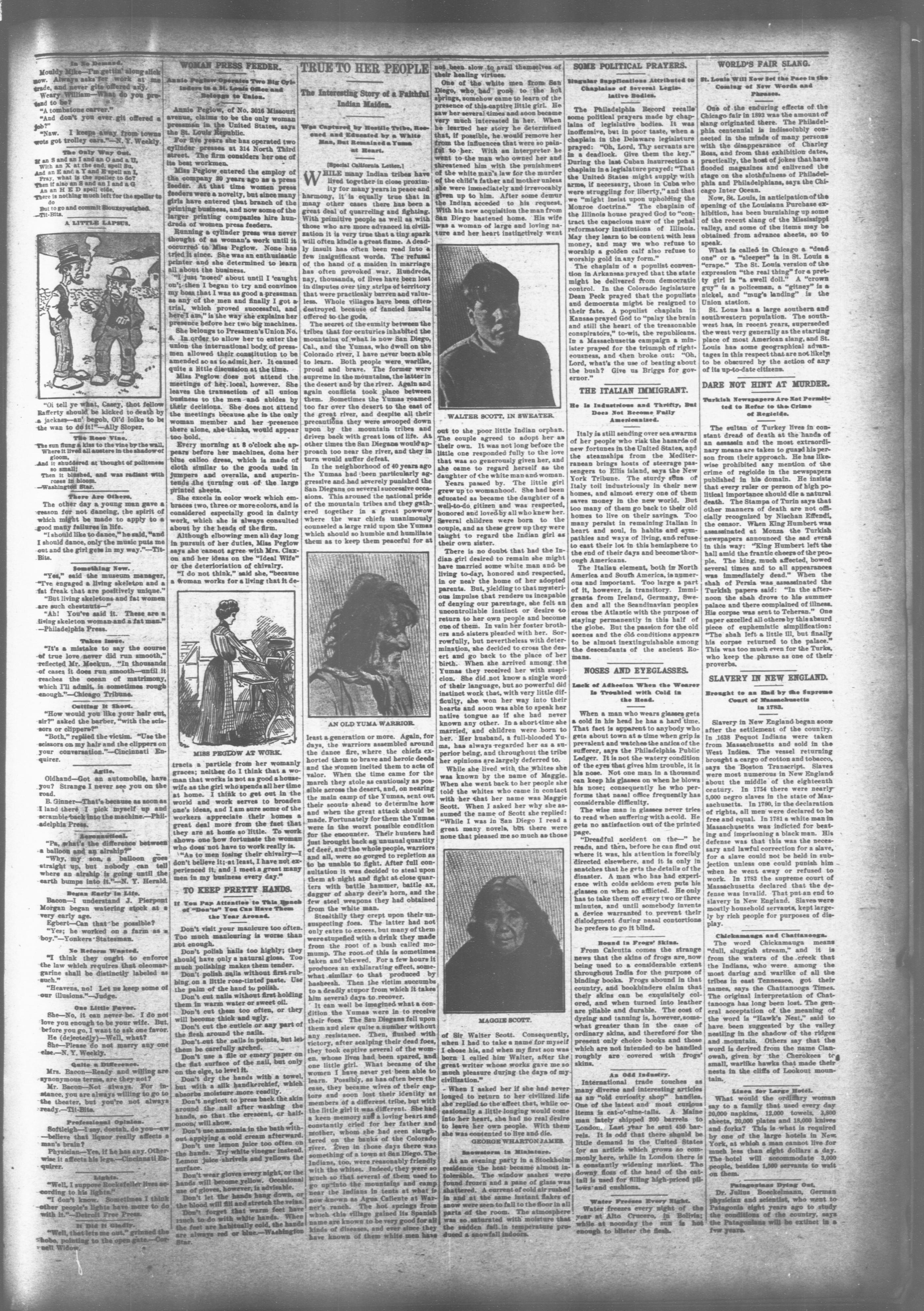
WHILE many Indian tribes have lived together in close proxim-
ity for many years in peace and harmony, it is equally true that in many other cases there has been a great deal of quarrelling and fighting. With primitive people as well as with those who are more advanced in civilization it is very true that a tiny spark will often kindle a great flame. A deadly insult has often been read into a few insignificant words. The refusal of the hand of a maiden in marriage has often provoked war. Hundreds, nay, thousands, of lives have been lost in disputes over tiny strips of territory that were practically barren and valueless. Whole villages have been often destroyed because of fancied insults offered to the gods.
The secret of the enmity between the tribes that for centuries inhabited the mountains of what is now San Diego, Cal., and the Yumas, who dwell on the Colorado river, I have never been able to learn. Both people were warlike, proud and brave. The former were supreme in the mountains, the latter in the desert and by the river. Again and again conflicts took place between them. Sometimes the Yumas roamed too far over the desert to the east of the great river, and despite all their precautions they were swooped down upon by the mountain tribes and driven back with great loss of life. At other times the San Diegans would approach too near the river, and they in turn would suffer defeat.
In the neighborhood of 40 years ago the Yumas had been particularly aggressive and had severely punished the San Diegans on several successive occasions. This aroused the national pride of the mountain tribes and they gathered together in a great powwow where the war chiefs unanimously counseled a large raid upon the Yumas which should so humble and humiliate them as to keep them peaceful for at
[Image of a man with long hair and a beard, wearing a robe.]
AN OLD YUMA WARRIOR.
least a generation or more. Again, for days, the warriors assembled around the dance fire, where the chiefs exhorted them to brave and heroic deeds and the women incited them to acts of valor. When the time came for the march they stole as cautiously as possible across the desert, and, on nearing the main camp of the Yumas, sent out their scouts ahead to determine how and when the great attack should be made. Fortunately for them the Yumas were in the worst possible condition for the encounter. Their hunters had just brought back an unusual quantity of deer, and the whole people, warriors and all, were so gorged to repletion as to be unable to fight. After full consultation it was decided to steal upon them at night and fight at close quarters with battle hammer, battle ax, dagger of sharp deer's horn, and the few steel weapons they had obtained from the white man.
Stealthily they crept upon their unsuspecting foes. The latter had not only eaten to excess, but many of them were stupefied with a drink they made from the root of a bush called momump. The root of this is sometimes taken and chewed. For a few hours it produces an exhilarating effect, somewhat similar to that produced by hasheesh. Then the victim succumbs to a deadly stupor from which it takes him several days to recover.
It can well be imagined what a condition the Yumas were in to receive their foes. The San Diegans fell upon them and slew quite a number without any resistance. Then, flushed with victory, after scalping their dead foes, they took captive several of the women, whose lives had been spared, and one little girl. What became of the women I have never yet been able to learn. Possibly, as has often been the case, they became wives of their captors and soon lost their identity as members of a different tribe, but with the little girl it was different. She had a keen memory and a loving heart and constantly cried for her father and mother, whom she had seen slaughtered on the banks of the Colorado river. Even in those days there was something of a town at San Diego. The Indians, too, were reasonably friendly with the whites. Indeed, they were so much so that several of them used to go up into the mountains and camp near the Indians in tents at what is now known as Agua Caliente at Warner's ranch. The hot springs from which this village gained its Spanish name are known to be very good for all kinds of diseases, and ever since they have known of them white men have
not been slow to avail themselves of their healing virtues.
One of the white men from San Diego, who had gone to the hot springs, somehow came to learn of the presence of this captive little girl. He saw her several times and soon became very much interested in her. When he learned her story he determined that, if possible, he would remove her from the influences that were so painful to her. With an interpreter he went to the man who owned her and threatened him with the punishment of the white man's law for the murder of the child's father and mother unless she were immediately and irrevocably given up to him. After some demur the Indian acceded to his request. With his new acquisition the man from San Diego hastened home. His wife was a woman of large and loving nature and her heart instinctively went
1980
WALTER SCOTT, IN SWEATER. out to the poor little Indian orphan. The couple agreed to adopt her as their own. It was not long before the little one responded fully to the love that was so generously given her, and she came to regard herself as the daughter of the white man and woman.
Years passed by. The little girl grew up to womanhood. She had been educated as became the daughter of a well-to-do citizen and was respected, honored and loved by all who knew her. Several children were born to the couple, and as these grew up they were taught to regard the Indian girl as their own sister.
There is no doubt that had the Indian girl desired to remain she might have married some white man and be living to-day, honored and respected, in or near the home of her adopted parents. But, yielding to that mysterious impulse that renders us incapable of denying our parentage, she felt an uncontrollable instinct or desire to return to her own people and become one of them. In vain her foster brothers and sisters pleaded with her. Sorrowfully, but nevertheless with determination, she decided to cross the desert and go back to the place of her birth. When she arrived among the Yumas they received her with suspicion. She did not know a single word of their language, but so powerful did instinct work that, with very little difficulty, she won her way into their hearts and soon was able to speak her native tongue as if she had never known any other. In a short time she married, and children were born to her. Her husband, a full-blooded Yuma, has always regarded her as a superior being, and throughout the tribe her opinions are largely deferred to.
While she lived with the whites she was known by the name of Maggie. When she went back to her people she told the whites who came in contact with her that her name was Maggie Scott. When I asked her why she assumed the name of Scott she replied: "While I was in San Diego I read a great many novels, but there were none that pleased me so much as those
MARIA MAYORA
MAGGIE SCOTT.
of Sir Walter Scott. Consequently, when I had to take a name for myself I chose his, and when my first son was born I called him Walter, after the great writer whose works gave me so much pleasure during the days of my civilization."
- When I asked her if she had never longed to return to her civilized life she replied to the effect that, while occasionally a little longing would come into her heart, she had no real desire to leave her own people. With them she was contented to live and die.
GEORGE WHARTON JAMES.
Snowstorm in Miniature.
At an evening party in a Stockholm residence the heat became almost intolerable. The window sashes were found frozen and a pane of glass was shattered. A current of cold air rushed in and at the same instant flakes of snow were seen to fall to the floor in all parts of the room. The atmosphere was so saturated with moisture that the sudden fall in temperature produced a snowfall indoors.
SOME POLITICAL PRAYERS.
Singular Supplications Attributed to Chaplains of Several Legislative Bodies.
The Philadelphia Record recalls some political prayers made by chapains of legislative bodies. It was inoffensive, but in poor taste, when a chaplain in the Delaware legislature prayed: "Oh, Lord, Thy servants are in a deadlock. Give them the key." During the last Cuban insurrection a chaplain in a legislature prayed: "That the United States might supply with arms, if necessary, those in Cuba who were struggling for liberty," and that we "might insist upon upholding the Monroe doctrine." The chaplain of the Illinois house prayed God to "contract the capacious maw of the peal reformatory institutions of Illinois. May they learn to be content with less money, and may we who refuse to worship a golden calf also refuse to worship gold in any form."
The chaplain of a populist convention in Arkansas prayed that the state might be delivered from democratic control. In the Colorado legislature Dean Peck prayed that the populists and democrats might be resigned to their fate. A populist chaplain in Kansas prayed God to "palsy the brain and still the heart of the treasonable conspirators," to-wit, the republicans. In a Massachusetts campaign a minister prayed for the triumph of righteousness, and then broke out: "Oh, Lord, what's the use of beating about the bush? Give us Briggs for governor."
THE ITALIAN IMMIGRANT.
He Is Industrious and Thrifty, But Does Not Become Fully Americanized.
Italy is still sending over sea swarms of her people who risk the hazards of new fortunes in the United States, and the steamships from the Mediterranean brings hosts of steerage passengers to Ellis island, says the New York Tribune. The sturdy sons of Italy toil industriously in their new homes, and almost every one of them saves money in the new world. But too many of them go back to their old homes to live on their savings. Too many persist in remaining Italian in heart and soul, in habits and sympathies and ways of living, and refuse to cast their lot in this hemisphere to the end of their days and become thorough Americans.
The Italian element, both in North America and South America, is numerous and important. Too large a part of it, however, is transitory. Immigrants from Ireland, Germany, Sweden and all the Scandinavian peoples cross the Atlantic with the purpose of staying permanently in this half of the globe. But the passion for the old scenes and the old conditions appears to be almost inextinguishable among the descendants of the ancient Romans.
NOSES AND EYEGLASSES.
Lack of Adheolon When the Wearer In Troubled with Cold in the Head.
When a man who wears glasses gets a cold in his head he has a hard time. That fact is apparent to anybody who gets about town at a time when grip is prevalent and watches the antics of the sufferer, says the Philadelphia Public Ledger. It is not the watery condition of the eyes that gives him trouble, it is his nose. Not one man in a thousand can keep his glasses on when he blows his nose; consequently he who performs that nasal office frequently has considerable difficulty. The wise man in glasses never tries to read when suffering with a cold. He gets no satisfaction out of the printed page.
"Dreadful accident on the—" he reads, and then, before he can find out where it was, his attention is forcibly directed elsewhere, and it is only in snatches that he gets the details of the disaster. A man who has had experience with colds seldom even puts his glasses on when so afflicted. He only has to take them off every two or three minutes, and until somebody invents a device warranted to prevent their dislodgment during nasal contortions he prefers to go it blind.
Bound in Frogs' Skins.
From Calcutta comes the strange news that the skins of frogs are, now being used to a considerable extent throughout India for the purpose of binding books. Frogs abound in that country, and bookbinders claim that their skins can be exquisitely colored, and when turned into leather are pliable and durable. The cost of dyeing and tanning is, however, somewhat greater than in the case of ordinary skins, and therefore for the present only choice books and those which are not intended to be handled roughly are covered with frogs' skins.
An Odd Industry
International trade touches as many diverse and interesting articles as an "old curiosity shop" handles. One of the latest and most curious items is cat-o-nine-tails. A Maine man lately shipped 200 barrels to London. Last year he sent 450 barrels. It is odd that there should be little demand in the United States for an article which grows so commonly here, while in London there is a constantly widening market. The downy floss of the head of the cattail is used for filling high-priced pillows and cushions.
Water Freezes Every Night. Water freezes every night of the year at Alto Crucero, in Bolivia; while at noonday the sun is hot enough to blister the flesh.
St. Louis Will Now Set the Pace in the Coming of New Words and Phrases.
One of the enduring effects of the Chicago fair in 1893 was the amount of slang originated there. The Philadelphia centennial is indissolubly connected in the minds of many persons with the disappearance of Charley Ross, and from that exhibition dates, practically, the host of jokes that have flooded magazines and enlivened the stage on the slothfulness of Philadelphia and Philadelphiaans, says the Chicago Inter Ocean.
Now, St. Louis, in anticipation of the opening of the Louisiana Purchase exhibition, has been burnishing up some of the recent slang of the Mississippi valley, and some of the items may be obtained from advance sheets, so to speak.
What is called in Chicago a "dead one" or a "sleeper" is in St. Louis a "crape." The St. Louis version of the expression "the real thing" for a pretty girl is "a swell doll." A "crown guy" is a policeman, a "gitney" is a nickel, and "mug's landing" is the Union station.
St. Louis has a large southern and southwestern population. The southwest has, in recent years, superseded the west very generally as the starting place of most American slang, and St. Louis has some geographical advantages in this respect that are not likely to be obscured by the action of any of its up-to-date citizens.
DARE NOT HINT AT MURDER.
Turkish Newspapers Are Not Permitted to Refer to the Crime of Regicide.
The sultan of Turkey lives in constant dread of death at the hands of an assassin and the most extraordinary means are taken to guard his person from their approach. He has likewise prohibited any mention of the crime of regioide in the newspapers published in his domain. He insists that every ruler or person of high political importance should die a natural death. The Stampa of Turin says that other manners of death are not officially recognized by Nischan Effendi, the censor. When King Humbert was assassinated at Monza the Turkish newspapers announced the sad event in this way: "King Humbert left the hall amid the frantic cheers of the people. The king, much affected, bowed several times and to all appearances was immediately dead." When the shah of Persia was assassinated the Turkish papers said: "In the afternoon the shah drove to his summer palace and there complained of illness. His corpse was sent to Teheran." One paper excelled all others by this absurd piece of euphemistic simplification: "The shah left a little ill, but finally his corpse returned to the palace." This was too much even for the Turks, who keep the phrase as one of their proverbs.
SLAVERY IN NEW ENGLAND.
Brought to an End by the Supreme Court of Massachusetts in 1783.
Slavery in New England began soon after the settlement of the country. In 1638 Pequot Indians were taken from Massachusetts and sold in the West Indies. The vessel returning brought a cargo of cotton and tobacco, says the Boston Transcript. Slaves were most numerous in New England about the middle of the eighteenth century. In 1754 there were nearly 5,000 negro slaves in the state of Massachusetts. In 1780, in the declaration of rights, all men were declared to be free and equal. In 1781 a white man in Massachusetts was indicted for beating and imprisoning a black man. His defense was that this was the necessary and lawful correction for a slave, for a slave could not be held in subjection unless one could punish him when he went away or refused to work. In 1783 the supreme court of Massachusetts declared that the defense was invalid. That put an end to slavery in New England. Slaves were mostly household servants, kept largely by rich people for purposes of display.
Chickamauga and Chattanooga. The word Chickamauga means "dull, sluggish stream," and it is from the waters of the creek that the Indians, who were among the most daring and warlike of all the tribes in east Tennessee, got their names, says the Chattanooga Times. The original interpretation of Chattanooga has long been lost. The general acceptance of the meaning of the word is "Hawk's Nest," said to have been suggested by the valley nestling in the shadow of the ridges and mountain. Others say that the word is derived from the name Clanowah, given by the Cherokees to small, warlike hawks that made their nests in the cliffs of Lookout mountain.
What would the ordinary woman say to a family that used every day 20,000 napkins, 12,000 towels, 3,800 sheets, 20,000 plates and 18,000 knives and forks? This is what is required by one of the large hotels in New York, at which a man cannot live for much less than eight dollars a day. The hotel will accommodate 3,000 people, besides 1,500 servants to wait on them.
Dr. Julius Boeckelmann, German physician and scientist, who went to Patagonia eight years ago to study the conditions of the country, says the Patagonians will be extinct in a few years.
THE LIGHT IS TURNED ON REV. E. J. FISHER'S RECORD AT NASHVILLE, TENN.
When Dr. E. J. Fisher arrived here from Nashville, Tenn, he told the people of Chicago that he had erected completed and paid every dollar of indebtedness on the Spruce St. Baptist church, Nashville, Tenn. Explanation was further made that this was done by the Doctor himself purchasing the materials at wholesale price and paying for the same before it was delivered; and by hiring mechanics and other workmen by the week, and raising the money each Sabbath to pay for the labor of the preceding week. Thus when the church was completed he said it was free from debt. Dr. Fisher also vouchsafed the information that when he tendered his resignation for the purpose of coming to the Olivet church of this city, "that the Spruce St. church refused to accept it, that strong men wept like children and women screamed and tore their clothes." Many simple people naturally thought that Chicago had a "gold brick" in the person of the Rev. E. J. Fisher, D. D.
Now the most authentic information comes from the city of Nashville, Tennessee, to the effect that Dr. Fisher did not erect, complete and pay for the Spruce St. Baptist church; as he had solemnly declared; that he did not even put one stone or one brick upon another; that when he appeared on the scene, the building was erected and roofed in; and all that Dr. Fisher did was to put in the windows, and finish the interior; that instead of paying for the work as it was being done, and as he claimed he was doing, the congregation discovered to their dismay that in place of being free from debt, their church was actually in debt to the extent of $6,600. These are some of the questionable methods resorted to by Dr. E. J. Fisher, that apostle of truth, respecting whose departure from Nashville he would have us believe that strong men bowed their heads in grief and weak-minded women "tore their clothes."
Now, I beg of you not to accept my word for anything herein written. I would not consent to have the question of veracity raised between Dr. Fisher and myself when you may as well have the very highest authority in the city of Nashville for every statement made. If you would know who laid the corner stone and erected that magnificent edifice known as the Spruce St. Baptist church, ask the widow of the late Rev. Nelson Merry, No. 316 N. Spruce St., and the officers of that church. If you would know that Dr. Fisher did nothing more than to put in the windows and complete the interior apply for information to the present board of Deasons. If you doubt the existence of the gigantic debt of $6,000, and of the present pastor being sorely pressed by Dr. Fish-
Lawyer J. Gray Lucas, and Dr. E. R. Robinson, have arrived home from their legal trip to Washington D. C.
Mr. Edward O. Brown has no flies on him, neither does he permit the grass to grow under his feet, therefore he will be one of the new judges in this county.
Lloyd G. Wheeler, C. H. Smiley, Dr. Bentley, Mr. and Mrs. J. Gray Lucas occupied seats on the stage at the Auditorium last Friday night and heard Booker T. Washington.
Prof. A. T. Clark, and wife of Troy, Mo., who is Principal of the high school in that nice little city, is spending his vacation with his father Rev. T. A. Clark 6435 S. Halsted st.
Hon. Chas. M. Walker, who has faithfully served the people of Chicago as Alderman and Corporation Counsel for the past six years, is in every way qualified to preside as one of the new judges of Cook county and he will be elected to that honorable position.
Alderman John J. Bradley has removed from his home at 817, W. 47th st., to 726 Garfield Blvd. By locating in the south end of the ward Alderan Bradley will be in a position to shake the boys up in good shape next spring.
Attorney Andrew Jackson Hirschl is making a splendid race for one of the judgeships of this city and county and Mr. Hirschl has many friends among the Afro-American race who will assist to make his election doubly sure.
er's creditors, as scarcely to be able to tell which way to tun, ask the Rev. Dr. Kenney.
Again, in October last while in this city, Dr. Fisher raised a collection at Olivet to assist the Spruce St. church of Nashville in a rally which he said was in progress. The collection was taken and the money given to Dr. Fisher to present to the church in Nashville when he should reach that city. Despite the fact that Dr. Fisher went immediately to Nashville and despite the fact that the rally for that church has closed, and several months have since elapsed, yet no one in Nashville has ever heard of that Chicago collection which was lifted by the Rev. Dr. Fisher. Now, if any one wishes either to vindicate the Rev. Dr. Fisher, or to satisfy his curiosity in this matter, he may do so by addressing the treasurer of that church.
I was present at Olivet when the appeal was made and the collection lifted, but did not subscribe to the fund because if Dr. Fisher paid for the Spruce St. church as it was being built and as he said on a previous occasion he had done, I could see no necessity for the rally. But if I had given a $5.00 bill Fisher would now disgorge, or I would have him arrested, because this case is particularly revolting and rarely equaled in the history of the Christian church. First, Dr. Fisher robs the late Rev. Nelson Merry of the credit of building the church, by claiming to have bought the material, and erected the building himself. Second, he collected money weekly from the people and told them that the church was paid for as far as he had gone, but instead he left a debt of $6,600 behind him. Third, he took up a collection in Chicago ostensibly to help the Nashville people pay a second time for finishing their church and even this money cannot be followed further than Fisher's pocket. How apt and forceful does the opinion of Justice John C. Pallock of the Supreme Court of Kansas apply to this case: "It was indeed a brutal deed, utterly lacking in mitigating or extenuating circumstances, alike appalling to the mind and shocking to the sensibilities."
Notwithstanding the fact that this preacher is as dead to the Spruce St. church as is the late Nelson Merry, of whose memory Dr. Fisher, by reason of his ignorance and ill-breeding, has neglected to speak kindly, yet this man Fisher has the audacity to tell the people of Olivet, many of whom would rejoice to be well rid of him, that he has a call to go back to this church in Nashville, when it is patent to all that he couldn't get a call as a dog catcher in Nashville.
AGENTS FOR THE BROAD AX.
From on and after this date The Broad Ax can be found on sale at the following places:
The Afro-American News Office, 3104 State Street.
A. G. Marshall, news stand and book store, 3604 State street.
A. F. Tervalon's Cigar Store and News Stand, 2826 State street.
Edward Felix's Cigar Store, 8% 30th street, N. E. Corner Armour Ave.
T. B. Hall's Cigar Store and Laundry office, 281 29th St.
J. E. Webb's Cigar Store, 280, 29th Street.
Turner William's Cigar and News Stand, 2903 Armour Ave.
J. F. Bradbury's News Depot, 2970 State Street.
M. H. Watts, dealer in cigars and tobacco, 3742 State street.
J. C. Campbell, 145 W. 47th street., Cigars, Tobacco, Staple Groceries.
Wm. H. Monroe, cigar and news stand, 486 State street.
H. N. Drake, 3246 State Street, Cigar Store and News Stand.
L. Levy, 506, 37th Street, dealer in Cigars and Tobacco.
The Chicago Shoe Shining Parlor, 3123 Cottage Grove Ave.
Geo. Blaine, cigars, tobacco and news stand, 3420 Dearborn street.
T. H. Smith, 419 36th street, Cigar store store, News stand and Bakery.
Whiteley Bros., 2724 State street, cigars, and news stand.
Mrs. Florence Granger, 2940 Dearborn Street. Cigars, Laundry Office and News Stand.
Harris & Hallock, cigars and news stand, 2960½, State Street.
T. J. Hill, cigars and stationery store., 5220 Lake Ave.
Wm. Dixon 2638 State Street cigars, tobacco, and news stand.
News items and advertisements left at these places will find their way into the columns of The Broad Ax.
ATrium
822 MARQUETTE BUILDING
Telephone 2810 Central CHICAGO
TELEPHONE MAIN 2804
FEDERICO M. BARRIOS
Attorney & Counsellor at Law
Suite 501 Firmenich Bldg.
N. E. Cor. Fifth Avenue
and Washington Street Chicago.
LAWRENCE A. NEWBY ATTORNEY AT LAW ROOM 42, LA SALLE STREET CHICAGO
Willia Howard Fitzgerald
LAWYER
Room 402 Reaper Block. CHICAGO
PHONE: Office, M 1-1157
Res. Brown 42
STEPHEN A. COUGLAS
LAWYER
Suite 200, 123 125 LB Salle Street
CHICAGO
JOSEPH A. McINERNEY
LAWYER
WILLIAM RITCHIE
ATTORNEY AND COUNSELOR.
Baltic MD MD Oxford Building
64 LA BALLE ST., CHICAGO
Telephone Main 1646.
Robert M. Mitchell
Attorney at Law
Baltic 9, No. 77 South Clark St.
CHICAGO
WATERS & JOHNSON
Lawyers
Practice Limited to the Trial of Personal Injury Cases
Suite 801 Keddie Building
120 E. Randolph St.
Telephone Central 4203 CHICAGO
Shilohone Tortoise WI Randolph, IL Garfield Rd.
JOHN FITZGERALD
JUSTICE OF THE PEACE
6197 B. HALSTED STREET,
CHICAGO
J. GRAY LUCAS
ATTORNEY-AT-LAW
Suite 412 Real Estate Board Bldg
89 Dearborn St. Cor. Randolph
CHICAGO.
Phone Randolph 53
J. E. JONES
LAWYER
79 Clark Street
Room 9 Chicago
S. A. McELWEE
...LAWYER...
36 S. Clark St., CHICAGO.
Room 700 Ogden Building
Residence, 3183 Forest Av.
ALBERT B. GEORGE
LAWYER.
428 Ashland Block, Chicago.
— Rel. M. B025. —
For Sale or Rent.
Houses, flat buildings, and lots in city and suburbs, on easy monthly installments. Fire Insurance and Furniture Loans at lowest rates. CEO, W. FAULKNER & CO. Phone 2331 Brown. 2935 State St.
Chiropodist and Manicuring
Removes Corns Without Pain
Medicated Foot Baths and Foot Massage
138 State St., 4th Floor, Chicago
A. HOFFMAN,
CLEANER, DYER
AND PRESSER.
Suits Sponged and Pressed. t.c
5125 State St. Expert Workmanship
Moderate Prices.
Mrs. Florence Miller
FASHIONABLE
DRESSMAKER
PERFECT FIT GUARANTEED
PRICES REASONABLE
3151 State Street CHICAGO.
CHARLES L. WEBB COURT REPORTER 77 South Clark St., Room 9 CHICAGO. General Stenographer
WONDERFUL
DISCOVERY
Curly Hair Made Straight By
TAKEN FROM LIFE:
BEFORE AND AFTER TREATMENT.
ORIGINAL
OZONIZED OX MARROW
(Copyrighted.)
This wonderful hair pomade is the only safe preparation in the world that makes kinky or early hair straight as shown above. It nourishes the scalp, prevents the hair from fallout, prevents off, cares dandruff and makes the hair grow thick and hardy forty years and used by thousands. Warranted harmless. It was the first preparation ever gold for straightening kinky hair. Beware of limitations. Get the Original Ozonized Ox Marrow as the genuine never fails to keep the hair straight, soft and beautiful, gives healthy, life-like appearance so much desired. Will appeal to ladies, gentlemen and children. Elegantly presents doing to its superior and lasting qualities it is the best and most economical. It is not possible for anybody to produce a preparation equal to it. Full directions with every hostel. Only 50 cents. Sold by druggists send us 50 cents for one bottle or $1.40 for two. We pay all expenses charges. Send postal mail to money order. Please mention name of this paper when ordering. Write your name and address plainly to
OZONIZED OX MARROW CO.,
75 Wabash Ave., Chicago, Illinois.
AGENTS AND CORRESPONDENTS WANTED.
The Broad Ax desires to engage agents and regular correspondents in all the leading cities and towns in Illinois and throughout the other sections of the country. The highest commissions paid to live hustlers Sample copies furnished. For further information address Julius F. Taylor 5040 Armour avenue, Chicago, Ill
ROOMS FOR RENT.
Two comodious nicely furnished rooms for rent to gentlemen only. Inquire at 262s Wapman avenue.
MRS. A. WILSON.
Nicely furnished rooms to rent for gentlemen. Reasonable rates, 2252 Indiana avenue.
Rooms for Rent.
Elegantly furnished rooms for rent with bath and gas at 2232 Wabasi avenue.
Mrs. Kittle Scott.
WILLIAM C. KUESTER. SUPERINTENDENT.
N. Western Ave., Ch Telephone Lake View 270.
1994 N. Western Ave., Chicago. Telephone Lake View 270.
HOHENADEL BROS.
211-213 Madison Street
CHICAGO
Telephone Main J300
era UNIFORM CA
Manufacturers UNIFORM CAPS
Pollicemen, Firemen, Street Car Employes,
Letter Carriers, Telegraph Messengers,
Elevatorsmen, Railroad Employes,
Janitors, Wagonmen, Beilboys, Watchmen, Etc.
JACOB FEINBERG
31st and State Sts. CHICAGO
John J. Bradley
Real Estate, Insurance and Loans Property managed. Abstracts examined. Renting. Legal papers prepared. 4709 South Halsted Street Chicago
COAL, WOOD AND ICE
MOVING AND EXPRESSING
All Orders Promptly Attended to Cash on Delivery
Telephone
Dine 24p
4656 Armour Avenue, CHICAGO.
M. JUNK, Proprietor JOS. P. JUNK, Manager 3700-3710 South Halsted Street and 897 to 929 Thirtyseventh Street CHICAGO
American Brick Co.
President and Treasurer, THOMAS CAREY. Vice-President, JOHN SHELHAMER, Secretary, WILLIAM SULLIVAN. MANUFACTURERS OF
45th and Robey Sts.