The Broad Ax
Saturday, May 23, 1903
Chicago, Illinois
Page text (machine-generated)
REV. E. J. FISHER OF OLIVET CANNOT PASS AS A MORAL SAINT
Vol. VIII.
Editor Julius F. Taylor:—Rev. E. J. Fisher, D. D., whose management of the affairs of Olivet Baptist Church, has attracted notice, and who describes himself as "looking like Jesus," will not be identified with the good people of Chicago much longer, nor will his name appear in the next Lakeside City Directory, or in any other standard work of reference in the community.
On Sabbath evening, May 11th, Dr. Fisher said respecting his right to preach about himself and his family, from the pulpit, "I have married my wife, my children are legitimate, and I propose to talk about them. Some people don't like to hear it, but my wife is the most beautiful woman I ever saw. I love her, and I am living with her," etc. All of this rot, and much more, was made a part of the sermon, and dished up to an intelligent congregation. Barring the fact that it is exceedingly difficult to understand how a man can have a wife without marrying her what I wish to say is that all the clap-trap about his wife, whom he says resembles him, and is the most beautiful woman he ever saw, is mere bunkum. Her surpassing beauty has not impaired his intimacy with a certain widow and some of the nappy-headed sisters in Chicago, nor has it prevented him from dividing his time between his church and the home of a little insignificant she-upstart on Dearborn St. Then, there is such genuine humor in the thought of a beautiful woman and a thing that looks like Fisher, that one is obliged to smile.
Again, there are so many married men in this city, and so many legitimate children, as to occasion no comment at all by reason of that fact. Perhaps it is unusual in that part of the South whence Fisher came for a preacher to lawfully marry a woman, or for him to be father of a legitimate child. In Chicago, however, these things are so common as not to cause a single ripple on the placid surface of a Christian community. Notwithstanding Fisher says' "I am living with my wife," yet he has not shown her the formal consideration of bringing her, even on a visit to this city—the field of his labor—which consideration most preachers, however unfaithful, accord the partners of their lives and the mothers of their children. He did make a perfunctory visit to his home some months ago, but soon returned to the scene of his pleasures without that most beautiful woman. Other preachers, who have been considered base, have spared their wives the insult and humiliation of mentioning their names from the pulpit. This, no doubt, is prompted by the feeling that one should omit speaking of the dead; and who can be more dead to the world than Mrs. Fisher, a wife who must eke out an existence in one town while her husband's name is a byword among some of the sisters in another?
Since Fisher's delight is talking of himself it may give him pleasure to answer a few questions. I would like to interrogate this talking machine a little as to his right to the title of D. D. It might prove interesting, likewise, if he would tell something of his antecedents; also of the methods by which he obtained the degree of Doctor of Divinity, if, indeed, he has it; and at what Institution of learning the honor was conferred, since the report is current that he has coolly invested himself with the title without the sanction of any other authority.
The people of Olivet Church, at this writing, are not amused if the Rev. E. J. Fisher had made them look like a lot of monkeys. There is no precedent for regarding the present status of the church in the light of a comedy, even in their humorous age. The situation is this: Instead of Fisher paying Attorney C. M. Millar and other claimants, he scattered the people's money to the four winds of the earth. He generously gave away $30.00 to another church; sent $50.00 to Africa; and made Rev. P. J.
Bryant of Atlanta Georgia a present of $100,00, and paid his board bill of $10.00 more. He has also recently paid claims against the church that have once been adjusted; settled others which the church did not owe, in order to establish a ficticious reputation for honesty; and he lately caused it to be published in a little one-horse organ, that the $6,000, raised under another administration, would be paid to certain creditors holding notes, judgments, etc. Upon this showing one of the principal creditors not preferred by Fisher, went into court and filed a creditor's bill against the church, which ties up the $6,000 in the hands of the Treasurer. The donors of the $15,000 having heard of this action, and having before had their attention called to this preacher's abominable lies, as well as his loose and unbusinesslike methods through the columns of The Broad Ax, at once withdrew the proposed gift of $15,000. The result is that this jack-leg preacher has, in seven months, lost to Olivet $21,000, and rendered the church utterly bankrupt and homeless. If any one desires to be assured whether the gift has been unconditionally withdrawn, let him apply for information to Mr. John Dearinger, 224 31st St., Flat D., Chicago, Ill., a white gentlemen who has toiled unceasingly, but in vain, to adjust the financial affairs of Olivet Church.
While many weak-minded women still have a very high regard for Dr. Fisher, and implicit faith in his wisdom and business ability, yet I do not, in this instance, think it necessary for them to call upon their pastor for facts. Do they doubt the recent court proceedings? If so a certified copy of the notice served on the church is quoted below and made a part of this article. STATE OF ILLINOIS, County of Cook ss. In the Circuit Court of Cook County
Wensel Morava, et al, vs. Olivet Baptist Church, Henry T. Elby, et al 23088, Creditor's Fili
230889. Creditor's Bill.
To Olivet Baptist Church & Henry T. Elby, Defendants:
YOU ARE HEREBY NOTIFIED:
That on Thursday, May 14th, A. D. 1903, at 3:00 o'clock P. M., I shall, before his Honor, William Fenimore Cooper, Master in Chancery to whom the above entitled cause was referred, proceed to take testimony in the above entitled cause.
AND YOU ARE HEREBY NOTIFIED: To be present at said time, heretofore entered herein, in relation to the moneys and assets of the Defendant Olivet Church, In your hands and possession.
YOU ARE FURTHER NOTIFIED: That if I hear of any more attempts to pay out money in your hands and possession upon claims or judgments, or any other money except running expenses, I shall immediately have a Receiver appointed to take charge and possession of all the assets of the Church.
James H. Hooper, Solr., for Complts. Dated. May 12th. 1903.
By his counsel and advice Fisher has made the officers of Olivet Baptist Church notorious, and now the public points the finger of scorn at them for being the greatest fools in Chicago. The Rev. Dr. E. J. Fisher came to Olivet in quest of money, but since the gold bags have sunk into oblivion he will now gather up his belongings and limp away. It is not necessary that I should dwell too severely upon the loose business methods, or on the record made by this pin-head preacher, who claims to 'look like Jesus." The people of Chicago have recently learned something of his record and questionable methods in Nashville, Tenn., and for these reasons, if for no others, they will easily reconcile themselves to his absence from this sorely afflicted community.
2209 Cottage Grove Ave. James A. Quinn, who is one of the slickest politicians in the west, has been re-appointed City Sealer of Chi-
HEW TO THE LINE.
CHICAGO, MAY 23, 1903
[Name]
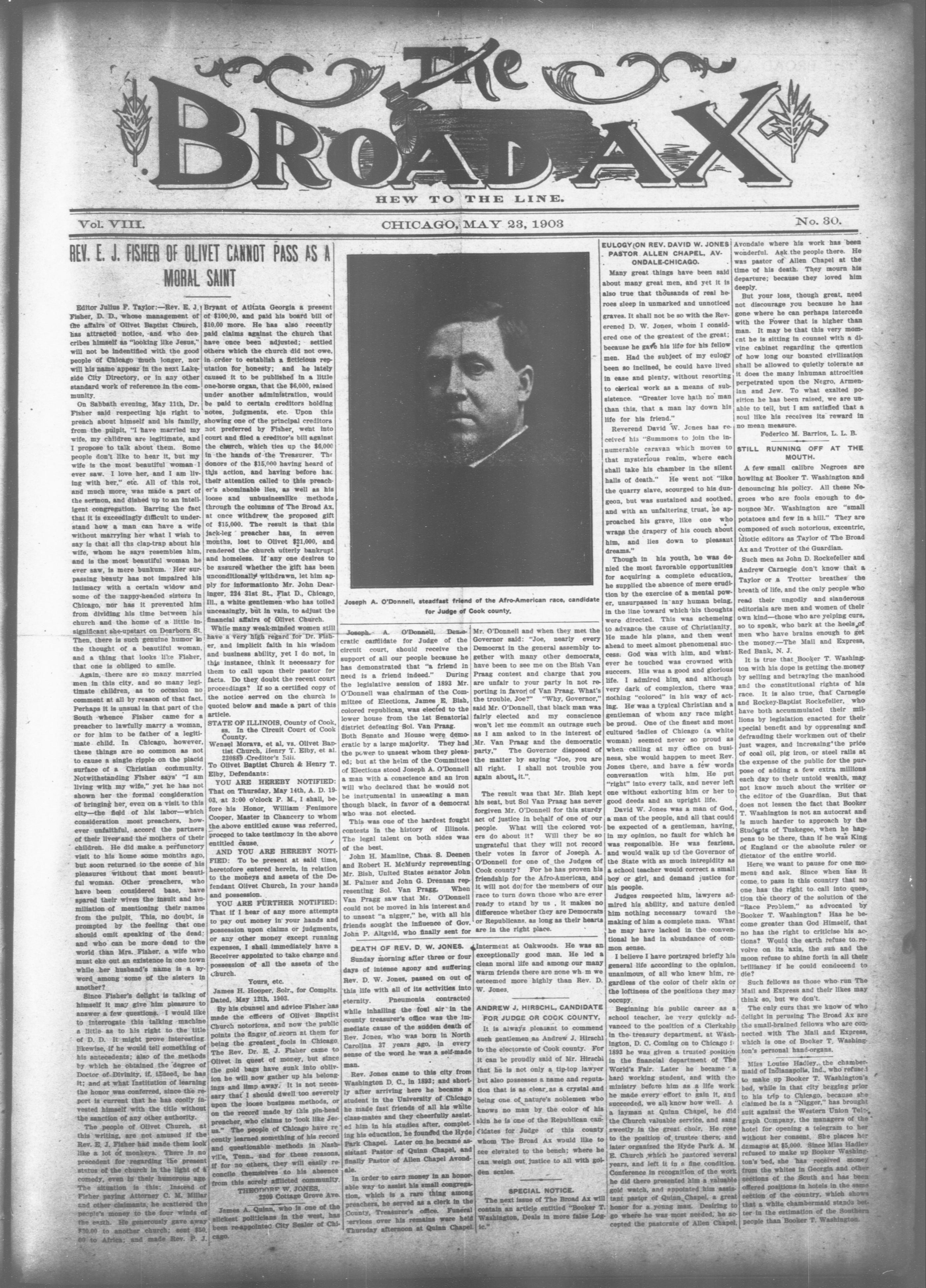
Joseph A. O'Donnell, steadfast friend of the Afro-American race, candidate for Judge of Cook county.
Joseph. A. O'Donnell. Democratic candidate for Judge of the circuit court, should receive the support of all our people because he has demonstrated that "a friend in need is a friend indeed." During the legislative session of 1893 Mr. O'Donnell was chairman of the Committee of Elections, James E. Bish, colored republican, was elected to the lower house from the 1st Senatorial district defeating Sol. Van Praag. Both Senate and House were democratic by a large majority. They had the power to unseat whom they pleased; but at the helm of the Committee of Elections stood Joseph A. O'Donnell a man with a conscience and an iron will who declared that he would not be instrumental in unseating a man though black, in favor of a democrat who was not elected.
This was one of the hardest fought contests in the history of Illinois. The legal talent on both sides was of the best. John H. Mamline, Chas. S. Deenen and Robert H. McMurdy representing Mr. Bish, United States senator John M. Palmer and John G. Drennan representing Sol. Van Pragg. When Van Pragg saw that Mr. O'Donnell could not be moved in his interest and to unseat "a nigger," he, with all his friends sought the influence of Gov. John P. Altgeld, who finally sent for
DEATH OF REV. D. W. JONES. Sunday morning after three or four days of intense agony and suffering Rev. D. W. Jones, passed on out of this life with all of its activities into eternity. Pneumonia contracted while inhailing the foul air in the county treasurer's office was the immediate cause of the sudden death of Rev. Jones, who was born in North Carolina 37 years ago, in every sense of the word he was a self-made man.
Rev. Jones came to this city from Washington D. C., in 1893; and shortly after arriving here he became a student in the University of Chicago he made fast friends of all his white class-mates and they cheerfully assisted him in his studies after, completing his education, he founded the Hyde Park Chapel. Later on he became assistant Pastor of Quinn Chapel, and finally Pastor of Allen Chapel Avondale.
In order to earn money in an honorable way to assist his small congregation, which is a rare thing among preachers, he served as a clerk in the County, Treasurer's office. Funeral services over his remains were held Thursday afternoon at Quinn Chapel
Mr. O'Donnell and when they met the Governor said: "Joe, nearly every Democrat in the general assembly together with many other democrats, have been to see me on the Bish Van Praag contest and charge that you are unfair to your party in not reporting in favor of Van Praag. What's the trouble, Joe?" "Why, Governor," said Mr. O'Donnell, that black man was fairly elected and my conscience won't let me commit an outrage such as I am asked to in the interest of Mr. Van Praag and the democratic party." The Governor disposed of the matter by saying "Joe, you are all right. I shall not trouble you again about it."
The result was that Mr. Bish kept his seat, but Sol Van Praag has never forgiven Mr. O'Donnell for this sturdy act of justice in behalf of one of our people. What will the colored voters do about it? Will they be so ungrateful that they will not record their votes in favor of Joseph A. O'Donnell for one of the Judges of Cook county? For he has proven his friendship for the Afro-American, and it will not do for the members of our race to turn down those who are ever ready to stand by us, it makes no difference whether they are Democrats or Republicans, as long as their hearts are in the right place.
Interment at Oakwoods. He was an exceptionally good man. He led a clean moral life and among our many warm friends there are none whm we esteemed more highly than Rev. D. W. Jones.
ANDREW J. HIRSCHL, CANDIDATE FOR JUDGE OR COOK COUNTY. It is always pleasant to commend such gentlemen as Andrew J. Hirschl to the electorate of Cook county. For it can be proudly said of Mr. Hirschl that he is not only a tip-top lawyer but also possesses a name and reputation that is as clear as a crystal and being one of nature's noblemen who knows no man by the color of his skin he is one of the Republican candidates for Judge of this county whom The Broad Ax would like to see elevated to the bench; where he can weigh out justice to all with golden scales.
The next issue of The Broad Ax will contain an article entitled "Booker T. Washington, Deals in more false Logic."
EULOGY(ON REV. DAVID W. JONES PASTOR ALLEN CHAPEL, AVONDALE-CHICAGO.
Many great things have been said about many great men, and yet it is also true that thousands of real heroes sleep in unmarked and unnoticed graves. It shall not be so with the Reverened D. W. Jones, whom I considered one of the greatest of the great; because he gave his life for his fellow men. Had the subject of my eulogy been so inclined, he could have lived in ease and plenty, without resorting to clerical work as a means of subsistence. "Greater love hath no man than this, that a man lay down his life for his friend."
Reverend David W. Jones has received his "Summons to join the innumerable caravan which moves to that mysterious realm, where each shall take his chamber in the silent halls of death." He went not "like the quarry slave, scourged to his dungeon, but was sustained and soothed, and with an unfaltering trust, he approached his grave, like one who wraps the drapery of his couch about him, and lies down to pleasant dreams."
Though in his youth, he was denied the most favorable opportunities for acquiring a complete education, he supplied the absence of mere erudition by the exercise of a mental power, unsurpassed in any human being, in the line toward which his thoughts were directed. This was schemeing to advance the cause of Christianity. He made his plans, and then went ahead to meet almost phenomenal success. God was with him, and whatever he touched was crowned with success. His was a good and glorious life. I admired him, and although very dark of complexion, there was nothing "colored" in his way of acting. He was a typical Christian and a gentleman of whom any race might be proud. One of the finest and most cultured ladies of Chicago (a white woman) seemed never so proud as when calling at my office on business, she would happen to meet Rev. Jones there, and have a few words conversation with him. He put "right" into every talk, and never left one without exhorting him or her to good deeds and an upright life.
David W. Jones was a man of God, a man of the people, and all that could be expected of a gentleman, having, in my opinion, no fault for which he was responsible. He was fearless, and would walk up to the Governor of the State with as much intrepidity as a school teacher would correct a small boy or girl, and demand justice for his people.
Judges respected him, lawyers admired his ability, and nature denied him nothing necessary toward the making of him a complete man. What he may have lacked in the conventional he had in abundance of common sense. I believe I have portrayed briefly his general life according to the opinion, unanimous, of all who knew him, regardless of the color of their skin or the loftiness of the positions they may occupy.
Beginning his public career as a school teacher, he very quickly advanced to the position of a Clerkship in the treasury department, at Washington, D. C. Coming on to Chicago in 1893 he was given a trusted position in the financial department of The World's Fair. Later he became a hard working student, and with the ministry before him as a life work he made every effort to gain it, and succeeded, we all know how well. A layman at Quinn Chapel, he did the Church valuable service, and sang sweetly in the great choir. He rose to the position of trustee there; and later organized the Hyde Park A. M. E. Church which he pastored several years, and left it in a fine condition. Conference in recognition of the work he did there presented him a valuable gold watch, and appointed him assistant pastor of Quinn Chapel, a great honor for a young man. Desiring to go where he was most needed, he accepted the pastorate of Allen Chapel.
No. 30.
Avondale where his work has been wonderful. Ask the people there. He was pastor of Allen Chapel at the time of his death. They mourn his departure; because they loved him deeply.
But your loss, though great, need not discourage you because he has gone where he can perhaps intercede with the Power that is higher than man. It may be that this very moment he is sitting in counsel with a divine cabinet regarding the question of how long our boasted civilization shall be allowed to quietly tolerate as it does the many inhuman attrocities perpetrated upon the Negro, Armenian and Jew. To what exalted position he has been raised, we are unable to tell, but I am satisfied that a soul like his receives its reward in no mean measure.
Federico M. Barrios, L. L. B.
STILL RUNNING OFF AT THE MOUTH. A few small calibre Negroes are howling at Booker T. Washington and denouncing his policy. All these Negroes who are fools enough to denounce Mr. Washington are "small potatoes and few in a hill." They are composed of such notorious, excentric, idiotic editors as Taylor of The Broad Ax and Trotter of the Guardian.
Such men as John D. Rockefeller and Andrew Carnegie don't know that a Taylor or a Trotter breathes the breath of life, and the only people who read their ungodly and slanderous editorials are men and women of their own kind—those who are yelping curs, so to speak, who bark at the heels of men who have brains enough to get the money.-The Mail and Express, Red Bank. N. J.
It is true that Booker T. Washington with his dope is getting the money by selling and betraying the manhood and the constitutional rights of his race. It is also true, that Carnegie and Rockey-Baptist Rockefeller, who have both accumulated their millions by legislation enacted for their special benefit and by oppressing and defrauding their workmen out of their just wages, and increasing the price of coal oil, pig iron, or steel rails at the expense of the public for the purpose of adding a few extra millions each day to their untold wealth, may not know much about the writer or the editor of the Guardian. But that does not lessen the fact that Booker T. Washington is not an autocrat and is much harder to approach by the Students of Tuskegee, when he happens to be there, than if he was King of England or the absolute ruler or dictator of the entire world.
Here we want to pause for one moment and ask. Since when has it come to pass in this country that no one has the right to call into question the theory of the solution of the "Race Problem," as advocated by Booker T. Washington? Has he become greater than God Himself, that no has the right to criticise his actions? Would the earth refuse to revolve on its axis, the sun and the moon refuse to shine forth in all their brilliancy if he could condecend to die?
Such fellows as those who run The Mail and Express and their likes may think so, but we don't.
The only curs that we know of who delight in perusing The Broad Ax are the small-brained fellows who are connected with The Mail and Express, which is one of Booker T. Washington's personal hand-organs.
Miss Louise Hadley, the chambermaid of Indianapolis, Ind., who refused to make up Booker T. Washington's bed, while in that city begging prior to his trip to Chicago, because she claimed he is a "Nigger," has brought suit against the Western Union Telegraph Company, the managers of the hotel for opening a telegram to her without her consent. She places her damages at $5,000. Since Miss Hadley refused to make up Booker Washington's bed, she has received money from the whites in Georgia and other sections of the South and has been offered positions in hotels in the same section of the country, which shows that a white chambermaid stands better in the estimation of the Southern people than Booker T. Washington.
Will proclaimate and at all times uphold the true principles of Democracy, but Chelsea, Proteckana, Priests, Indola, Farmers, Single Taxes, Republica, Knights of Lobos, or any one else can have their say, so long as their language is proper and responsibility is fixed.
The Broad Ax is a newspaper whose platform is broad enough for all, ever claiming the editorial right to speak its own mind.
Local communications will receive attention.
Write only on one side of the paper.
Subscriptions must be paid in advance.
One Year.....$2.00
Six Months.....1.00
Advertising rates made known on application.
Address all communications to
THE BROAD AX
8040 Armour Avenue, Chicago.
JULIUS F. TAYLOR, Editor and Publisher.
Entered at the Post Office at Chicago,
Ill., as Second-class Matter.
"I hear," said Hi Tragerdy, "that while you were playing in one of the western towns a fire broke out in the theater." "Yes," replied Low Comedy, "and there might have been a horrible panic but for one thing." "What was that?" "There weren't enough people in the audience to create one."—Philadelphia Press.
He could write a comic article that would make you fairly roar.
And his after-dinner speeches were with humor brimming o'er;
But when left to mind the baby his resources were dispelled.
And the funnier he tried to be the more the baby yelled.
—Tit-Bits. _____
THE SECOND FIDDLE.
I
She—Gracious! The last time I saw him he was the most opinionated fellow in town. How he has changed.
He—Oh! didn't you know he was recently married?—Detroit Free Press.
Where They Go.
The men who deal in flower seeds,
Would suffer like the dickens
In business, if it were not
For neighbors who keep chickens.
—Chicago Tribune.
Jink's Fool Notion.
Winks—Did you ever notice that,
during hard times, religious revivals always start up and the long-empty churches are sure to be filled?
"Salvation's free."—N. Y. Weekly.
No More Jam.
Mother (putting the boy out of the pantry)—How many more times will I have to tell you to keep away from that preserve jar?
Small Boy (sobbing)—No more, mamma, the jam's all gone.—Cincinnati Enquirer.
First Married Man.—Women are frightful gossipers, aren't they. Second Married Man—Yes; but just think what a lot of entertaining information one would miss concerning the neighbors were they otherwise. Chicago Daily News.
As Explained
"Say, pa," queried little Johnny Bumpernickle, "what's the difference between a green grocer and the other kind?"
"The other kind sell exclusively for cash, my son," replied the old man.—Cincinnati Enquirer.
A Pessimistic View.
"I suppose there will never be an end to grabs until everything is grabbed."
"Oh! Not even then; because the people who haven't grabbed anything will be trying to grab what has already been grabbed."—Puck.
"The people who go to South Dakota for divorces spend a million dollars a year in that state."
"Well, did you ever hear that they wanted their money back?"—Chicago Record-Herald.
Lawyer—You say you are sure it was about 11 o'clock in the forenoon. How do you fix the time?
Witness—The night editions of the afternoon papers had just been placed on sale.—Town Topics.
Not a Matter of Choice.
"What do you put on your face after shaving?" asked the man who smelled of bay rum.
"Court plaster, usually," replied the nervous chap, gloomily. — Cincinnati Commercial Tribune.
Two Questions.
Young McGall—Do you suppose that any rich man would marry a girl as homely as she is?—N. Y. Weeldy.
Great Precautions Taken in War Department to Keep Minors Out
The war department is determined that the recruiting officers shall reject all applications for enlistment from minors. Instructions given to that end several months ago, however, have been found not to serve the purpose desired. There are still numerous enlistments of young men who prove to be under 21 years of age, though said to be older, leading to applications to the war department from parents and friends for their discharge on the ground of minority, says a Washington report.
It is therefore desired that every possible precaution be taken to avoid the improper enlistment of persons under the age of 21 years. To this end young men who meet other requirements and say they are fully 21, or even a few years over that age, should not only be carefully interrogated and their antecedents be carefully investigated, but the written consent of the parents to the enlistment must also be obtained if the recruit appears to be under 21 years of age. In case such a recruit fails to obtain this consent he will be required to furnish his own sworn statement in writing regarding his age, supported by the sworn statement of two other persons, and these must be satisfactory to the recruiting officer, otherwise the applicant will be rejected. When the written consent of parents or the sworn statements indicated are furnished and accepted in such cases they will be attached to the enlistment papers.
NAPOLEON AMONG ANIMALS.
Commander of 20,000 Men Who Daily Put to Death Thousands of Food Animals.
Imagine a procession of 10,000 cattle, marching two by two, in a line 15 miles long; let 20,000 sheep follow them, bleating along 12 miles of road; after them drive 16 miles of hogs, 27,000 strong; then let 30,000 fowls bring up the rear, clucking and quacking and gobbling, over a space of six miles; and in this whole caravan, stretching for nearly 50 miles and requiring two days to pass a given point, you will see the animals devoted to death in the packing houses of Swift & Co. in a single day, says the Cosmopolitan. Surely a Buddhist would think that the head of that establishment had much to answer for. Never before in the world's history was a massacre of the innocents organized on such a stupendous scale or with such scientific system.
The commander of the army of 20,000 men engaged in this work earned his first penny picking cranberries in a swamp on Cape Cod more than 50 years ago. It was at Sagamore, on that historic peninsula, that a son was born to the house of Swift on June 24, 1839, and named Gustavus Franklin. A few years later, when the boy was not picking cranberries, he drove hogs along the cape. It was like Napoleon exercising his infant armies at school.
'HIS FACE SPOILS RAZORS.
Philadelphia Barber Has a Customer Whose Skin Is Always Full of Grit.
"Did you see the man who just went out?" asked an uptown barber of a customer, as a swarthy individual left the shop, according to the Philadelphia Telegraph. "Yes? Well, he spoils a razor every time I shave him, and he comes here twice a week regularly. He is a stonecutter, and the grit and dust is so imbedded in the pores of his face that it is like drawing a razor over the side of a stone. I always use the best tools I have upon him, but they are not stone-proof, and a dull razor is the result when his beard is removed.
"He is a customer upon whom I lose money, and I am glad to say that he is the only stonecutter who favors me with his patronage. I often wonder how it is that he doesn't wince when the razor strikes a section of stone that is imbedded in his face and bounds off, but it is probably because his skin is so hardened that he feels no ill effects."
Football Hayne.
The Maryland Medical Journal produces figures which show that returns from 60 colleges covering ten years of time and including 1,374 separate teams prove the dangerous character of football. Of the 22,769 men in these teams 654 received injuries serious enough to prevent college work, the ratio being one for every 2,846 players. The deaths were too numerous, but the figure is not given. The number playing decreases, but the injuries increase in an ominous manner. Beginning with 1893 and ending with 1902, the injuries ran thus: 40, 46, 40, 48, 52, 52, 67, 90, 76, 143.
Legislation on Kissing. A kissing certificate may be one of the luxuries of life if a certain American physician has his way. The senate of the state of Minnesota is considering a bill for the prohibition of kissing unless the people wishing to salute each other thus possess health certificates stating that they are fit subjects. The bill has a clause forbidding such health certificates being given to people with weak hearts, as this is declared an obstacle to the emotion aroused by kissing.
Tommy Atkins' Tight Togs. The tight-fitting British uniform is alleged to be the cause of so much heart-disease among soldiers.
Edward O. Brown, who is a broadminded, cultured, gentleman, will receive the votes of many Republicans, and it simply means that Mr. Brown will be elected Judge of Cook county. Ex-Judge William H. Barnum is so well-known to the voters of this city and county that the great majority of them regardless of their politics, have already made up their minds to mark an X right up by his name and let it go at that.
Charles M. Walker, the efficient and hardworking Corporation Counsel of Chicago, is highly esteemed by his fellow-citizens in all parts of this city and county and they will pass him on up to one of the Judgeships on the first day of June.
Honest John M. Moore, who has served for many years as Justice of the Peace in the Town of Lake, has relinquished the duties of his office and he will spend the remainder of his days in quietude at his comfortable home. 112 West 47th street.
Early Monday morning the top part of Rev. Abraham Lincoln Murray's richly furnished home, 2806 Wabash avenue, was discovered to be on fire, and some suspect that Brother Murray took a hand in starting the blaze in order to rake in a little extra pocket money.
Sunday evening, May 24th, is Emerson Day, at the Institutional church. The program will be as follows: "Emerson, the Literary Man," W. H. A. Moore. "Emerson, the Philosopher," M. N. Work. "Emerson's Influence on His Times," Mrs. F. B. Williams. "Emerson and Posterity," Mrs. L. A. Davis.
Henry E. Brandt, 446 Lincoln Ave. dealer in paints and wall paper, painting, paper-hanging and decorating, does an extensive business with all classes in all sections of the city and Mr. Brandt is well known to the prosperous Afro-Americans on the south side for he does considerable work for them.
The whites of New Orleans, La. have sent Miss Louise Hadley, the ex-chambermald of Indianapolis, one thousand dollars, as a present because she refused to make up the bed in the Hotel English which was occupied by Booker T. Washington. This shows that Prof. Washington does not stand ace high with the Southern whites.
Rev. and Mrs. John W. Robinson 4760, Armour Ave., lost their two bright and interesting little daughters this week from diphtheria. They were only sick a few days, and Mrs. Robinson, is hovering between life and death with the same allment. Rev. Robinson, has the heartfelt sympathy of his many friends in this his most sore affliction.
An invitation has been received by us to attend the eighth annual Conference at Atlanta University, on the "Negro Church," Tuesday, May 26.: Rev. Dr. Washington Gladden, Prof. Kelly Miller, Mrs. Mary church—Terrell, the Rev. C. B. Wilmer, are among the speakers. Horace Bumstead, will preside, and Prof. W. E. B. Du Bois, will serve as secretary.
The officers and friends of the Friendship Baptist Church 372-74 West Lake St. are making lovely preparations for their 6th Anniversary on next Tuesday evening, May 26th, at which time its friends will be banqueted in grand style. The city ministers Alliance is expected to be present in a body. Addmission including supper 25cts. John Rogers chairman H. W. Knight Pastor.
Mr. George Williams, president of the Masons' and Builders' Association, of Chicago, has been chosen Commissioner of Buildings. Mr. Williams has in the past been an extensive builder and contractor. He is therefore well qualified for the position. Alderman Thomas Carey strongly backed up Mr. Williams for Building Commissioner and it seems he held the biggest hand in the game
An attempt was made last Friday night to blow up Ebenezer A. M. E. church in Evanston by dynamite. Rev. I. N. Daniels, its pastor narrowly escaped being caught in the explosion and much damage was done to the building. It seems hard to reason out the cause of the action of those who endeavored to destroy the church. Some claim it was done by the policy players, writers, or their friends. Whether this is true or not, earnest efforts should be made to bring the perpetrators of such deeds to the bars of justice and let them feel the strong arm of the law.
Prof. Booker T. Washington's daughter, Miss Portia, who has so far received all her education in the white schools in the East, and never attended any of the colored schools in the South, it is claimed is now drawing seventy-five dollars per month as one of the under teachers at Tuskegee, that next year Miss Portia will attend the University at Heidelberg, Germany, where she will complete her education. This seems to indicate that Booker Washington wants his children to receive the best and the
highest education but he thinks industrial education is plenty good enough for the sons and daughters of common "niggers."
Down in Lanett, Ala., near the home of Booker T. Washington, several colored men and women were given work in one end of the cotton mills which gives employment to almost two thousand men and women, and just as soon as the one or two Negroes went to work, the white men and women walked out on a strike, and they would not go to work until the colored laborers were discharged and they were dismissed in order to keep the cotton mills running. Those colored workmen could not receive any worse treatment in the North. What explanation have you to make in regard to this incident, Prof. Washington?
T. J. HUNTER REMOVED
T. J. Hunter, 3235 State St., dealer in ladies and gents clothing of all kinds which he sells for cash or easy terms, has removed his stock of goods to his residence 3149 State street second floor and from henceforth he will make personal calls on his customers at their homes and fill all orders with promptness.
Makes Good.
"Isn't Jimpson a young looking man for his age? He's 62, and he doesn't look a day over 40."
"And sometimes, when you hear him talk, you'd better think he wasn't a day over five."—Chicago Tribune.
Placing the Dinner Guents.
Bertha—How shall we seat the famous antiquarian collector?
Ethel—Oh, put him next to grandmamma; she'll tell him some scandals 90 years old.—Brooklyn Life.
Georgie—Pa, what are the fattest letters in the alphabet?
"Give it up, Georgie; what are they?"
"O, B, C, T."—Yonkers Statesman.
Society Manners.
Fair Debutante—And was my deportment correct?
Skilled Dowager—Yes, my dear. But we will soon train that out of you.—Brooklyn Life.
Pa's Experience.
"Say, pa." queried little Johnny Bumpernickle, "what is flattery?"
"Flattery, my son," replied the old man, "is the art of making others believe you are interested in their remarks when, in reality, they give you that tired feeling."—Cincinnati Enquirer.
"George, your watch should be worth a mint of money to you."
"Why so?"
"Gains time steadily?"
"Yes."
"Well, time is money."—Yonkers Statesman.
First Fashion Leader—Why not adopt this style? It is very becoming to both of us?
Second Fashion Leader—Yes, it is becoming to us, but it does not make other people look ugly enough.—N. Y. Weekly.
The Banquet.
The moth he is an epicure
Who eats full oft with dainty seal.
He eats his fill.
You foot the bill
For his nice fifty-dollar meal.
—Washington Star.
IN' REDUCED CIRCUMSTANCES.
CITY
Weary Willie—You'd hardly tink it, ma'm, but I was once grand vizier to de sultan of Toikey.
Mrs. Farmer—And what reduced you to this?
Weary Willie—Buyin' bonnets fer me harem, ma'm. — Louisville Courier-Journal.
"How are you getting on with your invention?"
"Beautifully," answered the enthusiast. "The advertisements are all completed and in fine working order."—Washington Star.
A Close Observer.
First Office Boy—Why do yer t'ink de "old man's" wife is in Europe?
Second Office Boy—Why, I jes' seen him put a check in a letter, swear like sixty, an' den put a five-cent stamp on it.—Judge.
Georgie—Pa, is a boycott a thing for a boy to sleep on?
Pa—No, Georgie; it's a thing that puts a man's business to sleep if he doesn't knuckle down.—Yonkers Statesman.
Not Her Ideal.
Nell—A girl seldom marries her ideal, does she?
Belle—No; some other fellow generally comes along with a lot of money.—Philadelphia Record.
THE UNGUIDED BRIDEGROOM.
There Is Room for Instructions for Him on How to Look Properly Happy.
A thoughtful young man of Washington was heard to decry the fact the other day that while there is a deluge of don'ts and do's for the bride to follow—how to enter the church, how to behave during the ceremony, what to wear, and so on—the bridegroom must shift for himself, says the Post of that city.
"There is absolutely nothing to guide a man but his own awkward self, and it isn't fair," he said. "From the time a girl is old enough to hear, she understands the importance of having things done properly at a wedding, while the prospective groom is something necessary to complete the picture, but a secondary consideration, and nothing short of inspiration can get a man through a marriage ceremony gracefully.
"In order to impress the bride and spectators that he is enthusiastic about it, he appears with a sort of frozen grin on his face that you expect to melt at any moment and run down his collar. If he is too frightened to respond in a loud voice some of the bride's girl friends will whisper that he 'was unwilling from the first'—again, if he replies in a loud, stern voice, another bunch in another direction of the church will huddle together and express how glad they are that they are not marrying him, while the attitude of many is that they are signing away their life and all worth living for. So I think it about time," continued the thoughtful young man, "that somebody is writing a few hints on how to behave that we may appear enthusiastic about being married without being ridiculous and a target for the people to knock at."
MADE DEAL-ON DEATH BED.
Strange Transaction Between William Rockefeller and the Late Marcus Daly.
A peculiar business transaction in which William Rockefeller and the late Marcus Daly were concerned has just come to light. It seems that when the Montana copper king was lying at the point of death he had on deposit in the National City bank one account amounting to $197,995, and a special account of $1,300,518.
A singular thing in connection with the special deposit of $1,300,518 in the National City bank is that it was opened only a few days before Mr. Daly's death in the form of a check of William Rockefeller for money which he owed to Mr. Daly as a result of transactions in which both men were interested, but the nature of which is not disclosed, says a New York report. It is understood that it was Mr. Daly's intention to use this money in the purchase of the Amalgamated Copper company, of which he owned at the time he died 67,300 shares.
Claims amounting to $1,600,000 are pending against Mr. Daly's estate, the chief of which is in an action brought by the United States against the estate to recover $1,365,000 for trespass on government lands and the conversion of timber removed from it. P. J. Shields also has a claim against the estate for $258,000. He claimed to have been a partner with Mr. Daly in a coal mine and some other enterprises. John H. Maloney and others have an action pending in the Montana courts to recover $50,000.
THE AMATEUR GARDENER
An Illustrative Example of What He Does Not Know About Gardening.
One of the recently married couples rented a house in the suburbs and started to housekeeping on their own account, relates the Memphis Scimitar. They planted a garden.
Recently the husband was looking over the new vegetables as they were bursting through the ground, and with his wife was discussing the appearance of the different plants as they appeared above the ground, most of which were new to them. They came to the row of beans which were just shooting their heads into the air and marveled that the seed should be thus thrust up. It appeared to the husband that the order of their appearance was reversed.
He pondered the matter over and, after giving it due consideration, decided that it would be a pity to have the beans ruined through their ignorance of the proper manner of coming through the ground. To save them this catastrophe, he pulled them all up, and reset them with the seed underneath, where he thought a good seed should be.
A Sealakin Church
The Eskimos possessed the most remarkable place of worship in the world. It was a sealskin church. Forty sealskins were stretched over a light framework and in this tent, 18 feet by 12 feet, services were held every Sunday. But the church came to an untimely end. One hard winter the Eskimos' dogs, being half famished, dined on the sealskins, and only the frame was left. The Eskimos have now erected a dog proof tabernacle.
The Composite Filipino.
Ethnologists of the Smithsonian institution have investigated the Filipinos, with results that are of rare interest to science, says the Scientific American. They have called attention to the fact that in the veins of the tribes of the archipelago flows the blood of all the races and varieties of mankind.
An Ominous Phrase
"I hope you will excuse what may seem to you to be a liberty," said the young man.
"Certainly," replied the merchant.
"I am sure that you will not presume on your position as a trusted employee—"
"It is just that that I desire to mention. I heard you speaking of me to one of your friends the other day as 'a trusted employee,' and I wanted to ask you as a special favor to call me something else. After all that has been happening I can't help feeling that it causes me to be regarded with suspicion which I do not deserve."—N. Y. Times.
On the Heaving Sea.
"Won't you have another piece of cake, John? O! where is he?" exclaimed the bride, suddenly discovering that he was no longer at her side.
"He's just gone up on deck, ma'am, to prove an old saying," said the passenger opposite.
"To prove an old saying?"
"Yes. 'You can't eat your cake and have it too.'—Philadelphia Press.
Something Radically Wrong
"Sarah, there is something wrong with this child," said the minister, stopping in his midnight walk with his child in his arms.
"What makes you think so, Isaiah?" asked the wife, from her warm bed.
"Well, I have got to my sixteenthly in my last sermon, and he shows no sign of sleep."—Yonkers Statesman.
A Modern Proposal.
Young De Style—Aw—congwatulate me, my deah fellah. I'm the happiest man outside of Lunnon.
Friend—Eh? Is it about the lovely Miss De Fashion?
Young De Style—That's it. I awsked her to share my 20,000 a yeah, and she said she would. — N. Y. Weekly.
Resigned.
Parson Sollum—Don't you think, Mr. Hennpecke, that in this, your last hour, you should think of the future? Are you not afraid of the King of Terrors?
Resigned.
Willie Hennepecke—Can't say I am, Parson. I've lived 36 years with the Queen of Terrors. The old man can't scare me—N. Y. Times.
Case Properly Stated.
Penelope, said her brother, don't look angry, now. But, really, didn't Will kiss you when he left last night?" "How can you use such plebeian phraseology, George?" she answered, haughtily. "There was a slight labial juxtaposition, but it was only momentary."—Tit Bits.
A Question for Papa.
"Papa," queried little Floramay, "are afterthoughts always the best?"
"I believe so, my dear," replied her father.
"Then," continued the little inquisitor, "why don't people have them first?"—Cincinnati Enquirer.
The Difference.
Willie Boerum—Pa, what's the difference between news and gossip?
Mr. Boerum—Well, my son, whenever your mother tells anything to anyone, it's news; but when anyone tells her anything it's gossip.—N. Y. Times.
Disappointed.
"They say Bascom was disappointed in love."
"Yes."
"Wonder why the girl wouldn't marry him?"
"She did."—Indianapolis Sun.
No Need of Birds
"I understand she has joined the Audubon society and no longer has birds on her hats. How did it happen?"
"Why, she found that she could get just as expensive a hat or a bonnet without birds.—Chicago Post.
The Fly in the Ointment.
At last we're to be married!
With joy my bosom thrills.
To think that all is settled—
That is, except the bills.
—Philadelphia Ledger.
A
"I want to introduce my friend, Baron Effeff."
"I had the pleasure last season, madam, of dancing with you several times—perhaps you remember me?"—Fliegende Blaetter.
Permit us to put in a word:
About the yachts we've reckoned.
And we believe that Shamrock third
Will still be Shamrock second.
—Judge.
"Wasn't that Jack? He passed right by without recognizing us."
"Yes. I rejected him yesterday, and the silly boy thinks I meant it."—N. Y. Journal.
Jill—Race prejudice, I guess.—Yonkers Statesman.
Uncle Reuben Says:
De only good thing about a mortgage am de fact dat yo' don't need any clock in de house to hurry along de time.—Detroit Free Press.
---
LIFE'S DARKER SIDE.
IT IS not prophecy nor oracular ipse dixit, but simple statement of fact, that "the poor ye have with you always."
There will be no poor people in the world when all men become communists after the manner of the 12 apostles and the disciples who "had all things in common." Until the coming of that millenium of communism the poor we will have with us always.
But when that condition shall have been developed, in the moral evolution of which we are a part, what will become of our talents for benevolence? Where no poverty exists there can be no benevolence, and ultimately no need of the benevolent faculty. To banish poverty will be to cause brain upheaval; the benevolent faculty dying and some other faculty, may be a nobler one, taking its place.
Men, women and children who learn to live by their wits impose upon the benevolent; so that on this account in all towns and cities charities are organized and intelligently managed. Not long ago a poor boy with only one arm rang a door bell in this city and appealed for charity. He wanted money to help him get back to his home in Boston. In reply to an inquiry he said that his left hand had been caught in some machinery and his entire arm destroyed.
Before giving him aid the citizen undertook to examine the stump of his arm. The poor boy shrank from the examination. He stepped backward and soon began running away. He was caught by the citizen who displayed the badge of a precinct detective. The poor one-armed boy was taken to the station and his left arm, which was strapped to his side, was released. He had been making more than a good living by imposing upon the sympathies of the benevolent.
This is only one sample out of hundreds of thousands of devices in real life to profit by the credulity and sympathy of the charitable. And here is another, fresh from the memory of the narrator, who has had more impulse than reason or common sense, from adolescence to maturity.
Out of the darkness of an alley in fashionable Washington two stalwart young men emerged, one of them saying in an audible undertone: "It is humiliation or starvation; and I prefer the humiliation." Then he came to the narrator and said: "I beg your pardon, sir, but my brother and I are hungry; and James is on the verge of suicide. We are scions of an old Maryland family; but our good clothes and 17 pennies are all we have left."
He showed the pennies; also two beautiful rows of teeth; also two honest dark brown eyes. His story was so interesting and so modestly told that he and his silent, moody brother were taken to a restaurant where they ate two big suppers; just as very hungry men would eat—ravenously. Then they were given as much ready money as their benefactor could spare, and they departed with their stomachs full of good food, and their eyes filled with grateful tears.
Thirty-five dollars were in the pocketbook of their friend when he met the poor fellows; but there was no pocketbook at all when he reached in his pocket for it an hour later. The poor
THE FEDERAL CONFERENCE
TWO YOUNG MEN EMERGED. scions of an old Maryland family were very clever pickpockets.
It is on account of these shrewd manipulators of sympathies, and moneygetters, that associated charities exist in every town and city. Wise men and women now a days do not give alms to those who call at their doors. They contribute to the organized charities, and send beggars of every description to headquarters, where aid is systematically given. In this manner imposture is impossible; and its prevention works no hardship upon the poor and needy. The deserving are even better cared for than when they depend upon intermittent benevolences.
The general secretary of associated charities in this city, Mr. Charles Weller, has long devoted himself to this work and he personally knows scores of worthy ones at whose doors hard times come knocking at all seasons of the year. He not only gives personal attention to all cases coming through the mails (and his daily mail is a heavy one), but he makes personal tours of the city, going to those quarters where vice and poverty mingle in unholy alliance; where
vice makes poverty unspicable, and where poverty encourages vice.
Careful study of this problem of systematic charity develops one singular fact; and that is, that the Christians who love their fellow men (in prayer meetings) are buying and renting houses in alleys. Their investments yield ten per cent., or upwards; and, as they grow rich out of the hard earnings of the poor, they "thank God that they are not as other men are." There are alleys which are respectable, but they are all paths downward to poverty and its kindred, crime. It is to the alleys that fuel and food are taken by the associated charities. Whole families dwell in single rooms of alley houses, and five families have been found huddled in one alley house of three
A man in a coat stands beside a barrel, looking at a man seated inside a wooden stall. Another man sits behind the barrel, observing the scene.
AN ALLEY "RESIDENCE." rooms. Under such circumstances it is as useless to try to teach virtue as it would be to try to get an Apache papoose to understand the meaning of differential calculus. It is simply incomprehensible.
Some of these alleys are in the rear of fashionable residences, and pestilence stalks back of the brownstone fronts. In an alley one block from the palatial embassy of Great Britain a family dwells in a single room where the cooking, eating, sleeping, washing, ironing and quarreling are all done. In the same alley not long ago there were five cases of smallpox discovered. The alley houses have no cellars, no drainage, no modern conveniences. It is a wonder that disease does not become rampant here, when one has revealed these alley conditions.
The colored people in the alleys of south Washington are worse conditioned than ever they were in slavery days. One of the old women said that she had been living on one spot for upwards of 50 years; that she had ten children and all were gone out into the world except the baby; that she had no knowledge of her other children; and that they never called on her. In slavery days, when families were occasionally separated by the masters, hands were held up in horror. But, in these latter days, when poverty separates families, few people on the surface realize what is going on in the submerged tenth.
When asked, in his office, how he could endure hearing so many personal pleas, Mr. Weller replied: "I've been hearing hard luck stories for so long that I understand them all before they are uttered. There are very few new ones to me. And yet each individual's case is all the world to him; consequently I listen as though each case were something entirely new and demanding special attention." He entertains poor girls and women with graceful ease, putting them under no obligations, and making them feel that they have made him happy by giving him an opportunity to help them. He is a diplomat as well as a philanthropist.
But he can be stern and just, as well as generous. The man or woman with a false hard luck tale might better take it somewhere else, for he will detect the least discordant note in the story. They who occasionally have the effrontery to attempt to impose on Mr. Weller usually have their labor for their pains, and it is hard labor on the farm, where they are sent by the police court judge. In such cases there is no disposition to be merciful or to extenuate the wrongdoer. And so the word has gone around among the hoboes that Washington is not a good place to go with any but genuine hard luck stories.
Secretary Weller says that the associated charities here, as in all other cities, does not stop short in its work when suffering is relieved by food, fuel or clothing. It is the purpose of the organization to ascertain where good characters are capable of being developed and to find employment for all the worthy. In this the Young Men's Christian association cordially and effectively cooperates. It is stated reliably that not less than 1,000 families here are to-day supported by those whose beginnings were extremely unfortunate, but who were lifted up and given employment. Also, many beautiful girls have been taken from the vice-encompassed alleys and helped Heavenward.
There are many ladies and gentlemen who have their parts to play in this drama of humanity; and we will tell about them some other day.
Wederley—My wife is one of the most affectionate women I ever saw. Singleton—Indeed! "Yes; no matter at what hour of the day or night I happen to come home she always meets me at the door with a kiss."
"Pool! That's not affection; it's suspicion."—Stray Stories.
Leopold de Rothschild, at a dinner of the Newspaper Press fund, drew an interesting contrast between the methods used for transmitting news in 1815 and now. His own firm claims to have been the first to announce the victory of Waterloo in England, says Country Life. By the by, there is a tradition at Somersby, where Tennyson was born and lived, that they did not hear of the battle of Waterloo there till six weeks after it was fought.
Mr. Leopold de Rothschild, however, said that his grandfather, who was the owner of some ships, gave his captains direct orders that wherever they went they were always to bring him the latest newspapers, and in this way there came into his hands a Dutch paper which contained the intelligence in one line, "Great victory of the English at Amsterdam."
His grandfather took the news to Lord Liverpool, but was scouted because the intelligence had arrived on the previous day that the English troops had been beaten.
If there is a Waterloo fought in the future, we wonder how the first intelligence will reach London. Will it be by what we have come to regard as the somewhat prosaic cablegram? Will it be by telephone? Or shall we have it in a marconigram? Perhaps there may be an invention before then that will render all these obsolete.
EASILY UNDERSTOOD.
Movements of the Lips as Plainly Understandable to Deaf Mutes as Spoken Words to Hearers.
"You need not think you are always telephoning in secrecy," said a teacher in the deaf mute college in this city, relates the Washington Star, "when you go in a booth and close the double doors after you, as I see people doing every day. I notice these people in their retreats in which they think their words are drowned from the outer world, talking often while they look on the people outside of the glass doors.
"Now, do you know," he continued, "that every word that is so spoken is understood by a deaf mute whenever he sees what is going on under such conditions? That is a fact. The deaf mute becomes so proficient in learning to read the language of the lips that the motion is as expressive to him as is the sound of the human voice to other people. The next time you have a secret to impart to some friend over a telephone in a public booth where people are watching you you should be careful to speak directly in the mouthpiece of the 'phone so that your secret be not given away to some who happen to understand the language of the lips."
MONTANA SOCIETY NOTE.
Characteristic Description of a Brilliant Social Function in the Cow Country.
The ball given at the Palace parlors over the Crimson Wing saloon last Friday night was a roaring success, reports the Alkali Gulch (Mont.) Herald. Pap Henderson tuned up the catguts and rosined his bow about nine p. m., and started in on "Turkey in the Straw." Buck Lewis, Baldy Williams, Fightin' Pharaoh, and a few more punchers from the Double Cross ranch rode over, bringing their senoritas on their cayuses behind them. There was nothing special doing all night. About two a. m. Big Abe Hall, proprietor of the only respectable faro joint in Alkali Gulch, blew in and began to prospect for a pardner. Abe had been taking too much bottled comfort and when he jerked Choctaw Kate away from Dan Weimer and backed off and "pulled," Big Abe, being some doped, fumbled his gun, and Dan's lead pill went lookin' for room in Abe's attic. The faro joint is now looking for a new manager.
The boys rounded up their ladies about four a. m. and vamoosed. It was one of the most brilliant heel-and-toe stampedes ever held in this settlement.
TELEGRAPH - POLE INDUSTRY.
Between Chicago and Denver, a distance of 1,500 miles, along one line of railway, there are 31,500 telegraph poles, says Arboriculture. They are set 176 feet apart, or 30 to a mile. As there are considerable more than 2,000,000 miles of steam railway in the United States, increasing in mileage each year, and many roads have double lines of poles to accommodate the great number of wires required to transact the telegraphic business of the country, there are 8,000,000 poles in use on railway lines.
When to this is added the poles used by trolley lines and by telegraph and telephone companies we find an aggregate of 15,000,000 poles in use. If these should be replaced at once it would require 250,000 flat cars to transport them; 8,000 locomotives would be necessary to haul the trains, which if continuous would reach 1.750 miles. If the poles were placed end to end they would reach more than three times around the earth at the equator.
Negroes in Penn State.
Pennsylvania has a larger number of persons of negro descent in its population than any other of the northern states.
To Cure Rheumatism in Horses.
The idea of curing rheumatism in horses by the means of brine baths is receiving the support of veterinary surgeons.
CAPTURED THE WRONG LION.
Compliment intended for Noted Lecturer Falls to the Head Waiter.
The career of a social lion hunter is liable to be attended with an occasional disappointment, even though on the whole successful. Burton Holmes, on some of his tours as a lecturer, has been considerably lionized, and he tells this story of a compliment which he missed, but which was enjoyed by another, says the New York Times. He was lecturing in an eastern city, and a reception was given in his honor at the principal hotel of the place.
Among those who attended this reception was a woman prominent socially, who has established a sort of "salon," and received her friends Sunday afternoons, trying to provide a "lion" or two for each occasion.
Burton Holmes was so fortunate as not to be presented to the fair lion hunter, but she presented herself to the man she had stalked for her game, and urged upon him her invitation for the Sunday afternoon. He very modestly attempted to decline it. His excuses were not accepted, and the victim consented to appear. Extra arrangements were made for this occasion, and the fact that Mr. Holmes was to be there was heralded abroad. On the day all the youth and beauty of the place gathered together awaiting the advent of a somewhat tardy lion, who was received with every mark of consideration, and appeared to be embarrassed thereby. The head waiter had been mistaken for the eminent lecturer.
ENTERING THE CAPITOL
Strangers Are Easily Distinguished by the Way They Ascend the Steps.
"When you see a man or woman climbing the steps to the west front of the captiol you may bet he or she is a stranger in Washington," said an old attache of the national capitol building, according to the Washington Star. "Ninety-nine out of 100 persons who enter the capitol from the west are persons who are paying their first visit to the building; depend upon it. After they are here awhile they will make the pilgrimage by car and land themselves around on the east side, and thus escape climbing so many steps. Strangers invariably think the west side of the capitol is the front.
"At the last session of congress I noticed one day a man enter the corridor puffing and blowing and trying to catch his breath. When he cooled off sufficiently to talk coherently he gasped: 'Will you direct me to the house of representatives?' "I did so, and he passed on. The next day I saw him enter from the east side with a western congressman. The fellow was perfectly passive, and seemed pleased that he had found the easiest way of getting to the capitol. It was evident that the trip to the capitol had been made in a street car which landed him on the hill, and that the congressman had put him on."
PROTECTING THE BIRDS.
England Is Far Ahead of America in Preventing Ravages on the Songsters.
The protection of birds has been carried so far in England that fruit growers and farmers are complaining bitterly of the ravages of thrushes, blackbirds and bulfinches. These winged beauties work great mischief in gardens and orchards, says the New York Tribune.
American readers of British books recall with pdeasure vivid descriptions of the diversion of shooting young rooks in the early spring with shortrange, small-bore rifles, and of the succulence of the young rook pies cooked by experts. But it now appears that the English rooks have not been thinned out with sufficient thoroughness, and these birds do harm to various farm crops.
East of the Mississippi in most of the states north of the Potomac and the Ohio the protection of birds of every kind has been much underdone. We have no rooks or ravens here, but it is certain we don't protect our winged friends as we ought to protect them.
Where Richelieu Is Buried.
Although a stern edict has gone forth to no longer bottle up the new wine of science and letters in the old receptacle of Richelieu, even official iconoclasts have spared the familiar dome which covers the great cardinal's tomb. The new Sorbonne, however elaborate, would hardly be the Sorbonne at all without Richelieu's splendid chapel as its heart. Students and professors no longer have to bow before the altar, and no Sorbonne doctors fill the pulpit, but who so chooses can enter and either find a service, or at least view the beautiful sarcophagus beneath which lies the dust of the great Armand Jean du Plessis himself, in the midst of the institution he builded anew, lavishing the millions of his private fortune thereon, and even mortgaging the estate of his heirs. Above the tomb has in recent years been suspended his carefully preserved cardinal's hat, while the head itself, savagely severed when the tomb was violated in 1793, has also been miraculously recovered and replaced on the embalmed remains. Even the tomb itself was carted away and kept for many years at the museum.
Having in the course of his 60 years of life buried 26 wives, a farmer of Buziens, in France, has just married a 27th. Nor is the lady a raw beginner at the game. She has buried 18 husbands.
MEN OF MEANS.
Pierpont Morgan has a gold dinner service, said to be worth $80,000, which was presented to him by William H. Vanderbilt when he (Morgan) made an extensive sale of New York Central stock in Europe. It is a reproduction of a service in the British royal family, but the Morgans are not fond of display and seldom use it.
A wondrous change has been worked in John D. Rockefeller's physical condition by his recent trip through Mexico and the west. In prize ring parlance he would weigh in at about 180 ringside, with muscles firm and lungs in fine condition for a man over 60. Mr. Rockefeller's father is still living on a farm in the west, having turned 93 years.
Uncle Russell Sage has just given Wall street another surprise by appearing in a brand new suit of store clothes and hat. The street had but just begun to recover from the shock of seeing the aged financier whirled into the district in an automobile. Such feats of extravagance are causing no end of comment, for Mr. Sage has always been regarded as a fairly economical man.
There appears to be little doubt that William K. Vanderbilt is coming home for good. Not only is he going to settle down to the railroad business after his marriage, but he will bring to this country all his horses and become a patron of the American turf. He has a stable filled with some of the best two-year-olds alive, and on the Kentucky farm he intends to buy he hopes to raise others equally good.
Pierpont Morgan, who celebrated his sixty-sixth birthday last Friday, achieved his greatest business successes since he reached the three-score mark. He first became prominent in the financial world about 20 years ago, when he went to Europe and successfully sold $25,000,000 worth of New York Central stock. This made the old financiers gasp. By this piece of work Mr. Morgan won the lasting friendship of the late William H. Vanderbilt and incidentally cleared $1,000,-100 for himself.
T. P. O'Connor thinks it would be hard to imagine "ahyone more unlike the American millionaire of fiction and the stage than Charles T. Yerkes." "Of middle height, square-shouldered, very quietly dressed, gray mustached, his complexion tanned a light brown, he looks for all the world like a half-pay colonel and one who has spent much time in the tropics. The face is contemplative rather than aggressive; the brown eyes, if they have a disconcerting trick of seeming to look clean through you, kindly and not a little sad; his whole bearing that of a rather tired man of the world."
FOREIGNERS OF NOTE.
Lieut. Col. Temple West, of the English Grenadier guards, who recently died in Nice, left more than $1,000,000 for public purposes, largely for the purchase of works of art to be placed in the national gallery.
Sir Thomas Lipton evidently values the Shamrock III. more highly than either of her predecessors of the same name. The previous Shamrocks were insured for $60,000 each, but the latest challenger has been underwritten at $100,000. Of course these amounts are far below the value of the yachts.
A good many Frenchmen think that Paul Deschanel, ex-president of the chamber of deputies, is a coming president of the republic. It is said that he entertains that opinion himself. He is young, rich, clever, the most well-groomed politician of his party, a member of the academy and high in favor of the czar.
Kang Yu Wai, a rich and powerful Chinese reformer, has come to this country in the interest of a movement to have his countrymen, both at home and abroad, take up western customs of life and civilization. He also wants Emperor Kwang Hsu to be ruler in fact as well as in name. Accordingly he is safe only outside the flowery kingdom, for the dowager empress would seek nothing better than to have the silken cord tightened around his throat. At one time he was a member of the tsung-li-yamen, China's ruling board, but his revolutionary views got him into disfavor and he left China. This ardent reformer, the first rich man of his race to advocate radical reform, is now on the Pacific coast organizing his countrymen as sharers in the movement he has at heart.
RECENT BENEFACTIONS.
Dr. L. Gideon Archambault, late of Providence, R. I., left $40,000 to found a home for the aged poor.
Andrew Carnegie has given $30,000 for a library at Oklahoma university, to replace one destroyed by fire several months ago.
In memory of his boyhood days as a worshiper at St. Paul's Episcopal church, Boston, J. Pierpont Morgan has presented to the church a priceless Book of Common Prayer.
John D. Rockefeller has offered $66,567 to the University of Nebraska for the construction of a building to cost $100,000, conditional on the remaining $33,333 being donated by July 1, 1904.
Miss Caroline Phelps Stokes, several times a millionaire in her own right, has endowed a $5,000 scholarship in domestic science at the Teachers' college in New York. A special competitive course will be established and graduates of other colleges may enter for the prize. Domestic science as now taught at Teachers' college is an affair of engrossing interest. It comprehends much of the lore maldens formerly acquired under a less scientific if more motherly influence, separates the wheat from the chaff, adds the whys and wherefores mothers seldom bothered about and inculcates the theory of food combinations.
On many railways cement ties are displacing wooden ties. Two locomotives, the largest in Europe, have just been turned out at Basle, Switzerland. The boilers are twice the ordinary size, give a force of 1,600 horse-power, and a speed of over 75 miles an hour. Russian experts now declare that the Manchurian railway traffic is likely to be often interrupted because the builders did not sufficiently allow for meteorological occurrences such as typhoons and inundations.
Holland, which is about one-quarter the size of Illinois, has about 2,000 miles of railroad, of which the government owns only one-half. With scarcely a quarter of the railroad mileage of Illinois the recent railroad strike in Holland has attracted world-wide attention. Natal proper, which is less than half the size of the Orange River Colony, has 50 per cent. more railways. Southern Rhodesia is somewhat larger than the Transvaal, but has only one-eighth of its revenue and one-twentieth of its white population. Yet it has more railways than the Transvaal, and nearly twice its mileage.
That Italian railway officials are no respecters of persons is shown by an incident which occurred the other day, when the duchess of Manchester arrived at Salsomaggiore. Hergrace had so much baggage that the railway officials became tired of watching the endless stream of trunks pouring from the baggage car. Two porters from the hotel whither the duchess was going had got into the car to help in unloading the trunks; but before they could get out the impatient officials started the train and they were carried off to Parma with a considerable portion of the duchess' baggage.
ROYALTY IN EUROPE.
Nearly all the royal families of Europe employ American dentists. Kaiser Wilhelm is said to be quite superstitious regarding an old prophecy handed down in legend from a monk in the thirteenth century. The prediction in effect was that the German empire would be restored some day, but would come to an end with the third emperor. The kaiser is the third and hence his alleged uneasiness.
King Christian of Denmark, in spite of his advanced years—he is more than 50 years old—is more active than some men many years his junior. Not long age he stopped a runaway horse in the streets of Copenhagen, and a few days ago he saved the lives of two children. An electric car was advancing toward the children, who were walking on the car track, and they would have been killed undoubtedly had not the venerable king dragged them away in the nick of time.
Kaiser Wilhelm has concluded to modernize some of his old family castles by putting in electric lights, upto-date heating and sanitary appliances and elevators. The absence of these conveniences has hitherto caused great discomfort and the German emperor will make the improvements first in the Berlin and Potsdam palaces, in spite of the protests of a lot of antiquarians in his court. When the works now in progress are finished the emperor's palaces will have all the modern improvements on the American plan.
OVERHEARD ON THE STREET.
There are more Swedes in Chicago than in any Swedish city except Stockholm. Commissioner Greene, of New York, has caused much commotion in the police department by announcing that officers and men will be expected to keep away from race tracks the coming season. For a number of years it has been the custom for nearly all inspectors and captains to deadhead their way into grand stands when big races were to be run.
The commissioner of street cleaning in New York city, Mr. Woodbury, has been explaining how the municipality derives a revenue from every bit of street sweepings and refuse collected in New York, and he is proud of the good results from the city's incinerator and "digester." "Now what do you suppose." he said, "frequently clogs up our sifter? Why, hairpins! Do you know we sell tons of them and get quite a revenue from them? And what do you suppose came out of the 'digester' the other day? Two one-dollar bills. After the refuse is sifted," he continued, "it goes into the digester and later on is covered with oil. The top is skimmed off, and what do you think we do with that? Why, that goes to Holland or France and comes back to this country as perfumery."
ENGLISH TOWN NOTES.
Three hundred and fifty per 1,000 of London's inhabitants are country born.
There are 2,850 blind persons in the East end of London.
Pauper aliens to the number of 435, who have been returned from the United States as unfit for admission, have been supported by the Liverpool charities. Over 500 infants are killed every year in London by their parents rolling over them in bed, and out of the 156 poor law unions 119 are urging legislation to protect child life. The Birmingham city council set a new record recently by completing the entire business of the meeting in four minutes, passing its previous best record by a full minute.
The Manchester corporation in order to facilitate local transportation has ordered drivers of all slow going vehicles to keep off the tracks under penalty of eight dollars' fine for each offence
aD
It’s the Only Place
AFRO-AMERICAN NEWS STORE
8104 State Street
WISDOM COMES BY READING
Renee br Taonga ier mec Soc, Soy STS as
a Sie Setienesy: Sian sot Snowe
_ _ E.H. FAULKNER, Manager
"dseline ot great convictions: are #0
“make ® nation great?” was the sub-
Jeet of the sermon preached this
morning by Rev. Newell Dwight Hillis
“m Plymouth church, Brooklyn.
_ “At @ meeting in New York a few
weeks ago,” said Dr. Hillis, “an ex-
president, Mr. Cleveland, and a great
religious editor, Dr. Lymann Abbott,
“@poke on the color question. They
affirmed that the giving of suffrage to
the Negro had been a failure; that
the Negro-was ignorant and vicious
and unworthy. ?
“Both the statesman and the edi-
tor have for the hour lost faith in the
republic, in the equality of the races,
‘m the universal suffrage. We must
ai! cherish the hope that neither.one
realized fully the scope of his state
ment. If the Negro is to be disfran-
ehiséd in the south do these two men
“understand that they must also dis-
franchise him in the north? Will they
also Gisfranchise the million white
men who are also illiterate?
“If the Negro is to be disfranchised
then the declaration of independence
is wrong. If universal suffrage is
wrong, then the fifteenth amendment
to the constitution must be given up;
then Abraham Lincoin was wrong in
his speech at Gettysburg and the milk
lion soldiers who gave their lives for
Tiberty spilled their blood in the in-
terests of folly and superstitution.”
Rev. Mr. Hillis predicted that the
black man's industry would put him
abead of the southern white man.
Tt is certainly refreshing to read
such sentiments as these from the
lps of so eminent a divine as Rev.
Doctor Hillis, who fittingly occupies
the pulpit cf Henry Ward Beecher and
it shows that here and there we still
tren tw brs men woo
morally dead to the higher ideals of
human society. That they cannot be
bought or bribed with gold to spit up-
on the Declaration of Independence
and to belittle the Negro by making it
appear that he is nothing more than
a wild animal and not-entitled to par-
devi be he sate ot te pve
ment.
NEW OFFICERS OF THE SERVICE
MEN OF THE SPANISH
waR. .
The Service Men of¢the Spanish
War held their third annual encamp
ment at East St. Louis, recently and
the following officers were elected for
the ensuing year: ae,
Commander, Lawrence M. Ennis;
Chicago; Senior ViceCommander, Lee
Philpot, East St. Louis; Junior Vice-
Commander, F. J. Knorr, Blooming:
ton; Asst. Q M. Gen, James ~H.
Stansfield, Chicago; Asst. Surgeon
Gen., George E. Hilgard, M. D., Belle-
‘ville. 5 :
» Maj. Ennis, the commander, then
appointed as his staff the following
soldiers of Illinois:
Asst. Adj. Gen., Earle C. Thomton,
Danville; Asst. Judge Advocate Gen.,
John R. Marshall, Chicago; His
torian Gen:, Edmund Burke, Belle-
ville;; Commissary Gen. -James
'T. Burns, ‘Kankakee; Chaplain
Gen., Rev. Jordan Chavis, Chicago;
Sergt. Major, Charles M. Crayton, Po-
tomac; Officer of Day, Andrew J. Hir-
sch], Chicago; Q. M. Sergt., Edward
J. Poulsen, Chicago; Sergt. of Guard,
Martin Downey, Chicago; Sentinel,
Felix J. Streychmans, Springfield;
Council of Administration, James E.
Stuart, Chicago; Rev. Edw. A Kelly,
Chicago; F. W. B. Reynolds, East
St. Louis.
x-Judge William Prentiss, Ashiand
Bik., who is a thorough disciple of
-Thomas Jefferson, thinks it is a grave
‘error or mistake to disfranchise the
‘Afro.Americans in the Southern
states. That in time such a course
‘or policy persistei in wili not only
“have been deprived of the baliot but
also war and revolution.
cHIPS.
Capt. William. P. Black will be
| electea one of the new judges of thi
county and don’t you forget it. ~
Aljerman P, J. O'Connell, sis
‘Ward, is O. K., for he is ever read;
to serve all the citizens of his war
regardiess of their politics or statior
in life.
The law firm of Fitzgerald & Orr
Reaper Block, bas been changed tc
Fitzgerald, Orr & Wenworth ani Mr
Daniel 8. Wentworth is the new mem
ber of the firm.
John E, Owens, ex-city Attorney 0!
Chicago, is now occupying an elegant
suite of law offices on the third floor
ofthe Ashland Bik. and he has set
ted down to business.
Attorney C. B. Chisholm, Room 619,
Oxford Bidg., is meeting with good
success in his chosen profession and
Mr. Chisholm is making fast friends
among &@ nics class of litigants.
‘The Women's Clubs held a Union
meeting at. Bethel Church Wednesday
afternoon. It was largely attended.
Mrs. L. A. Davis and several other
prominent workers in the clubs ad-
dressed the meeting. ~
Justice John R. Caverly began his
Guties as Police Magistrate at the
Harrison street station Tuesday
morning, and Justice Caverly looked
quite dignified while dealing out jus-
tice to those who appeared before
him.
Lawyer James Harvey -Hooper, Ox-
ford Bldg., is counted among the able
and brilliant lawyers of Chicago.
Within the past few years the Su-
preme Court of this state has decided
several important suits in favor of
Mr. Hooper’s clients, and that causes
him to feel happy.
Justice John K. Prindiville will con-
tinue to serve as Police Magistrate
at the Harrison street station, and
Mayor Carter H. Harrison proved
that he is a pretty wise guy by re
selecting Justice Prindiville to dis-
pence justice at the Harrison street
station.
AGENTS FOR THE BROAD AX.
From on and after this date Th
Broad Ax can be found on saie at ihe
following places: 5
The Afro-American News Office
2104 State Street.
A. G. Marshall, news stand and book
store, 3604 State street.
A. F, Tervalon’s Cigar ‘tore and
News Stand, 2826 State street.
Edward Felix’s C:gar Store, 3+
30th street, N. E. Corner Armour Ave.
T. B. Hall's Cigar Store and
Laundry office, 281 z¥th St.
J. E. Webb's Cigar*Store, 280, 29th
Street.
Turner William's Cigar and News
Stand, 2903 Armour Ave.
3. F. Bradbury's News Depct, 2970
State Street.
M. H. Watts, dealer in cigars and to-
bacco, $742 State street.
J. C. Campbell, 145 W. 47th street.,
Cigars, Tobacco, Staple Groceries.
Wm. H. Monroe, cigar and news
stand, 486 State street.
-H. N. Drake, 3246 State Street, Ci-
L. Levy, 506, 37th Street, dealer in
Cigars and Tobacco. a
| The Chicage Shoe Shining Parlor,
$123 Cottage Grove Ave. .
Geo. Blaine, cigars. tobacco and
news stand, 3420 Dearborn street. |
T. H. Smith, 419 36th streets Cigar
store store, News stand and Bakery.
Whiteley Bros, 2724 State street,
cigars, and news stand. .
Mrs, Florence Granger, 2940 Dear-
born Street.. Cigars, Laundry Office
and News Stand.
" C. E. Hunter, 4503 Wentworth ave,
cigars, tobacco, news stand.
T. J. Hill, cigars and stationery
store,, 5220 Lake Ave.
Wm. Dixon 2638 State. Street
cigars, tobacco, and news stand.
News items and advertisements lect
at these places will find their way
into the columns of The Broad Ax.
DEVINE & O'CONNELL
ATTORNEYS AT LAW
SUITE 32-320 REAPER BLOCK |
Gack and Weshingtoo Sve
Telephose, Main 940. CHICAGO,
A. D. GASH
ee Ss
84-86 La Salle Steet, Chicaco.
Suite 655 2 619,
Telephone Main 3077,
JOHN E, OWERS
| Attorney at Lav,
Corre 62: Aswrasp Bloc
Se & “terk Gt ect on caeo
FREDERICK W 10B
AT ORBEY at ua
a
“amateeae — CHICAGO
‘TsLErmows Marx 2605
FEDERICO M. BARRIOS
Attorney & Counsellor at Law
Saite 501 Firmentch Bldg.
aA Cor. Fifth aes Chicago.
LAWRENCE A. NEWBY
ATTORNEY AT LAW
Room 42, 119 La Salle Street
CHICAGO :
AAA*A SAAS AAAABASAALAALASAAAAASD
Willias Howard Fitzgerald
LAWYER
Room 402 Reaper Bick. - COAG
al lc
© PHONES) Rate da
STEPHEN A DOUGLAS |
LAWYER
Suite 200, 123-125 LA Salle Street
CHICAGO
JOSEPH A. MciMERNEY
LAWYER 4
Serre ome
Durese0 Ormas House onmreanc )
WILLIAM RITCHIE '
ATTORNEY AND COUNSELOR.
Robert M. Mitchell
Attorney at Law
Suite 9. No. 77 South Clark St
CHICAGO
Joux F. Warrns. C. H. Jomwson
WATERS & JOHNSON
Lawyers
Practice Limited to the Trial of Personal injury Cases
"120 E. Randolph Ste :
Telephone Central 4283 CHICAGO
JOHN FITZGERALD
WSTICE OF THE PEACE:
46787 6 HALSTED STREET,
ee
_ J. GRAY LUCAS
| ATTORNEY-AT-LAW
Suite 412 Real Estate Board Bidg
59 Dearborn St. Cor. Randolph
CHICAGO.
Phone Raadolph 55
#* J.E. JONES #-
LAWYER
: 79 Clark Street
Room 9 Chicago
S. A. MCELWEE
«ost AWYER...
36 S. Clark St., CHICAGO.
7 Room 706 Ogden Butiding
Residence, 3153 Forest ar.
ALBERT 8 GEORGE
_ LAWYER
423 Ashland Glock, Chicago.
For Sale or. Rent.
Houses, fiat buildings, and lots in
city and suburbs, on easy monthly in-
stellments. ‘Fire insurance and Fur-
sitare Loans at lewest rates.
| CEO. W. FAULKNER 4 CO.
Phone 2331 Brown. 2935 State Gt
ILLINOIS BRICK CO
| : ;
WILLIAM C, KUESTER.
< _ SUPERINTENDENT. ~
1994 N. Western Ave., Chicago.
Telephone Lake View 270.
ane so - 2 i8r7. 3
JohnJ. Dunn
seer WOOD
Fifty-First St. and Armour Ave.
Ram Yanos:{ eae ene ze
: CHICAGO
Phenix Oj] & Mineral Co.
OF ARIZONA
$200,000 CAPITAL
Pays diviaends | per cent. monthly or
12 per cent per annum.
Sock now selling at 1c per share,
full paid and non-assessable. For
further Particulars aidress
THE DAVIES INVESTMENT COMPANY
614 First Nat‘onal Bank Bldg., Chicago
‘ "Phone Central 3025,
Fece Massagé, Shampooing, Scalp Treating
Mrs, Warner
Chiropodist and Manicuring
Removes ( orns Without Pain
Medicated Foot Baths 21d Foot Mastage |
138 State St ,4th Floor, Chicago
eerie |
toe teem Some
A. HOFFMAN,
. CLEANER, DYER
AND PRESSER.
Suits Sponged and Pressed =t¢
Svas Gute St. = See wee
HOHENADEL BROS.
214-213 — Street
“ee UNIFORM CAPS
moet ASE
a a
JACOB FEINBERG
Market and Grocery
Telephone 565 South
81st and State Sts. CHICAGO
Mrs. Florence Miller
FASHIONABLE
* DRE:SMAKER
PERFECT FIT GUARANTEED
PRICES REASONABLE
3151 State Street _ CHICAGO.
Tel. Yarde Gs ; Notary Public
John J. Bradley
Real Estate, Insurance and Loans
Property managed. Abstracts examined. Renting. Legal papers prepared.
4709 South Halsted Street : : Chicago
e- s Mason and
JM Higsinbothan ==",
a eee
22% East 25th Street - - - CHICAGO
CHARLES L. WEBB
COURT REPORTER
77 South Olark St.. Room 9
CHICAGO.
General Stenographer
‘
WONDERFUL
DISCOVERY |
Curly Hair Made Straight
* g
AFTER TREATMENT.
OZONIZED OX MARROW
es sent mete we
Se aerate at
Bees
ak oeecare
ito inn Baht dirbetions, wide Seery
ieee Wea
OZONIZED OX MARROW CO.,
76 Wabash Ave., Chicago, Ilinois.
F. W. BOYD _DdEAtER IN”
COAL, WOOD AND ICE
MOVING AND EXPRESSING :
All Orders Promptly Attended to } Cash on Delivery
= 4656 Armour Avenue, CHICAGO.
Telephone Yards: 718
| k H
M. JUNE, Proprietor J
JOS. P. JUNK, Manager
3700-3710 South Halsted Street on
and 897 to 929 Thirtyseventh Street
CHICAGO
AGENTS AND CORRESPONDENTS
WANTED.
~ American Brick Co. -
President and Treasurer, THOMAS CAREY.
Vice-President, JOHN SHELHAMER,
Secretary, WILLIAM SULLIVAN.
“ MANUFACTURERS OF
Gommor and Sewer Brick
Office and Yards:
45th and Robey Sts.
| <i (eis epee
Datput of Winter Vards ..........c1c-.scecececceene secese Ln@O per day
Output of Summer Yards. ........000.c.ccceeeseiss seeces “JOuOO per day
_ Telephone Yards“2s.
| Jas. J. McCormick,
: WINES, LIQUORS AND CIGARS.
$492 BOUTH HALSTED STREET, = omicace~
The Broad Ax desires to engage
agents and regular correspondents in
all the leading cities and towns in Il-
Hnois and throughout the otlier sec-
dons of the country. The highest
commissions paid to live hustlers
Sample copies furnished. For farther
information address Julius F. Taylor
5040 Armour avenue, Chicago, Ill
ROOMS FOR RENT.
‘Two comodious uicety turnabe:
rgoms tur rent to gentlemen ouly. iv
quite at 2623 Wabash avouve
MRS. A. WILSON.
Nicely furnished rooms to rent for
judlana aveuae.
Rooms for Rent.
Elegaatiy furnished rooms for rent
“with beth and gas at 2232 \anaess
avenue.
. Mrs. Kittie Scott.
_Sholee furnished rooms to rent t-
indies and gentlemen. 2807 Waba:>
Ave. =