The Broad Ax
Saturday, May 30, 1903
Chicago, Illinois
Page text (machine-generated)
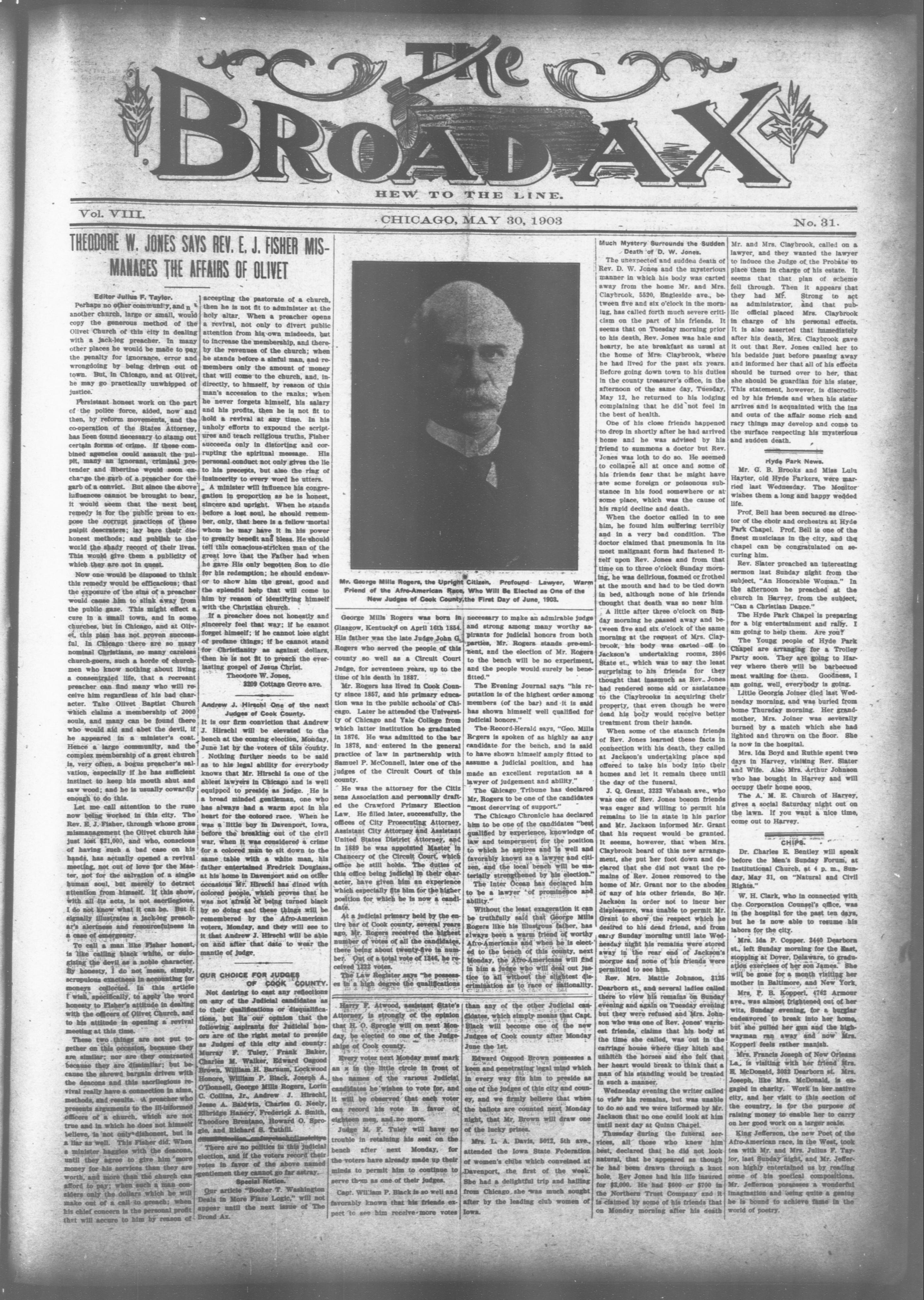
THEODORE W. JONES SAYS REV. E. J. FISHER MISMANAGES THE AFFAIRS OF OLIVET
Vol. VIII
Perhaps no other community, and n another church, large or small, would copy the generous method of the Olivet Church of this city in dealing with a jack-leg preacher. In many other places he would be made to pay the penalty for ignorance, error and wrongdoing by being driven out of town. But, in Chicago, and at Olivet, he may go practically unwhipped of justice.
Persistant honest work on the part of the police force, aided, now and then, by reform movements, and the co-operation of the States Attorney, has been found necessary to stamp out certain forms of crime. If these combined agencies could assault the pulpit, many an ignorant, criminal pretender and libertine would soon exchange the garb of a preacher for the garb of a convict. But since the above influences cannot be brought to bear, it would seem that the next best remedy is for the public press to expose the corrupt practices of these pulpit descraters; lay bare their dishonest methods; and publish to the world the shady record of their lives. This would give them a publicity of which they are not in quest.
Now one would be disposed to think this remedy would be efficacious; that the exposure of the sins of a preacher would cause him to slink away from the public gaze. This might effect a cure in a small town, and in some churches, but in Chicago, and at Olivet, this plan has not proven successful. In Chicago there are so many nominal Christians, so many careless church-goers, such a horde of churchmen who know nothing about living a concentrated life, that a recreant preacher can find many who will receive him regardless of his bad character. Take Olivet Baptist Church which claims a membership of 2000 souls, and many can be found there who would aid and abet the devil, if he appeared in a minister's coat. Hence a large community, and the complex membership of a great church is, very often, a bogus preacher's salvation, especially if he has sufficient instinct to keep his mouth shut and saw wood; and he is usually cowardly enough to do this.
Let me call attention to the ruse now being worked in this city. The Rev. E. J. Fisher, through whose gross mismanagement the Olivet church has just lost $21,000, and who, conscious of having such a bad case on his hands, has actually opened a revival meeting, not out of love for the Master, not for the salvation of a single human soul, but merely to detract attention from himself. If this show, with all its acts, is not sacrilegious, I do not know what it can be. But it signally illustrates a jack-leg preacher's alertness and resourcefulness in a case of emergency.
To call a man like Fisher honest, is like calling black white, or eulogizing the devil as a noble character. By honesty, I do not mean, simply, scrupulous exactness in accounting for moneys collected. In this article I wish, specifically, to apply the word honesty to Fisher's attitude in dealing with the officers of Olivet Church, and to his attitude in opening a revival meeting at this time.
These two things are not put together on this occasion, because they are similar; nor are they contrasted because they are dissimilar; but because the shrewd bargain driven with the deacons and this sacrilegious revival really have a connection in aims, methods, and results. A preacher who presents arguments to the ill-informed officers of a church, which are not true and in which he does not himself believe, is not only dishonest, but is a liar as well. This Fisher did. When a minister haggles with the deacons, until they agree to give him more money for his services than they are worth, and more than the church can afford to pay; when such a man considers only the dollars which he will make out of a call to preach; when his chief concern is the personal profit that will accure to him by reason of
accepting the pastorate of a church, then he is not fit to administer at the holy altar. When a preacher opens a revival, not only to divert public attention from his own misdeeds, but to increase the membership, and thereby the revenues of the church; when he stands before a sinful man, and remembers only the amount of money that will come to the church, and, indirectly, to himself, by reason of this man's accession to the ranks; when he never forgets himself, his salary and his profits, then he is not fit to hold a revival at any time. In his unholy efforts to expound the scriptures and teach religious truths, Fisher succeeds only in distorting and corrupting the spiritual message. His personal conduct not only gives the lie to his precepts, but also the ring of insincerity to every word he utters.
A minister will influence his congregation in proportion as he is honest, sincere and upright. When he stands before a lost soul, he should remember, only, that here is a fellow mortal whom he may have it in his power to greatly benefit and bless. He should tell this conscious-stricken man of the great love that the Father had when he gave His only begotten Son to die for his redemption; he should endeavor to show him the great, good and the splendid help that will come to him by reason of identifying himself with the Christian church.
If a preacher does not honestly and sincerely feel that way; if he cannot forget himself; if he cannot lose sight of profane things; if he cannot stand for Christianity as against dollars, then he is not fit to preach the everlasting gospel of Jesus Christ.
Theodore W. Jones,
2209 Cottage Grove ave.
Andrew J. Hirechl One of the next Judges of Cook County.
It is our firm conviction that Andrew J. Hirschl will be elevated to the bench at the coming election, Monday, June 1st by the voters of this county. Nothing further needs to be said as to his legal ability for everybody knows that Mr. Hirschl is one of the ablest lawyers in Chicago and is well equipped to preside as judge. He is a broad minded gentleman, one who has always had a warm spot in his heart for the colored race. When he was a little boy in Davenport, Iowa, before the breaking out of the civil war, when it was considered a crime for a colored man to sit down to the same table with a white man, his father entertained Fredrick Douglass at his home in Davenport and on other occasions Mr. Hirschl has dined with colored people, which proves that he was not afraid of being turned black by so doing and these things will be remembered by the Afro-American voters, Monday, and they will see to it that Andrew J. Hirschl will be able on and after that date to wear the mantle of judge.
QUR CHOICE FOR JUDGES
OF COOK COUNTY
Not desiring to cast any reflections on any of the Judicial candidates as to their qualifications or disqualifications, but its our opinion that the following aspirants for Judicial honors are of the right metal to preside as Judges of this city and county: Murray F. Tuley, Frank Baker, Charles M. Walker, Edward Osgood Brown, William H. Barnum, Lockwood Honore, William P. Black, Joseph A. O'Donnell, George Mills Rogers, Lorin C. Collins, Jr., Andrew J. Hirschl, Jesse A. Baldwin, Charles G. Neely, Elbridge Hanery, Frederick A. Smith, Theodore Brentano, Howard O. Sprogle, and Richard S. Tuthill.
There are no politics in this judicial election, and if the voters record their votes in favor of the above named gentlemen they cannot go far astray. Special Notice. Our article "Booker T. Washington Deals in More Flase Logic," will not appear until the next issue of The Broad Ax.
HEW TO THE LINE.
CHICAGO, MAY 30, 1903
[Name]
Mr. George Mills Rogers, the Upright Citizen, Profound Lawyer, Warm Friend of the Afro-American Race, Who Will Be Elected as One of the New Judges of Cook County,the First Day of June, 1903.
George Mills Rogers was born in Glasgow, Kentucky on April 16th 1854. His father was the late Judge John G. Rogers who served the people of this county so well as a Circuit Court Judge, for seventeen years, up to the time of his death in 1887. necessary to make an admirable judge and strong among many worthy aspirants for judicial honors from both parties, Mr. Rogers stands pre-eminent, and the election of Mr. Rogers to the bench will be no experiment, and the people would surely be bene fitted."
Mr. Rogers has lived in Cook County since 1857, and his primary education was in the public schools of Chicago. Later he attended the University of Chicago and Yale College from which latter institution he graduated in 1876. He was admitted to the bar in 1878, and entered in the general practice of law in partnership with Samuel P. McConnell, later one of the judges of the Circuit Court of this county.
He was the attorney for the Citizens Association and personally drafted the Crawford Primary Election Law. He filled later, successfully, the offices of City Prosecuting Attorney, Assistant City Attorney and Assistant United States District Attorney, and in 1889 he was appointed Master in Chancery of the Circuit Court, which office he still holds. The duties of this office being judicial in their character, have given him an experience which especially fits him for the higher position for which he is now a candidate.
At a judicial primary held by the entire bar of Cook county, several years ago, Mr. Rogers received the highest number of votes of all the candidates, there being about twenty-five in number. Out of a total vote of 1346, he received 1222 votes.
The Law Register says "he possesses in a high degree the qualifications
Harry F. Atwood, assistant State's Attorney, is strongly of the opinion that H. O. Sprogle will on next Monday, be elected to one of the Judgeships of Cook county.
Every voter next Monday must mark an x in the little circle in front of the names of the various Judicial candidates he wishes to vote for, and it will be observed that each voter can record his vote in favor of eighteen men, and no more.
Judge M. F. Tuiey will have no trouble in retaining his seat on the bench after next Monday, for the voters have already made up their minds to permit him to continue to serve them as one of their judges.
Capt. William P. Black is so well and favorably known that his friends expect to see him receive more votes
necessary to make an admirable judge and strong among many worthy aspirants for judicial honors from both parties, Mr. Rogers stands pre-eminent, and the election of Mr. Rogers to the bench will be no experiment, and the people would surely be benefitted."
The Evening Journal says "his reputation is of the highest order among members (of the bar) and it is said has shown himself well qualified for judicial honors."
The Record-Herald says, "Geo. Mills Rogers is spoken of as highly as any candidate for the bench, and is said to have shown himself amply fitted to assume a judicial position, and has made an excellent reputation as a lawyer of judgement and ability." The Chicago Tribune has declared Mr. Rogers to be one of the candidates "most deserving of support."
The Chicago Chronicle has declared him to be one of the candidates "best qualified by experience, knowledge of law and temperment for the position to which he aspires and is well and favorably known as a lawyer and citizen, and the local bench will be materially strengthened by his election." The Inter Ocean has declared him to be a lawyer "of prominence and ability."
Without the least exagregation it can be truthfully said that George Mills Rogers like his illustrous father, has always been a warm friend of worthy Afro-Americans and when he is elected to the bench of this county, next Monday, the Afro-Americans will find in him a judge who will deal out justice to all without the slightest discrimination as to race or nationality.
than any of the other Judicial candidates, which simply means that Capt. Black will become one of the new Judges of Cook county after Monday June the 1st.
Edward Osgood Brown possesses a keen and penetrating legal mind which in every way fits him to preside as one of the judges of this city and couney, and we firmly believe that when the ballots are counted next Monday night, that Mr. Brown will draw one of the lucky prizes.
Mrs. L. A. Davis, 5012, 5th ave., attended the Iowa State Federation of women's clubs which convened at Davenport, the first of the week. She had a delightful trip and hailing from Chicago she was much sought after by the leading club women of Iowa.
Much Mystery Surrounds the Sudden Death of D. W. Jones.
The unexpected and sudden death of Rev. D. W. Jones and the mysterious manner in which his body was carted away from the home Mr. and Mrs. Claybrook, 5520, Engleside ave., between five and six o'clock in the morning, has called forth much severe criticism on the part of his friends. It seems that on Tuesday morning prior to his death, Rev. Jones was hale and hearty, he ate breakfast as usual at the home of Mrs: Claybrook, where he had lived for the past six years. Before going down town to his duties in the county treasurer's office, in the afternoon of the same day, Tuesday, May 12, he returned to his lodging complaining that he did not feel in the best of health.
One of his close friends happened to drop in shortly after he had arrived home and he was advised by his friend to summons a doctor but Rev. Jones was loth to do so. He seemed to collapse all at once and some of his friends fear that he might have ate some foreign or poisonous substance in his food somewhere or at some place, which was the cause of his rapid decline and death.
When the doctor called in to see him, he found him suffering terribly and in a very bad condition. The doctor claimed that pneumonia in its most malignant form had fastened itself upon Rev. Jones and from that time on to three o'clock Sunday morning, he was delirious, foamed or frotted at the mouth and had to be tied down in bed, although none of his friends thought that death was so near him. A little after three o'clock on Sunday morning he passed away and between five and six o'clock of the same morning at the request of Mrs. Claybrook, his body was carted off to Jackson's undertaking rooms, 2806 State st., which was to say the least surprising to his friends for they thought that inasmuch as Rev. Jones had rendered some aid or assistance to the Claybrooks in acquiring their property, that even though he were dead his body would receive better treatment from their hands.
When some of the staunch friends of Rev. Jones learned these facts in connection with his death, they called at Jackson's undertaking place and offered to take his body into their homes and let it remain there until the day of the funeral.
J. Q. Grant, 3232 Wabash ave., who was one of Rev. Jones bosom friends was eager and willing to permit his remains to lie in state in his parlor and Mr. Jackson informed Mr. Grant that his request would be granted. It seems, however, that when Mrs. Claybrook heard of this new arrangement, she put her foot down and declared that she did not want the remains of Rev. Jones removed to the home of Mr. Grant nor to the abodes of any of his other friends. So Mr. Jackson in order not to incur her displeasure, was unable to permit Mr. Grant to show the respect which he desired to his dead friend, and from early Sunday morning until late Wednesday night his remains were stored away in the rear end of Jackson's morgue and none of his friends were permitted to see him.
Rev. Mrs. Mattle Johnson, $125 Dearborn st., and several ladies called there to view his remains on Sunday evening and again on Tuesday evening but they were refused and Mrs. Johnson who was one of Rev. Jones' warmest friends, claims that his body at the time she called, was out in the carriage house where they hitch and unhitch the horses and she felt that her heart would break to think that a man of his standing would be treated in such a manner.
Wednesday evening the writer called to view his remains, but was unable to do so and we were informed by Mr. Jackson that no one could look at him until next day at Quinn Chapel.
Thursday during the funeral services, all those who knew him best, declared that he did not look natural, that he appeared as though he had been drawn through a knot hole. Rev Jones had his life insured for $3,000. He had $600 or $700 in the Northern Trust Company and it is claimed by some of his friends that on Monday morning after his death
No.31.
Mr. and Mrs. Claybrook, called on a lawyer, and they wanted the lawyer to induce the Judge of the Probate to place them in charge of his estate. It seems that that plan of scheme fell through. Then it appears that they had Mr. Strong to act as administrator, and that public official placed Mrs. Claybrook in charge of his personal effects. It is also asserted that immediately after his death, Mrs. Claybrook gave it out that Rev. Jones called her to his bedside just before passing away and informed her that all of his effects should be turned over to her, that she should be guardian for his sister. This statement, however, is discredited by his friends and when his sister arrives and is acquainted with the ins and outs of the affair some rich and racy things may develop and come to the surface respecting his mysterious and sudden death.
Hyde Park News.
Mr. G. B. Brooks and Miss Lulu Hayter, old Hyde Parkers, were married last Wednesday. The Monitor wishes them a long and happy wedded life. Prof. Bell has been secured as director of the choir and orchestra at Hyde Park Chapel. Prof. Bell is one of the finest musicians in the city, and the chapel can be congratulated on securing him.
Rev. Slater preached an interesting sermon last Sunday night from the subject, "An Honorable Woman." In the afternoon he preached at the church in Harvey, from the subject, "Can a Christian Dance."
The Hyde Park Chapel is preparing for a big entertainment and rally. I am going to help them. Are you?
The Young people of Hyde Park Chapel are arranging for a Trolley Party soon. They are going to Harvey where there will be barbecued meat waiting for them. Goodness, I am going, well, everybody is going.
Little Georgia Joiner died last Wednesday morning, and was buried from home Thursday morning. Her grandmother, Mrs. Joiner was severally burned by a match which she had lighted and thrown on the floor. She is now in the hospital.
Mrs. Ida Boyd and Ruthie spent two days in Harvey, visiting Rev. Slater and Wife. Also Mrs. Arthur Johnson who has bought in Harvey and will occupy their home soon
The A. M. E. Church of Harvey, gives a social Saturday night out on the lawn. If you want a nice time, come out to Harvey.
CHIP8.
Dr. Charles E. Bentley will speak before the Men's Sunday Forum, at Institutional Church, at 4 p. m., Sunday, May 31, on "Natural and Civil Rights."
W. H. Clark, who in connected with the Corporation Counsel's office, was in the hospital for the past ten days, but he is now able to resume his labors for the city.
Mrs. Ida P. Copper. 2440 Dearborn st., left Sunday morning for the East, stopping at Dover, Delaware, to graduation exercises of her son James. She will be gone for a month visiting her mother in Baltimore, and New York. Mrs. P. B. Kopperl, 4762 Armour ave., was almost frightened out of her wits, Sunday evening, for a burglar endeavored to break into her home, but she pulled her gun and the highwayman ran away and now Mrs. Kopperl feels rather manish.
Mrs. Francis Joseph of New Orleans La., is visiting with her friend Mrs. E. McDonald, 3032 Dearborn st. Mrs. Joseph, like Mrs. McDonald, is engaged in charity. Work in her native city, and her visit to this section of the country, is for the purpose of raising money to enable her to carry on her good work on a larger scale.
King Jefferson, the new Poet of the Afro-American race, in the West, took tea with Mr. and Mrs. Julius F. Taylor, last Sunday night, and Mr. Jefferson highly entertained us by reading some of his poetical compositions. Mr. Jefferson possesses a wonderful imagination and being quite a gening he is bound to achieve fame in the world of poetry.
———_ oan se. 2 eP
2S egpee Wem
__ Will prom [At aut dimes mpbold the tra?
Priests, Infidels, Parmers, 8! ‘xers, Repub:
‘Broad te a ni ~
CEs
VWiwtnmastapee
ffubscriptions must be paid in advance.
LSS
ochiyicmatstere, = orien
THE BROAD AX .
@ Armour Avenue, Chicago.
- JULIUS ¥. TAYLOR, Réttor and Publisher.
—————————————————
Batered at the Post Office at Chicago,
MIL, as Second-ciass Matter.
Be Crash.
“I hear,” said Hi Tragerdy, “that
while you were playing in one of the
western towns a fire broke out-in the
theater.”
“Yes,” replied Low Comedy, “and
there might have been a horrible
panic but for one thing.”
“What was that?” 3
“There Weren't enough people in
the audience to create one.”—Phila-
delphia Press. -
. ‘Where He Fell Down.
He could write a comic article that would
make you fairly roar,
An@ his after-dinner speeches were with
humor brimming o'er;
But when left to mind the baby his re-
sources were Qispelied,
cag ~~ ge rh acane aopoasacchegs
—Tit-Bits.
7H sECOND FIDDLE.
hous Py
i ae
‘eet
Ca ‘i
igs Ca ei
lhe
G a7 2 .
Gs EF As
Ve <= ¥ NS
-_Z * 4 NS
% aN
a “oo .
IF 967. -
es ee
a> Zt ' iz
She—Gracioug! The last time I saw
him he was the most opinionated fel-
lowin town. Howhehaschanged. .
_He—Oh! didn’t you know he was re-
cently married?—Detroit Free Press.
=. ‘Where They Go.
Themen who deal in secds,,
> ae eaatina ee as
; #ink’s Fool Ketien. =
_ Winks—Did you ever notice that,
during hard times, religious retivalsal-
‘ways start up and jhe* ‘long-empty
churches are sure-to be filled?
Jinks—Yes.
“How do you account for it?”
“Galvation’s free."—N. Y. Weekly.
* ‘Ste Ctineh ieee -
Mother (putting the bay out of the
een er many more times will I
2 to tell you to keepaway from that
Preserve jar? - :
- ‘Small Boy (sobbing)—No ‘more,
mamma, the jam’s all- gone—Cincin-
mati Enquirer. ,
‘The Thorn an@ the Rose,
First Married Man—Women are
| goasipers,-aren"t they. ~
, Married Man—Yes; but just
‘think what a lot ‘of entertaining in-
formation one would miss concerning
the neighbors were they otherwise —
Chicago Daily News,.’ z
“Bay, pa,” queried “little Johuny
Bumpernictle, “what's the difercace
pepe re: and the other
‘eash, my son,” replied the-old-man—
Cincinnati Enquirer;:.: > = alt
tes ns
=° “I pupipose there will sever be an end
*Satctees aphaent an
if en,
“ple who hovers grabbed tay thing wil
eer San What ‘has already
“The people-who go to South Da-
_kota for divorees spend a million dol-
dars-a year in that-state? .~ . ~
« “Well, did. you ever-hear that they
A their money, back ?”—Chicago
a: ee tar;
secre Foran stn
“about 11 stclock in the Yorincos. How
“Wet @ Batter ef Chotce. - oa
“Wht do you put on your face efter.
-ghavia;/?” asked the man who smelled
eee < Be ea.
nérvous chap, gicomily. — Cincinnati
that I am going to allow my danghter
‘to merrys man es pooranyouare? -
P aman would | & girl on
ea re ae
- SOME-SQLDIERS TOO. YOU HG.
Great Precautions Taken tn War De-
partment to Keep Minors Out
ef the Arar.
~The war department fs determined
that the recrutting officers shall re-
ey erections Secon
ors. Instructions given to
Tic Git ecoiat nents nan Seton.
agpmretett Mmadens shite! isthe
fo be under 21 years of age, thougl
wild 16 be older, londing'to epptieetions
to the war department from parents
ground of minority, saysa Washington
It is therefore desired that every pos-
sible precaution be‘ taken to avoid the
improper enlistment of persons under
the age of 21 years. To this end young
men who meet other requirements and
Say they are fully 21, or even a few
years over that age, should not only be
carefully interrogated and their ante-
cedents be carefully investigated, but
the written conse of the parents to
the enlistment must also be obtained
if the recruit appears to be under 21
years of age. In case such a recruit
fails to obtain this consent he will be
required to furnish his own sworn
statement in writing regarding his
age, supported by the sworn statement
of two other persons, and these must
be satisfactory to the recruiting off-
cer, otherwise the applicant will be re-
jected. When the written consent of
parents or the sworn statements indi-
cated are furnished ané@ accepted in
such cases they will be attached to the
enlistment papers.
NAPOLEON AMONG ANIMALS.
Commander of 20,000 Men Who Daily
Pat to Death Thousands of
Food Animals.
Imagine a. procession of 10,000 cat-
tle, marching two by two, in a line
‘15 mitts 3 let 20.000 sheep follow
‘them, bieating along 12 miles of
road; after em drive 16 miles of
‘hogs, 27,000 strong; then let 30,000
fowls brisig up the rear, clucking and
quacking and gobbling, over a space
.of six miles; -and in this whole cara-
van, stretching, for nearly 50 miles
and requiring two days to pass a
given point, you will see the animals
devoted to death in the packing
houses of Swift & Co. in a single day,
says the Cosmopolitan. ~ Surely a
Buddhist would think that the head
of that establishment had much to
answer for. Never before in the
world’s history was & massacre of
the innocents Organized gn such a
stupendous scale‘or with~such scien-
‘The commander of the army of 20,-
000 men engaged in. this work earned
his first penny picking cranberries
in a swamp on §ape Cod more than
50 years ago. It was at Sagamore,
on that historic peninsula, that a son’
was born to the house of Swift on
June 24, 1839, end named Gustavus
Franklin. -A,few years later, when
the boy was not picking cranberries,.
he drove hogs slong the It
fant armies at school ~
. 3 FACE SPOILS Ré
Philadelphia Barber Has a Customer
Whose Skin Is Always :
- Pall of Gett.
“Did you see the man who just
went out?” asked an uptown barber
of @ customer, as a swarthy individ-
ual left the shop, according to the
Philadelphia Telegraph. ~ “Yes?
Well, ‘he spoil s razor every time I
shave him, and he comes here twice
‘® week regularly. He is @ stonecut-
ter, and the grit and dust is so im-
bedded in ‘the pores of his face that
itis like drawing a razor over the
side of a stone. I slways use the
‘best tools I have upon him, but they
are Got stone-proof, and « dull razor
is the result when his beard is re~
moved. oe sod am
“He is a. customer upon whom I
lose money, end I am glad to my
that he is the only stonécutter who.
favors ‘ine witb his patronage. 1
often wonder't ae it~ is that he’
doesn’t wince when the razor strikes
a section of stone that .is imbedded
in his and bounds off,.but it is
probably beenwe hn kin to band
erfed that ‘he ¥éels no ill effects.”
. The Maryland Medical, Jouznal.
Guces figures which show pe.
turns from‘ “colleges* covering ten
beara termptrrline gmp Pie
‘Ghafacter’of football. Of the 22,766
‘men in these teams 654 recaived:in-
every 2,846 “The dedths were
$00 “ai bat the gGre‘ts xot
given, 7The- sumter* phiging “de
cTeases, but the injuries imorease’ in
ries aan "40, eae Beso, 7
Ties ram thus: 40, 46, 4, : %
RN ere
A Kissing <ertificate may be one of
‘the lexaries of life if a certain Amer-
‘ican physician bas his way. ~The sen-
uae gee eee
a ‘or. i b [
unless the to
salute nchother ts poe bs
certificates stating that they ate ft
subjects. The bili has = clause for-
see agient<a people with —
hearts, as this is declared an obsta-
Sate Po sneer Ue Ie
id piacama ~pentan? Siena pay sas
The tight-Btting British uniform is
alleged to be the cause of so muck
heart-disease aimong soldiers.
5
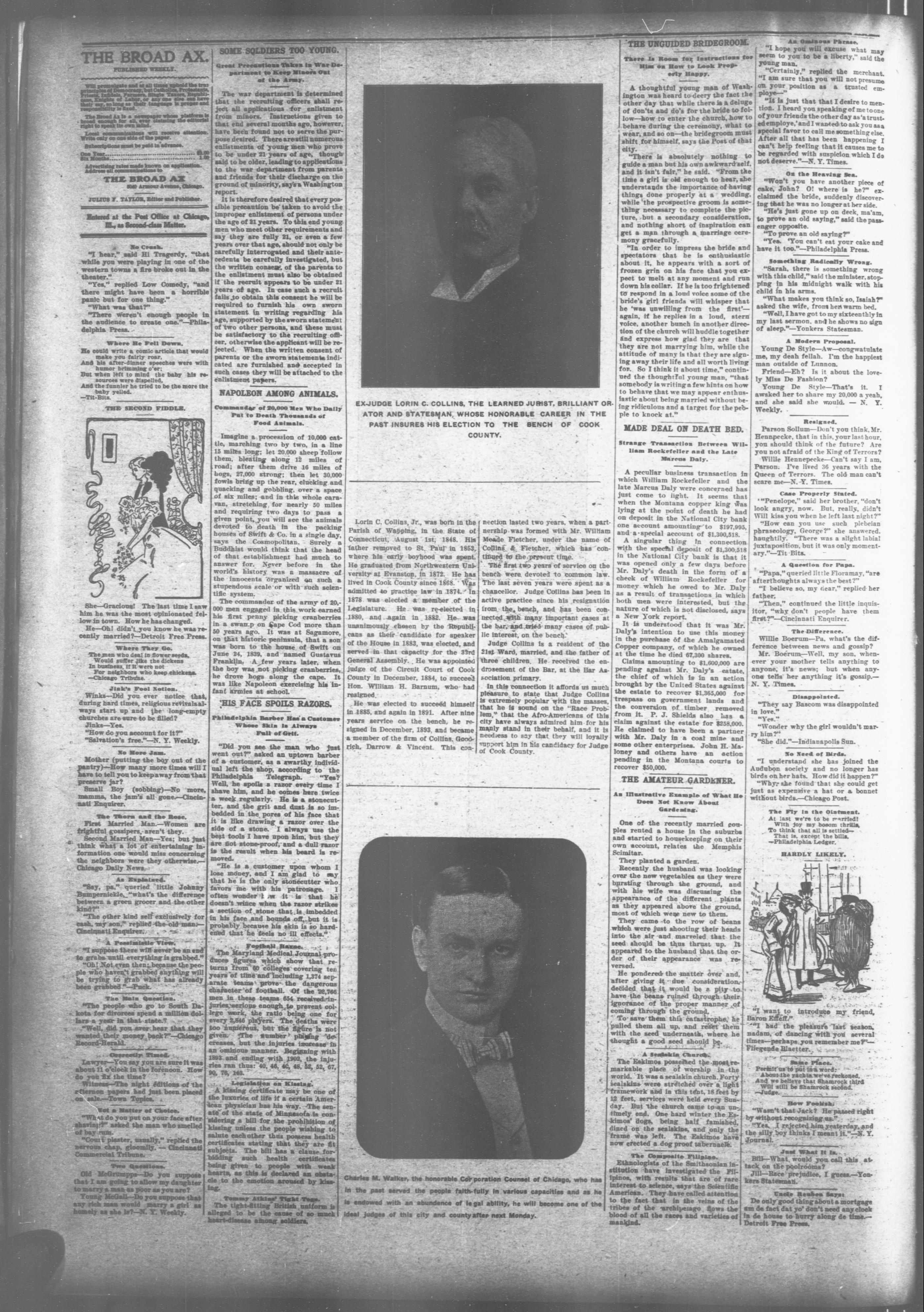
EXJUDGE LORIN C. COLLINS, THE LEARNED JURIST, BRILLIANT OR.
ATOR AND STATESMAN, WHOSE HONORABLE CAREER IN THE
PAST INSURES HIS ELECTION TO THE BENCH OF COOK
COUNTY. ;
: Se AN eR
rs 3 :
S , rf
Charles M. Walker, the honorable Cok poration Counsel of Chicago, who has
In the past served the people faith-fully in various capacities and 2s he
Je endowed with an abundence of legal ability, he will become one of the
Lorin C, Collins, Jr., was born in the
Parish of Wapping, ta the. State of
Connecticut; ‘August “1st; 1848. His
father removed to St. Pau} in 1853,
He graduated from Northwestern Un}
oars See, RIES. Se oe
lived in Cook County since 1868. *
admitted to practice iaw°in zat
1878. was elected a member of the
Legislature. He- was. reelected in
1880, and.again in 1882. He was
unanimous}y ehesen by the ‘Repubil-
cans as their-candidate for speaker
of the House in 1883, was elected, and
served imthat capacity for the 3%rd
General Acsembly. He was appointed
judge of the Circuit Court of Cook
County in December, 1884, to succeed
Hon. William H. Barnum, who- had
He -was elected to succeéd himself
in 4885, and again in 1891. After nine
years service on the bench, he re
signed in December, 1893, and became
& member of the firm of Collins, Good-
tich, Darrow & Vincent. This con-
nection lasted two years, when a part.
nership.was formed with Mr. William
Meade Fletcher, under the name of
Colling. & Fletcher, which has“ con-
titued ‘to the time. - ‘
reeset sect reskin te
bench. were devoted to common lav.
“he last seven years were spent as a
chancellor. Judge Collins has been in
active practice since his resignation
nected ith many important cases at
the bar;and triéd many cases of pub-
lie interest, on the bench-
Judge Collins is a resident of the
21st Ward, married, and the father of
‘three children. He. received the en-
drosement of the Bar, at the Bar As-
sociation primary. 5
In this connection it affords ws much
pleasure to state that Judge Collins
is extremely popular with the masses,
that he ig sound on the “Race Prob-
lem,” that the Afro-Americans of this
city have always admired him. for his
manly stand in their behalf, and it is
neediess to say that they will loyally
support him in Ris candidacy for Judge
of Cook County.
‘There Is Room fox Instructions for
Hiss Gn How to Look Prop
eats Manor.
A thoughtful man of Wash
| mgt was heard coceery he tact
other day that while there is a deluge
of don'ts and do’s for the bride to fol
low—how to enter the chureb, how te
behave during the ceremony, what to
; Wear, and so on—the bridegroom must
shift for himself, says the Post of that
“Trnere is absolutely nothing to
guide a man but his own awkwardself,
and it isn't fair,” he said. “From the
time a girl is old enough to hear, ahe
understands the importance of having
things done properly at a wedding,
aoe : oan ‘toe pe
necessary to complete
ture, -but a secondary consideration,
and nothing short of inspiration can
get @ man through a marriage cere-
mony gracefully.
“In order to impress the bride and
spectators that he is enthusiastic
about it, he appears with a sort of
frozen grin on his face that you ex-
peet to melt at any moment and run
down hiscollar. If he is too frightened
to respond in a loud voice some of the
bride’s girl friends will whisper that
he ‘was unwilling from the first’—
again, if he replies in a loud, stern
voice, another bunch in another diree-
tion of the church will huddle together
find express how glad they are that
they are not marrying him, while the
attitude of many is that they are sign-
ing away their life and all worth living
for.. So I think it about time,” contin-
ued the thoughtful young man, “that
somebody is writing a few hints on how
to behave that we may appear enthus-
fastic about being married without be-
ing ridiculous and a target for the ped-
ple to knock at.”
MADE DEAL ON DEATH BED.
Strange Transaction Between Wil-
liam Rockefeller and the Late
Marcus Daily.
A peculiar business transaction in
which William Rockefeller and the
late Marcus Daly were concerned has
just come to light. It seems that
when the Montana copper king Was
lying at the point of death he had
on deposit in the National City bank
one account amounting’to $197,995,
and-a-special account of $1,300,518.
A singular thing in connection
with the specfal aqprait of $1,300,518
in the National City bank is that it
was opened only a few days before
Mr. Daly’s death in the form of a
check of William Rockefeller _ for
‘money which he owed to Mr. Daly
as a result of transactions in which
both men were interested, but the
nature of which is not disclosed, says
a New York report.
It is understood that it was Mr.
Daly's intention to use this money
in the purchase 6f the Amalgamated
Copper company, of which he owned
at time he died 67,300 shares.
Claims amounting to $1,600,000 are
pending against Mr. Daly’s -estate,
the chief of which is in an action
brought by the United States against
the estate to recover $1,365,000 for
trespass on government lands and
the conversion of.timber removed
from it. P. J. Shields also has @
claim against the estate for $253,000.
He claimed to have been a partner
with Mr. Daly in a coal mine and
some other enterprises. John H. Ma-
loney and others have an action
pending in the Montana courts to
recover $50.000.
THE AMATEUR GARDENER.
An IMustrative Example of What He
Dees Net Know About
Gardening.
One of the recently married cou
ples rented a house in the suburbs
and started to housekeeping on their
own account, relates the Memphis
Scimitar.
| They planted a garden.
_ Recently the husband was looking
over the new vegetables as they were
eats through the ground, and
) hie wife was discussing the
‘Sppearance of the different _ plants
‘as they appeared above the ground,
most of which weg new to them.
| They came-to the row of: beans
which were just shooting their heads
inte the air -and marveled. that. the
seed: should be thus thrust up. It
sppeartd to the husband that the or-
der of their appearance was re
versed. eae ee
He pondered the snatter dver and,
after giving it-due consideration,
decided. that it, would be 2 pity.to
ignorance of the proper manner of
coming through the g: Ly =
; Tor save’ them thik’ éatastrophe, he
pulled them all up, and revet them
with the seed underneath, where he
thought a good seed should be. |
— .- & Seniekia Charc®.
"The Eekimos. possefted the -motre
aaah place of worship in-the
world, ‘It was a sealskin church. Forty
sealskins were strétchéd over a light
“framework abd in this tént, 16 feet by
12 feet, services were held every Sun-
day. But the eburch came to-gp un-
timely end, One hard winter the E5-
sek the poh only the
. pee
‘tepoah San left. The Eskimos bave
Bow erected a dog proof tabernack.
“The Composite Filipizo.
pace hiss ot the Sonithecsian te:
fpinos, with results that dre of rare
interest to science, ssys°the Scientific
to eatery in the veins of the
= 2
~ I hope: what may
weem to ) be a liberty,” sald the
young man. ~ se
“Certainly,” replied the merchant,
‘“T am sure that you will not presume
on Your position as a trusted em-
a just that that I desire to men-
tion. I heard you speaking of me toone
of your friends the other day as‘a trust.
edemploye,’and!I wantedto ask youasa
ouecial favor to call mesomething else.
all that has been happening I
can’t help feeling that it causes me to
be regarded with suspicion which I do
not deserve.”—N. Y. Times.
Ou the Heavice Sea_
“Won't you have another piece of
cake; John? 0! where is he?” ex-
claimed the bride, suddenly discover-
ing that he was no longer at her side.
“He’s just — up on deck, ma’am,
to prove an saying,” said the pass-
-enger opposite.
| “To prove an old saying?”
“Yes. ‘You can't eat your cake and
have it too.”—Philadelphia Press.
Something Radically Wrong.
“Sarah, there is something wrong
with this child,” said the minister, stop-
ping in his midnight walk with his
child in his arms.
“What makes you think so, Isaiah?”
asked the wife, from hen warm bed.
“Well, [have got to my sixteenthly in
my last sermon, and he shows no sign
of sleep.”"—Yonkers Statesman.
A MeGecn Prenesst.
Young De Style—Aw—congwatulate
me, my deah fellah. I'm the happiest
man outside of Lunnon.
Friend—Eh? Is it about the love-
ly Miss De Fashion?
Young De Style—That’s it. I
awsked her to share my 20,000 a yeah,
and she said she would. — N. Y.
Weekly, - :
Resigned.
Parson Sollum—Don't you think, Mr.
Hennpecke, that in this, your last hour,
you should think of the future? Are
you not afraid of the King of Terrors?
Willie Hennepecke—Can’t say I am,
Parson: I've lived 36 years with the
Queen of Terrors. The old man can’t
scare me—N.-Y. Times.
Case Properly Stated.
*“Penelope,” said her brother, “don’t
look angry, now. But, really, didn’t
Will kiss you when he left last night?”
“How can you use such plebeian
phraseology, George?” she answered.
haughtily. “There was a slight labial
juxtaposition, but it was only moment-
ary.”—Tit Bits. :
ais A Question for Papa.
“Papa,” queried little Floramay, “are
afterthoughts always the best?”
“I believe so, my cear,” replied her
father,
“Then,” continued the little inquis-
itor, “why don’t people have them
first?”—Cincinnati Enquirer.
The Difference.
Willie Boerum—Pa, what's the dif-
ference between news and gossip?
Mr. Boérum—Well, my son, when-
ever your mother tells anything to
anyone; it’s news; but when any-
one tells’ her anything it’s gossip.—
N. Y¥. Times. - > 2
. Disappointed.
“They say Bascom was disappointed
in love.”
“¥es.?
“Wonder why the girl wouldn’t mar-
ry him?”
“She did.”—Indianapolis Sun.
No Need of Birds. ;
“I understand she bas joined the
Audubon society and no longer has
birds on her hats. How did it happen?”
“Why; she found that she could get
just as expensive'a hat or a bonnet
witHout birds—Chicago Post.
The Fiy in the Ointment.
* At last we're to be married!
With joy my bosom thrills,
‘To think that all is settled—
“ ‘That is, except the bills,
Philadelphia Ledger,
BARDLY LIKELY. .
2 Aa AE
ww] = aegs | | aie
e py fir
| ae AD |i i a
ed ss a D
Le Gh a
=, ye |
DaLTTas. ntzotebe! my. tena
“8 Wid the pleasure “Yast Seabon,
nadam, of dancing With you eee
Vienne
TDi be pean ye feckoned
) Saratres eee pe*
saan Taek: Serpe tight
Yen, nand
aie
SO,
on Just. What 3 Ee...
Ba this_ at
Soe
a ‘on:
<< Une ‘fame
De ‘
Semis
E x 1815 | ‘DN Wee
The Batic of Waterloo Was wat
Mesa Of Tul Six Weekes Arter
"1 Was Peught.
int
ods used for transm ews in 1815
and now, Hisown aims to have
been the first to announce the
of Waterloo in England, says
Life. . tog Sa Sayers
By the by, there is a tradition at
Somersby, where Tennyson was bors
and lived, thet they did not hear of
the bape nts see a ti six
weeks ‘was ~
Mr. Leopold de Rothschild, however,
ssid that lis grandfather, who was the
owner some ships, gave his captains
they ise che oe Jat-
it newspapers, \ this way there
pe into his hands a Duteh paper
which contained the intelligence in one
line, “Great vietary of the English at
His grandfather took the news to
Lord Liverpool, but.was.scouted be-
cause the ae on
the previous it English
trou had beeh beaten. Z :
If there is a Waterloo fought in the
future, we wonder how the first intel-
ligence will reach Lorfdon, Will it be
by what we have come to regard asthe
somewhat prosaic cablegram? Will it
be by ‘canes Or shall we have it
ina marconigram? Perhapsthere may
ce invention before then that will
render all these obsolete.
EASILY UNDERSTOOD. -
Movements @f the Laps an Plainay Un-
derstandable te Deaf Mates as
Spoken Words to Hearers.
“You ntéd not think you are always
telephoning im secrecy,” said a teacher
in the deaf mute college in this eity,
relates the Washington Star, “when
you go ina booth and close the double
doors after you; ast see people doing
every day. I notice these people in
their retreats in which dey think
their words are drowned from. the
outer world, talking often while they
look on the people outside of the glass
doors, £08 i, 3 eS <
“Now, do yGwAmow,” he continued,
“that every word: that is se spoken is
understood by a deaf mute whenever
he sees what is going on under such
conditions? ‘That isa fact. The deaf
mute becomes se proficient*in learn-
ing to reat>the Innguage of the lips
that the motjon “is as expressive to
him as is the sound of the humen voice
to other eS The next time you
have a sectéC to impart to some friend
over @ e.in.a public booth.
where people ae? 3d you you
should be eatefal to-speak directly in
the mouthpiece of the "phone se that.
your semaines ae
who happétt: fo “« the lan-
guage of the Tips.” _ ] Fn
linat Social Fanction in the ©
‘Cow Céuntry.
The ball given at the Palace parlors
over the Crimson Wing saloon last Fri-
day night wasa roaripg sucess, re-
San Alkali Gulch Con tarmecia,
Pap Hendersem ‘tuned. up cntapts
and rosined his bow about nine p. m.,
and started in on “Turkey in the
Straw.” Buck Lewis, SeCees
Fightin’ Pharaob, and a . more
punchers from the Double Cross ranch
rode over, bringing their senoritgs op
thels corsage tasking. There-wee
nothing night, About
two am, Abe Hall, proprietor of
the only respectable faro jointin Alkali
Gulch, blew in-and began to prospect
for a panduer. Abe had been taking
too much bottled comfort and when bs
jerked Ghoctaw Kate away from
Weimer and backed ene
gun, and Dan’s lead pill went lookin’
for room if Abe’é attic. The faro join?
is now looking for-a new inanager.
The boys rounded: up their ladies
about four a. m.and vamoosed. Itwas
one of the most brilliant hee]-and-toe
stampedes ever held in this settlement.
TELEGRAPH - POLE INDUSTRY.
Millions of Forest aakae Ags Xe to
- at. Weenaae agit?
Between Chicago and Denver, #
distance of eee slong tne ting
of railway,there are 35408, aE yORe
1 Se : r
set 490 feet apart, or 36 to = +
000.000 saes oP ateeme
000,000 miles : the
United States, increasing ~in mileage
each year, dnd many.
senber of op ‘erases
the legraphic of the sree
the t ot
pa there are 8,000,000 polemin use
en eS ae, Fe
by troltegitaeaana by telégraph and
so eee i
gate of 15,000,000 poles in use. If these
should be replaced at once it would re-
quire 250,000 fat. to: transport
a ere eee
sary to which Sf ton-
were”. 5
pa ep
around the earth atthe equator. >
eanninans bee hanger tae
aia cea de
Rorthern states. eters ;
eee coreg Semin i
horses by the means of brine baths is
Watter.
: . The career of & social lion hunter is
Mable to be attended with am ooca-
sional disappointment, even though on
on some of tours asa lecturer,
considerably lionized, and hetells
‘this-otory of «compliment which he
‘missed, Dut which was enjoyed by an.
other, says the New York Times. He
‘was lecturing in an eastern city, and a
Feception was given in his honor at the
principal hotel of the place.
Among those who attended this re-
ception was ¢ woman prominen social-
ly, who has established a sort of
dor Seinen ie een
to-provide «=
“Hon” or two for each occasion.
Burton Holmes was so fortunate as
not to Sy Presented to thefair lion
hunter, she presented herself to
tnd erged aaad stalked for her game,
nd urged upon her invitation for
the Sunday afternoon. He mod-
estly attempted to decline ft. His ox.
cuses were not accepted, and the vic-
tim consented to appear. Extra ar-
ramgements were made for (Bis occa-
sion, and the fact that Mr. Holmes was
to be there was heralded abroad. On
the day all the youth and beauty of the
Place gathered together awaiting the
advent of @ somewhat tardy lion, who
was received with évery matk of con-
sideration, and appeared to be em-
barrassed thereby. The head waiter
had been mistaken for the eminent lec-
turer. - /
Strangers Are Easily Distinguished
by the Way They Ascena
“When you see a man or woman
climbing the steps to the west front of
the captiol you may bet he or she isa
stranger in Washington,” said an old
attache of the national capitol build-
ing, according to the Washington Star.
“Ninety-nine out of 100 persons who
enter the capitol from the west are
persons who are paying their first visit
to the building; depend upon it. After
they are here awhile they will make
the pilgrimage by ear and land them-
Selves around on the east side, and thus
escape climbing so many steps. Strang-
ers invariably think the west side of
the capitol is the front. - q
“At‘the last session of congress I no-
ticed one day a man enter the corridor
ptfing and blowingand trying to catch
his breath. When he cooled off suf-
ficiently'to talk corherently he gasped:
* “*Willcyou =e me to the house of
representatives? — an :
“I @ia so, and he passed dn.” Thenext
day I saw him enter.fronrthe east Bide
with a westerh congressman. The fel-
low was perfectly passive, and seemed
pleased that he bad found the easiest
way of getting to the capitol. It was
evident that the trip to oowtit had
been made in.a street car which landed
him on the hill, and that the congress-
man had put him on.” ‘
Haugland is Far Abead of America in
Prevesting Revages on the
at — Sengeters. me
‘The -protection of birds has been
eazried so fer in’England that fruit
growers and farmers are complaining
bitterly of the ratages of: thrusbes,
blackbirds and bullfinchés. These
Winged beauties work great mischief
in gardens and orchards, says the New
York Tribune. .~ . § .
“American readers of British books
recall with pdeasure vivid descriptions
of the “diversion of shooting young
rooks ‘in. the early spring with short-
range, small-bore rifies, and of the
succulente of-the young Took pies
eooked by experts. But itnow appears
tl %
mess, and these“birdsdo harm to va-
rious farm crops. pele
East of the Missisaippi in most ofthe
states gorth of the ae and the
Ohio the ot birdsof every
kind Sosteee eoet underdone. We
bave no tooks or ravens bere, but it is
es don protect our winged
fricads as We ought to protect them.
Where RicheMea Is Baried.
f Althongh “a atefit* Mii¢t. ba:
Dota sane esgecoawe op tine sew
wine of science and letters in the old
reveptacle’ of Richelieu, even official
‘iconotlasts have spared the familiar
G6fit which covers’ great cardi-
sate tomb. Tad how Sotbonde. hey
ever elakofate would. ly be the
Sorboune at all without Richelieu's
grooms a, tenet tare
y ve
Sonne ‘doctors fill the pulpit, ~ bat
who.so. chooses, can.enter and either
Sind a <érvice;“oF atleast view the
ae _ pt she’,
eee: age eae
‘ot the institution he anew,
Javisting thé iniflions of bis private
she 4 ‘in pocent yeasts been
in ee
. was
eS
. - > >
for many years atthe museum,
Barn i Op come of hie zr
; course
ot te arin 0 wires, tQro ot
in France, bas jest’ «
—. Hor is the indy * raw beginner
ot epee ee ee
i SD
bel a SBS
os =f eta
eens: = eae
ee ee.
oe =
4 : oe a *
= ae ae
= ee
aa te |
Eee se
= ie Ss |
— Py
Ta ¢ pe
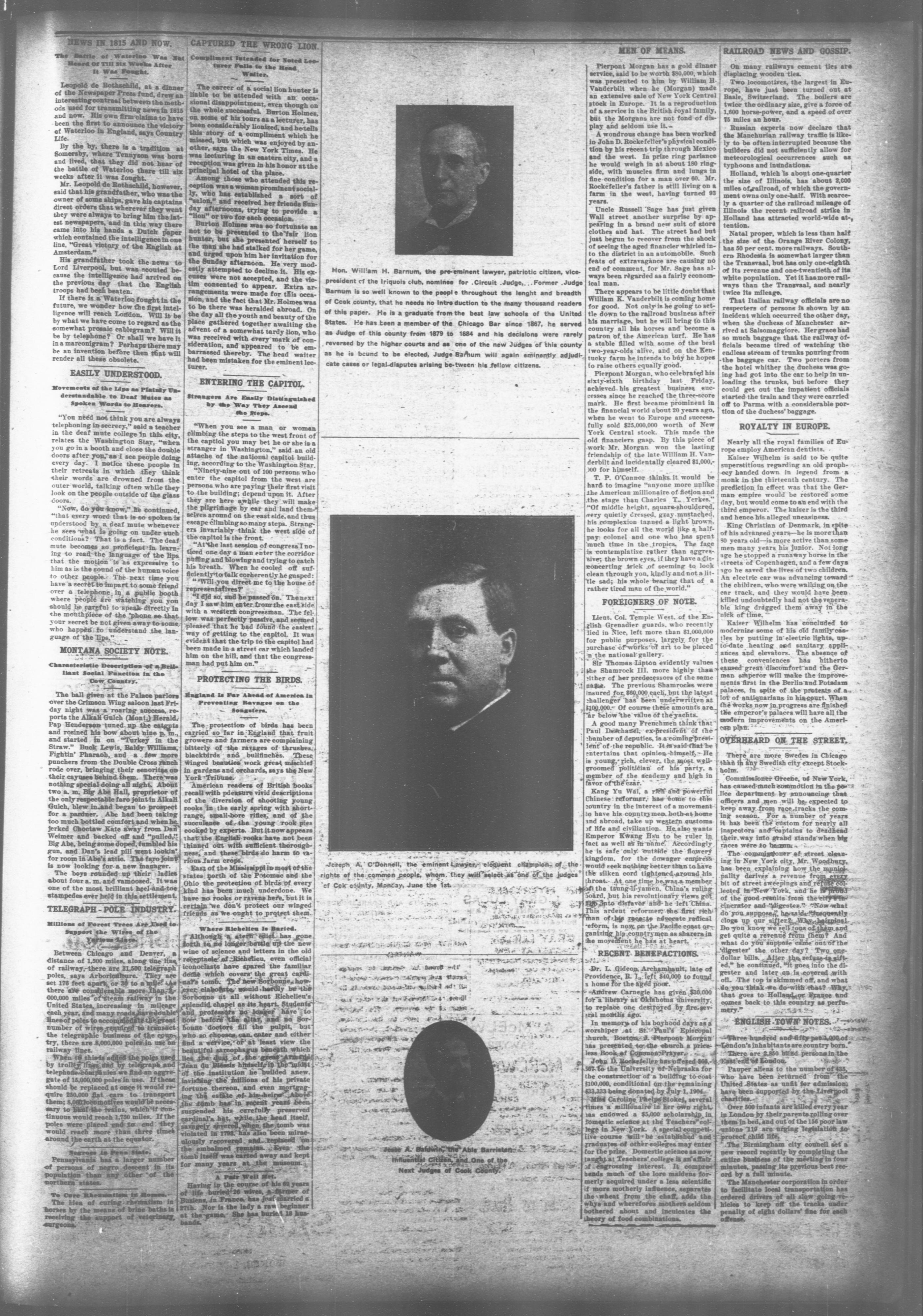
Hon. William H. Barnum, the pre-eminent lawyer, patriotic citizen, vice-
President cf the Iriquois club, nominee for .Circuit .Judge,...Former .Judge
Barnum is so well known to the people throughout the lenght and breadth
of Cook county, that he needs no Intre duction to the many thousand readers
of this paper. He is a graduate fromthe best law schools of the United
States. He has teen a member of the Chicago Bar since 1867, he served
as Judge of this county from 1879 to 1684 and his decisions were rarely
. Peversed by the higher courts and as one of the new Judges of this county
as he is beund to be elected, Judge Bathum will again eniinently adjudi-
cate cases or legal-diaputes arising be-tween his fellow citizens. .
re 8 ey
De oe
—— a a
; | é
x a we TE aeons a. + :
Scteph, A.’ C’Dohnell, the eminent Lawyer eléguent cliampioh, of the
rights of the.cqmmon people, whom. they swit!"seleét as 6né Sf the judges
“of Cok céiinty, Monday, June the ist sa Pe eee Sea ge
a ERVSS z i oe a SBetehags 2S RNR oe 27
Ssh ee.
cae ee Ee AC Ana RAS To -ST eG
: . GIP STMIT SEIS wwe te
one 2 are Cat peor? = itl Denese SF 4 ‘
Sos f ese eer tale Dee Varna fabag cE >
i dh oewed SoA wad ad Te | .
agi tp Roe ae tee Ber 4+ geri Et) eae ;
hd eS - eeree oF Ser - 5 > .
pepe lew Sin erie kencatpaasen
PPA FS PR at F
tno sadewzy XsF-s
AEDT ERS ow ee
ia Spdd gh EP oe
A 2
os a . rnd y :
+ > > “eer: 3t-ea5h
LP Get
. ee Soca js
“gies. Sr Sa ee ad 7
1 eet pee HES He Aom
Sats SPOR ee 2 os
ei ager SD the 1
~ : - +" = 8
¥ inks th. ne
- 2 Sye st ex
bie AIS eA aie > er ars
a pat i a7 3 oe oo ae
t= eee aaah AL Babi ANE Abie Barcietens So TS
a a oe oo one it 2 ee ee
- = = vs Fe wie: Soo
= eet oe ie a
Na ea pee cae Fe 20 Saree
os fee Sane soe ae Aa =
a = “ Sta 2b Ska
a ayia mS
gS tS eee Se a
Se eet. on ee EE
sa TNR Ss Foe ee He eeeae ye
ale Be eee ee
Rak Se Tye
yet -
“retee -~
Ss bt os is sepaeigs
pet * <3 2
try tga tty Ped
Sn oad eatin FS
i al eT ae |
MEN OF MEA!
service, said to be worth $30,000, which
was presented to him by William H.
Vanderbilt when he (Morgan) made
an extensive sale of New York Central
stock in Europe. It is a reproduction
of a service in the British foyal family,
bit the Morgans are not fond of dis-
play and seldom use it,-
A wondrous change has been worked
in John D. Rockefetler’s physical condi-
tion by his récent trip through Mexico
snd the west. In prize ring pariance
he would weigh in at about 180 ring-
side, with muscles firm and lungs in
fine-condition for a man over 60. Mr.
Rockefeller’s father is still living on a
farm in the west, having turned 93
years. :
Uncle Russell ‘Sage has just given
Wall street another surprise by ap-
pearing in a brand new suit of store
clothes and hat. The street had but
just begun to recover from the shock
of seeing the aged financier whirled in-
to the district in an automobile. Such
feats of extravagance are causing no
end of comment, for Mr. Sage has al-
ways been régarded asa fairly econom-
ical man.
There appears to be little doubt that
William K. Vanderbilt is coming home
for good. Not only is he going to set-
tle down to the railroad business after
bis marriage, but he will bring to this
country all his horses and become @
‘patron of the American turf. He has
a stable filled with some of the best
two-year-olds alive, and on the Ken-
tucky farm he intends to bay he hopes
to raise others equally good. ~ .
_ Pierpont Morgan, who celebrated his
sixty-sixth birthday last Friday,
achieved. his greatest businesq suc-
cesses since he reached the three-score
mark. He first became prominent in
the financial world about 20 years ago,
when he went to Europe and succese-
fully sold $25,000,000 worth of New
York Central stock. This made the
old financiers gasp. By this piece of
work Mr. Morgan won the lasting
friendship of the late William H. Van-
derbilt and incidentally cleared $1,000,-
300 for himself. P
T. P. O'Connor thinks it would be
haré. to imagine “anyone more uplike
the American millionaire of fiction and
the stage than Charles T., Yerkes.”
“Of middle height, square-shouldered,
wery quietly cressed, gray.mustached,
his complexion tanned a light brown,
he looks for all the world like a half-
pay: colonel and one who hes spent
‘much time in the tropics, The face
is contemplative rather than aggres-
sive; the brown eyes, if they have adis-
roncerting trick of seeming ta look
clean through you, kindly and not a lit-
tle sad; his whole bearing that of a
rather tired man of fhe world.”
FOREIGNERS OF NOTE.
/ Lient, Col. Temple West, of the En-
lish se guards, who recently
died in Nice, left more than $1,000,000
for public purposes, largely for the
purchase 6f'works*b? art to be placed
‘nthe national gallery.
* Sir Thomas Lipton evidently values
jhe Shamrock II. more highly thaa
rither of her predecessors of the seme
nage. The previous Shamrocks were
insured ‘or, $69,000 each, but t latest
eatiendee “has Tan uadctuctttestas
$109,900.~ Of course these amounts are
“ar below ‘the vilue 6f thé'yachts. _
A good many Frenchmen think that’
Paul De#chatél;-ex-Presideiit 6f the
shamber of deputies, is.a coming’prési-
lent’ of the republic. It 4s'said-(tiat be
entertains that opinion-himself,~ He
wb haze tich, clever, the. mogt well
politi¢ian of his party, a
membre of the deademy and high in
wor of thé czar. ~ ~~ sath
Kang Yu Wai, a rf@W dnd powerful
Chinese: reformer, has “torie to this
2ountry in the interest of a movement
to have his conntrymep, bothat home
and abroad, take up western customs
of life and civilization. Healso wants
Emperor Kwang Hsu to be ruler in.
fact as well a¥ ir-namé. Accordingly
he is safe ‘only ‘outside the flawery
kingdom, for the dawsger entpress
would seek nothing better than to have
ve: silken cord tightened.around his.
roat.- At ane time he. -& member
afi the tanga yanten, tuice's ruling
doard, but bis revolutionary views roe
to disfavor aie he left “China.
jis ardent reformer> the first Heh!
orm bo sy oo the Decltoneeet ar
“eform, is noy.pn the Pacific coest or
gontinle bio Tymen as sharers in
the moyerfent he bas at heart.”
< 1 2S Bes rae
‘ RECENT. BENEPACTIONS.
Dr. L. Gideop, Archambault, late of
Providence, B. I,,-left $40,000 to found
a home for the agéd foot. ~~ 5
> wArtdrew Carnegie has givén $30,600
fora library at Okfvhoina thiversity,
to replace one desitoyed by fire.gev-
ral momthg¢ ago. *. ie ee
In memory of his boyhodd days asa
worsbiper at St-‘*Paul’é Episcopal
church, Bostom<¥. terpont Morgan
has presented tothe eburch a price-
less Book.@f ee H
0b the Uaineraly be Negras fer
36%. fo the University ebraska for
the constructior of a beilétug té-cost
$100,000, conditional ay he gr
$33,333 being donated by duly:2, 1904.
ras endowed a $5,000 helenae
Tomestic science at thé cok.
ge So Se Sask, 4 spect ogee
ve ot ethir oder 2 cater
Siri aces
pees Zerabees coerce
interest. It. ee
bends much of the lore maidens for~
a motherly atte
RAILROAD NEWS AND GOSSIP.
Om many railways cement ties are
‘displacing wooden ties. -
Two locomotives, the largest in Eu-
rope, have just been turned out et
Basle, Switzerland. The boilers are
twice the ordinary size, give a force of
1,800 horse-powwer, and a speed.of over
15 miles an hour.
Russian experts now declare that
the Manchurian railway traffic is like-
ly to be often interrupted because the
builders did not sufficiently allow for
meteorological occurrences such as
typhoons and inundations. ;
Holland, which is about one-quarter
the size of Illinois, has ‘about 2,000
miles ofgailroad, of which the govern-
ment owns only one-half. With scarce-
ly a quarter of the railroad mileage of
Illinois the recent railroad strike in
Holland has attracted world-wide at-,
tention.
Natal proper, which is less than half
the size of the Orange River Colony,
has 50 per cent. morerailways. South-
ern Rhodesia is somewhat larger than
the Transvaal, but has only one-eighth
of its revenue and one-twentieth of its
white population. Yet it hasmore rail-
ways than the Transvaal, and nearly
twice its mileage.
That Italian railway officials areno
respecters of persons fs shown by an
ineident which occurred the other day,
when the duchess of Manchester ar-
rived at Salsomaggiore. Hergrace had
so much baggage that the railway of-
ficials became tired of watching the
endless stream of trunks pouring from
‘the baggage car. Two porters from
the hotel whither the duchess was go-
ing had got into the car to help in un-
loading the trunks, but before they
could get out the impatient officials
started-the train and they were carried
off to Parma with a considerable por-
tion of the duchess’ baggage.
ROYALTY IN EUROPE.
Nearly all the royal families of Eu«
rope employ American dentists. -
Kaiser Wilhelm is said to be quite
superstitious regarding an old proph-
-ecy handed down in legend froma
monk in the thirteenth century. The
prediction in effect was that the Ger-
‘man empire would be restored some
day, but would come toan end with the
third emperor. The kaiser is the third
and hence his alleged uneasiness. -
King Christian of Denmark, a
of his advaneed years—he is m
80 years old—is more active than some
men many years his junior. Not jong
age he stopped a runaway horse in the
streets of Copenhagen, and a few days
ago he saved the lives of two children.
An electric car was advancing toward:
the children, who were walling on the
ear track, and they would have heen
killed undoubtedly had not the venera-
ble oe them away in the
‘nick of time, ~ inate
Kaiser Withelm has concluded to
modernize some of his old famtily cas~
tles by putting in electric lights, up--
to-date heating aed sanitary eppli-
ances and elevators. The absence of
these conveniences has hitherto
eaused’ great discomfort-and the Ger
man ethperor will make the improve-
ments first in the Berlin and Potsdam
palaces, in spite of the protests of a.
lot of antiquarians in hig-¢ourt. When
thé Works now in progress are finished
tle emperor’s palaces will have al] the
OVERHEARD ON. THE STREET.
vere are more Swedes in Chicago
“thha it any Swedish city except Stock-
holm. "291 a ogee ¥
. Commissioner Greene, of New York,
has caused:mack eommdtion im the po
lice department. by announcing that
officers and men will be- expected to
keep away.from race.tracks the com-
‘ng season. For a number of years
it has beet thé eistom for nearly all
inspectors an@“captains to deadnead
their, way into grabd stands when big
Faces wére to hamum ~ = nz
The commissioner ef street elean-
ing im New York city, Mr. Woodbury,
has. been explaining bow the mpnigh.
pality derives a revenue fr
bit of street swéepings and |
lected tn*New York, and’fie
of the good -restits from the :
cinermtor and-“gigester.”> “Now what
do you supposes, hesaidaeequently.
Clogs up qur .sifjer! inal.
Bo you know we selh tous ul
get quitee Teena ftom ta And
what do you éuppode came” out tf the
eigen oe other-day? © Two one
10! ‘J ,
“ed,” he soediae hee ae
Kester and later qn. is covered swith
-ofl. ‘The top is skimmed off, and what
-do you think we do-with that? ee
that goes to Hollangaor ¢ Brance
comes back to this country as perfu-
mery.” seme? Be =~ ee
‘ENGLISH .TOWN NOTES. -’ >>"
“hree hundred ané-fifty pett,aoGot
“London's inhabitants are country born.”
“Ehere 2.850 blind personsin the
Meeceat ot Eoudon. “ye ne
Pa alf to th pe
Who Tre bare Getiirned” fies “the
United States as unfit fer edmission
ere eee terete 22 eee °
Charities 6° 5+ =f eS
‘Over 500 infants are killed every year
in London py their parents splling over
“them In bed, and out of the 156 poor law
~The Birmingham city couneil set a
pew record recently by the
‘Sed bg 2 tall Meinuter : x
to testes lomat ton om has
Tine 1 aeg oe e take =
a ee eee
It's the Only Place
JUST LOOK WHAT YOU CAN FIND AT THE
AFRO-AMERICAN NEWS STORE
8104 State Street
WISDOM CONES BY READING
Here all the best and leading weekly journals and magazines from all parts of the U. S. can be found every week, including all other standard monthly, weekly and daily publications.
A Full Lina of Stationery, C gars and Tobacco
Papers sent by mail to any part of the country. Give us a call and see for yourself if we haven't what you want. Leave your order and we will get it for you. Remember the name and place
AFRO-AMERICAN NEWS STORE
8104 State Street
E. H. FAULKNER, Manager
Rev. Archibald James Carey grew as red in the face as a whisky drinking Irishman, while he was assisting to boost the soul of Rev. D. W. Jones into heaven, but while he was doing it, he refrained from mentioning the fact that Quinn Chapel never paid Rev. Jones the six hundred dollars which it owed him as salary while he served as assistant pastor of old Quinn.
Rev. and Mrs. J. W. Robinson, 4752 Armour ave., only lost one of their little daughters instead of both of them as reported last week. Carrie Lewis Robinson was one year and eight months old on the day of her death. Mrs. Robinson and her remaining daughter have completely recovered from the effect of their indisposition, which is pleasing news to her friends.
Rev. Abraham Lincoln Murray wore a mighty long face when he offered up prayer for Rev. Jones in Quinn Chapel, possibly he was thinking of his many dark deeds and that might have caused him to fear that he would be snatched out of this world before he had repented of his sins, for it old seem that Rev. Abraham Lincoln Murray acted as though he was good and ready to run from death.
"The Guardian," Boston, Mass. which is by far the best Afro-American newspaper in the U. S., quoted in its last issue, a one-half column of our article on Booker T. Washington and James H. Eckels, and its comment on these two roebacks is very pointed. If the race had a hundred more newspapers like The Guardian, to fight its battles, it would not be long before a healthier sentiment would blossom forth, in favor of permitting the Negro to enjoy larger opportunities as American citizens.
Last Friday, Miss Dolly Scott and Louise Krikling, 5042 Armour ave. celebrated their 10th and 13th birthday. They both received many presents from their associates. Mrs. Gananway assisted Mrs. Scott to entertain the little folks who enjoyed the occasion. The following Misses and Masters joined in the festivities: Sarah Pitts, Luu Young, Hester Webster, Carrie Morton, Benlah Vanhook, Lala Woods, Amelia Young, Rebecca Young, Alice Andrews, Virenia Clark, Thomas Drish, Clifford Richie, Truman Brooks, Albert Matthews, Joseph Matthews and Floyd White.
Monday evening a reception was tendered to Rep. Edward H. Morris, at Lincoln Hall, the affair reflected much credit on L. B. Anderson and the other gentlemen who served on the general committee. About three hundred guests enjoyed the luncheon which was served during the speech making. Mr. Morris, J. A. Scott, Dr. A. A. Wenley, Rev. Jordon Chavis, Hale G. Parker, and the man who resembles the "Bad Preacher." Judges Horton and Henecy furnished the oratory. In presenting the gentleman who looks like the "Bad Preacher," Mr. Anderson said; "I now have the great honor of introducing a gentleman who is connected with a newspaper whose motto is "Hew to the Line and let the chips fall where they may." Several of our true friends who were seated at one of the tables, exclaimed, no, not "that motto belongs to The Broad Ax, and its not right to steal its thunder." The chap who would have no trouble in passing for a "Bad Preacher," looked rather sheepish as he arose to speak but he seemed willing to sail under. false colors and his talk fell flat upon the ears of those who were compelled to listen to him. Mr. Morris, during his extended remarks took issue with Booker T. Washington, and his pet theory of settling the "Race Problem"
PAY WATER TAXES NOW.
Save 15 per cent.
PAY EARLY, AVOID CRUSH AND
SAVE TIME.
DISCOUNT PERIOD.
Wards—1, 2, 3, 4, 5, 6, 7, 8....May 31
Wards—29, 30, 31, 32, 33....June 15
Wards—28, 29, 34 and 35....June 30
F. W. BLOCKL
Commissioner of Public Works.
in this country, and he delt the wizard of Tuskegee some pretty hard raps which seemed to please those who had assembled there to do honor to him.
IT IS KNOWN AS SOLANINE.
That Is the Name of a Deadly Poison That Is Sometimes Found in Potatoes.
Chemical examination has revealed the fact that a poisonous alkaloid known as solanine is contained in potatoes. Little of this poison is found in new potatoes, but even fresh potatoes which have grown about the surface of the soil and have a green skin are generally known to be poisonous, says a scientific authority. When potatoes are kept a long time they contain a large amount of this poison, and many cases of serious poisoning have occurred in late summer from eating old potatoes. About ten years ago many soldiers in the German army were ill from an unknown cause. They suffered with headache, colic, diarrhea, vomiting weakness and slight stupor, and in some cases dilation of the pupils. The matter was investigated and it was discovered that the men have been eating potatoes which had been kept for a long time in a damp place until they had begun to sprout. These potatoes, a chemical analysi showed contained as much solanin as is found in new potatoes.
HAD A CHINESE NAME.
In the household of a prominent Bostonian is a Chinese servant who was brought east by the family several years ago from California, where he had ingratiated himself during a winter sojourn at Pasadena.
Recently a young man named Archibald has been visiting the family, and the Chinaman seemed to take a strange fancy to him. He is called Archie for short, and every time the name of Archie was mentioned the Mongolian would grin and beam at the guest with a pride that seemed little less than paternal. That it was at least fraternal was disclosed one day, when he said: "Why for you have name alles namee like Chinaman?" Archibald was rather taken back. "What do you mean?" he asked. "Why, you name," replied the Chinaman, according to the Philadelphia Record. "When they talkee to you they called you Ah Chee!"
AGENTS FOR THE BROAD AX.
From on and over this date The Broad Ax can be found on sale at the following places:
The Afro-American News Office, 3104 State Street.
A. G. Marshall, news stand and book store, 3604 State street.
A. F. Tevalon's Cigar Store and News Stand, 2826 State street.
Edward Felix's Cigar Store, 395 30th street, N. E. Corner Armour Ave.
T. B. Hall's Cigar Store and Laundry office, 281 29th St.
J. E. Webb's Cigar Store, 280, 29th Street.
Turner William's Cigar and News Stand, 2903 Armour Ave.
J. F. Bradbury's News Depot, 2970 State Street.
M. H. Watts, dealer in cigars and tobacco, 2742 State street.
J. C. Campbell, 145 W. 47th street., Cigars, Tobacco, Staple Groceries.
Wm. H. Monroe, cigar and news stand, 486 State street.
H. N. Drake, 3246 State Street, Cigar Store and News Stand.
L. Levy, 506, 37th Street, dealer in Cigars and Tobacco.
The Chicago Shoe Shining Parlor, 3123 Cottage Grove Ave.
Geo. Blaine, cigars, tobacco and news stand, 3420 Dearborn street.
T. H. Smith, 419 36th street, Cigar store store, News stand and Bakery.
Whiteley Bros., 2724 State street, cigars, and news stand.
Mrs. Florence Granger, 2940 Dearborn Street. Cigars, Laundry Office and News Stand.
C. E. Hunter, 4503 Wentworth ave., cigars, tobacco, news stand.
T. J. Hill, cigars and stationery store., 5220 Lake Ave.
Wm. Dixon 2628 State Street cigars, tobacco, and news stand.
News items and advertisements left at these places will find their way into the columns of The Broad Ax.
SUITE 318-320 REAPER BLOCK Clark and Washington Sts.
A. D. GASH
Attorney at Law,
84-86 La Salle Street, Chicago.
Suite 615 to 619,
Telephone Main 3077.
JOHN E. OWENS
Attorney at Law,
Suite 601 AMILAND BLOCK
60 E. Clark Street, OE CAGO
FREDERICK W JOB
ATTORNEY AT LAW
832 MARQUETTE BUILDING
Telephone 2340 Central CHICAGO
FEDERICO M. BARRIOS
Attorney & Counsellor at Law
Suite 501 Firmentch Bldg.
N. E. Cor. Fifth Avenue
and Washington Street
Chicago.
LAWRENCE A. NEWBY
ATTORNEY AT LAW
Room 42, 119 La Salle Street
CHICAGO
William Howard Fitzgerald
LAWYER
Room 402 Reaper Block, • CHICAGO
PHONES {Office, Main 1157
Rea. Brown 42
STEPHEN A. DOUGLAS
LAWYER
Suite 200. 123 125 La Salle Street
CHICAGO
JOSEPH A. McNERNEY
LAWYER
METRO-TOWN
Oxford House Houses
ORIGA
WILLIAM RITCHIE
ATTORNEY AND COUNSELOR.
Suite 610-620 Oxford Building
64 LA BALLER ST. CHICAGO
Telephone Main 1644.
Robert M. Mitchell
Attorney at Law
Suite 9, No. 77 South Clark St.
CHICAGO
JOHN F. WATERS. C. H. JOHNSON
WATERS & JOHNSON
LAWYERS
Practices Limited to the Trial of Personal Injury Cases
Suite 601 Nathan Building
120 E. Franklinville St.
Telephone Central 4203 CHICAGO
Oxford House W. Building W. Oxford MA.
JOHN FITZGERALD
JUSTICE OF THE PEACE
6107 & HALOTED STRIKE.
CHICAGO
J. GRAY LUCAS
ATTORNEY-AT-LAW
Suite 412 Real Estate Board Bldg
59 Dearborn St. Cor. Randolph
CHICAGO.
Phone Randolph 39
J. E. JONES
LAWYER
79 Clark Street
Room 9 Chicago
S. A. McELWEE
...LAWYER...
36 S. Clark St., CHICAGO
Room 760 Ogden Building
Residence, 8138 Forest St.
ALBERT & GEORGE
LAWYER
428 Ashland Block, Chicago.
TOL. 31. 2000.
For Sale or Rent.
Houses, flat buildings, and lots in city and suburbs, on easy monthly installments. Fire Insurance and Furniture Loans at lowest rates.
CEO. W. FAULKNER & CO.
Phone 2331 Brown. 2935 State St.
[ ]
Fifty-First St. and Armour Ave.
RAIL YARDS: 51st St. & L. S. & M. S. Ry.
52nd St. and Armour Ave.
CHICAGO
Phoenix Oil & Mineral Co.
OF ARIZONA
$200,000 CAPITAL
Pays dividends 1 per cent. monthly or
12 per cent per annum.
Stock now selling at 10c per share,
full paid and non-assessable. For
further particular address
THE DAVIES INVESTMENT COMPANY
614 First National Bank Bldg., Chicago
'Phone Central 3026,
Face Massage, Shampooing, Scalp Treating
Mrs. Warner
Chiropodist and Manicuring
Removes horns Without Pain
Medicated Foot Baths and Foot Massage
138 State St, 4th Floor, Chicago
Telephone Blue 4632
Work Called for
and Delivered...
A. HOFFMAN,
CLEANER, DYER
AND PRESSER.
Suits Sponged and Pressed stc
5125 State St.
Expert Workmanship
Moderate Prices.
Mrs. Florence Miller
FASHIONABLE DRESSMAKER PERFECT FIT GUARANTEED PRICES REASONABLE 3151 State Street CHICAGO.
CHARLES L. WEBB
COURT REPORTER
77 South Clark St., Room 9
CHICAGO.
General Stenographer
WONDERFUL DISCOVERY Curly Hair Made Straight By
TAKEN FROM LIFE:
BEFORE AND AFTER TREATMENT.
ORIGINAL
AGENTS AND CORRESPONDENTS WANTED.
The Broad Ax desires to engage agents and regular correspondents in all the leading cities and towns in Illinois and throughout the other sections of the country. The highest commissions paid to live hustlers Sample copies furnished. For further information address Julius F. Taylor 5040 Armour avenue, Chicago, Ill.
ROOMS FOR RENT. Two comodious nicely furnished rooms for rent to gentlemen only. Inquire at 2623 Wabash avenue.
MRS. A. WILSON.
Nicely furnished rooms to rent for gentlemen. Reasonable rates, 2352 Indiana aveune.
Rooms for Rent.
Elegantly furnished rooms for rent with bath and gas at 2232 Wabash avenue.
Mrs. Kittle Scott.
Choice furnished rooms to rent to ladies and gentlemen. 2807 Wabast Ave.
ILLINOIS BRICK CO.
ILLINOIS BRICK CO.
WILLIAM C. KUESTER. SUPERINTENDENT.
N. Western Ave., CH Telephone Lake View 2702 IENADEL B
1994 N. Western Ave., Chicago. Telephone Lake View 270.
HOHENADEL BROS.
211-213 Madison Street
CHICAGO
Telephone Main 3300
Manufacturers
of ...
UNIFORM CAPS
Pollcomen, Firemen, Street Car Employes,
Letter Carriers, Telegraph Messengers,
Elevatormen, Railroad Employes,
Jauitors, Wagonmen, Bellboys, Watchmen, Eta
81st and State Sts. CHICAGO
Tel. Yards 693 Notary Public
John J. Bradley
Real Estate, Insurance and Loans Property managed. Abstracts examined. Renting. Legal papers prepared. 4709 South Halsted Street Chicago
COAL, WOOD AND ICE MOVING AND EXPRESSING All Orders Promptly Attended to Cash on Delivery Telephone Dine s8g 4656 Armour Avenue, CHICAGO.
Junk's Brewery
M. JUNK, Proprietor JOS. P. JUNK, Manager 3700-3710 South Halsted Street and 897 to 929 Thirtyseventh Street CHICAGO
American Brick Co. --
President and Treasurer, THOMAS CAREY. Vice-President, JOHN SHELHAMER, Secretary, WILLIAM SULLIVAN. MANUFACTURERS OF Common and Sewer Brick Office and Yards:
45th and Robey Sts.
IMPORTED AND DOMESTIC WINES, LIQUORS AND CIGARS 8402 SOUTH HALSTED STREET.
Chicago
270.
BROS.
reet
CAPS
Employees,
Messengers,
and Employes,
S, Watchmen, Etc.
BERG
cery
CHICAGO
Notary Public
Hudley
and Loans
legal papers prepared.
Chicago
Mason and
General
Contractor
CHICAGO