The Broad Ax
Saturday, June 27, 1903
Chicago, Illinois
Page text (machine-generated)
BOOKER T. WASHINGTON SHOOTS OFF HIS MOUTH ON SOCIAL EQUALITY AND OTHER NON- SENSE. WHILESLAVERYIS FLOURISHING IN ALABAMA.
Of all the wonders or prodigies in the world Booker T. Washington is the greatest wonder or prodigy, so far produced. On his last begging tour through the North, he freely imparted much nonsense to the Negro on all subjects. He advised him how to use the toothbrush. He implored or intreated the whites residing in the northern cities to urge or compel all Negroes to return to the farms, that "the whites would serve his race the best if they would lead off in this direction, that the Negro is so constituted that he can not stand nor resist the evil temptations of city life." Prof. Washington unbosomed himself of much more nonsense along this line which is not worth repeating here, but in all of his wonderful effusions on the "Race Problem" in the South, he very carefully refrained from having one word to say' as to the existence of slavery in Alabama, the state wherein he resides, and which has been under his control for the past twenty-two years as far as the Negro is concerned.
Just before coming on to Chicago to speak at the Auditorium, where he unmercifully belittled the Negro, he shot off his mouth on social equality while addressing the students of the Hampton Normal and Industrial Institute at Fort Monroe. On that occasion Prof. Washington declared in the most solemn manner that "The Negro is seeking no social equality with the whites;" then upon arriving in Chicago, this great dealer in "False Logic" or philosophy sat in the midst of white gentlemen during the meeting at the Auditorium, and before leaving the city he was wined and dined at the homes of several white ladies. If Prof. Washington does not call that social equality, or if he was not for the time being the social equal of the whites who entertained him, then it clearly demonstrates that Prof. Washington is the greatest prodigy or wonder in the world.
In referring to Booker's running off at the mouth on social equality. The Chicago Chronicle unequivocally declared that "In his sermon against social equality Booker T. Washington does not speak for a single race of people, that no race, class, family or coterie, can boast its escutcheon, that it is as unknown to clivalry as to the savage, that no philosopher or theologian has told or is likely ever to be able to tell what has constituted or ever will constitute social equality, that it is reasonable to say that racial color is subject to change and in the discussion of equality or inequality in a social sense the component of a blood corpusele are logically irrelevant, that it is the right of every race and all the members thereof to equal opportunity in the struggle for existence ought to be obvious to every intelligent and humane human being, within this practically unbounded area of thought and action the myth of racial equality is a fantastic and obstreperous allen."
Booker Washington is so constituted and he has breathed the air of slavery for so many years that he will never be able to grasp the full meaning or the logical deductions of the words just quoted. Therefore, like the whites of the South, he delights in mixing up the word "social equality" with the Negro and his civil and political rights, simply to maintain his theory "that it is not necessary for the Negro to enjoy the right of suffrage, that he has no right to seek political honors, that he must regard or consider himself as an inferior being, and permit the proud and haughty members of an opposite race, who are themselves incapable of self-government, to prescribe his meads and bounds, and in every way
to hold his destiny in the hollow of their hands.
As further proof that Booker Washington is daffy on the social equality scare-crow, recently he requested a number of Southern white gentlemen to visit his school and after those real white gentlemen had looked into the mouths of all his lovely female students, and no doubt some of them felt like hugging and kissing them, those Southern gentlemen then and there resolved that "after close observation of the principal, teachers, and students, we find not the slightest attempt at or apparent desire for social equality or amalgamation with the white race." Such nonsense on the part of Booker Washington, brands him as being utterly unfit to pose as the leader of any race of people, for his highest ambition is to teach the Negro to be unmanly—to be humble or submissive in all things and not attempt to assert his natural or manhood rights, that he must content himself by remaining in the swadeling coltes of Jim Crowism.
It is not necessary for any prophet to come forth out of the South to inform us that Booker Washington and his unsound teaching or preaching are largely responsible for the existence of slavery in Alabama, that white men, who have drank in his ideas respecting the inferiority of the Negro, have bought and sold Negroes and worked men and women together perfectly nude in the open fields within ten or fifteen miles of Tuskegee, and no pen nor tongue can ever describe the brutalities which are constantly being perpetrated upon those defenseless Black men, women and children, who are worked and held as slaves so near to Tuskegee; but their indescribable suffering has failed to cause Booker Washington to raise his voice in their behalf. We do not mean to intimate that if Booker Washington would simply wave his hand over Alabama that this new form of slavery would disappear from its soil, but we do honestly believe that whatever the result might be he should at all times vigorously protest against injustice, peonage, slavery, tyranny, and oppression.
QUINN CHAPEL FAILED TO PAY D.W. JONES
A few days after the 1st of February, 1903, while in conversation with Rev. D. W. Jones, who passed on to the next world a short time ago, and J. Q. Grant in the law office of W. G. Anderson, 36 S. Clark street, our conversation drifted on to Quinn Chapel and its financial affairs or difficulties and Rev. Jones let it be known in our presence and in the presence of Mr. Grant that up to that time he had not received the $600 which was due him by Quinn Chapel while serving it as assistant pastor.
Two weeks before his death while Rev. Jones and ourself were lunching together in Williams' restaurant, Madson street near Dearborn, he also intimated that the $600 was not forthcoming. That "If he only had it, it would assist him in carrying on his work for the Lord at Avondale."
If old Quinn has failed or refused to pay the $600 to Rev. Jones while he was on earth it would be well for the attorneys interested in settling up his affairs to do a little investigating along this line and they might gather in $600 for the sister of Rev. Jones and his other relatives.
It ought to be understood that as long as the natural resources of the country are privately owned, anJ the tools of production and transportation are in the hands of the few, the struggling masses will be the victims of that few—Truth and Freedom.
HEW TO THE LINE.
CHICAGO, JUNE 27,1903
SWELL RECEPTIONS IN HONOR OF MISS FLORENCE A. JOHNSON.
Tuesday evening, June 30th, Miss Florence A. Johnson will become united in marriage to Mr. Joe Brent at St. Thomas Church. In the mean time many receptions have been given in her honor. Miss Lizzie Slaughter, 3544 Dearborn st., gave a reception in her honor last Wednesday evening, which was a very elaborate affair.
Thursday evening Mrs. Eva Lewis, 3719 Forest av., assisted by her daughter, Mrs. Edward M. Blackwell, also gave a reception in honor of Miss Johnson. Miss Ida M. Hall, New Orleans, La., Doctor and Mrs. John C. Davis and Doctor and Mrs. Leonard W. Lewis, and today from 3 to 6 p. m., Mrs. J. H. Smiley lavishly entertains Miss Johnson.
These various receptions have been the social events of the week. The next issue of The Broad Ax will contain a full account of this fashionable wedding.
Allen Chapel, Avondale.
Sunday the 14th inst., Rev. Goggin was absent on account of the death of his little daughter in Indianapolis, Ind. Last Sunday, however, we were delighted to have him with us. At the morning service, Rev. Lewis of Wayman Chapel, preached what Rev. Goggin declared to be a good, plain gospel sermon, and thanked the congregation for the attention given.
In the evening Rev. Goggin preached from the text, "And God said let there be light and there was light." Space forbids the favorable comment I would like to make regarding the valuable discussion, and suffice it now to say: it was a first-class discourse in every respect.
Don't forget the quarterly meeting Sunday, June 28th, and be sure to remember the great concert of July 9th. Mme. Osborne of Evanston, the wonderful singer, and other good talent have been engage for the occasion.
Miss Laura M. Lowry, Repr.
Christianity a Stupenduous Sham.
The peace proclamation of Christianity is a stupendous sham. Religion has ruled by force—by the strong hand. And it did so while preaching to its enslaved dupes the doctrine of non-resistance. This doctrine has been the message of the weak and the defenseless. And it is high time that mankind should put away this slavish and cowardly creed. It is time that all should know this great truth: that he who consents to slavery invites for himself a master. As Victor Hugo said: "Not to be a slave is to dare and do." Therefore, as against the saying of Jesus, let it be said: Accursed be the peace-makers and all non-resistants, for they are the props of all oppression. It is the meek ox that wears the galling yoke, while the fearless lion stalks his native jungle in the savage glory of self-soverignity. And man, who despises the ox for his stupid servility respects and fears the king of beasts.—Ross Winn.
If The Broad Ax of Chicago is no better acquainted with the history of Booker T. Washington and Tuskegee, than it is with the Bible and the history of Moses, it ought to quit fooling with the aforesaid B. T. W. It is loaded.—The Afro-American Ledger. Baltimore, Md.
Brother Murphy. are you prepared to say that Moses did not kill an Egyptian for mistreating an Israelite, that he did not marry a "Nigger" woman for his wife, that the Israelites did not steal the jewelry and the silverware belonging to their masters and did not lug off the two tablets of stone upon which the ten commandments were engraved, at the time they obtained permission to go and offer sacrifices to their desert God; that Moses in connection with his God did not establish slavery and buy and sell human beings not of the Jewish race; that the children of Israel did enter the promised land under the leadership of Moses. If you contend brother Murphy that these things are not correct, then all we have to say is, that you are not familiar with God's plan of salvation and the history of the Bible.
[Name not visible in the image]
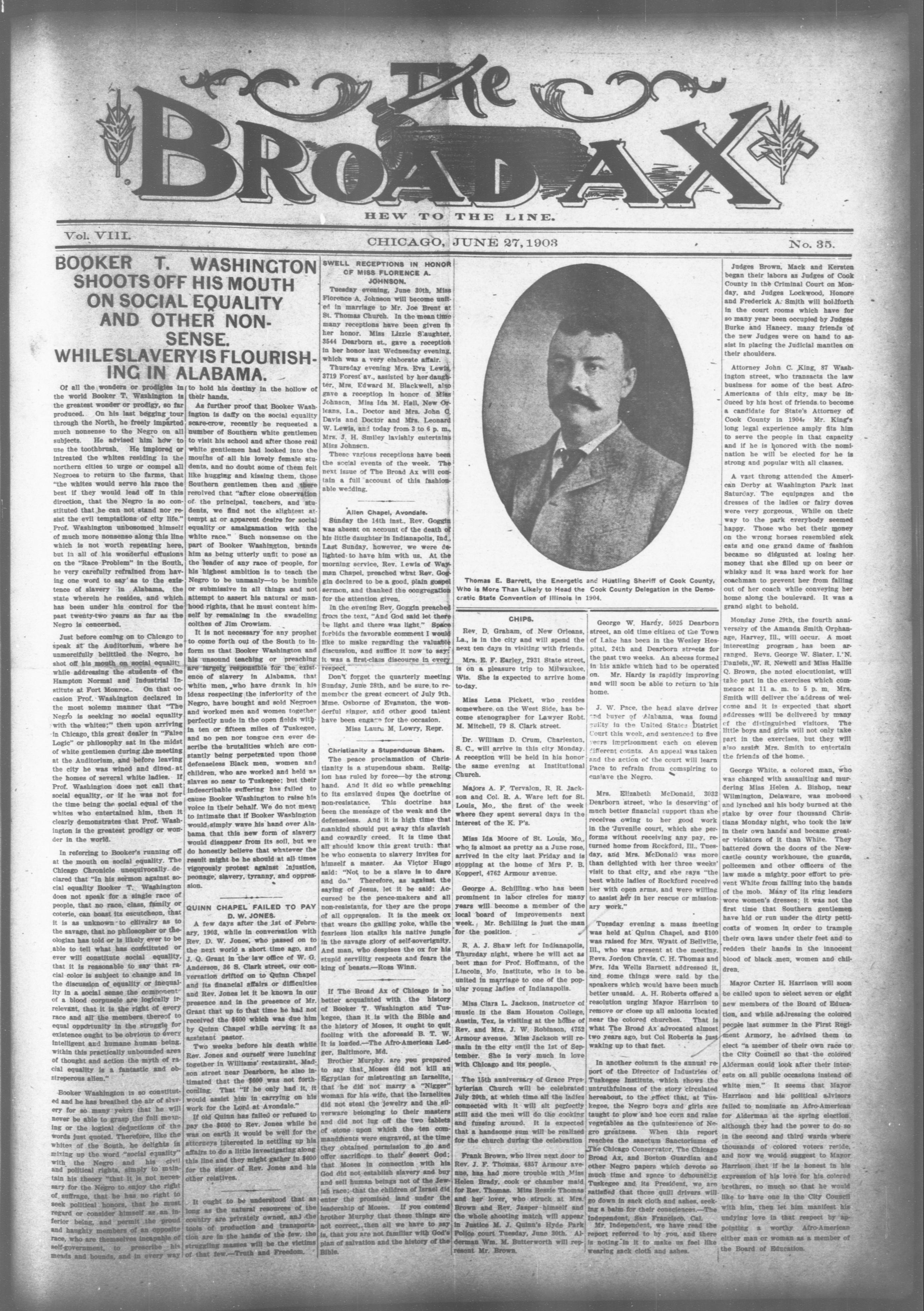
Thomas E. Barrett, the Energetic and Hustling Sheriff of Cook County, Who is More Than Likely to Head the Cook County Delegation in the Democratic State Convention of Illinois in 1904.
CHIPS.
Rev. D. Graham, of New Orleans, La., is in the city and will spend the next ten days in visiting with friends.
Mrs. E. F. Earley, 2931 State street, is on a pleasure trip to Milwaukee, Wis. She is expected to arrive home to-day.
Miss Lena Pickett, who resides somewhere on the West Side, has become stenographer for Lawyer Robt. M. Mitchell, 79 S. Clark street.
Dr. William D. Crum, Charleston, S. C., will arrive in this city Monday. A reception will be held in his honor the same evening at Institutional Church.
Majors A. F. Tervalon, R. R. Jackson and Col. R. A. Ware left for St. Louis, Mo., the first of the week where they spent several days in the interest of the K. P's.
Miss Ida Moore of St. Louis, Mo., who is almost as pretty as a June rose, arrived in the city last Friday and is stopping at the home of Mrs P. B. Kopperl, 4762 Armour avenue.
George A. Schilling who has been prominent in labor circles for many years will become a member of the local board of improvements next week. Mr. Schilling is just the man for the position.
R. A. J. Shaw left for Indianapolis, Thursday night, where he will act as best man for Prof. Hoffmann, of the Lincoln, Mo. Institute, who is to be united in marriage to one of the popular young ladies of Indianapolis.
Miss Clara L. Jackson, instructor of music in the Sam Houston College, Austin, Tex, is visiting at the home of Rev. and Mrs. J. W. Robinson, 4752 Armour avenue. Miss Jackson will remain in the city until the 1st of September. She is very much in love with Chicago and its people.
The 15th anniversary of Grace Presbyterian Church will be celebrated July 20th, at which time all the ladies connected with it will sit perfectly still and the men will do the cooking and fussing around. It is expected that a handsome sum will be realized for the church during the celebration
Frank Brown, who lives next door to Rev. J. F. Thomas, 4857 Armour avenue, has had more trouble with Miss Helen Brady, cook or chamber maid for Rev. Thomas. Miss Bessie Thomas and her lover, who struck at Mrs. Brown and Rev. Jasper himself and the whole shooting match will appear in Justice M. J. Quinn's Hyde Park Police court Tuesday, June 30th. Alderman Wm. M. Butterworth will represent Mr. Brown.
George W. Hardy, 5025 Dearborn street, an old time citizen of the Town of Lake has been in the Wesley Hospital, 24th and Dearborn streets for the past two weeks. An abcess formed in his ankle which had to be operated on. Mr. Hardy is rapidly improving and will soon be able to return to his home.
J. W. Pace, the head slave driver and buyer of Alabama, was found guilty in the United States District Court this week, and sentenced to five years imprisonment each on eleven different counts. An appeal was taken and the action of the court will learn Pace to refrain from compiring to enslave the Negro.
Mrs. Elizabeth McDonald, 3032 Dearborn street, who is deserving of much better financial support than she receives owing to her good work in the Juvenile court, which she performs without receiving any pay, returned home from Rockford, Ill., Tuesday, and Mrs. McDonald was more than delighted with her three weeks' visit to that city, and she says "the best white ladies of Rockford received her with open arms, and were willing to assist her in her rescue or missionary work."
Tuesday evening a mass meeting was held at Quinn Chapel, and $100 was raised for Mrs. Wyatt of Bellville, Ill., who was present at the meeting. Revs. Jordon Chavis, C. H. Thomas and Mrs. Ida Wells Barnett addressed it, and some things were said by the speakers which would have been much better unsaid. A. H. Roberts offered a resolution urging Mayor Harrison to remove or close up all saloons located near the colored churches. That is what The Broad Ax advocated almost two years ago, but Col Roberts is just waking up to that fact.
In another column is the annual report of the Director of Industries of Tuskegee Institute, which shows the untruthfulness of the story circulated hereabout, to the effect that, at Tuskegee, the Negro boys and girls are taught to plow and hoe corn and raise vegetables as the quintessence of Negro greatness. When this report reaches the sanctum Sanctoriums of The Chicago Conservator, The Chicago Broad Ax, and Boston Guardian and other Negro papers which devote so much time and space to dehouncing Tuskegee and its President, we are satisfied that those quill drivers will go down in sack cloth and ashes, seeking a balm for their consciences.—The Independent, San Francisco, Cal.
Mr. Independent, we have read the report referred to by you, and there is noting in it to make us feel like wearing sack cloth and ashes.
No. 35.
Judges Brown, Mack and Kersten began their labors as Judges of Cook County in the Criminal Court on Monday, and Judges Lockwood, Honore and Frederick A: Smith will holdforth in the court rooms which have for so many year been occupied by Judges Burke and Hanecy, many friends of the new Judges were on hand to assist in placing the Judicial mantles on their shoulders.
Attorney John C. King, 87 Washington street, who transacts the law business for some of the best Afro-Americans of this city, may be induced by his host of friends to become a candidate for State's Attorney of Cook County in 1904. Mr. King's long legal experience amply fits him to serve the people in that capacity and if he is honored with the nomination he will be elected for he is strong and popular with all classes.
A vast throng attended the American Derby at Washington Park last Saturday. The equipages and the dresses of the ladies or fairy doves were very gorgeous. While on their way to the park everybody seemed happy. Those who bet their money on the wrong horses resembled sick cats and one grand dame of fashion became so disgusted at losing her money that she filled up on beer or whisky and it was hard work for her coachman to prevent her from falling out of her coach while conveying her home along the boulevard. It was a grand sight to behold.
Monday June 29th, the fourth anniversary of the Amanda Smith Orphanage, Harvey, Ill., will occur. A most interesting program, has been arranged. Revs. George W. Slater, I.'N. Daniels, W. R. Newell and Miss Hallie Q. Brown, the noted elocutionist, will take part in the exercises which commence at 11 a. m. to 5 p. m. Mrs. Smith will deliver the address of welcome and it is expected that short addresses will be delivered by many of the distinguished visitors. The little boys and girls will not only take part in the exercises, but they will also assist Mrs. Smith to entertain the friends of the home.
George White, a colored man, who was charged with assaulting and murdering Miss Helen A. Bishop, near Wilmington, Delaware, was mobbed and lynched anl his body burned at the stake by over four thousand Christians Monday night, who took the law in their own hands and became greater violators of it than White. They battered down the doors of the Newcastle county workhouse, the guards, policemen and other officers of the law made a mighty poor effort to prevent White from falling into the hands of the mob. Many of its ring leaders wore women's dresses; it was not the first time that Southern gentlemen have hid or run under the dirty petticoats of women in order to trample their own laws under their feet and to redden their hands in the innocent blood of black men, women and children.
Mayor Carter H. Harrison will soon be called upon to select seven or eight new members of the Board of Education, and while addressing the colored people last summer in the First Regiment Armory, he advised them to elect "a member of their own race to the City Council so that the colored Alderman could look after their interests on all public occasions instead of white men." It seems that Mayor Harrison and his political advisors failed to nominate an Afro-American for Alderman at the spring election, although they had the power to do so in the second and third wards where thousands of colored voters reside, and now we would suggest to Mayor Harrison that if he is honest in his expression of his love for his colored brethren, so much so that he would like to have one in the City Council with him, then let him manifest his undying love in that respect by appointing a worthy Afro-American either man or woman as a member of the Board of Education.
THE BROAD AX
Will promulgate and at all times uphold the true principles of Democracy, but Catholics, Protestants, Priests, Infidels, Farmers, Single Texers, Republicans, Knights of Labor, or any one else can have their say, so long as their language is proper and responsibility is fixed.
The Broad Ax is a newspaper whose platform is broad enough for all, ever claiming the editorial right to speak its own mind.
Local communications will receive attention. Write only on one side of the paper.
Subscriptions must be paid in advance.
One Year..... $2.00
Six Months..... 1.00
Advertising rates made known on application.
Address all communications to
JULIUS F. TAYLOR, Editor and Publisher.
Entered at the Post Office at Chicago, Ill, as Second-class Matter.
OF INTEREST TO WOMEN.
The condition of the Japanese woman, says Mr. Masujima before the New York bar, is fully as favorable to her development as that of the woman of America.
Miss Natica Reeves, a wealthy young sojourner in Newport, appeared on the street there a few days ago with ribbon-bound hair hanging down her back Some other young women of the swell set followed suit and the style bids fair to become general for the hot weather.
Mme. Mathilda Georgina Roberty, of Rouen, has started a campaign against the destruction of bird life for millinery purposes. She has inaugurated a Ladies' Bird Protective association, the members of which are to defy the Parisian fashions and she appeals to Americans interested in the same movement to send her statistics dealing with this "mouvement humain."
Mrs. Stuyvesant Fish has such an assured place in society, that she does not hesitate to tell of her husband's early struggles with the world. In fact, she is rather fond of doing so. While in Nice last spring she related at a dinner party how Mr. Fish worked his way up to the presidency of the Illinois Central railroad. A German princeling who was among the guests remarked, with just a trace of a sneer: "I had always heard that your husband came from a fine family." Mrs. Fish met this thrust with perfect good nature. "Oh, yes, he does. But you see in America it is not a disgrace to work. How much better it would be if these conditions prevailed in Europe. We in America would be spared so many titled non-entities."
DEBITS AND CREDITS.
A deed absolute in form is held, in First national bank vs. Sargent (Neb.), 59 L. R. A. 206, to be properly treated as a mortgage when it is given to secure payment of a debt, although the parties may have agreed that upon default of payment the deed shall become absolute.
The entry of a judgment setting aside in favor of creditors a voluntary deed is held, in Steinmeyer vs. Steinmeyer (S. C.), 59 L. R. A., 319, to change the ownership of the grantee from sole and unconditional within the meaning of a policy of insurance in his favor, which is to be void in case he has not such ownership.
Directors of an insolvent manufacturing corporation are held, in Nappanee Canning company va. Reid, M. & Co. (Ind.), 59 L. R. A. 199, to be entitled to apply its assets to their own unsecured claims against it, and to its obligations upon which they are individually liable, although the result is to deprive persons who have contracted with it of any remedy for breach of its contracts.
Land held by a debtor and his wife by entireties, is held, in Laird vs. Perry (Va.), 59 L. R. A., 340, to pass, except her right of survivorship, by his assignment of all his estate, real and personal, for the benefit of creditors, under statutes making everything pass which might be taken in execution against him, but providing that neither the wife's separate property nor its products shall be liable for his debts.
SQUIBS FROM ABROAD.
Antiseptic toothpicks, warranted free of germs, are being supplied by the large hotels and restaurants in London. Great Yarmouth, England, has the narrowest street in the world. It is Kitty Witches, which is only 55 inches wide. You can lean out of your window and shake hands with your neighbor across the street. Through the carelessness of a workman the valuable collection of busts and skulls—once the property of Gall, the founder of phrenology—in the museum of Baden, near Vienna, has been seriously damaged.
The whole northern part of Asia Minor, according to the treaty between Russia and Turkey, is now placed under such conditions that Russian capitalists have the area open to them to the exclusion of foreign enterprises. A situation analogous is found in Persia, where the entire northern portion is acknowledged to be under the exclusive economic influence of Russia.
The floating gardens in the lakes near the City of Mexico were recently visited by an English naturalist, who reports them a paradise and accounts for their existence. Floating tangles of peat moss, rushes and grass are caught by stakes driven into the soft lake bottom, and upon this mass rich mud from the bottom is thrown. The surface is then transformed into a market garden.
PURELY PERSONAL
William Winter, dean of New York dramatic critics, said recently of Jefferson's Rip: "The secret of its supremacy is not obscure. It has bewitched the world for the simple reason that it has successfully applied the method of poetic treatment to common things. That is easily done—when you happen to be able to do it—but you will not accomplish it unless you were born with the faculty of the poet."
W. S. Gilbert, formerly of Gilbert and Sullivan comic opera fame, wrote as follows to a London newspaper recently: "There is a line in your issue of May 15 that must have sent a thrill of joy through many a worthy home. I refer to the line in an article headed 'A Naval Battle,' in which I am referred to as the 'late W. S. Gilbert.' I am always sorry to spoil sport, but common candor compels me to admit (reluctantly) that I am still alive."
Louis Hasselriis, the Danish sculptor, will make the statue which is to commemorate the three hundredth anniversary of the first printed edition of "Hamlet." Danish scholars and literati took the lead in the movement for a monument to Shakespeare, which will be erected in or near Elsinore. Queen Alexandra of England, a Dane by birth, has taken a deep interest in the project, and other royalties, including her parents, are also giving aid.
James McNeill Whistler's portrait of Carlyle is owned by the corporation of Glasgow. Shortly after it was finished a committee from the corporation visited Mr. Whistler, intending to purchase the wonderful painting. They wanted to know about the price, which the artist had announced as 1,000 guineas. "Didn't you know the price before you came here?" asked Whistler, blandly. "Oh, yes, we knew, but—" "Then let's talk about something else," interrupted Whistler. The canny Scots bought the picture and—trust them—got a bargain.
When President Roosevelt was in Sharon Springs, Mo., a countryman stepped up and said to a member of the president's party: "Whar's the president?" Mr. Roosevelt, scenting something good, said: "Do you wish to see him particularly?" "I never seen but one president in my life, an', of course, I would like to see him on gin'ral principles," replied the countryman. "But what I want to see this one fur mos' particular is to see if he's got them squirrel teeth the papers say he has." And then and there the president displayed his "squirrel" teeth in the broadest of grins. "Gosh, ter blazes, you're the feller," said the man, as he hurried away.
SMILES FOR THE SEASON.
"Markley tells me he follows the races." "That's the gospel truth. He never gets ahead of them."—Philadelphia Ledger.
They Didn't Stay Long.—"How long have you kept summer boarders?" "I believe the average is two and a half days."—Town Topics.
Question of Orthography.—Jack—"Say, let's get married." Maude—"I will not." Jack—"How do you spell that not—with or without a k?"—Chicago Daily News.
Summer Boarder—"I thought your advertisement said something about boating?" Farmer—"Oh, yes. We have a boat and oars—only sometimes the creek dries up."—Town and Country.
Pride.—"How was Ethelinda's graduation essay?" "Beautiful," answered the proud mother. "We spared no expense in ribbons to bind it, and I have no hesitation in saying it was the most becoming essay in the class."—Washington Star.
The Briber.—"Say, mister," began the urchin with the soiled cheeks, "are yer de man dat's going to put up de baseball fence?" "Yes, sonny," responded the big builder. "What can I do for you?" "W—will yer accept a bribe?" "A bribe?" "Yes, der Goose Hill gang will club in an' give yer one bone to pick out planks wid knotholes in dem."—Chicago Daily News.
A BUDGET OF FACTS.
A German scientist who has spent eight years in Patagonia says that Patagonians will soon be extinct.
In a layer of sea water a mile square and 600 feet deep there are 16 tons of chalk.
The only piece of radium in existence is a thin sheet about an inch square. It was extracted from several tons of barium salts, at a cost of £400.
The anti-diphtheria serum discovered by Prof. Roux, of the Pasteur institute, is now being-made in the form of lozenges for use during convalescence. The professor had observed that bacilli found in the mouths of patients several weeks after recovery were liable to convey the disease to others. The lozenges overcome this, and also render preventive inoculation unnecessary.
THINGS NICE GIRLS NEVER DO.
Do not turn their heads to look after impertinent men.
Do not write silly letters to young men or permit them to write such letters.
Do not get into the habit of speaking familiarly to all the men they know.
Do not direct their conversation to one person when several visitors are present.
Do not imagine that every man who is pleasant to them has fallen in love with them.
The nice girl does not talk and laugh loudly when traveling or in any public place where she may attract attention Chicago Tribune
MADE TRIP ON SNOWSHOES. Early Minnesota Legislators Had a Hard Time Reaching the State Capital.
The members of the Minnesota legislature of to-day are not content with their lot unless they can journey to St. Paul, the capital, in the most palatial of railway carriages, says a Minneapolis exchange. Fifty years ago last January, when the legislature assembled, some of the members from the extreme northern counties were sadly disappointed. They had hoped to walk into the new capitol, select their seats and enjoy the pleasures incident to the first occupancy of that structure. Their homes were so far removed from the capital and the means of communication during the winter months so poor as to practically isolate them, hence they had not been able to keep in touch with the situation and did not know that the capitol was still unfinished. Three of them—Rolette, Kittson and Gingros, of the county of Pembina—had come the entire distance on snowshoes and several had taken desperate chances of death by blizzards or hungry timber wolves. Several members of that legislature were afterward distinguished for their ability as debaters and shrewd politicians and most of them had a hand in forming the great commonwealth now called the "bread and butter state."
ENGLISH DISDAIN PEANUTS.
In Their Eyes the Toothsome Goober Is Fit Only to Be Fed to Swine.
Over in England they call the peanut "ground-nut" and "ground-bean," says the New York Press. In British eyes it is fit only for pigs. It is met with occasionally in fruiterers' shops, but never in push carts, as in this country. A British encyclopaedia says: "In the southern states of North America the seeds, or nuts, as they are called, are roasted and used as chocolate. They are a favorite article of food with the negroes." Georgians are called "goober grabbers" throughout the south. Many a farmer has grown rich on the humble peanut, the annual product being worth $10,000,000. Some persons try to belittle the goober. A lawyer, examining a witness in an important case, one whose testimony was conclusive, undertook to ridicule him. "You are a business man, I believe?" "Yes." "What is your business?" "I deal in peanuts." The lawyer smiled knowingly at the jury. "A peanut vender, eh? How many pints did you sell last month?" "I hardly know. A million, possibly." "What! A million?" "I handle about half a million bushels a year. I am a wholesale dealer." The lawyer sat down with the laugh turned on him.
FEW ALIENS IN SCOTLAND.
Scotland, according to the latest returns, is not a dumping ground for aliens, says the London Chronicle. Only 1.033 per cent. out of a population of 4,472,1663 are aliens. The number of English-born persons north of the Tweed, if transferred to London, would be hardly noticed. They number only 131,350, or 2.937 per cent. Irish people, on the other hand, aggregate 205,064, or 4.585 per cent., and patriotic Scots, backed up by police statistics, charge this remnant and their connections with committing 50 per cent. of the crimes annually recorded on the far side of the Cheviots.
Welshmen seem to shun Scotland, as only 2,673 were found there when the census enumerators came round. Marriage is popular to the extent of 46,777 per cent. of males over 15 years of age, and fair womankind is appreciated to the extent of 44,277 per cent.of like ages. While the widowers number 72,741, the widows total no fewer than 175,405, which bears out the truth there lies in the now neglected ballad of "Three Women for Every Man."
MAKING ENGLISH WORSE.
Foreigners Have Enough Trouble Over It Without These Mistakes Being Made.
Foreigners are always complaining, and not without reason, at the difficulties of the English language. This is quite natural, considering how very different our pronunciation is from our spelling, but what must to them appear to be gratuitously adding insult to injury is the entirely opposite meanings some common words possess in different localities, says London Gentlewoman.
In the eastern counties particuluarly, many words are misleading. For instance, "there were several there" means not just a few, but a great number; a "shy girl" is a bold one; and some of the verbs do double duty with absolutely opposite meanings, notably that of "to learn."
I will quote an instance gleaned from this morning's local daily paper: 'Situation required as underhousemaid, or where lady is willing to learn. Good references.—Apply,' etc. The advertiser was quite innocent of any impertinence. She meant "where lady is willing to teach!"
Perhaps the most curious means of communication in the world is the drum language of a Congo tribe. These queer people can talk to each other with large drums made of bamboo hoops, over which the skin of some animal is stretched. The drum, however, is used only on important occasions.
AN OCEAN PATROL.
Project of an English Ship Builder to Provide a Unique Sea Service.
One English ship builder is furthering a project which, it carried through, will be the means of much saving of life and property in mid-ocean. He calls it the International Blue Cross Ocean Life and Salvage service. It is meant to take the place of the Red Cross in the army, says the New York Herald.
It will consist of a fleet of ten lifeboats and one storeboat to patrol the north Atlantic along the line of travel of the great ocean steamers. The aim is that of saving vessels and crews in distress. They will have a regular schedule of time, which will be sent to all captains of vessels, so that in case of wreck or fire or disablement the officers will know at what exact date and point a Blue Cross boat may be expected, and much may be done to save both life and money.
The salvage is to go to the respective governments which fitted the fleet out in proportion to their shipping tonnage. He expects the various nations who have much traffic on the high seas to appropriate sums necessary to the complete outfitting of the boats and crews. The project seems to have met with approval in high places, and ere long we may expect the Blue, as well as the Red, Cross to the rescue of human lives in danger.
WHERE FLAG FIRST WAVED.
Memorial to Be Erected on Famous Revolutionary Hill in Somerville, Mass.
Work will soon begin on the erection of a memorial observatory on the top of historic Prospect hill, Somerville, a sum of money having already been set aside by Mayor Glines for the carrying out of such a purpose, says the Boston Post of recent date. Prospect hill is noted for the prominent part it took in the revolutionary war and it was from the top of this hill that the first American flag was thrown to the breeze.
The observatory is to take the form of a tower and will closely resemble an old English castle. Situated upon the now unoccupied mound, which has been allowed to remain on the Munroe street side of the parkway, it will greatly add to the artistic beauty of the spot.
The tower will be 45 feet high. The top will be flat and protected to a height of four feet by a parapet, with iron gratings in the embrasures, and will afford a view that cannot be equaled in Boston. The walls of the tower will be of rough granite and will be 30 feet in diameter. Two rooms will be set apart for the exhibition of historic relics and souvenirs. The structure from the second floor will be hexagonal in shape, resting on six columns. The cost of the tower is estimated to be about $6,000.
CAUSE OF FLAT WHEELS
Brakemen Put on the Brakes Too Suddenly and Start the Trouble.
"Flat wheels," growled the old railroad brakemen, as the trolley car in which he sat went thumping along at 12 miles an hour, shaking the passengers uncomfortably at every revolution of the wheels, relates the New York Times.
"What makes flat wheels?" asked the man sitting next the old brakeman.
"Darn fools," said the brakeman. "It's this way: If a man doesn't know how to stop his car he makes a flat wheel. On the steam roads some brakemen flatten a wheel every time they put on the brakes. When the wheel suddenly stops revolving and the momentum of the train carries it on, the wheel slides along the track and a flat is started. Next stop, perhaps, makes it worse, and so the thing goes until the wheel is no good. If a brakeman knows his business he need never make a flat wheel unless he has to stop suddenly to avoid an accident. If he keeps his wheels turning slowly they don't flatten. Now, these fellows on the trolleys take no care at all, and every other car in some places has a flat wheel."
Floating Academy.
An indication of a new tendency in scientific study is furnished by the plan of the Geographical society of Baltimore to send this summer to the Bahama islands a ship carrying a staff of 50 persons, who will study the geology, geography, botany, zoology, climatology, physics and medical and hygienic conditions of those islands. The ship, specially chartered for the purpose, will be fitted and equipped as the home and laboratory of the party during the entire trip.
A Sizable Suit
At Stamford, England, recently a suit of clothes which belonged to Daniel Lambert, the Leicestershire giant, was offered by auction. Lambert was the most corpulent man of his generation and weighed upward of 700 pounds. Gen. Tom Thumb once walked through the arm of his coat. The bidding reached $375, at which figure the lot was withdrawn.
Ireland is determined to be in the front in dairying. It is devising new methods for interesting those engaged in it. One of the best agencies to be employed is that of surprise butter competitions. The object is to encourage the making of good butter and careful packing.
Pretty Hard Water.
"They say that the English language is the most difficult of any for a foreigner to acquire," said the lady who was pouring the tea, "especially on account of its many idiomatic perplexities. I have a neighbor, a dear little girl, who would say the same if she were able to express her opinions in words.
"The other day I said to her: 'Is the water where you live hard or soft, Jennie?' Quick as a wink came the surprising answer:
"'Oh, I guess it's awfully hard, for I spilt some on a lamp chimney last night and it broke all to pieces!'"—N. Y. Times.
No Relief.
If vegetarians held sway
Meat wouldn't be so dear as now.
But then some trust would corner hay
And keep us guessing anyhow.
-Washington Star.
BETTER LEFT UNSAID.
Lady Visitor. (who has been shown down a rather intricate staircase by her host)—So very kind of you to show me the way out. The Host—Not at all. Pleasure, I assure you.—The King.
Natural History
Alone in the hills the couple strolls
And multiplied kisses he seeks.
"There's none' to see," he swears; but she
Cries: "Oh, but the mountain peaks!"
-Pelican.
In Doubt.
"He seems to be a very good husband," said the thoughtful young woman. "Yes," said Miss Cayenne; "but it's always difficult to determine whether a man is a good husband or whether his wife is too much of a lady to talk about him."—Washington Star.
Between Friends.
"He's so foolish," said the one in white.
"Foolish!" returned the one in gray.
"Yes. Why, he wants me to marry him."
"Oh, then he is foolish."—Chicago Post.
By Its Teeth
"You don't seem to be afraid of our dog," said the farmer's wife. "No, ma'am," replied the tramp. "I'm attached to dogs, I am, an'—"
"Well, you'd better skip pretty quick or this one will be attached to you."— Philadelphia Ledger.
Self-Sacrifice
The Mistress—But what made you leave Mrs. Smythe so suddenly, Maria? The Maid—Oh! Me an' er 'usband couldn't agree, so I thought it best to send in my resignation at onct. It come to the pint where one of us 'ad to go.—Brooklyn Life.
An Affinity.
"Oh, you cannibal!" she exclaimed.
"Did you know I am a grass widow?"
—N. Y. Times.
A Great Truth.
"That's a splendid perfume," she said, as she soused her handkerchief.
"Yes," admitted her brother, "but in some lines it is better to do a retail than a wholesale business."—Chicago Post.
Why They Liked Her.
Ida—She is very popular with the young people.
May—But I hear she sits with her back toward them.
Ida—That is why they like her. She is the chaperon.—Chicago Daily News.
Inspector Casey—I saw a woman pass a milliner shop to-day without stopping to look in the window.
Chief Millikin—Poor thing; blindness is a terrible affliction, isn't it?—Cincinnati Enquirer.
They Don't Speak Now.
Clara—How well you looked at the fancy ball!
Maud—Think so?
Clara—Oh, yes. You had on such a becoming mask—Town Topics.
Almost Impossible.
"Dear me! I don't know which of these hats to choose."
"Ah, mademoiselle,zet ees verre difficult to decide when zey are all ze same price."—Chicago American.
Madge—That artist didn't make a very lifelike picture of her.
Marjorie—She should have supplied him with some of the same paint she uses herself.—N. Y. Herald.
Woman's Way.
Her Brother—I wouldn't have much to do with Dashdash if I were you—he is a mere excuse for a man.
She—But a poor excuse is better than none.—Judge.
They Do Them Brown.
"What do men do when they get in the legislature, pop?"
"Why, they do corporations, my son."—Yonkers Statesman.
Justifiable Excuse. "I must have been born under an unlucky star," said the angry wife, whose request for a new bonnet had just been vetoed. "I could have married either Jones or Brown before I met you, and to-day they are both millionaires, while you have nothing." "Yes, my dear,' replied the patient other half of the sketch, "but you should remember that Jones and Brown are still in the bachelor class, while I have had you to support all these years."—Chicago News.
His Architectural Apology
"You awkward boor!" exclaimed the angry woman in the seat, replacing her headgear.
"I beg your pardon, ma'am," said the passenger in the overalls. "When the car turned the corner I grabbed the front cornice of your hat to save myself, without noticing what I was doing, but I certainly didn't intend to unroof you."—Chicago Tribune.
Woman's Narrowness
Mrs. Buttercup—I wish I had a million dollars.
Mr. Buttercup—Thunderation, woman, haven't you any business acumen?
What do you want to stop at a paltry million for when you can wish for a hundred million just as easily and with just as much prospect of getting it? No wonder we are poor.
—Kansas City Journal.
After the Discount.
"Ef you please, suh," said the Georgia darky, "how much fer a marriage license en a divorce dockiment?"
"A marriage license and divorce document?"
"Yes, suh. I been studyin' bout glittin' married, en I 'lowed dat ef I got de two tergether dey'd come cheaper!"—Atlanta Constitution.
Home. Sweet Home.
Mrs. Chugwater—So that's the photograph you had taken the other day, is it? I'd like to know why you can't look as pleasant as that when you are in the house?
Mr. Chugwater—Well, it may be that the photographer tried to bring out my pleasant expression, and you don't.—Tit-Bits.
One of Many.
Smith—Was Green's scheme a success?
James—That depends on the point of view.
Smith—How's that?
Jones—Well, as a success it was a failure, but as a failure it was a success—Cincinnati Enquirer.
No Cause to Worry.
"I see," said the landlady. "that a Washington scientist has discovered that strawberries make people commit suicide."
"Never mind," replied the star boarder, "your conscience will never have a chance to trouble you on that score."—Chicago Record-Herald.
The Point of View
"Why did you have your automobile painted that hideous yellow color, Mr. Packerson?"
"Hideous? That's the most beautiful color in the world. It's the tint that has made our firm's hams famous on two continents."—Chicago Record-Herald.
Knew the Cook
Gunner—I hear that you recommended your cook to Wilderman. Did you do it as a favor? Guyer—No; as a grudge.—Chicago Daily News.
Truly Feminine
"But why do you cry?" they asked.
"Because," replied the little one,
"I've learned that that's the easiest way to get what I want."—Brooklyn Eagle.
Asked and Answered.
"Why do I live?" the poet wrote,
And the editor made reply:
"You sent your poem in by mail—
That is the reason why."
—Cincinnati Enquirer.
A
Kind Father—My dear, if you want a good husband, marry Mr. Goodhart. He really and truly loves you.
Daughter—Are you sure of that, pa?
Kind Father—Yes, indeed. I've been borrowing money of him for six months, and still he keeps coming.—Judy.
Ring Out the Old.
She wrung her hands,
I hate to tell
This joke on
The village belle.
—Pennsylvania Punch Bowl.
Beasley—These workingmen are like so many matches.
Burr—Matches?
Beasley—Yes; always ready to strike."—Yonkers Statesman.
Naturally.
The Student—That fellow has his work cut out for him.
The College Man—What fellow?
The Student—My tallor.—Harvard Lampoon
Methods of Securing Appointments
Fifty Years Age and Now—
Public Men Who Are of More
Than Passing Interest.
Washington.—In looking through
some old files at the post office depar-
ment the other
day Mr. Nicholson,
the appointment
clerk, came across
a bunch of old
letters which have
proved to be a real
mine of interest.
I want these
money offers
but
the law
The files had been stored away in a coal bin and had not their value been discovered it would not have been long before they were burned.
as nobody suspected that they were anything but departmental trash. Among them were autograph letters of recommendation from famous public men dating back 40 years—to the time when public men were in the habit of devoting a good share of their time to recommending constituents to office and when they would pen elaborate testimonials to the heads of departments.
That sort of thing has gone out of date since the civil service commise' came into existence and the clerical places in the departments were gathered into the classified service.
There are letters from Roscoe Conkling, Horace Greeley, Charles Sumner and James A. Garfield. There is a letter recommending the appointment of the first woman who ever had a position in the department and one of the first who ever received an appointment in the government service. Most of them were addressed to Horatio King, who was postmaster general under Buchanan for a few weeks before Lincoln came in and to Montgomery Blair, who was Lincoln's postmaster general.
The striking thing about all of the letters is the peremptory tone in which they are couched and the air of proprietorship with which men not connected with the department demanded the privilege of naming the members of the clerical force. Such letters would receive scant courtesy now from any cabinet officer; but, as a rule, in 1861 they seem to have prevailed.
Justice Harlan Plays Golf. Justice Harlan, the justice of longest service on the supreme bench, has just passed his seventh birthday, which qualifies him for retirement on full pay -if he cares to.
GOLF
The sturdy old justice, however, has no idea of retirement, and from all appearances he will still be dispensing robust law for 20 years for he has
years, for he has This is a Disease. all the physical and mental vigor of a man of 50. Harlan was appointed to the bench by President Hayes, and it was said at the time that he secured his appointment by reason of his service as a visiting statesman in Louisiana during the days when the election of Hayes was trembling in the balance. Be that as it may, nobody has ever questioned the honesty and ability of his course as justice, and he has always been regarded as one of the strong men on the bench.
He has always had an inclination towards politics of the stalwart kind, and his friends say the presidential bee has buzzed persistently in his bonnet. Yet, in all his three score years and ten, he has never held an elective office. That has been a source of great grief to him. If he were to retire from the bench the only temptation would come from a sure prospect of being elected to something, no matter how small.
Harlan is a great pedestrian and a devoted player of golf. He walks every day five or six miles, and it is a rare day that fails to see him on the Chevy Chase links. It was Harlan who first characterized golf as a disease not a game; and he is qualified to judge. Last summer he went up to Canada with a trunk full of cases which he had promised himself to study and complete before his return for the fall term. He began playing golf the first day and he came home without once opening the trunk.
The Christian Lobby.
Wilbur F. Crafts, the "Christian Lobbyist," as he calls himself, is going
A man in a coat and top hat holding a book.
to establish headquarters in Washington from which he will be able to control more effectively the numerous projects for reform which he makes it his business to advance. He has bought a lot of land just opposite the capitol where he is going
The Christian Lobayist, to build an auditorium, an office building and a temperance hotel. The office building will be equipped with printing presses, clerks, editors and the entire outfit needed for the Craft propaganda; the auditorium will be given up to daily lectures for
the regeneration of society, with talks by Mr. Crafts and other reformers against gambling, intemperance, the social evil and every other kind of uncleanness. The hotel will be the resort of reformers of all sorts, who will crowd into Washington when congress is in session to lay their various schemes before the law.
Crafts expects to have a very busy winter of it. He will have on hand the case of Apostle Smoot, whose presence in the senate is objectionable to a great many people, and he will have to conduct the agitation against establishing an opium monopoly in the Philippines, which is just beginning to attract attention. Then he will have on hand his usual batch of measures for regenerating congress and purifying every other department of the government.
Crafts has developed his Christian lobby into a regular and flourishing business. He is responsible for nineteenths of the petitions which are sent into congress, encouraging the petition industry by sending out countless circulars and blanks to religious and temperance organizations all over the country. These printed petitions pour into congress by the million and they never receive the slightest attention; for their artificial character is understood.
That Tom Reed had made money enough to retire on and live in comfort
was known by his intimate friends some time before his death, but few of them had any idea of the extent of his earnings during the brief period of his law practice in New York. It remained for the inventory recently published to show
intimate friends some time before his death, but few of them had any idea of the extent of his earnings during the brief period of his law practice in New York. It remained for the inventory recently published to show that he was possessed of nearly half a million dollars clear of all indebtedness when he died
clear of all indebtedness when he died.
When Reed retired from congress he was a poor man. If he had died then his widow would have been left with the old-fashioned house in Portland—and that is about all; for he lived fully up to his income ever since he had been in Washington.
As speaker he had a salary of $8,000. As consulting counsel for the National Board of Fire Underwriters he had an annual income of about $1,500. For occasional magazine articles he received $500 apiece; and he may have averaged four of these a year. A liberal estimate of his income was $12,000, for he had practically no law practice while in congress. Every cent of this went to the cost of existence in Washington; although Beed never lived extravagantly and had simple tastes.
He no sooner arrived in New York than the rich men with whom he associated began to put him into things, and under their guidance he bought stocks surely and conservatively. It would not have surprised some of his friends if his estate had inventoried a million dollars; but the general understanding was that he left about $200,000.
Reed was longing to get back to Washington. New York always seemed to him like a huge mining camp—a place to make money, and nothing else. Had he lived another week he would have had his family settled in Washington, and he was prepared to enjoy thoroughly an irresponsible leisure. But fate ordained that it should not be.
Where Statesmen Ent.
One of the most extraordinary institution in Washington is the quick
extraordinary instigton is the quick lunch counter just opposite the treasury department on Fifteenth street.
A
The place has been in existence for a dozen years and it has all the characteristics of the earliest dairy lunches an unlimited quantity of simplest kind of food—sandwiches, milk and pie and an equally unlimited amount of
The Statesman's Exchange. an equally unlimited amount of dirt. It is commonly known among its habitues as "the Hog Trough" and the "Quick and Dirty."
It is a mint for its proprietors. Every customer picks out his own sandwich or pie, and pays for it as he sees fit. There is absolutely no check to prevent his walking out without paying if he sees fit. The personnel of the establishment consists of three or four men behind the counter who draw coffee and milk, two proprietors who take in change, and a nondescript who walks around with a rag picking up soiled mugs and wiping off the chair seats.
Yet a greater number of distinguished public men probably patronize this place than any other eating establishment in America. At almost any time in the middle of the day one is sure to find some high government official, a senator, a congressman and occasionally a member of the cabinet. It is in the nature of a news exchange where all sorts of public questions are talked over, and where any number of political schemes are suggested.
It would be hard for a millionaire to spend more than 15 cents in the establishment, and nobody ever thought of such a thing as trying to beat it out of a lunch. It is frequented not only by officials near at hand, but by those who, like Public Printer Palmer, have to drive a mile and a half in their carriages to foregather there every noon. It is a striking example of what can grow out of an acquired habit.
grow out of an acquired habit.
LOUIS A. COOLIDGE
BARBARA FRIETCHIE AND HER FAMOUS FLAG.
```markdown
```
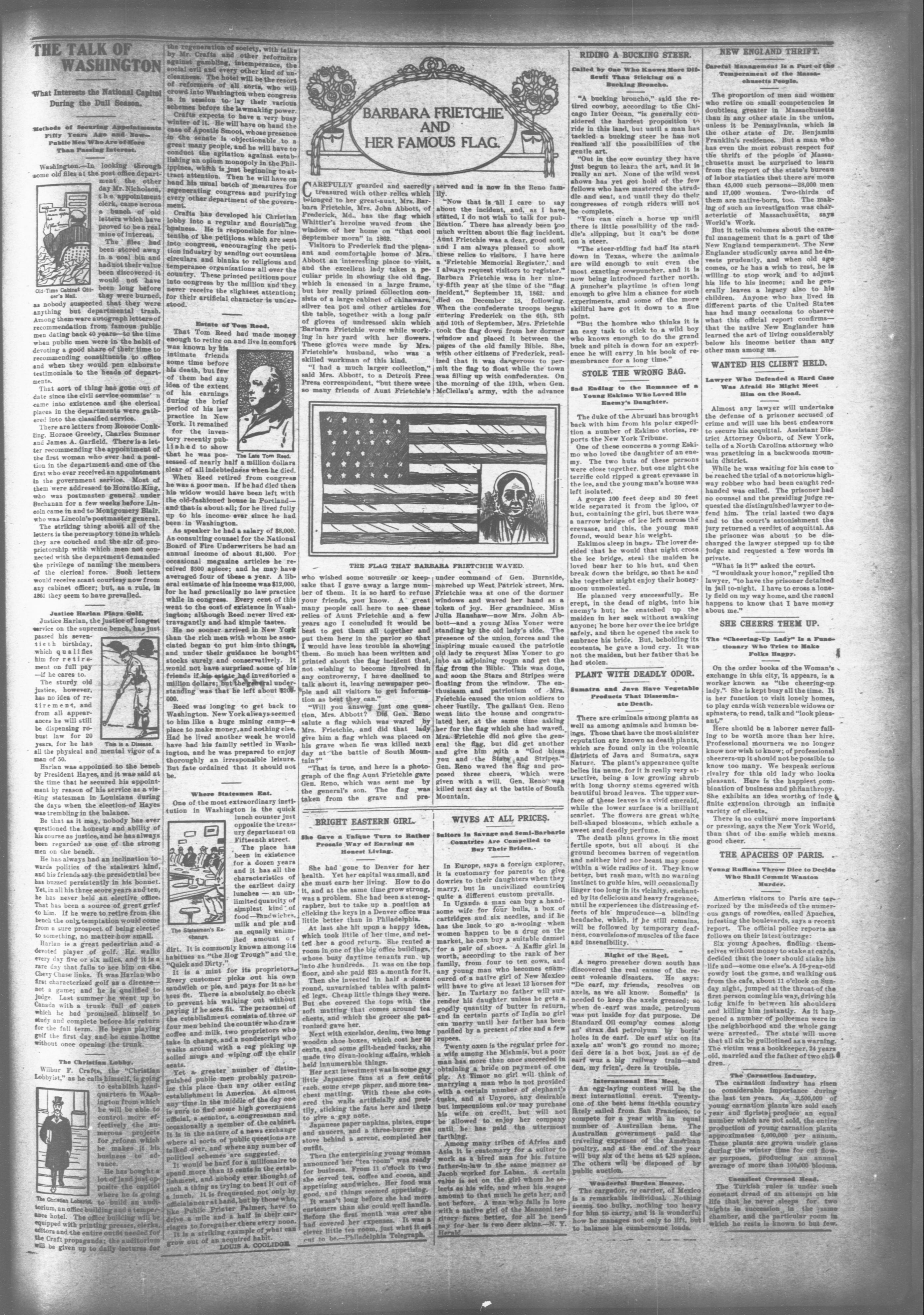
THE FLAG THAT BARBARA FRIETCHIE WAVED.
CAREFULLY guarded and sacredly treasured with other-relies which belonged to her great-aunt, Mrs. Barbara Frietchie, Mrs. John Abbott, of Frederick, Md., has the flag which Whittier's heroine waved from the window. of her home on "that cool September morn" in 1862
Visitors to Frederick find the pleasant and comfortable home of Mrs. Abbott an interesting place to visit, and the excellent lady takes a peculiar pride in showing the old flag, which is encased in a large frame, but her really prized collection consists of a large cabinet of chinaware, silver tea pot and other articles for the table, together with a long pair of gloves of undressed skin which Barbara Frietchie wore while working in her yard with her flowers. These gloves were made by Mrs. Frietchie's husband, who was a skilled workman of this kind.
"I had a much larger collection," said Mrs. Abbott, to a Detroit Free Press correspondent, "but there were so many friends of Aunt Frietchie's
THE FLAG THAT BARE
who wished some souvenir or keepsake that I gave away a large number of them. It is so hard to refuse your friends, you know. A great many people call here to see these relics of Aunt Frietchie and a few years ago I concluded it would be best to get them all together and put them here in the parlor so that I would have less trouble in showing them. So much has been written and printed about the flag incident that, not wishing to become involved in any controversy, I have declined to talk about it, leaving newspaper people and all visitors to get information as best they can."
"Will you answer just one question, Mrs. Abbott? Did Gen. Reno salute a flag which was wayed by Mrs. Frietchie, and did that lady give him a flag which was placed on his grave when he was killed next day at the battle of South Mountain?"
"That is true, and here is a photograph of the flag Aunt Frietchie gave Gen. Reno, which was sent me by the general's son. The flag was taken from the grave and pre-
BRIGHT EASTERN GIRL.
She Gave a Unique Turn to Rather Prosale Way of Earning an Honest Living.
She had gone to Denver for her health. Yet her capital was small, and she must earn her living. How to do it, and at the same time grow strong, was a problem. She had been a stenographer, but to take up a position at clicking the keys in a Denver office was little better than in Philadelphia.
At last she hit upon a happy idea, which took little of her time, and netted her a good return. She rented a room in one of the big office buildings, whose busy daytime tenants run, up into the hundreds. It was on the top floor, and she paid $25 a month for it. Then she invested in half a dozen round, unvarnished tables with painted legs. Cheap little things they were. But she covered the tops with the soft matting that comes around tea chests, and which the grocer she patronized gave her.
Next with excelsior, denim, two long wooden shoe boxes, which cost her 50 cents, and some gilt-headed tacks, she made two divan-looking affairs, which held innumerable things. Her next investment was in some gay little Japanese fans at a few cents each, some crepe paper, and more teachest matting. With these she covered the walls artificially and prettily, sticking the fans here and there to give a gay note.
Japanese paper napkins, plates, cups and saucers, and a three-burner gas stove behind a screne, completed her outfit
Then the enterprising young woman announced her "tea room" was ready for business. From 11 o'clock to two she served tea, coffee and cocoa, and appetizing sandwiches. Her food was good, and things seemed appetizing. It wasn't long before she had more customers than she could well handle. Before the first month was over she had covered her expenses. It was a clever little tea room, just what it set out to be. Philadelphia Telegraph.
---
served and is now in the Reno family.
"Now that is all I care to say about the incident, and, as I have stated, I do not wish to talk for publication. There has already been too much written about the flag incident. Aunt Frietchie was a dear, good soul, and I am always pleased to show these relics to visitors. I have here a 'Frietchie Memorial Register,' and I always request visitors to register." Barbara Frietchie was in her ninety-fifth year at the time of the "flag incident," September 12, 1862, and died on December 18, following. When the confederate troops began entering Frederick on the 6th, 8th and 10th of September, Mrs. Frietchie took the flag down from her dormer window and placed it between the pages of the old family Bible. She, with other citizens of Frederick, realized that it was dangerous to permit the flag to float while the town was filling up with confederates. On the morning of the 12th, when Gen. McClellan's army, with the advance
BARA FRIETCHIE WAVED.
under command of Gen. Burnside, marched up West Patrick street, Mrs. Frietchie was at one of the dormer windows and waved her hand as a token of joy. Her grandniece, Miss Julia Hanshaw—now Mrs. John Abbott—and a young Miss Yoner were standing by the old lady's side. The presence of the union forces and the inspiring music caused the patriotic old lady to request Miss Yoner to go into an adjoining room and get the flag from the Bible. This was done, and soon the Stars and Stripes were floating from the window. The enthusiasm and patriotism of Mrs. Frietchie caused the union soldiers to cheer lustily. The gallant Gen. Reno went into the house and congratulated her, at the same time asking her for the flag which she had waved. Mrs. Frietchie did not give the general the flag, but did get another and give him with a "God bless you and the Stars and Stripes." Gen. Reno waved the flag and proposed three cheers, which were given with a will. Gen. Reno was killed next day at the battle of South Mountain.
WIVES AT ALL PRICES.
Suitors in Savage and Semi-Barbaric Countries Are Compelled to Buy Their Brides..
In Europe, says a foreign explorer, it is customary for parents to give dowries to their daughters when they marry, but in uncivilized countries quite a different custom prevails.
In Uganda a man can buy a handsome wife for four bulls, a box of cartridges and six needles, and if he has the luck to go a-wooing when women happen to be a drug on the market, he can buy a suitable damsel for a pair of shoes. A Kaffir girl is worth, according to the rank of her family, from four to ten cows, and any young man who becomes enamoured of a native girl of New Mexico will have to give at least 12 horses for her. In Tartary no father will surrender his daughter unless he gets a goodly quantity of butter in return, and in certain parts of India no girl can marry until her father has been pacified by a present of rice and a few rupees.
Twenty oxen is the regular price for a wife among the Mishmis, but a poor man has more than once succeeded in obtaining a bride on payment of one pig. At Timor no girl will think of marrying a man who is not provided with a certain number of elephant's tusks, and at Unyoro, any desirable but impecunious sufficor may purchase his wife on credit, but will not be allowed to enjoy her company until he has paid the uttermost farthing.
Among many tribes of Africa and Asia it is customary for a suitor to work as a hired man for his future father-in-law in the same manner as Jacob worked for Laban. A certain value is set on the girl whom he selects as his wife, and when his wages amount to that much he gets her, and not before. A man who falls in love with a native girl of the Manzoni territory fares better, for all he need nay for her is two deer skins.—N. Y. Herald
```markdown
```
"A bucking broncho," said the retired cowboy, according to the Chicago Inter Ocean, "is generally considered the hardest proposition to ride in this land, but until a man has tackled a bucking steer he has not realized all the possibilities of the gentle art.
"Out in the cow country they have just begun to learn the art, and it is really an art. None of the wild west shows has yet got hold of the few fellows who have mastered the straddle and seat, and until they do their congresses of rough riders will not be complete.
"You can cinch a horse up until there is little possibility of the saddle's slipping, but it can't be done on a steer.
"The steer-riding fad had its start down in Texas, where the animals are wild enough to suit even the most exacting cowpuncher, and it is now being introduced farther north. A puncher's playtime is often long enough to give him a chance for such experiments, and some of the more skillful have got it down to a fine point.
"But the hombre who thinks it is an easy task to stick to a wild boy who knows enough to do the grand buck and pitch is down for an experience he will carry in his book of remembrance for a long time."
STOLE THE WRONG BAG.
Sad Ending to the Romance of a Young Eskimo Who Loved His Enemy's Daughter.
The duke of the Abruzzi has brought back with him from his polar expedition a number of Eskimo stories, reports the New York Tribune.
One of these concerns a young Eskimo who loved the daughter of an enemy. The two huts of these persons were close together, but one night the terrific cold ripped a great crevasse in the ice, and the young man's house was left isolated.
A gorge 100 feet deep and 20 feet wide separated it from the igloo, or hut, containing the girl, but there was a narrow bridge of ice left across the crevasse, and this, the young man found, would bear his weight.
Eskimos sleep in bags. The lover decided that he would that night cross the ice bridge, steal the maiden he loved bear her to his hut, and then break down the bridge, so that he and she together might enjoy their honeymoon unmolested.
He planned very successfully. He crept, in the dead of night, into his enemy's hut; he snatched up the maiden in her sack without awaking anyone; he bore her over the ice bridge safely, and then he opened the sack to embrace his bride. But, beholding its contents, he gave a loud cry. It was not the maiden, but her father that he had stolen.
PLANT WITH DEADLY ODOR.
Sumatra and Java Have Vegetable Products That Disseminate Death.
There are criminals among plants as well as among animals and human beings. Those that have the most sinister reputation are known as death plants, which are found only in the volcanic districts of Java and Sumatra, says Nature. The plant's appearance quite belies its name, for it is really very attractive, being a low growing shrub with long thorny stems covered with beautiful broad leaves. The upper surface of these leaves is a vivid emerald, while the lower surface is a brilliant scarlet. The flowers are great white bell-shaped blossoms, which exhale a sweet and deadly perfume.
The death plant grows in the most fertile spots, but all about it the ground becomes barren of vegetation and neither bird nor beast may come within a wide radius of it. They know better, but rash man, with no warning instinct to guide him, will occasionally linger too long in its vicinity, enchanted by its delicious and heavy fragrance, until he experiences the distressing effects of his imprudence—a blinding headache, which, if he still remains, will be followed by temporary deafness, convulsions of muscles of the face and insensibility.
Right of the Reel
A negro preacher down south has discovered the real cause of the recent volcanic disasters. He says: "De earf, my friends, resolves on axels, as we all know. Somefin' is needed to keep the axels greased; so when de earf was made, petrolyum was put inside for dat purpose. De Standard Oil comp'ny comes along an' strax dat petrolyum by borin' holes in de earf. De earf stix on its axels an' won't go round no more; den dere is a hot box, just as ef de earf wuz a big railway train—and den, my frien', dere is trouble.
International Hen Meet
An egg-laying contest will be the next international event. Twenty-one of the best hens in this country lately sailed from San Francisco, to compete for a year with an equal number of Australian hens. The Australian government paid the traveling expenses of the American poultry, and at the end of the year will buy six of the hens at $25 apiece. The others will be disposed of by public auction.
The cargador, or carrier, of Mexico is a remarkable individual. Nothing seems too bulky, nothing too heavy for him to carry, and it is wonderful how he manages not only to lift, but to balance his cumbersome loads.
Careful Management Is a Part of the Temperament of the Massachusetts People.
The proportion of men and women who retire on small competencies is doubtless greater in Massachusetts than in any other state in the union, unless it be Pennsylvania, which is the other state of Dr. Benjamin Franklin's residence. But a man who has even the most robust respect for the thrift of the people of Massachusetts must be surprised to learn from the report of the state's bureau of labor statistics that there are more than 45,000 such persons—28,000 men and 17,000 women. Two-thirds of them are native-born, too. The making of such an investigation was characteristic of Massachusetts, says World's Work.
But it tells volumes about the careful management that is a part of the New England temperament. The New Englander studicusly saves and he invests prudently, and when old age comes, or he has a wish to rest, he is willing to stop work and to adjust his life to his income; and he generally leaves a legacy also to his children. Anyone who has lived in different parts of the United States has had many occasions to observe what this official report confirms—that the native New Englander has learned the art of living considerably below his income better than any other man among us.
WANTED HIS CLIENT HELD.
Lawyer Who Defended a Hard Case Was Afraid He Might Meet Him on the Road.
Almost any lawyer will undertake the defense of a prisoner accused of crime and will use his best endeavors to secure his acquittal. Assistant District Attorney Osborn, of New York, tells of a North Carolina attorney who was practicing in a backwoods mountain district.
While he was waiting for his case to be reached the trial of a notorious highway robber who had been caught redhanded was called. The prisoner had no counsel and the presiding judge requested the distinguished lawyer to defend him. The trial lasted two days and to the court's astonishment the jury returned a verdict of acquittal. As the prisoner was about to be discharged the lawyer stepped up to the judge and requested a Yew words in private. "What is it?" asked the court.
"Iwouldask your honor," replied the lawyer, "to have the prisoner detained in jail to-night. I have to cross a lonely field on my way home, and the rascal happens to know that I have money about me."
SHE CHEERS THEM UP.
The "Cheering-Up Lady" Is a Functionary Who Tries to Make Folks Happy.
On the order books of the Woman's exchange in this city, it appears, is a worker known as "the cheering-up lady." She is kept busy all the time. It is her function to visit lonely homes, to play cards with venerable widows or spinsters, to read, talk and "look pleasant."
Here should be a laborer never failing to be worth more than her hire. Professional mourners we no longer know nor wish to know; of professional cheerers-up it should not be possible to know too many. We bespeak serious rivalry for this old lady who looks pleasant. Here is the happiest combination of business and philanthropy. She exhibits an idea worthy of infinite extension through an infinite variety of clients. There is no culture more important or pressing, says the New York World, than that of the smile which means good cheer.
THE APACHES OF PARIS.
Young Ruffians Throw Dice to Decide Who Shall Commit Wanton Murder.
American visitors to Paris are terrorized by the misdeeds of the numerous gangs of rowdies, called Apaches, infesting the boulevards, says a recent report. The official police reports as follows on their latest outrage:
Six young Apaches, finding themselves without money to stake at cards, decided that the loser should stake his life and—some one else's. A 16-year-old rowdy lost the game, and walking out from the cafe, about 11 o'clock on Sunday night, jumped at the throat of the first person coming his way, driving his long knife in between his shoulders and killing him instantly. As it happened a number of policemen were in the neighborhood and the whole gang were arrested. The state will move that all six be guillotined as a warning. The victim was a bookkeeper, 24 years old, married and the father of two children.
The carnation industry has risen to considerable importance during the last ten years. As 2,500,000 of young carnation plants are sold each year and florists produce an equal number which are not sold, the entire production of young carnation plants approximates 5,000,000 per annum. These plants are grown under glass during the winter time for cut flower purposes, producing an annual average of more than 100,000 blooms.
Uncensest Crowned Head. The Turkish ruler is under such constant dread of an attempt on his life that he never sleeps for two nights in succession in the same chamber, and the particular room in which he rests is known to but few.
Wm. Jefferson Triumphs Over Rev. E. J. Fisher of Olivet
It's the Only Place
8104 State Street E. H. FAULKNER, Manager
Editor Julius F. Taylor.
A few of the many law suits against the Rev. E. J. Fisher, of the Olivet Baptist church and its members, after many delays and continuances, have been disposed of. I wish to call attention to one case, the complaint of which alleges that one "William Jefferson unlawfully and wilfully did make an improper noise tending to a breach of the peace."
Upon the trial of the above case the testimony showed that Rev. Fisher Bros. Winby, Edwards, Elby, Williams and Griffin were in the Pastor's study about 11 o'clock at night, when they heard in the distance a loud and "improper noise tending to a breach of the peace." Upon investigation it was learned that the loud and improper noise was headed toward the church. In a few moments it arrived at the door "unlawfully and wilfully," in the person of Bro. Jefferson. When this discovery was made and announced, immediately there ensued a panic among those valiant soldiers of the cross. One armed himself with a xin sword, another clubbed his crutch, a third, who possessed the only gun in the bunch, fled below to the cellar, shut off the gas at the meter and hid himself in the darkness, a fourth being unable to obtain any weapon of defence, jumped through the back window into the alley and made good his escape, while others barricaded the doors and pulled down the blinds. After waiting a while in awful suspense Dr. Fisher slowly lifted himself out of the gloom and darkness of the corner, in which he had crouched and by aid of a broken window pane, beheld his adversary in the street, probably the most hideous and loathsome looking monster he had ever seen. Some witnesses testified that Mr. Jefferson looked like a raving manic, with bloodshot eyes, angry mein and having an awful rumbling voice. "like the sound of many waters."
Dr. Fisher, however, was so frightened that he was not in a fit condition to make an accurate description as he surveyed the enemy, yet he probably drew a mental picture of a monster half dragon, with "feet like a bear, and a mouth as the mouth of a lion." Fortunately, instead of making an unlawful and wilful attack on the door of the church, the beast merely opened his mouth, not in blasphemy against God, as did the Revelators beast, but in a threat to "make Dr. Fisher jump into Lake Michigan." After this tendency to a "breach of the peace," that loud and "improper noise" moved slowly down Twenty-seventh street much to the satisfaction and evident relief of Dr. Fisher and his panic stricken officers. About an hour later these "tin soldiers" formed themselves into a hollow square and escorted the Rev. Dr. Fisher to Mrs. Knuckles' home, two of the brethren remaining the rest of the night as a body guard.
A hurried church meeting was called not many evenings later, when Dr. Fisher related the "horrible and terrifying experiences of that awful night." A few brothers and a majority of the sisters immediately decided, in substance, that Bro. Jefferson was a member of Olivet with an immortal soul, yet not worth saving; so they cast the "nasty old thing" over the battlements of the church and consigned him to outer darkness.
This action was taken despite the fact that this preacher makes a great show and pretense of conforming to Baptist usages. Now, I have been informed that the rules adopted by this church in such cases, is in effect that If thy brother shall offend thee, go and tell him his fault between thee and him alone, if he will not hear thee, then take with thee one or two more brethern; and if he shall neglect to hear them, tell it unto the church; but if he neglect to hear the church, let him be unto thee a heathen, etc.
Since Dr. Fisher was the complaining witness he did not, of course, act
as moderator at the church meeting, but he was there and there to prosecute. He saw the rights of a churchman trampled under foot and the rules of the Baptist Church ruthlessly violated; yet he offered no objection when it was clearly within his power to have prevented these abuses. Is the doctor so blind to justice that he could not see that Bro. Jefferson would be injured by not having time to prepare his defense, and by not even being notified to be present at the trial of his case? If, therefore, at this so-called hearing Dr. Fisher did not ask that the established rules of his church be adheared to, and the rights of one of the humblest of its members protected, then he did not deem these violations a matter of any importance, and actually favored them. Do not the facts in this case lead irresistibly to this conclusion?
But let us return to the scenes in the courtroom. When the evidence for the prosecution was in, Attorney E. H. Morris in behalf of Mr. Jefferson claimed that his client was not charge in the complaint with the commission of any offense punishable by the laws of this state; that it was not in violation of any statute of Illinois for a person to make "an improper noise tending to a breach of the peace;" that the peace must be actually broken; and that this must be clearly charged in the complaint. The court sustained Mr. Morris' contention and held in effect that the "improper noise" or that beast which Dr. Fisher could not describe, had not disturbed that peace of Olivet which passeth understanding and William Jefferson was discharged.
Theodore W. Jones,
2209 Cottage Grove Ave.
Thomas Ryan was re-elected president of the 30th Ward Democratic Club last Saturday night. Thomas Dunn will serve as vice president. William E. O'Day will continue to act as secretary and Patriok Marley was selected as treasurer.
Monday evening Mayor Harrison made the following appointments: Dr. J. F. Todd, City Physician; James C. Blaney, Boiler Inspector; John McCarthy, Harbormaster; Charles Dorow, William White, M. J. Kelly and William Krohn, Assistant Harbormasters; Charles C. Brayer, Frank T. Kennedy and George L. McConnell, members of the Plumbing Commission. It appears that all the police court clerks, bailiffs and bridgetenders, outside of John Lyons, of the Harrison station, possess unpronounceable French names, and so far Mayor Harrison has failed to land any of his colored supporters in any new jobs. There is some talk, however, of Rev. Abrham Lincoln Murray becoming head chaplin of Chicago, for it is surmised that if the mayor has someone to pray for him long and loud he may become Governor of Illinois.
AGENTS FOR THE BROAD AX.
From on and after this date The Broad Ax can be found on sale at the following places:
The Afro-American News Office, 3104 State Street.
A. G. Marshall, news stand and book store, 3604 State street.
A. F. Tervalon's Cigar Store and News Stand, 2826 State street.
Edward Felix's Cigar Store, 350th street, N. E. Corner Armour Ave.
T. B. Hall's Cigar Store and Laundry office, 281 29th St.
J. E. Webb's Cigar Store, 280, 29th Street.
Turner William's Cigar and News Stand, 2903 Armour Ave.
J. F. Bradbury's News Depot, 2970 State Street.
M. H. Watts, dealer in cigars and tobacco, 3742 State street.
J. C. Campbell, 145 W. 47th street., Cigars, Tobacco, Staple Groceries.
SUITE 318-320 REAPER BLOCK
Clark and Washington St.
Telephone, Main 940. CHICAGO.
A. D. GASH
Attorney at Law,
84-86 La Salle Street, Chicago.
Suite 615 to 619.
Telephone Main 3077.
JOHN E. OWEN
Attorney at Law,
LUTTE GAR ARLAND BLOCK
80 B. Clark Street
122 CAGO
FREDERICK W. JOB
ATTORNEY AT LAW
822 MARQUETTE BUILDING
Telephone 2350 Central
CHICAGO
TELEPHONE MAIN 2804
FEDERICO M. BARRIOS
Attorney & Counsellor at Law
Suite 501 Firmenich Bldg.
N. E. Cor, Fifth Avenue
and Washington Street Chicago.
LAWRENCE A. NEWBY
ATTORNEY AT LAW
Room 42, 119 La Salle Street
CHICAGO
William Howard Fitzgerald
LAWYER
Room 402 Reaper Block. CHICAGO
PHONE: {Office, M in 1157
Res. Brown 42
STEPHEN A. DOUGLAS
LAWYER
Suite 200, 128-125 La Salle Street
CHICAGO
JOSEPH A McINERNEY
LAWYER
Suite 708—708
Chicago Opera House
CHICAGO
WILLIAM RITCHIE
ATTORNEY AND COUNSELOR.
Suite 819-820 Oxford Building
84 LA BALLE ST., CHICAGO
Telephone Main 1646.
Robert M. Mitchell
Attorney at Law
Suite 9, No. 77 South Clark St
CHICAGO
Telephone Tardis 707 Residence, 113 Garfield Bd.
JOHN FITZGERALD
JUSTICE OF THE PEACE
6787 R. HALSTED STREET,
....CHICAGO
J. GRAY LUCAS
ATTORNEY-AT-LAW
Suite 412 Real Estate Board Bldg
59 Dearborn St. Cor. Randolph
CHICAGO.
Phone Randolph 55
J. E. JONES
LAWYER
79 Clark Street
Room 9 Chicago
S. A. McELWEE
...LAWYER...
36 S. Clark St., CHICAGO.
Room 706 Ogden Building
Residence, 3153 Forest Av.
ALBERT B. GEORGE
LAWYER.
423 Ashland Block, Chicago.
— 2nd M. 2010. —
For Sale or Rent.
Houses, flat buildings, and lots in city and suburbs, on easy monthly installments. Fire Insurance and Furniture Loans at lowest rates.
CEO. W. FAULKNER & CO.
Phone 2331 Brown. 2935 State St.
```markdown
```
ILLINOIS BRICK CO.
ILLINOIS BRICK CO.
1994 N. Western Ave., Chicago.
HOHENADEL BROS.
Pollicemen, Firemen, Street Car Employees,
Letter Carriers, Telegraph Messengers,
Elevatormen, Railroad Employees,
Janitors, Wagonmen, Bellboys, Watchmen, Bta.
JACOB FEINBERG
81st and State Sts. CHICAGO
Real Estate, Insurance and Loans Property managed. Abstracts examined. Renting. Legal papers prepared. 4709 South Halsted Street Chicago J.M.Higginbothan Mason and General Contractor
226 East 25th Street - - - CHICAGO
F. W. BOYD DEALER IN COAL, WOOD AND ICE MOVING AND EXPRESSING All Orders Promptly Attended to Cash on Delivery Telephone Blue 38g 4656 Armour Avenue, CHICAGO.
M. JUNK, Proprietor JOS. P. JUNK, Manager 3700-3710 South Halsted Street and 897 to 929 Thirtyseventh Street CHICAGO
American Brick Co.
Common and Sewer Brick Office and Yards:
45th and Robey Sts.
Yards running winter and summer, equipped with the latest improved Wolf Dryer.
Output of Winter Yards ..... 1,400 o per day
Output of Summer Yards..... 300,000 per day
IMPORTED AND DOMESTIC WINES, LIQUORS AND CIGARS 8462 SOUTH HALSTED STREET. OHICAGO
Fifty-First St. and Armour Ave.
RAIL YARDS: { 51st St. & L. S. & M. S. Ry.
52nd St. and Armour Ave.
CHICAGO
Phoenix Oil & Mineral Co.
OF ARIZONA
$200,000 CAPITAL
Pays dividends 1 per cent. monthly or
12 per cent per annum.
Stock now selling at 10c per share,
full paid and non-assessable. For
further particular address
THE DAVIES INVESTMENT COMPANY
614 First National Bank Bldg., Chicago
'Pphone Central 3026.
Face Massage, Shampooing, Scalp Treating
Mrs. Warner
Chiropodist and Manicuring
Removes Corns Without Pain
Medicated Foot Baths and Foot Massage
138 State St., 4th Floor, Chicago
Telephone Blue 4632 Work Called for and Delivered...
A. HOFFMAN,
CLEANER, DYER
AND PRESSER.
Suits Sponged and Pressed etc
5125 State St. Expert Workmanship
Moderate Prices.
Mrs. Florence Miller
FASHIONABLE DRESSMAKER PERFECT FIT GUARANTEED PRICES REASONABLE 3151 State Street CHICAGO.
Tel. Yards 693
COURT REPORTER
77 South Clark St., Room 9
CHICAGO.
General Photographer
WONDERFUL DISCOVERY Curly Hair Made Straight By
TAKEN FROM LIFE:
BEFORE AND AFTER TREATMENT.
OZONIZED OX MARROW
This wonderful hair pomade is the only safe preparation in the world that makes kinky or curly hair straight as shown above. It nourishes the scalp, prevents the hair from falling out or breaking off, cures dandruff and it lasts for forty years and used by thousands. Warranted harmless. It was the first preparation ever sold for straightening kinky hair. Beware of imitations. Get the Original Ozonized Ox Marrow as the genuine never fails to keep the hair straight, soft and beautiful, giving much desired. A toilet necessity for ladies, gentlemen and children. Elegantly perfumed. Owing to its superior and lasting qualities it is the best and most economical. It is not possible for anybody to produce a preparation equal to it. Full directions with every bottle. Only 50 cents. Sold by druggists and dealers and sent to a hotel or tlcer or $1.40 for three bottles. We pay all express charges. Send postal or express money order. Please mention name of this paper when ordering. Write your name and address plainly to
OZONIZED OX MARROW CO., 76 Wabash Ave., Chicago, Illinois.
MRS. A. WILSON.
Nicely furnished rooms to rent for gentlemen. Reasonable rates. 2252 Indiana avenue.
Mrs. Anna L. Newby.
First class furnished rooms, for rent to gentleman and ladies, with bath and gas. 2628 Wabash avenue.
Wm. H. Monroe, cigar and news stand, 486 State street.
L. Levy, 506, 37th Street, dealer in Cigars and Tobacco.
The Chicago Shoe Shining Parlor, 3423 Cottage Grove Ave.
Geo. Blaine, cigars, tobacco and news stand, 3420 Dearborn street.
Whiteley Bros., 2724 State street, cigars, and news stand.
Mrs. Florence Granger, 2940 Dearborn Street. Cigars, Laundry Office and News Stand.
J. New 131 W. 51st street, cigars, tobacco and confectionaries.
J. W. Hutchinson, 371 Dearborn street cigars and news stand.
C. E. Hunter, 4503 Wentworth ave., cigars, tobacco, news stand.
T. J. Hill, cigars and stationery store., 5220 Lake Ave.
Wm. Dixon 2638 State Street cigars, tobacco, and news stand.
News items and advertisements left at these places will and their way into the columns of The Broad Ax.
8462 SOUTH
WILLIAM C. KUESTER.
SUPERINTENDENT.
N. Western Ave., Ch
Telephone Lake View 270.
HENADEL BR
211-213 Madison Street
CHICAGO
Telephone Main 3300
UNIFORM CAR
FOR
Firemen,
Carriers,
Vatormen,
Janitors, Wagonmen,
Street Car Employees,
Telegraph Messens,
Railroad Empl
Bellboys, Wat
COB FEINBEN
Market and Grocer
Telephone 565 South
and State Sts. CHI
John J. Bradle
Estate, Insurance and
managed. Abstracts examined. Renting. Legal paper
Halsted Street
Higginbothan
Mason
Genel
Co
at 25th Street - - - CHI
V. BOYD DEALER
GOAL, WOOD AND
AND EXPRESSING
Promptly Attended to
Cash on Delive
4656 Armour Avenue, CHI
Manufacturers of... UNIFORM CAPS
Market and Grocery
John J. Bradley
Telephone Yards 718 nk's Brewe M. JUNK, Proprietor
President and Treasurer, THOMAS CAREY. Vice-President, JOHN SHELHAMER, Secretary, WILLIAM SULLIVAN. MANUFACTURERS OF
Telephone Yards 128.
BROS.
eet
CAPS
Employes,
Messengers,
and Employes,
s, Watchmen, Bta.
BERG
cery
CHICAGO
Notary Public
dley
and Loans
legal papers prepared.
Chicago
Mason and General Contractor
CHICAGO
ALER IN
ND ICE
Delivery
CHICAGO.
very