The Broad Ax
Saturday, July 4, 1903
Chicago, Illinois
Page text (machine-generated)
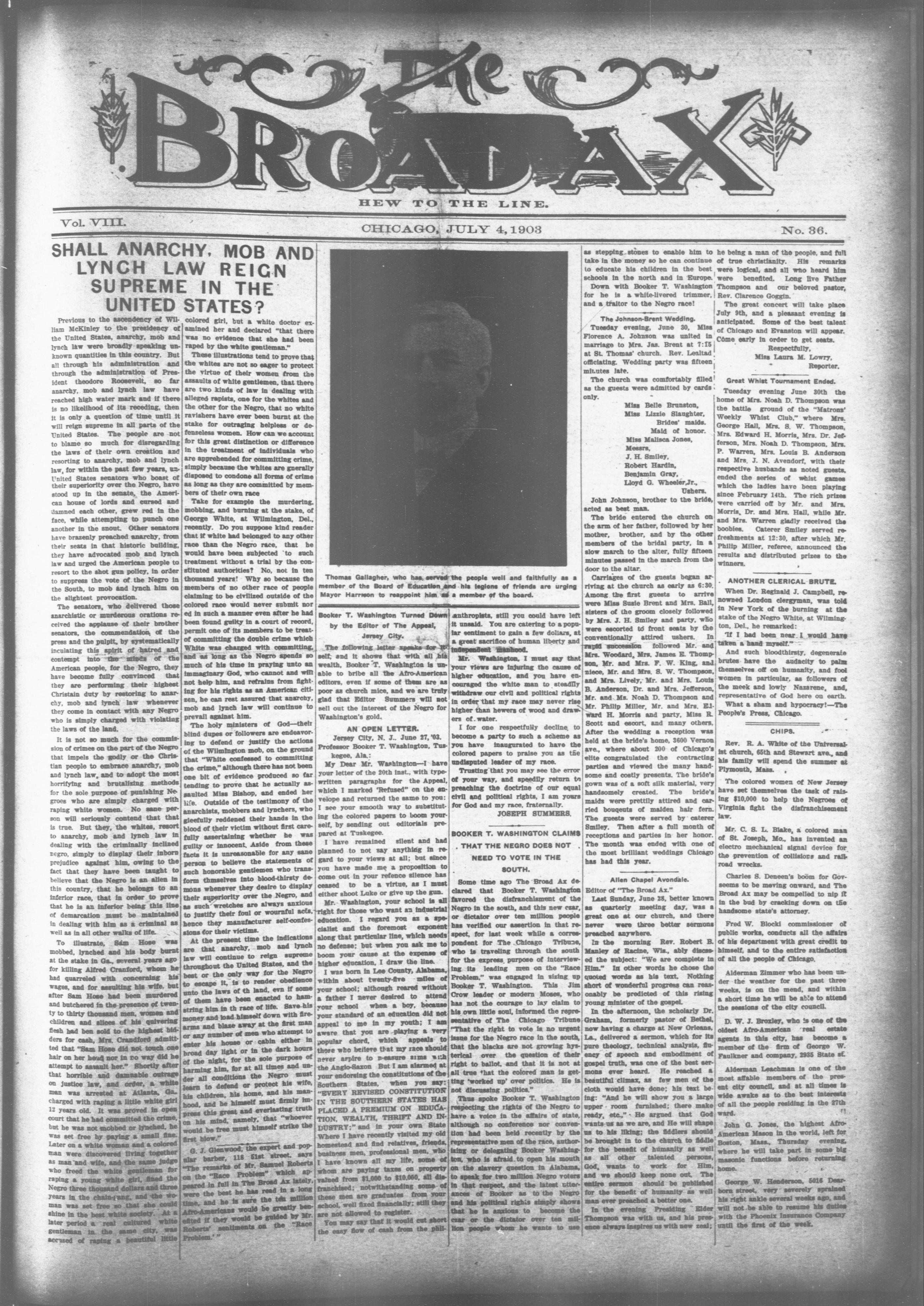
SHALL ANARCHY, MOB AND LYNCH LAW REIGN SUPREME IN THE UNITED STATES?
Vol. VIII.
Previous to the ascendency of William McKinley to the presidency of the United States, anarchy, mob and lynch law were broadly speaking unknown quantities in this country. But all through his administration and through the administration of President theodore Roosevelt, so far anarchy, mob and lynch law have reached high water mark and if there is no likelihood of its receding, then it is only a question of time until it will reign supreme in all parts of the United States. The people are not to blame so much for disregarding the laws of their own creation and resorting to anarchy, mob and lynch law, for within the past few years, unUnited States senators who boast of their superiority over the Negro, have stood up in the senate, the American house of lords and cursed and damned each other, grew red in the face, while attempting to punch one another in the snout. Other senators have brazenly preached anarchy, from their seats in that historic building, they have advocated mob and lynch law and urged the American people to resort to the shot gun policy, in order to suppress the vote of the Negro in the South, to mob and lynch him on the slightest provocation.
The senators, who delivered those anarchistic or murderous orations received the applause of their brother senators, the commendation of the press and the pulpit, by systematically inculating this spirit of hatred and contempt into the minds of the American people, for the Negro, they have become fully convinced that they are performing their highest Christain duty by restoring to anarchy, mob and lynch law whenever they come in contact with any Negro who is simply charged with violating the laws of the land.
It is not so much for the commission of crimes on the part of the Negro that impels the godly or the Christian people to embrace anarchy, mob and lynch law, and to adopt the most horrifying and brutalizing methods for the sole purpose of punishing Negroes who are simply charged with raping white women. No sane person will seriously contend that that is true. But they, the whites, resort to anarchy, mob and lynch law in dealing with the criminally inclined negro, simply to display their inborn prejudice against him, owing to the fact that they have been taught to believe that the Negro is an alien in this country, that he belongs to an inferior race, that in order to prove that he is an inferior being this line of demarcation must be maintained in dealing with him as a criminal as well as in all other walks of life.
To illustrate, Sam Hose was mobbed, lynched and his body burnt at the stake in Ga., several years ago for killing Alfred Cranford, whom he had quarreled with concerning his wages, and for assulting his wife, but after Sam Hose had been murdered and butchered in the presence of twenty to thirty thousand men, women and children and slices of his quivering flesh had ben sold to the highest bidders for cash, Mrs. Crandford admitted that "Sam Hose did not touch one hair on her head nor in no way did he attempt to assault her." Shortly after that horrible and damnable outrage on justice law, and order, a white man was arrested at Atlanta, Ga., charged with raping a little white girl 12 years old. It was proved in open court that he had committed the crime, but he was not mobbed or lynched, he was set free by paying a small fine. Later on a white woman and a colored man were discovered living together as man and wife, and the same judge who freed the white gentleman for raping a young white girl, fined the Negro three thousand dollars and three years in the chain ring, and the woman was set free so that she could shine in the best white society. At a later period a real cultured white gentleman in the same city, was accused of raping a beautiful little
colored girl, but a white doctor examined her and declared "that there was no evidence that she had been raped by the white gentleman"
These illustrations tend to prove that the whites are not so eager to protect the virtue of their women from the assaults of white gentlemen, that there are two kinds of law in dealing with alleged rapists, one for the whites and the other for the Negro, that no white ravishers have ever been burnt at the stake for outraging helpless or defenseless women. How can we account for this great distinction or difference in the treatment of individuals who are apprehended for committing crime, simply because the whites are generally disposed to condone all forms of crime as long as they are committed by members of their own race
Take for example the murdering, mobbing, and burning at the stake, of George White, at Wilmington, Del., recently. Do you suppose kind reader that if white had belonged to any other race than the Negro race, that he would have been subjected to such treatment without a trial by the constituted authorities? No, not in ten thousand years! Why so because the members of no other race of people claiming to be civilized outside of the colored race would never submit nor ed in such a manner even after he had been found guilty in a court of record, permit one of its members to be treat of committing the double crime which White was charged with committing, and as long as the Negro spends so much of his time in praying unto an imaginary God, who cannot and will not help him, and refrains from fighting for his rights as an American citizen, he can rest assured that anarchy, mob and lynch law will continue to prevail against him.
The holy ministers of God—their blind dupes or followers are endeavoring to defend or justify the actions of the Wilmington mob, on the ground that "White confessed to committing the crime," although there has not been one bit of evidence produced so far tending to prove that he actually assaulted Miss Bishop, and ended her life. Outside of the testimony of the anarchists, mobbers and lynchers, who gleefully reddened their hands in the blood of their victim without first carefully asserting whether he was guilty or innocent. Aside from these facts it is unreasonable for any sane person to believe the statements of such honorable gentlemen who transform thmselves into blood-thirsty demons whenever they desire to display their superiority over the Negro, and as such wretches are always anxious to justify their foul or wournful acts, hence they manufacturer self-confessions for their victims.
At the present time the indications are that anarchy, mob and lynch law will continue to reign supreme throughout the United States, and the best or the only way for the Negro to escape it, is to render obedience unto the laws of th land, evn if some of them have been enacted to hamstring him in th race of life. Save his money and load himself down with firearms and blaze away at the first man or any number of men who attempt to enter his house or cabin either in broad day light or in the dark hours of the night, for the sole purpose of harming him, for at all times and under all conditions the Negro must learn to defend or protect his wife, his children, his home, and his manhood, and he himself must firmly impress this great and everlasting truth on his mind, namely, that "whoever would be free must himself strike the first blow."
G. J. Glenwood, the expert and popular barber, 118 51st street, says "The remarks of Mr. Samuel Roberts on the "Race Problem" which appeared in full in The Broad Ax lately were the best he has read in a long time, and he is sure the ten million Afro-Americans would be greatly benefited if they would be guided by Mr. Roberts' sentiments on the "Race Problem."
HEW TO THE LINE.
[Name]
Thomas Gallagher, who has served the people well and faithfully as a member of the Board of Education and his legions of friends are urging Mayor Harrison to reappoint him as a member of the board.
The following letter speaks for itself, and it shows that with all his wealth, Booker T. Washington is unable to bribe all the Afro-American editors, even if some of them are as poor as church mice, and we are truly glad that Editor Summers will not sell out the interest of the Negro for Washington's gold.
AN OPEN LETTER.
Jersey City, N. J.. June 27, '03. Professor Booker T. Washington, Tuskegee, Ala.:
My Dear Mr. Washington—I have your letter of the 20th inst., with typewritten paragraphs for the Appeal, which I marked 'Refused" on the envelope and returned the same to you:
I see your smooth way to substituting the colored papers to boom yourself, by sending out editorials prepared at Tuskegee.
I have remained silent and had planned to not say anything in regard to your views at all; but since you have made me a proposition to come out in your refence silence has ceased to be a virtue, as I must either shoot Luke or give up the gun. Mr. Washington, your school is all right for those who want an industrial education. I regard you as a specialist and the foremost exponent along that particular line, which needs no defense; but when you ask me to boom your cause at the expense of higher education. I draw the line.
I was born in Lee County, Alabama, within about twenty-five miles of your school; although reared without a father I never desired to attend your school when a boy, because your standard of an education did not appeal to me in my youth; I am aware that you are playing a very popular chord, which appeals to those who believe that my race should never aspire to n-easure aims with the Anglo-Saxon. But I am alarmed at your endorsing the constitutions of the Southern States, when you say: "EVERY REVISED CONSTITUTION IN THE SOUTHERN STATES HAS PLACED A PREMIUM ON EDUCATION, WEALTH, THRIFT AND INDUSTRY;" and in your own State Where I have recently visited my old homestead and find relatives, friends, business men, professional men, who I have known all my life, some of whom are paying taxes on property valued from $1,000 to $10,000, all disfranchised; notwithstanding some of these men are graduates from your school, well fixed financially; still they are not allowed to register. You may say that it would cut short the easy flow of cash from the phil-
anthropists, still you could have left it unsaid. You are catering to a popular sentiment to gain a few dollars, at a great sacrifice of human liberty and independent manhood. Mr. Washington, I must say that your views are injuring the cause of higher education, and you have encouraged the white man to steadily withdraw our civil and political rights in order that my race may never rise higher than hewers of wood and drawers of water.
I for one respectfully decline to become a party to such a scheme as you have inaugurated to have the colored papers to praise you as the undisputed leader of my race. Trusting that you may see the error of your way, and speedily return to preaching the doctrine of our equal civil and political rights, I am yours for God and my race, fraternally.
Some time ago The Broad Ax declared that Booker T. Washington favored the disfranchisement of the Negro in the south, and this new czar, or dictator over ten million people has verified our assertion in that respect, for last week while a correspondent for The Chicago Tribune, who is traveling through the south for the express purpose of interviewing its leading men on the "Race Problem," was engaged in sizing up Booker T. Washington. This Jim Crow leader or modern Moses, who has not the courage to lay claim to his own little soul, informed the representative of The Chicago Tribune "That the right to vote is no urgent issue for the Negro race in the south, that the blacks are not growing hysterical over the question of their right to ballot, and that it is not at all true that the colored man is getting 'worked up' over politics. He is not discussing politics."
Thus spoke Booker T. Washington respecting the rights of the Negro to have a voice in the affairs of state, although no conference nor convention had been held recently by the representative men of the race, authorizing or delegating Booker Washington, who is afraid to open his mouth on the slavery question in Alabama, to speak for two million Negro voters in that respect, and the latest utterances of Booker as to the Negro and his political rights simply shows that he is anxious to become the czar or the dictator over ten million people whom he wants to use
as stepping stones to enable him to take in the money so he can continue to educate his children in the best schools in the north and in Europe. Down with Booker T. Washington for he is a white-livered trimmer, and a traitor to the Negro race!
Tuesday evening, June 30, Miss Florence A. Johnson was united in marriage to Mrs. Jas. Brent at 7:15 at St. Thomas' church. Rev. Lealtad officiating. Wedding party was fifteen minutes late. The church was comfortably filled as the guests were admitted by cards only.
John Johnson, brother to the bride, acted as best man. The bride entered the church on the arm of her father, followed by her mother, brother, and by the other members of the bridal party, in a slow march to the alter, fully fifteen minutes passed in the march from the door to the altar.
Carriages of the guests began arriving at the church as early as 6:30. Among the first guests to arrive were Miss Susie Brent and Mrs. Ball, sisters of the groom closely followed by Mrs. J. H. Smiley and party, who were escorted to front seats by the conventionally attired ushers. In rapid succession followed Mr. and Mrs. Woodard, Mrs. James E. Thompson, Mr. and Mrs. F. W. King, and niece, Mr. and Mrs. S. W. Thompson, and Mrs. Lively, Mr. and Mrs. Louis B. Anderson, Dr. and Mrs. Jefferson, Mr. and Ms. Noah D. Thompson and Mr. Philip Miller, Mr. and Mrs. Edward H. Morris and party, Miss R. Scott and escort, and many others. After the wedding a reception was held at the bride's home, 3600 Vernon ave., where about 200 of Chicago's elite congratulated the contracting parties and viewed the many handsome and costly presents. The bride's gown was of a soft silk material, very handsomely created. The bride's malds were prettily attired and carried bouqeuts of malden hair fern. The guests were served by caterer Smiley. Then after a full month of receptions and parties in her honor. The month was ended with one of the most brilliant weddings Chicago has had this year.
Allen Chapel Avondale
Editor of "The Broad Ax."
Last Sunday, June 28, better known as quarterly meeting day, was a great one at our church, and there never were three better sermons preached anywhere. In the morning Rev. Robert B. Manley of Racine, Wis., ably discussed the subject: "We are complete in Him." In other words he chose the quoted words as his text. Nothing short of wonderful progress can reasonably be predicted of this rising young minister of the gospel.
In the afternoon, the scholarly Dr. Graham, formerly pastor of Bethel, now having a charge at New Orleans, La., delivered a sermon, which for its pure theology, technical analysis, fluency of speech and embodiment of gospel truth, was one of the best sermons ever heard. He reached a beautiful climax, as few men of the cloth would have done; his text being: "And he will show you a large upper room furnished; there make ready, etc." He argued that God wants us as we are, and He will shape us to his liking; the fiddlers should be brought in to the church to fiddle for the benefit of humanity as well as all other talented persons, God, wants to work for Him, and we should keep none out. The entire sermon should be published for the benefit of humanity as well man ever preached a better one. In the evening Presiding Elder Thompson was with us, and his presence always inspires us with new zeal;
No.36.
he being a man of the people, and full of true christianity. His remarks were logical, and all who heard him were benefited. Long live Father Thompson and our beloved pastor, Rev. Clarence Goggin. The great concert will take place July 9th, and a pleasant evening is anticipated. Some of the best talent of Chicago and Evanston will appear. Come early in order to get seats.
Tuesday evening June 30th the home of Mrs. Noah D. Thompson was the battle ground of the "Matrons' Weekly Whist Club," where Mrs. George Hall, Mrs. S. W. Thompson, Mrs. Edward H. Morris, Mrs. Dr. Jefferson, Mrs. Noah D. Thompson, Mrs. P. Warren, Mrs. Louis B. Anderson and Mrs. J. N. Avendorf, with their respective husbands as noted guests, ended the series of whist games which the ladies have been playing since February 14th. The rich prizes were carried off by Mr. and Mrs. Morris, Dr. and Mrs. Hall, while Mr. and Mrs. Warren gladly received the boobies. Caterer Smiley served refreshments at 12:30, after which Mr. Philip Miller, referee, announced the results and distributed prizes to the winners.
ANOTHER CLERICAL BRUTE
When Dr. Reginald J. Campbell, renowned London clergyman, was told in New York of the burning at the stake of the Negro White, at Wilmington, Del., he remarked:
'If I had been near I would have taken a hand myself.'
And such bloodthirsty, degenerate brutes have the audacity to palm themselves off on humanity, and fool women in particular, as followers of the meek and lowly Nazarene, and, representative of God here on earth.
What a sham and hypocracy!—The People's Press, Chicago
CHIPS.
Rev. R. A. White of the Universalist church, 65th and Stewart ave., and his family will spend the summer at Plymouth, Mass. ,
The colored women of New Jersey have set themselves the task of raising $10,000 to help the Negroes of Virginia fight the disfranchisement law.
Mr. C. S. L. Blake, a colored man of St. Joseph, Mo., has invented an electro mechanical signal device for the prevention of collisions and railroad wrecks.
Charles S. Deneen's boom for Govseems to be moving onward, and The Broad Ax may be compelled to nip it in the bud by cracking down on the handsome state's attorney.
Fred W. Blocki commissioner of public works, conducts all the affairs of his department with great credit to himself, and to the entire satisfaction of all the people of Chicago.
Alderman Zimmer who has been under the weather for the past three weeks, is on the mend, and within a short time he will be able to attend the sessions of the city council.
D. W. J. Broxley, who is one of the oldest Afro-American real estate agents in this city, has become a member of the firm of George W. Faulkner and company, 2935 State st.
Alderman Leachman is one of the most affable members of the present city council, and at all times is wide awake as to the best interests of all the people residing in the 27th ward.
John G. Jones, the highest Afro-American Mason in the world, left for Boston, Mass., Thursday evening, where he will take part in some big masonic functions before returning home.
George W. Henderson, 5016 Dearborn street, very severely sprained his right ankle several weeks ago, and will not-be able to resume his duties with the Phoenix Insurance Company until the first of the week.
PUBLISHED WEEKLY.
Will promulgate and at all times uphold the true principle of Democracy, but Catholic Protestants, Presbyterians,狄尔达尔, Parochians, Single Taxes, Reprobates, Knights of Lobos, or any one else can have their say, so long as their language is proper and responsibility is fixed.
The Broad Ax is a newspaper whose platform is broad enough for all, ever claiming the editorial right to speak its own mind.
Local communications will receive attention. Write only on one side of the paper.
Subscriptions must be paid in advance.
One Year.....$2.00
Six Months.....1.00
Advertising rates made known on application. Address all communications to
THE BROAD AX
9040 Armour Avenue, Chicago.
JULIUS F. TAYLOR, Editor and Publisher.
Entered at the Post Office at Chicago, Ill., as Second-class Matter.
WATERFED QUOTATION
In the spring a young man's fancy lightly turns from thoughts of school. N.Y.Sun.
"You are going too far!" vows Estella in haste,
As I clasp her soft hand in my own,
While my disengaged arm slow encircles her waist—
And her voice has reproof in its tone.
That she's wrong in thus thinking I try to make clear,
And this is my reasoning's plan:
"It's certain I'm not going very far, dear,
When I'm sitting as close as I can!"
—Town Topics.
A Feeless Case.
"A case came to me this morning," said the great lawyer, "that I propose to handle without gloves." "What kind of a case is it?" asked the human interrogation point.
"A case of soap," replied the legal luminary with an open-faced grain.—Cincinnati Enquirer.
An Unnecessary Sacrifice.
Paul—What in the world made him marry her?
Sanford—Her wonderful skill in playing the piano.
Paul—Didn't he know there were self-playing pianos in the market?—Brooklyn Life.
Second to Him.
"If it wasn't for me, sir," cried old Gayman, "you'd be the most forlorn and disreputable creature in this community."
"That's right, pop," replied young Gayman, "I won't be able to claim first honors till you die."—Philadelphia Press.
Speaking of Whoppers.
Mrs. Brown—Do you really believe the story of Jonah and the whale? Mrs. Green—Why not? My husband comes home and tells me bigger fish stories than that and expects me to believe them.—Philadelphia Bulletin.
The Handbook
Booth—Say, what does ova mean? Garrick—It is Latin for egg.
Booth—Ah! Now I understand what the paper meant when it spoke of that shower of eggs I received as an ovation.—N. Y. Times.
The Only Class Left Him.
"I really believe I was born great."
"Indeed?"
"Yes. There doesn't seem to be any prospect of my achieving greatness or having it thrust upon me."—Philadelphia Ledger.
It All Depends.
"Have you any idea what time my wife will return home, Hortense?"
"No, sir, I can't tell. I know she went shopping, but I don't know how much money she had."—Chicago American.
"A bright spring day," she said, "makes me like a girl again."2
"You don't look it," returned the absent-minded man, who wished to be complimentary.—Brooklyn Eagle.
One Way.
Somerset—What's the best way to tell a gentleman?
Bingham—Wait till he dies; then, see if the newspapers publish a list of the clubs he belongs to.—N. Y. Sun.
Not Encouraging.
She—What would be the result if women were to get their rights?
He—Well, my private opinion is that more men would die old bachelors.—Cincinnati Enquirer.
Johnnie—I see by the papers that diamonds are going to be much dearer.
Glossie—They could never be dearer to me.—Town Topics.
No Option Admissible.
Jill—Why do so many little men marry big women?
Jack—Oh! The big women marry the little men.—Fuck.
She Tried to Be.
Mand—So Jack is engaged, is he?
And is Lucy the bride to be?
Irene—No; she's the tried-to-be.—The Lyre.
---
On the army this year we shall spend $130,000,000; on the navy, $85,- 000,000. The civil establishment will cost $126,000,000.
A torpedo which can be steered and exploded by wires from a warship has been invented in Pittsburg for destroying submarine craft.
During the Spanish-American war it was estimated that only three per cent. of the shots fired by American gunners hit the enemy's ships. In the recent quarterly target practice of the north Atlantic squadron $51 \frac{1}{2}$ per cent. of the shots hit.
The first of the new 16-inch guns was satisfactorily tested at Sandy Hook with a charge of 642 pounds of powder and a 2,400-pound shell. The power chamber pressure was 38,000 pounds to the square inch and the muzzle velocity 2,306 feet a second.
It is stated that when Lord Roberts comes to America in August it will be in his official capacity. King Edward has expressed a wish that his trip shall be regarded as an official one in return for the recent visits of distinguished American military officers to Great Britain.
The McLean automatic one-pound gun; which is used in the navy, and which Gen. Miles says is "the deadliest weapon" he has ever seen, has been improved. The new gun was recently tested at Sandy Hook. It weighs about 450 pounds and discharges 25 one-pound projectiles with one pull of the trigger. It can fire 800 shots a minute.
Last year the United States government ordered from the Uraga Dock company for service in the Philippines five gunboats. After the first boat was delivered at Manila structural defects of a serious character were discovered. The United States authorities insisted on the entire rebuilding of the remaining four boats, though they were already half-completed.
AUTHORS AND BOOKS.
In the printed records of Boston in the public library the birth of Ralph Waldo "Emmerson" is entered. Wireless telegraphy has already been made the subject of a book of 525 pages, with 259 woodcuts, by two Italians named Righi and Dessau. At the recent commencement exercises of the Columbian university at Washington the honorary degree of doctor of letters was conferred upon George Horton, the well-known author, formerly of Chicago, who is now pursuing literary and philological studies at the capital.
John L. Griffiths is at work on the life of the late President Harrison. All the private papers of the president, including some unfinished manuscripts, have been turned over to him. Mr. Griffiths was closely associated with Mr. Harrison for many years. He is at present at Indianapolis. Hall Caine recently completed his first half century. While he is chiefly known as a novelist and dramatist, he is a man of many energies. He spent five years as an apprentice in an architect's office in Liverpool, but the technical knowledge he acquired he used mainly for themes in his early writings.
WORTH THINKING OVER
A woman stops insisting on having her own way when you insist on her having it.—Chicago Journal.
A little enthusiasm greases one's elbows and lubricates the whole mental machinery.—Milwaukee Sentinel.
Jealousy and love cannot live long in the same heart. Soon one must be annihilated by the other.—Town Topics.
To be perfectly just is an attribute of our divine nature; to be so to the utmost of our abilities, is the glory of man.—Addison.
If a man draws a blank in a lottery, he can tear up the ticket, but it's different in the matrimonial game.—Chicago Daily News.
The chiefest action for a man of spirit is never to be out of action; the soul was never put into the body to stand still.—J. Webster.
PEMININE HITS.
Edith—"I dreamed last night that I was going to be married." Kitty—"Funny, what absurd things come to us in dreams, isn't it, dear?"—Boston Transcript.
Tess—"He's a gay Lothario. He tries to flirt with all the pretty girls in our street." Jess—"I've seen him trying to flirt with you, too."—Philadelphia Press.
"The fools are not all dead yet," said the angry husband. "I'm glad of it, dear," calmly replied the other half of the combination. "I never did look well in black."—Stray Stories.
Miss Parcavenue—"Are you going to the musical at the De Squalle's tonight?" Miss Utaplace—"I don't know. Are they going to have music or is Gwendolyn going to sing?"—Baltimore American.
VARIOUS LITTLE MATTERS
On the last day of April there was in London a total of 108,685 paupers.
Gold discoveries have been made at Kairouan, in Tunis. The samples are said to average three ounces per ton.
Automobile owners are so numerous among the guests at Atlantic City hotels this year that special storage and repair quarters have been arranged by several of the hostelries.
It is probable that ere long an Italian company will establish a steamship line from Venice to Calcutta. At present Italy holds only one per cent. of the East Indian foreign trade, and most of that is carried on in foreign vessels.
HEADS OF FOREIGN STATES.
The sultan of Turkey and the queen of the Netherlands are the only total abstainers among European sovereigns.
The empress dowager of China is selecting 14 princes of her own blood for study in Europe, America or Japan.
Queen Helena of Italy has been elected a member of the Academy of St. Luke at Rome. She is the cleverest artist of any royalties.
The prince of Monaco, who was prevented by a motor cycle accident from delivering his lecture at the Royal institution of London, is perhaps the first of living oceanographers. When the British association last met in Edinburgh the royal scientist drew large audiences to hear his accounts of his experiments upon the routes followed by the waters of oceans themselves, as distinguished from the voyagers upon them. The gambler at Monte Carlo would thus seem to serve science.
La Figaro of Paris states that the members of the Jockey club of that city have a serious affair to settle with Leopold II. of Belgium on his next visit to the French capital, which will occur toward the end of the present month. It seems that when the king was last there, in February, he dined at the club off a "canard aux navets," which he pronounced to be the finest he had ever eaten, and the next day the chef of the club disappeared. It was later learned that he had been kidnapped by the Belgian monarch and is now in charge of the royal kitchens at Lachen. Then the Jockey club met and resolved some disagreeable things about the old royal roue, with more to come.
RAILROADS AND THE COURTS.
Trackmen charged with the inspection and repair of the tracks and roadbed are held, in Smith vs. Erie Railroad company (N. J. Err. and Appa), 59 L. R. A. 302, not to be fellow servants of a trainman so as to absolve the master from liability for injury to the latter by the negligence of the former. A railroad company is held, in Frost vs. Washington County Railroad company (Me.), 59 L. R. A. 68, to have the right, under legislative authority, to close the entrance to a navigable cove without making compensation to the owners of property on the cove, the value of which is thereby diminished.
Evidence that additional precautions were taken, after an occurrence resulting in injury, to prevent others from being likewise injured, is held, in Georgia S. & F. R. R. company vs. Cartledge (Ga.), 59 L. R. A. 118, not to be competent as an admission of negligence on the part of one sought to be held liable for the injury.
A railroad paymaster, traveling upon business of the company from station to station, and stopping between stations for the purpose of paying off emplyes wherever they may be, is held, in Travelers' Insurance company vs. Austin (Ga.), 59 L. R. A. 107, not to be, while so doing, a "passenger" within the meaning of a policy of accident insurance granting double indemnity to the insured, if injured while riding as a passenger on a passenger car using steam as a motive power.
MEN IN OFFICIAL POSITION.
Paul Desmuke, of Amphion, Tex., who was recently elected justice of the peace, is without arms, but performs wonders with his feet. With them he handles a knife and fork with dexterity and writes with ease. For six months he was county clerk, kept the records accurately and they are models of neatness.
James E. Burke, recently chosen mayor of Burlington, Vt., is a blacksmith. When notified that the supreme court had decided his election legal—it had been contested by the republican candidate—he was in his shop shoeing a horse. He finished his job before making any reply to the congratulations of his friends.
The New York World asked young Gov. Beckham of Kentucky to communicate to it (and the public) his plans for putting a stop to the feuds. He telegraphed back: "When you succeed in evolving a real good plan for successfully stamping out sin and crime in New York please let me know what it is and I will try it in Kentucky if necessary."
FROM THE NEW BOOKS
When prudence and reticence are off guard the man himself, past, present and future, comes into view.—Kent Fort Manor.
You never could bet on that woman. If there was one or two things she'd be likely to do she wouldn't do either of them.—Tioba.
Things always run in streaks; don't matter whether it's politics, love, farmin' or war. They don't travel alone.—Before the Dawn.
Success undoubtedly often covers mistakes, but human nature is on the whole generous, or at least good-tempered.—Retrospect and Prospect.
SCHOOL INTERESTS.
Eighty-five per cent. of the children of Japan are now in school.
The University of Zurich is about to establish a chair for journalism.
Berlin has 540,000 school children, but only eight public playgrounds for them.
Dr. Conradi, of the University of Leipsic, who has accepted a professorship at the Chinese Imperial university of Peking, is the first foreign scholar invited to teach Asiatic languages at a Chinese institution. He is 39 years old.
Archbishop Temple, the recently deceased primate of the established Church of England and a man of the highest character, gave a short time before his death the following outline of what he considered really gentlemanly conduct:
"The man who is thoroughly unselfish in all small things, he is the man in regard of whom it is quite impossible for you not to feel, that man is a gentleman. Let his rank in society be what it may, let him be ignorant of the ordinary conventionalities of social intercourse, still, if the man is truly self-sacrificing, if in his ordinary relations with his fellows there is true and genuine unselfishness, it is impossible for any man who has much to do with him not to feel 'That man is a gentleman.' I don't care whether he is learned or not; whether he is educated or not; I don't care how ignorant he may be or how low he may stand; I don't care if he be ever so poor; the man who constantly shows that he is giving himself up for the sake of other people, that man is at heart and in reality one of nature's gentlemen and this is the way in which he shows it."
RACE SUICIDE IN AUSTRALIA.
Birth Rate Has Dropped to Small Figure and Marriages Are Few.
A colonial newspaper has drawn attention to features in the affairs of Australia that are calculated to give pause to those who are looking forward to the future of this dependency, says London Sketch. One of these is what he calls the total arrest of immigration, and the other is the steady shrinkage of the birth rate. He puts the point very cogently thus:
"Here is a continent equal in area to the whole of Europe, if Russia in Europe is omitted; it is only a little less than the United States."
The richness of the country does not require to be enlarged upon, "yet," our correspondent goes on to say, "at the end of nearly 120 years of colonization, its population is less than 4,000,000, or about equal to that of a couple of London suburbs." The annual increase of population has fallen from 11 per cent. to two per cent. The marriage rate has shrunk from 8.64 to 6.87, and, while the average number of children for each marriage used to be six, it is now only a little over four.
AN EAR FOR MUSIC.
Unconscious Relations That Exist Between Musical Art and the Human Organism.
According to a new theory advanced by Fere and Jaell, two French investigators, the influence of musical tones and intervals on the physical organism is exactly the same with all persons, says Success. The only difference between a musical and an unmusical person is that the former is able to realize the esthetic relations of these reactions, while the other is not. By means of Mosso's "ergograph," a sensitive device by which the exciting or depressing effect of any influence on the organism can be measured, the experimenters have ascertained which are stimulating combinations of sounds and which are depressing ones.
Thus they find that a discord has just the same depressing physical effect on a person who "has no ear" as on one who is exquisitely sensitive to tones. "These experiments seem to prove," says the writers, "that our musical culture makes more and more perceptible to us the unconscious relations that exist between musical art and the human organism."
UNCLE SAM'S GIRL ARMY.
Five Thousand Young Women Work at Typewriters for Him Every Day.
From eight o'clock in the morning until close to six in the evening there are 5,000 typewriters grinding out letters for the United States government. During these hours there are, of course, 5,000 typewriter girls busily hammering the machines, says the Chicago Tribune.
Uncle Sam is the largest employer of typists in the country and should be the patron saint of the typewriter girl. The amount of manuscript his workers turn out would make even Clyde Fitch look dizzy. Uncle Sam is the nicest kind of a man for typewriter girls to work for. He pays large salaries and he supplies his workers with everything they want. If a girl expresses a preference for a certain kind of a machine she gets it. She does not have to sit down and try to pound a typewriter she does not like.
Whenever a new typewriter girl is employed in one of the departments she names the machine and it is purchased for her.
Monks Purchase Jones Island
It is understood that the duke of Argyll has sold Iona island, Hebrides, to the Carthusians, who were recently expelled from the monastery of the Grande Chartreuse in France. The terms of the sale provide for the preservation of the sacred and historical associations of the island.
The Caper of Commerce.
The caper tree is a bush which is grown in some parts of Spain and in Algeria, as well as in this portion of France. The commercial caper is the flower bud, which is gathered before its development and preserved in vinegar.
It’s the Only Place
JUST LOOK WHAT YOU CAN FIND AT THE
AFRO-AMERICAN NEWS STORE
8104 State Street
WISDOM COMES BY READING
Here all the best and leading weekly journals and magazines from all parts of the U. S. can be found every week including all other standard monthly, weekly and daily publications.
A Full Line of Stationery, Cigars and Tobacco
Papers sent by mail to any part of the country. Give us a call and see for yourself if we haven’t what you want. Leave your order and we will get it for you. Remember the name and place
AFRO-AMERICAN NEWS STORE
8104 State Street
E. H. FAULKNER, Manager
Jas. J. McCormick,
SAMPLE ROOM
IMPORTED AND DOMESTIC
WINES, LIQUORS AND CIGARS
8462 SOUTH HALSTED STREET,
"The lobster," said an old fisherman, according to the New York Sun, "has no greater enemy than the bottom-feeding fishes—blackfish, codfish, haddock, and so on.
"They eat the lobster entire when they find one that has just shed its shell, when it is not only soft but powerless, and they may disable a lobster and then destroy it even when it is in fighting trim. Half a dozen blackfish, for instance, might come across a lobster and manage to bite off its legs and so partially disable it.
"The lobster is agile, a quick and long jumper through the water, but the blackfish is quicker and it can easily keep up; and the lobster finally disabled, it quickly finishes it. In this way a blackfish might get away with a lobster of considerable size.
"The codfish gets many—very likely the codfish knows the haunts of the lobster better than men do. The skate, clumsy as it is, gets some; if it can blanket a lobster, get one of its big flap-like pectoral fins over it, the skate gradually works the lobster up to its mouth, and holds it so while it eats it. The skate gets crabs in the same manner, and there is a fish called the crab-eater.
"In fact, there is constant warfare going on at the bottom of the sea among the dwellers there in the struggle for existence, and the lobster among them has no greater enemy than the bottom-feeding fishes."
Sad Discovery.
Lawson—You know young Jenkins and his wife thought before they were married that their life was going to be one grand, sweet song.
Dawson—Yes.
Lawson—Well, they can't either of them sing.—Somerville Journal.
Mrs. Bacon-I understand if men were relatively as strong as beetles they could juggle with weights of several tons.
Mr. Bacon—Well, doesn't the coal man do that same thing?—Yonkers Statesman.
AGENTS FOR THE BROAD AX.
From on and after this date The Broad Ax can be found on sale at the following places:
The Afro-American News Office, 3104 State Street.
A. G. Marshall, news stand and book store, 3604 State street.
A. F. Tervalon's Cigar Store and News Stand, 2826 State street.
Edward Felix's Cigar Store, 368 30th street, N. E. Corner Armour Ave.
T. B. Hall's Cigar Store and Laundry office, 281 29th St.
J. E. Webb's Cigar Store, 280, 29th Street.
Turner William's Cigar and News Stand, 2903 Armour Ave.
M. H. Watts, dealer in cigars and tobacco, 3742 State street.
The Stationery, 2970 State street.
J. C. Campbell, 145 W. 47th street., Cigars, Tobacco, Staple Groceries.
Wm. H. Monroe, cigar and news stand, 486 State street.
L. Levy, 506, 37th Street, dealer in Cigars and Tobacco.
Geo. Blaine, cigars. tobacco and news stand, 3420 Dearborn street.
Whiteley Bros., 2724 State street, cigars, and news stand.
Mrs. Florence Granger, 2940 Dearborn Street. Cigars, Laundry Office and News Stand.
J. New 131 W. 51st street, cigars, tobacco and confectionaries.
J. W. Hutchinson, 371 Dearborn street cigars and news stand.
C. E. Hunter, 4503 Wentworth ave. cigars, tobacco, news stand.
T. J. Hill, cigars and stationery store,, 5220 Lake Ave.
Wm. Dixon 2638 State Street cigars, tobacco, and news stand.
News items and advertisements left at these places will find their way into the columns of The Broad Ax.
WON HER OWN PROMOTION
Young Woman Who Has Been Appointed to Office in the Philippines.
One of the recent appointees of the department of justice is that of Miss Floy V. Gilmore to be an assistant attorney in the office of the attorney general of the Philippines. She is the first woman ever appointed by the department to such an important position. She owes her distinction entirely to her ability and ambition. She was born in Indiana and is 28 years old. Army officers who knew her in the Philippines say she is very pretty, says a Washington report.
Miss Gilmore was clerk and secretary to E. Finley Johnson when he was professor of law at Michigan university. She devoted her spare time to studying law and graduated from the university law school. When the Philippine judiciary was established in 1901 Prof. Johnson was appointed judge of a court of the first instance.
Miss Gilmore went with him. She took the civil service examination and was appointed stenographer in the attorney general's office. There she displayed such marked legal ability that Gov. Taft appointed her to her present position and she was unanimously confirmed by the commission. Her salary as stenographer was $1,400. She now draws twice that much.
BOARD ON HOUSEBOATS
Accommodations Offered New Yorkers Who Like to Live on the Water.
The fact that board can now be got on houseboats near New York puts the bachelor maid and the single man boarder in a position to test a new order of domestic accommodation, says the New York Sun.
Two sorts of houseboats offer summer accommodations to boarders. First, there is the boat of comparatively primitive description, which does not rent for a large sum, on which the boarder gets merely a berth and a locker, and all the furnishings in the various departments are of the simplest and plainest. Then there is the houseboat of high class English pattern, with all modern house conveniences, antique fittings, library, staterooms, etc., and a liberal amount of deck room. The rates of board on the two kinds correspond with the accommodations offered.
The water facilities for houseboating within 25 miles of New York are such as to arouse enthusiasm for this sort of summer lodging. Doubtless in addition to houseboat boarding colonies there will soon be houseboats offering furnished rooms and apartments to the public and others making a specialty of providing meals for the neighboring roomers.
Cartridges as Currency.
Emperor Menelik has had a curious experience in his efforts to replace barter by metallic currency in Abyssinia. The Maria Theresa thaler has for years been current, but for want of a smaller coinage salt blocks became the standard of exchange, and resisted all efforts, even of the emperor, to replace them by new currency coined in Paris some years ago. The salt blocks have given way, but not to the new coinage. The new standard of values is the rifle cartridge.
Mite of a Salary.
The smallest salary paid by the government of the United States to any public servant is received by Charles Henry Gibbs, of Nantucket, R. I., keeper of the "Bug Light." This lighthouse has been put out of commission because the shifting sands outside of Nantucket harbor have made it useless, but the government allows Mr. Gibbs, an ancient mariner, to live in the place, to protect the property, and it pays him one dollar a year.
His Explanation.
"That political rival of yours went so far as to intimate that you would sell your influence for money."
"Professional jealousy, my friend," replied Senator Sorghum, soothingly.
"He's cross because he hasn't any influence to sell."—Washington Star.
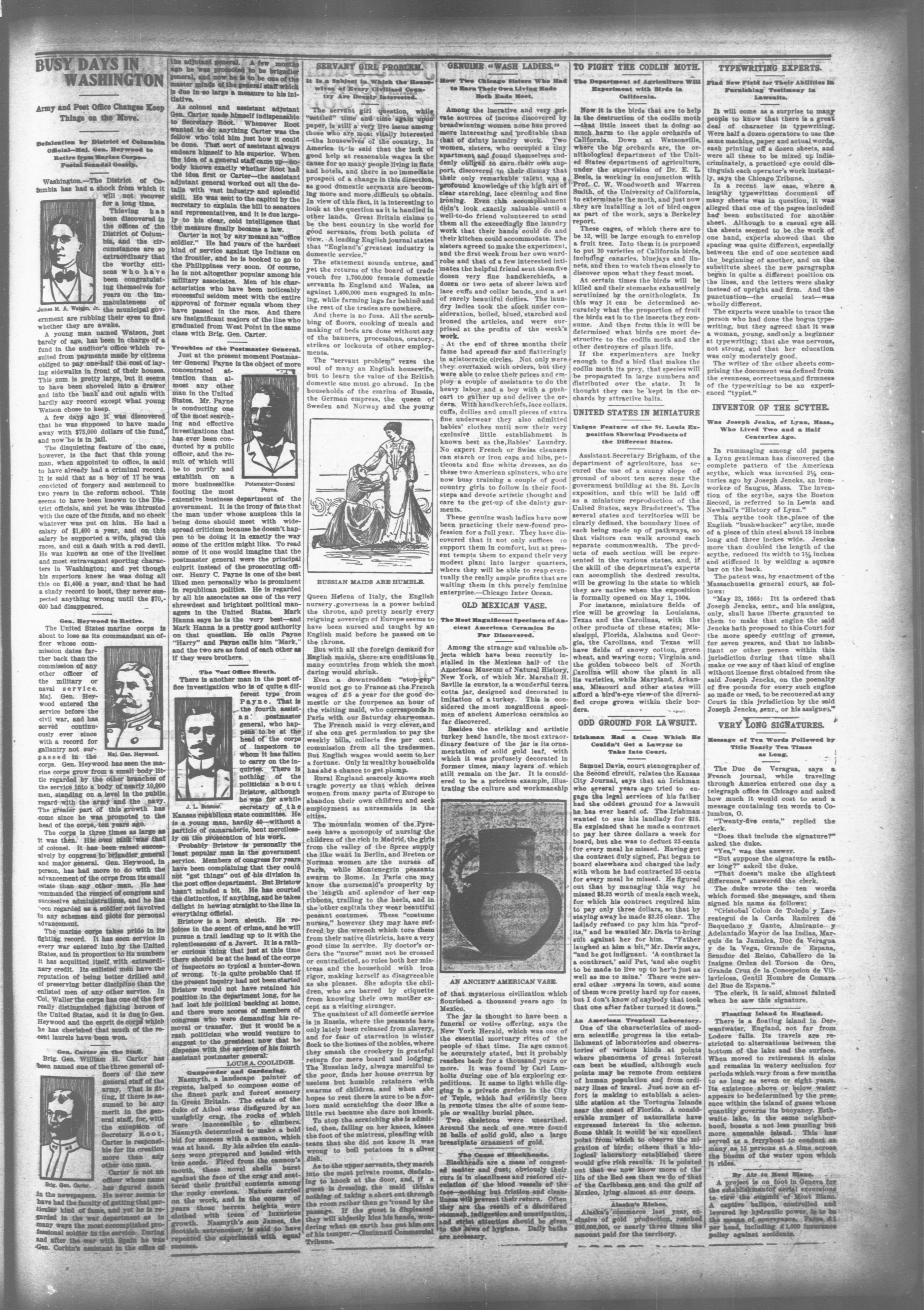
BUSY DAYS IN WASHINGTON
Army and Post Office Changes Keep Things on the Move.
Defalcation by District of Columbia Official—Maj. Gen. Heywood to Retire from Marine Corps—Postal Scandal Gossip.
Washington.—The District of Columbia has had a shock from which it
A.
Thieving has been discovered in the offices of the District of Columbia, and the circumstances are so extraordinary that the worthy citizens who have been congratulating themselves for years on the immaculateness of the municipal gov
municipal government are rubbing their eyes to find whether they are awake. A young man named Watson, just barely of age, has been in charge of a fund in the auditor's office which resulted from payments made by citizens obliged to pay one-half the cost of laying sidewalks in front of their houses. This sum is pretty large, but it seems to have been shoveled into a drawer and into the bank and out again with hardly any record except what young Watson chose to keep.
A few days ago it was discovered that he was supposed to have made away with $75,000 dollars of the fund, and now he is in jail.
The disquieting feature of the case, however, is the fact that this young man, when appointed to office, is said to have already had a criminal record. It is said that as a boy of 17 he was convicted of forgery and sentenced to two years in the reform school. This seems to have been known to the District officials, and yet he was intrusted with the care of the funds, and no check whatever was put on him. He had a salary of $1,400 a year, and on this salary he supported a wife, played the races, and cut a dash with a red devil. He was known as one of the liveliest and most extravagant sporting characters in Washington; and yet though his superiors knew he was doing all this on $1,400 a year, and that he had a shady record to boot, they never suspected anything wrong until the $70,000 had disappeared.
The United States marine corps is about to lose as its commandant an of-
ficer whose commission dates farther back than the commission of any other officer of the military or naval service. Maj. Gen. Heywood entered the service before the civil war, and has served continuously ever since with a record for gallantry not surpassed in the
M.
corps. Gen. Heywood has seen the marine corps grow from a small body little regarded by the other branches of the service into a body of nearly 10,000 men, standing on a level in the public regard with the army and the navy. The greater part of this growth has come since he was promoted to the head of the corps, ten years ago.
The corps is three times as large as it was then. His own rank was that of colonel. It has been raised successively by congress to brigadier general and major general. Gen. Heywood, in person, has had more to do with the advancement of the corps from its small estate than any other man. He has commanded the respect of congress and successive administrations, and he has been regarded as a soldier not involved in any schemes and plots for personal advancement.
The marine corps takes pride in its fighting record. It has seen service in every war entered into by the United States, and in proportion to its numbers it has acquitted itself with extraordinary credit. Its enlisted men have the reputation of being better drilled and of preserving better discipline than the enlisted men of any other service. In Col. Waller the corps has one of the few really distinguished fighting heroes of the United States, and it is due to Gen. Heywood and the esprit de corps which he has cherished that much of the recent laurels have been won.
Gen. Carter on the Staff.
Brig. Gen. William H. Carter has been named one of the three general officers of the new general staff of the army. That is fitting, if there is assumed to be any merit in the general staff, for, with the exception of Secretary Root, Carter is responsible for its creation more than any other one man.
88
Carter is not an officer whose name has figured much
Brig. Gen. Carter, has figured much in the newspapers. He never seems to have had the faculty of getting that particular kind of fame, and yet he is regarded in the war department as in many ways the most accomplished professional soldier in the service. During and after the war with Spain he was Gen. Corbin's assistant in the office of
the adjutant general. A few months ago he was promoted to be brigadier general, and now he is to be one of the master minds of the general staff which is due in so large a measure to his initiative.
As colonel and assistant adjutant Gen. Carter made himself indispensable to Secretary Root. Whenever Root wanted to do anything Carter was the fellow who told him just how it could be done. That sort of assistant always endears himself to his superior. When the idea of a general staff came up—nobody knows exactly whether Root had the idea first or Carter—the assistant adjutant general worked out all the details with vast industry and splendid skill. He was sent to the capitol by the secretary to explain the bill to senators and representatives, and it is due largely to his clear, cold intelligence that the measure finally became a law.
Carter is not by any means an "office soldier." He had years of the hardest kind of service against the Indians on the frontier, and he is booked to go to the Philippines very soon. Of course, he is not altogether popular among his military associates. Men of his characteristics who have been noticeably successful seldom meet with the entire approval of former equals whom they have passed in the race. And there are insignificant majors of the line who graduated from West Point in the same class with Brig. Gen. Carter.
Troubles of the Postmaster General Just at the present moment Postmaster General Payne is the object of more
concentrated attention than almost any other man in the United States. Mr. Payne is conducting one of the most searching and effective investigations that has ever been conducted by a public officer, and the result of which will be to purify and establish on a more businesslike footing the most
Potsmaster-General
Payne.
extensive business department of the government. It is the irony of fate that the man under whose auspices this is being done should meet with widespread criticism because he doesn't happen to be doing it in exactly the way some of the critics might like. To read some of it one would imagine that the postmaster general were the principal culprit instead of the prosecuting officer. Henry C. Payne is one of the best liked men personally who is prominent in republican politics. He is regarded by all his associates as one of the very shrewdest and brightest political managers in the United States. Mark Hanna says he is the very best—and Mark Hanna is a pretty good authority on that question. He calls Payne "Harry" and Payne calls him "Mark," and the two are as fond of each other as if they were brothers.
The Post Office Sleuth. There is another man in the post office investigation who is of quite a dif-
ferent type from Payne. That is the fourth assistan postmaster general, who happens to be at the head of the corps of inspectors to whom it has fallen to carry on the inquiries. There is nothing of the politician about Bristow, although he was for awhile secretary of the
J. L. Bristow.
J. L. Bristow. secretary of the Kansas republican state committee. He is a young man, hardly 40—without a particle of camaraderie, bent mercilessly on the prosecution of his work. Probably Bristow is personally the least popular man in the government service. Members of congress for years have been complaining that they could not "get things" out of his division in the post office department. But Bristow hasn't minded a bit. He has courted the distinction, if anything, and he takes delight in hewing straight to the line in everything official.
Bristow is a born sleuth. He rejoices in the scent of crime, and he will pursue a trail leading up to it with the relentlessness of a Javert. It is a rather curious thing that just at this time there should be at the head of the corps of inspectors so typical a hunter-down of wrong. It is quite probable that if the present inquiry had not been started Bristow would not have retained his position in the department long, for he had lost his political backing at home, and there were scores of members of congress who were demanding his removal or transfer. But it would be a rash politician who would venture to suggest to the president now that he dispense with the services of his fourth assistant postmaster general.
Gunpowder and Gardening. Nasmyth, a landscape painter of repute, helped to compose some of the finest park and forest scenery in Great Britain. The estate of the duke of Athol was disfigured by an unsightly crag, the rocks of which were inaccessible to climbers. Nasmyth determined to make a bold bid for success with a cannon, which was at hand. By his advice tin canisters were prepared and loaded with tree seeds. Fired from the cannon's mouth, these novel shells burst against the face of the crag and scattered their fruitful contents among the rocky crevices. Nature carried on the work, and in the course of years those barren heights were clothed with trees of luxurious growth. Nasmyth's son James, the Scottish astronomer, is said to have repeated the experiment with equal success.
SERVANT GIRL PROBLEM.
It Is a Sublest in Which the Housewives of Every Civilized Coun-
The servant girl question, while "settled" time and time again upon paper, is still a very live issue among those who are most vitally interested—the housewives of the country. In America it is said that the lack of good help at reasonable wages is the cause for so many people living in flats and hotels, and there is no immediate prospect of a change in this direction, as good domestic servants are becoming more and more difficult to obtain. In view of this fact, it is interesting to look at the question as it is handled in other lands. Great Britain claims to be the best country in the world for good servants, from both points of view. A leading English journal states that "England's' greatest industry is domestic service."
The statement sounds untrue, and yet the returns of the board of trade vouch for 1,700,000 female domestic servants in England and Wales, as against 1,400,000 men engaged in mining, while farming lags far behind and the rest of the trades are nowhere. And there is no fuss. All the scrubbing of floors, cooking of meals and making of beds are done without any of the banners, processions, oratory, strikes or lockouts of other employments.
The "servant problem" vexes the soul of many an English housewife, but to learn the value of the British domestic one must go abroad. In the households of the czarina of Russia, the German empress, the queen of Sweden and Norway and the young
A
RUSSIAN MAIDS ARE HUMBLE.
Queen Helena of Italy, the English nursery-governess is a power behind the throne, and pretty nearly every reigning sovereign of Europe seems to have been nursed and taught by an English maid before he passed on to the throne.
But with all the foreign demand for English maids, there are conditions in many countries from which the most daring would shrink.
Even a downtrodden "stop gap" would not go to France at the French wages of £5 a year for the good domestic or the fourpence an hour of the visiting maid, who corresponds in Paris with our Saturday charwoman. The French maid is very clever, and if she can get permission to pay the weekly bills, collects five per cent. commission from all the tradesmen. But English wages would seem to her a fortune. Only in wealthy households has she a chance to get plump.
Rural England scarcely knows such tragic poverty as that which drives women from many parts of Europe to abandon their own children and seek employment as nursemaids in the cities.
The mountain women of the Pyrenees have a monopoly of nursing the children of the rich in Madrid, the girls from the valley of the Spree supply the like want in Berlin, and Breton or Norman women are the nurses of Paris, while Montenegrin peasants swarm to Rome. In Paris one may know the nursemaid's prosperity by the length and splendor of her cap ribbons, trailing to the heels, and in the other capitals they wear beautiful peasant costumes. These "costume nurses," however they may have suffered by the wrench which tore them from their native districts, have a very good time in service. By doctor's orders the "nurse" must not be crossed or contradicted, so rules both her mistress and the household with iron rigor, making herself as disagreeable as she pleases. She adopts the children, who are barred by etiquette from knowing their own mother except as a visiting stranger.
The quaintest of all domestic service is in Russia, where the peasants have only lately been released from slavery, and for fear of starvation in winter flock to the houses of the nobles, where they smash the crockery in grateful return for mere board and lodging. The Russian lady, always merciful to the poor, finds her house overrun by useless but humble retainers with swarms of children, and when she hopes to rest there is sure to be a forlorn maid scratching the door like a little rat because she dare not knock.
To stop the scratching she is admitted, then, falling on her knees, kisses the foot of the mistress, pleading with tears that she did not know it was wrong to boil potatoes in a silver dish.
As to the upper servants, they march into the most private rooms, disdaining to knock at the door, and, if a guest is dressing, the maid thinks nothing of taking a short cut through the room rather than go'round by the passage. If the guest is displeased they will objectly kiss his hands, wondering what on earth has put him out of his temper.—Cincinnati Commercial Tribune.
GENUINE "WASH LADIES." How Two Chicago Sisters Who Had to Earn Their Own Living Made Both Ends Meet.
Among the lucrative and very private sources of income discovered by breadwinning women none has proved more interesting and profitable than that of dainty laundry work. Two women, sisters, who occupied a tiny apartment and found themselves suddenly obliged to earn their own support, discovered to their dismay that their only remarkable talent was a profound knowledge of the high art of clear starching, lace cleaning and fine ironing. Even this accomplishment didn't look exactly valuable until a well-to-do friend volunteered to send all the exceedingly fine laundry work that their hands could do and their kitchen could accommodate. The sisters agreed to make the experiment, and the first week from her own wardrobe and that of a few interested intimates the helpful friend sent them five dozen very fine handkerchiefs, a dozen or two sets of sheer lawn and lace cuffs and collar bands, and a set of rarely beautiful doilies. The laundry ladies took the stock under consideration, boiled, blued, starched and ironed the articles, and were surprised at the profits of the week's work.
At the end of three months their fame had spread far and flatteringly in aristocratic circles. Not only were they overtaxed with orders, but they were able to raise their prices and employ a couple of assistants to do the heavy labor and a boy with a pushcart to gather up and deliver the orders. With handkerchiefs, lace collars, cuffs, doilies and small pieces of extra fine underwear they also admitted babies' clothes until now their very exclusive little establishment is known best as the, Babies' Laundry. No expert French or Swiss cleaners can starch or iron caps and bibs, petticoats and fine white dresses, as do these two American spinsters, who are now busy training a couple of good country girls to follow in their footsteps and devote artistic thought and care to the get-up of the dainty garments.
These genuine wash ladies have now been practicing their new-found profession for a full year. They have discovered that it not only suffices to support them in comfort, but at present tempts them to expand their very modest plant into larger quarters, where they will be able to reap eventually the really ample profits that are waiting them in this purely feminine enterprise.—Chicago Inter Ocean.
OLD MEXICAN VASE.
The Most Magnificent Specimen of Ancient American Ceramics So Far Discovered.
Among the strange and valuable objects which have been recently installed in the Mexican hall of the American Museum of Natural History, New York, of which Mr. Marshall H. Saville is curator, is a wonderful terra cotta jar, designed and decorated in imitation of a turkey. This is considered the most magnificent specimen of ancient American ceramics so far discovered.
Besides the striking and artistic turkey head handle, the most extraordinary feature of the jar is its ornamentation of solid gold leaf, with which it was profusely decorated in former times, many layers of which still remain on the jar. It is considered to be a priceless example, illustrating the culture and workmanship
C
AN ANCIENT AMERICAN VASE. of that mysterious civilization which flourished a thousand years ago in Mexico.
The jar is thought to have been a funeral or votive offering, says the New York Herald, which was one of the essential mortuary rites of the people of that time. Its age cannot be accurately stated, but it probably reaches back for a thousand years or more. It was found by Carl Lumholtz during one of his exploring expeditions. It came to light while digging in a private garden in the City of Tepic, which had evidently been in remote times the site of some temple or wealthy burial place.
Two skeletons were unearthed. Around the neck of one were found 26 balls of solid gold, also a large breastplate ornament of gold.
The Cause of Blackheads.
Blackheads are a mass of congested matter and dust; obviously their cure is in cleanliness and restored circulation of the blood vessels of the face nothing but friction and cleanliness will prevent their return. Often they are the result of a disordered stomach, indigestion and constipation, and strict attention should be given to the laws of hygiene. Daily baths are necessary.
Now it is the birds that are to help in the destruction of the codlin moth that little insect that is doing so much harm to the apple orchards of California. Down at Watsonville, where the big orchards are, the ornithological department of the United States department of agriculture, under the supervision of Dr. E. L. Beele, is working in conjunction with Prof. C. W. Woodworth and Warren Smith, of the University of California, to exterminate the moth, and just now they are installing a lot of bird cages as part of the work, says a Berkeley report.
These cages, of which there are to be 12, will be large enough to envelop a fruit tree. Into them it is purposed to put 30 varieties of California birds, including canaries, bluejays and linnets, and then to watch them closely to discover upon what they feast most. At certain times the birds will be killed and their stomachs exhaustively scrutinized by the ornithologists. In this way it can be determined accurately what the proportion of fruit the birds eat is to the insects they consume. And then from this it will be determined what birds are most destructive to the codlin moth and the other destroyers of plant life.
If the experimenters are lucky enough to find a bird that makes the codlin moth its prey, that species will be propagated in large numbers and distributed over the state. It is thought they can be kept in the orchards by attractive baits.
UNITED STATES IN MINIATURE
Unique Feature of the St. Louis Exposition Showing Products of the Different States.
Assistant Secretary Brigham, of the department of agriculture, has secured the use of a sunny slope of ground of about ten acres near the government building at the St. Louis exposition, and this will be laid off as a miniature reproduction of the United States, says Bradstreet's. The several states and territories will be clearly defined, the boundary lines of each being made up of pathways, so that visitors can walk around each separate commonwealth. The products of each section will be represented in the various states, and, if the skill of the department's experts can accomplish the desired results, will be growing in the state to which they are native when the exposition is formally opened on May 1, 1904.
For instance, miniature fields of rice will be growing in Louisiana, Texas and the Carolinas, with the other products of these states; Mississippi, Florida, Alabama and Georgia, the Carolinas, and Texas will have fields of snowy cotton, green wheat, and waving corn; Virginia and the golden tobacco belt of North Carolina will show the plant in all its varieties, while Maryland, Arkansas, Missouri and other states will afford a bird's-eye view of the diversified crops grown within their borders.
ODD GROUND FOR LAWSUIT.
Irishman Mad a Case Which He Couldn't Get a Lawyer to Take Into Court.
Samuel Davis, court stenographer of the Second circuit, relates the Kansas City Journal, says that an Irishman who several years ago tried to engage the legal services of his father had the oddest ground for a lawsuit he has ever heard of. The Irishman wanted to sue his landlady for $15. He explained that he made a contract to pay her three dollars a week for board, but she was to deduct 25 cents for every meal he missed. Having got the contract duly signed, Pat began to board elsewhere and charged the lady with whom he had contracted 25 cents for every meal he missed. He figured out that by managing this way he missed $5.25 worth of meals each week, for which his contract required him to pay only three dollars, so that by staying away he made $2.25 clear. The ladlady refused to pay him his "profits," and he wanted Mr. Davis to bring suit against her for him. "Father laughed at him a bit," Mr. Davis says, "and he got indignant. 'A contract is a contract,' said Pat, 'and she ought to be made to live up to her'n just as well as me to mine.' There were several other awyers in town, and some of them were pretty hard up for cases, but I don't know of anybody that took that one after father turned it down."
An American Tropical Laboratory. One of the characteristics of modern scientific progress is the establishment of laboratories and observatories of various kinds at points where phenomena of great interest can best be studied, although such points may be remote from centers of human population and from ordinary lines of travel. Just now an effort is making to establish a scientific station at the Tortugus Islands near the coast of Florida. A considerable number of naturalists have expressed interest in the scheme. Some think it would be an excellent point from which to observe the migration of birds; others that a biological laboratory established there would give rich results. It is pointed out that we now know more of the life of the Red sea than we do of that of the Caribbean sea and the gulf of Mexico, lying almost at our doors.
Alaska's Riches. Alaska's commerce last year, exclusive of gold production, reached $20,000,000, or nearly three times the amount paid for the territory.
TYPEWRITING EXPERTS.
Find New Field for Their Abilities in Furnishing Testimony in Lawsuits.
It will come as a surprise to many people to know that there is a great deal of character in typewriting. Were half a dozen operators to use the same machine, paper and actual words, each printing off a dozen sheets, and were all these to be mixed up indiscriminately, a practiced eye could distinguish each operator's work instantly, says the Chicago Tribune.
In a recent law case, where a lengthy typewritten document of many sheets was in question, it was alleged that one of the pages included had been substituted for another sheet. Although to a casual eye all the sheets seemed to be the work of one hand, experts showed that the spacing was quite different, especially between the end of one sentence and the beginning of another, and on the substitute sheet the new paragraphs began in quite a different position on the lines, and the letters were shaky instead of upright and firm. And the punctuation—the crucial test—was wholly different.
The experts were unable to trace the person who had done the bogus typewriting, but they agreed that it was a woman, young, and only a beginner at typewriting; that she was nervous, not strong, and that her education was only moderately good.
The writer of the other sheets comprising the document was defined from the evenness, correctness and firmness of the typewriting to be an experienced "typist."
INVENTOR OF THE SCYTHE.
Was Joseph Jenks, of Lynn, Mass. Who Lived Two and a Half Centuries Ago.
In rummaging among old papers a Lynn gentleman has discovered the complete pattern of the American scythe, which was invented $ 2 \frac{1}{2} $ centuries ago by Joseph Jencks, an ironworker of Saugus, Mass. The invention of the scythe, says the Boston Record, is referred to in Lewis and Newhall's "History of Lynn."
This scythe took the place of the English "bushwhacker" scythe, made of a piece of thin steel about 18 inches long and three inches wide. Jencks more than doubled the length of the scythe, reduced its width to $ 1 \frac{1}{2} $ inches and stiffened it by welding a square bar on the back.
The patent was, by enactment of the Massachusetts general court, as follows:
"May 23, 1665: Itt is ordered that Joseph Jencks, senr., and his assigns, only, shall haue liberte graunted to them to make that engine the said Jencks hath proposed to this Court for the more speedy cutting of grasse, for seven yeares, and that no inhabitant or other person within this jurisdiction during that time shall make or vse any of that kind of engine without license first obtained from the said Joseph Jencks, on the poenalty of five pounds for euery such engine so made or vsed, to be recouered at any Court in this jvrisdiction by the said Joseph Jencks, senr., or his assignes."
Message of Ten Words Followed by Title Nearly Ten Times as Long.
The Duc de Veragua, says a French journal, while traveling through America entered one day a telegraph office in Chicago and asked how much it would cost to send a message containing ten words to Columbus, O.
"Twenty-five cents," replied the clerk.
"Does that include the signature?" asked the duke.
"Yes," was the answer.
"But suppose the signature is rather long?" asked the duke.
"That doesn't make the slightest difference," answered the clerk.
The duke wrote the ten words which formed the message, and then signed his nams as follows:
"Cristobal Colon de Toledo y Larreategui de la Carda Ramirez de Baquedano y Gante, Almirante y Adelantado Mayor de las Indias, Marquis de la Jamaica, Duc de Veragua y de la Vega, Grande de Espana, Senador del Reino, Caballero de la Insigne Orden del Torson de Oro, Grande Cruz de la Concepcion de Villaviciosa, Gentil Hombre de Comara del Rue de Espana."
The clerk, it is said, almost fainted when he saw this signature.
Floating Island in England.
There is a floating island in Derwentwater, England, not far from Lodore falls. Its travels are restricted to alternations between the bottom of the lake and the surface. When moved to retirement it sinks and remains in watery seclusion for periods which vary from a few months to as long as seven or eight years. Its existence above or below water appears to be determined by the presence within the island of gases whose quantity governs its buoyancy. Esthwaite lake, in the same neighborhood, boasts a not less puzzling but more amenable island. This has served as a ferryboat to conduct as many as 15 persons at a time across the bosom of the water upon which it rides.
By Air to Mont Blanc.
A project is on foot in Geneva for the establishment of serial excursions to view the summit of Mont Blanc. A captive balloon, controlled and lowered by hydraulic power, is to be the means of conveyance. Fares £1 per head, including £1,000 insurance policy against accidents.
CHIPS.
Attorney Timothy J. Fell, late of the law firm of Gilbert & Fell, now occupies fine quarters on the eighth floor of the Chamber of Commerce. Mr. Fell is one of the many the able and popular lawyers of Chicago.
W. W. Simpson, the expressman, 1205 State street, does not make as much money as some of the would-be leaders of the Afro-American race in this city, but he is an honest man, a lover of his race and a supporter of The Broad Ax.
A colored woman of Indianapolis, Ind., has brought suit against a white woman of that city for $5,000 for alienating the affections of her husband. This seems to indicate that there are some white women who fall in love with colored men.
Booker T. Washington was condemned by the A. M. E. Sunday school convention which met at Milwaukee, Wis., last week, for contending that "the Negro should confine himself to one line of industry," this shows which way the wind is blowing Booker T.!
Lynch Wormley, 364 27th street, who for many years worked in the South Town office, left the city Monday evening on the private car of Robert T. Lincoln, President of the Pullman Palace Car Company, Mr. Wormley and President Lincoln will be absent from the city one month.
Rev. Father Flannagan, St. Anne's Church, Garfield Boulevard, and Wentworth ave., is greatly interested in the progress of the Afro-American race, and if all ministers of the gospel were as considerate and liberal-minded as Father Flannagan, there would be no "Race problem" in America.
Judge Charles M. Walker began his judicial duties Wednesday morning in the court room vacated by Judge Frank Baker. Many of the friends of Judge Walker were on hand to greet him at the opening of court. Roses and other lovely flowers were in evidence in his court rooms. Judge Baker acted as god father for Judge Walker.
J. A. Scott, ex-journalist and politician, who holds down a good job in the county building, spent the past two weeks in visiting his old friends at Macon, Miss., and in that neck of the woods Mr. Scott says "the colored people are rapidly turning against Booker T. Washington, and his shallow ideas respecting their right to enjoy the exercise of suffrage the same as other American citizens.
Larson Reed, lover of Miss Bessie Thomas, daughter of Rev. Jasper F. Thomas, 4857 Armour ave., was fined ten dollars and cost, Tuesday morning by Justice Charleton of Hyde Park, for striking at or quarreling with Mrs. Frank Brown, who lives next door to Rev. Jasper, and his fighting family. Alderman Butterworth represented Mrs. Brown and Gambling Jack Terrell, who beat The Broad Ax out of three dollars, looked after the Reed and Thomas end of the scrap.
Mayor Harrison made a few more of his followers happy Monday evening by permitting them gnaw at the public crib; the lucky ones are as follows; Ernest McGaffrey, secretary to his honor; Andrew J. Lynch, Peter Kiolbassa, George A. Schilling and John Ericson, members of the local board of improvements. John Fitzgerald, police magistrates, stock yards station, and John J. Hennessy, Englewood station; some of the small fry politicians endeavored to induce Mayor Harrison to toss Justice Fitzgerald up in the air, but they did not phase him.
Several colored men are employed in the foundries at Madina, N. Y., a small town of 2,500 inhabitants, and the place is offering inducements for the settlement of domestics, farm laborers and industrious mechanics from the South—Not as an exodus, but as a natural, healthful migration. It is said that no color line is apparent there. The churches, Methodist, Baptist, Presbyterians, Episcopal, Lutheran and Roman Catholic, freely open their doors to coed communists, and on the local ball team there are two Indian and two Negroes.—Ex.
Slavery is firmly fastened on the soil of Alabama, and the Christians are burning Negroes at the stake and mobbing and lynching them right and left.
But up to the present time Booker T. Washington has slunk away like a whipped dog, and he has not had one word to say pertaining to the enslavement of human beings in his state, nor opened his mouth in condemnation of the reign of anarchy mob and lynch law, but notwithstanding this fact Booker Washington still possesses enough brass to pose as the great and only leader of the Afro-American race, but when chicken, hearted Leaders as the Wizard of Tuskeges are not worth one cent to
the race while it is being persecuted on every hand near unto death.
The Freeman and all the other Afro-American newspapers which are owned and controlled by Booker T. Washington, the second Moses, or the "modern emancipator," are engaged in blowing all about the committee of southern gentlemen who visited Tuskegee recently, and their endorsement of Booker and his Jim Crow ideas, but these newspaper flunkies have carefully refrained from publishing resolution No. 3, which was passed by that famous committee of southernborn and southern-bred gentlemen, who are in favor of robbing the Negro in every way and depriving him of his ballot, so that it will be no trouble to re-enslave him. Resolved: "That after close observation of the 150 teachers and 1400 students here to-day, we have found not the slightest attempt at, or apparent desire for social equality or amalgamation with the white race." That was the most important resolution passed by those southern gentlemen, but Booker Washington and his gang of cowards did not have the nerve to publish it.
Joseph Haywood, 29601-2 State street, new stand, and confectionary store.
A Gentle Hint.
He had taken the curtain lecture meekly, but at the conclusion he remarked casually:
"Now, there's the case of that woman who was accidentally pushed under water while she was in bathing."
"What of her?" his wife demanded.
"Why, if she had learned to keep her mouth shut," he answered, brutally, "she wouldn't have drowned before help reached her."—Chicago Post.
Ambiguous.
A faithful Irish maid called upon her former mistress, who had recently lost her mother.
"Och, mum!" Nora began, "an' th' shwate lady 's gone. Shure, Oi niver knowed it till a wake afther th' buryin'. She wuz loike wan av me own, an' "—with a fresh burst of tears—"there wa'n't nobody Oi'd rather hov seen dead than yure darlin' ould mother."—Judge.
Its Capacity.
Little Clarence—Pa, what is a volcano?
Mr. Callipers—A volcano, my son, is a cramped and feverish mountain which belches forth fire, smoke, lava, statistics, adjectives and "copy" for the magazines, for two years or more after the first eruption, and beggars description every time it is described. Puck.
Only a Little More So.
Stranger (in mining village)—I used to know a fellow in the east named Cull Boffum that moved out here ten or 15 years ago. The people were mighty glad to have him go. He was dead tough.
Comanche Jim—Well, he ain't changed no great deal. He's a dead tough now.—Chicago Tribune.
Sure to Move Them.
Traveler—Deadlock in your state legislature.
"Introduce a bill to raise salaries."
—N. Y. Weekly.
Never Quarreled.
"I am proud to say," remarked Mr. Meekton, "that my wife is not what could be called a quarrelsome woman."
"Indeed?"
"I never knew her to quarrel in my life. She merely announces what she wants, and that's an end of the matter."—Washington Star.
Knows What Is Coming.
Mr. Bacon-By means of an ingenious instrument, the hrydroscope, the human eyesight can penetrate the ocean depths and clearly distinguish objects over a mile below the surface.
Mrs. Bacon-Now look out for some startling new fish stories-Yonkers Statesman.
Severely Unsympathetic.
"Mister," said Meandering Mike, "if I was to tell you dat I had seen better days would you believe me?"
"Certainly," answered Mr. Leander Scraggs; "this is one of the most unsatisfactory days that our versatile climate has yet produced."—Washington Star.
DEVINE & O'CONNELL
ATTORNEYS AT LAW
SUITE 318-320 REAPER BLOCK
Clerk and Washington Sts.
Telephone, Main 940. CHICAGO.
A. D. GASH
Attorney at Law,
84-86 La Salle Street, Chicago.
Suite 615 to 619,
Telephone Main 3077.
JOHN F. OWENS
Attorney at Law,
Dutra 6th ARLAND BLOCK,
80 E. Clark Street, CHICAGO
FREDERICK W. JOB
ATTORNEY AT LAW
B22 MABQUETTE BUILDING
Telephone 2810 Central
CHICAGO
TELEPHONE MAIN 2804
FEDERICO M. BARRIOS
Attorney & Counsellor at Law
Suite 501 Firmenich Bldg.
N. E. Cor. Fifth Avenue
and Washington Street
Chicago.
LAWRENCE A. NEWBY ATTORNEY AT LAW Room 42,119 La Salle Street CHICAGO
William Howard Fitzgerald
LAWYER
Room 402 Reeper Black, CHICAGO
PHONES {Office, Main 1157
Res. Brown 42
STEPHEN A. DOUGLAS
LAWYER
Suite 200, 123-125 LA Salle Street
CHICAGO
JOSEPH A. McINERNEY
LAWYER
Suite 700-701
Chicago O'Neal Hoean
CHICAGO.
WILLIAM RITCHIE
ATTORNEY AND COUNSELOR.
Suite 810-820 Oxford Building
84 LA SALLE ST., CHICAGO
Telephone Main 1646.
Robert M. Mitchell
Attorney at Law
Suite 9, No. 77 South Clark St.
CHICAGO
Telephone Tardis 911 Bedfordson, 119 Canfield Rd.
JOHN FITZGERALD
JUSTICE OF THE PEACE
6707 N. HALLOWEEN STREET,
CHICAGO
J. GRAY LUCAS
ATTORNEY-AT-LAW
Suite 412 Real Estate Board Bldg
50 Dearborn St. Cor. Randolph
CHICAGO.
Phone Randolph 55
J. E. JONES
LAWYER
79 Clark Street
Room 9 Chicago
S. A. McELWEE
...LAWYER...
36 S. Clark St., CHICAGO.
Room 700 Ogden Building
Residence, 8163 Forest Av.
ALBERT B. GEORGE
LAWYER.
428 Ashland Block, Chicago.
— 201. M. BOOK. —
For Sale or Rent.
Houses, flat buildings, and lots in city and suburbs, on easy monthly installments. Fire Insurance and Furniture Loans at lowest rates. CEO. W. FAULKNER & CO. Phone 2331 Brown. 2935 State St.
```markdown
```
THE DAVIES INVESTMENT COMPANY
614 First National Bank Bldg., Chicago
'Phone Central 3026,
Face Massage, Shampooing, Scalp Treating
Mrs. Warner
Chiropodist and Manicuring
Removes Corns Without Pain
Medicated Foot Baths and Foot Massage
138 State St., 4th Floor, Chicago
Telephone Blue 4632 Work Called for and Delivered..
A. HOFFMAN,
CLEANER, DYER
AND PRESSER.
Suits Sponged and Pressed 35c
5125 State St. Expert Workmanship
Moderate Prices.
Mrs. Florence Miller
FASHIONABLE
DRESSMAKER
PERFECT FIT GUARANTEED
PRICES REASONABLE
3151 State Street CHICAGO.
CHARLES L. WEBB COURT REPORTER 77 South Clark St., Room 9 CHICAGO. General Stenographer
WONDERFUL DISCOVERY Curly Hair Made Straight By
TAKEN FROM LIFE:
BEFORE AND AFTER TREATMENT.
ORIGINAL
OZONIZED OX MARROW
(Coprighited.)
This wonderful hair pomade is the only safe preparation in the world for curly hair straight as shown above. It nourishes the scalp, prevents the hair from falling out or breaking off, cures dandruff and makes the hair grow long and silky. Sold over forty years and used by thousands. Warranted harmless. It was the first preparation ever made for curly hair. Beware of limitations. Get the Original Ox Marrow as the genuine never falls to keep the hair straight, soft and beautiful, giving it that healthy, life-like appearance so much desired. A bottle necessary for ladies, gentlemen and children. Elegantly perfumed, so its superior and lasting qualities it is the perfect companion for anybody to produce a preparation equal to it. Full directions with every bottle. Only $0 cents. Sold by druggists and dealers or send us $0 cents for one bottle or $1.40 for three bottles. We pay all express charges. Send postal or express delivery address. Indicate name of this paper when ordering. Write your name and address plainly to
OZONIZED OX MARROW CO.,
76 Wabash Ave., Chicago, Illinois.
Nicely furnished rooms to rent for gentlemen. Reasonable rates, 2252 Indiana aveuna.
Mrs. Anna L. Newby. First class furnished rooms, for rent to gentleman and ladies, with bath and gas. 2628 Wabash avenue.
Rooms for Rent.
Elegantly furnished rooms for rent with bath and gas at 3232 Wabash avenue.
AGENTS AND CORRESPONDENTS WANTED.
The Broad Ax desires to engage agents and regular correspondents in all the leading cities and towns in Illinois and throughout the other sections of the country. The highest commissions paid to live hustlers Sample copies furnished. For further information address Julius F. Taylor 5040 Armour avenue, Chicago, Ill.
```markdown
```
ILLINOIS BRICK CO.
ILLINOIS BRICK CO.
WILLIAM C. KUESTER. SUPERINTENDENT.
N. Western Ave., Ch
Telephone Lake View 270
1994 N. Western Ave., Chicago. Telephone Lake View 270.
HOHENADEL BROS.
211-213 Madison Street
CHICAGO
Telephone Main J300
UNIFORM CAR
FOR
men,
riers,
formen,
nitors, Wagonmen,
Street Car Employes,
Telegraph Messen,
Railroad Emp,
Bellboys, Wa
BOB FEINBEN
Market and Grocer
Pollicemen, Firemen, Street Car Employes,
Letter Carriers, Telegraph Messengers,
Elevatormen, Railroad Employes,
Janitors, Wagenmen, Bellboys, Watchmen, Eta.
JACOB FEINBERG
Market and Grocery
State Sts. CHI
81st and State Sts. CHICAGO
Tel. Yards 693 Notary Public
John J. Bradley
Real Estate, Insurance and Loans Property managed. Abstracts examined. Renting. Legal papers prepared. 4709 South Halsted Street Chicago
T. J. HUNTER
Fancy Summer Dresses and Silk Waists
GENTS' SUITS AND OVERCOATS
EASY TERMS MAIL ORDERS PROMPTLY FILLED
Private Sales Room 3149 State St. Second Floor
OPEN EVENINGS
226 East 25th Street - - - CHICAGO
F. W. BOYD DEALER IN COAL, WOOD AND ICE MOVING AND EXPRESSING All Orders Promptly Attended to Cash on Delivery Telephone Blue 289 4656 Armour Avenue, CHICAGO.
M. JUNK, Proprietor JOS. P. JUNK, Manager 3700-3710 South Halsted Street and 897 to 929 Thirtyseventh Street CHICAGO
-- American Brick Co. --
President and Treasurer, THOMAS CAREY. Vice-President, JOHN SHELHAMER, Secretary, WILLIAM SULLIVAN. MANUFACTURERS OF
Common and Sewer Brick Office and Yards:
45th and Robey Sts.
Yards running winter and summer, equipped with the latest improved Wolf Dryer.
Output of Winter Yards ..... 144,0.0 per day
Output of Jummer Yards..... 300,0.0 per day
Telephone Yards 128.
Telephone 565 South
270.
CAPS
Employee,
Messengers,
and Employes,
Srs, Watchmen, Etc.
BERG
cery
CHICAGO
Notary Public
Hdley
and Loans
legal papers prepared.
Chicago
TER
ALL KINDS
ists
ATS
PLY FILLED
Second Floor
Mason and
General
Contractor
CHICAGO
LER IN
ND ICE