The Broad Ax
Saturday, August 1, 1903
Chicago, Illinois
Page text (machine-generated)
Anarchy, Mob and Lynch Law Is Increasing In Illinois
Vol. VIII
Anarchy, Mob Is Increasing
While Gov. Yates is R
Nursing His Vice
Anarchy, mob and lynch law with all of its hideousness again raised its slimy and bloody head at Danville, Ill., last Saturday night. A Negro by the name of J. D. Mayfield, late of Evansville, Ind., became involved in a quarrel with a white man by the name of Henry Gatterman, and the former
pulled out his revolver and shot the latter dead in front of the saloon in which Mayfield had been refused a drink. The officers of the law promptly arrested Mayfield and lodged him in the city prison. Then the mob consisting of over four thousand men and women, many of them the best and the leading citizens of Danville, and the surrounding country, stormed the city hall, played with mayor Beard and the policemen who made not the slightest effort to uphold the law, without saying anything about protecting their prisoner.
Only a few moments elapsed after the mob gained admission to the city hall with the aid of Mayor Beard and his peace officers, until it had a rope around the neck of its victim which it dragged up and down, the streets for the edification of the Christian men and women of Danville. Finally the mob strung his body up to a telegraph pole, riddled it with bullets, then cries wrent the air, "burn him! burn him!" and in a jiffy his body was cut down and a mighty yell went up "to the county jail. When the mob arrived in front of the jail, many men and boys who acted like man-eating canibals kicked and jumped on it. By that time the black body of Mayfield was perfectly naked but that did not prevent delicate and so-called refined society ladies from rushing forward so they could behold the naked body of a dead "Nigger." The mob at last concluded that the best way to display its superiority over the Negro, was to reduce the lifeless body of Mayfield to ashes.
So a large armful of hay or straw was placed upon it, and in a short time the flames were hissing, roaring and leaping heavenward and when the brilliancy of that awful conflagation had died away and darkness had settled down around the body of Mayfield which was still lying on the ground with its face upward, a gentleman came forward out of the darkness, and threw his lighted cigar in the face of the victim of the mob for the purpose of rekindling the flames in order to furnish some more amusement or excitement for the men, women and children who witnessed that revolting or horrible spectacle. At last the leaders of the mob who had become thoroughly intoxicated with blood and whisky, decided to batter down the doors of the county jail and secure another Negro by the name of James Wilson, who is charged with assaulting Mrs. Burgess, as the mob wanted to subject him to the same treatment which it had administered to Mayfield.
But Sheriff Hardy H. Whitlock, who highly resolved to adhere strictly to the oath which he subscribed to when he assumed the duties of Sheriff of Vermillion county, ordered the respectable citizens who were the ringleaders of the mob, to refrain from endeavoring to storm the jail. He, like a brave man, addressed them thusly:
"You are doing wrong, you will regret what you have already done tomorrow and you should go home and allow the law to take its course. This Negro has not been identified as the man who assaulted Mrs. Burgess. If
he had been I would turn him out to you. You cannot afford to kill an innocent man." Several other gentlemen who were willing to assist to uphold the hands of Sheriff Whitlock also pleaded with the anarchists, mobbers and lynchers, to disperse and go to their homes, but the leaders of the mob closed their ears to reason and conducted themselves like mad bulls. Then they charged against the doors of the jail with a railroad iron. The sheriff again admonished the anarchists or law breakers to disperse but they beeded not his kindly advice; then he cooly fired into them, and when the smoke had cleared away more than twenty members of the mob had received a good dose of buckshot. Several gentlemen possibly Sunday school teachers, were lying on the ground freely bleeding, many others crawled away in the darkness on their hands and knees. Some were carted away in ambulances and those who failed to receive their share of lead suddenly made up their minds to return to their Christian homos without any further urging on the part of Sheriff Whitlock.
In order to further uphold the law and protect the prisoners in the jail Sheriff Whitlock called on Governor Yates for aid, but the Governor and none of his under-strappers could be found at or near the State Capitol for he was racing around over the country spending the people's time nursing his vice-presidential boom, while anarchy, mob and lynch law was flourishing in Illinois. At last some one connected with the Governor's office ordered four companies of the Seventh Regiment which were encamping at Springfield to Danville. That act cost the people of Illinois between four and six thousand dollars; and while at the same time Company K, of the Eighth Regiment, which is composed of men who had served in the Spanish-American War, was located at Danville, but the anarchists, mobbers and lynchers declared" that they would kill the "Nigger" soldiers" if they were ordered out to assist the Sheriff to maintain law and order. Now, suppose they had killed every one of the Negro soldiers. What difference would it have made whether white or colored soldiers were killed in an effort to enforce the law and restore peace, on such occasions as that? By all means Company K. should have been thrown against the mob and not ignored in the manner in which it was, for if fighting is not a part of its business, then what good is it? There is no use in maintaining it at a great expense to the people of Illinois simply for political effect, or solely for the purpose of tickling the fancy of Dick Yates and his gang of pinheaded politicians whenever they are on dress parade. So the Eighth Regiment should be abandoned and other men should be selected to take its place who can and will fight when such occasions arise without putting the state to so much expense in transporting them to the scene of action.
As for Mayfield, he had no right to shoot Henry Gatterman, but men and women, regardless of their color, murder each other every day in the year, and will continue to do so, and after all that has been said and done, how much better it would have been for the people of Danville, if they would have permitted the law to take its own course.
HEW TO THE LINE.
CHICAGO,AUGUST1,1903.
Jim Crow Negro Preachers. The Negro Methodist preachers of Georgia, met at Madison Ga. last week and all of them had their hands out for a little piece of money and they thought the best way to wiggle it out of the pockets of the whites in the South would be to pass the following resolution. "We commend the Southern White Man, because he refuses to let Negroes drink at his fountains, eat in his cafes, sleep in his hotels for the following reasons. It forces the Negroes to build his own resorts, teaches him business and turns a flood of money to the Negro vaults and bank accounts."
They might have added that they favored Jim Crow cars for the same reason. They also condemned the whites in the north for mobbing and lynching Negroes and claimed that the Negro is safer and freerer in the south from mob law than in the north which is all rot. For in order to give the lie to those Jim Crow preachers the day after their meeting the whites of Georgia went out and mobbed and lynched an innocent Negro.
The Negro race cannot make any substantial moral or financial progress until it hangs up by the neck the majority of its preachers and leaders like Booker T. Washington who are ever ready to sell it out for a mess of pottage.
Hyde Park News.
The infant child, a little girl, of Mr. and Mrs. G. Williams, 5333 Lake ave., drank gasoline last Saturday between 4 and 5 O'clock and in less than an hour it was dead. The funeral was Monday at 2:30, Rev. Slater officiating. The child was a very beautiful and smart girl, the idol of its mother and father. Mr. J. J. Coleman has been heard from. It is reported that one of his sons have a letter from him and that he is in Buffalo.
Rev. and Mrs. Slater dined at Mrs. Fred Coleman's last Sunday evening. The Rev. says that Mrs. Coleman is one of the finest cooks in this part of the city.
The Negro Symposium at the Hyde Park Chapel last Sunday night was a decided success in the way both of program and attendance. The speeches were of the finest character, sound in thought and chaste in diction. The participants were Mr. Rayford of the Atlanta Baptist College, Noble Grant of the South Side Academy, Prof. Jno. Bias, Prof. of Mathematics at Lincoln Institute in Mo., Prof. C. H. Johnson of Wilberforce, Ohio. Miss F. A. Lee, Bishop Lee's daughter Prof of Greek and Latin at Wilberforce, and Prof. J. B. Shaw, Prof. of Greek and Latin of Rust University at Holly Springs, Miss. Miss Lee spoke on the Negro woman. She enjoined plain living and high thinking on the part of our women. Every colored woman should have heard her. Prof. Johnson said that thought and love should characterize the religion of the Negro. It was left for Prof. Shaw to simply carry the audience away with his matchless eloquence. Rev. Slater says that Hyde Park must hear Prof. Shaw again soon. Mrs. Emma Taylor sang "The Haven of Rest" very sweetly.
Rev. Slater was invited to address the white people last Monday night at Harvey, Ill. on the Temperance Question Relative to the Colored People.
Courtship and Marriage is the subject of Rev. Slater's sermon next Sunday night. If you are thinking of getting married, come and here him. Well, well, ye old batchelors and maids, go anyhow.
Rev. Mrs. Lena Mason has been doing a whole lot of vulgar talking in the colored churches of this city lately under the guise of preaching, while she was ranting and taking or going on in the Pulpit at Grace A. M. E. Church, 49th and Dearborn sts., last Monday night. She referred to the ten commandments in a round about way and declared "that thou shalt not commit adulty," then she exclaimed what is that "I will saw it off my list, taint no harm for two clean sheets to be or lay together," her many corse or uncouth remarks throughout the evening produced much laughter on the part of her hearers, who kept up a babbling noise all the time, and any one on the out side of the church might have easily mistook them for baboons who were endeavoring to talk but that is what they call "getting religion."
```markdown
```
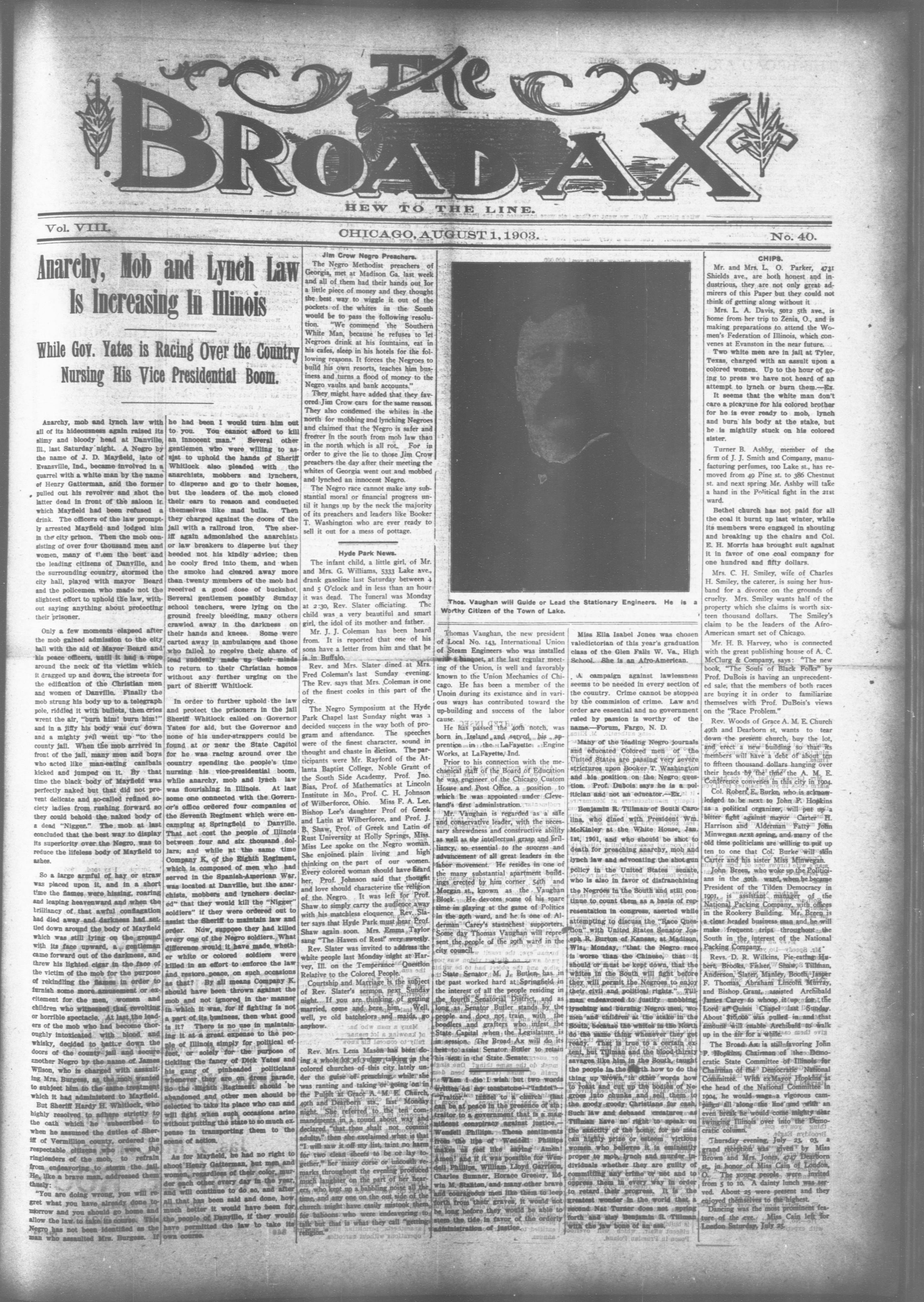
Thos. Vaughan will Guide or Lead the Stationary Engineers. He is Worthy Citizen of the Town of Lake.
Thomas Vaughan, the new president of Local No. 143, International Union of Steam Engineers who was installed with a banquet, at the last regular meeting of the Union, is well and favorably known to the Union Mechanics of Chicago. He has been a member of the Unoin during its existence and in various ways has contributed toward the up-building and success of the labor cause. He has passed the 40th notch, was born in Ireland and served his apprentice in the LaFayette Engine Works, at LaFayette, Ind.
Prior to his connection with the mechanical staff of the Board of Education he was engineer of the Chicago Custom House and Post Office, a position to which he was appointed under Cleveland's first administration. Mr. Vaughan is regarded as a safe and conservative leader, with the necessary shrewdness and constructive ability as well as the intellectual grasp and brilliancy, so essential to the success and advancement of all great leaders in the labor movement. He resides in one of the many substantial apartment buildings erected by him corner 54th and Morgan st., known as the Vaughan Block. He devotes some of his spare time in playing at the game of Politics in the 29th ward, and he is one of Alderman Carey's staunchest supporters. Some day Thomas Vaughan will represent the people of the 29th ward in the city council.
State Senator M. J. Butler has in the past worked hard at Springfield in the interest of all the people residing in the fourth Senatorial District and as long as Senator Butler stands by the people and does not train with the boodlers and grafters who infest the State Capital when the Legislature is in session. The Broad Ax will do its best to assist Senator Butler to retain his seat in the State Senate.
When I die I wish but two words written on my tombstone "Unfidel"—Traitor. Unfidel to a church that can be at peace in the presence of sin; traitor to a government that is a magnificent conspiracy against justice. Wendell Phillips. These sentiments from the lips of Wendell Phillips makes us feel like saying Amen! Amen! and if it was possible for Wendell Phillips, William Lloyd Garrison, Charles Sumner, Horace Greeley, Edwin M. Stanton, and many other brave and courageous men like them to sleep forth from their graves, it would not be long before they would be able to stem the tide in favor of the orderly administration of justice.
Miss Ella Isabel Jones was chosen valedictorian of this year's graduation class of the Glen Falls W. Va., High School. She is an Afro-American.
A campaign against lawlessness seems to be needed in every section of the country. Crime cannot be stopped by the commission of crime. Law and order are essential and no government ruled by passion is worthy of the name.—Forum, Fargo, N. D.
Many of the leading Negro journals and educated Colored men of the United States are passing very severe strictures upon Booker T. Washington and his position on the Negro question. Prof. Dubois says he is a politician and not an educator.—Ex.
Benjamin R. Tillman of South Carolina, who dined with President Wm. McKinley at the White House, Jan. 1st, 1901, and who should be shot to death for preaching anarchy, moh and lynch law and advocating the shot gun policy in the United States senate, who is also in favor of disfranchising the Negroes in the South and still continue to count them as a basis of representation in congress, asserted while attempting to discuss the "Race Question" with United States Senator Joseph R. Burton of Kansas, at Madison, Wis. Monday, "that the Negro race is worse than the Chinese, that it should or must be kept down, that the whites in the South will fight before they will permit the Negroes to enjoy their civil and political rights." Tillman endeavored to justify mobbing, lynching and burning Negro men, women and children at the stake in the South, because the whites in the North do the same thing whenever they get ready. That is true to a certain extent, but Tillman and the blood-thirsty savages like him in the South, taught the people in the North how to do the thing up brown in other words how to roast and cut up the bodies of Negroes into chunks and sell them to the goody goody Christians for cash. Such law and debased creatures as Tillman have no right to speak on the sanctity of the home, for no man can highly prize or esteem virtuous women who believes it is eminently proper to mob, lynch and murder individuals whether they are guilty of committing any crime or not and to oppress them in every way in order to retard their progress. It is the greatest wonder in the world that a second Nat Turner does not spring forth and slay Benjamin R. Tillman with the jaw bone of an ass.
No.40.
Mr. and Mrs. L. O. Parker, 4731 Shields ave., are both honest and industrious, they are not only great admirers of this Paper but they could not think of getting along without it.
Mrs. L. A. Davis, 5012 5th ave., is home from her trip to Zenia, O., and is making preparations to attend the Women's Federation of Illinois, which convenes at Evanston in the near future.
Two white men are in jail at Tyler, Texas, charged with an assult upon a colored women. Up to the hour of going to press we have not heard of an attempt to lynch or burn them—Ex
It seems that the white man don't care a picayune for his colored brother for he is ever ready to mob, lynch and burn his body at the stake, but he is mightily stuck on his colored sister.
Turner B. Ashby, member of the firm of J. J. Smith and Company, manufacturing perfumes, 100 Lake st., has removed from 49 Pine st. to 386 Chestnut st. and next spring Mr. Ashby will take a hand in the Political fight in the 21st ward.
Bethel church has not paid for all the coal it burnt up last winter, while its members were engaged in shouting and breaking up the chairs and Col. E. H. Morris has brought suit against it in favor of one coal company for one hundred and fifty dollars.
Mrs. C. H. Smiley, wife of Charles H. Smiley, the caterer, is suing her husband for a divorce on the grounds of cruelty. Mrs. Smiley wants half of the property which she claims is worth sixteen thousand dollars. The Smiley's claim to be the leaders of the Afro-American smart set of Chicago.
Mr. H. B. Harvey, who is connected with the great publishing house of A. C. McClurg & Company, says: "The new book, "The Souls of Black Folks" by Prof. DuBois is having an unprecedented sale, that the members of both races are buying it in order to familiarize themselves with Prof. DuBois's views on the "Race Problem."
Rev. Woods of Grace A. M. E. Church 49th and Dearborn st, wants to tear down the present church, buy the lot, and erect a new building so that its members will have a debt of about ten to fifteen thousand dollars hanging over their heads by the time the A. M. E. Conference convenes in this city in 1904.
Col. Robert E. Burke, who is acknowledged to be next to John P. Hopkins as a political organizer, will put up a bitter fight against mayor Carter H. Harrison and Alderman Fatty John Minwegan next spring, and many of the old time politicians are willing to put up ten to one that Col. Burke will skin Carter and his sister Miss Minwegan. John Breen, who woke up the Politicians in the 30th ward, when he became President of the Tilden Democracy in 1901, is assistant manager of the National Packing Company, with offices in the Rookery Building. Mr. Breen is a clear headed business man and he will make frequent trips throughout the South in the interest of the National Packing Company.
Revs. D. R. Wilkins, Pie-eating Hubert, Brooks, Fisher, Shaw, Tillman, Anderson, Slater, Manley, Booth, Jasper F. Thomas, Abraham Lincoln Murray, and Bishop Grant, assisted Archibald James Carey to whoop it up for the Lord at Quinn Chapel last Sunday. About $10,000 was pulled in and that amount will enable Archibald to walk up in the air for a while.
The Broad Art is still favoring John P. Hopkins, Chairman of the Democratic State Committee of Illinois for Chairman of the Democratic National Committee. With exMayor Hopkins at the head of the National Committee in 1904, he would wage a vigorous campaign all along the line and with an even break he would come mighty near swinging Illinois over into the Democratic column.
Dancing was the most prominent feature of the exe Miss Cain left for London Saturday, July 25.
Will promulgate and at all times uphold the true principles of Democracy, but Catholic, Protestant, Principe, Indieola, Farmers, Single Taxes, Republcana, Knights of Labor, or any one else can have their say, so long as their language is proper and responsibility is fixed.
The Broad AX is a newspaper whose platform is broad enough for all, ever claiming the editorial right to speak its own mind.
Local communications will receive attention. Write only on one side of the paper.
Subscriptions must be paid in advance.
One Year..... $2.00
Six Months..... 1.00
Advertising rates made known on application. Address all communications to
THE BROAD AX
6000 Armour Avenue, Chicago.
JULIUS F. TAYLOR, Editor and Publisher.
Entered at the Post Office at Chicago, IL., as Second-class Matter.
"Pshaw!" she exclaimed, disgustedly, as she came to the most interesting part only to read, "to be continued," "I don't see why they call these things 'continued stories.'"
"No?" queried her husband, politely.
"No; they should be called 'discontinued stories.'"—Philadelphia Press.
Motive in His Politeness.
Little Theodore—Shall I take your hat, Miss Peake?
Miss Peake—No, thank you; but you're a polite little man, all the same. Little Theodore—No; 'taint that. I just wanted to get the hatpin to stick into Tommy. Me an' him's goln' to have a fight in the hall—Tit-Bits.
Revised Version.
Revised Version.
There was an old lady named Hupboard,
Who went one day to the cupboard
To look for a bone,
But she found none,
And it made her so mad she blupboard.
—Chicago Daily News.
KITCHEN LITERATURE.
A
"You look like a wreck to-day, Anna! Have you been sitting up all night again reading a novel?" "Yes, madam. It was such a beautiful story, but they didn't get married till nearly five o'clock this morning!"—Fliegende Blaetter.
The Politician.
Nobody truly understands Just how his fame extends. Some men succeed by shaking hands And some by shaking friends.
—Washington Star.
Getting Acquainted.
Mr. Stayout—Say, old boy they tell me you have given up all of your clubs and that you never go out at night any more.
Mr. Stayin—Yes; getting so well acquainted at home that my wife is beginning to call me by my first name.—N. Y. Times.
Why It Was.
Mrs. Greene—What do you have an alarm clock in your chamber for if you don't have the alarm wound up?
Mrs. Gray—If you could have heard the awful things my husband said when the alarm went off, you wouldn't ask me.—Boston Advertiser.
New Household Joke.
Yeast—I see they have electrical flat irons, now.
Crimsonbeak—Yes; I suppose when a man's wife throws one of them at him he feels as if he'd been struck by lightning.—Yonkers Statesman.
Rather Ambiguous.
Softhead—Wasn't that—aw—a beastly absurd rumor about me—aw—losing me mind?
Miss Slasher—Yes; that certainly was the limit.—Chicago Daily News.
Ever on the Alert.
Mr. Speedy—Do you care for outdoor sports?
Miss Seedy—Why, I never thought—you are one, aren't you, Mr. Speedy?
This is so sudden!—N. Y. Sun.
Johnny—Ma, aren't they using hero-
sene oil to get rid of the mosquitoes?
Mamma—Yes; I believe so.
Johnny—I wonder why they don't
give them castor oil?—Puck.
The Gents—Not exactly; but we have a—hic—leaning that way.—Harvard Lampoon.
Answered.
"Why can't a man court his wife after marriage as he does before?"
"Because it's foolish to chase something you've got," he answered.—Brooklyn Eagle.
The Nose or the Kiss.
Daughter—Why, he actually dared to kiss me on the nose!
Mother—I hope you made him feel how entirely out of place it was—Yale Record.
The Usual Way.
She—Faint heart never won a fair lady.
He—No, a faint heart usually goes with experience of fair ladies—Judge.
PICTURE-FRAME SPROUTED.
Miracle That Was Worked by Mid-Summer Dust and Dampness in Pennsylvania.
The dryness of the present summer was the subject under discussion. The talk, in a little while, veered naturally to the dampness of some of the summers of the past. A clergyman then told an appropriate story, says the Philadelphia Record.
"The dampest summer I remember was in the year 18—, but I am not good at dates," he said. "At any rate, there happened in my house during that summer an almost incredible thing.
"I had bought in the spring a frame of oak, decorated at the corners with acorns. I had put in this frame my wife's picture. Well, we went to Chester Heights for the season, all of us, and the house was closed from June till September. That was a very damp summer. Violins and cameras fell apart. Furniture became unglued. Your clothes would mildew while you alept—one morning I even found a little mildew on my whiskers.
"In September, on returning home, I discovered nothing but mold and ungued furniture, and in the library I discovered a little oak tree growing from each corner of the frame of my wife's picture. The exhilarating effect of the dampness on the frame's four acorns, together with the rich soil that a thick coating of dust supplied, had caused the acorns to sprout. There on the frame, were four little trees, each several inches high. It was a pretty and an unusual sight."
UTENSILS OF QUARTZ
Bottles, Glasses and Other Articles Manufactured in Germany from Molten Rock.
A German technical factory, which has been making expensive experiments with high temperatures, has produced utensils made of molten quartz, reports an industrial journal.
After the melting was done the manufacture of bottles, glasses and other articles was not much different in method from that used for making glass articles.
The objects made from molten quartz are flashing and clear, with the effect of diamonds. They are not brittle as glass, and have the further advantage of not being affected easily by heat or cold. Glass articles, as everybody knows, from sad experience, will crack if hot liquids are poured into them when they are cold, or vice versa. Quartz articles, however, can be heated to a cherry red, and then ice-cold water can be squirted on them without affecting them in the least. This is due to the fact that quartz neither expands nor shrinks much under changes of temperature.
MANUFACTURED MUMMIES
The Trade of Making Up "Antiques" Is Carried On Extensively in Paris.
There is said to be a regular trade in Paris, of manufacturing "antiques," among which are included mummies. Bodies are obtained from the hospitals, and, after being scientifically treated, are shipped to Egypt. When they are shipped back again they have every appearance of being authentic. M. Elina, a young sculptor in Paris, recently acknowledged that, although he was simply working under orders for an "antique" firm, that it was he who made the famous "Tiara of Sartapharnes," which was bought by the Louvre museum as genuine for $80,000. He made it in 1839, to the order of a firm of antiquity manufacturers at Monmartre, which had received a commission from a noted collector. It was made with leaf gold, worth $900, and as he wondered what it was intended for, he says he put private marks upon the tiara. His counsel possessed full details of the marks in a sealed envelope. He had heard that the tiara was first offered to the British museum, but that it was there found to be spurious, and rejected.
Prof. Murani, a distinguished Italian scientist, says that certain persons possess a strange magnetic or electrical influence, which produces very curious results. A few days ago while he was at work on some electrical experiment, one of his friends suddenly entered the room, and at the same moment the needle of his galvanometer moved to and fro very rapidly. He was sure that his friend had in one of his pockets either a magnet or some other electrical instrument, and, in order to convince him that he was mistaken, his friend removed all his clothes. To the professor's surprise, the galvanometer continued to act just as though a powerful magnet was near it, and the closer his friend approached the more marked its action became. Moreover, the front of the body acted on it in the same manner as the positive pole of a magnet, and the back as a negative pole.
A life insurance policy is of occasional value to a man when alive, as shown recently in Russia. An American was traveling there, and in some way mislaid his passport. When it was demanded he hesitated, and finally handed over his life insurance policy. The official took it, examined it upside down and was much impressed with its colors, seals and signatures, and he passed the man all right.
Kaiser as Landowner.
Kaiser Wilhelm owns 33 estates and 53 castles. These foot up a total of 300,000 acres and bring in an income of $160,000. He has as yet visited only 30 of his castles, but the total sum which goes to their support is enormous. He is building a fifty-fourth castle, a magnificent affair, which will overlook Pozen in Prussian Poland.
CROPS OF THE STATES. How the General Result Is Affected by Western Floods or Eastern Droughts.
The comment is familiar that damage done to crops by abnormal weather conditions in one section of the country cannot ruin whole crop. This may be shown by some interesting comparisons, says the New York Post. Taking 1902 as a fairly normal year, the wheat crop footed up 670,000,000 bushels. Of this, 362,000,000 was winter-sown wheat and 307,000 the spring crop. The lower Missouri valley produced about 184,000,000 of the total, or near one-third. The upper Mississippi and Red River valley produced some 187,000,000 — another third. Something over 61,000,000 bushels were harvested on the Pacific coast. The New England states, and the Middle Atlantic group, comprising New York, New Jersey, Pennsylvania and Maryland, yielded 42,000,000. The Ohio valley and the lake states accounted for 182,000,000.
This is a pretty wide geographical distribution, and the weather of 1881 would be required to make general havoc. It will be seen, therefore, that even the six weeks of western rain and astern drought, followed by three weeks of eastern rain and western drought, did not touch everythin
The corn crop makes some equally interesting comparisons. Of the total 2,523,000,000 bushels yielded in 1902, 1,100,000,000 grew in the Missouri basin, and nearly 750,000,000 in the Ohio and lake region. Only about 100,000,000 bushels came from the eastern states, properly so-called. But the south produced nearly 500,000,000. Those were the lucky farmers who got high prices for a very fair crop in the disastrous corn year, 1901.
DANGEROUS TOPICS
Some Subjects That an American in Spain Found to Be Unsafe to Mention.
"I was in Madrid, Spain, six months after the close of the war," said the American tourist, according to the Chicago Daily News, "and wnated to take a run down to the old city of Toledo. I had heard, however, that the feeling against Americans was very bitter in the latter city, and it struck me that it would be a good thing to get a little advice. The landlord had been very kind and courteous, though a Spaniard, and I put the case before him.
"Senor," he replied, after a bit, "if you went to Toledo would you mention anything about your Admiral Dewey and Manila bay?"
"I should not." I replied.
"Nor Santiago and Admiral Sampson?"
"Not a word."
"Nor the fight on San Juan hill and Gen. Torrey's surrender?"
"No."
"And would you refer to our loss of Cuba and the Philippines?"
"Not a refer."
"Well, I think you can safely go to Toledo," he said, after looking me over,
"but my advice to you in case the painful subject is touched upon, is to say that you expected Spain to whip the United States within 30 days, and you can't tell why the devil she took three months to do it!"
NEAR-SIGHTED INSECTS
The Range of Vision in Most Species Is Found to Be Extremely Limited.
Although most insects are provided with two kinds of eyes, the simple, and the compound or facet eyes, all experiments go to show that their range of sight is extremely limited. The most rudimentary eye is found in the larvae of the water beetle; in this case the power of vision is so limited that they are nearly blind, says a scientific authority. Most caterpillars, even when possessing five or six eye spots, can do little more than distinguish between light and darkness; their utmost range would be about an inch.
Plateau found that scorpions can only see the length of their own pincers, and that spiders are so short-sighted as not to see their prey four inches off. Sir John Lubbock confirmed this repeatedly by finding spiders unable to detect their own egg at half an inch. Claparede made many experiments to find out the distance at which the faceted eye can see as clearly as the human eye; the result was that at a yard away no distinct vision was possible, and the object had to be within an eighth of an inch to answer the proposed end.
Radium and Musk
Radium was the subject matter under discussion, says the Philadelphia Record, and a lawyer said: "I don't see anything so very wonderful in radium. Admit that it does throw off light and heat, in a kind of perpetual motion, without any loss of weight or energy—well, won't a grain of musk do the same thing? One single grain of musk (this has been demonstrated) will scent for several years a room 12 feet square, and in the end the grain will still remain entire. Consider what this means. A room 12 feet square contains 2,985,984 cubic inches, and each one-tenth cubic inch, at least, must have its little molecule of musk, or otherwise all the air would not be perfumed. One grain of musk, that is to say, will radiate millions and millions of musk fragments for years and still it will remain whole. Can radium beat that?"
King Edward is also a clergyman of the Church of England, with a salary. In Pembrokeshire, Wales, St. David's cathedral claims King Edward as a prebendary, and for this office he is entitled to a salary of one pound per annum.
ABOUT ANIMALS.
Between Skaguay and St. Michael, Alaska, 600 dogs are kept by the postal authorities for letter carrying.
Australia and New Zealand have 90,-500,000 sheep, which is just one and one-half times as many as the whole of the United States possesses.
Kite hawks have become so bold about the garrison in Burmah that they swoop down on the mess tables and seize food from the soldiers' plates.
William Tell II. is the biggest St. Bernard dog in the United States. He is owned by Mr. Fulling, of New York city, and is worth many hundreds of dollars and has won many blue ribbons.
The head and antlers of a magnificent specimen of the extinct Irish deer have been found in a bog near Limerick. The horns measured nine feet six inches from tip to tip, and the head is the finest ever discovered.
The education of the French society dog is proceeding apace. They manicure dogs now. A young woman calls daily at the homes of wealthy owners of dogs. She brings with her a neat little black bag that looks not unlike those carried by trained nurses. This contains a set of fine white towels, a brush with an ebony back, a comb, soap, and the daintiest set of manicure implements imaginable. There is even a small jar of rosaline, that gives the delicate doggy nails a dainty tint.
WHEN ON YOUR VACATION.
Don't kick because the roof over your room leaks. If you kick the landlord will charge you with an extra bath.
Don't propose to every girl you meet. They may compare notes some time. Be satisfied with proposing to every other girl. That's enough.
Don't dwell too strongly on the subject of your steam yacht and your trip around the world next year. She may happen to want some ribbon some time, and fate may lead her right straight over to your counter.
Don't substitute the name of Claude, Alfred or Chauncey for your regularly given first name. Somebody who used to know you is sure to drop in and whoop out: "Hello, Bill; how did you get in this swell place?"
Don't open a tete-a-tete in the evening by saying: "What a glorious night. How sweet the music sounds across the water." The girl has probably heard the same thing ten or 12 times, and may tell you so. Cut out the lines about the golden moon up in the heavens so high, too. She's heard that.
Don't be too haughty with the colored individual who waits on you at the table. It may impress the heiress sitting next to you, but it is apt to make the waiter mad and talkative, and you know that he used to bring you your sinkers and coffee at the lunch counter where you eat when you are in town.
GLEANINGS OF SCIENCE
Meteorological experiments with a balloon at Geneva showed that there was a regular diminution of temperature for every 100 yards of ascent. Electrons are actual particles of matter, so infinitely small that a microscope with 1,000,000 times the capacity of the most powerful instrument now in existence could not discover them. A section of cable in the Caribbean sea was recently raised from 1,350 fathoms of water, where it had lain for thirty years. Tests showed its core to be in perfect electrical condition and the rubber insulator uninjured. A fear that sulphur from the rubber might injure the copper wire had no foundation.
M. Martel, a French scientist, in a lecture before the Geographical society of Paris, maintained that surface streams are gradually disappearing; owing to subterranean circulation of water being substituted. His investigations have proved that, as a rule, all great caves have either captured or are deflecting some water course.
LITTLE POINTERS
The egotist is always the other fellow.
Most men would rather fight than eat their own words.
The dentist doesn't deal in perfumery, but he is an authority on extracts.
No, Maude, dear; the wife of a governor is not necessarily a governess. It is easier for some men to talk all day than to keep their mouths shut five minutes.
The fellow who makes a fool of himself is seldom satisfied unless he works overtime at the job.
Even when poverty pinches some people insist upon adding to their misery by wearing tight shoes.
Many a man who has the reputation of knowing a lot manages very successfully to conceal his knowledge.—Philadelphia Record.
WHAT THE DOCTOR SAYS.
There are nearly 20,000 known medicinal remedies.
According to a German paper, out of 3,000 soldiers recently mustered into rank and file in Breslau, Silesia, only 184 had good teeth. The number of bad teeth of the other soldiers was no less than 26,394. D'Arsonval, the famous Parisian therapeutic specialist of Paris, stated that the world is on the eve of a therapeutical revolution and that electricity will be the medicine of the future. A strong, continuous current through a patient could, he affirmed, produce local anaesthesia, permitting slight surgical operations without narcotics.
It's the Only Place
Somewhat Different. "All men are equal before the law," remarked the student of legal lore.
"Possibly," rejoined the meek-looking man with the hairless pate "but not before the mother in law."—Cincinnati Enquirer.
Sufficiently Urged.
"I wonder why none of those McGabbleton girls has married?"
"I suppose it's for the same reason that you didn't attend the Vanderbilt wedding."—Cleveland Plain Dealer.
Woman, Lovely Woman.
He—Don't you think that Miss Gingerly is rather artificial?
She—Indeed she is—especially her hair and teeth.—Chicago Daily News.
Up Against a Hard Fact.
Many a man has dreamt he dwelt in marble halls and awoke in a stone-yard.—N. Y. Times.
Easily Caught.
"Say, my good man," exclaimed the city youth, who was undecided whether to buy shrimps or minnows, "what do you catch fish with around here?"
"Give me a quarter and I'll tell yeou," grunted the ruralite with the new cut pole.
"Here it is. Now, what do you catch them with?"
"Hooks!"—Philadelphia Record.
How She Enjoyed Herself.
Angeline—Did you enjoy yourself at the hotel back in the woods?
Seraphine—Yes; the bathing was fine.
Angeline—Bathing? Where did you find the water? Seraphine—I don't mean swimming. The proprietor fixed up a long stretch of sand, and that and bathing-suits were all that was necessary.—Judge.
A Rank Outrage.
Business Manager—And now what's the trouble?
Irate Patron—When I gave your man my advertisement yesterday I explicitly stipulated that it was to run in the same column with the story of the woman suspected of murder. Instead of that it was printed right next to the report of a Sunday school convention. Baltimore American.
A Strike of Enterprise.
New Reporter—Old Golding says that if I approach him again regarding that bank scandal he'll break every bone in my body; and he means it, too.
Editor—Great! That'll be good for three columns; go, Interview him at once. I'll have an ambulance at the door when they bring you out.—Tit-Bits.
Her Brutal Father
Algy—Gwace has a hahwid father. When I awsked him for her hand I said: "Love for your daughter has dwiven me hawf cwazy." Cholly—And then, deah boy? Algy—Then the old bwute said: "Has, eh? Well, who completed the job?"—Kansas City Journal.
His Second Offence.
"This isn't the first time you have come in contact with the police?" said the magistrate to the witness.
"What, may I ask, was the reason of your former encounter?"
"I woke him. He had gone to sleep on his beat."—Tit-Bits.
She Went to Him Innocently.
"Did your husband ever write any sonnets to you before you were married?" the poet's wife was asked.
"No," she bitterly replied. "He was working in a railroad office then, and never gave me any reason to suspect that he possessed this gift."—Chicago Record-Herald.
The Difference.
Mrs. Jones—When a Turkish husband wants a divorce all he has to do is to say "I divorce you" three times and he is divorced.
Mr. Jones—Huh! If an American husband tried that he wouldn't want a divorce, but an undertaker.—Judge.
Mystery Not Solved.
Ruggles—Woman is a mystery.
Raisins—Thought you were to solve it by getting married.
"I did, in part, but I can't understand yet why she's afraid of a mouse but will wear a 'rat' in her hair."—Yonkers Statesman.
It's the On
JUST LOOK WHAT YOU
AFRO-AMERICAN
8104 State
WISDOM COMES
Here all the best and leading weekly journals and magazines
week including all other standard months
"But you once said that I was the apple of your eye," she pouted.
"Maybe," he responded; "but you have been evaporated."—Judge.
Well Fitted to Make Trouble.
She—Has your roommate an ear for music?
He—Worse; he has two hands and a mouth.—Harvard Lampoon.
Master—Pat, I must say you're contradictory.
Pat (emphatically)—I am not, sorr!
—Punch.
"Is kissing dangerous?"
"Well, I wouldn't try it on an athletic girl without her consent."—Chicago Post.
O
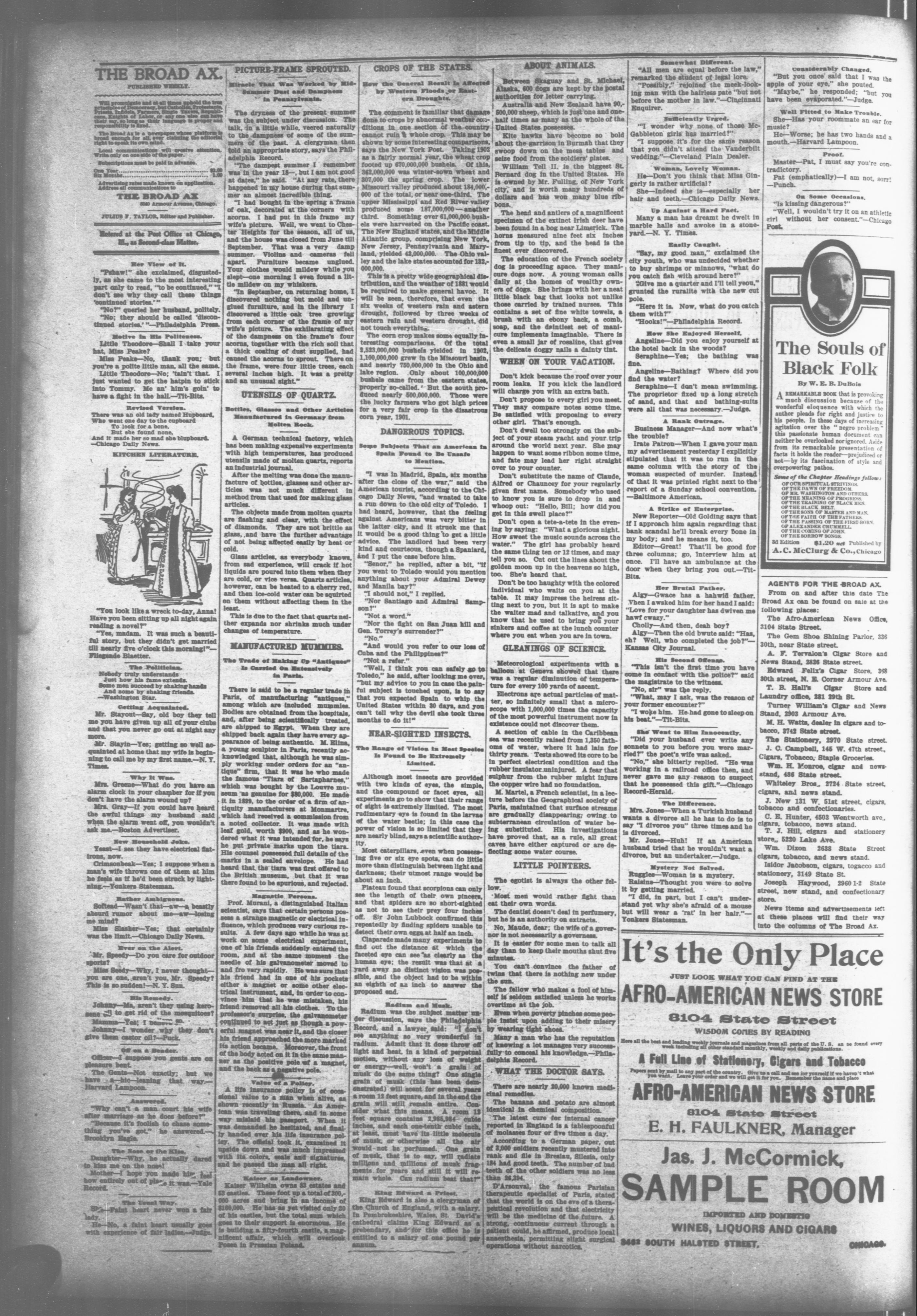
The Souls of Black Folk
By W. E. B. DuBois
A REMARKABLE BOOK that is provoking much discussion because of the wonderful eloquence with which the author pleads for right and justice to his people. In these days of increasing agitation over the "negro problem" this passionate human document can neither be overlooked nor ignored. Aside from its remarkable presentation of facts it holds the reader—prejudiced or not—by its fascination of style and overpowering pathos.
Some of the Chapter Headings follow:
OF OUR SPIRITUAL STRIVINGS.
OF THE DAWN OF FREEDOM.
OF MR. WASHINGTON AND OTHERS.
OF THE MEANING OF PROGRESS.
OF THE TRAINING OF BLACK MEN.
OF THE BLACK BELT.
OF THE SONS OF MASTER AND MAN.
OF THE FAITH OF THE FATHERS.
OF THE PASSING OF THE FIRST-BORN.
OF ALEXANDER CRUMMELL.
OF THE COMING OF JOHN.
OF THE SORROW SONGS.
3d Edition $1.20 net Published by
A.C. McClurg & Co., Chicago
AGENTS FOR THE BROAD AX.
From on and after this date The Broad Ax can be found on sale at the following places:
The Afro-American News Office, 3104 State Street.
The Gem Shoe Shining Parlor, 336 30th, near State street.
A. F. Tervalon's Cigar Store and News Stand, 2826 State street.
Edward Felix's Cigar Store, 368 30th street, N. E. Corner Armour Ave.
T. B. Hall's Cigar Store and Laundry office, 281 29th St.
Turner William's Cigar and News Stand, 2903 Armour Ave.
M. H. Watts, dealer in cigars and tobacco, 3742 State street.
The Stationery, 2970 State street.
J. C. Campbell, 145 W. 47th street., Cigars, Tobacco, Staple Groceries.
Wm. H. Monroe, cigar and newsstand, 486 State street.
Whiteley Bros., 2724 State street, cigars, and news stand.
J. New 131 W. 51st street, cigars, tobacco and confectionaries.
C. E. Hunter, 4503 Wentworth ave., cigars, tobacco, news stand. T. J. Hill, cigars and stationery store., 5220 Lake Ave. Wm. Dixon 2638 State Street cigars, tobacco, and news stand.
Joseph Haywood, 29601-2 State street, new stand, and confectionary store. News items and advertisements left at these places will find their way into the columns of The Broad Ax.
only Place
YOU CAN FIND AT THE
N NEWS STORE
te Street
BY READING
ines from all parts of the U. S. an be found every
thly, weekly and daily publications.
Mrs. James G. Blaine's Place in National Politics-A New Generation in Power in the Army-Other Items.
Washington.—Elisha S. Theall, the young attorney who acted as counsel
for Admiral Sampson during the Schley court of inquiry, has attracted attention in army and navy circles by announcing the discovery of a new disease to which only those officers are subject who have served in the far east. The disease is known as guamitis. It takes its name from the
Where They Catch
island of Guam, where the germ is most prevalent, but it is not unknown in the Philippines. Mr. Theall has been defending a young prognosticator of the navy who was brought up before a court-martial at the Washington navy yard on charges growing out of carelessness with his accounts, and in order to clear his client he cited official reports and brought forward examples of officers who after service in Guam for a year or more had been found to be entirely unfitted for duty.
Guam is the most isolated of all the American military stations in the far east. A few naval and marine officers and a small detachment of marines constitute the entire English-speaking population, and the climate is so enervating that even the most ambitious quickly succumb and lead a life of irksome routine unembellished with outside interests. The result is physical, mental and sometimes moral deterioration. Dozens of young officers who have had a tour of duty on the island find themselves on their return to civilization quite unfitted to take up the ordinary service to which they have been accustomed. They are subject to physical weakness and to mental depression which makes them irresponsible for their actions.
Since Mr. Theall has called public attention to a condition which has been understood for some time in the service there is a proposition to require every officer relieved from service in Guam to undergo special medical treatment before being detailed to active duty elsewhere.
Clerks in the war and navy departments, and in fact all government
clerks in Washington are jubilant over the turn which has been given to the attempt of Secretaries Root and Moody to enforce the law with regard to hours of labor.
A
For many years it has been the custom during the hot days of summer to close the
three o'clock every Saturday afternoon, instead of at four o'clock, as on other days. Secretaries Root and Moody discovered that the law provided that clerks should work seven hours every day except Sundays and holidays and, after mature deliberation, they regretfully determined that it was beyond their discretion to close the war and navy departments early on Saturday.
For a day or two there was great grief. Then some ingenious clerk bethought himself of a paragraph hidden away in the new code of District of Columbia statutes adopted by congress two years ago. That paragraph, in dealing with negotiable instruments, declares that besides the usually recognized holidays the Fourth of July, Christmas, New Year's, Decoration day, Washington's Birthday and Labor day—"every Saturday after 12 o'clock, noon," shall be a holiday in the District of Columbia for all purposes. That was a poser for the cabinet lawyers. They turned it over to their own legal advisers to investigate, and now the clerks who had expected to be deprived of their extra hour once a week during the summer, are looking forward to a Saturday half holiday all the year round.
New Generation of Soldiers.
The retirement of Lieut. Gen. Miles on August 8 and the simultaneous muto-
A.
motion and retirement of some 30 other high officers may be said to be the dividing line between the ascendancy of an old and a new generation in the United States army—just as the death of McKinley and the incoming of Roosevelt was the dividing line
Gen. Nelson A. Miles viding line between two generations in republican politics. Miles is the last of the commanding generals of the army who achieved fame in the civil war, and when the 80
newly created brigadiers go out of the service within the next 30 days there will be left among the officers of the army less than 100 of any rank whatever who saw military service of any kind between 1861 and 1865
Gen. Young, who will succeed Miles as lieutenant general, and Chaffee, who will succeed Young, both, it is true, saw service in the civil war, but without achieving distinction. Their rank and reputation grew out of their service in the war with Spain, and later. Should MacArthur succeed Chaffee he will be the last of the lieutenant generals with even a reminiscence of the struggle between the states in his record. At best, Young, Chaffee and MacArthur will remain in the service only a few years, and then will come a generation—most of whom were babies when Miles, Schofield, Sheridan, Sherman and Grant were winning fame.
Nobody can tell yet whether Leonard Wood, who comes by regular promotion to be a major general, will in due course of seniority rise to the higher rank upon MacArthur's retirement, but whether he does or not, the lieutenant generalship will then fall to some officer who is in no way Wood's superior in length of active war service.
A woman who played a great part in national politics against her own
will has recently passed from the scene of action in the death of the widow of James G. Blaine. Mrs. Blaine was not consciously a political factor, and yet no woman of her time wielded a greater influence in shaping the destinies of republican leaders among whom her
A. B.
She was a brilliant, brainy woman with a mind as keen as a razor's edge, and if her tastes had run in the direction of politics—if she had been consciously a politician—it is hard to say what she might not have achieved in the great game which is continually playing here in social life at the capital.
But instead of a liking for politics she cherished an aversion to it. Every step in advance which James G. Blaine took, while it gratified her pride in him, was a source of regret to her in that she saw herself constantly thrust forward into a personal prominence which was distasteful, and compelled to combat the ever-growing demand that for political reasons she should mingle with all sorts of people in whom she could not simulate an interest. Combined with a seclusive temper she had that most dangerous of accomplishments, a quick wit and a ready tongue. She resented and resisted the curtailment of individual liberty which her husband's official position was constantly threatening. When Blaine was secretary of state she made many enemies for both by refusing to return the innumerable calls made upon her on public reception days—a practice which, silly as it was, had grown to be regarded as an official duty. She had to bear the brunt of the criticisms for the innovation which subsequently all cabinet women were forced to follow in self-protection. She made a bitter lifelong enemy of the wife of Benjamin Harrison, who afterwards became mistress of the white house by some cutting comment she gave utterance to when both Blaine and Harrison were in the senate; and that difference led to the tragic candidacy of Blaine for the republican nomination in 1892 and had much to do with the party coolness that resulted in Harrison's defeat.
She had her limited circle of friends, close and devoted, but she entirely lacked the insincerity that would have led those for whom she did not care to count her as their friend. Her last years were clouded with tragedy and sorrow, and death came to her as a relief.
A mischievous messenger boy put in his spare time a few days ago in plug-
w days ago in plugging with putty the eyes and noses of several of the marble statues in Steinway hall, and now he is suffering punis him ent for "vandalism."
National Wax Works
Exhibition.
The first statue that this youthful offender fixed up was that of Daniel Webster, which stares out of countenance every unfortunate who passes through National Wax Works Exhibition.
Statuary hall, going from the house of representatives to the senate; he was so well pleased with his achievement that he want on to improve several more. He would have touched up the entire collection of monstrosities if his putty had not given out.
It is needless to say that the sympathy of the Washington public is with the boy; for in his ineffective way he was simply trying to remedy a few of the defects which have worried visitors to the capitol for many years.
No more grotesque assemblage of marble freaks was ever brought together than the one in Statuary hall. Only two or three of the commemorative statues by any stretch of the imagination can be called works of art, and a spot which might have been made as inspiring as Westminster abbey has developed a dignity a few degrees removed from Jarley's wax works or the Eden Musee.
Chafing Dish and Table Devices and Inventions
OLD BEYOND HER AGE.
As a Child Wife of the British Colonial Secretary Was Companion of Her Parents.
The wife of the colonial secretary of Great Britain is not only an Endicott, of Massachusetts, but she is lineally connected with the Crownlushields and Peabodys, two of the famous families of New England.
Because of her early training and natural reserve of manner, Mrs. Joseph Chamberlain has been able to meet the responsibilities of her social position abroad.
As a child she was old beyond her years, through constant companionship with her parents and grandparents in Salem, at the Nahant summer home and on the farm at Danvers.
The Danvers house was built by the great Salem merchant, Joseph Peabody.
A.
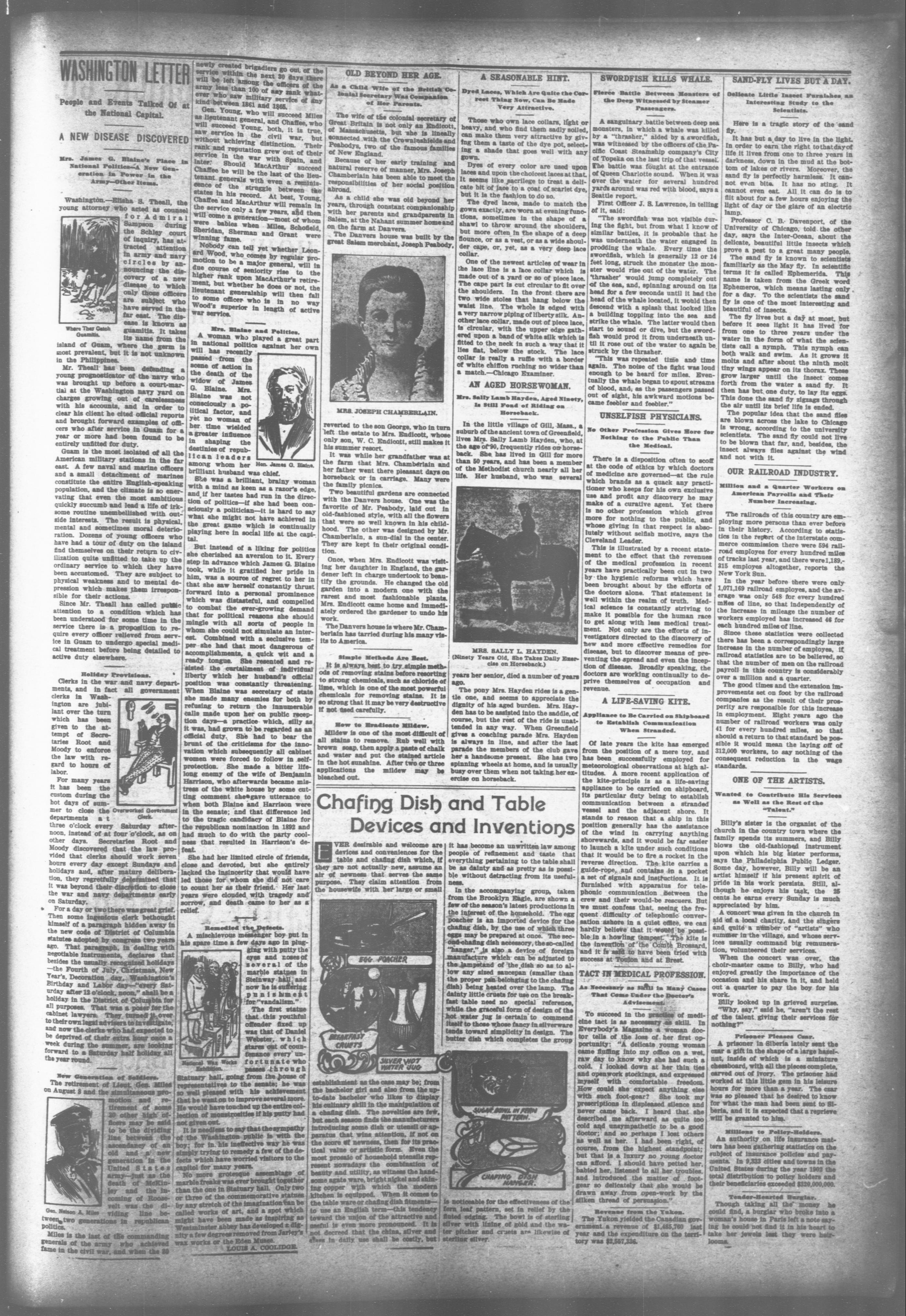
MRS. JOSEPH CHAMBERLAIN.
reverted to the son George, who in turn left the estate to Mrs. Endicott, whose only son, W. C. Endicott, still makes it his summer resort.
It was while her grandfather was at the farm that Mrs. Chamberlain and her father went there pleasant days on horseback or in carriage. Many were the family picnics.
Two beautiful gardens are connected with the Danvers house. One was the favorite of Mr. Peabody, laid out in old-fashioned style, with all the flowers that were so well known in his childhood. The other was designed by Mr. Chamberlain, a sun-dial in the center. They are kept in their original condition.
Once, when Mrs. Endicott was visiting her daughter in England, the gardener left in charge undertook to beautify the grounds. He changed the old garden into a modern one with the rarest and most fashionable plants. Mrs. Endicott came home and immediately ordered the gardener to undo his work. The Danvers house is where Mr. Chamberlain has tarried during his many visits to America.
It is always best to try simple methods of removing stains before resorting to strong chemicals, such as chloride of lime, which is one of the most powerful chemicals for removing stains. It is so strong that it may be very destructive if not used carefully.
How to Eradicate Mildew
Mildew is one of the most difficult of all stains to remove. Rub well with brown soap, then apply a paste of chalk and water and put the stained article in the hot sunshine. After two or three applications the mildew may be bleached out.
EVER desirable and welcome are devices and conveniences for the table and chafing dish which, if they are not actually new, assume an air of newness that serves the same purpose. They claim attention from the housewife with her large or small
EGG POACHER
BREAKFAST
CRUETS
SILVER HOT
WATER JUG
establishment as the case may be; from the bachelor girl and also from the up-to-date bachelor who likes to display his culinary skill in the manipulation of a chafing dish. The novelties are few, but each season finds the manufacturers introducing some dish or utensil or apparatus that wins attention, if not on the score of newness, then for its practical value or artistic form. Even the most prosaic of household utensils represent nowadays the combination of beauty and utility, as witness the handsome agate ware, bright nickel and shining copper with which the modern kitchen is equipped. When it comes to the table ware or chafing dish fitments—to use an English term—this tendency toward the union of the attractive and useful is even more pronounced. It is not decreed that the china, silver and elses in daily use shall be costly, but
Dyed Laces, Which Are Quite the Correct Thing Now, Can Be Made Very Attractive.
Those who own lace collars, light or heavy, and who find them sadly soiled, can make them very attractive by giving them a taste of the dye pot, selecting a shade that goes well with any gown.
Dyes of every color are used upon laces and upon the choicest laces at that. It seems like sacrilege to treat a delicate bit of lace to a coat of scarlet dye, but it is the fashion to do so.
The dyed laces, made to match the gown exactly, are worn at evening functions, sometimes in the shape of a shawl to throw around the shoulders, but more often in the shape of a deep flounce, or as a vest, or as a wide shoulder cape, or, yet, as a very deep lace collar.
One of the newest articles of wear in the lace line is a lace collar which is made out of a yard or so of piece lace. The cape part is cut circular to fit over the shoulders. In the front there are two wide stoles that hang below the waist line. The whole is edged with a very narrow piping of liberty silk. Another lace collar, made out of piece lace, is circular, with the upper edge gathered upon a band of white silk which is fitted to the neck in such a way that it lies flat, below the stock. The lace collar is really a ruffle with a border of white chiffon ruching no wider than a match.—Chicago Examiner.
AN AGED HORSEWOMAN
Mrs. Sally Lamb Hayden, Aged Ninety, Is Still Fond of Riding on Horseback.
In the little village of Gill, Mass., a suburb of the ancient town of Greenfield, lives Mrs. Sally Lamb Hayden, who, at the age of 90, frequently rides on horseback. She has lived in Gill for more than 50 years, and has been a member of the Methodist church nearly all her life. Her husband, who was several
```markdown
```
MRS. SALLY L. HAYDEN.
(Ninety Years Old, She Takes Daily Exercise on Horseback.)
MRS. SALLY L. HAYDEN.
(Ninety Years Old, She Takes Daily Exercise on Horseback.)
years her senior, died a number of years ago.
The pony Mrs. Hayden rides is a gentle one, and seems to appreciate the dignity of his aged burden. Mrs. Hayden has to be assisted into the saddle, of course, but the rest of the ride is unattended in any way. When Greenfield gives a coaching parade Mrs. Hayden is always in line, and after the last parade the members of the club gave her a handsome present. She has two spinning wheels at home, and is usually busy over them when not taking her exercise on horseback.
it has become an unwritten law among people of refinement and taste that everything pertaining to the table shall be as dainty and as pretty as is possible without detracting from its usefulness.
In the accompanying group, taken from the Brooklyn Eagle, are shown a few of the season's latest productions in the interest of the household. The egg poacher is an imported device for the chafing dish, by the use of which three eggs may be prepared at once. The second chafing dish accessory, the so-called "hanger," is also a device of foreign manufacture which can be adjusted to the lampstand of the dish so as to allow any sized saucepan (smaller than the proper pan belonging to the chafing dish) being heated over the lamp. The dainty little cruets for use on the breakfast table need no special reference, while the graceful form of design of the hot water jug is certain to commend itself to those whose fancy in silverware tends toward simplicity in design. The butter dish which completes the group
SUGAR BURN IN FERN PATTERN.
CHAPING DISH MANGER.
is noticeable for the effectiveness of the fern leaf pattern, set in relief by the fluted edging. The bowl is of sterling silver with lining of gold and the water pitcher and crafts are likewise of sterling silver.
SWORDFISH KILLS WHALE.
Flerce Battle Between Monsters of the Deep Witnessed by Steamer Passengers.
A sanguinary battle between deep sea monsters, in which a whale was killed by a "thrasher," aided by a swordfish, was witnessed by the officers of the Pacific Coast Steamship company's City of Topeka on the last trip of that vessel. The battle was fought at the entrance of Queen Charlotte sound. When it was over the water for several hundred yards around was red with blood, says a Seattle report.
First Officer J. S. Lawrence, in telling of it, said:
"The swordfish was not visible during the fight, but from what I know of similar battles, it is probable that he was underneath the water engaged in prodding the whale. Every time the swordfish, which is generally 12 or 14 feet long, struck the monster the monster would rise out of the water. The 'thrasher' would jump completely out of the sea, and, spinning around on its head for a few seconds until it had the head of the whale located, it would then descend with a splash that looked like a building toppling into the sea and strike the whale. The latter would then start to sound or dive, but the swordfish would prod it from underneath until it rose out of the water to again be struck by the thrasher.
"This was repeated time and time again. The noise of the fight was loud enough to be heard for miles. Eventually the whale began to spout streams of blood, and, as the passengers passed out of sight, his awkward motions became feebler and feebler."
UNSELFISH PHYSICIANS
No Other Profession Gives More for Nothing to the Public Than the Medical.
There is a disposition often to scoff at the code of ethics by which doctors of medicine are governed—at the rule which brands as a quack any practitioner who keeps for his own exclusive use and profit any discovery he may make of a curative agent. Yet there is no other profession which gives more for nothing to the public, and whose giving in that respect is absolutely without selfish motive, says the Cleveland Leader.
This is illustrated by a recent statement to the effect that the revenues of the medical profession in recent years have practically been cut in two by the hygienic reforms which have been brought about by the efforts of the doctors alone. That statement is well within the realm of truth. Medical science is constantly striving to make it possible for the human race to get along with less medical treatment. Not only are the efforts of investigators directed to the discovery of new and more effective remedies for disease, but to discover means of preventing the spread and even the inception of disease. Broadly speaking, the doctors are working continually to deprive themselves of occupation and revenue.
A LIFE-SAVING KITE.
Appliance to Be Carried on Shipboard to Establish Communication When Stranded.
Of late years the kite has emerged from the position of a mere toy, and has been successfully employed for meteorological observations at high altitudes. A more recent application of the kite-principle is as a life-saving appliance to be carried on shipboard, its particular duty being to establish communication between a stranded vessel and the adjacent shore. It stands to reason that a ship in this position generally has the assistance of the wind in carrying anything shorewards, and it would be far easier to launch a kite under such conditions that it would be to fire a rocket in the reverse direction. The kite carries a guide-rope, and contains in a pocket a set of signals and instructions. It is furnished with apparatus for telephonic communication between the crew and their would-be rescuers. But we must confess that, seeing the frequent difficulty of telephonic conversation ashore in a quiet office, we can hardly believe that it would be possible in a howling tempest. The kite is the invention of the Comte Brossard, and it is said to have been tried with success at Toulon and at Brest.
TACT IN MEDICAL PROFESSION.
To succeed in the practice of medicine tact is as necessary as skill. In Everybody's Magazine a woman doctor tells of the loss of her first opportunity: "A delicate young woman came fluffing into my office on a wet, raw day to know why she had such a cold. I looked down at her thin ties and openwork stockings, and expressed myself with comfortable freedom. How could she expect anything else with such foot-gear? She took my prescriptions in displeased silence and never came back. I heard that she described me afterward as quite too cold and unsympathetic to be a good doctor; and so perhaps I lost others as well as her. I had been right, of course, from the highest standpoint; but that is a luxury no young doctor can afford. I should have petted her, babied her, listened to all her troubles, and introduced the matter of foot-gear so delicately that she would be drawn away from open-work by the silken thread of persuasion."
Revenue from the Yukon.
The Yukon yielded the Canadian government a revenue of $1,485,760 last year and the expenditure on the territory was $2,557,336.
Delicate Little Insect Furnishes an Interesting Study to the Scientists.
Here is a tragic story of the sand fly.
It has but a day to live in the light. In order to earn the right to that day of life it lives from one to three years in darkness, down in the mud at the bottom of lakes or rivers. Moreover, the sand fly is perfectly harmless. It cannot even bite. It has no sting. It cannot even eat. All it can do is to flit about for a few hours enjoying the light of day or the glare of an electric lamp.
Professor C. B. Davenport, of the University of Chicago, told the other day, says the Inter-Ocean, about the delicate, beautiful little insects which prove a pest to a great many people. The sand fly is known to scientists familiarly as the May fly. In scientific terms it is called Ephemerida. This name is taken from the Greek word Ephemeros, which means lasting only for a day. To the scientists the sand fly is one of the most interesting and beautiful of insects.
The fly lives but a day at most, but before it sees light it has lived for from one to three years under the water in the form of what the scientists call a nymph. This nymph can both walk and swim. As it grows it molts and after about the ninth molt tiny wings appear on its thorax. These grow larger until the insect comes forth from the water a sand fly. It then has but one duty, to lay its eggs. This done the sand fly zigzags through the air until its brief life is ended.
The popular idea that the sand files are blown across the lake to Chicago is wrong, according to the university scientists. The sand fly could not live to be blown that far, and, besides, the insect always flies against the wind and not with it.
OUR RAILROAD INDUSTRY.
Million and a Quarter Workers on American Payrolls and Their Number Increasing.
The railroads of this country are employing more persons than ever before in their history. According to statistics in the report of the interstate commerce commission there were 594 railroad employes for every hundred miles of tracks last year, and there were1,189,315 employes altogether, reports the New York Sun.
In the year before there were only 1,071,169 railroad employes, and the average was only 548 for every hundred miles of line, so that independently of the increase in mileage the number of workers employed has increased 46 for each hundred miles of line.
Since these statistics were collected there has been a correspondingly large increase in the number of employees, if railroad statistics are to be believed, so that the number of men on the railroad payroll in this country is considerably over a million and a quarter.
The good times and the extension improvements set on foot by the railroad companies as the result of their prosperity are responsible for this increase in employment. Eight years ago the number of railroad workers was only 41 for every hundred miles, so that should a return to that standard be possible it would mean the laying off of 312,000 workers, to say nothing of the consequent reduction in the wage standards.
ONE OF THE ARTISTS.
Wanted to Contribute His Services as Well as the Rest of the "Talent."
Billy's sister is the organist of the church in the country town where the family spends its summers, and Billy blows the old-fashioned instrument upon which his big sister performs, says the Philadelphia Public Ledger. Some day, however, Billy will be an artist himself if his present spirit of pride in his work persists. Still, although he enjoys his task, the 25 cents he earns every Sunday is much appreciated by him.
A concert was given in the church in aid of a local charity, and the singers and quite a number of "artists" who summer in the village, and whose services usually command big remuneration, volunteered their services.
When the concert was over, the choir-master came to Billy, who had enjoyed greatly the importance of the occasion and his share in it, and held out a quarter to pay the boy for his work.
Billy looked up in grieved surprise.
"Why, say," said he, "aren't the rest of the talent giving their services for nothing?"
A prisoner in Siberia lately sent the czar a gift in the shape of a large hazelnut, inside of which is a miniature chessboard, with all the pieces complete, carved out of ivory. The prisoner had worked at this little gem in his leisure hours for more than a year. The czar was so pleased that he desired to know for what the man had been sent to Siberia, and it is expected that a reprieve will be granted to him.
An authority on life insurance matters has been gathering statistics on the subject of insurance policies and payments. In 9,333 cities and towns in the United States during the year 1902 the total distribution to policy holders and their beneficiaries exceeded $320,000,000.
Tender-Hearted Burglar.
Though taking all the money he could find, a burglar who broke into a woman's house in Paris left a note saying he could not find it in his heart to take her jewels lost they were heirlooms.
President Theodore Roosevelt is not saying much respecting the mobbing and lynching of his colored brothers, but next year he will be fishing for their votes, then he will have to throw out some sop to the Negro concerning the evil effect of mob and lynch law. In the meantime the good Christians of this country will continue to reform Negroes by burning them at the stake.
It's about time for W. W. Johnson, Col. or Elder D. R. Wilkins, Hale G. Parker, J. G. Thurman, Rev. R. C. Ransom, Hon. John G. Jones, Col. Louis B. Anderson and Company to hold another injunction meeting against mob and lynch law, pass a lot of high sounding resolutions, get on the outside of long winded speeches, then close up shop until another Negro is burnt at the stake in ll.
Several years ago H. C. Smith, editor and publisher of the Gazette, Cleveland, Ohio, was a member of the Legislature of that state, and formulated and had placed on the statute books, the present Anti-Lynching Law of Ohio, which makes each county liable to the extent of five thousand dollars to the family or relatives of every person who is mobbed and lynched within its boundry. Since the enactment of that measure mob and lynch law is not very popular in Ohio. Now suppose Col. Edward H. Morris, who is regarded as the brightest, the brainiest and the wealthiest Afro-American in the great state of Ill.—which is doubly great because its best citizens are becoming proficient in the art of mobbing and lynching "Niggers" and burning them at the stake—Would have used his extraordinary ability last winter, with the members of the Legislature, and induced them to assist him to place a similar law on the statute books of Ill. If Col. Morris would have done so, then the chances are that the Bellville and Danville lynchings and burnings would never have occurred. Then his friends and admirers would have been perfectly justified in giving him a grand blow out at Arlington Hall when he returned from his labors for the grasping corporations at Springfield.
Years ago Major John C. Buckner, was at the head of the eight Battalion, and when the riot or the uprising occurred against the Colored People, at Spring Valley he went to that point, remained four months and spent much of his money in an effort to convict and send to jail or the Pen at Joliet the leaders of the unfriendly demonstration against the Colored People and in spite of all the difficulties he had to go up against he finally succeeded in furnishing enough evidence to convict about sixty or seventy of the ring-leaders of the mob, and they were fined and imprisoned at Joliet and in the county jail that act on the part of Major Buckner and the officials of that section of the state of Illinois broke up mob and lynch law as applied to the Negro, and to day there are over two thousand more Negroes in the Spring Valley district than there were before the attempt was made to aniliate them and no one seems eager to organize for the purpose of stoning their houses and driving them away. The majority of the Negroes in Illinois may not be able to see it that way, but a great mistake was made when Major Buckner was kicked out of the eight Battalion or Regiment for if he was still its commanding officer he could render greater service in assisting to curb or check the spirit of mob and lynch law in Illinois than Col. John R. Marshall who has always endeavored to be known as a red faced Irishman for he has never spent one dollar of his money nor expended any of his time for the benefit of the Afro-American race and his highest ambition is to become a good white man's "nigger" and train or run with Col. Mushmouth Johnson.
Wisdom Comes by Reading.
Stop! Don't worry your friends and neighbors about what happens and what will take place in the future. Read good books and papers and learn for yourself it is a wise thing to do. You can find the best WEEKLY JOURNALS and MAGAZINES from all parts of the United States at the famous Afro-American News Office, $104 State street. You can find each month the Colored American Magazine from Boston, Mass.; the Colored Home Journal from Pittsburg, Pa., and a full line of stationary, including assortment of choice cigars and tobacco. Call and see our display of race journals and library pamphlets that are edited by the race. If you don't find what you want, leave your order for it. We are reliable and the only place of this kind. Remember the name and place—the Afro-American News Office, $104 State street.
FIFTY CENTS FOR TWO COPIES OF THE BROAD AX. Fifty cents for two copies of The Broad Ax. In order to complete our files to date, we will cheerfully pay.
twenty-five cents each for two copies of The Broad Ax, dated December 29, 1900 and July 13, 1901. The papers must be in good condition and the money will be forwarded for the same upon receipt of them.
Soprano Soloist Wanted.
Lady soprano soloist wanted for Sunday evening church services. Must be fairly good looking, widow prefereed. Will receive reasonable compensation for services. Call in person on the editor of The Broad AX, 5040 Armour ave., after 6 p. m.
PEOPLE AND EVENTS
Senator J. W. Bailey, of Texas, has a stock farm in Kentucky and up to a recent period owned one of the finest places in Texas, a combined farm and ranch in the fertile prairies of Dallas county. President Loubet will resume his studies of astronomy as soon as he lays down the cares of state. An observatory is being built on the grounds of the chateau which the president recently purchased.
James Buchanan Duke is president of two tobacco companies and receives a salary of $50,000 from each of them. A shareholder once grumblingly asked Mr. Duke what he did in return for such handsome pay. "I am not paid for what I do," was the reply. "The companies pay me for the mistakes I avoid making."
Joseph Snyder, an athlete of 92, who lives in Aetna, N. Y., challenges any man of 75 or older to walk from ten to 50 miles. "I'll walk him either with or without canes, though I prefer to carry one just for company. I walk at least ten miles every day, and the fellow who takes up my challenge will have to scratch gravel mightly lively to win."
Thomas E. White, the Boston mulatto whom Dr. Sargent, of Harvard university, regards as possessing the finest physical development he has ever seen, is five feet three inches tall and weighs 151 pounds. During a recent examination by Dr. Sargent he lifted 1,776 pounds by the leg-lift, doing so with perfect ease. H. K. Kitson, the sculptor, is making a statue of him. The mulatto is employed in the Boston navy yard.
Count de la Vaulx, who tried last fall to cross the Mediterranean in a balloon and failed, owing to bad weather, is reconstructing his balloon and will make the trial again this year. His ballast will be in the form of water pumped up through a hose, the lower end of which trails in the sea. When the balloon rises more water is pumped up, and when it descends some is let out.
MISCELLANEOUS MENTION.
The gold fever is raging in Africa, attracting men to the regions adjoining Khartoum, where copper and gold also exist in paying quantities. There were 800,000 bicycles sold in this country last year, and this year, up to the present time, the records show a decided increase over the sales of last year. The longest walk on record is a little jaunt of 3,395 miles. The distance covered was from San Francisco to New York city, and the pedestrian was Mr. "Zoe" Gayton. He left San Francisco on August 27, 1890, and arrived in New York March 27, 1891.
After picnicking under a haystack, a party of holiday makers, near Montauban, France, left an empty ginger beer bottle standing upon the ground. The sun's rays became focused through the glass, and set the stack alight. It was burned to the ground.
Prof. Franz Wirchoff, of the University of Vienna, has been charged by the Vienna Academy of Science to visit all the public and private galleries of Europe to discover how many genuine works of Raphael they contain. The professor, who is an expert, declares that of the pictures and drawings attributed to Raphael not more than 150 are genuine, the rest being either imitations or works of his pupils.
IN THE GREAT CITIES.
There are 4,702 lawyers in Chicago. The increase in their number during the last twelvemonth was 320. More than 30 per cent of the inhabitants of London are so poor that they cannot afford meat, butter, tobacco, car fares, or even stand for letters.
A crusade is being made in New York against the professional beggars and street freaks. It is suggested that many of them will draw on their bank accounts and spend the summer in the country.
The total number of arrests by the New York police during the last year was 145,936, an increase of 12,187 over the year 1901. The Tenderloin surpassed all other precincts, with a total of 7,404; 6,835 were charged with intoxication, while 27,635 people were accused of disorderly conduct, and 9,230 of assault and battery.
Cairo is one of the world's interesting cities. It has about 500,000 population. While there are no great industries, the people are busy at all kinds of handicraft, and many of them are clever artisans. Cairo has no municipal autonomy, but is managed by the central government. It has electric lights, trolley cars and other improvements of the day, and some exceedingly good hotels.
No Option Admissible.
Jill—Why do so many little men marry big women?
Jack—Oh! The big women marry the little men.—Puck.
FEDERICO M. BARRIOS Attorney & Counsellor at Law Suite 501 Firmench Bldg. M. E. Cor. Fifth Avenue and Washington Street Chicago.
LAWRENCE A. NEWBY
ATTORNEY AT LAW
Room 42, 119 La Salle Street
CHICAGO
William Howard Fitzgerald
LAWYER
Room 402 Reeper Block, CHICAGO
PHONES {Office, Main 1157
Res. Brown 42
STEPHEN A. DOUGLAS
LAWYER
Suite 200, 123-125 La Salle Street
CHICAGO
JOHN FITZGERALD
JUSTICE OF THE PEACE
4787 &. HALSTED STREET.
....CHICAGO
J. GRAY LUCAS
ATTORNEY-AT-LAW
Suite 412 Real Estate Board Bldg
59 Dearborn St. Cor. Randolph
CHICAGO.
Phone Randolph 58
J. J. HENNESSY,
Justice of the Peace,
6301 S. Halsted St.
WILLIAM TREXLER. CLERK.
TELEPHONE WENTWORTH 4403.
Police Magistrate Englewood Police
Court.
Notary Public. 5072 Central.
EDWARD G. ALEXANDER,
ATTORNEY AT LAW.
Robert M. Mitchell
Attorney at Law
Suite 9, No. 77 South Clark St.
CHICAGO
WILLIAM RITCHIE
ATTORNEY AND COUNSELOR,
Suite 819-830 Oxford Building
84 LA SALLE ST., CHICAGO
Telephone Main 1646.
J. E. JONES
LAWYER
79 Clark Street
Room 9 Chicago
S. A. McELWEE
...LAWYER...
36 S. Clark St., CHICAGO.
Room 700 Ogden Building
Residence, 9155 Forest Av.
ALBERT B. GEORGE
LAWYER
428 Ashland Block, Chicago.
For Sale or Rent.
Houses, flat buildings, and lots in city and suburbs, on easy monthly installments. Fire Insurance and Furniture Loans at lowest rates.
CEO. W. FAULKNER & CO.
Phone 2331 Brown. 2935 State St.
Fifty-First St. and Armour Ave.
RAIL YARDS: { 51st St. & L. S. & M. S. RY.
52nd St. and Armour Ave.
CHJCAGO
Phoenix Oil & Mineral Co.
OF ARIZONA
$200,000 CAPITAL
Pays dividends 1 per cent. monthly or
12 per cent per annum.
Sock now selling at 10c per share,
full paid and non assessable. For
further particular a dress
THE DAVIES INVESTMENT COMPANY
614 First National Bank Bldg., Chicago
'Phone Central 3086,
Face Massage, Shampooing, Scalp Treating
Mrs. Warner
Chiropodist and Manicuring
Removes Corns Without Pain
Medicated Foot Baths and Foot Massage
138 State St., 4th Floor, Chicago
Telephone Blue 463a Work Called for and Delivered...
A. HOFFMAN,
CLEANER, DYER
AND PRESSER.
Suits Sponged and Pressed 5¢
5125 State St. Expert Workmanship Moderate Prices.
Mrs. Florence Miller
FASHIONABLE
DRESSMAKER
PERFECT FIT GUARANTEED
PRICES REASONABLE
3151 State Street CHICAGO.
CHARLES L. WEBB COURT REPORTER 77 South Clark St., Room 9 CHICAGO. General Stenographer
WONDERFUL DISCOVERY Curly Hair Made Straight By
TAKEN FROM LIFE:
BEFORE AND AFTER TREATMENT.
ORIGINAL
OZONIZED OX MARROW
This wonderful hair pomade is the only safe preparation in the world that makes kinky or curly hair straight as shown above. It nourishes the scalp, prevents the hair from falling out or breaking off, cures dandruff and silky dullness forty years and used by thousands. Wash off and harmless. It is the best preparation ever sold for straightening kinky hair. Beware of imitations. Get the Original Ozonized Ox Marrow, as the genuine never fails to keep the hair straight, soft and beautiful, giving it its healthy, life-like appearance so much desired. A bottle necessary for ladies, gentlemen and children. Elegantly performed. Owing to its superior and lasting qualities it is the best and most economical. It is not possible for anybody to produce a prepara-
bility of this pomade with every bottle. Only 50 coins sold by druggers and dealers or send us 50 coins for one bottle or $1.40 for three bottles. We pay all express charges. Send postal or express money order. Please mention name of this paper when ordering. Write your name and address plainly to
OZONIZED OX MARROW CO., 76 Wabash Ave., Chicago, Illinois.
MRS. A. WILSON.
Nicely furnished rooms to rent for gentlemen. Reasonable rates, 2252 Indiana avenue.
Mrs. Anna L. Newby.
First class furnished rooms, for rent to gentleman and ladies, with bath and gas. 2628 Wabash avenue.
Rooms for Rent.
Elegantly furnished rooms for rent with bath and gas at 2232 Wabash avenue.
AGENTS AND CORRESPONDENTS WANTED.
The Broad Ax desires to engage agents and regular correspondents in all the leafling cities and towns in Illinois and throughout the other sections of the country. The highest commissions paid to live hustlers sample copies furnished. For further information address Julius F. Taylor 5040 Armour avenue, Chicago, Ill.
```markdown
```
ILLINOIS BRICK CO.
WILLIAM C. KUESTER. SUPERINTENDENT.
N. Western Ave., Ch
Telephone Lake View 270
1994 N. Western Ave., Chicago.
HOHENADEL BROS.
211-213 Madison Street
CHICAGO
Telephone Main J300
Policemen, Firemen, Street Car Employees,
Letter Carriers, Telegraph Messengers,
Elevatormen, Railroad Employees,
Janitors, Wagonmen, Bellboys, Watchmen, Eta.
John J. Bradley
Real Estate, Insurance and Loans Property managed. Abstracts examined. Renting. Legal papers prepared. 4709 South Halsted Street Chicago
T. J. HUNTER
LADIES' FINE CLOTHING OF ALL KINDS
Fancy Summer Dresses and Silk Waists
GENTS' SUITS AND OVERCOATS
EASY TERMS MAIL ORDERS PROMPTLY FILLED
Private Sales Room 3149 State St. Second Floor
OPEN EVENINGS
226 East 25th Street - - - CHICAGO
COAL, WOOD AND ICE MOVING AND EXPRESSING All Orders Promptly Attended to Cash on Delivery Telephone Blue 28p 4656 Armour Avenue, CHICAGO.
Junk's Brewery
M. JUNK, Proprietor JOS. P. JUNK, Manager 3700-3710. South Halsted Street and 897 to 929 Thirtyseventh Street CHICAGO
-- American Brick Co. --
President and Treasurer, THOMAS CAREY. Vice-President, JOHN SHELHAMER, Secretary, WILLIAM SULLIVAN. MANUFACTURERS OF
Mason and General Contractor