The Broad Ax
Saturday, August 15, 1903
Chicago, Illinois
Page text (machine-generated)
It may be well to commence this article by saying that the writer was reared in the south, that his sympathies are naturally with the oppressed of all countries; that in the language of the immortal Thomas Palne, "The world is my country, and to do good is my religion."
After the war, while clerking in a bookstore, several colored men came to me with a request to teach them how to read and write. We are citizens, now, they said, and we want to be good citizens. You have always been our friend and now we come to you for education. We know you are a democrat, but you are opposed to any kind of slavery and have always talked in favor of equal opportunities and rights for all men and women.
My answer was, "I am only too glad to be of service to you, and I am very much pleased with your desire and determination. Secure a room or hall and begin to learn at once. No time must be lost." Soon I had a large class of very apt pupils, and to this day they express their gratitude to me for their literary and scientific attainments. Most of them became good and useful men and women. Some have acquired reputations as first-class teachers and a few, I regret to say, are prominent preachers who ought to be doing good work in the field of science and philosophy instead of wasting time on theology.
Previous to this experience I had studied, phrenology, physiology and anatomy. Since then I have been an earnest student of the works of our greatest materialists, including Darwin, Huxley, Spencer, Hueckel, et alios. Indeed, I have delivered numerous lectures on the "Whence, Where, and Whither of Man," "The Body and Mind," "Origin and Descent of Man," etc. In my studies and lectures it has been necessary for me to follow up the origin and growth of planets, especially our own Mother Earth, to explain the nubular hypothesis which accounts for the birth of our planets, and all others; to show that no vegetable or animal life exists on a planet for millions of years after its formation; that the first evidence of animal life (the monera) appeared about seventeen million years ago; that there have been about twenty-six stages of animal life since then; that after the invertebrates came the vertebrates and that the last of these to appear are the mammals; that of this family the primates are far in the lead, physically and mentally, and finally that man is at the head of the class of primates. In other words man is related to all other animals but is the latest and best product of animal life.
With improvement in the body and brain of primates has come increased intellect and intelligence, with their natural results, physical and social environment adapted to further advancement. Men inherit from their ancestors their peculiar mental and physical characteristics, but these always adapt themselves to environment. Among the civilized people of every country we find differences of organic quality, differences of temperaments, different features, short and tall, lean and stouter, idiocy, talent and genius, all the result of heredity and environment.
Take people from one part of a continent and transfer them to another, where the conditions of every kind are better, and they will become much improved; and should they become assimilated with superior stock they would be doubly improved.
Again, consider the mental, physical and moral condition of persons living under the several systems of slavery, vik.: Social, political, religious, wage and chattel. The rules and
conventionalities of society are often very absurd and injurious. Although, in a measure due to religious and political institutions, they are different from the laws of state and creeds and obligations of churches. The adoption of sumptuary legislation by the state leads to all kinds of evils and injurious restraints. The mental tyranny of the church has always been the worst drawback of civilization. The people of a country under the tyranny and arogan domination of the church are always more poverty stricken, more ignorant, more criminal, more stupidly abject and more immoral than those of other countries not so unfortunate. As to chattel slavery, we know from recent observation the marked change that takes place when the slave becomes a free man and is so fortunate as to fall into favorable circumstances. If however, the conditions surrounding him on his entry into free life be bad, if no one sympathize with him in his helplessness, and lend him a helping hand, it is no wonder that he becomes little better than a brute. This happens not only to the colored man escaping from chattel slavery, but also to the white wage slave. With good wages and constant employment, he occupies a pleasant home, has ample food and good clothes for himself and family and cultivates his mind. But let poverty enter his door, low wages or none at all, sickness and disease, every member of the family works to keep the wolf from the door, all work and no play, all worry and strife and soon follow degradation. This holds good with peoples of any nationality, race or color; European, Asiatic, African, or American.
Conditions of soil and climate, to a great extent make men physically what they are; social, religious and political institutions make them what they are mentally. Give the Chinese the same institutions that we have and in a short time they would become a great people. The Japanese are very rapidly advancing because they are giving close attention to science and philosophy. Give the African—especially the Afro-American—equal opportunities and proper environment; give him a thorough scientific education; give him free thought, free speech and free personal liberty; give him an economic and equitable system of production and distribution, and he would, in a short time, be the superior race of the world. Give the Mongolian these advantages and he would soon distance his Caucasian neighbor in the race of civilization. Free the people of Spain, of Italy, of Austria, from church despotism so that they may acquire education, general scientific knowledge and the advantages mentioned, and they would become the greatest peoples in the world. Of course, every nationality and race has its inferior and superior members. But the differences are not so great as most people imagine. Men require opportunity before they can develop and display talent or genius—and what differences there are among the people in their physical and mental qualities are due in a great measure, as John Stuart Mill well says, "to inequalities of fortune." All of our present social, political, commercial and religious systems have been devised by brainy and cunning rulers to flisce the masses while they keep them in ignorance and subjection. Under a proper social system there would not be any inequalities of fortune. The Negro in the United States has done wonderfully well in those parts of the country where he has found favorable environment. He has yet to play an important part in our future advancement. In a great measure the future of our country and our civilization
HEW TO THE LINE.
depends on his conduct. He has already received overtures to cooperate with the enemies of science and progress and the corrupt leaders of his people are conspiring to turn them over to the worst enemy of civilization the world has ever known. The proper policy of the Negro is to look to his own welfare and the welfare of his adopted country which are identical. Let him refuse to longer serve as a puppet for corrupt politicians. Let him attend scientific lectures, especially those on sociology and anthropology. Let him attend to the wants and education of his wife and children. Let him be cleanly in his habits and gentlemanly in his deportment. Let him avoid saloons, gambling resorts and other dives. Let him get away from the low quarters and levees of large cities and seek the suburbs where his family can have plenty of room and fresh air. Then he will be the superior of many white men and will be so recognized. The Negro has the same osseous, muscular, circulatory and nervous systems as the white man. He has the same senses. He has the same gray matter and organs of the brain. His organic quality and temperaments have the same variations. He has the same social standing as different classes of whites. The prejudices against him are the same as those against other nationalities and races and will be eradicated in time. The feeling in California has been, and even now is, as strong against the Chinese as that of the backwoods Southrons against the colored people. Lynch law is a passing cloud, made blacker by those to whose interest it is to exaggerate the affairs which we all so much deplore. Our best citizens everywhere are determined to put a stop to such damnable practices and they have the earnest support of the entire press of the country. Patience and indulgence must be observed on all sides. We cannot in a day get rid of evils which it took centuries to create. The Negro will earn the gratitude of posterity by being a true and exemplary man.
Many ignorant Afro-Americans have been caught up in the froth and foam of President Roosevelt's letter to Gov. Durbin, of Indiana, on the evil effects of mob and lynch law and they now think that the Rough Riding President has transformed himself into a god, but he has said nothing new and, as a matter of fact, he was forced to say what he did say. His letter will fall flat and it will not hit the mark because he begs the question, and is in favor of yielding to the clamour of the mob by contending for a speedy trial of the individual who is accused of committing a crime. He fails to note that if the accused person is rushed into death right away in the presence of the mob with all of its members hot for blood, that it would be just as well in the first place to permit the mob to carry out its diabolical work, and the courts would not be compelled to assassinate its victims, for if mobs are encouraged to force the courts to do their bidding in dealing out swift injustice under the direction of the mob and if the verdicts rendered by the judges failed to suit the anarchists and law breakers, then they might make up their minds to redden their hands in the blood of the judges, so President Roosevelt ought to be able to see that in the long run it is far better to let the law take its own course, even if two or three months or one year should elapse before the violators of the law are brought into court for trial. The judge in Delaware and Gov. Durbin of Ind., are both deserving of the highest commendation for refusing to permit the anarchists to over awe them, and run everthing with a high hand. Let President Roosevelt cease from writing letters respecting swift punishment for one or two classes of crimes, and urge congress when it convines, to enact a law empowering the Federal Government to hang or shoot to death every person who aids or encourages individuals to resort to mob and lynch law. Such a measure must be enacted and enforced before the red flag of mob and lynch law and anarchy will be lowered on this continent.
P.
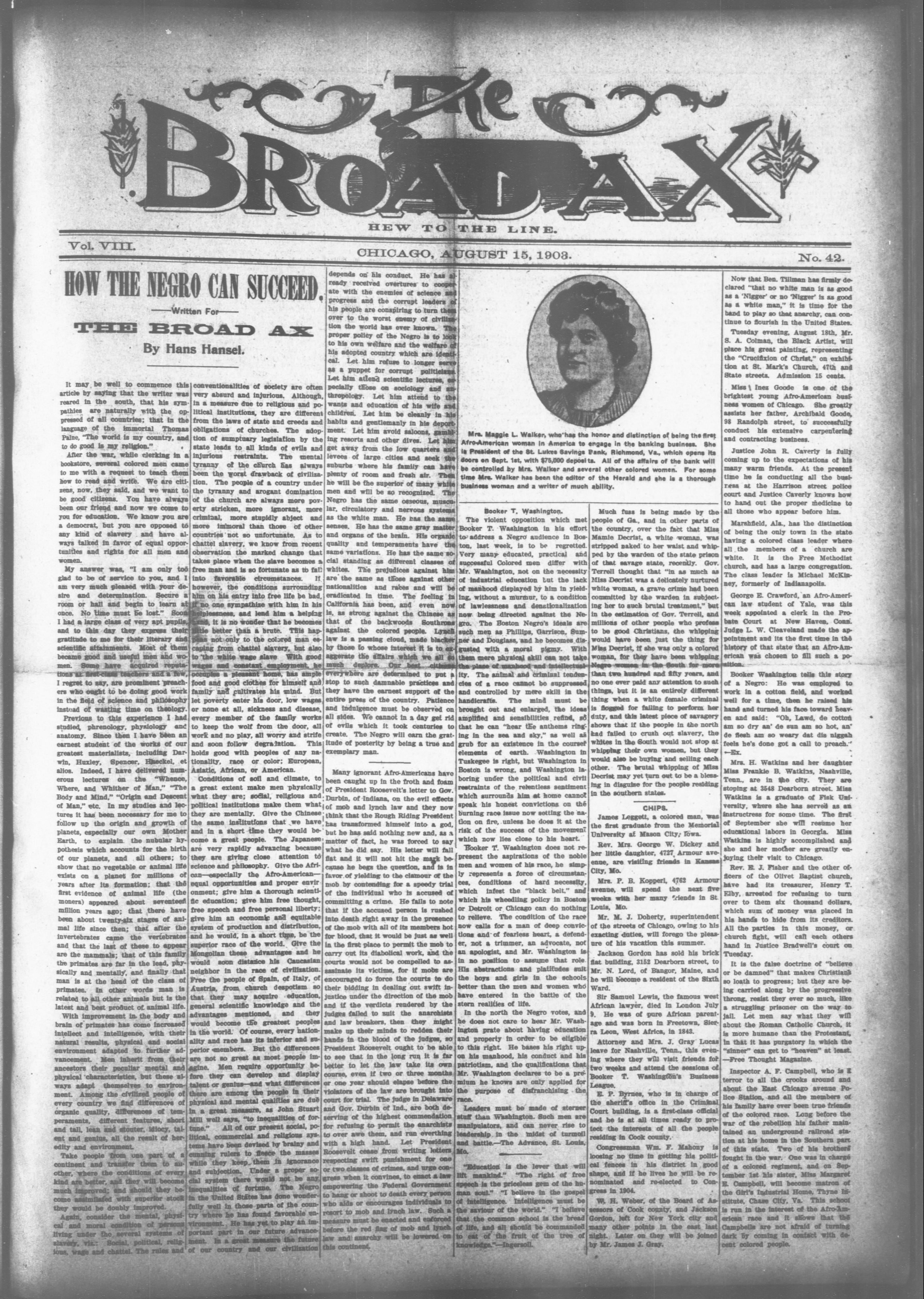
Mrs. Maggie L. Walker, who has the honor and distinction of being the first Afro-American woman in America to engage in the banking business. She is President of the St. Lukes Savings Bank, Richmond, Va., which opens its doors on Sept. 1st, with $75,000 deposits. All of the affairs of the bank will be controlled by Mrs. Walker and several other colored women. For some time Mrs. Walker has been the editor of the Herald and she is a thorough business woman and a writer of much ability.
Booker T. Washington. The violent opposition which met Booker T. Washington in his effort to address a Negro audience in Boston, last week, is to be regretted. Very many educated, practical and successful Colored men differ with Mr. Washington, not on the necessity of industrial education but the lack of manhood displayed by him in yielding, without a murmur, to a condition of lawlessness and denationalization now being directed against the Negro. The Boston Negro's ideals are such men as Phillips, Garrison, Sumner and Douglass, and he becomes disgusted with a moral pigmy. With them mere physical skill can not take the place of manhood and intellectuality. The animal and criminal tendencies of a race cannot be suppressed and controlled by mere skill in the handicrafts. The mind must be brought out and enlarged, the ideas amplified and sensibilities refind, so that he can "hear the anthems ringing in the sea and sky," as well as grub for an existence in the course elements of earth. Washington in Tuskegee is right, but Washington in Boston is wrong, and Washington laboring under the political and civil restraints of the relentless sentiment which surrounds him at home cannot speak his honest convictions on the burning race issue now setting the nation on fire, unless he does it at the risk of the success of the movement which now lies close to his heart.
Booker T. Washington does not represent the aspirations of the noble men and women of his race, he simply represents a force of circumstances, conditions of hard necessity, which infest the "black belt," and which his wheedling policy in Boston or Detroit or Chicago can do nothing to relieve. The condition of the race now calls for a man of deep convictions and of fearless heart, a defender, not a trimmer, an advocate, not an apologist, and Mr. Washington is in no position to assume that role. His abstractions and platitudes suit the boys and girls in the schools better than the men and women who have entered in the battle of the stern realities of life.
In the north the Negro votes, and he does not care to hear Mr. Washington prate about having education and property in order to be eligible to this right. He bases his right upon his manhood, his conduct and his patriotism, and the qualifications that Mr. Washington declares to be a premium he knows are only applied for the purpose of disfranchising the race.
Leaders must be made of sterner stuff than Washington. Such men are manipulators, and can never rise to leadership in the midst of turmoil and battle.-The Advance, St. Louis, Mo.
"Education is the lever that will lift mankind." "The right of free speech is the priceless gem of the human soul." "I believe in the gospel of intelligence. Intelligence must be the saviour of the world." "I believe that the common school is the bread of life, and all should be commanded to eat of the fruit of the tree of knowledge."—Ingersoll.
a honor and distinction of being the first engage in the banking business. She Bank, Richmond, Va., which opens its its. All of the affairs of the bank will several other colored women. For some of the Herald and she is a thorough ability.
Much fuss is being made by the people of Ga., and in other parts of the country, over the fact that Miss Mamie Decrist, a white woman, was stripped naked to her waist and whipped by the warden of the state prison of that savage state, recently. Gov. Terrell thought that "in as much as Miss Decrist was a delicately nurtured white woman, a grave crime had been committed by the warden in subjecting her to such brutal treatment," but in the estimation of Gov. Terrell, and millions of other people who profess to be good Christians, the whipping would have been just the thing for Miss Decrist, if she was only a colored woman, for they have been whipping Negro women in the South for more than two hundred and fifty years, and no one ever paid any attention to such things, but it is an entirely different thing when a white female criminal is flogged for failing to perform her duty, and this latest piece of savagery shows that if the people in the north had failed to crush out slavery, the whites in the South would not stop at whipping their own women, but they would also be buying and selling each other. The brutal whipping of Miss Decrist may yet turn out to be a blessing in disguise for the people residing in the southern states.
James Leggett, a colored man, was the first graduate from the Memorial University at Mason City, Iowa.
Rev. Mrs. George W. Dickey and her little daughter, 4727 Armour avenue, are visiting friends in Kansas City, Mo.
Mrs. P. B. Kopperl, 4762 Armour avenue, will spend the next five weeks with her many friends in St. Louis, Mo.
Mr. M. J. Doherty, superintendent of the streets of Chicago, owing to his exacting duties, will forego the pleasure of his vacation this summer.
Jackson Gordon has sold his brick flat building, 3152 Dearborn street, to Mr. N. Lord, of Bangor, Maine, and he will become a resident of the Sixth Ward.
Sir Samuel Lewis, the famous west African lawyer, died in London July 9. He was of pure African parentage and was born in Freetown, Sierra Leon, West Africa, in 1843.
Attorney and Mrs. J. Gray Lucas leave for Nashville, Tenn., this evening where they will visit friends for two weeks and attend the sessions of Booker T. Washington's Business League.
E. P. Byrnes, who is in charge of the sheriff's office in the Criminal Court building, is a first-class official and he is at all times ready to protect the interests of all the people residing in Cook county.
Congressman Wm. F. Mahony is loosing no time in getting his political fences in his district in good shape, and if he lives he will be renominated and re-elected to Congress in 1904.
W. H. Weber, of the Board of Assessors of Cook county, and Jackson Gordon, left for New York city and many other points in the east last night. Later on they will be joined by Mr. James J. Gray.
CHIPS.
No.42.
Now that Ben. Tillman has firmly declared "that no white man is as good as a 'Nigger' or no 'Nigger' is as good as a white man," it is time for the band to play so that anarchy, can continue to flourish in the United States. Tuesday evening, August 18th, Mr. S. A. Colman, the Black Artist, will place his great painting, representing the "Crucifixion of Christ," on exhibition at St. Mark's Church, 47th and State streets. Admission 15 cents.
Miss Inez Goode is one of the brightest young Afro-American business women of Chicago. She greatly assists her father, Archibald Goode, 98 Randolph street, to successfully conduct his extensive carpentering and contracting business.
Justice John R. Caverly is fully coming up to the expectations of his many warm friends. At the present time he is conducting all the business at the Harrison street police court and Justice Caverly knows how to hand out the proper medicine to all those who appear before him.
Marshfield, Ala., has the distinction of being the only town in the state having a colored class leader where all the members of a church are white. It is the Free Methodist church, and has a large congregation. The class leader is Michael McKinney, formerly of Indianapolis.
George E. Crawford, an Afro-American law student of Yale, was this week appointed a clerk in the Probate Court at New Haven, Conn. Judge L. W. Cleaveland made the appointment and its the first time in the history of that state that an Afro-American was chosen to fill such a position.
Booker Washington tells this story of a Negro: He was employed to work in a cotton field, and worked well for a time, then he raised his hand and turned his face toward heaven and said: "Oh, Lawd, de cotton am so dry an' de sun am so hot, an' de flesh am so weary dat dis niggah feels he's done got a call to preach." Ex.
Mrs. H. Watkins and her daughter Miss Frankie B. Watkins, Nashville, Tenn., are in the city. They are stoping at 3548 Dearborn street. Miss Watkins is a graduate of Fisk University, where she has served as an instructress for some time. The first of September she will resume her educational labors in Georgia. Miss Watkins is highly accomplished and she and her mother are greatly enjoying their visit to Chicago.
Rev. E. J. Fisher and the other officers of the Olivet Baptist church, have had its treasurer, Henry T. Elby, arrested for refusing to turn over to them six thousand dollars, which sum of money was placed in his hands to hide from its creditors. All the parties in this money, or church fight, will call each others hand in Justice Bradwell's court on Tuesday.
It is the false doctrine of "believe or be damned" that makes Christians so loath to progress; but they are being carried along by the progressive throng, resist they ever so much, like a struggling prisoner on the way to jail. Let men say what they will about the Roman Catholic Church, it is more humane than the Protestant, in that it has purgatory in which the "sinner" can get to "heaven" at least. Free Thought Magazine.
Inspector A. F. Campbell, who is a terror to all the crooks around and about the East Chicago avenue Police Station, and all the members of his family have ever been true friends of the colored race. Long before the war of the rebellion his father maintained an underground railroad station at his home in the Southern part of this state. Two of his brothers fought in the war. One was in charge of a colored regiment, and on September 1st his sister, Miss Margaret E. Campbell, will become matron of the Girl's Industrial Home, Thyne Institute, Chase City, Va. This school is run in the interest of the Afro-American race and it shows that the Campbells are not afraid of turning dark by coming in contact with decent colored people.
Will promulgate and at all times uphold the true principles of Democracy, but Catholics, Protestants, Priests, Indies, Farmers, Single Turtles, Republicans, Knights of Labor, or any one else can have their say, so long as their language is proper and responsibility is fixed.
The Broad Ax is a newspaper whose platform is broad enough for all, ever claiming the editorial right to speak in its own mind.
Local communications will receive attention. Write only on one side of the paper.
Subscriptions must be paid in advance.
One Year..... $2.00
Six Months..... 1.00
Advertising rates made known on application. Address all communications to
THE BROAD AX
6040 Armour Avenue, Chicago.
JULIUS F. TAYLOR, Editor and Publisher.
Entered at the Post Office at Chicago, IL, as Second-class Matter.
Perhaps you never noticed it,
But it's gospel anyway,
The person who agrees with you
In everything you say
Wants to get next to your coin,
Or make of you a tool;
He either thinks you're foolish—
Or is himself a fool.
—Cincinnati Enquirer.
AWKWARD FOR ALL PARTIES.
A
Visitor—Is Mrs. Smith in? Bridget—Yes, sur—but she told me to tell you she was out.—Ally Sloper.
Human Nature.
We search for microbes everywhere
But show convenient blindness
When it comes time to find them in
Our milk of human kindness.
N. Y. Sun.
Lessons of Experience.
Mr. Slimpurse—But why do you insist
that our daughter should marry a man
whom she does not like? You married
for love, didn't you?
Mrs. Slimpurse—Yes; but that is no
reason why. I should let our daughter
make the same blunder.—N. Y. Weekly.
She Missed Some Years.
He—I know you won't like her, but
you must certainly admit she's an
up-to-date girl.
She—Not at all. She claims she's 20 years old. If she were really up-to-date she'd acknowledge she's 30, at least. Philadelphia Press.
His Point of View.
"Some people," said Rev. Mr. Goodman, "can never be made to appreciate the value of religion."
"That's right," replied Pecksniff, the merchant. "They don't know how to catch the church trade at all."—Catholic Standard and Times.
The Salve That Cured.
"Why, Sharpe, I'm glad to see you so lively again. You were quite lame when I last met you."
"Oh! yes; I was awfully lame then. But that was before I got a verdict of $5,000 against the railway company."—Tit-Bits.
An All Wool Defect.
Patron—I wouldn't take this pair of all wool undershirts for a gift.
Clerk—Why not?
Patron—Because the first time they come from the wash they'll be a pair of wristlets.—N. Y. Herald.
"Say, pa," began little Johnny Bumpernickle, "I've got a question for you." "Well, let it come," said the old man. "I want to know," continued the small investigator, "if painting a town red is a cardinal sin?"—Cincinnati Enquirer.
Better Part of Valor.
"Aren't you going to fight him?"
(Gnashing his teeth) "No! That's what he wants me to do. Think I'm going to do anything to oblige a scoundrel like him?"—Chicago Tribune.
Waste of Time.
"No, I never tan, no matter how much I'm out in the sun."
"Goodness! What's the use of having a vacation, then?"—Chicago American.
Vain.
"Did you find the Chinese a vain people?"
"Very. To hear a Chinese brag you could almost believe an American was talking."—Detroit Free Press.
"Fair creature, I adore you!"
"Oh, that's all right, count. You go and talk it over with papa. Any arrangement you make with him will be satisfactory to me."—Chicago American.
Cherches in Femme.
"Another tragedy," said the cynic, as shrill shrieks arose from the ruined cistern. "I suppose there is a woman at the bottom of it."—Yale Record.
An Angling Axiom.
She—I'd like to land at least one fish.
I hate to go home without any.
He—Why, yes. One fish is worth a dozen explanations.—Pink
---
RAILROAD ADVERTISING.
When the passenger departments of the railroads began to advertise the advantages of their respective lines and the beauties and points of interest along the right of way, the conservatives stood aghast at the innovation, says the Toledo Tomes. It was freely predicted that they would get tired of wasting their money or that their employers would call them down and refuse to countenance such expenditures. Yet how different has been the outcome. The pioneers in the business have been followed by imitators and competitors, until some of the most attractive and interesting and instructive advertising of the day is done by the railroads. It is, of course, impossible to know the full extent of the influence of this advertising, but the result has been to immensely stimulate travel. We Americans are just learning to appreciate leisure and to know that one doesn't have to go a thousand miles from home to get genuine recreation and an education that is a pleasure to acquire.
The theory that everything worth seeing is in Europe has been exploded and the railroads, with their persistent, artistic and well constructed advertising have lighted the fuse that led to the explosion. Everyone with a spark of ambition desires to see surroundings different from his own. He wants to travel. But he dreads going into strange scenes and conditions.
DRYING OUT ZUYDER ZEB.
The Chicago drainage canal is a mere plaything compared with the engineering feat of draining Haarlem lake in Holland, says a writer in the New York Tribune. The Dutch built a dike around a piece of the sea and then pumped the lake they had made entirely dry. This was so successful that other portions of the sea have been reclaimed in the same way. Now the Netherlanders have set out to dry up a sea, the Zuyder Zee, and reclaim about 600 square miles. The cost of this undertaking is estimated to be $41,000,000 or $6,000,000 more than the cost of the New York subway. The Dutch government, however, expects to get its money back, as it will have 450,000 acres of land, from which it expects to get a rental of $4,500,000 a year.
One might think that such a marshy tract of land, even after it had been reclaimed and drained, would be malarial. Not so. The draining of the land will be done a little at a time, so as to shorten the marshy stage as much as possible. Coast land, even if low, when past the marshy stage, is especially healthful. Furthermore, the people of that country are used to low land. At any rate, they succeeded in drying up Haarlem.
LIGHT AND HEAVY BRAINS.
Professional Men Said to Have Far More Gray Matter Than Laborers.
In a recent memoir on the human brain, Dr. Matlagta, of Prague, one of the most eminent specialists of Europe, records the fact that the heaviest brain he has found is that of a young man of 22 years and 1.80 meters in height, which weighs 1,820 grams. The female brain does not seem to rise over 1,500 grams, and the lightest he knows about (excluding the very aged) was 1,020 grams, that of a woman of 25 years, 1.50 meters in height. There is one of 1,000 grams belonging to a woman of 89 years. The average male brain weighs 1,400 grams, and the female 1,200 grams, -between 20 and 59 years. Of remarkable brains that of Konstantinoff, a Bulgarian novelist, weighed 1,595 grams, and that of Smetana, a composer, only 1,250 grams. The average weight of the brain of different occupations he gives as from 1,410 to 1,440 for workmen, 1,468 for business men, professional musicians and photographers, and 1,500 for medical men and persons whose calling supposes a university education.
GREEN TURTLES OF FLORIDA.
Fishermen Catch Them with Nets as They Float in Balls of
The green turtles of southern Florida live in deep water and feed on sea plants, mostly the kind called "turtle grass," which they cut off near the roots, eating the lower parts and leaving the tops floating so that it collects in great fields and marks the spots where the animals are to be hunted for by the fishermen. After browsing in such ocean pastures the green turtles go to the mouths of rivers for baths of fresh water, which they seem to need from time to time. The, Florida fishermen say the reptiles enter the creeks and roll together in masses of grass, cementing them into balls with clay. When the turn of the tide takes the balls out to sea they follow them. The fishermen watch for such balls floating down the creeks, and when they see them they stretch nets across the mouths of the streams and always catch the turtles.
The treasures that lie at the bottom of the sea are now more easily obtainable by the invention of an instrument known as the hydroscope. The contrivance is shortly to be put in operation in order to find the lost Seet of Xerxes, which has reclined on the sea's bed undisturbed for about 2,800 years. Search is also to be made for the ship chartered by Pompey to carry Roman art treasures to Athens and wrecked in the archipelago 1,800 years ago.
"Now, children," said the teacher of the kindergarten class, trying to bring to the attention of the scholars the active flea, "what is it that goes quickly from place to place?"
"I know," quickly said Tommy.
"Well, Tommy, what is it that goes quickly from place to place?"
"A cook, ma'am!"—Yonkers Statesman.
Admitted to the Bar.
"He doesn't look smart enough to be a lawyer."
"He isn't."
"But you said he was admitted to the bar."
"Quite right."
"Well, how did it happen?"
"Easily enough. The barkeeper admitted him."—Chicago Post.
Good Reason.
"Why are you crying, little boy?" asked the tourist in Texas. "Boo-hoo!" sobbed the youngster, "the cyclone blew down every house in town but one."
"What one was that?"
"The schoolhouse," answered the boy, between his sobs.—Philadelphia Record.
Poor Boy.
"Your new brother is the eleventh child in the family, is he not?" asked the caller. "Yes, ma'am," said the little girl. "Have you named him yet?" "I think we're going to name him Jerusalem. That's what papa called him when he was born."—Chicago Tribune.
Reason.
"Here's an interview with a man whose name is withheld, it says, for obvious reasons. Now, I don't see any reason."
"Oh, that's perfectly obvious."
"Well, what is it?"
"There's no such man." — Detroit Free Press.
An Unsuccessful Attempt.
"It's funny our minister never gets married," remarked the young husband, who had just refused his wife a bonnet, in his endeavor to change the subject.
"I think he'd make a good husband."
"Well," replied the wife, warmly, "he didn't seem to make a very good one when he married us."—Tit-Bits.
Corrected Himself.
Mr. Blunder—Why, your mother looks as young as you do, Miss Stale. Miss S. (stiffly)—That is not very complimentary to me, Mr. Blunder. Mr. B. (confusedly)—I—I didn't mean that. I—I mean you look as young as your mother!—Tit-Bits.
It Comes Back
Subbubs—Do you really mean to say you keep a cat?
Backlotz—Yes.
Subbubs—I shouldn't think you'd want one around the house.
Backlotz—I don't, but the cat insists. Philadelphia Press.
Student—What kind of treatment would you recommend for inebriates, professor?
Professor—I wouldn't recommend any. The worst possible thing you can do for an inebriate is to treat him.—Chicago Daily News.
Words of Wisdom.
Men who choice language command,
May talk on all subjects at will;
But wiser are they who understand
Just when and where to keep still.
—Cincinnati Enqnirer.
KNEW WITHOUT GUESSING.
Dilhon
Vera Smartsette—What flowers do you think I love the most? Now, guess. Jack Hardup—Oh! I know; the most expensive ones.—Chicago Chronicle.
Trouble Coming.
The hens are in the garden,
It makes me smile with glee.
It's Johnson's garden they are in
And the hens belong to me.
—N. Y. Evening Sun.
At Home.
Henry Peck's Clerk—No, Mr. Peck won't be at his office to-day.
Customer—I wonder if I could see him at his home?
"If your eyes are very good."—Detroit Free Press.
Caroline—Does Winifred expect many wedding presents?
Margaret—Oh, yes; but she has no idea she will receive as many as she expects.—Kansas City Journal.
Deserved Popularity.
Mae—How is it that Mr. Frost is so cordially liked by everyone?
Tomme—Oh, he has such a good memory that he knows exactly what to forget, and when.—Puck.
Viktim—Because, as I found out later, he had nothing else to put in them. N. Y. Times.
"Does Hunter play golf for pleasure?"
"No, for money. He plays with the rich Miss Notmarried."—Brooklyn Life.
About the time that Whistler, the artist, was causing a sensation with the paintings which he called "A Harmony in Black and Red," "A Nocturn in Blue," or some such names, he had a misunderstanding with his club regarding dues. The secretary finally wrote to Mr. Whistler saying that the club would be glad to receive from him "an arrangement in gold and silver."
Paris is to have a statue of Byron from the chisel of Jean De Charmoy, who has made notable monuments of Baudelaire, Sainte-Beuve and Alfred De Vigny. His new work is a commission from the Byron committee, initiated by Sir Edmund Monson and Jules Claretie and including Duchess D'Uzes, Duchesse De Rohan, Comtesse De Nollies, Comtesse Greffulhe, Mme. Sarah Bernhardt, M. Mounet-Sully, Edmond Rostand, M. Sardou, Anatole France, Francois Coppee, M. Sully-Prudhomme and Sir Henry Irving.
M. Chauchard, director of the Grands Magisins du Louvre, whose collection of paintings by French artists will go to the government museums, has the honor of a statue before his death. The sculpton Wigele has modeled him in modern dress, his long whiskers falling in ample splendor on his shoulders. The seated statue has been placed in the Pavilion de Madame, at Versailles, which until recently was his country seat. In the park belonging to this estate he has built 100 small cottages. He has presented the property to the employes of his famous shops. When they retire from active life they will become tenants of these homes without paying rent.
IN VARIOUS PLACES.
London has an American invasion of mosquitoes.
The new Palace hotel at Bombay has ordered 320 electric clocks of a German firm at Wiesbaden.
A Chicago lawyer tells of a weird break he witnessed in London last year. Over a shop door a man had placed the motto: "Mens Conscia Recti" (a mind conscious of right). The next day a rival tradesman across the street, not to be outdone, flashed the following sign: "Men's and Women's Conscia Recti."
It is being seriously suggested in England that King Edward, breaking through all tradition, should pay a visit to America next year, beginning his tour with a stay in Canada, as he did many years ago. It is pointed out that nowadays a transatlantic journey is really a small matter, and one writer expresses the opinion that therefore the visit of a European sovereign to the United States is but a matter of time.
Some surprise was expressed recently in England when Lord Ravenscourt's butler died, leaving an estate valued at $150,000, but investigation shows that this is by no means a unique case. Men in his position receive good salaries, and speaking roughly a good butler may count on twice his salary in tips. A London weekly speaks of a conservative M. P. (name not given) who in years gone by was Lord Salisbury's butler. The money he saved was invested in a hotel, which he conducted successfully for 15 years and then sold at an enormous profit. No inconsiderable portion of a butler's income is the commissions paid by tradesmen.
SCHOOL AND COLLEGE.
Nearly 40 years as teacher in one school, and that the school where she studied as a girl, is the record of the late Anna E. L. Parker, of the Franklin school in Boston.
Dr. Maurice Bloomfield, professor of Sanskrit and comparative philology at Johns Hopkins, is spending his vacation in reading the proof of a glossary of words found in the ancient Vedas of the Babylonians.
Mrs. Leland Stanford has given to the university of which she is the patroness the famous Brugsch Bey collection of Egyptian antiquities. It contains a vast number of objects, large and small, dating from 6000 to 3000 B. C.
Prof. George N. Olcott, of Columbia university has several times been asked what the initial "N" in his name stood for. He usually evades these replies, but he confessed a short time ago to an old classmate that the mystic initial stood literally for "Nothing." It was a whim of his in undergraduate days to endow himself with an initial, or, as he expressed it, "to part his name in the middle." And the letter "N" was chosen.
ECHOES OF CURRENT THOUGHT
It is the fault of dreamers to fear fate. —"Herod."
A blush is like a chill; when it strikes inwardly it is much more dangerous.— "The Undercurrent."
Troubles all come together in this world, and they don't even make the usual reduction for taking a quantity.— "The Prude's Progress."
Woman's advice means man's retreat. But, gentlemen, it is surely for man to advance and for woman to receive his advances.— "The Noble Lord."
No man can make his chances—every man may take them; we cannot change the courses of the stars! But, by their courses we can steer our own.—"Queen's Favorite."
IN FEW WORDS.
The man who is quite infallible is equally intolerable.—Ram's Horn.
He alone is an acute observer who can observe minutely without being observed.—Lavater.
Lots of men have so much genius that they are unable to do anything but sit in the shade and think about it.—Chicago Daily News.
If you find no peer to travel with you, then walk cheerfully on alone, your goal before, the world behind; better alone with your own heart than with a crowd of babblers.—Buddha.
JOHN A ORB, President. WILLIAM LEGNER, Vice Pres. & Treas.
WEST SIDE BREWERY COMPANY,
CHICAGO, U. S. A.
CORNER AUGUSTA AND PAULINA STREETS.
Monroe 1567—TELEPHONES—Monroe 1573.
It’s the Only Place
JUST LOOK WHAT YOU CAN FIND AT THE AFRO-AMERICAN NEWSS TORE
8104 State Street
WISDOM COMES BY READING
Here all the best and leading weekly journals and magazines from all parts of the U. S. can be found every week including all other standard monthly, weekly and daily publications.
A Full Line of Stationery, Cigars and Tobacco
Papers sent by mail to any part of the country. Give us a call and see for yourself if we haven’t what you want. Leave your order and we will get it for you. Remember the name and place
AFRO-AMERICAN NEWS STORE
8104 State Street
E. H. FAULKNER, Manager
Jas. J. McCormick,
SAMPLE ROOM
IMPORTED AND DOMESTIC
WINES, LIQUORS AND CIGARS
8402 SOUTH HALSTED STREET.
AGENTS FOR THE BROAD AX.
From on and after this date The Broad Ax can be found on sale at the following places:
The Afro-American News Office,
3104 State Street.
The Gem Shoe Shining Parlor, 336
30th, near State street.
A. F. Tervalon's Cigar Store and News Stand, 2826 State street.
Edward Felix's Cigar Store, 398 30th street, N. E. Corner Armour Ave.
T. B. Hall's Cigar Store and Laundry office, 281 29th St.
Turner William's Cigar and News Stand, 2903 Armour Ave.
M. H. Watts, dealer in cigars and tobacco, 3742 State street.
The Stationery, 2970 State street.
J. C. Campbell, 145 W. 47th street., Cigars, Tobacco, Staple Groceries.
Wm. H. Monroe, cigar and newsstand, 486 State street.
Whiteley Bros., 2724 State street, cigars, and news stand.
J. New 131 W. 51st street, cigars, tobacco and confectionaries.
C. E. Hunter, 4503 Wentworth ave., cigars, tobacco, news stand.
T. J. Hill, cigars and stationery store., 5220 Lake Ave.
Wm. Dixon 2638 State Street cigars, tobacco, and news stand.
Isidor Jacobson, cigars, togacco and stationery, 3149 State St.
Joseph Haywood, 2960 1-2 State street, new stand, and confectionary store.
Wm. Goetz, News Stand and Laundry Office, 411 E. 36th st. News items and advertisements left at these places will find their way into the columns of The Broad Ax.
THIRTY-TWO-WHEEL CAR.
Has Sixteen Steel Trucks and Is the Largest One Ever Constructed.
A perfect car has recently been built by the Bethlehem Steel company for its own use. The company is supplying some very large castings for a 12,000 ton forging press for the Carnegie Steel company, and this car is for their transportation, says the Engineering Record. Both iron and steel castings are being supplied, some of the latter being of extraordinary size. One of them requires about 325,000 pounds of steel and 60 40-ton open-hearth furnaces are employed to provide the metal for it.
Ths car has 16-wheel trucks, connected by bridge trusses, 66 feet 10 inches long and 6 feet deep at the center. The distance between the king bolts is 64 feet. The car is 103 feet $ 10\frac{1}{2} $ inches long, over the couplers, 10 feet $ 2\frac{1}{4} $ inches high, and 9 feet 9 inches wide. It weighs 196,420 pounds, and has a rated capacity of 300,000 pounds. The largest car hitherto constructed was probably that used by the Pennsylvania railroad for transporting a Krupp gun to the Columbian exposition. It also had 32 wheels, but its rated capacity was somewhat less than that of the new car.
O
The Souls of Black Folk
A REMARKABLE BOOK that is provoking much discussion because of the wonderful eloquence with which the author pleads for right and justice to his people. In these days of increasing agitation over the "negro problem" this passionate human document can neither be overlooked nor ignored. Aside from its remarkable presentation of facts it holds the reader—prejudiced or not—by its fascination of style and overpowering pathos.
Some of the Chapter Headings follow:
OF OUR SPIRITUAL STRIVINGS.
OF THE DAWN OF FREEDOM.
OF MR. WASHINGTON AND OTHERS.
OF THE MEANING OF PROGRESS.
OF THE TRAINING OF BLACK MEN.
OF THE BLACK BELT.
OF THE SONS OF MASTER AND MAN.
OF THE FAITH OF THE FATHERS.
OF THE PASSING OF THE FIRST-BORN.
OF ALEXANDER CRUMMELL.
OF THE COMING OF JOHN.
OF THE SORROW SONGS.
8d Edition $1.20 net Published by
A.C. McClurg & Co., Chicago
THIS, THAT AND THE OTHER.
A harness-broken zebra is worth $10,000.
About 3,000,000 wage earners will be represented by the American Federation of Labor convention at Boston, Mass., in November.
The United States signal corps will establish wireless telegraph stations at Fort Davis, Safety Harbor, St. Michaels, Fort Piggons, Bates Rapids and at Valdez, where connections will be had with the submarine cable at Puget sound.
Dr. John P. Frizell has arrived in Portland, Ore., from Chimak island, one of the Aleutian chain, bringing with him fine samples of carbonate of iron, and says that there are thousands of tons in the Aleutian deposits. The only other deposits are in Bavaria, which supplies all the carbonate now in use.
Only three of the 15 members of the famous electoral commission of 1877 ex-Senator Edmunds, Senator Hoar and Gen. Eppa Hunton, of Virginia the two last having been chosen on the part of the house of representatives. All of the five justices of the supreme court who sat on the commission long since passed away.
"I never tell all I think," she said. "What a busy set of thought works you must have," the mean man replied.—Chicago Record-Herald.
WILLIAM LEGNER,
Vice Pres. & Treas.
WASHINGTON STORIES
Extraordinary Character of Venusuclan Minister—Mrs. Cushman K. Davis' Marriage Causes Stir Marine Band Growing Old.
Washington.—Washington is to have an acquisition to its diplomatic col-
ony this winter in the person of Gen. Jose Manuel Hernandez, the new minister from Venezuela, who has just arrived with his credentials. Hernandez is one of the most extraordinary characters in all South America. There is no man in all that turbulent continent who has had a more
```markdown
```
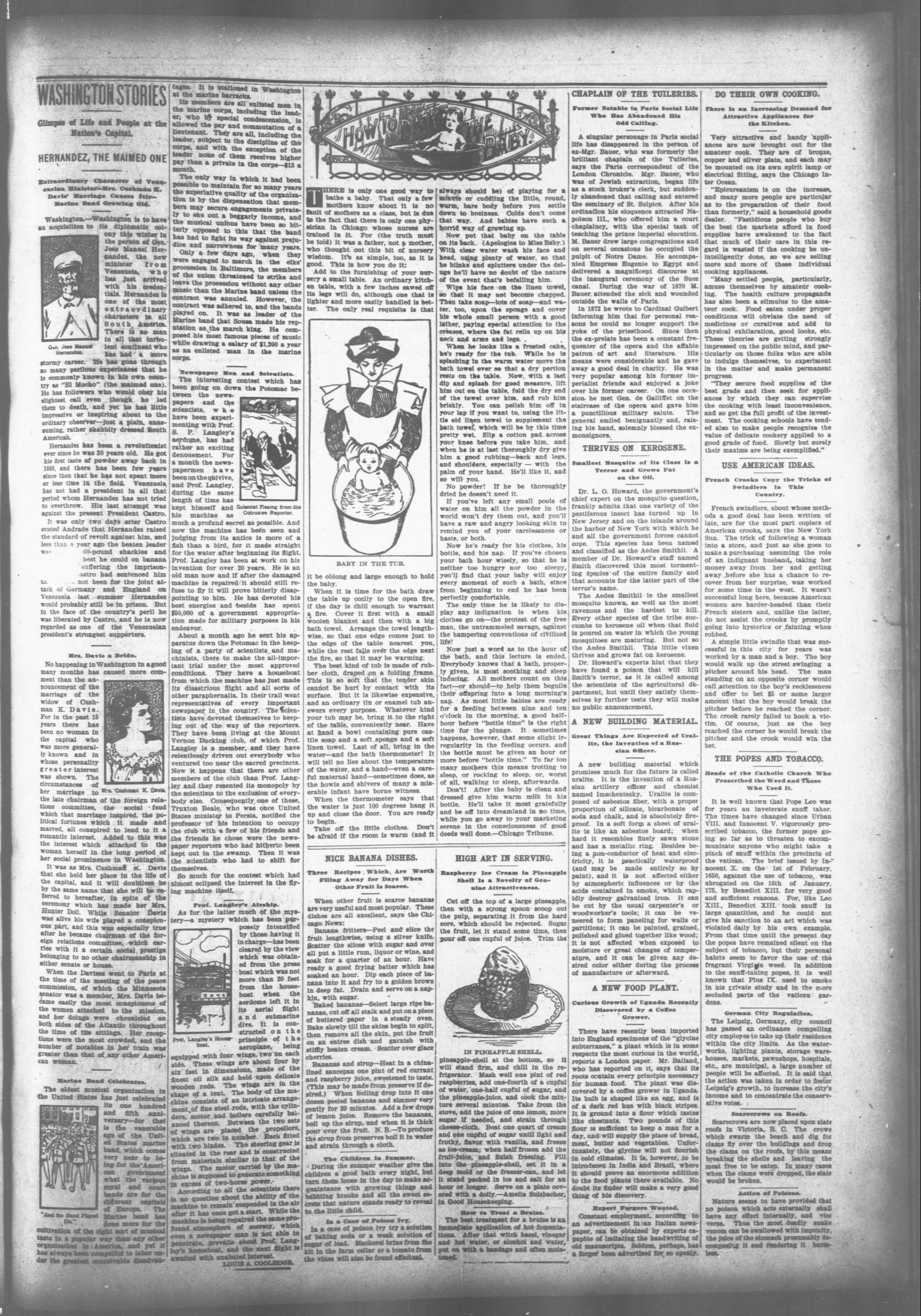
Gen. Jose Manuel Hernandez lent continent who has had a more stormy career. He has gone through so many perilous experiences that he is commonly known in his own country as "El Mocho" (the maimed one). He has followers who would obey his slightest call even though he led them to death, and yet he has little impressive or inspiring about to the ordinary observer—just a plain, unassuming, rather shabbily dressed South American.
Hernandez has been a revolutionist ever since he was 20 years old. He got his first taste of powder away back in 1868, and there has been few years since then that he has not spent more or less time in the field. Venezuela has not had a president in all that period whom Hernandez has not tried to overthrow. His last attempt was against the present President Castro. It was only two days after Castro ousted Andrade that Hernandez raised the standard of revolt against him, and less than a year ago the beaten leader was 60-pound shackles and
to. not been for the joint attack of Germany and England on Venezuela last summer Hernandez would probably still be in prison. But in the face of the country's peril he was liberated by Castro, and he is now regarded as one of the Venezuelan president's strongest supporters.
Mrs. Davis a Bride.
No happening in Washington in a good many months has caused more com-
many months has ment than the announcement of the marriage of the widow of Cushman K. Davis. For in the past 15 years there has been no woman in the capital who was more generally known and in whose personality greater interest was shown. The circumstances of her marriage to
Mrs. Cushman K. Davis
the late chairman of the foreign relations committee, the social feud which that marriage inspired, the political fortunes which it made and marred, all conspired to lend to it a romantic interest. Added to this was the interest which attached to the woman herself in the long period of her social prominence in Washington.
It was as Mrs. Cushman K. Davis that she held her place in the life of the capital, and it will doubtless be by the same name that she will be referred to hereafter, in spite of the ceremony which has made her Mrs. Hunter Doll. While Senator Davis was alive his wife played a conspicuous part, and this was especially true after he became chairman of the foreign relations committee, which carries with it a certain social prestige belonging to no other chairmanship in either senate or house.
When the Davises went to Paris at the time of the meeting of the peace commission, of which the Minnesota senator was a member, Mrs. Davis became easily the most conspicuous of the women attached to the mission, and her doings were chronicled on both sides of the Atlantic throughout the time of the sittings. Her receptions were the most crowded, and the number of notables in her train was greater than that of any other American woman.
The oldest musical organization in the United States has just celebrated
cal organization in has just celebrated its one hundred and fifth anniversary-for that is the venerable age of the United States marine band, which comes very near to being for the American government what the various royal and court bands are for the different capitals of Europe. The Marine band has done more for the
"And the Band Played On."
cultivation of the right sort of musical taste in a popular way than any other organization in America, and yet it has always been compelled to labor under the greatest conceivable disadvan-
tages. It is stationed in Washington at the marine barracks.
Its members are all enlisted men in the marine corps, including the leader, who by special condescension, is allowed the pay and commutation of a lieutenant. They are all, including the leader, subject to the discipline of the corps, and with the exception of the leader none of them receives higher pay than a private in the corps—$13 a month.
The only way in which it had been possible to maintain for so many years the superlative quality of the organization is by the dispensation that members may secure engagements privately to eke out a beggarly income, and the musical unions have been so bitterly opposed to this that the band has had to fight its way against prejudice and narrowness for many years
Only a few days ago, when they were engaged to march in the elks' procession in Baltimore, the members of the union threatened to strike and leave the procession without any other music than the Marine band unless the contract was annuled. However, the contract was adhered to, and the bands played on. It was as leader of the Marine band that Sousa made his reputation as the march king. He composed his most famous pieces of music while drawing a salary of $1,200 a year as an enlisted man in the marine corps.
Newspaper Men and Scientists. The interesting contest which has been going on down the Potomac be-
tween the newspapers and the scientists, who have been experimenting with Prof. S. P. Langley's aerdome, has had rather an exciting denouement. For a month the newspapermen have been on the quivive, and Prof. Langley, during the same length of time has kept himself and his machine as
Scientist Fleeing from the Obtrusive Reporter.
much a profund secret as possible. And now the machine has been seen and judging from its antics is more of a fish than a bird, for it made straight for the water after beginning its flight. Prof. Langley has been at work on his invention for over 20 years. He is an old man now and if after the damaged machine is repaired it should still refuse to fly it will prove bitterly disappointing to him. He has devoted his best energies and beside has spent $50,000 of a government appropriation made for military purposes in his endeavor.
About a month ago he sent his apparatus down the Potomac in the keeping of a party of scientists and machinists, there to make the all-important trial under the most approved conditions. They have a houseboat from which the machine has just made its disastrious flight and all sorts of other paraphernalia. In their trail went representatives of every important newspaper in the country. The scientists have devoted themselves to keeping out of the way of the reporters. They have been living at the Mount Vernon Ducking club, of which Prof. Langley is a member, and they have relentlessly driven out everybody who ventured too near the sacred precincts. Now it happens that there are other members of the club than Prof. Langley and they resented its monopoly by the scientists to the exclusion of everybody else. Consequently one of these, Truxton Beale, who was once United States minister to Persia, notified the professor of his intention to occupy the club with a few of his friends and the friends he chose were the newspaper reporters who had hitherto been kept out in the swamp. Then it was the scientists who had to shift for themselves.
So much for the contest which had almost eclipsed the interest in the flying machine itself.
Prof. Langley's Airship. As for the latter much of the mystery—a mystery which has been pur-
posely intensified by those having it in charge—has been cleared by the view which was obtained from the press boat which was not more than 20 feet from the houseboat when the aerdome left it in its aerial flight and submarine dive. It is constructed on the principle of the aeroplane, being
Prof. Langley's House
Prot. Langley's House-boat.
equipped with four wings, two on each side. These wings are about four by six feet in dimensions, made of the finest oil silk and held upon delicate wooden rods. The wings are in the shape of a tent. The body of the machine consists of an intricate arrangement of fine steel rods, with the cylinders, motor and boilers carefully balanced thereon. Between the two sets of wings are placed the propellors, which are two in number. Each fitted with two blades. The steering gear is situated in the rear and is constructed from materials similar to that of the wings. The motor carried by the machine is supposed to generate something in excess of two-horse power.
According to all the scientists there is no question about the ability of the machine to remain suspended in the air after it has once got a start. While the machine is being repaired the same profound atmosphere of secrecy, which even a newspaper man is not able to penetrate, prevails about Prof. Langley's houseboat, and the next flight is awaited with unabated interest.
LOUIS A. COOLEIDGE.
HOW TO RAISE THE PABY.
THERE is only one good way to bathe a baby. That only a few mothers know about it is no fault of mothers as a class, but is due to the fact that there is only one physician in Chicago whose nurses are trained in it. For (the truth must be told) it was a father, not a mother, who thought out this bit of nursery wisdom. It's as simple, too, as it is good. This is how you do it: Add to the furnishing of your nursery a small table. An ordinary kitchen table, with a few inches sawed off its legs will do, although one that is lighter and more easily handled is better. The only real requisite is that
BATHING
it be oblong and large enough to hold the baby. When it is time for the bath draw the table up cozily to the open fire, if the day is chill enough to warrant a fire. Cover it first with a small woolen blanket and then with a big bath towel. Arrange the towel lengthwise, so that one edge comes just to the edge of the table nearest you, while the rest falls over the edge next the fire, so that it may be warming.
The best kind of tub is made of rubber cloth, draped on a folding frame. This is so soft that the tender skin cannot be hurt by contact with its surface. But it is likewise expensive, and an ordinary tin or enamel tub answers every purpose. Whatever kind your tub may be, bring it to the right of the table, conveniently near. Have at hand a bowl containing pure castile soap and a soft sponge and a soft linen towel. Last of all, bring in the water—and the bath thermometer! It will tell no lies about the temperature of the water, and a hand—even a careful maternal hand—sometimes does, as the howls and shivers of many a miserable infant have borne witness.
When the thermometer says that the water is just 100 degrees hang it up and close the door. You are ready to begin. Take off the little clothes. Don't be afraid if the room is warm (and it
NICE BANANA DISHES.
Three Recipes Which Are Worth Filing Away for Days When Other Fruit Is Scarce.
When other fruit is scarce bananas are very useful and most popular. These dishes are all excellent, says the Chicago News:
Banana fritters—Peel and slice the fruit lengthwise, using a silver knife. Scatter the slices with sugar and over all put a little rum, liquor or wine, and soak for a quarter of an hour. Have ready a good frying batter which has soaked an hour. Dip each piece of banana into it and fry to a golden brown in deep fat. Drain and serve on a napkin, with sugar.
Baked bananas—Select large ripe bananas, cut off all stalk and put on a piece of buttered paper in a steady oven. Bake slowly till the skins begin to split, then remove all the skin, put the fruit on an entree dish and garnish with stiffly beaten cream. Scatter over glace cherries.
Bananas and sirup—Heat in a chinalined saucepan one pint of red currant and raspberry juice, sweetened to taste. (This may be made from preserve if desired.) When boiling drop into it one dozen peeled bananas and simmer very gently for 20 minutes. Add a few drops of lemon juice. Remove the bananas, boil up the sirup, and when it is thick pour over the fruit. N.B.-To produce the sirup from preserves boil it in water and strain through a cloth.
During the summer weather give the children a good bath every night, but turn them loose in the day to make acquaintance with growing things and babbling brooks and all the sweet secrets that nature stands ready to reveal to the little child.
In a Case of Poison Ivy.
In a case of poison ivy try a solution of baking soda or a weak solution of sugar of lead. Mackerel brine from the kit in the farm cellar or a tomato from the vines will also be found effectual.
always should be) of playing for a minute or cuddling the little, round, warm, bare body before you settle down to business. Colds don't come that way. And babies have such a horrid way of growing up. Now put that baby on the table on its back.. (Apologies to Miss Baby.) With clear water wash his face and head, using plenty of water, so that he blinks and splutters under the deluge he'll have no doubt of the nature of the event that's befalling him.
Wipe his face on the linen towel, so that it may not become chapped. Then take soap—lots of soap—and water, too, upon the sponge and cover his whole small person with a good lather, paying special attention to the creases, where the fat rolls up on his neck and arms and legs.
When he looks like a frosted cake, he's ready for the tub. While he is splashing in the warm water move the bath towel over so that a dry portion rests on the table. Now, with a last dip and splash for good measure, lift him out on the table, fold the dry end of the towel over him, and rub him briskly. You can polish him off in your lap if you want to, using the little old linen towel to supplement the bath towel, which will be by this time pretty wet. Slip a cotton pad across your knee before you take him, and when he is at last thoroughly dry give him a good rubbing—back and legs, and shoulders, especially — with the palm of your hand. He'll like it, and so will you.
No powder! If he be thoroughly dried he doesn't need it.
If you've left any small pools of water on him all the powder in the world won't dry them out, and you'll have a raw and angry looking skin to remind you of your carelessness or haste, or both.
Now he's ready for his clothes, his bottle, and his nap. If you've chosen your bath hour wisely, so that he is neither too hungry nor too sleepy, you'll find that your baby will enjoy every moment of such a bath, since from beginning to end he has been perfectly comfortable.
The only time he is likely to display any indignation is when his clothes go on—the protest of the free man, the untrammeled savage, against the hampering conventions of civilized life!
Now just a word as to the hour of the bath, and this lecture is ended. Everybody knows that a bath, properly given, is most soothing and sleep inducing. All mothers count on this fact—or should—to help them beguile their offspring into a long morning's nap. As most little babies are ready for a feeding between nine and ten o'clock in the morning, a good half-hour before "bottle time" is the right time for the plunge. It sometimes happens, however, that some slight irregularity in the feeding occurs, and the bottle must be given an hour or more before "bottle time." To far too many mothers this means trotting to sleep, or rocking to sleep, or, worst of all, walking to sleep, afterwards.
Don't! After the baby is clean and dressed give him warm milk in his bottle. He'll take it most gratefully and be off into dreamland in no time, while you go away to your marketing serene in the consciousness of good deeds well done.—Chicago Tribune.
HIGH ART IN SERVING.
Raspberry Ice Cream in Pineapple Shell Is a Novelty of Genuine Attractiveness. Cut off the top of a large pineapple, then with a strong spoon scoop out the pulp, separating it from the hard core, which should be rejected. Sugar the fruit, let it stand some time, then pour off one cupful of juice. Trim the
IN PINEAPPLE SHELL.
pineapple-shell at the bottom, so it will stand firm, and chill in the refrigerator. Mash well one pint of red raspberries, add one-fourth of a cupful of water, one-half cupful of sugar, and the pineapple-juice, and cook the mixture several minutes. Take from the stove, add the juice of one lemon, more sugar if needed, and strain through cheese-cloth. Beat one quart of cream and one cupful of sugar until light and frothy, flavor with vanilla, and freeze as ice-cream; when half frozen add the fruit-juice, and finish freezing. Fill into the pineapple-shell, set it in a deep mold or the freezer-can, and let it stand packed in ice and salt for an hour or longer. Serve on a plate covered with a doily.—Amelia Sulzbacher, in Good Housekeeping.
The best treatment for a bruise is an immediate application of hot fomentations. After that witch hazel, vinegar and hot water, or alcohol and water, put on with a bandage and often moistened.
CHAPLAIN OF THE TUILERIES.
Former Notable in Paris Social Life Who Has Abandoned His Odd Calling.
A singular personage in Paris social life has disappeared in the person of ex-Mgr. Bauer, who was formerly the brilliant chaplain of the Tuilleries, says the Paris correspondent of the London Chronicle. Mgr. Bauer, who was of Jewish extraction, began life as a stock broker's clerk, but suddenly abandoned that calling and entered the seminary of St. Sulpice. After his ordination his eloquence attracted Napoleon III, who offered him a court chaplaincy, with the special task of teaching the prince imperial elocution. M. Bauer drew large congregations and on several occasions he occupied the pulpit of Notre Dame. He accompanied Empress Eugenie to Egypt and delivered a magnificent discourse at the inaugural ceremony of the Suez canal. During the war of 1870 M. Bauer, attended the sick and wounded outside the walls of Paris.
In 1872 he wrote to Cardinal Guibert informing him that for personal reasons he could no longer support the yoke of the priesthood. Since then the ex-prelate has been a constant frequenter of the opera and the affable patron of art and literature. His means were considerable and he gave away a good deal in charity. He was very popular among his former imperialist friends and enjoyed a joke over his former career. On one occasion he met Gen. de Galliffet on the staircase of the opera and gave him a punctilious military salute. The general smiled benignantly and, raising his hand, solemnly blessed the exmonsignore.
THRIVES ON KEROSENE.
Smallest Mosquito of Its Class Is a Terror and Grows Fat on the Oil.
Dr. L. O. Howard, the government's chief expert on the mosquito question, frankly admits that one variety of the pestiferous insect has turned up in New Jersey and on the islands around the harbor of New York with which he and all the government forces cannot cope. This species has been named and classified as the Aedes Smithii. A member of Dr. Howard's staff named Smith discovered this most tormenting species of the entire family and that accounts for the latter part of the terror's name.
The Aedes Smithii is the smallest mosquito known, as well as the most ravenous and the hardest to kill. Every other species of the tribe succumbs to kerosene oil when that fluid is poured on water in which the young mosquitoes are maturing. But not so the Aedes Smithii. This little vixen thrives and grows fat on kerosene. Dr. Howard's experts hint that they have found a poison that will kill Smith's terror, as it is called among the scientists of the agricultural department, but until they satisfy themselves by further tests they will make no public announcement.
A NEW BUILDING MATERIAL.
Great Things Are Expected of Uralite, the Invention of a Russian Officer.
A new building material which promises much for the future is called uralite. It is the invention of a Russian artillery officer and chemist named Imschentezky. Uralite is composed of asbestos fiber, with a proper proportion of silicate, bicarbonate of soda and chalk, and is absolutely fireproof. In a soft form a sheet of uralite is like an asbestos board; when hard it resembles finely sawn stone and has a metallic ring. Besides being a non-conductor of heat and electricity, it is practically waterproof (and may be made entirely so by paint), and it is not affected either by atmospheric influences or by the acids contained in smoke, which rapidly destroy galvanized iron. It can be cut by the usual carpenter's or woodworker's tools; it can be veneered to form paneling for walls or partitions; it can be painted, grained, polished and glued together like wood; it is not affected when exposed to moisture or great changes of temperature, and it can be given any desired color either during the process of manufacture or afterward.
A NEW FOOD PLANT.
Curious Growth of Uganda Recently Discovered by a Coffee Grower.
There have recently been imported into England specimens of the "glycine subterranea," a plant which is in some respects the most curious in the world, reports a London paper. Mr. Balland, who has reported on it, says that its roots contain every principle necessary for human food. The plant was discovered by a coffee grower in Uganda. Its bulb is shaped like an egg, and is of a dark red hue with black stripes. It is ground into a flour which tastes like chestnuts. Two pounds of this flour is sufficient to keep a man for a day, and will supply the place of bread, meat, butter and vegetables. Unfortunately, the glycine will not flourish in cold climates. It is, however, to be introduced in India and Brazil, where it should prove an enormous addition to the food plants there available. No doubt its finder will make a very good thing of his discovery.
Constant employment, according to an advertisement in an Italian newspaper, can be obtained by experts capable of imitating the handwriting of old manuscripts. Seldom, perhaps, has a forger been advertised for so openly.
DO THEIR OWN COOKING.
There Is an Increasing Demand for Attractive Appliances for the Kitchen.
Very attractive and handy appliances are now brought out for the amateur cook. They are of bronze, copper and silver plate, and each may be mounted on its own spirit lamp or electrical fitting, says the Chicago Inter Ocean.
"Epicureanism is on the increase, and many more people are particular as to the preparation of their food than formerly," said a household goods dealer. "Fastidious people who buy the best the markets afford in food supplies have awakened to the fact that much of their care in this regard is wasted if the cooking be unintelligently done, so we are selling more and more of these individual cooking appliances.
"Many settled people, particularly, amuse themselves by amateur cooking. The health culture propaganda has also been a stimulus to the amateur cook. Food eaten under proper conditions will obviate the need of medicines or curatives and add to physical exhilaration, good looks, etc. These theories are getting strongly impressed on the public mind, and particularly on those folks who are able to indulge themselves, to experiment in the matter and make permanent progress.
"They secure food supplies of the best grade and then seek for appliances by which they can supervise the cooking with least inconvenience, and so get the full profit of the investment. The cooking schools have tended also to make people recognize the value of delicate cookery applied to a good grade of food. Slowly but surely their maxims are being exemplified."
USE AMERICAN IDEAS.
French Crooks Copy the Tricks of Swindlers in This Country.
French swindlers, about whose methods a good deal has been written of late, are for the most part copiers of American crooks, says the New York Sun. The trick of following a woman into a store, and just as she goes to make a purchasing assuming the role of an indignant husband, taking her money away from her and getting away, before she has a chance to recover from her surprise, was worked for some time in the west. It wasn't successful long here, because American women are harder-headed than their French sisters and, unlike the latter, do not assist the crooks by promptly going into hysterics or fainting when robbed.
A simple little swindle that was successful in this city for years was worked by a man and a boy. The boy would walk up the street swinging a pitcher around his head. The man standing on an opposite corner would call attention to the boy's recklessness and offer to bet $5 or some larger amount that the boy would break the pitcher before he reached the corner. The crook rarely failed to hook a victim. Of course, just as the boy reached the corner he would break the pitcher and the crook would win the bet.
THE POPES AND TOBACCO.
Heads of the Catholic Church Who Proscribed the Weed and Those Who Used It.
It is well known that Pope Leo was for years an inveterate snuff taker. The times have changed since Urban VIII. and Innocent V. vigorously proscribed tobacco, the former pope going so far as to threaten to excommunicate anyone who might take a pinch of snuff within the precincts of the vatican. The brief issued by Innocent X. on the 1st of February, 1650, against the use of tobacco, was abrogated on the 16th of January, 175, by Benedict XIII. for very good and sufficient reasons. For, like Leo XIII., Benedict XIII. took snuff in large quantities, and he could not give his sanction to an act which was violated daily by his own example. From that time until the present day the popes have remained silent on the subject of tobacco, but their personal habits seem to favor the use of the fragrant Virginia weed. In addition to the snuff-taking popes, it is well known that Plus IX. used to smoke in his private study and in the more secluded parts of the vatican gardens.
German City Regulation.
The Leipzig, Germany, city council has passed an ordinance compelling city employees to take up their residence within the city limits. As the waterworks, lighting plants, storage warehouses, markets, pawnshops, hospitals, etc., are municipal, a large number of people will be affected. It is said that the action was taken in order to foster Leipzig's growth, to increase the city's income and to concentrate the conservative votes.
Scarecrows on Roofs.
Scarecrows are now placed upon slate roofs in Victoria, B. C. The crows which swarm the beach and dig for clams fly over the buildings and drop the clams on the roofs, by this means breaking the shells and leaving the meat free to be eaten. In many cases when the clams were dropped, the slate would be broken.
Nature seems to have provided that no poison which acts externally shall have any effect internally, and vice versa. Thus the most deadly snake venom can be swallowed with impunity, the juice of the stomach presumably decomposing it and rendering it harmless.
Mr. and Mrs. G. A. Colman have opened up a very neat art studio at 419 East 36th street. Mr. and Mrs. Colman are among the best Afro-American artists of this country. Their rates for instructions in oil painting and all kinds of fancy work, which is always useful in decorating or beautifying the home, are to say the least very reasonable, and as they come to this city highly recommended they should receive the hearty support of its citizens.
Brother Douglas, of the Independent, San Francisco, Cal., in commenting on the meeting of the Afro-American Council at Louisville, Ky., says that "if Bro. Taylor, of The Broad Ax, could have raised the wind that he would have joined hands with Wm. M. Trotter and the other members of the disgruntled bunch who fought Booker. T. Washington." No, indeed, Brother Douglas, we would never think of paying out one cent of our money for the purpose of going up against a brace game like the Afro-American Council, which is simply run in the interest of Old Drunken Tom Fortune.
Cols. Edward H. Morris, Louis B. Arders and Rev. Jordan Chavis, journeyed to Springfield last week for the purpose of assuring little Dick Yates that "they in company with Cols. Mushmouth Johnson and Slippery Jacksonville, Wilkins will be able to swing all the colored voters in line for him in 1904, but Major John C. Buckner and many of the other Afro-Americans in the state of Illinois claim that Cols. John R. Marshall, Edward H. Morris, Mushmouth Johnson, David Ranting Wilkins, who was more than willing to assist Rev. Abraham Lincoln Murray to send the writer to jail for publishing the truth, Louis B. Anderson, Edward H. Wright, and Rev. Jordan Chauis do not toote the Afro-American voters of Chicago, nor of Illinois, around in their hip pockets. That when the band begins to play these saintly gentlemen cannot deliver the goods to Dick Yates, who never was, and is not now greatly in love with smart colorel men who walk with their heads up in the air.
Wisdom Comes by Reading.
Stop! Don't worry your friends and neighbors about what happens and what will take place in the future. Read good books and papers and learn for yourself it is a wise thing to do. You can find the best WEEKLY JOURNALS and MAGAZINES from all parts of the United States at the famous Afro-American News Office, $104 State street. You can find each month the Colored American Magazine from Boston, Mass.; the Colored Home Journal from Pittsburg, Pa., and a full line of stationary, including assortment of choice cigars and tobacco. Call and see our display of race journals and library pamphets that are edited by the race. If you don't find what you want, leave your order for it. We are reliable and the only place of this kind. Remember the name and place—the Afro-American News Office, $104 State street.
E. H. FAULKNER, Manager.
Fifty cents for two copies of The Broad Ax. In order to complete our files to date, we will cheerfully pay twenty-five cents each for two copies of The Broad Ax, dated December 29, 1900 and July 13, 1901. The papers must be in good condition and the money will be forwarded for the same upon receipt of them.
SAD FOR SPINDLESHANKS.
Now that King Edward has set the fashion for knee breeches in full dress affairs, and is being followed by many of his subjects, it is likely that they will be received are long on this side of the water. They must, of course, be made of black silk satin, and the effects resulting from such a dress will, to say at least, be somewhat curious, says the American Wool and Cotton Reporter. Those who favor the innovation will be the well-built, athletic class, while those who cry out most loudly against it—that they will not adopt such a ridiculous fashion—will have, no doubt, some personal reasons for not wanting to be seen in knee breeches. It will not be the first fashion adopted that has made men look ridiculous, nor will it probably be the last. King Edward is still the criterion of fashion in London. There is little question as to the style there, at least.
An opal has been found in Australia, on the White Cliff fields, which, with good fortune in the cutting, will make a gem eight inches long by five wide, or larger than any of the crown jewels of Belgium, weighs nearly a pound and is valued at $250,000.
The causes which control the ebb and flow of humanity between city and country are among the most subtile and obscure of social phenomena, says the San Francisco Chronicle. The characteristic of the people of all new countries is vigor. It is due to the abundance of land for all the people, and the action and reaction between land and man. The life of new countries is rude, but the nourishment is abundant, and the pure air sends pure blood coursing through the veins. The result is a race of strong men. When class distinctions are marked the gentry gain culture without losing strength. That is the highest type of manhood. It was seen in the pre-Augustan age of Rome, in the chivalry of medieval western Europe, in the planters of our own southern states in the first half of the nineteenth century. The development of the highest type of manhood involves the condemnation of the majority to a rude and laborious life. But such men can be propagated from generation to generation only so long as they remain in their rural environment. In the cities degeneration occurs. Here and there vigor is transmitted through several generations of city bred men, at least in individuals, who maintain the family name and standing. The tendency is to degeneration, and the mass yields to the tendency. The result is seen in the slums and the potter's field. The new men who dominate the cities—at least in America—are country bred.
TRIP TO THE DENTIST'S.
Western Woman Rode Her Pony Sixty Miles to Have Her Teeth Fixed.
"The experiences of a city bred girl on a western ranch are positively thrilling to me," remarked the woman who was reading a letter from a friend of her youth, to the Philadelphia Record. "Now this friend of mine, so she writes, found herself in need of the attention of a dentist. Did she call a cab or hall a trolley car? She did not. Rather, she had her pony saddled early in the morning and rode 25 miles to the nearest doctor of dentistry—only it was 30 miles, because she had to go five miles out of her way on account of the freshets. Instead of resting at her destination she barely had time to eat a bite when she resigned herself to the filing, scraping, buzz-sawing and hammering which is the lot of the victim of ailing molars. A few hours of this modern mode of torture and she was again in the saddle, with the refreshed pony setting out gallantly to complete his 60 miles. Equines have a way of being light-footed when their heads are turned homeward. As for his rider, a husband and three babies anxiously awaited her in the cool, mysterious moonlight."
Paul Gabel, who died in New York recently at the age of 84, is reputed to have been the originator in America of the "delicatessen" store. He was a native of Germany and opened a delicatessen store in New York city nearly three-quarters of a century ago.
Congressman Boutell proposes as a means of promoting annexation the intermarriage of young Americans and Canadians, adding that he had already taken his wife from Canada. His remark recalls to the Toronto Globe the southern Irishman's reply to a question as to how the southern women regarded secession: "Sure, they're all for union to a man."
Ex-Sheriff "Tom" Dunn, of New York, has long since won a reputation as a wit. In consequence a number of alleged witticisms are tacked to his name that were never perpetrated by him. "Dunn," said a friend to him the other day, "what is the cleverest thing you ever said?" "I don't know," sighed the ex-sheriff, "but it was probably said by someone else."
Sir Thomas Lipton has faith in the luck of the individual, and this year, for the first time, he will be joined in America by his mascot. This is Mr. Carmichael, the secretary of the Lipton company, whom Sir Lipton calls his "lucky man." Mr. Carmichael has been associated with the owner of the Shamrock III. since almost the beginning of his business career, which began in a small shop in a mean street of Glasgow.
On the 30th of July Samuel M. Shaw retired from editorial management of the Cooperstown (N. Y.) Freeman's Journal, having conducted that sterling democratic weekly for 52 years. He is now 80 years old. In a published card Mr. Shaw says: "I have fortunately experienced but little sickness and never severe enough to prevent my doing some work each week; have been confined to my room but few days in the last 52 years, and never an entire day to my bed. Only once have I been absent from the office for a longer period than ten days, and that was in January, 1876. It is full time to lower my flag and take a rest."
There are several young premiers in various parts of the British empire, but the latest is the youngest of all. He is R. McBride, the new premier of British Columbia, who was born in New Westminster, the original capital of that western Canadian province, 22 years ago. He went to the other end of the dominion for his education, as he is a graduate of Dalhousie university, Halifax. In 1892 he was called to the bar of British Columbia, and six years later he entered the parliament of the province of which he is now prime minister, so that his term of political preparation for the premiership was less than five years.
J. GRAY LUCAS
ATTORNEY-AT-LAW
Suite 412 Real Estate Board Bldg
50 Dearborn St. Car. Randolph
CHICAGO.
Fifty-First St. and Armour Ave.
RAIL YARDS: 1st St. & I. S. & M. S. Ry.
133rd St. and Armour Ave.
CHICAGO
Phoenix Oil & Mineral Co.
OF ARIZONA
$200,000 CAPITAL
Pays dividends 1 per cent. monthly or
12 per cent per annum.
Stock now selling at 10c per share,
full paid and non-assessable. For
further particulars address
THE DAVIES INVESTMENT COMPANY
614 First National Bank Bldg., Chicago
'Phone Central 3026.
Face Massage, Shampooing, Scalp Treating Mrs. Warner Chiropodist and Manicuring Removes Corns Without Pain Medicated Foot Baths and Foot Massage 138 State St., 4th Floor, Chicago
Telephone Blue 4632 Work Called for and Delivered...
A. HOFFMAN,
CLEANER, DYER
AND PRESSER.
Suits Sponged and Pressed 35c
5125 State St. Expert Workmanship
Moderate Prices.
Mrs. Florence Miller
FASHIONABLE
DRESSMAKER
PERFECT FIT GUARANTEED
PRICES REASONABLE
3151 State Street CHICAGO.
CHARLES L. WEBB
COURT REPORTER
77 South Clark St., Room 9
CHICAGO.
General Stenographer
WONDERFUL DISCOVERY
Curly Hair Made Straight By
TAKEN FROM LIFE:
BEFORE AND AFTER TREATMENT.
ORIGINAL
OZONIZED OX MARROW
(Copyrighted.)
This wonderful hair pomade is the only safe preparation in the world that makes kinky or curly hair straight as shown above. It nourishes the scalp, prevents the hair from falling out or breaking off, curts dandruff and makes the hair grow long and silky. Sold over forty years and used by thousands. Warranted hardware. It was the first preparation ever sold for straightening kinky hair. Wearable of imitations. Get the Original Ozonized Ox Marrow as the genuine never fails to keep the hair straight, soft and beautiful, giving it that healthy, life-like appearance, so much desired. A toilet necessity for ladies, gentlemen and children. Elegantly perfumed. Owing to its superior and lasting qualities it is the best and most economical. It is not possible for anybody to produce a preparation equal to it. Full directions with every bottle. Only 50 cents. Sold by draggers and dealers or send us 50 cents for one bottle or $1.40 for three bottles. We pay all express charges. Send postal or express money order. Please mention name of this paper when ordering. Write your name and address plainly to
OZONIZED OX MARROW CO., 76 Wabash Ave., Chicago, Illinois.
MRS. A. WILSON.
Nicely furnished rooms to rent for gentlemen. Reasonable rates, 2352 Indiana aveuna.
Mrs. Anna L. Newby.
First class furnished rooms, for rent to gentleman and ladies, with bath and gas. 2628 Wabash avenue.
Rooms for Rent.
Elegantly furnished rooms for rent with bath and gas at $282 Wabash avenue.
ILLINOIS BRICK CO.
ILLINOIS BRICK CO.
WILLIAM C. KUESTER. SUPERINTENDENT.
N. Western Ave., Ch Telephone Lake View 270. IENADEL B
1994 N. Western Ave., Chicago.
HOHENADEL BROS.
211-213 Madison Street
CHICAGO
Telephone Main 2300
Pollcomen, Firemen, Street Car Employes,
Letter Carriers, Telegraph Messengers,
Elevatormen, Railroad Employes,
Janitors, Wagonmen, Bollboys, Watchmen, Bla
Real Estate, Insurance and Loans Property managed. Abstracts examined. Renting. Legal papers prepared. 4709 South Halsted Street Chicago
LADIES' FINE CLOTHING OF ALL KINDS
Fancy Summer Dressags and Silk Waists
GENTS' SUITS AND OVERCOATS
EASY TERMS MAIL ORDERS PROMPTLY FILLED
Private Sales Room 3149 State St. Second Floor
OPEN EVENINGS
COAL, WOOD AND ICE MOVING AND EXPRESSING Cash on Delivery All Orders Promptly Attended to Telephone Blue 28p 4656 Armour Avenue, CHICAGO.
Junk's Brewery
M. JUNK, Proprietor JOS. P. JUNK, Manager 3700-3710 South Halsted Street and 897 to 929 Thirtyseventh Street CHICAGO
-- American Brick Co. --
President and Treasurer, THOMAS CAREY. Vice-President, JOHN SHELHAMER, Secretary, WILLIAM SULLIVAN. MANUFACTURERS OF