The Broad Ax
Saturday, August 22, 1903
Chicago, Illinois
Page text (machine-generated)
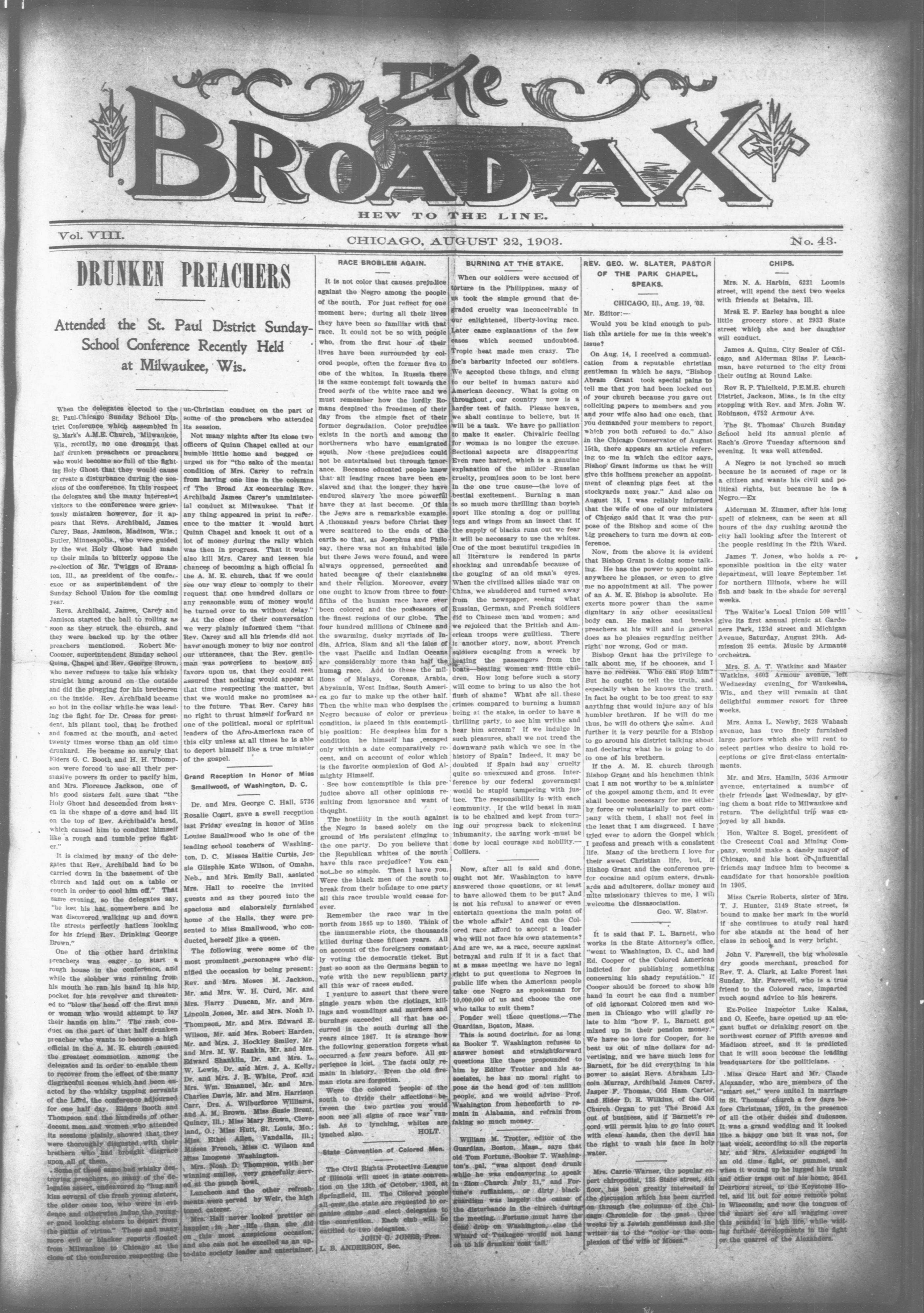
DRUNKEN PREACHERS
Attended the St. Paul District Sunday School Conference Recently Held at Milwaukee, Wis.
Vol. VIII.
DRUNKEN
Attended the St. I School Conferen at Milwa
When the delegates elected to the St. Paul-Chicago Sunday School District Conference which assembled in St. Mark's A.M.E. Church, Milwaukee, Wis., recently, no one dreamt that half drunken preachers or preachers who would become so full of the fighting Holy Ghost that they would cause or create a disturbance during the sessions of the conference. In this respect the delegates and the many interested visitors to the conference were grieviously mistaken however, for it appears that Revs. Archibald, James Carey, Bass, Jamison, Madison, Wis.; Butler, Minneapolis., who were guided by the wet Holy Ghost had made up their minds to bitterly oppose the re-election of Mr. Twiggs of Evanston, Ill., as president of the conference or as superintendent of the Sunday School Union for the coming year.
Revs. Archibald, James, Carey and Jamison started the ball to rolling as soon as they struck the church, and they were backed up by the other preachers mentioned. Robert McCoomer, superintendent Sunday school Quinn, Chapel and Rev. George Brown, who never refuses to take his whisky straight hung around on the outside and did the plugging for his bretheren on the inside. Rev. Archibald became so hot in the collar while he was leading the fight for Dr. Cress for president, his pliant tool, that he frothed and foamed at the mouth, and acted twenty times worse than an old time drunkard. He became so unruly that Elders G. C. Booth and H. H. Thompson were forced to use all their persuasive powers in order to pacify him, and Mrs. Florence Jackson, one of his good sisters felt sure that "the Holy Ghost had descended from heaven in the shape of a dove and had lit on the top of Rev. Archibald's head, which caused him to conduct himself like a rough and tumble prize fighter."
It is claimed by many of the delegates that Rev. Archibald had to be carried down in the basement of the church and laid out on a table or couch in order to cool him off." That same evening, so the delegates say, "he lost his hat somewhere and he was discovered walking up and down the streets perfectly hatless looking for his friend Rev. Drinking George Brown."
One of the other hard drinking preachers was eager to start a rough house in the conference, and while the slobber was running from his mouth he ran his hand in his hip pocket for his revolver and threatened to "blow the head off the first man or woman who would attempt to lay their hands on him." The rash conduct on the part of that half drunken preacher who wants to become a high official in the A. M. E. church caused the greatest commotion among the delegates and in order to enable them to recover from the effect of the many disgraceful scenes which had been enacted by the whisky tapping servants of the Lord, the conference adjourned for one half day. Elders Booth and Thompson and the hundreds of other decent men and women who attended its sessions plainly showed that they were thoroughly disgusted with their brethern who had brought disgrace upon all of them.
Some of these same bad whisky destroying preachers, so many of the delegates assert, endeavored to "hug and kiss several of the fresh young sisters, the older ones too, who were in evidence and otherwise induce the younger good looking sisters to depart from the paths of virtue." These and many more evil or blacker reports floated from Milwaukee to Chicago at the close of the conference respecting the
---
un-Christian conduct on the part of some of the preachers who attended its session.
Not many nights after its close two officers of Quinn Chapel called at our humble little home and begged or urged us for "the sake of the mental condition of Mrs. Carey to refrain from having one line in the columns of The Broad Ax concerning Rev. Archibald James Carey's unministerial conduct at Milwaukee. That if any thing appeared in print in reference to the matter it would hurt Quinn Chapel and knock it out of a lot of money during the rally which was then in progress. That it would also kill Mrs. Carey and lessen his chances of becoming a high official in the A. M. E. church, that if we could see our way clear to comply to their request that one hundred dollars or any reasonable sum of money would be turned over to us without delay." At the close of their conversation we very plainly informed them "that Rev. Carey and all his friends did not have enough money to buy nor control our utterances, that the Rev. gentleman was powerless to bestow any favors upon us, that they could rest assured that nothing would appear at that time respecting the matter, but that we would make no promises as to the future. That Rev. Carey has no right to thrust himself forward as one of the political, moral or spiritual leaders of the Afro-American race of this city unless at all times he is able to deport himself like a true minister of the gospel.
Grand Reception In Honor of Miss Smallwood, of Washington, D. C.
Dr. and Mrs. George C. Hall, 5736 Rosalie Court, gave a swell reception last Friday evening in honor of Miss Louise Smallwood who is one of the leading school teachers of Washington, D. C. Misses Hattie Curtis, Jessie Glisphie Kate Wilson, of Omaha, Neb., and Mrs. Emily Ball, assisted Mrs. Hall to receive the invited guests and as they poured into the spacious and elaborately furnished home of the Halls, they were presented to Miss Smallwood, who conducted herself like a queen.
The following were some of the most prominent personages who dignified the occasion by being present: Rev. and Mrs. Moses M. Jackson, Mr. and Mrs. W. H. Curd, Mr. and Mrs. Harry Duncan, Mr. and Mrs. Lincoln Jones, Mr. and Mrs. Noah D. Thompson, Mr. and Mrs. Edward E. Wilson, Mr. and Mrs. Robert Harden, Mr. and Mrs. J. Hockley Smiley, Mr. and Mrs. M. W. Rankin, Mr. and Mrs. Edward Shanklin, Dr. and Mrs. L. W. Lewis, Dr. and Mrs. J. A. Kelly, Dr. and Mrs. J. R. White, Prof. and Mrs. Wm. Emanuel, Mr. and Mrs. Charles Davis, Mr. and Mrs. Harrison Carr, Drs. A. Wilburforce Williams, and A. M. Brown. Miss Susie Brent, Quincy, Ill.; Miss Mary Brown, Cleveland, O.; Miss Hutt, St. Louis, Mo.; Miss Ethei Allen, Vandalia, Ill.; Misses French, Miss C. Wilson and Miss Imogene Washington.
Mrs. Noah D. Thompson, with her winning smiles, very gracefully served at the punch bowl.
Luncheon and the other refreshments were served by Weir, the high toned caterer.
Mrs. Hall never looked prettier or happier in her life than she did on this most auspicious occasion, and she can not be excelled as an up-to-date society leader and entertainer.
HEW TO THE LINE.
RACE BROBLEM AGAIN.
It is not color that causes prejudice against the Negro among the people of the south. For just reflect for one moment here; during all their lives they have been so familiar with that race. It could not be so with people who, from the first hour of their lives have been surrounded by colored people, often the former five to one of the whites. In Russia there is the same contempt felt towards the freed serfs of the white race and we must remember how the lordly Romans despised the freedmen of their day from the simple fact of their former degradation. Color prejudice exists in the north and among the northerners who have emmigrated south. Now these prejudices could not be entertained but through ignorance. Because educated people know that all leading races have been enslaved and that the longer they have endured slavery the more powerful have they at last become. Of this the Jews are a remarkable example. A thousand years before Christ they were scattered to the ends of the earth so that, as Josephus and Philo say, there was not an inhabited isle but there Jews were found, and were always oppressed, persecuted and hated because of their clanishness and their religion. Moreover, every one ought to know from three to four-fifths of the human race have ever been colored and the possessors of the finest regions of our globe. The four hundred millions of Chinese and the swarming, dusky myriads of India, Africa, Siam and all the isles of the vast Pacific and Indian Oceans are considerably more than half the human race. Add to these the millions of Malays, Coreans, Arabia, Abysinnia, West Indias, South America go far to make up the other half. Then the white man who despises the Negro because of color or previous condition, is placed in this contemptible position: He despises him for a condition he himself has escaped only within a date comparatively recent, and on account of color which is the favorite complexion of God Almighty Himself.
See how contemptible is this prejudice above all other opinions resulting from ignorance and want of thought.
The hostility in the south against the Negro is based solely on the ground of his persistent clinging to the one party. Do you believe that the Republican whites of the south have this race prejudice? You can not-be so simple. Then I have you. Were the black men of the south to break from their bondage to one party all this race trouble would cease forever.
Remember the race war in the north from 1845 up to 1860. Think of the innumerable riots, the thousands killed during these fifteen years. All on account of the foreigners constantly voting the democratic ticket. But just so soon as the Germans began to vote with the new republican party all this war of races ended.
I venture to assert that there were single years when the riotings, killings and woundings and murders and burnings exceeded all that has occurred in the south during all the years since 1867. It is strange how the following generation forgets what occurred a few years before. All experience is lost. The facts only remain in history. Even the old fireman riots are forgotten.
Were the colored people of the south to divide their affections between the two parties you would soon see all signs of race war vanish. As to lynching, whites are lynched also. HOLT. State Convention of Colored Men.
The Civil Rights Protective League of Illinois will meet in state convention on the 12th of October, 1903, at Springfield, Ill. The Colored people all over the state are requested to organize clubs and elect delegates to the convention. Each club will be entitled to two delegates.
JOHN G. JONES, Pres.
L. B. ANDERSON, Sec.
```markdown
```
When our soldiers were accused of torture in the Philippines, many of us took the simple ground that degraded cruelty was inconceivable in our enlightened, liberty-loving race. Later came explanations of the few cases which seemed undoubted. Tropic heat made men crazy. The foe's barbarity infected our soldiers. We accepted these things, and clung to our belief in human nature and American decency. What is going on throughout, our country now is a harder test of faith. Please heaven, we shall continue to believe, but it will be a task. We have no palliation to make it easier. Chivalric feeling for woman is no longer the excuse. Sectional aspects are disappearing. Even race hatred, which is a genuine explanation of the milder Russian cruelty, promises soon to be lost here in the one true cause—the love of bestial excitement. Burning a man is so much more thrilling than boyish sport like stoning a dog or pulling legs and wings from an insect that if the supply of blacks runs out we fear it will be necessary to use the whites. One of the most beautiful tragedies in all literature is rendered in parts shocking and unreadable because of the gouging of an old man's eyes. When the civilized allies made war on China, we shuddered and turned away from the newspaper, seeing what Russian, German, and French soldiers did to Chinese men and women; and we rejoiced that the British and American troops were guillotless. There is another story, now, about French soldiers escaping from a wreck by beating the passengers from the boats—beating women and little children. How long before such a story will come to bring to us also the hot flush of shame? What are all these crimes compared to burning a human being at the stake, in order to have a thrilling party, to see him writhe and hear him scream? If we indulge in such pleasures, shall we not tread the downward path which we see in the history of Spain? Indeed, it may be doubted if Spain had any cruelty quite so unexcused and gross. Interference by our federal government would be stupid tampering with justice. The responsibility is with each community. If the wild beast in man is to be chained and kept from turning our progress back to sickening inhumanity, the saving work must be done by local courage and nobility.—Colliers
Now, after all is said and done, ought not Mr. Washington to have answered those questions, or at least to have allowed them to be put? And is not his refusal to answer or even entertain questions the main point of the whole affair? And can the Colored race afford to accept a leader who will not face his own statements? And are we, as a race, secure against betrayal and ruin if it is a fact that at a mass meeting we have no legal right to put questions to Negroes in public life when the American people take one Negro as spokesman for 10,000,000 of us and choose the one who talks to suit them?
This is sound doctrine. for as long as Booker T. Washington refuses to answer honest and straightforward questions like those propounded to him by Editor Trotter and his associates, he has no moral right to pose as the head god of ten million people, and we would advise Prof Washington from henceforth to remain in Alabama, and refrain from faking so much money.
William M. Trotter, editor of the Guardian, Boston, Mass., says that old Tom Fortune, Booker T. Washington's pal, "was almost dead drunk while he was endeavoring to speak in Zion Church July 31," and Fortune's ruffianism, or dirty blackguardism was largely the cause of the disturbance in the church during the meeting. Fortune must have the dead drop on Washington, else the Wizard of Tuskegee would not hang on to his drunken contail.
Would you be kind enough to publish this article for me in this week's issue?
On Aug. 14, I received a communication from a reputable christian gentleman in which he says, "Bishop Abram Grant took special pains to tell me that you had been locked out of your church because you gave out soliciting papers to members and you and your wife also had one each, that you demanded your members to report which you both refused to do." Also in the Chicago Conservator of August 15th, there appears an article referring to me in which the editor says, Bishop Grant informs us that he will give this holiness preacher an appointment of cleaning pigs feet at the stockyards next year." And also on August 18, I was reliably informed that the wife of one of our ministers of Chicago said that it was the purpose of the Bishop and some of the big preachers to turn me down at conference.
Now, from the above it is evident that Bishop Grant is doing some talking. He has the power to appoint me anywhere he pleases, or even to give me no appointment at all. The power of an A. M. E. Bishop is absolute. He exerts more power than the same dignitary in any other eciestastical body can. He makes and breaks preachers at his will and in general does as he pleases regarding neither right nor wrong. God or man.
Bishop Grant has the privilege to talk about me, if he chooses, and I have no redress. Who can stop him? But he ought to tell the truth, and especially when he knows the truth. In fact he ought to be too great to say anything that would injure any of his humbler brethren. If he will do me thus, he will do others the same. And further it is very peurile for a Bishop to go around his district talking about and declaring what he is going to do to one of his brethren.
If the A. M. E. church through Bishop Grant and his henchmen think that I am not worthy to be a minister of the gospel among them, and it ever shall become necessary for me either by force or voluntarily to part company with them, I shall not feel in the least that I am disgraced. I have trled ever to adorn the Gospel which I profess and preach with a consistent life. Many of the brethern I love for their sweet Christian life, but, if Bishop Grant and the conference prefer cocaine and opium eaters, drunkards and adulterers, dollar money and mite missionary thieves to me, I will welcome the dissasociation.
It is said that F. L. Barnett, who works in the State Attorney's office, "went to Washington, D. C., and had Ed. Cooper of the Colored American indicted for publishing something concerning his shady reputation." If Cooper should be forced to show his hand in court he can find a number of old ignorant Colored men and women in Chicago who will gladly relate to him "how F. L. Barnett got mixed up in their pension money." We have no love for Cooper, for he beat us out of nine dollars for advertising, and we have much less for Barnett, for he did everything in his power to assist Revs. Abraham Lincoln Murray, Archibald James Carey, Jasper F. Thomas, Old Ham Carter, and Elder D. R. Wilkins, of the Old Church Organ to put The Broad Ax out of business, and if Barnett's record will permit him to go into court with clean hands, then the devil has the right to wash his face in holy water.
Mrs. Carrie Warner, the popular expert chiropodist, 138 State street, 4th floor, has been greatly interested in the discussion which has been carried on through the columns of the Chicago Chronicle for the past three weeks by a Jewish gentleman and the writer as to the "color or the complexion of the wife of Moses."
CHIPS.
Mrs. N. A. Harbin, 6221 Loomis street, will spend the next two weeks with friends at Betaiva, Ill.
Mrsä E. F. Earley has bought a nice little grocery store, at 2933 State street which she and her daughter will conduct.
James A. Quinn, City Sealer of Chicago, and Alderman Silas F. Leachman, have returned to the city from their outing at Round Lake:
Rev R. P. Thielkeld, P.E.M.E. church District, Jackson, Miss., is in the city stopping with Rev. and Mrs. John W. Robinson, 4752 Armour Ave.
The St. Thomas' Church Sunday School held its annual picnic at Rach's Grove Tuesday afternoon and evening. It was well attended.
A Negro is not lynched so much because he is accused of rape or is a citizen and wants his civil and political rights, but because he is a Negro.—Ex
Alderman M. Zimmer, after his long spell of sickness, can be seen at all hours of the day rushing around the city hall looking after the interest of the people residing in the f2th Ward.
James T. Jones, who holds a responsible position in the city water department, will leave September 1st for northern Illinois, where he will fish and bask in the shade for several weeks.
The Waiter's Local Union 509 will give its first annual picnic at Gardeners Park, 123d street and Michigan Avenue, Saturday, August 29th. Admission 25 cents. Music by Armants orchestra.
Mrs. S. A. T. Watkins and Master Watkins, 4603 Armour avenue, left Wednesday evening for Waukesha, Wis., and they will remain at that delightful summer resort for three weeks.
Mrs. Anna L. Newby, 2628 Wabash avenue, has two finely furnished large parlors which she will rent to select parties who desire to hold receptions or give first-class entertainments.
Mr. and Mrs. Hamlin, 5036 Armour avenue, entertained a number of their friends last Wednesday, by giving them a boat ride to Milwaukee and return. The delightful trip was enjoyed by all hands.
Hon. Walter S. Bogel, president of the Crescent Coal and Mining Company, would make a dandy mayor of Chicago, and his host of influential friends may induce him to become a candidate for that honorable position in 1905.
Miss Carrie Roberts, sister of Mrs. T. J. Hunter, 3149 State street, is bound to make her mark in the world if she continues to study real hard for she stands at the head of her class in school and is very bright.
John V. Farewell, the big wholesale dry goods merchant, preached for Rev. T. A. Clark, at Lake Forest last Sunday. Mr. Farewell, who is a true friend to the Colored race, imparted much sound advice to his hearers.
Ex-Police Inspector Luke Kalas, and O. Keefe, have opened up an elegant buffet or drinking resort on the northwest corner of Fifth avenue and Madison street, and it is predicted that it will soon become the leading headquarters for the politicians.
Miss Grace Hart and Mr. Claude Alexander, who are members of the "smart set," were unite1 in marriage in St. Thomas' church a few days before Christmas, 1902, in the presence of all the other dudes and dudesses. It was a grand wedding and it looked like a happy one but it was not, for last week, according to all the reports Mr. and Mrs. Alexander engaged in an old time fight, or pummel, and when it wound up he lugged his trunk and other traps out of his home, 3541 Dearborn street, to the Keystone Ho
Will promulgate and at all times uphold the true principles of Democracy, but Catholic, Protestant, Priest, Infidel, Farmer, Single Taxes, Republi-cans, Knights of Labor, or any one else can have their say, so long as their language is proper and responsibility is fixed.
The Broad AX is a newspaper whose platform is broad enough for all, ever claiming the editorial right to speak its own mind.
Local communications will receive attention. Write only on one side of the paper.
Subscriptions must be paid in advance.
One Year..... $2.00
Six Months..... 1.00
Advertising rates made known on application. Address all communications to
THE BROAD AX
8010 Armour Avenue, Chicago.
JULIUS F. TAYLOR, Editor and Publisher.
Entered at the Post Office at Chicago, III., as Second-class Matter.
Human Nature
Perhaps you never noticed it,
But it's gospel anyway.
The person who agrees with you
In everything you say
Wants to get next to your coin,
Or make of you a tool;
He either thinks you're foolish—
Or is himself a fool.
—Cincinnati Enquirer.
A
Visitor—Is Mrs. Smith in? Bridget—Yes, sur—but she told me to tell you she was out.—Ally Sloper.
Human Nature.
We search for microbes everywhere
But show convenient blindness
When it comes time to find them in
Our milk of human kindness.
-N. Y. Sun.
Lessons of Experience.
Mr. Slimpurse—But why do you insist
that our daughter should marry a man
whom she does not like? You married
for love, didn't you?
Mrs. Slimpurse—Yes; but that is no
reason why I should let our daughter
make the same blunder.—N. Z. Weekly.
She Missed Some Years.
She Missed Some Years.
He—I know you won't like her, but you must certainly admit she's an up-to-date girl.
She—Not at all. She claims she's 20 years old. If she were really up-to-date she'd acknowledge she's 30, at least.—Philadelphia Press.
His Point of View.
"Some people," said Rev. Mr. Goodman, "can never be made to appreciate the value of religion."
"That's right," replied Pecksniff, the merchant. "They don't know how to catch the church trade at all."—Catholic Standard and Times.
The Salve That Cured.
"Why, Sharpe, I'm glad to see you so lively again. You were quite lame when I last met you."
"Oh! yes; I was awfully lame then. But that was before I got a verdict of $5,000 against the railway company."—Tit-Bits.
Patron—I wouldn't take this pair of all wool undershirts for a gift. Clerk—Why not? Patron—Because the first time they come from the wash they'll be a pair of wristlets.—N. Y. Herald.
"Say, pa," began little Johnny Bumpernickle, "I've got a question for you." "Well, let it come," said the old man. "I want to know," continued the small investigator, "if painting a town red is a cardinal sin?"—Cincinnati Enquirer.
Better Part of Valor.
"Aren't you going to fight him?" (Gnashing his teeth) "No! That's what he wants me to do. Think I'm going to do anything to oblige a scoundrel like him?"—Chicago Tribune.
Waste of Time.
"No, I never tan, no matter how much I'm out in' the sun."
"Goodness! What's the use of having a vacation, then?"—Chicago American.
"Did you find the Chinese a vain people?"
"Very. To hear a Chinese brag you could almost believe an American was talking."—Detroit Free Press.
A Matter of Business.
"Fair creature, I adore you!"
"Oh, that's all right, count. You go and talk it over with papa. Any arrangement you make with him will be satisfactory to me."—Chicago American.
Cherches in Femme.
"Another tragedy," said the cynic, as shrill shrieks arose from the ruined clistern. "I suppose there is a woman at the bottom of it."—Yale Record.
An Angling Axiom.
She—I'd like to land at least one fish. I hate to go home without any.
He—Why, yes. One fish is worth a dozen explanations—Puck
APA
RAILROAD ADVERTISING.
When the passenger departments of the railroads began to advertise the advantages of their respective lines and the beauties and points of interest along the right of way, the conservatives stood aghast at the innovation, says the Toledo Tomes. It was freely predicted that they would get tired of wasting their money or that their employers would call them down and refuse to countenance such expenditures. Yet how different has been the outcome. The pioneers in the business have been followed by imitators and competitors, until some of the most attractive and interesting and instructive advertising of the day is done by the railroads. It is, of course, impossible to know the full extent of the influence of this advertising, but the result has been to immensely stimulate travel. We Americans are just learning to appreciate leisure and to know that one doesn't have to go a thousand miles from home to get genuine recreation and an education that is a pleasure to acquire.
The theory that everything worth seeing is in Europe has been exploded and the railroads, with their persistent, artistic and well constructed advertising have lighted the fuse that led to the explosion. Everyone with a spark of ambition desires to see surroundings different from his own. He wants to travel. But he dreads going into strange scenes and conditions.
DRYING OUT ZUYDER ZEE.
Hollanders Are Constantly at Work Reclaiming Land from the Sea.
The Chicago drainage canal is a mere plaything compared with the engineering feat of draining Haarlem lake in Holland, says a writer in the New York Tribune. The Dutch built a dike around a piece of the sea and then pumped the lake they had made entirely dry. This was so successful that other portions of the sea have been reclaimed in the same way. Now the Netherlanders have set out to dry up a sea, the Zuyder Zee, and reclaim about 600 square miles. The cost of this undertaking is estimated to be $41,000,000 or $6,000,000 more than the cost of the New York subway. The Dutch government, however, expects to get its money back, as if will have 450,000 acres of land, from which it expects to get a rental of $4,500,000 a year.
One might think that such a marshy tract of land, even after it had been reclaimed and drained, would be malarial. Not so. The draining of the land will be done a little at a time, so as to shorten the marshy stage as much as possible. Coast land, even if low, when past the marshy stage, is especially healthful. Furthermore, the people of that country are used to low land. At any rate, they succeeded in drying up Haarlem.
LIGHT AND HEAVY BRAINS.
Professional Men Said to Have Far More Gray Matter Than Laborers.
In a recent memoir on the human brain, Dr. Matiagta, of Prague, one of the most eminent specialists of Europe, records the fact that the heaviest brain he has found is that of a young man of 22 years and 1.80 meters in height, which weighs 1,820 grams. The female brain does not seem to rise over 1,500 grams, and the lightest he knows about (excluding the very aged) was 1,020 grams, that of a woman of 25 years, 1.50 meters in height. There is one of 1,000 grams belonging to a woman of 89 years. The average male brain weighs 1,400 grams, and the female 1,200 grams, between 20 and 59 years. Of remarkable brains that of Konstantinoff, a Bulgarian novelist, weighed 1,595 grams, and that of Smetana, a composer, only 1,250 grams. The average weight of the brain of different occupations he gives as from 1,410 to 1,440 for workmen, 1,468 for business men, professional musicians and photographers, and 1,500 for medical men and persons whose calling supposes a university education.
GREEN TURTLES OF FLORIDA.
Fishermen Catch Them with Nets as They Float in Balls of Grass.
The green turtles of southern Florida live in deep water and feed on sea plants, mostly the kind called "turtle grass," which they cut off near the roots, eating the lower parts and leaving the tops floating so that it collects in great fields and marks the spots where the animals are to be hunted for by the fishermen. After browsing in such ocean pastures the green turtles go to the mouths of rivers for baths of fresh water, which they seem to need from time to time. The Florida fishermen say the reptiles enter the creeks and roll together in masses of grass, cementing them into balls with clay. When the turn of the tide takes the balls out to sea they follow them. The fishermen watch for such balls floating down the creeks, and when they see them they stretch nets across the mouths of the streams and always catch the turtles.
Use of Hydroscope.
The treasures that lie at the bottom of the sea are now more easily obtainable by the invention of an instrument known as the hydroscope. The contrivance is shortly to be put in operation in order to find the lost fleet of Xerxes, which has reclined on the sea's bed undisturbed for about 2,300 years. Search is also to be made for the ship chartered by Pompey to carry Roman art treasures to Athens and wrecked in the archipelago 1,950 years ago.
"Now, children," said the teacher of the kindergarten class, trying to bring to the attention of the scholars the active flea, "what is it that goes quickly from place to place?"
"I know," quickly said Tommy.
"Well, Tommy, what is it that goes quickly from place to place?"
"A cook, ma'am!"—Yonkers Statesman.
Admitted to the Bar.
"He doesn't look smart enough to be a lawyer."
"He isn't."
"But you said he was admitted to the bar."
"Quite right."
"Well, how did it happen?"
"Easily enough. The barkeeper admitted him."—Chicago Post.
Good Reason.
"Why are you crying, little boy?" asked the tourist in Texas. "Boo-hoo!" sobbed the youngster, "the cyclone blew down every house in town but one."
"What one was that?"
"The schoolhouse," answered the boy, between his sobs.—Philadelphia Record.
Poor Boy.
"Your new brother is the eleventh child in the family, is he not?" asked the caller.
"I think we're going to name him Jerusalem. That's what papa called him when he was born."—Chicago Tribune.
Reason.
"Here's an interview with a man whose name is withheld, it says, for obvious reasons. Now, I don't see any reason."
"Oh, that's perfectly obvious."
"Well, what is it?"
"There's no such man." — Detroit Free Press.
"It's funny our minister never gets married," remarked the young husband, who had just refused his wife a bonnet, in his endeavor to change the subject. "I think he'd make a good husband." "Well," replied the wife, warmly, "he didn't seem to make a very good one when he married us."—Tit-Bits.
Corrected Himself.
Mr. Blunder—Why, your mother looks as young as you do, Miss Stale.
Mr. B. (confusedly)—I—I didn't mean that. I—I mean you look as young as your mother!—Tit-Bits.
It Comes Back.
Subbubs—Do you really mean to say you keep a cat?
Backlotz—Yes.
Subbubs—I shouldn't think you'd want one around the house.
Backlotz—I don't, but the cat insists. —Philadelphia Press.
As It Should Be.
Student—What kind of treatment would you recommend for inebriates, professor?
Professor—I wouldn't recommend any. 'The worst possible thing you can do for an inebriate is to treat him.—Chicago Daily News.'
Words of Wisdom
Men who choice language command,
May talk on all subjects at will;
But wiser are they who understand
Just when and where to keep still.
—Cincinnati Enqnirer.
KNEW WITHOUT GUESSING.
Dilho
Vera Smartsette—What flowers do you think I love the most? Now, guess. Jack Hardup—Oh! I know; the most expensive ones.—Chicago Chronicle.
Trouble Coming.
The hens are in the garden,
It makes me smile with glee.
It's Johnson's garden they are in
And the hens belong to me.
—N. Y. Evening Sun.
At Home.
Henry Peck's Clerk—No, Mr. Peck won't be at his office to-day.
At Home.
Customer-I wonder if I could see him at his home?
"If your eyes are very good."—Detroit Free Press.
Caroline—Does Winifred expect many wedding presents?
Margaret—Oh, yes; but she has no idea she will receive as many as she expects.—Kansas City Journal.
Tomme—Oh, he has such a good memory that he knows exactly what to forget, and when.—Puck.
Filling an Aching Void.
Kurious—Why did he insist upon posing with his hands in his pockets?
Viktim—Because, as I found out later, he had nothing else to put in them.—N. Y. Times.
A Professional.
"Does Hunter play golf for pleasure?"
"No, for money. He plays with the rich Miss Notmarried."—Brooklyn Life.
---
BRUSH AND CHISEL.
About the time that Whistler, the artist, was causing a sensation with the paintings which he called "A Harmony in Black and Red," "A Nocturn in Blue," or some such names, he had a misunderstanding with his club regarding dues. The secretary finally wrote to Mr. Whistler saying that the club would be glad to receive from him "an arrangement in gold and silver."
Paris is to have a statue of Byron from the chisel of Jean De Charmoy, who has made notable monuments of Baudelaire, Sainte-Beuve and Alfred De Vigny. His new work is a commission from the Byron committee, initiated by Sir Edmund Monson and Jules Claretie and including Duchess D'Uzes, Duchessse De Rohan, Comtesse De Nolles, Comtesse Greffulhe, Mme. Sarah Bernhardt, M. Mounet-Sully, Edmond Rostand, M. Sardou, Anatole France, Francois Coppee, M. Sully-Prudhomme and Sir Henry Irving.
M. Chauchard, director of the Grands Magisins du Louvre, whose collection of paintings by French artists will go to the government museums, has the honor of a statue before his death. The sculpton Wigele has modeled him in modern dress, his long whiskers falling in ample splendor on his shoulders. The seated statue has been placed in the Pavilion de Madame, at Versailles, which until recently was his country seat. In the park belonging to this estate he has built 100 small cottages. He has presented the property to the employes of his famous shops. When they retire from active life they will become tenants of these homes without paying rent.
IN VARIOUS PLACES.
London has an American invasion of mosquitoes.
The new Palace hotel at Bombay has ordered 320 electric clocks of a German firm at Wiesbaden.
A Chicago lawyer tells of a weird break he witnessed in London last year. Over a shop door a man had placed the motto: "Mens Conscia Recti" (a mind conscious of right). The next day a rival tradesman across the street, not to be outdone, flashed the following sign: "Men's and Women's Conscia Recti."
It is being seriously suggested in England that King Edward, breaking through all tradition, should pay a visit to America next year, beginning his tour with a stay in Canada, as he did many years ago. It is pointed out that nowadays a transatlantic journey is really a small matter, and one writer expresses the opinion that therefore the visit of a European sovereign to the United States is but a matter of time.
Some surprise was expressed recently in England when Lord Ravenscourt's butler died, leaving an estate valued at $150,000, but investigation shows that this is by no means a unique case. Men in his position receive good salaries, and speaking roughly a good butler may count on twice his salary in tips. A London weekly speaks of a conservative M. P. (name not given) who in years gone by was Lord Salisbury's butler. The money he saved was invested in a hotel, which he conducted successfully for 15 years and then sold at an enormous profit. No inconsiderable portion of a butler's income is the commissions paid by tradesmen.
SCHOOL AND COLLEGE
Nearly 40 years as teacher in one school, and that the school where she studied as a girl, is the record of the late Anna E. L. Parker, of the Franklin school in Boston. Dr. Maurice Bloomfield, professor of Sanskrit and comparative philology at Johns Hopkins, is spending his vacation in reading the proof of a glossary of words found in the ancient Vedas of the Babylonians. Mrs. Leland Stanford has given to the university of which she is the patroness the famous Brugsch Bey collection of Egyptian antiquities. It contains a vast number of objects, large and small, dating from 6000 to 3000 B.C.
Prof. George N. Olcott, of Columbia university has several times been asked what the initial "N" in his name stood for. He usually evades these replies, but he confessed a short time ago to an old classmate that the mystic initial stood literally for "Nothing." It was a whim of his in undergraduate days to endow himself with an initial, or, as he expressed it, "to part his name in the middle." And the letter "N" was chosen.
ECHOES OF CURRENT THOUGHT
It is the fault of dreamers to fear fate. —"Herod."
A blush is like a chill; when it strikes inwardly it is much more dangerous. — "The Undercurrent."
Troubles all come together in this world, and they don't even make the usual reduction for taking a quantity. — "The Prude's Progress."
Woman's advice means man's retreat. But, gentlemen, it is surely for man to advance and for woman to receive his advances. —"The Noble Lord."
No man can make his chances—every man may take them; we cannot change the courses of the stars! But, by their courses we can steer our own.—"Queen's Favorite."
IN FEW WORDS.
The man who is quite infallible is equally intolerable.—Ram's Horn.
He alone is an acute observer who can observe minutely without being observed.—Lavater.
Lots of men have so much genius that they are unable to do anything but sit in the shade and think about it.—Chicago Daily News.
If you find no peer to travel with you, then walk cheerfully on alone, your goal before, the world behind; better alone with your own heart than with a crowd of babblers.—Buddha.
A Full Line of Stationery, Gigars and Tobacco Papers sent by mail to any part of the country. Give us a call and see for yourself if we haven't what you want. Leave your order and we will get it for you. Remember the name and place.
E. H. FAULKNER, Manager
IMPORTED AND DOMESTIC WINES, LIQUORS AND CIGARS 8462 SOUTH HALSTED STREET.
AGENTS FOR THE BROAD AX.
From on and after this date The Broad Ax can be found on sale at the following places:
The Afro-American News, Office, 3104 State Street.
The Gem Shoe Shining Parlor, 336 30th, near State street.
A. F. Tervalon's Cigar Store and News Stand, 2826 State street.
Edward Felix's Cigar Store, 358 30th street, N. E. Corner Armour Ave.
T. B. Hall's Cigar Store and Laundry office, 281 29th St.
Turner William's Cigar and News Stand, 2903 Armour Ave.
M. H. Watts, dealer in cigars and tobacco, 3742 State street.
The Stationery, 2970 State street.
J. C. Campbell, 145 W. 47th street., Cigars, Tobacco, Staple Groceries.
Wm. H. Monroe, cigar and newsstand, 486 State street.
Whiteley Bros., 2724 State street, cigars, and news stand.
J. New 131 W. 51st street, cigars, tobacco and confectionaries.
C. E. Hunter, 4503 Wentworth ave., cigars, tobacco, news stand.
T. J. Hill, cigars and stationery store., 5220 Lake Ave.
Wm. Dixon 2638 State Street cigars, tobacco, and news stand.
Isidor Jacobson, cigars, togacco and stationery, 3149 State St.
Joseph Haywood, 29601-2 State street, new stand, and confectionary store.
Wm. Goetz, News Stand and Laundry Office. 411 E. 36th st.
News items and advertisements left at these places will find their way into the columns of The Broad Ax.
THIRTY-TWO-WHEEL CAR.
Has Sixteen Steel Trucks and Is the Largest One Ever Constructed.
A perfect car has recently been built by the Bethlehem Steel company for its own use. The company is supplying some very large castings for a 12,000 ton forging press for the Carnegie Steel company, and this car is for their transportation, says the Engineering Record. Both iron and steel castings are being supplied, some of the latter being of extraordinary size. One of them requires about 325,000 pounds of steel and 60 40-ton open-hearth furnaces are employed to provide the metal for it.
This car has 16-wheel trucks, connected by bridge trusses, 66 feet 10 inches long and 6 feet deep at the center. The distance between the king bolts is 64 feet. The car is 103 feet $ 10\frac{1}{2} $ inches long, over the couplers, 10 feet $ 2\frac{1}{4} $ inches high, and 9 feet 9 inches wide. It weighs 196,420 pounds, and has a rated capacity of 300,000 pounds. The largest car hitherto constructed was probably that used by the Pennsylvania railroad for transporting a Krupp gun to the Columbian exposition. It also had 32 wheels, but its rated capacity was somewhat less than that of the new car.
JOHN A ORB,
President.
O
The Souls of Black Folk
A REMARKABLE BOOK that is provoking much discussion because of the wonderful eloquence with which the author pleads for right and justice to his people. In these days of increasing agitation over the "negro problem" this passionate human document can neither be overlooked nor ignored. Aside from its remarkable presentation of facts it holds the reader—prejudiced or not—by its fascination of style and overpowering pathos.
Some of the Chapter Headings follow:
OF OUR SPIRITUAL STRIVINGS.
OF THE DAWN OF FREEDOM.
OF MR. WASHINGTON AND OTHERS.
OF THE MEANING OF PROGRESS.
OF THE TRAINING OF BLACK MEN.
OF THE BLACK BELT.
OF THE SONS OF MASTER AND MAN.
OF THE FAITH OF THE FATHERS.
OF THE PASSING OF THE FIRST-BORN.
OF ALEXANDER CRUMMELL.
OF THE COMING OF JOHN.
OF THE SORROW SONGS.
3d Edition $1.20 net Published by
A.C. McClurg & Co.,Chicago
THIS, THAT AND THE OTHER.
A harness-broken zebra is worth $10,000.
About 3,000,000 wage earners will be represented by the American Federation of Labor convention at Boston, Mass., in November.
The United States signal corps will establish wireless telegraph stations at Fort Davis, Safety Harbor, St. Michaels, Fort Piggons, Bates Rapids and at Valdez, where connections will be had with the submarine cable at Puget sound.
Dr. John P. Frizell has arrived in Portland, Ore., from Chimak island, one of the Aleutian chain, bringing with him fine samples of carbonate of iron, and says that there are thousands of tons in the Aleutian deposits. The only other deposits are in Bavaria, which supplies all the carbonate now in use.
Only three of the 15 members of the famous electoral commission of 1877 ex-Senator Edmunds, Senator Hoar and Gen. Eppa Hunton, of Virginia the two last having been chosen on the part of the house of representatives. All of the five justices of the supreme court who sat on the commission long since passed away.
"I never tell all I think," she said. "What a busy set of thought works you must have," the mean man replied.—Chicago Record-Herald.
WILLIAM LEGNER,
Vice Pres. & Treas.
WASHINGTON STORIES
Glimpse of Life and People at the Nation's Capital.
HERNANDEZ, THE MAIMED ONE
Extraordinary Character of Venesuelan Minister—Mrs. Cushman K. Davis' Marriage Causes Stir Marine Band Growing Old.
Washington.—Washington is to have an acquisition to its diplomatic col-
ony this winter in the person of Gen. Jose Manuel Hernandez, the new minister from Venezuela, who has just arrived with his credentials. Hernandez is one of the most extraordinary characters in all South America. There is no man in all that turbulent continent who has had a more
Gen. Jose Manuel
Hermandez
stormy career. He has gone through so many perilous experiences that he is commonly known in his own country as "El Mocho" (the maimed one). He has followers who would obey his slightest call even though he led them to death, and yet he has little impressive or inspiring about to the ordinary observer—just a plain, unassuming, rather shabbily dressed South American.
Hernandez has been a revolutionist ever since he was 20 years old. He got his first taste of powder away back in 1868, and there has been few years since then that he has not spent more or less time in the field. Venezuela has not had a president in all that period whom Hernandez has not tried to overthrow. His last attempt was against the present President Castro.
to. not been for the joint attack of Germany and England on Venezuela last summer Hernandez would probably still be in prison. But in the face of the country's peril he was liberated by Castro, and he is now regarded as one of the Venezuelan president's strongest supporters.
Mrs. Davis a Bride.
No happening in Washington in a good many months has caused more com-
many months has ment than the announcement of the marriage of the widow of Cushman K. Davis. For in the past 15 years there has been no woman in the capital who was more generally known and in whose personality greater interest was shown. The circumstances of her marriage to
Mrs. Cushman K. Davis
the late chairman of the foreign relations committee, the social feud which that marriage inspired, the political fortunes which it made and marred, all conspired to lend to it a romantic interest. Added to this was the interest which attached to the woman herself in the long period of her social prominence in Washington.
It was as Mrs. Cushman K. Davis that she held her place in the life of the capital, and it will doubtless be by the same name that she will be referred to hereafter, in spite of the ceremony which has made her Mrs. Hunter Doll. While Senator Davis was alive his wife played a conspicuous part, and this was especially true after he became chairman of the foreign relations committee, which carries with it a certain social prestige belonging to no other chairmanship in either senate or house.
When the Davises went to Paris at the time of the meeting of the peace commission, of which the Minnesota senator was a member, Mrs. Davis became easily the most conspicuous of the women attached to the mission, and her doings were chronicled on both sides of the Atlantic throughout the time of the sittings. Her receptions were the most crowded, and the number of notables in her train was greater than that of any other American woman.
The oldest musical organization in the United States has just celebrated
cal organization in has just celebrated its one hundred and fifth anniversary-for that is the venerable age of the United States marine band, which comes very near to being for the American government what the various royal and court bands are for the different capitals of Europe. The Marine band has done so far.
MILITARY MARCH
cultivation of the right sort of musical taste in a popular way than any other organization in America, and yet it has always been compelled to labor under the greatest conceivable disadvan-
tages. It is stationed in Washington at the marine barracks.
Its members are all enlisted men in the marine corps, including the leader, who by special condescension, is allowed the pay and commutation of a lieutenant. They are all, including the leader, subject to the discipline of the corps, and with the exception of the leader none of them receives higher pay than a private in the corps—$13 a month.
The only way in which it had been possible to maintain for so many years the superlative quality of the organization is by the dispensation that members may secure engagements privately to eke out a beggarly income, and the musical unions have been so bitterly opposed to this that the band has had to fight its way against prejudice and narrowness for
Only a few days ago, when they were engaged to march in the elks' procession in Baltimore, the members of the union threatened to strike and leave the procession without any other music than the Marine band unless the contract was annuled. However, the contract was adhered to, and the bands played on. It was as leader of the Marine band that Sousa made his reputation as the march king. He composed his most famous pieces of music while drawing a salary of $1,200 a year as an enlisted man in the marine corps.
Newspaper Men and Scientists. The interesting contest which has been going on down the Potomac be-
tween the newspapers and the scientists, who have been experimenting with Prof. S. P. Langley's aerdome, has had rather an exciting denouement. For a month the newspapermen have been on thequivive, and Prof. Langley, during the same length of time has kept himself and his machine as
Scientist Fleeing from the Obtrusive Reporter.
much a profund secret as possible. And now the machine has been seen and judging from its antics is more of a fish than a bird, for it made straight for the water after beginning its flight. Prof. Langley has been at work on his invention for over 20 years. He is an old man now and if after the damaged machine is repaired it should still refuse to fly it will prove bitterly disappointing to him. He has devoted his best energies and beside has spent $50,000 of a government appropriation made for military purposes in his endeavor.
About a month ago he sent his apparatus down the Potomac in the keeping of a party of scientists and machinists, there to make the all-important trial under the most approved conditions. They have a houseboat from which the machine has just made its disastrious flight and all sorts of other paraphernalia. In their trail went representatives of every important newspaper in the country. The scientists have devoted themselves to keeping out of the way of the reporters. They have been living at the Mount Vernon Ducking club, of which Prof. Langley is a member, and they have relentlessly driven out everybody who ventured too near the sacred precincts. Now it happens, that there are other members of the club than Prof. Langley and they resented its monopoly by the scientists to the exclusion of everybody else. Consequently one of these, Truxton Beale, who was once United States minister to Persia, notified the professor of his intention to occupy the club with a few of his friends and the friends he chose were the newspaper reporters who had hitherto been kept out in the swamp. Then it was the scientists who had to shift for themselves.
So much for the contest which had almost eclipsed the interest in the flying machine itself.
As for the latter much of the mystery—a mystery which has been pur-
posely intensified by those having it in charge—has been cleared by the view which was obtained from the press boat which was not more than 20 feet from the houseboat when the aeridome left it in its aerial flight and submarine dive. It is constructed on the principle of the aeroplane, being
Prof. Langley's House-boat.
equipped with four wings, two on each side. These wings are about four by six feet in dimensions, made of the finest oil silk and held upon delicate wooden rods. The wings are in the shape of a tent. The body of the machine consists of an intricate arrangement of fine steel rods, with the cylinders, motor and boilers carefully balanced thereon. Between the two sets of wings are placed the propellors, which are two in number. Each fitted with two blades. The steering gear is situated in the rear and is constructed from materials similar to that of the wings. The motor carried by the machine is supposed to generate something in excess of two-horse power.
According to all the scientists there is no question about the ability of the machine to remain suspended in the air after it has once got a start. While the machine is being repaired the same profound atmosphere of secrecy, which even a newspaper man is not able to penetrate, prevails about Prof. Langley's houseboat, and the next flight is awaited with unabated interest.
LOUIS A. COOLEDGE
HOW TO BREAT THE BABY.
THERE is only one good way to bathe a baby. That only a few mothers know about it is no fault of mothers as a class, but is due to the fact that there is only one physician in Chicago whose nurses are trained in it. For (the truth must be told) it was a father, not a mother, who thought out this bit of nursery wisdom. It's as simple, too, as it is good. This is how you do it: Add to the furnishing of your nursery a small table. An ordinary kitchen table, with a few inches sawed off its legs will do, although one that is lighter and more easily handled is better. The only real requisite is that
BABY BATH
it be oblong and large enough to hold the baby. When it is time for the bath draw the table up cozily to the open fire, if the day is chill enough to warrant a fire. Cover it first with a small woolen blanket and then with a big bath towel. Arrange the towel lengthwise, so that one edge comes just to the edge of the table nearest you, while the rest falls over the edge next the fire, so that it may be warming.
The best kind of tub is made of rubber cloth, draped on a folding frame. This is so soft that the tender skin cannot be hurt by contact with its surface. But it is likewise expensive, and an ordinary tin or enamel tub answers every purpose. Whatever kind your tub may be, bring it to the right of the table, conveniently near. Have at hand a bowl containing pure castile soap and a soft sponge and a soft linen towel. Last of all, bring in the water—and the bath thermometer! It will tell no lies about the temperature of the water, and a hand—even a careful maternal hand—sometimes does, as the howls and shivers of many a miserable infant have borne witness.
When the thermometer says that the water, is just 100 degrees hang it up and close the door. You are ready to begin.
Take off the little clothes. Don't be afraid if the room is warm (and it
NICE BANANA DISHES.
Three Recipes Which Are Worth Filing Away for Days When Other Fruit Is Scarce.
When other fruit is scarce bananas are very useful and most popular. These dishes are all excellent, says the Chicago News:
Banana fritters—Peel and slice the fruit lengthwise, using a silver knife: Scatter the slices with sugar and over all put a little rum, liquor or wine, and soak for a quarter of an hour. Have ready a good frying batter which has soaked an hour. Dip each piece of banana into it and fry to a golden brown in deep fat. Drain and serve on a napkin with sugar.
Baked bananas—Select large ripe bananas, cut off all stalk and put on a piece of buttered paper in a steady oven. Bake slowly till the skins begin to split, then remove all the skin, put the fruit on an entree dish and garnish with stiffly beaten cream. Scatter over glace cherries.
Bananas and sirup—Heat in a chinalined saucepan one pint of red currant and raspberry juice, sweetened to taste. (This may be made from preserve if desired.) When boiling drop into it one dozen peeled bananas and simmer very gently for 20 minutes. Add a few drops of lemon juice. Remove the bananas, boil up the sirup, and when it is thick pour over the fruit. N. B.—To produce the sirup from preserves boil it in water and strain through a cloth.
During the summer weather give the children a good bath every night, but turn them loose in the day to make acquaintance with growing things and babbling brooks and all the sweet secrets that nature stands ready to reveal to the little child.
In a Case of Poison Ivy.
In a case of poison ivy try a solution of baking soda or a weak solution of sugar of lead. Mackerel brine from the kit in the farm cellar or a tomato from the vines will also be found effectual.
always should be) of playing for a minute or cuddling the little, round, warm, bare body before you settle down to business. Colds don't come that way. And babies have such a horrid way of growing up. Now put that baby on the table on its back. (Apologies to Miss Baby.) With clear water wash his face and head, using plenty of water, so that he blinks and splutters under the deluge he'll have no doubt of the nature of the event that's befailing him.
Wipe his face on the linen towel, so that it may not become chapped. Then take soap—lots of soap—and water, too, upon the sponge and cover his whole small person with a good lather, paying special attention to the creases, where the fat rolls up on his neck and arms and legs.
When he looks like a frosted cake, he's ready for the tub. While he is splashing in the warm water move the bath towel over so that a dry portion rests on the table. Now, with a last dip and splash for good measure, lift him out on the table, fold the dry end of the towel over him, and rub him briskly. You can polish him off in your lap if you want to, using the little old linen towel to supplement the bath towel, which will be by this time pretty wet. Slip a cotton pad across your knee before you take him, and when he is at last thoroughly dry give him a good rubbing—back and legs, and shoulders, especially — with the palm of your hand. He'll like it, and so will you.
No powder! If he be thoroughly dried he doesn't need it.
If you've left any small pools of water on him all the powder in the world won't dry them out, and you'll have a raw and angry looking skin to remind you of your carelessness or haste, or both.
Now he's ready for his clothes, his bottle, and his nap. If you've chosen your bath hour wisely, so that he is neither too hungry nor too sleepy, you'll find that your baby will enjoy every moment of such a bath, since from beginning to end he has been perfectly comfortable.
The only time he is likely to display any indignation is when his clothes go on—the protest of the free man, the untrammeled savage, against the hampering conventions of civilized life!
Now just a word as to the hour of the bath, and this lecture is ended. Everybody knows that a bath, properly given, is most soothing and sleep inducing. All mothers count on this fact—or should—to help them beguile their offspring into a long morning's nap. As most little babies are ready for a feeding between nine and ten o'clock in the morning, a good half-hour before "bottle time" is the right time for the plunge. It sometimes happens, however, that some slight irregularity in the feeding occurs, and the bottle must be given an hour or more before "bottle time." To far too many mothers this means trotting to sleep, or rocking to sleep, or, worst of all, walking to sleep, afterwards.
Don't! After the baby is clean and dressed give him warm milk in his bottle. He'll take it most gratefully and be off into dreamland in no time, while you go away to your marketing serene in the consciousness of good deeds well done.—Chicago Tribune.
HIGH ART IN SERVING.
Raspberry Ice Cream in Pineapple Shell Is a Novelty of Genuine Attractiveness.
Cut off the top of a large pineapple, then with a strong spoon scoop out the pulp, separating it from the hard core, which should be rejected. Sugar the fruit, let it stand some time, then pour off one cupful of juice. Trim the
IN PINEAPPLE SHELL.
pineapple-shell at the bottom, so it will stand firm, and chill in the refrigerator. Mash well one pint of red raspberries, add one-fourth of a cupful of water, one-half cupful of sugar, and the pineapple-juice, and cook the mixture several minutes. Take from the stove, add the juice of one lemon, more sugar if needed, and strain through cheese-cloth. Beat one quart of cream and one cupful of sugar until light and frothy, flavor with vanilla, and freeze as ice-cream; when half frozen add the fruit-juice, and finish freezing. Fill into the pineapple-shell, set it in a deep mold or the freezer-can, and let it stand packed in ice and salt for an hour or longer. Serve on a plate covered with a dolly.—Amelia Sulzbacher, in Good Housekeeping.
The best treatment for a bruise is an immediate application of hot fomentations. After that witch hazel, vinegar and hot water, or alcohol and water, put on with a bandage and often moistened.
CHAPLAIN OF THE TUILERIES.
Former Notable in Paris Social Life Who Has Abandoned His Odd Calling.
A singular personage in Paris social life has disappeared in the person of ex-Mgr. Bauer, who was formerly the brilliant chaplain of the Tuilleries, says the Paris correspondent of the London Chronicle. Mgr. Bauer, who was of Jewish extraction, began life as a stock broker's clerk, but suddenly abandoned that calling and entered the seminary of St. Sulpice. After his ordination his eloquence attracted Napoleon III., who offered him a court chaplaincy, with the special task of teaching the prince imperial elocution. M. Bauer drew large congregations and on several occasions he occupied the pulpit of Notre Dame. He accompanied Empress Eugenie to Egypt and delivered a magnificent discourse at the inaugural ceremony of the Suez canal. During the war of 1870 M. Bauer attended the sick and wounded outside the walls of Paris.
In 1872 he wrote to Cardinal Guibert informing him that for personal reasons he could no longer support the yoke of the priesthood. Since then the ex-prelate has been a constant frequenter of the opera and the affable patron of art and literature. His means were considerable and he gave away a good deal in charity. He was very popular among his former imperialist friends and enjoyed a joke over his former career. On one occasion he met Gen. de Galliffet on the staircase of the opera and gave him a punctilious military salute. The general smiled benignantly and, raising his hand, solemnly blessed the exmonsignore.
THRIVES ON KEROSENE.
Smallest Mosquito of Its Class Is a Terror and Grows Fat on the Oil.
Dr. L. O. Howard, the government's chief expert on the mosquito question, frankly admits that one variety of the pestiferous insect has turned up in New Jersey and on the islands around the harbor of New York with which he and all the government forces cannot cope. This species has been named and classified as the Aedes Smithii. A member of Dr. Howard's staff named Smith discovered this most tormenting species of the entire family and that accounts for the latter part of the terror's name.
The Aedes Smithii is the smallest mosquito known, as well as the most ravenous and the hardest to kill. Every other species of the tribe succumbs to kerosene oil when that fluid is poured on water in which the young mosquitoes are maturing. But not so the Aedes Smithii. This little vixen thrives and grows fat on kerosene. Dr. Howard's experts hint that they have found a poison that will kill Smith's terror, as it is called among the scientists of the agricultural department, but until they satisfy themselves by further tests they will make no public announcement.
A NEW BUILDING MATERIAL
Great Things Are Expected of Uralite, the Invention of a Russian Officer.
A new building material which promises much for the future is called uralite. It is the invention of a Russian artillery officer and chemist named Imschentezky. Uralite is composed of asbestos fiber, with a proper proportion of silicate, bicarbonate of soda and chalk, and is absolutely fireproof. In a soft form a sheet of uralite is like an asbestos board; when hard it resembles finely sawn stone and has a metallic ring. Besides being a non-conductor of heat and electricity, it is practically waterproof (and may be made entirely so by paint), and it is not affected either by atmospheric influences or by the acids contained in smoke, which rapidly destroy galvanized iron. It can be cut by the usual carpenter's or woodworker's tools; it can be veneered to form paneling for walls or partitions; it can be painted, grained, polished and glued together like wood; it is not affected when exposed to moisture or great changes of temperature, and it can be given any desired color either during the process of manufacture or afterward.
A NEW FOOD PLANT.
Curious Growth of Uganda Recently Discovered by a Coffee Grower.
There have recently been imported into England specimens of the "glycine subterrahea," a plant which is in some respects the most curious in the world, reports a London paper. Mr. Balland, who has reported on it, says that its roots contain every principle necessary for human food. The plant was discovered by a coffee grower in Uganda. Its bulb is shaped like an egg, and is of a dark red hue with black stripes. It is ground into a flour which tastes like chestnuts. Two pounds of this flour is sufficient to keep a man for a day, and will supply the place of bread, meat, butter and vegetables. Unfortunately, the glycine will not flourish in cold climates. It is, however, to be introduced in India and Brazil, where it should prove an enormous addition to the food plants there available. No doubt its finder will make a very good thing of his discovery.
Expert Forgers Wanted.
Constant employment, according to an advertisement in an Italian newspaper, can be obtained by experts capable of imitating the handwriting of old manuscripts. Seldom, perhaps, has a forger been advertised for so openly.
DO THEIR OWN COOKING.
There Is an Increasing Demand for Attractive Appliances for the Kitchen.
Very attractive and handy appliances are now brought out for the amateur cook. They are of bronze, copper and silver plate, and each may be mounted on its own spirit lamp or electrical fitting, says the Chicago Inter Ocean.
"Epicureanism is on the increase, and many more people are particular as to the preparation of their food than formerly," said a household goods dealer. "Fastidious people who buy the best the markets afford in food supplies have awakened to the fact that much of their care in this regard is wasted if the cooking be unintelligently done, so we are selling more and more of these individual cooking appliances.
"Many settled people, particularly, amuse themselves by amateur cooking. The health culture propaganda has also been a stimulus to the amateur cook. Food eaten under proper conditions will obviate the need of medicines or curatives and add to physical exhilaration, good looks, etc. These theories are getting strongly impressed on the public mind, and particularly on those folks who are able to indulge themselves, to experiment in the matter and make permanent progress.
"They secure food supplies of the best grade and then seek for appliances by which they can supervise the cooking with least inconvenience, and so get the full profit of the investment. The cooking schools have tended also to make people recognize the value of delicate cookery applied to a good grade of food. Slowly but surely their maxims are being exemplified."
USE AMERICAN IDEAS.
French Crooks Copy the Tricks of Swindlers in This
French swindlers, about whose methods a good deal has been written of late, are for the most part copiers of American crooks, says the New York Sun. The trick of following a woman into a store, and just as she goes to make a purchasing assuming the role of an indignant husband, taking her money away from her and getting away before she has a chance to recover from her surprise, was worked for some time in the west. It wasn't successful long here, because American women are harder-headed than their French sisters and, unlike the latter, do not assist the crooks by promptly going into hysterics or fainting when robbed.
A simple little swindle that was successful in this city for years was worked by a man and a boy. The boy would walk up the street swinging a pitcher around his head. The man standing on an opposite corner would call attention to the boy's recklessness and offer to bet $5 or some larger amount that the boy would break the pitcher before he reached the corner. The crook rarely failed to hook a victim. Of course, just as the boy reached the corner he would break the pitcher and the crook would win the bet.
THE POPES AND TOBACCO.
Heads of the Catholic Church Who Proscribed the Weed and Those Who Used It.
It is well known that Pope Leo was for years an inveterate snuff taker. The times have changed since Urban VIII. and Innocent V. vigorously proscribed tobacco, the former pope going so far as to threaten to excommunicate anyone who might take a pinch of snuff within the precincts of the vatican. The brief issued by Innocent X. on the 1st of February, 1650, against the use of tobacco was abrogated on the 16th of January, 175, by Benedict XIII. for very good and sufficient reasons. For, like Leo XIII., Benedict XIII. took snuff in large quantities, and he could not give his sanction to an act which was violated daily by his own example. From that time until the present day the popes have remained silent on the subject of tobacco, but their personal habits seem to favor the use of the fragrant Virginia weed. In addition to the snuff-taking popes, it is well known that Plus IX. used to smoke in his private study and in the more secluded parts of the vatican gardens.
German City Regulation.
The Leipzig, Germany, city council has passed an ordinance compelling city employees to take up their residence within the city limits. As the waterworks, lighting plants, storage warehouses, markets, pawnshops, hospitals, etc., are municipal, a large number of people will be affected. It is said that the action was taken in order to foster Leipzig's growth, to increase the city's income and to concentrate the conservative votes.
Scarecrows on Roofs.
Scarecrows are now placed upon slate roofs in Victoria, B. C. The crows which swarm the beach and dig for clams fly over the buildings and drop the clams on the roofs, by this means breaking the shells and leaving the meat free to be eaten. In many cases when the clams were dropped, the slats would be broken.
Action of Poisons.
Nature seems to have provided that no poison which acts externally shall have any effect internally, and vice versa. Thus the most deadly snake venom can be swallowed with impunity, the juice of the stomach presumably decomposing it and rendering it harmless.
It appears that hereafter no more white women prisoners will be flogged by the Christians of Georgia, but they will continue to beat or whip Negro women prisoners just the same. That is justice with a vengeance.
Mr. H. R. Pierson, a real estate agent of Guthrie, Oklahoma, is spending his vacation in the city, and is greatly encouraged with the business that is being carried on by Negroes. He is stopping with friends at 3606 Dearborn street.
Dr. A. B. Schultz, 2719 State street, is seriously ill. For several days the doctors were fearful that she would pass on into the next world, but they now claim that she is on the road to recovery; that within a short time she will be able to go forth and administer to the sick.
John J. Hayes, member of the firm of J. J. Ryan & Company, 68 West Monroe street, manufacturers of brass models and patterns, is devoting all of his time to business this summer, while his bookkeeper and the remainder of his office force are having a good time on their wedding trips and vacations.
The Negro who was killed a few days ago at Norway, S. C., hung to a tree, riddled with bullets and kept hanging a whole day a ghastly aspect in the sun as a warning to peaceable Negroes, was not guilty of "nigger domination," but of shooting a white man with whom he had a quarrel and fight, and the white man is alive and recovering rapidly.—The Star of Zion, Charlotte, N. C.
Justice of the Peace J. J. Hennessy, 6301 South Halsted street, is full of the milk of human kindness. As police magistrate at the Englewood Station he always permits those brought before him charged with violating the laws to pour their tales of woe into his ears, and if they are not hardened criminals he will send them on their way rejoicing, if they promise to sin no more.
According to the Old Church Organ Rev. Abraham Lincoln Murray is whiling away his time at Atlantic City. As we have stated before, Rev. Abraham Lincoln Murray is a high roller but it would be much better for him and the other preachers if he would pay Jacob Feinberg, 31st and State streets, for the chickens which he obtained for the grand blow out at Bethel Church last winter before spending the people's money in traveling around over the country.
As expected, the great majority of the Afro-American editorial writers last week lauded President Roosevelt to the skies for writing a wishy-washy letter " on mob and lynch lay" regardless of the fact that the president wants all Afro-American citizens to transform themselves into policemen or detectives and assist to catch the colored criminal if his victim should happen to be white, and these blind editorial writers are so blind that they can not see that President Roosevelt favors the color line in this respect. That as long as this color line is maintained in dealing with the Negro in all things, just so long he will be mobbed and lynched on the slightest provocation.
Wisdom Comes by Reading.
Stop! Don't worry your friends and neighbors about what happens and what will take place in the future. Read good books and papers and learn for yourself it is a wise thing to do. You can find the best WEEKLY JOURNALS and MAGAZINES from all parts of the United States at the famous Afro-American News Office, 3104 State street. You can find each month the Colored American Magazine from Boston, Mass.; the Colored Home Journal from Pittsburg, Pa., and a full line of stationary, including assortment of choice cigars and tobaccos. Call and see our display of race journals and library pamphlets that are edited by the race. If you don't find what you want, leave your order for it. We are reliable and the only place of this kind. Remember the name and place—the Afro-American News Office, 3104 State street.
E. H. FAULKNER, Manager.
Fifty cents for two copies of The Broad Ax. In order to complete our files to date, we will cheerfully pay twenty-five cents each for two copies of The Broad Ax, dated December 29, 1900 and July 13, 1901. The papers must be in good condition and the money will be forwarded for the same upon receipt of them.
"Have you everything for the automobile?" asked the stranger, entering the store.
"Yes, yes," replied the clerk.
"Well, give me four yards of courtplaster, six gallons of arnica, a bundle of cotton batting, and half a dozen copies of 'First Aid to the Injured.'"—Youkers Statesman.
THE INFLUENCE OF LAND.
Highest Type of Manhood Comes from the Country Where There Is Room for Action.
The causes which control the ebb and flow of humanity between city and country are among the most subtile and obscure of social phenomena, says the San Francisco Chronicle. The characteristic of the people of all new countries is vigor. It is due to the abundance of land for all the people, and the action and reaction between land and man. The life of new countries is rude, but the nourishment is abundant, and the pure air sends pure blood coursing through the veins. The result is a race of strong men. When class distinctions are marked the gentry gain culture without losing strength. That is the highest type of manhood. It was seen in the pre-Augustan age of Rome, in the chivalry of medieval western Europe, in the planters of our own southern states in the first half of the nineteenth century. The development of the highest type of manhood involves the condemnation of the majority to a rude and laborious life. But such men can be propagated from generation to generation only so long as they remain in their rural environment. In the cities degeneration occurs. Here and there vigor is transmitted through several generations of city bred men, at least in individuals, who maintain the family name and standing. The tendency is to degeneration, and the mass yields to the tendency. The result is seen in the slums and the potter's field. The new men who dominate the cities—at least in America—are country bred.
TRIP TO THE DENTIST'S.
Western Woman Rode Her Pony Sixty Miles to Have Her Teeth Fixed.
"The experiences of a city bred girl on a western ranch are positively thrilling to me," remarked the woman who was reading a letter from a friend of her youth, to the Philadelphia Record. "Now this friend of mine, so she writes, found herself in need of the attention of a dentist. Did she call a cab or hail a trolley car? She did not. Rather, she had her pony saddled early in the morning and rode 25 miles to the nearest doctor of dentistry—only it was 30 miles, because she had to go five miles out of her way on account of the freshets. Instead of resting at her destination she barely had time to eat a bite when she resigned herself to the filing, scraping, buzz-sawing and hammering which is the lot of the victim of ailing molars. A few hours of this modern mode of torture and she was again in the saddle, with the refreshed pony setting out gallantly to complete his 60 miles. Equines have a way of being light-footed when their heads are turned homeward. As for his rider, a husband and three babies anxiously awaited her in the cool, mysterious moonlight."
MEN AND AFFAIRS.
Paul Gabel, who died in New York recently at the age of 84, is reputed to have been the originator in America of the "delicatassen" store. He was a native of Germany and opened a delicatassen store in New York city nearly three-quarters of a century ago.
Congressman Boutell proposes as a means of promoting annexation the intermarriage of young Americans and Canadians, adding that he had already taken his wife from Canada. His remark recalls to the Toronto Globe the southern Irishman's reply to a question as to how the southern women regarded secession: "Sure, they're all for union to a man."
Ex-Sheriff "Tom" Dunn, of New York, has long since won a reputation as a wit. In consequence a number of alleged witticisms are tacked to his name that were never perpetrated by him. "Dunn," said a friend to him the other day, "what is the cleverest thing you ever said?" "I don't know," sighed the ex-sheriff, "but it was probably said by someone else."
Sir Thomas Lipton has faith in the luck of the individual, and this year, for the first time, he will be joined in America by his mascot. This is Mr. Carmichael, the secretary of the Lipton company, whom Sir Lipton calls his "lucky man." Mr. Carmichael has been associated with the owner of the Shamrock III. since almost the beginning of his business career, which began in a small shop in a mean street of Glasgow.
On the 30th of July Samuel M. Shaw retired from editorial management of the Cooperstown (N. Y.) Freeman's Journal, having conducted that sterling democratic weekly for 52 years. He is now 80 years old. In a published card Mr. Shaw says: "I have fortunately experienced but little sickness and never severe enough to prevent my doing some work each week; have been confined to my room but few days in the last 52 years, and never an entire day to my bed. Only once have I been absent from the office for a longer period than ten days, and that was in January, 1876. It is full time to lower my flag and take a rest."
There are several young premiers in various parts of the British empire, but the latest is the youngest of all. He is R. McBride, the new premier of British Columbia, who was born in New Westminster, the original capital of that western Canadian province, 33 years ago. He went to the other end of the dominion for his education, as he is a graduate of Dalhousie university, Hallifax. In 1892 he was called to the bar of British Columbia, and six years later he entered the parliament of the province of which he is now prime minister, so that his term of political preparation for the premiership was less than five years.
ATTORNEYS AT LAW
SUITE 318-320 REAPER BLOCK Clark and Washington Sta.
A. D. GASH
A. D. GASH
Attorney at Law,
84-86 La Salle Street, Chicago.
Suite 615 in 619.
Telephone Main 3077.
FREDERICK W. JOB
ATTORNEY AT LA#
BIG MARQUETTE BUILDING
Telephone 2000 001010
CHICAGO
FEDERICO M. BARRIOS
Attorney & Counsellor at Law
Suite 501 Firmenich Bldg.
N. E. Cor. Fifth Avenue
and Washington Street Chicago.
LAWRENCE A. NEWBY
ATTORNEY AT LAW
Room 42, 119 La Salle Street
CHICAGO
William Howard Fitzgerald
LAWYER
Room 402 Reaper Block. OBCAGO
PHONES {Office, M b. 1157
Res. Brown 42
STEPHEN A. DOUGLAS
Suite 200, 123 125 Lil Satle Street
CHICAGO
Telephone Yards 107 Residence, 129 Garfield Bd.
JOHN FITZGERALD
JUSTICE OF THE PEACE
4787 & HALSTED STREET.
....CHICAGO
J. GRAY LUCAS
ATTORNEY-AT-LAW
Suite 412 Real Estate Board Bldg
59 Dearborn St. Cor. Randolph
CHICAGO.
Phone Randolph 55
J. J. HENNESSY,
Justice of the Peace,
6301 S. Halsted S
WILLIAM TREXLER, CLERK.
TELEPHONE WENTWORTH 4403.
Police Magistrate Englewood Police
Court.
Notary Public. 5072 Central.
EDWARD G. ALEXANDER,
ATTORNEY AT LAW.
Suite 510.
130 Dearborn Street, CHICAGO.
Robert M. Mitchell
Attorney at Law
Suite 9, No. 77 South Clark St.
CHICAGO
WILLIAM RITCHIE
ATTORNEY AND COUNSELOR.
Suite 819-320 Oxford Building
84 LA SALLE ST., CHICAGO
Telephone Main 1646.
J. E. JONES
LAWYER
79 Clark Street
Room 9 Chicago
S. A. McELWEE
...LAWYER...
36 S. Clark St., CHICAGO.
Room 708 Ogden Building
Residence, 3168 Forest Av.
ALBERT B. GEORGE
LAWYER.
428 Ashland Block, Chicago.
— Tul. M. 2020. —
For Sale or Rent.
Houses, flat buildings, and lots in city and suburbs, on easy monthly installments. Fire Insurance and Furniture Loans at lowest rates.
CEO. W. FAULKNER & CO.
Phone 2331 Brown. 2935 State St.
---
Fifty-First St. and Armour Ave.
RAIL YARDS: 51st St. & L. S. & M. S. Ry.
52nd St. and Armour Ave.
CHJCAGO
Phoenix Oil & Mineral Co.
OF ARIZONA
$200,000 CAPITAL
Pays dividends 1 per cent. monthly or
12 per cent per annum.
Stock now selling at 10c per share,
full paid and non assessable. For
further particular a dress
THE DAVIES INVESTMENT COMPANY
614 First National Bank Bldg., Chicago
'Phone Central 3026,
Face Massage, Shampooing, Scalp Treating
Chiropodist and Manicuring Removes horns Without Pain Medicated Foot Baths and Foot Message 138 State St, 4th Floor, Chicago
Telephone Blue 4632 Work Called for and Delivered...
A. HOFFMAN,
CLEANER, DYER
AND PRESSER.
Suits Sponged and Pressed 5c
5125 State St. Expert Workmanship Moderate Prices.
Mrs. Florence Miller
FASHIONABLE
DRESSMAKER
PERFECT FIT GUARANTEED
PRICES REASONABLE
3151 State Street CHICAGO.
CHARLES L. WEBB COURT REPORTER 77 South Clark St., Room 9 CHICAGO. General Stenographer
WONDERFUL DISCOVERY Curly Hair Made Straight By
TAKEN FROM LIFE:
BEFORE AND AFTER TREATMENT.
ORIGINAL
OZONIZED OX MARROW
(Copyrighted.)
This wonderful hair pomade is the only safe preparation in the word that makes kinky or curly hair straight as shown above. It nourishes the scalp, prevents the hair from falling out or breaking off, cures dandruff and makes the hair grow long and silky. Sold over forty years and used by thousands. Warranted harmless. It was the first preparation ever sold for straightening kinky hair. Beware of imitations. Get the Original Ozonized Ox Marrow as the genuine never fails to keep the hair straight, soft and beautiful, giving that Health-like appearance so much deeper than toilet paper. Gentlemen and children. Elegantly perfumed. Owing to its superior and lasting qualities it is the best and most economical. It is not possible for anybody to produce a preparation equal to it. Full directions with every bottle. Only 50 cents. Sold by druggists and dealers or send us 50 cents for one bottle or $1.40 for three bottles. We pay all express charges. Send postal or express money order. Please mention name of this paper when ordering. Write your name and address plainly to
OZONIZED OX MARROW CO..
76 Wabash Ave., Chicago, Illinois.
MRS. A. WILSON.
Nicely furnished rooms to rent for gentlemen. Reasonable rates, 2252 Indiana aveune.
Mrs. Anna L. Newby. First class furnished rooms, for rent to gentleman and ladies, with bath and gas. 2628 Wabash avenue.
Rooms for Rent.
Rooms for Rent.
Elegantly furnished rooms for rent with bath and gas at 3222 Wabash avenue.
AGENTS AND CORRESPONDENTS
WANTED.
The Broad Ax desires to engage agents and regular correspondents in all the leading cities and towns in Illinois and throughout the other sections of the country. The highest commissions paid to live hustlers Sample copies furnished. For further information address Julius F. Taylor 5040 Armour avenue, Chicago, Ill.
```markdown
```
ILLINOIS BRICK CO.
ILLINOIS BRICK CO.
WILLIAM C. KUESTER. SUPERINTENDENT.
N. Western Ave., C Telephone Lake View 270
1994 N. Western Ave., Chicago.
Telephone Lake View 270.
HOHENADEL BROS.
211-213 Madison Street
CHICAGO
Telephone Main D300
Pollcemen, Firemen, Street Car Employees,
Lotter Carriers, Telegraph Messengers,
Elevatormen, Railroad Employees,
Janitors. Wagonmen, Bellboys, Watchmen, Bta.
JACOB FEINBERG
31st and State Sts. CHICAGO
Tel. Yards 693 Notary Public
John J. Bradley
Real Estate, Insurance and Loans Property managed. Abstracts examined. Renting. Legal papers prepared. 4709 South Halsted Street Chicago
T. J. HUNTER
Fancy Summer Dresses and Silk Waists
GENTS' SUITS AND OVERCOATS
EASY TERMS MAIL ORDERS PROMPTLY FILLED
Private Sales Room 3149 State St. Second Floor
226 East 25th Street - - - CHICAGO
F. W. BOYD DEALER IN COAL, WOOD AND ICE MOVING AND EXPRESSING All Orders Promptly Attended to Cash on Delivery Telephone Blue 289 4656 Armour Avenue, CHICAGO.
M. JUNK, Proprietor JOS. P. JUNK, Manager 3700-3710 South Halsted Street and 897 to 929 Thirtyseventh Street CHICAGO
-- American Brick Co. --
President and Treasurer, THOMAS CAREY. Vice-President, JOHN SHELHAMER. Secretary, WILLIAM SULLIVAN. MANUFACTURERS OF
Common and Sewer Brick Office and Yards:
45th and Robey Sts.
J.M.Higginbothan
Mason and General Contractor