The Broad Ax
Saturday, November 14, 1903
Chicago, Illinois
Page text (machine-generated)
Oratorical Failure
Booker T. Washington's Feeble Efforts at Raleigh, N. C.
President John R. Hawkins' Noble Resue of the Afro-American Race.
Raleigh, N. C.,—Three thousand Colored people and two hundred white people came out to the state fair grounds at Raleigh, N. C., last Friday, expecting to hear an oratorical treat from Booker T. Washington, but most of them went away disappointed. Of course, the white papers of Raleigh praised him for advising his people to be farmers, barbers, cooks, and servant girls, because he said, to quote the words of the News and Observer of Raleigh. "But the trouble is that so many of our black men are not satisfied with this sort of thing. He wants to talk about the moon and Jupiter and things like that, rather than learn how to be a good barber."
But what does the editorial in the columns of the Observer, which is headed "Can do nothing but good," say of Dr. Washington's speech? He spoke more than an hour, and from the first sentence to the last it was free from the airing of grievance or any taint of complaint. The speech was remarkable for what it did not say. The chief emphasis of his speech was in urging the Negroes to stick to the farms . . . He truly declared that idle Negroes who loafed on the street corners were 'festering sores' in any community, and that they can live in this idleness only because they are supported from the back door of the white people's kitchens. He counseled that their supplies be cut off. Washington is not an orator like Price. Price was of pure African blood, without any admixture, and had a native eloquence that no other American Negro has possessed. Price could stir the blood of his race by his eloquence. Washington is nothing of an orator in the sense that Price was an orator."
This opinion of the white editor of the News and Observer that "Washington was nothing of an orator in the sense that Price was an orator," was evidently shared by many intelligent Colored people who left the auditorium in disgust before Booker had finished speaking. His telling of a Colored man who had a dream, in which he visited Hell and saw that every white man had a nigger whom he was holding between himself and the fire, his meaningless platitudes, his unusual fund of darkey stories, and his saying "And the most hopeful line of work for the Negro seemed to be in farming. But in most of the school books what do we see? A picture of the great suspension bridge spanning the East river between New York and Brooklyn," wearied the educated Colored people who were present, and every time Booker T. gave his own people a hard rap he would look up to where the white people sat for smiles of approval and applause.
But it remained for President John R. Hawkins of Kittrell College, Kittrell, N. C., to save the day for the higher education of the Negro and for his civil and political rights. So telling and powerful was his address that the Morning News of Raleigh, N. C., said: "His speech was eloquent, and he frequently received applause. He reviewed vividly the Negro's service from the time he came to America to the present and pictured his marvelous progress." Every one said "Prof. Hawkins made the speech of the day." And when Prof. Hawkins faced the gallery where the white people sat, threw back his handsome face and cried out in stentorian tones, his voice quivering with emotion and his erect form shaking with righteous indignation: "We ask no special favors, nor do we want any special legislation for us, while on the other hand we solemnly and sacredly protest against any special legislation against us; we
---
do not ask admission to your homes, and do not expect invitations of a social nature. These things do not trouble us at all, but we are concerned about decent treatment on our railroads and public thoroughfares, where comforts are exchanged for pay, and wher one man's dollar is as good as the other's. We are concerned about receiving something like a reasonable price for a hard, honest day's labor. We are concerned about the education and uplifting of all the people, and believe in the doctrine advanced by Pericles in his funeral oration, viz.: 'Athens owes its supremacy not to the elevation of a select class of its citizens, but to the uplift of all her citizens.' The greatest mistake of this age is in not encouraging the Negro to place a higher estimate on the power of the ballot, and to be given a chance to be heard in his plea for the members of his own race. We can live under any law you may make for yourselves, and pray that you do not subject us to humiliating restrictions which you yourselves would not tolerate or indign in for a moment."
with excitement. It was years since a Negro educator dared to face white men in a public audience and with blazing eyes and shaking finger, eloquently demand for his race the same rights and privileges that are enjoyed by white men.
Besides the impassioned and thrilling address of President Hawkins, who frequently arose on an aerial flight of eloquence that fairly electrified his audience and swept them from their feet, the dull platitudes and commonplaces of Booker T. Washington seem flat and tame. No wonder the editor of the Raleigh News and Observer, the leading newspaper in North Carolina, said: "Washington is nothing of an orator in the sense that Price was an orator." Washington did not, like Price of old, or Hawkins of Friday, lift the audience off its feet or stir the seas or human passion with an elemental fire.
HEW TO THE LINE.
CHICAGO, November 14, 1908.
[Name]
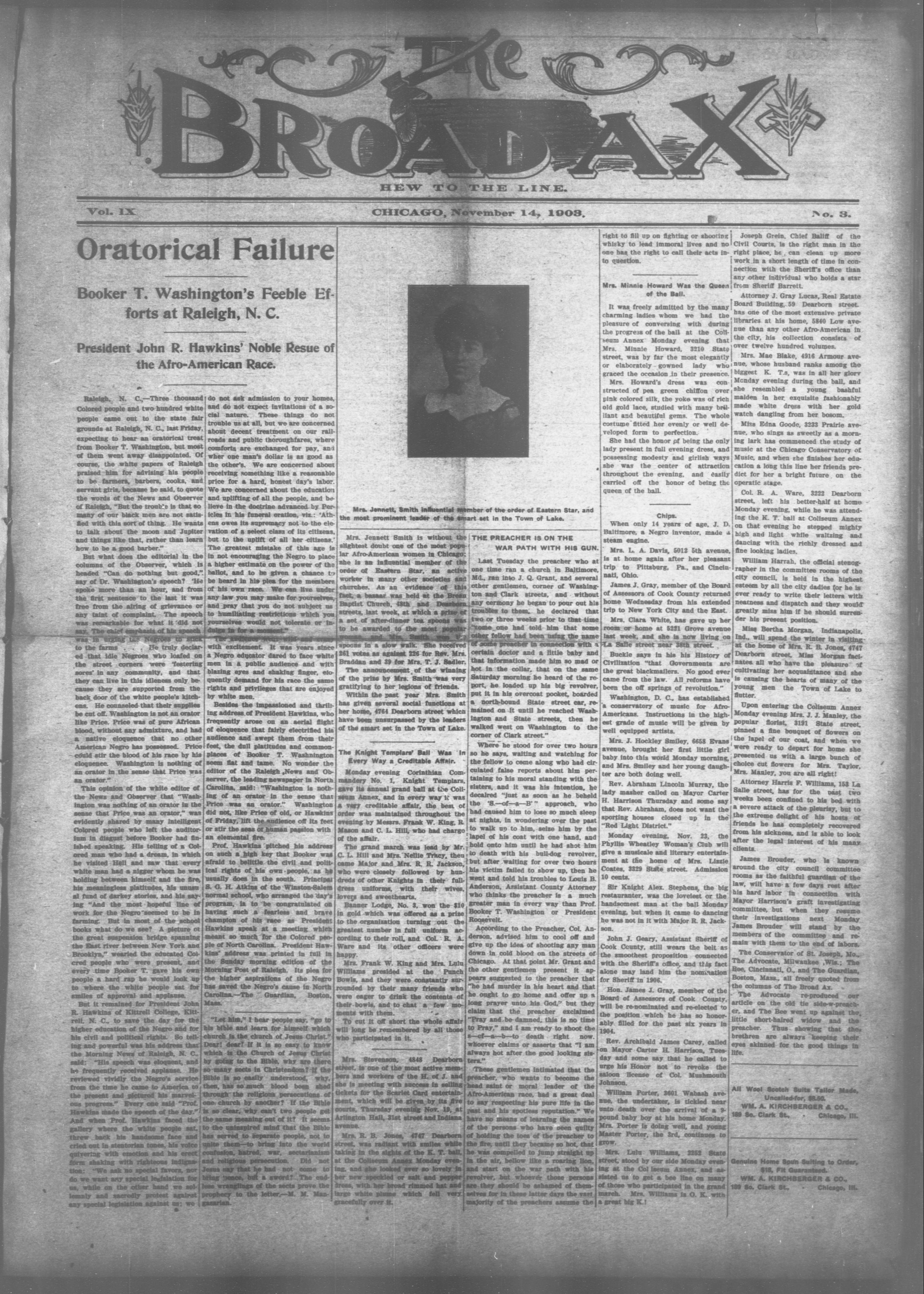
Mrs. Jennett, Smith influential me the most prominent leader of the em
Mrs. Jennett Smith is without the slightest doubt one of the most popular Afro-American women in Chicago; she is an influential member of the order of Eastern Star, an active worker in many other societies and churches. As an evidence of this fact, a bazaar was held at the Brean Baptist Church, 48th and Dearborn streets, last week, at which a prize of a set of after-dinner tea spoons was to be awarded to the most popular
spoons in a slow walk. She received 261 votes as against 226 for Rev. Mrs. Braddan and 39 for Mrs. T. J. Sadler. The announcement of the winning of the prize by Mrs. Smith was very gratifying to her legions of friends. Within the past year Mrs. Smith has given several social functions at her home, 4764 Dearborn street which have been unsurpassed by the leaders of the smart set in the Town of Lake.
Monday evening Corinthian Commandery No. 1, Knight Templars, gave its annual grand ball at the Coliseum Annex, and in every way it was a very creditable affair, the best of order was maintained throughout the evening by Messrs. Frank W. King, R. Mason and C. L. Hill, who had charge of the affair.
The grand march was lead by Mr. C. L. Hill and Mrs. Nellie Tracy, they came Major and Mrs. R. R. Jackson, who were closely followed by hundreds of other Knights in their full-dress uniforms, with their wives, lovers and sweethearts.
Banner Lodge, No. 3, won the $10 in gold which was offered as a prize to the organization turning out the greatest number in full uniform according to their roll, and Col. R. A. Ware and its other officers were happy.
Mrs. Frank W. King and Mrs. Lulu Williams presided at the Punch Bowls, and they were constantly surrounded by their many friends who were eager to drink the contents of their bowls, and to chat a few moments with them.
To cut it off short the whole affair will long be remembered by all those who participated in it.
Mrs. Stevenson, 4848 Dearborn street, is one of the most active members and workers of the H. of J. and she is meeting with success in selling tickets for the Scarlet Card entertainment, which will be given by its five courts, Thursday evening Nov. 19, at Arlington Hall, 31st street and Indiana avenue.
Mrs. R. B. Jones, 4747 Dearborn street, was radiant with smiles while taking in the sights of the K. T. ball, at the Coliseum Annex Monday evening, and she looked ever so lovely in her new speckled or salt and pepper dress, with her broad rimmed hat and large white plume which fell very gracefully over it.
---
Last Tuesday the preacher who at one time ran a church in Baltimore, Md., ran into J. Q. Grant, and several other gentlemen, corner of Washington and Clark streets, and without any cermony he began to pour out his troubles to them, he declared that two or three weeks prior to that time "some one had told him that some other fellow had been using the name of some preacher in connection with a certain doctor and a little baby and that information made him so mad or hot in the collar, that on the same Saturday morning he heard of the report, he loaded up his big revolver, put it in his overcoat pocket, boarded a north-bound State street car, remained on It until he reached Washington and State streets, then he walked west on Washington to the corner of Clark street."
Where he stood for over two hours so he says, waiting and watching for the fellow to come along who had circulated false reports about him pertaining to his moral standing with the sisters, and it was his intention, he decalred "just as soon as he beheld the 'S.—of—a—B'" approach, who had caused him to lose so much sleep at nights, in wondering over the past to walk up to him, seize him by the lapel of his coat with one hand, and hold onto him until he had shot him to death with his bull-dog revolver, but after waiting for over two hours his victim failed to show up, then he went and told his troubles to Louis B. Anderson, Assistant County Attorney who thinks the preacher is a much greater man in every way than Prof. Booker T. Washington or President Roosevelt.
According to the Preacher, Col. Anderson, advised him to cool off and give up the idea of shooting any man down in cold blood on the streets of Chicago. At that point Mr. Grant and the other gentlemen present it appears suggested to the preacher that "he had murder in his heart and that he ought to go home and offer up a long prayer unto his God," but they claim that the preacher exclaimed "Pray and be damned, this is no time to Pray," and I am ready to shoot the s—of—a—b—to death right now. whoever claims or asserts that "I am always hot after the good looking sisters."
These gentlemen intimated that the preacher, who wants to become the head saint or moral leader of the Afro-American race, had a great deal to say respecting his pure life in the past and his spotless reputation." We have no means of learning the names of the persons who have been guilty of holding the toes of the preacher to the fire, until they became so hot, that he was compelled to jump straight up in the air, bellow like a roaring lion, and start on the war path with his revolver, but whoever those persons are they should be ashamed of themselves for in these latter days the vast majority of the preachers assume the
right to fill up on fighting or shooting whisky to lead immoral lives and no one has the right to call their acts into question.
Mrs. Minnie Howard Was the Queen of the Ball.
It was freely admitted by the many charming ladies whom we had the pleasure of conversing with during the progress of the ball at the Coliseum Annex Monday evening that Mrs. Minnie Howard, 3210 State street, was by far the most elegantly or elaborately gowned lady who graced the occasion in their presence. Mrs. Howard's dress was constructed of pea green chiffon over pink colored silk, the yoke was of rich old gold lace, studied with many brilliant and beautiful gems. The whole costume fitted her evenly or well developed form to perfection. She had the honor of being the only lady present in full evening dress, and possessing modesty and girlish ways she was the center of attraction throughout the evening, and easily carried off the honor of being the queen of the ball.
Chips.
When only 14 years of age, J. D. Baltimore, a Negro inventor, made a steam engine.
Mrs. L. A. Davis, 5012 5th avenue, is at home again after her pleasant trip to Pittsburg, Pa., and Cincinnati, Ohio.
James J. Gray, member of the Board of Assessors of Cook County returned home Wednesday from his extended trip to New York City and the East. Mrs. Clara White, has gave up her room or home at 5221 Grove avenue last week, and she is now living on La Salle street near 38th street. Buckle says in his his History of Civilization "that Governments are the great blackmailers. No good ever came from the law. All reforms have been the off springs of revolution."
Washington, D. C., has established a conservatory of music for Afro-Americans. Instructions in the highest grade of music will be given by well equipped artists. Mrs. J. Hockley Smiley, 6658 Evans avenue, brought her first little girl baby into this world Monday morning, and Mrs. Smiley and her young daughter are both doing well.
Rev. Abraham Lincoln Murray, the lady masher called on Mayor Carter H. Harrison Thursday and some say that Rev. Abraham, does not want the sporting houses closed up in the "Red Light District."
Monday evening, Nov. 23, the Phyllis Wheatley Woman's Club will give a musicale and literary entertainment at the home of Mrs. Lizzie Coates, 3329 State street. Admission 10 cents.
Sir Knight Alex. Stephens, the big restauranter, was the loveliest or the handsomest man at the ball Monday evening, but when it came to dancing he was not in it with Major R. R. Jackson.
John J. Geary, Assistant Sheriff of Cook County, still wears the belt as the smoothest proposition connected with the Sheriff's office, and this fact alone may land him the nomination for Sheriff in 1906.
Hon. James J. Gray, member of the Board of Assessors of Cook County, will be re-nominated and re-elected to the position which he has so honorably filled for the past six years in 1904.
Rev. Archibald James Carey, called on Mayor Carter H. Harrison, Tuesday and some say that he called to urge his Honor not to revoke the saloon license of Col. Mushmouth Johnson.
William Porter, 3601 Wabash avenue, the undertaker, is tickled near unto death over the arrival of a 9-pound baby boy at his home Monday. Mrs. Porter is doing well, and young Master Porter, the 3rd, continues to grow. Mrs. Lulu Williams, 2252 State street, stood by our side Monday evening at the Coliseum Annex, and assisted us to get a bee line on many of those who participated in the grand march. Mrs. Williams is O. K. with a great big K.
```markdown
```
Joseph Grein, Chief Baliff of the Civil Courts, is the right man in the right place, he can clean up more work in a short length of time in connection with the Sheriff's office than any other individual who holds a star from Sheriff Barrett.
Attorney J. Gray Lucas, Real Estate Board Building, 59 Dearborn street. has one of the most extensive private libraries at his home, 5840 Low avenue than any other Afro-American in the city, his collection consists of over twelve hundred volumes.
Mrs. Mae Blake, 4916 Armour avenue, whose husband ranks among the biggest K. T.s, was in all her glory Monday evening during the ball, and she resembled a young bashful maiden in her exquisite fashionably made white dress with her gold watch dangling from her bosom.
Miss Edna Goode, 3233 Prairie avenue, who sings as sweetly as a morning lark has commenced the study of music at the Chicago Conservatory of Music, and when she finishes her education a long this line her friends predict for her a bright future on the operatic stage.
Col. R. A. Ware, 3222 Dearborn street, left his better-half at home Monday evening, while he was attending the K. T. ball at Coliseum Annex on that evening he stepped mighty high and light while waltzing and dancing with the richly dressed and fine looking ladies.
William Harrah, the official stenographer in the committee rooms of the city council, is held in the highest esteem by all the city ladies for he is ever ready to write their letters with neatness and dispatch and they would greatly miss him if he should surrender his present position.
Miss Bertha Morgan, Indianapolis, Ind., will spend the winter in visiting at the home of Mrs. R. B. Jones, 4747 Dearborn street, Miss Morgan facinates all who have the pleasure of cultivating her acquaintance and she is causing the hearts of many of the young men the Town of Lake to flutter.
Upon entering the Coliseum Annex Monday evening Mrs. J. J. Manley, the popular florist, 3191 State street, pinned a fine bouquet of flowers on the lapel of our coat, and when we were ready to depart for home she presented us with a large bunch of choice cut flowers for Mrs. Taylor, Mrs. Manley, you are all right!
Attorney Harris F. Williams, 153 La Salle street, has for the past two weeks been confined to his bed with a severe attack of the pleurisy, but to the extreme delight of his hosts of friends he has completely recovered from his sickness, and is able to look after the legal interest of his many clients.
James Brouder, who is known around the city council committee rooms as the faithful guardian of the law, will have a few days rest after his hard labor in connection with Mayor Harrison's graft investigating committee, but when they resume their investigations next Monday James Brouder will stand by the members of the committee and remain with them to the end of labors.
The Conservator of St. Joseph, Mo., The Advocate, Milwaukee ,Wis.; The Bee, Cincinnati, O., and The Guardian, Boston, Mass., all freely quoted from the columns of The Broad Ax.
The Advocate re-produced our article on the old tie side-w-preacher, and The Bee went up against the little short-haired widow and the preacher. Thus showing that the brethren are always keeping their eyes skinned for the good things in life.
Will promulgate and at all times uphold the true principles of Democracy, but Castellion, Prentice, Priest, Indoasia, Farmers, Single Issue, Emancipation, Knights of Labor, or any other use can have their license to use their language in proper and responsibility in hand.
The Broad Ax is a newspaper whose platform is broad enough for all viewers claiming the editorial right to speak its own mind.
One Year.....$9.00
Six Months.....1.60
Advertising rates made known on application.
Communications to
THE BROAD AX
Entered at the Post Office at Chicago, Ill., as Second-class Matter.
DETERIORATION OF COAL.
Claim Made That Fuel Kept in Free
Claim Made That Fuel Kept in Free Air Loses Much of Its Steaming Power.
The question of storing coal for fleets has assumed such importance that the experiments made in England to overcome the deterioration due to continual stowage possess a definite interest, says the New York Herald. It is claimed that coal kept in free air quickly loses between 10 and 20 per cent. of its steaming power, while coal deposited under water in prepared basins suffers but little loss. In the experiments undertaken at the suggestion of the admiralty coal that had been submerged from three to ten years at the Alexandra docks, Newport, and other specimens that had drifted from wrecks into the River Usk were submitted to a comparative test with the best fresh mined Monmouthshire coal. The result was that the Usk coal stood first and the Alexandra dock second, both by a surprising margin of superiority.
Our experience in the Philippines, where the conditions are especially severe, does not show the asserted deterioration of 10 per cent. in 12 months, but there is such a sensible loss in efficiency that the new idea seems worth a careful examination. Submerged storage is cheap, and the coal, easily recovered when needed, can be dried so speedily by exposure to the sun that the danger of spontaneous combustion in the bunkers is obviated. Coal is a prime essential of war power, and we must rather extend than diminish our efforts to store it.
ZACHARY TAYLOR'S TOMB.
Resting Place of a Great General and President Is Neglected-Few Visit the Spot.
That is the inscription on the tomb of Zachary Taylor, twelfth president of the United States, according to the Cleveland Press.
Apparently nobody cares.
The tomb lies five miles from Louisville, and is off the road. Ivy riots over the weather-beaten blocks of granite. The fastenings on the door are red with rust. So far as is known no key has turned the locks for 50 years. Visitors are rare. It is doubtful if half a dozen tourists visit the tomb in a twelve-month.
And this neglected spot is the last resting place of the hero of the Black Hawk and Florida wars. Here is the dust of that great soldier who with 4,000 American riflemen drove in retreat 20,000 Mexicans under Santa Anna at Buena Vista. Here are the remains of the American Cortez and president of the United States.
He who conquered the swamps and everglades of Florida and made Mexico surrender is forgotten by his countrymen. Not one in 10,000 knows the place of his sepulcher.
NEEDED SCIENTIFIC REFORM.
Men Trained to Precision in Observation and Utterance Should Learn Punctuality.
With the latest opening of the season of medical, electrical and other scientific conferences, a familiar characteristic of such meetings is brought into fresh prominence, says the New York Tribune. The members are rarely called to order until ten or fifteen minutes after the appointed time. Not infrequently the delay is greater. Similar tardiness may be observed in formally opening the proceedings of charitable and social organization, and such laxity is not without its drawbacks. Comment is confined here, however, to the group of gatherings first named, because a lack of punctuality among scientific people is, after a fashion, inconsistent with that exactness of thought and statement which the world expects from them and on which they occasionally pride themselves. Men who are trained to precision in observation and utterance might reasonably be expected to be exceptionally scrupulous in keeping engagements. Any shortcomings in this respect become even more conspicuous when a comparison is made with the promptness with which bank directors' meetings and church services begin, to say nothing of theaters and symphony concerts.
Not Lamblike.
"I understand that your husband was one of the lambs in Wall street," said the woman who likes to talk things over.
"Whoever said that doesn't know anything about Charles's disposition," said young Mrs. Torkina. "He was more like a raging lion than a lamb."—Washington Star.
THE SEA OF SAHARA.
To Convert Desert Into a Lake the Gigantic and Pleasing Dream of French Engineers
French engineers have declared it is perfectly feasible to convert the desert of Sahara into a vast lake, thus opening to commerce great regions of the interior of Africa which can now only be reached by long, tedious and dangerous caravan journeys, says London Answers. They say that a large portion of the desert lies below the level of the Atlantic, and that by digging a canal to let in the waters of the ocean the great change could be effected easily, and at a cost which would be small compared to the benefits which would accrue.
If the whole desert lay below the level of the Atlantic, the flooding of it would create a sea more than four times as big as the Mediterranean; but, as the Sahara is composed of elevated plateaux, mountain ranges and depressions, only a part would be covered with water when the waves of the ocean were let in, and the new sea thus formed would be an irregular body of water, probably of about the same size as the Mediterranean. Great commercial cities would at once spring up on its shores, and trade and civilization strike at once to e heart of Africa. The sea of Sahara may never become a reality, but, in any event, it is a gigantic and pleasing dream.
NO SERVIAN CROWNS.
Stephen Dushan, Who Became King in 1346, Last Ruler to Wear Symbol of Royalty.
It is no wonder, says the Philadelphia Press, that King Peter finds it hard to discover a model for his crown. Since 1374 no ruler of Servia has worn one, from 1374 to 1882 no Servian bore the title of king. There is a tradition that a Servian.ruler named Michael received the crown and title from the pope so far back as 1078, but the personage, who is styled, the "first crowned" in Servian history, was Stephen Nemausha II., who was crowned by a papal legatee in 1217, and in order to pacify his orthodox subjects recrowned by his brother, St. Sava, archbishop of Servia, in 1222. On that occasion the crown was provided by the Byzantine emperor.
From that time the Servian sovereign bore the title of king, or "kral," till, in 1346 Stephen Dushan was crowned at Uskub as "emperor of Macedonia and monarch of the Serbs, Greeks and Bulgarians." His son was also styled emperor, but the usurper Vukashin, who murdered the latter, took the name of king. Since his death no Serb has been crowned. The king of Roumania had his crown made from the cannon of Plevna, but Slivnitza would scarcely be commemorated in that way at Belgrade.
CIGARETTES AS PRIZES.
Given by a Sundny School Teacher in England to Secure Larger Attendance of Boys.
There have been numerous attempts in America to enact legislation against the sale of cigarettes; in fact, says the Boston Globe, it is illegal to sell cigarettes to those under 16 years of age in our own state. What would these anti-cigarette agitators say to a Sunday school teacher who offered presents of cigarettes as an inducement for boys to attend his class? According to one of the London papers, at All Saints' church, Wellington, in Somerset, the practice of giving cigarettes to members of the Bible class was started. It was reported that this distribution of cigarettes increased the attendance of the Bible class nearly 100 per cent. The experiment has stirred up a great deal of criticism, however, and the vicar denies that he had any knowledge of the matter, it having been an experiment made by Mr. Wilmont, the teacher of the Bible class. While the boys in this class, as a rule, were over 16 years of age, there were a number of them who were not allowed to smoke, and the parents of these boys naturally seriously object to this new scheme of securing better attendance in the Bible class.
St. George's Chapel.
It costs the British government $18,660 a year to keep up daily services in St. George's chapel, London, although they are attended by very few people. All of this money goes to pay several priests and a trained choir. According to an ancient custom the choir boys are entitled to collect a guinea from every soldier or other person who enters St. George's chapel with spurs upon his boots. Nobody knows when this custom originated, but it has been revived with a great deal of energy this last two years, because so many of the officers from the army in South Africa came to Windsor, and almost invariably entered the beautiful church, which is the headquarters of the Knights of the Order of St. George, the patron saint of England.—London Letter.
Bells on Trees.
St. Peter's cathedral, in South Africa, has doubtless the most unusual belfry to be found in any cathedral. It boasts a fine peal of four large bells which have hung for years from a large tree in the open. There are several church bells in England which are hung from trees, as is the case at Thirlmere church, Surrey, but there is only one cathedral equipped in this way—the church of the late Bishop Colenso.
Iron in the Soudan.
Valuable iron deposits have been discovered in the Bongo country of the Soudan, and much interest has been awakened thereby.
Microscopic experiments have shown that the electrically made steel is not different in any way from crucible steel.
"Have you decided yet upon a name for that new suburb of yours?"
"Yes. I am going to call it Look-out."
"I can't see anything striking or original about that."
"You can't? Think how everybody in the train will run to the windows when the brakeman calls out the name of the station."—Chicago Tribune.
Flood of Animals.
"I think that every good man is fond of animals," remarked the young woman.
"I'm glad to hear you say so," answered Mr. Pygmallon Packard, of Chicago. "I 'spose I can claim to think as much of animals as anybody in the business. I bought several hundred thousand head of cattle this fall."
—Washington Star.
In After Years.
We sigh for things that mother cooked,
And yet, there is no doubt,
They must have been the very ones
That father kicked about.
-N. Y. Sun.
BETTER LEFT UNSAID.
海甫漾西
"Don't you think, madam, some ladies are—er—er—over decollete?"
"Yes—and so are some craniums!"—Ally Sloper.
A Pessimistic View.
In all vocations, it appears,
Men plan to cheat and rob;
Even an honest builder's work
Is, at best, a put-up job.
—Cincinnati Enquirer.
A Variation.
"You say your wife insists on buying your cigars for you?"
"Don't laugh. It's serious. She says the kind I get are too cheap to be good. She insists' on paying 50 cents apiece for them."—Washington Star.
Avoiding Temptation.
Cholly—Quick! This way! Here comes my tailor!
Algy—I nevah knew you had to dodge your tailor before.
Cholly—Yaas, but this time I have money, and might be tempted to pay him.—N. Y. Weekly.
Wienerwurst to Be.
"Of all the unlucky dogs," moaned the poor dog, as the net fell over him, "I'm the worst yet."
"No," replied his captor, the sausage-maker, "you are not the wurst yet, but you will be pretty soon."—Philadelphia Ledger.
A Practical Way.
Sunday-School Teacher — Can any little boy tell me how the Lord will separate the sheep from the goats on the Judgment day?
Johnny—I know, I know! Throw a tin can down, and see which will eat it.—Puck.
Better Than Quarantine.
"How," asked the weighty matters editor, "do you keep your office clear of visitors?"
"I read my stuff to 'em," said the pointed paragrapher.—Newark News.
"The only thing about airships which seems to keep up," remarked the Observer of Events and Things, "is the cost of manufacturing them."—Yonkers Statesman.
Very Ancient Indeed.
"Miss Elderly came from a very old family, didn't she?"
"Oh, yes."
"Well, she looks it."—Town Topics.
One hears of wonderful new applications or uses for the electric current—some of real value, others nonsensical, but probably one of the latest is the testing of wine by means of the telephone. According to the Paris correspondent of a London daily paper, a M. Maneuvrier, director of the laboratory of researches of the Paris Faculty of Sciences, has discovered an infallible method of ascertaining by means of the telephone how much a given quantity of wine has been watered. The principle on which the invention rests is the variable conductivity of different liquids, notably wine and water. The originality of M. Maneuvrier's ingenious application is his use of the telephone to determine to what degree the liquid under observation is a conductor.
He has constructed an apparatus, the details of which are not given, which is said to achieve this object satisfactorily and accurately. The apparatus works as follows: Two vessels, one containing wine known to be pure, and the other the same quantity of the wine to be tested, are placed on an instrument outwardly resembling a pair of scales. The telephone is in contact with both liquids. If the sample of wine under observation is as pure as the standard used for comparison no sound is heard; if, on the contrary, it contains water, the tell-tale telephone "speaks," and the greater the proportion of water the louder the instrument complains.
HOW JAPS PLAY KEN.
Old Game Gives Belles of Far East Opportunity to Display Their Beautiful Hands.
In its most widely practiced form the basis of the Japanese game of ken is that the fully outstretched hand signifies paper; the fully closed hand, a stone; and two fingers alone extended, the rest being closed, scissors. Each of the players, says the Japan Mail, counting one, two, three, throws out his hand, at the moment of pronuncing three, and the out whose manual symbol is superior to that of the others, according to the theory of the game, was the trial.
Superiority is determined on the hypothesis that whereas scissors cannot cut a stone, they can cut paper, and whereas paper is cut by scissors, it can wrap up a stone. Consequently scissors is inferior to stone, but conquers paper; stone is inferior to paper, but conquers scissors, and paper is inferior to scissors, but conquers stone. There are innumerable varieties of the game—for it is not a mere method of determining a dispute of priority—and they are constantly added to by ingenious young ladies, the dancing-girl class especially, who play it with exquisite grace and judicious enhancement of beautiful hands and arms.
X-RAY COLORS DIAMONDS.
Chicagoan Discovers Method of Giving Stones Any Color Chosen, Also of Bleaching Them Again.
From Chicago the following dispatch has been received: Predictions of a tim when the brown diamonds in the crown of Edward, the Hope diamond and other famous gems of the kind can be practically duplicated at will were made by W. C. Fuchs at a Chicago X-ray experiment station. Mr. Fuchs announced the discovery of a process by which he is able to change a diamond to any color chosen and make such coloration permanent by the use of the Roentgen days.
The method consists in directing the X-ray through the substances from which the color is to be obtained before the rays touch and penetrate the diamond. Various metals and chemicals have been used to color the diamonds, and it has been found that by reversing the method, the color may also be removed. tI is thought by Mr. Fuchs that when he has completely perfected his experiments he will be able to bleach yellow diamonds with ease.
Puzzling Fact.
A puzzling fact is that the walls of the intestines and the parasites often living on them are never digested by the ferments that attack, destroy and transform the food. Frenzel, in 1891, suggested that protective anti-ferments are secreted by living tissues. In some late experiments M. Weinland, a French physiologist, sought to digest fibrine in trypsine or pepsin after first adding a little juice from intestinal worms, but the ferment had no effect upon the fibrine in the presence of the anti-ferment juice. It is thus proven that the juice secreted by and impregnating living tissues—instead of the tissues themselves—resist digestion. The anti-ferment extract is exceedingly powerful and retains its resisting power for months, but it loses its property on boiling.
Population of Abyssinia. The population of Abyssinia is about 10,000,000. The products of the country, exclusive of cereals, are ivory, sibeth or civet, wax, hides, coffee and gold, the latter abounding in the mountains, where the mines are merely scratched. In cotton, North Americans have captured the market against England, France and Germany. In spite of the high price of labor and the enormous cost of freight for such a distance, Americans have succeeded in capturing the trade by the low prices of their products. Different nations sell these goods, but they are all American made.
Chrysanthemums. Among flowers the chrysanthemum is said to live the longest after being cut.
AGENTS FOR THE BROAD AX.
From on and after this date The Broad Ax can be found on sale at the following places:
The Afro-American News Office, 3104 State Street.
A. F. Tervalon's Cigar Store and News Stand, 2826 State street.
Edward Felix's Cigar Store, 368 30th street, N. B. Corner Armour Ave.
T. B. Hall's Cigar Store and Laundry office, 281 29th St.
Turner William's Cigar and News Stand, 2902 Armour Ave.
Mrs. E. F. Early, groceries and notions, 2933 State St.
H. Winston's Cigar Store and Newsstand, 280, 29th St.
The Stationery, 2970 State street.
J. C. Campbell, 145 W. 47th street., Cigars, Tobacco, Staple Groceries.
Wm. H. Monroe, cigar and newsstand, 486 State street.
J. New 131 W. 51st street, cigars tobacco and confectionaries.
C. E. Hunter, 4503 Wentworth ave., cigars, tobacco, news stand.
S. B. Bridges, Cigars and Stationary Store, 5220 Lake avenue.
Wm. Dixon 2638 State Street cigars, tobacco, and news stand.
Isidor Jacobson, cigars, togacco and stationery, 3149 State St.
Wm. Goetz, News Stand and Laundry Office, 411 E. 36th st.
News items and advertisements left at these places will find their way into the columns of The Broad Ax.
-- American President and Treasurer, THE Vice-President, J SECRETAR
-- American Brick Co. --
President and Treasurer, THOMAS CAREY. Vice-President, JOHN SHELHAMER, Secretary, WILLIAM SULLIVAN MANUFACTURERS OF
Common and
Office an
45th and
Yards running winter
with the latest improv
Output of Winter Yards .....
Output of Summer Yards.....
Telephone
45th and Robey Sts.
Yards running winter and summer, equipped with the latest improved Wolf Dryer.
Output of Winter Yards ..... 140,00 per day
Output of Summer Yards..... 300,00 per day
Telephone Yards 128.
JOHN A ORB,
President.
WEST SIDE BREWERY COMPANY,
CHICAGO, U. S. A.
CORNER AUGUSTA AN
Monroe 1567—T E L E P
It's the O
Monroe 1567—T E L E P H O N E S—Monroe 1573.
It's the Only Place
JUST LOOK WHAT YOU CAN FIND AT THE AFRO-AMERICAN NEWS STORE
A Full Line of Stationery, Cigars and Tobacco Papers sent by mail to any part of the country. Give us a call and see for yourself if we haven't what you want. Leave your order and we will get it for you. Remember the name and placer.
AFRO-AMERICAN NEWS STORE
E. H. FAULKNER, Manager
IMPORTED AND DOMESTIG WINES, LIQUORS AND CIGARS 8403 SOUTH HALSTED STREET. CHICAGO.
The Souls of Black Folk
A REMARKABLE BOOK that is provoking much discussion because of the wonderful eloquence with which the author pleads for right and justice to his people. In these days of increasing agitation over the "negro problem" this passionate human document can neither be overlooked nor ignored. Aside from its remarkable presentation of facts it holds the reader—prejudiced or not—by its fascination of style and overpowering pathos.
OF OUR SPIRITUAL STRIVINGS.
OF THE DAWN OF FREEDOM.
OF MR. WASHINGTON AND OTHERS.
OF THE MEANING OF PROGRESS.
OF THE INNING OF BLACK MEN.
OF THE BLACK BELT.
OF THE SONS OF MASTER AND MAN.
OF THE FAITH OF THE FATHERS.
OF THE PASSING OF THE FIRST-BORN.
OF ALKANDER CRUMMELL.
OF THE COMING OF JOHN.
OF THE BORROW SONGS.
3d Edition $1.20 net Published by
A.C. McClurg & Co., Chicago
Brick Co. -
THOMAS CAREY.
HN SHELHAMER,
y, WILLIAM SULLIVAN.
Sewer Brick
Yards:
Robey Sts.
and summer, equipped
ed Wolf Dryer.
140,0.0 per day
300,0.0 per day
Yards 128.
WILLIAM LEGNER, Vice Pres. & Treas.
PAULINA STREETS.
MONES—Monroe 1573.
Where Democrats and Republicans Are the Best of Friends—A Red-Headed Congressman from Kansas—Other Gossip.
Washington.—John R. Proctor will celebrate next month the tenth anniversary of his appointment as civil service commissioner.
A.
He has had an extraordinary record in that position. His term of service represents almost exactly one-half the life of the commission and he has survived republican and democratic administrations with equal facility. He
has seen the entire personnel of the commission except himself change no less than four times since he has held the office of president. Eight commissioners have come and gone, beginning with Theodore Rooseveit and ending with James R. Garfield.
Curiously enough, Proctor was first appointed president of the commission on the recommendation of Mr. Roosevelt who was then nearing the end of his service and who proposed Proctor to President Cleveland as the best man to keep the commission going in a democratic administration along the lines laid down. Roosevelt and Cleveland were the only two men who knew anything about the appointment in advance, for Proctor was never much of a political factor. At the time he was state geologist of Kentucky, a place he had occupied for 13 years, and he was a member of the jury of awards for mines and mining at the Columbian exposition.
When Cleveland called him to Washington and told him what he wanted Proctor objected. "The only thing I am interested in," he said, "is the Appalachian mountains. This will take me away from that work."
"Oh, don't bother about that," said the president. "You won't have much to do here. Whenever you want to go away for a month or two, we can fix it up easily enough."
So Proctor accepted, but he hasn't yet been able to get away as Cleveland promised him.
Mr. Proctor is a close personal friend of the president-a friendship
Two Chums
which has continued now for many years. It is true that he classes himself as a democrat, but his political leanings are not strong, and he voted for McKinley in 1896 and 1900. Besides he is an expansionist of a radical type, and on that point he is thoroughly in harmony with the president.
But politics aside
the president and the civil service commission are decidedly chummy. Proctor is at the white house about as much as he is at the commission. He is a great favorite with the children, as well as with the old folks, and, altogether, he is almost one of the family. He rides with the president oftener than anybody else, and that is one of the ties that bind the two together. He is a splendid horseman, with all the native Kentuckian's love for a fine animal. He is fond of outdoor sports of every kind, and although he is within a few months of 60, and served several years with the confederate army, he looks hardly a day older than the president, who is 15 years his junior. But a man who has been a soldier, a farmer, a geologist and a civil service commissioner keeps young by the force of circumstances.
A good many public men think that Proctor carries his civil service reform theories too far, and that he is too much enamored of the machinery of the system. But they know he is honest and pugnacious, and they respect him even while they disagree with him sometimes.
The civil service commission once in awhile has an interesting experi-
New Rules While You
elected senators and representatives generally come to Washington with a prejudice against the commission, and a quiet determination to wipe it off the face of the earth. They don't stay here long before they begin to realize that however unpopular that body may be the only
thing to do is to grin and bear it. The civil service law never was popular with congress, and yet it has continued to wax strong in spite of its unpopularity.
Commissioner Roseyelt and then of Commissioner Proctor, had much to do with this. Even the most hard-suited opponent of the system could not withhold admiration from two such manly advocates.
Every little while the commission breaks out with a new set of regulations which prove a stumbling block for those in search of knowledge. That circumstance gives rise to some amusing experiences. Not long ago Senator Pettus, of Alabama, drifted into the commission's offices. Senator Pettus is the oldest man in congress, a hard-headed and able citizen with a keen sense of humor. He had a problem for Commissioner Proctor to solve. The commissioner explained it all out in great detail, while Pettus listened gravely. Finally Proctor asked him if it was perfectly clear.
"Yes," said the senator. "It is clear enough; but the trouble with your infernal commission is that whenever I come up here and get the rules down fine I don't have time to ride down in the elevator before you bring out a new set of regulations and I have to learn them all over again."
"I'm glad you spoke of that, senator," said the commissioner, gravely. "That elevator is old fashioned and we've been bothered about its slowness for a long time. I wish you would try to get an appropriation for a new one."
The old senator looked at the commissioner blankly for a minute. Then he turned and walked out of the room. "You people are altogether too much for me," he snorted as he disappeared through the door.
A Red-Headed Congressman.
Victor Murdock is the handsome young fellow who has just been elected to congress from Kansas to represent the district left vacant by the promotion of Representative Long to the senate—the same district that held fame for a time as the home of Sockless Jerry Simpson.
VOTE FOR RED HEADS.
RED HEAD CAMPAIGN.
Murdock is pretty sure to be pointed out in the house — first because he is young: second, because he third, on account of his election.
cause he is young: second, because he is good looking, and third, on account of the peculiar manner of his election. When Mr. Long retired from the house to become a senator young Mr. Murdock promptly announced himself as a candidate for the succession. It looked rather dubious at the start, for he was a new hand at it and not very well known in the district; but he hit on a scheme that proved a winner.
Murdock has a superb suit of red hair. There were 17 other candidates in the field, and one of them also had red hair. So Murdock went to him and struck a bargain. It was agreed that the two should make their canvass on the red-headed issue, and that at an opportune moment the weaker of the two should withdraw from the race in favor of the other. Murdock then set at it. He made a whirlwind campaign on the cry that the red-headed men ought to be represented in congress. He quoted statistics to show that one man out of ten had a red head, and that proportion did not hold in congress. He made an impregnable case on that issue, and the other red-headed man followed suit. The novelty of the canvass caught the fancy of the district, and when at the psychological moment the other, who was found to be the weaker, withdrew the momentum was so strong that Murdock won the nomination in a walk. Then he went into the campaign for election on the same issue, and won out again.
Uniforms at the White House. Secretary Loeb has ordered that the doorkeepers at the white house shall
hereafter wear uniforms to distinguish them from the crowds who frequent the executive mansion.
```markdown
```
A lot of fun is being poked at the proposition, and there has been a good deal of humorous talk about the aping of royalty and all that. But the uniforms are
likely to stay for awhile, at any rate until it can be demonstrated whether they really are a good thing or not.
Away back in McKinley's administration John Addison Porter gave a similar order and the uniforms appeared in due time, but there was so much comment on them that one day they disappeared from view as quietly as they had come.
Secretary Loeb believes that this time they will demonstrate their usefulness and that before long the gossip about them will cease. He intends to give them a chance.
The uniforms are very simple affairs, hardly distinguishable from ordinary dress, except for the modest brass buttons.
Capt. Loeffler, the veteran doorkeeper at the president's own door, will not wear a uniform, although his army rank entitles him to it; and Arthur Simmons, who has stationed himself at the secretary's door in ebony watchfulness for lo, these many years, will also continue to wear his simple suit of black. The ushers in the private part of the house, the old executive mansion, will continue to appear in civilian's dress. So, really, there is not much to talk about.
LOUIS A. COOLIDGE.
[Name]
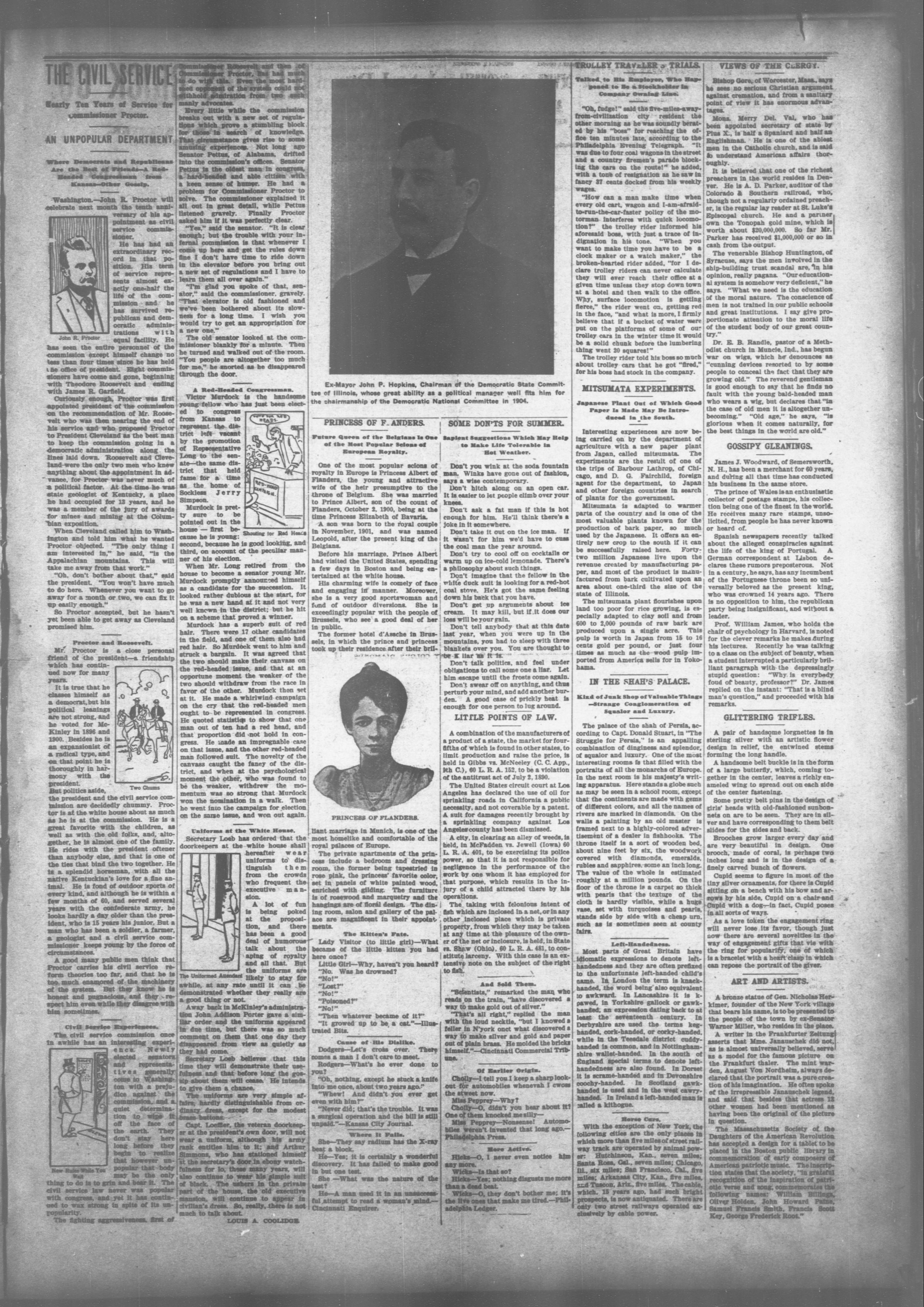
Ex-Mayor John P. Hopkins, Chairman of the Democratic State Committee of Illinois, whose great ability as a political manager well fits him for the chairmanship of the Democratic National Committee in 1904.
Ex-Mayor John P. Hopkins, Chairman of the Democratic State Committee of Illinois, whose great ability as a political manager well fits him for the chairmanship of the Democratic National Committee in 1904.
PRINCESS OF F. ANDERS
Future Queen of the Belgians Is One of the Most Popular Scions of European Royalty.
One of the most popular scions of royalty in Europe is Princess Albert of Flanders, the young and attractive wife of the heir presumptive to the throne of Belgium. She was married to Prince Albert, son of the count of Flanders, October 2, 1900, being at the time Princess Elizabeth of Bavaria.
A son was born to the royal couple in November, 1901, and was named Leopold, after the present king of the Belgians.
Before his marriage, Prince Albert had visited the United States, spending a few days in Boston and being entertained at the white house.
His charming wife is comely of face and engaging in manner. Moreower, she is a very good sportswoman and fund of outdoor diversions. She is exceedingly popular with the people of Brussels, who see a good deal of her in public.
The former hotel d'Assche in Brussels, in which the prince and princess took up their residence after their bril-
A.
PRINCESS OF FLANDERS.
lant marriage in Munich, is one of the most homelike and comfortable of the royal palaces of Europe.
The private apartments of the princess include a bedroom and dressing room, the former being tapestried in rose pink, the princess' favorite color, set in panels of white painted wood, enriched with gilding. The furniture is of rosewood and marquetry and the hangings are of floral design. The dining room, salon and gallery of the palace are magnificent in their appointments.
Lady Visitor (to little girl)—What became of the little kitten you had here once?
Little Girl—Why, haven't you heard?
"No. Was he drowned?
"No!"
"Lost?"
"No!"
"Poisoned?"
"No!"
"Then whatever became of it?"
"It growed up to be a cat."—Illustrated Bits.
Cause of His Dislike.
Dodgers—Let's cross over. There comes a man I don't care to meet.
Rodgers—What's he ever done to you?
"Oh, nothing, except he stuck a knife into me once, about two years ago."
"Whew! And didn't you ever get even with him?"
"Never did; that's the trouble. It was a surgical operation and the bill is still unpaid."—Kansas City Journal.
Where It Falls.
She—They say radium has the X-ray beat a block.
He—Yes; it is certainly a wonderful discovery. It has failed to make good in but one test.
She—What was the nature of the test?
He—A man used it in an unsuccessful attempt to read a woman's mind. Cincinnati Enquirer.
SOME DON'TS FOR SUMMER.
Sapient Suggestions Which May Help to Make Life Tolerable in Hot Weather.
Don't you wink at the soda fountain man. Winks have gone out of fashion, says a wise contemporary.
Don't hitch along on an open car. It is easier to let people climb over your knees.
Don't ask a fat man if this is hot enough for him. He'll think there's a joke in it somewhere.
Don't take it out on the ice man. If it wasn't for him we'd have to cuss the coal man the year around.
Don't try to cool off on cocktails or warm up on ice-cold lemonade. There's a philosophy about such things.
Don't imagine that the fellow in the white duck suit is looking for a red-hot coal stove. He's got the same feeling down his back that you have.
Don't get up arguments about ice cream. It may kill, but if it does our loss will be your gain.
Don't tell anybody that at this date last year, when you were up in the mountains, you had to sleep with three blankets over you. You are thought to be a liar as it is.
Don't talk politics, and feel under obligations to call some one a liar. Let him escape until the frosts come again.
Don't swear off on anything, and thus perturb your mind, and add another burden. A good case of prickly heat is enough for one person to lug around.
LITTLE POINTS OF LAW.
A combination of the manufacturers of a product of a state, the market for four-fifths of which is found in other states, to limit production and raise the price, is held in Gibbs vs. McNeeley (C. C. App., 9th C.), 60 L. R. A. 152, to be a violation of the antitrust act of July 2, 1890.
The United States circuit court at Los Angeles has declared the use of oil for sprinkling roads in California a public necessity, and not coverable by a patent. A suit for damages recently brought by a sprinkling company against Los Angeles county has been dismissed.
A city, in clearing an alley of weeds, is held, in McFadden vs. Jewell (Iowa) 60 L. R. A. 401, to be exercising its police power, so that it is not responsible for negligence in the performance of the work by one whom it has employed for that purpose, which results in the injury of a child attracted there by his operations.
The taking with felonious intent of fish which are inclosed in a net, or in any other inclosed place which is private property, from which they may be taken at any time at the pleasure of the owner of the net or inclosure, is held, in State vs. Shaw (Ohio), 60 L. R. A. 481, to constitute larceny. With this case is an extensive note on the subject of the right to fish.
And Sold Them.
"Scientists," remarked the man who reads on the train, "have discovered a way to make gold out of silver."
"That's all right," replied the man with the loud necktie, "but I knowed a feller in N'york onct what discovered a way to make silver and gold and paper out of plain brass. He molded the bricks himself."—Cincinnati Commercial Tribune.
Cholly—I tell you I keep a sharp lookout for automobiles whenevah I cwoss the sweet now.
Miss Pepprey—Why?
Cholly—O, didn't you hear about it?
One of them knocked me silly—
Miss Pepprey—Nonsense! Automobiles weren't invented that long ago.—Philadelphia Press.
Hicks—O, I never even notice him any more.
Wicks—Is that so?
Hicks—Yes; nothing disgusts me more than a dead beat.
Wicks—O, they don't bother me; it's the live ones that make me tired.—Philadelphia Ledger.
TROLLEY TRAVELER & TRIALS
Talked to His Employer, Who Happened to Be a Stockholder in
"Oh, fudge!" said the five-miles-away from-civilization city resident the other morning as he was soundly berated by his "boss" for reaching the office ten minutes late, according to the Philadelphia Evening Telegraph. "It was due to four coal wagons in the street and a country firemen's parade blocking the cars on the route!" he added, with a tone of resignation as he saw in fancy 37 cents docked from his weekly wages.
"How can a man make time when every old cart, wagon and I-am-afraid-to-run-the-car-faster policy of the motorman interferes with quick locomotion?" the trolley rider informed his aforesaid boss, with just a trace of indignation in his tone. "When you want to make time you have to be a clock maker or a watch maker," the broken-hearted rider added, "for I declare trolley riders can never calculate they will ever reach their office at a given time unless they stop down town at a hotel and then walk to the office. Why, surface locomotion is getting flerce," the rider went on, getting red in the face, "and what is more, I firmly believe that if a bucket of water were put on the platforms of some of our trolley cars in the winter time it would be a solid chunk before the lumbering thing went 20 squares!"
The trolley rider told his boss so much about trolley cars that he got "fired," for his boss had stock in the company.
MITSUMATA EXPERIMENTS.
Japanese Plant Out of Which Good Paper Is Made May Be Introduced in the South.
Interesting experiences are now being carried on by the department of agriculture with a new paper plant from Japan, called mitsumata. The experiments are the result of one of the trips of Barbour Lathrop, of Chicago, and D. G. Fairchild, foreign agent for the department, to Japan and other foreign countries in search of plants for the government.
Mitsumata is adapted to warmer parts of the country and is one of the most valuable plants known for the production of bark paper, so much used by the Japanese. It offers an entirely new crop to the south if it can be successfully raised here. Forty-two million Japanese live upon the revenue created by manufacturing paper, and most of the product is manufactured from bark cultivated upon an area about one-third the size of the state of Illinois.
The mitsumata plant flourishes upon land too poor for rice growing, is especially adapted to clay soil and from 600 to 2,000 pounds of raw bark are produced upon a single acre. This pulp is worth in Japan from 15 to 16 cents gold per pound, or just four times as much as the wood pulp imported from America sells for in Yokohama.
IN THE SHAH'S PALACE.
Kind of Junk Shop of Valuable Things Strange Conglomeration of Squalor and Luxury.
The palace of the shah of Persia, according to Capt. Donald Stuart, in "The Struggle for Persia," is an appalling combination of dinginess and splendor, of squailor and luxury. One of the most interesting rooms is that filled with the portraits of all the monarchs of Europe. In the next room is his majesty's writing apparatus. Here stands a globe such as may be seen in a school room, except that the continents are made with gems of different colors, and all the names of rivers are marked in diamonds. On the walls a painting by an old master is framed next to a highly-colored advertisement of a dealer in fishhooks. The throne itself is a sort of wooden bed, about nine feet by six, the woodwork covered with diamonds, emeralds, rubles and sapphires, some an inch long. The value of the whole is estimated roughly at a million pounds. On the floor of the throne is a carpet so thick with pearls that the texture of the cloth is hardly visible, while a huge vase, set with turquoises and pearls, stands side by side with a cheap urn, such as is sometimes seen at county fairs.
Left-Handedness
Most parts of Great Britain have idiomatic expressions to denote left-handedness and they are often prefixed to the unfortunate left-handed child's name. In London the term is knack-handed, the word being also equivalent to awkward. In Lancashire it is kpawed, in Yorkshire gallock or gawk-handed; an expression dating back to at least the seventeenth century. In Derbyshire are used the terms keghanded, cork-handed, or corky-handed, while in the Teesdale district cuddy-handed is common, and in Nottinghamshire wallet-handed. In the south of England special terms to denote left-handedness are also found. In Dorset it is scrame-handed and in Devonshire coochy-handed. In Scotland gawk-handed is used and in the west cawry-handed. In Ireland a left-handed man is called a kithogue.
With the exception of New York, the following cities are the only places in which more than five miles of street railway track are operated by animal power: Hutchinson, Kan., seven miles; Santa Rosa, Cal., seven miles; Chicago, ill., six miles; San Francisco, Cal., five miles; Arkansas City, Kan., five miles, and Tuscon, Ariz., five miles. The cable, which, 15 years ago, had such bright prospects, is now antiquated. There are only two street railways operated exclusively by cable power.
VIEWS OF THE CHERGY.
Bishop Gore, of Worcester, Mass., says he sees no serious Christian argument against cremation, and from a sanitary point of view it has enormous advantages.
Mons. Merry Del. Val, who has been appointed secretary of state by Plus X., is half a Spaniard and half an Englishman. He is one of the ablest men in the Catholic church, and is said so understand American affairs thoroughly.
It is believed that one of the richest preachers in the world resides in Denver. He is A. D. Parker, auditor of the Colorado & Southern railroad, who, though not a regularly ordained preacher, is the regular lay reader at St. Luke's Episcopal church. He and a partner own the Tonopah gold mine, which is worth about $20,000,000. So far Mr. Parker has received $1,000,000 or so in cash from the output.
The venerable Bishop Huntington, of Syracuse, says the men involved in the ship-building trust scandal are, in his opinion, really pagans. "Our educational system is somehow very deficient," he says. "What we need is the education of the moral nature. The conscience of men is not trained in our public schools and great institutions. I say give proportionate attention to the moral life of the student body of our great country."
Dr. E. B. Randle, pastor of a Methodist church in Muncie, Ind., has begun war on wigs, which he denounces as "cunning devices resorted to by some people to conceal the fact that they are growing old." The reverend gentleman is good enough to say that he finds no fault with the young bald-headed man who wears a wig, but declares that "in the case of old men it is altogether unbecoming." "Old age," he says, "is glorious when it comes naturally, for the best things in the world are old."
GOSSIPY GLEANINGS.
James J. Woodward, of Semersworth, N. H., has been a merchant for 60 years, and during all that time has conducted his business in the same store. The prince of Wales is an enthusiastic collector of postage stamps, his collection being one of the finest in the world. He receives many rare stamps, unsolicited, from people he has never known or heard of.
Spanish newspapers recently talked about the alleged conspiracies against the life of the king of Portugal. A German correspondent at Lisbon declares these rumors preposterous. Not in a century, he says, has any incumbent of the Portuguese throne been so universally beloved as the present king, who was crowned 14 years ago. There is no opposition to him, the republican party being insignificant, and without a leader.
Prof. William James, who holds the chair of psychology in Harvard, is noted for the clever remarks he makes during his lectures. Recently he was talking to a class on the subject of beauty, when a student interrupted a particularly brilliant paragraph with the depressingly stupid question: "Why is everybody fond of beauty, professor?" Dr. James replied on the instant: "That is a blind man's question," and proceeded with his remarks.
GLITTERING TRIFLES.
A pair of handsome lorgnettes is in sterling silver with an artistic flower design in relief, the entwined stems forming the long handle.
A handsome belt buckle is in the form of a large butterfly, which, coming together in the center, leaves a richly enameled wing to spread out on each side of the center fastening.
Some pretty belt pins in the design of girls' heads with old-fashioned sunbonnets on are to be seen. They are in silver and have corresponding to them belt slides for the sides and back.
Brooches grow larger every day and are very beautiful in design. One brooch, made of coral, is perhaps two inches long and is in the design of a finely carved bunch of flowers. Cupid seems to figure in most of the tiny silver ornaments, for there is Cupid sitting on a bench with his bow and arrows by his side, Cupid on a chair and Cupid with a dog—in fact, Cupid poses in all sorts of ways.
As a love token the engagement ring will never lose its favor, though just now there are several novelties in the way of engagement gifts that vie with the ring for popularity, one of which is a bracelet with a heart clasp in which can repose the portrait of the giver.
ART AND ARTISTS.
A bronze statue of Gen. Nicholas Herkimer, founder of the New York village that bears his name, is to be presented to the people of the town by ex-Senator Warner Miller, who resides in the place.
A writer in the Frankfurter Zeitung asserts that Mme. Janauschek did not, as is almost universally believed, serve as a model for the famous picture on the Frankfurt thaler. The mint warden, August Von Nordheim, always declared that the portrait was a pure creation of his imagination. He often spoke of the irrepressible Janauschek legend, and said that besides that actress 12 other women had been mentioned as having been the original of the picture in question.
The Massachusetts Society of the Daughters of the American Revolution has accepted a design for a tablet to be placed in the Boston public library in commemoration of early composers of American patriotic music. The inscription states that the society, "in grateful recognition of the inspiration of patriotic verse and song, commemorates the following names: William Billings, Oliver Holden, John Howard Faine, Samuel Franels Smith, Francis Scott Key, George Frederick Root."
It is the bitter truth that fairly good musicians too often find, after years of study and expense, that it is almost impossible to secure a hearing, and that money must go out where it is expected to come in, says Everybody's Magazine. The debut of a singer not unfrequently involves serious outlay—including a paid manager whose duties cover not only such details as the renting of a hall, advertising, purchase of floral tributes, etc., but the drumming up of a "paper" audience as well; and free tickets are not always rewarded by applause or press notices. The greatest check to an artistic career is to become a fad with the so-called smart set, whose interest is fleeting and undiscriminating; yet bills must be paid; patronage represents money, and few can resist the temptation to seek it. Finally, it is a short-sighted policy for a novice to appear side by side with an experienced artist. It may bring financial return, but when an obscure young person makes a first bow to the public "assisted by" a celebrity, comparison is inevitable.
ON RAILS OF STEEL.