The Broad Ax
Saturday, November 21, 1903
Chicago, Illinois
Page text (machine-generated)
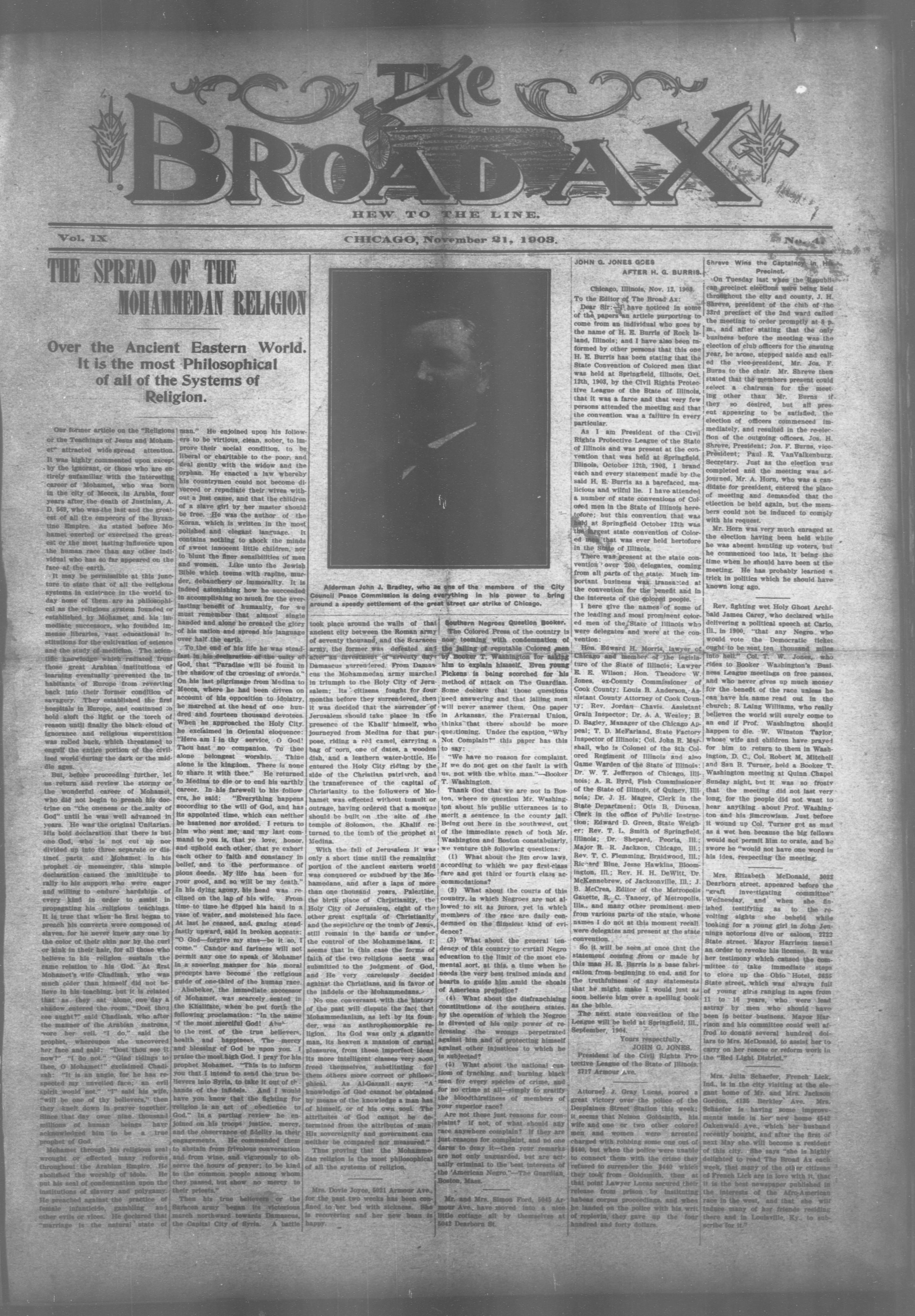
THE SPREAD OF THE MOHAMMEDAN RELIGION
Over the Ancient Eastern World. It is the most Philosophical of all of the Systems of Religion.
Our former article on the "Religions or the Teachings of Jesus and Mohamet" attracted widespread attention. It was highly commented upon except by the ignorant, or those who are entirely unfamiliar with the interesting career of Mohamet, who was born in the city of Mecca, in Arabia, four years after the death of Justinian, A.D. 569, who was the last and the greatest of all the emperors of the Byzantine Empire. As stated before Mohamet exerted or exercised the greatest or the most lasting influence upon the human race than any other individual who has so far appeared on the face of the earth.
It may be permissible at this juncture to state that of all the religious systems in existence in the world today none of them are as philosophical as the religious system founded or established by Mohamet and his immediate successors, who founded immense libraries, vast educational institutions for the cultivation of science and the study of medicine. The scientific knowledge which radiated from those great Arabian institutions of learning eventually prevented the inhabitants of Europe from reverting back into their former condition of savagery. They established the first hospitals in Europe, and continued to hold aloft the light or the torch of reason until finally the black cloud of ignorance and religious superstition was rolled back, which threatened to engulf the entire portion of the civilized world during the dark or the middle ages.
But, before proceeding further, let us return and review the stormy or the wonderful career of Mohamet, who did not begin to preach his doctrine on "the oneness or the unity of God" until he was well advanced in years. He was the original Unitarian. His bold declaration that there is but one God, who is not cut up nor divided up into three separate or distinct parts and Mohamet in his prophet or messenger, this simple declaration caused the multitude to rally to his support who were eager and willing to endure hardships of every kind in order to assist in propagating his religious teachings. It is true that when he first began to preach his converts were composed of slaves, for he never knew any one by the color of their skin nor by the curl or kink in their hair, for all those who believe in his religion sustain the same relation to his God. At first Mohamet's wife Chadizah, who was much older than himself did not believe in his teaching, but it is related that as they sat alone, one day a shadow entered the room. "Dost thou see aught?" said Chadizah, who after the manner of the Arabian matrons, wore her veil. "I do," said the prophet, whereupon she uncovered her face and said: "Dost thou see it now?" "I do not." "Glad tidings to thee, O Mohamet!" exclaimed Chadizah: "It is an angle, for he has respected my unveiled face; an evil spirit would not." "I" said his wife, "will be one of thy believers," then they knelt down in prayer together. Since that day over nine thousand millions of human beings have acknowledged him to be a true prophet of God.
Mohamet through his religious zeal wrought or effected many reforms throughout the Arabian Empire. He abolished the worship of idols. He put his seal of condemnation upon the institutions of slavery and polygamy. He preached against the practice of female infanticide, gambling and other evils or vices. He declared that "marriage is the natural state of
man." He enjoined upon his followers to be virtuous, clean, sober, to improve their social condition, to be liberal or charitable to the poor, and deal gently with the widow and the orphan. He enacted a law whereby his countrymen could not become divorced or repudiate their wives with out a just cause, and that the children of a slave girl by her master should be free. He was the author of the Koran, which is written in the most polished and elegant language. It contains nothing to shock the minds of sweet innocent little children, not to blunt the finer sensibilities of men and women. Like unto the Jewish Bible which teems with rapine, murder, debauchery or immorality. It is indeed astonishing how he succeeded in accomplishing so much for the everlasting benefit of humanity, for we must remember that almost single handed and alone he created the glory of his nation and spread his language over half the earth.
To the end of his life he was steadfast in his declaration of the unity of God, that "Paradise will be found in the shadow of the crossing of swords." On his last pilgrimage from Medina to Mecca, where he had been driven on account of his opposition to idolatry, he marched at the head of one hundred and fourteen thousand devotees. When he approached the Holy City, he exclaimed in Oriental eloquence: "Here am I in thy service, O God! Thou hast no companion. To thee alone belongest worship. Thine alone is the kingdom. There is none to share it with thee." He returned to Medina to die or to end his earthly career. In his farewell to his followers, he said: "Everything happens according to the will of God, and has its appointed time, which can neither be hsatened nor avoided. I return to him who sent me, and my last command to you is, that ye love, honor, and uphold each other, that ye exhort each other to faith and constancy in belief, and to the performance of plous deeds. My life has been for your good, and so will be my death."
In his dying agony, his head was reclined on the lap of his wife. From time to time he dipped his hand in a vase of water, and moistened his face. At last he ceased, and, gazing steadfastly upward, said in broken accents: "O God—forgive my sins—be it so, I come." Candor and fariness will not permit any one to speak of Mohamet in a sneering manner for his moral precepts have become the religious guide of one-third of the human race. Abubeker, the immediate successor of Mohamet, was scarcely seated in the Khalifate, when he put forth the following proclamation: "In the name of the most merciful God! Abu" to the rest of the true believers, health and happiness. The mercy and blessing of God be upon you. I praise the most high God. I pray for his prophet Mohamet. "This is to inform you that I intend to send the true believers into Syria, to take it out of the hands of the infidels. And I would have you know that the fighting for religion is an act of obedience to God." In a parting review he enjoined on his troops justice, mercy, and the observance of fidelity in their engagements. He commanded them to abstain from frivolous conversation and from wine, and vigorously to observe the hours of prayer; to be kind to the common people among whom they passed, but show no mercy to their priests."
Then his true believers or the Saracen army began its victorious march northward towards Damascus, the Capital City of Syria. A battle
[Name]
took place around the walls of that ancient city between the Roman army of seventy thousand, and the Scaracen army, the former was defeated and after an investment of seventy days Damascus surrendered. From Damascus the Mohammedan army marched in triumph to the Holy City of Jerusalem; its citizens fought for four months before they surrendered, then it was decided that the surrender of Jerusalem should take place in the presence of the Khalif himself, who journeyed from Medina for that purpose, riding a red camel, carrying a bag of corn, one of dates, a wooden dish, and a leathern water-bottle. He entered the Holy City riding by the side of the Christian patriarch, and the transference of the capital of Christianity to the followers of Mohamet was effected without tumult or outrage, having ordered that a mosque should be built on the site of the temple of Solomon, the Khalif returned to the tomb of the prophet at Medina.
With the fall of Jerusalem it was only a short time until the remaining portion of the ancient eastern world was conquered or subdued by the Mohamedans, and after a laps of more than one thousand years, Palestine, the birth place of Christianity, the Holy City of Jerusalem, eight of the other great capitals of Christianity and the sepulchre or the tomb of Jesus, still remain in the hands or under the control of the Mohammedans. It seems that in this case the forms of faith of the two religious sects was submitted to the judgment of God, and He very carelessly decided against the Christians, and in favor of the infidels or the Mohammedans.
No one conversant with the history of the past will dispute the fact that Mohammedanism, as left by its founder, was an anthropomorphic religion. Its God was only a gigantic man, its heaven a mansion of carnal pleasures, from these imperfect ideas its more intelligent classes very soon freed themselves, substituting for them others more correct or philosophical. As Al-Gazzall says: "A knowledge of God cannot be obtained by means of the knowledge a man has of himself, or of his own soul. The attributes of God cannot be determined from the attributes of man. His sovereignity and government can neither be compared nor measured."
Thus proving that the Mohammedan religion is the most philosophical of all the systems of religion.
Mrs. Dovie Joyce, 5021 Armour Ave., for the past two weeks has been confined to her bed with sickness. She is recovering and her new beau is happy.
Southern Negroes Question Booker. The Colored Press of the country is now teeming with condemnation of the jailing of reputable Colored men by Booker T. Washington for asking him to explain himself. Even young Pickens is being scorched for his method of attack on The Guardian. Some declare that those questions need answering and that jailing men will never answer them. One paper in Arkansas, the Fraternal Union, thinks that there should be more questioning. Under the caption, "Why Not Complain?" this paper has this to say:
"We have no reason for complaint. If we do not get on the fault is with us, not with the white man."—Booker T. Washington.
Thank God that we are not in Boston, where to question Mr. Washington about his public utterances is to merit a sentence in the county jail. Being out here in the southwest, out of the immediate reach of both Mr. Washington and Boston constabularly, we venture the following questions:
(1) What about the Jim crow laws, according to which we pay first-class fare and get third or fourth class accommodations?
(2) What about the courts of this country, in which Negroes are not allowed to sit as jurors, yet in which members of the race are daily condemned on the filmsiest kind of evidence?
(3) What about the general tendency of this country to curtail Negro education to the limit of the most elemental sort, at this, a time when he needs the very best trained minds and hearts to guide him amid the shoals of American prejudice?
(4) What about the disfranchising constitutions of the southern states, by the operation of which the Negroe is divested of his only power of redressing the wrongs perpetrated against him and of protecting himself against other injustices to which he is subjected?
To the Editor of The Broad Ax:
Dear Sir: I have noticed in some of the papers an article purporting to come from an individual who goes by the name of H. E. Burris of Rock Island, Illinois; and I have also been informed by other persons that this one H. E. Burris has been stating that the State Convention of Colored men that was held at Springfield, Illinois, Oct. 12th, 1903, by the Civil Rights Protective League of the State of Illinois, that it was a farce and that very few persons attended the meeting and that the convention was a failure in every particular.
As I am President of the Civil Rights Protective League of the State of Illinois and was present at the convention that was held at Springfield, Illinois, October 12th, 1903, I brand each and every statement made by the said H. E. Burris as a barefaced, malicious and wilful lie. I have attended a number of state conventions of Colored men in the State of Illinois heretofore; but this convention that was held at Springfield October 12th was the largest state convention of Colored men that was ever held hertofore in the State of Illinois.
There was present at the state convention over 200 delegates, coming from all parts of the state. Much important business was transacted at the convention for the benefit and in the interests of the colored people. I here give the names of some of the leading and most prominent colored men of the State of Illinois who were delegates and were at the convention:
Hon. Edward H. Morris, lawyer of Chicago and member of the legislature of the State of Illinois; Lawyer E. E. Wilson; Hon. Theodore W. Jones, ex-County Commissioner of Cook County; Louis B. Anderson, Assistant County Attorney of Cook County; Rev. Jordan Chavis. Assistant Grain Inspector; Dr. A. A. Wesley; B. D. Bagley, Manager of the Chicago Appeal; T. D. McFarland, State Factory Inspector of Illinois; Col. John R. Marshall, who is Colonel of the 8th Colored Regiment of Illinois and also Game Warden of the State of Illinois; Dr. W. T. Jefferson of Chicago, Illinois; A. R. Byrd, Fish Commissioner of the State of Illinois, of Quincy, Illinois; Dr. J. H. Magee, Clerk in the State Department; Otis B. Duncan, Clerk in the office of Public Instruction; Edward D. Green, State Weigher; Rev. T. L. Smith of Springfield, Illinois; Dr. Shepard, Peoria, Ill.; Major R. R. Jackson, Chicago, Ill.; Rev. T. C. Flemming, Braidwood, Ill.; Richard Blue, Jesse Hawkins, Bloomington, Ill.; Rev. H. H. DeWitt, Dr. McKennebrew, of Jacksonville, Ill.; J. B. McCrea, Editor of the Metropolis Gazette, R. C. Yancey, of Metropolis, Ill., and many other prominent men from various parts of the state, whose names I do not at this moment recall were delegates and present at the state convention.
So it will be seen at once that the statement coming from or made by this man H. E. Burris is a base fabrication from beginning to end, and for the truthfulness of any statements that he might make I would just as soon believe him over a spelling book as the bible. The next state convention of the League will be held at Springfield, Ill., September, 1904.
On Tuesday last when the Republican precinct elections were being held throughout the city and county, J. H. Shreve, president of the club of the 33rd precinct of the 2nd ward called the meeting to order promptly at 8 p.m., and after stating that the only business before the meeting was the election of club officers for the ensuing year, he arose, stepped aside and called the vice-president, Mr. Jos. F. Burns to the chair. Mr. Shreve then stated that the members present could select a chairman for the meeting other than Mr. Burns if they so desired, but all present appearing to be satisfied, the election of officers commenced immediately, and resulted in the re-election of the outgoing officers, Jos. H. Shreve, President; Jos. F. Burns, vicePresident; Paul E. VanValkenburg. Secretary. Just as the election was completed and the meeting was adjourned, Mr. A. Horn, who was a candidate for president, entered the place of meeting and demanded that the etlection be held again, but the members could not be induced to comply with his request.
Mr. Horn was very much enraged at the election having been held while he was absent hunting up voters, but he commenced too late, it being the time when he should have been at the meeting. He has probably learned a trick in politics which he should have known long ago.
Rev. fighting wet Holy Ghost Archibald James Carey, who declared while delivering a political speech at Carlo, Ill., in 1900, "that any Negro who would vote the Democratic ticket ought to be sent ten thousand miles into hell." Col. T. W. Jones, who rides to Booker Washington's Business League meetings on free passes, and who never gives up much money for the benefit of the race unless he can have his name read out in the church; S. Laing Williams, who really believes the world will surely come to an end if Prof. Washington should happen to die. W. Winston Taylor, whose wife and children have prayed for him to return to them in Washington, D. C., Col. Robert M. Mitchell and San B. Turner, held a Booker T. Washington meeting at Quinn Chapel Sunday night, but it was so frostv that the meeting did not last very long, for the people did not want to hear anything about Prof. Washington and his jimcrowism. Just before it wound up Col. Turner got as mad as a wet hen because the big fellows would not permit him to orate, and he swore he "would not have one word in his idea, respecting the meeting.
Mrs. Elizabeth McDonald, 3032 Dearborn street, appeared before the "graft investigating committee" Wednesday, and when she finished testifying as to the revolting sights she beheld while looking for a young girl in John Jennings notorious dive or saloon, 2722 State street. Mayor Harrison issued an order to revoke his license. It was her testimony which caused the committee to take immediate steps to close up the Ohio Hotel, 2635 State street, which was always full of young girls ranging in ages from 11 to 16 years, who were lead astray by men who should have been in better business. Mayor Harrison and his committee could well afford to donate several hundred dollars to Mrs. McDonald, to assist her to carry on her rescue or reform work in the "Red Light District."
Mrs. Julia Schaefer, French Lick, Ind., is in the city visiting at the elegant home of Mr. and Mrs. Jackson Gordon, 4135 Berkley Ave. Mrs. Schaefer is having some improvements made in her new home 4542 Oakenwald Ave., which her husband recently bought, and after the first of next May she will become a resident of this city. She says "she is highly delighted to read The Broad Ax each week, that many of the other citizens of French Lick are in love with it, that it is the best newspaper published in the interests of the Afro-American race in the west, and that she will induce many of her friends residing there and in Louisville, Ky., to subscribe for it."
THE BROAD AX.
Will promulgate and at all times uphold the true principles of Democracy, but Cabellon, Protecinta, Pristata, Inidda, Farmare, Single Taxes, Republica, Knibble of Labor, or any one else can have their say, so long as their language is proper and responsibility is fixed.
The Broad Ax is a newspaper whose platform is broad enough for all, ever claiming the editorial right to speak its own refind.
One Year.....$5.00
Six Months.....1.00
Advertising rates made known on application.
Address all communications to
THE BROAD AX
8040 Armour Avenue, Chicago.
JULIUS F. TAYLOR, Editor and Publisher.
Entered at the Post Office at Chicago, Ill., as Second-class Matter.
"It was a brave and manly act, young man," said the millionaire. "At the risk of your own life you rushed into the burning building and saved my only daughter from a horrible fate. How can I reward you?"
"Oh, I don't know," replied the hero. "Do you think a couple of dollars would be too much?"—Cincinnati Enquirer.
She Didn't Care.
Jack—My darling, I want to tell you something. I have deceived you. I am not rich. Will it make any difference to you?
Ethel—Not the slightest, Jack.
"I am so glad. Are you quite sure it will make no difference to you?"
"Quite sure; I can marry old Mr. Moneybags."—Tit-Bits.
Cut It Out.
If you have an evil thought,
Cut it out;
If to you some scandal's brought,
Cut it out;
Should you like this sort of verse,
If you think it's not "so worse"—Cut it out!
—Yonkers Statesman.
PEOPLE SHOULD BE CAREFUL.
Moths.
"There are no birds in last year's nests."
But many a closet shows
As a Matter of Form.
Mother—If you hadn't encouraged the young man he wouldn't have kissed you.
Daughter--O! mother, I told him to go away.
Mother—You did?
Daughter—Yes. I.sald, "now, you go 'way' every time.—Philadelphia Press.
A Disagreeable Habit.
Old Grumpps—Sure that girl loves you instead of your money?
Son—Absolutely. Why, she actually keeps count of the kisses I give her.
Old Grumpps—Hum! That's bad. She may keep it up after marriage.—N. Y. Weekly.
Confession.
"Mistah Pinkley," said Miss Miami Brown, "you sings jes' like you was a bird,"
"'Deed, Miss Miami,' was the rejoinder, "if I was a bird I reckon I wouldn't be able to sing. I'd be a chicken hawk."—Washington Star.
Mental Reservation.
Madge—It isn't long ago you told me you'd never again wear any but common sense shoes.
Dolly—But I didn't know then, my dear, that high heels would be in fashion again.—Town Topics.
"Yes; he disregarded the doctor's orders and is now in the hospital."
"Is, eh?"
"Yes; the doctor told him not to work so hard and the chump went on a vacation."—Puck.
In After Years.
"When you were courting me," said the annexed rib, "you said life was only a lovely-dream."
"Ah, yes," sighed the ex-dreamer,
"but what a rude awakening I had!"—Chicago Daily News.
Wanted to See the Stork.
Nurse—Tommy, dear, do you want to come with me and see the sweet little sister a stork has left for you?
Tommy—Naw. I don't want to see a sister—I want to see the stork.—Town Topics.
"Well, I should say so. Why, he doesn't hesitate to open a flirtation with any young widow he meets."—Chicago Post.
Comforting Conviction:
Bessle—What! Don't you ever take up any collections for the neathen at your church?
Kitty—No: we never have any heathens at our church.—Chicago Tribune.
Great Success.
He—Do you suppose their married life is a happy one?
She—Why, of course it is. Haven't they had the same cook now for over a year?—Syracuse Herald.
She—I don't think a man should smoke when he is with a lady.
He—And I don't think a lady should fume when she is with a man.—Yonkers Statesman.
Scholar—No-o-o, mam! I know my lessons to-day.—Chicago American.
She—And you haven't any mind urder yours.—Tit-Bits.
Ex-Convicts in England Who Can Afford to Ride in Carriages to Report Their Whereabouts.
A Stratford (England) magistrate says he knows ticket-of-leave men who drive up to the police station in carriages to report themselves, leaving the offices with smiling faces. The police, who should know, say they would like to see them.
"Most of these ex-convicts reporting their whereabouts to us come to the station wearing odd boots," said a city police officer. "They scarcely have the money to pay for a drink, much less a cab, while a carriage is out of the question."
While such cases may be uncommon, however, the fact remains that there are men who, leaving a penal establishment, return to enjoy ill-gotten wealth and to partake of the pleasures of idleness, says the London Mail. Three years ago a business man who had suffered imprisonment for serious charges of fraud drove up to a police station to report himself, leaving in a smart brougham outside his two well-dressed daughters, and wearing the tall hat and frock coat of respectability. He asked for the superintendent in the airiest of manners, saying he had to see him on "a matter of private business." Only the severe and gruff manager of the station sergeant, who recognized him, brought him to realize his position.
The man whom the Stratford magistrate sent to jail for his failure to report himself every month said that he had been turned away from his work and lodgings on two occasions when it was discovered that he had to call at the police station periodically. He could scarcely have known that with the home secretary's permission exconvicts are allowed to report themselves by letter.
AN ODD CASE.
This Man Learned to Spell Three Times and Can't Spell Now His Curious Story.
"Think of a man learning how to spell three times and then not being able to spell correctly," said an observant man who takes an interest in subjects of this sort, according to the New Orleans Times-Democrat, "and you will have my case summed up exactly. I am not what you would call a bad speller by any manner of means. But I stumble now and then, and stumble badly. Why is it? It is the simplest thing in the world. I grew up in the country, attended a country school, and my first spelling was under the rules of the old-time school teacher. I learned how to spell on my feet. It is a curious fact that for a long time I could not spell the simplest words unless I stood up. Standing I could spell anything, and, in fact, was always the winner in the spelling bee. No one could 'turn me down,' as we used to say in the country. Well, after this I learned how to spell with my pencil. All my spelling talent went into the pencil. My tongue forgot the art, and whether standing or sitting, I could not spell a word unless it belonged to the simpler kind without using my pencil. Now I began to use the typewriter, and consequently I had to learn how to spell again. Ask me how to spell a word now and I will have to go to the typewriter unless the word is a very simple one. My tongue won't spell it and my pencil will refuse to write it. So I have learned to spell three times, and as I said before I am not a good speller yet."
DESERT NOW A GARDEN.
Southwestern Colorado Redeemed by Irrigation—Fine Crops Raised on Land Once Barren.
The popular belief, dating back for 50 years, that the slopes of the Rockies and the intervening valleys were fit for nothing but mining enterprises and would never be of agricultural value would be severely shaken if the old-time pessimists could travel for a week through this portion of the San Juan country, says a Durango (Col.) dispatch. For many miles in all directions flourishing fields are literally blossoming like the summer rose. All of the cereals do well in the neighborhood and the root crops are of the finest quality. Irrigation, which has done so much for other sections of the formerly unproductive west, has worked wonders in this part of Colorado and the possibilities of irrigating ditches, fed by the inexhaustible snows of the mountains, are just beginning to be fully understood. Considerable capital will be invested in irrigating works in this country during the next two years.
Military Magpie
Emperor William has lately reviewed a feathered veteran of the German army. One of his regiments has a pet magpie, which is full of militarism and very proud of its parade step. When the kaiser visited the regimental quarters recently he asked for this accomplished bird. A French illustrated paper publishes a picture of the incident. There is the kaiser sitting sternly in the saddle and there is the magpie with its martial stride and there are the officers of the regiment with gingered anxiety and pride plainly marked on all their faces.
The novel house of Eugene Petit, a French architect, turns to the sun at the will of its occupants. It is mounted on a steel platform, which is rotated on ball bearings by a pinion geared in a circular set of teeth. An ordinary three-story dwelling can be turned by two men. Water, gas and electricity are brought in through a central passage and sewage finds its exit in a similar way. Houses of this kind, costing not more than ten per cent. above the ordinary, are required for the patients of Dr. Pellagrin, the advocate of hall-otherapy.
AMONG WELL-TO-DO PEOPLE.
The duchess of Westminster lately purchased a flexible ribbon of diamonds, paying $100,000 therefor.
Morris Williams, of Wilkesbarre, who has just been appointed president of the Pennsylvania Coal company, started his work about the mines as a breaker boy and has risen through all the grades of mining to his present position, where he controls millions of dollars' worth of property and commands 10,000 men.
Just to prove that her husband, Edwin D. Mooers, is fully able to pay $3,000 a year alimony, Mrs. Mooers had introduced in a New York city court the testimoney that his liquor bill alone amounts to $400 a month. The defendant is the son of a Texas millionaire and is sald to own mining stock valued at $700,000.
James Stillman, president of the National City bank of New York, is a man of few words, but he makes those few count. A famous tip that he is said to have given a friend two months ago has leaked out in Wall street. The friend in question wrote to him, asking for advice concerning the market. He had $500,000 and wanted to make it a million. Here is the reply of Mr. Stillman, written in lead pencil on a sheet of paper 3x4: "Polo ponies, steam yachts and Newport villas are the best short sales in the world."
What the Rothschilds are to Paris and London, so are the Bleichroeders to Berlin—that is, a power in the financial world. The ladies of the great financial families of Europe enjoy all the privileges and have none of the crushing responsibilities of royalty. Almost invariably they rise to the occasion and the charitable works organized by them may be said to be as limitless in number as they are in scope. This has always been as true of the wives and daughters belonging to the house of Bleichroeder as it is of the women who bear the honored names of Rothschild, of Goldsmid and of Mocatta.
Chauncey M. Depew recently said that one of the narrow escapes of his life was when he refused, some 30 years ago, to advance $10,000 to help Alexander Graham Bell and his father-in-law, the late Gardiner Hubbard, to develop the newly invented "talking telegraph." Mr. Depew was then counsel for the Harlem railroad and Mr. Hubbard a railway mail inspector. "Had I accepted the proposition," Mr. Depew said, "I would be worth to-day about $30,000,000, or my estate would, for with this vast wealth I should have had no incentive to healthy work, I should have deteriorated and should probably now be dead and forgotten."
WAY STATIONS
A scheme has been prepared for carrying out an underground railway in Manchester, England, with connections with the principal out-districts.
Our 200,000 miles of railway transport 600,000,000 tons of original freight, not including duplications, and pay 800,000 operatives, exclusive of officers, $650,-000,000.
Nottingham, England, a city of 250,-000, has owned its street railways for two years and at a fare of two cents a mile made a profit of 11 per cent. per annum on the capital invested.
There will be 36 tunnels on the route of the new Denver, Northwestern and Pacific railway within a distance of 26 miles, through the Rockies. It is estimated that it will require 600,000 pounds of powder to blast $ 2 \frac{1}{2} $ miles of this route. Four-Track News. The Highland railway company of Great Britain announces that it has completed arrangements for telephonic communication between trains and stations on its line, thus not only greatly lessening the danger of wrecks on the road but also enabling its passengers to communicate with friends and business associates while traveling from place to place.
At the beginning of the last century the royal college of Bavarian physicians sought to forbid steam railway travel, because it would induce delirium furlosum among the passengers and drive the spectators crazy; while an English quarterly said that it would as soon expect the people to suffer themselves to be tled to one of Congreve's rockets as to trust themselves to the mercy of a locomotive going at the prodigious rate of 12 miles an hour.
POINTED PARAGRAPHS.
Borrowed trouble commands the highest rate of interest. An absent-minded woman forgets everything—except herself. When the members of a woman's club quarrel they call it a debate.
Some theories are like gunpowder most useful when exploded.
No amateur play is satisfactory unless all the feminine parts are heroines.
The average girl believes the proper time to marry is the first time she's asked.
The dog is man's best friend. When a man has a cold the dog never tells him what to do for it.
It's as difficult to see how money makes the man as it is to see how some men make their money.—Chicago Daily News.
PROVERBS UP TO DATE
"Nothing comes of nothing," but you had best not quote this to the father of a worthless son.
"Let the shoemaker stick to his last," but he had best know something about collecting bills.
"Birds of a feather flock together," but a blond woman usually considers a brunette her best foil.
"The cracked pitcher goes most often to the well," and the prima donna's last public appearance is a big house filler.
"The eyes are the windows of the soul," yet a lover is satisfied as he gazes into the "dark depths" of my lady's eyes—N. Y. Herald.
Spokesman (of committee)—We want you to come to the meeting of our society to-morrow evening and give us an address about an hour long. Eminent Lecturer—To-morrow evening? That will not give me time to prepare myself. Spokesman—You'll not need any preparation. What we want you to talk about is "How Our Newspapers Ought to Be Conducted."—Chicago Tribune.
What He Meant.
"The ills that are easiest to bear," said the philosopher, "are—"
"I know, I know," interrupted the friend. "You mean to say that, when you get right down to it, the ills that are the easiest to bear are the real, rather than the imaginary ones that seem so great."
"On the contrary, I mean that the ills that are easiest to bear are the ills of other people."—Chicago Post.
The Deacon—I thought you intended to preach on the avils of profanity this morning. Why did you change your mind?
The Parson—Well, I dropped my collar button while dressing for church, and I didn't feel that I could do the subject justice.—Cincinnati Enquirer.
Something Exceptional.
Tess—She's a remarkable woman; not like other women at all.
Jess—Why, I've never noticed it.
Tess—I have. I watched her making bread the other day, and all the time she had her hands in the dough she didn't have to scratch her nose at all.
—Philadelphia Press.
Good Advice.
"What am I going to do?" he cried as he emerged from the water. "A thief stole my clothes?" "Well," replied the stranger who happened along and naturally noted his condition, "I can't think of anything better than to go back in swimming again."—Chicago Post.
"He used to kiss me every time we passed through a tunnel before our marriage," said the little woman, with sad reflections.
"And does he do so now?" asked the bosom friend.
"No, he takes a drink."—Spare Moments.
Ought to Be.
"I don't understand," remarked Smithers, "what Peary wants to be always going after the north pole for. It must cost a lot to live up there."
"It does, generally speaking," replied Smuthers, "but just think how cheap ice must be!"—Cincinnati Commercial Tribune.
A shadow fell on Mildred's finely chiseled face. "Yes, but the more time, the fewer people," she replied vexedly.—Detroit Free Press.
Mrs. Coldphiz—Go on; this is interesting!
Weary Wilkins—Yes'm, an'd den I signed de pledge.—Cleveland Plain-dealer.
A Deliberate Insult.
Fred—I stole a kiss from Miss Peachly the other evening, and now she won't speak to me.
'Twas Ever Thus.
Alas! man's cup of sorrow
Is ever filled with woe;
When the ice man disappears
The coal man gets his dough.
—Cincinnati Enquirer.
TO BE QUITE EXACT.
14
The Sweet Maid—It must be awfully dangerous to go up in an airship.
The Inventor—Not half as dangerous as coming down.—Chicago Chronicle.
Needs the Dough.
Old Jones—Do you play cards for money?
Daughter's Lover—Y-yes, sir; but—Old Jones—Well, let's have a game. I'm about busted.—Judge.
Sure to Get It.
Higbee—All that Larks needs is experience.
Dyer—Well, he's just been married and has bought an auto, so I guess he'll get it.—Town Topics.
Still Grieving.
"So she lost her husband? Has she recovered from her grief yet?"
AGENTS FOR THE BROAD AX.
From on and after this date The Broad Ax can be found on sale at the following places:
The Afro-American News Office, 3104 State Street.
A. F. Tervalon's Cigar Store and News Stand, 2826 State street.
Edward Felix's Cigar Store, 358 30th street, N. E. Corner Armour Ave.
T. B. Hall's Cigar Store and Laundry office, 281 29th St.
Turner William's Cigar and News Stand, 2903 Armour Ave.
Mrs. E. F. Early, groceries and notions, 2933 State St.
H. Winston's Cigar Store and Newsstand, 280, 29th St.
The Stationery, 2970 State street.
J. C. Campbell, 145 W. 47th street.,
Cigars, Tobacco, Staple Groceries.
Wm. H. Monroe, cigar and newsstand, 486 State street.
J. New 131 W. 51st street, cigars, tobacco and confectionaries.
C. E. Hunter, 4503 Wentworth ave., cigars, tobacco, news stand.
S. B. Bridges, Cigars and Stationary Store, 5220 Lake avenue.
Wm. Dixon 2638 State Street cigars, tobacco, and news stand.
Isidor Jacobson, cigars, togacco and stationery, 3149 State St.
Wm. Goetz, News Stand and Laundry Office, 411 E. 36th st.
News items and advertisements left at these places will find their way into the columns of The Broad Ax.
-- American President and Treasurer, THE Vice-President, JO Secretary
American Brick Co. dent and Treasurer, THOMAS CAREY. Vice-President, JOHN SHELHAMER Secretary, WILLIAM SULL
-- American Brick Co. --
President and Treasurer, THOMAS CAREY. Vice-President, JOHN SHELHAMER, Secretary, WILLIAM SULLIVAN. MANUFACTURERS OF
Common and S
Office at
45th and I
Yards running winter
with the latest improv
Output of Winter Yards .....
Output of Summer Yards.....
Telephone
mon and Sewer B
Office and Yards:
h and Robey
Yards running winter and summer, equipped
with the latest improved Wolf Dryer.
Winter Yards ..... 14
Summer Yards..... 3
Telephone Yards 12
45th and Robey Sts.
Yards running winter and summer, equipped with the latest improved Wolf Dryer.
Output of Winter Yards ..... 140,000 per day
Output of Summer Yards..... 300,000 per day
Telephone Yards 128.
JOHN A ORB,
President.
WEST SIDE BREWERY COMPANY,
CHICAGO, U. S. A.
CORNER AUGUSTA AND PAULINA STREETS.
Monroe 1567—TELEPHONES—Monroe
It's the Only Pl
JUST LOOK WHAT YOU CAN FIND AT THE
AERO AMERICAN NEWS S
the Only Pl
JUST LOOK WHAT YOU CAN FIND AT THE
AMERICAN NEWS
Monroe 1567——T E L E P H O N E S——Monroe 1573.
It's the Only Place
A Full Line of Stationery, Cigars and Tobacco
Papers sent by mail to any part of the country. Give us a call and see for yourself if we haven't what
you need. LET US KNOW. 111-222-2222.
AFRO-AMERICAN NEWS STORE
8104 State Street E. H. FAULKNER, Manager
Jas. J. McCormick,
IMPORTED AND DOMESTIC WINES, LIQUORS AND CIGARS 9463 SOUTH HALSTED STREET.
---
The Souls of Black Folk
By W. E. B. DuBois
A REMARKABLE BOOK that is provoking much discussion because of the wonderful eloquence with which the author pleads for right and justice to his people. In these days of increasing agitation over the "negro problem" this passionate human document can neither be overlooked nor ignored. Aside from its remarkable presentation of facts it holds the reader—prejudiced or not—by its fascination of style and overpowering pathos.
Some of the Chapter Headings follow:
OF OUR SPIRITUAL STRIVINGS
OF OUR SPIRITUAL STRIVINGS.
OF THE DAWN OF FREEDOM.
OF MR. WASHINGTON AND OTHERS.
OF THE MEANING OF PROGRESS.
OF THE TRAINING OF BLACK MEN.
OF THE BLACK BELT.
OF THE SONS OF MASTER AND MAN.
OF THE FAITH OF THE FATHERS.
OF THE PASSING OF THE FIRST-BORN.
OF ALEXANDER CRUMMELL.
OF THE COMING OF JOHN.
OF THE SORROW SONGS.
3d Edition $1.20 net Published by
A.C. McClurg & Co.,Chicago
Brick Co. -
THOMAS CAREY.
HN SHELHAMER,
WILLIAM SULLIVAN.
Sewer Brick
Yards:
Robey Sts.
and summer, equipped
and Wolf Dryer.
140,00 per day
300,00 per day
Yards 128.
WILLIAM LEGNER,
Vice Pres. & Treas.
ONES—Monroe 1573. nly Place YOU CAN FIND AT THE NEWS STORE
Now Speaker Cannon and Congressman Hepburn Settled a Quarrel-- Youthful Members of the House The New British Minister.
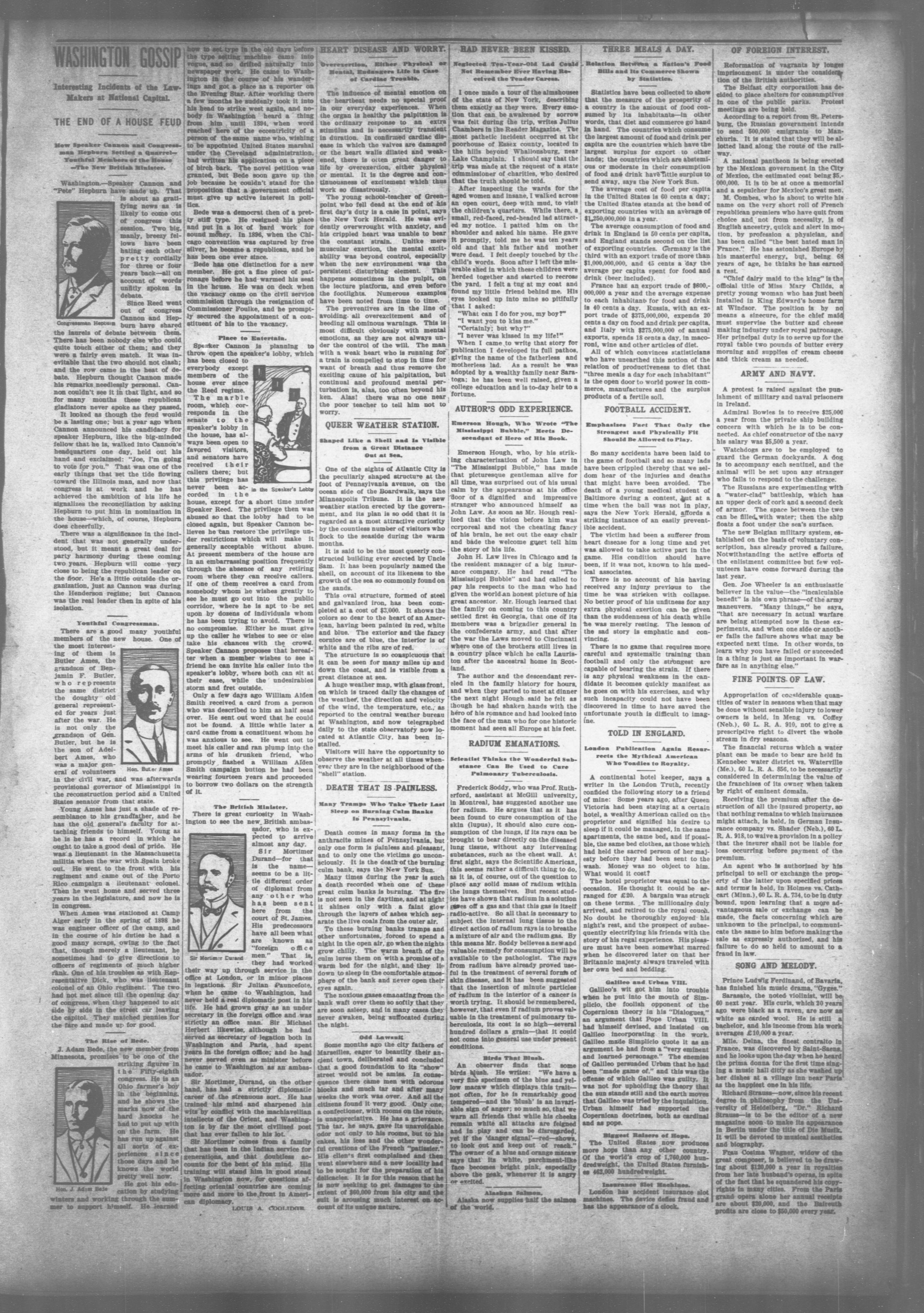
Washington.—Speaker Cannon and "Pete" Hepburn have made up. That
is about as gratifying news as is likely to come out of congress this session. Two big, manly, breezy fellows have been hating each other pretty cordially for three or four years back—all on account of words unfitly spoken in debate.
A. B.
Since Reed went out of congress Cannon and Hepburn have shared
the laurels of debate between them. There has been nobody else who could quite touch either of them; and they were a fairly even match. It was inevitable that the two should not clash; and the row came in the heat of debate. Hepburn thought Cannon made his remarks needlessly personal. Cannon couldn't see it in that light, and so for many months these republican gladiators never spoke as they passed.
It looked as though the feud would be a lasting one; but a year ago when Cannon announced his candidacy for speaker Hepburn, like the big-minded fellow that he is, walked into Cannon's headquarters one day, held out his hand and exclaimed: "Joe, I'm going to vote for you." That was one of the early things that set the tide flowing toward the Illinois man, and now that congress is at work and he has achieved the ambition of his life he signalizes the reconciliation by asking Hepburn to put him in nomination in the house—which, of course, Hepburn does cheerfully.
There was a significance in the incident that was not generally understood, but it meant a great deal for party harmony during these coming two years. Hepburn will come very close to being the republican leader on the floor. He's a little outside the organization, just as Cannon was during the Henderson regime; but Cannon was the real leader then in spite of his isolation.
There are a good many youthful members of the new house. One of
the most interesting of them is Butler Ames, the grandson of Benjamin F. Butler, who represents the same district the doughty old general represented for years just after the war. He is not only the grandson of Gen. Butler, but he is the son of Adelbert Ames, who was a major general of volunteers
Hon. Buter Ames
in the civil war, and was afterwards provisional governor of Mississippi in the reconstruction period and a United States senator from that state.
Young Ames has just a shade of resemblance to his grandfather, and he has the old general's faculty for attaching friends to himself. Young as he is he has a record in which he ought to take a good deal of pride. He was a lieutenant in the Massachusetts militia when the war with Spain broke out. He went to the front with his regiment and came out of the Porto Rico campaign a lieutenant colonel. Then he went home and served three years in the legislature, and now he is in congress.
When Ames was stationed at Camp Alger early in the spring of 1898 he was engineer officer of the camp, and in the course of his duties he had a good many scraps, owing to the fact that, though merely a lieutenant, he sometimes had to give directions to officers of regiments of much higher rank. One of his troubles as with Representative Dick, who was lieutenant colonel of an Ohio regiment. The two had not met since till the opening day of congress, when they happened to sit side by side in the street car leaving the capitol. They matched pennies for the fare and made up for good.
The Rise of Bede. J. Adam Bede, the new member from Minnesota, promises to be one of the
striking figures in the Fifty-eighth congress. He is an Ohio farmer's boy in the beginning, and he shows the marks now of the hard knocks he had to put up with on the farm. He has run up against all sorts of experiences since those days and he knows the world pretty well now. He got his edu-
A.
Hon. J. Adam Bose cation by studying winters and working through the summer to support himself. He learned
how to set type in the old days before the type setting machine came into vogue, and so drifted naturally into newspaper work. He came to Washington in the course of his wanderings and got a place as a reporter on the Evening Star. After working there a few months he suddenly took it into his head to strike west again, and nobody in Washington heard a thing from him until 1894, when word reached here of the eccentricity of a person of the same name who, wishing to be appointed United States marshal under the Cleveland administration, had written his application on a piece of birch bark. The novel petition was granted, but Bede soon gave up the job because he couldn't stand for the proposition that a government official must give up active interest in politics.
Bede was a democrat then of a pretty stiff type. He resigned his place and put in a lot of hard work for sound money. In 1896, when the Chicago convention was captured by free silver, he became a republican, and he has been one ever since. Bede has one distinction for a new member. He got a fine piece of patronage before he had warmed his seat in the house. He was on deck when the vacancy came on the civil service commission through the resignation of Commissioner Foulke, and he promptly secured the appointment of a constituent of his to the vacancy.
Place to Entertain.
Speaker Cannon is planning to throw open the speaker's lobby, which has been closed to everybody except members of the house ever since the Reed regime.
I
The marble room, which corresponds in the senate to the speaker's lobby in the house, has always been open to favored visitors, and senators have received their callers there; but this privilege has never been accorded in the
house, except for a short time under Speaker Reed. The privilege then was abused so that the lobby had to be closed again, but Speaker Cannon believes he can restore the privilege under restrictions which will make it generally acceptable without abuse. At present members of the house are in an embarrassing position frequently through the absence of any retiring room where they can receive callers. If one of them receives a card from somebody whom he wishes greatly to see he must go out into the public corridor, where he is apt to be set upon by dozens of individuals whom he has been trying to avoid. There is no compromise. Either he must give up the caller he wishes to see or else take his chances with the crowd. Speaker Cannon proposes that hereafter when a member wishes to see a friend he can invite his caller into the speaker's lobby, where both can sit at their ease, while the undesirables storm and fret outside.
Only a few days ago William Alden Smith received a card from a person who was described to him as half seas over. He sent out word that he could not be found. A little while later a card came from a constituent whom he was anxious to see. He went out to meet his caller and ran plump into the arms of his drunken friend, who promptly flashed a William Alden Smith campaign button he had been wearing fourteen years and proceeded to borrow two dollars on the strength of it.
There is great curiosity in Washington to see the new British ambassador, who is expected to arrive almost any day.
M.
Sir Mortimer Durand—for that is the name—seems to be a little different order of diplomat from any other who has been sent here from the court of St. James. His predecessors have all been what are known as "foreign office men." That is, they had worked
Sir Mortimer Durand men." That is, they had worked their way up through service in the office at London, or in minor places in legations. Sir Julian Pauncefote, when he came to Washington, had never held a real diplomatic post in his life. He had grown gray as an under secretary in the foreign office and was strictly an office man. Sir Michael Herbert likewise, although he had served as secretary of legation both in Washington and Paris, had spent years in the foreign office; and he had never served oven as minister before he came to Washington as an ambassador.
Sir Mortimer, Durand, on the other hand, has had a strictly diplomatic career of the strenuous sort. He has trained his mind and sharpened his wits by conflict with the machiavellian intellects of the Orient, and Washington is by far the most civilized post that has ever fallen to his lot.
Sir Mortimer comes from a family that has been in the Indian service for generations, and that doubtless accounts for the bent of his mind. His training will stand him in good stead in Washington now, for questions affecting oriental countries are coming more and more to the front in American diplomacy.
LOUIS A. COOLIDGR.
HEART DISEASE AND WORRY. Overexertion, Either Physical or Mental, Endangers Life In Case of Cardiac Trouble.
The influence of mental emotion on the heartbeat needs no special proof in our everyday experiences. When the organ is healthy the palpitation is the ordinary response to an extra stimulus and is necessarily transient in duration. In confirmed cardiac disease in which the valves are damaged or the heart walls dilated and weakened, there is often great danger to life by overexertion, either physical or mental. It is the degree and continuousness of excitement which thus work so disastrously.
The young school-teacher of Greenpoint who fell dead at the end of his first day's duty is a case in point, says the New York Herald. He was evidently overwrought with anxiety, and his crippled heart was unable to bear the constant strain. Unlike mere muscular exertion, the mental excitability was beyond control, especially when the new environment was the persistent disturbing element. This happens sometimes in the pulpit, on the lecture platform, and even before the footlights. Numerous examples have been noted from time to time.
The preventives are in the line of avoiding all overexcitement and of heeding all ominous warnings. This is most difficult obviously with mental emotions, as they are not always under the control of the will. The man with a weak heart who is running for a train is compelled to stop in time for want of breath and thus remove the exciting cause of his palpitation, but continual and profound mental perturbation is, alas, too often beyond his ken. Alas! there was no one near the poor teacher to tell him not to worry.
QUEER WEATHER STATION.
Shaped Like a Shell and Is Visible from a Great Distance Out at Sea.
One of the sights of Atlantic City is the peculiarly shaped structure at the foot of Pennsylvania avenue, on the ocean side of the Boardwalk, says the Minneapolis Tribune. It is the new weather station erected by the government, and its plan is so odd that it is regarded as a most attractive curiosity by the countless number of visitors who flock to the seaside during the warm months. It is said to be the most queerly constructed building ever erected by Uncle Sam. It has been popularly named the shell, on account of its likeness to the growth of the sea so commonly found on the sands.
This oval structure, formed of steel and galvanized iron, has been completed at a cost of $3,000. It shows the colors so dear to the heart of an American, having been painted in red, white and blue. The exterior and the fancy cornice are of blue, the interior is of white and the ribs are of red. The structure is so conspicuous that it can be seen for many miles up and down the coast, and is visible from a great distance at sea.
A huge weather map, with glass front, on which is traced daily the changes of the weather, the direction and velocity of the wind, the temperature, etc., as reported to the central weather bureau at Washington, and now telegraphed daily to the state observatory now located at Atlantic City, has been installed. Visitors will have the opportunity to observe the weather at all times whenever they are in the neighborhood of the "shell" station.
DEATH THAT IS PAINLESS
Many Tramps Who Take Their Last Sleep on Burning Culm Banks In Pennsylvania.
Death comes in many forms in the anthracite mines of Pennsylvania, but only one form is painless and pleasant, and to only one the victims go unconsciously. It is the death of the burning culm bank, says the New York Sun. Many times during the year is such a death recorded when one of these great culm banks is burning. The fire is not seen in the daytime, and at night it shines only with a faint glow through the layers of ashes which separate the live coals from the outer air.
To these burning banks tramps and other unfortunates, forced to spend a night in the open air, go when the nights grow chilly. The warm breath of the culm lures them on with a promise of a warm bed for the night, and they lie down to sleep in the comfortable atmosphere of the bank and never open their eyes again.
The noxious gases emanating from the bank waft over them so softly that they are soon asleep, and in many cases they never awaken, being suffocated during the night.
Odd Lawsuit
Some months ago the city fathers of Marseilles, eager to beautify their ancient town, deliberated and concluded that a good foundation to its "show" street would not be amiss. In consequence there came men with odorous blocks and much tar and after many weeks the work was over. And all the citisens found it very good. Only one, a confectioner, with rooms on the route, is unappreciative. He has a grievance. The tar, he says, gave its unavoidable odor not only to his rooms, but to his cakes, his icees and the other wonderful creations of the French "patissier." His client's first complained and then went elsewhere and a new locality had to be sought for the preparation of his delicacies. It is for this reason that he is now seeking to get damages to the extent of $60,000 from his city and the suit is arousing much interest on account of its unique nature.
HAD NEVER BEEN KISSED.
Neglected Ten-Year-Old Lad Could Not Remember Ever Having Received the Tender Carress.
I once made a tour of the almshouses of the state of New York, describing them exactly as they were. Every emotion that can be awakened by sorrow was felt during the trip, writes Julius Chambers in the Reader Magazine. The most pathetic incident occurred at the poorhouse of Essex county, located in the hills beyond Whallonsburg, near Lake Champlain. I should say that the trip was made at the request of a state commissioner of charities, who desired that the truth should be told.
After inspecting the wards for the aged women and insane, I walked across an open court, deep with mud, to visit the children's quarters. While there, a small, red-faced, red-headed lad attracted my notice. I patted him on the shoulder and asked his name. He gave it promptly, told me he was ten years old and that his father and mother were dead. I felt deeply touched by the child's words. Soon after I left the miserable shed in which these children were herded together and started to recross the yard. I felt a tug at my coat and found my little friend behind me. His eyes looked up into mine so pitifully that I asked:
"What can I do for you, my boy?"
I never was kissed in my life! When I came to write that story for publication I developed its full pathos, giving the name of the fatherless and motherless lad. As a result he was adopted by a wealthy family near Saratoga; he has been well raised, given a college education and is to-day heir to a fortune.
AUTHOR'S ODD EXPERIENCE
Emerson Hough, Who Wrote "The Mississippi Bubble," Meets Descendant of Hero of His Book.
Emerson Hough, who, by his striking characterization of John Law in "The Mississippi Bubble," has made that picturesque gentleman alive for all time, was surprised out of his usual calm by the appearance at his office door of a dignified and impressive stranger who announced himself as John Law. As soon as Mr. Hough realized that the vision before him was ecorporeal and not the cheating fancy of his brain, he set out the easy chair and bade the welcome guest tell him the story of his life.
John H. Law lives in Chicago and is the resident manager of a big insurance company. He had read "The Mississippi Bubble" and had called to pay his respects to the man who had given the world an honest picture of his great ancestor. Mr. Hough learned that the family on coming to this country settled first in Georgia, that one of its members was a brigadier general in the confederate army, and that after the war the Laws moved to Cincinnati where one of the brothers still lives in a country place which he calls Lauriston after the ancestral home in Scotland.
The author and the descendant revealed in the family history for hours, and when they parted to meet at dinner the next night Hough said he felt as though he had shaken hands with the hero of his romance and had looked into the face of the man who for one historic moment had seen all Europe at his feet.
RADIUM EMANATIONS.
Scientist Thinks the Wonderful Substance Can Be Used to Cure Pulmonary Tuberculosis.
Frederick Soddy, who was Prof. Rutherford, assistant at McGill university, in Montreal, has suggested another use for radium. He argues that as it has been found to cure consumption of the skin (lupus), it should also cure consumption of the lungs, if its rays can be brought to bear directly on the diseased lung tissue, without any intervening substances, such as the chest wall. At first sight, says the Scientific American, this seems rather a difficult thing to do, as it is, of course, out of the question to place any solid mass of radium within the lungs themselves. But recent studies have shown that radium in a solution gives off a gas and that this gas is itself radio-active. So all that is necessary to subject the internal lung tissue to the direct action of radium rays is to breathe a mixture of air and the radium gas. By this means Mr. Soddy believes a new and valuable remedy for consumption will be available to the pathologist. The rays from radium have already proved useful in the treatment of several forms of skin disease, and it has been suggested that the insertion of minute particles of radium in the interior of a cancer is worth trying. It should be remembered, however, that even if radium proves valuable in the treatment of pulmonary tuberculosis, its cost is so high—several hundred dollars a grain—that it could not come into general use under present conditions.
Birds That Blush.
An observer finds that some birds blush. He writes: "We have a very fine specimen of the blue and yellow macaw which displays this trait—not often, for he is remarkably good tempered—and the 'blush' is an invariable sign of anger; so much so, that we warn all friends that while his cheeks remain white all attacks are feigned and in play and can be disregarded, yet if the 'danger signal'—red—shows, to look out and keep out of reach." The owner of a blue and orange macaw says that its white, parchment-like face becomes bright pink, especially above the peak, whenever it is angry or excited.
Alaskan Salmon.
Alaska now supplies half the salmos of the world.
Relation Between a Nation's Food Bills and Its Commerce Shown by Statistics.
Statistics have been collected to show that the measure of the prosperity of a country is the amount of food consumed by its inhabitants—in other words, that diet and commerce go hand in hand. The countries which consume the largest amount of food and drink per capita are the countries which have the largest surplus for export to other lands; the countries which are abstemious or moderate in their consumption of food and drink have little surplus to send away, says the New York Sun.
The average cost of food per capita in the United States is 60 cents a day; the United States stands at the head of exporting countries with an average of $1,250,000,000 in a year. The average consumption of food and drink in England is 50 cents per capita, and England stands second on the list of exporting countries. Germany is the third with an export trade of more than $1,000,000,000, and 45 cents a day the average per capita spent for food and drink (beer included).
France has an export trade of $800,000,000 a year and the average expense to each inhabitant for food and drink is 40 cents a day. Russia, with an export trade of $375,000,000, expends 20 cents a day on food and drink per capita, and Italy with $275,000,000 of annual exports, spends 18 cents a day, in macoroni, wine and other articles of diet.
All of which convinces statisticians who have unearthed this notion of the relation of productiveness to diet that "three meals a day for each inhabitant" is the open door to world power in commerce, manufactures and the surplus products of a fertile soil.
FOOTBALL ACCIDENT.
Emphasizes Fact That Only the Strongest and Physically Fit Should Be Allowed to Play.
So many accidents have been laid to the game of football and so many lads have been crippled thereby that we seldom hear of the injuries and deaths that might have been avoided. The death of a young medical student of Baltimore during a contest, but at a time when the ball was not in play, says the New York Herald, affords a striking instance of an easily preventible accident.
The victim had been a sufferer from heart disease for a long time and yet was allowed to take active part in the game. His condition should have been, if it was not, known to his medical associates.
There is no account of his having received any injury previous to the time he was stricken with collapse. No better proof of his unfitness for any extra physical exertion can be given than the suddenness of his death while he was merely resting. The lesson of the sad story is emphatic and convincing.
There is no game that requires more careful and systematic training than football and only the strongest are capable of bearing the strain. If there is any physical weakness in the candidate it becomes quickly manifest as he goes on with his exercises, and why such incapacity could not have been discovered in time to have saved the unfortunate youth is difficult to imagine.
TOLD IN ENGLAND.
London Publication Again Resurrects the Mythical American Who Toadies to Royalty.
A continental hotel keeper, says a writer in the London Truth, recently confided the following story to a friend of mine: Some years ago, after Queen Victoria had been staying at a certain hotel, a wealthy American called on the proprietor and signified his desire to sleep if it could be managed, in the same apartments, the same bed, and if possible, the same bed clothes, as those which had held the sacred person of her majesty before they had been sent to the wash. Money was no object to him. What would it cost?
The hotel proprietor was equal to the occasion. He thought it could be arranged for £20. A bargain was struck on these terms. The millionaire duly arrived, and retired to the royal couch. No doubt he thoroughly enjoyed his night's rest, and the prospect of subsequently electrifying his friends with the story of his regal experience. His pleasure must have been somewhat marred when he discovered later on that her Britannic majesty always traveled with her own bed and bedding.
Galileo and Urban VIII
Galileo's wit got him into trouble when he put into the mouth of Simplicio, the foolish opponent of the Copernican theory in his "Dialogues," an argument that Pope Urban VIII had himself devised, and insisted on Galileo incorporating in the work. Galileo made Simplicio quote it as an argument he had from a "very eminent and learned personage." The enemies of Galileo persuaded Urban that he had been "made game of." and this was the offense of which Galileo was guilty. It was not for upholding the theory that the sun stands still and the earth moves that Galileo was tried by the inquisition. Urban himself had supported the Copernican doctrines, both as cardinal and as pope.
The United States now produces more hops than any other country. Of the world's crop of 1,760,000 hundredweight, the United States furnishes 462,000 hundredweight.
Insurance Slot Machines.
London has accident insurance slot machines. The device defies fraud and has the appearance of a clock.
Reformation of vagrants by longer imprisonment is under the consideration of the British authorities.
The Belfast city corporation has decided to place shelters for consumptives in one of the public parks. Protest meetings are being held.
According to a report from St. Petersburg, the Russian government intends to send 500,000 emigrants to Manchuria. It is stated that they will be allotted land along the route of the railway.
A national pantheon is being erected by the Mexican government in the City of Mexico, the estimated cost being $5,000,000. It is to be at once a memorial and a sepulcher for Mexico's great men. M. Combes, who is about to write his name on the very short roll of French republican premiers who have quit from choice and not from necessity, is of English ancestry, quick and alert in motion, by profession a physician, and has been called "the best hated man in France." He has astonished Europe by his masterful energy, but, being 68 years of age, he thinks he has earned a rest.
"Chief dairy maid to the king" is the official title of Miss Mary Childs, a pretty young woman who has just been installed in King Edward's home farm at Windsor. The position is by no means a sinecure, for the chief maid must supervise the butter and cheese making industry under royal patronage. Her principal duty is to serve up for the royal table two pounds of butter every morning and supplies of cream cheese and thick cream as needed.
ARMY AND NAVY.
A protest is raised against the punishment of military and naval prisoners in Ireland.
Admiral Bowles is to receive $25,000 a year from the private ship building concern with which he is to be connected. As chief constructor of the navy his salary was $5,500 a year.
Watchdogs are to be employed to guard the German dockyards. A dog is to accompany each sentinel, and the animal will be set upon any stranger who fails to respond to the challenge.
The Russians are experimenting with a "water-clad" battleship, which has an upper deck of cork and a second deck of armor. The space between the two can be filled with water; then the ship floats a foot under the sea's surface. The new Belgian military system, established on the basis of voluntary conscription, has already proved a failure. Notwithstanding the active efforts of the enlistment committee but few volunteers have come forward during the last year.
Gen. Joe Wheeler is an enthusiastic believer in the value—the "incalculable benefit" is his own phrase—of the army maneuvers. "Many things," he says, "that are necessary in actual warfare are being attempted now in these experiments, and when one side or another falls the failure shows what may be expected next time. In other words, to learn why you have failed or succeeded in a thing is just as important in warfare as in anything else."
FINE POINTS OF LAW.
Appropriation of considerable quantities of water in seasons when that may be done without sensible injury to lower owners is held, in Meng vs. Coffey (Neb.), 60 L. R. A. 910, not to give a prescriptive right to divert the whole stream in dry seasons. The financial returns which a water plant can be made to bear are held in Kennebec water district vs. Waterville (Me.), 60 L. R. A. 856, to be necessarily considered in determining the value of the franchises of its owner when taken by right of eminent domain.
Receiving the premium after the destruction of all the insured property, so that nothing remains to which insurance might attach, is held, in German Insurance company vs. Shader (Neb.), 60 L. R. A. 918, to waive a provision in a policy that the insurer shall not be liable for loss occurring before payment of the premium.
An agent who is authorized by his principal to sell or exchange the property of the latter upon specified prices and terms is held, in Holmes vs. Cathcart (Minn.), 60 L. R. A. 734, to be in duty bound, upon learning that a more advantageous sale or exchange can be made, the facts concerning which are unknown to the principal, to communicate the same to him before making the sale as expressly authorized, and his failure to do so held to amount to a fraud in law.
SONG AND MELODY.
Prince Ludwig Ferdinand, of Bavaria, has finished his music drama, "Gyges." Sarasate, the noted violinist, will be 60 next year. His curls, which 20 years ago were black as a raven, are now as white as carded wool. He is still a bachelor, and his income from his work averages £10,000 a year. Mlle. Delna, the finest contralto in France, was discovered by Saint-Saens, and he looks upon the day when he heard the prima donna for the first time singing a music hall ditty as she washed up her dishes at a village inn near Paris as the happiest one in his life.
Richard Strauss—now, since his recent degree in philosophy from the University of Heidelberg, "Dr." Richard Strauss—is to be the editor of a new magazine soon to make its appearance in Berlin under the title of Die Musik. It will be devoted to musical aesthetics and biography.
Frau Cosima Wagner, widow of the great composer, is believed to be drawing about $120,000 a year in royalties from her late husband's operas, in spite of the fact that he squandered his copyrights in many cities. From the Paris grand opera alone her annual receipts are about $20,000, and the Bairenth profits are close to $50,000 every year.
Mrs. Carrie Warner, 5132 Grove avenue, will eat her Thanksgiving dinner in St. Louis, Mo., with her mother and sister.
Major John C. Buckner, who is the most popular Afro-American in Cook County, should be nominated for County Commissioner in 1904, and if he should, he would certainly be elected.
Judge Charles M. Walker can grasp a legal proposition as quick as lighting, and in the short space of a few months he has become one of the ablest and one of the fairest judges in Cook County.
Mrs. Tyler, 5021 Armour Ave., who lately moved to this city from St. Paul, Minn., with her husband, is a very pleasant lady to meet and she will soon become a factor in the social life in the town of Lake.
Mrs. Emma L. Stevens, 4844 Dearborn St., is a prominent member in the Order of Eastern Star. She is a neat housekeeper and at all times she is able to paddle her own canoe, for she earns her own living by hard work.
Miss Blanch Wright, who performs on the organ each Sunday at St. Thomas church, and who can talk much faster than a race horse can run, has resumed her duties as stneographer in the law office of J. Gray Lucas, 59 Dearborn St.
Col. Edward H. Morris, Attorney for the "Gamblers Trust," so they say, has become the head or the largest stockholder in the Old Church Organ, and that is the reason why his handsome mug appears in it every two or three weeks.
Sunday evening Rev. Abraham Lincoln Murray, who is the dead game sport of the A. M. E. preachers, and Mrs. Sarah Scott walked arm in arm ahead of Mrs. Murray and another lady and they all partook of supper at Stephens' Restaurant.
Paul Laurence Dunbar, the leading Afro-American Poet, gave a reading at Quinn Chapel Thursday evening from his own poems, and Joseph Douglass, of Washington, D. C., the greatest violinist of the race rendered some selections on his violin, they were greeted by a large audience.
Last Saturday evening, while out rounding up some of the readers of The Broad Ax, we called at the home of a certain married lady whose husband was out of town and we noticed the feet of a man sticking out from beneath a curtain in one of her bedrooms.
John G. Jones, 33, Grand Secretary of the Grand Lodge of A. F. & A. Masons of the State of Illinois, left last Sunday for Pittsburg, Pa., where he has been invited to deliver an address on the origin and legal status of masonry among colored men in the United States.
Mrs. T. J. Hunter, 3149 State St., and her sister, Miss Carrie Robinson, will leave the city shortly for Baltimore, Md., where Mrs. Hunter will spend the holiday season with her relatives and friends, and Miss Robinson will remain in the east for several years, much to regret of her many warm friends.
Mrs. Lucy Howard, 2960 Dearborn St., who is one of the deaconess of Bethel church, has had a 'phone put in her house so that she and Mrs. Jessie Mitchell can call Rev. Abraham Lincoln Murray up at any time and consult with him as to the best method to pursue in order to save their souls.
The past week several ladies have written us letters desiring to learn the name and the address of the dressmaker who made the fancy dress for Mrs. Minnie Howard, which she wore the night of the Knight Templers' ball. The dress was made by Madame Doyle, 92 E. 33rd St., and she is one of the most expert and up-to-date dressmakers in Chicago.
Mrs. Mae Blake, 4916 Armour Ave., as president of the Oak Leaf Club, gave a musical concert last Wednesday night at St. Mary's church, 50th and Dearborn St., and it was such a success that enough money was realized from it to buy a new carpet for the floor of the church, which will be quite an improvement over the bare floor.
Little slick headed W. W. Johnson, who claims to be a lawyer, and who beat us out of one dollar as subscription to The Broad Ax, has been blowing around for the past year "that he carried the 29th Precinct of the $1st Ward in his hip pocket, but when the election was held Tuesday night he only received or controlled 12 votes, as against 38 votes for N. A. Harbin, who was re-elected Captain of the Precinct.
J. Q. Grant, who is one of the oldest members of Quinn Chapel, and who negotiates more loans on first-class real estate than any other Afro-American in this city says that "he was very much surprised to hear the preacher relate how he was good and ready to shoot some one to death simply because they had been talking about some preacher, but didn't men-
tion his name." Mr. Grant is right and it does seem to us that the good or the saintly preacher, went off half cocked at the wrong time.
Col. Mushmouth Johnson, 464 State street, who compelled the Republican County Convention in 1902 to nominate his chum, Col. John R. Marshall, for County Commissioner, had his license revoked the first of the week, and he was forced to close up his famous dive. Rev. Archibald James Carey and his strong pull in other directions could not save him. Mayor Harrison is to be commended for turning against Col. Mushmouth Johnson, and all others who conduct disruptable dens similar to his gambling joint.
MATCH WOULD BE IDEAL.
Prince May Wed Princess of Cumberland.
Again is the gossip revived in Berlin that Emperor Francis Joseph of Austria has smoothed away the obstacles that have stood between the crown prince of Germany and Princess Alexandra of Cumberland, and that the Hanoverian girl has good prospects of becoming empress of Germany some day. The fact is that whereas the crown prince is now of marriageable age, the crop of princesses suited to him in years, health, religion and politics is extremely limited. Two or three English princesses are available and suitable, and rumor has repeatedly engaged him to one or the other of them, and Emperor William is understood to be rather in favor of such a match. But the emperor remembers the unpopularity of his mother in Germany, and the rooted objection of the German public to have an English empress. So it is that the name of Princess Alexandria comes up aghin.
If the crown prince of Germany marries Princess Alexandra of Cumberland it will be a romantic match, for there has been a bitter feud between the Hohenzollerns and the Guelphs of Hanover for the last 35 years. In the war of 1866 the king of Hanover, the grandfather of Princess Alexandra, was led by his warm friendship for Emperor Francis Joseph to take the losing side, with the result that when Prussia had crushed Austria he was dethroned and his dominions added to the Prussian crown. There is still a Guelph party in Hanover and every year on the duke of Cumberland's birthday a deputation comes to Gmunden to bring him the greeting of his "loyal subjects in Hanover." The Guelphian movement in Hanover, however, is suppressed with an iron hand by the most approved German police methods. Since the crash, the royal family has lived in Austria, at Penzing, near Vienna, and at Gmunden in upper Austria. The head of the family uses his English title, Cumberland, but keeps up all the state and ceremony of a king at his residences.
Princess Alexandra is a tall, pleasant looking girl, but not particularly beautiful. She is an enthusiastic yachtswoman and sails her own boat over the waters of the treacherous Gmunden lake. She has been much at the Austrian court where the Cumberlands take the precedence of every one and are treated as a reigning family. She is a Protestant and therefore religiously eligible to be the German crown prince's bride.
There is probably no defect which causes so much anguish of spirit and discomfort as shyness and blushing. Nobody who has not personally suffered from it can even begin to conceive what torture it may cause.
Shyness may proceed from one of two causes—the one physical, the other mental. It is often an affair of health. The nerves are out of order, and the will becomes weak. People shrink from their fellow-creatures, and are filled with an unreasonable horror of meeting or speaking to them. This is often the case after an illness, or when one has been overworking, and strained the physical powers too much. The best cure for this kind of shyness is fresh air, exercise and cheerful society.
But there is another shyness, and one harder to cure, which comes from mental causes. Its afflicted possessor may be in robust health and yet so tormented by this inward enemy that she finds all intercourse with other people positively alarming. To meet strangers causes her a severe struggle.
In either case, the root of the matter is self-consciousness, and it is only by losing that self-consciousness that self-possession and confidence can be gained. As long as one thinks about oneself at all, one will be liable to shyness. The only cure is to thrust all recollection of oneself into the background as much as possible, when one will gradually become natural, happy and at ease.
To overcome shyness and blushing there is nothing on earth like going a great deal into society, and every effort possible should be made to achieve this. This does not merely mean social life, but intercourse with one's fellow creatures. Force yourself to speak to every one you come in contact with, no matter what it costs you at first. Go on bravely; never mind how much you may blush and stammer. Persist in it, and it will grow easier and easier. Never shrink from putting yourself into positions which may draw attention upon you—N. Y. Journal.
STEPHEN A. DOUGLAS
LAWYER
Suite 200, 128-125 Lil Salle Street
CHICAGO
Telephone Tuxedo WV Residence, 129 Garfield DL
JOHN FITZGERALD
JUSTICE OF THE PEACE
4107 S. MALGESTED STREET,
CHICAGO
J. GRAY LUCAS ATTORNEY-AT-LAW Suite 412 Real Estate Board Bldg 79 Dearborn St. Cor. Randolph CHICAGO.
J. J. HENNESSY,
Justice of the Peace,
6301 S. Halsted St.
WILLIAM TREXLER, CLERK.
TELEPHONE WENTWORTH 4403.
Police Magistrate Englewood Police Court.
Telephone Main 355%.
P. J. O'SHEA
ATTORNEY AT LAW
Suite 1444 Unity Building
79 Dearborn St. Chicago.
Notary Public. 5072 Central.
EDWARD G. ALEXANDER
ATTORNEY AT LAW.
Suite 510,
130 Dearborn Street, CHICAGO.
Robert M. Mitchell
Attorney at Law
Suite 9, No. 77 South Clark St.
CHICAGO
WILLIAM RITCHIE
ATTORNEY AND COUNSELOR.
Suite 800-800 Oxford Building
84 LA SALLE ST., CHICAGO
Telephone Main 1644.
J. E. JONES
LAWYER
79 Clark Street
ALBERT B. GEORGE
LAWYER.
423 Ashland Blok, Chicago.
— Nov. 11, 2000. —
Telephone Blue 4632
Work Called for
and Delivered...
A. HOFFMAN,
CLEANER, DYER
AND PRESSER.
Suits Sponged and Pressed 35c
5125 State St.
Expert Workmanship
Moderate Prices.
ILLINOIS BRICK CO.
WILLIAM C. KUESTER. SUPERINTENDENT.
N. Western Ave., Ch
Telephone Lake View 270.
HOHENADEL BROS.
211-213 Madison Street
CHICAGO
Telephone Main 3300
John J. Bradley
JUSTICE OF THE PEACE
Mortgages, Deeds, Notes and Legal Documents Drawn and Acknowledged. Room 22, 27 North Clark Street.
Metropole Hall
FOR THE SEASON 1903-4
31st St. and 5th Ave.
Every Tuesday and Friday
Under New Management
Mr. Alex. Armant and
Mr. Horace Clinton
Every Tuesday and Friday Evenings
MUSIC BY ARMANT'S ORCHESTRA
PROF. HALL, Dancing Master.
Admission 25c.
Junk's Brewery
M. JUNK, Proprietor JOS. P. JUNK, Manager 3700-3710 South Halsted Street and 897 to 929 Thirtyseventh Street CHICAGO
F. W. BOYD DEALER IN COAL, WOOD AND ICE MOVING AND EXPRESSING All Orders Promptly Attended to Cash on Delivery Telephone Blue 26g 4656 Armour Avenue, CHICAGO.