The Broad Ax
Saturday, December 5, 1903
Chicago, Illinois
Page text (machine-generated)
THE WHITE WOMAN AND THE NEGRO.
There is an article on the above subject in Good Housekeeping for November, written by Dr. Ellen Barret Tigon of Mobile, Ala. Although the lady has studied medicine and is supposed to have grown up and to have steady nerves, the habit of shrieking at a mouse has still complete possession of her woman's mind. She does not reason, she chrieks, and she does it loud and long. She does not enact the role artistically. She does not climb to the seat of the nearest chair with either dignity or grace, but rushes upon it in a perfect panic of terror, stumbling over facts, logic and literary workmanship to seek safety from her mouse which, by the way, is not even real, but one made of little bits of her southern imagination and tendency to hysterics.
This woman doctor does not understand, apparently the a-b-c of her subject. Otherwise she could not have given utterance to stuff like this—"The white woman is the coveted desire of the Negro man. The white woman must be saved!" That is a pretty loud chriek. We have all heard it. But it is not the first time that its dissonance has assailed our organ of hearing.
Suppose the white woman to be the coveted desire of the Negro man. In affairs of the heart it takes two to make a bargain. Is the Negro man the coveted desire of the white woman? If he is not, why this loud shriek, for surely in that case, there is no danger of the Negro man's ever being able to gratify his desire. The Negro man might make love night after night to this lady in the moon, but he will never get her, even though he may sing his love ditty ever so tuneful. She is not for the likes of him. She is for the southern gentleman and his descendants who discovered a passion for dusky maidens quite outside of his sacred race sphere.
But let us suppose on the other hand that some black men of the south have a coveted desire for white women, is that desire on their part a greater crime against Anglo-Saxon purity than is the coveted desire of the white man of the south for the Negro woman? Is there any difference, and if so, pray point out in what does this difference consist? We should like to be enlightened on this subject, while we beg to be spared the chrieks.
What is the difference between the inter-marriage of black men and white women, and that between white men and black women? Pray tell us the difference between the illicit intercourse of black men and white women, and that between white men and black women? What is the difference scientifically, in these two cases of race-mixture? Is the act miscegenation in the one case and not in the other? Is it not precisely the same in a scientific scense? Do you doubt it, madam, you who study medicine, and ought to know? Then look to the product of such union, is it white in the case of the white woman, or is it mulatto? Is it black in the case of the black woman, or is it mulatto? Look around you in Mobile, in Alabama, in the south. Do you find many mulattoes, and do you not know who mothered them and fathered them? Were they mothered and fathered by white women and white men? Then what class of women is in danger in the south, in actual, every day peril in their own persons and in those of their daughters? It certainly is not the white women of the south. They never were in any real danger to any considerable extent from black men. But the black woman has been in the past and is today the coveted desire of the white man.
Illicit intercourse goes on unchecked in Mobile, Alabama, and all over the south.
Is it surprising that some white women of the south, with such fathers,
should develop fondness for black men, and be willing to engage in illicit intercourse with them just as their fathers and brothers do with black women? Do not daughters resemble fathers in many respects, physical, mental, and moral, and may they not resemble them in respect to the black race, in having a coveted desire for black men. Like father, like son, then may it not be like father, like daughter as well?
Mr. A. A. Gunby of the Louisiana bar in discussing his subject of miscegenation makes this startling statement: "Let those who believe in and demand the highest and purest standard of Anglo-Saxon blood and manhood begin a crusade against the white men who would lower that standard by mixing their blood with that of an inferior race. The gravity of the situation may be appreciated when I state that in a town of 10,000 inhabitants, 500 Negresses are supported in idleness by white paramours." Mr. Gunby does not urge that a crusade be made against black men who have a coveted desire for white women, but against white men who have a coveted desire for black women, and who are gratifying openly, shamefully, that desire. He does not do so, because he is no moral Don Quixote, tilting at windmills. He sees the situation in the south as it is. He sees things down there clear and he sees them straight. Would that others would get out of their fool-world of make believe, and do something besides stare and shriek at their own hysterical hallucinations.
Mr. Gunby knows, and every sane observer knows that there is no real danger to the white women of the south from the black men. He knows that the "usual crime" scare is a bugaboo and that but a small percent of the black men lynched in the south has ever been accused of criminally assaulting white women.
They know that no white woman teacher from the north, living among these black men, in the black belt of the south has ever been insulted by those selfsame black men.
These women have lived among these men, unprotected, but in perfect safety. No black brute has even violated their persons, or attempted to, but on the contrary the whole black population, men and women alike, have served them by day and watched over them by night. The black men of the south have been to those devoted women what they were during four years of war to the white women of the south, a pillar of cloud by day and a pillar of fire by night. When will the south stop lying about this subject?"—The Guardian, Boston, Mass.
Congressman James McAndrews leaves for Washington, D. C., this evening. He will not return to the city until the holidays. Congressman McAndrews is of the opinion that "President Roosevelt gained nothing by calling an extra session of Congress; that nothing in the way of legislation will be accomplished until after the 15th of the month, that the Lower House passed and got rid of the "Cuban Bill" in two days, while the Senate expects to have it laying around, for two weeks before it will act upon it."
Prof. Booker T. Washington has begun his begging tour through the North for the winter, and he does not expect to spend much time at Tuskegee until next spring, in the meantime the boys and girls attending his school can make love to each other in the hallways, and have high old time while the Prof. is lecturing on his own greatness in the North, and raising money to educate his children abroad.
```markdown
```
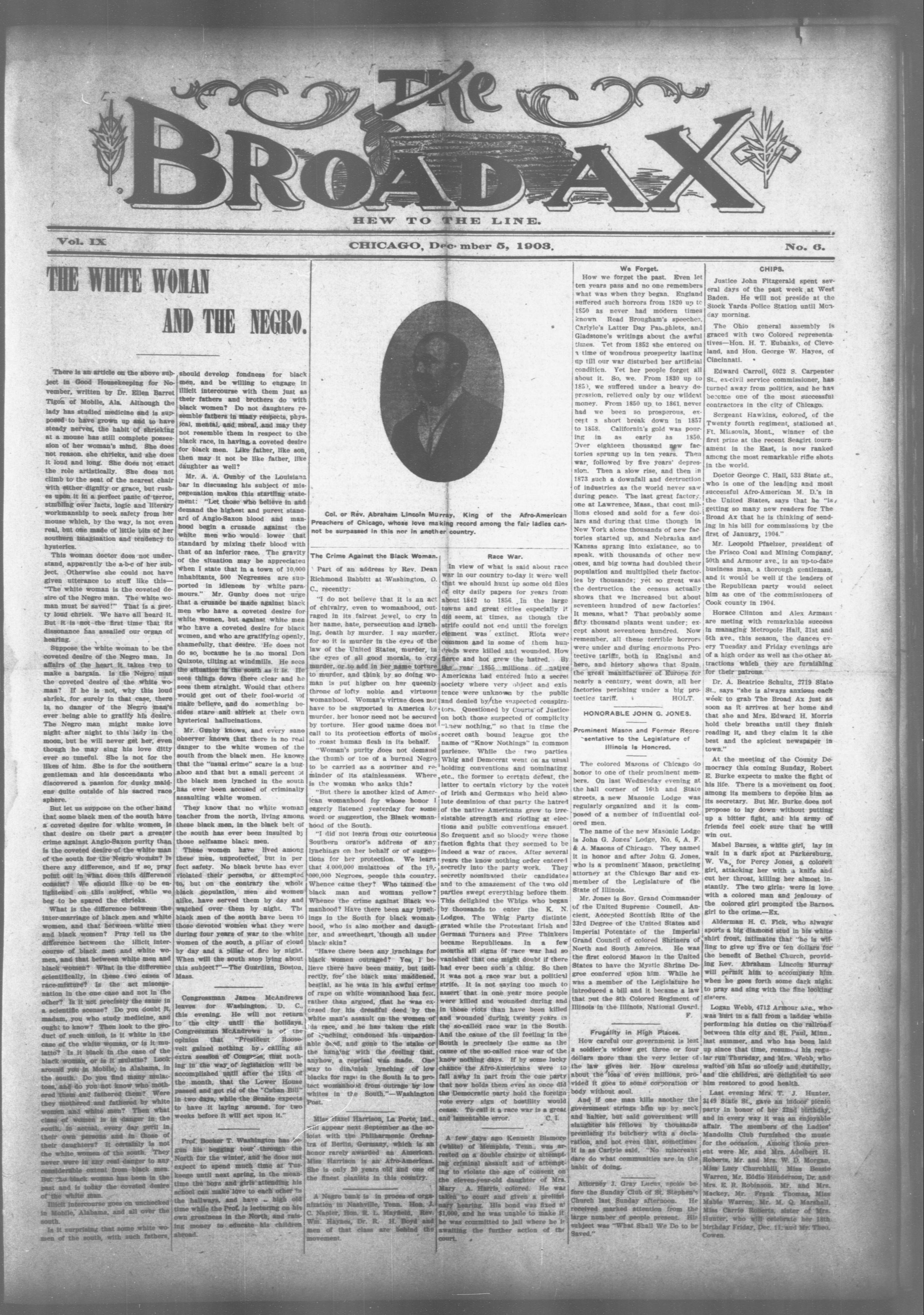
Col. or Rev. Abraham Lincoln Murray, King of the Afro-American Preachers of Chicago, whose love making record among the fair ladies cannot be surpassed in this nor in another country.
The Crime Against the Black Woman. Part of an address by Rev. Dean Richmond Babbitt at Washington, D. C., recently:
"I do not believe that it is an act of chivalry, even to womanhood, outraged in its fairest jewel, to cry in her name, hate, persecution and lynching, death by murder. I say murder, for so it is murder in the eyes of the law of the United States, murder, in the eyes of all good morals, to cry murder, or to add in her name torture to murder, and think by so doing woman is put higher on her queenly throne of lofty noble and virtuous womanhood. Woman's virtue does not have to be supported in America by murder, her honor need not be secured by torture. Her good name does not call to its protection efforts of mobs to roast human flesh in its behalf.
"Woman's purity does not demand the thumb or toe of a burned Negro to be carried as a souviner and reminder of its stainlessness. Where is the woman who asks this?
"But there is another kind of American womanhood for whose honor I eagerly listened yesterday for some word or suggestion, the Black womanhood of the South.
"I did not learn from our courteous Southern orator's address of any lynchings on her behalf or of suggestions for her protection. We learn that 4.000,000 mulattoes of the 10.000,000 Negroes, people this country. Whence came they? Who tanned the black man and woman yellow? Whence the crime against Black womanhood? Have there been any lynchings in the South for black womanhood, who is also mother and daughter, and sweetheart, though all under black skin?
"Have there been any lynchings for black women outraged? Yes, I believe there have been many, but indirectly, for the black man maddened, bestial, as he was in his awful crime of rape on white womanhood has felt, rather than argued, that he was excused for his dreadful deed by the white man's assault on the women of his race, and he has taken the risk of lynching, condoned his unpardonable dead, and gone to the stake or the hanging with the feeling that, anyhow, a reprisal was made. One way to diminish lynching of low blacks for rape in the South is to protect womanhood from outrage by low whites in the South."—Washington Post.
Miss Hazel Harrison, La Porte, Ind. will appear next September as the soloist with the Philharmonic Orchestra of Berlin, Germany, which is an honor rarely awarded an American. Miss Harrison is an Afro-American. She is only 20 years old and one of the finest pianists in this country.
Race War.
In view of what is said about race war in our country to-day it were well that we should hunt up some old files of city daily papers for years from about 1842 to 1856. In the large towns and great cities especially it did seem, at times, as though the strife could not end until the foreign element was extinct. Riots were common and in some of them hundreds were killed and wounded. How fierce and hot grew the hatred. By the year 1855 millions of native Americans had entered into a secret society where very object and existence were unknown by the public and denied by the suspected conspirators. Questioned by Courts of Justice on both those suspected of complicity "l. new nothing," so that in time the secret oath bound league got the name of "Know Nothings" in common parlence. While the two parties Whig and Democrat went on as usual holding conventions and nominating etc., the former to certain defeat, the latter to certain victory by the voters of Irish and Germans who held absolute deminion of that party the hatred of the native Americans grew to irresistible strength and rioting at elections and public conventions ensued. So frequent and so bloody were those faction fights that they seemed to be indeed a war of races. After several years the know nothing order entered secretly into the party work. They secretly nominated their candidates and to the amazement of the two old parties swept everything before them. This delighted the Whigs who began by thousands to enter the K. N. Lodges, The Whig Party distintegrated while the Protestant Irish and German Turners and Free Thinkers became Republicans. In a few months all signs of race war had so vanished that one might doubt if there had ever been such a thing. So then it was not a race war but a political strife. It is not saying too much to assert that in one year more people were killed and wounded during and in those riots than have been killed and wounded during twenty years in the so-called race war in the South. And the cause of the ill feeling in the South is precisely the same as the cause of the so-called race war of the know nothing days. If by some lucky chance the Afro-Americans were to fall away in part from the one party that now holds them even as once did the Democratic party hold the foreign vote every sign of hostility would cease. To call it a race war is a great and lamentable error.
A few days ago Kenneth Bismore (white) of Memphis, Tenn., was arrested on a double charge of attempting criminal assault and of attempting to violate the age of consent on the eleven-year-old daughter of Mrs. Mary A. Harris, colored. He was taken to court and given a preliminary hearing. His bond was fixed at $1,000, and he was unable to make it he was committed to jail where he is awaiting the further action of the court.
---
How we forget the past. Even let ten years pass and no one remembers what was when they began. England suffered such horrors from 1820 up to 1850 as never had modern times known. Read Brougham's speeches, Carlyle's Latter Day Pamphlets, and Gladstone's writings about the awful times. Yet her people forget all about it. So, we. From 1830 up to 185), we suffered under a heavy depression, relieved only by our wildcat money. From 1850 up to 1861, never had we been so prosperous, except a short break down in 1857 to 1858. California's gold was pouring in as early as 1850. Over eighteen thousand new factories sprung up in ten years. Then war, followed by five years' depression. Then a slow rise, and then in 1873 such a downfall and destruction of industries as the world never saw during peace. The last great factory, one at Lawrence, Mass., that cost millions closed and sold for a few dollars and during that time though in New York alone thousands of new factories started up, and Nebraska and Kansas sprang into existence, so to speak, with thousands of other new ones, and big towns had doubled their population and multiplied their factories by thousands; yet so great was the destruction the census actually shows that we increased but about seventeen hundred of new factories! It means, what? That probably some fifty thousand plants went under; except about seventeen hundred. Now remember, all these terrible horrors were under and during enormous Protective tariffs, both in England and here, and history shows that Spain, the great manufacturer of Europe for nearly a century, went down, all her factories perishing under a big protection tariff. HOLT.
The colored Masons of Chicago do honor to one of their prominent members. On last Wednesday evening at the hall corner of 16th and State streets, a new Masonic Lodge was regularly organized and it is composed of a number of influential colored men.
The name of the new Masonic Lodge is John G. Jones' Lodge, No. 6, A. F. & A. Masons of Chicago. They named it in honor and after John G. Jones, who is a prominent Mason, practicing attorney at the Chicago Bar and exmember of the Legislature of the State of Illinois.
Mr. Jones is Sov. Grand Commander of the United Supreme Council, Ancient, Accepted Scottish Rite of the 33rd Degree of the United States and Imperial Potentate of the Imperial Grand Council of colored Shriners of North and South Amreica. He was the first colored Mason in the United States to have the Mystic Shrine Degree conferred upon him. While he was a member of the Legislature he introduced a bill and it became a law that put the 8th Colored Regiment of Illinois in the Illinois, National Guard.
And if one man kills another the government strings him up by neck and halter, but said government will slaughter his fellows by thousands premising its butchery with a declaration, and not even that, sometimes It is as Carlyle said, "No miscreant dare do what communities are in the habit of doing.
Attorney J. Gray Lucus, spoke before the Sunday Club of St. Stephen's Church last Sunday afternoon. He received marked attention from the large number of people present. His subject was "What Shall We Do to be Saved."
Justice John Fitzgerald spent several days of the past week at West Baden. He will not preside at the Stock Yards Police Station until Monday morning. The Ohio general assembly is graced with two Colored representatives—Hon. H. T. Eubanks, of Cleveland, and Hon. George W. Hayes, of Cincinnati.
Edward Carroll, 6022 S. Carpenter St., ex-civil service commissioner, has turned away from politics, and he has become one of the most successful contractors in the city of Chicago. Sergeant Hawkins, colored, of the Twenty fourth regiment, stationed at Ft. Missoula, Mont., winner of the first prize at the recent Seagirt tournament in the East, is now ranked among the most remarkable rifle shots in the world.
Doctor George C. Hall, 533 State st., who is one of the leading and most successful Afro-American M. D.'s in the United States, says that he "is getting so many new readers for The Broad Ax that he is thinking of sending in his bill for commissions by the first of January, 1904."
Mr. Leopold Pfaelzer, president of the Frisco Coal and Mining Company, 50th and Armour ave.; is an up-to-date business man, a thorough gentleman, and it would be well if the leaders of the Republican party would select him as one of the commissioners of Cook county in 1904.
Horace Clinton and Alex Armant are meting with remarkable success in managing Metropole Hall, 31st and 5th ave., this season, the dances every Tuesday and Friday evenings are of a high order as well as the other attractions which they are furnishing for their patrons.
Dr. A. Beatrice Schultz, 2719 State St., says "she is always anxious each week to grab The Broad Ax just as soon as it arrives at her home and that she and Mrs. Edward H. Morris hold their breaths until they finish reading it, and they claim it is the best and the spiciest newspaper in town."
At the meeting of the County Democracy this coming Sunday, Robert E. Burke expects to make the fight of his life. There is a movement on foot among its members to depose him as its secretary. But Mr. Burke does not propose to lay down without putting up a bitter fight, and his army of friends feel cock sure that he will win out.
Mabel Barnes, a white girl, lay in wait in a dark spot at Parkersburg, W. Va., for Percy Jones, a colored girl, attacking her with a knife and cut her throat, killing her almost instantly. The two girls were in love with a colored man and jealousy of the colored girl prompted the Barnes girl to the crime.—Ex.
Alderman H. C. Fick, who always sports a big diamond stud in his white shirt front, intimates that "he is willing to give up five or ten dollars for the benefit of Bethel Church, providing Rev. Abraham Lincoln Murray will permit him to accompany him when he goes forth some dark night to pray and sing with the fine looking sisters.
Logan Webb, 4712 Armour ave., who was hurt in a fall from a ladder while performing his duties on the railroad between this city and St. Paul, Minn., last summer, and who has been laid up since that time, resumed his regular run Thursday, and Mrs. Webb, who waited on him so nicely and dutifully, and the children, are delighted to see him restored to good health.
Last evening Mrs. T. J. Hunter, 3149 State St., gave an indoor picnic party in honor of her 22nd birthday, and in every way it was an enjoyable affair. The members of the Ladies' Mandolin Club furnished the music for the occasion. Among those present were Mr. and Mrs. Adelbert H. Roberts, Mr. and Mrs. W. D. Morgan, Miss Lucy Churchhill, Miss Bessie Warren, Mr. Eddie Henderson, Dr. and Mrs. E. R. Robinson, Mr. and Mrs. Mackey, Mr. Frank Thomas, Miss Mable Warren, Mr. M. Q. Marshall, Miss Carrie Roberts, sister of Mrs. Hunter, who will celebrate her 18th birthday Friday, Dec. 11; and Mr. Theo. Cowen.
---
Will promulgate and at all times uphold the true principles of Democracy, but Catholics, Protestants, Priests, Inclides, Farmers, Single Taxes, Republicans, Knights of Labor, or any one else can have their say, so long as their language is proper and responsibility is fixed.
The Broad AX is a newspaper whose platform is broad enough for all, ever claiming the editorial right to speak its own mind.
Local communications will receive attention. Write only on one side of the paper.
Subscriptions must be paid in advance.
One Year ..... $2.00
Six Months ..... 1.00
Advertising rates made known on application. Address all communications to
THE BROAD AX
5040 Armour Avenue, Chicago.
JULIUS F. TAYLOR, Editor and Publisher.
Entered at the Post Office at Chicago Ill., as Second-class Matter.
Magistrate—How do you know this gentleman was drunk when you arrested him?
Policeman—He was talking about his wife, and he said she didn't care what sort of dresses she had so long as she was comfortable, and she didn't get mad about the furniture when the neighbors had better, and she didn't care for a fine house, and didn't want a carriage, and she would rather do her own housework than bother with servants.—N. Y. Weekly.
A Glorious Victory.
Mrs. DeStyle—I've got ahead of Mrs. DeFashion at last.
Mrs. DeStyle—At Mrs. DeFashion's last party, two of the guests fainted; but at my grand reception last night the crush was so great six of the ladles had to be carried out and one had to have a doctor.—N. Y. Weekly.
She Decides for Him.
Jobberwok—Your friend Meekerton appears to be a man of very decided views.
Dinglebatz—Yes, did you ever meet his wife?
Jobberwok—No, I believe not.
Dinglebatz—Well, when you do you will understand why he has them.—Cincinnati Enquirer.
Layzee—My wife isn't exactly an anarchist, but she annoyed me this morning with one of her incendiary speeches.
Jenks—You don't say so?
Layzee—Yes, she said: "Henry, get up this minute and make the fire."—Philadelphia Ledger.
"Do you believe that every man has his price."
"I won't discuss that," answered Senator Sorghum; "but I will say that the reason some men stay honest is because the price asked is so much higher than the price bid."—Washington Star.
He Needs Rest.
"You should speak when you're spoken to, my son."
"Yes, pop, but I can't be talking always."
"No, of course not."
"Well, ma's speaking to me nearly all the time."—Yonkers Statesman.
"Both of my grandparents on my mother's side were nonogenarians," said Mrs. Oldcastle.
"Is that so?" replied her hostess "My folks was all Baptists, but Josiah comes from a. Methodist family.—Chicago Record-Herald.
Purewell.
"Why do you call this a farewell concert? You know the chances are that the singer will return as usual."
"Yes, but this gives the purchaser of a seat such an admirable opportunity to say farewell to his money."—Washington Star.
Between Friends.
Phyllis—I would go to Mme. LeFrizzle's often to have my hair dressed, but one has to wait so awfully long.
Eloise—Why don't you leave it, dear, and have them send it home when it's finished?—Cincinnati Enquirer.
Absolutely Safe.
"Have I any rival in your affections?" he demanded, fiercely.
"No-o," replied the lovely girl, thoughtfully. "At least, I cannot think of anybody else I regard with equal indifference."—Town Topics.
For pelf man resolutely schemes,
Despite the wealth that he secures;
The other fellow's dollar seems
At least three times as big as yours.
—Washington Stcr.
He—I'm sure I can marry any girl I please.
She—Yes, but could you please any?
—N. Y. Times.
Modest, Indeed.
"He seems to be a modest, unassum-
ing man."
"He is. Why, he actually admits that he might not be able to run an automobile that he never saw."—N. Y. Times.
Two Evils.
"It's hard to have a lot of debts that you simply can't pay."
"Oh, I don't know! It's worse to have a lot that you simply have to pay."
—Philadelphia Public Ledger.
A Model of Industry.
"Claudia, is the young man industrious to whom you are engaged!"
"Industrious? Why, papa, he intended to propose to me a month ago, but was too busy."—Tit-Bit.
Easy People.
First Statesman—You have, air, absolute confidence, then, in the people?
Second Statesman—I have, air. I have made all my money out of them.
—Louisville Times.
```markdown
```
NO MORE RED TROUSERS.
Radical Change in the French Infantry Uniform-Beautiful Gives Way to the Expedient.
It is a matter of more than passing interest that the French infantry uniform, made familiar all over the world by paintings of famous artists, is to be changed, says the Chicago Tribune. The baggy red trousers are to go out. The French ministry has decided that they make too good targets for German or other sharpshooters. The "plou-plou," as the French infantry man has been affectionately called, was as much a landmark of Paris in his blue jacket and baggy red trousers as the Arc de Triomphe or the Madeleine. The gay capital will be sadly changed when the legs of its defenders are incased in something more inconspicuous. La Presse, of Paris, mourns the loss of the gay plumage, saying: "In depriving our soldiers of their red trousers Gen. Andre has deprived them almost of their excuse for existence. To deprive an army of its distinctive signs is to show that he wishes to attack it in its vital principle." Although the Presse in its excess of despair exaggerates the case when it argues that the change almost deprives the army of its reason for existence, and certainly strikes a blow at its vital principles, yet one can understand that journal's grief. The French are a historic and artistic people, and the placing of a somber olive on her soldiers' legs will depress Paris for many hours. Yet such is the inexorable march of progress. The beautiful gives way to the expedient.
YOUNG MEN IN CONGRESS.
Crop of Embryo Statesmen Whose Ages Range from 28 to 32 Coming to the Fore.
"The Fifty-eighth congress will be remarkable for its membership of young men, who are notable, not only in point of numbers, but conspicuous for ability. Some 50 members of the new congress have emerged from kilts since the last bullet sped at Appomattox.
"In official and congressional life," says Mr. North Overton Messenger, in Pearson's, "a man at 40 years of age is considered young, and the graybeards look upon the fellows of 35 as mere striplings; but here comes on a crop of embryo statesmen whose ages range from 28 to 32. Who can say that a man who possesses ability enough to push him through the stirring competition of these times into a seat in congress before he is 30 years old, may not within the next decade take his place among the most brilliant statesmen of the land?
"With a president in the white house, who, as the head of the government, took the executive chair at 43 years of age, there is a following of young men in important positions throughout the various branches—legislative, executive and judicial—which emphatically marks this as the age of young men. Behind this army of aggressive, ambitious, energetic, and competent men is a solid backing of experienced legislators, jurists and executive officers who will furnish the fly-wheel, the governor to the engine, so to speak."
IN INTEREST OF INFANTS.
Battersen Sells City Milk to Mothers and Records Weight of Their Babies.
Battersea mothers are taking a lively interest in the weights of their babies. A weighing machine has been added to the municipal milk depot established by the borough council for the better feeding of infants. The shell-shaped scales in which the infants are placed are similar to those used by grocers for weighing flour. At the last fortnightly weighing day large numbers of proud mothers compared notes after the ceremony. One lusty infant, which kicked vigorously, had gained nearly two pounds since the previous weighing day. The champion baby, aged eight months, weighed 28 pounds, and the puniest three-weeks-old infant turned the scale at six pounds.
Municipal milk, sterilized and humanized, is being served to 400 mothers daily. It is sent out in neat-looking cruets, and the total cost of one child's daily allowance of six, eight or nine bottles, according to age, is six cents. The milk has worked wonders with the infant health of the neighborhood. The death rate among Battersea infants has declined from 710 to 96 per 1,000 since the establishment of the milk depot.
Alcohol and Exercise.
In La Nature is an interesting article on the influence of muscular energy in eliminating alcohol which has been introduced into the blood. M. Grehant made a series of experiments, dosing with alcohol; and then examined the blood after a varying number of hours. He found that under ordinary circumstances the elimination of alcohol was extremely slow. He then had constructed a wheel, three meters in diameter, into which a dog could be placed and kept moving. Alcohol was introduced into the stomach of the dog, and after five hours in the wheel its blood was examined, when it was found that the alcohol had diminished much more rapidly than when the animal was not exercising. M. Grehant commends the result of his experiment to the consideration of men who have somewhat overindulged, and suggests that experiment might show beneficial results from carriage riding when the degree of "lvrease" was too great for walking.
American Progress.
There were 9,700 American tourists in Switzerland last summer.
American Tourists.
American shoe stores are being opened in all the cities of Germany.
Gander Wags His Tail When Happy There Are Birds That Black When Angry.
A writer in an English publication declares that birds wag their tails when they are happy. "The gander," he says, "when he has to his satisfaction driven off a dog from the presence of his spouse, returns to her craning his neck toward her and wage his tail with pleasure. Our jackdaw—or rather jilldaw, as it is a female—on our return a few days since after two months' absence, cried out lustily to us from the bush where she was perched, and on our going to greet her she received us with profuse tail wagging to show her pleasure at our return. She always greets her particular friends in the household by wagging her tail, crouching on her perch, and cawing in an undertone."
Another observer finds that some birds blush. He writes: "We have a very fine specimen of the blue and yellow macaw which displays this trait—not often, for he is remarkably good-tempered—and the blush is an invariable sign of anger; so much so that we warn all friends that while his cheeks remain white all attacks are feigned and in play, and can be disregarded, yet if the 'danger signal'—red—shows, to look out and keep out of reach." The owner of a blue and orange macaw says that its white, parchment-likeface becomes bright pink, especially above the beak, whenever it is angry or excited."
OUR GREAT COPPER WEALTH.
Michigan Led in Production of the Metal Until Montana Assumed That Honor in 1802.
In an article on Modern Methods of "Finance," in the Pearson's, Mr. Henry George, Jr., speaks of our great copper interests as follows: "Modern copper mining began in the United States about 1845. In that year our total production was estimated to be about 100 tons. More than a tenth of this was produced in Michigan. Copper mining in many of the states rapidly developed, but nowhere so rapidly as in Michigan, which in 1880 yielded more than four-fifths of the output of the country.
"Then it was that Montana began its phenomenal mineral development. By 1892 its copper production exceeded that of bountiful Michigan. Arizona's copper development came later. Toward the close of the nineties, the copper mined in the United States exceeded annually $80,000,000 in value, which rivaled our gold yield and far surpassed our petroleum. We had come to produce more copper than all the rest of the world combined, and hence our product commanded the world's market.
"This country's enormous copper yield came mainly from three districts, in the following order. The Butte region, Silver Bow county, Mont; the Lake Superior peninsula of Michigan, where it is richest; and the triangular region of southeastern Arizona marked by Clifton, Bisbee and Globe."
DISEASE IN THE MINES.
Profuse Use of Water, Spraying in Collieries Has Assisted in Introducing Serious Disorder.
The profuse use of water spraying in mines has unfortunately assisted in the introduction of a most serious disease into collieries, viz: "ankylostomalis," which is at present mostly confined to Austrian, German and Hungarian mines, but has been discovered in some mines in Cornwall, and also in Australia, where those suffering from the disease are called "earth eaters," says Mines and Minerals. The higher the temperature and the greater the point of saturation the more easily is the parasite propagated, and therefore its favorite habitat is in the damp and badly ventilated places. The larvae can exist in any temperature above 48 degrees F., and have been found on the higher parts of props and bars, but not near the floor. Fortunately, the first accounts are believed to have exaggerated the danger, and were incorrect in stating that the infection could be carried through the air; but later investigations seem to point out that it can only be taken in through the mouth, and, therefore, clean hands and clean water, when partaking of foods, are the principal safeguards.
SIZE OF RUSSIA'S ARMY.
Actual Number of Troops the Czar Has In or Near Manchuria Kept a Secret.
No one outside the Russian war office kncws the actual number of troops the czar has in Manchuria or within reach of it, writes O. K. Davis, in Everybody's Magazine. The Russian army in point of number is the largest in the world. Nearly 900,000 young men reach their majority in Russia every year, and each is bound by law to spend five years in the army. If all were taken they would make an army too large even for Russia, so only 219,000 go to the colors with the army or the fleet, and the rest go to the reserve. The lowest peace strength of the Russian military establishment, therefore, numbers more than a million men, with 42,000 officers. In war time practically all these young men join the colors, swelling the army to the stupendous figures of 4,500,000 men, and 75,000 officers, for whom there are provided 560,000 horses. Men who are in position to guess shrewdly say there are more than 300,000 Russian soldiers in Manchuria or hear it now. The number that can be put in the field there is limited only by the will of the government.
Balance of Trade. The balance of trade in our favor nearly equals, and occasionally exceeds, that of all other favored nations on the map.
GREEN-ROOM GOSSIP.
Someone complained to Pinero, the London dramatist, that in the case of his latest success the curtain rose too early for those who dine at the usual fashionable hour. "Then postpone dinner until after the play," said Pinero. "Sit down to a square meal about 11. What dreams may come will be dreams of the play, and even nightmare may prove an advertisement for me."
London papers tell of a queer "first night" which took place at Wallingford recently. It was the initial production—for copyright purposes only—of "Merely Mary Ann," the new comedy by Israel Zangwill. The novelty of the production lay in the character of the company. Jerome K. Jerome, Sir Conan Doyle and other well-known literary men were in the cast "just for a lark," and as they merely read their parts instead of having to memorize them there was a refreshing originality about this performance. Mr. Zangwill was present as a quiet but interested spectator. Anthony Hope was "leading man," and his acting is said to have been simply unmentionable.
Henry Irving once preached quite a terse sermon on appropriate dressing. A clever young woman belonging to his company appeared at rehearsal one morning dressed in a lovely gown and a stunning hat. Irving commented on the unusual splendor of her getup, whereupon the actress explained that she was going to a swell luncheon that afternoon, and had saved time by dressing in advance. "Then run away to the luncheon first, my dear young lady," said the star. "Just now your mind, too, is dressed up for the luncheon and not for work. When you come for rehearsal come looking the part." The young woman, who is now a star, never forgot the lesson which she learned that morning.
GLEANED ABROAD.
Several slight cracks having been noticed in the dome of the Pantheon at Rome, the government has ordered an inquiry by experts. Six hundred cases of tiles, reliefs and other objects which once decorated the palace of Nebuchadnezzar have been shipped to Germany from Babylon by Dr. Koldeway. Knoedler, Roux and other prominent art dealers of Paris say that the financial situation in England and the United States is having a baneful influence on the art trade and is likely to have for some time.
One of the great stones of the portico of Octavio in Rome fell recently in consequence of a storm. The report was for a time current that the whole monument was threatened. There is, however, no danger of further damage. Mild indignation has been caused at Southport, England, because a statue of Queen Victoria was cast by a firm of German bronze founders. The statue has not yet been unpacked, and speculation is rife as to which part of it will bear the inscription "Made in Germany."
SOME NECROLOGY OF 1903.
Captains in charge of troops who captured Jeff Davis, four.
Lieutenants in charge, five. The last one died the other day.
The last man who hanged John Brown, two.
Last survivors of Waterloo, nine.
Last Balaclava men, three.
Last men who saw Napoleon, two.
This does not include the men who have written about him, none of whom has died for several years.
Last women, who, as flower girls, were kissed by Lafayette, thirteen.
Last men who shot Wilkes Booth, six.
The original McKinley man has not died so often during the year as formerly.
All of the original Roosevelt men are still living.
There has been a noticeable falling off in the men who knew Lincoln before he was president.
The last man who voted for Andrew Jackson has died once this year.—N. Y. Sun.
EXPORTS AND IMPORTS.
France exported $5,832,341 worth of automobiles last year, while spending only $206,000 in imported ones.
Agricultural implements exported from the United States last year amounted to $21,000,000 in value.
The Canadian plan of preferential tariffs in favor of Great Britain and the British colonies is now being adopted in the British colonies of South Africa.
The imports into Germany from Ceylon amounted to 7,400,000 marks ($1,761,200), consisting of corpra, graphite, oil cake, cinnamon, cocoa, coffee and tea; the return exports to Ceylon amounted to 1,040,000 marks ($247,520) made up of assorted goods.
The average annual importations of foreign corn into France for the last three years were 14,000,000 bushels, of which the Argentine Republic furnished an annual average of 4,250,000 bushels, Roumania 3,000,000, and the United States 2,800,000 bushels.
ADVICE TO SMOKERS.
[Dr. Caze, a well-known French physician, lays down the following rules for smokers, and maintains that those who observe them need have no fear that tobacco will do them any harm.]
5. Do not sit where there is a cloud of tobacco smoke.
6. Do not chew the end of a cigar.
7. Use a cigar holder or cigarette holder and line it with cotton, for the nicotine will cling to the latter and will only penetrate in very small quantities into the smoker's system.
AGENTS FOR THE BROAD AX.
From on and after this date The Broad Ax can be found on sale at the following places:
The Afro-American News Office, 3104 State Street.
A. F. Tervalon's Cigar Store and News Stand, 2826 State street.
Edward Felix's Cigar Store, 398 30th street, N. E. Corner Armour Ave.
T. B. Hall's Cigar Store and Laundry office, 281 29th St.
Turner William's Cigar and News Stand, 2903 Armour Ave.
Mrs. E. F. Early, groceries and notions, 2933 State St.
H. Winston's Cigar Store and Newsstand, 280, 29th St.
The Stationery, 2970 State street.
J. C. Campbell, 145 W. 47th street., Cigars, Tobacco, Staple Groceries.
Wm. H. Monroe, cigar and newsstand, 486 State street.
J. New 131 W. 51st street, cigars, tobacco and confectionaries.
C. E. Hunter, 4503 Wentworth ave., cigars, tobacco, news stand.
S. B. Bridges, Cigars and Stationary Store, 5220 Lake avenue.
Wm. Dixon 2638 State Street cigars, tobacco, and news stand.
Wm. Goetz, News Stand and Laundry Office, 411 E. 36th st. News items and advertisements left at these places will find their way into the columns of The Broad Ax.
President and Treasurer, THC
Vice-President, JOE
Secretary
MANUFACTU
Common and S
Office and
45th and R
Yards running winter a
with the latest improve
Output of Winter Yards
Output of Summer Yards
Telephone
JOHN A ORB,
President.
WEST
BREW
COMPA
-- American Brick Co. --
-- American Brick Co. --
President and Treasurer, THOMAS CAREY. Vice-President, JOHN SHELHAMER, Secretary, WILLIAM SULLIVAN. MANUFACTURERS OF
Yards running winter and summer, equipped with the latest improved Wolf Dryer.
Output of Winter Yards ..... 140,000 per day
Output of Summer Yards..... 300,000 per day
Telephone Yards 128.
CHICAGO, U. S. A.
CORNER AUGUSTA AND PAULINA STREETS.
Monroe 1567—TELEPH
Jas. J. McG
SAMPLE
IMPORTED AN
WINES, LIQUOR
Monroe 1567—T E L E P H O N E S—Monroe 1573.
Jas. J. McCormick, SAMPLE ROOM
The Belle.
We think a belle is incomplete
Without a ring when young;
But later on—oh, sad deceit!
We find she has a tongue.
—Judge.
A Scandal Indeed.
Gladys—If Mrs. Playfair is so happy
with her husband, why is she getting a
divorce?
Elsie—Because she dreads the facts
of their prosale agreement coming out
in the society papers. It would be such
a scandal, you know!—Brooklyn Life.
The Cabbage Market.
Bill—These cigars I am speaking of are at least six inches long.
Jill—I understand. When you buy cabbage in a grocery you get it by the head; and when you buy it in a cigar emporium you get it by the half foot.—Yonkers Statesman.
An Assurance.
"And you tell me," said the king of Egypt; "that your process will preserve my mummy for centuries?"
"Yes, indeed," said the man with the patent preparation. "Your majesty will keep like canned goods!"—N. Y. Times.
Before the Murder Trial.
"Have you any idea what line the defense will take?"
"No. But I can give a fair guess at the line it will try to steer clear of."
"What's that?"
"The rope."—Ally Sloper.
---
The Souls of Black Folk
A REMARKABLE BOOK that is provoking much discussion because of the wonderful eloquence with which the author pleads for right and justice to his people. In these days of increasing agitation over the "negro problem" this passionate human document can neither be overlooked nor ignored. Aside from its remarkable presentation of facts it holds the reader—prejudiced or not—by its fascination of style and overpowering pathos.
Some of the Chapter Headings follow:
OF OUR SPIRITUAL STRIVINGS.
OF THE DAWN OF FREEDOM.
OF MR. WASHINGTON AND OTHERS.
OF THE MEANING OF PROGRESS.
OF THE TRAINING OF BLACK MEN.
OF THE BLACK BELT.
OF THE SONS OF MASTER AND MAN.
OF THE FAITH OF THE FATHERS.
OF THE PASSING OF THE BIRST-BORN.
OF ALEXANDER CRUMMELL.
OF THE COMING OF JOHN.
OF THE SORROW SONGS.
3d Edition $1.20 net Published by
A.C. McClurg & Co., Chicago
Brick Co. --
THOMAS CAREY.
JOHN SHELHAMER,
Bry, WILLIAM SULLIVAN.
STURERS OF
Sewer Brick
and Yards:
Robey Sts.
and summer, equipped
red Wolf Dryer.
1,40,00 per day
300,000 per day
Yards 128.
WILLIAM LEGNER,
Vice Pres. & Treas.
SIDE
ERY
ANY,
HONES—Monroe 1573.
Cormick,
E ROOM
AND DOMESTIG
RS AND CIGARS
T.
CHICAGO.
A History of the Case.
Of germs a healthy man once read
They filled his soul with awful dread.
They worried him
And flurried him.
Till now, poor man, he's sick abed.
—Washington Star.
SPEAKING AS AN OUTSIDER.
A girl in a hat and a dress stands in front of a tiger. The girl is pointing at the tiger with her finger. The tiger is sitting on a rock with its mouth open, showing its tongue. The background is a desert landscape with pyramids.
Little Bo-Peep—Say, Tige, I've lost may sheep again. Haven't seen anything of 'em. Have you?
Tige—Why, yes. I did see a couple while I was at dinner. They must be somewhere 'round here now, but I can't lay my. hand on 'em just this minute.—N. Y. Sun.
1
CHICAGO
The Value of Asher Hinds—Indiana Prominently Figures in National Legislation—Heads of Important Committees.
Washington.—The indispensable man is not numerous, but scarce as he is
one is to be found in the speaker's room in the house of representatives. Asher Hinds has been clerk at the speaker's table ever since Tom Reed began to wield the gavel away back in the Fifty-first congress He came here from Maine where he had been writing editorials on the Portland Press and he slipped right into the oxy's hab
PARLIA
MENTARY
LAW
Popular Conception o:
Mr. Hinds
Popular Conception o. Mr. Hinds he slipped right into the czar's habits and moods. He is a young man still, considerably under 40, and when Reed picked him up he was barely more than a boy; but he hadn't been in the harness a single session before he was looked upon by the older members as an authority on parliamentary law; and before two congresses had passed there was nobody else about the capitol who could compare with him.
Reed himself depended on Hinds absolutely. The great speaker was not much of an adept in the intricacies of parliamentary law and didn't pretend to be. He was concerned in reaching results and having made up his mind what he wanted to do he had a way of turning to the experts about him for information as to how he might do it. Hinds was always able to find a way and the speaker never hesitated in following out Hind's suggestions no matter where they might lead.
There has not been a republican speaker since who has not been even more dependent on Hinds than Reed was. When Reed was in the chair he noticed that whenever the house got into a parliamentary tangle Hinds would hit himself to the speaker's room and hurry back with some loose sheets of paper, upon consulting which a way out was sure to be found. This had happened several times when it aroused Reed's curiosity. He inquired about it and discovered that his clerk had spent his spare hours collecting all the precedents and decisions of speakers from the beginning of the government—work which nobody had ever had the intelligent industry to undertake before.
Hinds had a drawer full of these papers and as soon as the House leaders found out about them they passed a resolution to print them and put them in permanent form. Hinds' book is now the standard work on parliamentary precedents.
A Reincarnation of Reed.
It is a frequent subject of remark among habitues of the house that Hinds
seems to be almost a reincarnation of Reed. It may be simply the strain of common ancestry among Maine seafaring folk, but there are certainly several striking points of resemblance.
TOMMY
Hinds is not quite as big physically as Reed was, but he is plenty big enough; and to look at him from the rear as he ambles up. Pennsyl-
look at him from the rear as he ambles up Pennsylvania avenue one might well imagine himself watching the resurrected speaker's rolling gait. Hinds has the same easy direct supplemented by the same hard sets and delicious humor. His face is of the keen Yankee type, so that here the resemblance ceases. Nobody who remembers Reed can ever forget the vacant moon-like expression which used to characterize him in his moments of repose.
At home during the recess of congress Hinds not only writes the editorials for his paper, but he occasionally hustles out on an important local assignment. Last summer he thought he would look after the army and navy maneuvers, which centered about Cushing's Island in Portland harbor.
Indiana is to play an important part in the house of representatives as long as
Cannon is speaker. The old stand-bys, like Payne, Dalzell and Grosvenor will still continue in their positions won by seniority, but a new element has come in of younger men who have been loyal adherents of Cannon and who will be his counselorsnow. Conspicuous among these are Hemenway, and Overstreet of In-
Cannon Is Kind to
chairman of the reorganized committee on post offices and post roads. But their influence does not arise from their chairmanships. It arises from their close personal relations with the speaker and his confidence in their judgment.
When the speaker came to look over his committees almost the first thing that struck him was the necessity of completely reorganizing the postal committee, the chairman of which had failed of reelection and the other members of which were almost without exception subject to some failing which made is inadvisable to put them at the head of a committee which was destined to handle a very knotty and disagreeable situation. So he decided to go outside the committee for a chairman. He didn't have to look long before he hit on Overstreet.
Overstreet was secretary of the republican congressional committee last year when the figures he made before election were almost exactly verified by the results. He is a mighty goal politician, as well as a very clean-cut fellow every way and one of the most popular men in the house.
The Appropriations Chairman.
Hemenway is a different type, with fewer popular qualities and less of the
fewer popular qual politician's art. Cannon's confidence in him has grown through years of intimate relationship while both were members of the appropriations committee.
2
For several congresses Hemenway has been Cannon's right hand man on that committee and he possesses some of the sterling qualities that have gone to give Can-
gone to give Cannon so high a place in the esteem of the house. He has the Indiana faculty for close calculation. He is not a chummy fellow and for that reason he may never gain a popular hold on his party, but he is bound to grow as long as he remains a member of the house and he will become more and more a factor in legislation.
Hemenway will hardly develop into a floor leader, for he lacks the snap and pugnacity of a born debater, but he will always be looked upon as safe. He, too, is young enough to look forward to a career, but his ambition lies in the direction of the senate or the governorship of his state. Hemenway and Overstreet come from adjoining counties.
Two other Hoosiers who are going to attract attention are the Landis broth-
ers. One of them has been in the house for three congresses and is known as a witty and formidable debater and a thoroughly good fellow. He went to Boston two or three years ago and made a hit there before one of the political dining clubs of that town, which is even now remembered. He has a faculty for telling stories that them can by any
Brothers of Different
Brothers of Different Physique nobody who hears possibility forget
His brother, who is just beginning his first term, is like unto him in mental alertness, though there is little resemblance physically between the two. Charlie, the older, is a little over 40, stocky in build with iron gray hair. Fred, the younger, is the baby of the house, with his 29 years. He is tall, angular and thin as a rail. He had already made a reputation as a story teller and wit. His qualit expressions are quoted in the republican coat rooms.
There is another brother, Kenesaw, who used to be private secretary to Walter Q. Gresham, when Gresham was secretary of state in Cleveland's second administration. The way Kenesaw shook up the dry bones of the state department during his brief incumbency was a caution. He is a lawyer now in Chicago and he can hardly have more friends there than he left in Washington. Both Charlie and Fred Landis are newspaper men.
Only two hotels in New York refuse to keep their register of guests open and publicly accessible. These are the Fifth Avenue and the Waldorf-Astoria. The Fifth Avenue is a favorite resort of politicians, and its guests sometimes prefer not to have it known that they are there. The Waldorf-Astoria has made its way with leaders in haute finance, with important and unimportant persons, diplomats and men like Dr. Amador and M. Varilla with republics in their brains. The books are not accessible to the public; lists of guests cannot be transcribed. This is not only intended as a protection to the guests, but as a protection to the office staff. Many business houses send circulars to "hotel arrivals" when they can get the names, and at the Waldorf this would mean each morning the sorting of some 1,500 additional pieces of mail. The law only requires that a register shall be accurately kept, so that the police or authorized officers of government may consult it.—N. Y. Post.
American Capital in Canada. American capital is rapidly invading part of the dominion near Sherbrooke, and the near future will see the erection and equipment of many large manufacturing plants, which will greatly increase the wealth and business of the section and promote trade with the United States.
DANGER IN SLEEPING CARS. Berths Scored as Filthy and Disease
The alfthy and disease-laden sleeping car has been duly scored by the American Health association. At the meeting in Washington, says the Star, the subject was very thoroughly discussed from a sanitary standpoint. Although the facts regarding the culpable uncleanliness of berths are admitted by the public, their rehearsal from time to time helps to emphasize the necessity for reform.
The railroad companies are always ready with excuses against bettering conditions. Their business is to avoid trouble and save expense. The casual traveler may growl as much as he chooses, but is oftener contented to submit to an infliction rather than suffer the humiliation of a fruitless appeal to authority. No one needs be told that the ordinary heavy curtained and ill-ventilated night car is a veritable propagator of infectious diseases. What better could be expected when the nightly used blankets, as claimed by one speaker, are cleansed but once in six months?
And, pray, what power exists to call officials to account? What is the real guarantee for the sleeper that he is absolutely safe from the germs left for him from the previous customer? The only remedy rests in the ordinary honesty of the common carrier.
One of the railroad experts rather plausibly claimed that it was not fair to require railroads to spend large sums of money for sanitary purposes until they knew where they stood. As if, in truth, there were any doubts concerning the efficacy of absolute cleanliness, perfect ventilation and thorough disinfection—all easy enough of application when there is a will for the way.
CAUSE OF BAD SPELLING.
Repetition the Only Secret of Learning to Spell for Persons with Average Memories.
Probably it is a mistake to say that any person with an average memory cannot learn to spell. As there is a lack of analogy in the spelling of words, learning to spell is chiefly a matter of memory. Repetition is the only secret about it, says the Philadelphia Record. There are some aids, but it is the words to which there is no guide which are the common source of trouble. Persons who do not spell well have simply neglected the study of orthography and are not entitled to sympathy. Operators of typewriting machines who have considered themselves the victims of a defective orthographical memory have often become good spellers through practice.
In a vast proportion of cases bad spelling may be traced to wrong pronunciation, which is even more frequent than is wrong spelling. Probably the modern methods of instruction have something to do with the number of bad spellers among fairly educated people. The old spelling-bee system insured repetition. In recent years the writing of the spelling lesson has in many schools taken the place of the oral system. The men and women who had gone through the district school of half a century or more ago were almost invariably good spellers. If, as the Evanston councilmen maintain, spelling be a gift, it is apparent that it is not bestowed on man as liberally as formerly.
GUN-MAKING IN CHINA
Every Form of Munition of War, from Rifles to Heavy Artillery, Made by Natives.
A correspondent of the Lahore Civil and Military Gazette visited one of the Chinese arsenals and thus put down his impressions: "Finally we were taken, among other places, to the great Chinese arsenal some way beyond treaty limits, where every form of munition of war, from rifles to 45-ton guns, was being made. We wandered through a wilderness of factories, covering acres of ground, and were shown the whole process of manufacture. And there were powder factories and other institutions not far away which we had no time to visit. That was, perhaps, the most significant experience of all. You may have seen gun factories before, but have you seen a place turning out great guns by the dozen, and machine guns by the hundred, perfect in design and construction, run, from coolie to head mandarin, entirely by Chinese, and with only a couple of Englishmen engaged solely in consultative supervision? Have you seen a roomful of Chinese draughtsmen and designers in pigtails and blue gowns solemnly, stolidly and assiduously getting out the drawings for a new gun? It is a sight that furnishes food for thought. And as you leave you ask yourself the question: 'If these men can make guns, why may they not work them some day!'"
Maj. Powell-Cotton, who recently explored a part of central Africa never before visited by white men, writes: "Among the Kimager the women go completely naked, but the men are clothed. I secured some photographs of a tribesman and his two wives hoeing the family plot. One of these shows a curious fashion of skin decoration in vogue among the womenfolk. It is a raised pattern wrought on the body when they are young. Small incisions, geometrically arranged, are made in the skin and into these ashes are inserted. The wounds heal in permanent raised lumps."
We Take More Than Half. The United States uses more than five-eighths of the diamond output of the world. In two years the total advance on small stones has been 20 per cent., and on large stones 25 per cent.
THEIR OWN BARBERS.
Increased Sales of Razors Indicate
That More Men Than Ever Before Shave Themselves.
"There are sold in this country today," said a cutlery man, according to the New York Sun, "a hundred times as many razors as were sold here 40 years ago.
"Some share of this increase is due, of course, to the advance in population, but the greater part is due to the large increase in the proportion of men who shave themselves. More men than ever before now possess this polite art.
"With a greater number of individual users of razors there are, of course, many more razors now sold. And, of course, plenty of men own more than one razor; everyone ought to own two, at least, as many men do. One good razor properly cared for might serve its purpose continuously and well for a long time without regrinding or honing, but an accident might happen to it, and against that a man guards by having at least one extra razor.
"Many men buy sets of seven razors, one for each day in the week, and there are men who have sets of 31 razors, one for every day in the month. And travelers going to distant countries and into regions where facilities would be lacking buy cases of razors to take with them. A traveler starting out with a case of half a dozen razors in perfect condition would have a razor outfit that, with such care as he could bestow upon it himself, would serve him well for years.
"The best razor that can be made can be bought with a plain handle for two dollars; anything more than that in the cost of it would be in the mounting—in pearl handles and so on. You can buy a case of seven fine razors, simply mounted, for $12, or you can pay $50 or more for a case of razors with the same blades, but with fine mountings and in a finer case."
WE CAN'T EAT CELERY NOW.
Doctors Have Cut Off Another Article of Diet—Vegetable Said to Carry Typhoid Germs.
Now the physicians are said to have forbidden another relish nearly as popular as oysters at this time, says the Washington Star. Celery has come under the ban of the doctors, who say that it is equally well adapted to transmitting the poisonous elements of the soil and carrying the germs of typhoid. The disease can be acquired only by introducing the microbes into the system in food or drink, and for that reason advice against certain kinds of food is always likely to be regarded. But to what extent this may be carried is well understood by the proprietor of one hotel, who has seen oysters during the past three weeks disappear almost entirely from the orders of his guests. Some weeks ago a well-known man died of typhoid fever. He had lived at a large hotel, and the report went about that he had got his illness there. "Whatever you do, don't eat oysters at that hotel," was the advice that one friend was giving another, based on the belief that this man had died of a disease contracted in the hotel dining-room, where the chances were immensely in favor of his having got the fever somewhere else.
If they keep on there will be nothing left for us to eat except fish and fritters, and the latter will probably be cut off soon and pills substituted.
SOLD HER HUSBAND'S GRAVE.
How a Southern Woman Made a Profitable Speculation on a City Cemetery Lot.
"One of those things which go to show that where there is a will there is a way is well exemplified by a happening in a certain southern city," said a well-known former railroad man in the New Orleans Times-Democrat. "A man before his marriage had purchased a beautifully located lot in the city cemetery and paid $100 for it. After awhile he married and some ten or twelve years afterward died and was buried in the aforesaid beautifully located lot and his grave was carefully attended for awhile by his widow.
"When the big show came off in Chicago and all the world was en route to that mecca the widow took a notion she must see the show. As a result of long cogitation over ways and means she had the body of her deceased husband exhumed and railroaded 50 miles away and reburied at a cost of about $75, when she sold the cemetery lot for $600 and had a good old time at the big world's fair. Somewhat of a financier, wasn't she?"
Glass-Making in Japan
The art of making glass was introduced into Japan about 150 years ago by a Hollander, who settled at Osaka. For several generations the knowledge of the process was confined to a single family, and it was not until about 1879 that the employment of coal instead of charcoal, and the construction of brick chimneys, enabled the manufacturers to introduce improvements which placed the industry on a substantial basis. Osaka has continued to be the center of the industry, and now manufactures for export besides supplying the home demand.
Sure to Be Fined.
Some butchers of Frankfort, Germany, evidently find it cheaper to be fined small sums for using boracic acid in the manufacture of Frankfort sausages than to be haled up for selling meats affected with trichinae or allowing the dearer meats to spoil in other ways. John Klein, a butcher, followed the example of many others recently and was fined only $2.36. If this sum were paid every day in fines, the loss caused the butcher would not be so great in a year as the loss from meats undoctored with the chemical.
They Are Very Pretty and No Clever Girl or Woman Need Be Without One.
Shoe-string belts may be made of white, colored or checkered lacings. White belts can be cleaned with a brush after soaking for a few minutes in soapsuds.
Five pairs of lacings are required for a belt of medium width. Run a large safety-pin through each lacing, about one inch from the end, and fasten the pinned ends to a table, or shut them in a bureau drawer. The strings must lie flat, and should be numbered in order, beginning at the right.
Take No.1, holding it flat between the thumb and forefinger of the right hand, turn it over toward the left, until the part that was underneath lies on top; pass the string over No.2, under No.3, over No.4, and so on, weaving it over and under the strings alternately to the end of the row, No.10 coming above No.1.
Take No.10 in the left hand and turn it downward and over toward the right, and pass it under No.1. At the right hand take No.2 in the same way, pass it over No.3, under No.4; continue in this manner to the end of the row, where No.1 holds the last position.
Take No. 2 in the left hand, turn it downward and toward the right, and pass it under No. 1, over No. 10, working toward the right.
Take No. 3 in the right hand, and use it in the same manner as you used No. 1 and No. 2; at the end of the row take the string in the left hand, and work it toward the right. Continue the work to the desired length and add about three inches to the usual waist measure to allow for crossing the ends. When braiding, give each string a slight pull, in order to make the work close and even. At the beginning of each row at the right-hand side, take the string as it lies flat, and turn it upward and over
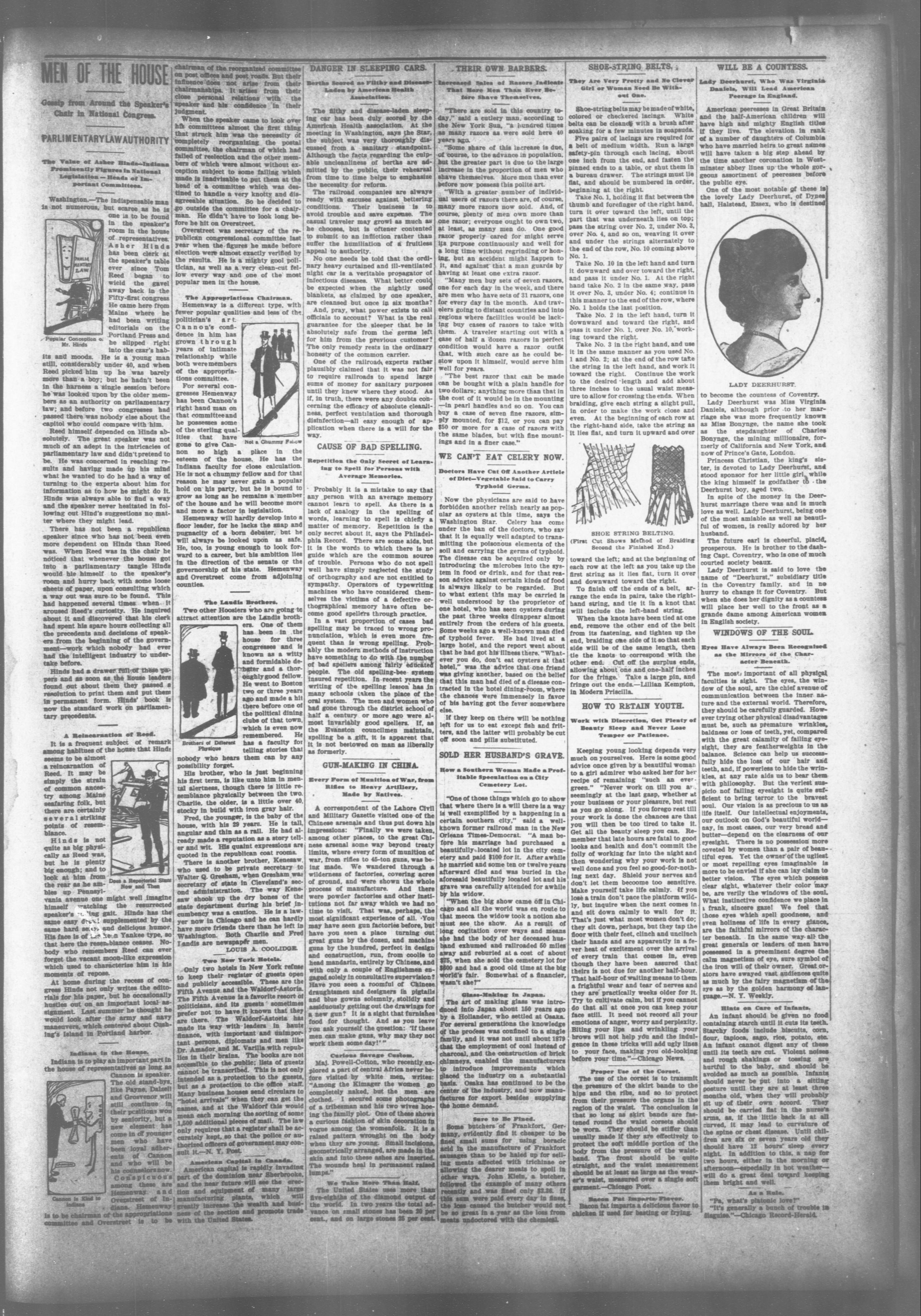
SHOE STRING BELTING.
(First Cut Shows Method of Braiding
Second the Finished End.)
toward the left; and at the beginning of each row at the left as you take up the first string as it lies flat, turn it over and downward toward the right.
To finish off the ends of a belt, arrange the ends in pairs, take the right-hand string, and tie it in a knot that will include the left-hand string.
When the knots have been tied at one end, remove the other end of the belt from its fastening, and tighten up the end, braiding one side of it so that each side will be of the same length, then tie the knots to correspond with the other end. Cut off the surplus ends, allowing about one and one-half inches for the fringe. Take a large pin, and fringe out the ends.—Lillian Kempton, in Modern Priscilla.
HOW TO RETAIN YOUTH.
Work with Discretion, Get Plenty of Beauty Sleep and Never Lose Temper or Patience.
Keeping young looking depends very much on yourselves. Here is some good advice once given by a beautiful woman to a girl admirer who asked her for her recipe of remaining "such an evergreen." "Never work on till you are seemingly at the last gasp, whether at your business or your pleasure, but rest as you go along. If you forego rest till your work is done the chances are that you will then be too tired to take it. Get all the beauty sleep you can. Remember that late hours are fatal to good looks and health and don't commit the folly of working far into the night and then wondering why your work is not well done and you feel so good-for-nothing next day. Shield your nerves and don't let them become too sensitive. Make yourself take life calmly. If you lose a train don't pace the platform wildly, but inquire when the next comes in and sit down calmly to wait for it. That's just what most women don't do; they sit down, perhaps, but they tap the floor with their feet, clinch and unclinch their hands and are apparently in a fever heat of excitement over the arrival of every train that comes in, even though they have been assured that theirs is not due for another half-hour. That half-hour of waiting means to them a frightful wear and tear of nerves and they are practically weeks older for it. Try to cultivate calm, but if you cannot do that all at once you can keep your face still. It need not record all your emotions of anger, worry and perplexity. Biting your lips and wrinkling your brows will not help you and the indulgence in these tricks will add ugly lines to your face, making you old-looking before your time."—Chicago News.
Proper Use of the Corset.
The use of the corset is to transmit the pressure of the skirt bands to the hips and the ribs, and so to protect from their pressure the organs in the region of the waist. The conclusion is that so long as skirt bands are fastened round the waist corsets should be worn. They should be stiffer than usually made if they are effectively to protect the soft middle portion of the body from the pressure of the waist-band. The front should be quite straight, and the waist measurement should be at least as large as the wearer's waist, measured over a single soft garment.—Chicago Post.
Bacon Fat Imparts Flavor.
Bacon fat imparts a delicious flavor to chicken if used for basting or frying.
Lady Deerhurst, Who Was Virginia Daniels, Will Lead American Peerage in England.
American peeresses in Great Britain and the half-American children will have high and mighty English titles if they live. The elevation in rank of a number of daughters of Columbia who have married heirs to great names will have taken a big step ahead by the time another coronation in Westminster abbey lines up the whole gorgeous assortment of peeresses before the public eye.
One of the most notable of these is the lovely Lady Deerhurst, of Dynes hall, Halstead, Essex, who is destined
---
LADY DEERHURST. to become the countess of Coventry. Lady Deerhurst was Miss Virginia Daniels, although prior to her marriage she was more frequently known as Miss Bonynge, the name she took as the stepdaughter of Charles Bonynge, the mining millionaire, formerly of California and New York, and now of Prince's Gate, London. Princess Christian, the king's sister, is devoted to Lady Deerhurst, and stood sponsor for her little girl, while the king himself is godfather to the Deerhurst boy, aged two.
In spite of the money in the Deerhurst marriage there was and is much love as well. Lady Deerhurst, being one of the most amiable as well as beautiful of women, is really adored by her husband.
The future earl is cheerful, placid, prosperous. He is brother to the dashing Capt. Coventry, who is one of much courted society beaux.
Lady Deerhurst is said to love the name of "Deerhurst," subsidiary title in the Coventry family, and in no hurry to change it for Coventry. But when she does her dignity as a countess will place her well to the front as a grande dame among American women in English society.
WINDOWS OF THE SOUL.
Eyes Have Always Been Recognised as the Mirrors of the Character Beneath.
The most, important of all physical faculties is sight. The eyes, the window of the soul, are the chief avenue of communication between the inner nature and the external world. Therefore, they should be carefully guarded. However trying other physical disadvantages must be, such as premature wrinkles, baldness or loss of teeth, yet, compared with the great calamity of failing eyesight, they are featherweights in the balance. Science can help us successfully hide the loss of our hair and teeth, and, if powerless to hide the wrinkles, at any rate aids us to bear them with philosophy. But the veriest suspicio not failing eyesight is quite sufficient to bring terror to the bravest soul. Our vision is as precious to us as life itself. Our intellectual enjoyments, our outlook on God's beautiful world—nay, in most cases, our very bread and butter—depend on the clearness of our eyesight. There is no possession more coveted by women than a pair of beautiful eyes. Yet the owner of the ugliest or most repelling eyes imaginable is more to be envied if she can lay claim to better vision. The eyes which possess clear sight, whatever their color may be, are verily the windows of the soul. What instinctive confidence we place in a frank, sincere gaze! We feel that those eyes which spell goodness, and even holiness of life in every glance, are the faithful mirrors of the character beneath. In the same way all the great generals or leaders of men have possessed in a preeminent degree the calm magnetism of eye, sure symbol of the iron will of their owner. Great orators have swayed vast audiences quite as much by the fairy magnetism of the eye as by the golden harmony of language.—N. Y. Weekly.
Hints on Care of Infants.
An infant should be given no food containing starch until it cuts its teeth. Starchy foods include biscuits, corn, flour, tapioca, sago, rice, potato, etc. An infant cannot digest any of these until its teeth are cut. Violent noises and rough shakings or tossing are hurtful to the baby, and should be avoided as much as possible. Infants should never be put into a sitting posture until they are at least three months old, when they will probably sit up of their own accord. They should be carried flat in the nurse's arms, as, if the little back is at all curved, it may lead to curvature of the spine or chest disease. Until children are six or seven years old they should have 12 hours' sleep every night. In addition to this, a nap for two hours, either in the morning or afternoon—especially in hot weather—will do a great deal toward keeping them bright and well.
As a Rule.
"Pa, what's platonic love?"
"It's generally a bunch of trouble in disguise."—Chicago Record-Herald.
Chips. Atlanta, Ga., is to have a banking institution among Afro-Americans.
It may not be true, but it is reported "for some time Revs. Archibald James Carey, and Abraham Lincoln Murray, the Brigham Young of the A. M. E. preachers, did not speak as they passed by, but when they ran into each other lately in a place not frequented by angels they looked at each other as much as to say, we are both caught, then they burst out into a long loud laugh.
Rev. Archibald James Carey, who runs everything in Quinn Chapel with a high hand, declared Sunday night from his pulpit that "he must have two thousand dollars by Jan. 1st, 1804," and some of its members contend that part of the money will be used to pay the thirty-five dollars per month rent for his elegant home on Forest ave., and that Mrs. Carey must have some costly Christmas presents."
And so it turns out, upon investigation that the two Negro men arrested near Petersburg upon the charge of rape were not the guilty parties. And if this course was pursued in every instance where this awful charge is laid at the Negro's door, many a Negro would be living, that the "best citizens" and "best friends of the Negro," have hurried into eternity from the end of a rope. and with a body filled with lead.—The St. Luke Herald, Richmond, Va.
The leaders of the Republican party in the thirteenth ward could not honor themselves any better than by selecting former Alderman Charles H. Gary, to make the race for the city council in the spring of 1904. While serving in the council Alderman Gary was one of its useful members, and with his past experience he could accomplish much for all the people residing in his ward, if he was only permitted to serve them and the city of Chicago for another period in the city council.
Col. T. W. Jones, while tooting Prof. Booker T., Washington's horn in Quinn Chapel several Suday nights ago, declared that "those who are opposed to Prof. Booker and his doctrine or inferiority for the Negro have no moral standing in the communities in which they reside." It may ease Col. Jones up just a little bit to do some bellyaching in this direction, but if we mistake not he is not the proper individual belonging to Booker Washington's bunch of supporters to pose as the embodiment of purity or morality.
Sunday Rev. Archibald James Carey was on his high horses. He railed at his flock of sheep for permitting their names to appear on the rolls or in the Bulletin each week without paying their class dues. At that point J. Q. Grant, who always has the courage to tove expression to his honest convictions, arose and took a hand in. the wordy combat. He showed or proved that he himself and many others had paid their dues without receiving the proper credit, and when he got through with Rev. Archibald he was as quite as a church mouse.
The box party given by Mr. Walter De Jacques Gaffney on Tuesday evening at the Iroquois theater, was a function long to be remembered. The party was given in honor of Miss Carrie De Antonett and Madam Truesdale of Paris, France, the former distant relative of Mr. Gaffney. Mr. Gaffney had as his guests Miss Carrie De Antonett, Miss Lena Larkhan of Washington, Miss Inz Goode, Miss Edna Goode, and Madam Truesdale, Mr. Howard Bradshaw of Detroit, Mr. Clarmount Darlin, Mr. Clarence Dudley and Mr. John Smyth of Washington, D. C. a cousin of the Misses Goodes, who is Ex-Minister to Hayti. After the performance the party dined sumptuously in the new French drawing room or Banquet Hall at Kinleys.
The old dirty or filthy rag which held Rev. Abraham Lincoln Murray and all his rottenness or nastiness up to the public gaze several years ago now claims "that Rev. and Mrs. Archibald James Carey are not trying to play white," that she is not above speaking to the dark men and women belonging to Quinn Chapel, but no respectable person takes any stock in anything dished up by the old thing or creature respecting the Careys, for not so long ago, it, he, or she stated that it, he, or she had a brick wrapped up in white paper, which it was ready to throw at Rev. Archibald if he simply opened his mouth. Therefore the nameless thing who pretends to be the editor or the owner of the old rag has sunk beneath the notice of decent or honest men.
Wanted.—A Colored Girl For general housework. Must furnish first, class reference, good wages paid. Call at 14 Marquette Terrace
```markdown
```
FACTS AND FIGURES.
Of the 338 candidates on the New York ballots voted for recently 80 were college graduates and 98 were lawyers. Only 29 were liquor dealers, four of these being on the ticket with Seth Low. John Palmer, a full-blood Ponca Indian, who has been admitted to the bar in Oklahoma, will be one of the speakers at the next session of the Oklahoma Bar association. Palmer is located in Pawhuska, and is considered one of the best orators in the territory.
The space filled by the French exhibit at the Chicago world's fair was 35,387 square meters. That nation will make an exhibit at the St. Louis fair covering a space of 74,951 meters, making it one of the greatest exhibits ever made by any government at any exposition. Four-Track ews.
At the wedding the other day of Raymond F. Barnes and Miss Adelaide Weeber in New York a man took the place of the maid of honor. There were six bridesmaids, but the bride insisted on the innovation mentioned, saying that she and the "man of honor" had been acquainted all their lives and had always been the best of friends.
One vote cast in New York recently cost the city $300. It was that of Joseph Thomas, who lives in the Nineteenth election district, comprising one block. Last year the registration there was 332. Since then nearly all the houses in the district have been torn down to make way for St. Gabriel's park, the result being that Thomas is the only voter left there. The election machinery had to be kept running just the same. When the polls closed the vote stood: Low, 1; McClellan, 0; scattering, 0.
ALL SORTS.
One of the modern conveniences is a trunk rest on which to set your trunk so that you can pack it without the fatigue of stooping to your task. The bronze statue of Cecil Rhodes, which was recently completed at Fulham, England, for shipment to South Africa, is one of the largest ever cast in England. It is 14 feet high and weighs over five tons.
Dr. E. Guglia calls attention in a Viennese journal to the fact that the city of Danzig, in which Schopenhauer was born, has no monument of him, nor has it even named a street after the great philosopher. Vienna has a Schopenhauer-strasse, but it is frequently chiefly by market women, who wondered much what the new name meant and finally concluded that it was some new-fangled substitute for fleischhauer (butcher).
The ship canal from Lake Huron, in Georgian bay, almost due south to Lake Ontario, near Toronto, upon which work has been in progress for several years, will shorten the lake route 250 miles. The highest point is 600 feet higher than Lake Ontario, and a drop of 66 feet in four miles, at Peterboro, made necessary the building of the largest locks of the kind in the world. They are now completed.
CLEANING METALS.
To clean tinware, rub with a damp cloth or paper, and soda, polish with dry paper.
To clean copper, scrub it with salt and vinegar, then rinse it off with cold water, rub again with sapolio and wipe dry with flannel. Soda is also good.
To clean silverware, mix one pint of alcohol, half a pint of ammonia, half a pint of distilled water, and four ounces of Spanish whiting; rub on with a sponge, and wipe well with a cloth.
Rub tarnished or rusted brass with a cloth dipped in diluted acid, such as sulphuric, or even in strong vinegar, then wash off with hot water, and polish with dry whiting. Brass kettles may be scoured with ashes, then with salt and vinegar.
Bronzes may be cleaned by plunging into boiling water until warm, then washed with soap suds, and dried with old linen cloths. If this is ineffectual, try beeswax and turpentine, rubbed on and off with clean, soft cloths. Sweet oil is also used, polishing off with a chamois.—Home Magazine.
SCHOOL AND CHURCH.
The native agency in the missions of the American board has increased in number during the last decade from 2,600 to 3,581.
The authorities of the Iowa State university have declared a boycott against boarding houses which refuse to conform to certain regulations promulgated by the dean of the woman's department.
On his seventelf birthday Dr. Horace Howard Furness, of Philadelphia, received from Prof. Haupt of Johns Hopkins a congratulatory message inscribed on a cracked clay tablet in the cuneiform characters of old Assyria.
The Young Men's Christian association, of Brockton, Mass., has established a new feature at its meetings. It encourages the exhibitions of new inventions by the inventors, and at a recent meeting a number of interesting mechanical novelties were shown and the innovation has proved to be a welcome one.
MONETARY FACTS.
Six million operatives in the United States annually sign pay rolls aggregating $3,000,000,000.
It is estimated by the treasury department that the exports of the United States for the current year will reach the great total of $1,500,000,000.
There are now 8,897 accounts with the Bank of England on which dividends accumulate automatically, and the amount of capital is £1,801,810. A year ago the figures were 8,514 accounts, and £1,732,627 capital.
SUFTH 318-320 REAPER BLOCK
Clark and Washington St.
A. D. GASH
Attorney at Law,
84-86 La Salle Street, Chicago.
Suite 615 to 619.
Telephone Main 3077.
FREDERICK W. JOB
ATTORNEY AT LAW
BEE MARQUETTE BUILDING
Telephone 2300 Central CHICAGO
FEDERICO M. BARRIOS Attorney & Counsellor at Law Suite 501 Firmentch Bldg. N. E. Cor. Fifth Avenue and Washington Street Chicago.
William Howard Fitzgerald
LAWYER
Room 402 Reeper Blvd. - CBK40
PHONES {Office, Main 1157
Ree. Brown 42
STEPHEN A. BOUGLAS
Suite 200, 128-125 LA Salle Street CHICAGO
JOHN FITZGERALD
JUSTICE OF THE PEACE
4787 E. HALSTED STERMER,
....CHICAGO
J. GRAY LUCAS
ATTORNEY-AT-LAW
Suite 412 Real Estate Board Bldg
79 Dearborn St. Cor. Randolph
CHICAGO.
J. J. HENNESSY,
Justice of the Peace,
6301 S. Halsted St.
WILLIAM TREXLER, CLERK.
TELEPHONE WENTWORTH 4403.
Police Magistrate Englewood Police
Court.
Telephone Main 3558.
P. J. O'SHEA
ATTORNEY AT LAW
Suite 1444 Unity Building
79 Dearborn St. Chicago.
Notary Public. 5072 Central.
EDWARD G. ALEXANDER
ATTORNEY AT LAW.
Suite 510,
130 Dearborn Street, CHICAGO.
Robert M. Mitchell
Suito 9, No. 77 South Clark St.
CHICAGO
WILLIAM RITCHIE
ATTORNEY AND COUNSELOR.
Bruce 810-400 Oxford Building
84 LA SALLE ST., CHICAGO
Telephone Male 1644.
J. E. JONES
LAWYER
79 Clark Street
Room 9 Chicago
ALBERT B. GEORGE
LAWYER.
428 Ashland Block, Chicago.
T. J. HUNTER. Dealer in ladies' and gent's clothing. Private salesrooms, 3149 State St. Phone, Douglas 2961.
```markdown
```
Fifty-First St. and Armour Ave.
RAIL YARDS: 1st St. & L. S. & M. S. Ry.
3rd St. and Armour Ave.
CHICAGO
Phoenix Oil & Mineral Co.
OF ARIZONA
$200,000 CAPITAL
Pays dividends 1 per cent. monthly or
12 per cent per annum.
Stock now selling at 10c per share,
full paid and non-assessable. For
further particular address
THE DAVIES INVESTMENT COMPANY
614 First National Bank Bldg., Chicago
FRISCO COAL AND MINING CO.
LEOPOLD PPAELZER, Paes.
Miners, Producers and Shippers. Mines in Clay County, Indiana on C. & E. I. R. R.
Coal and Wood. 2001 lbs. to the Ton
YARDS AND OFFICE, 50th ST. AND ARMOUR AVE. TEL. OAKLAND 785.
CHICAGO.
NOTARY PUBLIC. Office Phone, M. 751 Residence Phone, Blue 5885.
W.G.ANDERSON,
J.Q.GRANT&CO.
SUITE 61,119 LA SALLE
Residence, 3232 Wabash Avenue,
CHICAGO.
Telephone Blue 4632
Work Called for
and Delivered...
A. HOFFMAN,
CLEANER, DYER
AND PRESSER.
Suits Sponged and Pressed 55c
5125 State St.
Expert Workmanship
Moderate Prices.
---
WONDERFUL DISCOVERY Curly Hair Made Straight By
TAKEN FROM LIFE:
OZONIZED OX MARROW
This wonderful hair pomade is the only safe preparation in the hair that keeps kinky or curly hair straight as shown above. It is itishes the scalp, prevents the hair from falling out or breaking off, cures dandruff and makes the hair grow long and silky. Sold over forty years and used by thousands. Warranted harmless. It was the first preparation ever sold for straightening kinky hair. Beware of limitations. Get the Original Ozonized hair gel. Keep the hair straight, soft and beautiful, giving it that healthy, life-like appearance so much desired. A toilet necessity for ladies, gentlemen and children. Elegantly perfumed. Owing so its superior and lasting qualities it is the best and most economical. It is not possible for anybody to produce a prepara- tion that will all alike ever bottle. Only 50 cents. Sold by druggers and dealers or send us 50 cents for one bottle or $1.40 for three bottles. We pay all express charges. Send postal or express money order. Please mention name of this paper when ordering. Write your name and address plainly to
OZONIZED OX MARROW CO.,
76 Wabash Ave., Chicago, Illinois.
MRS. A. WILSON.
Nicely furnished rooms to rent for gentlemen. Reasonable rates, 2252 Indiana avenue.
Mrs. Anna L. Newby.
First class furnished rooms, for rent to gentleman and ladies, with bath and gas. 2628 Wabash avenue.
Mrs. J. J. Manley. Florist. Funeral designs of every description, latest and most stylish decorations, for churches and weddings. Palms to rent for all social functions, 3119 State St., Chicago.
Rooms for Rent.
Elegantly furnished rooms for rent with bath and gas at 2232 Wabash avenue.
ILLINOIS BRICK CO.
ILLINOIS BRICK CO.
WILLIAM C. KUESTER. SUPERINTENDENT. N. Western Ave., Ch Telephone Lake View 270.
HENADEL BR
HOHENADEL BROS.
211-213 Madison Street
CHICAGO
Telephone Main 3300
UNIFORM CAFE
FOR
Firemen,
Barriers,
Watermen,
Janitors, Wagonmen,
Street Car Employees,
Telegraph Messengers,
Railroad Employees,
Bellboys, Waters
COB FEINBERG
Market and Grocer
Telephone 565 South
United State Sts. CHICAGO
John J. Bradley
Estate, Insurance and
Management. Abstracts examined. Renting. Legal paper.
Halsted Street
Theodore C. May
VICE OF THE PEOPLE
Pages, Deeds, Notes and Legal Documents Ducknowledged.
Room 22, 27 North C
MAGISTRATE
Ave. Police Court
RESIDENCE
337 B
CHICAGO
Metropole Hall
FOR THE SEASON 1903-4
31st St. and 5th Ave.
Every Tuesday and Friday
Pollicemen, Firemen, Street Car Employes,
Letter Carriers, Telegraph Messengers,
Elevatormen, Railroad Employes,
Janitors, Wagonmen, Bellboys, Watchmen, Bts.
JACOB FEINBERG
31st and State Sts. CHICAGO
John J. Bradley
Real Estate, Insurance and Loans Property managed. Abstracts examined. Renting. Legal papers prepared. 4709 South Halsted Street Chicago
Theodore C. Mayer
JUSTICE OF THE PEACE
Mortgages, Deeds, Notes and Legal Documents Drawn and Acknowledged. Room 22, 27 North Clark Street.
Metropole Hall
Tuesday and Friday Evening
MUSIC BY ARMANT'S ORCHESTRA
ALL, Dancing Master. Admission
Telephone Yards: 718
Every Tuesday and Friday Evenings MUSIC BY ARMANT'S ORCHESTRA PROF. HALL, Dancing Master. Admission 25c.
M. JUNK, Proprietor JOS. P. JUNK, Manager 3700-3710 South Halsted Street and 897 to 929 Thirtyseventh Street CHICAGO
F. W. BOYD DEALER IN
COAL, WOOD AND ICE
MOVING AND EXPRESSING
All Orders Prompt'y Attended to Cash on Delivery
Telephone
Blue 259
4656 Armour Avenue, CHICAGO.
Under New Management Mr. Alex. Armant and Mr. Horace Clinton
BROS.
eet
CAPS
Employes,
Messengers,
and Employes,
S, Watchmen, Etc.
BERG
cery
CHICAGO
Notary Public
dley
and Loans
normal papers prepared.
Chicago
ayer
PEACE
ents Drawn
North Clark Street.
RESIDENCE
337 Burling Street
Hall