The Broad Ax
Saturday, January 2, 1904
Chicago, Illinois
Page text (machine-generated)
THE BROAD AX
THE EIGHTH ANNIVERSARY EDITION OF THE BROAD AX
Vol. IX
November 1, 1903, The Broad Ax completed its eighth year in the journalistic world. Eight years ago or more properly speaking, the 31st of August, 1895, we began its publication in Salt Lake City, Utah, and continued to do so each week until June 1, 1899, then we discontinued its publication there and removed to this great metropolis, which we had formerly resided in for seven years prior to 1895, and began its publication here in this city. July 15, 1899, and from that time to the present it has made its appearance each week.
At the time our little journal made its first appearance in that far away western city, which is located midway between Denver and San Francisco, it had no subscription list, no friends. But it gradually found its way into the homes of many of the noblest and the brightest men and women, residing in the grand and magnificent valleys of Utah, and today its bright and sparkling editorials are eagerly read by United States senators, congressmen, governors, judges and many other eminent personages, and copies of it have been sent to England, Germany, France, and other European countries.
Here at this point we must again pause for a few moments to re-express our everlasting gratitude to those warm or generous hearted white men and women of Utah who first rallied to the support of The Broad Ax, and made it possible for it to "hew to the line," and we shall ever or always hold them in greatful remembrance.
Many members of our race living in this city freely predicted at the time we began republishing The Broad Ax in Chicago "that is was only a campaign sheet gotten up with no other object in view but to skin the politicians—to rob green-horns and suckers," although these short-sighted prophets failed to take into consideration the fact that at the time The Broad Ax made sits appearance here the spring campaign of 1899 had jusst closed, that almost one year would have to elapse before another election occurred. But in spite of their predictions, in spite of the many obstacles, which the obstructionists have endeavored to throw in its pathway, in spite of our je-june and envious rivals, The Broad Ax has gone or marched steadily forward, never looking to the right nor to the left, but straight ahead, and by persistently pursuing this policy or course for the past eight years, it is now recognized in all parts of this grand commonwealth as one of the greatest champions of the rights of man.
From its inception to the present time it has heroically and courageously advocated and contended for the rights of the common people regardless of their color, nationality or complexion, and for the equality of all men before the law. It has been fearless and outspoken on all the leading topics or questions of the day. It has never hesitated in denouncing those who have attempted to ride rough-shod over the rights and the liberties of the toiling millions. It has been the earnest champion of the restoration of the money of the constitution, which would divest the bankers, the money changers, or gamblers of the right to regulate and control the people, the finances and the government itself. In two of the greatest political battles ever waged in this republic The Broad Ax valiantly fought on the side of the masses, as against the interests of the blood-sucking trusts, the gigantic monopolies, the money power, and the plutocratic classes.
It is true The Broad Ax is not very large, or rather insignificent in its size but it has assisted in helping to shape the legislation of this great nation. This can be verified by referring to the United States senate document No. 182, 54th Congress, second session, page 76, which contains an editorial from The Broad Ax in favor of the present national bankruptcy law. Within the past eight years many of the leading daily news-
papers in all sections of the country have freely quoted from itscolumns and commented upon its bright appearance. Our little journal is perused by hundreds and hundreds or politicians, but there is not one politician or would-be politician, statesman or would-be statesman on earth, white or black, who can crack their whip over us and compel us to fall down upon our hands and knees in their presence or to dance to their music or to write to suit them.
The Broad Ax so far has not published "Coon Songs" nor "cake walks" in order to make a little money like so many other so-called leading Afro-American newspapers. Neither has it been guilty of white-washing gamblers, dead beats, cheap Jack or balck-leg preachers for the purpose of making money, which is much more than can be said in favor of the vast majority of our race papers. Its motto has ever been that a dishonest, low-bred crap-schooting, immoral Negro is not one whit better than an ignorant, bull-headed, uncouth, vicious, law-defying white person. They both look and act alike to us, and there is no desire on our part to become contaminated with such creatures.
In conclusion we again desire to thank our many thousand friends and readers of The Broad Ax, who are scattered throughout Utah, Alabama. North Carolina, Colorado, Illinois, Wisconsin and the great city of Chicago, for so manfully and heroically standing by The Broad Ax in its effort to "hew to the line and let the chips fall where they may," to broaden or enlighten the minds of the Afro-Americans—those who have been for many years enshrouded in darkness, respecting the imperishable or the fundamental principles of Democracy, which have been handed down to us by the author of the Declaration of Independence—the immortal Thomas Jefferson.
Concealed Weapons
It is astounding how little our would-be law makers learn from past experience. The coroner of your city seems to believe that the most severe penalties possible will tend to put a stop to carrying of weapons and assaults with intent to kill. We can assure him that the severer the penalties the less is the law enforced.
"I could have pulled him in any day for carrying concealed weapons." "Why did you not do so?" the officer was asked. "Just because every jury dodges and refuses to agree. The law is too severe. A fine of not less than $50 on the disgrace of the jail." Any one can see why such laws are dead letters. Five dollars and costs is enough. The jury will bring in guilty then every time. Wherever a severe penalty is enforced as formerly in Tennessee because of an aroused public sentiment against carrying concealed weapons one found in every town and vicinity young men carrying deadly weapons openly with lappels of coats pinned back to display them or belted around their waists. Fellows soon tire of $5 fines and costs. They know the law will be enforced. But why say anything about it? Fools are sure to get up such laws during spasms of excitement. HOLT.
Mrs. Carrie Warner, 5133 Grove ave., was a conspicuous figure during the reception and ball Tuesday night, held at the Douglas Club House, under the auspices of the Crescent Club, and it was freely admitted by the many richly and elegantly costumed ladies who participated in that most enjoyable affair, that the gown worn by Mrs. Warner was the most costly and handsome ever beheld. It was imported and all hand made Irish point lace, made over white silk, and it fitted her well shaped form to perfection. It was in every sense of the word a most beautiful garment. Her ornaments were diamonds and American beauties.
CHICAGO, January 2, 1904.
1900
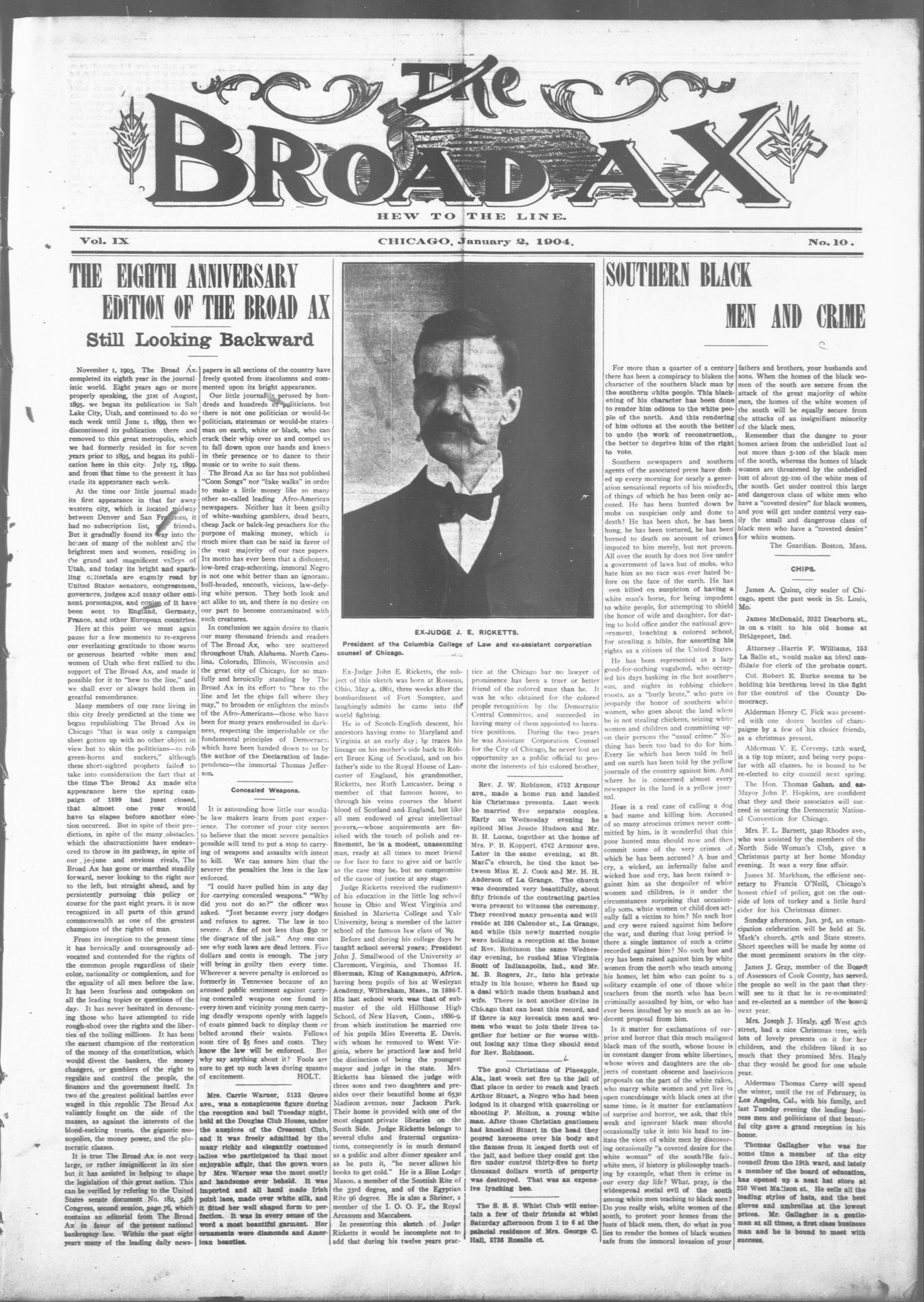
EX-JUDGE J. E. RICKETTS. President of the Columbia College of Law and ex-assistant corporation counsel of Chicago.
Ex-Judge John E. Ricketts, the subject of this sketch was born at Rosseau, Ohio, May 4. 1861, three weeks after the bombardment of Fort Sumpter, and laughingly admits he came into the world fighting.
He is of Scotch-English descent, his ancestors having come to Maryland and Virginia at an early day; he traces his lineage on his mother's side back to Robert Bruce King of Scotland, and on his father's side to the Royal House of Lancaster of England, his grandmother, Ricketts, nee Ruth Lancaster, being a member of that famous house, so through his veins courses the bluest blood of Scotland and England, but like all men endowed of great intellectual powers,—whose acquirements are finished with the touch of polish and refinement, he is a modest, unassuming man, ready at all times to meet friend or foe face to face to give aid or battle as the case may be, but no compromise of the cause of justice at any stage.
Judge Ricketts received the rudiments of his education in the little log school house in Ohio and West Virginia and finished in Marietta College and Yale University, being a member of the latter school of the famous law class of '80.
Before and during his college days he taught school several years; President John J. Smallwood of the University at Claremont, Virginia, and Thomas H. Sherman, King of Kangamayo, Africa, having been pupils of his at Wesleyan Academy, Wilbraham, Mass., in 1886-7. His last school work was that of submaster of the old Hillhouse High School, of New Haven, Conn., 1886-9, from which institution he married one of his pupils Miss Everetta E. Davis, with whom he removed to West Virginia, where he practiced law and held the distinction of being the youngest mayor and judge in the state. Mrs. Ricketts has blessed the judge with three sons and two daughters and presides over their beautiful home at 6530 Madison avenue, near Jackson Park. Their home is provided with one of the most elegant private libraries on the South Side. Judge Ricketts belongs to several clubs and fraternal organizations, consequently is in much demand as a public and after dinner speaker and as he puts it, "he never allows his books to get cold." He is a Blue Lodge Mason, a member of the Scottish Rite of the 33rd degree, and of the Egyptian Rite 96 degree. He is also a Shriner, a member of the I. O. O. F., the Royal Arcanum and Maccabees.
In presenting this sketch of Judge Ricketts it would be incomplete not to add that during his twelve years prac-
tice at the Chicago bar no lawyer of prominence has been a truer or better friend of the colored man than he. It was he who obtained for the colored people recognition by the Democratic Central Committee, and succeeded in having many of them appointed to lucrative positions. During the two years he was Assistant Corporation Counsel for the City of Chicago, he never lost an opportunity as a public official to promote the interests of his colored brother.
Rev. J. W. Robinson, 4752 Armour ave., made a home run and landed his Christmas presents. Last week he married five separate couples. Early on Wednesday evening he spliced Miss Jessie Hudson and Mr. B. H. Lucas, together at the home of Mrs. P. B. Kopperl, 4762 Armour ave. Later in the same evening, at St. Mark's church, he tied the knot between Miss E. J. Cook and Mr. H. H. Anderson of La Grange. The church was decorated very beautifully, about fifty friends of the contracting parties were present to witness the ceremony. They received many presents and will reside at 326 Calender st., La Grange, and while this newly married couple were holding a reception at the home of Rev. Robinson the same Wednesday evening, he rushed Miss Virginia Scott of Indianapolis, Ind., and Mr. M. B. Rogers, Jr., into his private study in his house, where he fixed up a deal which made them husband and wife. There is not another divine in Chicago that can beat this record, and if there is any lovesick men and women who want to join their lives together for better or for worse without losing any time they should send for Rev. Robinson.
The good Christians of Pineapple, Ala., last week set fire to the jail of that place in order to reach and lynch Arthur Stuart, a Negro who had been lodged in it charged with quarreling or shooting P. Melton, a young white man. After those Christian gentlemen had knocked Stuart in the head they poured kerosene over his body and the flames from it leaped forth out of the jail, and before they could get the fire under control thirty-five to forty thousand dollars worth of property was destroyed. That was an expensive lynching bee.
The S. S. S. Whist Club will entertain a few of their friends at whist Saturday afternoon from 1 to 6 at the palacial residence of Mrs. George C. Hall. 5736 Rosalie ct.
SOUTHERN BLACK
For more than a quarter of a century there has been a conspiracy to blaken the character of the southern black man by the southern white people. This blackening of his character has been done to render him odious to the white people of the north. And this rendering of him odious at the south the better to undo the work of reconstruction, the better to deprive him of the right to vote.
Southern newspapers and southern agents of the associated press have dished up every morning for nearly a generation sensational reports of his misdeeds, of things of which he has been only accused. He has been hunted down by mobs on suspicion only and done to death! He has been shot, he has been hung, he has been tortured, he has been burned to death on account of crimes imputed to him merely, but not proven. All over the south he does not live under a government of laws but of mobs, who hate him as no race was ever hated before on the face of the earth. He has been killed on suspicion of having a white man's horse, for being impudent to white people, for attempting to shield the honor of wife and daughter, for daring to hold office under the national government, teaching a colored school, for stealing a bible, for assorting his rights as a citizen of the United States.
He has been represented as a lazy good-for-nothing vagabond, who occupied his days basking in the hot southern sun, and nights in robbing chicken roosts, as a "burly brute," who puts in jeopardy the honor of southern white women, who goes about the land when he is not stealing chickens, seizing white women and children and committing upon their persons the "usual crime." Nothing has been too bad to do for him. Every lie which has been told in hell and on earth has been told by the yellow journals of the country against him. And where he is concerned almost every newspaper in the land is a yellow journal.
Here is a real case of calling a dog a bad name and killing him. Accused of so many atrocious crimes never committed by him, is it wonderful that this poor hunted man should now and then commit some of the very crimes of which he has been accused? A hue and cry, a wicked, an infernally false and wicked hue and cry, has been raised against him as the despoiler of white women and children, is it under the circumstances surprising that occasionally some white women or child does actually fall a victim to him? No such hue and cry were raised against him before the war, and during that long period is there a single instance of such a crime recorded against him? No such hue and cry has been raised against him by white women from the north who teach among his homes, let him who can point to a solitary example of one of those white teachers from the north who has been criminally assaulted by him, or who has ever been insulted by so much as an indecent proposal from him.
Is it matter for exclamations of surprise and horror that this much maligned black man of the south, whose house is in constant danger from white libertines, whose wives and daughters are the objects of constant obscene and lascivious proposals on the part of the white rakes, who marry white women and yet live in open concubinage with black ones at the same time, is it matter for exclamation of surprise and horror, we ask, that this weak and ignorant black man should occasionally take it into his head to imitate the vices of white men by discovering occasionally "a coveted desire for the white woman" of the south?Be fair, white men, if history is philosophy teaching by example, what then is crime in our every day life? What, pray, is the widespread social evil of the south among white men teaching to black men? Do you really wish, white women of the south, to protect your homes from the lusts of black men, then, do what in you lies to render the homes of black women safe from the immoral invasion of your
CK EN AND CRIME
fathers and brothers, your husbands and sons. When the homes of the black women of the south are secure from the attack of the great majority of white men, the homes of the white women of the south will be equally secure from the attacks of an insignificant minority of the black men.
Remember that the danger to your homes arises from the unbridled lust of not more than 5-100 of the black men of the south, whereas the homes of black women are threatened by the unbridled lust of about 95-100 of the white men of the south. Get under control this large and dangerous class of white men who have a "coveted desire" for black women, and you will get under control very easily the small and dangerous class of black men who have a "coveted desire" for white women. The Guardian. Boston. Mass.
CHIPS.
CHIPS.
James A. Quinn, city sealer of Chicago, spent the past week in St. Louis, Mo.
James McDonald, 3032 Dearborn st., is on a visit to his old home at Bridgeport, Ind.
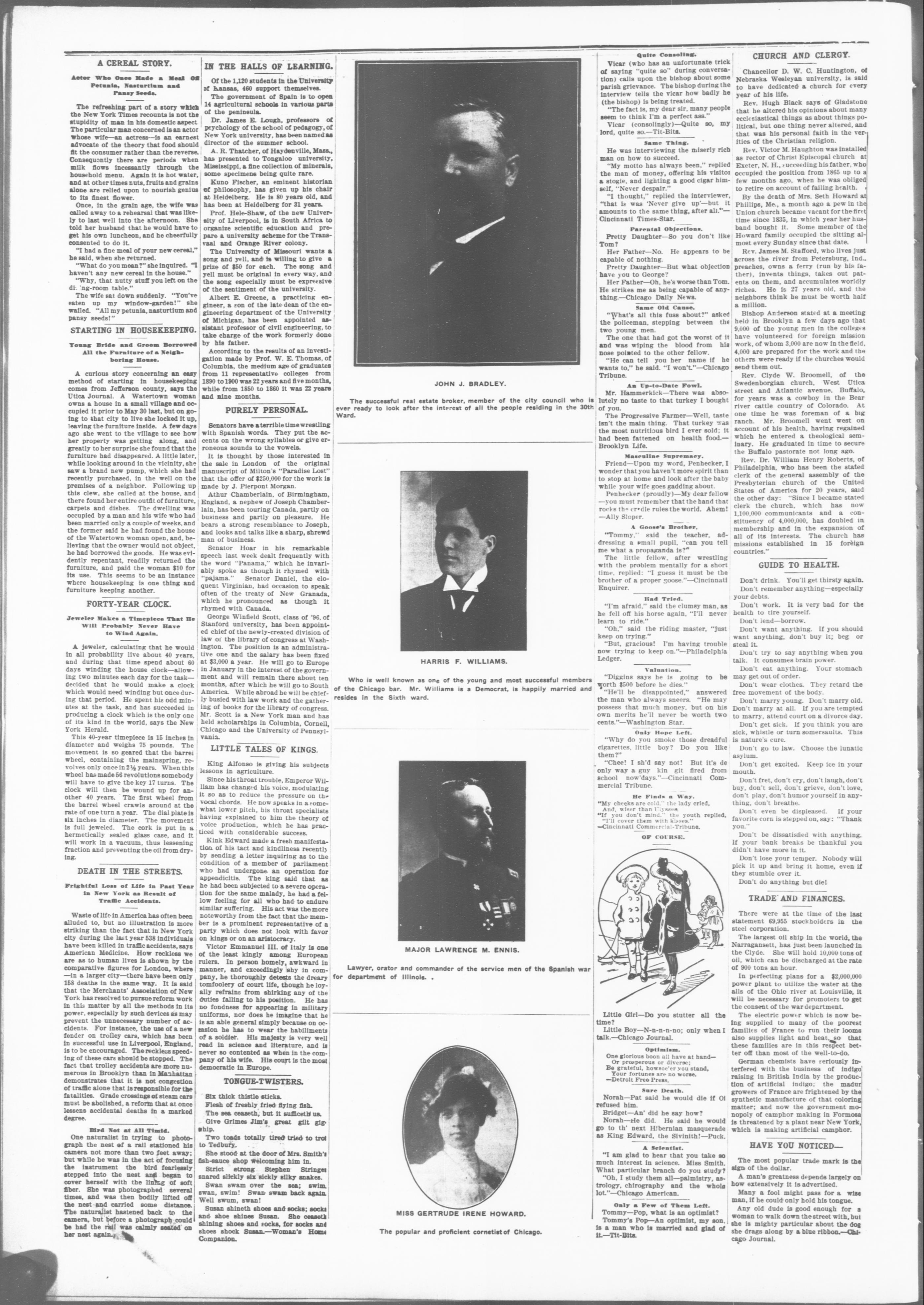
Attorney Harris F. Williams, 153 La Salle st., would make an ideal candidate for clerk of the probate court.
Col. Robert E. Burke seems to be holding his brethren level in the fight for the control of the County Democracy.
Alderman Henry C. Fick was presented with one dozen bottles of champagne by a few of his choice friends, as a christmas present. Alderman V. E. Cerveny, 12th ward, is a tip top mixer, and being very popular with all classes, he is bound to be re-elected to city council next spring. The Hon. Thomas Gahan, and Mayor John P. Hopkins, are confident that they and their associates will succeed in securing the Democratic National Convention for Chicago.
Mrs. F. L. Barnett, 3240 Rhodes ave. who was assisted by the members of the North Side Woman's Club, gave a Christmas party at her home Monday evening. It was a very fine affair. James M. Markham, the efficient secretary to Francis O'Neill, Chicago's honest chief of police, got on the outside of lots of turkey and a little hard cider for his Christmas dinner.
Sunday afternoon, Jan. 3rd, an emancipation celebration will be held at St. Mark's church, 47th and State streets. Short speeches will be made by some of the most prominent orators in the city. James J. Gray, member of the Board of Assessors of Cook County, has served the people so well in the past that they will see to it that he is re-nominated and re-elected as a member of the board next year.
Mrs. Joseph J. Healy, 436 West 47th street, had a nice Christmas tree, with lots of lovely presents on it for her children, and the children liked it so much that they promised Mrs. Healy that they would be good for one whole year. Alderman Thomas Carey will spend the winter, until the 1st of February, in Los Angeles, Cal., with his family, and last Tuesday evening the leading business men and politicians of that beautiful city gave a grand reception in his honor.
Thomas Gallagher who was for some time a member of the city council from the 19th ward, and lately a member of the board of education, has opened up a neat hat store at 250 West Madison st. He sells all the leading styles of hats, and the best gloves and umbrellas at the lowest prices. Mr. Gallagher is a gentleman at all times, a first class business man and he is bound to meet with success.
---
1904
A Good Beginning for the Year
"I BELIEVE in beginnning the New Year well," observed young Mr. Talkington, as he carved the turkey; "I am not superstitious, but—" "Yes," said his wife, demurely, "I remember how well we began it last year."
"You were to start on a trip that day, weren't you?" queried a guest.
"Yes, and the train, a new one just put on, left at 9:25. Ned said we should arise at five, thus beginning the New Year well and catching the train comfortably. He ordered a cab for 6:30, so it would reach the house at night:
TICKET OFFICE
BENARE OF
TICKET POCKET?
he did this over night and also wound up the cook's alarm clock. Ned duly waked me the next morning."
"With difficulty, dear."
"You waked me, anyhow, and your voice sounded like the dentist's saying. 'Step this way, please.' We hadn't heard the cook go down, and going to investigate I found her asleep. She said the alarm had gone off at 2:15, and she'd been up every half hour since to see if it was five. The voicano was awake then!"
"Oh!"
"When I returned, Ned pointed to the clock on the mantel and said it was 5:17, and we were late."
"Well?"
"Nothing—only that clock was a wedding present and so handsome that nobody ever expected it to keep time. Investigation proved it was just four, and we went back to bed for an hour. I was dreaming that the cook's New Year's resolve was that she would never leave me, when an awful noise waked me. The cook called that it was eight, and as breakfast had been ready three hours she thought she'd better call us!"
"But did you reach the station in time?"
"Yes. In my haste I did my hair with three pins and Ned put on his dress coat and odd shoes—we are both forgetful, you know. We scalded our throats with hot coffee and choked ourselves with overdone steak. The cabman, who had arrived at 6:30 sharp, demanded full pay for the time he had waited, else he'd deduct from the number of Ned's useful eyes!"
"Dreadful!" chorused the guests.
"While he did this the cook gave warning and told me that the catch on the back cellar window was loose.
"We were in time. To Ned's feverish inquiries the ticket agent calmly responded, 'Oh, yes, we had plenty of time—24 hours and 29 minutes!'"
"Why, how on earth could that happen?"
"The train, as I said, was a new one, put on for the first time on New Year's day, and—and the calendar to which the agent pointed told us that to-day was December thirty-first!"
ELISA ARMSTRONG
Their New Year's Dinner
"SO you went to Isabel's New Year's dinner?" said the brunette. "Lucky you! Tom and I dine with his mother on the first day of each year, listening to a discourse on economy which lasts from oysters to coffee."
"Knowing that all your bills will be in the next morning's mail, too," cried the blonde. "Yes, we accepted Isabel's invitation, and—"
"How do you like Isabel's new dress? Is it as cold as—"
"Her reception of a tardy guest? Not quite. I was ready at only ten minutes after the last moment at which we could safely start—and if that is not being punctual, I'd like to know what is! 'Eleven sharp!' Jack called to the driver, and then I looked up to see—Isabel's old house!"
"When the dinner was given to display the new one?"
"Exactly. After running a block through the snow in his thin shoes and nearly being arrested as an escaping thief, Jack got the driver to return. Once inside, he declared I hadn't told him Isabel had moved."
"Because he had kept on reading his paper while you told him about it?"
"Yes. I had even told him how the bathroom was tiled. But, dear, I had forgotten whether the new number was 250 or 2550."
"What on earth—"
"Jack threatened to go home and get dinner on the chafing dish—the cook had holiday. Then I remembered thoughtfully writing out the address while Mae and I discussed that new dressmaker, and putting it in Jack's waistcoat pocket, because I am so forgetful."
"How thoughtful."
"Jack gave the slip to the driver and promised him something awful to drive fast."
"Then your troubles were ended?" N—no. I had written down the ad.
```markdown
```
dress of the new dressmaker, instead of Isabel's."
"And you were no better off than before?"
"Worse. Jack's language was awful. I said we could just drive along the avenue until we came to the house, which I would recognize immediately."
"So—"
"He said we were invited to dinner, not to breakfast. Then he asked the driver if he happened to know where Mrs. De Style lived."
"He knew. It was about six blocks from our house. Stupid of Jack not to have asked sooner. And he seemed to think the whole affair my fault!"
"Well, you reached Isabel's after all."
"Ye-es, in time for the salad. And—and I really should not like to repeat the things our hostess said when she had a chance to speak to me alone."
A New Year Conquest
By
CHARLES MOREAU HARGER
A Story of the Great Southwest
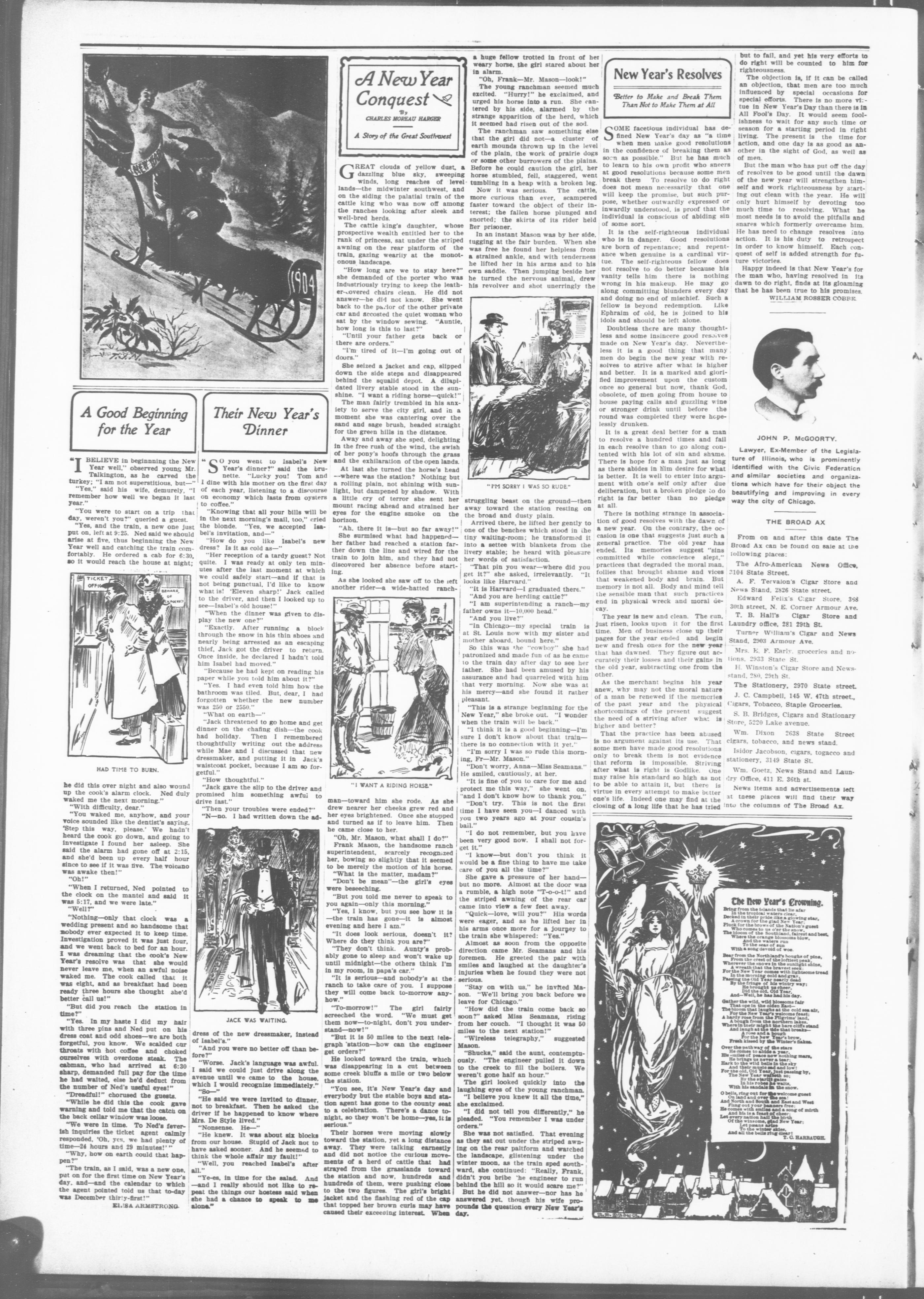
GREAT clouds of yellow dust, a dazzling blue sky, sweeping winds, long reaches of level lands—the midwinter southwest, and on the siding the palatial train of the cattle king who was now off among the ranches looking after sleek and well-bred herds. The cattle king's daughter, whose prospective wealth entitled her to the rank of princess, sat under the striped awning on the rear platform of the train, gazing weariiy at the monotonous landscape.
"How long are we to stay here?" she demanded of the porter who was industriously trying to keep the leather-covered chairs clean. He did not answer—he did not know. She went back to the parlor of the other private car and accosted the quiet woman who sat by the window sewing. "Auntie, how long is this to last?"
"Until your father gets back or there are orders."
"I'm tired of it—I'm going out of doors."
She seized a jacket and cap, slipped down the side steps and disappeared behind the squalid depot. A dilapidated livery stable stood in the sunshine. "I want a riding horse—quick!"
The man fairly trembled in his anxiety to serve the city girl, and in a moment she was cantering over the sand and sage brush, headed straight for the green hills in the distance.
Away and away she sped, delighting in the free rush of the wind, the swish of her pony's hoofs through the grass and the exhilaration of the open lands.
At last she turned the horse's head--where was the station? Nothing but a rolling plain, not shining with sunlight, but dampened by shadow. With a little cry of terror she sent her mount racing ahead and strained her eyes for the engine smoke on the horizon.
"Ah, there it is—but so far away!"
She surmised what had happened—her father had reached a station farther down the line and wired for the train to join him, and they had not discovered her absence before starting.
As she looked she saw off to the left another rider—a wide-hatted ranch-
A man and a woman stand in front of a wooden fence. The man is wearing a cowboy hat and a long coat, while the woman is wearing a long dress with a ruffled skirt. They are facing each other, and the woman appears to be asking the man for a drink. In the background, there is a building with a large window.
"I WANT A RIDING HORSE."
man—toward him she rode. As she drew nearer her cheeks grew red and her eyes brightened. Once she stopped and turned as if to leave him. Then he came close to her.
"Oh, Mr. Mason, what shall I do?"
Frank Mason, the handsome ranch superintendent, scarcely recognized her, bowing so slightly that it seemed to be merely the motion of his horse.
"What is the matter, madam?"
"Don't be mean"—the girl's eyes were beseeching.
"But you told me never to speak to you again—only this morning."
"Yes, I know, but you see how it is—the train has gone—it is almost evening and here I am."
"It does look serious, doesn't it? Where do they think you are?"
"They don't think. Aunty's probably gone to sleep and won't wake up until midnight—the others think I'm in my room, in papa's car."
"It is serious—and nobody's at the ranch to take care of you. I suppose they will come back to-morrow anyhow."
"To-morrow!" The girl fairly screeched the word. "We must get them now—to-night, don't you understand—now!"
"But it is 50 miles to the next telegraph station—how can the engineer get orders?"
He looked toward the train, which was disappearing in a cut between some creek bluffs a mile or two below the station.
"You see, it's New Year's day and everybody but the stable boys and station agent has gone to the county seat to a celebration. There's a dance tonight, so they won't be home—yes, it is serious."
Their horses were moving slowly toward the station, yet a long distance away. They were talking earnestly and did not notice the curious movements of a herd of cattle that had strayed from the grasslands toward the station and now, hundreds and hundreds of them, were pushing close to the two figures. The girl's bright jacket and the flashing red of the cap that topped her brown curls may have caused their exceeding interest. When
a huge fellow trotted in front of her weary horse, the girl stared about her in alarm. "Oh. Frank—Mr. Mason—look!"
The young ranchman seemed much excited. "Hurry!" he exclaimed, and urged his horse into a run. She cantered by his side, alarmed by the strange apparition of the herd, which it seemed had risen out of the sod.
The ranchman saw something else that the girl did not—a cluster of earth mounds thrown up in the level of the plain, the work of prairie dogs or some other burrowers of the plains. Before he could caution the girl, her horse stumbled, fell, staggered, went tumbling in a heap with a broken leg.
Now it was serious. The cattle, more curious than ever, scampered faster toward the object of their interest; the fallen horse plunged and snorted; the skirts of its rider held her prisoner. In an instant Mason was by her side, tugging at the fair burden. When she was free he found her helpless from a strained ankle, and with tenderness he lifted her in his arms and to his own saddle. Then jumping beside her he turned the nervous animal, drew his revolver and shot unerringly the
TIME
"IM SORRY I WAS SO RUDE."
struggling beast on the ground—then away toward the station resting on the broad and dusty plain.
Arrived there, he lifted her gently to one of the benches which stood in the tiny waiting-room; he transformed it into a settee with blankets from the livery stable; he heard with pleasure her words of satisfaction.
"That pin you wear—where did you get it?" she asked, irrelevantly. "It looks like Harvard."
"It is Harvard—I graduated there."
"And you are herding cattle?"
"I am superintending a ranch—my father owns it—10,000 head."
"And you live?"
"In Chicago—my special train is at St. Louis now with my sister and mother aboard, bound here."
So this was the "cowboy" she had patronized and made fun of as he came to the train day after day to see her father. She had been amused by his assurance and had quarreled with him that very morning. Now she was at his mercy—and she found it rather pleasant.
"This is a strange beginning for the New Year," she broke out. "I wonder when the train will be back."
"I think it is a good beginning—I'm sure I don't know about that train—there is no connection with it yet."
"I'm sorry I was so rude this morning, Fr—Mr. Mason."
"Don't worry, Anna—Miss Seamans." He smiled, cautiously, at her.
"It is fine of you to care for me and protect me this way," she went on, "and I don't know how to thank you."
"Don't try. This is not the first time I have seen you—I danced with you two years ago at your cousin's bail."
"I do not remember, but you have been very good now. I shall not forget it."
"I know—but don't you think it would be a fine thing to have me take care of you all the time?" She gave a pressure of her hand—but no more. Almost at the door was a rumble, a high note "T-o-o-t!" and the striped awning of the rear car came into view a few feet away. "Quick—love, will you?" His words were eager, and as he lifted her in his arms once more for a journey to the train she whispered: "Yes." Almost as soon from the opposite direction came Mr. Seamans and his foremen. He greeted the pair with smiles and laughed at the daughter's injuries when he found they were not serious.
"Stay on with us," he invited Mason. "We'll bring you back before we leave for Chicago."
"How did the train come back so soon?" asked Miss Seamans, rising from her couch. "I thought it was 50 miles to the next station!"
"Wireless telegraphy," suggested Mason.
"Shucks," said the aunt, contemptuously. "The engineer pulled it down to the creek to fill the boilers. We weren't gone half an hour."
The girl looked quickly into the laughing eyes of the young ranchman.
"I believe you knew it all the time," she exclaimed.
"I did not tell you differently," he pleaded. "You remember I was under orders."
She was not satisfied. That evening as they sat out under the striped awning on the rear paltform and watched the landscape, glistening under the winter moon, as the train sped southward, she continued: "Really, Frank, didn't you bribe 'he engineer to run behind the hill so it would scare me?" But he did not answer—nor has he answered yet, though his wife propounds the question every New Year's day.
The New Year's Crowning.
Bring from the islands that lie afar
In the tropical waters clear.
Decked in their pride like a glowing star,
A crown for the glad New Year;
Pluck for the brows of the Nation's guest
Who comes to us o'er the snow,
The bloom of the Southland, fairest and best,
Where the orange blossoms blow,
And the waters run
To the seas of sun
With a song devoid of woe.
Bear from the Northland's boughs of pine,
From the crest of the loftiest peak,
Wherever the snows in the sunlight shine,
A wreath that the bravest seek:
For the New Year comes with lightsome tread
In the morning cold and gray,
Passing the Old Year nearly dead
By the fringe of his wintry way;
He brought us cheer,
Did the old, Old Year,
And—Well, he has had his day.
Gather the wild, wild blossoms fair
That ope in the olden East—
The bloom that laughs at the cold sea air,
For the New Year's welcome feast;
A hardy rose from the Pilgrims' land,
A bough from the northern lakes.
Where in their might the bare cliff's stand
And laugh at his side that breaks—
A rose and a bough,
For the New Year's brow.
Fresh kissed by the Winter's flakes.
Over the pathway of the stars
He comes to abide a year,
His smiles of peace now nothing mars,
He brings us never a tear;
Hark to the wild bells in the sky
And their music and low!
For the old, Old Year, just passing by,
The New Year weeth so;
By the star's gaze,
In his robes he waits,
With his sandals in the snow.
O bells, ring out for the welcome guest
On land and over the sea:
And North and South and East and West
Fing out your banners free;
He comes with smiles and a song of mirth
And his is a feast of cheer;
Let every nation hail the birth
Of the winsome, glad New Year;
Let pass us sails
To the winter sides,
And all the bells ring clear!
T. C. HARBAUGH.
Better to Make and Break Them Than Not to Make Them at All
SOME facetious individual has defined New Year's day as "a time when men make good resolutions in the confidence of breaking them as soon as possible." But he has much to learn to his own profit who sneers at good resolutions because some men break them To resolve to do right does not mean necessarily that one will keep the promise, but such purpose, whether outwardly expressed or inwardly understood, is proof that the individual is conscious of abiding sin of some sort.
It is the self-righteous individual who is in danger. Good resolutions are born of repentance; and repentance when genuine is a cardinal virtue. The self-righteous fellow does not resolve to do better because his vanity tells him there is nothing wrong in his makeup. He may go along committing blunders every day and doing no end of mischief. Such a fellow is beyond redemption. Like Ephraim of old, he is joined to his idols and should be left alone.
Doubtless there are many thoughtless and some insincere good resolves made on New Year's day. Nevertheless it is a good thing that many men do begin the new year with resolves to strive after what is higher and better. It is a marked and glorified improvement upon the custom once so general but now, thank God, obsolete, of men going from house to house paying calls and guzzling wine or stronger drink until before the round was completed they were hopelessly drunken.
It is a great deal better for a man to resolve a hundred times and fail in each resolve than to go along contented with his lot of sin and shame. There is hope for a man just as long as there abides in him desire for what is better. It is well to enter into argument with one's self only after due deliberation, but a broken pledge to do right is far better than no pledge at all.
There is nothing strange in association of good resolves with the dawn of a new year. On the contrary, the occasion is one that suggests just such a general practice. The old year has ended. Its memories suggest "sins committed while conscience slept," practices that degraded the moral man, follies that brought shame and vices that weakened body and brain. But memory is not all. Body and mind tell the sensible man that such practices end in physical wreck and moral decay.
The year is new and clean. The sun, just risen, looks upon it for the first time. Men of business close up their pages for the year ended and begin new and fresh ones for the new year that has dawned. They figure out accurately their losses and their gains in the old year, subtracting one from the other.
As the merchant begins his year anew, why may not the moral nature of a man be renewed if the memories of the past year and the physical shortcomings of the present suggest the need of a striving after what is higher and better?
That the practice has been abused is no argument against its use. That some men have made good resolutions only to break them is not evidence that reform is impossible. Striving after what is right is Godlike. One may raise his standard so high as not to be able to attain it, but there is virtue in every attempt to make better one's life. Indeed one may find at the closing of a long life that he has tried
but to fail, and yet his very efforts to do right will be counted to him for righteousness. The objection is, if it can be called an objection, that men are too much influenced by special occasions for special efforts. There is no more virtue in New Year's Day than there is in All Fool's Day. It would seem foolishness to wait for any such time or season for a starting period in right living. The present is the time for action, and one day is as good as another in the sight of God, as well as of men.
But the man who has put off the day of resolves to be good until the dawn of the new year will strengthen himself and work righteousness by starting out clean with the year. He will only hurt himself by devoting too much time to resolving. What he most needs is to avoid the pitfalls and snares which formerly overcame him. He has need to change resolves into action. It is his duty to retrospect in order to know himself. Each conquest of self is added strength for future victories.
Happy indeed is that New Year's for the man who, having resolved in its dawn to do right, finds at its gloaming that he has been true to his promises.
WILLIAM ROSSER COBRE
```markdown
```
JOHN P. McGOORTY. Lawyer, Ex-Member of the Legislature of Illinois, who is prominently identified with the Civic Federation and similar societies and organizations which have for their object the beautifying and improving in every way the city of Chicago.
THE BROAD AX
From on and after this date The Broad Ax can be found on sale at the following places:
The Afro-American News Office, 2104 State Street.
A. F. Tervalon's Cigar Store and News Stand, 2826 State street.
Edward Felix's Cigar Store, 368 30th street, N. E. Corner Armour Ave.
T. B. Hall's Cigar Store and Laundry office, 281 29th St.
Turner William's Cigar and News Stand, 2903 Armour Ave.
Mrs. E. F. Early, groceries and notions, 2933 State St.
H. Winston's Cigar Store and Newsstand, 280, 29th St.
The Stationery, 2970 State street.
J. C. Campbell, 145 W. 47th street.,
Cigars, Tobacco, Staple Groceries.
S. B. Bridges, Cigars and Stationary
Store, 5220 Lake avenue.
Wm. Dixon 2638 State Street
cigars, tobacco, and news stand.
Isidor Jacobson, cigars, togacco and
stationery, 3149 State St.
Wm. Goetz, News Stand and Laundry Office, 411 E. 36th st.
News items and advertisements left at these places will find their way into the columns of The Broad Ax
REPORT OF HER BESCUTES A SHORT SKETCH OF HER LIFE, HER STRUGGLES, AND SUBMITS AN INTERESTING MRS. ELIZABETH McDONALD WRIE AND REFORM WORK FOR THE PAST YEAR.
Julius F. Taylor, Editor of "The assistance of generous people who made donations of clothing. I dis
Being asked to prepare my report with a short resume of my life I appreciate the opportunity it gives me to answer the oft repeated question as to why I took up my present work. At the age of $2\frac{1}{2}$ years I was taken from my birthplace, Warrington, Va., to Alexandria, Va., where I remained until I was 14. Having a desire to assist in the support of my widowed mother I went to Baltimore, Md., where I could earn a larger salary.
At the age of 19 I was married to Murray Coleman of Baltimore. God gave to me one daughter by this marriage, shortly after whose birth I became a widow. About 17 years ago I came to Chicago and shortly after was married to James McDonald of Louisville, Ky. I have always had a desire for missionary work, having been converted between the ages of 6 and 7, but having always to work I never had the opportunity of one day in school. Eight years ago the longed for opportunity to do missionary work came, and being called and anointed by God's Holy Spirit to go into the highways and hedges and compel men and women to come in, I answered—yes. Lord, I will.
After three years of constant work the Lord sent sorrow into my life by the death of my dear mother. Then another three years and death again visited me and took away a much beloved daughter. Through it all God's sustaining hand ever kept the reins of my life, and I attribute my success to a life absolutely dedicated to Him. From no club, church, court, or, anywhere do I receive one cent of salary. My home is open at all times, day and night to receive the suffering of any nationality.
During the past year my work has been full of difficulties as usual, but at the same time I feel more than repaid by the reward which has come to those whom it has been my pleasure to serve.
Mary Ann
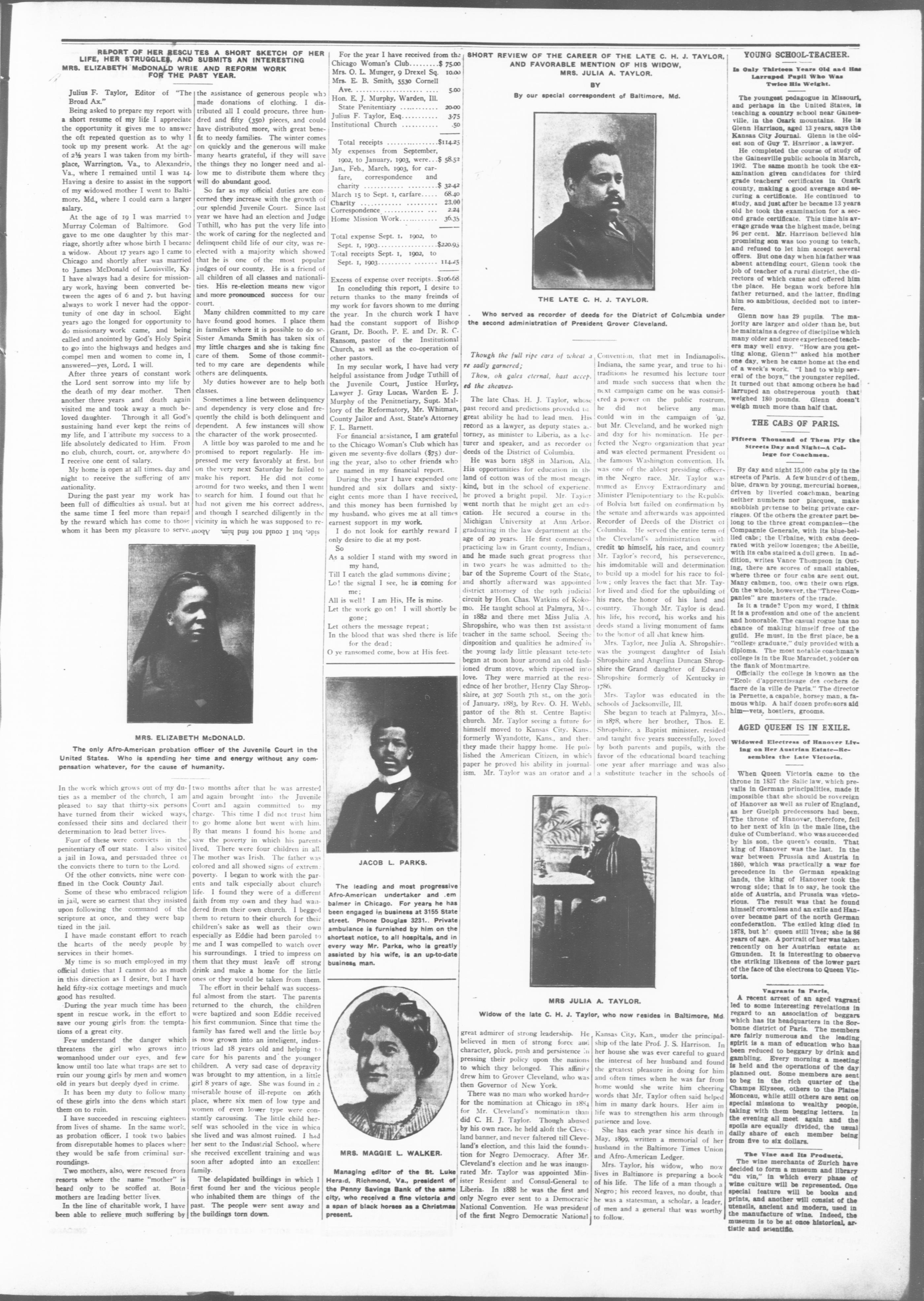
MRS. ELIZABETH McDONALD. The only Afro-American probation officer of the Juvenile Court in the United States. Who is spending her time and energy without any compensation whatever, for the cause of humanity.
In the work which grows out of my duties as a member of the church, I am pleased to say that thirty-six persons have turned from their wicked ways, confessed their sins and declared their determination to lead better lives.
Four of these were convicts in the penitentiary of our state. I also visited a jail in Iowa, and persuaded three of the convicts there to turn to the Lord.
Of the other convicts, nine were confined in the Cook County Jail.
Some of these who embraced religion in jail, were so earnest that they insisted upon following the command of the scripture at once, and they were baptized in the jail.
I have made constant effort to reach the hearts of the needy people by services in their homes.
My time is so much employed in my official duties that I cannot do as much in this direction as I desire, but I have held fifty-six cottage meetings and much good has resulted.
During the year much time has been spent in rescue work, in the effort to save our young girls from the temptations of a great city. Few understand the danger which threatens the girl who grows into womanhood under our eyes, and few know until too late what traps are set to ruin our young girls by men and women old in years but deeply dyed in crime. It has been my duty to follow many of these girls into the dens which start them on to ruin.
I have succeeded in rescuing eighteen from lives of shame. In the same work, as probation officer, I took two babies from disreputable homes to places where they would be safe from criminal surroundings.
Two mothers, also, were rescued from resorts where the name "mother" is heard only to be scoffed at. Botn mothers are leading better lives.
In the line of charitable work, I have been able to relieve much suffering by
the assistance of generous people who made donations of clothing. I distributed all I could procure, three hundred and fifty (350) pieces, and could have distributed more, with great benefit to needy families. The winter comes on quickly and the generous will make many hearts grateful, if they will save the things they no longer need and allow me to distribute them where they will do abundant good.
So far as my official duties are concerned they increase with the growth of our splendid Juvenile Court. Since last year we have had an election and Judge Tuthill, who has put the very life into the work of caring for the neglected and delinquent child life of our city, was re-elected with a majority which showed that he is one of the most popular judges of our county. He is a friend of all children of all classes and nationalities. His re-election means new vigor and more pronounced success for our court.
Many children committed to my care have found good homes. I place them in families where it is possible to do so. Sister Amanda Smith has taken six of my little charges and she is taking fine care of them. Some of those committed to my care are dependents while others are delinquents.
My duties however are to help both classes.
Sometimes a line between delinquency and dependency is very close and frequently the child is both delinquent and dependent. A few instances will show the character of the work prosecuted.
A little boy was paroled to me and he promised to report regularly. He impressed me very favorably at first, but on the very next Saturday he failed to make his report. He did not come around for two weeks, and then I went to search for him. I found out that he had not given me his correct address, and though I searched diligently in the vicinity in which he was supposed to reoqy
two months after that he was arrested and again brought into the Juvenile Court and again committed to my charge. This time I did not trust him to go home alone but went with him. By that means I found his home and saw the poverty in which his parents lived. There were four children in all. The mother was Irish. The father was colored and all showed signs of extrem poverty. I began to work with the parents and talk especially about church life. I found they were of a different faith from my own and they had wandered from their own church. I begged them to return to their church for their children's sake as well as their own especially as Eddie had been paroled to me and I was compelled to watch over his surroundings. I tried to impress on them that they must leave off strong drink and make a home for the little ones or they would be taken from them.
The effort in their behalf was successful almost from the start. The parents returned to the church, the children were baptized and soon Eddie received his first communion. Since that time the family has fared well and the little boy is now grown into an intelligent, industrious lad 18 years old and helping to care for his parents and the younger children. A very sad case of depravity was brought to my attention, in a little girl 8 years of age. She was found in a miserable house of ill-repute on 26th place, where six men of low type and women of even lower type were constantly carousing. The little child herself was schooled in the vice in which she lived and was almost ruined. I had her sent to the Industrial School, where she received excellent training and was soon after adopted into an excellent family.
The delapidated buildings in which I first found her and the vicious people who inhabited them are things of the past. The people were sent away and the buildings torn down.
For the year I have received from the
Chicago Woman's Club.....$ 75.00
Mrs. O. L. Munger, 9 Drexel Sq. 10.00
Mrs. E. B. Smith, 5530 Cornell
Ave. ..... 5.00
Hon. E. J. Murphy, Warden, Ill.
State Penitentiary ..... 20.00
Julius F. Taylor, Esq..... 3.75
Institutional Church ..... .50
Total receipts .....$114.25
My expenses from September,
charity ..... $ 32.42
March 15 to Sept. 1, carfare ..... 68.40
Charity ..... 23.00
Correspondence ..... 2.24
Home Mission Work ..... 36.35
Total expense Sept. 1, 1902, to
Total expense Sept. 1, 1922,
Sept. 1, 1903.....$220.95
Total receipts Sept. 1, 1902, to
Excess of expense over receipts...$100.08
In concluding this report, I desire to return thanks to the many freinds of my work for favors shown to me during the year. In the church work I have had the constant support of Bishop Grant, Dr. Booth, P. E. and Dr. R. C. Ransom, pastor of the Institutional Church, as well as the co-operation of other pastors.
In my secular work, I have had very helpful assistance from Judge Tuthill of the Juvenile Court, Justice Hurley, Lawyer J. Gray Lucas, Warden E. J. Murphy of the Penitnetiary, Supt. Mallory of the Reformatory, Mr. Whitman, County Jailor and Asst. State's Attorney F. L. Barnett. For financial assistance, I am grateful to the Chicago Woman's Club which has given me seventy-five dollars ($75) during the year, also to other friends who are named in my financial report.
During the year I have expended one hundred and six dollars and sixty-eight cents more than I have received, and this money has been furnished by my husband, who gives me at all times earnest support in my work.
I do not look for earthly reward I only desire to die at my post.
So
As a soldier I stand with my sword in my hand,
Till I catch the glad summons divine;
Lo! the signal I see, he is coming for me;
All is well! I am His, He is mine.
Let the work go on! I will shortly be gone;
Let others the message repeat;
In the blood that was shed there is life for the dead;
O ye ransomed come, bow at His feet.
D
JACOB L. PARKS.
The leading and most progressive Afro-American undertaker and embalmer in Chicago. For years he has been engaged in business at 3155 State street. Phone Douglas 3231.. Private ambulance is furnished by him on the shortest notice, to all hospitals, and in every way Mr. Parks, who is greatly assisted by his wife, is an up-to-date business man.
[Image of a woman with dark hair styled in waves, wearing a light-colored dress with a necklace.]
MRS. MAGGIE L. WALKER
Managing editor of the St. Luke Herald, Richmond, Va., president of the Penny Savings Bank of the same city, who received a fine victoria and a span of black horses as a Christmas present.
REVIEW OF THE CAREER OF THE LATE C. H. J. TAYLOR, AND FAVORABLE MENTION OF HIS WIDOW, MRS. JULIA A. TAYLOR.
By our special correspondent of Baltimore, Md.
M.
THE LATE C. H. J. TAYLOR. Who served as recorder of deeds for the District of Columbia under the second administration of President Grover Cleveland.
Though the full ripe ears of wheat a re sadly garnered;
Thou, oh gales eternal, hast accepted the sheaves.
The late Chas. H. J. Taylor, whose past record and predictions provided to great ability he had to lead men. His record as a lawyer, as deputy states attorney, as minister to Liberia, as a lecturer and speaker, and as recorder on deeds of the District of Columbia.
He was born 1858 in Marion, Ala. His opportunities for education in the land of cotton was of the most meagro kind, but in the school of experience he proved a bright pupil. Mr. Taylor went north that he might get an education. He secured a course in the Michigan University at Ann Arbor graduating in the law department at the age of 20 years. He first commenced practicing law in Grant county, Indiana, and he made such great progress that in two years he was admitted to the bar of the Supreme Court of the State, and shortly afterward was appointed district attorney of the 19th judicial circuit by Hon. Chas. Watkins of Kokomo. He taught school at Palmyra, Mo. in 1882 and there met Miss Julia A. Shropshire, who was then 1st assistant teacher in the same school. Seeing the disposition and qualities he admired in the young lady little pleasant tete-tete began at noon hour around an old fashioned drum stove, which ripened into love. They were married at the residence of her brother, Henry Clay Shropshire, at 307 South 7th st., on the 30th of January, 1883, by Rev. O. H. Webb pastor of the 8th st. Centre Baptist church. Mr. Taylor seeing a future for himself moved to Kansas City, Kans., formerly Wyandotte, Kans., and there they made their happy home. He published the American Citizen, in which paper he proved his ability in journalism. Mr. Taylor was an orator and a
THE WOMEN'S HISTORY
MRS JULIA A. TAYLOR. Widow of the late C. H. J. Taylor, who now resides in Baltimore, Md
great admirer of strong leadership. He believed in men of strong force and character, pluck, push and persistence in pressing their policy upon the nations to which they belonged. This affinity drew him to Grover Cleveland, who was then Governor of New York.
There was no man who worked harder for the nomination at Chicago in 1884 for Mr. Cleveland's nomination than did C. H. J. Taylor. Though abused by his own race, he held aloft the Cleveland banner, and never faltered till Cleveland's election, and this laid the foundation for Negro Democracy. After Mr. Cleveland's election and he was inaugurated Mr. Taylor was appointed Minister Resident and Consul-General to Liberia. In 1888 he was the first and only Negro ever sent to a Democratic National Convention. He was president of the first Negro Democratic National
Convention, that met in Indianapolis, Indiana, the same year, and true to his traditions he resumed his lecture tour and made such success that when the next campaign came on he was considered a power on the public rostrum he did not believe any man could win in the campaign of 1921 but Mr. Cleveland, and he worked night and day for his nomination. He perfected the Negro organization that year and was elected permanent President of the famous Washington convention. He was one of the ablest presiding officers in the Negro race. Mr. Taylor was named as Envoy Extraordinary and Minister Plenipotentiary to the Republic of Bolivia but failed on confirmation by the senate and afterwards was appointed Recorder of Deeds of the District of Columbia. He served the entire term of the Cleveland's administration with credit to himself, his race, and country. Mr. Taylor's record, his perseverance, his imdomitable will and determination to build up a model for his race to follow; only leaves the fact that Mr. Taylor lived and died for the upbuilding of his race, the honor of his land and country. Though Mr. Taylor is dead his life, his record, his works and his deeds stand a living monument of fame to the honor of all that knew him.
Mrs. Taylor, nee Julia A. Shropshire was the youngest daughter of Isiah Shropshire and Angelina Duncan Shropshire the Grand daughter of Edward Shropshire formerly of Kentucky in 1786. Mrs. Taylor was educated in the schools of Jacksonville, Ill.
She began to teach at Palmyra, Mo.. in 1878, where her brother, Thos. E. Shropshire, a Baptist minister, resided and taught five years successfully, loved by both parents and pupils, with the favor of the educational board teaching one year after marriage and was also a substitute teacher in the schools of
Kansas City, Kan., under the principalship of the late Prof. J. S. Harrison. In her house she was ever careful to guard the interest of her husband and found the greatest pleasure in doing for him and often times when he was far from home would she write him cheering words that Mr. Taylor often said helped him in many dark hours. Her aim in life was to strengthen his arm through patience and love. She has each year since his death in May, 1899, written a memorial of her husband in the Baltimore Times Union and Afro-American Ledger.
Mrs. Taylor, his widow, who now lives in Baltimore is preparing a book of his life. The life of a man though a Negro; his record leaves, no doubt, that he was a statesman, a scholar, a leader, of men and a general that was worthy to follow.
YOUNG SCHOOL-TEACHER.
Is Only Thirteen Years Old and Has Larruped Pupil Who Was Twice His Weight.
The youngest pedagogue in Missouri, and perhaps in the United States, is teaching a country school near Gainesville, in the Ozark mountains. He is Glenn Harrison, aged 13 years, says the Kansas City Journal. Glenn is the oldest son of Guy T. Harrison, a lawyer.
He completed the course of study of the Gainesville public schools in March, 1902. The same month he took the examination given candidates for third grade teachers' certificates in Ozark county, making a good average and securing a certificate. He continued to study, and just after he became 13 years old he took the examination for a second grade certificate. This time his average grade was the highest made, being 96 per cent. Mr. Harrison believed his promising son was too young to teach, and refused to let him accept several offers. But one day when his father was absent attending court, Glenn took the job of teacher of a rural district, the directors of which came and offered him the place. He began work before his father returned, and the latter, finding him so ambitious, decided not to interfere.
Glenn now has 29 pupils. The majority are larger and older than he, but he maintains a degree of discipline which many older and more experienced teachers may well envy. "How are you getting along, Glenn?" asked his mother one day, when he came home at the end of a week's work. "I had to whip several of the boys," the youngster replied. It turned out that among others he had larruped an obstreperous youth that weighed 180 pounds. Glenn doesn't weigh much more than half that.
THE CABS OF PARIS.
Fifteen Thousand of Them Ply the Streets Day and Night-A College for Coachmen.
By day and night 15,000 cabs ply in the streets of Paris. A few hundred of them, blue, drawn by young, mercurial horses, driven by liveried coachman, bearing neither numbers nor placques, make snobbish pretense to being private carriages. Of the others the greater part belong to the three great companies—the Compagnie Generale, with its blue-bellied cabs; the Urbaine, with cabs decorated with yellow lozenges; the Abeille, with its cabs stained a dull green. In addition, writes Vance Thompson in Outing, there are scores of small stables, where three or four cabs are sent out. Many cabmen, too, own their own rigs. On the whole, however, the "Three Companies" are masters of the trade.
Is it a trade? Upon my word, I think it is a profession and one of the ancient and honorable. The casual rogue has no chance of making himself free of the guild. He must, in the first place, be a "college graduate," duly provided with a diploma. The most notable coachman's college is in the Rue Marcadet, yolder on the flank of Montmartre.
Officially the college is known as the "Ecole d'apprentissage des cochers de flacier de la ville de Paris." The director is Pernette, a capable, horsey man, a famous whip. A half dozen professors aid him—vets, hostlers, grooms.
AGED QUEEN IS IN EXILE.
Widowed Electress of Hanover Living on Her Austrian Estate—Resembles the Late Victoria.
When Queen Victoria came to the throne in 1837 the Salic law, which prevails in German principalities, made it impossible that she should be sovereign of Hanover as well as ruler of England, as her Guelph predecessors had been. The throne of Hanover, therefore, fell to her next of kin in the male line, the duke of Cumberland, who was succeeded by his son, the queen's cousin. That king of Hanover was the last. In the war between Prussia and Austria in 1860, which was practically a war for precedence in the German speaking lands, the king of Hanover took the wrong side; that is to say, he took the side of Austria, and Prussia was victorious. The result was that he found himself crownless and an exile and Hanover became part of the north German confederation. The exiled king died in 1878, but h' queen still lives; she is 86 years of age. A portrait of her was taken rencently on her Austrian estate at Gmunden. It is interesting to observe the striking likeness of the lower part of the face of the electress to Queen Victoria.
Vagrants in Paris.
A recent arrest of an aged vagrant led to some interesting revelations in regard to an association of beggars which has its headquarters in the Sorbonne district of Paris. The members are fairly numerous and the leading spirit is a man of education who has been reduced to beggary by drink and gambling. Every morning a meeting is held and the operations of the day planned out. Some members are sent to beg in the rich quarter of the Champs Elysees, others to the Plaine Monceau, while still others are sent on special missions to wealthy people, taking with them begging letters. In the evening all meet again and the spoils are equally divided, the usual daily share of each member being from five to six dollars.
The Vine and Its Products.
The wine merchants of Zurich have decided to form a museum and library "du vin," in which every phase of wine culture will be represented. One special feature will be books and prints, and another will consist of the utensils, ancient and modern, used in the manufacture of wine. Indeed, the museum is to be at once historical, artistic and scientific.
PUBLISHED WEEKLY.
Will promulgate and at all times uphold the true principles of Democracy, but Catholice, Protestants, Priest, Infidel, Farmers, Single Taxes, Republicans, Knights of Labor, or any one else can have their say, so long as their language is proper and responsibility is fixed.
The Broad Ax is a newspaper whose platform is broad enough for all, ever claiming the editorial right to speak its own mind.
Local communications will receive attention. Write only on one side of the paper.
Subscriptions must be paid in advance.
One Year ..... $2.00
Six Months ..... 1.00
Advertising rates made known on application.
Address all communications to
JULIUS F. TAYLOR, Editor and Publisher. Entered at the Post Office at Chicago Ill., as Second-class Matter.
Chips.
Mr. and Mrs. J. Hookley Smiley, 6748 Evans ave., gave a family dinner in honor of their daughter, who was christened Hookley, Etta, last Sunday by Rev. Lealtad. Many handsome presents were given the young one. Ex-Alderman James J. McCormick, who stands a splendid chance of breaking into the city council next spring from the 5th ward, is presenting his friends and loyal supporters with an elegant leather card case as a New Year's present.
Recently the Swedish M. E. church, 48th and Dearborn st., caught on fire, the flames were quickly extinguished by Morris O'Day, Wm. O. Roeske and Texas, of Engine Company No. 50, who are the three best looking men in the Department, and after they succeeded in smothering the flames the young ladies felt so grateful to them that they jumped in and baked all the pankakes the three handsome firemen could eat.
One of the most terrible catastrophes that has shocked civilization occurred Wednesday afternoon at the Iroquois theater on Randolph street near Dearborn, while an audience of three thousand people, mostly women and children, were watching the mystic fantisies of Mr. Blue Beard fire was discovered on the stage. In twenty minutes this modern fire-proof play house was a funeral pyre for eight hundred souls. As far as can be ascertained only two Afro-Americans perished in this terrible fire.
Joseph W. Houston, who is connected with the 42nd precinct police station, Addison and North Halsted streets, came out to our humble little home Monday evening through the blinding snowstorm for the purpose of paying his subscription to The Broad Ax. He was considerably put out at first and rather swelled up, for someone had circulated the report over on the northwest side to the effect that he did not want to pay his subscription to it, but after Mrs. Taylor proffered him a glass of port wine and gave him an orange and some candy he went away feeling happy, and Joseph W. Houston is still our friend.
S. W.
WILLIAM P. CLANCY. Lieutenant at the Desplaines Street Police Station, who is still popular with his old friends in the Town of Lake.
Notice.
To whom it may concern. Whereas, the storage charges upon certain lots of goods and chattels stored in the T. W. Jones Furniture Transit Co.'s office, 2209 Cottage Grove ave., having remained unpaid for the period of six months last past, and the property having remained unclaimed during that time, and the parties in whose names said goods and chattels were stored having failed or refused to pay said storage, we hereby give notice to the person or persons mentioned below, that unless said storage charges are paid before Jan. 18, 1904, we will, on or after Tuesday, Jan. 19, 1904, at the hour of 10 o'clock at the office 2209 Cottage Grove ave., in Chicago, Cook County, State of Illinois, sell said goods and chattels at public auction, to pay sail storage charges. Eiffle Hext, 1 box, etc.; Mrs. J. W.
Bme Hext, 1 box, etc.; Mrs. J. W.
Lutz. 1 lot of boxes and H. H. goods.
14
[Name]
THE LATE MRS. MARGARET F. SULLIVAN.
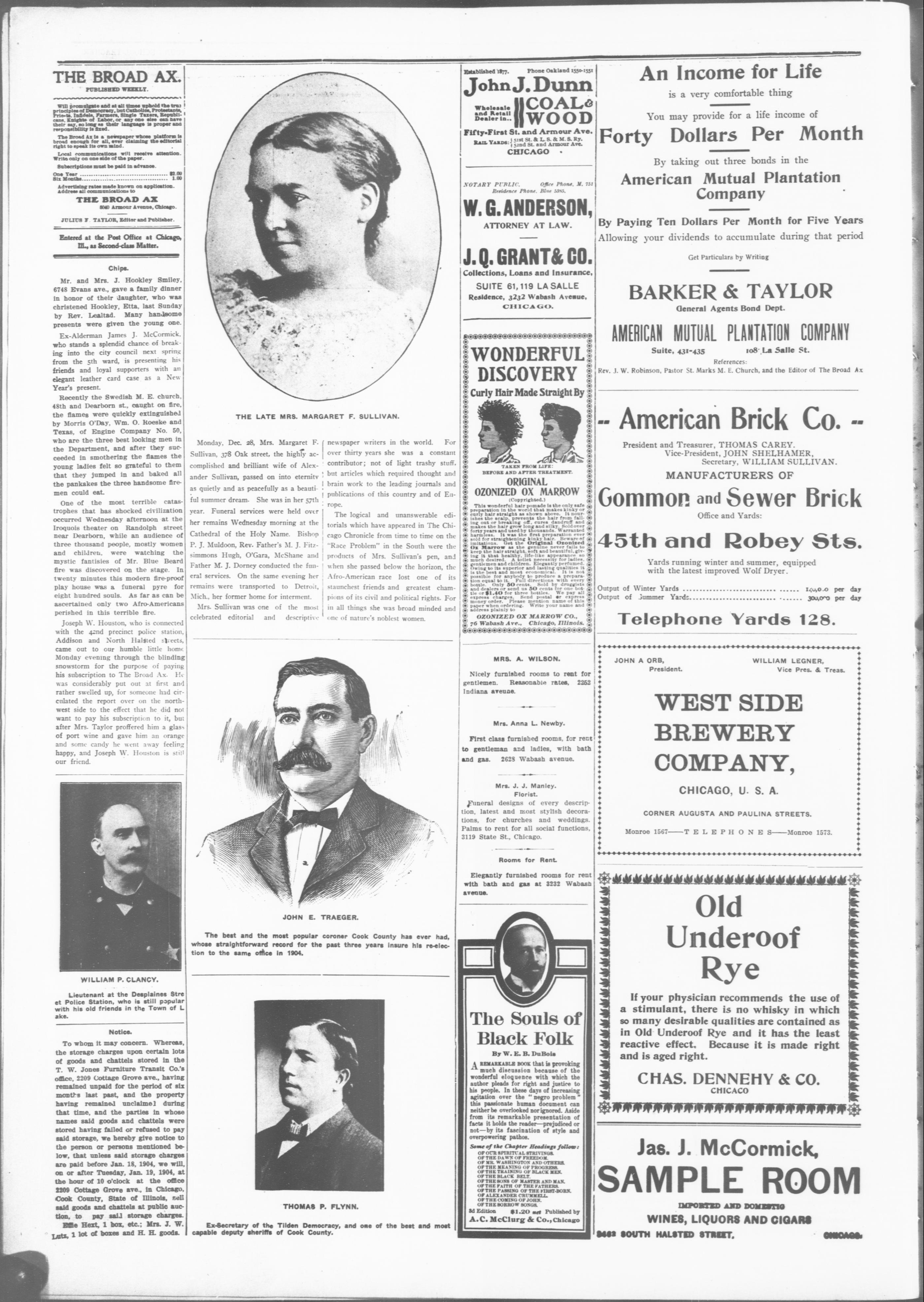
Monday, Dec. 28, Mrs. Margaret F. Sullivan, 378 Oak street, the highly accomplished and brilliant wife of Alexander Sullivan, passed on into eternity as quietly and as peacefully as a beautiful summer dream. She was in her 57th year. Funeral services were held over her remains Wednesday morning at the Cathedral of the Holy Name. Bishop P. J. Muldoon, Rev. Father's M. J. Fitzsimmons Hugh, O'Gara, McShane and Father M. J. Dorney conducted the funeral services. On the same evening her remains were transported to Detroit, Mich., her former home for interment.
Mrs. Sullivan was one of the most celebrated editorial and descriptive
JOHN E.
The best and the most popular whose straightforward record for the tion to the same office in 1904.
JOHN E. TRAEGER.
It and the most popular coroner Cook County rightforward record for the past three years insured same office in 1904.
The best and the most popular coroner Cook County has ever had, whose straightforward record for the past three years insure his re-election to the same office in 1904.
Ex-Secretary of the Tilden Demon
capable deputy sheriffs of Cook County
THOMAS P. FLYNN.
Secretary of the Tilden Democracy, and one of the county sheriffs of Cook County.
Ex-Secretary of the Tilden Democracy, and one of the best and most capable deputy sheriffs of Cook County.
newspaper writers in the world. For over thirty years she was a constant contributor; not of light trashy stuff, but articles which required thought and brain work to the leading journals and publications of this country and of Europe.
The logical and unanswerable editorials which have appeared in The Chicago Chronicle from time to time on the "Race Problem" in the South were the products of Mrs. Sullivan's pen, and when she passed below the horizon, the Afro-American race lost one of its staunchest friends and greatest champions of its civil and political rights. For in all things she was broad minded and one of nature's noblest women.
TRAEGER.
coroner Cook County has ever had, past three years insure his re-elec-
2. FLYNN.
ocracy, and one of the best and most
city.
Fifty-First St. and Armour Ave.
RAIL YARDS: 151st St. & L. S. & M. S. Ry.
152nd St. and Armour Ave.
CHJCAGO
NOTARY PUBLIC. Office Phone, M. 751
Residence Phone. Blue 5385.
W. G. ANDERSON,
ATTORNEY AT LAW.
J. Q. GRANT & CO.
Collections, Loans and Insurance,
SUITE 61, 119 LA SALLE
Residence, 3232 Wabash Avenue,
CHICAGO.
WONDERFUL DISCOVERY Curly Hair Made Straight By
TAKEN FROM LIFE:
BEFORE AND AFTER TREATMENT.
ORIGINAL
OZONIZED OX MARROW
(Copyrighted.)
This wonderful hair pomade is the only safe preparation in the world that makes kinky or curly hair straight as shown above. It nourishes the scalp, prevents the hair from falling out or breaking off, cures dandruff and makes the hair grow long and silky. Sold over forty years and used by thousands. Warranted harmless. It was the first preparation ever sold for straightening the hair. The Original Ozonized Ox Marrow is the genuine never fails to keep the hair straight, soft and beautiful, giving it that healthy, life-like appearance so much desired. A toilet necessity for ladies, gentlemen and children. Elegantly perfumed. Owing to its superior and lasting qualities it is the best and most economical. It is not possible for anybody to produce a preparation equal to it. Full directions. Bottle of 50 cents. Sold by druggists and dealers or send us 50 cents for one bottle or $1.40 for three bottles. We pay all express charges. Send postal or express money order. Please mention name of this paper when ordering. Write your name and address plainly to
OZONIZED OX MARROW CO.,
76 Wabash Ave., Chicago, Illinois.
MRS. A. WILSON.
Nicely furnished rooms to rent for gentlemen. Reasonable rates, 2252 Indiana aveune.
Mrs. Anna L. Newby.
First class furnished rooms, for rent to gentleman and ladies, with bath and gas. 2628 Wabash avenue.
Mrs. J. J. Manley.
Florist.
Funeral designs of every description, latest and most stylish decorations, for churches and weddings. Palms to rent for all social functions, 3119 State St., Chicago.
Rooms for Rent.
Elegantly furnished rooms for rent with bath and gas at 3232 Wabash avenue.
The Souls of
Black Folk
By W. E. B. DuBois
AREMARKABLE BOOK that is provoking much discussion because of the wonderful eloquence with which the author pleads for right and justice to his people. In these days of increasing agitation over the "negro problem" this passionate human document can neither be overlooked nor ignored. Aside from its remarkable presentation of facts it holds the reader—prejudiced or not—by its fascination of style and overpowering pathos.
Some of the Chapter Headings follow:
OF OUR SPIRITUAL STRIVINGS.
OF THE DAWN OF FREEDOM.
OF MR. WASHINGTON AND OTHERS.
OF THE MEANING OF PROGRESS.
OF THE TRAINING OF BLACK MEN.
OF THE BLACK BELT.
OF THE SONS OF MASTER AND MAN.
OF THE FAITH OF THE FATHERS.
OF THE PASSING OF THE FIRST-BORN.
OF ALEXANDER CRUMMELL.
OF THE COMING OF JOHN.
OF THE SORROW SONGS.
8d Edition $1.20 net Published by
A.C. McClurg & Co., Chicago
---
An Income for Life
is a very comfortable thing
You may provide for a life income
by taking out three bonds in the
American Mutual Plantation
Company
Ten Dollars Per Month for
our dividends to accumulate during
By taking out three bonds in the American Mutual Plantation Company
By Paying Ten Dollars Per Month for Five Years Allowing your dividends to accumulate during that period
ARKER & TAYLOR
General Agents Bond Dept.
MAN MUTUAL PLANTATION CO.
Suite, 431-435
108 La Salle St.
References:
Benson, Pastor St. Marks M. E. Church, and the Editor
American Brick Co.
Agent and Treasurer, THOMAS CAREY.
Vice-President, JOHN SHELHAME
Secretary, WILLIAM SUL
MANUFACTURERS OF
Lemon and Sewer
Office and Yards:
Lemon and Robey
Yards running winter and summer, equipped with the latest improved Wolf Dryer.
Lemon Yards ...
Summer Yards...
Telephone Yards
Rev. J. W. Robinson, Pastor St. Marks M. E. Church, and the Editor of The Broad Ax
President and Treasurer, THOMAS CAREY. Vice-President, JOHN SHELHAMER, Secretary, WILLIAM SULLIVAN. MANUFACTURERS OF
Yards running winter and summer, equipped
with the latest improved Wolf Dryer.
Output of Winter Yards ..... 140,000 per day
Output of Summer Yards..... 300,000 per day
Telephone Yards 128.
JOHN A ORB,
President.
WEST SIDE BREWERY COMPANY,
ORNER AUGUSTA AND PAULINA STREET
1567—TELEPHONES—Monroe
CORNER AUGUSTA AND PAULINA STREETS.
Monroe 1567——T E L E P H O N E S——Monroe 1573.
Old Underoof Rye
our physician recommends the
mulant, there is no whisky in
any desirable qualities are contai
Underoof Rye and it has th
ve effect. Because it is made
aged right.
THAS. DENNEHY & C
CHICACO
If your physician recommends the use of a stimulant, there is no whisky in which so many desirable qualities are contained as in Old Underoof Rye and it has the least reactive effect. Because it is made right and is aged right.
CHAS. DENNEHY & CO.
CHICACO
life income of
Per Month
bonds in the
Plantation
any
Month for Five Years
culate during that per
Writing
STAYLOR
and Dept.
FONTATION COMPANY
108 La Salle St.
arch, and the Editor of The Broad
Brick Co.
AS CAREY.
SHELHAMER,
WILLIAM SULLIVAN.
ERS OF
Newer Brick
wards:
Obey St
summer, equipped
Golf Dryer.
140,000 per
300,000 per
wards 128.
WILLIAM LEGNER,
Vice Pres. & Treas.
S. A.
ULINA STREETS.
N E S——Monroe 1573.
CHICAGO, U. S. A.
mends the use of whisky in which are contained as it has the least it is made right HY & CO.
Get Particulars by Writing
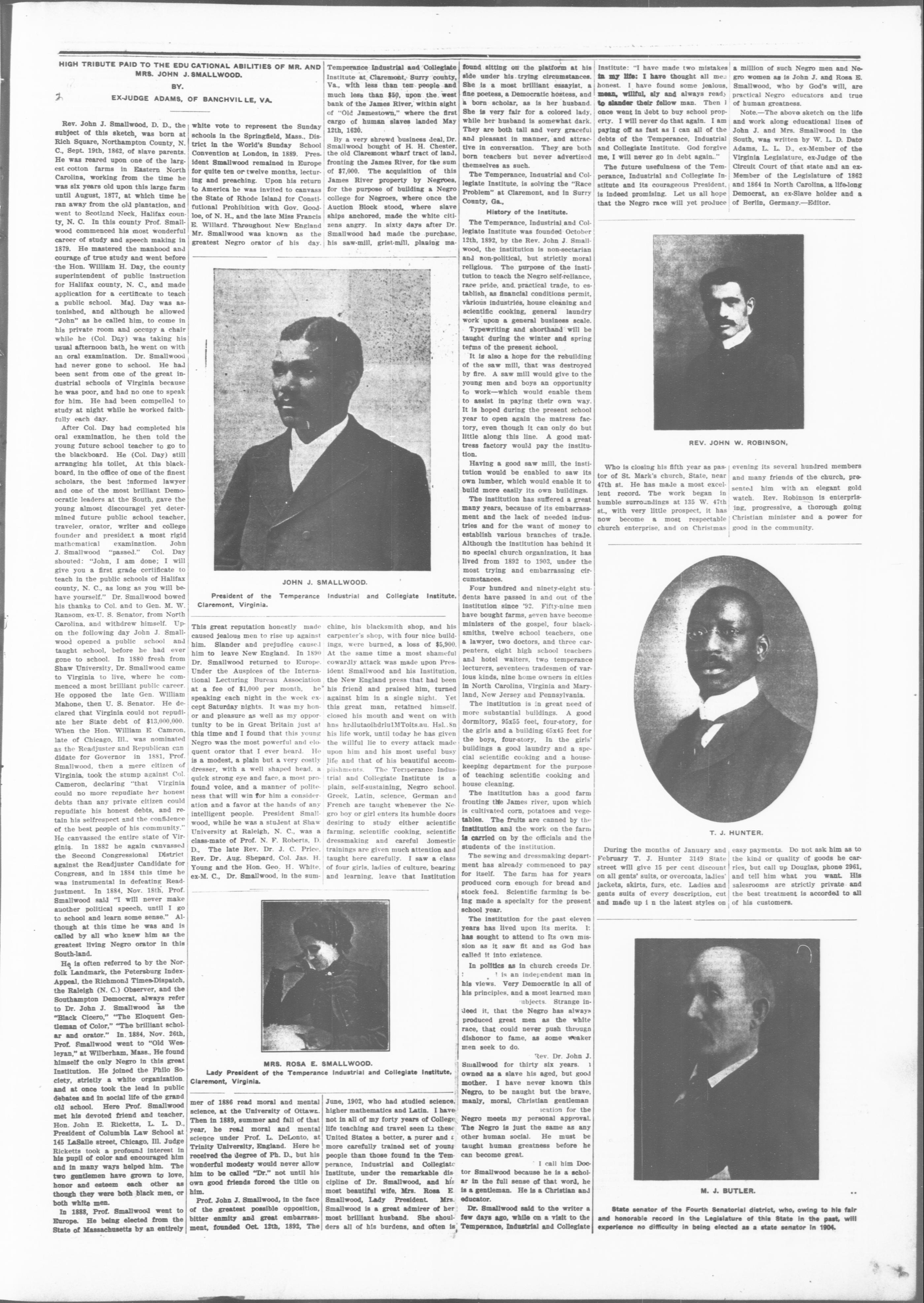
HIGH TRIBUTE PAID TO THE EDUCATIONAL ABILITIES OF MR. AND MRS. JOHN J. SMALLWOOD.
EX-JUDGE ADAMS, OF BANCHVILLE, VA.
Rev. John J. Smallwood, D. D., the subject of this sketch, was born at Rich Square, Northampton County, N. C., Sept. 19th, 1862, of slave parents. He was reared upon one of the largest cotton farms in Eastern North Carolina, working from the time he was six years old upon this large farm until August, 1877, at which time he ran away from the old plantation, and went to Scotland Neck, Halifax county, N. C. In this county Prof. Smallwood commenced his most wonderful career of study and speech making in 1879. He mastered the manhood and courage of true study and went before the Hon. William H. Day, the county superintendent of public instruction for Halifax county, N. C., and made application for a certificate to teach a public school. Maj. Day was astonished, and although he allowed "John" as he called him, to come in his private room and occupy a chair while he (Col. Day) was taking his usual afternoon bath, he went on with an oral examination. Dr. Smallwood had never gone to school. He had been sent from one of the great industrial schools of Virginia because he was poor, and had no one to speak for him. He had been compelled to study at night while he worked faithfully each day.
After Col. Day had completed his oral examination, he then told the young future school teacher to go to the blackboard. He (Col. Day) still arranging his toilet, At this blackboard, in the office of one of the finest scholars, the best informed lawyer and one of the most brilliant Democratic leaders at the South, gave the young almost discouragel yet determined future public school teacher, traveler, orator, writer and college founder and president a most rigid mathematical examination. John J. Smallwood "passed." Col. Day shouted: "John, I am done; I will give you a first grade certificate to teach in the public schools of Halifax county, N. C., as long as you will behave yourself." Dr. Smallwood bowed his thanks to Col. and to Gen. M. W. Ransom, ex-U. S. Senator, from North Carolina, and withdrew himself. Upon the following day John J. Smallwood opened a public school and taught school, before he had ever gone to school. In 1880 fresh from Shaw University, Dr. Smallwood came to Virginia to live, where he commenced a most brilliant public career. He opposed the late Gen. William Mahone, then U. S. Senator. He declared that Virginia could not repudiate her State debt of $13,000,000. When the Hon. William E. Camron, late of Chicago, Ill., was nominated as the Readjuster and Republican candidate for Governor in 1881, Prof. Smallwood, then a mere citizen of Virginia, took the stump against Col. Cameron, declaring "that Virginia could no more repudiate her honest debts than any private citizen could repudiate his honest debts, and retain his selfrespect and the confidence of the best people of his community." He canvassed the entire state of Virginia. In 1882 he again canvassed the Second Congressional District against the Readjuster Candidate for Congress, and in 1884 this time he was instrumental in defeating Readjustment. In 1884, Nov. 18th, Prof. Smallwood said "I will never make another political speech, until I go to school and learn some sense." Although at this time he was and is called by all who knew him as the greatest living Negro orator in this South-land.
He is often referred to by the Norfolk Landmark, the Petersburg Index- Appeal, the Richmond Times-Dispatch, the Raleigh (N. C.) Observer, and the Southampton Democrat, always refer to Dr. John J. Smallwood as the "Black Cicero," "The Eloquent Gentleman of Color," "The brilliant scholar and orator." In. 1884, Nov. 26th, Prof. Smallwood went to "Old Wesleyan," at Wilberham, Mass., He found himself the only Negro in this great Institution. He joined the Philo Society, strictly a white organization, and at once took the lead in public debates and in social life of the grand old school. Here Prof. Smallwood met his devoted friend and teacher, Hon. John E. Ricketts, L. L. D., President of Columbia Law School at 145 LaSalle street, Chicago, Ill. Judge Ricketts took a profound interest in his pupil of color and encouraged him and in many ways helped him. The two gentlemen have grown to love, honor and esteem each other as though they were both black men, or both white men.
In 1888, Prof. Smallwood went to Europe. He being elected from the State of Massachusetts by an entirely
white vote to represent the Sunday schools in the Springfield, Mass., District in the World's Sunday School Convention at London, in 1889. President Smallwood remained in Europe for quite ten or twelve months, lecturing and preaching. Upon his return to America he was invited to canvass the State of Rhode Island for Constitutional Prohibition with Gov. Goodloe, of N. H., and the late Miss Francis E. Willard. Throughout New England Mr. Smallwood was known as the greatest Negro orator of his day.
[Name]
President of the Temperance Claremont, Virginia.
President of the Temperance Industrial and Collegiate Institute Claremont, Virginia.
President of the Temperance Industrial and Collegiate Institute Claremont, Virginia.
This great reputation honestly made caused jealous men to rise up against him. Slander and prejudice caused him to leave New England. In 1890 Dr. Smallwood returned to Europe. Under the Auspices of the International Lecturing Bureau Association at a fee of $1,000 per month, he speaking each night in the week except Saturday nights. It was my honor and pleasure as well as my opportunity to be in Great Britain just at this time and I found that this young Negro was the most powerful and eloquent orator that I ever heard. He is a modest, a plain but a very costly dresser, with a well shaped head, a quick strong eye and face, a most profound voice, and a manner of politeness that will win for him a consideration and a favor at the hands of any intelligent people. President Smallwood, while he was a student at Shaw University at Raleigh, N. C., was a class-mate of Prof. N. F. Roberts, D. D., The late Rev. Dr. J. C. Price, Rev. Dr. Aug. Shepard, Col. Jas. H. Young and the Hon. Geo. H. White, ex-M. C., Dr. Smallwood, in the sum-
Lady President of the Temperan Claremont, Virginia.
Lady President of the Temperance Industrial and Collegiate Institute, Claremont, Virginia.
Lady President of the Temperance Industrial and Collegiate Institute, Claremont, Virginia.
mer of 1886 read moral and mental science, at the University of Ottawz. Then in 1889, summer and fall of that year, he read moral and mental science under Prof. L. DeLonto, at Trinity University, England. Here he received the degree of Ph. D., but his wonderful modesty would never allow him to be called "Dr." not until his own good friends forced the title on him.
Prof. John J. Smallwood, in the face of the greatest possible opposition, bitter enmity and great embarrassment, founded Oct. 12th, 1892, The
JOHN J. SMALLWOOD.
1920
MRS. ROSA E. SMALLWOOD.
Temperance Industrial and Collegiate Institute at Claremont, Surry county, Va., with less than ten people and much less than $50, upon the west bank of the James River, within sight of "Old Jamestown," where the first cargo of human slaves landed May 12th, 1620.
By a very shrewd business deal, Dr. Smallwood bought of H. H. Chester, the old Claremont wharf tract of land, fronting the James River, for the sum of $7,000. The acquisition of this James River property by Negroes, for the purpose of building a Negro college for Negroes, where once the Auction Block stood, where slave ships anchored, made the white citizens angry. In sixty days after Dr. Smallwood had made the purchase, his saw-mill, grist-mill, planing ma
1930
Industrial and Collegiate Institute,
chine, his blacksmith shop, and his carpenter's shop, with four nice buildings, were burned, a loss of $5,900. At the same time a most shameful cowardly attack was made upon President Smallwood and his Institution, the New England press that had been his friend and praised him, turned against him in a single night. Yet this great man, retalned himself closed his mouth and went on with hns hrdlutaoihdrlu1MToits.au. Hsl..8n his life work, until today he has given the willful lie to every attack made upon him and his most useful busy life and that of his beautiful accomplishments. The Temperance Industrial and Collegiate Institute is a plain, self-sustaining, Negro school, Greek, Latin, science, German and French are taught whenever the Negro boy or girl enters its humble doors desiring to study either scientific farming, scientific cooking, scientific dressmaking and careful Domestic trainings are given much attention and taught here carefully. I saw a class of four girls, ladies of culture, bearing and learning, leave that Institution
The Industrial and Collegiate Institute,
June, 1902, who had studied science, higher mathematics and Latin. I have not in all of my forty years of College life teaching and travel seen in these United States a better, a purer and a more carefully trained set of young people than those found in the Temperance, Industrial and Collegiate Institute, under the remarkable discipline of Dr. Smallwood, and his most beautiful wife, Mrs. Rosa E. Smallwood, Lady President. Mrs. Smallwood is a great admirer of her most brilliant husband. She shoulders all of his burdens, and often is
---
found sitting on the platform at his side under his trying circumstances. She is a most brilliant essayist, a fine poetess, a Democratic hostess, and a born scholar, as is her husband. She is very fair for a colored lady, while her husband is somewhat dark. They are both tall and very graceful and pleasant in manner, and attractive in conversation. They are both born teachers but never advertised themselves as such.
The Temperance, Industrial and Collegiate Institute, is solving the "Race Problem" at Claremont, and in Surry County, Ga..
History of the Institute.
The Temperance, Industrial and Collegiate Institute was founded October 12th, 1892, by the Rev. John J. Smallwood, the institution is non-sectarian and non-political, but strictly moral religious. The purpose of the institution to teach the Negro self-reliance, race pride, and practical trade, to establish, as financial conditions permit, various industries, house cleaning and scientific cooking, general laundry work upon a general business scale.
Typewriting and shorthand will be taught during the winter and spring terms of the present school. It is also a hope for the rebuilding of the saw mill, that was destroyed by fire. A saw mill would give to the young men and boys an opportunity to work—which would enable them to assist in paying their own way. It is hoped during the present school year to open again the matress factory, even though it can only do but little along this line. A good mattress factory would pay the institution.
Having a good saw mill, the institution would be enabled to saw its own lumber, which would enable it to build more easily its own buildings. The institution has suffered a great many years, because of its embarrassment and the lack of needed industries and for the want of money to establish various branches of trade. Although the institution has behind it no special church organization, it has lived from 1892 to 1903, under the most trying and embarrassing circumstances.
Four hundred and ninety-eight students have passed in and out of the institution since '92. Fifty-nine men have bought farms, seven have become ministers of the gospel, four blacksmiths, twelve school teachers, one a lawyer, two doctors, and three carpenters, eight high school teachers and hotel waiters, two temperance lecturers, seventeen tradesmen of various kinds, nine home owners in cities in North Carolina, Virginia and Maryland, New Jersey and Pennsylvania.
The institution is in great need of more substantial buildings. A good dormitory, 95x55 feet, four-story, for the girls and a building 65x45 feet for the boys, four-story. In the girls' buildings a good laundry and a special scientific cooking and a housekeeping department for the purpose of teaching scientific cooking and house cleaning.
The institution has a good farm fronting the James river, upon which is cultivated corn, potatoes and vegetables. The fruits are canned by the institution and the work on the farm is carried on by the officials and the students of the institution.
The sewing and dressmaking department has already commenced to pay for itself. The farm has for years produced corn enough for bread and stock feed. Scientific farming is being made a specialty for the present school year.
The institution for the past eleven years has lived upon its merits. I: has sought to attend to Its own mission as it saw fit and as God has called it into existence.
In politics as in church creeds Dr. is an independent man in his views. Very Democratic in all of his principles, and a most learned man subjects. Strange indeed it, that the Negro has always produced great men as the white race, that could never push through dishonor to fame, as some weaker men seek to do.
Rev. Dr. John J. Smallwood for thirty six years. I owned as a slave his aged, but good mother. I have never known this Negro, to be naught but the brave, manly, moral, Christian gentlemanication for the Negro meets my personal approval. The Negro is just the same as any other human social. He must be taught human greatness before he can become great.
I call him Doctor Smallwood because he is a scholar in the full sense of that word, he is a gentleman. He is a Christian and educator. Dr. Smallwood said to the writer a few days ago, while on a visit to the Temperance, Industrial and Collegiate
Institute: "I have made two mistakes in my life: I have thought all men honest. I have found some jealous, mean, willful, sly and always ready to slander their fellow man. Then I once went in debt to buy school property. I will never do that again. I am paying off as fast as I can all of the debts of the Temperance, Industrial and Collegiate Institute. God forgive me, I will never go in debt again."
The future usefulness of the Temperance, Industrial and Collegiate Institute and its courageous President, is indeed promising. Let us all hope that the Negro race will yet produce
---
REV. JOHN W. ROBINSON.
Who is closing his fifth year as pastor of St. Mark's church, State, near 47th st. He has made a most excellent record. The work began in humble surroundings at 135 W. 47th st., with very little prospect, it has now become a most respectable church enterprise, and on Christmas
T. J.
[Name]
[Name not visible]
During the months of January and February T. J. Hunter 3149 State street will give 15 per cent discount on all gents' suits, or overcoats, ladies' jackets, skirts, furs, etc. Ladies and gents suits of every description, cut and made up in the latest styles on
---
[Name]
C
M. J. BUTLER.
or of the Fourth Senatorial district, who, over record in the Legislature of this State in difficulty in being elected as a state senator
State senator of the Fourth Senatorial district, who, owing to his fair and honorable record in the Legislature of this State in the past, will experience no difficulty in being elected as a state senator in 1904.
a million of such Negro men and Negro women as is John J. and Rosa E. Smallwood, who by God's will, are practical Negro educators and true of human greatness.
Note.—The above sketch on the life and work along educational lines of John J. and Mrs. Smallwood in the South, was written by W. L. D. Dato Adams, L. L. D., ex-Member of the Virginia Legislature, ex-Judge of the Circuit Court of that state and an ex-Member of the Legislature of 1862 and 1864 in North Carolina, a life-long Democrat, an ex-Slave holder and a of Berlin, Germany.—Editor.
evening its several hundred members and many friends of the church, presented him with an elegant gold watch. Rev. Robinson is enterprising, progressive, a thorough going Christian minister and a power for good in the community.
HUNTER.
y and State account ladies' and cut cases on easy payments. Do not ask him as to the kind or quality of goods he carries, but call up Douglas, phone 2961, and tell him what you want. His salesrooms are strictly private and the best treatment is accorded to all of his customers.
C
A CEREAL STORY.
Actor Who Once Made a Meal Of Petunia, Nasturtium and Pansy Seeds.
The refreshing part of a story which the New York Times recounts is not the stupidity of man in his domestic aspect. The particular man concerned is an actor whose wife—an actress—is an earnest advocate of the theory that food should fit the consumer rather than the reverse. Consequently there are periods when milk flows incessantly through the household menu. Again it is hot water, and at other times nuts, fruits and grains alone are relied upon to nourish genius to its finest flower.
Once, in the grain age, the wife was called away to a rehearsal that was likely to last well into the afternoon. She told her husband that he would have to get his own luncheon, and he cheerfully consented to do it. "I had a fine meal of your new cereal," he said, when she returned. "What do you mean?" she inquired. "I haven't any new cereal in the house."
"Why, that nutty stuff you left on the di- ing-room table."
The wife sat down suddenly. "You've eaten up my window-garden!" she wailed. "All my petunia, nasturtium and pansy seeds!"
STARTING IN HOUSEKEEPING.
Young Bride and Groom Borrowed All the Furniture of a Neighboring House.
A curious story concerning an easy method of starting in housekeeping comes from Jefferson county, says the Utica Journal. A Watertown woman owns a house in a small village and occupied it prior to May 30 last, but on going to that city to live she locked it up, leaving the furniture inside. A few days ago she went to the village to see how her property was getting along, and greatly to her surprise she found that the furniture had disappeared. A little later, while looking around in the vicinity, she saw a brand new pump, which she had recently purchased, in the well on the premises of a neighbor. Following up this clew, she called at the house, and there found her entire outfit of furniture, carpets and dishes. The dwelling was occupied by a man and his wife who had been married only a couple of weeks, and the former said he had found the house of the Watertown woman open, and, believing that the owner would not object, he had borrowed the goods. He was evidently repentant, readily returned the furniture, and paid the woman $10 for its use. This seems to be an instance where housekeeping is one thing and furniture keeping another.
FORTY-YEAR CLOCK
Jeweler Makes a Timepiece That He Will Probably Never Have to Wind Again.
A jeweler, calculating that he would in all probability live about 40 years, and during that time spend about 60 days winding the house clock—allowing two minutes each day for the task—decided that he would make a clock which would need winding but once during that period. He spent his odd minutes at the task, and has succeeded in producing a clock which is the only one of its kind in the world, says the New York Herald.
This 40-year timepiece is 15 inches in diameter and weighs 75 pounds. The movement is so geared that the barrel wheel, containing the mainspring, revolves only once in $2\frac{1}{2}$ years. When this wheel has made 56 revolutions somebody will have to give the key 17 turns. The clock will then be wound up for another 40 years. The first wheel from the barrel wheel crawls at the rate of one turn a year. The dial plate is six inches in diameter. The movement is full jeweled. The cork is put in a hermetically sealed glass case, and it will work in a vacuum, thus lessening fraction and preventing the oil from drying.
DEATH IN THE STREETS
Frightful Loss of Life in Past Year in New York as Result of Traffic Accidents.
Waste of life in America has often been alluded to, but no illustration is more striking than the fact that in New York city during the last year 538 individuals have been killed in traffic accidents, says American Medicine. How reckless we are as to human lives is shown by the comparative figures for London, where—in a larger city—there have been only 158 deaths in the same way. It is said that the Merchants' Association of New York has resolved to pursue reform work in this matter by all the methods in its power, especially by such devices as may prevent the unnecessary number of accidents. For instance, the use of a new fender on trolley cars, which has been in successful use in Liverpool, England, is to be encouraged. The reckless speeding of these cars should be stopped. The fact that trolley accidents are more numerous in Brooklyn than in Manhattan demonstrates that it is not congestion of traffic alone that is responsible for the fatalities. Grade crossings of steam cars must be abolished, a reform that at once lessens accidental deaths in a marked degree.
Bird Not at All Timid
One naturalist in trying to photograph the nest of a rail stationed his camera not more than two feet away; but while he was in the act of focusing the instrument the bird fearlessly stepped into the nest and began to cover herself with the lining of soft fiber. She was photographed several times, and was then bodily lifted off the nest and carried some distance. The naturalist hastened back to the camera, but before a photograph could be had the rail was calmly seated on her nest again.
IN THE HALLS OF LEARNING.
Of the 1,120 students in the University of Kansas, 460 support themselves. The government of Spain is to open 14 agricultural schools in various parts of the peninsula. Dr. James E. Lough, professors of psychology of the school of pedagogy, of New York university, has been named as director of the summer school. A. R. Thatcher, of Haydenville, Mass., has presented to Tongaloo university, Mississippi, a fine collection of minerals, some specimens being quite rare. Kuno Fischer, an eminent historian of philosophy, has given up his chair at Heidelberg. He is 80 years old, and has been at Heidelberg for 31 years.
Prof. Hele-Shaw, of the new University of Liverpool, is in South Africa to organize scientific education and prepare a university scheme for the Transvaal and Orange River colony. The University of Missouri wants a song and yell, and is willing to give a prize of $50 for each. The song and yell must be original in every way, and the song especially must be expressive of the sentiment of the university.
Albert E. Greene, a practicing engineer, a son of the late dean of the engineering department of the University of Michigan, has been appointed assistant professor of civil engineering, to take charge of the work formerly done by his father. According to the results of an investigation made by Prof. W. E. Thomas, of Columbia, the medium age of graduates from 11 representative colleges from 1890 to 1900 was 22 years and five months, while from 1850 to 1860 it was 22 years and nine months.
PURELY PERSONAL
Senators have a terrible time wrestling with Spanish words. They put the accents on the wrong syllables or give erroneous sounds to the vowels.
It is thought by those interested in the sale in London of the original manuscript of Milton's "Paradise Lost" that the offer of $250,000 for the work is made by J. Pierpont Morgan.
Athur Chamberlain, of Birmingham, England, a nephew of Joseph Chamberlain, has been touring Canada, partly on business and partly on pleasure. He bears a strong resemblance to Joseph, and looks and talks like a sharp, shrewd man of business.
Senator Hoar in his remarkable speech last week dealt frequently with the word "Panama," which he invariably spoke as though it rhymed with "pajama." Senator Daniel, the eloquent Virginian, had occasion to speak often of the treaty of New Granada, which he pronounced as though it rhymed with Canada.
George Winfield Scott, class of '96, of Stanford university, has been appointed chief of the newly-created division of law of the library of congress at Washington. The position is an administrative one and the salary has been fixed at $3,000 a year. He will go to Europe in January in the interest of the government and will remain there about ten months, after which he will go to South America. While abroad he will be chiefly busied with law work and the gathering of books for the library of congress. Mr. Scott is a New York man and has held scholarships in Columbia, Cornell, Chicago and the University of Pennsylvania.
LITTLE TALES OF KINGS
King Alfonso is giving his subjects lessons in agriculture. Since his throat trouble, Emperor William has changed his voice, modulating it so as to reduce the pressure on the vocal chords. He now speaks in a somewhat lower pitch, his throat specialists having explained to him the theory of voice production, which he has practiced with considerable success.
Kink Edward made a fresh manifestation of his tact and kindliness recently by sending a letter inquiring as to the condition of a member of parliament who had undergone an operation for appendicitis. The king said that as he had been subjected to a severe operation for the same malady, he had a fellow feeling for all who had to endure similar suffering. His act was the more noteworthy from the fact that the member is a prominent representative of a party which does not look with favor on kings or on an aristocracy.
Victor Emmanuel III. of Italy is one of the least kingly among European rulers. In person homely, awkward in manner, and exceedingly shy in company, he thoroughly detests the dreary tomfoolery of court life, though he loyalty refrains from shirking any of the duties falling to his position. He has no fondness for appearing in military uniforms, nor does he imagine that he is an able general simply because on occasion he has to wear the habiliments of a soldier. His majesty is very well read in science and literature, and is never so contented as when in the company of his wife. His court is the most democratic in Europe.
TONGUE-TWISTERS.
Six thick thistle sticks.
Flesh of freshly fried flying fish.
The sea ceaseth, but it sufficeth us.
Give Grimes Jim's great gilt gig-
hip.
Two toads totally tired tried to trot
to Tedbury.
She stood at the door of Mrs. Smith's
fish-sauce shop welcoming him in.
Strict strong Stephen Stringer
snared slickly six sickly silky snakes.
Swan swam over the sea; swim,
swan, swim! Swan swam back again.
Well swum, swan!
Susan shineth shoes and socks; socks and shoe shines Susan. She ceaseth shining shoes and socks, for socks and shoes shock Susan.—Woman's Home Companion.
[Name]
successful real estate broker, member of the city to look after the interest of all the people resid
The successful real estate broker, member of the city council who is ever ready to look after the interest of all the people residing in the 30th Ward.
[Name]
well known as one of the young and most succes go bar. Mr. Williams is a Democrat, is happil the Sixth ward.
Who is well known as one of the young and most successful members of the Chicago bar. Mr. Williams is a Democrat, is happily married and resides in the Sixth ward.
8
MAJOR LAWRENCE M. ENNIS.
corporator and commander of the service men of the
mt of Illinois.
Lawyer, orator and commander of the service men of the Spanish war for department of Illinois.
[Picture of a woman with a hat and a necklace.]
MISS GERTRUDE IRENE HOWARD.
The popular and proficient cornetist of Chicago.
Quite Consoling.
Vicar (who has an unfortunate trick of saying "quite so" during conversation) calls upon the bishop about some parish grievance. The bishop during the interview tells the vicar how badly he (the bishop) is being treated. "The fact is, my dear sir, many people seem to think I'm a perfect ass." Vicar (consolingly)—Quite so, my lord, quite so.—Tit-Bits.
Same Thing.
He was interviewing the miserly rich man on how to succeed.
"My motto has always been," replied the man of money, offering his visitor a stogie, and lighting a good cigar himself, "Never despair."
"I thought," replied the interviewer, "that is was 'Never give up'—but it amounts to the same thing, after all."—Cincinnati Times-Star.
Parental Obljections.
Pretty Daughter—So you don't like Tom?
Her Father—No. He appears to be capable of nothing.
Pretty Daughter—But what objection have you to George?
Her Father—Oh, he's worse than Tom.
He strikes me as being capable of anything.—Chicago Daily News.
Same Old Cause.
"What's all this fuss about?" asked the policeman, stepping between the two young men.
The one that had got the worst of it and was wiping the blood from his nose pointed to the other fellow.
"He can tell you her name if he wants to," he said. "I won't."—Chicago Tribune.
An Up-to-Date Fowl.
Mr. Hammerkick—There was absolutely no taste to that turkey I bought of you.
The Progressive Farmer—Well, taste isn't the main thing. That turkey was the most nutritious bird I ever sold; it had been fattened on health food.—Brooklyn Life.
Masculine Supremacy.
Friend—Upon my word, Penhecker, I wonder that you haven't more spirit than to stop at home and look after the baby while your wife goes gadding about.
Penhecker (proudly)—My dear fellow—you must remember that the hand that rocks the candle rules the world. Ahem!—Ally Sloper.
A. Goose's Brother
"Tommy," said the teacher, addressing a small pupil, "can you tell me what a propaganda is?"
The little fellow, after wrestling with the problem mentally for a short time, replied: "I guess it must be the brother of a proper goose."—Cincinnati Enquirer.
Kad Tried.
"I'm afraid," said the clumsy man, as he fell off his horse again, "I'll never learn to ride."
"Oh," said the riding master, "just keep on trying."
"But, gracious! I'm having trouble now trying to keep on."—Philadelphia Ledger.
Valuation.
"Diggins says he is going to be worth $500 before he dies."
"He'll be disappointed," answered the man who always sneers. "He may possess that much money, but on his own merits he'll never be worth two cents."—Washington Star
Only Hone Left
"Why do you smoke those dreadful cigarettes, little boy? Do you like them?" "Chee! I sh'd say not! But it's de only way a guy kin git fired from school now'days."—Cincinnati Commercial Tribune.
OF COURSE.
Little Girl—Do you stutter all the time?
Little Boy—N-n-n-n-no; only when I talk.—Chicago Journal.
One glorious boon all have at hand—
Or prosperous or diverse;
Be grateful, howsoe'er you stand,
Your fortunes are no worse.
—Detroit Free Press.
Sure Death.
Norah—Pat said he would die if Oi
refused him.
Bridget—An' did he say how?
Bridget—Ah did he say now?
Norah—He did. He said he would go to th' next Hibernian masquerade as King Edward, the Sivinith!—Puck.
A Scientist.
"I am glad to hear that you take so much interest in science. Miss Smith. What particular branch do you study? "Oh, I study them all—palmistry, astrology, chirography and the whole lot."—Chicago American.
Tommy—Pop, what is an optimist?
Tommy's Pop—An optimist, my son, is a man who is married and glad of it.—Tit-Bits.
CHURCH AND CLERGY.
Chancellor D. W. C. Huntington, of Nebraska Wesleyan university, is said to have dedicated a church for every year of his life.
Rev. Hugh Black says of Gladstone that he altered his opinions about many ecclesiastical things as about things political, but one thing never altered, and that was his personal faith in the verities of the Christian religion.
Rev. Victor M. Haughton was installed as rector of Christ Episcopal church at Exeter, N. H., succeeding his father, who occupied the position from 1865 up to a few months ago, when he was obliged to retire on account of failing health.
By the death of Mrs. Seth Howard at Phillips, Me., a month ago a pew in the Union church became vacant for the first time since 1835, in which year her husband bought it. Some member of the Howard family occupied the sitting almost every Sunday since that date.
Rev. James M. Stafford, who lives just across the river from Petersburg, Ind., preaches, owns a ferry (run by his father), invents things, takes out patients on them, and accumulates worldly riches. He is 27 years old, and the neighbors think he must be worth half a million.
Bishop Anderson stated at a meeting held in Brooklyn a few days ago that 9,000 of the young men in the colleges have volunteered for foreign mission work, of whom 3,000 are now in the field, 4,000 are prepared for the work and the others were ready if the churches would send them out.
Rev. Clyde W. Broomell, of the Swedenborgian church, West Utica street and Atlantic avenue, Buffalo, for years was a cowboy in the Bear river cattle country of Colorado. At one time he was foreman of a big ranch. Mr. Broomell went west on account of his health, having regained which he entered a theological seminary. He graduated in time to secure the Buffalo pastorate not long ago.
Rev. Dr. William Henry Roberts, of Philadelphia, who has been the stated clerk of the general assembly of the Presbyterian church of the United States of America for 20 years, said the other day: "Since I became stated clerk the church, which has now 1,100,000 communicants and a constituency of 4,000,000, has doubled in membership and in the expansion of all of its interests. The church has missions established in 15 foreign countries."
GUIDE TO HEALTH.
Don't drink. You'll get thirsty again.
Don't remember anything—especially your debts.
Don't work. It is very bad for the health to tire yourself.
Don't lend—borrow.
Don't want anything. If you should want anything, don't buy it; beg or steal it.
Don't try to say anything when you talk. It consumes brain power.
Don't eat anything. Your stomach may get out of order.
Don't wear clothes. They retard the free movement of the body.
Don't marry young. Don't marry old. Don't marry at all. If you are tempted to marry, attend court on a divorce day. Don't get sick. If you think you are sick, whistle or turn somersaults. This is nature's cure. Don't go to law. Choose the lunatic asylum. Don't get excited. Keep ice in your mouth. Don't fret, don't cry, don't laugh, don't buy, don't sell, don't grieve, don't love, don't play, don't humor yourself in anything, don't breathe. Don't even be displeased. If your favorite corn is stepped on, say: "Thank you."
Don't be dissatisfied with anything. If your bank breaks be thankful you didn't have more in it. Don't lose your temper. Nobody will pick it up and bring it home, even if they stumble over it. Don't do anything but die!
TRADE AND FINANCES
There were at the time of the last statement 69,955 stockholders in the steel corporation.
The largest oil ship in the world, the Narragansett, has just been launched in the Clyde. She will hold 10,000 tons of oil, which can be discharged at the rate of 900 tons an hour.
In perfecting plans for a $2,000,000 power plant to utilize the water at the ails of the Ohio river at Louisville, it will be necessary for promoters to get the consent of the war department.
The electric power which is now being supplied to many of the poorest families of France to run their looms also supplies light and heat, so that these families are in this respect better off than most of the well-to-do. German chemists have seriously interfered with the business of indigo raising in British India by the production of artificial indigo; the madur growers of France are frightened by the synthetic manufacture of that coloring matter; and now the government monopoly of camphor making in Formosa is threatened by a plant near New York, which is making artificial camphor.
HAVE YOU NOTICED
The most popular trade mark is the sign of the dollar.
A man's greatness depends largely on how extensively it is advertised.
Many a fool might pass for a wise man, if he could only hold his tongue.
Any old dude is good enough for a woman to walk down the street with, but she is mighty particular about the dog she drags along by a blue ribbon.—Chicago Journal.
1903 LOOKING BACKWARD 1903 Chronological Record of the More Important Happenings of Past Year Both at Home and Abroad
Nov. 3—Panama declares its independence of Colombia.
4—U. S. marines landed at Colon....Colombian gunboat bombards Panama.
5—U. S. recognizes republic of Panama.
8—Colombia protests against attitude of U. S. and protests against American interpretation of treaty of 1846.
10—France recognizes Panama government.
13—Mr. Bunau-Varilla formally received by Pres. Roosevelt as minister of Panama republic.
18-New isthmian canal treaty signed by Secretary Hay and Mr. Bunau-Varilla.
20-Panama rejects all overtures to return
to U. S., offers to grant all canal concessions absolutely free of cost.
Dec. 2—Panama canal bill signed at Panama.
5—Gen. Reyes received by Pres. Roosevelt at white house.
9—Sweden and Norway recognize new republic.
12—W. I. Buchanan (N. Y.) chosen special minister to Panama.
17—U. S. marines ordered to San Miguel to prevent invasion of Colombian troops.
21—Peru recognizes Panama.
23-Gen. Reyes (from Washington) informs Colombia that "war on Panama means war with the United States."
Foreién
Jan. 1-Edward VII. proclaimed emperor of India, at Delhi. 8-Pres. Castro, of Venezuela, accepts powers' conditions for arbitration.
KING OF SERVIA
21—German warships bombard Ft. San Carlos, Venezuela.
23—Col. Arthur Lynch, member of parliament for Galway, found guilty of high treason and sentenced to death. (Government later commutes sentence to penal servitude for life).
KING OF SERVIA
Feb. 6—Pres. Roosevelt declines to arbitrate Venezuelan disputes as requested by allies.
12—Venezuelan dispute settled; Germany to get $27,500 in 5 monthly instalments, Gt. Britain and Italy, $27,500 each.
Mar. 12—Czar issues decree granting freedom of worship to unorthodox Russian subjects, and self-government to villagers and communes.
25—Maj. Gen. Sir Hector Macdonald, British military commander at Ceylon and Boer war hero, commits suicide in Paris while en route to face court martial for immoral conduct.
Apr. 6—General strike ordered on all land and water transportation systems of Holland; troops guard property.
7—King Alexander of Servia suspends constitution of 1901, restores laws in force before its enactment and removes councils of state and senators from office.
May 18—Gen. de Raaben, gov. of Bessarabia, dismissed by czar for not ending Jewish massacres.
22—Paris-Madrid automobile race results in 8 deaths and contest declared off.
Jun, 10—King Alexander and Queen Draga shot to death at Belgrade: two cabinet ministers, queen's two brothers and four officers are also killed. Prince Peter Karageorgevitch proclaimed ruler.
30-Abyssinians surprise Mad Mullah's forces in Somaliland, killing 10,000 spearmen...Japan protests against invasion of Correa, by 150 Russian troops.
Aug. 8- Village of Djwarek, near Monastir, burned by Macedonian and Bulgarian insurgents.
10- In Paris fire and panic on underground electric railway caused death of 114 persons....Bulgarians burn 15 Turkish villages in Okhela village.
27-Attempted assassination of U. S. Vice Consul W. G. Mageissen, at Beirut, Syria, causes American squadron to sail for Turkish waters.
Sep. 7-San Miguel, where Cortez landed, is destroyed by hurricane with great loss of life.
17-Joseph Chamberlain, secretary of state for the colonies, Chas. T. Titchel, chancellor of exchequer, and Lord Geo. Hamilton, secretary for India, resign from British cabinet....Emperor Francis Joseph issues order against use of Hungarian language in army.
Oct. 5-New British cabinet announced with Alfred Lyttleton as colonial secretary and Austen Chamberlain as chancellor of exchequer.
19-In consequence of understanding between Turkey and Bulgaria latter disbands 10,000 troops occupying frontier and Turkey agrees to disband 20,000 troops.
Dec. 8-Gen. Reyes elected pres. of Colombia.
Industrial
Industrial
Jan. 8-Board of trade corners establishing fictitious prices for grain declared illegal by appellate court in Chicago. 26-John Mitchell reelected pres. United Mine Workers at Indianapolis. Mar. 3-Judge Adams, of St. Louis, enjoins Brotherhood of Railroad Trainmen and Locomotive Firemen from ordering Wabash R. R. strike, and on Apr. 1 dissolved injunction. 21-Report of coal strike arbitration made public in Washington. Workmen given general increase of wages amounting to about 10 per cent, some decrease in hours, a sliding scale and provision for future arbitration. Awards to be in force until Mar. 31, 1906. Recognition of union not passed upon.
9-U. S. court of appeals at St. Paul decides Northern Securities Co. an illegal corporation in violation of anti-trust law and enjoins it from voting stock of controlled roads.
May 1-To secure more pay and shorter hours, 75,000 workmen, mostly in building trades, strike.
12-Federal Salt Co. convicted in U. S. court at San Francisco of maintaining a monopoly.
21-Freight traffic of railroads entering St. Louis practically tied up by 1,500 freight handlers joining strike of the warehousemen.
Jun. 4-Many hotels and restaurants in Chicago tied up by strike of waiters and
Aug. 3—C. M. Schwab is succeeded by W. E. Corey as pres. United States Steel corporation. Sam. J. Parks, of New York, walking delegate, found guilty of extorting money for settling strike, is sentenced to prison for not less than 2½ years....All employees in government printing office in Washington ordered to swear allegiance to U. S. before notary.
21—Sam J. Parks released on certificate of reasonable doubt.
Sep. 18—Commerce of port of New Orleans tied up by strike of longshoremen.
22—In Kansas City, Mo., convention of Intervational Assn. of Bridge and Struc-
Oct. 3—Frank Buchanan reelected pres. of iron workers' convention.
Nov. 6—Sam J. Parks, N. Y. walking delegate, sentenced to 2 yrs, 3 mos. at Sing Sing for extortion....Over 3,000 employees of Chicago City Railway Co. strike for higher wages and employment of only union men; entire system tied up.
22—Samuel Gompers chosen pres. Am. Fed.
23—Chicago street railway strike settled.
eration of Labor in Boston....In New England cotton mills 65,000 employees submit to 10 per cent. cut in wages.
Dec. 2—Work on buildings costing $20,000,000 in 10 cities stopped by strike of iron structural workers.
12—Judge Holdom fines Franklin Union of Press Feeders in Chicago $1,000 for violation of injunction.
14—Steel trust officials announce cut in wages of 90 per cent, of employees after Jan. 1.
18—Drivers of hearses and carriages in Chicago quit work and funerals suffer.
Crimes
Jan. 9—Emil Johnson kills Miss Benna Benson and self at Virginia, Minn.; she refused to marry him.....Wm. B. Chio, of Toledo, kills wife and self; domestic trouble.
10—Mrs. Amelia Roller, of Palmyra, Wis., hangs her two children and self.
28—John J. Fiddler kills wife and self at Marionville, Pa.
31—Chas. Rowe, while insane, kills wife, 3 children and self, at Woods, Tex.
Feb. 5—John Stark kills wife and self, at Rosedale, Ind.
27—Edward L. Burdick, of Buffalo, N. Y., found dead in his home with head crushed.
Mar. 12—Adolph Krauss kills wife and 6 children with sledge hammer, then attempts suicide....Bandits attack stage along Yaqui river in Sonora murdering driver and 6 passengers....Near Orange Springs, Va., 8 killed in fight between rival turpentine camps.
May 4-Jas. B. Marcum assassinated at Jackson, Ky., as result of Hargis-Cockrill feud.
20—H. S. Biggs, Ed Bell and Deputy Sheriff R. C. McMahon killed in street fight in Sanderson. Tex.
Jun. 4-Cowboys kill E. M. Berry and 3 sons at St. Francis, Kan., in quarrel over land. 30-R. M. Love, Tex. state comptroller, killed at Austin by discharged employee who was wounded in subsequent struggle with J. W. Stephens. Jul. 16-Alfred A. Knapp sentenced to be electrocuted, at Hamilton, O.
13-Gilbert Twigg (insane) shoots into crowd at Winfield, Kan., killing 3 and then kills himself.
14-Curtis Jett and Thos. White found guilty of assassinating Jas. B. Marcum and punishment fixed at life imprisonment.
17-Desperate negro in Randolph county, Ala., kills 4 and wounds 9 in dispute over watermelons.
29-Two men killed and two wounded at Chicago City Railway Co.'s barns by 3 masked men who escaped with $3,000.... Caleb Powers sentenced to death for complicity in assassination of Wm. Goebel.
Sep. 7-Three men killed in battle at camp meeting at Victory, Ky.
Oct. 12—Seven Indians killed in quarrel after drinking bout on Blackfoot reservation in Montana.
Nov. 13—Insane negro kills Andrew G. Green. "father of Greater New York."
27—Henry Van Dine, Peter Niedermeier and Emil Roeski, charged with being accomplices of Gus Marx in Chicago car barn robbery and murder, captured by police and farmers near Tolleston, Ind., after stealing locomotive, killing brakeman and fatally shooting Detective J. R. Driscoll.
Dec. 6—Dell Thompson kills Addie Hacker, his fiancee, then commits suicide at wedding feast in Camden, N. J.
20—Roscoe W. Derby, at Cleveland, O., kills wife, his 3 children and self.
24—Jos. Phillips, at Hollowville, N. Y., killed his 3 children and self; poverty.
Government and Politics
Jan. 1—Gov. Benjamin B. Odell (N. Y.) inaugurated 2nd time. Annual report of
WILLIAM R. DAY
WILLIAM R. DAY
6—Gov. T. F. Garvin
(R. I.) inaugurated.
7—Gov. Van Sant
(Minn.) inaugurated.
12—Gov. Wm. J. Bailey
(Kan.) inaugurated.
13—Weldon B. Heyburn
(Idaho) and
Geo. C. Perkins (Cal.) elected to U. S.
senate.
14—Gov. Jefferson Davis (Ark.) inaugurated
2nd time.
15—Pres. Roosevelt signs anthracite coal
repeal bill.
19—Gov. Wm. Dorsey (Ala.) inaugurated.
20—Chas. F. Kelly, former speaker of St.
Louis house of delegates, convicted of
perjury....U. S. Senators Hopkins (Ill.)
Fairbanks (Ind.), Alger (Mich.), Platt
(Conn.), Clarke (Ark.), Stone (Mo.)
Hansbrough (N. D.), Penrose (Pa.), Platt
(N. Y.), Smoot (Utah), Gaillinger (N. H.),
and Kittredge (S. D.) elected.
25—U. S. Senator Henry M. Teller (Col.) reeled.
27—U. S. Senators John C. Spooner (Wis.)
Chester I. Long (Kan.), Asbury C. Latimer (S. C.), and Francis G. Newlands (Nevada) elected.
Feb. 3—Committee's report declares bribery charges against Congressman Lessier sustained by evidence; blames Philip Doblin, but holds Lemuel E. Quigg to be not involved.
6—Naval Constructor Richard T. Hobson's resignation accepted.
15—Pres. signs bill establishing department of commerce, also general army staff.
18—Associate Justice Shiras of U. S. supreme court resigns.
19—Judge W. R. Day (Ohio) appointed to succeed Justice Shiras.
20—C. W. Fulton (Ore) elected to U. S. senate.
Mar. 2—Delaware's long senatorial fight ended by election of J. Frank Allee to long term and Louis H. Ball to short term....
Pres. calls extra session of senate to meet Mar. 5.
4—The 57th congress adjourns sine die; Senator Allison states appropriations aggregated $1,564,108,514.
treaty 50 to 10 and adjourn 31—Pres. Roosevelt leaves Washington on western trip covering 14,000 mi. and 22
Apr. 7—Carter H. Harrison reelected mayor of Chicago.
19—Stephen H. Mallory (Fla.) elected to U. S. senate.
23—Upon attempt of Speaker John H. Miller of Ill. legislature to force passage of Lindly bill by gavel rule, the vast majority of the house insists upon roll call, drives speaker from house, and proceeds to pass Mueller bill.
24—Postmaster Gen. Payne removes Jas N. Tynner, asst. atty, gen., from P. O. de- partment
25—Lieut. Gov. Lee (Mo.) resigns as result or bribery disclosures in legislature....
Gen. Miles' report on Philippines made public, citing cases on part of American troops.
May 1-Gen. Luke E. Wright, vice gov. of Philippines, arrives in Manila.
July 1-New dept. of commerce and labor launched. Geo. B. Cortelyou in charge.
SECRETARY CORTEYOU
17-Geo. W. Beavers, formerly chief of salary and allowance division of P. O. dept., indicted in Brooklyn for alleged acceptance of bribe.
22-Chas. Hedges removed from office of supt. of free delivery of P. O. dept. on charge of falsifying diary.
8- Lieut. Gen. Nelson A. Miles retires from active service, and is succeeded by Gen. Young.
20- Pres. Roosevelt defines attitude toward labor question, saying: "There is no objection to the employees of the government printing office constituting themselves into a union if they so desire, but no rules or resolutions of that union can be permitted to override the laws of the United States, which it is my sworn duty to enforce.".....State Senator Wm. P. Sullivan (Mo.) convicted at Jefferson City of soliciting bribe for votes.....Battleship Missouri launched at Baltimore, Md.
Sep. 4- U. S. cruisers Brooklyn and San Francisco arrive at Beirut.
Oct. 17- American Alaskan claims granted in all particulars save the Portland canal, which is awarded by mixed commission to Canada
.....Jury in postal fraud scandal at Cincinnati disagrees as to charges against D. V. Miller and J. M. Jones.
21-Sanford B. Dole, gov. of Hawall, appointed judge of U. S. district court of territory, and Geo. R. Carter succeeds to governorship.
Nov. 3-Geo. B. McClellan elected mayor of New York by 63,617 plurality...Gubernational elections: Myron T. Herrick (rep, O.), 113,812 plurality; Edwin Warfield (dem., Md.), about 12,375; Gov. Garvin (dem., R. I.), 1,587; John L. Bates (rep, Mass.), 35,984; Albert B. Cummins (rep, la.), 79,090; Gov. Beckham (dem., Ky.), about 30,000; J. K. Vardman (dem., Miss.), without opposition...Republicans successful in minor elections in Pa., N. J., Neb., and Col., and the democrats in Va.
9-Congress (58th) assembles in extraordinary session; Joseph G. Cannon (Ill.) elected speaker of house.
16-U. S. Senator Deidrich (Neb.) indicted by federal grand jury in Omaha on charge of accepting bribe for appointment of postmaster.
19—House of representatives votes (335 to 21) to give effect to Cuban reciprocity treaty.
nction with post once scandals.
27—Grover Cleveland announces unconditionally and irrevocably that he will not be presidential candidate.
30—Lant K. Salsbury makes sensational bribery charges against various public and private individuals.
Dec. 7—Regular session of 58th congress opens in Washington; president's message read...Gen. Leonard Wood nominated to be maj. gen.
8—Gov. J. C. W. Beckham (Ky.) inaugurated.
16-U. S. senate passes Cuban reciprocity bill, 57 to 18.
Meteorological
Jan. 23—Savannah, Ga., and Columbus, S. C.; earthquake.
Feb. 6—Southern Ill., southeastern Mo., and northern Ky.; earthquake.
Mar. 16—Miss. river levee breaks 22 m. above Memphis on Ark. side...Marion, Ark., cut off by flood.
27—Greenville, Miss., levee breaks; 6 lives lost.
Apr. 12—Near Lincoln, Ill., tornado.
13—Portland, Ind., cloudburst floods town.
14—Monroe county, Ala., 10 persons killed and much property destroyed by cyclone.
21—Tornado nearly destroys White Springs, Mo.
21-Cyclone in Kan. at Ashland, Bialne and Assaria....Tornado at Lebanon, Elwood and Crawfordsville, Ind....Tornado near Ord. Neb.
26—Elmo, Mo., nearly wiped out by cyclone,
9 lives lost, Salina, Kan., flooded.
Jun. 1—Gainesville, Ga., 110 killed and $500,000 of property destroyed by cyclone
7—Flood in Pacolet valley, S. C., causes 50 deaths and property loss of $3,500,000.
Cloudbursts flood vicinity of Alexandria and Greystone, Ind.
15-Heppner Ore., nearly destroyed by cloudburst; over 200 drowned. Water wall 20 ft. high swept the gulch.
Paulick county, S. W. Texas; 20 drowned.
2—Cloudburst in S. W. Texas; 20 drowned.
5—Cloudburst at Jeannette, Pa., 36 lives lost.
Aug. 7—Hallstorm in northern Col. causes $500,000 damage to crops.
12—Island of Jamaica hurricane; 200 lives lost; damage, $10,000,000
Sep. 9—Cyclone at Quincy, Ill....Earthquake at Bowlder, Loveland, Longmont and Fort Coilins, Col.
16—Atlantic coast swept by terrific storms, nearly 100 persons being reported drowned; damage on Manhattan island, $2,000,000....Pres. and Mrs. Roosevelt and party in imminent danger on yacht Sylph. Oct. 4—Cyclones in Minn. Wis. and Ill. kill 18.
9—Paterson, N. J., flooded, $2,000,000 loss.
Nov. 1—Cyclone at Hydro, Okla.
11—Tornado at White River, Ind.
Dec. 13—Northwest has coldest weather of season, thermometer going as low as 24 below in some places.
Casualties
Jan. 6-Port Townsend, Wash., news received of drowning of 18 in wreck of bark Prince Arthur.
17-On battleship Massachusetts, off Culebra island, 6 killed by explosion during target practice.
27-Near Westfield, N. J., 25 in railway collision.
28-Near Tucson, Ariz., 50 in railway collision.
Feb. 1-Near Vicksburg, Miss., 6 by emigrant car leaving track and plunging into river.
4-On U. S. Receiving ship Franklin, 62 marines die of black diphtheria.... Milwaukee, 5 firemen, including Chief Foley, from inhaling nitric acid fumes.
16-Fostoria, O., 8 By explosion.
17-Near Edenton, N. C., 18 drowned by cyclone striking steamer Olive.
20-Cedar Rapids, Ia., in burning hotel.
Mar. 1-Hickman, Ky., 6 drowned.
7-Spier Falls, N. Y., 17 by ferry boat cap-sizing.
9-Olean, N. Y., 22 by explosion of oil tanks.
Apr. 8-White and Cleburn counties, Ark., 9 in cyclone....Hopewell, Ala., 12 in tornado.
20—Red House, N. Y., 8 in railway wreck.
22—Minneapolis, 8 by explosion in oil plant.
23—New Buffalo, Kan., 11 in railway wreck.
30—Ganistock, Pa., 9 in explosion of powder plant.
7—Eggleston Springs, Va., 9 by sliding rock.
25—Near Hastings, Neb., 18 by tornadoes.
27—Near Bryan, Ala., 8 in railway collision.
Jun 4—Near Stillwater, Kan., 9 in railway collision.
9—Madison, Ill., 15 while protecting property from flood.
11—Aberdeen, Ark., 7 by houseboat capsizing.
Jul. 4—In various cities 52 deaths are traceable to accidents in celebrating the day; 113 deaths from lockjaw later reported. 7—Near Charlottesville, Va., 24 in railway collision. 29—South Lowell, Mass., 25 by dynamite explosion.
Aug. 2—Near Cumberland Falls, Tenn., 8 in railway collision.
5—Devon, la., 7 in railway wreck.
7—Durand, Mich., 23 by collision of trains carrying Wallace Bros.' circus.
Mich., 5 by capsizeing of boat.
Sep. 3—Near Yorkville, S. C., 6 in railway wreck.
28—Near Danville, Va., 9 by train jumping from trestle 75 ft. high.
Oct. 3.—Peoria, Ill., 7 in explosion in distillery.
4—Gale in Green bay sinks steamer Erie L. Hackley; 12 drowned.
18—Near Washington Crossing, N. Y., 15 in railway collision.
25—New York city, 10 by cave-in in subway tunnel.
Nov. 1—Special train carrying Purdue college football team for game with Indianapolis university wrecked; 17 killed.... New York city, 24 in burning tenement.
4—Iona Island, N. Y., 6 by explosion of U. S. naval magazine; property loss, $500,000.
6—Near Virginia City, Mont., 9 in mine fire.
12—New Hope, Ky., 6 in railway collision.
21—Near Connelisville, Pa., 10 by mine explosion.
24—Bonanza, Ark. 13 by gas explosion in coal mine.
Dec. 8—Clarksburg, N. J., 5 in burning home.
18—Brown, Ark. 13 by gas explosion in coal mine.
13—Near Alba, Ia., 5 cremated in railway wreck....Near Pledmont, W. Va., 5 by overturning of 2 engines.
15—Lake Concordia, Miss., 6 by sinking of tugboat.
18—Near Nashville, Tenn., 13 girls in fire that destroys Walden university.
21—Godfrey, Kan., 9 in railway wreck.
22—St. Louis, 5 by bolier explosion.
23—Laurel Run, Pa., 68 in railway wreck on B. & O. road.
26—Near Grand Rapids, Mich., 22 in collision on Pere Marquette R. R.
Miscellaneous
Jan, I—Gov. Dole sends to Pres. Roosevelt it message over direct cable between Honolulu and San Francisco.
15-Lieut. Gov. Tillman (S. C.) shoots and fatally wounds Editor Narcisso G. Gonzales in Columbia.
Feb. 9-Arnold & Co.'s St. Louis cooperative investment concern suspends payment....Over 400 persons afflicted with typhoid at Ithaca, N. Y.; many students leave Cornell university.
Mar. 3-Andrew Carnegie gives Princeton university $1,000,000.
10-Arthur R. Pennell, a chief figure in mysterious murder case of E. L. Burdick, killed in automobile accident in Buffalo. Mrs. Pennell dies on 11th of injuries received at same time.
24-Carrie C. Catt elected pres. Am. Woman's Suffrage assn. in New Orleans.
Apr. 2-Pres. Roosevelt receives LL. D. degree from University of Chicago.
30—Louisiana Purchase exposition in St. Louis formally dedicated, Pres. Roosevelt, Ex-Pres. Cleveland, Cardinal Gibbons and other notables taking part.
DAVID R. FRANCIS
May 11—Geo. F. Koregay, editor Dalhart (Tex.) Sun. killed in duel with Judge Geo. Keith. 14—Pres. Roosevelt receives LL. D. degree from University of California. 16—Centennial anniversary of admission of Ohio into union celebrated.
21—Gen. Gordon reelected commander in chief at confederate reunion in New Orleans.
Jun. 11—Lady Henry Somerset reelected pres. World's Woman's Christian Temperance union, at Geneva, Switzerland.
Jul. 1—Joint committee of Congregation
6-Nat. Educational assn. in convention at Boston.
9-Rev. Francis E. Clark, D. D., of Y. P. S.
C. E. in Denver.
Aug. 14-Catholic Total Abstinence union in nat.convention in Pittsburg....Nat. Assn.
of Photographers in convention at Indianapolis.
11—W. S. Stone (Ia.) elected grand chief of Locomotive Engineers.
15—Jos. Pulitzer donates $2,000,000 to found school of journalism in connection with Columbia university.
20—Gen. John C. Black (Ill.) elected commander-in-chief by G. A. R. encampment at San Francisco.
Oct. 2—Honorable Artillery, of London, entertained by Ancient and Honorable Artillery, of Boston.
15—Former Lieut. Gov. J. H. Tillman acquitted at Lexington, S. C., of murdering Editor N. G. Gonzales...Gen. Greenville M. Dodge (N. Y.) reelected pres. Society Army of Tennessee.
17—Dr. August Greth sails airship two hrs. at San Francisco, directing machine at will.
25—Pan-American conference of bishops urges union of Episcopal, Presbyterian and Methodist churches.
Dec. 1- Receivers for property of John Alexander Dowie at Zion City, Ill., appointed on petition of creditors.
Dec. 8- Receivership at Zion City, Ill., dissolved and control restored to Dr. Dowie,
18- Flying machine built by Orville and Wilbur Wright, of Dayton, O., travels 3 m. against 21-m. wind.
21-Alderman J. J. Frennan sentenced to
1 yr. in house of correction for election
frauds.
Lynchings
Jan. 10- Two unknown negroes, one of
whom killed Sheriff Reese, near Brierfield,
Ala....John Hollins (negro) near
Drew, Miss.; charged with attempted assault.
14-Ransom O'Neal and Chas, Tunstall (negroes) at Angleton, Tex.; murder.
21-C. A. Sobrilofski, Russian miner who had worked during strike, kicked to death
at Wilkesbarre, Pa.
Feb. 4—Lee Hall (colored), at Wrightsville,
Ga.; for shooting Sheriff Crawford.
Mar. 9—Harry, Thomas (negro), near
Mar. 9—Henry Thomas (negro), near Parish, Fla.; for attacking 10-yr.-old girl.
Apr. 6—John Turner (colored), at Warren, Ark.; attempted assault on white woman.
15—Tom Gilyard (colored), at Joplin, Mo.; for killing officer.
May 2—Bob Bryant and Will Morris at Haynes Bluff, Miss.; assassination of W. H. Legg.
20—Moses Hart (negro desperado), at Corinth, Miss.; for shooting at chief of police....Amos Randall (white), and Dan Kennedey and Henry Golden (negroes), at Mulberry, Fla.; murder of white man.
Jun. 4—John Demils (negro), at Greenville, Miss.; attempted criminal assault.
6—E. H. Wyatt (negro), at Belleville, Ill.; for shooting Supt. of Schools Hertel.
8—"Banjo" Peavy (colored), near Fort Valley, Ga.; murder of W. C. Winslow....Five negroes near Forest, Miss.; for shooting Mr. Craft.
24-Case Jones (colored), at Elk Valley,
Tenn.; for assaulting 12-yr.-old girl.
26-Lamb Whitely (colored), near Monte-
Jul. 1—Reuben Elrod (negro), at Pledmont, S. C....Chas. Evans (colored), at Norway, S. C.; suspected of murder of J. L. Phillips.
5—Evansville, Ind., terrorized by mob that broke into jail to lynch negro. Gov. orders out militia.
6—Seven persons killed and 21 injured in battle between militia and mob when latter made desperate assault on jail.
23—Mooney Allen (negro), at Beaumont, Tex.; for shooting policeman.
25—J. D. Mayfield (colored), at Danville, Ill.; murder of Henry Galterman....Jennie Steers (negress), near Shreveport, La.; charged with poisoning girl.
Aug. 4—John Millikin (negro preacher) and John Hunter, his son-in-law, killed by whitecappers at Lewisburg, Tenn....Wm. Garrett (negro) drowned while being pursued by armed men of Bartholomew county, Ind.
Sep. 6—Twelve more convicted of complicity in Danville (Ill.) race riots.
Tex.; murder of Constable Hayes.
6-Ed McCollum (colored), at Sheridan,
Ark.; for wounding officer.
15-Thos. Hall (negro), at Wickliffe, Ky.; charged with shooting white boy.
Nov. 2—Jos. Craddock (negro), at Shreveport; murder.
5- Sam Adams (negro), at Pass Christian, Miss.; assaulting wife of prominent citizen.
Dec. 5—Lewis Jackson (colored), near Tampa.
Fla.: attempted assault.
The Papacy
Feb. 21-Pope Leo XIII. celebrates 25th anniversary of election. Mar. 3-Impressive celebration of Pope Leo's coronation, in Rome.
POPE PIUS X
Jun. 25—Pope Leo
holds his last
consistory, conferring
red hat on 7 new
cardinals.
July 20—Pope Leo
XIII. dies in Rome
at 4:04 p. m. from
pleuro - pneumonia, aged 93.
25—Body of Leo in-
terred in basilica
of St. Peter's with
impressive ceri-
monies.
30—Last tribute paid
late Pope with celebration of 3d great
requiem mass in Sistine chapel of vatican.
Aug. 4—Cardinal Giuseppe Sarto, patriarch of Venice, elected pontiff on
7th ballot, and chooses title of Plus
X. New pope is aged 68.
9—Coronation of Pope Plus X. in basilica
of St. Peter's in Rome.
Oct. 17—Pope Plus appoints Mgr. Merry del
Val papal secretary of state.
Nov. 9—First secret consistory of new pontificate held in Rome.
12—Mgr. Merry del Val and 4 others raised
to cardinalate
Jan. 3—Rockweil, Tex., E. W. Hardin & CO.'s private bank
Feb. 13—Nashville, Ark., Howard County bank.
16- Jacksonville, Fla., First Nat. bank.
20- Gowanda, N, Y., C. Moench & Sons Co.
and Moench, Fischer & Gaensslen, tanners;
$1,844,000.
Apr. 4-Cleveland, O., Aultman-Miller Co. manufacturers of agricultural implements; $1,800,000.....Kenosha (Wis.) State bank.
8-Chicago, Lord, Owen & Co., wholesale druggists; $62,730.
17-Fort Payne, Ala., People's Bank & Trust Co.
May 19-Providence, R. I., Mossberg & Granville Manufacturing Co.; $1,289,000
Jun. 2-Toronto, Can., A. E. Ames & Co., bankers and brokers; $10,000,000.
2-St. Thomas, Ont., Atlas Loan Co.; $4,000,000.
22—Worcester, Mass., Norcross Bros., contractors and builders; $800,000
30—Doylestown (Pa.) Nat. bank.
Aug. 5—New York, Sharp & Bryan, stock brokers; $5,000,000
12—Duluth, Minn., Commercial Banking Co.
18—Angola, Ind., Kinney & Co.'s private bank.
19—Boston, Mason & Hamil Co., plano and organ house; $1,000,000. Beaumont, Tex., Citizens' Nat. & Savings bank.
Sep. 10—Willoughby, O., bank.
16—La Grange, Ind, Ellison bank, also branch at Topeka.
8—Baltimore, City Trust & Banking Co.; $500,000.
10-Besseme (Ala) savings bank.
11-Bessemer, Ala., Bank of Commerce.
23-Boston, Lamken & Foster, shoe manufacturers: $200,000.
28—Consolidated Lake Superior Co. at American and Canadian "Soos," $100,000.00.
51—Springfield, Mass., Packard Nat. bank;
$500,000.
Oct. 3—Bolliver, Pa., Reese-Hammond
Brick Co.; $500,000.
5—Brooklyn, N. Y., Morse Iron Works &
Dry Docks Co.
12—Foxhome, Minn., Standing Bros.' private bank.
12—City of Mexico, International Bank of America; $1,850,000.
19—Baltimore (Md.) Trust Co.; $5,773,817.... Also Union Trust Co. of Baltimore; $2,000,000....Seattle (Wash.) branch of International Bank & Trust Co. of America.
20—Chatsworth, Ill., J. E. Brown's bank.
21—Lockport, Ill., State bank.
22—Peoria, Ill., Acme Harvester Co.; $2,000,000....Lessener, Minn., Farmers' and Merchants' bank....Allegheny, Pa., First Nat. bank (resumes Oct. 24).
24—Chicago, Lake St. Elevated R. R.
30—Mount Alry, Md., Albert Jones & Co., bankers.
Nov. 4 Sheldon (Ia.) State bank...Victor
(Col.) First Nat. bank
5—Cripple Creek (Col.) Mimetallic bank...
Pueblo (Col.) Title & Trust Co.
9—Chicago, Sutter Bros.' tobacco house;
¥1,800,000
17—Ireton (Ia.) private bank....Egan (S.
D.) state bank.
19—Eikhart, Indiana Nat. bank; $550,000....
Henrietta, Tex., Farmers' Nat. bank.
21—Dundee, Ill., First Nat. bank.
Dec. 7—Ravia (I. T.) bank.
14—Linn Grove (Ia.) Merchants' bank.
Necrology
Jan. 5—Senor Sagasta, ex-premier of Spain.
in Madrid; aged 75.
9—Ex-Gov. Daniel H.
Hastings (ra.), at
Bellefonte; aged 54.
11 — Congressman
Thos H. Tongue
(Ore.), in Washington.
D. C.
LORD SALISBURY
25-Ex-Gov, Chas, R. Ingersoll, at New Haven, Conn.; aged 82.
28-Ex-U. S. Senator
Seattle, Wash.
Feb. 6-Ex-U. S. Senator Henry L. Dawes,
at Pittsfield, Mass....Congressman J. H.
Moody, at Waynesville, N. C.
9-Edna Lyall, novelist, at Eastbourne, England.....Ex-Gov. Wm. Fishback, in Fort Smith, Ark.; aged 72.
26—Dr. Richard J. Gatling, inventor of Gatling gun, in New York; aged 94.
Mar. 8—Ex-Congressman Jas. H. Blount and paramount commissioner to Hawaii, at Macon, Ga.
27—Nathaniel K. Fairbanks, philanthropist, in Chicago; aged 73.
29—Gustavius F. Swift, multi-millionaire meat packer of Chicago; aged 64.
31—Ex-U. S. Senator H. W. Corbett, at Portland, Ore.
Apr. 7—Rear Admiral Geo. E. Belknap (Mass.) at Key West, Fla.; aged 61.
10—Rev. Wm. H. Milburn, blind chaplain of U. S. senate, in Santa Barbara, Cal.; aged 80.
12—Brightham Young, pres. Mormon church, in Salt Lake City.
22—Ex-Gov. and ex-U. S. Senator Alexander Ramsay, in St. Paul; aged 88.
28—Gov. Deforest Richards, at Cheyenne, Wyo.; aged 66...Irving M. Scott, builder of the Oregon, in San Francisco.
29—Stuart Robson, comedian, in New York; aged 67.
30 - Paul Du Challu, American author and explorer, in St. Petersburg; aged 67.
May 24 - Paul Blouet (Max O'Rell), in Paris, died; ed. Daupert, O.
16—P. M. Arthur, grand chief engineer of Brotherhood of Locomotive Engineers, at Winnipeg, Man
17—Jas. McNell Whistler, artist, in London.
22- Gen. Cassius M. Clay, minister to Russia under Lincoln, at Whitehall, Ky.; aged 94... Francis M. Wells, sculptor, in San Francisco; aged 56.
23-A. B. Youngson, successor of late Chief P. M. Arthur, of Locomotive Engineers, at Meadville, Pa.
Aug. 5—Phil May, artist, in London.
23—Lord Sailsbury, former British premier, at Hatfield house, England, aged 70.... Chas. C. Bonney, lawyer and pres. parliament of religions at Chicago world's fair, in Chicago.
24—Maj. Chas. H. Smith (Bill Arp), in Atlanta, Ga.; aged 77.
Sep. 15—Ex-U. S. Senator Jas. Kerr Kelly (Ore.), in Washington; aged 84.
16—Congressman Vincent Boreing, in London, Ky.; aged 64.
23—Ex-U. S. Senator Chas B. Farwell, at Lake Forest, Ill.; aged 90.
30—Sir Michael Herbert, British ambassador to U. S., at Davos-Platz, Switzerland; aged 46.
Oct. 6—Ex-Postmaster General Wilson S. Blissell, at Buffalo, N. Y.; aged 56.... Wm. Baker, pres. of Chicago world's fair, at Highland Park, Ill.
13—Archbishop Kain, of St. Louis, at Baltimore, Md.; aged 82.
14—Ex-Gov. Henry L. Mitchell, at Tampa, Fla.; aged 70.
15—Ex-Gov. Peter Turney, in Winchester, Tenn.
16—Wm. E. Lecky, historian, in London; aged 65.
17—Mrs. Emma Booth-Tucker, noted Salvation Army worker, killed in a railway wreck at Dean Lake, Mo.
18—Nov. I-Prof. Theo. Mommsen, historian, at Charlottenburg, Germany; aged 86.
19—Jas. R. Gilmore, writer, at Glens Falls, N. Y.; aged 80.
20—Gen. Francis Marlon Drake, ex-Gov. of Ia., at Centerville; aged 73.
21—Dec. 2—Dr. Cyrus Edson, germ specialist, in New York; aged 46.
22—Ex-Cong. Wm. M. Springer (Ill.), in Washington, D. C.; aged 64.
23—Cong. Henry Burk, in Philadelphia; aged 53.
8- Herbert Spencer, philosopher, author and scientist, in Brighton, Eng; aged 83. ....Rev, Henry Clay Trumbull, editor and author, in Philadelphia; aged 73.
12- John R. Proctor, pres. U. S. civil service commission, in Washington; aged 59.
14- Ex-U. S. Senator Alexander McDonald (Ark), at Norwood Park, N. J.
New Records
Jan. 15-Tommy Ryan, middleweight champion, defeats Bill Stift, 4 rounds, at Kansas City.
```markdown
```
Feb. 11 - Olympian games awarded to St. Louis for 1904.
Harry Forbes (Chicago) wins world's bantam weight championship, defeating Andy Tokell, at Detroit....Dan Jones wins bowling championship of U. S. at Indianapolis. Mar. 5- World 5-men bowling record broken, the Empires, of Chicago, scoring 1,152
Reliance.
Apr. 3—Battleship Indiana's crew scored 14 out of 16 shots with 13 in. gun at 5 m. range, off Pen-sacola, Fla.
16-Nat. league baseball season opens,
St. Louis defeating Chicago and Pittsburg defeating Cincinnati.
Jul. 1—Alan-a-Dale breaks world's record for mile over circular track in Chicago; 1:37 3-5.
2—International automobile race in Ireland for Jas. Gordon Bennett cup won by Jenatzy, who covered 370% m. in 6 hrs. 36 min. 9 sec.
25—Battleship Kearsarge makes record-breaking trip from England to Bar Harbor, Me. (3,000 m.), in 9 das. 4% hrs.... First transcontinental trip in automobile completed by Dr. H. N. Jackson and Sewall L. Crocker, who reach New York after 64 days' run from San Francisco.
Aug. 7—Special train runs from New York to Los Angeles, Cal., in 70 hrs. 21 min.
14—Jas. J. Jeffries knocks out Jas. J. Corbett in 10th round in fight at San Francisco for world's heavyweight championship.
25—Dick Creaghe wins 5-m. cowboy relay race in 9:42 2-5.
wagon for trotters, in Cleveland; 2:04½
3—Reliance wins 3d and decisive race in international series for America's cup, Shamrock III. failing to cross line.
21—Trooper Davls (8th U. S. cavalry) reaches West Point, N. Y., making 2,000 m. from Oklahoma on horseback in 39 das.
Oct. 1—Chicago-New York auto tour ends; 1,137 m covered in 76 hrs....McGee (3-yr-old) makes 5½ furlongs in Chicago in 1:06½.
7—Miss Lucile Mulhall, 18 yrs. old, wins $1,000 steer roping prize, competing at South McAlester, I. T., with well known cowboys.
22—Dan Patch paces mile in 1:56% at Memphis, Tenn.
24-Lou Dillon trots mile in 1:55½ at Memphis.
27-Tom Jenkins wins world's wrestling championship in match with Dan McLeod, at Pittsburg.
29-Barney Oldfield, at Denver, makes 3 new automobile records: 5 m. in 4:43, 10 m. in 9:38 and 15 m. in 14:24% .Sir Thos. Lipton's offer of cup for trans-Atlantic yacht race in 1904 withdrawn to permit offer from Emperor William.
25- Fitzsimmons and Geo. Gardner fight 20 rounds in San Francisco for light heavyweight championship; decision given former.
26- Thanksgiving football games: Mich. 28, Chicago 0; Carlisle 28, Northwestern 0; Minn. 17, Wis. 0; Pa. 42, Cornell 0; Neb. 16, Ill. 0.
Dec. 12—Walthour and Monroe win 6-da cycle race in New York.
Jan. 2—Woodruff, Ill., destroyed.
Feb. 11—Rock Island (Ill.) arsenal; $2,000.000.
26—Cincinnati, business block; $2,000.000.
Mar. 10—Portland, Ore.; Victoria dock; incendiary; $600.000.
Apr. 1—Sibley, Ill., business block.
15—Near Beaumont, Tex., in oil fields; $1,000.000.
21—La Crosse, Wis., Park dept. store; $500,000.
30—Near Bradford, Pa., forest fires; town of Watsonville destroyed; property loss $1,000,000.
May 1—In Adirondacks, north of Utica, N.
Y. $1,000,000 of timber.
26—Milwaukee, American malting plant;
$1,000.000.
Jul. 1—Whitehouse, O., nearly wiped out.
4—St. Joseph, Mo., Hammond Packing Co.'s
building; $1,500.000.
Nov. 1—Coney Island, N. Y., bowery swept by flames; $1,000,000...Fire in vatican at Rome.
2—Troy, N. Y., $1,000,000 blaze on Citizens' steamboat pier....Basin, Mont., destroyed.
21—Lilly, Pa., lodging house; 28 Italian laborers burned to death.
Dec. 2-Ottawa (Ont.) university; $500,000.
4-Salina, Kan., wholesale mercantile house of H. D. Lee; $500,000.
9-Abbott, Tex., almost wiped out.
THE EVIL EFFECTS: OF THE JIM CROW CAR LAW IN THE SOUTH. IT'S A SYSTEM OF ROBBERY AND SWINDLE.
By Doctor H. R. Butler, of Atlanta, Ga.
The James Crow Car is a peculiar piece of rolling stock. It usually consists of the worst car, with a partition near the middle. One end is the colored people's car. The other end is the smoker for the gentlemen. On the return trip the smoking end is the colored people's car, and what was their car going is the smoker returning. Hence going or coming our gentlemen and ladies have a chance to become fairly well saturated with tobacco fumes.
The degrees in goodness or badness of these "Jim Crow" cars differ in different states and especially in proportion to their distance from the civilization of large cities. Some are very good on through trains, but they are miserably poor on short lines. As one travels to the interior of some of the states these "Jim Crows" show unmistakable evidence of filth, whisky, smoke and disease. Some of the cars have had wood seats, no upholstering at all. In many, in the coldest of days, there is no fire. Only two weeks ago I was a passenger on the Central railroad of Georgia, leaving Atlanta at 1:40 a. m., and although I had paid for first class accommodation I was compelled to ride in one of these cold James Crow cars from Atlanta to Albany, a distance of fully 165 miles. It was the coldest night we have had in this section of the South. I was subjected to thus hazzard my life while the same train was pulling a warm, comfortable car, the occupants of which had paid no more than I. Behind this was a sleeper, well heated with all other comforts, all of which I was able and willing to pay for, but was prohibited because of the "Jim Crow" laws.
At Albany I changed cars, to find the same cold "Jim Crow." At Smithville I changed to the Plant System. These cars were also the "James Crow." They were heated; but those hard seats. Through two weeks have passed the impressions are still green in my memory. In this "Jim Crow" is another pest, the news butcher, who reaps a golden harvest among the most ignorant, selling stale candies, worm-eaten peanuts and all kinds of brass jewelry. I saw one selling Cleveland five cent buttons during Harrison's term as president, telling the people he (Cleveland) was president. I disputed the assertion and was ordered to shut up. The buttons were going at a hot cake rate for twenty-five cents each. Being in a strange state, Alabama, and alone I cooled down.
The Class Of Passengers.
In these places our school teachers, college professors, editors, preachers, bishops, lawyers, business men and other ladies and gentlemen must ride, and for which service must pay for first rates. We will touch this part of the subject further on. I am not able to say who was the first to introduce the "Jim Crow" car bill.
The object of the law was said to be to separate the races on trains. In this it is a failure. It keeps the colored passengers crowded into the filthy, uncomfortable end of a car, while the white male passengers come in when they please, ride, eat their lunches and often drink their whisky in the presence of our women. Again a colored nurse or other servant traveling with their employer can ride in any first class car. The James Crow law is not applicable to the colored servant; but to the colored gentleman or lady of education, wealth, culture, refinement, morals and all that go to make up the American citizen.
It is that class that is feared, and every time any law is enacted against said class it is an acknowledgement that the authors of said law are the most frightened of all.
It is not the sparrow put in the strongest cage, it is the bravest and all powerful eagle. It is not the playful squirrel that is guarded by the strong iron bars of the cage, it is the bold, aggressive and unconquerable lion. Neither is it the quiet Jew or inert Chinaman that these Jim Crow laws are made against, but they are made against a race—the Afro-American race—the most aggressive, unsuppressible and unconquerable division of the African race. They could not be held in perpetual slavery so far as their bodies were concerned, neither will they be held in slavery so far as their minds, civil and political rights are concerned. Like truth, though crushed to earth, they will rise again ten times more powerful than ever before. The patience of this race is one of the powers that will lift it above its present trials and tribulations.
Another injustice in this system is, all convicts and criminals transported are, with their white guards, allowed to travel in these cars. I have often seen college professors and students, male and female, and ladies in delicate health riding in the same car with convicts. The latter chained to the car seats under an armed white guard. This is bad enough, but to make it worse, white convicts, which should be taken into a car for whites, are also forced into this "Jim Crow," which is against the law.
There are, in some places, especially large cities, "Jim Crow" lunch places in the railway stations, and to the fellow who has traveled from one to three hundred miles, living on the fruits sold by the news butcher, paying a double price for them, these "Jim Crow" lunch places, with all of their faults, filth, spider webs and flies, are hailed with a hungry joy. As a rule, the railroads in the South have made no provision for feeding the colored patrons. This is a serious mistake. It is hard enough on men, but what might I say of the ladies, and especially the mothers, with infant babes at their breasts, having to go without food to make nourishment for her young for hundreds of miles, and with other hungry little ones at her feet—hungry, and money in her pocket to buy bread, and yet so "Jim Crowed" that she cannot get it. If this is not the climax of wrong and injustice I never saw it.
God will not always suffer corporations to prosper and grind the life out of this helpless people. No wonder wrecks are increasing. God is displeased, and vengeance is His.
One thing must not be lost to view in discussing this subject. The great majority of colored passengers often do not conduct themselves as they should while traveling. Sometimes some of them are not clean in their dress and language; they take all kinds of baggage in the car, including young trunks, small coops of chickens, bags of opossoms, jugs of whisky, syrup, etc. And, too, this class of passengers often make themselves more conspicuous than any other. I was on a train last week and noticed a neatly dressed lady, with the appearance of a school teacher, board the train at a certain station. I noticed she carried a large hat box, with which she was very careful; of course there was nothing unusual in her great care for the hat box, for above all things don't intentionally, or otherwise, mash a ladies' fine hat. So, she and her box quietly occupied a seat just in front of me. Just before day I was awakened from my uncomfortable slumbers by the crowing of a cock somewhere near at hand. I was not long is discovering that a rooster was peacefully riding in the box that I thought contained a fine hat. The other passengers did not seem to be very much surprised. They were, no doubt, used to such company on the road.
No one will deny the fact that there is something objectionable in such conduct among some passengers. Again, I believe the "Jim Crow" service is largely responsible for such behavior. If these people knew they would have better service they would act and behave better and dress better.
I never get on the train in places where "James Crow" is king, but that I feel that I am being robbed of my hard earned money. That is one piece of money I begrudgingly give up. As I feel so feel millions of other self-respecting colored men and women. When I board a train to go to a place there is something else I want besides the mere getting there; I want to get there in peace and with all the comforts of other passengers, our fares being equal. The so-called laws call for—in some states—equal accommodation; but all which colared passengers, and the railroad authorities themselves, know that although they pay for equal accommodation, they never get it. If they did there would be no complaint. The colored passengers pay the same fare as the whites and should have a whole first class car, such as is used by other passengers. On long trips they should have sleepers and dining cars and decent places in which to eat at places where trains stop for meals in large cities.
This can be done by instituting first and second class fares for all the people and first and second class service. I am of the opinion that it
Dining Car Service.
The Other Side.
The Remedy.
is within the power of the railroad commissioners to compel the roads to do this.
If the states do not take up the matter, which they are not likely to do, and compel the roads to give all passengers equal accommodation for equal money the national government ought to take up the matter. If it does not, then these oppressed and swindled class of passengers must take up the matter themselves, and in some way strive to induce the roads to charge only a second or third class fare for the present "Jim Crow" service, for to charge more is nothing less than a swindle.
In conclusion I will say that the want of time and present length of this article will not permit me to speak of the "Jim Crow" as it has been extended into the street cars, steamboats, ships, churches theaters, and by the way, you Chicago people have a taste of that in the Alhambra, and am surprised to say you put up with it. It is seen in the hotels, restaurants, and even in the grave yards. It will take time, education, Christianity, manhood, womnahood and wealth to bring about justice in this uncivilized system.
Berean Baptist Church.
On last Lord's Day Rev. W. S. Braddan preached two very strong sermons. The attendance was good. One united with the church.
The Christmas exercises were held Friday evening. The children were out in large numbers. The cantata was a grand success. The tree was beautifully decorated for the occasion. The superintendent distributed a present and a box of candy to every pupil. All went home full of good cheer.
Wednesday evening praise services were held. Revival services will commence Monday evening, Jan. 4th.
Open Doors New Year's Day.
Tribe No. 1 of Berean Baptist church, had open doors at the church New Year's Day, assisted by the following ladies: Misses Edetta Bond, Victoria Bond, Anna G. Nelson, May Pitts, Theo. Hardy, Katie Hardy, Effie Stewart, Kittie Stewart, Celia Morton, Bertha Morgan, Lillian Bell West, Laura Richardson, Nannie Richardson, Francis Thomas. Mesdames Geneva Smith, Lulu Boswell, Emma L. Stevens, Bessie Cotton, Marian Moor, Margaret Smith, Abbie McCoy, Emma Jones. Cora Tracey, S. A. T. Watkins, Eliza Harris, Henrietta Simpson, Kate Childress, Fannie Mitchel. A fine luncheon was served. Patronesses, Mesdames Cross, DeCoursey, Moselcy, Carson, Taylor, Bell. D.
CHIPS
Mrs. Anna L. Newby, 2628 Wabash ave., was in evidence at the ball given by the Crescent Club, at the Douglas Club House Tuesday evening, and she looked very bewitching in her new low neck, blue velvet gown, which was trimmed in rich Irish lace.
Miss Suma Ellis, Altmont, Ill., who is stopping at 5020 Armour ave., was the creation of loveliness while attending the reception and ball Tuesday evening at the Douglas Club House. Miss Ellis' graceful form was encased in a blue turquoise gown. Her ornaments consisted of diamonds and pearls.
John E. Owens, ex-city attorney of Chicago, occupies a fine suite of rooms on the third floor of the Ashland Block, and being very popular and having hosts of warm friends, he has already built up a good practice. Mr. Owens is not wasting his time in fooling with politics, however, he will continue to boom William Randolph Hearst for President of the United States.
A brilliant reception was given Thursday evening, Dec. 31, by Mrs. and Mrs. Milton Black at their home, 5025 Dearborn st. The parlors were artistically decorated in green and white, a very natural effect being secured by the profuse display of palms, ferns, chrysanthemums and white carnations. The dining room was decorated in red and green. Pro. N. Clark Smith's symphony orchestra furnished the music, and Smith served. Those present were: Mesdames R. Flowers, W. Daybrook, D. Jenkins, Geneva Smith, Messrs. A. D. Brown, J. Goodlow, R. Collins, Wm. Daybrook, S. C. Augustus, D. Jenkins, C. Smith, Wm. Nelson.
The colored American, Washington, D. C., says: "That James A. Ross, Lorenzo L. Burke, J. W. A. Shaw, E. F. Horne, Ralph E. Langston, Anthony Mcarthy, Julius F. Taylor, F. L. McGhee and the rest of the bunch will look real funny in case they are asked to support Arthur Pue Gorman on a "this is a-whiteman's-government" platform.
There is no danger of such a thing happening in this county, Col. Cooper, for as far as the presidency of the United States is concerned Arthur Pue Gorman is already a "dead one."
SURTE 318-320 REAPER BLOCK
Clark and Washington St.
A. D. GASH
Attorney at Law,
84-86 La Salle Street, Chicago.
Suite 615 x 619.
Telephone Main 3077.
FREDERICK W. JOB
ATTORNEY AT LAW
BOSS MARQUETTE BUILDING
Telephone 2310 Central CHICAGO
JOHN E. OWENS
ATTORNEY & COUNSELOR
AT LAW
323 ASHLAND BLOCK
TELEPHONE CENTNAL 898 CHICAGO
William Howard Fitzgerald
LAWYER
Room 402 Reeper Blvd. - CK400
PHONES {Office, Main 1157
Res. Brown 42
STEPHEN A. DOUGLAS
LAWYER
Suite 200, 123-125 Lil Salle Street
CHICAGO
Telephone Yard WI Residence, 119 Garfield Bl.
JOHN FITZGERALD
JUSTICE OF THE PEACE
4797 S. HALSTED STREET.
CHICAGO
J. GRAY LUCAS
ATTORNEY-AT-LAW
Suite 412 Real Estate Board Bldg
79 Dearborn St. Cor. Randolph
CHICAGO.
J. J. HENNESSY,
Justice-of-the-Peace,
6301 S. Halsted St.
WILLIAM TREXLER, CLERK.
TELEPHONE WENTWORTH 4403.
Police Magistrate Englewood Police
Court.
Telephone Main 3558.
P. J. O'SHEA
ATTORNEY AT LAW
Suite 1444 Unity Building
79 Dearborn St. Chicago.
Notary Public. 5072 Central.
EDWARD G. ALEXANDER
ATTORNEY AT LAW.
Suite 510.
130 Dearborn Street, CHICAGO.
Robert M. Mitchell
Attorney at Law
Suite 9, No. 77 South Clark St.
CHICAGO
WILLIAM RITCHIE
ATTORNEY AND COUNSELOR.
Suite 810-819 Oxford Building
84 LA SALLE ST., CHICAGO
Telephone Main 1646.
J. E. JONES
LAWYER
79 Clark Street
Room 9 Chicago
ALBERT B. GEORGE
LAWYER.
423 Ashland Block, Chicago.
— Tul. M. 2021. —
T. J. HUNTER.
Dealer in ladies' and gent's clothing. Private salesrooms, 3149 State St. Phone, Douglas 2961.
ILLINOIS BRICK CO.
ILLINOIS BRICK CO.
WILLIAM C. KUESTER. SUPERINTENDENT.
1994 N. Weste
4 N. Western Ave., Ch
1994 N. Western Ave., Chicago.
Telephone Lake View 270.
JACOB B
Market and
Teleph
81st and State S
HILL
112
STATE
Dry Goods and
Man, Wom
Tel. Yards 693
John J
Real Estate, In
Property managed. Abstracts exa
4709 South Halsted Street
Theodore
JUSTICE OF
Mortgages, Deeds, Notes
and Acknowledged.
JACOB FEINBERG
Market and Grocer
Telephone 565 South
and State Sts. CHI
HILLMAN'S
112-114-116
STATE STREET
Goods and Everything to
For
Men, Woman and C
John J. Bradley
Estate, Insurance and
managed. Abstracts examined. Renting. Legal paper
th Halsted Street
Theodore C. Maye
JUSTICE OF THE PE
Mortgages, Deeds, Notes and Legal Documents Dra
Acknowledged. Room 22, 27 North Cla
JACOB FEINBERG
Market and Grocery Telephone 565 South
81st and State Sts. CHICAGO
HILLMAN'S
112-114-116
STATE STREET.
Dry Goods and Everything to Wear For Man, Woman and Child
Real Estate, Insurance and Loans Property managed. Abstracts examined. Renting. Legal papers prepared. 4709 South Halsted Street Chicago
Mortgages, Deeds, Notes and Legal Documents Drawn and Acknowledged. Room 22, 27 North Clark Street.
POLICE MAGISTRATE East Chicago Ave. Police Court
Metropolis
FOR THE
31st St.
Every Tuesday
Under New
Mr. Alex
Mr. Horse
Every Tuesday and
MUSIC BY ARM
PROF. HALL, Dancing Master
CHICAGO
Metropole Hall
FOR THE SEASON 1903-4
31st St. and 5th Ave.
Every Tuesday and Friday
Under New Management
Mr. Alex. Armant and
Mr. Horace Clinton
By Tuesday and Friday Event
MUSIC BY ARMANT'S ORCHESTRA
HALL, Dancing Master. Admission
Metropole Hall
FOR THE SEASON 1903-4
31st St. and 5th Ave.
Every Tuesday and Friday
Under New Management
Mr. Alex. Armant and
Mr. Horace Clinton
Every Tuesday and Friday Evenings
MUSIC BY ARMANT'S ORCHESTRA
PROF. HALL, Dancing Master. Admission 25c.
Telephone Yards: 718
Junk's M. JUNK, JOS. P. JUN 700-3710 South Ha
nk's Brewe M. JUNK, Proprietor OS. P. JUNK, Manager 10 South Halsted Street
M. JUNK, Proprietor JOS. P. JUNK, Manager 3700-3710 South Halsted Street and 897 to 929 Thirtyseventh Street CHICAGO
COAL, WOOD AND ICE MOVING AND EXPRESSING All Orders Promptly Attended to Cash on Delivery Telephone Blue 289 4656 Armour Avenue, CHICAGO.
, Chicago
BERG
ocery
CHICAGO
N'S
g to Wear
Child
Notary Public
dley
and Loans
legal papers prepared.
Chicago
Layer
PEACE
ents Drawn
North Clark Street.
RESIDENCE
337 Burling Street
Hall