The Broad Ax
Saturday, January 23, 1904
Chicago, Illinois
Page text (machine-generated)
THE BROAD AX
HEW TO THE LINE.
REASONS FOR REDUCING REPRESENTATION
Why should southern representation in Congress be reduced? First, because it would reduce the political strength of the South as a factor in national legislation, diminish its relative importance as an element in national politics. That section is insolent, exacting and aggressive today because it has so much numerical strength in Congress. Reduce that strength by a judicious blood-letting to the tune of forty or fifty representatives and there will follow in due time a terrible reduction of its arrogance and aggressiveness. For as it declines in relative strength in congress, it will decline in relative importance in management and leadership of the Democratic party also. It will gradually lose its controlling influence over it, cease ultimately to dominate it on the Negro question. The relative decline of the South in congress means, of course, the relative increase of the North in the same branch—means that in time the North will pay less heed to the claims of the South, to its threats, and more to the claims, to the case of the Negro. It means more. The relative decline of the South as a factor in national politics means the relative increase of the northern wing of the Democratic party in the control of that party, in the shaping for that party of a more liberal policy on the Negro question. For as the northern wing of this party gains in relative strength, in numerical importance over that if the South, it will more and more solicit the support of the Negro vote of the North. In close elections and in pivotal states the Democrats of the North will make liberal declaration and positive bids in order to win this vote from the Republican party.
This consideration brings us to our second reason for desiring a reduction of southern representation. And that is that it will put an end to the present period of good will and peace between the sections, so disastrous to the rights of the Negro. Such a measure will usher in a period of bitter difference and strife between the two sections again. The difference will not arise merely between the Republicans of the North and the South, but between Democrats of the south and the Negro question as well. For the northern wing of the Democritical party cannot bid for the Colored vote of its section without offending the South and thereby sowing seeds of alienation and strife between them on the question of the rights and wrongs of the Negro as a citizen. There will follow such differences and strife between the sections, a reaction in the North in favor of the Negro. Public sentiment for juster treatment of the race will gain steadily in strength. It will influence the Republican party to give to the question a more radical treatment than it now gives it, to take steps to enforce by appropriate legislation the fourteenth and fifteenth amendments of the constitution. Such growing public sentiment in favor of according the Negro fairer treatment may do more, it may be able to reach even that Hunker tribunal, known as the Supreme Court, and put, like the bees, honey for the race in its dead body. Even it may be infinenced in time to trust the law in favor of human liberty, not against it, as now. And lastly, it will give the silent South a chance to be heard on the Negro question, to appeal from the section, drunk on the race question, to its sober second thought, a chance to show it the folly and madness of its disfranchisement and degradation of its Negro labor as an economic factor in its development and civilization. And so liberal sentiment toward the
Negro may be awakened in the South and be made to spread slowly downward as a leavening influence
Third, we are in favor of reducing the southern representation in congress because the doing so will not hurt the Negro. It will not take away from him in the South any right which he now enjoys down there. The doing so cannot in any way change his status either in law or in fact. He is now disfranchised; congress will still have power to enforce the fifteenth amendment by appropriate legislation. The reduction will certainly break up the present state of the country in respect to the Negro. With the breaking up there will follow a reaction, of course in favor of freedom, there will arise a public sentiment which will bring legislation to enforce the right of the Colored people of the South to the ballot well within the sphere of the possible, yea of the probable, if the South persists in its action to nullify that amendment and to reduce its Colored people to a condition of a permanently subordinate and servile class, without rights as men or as citizens which southern white people are bound to respect. Let southern representation in congress be therefore reduced. The sooner the better.—The Guardian, Boston, Mass.
Mrs. Perry Bates Entertained In Honor of Mrs. Welch, of Los Angeles, California.
Monday evening Mrs. Perry Bates, 5224 Dearborn street, delightfully entertained a few of her chosen friends in honor of Mrs. G. H. Welch of Los Angeles, California.
Mrs. Welch was very tastefully gowned in a black grenadine gown made oven the finest and the most expensive white silk. She is a most charming lady to converse with, and she made a most favorable impression upon all those who had the pleasure of greeting her.
Dancing was in order during the evening, which was greatly enjoyed by many of the guests. Mrs. Bates served an elaborate and most tempting luncheon, which could not be excelled.
The following were among those who enjoyed the hospitalities of Mrs. Bates: Mr. and Mrs. J. A. Gray, Mrs. J. H. Johnson, Los Angeles, Cal.. Doctor Anna R. Cooper. Madames Wm. Johnson, Robt. Brown, J. R. Taylor, Emma Nalls, St. Clair Jones, M. A. Johnson. Messrs. Burt Henderson, M. Whitington, Oliver Nalls, Wm. Budd, A. Jno. Thomas and Julius F. and Mrs. Taylor.
Last Friday evening Mrs. Jackson Gordon, 4135 Berkley avenue, gave a surprise whist party in honor of her husband's birthday. It was a very enjoyable affair in every way. Mrs. Gordon had her new home decorated with palms and American Beauty roses. Courses were laid for eighteen persons, who were served by Morris, the caterer, and the luncheon was fit for the gods. In the center of the dining table stood a very large white cake filled with candles set in a red rose vase, representing the number of birthdays which have so far been en-
The table and everything in connection with it was very beautiful. An American beauty rose rested by the side of the plate of those seated at the festive board; red and white was the prevailing colors of the evening, and much praise was bestowed upon Mrs. Gordon by her invited guests for displaying so much taste in arranging the artistic decorations in her home on that occasion, which will be remembered by her husband.
CHICAGO, January 28, 1904.
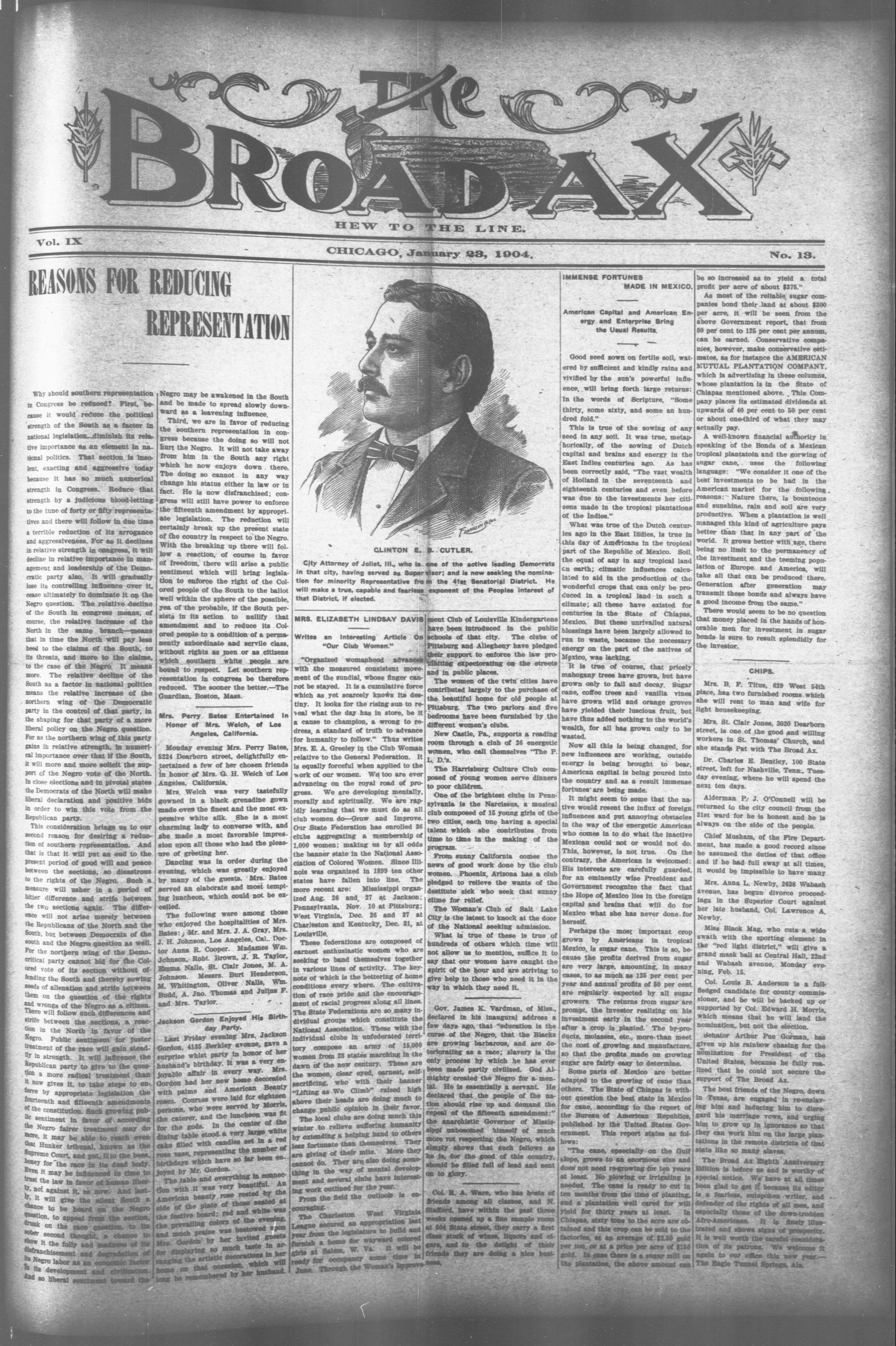
GLINTON E. B. CUTLER.
Cjty Attorney of Jollet, Ill., who is one of the active leading Democrats in that city, having served as Supervisor; and is now seeking the nomination for minority Representative from the 41st Senatorial District. He will make a true, capable and fearless exponent of the Peoples interest of that District, if elected.
"Organized womanhood advances with the measured consistent movement of the sundial, whose finger cannot be stayed. It is a cumulative force which as yet scarcely knows its destiny. It looks for the rising sun to reveal what the day has in store, be it a cause to champion, a wrong to redress, a standard of truth to advance for humanity to follow." Thus writes Mrs. E. A. Greeley in the Club Woman relative to the General Federation. It is equally forceful when applied to the work of our women. We too are ever advancing on the royal road of progress. We are developing mentally, morally and spiritually. We are rapidly learning that we must do as all club women do—Grow and Improve. Our State Federation has enrolled 36 clubs aggregating a membership of 1,000 women; making us by all odds the banner state in the National Association of Colored Women. Since Illinois was organized in 1899 ten other states have fallen into line. The more recent are: Mississippi organized Aug. 26 and, 27 at Jackson; Pennsylvania, Nov. 10 at Pittsburg; West Virginia, Dec. 26 and 27 at Charleston and Kentucky, Dec. 31, at Louisville.
These federations are composed of earnest enthusiastic women who are seeking to band themselves together in various lines of activity. The keynote of which is the bettering of home conditions every where. The cultivation of race pride and the encouragement of racial progress along all lines. The State Federations are so many individual groups which constitute the National Association. These with the individual clubs in unfederated territory compose an army of 15,000 women from 28 states marching in the dawn of the new century. These are the women, clear eyed, earnest, self-sacrificing, who with their banner "Lifting as We Climb" raised high above their heads are doing much to change public opinion in their favor.
The local clubs are doing much this winter to relieve suffering humanity by extending a helping hand to others less fortunate than themselves. They are giving of their mite. More they cannot do. They are also doing something in the way of mental development and several clubs have interesting work outlined for the year. From the field the outlook is en-
ment Club of Louisville Kindergartens have been introduced in the public schools of that city. The clubs of Pittsburg and Allegheny have pledged their support to enforce the law prohibiting expectorating on the streets and in public places. The women of the twin cities have contributed largely to the purchase of the beautiful home for old people at Pittsburg. The two parlors and five bedrooms have been furnished by the different women's clubs.
New Castle, Pa., supports a reading room through a club of 26 energetic women, who call themselves "The P. L. D.'s.
The Harrisburg Culture Club composed of young women serve dinners to poor children.
One of the brightest clubs in Pennsylvania is the Narcissus, a musical club composed of 15 young girls of the two cities, each one having a special talent which she contributes from time to time in the making of the program.
From sunny California comes the news of good work done by the club women. Phoenix, Arizona has a club pledged to relieve the wants of the destitute sick who seek that sunny clime for relief. The Woman's Club of Salt Lake City is the latest to knock at the door of the National seeking admission.
What is true of these is true of hundreds of others which time will not allow us to mention, suffice it to say that our women have caught the spirit of the hour and are striving to give help to those who need it in the way in which they need it.
Gov. James K. Vardman, of Miss. declared in his inaugural address a few days ago, that "education is the curse of the Negro, that the Blacks are growing barbarous, and are deteriorating as a race; slavery is the only process by which he has ever been made partly civilized. God Almighty created the Negro for a menial. He is essentially a servant. He declared that the people of the nation should rise up and demand the repeal of the fifteenth amendment:" the anarchistic Governor of Mississippi unbosomed himself of much more rot respecting the Negro, which simply shows that such fellows as he is, for the good of this country, should be filled full of lead and sent on to glory.
Col. R. A. Ware, who has hosts of friends among all classes, and N. Stafford, have within the past three weeks opened up a fine sample room at 504 State street, they carry a first class stock of wines, liquors and cigars, and to the delight of their friends they are doing a nice business.
American Capital and American Energy and Enterprise Bring the Usual Results.
Good seed sown on fertile soil, watered by sufficient and kindly rains and vivified by the sun's powerful influence, will bring forth large returns: In the words of Scripture, "Some thirty, some sixty, and some an hundred fold."
This is true of the sowing of any seed in any soil. It was true, metaphorically, of the sowing of Dutch capital and brains and energy in the East Indies centuries ago. As has been correctly said, "The vast wealth of Holland in the seventeenth and eighteenth centuries and even before was due to the investments her citizens made in the tropical plantations of the Indies."
What was true of the Dutch centuries ago in the East Indies, is true in this day of Americans in the tropical part of the Republic of Mexico. Soil, the equal of any in any tropical land on earth; climatic influences calculated to aid in the production of the wonderful crops that can only be produced in a tropical land in such a climate; all these have existed for centuries in the State of Chiapas, Mexico. But these unrivalled natural blessings have been largely allowed to run to waste, because the necessary energy on the part of the natives of Mexico, was lacking.
It is true of course, that pricely mahogany trees have grown, but have grown only to fall and decay. Sugar cane, coffee trees and vanilla vines have grown wild and orange groves have yielded their luscious fruit, but have thus added nothing to the world's wealth, for all has grown only to be wasted.
Now all this is being changed, for new influences are working, outside energy is being brought to bear, American capital is being poured into the country and as a result immense fortunes are being made.
It might seem to some that the native would resent the influx of foreign influences and put annoying obstacles in the way of the energetic American who comes in to do what the inactive Mexican could not or would not do. This, however, is not true. On the contrary, the American is welcomed: His interests are carefully guarded, for an eminently wise President and Government recognize the fact that the Hope of Mexico lies in the foreign capital and brains that will do for Mexico what she has never done for herself.
Perhaps the most important crop grown by Americans in tropical Mexico, is sugar cane. This is so, because the profits derived from sugar are very large, amounting, in many cases, to as much as 125 per cent per year and annual profits of 50 per cent are regularly expected by all sugar growers. The returns from sugar are prompt, the investor realizing on his investment early in the second year after a crop is planted. The by-products, molasses, etc., more than meet the cost of growing and manufacture, so that the profits made on growing sugar are fairly easy to determine.
Some parts of Mexico are better adapted to the growing of cane than others. The State of Chiapas is without question the best state in Mexico for cane, according to the report of the Bureau of American Republics, published by the United States Government. This report states as follows:
"The cane, epsecially on the Gulf slope, grows to an enormous size and does not need re-growing for ten years at least. No plowing or irrigating is needed. The cane is ready to cut in ten months from the time of planting, and a plantation well cared for will yield for thirty years at least. In Chiapas, sixty tons to the acre are obtained and this crop can be sold to the factories, at an average of $2.50 gold per ton, or at a price per acre of $150 gold. In case there is a sugar mill on the plantation, the above amount can
be so increased as to yield a total profit per acre of about $375."
As most of the reliable sugar companies bond their land at about $300 per acre, it will be seen from the above Government report, that from 50 per cent to 125 per cent per annum, can be earned. Conservative companies, however, make conservative estimates, as for instance the AMERICAN MUTUAL PLANTATION COMPANY, which is advertising in these columns, whose plantation is in the State of Chiapas mentioned above. This Company places its estimated dividends at upwards of 40 per cent to 50 per cent or about one-third of what they may actually pay.
A well-known financial authority in speaking of the Bonds of a Mexican tropical plantatoin and the gorwing of sugar cane, uses the following language: "We consider it one of the best investments to be had in the American market for the following reasons: Nature there, is bounteous and sunshine, rain and soil are very productive. When a plantation is well managed this kind of agriculture pays better than that in any part of the world. It grows better with age, there being no limit to the permanency of the investment and the teeming population of Europe and America, will take all that can be produced there. Generation after generation may transmit these bonds and always have a good income from the same."
There would seem to be no question that money placed in the hands of honorable men for investment in sugar bonds is sure to result splendidly for the investor.
CHIPS
Mrs. B. F. Titus, 629 West 54th place, has two furnished rooms which she will rent to man and wife for light housekeeping.
Mrs. St. Clair Jones, 3020 Dearborn street, is one of the good and willing workers in St. Thomas' Church, and she stands Pat with The Broad Ax.
Dr. Charles E. Bentley, 100 State street, left for Nashville, Tenn., Tuesday evening, where he will spend the next ten days.
Alderman P. J. O'Connell will be returned to the city council from the 31st ward for he is honest and he is always on the side of the people. Chief Musham, of the Fire Department, has made a good record since he assumed the duties of that office and if he had full sway at all times, it would be impossible to have many
Mrs. Anna L. Newby, 2628 Wabash avenue, has begun divorce proceedings in the Superior Court against her late husband, Col. Lawrence A. Newby. Miss Black Mag, who cuts a wide swath with the sporting element in the "red light district," will give a grand mask ball at Central Hall, 22nd and Wabash avenue, Monday evening, Feb. 15.
Col. Louis B. Anderson is a fullfledged candidate for county commissioner, and he will be backed up or supported by Col. Edward H. Morris, which means that he will land the nomination, but not the election. Sehator Arthur Pue Gorman, has given up his rainbow chasing for the nomination for President of the United States, because he fully realized that he could not secure the support of The Broad Ax.
The best friends of the Negro, down in Texas, are engaged in re-enslaving him and inducing him to disregard his marriage vows, and urging him to grow up in ignorance so that they can work him on the large plantations in the remote districts of that state like so many slaves.
The Broad Ax Eighth Anniversary Edition is before us and is worthy of special notice. We have at all times been glad to get it because its editor is a fearless, outspoken writer, and defender of the rights of all men, and especially those of the down-trodden Afro-Americans. It is finely illustrated and shows signs of prosperity. It is well worth the careful consideration of its patrons. We welcome it again to our office this new year. The Eagle Tunnel Springs Ala.
THE BROAD AX.
Will promulgate and at all times uphold the true principles of Democracy, but Oaths, Protestants, Priests, Infidels, Farmers, Single Towers, Republicans, Knights of Labor, or any one else can have their say, so long as their language is proper and responsibility is fired.
The Broad Ax is a newspaper whose platform is broad enough for all, ever claiming the editorial right to speak its own mind.
Local communications will receive attention. Write only on one side of the paper.
Subscriptions must be paid in advance.
One Year.....$2.00
Six Months.....1.00
Advertising rates made known on application.
Address all communications to
THE BROAD AX
6040 Armour Avenue, Chicago.
JULIUS F. TAYLOR, Editor and Publisher.
Entered at the Post Office at Chicago, Ill., as Second-class Matter.
MEN YOU HAVE HEARD OF.
Gov. Brodie, of Arizona, is a native of New York state, and went to West Point in 1866. He became a mining engineer after serving several years in the army. Secretary Hay has in his possession the Panama flag in which was wrapped Panama's treaty with the United States on its trip from Washington to the Isthmus and back again. The flag was presented to him by Minister Bunau-Varilla, who himself kept the American flag, which was also wrapped about the treaty.
Though a very busy man, President Diaz, of Mexico, rarely if ever refuses an audience to American visitors. Usually a letter sent a day or two ahead is sufficient to secure an interview. The general's knowledge of English is hardly more than rudimentary, so he always has an interpreter at hand on such occasions.
Grover Cleveland has lived in the time of more administrations than any other citizen who has ever been president, beginning with that of Martin Van Buren and coming down to that of Theodore Roosevelt—in all 18, exclusive of his own two. He has also lived to see six vice presidents succeed to the presidency, three of them, Johnson, Arthur and Roosevelt, coming to the white house through the assassination of their predecessors. The others were Van Buren, Tyler and Fillimore.
Rear Admiral Schley desires to become a voter in his native state of Maryland. With the view of aiding him some of his friends in the legislature are considering the introduction of an enabling bill. Some lawyers say that such a course is not necessary, holding that a sailor retains his former domicile until by actual residence elsewhere he loses his right to vote. In any event, the admiral is likely to cast his first vote at the presidential election next fall. The Schley family has been identified with Maryland for over 150 years.
Senator Reagan, of Texas, when he was in the senate, was one of the men who strongly objected to being interrupted. On one occasion Henry W. Blair, then a senator from New Hampshire, tried to ask Reagan a question during the latter's speech. "I do not want to be interrupted," said Reagan, "but I will listen to a question." "It is not exactly a question, but a statement," said Blair. "Then I refuse to yield," said Reagan. "Well, the senator has missed an opportunity of greatly improving his speech," remarked Blair, as he ambled toward the cloakroom.
GERMAN AND RUSSIAN TRADE.
It is believed that the artificial campher now being made in Germany will prove particularly useful in the manufacture of safety explosives. The German-Russian association, at Berlin, whose mission is to increase German exports to Russia, has 257 German business and manufacturing firms and 42 German chambers of commerce among its membership.
A special bureau has been established to collect information on all matters pertaining to grain in different parts of Russia, and an arbitration and supervisory committee, composed of the most reputable merchants of Odesa, has been appointed to inspect grain shipments, decide disputes, adjust claims, etc.
The produce exchanges of the Russian Black sea ports—Odessa, Nicholalov and Rostoff—intend to locate agents at the ports of Hull, London, Rotterdam, Antwerp, Hamburg and Marseilles for the purpose of watching the arrivals of Russian grain cargoes and frustrating the fraudulent practices which have brought Russian grain into disrepute.
MUNICIPAL MATTERS
An agitation has been commenced in New York for a more uniform system of ten inspection.
Chester W. Kingsley, of Cambridge, Mass., who died recently, left $150,000 to the charities of the city. His wife, who was buried the day before his death, also bequeathed her individual fortune to benevolent purposes.
Lewis P. Abbott, for 80 years a member of the Boston fire department, a part of that time holding the office of district chief, retired on a pension of $1,000 yearly on New Year's day. He has missed but four fire in his district during his term of service.
Mrs. Mary Conway has been appointed tax collector of Gordon, Pa. She is a widow and a school teacher, and she is the first woman ever appointed to a position of this kind is that section. Collection of taxes in Gordon is very difficult and carries little enoument, and no male resident could be found to undertake the work.
Not Worth Mentioning.
It was a case of love at first sight. They met, loved, and were married in an incredibly short time.
"Forgive me, d—darling," sobbed the sudden bride, as she fell somewhat excitedly on the bridegroom's neck; "but I k—kept a s—secret from you. I can't cook!"
"Oh, that'll be all right," replied the masculine part of love's sweet illusion; "I forgive your secret, dearest, because I'm a poet—consequently there won't be much to cook."—Tit-Bits.
Combination of Soles.
"Why, it's a number of men who play together."
"Well, pop, I'm sure no two of those men were playing together!"—Yonkers Statesman.
A Poor Guess.
Son-What does Congressman Popullem mean by saying that the money of the country is unevenly distributed?
Father (a carpenter)—Don't know exactly. Maybe he means that it isn't right for a blatherskite like him to be drawing $13.50 a day, while a carpenter like me is often thankful to make that much a week.—N. Y. Weekly.
A Cropper.
Annie Seed—Oh, Mr. Tallyhear, you should have seen Mr. Seldham-Hunt take that high hedge.
-Mr. Tallyheau—The idea! I didn't think the horse he rode was much of a jumper.
Annie Seed—Oh, the horse didn't take the hedge. Mr. Seldham-Hunt did it alone.—Philadelphia Press.
The Moving Jarred Him.
"I never saw any one in such a horrible humor as Townley was yesterday."
"Well, well; and yet they say he is not easily moved."
"That's the whole trouble. Somebody bought his house over his head and he had to get out yesterday."—Philadelphia Press.
At Nation of Inventors.
Foreign Visitor—To what do you ascribe the remarkable inventive ingenuity of Americans.
Host—Puritan mothers.
"I do not understand."
"A boy with that kind of a mother has got to cultivate his inventive facilities if he is going to have any fun."—N. Y. Weekly.
Appreciative.
"Do you believe that the American people like to be humbugged?"
"No, sir," answered the sturdy patriot, "but when they find any one smart enough to do it they can't help takin' off their hats to him."—Washington Star.
Rule Safe to Break.
Guest—I understand this club has a rule that there shall be no feeling the waiters.
Waiter—Yes, sir; but we never think of reporting when the rule is broken.—Town Topics.
Sportsman (wishing for fresh fields to conquer)—I should like to try my hand at big game.
Fair Ignoramus—Yes; I suppose you find it very hard to hit these little birds.
—Judge.
Hepeless.
"Would you be happy if you wereguaranteed $10,000 a year for life?"
"No. My wife would worry me into a lunatic asylum trying to make me get it raised to $15,000.—Chicago Record-Herald.
How the Disaffection Began.
Mary had a little lamb
Which she warmed up in mince,
"Twas "not as good as mothers,"
And there's been a coldness since.
—N. I. Times.
A
He—What a splendid disguise your husband has adopted.
She—Woman?
He Was Interested.
Wife—You seem to find something very interesting in that paper. What are you reading?
Husband—The Woman's Page.
"Well, I am glad you have at last awakened to the vast importance of woman's place in civilization."
"Yes, indeed. I've struck some mighty fine cooking recipes."—N. Y. Weekly.
Tweetless.
The Grassnopper—What was the matter with poor Papa Spider? Why did he kill himself?
The Potato Bug—Why, his wife is a woman of no tact. When he came home the other night she blurted out that the children all needed new shoes.—Brooklyn Life.
No Dry Measure;
"Waters is trying to sell his property," said the first resident of Swamphurst.
"Of course, he is," remarked the other.
"But I mean he's actually advertising it in the papers."
"The idea! How much does he ask for it per gallon?"—Philadelphia Press.
Human Nature.
When either fools or wise men
Buy something nice they show it;
But when they buy experience,
They don't want folks to know it.
—Cincinnati Enquirer.
WORKING ON TIME.
A
Stork—Say, Monk, what's become of the cuckoo bird that used to live in the third bough back?
Monk—Oh, he's moved to the city. He's got a job as model in a clock factory.—N. Y. Sun.
An Iowa Classic
Way up here in Iowa
We've had a kind o' blizzard;
It's cold enough both night and day
To nearly freeze your gizzard.
Summer (la.) Journal.
"Did you ever see a chimney sweep?" asked the solemn man with the black cane.
"No," responded the conductor of the car, "but I've heard a college yell." Chicago Daily News.
A Born Diplomat.
"Can you tie a true lover's knot?" asked the coy maiden.
"Not me," replied the young man, "but I know a clergyman who would be only too glad to do it."—Cincinnati Enguirer.
"Hazel came over to-night to study with me," exclaimed Dorothy. "And did you do much studying?" "Well, we would have, if there hadn't been so much to talk about."—Chicago Post.
No Respite.
"I Cannot Sing the Old Songs," warbled the young woman at the piano. But this was small relief, for the new ones she sang were even worse.—Chicago Tribune.
Old One—Yes, indeed! If you don't tell her every day in the week how beautiful she is, she's as cross as a bear.—Chicago American.
The Absent Treatment.
Cholly—It seems to me I have tried every way I know to gain her affections.
Ethel—They say that absence makes the heart grow fonder. Try that for a change.—Judge.
Fruitless Quest.
"Worry," said the author is the plague of genius, but it hasn't reached my brain yet."
"Perhapa," suggested a listener, "it got tired looking for it."—Augusta (Ga.) Terald.
"Sure, an' I hate to be lavin' ye, Dinnis."
"Och, Nora, me darlint, I can't bear the siparation. If we must part, let's go t'gither."—Kansas City Journal.
test of piano players come out?"
"It ended, I believe, at the fourteenth hour. The neighbors interfered."—Chicago Tribune.
Good Adives.
Gertrude—Uncle, what would you advise me to do to find a husband?
Uncle Gayboy—Let the husbands alone, my dear. Go after a single man.
—Boston Globe.
She Wouldn't Have Him.
"He's a gay dog; likes all women but isn't engaged to any particular one."
"I should think not. What particular woman would have him?"—Brooklyn Life.
Philosophy.
"An enthusiastic natred is almost as healthful as a great love."
"You're looking well. You must be married."—Cincinnati Commercial Tribune.
Fifty-First St. and Armour Ave.
RAIL YARDS: 51st St. & L. S. & M. S. Ry.
52nd St. and Armour Ave.
CHICAGO
NOTARY PUBLIC. Office Phone, M. 751
Residence Phone. Blue 5385.
W. G. ANDERSON,
ATTORNEY AT LAW.
J.Q.GRANT&CO.
Collections, Loans and Insurance,
SUITE 61,119 LA SALLE Residence, 3232 Wabash Avenue, CHICAGO.
---
The Souls of Black Folk
By W. E. B. DuBois
A REMARKABLE BOOK that is provoking much discussion because of the wonderful eloquence with which the author pleads for right and justice to his people. In these days of increasing agitation over the "negro problem" this passionate human document can neither be overlooked nor ignored. Aside from its remarkable presentation of facts it holds the reader—prejudiced or not—by its fascination of style and overpowering pathos.
Some of the Chapter Headings follow:
OF OUR SPIRITUAL STRIVINGS.
OF THE DAWN OF FREEDOM.
OF MR. WASHINGTON AND OTHERS.
OF THE MEANING OF PROGRESS.
OF THE TRAINING OF BLACK MEN.
OF THE BLACK BELT.
OF THE SONS OF MASTER AND MAN.
OF THE FAITH OF THE FATHERS.
OF THE PASSING OF THE FIRST-BORN.
OF ALEXANDER CRUMMELL.
OF THE COMING OF JOHN.
OF THE BORROW SONGS.
3d Edition $1.20 net Published by
A.C. McClurg & Co., Chicago
MR8. A. WILSON.
Nicely furnished rooms to rent for gentlemen. Reasonable rates, 2262 Indiana aveuna.
Mrs. Anna L. Newby.
First class furnished rooms, for rent to gentleman and ladies, with bath and gas. 2628 Wabash avenue.
Mrs. J. J. Manley.
Florist.
Funeral designs of every description, latest and most stylish decorations, for churches and weddings. Palms to rent for all social functions, 3119 State St., Chicago.
Rooms for Rent
Elegantly furnished rooms for rent with bath and gas at 3232 Wabash avenue.
```markdown
```
By taking out three bonds in the American Mutual Plantation Company
By Paying Ten Dollars Per Month for Five Years Allowing your dividends to accumulate during that period Get Particulars by Writing
Rev. J. W. Robinson, Pastor St. Marks M. E. Church, and the Editor of The Broad Ax
American Brick Co.
President and Treasurer, THOMAS CAREY. Vice-President, JOHN SHELHAMER, Secretary, WILLIAM SULLIVAN. MANUFACTURERS OF
45th and Robey Sts.
Yards running winter and summer, equipped with the latest improved Wolf Dryer.
Output of Winter Yards ..... 144,000 per day
Output of Summer Yards..... 300,000 per day
Telephone Yards 128.
---
If your physician recommends the use of a stimulant, there is no whisky in which so many desirable qualities are contained as in Old Underoof Rye and it has the least reactive effect. Because it is made right and is aged right.
WINES, LIQUORS AND CIGARS 8400 SOUTH HALSTED STREET.
JOHN A ORB,
President.
WILLIAM LEGNER,
Vice Pres. & Treas.
But Few of Them Are Now to Be Found in the Senate or House— Some Picturesque Characters in Congress.
Washington.—Two great soldiers have passed away in the deaths of
in the deaths of Maj. Gen. Longstreet and Gen. Gordon—two of the greatest soldiers in the history of the republic.
M. B.
Of the generals of the confederacy Longstreet ranked easily among the first three, and in the opinion of military experts there were not more than that number of commanders on
the federal side who excelled him. Yet for the greater portion of the time after the close of the civil war until his death his fame rested under a cloud among some of his own people, because after swords were transformed into agricultural implements he allied himself with the opposition party.
At the close of the war Longstreet became a republican and he remained a republican until the end. Some of his neighbors, forgetful of the splendid services he had rendered the confederacy in the field, ostracized him. They refused to recognize him at the reunions of confederate veterans and for years he lived as a stranger in a strange land. Now that he is dead perhaps his reward may come, but the tragedy of his life cannot be obliterated.
Oflateyears he has been a resident of Washington occupying the sinecure position of railroad commissioner, which was occupied before him by another confederate soldier, Joseph F. Johnston. There is little in the physical appearance of the gray-haired old man to remind one of the dashing corps commander of 40 years ago. The inevitable ear-trumpet and the sightless eye were pathetic reminiscences of a heroic past.
Dwindling Hanks
The departure of Longstreet and Gordon serves to call attention to the
rapidly dwindling group of former confederate officers who remain in public life in Washington.
A. B.
There are still a good many confederate veterans in congress, but very few of them held conspicuous rank. There was a time not so very long ago when the visitor to the senate galleries looked
down on an historic group of southern military heroes. There were Wade Hampton and M. C. Butler, those fine types of the "rebel brigadier" about whom Ben Butler used to storm; Isham Harris, of Tennessee; Mahona, of Virginia; John B. Gordon and Colquitt, of Georgia; Walthall, of Mississippi, whom Lamar used to say would have succeeded Lee if Lee for any reason had fallen by the wayside, and whom Senator Hoar describes as the finest type of southern statesman; Zeb Vance, of North Carolina, the idol of the old north state. In the senate now there are only three or four. Cockrell, of Missouri, had an enviable record. So had Morgan and Pettus of Alabama. Another interesting survival is Bate, of Tennessee. Bate limps about on a shortened leg to show for his experience in fighting the battles of the confederacy. Bate is known among his colleagues and has been known for years as the man who never smokes a lighted cigar. He is never without a cigar in his mouth, but it is always what is known as a dry smoke. There is a reason for this to which the Tennessee senator rarely refers. During the civil war he was riding into action once with his brother by his side. He was smoking a cigar. A bullet sped by, caught his cigar from between his lips and speeding past killed his companion. From that day Bate has never lighted a cigar. And he never will.
Bate rarely opens his mouth in the senate, but he is now one of the most experienced members of that body. He is serving his third term.
A Picturesque Congressman. A picturesque figure in the house is the new member from the Bowery dis-
trict in New York, Tim Sullivan. Sullivan is a Bowery boy and is proud of it. He has fought his way up from the bottom and at 40 years he is one of the most influential democrats in Greater New York. Over on the East side nobody would think of speaking of him as Con-
"Den Dall
Grossman Sullivan. They all call him Tim" or "Big Tim" or "Dry Dollar." "Dry Dollar Tim" is perhaps the
name by which he is most familiarly known. He has carried it from boyhood. One day on his way to school little Tim picked up a revenue beer stamp. He thought it was a dollar bill. It had been raining and the stamp was wet so when he reached the school he pinned the stamp on the wall near the stove. The teacher asked him what he was doing and he replied that he was trying to "dry that dollar." The boys caught on as boys will and from that day to this he has been known as "Dry Dollar Tim." Since that memorable day Tim Sullivan has learned a great deal about the medium of exchange
He has over a million and a half of dry dollars now. He owns theaters, race horses and race tracks and he is as well known in the sporting world as in politics. Most of "Dry Dollar's" education he picked up in the streets. His school days were few. He began to make money by selling papers and most of the information he picked up was gathered from the papers he sold and from the racy talk of the streets. To this day he says his reading is confined to the newspapers. He buys a lot of them and reads them all. When he is through with them he has little time for anything else.
Sam Powers, of Massachusetts, is going to retire from congress at the end of his present
term. That will be sad news for younger men in the house and for many of the older men, too, for that matter. But Powers thinks he can make a good deal more money by going back to his profession and he says that the life of a representative is dreary and unprofitable.
A. B.
Congressman Powers
Powers is a man of ability and he is also a thoroughly good fellow. He is one of the few members who has managed to attract the attention of the house during his first term in congress. When he landed in Washington to begin his congressional career the first thing that impressed him was the utter insignificance of the new member under the hard and fast system of preferment which prevails. He lay around for a few weeks, wondering why he ever consented to come to Washington at all, and calling himself all sorts of names. He talked around among some of the other new members and found that most of them felt about as he did. Then he had an inspiration
He organized the new members into a club, which he called the Tantalus club, because it is the fate of the new member to be constantly hoping to get somewhere and never reaching the goal. He got them all together for a dinner. He was made president by acclamation, and the first dinner was such a success that they had another and another. The beauty about the dinners was that the members who would never get a chance to talk in the house under the rules could be recognized and show what there was in them. The Tantalus club dinners became a feature of Washington. Everybody wanted to go to them and nobody could get in. The old members for once had to take a subordinate position. Powers became the best of all the new men and he speedily became a factor to be reckoned with. If he were to stay in congress he would cut a big figure, but he is going to leave.
Beveridge, of Indiana.
Beveridge, of Indiana, is coming back to the senate at the expiration of his present term. That is one of the things that seems to have been settled by the recent republican love feast at Indianapolis. It is a good thing for Beveridge and it is a good thing for Indiana.
A.
Beveridge is one of the most promising men in public life to-day. If he handles himself
Senator Beveridge handles himself right it is hard to say where his ambition will carry him. For he has plenty of ambition and he has plenty of capacity. He has an acute mind. He has ample assurance. He has industry. He has a wonderfully attractive personality.
If Beveridge were not in politics he could make a handsome living with his pen. It is possible, too, that he might make a great success in business. His closest friend is George W. Perkins, of the firm of J. P. Morgan & Co.
Beveridge ran into George W. Perkins in Indianapolis when both were ambitious young fellows with their way to make in the world. They met for the first time on a trial trip that was made on an Indianapolis trolley line and they were attracted to each other at once. After that trip one of the big financial magnates of Indianapolis asked Beveridge what he thought of his new acquaintance.
thought of his new acquaintance "I believe," said Beveridge, who was then a boy lawyer, "that Perkins will be the most powerful financial figure in the United States."
Perkins was then a life insurance man and there was no superficial indication of his future. But before long he was called to New York and he is rapidly advancing to the position which Beveridge picked out for him. The two are great chums now. They spend all the time together they can, and each goes to the other for advice, but neither ever asks the other for a favor. That is the compact between
LOUIS A. COOLIDGE
Made of Two Ordinary Embroidered Handkerchiefs and Finished in Lace and Ribbon.
This novel and dainty corset cover is made of two ordinary embroidered handkerchiefs. Cut one of the handkerchiefs in two straight across from corner to corner thus forming two large triangles; then cut one of these pieces in two in the middle, again forming two equal triangles. Now take the second handkerchief and cut it in two big triangles in exactly the same manner. You now have one handkerchief in two pieces and one in one large and two small triangles. Take the three large triangles, put one in the center with the pointed end up, and one on either side of this with the pointed end down. Join these with strips of lace insertion. Now take the two small triangles that are left and join them with insertion for the fronts in
```markdown
```
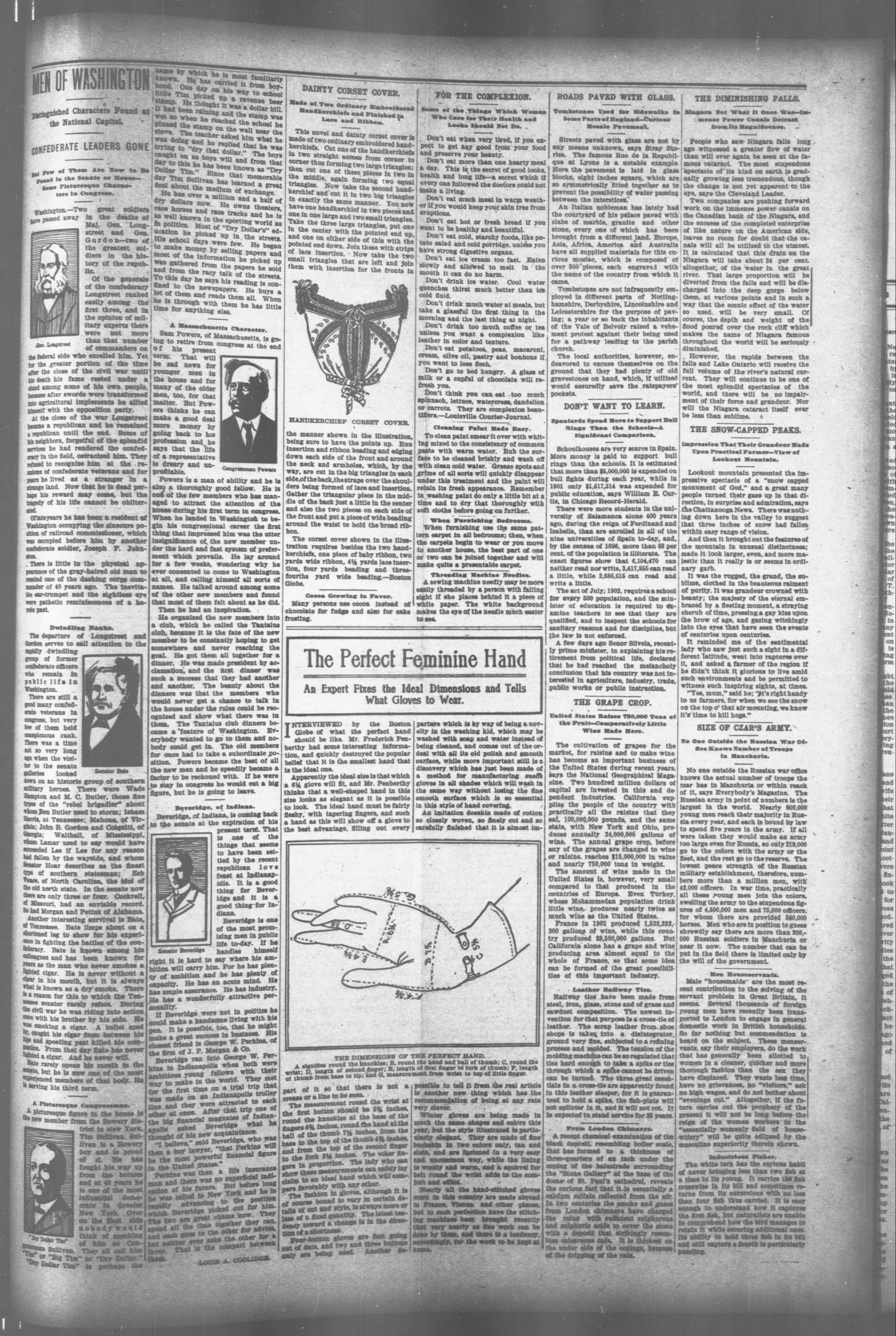
HANDKERCHIEF CORSET COVER. the manner shown in the illustration, being sure to have the points up. Run insertion and ribbon beading and edging down each side of the front and around the neck and armholes, which, by the way, are cut in the big triangles in each side, of the back,the straps over the shoulders being formed of lace and insertion. Gather the triangular piece in the middle of the back just a little in the center and also the two pieces on each side of the front and put a piece of wide beading around the waist to hold the broad ribbon.
The corset cover shown in the illustration requires besides the two handkerchiefs, one piece of baby ribbon, two yards wide ribbon, 4% yards lace insertion, four yards beading and three-fourths yard wide beading.—Boston Globe.
Cocoa Growing in Favor.
Many persons use cocoa instead of chocolate for fudge and also for cake frosting.
The Perfect F
An Expert Fixes the Ide
What Glove
The Perfect Feminine Hand
An Expert Fixes the Ideal Dimensions and Tells What Gloves to Wear.
INTERVIEWED by the Boston Globe of what the perfect hand should be like. Mr. Frederick Penberthy had some interesting information, and quickly destroyed the popular belief that it is the smallest hand that is the ideal one. Apparently the ideal size is that which a 6 1/4 glove will fit, and Mr. Penberthy thinks that a well-shaped hand in this size looks as elegant as it is possible to look. The ideal hand must be fairly fleshy, with tapering fingers, and such a hand as this will show off a glove to the best advantage, filling out every
4.3%
E 4.3%
7
D 3%
G 5%
C 2%
F 4.3%
E 4.3%
G 5.5%
THE DIMENSIONS OF THE PERFECT HAND.
A signifies round the knuckles; B, round the hand and ball of thumb; C, round the wrist; D, length of second finger; E, length of first finger to fork of thumb; F, length of thumb from base to tip; and G, measurement from wrist to top of little finger.
part of it so that there is not a possible to tell it from the real article is another new thing which has the crease or a line to be seen.
The measurement round the wrist at the first button should be 5% inches, round the knuckles at the base of the fingers 6% inches, round the hand at the ball of the thumb 7% inches, from the base to the top of the thumb 4% inches, and from the top of the second finger to the fork 3% inches. The other fingers in proportion. The lady who can show these measurements can safely lay claim to an ideal hand which will comfortably with any other.
The fashion in gloves, although it is of course bound to vary in certain details of cut and style, is always more or less of a fixed quantity. The latest tendency toward a change is in the direction of a shortness.
Four-button gloves are fast going out of date, and two and three buttons only are being used. Another de-
FOR THE COMPLEXION.
Some of the Things Which Women Who Care for Their Health and Looks Should Not Do.
Don't eat when very tired, if you expect to get any good from your food and preserve your beauty.
Don't eat more than one hearty meal a day. This is the secret of good looks, health and long life—a secret which if every one followed the doctors could not make a living.
Don't eat much meat in warm weather if you would keep your skin free from eruptions.
Don't eat hot or fresh bread if you want to be healthy and beautiful.
Don't eat cold, starchy foods, like potato salad and cold porridge, unless you have strong digestive organs.
Don't eat ice cream too fast. Eaten slowly and allowed to melt in the mouth it can do no harm.
Don't drink ice water. Cool water quenches thirst much better than ice cold fluid.
Don't drink much water at meals, but take a glassful the first thing in the morning and the last thing at night.
Don't drink too much coffee or tea unless you want a complexion like leather in color and texture.
Don't eat potatoes, peas, macaroni, cream, olive oil, pastry and bonbons if you want to lose flesh.
Don't go to bed hungry. A glass of milk or a cupful of chocolate will refresh you.
Don't think you can eat too much spinnach, lettuce, watercress, dandelion or carrots. They are complexion beautifiers.—Louisville Courier-Journal.
To clean paint smear it over with whiting mixed to the consistency of common paste with warm water. Rub the surface to be cleaned briskly and wash off with clean cold water. Grease spots and grime of all sorts will quickly disappear under this treatment and the paint will retain its fresh appearance. Remember in washing paint do only a little bit at a time and to dry that thoroughly with soft cloths before going on further.
When Furnishing Bedrooms.
When furnishing use the same pattern carpet in all bedrooms; then, when the carpets begin to wear or you move to another house, the best part of one or two can be joined together and will make quite a presentable carpet.
Threading Machine Needles.
A sewing machine needly may be more easily threaded by a person with failing sight if she places behind it a piece of white paper. The white background makes the eye of the needle much easier to see.
Feminine Hand Real Dimensions and Tells ves to Wear.
parture which is by way of being a novelty in the washing kid, which may be washed with soap and water instead of being cleaned, and comes out of the ordeal with all its old polish and smooth surface, while more important still is a discovery which has just been made of a method for manufacturing suede gloves in all shades which will wash in the same way without losing the fine smooth surface which is so essential in this style of hand covering. An imitation doeskin made of cotton so closely woven, so finely cut and so carefully finished that it is almost im-
B 7%
possible to tell it from the real article is another new thing which has the recommendation of being at any rate very clever. Winter gloves are being made in much the same shapes and colors this year, but the style illustrated is particularly elegant. They are made of fine buckskin in two colors only, tan and slate, and are fastened in a very easy and uncommon way, while the lining is woolly and warm, and a squirrel fur belt round the wrist adds to the comfort and effect.
Nearly all the hand-stitched gloves worn in this country are made abroad in France, Vienna and other places, but to such perfection have the stitching machines been brought recently that very nearly as fine work can be done by them, and there is a tendency, accordingly, for the work to be kept at home.
```markdown
```
ROADS PAVED WITH GLASS.
Tombstones Used for Sidewalks in Some Parts of England-Curious Mosale Pavement. Streets paved with glass are not by any means unknown, says Stray Stories. The famous Rue de la Republique at Lyons is a notable example. Here the pavement is laid in glass blocks, eight inches square, which are so symmetrically fitted together as to prevent the possibility of water passing between the interstices.
An Italian nobleman has lately had the courtyard of his palace paved with slabs of marble, granite and other stone, every one of which has been brought from a different land. Europe, Asia, Africa, America and Australia have all supplied materials for this curious mosiac, which is composed of over 500 pieces, each engraved with the name of the country from which it came.
Tombstones are not infrequently employed in different parts of Nottinghamshire, Derbyshire, Lincolnshire and Leicestershire for the purpose of paving; a year or so back the inhabitants of the Vale of Belvoir raised a vehement protest against their being used for a pathway leading to the parish church.
The local authorities, however, endeavored to excuse themselves on the ground that they had plenty of old gravestones on hand, which, if utilized would assuredly save the ratepayers' pockets.
DON'T WANT TO LEARN.
Spanlards Spend More to Support Bull Rings Than the Schools-A Significant Comparison,
Schoolhouses are very scarce in Spain. More money is paid to support bull rings than the schools. It is estimated that more than $5,000,000 is expended on bull fights during each year, while in 1901 only $1,617,314 was expended for public education, says William E. Curtis, in Chicago Record-Herald.
There were more students in the university of Salamanca alone 400 years ago, during the reign of Ferdinand and Isabella, than are enrolled in all of the nine universities of Spain to-day, and, by the census of 1896, more than 68 per cent. of the population is illiterate. The exact figures show that 6,104,470 can neither read nor write, 3,417,855 can read a little, while 2,686,615 can read and write a little.
The act of July, 1902, requires a school for every 500 population, and the minister of education is required to examine teachers to see that they are qualified, and to inspect the schools for sanitary reasons and for discipline, but the law is not enforced. A few days ago Senor Silvela, recently prime minister, in explaining his retirement from political life, declared that he had reached the melancholy conclusion that his country was not interested in agriculture, industry, trade, public works or public instruction.
THE GRAPE CROP.
United States Raises 750,000 Tons of the Fruit-Comparatively Little Wine Made Here.
The cultivation of grapes for the market, for raisins and to make wine has become an important business of the United States during recent years, says the National Geographical Magazine. Two hundred million dollars of capital are invested in this and dependent industries. California supplies the people of the country with practically all the raisins that they eat, 100,060,000 pounds, and the same state, with New York and Ohio, produces annually 24,000,000 gallons of wine. The annual grape crop, before any of the grapes are changed to wine or raisins, reaches $15,000,000 in value and nearly 750,000 tons in weight.
The amount of wine made in the United States is, however, very small compared to that produced in the countries of Europe. Even Turkey, whose Mohammedan population drink little wine, produces nearly twice as much wine as the United States. France in 1901 produced 1,523,233, 200 gallons of wine, while this country produced 29,500,000 gallons. But California alone has a grape and wine producing area almost equal to the whole of France, so that some idea can be formed of the great possibilities of this important industry.
Leather Railway Ties. Railway ties have been made from steel, iron, glass, stone and of grass and sawdust composition. The newest invention for that purpose is a cross-tie of leather. The scrap leather from shoe shops is taken into a disintegrator, ground very fine, subjected to a refining process and molded. The tension of the molding machine can be so regulated that ties hard enough to take a spike or ties through which a spike cannot be driven can be turned. The three great essentials in a cross-tie are apparently found in this leather sleeper, for it is guaranteed to hold a spike, the fish-plate will not splinter in it, and it will not rot. It is expected to stand service for 35 years.
A recent chemical examination of the black deposit, resembling boiler scale, that has formed to a thickness of three-quarters of an inch under the coping of the balustrade surrounding the "Stone Gallery" at the base of the dome of St. Paul's cathedral, reveals the curious fact that it is essentially a calcium sulfate collected from the air. In two centuries the smoke and gases from London chimneys have charged the rains with sufficient sulphurous and sulphuric acids to cover the stone with a deposit that strikingly resembles calcareous tufa. It is thickest on the under side of the copings, because of the drilling of the rain.
THE DIMINISHING FALLS.
Niagara Not What It Once Was—Immense Power Canals Detract from Its Magnificence.
People who saw Niagara falls long ago witnessed a greater flow of water than will ever again be seen at the famous cataract. The most stupendous spectacle of its kind on earth is gradually growing less tremendous, though the change is not yet apparent to the eye, says the Cleveland Leader.
NEW NEWS
releases
dates by
in
identity
on
cent
the
held
divided
more
man
on a
limited
absso
of
with
com-
mitted
ention,
the
wes-
dwn
were
the
the
well-
color
dular
of
T.
both?
con-
Ne
in
many
count
on
is
going
form
night
the
should
use
than
the
times
union
bourt
every-
living
even
mans
and
wife
their
that
white
better
land
and
point
hoot-
vere
fin-
took
to
for
cross
good-
fured
ever
arity
dies
the
that
argued
the
s of
fish-
back-
fact
he
ago-
me
ed
of
not
wife
are
Chi-
nen
the
of
own
was
the
son
the
mup
or
less.
the
ne
if
ob-
lit-
Two companies are pushing forward work on the immense power canals on the Canadian bank of the Niagara, and the success of the completed enterprise of like nature on the American side, leaves no room for doubt that the canals will all be utilized to the utmost. It is calculated that this drain on the Niagara will take about 24 per cent. altogether, of the water in the great river. That large proportion will be diverted from the falls and will be discharged into the deep gorge below them, at various points and in such a way that the scenic effect of the water so used will be very small. Of course, the depth and weight of the flood poured over the rock cliff which makes the name of Niagara famous throughout the world will be seriously diminished.
However, the rapids between the falls and Lake Ontario will receive the full volume of the river's natural current. They will continue to be one of the most splendid spectacles of the world, and there will be no impairment of their force and grandeur. Nor will the Niagara cataract itself ever be less than sublime.
THE SNOW-CAPPED PEAKS.
Impression That Their Grandeur Made Upon Practical Farmer—View of Lookout Mountain.
Lookout mountain presented the impressive spectacle of a "snow capped monument of God," and a great many people turned their gaze up in that direction, in surprise and admiration, says the Chattanooga News. There was nothing down here in the valley to suggest that three inches of snow had fallen within easy range of vision. And then it brought out the features of the mountain in unusual distinctness; made it look larger, even, and more majestic than it really is or seems in ordinary garb.
It was the rugged, the grand, the sublime, clothed in the beauteous raiment of purity. It was grandeur crowned with beauty; the majesty of the eternal embraced by a fleeting moment, a straying cherub of time, pressing a gay kiss upon the brow of age, and gazing witchingly into the eyes that have seen the events of centuries upon centuries.
It reminded me of the sentimental lady who saw just such a sight in a different latitude, went into raptures over it, and asked a farmer of the region if he didn't think it glorious to live amid such environments and be permitted to witness such inspiring sights, at times.
"Yes, mum," said he; "it's right handy to us farmers, for when we see the snow on the top o' that air mounting, we know it's time to kill hogs."
SIZE OF CZAR'S ARMY.
No One Outside the Russian War Office Knows Number of Troops in Manchuria.
No one outside the Russian war office knows the actual number of troops the czar has in Manchuria or within reach of it, says Everybody's Magazine. The Russian army in point of numbers is the largest in the world. Nearly 900,000 young men reach their majority in Russia every year, and each is bound by law to spend five years in the army. If all were taken they would make an army too large even for Russia, so only 219,000 go to the colors with the army or the fleet, and the rest go to the reserve. The lowest peace strength of the Russian military establishment, therefore, numbers more than a million men, with 42,000 officers. In war time, practically all these young men join the colors, swelling the army to the stupendous figures of 4,500,000 men and 75,000 officers, for whom there are provided 560,000 horses. Men who are in position to guess shrewdly say there are more than 300,000 Russian soldiers in Manchuria or near it now. The number that can be put in the field there is limited only by the will of the government.
Male "housemaids" are the most recent contribution to the solving of the servant problem in Great Britain, it seems. Several thousands of foreign young men have recently been transported to London to engage in general domestic work in British households. So far nothing but commendation is heard on the subject. These menservants, say their employers, do the work that has generally been allotted to women in a cleaner, quicker and more thorough fashion than the sex they have displaced. They waste less time, have no grievances, no "visitors," ask no high wages, and do not bother about "evenings out." Altogether, if the future carries out the prophecy of the present it will not be long before the reign of the women workers in the "essentially womanly field of housewifery" will be quite eclipsed by the masculine superiority therein shown.
Industrious Fisher. The white tern has the curious habit of never bringing less than two fish at a time to its young. It carries the fish crosswise in its bill and sometimes returns from its excursions with no less than four fish thus carried. It is easy enough to understand how it captures the first fish, but naturalists are unable to comprehend how the bird manages to retain it while securing additional ones. Its ability to hold three fish in its bill and still capture a fourth is particularly puzzling.
Rev. J. W. Robinson, of St. Mark's Church, 47th and State Street, has started a mission down at 18th and Armour Avenue, which will be in charge of Rev. Mrs. Walter Hill, who is preparing a book for the Press which will contain a sketch of her life and essays on the Bible and other topics.
Mrs. J. C. Stewart, 5434 Normal Avenue, is still receiving presents from her numerous friends. The first of this week she received a handsome set of silver forks from Mr. and Mrs. C. Pitman, and a beautiful ornamental cross from Mrs. E. H. Smith, Philadelphia, Pa., fancy plate, Mrs. Lulu Weaver, cup and saucer, Mr. and Mrs. Dan. Bell.
Melville G. Holding, who was one of the best city oil inspectors Chicago has ever had, is being urged by many of his friends to become a candidate for alderman in the 32nd ward, and if Mr. Holding should decide to enter the aldermanic contest in his ward he would be elected, for he is an affable gentleman, and highly esteemed by a large circle of friends.
The following news and representative race papers made their bow to the new year in holiday attire. The Boston Guardian, Chicago Broad-Ax, Des Moines Bystander and Little Rock Mosaic Guide. May your beauty charm the whole of the year and may a ripe return attend your efforts. —The Spectator, St. Joseph, Mo.
As further evidence that the whites residing in the State of Mississippi are reverting back to savagery, a member of the legislature of that state has introduced a bill which it passed will transform all its white citizens into saints, who make up their minds to amuse themselves by mobbing and lynching Negroes.
The Douglass Afro-American Press Agency has been organized at Providence, R. L., to handle newspapers, magazines and books published by Negroes. Its officers are Fillmore R. Purnell, business manager and treasurer; John H. Maddox, secretary; William P. H. Freeman, advertising solicitor, and William Ward, superintendent.
Mrs. J. H. Johnson, sister to Mrs. F. D. Berry, 5025 Armour avenue, and also sister of the late Mrs. Walter Gray, and Mrs. John Leak, and Arthur Bartlett of Ashtabula, Ohio, and Harry Patterson, Grand Rapids, Mich., and Bert Patterson, Cleveland, Ohio, who came to the city to attend the funeral of Mrs. Gray, left for their respective homes Sunday morning.
The Phyllis Wheatley Woman's Club met at the home of Mrs. J. B. Hart, 4841 Armour Avenue Wednesday afternoon. Miss Susie Brown, Mrs. Jessie Woods, Miss Rosa McDonald, Miss Nellie Toler, Mrs. Bell, Miss Constance Toler, Mrs. Cordelia West, Mrs. Fanny Battles, Mrs. Anna Dunmore, and Mrs. L. A. Davis, assisted in carrying out a very interesting program. At its conclusion a fine luncheon was served by Mrs. Hart.
Miss Sylvie J— who was loaded down with paste diamonds and imitation pearls while attending the halt given by the Crescent Club at the Douglas Club House a short time ago, which would be well and good if her mother and Mrs. M. R. J— would only pay the one dollar which she honestly owes as six months' subscription to The Broad Ax for which she has told one thousand lies about paying it within the past two years.
McClure's Magazine for the month of (January, 1904) contains a very timely article on the "Race Problem" in the Sluth, by Carl Schurs, which should be read by every white and black person in this country, for it sheds more light on the true condition of affairs in the South, shortly after the close of the slave-holders' rebellion, and at the present time, than any other article which has so far appeared on that subject.
Three weeks passel away before the head members of the Crescent Club were able to scrape enough money together to pay the Old Church Organ for publishing the fact that they received callers New Year's Day,
In some woman's house at 32nd and Armour avenue, which was decorated with red paper. It seems that the boys belonging to the Crescent Club, who can always draw a crowd to their dances, as long as they have free doings, and the Old Church Organ, have a mania for dishing up stale news.
Wro. 1". Lawrence, 3638 Dearborn street, who claims to be one of the head members of Quinn Chapel, some time ago ordered The Broad Ax sent to his address, and he declared that "he liked it ever so much, because it told the truth respecting Rev. Archibald James Carey, and his desire to fight as usual with the wet Holy Ghost, but only a short time ago Rev. Archibald called at the home of Mr. Lawrence, and when he noticed The Broad Ax lying on the table in front of him he acted as though he had the "Jim Jams." and he ordered Mr. Lawrence to stop taking it, which he did without paying for it, then he began borrowing it from his next door neighbor, but finally his neighbor refused to let him read his copy of The Broad Ax and intimated to him that it would look more manly on his part if he would go and buy the paper and stop sponging on him," this incident shows that Wm. P. Lawrence is a first-class double-faced, so-called Christian.
THE CAT OBJECTED.
Accidentally Imprisoned in a Vacant House—Released After Considerable Official Red Tape.
French official redtapeism led to an amusing scene recently in a provincial town, says Golden Penny. An old man having died, the Judge de Paix formally sealed up the house till the heirs should take possession, in accordance with Gallic law. But the neighbors were soon disturbed by the most frightful noises and "meeowings," and found that the house cat had been sealed up inside with the rest of the dead man's property, and, as the judge had done his work most conscientiously, not a single exit remained for poor puss.
The neighbors dared not break the seals to let pass out. So, after some days, applied to the nearest magic trate. He was equally powerless, and a formal petition had to be handed in to the president of the civil tribunal for legal authorization to open a single crack in the building. Then the Judge de Paix and his official solemnly proceeded to the house, and formally broke the seals, with the result of liberating a very starved cat, which, being exceedingly wild and spiteful from its long imprisonment, ungratefully flew at the unlucky judge as he opened the door.
MR. ROOSEVELT'S FIST.
"In all Mr. Roosevelt's life on the frontier," says Jacob Riis, writing about the president in the Outlook, "he was molested only once, and then by a drunken rowdy, who took him for a tenderfoot, and with a curse bade him treat, at the point of his two revolvers, enforcing the invitation with a little exhibition of 'gun play,' while a roomful of men looked stolidly on. Roosevelt was a stranger in the town and had no friends there. He got up apparently to yield to the inevitable, practicing over mentally the while a famous lefthander that had done execution in the old Harvard days. The next instant the bully crashed against the wall and measured his length on the floor. His pistols went off harmlessly in the air. He opened his eyes to find the 'four eyed tenderfoot' standing over him, bristling with fight, while the crowd nodded calmly, 'Served him right.' He surrendered then and there and gave up his guns, while Mr. Roosevelt went to bed unmolested. Such things carry far on the plains. No one was ever after that heard to express a wish to fill this tenderfoot 'full of holes,' even though he did wear gold spectacles and fringed angcra 'chaps.'"
Ancient Roman Stoves.
The form of some of the old Roman stoves that have been unearthed suggests, that, as to-day, fuel in southern Italy was scarce. They were designed to serve several different purposes at one time. For instance, one resembled a miniature castle. It was square, with a small tower at each corner. The top was toothed like the battlements of an old fortress. The whole served as a brazier to heat the apartments for roasting meat and for heating water. An iron pan in the center contained the glowing charcoal. This was surrounded on all sides by a hollow chamber for water, with a capacity of about six gallons, which was filled by raising a hinged lid in the top of any one of the towers. The water was drawn off by means of a tap, which resembled the modern appliances employed for the same purpose. The spits for roasting the meat were placed across from tower to tower. At the front and back were pairs of handles for transporting the apparatus from one place to another. The houses of the ancient Romans were innocent of chimers.
Cats in Japan almost universally have short tails, and if a cat does come into the world with a lengthy cauda appendage it is usually chopped off for the Japa detect a likeness to snakes in the long tail and cannot endure it. The Japanese cat has the usual number of bones in its tail, but they are not developed.
Ish Industry of Americans—Fact Suggests a Question.
We are the only nation of hustlers, and the idea suggests itself that all the rest of the world cannot be entirely wrong and we alone right in the conduct and object of life, says the Hartford Times. The Germans and the French work for a certain number of hours with a steady but not a feverish industry, and then they enjoy themselves in what we would consider a rather childish way. They gather in their cafes or beer gardens with their families and chat good-humoredly about trivial subjects. Even the English, though abounding in physical energy, take life easily.
They seem to us to make too much of their leisurely game of cricket. But all these nations have accomplished great things, not only in science, art and literature, but in the material advance of civilization. They do not expend nervous energy as rapidly as we do, and in consequence the period of life work among their men is longer. They do not consume life so fast. May it not be that they, in their old-fashioned way, are wiser than we? They have emboldened their views of life in proverbs like these: "More haste worse speed." "He who goes slowly goes far." "It's the pace that kills," and others to the same purport, and proverbs are entitled to respect, because they embody the wisdom of humanity. There is no proverb enjoying the necessity of continuous restless activity.
HOW SHELLFISH TALK.
Warn One Another of Danger by Weird Clicking Sounds, Says a Distinguished Naturalist.
Most seamen will tell of curious clicking sounds heard on calm nights at sea, and the origin of the noise seems so altogether unaccountable that it has often created some alarm among superstitious fishermen, says the Chicago Tribune.
A distinguished naturalist made a careful study of the sounds on many occasions, and found that it was not a sustained note, but made up of a multitude of tiny ones, each clear and distinct in itself, and ranging from a high treble down to a bass. When the ear was applied to the gunwale of the boat the sound grew more intense, and in some places, as the boat moved on, it could not be heard at all.
On other occasions the sound resembled the tolling of bells, the booming of guns, and the notes of an Aeolian harp.
For a long time he was unable to trace the cause, but at length discovered that the sounds were made by shellfish, hundreds of them opening their shells and closing them with sharp snaps. The noise, partly muffled by the water, sounded indescribably weird. He was finally led to the conclusion that, as the shellfish made the sounds, they probably had some meaning, and that the clicks might possibly be a warning of danger when the shallow water was disturbed by the boat.
GAMBLING AND STOCKS.
Stock Speculation Is Outwardly Respectable But Just as Certainly Brings Final Financial Ruin.
The very fact that the professional gambler is to a large extent a social outcast, plying his craft at night and behind steel doors and only then with the purchasable connivance of the authorities, is in itself a warning that not even the stupidest can fall to observe. Stock speculation, on the contrary, says Leslie's Monthly, hangs out the banner of respectability—which a great many unthinking persons have somehow come to confound with morality—and under its protection, carries on its traffic night and day, in city streets and village lanes, in parlor and boudoir, in store and in factory—in short, wherever it can find a single human being possessed of this mania for getting something for nothing. Men who would scorn to cross the threshold of a gambling house, gamble openly in stocks and are not ashamed to discuss their ventures in the presence of their own children. When Wallstreet ruins a man, it strips him of everything that he possesses—destroys his business, places a mortgage on his home, eats up the trust funds of which he was custodian and leaves him naked to the world.
Fear of Microbes seems to have spread to the possessors of old furniture, which during a long life and unknown experiences may have collected the germs of disease. Recently a cautious lady in London who had been studying the medical warnings inherited a Sheraton table. She would not admit it to her house, but sent it off to a cabinet maker's with orders that an exact replica be made, the original table being offered in payment. If this lady's crab for new and innocuous furniture spreads there should be good times in store for the cabinet makers, as well as for collectors who prefer the risk of microbes to the certainty of shoddy.
Settled Old Account.
A letter was received at the East Dorset (VL) post office a few weeks ago postmarked at Spokane Falls, Wash., and directed to Benjamin Ames or any of his descendants. It proved to be from a man who 60 years ago boarded with Mr. Ames for a time and left without paying his board bill. He said that he was now 83 years old and wanted to pay. The bill was sent him and he sent a check for the amount.
Suite 200, 123-125 Là Salle Street
CHICAGO
Baiqianmo Yard 77, Baitdenn, 130 Garold 14,
JOHN FITZGERALD JUSTICE OF THE PEACE
4707 S. HALOTHD STRIM2,
CHICAGO
J. GRAY LUCAS ATTORNEY-AT-LAW Suite 412 Real Estate Board Bidg 59 Dearborn St. Cor. Randolph CHICAGO.
Phone Raqadolph 85
J. J. HENNESSY,
Justice of the Peace,
6301 S. Halsted St.
WILLIAM TREXLER, CLERK.
TELEPHONE WENTWORTH 4403.
Police Magistrate Englewood Police Court.
Telephone Main 3558.
P. J. O'SHEA
ATTORNEY AT LAW
Suite 1444 Unity Building
79 Dearborn St.
Chicago.
Robert M. Mitchell
Attorney at Law
Suite 9, No. 77 South Clark St.
CHICAGO
WILLIAM RITCHIE
ATTORNEY AND COUNSELOR.
Bucho 830-830 Oxford Building
54 LA SALLE ST.,
CHICAGO
WILLIAM C. KUESTER. SUPERINTENDENT.
HILLMAN'S
112-114-116
STATE STREET.
Prices always lowest for equal qualities.
Real Estate, Insurance and Loans
Property managed. Abstracts examined. Renting. Legal papers prepared.
4709 South Halsted Street
Chicago
Metropole Hall
FOR THE SEASON 1903-4
Sist St. and Sth Ave.
Every Tuesday and Friday
Under New Management
Mr. Alex. Armant and
Mr. Horace Clinton
Every Tuesday and Friday Evenings
MUSIC BY ARMANT'S ORCHESTRA
PROF. HALL, Dancing Master.
Admission 25c.
M. JUNK, Proprietor
JOS. P. JUNK, Manager
3700-3710 South Halsted Street
and 897 to 929 Thirtyseventh Street
CHICAGO
F. W. BOYD DEALER IN COAL, WOOD AND ICE
MOVING AND EXPRE88ING
All Orders Prompt:y Attended to
Telephone: 4656 Armour Avenue, CHICAGO.