The Broad Ax
Saturday, February 6, 1904
Chicago, Illinois
Page text (machine-generated)
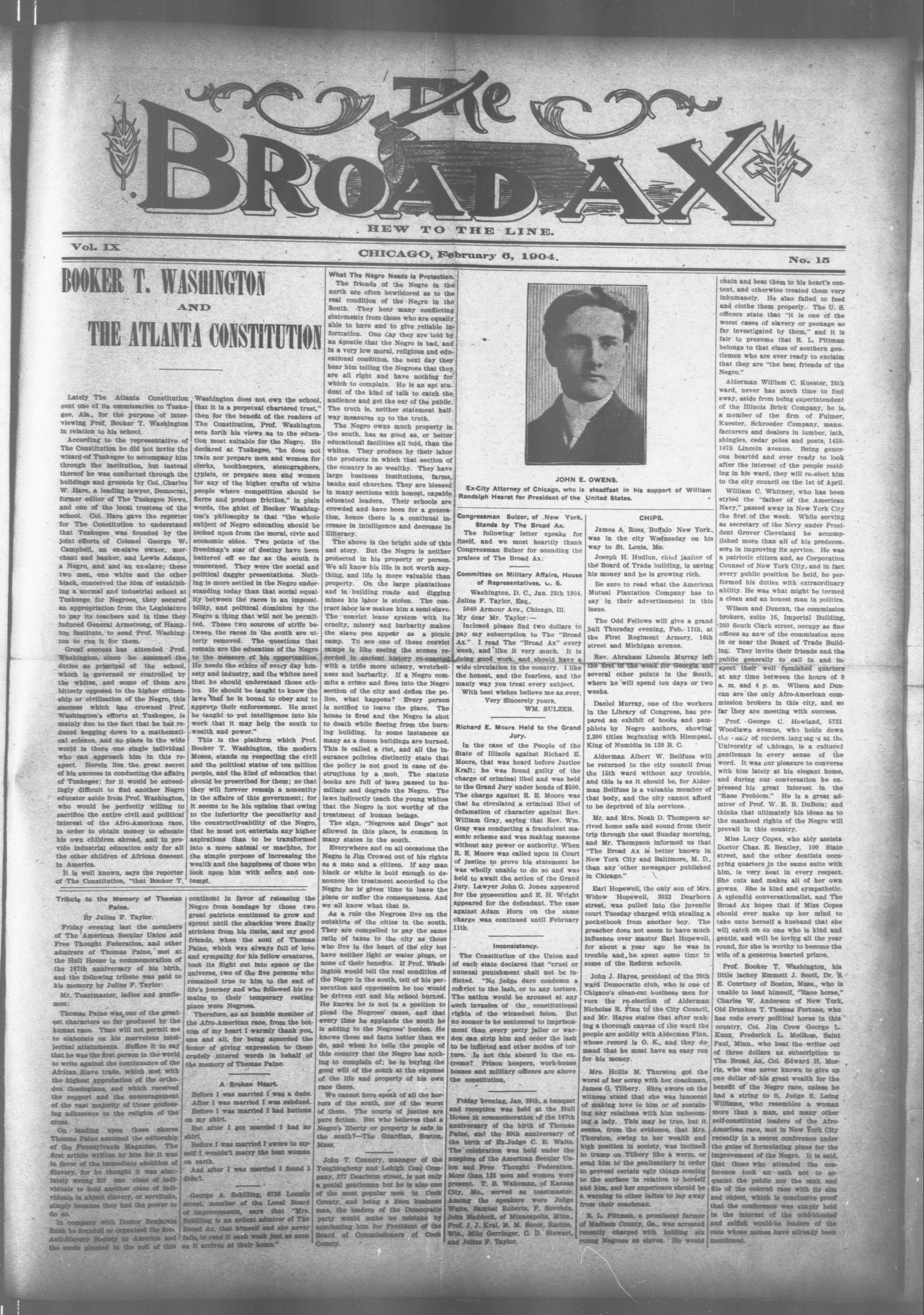
BOOKER T. WASHINGTON AND THE ATLANTA CONSTITUTION
Vol. IX
BOOKER T. WA
THE ATLANT
Lately The Atlanta Constitution sent one of its emissaries to Tuskegee, Ala., for the purpose of interviewing Prof. Booker T. Washington in relation to his school.
According to the representative of The Constitution he did not invite the wizard of Tuskegee to accompany him through the institution, but instead thereof he was conducted through the buildings and gruonds by Col. Charles W. Hare, a leading lawyer, Democrat, former editor of The Tuskegee News, and one of the local trustees of the school. Col. Hare gave the reporter for The Constitution to understand that Tuskegee was founded by the joint efforts of Colonel George W. Campbell, an ex-slave owner, merchant and banker, and Lewis Adams, a Negro, and and an ex-slave; these two men, one white and the other black, conceived the idea of establishing a normal and industrial school at Tuskegee for Negroes, they secured an appropriation from the Legislature to pay its teachers and in time they induced General Armstrong, of Hampton Institute, to send Prof. Washington to run it for them.
Great success has attended Prof. Washington, since he assumed the duties as principal of the school, which is governed or controlled by the whites, and some of them are bitterly opposed to the higher citizenship or civilization of the Negro, this success which has crowned Prof. Washington's efforts at Tuskegee, is mainly due to the fact that he has reduced begging down to a mathematical science, and no place in the wide world is there one single individual who can approach him in this respect. Herein lies the great secret of his success in conducting the affairs of Tuskegee; for it would be exceedingly difficult to find another Negro educator aside from Prof. Washington, who would be perfectly willing to sacrifice the entire civil and political interest of the Afro-American race, in order to obtain money to educate his own children abroad, and to provide industrial education only for all the other children of African descent in America.
It is well known, says the reporter of The Constitution, "that Booker T.
Tribute to the Memory of Thomas Paine.
Friday evening last the members of The American Secular Union and Free Thought Federation, and other admirers of Thomas Paine, met at the Hull House in commemoration of the 167th anniversary of his birth, and the following tribute was paid to his memory by Julius F. Taylor: Mr. Toastmaster, ladies and gentlemen:
Thomas Paine was one of the greatest characters so far produced by the human race. Time will not permit me to elaborate on his marvelous intellectual attainments. Suffice it to say that he was the first person in the world to write against the continuance of the African Slave trade, which met with the highest approbation of the orthodox theologians, and which received the support and the encouragement of the vast majority of those professing adherence to the religion of the cross.
On landing upon these shores Thomas Paine assumed the editorship of the Pennsylvania Magazine. The first article written by him for it was in favor of the immediate abolition of Slavery, for he thought it was absolutely wrong for one class of individuals to hold another class of individuals in abject slavery, or servitude, simply because they had the power to do so.
In company with Doctor Benjamin Rush he founded or organized the first Anti-Slavery Society in America and the seeds planted in the soil of this
---
Washington does not own the school that it is a perpetual chartered trust,' then for the benefit of the readers of The Constitution, Prof. Washington sets forth his views as to the education most suitable for the Negro. He declared at Tuskegee, "he does not train nor prepare men and women for clerks, bookkeepers, stenographers, typists, or prepare men and women for any of the higher crafts of white people where competition should be fierce and produce friction," in plain words, the ghist of Booker Washington's philosophy is that "the whole subject of Negro education should be looked upon from the moral, civic and economic sides. Two points of the freedman's star of destiny have been battered off so far as the south is concerned. They were the social and political dagger presentations. Nothing is more settled in the Negro understanding today than that social equality between the races is an impossibility, and political dominion by the Negro a thing that will not be permitted. These two sources of strife between the races in the south are utterly removed. The questions that remain are the education of the Negro to the measure of his opportunities. He needs the ethics of every day honesty and industry, and the whites need that he should understand those ethics. He should be taught to know the laws that he is bound to obey and to approve their enforcement. He must be taught to put intelligence into his work that it may help the south to wealth and power."
This is the platform which Prof. Booker T. Washington, the modern Moses, stands on respecting the civil and the political status of ten million people, and the kind of education that should be prescribed for them; so that they will forever remain a nonentity in the affairs of this government; for it seems to be his opinion that owing to the inferiority the peculiarity and the constructiveability of the Negro, that he must not entertain any higher aspirations than to be transformed into a mere animal or machine, for the simple purpose of increasing the wealth and the happiness of those who look upon him with scorn and contempt.
continent in favor of releasing the Negro from bondage by those two great patriots continued to grow and sprout until the shackles were finally stricken from his limbs, and my good friends, when the soul of Thomas Paine, which wss always full of love and sympathy for his fellow creatures, took its flight out into space or the universe, two of the five persons who remained true to him to the end of life's journey and who followed his remains to their temporary resting place were Negroes.
Therefore, as an humble member of the Afro-American race, from the bottom of my heart I warmly thank you, one and all, for being accorded the honor of giving expression to these crudely uttered words in behalf of the memory of Thomas Paine.
Before I was married I was a dude.
After I was married I was subdued.
Before I was married I had buttons on my shirt.
But after I got married I had no shirt.
HEW TO THE LINE.
What The Negro Needs is Protection. The friends of the Negro in the north are often bewildored as to the real condition of the Negro in the South. They hear many conflicting statements from those who are equally able to have and to give reliable information. One day they are told by an apostle that the Negro is bad, and in a very low moral, religious and educational condition, the next day they hear him telling the Negroes that they are all right and have nothing for which to complain. He is an apt student of the kind of talk to catch the audience and get the ear of the public. The truth is, neither statement halfway measures up to the truth.
The Negro owns much property in the south, has as good as, or better educational facilities all told, than the whites. They produce by their labor the products in which that section of the country is so wealthy. They have large business institutions, farms, banks and churches. They are blessed in many sections with honest, capable educated leaders. Their schools are crowded and have been for a generation, hence there is a continual increase in intelligence and decrease in illiteracy.
The above is the bright side of this sad story. But the Negro is neither protected in his property or person. We all know his life is not worth anything, and life is more valuable than property. On the large plantations and in building roads and digging mines his labor is stolen. The contract labor law makes him a semi-slave. The convict lease system with its cruelty, misery and barbarity makes the slave pen appear as a picnic camp. To see one of these convict camps is like seeing the scenes recorded in ancient history re-enacted with a trifle more misery, wretchedness and barbarity. If a Negro commits a crime and flees into the Negro section of the city and defies the police, what happens? Every person is notified to leave the place. The house is fired and the Negro is shot to death while fleeing from the burning building. In some instances as many as a dozen buildings are burned. This is called a riot, and all the insurance policies distinctly state that the policy is not good in case of destructions by a mob. The statute books are full of laws passed to humiliate and degrade the Negro. The laws indirectly teach the young whites that the Negro is not worthy of the treatment of human beings.
The sign, "Negroes and Dogs" not allowed in this place, is common in many states in the south. Everywhere and on all occasions the Negro is Jim Crowed out of his rights as a man and a citizen. If any man black or white is bold enough to denounce the treatment accorded to the Negro he is given time to leave the place or suffer the consequences. And we all know what that is.
As a rule the Negroes live on the outskirts of the cities in the south. They are compelled to pay the same ratio of taxes to the city as those who live in the heart of the city but have neither light or water plugs, or none of their benefits. If Prof. Washington would tell the real condition of the Negro in the south, tell of his persecution and oppression he too would be driven out and his school burned. He knows he is not in a position to plead the Negroes' cause, and that every time he applauds the south he is adding to the Negroes' burden. He knows these sad facts better than we do, and when he tells the people of this country that the Negro has nothing to complain of; he is buying the good will of the south at the expense of the life and property of his own race there.
We cannot here speak of all the horrors of the south, nor of the worst of them. The courts of justice are pure fiction. But who believes that a Negro's liberty or property is safe in the south?—The Guardian, Boston, Mass.
John T. Connery, manager of the Youghiogheny and Lehigh Coal Company, 277 Dearbron street, is not only a genial gentleman but he is also one of the most popular men in Cook County, and being a keen business man, the leaders of the Democratic party would make no mistake by nominating him for President of the Board of Commissioners of Cook County.
M. B.
Ex-City Attorney of Chicago, who is steadfast in his support of William Randolph Hearst for President of the United States.
Congressman Suizer, of .New York, Stands by The Broad Ax
The following letter speaks for itself, and we most heartily thank Congressman Sulzer for sounding the praises of The Broad Ax:
Committee on Military Affairs, House of Representatives, U. S.
Washington, D. C., Jan. 28th 1904.
Julius F. Taylor, Esq.
5040 Armour Ave., Chicago, Ill.
My dear Mr. Taylor:—
Inclosed please find two dollars to pay my subscription to The "Broad Ax." I read The "Broad Ax" every week, and like it very much. It is doing good work, and should have a wide circulation in the country. I like the honest, and the fearless, and the manly way you treat every subject.
Richard E. Moore Held to the Grand Jury.
In the case of the People of the State of Illinois against Richard E. Moore, that was heard before Justice Kraft; he was found guilty of the charge of criminal libel and was held to the Grand Jury under bonds of $500. The charge against R. E. Moore was that he circulated a criminal libel of defamation of character against Rev. William Gray, saying that Rev. Wm. Gray was conducting a fraudulent masonic scheme and was making masons without any power or authority. When R. E. Moore was called upon in Court of justice to prove his statement he was wholly unable to do so and was held to await the action of the Grand Jury. Lawyer John G. Jones appeared for the prosecution and E. H. Wright appeared for the defendant. The case against Adam Horn on the same charge was continued until February 11th.
The Constitution of the Union and of each state declares that "cruel or unusual punishment shall not be inflicted. "No judge dare condemn a cohvict to the lash, or to any torture. The nation would be aroused at any such invasion of the constitutional rights of the wickedest felon. But no sooner is he sentenced to imprisonment than every petty jailer or warden can strip him and order the lash to be inflicted and other modes of torture. Is not this absurd in the extreme? Prison keepers, work-house bosses and military officers are above the constitution.
Friday evening, Jan. 29th, a banquet and reception was held at the Hull House in commemoration of the 167th anniversary of the birth of Thomas Paine, and the 80th anniversary of the birth of Ex-Judge C. B. Waite. The celebration was held under the auspices of the American Secular Union and Free Thought Federation. More than 125 men and women were present. T. B. Wakeman, of Kansas City, Mo., served as toastmaster. Among the speakers were Judge Walte, Samuel Roberts, F. Sovobda, John Maddock, of Minneapolis, Minn., Prof. J. J. Kral, M. M. Secor, Racine, Wls., Milo Gerringer, C. D. Stewart, and Julius F. Taylor.
Inconsistency.
James A. Ross, Buffalo New York., was in the city Wednesday on his way to St. Louis, Mo.
Joseph H. Hudlun, chief janitor of the Board of Trade building, is saving his money and he is growing rich.
Be sure to read what the American Mutual Plantation Company has to say in their advertisement in this issue.
The Odd Fellows will give a grand ball Thursday evening, Feb. 11th, at the First Regiment Armory, 16th street and Michigan avenue.
Rev. Abraham Lincoln Murray left the first of the week for Georgia and several other points in the South, where he will spend ten days or two weeks.
Daniel Murray, one of the workers in the Library of Congress, has prepared an exhibit of books and pamphlets by Negro authors, showing 2,300 titles beginning with Hiempsal, King of Numidia in 120 B. C.
Alderman Albert W. Beilfuss will be returned to the city council from the 15th ward without any trouble, and this is as it should be, for Alderman Beilfuss is a valuable member of that body, and the city cannot afford to be deprived of his services. Mr. and Mrs. Noah D. Thompson arrived home safe and sound from their trip through the east Sunday morning, and Mr. Thompson informed us that "The Broad Ax is better known in New York City and Baltimore, M. D., than any other newspaper published in Chicago."
Earl Hopewell, the only son of Mrs. Widow Hopewell, 3032 Dearborn street, was pulled into the juvenile court Tuesday charged with stealing a pocketbook from another boy. The preacher does not seem to have much influence over master Earl Hopewell, for about a year ago he was in trouble and, he spent some time in some of the Reform schools.
John J. Hayes, president of the 20th ward Democratic club, who is one of Chigaco's clean-cut business men for vors the re-election of Alderman Nicholas R. Finn to the City Council, and Mr. Hayes states that after making a thorough canvas of the ward the people are solidly with Alderman Finn, whose record is O. K., and they demand that he must have an easy run for his money.
Mrs. Hollis M. Thurston got the worst of her scrap with her coachman James G. Tilbery. Shre swore on the witness stand that she was innocent of making love to him or of sustaining any relations with him unbecoming a lady. This may be true, but it seems, from the evidence, that Mrs. Thurston, owing to her wealth and high position in society, was inclined to tramp on Tilbery like a worm, or send him to the penitentiary in order to prevent certain ugly things coming to the surface in relation to herself and him, and her experience should be a warning to other ladies to lay away from their coachman.
R. L. Pittman, a prominent farmer of Madison County, Ga., was arrested recently charged with holding six young Negroes as slaves. He would
CHIPS.
No.15
chain and beat them to his heart's content, and otherwise treated them very inhumanely. He also failed to feed and clothe them properly. The U. S. officers state that "it is one of the worst cases of slavery or peonage so far investigated by them," and it is fair to presume that R. L. Pittman belongs to that class of southern gentlemen who are ever ready to exclaim that they are "the best friends of the Negro."
Alderman William C. Kuester, 26th ward, never has much time to fool away, aside from being superintendent of the Illinois Brick Company, he is a member of the firm of Fulmer, Kuester, Schroeder Company, manufacturers and dealers in lumber, lath, shingles, cedar poles and posts, 1458-1478 Lincoln avenue. Being generous hearted and ever ready to look after the interest of the people residing in his ward, they will re-elect him to the city council on the 1st of April.
William C. Whitney, who has been styled the "father of the American Navy," passed away in New York City the first of the week. While serving as secretary of the Nevy under President Grover Cleveland he accomplished more than all of his predecessors in improving its service. He was a patriotic citizen and, as Corporation Counsel of New York City, and in fact every public position he held, he performed his duties with extraordinary ability. He was what might be termed a clean and an honest man in politics.
Wilson and Duncan, the commission brokers, suite 16, Imperial Building, 260 South Clark street, occupy as fine offices as anw of the commission men in or near the Board of Trade Building. They invite their friends and the public generally to call in and inspect their well furnished quarters at any time between the hours of 9 a.m. and 4 p.m. Wilson and Duncan are the only Afro-American commission brokers in this city, and so far they are meeting with success.
Prof. George C. Howland, 5731 Woodlawn avenue, who holds down the chair of modern languages at the University of Chicago, is a cultured gentleman in every sense of the word. It was our pleasure to converse with him lately at his elegant home, and during our conversation he expressed his great interest in the "Race Problem." He is a great admirer of Prof. W. E. B. DuBois; and thinks that ultimately his ideas as to the manhood rights of the Negro will prevail in this country.
Miss Lucy Copes, who ably assists Doctor Chas. E. Bentley, 100 State street, and the other dentists occupying quarters in the same suite with him, is very neat in every respect. She cuts and makes all of her own gowns. She is kind and sympathetic. A splendid conversationalist, and The Broad Ax hopes that if Miss Copes should ever make up her mind to take unto herself a husband that she will catch on to one who is kind and gentle, and will be loving all the year round, for she is worthy to become the wife of a generous hearted prince.
Prof. Booker T. Washington, his little lackey Emmett J. Scott, Dr. S E. Courtney of Boston, Mass., who is unable to lead himself, "Race horse, Charles W. Anderson of New York Old Drunken T. Thomas Fortune, who has rode every political horse in this country, Col. Jim Crow George L Knox, Frederick L. McGhee, Saint Paul, Minn., who beat the writer out of three dollars as subscription to The Broad Ax, Col. Edward H. Morris, who was never known to give up one dollar of his great wealth for the benefit of the Negro race, unless he had a string to it, Judge S. Laing Williams, who resembles a woman more than a man, and many other self-constituted leaders of the Afro-American race, met in New York City recently in a secret conference under the guise of formulating plans for the improvement of the Negro. It is said, that those who attended the conference took an oath not to acquaint the public nor the rank and file of the colored race with its aim and object, which is conclusive proof that the conference was simply held in the interest of the cold-blooded and selfish would-be leaders of the race whose names have already been mentioned.
Will promulgate and at all times uphold the true principles of Democracy, but Catholics, Protestants, Priests, Infidels, Farmers, Single Taxes, Republicans, Knights of Labor, or any one else can have their say, so long as their language is proper and responsibility is fixed.
The Broad Ax is a newspaper whose platform is broad enough for all, ever claiming the editorial right to speak its own mind.
THE BROAD AX
1040 Armour Avenue, Chicago.
JULIUS F. TAYLOR, Editor and Publisher.
Entered at the Post Office at Chicago,
Ill., as Second-class Matter.
UNIQUE WAR RECORD OF DOG.
Once Owned by Botha and Followed Irish Troops in Beer War Was Given Medal.
Unusual interest centered in a case heard in the Dublin police court, in which the leading figure was a bulldog that formerly belonged to Gen. Philip Botha and went through a good portion of the South African war, says the London Telegraph. Ernest Warmington, canteen manager for the contractors, was summoned for cruelty to the animal, which has been stationed for some time past with the Royal Irish Rifles at Richmond barracks.
The bulldog, which now belongs to Color Sergeant Edwards, Royal Irish Rifles, was accommodated with a seat in the witness box, from which point he seemed to take a languid interest in the proceedings. He was dressed in a coat with green facings, and wore several South African medals with clasps. The animal's record is an eventful one. During the Boer war he was captured by the Second Royal Irish Rifles, mounted infantry, from Commandant Philip Botha's farm in the Doornberg, in September, 1900.
FFrom that time until the end of the war he trekked with the Rifles' mounted force from Griqualand in the west to Basutoland in the east, and he still bears the scar of a wound received in action. Later he was with Gen. French's column in Cape Colony. For his services the bulldog now wears the queen's South African medal with two clasps. Mr. Drury remarked, when the case was called, that this was the most distinguished dog in the country, as he had medals.
INDUSTRY ABROAD.
The Agricultural society, of Lombardy, has decided to found and maintain in Milan a trial station for the testing of agricultural machines. Architect Stewart, of Lucerne, has patented a new system of concrete flooring, consisting of hollow tubes and mortar and iron. It is fireproof.
The annual production of coal and coke in Mexico now amounts to 1,000,000 tons, and at the present rate of increase this production will be doubled in 1905. A Paris concern intends to build blast furnaces in Chili in order to develop the iron ore deposits in the northern part of that country. A syndicate has been formed to organize a stock company, with a capital of 17,500,000 francs ($8,357,500), which will be in a position to undertake some of the iron contracts for which the Chilian government is now asking bids.
From April 16 to May 31, 1904, an international exhibition of alcohol-using machines and of fermentation products will be held at Vienna. The purpose of the exhibition is to give a general idea of the present development of the alcohol industry and the various ways in which alcohol can best be used. The exhibition will also include brewing, distilling and manufacture of malt, starch and vinegar.
It is officially announced that the government of Montenegro has leased its tobacco monopoly to a Venetian company, which has been formed with a capital of 1,500,000 francs ($289,000). Besides furthering the production, manufacture and export of Montenegrin tobacco and tobacco products, this company will reorganize the monopoly, building a factory, with head office in Montenegro's chief city, Podgorica, and establishing stores in Niksicz and at the port of Antivari.
Twice as Good.
"I see the agent has sold yes a carpet-sweeper, Mrs. Maginnis. Is it as good as the old-fashioned broom!"
"It is, an' better, Mrs. Mulduckle. I can knock Maginnis twice as far wid it."
—Tit-Bits.
Popular Airs.
Mr. Gabler—So Mrs. Hyffly's husband comes down every week to the tune of $50 for her?
Mrs. Gabler—Yes; and yet you said he didn't know one note from another.—Judge.
"Absolutely. Why, he'd follow the organization even if it was in favor of decent government."—Judge.
A Character Study.
"Brilliant and impulsive people," said a lecturer on physiognomy, "have black eyes, or if they don't have them they are apt to get them. If they're too impulsive."—Tit-Bite.
GET SEASICK IN A HOUSE.
Peculiar Effect of Attempts to Walk in Storm-Benten Buildings--Floors Were Solid, Too.
At a recent meeting of the Women's Literary club of Baltimore Mrs. Charles C. Morgan read a paper in which she cited a peculiar but well-authenticated fact concerning some storm-beaten houses on Cobb's island, off the eastern coast of Virginia. The houses were eventually washed away by the encroachments of the sea, but for a long time they were firmly imbedded in the sand at such an angle that the wanderer could walk in the second story windows from the bluff, while the floors all slanted at an acute degree.
There was not the slightest danger attendant upon walking up or down these floore, yet no one was ever found who could traverse their length without becoming seasick. Experienced sailors, who knew no qualms in midocean, turned faint and giddy on trying to walk these perfectly steady planks. To all the neighborhood the buildings were known as the "seasick houses," and that the seasickness was not due to imagination was proved by persons who never had heard of the tradition experiencing the same unpleasant results.
Mrs. Morgan, who resided on the mainland near by, concluded her account of the houses by saying that a small dog belonging to her husband which followed that gentleman "foot to foot," as the negroes term it, never could be induced to follow his master across the mysterious thresholds, be the command ever so peremptory or the inducement ever so strong.
MRS. PYMACHER'S PIE.
Here's an Idyll of the New York Stock Exchange - Speculators Appreciated Toothsome Dainty.
Pymacher was a telegrapher employed by the stock exchange firm in which John W. Gates is a special partner, says Everybody's Magazine. Pymacher brought for his lunch a noble pie, a composition of Mrs. Pymacher's. The manager of the office tasted that pie, found it good, and gobbled it. Such are the notions of property in the street. "Is there any more where that came from?" asked the manager, a man of delicate tooth. "There is more," said Pymacher, "and better, if possible." "It is not possible," said the manager. He told all the Chicago capitalists, who came to that office. He made their mouths water. The next day Pymacher brought in a lemon pie, an iridescent dream, a tender flower. Half a dozen millionaires ate of it, with tears of joy and thanksgiving. "What shall we do for Mrs. Pymacher? Shall we build her a monument?" "Buy her 14 hundred shares of Northern Pacific," says Gates. So they bought her 100 shares at 113½ sold it at 135. The next day came the corner, and a share of Northern Pacific was worth $1,000. But Mr. Gates had showed his eagerness to reward a supreme artist. If old Rembrandt were alive "the Gates crowd" would "let him in" on the best thing it had.
KEEP BOYS ON THE FARM.
Educational Department Gives Good Advice to Rural Father-Advice to the Teachers.
The superintendent of public instruction of the state of Indiana has recently issued a bulletin touching on the steady migration of the young men of the rural districts to the cities in search of a so-called "better chance." Believing that Indiana is being sapped of its energies by that movement, the department in a bulletin to the teachers says that they can influence the boy to stay on the farm and to work out its problems.
"It will be a sad day for our national life when all our young farmers come to town; when the small, well-cultivated homesteads give way to landed estates," the bulletin says. The necessity of keeping the boys on the farm was the subject of a discussion as to what the teacher can do for the community. A teacher's power in determining the industry of a community lies in making her schoolroom a busy workshop, where the rights of others and the nobility of honest toll are taught.
The bulletin which is being sent out by the state superintendent deals with the relation of the teacher to the school, her patrons and the locality. The teacher, the bulletin says, ought to be a missionary, harmonizing turbulent elements.
Some time ago a rumor went round that astute publishers had in their pay a large number of the most attractive diners-out. Your neighbor at table would lead the conversation to the latest novel—quite the easiest of conversational openings between strangers, who lay their heads together over the menu and have to entertain each other for an hour. You are interested in the description of the book of the hour, you are a little ashamed of not having read it, and going home you sit down and order the book—from the circulating library. Every publisher, every theater manager, every deviser of a patent medicine knows that the advice of a friend is a more concentrated and personal pull than the opinion of a critic from the empyrean. And if the idea was ever carried out, it deserved to succeed, but no one ever spotted the paid diner-out. There was the artistry of the thing.—London Chronicle.
All Soils Are Good. A recent bulletin of the department of agriculture says: "It appears that practically all soils contain sufficient plant food for good crop yield; that this supply will be indefinitely maintained, and that this actual yield of plants adapted to the soil depends mainly, under favorable conditions, upon the cultural methods and suitable crop rotation."
A NEW SUPERSTITION.
Traffic on a Busy New York Thoroughfare Almost Blocked Temporarily by a Curious Occurrence.
Traffic on Broadway was almost blocked for a few moments the other afternoon by the actions of two women, who went through what was evidently a superstitious rite which no one but themselves could understand. The women were middle aged, the New York Herald states, and beyond reproach in appearance, and no one noticed them, as they crossed Herald square; but midway of the Thirty-fifth and Thirty-sixth street block they paused, turned back and together retraced their footsteps for a short distance, gazing steadily at the ground as though they had lost something. When they had gone a few yards they stopped, and each woman put out her right foot and carefully touched one of the paving stones with the toe of her shoe. Then they turned again and resumed their walk in the most matter of fact way in the world. But the onlookers did not take it so coolly.
New Yorkers are a curious people, and those who had noticed the women's action resolved to find out if there was anything peculiar about one of those paving stones. They stared eagerly toward that part of the pavement, and other persons, who had not seen the women, followed the crowd. But nothing unusual could be found in the pavement, and it was decided that it must be a new superstition, such as had not before been heard of, even in New York, which is as cosmopolitan in superstitions as it is in fashions.
ENGLISH AS SHE IS SPOKE.
Marvelous Exploit of a Picture Dealer in Munich—Used Dictionary, But No Grammar.
The following notice, says the London Outlook, appears in the shop window of a picture dealer in Munich:
"The exhibition of the paintings, which no every exception, whose alone property, and the possession of about 40,000 No. stitch of Kooper, cut of wood, art of shave lifes, colour printings, erasures, and ca. 6000 Portraits, also 10,000 sketches in hand. Aquarelles of german, english, dutch, belgian, italian and french masters of the latest four centuries. Also an collection of miniatures and many old books. Whiches complet collection are saleable. Mrs Patrons you want information about, send your please a letter to the possession J. Gernert, Bavariaring 30-1 and Karlsplatz 20-1 Munich. Catalogue of the collection is to preparation, and send the catalogues every Patron which to give his strict address."
This, says the correspondent who kindly sends us the foregoing, rather emphasizes an experience of my own in Munich, where a shopkeeper, trying in English to excuse himself for not having in stock an appliance I needed, said: "I have not; I am very disagreeable."
NO THIEVES THERE
In Bermuda They Couldn't Dispose of Plunder If They Stole—An Idyllic Community.
The capture of the two negroes in this city charged with having looted a jewelry shop in Hamilton, Bermuda, will be the chief topic of conversation for the winter in that idyllic community, says the New York World.
Bermuda is not accustomed to thieves. No experienced Bermudan will enter the profession of pilfering, at least of taking things that cannot be immediately eaten.
For what can be done with them? If any property is taken the officers of the law have only to watch the steamship docks. The stuff cannot be disposed of on the islands. They are too small and everybody knows everybody.
It is a Bermudian legend that once a bicycle was stolen. It was the talk of the town. The next ensuing problem of the thief was how to get any good of it. He did not dare use it; he could not send it out of the country.
That he finally "gave it up" was proved when six months later a fisherman brought up the missing wheel from fairly deep water upon his hook.
HOW THEY COLLECT BILLS.
Indians Have a Delicate Way of Approaching Their Debtors—Their Dunning Sticks.
The aboriginal debt collector literally goes after his victim with a sharp stick. Perhaps the phrase may have originated from the manner in which some Indians realize on bills due them. The Nushinan Indians, of California may have seen the disagreeable habit prevalent among whites of sending bills. When one Indian owes another it is considered bad taste for the creditor to dun the debtor. He proceeds with more delicacy. He procures a certain number of sticks, according to the amount of the debt, and paints a ring around the end of each. These he carries and tosses into the debtor's wigwam and then goes away without a word. The debtor invariably pays the debt and destroys the sticks, as it is considered a reproach to have the January dunning stick thrown into the wigwam. Indeed, the creditor never uses them except with hard customers.
Pipe Smoking in Cold Weather.
There is more smoking of pipes done in cold weather than at any other time, and, excluding the vacation season, there are more pipes and smoking tobacco sold during the cold weather than during the temperate and heated spells.—Tobacco Trade Review.
Work the Year Around.
It is estimated that only one in six of the population of London leave the city for more than a day at a time in the summer.
Fifty-First St. and Armour Ave.
RAIL YARDS: 51st St. & L. S. & M. S. RY.
52nd St. and Armour Ave.
CHJCAGO
NOTARY PUBLIC. Office Phone, M. 751
Residence Phone, Blue 5385.
W. G. ANDERSON,
ATTORNEY AT LAW.
J. Q. GRANT & CO.
Collections, Loans and Insurance,
SUITE 61, 119 LA SALLE
Residence, 3232 Wabash Avenue,
CHICAGO.
GEO. A. WILSON GEO. D. DUNCAN
PHONE 1515 HARRISON.
WILSON & DUNCAN
COMMISSION BROKERS
STOCKS, BONDS, GRAIN,
PROVISIONS & COTTON
SUITE 16, IMPERIAL BLDG.
200 80. CLARK ST., CHICAGO.
Send for our Pamphlet and Daily
Market Letter upon Successful Speculation.
All Business Transacted through
and Confirmed by Ernest E. Jones &
Co.
Correspondence Solicited.
O
The Souls of Black Folk
By W. E. B. DuBois
A REMARKABLE BOOK that is provoking much discussion because of the wonderful eloquence with which the author pleads for right and justice to his people. In these days of increasing agitation over the "negro problem" this passionate human document can neither be overlooked nor ignored. Aside from its remarkable presentation of facts it holds the reader—prejudiced or not—by its fascination of style and overpowering pathos.
Some of the Chapter Headings follow:
OF OUR SPIRITUAL STRIVINGS.
OF THE DAWN OF FREEDOM.
OF MR. WASHINGTON AND OTHERS.
OF THE MEANING OF PROGRESS.
OF THE TRAINING OF BLACK MEN.
OF THE BLACK BELT.
OF THE SONS OF MASTER AND MAN.
OF THE FAITH OF THE FATHERS.
OF THE PASSING OF THE FIRST-BORN.
OF ALEXANDER CRUMMELL.
OF THE COMING OF JOHN.
OF THE SORROW SONGS.
8d Edition $1.20 net Published by
A. C. McClurg & Co., Chicago
MRS. A. WILSON.
Nicely furnished rooms to rent for gentlemen. Reasonable rates, 2252 Indiana aveune.
First class furnished rooms, for rent to gentleman and ladies, with bath and gas. 2623 Wabash avenue.
Funeral designs of every description, latest and most stylish decorations, for churches and weddings. Palms to rent for all social functions, 3119 State St., Chicago.
WONDERFUL DISCOVERY
Curly Hair Made Straight By
TAKEN FROM LIFE:
BEFORE AND AFTER TREATMENT.
ORIGINAL
OZONIZED OX MARROW
(Copyrighted.)
This wonderful hair pomade is the only safe preparation in the world that makes kinky or curly hair straight as shown above. It nourishes the scalp, prevents the hair from falling out or breaking off, ensures dandruff and makes the hair grow long and silky. Sold over forty years and used by thousands. Warranted harmless. It was the first straightening kinky hair. Beware of imitations. Get the Original Ozonized Ox Marrow as the genuine never falls to keep the hair straight, soft and beautiful, giving it that healthy, life-like appearance so much desired. A toilet necessity for ladies, gentlemen and children. Elegantly positioned. Owing to its superior and having equal qualities is the most economical. It is not suitable for anybody to produce a preparation equal to it. Full directions with every bottle. Only 50 cents. Sold by druggists and dealers or send us 50 cents for one bottle or $1.40 for three bottles. We pay all express charges. Send postal or express money order. Please enclose this paper when ordering. Write your name and address plainly to
OZONIZED OX MARROW CO.,
76 Wabash Ave., Chicago, Illinois.
The American Mutual Plantation Company
You have all doubtless read the advertisement that we have been running in The Broad Ax for some weeks past. Some of you may have been interested in our statements published in that "Ad" and may be even now considering seriously making an investment with us. (If you did this, you would be in excellent company for some of the brightest and shrewdest business and professional men, both white and colored have made this investment and are thoroughly pleased with it.) Some of you may have thought our statements extreme. You may have considered that we were exaggerating and consequently you have decided, temporarily at least not to invest with us. You are right in being careful; in fact, that is exactly the type of man we want to reach, the careful, thoughtful man who investigates, goes slowly and knows what he is doing when he makes a move.
As to the question of over-stating our proposition; we would like to have a good serious talk with every man who thinks we have made any over-statements. Do you know that it is exceedingly difficult to write an advertisement that comes anywhere near the facts in such a proposition as ours, a Tropical Plantation, and not be open to the charge, made by people uneducated in the proposition, that one has exaggerated. The TRUTH IS WONDERFUL and so wonderful that people doubt the truth. AS A MATTER OF FACT EVERY STATEMENT EVER MADE BY US AS TO PROBABLE RESULTS OF AN INVESTMENT IN THE AMERICAN MUTUAL PLANTATION COMPANY HAS BEEN RATHER UNDERSTATED THAN OVERSATED.
Now, the only way we can prove this to you is to prove it to you and to do that we should meet you; to do that you must come and see us or we must go and see you. If you care for an investment that will surely bring you from 10 to 50 per cent in a proposition that is not a speculation but a plain, cold business matter you should certainly look us up and decide for yourselves as to whether we are stating facts or not. We would like to have you inquire of Bradstreet, R. G. Dunn & Co., and the International Mercantile Agency as to our rating; in fact, we want you to know all about us. AMERICAN MUTUAL PLANTATION CO.. BARKIER & TAYLOR, General Agents, 431-435 Stock Exchange Bldg., Chicago, Ill.
President and Treasurer, THOMAS CAREY. Vice-President, JOHN SHELHAMER, Secretary, WILLIAM SULLIVAN. MANUFACTURERS OF
Yards running winter and summer, equipped with the latest improved Wolf Dryer.
Output of Winter Yards ..... 140,0.0 per day
Output of Summer Yards..... 300,0.0 per day
If your physician recommends the use of a stimulant, there is no whisky in which so many desirable qualities are contained as in Old Underoof Rye and it has the least reactive effect. Because it is made right and is aged right. CHAS. DENNEHY & CO. CHICACO
To the readers of The Broad Ax:
WILLIAM LEGNER,
Vice Pres. & Treas.
```markdown
```
institute, never saw the United States while he was living and it is fitting that his body should be brought here now 75 years after his death to rest for all time in the shadows of the institution which
Smithson was the natural son of James Smithson, the first duke of Northumberland, and it was not until after his father's death that he assumed his father's family name. Up till that time he had gone by his mother's name and was known as James Lewis Macle. He had an ample fortune which he devoted to scientific research. He was graduated at Oxford and then spent the rest of his life traveling on the continent engaged in scientific observations. Wherever he went he carried with him a portable laboratory and a large collection of gems and minerals.
He was a member of the Royal Society of England and of the French Institute. He died in Genoa in 1829 at the age of 65, and left his entire fortune of $000,000 to a nephew, with the proviso in this will that if the nephew should die without heirs the entire property should be "left to the United States for the purpose of founding an institution at Washington to be called the Smithsonian Institution for the increase and diffusion of knowledge among men." The nephew died in 1835, and the property, amounting then to $508,318.46, came into possession of the United States government, resulting in the establishment of the Smithsonian Institution in 1846.
Smithson's body has rested ever since his death in the cemetery at Genoa, and there it might have remained indefinitely had it not been for Alexander Graham Bell, who started a movement to have the body brought to the United States. He enlisted the support of Secretary Moody and other officers of the administration, with the result that after the arrival of the body at New York it was brought to Washington on the steamer Dolphin, thus giving to the transaction the official flavor which it deserved.
The Smithsonian Institution.
It may be doubted whether Smithson had any conception when he put the al-
ternative provision in his will to what extent his bequest would grow, and the far-reaching results it would have. His original bequest has multiplied like a grain of mustard seed. Under the direction of the officers of the Smithsonian the government in the test half century
The Smithsonian Institution
government in the The Smithsonian last half century Institution, has expended millions of dollars in scientific research, and some of the most eminent scientists in the world have been in its employ. Last year the amount appropriated for the support of the institution was $678,400, a sum surpassing the entire original bequest. This year estimates have been laid before congress calling for an appropriation of nearly $900,000.
The institution has become the most important center of scientific activity in the United States, and there is nothing anywhere else in the world that surpasses it. The original institution building—one of the most beautiful structures architecturally in the United States—is the nucleus for a great and constantly expanding system. The ethological bureau costs $50,000 a year. The government is at an expense of nearly half a million dollars a year to sustain the national museum. The zoological park on the outskirts of the city, containing one of the finest collections of animals in the world, costs $100,000 a year to maintain.
Smithson gave his money to a country which seemed to him to be poor and struggling simply because he was enamored of the principles upon which the republic was founded. His body will rest under the shadow of the institution which bears his name, in the midst of one of the most beautiful cities in the world and one of the wealthiest.
Retirement of Root.
Secretary Root retires to private life on the first of February more generally
regretted that any official of the government who has left its service in a generation. There is hardly another instance of a man coming to Washington comparatively unknown except for a local reputation who has won for himself so high a place in so short a time. The
```markdown
```
Miss Root. short a time. The nearest approach to it in recent years is Oiney, who came into Cleveland's cabinet with no national reputation at all and who was regarded simply as a successful corporation lawyer of Boston, wicked up by Cleveland for some partiu-
lar reason of his own. Olney became the strong man of the Cleveland administration, both as attorney general and as secretary of state. Root came here with more of a reputation than Olney, because he had played on the larger stage of New York life and had been more or less conspicuous in local politics in a somewhat academic way. Few realized that he had in him the stern stuff he has developed. Even before his retirement he was recognized as one of the two greatest secretaries of war in the history of the government, and there are some who believe that if he had been confronted with the momentous problems Stanton had to solve he would have shown qualities superior even to those of Lincoln's great war secretary.
There is no doubt that Root's experience in Washington has broadened him and ripened him as he has risen to meet each new emergency. He knows more about men than he did, and is less characteristically the corporation lawyer than he was. He will go back to New York to take unchallenged his place at the head of the New York bar, a distinction which he seems to prize more than any other that can come to him.
Gov. Taft, who will succeed him at the head of the war department, is a man
of perhaps equal ability, but of an altogether different temper. He is younger for one thing, and he is personally more of the hall fellow well met. Taft was solicitor general in Harrison's administration and he was then one of the most popular officials in Washington. He is remem-
M. B.
ton. He is remem- Secretary Taft, bered even now for his genial qualities, as well as for his official success. He is a big fellow physically, with a face not altogether unlike that of Cleveland. Taft has great courage, as Root has, but it may be that he will be more inclined to listen to argument than Root, and there may not be the up and down determination which has characterized the proceedings of the war department during the past four years.
Root has been the trusted adviser of two presidents of opposite temperaments—McKinley and Roosevelt. It is hard to say which leaned on him most, and it is certain he has been intensely loyal to both. Taft at the beginning can hardly hope to fill Root's place in that regard, whatever may come later.
A Carriage Question.
The burning question as to whether or not assistant secretaries and chief clerks
of departments shall have carriages at the government expense has been agitating the bosoms of the house of representatives.
No More Free Carriages.
George H. Williams, former attorney general of the United States during Grant's administration, and still a man of conse-
quence in Oregon, must chuckle to himself if he ever reads the Washington dispatches. Williams, one of the ablest men in Grant's cabinet, and nominated by Grant to be chief justice of the supreme court, was lampooned from one end of the country to the other in the democratic press and gained the nickname of "Landaulet" because Mra. Williams drove about in a handsomely upholstered landaulet furnished by the government when she made her social calls. For some reason that was regarded as reprehensible in those days, even though Williams was a member of the cabinet. But now, 30 years later, the carriage habit has become so fixed that very little excitement is created outside of congress when the question arises as to the advisability of allowing the privilege to chief clerks in the departments.
The house of representatives very properly voted that no part of the appropriations should be used for carriages unless they were specially provided in the legislative bill, and for a time that will do away with carriages except for members of the cabinet and two or three others; but, as a matter of fact, the carriages in very many instances are really a necessity, and they will gradually creep back one by one through legitimate channels.
There is not a government official in Washington below the cabinet rank who can afford to keep a carriage on his colony.
One of the most striking anecdotes told in Hermann Klein's "Thirty Years of Musical Life in London," relates to Anton Seidl's first interview with Wagner, in the library at Wahnfried. Seidl found the room dark; and, imagining nobody was there, he pulled out his letter of introduction and began silently rehearsing the speech he had prepared. Suddenly, from out of a gloomy corner, Wagner appeared, and Seidl was so nervous that he could not bring out a sentence of his speech. This proved to be his salvation, for Wagner, declaring, "If you can work as well as you can hold your tongue, you will do," engaged him on the spot.
Success of Electrocution.
Attorney General Cunnen, of New York, has received a communication from a man in Michigan, who inquires whether electrocution is an effective punishment for the crime of murder. The attorney general in reply stated that so far as he is aware no man who has suffered that punishment ever again committed murder or any other crime.
Nothing can be more provoking and disheartening than dull, sizzling fires, and sputtering, smoky lamps. Sometimes, however, lamps will become exasperatingly contrary. In spite of all one can do, they will not condescend to work properly. If such a state of temper should take possession of them, try the following process. If it should not prove successful, better throw the old burners away at once, and buy new ones.
Put the burners in a dish of good strong suds, and place on the stove. Some recommend boiling them first in water which has been strained from boiled beans or apple parings. When well boiled, remove, clean out with a brush, and polish with a dry cloth. If the bowls have become dirty, empty the oil out, and clean them thoroughly. Then refill with good oil—the cheap grades of oil should never be used. Don't put in a great roll of wick at once. It is better to cut it into shorter pieces, and put a new one in at frequent intervals. See that the wicks are always trimmed off straight across the top, without any jagged points to flare up and smoke the chimney.
Wash each chimney well in soapy soft water, dry with a clean cloth, and polish with newspaper until they glitter as brightly as cut-glass. I have heard that they will last much longer if put, when new, into cold water and the water permitted to come gradually to a boil. Prairie Farmer.
PRETTY PANSY EMERY.
Nent Little Trife Which Can Be Made by Any Ingenious Woman Without Any Expense.
The merit of striking novelty can hardly be claimed for this convenient trifle, but it is newer than the scarlet fruits—supposed to be strawberries—in the guise of which emeries are so frequently made. To make the emery-bag proper, use a bit of very firm muslin or dress-lining about two inches long and a little over one inch wide. Double this in the middle, and turning in the width of a seam at the sides and ends, sew the sides together with the finest and closest of over-and-over stitches; for close sewing is absolutely necessary to hold the emery. There is probably an old emery in somebody's work-basket that would be benefited by a new covering, or you can get a new and inexpensive "strawberry" in order to procure the filling for your tiny bag. In either case cut an opening in the smaller end of the bag you wish to reject, draw your new one over this, and gently poke and squeeze until the contents are transferred—emery is not pleasant stuff to handle—then draw the ends very tightly together, like a bag, and sew securely.
The next step is the ribbon covering. This is of satin one inch in width, and three pieces will be needed—one of royal purple four inches long, and two of pale yellow, one of which is two inches, the other one inch, in length. The purple strip is doubled over the little bag, and overhanded together with sewing-silk to match. When this is done, and the ends drawn together, the appearance of the work should be like No.1 in the illustration. The bag may, however, be shorter in proportion to its width if you have only a small quantity of emery; then, of course, the bit of ribbon would be cut a little shorter. Open out and turn back the ends of the ribbon, trim them in shape with a pair of sharp scissors, and arrange them as in No.2, to suggest the upper petals of a pansy. Next shape one end of the shorter piece of yellow, and near the other end mark with a pen and ink several lines to suggest the "beard." Gather
A.
DAINTY PANSY EMERY.
this inner end, and fasten to the junction of the purple petals, using pale green sewing-silk; see No. 4. Then, without detaching the thread, run your needle crosswise through the center of the other yellow strip—first shaping, and marking it with ink like No. 3—draw it up until it occupies the correct position in relation to the other petals, and sew in place. You need not be afraid of your stitches showing—take care only that they are taken crosswise of the petals—and for the "fastening-off," take one short stitch directly in the center of the finished flower, a second in the same place right over the first, a third over the second, and then put the needle down through the little bag, drawing the silk after it, and cut the latter close to the surface as it emerges.
If you prefer a pancy all of one color, it is easy to substitute rich gold-color for the purple and pale yellow ribbons; or if you have some bits of lavender ribbon, you can make a beautiful one with touches of yellow paint, if you handle the brush, or with long stitches of gold-colored floss, for the markings in the center.—Isabel Carter, in Modern Priscilla
A very useful article to keep always near the sewing machine is made in this way: Take three light wooden boxes, such as can be procured at any grocery store, all being the same length and width. One foot wide by two feet long is a convenient size. Have two of them three inches and the other six inches deep. The boxes can be made at home by any hardy man or boy, half-inch lumber being used. Carefully plane on both sides.
Use four upright strips for the frame and fasten the boxes one above the other to these corner pieces, in the manner of the workbaskets often seen, the lower box being about nine inches above the floor and the others at such distance apart that the top one is at a convenient height to reach into when seated. The upright posts can be made as fancy as desired, as turned pieces of this kind can be obtained at any woodworking shop, or they can be made square.
Have the deepest box at the top and fit it with a hinged cover. It can be used to hold small pieces of unfinished work as well as the pieces of goods needed in the regular weekly mending. It should
```markdown
```
HOME-MADE SEWING TABLE. be lined with suitable material, pockets being made on each side to hold materials for fancywork, and a needlebook and small pincushion should be fastened to the lining of the cover.
The second box should be divided into compartments to hold spools, scissors, papers of needles, pins, tape, knitting needles, crochet hooks, etc., while the lower one has one-half divided into small compartments to hold different styles of buttons, the other half being left undivided to hold the tools and materials for stocking mending. When completed the whole affair should be stained with black walnut stain and then varnished, and castors be added or not as desired.
It can be made ornamental or not as one chooses. Some people tack fringe around the lower edge of each box, which adds to its attractiveness, but it makes a creditable appearance without it. A row of fancy tacks with brass heads placed an inch and a half apart around both top and bottom of each box also makes a very ornamental finish.—Marion Meade, in Orange Judd Farmer.
Luxuriant Hair Is a Beautiful Thing to Have, and Every Girl Can Have It, Too.
"Nearly every girl can have luxuriant hair if she knows how to cultivate it properly, but 99 out of 100 are ignorant as to the right methods to employ," said the hairdresser to President Roosevelt's family, in convrtsation with a Tribune reporter, while in New York city recently. "The principal thing to look to," he continued, "is to keep the hair and scalp thoroughly clean, but not overdo it. For a normal head of hair shampooing once a month is quite sufficient if one is living in the country. In large cities, however, where there is generally a lot of dust and smoke flying around, a shampoo twice a month does no harm.
"Many have a habit of putting a lump of soda into the shampooing water, because it makes the hair fluffy and dries it quickly. I never advise my women patrons to do that, for the reason that it renders the hair brittle and fades the color. The best shampoo 'powder' I know of is the yolk of an egg beaten in a cupful of cold or tepid water. This, when rubbed well into the scalp by the tips of the fingers, cleanses the scalp perfectly, besides acting as a tonic to the hair. I may say, however, that if it is not washed off thoroughly with several rinsing waters—two waters, at least—it becomes injurious.
The best way of shampooing the hair is always to turn it over the face after brushing it well up from the back. Then, when it is washed, divide it by a parting through the center of the head, and let it fall down over the shoulders after squeezing out all the water possible by twisting it tightly. The hair should never be dried quickly by sitting in front of a stove. A little gentle fanning is the best way, but first rub a little alcohol into the roots. This prevents catching cold. Rub the hair with warm towels, and when perfectly dry divide it into strands and comb out the tangles, beginning at the ends.
"Plain cold water is undoubtedly the best tonic for the hair, and the scalp should be massaged every morning, for, say, five minutes, with the fingers dipped in cold water. A gentle pulling of the hair against the roots is also a good thing, in that it stimulates the circulation. The hair, too, should be brushed for ten minutes night and morning with a long, stiff bristled brush."
He then gave the following lotion for dandruff, which he claims to be effective: "One teaspoonful of powdered borax, half a teaspoonful flour of sulphur, six ounces of rosewater and one ounce of spirits of rosemary."
Stand brooms Upside Down. Don't stand brooms on their broom and, but upside down in the corner.
"I have observed recently a rather curious thing with respect to the relationship between cats and rats, and it has led to a rather interesting reflection," said a man who takes much interest in animal life, to a New Orleans Times-Democrat reporter. "For awhile the rats overran my place. At night there was no such thing as quiet around the house. They would scamper across the floor, bump up and down the steps and cut all kinds of capera. We secured a cat, and from the very time the cat appeared on the place the rats began to get scarce.
"There is nothing curious about this fact in itself. But to my personal knowledge the rats have never seen the cat. The cat has remained on one floor and the rats on another. There has been no chasing and no conflict between them. Now, I want to know how the rats know the cat is on the place.
"The inquiry has caused me to indulge the more interesting reflection: How far can a rat detect the presence of a cat by the sense of smell? Evidently at considerable distance. Else the rats at my place would not have known of the cat's presence under the circumstances. I'm quite sure that they have never seen the cat. But they know he is there just the same, and they have been awfully cautious since his arrival."
SILENCE NOT ALWAYS BEST.
One Woman Found a Flaw in the Time-Honored Adage-Experience with Swedish Cook.
Misunderstandings sometimes arise from slight causes, and occasionally one occurs which seems to prove that silence is not always golden. In this case trouble was brewed without a word being spoken. Young Mrs. Bond's Swedish cook, says the Youth's Companion, was scrupulously neat about her work, but her figure was so unlovely, and her countenance so unprepossessing that her overfastidious young mistress could never bear to look at her. Instead, whenever the young housekeeper found it necessary to interview her unattractive maid she kept her eyes fixed upon a large black coal scuttle that always stood before the kitchen stove.
One day as Mrs. Bond stood, as usual, in the doorway gazing intently at the coal hod while Matilda was telling what groceries were needed, the handmaiden unexpectedly changed the subject, and proceeded to give vent to the pent-up feelings of many weeks.
"Vat for you all tam luke at my's coal bocket, messis?" exclaimed Matilda, with evident resentment. "Every day I scrob heem inside and I scroob heem outside, until he vas yust so clean as my can vash heem—luke, meesis, I have scrub all she's skeen of heem—but all the tame you luke—luke at heem like you tank I dondt vash heem at all! I never sees no lady so particular about she's coal bocket!"
CHEESE IN WISCONSIN.
In Spite of Seventeen Hundred Factories in State There Is No Over Production.
"You might as well look for an overproduction of children as an over-production of cheese," said U. S. Baer, secretary of the Wisconsin Cheese Makers' association, at the Republican house, to a Milwaukee Sentinel reporter, "The fact that we have upward of 1,700 cheese factories in Wisconsin has raised the cry that the business is being overdone. The people of this country have not yet learned to eat cheese, but they are coming to it. Let me tell you, the consumption per capita in England is nearly 13 pounds a year, while in Wisconsin it is only about three pounds a year to each person. We are above the average of the states in the consumption of cheese, notwithstanding we are so far behind the Englishmen in this respect. There were produced in Wisconsin during the past year 90,000,000 pounds of cheese, which is more than a quarter of the whole amount produced in the United States. The average price has been ten cents a pound, so that you can see, with possibly the exception of butter, the making of cheese is the first single farm industry in the state. There is no Wisconsin cheese being exported, for the simple reason that the domestic demand takes all the supply."
SHARKS RETURN TO PREY.
Reappearance in Baltic Drives Away Small Fish-Flunny Tribe Likes Change of Scene.
As is well known, fish like a change of home, and frequently, without apparent reason, abandon waters in which they have long disported, and are next found in some distant part of the sea. A desire for a change of scene, however, is not the cause of the pilchards suddenly leaving the west coast of France, and the fishermen are unable to discover the reason.
Now it is announced, according to the testimony of fishermen, that the shark has returned to European waters. In the Baltic, where sharks had been extinct since 1759, they have made their reappearance in considerable numbers, and several fishing boats report having whole catches of fish devoured from the nets, which were broken, in the Belt and the Cattegat. A fisherman who fell overboard narrowly escaped with his life. Shoals of sharks, some of them of large size, have been seen off the German coast, and they are even reported as becoming far from rare in the North sea. Their presence is attributed to their pursuit of the herring shoals on the west coast of Norway.
Natural Trotters.
Of American animals, the moose, elk and caribou are natural trotters.
"Well," said her-neighbor, "this is a regular old-fashioned winter, isn't it?" "Oh, is it?" she returned. "Really, you know, I can't speak from experience about old-fashioned winters, not having been here when you used to have that kind."—Chicago Record-Herald.
One of Many.
Dingdong—Did you try that cigar I gave you yesterday?
Biffbang—Yes; but it didn't deserve a trial.
Dingdong—Why, what do you mean?
Biffbang—It should have been lynched.—Cincinnati Enquirer.
Where Johnny Demurred.
"Remember, Johnny," said his elderly uncle, "that actions speak louder than words."
"Sometimes they don't," objected Johnny. "When mamma's spankin' me I can yell a good deal louder than she can spank."—Chicago Tribune.
Marriage.
Marriage is a lottery?
Not by all the twinkling stars!
Marriage is a pottery,
Where are made the family jars!
—Puck.
BLUFF THAT DIDN'T WORK
A
"Hubby, dear, I saw a simply charming hat to-day. You must buy it for me because it will set all my friends to talking."
"H'm! It seems to me they'll talk still more if you keep on wearing your old hat."—Fliegende Blaetter.
A Safe Rule to Work On.
Whenever I am sure I'm right
I do not argue long.
Because from dear experience
I know that I am wrong.
—Chicago Record-Herald.
No Place to Go.
"Great Scott, Maria! You're not going to begin housecleaning now, are you?" "Of course. Why not?"
"Why, they've closed up my club for repairs. I'll have to walk the streets." —Chicago American.
Caught in His Own Trap.
Hardup—I'm very sorry, but I can't pay you to-day. You see, the grocer had just been here, and—
Butcher (interrupting)—Yes, I just met him, and he said you put him off because you had to pay me. So here's the bill.—Tit-Bits.
"I'm sorry, Mrs. O'Toole, to hear that yer husband suffers from insomny. My husband had the same complaint, but he cured it."
"How did he, now?"
"Sure, he became a night watchman."
—Brooklyn Life.
The Kink That Won't Come Back. You can make your hair just as straight and smooth as you want to by using the Original Ozonized Ox Marrow, and the kink that was there before will not come back. The Ozonized Ox Marrow also keeps the hair from falling out, cures dandruff and makes the hair grow. It never falls. One bottle does it. Sold over forty years to ladies of refinement all over the country, giving perfect satisfaction. Send us 50 cents and we will ship you a bottle express paid. Address Ozonized Ox Marrow Co., 76 Wabash Avenue, Chicago, Ill.
THE BROAD AX.
Is for sale at the following news stands:
The Afro-American News Office, 2104 State Street.
A. F. Tervalon's Cigar Store and News Stand, 2826 State street.
Edward Felix's Cigar Store, 363 30th street, N. E. Corner Armour Ave.
T. B. Hall's Cigar Store and Laundry office, 281 29th St.
Turner William's Cigar and News Stand, 2903 Armour Ave.
Mrs. B. Williams, Cigars, Notions and News Stand, 486 1/2 State street.
Frank H. Hart, 354-31st street, cigars, tobacco and Laundry office.
Mrs. E. F. Early, groceries and notions, 2933 State St.
H. Winston's Cigar Store and Newsstand, 280, 29th St.
The Stationery, 2970 State street.
J. C. Campbell, 145 W. 47th street, Cigars, Tobacco, Staple Groceries.
Wm. Dixon 2638 State Street cigars, tobacco, and news stand.
Isidor Jacobson, cigars, togacco and stationery, 3149 State St.
Wm. Goetz; News Stand and Laundry Office, 411 B. 36th st.
News items and advertisements left at these places will and their way into the columns of The Broad Ax.
Alderman Bill Dever, who misrepresents the people of the 17th ward in the city council, for he is no good, he has been a member of that body for the past two years, but all that time he has been a dead one, for the only act performed by him is simply to sit still, keep his mouth closed up, draw his pay and bring lawsuits against the city. The services of such fellows are not of the slightest benefit to the city of Chicago.
Wednesday, the members of the Democratic State Committee of Illinois met at the Sherman House, and it was decided by them to hold the next Democratic State convention at Springfield on June 14th. Attempts were made to drag the Presidential booms of Congressmen J. R. Williams and William Randolph Hearst through the meeting or "love feast," but the booms of both candidates received many severe blows and kicks from the contesting factions. It seemed as though most every fellow who butted into the "love feast" brought along all of their dirty underclothing, and they washed a considerable portion of the dirt out of them in the presence of the newspaper men and the several hundred visitors who were crowded into the rooms occupied by the committee. Many of those called upon to speak seemed to have knives up their sleeves for the other fellows. Some of the speakers hit Chairman John P. Hopkins some pretty hard raps, but he seemed to enjoy them and he permitted every one to have their say whether it suited him or not, which shows that he is a pretty smooth proposition. Miles J. Devine, Roger C. Sullivan, Ex-Congressman John J. Feely, D. J. Hogan, Thos. Gahan, and many of the other big ones endeavored to straddle the two Presidential booms, but to an unbiased mind it seemed that William Randolph Hearst was the choice or the favorite of those who participated in the "love feast," and it is apparent to all that the sentiment throughout Illinois is rapidly crystallizing in his favor.
HAREM WANTED SARDINES.
Whed First Boxes of This Delieney Renched Morocco Court There Was Great Excitement.
If the sultan of Morocco, Muley Abd el-Asis, loses his throne, it perhaps might be due to the discontent of his subjects in seeing him adopt so precipitately European manners and habits. The sultan disregards this danger, however, and when he wants a thing European, he must have it at once, says the New York Tribune.
One night there was a great noise in front of the residence of an Englishman inhabiting Morocco. Immediately the soldiers of the palace struck the door violently exclaiming: "Daba! Daba! (quick! quick!). The master wants all the sardines you have in your house!" The Englishman was not a sardine merchant, but handed over what few boxes he had, and learned later that only a few hours before a foreign minister had presented to the sultan a few boxes of sardines, which were opened in the harem and partaken of by all the inmates.
Such a sudden frenzy was created for them that on the morrow a special rakhas was dispatched to Tangier, with orders to bring all the sardines in the place.
The $1,836,000 asked by the secretary of the navy for gun practice during the year seems enormous until one considers the cost of firing the big guns now in use. To fire a 13-inch gun costs for powder and shell just about $500. Four times a year the men are exercised in big gun practice, with regulation charges, each man of the gun crew firing four shots at these trials. There are seven men in the gun's crew on these guns. To fire a four-inch common shell costs $17, a six-pounder, $3.86; a one-pounder, $1.14.
Scores of costly fire extinguishers and hundreds of fire buckets are picked up and destroyed every year by the agents of the insurance patrol. They are all rendered worthless by neglect. Acids which enter into the formulae of most patent extinguishers eat away the tin coverings, and there is nothing to be done except to destroy the apparatus, because it becomes a peril in itself. The water buckets, which should be emptied and refilled at least once a week, simply rust out and become useless—Philadelphia Press.
BEARD IN ENGLAND.
Last year the British Mercantile marine sustained 1,483 casualties, of which 548 were complete wrecks. The loss of life was 6,818.
England now produces only 300 pounds of grain for each head of her population. The North American output is 22,818 pounds for each inhabitant.
"Social success in these days is merely a question of sources and vintages," says an English paper. "Feed the brute" is not only the foundation of matrimonial bliss, but of social popularity. The cook, and not the hostess, in the determining factor by which the establishment is judged.
There is now an agitation in Great Britain for a department of commerce similar to that recently created in the United States. It is surely an anomaly that a great trading nation like the United Kingdom should divide the administration of trade and commerce between the board of trade, the foreign office and the home office.
We are the only nation of hustlers, and the idea suggests itself that all the rest of the world cannot be entirely wrong and we alone right in the conduct and object of life, says the Hartford Times. The Germans and the French work for a certain number of hours with a steady but not a feverish industry, and then they enjoy themselves in what we would consider a rather childish way. They gather in their cafes or beer gardens with their families and chat good-humoredly about trivial subjects. Even the English, though abounding in physical energy, take life easily.
They seem to us to make too much of their leisurely game of cricket. But all these nations have accomplished great things, not only in science, art and literature, but in the material advance of civilization. They do not expend nervous energy as rapidly as we do, and in consequence the period of life work among their men is longer. They do not consume life so fast. May it not be that they, in their old-fashioned way, are wiser than we? They have embouched their views of life in proverbs like these: "More haste worse speed." "He who goes slowly goes far." "It's the pace that kills," and others to the same purport, and proverbs are entitled to respect, because they embody the wisdom of humanity. There is no proverb enjoining the necessity of continuous restless activity.
HOW SHELLFISH TALK.
Warn One Another of Danger by Weird Clicking Sounds, Says a Distinguished Naturalist.
Most seamen will tell of curious clicking sounds heard on calm nights at sea, and the origin of the noise seems so altogether unaccountable that it has often created some alarm among superstitious fishermen, says the Chicago Tribune.
A distinguished naturalist-made a careful study of the sounds on many occasions, and found that it was not a sustained note, but made up of a multitude of tiny ones, each clear and distinct in itself, and ranging from a high treble down to a bass. When the ear was applied to the gunwale of the boat the sound grew more inense, and in some places, as the boat moved on, it could not be heard at all.
On other occasions the sound resembled the tolling of bells, the booming of guns, and the notes of an Acolian harp. For a long time he was unable to trace the cause, but at length discovered that the sounds were made by shellfish, hundreds of them opening their shells and closing them with sharp snaps. The noise, partly muffled by the water, sounded indescribably weird. He was finally led to the conclusion that, as the shellfish made the sounds, they probably had some meaning, and that the clicks might possibly be a warning of danger when the shallow water was disturbed by the boat.
GAMBLING AND STOCKS.
Stock Speculation Is Outwardly Respectable But Just as Certainly Brings Final Financial Ruin.
The very fact that the professional gambler is to a large extent a social outcast, plying his craft at night and behind steel doors and only then with the purchasable connivance of the authorities, is in itself a warning that not even the stupidest can fall to observe. Stock speculation, on the contrary, says Leslie's Monthly, hangs out the banner of respectability—which a great many unthinking persons have somehow come to confound with morality—and under its protection, carries on its traffic night and day, in city streets and village lanes, in parlor and boudoir, in store and in factory—in short, wherever it can find a single human being possessed of this mania for getting something for nothing. Men who would scorn to cross the threshold of a gambling house, gamble openly in stocks and are not ashamed to discuss their ventures in the presence of their own children. When Wall street ruins a man, it strips him of everything that he possesses—destroys his business, places a mortgage on his home, eats up the trust funds of which he was custodian and leaves him naked to the world.
Dear of Microbes
Fear of microbes seems to have spread to the possessors of old furniture, which during a long life and unknown experiences may have collected the germs of disease. Recently a cautious lady in London who had been studying the medical warnings inherited a Sheraton table. She would not admit it to her house, but sent it off to a cabinet maker's with orders that an exact replica be made, the original table being offered in payment. If this lady's craze for new and innocuous furniture spreads there should be good times in store for the cabinet makers, as well as for collectors who prefer the risk of microbes to the certainty of shoddy.
A letter was received at the East Dorset (Vt.) post office a few weeks ago postmarked at Spokane Falls, Wash., and directed to Benjamin Ames or any of his descendants. It proved to be from a man who 60 years ago boarded with Mr. Ames for a time and left without paying his board bill. He said that he was how 80 years old and wanted to pay. The bill was sent him and he sent a check for the amount.
Only 64 per cent. of Germany's young men are 8t for military service. Dr. Stricker finds that heart disease has increased 300 per cent. in a decade.
Religion an Practiced.
"That drug store man up by our house is a rascal," said Squeezam. "I'll never trade with him again."
"What's the matter?" naked Judkins.
"He passed a bad nickel off on me this morning."
"I suppose you gave it back to him?"
"No," said Squeezem, "it was too much trouble. I put it in the collection basket at church."—Chicago Tribune.
Justice with Mercy.
Magistrate—You are charged with having 16 wives. What have you to say for yourself, sir?
"It was this way; Five years ago I went to a summer resort, and for six weeks I was the only man there." Discharged "N. K. Weekly"
"Johuny is a very imaginative child," said the fond mother. "But Willie is more practical. When Willie decides that he wants anything he sets out to get it."
"I have noticed that difference," answered the upnfeeling bachelor. "Johnny sings: 'I want to be an angel,' but Willie smokes cigarettes and skates on thin ice."—Washington Star.
A Sensitive Point.
"I didn't know until to-day," said young Mrs. Torkins, "that Charley was taking an interest in palmistry."
"Indeed?" responded the caller.
"Yes. And he has put his heart into it, just as he does into anything that he undertakes. He was as indignant as he could be because he met a man last night who had a better hand than his."—Washington Star.
A Friend in Need.
Long—I'm getting entirely too stout for comfort, but I'm unable to find a remedy.
Short—I've been told that worry will quickly reduce superfluous flesh.
Short—Well, just to help you out, I'm willing to let you loan me $10.—Cincinnati Enquirer.
Four New Brothers.
"My affections are already engaged," he said.
She turned pale.
"I am very sorry," he added.
Then he arose and took his hat.
"Good-night," he said.
She looked after his retreating form.
"That's my fourth failure," she said "but the year is young yet."—Cleveland Plain Dealer.
"Do you think your father has any idea that I have serious intentions concerning you?"
"I heard him telling mother the other day that he didn't think it would cost any more to have you at the table regularly than it does for me to feed you from the pantry shelves every night."—Chicago Record-Herald.
Friendly Advice.
"I'd advise you to take this poem to a chiropodist," said the editor in a kindly tone.
"Because why?" queried he of the uncut hair.
"It's feet need attention," replied the editor.—Cincinnati Enquirer.
In Peace and War.
"Do you use a safety razor, Sambo?" asked the boss.
"Well, sah, in times of peace it may be a safety razor, sah; but in times of war it is pow'ful dangerous, sah!"—Yonkers Statesman.
Rag-Time Melody.
Pickaninny's in de crib,
Cryin' laik de dickens;
Mammy's bakin' hoe cakes,
Daddy's huntin' chickens.
—Cincinnati Enquirer.
QUITE UP TO DATE.
A
Jessica—Lucy is foolish.
Tess—Why?
Jessica—She's engaged to a man she can't afford. It is foolish to marry beyond one's means.—Chicago Tribune.
Ain't It a Shame.
Little drops of water,
Little grains of sand,
Make the wily grocer
A power in the land.
—Cincinnati Enquirer.
Effective Talk.
"There is a good deal of talk to the effect that the duke will marry in America."
"Yes, the money of at least a dozen heiresses is talking all at once."—Puck.
Suite 200, 128-125 Lil Salle Street
CHICAGO
Telephone Tardis 707 Residence, 130 Garfield Rd.
JOHN FITZGERALD
JUSTICE OF THE PEACE
4787 S. HALSTED STREET,
....CHICAGO
J. GRAY LUCAS
ATTORNEY-AT-LAW
Suite 412 Real Estate Board Bldg
79 Dearborn St. Cor. Randolph
CHICAGO.
J. J. HENNESSY,
Justice of the Peace,
6301 S. Halsted St.
WILLIAM TREXLER, CLERK.
WILLIAM C. KUESTER. SUPERINTENDENT. N. Western Ave., Chicago.
1994 N. Western Ave., Chicago.
Telephone Lake View 270.
HILLMAN'S 112-114-116 STATE STREET
Dry Goods and Everything to Wear for Man, Woman and Child
Notary Public
John J. Bradley
Real Estate, Insurance and Loans Property managed. Abstracts examined. Renting. Legal papers prepared. 4709 South Halsted Street Chicago
Theodore C. Mayer
JUSTICE OF THE PEACE
Mortgages, Deeds, Notes and Legal Documents Drawn and Acknowledged. Room 22, 27 North Clark Street.
Metropole Hall
M. JUNK, Proprietor JOS. P. JUNK, Manager 3700-3710 South Halsted Street and 897 to 929 Thirtyseventh Street CHICAGO
F. W. BOYD DEALER IN COAL, WOOD AND ICE MOVING AND EXPRESSING All Orders Promptly Attended to Cush on Delivery 4656 Armour Avenue, CHICAGO.