The Broad Ax
Saturday, February 13, 1904
Chicago, Illinois
Page text (machine-generated)
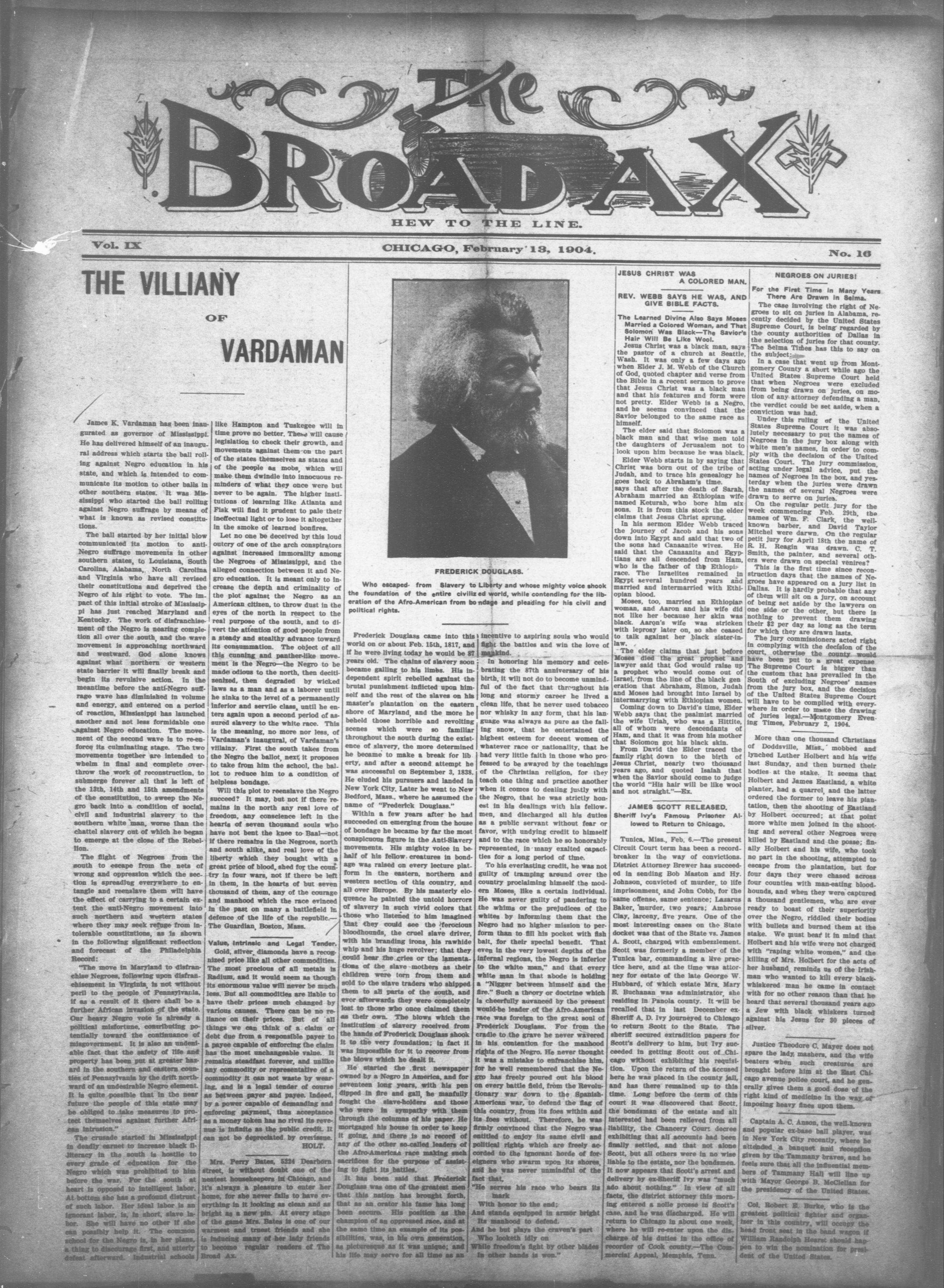
THE VILLIANY
Value, Intrinsic and Legal Tender Gold, silver, diamonds have a recognized price like all other commodities. The most precious of all metals is Radium, and it would seem as though its enormous value will never be much less. But all commodities are liable to have their prices much changed by various causes. There can be no reliance on their prices. But of all things we can think of a claim or debt due from a responsible payer to a payee capable of enforcing the claim has the most unchangeable value. It remains steadfast forever, and unlike any commodity or representative of a commodity it can not waste by wearing, and is a legal tender of course as between payer and payee. Indeed, by a power capable of demanding and enforcing payment, thus acceptance as a money token has no rival its revenue is infinite as the public credit. It can not be depreciated by overissue. HOLT.
Mrs. Perry Bates, 5224 Dearborn street, is without doubt one of the nearest housekeepers in Chicago, and it's always a pleasure to enter her home, for she never falls to have everything in it looking as clean and as bright as a new pin. At every stage of the game Mrs. Bates is one of our warmest and truest friends and she is inducing many of her lady friends to become regular readers of The Broad Ax.
James K. Vardaman has been inaugurated as governor of Mississippi. He has delivered himself of an inaugural address which starts the ball rolling against Negro education in his state, and which is intended to communicate its motion to other balls in other southern states. It was Mississippi who started the ball rolling against Negro suffrage by means of what is known as revised constitutions.
The ball started by her initial blow communicated its motion to anti Negro suffrage movements in other southern states, to Louisiana, South Carolina, Alabama, North Carolina and Virginia who have all revised their constitutions and deprived the Negro of his right to vote. The impact of this initial stroke of Mississippi has just reached Maryland and Kentucky. The work of disfranchisement of the Negro is nearing completion all over the south, and the wave movement is approaching northward and westward. God alone knows against what northern or western state barrier it will finally break and begin its revulsive action. In the meantime before the anti-Negro suffrage wave has diminished in volume and energy, and entered on a period of reaction, Mississippi has launched another and not less formidable one against Negro education. The movement of the second wave is to re-enforce its culminating stage. The two movements together are intended to whelm in final and complete overthrow the work of reconstruction, to submerge forever all that is left of the 13th, 14th and 15th amendments of the constitution, to sweep the Negro back into a condition of social, civil and industrial slavery to the southern white man, worse than the chattel slavery out of which he began to emerge at the close of the Rebellion.
The flight of Negroes from the south to escape from the nets of wrong and oppression which the section is spreading everywhere to entangle and reenslave them will have the effect of carrying to a certain extent the anti-Negro movement into such northern and western states where they may seek refuge from intolerable constitutions, as is shown in the following significant reflection and forecast of the Philadelphia Record:
"The move in Maryland to disfranchise Negroes, following upon disfranchisement in Virginia, is not without peril to the people of Pennsylvania, if as a result of it there shall be a further African invasion of the state. Our heavy Negro vote is already a political misfortune, contributing potentially toward the continuance of misgovernment. It is also an undeniable fact that the safety of life and property has been put at greater hazard in the southern and eastern counties of Pennsylvania by the drift northward of an undesirable Negro element. It is quite possible that in the near future the people of this state may be obliged to take measures to protect themselves against further African intrusion."
The crusade started in Mississippi in deadly earnest to increase black illiteracy in the south is hostile to every grade of education for the Negro which was prohibited to him before the war. For the south at heart is opposed to intelligent labor. At bottom she has a profound distrust of such labor. Her ideal labor is an ignorant labor, is, in short, slave labor. She will have no other if she can possibly help it. The common school for the Negro is, in her plans, a thing to discourage first, and utterly defeat afterward. Industrial schools
like Hampton and Tuskegee will in time prove no better. These will cause legislation to check their growth, and movements against them on the part of the states themselves as states and of the people as mobs, which will make them dwindle into innocuous reminders of what they once were but never to be again. The higher institutions of learning like Atlanta and Fisk will find it prudent to pale their ineffectual light or to lose it altogether in the smoke of learned bonfires.
Let no one be deceived by this loud outcry of one of the arch conspirators against increased immorality among the Negroes of Mississippi, and the alleged connection between it and Negro education. It is meant only to increase the depth and criminality of the plot against the Negro as an American citizen, to throw dust in the eyes of the north in respect to the real purpose of the south, and to divert the attention of good people from a steady and stealthy advance toward its consummation. The object of all this cunning and panther-like movement is the Negro—the Negro to be made odious to the north, then decitizenized, then degraded by wicked laws as a man and as a laborer until he sinks to the level of a permanently inferior and servile class, until he enters again upon a second period of assured slavery to the white race. This is the meaning, no more nor less, of Vardaman's inaugural, of Vardaman's villainy. First the south takes from the Negro the ballot, next it proposes to take from him the school, the ballot to reduce him to a condition of helpless bondage.
Will this plot to reenslave the Negro succeed? It may, but not if there remains in the north any real love of freedom, any conscience left in the hearts of seven thousand souls who have not bent the knee to Baal—not if there remains in the Negroes, north and south alike, and real love of the liberty which they bought with a great price of blood, shed for the country in four wars, not if there be left in them, in the hearts of but seven thousand of them, any of the courage and manhood which the race evinced in the past on many a battlefield in defence of the life of the republic. The Guardian, Boston, Mass.
HEW TO THE LINE.
[Image of a man with a long, curly white beard and a dark suit with a bow tie. He is facing slightly to the right, looking off to the side.]
Who escaped from Slavery to Liberty and whose mighty voice shook the foundation of the entire civilized world, while contending for the liberation of the Afro-American from bondage and pleading for his civil and political rights.
Frederick Douglass came into this world on or about Feb. 15th, 1817, and if he were living today he would be 87 years old. The chains of slavery soon became galling to his limbs. His independent spirit rebelled against the brutal punishment inflicted upon himself and the rest of the slaves on his master's plantation on the eastern shore of Maryland, and the more he beheld those horrible and revolting scenes which were so familiar throughout the south during the existence of slavery, the more determined he became to make a break for liberty, and after a second attempt he was successful on September 3, 1838. He eluded his pursuers and landed in New York City. Later he went to New Bedford, Mass., where he assumed the name of "Frederick Douglass."
Within a few years after he had succeeded on emerging from the house of bondage he became by far the most conspicuous figure in the Anti-Slavery movements. His mighty voice in behalf of his fellow creatures in bondage was raised on every lecture platform in the eastern, northern and western section of this country, and all over Europe. By his masterly eloquence he painted the untold horrors of slavery in such vivid colors that those who listened to him imagined that they could see the ferocious bloodhounds, the cruel slave driver, with his branding irons, his rawhide whip and his huge revolver; that they could hear the cries or the lamentations of the slave mothers as their children were torn from them and sold to the slave traders who shipped them to all parts of the south, and ever afterwards they were completely lost to those who once claimed them as their own. The blows which the institution of slavery received from the hands of Frederick Douglass shook it to the very foundation; in fact it was impossible for it to recover from the blows which he dealt it.
He started the first newspaper owned by a Negro in America, and for seventeen long years, with his pen dipped in fire and gall, he manfully fought the slave-holders and those who were in sympathy with them through the columns of his paper. He mortgaged his house in order to keep it going, and there is no record of any of the other so-called leaders of the Afro-American race making such sacrifices for the purpose of assisting to fight its battles.
It has been said that Frederick Douglass was one of the greatest men that this nation has brought forth, that as an orator his fame has long been secure. His position as the champion of an oppressed race, and at the same time an example of its possibilities, was, in his own generation, as picturesque as it was unique; and his life may serve for all time as an
incentive to aspiring souls who would fight the battles and win the love of mankind.
In honoring his memory and celebrating the 87th anniversary of his birth, it will not do to become unmindful of the fact that throughout his long and stormy career he lived a clean life, that he never used tobacco nor whisky in any form, that his language was always as pure as the falling snow, that he entertained the highest esteem for decent women of whatever race or nationality, that he had very little faith in those who professed to be swayed by the teachings of the Christian religion, for they teach one thing and practice another when it comes to dealing justly with the Negro, that he was strictly honest in his dealings with his fellowmen, and discharged all his duties as a public servant without fear or favor, with undying credit to himself and to the race which he so honorably represented, in many exalted capacities for a long period of time.
To his everlasting credit, he was not guilty of tramping around over the country proclaiming himself the modern Moses, like a certain individual. He was never guilty of pandering to the whims or the prejudices of the whites by informing them that the Negro had no higher mission to perform than to fill his pocket with fish bait, for their special benefit. That even in the very lowest depths of the infernal regions, the Negro is inferior to the white man," and that every white man in that abode is holding a "Nigger between himself and the fire." Such a theory or doctrine which is cheerfully advanced by the present would-be leader of the Afro-American race was foreign to the great soul of Frederick Douglass. For from the cradle to the grave he never wavered in his contention for the manhood rights of the Negro. He never thought it was a mistake to enfranchise him, for he well remembered that the Negro has freely poured out his blood on every battle field, from the Revolutionary war down to the Spanish-American war, to defend the flag of this country, from its foes within and its foes without. Therefore, he was firmly convinced that the Negro was entitled to enjoy its same civil and political rights which are freely accorded to the ignorant horde of foreigners who swarm upon its shores, and he was never unmindful of the fact that,
"He serves his race who bears its mark
With honor to the end;
And stands equipped in armor bright
Its manhood to defend.
And he but plays the craven's part
Who looketh idly on
JESUS CHRIST WAS
A COLORED MAN
REV. WEBB SAYS HE WAS, AND GIVE BIBLE FACTS.
The Learned Divine Also Says Moses Married a Colored Woman, and That Solomon Was Black—The Savior's Hair Will Be Like Wool.
Jesus Christ was a black man, says the pastor of a church at Seattle, Wash. It was only a few days ago when Elder J. M. Webb of the Church of God, quoted chapter and verse from the Bible in a recent sermon to prove that Jesus Christ was a black man and that his features and form were not pretty. Elder Webb is a Negro, and he seems convinced that the Savior belonged to the same race as himself.
The elder said that Solomon was a black man and that wise men told the daughters of Jerusalem not to look upon him because he was black. Elder Webb starts in by saying that Christ was born out of the tribe of Judah, and to trace his genealogy he goes back to Abraham's time. says that after the death of Sarah, Abraham married an Ethiopian wife named Keturah, who bore him six sons. It is from this stock the elder claims that Jesus Christ sprung.
In his sermon Elder Webb traced the journey of Jacob and his sons down into Egypt and said that two of the sons had Canaanite wives. He said that the Canaanites and Egyptians are all descended from Ham, who is the father of the Ethiopian race. The Israelites remained in Egypt several hundred years and married and intermarried with Ethiopian blood.
Moses, too, married an Ethiopian woman, and Aaron and his wife did not like her because her skin was black. Aaron's wife was stricken with leprosy later on, so she ceased to talk against her black sister-in-law.
The elder claims that just before Moses died the great prophet and lawyer said that God would raise up a prophet who would come out of Israel, from the line of the black generation that Abraham, Simon, Judah and Moses had brought into Israel by intermarrying with Ethiopian women. Coming down to David's time, Elder Webb says that the psalmist married the wife Uriah, who was a Hittite, all of whom were descendants of Ham, and that it was from his mother that Solomon got his black skin.
From David the Elder traced the family right down to the birth of Jesus Christ, nearly two thousand years ago, and quoted Isaiah that when the Savior should come to judge the world "His hair will be like wool and not straight."—Ex.
JAMES SCOTT RELEASED. Sheriff Ivy's Famous Prisoner Allowed to Return to Chicago.
Tunica, Miss., Feb. 6.—The present Circuit Court term has been a record breaker in the way of convictions. District Attorney Brewer has succeeded in sending Bob Maston and Hy Johnson, convicted of murder, to life imprisonment, and John Cobb, for the same offense, same sentence; Lazarus Baker, murder, two years; Ambrose Clay, larceny, five years. One of the most interesting cases on the State docket was that of the State vs. James A. Scott, charged with embezzlement. Scott was formerly a member of the Tunica bar, commanding a live practice here, and at the time was attorney for estate of the late George W. Hubbard, of which estate Mrs. Mary E. Buchanan was administrator, she residing in Panola county. It will be recalled that in last December exSheriff A. D. Ivy journeyed to Chicago to return Scott to the State. The sheriff secured extradition papers for Scott's delivery to him, but Ivy succeeded in getting Scott out of Chicago without exhibiting his requisition. Upon the return of the accused here he was placed in the county jail, and has there remained up to this time. Long before the term of this court it was discovered that Scott, the bondsman of the estate and all interested had been relieved from all liability, the Chancery Court decree exhibiting that all accounts had been finally settled, and that not alone Scott, but all others were in no wise liable to the estate, nor the bondsmen. It now appears that Scott's arrest and delivery by ex-Sheriff Ivy was "much ado about nothing." In view of all facts, the district attorney this morning entered a nolle prosse in Scott's case, and he was discharged. He will return to Chicago in about one week, where he will re-enter upon the discharge of his duties in the office of recorder of Cook county.—The Commercial Appeal, Memphis, Tenn.
No.16
For the First Time In Many Years. There Are Drawn In Selma.
The case involving the right of Negroes to sit on juries in Alabama, recently decided by the United States Supreme Court, is being regarded by the county authorities of Dallas in the selection of juries for that county. The Selma Times has this to say on the subject:
In a case that went up from Montgomery County a short while ago the United States Supreme Court held that when Negroes were excluded from being drawn on juries, on motion of any attorney defending a man, the verdict could be set aside, when a conviction was had.
Under this ruling of the United States Supreme Court it was absolutely necessary to put the names of Negroes in the jury box along with white men's names, in order to comply with the decision of the United States Court. The jury commission, acting under legal advice, put the names of Negroes In the box, and yesterday when the juries were drawn the names of several Negroes were drawn to serve on juries.
On the regular petit jury for the week commencing Feb. 29th, the names of Wm. F. Clark, the well-known barber, and David Taylor Mitchel were darwn. On the regular petit jury for April 18th the name of R. H. Reagin was drawn. C. T. Smith, the painter, and several others were drawn on special venires?
This is the first time since reconstruction days that the names of Negroes have appeared on a jury list in Dallas. It is hardly probable that any of them will sit on a jury, on account of being set aside by the lawyers on one side or the other, but there is nothing to prevent them drawing their $2 per day as long as the term for which they are drawn lasts.
The jury commissioners acted right in complying with the decision of the court, otherwise the county would have been put to a great expense. The Supreme Court is bigger than the custom that has prevailed in the South of excluding Negroes' names from the jury box, and the decision of the United States Supreme Court will have to be complied with everywhere in order to make the drawing of juries legal.—Montgomery Evening Times, February 2, 1904.
More than one thousand Christians of Doddsville, Miss., mobbed and lynched Luther Holbert and his wife last Sunday, and then burned their bodies at the stake. It seems that Holbert and James Eastland, a white planter, had a quarrel, and the latter ordered the former to leave his plantation, then the shooting of Eastland by Holbert occurred; at that point more white men joined in the shooting and several other Negroes were killed by Eastland and the posse; finally Holbert and his wife, who took no part in the shooting, attempted to escape from the plantation, but for four days they were chased across four counties with man-eating blood-hounds, and when they were captured a thousand gentlemen, who are ever ready to boast of their superiority over the Negro, riddled their bodies with bullets and burned them at the stake. We must bear it in mind that Holbert and his wife were not charged with "raping white women," and the killing of Mrs. Holbert for the acts of her husband, reminds us of the Irishman who wanted to kill every black-whiskered man he came in contact with for no other reason than that he heard that several thousand years ago a Jew with black whiskers turned against his Jesus for 30 pieces of silver.
Justice Theodore C. Mayer does not spare the lady, mashers, and the wife beaters when such creatures are brought before him at the East Chicago avenue police court, and he generally gives them a good dose of the right kind of medicine in the way of imposing heavy fines upon them.
Captain A. C. Anson, the well-known and popular ex-base ball player, was in New York City recently, where he attended a banquet and reception given by the Tammany braves, and he feels sure that all the influential members of Tammany Hall will line up with Mayor George B. McClellan for the presidency of the United States.
Col. Robert E. Burke, who is the greatest political fighter and organizer in this country, will occupy the head front seat in the band wagon if William Randolph Hearst should happen to win the nomination for president of the United States.
Will promigigate and at all times uphold the true principles of Democracy, but Catholics, Protestants, Priests, Inddela, Farmers, Single Taxes, Republics, Knights of Labor, or any one else can have their say, so long as their language is proper and responsibility is fixed.
The Broad Ax is a newspaper whose platform is broad enough for all, over claiming the editorial right to speak its own mind.
Local communications will receive attention. Write only on one side of the paper.
JULIUS F. TAYLOR, Editor and Publisher. Entered at the Post Office at Chicago, Ill., as Second-class Matter.
PERSIAN GEMS MORE COSTLY. Fine Turquoise Stones from the Mines
of Nishapoor Are Becoming Scarcer and Dearer.
The turquoise gems, the finest examples of which are produced from the mines of Nishapoor, are, probably from some change in the fashion of the west, becoming dearer in price and, in Teheran and neighborhood, more difficult to find. According to Vice Consul General Tyler, at Teheran, says the Washington Star, much of the value of the stone depends on its shape, the oblong being considered the most appropriate; on its freedom from spots or discoloration, however small in size; on its age, when the color has settled down into its final hue (not the superficial variations or sympathetic changes, but its really permanent shade); but more than all on its actual color, whether fresh from the hands of the lapidary or sedate from long wear. Choice, taste and fashion largely determine the preference of one shade or another, but the lapis lazuli, or the cloudless sapphire of its native skies, is the highest quality of the turquoise.
The pearls of the Persian gulf, which have formed for a long time past an important branch of the export trade, have likewise, within the last few years, risen greatly in price. Mr. Tyler says he does not think that, this means that the supply has seriously diminished, but rather that the demand has increased out of proportion. Ten thousand dollars for a rosary of faultless pearls is not at the present time considered at all excessive, although formerly the same might be bought for a tithe of that amount.
EVERY "S" WAS STOLEN.
Consequently This Publication Was in Great Distress and Compelled to Lisp Out Its Ideas.
"We are thorry to thay," explained the editor of a weekly paper in Texas, "that our compothing-room wath entered latth night by thome unknown thcoundrel, who thtole every eth in the ethtablithment and thuucceeded in making hith ethcape undetected.
"It hath been impothible of courthe to procure a new thupply of etheth in time for thith iththue, and we are thuth compelled to go to preth in a thitnation motht embarrathing and ditthrething; but we thee no other courthe to purthue than to make the betht thtagger we can to get along without the mithing letter, and we therefore print the 'Newth' on time regardleth of the loth thuthtained.
"The motive of the mitherable mithcreant ith unknown to uth, but doubtleth wath revenge for thome thuppothed inthult."
"It thall never be thaid that the petty thpite of the thmall-thouled villain hath dithabled the 'Newth.' If thith meetth the eye of the detethtable rathcal, we beg to athure him that he undereithimateth the rethourceth of a firth-clath newthpaper when he thinkth he can cripple it hopelethly by breaking into the alphabet.
"We take occathlon to thay to him, furthermore, that before next Thurthday we will have three timeth ath many etheth ath he thtole."
FREE SMOKES FOR SINNERS.
Tobacco Used in Prisons Does Not Pay a Government Revenue Tax-A Recent Ruling.
Convicts serving terms in the various prisons of the country have one privilege people outside the walls do not enjoy. The commissioner of internal revenue has decided that it is permissible for state prisons to manufacture tobacco or cigars for its own inmates without paying license. The commissioner says:
"I would say that upon careful consideration of the question involved, it is held that a charitable or other institution conducted by the state and under state authority, with its own operatives, has the right to manufacture tobacco, cigars, or any other tobacco product without the payment of tax when all such manufactured tobacco is used exclusively within the state institution.
"The tobacco must, however, be manufactured within the limits of the state institution, and no portion of it be removed therefrom. If any portion of such manufactured tobacco is found outside of the limits of the institution, it will be liable to seizure and forfeiture, the same as any other unstamped manufactured tobacco which might be found upon the market."
In the United Kingdom $7,500,000 people out of 40,000,000 receive less than $60 a month for each family; 1,000,000 are in daily receipt of poor law relief; 8,000,-000 have only a week's wages between them and starvation; 500 hereditary peers own one-fourth of England, and they and their dependents spend every year $1,250,000,000.
COLONIZING CANADA.
What Persistent Advertising Man Done for the Northwest-Growing Flax on a Large Scale.
Some five years ago the Canadian government did strenuous advertising throughout the cities of the United States with a view of disabusing the people's minds of the idea that western Canada was a waste of frost and snow. The government caused free lectures to be given, established bureaus from which large quantities of literature about Canadian possibilities in the way of farming and home making were issued and gave exhibitions of agricultural products at state and county fairs.
The farmers of the middle west in particular emigrated in large numbers, with the result that an American invasion of Canada began, and continued so steadily as to produce what a recent writer has called the "Americanization of Canada."
One of the most noticeable results of the invasion is shown in the introduction of flax growing on a large scale. The Canadians thought it unwise to attempt the cultivation of that grain, as they believed it hard on the land and a great protector of weeds. But the Americans have proved to the contrary, and with land selling at $12 an acre and yielding an average of 15 bushels to the acre of flax the newly-bought farms have paid for themselves during the very first year.
THE HARDINESS OF TREES.
Depends a Good Deal Upon the Climate to Which They Have Become Accustomed.
An expert nurseryman says the hardiness or non-hardiness of trees depends largely upon where the seeds from which the trees in question sprang came from. Satisfactory results are seldom experienced by planting a seed obtained from the sunny south, say. By planting seeds gradually further north, however, trees may be at length hardened and acclimated until a seed from such a tree may be reasonably expected to thrive and mature its fruits.
Trees, like people, says the Philadelphia Record, acquire their habits from the climate in which they live. The northern tree knows instinctively when the time has come to ripen its fruits. The southern tree follows the same instinct, being in no hurry, as there is little likelihood of real cold. With transplantings further north its habit changes.
The great trouble with most people is that they want to jump a tree from south to north at one move. This same idea is evident in the attempt to bring various fruit trees from Russia to the northern United States.
Apples and plums from the land of the great white czar have taken kindly to the below zero conditions of the gentle Dakotas.
NATIVES OF SWITZERLAND.
Cannot Forswear Allegiance Merely by Becoming Naturalized Elsewhere—Should Have Passports.
Students and other residents of the United States who may be natives of Switzerland, will be interested in a communication to the state department from Consul Lieberknecht at Zurich, who calls attention of students and others to the necessity of providing themselves with passports.
Many naturalized American citizens who were formerly Swiss citizens labor under a misapprehension as to their old and new citizenship rights and responsibilities. They return to Switzerland without naturalization papers or passports, only to find themselves Swiss citizens again.
The consul adds that a person never loses citizenship, no matter how long he may absent himself, unless he goes through certain necessary formalities. If he returns and is owing a military tax, he is compelled to pay the same, in spite of the fact that he is an American citizen.
The only way to be released from old responsibilities is by making a written request to his home community for such release, submitting proof at the same time that he has acquired American citizenship.
HE WEDDED IN LONDON.
President Roosevelt's Marriage Register at St. George's Attracts Many Curious American Tourists.
President Roosevelt's marriage register is in London, at St. George's, Hanover square, and so many American tourists have flocked to see it that, for convenience' sake, it has been placed by itself in an accessible alcove of the old church building, says the New York Tribune.
President Roosevelt's marriage to Miss Carow took place so long ago—17 years ago, to be exact—that few persons remember that the American president was married in a foreign land. He is, it is said, the only American president whose wedding was not celebrated under the Stars and Stripes. Tourists take great interest in the certificate, in Mr. Roosevelt's occupation of "ranchman," and in Miss Carow's signature. They study the autographs of the witnesses, and they wonder who these persons were. They observe with pride that the canon of York, and not a simple "reverend," performed the ceremony.
Smallpox as "the Good Wife."
To this day smallpox is alluded to in the outer islands of the Hebrides as "bhean mhath" ("the good wife"), a form of euphemism, the idea of which is that, in order to escape the ban of the disease, it should be spoken of respectfully.—Caledonian Medical Journal.
Brend for Frenchmen.
The average Frenchman eats 428 pounds of bread a year.
FOREIGN CELEBRITIES.
Mr. George Meredith, the distinguished novelist, finds it impossible to write original matter save when he is in absolute seclusion.
A French sculptor, M. Charpentier, and a Belgian sculptor, M. Meunier, have completed a design for the Zola monument, which will symbolize Zola's novels, "Travail" and "Fecondite."
Princes Edward and Albert, the little sons of the prince of Wales, are already being initiated into the mysteries of wielding a fishing-rod, and promise to be formidable rivals of their father and grandfather.
Sevcik, the master who taught Kubelik, the great violinist, has only one eye. A violin string snapped once, whilst he was playing and struck him in the eye, inflicting such injuries to that organ that its sight was lost.
The departure from Washington of Gen. Khan, Persian minister, who is promoted to a Vienna post, removes a most picturesque figure from the capital. The general, whose full name is Mofak Hamed Dovelet, has been in Washington four years, but has never become familiar with the English language, speaking French entirely with members of the diplomatic corps. Gen. Khan is regarded as the shah's righthand man, his most notable work having been done in cultivating friendly relations between the republics of South America and his home government.
One of the most ardent fox hunters in Great Britain is Lord Fitzwilliam, who owns a fine estate in England and another in Ireland. He is the owner of five motor cars and in the hunting season he keeps them busy. At the close of a chase on his English estate he jumps into one of his autos and dashes off to Manchester, 50 miles away. Here he catches a fast train to Holyhead, where he arrives in time for the mail boat to Dublin. An auto takes him to his Irish estate next morning. Another run after a fox is followed by a journey back to England, and this his lordship keeps up sometimes for four days on a stretch, burrying from one estate to another every day.
EDUCATIONAL TOPICS
The men who teach in French schools are to get hereafter from $240 to $440 a year; the women teachers get $40 less. Prof. Milford, of the English department of Wabash college at Crawfordsville, Ind., has been forced to give up his work for at least this term. The wider and deeper is the foundation the higher a superstructure one can rear. Bear that in mind in getting an education, for you are then laying the foundations of your life.—Wellspring.
For the first time in the history of German universities a deaf mute has succeeded in obtaining a doctor's degree. Dr. Walter Kuntze, on whom the University of Leipsic has conferred a Ph. D., is a comparatively young man. His thesis for the degree is regarded as one of the best in recent years.
The thoroughness in which the agricultural schools of the western states are going into the education of farmers is illustrated by the announcement that the Iowa State Agricultural college has just established a course of instruction in the slaughtering of live stock. It is a laboratory course, and the young farmers will learn the art by practical instruction.
Helen Keller has just begun her senior year at Radcliffe. Her studies this year will consist of Prof. Kittredge's Shakespearean course, Dr. Nellson's English literature, Prof. Moore's course in Plautus, Cicero and Lueretius and Prof. Morgan and Dr. Rand's course in Latin, which covers the annals of Tacitus, the satires and epistles of Horace and selections from Catullus. Up to the present time Miss Keller has passed with credit all her college examinations.
TOLD OF THE FAIR SEX.
Selma Lagerlof, the second woman to receive a gold medal for literary excellence from the Swedish royal academy, is a well known Swedish novelist.
Through the entire civil war Gen. Gordon's wife accompanied him, never leaving his side, save when the exigencies of the campaign made her presence impossible. To the faithful devotion of his wife Gen. Gordon owed his life. In the bloody battle of Sharpsburg Gordon, while in the midst of the carnage, was shot five times. As soon as he fell his wife rushed to his side and carried him to safety, stanching the flow of blood and attending his wounds until medical aid could be procured. She remained with him in the hospital until he had recovered and when Gen. Gordon went back to join his command Mrs. Fannie Haralson Gordon followed her husband.
THE WORLD OF LABOR
During the past 20 years a total of 8,500 men have been killed in the hard coal mines.
In round numbers and generally speaking the strike bill of Manhattan and the Bronx for the year ended November 30 is estimated at $25,000,000.
Nearly all railroad companies in the Mississippi valley have adopted a shorter workday instead of reducing their force of machinists and other workmen. All railroads having shops in Chicago have done this.
Although there has been a large increase in the number of wage earners in Minnesota during the past year, there has been a big decrease in child labor, according to the report of the state labor commissioner.
Fifty-First St. and Armour Ave.
RAIL YARDS: 151st St. & I. S. & M. S. RY.
152nd St. and Armour Ave.
CHJCAGO
W. G. ANDERSON,
ATTORNEY AT LAW.
J. Q. GRANT & CO.
Collections, Loans and Insurance,
SUITE 61,119 LA SALLE
Residence, 3232 Wabash Avenue,
CHICAGO.
GEO. A. WILSON GEO. D. DUNCAN PHONE 1515 HARRISON. WILSON & DUNCAN
STOCKS, BONDS, GRAIN, PROVISIONS & COTTON SUITE 16, IMPERIAL BLDG. 260 SO. CLARK ST., CHICAGO. Send for our Pamphlet and Dally Market Letter upon Successful Speculation. All Business Transacted through and Confirmed by Ernest E. Jones & Co. Correspondence Solicited.
O
The Souls of Black Folk
By W. E. B. DuBois
A REMARKABLE BOOK that is provoking much discussion because of the wonderful eloquence with which the author pleads for right and justice to his people. In these days of increasing agitation over the "negro problem" this passionate human document can neither be overlooked nor ignored. Aside from its remarkable presentation of facts it holds the reader—prejudiced or not—by its fascination of style and overpowering pathos.
Some of the Chapter Headings follow:
OF OUR SPIRITUAL STRIVINGS.
OF THE DAWN OF FREEDOM.
OF MR. WASHINGTON AND OTHERS.
OF THE MEANING OF PROGRESS.
OF THE TRAINING OF BLACK MEN.
OF THE BLACK BELT.
OF THE SONS OF MASTER AND MAN.
OF THE FAITH OF THE FATHERS.
OF THE PASSING OF THE FIRST-BORN.
OF ALEXANDER CRUMMELL.
OF THE COMING OF JOHN.
OF THE SORROW SONGS.
8d Edition $1.20 net Published by
A.C. McClurg & Co., Chicago
MRS. A. WILSON.
Nicely furnished rooms to rent for gentlemen. Reasonable rates, 2252 Indiana aveune.
First class furnished rooms, for rent to gentleman and ladies, with bath and gas. 2623 Wabash avenue.
Funeral designs of every description, latest and most stylish decorations, for churches and weddings. Palms to rent for all social functions, 3119 State St., Chicago.
WONDERFUL DISCOVERY
Curly Hair Made Straight By
TAKEN FROM LIFE:
BEFORE AND AFTER TREATMENT.
ORIGINAL
OZONIZED OX MARROW
This wonderful hair pomade is the only safe preparation in the world that makes kinky or prickly hair grow long and silky. It also makes the hair from falling out or breaking off, cures dandruff and makes the hair grow long and silky. Sold over forty years and used by thousands. Warranted harmless. It was the first preparation ever sold for straightening kinky hair. Beware of imitations. Get the Original Omnioned Ox Marrow as the genuine never fails to creep. It is the best hair conditioner it that healthy, life-like appearance much desired. A bottle necessary for noje, gentlemen and children. Elegantly pertained. Owing to its superior and lasting qualities it is the best and most economical. It is not possible for anybody to produce a preparation equal to it. Full directions with every bottle. Only 50 cents. Sold by drugstores and pharmacies. 50 cents. The or 41.40 for three bottles. We pay all express changes. Send postal or express money order. Please mention name of this paper when ordering. Write your name and address plainly to
OZONIZED OX MARHOW CO.,
76 Wabash Ave., Chicago, Illinois.
The American Mutual Plantation Company
You have all doubtless read the advertisement that we have been running in The Broad Ax for some weeks past. Some of you may have been interested in our statements published in that "Ad" and may be even now considering seriously making an investment with us. (If you did this, you would be in excellent company for some of the brightest and shrewdest business and professional men, both white and colored have made this investment and are thoroughly pleased with it.) Some of you may have thought our statements extreme. You may have considered that we were exaggerating and consequently you have decided, temporarily at least not to invest with us. You are right in being careful; in fact, that is exactly the type of man we want to reach, the careful, thoughtful man who investigates, goes slowly and knows what he is doing when he makes a move.
As to the question of over-stating our proposition; we would like to have a good serious talk with every man who thinks we have made any over-statements. Do you know that it is exceedingly difficult to write an advertisement that comes anywhere near the facts in such a proposition as ours, a Tropical Plantation, and not be open to the charge, made by people uneducated in the proposition, that one has exaggerated. The TRUTH IS WONDERFUL and so wonderful that people doubt the truth. AS A MATTER OF FACT EVERY STATEMENT EVER MADE BY US AS TO PROBABLE RESULTS OF AN INVESTMENT IN THE AMERICAN MUTUAL PLANTATION COMPANY HAS BEEN RATHER UNDERSTATED THAN OVERSATED.
Now, the only way we can prove this to you is to prove it to you and to do that we should meet you; to do that you must come and see us or we must go and see you. If you care for an investment that will surely bring you from 10 to 50 per cent in a proposition that is not a speculation but a plain, cold business matter you should certainly look us up and decide for yourselves as to whether we are stating facts or not. We would like to have you inquire of Bradstreet, R. G. Dunn & Co., and the International Mercantile Agency as to our rating; in fact, we want you to know all about us. AMERICAN MUTUAL PLANTATION CO.. BARKIER & TAYLOR, General Agents, 431-435 Stock Exchange Bldg., Chicago, Ill.
-- American Brick Co. --
President and Treasurer, THOMAS CAREY. Vice-President, JOHN SHELHAMER. Secretary, WILLIAM SULLIVAN.
45th and Robey Sts.
Yards running winter and summer, equipped with the latest improved Wolf Dryer.
Output of Winter Yards ..... 140,0.0 per day
Output of Summer Yards..... 300,0.0 per day
Telephone Yards 128.
If your physician recommends the use of a stimulant, there is no whisky in which so many desirable qualities are contained as in Old Underoof Rye and it has the least reactive effect. Because it is made right and is aged right.
CHAS. DENNEHY & CO.
CHICACO
JOHN A ORB,
President.
WILLIAM LEGNER,
Vice Pres. & Treas.
CHICAGO, U. S. A.
LINCOLN
The Religion of Lincoln
The Religion of Lincoln
SURPRISE has often been expressed that so many of our public men are
unprofessed Christians. Lincoln until the last days of his life was such, and yet he believed, no doubt, the principal tenets of the Christian faith, at least those he expressed in the Apostle's creed. His life was pure and if a black spot ever stained his character the historical synic has failed to put it on his printed pages. During his administration as president one of the lady members of the Christian commission had several interviews with him in regard to certain government matters concerning the cause she represented. At the close of one of these interviews Mr. Lincoln said to her:
"Madam, I have formed a high opinion of your Christian character, and now, as we are alone, I have a mind to ask you to give me, in brief, your idea of what constitutes a Christian."
Her reply was at some length, but, in substance, she said that it consisted of a conviction of one's own sinfulness and weakness and the personal need of Christ as a Saviour. She said that views in regard to doctrine might and did differ, but when one was really brought to feel his need of Divine help, and to seek the aid of the Holy Spirit for strength and guidance, it was satisfactory evidence of his having been born again.
Mr. Lincoln listened to her with deep attention and visible signs of emotion, and when she had concluded said: "If what you have told me is really a correct view of this great subject, I think I can say, with sincerity, that I hope that I am a Christian. I had lived, until my boy Willie died, without realizing fully these things. That blow, however, overwhelmed me. It showed me my weakness as I had never felt it before."
In many of his utterances, and in many of his documents, the president showed his trust in Divine providence and his religious nature. In a cabinet meeting during the darkest days of the war he said to Secretary Chase: "I made a solemn vow before God that if
A
LISTENED WITH EMOTION
Gen. Lee should be driven back from Pennsylvania I would crown the result by the declaration of freedom to the slaves" That he believed in prayer comes as a confession from his own lips. When the fearful cares and responsibilities of his office were pressing him most, he said:
"I-have been driven many times to my knees by the overwhelming conviction that I had nowhere else to go. My own wisdom and that of all about me seemed insufficient for that day. I should be the most presumptuous blockhead upon this footstool if I for one day thought that I could discharge the duties which have come upon me since I came into this place without the aid and enlightenment of One Who is wiser and stronger than all others."
The Strength of Lincoln
N the winter of 1864 between 40 and 50 women connected with the Sani-
tary commission met in Washington to "talk it over." After the business had been concluded, about half the delegates decided to call upon President Lincoln. To one of their number, at least—Helen Evertson Smith—the interview offered a wonderfully impressive illustration of Lincoln's trust in God, and the strength and comfort he derived from it. There was no special reason for the call, except, perhaps, a pardonable
A
"LADIES, GOD BLESS YOU ALL"
curiosity on the part of the women to see "Old Abe" at close hand, and to hear his voice. The demand upon his time was a matter that probably had not occurred to them.
The Youth's Companion says that each one of the women, as she shook hands with him, had tried to say some pleasant thing, and he had gravely and perfunctorily replied with an expressionless "Thank you." The moments were getting fearfully long, and trying to the president.
"Could we not get out?" a lady asked, in a whisper.
Just then a dear old Quaker lady took the long-suffering giant's down-stretched hand. She had to rise on tiptoe, and as she did it her sweet voice uttered some words difficult to catch. But their effect was easy to see. As when the lights suddenly blaze behind a cathedral window, so the radiance filumined those rugged features and poured from the wonderful eyes. The gaunt form straightened. The mouth became beautiful in its sweetness. It is not possible to give the words of either exactly, but this was their support:
"Yes, friend Abraham, thee need not think thee stands alone. We are all praying for thee. The hearts of all the people are behind thee, and thee cannot fail. The Lord has appointed thee, the Lord will sustain thee, and the people love thee. Yea, as no man was ever loved before, does this people love thee. We are only a few weak women, but we represent many. Take comfort, friend Abraham. God is with thee. The people are behind thee."
"I know it." The great, soft voice rolled solemnly and sweetly forth from the trembling lips. "If I did not have the knowledge that God is sustaining and will sustain me until my appointed work is done, I could not live. If I did not believe that the hearts of all loyal people were with me, I could not endure it. My heart would have broken long ago.
"You have given a cup of cold water to a very thirsty and grateful man. Ladies, you have done me a great kindness to-day. I knew it before. I know that good men and women were praying for me, but I was so tired I had almost forgotten. God bless you all!"
Havana has its Senora Abreu, just as England has its Baroness Burdett-Coutts, and just as the United States has its Hetty Green.
She is the richest woman in Cuba, a handsome, intelligent, rather aristocratic widow, worth $2,000,000, and with no incumbrances. She is considered a catch.
To northern eyes $2,000,000 does not seem important. But, says the Boston Globe, that sum of money in Cuba is looked upon as immense wealth, and so it is, considering the impoverished condition of the island, and the years of oppression when there was no incentive to amass wealth.
Rosa Abreu is a Cuban born. Her husband was a Cuban, and all her interests and sympathies are entirely non-Spanish. Aside from Countess Fernandino, she is the most-talked-of woman in Havana, principally for her social charm, her great generosity in charitable matters, her taste in dress, and her hospitality.
She lives in the Cerro, a fashionable suburb of Havana, or more precisely at Palatino, on the edge of the Cerro. On Sunday afternoon and evening she holds a salon, which has actually become famous in the West Indies.
Everybody goes. It is the meeting place of the representatives of the best Cuban and American society in Havana. Officers of the army and navy in uniform line up in battalions around the walls of her dining rooms. The literary, artistic and dramatic world of the Cuban capital come to meet this clever woman, with a clear, bright, quick mind like a northern woman. All society pays homage to her and she accepts it all with simple, democratic grace and dignity.
At the Abreu dancing parties one meets the prettiest Cuban girls of the capital, and the best of the Americans, and since Senora Abreu speaks English and French as perfectly as Spanish, she is quite competent to entertain a cosmopolitan assembly.
Senora Abreu's home at Palatino is the typical planter's mansion of the better class. It is built of brick, covered over with stucco, and great balconies and verandas surround it on all sides, giving it an appearance of comfort and ease. A grove of tall, stately royal palms surrounds it and makes the house a cool and shady retreat.
Within the furnishings are an evidence of the good taste of this southern
A.
SENORA ROSA ABREU.
woman. The rooms are large and the ceilings high, and, like all Cuban houses, they are difficult to furnish so as to look homelike and inviting.
There is little art in Cuba, and as a consequence few, if any, pictures are found hanging on Cuban walis. Senora Abreu, however, appreciates the attractiveness of a room hung with pictures, and, therefore, has made of them. She has discovered as well the artistic effect of small tropical palms indoors and has used them to advantage.
In a country where they grow so plentifully one would imagine that Cuban housewives would use them as a means of decoration, but they are almost totally ignored. Senora Abreu's house is filled with bric-a-brac, and many oriental rugs and real brussels curtains, all in excellent taste.
In the wealthiest Cuban homes it is the custom to stable the horses in the courtyard of the house, and also to push the carriages through the immense portals into the lower corridor itself. Senora Abreu, however, has followed the American custom and constructed stables for her fine horses away from the house. Living in the country, as she does, there is more ground space and she is better able to build onhouses.
Her plantation, given over almost entirely to the cultivation of coffee, is one of the largest in Cuba. It is composed of 20,000 acres of magnificent coffee land. A mill built at a cost of over $150,000 stands in the midst of it. When the plantation and mill are in active operation several hundred plantation hands are employed. At present all work has been suspended on account of the unsettled state of affairs. Senora Abreu supports these farm hands even though they are forced to idleness by the uncertainty of the times.
Rosa Abreu is not yet 35 years of age, and a great many of the young bloods of Havana have sought her hand. She is certainly a handsome woman, of the southern Latin type, with black hair and eyes. Her figure is a little too plump for gracefulness, but she dresses excellently, and with such skill that one is inclined to overlook the tendency to embonpoint.
Safeguard for Cream Soups.
A bit of soda the size of a pea added to the tomatoes for tomato cream soup will prevent the milk's "breaking" when it goes in and it is a safeguard for all cream soups.
NELLIE GRANT IN SHOE.
Pleasing Recollection of the Great Sanitary Fair Held in St. Louis, Mo., in 1864.
It has been well said that many noble enterprises owe their origin and success to women. This truth was exemplified during our civil war by schemes to promote the comfort and relieve the sufferings of the soldiers. A notable instance was the great fair in St. Louis, known as the Mississippi Valley Sanitary fair, in 1864. The project was for the benefit of the sanitary commission, which had been instituted in St. Louis in 1861 by Gen. Fremont.
The enterprise was pushed with zeal and enthusiasm. The inauguration was set for May 17, and extensive preparations were made. The fair was opened the next day in an immense pavilion, which had been erected in Twelfth street, extending north from Olive 525 feet, by a width of 114 feet, with wings extending east and west, each 200 feet, occupying Locust street. The project had been heralded throughout the country. The people of Missouri responded liberally. From all the loyal states and territories came donations in profusion, among which
A
AN OLD WAR PICTURE.
(Nellie Grant, as "the Old Woman Who
Lived in a Shoe.")
were many rare and curious articles.
Contributions came also from England,
Germany and France.
One of the most interesting features
was an immense shoe, perched on which
was the daughter of Lieut. Gen. U. S.
Grant, now Mrs. Nellie Grant Sartoris.
The cute little miss that she was then
represented
Old woman who lived in a shoe.
And had so many children she didn't know what to do.
She was rigged as such, with big white cap and spectacles, and surrounded by dolls of various sizes and attire, and most attractively arranged. The fair was a great success and netted for the sanitary commission nearly $600,000.
AN AID TO BEAUTY.
Although Their Owner May Be Plain of Face, Good Teeth Will Make Her Attractive.
No woman can be considered beautiful who has not clean, regular, well-preserved teeth. They are an attraction, although the owner may be plain of face. No matter how pretty or handsome a girl or woman may be, if she does not display good teeth when she laughs, smiles, or sings, she is not really pleasing to the eye.
There is no greater misfortune that can befall a child than to have a mother who will humor it when it begs not to be compelled to cleanse its teeth. At the time the short-sighted, over-indulgent parent may believe that it is a kindness to yield to the entreaties of the little one, but a few years later this spoiled child will regret that it was not made to give that care and attention to the teeth that will cause them to be healthy and sound, and look like a row of little pearls.
Every six months the maid or matron who is really careful of her teeth pays a visit to the dentist. And the watchful, prudent mother takes her offspring quite as regularly as she goes herself. Oftentimes the dentist finds nothing to do, and when he does the patient does not suffer as much as when the teeth are permitted to go long untreated. The woman or girl who visits her dentist twice a year is rewarded in other ways than that of being saved from pain, for the bill then is always less than when one goes only after the tooth has begun to ache and decay. The frequent visits also prevent that most distressing pain, toothache.—N. Y. Weekly.
Picture Post Card Screen.
A pretty use to put the picture postal cards that accumulate so rapidly these days, especially if one has friends abroad, is to paste them in an artistic arrangement on a screen, then cover them with glass. A young fellow amused himself by decorating a three-fold screen in this manner with a dado of stamps and postmarks. Such a production makes a welcome addition to a boy's or girl's bedroom, especially if the owner has worked and fussed over it himself, and the possessor is likely to be the envied of all his or her comrades.
To prevent the smell of cooking from getting into the house, sprinkle a little cedar sawdust on the top of the stove. When milk boils over on the stove or in the oven sprinkle a thick layer of salt on the burning milk; let it remain a few minutes, then brush off.
Keep Your Teapots Sweet.
A teapot which is only occasionally used should be dried as thoroughly as possible, and should then have a lump or two of sugar placed in it before it is put away. This will prevent the pot acquiring a musty smell.
ARMY AND NAVY.
Col. John G. Butler, just promoted to brigadier general, is now in command of the arsenal at Watertown, near Boston.
All Austrian officers possessing motor cars have been ordered by the minister of war to report themselves for service, bringing their machines.
Seventeen horses were required, says the Paris Matin, to draw an enormous cannon intended for coast defense from Bourges to Havre. The gun weighs over 17 tons.
J. T. Clary, chief master at arms on the United States battleship Nevada, with service stripes on his arms denoting 28 years of naval service, recently completed 100 trips around the world. Statistics gathered by an old Prussian officer show that the present Emperor William has caused 30 changes of uniform in the German army. These modifications have cost each officer $223.27.
The British naval building programme for 1904 is now published. There will be three battleships of the King Edward VII. class, having 16,350 tons displacement, 18,000 horse-power, and a speed of $ 18 \frac{1}{2} $ knots; four cruisers of the Duke of Edinburgh class, having 13,550 tons displacement, 23,500 horsepower, and 22 1-3 knots speed. Also four scouts, 15 torpedo-boat destroyers, with a speed of 25 and $ 25 \frac{1}{2} $ knots, and ten submarines.
The late Gen. Gordon often related with a relish a grimly humorous incident of the battle at Appomattox. Gen. Gordon said that when the end came he ordered his chief aid to take a flag of truce to the union commander. "We have no flag, sir," said the aid. "Take your handkerchief and tie it to a stick." "I have no handkerchief, general." "Tear off your shirt, then." "There is not a white shirt n the army, general. I have a flannel one, but it's far from white."
CONGRESSIONAL CHIT-CHAT.
Congressman Warnock, of Ohio is one of the largest owners of cattle in his state. Dining at his Washington mansion during a term of congress, Senator Clark will often sit alone at the head of the table in his brilliant diningroom, taking his meal in absolute silence. He is not a sociable man in general, but loves to dine out in agreeable company.
Nothing so elegant in the way of credentials ever appeared in the senate as those of Senator Hanna, which Mr. Foraker handed up to the clerk's desk. That is what the veteran employees of the clerk's office say. Written on the finest parchment, these credentials are bound between full morocco covers, labeled in gilt letters: "Credentials of Senator Marcus A. Hanna," and tied with dainty bows of red ribbon, nice enough for any boudoir.
Representative "Nick" Longworth, of Ohio, the amateur golf champion of Hamilton county, made his maiden speech in congress the other day. Fred Ireland, one of the official stenographers and himself a golfiac, reported the speech. He began his notes as follows: "Representative Longworth teed up his first oratorical ball to-day and made a pretty drive for 180 yards. He got in trouble in the long grass with his metaphorical iron on the second shot, but came out nicely with a poetical approach and holed down in five with a peroration that gave him bogy."
IMPORTS AND EXPORTS
During the last six months Ireland sent to Great Britain 148,101 more cattle, 108,160 more sheep and only 742 fewer horses than were received from all the rest of the world. The frequent discovery of new diamond mines in the Transvaal and Orange River colony is resulting in important orders being placed with British manufacturers for diamond washing machinery.
The value of the merchandise brought into the country during the year from islands which have recently come under the American flag was: Porto Rico, $11,051,196; Philippines, $11,372,584; Hawaii, $26,242,869—a total of $48,666,-648, against $20,252,563 in 1897. The shipments of merchandise to those islands during the year were: Philippines, $4,038,909; Hawaii, $10,840,472; Porto Rico, $12,246,225—a total of $27,-125,606. against $6,773,560 in 1897.
The ministers of the porte, after having decided that Turkey should not be represented at the St. Louis exposition, were influenced to change their decision when the following facts were submitted: Since the establishing of direct steamship service between New York and Turkish ports freight rates have been reduced from $9.73 to $4.26 a ton; the value of Turkish imports to the United States has increased from $4,000,000 to $8,000,000 per annum, and the United States is buying from Turkey, direct, more than $10,000,000 per annum.
BOYS, PLEASE DON'T-
Show the surly side of your disposition when at home.
Make your family smile at your vain- glorious boastings.
Take advantage of the generous impulses of your mother.
Talk back to your father with the thought that it is smart.
Say things which make father wish you would take a back seat.
Fall to extend to your family a pleas- ant greeting on going home.
Think it appears smart to become excessively taciturn when at home.
Think it unmanly to once in awhile bestow a caress on your mother.
Expect your mother and sisters to give you as much attention as though you were a child.
Do things which will necessitate a humiliating explanation.-Philadelphia Bulletin.
The dentist was cleaning Mrs. Flannigan's teeth. "What a splendid set of teeth you have, Mrs. Flannigan," he remarked.
"Shure, they ought to be fine; they're imported," she replied.
"Imported?" said the dentist, in astonishment. "Why, what do you mean? They're your own teeth."
"But I'm tellin' yer they're imported — imported from Ireland along with me-self."—N. Y. Times.
A Young Philosopher.
Jimmie—Ain't it funny dat w'en yer don't want a t'ing dat yer useter want yer kin have it all ter yerself.
Danny—W'at are yer t'inkin' erbout now?
Jimmie—I passed de baseball park ter-day an' dere wuz dat hole in defence w'at we all useter fight over last summer.—Philadelphia Press.
He said: "The ivy, you; the oak am I." With repartee habitually quick She answered: "That no doubt is why In conversation you are such a stick." —Washington Star.
Fiery
First Chorus Girl—Cholly reminds me of a piece of Dresden china.
Second Chorus Girl—So delicate and beautiful, you mean?
First Chorus Girl—No; because he gets broke so easily.—Chicago Chronicle.
Undoubtedly.
If kisses were numbered
And apt to be missed,
There's many a poor chap
Who ne'er would be kissed.
And if they were counted
By wives at their source
There's many a good wife
Who would sue for divorce.
—Chicago Daily News.
The Kink That Won't Come Back. You can make your hair just as straight and smooth as you want to by using the Original Ozonized Ox Marrow, and the kink that was there before will not come back. The Ozonized Ox Marrow also keeps the hair from falling out, cures dandruff and makes the hair grow. It never fails. One bottle does it. Sold over forty years to ladies of refinement all over the country, giving perfect satisfaction. Send us 50 cents and we will ship you a bottle express paid. Address Ozonized Ox Marrow Co., 76 Wabash Avenue, Chicago, Ill.
THE BROAD AX.
Is for sale at the following news stands:
The Afro-American News Office, 3104 State Street.
A. F. Tervalon's Cigar Store and News Stand, 2826 State street.
Edward Felix's Cigar Store, 368 30th street, N. E. Corner Armour Ave.
T. B. Hall's Cigar Store and Laundry office, 281 29th St.
Turner William's Cigar and News Stand, 2903 Armour Ave.
Mrs. B. Williams, Cigars, Notions and News Stand, 486 1/2 State street.
Frank H. Hart, 354-31st street, cigars, tobacco and Laundry office.
Mrs. E. F. Early, groceries and notions, 2933 State St.
H. Winston's Cigar Store and Newsstand, 280, 29th St.
The Stationery, 2970 State street.
J. C. Campbell, 145 W. 47th street, Cigars, Tobacco, Staple Groceries.
Wm. Dixon 2638 State Street cigars, tobacco, and news stand.
Isidor Jacobson, cigars, togacco and stationery, 3149 State St.
Wm. Goetz, News Stand and Laundry Office, 411 E. 36th st.
News items and advertisements left at these places will find their way into the columns of The Broad Ax.
LEGAL NOTICE.
J. Gray Lucas, 59 Dearborn St. STATE OF ILLINOIS, COUNTRY OF COOK, ss.—Circuit—Court of Cook County. To the Mar. Term A. D. 1904. Missouri Belle Cooper vs. George Cooper 248,530. Notice is hereby given to the said Missouri Belle Cooper that the above named Complainant heretofore filed her Bill of Complaint in said Court, on the Chancery side thereof, and that a summons thereupon issued out of said Court against the above named defendant, returnable on the first day of March term of the Circuit Court of Cook County, to be held at the Court House in Chicago, in said Cook County, on the third Monday of March, A. D. 1904, as is by law required, and which suit is still pending.
J. Gray Lucas, Compl'ts Solicitor.
John A. Cooke, Clerk.
Mrs. L. A. Davis, 5012 5th avenue, arrived home from attending the sessions of the Women's National Council at Indianapolis, Tuesday morning.
Alderman Bill Dever, who has a large head with not much in it, was guyed by all the city daddies because he was cat hopped by The Broad Ax.
Miss R. A. Smith, 3520 Armour avenue, who has for the past year been in charge of the Red Cross Sanitarium at Louisville, Ky., returned to the city last Friday.
The Old S—— W—— preacher had a fight with Master Earl Hopewell, 3032 Dearborn street, the first of the week, who does not want the preacher, who is covered over with immoral filth and slime, to boss or whip him. We may be mistaken, but we are of the opinion that Brother Wilkins could shout "Amen" when he goes in Bethel Church pulpit with just as much fervor on Keystone whisky as he could on Mulveu's.—The Illinois Idea.
Captain William P. Black, 404 Ashland Block, is of the opinion that Mayor George B. McClellan, of New York City, is the most available candidate for the National Democracy to nominate for president of the United States.
Alderman John J. Bradley, Thomas Tobin, Denny J. Rierdon, Harry J. Rogers, ex-Alderman, C. J. Boyd, James J. McNarney, Joseph J. Healy, and one or two other statesmen, are preparing to make the race for alderman of the 30th ward.
Alderman Thomas Carey returned home from California Sunday morning, where he spent the winter with his family, and on Tuesday evening the members of the Watita League gave a reception in his honor.
George A. Myers, Cleveland, Ohio, who lathers and shaves United States Senator Mark Hanna, will be the guest of Mr. and Mrs. Noah D. Thompson, 6349 Rhodes avenue during the National Republican convention.
Attorney J. Gray Lucas, 59 Dearborn street, is looking after the legal end of the divorce suit which Mrs. Anna L. Newby, 2628 Wabash avenue, has instituted against Col. Lawrence A. Newby, who poses as one of the prominent K. P.'s in the west.
Horace Clinton, and Alex. Armant have met with great success in conducting dances in Metropole Hall, 31st street, near 5th avenue, every Tuesday and Friday evenings, this season, the dances given by them are always orderly, and they are patronized by many of the bontons of Chicago.
Ex-Alderman Mike McInerney, so they say, would like to break into the city council this spring. The live people residing in the 30th ward are not in favor or having a "dead one" to represent them in that body, and the ex-alderman may not know it, but politically speaking, he is a dead cock in the pit.
Col. Mushmouth Johnson, who always had a gang of loafers and crapshooters around in front of his tough joint, has been in New York City for some time, but we presume that inasmuch as his gambling plant is again open for business, that he will be on hand to help to skin the suckers who are foolish enough to buck up against his brace games.
The February number of The Voice of The Negro, a new magazine, which is published in Atlanta, Ga., is before us. Jno. H. Adams, Jr., J. Max Barber, Jno. R. L. Diggs, W. G. Carver, Prof. Kelly Miller, and H. M. Porter, are the leading contributors to this number, and the articles are timely, interesting, instructive, and it is well worth any one's time to peruse them.
Marshall Drish, 4613 Dearborn street, through his attorney, Col. A. Gash, foreclosed a mortgage this week on a house and lot om 61st and Ada street. The mortgage was executed to Mr. Drish, by Walter H. and Daisy G. Jenkins, and being unable to make good, Mr. Drish was bound to step in and protect his interest. He will improve the property and continue to draw rent from the same.
Mrs. Elizabeth McDonald, 3032 Dearborn street, will, on the 1st of March, leave for a long visit with her relatives and friends at Baltimore, Md., while in the east she will deliver lectures on her Rescue, Reform and Prison Work in Chicago. During her absence Mrs. Mattie Board, 0227 Loomis street, will have charge of her work in the juvenile Court.
Mrs. Elizabeth Nolls, 3123 Dearborn street, is a true blue Kentuckian, she is one of the most fashionable and up-to-date Parisian dressmakers in the city; many of the leading wealthy society ladies residing on the avenues and boulevards, east of State have their finest party dresses and wedding gowns made by Mrs. Nolls, who will not attempt to turn out garments unless they suit their owners in every respect.
Uncle Alderman John Minwegen, of the 31st ward, claims that he may retire from the city council on account of too much work for the money. If
Uncle John should commit such a rash act the various seasons of the year will continue to come and go, this big town would not sink into the bottom of Lake Michigan, neither would his retirement from that body deter nor prevent the old ground hog from coming forth out of his hole on the second day of February.
Brother Wilkins, of the Conservator, says that the Keystone advertises in his paper and that he buys a bottle of pop now and then in the Keystone. That is all right as far as it goes, but we are both pained and surprised to think that Brother Wilkins should buy a five-cent bottle of pop from an advertiser, but uses the money he gets from the advertiser to buy 15-cent whisky from a competitor, who does not advertise with him.
And he a race man, too! For shame!—The Illinois Idea.
The officers of the 7th Infantry, Ill. National Guard, presented Col. Daniel Morarty with an elegant solid gold watch and chain, Tuesday evening, Feb. 9th, the case is beautifully engraved; on one side is the coat of arms of the State of Illinois, and on the other the monogram of the Colonel. After presenting him with the watch, chain and charm, a banquet was also given in his honor, the whole affair from beginning to end was a complete surprise to the dashing commander of the Seventh Regiment of Illinois.
Bishop B. W. Arnett, who collected a lot of money in 1896, after Major McKinley was elected president of the United States, from the old washwomen in order to buy a Bible for the new Republican President, who had Ben. Tillman to dine with him in the White House, shortly afterwards, and Bishop Arnett, secured the appointment of two of his sons to good positions in the government service for presenting the President with the Bible, and it's fair to presume that the Bishop collected the $81.50 from the same source which he paid for a Pullman sleeper, recently for the purpose of making a short tour through the South.
NATIONAL NEGRO SUFFRAGE LEAGUE CONVENTION.
Second Meeting.
Commencing June 20th, 1904, Chicago, Illinois.
OBJECT.
The object of the Convention is to invoke the aid of the Republican Party in National Convention assembled to the end that Southern Disfranchisement may be broken up.
REPRESENTATION. . . .
Each state will be entitled to a representation equal to the number of her Congressional representation.
RATES.
Delegates attending this Convention will be able to avail themselves of the rate to the National Republican Convention, one fare for the round trip.
HEADQUARTERS.
The National Negro Suffrage League operates at Washington, D. C., a Bureau of Publicity and Promotion, from which a campaign will be directed against Southern Disfranchisement. President, James H. Hayes, Va. Cor. Sec'y, Jas. E. Dixon, R. I. Rec. Sec'y, W. T. Ridley, Pa. Treas., Rev. J. A. Taylor, Washington D. C.
Eastern Organizer, Rev. J. A. Churchman, N. J.
Western Organizer, J. C. Leftwitch, Oklahoma.
For further information address
JAS. H. HAYES,
Attorney-at-Law,
Washington, D. C.
All Negro papers and publications please copy.
He Saw.
Editor—Great Scott! I'll be ruined! Why did you buy all those dry goods? Wife—Do you see that thing in your paper? "See what?" "This paragraph about foolish women spending all day shopping without buying anything. I'd have you know that I am not one of those fool women, no, indeed."—N. Y. Weekly.
Just Wanted a Chance.
"Mister Judge," called out the colored witness, after he had been on the stand a full hour, "kin I say one word, suh?" "Yes," replied the judge. "What is it?"
"Hit's des dis, suh: If you'll des make de lawyers set down en keep still two minutes, en gimme a livin' chance, I'l whirl in en tell de truth!"—Atlanta Constitution.
Stage-Struck.
Mother—It won't do to take our daughter to the theater so often. I am afraid she already imagines herself an actress.
Father—Has she taken to studying Shakespeare?
Mother—N-o; but within the past six weeks she has been engaged to half a dozen different men.—N. Y. Weekly.
He Had Promised.
The fair bride wept copiously.
"Boo-hoo!" she screamed. "You are a mean old thing; so there! You didn't eat a one of my biscuits!"
"But, darling—"
"There is no excuse, sir! Didn't you tell me when you married me-boo-hoo! that you would die for me?"—Balti- more News.
The punishment of merely lawless acts of individuals in preventing colored persons from voting at purely state elections is held, in Karem vs. United States (C. C. A., 6th C.), 61 L. R. A. 437, not to be within the power of congress. An appropriation to cover the expenses incurred and paid by a municipal officer in the discharge of his duty is held, in state ex rel. Crow vs. St. Louis (Mo.), 61 L. R. A. 593, not to be within a constitutional prohibition of the granting of public money to an individual.
A devise to one absolutely and forever is held, in Roth vs. Rauschenbusch (Mo.), 61 L. R. A. 455, to convey a fee simple which cannot be cut down by a subsequent clause directing the disposition of any remainder which may be undisposed of at the death of the devisee.
The mere fact that an applicant for insurance is receiving a pension from the government for alleged physical injuries is held, in Black vs. Travelers' Insurance company (C. C. A. 3d C.), 61 L. R. A. 500, not to show that he has a bodily infirmity within the meaning of a warrant in the policy.
The cutting of a train of cars on a side track, leaving some on one side and some on the other of a highway, where the view of the other tracks is partially obscured thereby, is held in Passman va. West Jersey & S. R. Co. (N. J. Err & App.), 61 L. R. A. 609, not to be an invitation to the public to cross without using ordinary precaution to ascertain if such crossing can be safely made.
A railroad company which permits a car to break loose from a train on a grade and run down into collision with another car at the foot of the decline in such a way as to be hurled off of the right of way, to the injury of a bystander, is held, in West Virginia, C. & P. R. Co., vs. state use of Fuller (Md.), 61 L. R. A. 574, to be liable for the injury thereby caused to him, unless it is shown that the accident was unavoidable.
TOWN TALK
A movement has been inaugurated in New York to prohibit the sale of cocaine except under authority of a doctor's prescription. Dr. Corydon Richmond, first mayor of Kokomo, Ind., celebrated his ninety-sixth birthday recently. He is in fairly good health, but has been blind for 15 years. The doctor maintains close interest in medical and surgical science, attends his masonic lodge regularly and, to all appearance, leads a contented and happy life. He became a masón 72 years ago.
On account of a recent experience Magistrate South, of Philadelphia, refuses to try any more cases against men accused of desecrating the Sabbath. A man fined in his court for the offense was obliged to pawn his overcoat and has since been compelled to work outdoors clad in thin raiment. The fact coming to Magistrate South's knowledge, he bought the man a coat and now advises a change of venue in all like cases called before him.
John Connaughton, principal keeper in Sing Sing prison, has not visited New York city for 29 years, and there is little likelihood that he will ever do so. The reason of this is that there are in that city a great number of men who would welcome an opportunity to kill him. In his capacity as prison-keeper for 40 years Mr. Connaughton has earned the enmity of many desperate criminals, most of whom hate him with an intensity which would induce them to murder should the chance offer.
HEALTH AND DISEASE.
Dr. G. Sims Woodhead, of Cambridge university, an eminent authority on tuberculosis, is lecturing in the United States.
William Laclede, once famous as a negro minstrel, has been taken to a Cincinnati hospital hopelessly paralyzed. Both hmbs are useless, due, the doctors say, to too much dancing.
The religious feelings of the natives of the Punjab are so strongly opposed to the killing of rats, and disinfection is so unpopular, that it has been decided to let the plague follow its course there, absolutely unchecked.
There has been no yellow fever in the United States for three years, excepting the recent development on the Mexican border of Texas. Some cases of yellow fever have come into Cuba, from Mexico in the last three years, but in no instance was the disease communicated to others.
THE MAN WHO KNOWS IT ALL.
The man who pretends to have a thorough speaking acquaintance with every known subject under the sun, and is imprudent enough to endeavor to make people believe everything he says, is described in different ways, says the Philadelphia Evening Telegraph. Some of his friends have formed these opinions of him:
SUITE 318-320 REAPER BLOCK Clark and Washington Sta.
A. D. GASH
Attorney at Law,
84-86 La Salle Street, Chicago.
Suite 615 a 619.
Telephone Main 3077.
FREDERICK W. JOB
ATTORNEY AT LAW
BIRD MARQUETTE BUILDING
Telephone 2100 Central
CHICAGO
JOHN E. OWENS
ATTORNEY & COUNSELOR AT LAW
323 ASHLAND BLOCK
TELEPHONE CENTRAL 898 CHICAGO
William Howard Fitzgerald
LAWYER
Room 402 Reeper Block, - CHICAGO
PHONES { Office, Main 1157
Res. Brown 42
STEPHEN A. DOUGLAS
Suite 200, 123-125 Lil Salle Street
CHICAGO
Telephone Yards WI Bedfordson, 129 Gurfield Rd.
JOHN FITZGERALD
JUSTICE OF THE PEACE
4781 B. HALFORD STREET,
CHICAGO
J. GRAY LUCAS
ATTORNEY-AT-LAW
Suite 412 Real Estate Board Bldg
79 Dearborn St. Cor. Randolph
CHICAGO.
Phone Randolph 35
J. J. HENNESSY,
Justice-of-the-Peace,
6301 S. Halsted St.
WILLIAM TREXLER, CLERK.
TELEPHONE WENTWORTH 4403.
Police Magistrate Englewood Police
Court.
Telephone Main 3558.
P. J. O'SHEA
ATTORNEY AT LAW
Suite 1444 Unity Building
79 Dearborn St. Chicago.
Robert M. Mitchell
Suite 9, No. 77 South Clark St.
CHICAGO
WILLIAM RITCHIE
ATTORNEY AND COUNSELOR.
Suite 815-820 Oxford Building
84 LA SALLE ST., CHICAGO
Telephone Main 1646.
J. E. JONES
LAWYER
79. Clark Street
Room 9 Chicago
ALBERT B. GEORGE
LAWYER.
428 Ashland Block, Chicago.
WILLIAM C. KUESTER. SUPERINTENDENT. N. Western Ave., Ch
1994 N. Western Ave., Chicago.
Telephone Lake View 270.
JACOB FEINBERG
HILLMAN'S 112-114-116 STATE STREET.
Dry Goods and Everything to Wear for Man, Woman and Child
John J. Bradley
Real Estate, Insurance and Loans Property managed. Abstracts examined. Renting. Legal papers prepared. 4709 South Halsted Street Chicago
Theodore C. Mayer
JUSTICE OF THE PEACE
Mortgages, Deeds, Notes and Legal Documents Drawn and Acknowledged. Room 22, 27 North Clark Street.
Metropole Hall
Every Tuesday and Friday
Under New Management
Mr. Alex. Armant and
Mr. Horace Clinton
Every Tuesday and Friday Evenings
MUSIC BY ARMANT'S ORCHESTRA
PROF. HALL, Dancing Master. Admission 25c.
M. JUNK, Proprietor JOS. P. JUNK, Manager 3700-3710 South Halsted Street and 897 to 929 Thirtyseventh Street CHICAGO
F. W. BOYD DEALER IN
COAL, WOOD AND ICE MOVING AND EXPRESSING All Orders Promptly Attended to Cash on Delivery Telephone 818-269 4656 Armour Avenue, CHICAGO.
Chicago.
BERG
cery
CHICAGO
N'S
thing to
oman
dley and Loans