The Broad Ax
Saturday, February 20, 1904
Chicago, Illinois
Page text (machine-generated)
THE BROAD AX
HEW TO THE LINE.
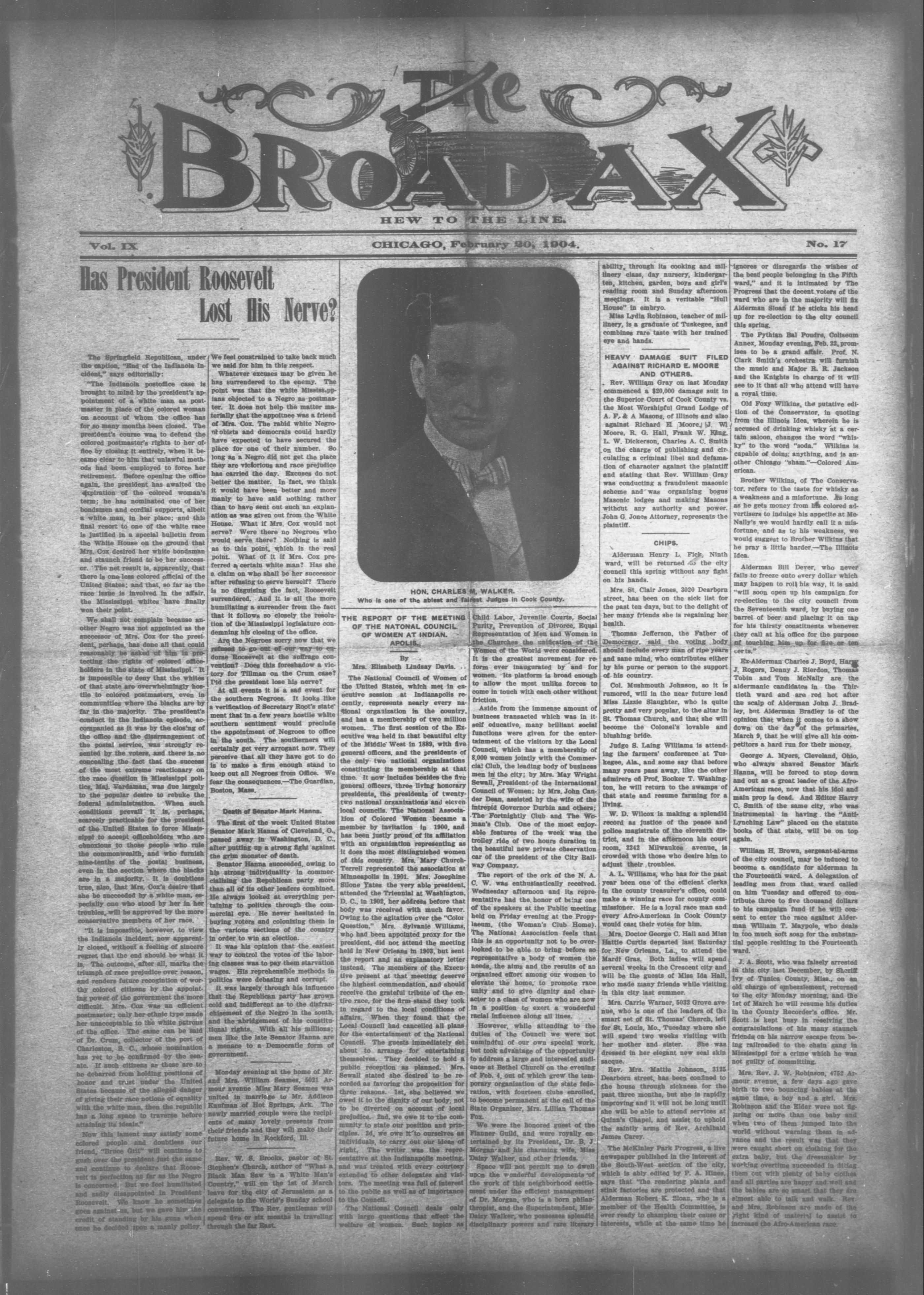
Has President Roosevelt Lost His Nerve?
The Springfield Republican, under the caption, "End of the Indianola Incident," says editorially:
"The Indianola postoffice case is brought to mind by the president's appointment of a white man as postmaster in place of the colored woman on account of whom the office has for so many months been closed. The president's course was to defend the colored postmaster's rights to her office by closing it entirely, when it became clear to him that unlawful methods had been employed to force her retirement. Before opening the office again, the president has awaited the expiration of the colored woman's term; he has nominated one of her bondsmen and cordial supports, albeit a white man, in her place; and this final resort to one of the white race is justified in a special bulletin from the White House on the ground that Mrs. Cox desired her white bondsman and staunch friend to be her successor. The net result is, apparently, that there is one less colored official of the United States; and that, so far as the race issue is involved in the affair, the Mississippi whites have finally won their point.
We shall not complain because another Negro was not appointed as the successor of Mrs. Cox for the president, perhaps, has done all that could reasonably be asked of him in protecting the rights of colored officeholders in the state of Mississippi. It is impossible to deny that the whites of that state are overwhelmingly hostile to colored postmasters, even in communities where the blacks are by far in the majority. The president's conduct in the Indianola episode, accompanied as it was by the closing of the office and the disarrangement of the postal service, was strongly resented by the voters, and there is no concealing the fact that the success of the most extreme reactionary on the race question in Mississippi politics, Maj. Vardaman, was due largely to the popular desire to rebuke the federal administration. When such conditions prevail it is, perhaps, scarcely practicable for the president of the United States to force Mississippi to accept officeholders who are obnoxious to those people who rule the commonwealth, and who furnish nine-tenths of the postal business, even in the section where the blacks are in a majority. It is doubtless true, also, that Mrs. Cox's desire that she be succeeded by a white man, especially one who stood by her in her troubles, will be approved by the more conservative members of her race.
"It is impossible, however, to view the Indianola incident, now apparently closed, without a feeling of sincere regret that the end should be what it is. The outcome, after all, marks the triumph of race prejudice over reason, and renders future recognition of worthy colored citizens by the appointing power of the government the more difficult. Mrs. Cox was an efficient postmaster; only her ethnic type made her unacceptable to the white patrons of the office. The same can be said of Dr. Crum, collector of the port of Charleston, S. C., whose nomination has yet to be confirmed by the senate. If such citizens as these are to be debarred from holding positions of honor and trust under the United States because of the alleged danger of giving their race notions of equality with the white man, then the republic has a long space to traverse before attaining its ideals."
Now this lament may satisfy some colored people and doubtless our friend, "Bruce Grit" will continue to gush over the president just the same and continue to declare that Roosevelt is perfection as far as the Negro is concerned. But we feel humiliated and sadly disappointed in President Roosevelt. We know he sometimes goes against us, but we gave him the credit of standing by his guns when once he decided upon a manly policy.
---
We feel constrained to take back much
we said for him in this respect. Whatever excuses may be given he has surrendered to the enemy. The point was that the white Mississippians objected to a Negro as postmaster. It does not help the matter materially that the appoitnee was a friend of Mrs. Cox. The rabid white Negro obists and democrats could hardly have expected to have secured the place for one of their number. So long as a Negro did not get the place they are victorious and race prejudice has carried the day. Excuses do not better the matter. In fact, we think it would have been better and more manly to have said nothing rather than to have sent out such an explanation as was given out from the White House. What if Mrs. Cox would not serve? Were there no Negroes who would serve there? Nothing is said as to this point, which is the real point. What of it if Mrs. Cox preferred a certain white man? Has she a claim on who shall be her successor after refusing to serve herself? There is no disguising the fact, Roosevelt surrendered. And it is all the more humiliating a surrender from the fact that it follows so closely the resolution of the Mississippi legislature condemning his closing of the office.
Are the Negroes sorry now that we refused to go out of our way to endorse Roosevelt at the suffrage convention? Does this foreshadow a victory for Tillman on the Crum case? Did the president lose his nerve?
At all events it is a sad event for the southern Negroes. It looks like a verification of Secretary Root's statement that in a few years hostile white southern sentiment would preclude the appointment of Negroes to office in the south. The southerners will certainly get very arrogant now. They perceive that all they have got to do is to make a firm enough stand to keep out all Negroes from Office. We fear the consequences.—The Guardian, Boston, Mass.
Death of Senator Mark Hanna.
The first of the week United States Senator Mark Hanna of Cleveland, O., passed away in Washington, D. C., after putting up a strong fight against the grim monster of death. Senator Hanna succeeded, owing to his strong individuality in commercializing the Republican party more than all of its other leaders combined. He always looked at everything pertaining to politics through the commercial eye. He never hesitated in buying voters and colonizing them in the various sections of the country in order to win an election.
It was his opinion that the easiest way to control the votes of the laboring classes was to pay them starvation wages. His reprehensible methods in politics were debasing and corrupt. It was largely through his influence that the Republican party has grown cold and indifferent as to the disfranchisement of the Negro in the south, and the abridgement of his constitutional rights. With all his millions; men like the late Senator Hanna are a menace to a Democratic form of government.
Monday evening at the home of Mr. and Mrs. William Seames, 5021 Armour avenue Miss Mary Seames was united in marriage to Mr. Addison Kaufman of Hot Springs, Ark. The newly married couple were the recipients of many lovely presents from their friends and they will make their future home in Rockford, Ill.
Rev. W. S. Brooks, pastor of St. Stephen's Church, author of "What a Black Man Saw in a White Man's Country," will on the 1st of March leave for the city of Jerusalem as a delegate to the World's Sunday school convention. The Rev. gentleman will spend five or six months in traveling through the far East.
[Name]
THE REPORT OF THE MEETING OF THE NATIONAL COUNCIL OF WOMEN AT INDIAN
The National Council of Women of the United States, which met in executive session at Indianapolis recently, represents nearly every national organization in the country, and has a membership of two million women. The first session of the Executive was held in that beautiful city of the Middle West in 1889, with five general officers, and the presidents of the only two national organizations constituting its membership at that time. It now includes besides the five general officers, three living honorary presidents, the presidents of twenty-two national organizations and eleven local councils. The National Association of Colored Women became a member by invitation in 1900, and has been justly proud of its affiliation with an organization representing as it does the most distinguished women of this country. Mrs. Mary Church-Terrell represented the association at Minneapolis in 1901. Mrs. Josephine Silone Yates the very able president, attended the Triennial at Washington, D. C., in 1902, her address before that body was received with much favor. Owing to the agitation over the "Color Question," Mrs. Sylvanie Williams, who had been appointed proxy for the president, did not attend the meeting held in New Orleans in 1903, but sent the report and an explanatory letter instead. The members of the Executive present at that meeting deserve the highest commendation, and should receive the grateful tribute of the entire race, for the firm stand they took in regard to the local conditions of affairs. When they found that the Local Council had cancelled all plans for the entertainment of the National Council. The guests immediately set about to arrange for entertaining themselves. They decided to hold a public reception as planned. Mrs. Sewall stated she desired to be recorded as favoring the proposition for three reasons. 1st, she believed we owed it to the dignity of our body, not to be diverted on account of local prejudice. 2nd, we owe it to the community to state our position and principles. 3d, we owe it to ourselves as individuals, to carry out our ideas of right. The writer was the representative at the Indianapolis meeting, and was treated with every courtesy extended to other delegates and visitors. The meeting was full of interest to the public as well as of importance to the Council.
The National Council deals only with large questions that effect the welfare of women. Such topics as
Child Labor, Juvenile Courts, Social Purity, Prevention of Divorce, Equal Representation of Men and Women in the Churches the unification of the Women of the World were considered. It is the greatest movement for reform ever inaugurated by and for women. Its platform is broad enough to allow the most unlike forces to come in touch with each other without friction.
Aside from the immense amount of business transacted which was in itself educative, many brilliant social functions were given for the entertainment of the visitors by the Local Council, which has a membership of 8,000 women jointly with the Commercial Club, the leading body of business men in the city; by Mrs. May Wright Sewall, President of the International Council of Women; by Mrs. John Cander Dean, assisted by the wife of the intrepid Governor Durbin and others; The Fortnightly Club and The Woman's Club. One of the most enjoyable features of the week was the trolley ride of two hours duration in the beautiful new private observation car of the president of the City Railway Company.
The report of the ork of the N. A. C. W. was enthusiastically received. Wednesday afternoon and its representative had the honor of being one of the speakers at the Public meeting held on Friday evening at the Propylaeum, (the Woman's Club Home). The National Association feels that this is an opportunity not to be overlooked to be able to bring before so representative a body of women the needs, the aims and the results of an organized effort among our women to elevate the home, to promote race unity and to give dignity and character to a class of women who are now in a position to exert a wonderful racial influence along all lines.
However, while attending to the duties of the Council we were not unmindful of our own special work, but took advantage of the opportunity to address a large and interested audience at Bethel Church on the evening of Feb. 4, out of which grew the temporary organization of the state federation, with fourteen clubs enrolled, to become permanent at the call of the State Organizer, Mrs. Lillian Thomas Fox.
We were the honored guest of the Flanner Guild, and were royally entertained by its President, Dr. B. J. Morgan and his charming wife, Miss Daisy Walker, and other friends. Space will not permit me to dwell upon the wonderful developments of the work of this neighborhood settlement under the efficient management of Dr. Morgan, who is a born philanthropist, and the Superintendent, Miss Daisy Walker, who possesses splendid disciplinary powers and rare literary
ability through its cooking and millinery class, day nursery, kindergarten, kitchen, garden, boys and girl's reading room and Sunday afternoon meetings. It is a veritable "Hull House" in embryo. Miss Lydia Robinson, teacher of millinery, is a graduate of Tuskegee, and combines rare taste with her trained eye and hands.
HEAVY DAMAGE SUIT FILED AGAINST RICHARD E. MOORE AND OTHERS.
Rev. William Gray on last Monday commenced a $20,000 damage suit in the Superior Court of Cook County vs. the Most Worshipful Grand Lodge of A. F. & A Masons, of Illinois and also against Richard E. Moore. J. Wl Moore, R. G. Hall, Frank W. King, L. W. Dickerson, Charles A. C. Smith on the charge of publishing and circulating a criminal libel and defamation of character against the plaintiff and stating that Rev. William Gray was conducting a fraudulent masonic scheme and was organizing bogus Masonic lodges and making Masons without any authority and power. John G. Jones Attorney, represents the plaintiff.
CHIPS.
Alderman Henry L. Fick, Ninth ward, will be returned to the city council this spring without any fight on his hands.
Mrs. St. Clair Jones, 3020 Dearborn street, has been on the sick list for the past ten days, but to the delight of her many friends she is regaining her health.
Thomas Jefferson, the Father of Democracy, said the voting body should include every man of ripe years and sane mind, who contributes either by his purse or person to the support of his country.
Col. Mushmouth Johnson, so it is rumored, will in the near future lead Miss Lizzie Slaughter, who is quite pretty and very popular, to the altar in St. Thomas Church, and that she will become the Colonel's lovable and blushing bride.
Judge S. Laing Williams is attending the farmers' conference at Tuskegee, Ala., and some say that before many years pass away, like the other admirers of Prof. Booker T. Washington, he will return to the swamps of that state and resume farming for a living.
W. D. Wilcox is making a splendid record as justice of the peace and police magistrate of the eleventh district, and in the afternoon his court room, 2242 Milwaukee avenue, is crowded with those who desire him to adjust their troubles.
A. L. Williams, who has for the past year been one of the efficient clerks in the county treasurer's office, could make a winning race for county commissioner. He is a loyal race man and every Afro-American in Cook County would cast their votes for him.
Mrs. Doctor George C. Hall and Miss Hattle Curtis departed last Saturday for New Orleans, La., to attend the Mardi Gras. Both ladies will spend several weeks in the Crescent city and will be the guests of Miss Ida Hall, who made many friends while visiting in this city last summer.
Mrs. Carrie Warner, 5033 Grove avenue, who is one of the leaders of the smart set of St. Thomas' Church, left for St. Louis, Mo., Tuesday where she will spend two weeks visiting with her mother and sister. She was dressed in her elegant new seal skin sacque.
Rev. Mrs. Mattie Johnson. 3125 Dearborn street, has been confined to the house through sickness for the past three months, but she is rapidly improving and it will not be long until she will be able to attend services at Quinn's Chapel, and assist to uphold the saintly arms of Rev. Archibald James Carey.
The McKinley Park Progress, a live newspaper published in the interest of the South-West section of the city, which is ably edited by P. A. Hines, says that "the rendering plants and stink factories are protected and that Alderman Robert K. Sloan, who is a member of the Health Committee, is ever ready to champion their cause or interests, while at the same time he
ignores or disregards the wishes of the best people belonging in the Fifth ward," and it is intimated by The Progress that the decent voters of the ward who are in the majority will fix Alderman Sloan if he sticks his head up for re-election to the city council this spring.
The Pythian Bal Poudre, Coliseum Annex, Monday evening, Feb. 22, promises to be a grand affair. Prof. N. Clark Smith's orchestra will furnish the music and Major R. R. Jackson and the Knights in charge of it will see to it that all who attend will have a royal time.
Old Foxy Wilkins, the putative edition of the Conservator, in quoting from the Illinois Idea, wherein he is accused of drinking whisky at a certain saloon, changes the word "whisky" to the word "soda." Wilkins is capable of doing anything, and is another Chicago "sham."—Colored American.
Brother Wilkins, of The Conservator, refers to the taste for whisky as a weakness and a misfortune. As long as he gets money from his colored advertisers to indulge his appetite at MeNally's we would hardly call it a misfortune, and as to his weakness, we would suggest to Brother Wilkins that he pray a little harder.—The Illinois Idea.
Alderman Bill Dever, who never fails to freeze onto every dollar which may happen to roll his way, it is said "will soon open up his campaign for re-election to the city council from the Seventeenth ward, by buying one barrel of beer and placing it on tap for his thirsty constituents whenever they call at his office for the purpose of touching him up for flare or ten certs."
Ex-Alderman Charles J. Boyd, Harry J. Rogers, Denny J. Rierdon, Thomas Tobin and Tom McNally are the aldermanic candidates in the Thirtieth ward and are red hot after the scalp of Alderman John J. Bradley, but Alderman Bradley is of the opinion that when it comes to a show down on the day of the primaries, March 9, that he will give all his competitors a hard run for their money.
George A. Myers, Cleveland, Ohio, who always shaved Senator Mark Hanna, will be forced to step down and out as a great leader of the Afro-American race, now that his idol and main prop is dead. And Editor Harry C. Smith of the same city, who was instrumental in having the "Anti-Lynching Law" placed on the statute books of that state, will be on top again.
William H. Brown, sergeant-at-arms of the city council, may be induced to become a candidate for alderman in the Fourteenth ward. A delegation of leading men from that ward called on him Tuesday and offered to contribute three to five thousand dollars to his campaign fund if he will consent to enter the race against Alderman William T. Maypole, who deals in too much soft soap for the substantial people residing in the Fourteenth ward.
J. A. Scott, who was falsely arrested in this city last December, by Shoriff Ivy of Tunica County, Miss., on an old charge of embezzlement, returned to the city Monday morning, and the 1st of March he will resume his duties in the County Recorder's office. Mr. Scott is kept busy in receiving the congratulations of his many staunch friends on his narrow escape from being railroaded to the chain gang in Mississippi for a crime which he was not guilty of committing.
Mrs. Rev. J. W. Robinson, 4752 Armour avenue, a few days ago gave birth to two bouncing babies at the same time, a boy and a girl. Mrs. Robinson and the Elder were not figuring on more than one baby and when two of them jumped into the world without warning them in advance and the result was that they were caught short on clothing for the extra baby, but the dressmaker by working overtime succeeded in fitting them out with plenty of baby clothes and all parties are happy and well and the babies are so smart that they are almost able to talk and walk. Rev. and Mrs. Robinson are made of the right kind of material to assist to increase the Afro-American race
Will promulgate and as all times uphold the true principles of Democracy, but Catholism, Protestantism, Prints, Inddela, Farmers, Single Taxation, Republics, Knights of Labor, or any one else can have their say, so long as their language is proper and responsibility is fixed.
The Broad Ax is a newspaper whose 'platform is broad enough for all, ever claiming the editorial right to speak its own mind.
Local communications will receive attention. Write only on one side of the paper.
Subscriptions must be paid in advance.
One Year..... $2.00
Six Months..... 1.00
Advertising rates made known on application.
Address all communications to
JULIUS F. TAYLOR, Editor and Publisher. Entered at the Post Office at Chicago, III., as Second-class Matter.
Fine Turquoise Stones from the Mines of Nishkpoer Are Becoming Scarcer and Dearer.
The turquoise gems, the finest examples of which are produced from the mines of Nishapoor, are, probably from some change in the fashion of the west, becoming dearer in price and, in Teheran and neighborhood, more difficult to find. According to Vice Consul General Tyler, at Teheran, says the Washington Star, much of the value of the stone depends on its shape, the oblong being considered the most appropriate; on its freedom from spots or discoloration, however small in size; on its age, when the color has settled down into its final hue (not the superficial variations or sympathetic changes, but its really permanent shade); but more than all on its actual color, whether fresh from the hands of the lapidary or sedate from long wear. Choice, taste and fashion largely determine the preference of one shade or another, but the lapis lazuli, or the cloudless sapphire of its native skies, is the highest quality of the turquoise.
The pearls of the Persian gulf, which have formed for a long time past an important branch of the export trade, have likewise, within the last few years, risen greatly in price. Mr. Tyler says he does not think that this means that the supply has seriously diminished, but rather that the demand has increased out of proportion. Ten thousand dollars for a rosary of faultless pearls is not at the present time considered at all excessive, although formerly the same might be bought for a title of that amount.
EVERY "S" WAS STOLEN.
Consequently This Publication Was in Great Distress and Compelled to Lisp Out Its Ideas.
"We are thorry to thay," explained the editor of a weekly paper in Texas, "that our compothing-room wath entered latth night by thome unknown thoundrel, who thtole every eth in the ethtablithment and thucceeded in making hith ethcape undetected.
"It hath been impothible of courthe to procure a new thupply of etheth in time for thith iththue, and we are thuth compelled to go to preth in a tituation motht embarrassing and ditthrething; but we thee no other courthe to purthue than to make the betht thtagger we can to get along without the mithing letter, and we therefore print the 'Newth' on time regardleth of the loth thuthtained.
"The motive of the mitherable mithereant ith unknown to uth, but doubtleth wath revenge for thome thuppothed inthult.
"It thall never be thaid that the petty thpite of the thmall-thouled villain hath dithabled the 'Newth.' If thith meetth the eye of the detethitable rathcal, we bag to athure him that he undereithtimateth the rethourceth of a firtht-clath newthpaper when he thinkth he can cripple it hopelethly by breaking into the alphabet.
"We take occathion to thay to him, furthermore, that before next Thurthday we will have three timeth ath many etheth ath he thtole."
FREE SMOKES FOR SINNERS.
Tobacco Used in Prisons Does Not Pay a Government Revenue Tax—A Recent Ruling.
Convicts serving terms in the various prisons of the country have one privilege people outside the walls do not enjoy. The commissioner of internal revenue has decided that it is permissible for state prisons to manufacture tobacco or cigars for its own inmates without paying license. The commissioner says:
"I would say that upon careful consideration of the question involved, it is held that a charitable or other institution conducted by the state and under state authority, with its own operatives, has the right to manufacture tobacco, cigars, or any other tobacco product without the payment of tax when all such manufactured tobacco is used exclusively within the state institution.
"The tobacco must, however, be manufactured within the limits of the state institution, and no portion of it be removed therefrom. If any portion of such manufactured tobacco is found outside of the limits of the institution, it will be liable to seizure and forfeiture, the same as any other unstamped manufactured tobacco which might be found upon the market."
In the United Kingdom 37,500,000 people out of 40,000,000 receive less than $60 a month for each family; 1,000,000 are in daily receipt of poor law relief; 8,000,000 have only a weak wages between them and starvation; 500 hereditary peers own one-fourth of England, and they and their dependents spend every year $1,850,000,000.
COLONIZING CANADA
What Persistent Advertising Has Done for the Northwest—Growing Flax on a Large Scale.
Some five years ago the Canadian government did strenuous advertising throughout the cities of the United States with a view of disabusing the people's minds of the idea that western Canada was a waste of frost and snow. The government caused free lectures to be given, established bureaus from which large quantities of literature about Canadian possibilities in the way of farming and home making were issued and gave exhibitions of agricultural products at state and county fairs.
The farmers of the middle west in particular emigrated in large numbers, with the result that an American invasion of Canada began, and continued so steadily as to produce what a recent writer has called the "Americanization of Canada."
One of the most noticeable results of the invasion is shown in the introduction of flax growing on a large scale. The Canadians thought it unwise to attempt the cultivation of that grain, as they believed it hard on the land and a great protector of weeds. But the Americans have proved to the contrary, and with land selling at $12 an acre and yielding an average of 15 bushels to the acre of flax the newly-bought farms have paid for themselves during the very first year.
THE HARDINESS OF TREES.
Depends a Good Deal Upon the Climate to Which They Have Become Accustomed.
An expert nurseryman says the hardiness or non-hardiness of trees depends largely upon where the seeds from which the trees in question sprang came from. Satisfactory results are seldom experienced by planting a seed obtained from the sunny south, say. By planting seeds gradually further north, however, trees may be at length hardened and acclimated until a seed from such a tree may be reasonably expected to thrive and mature its fruits.
Trees, like people, says the Philadelphia Record, acquire their habits from the climate in which they live. The ndrthern tree knows instinctively when the time has come to ripen its fruits. The southern tree follows the same instinct, being in no hurry, as there is little likelihood of real cold. With transplantings further north its habit changes.
The great trouble with most people is that they want to jump a tree from south to north at one move. This same idea is evident in the attempt to bring various fruit trees from Russia to the northern United States.
Apples and plums from the land of the great white czar have taken kindly to the below zero conditions of the gentle Dakotas.
NATIVES OF SWITZERLAND.
Cannot Forswear Allegiance Merely by Becoming Naturalized Elsewhere-Should Have Passports.
Students and other residents of the United States who may be natives of Switzerland, will be interested in a communication to the state department from Consul Lieberknecht at Zurich, who calls attention of students and others to the necessity of providing themselves with passports.
Many naturalized American citizens who were formerly Swiss citizens labor under a misapprehension as to their old and new citizenship rights and responsibilities. They return to Switzerland without naturalization papers or passports, only to find themselves Swiss citizens again.
The consul adds that a person never loses citizenship, no matter how long he may absent himself, unless he goes through certain necessary formalities. If he returns and is owing a military tax, he is compelled to pay the same, in spite of the fact that he is an American citizen.
The only way to be released from old responsibilities is by making a written request to his home community for such release, submitting proof at the same time that he has acquired American citizenship.
HE WEDDED IN LONDON.
President Roosevelt's Marriage Register at St. George's Attracts Many Curious American Tourists.
President Roosevelt's marriage register is in London, at St. George's, Hanover square, and so many American tourists have flocked to see it that, for convenience' sake, it has been placed by itself in an accessible alcove of the old church building, says the New York Tribune.
President Roosevelt's marriage to Miss Carow took place so long ago—17 years ago, to be exact—that few persons remember that the American president was married in a foreign land. He is, it is said, the only American president whose wedding was not celebrated under the Stars and Stripes. Tourists take great interest in the certificate, in Mr. Roosevelt's occupation of "ranchman," and in Miss Carow's signature. They study the autographs of the witnesses, and they wonder who these persons were. They observe with pride that the canon of York, and not a simple "reverend," performed the ceremony.
Smallpox as "the Good Wife."
To this day smallpox is alluded to in the outer islands of the Hebrides as "bhean mihath" ("the good wife"), a form of euphemism, the idea of which is that, in order to escape the ban of the disease, it should be spoken of respectfully.—Caledonian Medical Journal.
Bread for Frenchmen.
The average Frenchman eats 428 pounds of bread a year.
Mr. George Meredith, the distinguished novelist, finds it impossible to write original matter save when he is in absolute seclusion.
A French sculptor, M. Charpentier, and a Belgian sculptor, M. Meunier, have completed a design for the Zola monument, which will symbolize Zola's novels, "Travail" and "Fecondite."
Princes Edward and Albert, the little sons of the prince of Wales, are already being initiated into the mysteries of wielding a fishing-rod, and promise to be formidable rivals of their father and grandfather.
Sevcik, the master who taught Kubellik, the great violinist, has only one eye. A violin string snapped once, whilst he was playing and struck him in the eye, inflicting such injuries to that organ that its sight was lost.
The departure from Washington of Gen. Khan, Persian minister, who is promoted to a Vienna post, removes a most picturesque figure from the capital. The general, whose full name is Mofak Hamed Dovelet, has been in Washington four years, but has never become familiar with the English language, speaking French entirely with members of the diplomatic corps. Gen. Khan is regarded as the shah's righthand man, his most notable work having been done in cultivating friendly relations between the republics of South America and his home government.
One of the most ardent fox hunters in Great Britain is Lord Fitzwilliam, who owns a fine estate in England and another in Ireland. He is the owner of five motor cars and in the hunting season he keeps them busy. At the close of a chase on his English estate he jumps into one of his autos and dashes off to Manchester, 50 miles away. Here he catches a fast train to Holyhead, where he arrives in time for the mail boat to Dublin. An auto takes him to his Irish estate next morning. Another run after a fox is followed by a journey back to England, and this his lordship keeps up sometimes for four days on a stretch, hurrying from one estate to another every day.
EDUCATIONAL TOPICS.
The men who teach in French schools are to get hereafter from $240 to $440 a year; the women teachers get $40 less. Prof. Miliford, of the English department of Wabash college at Crawfordsville, Ind., has been forced to give up his work for at least this term. The wider and deeper is the foundation the higher a superstructure one can rear. Bear that in mind in getting an education, for you are then laying the foundations of your life.—Wellspring.
For the first time in the history of German universities a deaf mute has succeeded in obtaining a doctor's degree. Dr. Walter Kuntze, on whom the University of Leipsic has conferred a Ph. D., is a comparatively young man. His thesis for the degree is regarded as one of the best in recent years.
The thoroughness in which the agricultural schools of the western states are going into the education of farmers is illustrated by the announcement that the Iowa State Agricultural college has just established a course of instruction in the slaughtering of live stock. It is a laboratory course, and the young farmers will learn the art by practical instruction.
Helen Keller has just begun her senior year at Radcliffe. Her studies this year will consist of Prof. Kittredge's Shakespearean course, Dr. Nelson's English literature, Prof. Moore's course in Plautus, Cicero and Lucretius and Prof. Morgan and Dr. Rand's course in Latin, which covers the annals of Tacitus, the satires and epistles of Horace and selections from Catullus. Up to the present time Miss Keller has passed with credit all her college examinations.
TOLD OF THE FAIR SEX
Selma Lagerlof, the second woman to receive a gold medal for literary excellence from the Swedish royal academy, is a well known Swedish novelist. There are two national banks in Mount Pleasant, Ia., and it has just developed that a majority of stock in each is owned by a woman. The men who actually manage the enterprise own but a small fraction.
Through the entire civil war Gen. Gordon's wife accompanied him, never leaving his side, save when the exigencies of the campaign made her presence impossible. To the faithful devotion of his wife Gen. Gordon owed his life. In the bloody battle of Sharpsburg Gordon, while in the midst of the carnage, was shot five times. As soon as he fell his wife rushed to his side and carried him to safety, stanching the flow of blood and attending his wounds until medical aid could be procured. She remained with him in the hospital until he had recovered and when Gen. Gordon went back to join his command Mrs. Fannie Haralsson Gordon followed her husband.
THE WORLD OF LABOR
During the past 20 years a total of 8,500 men have been killed in the hard coal mines.
In round numbers and generally speaking the strike bill of Manhattan and the Bronx for the year ended November 20 is estimated at $25,000,000.
Nearly all railroad companies in the Mississippi valley have adopted a shorter workday instead of reducing their force of machinists and other workmen. All railroads having shops in Chicago have done this.
Although there has been a large increase in the number of wage earners in Minnesota during the past year, there has been a big decrease in child labor, according to the report of the state labor commissioner.
Fifty-First St. and Armour Ave.
RAIL YARDS: 51st St. & L. S. & M. S. Ry.
52nd St. and Armour Ave.
CHJCAGO
NOTARY PUBLIC. Office Phone, M. 751
• Residence Phone, Blue 5385.
W. G. ANDERSON,
ATTORNEY AT LAW.
J. Q. GRANT & CO.
SUITE 61,119 LA SALLE Residence, 3232 Wabash Avenue, CHICAGO.
GEO. A. WILSON GEO. D. DUNCAN
PHONE 1515 HABRISON.
WILSON & DUNCAN
COMMISSION BROKERS
STOCKS, BONDS, GRAIN,
PROVISIONS & COTTON
SUITE 16, IMPERIAL BLDG.
260 SO. CLARK ST., CHICAGO.
Send for our Pamphlet and Daily
Market Letter upon Successful Specu-
lation.
All Business Transacted through
and Confirmed by Ernest E. Jones &
Co.
Correspondence Solicited.
The Souls of
Black Folk
By W. E. B. DuBois
A REMARKABLE BOOK that is provoking much discussion because of the wonderful eloquence with which the author pleads for right and justice to his people. In these days of increasing agitation over the "negro problem" this passionate human document can neither be overlooked nor ignored. Aside from its remarkable presentation of facts it holds the reader—prejudiced or not—by its fascination of style and overpowering pathos.
Some of the Chapter Headings follow:
OF OUR SPIRITUAL STRIVINGS.
OF THE DAWN OF FREEDOM.
OF MR. WASHINGTON AND OTHERS.
OF THE MEANING OF PROGRESS.
OF THE TRAINING OF BLACK MEN.
OF THE BLACK BELT.
OF THE SONS OF MASTER AND MAN.
OF THE FAITH OF THE FATHERS.
OF THE PASSING OF THE FIRST-BORN.
OF ALEXANDER CRUMMELL.
OF THE COMING OF JOHN.
OF THE SORROW SONGS.
Ed Edition $1.20 net Published by
A.C. McClurg & Co., Chicago
MR&. A. WILSON.
Nicely furnished rooms to rent for gentlemen. Reasonable rates, 2252 Indiana aveuna.
First class furnished rooms, for rent to gentleman and ladies, with bath and gas. 2628 Wabash avenue.
Mrs. J. J. Manley.
Florist.
Funeral designs of every description, latest and most stylish decorations, for churches and weddings. Palms to rent for all social functions, 3119 State St., Chicago.
WONDERFUL
DISCOVERY
Curly Hair Made Straight By
TAKEN FROM LIFE:
BEFORE AND AFTER TREATMENT.
ORIGINAL
OZONIZED OX MARROW
(Copyrighted.)
This wonderful hair pomade is the only safe preparation in the world that makes kinky or curly hair straight as shown above. It nourishes the scalp, prevents the hair from falling out or breaking off, curse dandruff and makes the hair grow long and silky. Seldom over forty years and ued by thousands. Warranted harmless. It was the first preparation ever sold for straightening kinky hair. Beware of limitations. Get the Original. It never falls to keep the hair straight, soft and beautiful, giving it its healthy, life-like appearance so much desired. A bottle necessity for ladies, gentlemen and children. Elegantly perfumed. Owing to its superior and lasting qualities it is the best and most economical. It is not possible for anybody to produce a preparation equal to it. Full directions with every bottle. Only 50 cents. Sold by a bulk dealer. Only 50 cents for one bottle or $1.40 for three bottles. We pay all express changes. Send postal or express money order. Please mention name of this paper when ordering. Write your name and address plainly to
OZONIZED OX MARROW CO.,
76 Wabash Ave., Chicago, Illinois.
The American Mutual Plantation Company
You have all doubtless read the advertisement that we have been running in The Broad Ax for some weeks past. Some of you may have been interested in our statements published in that "Ad" and may be even now considering seriously making an investment with us. (If you did this, you would be in excellent company for some of the brightest and shrewdest business and professional men, both white and colored have made this investment and are thoroughly pleased with it.) Some of you may have thought our statements extreme. You may have considered that we were exaggerating and consequently you have decided, temporarily at least not to invest with us. You are right in being careful; in fact, that is exactly the type of man we want to reach, the careful, thoughtful man who investigates, goes slowly and knows what he is doing when he makes a move.
As to the question of over-stating our proposition; we would like to have a good serious talk with every man who thinks we have made any over-statements. Do you know that it is exceedingly difficult to write an advertisement that comes anywhere near the facts in such a proposition as ours, a Tropical Plantation, and not be open to the charge, made by people uneducated in the proposition, that one has exaggerated. The TRUTH IS WONDERFUL and so wonderful that people doubt the truth. AS A MATTER OF FACT EVERY STATEMENT EVER MADE BY US AS TO PROBABLE RESULTS OF AN INVESTMENT IN THE AMERICAN MUTUAL PLANTATION COMPANY HAS BEEN RATHER UNDERSTATED THAN OVERSATED.
Now, the only way we can prove this to you is to prove it to you and to do that we should meet you; to do that you must come and see us or we must go and see you. If you care for an investment that will surely bring you from 10 to 50 per cent in a proposition that is not a speculation but a plain, cold business matter you should certainly look us up and decide for yourselves as to whether we are stating facts or not. We would like to have you inquire of Bradstreet, R. G. Dunn & Co., and the International Mercantile Agency as to our rating; in fact, we want you to know all about us. AMERICAN MUTUAL PLANTATION CO. BARKER & TAYLOR, General Agents, 431-435 Stock Exchange Bldg., Chicago, Ill.
President and Treasurer, THOMAS CAREY. Vice-President, JOHN SHELHAMER. Secretary, WILLIAM SULLIVAN.
Yards running winter and summer, equipped with the latest improved Wolf Dryer.
Output of Winter Yards ..... 140,00 per day
Output of Summer Yards..... 300,00 per day
If your physician recommends the use of a stimulant, there is no whisky in which so many desirable qualities are contained as in Old Underoof Rye and it has the least reactive effect. Because it is made right and is aged right.
CHAS. DENNEHY & CO.
CHICACO
To the readers of The Broad Ax:
WILLIAM LEGNER,
Vice Pres. & Treas.
GET SEASICK IN A HOUSE.
Peculiar Effect of Attempts to Walk
In Storm-Senten Buildings—
Floors Were Solid, Too.
At a recent meeting of the Women's
Literary club of Baltimore Mrs. Charles
C. Morgan read a paper in which she
cited a peculiar but well-authenticated
fact concerning some storm-beaten
houses on Cobb's island, off the eastern
coast of Virginia. The houses were
eventually washed away by the encroachments of the sea, but for a long time they were firmly imbedded in the sand at such an angle that the wanderer could walk in the second story windows from the bluff, while the floors all slanted at an acute degree.
There was not the slightest danger attendant upon walking up or down these floors, yet no one was ever found who could traverse their length without becoming seasick. Experienced sailors, who knew no qualms in midocean, turned faint and giddy on trying to walk these perfectly steady planks. To all the neighborhood the buildings were known as the "seasick houses," and that the seasickness was not due to imagination was proved by persons who never had heard of the tradition experiencing the same unpleasant results.
Mrs. Morgan, who resided on the mainland near by, concluded her account of the houses by saying that a small dog belonging to her husband which followed that gentleman "foot to foot," as the nagroes term it, never could be induced to follow his master across the mysterious thresholds, be the command ever so peremptory or the inducement ever so strong.
MRS. PYMACHER'S PIE.
Hero's an Idyll of the New York Stock Exchange — Speculators Appreciated Toothsome Dainty.
Pymacher was a telegrapher employed by the stock exchange firm in which John W. Gates is a special partner, says Everybody's Magazine. Pymacher brought for his lunch a noble pie, a composition of Mrs. Pymacher's. The manager of the office tasted that pie, found it good, and gobbled it. Such are the notions of property in the street. "Is there any more where that came from?" asked the manager, a man of delicate tooth. "There is more," said Pymacher, "and better, if possible." "It is not possible," said the manager. He told all the Chicago capitalists, who came to that office. He made their mouths water. The next day Pymacher brought in a lemon pie, an iridescent dream, a tender flower. Half a dozen millionaires ate of it, with tears of joy and thanksgiving. "What shall we do for Mrs. Pymacher? Shall we build her a monument?" "Buy her a hundred shares of Northern Pacific," says Gates. So they bought her 100 shares at 113½. sold it at 135. The next day came the corner, and a share of Northern Pacific was worth $1,000. But Mr. Gates had showed his eagerness to reward a supreme artist. If old Rembrandt were alive "the Gates crowd" would "let him in" on the best thing it had.
KEEP BOYS ON THE FARM.
Educational Department Gives Good Advice to Rural Father-Advice to the Teachers.
The superintendent of public instruction of the state of Indiana has recently issued a bulletin touching on the steady migration of the young men of the rural districts to the cities in search of a so-called "better chance." Believing that Indiana is being sapped of its energies by that movement, the department in a bulletin to the teachers says that they can influence the boy to stay on the farm and to work out its problems.
"It will be a sad day for our national life when all our young farmers come to town; when the small, well-cultivated homesteads give way to landed estates," the bulletin says. The necessity of keeping the boys on the farm was the subject of a discussion as to what the teacher can do for the community. A teacher's power in determining the industry of a community lies in making her schoolroom a busy workshop, where the rights of others and the nobility of honest toll are taught.
The bulletin which is being sent out by the state superintendent deals with the relation of the teacher to the school, her patrons and the locality. The teacher, the bulletin says, ought to be a missionary, harmonizing turbulent elements.
Booming Books
Some time ago a rumor went round that astute publishers had in their pay a large number of the most attractive diners-out. Your neighbor at table would lead the conversation to the latest novel—quite the easiest of conversational openings between strangers, who lay their heads together over the menu and have to entertain each other for an hour. You are interested in the description of the book of the hour, you are a little ashamed of not having read it, and going home you sit down and order the book—from the circulating library. Every publisher, every theater manager, every deviser of a patent medicine knows that the advice of a friend is a more concentrated and personal pull than the opinion of a critic from the empyrean. And if the idea was ever carried out, it deserved to succeed, but no one ever spotted the pald diner-out. There was the artistry of the thing.—London Chronicle.
A recent bulletin of the department of agriculture says: "It appears that practically all soils contain sufficient plant food for good crop yield; that this supply will be indefinitely maintained, and that this actual yield of plants adapted to the soil depends mainly, under favorable conditions, upon the cultural methods and suitable crop rotation."
THE LAW LAID DOWN.
The punishment of merely lawless acts of individuals in preventing colored persons from voting at purely state elections is held, in Karem vs. United States (C. C. A., 6th C.), 61 L. R. A. 437, not to be within the power of congress. An appropriation to cover the expenses incurred and paid by a municipal officer in the discharge of his duty is held, in state ex rel. Crow vs. St. Louis (Mo.), 61 L. R. A. 593, not to be within a constitutional prohibition of the granting of public money to an individual.
A devise to one absolutely and forever is held, in Roth va. Rauschenbusch (Mo.), 61 L. R. A. 455, to convey a fee simple which cannot be cut down by a subsequent clause directing the disposition of any remainder which may be undisposed of at the death of the devisee.
The mere fact that an applicant for insurance is receiving a pension from the government for alleged physical injuries is held, in Black vs. Travelers' Insurance company (C. C. A. 3d C.), 61 L. R. A. 500, not to show that he has a bodily infirmity within the meaning of a warrant in the policy.
The cutting of a train of cars on a side track, leaving some on one side and some on the other of a highway; where the view of the other tracks is partially obscured thereby, is held in Passman va. West Jersey. & S. R. Co. (N. J. Err & App.), 61 L. R. A. 609, not to be an invitation to the public to cross without using ordinary precaution to ascertain if such crossing can be safely made.
A railroad company which permits a car to break loose from a train on a grade and run down into collision with another car at the foot of the decline in such a way as to be hurled off of the right of way, to the injury of a bystander, is held, in West Virginia, C. & P. R. Co., vs. state use of Fuller (Md.), 61 L. R. A. 574, to be liable for the injury thereby caused to him, unless it is shown that the accident was unavoidable.
TOWN TALK.
A movement has been inaugurated in New York to prohibit the sale of cocaine except under authority of a doctor's prescription.
Dr. Corydon Richmond, first mayor of Kokomo, Ind., celebrated his ninety-sixth birthday recently. He is in fairly good health, but has been blind for 15 years. The doctor maintains close interest in medical and surgical science, attends his mesonic lodge regularly and, to all appearance, leads a contented and happy life. He became a mason 72 years ago.
On account of a recent experience Magistrate South, of Philadelphia, refuses to try any more cases against men accused of desecrating the Sabbath. A man fined in his court for the offense was obliged to pawn his overcoat and has since been compelled to work outdoors clad in thin raiment. The fact coming to Magistrate South's knowledge, he bought the man a coat and now advises a change of venue in all like cases called before him.
John Connaughton, principal keeper in Sing Sing prison, has not visited New York city for 29 years, and there is little likelihood that he will ever do so. The reason of this is that there are in that city a great number of men who would welcome an opportunity to kill him. In his capacity as prison-keeper for 40 years Mr. Connaughton has earned the enmity of many desperate criminals, most of whom hate him with an intensity which would induce them to murder should the chance offer.
HEALTH AND DISEASE
The Public Health and Marine hospital service costs $1,000,000 a year.
Pleasant Porter, chief of the Creeka, has the gout. He blames it to civilization.
Dr. G. Sims Woodhead, of Cambridge university, an eminent authority on tuberculosis, is lecturing in the United States.
William Laciede, once famous as a negro minstrel, has been taken to a Cincinnati hospital hopelessly paralyzed. Both limbs are useless, due, the doctors say, to too much dancing.
The religious feelings of the natives of the Punjab are so strongly opposed to the killing of rats, and disinfection is so unpopular, that it has been decided to let the plague follow its course there, absolutely unchecked.
There has been no yellow fever in the United States for three years, excepting the recent development on the Mexican border of Texas. Some cases of yellow fever have come into Cuba, from Mexico in the last three years, but in no instance was the disease communicated to others.
THE MAN WHO KNOWS IT ALL.
The man who pretends to have a thorough speaking acquaintance with every known subject under the sun, and is imprudent enough to endeavor to make people believe everything he says, is described in different ways, says the Philadelphia Evening Telegraph. Some of his friends have formed these opinions of him:
Senora Abreu, in Spite of Her Wealth and Social Bank, Is a Simon- Pure Democrat.
Havana has its Senora Abreu, just as England has its Baroness Burdett-Coutts, and just as the United States has its Hetty Green.
She is the richest woman in Cuba, a handsome, intelligent, rather aristocratic widow, worth $2,000,000, and with no incumbrances. She is considered a catch.
To northern eyes $2,000,000 does not seem important. But, says the Boston Globe, that sum of money in Cuba is looked upon as immense wealth, and so it is, considering the impoverished condition of the island, and the years of oppression when there was no incentive to amass wealth.
Rosa Abreu is a Cuban born. Her husband was a Cuban, and all her interests and sympathies are entirely non-Spanish. Aside from Countess Fernandino, she is the most-talked-of woman in Havana, principally for her social charm, her great generosity in charitable matters, her taste in dress, and her hospitality.
She lives in the Cerro, a fashionable suburb of Havana, or more precisely at Palatino, on the edge of the Cerro. On Sunday afternoon and evening she holds a salon, which has actually become famous in the West Indies.
Everybody goes. It is the meeting place of the representatives of the best Cuban and American society in Havana. Officers of the army and navy in uniform line up in battalions around the walls of her dining rooms. The literary, artistic and dramatic world of the Cuban capital come to meet this clever woman, with a clear, bright, quick mind like a northern woman. All society pays homage to her and she accepts it all with simple, democratic grace and dignity.
At the Abreu dancing parties one meets the prettiest Cuban girls of the capital, and the best of the Americans, and since Senora Abreu speaks English and French as perfectly as Spanish, she is quite competent to entertain a cosmopolitan assembly.
Senora Abreu's home at Palatino is the typical planter's mansion of the better class: It is built of brick, covered over with stucco, and great balconies and verandas surround it on all sides, giving it an appearance of comfort and ease. A grove of tall, stately royal palms surrounds it and makes the house a cool and shady retreat.
Within the furnishings are an evidence of the good taste of this southern
Kate
SENORA ROSA ABREU. woman. The rooms are large and the cellings high, and, like all Cuban houses, they are difficult to furnish so as to look homelike and inviting. There is little art in Cuba, and as a consequence few, if any, pictures are found hanging on Cuban walls. Senora Abreu, however, appreciates the attractiveness of a room hung with pictures, and, therefore, has made of them. She has discovered as well the artistic effect of small tropical palms indoors and has used them to advantage.
In a country where they grow so plentifully one would imagine that Cuban housewives would use them as a means of decoration, but they are almost totally ignored. Senora Abreu's house is filled with bric-a-brac, and many oriental rugs and real brussels curtains, all in excellent taste.
In the wealthiest Cuban homes it is the custom to stable the horses in the courtyard of the house, and also to push the carriages through the immense portals into the lower corridor itself. Senora Abreu, however, has followed the American custom and constructed stables for her fine horses away from the house. Living in the country, as she does, there is more ground space and she is better able to build outhouse.
Her plantation, given over almost entirely to the cultivation of coffee, is one of the largest in Cuba. It is composed of 20,000 acres of magnificent coffee land. A mill built at a cost of over $150,000 stands in the midst of it. When the plantation and mill are in active operation several hundred plantation hands are employed. At present all wokk has been suspended on account of the unsettled state of affairs. Senora Abreu supports these farm hands even though they are forced to idleness by the uncertainty of the times.
Rosa Abreu is not yet 35 years of age, and a great many of the young bloods of Havana have sought her hand. She is certainly a handsome woman, of the southern Latin type, with black hair and eyes. Her figure is a little too plump for gracefulness, but she dresses excellently, and with such skill that one is inclined to overlook the tendency to embonpoint.
Safeguard for Cream Soups.
A bit of soda the size of a pen added to the tomatoes for tomato cream soup will prevent the milk's "breaking" when it goes in and it is a safeguard for all cream soups.
Pleasing Recollection of the Great Sanitary Fair Held in St. Louis, Mo., in 1864.
It has been well said that many noble enterprises owe their origin and success to women. This truth was exemplified during our civil war by schemes to promote the comfort and relieve the sufferings of the soldiers. A notable instance was the great fair in St. Louis, known as the Mississippi Valley Sanitary fair, in 1864. The project was for the benefit of the sanitary commission, which had been instituted in St. Louis in 1861 by Gen. Fremont.
The enterprise was pushed with zeal and enthusiasm. The inauguration was set for May 17, and extensive preparations were made. The fair was opened the next day in an immense pavilion, which had been erected in Twelfth street, extending north from Olive 525 feet, by a width off 114 feet, with wings extending east and west, each 200 feet, occupying Locust street. The project had been heralded throughout the country. The people of Missouri responded liberally. From all the loyal states and territories came donations in profusion, among which
A
AN OLD WAR PICTURE.
(Nellie Grant, as "the Old Woman Who
Lived in a Shoe.")
were many rare and curious articles.
Contributions came also from England,
Germany and France.
One of the most interesting features
was an immense shoe, perched on which
was the daughter of Lieut. Gen. U. S.
Grant, now Mrs. Nellie Grant Sartoris.
The cute little miss that she was then
represented
Old woman who lived in a shoe.
And had so many children she didn't
know what to do.
She was rigged as such, with big white cap and spectacles, and surrounded by dolls of various sizes and attire, and most attractively arranged. The fair was a great success and netted for the sanitary commission nearly $600,000.
AN AID TO BEAUTY.
Although Their Owner May Be Plain of Face, Good Teeth Will Make Her Attractive.
No woman can be considered beautiful who has not clean, regular, well-preserved teeth. They are an attraction, although the owner may be plain of face. No matter how pretty or handsome a girl or woman may be, if she does not display good teeth when she laughs, smiles, or sings, she is not really pleasing to the eye.
There is no greater misfortune that can befall a child than to have a mother who will humor it when it begs not to be compelled to cleanse its teeth. At the time the short-sighted, over-indulgent parent may believe that it is a kindness to yield to the entreaties of the little one, but a few years later this spoiled child will regret that it was not made to give that care and attention to the teeth that will cause them to be healthy and sound, and look like a row of little pearls.
Every six months the maid or matron who is really careful of her teeth pays a visit to the dentist. And the watchful, prudent mother takes her offspring quite as regularly as she goes herself. Oftentimes the dentist finds nothing to do, and when he does the patient does not suffer as much as when the teeth are permitted to go long untreated. The woman or girl who visits her dentist twice a year is rewarded in other ways than that of being saved from pain, for the bill then is always less than when one goes only after the tooth has begun to ache and decay. The frequent visits also prevent that most distressing pain, toothache.—N. Y. Weekly.
Picture Post Card Screen.
A pretty use to put the picture postal cards that accumulate so rapidly these days, especially if one has friends abroad, is to paste them in an artistic arrangement on a screen, then cover them with glass. A young fellow amused himself by decorating a three-fold screen in this manner with a dado of stamps and postmarks. Such a production makes a welcome addition to a boy's or girl's bedroom, especially if the owner has worked and fussed over it himself, and the possessor is likely to be the envied of all his or her comrades.
The Smell of Cooking.
To prevent the smell of cooking from getting into the house, sprinkle a little cedar sawdust on the top of the stove. When milk boils over on the stove or in the oven sprinkle a thick layer of salt on the burning milk; let it remain a few minutes, then brush off.
Keep Your Teapots Sweet.
A teapot which is only occasionally used should be dried as thoroughly as possible, and should then have a lump or two of sugar placed in it before it is put away. This will prevent the pot acquiring a musty smell.
ARMY AND NAVY.
Col. John G. Butler, just promoted to brigadier general, is now in command of the arsenal at Watertown, near Boston. All Austrian officers possessing motor cars have been ordered by the minister of war to report themselves for service, bringing their machines. Seventeen horses were required, says the Paris Matin, to draw an enormous cannon intended for coast defense from Bourges to Havre. The gun weighs over 17 tons.
J. T. Clary, chief master at arms on the United States battleship Nevada, with service stripes on his arms denoting 28 years of naval service, recently completed 100 trips around the world.
Statistics gathered by an old Prussian officer show that the present Emperor William has caused 30 changes of uniform in the German army. These modifications have cost each officer $223.27. The British naval building programme for 1904 is now published. There will be three battleships of the King Edward VII. class, having 16,350 tons displacement, 18,000 horse-power, and a speed of $18 \frac{1}{2}$ knots; four cruisers of the Duke of Edinburgh class, having 13,550 tons displacement, 23,500 horsepower, and 22 1-3 knots speed. Also four scouts, 15 torpedo-boat destroyers, with a speed of 25 and $25 \frac{1}{2}$ knots, and ten submarines.
The late Gen. Gordon often related with a relish a grimly humorous incident of the battle at Appomattox. Gen. Gordon said that when the end came he ordered his chief aid to take a flag of truce to the union commander. "We have no flag, sir," said the aid. "Take your handkerchief and tie it to a stick." "I have no handkerchief, general." "Tear off your shirt, then." "There is not a white shirt n the army, general. I have a flannel one, but it's far from white."
CONGRESSIONAL CHIT-CHAT.
Congressman Warnock, of Ohio is one of the largest owners of cattle in his state. Dining at his Washington mansion during a term of congress, Senator Clark will often sit alone at the head of the table in his brilliant diningroom, taking his meal in absolute silence. He is not a sociable man in general, but loves to dine out in agreeable company.
Nothing so elegant in the way of credentials ever appeared in the senate as those of Senator Hanna, which Mr. Foraker handed up to the clerk's desk. That is what the veteran employees of the clerk's office say. Written on the finest parchment, these credentials are bound between full morocco covers, labeled in gilt letters: "Credentials of Senator Marcus A. Hanna," and tied with dalnty bows of red ribbon, nice enough for any boudoir.
Representative "Nick" Longworth, of Ohio, the amateur golf champion of Hamilton county, made his maiden speech in congress the other day. Fred Ireland, one of the official stenographers and himself a golfiac, reported the speech. He began his notes as follows: "Representative Longworth teed up his first oratorical ball to-day and made a pretty drive for 180 yards. He got in trouble in the long grass with his metaphorical iron on the second shot, but came out nicely with a poetical approach and holed down in five with a peroration that gave him bogy."
IMPORTS AND EXPORTS
During the last six months Ireland sent to Great Britain 148,101 more cattle, 108,160 more sheep and only 742 fewer horses than were received from all the rest of the world. The frequent discovery of new diamond mines in the Transvaal and Orange River colony is resulting in important orders being placed with British manufacturers for diamond washing machinery.
The value of the merchandise brought into the country during the year from islands which have recently come under the American flag was: Porto Rico, $11,051,196; Philippines, $11,372,584; Hawaii, $26,242,869—a total of $48,666,-648, against $20,252,563 in 1897. The shipments of merchandise to those islands during the year were: Philippines, $4,038,909; Hawaii, $10,840,472; Porto Rico, $12,246,225—a total of $27,-125,606, against $6,773,560 in 1897.
The ministers of the porte, after having decided that Turkey should not be represented at the St. Louis exposition, were influenced to change their decision when the following facts were submitted: Since the establishing of direct steamship service between New York and Turkish ports freight rates have been reduced from $9.73 to $4.26 a ton; the value of Turkish imports to the United States has increased from $4,000,000 to $8,000,000 per annum, and the United States is buying from Turkey, direct, more than $10,000,000 per annum.
BOYS, PLEASE DON'T-
Show the surly side of your disposition when at home.
All Sent to Philadelphia at Close of Year and Destroyed in Presence of Officials.
"All the United States mints forward to the mint at Philadelphia at the close of each year," said a former treasury official, according to the New York Sun, "the steel dies used in coining the various denominations of gold and silver coins for that year, and bearing its date, and the Philadelphia mint distributes to the branch mints at the same time the new dies for the coming year. All coinage dies are made at the Philadelphia mint, but are returned there at the end of the year to be destroyed.
"The dies are round pieces of steel, three inches long, and sloping to the top on which is cut the face of the coin it stamps, with the date. The dies are collected and taken to the blacksmith shop of the mint, where, in the presence of the superintendent, the coler and the assayer, they are heated red hot in the forges and hammered out of shape with sledge hammers on anvils, and after having given currency value to millions of money, are cast aside as worthless, except as scrap."
Exceptions Possible.
Bad Boy—Teacher, do you think we descended from monkeys?
Teacher—I hope not, Rodney. I would rather think that most of us ascended from them.—Chicago Tribune.
Druggist—Oh, yes, everybody who tries 'em becomes very much attached to 'em—Yonkers Statesman.
"I wish I were a man."
"Why?"
"Because then I would not be afraid to celebrate my birthdays." — Chicago Post.
Too Good to Miss.
"I suppose the hero and heroine of that story get married in the last chapter?" she said.
"No, divorced." replied her friend.
"No, divorced," replied her friend. "Oh, how lovely! Will you let me borrow it when you get through?"—Chicago Record-Herald.
No Laggard in Love.
Cincinnati Heiress—And you really think the duke is on the verge of proposing? You dear! What are the symptoms?
Pittsburg Heiress—I heard he cabled his London solicitors to take the next boat—Puck.
The Kink That Won't Come Back.
You can make your hair just as straight and smooth as you want to by using the Original Ozonized Ox Marrow, and the kink that was there before will not come back. The Ozonized Ox Marrow also keeps the hair from falling out, cures dandruff and makes the hair grow. It never fails. One bottle does it. Sold over forty years to ladies of refinement all over the country, giving perfect satisfaction. Send us 50 cents and we will ship you a bottle express paid. Address Ozonized Ox Marrow Co., 76 Wabash Avenue, Chicago, Ill.
THE BROAD AX.
Is for sale at the following news stands:
The Afro-American News Office, 3104 State Street.
A. F. Tervalon's Cigar Store and News Stand, 2826 State street.
Edward Felix's Cigar Store, 363 30th street, N. E. Corner Armour Ave.
T. B. Hall's Cigar Store and Laundry office, 281 29th St.
Turner William's Cigar and News Stand, 2903 Armour Ave.
Mrs. B. Williams, Cigars, Notions and News Stand, 486 $ \frac{1}{2} $ State street.
Frank H. Hart, 354-31st street, cigars, tobacco and Laundry office.
Mrs. E. F. Early, groceries and notions, 2933 State St.
H. Winston's Cigar Store and Newsstand, 280, 29th St.
The Stationery, 2970 State street.
J. C. Campbell, 145 W. 47th street, Cigars, Tobacco, Staple Groceries.
Wm. Dixon 2638 State Street cigars, tobacco, and news stand.
Isidor Jacobson, cigars, togacco and stationery, 3149 State St.
Wm. Goetz, News Stand and Laundry Office, 411 E. 36th st.
News items and advertisements left at these places will find their way into the columns of The Broad Ax.
LEGAL NOTICE.
J. Gray Lucas, 59 Dearborn St. STATE OF ILLINOIS, COUNTY OF COOK, ss.—Circuit Court of Cook County. To the Mar. Term A. D. 1904. Missouri Belle Cooper vs. George Cooper 248,530. Notice is hereby given to the said George Cooper that the above named Complainant heretofore filed her Bill of Complaint in said Court, on the Chancery side thereof, and that a summons thereupon issued out of said Court against the above named defendant, returnable on the first day of March term of the Circuit Court of Cook County, to be held at the Court House in Chicago, in said Cook County, on the third Monday of March, A. D. 1904, as is by law required, and which suit is still pending.
J. Gray Lucas, Complits Sollicitor.
John A. Cooke, Clerk.
M. & F. COLLOGE NOTES.
2 Heskinevilie, Ky.
i ee
At egpoen yg? apy tery ae
ae at cae Footy trie ie Ae 1
eee a= Morwat. Al cca at a
ed heh ten: Site Goth obee
cso ON je ee ee
. . i eee RE
ee ae ess
_ hfter = few remarks by Pres. P. T.
‘following program was rendered, in-
“Wiliams, D.D., Chairman. ~
On dehslf of the Board of Educa
tion, Rev. Jes, L. Allensworth.
_ On behalf of the Faculty, Dr. ©. L.
Lpte, Resident Physician.
Cn behalf of the Students, Mr, G. L.
Henferson, Third Year Prepsratory.
- On bebalf of the Churches, Revs.
P. C. Cayee and P, D, Gordon.
Mise MeCall, while she does not
Giaim to be a great speaker, yet she
responded ‘to aff that was said in «
‘manner that pleased al! present, which
‘erought forth the college yell from
‘the students with a vim.
“Do-my thet the M. & F. College
ts progressing rapidly, te only mildly
expressing a fact that is talked of
Gafly, that has surpsssed the expecta-
tions of the founders of the school,
‘whose faith had begun to wan until
the arrival of Pres. Frazer s few years
ngo and by his faith-in the Lord and
courage to succeed, our college ts com-
ing to the front, second to none in the
state for real worth.
Our building is almost crowéed with
‘boarders from some of the best fam-
iiies in the state. We are very much
in need of another building, and our
ee daily is; that some liberal
ti ‘will come to our rescue.
Whe grand concert and entertain-
‘ment given last Friday night by the
“Third and Fourth Year Preparatory.
grades, was well attended by friends
anda neat little sum was realized for
the Mbrary. { .
‘The program was excellently render-
ed and refiects credit upon Miss Isora
R, Garrett B, 8.. our Secretary and
teacher, who had charge of the exer-
wisest. The following program was
rendered: if
Prayer........Rev. H. Williams, D. D.
‘Vous! Bolo.......Miss Lydia L, George
‘Oration—The ‘Negro as a Slave,
weensrsserss+ees-dm0. H, Miteberson
Oration—The Power and Work of
WMoble Women...i....26..00000
+«s+0>«e-Mfigs Louanna Lauderdale
Oration—The Value of Thought... '
edevesccs¥e+eeses--Mr, W. H, Baker
aseceeeeese»»hlliss Isora R. Garrett:
Gration—Race Pride......-..4..5 0
ae ecapevessvcereeses ss W, Alvin Gee
Wade ceb ede eeeeeesesees cess Melocted
Pantomime and Tableau—Home,
‘Vocal Sclo—Asleep in the Deep..
Pivakes tsvchasesavesbeaasWe 2 Balee
In Boarding Hall—Miss Barbara E.
_Misitore—Mr. and Mrs. Henry Hen-
¢ernon, Barnes, Ky.; Mr: Walter Rob-
inson and sister, Barnes, Ky.; Mr.
Odis Steward, Church Hill, Ky.
“The Second Year Preparatory class
will give @ grand concert and enter-
aon first Friday night in
"Miss Mossie Henderson is on thé
‘but we hope she will be up
CHIPS.
Doubtless the reason that Governor
—” r @ducation is.e curse
to the | ig because Mildred
Brooks, colored, a pupi! of the public
‘gthodl 78, New York city,.in a com-
petition forthe best esssy on “The
Courtship of Miles Standish," won the
first prize in 2 class of nearly 42
white scholars. Poor Vardamab. He
‘sees “through « gisss darkly.”—Ex.
_n ovaer to oust Negro students from
‘Berea College, a school established
ears ego in Kentucky for white and
colored students, a bill has passed
the legisisture of Kentucky provid-
ing Bne of $1,000 for any in
colored - children for educational
races to ether. It also provides a fine
for sty colored pupil who shall at-
tend 2 white school or college, and
wie ¥eran. ‘The suthor of the “bill,
called Car! Day Dill, claims thet the
dren Will Jed to sociul squality, then
‘ a “a
vite ay
aera - ae reas |
Nhe Gage et eo ety, ng en
tn one year for raping women than
eee Me ee ee pet normed
ee ees canines Br en ema |
cate eaeten. Seaman: eee Sei
with ‘the attempt. Will some one
pee st 2 aad Seon a
Stable assaults on the morals of the
Negto race is too ridiculous for ser!
“The Bar Association of Chicago is
endeavoring to induce the Supreme
‘Whisky Bill Ward from practicing in
the ‘courts of this city. The decent
Afro-American lawyers ought to assist
the Bar Association to sidetrack Little
‘Whisky Bill. Sleek or bullet-headed
W.'W. Johnson, who laid us out for
one Gollar as a subpt to The Broad
Ax Biward G. Alexander, who trains
with these tricky birds, and Ben Mose-
ley, who can never look an honest
dog in the face for the methods
which are employed by such Pot-house
lswyers makes it hard for
‘honorable colored, attorneys to obtain
first-class clients. ‘
One of the most pleasant and sur-
ne parties of the season was
‘the one given by Mrs. Geneva Smith,
4764 Dearborn, street, to her husband,
‘Mr. Chas, Smith, Tuesday evening.
‘Feb. 16, at their home, which was
‘beautifully decorated with carnations
and roses. Whist and dancing was tn-
‘@ulged in until the hour for refresh-
‘ments arrived, and all enjoyed the
‘dainty repast.
Prof, N. C. Smith’s orchestra furn-
‘ished the music. ‘Those present were
‘Mesdames R. B. Jones, G. Thomas, D.
Jenkins, E. Biack W. B. Howard, BE.
‘Willtams, Miss F. Davis, Messrs, R. B.
Jones, D. Jenkins, G. Thomas, Geo.
Calloway, P. Neeley, W. B. Howard
E. Williams. :
Wednesday afternoon the Phyllis
‘Wheatley Woman's Club met at the
home of Mrs. Mae Blake, 4916 Armour
avenue. The leading feature of the
meeting was a most excellent histori-
cal paper on “Race Literature,” by
Mrs. Fannie B. Williams. Some of
the women who think they know a
great deal about the white racé and
nothing about the accomplishment of
the members of the Afro-American
race in the Literary world, complained
because the instructive paper read by
Mrs. Williams was so long, this
shows that some of the good smart
ladies belonging to this club ought
to employ an expert doctor
clusion ot the highly interesting pro-
gram a wholesome and sumptous
lunch was served by Mrs. Biake.- |
Mra. Cecila Parker-Wooley, one of
the most noted lecturers and club
women-of this country, will lecture
before the Colored Women's Business
Club, Tuesday evening, Feb. 23, at
8 p. m. sharp, at the residence of
Mrs. R. B. Moore, 2974 Wabash ave-
nue, on Tennyson's poem, “The Holy
Greil” This will be an intellectual
feast and as there is no. admission fee
(we trust that all club women and
those who are not club women will
invite their husbands, brothers, sisters |
and friends to attend and help in gtv-
ing this noted woman a rousing good |
Feeeption. Do not forget the date and
place. _
BESSIE NANCE, |
President.
ALBERTA MOORD-GMITH ||
SSVRA. EEGNY SUPrRAGs
LEAGUE CONVENTION.
Second Meeting.
auctimaedhig aund?allas 400% nicer:
iHinois, 2
OBJECT.
The object of the Convention is to
dnvoke the ald of the Republican
Party in National Convention assem-
Died to the end that Southern Dis
franchisement may be broken up.
am REPRESENTATION.-.. ....
Bach state will be entitled to a rep-
resentation equal tp the number of
her Congressional representation.
: RATBS.
Delegates attending this Conven:ion
will be able to avail themselves of
the rate to the National Republican
Convention, one fare for the round
trip. « ;
operate at Washington, D. ©, a
Bureau .of Publicity and Promotion,
from which a campaign will be direct:
President, James H. Hayes, Va.
pec: Secy, We Micah Pa
Rec; Sec'y,.W..T. Ridley, Pa
EO ey gt a ad
n N., ae eat * eet
ies eee eB SEO 5
tgs ae Aner ae
SL BOOS 8 5 ates sg
Becosemry.
mowing the wood?” fe ws
aot same:
apa
vo brmpprameminy ree a aebe
Mra Strongminé—i really believe
that I am at last beginning to make an
impression upon the public. >
Mr. S.—Have the papers praised your
ast lecture?
Mrs. 8.—N-o, but to-day I heard you
mentioned as “the husband of Mra
Bttongmind.”—N. ¥, Weekly.
Medere War.
“Shall we notify the count’s relatives
that he is being held for ransom?" asked
the trusty Heutenant. :
“I should say not,” replied the bandit
chief. “Advertise him for sale in one of
those American journals devoted to the
interests of title-seeking hbeiresses.
‘See?"—Chicago Daily News,
| ‘What He Wanted.
_ “h tall bride is the best looking, don’t
you think?” : :
“Well,” replied the titled Mnglish-
man who had caught on to a litte
American slang, “so far as 1 am person-
ally concerned I certainly am not look-
ing for one who is ‘short.’”—Chicago
Post.
Extremes.
The Dean—I was at Lady Fastieigh’s
last sight.
‘The Canon—What sort of dinner did
she give you?
The Dean—Everything cold except
the ices, and all overdressed except the
‘womea.—Ally Sloper.
eae Bates.
“Your eyes, my dear, and your smile
are intoxicating,” he told her in bis
jocular way when she criticised the con-
@ition in which he came from the club.
“Even if they are,” she retorted, “they
never gave you that breath."—Chicago
mess eee
IN BOonEMIA. ‘
Sh \ce
AV"
Mi Y ; sayin
anes r) Sd I
et Sa
De SS wm
eet 7 Nip
p aA a
‘| IM Ny
D aS h\
any i ih tS
oo WAN Sa
£53 Fh ran |
Fh
ete | tee
‘Pehsmith—Where are those skeiches
I made yesterday?
Mrs. Penemith—Why, | started the
fire with them. I heard you teil Daub-
that they were “pot boilers.”—Bos-
Tee Late.
‘William Teli was quite heroic,
But we'd have less cause to grieve
Had he only shot the apple
From the head of Mother Be.
I a
‘The Potnt of View.
Miss Weary—Father always turns the
a0 off at ten o'clock.
Staylate—That's first rate. I was
fast going to ask you to do it—Judge.
Definition.
see eee eines Senet
“He ie usually one that does all the
talking, my sou.”—Cleveiand Leader.
One of Many.
“T'm afraid Mrs. Chatterton doesn’t
think twice before she spesKs once.”
“ah, no. She talks #o fast she can’t
get a thought in edgewise.”—Puck.
- Gett Confession.
Boundabout Pryer—Are you still at
your mother-in-law's?
Deleful Henpeck—Yes—stiller than
ever.—Brookiyn Life.
Marrieé Teo Young.
Frien@d—Why do you send your hus-
band’s clothes to a tailor, when all they
need is a button? a
Mrs. Maniofem—Well, the fact is my
busband married so young that he never
learned how to sew on buttons.—wN. Y.
Weekly. z
©, Bthelt
* De Cadde— Isay, Miss Ethel, what
would you do if—if a man should ask
you to marry him— .
Bthel—It depends. Do you mean a
real man, or just yourself ?—N. O. Times-
Democrat.
tee Modern Novel.
“Ané is that modern novel really up
‘to date?”
“Oh, yes, indeed. Why, it ends with
‘the line: ‘And so they were divorced and
ved happily ever afterwards.’ "—Chi-
cago Post.
She Likes Them All.
| ‘The Mother—Do you think it right,
my dear, to receive attention from all
‘these married men?
» The Danghter—But, mamma, | like
‘them all equaily well.—Town Topics.
_... Beand What He Wanted.
“How did you get your biack aye,
Sambor".” ‘
‘ “Well,-boss, yer see I was out a-look-
in’ fer trouble, and dis ‘ere aye was de
‘Surst ¢ find it,"—Youkers Statesman.
aoe ata ene
charity begins at home? .
on,’ ‘ 2 dete be
_, — FrePras.
ILLINOIS BRICK CO.
WILLIAM C. KUESTER.
SUPERINTENDENT.
1994 N. Western Ave., Chicago.
eee ‘tiheguads Leake View 270.
JACOB FEINBERG
Market and Grocery
3 Telephone 5653 South
81st and State Sts. CHICAGO
JOHN E. OWENS
ATTORNEY & COUNSELOR
aT Law
923 ASHLAND BLOCK
TELEPHONE CENTHAL SOS CHICAGO
RAE |
aS :
| STATE STREET
Dry Goods and Everything to
Wear for Man, Woman
and Child
William Howard Fitzgerald
LAWYER
et ae
Puomes {Seger da
STEPHEN A. DOUGLAS
LAWYER
Suite 200. 123-125 LA Salle Street
CHICAGO
| Tel. Yards 693 : Notary Public
John J. Bradley
Real Estate, Insurance and Loans
Property managed. Abstracts examined. Renting. Legal papers prepared.
4709 South Halsted Street $ : Chicago
Puiaphows Tarte WH Recidones. 119 Gartieli Bd
JOHN FITZGERALD .
WSTICE OF THE PEACE:
4701 & HALSTED STREBT.
- <—_ONIOASO
Theodore C. Mayer
JUSTICE OF -THE PEACE
Mortgages, Deeds, Notes and Legal Documents Drawn
and Acknowledged. Reom 22, 27 North Clark Street.
shast Chtenghs tas Fossa Gotet 337 Devtng erect
_ J. GRAY LUCAS
ATTORNEY-AT-LAW
Suite 412 Real Estate Board Bidg
«£8 Dearborn St. Cor. Eandoiph
| CHICAGO.
Phone Resdelph 55 |
J. J. HENNESSY,
Justice-of-the Peace,
6301 S. Halsted St. ===;
WILLIAM TREXLER, CLERK.
TELEPHONE WENTWORTH 4403.
Police Magistrate Englewood Police
Court.
Metropole Hall
FOR THE SEASON 1903-4 :
Every Tuesday and Friday |
Under New Management |
Mr. Alex. Armant asa ‘
Mr. Horace Clinton
Every Tuesday and Friday Evenings ;
MUSIC BY ARMANT’S ORCHESTRA
PROF. HALL, Dancing Master. Admission 2c.
2OO9O66-65-0-0-0-0-0-6-6-0-666-6-666-6-6-6-0606666666606060060646066044.
Telephone Mam 258 i
P. J. O'SHEA
ATTORNEY AT LAW
Suite 1444 Unity Building
79 Dearborn St. Chicago.
Rebert M. Mitchell
Attorney at Law
tutto 9, Ne; 77 South Clark $4. :
CHICAGO
ak Bowe
WILLIAM RITCHIE
ATTORNEY AND’ COUNSELOR.
besee SERS Oxtert Bul:
@ LASALLE 5ST., CHICAGO
‘Tatephees Mats 1644
# J.E. JONES
LAWYER
79 Clark Street
Room 9 : Chicago
ALBERT 6. GEORGE
628 Ashland Block, Ohicage.
F. W. BOYD —seacem—
COAL, WOOD AND ICE
Se Ey} ko Oi
putes. 4656 Armour Avenue, CHICAGO. —
: T. J, HUNTER.
| ‘Dealer in ladies’ and gent’s cloth-
ing. Private salesrcoms, 3149 State
st. Phoné, Douglas 2961.