The Broad Ax
Saturday, February 27, 1904
Chicago, Illinois
Page text (machine-generated)
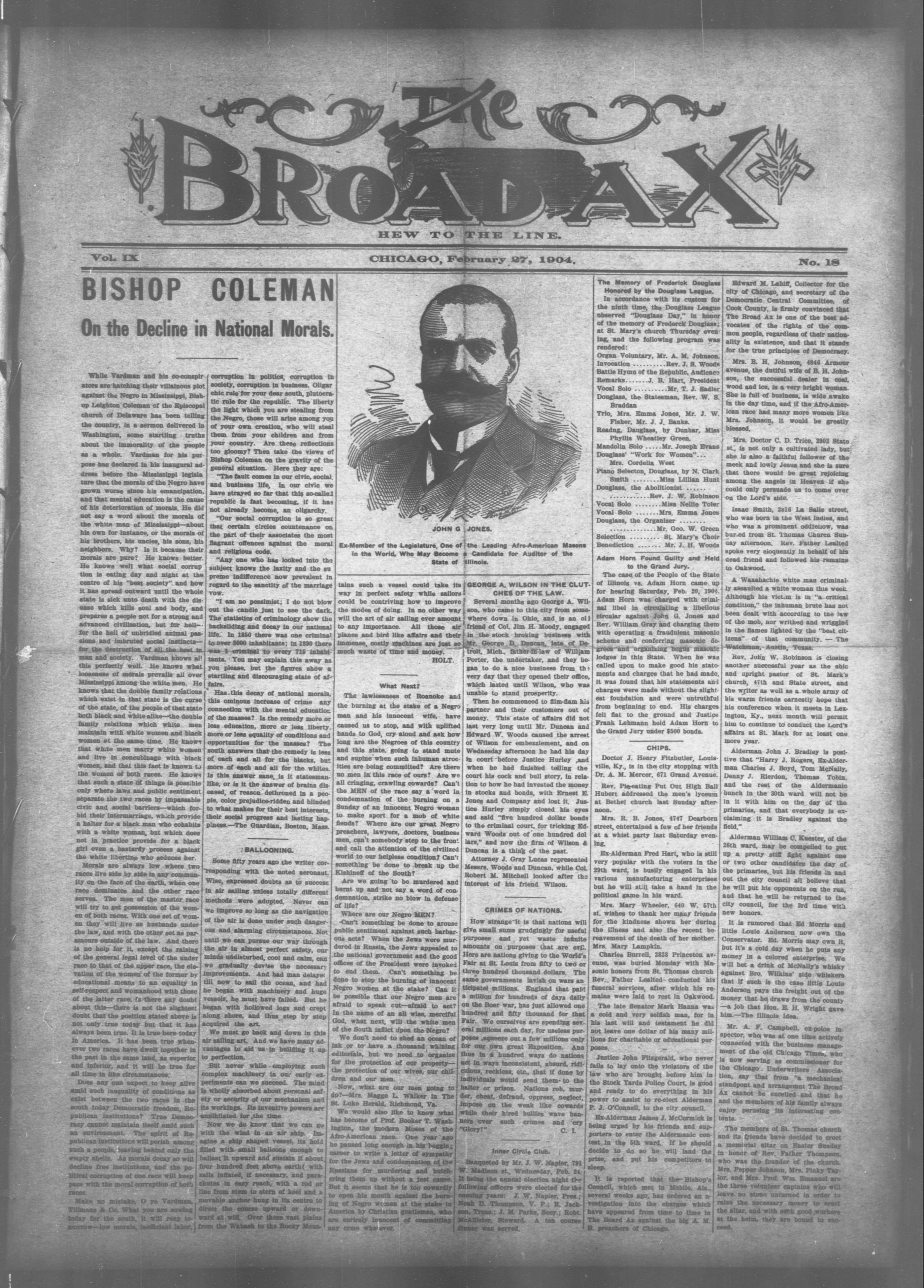
BISHOP COLEMAN On the Decline in National Morals.
While Vardman and his co-conspirators are hatching their villainous plot against the Negro in Mississippi, Bishop Leighton Coleman of the Episcopal church of Delaware has been telling the country, in a sermon delivered in Washington, some startling truths about the immorality of the people as a whole. Vardman for his purpose has declared in his inaugural address before the Mississippi legislature that the morals of the Negro have grown worse since his emancipation, and that mental education is the cause of his deterioration of morals. He did not say a word about the morals of the white man of Mississippi—about his own for instance, or the morals of his brothers, his uncles, his sons, his neighbors. Why? Is it because their morals are pure? He knows better. He knows well what social corruption is eating day and night at the centre of his "best society" and how it has spread outward until the whole state is sick unto death with the disease which kills soul and body, and prepares a people not for a strong and advanced civilization, but for hell—for the hell of unbridled animal passions and imbruted social instincts—for the destruction of all the best in man and society. Vardman knows all this perfectly well. He knows what looseness of morals prevails all over Mississippi among the white men. He knows that the double family relations which exist in that state is the curse of the state, of the people of that state both black and white alike—the double family relations which white men maintain with white women and black women at the same time. He knows that white men marry white women and live in concubinage with black women, and that this fact is known to the women of both races. He knows that such a state of things is possible only where laws and public sentiment separate the two races by impassable civic and social barriers—which forbid their intermarriage, which provide a halter for a black man who cohabits with a white woman, but which does not in practice provide for a black girl even a bastardy process against the white liberties who reduce
Morals are always low where two races live side by side in any community on the face of the earth, when one race dominates and the other race serves. The men of the master race will try to get possession of the women of both races. With one set of women they will live as husbands under the law, and with the other set as paramours outside of the law. And there is no help for it, except the raising of the general legal level of the under race to that of the upper race, the elevation of the women of the former by educational means to an equality in self-respect and womanhood with those of the latter race. Is there any doubt about this—there is not the slightest doubt that the position stated above is not only true today but that it has always been true. It is true here today in America. It has been true whenever two races have dwelt together in the past in the same land, as superior and inferior, and it will be true for all time in like circumstances.
Does any one expect to keep alive amid such inequality of conditions as exist between the two races in the south today Democratic freedom, Republican institutions? True Democracy cannot maintain itself amid such an environment. The spirit of Republican institutions will perish among such a people, leaving behind only the empty shells. As morals decay so will decline free institutions, and the political corruption of one race will keep pace with the moral corruption of both races.
Make no mistake, O ye Vardman, Tillmans & Co. What you are sowing today for the south, it will reap tomorrow—low morals, inefficient labor,
corruption in politics, corruption in society, corruption in business. Oligar chic rule for your dear south, plutocratic rule for the republic. The liberty the light which you are stealing from the Negro, those will arise among you of your own creation, who will steal them from your children and from your country. Are these reflections too gloomy? Then take the views of Bishop Coleman on the gravity of the
general situation. Here they are: "The fault comes in our civic, social and business life, In our civic we have strayed so far that this so-called republic is fast becoming, if it has not already become so.
not already become, an oligarchy.
"Our social corruption is so great that certain circles countenance on the part of their associates the most flagrant offences against the moral and religious code.
"Any one who has looked into the subject knows the laxity and the supreme indifference now prevalent in regard to the sanctity of the marriage vow.
"I am no pessimist; I do not blow out the candle just to see the dark. The statistics of criminology show the backsliding and decay in our national life. In 1850 there was one criminal to over 3000 inhabitants; in 1890 there was 1 criminal to every 715 inhabitants. You may explain this away as you please, but the figures show a startling and discouraging state of affairs.
Has this decay of national morals, this ominous increase of crime any connection with the mental education of the masses? Is the remedy more or less education, more or less liberty, more or less equality of conditions and opportunities for the masses? The south answers that the remedy is less of each and all for the blacks, but more of each and all for the whites. Is this answer sane, is it statesmanlike, or is it the answer of brains diseased, of reason dethroned in a people, color prejudice-ridden and blinded to what makes for their best interests, their social progress and lasting happiness.—The Guardian, Boston, Mass.
BALLOONING.
Some fifty years ago the writer corresponded with the noted aeronaut Wise, expressed doubts as to success in air sailing unless totally different methods were adopted. Never can we improve so long as the navigation of the air is done under such dangerous and alarming circumstances. Not until we can pursue our way through the air in almost perfect safety, our minds undisturbed, cool and calm, can we gradually devise the necessary improvements. And had man delayed till now to sail the ocean, and had he began with machinery and huge vessels, he must have failed. But he began with hollowed logs and crept along shore, and thus step by step acquired the art.
We must go back and down in this air sailing art. And we have many advantages to aid us in building it up to perfection. But never while employing such complex machinery in our early experiments can we succeed. The mind is wholly absorbed about personal safety or security of our mechanism and its workings. Its inventive powers are annihilated for the time.
Now we do know that we can go with the wind in an air ship. Imagine a ship shaped vessel, its hold filled with small balloons enough to ballast it upward and sustain it about four hundred feet above earth (with sails inflated, if necessary, and parachutes in easy reach, with a rod or line from stem to stern of koel and a movable anchor hung in its centre to direct the course upward or downward at will. Over these vast plains from the Wabash to the Rocky Moun-
JAMES O. HONTE
Ex-Member of the Legislature, One of in the World, Who May Become State of
tains such a vessel could take its way in perfect safety while sailors could be contriving how to improve the modes of doing. In no other way will the art of air sailing ever amount to any importance. All those air planes and bird like affairs and their immense, costly machines are just so much waste of time and money.
What Next?
The lawlessness of Roanoke and the burning at the stake of a Negro man and his innocent wife, have caused us to stop, and with uplifted hands to God, cry aloud and ask how long are the Negroes of this country and this state, going to stand mute and supine when such inhuman atrocities are being committed? Are there no men in this race of ours? Are we all cringing, crawling cowards? Can't the MEN of the race say a word in condemnation of the burning on a Sunday of an innocent Negro woman to make sport for a mob of white flends? Where are our great Negro preachers, lawyers, doctors, business men, can't somebody step to the front and call the attention of the civilized world to our helpless condition? Can't something be done to break up the Kishineff of the South?
Are we going to be murdered and burnt up and not say a word of condemnation, strike no blow in defense of life?
Where are our Negro MEN?
Can't something be done to arouse public sentiment against such barbarous acts? When the Jews were murdered in Russia, the Jews appealed to the national government and the good offices of the President were invoked to end them. Can't something be done to stop the burning of innocent Negro women at the stake? Can it be possible that our Negro men are afraid to speak out—afraid to act?
In the name of an all wise, merciful God, what next, will the white men of the South inflict upon the Negro?
We don't need to shed an ocean of ink or to have a thousand whining editorials, but we need to organize for the protection of our property—the protection of our wives, our children and our men. Now, what are our men going to do?—Mrs. Magge L. Walker in The St. Luke Herald, Richmond Va.
We would also like to know what has become of Prof. Booker T. Washington, the modern Moses of the Afro-American race. One year ago he paused long enough in his begging career to write a letter of sympathy for the Jews and condemnation of the Russians for murdering and butchering them up without a just cause. But it seems that he is too cowardly to open his mouth against the burning of Negro women at the stake in America by Christian gentlemen, who are entirely innocent of committing any crime whatever.
GEORGE A. WILSON IN THE CLUTCHES OF THE LAW.
Several months ago George A. Wilson, who came to this city from somewhere down in Ohio, and is an oil friend of Col. Jim H. Moody, engaged in the stock broking business with Mr. George D. Duncan, late of Detroit, Mich., father-in-law of William Porter, the undertaker, and they began to do a nice business from the very day that they opened their office, which lasted until Wilson, who was unable to stand prosperity.
Then he commenced to flim-flam his partner and their customers out of money. This state of affairs did not last very long until Mr. Duncan and Edward W. Woods caused the arrest of Wilson for embezzlement, and on Wednesday afternoon he had his day in court before Justice Hurley, and when he had finished telling the court his cock and bull story, in relation to how he had invested the money in stocks and bonds, with Ernest E. Jones and Company and lost it. Justice Hurley simply closed his eyes and said "five hundred dollar bonds to the criminal court, for tricking Edward Woods out of one hundred dollars," and now the firm of Wilson & Duncan is a think of the past.
Attorney J. Gray Lucas represented Messrs. Woods and Duncan, while Col Robert M. Mitchell looked after the interest of his friend Wilson.
CRIMES OF NATIONS.
How strange it is that nations will give small sums grudgingly for useful purposes and yet waste infinite amounts on purposes that are evil. Here are nations giving to the World's Fair at St. Louis from fifty to two on three hundred thousand dollars. The same governments lavish on wars anticipate millions. England that paid a million for hundreds of days daily on the Boer war, has just allowed one hundred and fifty thousand for that Fair. We ourselves are spending several millions each day, for useless purposes, squeeze out a few millions only for our own great Exposition. And thus in a hundred ways do nations act in ways inconsistent, absurd, ridiculous, reckless, etc., that if done by individuals would send them to the halter or prison. Nations rob, murder, cheat, defraud, oppress, neglect, impose on the weak like cowards while their hired bullies wave banners over such crimes and cry "Glory!" C. I.
Banqueted by Mr. J. W. Napier, 791 W. Madison st., Wednesday, Feb. 24. It being the annual election night the following officers were elected for the ensuing years: J. W. Napier, Pres.; Noah D. Thompson, V. P.; R. Jackson, Treas.; J. M. Parks, Secy.; Robt. McAllister, Steward. A ten course dinner was served.
The Memory of Frederick Douglass Honored by the Douglass League.
In accordance with its custom for the ninth time, the Douglass League observed "Douglass Day," in honor of the memory of Frederck Douglass; at St. Mary's church Thursday evening, and the following program was rendered:
Organ Voluntary, Mr. A. M. Johnson, Invocation .....Rev. J. S. Woods Battle Hymn of the Republic, Audience Remarks.....J. B. Hart, President Vocal Solo .....Mr. T. J. Sadler Douglass, the Statesman, Rev. W. S. Breddan
Trio, Mrs. Emma Jones, Mr. J. W.
Fisher, Mr. J. J. Banks.
Readng, Dauglass, by Dunbar, Miss
Phyllis Wheatley Green.
Mandolin Solo .....Mr. Joseph Evans
Douglass' "Work for Women"...
Mrs. Cordelia West
Piano Selecton, Douglass, by N. Clark
Smith .....Miss Lillian Hunt
Douglass, the Abolitionist ...
.....Rev. J. W. Robinson
Vocal Solo .....Miss Nellie Toler
Vocal Solo .....Mrs. Emma Jones
Douglass, the Organizer .....
Mr. Geo. W. Green
Selection St. Mary's Choir
Benediction Mr. J. H. Woods
Adam Horn Found Guilty and Held
to the Grand Jury.
The case of the People of the State of Illinois vs. Adam Horn came up for hearing Saturday, Feb. 20, 1904. Adam Horn was charged with criminal libel in circulating a libellous circular against John G. Jones and Rev. William Gray and charging them with operating a fraudulent masonic scheme and conferring masonic degrees and organizing bogus masonic lodges in this State. When he was called upon to make good his statements and charges that he had made, it was found that his statements and charges were made without the slightest foundation and were untruthful from beginning to end. His charges fell flat to the ground and Justice Frank Lehmann held Adam Horn to the Grand Jury under $500 bonds.
CHIPS.
Doctor J. Henry Fitzbutler, Louisville, Ky., is in the city stopping with Dr. A. M. Mercer, 671 Grand Avenue.
Rev. Pie eating Put Out High Ball Hubert addressed the men's lyceum at Bethel church last Sunday afternoon.
Mrs. R. B. Jones, 4747 Dearborn street, entertained a few of her friends at a whist party last Saturday evening.
Ex-Alderman Fred Hart, who is still very popular with the voters in the 29th ward, is busily engaged in his various manufacturing enterprises but he will still take a hand in the political game in his ward.
Mrs. Mary Wheeler, 640 W. 57th st. wishes to thank her many friends for the kindness shown her during the illness and also the recent bereavement of the death of her mother. Mrs. Mary Lampkin.
Charles Burrell, 2838 Princeton avenue, was buried Monday with Masonic honors from St. Thomas church Rev. Father Lealted- conducted his funeral services, after which his remains were laid to rest in Oakwood. The late Senator Mark Hanna was a cold and very selfish man, for in his last will and testament he did not leave one dollar of his many millions for charitable or educational purposes.
Justice John Fitzgerald, who never falls to lay onto the violators of the law who are brought before him in the Stock Yards Police Court, is good and ready to do everything in his power to assist to re-elect Alderman P. J. O'Connell, to the city council.
Ex-Alderman James J. McCormick is being urged by his friends and supporters to enter the Aldermanic contest in the 5th ward. If he should decide to do so he will land the prize, and put his competitors to sleep.
It is reported that the Bishop's Council, which met in Mobile, Ala., several weeks ago, has ordered an investigation into the charges which have appeared from time to time in The Board Ax against the big A. M. B. preachers of Chicago.
Edward M. Lahiff, Collector for the city of Chicago, and secretary of the Democratic Central Committee, of Cook County, is firmly convinced that The Broad Ax is one of the best advocates of the rights of the common people, regardless of their nationality in existence, and that it stands for the true principles of Democracy.
Mrs. B. H. Johnson, 4846 Armour avenue, the dutiful wife of B. H. Johnson, the successful dealer in coal, wood and ice, is a very bright woman. She is full of business, is wide awake in the day time, and if the Afro-American race had many more women like Mrs. Johnson, it would be greatly blessed.
Mrs. Doctor C. D. Trice, 2902 State st., is not only a cultivated lady, but she is also a faithful follower of the meek and lowly Jesus and she is sure that there would be great rejoicing among the angels in Heaven if she could only persuade us to come over on the Lord's side.
Isaac Smith, 2s16 La Salle street, who was born in the West Indies, and who was a prominent odd fellow, was bur.ed from St. Thomas Church Sunday afternoon. Rev. Father Lealted spoke very eloquently in behalf of his dead friend and followed his remains to Oakwood.
A Waxahachie white man criminally assaulted a white woman this week. Although his victim is in "a critical condition," the inhuman brute has not been dealt with according to the law of the mob, nor writhed and wriggled in the flames lighted by the "best citizens" of that community. - The Watchman, Austin, Texas.
Rev. John W. Robinson is closing another successful year as the ablc and upright pastor of St. Mark's church, 47th and State street, and the writer as well as a whole army of his warm friends earnestly hope that his conference when it meets in Lexington, Ky., next month will permit him to continue to conduct the Lord's affairs at St. Mark for at least one more year.
Alderman John J. Bradley is positive that "Harry J. Rogers, Ex-Alderman Charles J. Boyd, Tom McNally, Denny J. Rlerdon, Thomas Tobin, and the rest of the Aldermanic bunch in the 30th ward will not be in it with him on the day of the primaries, and that everybody is exclaiming it is Bradley against the field."
Alderman William C. Kuester, of the 26th ward, may be compelled to put up a pretty stiff fight against one or two other candidates the day of the primaries, but his friends in and out the city council all believe that he will put his opponents on the run, and that he will be returned to the city council, for the 3rd time with new honors.
It is rumored that Ed Morris and little Loule Anderson now own the Conservator. Ed. Morris may own it, but it's a cold day when he puts any money in a colored enterprise. We will bet a drink of McNally's whisky against Bro. Wilkins' side whiskers that if such is the case little Loule Anderson pays the freight out of the money that he draws from the county—a job that Hon. E. H. Wright gave him.—The Illinois Idea.
Mr. A. F. Campbell, ex police inspector, who was at one time actively connected with the business management of the old Chicago Times, who is now serving as commissioner for the Chicago Underwriters Association, say that from "a mechanical standpont and arrangement The Broad Ax cannot be excelled and that he and the members of his family always enjoy perusing its interesting contents.
The members of St. Thomas church and its friends have decided to erect a memorial altar on Easter Sunday in honor of Rev. Father Thompson, who was the founder of the church. Mrs. Pepper Johnson, Mrs. Pinky Taylor, and Mrs. Prof. Wm. Emanuel are the three volunteer captains who will leave no stone unturned in order to raise the necessary money to erect the altar, and with such good workers at the helm, they are bound to succeed.
Will promulgate and at all times uphold the true principles of Democracy, but Catholic, Protestants, Priests, Infidels, Farmers, Single Taxes, Republicans, Knights of Labor, or any one also can have their say, so long as their language is proper and responsibility is fixed.
The Broad Ax is a newspaper whose platform is broad enough for all, ever claiming the editorial right to speak its own mind.
Local communications will receive attention. Write only on one side of the paper.
Subscriptions must be paid in advance.
One Year.....$2.00
Six Months.....1.00
Advertising rates made known on application.
Address all communications to
JULIUS F. TAYLOR, Editor and Publisher.
Entered at the Post Office at Chicago ill., as Second-class Matter.
PERSIAN GEMS MORE COSTLY.
Fine Targuise Stones from the Mines of Nishapoor Are Becoming Searcer and Denrer.
The turquoise gems, the finest examples of which are produced from the mines of Nishapoor, are, probably from some change in the fashion of the west, becoming dearer in price and, in Teheran and neighborhood, more difficult to find. According to Vice Consul General Tyler, at Teheran, says the Washington Star, much of the value of the stone depends on its shape, the oblong being considered the most appropriate; on its freedom from spots or discoloration, however small in size; on its age, when the color has settled down into its final hue (not the superficial variations or sympathetic changes, but its really permanent shade); but more than all on its actual color, whether fresh from the hands of the lapidary or sedate from long wear. Choice, taste and fashion largely determine the preference of one shade or another, but the lapis lazuli, or the cloudless sapphire of its native skies, is the highest quality of the turquoise.
The pearls of the Persian gulf, which have formed for a long time past an important branch of the export trade, have likewise, within the last few years, risen greatly in price. Mr. Tyler says he does not think that this means that the supply has seriously diminished, but rather that the demand has increased out of proportion. Ten thousand dollars for a rosary of faultless pearls is not at the present time considered at all excessive, although formerly the same might be bought for a title of that amount.
EVERY "S" WAS STOLEN.
Consequently This Publication Was in Great Distress and Compelled to Lisp Out Its Ideas.
"We are thorry to thay," explained the editor of a weekly paper in Texas, "that our compothing-room wath entered lstht night by thome unknown thcoundrel, who thtole every eth in the ethtab-lithment and thuceceeded in making hith ethcape undetected.
"It hath been impothible of courthe to procure a new thupply of etheth in time for thith iththue, and we are thuth compelled to go to preth in a titutation moth embarrassing and ditthething; but we thee no other courthe to purthue than to make the betht thtagger we can to get along without the mithing letter, and we therefore print the 'Newth' on time regardleth of the loth thuthtained.
"The motive of the mitherable mithcreant ith unknown to utih, but doubtleth wath revenge for thome thuppothed inthult
"It thall never be thaid that the petty thpite of the thmall-thouled villain hath dithabled the 'Newth.' If thith meetth the eye of the detetthtable rathcal, we beg to athure him that he undererethtimateh the rethourceth of a firtht-clath newthpaper when he thinkth he can cripple it hopelethly by breaking into the alphabet.
"We take occathlon to thay to him, furthermore, that before next Thurthday we will have three timeth ath many etheth ath he thtole."
FREE SMOKES FOR SINNERS.
Tobacco Used in Prisons Does Not Pay a Government Revenue Tax-A Recent Ruling.
Convicts serving terms in the various prisons of the country have one privilege people outside the walls do not enjoy. The commissioner of internal revenue has decided that it is permissible for state prisons to manufacture tobacco or cigars for its own inmates without paying license. The commissioner says:
"I would say that upon careful consideration of the question involved, it is held that a charitable or other institution conducted by the state and under state authority, with its own operatives, has the right to manufacture tobacco, cigars, or any other tobacco product without the payment of tax when all such manufactured tobacco is used exclusively within the state institution.
"The tobacco must, however, be manufactured within the limits of the state institution, and no portion of it be removed therefrom. If any portion of such manufactured tobacco is found outside of the limits of the institution, it will be liable to seizure and forfeiture, the same as any other unstamped manufactured tobacco which might be found upon the market."
In the United Kingdom $7,500,000 people out of 40,000,000 receive less than $60 a month for each family; 1,000,000 are in daily receipt of poor law relief; 8,000,-000 have only a week's wages between them and starvation; 500 hereditary peers own one-fourth of England, and they and their Dependents spend every year $1,850,000,050.
---
COLONIZING CANADA.
What Persistent Advertising Has Done for the Northwest—Growing Flax on a Large Scale.
Some five years ago the Canadian government did strenuous advertising throughout the cities of the United States with a view of disabusing the people's minds of the idea that western Canada was a waste of frost and snow. The government caused free lectures to be given, established bureaus from which large quantities of literature about Canadian possibilities in the way of farming and home making were issued and gave exhibitions of agricultural products at state and county fairs.
The farmers of the middle west in particular emigrated in large numbers, with the result that an American invasion of Canada began, and continued so steadily as to produce what a recent writer has called the "Americanization of Canada."
One of the most noticeable results of the invasion is shown in the introduction of flax growing on a large scale. The Canadians thought it unwise to attempt the cultivation of that grain, as they believed it hard on the land and a great protector of weeds. But the Americans have proved to the contrary, and with land selling at $12 an acre and yielding an average of 15 bushels to the acre of flax the newly-bought farms have paid for themselves during the very first year.
THE HARDINESS OF TREES.
Depends a Good Deal Upon the Climate to Which They Have Become Accustomed.
An expert nurseryman says the hardiness or non-hardiness of trees depends largely upon where the seeds from which the trees in question sprang came from. Satisfactory results are seldom experienced by planting a seed obtained from the sunny south, say. By planting seeds gradually further north, however, trees may be at length hardened and acclimated until a seed from such a tree may be reasonably expected to thrive and mature its fruits.
Trees, like people, says the Philadelphia Record, acquire their habits from the climate in which they live. The northern tree knows instinctively when the time has come to ripen its fruits. The southern tree follows the same instinct, being in no hurry, as there is little likelihood of real cold. With transplantings further north its habit changes.
The great trouble with most people is that they want to jump a tree from south to north at one move. This same idea is evident in the attempt to bring various fruit trees from Russia to the northern United States.
Apples and plums from the land of the great white cxar have taken kindly to the below zero conditions of the gentle Dakotas.
NATIVES OF SWITZERLAND.
Cannot Forswear Allegiance Merely by Becoming Naturalized Elsewhere-Should Have Passports.
Students and other residents of the United States who may be natives of Switzerland, will be interested in a communication to the state department from Consul Lieberknecht at Zurich, who calls attention of students and others to the necessity of providing themselves with passports.
Many naturalized American citizens who were formerly Swiss citizens labor under a misapprehension as to their old and new citizenship rights and responsibilities. They return to Switzerland without naturalization papers or passports, only to find themselves Swiss citizens again.
The consul adds that a person never loses citizenship, no matter how long he may absent himself, unless he goes through certain necessary formalities. If he returns and is owing a military tax, he is compelled to pay the same, in spite of the fact that he is an American citizen.
The only way to be released from old responsibilities is by making a written request to his home community for such release, submitting proof at the same time that he has acquired American citizenship.
HE WEDDED IN LONDON
President Roosevelt's Marriage Reg
ation of State Georgetown Attorneys
President Roosevelt's marriage register is in London, at St. George's, Hanover square, and so many American tourists have flocked to see it that, for convenience' sake, it has been placed by itself in an accessible alcove of the old church building, says the New York Tribune.
President Roosevelt's marriage to Miss Carow took place so long ago—17 years ago, to be exact—that few persons remember that the American president was married in a foreign land. He is, it is said, the only American president whose wedding was not celebrated under the Stars and Stripes.
Tourists take great interest in the certificate, in Mr. Roosevelt's occupation of "ranchman," and in Miss Carow's signature. They study the autographs of the witnesses, and they wonder who these persons were. They observe with pride that the canon of York, and not a simple "reverend," performed the ceremony.
Smallpox as "the Good Wife."
To this day smallpox is alluded to in the outer islands of the Hebrides as "bhean mhath" ("the good wife"), a form of euphamism, the idea of which is that, in order to escape the ban of the disease, it should be spoken of respectfully.—Caledonian Medical Journal.
Bread for Frenchmen. The average Frenchman eats 428 pounds of bread a year.
FOREIGN CELEBRITIES.
Mr. George Meredith, the distinguished novelist, finds it impossible to write original matter save when he is in absolute seclusion.
A French sculptor, M. Charpentier, and a Belgian sculptor, M. Meunier, have completed a design for the Zola monument, which will symbolize Zola's novels, "Travail" and "Fecondite."
Princes Edward and Albert, the little sons of the prince of Wales, are already being initiated into the mysteries of wielding a fishing-rod, and promise to be formidable rivals of their father and grandfather.
Sevcik, the master who taught Kubellik, the great violinist, has only one eye. A violin string snapped once, whilst he was playing and struck him in the eye, inflicting such injuries to that organ that its sight was lost.
The departure from Washington of Gen. Khan, Persian minister, who is promoted to a Vienna post, removes a most picturesque figure from the capital. The general, whose full name is Mofak Hamed Dovelet, has been in Washington four years, but has never become familiar with the English language, speaking French entirely with members of the diplomatic corps. Gen. Khan is regarded as the shah's righthand man, his most notable work having been done in cultivating friendly relations between the republics of South America and his home government.
One of the most ardent fox hunters in Great Britain is Lord Fitzwilliam, who owns a fine estate in England and another in Ireland. He is the owner of five motor cars and in the hunting season he keeps them busy. At the close of a chase on his English estate he jumps into one of his autos and dares off to Manchester, 50 miles away. Here he catches a fast train to Holyhead, where he arrives in time for the mall boat to Dublin. An auto takes him to his Irish estate next morning. Another run after a fox is followed by a journey back to England, and this his lordship keeps up sometimes for four days on a stretch, hurrying from one estate to another every day.
EDUCATIONAL TOPICS
The men who teach in French schools are to get hereafter from $240 to $440 a year; the women teachers get $40 less. Prof. Milford, of the English department of Wabash college at Crawfordsville, Ind., has been forced to give up his work for at least this term. The wider and deeper is the foundation the higher a superstructure one can rear. Bear that in mind in getting an education, for you are then laying the foundations of your life.—Wellspring.
For the first time in the history of German universities a deaf mute has succeeded in obtaining a doctor's degree. Dr. Walter Kuntze, on whom the University of Lelpsic has conferred a Ph. D., is a comparatively young man. His thesis for the degree is regarded as one of the best in recent years.
The thoroughness in which the agricultural schools of the western states are going into the education of farmers is illustrated by the announcement that the Iowa State Agricultural college has just established a course of instruction in the slaughtering of live stock. It is a laboratory course, and the young farmers will learn the art by practical instruction.
Helen Keller has just begun her senior year at Radcliffe. Her studies this year will consist of Prof. Kittredge's Shakespearean course, Dr. Neilson's English literature, Prof. Moore's course in Plantus, Cicero and Lucretius and Prof. Morgan and Dr. Rand's course in Latin, which covers the annals of Tacitus, the satires and epistles of Horace and selections from Catullus. Up to the present time Miss Keller has passed with credit all her college examinations.
TOLD OF THE FAIR SEX.
Selma Lagerlof, the second woman to receive a gold medal for literary excellence from the Swedish royal academy, is a well known Swedish novelist. There are two national banks in Mount Pleasant, Ia., and it has just developed that a majority of stock in each is owned by a woman. The men who actually manage the enterprise own but a small fraction.
Through the entire civil war Gen. Gordon's wife accompanied him, never leaving his side, save when the exigencies of the campaign made her presence impossible. To the faithful devotion of his wife Gen. Gordon owed his life. In the bloody battle of Sharpsburg Gordon, while in the midst of the carnage, was shot five times. As soon as he fell his wife rushed to his side and carried him to safety, stanching the flow of blood and attending his wounds until medical aid could be procured. She remained with him in the hospital until he had recovered and when Gen. Gordon went back to join his command Mrs. Fannie Haralson Gordon followed her husband.
THE WORLD OF LABOR
During the past 20 years a total of 8,500 men have been killed in the hard ccal mines. In round numbers and generally speaking the strike bill of Manhattan and the Bronx for the year ended November 30 is estimated at $25,000,000. Nearly all railroad companies in the Mississippi valley have adopted a shorter workday instead of reducing their force of machinists and other workmen. All railroads having shops in Chicago have done this.
Although there has been a large increase in the number of wage earners in Minnesota during the past year, there has been a big decrease in child labor, according to the report of the state labor commissioner.
Established 1877. Phone Oakland 1550-1551
John J. Dunn
Wholesale and Retail Dealer in.
COAL &
WOOD
Fifty-First St. and Armour Ave.
RAIL YARDS: 51st St. & L. S. & M. S. Ry.
52nd St. and Armour Ave.
CHJCAGO
W.G.ANDERSON, ATTORNEY AT LAW.
J.Q. GRANT& CO.
Collections, Loans and Insurance,
SUITE 61,119 LA SALLE
Residence, 3232 Wabash Avenue,
CHICAGO.
GEO. A. WILSON GEO. D. DUNCAN
PHONE 1515 HARRISON.
WILSON & DUNCAN
COMMISSION BROKERS
STOCKS, BONDS, GRAIN,
PROVISIONS & COTTON
SUITE 16, IMPERIAL BLDG.
260 SO. CLARK ST. CHICAGO.
Send for our Pamphlet and Daily
Market Letter upon Successful Speculation.
All Business Transacted through
and Confirmed by Ernest E. Jones &
Co.
Correspondence Solicited.
O
The Souls of Black Folk
By W. E. B. DuBois
A REMARKABLE BOOK that is provoking much discussion because of the wonderful eloquence with which the author pleads for right and justice to his people. In these days of increasing agitation over the "negro problem" this passionate human document can neither be overlooked nor ignored. Aside from its remarkable presentation of facts it holds the reader—prejudiced or not—by its fascination of style and overpowering pathos.
Some of the Chapter Headings follow:
OF OUR SPIRITUAL STRIVINGS.
OF THE DAWN OF FREEDOM.
OF MR. WASHINGTON AND OTHERS.
OF THE MEANING OF PROGRESS.
OF THE TRAINING OF BLACK MEN.
OF THE BLACK BELT.
OF THE SONS OF MASTER AND MAN.
OF THE FAITH OF THE FATHERS.
OF THE PASSING OF THE FIRST-BORN.
OF ALEXANDER CRUMMELL.
OF THE COMING OF JOHN.
OF THE SORROW SONGS.
3d Edition $1.20 net Published by
A.C. McClurg & Co., Chicago
MRS. A. WILSON.
Nicely furnished rooms to rent for gentlemen. Reasonable rates, 2252 Indiana aveune.
First class furnished rooms, for rent to gentleman and ladies, with bath and gas. 2628 Wabash avenue.
Funeral designs of every description, latest and most stylish decorations, for churches and weddings. Palms to rent for all social functions, 3119 State St., Chicago.
WONDERFUL DISCOVERY
Curly Hair Made Straight By
TAKEN FROM LIFE:
BEFORE AND AFTER TREATMENT.
ORIGINAL
OZONIZED OX MARROW
(Copyrighted.)
This wonderful hair pomade is the only safe preparation in the world that makes kinky or curly hair straight as shown above. It nourishes the scalp, prevents the hair from falling out or breaking, and hardens and makes the hair strong, long and silky. Sold over forty years and used by thousands. Warranted harmless. It was the first preparation ever sold for straightening kinky hair. Beware of imitations. Get the Original Ozonized Ox Marrow as the genuine never fails to keep the hair straight and hardened, giving the hair strong, life-like appearance so much desired. A toilet necessity for ladies, gentlemen and children. Elegantly perfumed. Owing to its superior and lasting qualities it is the best and most economical. It is not possible, for anybody to produce a preparation equal to it. Full dirichloroethane with 50 ounces. Sold by druggists and dealers or send us 50 cents for one bottle or $1.40 for three bottles. We pay all express charges. Send postal or express money order. Please mention name of this paper when ordering. Write your name and address plainly to
OZONIZED OX MARROW CO.,
15 Wohl Ave. Chicago, Illinois
OZONIZED OX MARROW CO.,
75 Wabash Ave., Chicago, Illinois.
The American Mutual Plantation Company
You have all doubtless read the advertisement that we have been running in The Broad Ax for some weeks past. Some of you may have been interested in our statements published in that "Ad" and may be even now considering seriously making an investment with us. (If you did this, you would be in excellent company for some of the brightest and shrewdest business and professional men, both white and colored have made this investment and are thoroughly pleased with it.) Some of you may have thought our statements extreme. You may have considered that we were exaggerating and consequently you have decided, temporarily at least not to invest with us. You are right in being careful; in fact, that is exactly the type of man we want to reach, the careful, thoughtful man who investigates, goes slowly and knows what he is doing when he makes a move.
As to the question of over-stating our proposition; we would like to have a good serious talk with every man who thinks we have made any over-statements. Do you know that it is exceedingly difficult to write an advertisement that comes anywhere near the facts in such a proposition as ours, a Tropical Plantation, and not be open to the charge, made by people uneducated in the proposition, that one has exaggerated. The TRUTH IS WONDERFUL and so wonderful that people doubt the truth. AS A MATTER OF FACT EVERY STATEMENT EVER MADE BY US AS TO PROBABLE RESULTS OF AN INVESTMENT IN THE AMERICAN MUTUAL PLANTATION COMPANY HAS BEEN RATHER UNDERSTATED THAN OVERSATED.
Now, the only way we can prove this to you is to prove it to you and to do that we should meet you; to do that you must come and see us or we must go and see you. If you care for an investment that will surely bring you from 10 to 50 per cent in a proposition that is not a speculation but a plain, cold business matter you should certainly look us up and decide for yourselves as to whether we are stating facts or not. We would like to have you inquire of Bradstreet, R. G. Dunn & Co., and the International Mercantile Agency as to our rating; in fact, we want you to know all about us. AMERICAN MUTUAL PLANTATION CO., BARKIER & TAYLOR, General Agents, 431-435 Stock Exchange Bldg., Chicago, Ill.
President and Treasurer, THOMAS CAREY. Vice-President, JOHN SHELHAMER. Secretary, WILLIAM SULLIVAN.
Yards running winter and summer, equipped with the latest improved Wolf Dryer.
Output of Winter Yards ..... 140,0.0 per day
Output of Summer Yards..... 300,0.0 per day
If your physician recommends the use of a stimulant, there is no whisky in which so many desirable qualities are contained as in Old Underoof Rye and it has the least reactive effect. Because it is made right and is aged right. CHAS. DENNEHY & CO. CHICACO
To the readers of The Broad Ax:
You have all doubtless read the article have been running in The Broad past. Some of you may have been statements published in that "Add now considering seriously making us. (If you did this, you would buy a company for some of the brightest and professional men, both white and this investment and are thorough. Some of you may have thought ours. You may have considered that we and consequently you have decided, not to invest with us. You are right in fact, that is exactly the type of reach, the careful, thoughtful man goes slowly and knows what he is doing a move.
As to the question of over-stating would like to have a good serious who thinks we have made any over-know that it is exceedingly difficult tisement that comes anywhere near proposition as ours, a Tropical Plant open to the charge, made by people proposition, that one has exaggerated IS WONDERFUL and so wonderfully the truth. AS A MATTER OF STATEMENT EVER MADE BYABLE RESULTS OF AN INVESTMENT AMERICAN MUTUAL PLANTA HAS BEEN RATHER UNDER OVERSATED.
Now, the only way we can prove that it to you and to do that we should you must come and see us or we need. If you care for an investment that from 10 to 50 per cent in a property speculation but a plain, cold business certainly look us up and decide whether we are stating facts or not have you inquire of Bradstreet, R. the International Mercantile Agent in fact, we want you to know all about AMERICAN MUTUAL PLANTA BARKER & TAYLOR 431-435 Stock Exchange Bldg.,
American Br
President and Treasurer, THOMAS
Vice-President, JOHN S.
Secretary, W.
MANUFACTURE
Common and Seed
Office and Yard
5th and Roof
Yards running winter and summer with the latest improved W
out of Winter Yards
out of Summer Yards
JOHN A ORB,
President.
WILLIAM LEGNER,
Vice Pres. & Treas.
At a recent meeting of the Women's Literary club of Baltimore Mrs. Charles C. Morgan read a paper in which she cited a peculiar but well-authenticated fact concerning some storm-beaten houses on Cobb's island, off the eastern coast of Virginia. The houses were eventually washed away by the encroachments of the sea, but for a long time they were firmly imbedded in the sand at such an angle that the wanderer could walk in the second story windows from the bluff, while the floors all slanted at an acute degree.
There was not the slightest danger attendant upon walking up or down these floors, yet no one was ever found who could traverse their length without becoming seasick. Experienced sailors, who knew no qualms in midocean, turned faint and giddy on trying to walk these perfectly steady planks. To all the neighborhood the buildings were known as the "seasick houses," and that the seasickness was not due to imagination was proved by persons who never had heard of the tradition experiencing the same unpleasant results.
Mrs. Morgan, who resided on the mainland near by, concluded her account of the houses by saying that a small dog belonging to her husband which followed that gentleman "foot to foot," as the negroes term it, never could be induced to follow his master across the mysterious thresholds, be the command ever so peremptory or the inducement ever so strong.
MRS. PYMACHER'S PIE
Here's an Idyll of the New York Stock Exchange- Speculators Appreciated Toothsome Dainty.
Pymacher was a telegrapher employed by the stock exchange firm in which John W. Gates is a special partner, says Everybody's Magazine. Pymacher brought for his lunch a noble pie, a composition of Mrs. Pymacher's. The manager of the office tasted that pie, found it good, and gobbled it. Such are the notions of property in the street. "Is there any more where that came from?" asked the manager, a man of delicate tooth. "There is more," said Pymacher, "and better, if possible." "It is not possible," said the manager. He told all the Chicago capitalists, who came to that office. He made their mouths water. The next day Pymacher brought in a lemon pie, an iridescent dream, a tender flower. Half a dozen millionaires ate of it, with tears of joy and thanksgiving. "What shall we do for Mrs. Pymacher? Shall we build her a monument?" "Buy her a hundred shares of Northern Pacific," says Gates. So they bought her 100 shares at 113½ sold it at 135. The next day came the corner, and a share of Northern Pacific was worth $1,000. But Mr. Gates had showed his eagerness to reward a supreme artist. If old Rembrandt were alive "the Gates crowd" would "let him in" on the best thing it had.
KEEP BOYS ON THE FARM
Educational Department Gives Good Advice to Rural Father-Advice to the Teachers.
The superintendent of public instruction of the state of Indiana has recently issued a bulletin touching on the steady migration of the young men of the rural districts to the cities in search of a so-called "better chance." Believing that Indiana is being sapped of its energies by that movement, the department in a bulletin to the teachers says that they can influence the boy to stay on the farm and to work out its problems. "It will be a sad day for our national life when all our young farmers come to town; when the small, well-cultivated homesteads give way to landed estates," the bulletin says.
The necessity of keeping the boys on the farm was the subject of a discussion as to what the teacher can do for the community. A teacher's power in determining the industry of a community lies in making her schoolroom a busy workshop, where the rights of others and the nobility of honest toll are taught. The bulletin which is being sent out by the state superintendent deals with the relation of the teacher to the school, her patrons and the locality. The teacher, the bulletin says, ought to be a missionary, harmonizing turbulent elements.
Some time ago a rumor went round that astute publishers had in their pay a large number of the most attractive diners-out. Your neighbor at table would lead the conversation to the latest novel—quite the easiest of conversational openings between strangers, who lay their heads together over the menu and have to entertain each other for an hour. You are interested in the description of the book of the hour, you are a little ashamed of not having read it, and going home you sit down and order the book—from the circulating library. Every publisher, every theater manager, every deviser of a patent medicine knows that the advice of a friend is a more concentrated and personal pull than the opinion of a critic from the empyrean. And if the idea was ever carried out, it deserved to succeed, but no one ever spotted the paid dinner-out. There was the artistry of the thing.—London Chronicle.
A recent bulletin of the department of agriculture says: "It appears that practically all soils contain sufficient plant food for good crop yield; that this supply will be indefinitely maintained, and that this actual yield of plants adapted to the soil depends mainly, under favorable conditions, upon the cultural methods and suitable crop rotation."
THE LAW LAID DOWN.
The punishment of merely lawless acts of individuals in preventing colored persons from voting at purely state elections is held, in Karem vs. United States (C. C. A., 6th C.), 61 L. R. A. 437, not to be within the power of congress. An appropriation to cover the expenses incurred and paid by a municipal officer in the discharge of his duty is held, in state ex rel. Crow vs. St. Louis (Mo.), 61 L. R. A. 593, not to be within a constitutional prohibition of the granting of public money to an individual.
A devise to one absolutely and forever is held, in Roth vs. Rauschenbusch (Mo.), 61 L. R. A. 455, to convey a fee simple which cannot be cut down by a subsequent clause directing the disposition of any remainder which may be undisposed of at the death of the devisee.
The mere fact that an applicant for insurance is receiving a pension from the government for alleged physical injuries is held, in Black vs. Travelers' Insurance company (C. C. A. 3d C.), 61 L. R. A. 500, not to show that he has a bodily infirmity within the meaning of a warrant in the policy.
The cutting of a train of cars on a side track, leaving some on one side and some on the other of a highway, where the view of the other tracks is partially obscured thereby, is held in Passman va West Jersey & S. R. Co. (N. J. Err & App.), 61 L. R. A. 609, not to be an invitation to the public to cross without using ordinary precaution to ascertain if such crossing can be safely made.
A railroad company which permits a car to break loose from a train on a grade and run down into collision with another car at the foot of the decline in such a way as to be hurled off of the right of way, to the injury of a bystander, is held, in West Virginia, C. & P. R. Co., vs. state use of Fuller (Md.), 61 L. R. A. 574, to be liable for the injury thereby caused to him, unless it is shown that the accident was unavoidable.
TOWN TALK.
A movement has been inaugurated in New York to prohibit the sale of cocaine except under authority of a doctor's prescription. Dr. Corydon Richmond, first mayor of Kokomo, Ind., celebrated his ninety-sixth birthday recently. He is in fairly good health, but has been blind for 15 years. The doctor maintains close interest in medical and surgical science, attends his masonic lodge regularly and, to all appearance, leads a contented and happy life. He became a mason 72 years ago.
On account of a recent experience Magistrate South, of Philadelphia, refuses to try any more cases against men accused of desecrating the Sabbath. A man fined in his court for the offense was obliged to pawn his overcoat and has since been compelled to work outdoors clad in thin raiment. The fact coming to Magistrate South's knowledge, he bought the man a coat and now advises a change of venue in all like cases called before him.
John Connaughton, principal keeper in Sing Sing prison, has not visited New York city for 29 years, and there is little likelihood that he will ever do so. The reason of this is that there are in that city a great number of men who would welcome an opportunity to kill him. In his capacity as prison-keeper for 40 years Mr. Connaughton has earned the enmity of many desperate criminals, most of whom hate him with an intensity which would induce them to murder should the chance offer.
HEALTH AND DISEASE
The Public Health and Marine hospital service costs $1,000,000 a year. Pleasant Porter, chief of the Creeks, has the gout. He blames it to civilization. Dr. G. Sims Woodhead, of Cambridge university, an eminent authority on tuberculosis, is lecturing in the United States. William Laclede, once famous as a negro minstrel, has been taken to a Cincinnati hospital hopelessly paralyzed. Both Himbs are useless, due, the doctors say, to too much dancing.
The religious feelings of the natives of the Punjab are so strongly opposed to the killing of rats, and disinfection is so unpopular, that it has been decided to let the plague follow its course there, absolutely unchecked.
There has been no yellow fever in the United States for three years, excepting the recent development on the Mexican border of Texas. Some cases of yellow fever have come into Cuba, from Mexico in the last three years, but in no instance was the disease communicated to others.
THE MAN WHO KNOWS IT ALL.
The man who pretends to have a thorough speaking acquaintance with every known subject under the sun, and is imprudent enough to endeavor to make people believe everything he says, is described in different ways, says the Philadelphia Evening Telegraph. Some of his friends have formed these opinions of him:
ONLY NATION OF HUSTLERS.
No Other People Work with the Feverish Industry of Americans—Fact Suggests a Question.
We are the only nation of hustlers, and the idea suggests itself that all the rest of the world cannot be entirely wrong and we alone right in the conduct and object of life, says the Hartford Times. The Germans and the French work for a certain number of hours with a steady but not a feverish industry, and then they enjoy themselves in what we would consider a rather childish way. They gather in their cafes or beer gardens with their families and chat good-humoredly about trivial subjects. Even the English, though abounding in physical energy, take life easily.
They seem to us to make too much of their leisurely game of cricket. But all these nations have accomplished great things, not only in science, art and literature, but in the material advance of civilization. They do not expend nervous energy as rapidly as we do; and in consequence the period of life work among their men is longer. They do not consume life so fast. May it not be that they, in their old-fashioned way, are wiser than we? They have embouled their views of life in proverbs like these: "More haste worse speed." "He who goes slowly goes far." "It's the pace that kills," and others to the same purport, and proverbs are entitled to respect, because they embody the wisdom of humanity. There is no proverb enjoining the necessity of continuous restless activity.
HOW SHELLFISH TALK
Warn One Another of Danger by Weird Clicking Sounds, Says a Distinguished Naturalist.
Most seamen will tell of curious clicking sounds heard on calm nights at sea, and the origin of the noise seems so altogether unaccountable that it has often created some alarm among superstitious fishermen, says the Chicago Tribune.
A distinguished naturalist made a careful study of the sounds on many occasions, and found that it was not a sustained note, but made up of a multitude of tiny ones, each clear and distinct in itself, and ranging from a high treble down to a bass. When the ear was applied to the gunwale of the boat the sound grew more inense, and in some places, as the boat moved on, it could not be heard at all.
On other occasions the sound resembled the tolling of bells, the booming of guns, and the notes of an Aeolian harp.
For a long time he was unable to trace the cause, but at length discovered that the sounds were made by shellfish, hundreds of them opening their shells and closing them with sharp snaps. The noise, partly muffled by the water, sounded indescribably weird. He was finally led to the conclusion that, as the shellfish made the sounds, they probably had some meaning, and that the clicks might possibly be a warning of danger when the shallow water was disturbed by the boat.
GAMBLING AND STOCKS.
Stock Speculation Is Outwardly Respectable But Just as Certainly Brings Final Financial Ruin.
The very fact that the professional gambler is to a large extent a social outcast, plying his craft at night and behind steel doors and only then with the purchasable connivance of the authorities, is in itself a warning that not even the stupidest can fail to observe. Stock speculation, on the contrary, says Leslie's Monthly, hangs out the banner of respectability—which a great many unthinking persons have somehow come to confound with morality—and under its protection, carries on its traffic night and day, in city streets and village lanes, in parlor and boudoir, in store and in factory—in short, wherever it can find a single human being possessed of this mania for getting something for nothing. Men who would scorn to cross the threshold of a gambling house, gamble openly in stocks and are not ashamed to discuss their ventures in the presence of their own children. When Wall street ruins a man, it strips him of everything that he possesses—destroys his business, places a mortgage on his home, eats up the trust funds of which he was custodian and leaves him naked to the world.
Fear of Microbes.
Fear of microbes seems to have spread to the possessors of old furniture, which during a long life and unknown experiences may have collected the germs of disease. Recently a cautious lady in London who had been studying the medical warnings inherited a Sheraton table. She would not admit it to her house, but sent it off to a cabinet maker's with orders that an exact replica be made, the original table being offered in payment. If this lady's craze for new and innocuous furniture spreads there should be good times in store for the cabinet makers, as well as for collectors who prefer the risk of microbes to the certainty of shoddy.
Settled Old Account
A letter was received at the East Dorset (Vt.) post office a few weeks ago postmarked at Spokane Falls, Wash., and directed to Benjamin Ames or any of his descendants. It proved to be from a man who 60 years ago boarded with Mr. Ames for a time and left without paying his board bill. He said that he was now 83 years old and wanted to pay. The bill was sent him and he sent a check for the amount.
Eligible for the Army.
Only 54 per cent. of Germany's young men are fit for military service. Dr. Stricker finds that heart disease has increased 300 per cent. in a decade.
RATS KNEW CAT WAS ABOUT.
But They Never Saw the Cat and Were on Another Floor of the House.
"I have observed recently a rather curious thing with respect to the relationship between cats and rats, and it has led to a rather interesting reflection," said a man who takes much interest in animal life, to a New Orleans Times-Democrat reporter. "For awhile the rats overran my place. At night there was no such thing as quiet around the house. They would scamper across the floor, bump up and down the steps and cut all kinds of capers. We secured a cat, and from the very time the cat appeared on the place the rats began to get scarce.
"There is nothing curious about this fact in itself. But to my personal knowledge the rats have never seen the cat. The cat has remained on one floor and the rats on another. There has been no chasing and no conflict between them. Now, I want to know how the rats know the cat is on the place.
"The inquiry has caused me to indulge the more interesting reflection: How far can a rat detect the presence of a cat by the sense of smell? Evidently at considerable distance. Else the rats at my place would not have known of the cat's presence under the circumstances. I'm quite sure that they have never seen the cat. But they know he is there just the same, and they have been awfully cautious since his arrival."
SILENCE NOT ALWAYS BEST.
One Woman Found a Flaw in the Time-Honored Adage-Experience with Swedish Cook.
Misunderstandings sometimes arise from slight causes, and occasionally one occurs which seems to prove that silence is not always golden. In this case trouble was brewed without a word being spoken. Young Mrs. Bond's Swedish cook, says the Youth's Companion, was scrupulously neat about her work, but her figure was so unlovely, and her countenance so unprepossessing that her overfastidious young mistress could never bear to look at her. Instead, whenever the young housekeeper found it necessary to interview her unattractive maid she kept her eyes fixed upon a large black coal scuttle that always stood before the kitchen stove.
One day as Mrs. Bond stood, as usual, in the doorway gazing intently at the coal hod while Matilda was telling what groceries were needed, the handmaiden unexpectedly changed the subject, and proceeded to give vent to the pent-up feelings of many weeks.
"Vat for you all tam luke at my's coal bocket, messis?" exclaimed Matilda, with evident resentment. "Every day I scrob heem inside and I scroob heem outside, until he vas yust so clean as my can vash heem—luke, meesis, I have scrub all she's skeen of heem—but all the tame you luke—luke at heem like you tank I dondt vash heem at all! I never sees no lady so particular about she's coal bocket!"
CHEESE IN WISCONSIN.
In Spite of Seventeen Hundred Factories in State There Is No Over Production.
"You might as well look for an overproduction of children as an over-production of cheese," said U. S. Baer, secretary of the Wisconsin Cheese Makers' association, at the Republican house, to a Milwaukee Sentinel reporter, "The fact that we have upward of 1,700 cheese factories in Wisconsin has raised the cry that the business is being overdone. The people of this country have not yet learned to eat cheese, but they are coming to it. Let me tell you, the consumption per capita in England is nearly 13 pounds a year, while in Wisconsin it is only about three pounds a year to each person. We are above the average of the states in the consumption of cheese, notwithstanding we are so far behind the Englishmen in this respect. There were produced in Wisconsin during the past year 90,000,000 pounds of cheese, which is more than a quarter of the whole amount produced in the United States. The average price has been ten cents a pound, so that you can see, with possibly the exception of butter, the making of cheese is the first single farm industry in the state. There is no Wisconsin cheese being exported, for the simple reason that the domestic demand takes all the supply."
SHARKS RETURN TO PREY.
Reappearance in Baltic Drives Away Small Fish-Finny Tribe Likes Change of Scene.
As is well known, fish like a change of home, and frequently, without apparent reason, abandon waters in which they have long disported, and are next found in some distant part of the sea. A desire for a change of scene, however, is not the cause of the pilchards suddenly leaving the west coast of France, and the fishermen are unable to discover the reason.
Now it is announced, according to the testimony of fishermen, that the shark has returned to European waters. In the Baltic, where sharks had been extinct since 1759, they have made their reappearance in considerable numbers, and several fishing boats report having whole catches of fish devoured from the nets, which were broken, in the Belt and the Cattegat. A fisherman who fell overboard narrowly escaped with his life. Shoals of sharks, some of them of large size, have been seen off the German coast, and they are even reported as becoming far from rare in the North sea. Their presence is attributed to their pursuit of the herring shoals on the west coast of Norway.
Natural Trotters.
Of American animals, the moose, elk
and caribou are natural trotters.
ARMY AND NAVY.
Col. John G. Butler, just promoted to brigadier general, is now in command of the arsenal at Watertown, near Boston.
All Austrian officers possessing motor cars have been ordered by the minister of war to report themselves for service, bringing their machines.
Seventeen horses were required, says the Paris Matin, to draw an enormous cannon intended for coast defense from Bourges to Havre. The gun weighs over 17 tons.
J. T. Clary, chief master at arms on the United States battleship Nevada, with service stripes on his arms denoting 28 years of naval service, recently completed 100 trips around the world.
Statistics gathered by an old Prussian officer show that the present Emperor William has caused 30 changes of uniform in the German army. These modifications have cost each officer $223.27.
The British naval building programme for 1904 is now published. There will be three battleships of the King Edward VII. class, having 16,350 tons displacement, 18,000 horse-power, and a speed of $18\frac{1}{2}$ knots; four cruisers of the Duke of Edinburgh class, having 13,550 tons displacement, 23,500 horse-power, and 22 1-3 knots speed. Also four scouts, 15 torpedo-boat destroyers, with a speed of 25 and $25\frac{1}{2}$ knots, and ten submarines.
The late Gen. Gordon often related with a relish a grimly humorous incident of the battle at Appomattox. Gen. Gordon said that when the end came he ordered his chief aid to take a flag of truce to the union commander. "We have no flag, sir," said the aid. "Take your handkerchief and tie it to a stick." "I have no handkerchief, general." "Year off your shirt, then." "There is not a white shirt n the army, general. I have a flannel one, but it's far from white."
CONGRESSIONAL CHIT-CHAT.
Congressman Warnock, of Ohio is one of the largest owners of cattle in his state. Dining at his Washington mansion during a term of congress, Senator Clark will often sit alone at the head of the table in his brilliant diningroom, taking his meal in absolute silence. He is not a sociable man in general, but loves to dine out in agreeable company.
Nothing so elegant in the way of credentials ever appeared in the senate as those of Senator Hanna, which Mr. Foraker handed up to the clerk's desk. That is what the veteran employees of the clerk's office say. Written on the finest parchment, these credentials are bound between full morocco covers, labeled in gilt letters: "Credentials of Senator Marcus A. Hanna," and tied with dainty bows of red ribbon, nice enough for any boudoir.
Representative "Nick" Longworth, of Ohio, the amateur golf champion of Hamilton county, made his maiden speech in congress the other day. Fred Ireland, one of the official stenographers and himself a golfiac, reported the speech. He began his notes as follows: "Representative Longworth teed up his first oratorical ball to-day and made a pretty drive for 180 yards. He got in trouble in the long grass with his metaphorical iron on the second shot, but came out nicely with a poetical approach and holed down in five with a peroration that gave him bogy."
IMPORTS AND EXPORTS
During the last six months Ireland sent to Great Britain 148,101 more cattle, 108,160 more sheep and only 742 fewer horses than were received from all the rest of the world. The frequent discovery of new diamond mines in the Transvaal and Orange River colony is resulting in important orders being placed with British manufacturers for diamond washing machinery.
The value of the merchandise brought into the country during the year from islands which have recently come under the American flag was: Porto Rico, $11,051,196; Philippines, $11,372,584; Hawaii, $26,242,869—a total of $48,666,648, against $20,252,563 in 1897. The shipments of merchandise to those islands during the year yere: Philippines, $4,038,909; Hawaii, $10,840,472; Porto Rico, $12,246,225—a total of $27,125,606, against $6,773,560 in 1897.
The ministers of the porte, after having decided that Turkey should-not be represented at the St. Louis exposition, were influenced to change their decision when the following facts were submitted: Since the establishing of direct steamship service between New York and Turkish ports freight rates have been reduced from $9.73 to $4.26 a ton; the value of Turkish imports to the United States has increased from $4,000,000 to $8,000,000 per annum, and the United States is buying from Turkey, direct, more than $10,000,000 per annum.
BOYS. PLEASE DON'T-
Show the surly side of your disposition when at home.
Make your family smile at your vainglorious boasting.
Take advantage of the generous impulses of your mother.
Talk back to your father with the thought that it is smart.
Say things which make father wish you would take a back seat.
Fall to extend to your family a pleasant greeting on going home.
Think it appears smart to become excessively taciturn when at home.
Think it unmanly to once in awhile bestow a careas on your mother.
Expect your mother and sisters to give you as much attention as though you were a child.
Do things which will necessitate a humiliating explanation.-Philadelphia Bulletin.
FATE OF THE MINTING DIES.
All Sent to Philadelphia at Close of Year and Destroyed in Presence of Officials.
"All the United States mints forward to the mint at Philadelphia at the close of each year," said a former treasury official, according to the New York Sun, "the steel dies used in coining the various denominations of gold and silver coins for that year, and bearing its date, and the Philadelphia mint distributes to the branch mints at the same time the new dies for the coming year. All coinage dies are made at the Philadelphia mint, but are returned there at the end of the year to be destroyed.
"The dies are round pieces of steel, three inches long, and sloping to the top on which is cut the face of the coin it stamps, with the date. The dies are collected and taken to the blacksmith shop of the mint, where, in the presence of the superintendent, the coiner and the assayer, they are heated red hot in the forges and hammered out of shape with sledge hammers on anvils, and after having given currency value to millions of money, are cast aside as worthless, except as scrap."
Exceptions Possible.
Bad Boy—Teacher, do you think we descended from monkeys? Teacher—I hope not, Rodney. I would rather think that most of us ascended from them.—Chicago Tribune.
Warranted to Stick
Customer-I understand your porous plasters have become very popular?
Druggist—Oh, yes, everybody who tries 'em becomes very much attached to 'em—Yonkers Statesman.
"Because then I would not be afraid to celebrate my birthdays." — Chicago Post.
Too Gopd to Miss.
"I suppose the hero and heroine of that story get married in the last chapter?" she said.
"No, divorced," replied her friend.
"Oh, how lovely! Will you let me borrow it when you get through?"—Chicago Record-Herald.
No Laggard in Love.
Cincinnati Heiress—And you really think the duke is on the verge of proposing? You dear! What are the symptoms?
Pittsburg Heiress—I heard he cabled his London solicitors to take the next boat.—Puck.
The Kink That Won't Come Back.
You can make your hair just as straight and smooth as you want to by using the Original Ozonized Ox Marrow, and the kink that was there before will not come back. The Ozonized Ox Marrow also keeps the hair from falling out, cures dandruff and makes the hair grow. It never fails. One bottle does it. Sold over forty years to ladies of refinement all over the country, giving perfect satisfaction. Send us 50 cents and we will ship you a bottle express paid. Address Ozonized Ox Marrow Co., 76 Wabash Avenue, Chicago, Ill.
THE BROAD AX.
Is for sale at the following news stands:
The Afro-American News Office, 2104 State Street.
A. F. Tervalon's Cigar Store and News Stand, 2826 State street.
Edward Felix's Cigar Store, 398 30th street, N. E. Corner Armour Ave.
T. B. Hall's Cigar Store and Laundry office, 281 29th St.
Turner William's Cigar and News Stand, 2903 Armour Ave.
Mrs. B. Williams, Cigars, Notions and News Stand, 486½ State street.
Frank H. Hart, 354-31st street, cigars, tobacco and Laundry office.
Mrs. E. F. Early, groceries and notions, 2933 State St.
H. Winston's Cigar Store and Newsstand, 280, 29th St.
The Stationery, 2970 State street.
J. C. Campbell, 145 W. 47th street., Cigars, Tobacco, Staple Groceries.
Wm. Dixon 2638 State Street cigars, tobacco, and news stand.
Isidor Jacobson, cigars, togacco and stationery, 3149 State St.
Wm. Goetz, News Stand and Laundry Office, 411 E. 36th st.
News items and advertisements left at these places will find their way into the columns of The Broad Ax.
J. Gray Lucas, 59 Dearborn St. STATE OF ILLINOIS, COUNTY OF COOK. as.—Circuit·Court of Cook County. To the Mar. Term A. D. 1904. Missouri Belle Cooper vs George Cooper 248,530. Notice is hereby given to the said George Cooper that the above named Complainant heretofore filed her Bill of Complaint in said Court, on the Chancery side thereof, and that a summons thereupon issued out of said Court against the above named defendant, returnable on the first day of March term of the Circuit Court of Cook County, to be held at the Court House in Chicago, in said Cook County, on the third Monday of March, A. D. 1904, as is by law required, and which suit is still pending.
J. Gray Lucas, Compl'ts Solicitor.
John A. Cooke, Clerk.
After having used them as cooks and servants in the Confederate war, and later placing them on pension rolls because they gave good service, a wicked and mighty effort is being made now in Mississippi where Vardaman was elected Governor to strike the names of all Negroes, 318, from the pension of the Confederate rolls. The man who offered that bill must be suffering with a bad case of delirium tremens—Ex.
When Alderman Bill Dever, made the race for the city council two years ago he declared in our presence that "there was between six and seven hundred saloons in the Seventeenth ward, and that it would be more profitable to him to blow his money in against their bars than to expend any of it with the newspapers." Thus it would appear that Alderman Bill thinks the easiest way to reach the city council is by throwing a glass of fighting whisky and stale beer into the stomachs o fthe voters and yet the old Grannies conducting the municipal Voters League persist in classing Alderman Bill with the sanitly reformers.
Ex-County commissioner Rollin B. Organ, is a true friend to worthy Afro-Americans whether he is in or out office. He is never too haughty to stop and converse with them. Only a few days ago he called on the County Agent and urged that official to furnish coal and provisions to an old colored woman who was in a destitute condition. He also furnished her with some money himself, to assist her to buy medicine and other things which would add to her comfort. It may be that the colored voters of this county can partially repay Rollin B. Organ for his many kind deeds in behalf of the race by assisting to re-elect him one of the commissioners of Cook County next November.
Mrs. Elizabeth McDonald, 3032 Dearborn st., will speak at the Institutional church Sunday evening on "Rescue Work, Parents, Criminals, and her experiences in the Juvenile Court." Mrs. Mattle Board and F. L. Barnett will also make short talks along similar lines. Thursday, March 3, Mrs. McDonald will leave on an extended lecturing tour through the East and while absent she will visit the prisons and reformatory institutions in Columbus, O., Pittsburg., Pa., Baltimore, Md. Washington D. C., Philadelphia, Pa., New York City, and other points. Many of Mrs. McDonald's staunch friends are contributing money to her cause, so that she will be enabled to go on her way rejoicing.
The Record-Herald of Tuesday morning contains a full account of the Bal Poudre, which was given by Major R. R. Jackson and the other Colonels, Generals and Majors, comprising the Uniform Rank, Knights of Pythias, at the Coliseum Annex Monday evening. According to the Record-Herald it beat the Bal Poudre, given in the Auditorium a few weeks ago, and more titled persons were present at the Coliseum Monday evening than were at the Auditorium affair. Major General R. R. and Mrs. Jackson and Major A. F. and Mrs. Tervalon led the two columns of the grand march. Champagne flowed as free as common beer or water during the progress of the Bal Poudre, which was a grand success without the powdered wigs, quaint dresses and old French costumes which are supposed to be in evidence on such occasions.
Dr. A. Beatrice Schultz lectured before the John L. Whitman Moral Improvement Association in the Cook County Jali Monday evening on the "Uses of Water." The Doctor's talk was well received by those who had the pleasure of listening to her and notwithstanding the mental strain and worry which she has been subjected to within the past two months, she is cheerful and bears her troubles like a true philosopher. There are hundreds of people in Chicago who earnestly hope that Col. Edward H. Morris will beatir himself and urge the Supreme Court to grant Dr. Schultz a new trial for if he does they believe she will be able to prove herself innocent of any wrong doing at the time she attempted to purchase the diamond ring which they claim was the property of Louis Weber and Company.
Society Improvement.
Miss Summit—How that young Monroe girl has improved!
Miss Palisade—Hasn't she? Why, I can remember when she was such a modest little thing—Town Topics.
True as Steel.
"He's absolutely loyal to the organization, isn't he?"
"Absolutely. Why, he'd follow the organization even if it was in favor of decent government."—Judge.
A Character Study.
"Brilliant and impulsive people," said a lecturer on physiognomy, "have black eyes, or if they don't have them they are apt to get them, if they're too impulsive."—Tit-Bita.
The following notice, says the London Outlook, appears in the shop window of a picture dealer in Munich:
"The exhibition of the paintings, which no every exception, whose alone property, and the possession of about 40,000 No. stitch of Kooper, cut of wood, art of shave lifes, colour prints, erasures, and ca. 6000 Portraits, also 10,000 sketches in hand. Aquarelles of german, english, dutch, belgian, italian and french masters of the latest four centuries. Also an collection of miniatures and many old books. Whiches complet collection are saleable. Mrs Patrons you want information about, send your please a letter to the possession J. Gernert, Bavariaring 30-1 and Karisplatz 20-1 Munich. Catalogue of the collection is to preparation, and send the catalogues every Patron which to give his strict address."
This, says the correspondent who kindly sends us the foregoing, rather emphasizes an experience of my own in Munich, where a shopkeeper, trying in English to excuse himself for not having in stock an appliance I needed, said: "I have not; I am very disagreeable."
NO THIEVES THERE.
In Bermuda They Couldn't Dispose of Plunder If They Stole-An Idyllic Community.
The capture of the two negroes in this city charged with having looted a jewelry shop in Hamilton, Bermuda, will be the chief topic of conversation for the winter in that idyllic community, says the New York World. Bermuda is not accustomed to thieves. No experienced Bermudan will enter the profession of pilfering, at least of taking things that cannot be immediately eaten.
For what can be done with them? If any property is taken the officers of the law have only to watch the steamship docks. The stuff cannot be disposed of on the islands. They are too small and everybody knows everybody.
It is a Bermudian legend that once a bicycle was stolen. It was the talk of the town. The next ensuing problem of the thief was how to get any good of it. He did not dare use it; he could not send it out of the country.
That he finally "gave it up" was proved when six months later a fisherman brought up the missing wheel from fairly deep water upon his hook.
HOW THEY COLLECT BILLS.
Indians Have a Delicate Way of Approaching Their Debtors-Their Dunning Sticks.
The aboriginal debt collector literally goes after his victim with a sharp stick. Perhaps the phrase may have originated from the manner in which some Indians realize on bills due them. The Nushinan Indians of California may have seen the disagreeable habit prevalent among whites of sending bills. When one Indian owes another it is considered bad taste for the creditor to dun the debtor. He proceeds with more delicacy. He procures a certain number of sticks, according to the amount of the debt, and paints a ring around the end of each. These he carries and tosses into the debtor's wigwam and then goes away without a word. The debtor invariably pays the debt and destroys the sticks, as it is considered a reproach to have the January dunning stick thrown into the wigwam. Indeed, the creditor never uses them except with hard customers.
Pipe Smoking in Cold Weather. There is more smoking of pipes done in cold weather than at any other time, and, excluding the vacation season, there are more pipes and smoking tobacco sold during the cold weather than during the temperate and heated spells. Tobacco Trade Review.
NATIONAL NEGRO SUFFRAGE LEAGUE CONVENTION.
Second Meeting.
Commencing June 20th, 1904, Chicago,
Illinois.
OBJECT.
The object of the Convention is to invoke the aid of the Republican Party in National Convention assembled to the end that Southern Disfranchisement may be broken up.
REPRESENTATION. .....
Each state will be entitled to a representation equal to the number of her Congressional representation.
RATES.
Delegates attending this Convention will be able to avail themselves of the rate to the National Republican Convention, one fare for the round trip.
HEADQUARTERS
The National Negro Suffrage League operates at Washington, D. C., a Bureau of Publicity and Promotion, from which a campaign will be directed against Southern Disfranchisement. President, James H. Hayes, Va. Cor. Sec'y, Jas. E. Dixon, R. L. Rec. Sec'y, W. T. Ridley, Pa. Treas., Rev. J. A. Taylor, Washington, D. C. Eastern Organizer, Rev. J. A. Churchman, N. J. Western Organizer, J. C. Leftwitch, Oklahoma. For further information address JAS. H. HAYES. Attorney at Law.
IN BOREMIA.
J. GRAY LUCAS
ATTORNEY-AT-LAW
Suite 412 Real Estate Board Bldg
70 Dearborn St. Cor. Randolph
CHICAGO.
Phone Randolph 35
J. J. HENNESSY,
Justice of the Peace,
6301 S. Halsted St.
WILLIAM TREXLER, CLERK.
TELEPHONE WENTWORTH 4403.
Police Magistrate Englewood Police
Court.
WILLIAM C. KUESTER. SUPERINTENDENT.
Dry Goods and Everything to Wear for Man, Woman and Child
John J. Bradley
Real Estate, Insurance and Loans
Property managed. Abstracts examined. Renting. Legal papers prepared.
4709 South Halsted Street Chicago
M. JUNK, Proprietor JOS. P. JUNK, Manager 3700-3710 South Halsted Street and 897 to 929 Thirtyseventh Street CHICAGO