The Broad Ax
Saturday, March 5, 1904
Chicago, Illinois
Page text (machine-generated)
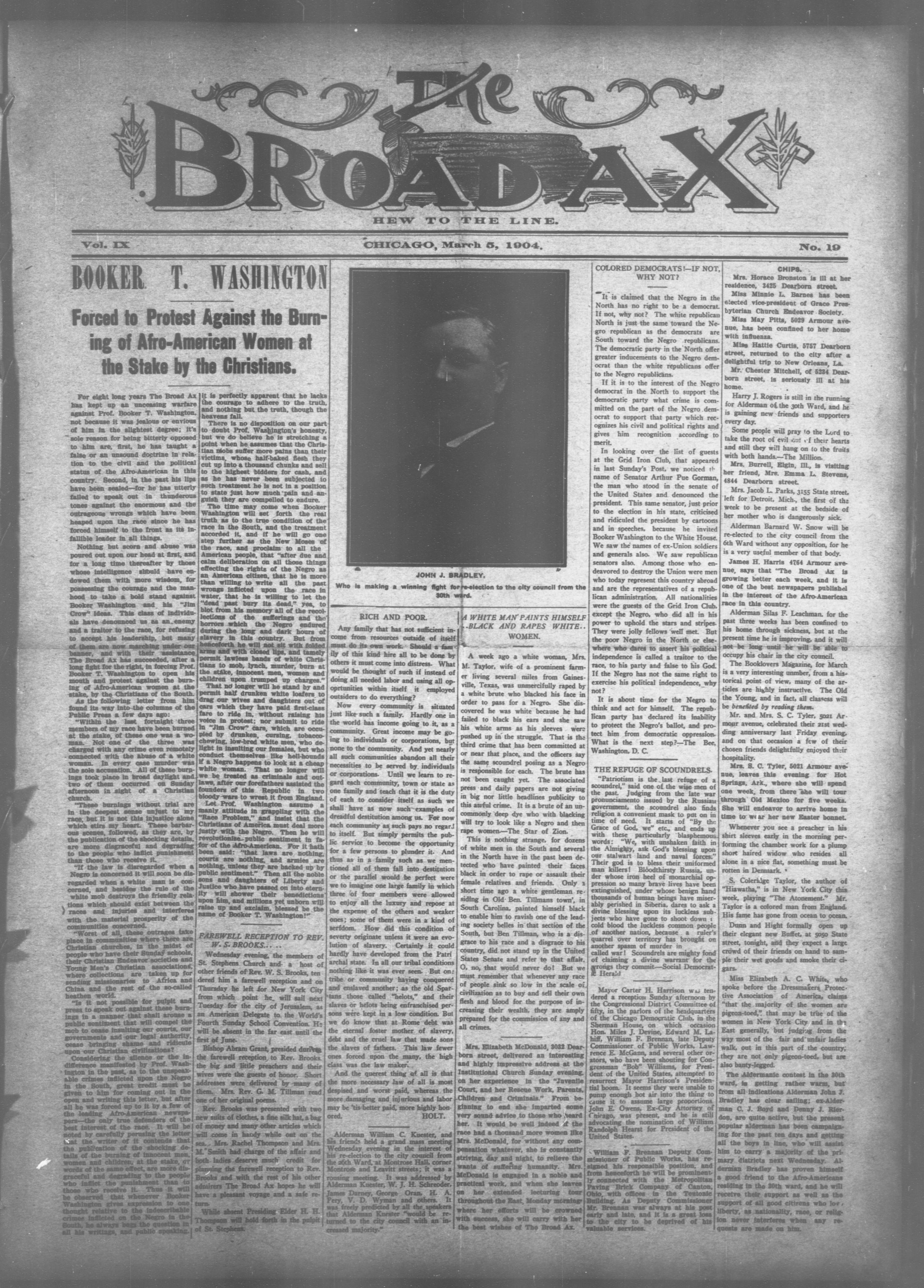
BOOKER. T. WASHINGTON Forced to Protest Against the Burning of Afro-American Women at the Stake by the Christians.
For eight long years The Broad Ax has kept up an unceasing warfare against Prof. Booker T. Washington, not because it was jealous or envious of him in the slightest degree; it's sole reason for being bitterly opposed to him are, first, he has taught a false or an unsound doctrine in relation to the civil and the political status of the Afro-American in this country. Second, in the past his lips have been sealed—for he has utterly failed to speak out in thunderous tones against the enormous and the outrageous wrongs which have been heaped upon the race since he has forced himself to the front as its infallible leader in all things.
Nothing but scorn and abuse was poured out upon our head at first, and for a long time thereafter by those whose intelligence should have endowed them with more wisdom, for possessing the courage and the manhood to take a bold stand against Booker Washington and his "Jim Crow" ideas. This class of individuals have denounced us as an enemy and a traitor to the race, for refusing to accept his leadership, but many of them are now marching under our banner, and with their assistance The Broad Ax has succeeded, after a long fight for the right, in forcing Prof. Booker T. Washington to open his mouth and protest against the burning of Afro-American women at the stake, by the Christians of the South. As the following letter from him found its way into the columns of the Public Press a few days ago:
"Within the last fortnight three members of my race have been burned at the stake, of these one was a woman. Not one of the three was charged with any crime even remotely connected with the abuse of a white woman. In every case murder was the sole accusation. All of these burnings took place in broad daylight and two of them occurred on Sunday afternoon in sight of a Christian church.
"These burnings without trial are in the deepest sense unjust to my race, but it is not this injustice alone which stirs my heart. These barbarous scenes, followed, as they are, by the publication of the shocking details, are more disgraceful and degrading to the people who inflict punishment than those who receive it.
"If the law is disregarded when a Negro is concerned it will soon be disregarded when a white man is concerned, and besides the rule of the white mob destroys the friendly relations which should exist between the races and injuries and interferes with the material prosperity of the communities concerned.
"Worst of all, these outrages take place in communities where there are Christian churches, in the midst of people who have their Sunday schools, their Christian Endeavor societies and Young Men's Christian associations, where collections are taken up for sending missionaries to Africa and China and the rest of the so-called heathen world.
"Is it not possible for pulpit and press to speak out against these burnings in a manner that shall arouse a public sentiment that will compel the mob to cease insulting our courts, our governments and our legal authority, cease bringing shame and ridicule upon our Christian civilizations?
Considering the silence or the indifference manifested by Prof. Washington in the past, as to the unspeakable crimes inflicted upon the Negro in the South, great credit must be given to him for coming out in the open and writing this letter, but after all he was forced up to it by a few of the leading Afro-American newspapers—the only true defenders of the best interest of the race. It will be noted by carefully perusing the letter that the writer of it contends that the publication of the shocking details of the burning of innocent men, women and children, at the stake, or words of the same effect, are more disgraceful and degrading to the people who inflict the punishment than to those who receive it. Thus it will be observed that whenever Booker Washington gives expression to one thought relative to the indescribable crimes inflicted on the Negro in the South, he always begs the question in all his writings, and public speaking.
it is perfectly apparent that he lacks the courage to adhere to the truth, and nothing but the truth, though the heavens fall.
There is no disposition on our part to doubt Prof. Washington's honesty, but we do believe he is stretching a point when he assumes that the Christian mobs suffer more pains than their victims, whose half-baked flesh they cut up into a thousand chunks and sell to the highest bidders for cash, and as he has never been subjected to such treatment he is not in a position to state just how much pain and anguish they are compelled to endure
The time may come when Booker Washington will set forth the real truth as to the true condition of the race in the South, and the treatment accorded it, and if he will go one step further as the New Moses of the race, and proclaim to all the American people, that "after due and calm deliberation on all those things effecting the rights of the Negro as an American citizen, that he is more than willing to write all the past wrongs inflicted upon the race in water, that he is willing to let the "dead past bury its dead," yea, to blot from his memory all of the recollections of the sufferings and the horrors which the Negro endured during the long and dark hours of slavery in this country. But from henceforth he will not sit with folded arms and with closed lips, and tamely permit lawless bands of white Christians to mob, lynch, murder, burn at the stake, innocent men, women and children upon trumped up charges."
That no longer will he stand by and permit half drunken white loafers to drag our wives and daughters out of cars which they have paid first-class fare to ride in, without raising his voice in protest; nor submit to ride in "Jim Crow" cars, which are occupied by drunken, cursing, tobaccochewing, low-bred white men, who delight in insulting our females, but who conduct themselves like hell-hounds if a Negro happens to look at a cheap white woman. That no longer will we be treated as criminals and outlaws, after our forefathers assisted the founders of this Republic in two bloody wars to wrest it from England. Let Prof. Washington assume a manly attitude in grappling with the "Race Problem," and insist that the Christians of America must deal more justly with the Negro. Then he will revolutionize public sentiment in favor of the Afro-American. For it hath been said: "that laws are nothing, courts are nothing, and armies are nothing, unless they are backed up by public sentiment." Then all the noble sons and daughters of Liberty and Justice who have passed on into eternity will shower their benedictions upon him, and millions yet unborn will raise up and exclaim, blessed be the name of Booker T. Washington!"
PAREWELL RECEPTION TO REV. W. S. BROOKS.....
Wednesday evening, the members of St. Stephens Church and a host of other friends of Rev. W. S. Brooks, tendered him a farewell reception and on Thursday he left for New York City from which point he will sail next Tuesday for the city of Jerusalem, as an American Delegate to the World's Fourth Sunday School Convention. He will be absent in the far east until the first of June.
Bishop Abram Grant, presided durings the farewell reception, to Rev. Brooks. the big and little preachers and their wives were the guests of honor. Short addresses were delivered by many of them. Mrs. Rev. G. M. Tillman read one of her original poems.
[Name]
RICH AND POOR. Any family that has not sufficient income from resources outside of itself must do its own work. Should a family of this kind hire all to be done by others it must come into distress. What would be thought of such if instead of doing all needed labor and using all oportunities within itself it employed outsiders to do everything?
Now every community is situated just like such a family. Hardly one in the world has income going to it, as a community. Great income may be going to individuals or corporations, but none to the community. And yet nearly all such communities abandon all their necessities to be served by individuals or corporations. Until we learn to regard each community, town or state as one family and teach that it is the duty of each to consider itself as such we shall have as now such examples of dreadful destitution among us. For now each community as such pays no regard to itself. But simply permits the public service to become the opportunity for a few persons to plunder it. And thus as in a family such as we mentioned all of them fall into destitution or the parallel would be perfect were we to imagine one large family in which three of four members were allowed to enjoy all the luxury and repose at the expense of the others and weaker ones; some of them were in a kind of serfdom. How did this condition of severity originate unless it were an evolution of slavery. Certainly it could hardly have developed from the Patriarchal state. In all our tribal conditions nothing like it was ever seen. But one tribe or community having conquered and enslaved another; as the old Spartans those called "helots," and their slaves or helots being enfranchised persons were kept in a low condition. But we do know that at Rome debt was the eternal foster mother of slavery, debt and the cruel law that made sons the slaves of fathers. This law fewer ones forced upon the many, the high class was the law maker.
And the querest thing of all is that the more necessary law of all is most despised and worst paid, whereas the more damaging and injurious and labor may be 'tis better paid, more highly honored. HOLT.
Alderman William C. Kuester, and his friends held a grand mass meeting Wednesday evening in the interest of his re-election to the city council from the 26th Ward, at Montrose Hall, corner Montrose and Leavitt streets; it was a rousing meeting. It was addressed by Alderman Kuester, W. J. H. Schreoder, James Darney, George Oran, H. A. Pery, V. D. Wyman and others. It was freely predicted by all the speakers that Alderman Kuester "would be returned to the city council with an increased majority."
CLEARLY IMPORTANT
A week ago a white woman, Mrs. M. Taylor, wife of a prominent farmer living several miles from Gainesville, Texas, was unmercifully raped by a white brute who blacked his face in order to pass for a Negro. She discovered he was white because he had failed to black his ears and she saw his white arms as his sleeves were pushed up in the struggle. That is the third crime that has been committed at or near that place, and the officers say the same scoundrel posing as a Negro is responsible for each. The brute has not been caught yet. The associated press and daily papers are not giving in big nor little headlines publicity to this awful crime. It is a brute of an uncommonly deep dye who with blacking will try to look like a Negro and then rape women—The Star of Zion.
This is nothing strange, for dozens of white men in the South and several in the North have in the past been detected who have painted their faces black in order to rape or assault their female relatives and friends. Only a short time ago a white gentleman residing in Old Ben. Tillmans town', in South Carolina, painted himself black to enable him to ravish one of the leading society belles in that section of the South, but Ben Tillman, who is a disgrace to his race and a disgrace to his country, did not stand up in the United States Senate and refer to that affair, O, no, that would never do! But we must remember that whenever any race of people sink so low in the scale of civilization as to buy and sell their own flesh and blood for the purpose of increasing their wealth, they are amply prepared for the commission of any and all crimes.
Mrs. Elizabeth McDonald, 3032 Dearborn street, delivered an interesting and highly impressive address at the Institutional Church Sunday evening, on her experience in the "Juvenile Court, and her Rescue Work, Parents, Children and Criminals." From beginning to end she imparted some very sound advice to those who heard her. It would be well indeed if the race had a thousand more women like Mrs. McDonald, for without any compensation whatever, she is constantly striving, day and night, to relieve the wants of suffering humanity. Mrs. McDonald is engaged in a noble and practical work, and when she leaves on her extended lecturing tour throughout the East, Monday morning, where her efforts will be crowned with success, she will carry with her the best wishes of The Broad Ax.
COLORED DEMOCRATS!—IF NOT,
WHY NOT?
It is claimed that the Negro in the North has no right to be a democrat. If not, why not? The white republican North is just the same toward the Negro republican as the democrats are South toward the Negro republicans. The democratic party in the North offer greater inducements to the Negro democrat than the white republicans offer to the Negro republicans.
If it is to the interest of the Negro democrat in the North to support the democratic party what crime is committed on the part of the Negro democrat to support that party which recognizes his civil and political rights and gives him recognition according to merit.
In looking over the list of guests at the Grid Iron Club, that appeared in last Sunday's Post, we noticed the name of Senator Arthur Pue Gorman, the man who stood in the senate of the United States and denounced the president. This same senator, just prior to the election in his state, criticised and ridiculed the president by cartoons and in speeches, because he invited Booker Washington to the White House. We saw the names of ex-Union soldiers and generals also. We saw republican senators also. Among those who endeavored to destroy the Union were men who today represent this country abroad and are the representatives of a republican administration. All nationalities were the guests of the Grid Iron Club, except the Negro, who did all in his power to uphold the stars and stripes. They were jolly fellows well met. But the poor Negro in the North or elsewhere who dares to assert his political independence is called a traitor to the race, to his party and false to his God. If the Negro has not the same right to exercise his political independence, why not?
It is about time for the Negro to think and act for himself. The republican party has declared its inability to protect the Negro's ballot, and protect him from democratic oppression. What is the next step?—The Bee, Washington, D. C.
THE REFUGE OF SCOUNDRELS.
"Patriotism is the last refuge of a scoundrel," said one of the wise men of the past. Judging from the late war pronunciamento issued by the Russian government, the scoundrel also finds religion a convenient mask to put on in time of need. It starts of "By the Grace of God, we" etc., and ends up with these particularly blasphemous words: "We, with unshaken faith in the Almighty, ask God's blessing upon our stalwart land and naval forces." Their god is to bless their uniformed man killers! Bloodthirsty Russia, under whose iron heel of monarchial oppression so many brave lives have been extinguished, under whose benign hand thousands of human beings have miserably perished in Siberia, dares to ask a divine blessing upon its luckless subjects who have gone to shoot down a cold blood the luckless common people of another nation, because a ruler's quarrel over territory has brought on another spasm of murder in called war! Scoundrels are mighty fond of claiming a divine warrant for the wrongs they commit—Social Democratic Heraid
Mayor Carter H. Harrison was tendered a reception Sunday afternoon by the Congressional District Committee of fifty, in the parlors of the headquarters of the Chicago Democratic Club, in the Sherman House, on which occasion Hon. Miles J. Devine, Edward M. Lahiff, William F. Brennan, late Deputy Commissioner of Public Works, Lawrence E. McGann, and several other orators, who have been shouting for Congressman "Bob" Williams, for President of the United States, attempted to resurrect Mayor Harrison's Presidential boom. It seems they were unable to pump enough hot air into the thing to cause it to assume large proportions. John E. Owens, Ex-City Attorney of Chicago, was present, and he is still advocating the nomination of William Randolph Hearst for President of the United States.
William F. Brennan Deputy Commissioner of Public Works, has resigned his responsible position, and from henceforth he will be prominently connected with the Metropolitan Paving Brick Company of Canton, Ohio, with offices in the Teutonic Building. As Deputy Commissioner Mr. Brennan was always at his post early and late, and it is a great loss to the city to be deprived of his valuable services.
No.19
Mrs. Horace Bronston is ill at her residence, 3425 Dearborn street.
Miss May Pitts, 5029 Armour avenue, has been confined to her home with influenza.
Miss Hattie Curtis, 5757 Dearborn street, returned to the city after a delightful trip to New Orleans, La.
Mr. Chester Mitchell, of 5234 Dearborn street, is seriously ill at his home.
Harry J. Rogers is still in the running for Alderman of the 30th Ward, and he is gaining new friends and supporters every day.
Some people will pray to the Lord to take the root of evil out of their hearts and still they will hang on to the fruits with both hands.-The Million.
Mrs. Burrell, Elgin, Ill., is visiting her friend, Mrs. Emma L. Stevens, 4844 Dearborn street.
Mrs. Jacob L. Parks, 3155 State street, left for Detroit, Mich., the first of the week to be present at the bedside of her mother who is dangerously sick.
James H. Harris 4764 Armour avenue, says that "The Broad Ax is growing better each week, and it is one of the best newspapers published in the interest of the Afro-American race in this country. Alderman Silas F. Leachman. for the past three weeks has been confined to his home through sickness, but at the present time he is improving, and it will not be long until he will be able to occupy his chair in the city council.
The Booklovers Magazine, for March is a very interesting unmber, from a historical point of view, many of the articles are highly instructive. The Old the Young, and in fact, all classess will be benefited by reading them. Mr. and Mrs. S. C. Tyler, 5021 Armour avenue, celebrated their 21st wedding anniversary last Friday evening, and on that occasion a few of their chosen friends delightfully enjoyed their hospitality.
Mrs. S. C. Tyler, 5021 Armour avenue, leaves this evening for Hot Springs, Ark., where she will spend one week, from there she will tour through Old Mexico for five weeks. She will endeavor to arrive home in time to wear her new Easter bonnet. Whenever you see a preacher in his shirt sleeves early in the morning performing the chamber work for a plump short haired widow who resides all alone in a nice flat, something must be rotten in Denmark.
S. Coleridge Taylor, the author of "Hiawatha," is in New York City this week, playing "The Atonement." Mr. Taylor is a colored man from England. His fame has gone from ocean to ocean. Dunn and Hight formally open up their elegant new Buffet, at 5050 State street, tonight, and they expect a large crowd of their friends on hand to sample their wet goods and smoke their cigars.
Miss Elizabeth A. C. White, who spoke before the Dressmakers Protective Association of America, claims "that the majority of the women are pigeon-toed," that may be true of the women in New York City and in the East generally, but judging from the way most of the fair and unfair ladies walk, out in this part of the country; they are not only pigeon-toed, but are also banty-legged.
The Aldermanic contest in the 30th ward, is getting rather warm, but from all indications Alderman John J. Bradley has clear sailing; ex-Alderman C. J. Boyd and Denny J. Rierdon, are quite active, but the present popular alderman has been campaigning for the past ten days and getting all the boys in line, who will assist him to carry a majority of the primary districts next Wednesday. Alderman Bradley has proven himself a good friend to the Afro-Americans residing in the 30th ward, and he will receive their support as well as the support of all good citizens who love liberty, as nationality, race, or religion never interferes when any requests are made on him.
THE BROAD AX.
Will promulgate and at all times uphold the true genius of Deuteronomy, put Catholic, Protestant, Pride, Indie, Farmers, Single Tumors, Republican, Knights of Labor, or any one else can have their say, no long so their language is proper and responsibility is fixed.
The Broad Ax is a newspaper whose platform is broad enough for all, ever claiming the editorial right to speak its own mind.
Local communications will receive attention.
Write only on one side of the paper.
Subscriptions must be paid in advance.
One Year..... $2.00
Six Months..... 1.00
Advertising rates made known on application.
Address all communications to
THE BROAD AX
8040 Armour Avenue, Chicago.
JULIUS F. TAYLOR, Editor and Publisher. Entered at the Post Office at Chicago, Ill., as Second-class Matter.
SAUERKRAUT EXPERIENCE.
A farmer who raises cabbage and manufactures sauerkraut on a large scale was trying to sell 50 barrels of that delicacy to a Front street dealer. The dealer, says the Portland Oregonian, did not appear eager to buy.
He said he could hardly get rid of so much sauerkraut before summer, and it was dangerous stuff to have around in hot weather, for it was likely to ferment in the barrels. He said his partner and another dealer on the street had a deal in kraut some years ago which was not profitable. They both had a big lot of the stuff, about 80 barrels in all, on a lower wharf on the city front and did not know what to do with it, as the weather was becoming warm. Finally they agreed to play cards to see who should have the whole, and his partner, who was a crackerjack at cribbage, won. They decided to ship it to San Francisco, but the next day one of the barrels exploded, threw down part of the warehouse and plastered everything within gunshot with the seething, fermenting, nasty-smelling stuff.
After cleaning up, the remaining barrels were placed on a steamer and sent to San Francisco. The night after they were landed the warehouse in which they were placed was burned, and they lost the whole lot and narrowly escaped a big damage suit, as it was charged that the fire was caused by the spontaneous combustion of the kraut. Since that time he takes his allowance of cabbage after being cooked with corned beef and well saturated with vinegar.
WORLD'S RICHEST FAMILY
A writer in the Tattler, a London publication which is nearly always bright, and often very well informed, argues that however great the riches of the American millionaires may be, there is no family in the United States which approaches the wealth of the Rothschilds. He makes a good case.
It appears that careful estimates of the possessions of the French branch of the family place its riches at or above $300,000,000. The British Rothschilds are rated still higher in the financial world. The German members of the family which won its first success in that country are also very rich, and there are other Rothschilds still to be reckoned with. Altogether, it is claimed that the wealth of the entire family is not less than $1,500,-000,000.
If that sum is anywhere near the marks, then it follows that there is no American family anything like so rich as the Rothschilds. They can easily outweigh any other house in the extent and value of their property. And most of it is very solid and safe. From the first, the Rothschilds have been careful and shrewd in handling their immense wealth. No one can set a limit on its probable accumulations a generation hence.
The majority of the Swiss parliament are averse to Sunday hunting.
ment are averse to Sunday hunting. The average yield of wheat in Russia is less than half that of the United States.
The treasure hunting craze has invaded Vienna, and thousands of Viennese are now digging all over the place. Of the 4,000 white settlers scattered among the total population of 200,000 in German Southwest, Africa, not much more than 2,000 are at present German, and these are very largely composed of the military and official element. Adult suffrage was tried for the first time in the commonwealth of Australia in the federal elections held upon December 16, 1903. The total number of voters registered was 1,700,000, of whom in round numbers 700,000 were women.
At the recent banquet of the Pilgrim's club in London cable communication was arranged with Delmonico's, New York, where Sir Mortimer Durand, the British ambassador, was dining with some friends. A telegraph instrument was placed in each dining-room, friendly greetings being exchanged at intervals throughout the evening.
Five pensioners are on the roll on account of the revolution, 1,116 on account of the war of 1812, 4,734 on account of the Indian wars, and 13,874 on account of the Mexican war. The great bulk of the roll is as follows: Civil war, invalida, 703,456; widows, 248,990; Spanish war, invalida, 9,200; widows, 3,662; regular establishment, invalida, 9,170; widows, 2,938.
>
MORE OR LESS PERSONAL
It is believed that the Rothschild family as a whole is worth about $1,500,000,-000, the French section being represented by about $350,000,000 and the English branch by considerably more.
Mr. and Mrs. Emil Zimmerman, of 4068 Finney avenue, St. Louis, celebrated their wooden wedding a few days ago, on which occasion their friends presented them with a pretty frame cottage, which had been erected on a lot some distance away owned by Mr. Zimmerman. The couple knew nothing about the matter until the house was complete in every detail.
Gen. Nelson A. Miles is at the head of a syndicate which will carbonize crude oil, converting it into a hardened form resembling coke, in the Osage and Cherokee oil fields. Upon his recent southwestern trip Gen. Miles not only visited the Texas field, but investigated the Indian Territory field carefully, and was fully satisfied with conditions. In the industry referred to Gen. Miles is in partnership with eastern capitalists, who have successfully developed a plan by which the crude oil may be carbonized.
Lloyd Morgan, professor of mineralogy in the University of Oxford, tells with delight how a great English merchant came to consult about the instruction of his hopeful son and heir who was some day to run the vast business interests from which "the pater" had made his wealth. "But mind you," said he, "I don't want him to learn about strata or dips or faults or upheavals or denudations, and I don't want him to fill his mind with fossils or stuff about crystals. What I want him to learn is how to find gold and silver and copper in paying quantities, sir—in paying quantities."
IN THE REALM OF SCIENCE.
The Bulletin des Sciences Pharm. says that the numerous assays which have been made of coffee berries, etc., have shown them to contain on the average about one per cent. of caffeine. Sven Hedin has furnished additional evidence of the Chinese invention of paper. On his recent journeys he found Chinese paper that dates back to the second half of the third century after Christ. Signatures are being secured by the Records of the Past Exploration society, to a petition which they will present to congress this winter providing for the protection of historic and prehistoric ruins of this country.
It is said that Prof. Markwald has discovered in pitchblende minute quantities of a new radio-active substance associated with tellurium. He has named the substance, on account of its association, "radiotellurium." It seems to be even more difficult to extract than radium, on account of its much smaller quantity.
A reddish ring enclosing a whitish glare was seen around the sun after the Krakatoa eruption in 1883, and has been named Bishop's ring. Keen observers have noted a similar appearance in recent months. This ring had a diameter of 70 degrees in August, 1902, but had diminished to 20 degrees in December, 1903, although settlement of coarser dust was expected to make it larger.
FOR READER AND WRITER.
A wise man will select his books, for he would not wish to class them all under the sacred name of friends.—Langford.
A $150 book has been published in London that the author may convince his readers that Columbus was born in 1451.
A monumental work of reference, an encyclopedia of 16 large volumes, is just being published in New York city. Whether by design or accident, not a page is numbered.
New Books and new editions published in this country in 1903, by the Publishers' Weekly count, numbered 7,865, as against 7,833 issued in 1902. Of the new books, 816 ranked with fiction; of the reprints, 644. In 1902 the figures were 838 and 959.
Miss Edith D. Lawrence, now a teacher in a missionary school at Tabriz, Persia, writing to friends in Oklahoma and telling of a shipment of books, etc., received from home, said: "Last night I picked up an American history and found 40 pages about the revolution torn out. They will not allow anything like that to pass through. The sultan will not allow such Sunday school lessons as Absolom's rebellion to be studied. Instead of publishing such lessons they out in a lesson from a psalm."
SOME RAILROAD RUMBLES.
During the month of January the Canadian Pacific railway sold 116,840.78 acres at a total value of $386,649.88.
In Europe there are companies which rent pillows to railway passengers. The charge is 20 cents a pillow for the trip.
The railroads of the country in three years have increased the amount of their outstanding bonds and have stock no less than $1,150,000,000.
A 100-ton electric traveling crane lifts in 80-ton locomotive in the repair shops of the Lake Shore railroad at Collinwood, O., said to be the largest locomotive repair shops in the world.
The construction of the great Transsiberian railway, comprising a length of 5,995 miles, has cost $484,554,415, or an average of $81,326.84 a mile. The loss andured through the disorders in China is estimated at $5,150,000.
CYNICAL LITTLE JIBES.
All things come to those who stop waiting and go after them.
A good son maketh a good husband—but he is worthy of a better fate.
A woman never really enjoys hurting a man's feelings unless she loves him.
A sensible woman seldom wastes her time on a handsome man—Philadelphia Inquirer.
TWIXT LIZARD AND BIRD.
One of the most interesting birds known to science is the hoatzin, say Jerrard Grant Allen and Leonard Buttress, in an article on "Bird Babies," in Pearson's. Indigenous to South America, this precocious youngster has made itself famous by the arboreal feats which it performs while yet at a very tender age. On the "thumb" and "forefinger" of the young hoatzin's wing appear tiny claws, and, armed with these, the tiny creature crawls out of its nest and clambers about the boughs of trees, using them as hands, by means of which it hooks itself along. The progress, indeed, exactly corresponds to the early pedestrian efforts of the human baby, whose first perambulations are made with the assistance of friendly chairs and other furniture. These little claws of the hoatzin are used only in infancy, dropping off as soon as the power of flight has been attained. The chief interest of the species, however, attaches to the fact that it is one of the most primitive forms of bird now in existence, and affords an important link with the ancestry of the fowl of to-day. Originally, as is generally known, birds were evolved from the lizard family, and the hoatzin forms a comparatively early step in the progression from reptile to bird. Even when its wings are full grown, so imperfect are they that no upward soaring can be negotiated, and their only use is in making short flights from a higher to a lower branch, while the ease with which the hoatzin climbs affords another indication of its proximity to the lizard tribe.
SPREAD PLEASANT ODORS.
The use of perfume as a disinfectant is well known, and the "scented dandy" has perhaps more hygienic wisdom than his detractors give him credit for, says the London Express. It is he who is trying to revive the use of the perfumed fountain ring, an article de luxe which may either be used as an ornament or as a means of a pleasant disinfectant in stuffy underground trains or in insalubrious districts.
The ring is an ordinary gold one fitted with a ball at the back. It is filled by pressing the ball nearly flat, and dipping the ring into a cup of scent, when the elasticity of the ball draws the perfume into the interior till quite full. By the least pressure the wearer of the ring can cause a jet of scent to shed its refreshing aroma any moment he pleases, and he may thus act as a benefactor or a nuisance to those in his vicinity.
The perfume lamp may also be used as another pleasant method of disinfecting a room. A ball of spongy platinum is placed over the center of the wick, and is fixed in its position by a thin glass rod, which is inserted into the wick. The lamp is then filled with any scented spirit, and when lighted is allowed to burn until the platinum gets red hot. The flame is then blown out and a pleasant odor fills the atmosphere
The cruel and powerful great horned owl is a bird of the eastern states, but its brothers—the western horned owl. Arctic horned owl and others—are found in the west and north. It has been known, says Woman's Home Companion, to kill a large tom cat in pitched battle, and on one occasion, while I was handling an owl of this species, it drove its talons through two thick pairs of leather gloves, and deep into my hand. I have seen one break the back of a squirrel at a single bite, and only last January I learned of another, which picked up and carried a full-grown struggling grouse over a hill for a distance of more than 50 yards before devouring it. The great horned owl nests very early in the year, sometimes even in February, utilizing the deserted nest of a hawk, crow or squirrel. It lays two or three eggs, which, like the eggs of all other owls, are white. Woe to the small boy who ventures to take these eggs or the downy white nestlings which come out of them. I have known a man to be nearly scaled by the parent birds while trying to steal young horned owls.
Coal Lands in New Mexico.
The area of proposed coal lands in sight in New Mexico is 1,493,480 acres, with 8,000,000,000 tons of coal, estimated to be worth $10,000,000. In spite of the want of water New Mexico has ready for the market 1,123,000 head of cattle, 97,580 horses, 113,000 goats and 5,674,000 sheep, with a wool yield of 20,000,000 pounds annually. The agricultural productions of the territory are valuable. Over 1,100,000 acres have been taken up since 1900 under the homestead act, increasing the number of farmers and ranchmen by nearly 90,000.
Is Brute Creation Wiser?
Every living bird and beast strives its utmost to cram itself with food before retiring for the night, and this food is digested as the night progresses. The evening feed is the feed of the day with the brute creation, and yet the doctors tell us to refrain from eating heartily at night and even advise us to retire to rest with a more or less empty stomach. Are we following nature when following this advice?—Country Gentleman.
Rents in Berlin.
The average yearly price for apartments paid by laboring families in Berlin is $72.
Fifty-First St. and Armour Ave.
RAIL YARDS: 51st St. & L. S. & M. S. Ry.
52nd St. and Armour Ave.
CHJCAGO
The Souls of Black Folk
By W. E. B. DuBois
A REMARKABLE BOOK that is provoking much discussion because of the wonderful eloquence with which the author pleads for right and justice to his people. In these days of increasing agitation over the "negro problem" this passionate human document can neither be overlooked nor ignored. Aside from its remarkable presentation of facts it holds the reader—prejudiced or not—by its fascination of style and overpowering pathos.
Some of the Chapter Headings follow:
OF OUR SPIRITUAL STRIVINGS.
OF THE DAWN OF FREEDOM.
OF MR. WASHINGTON AND OTHERS.
OF THE MEANING OF PROGRESS.
OF THE THIRD BLACK MEN.
OF THE BLACK BELT.
OF THE SONS OF MASTER AND MAN.
OF THE FAITH OF THE PATIERS.
OF THE PASSING OF THE FIRST-BORN.
OF ALEXANDER CRUMMELL.
OF THE COMING OF JOHN.
OF THE SORROW SONGS.
3d Edition $1.20 net Published by
A.C. McClurg & Co.,Chicago
MRS. A. WILSON.
Nicely furnished rooms to rent for gentlemen. Reasonable rates, 2252 Indiana aveune.
First class furnished rooms, for rent to gentleman and ladies, with bath and gas. 2628 Wabash avenue.
Funeral designs of every description, latest and most stylish decorations, for churches and weddings. Palms to rent for all social functions, 3119 State St., Chicago.
WONDERFUL DISCOVERY
Curly Hair Made Straight By
TAKEN FROM LIFE:
BEFORE AND AFTER TREATMENT.
ORIGINAL
OZONIZED OX MARROW
(Copyrighted.)
This wonderful hair pomade is the only safe preparation in the world that makes kinky or curly hair straight as shown above. It nourishes the scalp, prevents the hair from falling out or breaking off, cures dandruff and brittle hair. Sold for forty years and used by thousands. Warranted harmless. It was the first preparation ever sold for straightening kinky hair. Beware of imitations. Get the Original Ozonized 10 Marray. Get the Original Ozonized 10 Marray. Get the Original Ozonized 10 Marray. Soft and beautiful, giving it that healthy, life-like appearance so much desired. A toilets necessity for ladies, gentlemen and children. Elegantly perfumed. Owing to its superior and lasting qualities it is possible for anybody to produce a preparation equal to it. Full directions with every bottle. Only 50 cents. Sold by druggists and dealers or send us 50 cents for one bottle or $1.40 for three. Free shipping and postal or express money order. Please mention name of this paper when ordering. Write your name and address plainly to
OZONIZED OX MARROW CO.,
76 Wabash Ave., Chicago, Illinois.
Bulldog Scared Away Guests.
A writer tells how a bulldog scared away the guests bidden to a lady's reception. The hostess was waiting in her parlor. She heard carriages arrive, heard the front gate open, but no guests appeared. "The situation became puzzling. At last the lady of the house went out to see if perchance the paving and the steps had suddenly crumbled away and left an aching void. Not at all. On opening the front door she found herself confronted with the cause of the phantom visitors—Rex, in his most amiable and complacent mood, sitting, peaceful and majestic, on the top step, whither he had dragged his kennel, a featherweight to so powerful a creature, after him. No pedestrian visitor, no cardladen delegate of 'carriage folk,' had ventured to affront that lordly presence."
Thank goodness there will be no conflict between France and Slam, where the pepper comes from. Hate to see anybody tangled up with the king of Slam, says the New York Telegram, and then there's so much going on now we can't watch all the rings.
True Name of Corea.
The true name of Corea is "Choson," meaning "land of the morning sun." It is by this name that the country is designated in diplomatic papers at the state department at Washington.
11.11
The American Mutual Plantation Company
You have all doubtless read the advertisement that we have been running in The Broad Ax for some weeks past. Some of you may have been interested in our statements published in that "Ad" and may be even now considering seriously making an investment with us. (If you did this, you would be in excellent company for some of the brightest and shrewdest business and professional men, both white and colored have made this investment and are thoroughly pleased with it.) Some of you may have thought our statements extreme. You may have considered that we were exaggerating and consequently you have decided, temporarily at least not to invest with us. You are right in being careful; in fact, that is exactly the type of man we want to reach, the careful, thoughtful man who investigates, goes slowly and knows what he is doing when he makes a move.
As to the question of over-stating our proposition; we would like to have a good serious talk with every man who thinks we have made any over-statements. Do you know that it is exceedingly difficult to write an advertisement that comes anywhere near the facts in such a proposition as ours, a Tropical Plantation, and not be open to the charge, made by people uneducated in the proposition, that one has exaggerated. The TRUTH IS WONDERFUL and so wonderful that people doubt the truth. AS A MATTER OF FACT EVERY STATEMENT EVER MADE BY US AS TO PROBABLE RESULTS OF AN INVESTMENT IN THE AMERICAN MUTUAL PLANTATION COMPANY HAS BEEN RATHER UNDERSTATED THAN OVERSATED.
Now, the only way we can prove this to you is to prove it to you and to do that we should meet you; to do that you must come and see us or we must go and see you. If you care for an investment that will surely bring you from 10 to 50 per cent in a proposition that is not a speculation but a plain, cold business matter you should certainly look us up and decide for yourselves as to whether we are stating facts or not. We would like to have you inquire of Bradstreet, R. G. Dunn & Co., and the International Mercantile Agency as to our rating; in fact, we want you to know all about us. AMERICAN MUTUAL PLANTATION CO., BARKER & TAYLOR, General Agents, 431-435 Stock Exchange Bldg., Chicago, Ill.
President and Treasurer, THOMAS CAREY. Vice-President, JOHN SHELHAMER. Secretary, WILLIAM SULLIVAN.
Yards running winter and summer, equipped with the latest improved Wolf Dryer.
Output of Winter Yards ..... 140,000 per day
Output of Summer Yards..... 300,000 per day
Telephone Yards 128.
If your physician recommends the use of a stimulant, there is no whisky in which so many desirable qualities are contained as in Old Underoof Rye and it has the least reactive effect. Because it is made right and is aged right. CHAS. DENNEHY & CO. CHICACO
JOHN A ORB,
President.
WILLIAM LEGNER,
Vice Pres. & Treas.
CHICAGO, U. S. A.
Washington.—A great many people are surprised that Senator Hanna's
available wealth at the time of his death should have been only $3,000,000. In some way the impression had gone out that he was worth a great deal more than that. But impressions about money are pretty sure to be exaggerated in these days when men talk about millions as they used to talk about thousands ten years ago.
The Late Senator
Hanna.
Senator Hanna, of course, was a successful man of business, just as he was successful in everything, else he undertook, but after he had accumulated enough to insure his own financial permanency and the permanency of his family's financial interests, he was indifferent to whether any more came to him or not.
He never cared for money in itself, nor cared to pose as a man of wealth. What he did prize was the feeling of security and power which the possession of money gave him. And still more he prized the fact that his own business success enabled him to command the confidence and friendship of far wealthier men and through them to accomplish results in business and politics which would have been impossible for one whose own business experience did not inspire respect.
It was this reputation for business acumen which stood him in good stead as chairman of the national republican committee, but it had an even greater influence upon his career in the senate; for it gave impressive weight to the opinions he expressed in debate upon such distinctively business propositions as the ship subsidy bill and the Panama canal
Something Lake Hanna.
Former Gov. Crane of Massachusetts,
whose name has been mentioned more
frequently than any
other as Hanna's
probable successor
in the chairmanship of the republican national committee, is in some respects like Hanna
—in others strikingly unlike him.
M.
Like Hanna, he is a successful business man, whose own success and recognized acumen have given him un-
have given him unusual influence Ex-Gov. Crane. among men of greater wealth and of more far-reaching personal interests. Like Hanna, he has never met with failure in any undertaking, and, like Hanna, he is intensely loyal. Like Hanna, he inspires the confidence of laboring men as well as capitalists, and some of his most important achievements have been in the direction of bringing labor and capital to a better understanding.
It was Gov. Crane who first suggested to President Roosevelt the idea of inviting the coal operators and the representatives of the Miners' union to Washington to talk over their differences an invitation which resulted in bringing the anthracite coal strike to an end, when it had reached its most threatening stage. The suggestion came to him from his own experience as governor of Massachusetts when he brought the striking freight handlers and their employers together for a conference in the state house and ended a strike which had tied up the business of Boston.
Unlike Hanna, Gov. Crane will never develop into an effective debater or stump speaker. He has an unconquerable aversion to public appearances of that kind, and it is characteristic of him that the few public offices he has held have been forced upon him by other party leaders against his own inclination and in spite of his protests. He has a genius for politics, is absorbed in it, and is recognized by men who stand very high in public affairs as a wise and safe political adviser, but he hates above all things the idea of holding a political office. He likes to accomplish results, but he doesn't care at all for the glamor of the reputation for having done it.
Didn't Want the Job.
Senator Spooner, of Wisconsin, was asked by President Harrison to be chairman of the republican national committee in 1892 when Harrison was running for reelection. Harrison asked him first by wire and Spooner declined by wire. Then Harrison asked him to come to Washington and he came. But no pleading could induce him to take the place.
A. B.
Finally Harrison asked him why,
"I'll tell you," said Spooner, frankly,
"In order to run a campaign now the
chairman of the national committee in either party has to raise so much money that if he wins he is sure to be called a boodler. If he loses he is called a chump. I don't care for either reputation."
Upon that Harrison let him off without further urging.
It is a fact that a great deal more money is used now in the legitimate expenses of a national election than was the case in the earlier days.
Of men now living, probably, William E. Chandler has had more experience in the management of national campaigning than anybody else. He was connected with the national republican committee continuously from 1860 to 1880, and during a good part of that time he was secretary of the committee. He was especially active in the historic campaign of 1876. Yet in all his experience he never heard of a campaign fund approaching a million dollars.
Prior to 1880 the largest fund raised was by Henry J. Raymond, chairman of the committee in 1864. He is understood to have had $500,000 with which to manage the campaign for the reelection of Abraham Lincoln. The fund for Garfield's election in 1880 was somewhat larger than this, and in 1884 both national committees had funds which were regarded as generous in comparison with what had gone before.
The first fund running up into the millions, however, was in 1888, when M. S. Quay, as chairman of the republican national committee, induced the great manufacturers of the country to contribute generously to prevent the reelection of Cleveland. In 1892 the democratic committee had a campaign fund larger than the republicans had in 1888, while the republican fund was very small. In 1896 and 1900, the republican fund mounted high, but even in those years with Bryan as a candidate the democratic fund was larger than any republican fund had ever been before. The republican campaign fund in 1904 promises to be small.
The Case of Senator Hoar.
Senator Hoar is greatly concerned lest he shall be charged with criticising the administration when in reality he intended simply to call attention to certain transactions which he thought needed looking into.
A. H.
There is probably no other man in public life who would draw so fine a distinction between an attack on an administration policy and an
tion policy and an Senator Hoar. attack on the administration itself. But Senator Hoar is a law unto himself and his fellow senators are coming to recognize that his treatment of public questions is not to be considered exactly as it would be in the case of anybody else.
Senator Hoar has two distinct points of view for every political problem that comes to the front. First he looks at it from the viewpoint of the historian, then from the viewpoint of the practical statesman of to-day. Not infrequently he finds that the results do not harmonize and then he generally acts in accordance with the apparent necessity of the hour, while placing himself on record according to his judgment of the verdict of history.
He is getting to be an old man now, and he appreciates the fact that he will probably not long remain on the public stage. He does not want the closing years of his career to be stained by what he fears his biographer may regard as a questionable act. And so he places himself on record in such a way that after he is gone there can be no doubt about his own personal views without regard to what he may have been impelled to do in a national or party emergency. In what he says there is no personal feeling and there is no politics in the ordinary sense of the word. He does not think, for an instant, how any position he may assume will affect the political prospects either of himself or of anybody else—even his most intimate friends.
There are some wonderful old men in the senate. Hoar is one of them. Platt,
of Connecticut, is another of a distinctly different type hard-headed, practical, farseeing, progressive. Morgan and Pettus, of Alabama, each in his own way, is a marvel. Morgan even now having passed his eightieth year has limitless endurance, and Pettus, the oldest man in the senate, is one of
Platt, of Connecticut.
the youngest in his disposition. Then there are men whom we never think of as old—Quay, who is over 70; Platt, of New York, and Chauncey M. Depew—of equal age, each past his three score years and ten. Frye and Hale, of Maine; Proctor, of Vermont; Cullom, of Illinois, and Allison; of Iowa, are all in the class of 70—but they class themselves as youngsters.
Harry-I wish some one would invent an alarm clock which kindies the fire.
Harriet — Oh, pshaw! What the world needs is a machine that can get up and get the breakfast—Detroit Free Press.
It was in the latter part of the seventeenth century that the meal chest which has always been in the Spofford family and now owned by Mrs. Orin Spofford, of Georgetown, Mass., became bewitched under the most peculiar circumstances.
The meal chest is an ordinary one and was kept in the attic of Mr. Moody Spofford's house at Rowley Hill, filled with meal which was used in the family. Hannah Hazen, who was employed in the family, was of good, respectable family and lived in the town, the only thing known against her being the information obtained from the children that she had been trying to coax fortune through experiments practiced by the old-time superstitious.
The statement of the proceedings has been extracted from a written account of Dr. Jeremiah Spofford, who was asked to prepare it, and which was corroborated by a dozen witnesses, all of whom were present. It was one afternoon, while Hannah sat in one of the chambers quietly spinning, that she became annoyed by strange sounds, which seemed to come from the side of the house, and for which she was unable to account. They seemed to be from the sides of the walls, and responded to each and every pound of her fist on the laths.
She became so frightened that at last Moody Spofford, who was passing the house was called in, and he in turn was amazed at the sounds. He carefully examined the walls, striking them with a hammer to see whence came the sounds, but finding no loose lath, was perplexed all the more, as every blow which he gave was followed with another of equal sound. The jar of the spinning wheel was incapable to produce the noise, and, at last, unable to fathom the mystery he gave it up and left for his home.
He had, however, not been long home before he was for the second time called to the house, but again was he baffled. Had this happened during the time of the witchcraft excitement, Hannah's chances of dying a natural death would have been small, but as it was the mystery only excited the curi-
1
HANNAH WAS FRIGHTENED. osity of the neighbors, for when later she was sent to the attic on account of the trouble down stairs, to sift meal, to her amazement the chest, which was filled to the brim with meal, commenced to jog away two inched at a time, until it had reached the corner, and after a little it became so excited that when her dress touched it it flew to the ceiling and also went over the stairs.
This was too much for the family, and the children fled in fear to the neighbors, telling them the wonderful feats that were happening to the house. Curious people gathered in large numbers and soon grew so excited that poor Hannah was set to work touching everything to see how it worked. The door latch flew up with great rapidity when she touched the door, and even the farmer's heavy workbench when touched jogged rapidly over the floor. When, however, a horseshoe was fastened over the door the latch stopped its antics and the table ceased to move.
Excitement was at its height when the owner of the house walked in, disgusted at the commotion, sent the neighbors to their homes, summoned the ministers and had prayers said over the girl. The next day was the Sabbath, and all was quiet in the household. Monday, as soon as Mr. Spofford had left the house, the neighbors for a second time gathered and the same performances were gone through, this time three large men; Dr. Amos Spofford, David Thurston, Esq., and Capt. William Perley, all sat on the chest, and yet with their united weights did it rise nearly to the ceiling and start to turn a corner.
The master of the house, suspecting that the work might be renewed, came home, and the ministers were for the second time called for prayers, and the matter was stopped through the sending away of the girl who was at the bottom of the trouble, and who seems never afterward to have been gifted with the same power. Ever after the chairs, tables and meal chest kept to their own places, and although the matter was quieted down, yet the witnesses could not be silenced through its being an optical delusion which had occurred while they were in the room—Boston Globe.
Removing Mildew Stains.
Mildew stains can be removed from black woolen goods by washing in a dilated solution of javelle water. Try a sample of the goods first in order not to get the solution too strong, otherwise it will take the color out along with the stains.
Restering Luster to Silk.
To make silk that has been washed look like new put a teaspoonful of methylated spirits to a pint in the rinse water and iron while damp.
LATEST ENGLISH KINK.
Bridesmaid's Muff Supplants the Bouquet That Has Been in Use for Many Years.
If we cannot have brand new ideas to meet the demand of this novelty loving age we can have adaptations of old fashions that answer the purpose just as well as if they were really new comers. Such an adaptation—and a pretty one, too—is that of substituting a muff of dainty design and elaborate workmanship for the regulation bouquet, which for many a day has been dutifully carried by the bridesmaids at fashionable weddings. The custom,
```markdown
```
BRIDESMAID'S MUFF.
which originated a century or more ago, was revived this season, meeting with especial favor in King Edward's land. Things of beauty, indeed, are these bridal muffs, delicately perfumed and harmonizing with the color scheme and accessories of the wedding. Sometimes they are of a choice variety of fur, but as often as not fur is introduced to produce an effect of contrast or is omitted altogether, satin, soft and lustrous, mingled with embroidery and frills of chiffon or lace being substituted. Heart shape is the preferred one for muffs of this sort, the accompanying sketch showing the effect. Fashioned of pearl white satin, the outline is accentuated and softened by full frills of mousseline de soie, large bows of satin ribbon adding the final decorative touch. A handsome chain lends an extra touch of the glorification to the bridesmaid's muff.
The muff is of ordinary shape, particularly the "granny" type in vogue at present, is adapted to this form of embellisment and garniture, satin as a background or hand painting serving admirably for foundation material. Brooklyn Eagle.
THE WIFE'S ALLOWANCE
Necessity of Asking for Every Penny She Spends Is Humiliating to American Women.
Next to love, the most important, often the most importunate, question between a man and his wife is money. To the young and romantic this may seem a sordid condition. Love, in their view, means bonbons and long-stemmed "American beauties." Later on, when they learn that it also means taxes and coal bills, shoes, pew rent and groceries, they will see why it is that the most beautiful superstructure must have a firm financial foundation.
Then will come, or at least ought to come, the question of an allowance for the wife—a very modern question in the opinion of the many, and a foolish one in the view of the old-fashioned and conservative. It is true that it is raised more often than it used to be. The reason is that women's views of life, especially of married life, have advanced. Many were self-supporting before marriage, and many more might have been so if they chose. To them the exchange of financial freedom for absolute dependence is not attractive. They had the control of money before marriage; they reasonably desire the control of at least a little after marriage.
To men of sympathetic imagination this question may never present itself. They supply unasked not merely the wife's known and expressed needs, but, realizing their own fondness for a new tie or the occasional entertainment of a friend at luncheon, they appreciate a woman's need of funds for which she need not account.
The other type of man—the type which pays the regular bills and takes no thought of extraneous wants—should remember that married life is often compared to a partnership. It is not necessary that both partners draw equal sums from the profits of the business, but even the junior partner expects to use his small share as he pleases. If he is worthy to be a member of the firm he will not take advantage of his position, nor draw more than the business will stand.
The Youth's Companion truthfully says that the necessity of asking for every cent she spends is humiliating to any woman of sensibility. She wants her allowance, as Burns said of wealth: Not for to hide it in a hedge, or for a train resplendent, But for the glorious privilege of being inde-
pendent;
and if she has it she will use it, in most cases, wisely, and both she and, her husband will be happier.
How to Tell Fresh Eggs.
To ascertain the freshness of eggs without breaking, fold your hands around an egg, hold the egg between the sun or a bright light and yourself and look through it. If the yolk appears round and the white surrounding it clear, it is fresh. A good egg will also sink when dropped into a bucket of water; if it topples around in the water, apparently standing on its end, it is fairly fresh; if it floats, beware of it. The shell of a fresh egg looks dull and porous; that of an old egg thin and shiny. When eggs are kept any length of time they lose water by evaporation through the pores of the shell, and rattle or shake. This is not a sign of particular staleness, although stale eggs rattle.
ELUSIVE ART OF THE SKEE.
Of all the elusive arts, declares Mr. G. M. H. Hewitt, in "The Pedagogue at Play," the art of the skee is the most irritating. It is not that one falls often, it is not that one usually hurts himself severely, but it is that one falls so inextricably.
You generally roll over with your head downhill, says Mr. Hewitt. One arm is pinned by the heel of one of those lengthy strips of wood, the other arm by the toe of the other. After a few minutes of prostrate and irritated inertness, you make up your mind where the disentanglement is to begin.
So far so good. That arm is free. Then the other is slowly liberated. Now you realize that you are sitting on your own heels, and you can't get up because you are on the down-hill side of your center of gravity. You can't reverse yourself and get your feet below your head, because you are sitting on your feet. What to do? I have often been reduced to lying there and bellowing for help, and people are singularly unsympathetic; also they often come with a camera.
Then when you are half-way up, out goes one of your feet, dragging you after it into a fresh entanglement. Once fallen, you may put in the greater part of the morning's exercise for body and tongue in getting fairly righted again.
But if you do happen to get the snow in perfect order and hit on the proper equilibrium, then it is the best form of motion that you can possibly imagine. Down-hill you fly, with your heart in your mouth, but still keeping your feet, with a little spurt of snow spraying away from your pointed toes a yard away in front of you, past prostrate forms shouting for help, past admiring friends with now welcome cameras.
You glide on to gentler slopes, where you can stand more erect and look around you serenely happy, until the approaching fence or ditch or road warns you to turn your course diagonally across the slope; then you gradually come to a graceful stop, or sit quietly down, thankful that you are safe.
SHUN CRIPPLES' SCHOOLS
Teachers of Public Schools Dislike to Teach Unfortunates - Special Training Required.
That the public school-teachers of Chicago who now have positions in the elementary grades do not fancy the work of teaching in the schools for crippled children is evident from a bulletin sent out by Superintendent Cooley, says the Post.
The positions in the schools for crippled children pay $200 more a year than teaching in the elementary schools, but it is said that teachers do not like the work, because it is too difficult. Superintendent Cooley's bulletin to school principals is to the effect that the principals confer with the superintendent of schools concerning teachers whom they consider specially fitted for the work, so that these teachers may be encouraged to make some special preparation
Three new schools for crippled children will be opened next year, and teachers will be needed for these schools. It is required that teachers in schools for crippled children should have one year's special training in such teaching. Arrangements have been made by Superintendent of Schools Gooley to have special training in the work given in connection with normal extension classes.
FOREIGN WARES IN CHINA
Asiatics Are No Longer Content with the Simple Surroundings of Their Ancestors.
The Chinese peasant is no longer content to burn bean oil, says Arthur Judson Brown, in the Century; he wants kerosene. In scores of humble Laos homes I saw American lamps costing 20 rupees apiece, and a magistrate proudly showed me a collection of 19 of these shining articles. The narrow streets of Canton are brilliant with German and American chandeliers, and myriads of private houses throughout the empire are lighted by foreign lamps. The desire of the Asiatic to possess foreign lamps is equaled only by his passion for foreign clocks. The demand for clocks is insatiable. I counted 27 in the private apartments of the emperor of China, and my wife 19 in the bedroom of the empress dowager, while cheaper ones tick to the delightful wonder of myriads of humbler people. The ambitious Syrian scorns the mud roof of his ancestors, and will be satisfied only with the bright tiles imported from France.
Danger of Cremation.
Dr. Braunstein, of Wepperfurth, according to the London Mall, has been arrested on a charge of murdering his wife; whose body was cremated by his instructions. In November the doctor married a lady in Halle, her fortune amounting to £7,500 in ready money. Immediately after the wedding the couple left Halle for a trip abroad, and shortly afterward news was received that the bride had died suddenly. Suspicion was aroused, and the doctor is now accused of poisoning his wife. Owing to the cremation of the remains, however, there is no possibility of the body being examined for traces of poison, and the charge being thus either substantiated or refuted.
The value of the exports of the whole country in 1903 was 58 per cent. greater than in 1883; but the gain in New York was only 31 per cent., and the gain at New Orleans was 69 per cent., at Galveston 239 per cent., and at Mobile 432 per cent.
Capable of Charging Water with Radio-Activity-Opens Up Interesting Possibilities.
The latest marvel reported by the patient and ingenious students who are exploring the mysteries of radium comes from Ann Arbor, where a professor of the University of Michigan has found that by surrounding a little radium with pure water the fluid is soon charged with radio-activity to such an extent that it stops the pain of cancers almost instantly, and it seems to promise the healing of several cases which are being treated with water so energized. Obviously, it is too early to make very positive claims for radium as a curative agency, but the indications are very auspicious.
The certainty is that radium is so different from other substances and other forces that accepted views of the physical world must be revised, and unknown and unmeasured possibilities are larger and more impressive than they seemed not many months since, in the eye of science. What has been learned of radium is simply enough to prove that very little is yet understood of the earth beneath our feet. We are still only experimenters, touching the dim edges of momentous truths. Every point of vantage gained widens the fields yet to be won.
Here's a New One.
A new swindle is being worked by a pair of strangers in southern Michigan, according to the Auburn (Ind.) Dispatch. A stranger appears on the road apparently searching for a lost valuable diamond ring, but leaves after getting some responsible person interested, offering $100 for the return of the ring. Soon after his departure a tramp appears and picks up what appears to be the missing ring. The person who has been offered $100 reward for its return sees an opportunity to make a stake by giving the tramp a liberal sum for it, but fails to find the owner. He then consults a diamond expert and learns that the sparkler is worth about 15 cents.
A Japanese Holiday
Most of the people one meets on the Japanese New Year day are carrying a squashed salmon, with a piece of paper tied round its waist by a paper string which holds a little gold paper kite. That kite means that the thing is a present and has not to be paid for. Those who are not carrying crushed salmon or taking up the street in giving correct New Year's salutations are playing batteldore and shuttlecock.
The Kink That Won't Come Back.
You can make your hair just as straight and smooth as you want to by using the Original Ozonized Ox Marrow, and the kink that was there before will not come back. The Ozonized Ox Marrow also keeps the hair from falling out, cures dandruff and makes the hair grow. It never fails. One bottle does it. Sold over forty years to ladies of refinement all over the country, giving perfect satisfaction. Send us 50 cents and we will ship you a bottle express paid. Address Ozonized Ox Marrow.Co., 76 Wabash Avenue, Chicago, Ill.
THE BROAD AX.
Is for sale at the following news stands:
The Afro-American News Office, 3104 State Street.
A. F. Tervalon's Cigar Store and News Stand, 2826 State street.
Edward Felix's Cigar Store, 388 30th street, N. E. Corner Armour Ave.
T. B. Hall's Cigar Store and Laundry office, 281 29th St.
Turner William's Cigar and News Stand, 2903 Armour Ave.
Mrs. B. Williams, Cigars, Notions and News Stand, 486 1/2 State street.
Frank H. Hart, 354-31st street, cigars, tobacco and Laundry office.
Mrs. E. F. Early, groceries and notions, 2933 State St.
H. Winston's Cigar Store and Newsstand, 280, 29th St.
The Stationery, 2970 State street.
J. C. Campbell, 145 W. 47th street., Cigars, Tobacco, Staple Groceries.
Wm. Dixon 2638 State Street cigars, tobacco, and news stand.
Isidor Jacobson, cigars, togacco and stationery, 3149 State St.
Wm. Goetz, News Stand and Laundry Office, 411 E. 36th st.
News items and advertisements left at these places will find their way into the columns of The Broad Ax.
LEGAL NOTICE
J. Gray Lucas, 59 Dearborn St. STATE OF ILLINOIS, COUNTY OF COOK, ss.—Circuit Court of Cook County. To the Mar. Term A. D. 1904. Missouri Belle Cooper vs George Cooper 248,530. Notice is hereby given to the said George Cooper that the above named Complainant heretofore filed her Bill of Complaint in said Court, on the Chancery side thereof, and that a summons thereupon issued out of said Court against the above named defendant, returnable on the first day of March term of the Circuit Court of Cook County, to be held at the Court House in Chicago, in said Cook County, on the third Monday of March, A. D. 1904, as is by law required, and which suit is still pending.
J. Gray Lucas, Compl'ts Solicitor.
John A. Cooke, Clerk.
Electia Chapter, No. 1, O. E. S., will give a house social Wednesday evening, March 9, at the home of Miss Endora Fisher, 3524 Dearborn street. A beautiful silk quilt will be raffled off by the ladies. Dr. Manning, Supt. of City Missions, preached an instructive sermon on the subject of Obedience, at the Berean Baptist Church, last Sunday morning. The sermon was well received by an excellent audience.
Church and state stand together. The church teaches submission to the state and the state in turn exempts the church from all taxation. The bargain thus struck smells of the hell wherein it was consumated.—Free Society.
The Leaders of the Republican party would make no mistake if they would nominate Major John C. Buckner for county commissioner, as he is popular with his fellow citizens, and he would make a first-class county official.
Rev. Moses H. Jackson, pastor of Grace Presbyterian church, has been delivering a series of lectures before the students of Tuskegee Institute. He has just returned to the city and will occupy his pulpit tomorrow. The Lord's supper will be administered.
Little Bill Ward, W. W. Johnson Edward G. Alexander, who dislikes to pay his honest debts, and Ben Moseley ought not to be permitted to practice in any of the courts in Cook County, for they are all mighty slippery and tricky fellows, and they are liable to sell their victims out without any warning or notice on their part.
Rev. I. N. Daniels, Evanston, Ill., and J. E. Webb, who has charge of the Country Club in the same city, have become bondholders in the American Mutual Plantation Company whose offices are located at Suite 431-435 Stock Exchange Bldg There are other well known Afro-Americans who are bondholders in this company and they are well pleased with their investment.
nue, four dollars per week. twenty-five dollars for solicitor's fees, and to dig up the money for Mrs. Newby to redeem her diamonds which she pawned in 1900 in order to furnish Col. Newby with plenty of money so that he could attend the Democratic National Convention at Kansas City, Mo.
Mrs. Geneva Smith, 4764 Dearborn street, entertained a whist party and dance Saturday evening, at her home Cards were played at six tables. Prof. N. Clark Smith's Orchestra furnished the music for dancing. Refreshments were served in the dining-room, which was tastily decorated with the National colors and American beauty roses. The pariors were also draped with silk flags. The hostess proved herself a charming entertainer. Among those present were Mesdames Grant Thomas, R. P. Jones, D. Jenkins, Miss Bertha Neeley, Messrs. P. Neeley, R. B. Jones, D. Jenkins, C. Smith.
"I think," she said, "that he has deceived us all. I don't think he is anything more than a clerk." "Why?"
"Because, right in the middle of a proposal last night, his mind wandered and he said: 'You could wear a size smaller, miss, without any trouble at all.' I jerked my foot back, of course, but I knew right away why it was so easy for him to get on his knees before a girl."—Brooklyn Eagle.
Touching Music.
Miss Yallerby—Dat Percy Mokington kin play de mos' intoxicatin'an' heabenly music on his banjo. Oh, my!
Clarence Coonley (sneeringly)—Huh! I guess rag-time am about dat niggah's limit!
Miss Yallerby (warrally)—'T is, eh? Yo' jea ought ter heah dat man gib an imertation ob a spring chicken a-sizzlin' on de pan, or a hungry pickaninny eatin' a watch-millyun! Talk about yo' real music!—Puck.
The Boss Was Wise.
Employer—You are having a decided dirtation with the girl who has charge of our telephone wire!
Truthful Clerk (with cold chills running up and down his spine, and with visions of instant dismissal)—Y-e-e-s, sir; but please, al—
* Employer—Well, keep it up. She will give more attention to our calls if you do.—Tit-Bits, _____
"Well," said the victim, wearily.
"Wheeling West Virginia may be some and Lansing Michigan may be rather a big surgical undertaking, but Finishing Long Island isn't such a tiny little sanitary stunt."—Baltimore American.
Well Done All Around.
"Did the critic say anything when you told him I had sold that picture to an American millionaire?" asked the artist.
"Yes; he said 'Well done!'" responded the close friend.
"Ah! he meant the picture?"
"No; the American millionaire."—Tit-Bits.
that?
Janitor—Sure. I never cud see phat good they did except to kape all the tinants mad.
Landlord—That was the idea. By keeping them fuming at you, they did not notice how little heat there was in the steam pipes.—N. Y. Weekly.
A Gentle Hint.
"And that," said Mr. Staylate, concluding his tiresome story, "was how my mother became interested in the Home for Aged Widowa."
"Speaking of homes," remarked Miss Patience, yawning ostentatiously, "doesn't that word 'home' appeal to you and make you feel there is no place like it?"—Philadelphia Press.
Music.
No more the songbird doth delight
The ears of sordid men,
When eggs are dear they'd rather hear
The cackle of the hen.
-Washington Star.
SIZING IT UP.
```markdown
```
It's a pretty careful speaker who isn't forced to discount his first statements more than ten per cent.
"Oh, Annie!" exclaimed four-year-old Elmer, "there's a hole in my stocking as big as a silver dollar!"
"Are you sure it's that big?" asked his sister.
"Well," replied the little fellow, after looking at it again, "It's as big as $0 cents, anyway."—Cincinnati Enquirer.
Last Resort.
When everything's closed at the clubroom And the curtain is down at the show, too, There's no place like home, take my word for it.
When there's no other place you can go to.
—Baltimore News.
Days of the Week.
"What are the days of the week?" asked the teacher.
The little girl pondered deeply for a moment.
"Big dinner day, washing day, ironing day, baking day, the girl's day out, last school day and play day," she answered finally.—Chicago Post.
She Merely Wanted to Know.
"The fact is," said the old bachelor,
"that I regard a woman as an inferior being."
"What's the matter?" asked Mrs. Henpeck. "Has some woman been hinting that she regards you as being good enough for her?"—Chicago Record-Herald.
A Certain Indication.
"Mrs. A. S. Piring has recently opened a bank account for the first time in her life."
"How do you know?"
"She has just given her next door neighbor a check for 35 cents."—Woman's Home Companion.
A Sense of Distrust.
"Have you ever done anything to entitle you to the gratitude of posterity?" "No," answered Senator Sorphum; "and when I see some of the statuary that is scattered about I don't feel like tempting posterity to be too grateful." —Washington Star.
Rip Van Winkle Libsled.
Rip Van Winkle had just been taking a nap. Placing a hand upon his beard, he murmured drowsily, "How this grows on me." After which he fell into a second doze, that he might sleep out the remaining ten years. —Yale Record.
Tough Enquirl.
Teacher—Jimmy, how would you express the idea that a man is mentally unbalanced??
Jimmy—Aw, say dat he's got room ter rent in de second story!—N. O. Times-Democrat.
Clever Scheme.
The Hostler—Say, the horses won't eat that hay.
The Hustler—Well, tie it up in packages and advertise it as a new breakfast food.—Chicago American.
Wasn't Onite Sure.
Passenger—Are your sandwiches fresh?
The regulations drawn up some time ago to control big game hunters in the Soudan are to be revised shortly, and the "hippo"—whose hunter and killer was taxed when the Soudan was first opened up—the "hippo," as aforesaid, is doomed to "a sort of" extermination. "Because," said Sir Harry Johnston, the noted African explorer, in conversation, "it's all very well for people to talk about extermination in regard to the 'hippo,' but it will prove a very difficult matter to get rid of him. There are vast marshes in Africa to which he can and will resort, and from which he will only be driven at last by a well-organized, well-equipped and determined body of men."
"I am perhaps a little fanatical with regard to the preservation of lower animal life," went on Sir Henry, "but I should not carry my passion for it so far as to let a lion loose in England. And the 'hippo' in the rivers of Africa is as dangerous as the lion would be on dry land. Let the lion alone, and he lets you alone—especially has he a terror of a white man's face—but the 'hippo' causes more deaths annually in Africa than the lion and the leopard together. He constantly attacks boats from which he has received no offense, killing or mauling their occupants, and he destroys fields and gardens by the score. What he does not eat he sits on."
WALKING STICK CUT LONG.
Fashion Also Decrees Its Return to Earth—No Longer Carried as a Battering Ram.
The fact of the return of the walking stick to earth is a very remarkable one, for it must be approaching 15 years since walking sticks were used, and not worn or merely carried, says the Court Journal. With the disappearance of the "crutch" the walking stick left the ground. At first it was carried in the right hand, considerably nearer the ferrule than the "top," and, held in this position, was flourished in a most dangerous manner. Before long the hand traveled more amidships, when the action, from flail-like, became a ramming one. Then suddenly the stick was thrust under the left arm, where it remained some years. The advent of the curved or crook handle had its inevitable result. Instinctively man wants to hook it upon something, and, finding his left arm close at hand, straightway hung it up and created a fashion after the unconscious manner of his kind. Why the walking stick has once more come to the ground, thus to discover the perforated condition of the West end pavement, it is at present impossible to say. It will no doubt be remarked, however, that the king has for a year past generally been seen using a walking stick of rather more than usual length, and all sticks are now cut long.
Mamma," asked small Floramay, "does a lawyer know everything?" "No, dear," replied her mother, "but he thinks you think he does."—Cincinnati Enquirer.
NATIONAL NEGRO SUFFRAGE LEAGUE CONVENTION.
Second Meeting.
Commencing June 20th, 1904, Chicago, Illinois.
OBJECT.
The object of the Convention is to invoke the aid of the Republican Party in National Convention assembled to the end that Southern Disfranchisement may be broken up. REPRESENTATION. . . .... Each state will be entitled to a representation equal to the number of her Congressional representation. RATES. Delegates attending this Convention will be able to avail themselves of the rate to the National Republican Convention, one fare for the round trip.
The National Negro Suffrage League operates at Washington, D. C., a Bureau of Publicity and Promotion, from which a campaign will be directed against Southern Disfranchisement. President, James H. Hayes, Va. Cor. Sec'y, Jas. E. Dixon, R. I. Rec. Sec'y, W. T. Ridley, Pa. Treas., Rev. J. A. Taylor, Washington D. C.
Eastern Organizer, Rev. J. A. Churchman, N. J.
Western Organizer, J. C. Leftwitch, Oklahoma.
For further information address
JAS. H. HAYES,
Attorney-at-Law,
Washington, D. C.
LEGAL NOTICE:
To Whom It May Concern:
The firm of Wilson & Duncan, composed of George A. Wilson and George D. Duncan and formerly doing a business at the Imperial Bldg., Room 16, City of Chicago, is hereby dissolved; and all persons having done or contemplating doing any business with the said firm are duly notified as above. This March 5th, 1904.
GEORGE D. DUNCAN.
3601 Wabash Ave.
```markdown
```
Suite 200, 128-125 Lil Salle Street
CHICAGO
Shelghome Yards WI Bedfordshire, MI Gusfield DL
JOHN FITZGERALD
JUSTICE OF THE PEACE
STUDY A. MALCHEWD PETERSON,
CHICAGO
J. GRAY LUCAS
ATTORNEY-AT-LAW
Suite 412 Real Estate Board Bldg
99 Dearborn St. Cor. Randolph
CHICAGO.
Phone Randolph 55
J. J. HENNESSY,
Justice of the Peace.
6301 S. Halsted St.
WILLIAM TREXLER, CLERK.
TELEPHONE WENTWORTH 4403.
Police Magistrate Englewood Police
Court.
Telephone Main 3558.
P. J. O'SHEA
WILLIAM C. KUESTER. SUPERINTENDENT.
HILLMAN'S 112-114-116 STATE STREET. Dry Goods and Everything to Wear for Man, Woman and Child
Real Estate, Insurance and Loans Property managed. Abstracts examined. Renting. Legal papers prepared. 4709 South Halsted Street Chicago
Mortgages, Deeds, Notes and Legal Documents Drawn and Acknowledged. Room 22, 27 North Clark Street.
POLICE MAGISTRATE RESIDENCE
East Chicago Ave. Police Court 337 Burling Street
Metropole Hall
FOR THE SEASON 1903-4
31st St. and 5th Ave.
Every Tuesday and Friday
Under New Management
Mr. Alex. Armant and
Mr. Horace Clinton
Every Tuesday and Friday Evenings
MUSIC BY ARMANT'S ORCHESTRA
PROF. HALL, Dancing Master. Admission 25c.
M. JUNK, Proprietor JOS. P. JUNK, Manager 3700-3710 South Halsted Street and 897 to 929 Thirtyseventh Street CHICAGO
COAL, WOOD AND ICE MOVING AND EXPRESSING All Orders Promptly Attended to Cash on Delivery Telephone Blue 269 4656 Armour Avenue, CHICAGO.
270. BERG cery
CHICAGO