The Broad Ax
Saturday, April 16, 1904
Chicago, Illinois
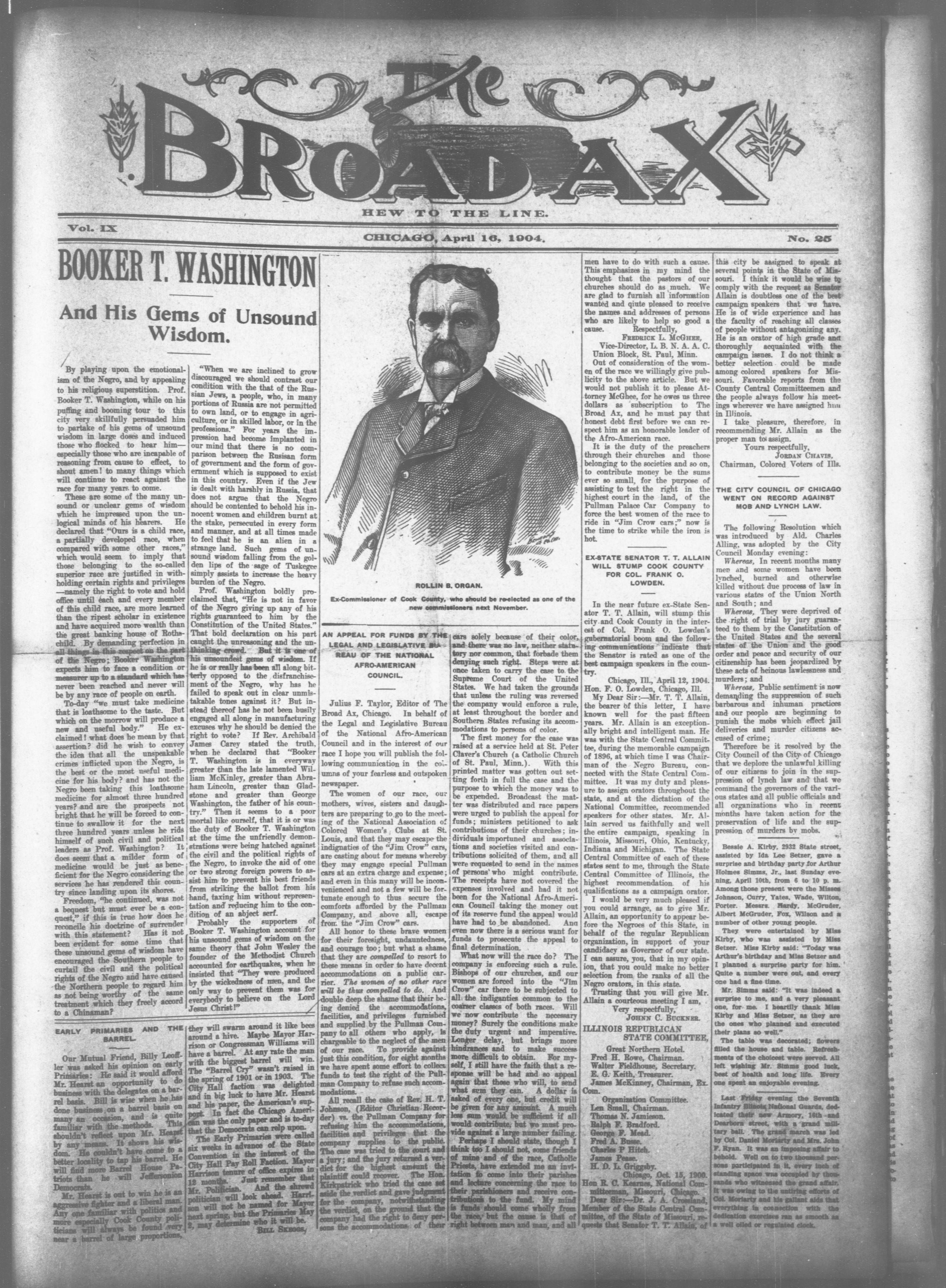
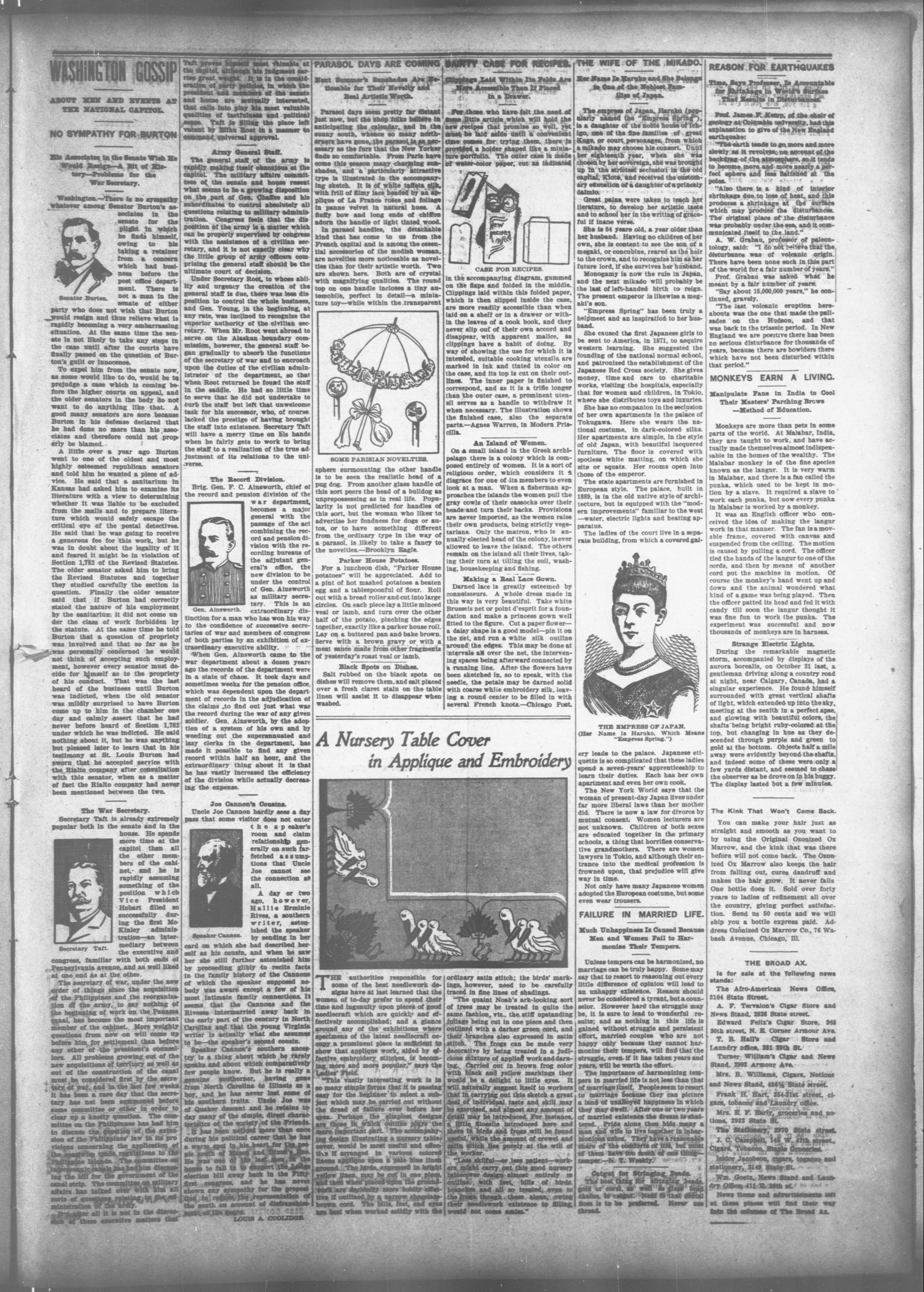
Page text (machine-generated)
BOOKER T. WASHINGTON
Vol. IX
BOOKER T. W.
And His Gem Wis
By playing upon the emotionalism of the Negro, and by appealing to his religious superstition. Prof. Booker T. Washington, while on his puffing and booming tour to this city very skillfully persuaded him to partake of his gems of unsound wisdom in large doses and induced those who flocked to hear him—especially those who are incapable of reasoning from cause to effect, to shout amen! to many things which will continue to react against the race for many years to come.
These are some of the many unsound or unclear gems of wisdom which he impressed upon the unlogical minds of his hearers. He declared that "Ours is a child race, a partially developed race, when compared with some other races," which would seem to imply that those belonging to the so-called superior race are justified in withholding certain rights and privileges—namely the right to vote and hold office until each and every member of this child race, are more learned than the ripest scholar in existence and have acquired more wealth than the great banking house of Rothschild. By demanding perfection in all things in this respect on the part of the Negro; Booker Washington expects him to face a condition or measurer up to a standard which has never been reached and never will be by any race of people on earth.
To-day "we must take medicine that is loathsome to the taste. But which on the morrow will produce a new and useful body." He exclaimed! what does he mean by that assertion? did he wish to convey the idea that all the unspeakable crimes inflicted upon the Negro, is the best or the most useful medicine for his body? and has not the Negro been taking this loathsome medicine for almost three hundred years? and are the prospects not bright that he will be forced to continue to swallow it for the next three hundred years unless he rids himself of such civil and political leaders as Prof. Washington? It does seem that a milder form of medicine would be just as beneficient for the Negro considering the services he has rendered this country since landing upon its shores.
Freedom, "he continued, was not a bequest but must ever be a conquest," if this is true how does he reconcilie his doctrine of surrender with this statement? Has it not been evident for some time that these unsound gems of wisdom have encouraged the Southern people to curtail the civil and the political rights of the Negro and have caused the Northern people to regard him as not being worthy of the same treatment which they freely accord to a Chinaman?
EARLY PRIMARIES AND THE BARREL.
Our Mutual Friend, Billy Leoffler was asked his opinion on early Primaries: He said it would afford Mr. Hearst an opportunity to do business with the delegates on a barrel basis. Bill is wise when he has done business on a barrel basis on many an occasion, and is quite familiar with the methods. This shouldn't reflect upon Mr. Heapst by any means. It shows his wisdom. He couldn't have come to a better locality to tap his barrel. He will find more Barrel House Patriots than he will Jeffersonion Democrats. Mr. Hearst is out to win he is an aggressive fighter and a liberal man. Any one familiar with politics and more especially Cook County politicians will always be found very
near a barrier or bridge.
"When we are inclined to grow discouraged we should contrast our condition with the that of the Russian Jews, a people, who, in many portions of Russia are not permitted to own land, or to engage in agriculture, or in skilled labor, or in the professions." For years the impression had become implanted in our mind that there is no comparison between the Rusisan form of government and the form of government which is supposed to exist in this country. Even if the Jew is dealt with harshly in Russia, that does not argue that the Negro should be contented to behold his innocent women and children burnt at the stake, persecuted in every form and manner, and at all times made to feel that he is an alien in a strange land. Such gems of unsound wisdom falling from the golden lips of the sage of Tuskegee simply assists to increase the heavy burden of the Negro.
Prof. Washington boldly proclaimed that, "He is not in favor of the Negro giving up any of his rights guaranteed to him by the Constitution of the United States." That bold declaration on his part caught the unreasoning and the unthinking crowd. But it is one of his unsoundest gems of wisdom. If he is or really has been all along bitterly opposed to the disfranchisement of the Negro, why has he failed to speak out in clear unmistakable tones against it? But instead thereof has he not been busily engaged all along in manufacturing excuses why he should be denied the right to vote? If Rev. Archibald James Carey stated the truth, when he declared that "Booker T. Washington is in everyway greater than the late lamented William McKinley, greater than Abraham Lincoln, greater than Gladstone and greater than George Washington, the father of his country." Then it seems to a poor mortal like ourselves, that it is or was the duty of Booker T. Washington at the time the unfriendly demonstrations were being hatched against the civil and the political rights of the Negro, to invoke the aid of one or two strong foreign powers to assist him to prevent his best friends from striking the ballot from his hand, taxing him without representation and reducing him to the condition of an abject serf.
Probably the supporters of Booker T. Washington account for his unsound gems of wisdom on the same theory that John Wesley the founder of the Methodist Church accounted for earthquakes, when he insisted that "They were produced by the wickedness of men, and the only way to prevent them was for everybody to believe on the Lord Jesus Christ!"
they will swarm around it like bees around a hive. Maybe Mayor Harrison or Congressman Williams will have a barrel. At any rate the man with the biggest barrel will win. The "Barrel Cry" wasn't raised in the spring of 1901 or in 1903. The City Hall faction was delighted and in big luck to have Mr. Hearst and his paper, the American's support. In fact the Chicago American was the only paper and is to-day that the Democrats can relp upon.
The Early Primaries were called six weeks in advance of the State Convention in the interest of the City Hall Pay Roll Faction. Mayor Harrison tenure of office expires in 12 months. Just remember that Mr. Politician. And the shrewd politician will look ahead. Harrison will not be named for Mayor next spring, but the Primaries May 2, may determine who it will be. BILL SKEOGS.
CHICAGO, April 16, 1904.
BENNETT
Ex-Commissioner of Cook County, who should be re-elected as one of the new commissioners next November.
Julius F. Taylor, Editor of The Broad Ax, Chicago. In behalf of the Legal and Legislative Bureau of the National Afro-American Council and in the interest of our race I hope you will publish the following communication in the columns of your fearless and outspoken newspaper.
The women of our race, our mothers, wives, sisters and daughters are preparing to go to the meeting of the National Association of Colored Women's Clubs at St. Louis, and that they may escape the indignaties of the "Jim Crow" cars, are casting about for means whereby they may engage special Pullman cars at an extra charge and expense; and even in this many will be inconvenienced and not a few will be fortunate enough to thus secure the comforts afforded by the Pullman Company, and above all, escape from the "Jim Crow" cars.
All honor to these brave women for their foresight, undauntedness, and courage too; but what a shame that they are compelled to resort to these means in order to have decent accommodations on a public carrier. The women of no other race will be thus compelled to do. And double deep the shame that their being denied the accommodations, facilities, and privileges furnished and supplied by the Pullman Company to all others who apply, is chargeable to the neglect of the men of our race. To provide against just this condition, for eight months we have spent some effort to collect funds to test the right of the Pullman Company to refuse such accommodations.
All recall the case of Rev. H. T. Johnson, (Editor Christian Recorder) vs. the Pullman Company for refusing him the accommodations, facilities and privileges that the company supplies to the public. The case was tried to the court and a jury; and the jury returned a verdict for the highest amount the plaintiff could recover. The Hon. Kirkpatrick who tried the case set aside the verdict and gave judgment for the company, notwithstanding the verdict, on the ground that the company had the right to deny persons the accommodations, of their
cars solely because of their color, and there was no law, neither statutory nor common, that forbade them denying such right. Steps were at once taken to carry the case to the Supreme Court of the United States. We had taken the grounds that unless the ruling was reversed the company would enforce a rule, at least throughout the border and Southern States refusing its accommodations to persons of color.
The first money for the case was raised at a service held at St. Peter Claver's Church (a Catholic Church of St. Paul, Minn.). With this printed matter was gotten out setting forth in full the case and the purpose to which the money was to be expended. Broadcast the matter was distributed and race papers were urged to publish the appeal for funds; ministers petitioned to ask contributions of their churches; individuals importuned and associations and societies visited and contributions solicited of them, and all were requested to send in the names of persons who might contribute. The receipts have not covered the expenses involved and had it not been for the National Afro-American Council taking the money out of its reserve fund the appeal would have had to be abandoned. And even now there is a serious want for funds to prosecute the appeal to final determination.
What now will the race do? The company is enforcing such a rule. Bishops of our churches, and our women are forced into the "Jim Crow" car there to be subjected to all the indiganties common to the coarser classes of both races. Will we now contribute the necessary money? Surely the conditions make the duty urgent and imperative. Longer delay, but brings more hindrances and to make success more difficult to obtain. For myself, I still have the faith that a response will be had and so appeal again that those who will, to send what sum they can. A dollar is asked of every one, but credit will be given for any amount. A much less sum would be sufficient if all would contribute, but we must provide against a large number failing. Perhaps I should state, though I think too I should not, some friends of mine and of the race, Catholic Priests, have extended me an invitation to come into their parishes and lecture concerning the race to their parishioners and receive contributions to the fund. My mind is funds should come wholly from the race, but the cause is that of right between man and man, and all
men have to do with such a cause. This emphasizes in my mind the thought that the pastors of our churches should do as much. We are glad to furnish all information wanted and qiute pleased to receive the names and addresses of persons who are likely to help so good a cause. Respectfully.
Vice-Director, L. B. N. A. A. C. Union Block, St. Paul, Minn. Out of consideration of the women of the race we willingly give publicity to the above article. But we would not publish it to please Attorney McGhee, for he owes us three dollars as subscription to The Broad Ax, and he must pay that honest debt first before we can respect him as an honorable leader of the Afro-American race.
It is the duty of the preachers through their churches and those belonging to the societies and so on, to contribute money be the sums ever so small, for the purpose of assisting to test the right in the highest court in the land, of the Pullman Palace Car Company to force the best women of the race to ride in "Jim Crow cars;" now is the time to strike while the iron is hot.
EX-STATE SENATOR T. T. ALLAIN
WILL STUMP COOK COUNTY
FOR COL. FRANK O.
LOWDEN.
In the near future ex-State Senator T. T. Allain, will stump this city and Cook County in the interest of Col. Frank O. Lowden's gubernatorial boom and the following communications indicate that the Senator is rated as one of the best campaign speakers in the country. Chicago, Ill., April 12, 1904. Hon. F. O. Lowden, Chicago, Ill.
Hon. F. O. Lowden, Chicago, Ill. My Dear Sir:Mr. T. T. Allain, the bearer of this letter, I have known well for the past fifteen years. Mr. Allain is an exceptionally bright and intelligent man. He was with the State Central Committee, during the memorable campaign of 1896, at which time I was Chairman of the Negro Bureau, connected with the State Central Committee. It was my duty and pleasure to assign orators throughout the state, and at the dictation of the National Committee, recommended speakers for other states. Mr. Allain served us faithfully and well the entire campaign, speaking in Illinois, Missouri, Ohio, Kentucky, Indiana and Michigan. The State Central Committee of each of these states sent to me, through the State Central Committee of Illinois, the highest recommendation of his qualifications as a campaign orator. I would be very much pleased if you could arrange, as to give Mr. Allain, an opportunity to appear before the Negroes of this State, in behalf of the regular Republican organization, in support of your candidacy as Governor of our state. I can assure, you, that in my opinion, that you could make no better selection from the ranks of all the Negro orators, in this state.
Trusting that you will give Mr Allain a courteous meeting I am,
Great Northern Hotel.
Fred H. Rowe, Chairman.
Walter Fieldhouse, Secretary.
E. G. Keith, Treasurer.
James McKinney, Chairman, Ex
Chicago, Oct. 15, 1900. Hon R. C. Kearnes, National Committeeman, Missouri, Chicago. Dear Sir:Dr. J. A. Crossland, Member of the State Central Committee, of the State of Missouri, requests that Senator T. T. Allain, of
No.25
this city be assigned to speak at several points in the State of Missouri. I think it would be wise to comply with the request as Senator Allain is doubtless one of the best campaign speakers that we have. He is of wide experience and has the faculty of reaching all classes of people without antagonizing any. He is an orator of high grade and thoroughly acquainted with the campaign issues. I do not think a better selection could be made among colored speakers for Missouri. Favorable reports from the County Central Committeemen and the people always follow his meetings wherever we have assigned him in Illinois.
I take pleasure, therefore, in recommending Mr. Allain as the proper man to assign.
Yours respectfully,
JORDAN CHAVIS,
Chairman, Colored Voters of Ills.
THE CITY COUNCIL OF CHICAGO WENT ON RECORD AGAINST MOB AND LYNCH LAW.
The following Resolution which was introduced by Ald. Charles Alling, was adopted by the City Council Monday evening: Whereas, In recent months many men and some women have been lynched, burned and otherwise killed without due process of law in various states of the Union North and South: and
Whereas, They were deprived of the right of trial by jury guaranteed to them by the Constitution of the United States and the several states of the Union and the good order and peace and security of our citizenship has been jeopardized by these acts of heinous lawlessness and murders; and Whereas, Public sentiment is now demanding the suppression of such barbarous and inhuman practices and our people are beginning to punish the mobs which effect jail deliveries and murder citizens accused of crime:
Therefore be it resolved by the City Council of the City of Chicago that we deplore the unlawful killing of our citizens to join in the suppression of lynch law and that we command the governors of the various states and all public officials and all organizations who in recent months have taken action for the preservation of life and the suppression of murders by mobs.
Bessie A. Kirby, 2932 State street, assisted by Ida Lee Setzer, gave a surprise and birthday party for Arthur Holmes Simms, Jr., last Sunday evening, April 10th, from 6 to 10 p. m. Among those present were the Misses Johnson, Curry, Yates, Wade, Wilton, Porter. Messrs. Hardy, McGruder, Albert McGruder, Fox, Wilson and a number of other young people.
They were entertained by Miss Kirby, who was assisted by Miss Setzer. Miss Kirby said: "Today was Arthur's birthday and Miss Setzer and I planned a surprise party for him. Quite a number were out, and every one had a fine time. Mr. Simms said: "It was indeed a surprise to me, and a very pleasant one, for me. I heartily thank Miss Kirby and Miss Setzer, as they are the ones who planned and executed their plans so well."
The table was decorated; flowers filled the house and table. Refreshments of the choicest were served. All left wishing Mr. Simms good luck, best of health and long life. Every one spent an enjoyable evening.
Last Friday evening the Seventh Infantry Illinois National Guards, dedicated their new Armory, 16th and Dearborn street, with a grand military ball. The grand march was led by Col. Daniel Moriarty and Mrs. John F. Ryan. It was an imposing affair to behold. Well on to two thousand persons participated in it, every inch of standing space was occupied by thousands who witnessed the grand affair. It was owing to the untiring efforts of Col. Moriarty and his gallant aids that everything in connection with the dedication exercise ran as smooth as a well oiled or regulated clock.
THE BROAD AX.
Will promulgate and at all times uphold the true principles of Democracy, but Catholic Prosecution, Friends, Inhabitia Preference, Single Thinking, Resistance, Knights of Lions, or only one else will have their say, so long as white language is proper and responsibility is fixed.
The Brow Ax is a newspaper whose platform is broad enough for all, over claiming the editorial right to speak its own mind.
Local communications will receive attention. Write only on one side of the paper.
THE BROAD AX
(320) Armour Avenue, Chicago.
JULIUS F. TAYLOR, Editor and Publisher.
Entered at the Post Office at Chicago
Ill., an Second-class Matter.
TO WORRY MEAN CREDITOR
The Amount of Small Change an Annoyed Debtor Can Unload When Paying Up.
Ordinarily, when a debtor appears before a long-time creditor in Chicago, there is no questioning of the United States coin in which the debt is to be paid, but the wide possibilities possessed by an arbitrary creditor in stipulating just what coins and in what amounts he will receive payment are enough almost to discourage even borrowing, says the Chicago Tribune.
You can't force a mean creditor to take more than 25 cents' worth of nickels or 25 cents' worth of copper cents. If you could get as much as five dollars' worth of old silver three-cent pieces of another generation, you could unload five dollars' worth on him, just as he would have to take five dollars' worth of the silver five-cent pieces and five dollars' worth of the obsolete 20-cent pieces, which made so much trouble in the late '70s. But you can pay out ten dollars in silver dimes, and silver quarters, and silver half-dollars; the trade dollar—of which there are a few still coming into the treasury of the United States for redemption—are worth nothing, while the standard dollar is an unlimited legal tender, as is the old "dollar of our dads," the first of which was coloned in 1794, and the last in 1873.
Coins that virtually have disappeared from circulation are gold three-dollar and one-dollar pieces, the trade dollar of silver, the nickel three-cent piece, the copper two-cent piece and the copper half-cent, and silver three and five-cent pieces.
DANGER SPOTS IN A STORM
Places One Would Do Well to Avoid While the Lightning Is Playing Pranka.
Now that the season of thunderstorms is approaching, people should understand what spots to avoid, in order to reduce to the minimum the chances of being struck by lightning. Out of doors trees should be avoided, and if from the rapidity with which the explosion follows the flash it is evident that electric clouds are near at hand, a recumbent posture is the safest. It is seldom dangerous to take shelter under sheds, carts or low buildings, or under the arch of a bridge, and a distance of 20 or 30 feet from tall trees or house is an eligible situation, for should a discharge take place these elevated bodies are most likely to receive it.
It is well, also, to avoid water, for it is a good conductor, and the height of a human being near the stream may determine the direction of a discharge. Within doors we are tolerably safe in the middle of a carpeted room or when standing on a thick hearth rug. The chimney should be avoided on account of the conducting power of the carbon deposited in it and gilt moldings or bell wires are sources of risk. In bed we are tolerably safe, since blankets and feathers are bad conductors. It is injudicious to take refuge in a cellar, because the discharge is often from the earth to a cloud, and buildings frequently sustain the greatest injury in their basements.
DISEASE GERMS IN CLAMS.
The infection of the few oysters that are cultivated near the mouths of sewers, and their share in conveying typhoid fever, is now an old story. The harm done, though relatively small, is real and serious. It is now said that clam beds are also in danger of contamination from the same cause. Of course, the proportion of clams which are exposed to disease germs is exceedingly small. All the same the fact is not to be ignored by wise people. However, the proper way to overcome the danger is not to stop eating clams or oysters, but to see that they are well cooked.
A German bacteriologist, Dr. Klein, who has been looking into the matter, says that the common practice of dipping the clams (inclosed in a net) into hot water for a moment is not enough to kill the germs if any are present. He advises boiling more thoroughly and longer. Dr. Klein also recommends cooking by steam. He says that if three layers of them are cooked at the same time, ten minutes are sufficient for the lower layer and 15 for the two others. Bacteriological investigation has demonstrated that after steaming clams for the length of time mentioned no living bacteria introduced into them before found.
SUCHS OF ROYALTY.
Prince Nitel Frith, second son of Kaiser Wilhelm, will make a visit to England shortly.
Peter of Servia has had a crown made, said to be one of the finest in existence, from an artistic standpoint.
King Edward has conferred the rank of royal highness upon the children of his brother, the duke of Connaught.
Prince Cetewayo, grandson of the famous Zulu king who was captured by the British in south Africa 23 years ago, is a student in London, devoting much of his time to law and history. He likes England and the English, he says, but hates their way of dressing. The immaculate trousers, frock coat and tall hat are to him a sore affliction, but he finds relief at night, when he strips and rolls himself in a blanket.
Andrew Carnegie has the best collection of autographs of crowned heads and famous persons in contemporary history. These are frequently not only signatures, but also letters written to him on various subjects. He has compiled them with a great deal of care and they form one of his most valued possessions. Nothing has ever been learned of what became of the collection of the late Dr. Evans, of Paris, which was one of the most extensive in Europe.
Princess Maria del Pilar, the little 13-year-old princess, whom rumor has assigned as a fiancee to the young king of Spain, is the third child of Prince Louis Ferdinand, of Bavaria. Her mother is Princess Maria de la Paz, an infanta of Spain, so there are already close ties of kinships between the two. The pretty little girl princess is, however, still in the schoolroom, and several years must elapse before she blossoms out into a full-blown young lady.
The crown prince of Germany and his younger brother, Prince Eitel Fritz, are much dissimilar in character and disposition, the latter being extremely retiring and greatly impressed with the necessity for complying with parental authority. The crown prince, on the contrary, on several occasions has suffered through disobeying his august father. The headstrong heir apparent once told a friend that Prince Eitel was "a very good boy, but not the stuff that kings are made of."
WOULD YOU BELIEVE IT?
A man knows how to make excuses with success.
Women want much in the way of polite consideration.
To the industrious man holidays come in the nature of toil.
The man who tells fancy stories has no idea of the value of time.
Some women have an odd way of showing affection for a man.
Some men carry their business into all their dealings with others.
A woman likes to feel that her social movements are worth noticing. Men of good standing pay close attention to correct correspondence. Take a woman's word in a love affair and you are bound to be confused. Philadelphia Bulletin.
FASHION'S FANCIES.
Last year's gowns will not be worn this season.
The popular fad of putting a No. 4 foot in a No. 2 shoe is still with us.
For very little boys there are belts in green apple tints, with lining of paragoric brown.
A new fabric known as eggproof scenery material is being introduced in theatrical circles.
The complete automobile costume this season calls for oiled fingers as well as gasoline on the handkerchief.
The newest lace collars are accompanied by an extra section, making it possible to use them as table doilies.—Chicago Tribune.
NOTABLE WOMEN.
Miss Eleanor Wallot has given 200,000 marks to the University of Heidelberg for the higher education of woman in Germany.
Mrs. Rachel Albright, granddaughter of Betsy Ross, who made the first American flag, lives at Fort Atkinson, Ia., and is a flagmaker.
Mrs. Herbert Druce, of San Francisco, has aided in reviving private theatricals in Paris. She has performances once a week at her home in the Rue Herran.
Mrs. Helen G. Craig, who died recently at Asbury Park, N. J., was selected, because of her beauty, to present a laurel wreath to Lafayette when he visited Boston in 1824.
SCRAPS OF FACT.
Letter boxes with electric bells in them as letter-thief tellitales are shortly to appear in Paris.
The government of Greece has authorized the English Institute of Archaeology to carry out excavations in Lakonia.
Chief Justice Alton B. Parker, of the New York court of appeals, says that "to the best of my knowledge and belief" he was born in Cortland, N. Y.
"Old Friendship," the fire engine George Washington aided in pulling through the streets of Alexandria, Va., will be exhibited at the St. Louis fair.
IMPERTINENGES
When a man is really hungry, his wife is apt to be a good cook. —St. Paul Globe.
"A friend in need is a friend indeed."
"I suppose so; a quit claim deed." —Brooklyn Life.
"Some folks' idea of bein' busy," said Uncle Eben, "is standin' aroun' an' findin' fault wif yuthuh folks dat'a workin'." —Washington Star.
When you lose a dollar somebody else finds one. But when somebody else loses a dollar you do not find one. Thus do we detect the wabble in the scalen of fate.
WOMEN YOU READ ABOUT.
Barbera Honora Venus Brown-Ryan, a Boston character for many years past, was arrested for vagrancy the other day, and upon being searched $8,000 was found concealed in her clothing. She was permitted to depart from the court room in peace, but with a warning to keep off the streets.
London women of high rank have taken to fencing, and leading physicians are doing all in their power to make the fad last as long as possible. A grand assault at arms was held recently, the duke of Connaught and a number of other distinguished members of the aristocracy being present. The neatness and grace of the girl competitors won hearty applause from the spectators, most of whom were women.
Probably the two most learned women in the world, certainly the foremost women Biblical scholars, are Mrs. Agnes Smith Lewis and Mrs. Margaret Dunlop Gibson, of Cambridge, England, who have just discovered what is known as the Sinaitic pallimpsest, the oldest known manuscript of the four gospels. This is the most important discovery of Biblical manuscripts which has been made in modern times.
Mrs. Andrew Carnegie cares little or nothing for jewels. When she goes out to a function or to the opera she sometimes wears pearls, but these are not of fabulous size or price. They are extremely modest and afford quite a contrast to the jewels which some women wear. At best Mrs. Carnegie does not care for functions or society in general. She makes a delightful hosters at Skibo castle, where she has received royalty, and these are qualities which always win with the higher classes abroad.
IN CHURCH CIRCLES.
China proper has a population of over 400,000,000. Protestant Christian communicants number 112,808.
Prof. Harnack, a widely known and liberal professor of theology in the University of Berlin, has made a collection of the sayings of Christ not contained in the New Testament.
The year 1903 in the Presbyterian mission in Canton, China, was the best in its history. To the 20 churches there were 1,098 additions, and the local contributions amounted to more than $8,000.
Up to the present time Plus X. has been regarded by orthodox Catholics as the two hundred and sixty-fourth bishop in direct succession from St. Peter. But the lately issued Gerarchia Cattolica, or Papal Blue book, sets him down as the two hundred and fifty-eighth. Monsignore Duchesne, director of the French academy at Rome, has for some time contended that half a dozen of the traditional popes never existed, and this act of the newly-elected prelate shows that he accepts that decision.
Miss Mary B. Robinson, of Pittsburg, Pa., is the richest woman evangelist. She is the niece of John G. Robinson, secretary of the Pittsburg & Lake Erie railway; has a fortune of $500,000 in her own right and owns one of the most luxurious homes in the smoky city. She is young, pretty and has such a glorious voice that an impresario offered her $10,-000 a year to sing in public. Friends and relatives oppose her purpose, but she has decided to enter the field of evangelical work and devote her life to teaching the moral law and trying to save sinners.
POINTED PARAGRAPHS
Some men lose their hair by butting in at the wrong time.
It is the grave cases of a physician that benefit the undertaker.
If a man loses all his money he also manages to lose nearly all his enemies.
An ounce of get-up-and-get is better than a pound of that "tired feeling."
A true hero is a man who fights for his country and refuses to scrap with his wife.
A fool refuses a paying job to-day because he has a thankless one for to-morrow.
Only a woman is capable of arriving at a conclusion without using either reason or judgment.
After a man has paid a woman a few compliments he will be voted a "mean thing" if he suspends payment. It is said that distance lends enchantment to the view, but the theory falls down when applied to a man's view of pay day. Now there are rumors of a boardinghouse trust abroad in the land. Boarding houses that will trust would fill a long-felt want.—Chicago Daily News.
MILADY'S MILLINERY.
Straw sailor hats for the children's wear come in red, brown and blue.
A hat in red straw is trimmed with great clusters of cherries and is very chic-looking.
Hats are shown trimmed with grapes apples and oranges, and many others are trimmed with grapes and cherries.
Nearly all the hats have rich lace veils which hang down in the back in a curtain effect. One handsome white chip hat in round shape has a low crown surrounded by pale pink roses and over this a rich lace veil with a heavy border which falls behind in a rather square effect.
T. R. Benson will give another series of dramatic performances at Stratford-on-Avon, this time during the festival of 1905.
"I have met people who roll their eyes to heaven and rave about Shakespeare and yet they won't go to see Shakespearean plays," says a popular actor, and that no doubt, is the reason why a well-known manager said recently, on was reported, no saying: "There's no use talking about it; this is Shakespearean play."
Wanted No Man with Ideas.
The late duke of Cambridge looked upon all innovations in army discipline with great suspicion, and it was only with the utmost difficulty that he could be induced to make changes. A story illustrating this is now affoil in London: An appointment in the horse guards was vacant and a certain captain was suggested as suitable. The duke said: "I know his name quite well, but isn't there something against him? Didn't he write a book on the army?" He was assured to the contrary. "I feel sure he has written a book or something," insisted the old man. "Is he one of those fellows who have ideas?" "Oh, no, your grace, absolutely none," answered the military secretary. "Very well," said the duke, "he may be given the post."
Alum in Colorado.
Alum is one of the latest mineral substances of value to be added to the list credited to Colorado. A blanket deposit, four feet thick and of great width, has been discovered a few miles east of Florence, and it is pronounced to be of high commercial quality. This is the first discovery of alum in Colorado.
Bargains in Real Estate.
Two two-story houses near the boulevard, 5311 Dearborn street and 5250 Dearborn street. For sale at real bargains. These are two snaps. For further particulars call on Long and McDonald, Room 410, Reaper Black, Tel. Central 858.
Mrs. Anna L. Newby.
First class furnished rooms, for rent to gentleman and ladies, with bath and gas. 2628 Wabash avenue.
Mrs. J. J. Manley.
Funeral designs of every description, latest and most stylish decorations, for churches and weddings. Palms to rent for all social functions, 3119 State St., Chicago.
Nicely furnished rooms to rent for gentlemen. Reasonable rates, 2252 Indiana aveune.
Established 1877. Phone Oakland 1550-1551
John J. Dunn
Wholesale and Retail Dealer in...
COAL & WOOD
Fifty-First St. and Armour Ave.
RAIL YARDS: 51st St. & L. S. & M. S. Ry.
52nd St. and Armour Ave.
CHICAGO
A REAL CHANCE ENTERPRISING CANVASSERS The demand for Professor W. E. B. DuBois' great book
The Souls of Black Folk
has been so remarkable, especially among those who do not buy many books, that we have just issued a
This powerful study of the Negro Question stands ahead of all others. Every one who has the future of the colored race at heart will want to buy it and read it. Is one of the easiest books to interest people in that has ever been published, and we are anxious to secure live, intelligent canvassers everywhere. Send to us for information, terms, etc.
A. C. McCLURG & CO., Publishers 215-221 Wabash Avenue, Chicago.
WONDERFUL
DISCOVERY
Curly Hair Made Straight By
Are You Saving
For a "Ra
For a "Rainy Day?"
For a "Rainy Day?"
The rainy day that is sure to come.
There is a time coming when you can have come upon you and your earning power paring for that time?
You, perhaps, have children growing forward to sending them to college. Your preparation for life's work than you had. tion will be impossible for you, if you have tion for it.
WILL YOUR FUTURE NOT BE RECEIVE WITHOUT WORK, AN INC YOUR NEEDS?
is a time coming when you cannot work, when old age will upon you and your earning power will cease. Are you prepared that time?
perhaps, have children growing up and you may be looking for sending them to college. You wish to give them a better life for life's work than you had. The expense of that education is impossible for you, if you have not made special preparations. YOUR FUTURE NOT BE HAPPIER IF YOU CAN BE WITHOUT WORK, AN INCOME SUFFICIENT FOR NEEDS?
There is a time coming when you cannot work, when old age will have come upon you and your earning power will cease. Are you preparing for that time?
You, perhaps, have children growing up and you may be looking forward to sending them to college. You wish to give them a better preparation for life's work than you had. The expense of that education will be impossible for you, if you have not made special preparation for it.
WILL YOUR FUTURE NOT BE HAPPIER IF YOU CAN RECEIVE WITHOUT WORK, AN INCOME SUFFICIENT FOR YOUR NEEDS?
You answer, "I want that income."
Now then, note this well. ANY TH VIDE FOR AN INCOME OF NOT L LARS A MONTH BY AN INVESTMENT AMERICAN MUTUAL PLANTATION Are you interested in knowing how the Editor of this paper, or to Rev. J. W.
then, note this well. ANY THRIFTY MAN CAN PROVE OR AN INCOME OF NOT LESS THAN FORTY DOLLARS MONTH BY AN INVESTMENT IN BONDS OF THE MAN MUTUAL PLANTATION COMPANY. You interested in knowing how this can be done? Write of this paper, or to Rev. J. W. Robinson,
Now then, note this well. ANY THRIFTY MAN CAN PROVIDE FOR AN INCOME OF NOT LESS THAN FORTY DOLLARS A MONTH BY AN INVESTMENT IN BONDS OF THE AMERICAN MUTUAL PLANTATION COMPANY.
Are you interested in knowing how this can be done? Write to the Editor of this paper, or to Rev. J. W. Robinson,
4752 Armour Ave.
or to BARKER & TAYLOR,
Suite 431, 5 Stock Exchange Bldg., Chicago.
-- American Br
President and Treasurer, THOMAS
Vice-President, JOHN
Secretary, W.
MANUFACTUR
Common and Se
Office and Yard
45th and Ro
Yards running winter and su
with the latest improved W
Output of Winter Yards
Output of Summer Yards.
Telephone Y
American Brick Co.
President and Treasurer, THOMAS CAREY.
Vice-President, JOHN SHELHAMER,
Secretary, WILLIAM SULLIVAN.
MANUFACTURERS OF
Samon and Sewer Brick
Office and Yards:
H and Robey St
Yards running winter and summer, equipped
with the latest improved Wolf Dryer.
Winter Yards ..... 140,000 per
summer Yards..... 300,000 per
Telephone Yards 128.
-- American Brick Co. --
President and Treasurer, THOMAS CAREY. Vice-President, JOHN SHELHAMER, Secretary, WILLIAM SULLIVAN. MANUFACTURERS OF
45th and Robey Sts.
Yards running winter and summer, equipped with the latest improved Wolf Dryer.
Telephone Yards 128.
WEST S
BREWER
COMPAN
WEST SIDE BREWERY COMPANY,
CHICAGO, U. S. A.
CORNER AUGUSTA AND PAULINA STREETS.
Monroe 1567—T E L E P H O N E S—Monroe
Old
Underoof
roe 1567—T E L E P H O N E S—Monroe 1573.
Old
Underof
Monroe 1567—T E L E P H O N E S—Monroe 1573.
If your physician recommends the use of a stimulant, there is no whisky in which so many desirable qualities are contained as in Old Underoof Rye and it has the least reactive effect. Because it is made right and is aged right.
CHAS. DENNEHY & CO.
CHICACO
JOHN A ORB,
President.
WILLIAM LEGNER,
Vice Pres. & Treas.
Washington.—There is no sympathy whatever among Senator Burton's associates in the senate for the plight in which he finds himself, owing to his taking a retainer from a concern which had business before the post office department. There is not a man in the senate of either
Senator Burton.
Senator Burton.
party who does not wish that Burton would resign and thus relieve what is rapidly becoming a very embarrassing situation. At the same time the senate is not likely to take any steps in the case until after the courts have finally passed on the question of Burton's guilt or innocence.
To expel him from the senate now, as some would like to do, would be to prejudge a case which is coming before the higher courts on appeal, and the older senators in the body do not want to do anything like that. A good many senators are sore because Burton in his defense declared that he had done no more than his associates and therefore could not properly be blamed.
A little over a year ago Burton went to one of the oldest and most highly esteemed republican senators and told him he wanted a piece of advice. He said that a sanitarium in Kansas had asked him to examine its literature with a view to determining whether it was liable to be excluded from the mails and to prepare literature which would safely escape the critical eye of the postal detectives. He said that he was going to receive a generous fee for this work, but he was in doubt about the legality of it and feared it might be in violation of Section 1,782 of the Revised Statutes. The older senator asked him to bring the Revised Statutes and together they studied carefully the section in question. Finally the older senator said that if Burton had correctly stated the nature of his employment by the sanitarium it did not come under the class of work forbidden by the statute. At the same time he told Burton that a question of propriety was involved and that so far as he was personally concerned he would not think of accepting such employment, however every senator must decide for himself as to the propriety of his conduct. That was the last heard of the business until Burton was indicted, when the old senator was mildly surprised to have Burton come up to him in the chamber one day and calmly assert that he had never before heard of Scetion 1,782 under which he was indicted. He said nothing about it, but he was anything but pleased later to learn that in his testimony at St. Louis Burton had sworn that he accepted service with the Rialto company after consultation with this senator, when as a matter of fact the Rialto company had never been mentioned between the two.
The War Secretary.
Secretary Taft is already extremely popular both in the senate and in the
house. He spends more time at the capitol than all the other members of the cabinet, and he is rapidly assuming something of the position which Vice President Hobart filled so successfully during the first McKinley administration—an intermediary between the executive and
Secretary Taft.
congress, familiar with both ends of Pennsylvania avenue, and as well liked at one end as at the other.
The secretary of war, under the new order of things since the acquisition of the Philippines and the reorganization of the army, to say nothing of the beginning of work on the Panama canal, has become the most important member of the cabinet. More weighty questions from now on will come up before him for settlement than before any other of the president's counsellors. All problems growing out of the new acquisitions of territory as well as out of the construction of the canal must be considered first by the secretary of war, and in the last few weeks it has been a rare day that the secretary has not been summoned before some committee or other in order to clear up a knotty question. The committee on the Philipinnes has had him to discuss the question of the extension of the Philippines law in its provisions concerning the application of the coastwise trade regulations to the Philippine Islands. The committee on interoceanic canals has had him discussing the bill for the government of the canal strip. The committee on military affairs has talked over with him all sorts of questions relating to the administration of the army. But after all it is not in the discussion of these executive matters that
Taft proves himself most valuable at the capitol, although his judgment carries great weight. It is in the consideration of party policies, in which the president and members of the senate and house are mutually interested, that calls into play his most valuable qualities of tactfulness and political sense. Taft is filling the place left vacant by Biflu Root in a manner to command universal approval.
Army General Staff.
The general staff of the army is rapidly making itself obnoxious at the capitol. The military affairs committees of the senate and house resent what seems to be a growing disposition on the part of Gen. Chaffee and his subordinates to control absolutely all questions relating to military administration. Congress feels that the disposition of the army is a matter which can be properly supervised by congress with the assistance of a civilian secretary, and it is not exactly clear why the little group of army officers comprising the general staff should be the ultimate court of decision.
Under Secretary Root, to whose ability and urgency the creation of the general staff is due, there was less disposition to control the whole business, and Gen. Young, in the beginning, at any rate, was inclined to recognize the superior authority of the civilian secretary. When Mr. Root went abroad to serve on the Alaskan boundary commission, however, the general staff began gradually to absorb the functions of the secretary of war and to encroach upon the duties of the civilian administrator of the department, so that when Root returned he found the staff in the saddle. He had so little time to serve that he did not undertake to curb the staff but left that unwelcome task for his successor, who, of course, lacked the prestige of having brought the staff into existence. Secretary Taft will have a merry time on his hands when he fairly gets to work to bring the staff to a realization of the true adjustment of its relations to the universe.
Brig. Gen. F. C. Ainsworth, chief of the record and pension division of the
war department, becomes a major general with the passage of the act combining the record and pension division with the recording bureaus of the adjutant general's office, the new division to be under the control of Gen. Ainsworth as military secretary. This is an extraordinary dis-
M.
Gen. Ainsworth. extraordinary distinction for a man who has won his way to the confidence of successive secretaries of war and members of congress of both parties by an exhibition of extraordinary executive ability.
When Gen. Ainsworth came to the war department about a dozen years ago the records of the department were in a state of chaos. It took days and sometimes weeks for the pension office, which was dependent upon the department of records in the adjudication of the claims to find out just what was the record during the war of any given soldier. Gen. Ainsworth, by the adoption of a system of his own and by weeding out the superannuated and lazy clerks in the department, has made it possible to find any given record within half an hour, and the extraordinary thing about it is that he has vastly increased the efficiency of the division while actually decreasing the expense.
Joe Cannon's Cousins
Uncle Joe Cannon hardly sees a day pass that some visitor does not enter
n hardly sees a day
itor does not enter
the sp eaker's
room and claim
relationship
generally on such far-
fetched assump-
tions that Uncle
Joe cannot see
the connection at
all.
[Image of a man with a long beard and a mustache, wearing a suit and a hat.]
A day or two ago, however, Hallie Erminie Rives, a southern writer, astonished the speaker by sending in her
Speaker Cannon. by sending in her card on which she had described herself as his cousin, and when he saw her she still further astonished him by proceeding glibly to recite facts in the family history of the Cannons of which the speaker supposed nobody was aware except a few of his most intimate family connections. It seems that the Cannons and the Riveses intermarried away back in the early part of the century in North Carolina and that the young Virginia writer is actually what she assumes to be—the speaker's second cousin.
Speaker Cannon's southern ancestry is a thing about which he rarely speaks and about which comparatively few people know. But he is really a genuine southerner, having gone from North Carolina to Illinois as a boy, and he has never lost some of his southern traits. Uncle Joe was of Quaker descent and he retains today many of the simple, direct characteristics of the society of the Friends. It has been noticed more than once during his political career that he has a warm spot in his heart for the people south of Mason and Dixon's line. He was one of the last men in the house to fall in to support the Lodge election bill away back in the Fifty-first congress, and he has never shown any sympathy for the proposition to revise the representation of the south on account of disfranchisement of His Negro. LOUIS A. COOLJDGE.
A Nursery Table Cover in Applique and Embroidery
```markdown
```
Next Summer's Sunshades Are Not Tenable for Their Novelty and
Parasol days seem pretty far distant just now, but the shop folks believe in anticipating the calendar, and in the sunny south, whence so many northerners have gone, the parasol is as necessary as the furs that the New Yorker finds so comfortable. From Paris have come this season many charming sunshades, and a particularly attractive type is illustrated in the accompanying sketch. It is of white taffeta silk, with frill of filmy lace headed by an applique of La France roses and foliage in panne velvet in natural hues. A fluffy bow and long ends of chiffon adorn the handle of light tinted wood.
In parasol handles, the detachable kind that has come to us from the French capital and is among the essential accessories of the modish woman, are novelties more noticeable as novelties than for their artistic worth. Two are shown here. Both are of crystal with magnifying qualities. The round top on one handle incloses a tiny automobile, perfect in detail—a miniature toy—while within the transparent
SOME PARISIAN NOVELTIES. sphere surmounting the other handle is to be seen the realistic head of a pug dog. From another glass handle of this sort peers the head of a bulldog as unprepossessing as in real life. Popularity is not predicted for handles of this sort, but the woman who likes to advertise her fondness for dogs or autos, or to have something different from the ordinary type in the way of a parasol, is likely to take a fancy to the novelties.—Brooklyn Eagle.
Parker House Potatoes
For a luncheon dish, "Parker House potatoes" will be appreciated. Add to a pint of hot mashed potatoes a beaten egg and a tablespoonful of flour. Roll out with a bread roller and cut into large circles. On each piece lay a little minced veal or lamb, and turn over the other half of the potato, pinching the edges together, exactly like a parker house roll. Lay on a buttered pan and bake brown. Serve with a brown gravity or with a meat sauce made from other fragments of yesterday's roast veal or lamb.
Black Spots on Dishes.
Salt rubbed on the black spots on dishes will remove them, and salt placed over a fresh claret stain on the table linen will assist it to disappear when washed.
A Nursery Table in Appliqu
THE authorities responsible for some of the best needlework designs have at last learned that the women of to-day prefer to spend their time and ingenuity upon pieces of good needlecraft which are quickly and effectively accomplished; and a glance around any of the exhibitions where specimens of the latest needlecraft occupy a prominent place is sufficient to show that applique work, aided by effective embroidery stitches, is becoming more and more popular," says the Ladies' Field.
"This vastly interesting work is in so many simple forms that it is passing easy for the beginner to select a subject which may be carried out without the dread of failure ever before her eyes. Perhaps the simplest designs are those in which outline plays the more important part. The accompanying design illustrating a nursery table cover, would be most useful and effective if arranged in various colored linens applique upon a pale blue linen ground. The birds, expressed in bright yellow linen, may be cut in one piece, and then when placed upon the groundwork are decidedly more boldly effective if outlined by a narrow chocolate brown cord. The bills, feet, and eyes are best when worked solidly with the
```markdown
```
For those who have felt the need of some little article which will hold the new recipes that promise so well, yet must be laid aside until a convenient time comes for trying them, there is provided a holder shaped like a miniature portfolio. The outer case is made of water-color paper, cut as indicated
NEW RECIPES
CASE FOR RECIPES.
in the accompanying diagram, gummed on the flaps and folded in the middle. Clippings laid within this folded paper, which is then slipped inside the case, are more readily accessible than when laid on a shelf or in a drawer or within the leaves of a cook book, and they never slip out of their own accord and disappear, with apparent malice, as clippings have a habit of doing. By way of showing the use for which it is intended, suitable cooking utensils are marked in ink and tinted in color on the case, and its top is cut on their outlines. The inner paper is finished to correspond, and as it is a trifle longer than the outer case, a prominent utensil serves as a handle to withdraw it when necessary. The illustration shows the finished case, also the separate parts.—Agnes Warren, in Modern Priscilla.
An Island of Women.
On a small island in the Greek archipelago there is a colony which is composed entirely of women. It is a sort of religious order, which considers it a disgrace for one of its members to even look at a man. When a fisherman approaches the islands the women pull the gray cowls of their cassocks over their heads and turn their backs. Provisions are never imported, as the women raise their own products, being strictly vegetarians. Only the matron, who is annually elected head of the colony, is ever allowed to leave the island. The others remain on the island all their lives, taking their turn at tilling the soil, washing, housekeeping and fishing.
Making a Real Lace Gown.
Making a Real Lace Gown.
Darned lace is greatly esteemed by connoisseurs. A whole dress made in this way is very beautiful. Take white Brussels net or point d'esprit for a foundation and make a princess gown well fitted to the figure. Cut a paper flower—a daisy shape is a good model—pin it on the net, and run a white silk outline around the edges. This may be done at intervals all over the net, the intervening spaces being afterward connected by a running line. After the flowers have been sketched in, so to speak, with the needle, the petals may be darned solid with coarse white embroidery silk, leaving a round center to be filled in with several French knots.—Chicago Post.
Cover
e and Embroidery
ordinary satin stitch; the birds' markings, however, need to be carefully traced in fine lines of shadings.
"The quaint Noah's ark-looking sort of trees may be treated in quite the same fashion, viz., the stiff upstanding foliage being cut in one piece and then outlined with a darker green cord, and their branches also expressed in satin stitch. The frogs can be made very decorative by being treated in a judicious mixture of applied work and darning. Carried out in brown frog color with black and yellow markings they would be a delight to little eyes. It will naturally suggest itself to workers that in carrying out this sketch a great deal of individual taste and skill may be exercised, and almost any amount of detail may be introduced. For instance, a little filoselle introduced here and there in birds and frogs will be found useful, while the amount of crewel and satin stitch lies purely at the will of the worker.
"Less skillful—or less patient—workers might carry out this good nursery tablecover design almost entirely in outline, with feet, bills of birds, branches and all so treated, even to the frogs, though these alone, owing their needlework existence to filling, would not come amiss."
```markdown
```
THE WIFE OF THE MIKADO.
Her Name Is Haruke and She Belongs to One of the Noblest Families of Japan.
The empress of Japan, Haruko (popularly named the "Empress Spring"), is a daughter of the noble house of Ichigo, one of the fine families of great Kuge, or court, personages, from which a milkado may choose his consort. Until her eighteenth year, when she was chosen by her sovereign, she was brought up in the strictest seclusion in the old capital, Klote, and received the customary education of a daughter of a princely daimio.
Great pains were taken to teach her literature, to develop her artistic taste and to school her in the writing of graceful if inane verse.
She is 54 years old, a year older than her husband. Having no children of her own, she is content to see the son of a megaki, or concubine, reared as the heir to the crown, and to recognize him as her future lord, if she survives her husband.
Monogamy is now the rule in Japan, and the next mikado will probably be the last of left-handed birth to reign. The present emperor is likewise a megaki's son.
"Empress Spring" has been truly a helpmeet and an inspiration to her husband.
She caused the first Japanese girls to be sent to America, in 1871, to acquire western learning. She suggested the founding of the national normal school, and patronized the establishment of the Japanese Red Cross society. She gives money, time and care to charitable works, visiting the hospitals, especially that for women and children, in Tokio, where she distributes toys and luxuries.
She has no companion in the seclusion of her own apartments in the palace of Tokugawa. Here she wears the national costume, in dark-colored silks. Her apartments are simple, in the style of old Japan, with beautiful lacquered furniture. The floor is covered with spotless white matting, on which she sits or squats. Her rooms open into those of the emperor.
The state apartments are furnished in European style. The palace, built in 1889, is in the old native style of architecture, but is equipped with the "modern improvements" familiar to the west—water, electric lights and heating apparatus.
The ladies of the court live in a separate building, from which a covered gal-
[Illustration of a woman wearing a crown and a necklace, with a star on her chest.]
THE EMPRESS OF JAPAN.
(Her Name Is Haruko, Which Means "Empress Spring.")
ery leads to the palace. Japanese etiquette is so complicated that these ladies spend a seven-years' apprenticeship to learn their duties. Each has her own apartment and even her own cook.
The New York World says that the woman of present-day Japan lives under far more liberal laws than her mother did. There is now a law for divorce by mutual consent. Women lecturers are not unknown. Children of both sexes are educated together in the primary schools, a thing that horrifies conservative grandmothers. There are women lawyers in Tokio, and although their entrance into the medical profession is frowned upon, that prejudice will give way in time. Not only have many Japanese women adopted the European costume, but some even wear trousers.
FAILURE IN MARRIED LIFE.
Much Unhappiness Is Caused Because Men and Women Fail to Harmonize Their Tempers.
Unless tempers can be harmonized, no marriage can be truly happy. Some may say that to resort to reasoning out every little difference of opinion will lead to an unhappy existence. Reason should never be considered a tyrant, but a counselor. However hard the struggle may be, it is sure to lead to wonderful results; and as nothing in this life is gained without struggle and persistent effort, married couples who are not happy only because they cannot harmonize their tempers, will find that the struggle, even if it has taken years and years, will be worth the effort.
The importance of harmonizing tempers in married life is not less than that of marriage itself. People seem to resort to marriage because they can picture a land of unalloyed happiness in which they may dwell. After one or two years of married existence the dream is shattered. Pride alone than bids many a man and wife to live together in inharmonious union. They have a reasonable share of the comforts of life, but most of them have too much of one thing—temper.—N. Y. Weekly.
Catgut for Stringing Beads. The best thing for stringing beads, gold or coral, as well as glass bead chains, is catgut. Next (5) that dental floss is to be preferred. Never use thread.
REASON FOR EARTHQUAKES
Time, Saya Professor, Is Accountable for Shrinkage in World's Surface That Results in Disturbances.
Prof. James P. Kemp, of the chair of geology at Columbia university, had this explanation to give of the New England earthquake:
The earth tends to go more and more slowly as it revolves on account of the backdrag of the atmosphere, so it tends to become more and more nearly a perfect sphere and less flattened at the poles.
"Also there is a kind of interior shrinkage due to loss of heat, and this produces a shrinkage at the surface which may produce the disturbances. The original place of the disturbance was probably under the sea, and it communicated itself to the land." A. W. Grabau, professor of paleontology, said: "I do not believe that the disturbance was of volcanic origin. There have been none such in this part of the world for a fair number of years."
"Say about 15,000,000 years," he continued, gravely. "The last volcanic eruption hereabouts was the one that made the palisades on the Hudson, and that was back in the triassic period. In New England we are positive there has been no serious disturbance for thousands of years, because there are bowlders there which have not been disturbed within that period."
MONKEYS EARN A LIVING.
Manipulate Fans in India to Cool Their Masters' Parching Brows Method of Education.
Monkeys are more than pets in some parts of the world. At Malabar, India, they are taught to work, and have actually made themselves almost indispensable in the homes of the wealthy. The Malabar monkey is of the fine species known as the langur. It is very warm in Malabar, and there is a fan called the punka, which used to be kept in motion by a slave. It required a slave to work each punka, but now every punka in Malabar is worked by a monkey.
It was an English officer who conceived the idea of making the langur work in that manner. The fan is a movable frame, covered with canvas and suspended from the ceiling. The motion is caused by pulling a cord. The officer tied the hands of the langur to one of the cords, and then by means of another cord put the machine in motion. Of course the monkey's hand went up and down and the animal wondered what kind of a game was being played. Then the officer patted its head and fed it with candy till soon the langur thought it was fine fun to work the punka. The experiment was successful and now thousands of monkeys are in harness.
Strange Electric Lights
During the remarkable magnetic storm, accompanied by displays of the aurora borealis, on October 31 last, a gentleman driving along a country road at night, near Calgary, Canada, had a singular experience. He found himself surrounded with great vertical shafts of light, which extended up into the sky, meeting at the zenith in a perfect apse, and glowing with beautiful colors, the shafts being bright ruby-colored at the top, but changing in hue as they descended through purple and green to gold at the bottom. Objects half a mile away were evidently beyond the shafts, and indeed some of these were only a few yards distant, and seemed to chase the observer as he drove on in his buggy. The display lasted but a few minutes.
The Kink That Won't Come Back.
You can make your hair just as straight and smooth as you want to by using the Original Ozonized Ox Marrow, and the kink that was there before will not come back. The Ozonized Ox Marrow also keeps the hair from falling out, cures dandruff and makes the hair grow. It never fails. One bottle does it. Sold over forty years to ladies of refinement all over the country, giving perfect satisfaction. Send us 50 cents and we will ship you a bottle express paid. Address Ozonized Ox Marrow Co., 76 Wabash Avenue, Chicago, Ill.
THE BROAD AX.
Is for sale at the following news stands:
The Afro-American News Office, 2104 State Street.
A. F. Tervalon's Cigar Store and News Stand, 2826 State street.
Edward Felix's Cigar Store, 818 30th street, N. E. Corner Armour Ave.
T. B. Hall's Cigar Store and Laundry office, 281 29th St.
Turner William's Cigar and News Stand, 2903 Armour Ave.
Mrs. B. Williams, Cigars, Notions and News Stand, 486 1/2 State street.
Frank H. Hart, 254 31st street, cigars, tobacco and Laundry office.
Mrs. E. F. Early, groceries and notions, 2933 State St.
The Stationery, 2970 State street.
J. C. Campbell, 145 W. 47th street, Cigars, Tobacco, Staple Groceries.
Isidor Jacobson, cigars, togacco and stationery, 3249 State St.
Wm. Goetz, News Stand and Laundry Office, 411 E. 29th st.
News items and advertisements left at these places will find their way into the columns of The Broad Ax.
Little Fatty Edward G. Alexander, does not like to be reminded of the fact that he has failed to walk up to the Captain's office and settle up. Mrs. Minnie Nelson, 3632 State street, conducts one of the nearest rooming houses in the city, and she is one of our many lady friends.
Mrs. Jennie Butler, who was an old member of Quinn Chapel, passed away last Saturday, and she was buried from the church in Oakwood, Tuesday.
Henry T. Elby was , on Tuesday morning, transferred from the Cook County Jail to the Penitentiary at Joliet, where he began serving his time.
Are you going to move? if so let The Broad Ax move with you. "The Souls of Black Folks," will accompany The Broad Ax, all for $1.50 Tell your friends about it.
There is no doubt in our mind that if the foolkiller should happen to strike this town, the first work he would perform would be to whack Col. T. W. Jones over his rattled brained pate. Edward M. Cummings, City Oil Inspector, has become a candidate for the State Senate, in the 4th Senatorial District, and there will be a warm scrap between him and the Hon. M. J. Butler.
Col. S. B. Turner would like to tell Judge S. Laing Williams, who always walks like a short legged woman, just what he, the Col., thinks of him, if he was not afraid the Judge would give him a good licking.
Buy your spring hat from Thomas Gallagher, 250 West Madison st., for he carries all the leading styles and shapes at the lowest prices.
Arthur Holmes Simms, Jr., has been confined to his residence at 3759 State street, with an attack of the La Gripp. He is now able to once more be around and about, but still shows the effects of his recent illness.
Mrs. W. W. Simpson, 74 East 12th street, has presented her husband with a brand new baby boy, and at the rate he is growing it will not be long until he will be able to read The Broad Ax.
Mrs. Dr. W. A. Buckner, 2842 Armour avenue, who knows how to make and save a dollar for a rainy day, says that The Broad Ax is plenty good enough for her and the Doctor every day in the week.
William H. Brown was unanimously re-elected sergeant-at-arms of the city council, at its regular meeting Monday evening, and he will continue to faithfully perform his duties for that body until April 1st, 1906.
Eddie Urigh, 5038 Armour avenue, who has been confined in the Michael Reese Hospital for the past three weeks, where he had an operation performed for appendicitis, is home again feeling as sound as a dollar.
John B. Stetson & Co., celebrated hats are sold at Gallagher's hat store, 250 West Madison st., for less money than they can be bought for at any N. A. Harbin, 6221 May street, is one of Col. Charles S. Deneen's right-hand men. Mr. Harbin has charge of his headquarters in the Grand Pacific Hotel, and he feels confident that the present state's attorney will be the next governor of Illinois.
John Minwegen, who served for two terms in the City Council from the Twenty-first Ward, has been chosen by Mayor Harrison as a member of the Local Board of Improvements, which will enable him to serve the city in a broader capacity.
Invitations are out for "The Storks" dancing party at the Ellis Club House, Friday evening, April 29th. Judging from the scratches on the membership list a lot of these young swells have failed to pay their club dues. Even the President, Dr. A. B. Barnes' name is scratched.
The alleged editor of the Old Church Organ was, from all appearances, endeavoring to pull Prof. Booker T. Washington's leg for some of the long green, for he not only slobbered all over the Wizard of Tuskegee, but it is also claimed that he even tagged on behind him while he was running to catch his train.
The ball given by the Inner Circle and Triangle Clubs, at the First Regiment Armory, 16th street and Michigan avenue, last Thursday night, was a great success, and a goodly sum of money was realized from it which will be donated to the Old Folk's and the Amanda Smith Homes.
Doctor A. Wilberforce Williams entertained the idea that he is smart enough to practice medicine and settle damage suits against the Railroad Companies at the same time, and the result is that he has been swindled out of almost $200 by Walter Wells, who persuaded the Doctor to believe that he had three of his fingers cut off while working for the Baltimore and Ohio Railroad Company.
Mrs. Rev. Lena Mason preached a fine sermon last Sunday at Zion church, 38th and Dearborn streets. It pleased the minister and the congregation so well that she has been requested to assume charge of the church while Rev. Moreland attends conference at St. Louis, Mo., next week. It is being planned for her to hold rally services every evening this coming week.
Mr. George Arthur, of Baltimore, Md., nephew to Noah D. Thompson, has been appointed secretary to Mr. J. M. Holland, Editor-in-Chief of the Detective Publication Co, at 6249 Cottage Grove avenue. Mr. Arthur comes very highly recommended by the president and secretary of the Y. M. C. A. of Baltimore, whom he served as stenographer for about four years.
Thomas Nelson Page, makes another vicious onslaught on the Negro, and his constitutional rights, in McClure's Magazine for April, and he will continue his attack in the May number of the same magazine. Thomas Nelson Page, thus far has succeeded in proving that he is one of the unregenerated and unreconstructed exrebels of the South, who has not become satisfied with the results which flowed from the war of the Rebellion.
Mrs. Emma Weaver, Worthy Grand Matron, Mrs. Mabel Harris, Treasurer, Mrs. Walker, Vice Matron, Mrs. Green, Secretary and Mrs. Brown, Guardian, were appointed a committee to make arrangements for the installation of officers of Oriental Court, Daughters of Sphinx; and an entertainment will be held and public installation of the officers of Oriental Court will take place Monday evening, April 18th at 8 o'clock p. m., at 2821 State street. The public is cordially invited to attend.
Col.'s Moseley and Wright feel mighty jubilent, for they have succeeded in having Justice Jandus to hold Rev. or Elder David Rantiny Wilkins, of the Old Church Organ, over to the Criminal Court, for publishing certain things in connection with Mrs. Catherine Gillespie. John G. Jones signed his bond Wednesday for five hundred dollars, in order to keep him from being confined in the Cook County Jail.
Ex-Gov. George S. Boutwell, of Boston, Mass., author of the 14th amendment, will, on April 22nd, speak at a great mass meeting which will be held in Faneuil Hall, to protest against the Disfranchisement of the Negro in the South. The proposed meeting was largely worked up through the influence of The Guardian of that city, which is making an unparalleled fight for the restoration of the civil and the political rights of the Negro throughout the Southern States.
It is reported that T. Thomas Fortune, has given up the ghost, and resigned as President of the National Afro-American Council. The only reason that we can assign for this action on the part of Tom Fortune, who has for money rode every drunken political horse in the United States, is that he has become unable to work his bosom friend, Booker T. Washington, who owns and controls it, and others connected with it, for more money in order to lay in a good stock of whisky.
The new chairmen of the city council committees are as follows: Finance, Frank I. Bennett; Local Transportation, Milton J. Foreman; Judiciary, Charles Werno; License, Thomas M. Hunter; Schools, Winfield P. Dunn; Gas, Oil and Electric Lights, Bill Dever; Streets and Alleys, South, Linn H. Young; Streets and Alleys.
West, John B. Scully; Streets and Alleys, North, Honore Palmer; State Legislation, Charles Alling; Building Department, Daniel V. Harkin; Harbor, Wharves, and Bridges, Silas F. Leachman; Special Assessments and General Taxation, Henry F. Eidmann; Health Department, M. D. Dougherty; Fire Department, J. J. Badenoch; Police Department and the Bridewell, John J. Bradley; Water Department, Jacob Sindelar; Civil Service, John Burns; Elections, Lewis D. Sitts; Rules, V. J. Jozwlakowski; Streets nomenclature, Peter A. Wendling; City Hall and Public Buildings, — — ; Printing, Bernard Anderson.
SMALL FARMS IN BERMUDA. Few Tillers of the Soil There Control More Than an Acre of Ground.
The farms in the Bermuda islands are not such as to impress one with the idea of the greatness of the country. The islands being extremely rocky, the farms consist for the most part of tiny detached fields in the pleasant hollows, where the accumulation of vegetable matter and of washings has made a shallow soil. In these little islands one sees fields from the size of a parlor floor to that of two acres—the latter size being uncommon. It is strange enough to the visitor from more ambitious lands to see a patch of onions or illies or potatoes only a few feet square bravely asserting its importance in some front yard or by the highway.
But although these fields are diminutive, they are numerous, and the combined output makes up a large trade in Bermudan products in the New York markets, for probably nine-tenths of the produce, except bananas, finds a market there, in spite of the dutles. The lands vary wonderfully in price—from very little for the exposed elevations to $500 per acre for good pieces in the little vales. The high price of these pieces and limited amount of land on the islands—there are less than 10,000 acres all told—have enforced a very high state of cultivation of the lands. The islands comprise a series of smart garden hollows, and the hard-metaled, white-walled roads, white, smug houses and profusion of compact garden growth, all unite to make the place a diminutive pictureland.
CURTAIN CALLS ABROAD.
German Actors Have a Code of Etiquette Quite Different from That in America.
"There is an unwritten code of etiquette among actors in regard to curtain calls that appears to differ widely in different countries," says Mr. P. Short, according to the St. Louis Globe-Democrat.
"A friend of mine was recently telling me about the custom that obtains in this respect in certain theaters and opera houses in German cities, and from what he says it is exactly the reverse of what it is here. Over there the star or leading player takes the first curtain call alone. If there is a second curtain call the star and associate player of the opposite sex appear together on the stage to respond to it, and should a third call from the audience be given the entire company appears in answer to it. The customs of our stage generally reverse this procedure. Among us the first curtain call is responded to by the entire company, the second by three or four or five of the principal players, the third by the leading man and woman alone, and then, if there are more, by the star or leading player.
"This is, of course, dealing with the subject in a general way and considering the circumstances as those which may ordinarily obtain. Where two or three players only are concerned in the scene that brings the applause, why, naturally, the other members of the company would have no part in the response."
TRIED TO COLLECT LOSS.
German Hotel Keeper Wanted Damages When a Guest Died—How the Court Ruled.
The supreme court at Berlin has rendered a decision limiting damage claims by hotel keepers which will be of interest to tourists generally and the many Americans who stay at German hotels in particular. The decision is the subject of a report to the state department by Consul General Guenther at Frankfort.
The question involved was whether a hotel keeper is entitled to damages from the heirs of a guest, who, after a stay of several days at the hotel, dies there of heart failure, and whose death necessitated a renovation and consequently a temporary non-rental of the room he had occupied.
The hotel keeper claimed pay for the expenses of renovation and disinfection of the room and the loss of rental of the same for ten days. As the hotel was one of the first-class, the sum asked was considerable. The supreme court dismissed the suit on the ground that "the tenant of a room is only responsible for damages if they were caused by his own fault or that of his people. The death of the hotel guest is a risk involved in keeping a hotel, which the hotel keeper alone has to bear, and which he cannot transfer to the heirs of the deceased. The case, of course, would be different if the guest had ended his life by suicide or had concealed from the hotel keeper a severe aliment which resulted in death."
```markdown
```
ATTORNEY & COUNSELOR
AT LAW
323 ASHLAND BLOCK
TELEPHONE CENTRAL 008 CHICAGO
PHONES {Office, Main 1157
Res. Brown 42
STEPHEN A. DOUGLAS
LAWYER
Suite 200, 128-125 LA Salle Street
CHICAGO
Telephone Tower WI Building, 120 Garfield St.
JOHN FITZGERALD
JUSTICE OF THE PEACE
STORY & HALLOWED STRIKE,
CHICAGO
J. GRAY LUCAS ATTORNEY-AT-LAW Suite 412 Real Estate Board Bldg 59 Dearborn St. Cor. Randolph CHICAGO.
J. J. HENNESSY, Justice of the Peace,
6301 S. Halsted St.
WILLIAM TREXLER, CLERK.
TELEPHONE WENTWORTH 4403.
Police Magistrate Englewood Police
Court.
Telephone Main 3558.
P. J. O'SHEA
ATTORNEY AT LAW
Suite 1444 Unity Building
79 Dearborn St. Chicago.
Robert M. Mitchell
Attorney at Law
Suite 9, No. 77 South Clark St.
CHICAGO
WILLIAM RITCHIE
ATTORNEY AND COUNSELOR.
Suite 810-830 Oxford Building
84 LA SALLE ST., CHICAGO
Telephone Main 1646.
WILLIAM C. KUESTER. SUPERINTENDENT.
HILLMAN'S 112-114-116 STATE STREET
Dry Goods and Everything to Wear for Man, Woman and Child
Notary Public
John J. Bradley
Real Estate, Insurance and Loans Property managed. Abstracts examined. Renting. Legal papers prepared. 4709 South Halsted Street Chicago
Theodore C. Mayer
Mortgages, Deeds, Notes and Legal Documents Drawn and Acknowledged. Room 22, 27 North Clark Street.
Metropole Hall
FOR THE SEASON 1903-4
31st St. and 5th Ave.
Every Tuesday and Friday
Under New Management
Mr. Alex. Armant and
Mr. Horace Clinton
Every Tuesday and Friday Evenings
MUSIC BY ARMANT'S ORCHESTRA
PROF. HALL, Dancing Master. Admission 25c.
M. JUNK, Proprietor JOS. P. JUNK, Manager 3700-3710 South Halsted Street and 897 to 929 Thirtyseventh Street CHICAGO