The Broad Ax
Saturday, May 14, 1904
Chicago, Illinois
Page text (machine-generated)
BROAD AX
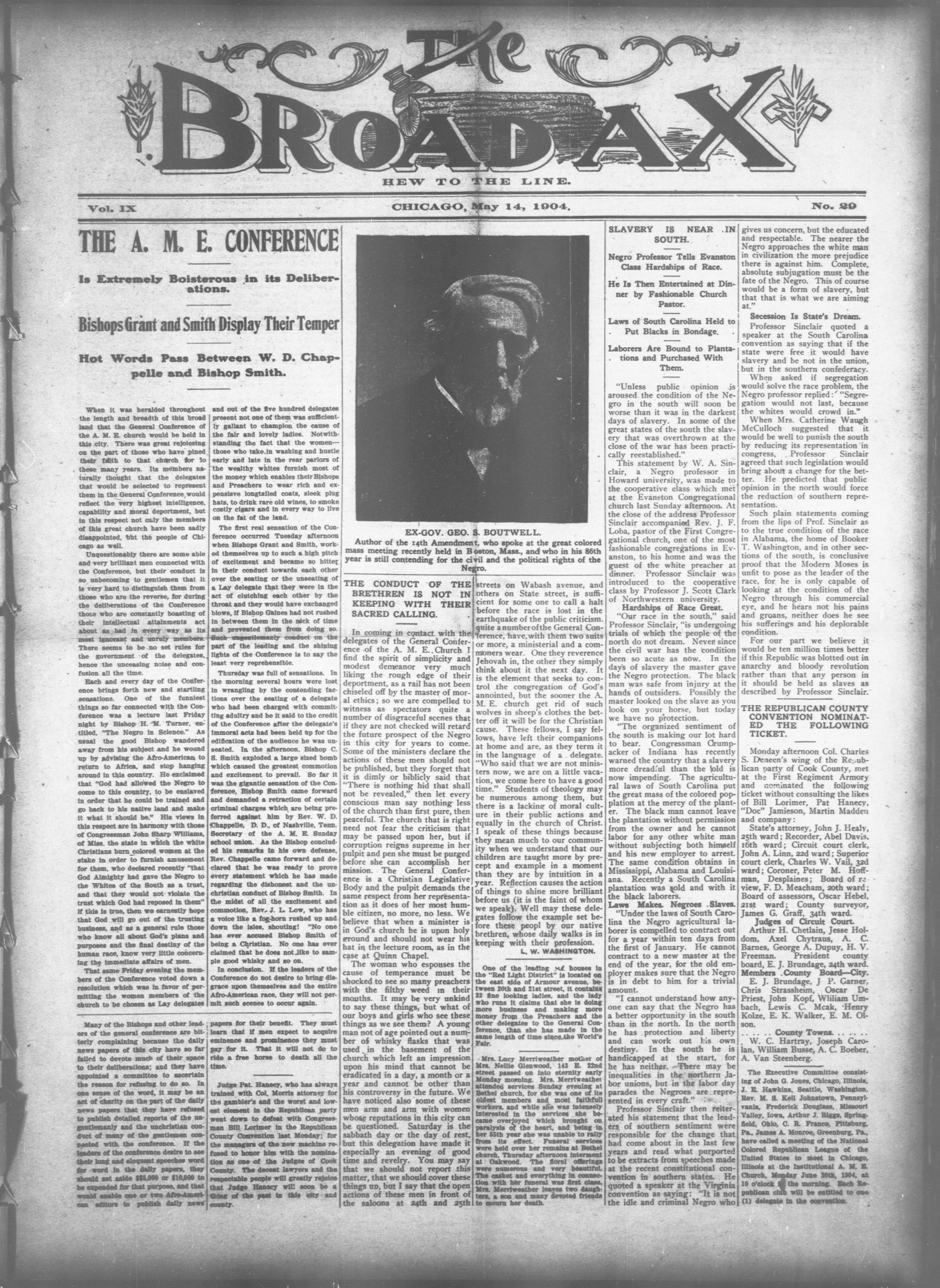
THE A. M. E. CONFERENCE
Is Extremely Boisterous in its Deliberations.
Bishops Grant and Smith Display Their Temper
Hot Words Pass Between W. D. Chappelle and Bishop Smith.
Vol. IX
THE A. M. E.
Is Extremely Boisterous
Bishops Grant and Smith
Hot Words Pass Belle and Belle
When it was heralded throughout the length and breadth of this broad land that the General Conference of the A. M. E. church would be held in this city. There was great rejoiceing on the part of those who have pined their faith to that church for 10 these many years. Its members naturally thought that the delegates that would be selected to represent them in the General Conference, would reflect the very highest intelligence, capability and moral deportment, but in this respect not only the members of this great church have been sadly disappointed, but the people of Chicago as well.
Unquestionably there are some able and very brilliant men connected with the Conference, but their conduct is so unbecoming to gentlemen that it is very hard to distinguish them from those who are the reverse, for during the deliberations of the Conference those who are constantly boasting of their intellectual attainments act about as bad in every way as its most ignorant and unruly members. There seems to be no set rules for the government of the delegates, hence the unceasing noise and confusion all the time.
Each and every day of the Conference brings forth new and startling sensations. One of the funniest things so far connected with the Conference was a lecture last Friday night by Bishop H. M. Turner, entitled, "The Negro in Science." As usual the good Bishop wandered away from his subject and he wound up by advising the Afro-American to return to Africa, and stop hanging around in this country. He exclaimed that "God had allowed the Negro to come to this country, to be enslaved in order that he could be trained and go back to his native land and make it what it should be." His views in this respect are in harmony with those of Congressman John Sharp Williams, of Miss. the state in which the white Christians burn colored women at the stake in order to furnish amusement for them, who declared recently "that God Almighty had gave the Negro to the Whites of the South as a trust, and that they would not violate the trust which God had reposed in them" if this is true, then we earnestly hope that God will go out of the trusting business, and as a general rule those who know all about God's plans and purposes and the final destiny of the human race, know very little concerning the immediate affairs of men.
That same Friday evening the members of the Conference voted down a resolution which was in favor of permitting the women members of the church to be chosen as Lay delegates
Many of the Bishops and other leaders of the general conference are bitterly complaining because the daily news papers of this city have so far failed to devote much of their space to their deliberations; and they have appointed a committee to ascertain the reason for refusing to do so. In one sense of the word, it may be an act of charity on the part of the daily news papers that they have refused to publish detailed reports of the ungentlemanly and the unchristian conduct of many of the gentlemen connected with the conference. If the leaders of the conference desire to see their long and eloquent speeches word for word in the daily papers, they should set aside $5,000 or $10,000 to be expended for that purpose, and that would enable one or two Afro-American editors to publish daily news
---
and out of the five hundred delegates present not one of them was sufficiently gallant to champion the cause of the fair and lovely ladies. Notwithstanding the fact that the women—those who take, in washing and hustle early and late in the rear parlors of the wealthy whites furnish most of the money which enables their Bishops and Preachers to wear rich and expensisve longtailed coats, sleek plug hats, to drink rare old wines, to smoke costly cigars and in every way to live on the fat of the land.
The first real sensation of the Conference occurred Tuesday afternoon when Bishops Grant and Smith, worked themselves up to such a high pitch of excitement and became so bitter in their conduct towards each other over the seating or the unseating of a Lay delegate that they were in the act of clutching each other by the throat and they would have exchanged blows, if Bishop Gaines had not rushed in between them in the nick of time and prevented them from doing so. Such ungentlemanly conduct on the part of the leading and the shining lights of the Conference is to say the least very reprehensible.
Thursday was full of sensations. In the morning several hours were lost in wrangling by the contending factions over the seating of a delegate who had been charged with committing adultry and be it said to the credit of the Conference after the delegate's immoral acts had been held up for the edification of the audience he was unseated. In the afternoon, Bishop C. S. Smith exploded a large sized bomb which caused the greatest commotion and excitement to prevail. So far it was the gigantic sensation of the Conference, Bishop Smith came forward and demanded a retraction of certain criminal charges which are being preferred against him by Rev. W. D. Chappelle, D. D., of Nashville, Tenn. Secretary of the A. M. E. Sunday school union. As the Bishop concluded his remarks in his own defense, Rev. Chappelle came forward and declared that he was ready to prove every statement which he has made regarding the dishonest and the unchristian conduct of Bishop Smith. In the midst of all the excitement and commotion, Rev. J. L. Low, who has a voice like a fog-horn rushed up and down the isles, shouting! "No one has ever accused Bishop Smith of being a Christian. No one has ever claimed that he does not like to sample good whisky and so on.
In conclusion. If the leaders of the Conference do not desire to bring disgrace upon themselves and the entire Afro-American race, they will not permit such scenes to occur again.
papers for their benefit. They must learn that if men expect to acquire eminence and prominence they must pay for it. That it will not do to ride a free horse to death all the time.
Judge Pat. Hanecy, who has always trained with Col. Morris attorney for the gambler's and the worst and lowest element in the Republican party went down to defeat with Congressman Bill Lorimer in the Republican County Convention last Monday; for the managers of the new machine refused to honor him with the nomination as one of the Judges of Cook County. The decent lawyers and the respectable people will greatly rejoice that Judge Hanecy will soon be a thing of the past in this city and county.
HEW TO THE LINE.
Author of the 14th Amendment, who spoke at the great colored mass meeting recently held in Boston, Mass., and who in his 86th year is still contending for the civil and the political rights of the
THE CONDUCT OF THE BRETHREN IS NOT IN KEEPING WITH THEIR SACRED CALLING.
In coming in contact with the delegates of the General Conference of the A. M. E., Church I find the spirit of simplicity and modest demeanor very much liking the rough edge of their deportment, as a rail has not been chiseled off by the master of moral ethics; so we are compelled to witness as spectators quite a number of disgraceful scenes that if they are not checked will retard the future prospect of the Negro in this city for years to come. Some of the ministers declare the actions of these men should not be published, but they forget that it is dimly or biblicly said that "There is nothing hid that shall not be revealed," then let every conscious man say nothing less of the church than first pure, then peaceful. The church that is right need not fear the criticism that may be passed upon her, but if corruption reigns supreme in her pulpit and pen she must be purged before she can accomplish her mission. The General Conference is a Christian Legislative Body and the pulpit demands the same respect from her representation as it does of her most humble citizen, no more, no less. We believe that when a minister is in God's church he is upon holy ground and should not wear his hat in the lecture room, as in the case at Quinn Chapel.
The woman who espouses the cause of temperance must be shocked to see so many preachers with the filthy weed in their mouths. It may be very unkind to say these things, but what of our boys and girls who see these things as we see them? A young man not of age pointed out a number of whisky flasks that was used in the basement of the church which left an impression upon his mind that cannot be eradicated in a day, a month or a year and cannot be other than his controversy in the future. We have noticed also some of these men arm and arm with women whose reputations in this city can be questioned. Saturday is the sabbath day or the day of rest, but this delegation have made it especially an evening of good time and revelry. You may say that we should not report this matter, that we should cover these things up, but I say that the open actions of these men in front of the saloons at 24th and 25th
streets on Wabash avenue, and others on State street, is sufficient for some one to call a halt before the race is lost in the earthquake of the public criticism. quite a number of the General Conference, have, with them two suits or more, a ministerial and a commoners wear. One they reverence Jehovah in, the other they simply think about it the next day. It is the element that seeks to control the congregation of God's anointed, but the sooner the A. M. E. church get rid of such wolves in sheep's clothes the better off it will be for the Christian cause. These fellows, I say fellows, have left their companions at home and are, as they term it in the language of a delegate. "Who said that we are not ministers now, we are on a little vacation, we come here to have a good time." Students of theology may be numerous among them, but there is a lacking of moral culture in their public actions and equally in the church of Christ. I speak of these things because they mean much to our community when we understand that our children are taught more by precept and example in a moment than they are by intuition in a year. Reflection causes the action of things to shine more brilliant before us (it is the faint of whom we speak). Well may these delegates follow the example set before these people by our native brethren, whose daily walks is in keeping with their profession. L. W. WASHINGTON.
One of the leading houses in the "Red Light District" is located on the east side of Armour avenue, between 20th and 21st street, it contains 32 fine looking ladies, and the lady who runs it claims that she is doing more business and making more money from the Preachers and the other delegates to the General Conference, than she has made in the same length of time since the World's Fair.
Mrs. Lucy Merriweather mother of Mrs. Nellie Glenwood, 143 E. 22nd street passed on into eternity early Monday morning. Mrs. Merriweather attended services Sunday evening at Bethel church, for she was one of its oldest members and most faithfull workers, and while she was intensely interested in the services she became overjoyed which brought on paralysis of the heart, and being in her 55th year she was unable to rally from its effect. Funeral services were held over her remains at Bethel church, Thursday afternoon interment at Oakwood. The floral offerings were numerous and very beautiful. The casket and everything in connection with her funeral was first class, Mrs. Merriweather leaves two daughters, a son and many devoted friends to mourn her death.
SLAVERY IS NEAR .IN SOUTH.
Negro Professor Tells Evanston Class Hardships of Race.
He Is Then Entertained at Dinner by Fashionable Church Pastor.
Laws of South Carolina Held to Put Blacks in Bondage.
Laborers Are Bound to Plantations and Purchased With
"Unless public opinion is aroused the condition of the Negro in the south will soon be worse than it was in the darkest days of slavery. In some of the great states of the south the slavery that was overthrown at the close of the war has been practically reestablished."
This statement by W. A. Sinclair, a Negro professor in Howard university, was made to the cooperative class which met at the Evanston Congregational church last Sunday afternoon. At the close of the address Professor Sinclair accompanied Rev. J. F. Loba, pastor of the First Congregational church, one of the most fashionable congregations in Evanston, to his home and was the guest of the white preacher at dinner. Professor Sinclair was introduced to the cooperative class by Professor J. Scott Clark of Northwestern university.
Hardships of Race Great.
"Our race in the south," said Professor Sinclair, "is undergoing trials of which the people of the north do not dream. Never since the civil war has the condition been so acute as now. In the days of slavery the master gave the Negro protection. The black man was safe from injury at the hands of outsiders. Possibly the master looked on the slave as you look on your horse, but today we have no protection.
"The organized sentiment of the south is making our lot hard to bear. Congressman Crumpacker of Indiana has recently warned the country that a slavery more dreadful than the old is now impending. The agricultural laws of South Carolina put the great mass of the colored population at the mercy of the planter. The black man cannot leave the plantation without permission from the owner and he cannot labor for any other white man without subjecting both himself and his new employer to arrest. The same condition obtains in Mississippi, Alabama and Louisiana. Recently a South Carolina plantation was sold and with it the black laborers.
"Under the laws of South Carolina the Negro agricultural laborer is compelled to contract out for a year within ten days from the first of January. He cannot contract to a new master at the end of the year, for the old employer makes sure that the Negro is in debt to him for a trivial amount.
"I cannot understand how anyone can say that the Negro has a better opportunity in the south than in the north. In the north he has protection and liberty and can work out his own destiny. In the south he is handicapped at the start, for he has neither. There may be inequalities in the northern labor unions, but in the labor day parades the Negroes are represented in every craft."
Professor Sinclair then reiterated his statement that the leaders of southern sentiment were responsible for the change that had come about in the last few years and read what purported to be extracts from speeches made at the recent constitutional convention in southern states. He quoted a speaker at the Virginia convention as saying: "It is not the idle and criminal Negro who
No.29
gives us concern, but the educated and respectable. The nearer the Negro approaches the white man in civilization the more prejudice there is against him. Complete, absolute subjugation must be the fate of the Negro. This of course would be a form of slavery, but that that is what we are aiming at."
Secession Is State's Dream.
Professor Sinclair quoted a speaker at the South Carolina convention as saying that if the state were free it would have slavery and be not in the union, but in the southern confederacy. When asked if segregation would solve the race problem, the Negro professor replied: "Segregation would not last, because the whites would crowd in."
When Mrs. Catherine Waugh McCulloch suggested that it would be well to punish the south by reducing its representation in congress, Professor Sinclair agreed that such legislation would bring about a change for the better. He predicted that public opinion in the north would force the reduction of southern representation.
Such plain statements coming from the lips of Prof. Sinclair as to the true condition of the race in Alabama, the home of Booker T. Washington, and in other sections of the south, is conclusive proof that the Modern Moses is unfit to pose as the leader of the race, for he is only capable of looking at the condition of the Negro through his commercial eye, and he hears not his pains and groans, neither does he see his sufferings and his deplorable condition.
For our part we believe it would be ten million times better if this Republic was blotted out in anarchy and bloody revolution rather than that any person in it should be held as slaves as described by Professor Sinclair.
THE REPUBLICAN COUNTY CONVENTION NOMINATED THE FOLLOWING TICKET.
Monday afternoon Col. Charles S. Deneen's wing of the Republican party of Cook County, met at the First Regiment Armory and nominated the following ticket without consulting the likes of Bill Lorimer, Pat Hanecy, "Doc" Jamieson, Martin Madden and company:
State's attorney, John J. Healy, 25th ward; Recorder, Abel Davis, 16th ward; Circuit court clerk, John A. Linn, 22d ward; Superior court clerk, Charles W. Vail, 32d ward; Coroner, Peter M. Hoffman, Desplaines; Board of review, F. D. Meacham, 20th ward; Board of assessors, Oscar Hebel, 21st ward; County surveyor, James G. Graff, 34th ward.
Arthur H. Chetlain, Jesse Holdom, Axel Chytraus, A. C. Barnes, George A. Dupuy, H. V. Freeman. President county board, E. J. Brundage, 24th ward. Members County Board—City. E. J. Brundage, J P. Garner, Chris Strassheim, Oscar De Priest, John Kopf, Wliliam Umbach, Lewis C. Mcak, Henry Kolze, E. K. Walker, E. M. Olson.
County Towns. W. C. Hartray, Joseph Carolan, William Busse, A. C. Boeber, A. Van Steenberg.
The Executive Committee consisting of John G. Jones, Chicago, Illinois, J. E. Hawkins, Seattle, Washington, Rev. M. S. Kell Johnstown, Pennsylvania, Frederick Douglass, Missouri Valley, Iowa, Arthur J. Riggs, Springfield, Ohio, C. R. France, Pittsburg, Pa., James A. Monroe, Greenburg, Pa., have called a meeting of the National Colored Republican League of the United States to meet in Chicago, Illinois at the Institutional A. M. E. Church, Monday June 20th, 1904, at 10 o'clock in the morning. Each Republican club will be entitled to one (1) delegate in the convention.
Will promulgate and at all times uphold the true principles of Democracy, but Catholics, Protestants, Priests, Infidels, Farmers, Single Taxes, Republics, Knights of Labor, or any one also can have their say, so long as their language is proper and responsibility is fixed.
The Broad Ax is a newspaper whose platform is broad enough for all, ever claiming the editorial right to speak its own mind.
Local communications will receive attention. Write only on one side of the paper.
Subscriptions must be paid in advance.
Entered at the Post Office at Chicago, Ill., as Second-class Matter.
Chicago, May 12, 1904 Editor of The "Broad AX," Chicago, Ill. Dear Sir:
Thinking that you and your readers have been, for some time past, interested in the progress of the work on the plantation of the American Mutual Plantation Company, I have thought it due to you and your readers that I should keep you informed as to that progress. I believe that any one who makes an investment in a company is entitled to the very fullest information as to what that company is doing. Of course it would be much better for the readers of The "Broad Ax" to call personally at the office of our company and get first hand information that we are anxious to give, but that is, no doubt, out of the question for many of your readers.
Everything has gone very smoothly and prosperously with us from the very beginning of our work. The bonds that we have been selling have been taken out very rapidly and by an excellent class of investors. In fact, we have met with such success in the placing of these securities that in all probability the selling of these bonds will be discontinued in a very short time, perhaps never to be resumed. Therefore, any of your readers who have not already invested and who wish to take out these high class securities, should make application within the next few weeks, if they wish to obtain them at their present price. We have been very pleased with the class of people who have profited by the opportunity to buy our goods. Leading business and professional men, as well as salaried people of high grade have taken out by far the greater number of the bonds that have been sold to date.
As to the work on the plantation itself, we can only say that we are far in advance of the work that we have contracted to do. Our choice of a plantation manager has evidently been an excellent one, because we find that the work has not only been well done, but quickly done. We have had very little trouble in getting and keeping in our employ all the help necessary for our work. This fact we believe is largely due to the excellent character of the local management.
We find that the judgment exercised in the beginning in determining the character of crops that would be most profitable was well founded, for all of the information at our disposal up to the present goes to prove that the cultivation of sugar cane, tobacco, vanilla, bananas, corn, etc., and the raising of cattle, are by all means the most profitable enterprises that we could have undertaken.
The discovery of coal on the plantation will, without doubt, add very materially to the value of the bonds, as will also the purchase of an additional tract of 1,500 acres, which will make our holdings upwards of 5,000 acres of some of the best land that can possibly be procured in any part of the tropical world. When one considers that probably four-fifths of this entire acreage is covered with valuable timber, one can easily conclude that even in the natural state our property is a great wealth producer.
In fact, Mr. Editor, the writer has had difficulty in presenting the facts as to our plantation in a sufficiently mild way as to guard against the accusation of grossly over-stating the truth. If any of your readers doubt the ex-
10
cellence of our enterprise, we wish they would take the trouble to obtain the United States Government Report on Mexico and read there of the wonderful chances for the profitable investment of money that exists in the tropical part of the Republic of Mexico. Yours sincerely, E. S. BARKER, Bond Dept. American Mutual Plantation Co., Suite 431-435 Chicago Stock Exchange Bldg.
JAPS ORDERLY DURING WAR
Mayors of Principal Cities in Island Declare Normal Conditions Are Prevailing There.
A cablegram has been received by the Japanese minister from Tokio to the effect that the mayors of the principal cities of Japan have been receiving for some time past letters from all parts of the world inquiring as to the condition of affairs in Japan. These letters usually come from prospective travelers who desire to know whether or not it is safe to visit the country. In response the mayors have issued the following statement:
"In answer to inquiries too numerous to be individually responded to, and in the hope of correcting erroneous impressions that may possibly exist abroad, we, the mayors of the principal cities of Japan, beg to give assurance that normal conditions prevail throughout the empire. Japan in war is as orderly as Japan in peace. Business men and travelers who contemplate journeying to Japan will encounter no inconvenience and will be exposed to no danger. The ordinary means of communication by land and sea are not and will not be interrupted. Japan and its territorial waters are not within the zone of hostilities, and the position and the advantages of our fleets and armies insure the empire against invasion."
SUICIDES' CLOTHES GOOD.
Women Who Seek Self-Destruction Always Array Themselves in Their Best.
Women who are driven to suicide presumably lose most of their ambition, before taking the fatal plunge, but there is one feminine trait that they retain to, the end—namely: pride in clothes, says the Chicago Tribune.
"Seldom," says a doctor whose position has required him to perform postmortem services for many of these unfortunates, "have I seen a woman who did not go to her death as well dressed as her circumstances would allow. The published reports of these tragedies confirm my observation. Read in the papers the account of a suicide, and nine times out of ten it will wind up by saying 'the woman was well dressed,' or at the least, 'her clothing was neat and clean.'
"Unless these women belong to the dregs they are found dressed in the silk skirt and silk walst, which have become the inevitable garb of the suicide of moderate means. At the last the true feminine instinct seems to assert itself, and, although the woman will not be here to read the account of the tragedy, she wants to die in the blessed satisfaction that she will be written up as a well-dressed member of society."
CHAUFFEUR'S NEW DISEASE.
"Motorpathea Cerebralis" the Latest Alliment to Which Auto Drivers Are Subject.
"Motorpathea cerebralis," the new disease to which chauffeurs are subject, is diagnosed by the London doctor who has discovered it as producing "temporary disorganization of the mental functions" and "derangement of the equilibrium of the nervous system."
The disease will explain many things about chauffeurs hitherto not quite understood. As, for example, how the 50-mile-an-hour gait of the clubhouse story falls to 15 when sworn to in court. The "derangement of equilibrium" has, of course, disturbed the narrator's sense of time. Similarly, in putting the blame on the other fellow after an accident, in direct contradiction of the policeman's testimony, the chauffeur is not necessarily untruthful, but merely suffering from temporary derangement of his veracity. "Speed madness" may be traced to a like disturbance of equilibrium. Automobilists are reported as amused at the doctor's discovery. When penalties are made harsher they may have occasion to feel grateful for the means provided for an acquittal.
GLORIFIED BY SHACKLES.
The cost of constructing some of the little "jerk-water" lines in Peru is enormous. One contractor had 6,000 laborers die while he was building 115 miles of track through a swamp. The handling of this mongrel labor is an intricate problem. If you beat them it does little good. They would get up after a thrashing and kiss your hand. If you put them in chains they feel like martyrra. Instead of feeling disgraced the shackles seem to add to the native's sense of importance. He feels that he must be a bold, bad man to be treated in such a decisive way. It rather glorifies him in his own estimation.
The Japanese women have no servant problem to solve, simply because they do not look down on servants as such. Visitors bow as low to servants as to their mistresses, and if the mistress is away the servants serve tea and entertain the visitors.
NEW YORK'S CHILD FARMERS Hundred and Twenty-Five Youthful Beubens Cared For-Plots During Summer of 1903.
One hundred and twenty-five farmers cared for their plots during the first season, but in the following spring, so many requests for "farms" were received that the park authorities decided to enlarge the space allotted, so that nearly 300 boy and girl farmers, varying in age from eight to 18 years, were happily employed during the second summer—that of 1903, says a writer in Review of Reviews. Through the long, hot days of July and August you might see them watering, weeding, hoeing or quietly sitting around the central flower plot listening to a nature study talk by the attendant teacher. Improvements upon the surrounding land followed rapidly in the wake of those upon the farm. Toward the east the park department had placed a huge open-air gymnasium and playground. Toward the west a tiny country seat, with a 12x18 foot farmhouse, a green lawn and flower beds, a pavilion, a pig pen and a chicken house had been added to the farm property. Still farther west stood a sand tent, and a second canvas formed a resting place for tired mothers. A typical afternoon might have shown 80 or 100 children busy in the garden; in the pavilion, a sewing class and a group weaving baskets for farm produce; in the tiny house tea being served by neatly aproned housekeepers, while on the lawn the boys played croquet.
CONSIDERATE OF PASTOR.
Former Bodyguard of Rockefeller Tells Humorous Story of Vermont Minister.
Capt. George Archer, who recently gave up his post of bodyguard to John D. Rockefeller, heard, during his 19 years of service, many interesting and odd things. "Yes," he said the other day," according to the Chicago Record-Herald, "I had some strange experineces while I was working for Mr. Rockefeller. I halted a good many queer people at Mr. Rockefeller's outer door. "I remember a Baptist minister I held up there last year. He hailed from a little town in Vermont, and he talked like a brother to me. He told me all about a minister's life in the country.
"It isn't an easy life. You'd be surprised to hear how some country people treat their ministers. Why, this man said that one cold winter night he was hustled out of bed by a woman he didn't know and ordered to come right away to her house, two miles off, because her son was sick.
"But I don't know you,' the minister grumbled. 'Are you a member of my church? Am I your pastor?"
"No,' said the woman, 'I'm a member of Mr. McWade's church. Mr. McWade is my pastor. I don't care about calling him in, though. My son's case is contagious.'"
LADY CURZON A DETECTIVE
Former Chicago Girl Disguised in Native Dress Solved Indian Murder Mystery.
Lady Curzon, who was Miss Lelter, of Chicago, is a clever detective, and this incident could be made into an absorbing story by either Conan Doyle or Rudyard Kipling.
A retired Indian judge tells it. He was dining at the viceregal lodge one night, and the conversation turned upon a sensational murder trial which he was conducting at the time. After dinner Lady Curzon drew the judge aside and said:
"I know as an absolute fact that the man who is charged with that murder is innocent. Send a detective to me and I will direct him to the house where the real murderer is now hiding. I only discovered the fact this afternoon, when I was down there in disguise with one of our syces."
Sure enough, the murderer was caught, as Lady Curzon had said, and the innocent man was released. This incident, becoming known, has made her very popular with the people of Calcutta, who are not used to English "mem-sahiba" taking so much interest in their humble lives.
Female Measurements Larger
A woman's periodical published in London is worried at the size of the modern woman. "Whereas," it says, "a decade since the average size in women's shoes was three, five being accounted specially large, seven and eight are now, commonly asked for, while the average size has become five. The little glove has likewise grown into a good-sized hand shoe. My lady's hosiery has become bigger at the same time—in short, the average girl of 1904 could not wear any article of apparel that fitted the girl of 1874. And where, one now tremblingly asks, is this to end?"
A Big Enterprise.
Wireless telegraph communication is to be attempted between Para, Brazil, and Manaos, a thousand miles up the Amazon, says the New York Tribune. A land line telegraph between these points is impossible, and the submerged cable recently laid in the bed of the river to connect them is said to be out of order three-fourths of the time, and the cable company has, therefore, purchased the rights for a wireless telegraph installation. From Manaos the service may be extended to Iquitos and other centers of the rubber trade on the upper Amazon.
World's Largest Hospital. Plans for a new Bellevue hospital in New York city, provide for the largest hospital in the world. It will take ten years to finish the structure and will cost $12,000,000. It is to be fireproof.
"This," said Mrs. Porcpacque, exhibiting a diamond-studded gold chain, with gold clasps at each end, "is for my husband's birthday. I had it made special."
"But what is it? What are the clasps or?" inquired Mrs. Ascum.
"Why, don't you see, it's a napkin holder; holds his napkin right up under his chin."—Philadelphia Press.
Getting His Measure.
"So Josh has been in town three weeks."
"Yes," answered Farmer Corntossel. "How's he getting along?" "I dunno yet. There's no tellin' for a month or so how a boy's goin' to turn out in the city. I reckon we'll know in a short time whether he's a gold brick buyer or a gold brick seller."—Washington Star.
Unanswered.
Harry's mother had found it necessary to punish him by whipping him thoroughly. His shrieks brought the ready tears to his mother's eyes, and she informed him that it hurt her just as much as it did him.
"Well," he managed to say, "what's the use of making us both feel bad, then?"—Philadelphia Ledger.
You Know Them.
A fellow cannot live on love,
But lots of men there are,
Whom you and I have knowledge of
Who live on their love's pa.
—Philadelphia Press.
LIKELY TO LAST.
A
He (after the acceptance)—Have you never loved anyone so much as you do me?
She (thoughtfully)—Not in the spring.
—N. Y. Weekly.
Contentment does not spring from wealth. We are told, and that may be; And yet we know it doesn't flow From grinding poverty. -Philadelphia Ledger.
Stranger—What's that crowd across the way?
Native—That's our string band.
Stranger—You don't say! Going to give an entertainment, I suppose.
Native—Yes; going to string up a hoss thief.—Cincinnati Enquirer.
Not Much Difference.
Wayward Hobbs—I used ter be a milkman, lady; after dat I wuz a sailor.
Mrs. Handout—Quite a difference of vocations.
Wayward Hobbs—Oh, I don't know. On my first voyage I wuz at de pumps most ov de time.—Judge.
One with a Real Problem. Naggus—They tell me you have written a problem play. Would you mind telling me what the problem is? Borus—Just at present the problem is to find some manager that will stand for it.—Chicago Tribune.
"Does your little girl know how to spell?"
"Oh, dear no. That's so plebeian, and we expect her to marry a man who is rich enough to let her have an amanuensis."—Chicago Post.
An Exception.
Teacher—A scream, Tommy, is an exclamation of pain. How can you say it is an exclamation of pleasure?
Tommy—I was alluding to de scream a girl gives when a man kisses her. Chicago Daily News.
Father—Where's the Bible? It used to be in the parlor on the center table.
Mother—Oh, it hasn't been kept there since the girls grew up. They didn't want the boys to know their ages.—Cleveland Leader.
Theory and Practice.
Knicker—Who is the lecturer who made such an eloquent plea for the simpler life?
Bocker—That's Jones; he's trying to make enough money to get an automobile.—N. Y. Sun.
The Reason.
Little Girl—Mamma says I must study grammar this term.
Little Boy—What's that for?
Little Girl—That's so I can laugh when folks make mistakes. — Boston Herald.
"No, but I've been soaked for about everybody else that I've ever been introduced to."—Chicago Record-Herald.
Heartless.
The Pupil—Now, I want you to be perfectly candid with me. Do you think my technique is getting better?
The Professor—Perhaps; but it's far from convalescent as yet.—Punch.
The More Important Character.
Prof. Bookish—Emerson was not a master of style.
Prof. Rockbottom—Well, he was master of ideas.—Cincinnati Commercial Tribune.
FRESH FEMININE FINERY.
Old English embroidery is to have an all-summer run.
Hyacinthine blue looks well on both blondes and brunettes.
Some of the new jackets have two graduated tucks up the back.
Very many evening dresses have long sleeves, full at the elbow.
Silk lace grenadines in lovely colors are the most attractive of new fabrics.
The most gorgeous plume of all is all red one side the quill and all creamy yellow the other.
are the most attractive of new fabrics.
The most gorgeous plume of all is all red one side the quill and all creamy yellow the other.
Coats to the linen and pique costumes vary from the three-quarter Norfolk to the very short eton.
It's a comfort to know that walking skirts at least will be exempt from the craze for skirt fullness.
Delightful 1830 possibilities hover in those soft mulls, lawns and organdies, of which the shops are full.
A new trimming is a braid which is made of punched velvet with satin ribbons run through the openings.
Evening gowns do not have the lace falling far enough down to interfere with the movements of the hand.
The woman who went without furs all winter is now reaping her reward in the big fur reductions in all the shops.
If you happen to have some mink edging or some sort of fur trimming by you you can make a chaming short skating frock with corduroy velvet.
An ecru batiste, heavily hand-embroidered with big red and brown popples, is edged with a ruche of red chiffon peeping from beneath the skirt.
SOME HORSE LORE.
Never examine a harness horse to halter, or one kept for saddling purposes in harness.
Don't pass final judgment on a high-spirited horse fresh from the stable, or one thoroughly tired out.
Don't fail to size up the owner or driver, and draw your own deduction from their statements, substantiated by your own observations of the horse.
Men are extravagant to the verge of recklessness for at least three months after the marriage ceremony.
-- American
President and Treasurer, THE
Vice-President, JOHN
Secretary
MANUFACTURE
Common and
Office an
45th and
Yards running winter
with the latest improv
Output of Winter Yards ...
Output of Summer Yards...
Telephone
American Brick
Treasurer, THOMAS CARD
e-President, JOHN SHELLI
Secretary, WILLIAM
MANUFACTURERS O
n and Sewer
Office and Yards:
and Robe
running winter and summer,
the latest improved Wolf Dryer
ards.
phone Yard
WILLIAM
t.
TEST SIDE
BREWERY
COMPANY
-- American Brick Co. --
President and Treasurer, THOMAS CAREY. Vice-President, JOHN SHELHAMER, Secretary, WILLIAM SULLIVAN. MANUFACTURERS OF
Yards running winter and summer, equipped with the latest improved Wolf Dryer.
Output of Winter Yards ..... 144,00 per day
Output of Summer Yards..... 304,00 per day
Telephone Yards 128.
WEST SIDE BREWERY COMPANY CHICAGO, U. S. A.
CORNER AUGUSTA AN
Monroe 1567—T E I. E P
AUGUSTA AND PAULINA S
TELEPHONES
Old
CORNER AUGUSTA AND PAULINA STREETS.
Monroe 1567——TE I. E PH O N E S——Monroe 1573.
If your physician recommends the use of a stimulant, there is no whisky in which so many desirable qualities are contained as in Old Underoof Rye and it has the least reactive effect. Because it is made right and is aged right.
CHAS. DENNEHY & CO.
CHICACO
JOHN A ORB,
President.
Fifty-First St. and Armour Ave.
RAIL YARDS: 51st St. & L. S. & M. S. Ry.
52nd St. and Armour Ave.
CHICAGO
WONDERFUL
DISCOVERY
Curly Hair Made Straight By
TAKEN FROM LIFE:
BEFORE AND AFTER TREATMENT.
ORIGINAL
OZONIZED OX MARROW
(Copyrighted.)
This wonderful hair pomade is the only safe preparation in the world that makes kinky or curly hair straight as shown above. It nourishes the scalp, prevents the hair from fall, shears the scalp, ensures the hair from dandruff and makes the hair grow long and silky for forty years and used by thousands. Warranted harmless. It was the first preparation ever sold for straightening kinky hair. Beware of imitations. Get the Original Ozonized OX MARROW CO., keep the hair straight, soft and beautiful, giving it that healthy, life-like appearance so much desired. A toilets necessity for ladies, gentlemen and children. Elegantly perfumed. Owing to its superior and lasting qualities it is not possible for anybody to produce a pomade equal so it. Full directions with every bottle. Only 50 cents. Sold by druggists and dealers or send us 50 cents for one bottle or $1.40 for three bottles. We pay all express charges on final order. Please mention name of this paper when ordering. Write your name and address plainly to
OZONIZED OX MARROW CO.,
76 Wabash Ave., Chicago, Illinois.
First class furnished roms for rent to gentleman, with bath and gas. 2628 Wabash avenue.
Brick Co. --
THOMAS CAREY.
JOHN SHELHAMER,
Bry, WILLIAM SULLIVAN.
FURNERS OF
Sewer Brick
d Yards:
Robey Sts.
and summer, equipped
ed Wolf Dryer.
140,00 per day
300,00 per day
Yards 128.
WILLIAM LEGNER,
Vice Pres. & Treas.
SIDE
VERY
ANY,
O PAULINA STREETS.
H O N E S——Monroe 1573.
THE PALACE OF THE PRESIDENT
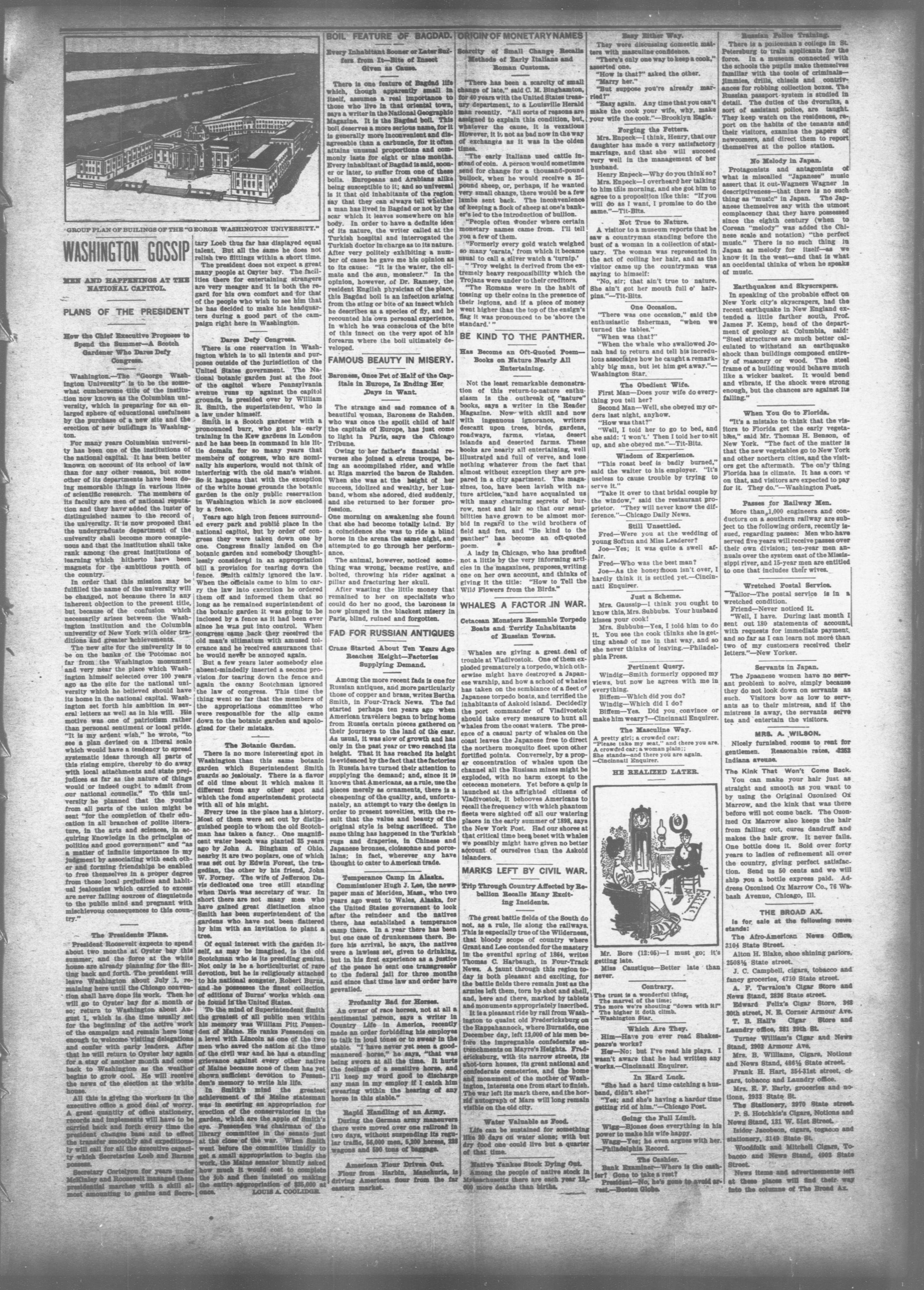
GROUP PLAN OF BUILINGS OF THE "GEORGE WASHINGTON UNIVERSITY."
WASHINGTON GOSSIP
MEN AND HAPPENINGS AT THE NATIONAL CAPITOL
PLANS OF THE PRESIDENT
Washington.—The "George Washington University" is to be the somewhat cumbersome title of the institution now known as the Columbian university, which is preparing for an enlarged sphere of educational usefulness by the purchase of a new site and the erection of new buildings in Washington.
For many years Columbian university has been one of the institutions of the national capital. It has been better known on account of its school of law than for any other reason, but some other of its departments have been doing memorable things in various lines of scientific research. The members of its faculty are men of national reputation and they have added the luster of distinguished names to the record of the university. It is now proposed that the undergraduate department of the university shall become more conspicuous and that the institution shall take rank among the great institutions of learning which hitherto have been magnets for the ambitious youth of the country.
In order that this mission may be fulfilled the name of the university will be changed, not because there is any inherent objection to the present title, but because of the confusion which necessarily arises between the Washington institution and the Columbia university of New York with older traditions and greater achievements.
The new site for the university is to be on the banks of the Potomac not far from the Washington monument and very near the place which Washington himself selected over 100 years ago as the site for the national university which he believed should have its home in the national capital. Washington set forth his ambition in several letters as well as in his will. His motive was one of patriotism rather than personal sentiment or local pride. "It is my ardent wish," he wrote, "to see a plan devised on a liberal scale which would have a tendency to spread systematic ideas through all parts of this rising empire, thereby to do away with local attachments and state prejudices as far as the nature of things would or indeed ought to admit from our national councils." To this university he planned that the youths from all parts of the union might be sent "for the completion of their education in all branches of polite literature, in the arts and sciences, in acquiring Knowledge in the principles of politics and good government" and "as a matter of infinite importance in my judgment by associating with each other and forming friendships be enabled to free themselves in a proper degree from those local prejudices and habitual jealousies which carried to excess are never falling sources of disquietude to the public mind and pregnant with mischievous consequences to this country."
The Presidents Plans.
President Roosevelt expects to spend about two months at Oyster bay this summer; and the force at the white house are already planning for the fitting back and forth. The president will leave Washington about July 1, remaining here until the Chicago convention shall have done its work. Then he will go to Oyster bay for a month or so; return to Washington about August 1, which is the time usually set for the beginning of the active work of the campaign and remain here long enough to welcome visiting delegations and confer with party leaders. After that he will return to Oyster bay again for a stay of another month and come back to Washington as the weather begins to grow cool. He will receive the news of the election at the white house.
All this is giving the workers in the executive office a good deal of worry. A great quantity of office stationery, records and implements will have to be carried back and forth every time the president changes base and to effect the transfer smoothly and expeditiously will call for all the executive capacity which Secretaries Loeb and Barnes possess. Secretary Cortelyou for years under McKinley and Roosevelt managed these presidential marches with a skill almost amounting to genius and Secre-
tary Loeb thus far has displayed equal talent. But all the same he does not relish two flirtings within a short time. The president does not expect a great many people at Osyter bay. The facilities there for entertaining strangers are very meager and it is both the regard for his own comfort and for that of the people who wish to see him that he has decided to make his headquarters during a good part of the campaign right here in Washington.
Dares Defy Congress.
There is one reservation in Washington which is to all intents and purposes outside of the jurisdiction of the United States government. The National botanic garden just at the foot of the capitol where Pennsylvania avenue runs up against the capitol grounds, is presided over by William R. Smith, the superintendent, who is a law under himself.
Smith is a Scotch gardener with a pronounced burr, who got his early training in the Kew gardens in London and he has been in command in his little domain for so many years that members of congress, who are nominally his superiors, would not think of interfering with the old man's wishes. So it happens that with the exception of the white house grounds the botanic garden is the only public reservation in Washington which is now enclosed by a fence.
Years ago high iron fences surrounded every park and public place in the national capitol, but by order of congress they were taken down one by one. Congress finally landed on the botanic garden and somebody thoughtlessly considered in an appropriation bill a provision for tearing down the fence. Smith calmly ignored the law. When the officials came to him to carry the law into execution he ordered them off and informed them that so long as he remained superintendent of the botanic garden it was going to be enclosed by a fence as it had been ever since he was put into control. When congress came back they received the old man's ultimatum with amused tolerance and he received assurances that he would never be annoyed again.
But a few years later somebody else absent-mindedly inserted a second provision for tearing down the fence and again the canny Scotchman ignored the law of congress. This time the thing went so far that the members of the appropriations committee who were responsible for the slip came down to the botanic garden and apologized for their mistake.
The Botanic Garden.
There is no more interesting spot in Washington than this same botanic garden which Superintendent Smith guards so jealously. There is a flavor of old time about it which makes it different from any other spot and which the fond superintendent protects with all of his might.
Every tree in the place has a history. Most of them were set out by distinguished people to whom the old Scotchman has taken a fancy. One magnificent water beech was planted 35 years ago by John A. Bingham of Ohio. nearby it are two poplars, one of which was set out by Edwin Forest, the tragedian, the other by his friend, John W. Forney. The wife of Jefferson Davis dedicated one tree still standing when Davis was secretary of war. In short there are not many men who have gained great distinction since Smith has been superintendent of the gardens who have not been flattered by him with an invitation to plant a tree.
Of equal interest with the garden itself, as may be imagined, is the old Scotchman who is its presiding genius. Not only is he a horticulturist of rare devotion, but he is religiously attached to his national songster, Robert Burns, and he possesses the finest collection of editions of Burns' works which can be found in the United States.
To the mind of Superintendent Smith the greatest of all public men within his memory was William Pitt Fessenden of Maine. He ranks Fessenden on a level with Lincoln as one of the two men who saved the nation at the time of the civil war and he has a standing grievance against every other native of Maine because none of them has yet shown sufficient devotion to Fessenden's memory to write his life.
In Smith's mind the greatest achievement of the Maine statesman was in securing an appropriation for erection of the conservatories in the garden, which are the apple of Smith's eye. Fessenden was chairman of the library committee in the senate just at the close of the war. When Smith went before the committee timidly to get a small appropriation to begin the work, the Maine senator bluntly asked how much it would cost to complete the job and then insisted on making the entire appropriation of $25,000 at once. LOUIS A. COOLIDGE.
BOIL FEATURE OF BAGDAD. Every Inhabitant Sooner or Later Buffers from It-Bite of Insect Given as Cause.
There is one feature of Bagdad life which, though apparently small in itself, assumes a real importance to those who live in that oriental town, says a writer in the National Geographic Magazine. It is the Bagdad boil. This boil deserves a more serious name, for it is generally more inconvenient and disagreeable than a carbuncle, for it often attains unusual proportions and commonly lasts for eight or nine months. Every inhabitant of Bagdad is said, sooner or later, to suffer from one of these boils. Europeans and Arabians alike being susceptible to it; and so universal is it that old inhabitants of the region say that they can always tell whether a man has lived in Bagdad or not by the scar which it leaves somewhere on his body. In order to have a definite idea of its nature, the writer called at the Turkish hospital and interrogated the Turkish doctor in charge as to its nature. After very politely exhibiting a number of cases he gave me his opinion as to its cause: "It is the water, the climate and the sun, monsieur." In the opinion, however, of Dr. Ramsey, the resident English physician of the place, this Bagdad boil is an infection arising from the sting or bite of an insect which he describes as a species of fly, and he recounted his own personal experience, in which he was conscious of the bite of this insect on the very spot of his forearm where the boil ultimately developed.
FAMOUS BEAUTY IN MISERY.
Baroness, Once Pet of Half of the Capitals in Europe, Is Ending Her Days in Want.
The strange and sad romance of a beautiful woman, Baroness de Rahden, who was once the spoilt child of half the capitals of Europe, has just come to light in Paris, says the Chicago Tribune.
Owing to her father's financial reverses she joined a circus troupe, being an accomplished rider, and while at Riga married the baron de Rahden. When she was at the height of her success, idolized and wealthy, her husband, whom she adored, died suddenly, and she returned to her former profession.
One morning on awakening she found that she had become totally blind. By a coincidence she was to ride a blind horse in the arena the same night, and attempted to go through her performance.
The animal, however, noticed something was wrong, became restive, and bolted, throwing his rider against a pillar and fracturing her skull.
After wasting the little money that remained to her on specialists who could do her no good, the baroness is now plunged in the blackest misery in Paris, blind, ruined and forgotten.
FAD FOR RUSSIAN ANTIQUES
Among the more recent fads is one for Russian antiques, and more particularly those of copper and brass, writes Bertha Smith, in Four-Track News. The fad started perhaps ten years ago when American travelers began to bring home from Russia certain pieces gathered on their journeys to the land of the czar. As usual, it was slow of growth and has only in the past year or two reached its height. That it has reached its height is evidenced by the fact that the factories in Russia have turned their attention to supplying the demand; and, since it is known that Americans, as a rule, use the pieces merely as ornaments, there is a cheapening of the quality, and, unfortunately, an attempt to vary the design in order to present novelties, with the result that the value and beauty of the original style is being sacrificed. The same thing has happened in the Turkish rugs and draperies, in Chinese and Japanese bronzes, cloissonne and porcelains; in fact, wherever any have thought to cater to American trade.
Temperance Camp in Alaska
Commissioner Hugh J. Lee, the newspaper man of Meriden, Mass., who two years ago went to Wales, Alaska, for the United States government to look after the reindeer and the natives there, has established a temperance camp there. In a year there has been but one case of drunkenness there. Before his arrival, he says, the natives were a lawless set, given to drinking, but in his first experience as a justice of the peace he sent one transgressor to the federal jail for three months and since that time law and order have prevailed.
Profanity Bad for Horses
An owner of race horses, not at all a sentimental person, says a writer in Country Life in America, recently made an order forbidding his employees to talk in loud tones or to swear in the stable. "I have never yet seen a good-mannered horse," he says, "that was being sworn at all the time. It hurts the feelings of a sensitive horse, and I'll keep my word good to discharge any man in my employ if I catch him swearing within the hearing of any horse in this stable."
David Handling of an Army
Mapid Handling or an Army.
During the German army maneuvers there were moved over one railroad in two days, without suspending its regular traffic, 56,000 men, 5,200 horses, 228 wagons and 590 tons of baggage.
American Flour Driven Out.
Flour from Harbin, Manchuria, is driving American flour from the far eastern market.
ORIGIN OF MONETARY NAMES
Scarcity of Small Change Recalls Methods of Early Italians and Roman Customs.
"There has been a scarcity of small change of late," said C. M. Binghamton, for 40 years with the United States treasury department, to a Louisville Herald man recently. "All sorts of reasons are assigned to explain this condition, but, whatever the cause, it is vexatious However, it is not as bad now in the way of exchanges as it was in the olden times.
"The early Italians used cattle instead of coin. A person would sometimes send for change for a thousand-pound bullock, when he would receive a 25-pound sheep, or, perhaps, if he wanted very small change, there would be a few lambs sent back. The inconvenience of keeping a flock of sheep at one's banker's led to the introduction of bullion.
"People often wonder where certain monetary names came from. I'll tell you a few of them.
"Formerly every gold watch weighed so many 'carats,' from which it became usual to call a silver watch a 'turnip.'
"Troy weight is derived from the extremely heavy responsibility which the Trojans were under to their creditors.
"The Romans were in the habit of tossing up their coins in the presence of their legions, and if a piece of money went higher than the top of the ensign's flag it was pronounced to be 'above the standard.'"
BE KIND TO THE PANTHER.
Has Become an Oft-Quoted Poem Books on Nature Nearly All Entertaining.
Not the least remarkable demonstration of this return-to-nature enthusiasm is the outbreak of "nature" books, says a writer in the Reader Magazine. Now with skill and now with ingenuous ignorance, writers descant upon trees, birds, gardens, roadways, farms, vistas, desert islands and deserted farms. These books are nearly all entertaining, well illustrated and full of verve, and lose nothing whatever from the fact that almost without exception they are prepared in a city apartment. The magazines, too, have been lavish with nature articles, and have acquainted us with many charming secrets of burrow, nest and lair so that our sensibilities have grown to be almost morbid in regard to the wild brothers of field and fen, and "Be kind to the panther" has become an oft-quoted poem.
A lady in Chicago, who has profited not a little by the very informing articles in the magazines, proposes writing one on her own account, and thinks of giving it the title: "How to Tell the Wild Flowers from the Birds."
WHALES A FACTOR IN WAR.
Cetacean Monsters Ressemble Torpedo Boats and Terrify Inhabitants of Russian Towns.
Whales are giving a great deal of trouble at Vladivostok. One of them exploded prematurely a torpedo, which otherwise might have destroyed a Japanese warship, and how a school of whales has taken on the semblance of a fleet of Japanese torpedo boats, and terrified the inhabitants of Askold island. Decidedly the port commander of Vladivostok should take every measure to hunt all whales from the coast waters. The presence of a casual party of whales on the coast leaves the Japanese free to direct the northern mosquito fleet upon other fortified points. Conversely, by a proper concentration of whales upon the channel all the Rusisan mines might be exploded, with no harm except to the cetecean monsters. Yet before a quip is launched at the affrighted citizens of Vladivostok, it behooves Americans to recall the frequency with which phantom fleets were sighted off all our watering places in the early summer of 1898, says the New York Post. Had our shores at that critical time been beset with whales we possibly might have given no better account of ourselves than the Askold islanders.
MARKS LEFT BY CIVIL WAR.
Trip Through Country Affected by Rebellion Recalls Many Exciting Incidents.
The great battle fields of the South do not, as a rule, lie along the railways. This is especially true of the Wilderness, that bloody scope of country where Grant and Lee contended for the mastery in the eventful spring of 1864, writes Thomas C. Harbaugh, in Four-Track News. A jaunt through this region today is both pleasant and exciting, for the battle fields there remain just as the armies left them, torn by shot and shell, and, here and there, marked by tablets and monuments appropriately inscribed.
It is a pleasant ride by rail from Washington to quaint old Fredericksburg on the Rappahannock, where Burnside, one December day, left 12,000 of his men before the impregnable confederate entrenchments on Mayre's Heights. Fredericksburg, with its narrow streets, its shot-torn houses, its great national and confederate cemeteries, and the home and monument of the mother of Washington, interests one from start to finish. The war left its mark there, and the horrid autograph of Mars will long remain visible on the old city.
Water Valuable as Food.
Life can be sustained for something like 30 days on water alone; with but dry food one could live but a quarter of that time.
Native Yankee Stock Dying Out.
Among the people of native stock in Massachusetts there are each year 12,000 more deaths than births.
They were discussing domestic matters with masculine confidence. "There's only one way to keep a cook," asserted one.
"How is that?" asked the other. "Marry her." "But suppose you're already married?" "Easy again. Any time that you can't make the cook your wife, why, make your wife the cook."—Brooklyn Eagle.
Forging the Fetters.
Mrs. Enpeck—I think, Henry, that our daughter has made a very satisfactory marriage, and that she will succeed very well in the management of her husband.
Henry Enpeck—Why do you think so?
Mrs. Enpeck—I overheard her talking to him this morning, and she got him to agree to a proposition like this: "If you will do as I want, I promise to do the same."—Tit-Bits.
Not True to Nature
A visitor to a museum reports that he saw a countryman standing before the bust of a woman in a collection of statuary. The woman was represented in the act of coiling her hair, and as the visitor came up the countryman was saying to himself:
"No, sir; that ain't true to nature. She ain't got her mouth full o' hairpins."—Tit-Bits.
One Occasion.
"There was one occasion," said the enthusiastic fisherman, "when we turned the tables."
"When was that?"
"When the whale who swallowed Jonah had to return and tell his incredulous associates how he caught a remarkably big man, but let him get away."—Washington Star.
The Obedient Wife.
First Man—Does your wife do everything you tell her?
Second Man—Well, she obeyed my orders last night, anyhow.
"How was that?"
"Well, I told her to go to bed, and she said: 'I won't.' Then I told her to sit up, and she obeyed me."—Tit-Bits.
Wisdom of Experience.
"This roast beef is badly burned," said the waiter to his employer. "It's useless to cause trouble by trying to serve it." "Take it over to that bridal couple by the window," said the restaurant proprietor. "They will never know the difference."—Chicago Daily News.
Still Unsettled.
Fred—Were you at the wedding of young Softun and Miss Leaderer?
Joe-Yes; it was quite a swell affair. Fred-Who was the best man?
Fred—Who was the best man?
Joe—As the honeymoon isn't over, I hardly think it is settled yet.—Cincinnati Enquirer.
Just a Scheme.
Mrs. Gaussip—I think you ought to know this, Mrs. Subbubs. Your husband kisses your cook!
Mrs. Subbubs—Yes, I told him to do it. You see the cook thinks she is getting ahead of me in that way, and so she never thinks of leaving.—Philadelphia Press.
Pertinent Query.
Windig—Smith formerly opposed my views, but now he agrees with me in everything.
Biffem—Yes. Did you convince or make him weary?—Cincinnati Enquirer.
A pretty girl; a crowded car;
"Please take my seat," and there you are.
A crowded car; a woman plain;;
She stands—and there you are again.
—Cincinnati Enquirer.
CITY
getting late.
Miss Caustique—Better late than never.
Contrary.
The trust is a wonderful thing,
The marvel of the time;
The more we're shouting "down with it!"
The higher it doth climb.
—Washington Star.
Which Are They.
Him—Have you ever read Shakespeare's works?
Her—No; but I've read his plays. I wasn't aware that he had written any works.—Cincinnati Enquirer.
In Hard Luck.
"She had a hard time catching a husband, didn't she?"
"Yes; and she's having a harder time getting rid of him."—Chicago Post.
Going the Full Limit.
Wigg—Bjones does everything in his power to make his wife happy.
Wagg—Yes; he even argues with her.—Philadelphia Record.
The Cashier.
Bank Examiner—Where is the cashier? Gone to take a rest?
President—No, he's gone to avoid ar-
Russian Police Training.
There is a policeman's college in St. Petersburg to train applicants for the force. In a museum connected with the schools the pupils make themselves familiar with the tools of criminals jimmies, drills, chisels and contrivances for robbing collection boxes. The Russian passport-system is studied in detail. The duties of the dvorniks, a sort of assistant police, are taught. They keep watch on the residences, report on the habits of the tenants and their visitors, examine the papers of newcomers, and direct them to report themselves at the police station.
No Melody in Japan.
Protagonists and antagonists of what is miscalled "Japanese" music assert that it cut-Wagners Wagner in descriptiveness—that there is no such thing as "music" in Japan. The Japanese themselves say with the utmost complacency that they have possessed since the eighth century (when to Corean "melody" was added the Chinese scale and notation) "the perfect music." There is no such thing in Japan as melody for itself—as we know it in the west—and that is what an occidental thinks of when he speaks of music.
Earthquakes and Skyscrapers
In speaking of the probable effect on New York city's skyscrapers, had the recent earthquake in New England extended a little farther south, Prof. James F. Kemp, head of the department of geology at Columbia, said: "Steel structures are much better calculated to withstand an earthquake shock than buildings composed entirely of masonry or wood. The steel frame of a building would behave much like a wicker basket. It would bend and vibrate, if the shock were strong enough, but the chances are against its falling."
When You Go to Florida.
"It's a mistake to think that the visitors to Florida get the early vegetables," said Mr. Thomas H. Benson, of New York. "The fact of the matter is that the new vegetables go to New York and other northern cities, and the visitors get the aftermath. The only thing Florida has is climate. It has a corner on that, and visitors are expected to pay for it. They do."—Washington Post.
Passes for Railway Men.
More than 1,000 engineers and conductors on a southern railway are subject to the following orders, recently issued, regarding passes: Men who have served five years will receive passes over their own division; ten-year men annuals over the system east of the Mississippi river, and 15-year men are entitled to one that includes their wives.
Wretched Postal Service
Tailor—The postal service is in a wretched condition.
Friend—Never noticed it. "Well, I have. During last month I sent out 180 statements of account, with requests for immediate payment, and so far as I can learn not more than two of my customers received their letters."—New Yorker.
Servants in Japan.
The Jpaanese women have no servant problem to solve, simply because they do not look down on servants as such. Visitors bow as low to servants as to their mistress, and if the mistress is away, the servants serve tea and entertain the visitors.
MRS. A. WILSON.
Nicely furnished rooms to rent for gentlemen. Reasonable rates, 2252 Indiana aveune.
The Kink That Won't Come Back. You can make your hair just as straight and smooth as you want to by using the Original Ozonized Ox Marrow, and the kink that was there before will not come back. The Ozonized Ox Marrow also keeps the hair from falling out, cures dandruff and makes the hair grow. It never fails. One bottle does it. Sold over forty years to ladies of refinement all over the country, giving perfect satisfaction. Send us 50 cents and we will ship you a bottle express paid. Address Ozonized Ox Marrow Co., 76 Wabash Avenue, Chicago, Ill.
THE BROAD AX.
Is for sale at the following news stands:
The Afro-American News Office, 2104 State Street.
Alton H. Blake, shoe shining parlors, 25081/2 State street.
J. C. Campbell, cigars, tobacco and fancy groceries, 4710 State street.
A. F. Tervalon's Cigar Store and News Stand, 2826 State street.
Edward Felix's Cigar Store, 343 30th street, N. E. Corner Armour Ave.
T. B. Hall's Cigar Store and Laundry office, 281 29th St.
Turner William's Cigar and News Stand, 2903 Armour Ave.
Mrs. B. Williams, Cigars, Notions and News Stand, 4861/2 State street.
Frank H. Hart, 354-31st street, cigars, tobacco and Laundry office.
Mrs. E. F. Early, groceries and notions, 2933 State St.
The Stationery, 2970 State street.
P. S. Hotchkis's Cigars, Notions and News Stand, 131 W. 51st Street.
Isidor Jacobson, cigars, togacco and stationery, 3149 State St.
Woodfolk and Mitchell Cigars, Tobacco and News Stand, 4902 State Street. News items and advertisements left at these places will find their way into the columns of The Broad Ax.
```markdown
```
CHIPS
James D. Carr, a Negro lawyer of New York has been appointed assistant corporation counsel with a salary of $$$2500 per annum.
Genuine uncalled tailor made suits, light colored, for $7.50. See them.—Wm. A. Kirchberger & Co., 189. So. Clark Street, Chicago.
Rev. W. W. S. Dyett, Denver, Colo., is attending the General Conference. The Rev. gentleman is stopping at the home of Mrs. Rev. Mattle Johnson, 3125 Dearborn street.
Congressman Wm. F. Mahony, should be re-nominated and re-elected to Congress from the 8th district, for he has proven himself worthy of the honor reposed him by his constituents.
Elegant Spring suit to order. Fine made trim etc. for $15.00. William A. Kirchberger & Co., 189 So. Clark Street, Chicago.
Lawyer R. C. and Mr. Barnes, Detroit, Michigan, are in the city visiting their old friends Mr. and Mrs. Jacob L. Parks, $152 Dearborn street. Mr. Barnes is also a Lay delegate to the General Conference.
Attorney J. Gray Lucas has removed his law office from 59 Dearborn street to the Old Stock Exchange Building, 167 Dearborn street. Suite, 611. And he now occupies more commodious quarters.
Do you wear a frock suit? If so, see what we sell you for $5.00, worth at least $15.00.—Wm. A. Kirchberger & Co., 189 So. Clark Street, Chicago.
Mr. W. F. Speak of Springfield, O., a lay delegate to the conference and his wife are stopping at 4764 Dearborn street, the home of Mrs. Dave Jenkins.
William Nelson looked well with his Deneen badge on Friday. "Will always cuts an important figure in politics and is quite a hustler although he is very bashful.
Bishops C. S. Smith, and Abram Grant, came very near coming to blows in the General Conference, Tuesday, over the seating of a Lay delegate, who belonged to Bishop Smith's side of the house. Bishop Gaines rushed in between his brother Bishops and prevented them from further disgracing themselves—their calling and from shedding each others blood in the house of their God.
Booker T. Washington, in order to throw dust in the eyes of those who heard him speak in Quinn Chapel, Monday, exclaimed: "I am proud I am a black man!" this may be true, but in his new book "Up from slavery" he declares that his "father was a white man," and if his father was really a white man, how can he be a full-blooded black man. The great wizard of Tuskegee ought to be able to see that he is a little shaky in his logic.
Judging from the large number of Preachers, and Lay delegates prowling around town at all hours of the day and night, with cigars and corncob pipes stuck in their mouth, and judging from their outward conduct in other respects, it is no wonder that many of the fancy houses and other questionable resorts located in the "Red Light District" will continue to do a land-office business as long as those distinguished gentlemen remain in the city.
It is sincerely to be regretted by the good men and women of the race, that so many evil reports are circulating throughout the city concerning the immoral conduct of some of the delegates attending the general conference. These gentlemen must realize that they are in the public eye and that unless they deport themselves like true and honorable gentlemen, they have no right to complain if they are severely criticised.
C. T. Mason who was well and favorably known, died very suddenly last Friday afternoon from heart failure. Mr. Mason was a lawyer by profession, at one time he was connected with the city attorney's office and until a short time ago he held a position with the Jury Commissioners of Cook County. His mother and brother came on from Washington, D. C., Monday morning and on that same evening they accompanied his remains back to his former home where they were laid to rest.
Bishop W. J. Gaines, offered up a prayer to his God to preserve the life of President Roosevelt, so that he can serve his country for another period of four years. And now whenever any of the other brethren attempt to speak, they first assure themselves that the windows in Quinn Chapel are raised, so that President Roosevelt, sitting in the White House at Washington, can catch every sentence of their political speeches. It seems impossible for the race to hold any kind of religious meetings without praising some cheap politician, or mixing politics in their spiritual deliberations. This seems to be the falling sickness of the leaders of the race.
Mrs. Sarah J. Duncan, Selma, Ala., editor of the Missionary Searchlight. General superintendent of W. H. and F. M. Society of A. M. E. church. Grand worthy Orator State of Ala. of I. O. O. C. D. D. Grand Protector of State, Ala., K. and L. of H. of W., and soliciting agent for Tuggle Institute at Birmingham, Ala., is in the city taking in the sights of the General Conference. Mrs. Duncan who is carrying at the home of Mrs. Mattle Johnson, 3125 Dearborn street, is one of the able and brilliant women in the South.
We have scarcely half the experience and the age of Mr. T. Thomas Fortune the Nestor of Negro journalism, yet we could have told him long ago that he need not have hoped that the mass of his race would appreciate and respond to his life's labor for their own uplifting. This will be the sad and bitter experience of other leaders who are working unselfishly and fighting with scarred bodies and bleeding hearts for the rights of their passive people. Pessimism? No; but the truth.—The Watchman, Austin, Texas.
Thursday afternoon a woman's meeting was held in Institutional church. It was addressed by Bishop W. D. Derrick, Mrs. Hallie Q. Brown, Mrs. L. A. Davis presiding. The meeting was largely attended by lady visitors from all sections of the country. The sentiments expressed by the various speakers contained food for thought, and were of much benefit to those who heard them.
ARE WE CIVILIZED.
Look around you, all is confusion. The greater the trickster the higher the office, with but few exceptions—"A. Lincoln" and a few others. Wars, murders and highway robbery on all sides. Yea, let us ignore all emblems all traditions and old fogy ideas and grasp the new which means universal brotherhood. Let us dare think for ourselves, no matter who is against us—Thoughts of the Hour.
INVENTION AND INDUSTRY.
Municipally owned plants furnish two-thirds of the electric lighting in Great Britain and only about five per cent. in the United States. The importation of raisins, which formerly amounted to about 2,000,000 boxes a year, has been reduced to almost nothing by the California crop. Immense quantities of sand equal to that imported from Turkey especially for glass makers have, according to the Westminster Gazette, been discovered not far from London.
The Umschau claims for the newly-invented process of milking cows by electricity (rubber caps being attached to the udders) the advantage of superior cleanliness, and adds that the cows more readily yield the milk than when the hands are used. A machine has been invented which is capable of splitting wood two feet long and eighteen inches thick. It is run by a three-horse-power gasoline engine and consists of a huge knife which works through the knottiest wood at the rate of 60 strokes a minute.
Steps are being taken to develop valuable deposits of fullers' earth, near Buelah, Pueblo county, and near Akron, Washington county, in Colorado. The few deposits of this substance already located in the Centennial state are said to be among the purest found anywhere in the world.
One of the largest and most expensive mineral collections in existence, owned by John F. Campion, Leadville, Col., forms part of Colorado's mineral exhibit at the St. Louis world's fair. The collection is valued at $250,000, the bullion value alone being $80,000. It has never before been placed on exhibition.
A method of producing soft zinc has been patented in France. Equal parts of zinc and aluminum are melted, to which a small amount of bismuth is added to molten zinc until volatilization ceases. The zinc is heated to a temperature of from 900 degrees to 1,200 degrees Fahrenheit. It is stated that the soft zinc so produced is of 90 per cent. purity.
FLOATING FACTS AND FIGURES.
The wolves of the Russian forests devour about 300 human beings yearly.
Twelve years ago there were 2,000 Japanese in the United States. To-day there are 24,300.
Every square mile of the sea is, approximately speaking, inhabited by 120,000,000 living creatures.
During the next six months the coal barons will graciously permit the law of supply and demand to operate automatically.
In 1832 the deaths from typhoid fever in Paris were 142 per 100,000 inhabitants; to-day the proportion is only ten per 100,000.
The aggregate weight of snuff consumed in the United States for one year is 18,000,000 pounds. Snuff-taking is increasing at the rate of six per cent. per annum.
Russia wouldn't have believed in January that a war with Japan could go on for more than two months without a single Japanese coast city being bombarded. Russia has the most rapidly increasing population of any country in the world. The growth during the last 100 years has been a fraction less than 1,000,000 annually.
Archduke Joseph of Austria is building a splendid palace at Buda-Pesth. He is in sympathy with the Hungarians and has mastered their language.
One of the wealthiest heiresses in the world is Lady Mary Hamilton, only daughter of the late duke of Hamilton. She is a charming girl of 19, and in two years will be mistress of £200,000 a year. Emperor Menelik has written a letter to the king of Italy informing him that he will no longer celebrate the anniversary of Adowa by military demonstrations, and will in future commemorate it only by a religious festival in honor of the Abyssinians and Italians who fell on the field of battle.
Empress Alix of Russia recently had her portrait painted by Fritz von Haulbach. She retains her love for her old German home at Darmstadt, and loves to spend a few weeks there whenever she can. She dislikes politics and public ceremonies, and is of a decededly domestic disposition.
On May 17 Alfonso of Spain was 18 years old, and he has been every year a king. In that respect he differs from Christian of Denmark who, although he celebrated the eighty-sixth anniversary of his birth last month, did not become a king till he was 45 years old. Indeed, Alfonso is perhaps the only donarch known to history who was born a king.
The crown prince of Germany and his younger brother, Prince Eitel Fritz, are much dissimilar in character and disposition, the latter being extremely retiring and greatly impressed with the necessity for complying with parental authority. The crown prince, on the contrary, on several occasions has suffered through disobeying his august father. The headstrong heir apparent once told a friend that Prince Eitel was "a very good boy, but not the stuff that kings are made of."
The present czar is the first of his race to recognize the legitimate claims of the press. At the outbreak of the present war he granted an interview to Melville E. Stone, formerly of Chicago, and now general manager of the Associated Press. Soon thereafter he received a deputation of St. Petersburg newspaper men, and a week or so ago he gave an audience to an English journalist, Henry Norman, M. P. The last named, by the way, did not find his majesty the mental and physical weakling he has been described so often. Instead, Nicholas seemed to be in the best of health and presented his views on oriental questions in clear and strong fashion.
FOUND IN FOREIGN LANDS.
Some of the houses in Berlin are numbered with luminous figures, which are easily visible at night.
The only two great European capitals that never have been occupied by a foreign foe are London and St. Petersburg.
Repeated robbing of Paris letter-boxes is responsible for a new device connecting the flap with an electric bell, which rings when the flap is raised, and keeps on ringing until it is lowered again.
Doors made entirely of paper are used in some of the modern dwellings in French cities. They are finished to resemble any kind of wood, and there is no warping, shrinking or cracking.
By an Italian law every circus which does not perform every act promised in the printed programme, or which misleads the public by means of pictures, is liable to a heavy fine for each offense. Male "housemaids" are the most recent contribution to the solving of the servant-problem in Great Britain, it seems. Several thousands of foreign young men have recently been transported to London to engage in general domestic work in British households.
Soldiers are despised in China. They belong chiefly to the coolie classes. The German officers engaged some time ago by the Chinese government found that their most important task was to overcome the soldier's own feelings that they were a lower order of beings than other Chinamen.
There is only one place in the world where the sun sets twice in the same day, and that is at Leek, in England. There is a jagged mountain there and the sun sets behind it and it grows dark. An hour later the sun reappears at a gap in the side of the mountain, and it is light again until the real sunset.
SAPIENT SAYINGS.
A watched pot never bolls-over!
And then, again, a man may be in the hired hands of his friends.
Was there ever a candidate that some one did not call "logical?"
It takes courage to resist a "straight tip," but there's safety in it.
It is no use praying for the preacher when you will not pay for the preaching.
Many men are bulls in regard to their own merits, but persistent bears in regard to others.
A man in criticism, is inclined to lay the stress on the art quality; a woman on the heart interest.
From the way some people use "typical" they must think it refers to divergence from rather than conformity with type.
MEN AND MATRIMONY.
In real life, a woman's ideal man is either a sycophant or an actor.
How supremely happy a man seems the week before his marriage.
Married women, no matter how young, like to talk about their courting days.
When a man strikes bad luck he indulges in the most glowing of good resolutions.
The engaged girl takes delight in telling how long she will be away on her bridal tour.
```markdown
```
SURTE 318-320 REAPER BLOCK Clark and Washington Sta.
A. D. GASH
Attorney at Law,
84-86 La Salle Street, Chicago.
Suits 615 to 639.
Telephone Main 3077.
FREDERICK W. JOB
ATTORNEY AT LAW
MARQUETTE BUILDING
Telephone 2310 Control CHICAGO
JOHN E. OWENS
ATTORNEY & COUNSELOR
AT LAW
323 ASHLAND BLOCK
TELEPHONE CENTNAL 988 CHICAGO
PHONES {Office, Majn 1157
Res. Brown 42
STEPHEN A. DOUGLAS
LAWYER
Suite 200. 128-125 Lil Salle Street
CHICAGO
Oaklane Yard 107 Residence, 112 Car Gold Bd.
JOHN FITZGERALD
JUSTICE OF THE PEACE
4787 S. HALSTED STREET,
....CHICAGO
J. GRAY LUCAS
ATTORNEY-AT-LAW
Suite 412 Real Estate Board Bldg
50 Dearborn St. Cor. Randolph
CHICAGO.
J. J. HENNESSY,
Justice of the Peace,
6301 S. Halsted St.
WILLIAM TREXLER, CLERK.
TELEPHONE WENTWORTH 4403.
Police Magistrate Englewood Police
Court.
Telephone Main 3558.
P. J. O'SHEA
ATTORNEY AT LAW
Suite 1444 Unity Building
79 Dearborn St. Chicago.
Robert M. Mitchell
Attorney at Law
Suite 9, No. 77 South Clark St.
CHICAGO
WILLIAM RITCHIE
ATTORNEY AND COUNSELOR.
Burke 800-400 Oxford Building
64 LA SALLE ST., CHICAGO
Telephone Main 1644.
ALBERT B. GEORGE
LAWYER
403 Ashland Block, Chicago.
— DEC. 21, 2001 —
The most costly tomb in existence is that which was erected to the memory of Mahomet. The diamonds and rubles used in the decorations alone are valued at $10,000,000.
In one of the states of the Argentine Republic bachelors have to pay a fine of five dollars a month up to the age of 30, ten dollars a month from 30 to 35, and $30 a month after they reach the age of 50.
---
ILLINOIS BRICK CO.
ILLINOIS BRICK CO.
WILLIAM C. KUESTER.
SUPERINTENDENT.
1994 N. Western Ave., C
N. Western Ave., Ch
1994 N. Western Ave., Chicago.
Telephone Lake View 270.
JACOB F
Market a
Telepho
81st and State St
HILL
112-
STATE
Dry Goods and
Wear for L
and
COB FEINBERG market and Grocer
JACOB FEINBERG
Market and Grocery Telephone 565 South
HILLMAN'S
112-114-116
STATE STREET
Goods and Everything
Wear for Man, Woman
and Child
John J. Bradle
Estate, Insurance and
Management. Abstracts examined. Renting. Legal paper
Halsted Street
Theodore C. May
VICE OF THE PE
Images, Deeds, Notes and Legal Documents D
cknowledged. Room 22, 27 North C
81st and State Sts. CHICAGO
HILLMAN'S 112-114-116 STATE STREET Dry Goods and Everything to Wear for Man, Woman and Child
John J
Real Estate, Ins
Property managed. Abstracts exa
4709 South Halsted Street
Theodore
JUSTICE OF
Mortgages, Deeds, Notes
and Acknowledged.
John J. Bradley
Real Estate, Insurance and Loans Property managed. Abstracts examined. Renting. Legal papers prepared. 4709 South Halsted Street Chicago
Theodore C. Mayer
JUSTICE OF THE PEACE
Mortgages, Deeds, Notes and Legal Documents Drawn and Acknowledged. Room 22, 27 North Clark Street.
POLICE MAGISTRATE East Chicago Ave. Police Court
Metropolis FOR THE 31st St. Every Tuesday
CHICAGO
Metropole Hall
FOR THE SEASON 1903-4
31st St. and 5th Ave.
Every Tuesday and Frid
Metropole Hall
Under New Management Mr. Alex. Armant and Mr. Horace Clinton
Every Tuesday and
MUSIC BY ARM
PROF. HALL, Dancing Master
Telephon
Lunka
Tuesday and Friday Even
USIC BY ARMANT'S ORCHESTRA
MALL, Dancing Master. Admissio
Telephone Yards: 718
M. JUNK, Proprietor JOS. P. JUNK, Manager 3700-3710 South Halsted Street and 897 to 929 Thirtyseventh Street CHICAGO
IMPORTED AND DOMESTIC WINES, LIQUORS AND CIGARS 2000 SOUTH HALSTED STREET.
Tel. Yards 693
BERG
cery
CHICAGO
N'S
thing to
man
Notary Public
dley
and Loans
legal papers prepared.
Chicago
ayer
PEACE
ents Drawn
North Clark Street.
RESIDENCE
337 Burling Street
Hall