The Broad Ax
Saturday, October 1, 1904
Chicago, Illinois
Page text (machine-generated)
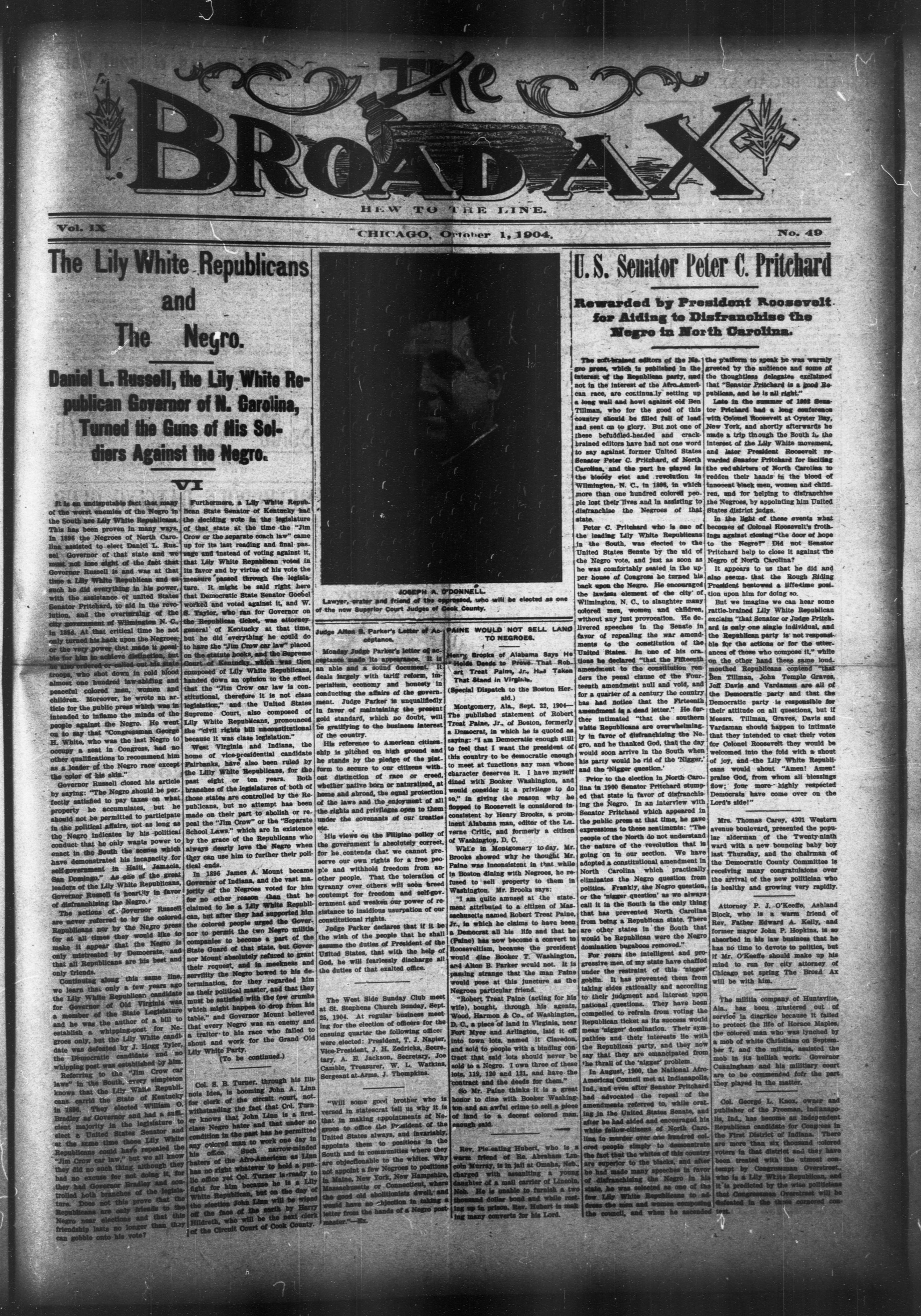
Furthermore, a Lily White Republican State Senator of Kentucky had the deciding vote in the legislature of that state at the time the "Jim Crow or the separate coach law" came up for its last reading and final passage and instead of voting against it, that Lily White Republican voted in its favor and by virtue of his vote the measure passed through the legislature. It might be said right here that Democratic State Senator Goebel worked and voted against it, and W. S. Taylor, who ran for Governor on the Republican ticket, was attorney-general of Kentucky at that time, but he did everything he could do to have the "Jim Crow car law" placed on the statute books, and the Supreme Court of Kentucky which was then composed of Lily White Republicans, handed down an opinion to the effect that the "Jim Crow car law is constitutional, therefore it is not class legislation," and the United States Supreme Court, also composed of Lily White Republicans, pronounced the "civil rights bill unconstitutional because it was class legislation."
West Virginia and Indiana, the home of vice-presidential candidate Fairbanks, have also been ruled by the Lilly White Republicans, for the past eight or ten years. Both branches of the legislatures of both of those states are controlled by the Republicans, but no attempt has been made on their part to abolish or repeal the "Jim Crow" or the "Separate School Laws," which are in existence by the grace of the Republicans who always dearly love the Negro when they can use him to further their political ends.
Montgomery, Ala., Sept. 22, 1904—The published statement of Robert Treat Paine, Jr., of Boston, formerly a Democrat, in which he is quoted as saying: "I am Democratic enough still to feel that I want the president of this country to be democratic enough to meet at functions any man whose character deserves it. I have myself dined with Booker Washington, and would consider it a privilege to do so," in giving the reason why he flopped to Roosevelt is considered inconsistent by Henry Brooks, a prominent Alabama man, editor of the Luverne Critic, and formerly a citizen of Washington, D. C.
Wal'e in Montgomery today, Mr. Brooks showed why he thought Mr. Paine was inconsistent in that while in Boston dining with Negroes, he refused to sell property to them in Washington. Mr. Brooks says:
"I am quite amused at the statement attributed to a citizen of Massachusetts named Robert Treat Paine, Jr., in which he claims to have been a Democrat all his life and that he (Paine) has now become a convert to Rooseveltism, because the president would dine Booker T. Washington, and Alton B. Parker would not. It is passing strange that the man Paine would pose at this juncture as the Negroes particular friend.
Rewarded by President Roosevelt for Aiding to Disfranchise the Negro in North Carolina.
The soft-brained editors of the Negro press, which is published in the interest of the Republican party, and not in the interest of the Afro-American race, are continually setting up a long wall and howl against old Ben Tillman, who for the good of this country should be filled full of load and sent on to glory. But not one of these befuddled-headed and crack-brained editors have had not one word to say against former United States Senator Peter C. Pritchard, of North Carolina, and the part he played in the bloody riot and revolution in Wilmington, N. C., in 1898, in which more than one hundred colored people lost their lives and in assisting to disfranchise the Negroes of that state.
Peter C. Pritchard who is one of the leading Lily White Republicans in the South, was elected to the United States Senate by the aid of the Negro vote, and just as soon as he was comfortably seated in the upper house of Congress he turned his back upon the Negro. He encouraged the lawless element of the city' of Wilmington, N. C., to slaughter many colored men, women and children, without any just provocation. He delivered speeches in the Senate in favor of repealing the war amendments to the constitution of the United States. In one of his orations he declared "that the Fifteenth amendment to the constitution renders the penal clause of the Fourteenth amendment null and void, and for a quarter of a century the country has had notice that the Fifteenth amendment is a dead letter." He further intimated "that the southern white Republicans are overwhelmingly in favor of disfranchising the Negro, and he thanked God, that the day would soon arrive in the South when his party would be rid of the 'Nigger, and the 'Nigger question.'
Prior to the election in North Carolina in 1900 Senator Pritchard stumped that state in favor of disfranchising the Negro. In an interview with Senator Pritchard which appeared in the public press at that time, he gave expressions to these sentiments: "The people of the North do not understand the nature of the revolution that is going on in our section. We have adopted a constitutional amendment in North Carolina which practically eliminates the Negro question from politics. Frankly, the Negro question, or the 'nigger question' as we always call it in the South is the only thing that has prevented North Carolina from being a Republican state. There are other states in the South that would be Republican were the Negro domination bugaboos removed."
For years the intelligent and progressive men of my state have chaffed under the restraint of this 'nigger' goblin. It has prevented them from taking sides rationally and according to their judgment and interest upon national questions. They have been compelled to refrain from voting the Republican ticket as its success would mean 'nigger' domination. Their sympathies and their interests lie with the Republican party, and they now say that they are emancipated from the thrall of the 'nigger' problem.
No. 49
ter C. Pritchard
sident Roosevelt.
isfranchise the
th Carolina.
the platform to speak he was warmly greeted by the audience and some of the thoughtless delegates exclaimed that "Senator Pritchard is a good Republican, and he is all right."
Late in the summer of 1992 Senator Prichard had a long conference with Colonel Roosevelt at Oyster Bay, New York, and shortly afterwards he made a trip through the South h. the interest of the Lily White movement, and later President Roosevelt rewarded Senator Pritchard for inciting the red shirters of North Carolina to redden their hands in the blood of innocent black men, women and children, and for helping to disfranchise the Negroes, by appointing him United States district judge.
In the light of these events what becomes of Colonial Roosevelt's frothings against closing "the door of hope to the Negro?" Did not Senator Pritchard help to close it against the Negro of North Carolina? It appears to us that he did and also seems that the Rough Riding President bestowed a lifetime position upon him for doing so.
But we imagine we can hear some rattle-brained Lily White Republican exclaim "that Senator or Judge Pritchard is only one single individual, and the Republican party is not responsible for the actions or for the utterances of those who compose it," while on the other hand these same loud-mouthed Republicans contend "that Ben Tillman, John Temple Graves, Jeff Davis and Vardaman are all of the Democratic party and that the Democratic party is responsible for their attitude on all questions, but if Messrs. Tillman, Graves, Davis and Vardaman should happen to intimate that they intended to cast their votes for Colonel Roosevelt they would be welcomed into the fold with a shout of joy, and the Lily White Republicans would shout "Amen! Amen! praise God, from whom all blessings flow; four more highly respected Democrats have come over on the Lord's side!"
Mrs. Thomas Carey, 4201 Western avenue boulevard, presented the popular alderman of the Twenty-ninth ward with a new bouncing baby boy last Thursday, and the chairman of the Democratic County Committee is receiving many congratulations over the arrival of the new politician who is healthy and growing very rapidly.
Attorney P. J. O'Keeffe, Ashland Block, who is a warm friend of Rev. Father Edward A. Kelly, and former mayor John P. Hopkins, is so absorbed in his law business that he has no time to devote to politics, but if Mr. O'Keeffe should make up his mind to run for city attorney of Chicago net spring The Broad Ax will be with him.
HIS FORMAL LETTER TO THE DEMOCRATIC NOTIFICATION COMMITTEE.
NAMES FOUR ISSUES AS OF PAR AMOUNT INTEREST TO THE ENTIRE COUNTRY.
To the Honorable Champ Clark and Others, Committee, Etc.-Gentlemen: In my response to your committee, at the formal notification proceedings, I referred to some matters not mentioned in this letter. I desire that these be considered as incorporated herein, and regret that lack of space prevents specific reference to them all. I wish here, however, again to refer to my views there expressed as to the gold standard, to declare again my unqualified belief in said standard, and to express my appreciation of the action of the convention in reply to my communication upon that subject.
Grave public questions are pressing for decision. The democratic party appeals to the people with confidence that its position on these questions will be accepted and indorsed at the polls. While the issues involved are numerous, some stand forth preeminent in the public mind. Among these are: Tariff reform, imperialism, economical administration and honesty in the public service. I shall briefly consider these and some others within the necessarily prescribed limits of this letter.
While I presented my views at the notification proceedings concerning this vital issue, the overshadowing importance of this question impels me to refer to it again. The issue is oftentimes referred to as constitutionalism vs. imperialism.
If we would retain our liberties and constitutional rights unimpaired, we cannot permit or tolerate, at any time or for any purpose, the arrogation of unconstitutional powers by the executive branch of our government. We should be ever mindful of the words of Webster: "Liberty is only to be preserved by maintaining constitutional restraints and a just division of political powers."
Already the national government has become centralized beyond any point contemplated or imagined by the founders of the constitution. How tremendously all this has added to the power of the president! It has developed from year to year until it almost equals that of many monarchs. While the growth of our country and the magnitude of interstate interests may seem to furnish a plausible reason for this centralization of power, yet these same facts afford the most potent reason why the executive should not be permitted to encroach upon the other departments of the government, and assume legislative, or other powers, not expressly conferred by the constitution.
The issue of imperialism which has been thrust upon the country involves a decision whether the law of the land or the rule of individual caprice shall govern. The principle of imperialism may give rise to brilliant, startling, dashing results, but the principle of democracy holds in check the brilliant executive and subjects him to the sober, conservative control of the people.
The people of the United States stand at the parting of the ways. Shall we follow the footsteps of our fathers along the paths of peace, prosperity and contentment, guided by the ever-living spirit of the constitution which they framed for us, or shall we go along other and untried paths, hitherto shunned by all, following blindly new ideals, which, though appealing with brilliancy to the imagination and ambition, may prove a will o' the wisp, leading us into difficulties from which it may be impossible to extricate ourselves without lasting injury to our national character and institutions?
The Tariff and Trusts. Tariff reform is one of the cardinal principles of the democratic faith, and the necessity for it was never greater than at the present time. It should be undertaken at once in the interest of all our people.
The Dingley tariff is excessive in many of its rates, and, as to them at least, unjustly and oppressively burdens the people. It secures to domestic manufacturers, singly or in combination, the privilege of exacting excessive prices at home and prices far above the level of sales made regularly by them abroad with profit, thus giving a bounty to foreigners at the expense of our own people. It levies oppressive and unjust taxes upon many articles forming, in whole or part, the so-called raw material of many of our manufactured products, not only burdening the consumer, but also closing to the manufacturer the markets he needs and seeks abroad. Its unjust taxation burdens the people generally, forcing them to pay excessive prices for food, fuel, clothing and other necessities of life. It levies duties on many articles not normally imported in any considerable amount, which are made extensively at home, for which the most extreme protectionist would hardly justify protective taxes, and which in large amounts are exported. Such duties have been and will continue to be a direct incentive to the formation of huge industrial com-
inations, which, secure from foreign competition, are enabled to stifle domestic competition and practically to monopolize the home market.
It contains many duties imposed for the express purpose only, as was openly avowed, of furnishing a basis for reduction by means of reciprocal trade treaties, which the republican administration, impliedly at least, promised to negotiate. Having, on this promise, secured the increased duties, the republican party leaders, spurred on by protected interests, defeated the treaties negotiated by the executive, and now these same interests cling to the benefit of these duties which the people never intended they should have, and to which they have no moral right.
Even now the argument most frequently urged in behalf of the Dingley tariff, and against tariff reform generally, is the necessity of caring for our infant industries. Many of these industries, after a hundred years of lusty growth, are looming up as industrial giants. In their case, at least, the Dingley tariff invites combination and monopoly, and gives justification to the expression that the tariff is the mother of trusts.
For the above-mentioned reasons, among many others, the people demand reform of these abuses, and such reform demands and should receive immediate attention.
In the words of our platform we demand "a revision and a gradual reduction of the tariff by the friends of the masses, and for the common weal, and not by the friends of its abuses, its extortions and discriminations."
I pointed out in my earlier response the remedy which, in my judgment, can effectually be applied against monopolies, and the assurance was then given that if existing laws, including both statute and common law, proved inadequate, contrary to my expectations, I favor such further legislation, within constitutional limitations, as will best promote and safeguard the interests of all the people. Whether there is any common law which can be applied and enforced by the federal courts, cannot be determined by the president, or by a candidate for the presidency.
The determination of this question was left by the people in framing the constitution, to the judiciary and not to the executive. The supreme court of the United States has recently considered this question, and, in the case of the Western Union Telegraph company vs. the Call Publishing company, to be found in the one hundred and eight-first volume of the United States supreme court reports, at page 92, it decided that common law principles could be applied by United States courts in cases involving interstate commerce, in the absence of United States statutes specifically covering the case. Such is the law of the land.
Reciprocity.
In my address to the notification committee I said that tariff reform "is demanded by the best interests of both manufacturer and consumer." With equal truth it can be said that the benefits of reciprocal trade treaties would ensure to both. That the consumer would be helped is unquestionable. That the manufacturer would receive great benefit by extending his markets abroad hardly needs demonstration. His productive capacity has outgrown the home market. The very term "Home Market," has changed in its significance. Once, from the manufacturers' point of view, it meant expansion; to-day the marvelous growth of our manufacturing industries has far exceeded the consumptive capacity of our domestic markets, and the term "Home Market" implies contraction, rather than expansion. If we would run our mills to their full capacity, thus giving steady employment to our workmen and securing to them and to the manufacturer the profits accruing from increased production, other markets must be found. Furthermore, when our manufacturers are dependent on raw materials in whole or part imported, it is vital to the extension of their markets abroad that they secure their materials on the most favorable terms.
Our martyred President, William McKinley, appreciated this situation. He pointed out in his last address to the people that we must make sensible trade arrangements if "we shall extend the outlets for our increasing surplus." He said, "a system which provides a mutual exchange of commodities is manifestly essential to the continued and healthful growth of our export trade. The period of exclusiveness is past. The expansion of our trade and commerce is the pressing problem. Commercial wars are unprofitable. A policy of good will and friendly relations will prevent reprisals. Reciprocity treaties are in harmony with the spirit of the times; measures of retaliation are not."
This argument was made in the interest of our manufacturers whose products, he urged, "have so multiplied, that the problem of more markets requires our urgent and immediate attention." He had come to realize that the so-called "stand pat" policy must give way—that there must be a reduction of duties to enable our manufacturers to cultivate foreign markets. The last words of this president—who had won the affection of his countrymen—ought to be studied by every man who has and doubt of the necessity of a reduction in tariff rates in the interest of the manufacturer. They present with clearness a situation and a proposed remedy that prompted the provision in our platform which declares that, "We favor liberal trade arrangements with Canada and with people of other countries where they can be entered into with benefit to American agricul
ture, manufactures, mining or commerce."
The persistent refusal of the republican majority in the federal Senate to ratify the reciprocity treaties negotiated in pursuance of the policy advocated alike by Mr. Blaine and Mr. McKinley, and expressly sanctioned in the Dingley act itself, is a discouraging exhibition of bad faith. As already mentioned by me, the exorbitant duty imposed on many an imported article by the Dingley tariff was avowedly intended by its author not to be permanent, but to serve temporarily as a maximum, from which the federal government was empowered to offer a reduction, in return for an equivalent concession on the part of a foreign country. President McKinley undertook honestly to carry out the purpose of the act. A number of reciprocity agreements were negotiated, which, if ratified, would have had the twofold result of cheapening many imported products for American consumers, and of opening and enlarging foreign markets to American producers. Not one of those agreements has met with the approval of the republican masters of the senate. Indeed they did not even permit their consideration. In view of the attitude of the present executive, no new agreement need be expected from him. Nor does the republican platform contain a favorable reference to one of the suspended treaties. The reciprocity clauses of the Dingley act seem destined to remain a monument of legislative coexenage and political bad faith, unless the people take the matter in their own hands at the ballot box and command a reduction of duties in return for reciprocal concessions.
Independence for the Filipinos. In some quarters it has been assumed that in the discussion of the Philippine question in my response, the phrase "self-government," was intended to mean something less than independence. It was not intended that it should be understood to mean, nor do I think as used it does mean less than independence. However, to eliminate all possibility for conjecture, I now state that I am in hearty accord with that plank in our platform that favors doing for the Filipinos what we have already done for the Cubans; and I favor making the promise to them now that we shall take such action as soon as they are reasonably prepared for it. If independence, such as the Cubans enjoy, cannot be prudently granted to the Filipinos at this time, the promise that if shall come the moment they are capable of receiving it will tend to stimulate rather than hinder their development. And this should be done not only in justice to the Filipinos, but to preserve our own rights; for a free people cannot withhold freedom from another people and themselves remain free. The toleration of tyranny over others will soon breed contempt for freedom and self-government, and weaken our power of resistance to insidious usurpation of our constitutional rights.
The pledge of the platform to secure to our citizens, without distinction of race or creed, whether native born or naturalized, at home and abroad, the equal protection of the laws and the enjoyment of all the rights and privileges open to them under the covenants of our treaties, as their just due, should be made good to them. In the accomplishment of that result it is essential that a passport issued by the government of the United States to an American citizen shall be accepted the world over as proof of citizenship.
Civil Service.
The statute relating to civil service is the outcome of the efforts of thoughtful, unselfish and public-spirited citizens. Operation under it has frequently been of such a character as to offend against the spirit of the statute, but the results achieved, even under a partial enforcement of the law, have been such as to both deserve and command the utterance of the democratic party that it stands committed to the principle of civil service reform and demands its just and impartial enforcement.
Reclamation of Arid Lands.
A vast expanse of country in the west, portions of which are to be found in each of the 16 states and territories, mentioned in the law, is directly affected by the national statute—the outcome of intelligent and persistent efforts of leading citizens, providing for the reclamation of the arid lands for the benefit of home-seekers. During the years of the development of the measure which finally received the vote of every member of the upper house of congress, it encountered opposition, based to a large extent upon the view that the aim of its promoters was to secure the benefits of irrigation to private owners at government expense. The aim of the statute is, however, to enable this vast territory to reclaim its arid lands without calling upon the taxpayers of the country at large to pay for it. Whether the purposes of the bill will be fully accomplished must depend in large measure upon the ability, sobriety of judgment, independence and honesty of the officers of the interior department having this great work in charge. In 1902 the main canals and ditches in the region affected aggregated more than 59,000 miles and the work of reclamation is but in its infancy. The total cost of construction of the necessary head-gates, dams, main canals, ditches, reservoirs and pumping stations was at that time a little over $93,000,000, which of itself suggests the hundreds of millions that may eventually be invested in the territory covered by the statute. The magnitude of the conception, and the enormous expense its carrying out involves, make us realize the overwhelming importance of a broad, capable and honest administration of the work authorized by the statute, if effect is to be given to that part of the plan that relieves the country at large from ultimate liability.
Panama Canal.
Sape of our statesmen, and the avowed aim of the two great parties, as their platforms in the past show. The Panama route having been selected, the building of the canal should be pressed to completion with all reasonable expedition.
The methods by which the executive acquired the Panama canal route and rights are a source of regret to many. To them, the statement that thereby a great public work was assured to the profit of our people is not a sufficient answer to the charge of violation of national good faith. They appreciate that the principles and healthy convictions which in their working out have made us free and great, stand firmly against the argument or suggestion that we shall be blind to the nature of the means employed to promote our welfare. They hold that adherence to principle, whether it works for our good or ill, will have a more beneficent influence on our future destiny than all our material upbuilding, and that we should ever remember that the idea of doing a wrong to a smaller, weaker nation that we, or even all mankind, may have a resultant good is repugnant to the principles upon which our government was founded.
Under the laws of the United States the duty is imposed on the executive to proceed with due diligence in the work of constructing the canal. That duty should be promptly performed. American Shipping.
Our commerce in American bottoms amounts to but eight per cent. of our total exports and imports. For 70 yeras prior to 1860, when the republican party came into power, our merchant marine carved an average of 75 per cent. of our foreign commerce. By 1877 it had dwindled to 27 per cent. Now we carry but a contemptibly small fraction of our exports and imports.
American shipping in the foreign trade was greater by over 100,000 tons in 1810—nearly 100 years ago—than it was last year. In the face of the continuous decline in the record of American shipping during the last 43 years, the promise of the republican party to restore it is without encouragement. The record of the democratic party gives assurance that the task can be more wisely intrusted to it.
Recent disclosures, coupled with the rapid augmentation of government expenditures, show a need of an investigation of every department of the government. The democrats in congress demanded it. The republican majority refused the demand. The people can determine by their vote in November whether they wish an honest and thorough investigation. A democratic congress and executive will assure it.
Army and Navy.
We are justly proud of the officers and men of our army and navy. Both, however, have suffered from the persistent injection of personal and political influence. Promotions and appointments have been frequently based on favoritism instead of merit. Trials and court-martials have been set aside under circumstances indicating political interference. These and other absences should be corrected.
Pensions for Our Soldiers and Sailors. The national democracy favors liberal pensions to the surviving soldiers and sailors and their dependents, on the ground that they deserve liberal treatment. It pledges by its platform adequate legislation to that end. But it denies the right of the executive to usurp the power of congress to legislate on that subject. Such usurpation was attempted by pension order No. 78, and effect has been given to it by a congress that dared not resent the usurpation. It is said that "this order was made in the performance of a duty imposed upon the president by act of congress," but the provision making the imposition is not pointed out. The act to which the order refers, which is the one relating to pensions to civil war veterans, does not authorize pensions on the ground of age. It does grant pensions to those "suffering from any mental or physical disability, or disabilities, of a permanent character, not the result of their own vicious habits, which so incapacitates them from the performance of manual labor as to render them unable to earn a support." This specified requirement of incapacity is in effect set aside by order No. 78 as to all persons over 62.
The war closed nearly 40 years ago. In the meantime many of our soldiers and sailors long survived the age of 62, and passed away without receiving any pension. Skillful pension attorneys hunting through the statute failed to find there a provision giving a pension to all who had reached 62. Many prominent veterans urged the justice of congressional action giving a service pension to all veterans. Bill to that effect were introduced in congress. And not until March of this year did anyone ever claim to have made the discovery that the president had power to treat the statute as if it read that when a claimant had passed the age of 62 years he is necessarily disabled one-half in ability to perform manual labor and therefore entitled to a pension.
The present pension commissioner indicated his view of the order when in a recent address he thanked the president for what he had done, and advised his hearers to use their influence that a law might be passed to the same effect. Full confidence after all seems not to have been placed on the defense of justification, for it is pleaded in mitigation that a former democratic president did something looking in that direction. Even if that were so—which is not admitted—our present duty would be none the less plain and imperative. Our people must never tolerate the citation of one act of usurpation of power as an excuse for another. The first may possibly be due to mistake; the second, being based on the first, cannot be. In explanation, however, it should be said
that the order relied on simply provided that the age of 75 years should be regarded as evidence of inability to perform manual labor. Few men are able to perform manual labor at that age, but nearly all men are at 62. The first order is based on a fact that experience teacher, the other is based on the assertion of that which is not true as a general rule.
The old inquiry: "What are you going to do about it?" is now stated in a new form. It is said by the administration, in reply to the public criticism of this order, that "it is easy to test our opponent's sincerity in this matter. The order in question is revocable at the pleasure of the executive. If our opponents come into power they can revoke this order and announce that they will treat the veterans of 63 and 70 as presumably in full bodily vigor and not entitled to pension. Will they authoritatively state that they intend to do this? If so, we accept the issue."
This suggests the suspicion, at least, that the order was made to create an issue—that it was supposed to present a strong strategic position in the battle of the ballots. But as the making of that order was, in my judgment, an attempted, though perhaps unwitting, encroachment upon the legislative power, and, therefore, unwarranted by the constitution, the challenge is accepted. If elected, I will revoke that order. But I go further and say that that being done, I will contribute my effort toward the enactment of a law to be passed by both houses of congress and approved by the executive that will give an age pension without reference to disability to the surviving heroes of the civil war; and under the provisions of which a pension may be accepted with dignity because of the consciousness that it comes as a just due from the people through their chosen representatives, and not as largess distributed by the chief executive.
Foreign Relations.
The foreign relations of the government have in late years assumed special importance. Prior to the acquisition of the Philippines, we were practically invulnerable against attacks by foreign states. Those tropical possessions, however, 7,000 miles from our shores, have changed all this and have in effect put us under bonds to keep the peace. The new conditions call for a management of foreign affairs the more circumspect in that the recent American invasion of foreign markets in all parts of the world has excited the serious apprehension of all the great industrial peoples. It is essential, therefore, more than ever, to adhere strictly to the traditional policy of the country as formulated by its first president and never, in my judgment, wisely departed from—to invite friendly relations with all nations while avoiding entangling alliances with any. Such a policy means the cultivation of peace instead of the glorification of war, and the minding of our own business in lieu of spectacular intermeddling with the affairs of other nations. It means strict observance of the principles of international law and condemns the doctrine that a great state, by reason of its strength, may rightfully appropriate the sovereignty or territory of a small state on account of its weakness. It means for other American states that we claim no rights and will assume no functions save those of a friend and of an ally and defender as against European aggressions. It means that we repudiate the role of the American continental policeman; that we refuse to act as debt collector for foreign states or their citizens; that we respect the independent sovereignty of each American state and its right to preserve order and otherwise regulate its own internal affairs in its own way; and that any intervention in its affairs by us is limited to the single office of enabling its people to work out their own political and national destiny for themselves free from the coercion of any European state.
Reform in Governmental Expenditure
The expenses of the first four years succeeding the last democratic administration amounted to the enormous average of $511,000,000 per year. This large expenditure was due to a considerable extent to the cost of the Spanish-American war, which occurred during that period; but the termination of that war brought no relief to the treasury, for the average annual expenses of the government, during the three subsequent years ending June 30, 1904, were about $519,000,000, which is the largest sum hitherto reached, during a like period, since the close of the civil war.
This draft upon the revenues of the country has had the effect which might have been anticipated, and now we have presented the reverse of the situation, which led to the famous observation: "It is a condition, and not a theory, which confronts us;" for, although the present incumbent found at the close of the first fiscal year, during which he assumed control of the administration, a surplus of receipts over expenditures of more than $91,000,000, there was an excess of expenditures over receipts at the close of the last fiscal year of $42,000,000, and the official monthly reports made by the treasury department show that the expenditures are continuously and rapidly increasing, while the receipts are diminishing.
In this connection it is interesting to note the recent administrative orders forbidding government officers from making public any statement of estimates on which future appropriations are to be based.
If a man of ordinary intelligence and prudence should find in the operating expenses of his business such a tremendous percentage of increase, would he not promptly set on foot an inquiry for the cause of the waste, and take immediate measures to stop it, especially when trusted employees have been found dishonest and convicted, and a widespread impression exists that a thorough investigation may discover other cases of malfeasance? When the chief executive reported to congress that, "through frauds, forgeries and perjuries, and by shameless briberies, the laws relating to the proper conduct of the public service in general, and to the due administration of the post office department have been notoriously violated * * *," there was a general popular demand for a rigid, sweeping investigation by congress, in addition to that undertaken by the executive himself. Such an investigation the republican majority in congress would not permit, although the minority insisted that the interests of good government demanded it. And the minority was right. The liberality, patriotism and national pride of the people should not be made an excuse for waste of the public funds. Official extravagance is official crime.
There is not a sentence in the republican platform recommending a reduction in the expenditures of the government; not a line suggesting that the increase in the cost of the war department from $34,000,000 in 1886 to $115,000,000 in 1904 should be inquired into; and not a paragraph calling for a thorough investigation of those departments of the government in which dishonesty has been recently disclosed.
The people, however, can by their votes, if they desire it, order such an investigation and inaugurate a policy of economy and retrenchment. It is safe to say that this will not be so complained by indorsing at the polls the republican majority of the house of representatives which refused the investigation and made the appropriations, nor by continuing in power the administration which made the disbursements.
Reform in expenditures must be had in both the civil, military and naval establishments in order that the national expenditures may be brought to a basis of peace and the government maintained without recourse to the taxes of war.
I have put aside a congenial work, to which I had expected to devote my life, in order to assume, as best I can, the responsibilities your convention put upon me.
I solicit the cordial cooperation and generous assistance of every man who believes that a change of measures and of men at this time would be wise, and urge harmony of endeavor as well as vigorous action on the part of all se minded.
The issues are joined and the people must render the verdict.
Shall economy of administration be demanded or shall extravagance be encouraged?
Shall the wrongdoer be brought to bay by the people, or must justice walk upon political oilarchy?
Shall our government stand for equal opportunity or for special privilege?
Shall it remain a government of law or become one of individual caprice?
Shall we cling to the rule of the people, or shall we embrace beneficent despotism?
With calmness and confidence, we await the people's verdict.
If called to the office of president, I shall consider myself the chief magistrate of all the people, and not of any faction, and shall ever be mindful of the fact that on many questions of national policy there are honest differences of opinion. I believe in the patriotism, good sense and absolute sincerity of all the people. I shall strive to remember that he may serve his party best who serves His country best.
If it be the wish of the people that I undertake the duties of the presidency, I pledge myself, with God's help, to devote all my powers and energy to the duties of this exalted office. Very truly yours,
‘THE AMERICAN WAITER IN
poLiTrics. «~~
i ie a
eames eens sey. ae
eS ene eet ans
a cae “traversing many m =
eee eet eS
re ee ae
they Dad alto a a rocky elif,
needs. Sa caso oc
See tees con ea
‘out » roar or o struggle, with nothing
4 See eee i Ot. the
“Geld, ut bere as belpless, 25 power-
their paws could bave and would have
‘shattered a humen form into pulp,
“or into insignificence. But nature hed
“qebbed ‘them this time of their prey-
aro ahaa grenpabeteerenmen
) im a nut shell, and the absotate
‘condition of tse Negro politically in.
general. . Let us have no more of
“whether it comes from the pulpit, pew,
‘college or. industrial tmetitation;
‘whether It comes from “Lily White
“Republicans,” deceitful Democrats, So-
Gldlist, Single Tazer Probibitionist or
‘others. For these, if opportunity wee
‘given ‘would be like the Hons of this
picture. ‘They would crash the Negro
‘voter, and destroy hts vitality eo that
be could not exist. It will be ours;
if always this condition we allow by
icing radicelly partizonized as it is to
Gay. A hopeless case. But on the
other hand, if we would be as wise
as the silent dessert, by bowing po-
ltically to the Republican party pro
@uce nothing upon which the beast
might prey upon, we would at least
teach the brute that he must find
other fivids for human distraction.
The earth here portrayed, is master
of the siteation, and the strength of
the beast can not long endure this
opposition and retain his- power of
resistance. What thinkest thou of it,
isn’t it true. The Republican perty,
Ike the lion it is; has been for thirty
years on “The Still Hunt.” trampling
upon the Negro voters” heads, using
them as a dessert life seeker, press-
ing their body politic with no other
interest but the ustural benefits d¢-
rived. from a travelers road, and
bridge to carry them-over safely to
their political oblivion, in order that
they may continue in their trust sys- |
tem, monopolizing ways. When these
satisfied their hunger craving, reached |
the water's edge and drabk away their |
thirst, with added strength to them-
selves for human destruction. The
Negro waiter after election of the/'
Republican history, mean anything to |
him, be will be.as silent in the man-
agement.of its affairs as the silent. |.
sandy dessert. My ples is that we),
should be more than the sandy des-
pert of the foot-stool of designing
politicians, false diplomats, or the):
jion spoken of. But rather the lion or |
beast dsatroyer, so that humen pro- ||
press may mot be hampered.
MAGOMIC NOTES.
The introduction and the spread of
spurious and clandestine
among colored men-in the Unit
States of America is to be placed
the Woor of the so-called Prince Hal)
Grand. Lodge of the State of Mas.
sachusetts. In the year 1997, ac-
cording te their own statements and
records, which they have published
over anf over again about the origis
of that socalled Prinée Hall Grand
Ledge, there was ouly one warranted
ledge im the United States of Ameri
ea when the sogaiied Prince Hall
Ledge of Massachusetis was ;
en ig 1797 and that was African Lodge
No, 45% that had received their char-
ter from the. Grand Lodge of Eng-
jand; and it wil] be seen that Prince
Hall, Thomas Sanderson and a few of
his followers in Massachusetts con
cdeved the scheme of assembling what
Master Masons there were who were
members of African Lodge ‘No. 459
‘Met in 1797 at Boston, Mass., and
prockaimel thomndlres « Grand Lotge
a raion yy pe
ae 5 aed i ee epeeaee
se = North Anerion. ay nine
nyse elie a RE tac
fee + men. wh belong to. the, 5 4
Ve eet Neer eee
a . a me a ts ae
& PN ee re ae ne re
; Fo i .
, ri am a
eee en 4 ae a
ee ee ee, eee ind: im
4 ~ ei Aros. Shoat as Rang 3
ac waves dats tay 0 om
pS oies ta er es ee oo
rage tabs & bere ot ack
ea L . Prince Hall Grand
Lodge ot! ts and placing
‘the facts, as they are, in relation to
i @ _the Masonic - fraternity
throughiout the country. Bro, Nelson,
ee arene an
orable ead upright man; he was made
@ Mason fn England and when he came
to. the United States he commenced
the investigation of the legat status
of Freemasonry among colored men.
Tt @J4 not take bim Jong to find out
that the origin of the spurious Prince
TL Deputy for the state of Massachu-
aod when he @iscovered those facts
be aid not ‘hesitate to make them
known. Bro. W. H. Nelson, 33, is the
1, Deputy for the state off Massachu-
setts and other states and belongs to
a tewiei and regular subordinate
lodge tn Massachusetts thet holds its
charter from the Grand Lodge of the
District of Colimbia. ‘The lodges in
the state of Massachusetts that have
been organized by Il. W. H. Nelson,
38, under the authority of the Grand
Lodge of the District of Colembia,
are the only regular and genuine
lodges there are ‘fa the state of Mas-
saghupetis. ic mr
Mrs. Lena Harris, of Johnstown, Pa,
is Worthy Grand Gupreme Recorder of
the Supreme Grand Court of Daughters
of Sphinx. She is one of the pioneer
of the order of Daughtérs of Sphihx
in the state of Pennsytvania and is
one of the prominent and leading col-
ored ladies of the state of Pennsyl-
vania, She is a sealous and active
worker in thé order of Daughters of
Sphinx and a lady of ability and has
fone much to promote the best inter.
est of the order all over the country.—
Henry Searchlight.
CHiPs.
Benjamin M..Mitchell will be re
elected to the State Legislature from
the twenty-first district.
John EB. Traeger is putting up a live
campaign and be will be re-elected
‘as Coroner of Cook County.
_Mra, Macey, 5133 Grove avenue, has
gone on a three weeks’ visit with
friends at Morris and Rogkford, I.
Get next week's Broad Ax, it will
give full account of the State Street
public scandal. s
Mrs. D. Jenkins, of 4764 Deaborn
street; is seriously ill, and her many
friends wish her a speedy recovery.
Mr. Henry J., of the Chicago post
ees, whe is s0 cheap that he beat
‘Breanen Btptist church out off ff.
teen cents for a ticket.
Mrs, David Jenkins, 4764 Dearborn
street, has returned home after visit-
ing Chattanooga, Tenn., Atlanta, Ga.
Mrs. Jenkins has been gone six weeks.
Mrs. Adg M. Willis, 123 W. Fifty-
sixth street, left this morning for
Vincennes, Indianapolis, St. Louis,
Mo.,.and will visit the fair.
Wanteé—Meg or Women. $3 to $25
daily. Chance to become independent
from epare time. Send Stamp. The
Maye Co., Greensboro, N. 0.
- Rev. J. W. Robinson, 4752 Armour
ayenne, is in In@ianapolis, tnd, at-
tending 2 missionary rally ‘of the
Indiana district conference. —
Hos. George Mills Rogers, who has
m clean record behind him will be
elected as one of the Superior Court
Judges of Cook County.
Heather -Bioa 7
Powder, manufactured in Chicago, 11),
BS, A, 28 cet gat bs, “Stes
spon postal notice to 2968 Btate street.
LW. Washington, general agent
eft a nest sum after sil ex-
es tee an m :
a ee
en een PDO in, DEE Tan 2 ty
aa gree ae
See an eee ras ts accident
ie running to catch « street
ne OPP: ae ™ rs e
ey ee
ot. Ap bice spots a
tae Meera aera er ga
adnate aii ian aaeeet
Bek BOER RPE
eal Me Nees Bek << C
"Ya. Ik. Anderson, cus | ot th
mummier Cled, fc Tesilng up at thc
fame of his old trisad Samet Alsi
368 Ki Thirticth street, efter making
an extensive trip throagh the west, .
Sunday, Octoder the 9th the Sun
‘day Forum will open up for business
t the Institutional churc and at four
ek each Sunday after that date'tf
‘wi rum for the enlightenment of
those who wish to attend its meetings
Richard W. Thompson, who seems
to be doing all the heavy writing for
the Freeman of Indianapolis, Ind.,-{s
‘still blowing about the meeting of
Pro. Booker T. Washington's Business
‘League ‘in that city, if it is charged
up to the Wisard of Tuskegee at s0
much per line the Freeman and bro
ther Thompson will pull his leg for
@ large roll of the long green.
GPECIAL NLTICE,
‘We fing it absolutely impossible t:
attend sli the social funetions &
whieh we are invited, consequently
‘we caunot report them as we would
ike. if you wfil mail to our sddreas
8 brief “write up” of your “social do
ings” so that we may nave it not tates
taan Wednesday of each week. our So
@lety Exiitor will give it the attention
i merits. Address The Broad Ax, 5046
Armour Avenue.
MERCHANTS FAVOR PARKER
They Like Democratic Candidate Be-
cause He Is Conservative and
@ Fine American.
business men to Judge Parker is fur-
mished by the New York Herald's care-
ful poll of the New York Produce ex-
change. In that organization there is
& reputed large preponderance of re-
publican members, and during the
Bryan campaigns their support was
powerfully directed to. McKinley, al-
though the organization as such took
mo part in the campa'gn. Whereas
the exchange voted almost solidly for
McKinley and Roosevelt at the last
@lection, the Herald’s pol shows that
“about one to every four and one-half
will swing this year from the republi-
can to the democratic ticket.” Six
hundred and sixty-five members have
replied to the Herald's inguiries as to
their voting intentions; out of which
number 141 who voted for McKinley
tm 1900 announce their determination to
vote for Judge Parker. The exchange
has some 3,000 members, and it is, of
course, impossible to tell from these
data how a majority of its members
will vote in coming élections, but, as
the Herald observes, “these straws
show which way the wind blows.”
Im & eritieal hour of national life,
ake innovations of
trond revolutionary
‘the administration threaten the stabil-
ity of government, an eminently sane,
safe and conservative candidate cannot
but appeal to the business community.
‘The St. Louis Republic wisely ob-
serves that if the perilous policies of
Mr. Roosevelt should fing popular in-
dorsement in November and be carried
further to their reasonable and prob-
able conclusion, the business interosts
of the country willsuffer grave dis-
turbance, and the consciousness of thie
fact by those interests is a powerful in-
fluence for Judge Parker.
The accessions to Judge Parker's
strength are not marked’ by Joud hus-
zas and torchlight processions. It is
reason which is at work for Judge Par-|
ker; it is business prudence and fore-
sight, and the result is achieved quietly,
Becoming public only when, as in this
instance, special inquiry is made.
In toe republican press the desertions
from the Roosevelt standard are refiect-
ed by constant efforts to allay fear, and
‘We Sind the frequently repeated state-
ment that “there is no menace to
business in this campaign” Mr. Roose-
velt is the “menace to business” which
occasions the alarm and prompts the ef-
fort. A president's riotous ambition to
ereate a great “world power” and to
achieve a crowded: hour of glorious life
for himself and to emblazon his fame
on history cannot result otherwise than
in the constant disturbance of business,
not to say disaster, When international
entanglements and war clouds darken
the horizon, business is the instant suf-
prise falters.
Business men do not care to see a
pene Fone eee
strut along the denger lins of in-
ternational comp'ications. They do not
ae idee tenes toe Sexes
and across the hemispheres. .
; as saopet ent peaber (be Semnatestid
candidate because Indicial tem-
perament, sound judgment and safe rea-
sone fers ee pepo
of great strength of char-
eer ee oes
i Bee oe oes
regard for the spirit of our institutions,
gs else, for.constitution, =
"We stand by the olican par-
Gini —ggean again sgt ino. 4
ok aa Sil ecthe aol és by us,”
eats ites eed gehibins the weinie = Sinan}
trusts that are robbing the people. The
Seecls ariuad thay need ai ves 3
eas,—Rochester Union.
caeadbhiee one J ee Se
ae ee ee ae
: te. an 7
TERY KRET ce
1LLg ) DAIWA .
WELLIAM ¢. KUESTER.
1994 N. Western Ave., Chicago.
Telephone Leake View 270, —
JACOB FEINBERG
Market and Grocery
Telephone 565 South
8ist and State Ste. CHICAGO
ene
‘Telephoos Main 3077.
FREDERICK W. JOB
om wages omens ‘
JOHN E. OWENS
: aa
G22 ASHLAND “BLOCK —
‘TELEPHONE CENTWAL O08 ‘cmeaco
PHONES { ios. Mate 3307,
STEPHEN A. DOUGLAS —
LAWYER
Suite 200, 128-125 La Salle Street
CHICAGO
Cstagmecns Verde $61 Racine Ea
- JOHN FITZQ@ERALD
WSTICE OF THE PEACE:
O79 8 BALOTED STEP,
—~0mI0Ae0
BEOROSE SE EO
Salte 611 . 467 Dearborn St, Cor. Monroe.
Chicego,
‘Tel, Cunt, oven. Res, Tel, Went. 4002.
J. . HENNESSY,
Justice-of-the Pence,
6301'S, Halsted St,
3 WILLIAM TREXLER, CLERK.
TELEPHONE WENTWORTH 4403.
Police Magistrate Englewood Police
Court.
ve
P, J. O’SHEA
ATTORNEY AT_LAW
. __ Salte 1444 Danity Building -
79 Dearborn St. Clitesas,
Robert M. Mitchell
Attorney st Law
Sette 9, No, 77 South Clark 5%.
crcaco
WILLIAM RITCHIE
ATTGENEY AND COUNSELOR.
‘Sates 0-408 Ontord Bunaing
LASALLE ST, CHICAGO
ALBERT 8. GEORGE
ea ets
butts Sot Waiters and Cooks,
aga, Denver, |
OE <=: 4
TSS
a eM
John J. Bradley
Real Estate, Insurance and Loans
Property managed. Abstracts examined. Renting. Legal pepers prepared.
Theodore OC. Mayer
JUSTICE OF THE PEACE
and Acknowledged. Room 32, 37 North Clark Street.
wae Ae ee Pa ten 237 Baring. Street
CHICAGO :
|
|
, 7
: B is
rrr
| k H
M, JUWK, Proprietor
JOS. P, JUNK, Maneger
3700-3710 South Halsted Street
and 897 to 929 Thixtyseventh Street
___ Jas, J. McCormick,
SAMPLE ROOM