The Broad Ax
Saturday, October 29, 1904
Chicago, Illinois
Page text (machine-generated)
THE BROAD AX
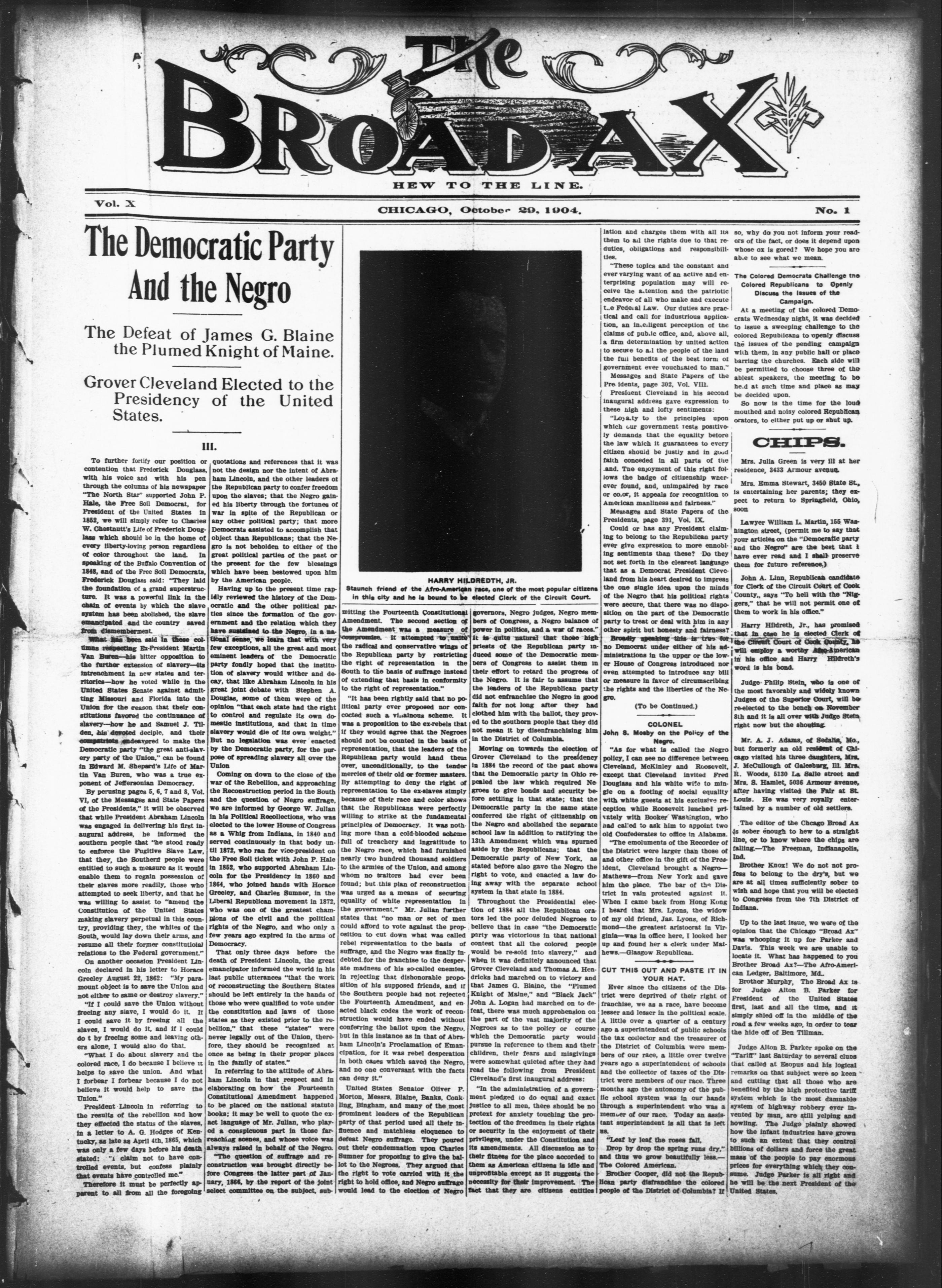
The Democratic Party And the Negro
The Defeat of James G. Blaine the Plumed Knight of Maine.
Grover Cleveland Elected to the Presidency of the United States.
Vol. X
The Democ
And the
The Defeat of Ja
the Plumed K
Grover Cleveland
Presidency
States.
To further fortify our position or contention that Frederick Douglass with his voice and with his pen through the columns of his newspaper "The North Star" supported John P. Hale, the Free Soil Democrat, for President of the United States in 1852, we will simply refer to Charles W. Chestnutt's Life of Frederick Douglass which should be in the home of every liberty-loving person regardless of color throughout the land. In speaking of the Buffalo Convention of 1848, and of the Free Soil Democrats, Frederick Douglass said: "They laid the foundation of a grand superstructure. It was a powerful link in the chain of events by which the slave system has been abolished, the slave emancipated and the country saved from dismemberment.
What has been said in these columns respecting Ex-President Martin Van Buren—his bitter opposition to the further extension of slavery—its intrenchment in new states and territories—how he voted while in the United States Senate against admitting Missouri and Florida into the Union for the reason that their constitutions favored the continuance of slavery—how he and Samuel J. Tilden, his devoted deciple, and their compatriots endeavored to make the Democratic party "the great anti-slavery party of the Union," can be found in Edward M. Shepard's Life of Martin Van Buren, who was a true exponent of Jeffersonian Democracy.
By perusing pages 5, 6, 7 and 8, Vol. VI, of the Messages and State Papers of the Presidents," it will be observed that while President Abraham Lincoln was engaged in delivering his first inaugural address, he informed the southern people that "he stood ready to enforce the Fugitive Slave Law, that they, the Southern people were entitled to such a measure as it would enable them to regain possession of their slaves more readily, those who attempted to seek liberty, and that he was willing to assist to "amend the Constitution of the United States making slavery perpetual in this country, providing they, the whites of the South, would lay down their arms, and resume all their former constitutioal relations to the Federal government."
On another occasion President Lincoln declared in his letter to Horace Greeley August 22, 1862: "My paramount object is to save the Union and not either to same or destroy slavery." "If I could save the Union without freeing any slave, I would do it. If I could save it by freeing all the slaves, I would do it, and if I could do t by freeing some and leaving others alone. I would also do that.
"What I do about slavery and the colored race, I do because I believe it helps to save the union. And what I forbear I forbear because I do not believe it would help to save the Union."
President Lincoln in referring to the results of the rebellion and how they effected the status of the slaves, in a letter to A. G. Hodges of Kentucky, as late as April 4th, 1865, which was only a few days before his death stated: "I claim not to have controlled events, but confess plainly that events have controlled me."
Therefore it must be perfectly ap- parent to all from all the foregoing
111.
quotations and references that it was not the design nor the intent of Abraham Lincoln, and the other leaders of the Republican party to confer freedom upon the slaves; that the Negro gained his liberty through the fortunes of war in spite of the Republican or any other political party; that more Democrats assisted to accomplish that object than Republicans; that the Negro is not beholden to either of the great political parties of the past or the present for the few blessings which have been bestowed upon him by the American people.
Having up to the present time rapidly reviewed the history of the Democratic and the other political parties since the formation of the government and the relation which they have sustained to the Negro, in a national sense, we learn that with very few exceptions, all the great and most eminent leaders of the Democratic party fondly hoped that the institution of slavery would wither and decay, that like Abraham Lincoln in his great joint debate with Stephen A. Douglas, some of them were of the opinion "that each state had the right to control and regulate its own domestic institutions, and that in time slavery would die of its own weight." But no legislation was ever enacted by the Democratic party, for the purpose of spreading slavery all over the Union
Coming on down to the close of the war of the Rebellion, and approaching the Reconstruction period in the South and the question of Negro suffrage, we are informed by George W. Julian in his Political Recollections, who was elected to the lower House of Congress as a Whig from Indiana, in 1840 and served continuously in that body until 1872, who ran for vice-president on the Free Soil ticket with John P. Hale in 1852, who supported Abraham Lincoln for the Presidency in 1860 and 1864, who joined hands with Horace Greeley, and Charles Sumner, in the Liberal Republican movement in 1872, who was one of the greatest champions of the civil and the political rights of the Negro, and who only a few years ago expired in the arms of Democracy.
That only three days before the death of President Lincoln, the great emancipator informed the world in his last public utterances "that the work of reconstructing the Southern States should be left entirely in the hands of those who were qualified to vote under the constitution and laws of those states as they existed prior to the rebellion," that these "states" were never legally out of the Union, therefore, they should be recognized as once as being in their proper places in the family of states."
In referring to the attitude of Abraham Lincoln in that respect and in elaborating on how the Fourteenth Constitutional Amendment happened to be placed on the national statute books; it may be well to quote the exact language of Mr. Julian, who played a conspicuous part in those farreaching scenes, and whose voice was always raised in behalf of the Negro. "The question of suffrage and reconstruction was brought directly before Congress the latter part of January, 1866, by the report of the joint select committee on the subject sub-
HEW TO THE LINE.
CHICAGO. October 29, 1904.
The image provided is too blurry to accurately recognize any text. It appears to be a grayscale portrait of a person.
mitting the Fourteenth Constitutional Amendment. The second section of the Amendment was a measure of compromise. It attempted to unite the radical and conservative wings of the Republican party by restricting the right of representation in the South to the basis of suffrage instead of extending that basis in conformity to the right of representation."
governors, Negro judges, Negro members of Congress, a Negro balance of power in politics, and a war of races." It is quite natural that those high priests of the Republican party induced some of the Democratic members of Congress to assist them in their effort to retard the progress of the Negro. It is fair to assume that the leaders of the Republican party
"It has been rightly said that no political party ever proposed nor concocted such a vivainous scheme. It was a proposition to the ex-rebels that if they would agree that the Negroes should not be counted in the basis of representation, that the leaders of the Republican party would hand them over, unconditionally, to the tender mercies of their old or former masters. By attempting to deny the right of representation to the ex-slaves simply because of their race and color shows that the Republicans were perfectly willing to strike at the fundamental principles of Democracy. It was nothing more than a cold-blooded scheme full of treachery and ingratitude to the Negro race, which had furnished nearly two hundred thousand soldiers to the armies of the Union, and among whom no traitors had ever been found; but this plan of reconstruction was urged as a means of securing equality of white representation in the government." Mr. Julian further states that "no man or set of men could afford to vote against the proposition to cut down what was called rebel representation to the basis of suffrage, and the Negro was finally indebted for the franchise to the desperate madness of his so-called enemies, in rejecting that dishonorable proposition of his supposed friends, and if the Southern people had not rejected the Fourteenth Amendment, and enacted black codes the work of reconstruction would have ended without conferring the ballot upon the Negro, but in this instance as in that of Abraham Lincoln's Proclamation of Emancipation, for it was rebel desperation in both cases which saved the Negro, and no one conversant with the facts can deny it."
United States Senator Oliver P. Morton, Messrs. Blaine, Banks, Conkling, Bingham, and many of the most prominent leaders of the Republican party of that period used all their influence and matchless eloquence to defeat Negro suffrage. They poured out their condemnation upon Charles Sumner for proposing to give the ballot to the Negroes. They argued that the right to vote carried with it the right to hold office, and Negro suffrage would lead to the election of Negro
governors, Negro judges, Negro members of Congress, a Negro balance of power in politics, and a war of races." It is quite natural that those high priests of the Republican party induced some of the Democratic members of Congress to assist them in their effort to retard the progress of the Negro. It is fair to assume that the leaders of the Republican party did not enfranchise the Negro in good faith for not long after they had clothed him with the ballot, they proved to the southern people that they did not mean it by disenfranchising him in the District of Columbia.
Moving on towards the election of Grover Cleveland to the presidency in 1884 the record of the past shows that the Democratic party in Ohio repealed the law which required Negroes to give bonds and security before settling in that state; that the Democratic party in the same state conferred the right of citizenship on the Negro and abolished the separate school law in addition to ratifying the 13th Amendment which was spurned aside by the Republicans; that the Democratic party of New York, as stated before also gave the Negro the right to vote, and enacted a law doing away with the separate school system in that state in 1884.
Throughout the Presidential election of 1884 all the Republican orators led the poor deluded Negroes to believe that in case "the Democratic party was victorious in that national contest that all the colored people would be re-sold into slavery," and when it was definitely announced that Grover Cleveland and Thomas A. Hendricks had marched on to victory and that James G. Blaine, the "Plumed Knight of Maine," and "Black Jack" John A. Logan had marched on to defeat, there was much apprehension on the part of the vast majority of the Negroes as to the policy or course which the Democratic party would pursue in reference to them and their children, their fears and misgivings were somewhat quieted after they had read the following from President Cleveland's first inaugural address:
"In the administration of a government pledged to do equal and exact justice to all men, there should be no pretext for anxiety touching the protection of the freedmen in their rights or security in the enjoyment of their privileges, under the Constitution and its amendments. All discussion as to their fitness for the place accorded to them as American citizens is idle and unprofitable except as it suggests the necessity for their improvement. The fact that they are citizens entitles
lation and charges them with all its them to all the rights due to that reduties, obligations and responsibilities
"These topics and the constant and ever varying want of an active and enterprising population may will receive the attention and the patriotic endeavor of all who make and execute the Federal Law. Our duties are practical and call for industrious application, an intelligent perception of the claims of public office, and, above all, a firm determination by united action to secure to all the people of the land the full benefits of the best form of government ever vouchsaved to man." Messages and State Papers of the Pre idents, page 302. Vol. VIII.
President Cleveland in his second inaugural address gave expression to these high and lofty sentiments:
"Loya.ty to the principles upon which our government rests positively demands that the equality before the law which it guarantees to every citizen should be justly and in good faith conceded in all parts of the and. The enjoyment of this right follows the badge of citizenship wherever found, and, unimpaired by race or co.or, it appeals for recognition to American manliness and fairness."
Messages and State Papers of the Presidents, page 391. Vol. IX.
Could or has any President claiming to belong to the Republican party ever give expression to more ennobling sentiments than these? Do they not set forth in the clearest language that as a Democrat President Cleveland from his heart desired to impress the one single idea upon the minds of the Negro that his political rights were secure, that there was no disposition on the part of the Democratic party to treat or deal with him in any other spirit but honesty and fairness?
Broadly speaking this is true for no Democrat under either of his administrations in the upper or the lower House of Congress introduced nor even attempted to introduce any bill or measure in favor of circumscribing the rights and the liberties of the Negro.
(To be Continued.)
COLONEL
John S. Mosby on the Policy of the Negro.
"As for what is called the Negro policy, I can see no difference between Cleveland, McKinley and Roosevelt, except that Cleveland invited Fred Douglass and his white wife to mingle on a footing of social equality with white guests at his exclusive reception while Roosevelt lunched privately with Booker Washington, who had called to ask him to appoint two old Confederates to office in Alabama.
"The emoluments of the Recorder of the District were larger than those of and other office in the gift of the President, Cleveland brought a Negro—Mathews—from New York and gave him the place. The bar of the District in vain protested against it. When I came back from Hong Kong I heard that Mrs. Lyons, the widow of my old friend, Jas. Lyons, of Richmond—the greatest aristocrat in Virginia—was in office here, I looked her up and found her a clerk under Mathews.—Glasgow Republican.
CUT THIS OUT AND PASTE IT IN YOUR HAT.
Ever since the citizens of the District were deprived of their right of franchise, we as a race, have become lesser and lesser in the political scale. A little over a quarter of a century ago a superintendent of public schools the tax collector and the treasurer of the District of Columbia were members of our race, a little over twelve years ago a superintendent of schools and the collector of taxes of the District were members of our race. Three months ago the autonomy of the public school system was in our hands through a superintendent who was a member of our race. Today an assistant superintendent is all that is left us.
"Leaf by leaf the roses fall,
Drop by drop the spring runs dry," and thus we grow beautifully less.—The Colored American.
Brother Cooper, did not the Republican party disfranchise the colored people of the District of Columbia? If
No.1
so, why do you not inform your readers of the fact, or does it depend upon whose ox is gored? We hope you are able to see what we mean.
At a meeting of the colored Democrats Wednesday night, it was decided to issue a sweeping challenge to the colored Republicans to openly discuss the issues of the pending campaign with them, in any public hall or place barring the churches. Each side will be permitted to choose three of the ablest speakers, the meeting to be he.d at such time and place as may be decided upon. So now is the time for the loud mouthed and noisy colored Republican orators, to either put up or shut up.
CHIPS.
Mrs. Julia Green is very ill at her residence, 3433 Armour avenue.
Mrs. Emma Stewart, 3450 State St. is entertaining her parents; they expect to return to Springfield, Ohio, soon
Lawyer William L. Martin, 155 Washington street, (permit me to say that your articles on the "Democratic party and the Negro" are the best that I have ever read and I shall preserve them for future reference.)
John A. Linn, Republican candidate for Clerk of the Circuit Court of Cook County., says "To hell with the "Niggers," that he will not permit one of them to work in his office."
Harry Hildreth, Jr., has promised that in case he is elected Clerk of the Circuit Court of Cook County, he will employ a worthy Afro-American in his office and Harry Hildreth's word is his bond.
Judge Philip Stein, who is one of the most favorably and widely known Judges of the Superior Court, will be re-elected to the bench on November 8th and it is all over with Judge Stein right now but the shouting.
Mr. A. J. Adams, of Sedalia, Mo. but formerly an old resident of Chicago visited his three daughters, Mrs. J. McCullough of Galesburg, Ill. Mrs. R. Woods, 5130 La Salle street and Mrs. S. Hamlet, 5036 Armour avenue, after having visited the Fair at St. Louis. He was very royally entertained by a number of old settlers.
The editor of the Chicago Broad Ax is sober enough to hew to a straight line, or to know where the chips are falling.—The Freeman, Indianapolis, Ind. Brother Knox! We do not not profess to belong to the dry's, but we are at all times sufficiently sober to wish and hope that you will be elected to Congress from the 7th District of Indiana.
Up to the last issue, we were of the opinion that the Chicago "Broad Ax" was whooping it up for Parker and Davis. This week we are unable to locate it. What has happened to you Brother Broad Ax?—The Afro-American Ledger, Baltimore, Md.. Brother Murphy, The Broad Ax is for Judge Alton B. Parker for President of the United States first, last and all the time, and it simply shied off in the middle of the road a few weeks ago, in order to tear the hide off of Ben Tillman.
Judge Alton B. Parker spoke on the "Tariff" last Saturday to several clubs that called at Esopus and his logical remarks on that subject were so keen and cutting that all those who are benefited by the high protective tariff system which is the most damnable system of highway robbery ever invented by man, are still yelping and howling. The Judge plainly showed how the infant industries have grown to such an extent that they control billions of dollars and force the great mass of the people to pay enormous prices for everything which they consume. Judge Parker is all right and he will be the next President of the United States.
JAMES J. GRAY. The efficient member of the Board of Assessors of Cook County whose popularity with the masses simply means that he will be re-elected to his present position at the coming election.
Will promulgate and at all times uphold the true principles of Democracy, but Catholic, Protestant, Priests, Infidels, Farmers, Single Taxers, Republicans, Knights of Labor, or any one else can have their say, so long as their language is proper and responsibility is fixed.
The Broad Ax is a newspaper whose platform is broad enough for all, ever claiming the editorial right to speak its own mind.
Local communications will receive attention.
Write only on one side of the paper.
JULIUS F. TAYLOR, Editor and Publisher. Entered at the Post Office at Chicago, II. as Second-class Matter.
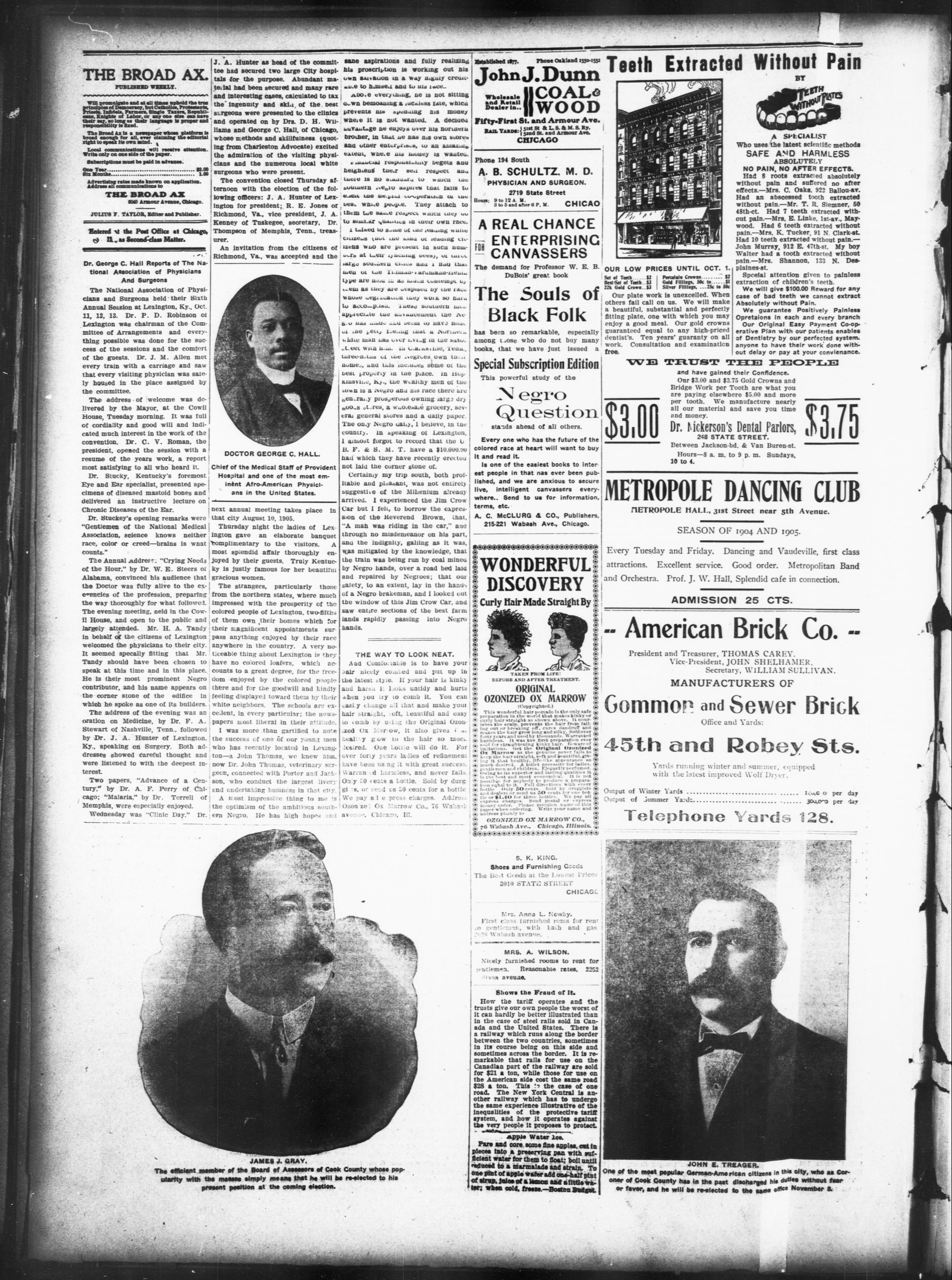
Dr. George C. Hall Reports of The National Association of Physicians And Surgeons
The National Association of Physicians and Surgeons held their Sixth Annual Session at Lexington, Ky., Oct. 11, 12, 13. Dr. P. D. Robinson of Lexington was chairman of the Committee of Arrangements and everything possible was done for the success of the sessions and the comfort of the guests. Dr. J. M. Allen met every train with a carriage and saw that every visiting physician was safely housed in the place assigned by the committee.
The address of welcome was delivered by the Mayor, at the Cowil House, Tuesday morning. It was full of cordiality and good will and indicated much interest in the work of the convention. Dr. C. V. Roman, the president, opened the session with a resume of the years work, a report most satisfying to all who heard it. Dr. Stucky, Kentucky's foremost Eye and Ear specialist, presented specimens of diseased mastoid bones and delivered an instructive lecture on Chronic Diseases of the Ear.
Dr. Stuckey's opening remarks were "Gentlemen of the National Medical Association, science knows neither race, color or creed—brains is what counts."
The Annual Address: "Crying Needs of the Hour," by Dr. W. E. Steers of Alabama, convinced his audience that the Doctor was fully alive to the exigencies of the profession, preparing the way thoroughly for what followed. The evening meeting, neld in the Cowil House, and open to the public and largely attended. Mr. H. A. Tandy in behalf of the citizens of Lexington welcomed the physicians to their city. It seemed specially fitting that Mr. Tandy should have been chosen to speak at this time and in this place. He is their most prominent Negro contributor, and his name appears on the corner stone of the edifice in which he spoke as one of its builders.
The address of the evening was an oration on Medicine, by Dr. F. A. Stewart of Nashville, Tenn., followed by Dr. J. A. Hunter of Lexington, Ky., speaking on Surgery. Both addresses showed careful thought and were listened to with the deepest interest. Two papers, "Advance of a Century," by Dr. A. F. Perry of Chicago; "Malaria," by Dr. Terrell of Memphis, were especially enjoyed. Wednesday was "Clinic Day." Dr.
J. A. Hunter as head of the committee had secured two large City hospitals for the purpose. Abundant material had been secured and many rare and interesting cases, calculated to tax the ingenuity and skill, of the best surgeons were presented to the clinics and operated on by Drs. D. H. Williams and George C. Hall, of Chicago, whose methods and skillfulness (quoting from Charleston Advocate) excited the admiration of the visiting physicians and the numerous local white surgeons who were present.
The convention closed Thursday afternoon with the election of the following officers: J. A. Hunter of Lexington for president; R. E. Jones or Richmond, Va., vice president, J. A. Kenney of Tuskegee, secretary, Dr. Thompson of Memphis, Tenn., treasurer. An invitation from the citizens of Richmond, Va., was accepted and the
[Name]
DOCTOR GEORGE C. HALL.
Chief of the Medical Staff of Provident Hospital and one of the most eminent Afro-American Physicians in the United States.
next annual meeting takes place in that city August 10, 1905.
Thursday night the ladies of Lexington gave an elaborate banquet complimentary to the visitors. A most splendid affair thoroughly enjoyed by their guests. Truly Kentucky is justly famous for her beautiful gracious women.
The strangers, particularly those from the northern states, where much impressed with the prosperity of the colored people of Lexington, two-fifths of them own their homes which for their magnificent appointments surpass anything enjoyed by their race anywhere in the country. A very noticeable thing about Lexington is they have no colored loafers, which accounts to a great degree, for the freedom enjoyed by the colored people there and for the goodwill and kindly feeling displayed toward them by their white neighbors. The schools are excellent, in every particular; the newspapers most liberal in their attitude.
I was more than gartified to note the success of one of our young men who has recently located in Lexington—a John Thomas, we knew him, now Dr. John Thomas, veterinary surgeon, connected with Porter and Jackson, who conduct the largest livery and undertaking business in that city.
A most impressive thing to me is the optimism of the ambitious southern Negro. He has high hopes and
sane aspirations and fully realizing his proscription is working out his own salvation in a way highly credible to himself and to his race.. Above everything, he is not sitting down bemoaning a lucidess fate, which prevents his spending his money where it is not wanted. A decided advantage he enjoys over his northern brother, in that he has his own stores and other enterprises, to an amazing extent, where his money is wanted.
financial responsibility begets and heightens their self respect and there is no standard to which the southern Negro aspires that falls to enact the helpful cooperation of the best white people. They attach to them the same respect which they do to similar quantities in their own race. I talked to some of the leading white citizens (not the kind of leading citizens who are present in such numbers at their lynching bees), of three large southern cities and I find that men of the Tillman-Vardmann-Heinle type are held in as much contempt by them as they are despised by the race whose degradation they work so hard to accomplish. These southern men appreciate the advancement the Negro has made and seem to have none of the petty feeling that a Northern white man has over living in the same street with him. In Carsville, Penn., three-ninths of the Negroes own their homes, and this includes some of the best property in the place. in Hopkinsville, Ky., the wealthy men of the town is a Negro and his race there are generally prosperous owning large dry goods stores, a wholesale grocery, several general stores and a daily paper. The only Negro daily, I believe, in the country. In speaking of Lexington, I almost forgot to record that the B. F. & S. M. T. have a $10,000.00 hail which they have recently erected not laid the corner stone of.
Certainly my trip south, both profitable and pleasant, was not entirely suggestive of the Milienium already arrived. I experienced the Jim Crow Car but I felt, to borrow the expression of the Reverend Brown, that, "A man was riding in the car," and through no misdemeanor on his part, and the indignity, galling as it was, was mitigated by the knowledge, that the train was being run by coal mined by Negro hands, over a road bed laid and repaired by Negroes; that our safety, to an extent, lay in the hands of a Negro brakeman, and I looked out the window of this Jim Crow Car, and saw entire sections of the best farm lands rapidly passing into Negro hands.
THE WAY TO LOOK NEAT.
And Comfortable is to have your hair nicely combed and put up in the latest style. If your hair is kinky and harsh it looks untidy and hurts when you try to comb it. You can easily change all that and make your hair straight, soft, beautiful and easy to comb by using the Original Ozonized Ox Marrow, it also gives an healthy gow to the hair so much desired. One bottle will do it. For over forty years ladies of refinement have been using it with great success. Warranted harmless, and never fails. Only 50 cents a bottle. Sold by durg giis, or send us 50 cents for a bottle. We pay a e press charges. Address Ozonized Ox Marrow Co., 76 Wabash avenue, Chicago, Ill.
Fifty-First St. and Armour Ave.
RAIL YARDS: { 151st St & L. S. & M. S. Ry.
52nd St. and Armour Ave.
CHJCAGO
Phone 194 South
A. B. SCHULTZ, M. D.
PHYSICIAN AND SURGEON.
2719 State Street
Hours: 9 to 12 A. M.
3 to 5 and after 6 P. M. CHICAO
A REAL CHANCE
FOR ENTERPRISING
CANVASSERS
The demand for Professor W. E. B.
DuBois' great book
The Souls of Black Folk has been so remarkable, especially among those who do not buy many books, that we have just issued a Special Subscription Edition This powerful study of the
Negro Question stands ahead of all others.
Every one who has the future of the colored race at heart will want to buy it and read it.
Is one of the easiest books to interest people in that nas ever been published, and we are anxious to secure live, intelligent canvassers everywhere.. Send to us for information, terms, etc.
A. C. McCLURG & CO., Publishers,
215-221 Wabash Ave., Chicago.
WONDERFUL
DISCOVERY
Curly Hair Made Straight By
TAKEN FROM LIFE:
BEFORE AND AFTER TREATMENT.
ORIGINAL
OZONIZED OX MARROW
(Copyrighted.)
This wonderful hair pomade is the only safe preparation in the world that makes kinky or curly hair straight as shown above. It nourishes the scalp, prevents the hair from falling out or breaking off, curts dandruff and makes the hair hair greying by thousands. Warranted harmless. It was the first preparation ever sold for straightening kinky hair. Beware of imitations. Get the Original Ozonized Ox Marrow as the best hair straight, soft and beautiful, giving it that healthy, life-like appearance so much desired. A toilet necessity for ladies, gentlemen and children. Elegantly performed. Owing to its superior and lasting qualities it is possible for anybody to produce a preparation equal to it. Full directions with every bottle. Only 50 cents. Sold by druggists and dealers or send us 50 CENTS for one bottle or $1.40 for three. Please send postal or express money order. Please mention name of this paper when ordering. Write your name and address plainly to
OZONIZED OX MARROW CO.,
76 Wabash Ave., Chicago, Illinois.
S. K. KING,
Shoes and Furnishing Goods
The Best Goods at the Lowest Prices
3010 STATE STREET
CHICAGO
Mrs. Anna L. Newby. First class furnished roms for rent to gentleman, with bath and gas 2028 Wabash avenue.
Nicely furnished rooms to rent for gentlemen. Reasonable rates. 2252 diana aveane.
Shows the Fraud of It.
How the tariff operates and the trusts give our own people the worst of it can hardly be better illustrated than in the case of steel rails sold in Canada and the United States. There is a railway which runs along the border between the two countries, sometimes in its course being on this side and sometimes across the border. It is remarkable that rails for use on the Canadian part of the railway are sold for $21 a ton, while those for use on the American side cost the same road $28 a ton. This is: the case of one road. The New York Central is another railway which has to undergo the same experience illustrative of the inequalities of the protective tariff system, and how it operates against the very people it proposes to protect.
Apple Water 1ca.
Pare and core, some fine apples, cut in pieces into a preserving pan with sufficient water for them to float; boll until reduced to a marmalade and strain. To one pint of apple water add one-half pint of sirup, juice of a lemon and a little water; when cold, freeze.—Boston Budget.
Teeth Extracted Without Pain
THE SAVED
STICKERSON DENTIST
STICKERSON DENTIST
OUR LOW PRICES UNTIL OCT. 1.
Set of Teeth ... $2
Best Set of Teeth ... $3
22k Gold Crown ... $3
Our plate work is unexcelled. When others fail call on us. We will make a beautiful, substantial and perfectly fitting plate, one with which you may enjoy a good meal. Our gold crowns guaranteed equal to any high-priced dentist's. Ten years' guaranty on all work. Consultation and examination free.
plaines-st.
Spcefal attention given to pain extraction of children's teeth.
We will give $100.00 Reward for case of bad teeth we cannot e Absolutely without Pain.
We guarantee Positively Pa Opretalions in each and every b Our Original Easy Payment erative Plan with our patients e of Dentistry by our perfected sy anyone to have their work done out delay or pay at your convien
and have gained their Confidence.
Our $3.00 and $3.75 Gold Crowns and Bridge Work per Tooth are what you are paying elsewhere $5.00 and more per tooth. We manufacture nearly all our material and save you time and money.
Dr. Nickerson's Dental Parlors,
248 STATE STREET.
Between Jackson-bd. & Van Buren-st.
Hours—8 a. m. to 9 p. m. Sundays,
10 to 4.
METROPOLE I
METROPOLE HALL, 31st
METROPOLE DANCING CLUB
METROPOLE DANCING CLUB
METROPOLE HALL, 31st Street near 5th Avenue. SEASON OF 1904 AND 1905. Every Tuesday and Friday. Dancing and Vaudeville, fine attractions. Excellent service. Good order. Metropolitan and Orchestra. Prof. J. W. Hall, Splendid cafe in connection
Every Tuesday and Friday. Dancing and Vaudeville, first class attractions. Excellent service. Good order. Metropolitan Band and Orchestra. Prof. J. W. Hall, Splendid cafe in connection.
ADMISSION 25 CTS.
American President and Treasurer, THE Vice-President, J Secreta
-- American Brick Co. --
President and Treasurer, THOMAS CAREY. Vice-President, JOHN SHELHAMER, Secretary, WILLIAM SULLIVAN. MANUFACTURERS OF Common and Sewer Brick Office and Yards:
Yards running winter and summer, equipped with the latest improved Wolf Dryer.
Output of Winter Yards ..... 140,000 per day
Output of Summer Yards..... 300,000 per day
Telephone Yards 128.
One of the most popular German-American citizens in this city, who as Coroner of Cook County has in the past discharged his duties without fear or favor, and he will be re-elected to the same office November 8.
One of the most popular German-American citizens in this city, who as Coroner of Cook County has in the past discharged his duties without fear or favor, and he will be re-elected to the same office November 8.
$3.00
TEETH WITHOUT PLATES
A SPECIALIST
Who uses the latest scientific methods
SAFE AND HARMLESS
ABSOLUTELY
We will give $100.00 Reward for any case of bad teeth we cannot extract Absolutely without Pain.
We guarantee Positively Painless Opretalions in each and every branch Our Original Easy Payment Co-operative Plan with our patients enables of Dentistry by our perfected system. anyone to have their work done without delay or pay at your convenience.
DANCING CLUB Street near 5th Avenue.
ancing and Vaudeville, first class Good order. Metropolitan Band Splendid cafe in connection.
Brick Co. --
THOMAS CAREY.
OHN SHELHAMER,
ry, WILLIAM SULLIVAN.
$3.75
M. H.
LAWRENCE B. STRINGER Candidate for Governor.
LAWRENCE B. STRINGER.
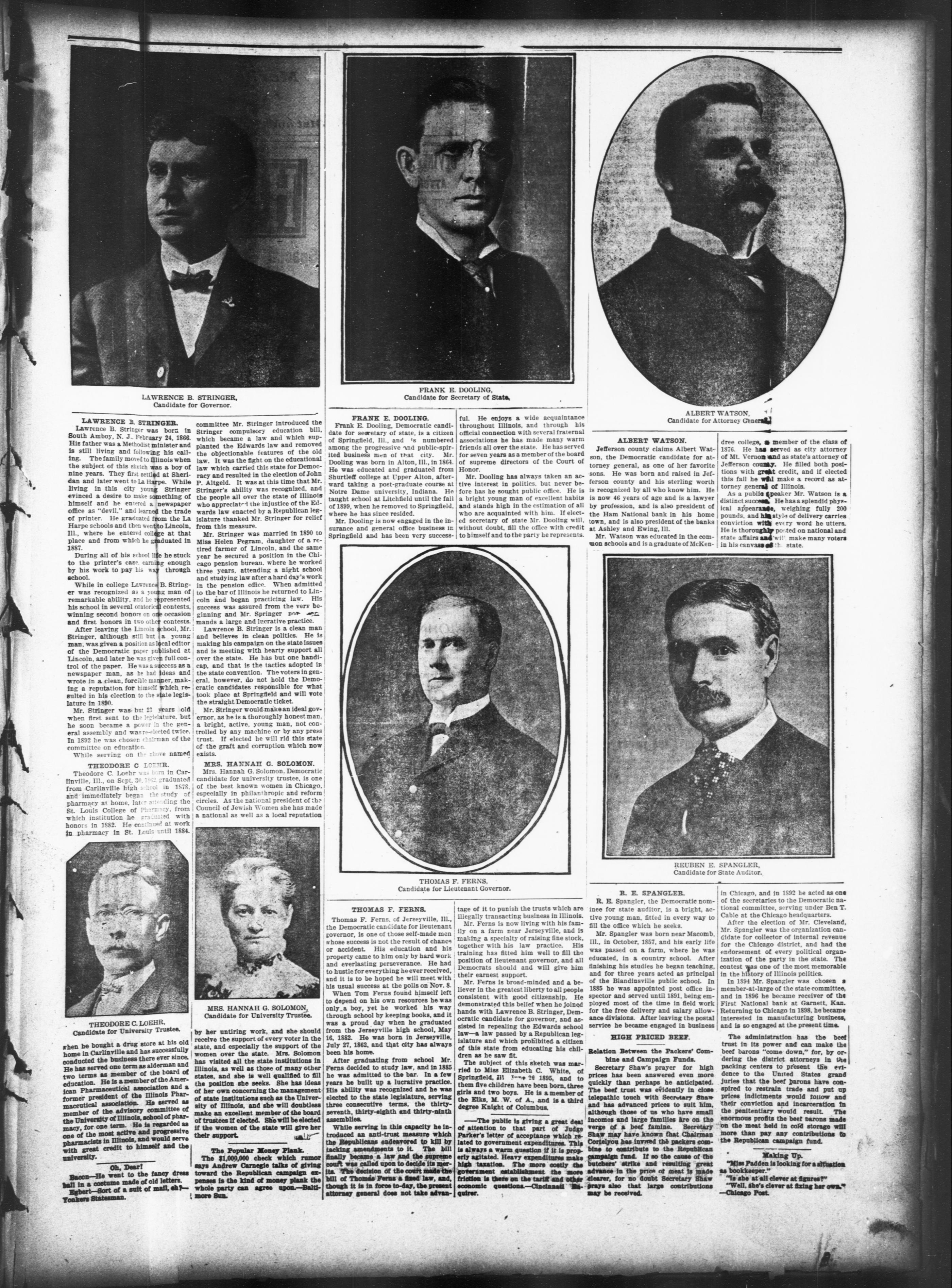
Lawrence B. Stringer was born in South Amboy, N. J.. February 24, 1866.
His father was a Methodist minister and is still living and following his calling. The family moved to Illinois when the subject of this sketch was a boy of nine years. They first settled at Sheridan and later went to La Harpe. While living in this city young Stringer evinced a desire to make something of himself and he entered a newspaper office as "devil," and learned the trade of printer. He graduated from the La Harpe schools and then went to Lincoln, Ill., where he entered college at that place and from which he graduated in 1887.
During all of his school life he stuck to the printer's case, earning enough by his work to pay his way through school.
While in college Lawrence B. Stringer was recognized as a young man of remarkable ability, and he represented his school in several oratorical contests, winning second honors on one occasion and first honors in two other contests.
After leaving the Lincoln school, Mr. Stringer, although still but a young man, was given a position as local editor of the Democratic paper published at Lincoln, and later he was given full control of the paper. He was a success as a newspaper man, as he had ideas and wrote in a clean, forcible manner, making a reputation for himself which resulted in his election to the state legislature in 1890.
Mr. Stringer was but 22 years old when first sent to the legislature, but he soon became a power in the general assembly and was re-elected twice. In 1892 he was chosen chairman of the committee on education.
While serving on the above named
THEODORE C. LOPEHR.
Theodore C. Loehr was born in Carlinville, Ill., on Sept. 30, 1882, graduated from Carlinville high school in 1878, and immediately began the study of pharmacy at home, later attending the St. Louis College of Pharmacy, from which institution he graduated with honors in 1882. He continued at work in pharmacy in St. Louis until 1884.
[Picture of a man in a suit and bow tie].
THEODORE C. LOEHR. Candidate for University Trustee.
when he bought a drug store at his old home in Carlinville and has successfully conducted the business there ever since. He has served one term as alderman and two terms as member of the board of education. He is a member of the American Pharmaceutical association and a former president of the Illinois Pharmaceutical association. He served as member of the advisory committee of the University of Illinois, school of pharmacy, for one term. He is regarded as one of the most active and progressive pharmacists in Illinois, and would serve with great credit to himself and the university.
Bacon—He went to the fancy dress ball in a costume made of old letters. Egbert—Sort of a suit of mail, eh? Yorkers Statesman.
Oh. Dear!
committee Mr. Stringer introduced the Stringer compulsory education bill, which became a law and which supplanted the Edwards law and removed the objectionable features of the old law. It was the fight on the educational law which carried this state for Democracy and resulted in the election of John P. Altgeld. It was at this time that Mr. Stringer's ability was recognized, and the people all over the state of Illinois who appreciated the injustice of the Edwards law enacted by a Republican legislature thanked Mr. Stringer for relief from this measure.
Mr. Stringer was married in 1890 to Miss Helen Pegram, daughter of a retired farmer of Lincoln, and the same year he secured a position in the Chicago pension bureau, where he worked three years, attending a night school and studying law after a hard day's work in the pension office. When admitted to the bar of Illinois he returned to Lincoln and began practicing law. His success was assured from the very beginning and Mr. Springer mands a large and lucrative practice.
Lawrence B. Stringer is a clean man and believes in clean politics. He is making his campaign on the state issues and is meeting with hearty support all over the state. He has but one handicap, and that is the tactics adopted in the state convention. The voters in general, however, do not hold the Democratic candidates responsible for what took place at Springfield and will vote the straight Democratic ticket. Mr. Stringer would make an ideal governor, as he is a thoroughly honest man, a bright, active, young man, not controlled by any machine or by any press trust. If elected he will rid this state of the graft and corruption which now exists.
MRS. HANNAH G. SOLOMON.
Mrs. Hannah G. Solomon, Democratic candidate for university trustee, is one of the best known women in Chicago, especially in philanthropic and reform circles. As the national president of the Council of Jewish Women she has made a national as well as a local reputation
Mary C.
MRS. HANNAH G. SOLOMON Candidate for University Trustee. by her untiring work, and she should receive the support of every voter in the state, and especially the support of the women over the state. Mrs. Solomon has visited all the state institutions in Illinois, as well as those of many other states, and she is well qualified to fill the position she seeks. She has ideas of her own concerning the management of state institutions such as the University of Illinois, and she will doubtless make an excellent member of the board of trustees if elected. She will be elected if the women of the state will give her their support.
The Popular Money Plank.
The $1,000,000 check which rumor says Andrew Carnegie talks of giving toward the Republican campaign expenses is the kind of money plank the whole party can agree upon.—Baltimore Sun.
M. B.
FRANK E. DOOLING. Candidate for Secretary of State.
FRANK E. DOOLING
Frank E. Dooling, Democratic candidate for secretary of state, is a citizen of Springfield, Ill., and is numbered among the progressive and public-spirited business men of that city. Mr. Dooling was born in Alton, Ill., in 1864. He was educated and graduated from Shurtleff college at Upper Alton, afterward taking a post-graduate course at Notre Dame university, Indiana. He taught school at Litchfield until the fall of 1899, when he removed to Springfield, where he has since resided. Mr. Dooling is now engaged in the insurance and general office business in Springfield and has been very success-
[Portrait of a man in a suit with a bow tie, facing slightly to the right. The background is a plain, light color. No text or additional details are present.]
[Portrait of a man in formal attire, wearing a suit and tie, with a serious expression. The background is a plain, light color, framed by an oval border.]]
THOMAS F. FERNS,
Candidate for Lieutenant Governor.
THOMAS F. FERNS.
Thomas F. Ferns, of Jerseyville, Ill., the Democratic candidate for lieutenant governor, is one of those self-made men whose success is not the result of chance or accident. His education and his property came to him only by hard work and everlasting perseverance. He had to hustle for everything he ever received, and it is to be hoped he will meet with his usual success at the polls on Nov. 8.
When Tom Ferns found himself left to depend on his own resources he was only a boy, yet he worked his way through school by keeping books, and it was a proud day when he graduated from the Jerseyville high school, May 16, 1882. He was born in Jerseyville, July 27, 1862, and that city has always been his home.
After graduating from school Mr. Ferns decided to study law, and in 1885 he was admitted to the bar. In a few years he built up a lucrative practice. His ability was recognized and he was elected to the state legislature, serving three consecutive terms, the thirty-seventh, thirty-eighth and thirty-ninth assemblies.
While serving in this capacity he introduced an anti-trust measure which the Republicans endeavored to kill by tacking amendments to it. The bill finally became a law and the supreme court was called upon to decide its merits. The decision of the court made the bill of Thomas Ferns a fixed law, and, though it is in force to-day, the present attorney general does not take advan-
---
ful. He enjoys a wide acquaintance throughout Illinois, and through his official connection with several fraternal associations he has made many warm friends all over the state. He has served for seven years as a member of the board of supreme directors of the Court of Honor. Mr. Dooling has always taken an active interest in politics, but never before has he sought public office. He is a bright young man of excellent habits and stands high in the estimation of all who are acquainted with him. If elected secretary of state Mr. Dooling will, without doubt, fill the office with credit to himself and to the party he represents.
[Name]
tage of it to punish the trusts which are illegally transacting business in Illinois.
Irregularly transacting business in Illinois. Mr. Ferns is now living with his family on a farm near Jerseyville, and is making a specialty of raising fine stock, together with his law practice. His training has fitted him well to fill the position of lieutenant governor, and all Democrats should and will give him their earnest support.
Mr. Ferns is broad-minded and a believer in the greatest liberty to all people consistent with good citizenship. He demonstrated this belief when he joined hands with Lawrence B. Stringer, Democratic candidate for governor, and assisted in repealing the Edwards school law—a law passed by a Republican legislature and which prohibited a citizen of this state from educating his children as he saw fit.
The subject of this sketch was married to Miss Elizabeth C. White, of Springfield, Ill June 26 1895, and to them five children have been born, three girls and two boys. He is a member of the Elks, M. W. of A., and is a third degree Knight of Columbus.
The public is giving a great deal of attention to that part of Judge Parker's letter of acceptance which related to government expenditures. This is always a warm question if it is properly agitated. Heavy expenditures make high taxation. The more costly the government establishment the more friction is there on the tariff and other economic questions.—Cincinnati Bailer.
```markdown
```
ALBERT WATSON,
Candidate for Attorney General
ALBERT WATSON,
Candidate for Attorney Genera
Jefferson county claims Albert Watson, the Democratic candidate for attorney general, as one of her favorite sons. He was born and raised in Jefferson county and his sterling worth is recognized by all who know him. He is now 46 years of age and is a lawyer by profession, and is also president of the Ham National bank in his home town, and is also president of the banks at Ashley and Ewing, Ill. Mr. Watson was educated in the common schools and is a graduate of McKen-
[Name]
M. B.
REUBEN E. S. SPANGLER
Candidate for State Auditor
R. E. Spangler, the Democratic nominee for state auditor, is a bright, active young man, fitted in every way to fill the office which he seeks.
Mr. Spangler was born near Macomb, Ill., in October, 1857, and his early life was passed on a farm, where he was educated, in a country school. After finishing his studies he began teaching, and for three years acted as principal of the Blandinsville public school. In 1885 he was appointed post office inspector and served until 1891, being employed most of the time in field work for the free delivery and salary allowance divisions. After leaving the post service he became engaged in business
HIGH PRICED BEEF.
Secretary Shaw's prayer for high prices has been answered even more quickly than perhaps he anticipated. The beef trust was evidently in close telepathic touch with Secretary Shaw and has advanced prices to suit him, although those of us who have small incomes and large families are on the verge of a beef famine. Secretary Shaw may have known that Chairman Cortelyou has invited the packers combine to contribute to the Republican campaign fund. If so the cause of the butchers' strike and resulting great advance in the price of meat is made clearer, for no doubt Secretary Shaw prays also that large contributions may be received.
```markdown
```
ALBERT WATSON.
R. E. SPANGLER
dree college, a member of the class of 1876. He has served as city attorney of Mt. Vernon and as state's attorney of Jefferson county. He filled both positions with great credit, and if elected this fall he will make a record as attorney general of Illinois. As a public speaker Mr. Watson is a distinct success. He has a splendid physical appearance, weighing fully 200 pounds, and his style of delivery carries conviction with every word he utters. He is thoroughly posted on national and state affairs and will make many voters in his canvass of the state.
IRELAND
in Chicago, and in 1892 he acted as one of the secretaries to the Democratic national committee, serving under Ben T. Cable at the Chicago headquarters. After the election of Mr. Cleveland, Mr. Spangler was the organization candidate for collector of internal revenue for the Chicago district, and had the endorsement of every political organization of the party in the state. The contest was one of the most memorable in the history of Illinois politics.
In 1894 Mr. Spangler was chosen a member-at-large of the state committee, and in 1896 he became receiver of the First National bank at Garnett, Kan. Returning to Chicago in 1898, he became interested in manufacturing business, and is so engaged at the present time.
The administration has the beef trust in its power and can make the beef barons "come down," for, by ordering the district attorneys in the packing centers to present the evidence to the United States grand juries that the beef barons have conspired to restrain trade and put up prices indictments would follow and their conviction and incarceration in the penitentiary would result. The enormous profits the beef barons made on the meat held in cold storage will more than pay any contributions to the Republican campaign fund.
"Miss Padden is looking for a situation as bookkeeper."
"Is she at all clever at figures?"
"Well, she's clever at fixing her own."
—Chicago Post.
The Colored Democrats Heid a Well Attended Meeting. Wednesday evening the colored Democrats of this city held a well attended meeting at 70 Washington St. Encouraging reports were made as to the progress of Democracy among the colored people in the various sections of the city.
Short speeches were made by Messrs. Crampton, Watkins, Clark, Lewis, Holman, Marrow, Henderson, Charles Morrison, Washington, Taylor and other. Nicholis Gier was present and he assured his fellow Democrats "that seventy-five per cent of the colored people in the 30th ward would vote for him for County Commissioner.
The three important committees are composed of the following persons:
Advisory Committee.
S. A. 1. Watkins, Jas. Miller, Geo. Woods, E. F. Marrow, Julius F. Taylor, W. K. Crampton, William H. Clark.
Literature Committee.
L. A. Newby, R. A. Dawson, Cyrus Miller, Julius F. Taylor, W. H. Clark, S. A. T. Watkins.
Executive Committee. . . .
L. W. Washington, Chairman, Ex., Geo. W. Henderson, William Holmon, Chairman, Robert Homos, Geo. Jones, Enos Bond, B. A. Lewis, Horace Clinton, K. D. Jackson, Sam. Nichols, Chas. Morrison, I. Cooper.
Another meeting will be held at the same place Monday afternoon at 3 o'clock, and all politically independent colored men are invited to attend the meeting.
CHIPS.
Robert L. Cooper, 122 Stave street who has charge of the private car belonging to Mr. S. Fish, president of the Illinois Central R. R. Co., met with an accident last week at Indianapolis, Ind., by falling from the platform of the car, As soon as Mr. Fish learned Mr. Cooper had fractured his left arm he ordered a doctor for him, and requested him to rest up for u next two weeks.
Miss Annie E. Lowrey has recently left the city for Alabama where she has been appointed to a lucratice position as stenographer in a large school credit for her being a stenographer and capable of taking the position is due to the Chicago Lawyer who while playing the organ for the Church in Avendale, became interested in the education of the young lady, and paid for her business training.
Armsted Jackson, 4834 Dearborn st. was last Thursday instantly killed while endeavoring to pacify E. S. Frinchey and George Huchinson who were quarreling in a barn in the rear of his home. Mr. Jackson was a good citizen. He leaves a wife and several children and many devoted friends. He owned his own home and almost had it free of debt. He was buried Sunday with Masonic honors.
Col. Edward H. Morris, who has been the colored Republican boss in the "black belt" for many years, was stripped of all of his political power this week by the Election Commissioners who kicked out Col. Morris and Durand his chum and they also threw out the contest of Edward D. Green and Francis P. Brady, and later on the Republican county committee selected the two last named men to make the race for the legislature in the First Senatorial District. The passing of Col. Edward H. Morris, the brilliant and brainy attorney for the "Gamblers' Trust," will make an interesting chapter in the political history of Chicago.
F. L. Barnett, who could write an interesting book on "How to Obtain Pension Money for old ignorant colored men and women and then report it lost or stuck to some one else's fingers," always claimed that The Broad Ax was a little "Nigger" newspaper that it couldn't hurt him as nobody read it. But lately he has been turning over heaven and hell in a vain endeavor to prevent the colored waiters in all the leading hotels from reading it. For he contends it will poison their minds against the Republican party and prevent them from voting the ticket. Barrett as Assistant States Attorney draws $150 per month from Democratic and Republican tax payers but he puts in all of the time which should be given to the people at the Republican National headquarters and he should be called down or dsmissed from office.
Harry S. Cummings, one of the little pot house politicians of Baltimore, Md., who is looking for a cheap job in case Col. Roosevelt is elected President and who receives his pay for every speech he makes declared while delivering a so-called political speech at Institutional Church last Wednesday night, that "Every Negro is a traitor and an enemy to his race" who refuses to continue to remain the mental and the servile slave of the
Grand Old Lily White party. But we are of the union that the only class of the race have proven themselves an emy and a traitor to their race are who have and are assisting the Republican party to murder women and children in the home rob them of their home or nothing that is near or near to them.
The secrete into guess the North ought to see their respective candidate for Congress and secure from them a peg to support the franchise plank in the national platform.—Ex.
This is true but not on Republican orator Black or white are having one word to say respecting the Negro plank in the Republican platform. The one or two cooled speakers who have received their pay for opening their mouthes in behalf of the election or Col. Roosevelt have been instructed not to refer to it and all they have to do to keep all the "Niggers" in line is to keep on "fighting the war or the rebellion over forty million times and tell them to remember that we freed you—that every Negro is not only an imp of hell but also an enemy and a traitor to his race, who fails to shout for the Rough Riding President."
PROTECTION ARGUMENTS MET.
Trusts, Combined, Defeat the Very Object of the Protection Theory. "The sole economic argument for a protective tariff," said Colonel A. H. Bacon, of Brooklyn, in his recent speech to the Travelers' Club, "is the ultimate benefit to the consumer by means of lower prices through domestic competition. The gigantic trusts have combined domestic plants so as to defeat the very object of the tariff under which they thrive. Prices are increased until a shipbuilder on the Clyde can buy American steel plate $10 a ton cheaper than a shipbuilder on the Kennebec, who now asks the general Government for a subsidy equal to $10 a ton to make up the difference.
"But,' says a Republican President, 'a reduction of the tariff would destroy the small manufacturers who are still infants and who bask in the shadow of the giant trusts.' This argument is too simple for children even. The tariff is to protect against the foreign competitor, but the foreign competitor must first destroy the largest domestic manufacturer before he can get at the infants. The battle must be waged between the giants, for the foreign giant could not occupy the home field without first defeating the domestic giant; and, under this recent argument, any man by investing a thousand dollars in a steel plant, fifty years from now could defeat the reduction of the tariff, even though the American Steel Trust was furnishing its product at every capital of the world. No, the moment one domestic firm becomes a giant, its very life depends upon its fighting every foreign foe, and it thus protects every infant that coddles under its shelter.
"But,' again say the orators: 'American laborers must not be reduced to the level of the pauper labor of Europe.' We are reminded of the traveler and his dog lost in the desert. Starvation stared them in the face. The traveler cut off the dog's tail, roasted it, ate the meat and threw back the bone to the dog. This represents the share of labor in the tariff problem."
FOSTER'S RANK TREASON.
Former Diplomat and Republican
Leader of the People
Leader Against a War Policy.
John W. Foster, an eminent Republican and accomplished diplomat, in an address before the American Bar Association a few days ago said:
"It has been reported in the press that the Secretary of the Navy has announced himself in favor of a navy equal to the greatest in the world. I trust he has been misquoted. Our Government should be ready to enter into an engagement for international disarmament, and not one looking to further increase of the navy. This country should hold itself to other and far more peaceful pursuits in the settlement of strife than to the making of implements of destruction and death."
This is rank heresy; in fact, it is treason to Roosevelt. It is likewise evidence that Mr. Foster is not looking to the Administration for any more jobs as arbitrator of international differences or negotiator of treaties between this and other countries.
Of course Mr. Foster is well aware that the Secretary of the Navy has not been misquoted. He is on record as saying that he favors the construction of a battleship of 20,000 tons displacement, one that will "knock the spots off" anything in this line yet launched abroad. The Secretary of the Navy is the President's "Me, Too," so it is safe to predict that the gentleman with the "Big Stick" will not be satisfied with the size and destructive capacity of the battleship Connecticut just launched at the Brooklyn Navy Yard. He wants a ship one-fifth larger than the Connecticut. It is doubtful if he will be contented with the navy until he has a battleship as large as the biggest British and the biggest German battleship combined. A battleship powerful enough, without assistance from other ships, to make any South American republic "behave itself with decency," "be orderly" and "be prosperous."
Colored and White Republicans Row "Apathy" has been dispelled in Grant County, Indiana, and there the first blood of the campaign has been spilled. The trouble grew out of rivalry between white and colored Republicans at Landesville and ended in a riot. One man had his collar bone broken and another was badly bruised about the legs and arms. Several arrests were made for rioting and assault with intent to kill.
JUDGE PARKER'S LETTER A NEW DECLARATION OF INDEPENDENCE
Imperialism is Struck the Hardest Blow It Ever Received---Republican Job- Lery W.ll Bre.d a Panic.
Charles M. Brown, a citizen of Fort Worth, Texas, sends to the Fort Worth Record the following eloquent comment upon Judge Parker's letter of acceptance:
"I am nearing the half century line, therefore have been reading letters of acceptance from Presidential candidates for many years.
"I am frank to admit that only two documents ever given to our public outrivals the letter of acceptance over the signature of Judge Alton B. Parker, those two being the Declaration of Independence and the Constitution of the United States. I might add that there never was a document written in this country by any man, dead or living, so nearly conforming to our Constitution as the one under discussion.
"It is a new declaration of independence made by a wise, honest, whole-souled statesman for the party of the people. It is firm, outspoken and to the point, arraigning the Republican machine before the public bar in its true colors, showing its standard bearer as usurping his lofty position by assuming prerogatives not allowed by our Constitution.
"It is not a lengthy document, but no word is superfluous; each one counts with telling effect. There are no subterfuges, no sophistry, but straight outshoulder blows for the people's rights under our Constitution."
"Imperialism is struck the hardest blow it ever received in this country, and if the American people do not awaken to the note of warning sounded by our Presidential candidate and continues the Republicans in power it will only be a matter of time until we shall have a one-man government under our people's Constitution. He will be called President of the United States, but in reality will be 'the monarch of all he surveys.' "The question now before the people of this country is, whether we shall have a Jeffersonian or a Hamiltonian form of government, for the Republican party is fast centralizing the governmental power in one man or allowing its leader to be the supreme dictator, regardless of the people's rights.
"There never was a time in the history of our country when this dictatorship has so openly shown its cloven foot. The bid by Roosevelt for the G. A. R.'s vote by his famous pension order proves this assertion.
"As there can be no change in our financial condition, Judge Parker being irrevocably a gold standard man, it is high time the Democrats were in governmental harness, turning the calcium light of truth on the last four years of Republican office-holding rottenness.
"I emphatically say that the indications are that the Government Treasury is being daily looted by corrupt practices, and another four years of Republican jobbery will throw this country into the greatest panic ever known in its history.
"It is apparent that every Republican in the country who is hidebound is swallowing Roosevelt, bag and baggage. We must rely on the independent vote to sweep us into victory.
"Our living expenses, under the extreme high tariff, are daily increasing. The trusts are combining to raise the price on our necessities and there is no hope to remedy this great evil under the sophistical promises of the party in power.
"My countrymen, I tell you that 1904 is the year the people of the United States should repudiate dictatorship, high tariff, looting the public treasury and machine politics, and I honestly believe a Democratic tidal wave will sweep over the land next November that will engulf the Republican party,—bury it out of sight."
PARTY PROMISES.
Fair and Definite Are the Democrats; Absurdly Vague the Republicans. Colonel Alexander S. Bacon, the well-known Brooklyn lawyer, in closing his excellent speech to the Commercial Travelers' Club, said in conclusion:
"The Democratic party says: 'We promise, now, to pass a resolution similar to that which granted independence to the Cubans, who have thrived so much better under their own than under our military government. We do this because it is admitted that the better class of Filipinos, who would do the ruling, are far superior to the Cubans.' "The Republicans say: 'We do now solemnly promise that at some time in the future we will meditate seriously upon the propriety of meditating again.'
"Democracy says: 'We believe in expansion, but not in imperialism. We believe that the Constitution should follow the flag, and that we should have no territory that we do not expect at some time to adopt into the family of States.' Expansion adopts children. Imperialism buys slaves. Republican imperialism would conquer, rule and bully the world, through brute force. Democratic expansion would take in only contiguous and homogeneous peoples. It would extend the Monroe Doctrine to republics everywhere until all peoples are homogeneous republics, despots remembered only as a faint memory, and all the world at peace, ruled by love, under the protecting arm of the great republic."
Uncle Joe Cannon's Rare Humor.
"Uncle" Joe Cannon, in all of his speeches in localities where gold Democrats are numerous, reminds his hearers that Judge Parker voted for Bryan, and then asks, "Can you trust such a man to uphold the gold standard?" This is rich. "Uncle" Joe's silver record is as follows:
In 1878 voted to pass the Bland free silver bill over the veto of a Republican President.
In 1890 voted voted for the Sherman silver purchase law.
Later he was one of a few Republicans who voted against the repeal of that law, which was urged by Grover Cleveland.
A. D. GASH
Attorney at Law,
84-86 La Salle Street, Chicago.
Suite 615 3619,
Telephone Main 3077.
FREDERICK W. JOB
ATTORNEY AT LAW
BARQUETTE BUILDING
Telephone 2000 Central
CHICAGO
JOHN E. OWENS
ATTORNEY & COUNSELOR
AT LAW
323 ASHLAND BLOCK
TELEPHONE CENTRAL 898 CHICAGO
PHONE- { office, M in 1157
Iten, Brown 42
STEPHEN A. LOUGLAS
LAWYER
Suite 200. 128 125 La Salle Street
CHICAGO
JOHN FITZGERALD
JUSTICE OF THE PEACE
STET G. MALSTED STRUGGE,
CHICAGO
Phone 1364 Central.
JOHN C. JONES
LAWYER
185 Dearborn Street
Adams Express Building
Room 607
Res. 3717 Armour Ave. CHICAGO
J. GRAY LUCAS
Attorney at J. w
Suite 611 167 Dearborn St., Cor. Monroe.
Chicago.
Tel. Cent. 5763. Res. Tel. Went. 4892.
J. I. HENNESSY,
Justice of the Peace,
6301 S. Halsted St.
WILLIAM TREXLER, CLERK.
TELEPHONE WENTWORTH 4403.
Police Magistrate Englewood Police
Court.
P. J. O'SHEA
ATTORNEY AT LAW
Suite 1444 Unity Building
79 Dearborn St. Chicago
Robert M. Mitchell
Suite 9, No. 77 South Clark St.
CHICAGO
ALBERT B. GEORGE
LAWYER
423 Ashland Block, Chicago.
MARCUS RUBEN,
(Incorporated)
Manufacturer of
Outfits for Waiters and Cooks,
BARBERS. :: DENTISTS,
BARKEEPERS AND BUTCHERS,
390 State St., Chicago.
Phone Harrison 417.
HILLMANS
112-114-116
STATE STREET
Theodore C. Mayer
Mortgages, Deeds, Notes and Legal Documents Drawn and Acknowledged. Room 22, 27 North Clark Street.
ILLINOIS BRICK CO.
WILLIAM C. KUESTER.
SUPERINTENDENT.
N. Western Ave., Ch
1994 N. Western Ave., Chicago.
Telephone Lake View 270.
M. JUNK, Proprietor JOS. P. JUNK, Manager 3700-3710 South Halsted Street and 897 to 929 Thirtyseventh Street CHICAGO
IMPORTED AND DOMESTIC WINES, LIQUORS AND CIGARS 8462 SOUTH HALSTED STREET. CHICAGO