The Broad Ax
Saturday, December 3, 1904
Chicago, Illinois
Page text (machine-generated)
THE BROAD AX
The Students Club of Brooklyn Reviewed and the School Teachers Incidentally Hit.
BY OUR SPECIAL CORRESPONDENT.
Vol. X
The Students Club of Brooklyn consists of a limited number of men whose purpose is set forth in the name of their society. It is total. y unlike most organizations among us, in that, one is not elected to membership on the ground of popularity or because he is a good fellow, each member must be both able and willing to contribute papers of approved ability and painstaking research. The club meets fortnightly on Thursdays at the residence of our president, the Hon. Samuel R. Scottron. Among the members we find Dr. W. M. Lively; D. Macon Webster, Lewis H. Latimer, Rev. Messrs. Lawton and Miller, Prof. Bulkley, and Dr. Peter W. Ray. Mention is made of this club to draw the attention of the race to the fact that too many of our organizations are simply time consumers and that sincere and earnest effort looking to real culture is entirely too infrequent among us. The boasted longings for higher culture of Boston usually end in a game of whist. Instead of the craze for the dance and the card table and the gossip circle, would it not be well for us to form more reading circles for the winter months? What our young people do not know about the poets, the best literature and the most inspiring biography would go far toward filling another Congressional Library. The alarming lack of literary culture among our school teachers for example, is greatly to be deplored. I have the greatest respect for our own teachers, for their native capacity, and sweetness of character and life, but the sad truth will not down, that they do not, as a class, give sufficient if any time to higher self culture. What could be more helpful to a village, a small town or to the numerous circles of friends in our large cities than the coming together of congenial companions once or twice a month for the purpose of study and reseach. The criticism was brought against us some years ago by the Slater Fund that much of our education is superficial. To whatever extent this is true, it is to be attributed to the fact that too many of us, who have been ground out of educational mills think the whole duty of man has been performed, and at once we cease to study, forgetting that at once also we begin to lose our grasp on what we picked up in the process. The physician who does not keep up with the advancement in surgery and the additions and the expurgations in Material Medica soon falls behind and should be relegated to the ranks of the horse doctor. Such a doctor merely goes about treating symptoms and effects without any clear grasp of the cause, and therefore giving no permanent relief to his patients. We have others who are conspicuous exceptions to such criminal indolence. Think of the famous surgeons, Daniel Williams, Austin Curtis, and William A. Ware field, two of these, Williams and Ware field being Baltimore boys. In other fields we have had our Crummell Langston, Blyden, Chestnutt, Fannie Jackson Coppin, Frances Harper, Annie Cooper, and hosts of others who by mental industry have made their mark. Is it to be wondered at that a people who have tasted so sparingly of real mental culture should be so generally swept from their shallow moorings of learning to worship the idol of the plow, the hoe and the scrub brush, which, however, in my opinion, are just as honorable as any other pursuit on God's green earth. At the same time, does it not conclusively show that as a race we have not as yet produced a reasonable number imbued with an appreciation for Letters? Are we not simply and truly
returning to our muttons when we so readily confess that we must return to the field to be attached to the soil? If now we can have a larger effort looking to adding to what we have received in the schools, we will acquire a taste for learning that will lead us to Elysian fields far beneath the surface of empty eloquence and witless speech. About fifteen years ago, a notable pamphlet was written by a white man, a Prof. J. O. A. Clark, D. D., L. L. D., of the Wesleyan College, Macon, Ga., an institution for the education of whites only. In this we get a very clear idea of the progress the Negro was making when in the process of mental education, before this bugaboo of too much mental training for him was sent up by the whites and taken up by some of our colored leaders, at first because they were led astray, and afterward, seeing what great things could be done by crying down higher mental training for the Negro and lauding a stampede back to the soil, they adopted this propaganda of the whites as the richly laden wave upon which they would ride in triumph to the pensioned security of golden sands. To-day, an advocate of higher mental culture for the Negro is regarded as a heretic. But to return to the evidence of Dr. Clark, taken in the halcyon epoch that endowed our leaders of to-day, with the ability to lead both in right and wrong paths. The booklet is entitled "The Races and Their Future: A Plea For Their Education." He writes: "It may be asked what benefit has the liberalty of the North been to the colored people? Have they availed themselves of their educational facilities? Have they been profited by them? Can they take an education? We answer, they have been incalculably benefited. They have showed, not only that they can receive an education, but an education of a high order. Their improvement has been so astonishing as to silence the doubting and cavailing. Our Southern eyes have been opened to see it, southern candor is free to admit it. There are none who cannot see it, but the wilfully blind; none who do not admit it, but the hopefully prejudiced. I am persuaded that the average examinations in the colored are better than the average in the white schools. What will be the issue, if the Negroes, outside of the cities, have better educational advantages than the whites? And what if the whites neglect their educational advantages? In many parts they have no school houses at all, and there are many who do not send their children to school any part of the year. The Negroes in this section are living on bread and water that they may send their children to school. When this is the case we must expect the Negroes to have the supremacy. And this result is a mere question of time; the problem may be solved as a sum in arithmetic. The better educated class must be in the end the more wealthy and influential. The Negro leaders (fifteen years ago) see this. Knowing that the white race has the supremacy because it is the more cultured, they urge upon their people the necessity of educating their children. The Caucasion race owes its great wealth and predominance to its preeminent culture. Knowledge is wealth and it is power. So it has ever been and so it ever will be. What if in the past the Negro race in culture had been pre-eminent? Then it would have been the wealthy and the ruling race. Then all that has been said about the kinky hair and the facial angle, and the flat nose, and the thick lips would have been reversed. "Now let us hear a word from Dr. Clark as to the industrial and mechanical stat of the Negro fifteen years ago, since
HEW TO THE LINE.
```markdown
```
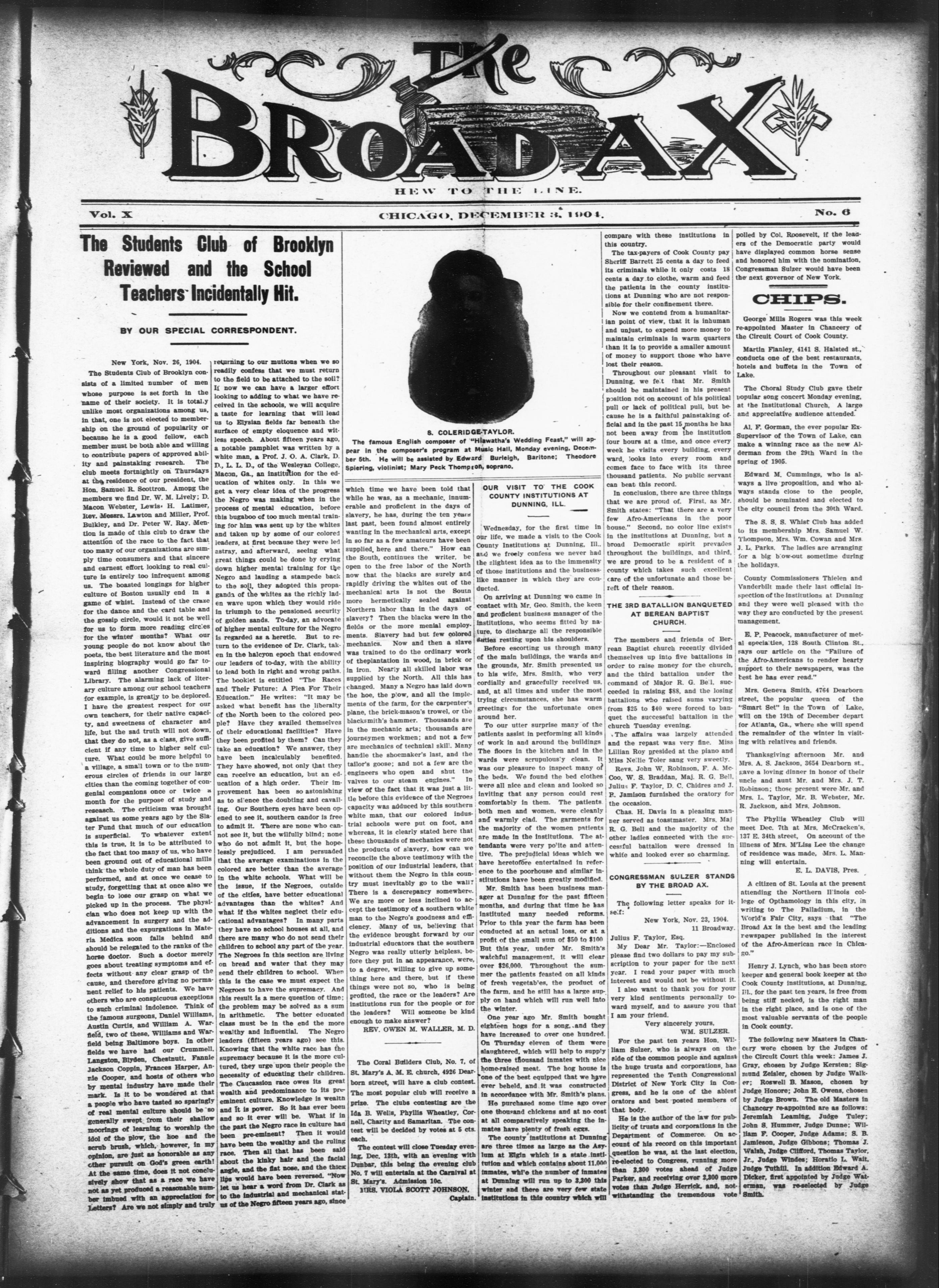
The famous English composer of "Hlawatha's Wedding Feast," will appear in the composer's program at Music Hall, Monday evening, December 5th. He will be assisted by Edward Burleigh, Baritone; Theodore Spiering, violinist; Mary Peck Thompson, soprano.
which time we have been told that while he was, as a mechanic, innumerable and proficient in the days of slavery, he has, during the ten years last past, been found almost entirely wanting in the mechanical arts, except in so far as a few amateurs have been supplied, here and there." How can the South, continues the writer, be open to the free labor of the North now that the blacks are surely and rapidly driving the whites out of the mechanical arts Is not the South more hermetically sealed against Northern labor than in the days of slavery? Then the blacks were in the fields or the more menial employments. Slavery had but few colored mechanics. Now and then a slave was trained to do the ordinary work of theplantation in wood, in brick or in iron. Nearly all skilled labor was supplied by the North. All this has changed. Many a Negro has laid down the hoe, the plow, and all the implements of the farm, for the carpenter's plane, the brick-mason's trowel, or the blacksmith's hammer. Thousands are in the mechanic arts; thousands are journeymen workmen; and not a few are mechanics of technical skill. Many handle the shoemaker's last, and the tailor's goose; and not a few are the engineers who open and shut the valves to our steam engines." In view of the fact that it was just a little before this evidence of the Negroes capacity was adduced by this southern white man, that our colored industrial schools were put on foot, and whereas, it is clearly stated here that these thousands of mechanics were not the products of slavery, how can we reconcile the above testimony with the position of our industrial leaders, that without them the Negro in this country must inevitably go to the wall? There is a descrepancy somewhere. We are more or less inclined to accept the testimony of a southern white man to the Negro's goodness and efficiency. Many of us, believing that the evidence brought forward by our industrial educators that the southern Negro was really utterly helpless, before they put in an appearance, were to a degree, willing to give up something here and there, but if these things were not so, who is being profited, the race or the leaders? Are institutions run for the people or for the leaders? Will someone be kind enough to make answer?
REV. OWEN M. WALLER, M. D
---
The Coral Builders Club, No. 7, of St. Mary's A. M. E. church, 4926 Dearborn street, will have a club contest. The most popular club will receive a prize. The clubs contesting are the Ida B. Welis, Phyllis Wheatley, Cornell, Charity and Samaritan. The contest will be decided by votes at 5 cts. each.
The contest will close Tuesday evening, Dec. 13th, with an evening with Dunbar, this being the evening club No. 7 will entertain at the Carnival at St. Mary's. Admission 10c.
MRS. VIOLA SCOTT JOHNSON. Captain
OUR VISIT TO THE COOK COUNTY INSTITUTIONS AT DUNNING, ILL.
Wednesday, for the first time in our life, we made a visit to the Cook County Institutions at Dunning, Ill., and we freely confess we never had the slightest idea as to the immensity of those institutions and the businesslike manner in which they are conducted.
On arriving at Dunning we came in contact with Mr. Geo. Smith, the keen and proficient business manager of the institutions, who seems fitted by nature, to discharge all the responsible duties resting upon his shoulders.
Before escorting us through many of the main buildings, the wards and the grounds, Mr. Smith presented us to his wife, Mrs. Smith, who very cordially and gracefully received us, and, at all times and under the most trying circumstances, she has warm greetings for the unfortunate ones around her.
To our utter surprise many of the patients assist in performing all kinds of work in and around the buildings. The floors in the kitchen and in the wards were scrupulous'y clean. It was our pleasure to inspect many of the beds. We found the bed clothes were all nice and clean and looked so inviting that any person could rest comfortably in them. The patients, both men and women, were cleanly and warmly clad. The garments for the majority of the women patients are made in the institutions. The attendants were very po'lite and attentive. The prejudicial ideas which we have heretofore entertained in reference to the poorhouse and similar institutions have been greatly modified.
Mr. Smith has been business manager at Dunning for the past fifteen months, and during that time he has instituted many needed reforms. Prior to this year the farm has been conducted at an actual loss, or at a profit of the small sum of $50 to $100. But this year, under Mr. Smith's watchful management, it will clear over $26,000. Throughout the summer the patients feasted on all kinds of fresh vegetab'es, the product of the farm, and he still has a large supply on hand which will run well into the winter.
One year ago Mr. Smith bought eighteen hogs for a song, and they have increased to over one hundred. On Thursday eleven of them were slaughtered, which will help to supply the three thousand inmates with nice home-raised meat. The hog house is one of the best equipped that we have ever beheld, and it was constructed in accordance with Mr. Smith's plans. He purchased some time ago over one thousand chickens and at no cost at all comparatively speaking the inmates have plenty of fresh eggs.
The county institutions at Dunning are three times as large as the Asylum at Elgin which is a state institution and which contains about 11,000 inmates, whi'e the number of inmates at Dunning will run up to 2,300 this winter and there are very few state institutions in this country which will
compare with these institutions in this country. The tax-payers of Cook County pay Sheriff Barrett 25 cents a day to feed its criminals while it only costs 18 cents a day to clothe, warm and feed the patients in the county institutions at Dunning who are not responsible for their confinement there.
Now we contend from a humanitarian point of view, that it is inhuman and unjust, to expend more money to maintain criminals in warm quarters than it is to provide a smaller amount of money to support those who have lost their reason.
Throughout our pleasant visit to Dunning, we felt that Mr. Smith should be maintained in his present position not on account of his political pull or lack of political pull, but because he is a faithful painstaking official and in the past 15 months he has not been away from the institution four hours at a time, and once every week he visits every building, every ward, looks into every room and comes face to face with its three thousand patients. No public servant can beat this record.
In conclusion, there are three things that we are proud of. First, as Mr. Smith states: "That there are a very few Afro-Americans in the poor house." Second, no color line exists in the institutions at Dunning, but a broad Democratic spirit prevades throughout the buildings, and third, we are proud to be a resident of a county which takes such excellent care of the unfortunate and those bereft of their reason.
THE 3RD BATALLION BANQUETED AT BEREAN BAPTIST CHURCH
The members and friends of Berrean Baptist church recently divided themselves up into five battalions in order to raise money for the church, and the third battalion under the command of Major R. G. Bell, succeeded in raising $88, and the losing battalions who raised sums varying from $25 to $40 were forced to banquet the successful battalion in the church Tuesday evening. The affairs was largely attended and the repast was very fine. Miss Lillian Roy presided at the piano and Miss Nellie Toler sang very sweetly.
Revs. John W. Robinson, F. A. McCoo, W. S. Braddan, Maj. R. G. Bell, Julius F. Taylor, D. C. Chidres and J. R. Jamison furnished the oratory for the occasion. Chas. H. Davis in a pleasing manner served as toastmaster. Mrs. Maj R. G. Bell and the majority of the other ladies connected with the successful battalion were dressed in white and looked ever so charming.
CONGRESSMAN SULZER STANDS BY THE BROAD AX.
The following letter speaks for itse.f:
New York, Nov. 23, 1904.
11 Broadway.
Julius F. Taylor, Esg.
Julius F. Taylor, Esq.
My Dear Mr. Taylor:—Enclosed please find two dollars to pay my subscription to your paper for the next year. I read your paper with much interest and would not be without it.
I also want to thank you for your very kind sentiments personally toward myself, and to assure you that I am your friend.
For the past ten years Hon. William Sulzer, who is always on the side of the common people and against the huge trusts and corporations, has represented the Tenth Congressional District of New York City in Congress, and he is one of the ablest orators and best posted members of that body.
He is the author of the law for publicity of trusts and corporations in the Department of Commerce. On account of his record on this important question he was, at the last election, re-elected to Congress, running more than 3,300 votes ahead of Judge Parker, and receiving over 2,300 more votes than Judge Herrick, and, notwithstanding the tremendous vote
No. 6
polled by Col. Roosevelt, if the leaders of the Democratic party would have displayed common horse sense and honored him with the nomination, Congressman Sulzer would have been the next governor of New York.
CHIPS.
George Mills Rogers was this week re-appointed Master in Chancery of the Circuit Court of Cook County.
Martin Flanley, 4141 S. Halsted st., conducts one of the best restaurants, hotels and buffets in the Town of Lake.
The Choral Study Club gave their popular song concert Monday evening, at the Institutional Church, A large and appreciative audience attended.
Al. F. Gorman, the ever popular Ex-Supervisor of the Town of Lake, can make a winning race as the new Alderman from the 29th Ward in the spring of 1905.
Edward M. Cummings, who is always a live proposition, and who always stands close to the people, should be nominated and elected to the city council from the 30th Ward.
The S. S. S. Whist Club has added to its membership Mrs. Samuel W. Thompson, Mrs. Wm. Cowan and Mrs. J. L. Parks. The ladies are arranging for a big blow-out sometime during the holidays.
County Commissioners Thielen and Vanderbilt made their last official inspection of the institutions at Dunning and they were well pleased with the way they are conducted by the present management.
E. P. Peacock, manufacturer of metal specialties, 128 South Clinton St., says our article on the "Failure of the Afro-Americans to render hearty support to their newspapers, was the best he has ever read."
Mrs. Geneva Smith, 4764 Dearborn street, the popular queen of the "Smart Set" in the Town of Lake, will on the 19th of December depart for Atlanta, Ga., where she will spend the remainder of the winter in visiting with relatives and friends.
Thanksgiving afternoon Mr. and Mrs. A. S. Jackson, 3654 Dearborn st., gave a loving dinner in honor of their uncle and aunt Mr. and Mrs. J. T. Robinson; those present were Mr. and Mrs. L. Taylor, Mr. B. Webster, Mr. R. Jackson, and Mrs. Johnson.
The Phyllis Wheatley Club will meet Dec. 7th at Mrs. McCracken's, 137 E. 34th street, On account of the illness of Mrs. M'Liss Lee the change of residence was made, Mrs. L. Manning will entertain.
E. L. DAVIS. Pres.
A citizen of St. Louis at the present attending the Northern Illinois college of Opthamology in this city, in writing to The Palladium, in the World's Fair City, says that "The Broad Ax is the best and the leading newspaper published in the interest of the Afro-American race in Chicago."
Henry J. Lynch, who has been store keeper and general book keeper at the Cook County institutions, at Dunning, Ill., for the past ten years, is free from being stiff necked, is the right man in the right place, and is one of the most valuable servants of the people in Cook county.
The following new Masters in Chancery were chosen by the Judges of the Circuit Court this week: James J. Gray, chosen by Judge Kersten; Sigmund Zeisler, chosen by Judge Walker; Roswell B. Mason, chosen by Judge Honore; John E. Owens, chosen by Judge Brown. The old Masters in Chancery re-appointed are as follows: Jeremiah Leaming, Judge Tuley; John S. Hummer, Judge Dunne; William F. Cooper, Judge Adams; S. B. Jamieson, Judge Gibbons; Thomas J. Walsh, Judge Clifford, Thomas Taylor, Jr., Judge Windes; Horatio L. Wait, Judge Tuthill. In addition Edward A. Dicker, first appointed by Judge Waterman, was re-selected by Judge Smith.
PUBLISHED WEEKLY.
Will promulgate and at all times uphold the true principles of Democracy, but Catholic, Protestants, Priests, Infidels, Farmers, Single Taxes, Republicans, Knights of Labor, or any one else can have their say, so long as their language is proper and responsibility is fixed.
The Broad ax is a newspaper whose platform is broad enough for all, ever claiming the editorial right to speak its own mind.
Local communications will receive attention.
Write only on one side of the paper.
JULIUS F. TAYLOR, Editor and Publisher. Entered at the Post Office at Chicago. II., as Second-class Matter.
Death Claims Mrs. Eliza Brown, Saint Of Avondale.
Sunday, the 20th day of November, A. D., 1904, from the beautiful suburb, Avondale, was the saintly life of Mrs. Eliza Brown brought to a close. So far as our human conceptions can advance beyond the limitations of knowledge, aided by faith and reason, we can only say the great woman is gone. Where? I beg leave to refer you to Dr. Carey's most sublimely eloquent sermon, delivered at her funera'. It was the best sermon the writer ever heard from th lips of any man, at any place, and if any one who heard it does not derive a lifelong benefit from the same, he or she is too stupid to be classed with human beings. The sermon was a complete guide heavenward.
Wednesday, the 23d day of November, A. D., 1904, at the hour of 11 o'clock, a. m., loving friends and acquaintances of the deceased began to assemble at Bethel, A. M. E. church, 30th and Dearborn Streets, to pay the last tribute of respect to Mrs. Brown. A solemn silence reigned. Dr. J. M. Townsend, the veteran clergyman, entered, and took his place on the rostrum; then followed a deep and soulstirring roll of the pipe organ, the funeral cortege enters, led by Mr. Fred Pounds and other officers of Allen Chapel, Avondale. The scholarly Dr. A. J. Carey next appeared, reading the usual psalm, then came the coffin, followed by Mrs. Jefferson, Miss Montgomery and other members of the family, sorrowfully weeping and mourning the loss of such a devoted friend and relative. There were many friends following the bier in which lay the remains of one of Nature's most estimable women. Doing great honor to her, the deceased, Mount Hope Temple, No. 1, of which Mrs. Brown was a member in her lifetime, turned out in a body, and added much dignity to the occasion. The ladies, all beautiful, were robed in black silk, the uniform being fittingly relieved by white collars. From all appearances, this is a model society.
All now seated, the choir sang "I Would Not Live Always," which was the last song the writer, assisted by her niece, Miss Montgomery, sang for her at the Avondale home. Dr. Townsend prays a good prayer; Dr. Carey reads the eulogy and death notice, and then follows the wonderful sermon, a few extracts from which are here quoted for the benefit of those who were absent:
Text: Luke 18th, 14th verse: "Of such is the kingdom of heaven." Christ, when parents brought to Him their children, took them into his arms, blessed them, and spoke thus; his aim was to convey the idea of a kingdom on earth; did not tell precisely what it was, but gave numerous illustrations as to what it was like, because, the mind of man being finite, it could not grasp; we do not have to wait to pass through the inexplicable change before becoming citizens of the kingdom; can be now actual citizens of the kingdom; that "Sister Brown," he had no hesitancy in saying, was, according to her walks and works on earth, as fully a citizen of the kingdom as she was after the demise; that the kingdom was composed of such as little children; that the kingdom of God was established on earth in the hearts of good men and women; those who do His will are the people; such enjoy heaven here, and do not concern themselves about passing into the other; it is simply a continuation; the citizens of the kingdom are like children; because their thoughts are pure, unselfish and full of sympathy for all mankind and also all of God's creatures; told of his little child's passing a restless night, because it had seen an animal killed in the street the day before, and narrated how the little one wept; told how little children would give away all they had to others, and declared Mrs. Brown was of the same character, telling how often benighted and impoverished preachers and others had been aided on their journey and fed by the noble heart whose remains lay in the coffin there; truthfully said that no one hungry or in need ever applied to her
-
for assistance, and was turned away unassisted; verily of such was the kingdom of heaven; said he could speak until the going down of the sun of the deeds of love and sacrifice or that departed saint, but Dr. Booth and Dr. Townsend would speak, and he had to be brief; then, in a beautiful peroration, he said: "These eighty-seven years of unselfish devotion to Christ, holiness and Christliness will not only live in the hearts of the people of Avondale, the Avondale church of which she was a most noble supporter, and Bethel Church where all knew of her great Christian character, but all over the country will they remember her, and those who have passed over and through the vale, men, women and children whom she had helped will await her coming, and welcome her spirit to the beautiful land of God forever. No lesser reward could await a true and noble character like "Sister Brown," and the Choir sang another of her favorite songs: "In Thy Cleft, O Rock of Ages." At this point the reporter had to of necessity leave to meet an engagement, and was sorry he could not remain until the end of the services, to hear Drs. Booth and Townsend speak. E. F. Y.
JOHN B. BURKE
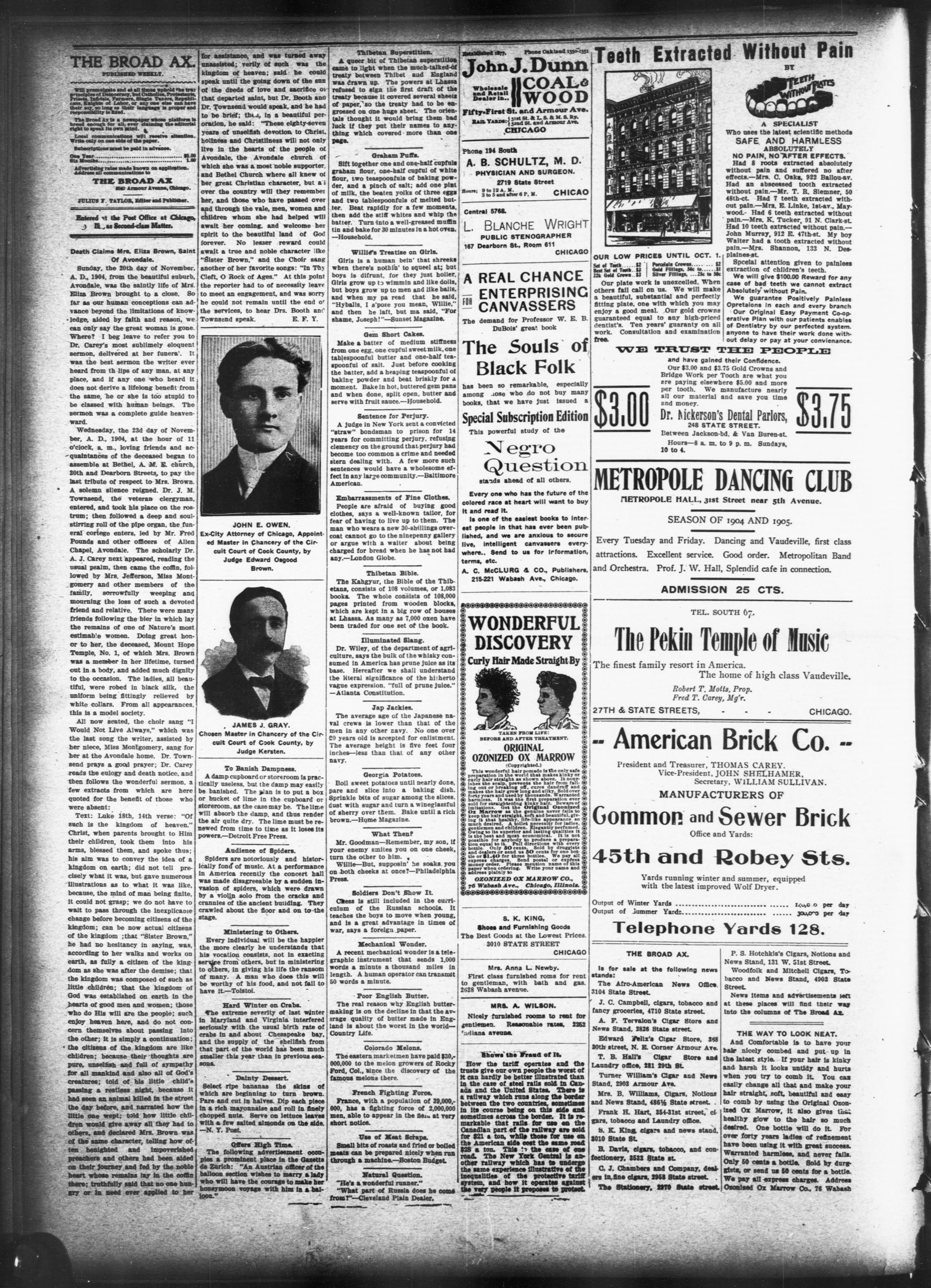
JOHN E. OWEN. Ex-City Attorney of Chicago, Appoint ed Master in Chancery of the Circuit Court of Cook County, by Judge Edward Osgood Brown.
JOHN E. OWEN. Ex-City Attorney of Chicago, Appoint ed Master in Chancery of the Circuit Court of Cook County, by Judge Edward Osgood Brown.
P. H.
JAMES J. GRAY. Chosen Master in Chancery of the Circult Court of Cook County, by Judge Kersten.
To Banish Dampness
A damp cupboard or storeroom is practically useless, but the damp may easily be banished. The plan is to put a box or bucket of lime in the cupboard or storeroom, as the case may be. The lime will absorb the damp, and thus render the air quite dry. The lime must be renewed from time to time as it loses its powers.—Detroit Free Press.
Audience of Spiders.
Spiders are notoriously and historically fond of music. At a performance in America recently the concert hall was made disagreeable by a sudden invasion of spiders, which were drawn by a violin solo from the cracks and crannies of the ancient building. They crawled about the floor and on to the stage.
Ministering to Others
Every individual will be the happier the more clearly he understands that his vocation consists, not in exacting service from others, but in ministering to others, in giving his life the ransom of many. A man who does this will be worthy of his food, and not fall to have it—Tolstol.
Hard Winter on Crabs.
The extreme severity of last winter in Maryland and Virginia interfered seriously with the usual birth rate of crabs in and about Chesapeake bay, and the supply of the shellfish from that part of the world has been much smaller this year than in previous seasons.
Dainty Dessert.
Select ripe bananas the skins of which are beginning to turn brown. Pare and cut in halves. Dip each piece in a rich mayonnaise and roll in finely chopped nuts. Serve on lettuce leaves with a few salted almonds on the side. —N. Y. Post.
Offers High Time.
The following advertisement occupies a prominent place in the Gazette de Zurich: "An Austrian officer of the balloon section wishes to marry a lady who will have the courage to make her honeymoon voyage with him in a balloon."
Thibetan Superstition.
A queer bit of Thibetan superstition came to light when the much-talked-of treaty between Thibet and England was drawn up. The powers at Lhassa refused to sign the first draft of the treaty because it covered several sheets of paper, so the treaty had to be engrossed on one huge sheet. The orientals thought it would bring them bad luck if they put their names to anything which covered more than one page.
Graham Puffs
Sift together one and one-half cupfuls graham flour, one-half cupful of white flour, two teaspoonfuls of baking powder, and a pinch of salt; add one pint of milk, the beaten yolks of three eggs and two tablespoonfuls of melted butter. Beat rapidly for a few moments, then add the stiff whites and whip the batter. Turn into a well-greased muffin tin and bake for 30 minutes in a hot oven. —Household.
Williie's Treatise on Girls.
Girls is a human bein' that shreeks when there's nothin' to squeeel at; but boys is difrunt, for they just holler. Girls grow up to wimmin and like dolls, but boys grow up to men and like balls, and when my pa read that he said, "Hyballs, I s'pose you mean, Willie," and then he laft, but ma said, "For shame, Joseph!"—Sunset Magazine.
Gem Short Cakes.
Make a batter of medium stiffness from one egg, one cupful sweet milk, one tablespoonful butter and one-half teaspoonful of salt. Just before cooking the batter, add a heaping teaspoonful of baking powder and beat briskly for a moment. Bake in hot, buttered gem pans and when done, split open, butter and serve with fruit sauce.—Household.
Sentence for Periury.
A judge in New York sent a convicted "straw" bondsman to prison for 14 years for committing perjury, refusing clemency on the ground that perjury had become too common a crime and needed stern dealing with. A few more such sentences would have a wholesome effect in any large community.—Baltimore American.
Embarrassments of Fine Clothes. People are afraid of buying good clothes, says a well-known tailor, for fear of having to live up to them. The man who wears a new 30-shillings overcoat cannot go to the ninepenny gallery or argue with a waiter about being charged for bread when he has not had any.—London Globe.
Thibetan Bible.
The Kahgyur, the Bible of the Thibetans, consists of 108 volumes, or 1,083 books. The whole consists of 108,000 pages printed from wooden blocks, which are kept in a big row of houses at Lhassa. As many as 7,000 oxen have been traded for one set of the book.
Illuminated Slang
Dr. Wiley, of the department of agriculture, says the bulk of the whisky consumed in America has prune juice as its base. Hereafter we shall understand the literal significance of the hitherto vague expression. "full of prune juice." Atlanta Constitution.
Jap Jackies.
The average age of the Japanese naval crews is lower than that of the men in any other navy. No one over 20 years old is accepted for enlistment. The average height is five feet four inches—less than that of any other navy.
Georgia Potatoes
Boil sweet potatoes until nearly done, pare and slice into a baking dish. Sprinkle bits of sugar among the slices, dust with sugar and turn a wineglassful of sherry over them. Bake until a rich brown.—Home Magazine.
What Then?
Mr. Goodman—Remember, my son, if your enemy smites you on one cheek, turn the other to him.
Willie—But, supposin' he soaks. you on both cheeks at once?—Philadelphia Press.
Soldiers Don't Show It.
Chess is still included in the curriculum of the Russian schools. It teaches the boys to move when young, and is a great advantage in times of war, says a foreign paper.
Mechanical Wonder.
A recent mechanical wonder is a telegraphic instrument that sends 1,000 words a minute a thousand miles in length. A human operator can transmit 50 words a minute.
Poor English Butter
The real reason why English buttermaking is on the decline in that the average quality of butter made in England is about the worst in the world Country Life.
Colorado Melons
The eastern marketmen have paid $30,000,000 to the melon growers of Rocky Ford, Col., since the discovery of the famous melons there.
France, with a population of 39,000,000, has a fighting force of 2,000,000 men, able to appear in the field at very short notice.
Small bits of roasts and fried or boiled meats can be prepared nicely when run through a machine.—Boston Budget.
"What part of Russia does he come from?"—Cleveland Plain Dealer.
Fifty-First St. and Armour Ave.
RAIL YARDS: 51st St. & L. S. & M. S. Ry.
52nd St. and Armour Ave.
CHICAGO
Phone 194 South
A. B. SCHULTZ, M. D.
PHYSICIAN AND SURGEON.
2719 State Street
Hours; 9 to 12 A. M.
3 to 5 and after 6 P. M. CHICAO
Central 5768.
L. BLANCHE WRIGHT
PUBLIC STENOGRAPHER
167 Dearborn St., Room 611
CHICAGO
A REAL CHANCE
FOR ENTERPRISING
CANVASSERS
The demand for Professor W. E. B.
DuBois' great book
The Souls of Black Folk
has been so remarkable, especially among those who do not buy many books, that we have just issued a Special Subscription Edition This powerful study of the Negro Question stands ahead of all others. Every one who has the future of the colored race at heart will want to buy it and read it.
Is one of the easiest books to interest people in that has ever been published, and we are anxious to secure live, intelligent canvassers everywhere.. Send to us for information, terms, etc. A. C. McCLURG & CO., Publishers, 215-221 Wabash Ave., Chicago.
WONDERFUL DISCOVERY Curly Hair Made Straight By
TAKEN FROM LIFE:
BEFORE AND AFTER TREATMENT.
ORIGINAL
OZONIZED OX MARROW
(Copyrighted.)
This wonderful hair pomade is the only safe preparation in the world that makes kinky or curly hair straight as shown above. It nourishes the scalp, prevents the hair from falling out or breaking off, cures dandruff and makes the hair grow long and silky. Sold over forty years and used by thousands. Warranted harmless. It was the first preparation of hair. Beware of imitations. Get the Original Ozonized Ox Marrow as the genuine never falls to keep the hair straight, soft and beautiful, giving it that healthy, life-like appearance so much desired. A toilet necessity for ladies, gentlemen and children. Elegantly perfumed. Owing to its superior and lasting qualities it is the best and most economical. It is not possible for anybody to produce a preparation equivalent to directions written by a professional. Only 50 cents. Sold by druggists and dealers or send us 50 cents for one bottle or 11.40 for three bottles. We pay all express charges. Send postal or express money order. Please mention name of this paper when ordering. Write your name and address plainly
OZONIZED OX MARROW CO.,
76 Wabash Ave., Chicago, Illinois.
S. K. KING,
Shoes and Furnishing Goods
The Best Goods at the Lowest Prices.
3010 STATE STREET
CHICAGO
Mrs. Anna L. Newby.
First class furnished roms for rent to gentleman, with bath and gas. 2628 Wabash avenue.
MRS. A. WILSON.
Nicely furnished rooms to rent for gentlemen. Reasonable rates, 2252 indiana aveune.
Shows the Fraud of It.
How the tariff operates and the trusts give our own people the worst of it can hardly be better illustrated than in the case of steel rails sold in Canada and the United States. There is a railway which runs along the border between the two countries, sometimes in its course being on this side and sometimes across the border. It is remarkable that rails for use on the Canadian part of the railway are sold for $21 a ton, while those for use on the American side cost the same road $28 a ton. This is the case of one road. The New York Central is another railway which has to undergo the same experience illustrative of the inequalities of the protective tariff system, and how it operates against the very people it proposes to protect.
---
Teeth Extracted Without Pain
DENTIST
Our plate work is unexcelled. When others fall call on us. We will make a beautiful, substantial and perfectly fitting plate, one with which you may enjoy a good meal. Our gold crowns guaranteed equal to any high-priced dentist's. Ten years' guaranty on all work. Consultation and examination free.
Spcelal attention given to pain extraction of children's teeth.
We will give $100.00 Reward for case of bad teeth we cannot e Absolutely without Pain.
We guarantee Positively Pa Opretalons in each and every b Our Original Easy Payment erative Plan with our patients en Of Dentistry by our perfected sy anyone to have their work done out delay or pay at your convien
and have gained their Confidence. Our $3.00 and $3.75 Gold Crowns and Bridge Work per Tooth are what you are paying elsewhere $5.00 and more per tooth. We manufacture nearly all our material and save you time and money.
Dr. Nickerson's Dental Parlors,
248 STATE STREET.
Between Jackson-bd. & Van Buren-st.
Hours—8 a. m. to 9 p. m. Sundays,
10 to 4.
METROPOLE I
METROPOLE HALL, 31st
METROPOLE DANCING CLUB
METROPOLE DANCING CLUB
METROPOLE HALL, 31st Street near 5th Avenue. SEASON OF 1904 AND 1905. Every Tuesday and Friday. Dancing and Vaudeville, fine attractions. Excellent service. Good order. Metropolitan and Orchestra. Prof. J. W. Hall, Splendid cafe in connection
Every Tuesday and Friday. Dancing and Vaudeville, first class attractions. Excellent service. Good order. Metropolitan Band and Orchestra. Prof. J. W. Hall, Splendid cafe in connection.
ADMISSION 25 CTS.
TEL. SOUTH 67.
The Pekin Temple of
The finest family resort in America.
The home of high c
TEL. SOUTH 67.
The Pekin Temple of Music
The finest family resort in America.
The home of high class Vaudeville.
Robert T. Motts, Prop.
Fred T. Carey, Mg'r.
27TH & STATE STREETS, CHICAGO.
-- American
President and Treasurer, THE
Vice-President, JC
Secretary
MANUFACT
Common and S
Office an
45th and I
Yards running winter
with the latest improv
Output of Winter Yards ...
Output of Summer Yards...
Telephone
American Brick Co.
President and Treasurer, THOMAS CAREY.
Vice-President, JOHN SHELHAMER,
Secretary, WILLIAM SULLIVAN.
MANUFACTURERS OF
Common and Sewer Brick
Office and Yards:
45th and Robey Sts.
Yards running winter and summer, equipped
with the latest improved Wolf Dryer.
Output of Winter Yards ..... 140,00 per day
Output of Summer Yards..... 300,00 per day
Telephone Yards 128.
THE BROAD AX.
Is for sale at the following news stands:
The Afro-American News Office. 3104 State Street.
J. C. Campbell, cigars, tobacco and fancy groceries, 4710 State street.
A. F. Tervalon's Cigar Store and News Stand, 2826 State street.
Edward Felix's Cigar Store, 368 30th street, N. E. Corner Armour Ave.
T. B. Hall's Cigar Store and Laundry office, 281 29th St.
Turner William's Cigar and News Stand, 2903 Armour Ave.
Mrs. B. Williams, Cigars, Notions and News Stand, 486½ State street.
Frank H. Hart, 354-31st street, cigars, tobacco and Laundry office.
S. K. King, cigars and news stand, 3010 State St.
B. Davis, cigars, tobacco, and confectionery, 3532 State st.
C. J. Chambers and Company, dealers in fine cigars, 2958 State street.
The Stationery, 2970 State street
the community, live and work there.
$3.00
TEETH WITHOUT PLATES
A SPECIALIST
Who uses the latest scientific methods
SAFE. AND HARMLESS
ABSOLUTELY
We will give $100.00 Reward for any case of bad teeth we cannot extract Absolutely without Pain.
We guarantee Positively Painless Opretalions in each and every branch Our Original Easy Payment Co-operative Plan with our patients enables of Dentistry by our perfected system. anyone to have their work done without delay or pay at your convienance.
DANCING CLUB Street near 5th Avenue.
ancing and Vaudeville, first class Good order. Metropolitan Band Splendid cafe in connection.
SOUTH 67.
ample of Music
America.
home of high class Vaudeville.
Lits, Prop.
M, Mg'r.
CHICAGO.
Brick Co. --
THOMAS CAREY.
JOHN SHELHAMER,
Bry, WILLIAM SULLIVAN.
TURERS OF
Sewer Brick
and Yards:
Robey Sts.
and summer, equipped
ved Wolf Dryer.
140,00 per day
300,00 per day
Yards 128.
P. S. Hotchkis's Cigars, Notions and News Stand, 131 W. 51st Street. Woodfolk and Mitchell Cigars, Tobacco and News Stand, 4902 State Street. News items and advertisements left at these places will find their way into the columns of The Broad Ax.
THE WAY TO LOOK NEAT.
And Comfortable is to have your hair nicely combed and put-up in the latest style. If your hair is kinky and harsh it looks untidy and hurts when you try to comb it. You can easily change all that and make your hair straight, soft, beautiful and easy to comb by using the Original Ozonized Ox Marrow, it also gives that healthy glow to the hair so much desired. One bottle will do it. For over forty years ladies of refinement have been using it with great success. Warranted harmless, and never fails. Only 50 cents a bottle. Sold by durgists, or send us 50 cents for a bottle. We pay all express charges. Address Ozonized Ox Marrow Co. 76 Wahab
PRESENTED BY MARLOW CITY, 10 WASHINGTON
$3.75
WASHINGTON LETTER
SOME CURRENT GOSSIP FROM THE NATIONAL CAPITAL.
It Is Always a Big Quadrennial Jubilee - Two Hundred Thousand Strangers Are Expected-Possible Cabinet Changes.
ASHINGTON. Washington is preparing for its quadrennial jubilee. The rest of the country elect the presidents, but the citizens of the capital city claim the privilege of inaugurating him in great style. From now until after the 4th of March the inaugu-
W
ration committee will be one of the most important bodies in the United States. There is great rivalry to secure the place of chairman of this committee, and also conspicuous positions upon it. Denied the right of franchise, the citizens of the District of Columbia can only look on during the excitement of an election, but they come out strong when the people of the country send their president here to be inaugurated.
Mr. Charles C. Glover, a prominent real estate man and banker of the district, will head the inauguration committee, and his corps of assistants will number most of the prominent business men and public-spirited citizens of the capital city. The expenses of the inaugural ceremonies and pageant are guaranteed by a public subscription, and it is calculated that $60,000 will be required to induct President Roosevelt into office on the 4th of March, with all the honors and glory befitting a man who has received the greatest popular indorsement of any presidential candidate in a century. This large amount of money is likely to be refunded, as there are several sources of revenue connected with the inauguration.
In the first place, the inaugural ball, if everything is favorable, can be counted on for $50,000 or $60,000. There are usually sold some 10,000 or 12,000 tickets to this function at the rate of five dollars per ticket. If the weather is propitious and a proper hall is secured, the ball will itself approximately reimburse the contributors to the inauguration fund.
The Inauguration Ball.
UST now there is some uncertainty as to where this great ball is to be held. Ever since the erection of the big brick barn, known as the pension office, that structure has been utilized for inaugural balls. It is a huge quadrangle, with a court in the center, which
J
can be converted into an immense ballroom, and which lends itself to a very handsome scheme of decoration. Congress has prohibited the use of the hall for public functions, however, and unless that action is reversed some other place will have to be secured. The holding of the ball in the pension office has hitherto resulted in stopping work in that important bureau virtually for a week. This was thought to be unfair to the thousands of old soldiers who have claims awaiting adjustment, and it is also regarded as unfair to the clerical force of the bureau, who have been compelled to take an enforced vacation during the inauguration season.
There has been some talk of building a huge temporary structure or wigwam for the purpose of holding this hall. One thing that militates against this proposition is the memory of the inaugural ball held at the time of Gen. Grant's second inauguration, in 1873, when an immense temporary wooden building was erected and used. The temperature dropped to five or six degrees below zero on inauguration night, and it was impossible to heat the building sufficiently to make it either healthful or comfortable. Numerous cases of pneumonia resulted from exposure in that building, and not a few deaths occurred. It is impossible to forecast the kind of weather that will prevail on the night of the 4th of March long enough before to insure the safety and comfort of a temporary structure.
Big Crowd Expected.
ASH:NGTON is counting on at least 200,000 strangers to be here on inauguration day. The crowds on this occasion have been constantly increasing in late years, and the above estimate is not at all extravagant. It is the one great national show day
W
in four years. The parade is one of the greatest features, and it is a sight worth witnessing. The journey of the president from the white house to the capitol, seated in a handsome open carriage drawn by four magnificent horses, and an escort of cavalry.
opens this fine sight, and then comes the trip back, when the president, after having taken the oath, leads the column from the capitol up Pennsylvania avenue to the white house, where he enters a reviewing stand and reviews the parade, which sometimes lasts five or six hours. Every branch of the army and navy is represented, usually with a full regiment each of infantry, cavalry and artillery from the army; several companies of United States marines, and battalion after battalion of blue jackets from the war vessels from within reach of Washington. Then come the various national guards to the number of 15,000 or 20,000, followed by political and civic organizations in fancy uniform.
The post of honor in this pageant is that of escort to the president. It is about settled that Black Cavalry, troop A, of Cleveland, will again have this honor. It acted as escort to President McKinley at both of his inaugurations, and performed similar service for Presidents Hayes and Garfield. It is a fine body of horsemen, each member owning his own mount, and each animal being a splendid black. In addition to this, the president has indicated a desire to have a troop or at least a section of his old rougai riders, most of whom are now in the Fifth United States cavalry, to act as part of his escort. He would like to have the boys appear in the uniforms they wore when they served under him in the Spanish war.
Cabinet Making.
HERE will be some good jobs distributed by President Roosevelt after the 4th of next March, as there are sure to be some changes in high positions in the government service at home and abroad. The majority of the present cabinet are likely to remain and receive their
ADIMER
portfolios anew on the 4th of next March, but it is known that there will be some changes in that body. Secretary of State Hay has been invited to remain, and has accepted the invitation. This fact has created much satisfaction, not only in this country, but among the important foreign powers, who all admit that John Hay is now the greatest living diplomat of the world. Secretary of War Taft will continue, but there is some doubt about Paul Morton retaining the secretaryship of the navy. His old railroad ties are very strong and the Santa Fe management wants him back to help run that system. Attorney General Moody may hold over until the new administration, but there are strong inducements for him to retire and accept a partnership in a law firm in Boston that has been held open for him for several months. Secretary Shaw, of the treasury, is to be invited to continue as the financier of the administration, and he will accept.
Secretary of the Interior Hitchcock may give up his seat in the cabinet, in which case it is believed that Secretary Metcalf, of the department of commerce and labor, will take the portfolio of the interior. National Chairman Cortelyou is to be made postmaster general, while Secretary of Agriculture Wilson can stay where he is as long as he likes. Mr. Wilson is regarded as the best head of the department of agriculture the government has ever had, and the great work that he has inaugurated, especially in the west, in the way of introducing new crops, new methods of cultivation, and, above all, his advocacy of irrigation, make him the farmers' friend, and a great how would go up if President Roosevelt should leave him out of his next cabinet. There is no danger, however, that the president will let such a valuable man go.
Diplomatic Changes.
N THE diplomatic field there promises to be quite a little revolution. Ambassador Choate will retire from St. James, and Hon. Whitelaw Reid will succeed him. Gen. Horace Porter will likely come back from France, and he will be succeeded
1
by Ambassador George V. L. Meyer, now at Rome. Ambassador McCormick is expected to retire from St. Petersburg on account of ill health. Ambassador Powell Clayton will retire from Mexico and Minister Conger will leave Peking. Other retirements and transfers of equal importance will occur very early in President Roosevelt's next term.
There are some consular positions attracting attention from those desirous of sacrificing themselves for the good of their country. The patriots think that John K. Gowdy, of Indiana, has enjoyed his $15,000 a year at Paris as consul general long enough. They also believe that H. Clay Evans has had his share of public office, and there are several hankering after his $20,000-a-year job. Consul General Boyle, at Liverpool, has enjoyed an income of something like $13,000 a year since the first month of the first McKinley administration. There is no dearth of patriots willing to undertake his duties. The president has indicated by his appointments so far that he is going to rely as much on his own knowledge of men and their fitness for the public service as he is upon the advice of the politicians.
FOR AND ABOUT WOMEN
A BEAUTIFUL NEGLIGEE.
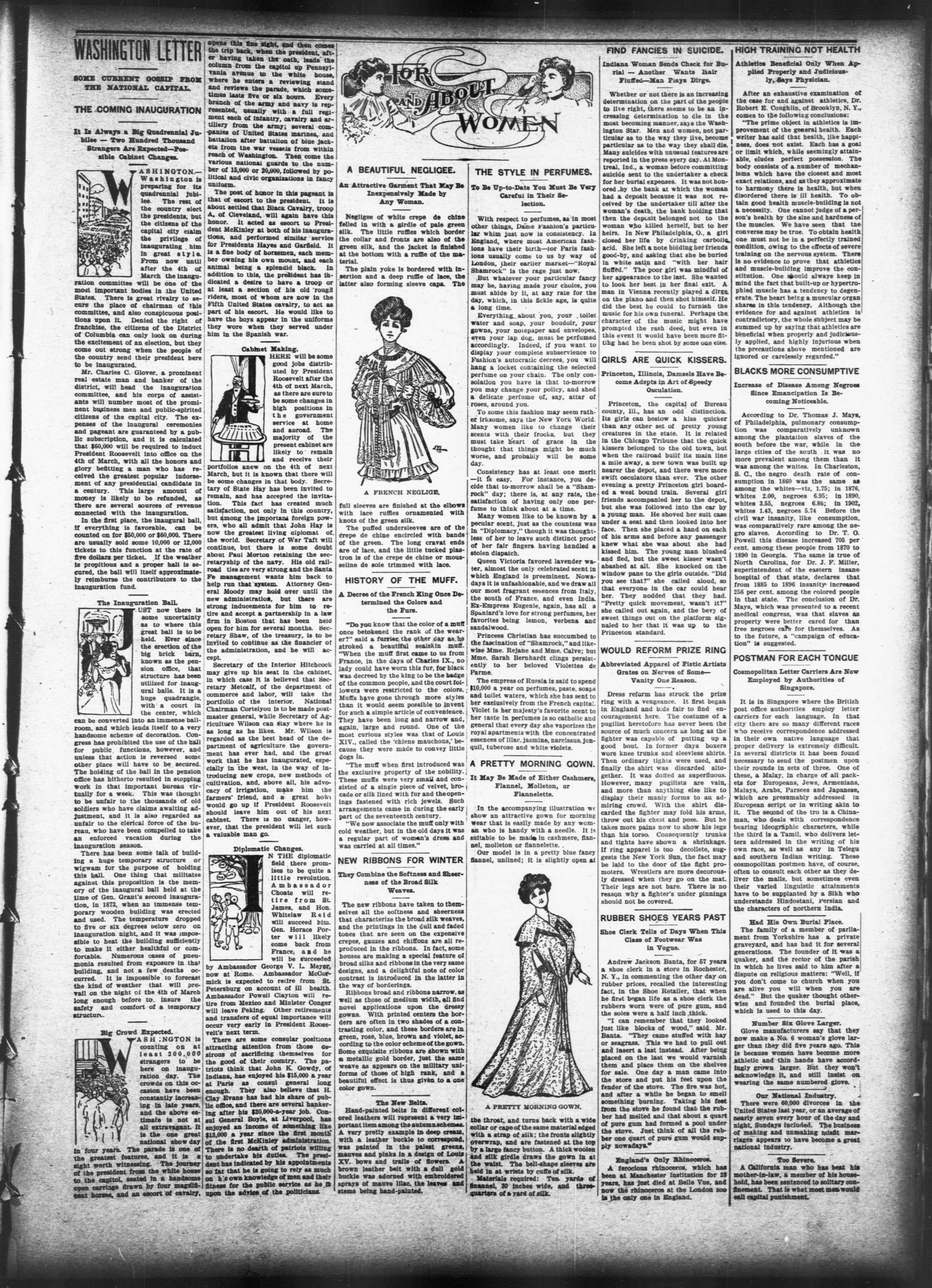
Negligee of white crepe de chine felled in with a girdle of pale green silk. The little ruffles which border the collar and fronts are also of the green silk, and the jacket is finished at the bottom with a ruffle of the material. The plain yoke is bordered with insertion and a deep ruffle of lace, the latter also forming sleeve caps. The
华
A FRENCH NEGLIGE. full sleeves are finished at the elbows with lace ruffles ornamented with knots of the green silk. The puffed undersleeves are of the crepe de chine encircled with bands of the green. The long cravat ends are of lace, and the little tucked plastron is of the crepe de chine or mousseline de soie trimmed with lace.
HISTORY OF THE MUFF.
A Decree of the French King Once Determined the Colors and the Furs.
"Do you know that the color of a muff once betokened the rank of the wearer?" said a furrier the other day as he stroked a beautiful sealskin muff. "When the muff first came to us from France, in the days of Charles IX., no lady could have worn this fur, for black was decreed by the king to be the badge of the common people, and the court followers were restricted to the colors. Muffs have gone through more styles than it would seem possible to invent for such a simple article of convenience. They have been long and narrow and, again, large and round. One of the most curious styles was that of Louis XIV., called the 'chiens mauchons,' because they were made to convey little dogs in.
"The muff when first introduced was the exclusive property of the nobility. These muffs were very small and consisted of a single piece of velvet, brocade or silk lined with fur and the openings fastened with rich jewels. Such arrangements came in during the early part of the seventeenth century.
"We now associate the muff only with cold weather, but in the old days it was a regular part of women's dress and was carried at all times."
NEW RIBBONS FOR WINTER
They Combine the Softness and Sheerness of the Broad Silk Weaves
The new ribbons have taken to themselves all the softness and sheerness that characterize the broad silk weaves, and the printings in the dull and faded tones that are seen on the expensive crepes, gauzes and chiffons are all reproduced in the ribbons. In fact, some houses are making a special feature of broad silks and ribbons in the very same designs, and a delightful note of color contrast is introduced in the latter in the way of borderings.
Ribbons broad and ribbons narrow, as well as those of medium width, all find novel applications upon the dressy gowns. With printed centers the borders are often in two shades of a contrasting color, and these borders are in green, rose, blue, brown and violet, according to the color scheme of the gown. Some exquisite ribbons are shown with a metallic gold border, just the same weave as appears on the military uniforms of those of high rank, and a beautiful effect is thus given to a one color gown.
The New Belts.
Hand-painted belts in different colored leathers will represent a very important item among the autumn schemes. A very pretty example in deep creams, with a leather buckle to correspond, was painted in the palest greens, mauves and pinks in a design of Louis XV. bows and trails of flowers. A brown leather belt with a dull gold buckle was adorned with embroidered sprays of mauve lilac, the leaves and stems being hand-painted.
THE STYLE IN PERFUMES.
With respect to perfumes, as in most other things, Dame Fashion's particular whim just now is consistency. In England, where most American fashions have their birth—ior Paris fashions usually come to us by way of London, their earlier market—"Royal Shamrock" is the rage just now. But whatever your particular fancy may be, having made your choice, you must abide by it, at any rate for the day, which, in this fickle age, is quite a long time.
Everything about you, your toilet water and soap, your boudoir, your gowns, your notepaper and envelopes, even your lap dog, must be perfumed accordingly. Indeed, if you want to display your complete subservience to Fashion's autocratic decrees, you will hang a locket containing the selected perfume on your chain. The only consolation you have is that to-morrow you may change your policy, and shed a delicate perfume of, say, attar of roses, around you.
To some this fashion may seem rather irksome, says the New York World. Many women like to change their scents with their frocks, but they must take heart of grace in the thought that things might be much worse, and probably will be some day.
Consistency has at least one merit—it is easy. For instance, you decide that to-morrow shall be a "Shamrock" day; there is, at any rate, the satisfaction of having only one perfume to think about at a time.
Many women like to be known by a pecular scent, just as the countess was in "Diplomacy," though it was thoughtless of her to leave such distinct proof of her fair fingers having handled a stolen dispatch.
Queen Victoria favored lavender water, almost the only celebrated scent in which England is preeminent. Nowadays it is unfashionable, and we draw all our most fragrant essences from Italy, the south of France, and even India. Ex-Empress Eugenie, again, has all a Spaniard's love for strong perfumes, her favorites being lemon, verbena and sandalwood.
Princess Christian has succumbed to the fascination of "Shamrock," and likewise Mme. Rejane and Mme. Calve; but Mme. Sarah Bernhardt clings persistently to her beloved Violettes de Parme.
The empress of Russia is said to spend $10,000 a year on perfumes, paste, soaps and toilet waters, which she has sent to her exclusively from the French capital. Violet is her majesty's favorite scent to her taste in perfumes is so catholic and general that every day she vaporizes the royal apartments with the concentrated essences of lilac, jasmine, narcissus, jonquil, tuberose and white violets.
A PRETTY MORNING GOWN
It May Be Made of Either Cashmere Flannel, Molleton, or Flannelette.
In the accompanying illustration we show an attractive gown for morning wear that is easily made by any woman who is handy with a needle. It is suitable to be made in cashmere, flannel, molleton or flannelette. Our model is in a pretty blue fancy flannel, unlined; it is slightly open at
1
A PRETTY MORNING GOWN. the throat, and turns back with a wide collar or cape of the same material edged with a strap of silk; the fronts slightly overwrap, and are fastened at the top by a large fancy button. A thick woolen and silk girdle draws the gown in at the waist. The bell-shape sleeves are held in at wrists by cuffs of silk. Materials required: Ten yards of finnel, 30 inches wide, and three-quarters of a yard of silk.
Whether or not there is an increasing determination on the part of the people to live right, there seems to be an increasing determination to die in the most becoming manner, says the Washington Star. Men and women, not particular as to the way they live, become particular as to the way they shall die. Many suicides with unusual features are reported in the press every day. At Montreal, Ind., a woman before committing suicide sent to the undertaker a check for her burial expenses. It was not honored by the bank at which the woman had a deposit because it was not received by the undertaker till after the woman's death, the bank holding that then the deposit belonged not to the woman who killed herself, but to her heirs. In New Philadelphia, O., a girl closed her life by drinking carbolic acid. She left a note bidding her friends good-by, and asking that she be buried in white satin and "with her hair fluffed." The poor girl was mindful of her appearance to the last. She wanted to look her best in her final exit. A man in Vienna recently played a dirge on the piano and then shot himself. He did the best he could to furnish the music for his own funeral. Perhaps the character of the music might have prompted the rash deed, but even in this event it would have been more fitting had he been shot by some one else.
GIRLS ARE QUICK KISSERS.
Princeton, Illinois, Damsels Have Become Adepts in Art of Speedy Osculation.
Princeton, the capital of Bureau county, Ill., has an odd distinction. Its girls can bestow a kiss quicker than any other set of pretty young creatures in the state. It is related in the Chicago Tribune that the quick kissers belonged to the old town, but when the railroad built its main line a mile away, a new town was built up nearer the depot, and there were more swift osculators than ever. The other evening a pretty Princeton girl boarded a west bound train. Several girl friends accompanied her to the depot, but she was followed into the car by a young man. He shoved her suit case under a seat and then looked into her face. Then she placed a hand on each of his arms and before any passenger knew what she was about she had kissed him. The young man blushed and fled, but the sweet kisser wasn't abashed at all. She knocked on the window pane to the girls outside. "Did you see that?" she called aloud, so that everyone in the car could hear her. They nodded that they had. "Pretty quick movement, wasn't it?" she called out again, and the bevy of sweet things out on the platform signaled to her that it was up to the Princeton standard.
WOULD REFORM PRIZE RING
Abbreviated Apparel of Fistic Artists Grates on Nerves of Some Vanity One Reason.
Dress reform has struck the prize ring with a vengeance. It first began in England and bids fair to find encouragement here. The costume of a pugilist heretofore has never been the source of much concern as long as the fighter was capable of putting up a good bout. In former days boxers wore knee trunks and sleevless shirts. Then ordinary tights were used, and finally the shirt was discarded altogether. It was doomed as superfluous. However, many pugilists are vain, and more than anything else like to display their manly forms to an admiring crowd. With the shirt discarded the fighter may fold his arms, throw out his chest and pose. But he takes more pains now to show his legs than his torso. Consequently trunks and tights have shown a shrinkage. If ring apparel is too decollete, suggests the New York Sun, the fact may be laid to the door of the fight promoters. Wrestlers are more decorously dressed when they go on the mat. Their legs are not bare. There is no reason why a fighter's under pinnings should not be covered.
RUBBER SHOES YEARS PAST
Shoe Clerk Tells of Days When This Class of Footwear Was
Andrew Jackson Banta, for 57 years a shoe clerk in a store in Rochester, N. Y., in commenting the other day on rubber prices, recalled the interesting fact, in the Shoe Retailer, that when he first began life as a shoe clerk the rubbers worn were of pure gum, and the soles were a half inch thick.
"I can remember that they looked just like blocks of wood," said Mr. Banta. "They came stuffed with hay or seagrass. This we had to pull out and insert a last instead. After being placed on the last we would varnish them and place them on the shelves for sale. One day a man came into the store and put his feet upon the fender of the stove. The fire was hot, and after a while he began to smell something burning. Taking his feet from the stove he found that the rubber had melted and that about a quart of pure gum had formed a pool under the stove. Just think of all the rubber one quart of pure gum would supply nowadays."
England's Only Rhinoceros
A ferocious rhinoceros, which has been at Manchester institution for 28 years, has just died at Belle Vue, and now the rhinoceros at the London zoo is the only one in England.
Athletics Beneficial Only When Applied Properly and Judiciously, Says Physician.
After an exhaustive examination of the case for and against athletics, Dr. Robert E. Coughlin, of Brooklyn, N. Y., comes to the following conclusions:
"The prime object in athletics is improvement of the general health. Each writer has said that health, like happiness, does not exist. Each has a goal or limit which, while seemingly attainable, eludes perfect possession. The body consists of a number of mechanisms which have the closest and most exact relations, and as they approximate to harmony there is health, but when disordered there is ill health. To obtain good health muscle-building is not a necessity. One cannot judge of a person's health by the size and hardness of the muscles. We have seen that the converse may be true. To obtain health one must not be in a perfectly trained condition, owing to the effects of severe training on the nervous system. There is no evidence to prove that athletics and muscle-building improve the constitution. One should always keep in mind the fact that built-up or hypertrophied muscle has a tendency to degenerate. The heart being a muscular organ shares in this tendency. Although the evidence for and against athletics is contradictory, the whole subject may be summed up by saying that athletics are beneficial when properly and judiciously applied, and highly injurious when the precautions above mentioned are ignored or carelessly regarded."
BLACKS MORE CONSUMPTIVE
Increase of Disease Among Negroes Since Emancipation Is Becoming Noticeable.
According to Dr. Thomas J. Mays, of Philadelphia, pulmonary consumption was comparatively unknown among the plantation slaves of the south before the war, while in the large cities of the south it was no more prevalent among them than it was among the whites. In Charleston, S. C., the negro death rate of consumption in 1860 was the same as among the whites—viz. 1.75; in 1876, whites 2.00, negroes 6.95; in 1890, whites 3.55, negroes 6.86; in 1902, whites 1.43, negroes 5.74 Before the civil war insanity, like consumption, was comparatively rare among the negro slaves. According to Dr. T. O. Powell this disease increased 705 per cent. among these people from 1870 to 1890 in Georgia. The same is true of North Carolina, for Dr. J. F. Miller, superintendent of the eastern insane hospital of that state, declares that from 1885 to 1896 insanity increased 256 per cent. among the colored people in that state. The conclusion of Dr. Mays, which was presented to a recent medical congress, was that slaves as property were better cared for than free negroes care for themselves. As to the future, a "campaign of education" is suggested.
POSTMAN FOR EACH TONGUE
Cosmopolitan Letter Carriers Are Now Employed by Authorities of Singapore.
It is in Singapore where the British post office authorities employ letter carriers for each language. In that city there are so many different races who receive correspondence addressed in their own native language that proper delivery is extremely difficult. In several districts it has been found necessary to send the postmen upon their rounds in sets of three. One of these, a Malay, in charge of all packets for Europeans, Jews, Armenians, Malays, Arabs, Parsees and Japanese, which are presumably addressed in European script or in writing akin to it. The second of the tro is a Chinaman, who deals with correspondence bearing ideographic characters, while the third is a Tamil, who delivers letters addressed in the writing of his own race, as well as any in Telegu and southern Indian writing. These cosmopolitan postmen have, of course, often to consult each other as they deliver the malls, but sometimes even their varied linguistic attainments have to be supplanted by a Sikh who understands Hindostani, Persian and the characters of northern India.
Had His Own Burial Place.
The family of a member of parliament from Yorkshire has a private graveyard, and has had it for several generations. The founder of it was a quaker, and the rector of the parish in which he lives said to him after a dispute on religious matters: "Well, if you don't come to church when you are alive you will when you are dead." But the quaker thought otherwise and founded the burial place, which is used to this day.
Number Six Glove Larger
Glove manufacturers say that they now make a No. 6 woman's glove larger than they did five years ago. This is because women have become more athletic and thin hands have accordingly grown larger. But they won't acknowledge it, and still insist on wearing the same numbered glove.
Our National Industry.
There were 60,000 divorces in the United States last year, or an average of nearly seven every hour of the day and night. Sundays included. The business of making and unmaking misfit marriages appears to have become a great national industry.
A California man who has beat his mother-in-law, a member of his household, has been sentenced to solitary confinement. That is what most men would call capital punishment.
CHIPS.
Mr. and Mrs. J. W. Wiesley, 1119 Clark street, Evanston, Ill., gave a dinner and a whist party in honor of their many friends, Thursday afternoon and evening. Mr. and Mrs. Panky, Mr. and Mrs. Nichols, and Mr. and Mrs. James Clark, 4747 Dearborn St., were among their invited guests from Chicago.
Booker T. Washington, Jr., the eldest son of the famous begger of Tuskegee, Ala. and Boston, Mass., wants to become a paymaster in the regular army, and the first one to sign his application for the position was his dady, who, it seems, does not want his son to earn his living by the sweat of his brow.
Mrs. H. W. Knight, the devoted wife of Rev. H. W. Knight, pastor Friendship Baptist Church, passed away the latter part of last week, and was buried from that church Sunday afternoon, Rev. John F. Thomas de'livering the main funeral oration who was ably assisted by Rev. W. S. Brooks, and by many other servants of the Lord, Mrs. Knight had lingered through a long spell of sickness and her husband and many warm friends feel that she has already received her blessing or reward as the fruits of living an humble Christian life.
The Broad Ax, published in Chicago, seems to have a hoel of a time with a few fellows in that city, and hewing to the line, as is The Broad Ax's custom, we should not be surprised if the fellows are beginning to wish they had been good. The Broad Ax is a tobasco sauce member, and can put more sarcasm and cut more timber by saying more waspy things in less space than any journal on top of the sod. The Broad Ax is a buzzsaw that goes through certain kinds of wood without fear or favor.—The Radical, St. Joseph, Mo.
The South Chicago Steel Mills which have in the past gave employment to over three thousand men closed down last Saturday owing to the lack of business until after the first of January, 1905; also the extensive plant of the International Harvester company at South Deering presented six hundred of its workmen with a nice Christmas gift by closing down and locking up all its doors vertight until after the first part of 1905. This is positive proof that Republican prosperity has struck this town with a very hard thud.
Col. Chas. J. Bonaparte, of Baltimore, Md., who a few years ago wrote a long article to the public press advocating and defending mob and lynch law and especially for colored men, if they were caught monkeying with white women, even if they should happen to make love to the Negro, is the intimate friend and counselor of President Roosevelt, who will in time select him to serve as Attorney General of the United States. It would also be a good idea, one which would be very pleasing to the colored Republicans, if the President would create a new department, label it "My Southern Policy," and place his bosom friend Thomas Nelson Page, who declared in McClures Magazine for May 1903, that "no virtue existed among colored girls 14 years old and over and that the great majority of colored women are immoral," in charge of it to formulate his Southern policy and to handle the "Niggers."
Fine Dish.
Lamb cutlets, Indian fashion, are prepared by a famous Austrian chef in this manner: Take lamb chops, fry quickly in butter and lay in a large baking dish. Fry in an ounce of butter two small onions chopped fine, one green. pepper, two tomatoes and six large mushrooms. Add a cupful of broth, and season with salt, pepper, and a teaspoonful of curry powder, thickening with a tablespoonful of flour. Pour over the chops, garnish the edges with boiled new potatoes, and bake 20 minutes.—N. Y. Post.
Unique Railroads
The rails of the Mexican Gulf railroad are laid on mahogany sleepers; and the bridges built of white marble. In west Mexico is a line with ebony sleepers and ballast of silver ore drawn from the mines beside the track. The engineers constructing these railways had no other material on the route, and found it cheaper to use these seeming extravagances than to import the ordinary material.
Rothschild's Art Treasures
The Rothschilds still seem to live in fear of the old riotous days of the commune, and it is said that the houses of the family are full of secret safes and closets. Baron Alphonse has a big collection of art objects and many of the specimens are kept in safes in the walls, which are opened occasionally to show their treasures, but always kept locked when some of the family are not in the house.
F
Nervy Beggar.
It is the custom of old King Christian of Denmark to give small coins to beggars and old women he meets on the street. Recently he met a young beggar and gave him the customary copper, but the youth handed it back and said that he would rather have a picture of the king. Christian said that he did not carry his pictures about with him in his pocket. The beggar said that he doubtless had one in his purse, though. He got it—on a gold piece.
Guards Against Loss
In the bureau of engraving and printing at Washington many women are employed in the making of postage stamps and paper money. Each operator is held responsible for every sheet of stamps or bills issued to her to work upon; and the face value of the stamps or notes that were upon any sheet, or part of a sheet, that may be missing is afterwards deducted from her salary.
As a Protection.
The skin of the men and women of some nations is much thicker than that of others. Particularly is this the case in hot countries. The Central African negro has a skin about half as thick again as that of a European. That of a negro is thickest over the head and back—evidently to form a protection from the burning rays of a tropical sun.
Immensity of Russia
Russia embraces one-sixth of the land surface of the world. It is more than 50 times larger than Japan, and has a total area of 8,650,000 square miles. Half of Europe and the whole of northern Asia are included within its boundaries. It has a greater continuous area than any other nation in the world.
Fish's Fault.
Deacon Good—Don't you think it cruel for you to draw a fish out of his native element by a sharp iron hook?
Fisherboy—It's no fault of mine. When I'm just giving a worm a salt water bath, what does a fish want to hook himself onto my line for? It's no business of his.—Boston Transcript.
Costly Piety.
Plety comes high in New York, but they must have it. To own a pew that will hold only four sinners, at Grace church, costs $1.550. Yet, perhaps, that is not very much to give, after all, says the Boston Herald, in a city where nothing can cost enough to please the very rich.
Can't Talk So Much
Hicks—I understand that you have had a telephone put in your house. Mrs. Wicks must find it a great convenience. Wicks—Yes; but she doesn't like it half as well as she thought she would. You see, when she is using it she has to listen half the time.—Somerville Journal.
Fast Mail Service.
A train on the Great Western railway recently eclipsed all records for the conveyance of American mail between Plymouth and London, covering the distance of 247 miles in 237 minutes. The last 118 miles of the run was made in 99 minutes.
Dressmaking Details
As showing the immense amount of attention paid nowadays to detail in dressmaking, it may be mentioned that the newest buttonhole machines are specially constructed to equally well finish the buttonhole whether viewed from outside or inside.
Wasn't Wise.
J—So you told Mrs. Cunningham that she looked as young as her daughter. I suppose that caught the old lady?
B—Yes; but it lost me the daughter.
—Stray Stories.
First of Her Kind
Baroness Overbeck is the first female Russian composer to attract attention in her own land. Her leading compositions have been performed in the leading theaters of St. Petersburg.
Women at Men's Work
Nearly 40 per cent. more women are working this year at men's labor than worked ten years ago, while the increase of male workers is only a trifle over 25 per cent.
Now Boom Business!
"Pa, what's a legal luminary?"
"A lawyer who has got up high enough to be able to decline cases that he knows he can't win."—Chicago Record-Herald.
Will "Hit the Trail."
Visitors to the Lewis and Clark exposition in Portland next year will not "take in the Midway" nor "go down the Pike." They will "hit the Trail."
Answered.
Hungry Joe—Where will we dine today?
Easy Ike—I'll tell you to-morrow.—Chicago Chronicle.
Strong Imagination.
Gerald—I claim to be a gentleman.
Geraldine—But we all haven't your imagination.—Town Topics.
Answered.
Strain Lancewood Stands.
A piece of lancewood an inch square will stand a strain of 2,000 pounds before breaking.
When One Is Short.
A melancholy sight in winter is the bill for a ton of anthracite.—Chicago Daily News.
Small Factories.
In New Zealand two persons working together constitute a factory in a legal sense.
Bran Instead of Soap. There are people who canhot use any soap at all on the face without finding that it makes the skin red and irritable. If even castile is found to have this troublesome effect it is best to abandon the use of soap altogether and use bran in bathing the face. Don't use hot water. Add to the cold water in which the face is bathed a few drops of simple tincture of benzoin. At night anoint it with a good soothing lotion and use talcum powder to your heart's content. It is used on the most delicate infants' skins without injury.—N. Y. Post.
Wild Horse Capturing.
The work of capturing wild horses in the vicinity of Fox mountain and Madeline plains has begun, and several animals have been taken. This country is practically a wild, unbroken stretch of mountains in western Nevada and eastern California that is too rough for any purpose except grazing, and over which several thousand head of wild horses roam. The captured animals are invariably small, but well proportioned, and prove to be hardy, serviceable and obedient after being broken.—Sacramento Bee.
"Grand Muletz."
The Grand Muets is a mass o' granite on Mount Blanc "rising up like an island in a tremendous billowy ocean of ice and snow." In the face of the rock a rough shielding of stone and boards has been built where a bed and refreshment can be had. It is in charge of a woman who ascends in the beginning of the season and remains there three months.
Misery of Selfishness.
How can he be otherwise than miserable who attends only to his own interests, who claims to himself no share in the happiness and prosperity of mankind, whom friendship cannot warn nor charity inspire? Living only to himself, he can but reflect back upon himself his own weakness and imbecility.— Henry Turner.
Home Ornaments.
It is safe to say that in all homes of ordinary size, if the necessary objects are well selected, of proper size, and attractive design and color, no other ornaments are needed. In most houses the addition to these necessary articles, of others not necessary, is a distinct disadvantage.—N. Y. Post.
Eves of Birds.
The sight of birds is extraordinary, and the simple fact that the eye of a hawk or pigeon is larger than their whole brain gives some idea of what their powers of sight must be, and of how easily they can fly hundreds of miles if they have marks to guide them.
Voting in Belgium.
Under the Belgian law, unmarried men over 25 have one vote, married men and widowers with families have two votes, and priests and other persons of position and education have three votes. Severe penalties are imposed on those who fail to vote.
Germ Holiday.
The state of Utah has established a holiday in honor of germs. It is called General Health Day and is the first Monday in October. On this day all theaters, churches, public halls, hotels, boarding houses, etc., must be thoroughly disinfected.
Probably a Newspaper Bee!
Probably a Newspaper Bee:
A bee that works only at night is found in the jungles of India. It is an unusually large insect, the combs being often six feet long, four feet wide and from four inches to six inches thick.
—Lahore Tribune.
Pretty Stale Bread
The best examples of old Roman bread have been found at Pompeii, a town that was destroyed by an eruption of Vesuvius in the year 78 A. D. Forty-eight loaves were dug out of one bake shop.
Queer Grave Decorations.
Most curiously decorated are the natives' graves in Zululand. Some of them are even garnished with the empty bottles of medicine used by the departed in their final illness.
Organ of Paper.
A church organ has recently been made in Belgium which is composed entirely of paper, the pipes being rolls of cardboard. The sound is sweet and powerful.
To Clean Nickel.
To clean nickel, scour with pulverized borax, use hot water and very little soap; rinse in hot water and rub dry with clean cloth.—Household.
London's Lady Clerks.
Inconsistency.
It's no use praying for a heavenly blessing when you won't pay your earthly bills.—Chicago Tribune.
Alaska's 1904 Gold.
The gold production of the entire Alaskan district for the present year is estimated at $26,000,000.
Big Sugar Bill.
England's bill for sugar to make into sweets is £400,000 every week.
Fact for Farmers.
Oxen and sheep fatten better in company than when kept alone.
James J. Gray. M. J. Moran.
GRAY & M N
ATTORNEYS AT LAW
Suite 1114 Ashland Block, Clark and
Randolph Sts. Tel. Central 569.
CHICAGO.
A. D. GASH
Attorney at Law,
84-86 La Salle Street, Chicago.
Suite 615 no 619.
Telephone Main 3077.
MELIS J. DEVINE MIRIAM B. O'CONNELL
DEVINE & O'CONNELL
ATTORNEYS AT LAW
SUITE 318-320 REAPER BLOCK
Clark and Washington Sta.
JOHN E. OWENS
ATTORNEY & COUNSELOR AT LAW
323 ABHLAND BLOCK
TELEPHONE CENTNAL 698 CHICAGO
PHONES {Office, M in 1157
Kes. Brown 42
STEPHEN A. DOUGLAS
Suite 200, 123-125 La Salle Street
CHICAGO
Bingham Yards 701 Residence, 123 GarGold Bd.
JOHN FITZGERALD
JUSTICE OF THE PEACE
4707 A. HALSTED STREET,
...CHICAGO
JOHN G. JONES
LAWYER
185 Dearborn Street
Adams Express Building
Room 607
Res. 3717 Armour Ave. CHICAGO
J. GRAY LUCAS
Attorney at Law
Suite 611 167 Dearborn St., Cor. Monroe.
Chicago.
Tel. Cent. 5768. Res. Tel. Went. 4892.
J. J. HENNESSY,
Justice of the Peace,
6301 S. Halsted St.
WILLIAM TREXLER, CLERK.
TELEPHONE WENTWORTH 4403.
Police Magistrate Englewood Police
Court.
Telephone Main 3558.
P. J. O'SHEA
ATTORNEY AT LAW
Suite 1444 Unity Building
79 Dearborn St. Chicago
Robert M. Mitchell
Attorney at Law
Suite 9, No. 77 South Clark St.
CHICAGO
ALBERT B. GEORGE
LAWYER.
423 Ashland Block, Chicago.
— B. M. BORN. —
MARCUS RUBEN,
(Incorporated)
Manufacturer of
Outfits for Waiters and Cooks,
BARBERS, :: DENTISTS,
BARKEEPERS AND BUTCHERS,
390 State St., - - - Chicago.
Phone Harrison 417
---
JACOB FEINBERG Market and Grocery Telephone 565 South 81st and State Sts. CHICAGO
HILL
112-114
STATE S
Special Sales in
Throughout
Tel. Yards 693
John J.
Real Estate, Insur
Property managed. Abstracts examin
4709 South Halsted Street
HOLIDAY
You don't need cash for Christmas
Get them on cr
Rich Furs, Winter Hats, Coats, Su
Men's Overcoats and Suits, Outfits
Smoking Jackets, Gloves, Hats, S
Furnishings for Men and Women.
Odd Furniture Pieces, Gilt and Ma
Umbrellas.
Diamonds, Watches and Jewelry;
and useful holiday gifts ever offered
WEEKLY OR MONTHLY PAYMENT
Second floor
Elevator.
Buel T. C
185 AND 187 W
Theodore
JUSTICE OF
Mortgages, Deeds, Notes an
and Acknowledged.
HILLMAN'S
112-114-116
STATE STREET.
Real Sales in New Fall
Throughout the Store.
John J. Bradley
Estate, Insurance and
Management. Abstracts examined. Renting. Legal paper.
Halsted Street
HOLIDAY GIFT
need cash for Christmas.
Buy them on credit at Crane
Winter Hats, Coats, Suits, Waists and Skirts.
Coats and Suits, Outfits for Youths, Misses and C
Jackets, Gloves, Hats, Sirts, Shoes, Underwear,
For Men and Women.
Mature Pieces, Gilt and Marble Clocks, Lamps, Chin
Watchés and Jewelry; The largest assortment of
holiday gifts ever offered on time in Chicago.
OR MONTHLY PAYMENTS.
Buel T. Crane & Co.
AND 187 WABASH AVENUE
Theodore C. May
PRICE OF THE PE
Images, Deeds, Notes and Legal Documents D
cknowledged. Room 22, 27 North C
HILLMAN'S
112-114-116
STATE STREET.
Special Sales in New Fall Goods
Throughout the Store.
John J. Bradley
Real Estate, Insurance and Loans Property managed. Abstracts examined. Renting. Legal papers prepared. 4709 South Halsted Street Chicago
HOLIDAY GIFTS
Rich Furs, Winter Hats, Coats, Suits, Waists and Skirts. Men's Overcoats and Suits, Outfits for Youths, Misses and Children. Smoking Jackets, Gloves, Hats, S irts, Shoes, Underwear, Hosiery and Furnishings for Men and Women. Odd Furniture Pieces, Gilt and Marble Clocks, Lamps, China Sets and Umbrellas. Diamonds, Watchés and Jewelry; The largest assortment of beautiful and useful holiday gifts ever offered on time in Chicago.
WEEKLY OR MONTHLY PAYMENTS.
Theodore C. Mayer
JUSTICE OF THE PEACE
Mortgages, Deeds, Notes and Legal Documents Drawn and Acknowledged. Room 22, 27 North Clark Street.
POLICE MAGISTRATE East Chicago Ave. Police Court CHIC
ILLINOIS
CHICAGO NOIS BRICK
ILLINOIS BRICK CO.
WILLIAM C. KUESTER.
SUPERINTENDENT.
1994 N. Western Ave., C
N. Western Ave., Ch
1994 N. Western Ave., Chicago.
Telephone Lake View 270. Telephone Yards 718 Junk's Brew M. JUNK, Proprietor
Telephone Yards 718 nk's Brew I. JUNK, Proprietor
M. JUNK, Proprietor JOS. P. JUNK, Manager 3700-3710 South Halsted Street and 897 to 929 Thirtyseventh Street CHICAGO
IMPORTED AND DOMESTIC WINES, LIQUORS AND CIGARS 8602 SOUTH HALSTED STREET.
CHICAGO
CHICAGO
N'S
Fall Goods
ore.
Nota y Publico
Hodley
and Loans
legal papers prepared.
Chicago
GIFTS
Grane's.
Skirts.
Sies and Children.
Perwear, Hoslery and
Imp, China Sets and
portment of beautiful
go.
Co. Open
Evenings.
AVENUE.
Layer
PEACE
Elements Drawn
North Clark Street.
RESIDENCE 337 Burling Street
K CO.
ER.
Chicago.
wery