The Broad Ax
Saturday, December 10, 1904
Chicago, Illinois
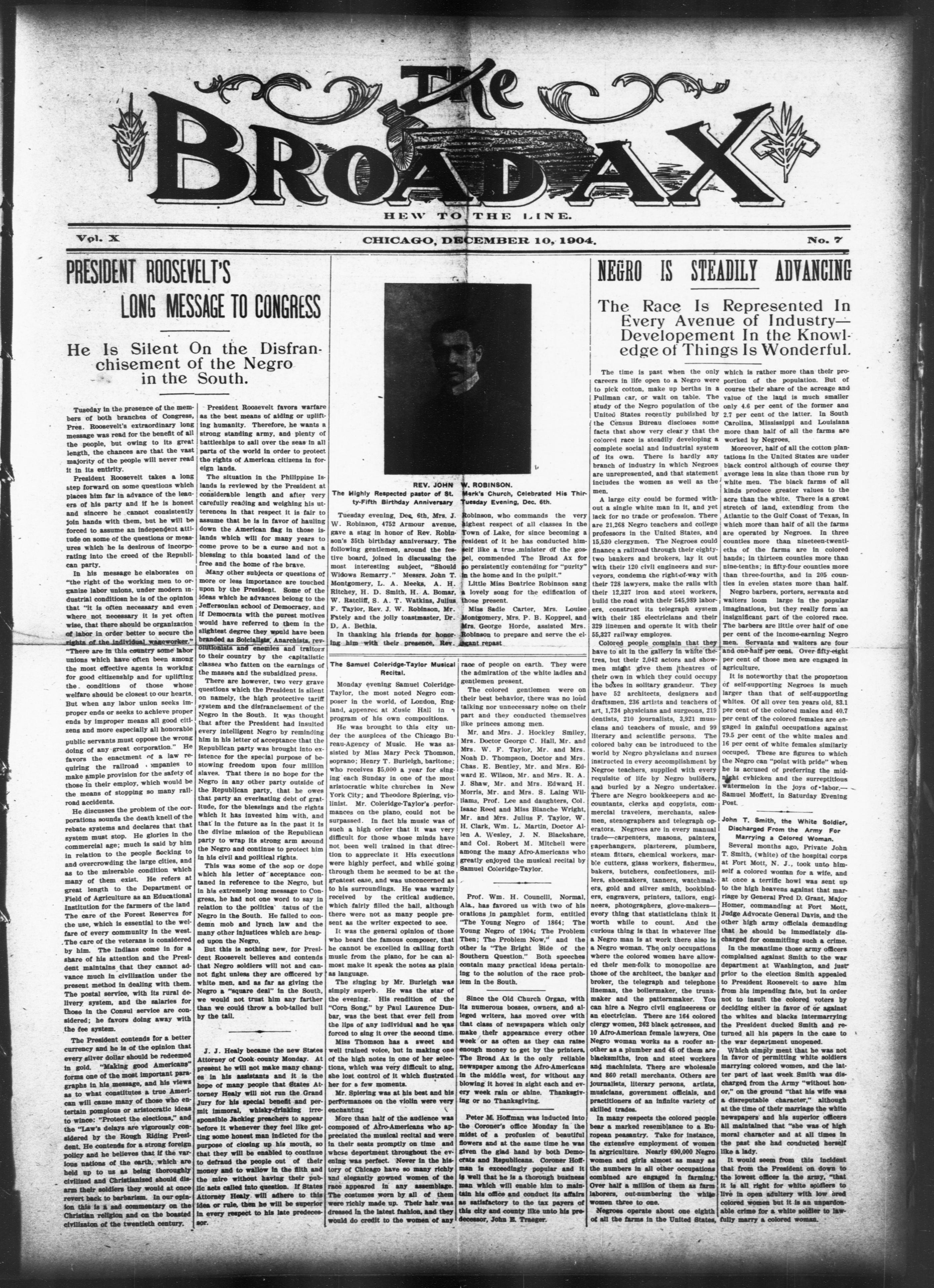
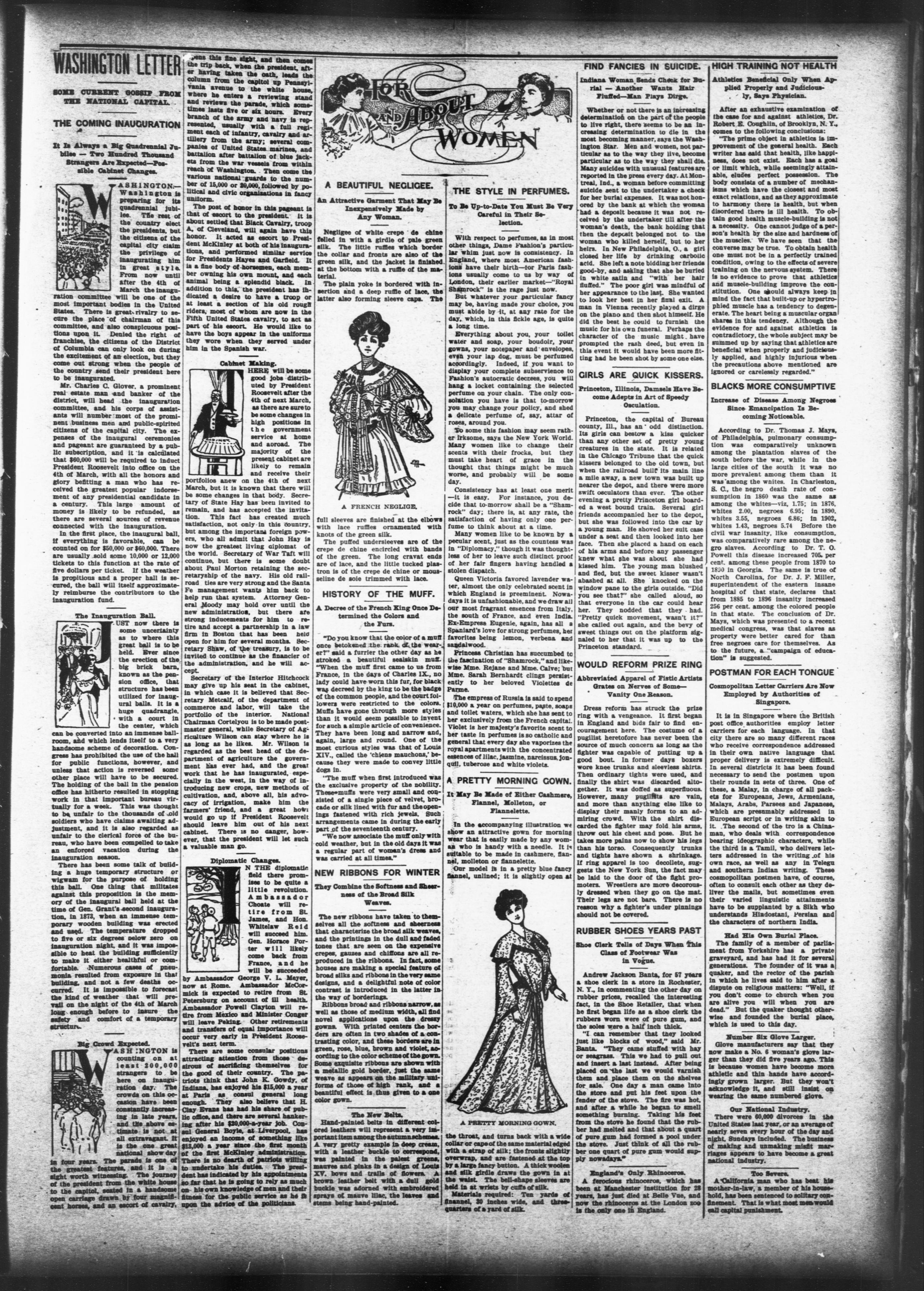
Page text (machine-generated)
THE BROAD AX
PRESIDENT ROOSEVELT'S LONG MESSAGE TO CONGRESS
He Is Silent On the Disfranchisement of the Negro in the South.
Vol. X
PRESIDENT ROOSEW
LONG MES
He Is Silent
chisement o
in the
Tuseday in the presence of the members of both branches of Congress, Pres. Roosevelt's extraordinary long message was read for the benefit of all the people, but owing to its great length, the chances are that the vast majority of the people will never read it in its entirety.
President Roosevelt takes a long step forward on some questions which places him far in advance of the leaders of his party and if he is honest and sincere he cannot consistently join hands with them, but he will be forced to assume an independent attitude on some of the questions or measures which he is desirous of incorporating into the creed of the Republican party.
In his message he elaborates on "the right of the working men to organize labor unions, under modern industrial conditions he is of the opinion that "it is often necessary and even where not necessary it is yet often wise, that there should be organization of labor in order better to secure the rights of the individual wageworker." "There are in this country some labor unions which have often been among the most effective agents in working for good citizenship and for uplifting the conditions of those whose welfare should be closest to our hearts. But when any labor union seeks improper ends or seeks to achieve proper ends by improper means all good citizens and more especially all honorable public servants must oppose the wrong doing of any great corporation." He favors the enactment of a law requiring the railroad companies to make ample provision for the safety of those in their employ, which would be the means of stopping so many railroad accidents.
He discusses the problem of the corporations sounds the death knell of the rebate systems and declares that that system must stop. He glories in the commercial age; much is said by him in relation to the people flocking to and overcrowding the large cities, and as to the miserable condition which many of them exist. He refers at great length to the Department or Field of Agriculture as an Educational Institution for the farmers of the land. The care of the Forest Reserves for the use, which is essential to the welfare of every community in the west. The care of the veterans is considered by him. The Indians come in for a share of his attention and the President maintains that they cannot advance much in civilization under the present method in dealing with them. The postal service, with its rural delivery system, and the salaries for those in the Consul service are considered; he favors doing away with the fee system.
The President contends for a better currency and he is of the opinion that every silver dollar should be redeemed in gold. "Making good Americans" forms one of the most important paragraphs in his message, and his views as to what constitutes a true American will cause many of those who entertain pompious or aristocratic ideas to wince: "Protect the elections," and the "Law's delays are vigorously considered by the Rough Riding President. He contends for a strong foreign policy and he believes that if the various nations of the earth, which are held up to us as being thoroughly civilized and Christianized should disarm their soldiers they would at once revert back to barbarism. In our opinion this is a sad commentary on the Christian religion and on the boasted civilization of the twentieth century.
```markdown
```
President Roosevelt favors warfare as the best means of aiding or uplifting humanity. Therefore, he wants a strong standing army, and plenty of battleships to sail over the seas in all parts of the world in order to protect the rights of American citizens in foreign lands.
The situation in the Philippine Islands is reviewed by the President at considerable length and after very carefully reading and weighing his utterences in that respect it is fair to assume that he is in favor of hauling down the American flag in those islands which will for many years to come prove to be a curse and not a blessing to this boasted land of the free and the home of the brave
Many other subjects or questions of more or less importance are touched upon by the President. Some of the ideas which he advances belong to the Jeffersonian school of Democracy, and if Democrats with the purest motives would have referred to them in the slightest degree they would have been branded as Solcialists, Anarchists, revolutionists and enemies and traitors to their country by the capitalistic classes who fatten on the earnings of the masses and the subsidized press.
There are however, two very grave questions which the President is silent on namely, the high protective tariff system and the disfrancisement of the Negro in the South. It was thought that after the President had insulted every intelligent Negro by reminding him in his letter of acceptance that the Republican party was brought into existence for the special purpose of bestowing freedom upon four million slaves. That there is no hope for the Negro in any other party outside of the Republican party, that he owes that party an everlasting debt of gratitude, for the blessings and the rights which it has invested him with, and that in the future as in the past it is the divine mission of the Republican party to wrap its strong arm around the Negro and continue to protect him in his civil and political rights.
This was some of the sop or dope which his letter of acceptance contained in reference to the Negro, but in his extremely long message to Congress, he had not one word to say in relation to the political status of the Negro in the South. He failed to condemn mob and lynch law and the many other injustices which are heaped upon the Negro.
But this is nothing new, for President Roosevelt believes and contends that Negro soldiers will not and cannot fight unless they are officered by white men, and as far as giving the Negro a "square deal" in the South, we would not trust him any farther than we could throw a bob-tailed bull by the tail.
J. J. Healy became the new States Attorney of Cook-county Monday. At present he will not make many changes in his assistants and it is the hope of many people that States Attorney Healy will not run the Grand Jury for his special benefit and permit immoral, whisky-drinking irresponsible Jackleg preachers to appear before it whenever they feel like getting some honest man indicted for the purpose of closing up his mouth, so that they will be enabled to continue to defraud the people out of their money and to wallow in the filth and the mire without having their public acts called into question. If States Attorney Healy will adhere to this idea or rule, then he will be superior in every respect to his late predecessor.
HEW TO THE LINE.
CHICAGO, DECEMBER 10, 1904.
1910
REV. JOHN The Highly Respected pastor of St. ty-Fifth Birthday Anniversary
Tuesday evening, Dec. 6th, Mrs. J. W. Robinson, 4752 Armour avenue, gave a stag in honor of Rev. Robinson's 35th birthday anniversary. The following gentlemen, around the festive board, joined in discussing the most interesting subject, "Should Widows Remarry." Messrs. John T. Montgomery, L. A. Meeks, A. H. Ritchey, H. D. Smith, H. A. Bomar, W. Ratcliff, S. A. T. Watkins, Julius F. Taylor, Rev. J. W. Robinson, Mr. Fately and the jolly toastmaster, Dr. D. A. Bethia.
In thanking his friends for honoring him with their presence. Rev.
The Samuel Coleridge-Taylor Musical Recital.
Monday evening Samuel Coleridge-Taylor, the most noted Negro composer in the world, of London, England, appeared at Music Hall in a program of his own compositions.
He was brought to this city under the auspices of the Chicago Bureau-Agency of Music. He was assisted by Miss Mary Peck Thomson, soprano; Henry T. Burleigh, baritone; who receives $5,000 a year for singing each Sunday in one of the most aristocratic white churches in New York City; and Theodore Spiering, violinist. Mr. Coleridge-Taylor's performances on the piano, could not be surpassed. In fact his music was of such a high order that it was very difficult for those whose minds have not been well trained in that direction to appreciate it. His executions were highly perfect, and while going through them he seemed to be at the greatest ease, and was unconcerned as to his surroundings. He was warmly received by the critical audience, which fairly filled the hall, although there were not as many people present as the writer expected to see.
It was the general opinion of those who heard the famous composer, that he cannot be excelled in calling forth music from the piano, for he can almost make it speak the notes as plain as language.
The singing by Mr. Burleigh was simply superb. He was the star of the evening. His rendition of the "Corn Song," by Paul Laurence Dunbar, was the best that ever fell from the lips of any individual and he was forced to sing it over the second time.
Miss Thomson has a sweet and well trained voice, but in making one of the high notes in one of her selections, which was very difficult to sing, she lost control of it which flurried her for a few moments. Mr. Spiering was at his best and his performances on the violin were very enchanting
More than half of the audience was composed of Afro-Americans who appreciated the musical recital and were in their seats promptly on time and whose deportment throughout the evening was perfect. Never in the history of Chicago have so many richly and elegantly gowned women of the race appeared in any assemblage. The costumes worn by all of them were richly made up. Their hair was dressed in the latest fashion, and they would do credit to the women of any
W. ROBINSON.
Mark's Church, Celebrated His Thir-
Tuesday Evening, Dec. 6th.
Robinson, who commands the very
highest respect of all classes in the
Town of Lake, for since becoming a
resident of it he has conducted him-
self like a true minister of the gospe-
l, commended The Broad Ax for
so persistently contending for "purity"
in the home and in the pulpit."
Little Miss Beatrice Robinson sang
a lovely song for the edification of
those present.
Miss Sadie Carter, Mrs. Louise Montgomery, Mrs. P. B. Kopprel, and Mrs. George Horde, assisted Mrs. Robinson to prepare and serve the elegant repast
race of people on earth. They were the admiration of the white ladies and gentlemen present.
The colored gentlemen were on their best behavior, there was no loud talking nor unnecessary noise on their part and they conducted themselves like princes among men.
Mr. and Mrs. J. Hockley Smiley, Mrs. Doctor George C. Hall, Mr. and Mrs. W. F. Taylor, Mr. and Mrs. Noah D. Thompson, Doctor and Mrs. Chas. E. Bentley, Mr. and Mrs. Edward E. Wilson, Mr. and Mrs. R. A. J. Shaw, Mr. and Mrs. Edward H. Morris, Mr. and Mrs. S. Laing Williams, Prof. Lee and daughters, Col. Isaac Reed and Miss Blanche Wright, Mr. and Mrs. Julius F. Taylor, W. H. Clark, Wm. L. Martin, Doctor Allen A. Wesley, J. N. Blackshare, and Col. Robert M. Mitchell were among the many Afro-Americans who greatly enjoyed the musical recital by Samuel Coleridge-Taylor.
Prof. Wm. H. Councill, Normal, Ala., has favored us with two of his orations in pamphlet form, entitled "The Young Negro of 1864; The Young Negro of 1904; The Problem Then; The Problem Now," and the other is "The Bright Side of the Southern Question." Both speeches contain many practical ideas pertaining to the solution of the race problem in the South.
Since the Old Church Organ, with its numerous bosses, owners, and alleged writers, has moved over with that class of newspapers which only make their appearance every other week or as often as they can raise enough money to get by the printers. The Broad Ax is the only reliable newspaper among the Afro-Americans in the middle west, for without any blowing it hoves in sight each and every week rain or shine. Thanksgiving or no Thanksgiving.
Peter M. Hoffman was inducted into the Coroner's office Monday in the midst of a profusen of beautiful flowers and at the same time he was given the glad hand by both Democrats and Republicans. Coroner Hoffman is exceedingly popular and it is well that he is a thorough business man which will enable him to maintain his office and conduct its affairs as satisfactory to the tax payers of this city and county like unto his predecessor, John E. Traeger.
NEGRO IS STEADILY ADVANCING
The Race Is Represented In Every Avenue of Industry- Developement In the Knowledge of Things Is Wonderful.
The time is past when the only careers in life open to a Negro were to pick cotton, make up berths in a Pullman car, or wait on table. The study of the Negro population of the United States recently published by the Census Bureau discloses some facts that show very clearly that the colored race is steadily developing a complete social and industrial system of its own. There is hardly any branch of industry in which Negroes are unrepresented, and that statement includes the women as well as the men.
A large city could be formed without a single white man in it, and yet lack for no trade or profession. There are 21,268 Negro teachers and college professors in the United States, and 15,530 clergymen. The Negroes could finance a railroad through their eighty-two bankers and brokers, lay it out with their 120 civil engineers and surveyors, condemn the right-of-way with their 728 lawyers, make the rails with their 12,327 iron and steel workers, build the road with their 545,989 laborers, construct its telegraph system with their 185 electricians and their 329 linemen and operate it with their 55,327 railway employees.
Colored people complain that they have to sit in the gallery in white thetres, but their 2,042 actors and showmen might give them theatres of their own in which they could occupy the boxes in solitary grandeur. They have 52 architects, designers and draftsmen, 236 artists and teachers of art, 1,734 physicians and surgeons, 219 dentists, 210 journalists, 3,921 musicians and teachers of music, and 99 literary and scientific persons. The colored baby can be introduced to the world by Negro physicians and nurses instructed in every accomplishment by Negroe teachers, supplied with every requisite of life by Negro builders, and buried by a Negro undertaker. There are Negro bookkeepers and accountants, clerks and copyists, commercial travelers, merchants, salesmen, stenographers and telegraph operators. Negroes are in every manual trade—carpenters, masons, painters, paperhangers, plasterers, plumbers, steam fitters, chemical workers, marble cutters, glass workers, fishermen, bakers, butchers, confectioners, millers, shoemakers, tanners, watchmakers, gold and silver smith, bookbinders, engravers, printers, tailors, engineers, photographers, glove-makers—every thing that statisticians think it worth while to count. And the curious thing is that in whatever line a Negro man is at work there also is a Negro woman. The only occupations where the colored women have allowed their men-folk to monopolize are those of the architect, the banker and broker, the telegraph and telephone lineman, the boilermaker, the trunkmaker and the patternmaker. You can hire a Negro civil engineeress or an electrician. There are 164 colored clergy women, 262 black actresses, and 10 Afro-American female lawyers. One Negro woman works as a roofer another as a plumber and 45 of them are blacksmiths, iron and steel workers and machinists. There are wholesale and 860 retail merchants. Others are journalists, literary persons, artists, musicians, government officials, and practitioners of an infinite variety of skilled trades.
In many respects the colored people bear a marked resemblance to a European peasantry. Take for instance, the extensive employment of women in agriculture. Nearly 690,000 Negro women and girls almost as many as the numbers in all other occupations combined are engaged in farming. Over half a million of them as farm laborers, out-numbering the white women three to one.
Negroes operate about one eighth of all the farms in the United States.
No. 7
which is rather more than their proportion of the population. But of course their share of the acreage and value of the land is much smaller only 4.6 per cent of the former and 2.7 per cent of the latter. In South Carolina, Mississippi and Louisiana more than half of all the farms are worked by Negroes.
Moreover, half of all the cotton plantations in the United States are under black control although of course they average less in size than those run by white men. The black farms of all kinds produce greater values to the acre than the white. There is a great stretch of land, extending from the Atlantic to the Gulf Coast of Texas, in which more than half of all the farms are operated by Negroes. In three counties more than nineteen-twentieths of the farms are in colored hands; in thirteen counties more than nine-tenths; in fifty-four counties more than three-fourths, and in 205 counties in eveleen states more than half.
Negro barbers, porters, servants and waiters loom large in the popular imaginations, but they really form an insignificant part of the colored race. The barbers are little over half of one per cent of the income-earning Negro men. Servants and waiters are four and one-half per cent. Over fifty-eight per cent of those men are engaged in agriculture.
It is noteworthy that the proportion of self-supporting Negroes is much larger than that of self-supporting whites. Of all over ten years old, 83.1 per cent of the colored males and 40.7 per cent of the colored females are engaged in gainful occupations against 79.5 per cent of the white males and 16 per cent of white females similarly occupied. These are figures to which the Negro can "point with pride" when he is accused of preferring the midnight cvhicken and the surreptitious watermelon in the joys of labor. Samuel Moffett, in Saturday Evening Post.
John T. Smith, the White Soldier, Discharged From the Army For Marrying a Celored Woman
Several months ago, Private John T. Smith, (white) of the hospital corps at Fort Mott, N. J., took unto himself a colored woman for a wife, and at once a terrific howl was sent up to the high heavens against that marriage by General Fred D. Grant, Major Homer, commanding at Fort Mott, Judge Advocate General Davis, and the other high army officials demanding that he should be immediately discharged for committing such a crime. In the meantime those army officers complained against Smith to the war department at Washington, and just prior to the election Smith appealed to President Roosevelt to save him from his impending fate, but in order not to insult the colored voters by deciding either in favor of or against the whites and blacks intermarrying the President ducked Smith and returned all his papers in the case to the war department unopened.
Which simply ment that he was not in favor of permitting white soldiers marrying colored women, and the latter part of last week Smith was discharged from the Army "without honor," on the ground "that his wife was a disreputable character," although at the time of their marriage the white newspapers and his superior officers all maintained that "she was of high moral character and at all times in the past she had conducted herself like a lady.
It would seem from this incident that from the President on down to the lowest officer in the army, "that it is all right for white soldiers to live in open adultery with low bred colored women but it is an unpardonable crime for a white soldier to lawfully marry a colored woman.
THE BROAD AX.
Will promulgate and at all times uphold the true principles of Democracy, but Catholic, Protestant, Priests, Infidels, Farmers, Single Taxes, Republicans, Knights of Labor, or any one else can have their say, so long as their language is proper and responsibility is fixed.
The Broad Ax is a newspaper whose platform is broad enough for all, ever claiming the editorial right to speak its own mind.
Local communications will receive attention. Write only on one side of the paper.
Subscriptions must be paid in advance,
One Year.....$2.00
Six Months.....1.00
Advertising rates made known on application. Address all communications to
THE BROAD AX
6040 Armour Avenue, Chicago.
JULIUS F. TAYLOE, Editor and Publisher.
Entered at the Post Office at Chicago IH, as Second-class Matter.
Rev. W. H. Knight Writes a Card of Thanks.
Chicago, Ill., Dec. 6th, 1904. Mr. Julius F. Taylor, Editor. The Broad Ax
Dear Sir:
My children and myself desire, through the columns of your journal to return a card of earnest and sincere thanks. First, to Dr. George C. Hall and Dr. John W. Lewis, our eminent physicians for their skillful prescriptions and generous visits, and to the Provident Hospital attendants for their tender care while my beloved wife was there, and to the members of Friendship Baptist Church and Sunday school Especially the Missionary Sisters of Frendenship for their friendly courtesies and deeds of charity, and to all of my brethren in the Ministry, especially Rev. A. L. Harris, pastor of Provident Baptist Church for their sympathetic counsel and appropriate words of condolence, as expressed through the set of resolutions and the beautiful brief sermon delivered by Rev. J. F. Thomas, our first pastor. And to the household of Ruth No. 153 G U. O. of O. F., for their constant and vigilant watch in showing forth F L. and T. Also to the efficient and ready services as given by Mr. Geo. O. Jones, as undertaker And for all the kindness shown to us by the floral tributes and designs made by Sister Manley, all of which was for and in behalf of Mrs Mary A. Knight, deceased. Yours gratefully.
H. W. KNIGHT,
(Husband.)
MASONIC NOTES
High Masonic Degrees Conferred upon Hon. John G. Jones, 33, of Chicago, Ill.
One of the most important events in the history of the Colored Masons in the United States occurred last Wednesday evening, Nov. 30, 1904, at Masonic Hall, in Chicago, Ill. It was the conferring of the high Masonic Degrees which are known as the Royal Order of Scotland upon Ill. John G. Jones, 33, a very learned and distinguished Colored Mason of Chicago by Doctor Frederick B. Ashley, 33, of the Republic of Panama, who was assisted in the ceremony by several prominent White Masons from that country. This is the first Colored Mason in the world who has ever had those high Masonic degrees conferred upon them. Mr. Jones has the power and authority to institute and propogate the Masonic work in this country. Mr. Jones, 33, is a lawyer at the Chicago bar, exmember of the Legislature of the state of Illinois and is a thirty-third degree, Ancient. Accepted Scottish Rite Mason and Sovereign Grand Master of the Supreme Grand Council of North America of the Knights of the Red Cross of Constantine and also Grand Secretary of the Most Worshipful St. John's Grand Lodge of A. F. & A. Masons of the State of Illinois and Jurisdiction. He is a man whose character for ability and learning in the masonic world places him high as an Instructor, Lecturer and Masonic Jurist.
—H. S.—
St. Mark Literary, 47th and State St.
The program last Sunday afternoon was in charge of the Excelsior Club of Olivet Baptist church. The subject was "Are the Morals of Our Race Declining." The addresses were delivered by Dr. O. L. Ballinger and Mr. J. W. Allen. The musical selections were very fine Miss Gertrude L. Fisher was the directress. Next Sunday Mrs. Fannie Barrier Williams will speak on the subject, "Domestic Service." The program has been so arranged that there will be ample time for a free discussion of the subject.
```markdown
```
Careful German Police.
American tourists returning from Europe bring back stories of the paternal watch which is kept upon them in Germany. One woman was requested by a policeman to hold up her gown, which was a trailing, elaborate affair of lace and chiffon. It was after dinner and she was taking a stroll with her husband through a park whose immaculate walks seemed to offer no harm to its delicacy, so she let it hang. The policeman was polite enough. He informed her gravely that any dress that was allowed to trail was liable to collect undesirable matter and prove injurious to heath.
Cleanser for Woodwork
When the painted woods of the interior of the house are soiled or spotted get a plate of very good whiting. It will cost only a few cents. Dip a piece of fiannel into warm water, squeeze nearly dry and dip it into the whiting. Then rub the paint with the whiting and all the dirt and grease will disappear and the paint will look like new, no matter how delicate.—Chicago Daily News.
Vigorous Acting
The Japanese in San Francisco lately gave a war drama for the benefit of the widows and orphans of the Japanese army. The audience was Japanese, large and enthusiastic. A newspaper report of the play says the handling of the "Russians" in it was "fierce." One Cossack received a three-inch cut on his arm from a Jap's sword.
Swelled Head Out of Style.
Hats for gentlemen are now worn larger than formerly, so as to come down farther on the back of the head of the wearer. That is the latest authorized dispensation. On the whole, it is better than the old style of wearing a head too big for one's hat, as the saying goes. It dispenses with the implied swelling.—Boston Herald.
Snail's Nose.
The snail's sense of smell has been located in its horns by some observers, but authorities quite as good have regarded this conclusion as incorrect. M. Yong, who has been making experiments to settle the matter, now claims to have proven that the snail's nose is distributed over the entire body. Nature.
Wouldn't Betray a Trust.
Employer—You say you would like to have two weeks' salary in advance? Clerk—Yes, sir.
"But suppose you should die tonight?"
"Sir, I may be poor, but I am too much of a gentleman to do a thing like that."—Cincinnati Enquirer.
Daintv Dish.
Jellied chicken can be made best when a meat machine is used. The chicken should not be pressed after being ground. Lift the meat lightly and lay into moulds, season with salt and a little pepper, fill the moulds with warm chicken jelly and set to cool.—Boston Budget.
Analogy.
"A public official is the servant of the people," said Senator Sorphum. "Yes," answered Miss Cayenne, "and sometimes he's the kind of servant that carries a market basket every time she goes home from her place of employment."—Washington Star.
Guiana Peanut Fields
The largest peanut fields in the world are in Guiana, on the north coast of Africa. Peanuts are grown there by hundreds of tons, but the quality is inferior to those grown in this country. Most of the African peanuts are shipped to France.
Greatness in Patience
Bed sheets are unknown in Japan, except in the hospitals. The introduction of white sheets and of white caps and dresses for nurses was vigorously objected to at first because white is in Japan the color of mourning.
Swimmer's Great Feat.
A well-known Belgian swimmer named Janssens made a wager that he could stay in the water ten hours, swimming the whole time. He won the wager, performing the feat in the Antwerp baths.
Mammoth Apples
The largest apple on record grew in old Missouri. It is of the Wolf river variety, weighs two pounds and one ounce, and probably measures 20 inches in circumference.
Culinary Hint.
Remember not to add butter or oil when browning salted almonds. They will retain enough of the salt without. Besides the butter makes them indigestible.—Household.
Tall Buildings in 'Fris
Hitherto San Francisco has prohibited the erection of buildings to a greater height than 201 feet. Now an ordinance has been passed permitting a height of 221 feet.
Earth Too Small.
"It's a pity that we can't insure our pipe dreams before they go up in smoke.—Chicago Daily News.
Death Among Miners.
The death rate among miners from lung diseases is heavier than among any other class of workmen.
Self-Inflicted.
Heedless people bear needless pain.
—Chicago Tribune.
Not Much Left.
About one-tenth of the world is still unexplored.
introduced.
Thibetan Superstition.
A queer bit of Thibetan superstition came to light when the much-talked-of treaty between Thibet and England was drawn up. The powers at Lhassa refused to sign the first draft of the treaty because it covered several sheets of paper, so the treaty had to be engrossed on one huge sheet. The orientals thought it would bring them bad luck if they put their names to anything which covered more than one page.
Graham Puffs.
Sift together one and one-half cupfuls graham flour, one-half cupful of white flour, two teaspoonfuls of baking powder, and a pinch of salt; add one pint of milk, the beaten yolks of three eggs and two tablespoonfuls of melted butter. Beat rapidly for a few moments, then add the stiff whites and whip the batter. Turn into a well-greased muffin tin and bake for 30 minutes in a hot oven. —Household.
Willie's Treatise on Girls.
Girls is a human bein' that shreeks when there's nothin' to squeel at; but boys is difrunt, for they just holler. Girls grow up to wimmin and like dolls, but boys grow up to men and like balls, and when my pa read that he said, "Hyballs, I s'pose you mean, Willie," and then he laft, but ma said, "For shame, Joseph!"—Sunset Magazine.
Gem Short Cakes.
Make a batter of medium stiffness from one egg, one cupful sweet milk, one tablespoonful butter and one-half teaspoonful of salt. Just before cooking the batter, add a heaping teaspoonful of baking powder and beat briskly for a moment. Bake in hot, buttered gem pans and when done, split open, butter and serve with fruit sauce.—Household.
Sentence for Perjury.
A judge in New York sent a convicted "straw" bondsman to prison for 14 years for committing perjury, refusing clemency on the ground that perjury had become too common a crime and needed stern dealing with. A few more such sentences would have a wholesome effect in any large community.—Baltimore American.
Embarrassments of Fine Clothes. People are afraid of buying good clothes, says a well-known tailor, for fear of having to live up to them. The man who wears a new 30-shillings overcoat cannot go to the ninepenny gallery or argue with a waiter about being charged for bread when he has not had any.—London Globe.
Thibetan Bible.
The Kahgyur, the Bible of the Thibetans, consists of 108 volumes, or 1,083 books. The whole consists of 108,000 pages printed from wooden blocks, which are kept in a big row of houses at Lhassa. As many as 7,000 oxen have been traded for one set of the book.
Illuminated Slang
Dr. Wiley, of the department of agriculture, says the bulk of the whisky consumed in America has prune juice as its base. Hereafter we shall understand the literal significance of the hitherto vague expression, "full of prune juice." Atlanta Constitution.
Jap Jackies.
The average age of the Japanese naval crews is lower than that of the men in any other navy. No one over 20 years old is accepted for enlistment. The average height is five feet four inches—less than that of any other navy.
Georgia Potatoes
Boil sweet potatoes until nearly done, pare and slice into a baking dish. Sprinkle bits of sugar among the slices, dust with sugar and turn a wineglassful of sherry over them. Bake until a rich brown.—Home Magazine.
What Then?
Mr. Goodman—Remember, my son, if your enemy smites you on one cheek, turn the other to him.
Willie--But, supposin' he soaks you on both cheeks at once?—Philadelphia Press.
Soldiers Don't Show It
Chess is still included in the curriculum of the Russian schools. It teaches the boys to move when young, and is a great advantage in times of war, says a foreign paper.
Mechanical Wonder
A recent mechanical wonder is a telegraphic instrument that sends 1,000 words a minute a thousand miles in length. A human operator can transmit 50 words a minute.
Poor English Butter
The real reason why English buttermaking is on the decline in that the average quality of butter made in England is about the worst in the world Country Life.
Colorado Melons
The eastern marketmen have paid $30,000,000 to the melon growers of Rocky Ford, Col., since the discovery of the famous melons there.
France, with a population of 39,000,000, has a fighting force of 2,000,000 men, able to appear in the niew at very short notice.
Small bits of roasts and fried or boiled meats can be prepared nicely when run through a machine.—Boston Budget.
"What part of Russia does he come from?"—Cleveland Plain Dealer.
Established 1877. Phone Oakland 1550-1551
John J. Dunn
Wholesale and Retail Dealer in...
COAL &
WOOD
Fifty-First St. and Armour Ave.
RAIL YARDS: 1st St. & L. S. & M. S. Ry.
52nd St. and Armour Ave.
CHJCAGO
Phone 194 South
A. B. SCHULTZ, M. D.
PHYSICIAN AND SURGEON.
2719 State Street
Hours: 9 to 12 A. M.
8 to 5 and after 6 P. M. CHICAO
Central 5768.
L. BLANCHE WRIGHT
PUBLIC STENOGRAPHER
167 Dearborn St., Room 611
CHICAGO
A REAL CHANCE ENTERPRISING CANVASSERS The demand for Professor W. E. B. DuBols' great book The Souls of Black Folk
has been so remarkable, especially among those who do not buy many books, that we have just issued a Special Subscription Edition This powerful study of the Negro Question stands ahead of all others.
Every one who has the future of the colored race at heart will want to buy it and read it.
Is one of the easiest books to interest people in that has ever been published, and we are anxious to secure live, intelligent canvassers everywhere.. Send to us for information, terms, etc.
A. C. McCLURG & CO., Publishers, 215-221 Wabash Ave., Chicago.
WONDERFUL DISCOVERY Curly Hair Made Straight By
TAKEN FROM LIFE:
BEFORE AND AFTER TREATMENT.
ORIGINAL
OZONIZED OX MARROW
(Copyrighted.)
This wonderful hair pomade is the only safe preparation in the world that makes kinky or curly hair straight as shown above. It nourishes the scalp, prevents the hair from falling out or breaking off, cures dandruff and makes the hair grow long and silky. Sold over forty years and used by thousands. Warranted harmless. It was the first preparation ever sold for straightening kinky hair. Beware of limitations. Get the Original Owing to its superior and lasting qualities it is the best and most economical. It is not possible for anybody to produce a preparation equally durable. Only 50 cents. Sold by drugstores and dealers or send us 50 cents for one bottle or $1.40 for three bottles. We pay all express charges. Send postal or express money order. Please mention name of this paper when ordering. Write your name and address plainly to
OZONIZED OX MARROW CO.,
76 Wabash Ave., Chicago, Illinois.
Mrs. Anna L. Newby.
First class furnished rooms for rent to gentleman, with bath and gas. 2628 Wabash avenue.
MRS. A. WILSON.
Nicely furnished rooms to rent for gentlemen. Reasonable rates, 2253 indiana aveuna.
To Banish Dampness
A damp cupboard or storeroom is practically useless, but the damp may easily be banished. The plan is to put a box or bucket of lime in the cupboard or storeroom, as the case may be. The lime will absorb the damp, and thus render the air quite dry. The lime must be renewed from time to time as it loses its powers.—Detroit Free Press.
Audience of Spiders.
Spiders are notoriously and historically fond of music. At a performance in America recently the concert hall was made disagreeable by a sudden invasion of spiders, which were drawn by a violin solo from the cracks and crannies of the ancient building. They crawled about the floor and on to the stage.
Ministering to Others.
Every individual will be the happier the more clearly he understands that his vocation consists, not in exacting service from others, but in ministering to others, in giving his life the ransom of many. A man who does this will be worthy of his food, and not fail to have it.—Tolstol.
Teeth Extracted Without Pain
TUHNSEN
DENTIST
OUR LOW PRICES UNTIL OCT. 1.
Set of Teeth ... $2
Best Set of Teeth ... $3
22k Gold Crowns ... $3
Percosin Crowns ... $2
Gold Fillings, 50c to ... $1
Silver Fillings, ... 25c to 50c
Our plate work is unexcelled. When others fail call on us. We will make a beautiful, substantial and perfectly fitting plate, one with which you may enjoy a good meal. Our gold crowns guaranteed equal to any high-priced dentist's. Ten years' guaranty on all work. Consultation and examination free.
plaines-st.
Special attention given to pain extraction of children's teeth.
We will give $100.00 Reward for case of bad teeth we cannot eat. Absolutely without Pain.
We guarantee Positively Pretalions in each and every case. Our Original Easy Payment erative Plan with our patients of Dentistry by our perfected so anyone to have their work done out delay or pay at your convien
and have gained their Confidence.
Our $3.00 and $3.75 Gold Crowns and Bridge Work per Tooth are what you are paying elsewhere $5.00 and more per tooth. We manufacture nearly all our material and save you time and money.
Dr. Nickerson's Dental Parlors,
248 STATE STREET.
Between Jackson-bd. & Van Buren-st.
Hours—8 a. m. to 9 p. m. Sundays,
10 to 4.
METROPOLE
METROPOLE HALL, 31st
METROPOLE DANCING CLUB
METROPOLE DANCING CLUB
METROPOLE HALL, 31st Street near 5th Avenue.
SEASON OF 1904 AND 1905.
Every Tuesday and Friday. D attractions. Excellent service. and Orchestra. Prof. J. W. Hall.
Every Tuesday and Friday. Dancing and Vaudeville, first class attractions. Excellent service. Good order. Metropolitan Band and Orchestra. Prof. J. W. Hall, Splendid cafe in connection.
ADMISSION 25 CTS.
The Pekin Ter
The finest family resort in Am
The h
Robert T. Mot
Fred T. Carey
TEL. SOUTH 67.
The finest family resort in America. The home of high class Vaudeville.
27TH & STATE STREETS,
-- American
President and Treasurer, THE
Vice-President, JC
Secretary
MANUFACTURE
Common and S
Office and
45th and P
Yards running winter
with the latest improv
Output of Winter Yards
Output of Summer Yards
Telephone
THE BROAD AX.
President and Treasurer, THOMAS CAREY. Vice-President, JOHN SHELHAMER, Secretary, WILLIAM SULLIVAN. MANUFACTURERS OF Common and Sewer Brick Office and Yards: 45th and Robey Sts.
Yards running winter and summer, equipped with the latest improved Wolf Dryer.
Output of Winter Yards ..... 1440.0 per day
Output of Summer Yards..... 10100 per day
Telephone Yards 128.
Is for sale at the following news stands:
The Afro-American News Office, 3104 State Street.
J. C. Campbell, cigars, tobacco and fancy groceries, 4710 State street.
A. F. Tervalon's Cigar Store and News Stand, 2826 State street.
Edward Felix's Cigar Store, 368 30th street, N. E. Corner Armour Ave.
T. B. Hall's Cigar Store and Laundry office, 281 29th St.
Turner William's Cigar and News Stand, 2903 Armour Ave.
Mrs. B. Williams, Cigars, Notions and News Stand, 4861/2 State street.
Frank H. Hart, 354-31st street, cigars, tobacco and Laundry office.
S. K. King cigars and news stand, 3010 State St.
B. Davis, cigars, tobacco, and confectionery, 3532 State st.
C. J. Chambers and Company, dealers in fine cigars, 2958 State street.
The Stationery, 2970 State street.
$3.00
TEETH WITHOUT PLATES
A SPECIALIST
Who uses the latest scientific methods
SAFE AND HARMLESS
ABSOLUTELY
We will give $100.00 Reward for any case of bad teeth we cannot extract Absolutely without Pain.
We guarantee Positively Painless Opretalons in each and every branch
Our Original Easy Payment Co-operative Plan with our patients enables of Dentistry by our perfected system.
anyone to have their work done without delay or pay at your convienance.
DANCING CLUB Street near 5th Avenue.
Dancing and Vaudeville, first class Good order. Metropolitan Band , Splendid cafe in connection.
SOUTH 67.
Sample of Music
America.
home of high class Vaudeville.
Itts, Prop.
y, Mg'r.
CHICAGO.
Brick Co. --
THOMAS CAREY.
JOHN SHELHAMER,
Bry, WILLIAM SULLIVAN.
TURERS OF
Sewer Brick
and Yards:
Robey Sts.
and summer, equipped
ved Wolf Dryer.
1440.0 per day
3040.0 per day
Yards 128.
P. S. Hotchkis's Cigars, Notions and News Stand, 131 W. 51st Street. Woodfolk and Mitchell Cigars, Tobacco and News Stand, 4902 State Street. News items and advertisements left at these places will find their way into the columns of The Broad Am
THE WAY TO LOOK NEAT.
And Comfortable is to have your hair nicely combed and put up in the latest style. If your hair is kinky and harsh it looks untidy and hurts when you try to comb it. You can easily change all that and make your hair straight, soft, beautiful and easy to comb by using the Original Ozonized Ox Marrow, it also gives thin healthy glow to the hair so much desired. One bottle will do it. For over forty years ladies of refinement have been using it with great success. Warranted harmless, and never fails. Only 50 cents a bottle. Sold by durgists, or send us 50 cents for a bottle. We pay all express charges. Address Ozonized Ox Marrow Co., 76 Wabash
---
$3.75
SOME CURRENT GOSSIP FROM THE NATIONAL CAPITAL.
It Is Always a Big Quadrennial Jubilee - Two Hundred Thousand Strangers Are Expected-Possible Cabinet Changes.
ASHINGTON: Washington is preparing for its quadrennial jubilee. The rest of the country elect the presidents, but the citizens of the capital city claim the privilege of inaugurating him in great style. From now until after the 4th of March the inaugu-
W
ration committee will be one of the most important bodies in the United States. There is great rivalry to secure the place of chairman of this committee, and also conspicuous positions upon it. Denied the right of franchise, the citizens of the District of Columbia can only look on during the excitement of an election, but they come out strong when the people of the country send their president here to be inaugurated.
Mr. Charles C. Glover, a prominent real estate man and banker of the district, will head the inauguration committee, and his corps of assistants will number most of the prominent business men and public-spirited citizens of the capital city. The expenses of the inaugural ceremonies and pageant are guaranteed by a public subscription, and it is calculated that $60,000 will be required to induct President Roosevelt into office on the 4th of March, with all the honors and glory befitting a man who has received the greatest popular indorsement of any presidential candidate in a century. This large amount of money is likely to be refunded, as there are several sources of revenue connected with the inauguration.
In the first place, the inaugural ball, if everything is favorable, can be counted on for $50,000 or $60,000. There are usually sold some 10,000 or 12,000 tickets to this function at the rate of five dollars per ticket. If the weather is propitious and a proper hall is secured, the ball will itself approximately reimburse the contributors to the inauguration fund.
The Inauguration Ball.
UST now there is some uncertainty as to where this great ball is to be held. Ever since the erection of the big brick barn, known as the pension office, that structure has been utilized for inaugural balls. It is a huge quadrangle, with a court in the center, which
T
can be converted into an immense ballroom, and which lends itself to a very handsome scheme of decoration. Congress has prohibited the use of the hall for public functions, however, and unless that action is reversed some other place will have to be secured. The holding of the ball in the pension office has hitherto resulted in stopping work in that important bureau virtually for a week. This was thought to be unfair to the thousands of old soldiers who have claims awaiting adjustment, and it is also regarded as unfair to the clerical force of the bureau, who have been compelled to take an enforced vacation during the inauguration season.
There has been some talk of building a huge temporary structure or wigwam for the purpose of holding this ball. One thing that militates against this proposition is the memory of the inaugural ball held at the time of Gen. Grant's second inauguration, in 1873, when an immense temporary wooden building was erected and used. The temperature dropped to five or six degrees below zero on inauguration night, and it was impossible to heat the building sufficiently to make it either healthful or comfortable. Numerous cases of pneumonia resulted from exposure in that building, and not a few deaths occurred. It is impossible to forecast the kind of weather that will prevail on the night of the 4th of March long enough before to insure the safety and comfort of a temporary structure.
Big Crowd Expected.
W
ASH:NGTON is counting on at least 200,000 strangers to be here on inauguration day. The crowds on this occasion have been constantly increasing in late years, and the above estimate is not at all extravagant. It is the one great national show day
in four years. The parade is one of the greatest features, and it is a sight worth witnessing. The journey of the president from the white house to the capitol, seated in a handsome open carriage drawn by four magnificent horses, and an escort of cavalry,
pens this fine sight, and then comes the trip back, when the president, after having taken the oath, leads the column from the capitol up Pennsylvania avenue to the white house, where he enters a reviewing stand and reviews the parade, which sometimes lasts five or six hours. Every branch of the army and navy is represented, usually with a full regiment each of infantry, cavalry and artillery from the army; several companies of United States marines, and battalion after battalion of blue jackets from the war vessels from within reach of Washington. Then come the various national guards to the number of 15,000 or 20,000, followed by political and civic organizations in fancy uniform.
The post of honor in this pageant is that of escort to the president. It is about settled that Black Cavalry, troop A, of Cleveland, will again have this honor. It acted as escort to President McKinley at both of his inaugurations, and performed similar service for Presidents Hayes and Garfield. It is a fine body of horsemen, each member owning his own mount, and each animal being a splendid black. In addition to this, the president has indicated a desire to have a troop or at least a section of his old rough riders, most of whom are now in the Fifth United States cavalry, to act as part of his escort. He would like to have the boys appear in the uniforms they wore when they served under him in the Spanish war.
Cabinet Making.
HERE will be some good jobs distributed by President Roosevelt after the 4th of next March, as there are sure to be some changes in high positions in the government service at home and aoroad. The majority of the present cabinet are likely to remain and receive their
DINER
portfolios anew on the 4th of next March, but it is known that there will be some changes in that body. Secretary of State Hay has been invited to remain, and has accepted the invitation. This fact has created much satisfaction, not only in this country, but among the important foreign powers, who all admit that John Hay is now the greatest living diplomat of the world. Secretary of War Taft will continue, but there is some doubt about Paul Morton retaining the secretaryship of the navy. His old railroad ties are very strong and the Santa Fe management wants him back to help run that system. Attorney General Moody may hold over until the new administration, but there are strong inducements for him to retire and accept a partnership in a law firm in Boston that has been held open for him for several months. Secretary Shaw, of the treasury, is to be invited to continue as the financier of the administration, and he will accept.
Secretary of the Interior Hitchcock may give up his seat in the cabinet, in which case it is believed that Secretary Metcalf, of the department of commerce and labor, will take the portfolio of the interior. National Chairman Cortelyou is to be made postmaster general, while Secretary of Agriculture Wilson can stay where he is as long as he likes. Mr. Wilson is regarded as the best head of the department of agriculture the government has ever had, and the great work that he has inaugurated, especially in the west, in the way of introducing new crops, new methods of cultivation, and, above all, his advocacy of irrigation, make him the farmers' friend, and a great howl would go up if President Roosevelt should leave him out of his next cabinet. There is no danger, however, that the president will let such a valuable man go.
Diplomatic Changes.
N THE diplomatic field there promises to be quite a little revolution. Ambassador Choate will retire from St. James, and Hon. Whitelaw Reid will succeed him. Gen. Horace Porter will likely come back from France, and he will be succeeded
1
by Ambassador George V. L. Meyer, now at Rome. Ambassador McCormick is expected to retire from St. Petersburg on account of ill health. Ambassador Powell Clayton will retire from Mexico and Minister Conger will leave Peking. Other retirements and transfers of equal importance will occur very early in President Roosevelt's next term.
There are some consular positions attracting attention from those desirous of sacrificing themselves for the good of their country. The patriots think that John K. Gowdy, of Indiana, has enjoyed his $15,000 a year at Paris as consul general long enough. They also believe that H. Clay Evans has had his share of public office, and there are several bankering after his $20,000-a-year job. Consul General Boyle, at Liverpool, has enjoyed an income of something like $13,000 a year since the first month of the first McKinley administration. There is no dearth of patriots willing to undertake his duties. The president has indicated by his appointments so far that he is going to rely as much on his own knowledge of men and their fitness for the public service as he is upon the advice of the politicians.
FOR AND ABOUT WOMEN
A BEAUTIFUL NEGLIGEE.
An Attractive Garment That May Be Inexpensively Made by Any Woman.
Negligee of white crepe de chine felled in with a girdle of pale green silk. The little ruffles which border the collar and fronts are also of the green silk, and the jacket is finished at the bottom with a ruffle of the material.
The plain yoke is bordered with insertion and a deep ruffle of lace, the latter also forming sleeve caps. The
4
A FRENCH NEGLIGE.
full sleeves are finished at the elbows with lace ruffles ornamented with knots of the green silk.
The puffed undersleeves are of the crepe de chine encircled with bands of the green. The long cravat ends are of lace, and the little tucked plastron is of the crepe de chine or mousseline de soie trimmed with lace.
HISTORY OF THE MUFF.
"Do you know that the color of a muff once betokened the rank of the wearer?" said a furrier the other day as he stroked a beautiful sealskin muff. "When the muff first came to us from France, in the days of Charles IX., no lady could have worn this fur, for black was decreed by the king to be the badge of the common people, and the court followers were restricted to the colors. Muffs have gone through more styles than it would seem possible to invent for such a simple article of convenience. They have been long and narrow and, again, large and round. One of the most curious styles was that of Louis XIV., called the 'chiens mauchons,' because they were made to convey little dogs in.
"The muff when first introduced was the exclusive property of the nobility. These muffs were very small and consisted of a single piece of velvet, brocade or silk lined with fur and the openings fastened with rich jewels. Such arrangements came in during the early part of the seventeenth century.
"We now associate the muff only with cold weather, but in the old days it was a regular part of women's dress and was carried at all times."
NEW RIBBONS FOR WINTER
They Combine the Softness and Sheerness of the Broad Silk Weaves.
The new ribbons have taken to themselves all the softness and sheerness that characterize the broad silk weaves, and the printings in the dull and faded tones that are seen on the expensive crepes, gauzes and chiffons are all reproduced in the ribbons. In fact, some houses are making a special feature of broad silks and ribbons in the very same designs, and a delightful note of color contrast is introduced in the latter in the way of borderings.
Ribbons broad and ribbons narrow, as well as those of medium width, all find novel applications upon the dressy gown. With printed centers the borders are often in two shades of a contrasting color, and these borders are in green, rose, blue, brown and violet, according to the color scheme of the gown. Some exquisite ribbons are shown with a metallic gold border, just the same weave as appears on the military uniforms of those of high rank, and a beautiful effect is thus given to a one color gown.
The New Belts.
Hand-painted belts in different colored leathers will represent a very important item among the autumn schemes. A very pretty example in deep cream, with a leather buckle to correspond, was painted in the palest greens, mauves and pinks in a design of Louis XV. bows and trails of flowers. A brown leather belt with a dull gold buckle was adorned with embroidered sprays of mauve illac, the leaves and stems being hand-painted.
THE STYLE IN PERFUMES.
To Be Up-to-Date You Must Be Very Careful in Their Se-
With respect to perfumes, as in most other things, Dame Fashion's particular whim just now is consistency. In England, where most American fashions have their birth—for Paris fashions usually come to us by way of London, their earlier market—"Royal Shamrock" is the rage just now.
But whatever your particular fancy may be, having made your choice, you must abide by it, at any rate for the day, which, in this fickle age, is quite a long time.
Everything about you, your toilet water and soap, your boudoir, your gowns, your notepaper and envelopes, even your lap dog, must be perfumed accordingly. Indeed, if you want to display your complete subservience to Fashion's autocratic decrees, you will hang a locket containing the selected perfume on your chain. The only consolation you have is that to-morrow you may change your policy, and shed a delicate perfume of, say, attar of roses, around you.
To some this fashion may seem rather irksome, says the New York World. Many women like to change their scents with their frocks, but they must take heart of grace in the thought that things might be much worse, and probably will be some day.
Consistency has at least one merit—it is easy. For instance, you decide that to-morrow shall be a "Shamrock" day; there is, at any rate, the satisfaction of having only one perfume to think about at a time.
Many women like to be known by a pecular scent, just as the countess was in "Diplomacy," though it was thoughtless of her to leave such distinct proof of her fair fingers having handled a stolen dispatch.
Queen Victoria favored lavender water, almost the only celebrated scent in which England is preeminent. Nowadays it is unfashionable, and we draw all our most fragrant essences from Italy, the south of France, and even India. Ex-Empress Eugenie, again, has all a Spaniard's love for strong perfumes, her favorites being lemon, verbena and sandalwood.
Princess Christian has succumbed to the fascination of "Shamrock," and likewise Mme. Rejane and Mme. Calve; but Mme. Sarah Bernhardt clings persistently to her beloved Violettes de Parme.
The empress of Russia is said to spend $10,000 a year on perfumes, paste, soaps and toilet waters, which she has sent to her exclusively from the French capital. Violet is her majesty's favorite scent to her taste in perfumes is so catholic and general that every day she vaporizes the royal apartments with the concentrated essences of lilac, jasmine, narcissus, jonquil, tuberose and white violets.
A. PRETTY MORNING GOWN.
In the accompanying illustration we show an attractive gown for morning wear that is easily made by any woman who is handy with a needle. It is suitable to be made in cashmere, flannel, molleton or flannelette. Our model is in a pretty blue fancy flannel, unlined; it is slightly open at
```markdown
```
A PRETTY MORNING GOWN.
the throat, and turns back with a wide collar or cape of the same material edged with a strap of silk; the fronts slightly overwrap, and are fastened at the top by a large fancy button. A thick woolen and silk girdle draws the gown in at the waist. The bell-shape sleeves are held in at wrists by cuffs of silk.
Materials required: Ten yards of finannel, 30 inches wide, and three-quarters of a yard of silk.
FIND FANCIES IN SUICIDE.
Indiana Woman Sends Check for Burial - Another Wants Hair Fluffed-Man Plays Dirge.
Whether or not there is an increasing determination on the part of the people to live right, there seems to be an increasing determination to die in the most becoming manner, says the Washington Star. Men and women, not particular as to the way they live, become particular as to the way they shall die. Many suicides with unusual features are reported in the press every day. At Montreal, Ind., a woman before committing suicide sent to the undertaker a check for her burial expenses. It was not honored by the bank at which the woman had a deposit because it was not received by the undertaker till after the woman's death, the bank holding that then the deposit belonged not to the woman who killed herself, but to her heirs. In New Philadelphia, O., a girl closed her life by drinking carbolic acid. She left a note bidding her friends good-by, and asking that she be buried in white satin and "with her hair fluffed." The poor girl was mindful of her appearance to the last. She wanted to look her best in her final exit. A man in Vienna recently played a dirge on the piano and then shot himself. He did the best he could to furnish the music for his own funeral. Perhaps the character of the music might have prompted the rash deed, but even in this event it would have been more fitting had he been shot by some one else.
GIRLS ARE QUICK KISSERS.
Princeton, Illinois, Damsels Have Become Adepts in Art of Speedy Osculation.
Princeton, the capital of Bureau county, Ill., has an odd distinction. Its girls can bestow a kiss quicker than any other set of pretty young creatures in the state. It is related in the Chicago Tribune that the quick kissers belonged to the old town, but when the railroad built its main line a mile away, a new town was built up nearer the depot, and there were more swift osculators than ever. The other evening a pretty Princeton girl boarded a west bound train. Several girl friends accompanied her to the depot, but she was followed into the car by a young man. He shoved her suit case under a seat and then looked into her face. Then she placed a hand on each of his arms and before any passenger knew what she was about she had kissed him. The young man blushed and fled, but the sweet kisser wasn't abashed at all. She knocked on the window pane to the girls outside. "Did you see that?" she called aloud, so that everyone in the car could hear her. They nodded that they had. "Pretty quick movement, wasn't it?" she called out again, and the bevy of sweet things out on the platform signaled to her that it was up to the Princeton standard.
WOULD REFORM PRIZE RING
Abbreviated Apparel of Fistic Artists Grates on Nerves of Some— Vanity One Reason.
Dress reform has struck the prize ring with a vengeance. It first began in England and bids fair to find encouragement here. The costume of a pugilist heretofore has never been the source of much concern as long as the fighter was capable of putting up a good bout. In former days boxers wore knee trunks and sleevless shirts. Then ordinary tights were used, and finally the shirt was discarded altogether. It was doffed as superfluous. However, many pugilists are vain, and more than anything else like to display their manly forms to an admiring crowd. With the shirt discarded the fighter may fold his arms, throw out his chest and pose. But he takes more pains now to show his legs than his torso. Consequently trunks and tights have shown a shrinkage. If ring apparel is too decollete, suggests the New York Sun, the fact may be laid to the door of the fight promoters. Wrestlers are more decorously dressed when they go on the mat. Their legs are not bare. There is no reason why a fighter's under pinnings should not be covered.
RUBBER SHOES YEARS PAST
Shoe Clerk Tells of Days When This Class of Footwear Was in Vogue.
Andrew Jackson Banta, for 57 years a shoe clerk in a store in Rochester, N. Y., in commenting the other day on rubber prices, recalled the interesting fact, in the Shoe Retaller, that when he first began life as a shoe clerk the rubbers worn were of pure gum, and the soles were a half inch thick.
"I can remember that they looked just like blocks of wood," said Mr. Banta. "They came stuffed with hay or seagrass. This we had to pull out and insert a last instead. After being placed on the last we would varnish them and place them on the shelves for sale. One day a man came into the store and put his feet upon the fender of the stove. The fire was hot, and after a while he began to smell something burning. Taking his feet from the stove he found that the rubber had melted and that about a quart of pure gum had formed a pool under the stove. Just think of all the rubber one quart of pure gum would supply nowadays."
A ferocious rhinoceros, which has been at Manchester institution for 28 years, has just died at Belle Vue, and now the rhinoceros at the London zoo is the only one in England.
After an exhaustive examination of the case for and against athletics, Dr. Robert, E. Coughlin, of Brooklyn, N. Y., comes to the following conclusions:
"The prime object in athletics is improvement of the general health. Each writer has said that health, like happiness, does not exist. Each has a goal or limit which, while seemingly attainable, eludes perfect possession. The body consists of a number of mechanisms which have the closest and most exact relations, and as they approximate to harmony there is health, but when disordered there is ill health. To obtain good health muscle-building is not a necessity. One cannot judge of a person's health by the size and hardness of the muscles. We have seen that the converse may be true. To obtain health one must not be in a perfectly trained condition, owing to the effects of severe training on the nervous system. There is no evidence to prove that athletics and muscle-building improve the constitution. One should always keep in mind the fact that built-up or hypertrophied muscle has a tendency to degenerate. The heart being a muscular organ shares in this tendency. Although the evidence for and against athletics is contradictory, the whole subject may be summed up by saying that athletics are beneficial when properly and judiciously applied, and highly injurious when the precautions above mentioned are ignored or carelessly regarded."
BLACKS MORE CONSUMPTIVE
Increase of Disease Among Negroes Since Emancipation Is Becoming Noticeable.
According to Dr. Thomas J. Mays, of Philadelphia, pulmonary consumption was comparatively unknown among the plantation slaves of the south before the war, while in the large cities of the south it was no more prevalent among them than it was among the whites. In Charleston, S. C., the negro death rate of consumption in 1860 was the same as among the whites—viz. 1.75; in 1876, whites 2.00, negroes 6.95; in 1890, whites 3.55, negroes 6.86; in 1902, whites 1.43, negroes 5.74 Before the civil war insanity, like consumption, was comparatively rare among the negro slaves. According to Dr. T. O. Powell this disease increased 705 per cent. among these people from 1870 to 1890 in Georgia. The same is true of North Carolina, for Dr. J. F. Miller, superintendent of the eastern insane hospital of that state, declares that from 1885 to 1896 insanity increased 256 per cent. among the colored people in that state. The conclusion of Dr. Mays, which was presented to a recent medical congress, was that slaves as property were better cared for than free negroes care for themselves. As to the future, a "campaign of education" is suggested.
POSTMAN FOR EACH TONGUE
Cosmopolitan Letter Carriers Are Now Employed by Authorities of Singapore.
It is in Singapore where the British post office authorities employ letter carriers for each language. In that city there are so many different races who receive correspondence addressed in their own native language that proper delivery is extremely difficult. In several districts it has been found necessary to send the postmen upon their rounds in sets of three. One of these, a Malay, in charge of all packets for Europeans, Jews, Armenians, Malays, Arabs, Parsees and Japanese, which are presumably addressed in European script or in writing akin to it. The second of the tro is a Chinaman, who deals with correspondence bearing ideographic characters, while the third is a Tamil, who delivers letters addressed in the writing of his own race, as well as any in Telegu and southern Indian writing. These cosmopolitan postmen have, of course, often to consult each other as they deliver the mails, but sometimes even their varied linguistic attainments have to be supplanted by a Sikh who understands Hindostani, Persian and the characters of northern India.
Had His Own Burial Place.
The family of a member of parliament from Yorkshire has a private graveyard, and has had it for several generations. The founder of it was a quaker, and the rector of the parish in which he lives said to him after a dispute on religious matters: "Well, if you don't come to church when you are alive you will when you are dead." But the quaker thought otherwise and founded the burial place, which is used to this day.
Number Six Glove Larger.
Glove manufacturers say that they now make a No. 6 woman's glove larger than they did five years ago. This is because women have become more athletic and thin hands have accordingly grown larger. But they won't acknowledge it, and still insist on wearing the same numbered glove.
Our National Industry
There were 60,000 divorces in the United States last year, or an average of nearly seven every hour of the day and night, Sundays included. The business of making and unmaking misfit marriages appears to have become a great national industry.
Too Severe.
A California man who has beat his mother-in-law, a member of his household, has been sentenced to solitary confinement. That is what most men would call capital punishment.
CHIPS.
Mrs. J. Hockley Smiley, 67 East 22nd street, entertained many of her friends Wednesday evening in honor of her birthday.
The Lewis-Clinkscale wedding occurred on or about the 1st of November, but the Old Church Organ is still dishing that affair up as live news.
Hon. Robert Redfield, the straight-forward Attorney for the local Board of Improvement, could if nominated make a successful race for City Attorney of Chicago in 1905.
Mrs. Hattie Jarvis, 4840 Greenwood avenue, left Tuesday for the Eastern part of Pennsylvania, where she will spend the next three weeks in visiting with her friends.
Col. Robert T. Motts was in evidence Monday night at Music Hall and drank in the unsurpassed music which emanated from S. Coleridge-Taylor and his star assistants.
The Monarch Buffet and Restaurant, 167 E. Randolph street, just west of La Salle street, which is under the management of Cerveny and Bewersdorf, is fast becoming the popular resort for the politicians
The new commissioners of Cook county began their labors Monday, and their quarters were beautifully embellished with flowers. Many ladies were present to witness their induction into office.
Alderman John H. Jones would make an ideal candidate for City Clerk of Chicago, for the Alderman stands well with all factions of the Republican party and they could unite on him as their most logical candidate for that office.
The Pekin Temple of Music, 27th and State streets, is truly one of the finest family resorts in this country. It is the home of high class vaudeville performers, and its manager Fred T. Carey, is always present to see that all its patrons get a "square deal."
Mr. George Schilling, member of the Local Board of Improvements, is ever watchful of the interests of the small tax-payer, and his warm heart beats in sympathy with all honest members of the colored race in their struggle to reach a higher goal.
It was our pleasure this week to be presented to Mrs. Edward E. Wilson 3632 Dearborn street, the highly accomplished wife of Attorney Wilson Mrs. Wilson is a cultured lady, full of race pride, a warm admirer and rever of this paper.
Some time ago Mr. R. L. Lacasse of the Old Church Organ, was advertising "plenty of money to loan," but evidently his roll has disappeared for last week no one connected with that so-called newspaper could dig up enough money to pay the printers or the pressmen to run it off.
Mrs. Gertrude E. Hancock, 3424 Dearborn street, will be united in marriage to Mr. Richard W. Carter, by Rev. Lealted Monday evening, December 12, at the Rectory, 3229 Wabash avenue. An informal reception will be held at the home of the bride and groom.
The leading Democrats of Joliet are falling in line for the re-nomination and re-election of Hon. William C. Crolius as Mayor of that city, who has in the past two years made many friends among his colored fellow citizens, and they will assist to give him a larger majority in the Spring of 1905 than he received two years ago.
An editor called on a delinquent subscriber who was on his death bed. After watching him breathing more and more slowly, he finally inquired: "How do you feel, Mr. Smith?" All looks bright before me," faintly replied the sufferer. "I thought so," said the editor. "You'll see the blaze in about ten minutes."—Exchange.
Samuel Coleridge-Taylor, while in the city, was entertained at the palatial home of Doctor and Mrs Charles E. Bentley, and on Sunday evening a reception was held in his honor and he had the pleasure of being presented to many of the representative citizens of Chicago.
Monday Judge Barnes assumed his duties as such in the Criminal Court. He was given an ovation in the morning. Governor-elect Chas. S. Deneen, Col. B. F. Moseley and others spoke. During the reception, many lawyers and citizens shook Judge Barnes by the hand, who received several elegant floral pieces from his admiring friends. At the present time it is our opinion that Judge Barnes will make one of the most considerate and conservative judges in Cook county
Nervy Beggar.
It is the custom of old King Christian of Denmark to give small coins to beggars and old women he meets on the street. Recently he met a young beggar and gave him the customary copper, but the youth handed it back and said that he would rather have a picture of the king. Christian said that he did not carry his pictures about with him in his pocket. The beggar said that he doubtless had one in his purse, though. He got it—on a gold piece.
Guards Against Loss.
In the bureau of engraving and printing at Washington many women are employed in the making of postage stamps and paper money. Each operator is held responsible for every sheet of stamps or bills issued to her to work upon; and the face value of the stamps or notes that were upon any sheet, or part of a sheet, that may be missing is afterwards deducted from her salary.
As a Protection.
The skin of the men and women of some nations is much thicker than that of others. Par i ularly is this the case in hot countries. The Central African negro has a skin about half as thick again as that of a European. That of a negro is thickest over the head and back—evidently to form a protection from the burning rays of a tropical sun.
Immensity of Russia
Russia embraces one-sixth of the land surface of the world. It is more than 50 times larger than Japan, and has a total area of 8,650,000 square miles. Half of Europe and the whole of northern Asia are included within its boundaries. It has a greater continuous area than any other nation in the world.
Fish's Fault.
Deacon Good—Don't you think it cruel for you to draw a fish out of his native element by a sharp iron hook? Fisherboy—It's no fault of mine. When I'm just giving a worm a salt water bath, what does a fish want to hook himself onto my line for? It's no business of his.—Boston Transcript.
Costly Piety.
Piety comes high in New York, but they must have it. To own a pew that will hold only four sinners, at Grace church, costs $1,550. Yet, perhaps, that is not very much to give, after all, says the Boston Herald, in a city where nothing can cost enough to please the very rich.
Can't Talk So Much.
Hicks—I understand that you have had a telephone put in your house. Mrs. Wicks must find it a great convenience. Wicks—Yes; but she doesn't like it half as well as she thought she would. You see, when she is using it she has to listen half the time.—Somerville Journal.
Fast Mail Service.
A train on the Great Western railway recently eclipsed all records for the conveyance of American mail between Plymouth and London, coveripg the distance of 247 miles in 237 minutes. The last 118 miles of the run was made in 99 minutes.
Dressmaking Details
As showing the immense amount of attention paid nowadays to detail in dressmaking, it may be mentioned that the newest buttonhole machines are specially constructed to equally well finish the buttonhole whether viewed from outside or inside.
J—So you told Mrs. Cunningham that she looked as young as her daughter. I suppose that caught the old lady?
B—Yes; but it lost me the daughter.
—Stray Stories.
First of Her Kind
Baroness Overbeck is the first female Russian composer to attract attention in her own land. Her leading compositions have been performed in the leading theaters of St. Petersburg.
Women at Men's Work
Women at Men's work.
Nearly 40 per cent. more women are working this year at men's labor than worked ten years ago, while the increase of male workers is only a trifle over 25 per cent.
Now Boom Business!
"Pa, what's a legal luminary?"
"A lawyer who has got up high enough to be able to decline cases that he knows he can't win."—Chicago Record-Herald.
Will "Hit the Trail."
Will "Hit the Trail."
Visitors to the Lewis and Clark exposition in Portland next year will not "take in the Midway" nor "go down the Pike." They will "hit the Trail."
Answered.
Hungry Joe—Where will we dine today?
Easy Ike—I'll tell you to-morrow.—Chicago Chronicle.
Strain, Lancewood Stands.
A piece of lancewood an inch square will stand a strain of 2,000 pounds before breaking.
When One Is Short.
A melancholy sight in winter is the bill for a ton of anthracite.—Chicago Daily News.
Small Factories.
In New Zealand two persons working together constitute a factory in a legal sense.
Bran Instead of Soap.
There are people who cannot use any soap at all on the face without finding that it makes the skin red and irritable. If even castile is found to have this troublesome effect it is best to abandon the use of soap altogether and use bran in bathing the face. Don't use hot water. Add to the cold water in which the face is bathed a few drops of simple tincture of benzoin. At night anoint it with a good soothing lotion and use talcum powder to your heart's content. It is used on the most delicate infants' skins without injury.—N. Y. Post.
Wild Horse Capturing
The work of capturing wild horses in the vicinity of Fox mountain and Madeline plains has begun, and several animals have been taken. This country is practically a wild, unbroken stretch of mountains in western Nevada and eastern California that is too rough for any purpose except grazing, and over which several thousand head of wild horses roam. The captured animals are invariably small, but well proportioned, and prove to be hardy, serviceable and obedient after being broken.—Sacramento Bee.
"Grand Muleta."
The Grand Muets is a mass of granite on Mount Blanc "rising up like an island in a tremendous billowy ocean of ice and snow." In the face of the rock a rough shielding of stone and boards has been built where a bed and refreshment can be had. It is in charge of a woman who ascends in the beginning of the season and remains there three months.
Miserv of Selfishness.
How can he be otherwise than miserable who attends only to his own interests, who claims to himself no share in the happiness and prosperity of mankind, whom friendship cannot warn nor charity inspire? Living only to himself, he can but reflect back upon himself his own weakness and imbecility.— Henry Turner.
Home Ornaments
It is safe to say that in all homes of ordinary size, if the necessary objects are well selected, of proper size, and attractive design and color, no other ornaments are needed. In most houses the addition to these necessary articles, of others not necessary, is a distinct disadvantage.—N. Y. Post.
Eyes of Birds.
The sight of birds is extraordinary, and the simple fact that the eye of a hawk or pigeon is larger than their whole brain gives some idea of what their powers of sight must be, and of how easily they can fly hundreds of miles if they have marks to guide them.
Voting in Belgium.
Under the Belgian law, unmarried men over 25 have one vote, married men and widowers with families have two votes, and priests and other persons of position and education have three votes. Severe penalties are imposed on those who fail to vote.
Germ Holiday.
The state of Utah has established a holiday in honor of germs. It is called General Health Day and is the first Monday in October. On this day all theaters, churches, public halls, hotels, boarding houses, etc., must be thoroughly disinfected.
Probably a Newspaper Bee!
A bee that works only at night is found in the jungles of India. It is an unusually large insect, the combs being often six feet long, four feet wide and from four inches to six inches thick.
—Lahore Tribune.
Pretty Stale Bread.
Pretty Stale Bread.
The best examples of old Roman bread have been found at Pompeii, a town that was destroyed by an eruption of Vesuvius in the year 78 A. D. Forty-eight loaves were dug out of one bake shop.
Queer Grave Decorations.
Most curiously decorated are the natives' graves in Zululand. Some of them are even garnished with the empty bottles of medicine used by the departed in their final illness.
Organ of Paper.
A church organ has recently been made in Belgium which is composed entirely of paper, the pipes being rolls of cardboard. The sound is sweet and powerful.
To Clean Nickel.
To clean nickel, scour with pulverized borax, use hot water and very little soap; rinse in hot water and rub dry with clean cloth.—Household.
London's Lady Clerks.
London's lady clerks increase in total number at the rate of about 4,000 a year—ten times faster than the men clerks' rate of increase,
Inconsistency.
It's no use praying for a heavenly blessing when you won't pay your earthly bills.—Chicago Tribune.
Alaska's 1904 Gold.
The gold production of the entire Alaskan district for the present year is estimated at $26,000,000.
Fact for Farmers. Oxen and sheep fatten better company than when kept alone.
Joseph A.O'Donnell. Henry D.Coghlin.
O'Donnell & Coghlin
Attorneys at Law
Phone 264 Main Metropolitan Block
N. W. Cor. LaSalle & Randolph Sts.
Chicago
James J. Gray. M. J. Moran.
GRAY & MORAN
ATTORNEYS AT LA N
Suite 1114 Ashland Block, Clark and
Randolph Sts. Tel. Central 569.
CHICAGO.
A. D. GASH
Attorney at Law,
84-86 La Salle Street, Chicago,
Suite 615 no 619,
Telephone Main 3077.
DEVINE & O'CONNELL
ATTORNEYS AT LAW
SUITE 318-320 REAPER BLOCK
Clark and Washington Sta.
JOHN E. OWENS
ATTORNEY & COUNSELOR AT LAW
323 ABHLAND BLOCK
TELEPHONE CENTNAL 000 'CHICAGO
PHONES { Office, Main 1157 Res. Brown 42
STEPHEN A. DOUGLAS LAWYER
Suite 200, 123-125 La Salle Street
CHICAGO
Philippe Yarde WV Residence, Mrs Garfield Bd.
JOHN FITZGERALD
JUSTICE OF THE PEACE
4787 & HALOTED STREET,
....CHICAGO
'Phone 1864 Central.
JOHN G. JONES
LAWYER
185 Dearborn Street
Adams Express Building
Room 607
Rea. 3717 Armour Ave. CHICAGO
J. GRAY LUCAS
Attorney at Law
Suite 611 167 Dearborn St., Cor. Monroe.
Chicago.
Tel. Cent. 5768. Res. Tel. Went. 4892.
J. J. HENNESSY,
Justice of the Peace,
6301 S. Halsted St.
WILLIAM TREXLER, CLERK.
TELEPHONE WENTWORTH 4403.
Police Magistrate Englewood Police
Court.
Telephone Main 355%
P. J. O'SHEA ATTORNEY AT LAW Suite 1444 Unity Building 79 Dearborn St. Chicago
Robert M. Mitchell
Robert M. Mitchell
Attorney at Law
Suite 9, No. 77 South Clark St.
CHICAGO
ALBERT B. GEORGE
LAWYER
428 Ashland Block, Chicago.
MARCUS RUBEN,
(Incorporated)
Manufacturer of
Outfits for Waiters and Cooks,
BARBERS, :: DENTISTS,
BARKEEPERS AND BUTCHERS,
390 State St., Chicago.
Phone Harrison 417
HILLMAN'S
112-114-116
STATE STREET
Low prices in Christmas Wares
Complete Assortments
John J. Bradley
Real Estate, Insurance and Loans Property managed. Abstracts examined. Renting. Legal papers prepared. 4709 South Halsted Street Chicago
HOLIDAY GIFTS
Rich Furs, Winter Hats, Coats, Suits, Waists and Skirts.
Men's Overcoats and Suits, Outfits for Youths, Misses and Children.
Smoking Jackets, Gloves, Hats, Skirts, Shoes, Underwear, Hosiery and Furnishings for Men and Women.
Odd Furniture Pieces, Gilt and Marble Clocks, Lamps, China Sets and Umbrellas.
Diamonds, Watches and Jewelry; The largest assortment of beautiful and useful holiday gifts ever offered on time in Chicago.
WEEKLY OR MONTHLY PAYMENTS.
Theodore C. Mayer
JUSTICE OF THE PEACE
Mortgages, Deeds, Notes and Legal Documents Drawn and Acknowledged. Room 22, 27 North Clark Street.
POLICE MAGISTRATE East Chicago Ave. Police Court ILLINOIS
CHICAGO NOIS BRICK
ILLINOIS BRICK CO.
WILLIAM C. KUESTER. SUPERINTENDENT. 1994 N. Western Ave., C
N. Western Ave., Ch
1994 N. Western Ave., Chicago.
Telephone Lake View 270. Telephone Yards 718
Telephone Yards 718
M. JUNK, Proprietor JOS. P. JUNK, Manager 3700-3710 South Halsted Street and 897 to 929 Thirtyseventh Street CHICAGO
IMPORTED AND DOMESTIC WINES, LIQUORS AND CIGARS 8602 SOUTH HALSTED STREET.
Notary Public
dley
and Loans
legal papers prepared.
Chicago
FTS
rane's.
irts.
and Children.
wear, Hosiery and
ups, China Sets and
artment of beautiful
o.
Co. Open
Evenings.
AVENUE.
ayer
PEACE
ents Drawn
North Clark Street.
RESIDENCE
337 Burling Street
K CO.
R.
Chicago.
718 Werv