The Broad Ax
Saturday, December 31, 1904
Chicago, Illinois
Page text (machine-generated)
THE BROAD AX
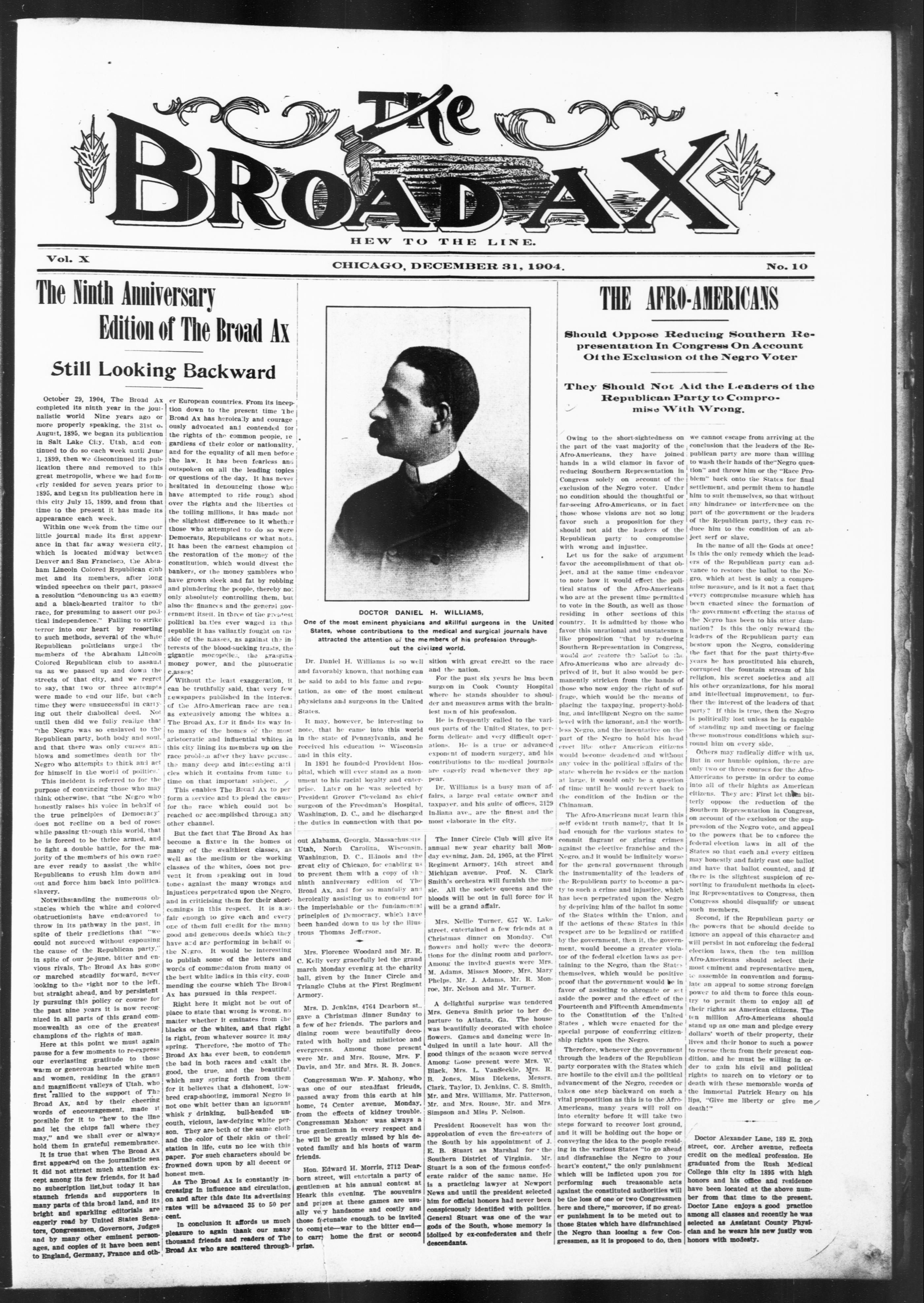
The Ninth Anniversary Edition of The Broad Ax
Still Looking Backward
Vol. X
October 29, 1904, The Broad Ax completed its ninth year in the journalistic world Nine years ago or more properly speaking, the 31st o. August, 1895, we began its publication in Salt Lake City, Utah, and continued to do so each week until June 1, 1899, then we discontinued its publication there and removed to this great metropolis, where we had formerly resided for seven years prior to 1895, and began its publication here in this city July 15, 1899, and from that time to the present it has made its appearance each week.
Within one week from the time our little journal made its first appearance in that far away western city, which is located midway between Denver and San Francisco, the Abraham Lincoln Colored Republican club met and its members, after long winded speeches on their part, passed a resolution "denouncing us an enemy and a black-hearted traitor to the race, for presuming to assert our political independence." Failing to strike terror into our heart by resorting to such methods, several of the white Republican politicians urged the members of the Abraham Lincoln Colored Republican club to assault us as we passed up and down the streets of that city, and we regret to say, that two or three attempts were made to end our life, but each time they were unsuccessful in carrying out their diabolical deed. Not until then did we fully realize that "the Negro was so enslaved to the Republican party, both body and soul, and that there was only curses and blows and sometimes death for the Negro who attempts to think and act for himself in the world of politics."
This incident is referred to for the purpose of convincing those who may think otherwise, that "the Negro who honestly raises his voice in behalf of the true principles of Democracy" does not recline on a bed of roses while passing through this world, that he is forced to be thrice armed, and to fight a double battle, for the majority of the members of his own race are ever ready to assist the white Republicans to crush him down and out and force him back into political slavery.
Notwithstanding the numerous obstacles which the white and colored obstructionists have endeavored to throw in its pathway in the past, in spite of their predictions that "we could not succeed without espousing the cause of the Republican party," in spite of our je-june, bitter and envious rivals. The Broad Ax has gone or marched steadily forward, never looking to the right nor to the left, but straight ahead, and by persistently pursuing this policy or course for the past nine years it is now recognized in all parts of this grand commonwealth as one of the greatest champions of the rights of man.
Here at this point we must again pause for a few moments to re-express our everlasting gratitude to those warm or generous hearted white men and women, residing in the grand and magnificent valleys of Utah, who first rallied to the support of The Broad Ax, and by their cheering words of encouragement, made it possible for it to "hew to the line and let the chips fall where they may," and we shall ever or always hold them in grateful remembrance.
It is true that when The Broad Ax first appeared on the journalistic sea it did not attract much attention except among its few friends, for it had no subscription list,but today it has staunch friends and supporters in many parts of this broad land, and its bright and sparkling editorials are eagerly read by United States Senators, Congressmen, Governors, Judges and by many other eminent personages, and copies of it have been sent to England, Germany, France and oth-
er European countries. From its inception down to the present time The Broad Ax has heroically and courageously advocated and contended for the rights of the common people, regardless of their color or nationality, and for the equality of all men before the law. It has been fearless and outspoken on all the leading topics or questions of the day. It has never hesitated in denouncing those who have attempted to ride rough shod over the rights and the liberties of the toiling millions, it has made not the slightest difference to it whether those who attempted to do so were Democrats, Republicans or what nots. It has been the earnest champion of the restoration of the money of the constitution, which would divest the bankers, or the money gamblers who have grown sleek and fat by robbing and plundering the people, thereby not only absolutely controlling them, but also the finances and the general government itself. In three of the greatest political battles ever waged in this republic it has valiantly fought on the side of the masses, as against the interests of the blood-sucking trusts, the gigantic monopolies, the grasping money power, and the plutocratic classes!
Without the least exaggeration, it can be truthfully said, that very few newspapers published in the interest of the Afro-American race are real as extensively among the whites an The Broad Ax. for it finds its way into many of the homes of the most aristocratic and influential whites in this city lining its members up on the race problem after they have perused the many deep and interesting articles which it contains from time to time on that important subject.
This enables The Broad Ax to perform a service and to plead the cause for the race which could not be reached or accomplished through any other channel.
But the fact that The Broad Ax has become a fixture in the homes of many of the wealthiest classes, as well as the medium or the working classes of the whites, does not prevent it from speaking out in loud tones against the many wrongs and injustices perpetrated upon the Negro, and in criticising them for their short comings in this respect. It is also fair enough to give each and every one of them full credit for the many good and generous deeds which they have and are performing in behalf of the Negro. It would be interesting to publish some of the letters and words of commendation from many of the best white ladies in this city, commending the course which The Broad Ax has pursued in this respect.
Right here it might not be out of place to state that wrong is wrong, no matter whether it eminates from the blacks or the whites, and that right is right, from whatever source it may spring. Therefore, the motto of The Broad Ax has ever been, to condemn the bad in both races and exalt the good, the true, and the beautiful which may spring forth from them for it believes that a dishonest, lowbred crap-shooting, immoral Negro is not one whit better than an ignorant whisk y drinking, bull-headed uncouth, vicious, law-defying white person. They are both of the same cloth and the color of their skin or their station in life, cuts no ice with this paper. For such characters should be frowned down upon by all decent or honest men.
As The Broad Ax is constantly increasing in influence and circulation on and after this date its advertising rates will be advanced 35 to 50 per cent. In conclusion it affords us much pleasure to again thank our many thousand friends and readers of The Broad Ax who are scattered through-
HEW TO THE LINE.
CHICAGO, DECEMBER 31, 1904.
DOCTOR DANIEL H. WILLIAMS,
One of the most eminent physicians and skillful surgeons in the United States, whose contributions to the medical and surgical journals have attracted the attention of the members of his profession throughout the civilized world.
Dr. Daniel H. Williams is so well and favorably known, that nothing can be said to add to his fame and reputation, as one of the most eminent physicians and surgeons in the United States.
sition with great credit to the race and the nation.
For the past six years he has been surgeon in Cook County Hospital where he stands shoulder to shoulder and measures arms with the brainsiest man of his profession.
It may, however, be interesting to note, that he came into this world in the state of Pennsylvania, and he received his education in Wisconsin and in this city. In 1891 he founded Provident Hospital, which will ever stand as a monument to his racial loyalty and enterprise. Later on he was selected by President Grover Cleveland as chief surgeon of the Freedman's Hospital, Washington, D. C., and he discharged the duties in connection with that po
out Alabama, Georgia, Massachusetts, Utah, North Carolina, Wisconsin, Washington, D. C., Illinois and the great city of Chicago, for enabling us to present them with a copy of the ninth anniversary edition of The Broad Ax, and for so manfully and heroically assisting us to contend for the imperishable or the fundamental principles of Democracy, which have been handed down to us by the illustrous Thomas Jefferson.
Mrs. Florence Woodard and Mr. R. C. Kelly very gracefully led the grand march Monday evening at the charity ball, given by the Inner Circle and Triangle Clubs at the First Regiment Armory.
Mrs. D. Jenkins, 4764 Dearborn st. gave a Christmas dinner Sunday to a few of her friends. The parlors and dining room were beautifully decorated with holly and mistletoe and evergreens. Among those present were Mr. and Mrs. Rouse, Mrs. F. Davis, and Mr. and Mrs. R. B. Jones.
Congressman Wm. F. Mahony, who was one of our steadfast friends, passed away from this earth at his home, 74 Center avenue, Monday, from the effects of kidney trouble. Congressman Mahony was always a true gentleman in every respect and he will be greatly missed by his devoted family and his hosts of warm friends.
Hon. Edward H. Morris, 2712 Dearborn street, will entertain a party of gentlemen at his annual contest at Heark this evening. The souvenirs and prizes at these games are usually very handsome and costly and those fortunate enough to be invited to compete—war to the bitter end—to carry home the first or second prize.
sition with great credit to the race and the nation.
For the past six years he has been surgeon in Cook County Hospital where he stands shoulder to shoulder and measures arms with the brainiest men of his profession.
He is frequently called to the various parts of the United States, to perform delicate and very difficult operations. He is a true or advanced exponent of modern surgery, and his contributions to the medical journals are eagerly read whenever they appear.
Dr. Williams is a busy man of affairs, a large real estate owner and taxpayer, and his suite of offices, 3129 Indiana ave., are the finest and the most elaborate in the city.
The Inner Circle Club will give its annual new year charity ball Monday evening, Jan. 2d, 1905, at the First Regiment Armory, 16th street and Michigan avenue. Prof. N. Clark Smith's orchestra will furnish the music. All the society queens and the bloods will be out in full force for it will be a grand affair.
Mrs. Nellie Turner, 657 W. Lake street, entertained a few friends at a Christmas dinner on Monday. Cut flowers and holly were the decorations for the dining room and parlors. Among the invited guests were Mrs. M. Adams, Misses Moore, Mrs. Mary Phelps, Mr. J. Adams, Mr. R. Monroe, Mr. Nelson and Mr. Turner.
A delightful surprise was tendered Mrs. Geneva Smith prior to her departure to Atlanta, Ga. The house was beautifully decorated with choice flowers. Games and dancing were indulged in until a late hour. All the good things of the season were served Among those present were Mrs. W. Black, Mrs. L. VanSeckle, Mrs. R. B. Jones, Miss Dickens, Messrs. Clark. Taylor, D. Jenkins, C. S. Smith, Mr. and Mrs. Williams, Mr. Patterson, Mr. and Mrs. Rouse, Mr. and Mrs. Simpson and Miss P. Nelson.
President Roosevelt has won the approbation of even the fire-eaters of the South by his appointment of J. E. B. Stuart as Marshal for the Southern District of Virginia. Mr. Stuart is a son of the famous confederate raider of the same name. He is a practicing lawyer at Newport News and until the president selected him for official honors had never been conspicuously identified with politics. General Stuart was one of the war gods of the South, whose memory is idolized by ex-confederates and their descendants.
THE AFRO-AMERICANS
Should Oppose Reducing Southern Representation In Congress On Account Of the Exclusion of the Negro Voter
They Should Not Aid the Leaders of the Republican Party to Compro mise With Wrong.
Owing to the short-sightedness on the part of the vast majority of the Afro-Americans, they have joined hands in a wild clamor in favor of reducing Southern Representation in Congress solely on account of the exclusion of the Negro voter. Under no condition should the thoughtful or far-seeing Afro-Americans, or in fact those whose visions are not so long favor such a proposition for they should not aid the leaders of the Republican party to compromise with wrong and injustice.
Let us for the sake of argument favor the accomplishment of that object, and at the same time endeavor to note how it would effect the political status of the Afro-Americans who are at the present time permitted to vote in the South, as well as those residing in other sections of this country. It is admitted by those who favor this unrational and unstatesmen like proposition "that by reducing Southern Representation in Congress, would not restore the ballot to the Afro-Americans who are already deprived of it, but it also would be permanently stricken from the hands of those who now enjoy the right of suffrage, which would be the means of placing the taxpaying, property-holding, and intelligent Negro on the same level with the ignorant, and the worthless Negro, and the incentive on the part of the Negro to hold his head erect like other American citizens would become deadened and without any voice in the political affairs of the state wherein he resides or the nation at large, it would only be a question of time until he would revert back to the condition of the Indian or the Chinaman.
The Afro-Americans must learn this self evident truth namely, that it is bad enough for the various states to commit flagrant or glaring crimes against the elective franchise and the Negro, and it would be infinitely worse for the general government through the instrumentality of the leaders of the Republican party to become a party to such a crime and injustice, which has been perpetrated upon the Negro by depriving him of the ballot in some of the States within the Union, and if the actions of these States in this respect are to be legalized or ratified by the government, then it, the government, would become a greater violator of the federal election laws as pertaining to the Negro, than the States themselves, which would be positive proof that the government would be in favor of assisting to abrogate or set aside the power and the effect of the Fourteenth and Fifteenth Amendments to the Constitution of the United States, which were enacted for the special purpose of conferring citizenship rights upon the Negro.
Therefore, whenever the government through the leaders of the Republican party corporates with the States which are hostile to the civil and the political advancement of the Negro, recedes or takes one step backward on such a vital proposition as this is to the Afro-Americans, many years will roll on into eternity before it will take two steps forward to recover lost ground, and it will be holding out the hope or conveying the idea to the people residing in the various States "to go ahead and disfranchise the Negro to your heart's content," the only punishment which will be inflicted upon you for performing such treasonable acts against the constituted authorities will be the loss of one or two Congressmen here and there," moreover, if no greater punishment is to be meted out to those States which have disfranchised the Negro than loosing a few Congressmen, as it is proposed to do, then
No.10
-AMERICANS
Reducing Southern Re-
congress On Account
of the Negro Voter
Aid the Leaders of the
Party to Compro-
th Wrong.
we cannot escape from arriving at the conclusion that the leaders of the Republican party are more than willing to wash their hands of the "Negro question" and throw him or the "Race Problem" back onto the States for final settlement, and permit them to handle him to suit themselves, so that without any hindrance or interference on the part of the government or the leaders of the Republican party, they can reduce him to the condition of an abject serf or slave.
In the name of all the Gods at once! Is this the only remedy which the leaders of the Republican party can advance to restore the ballot to the Negro, which at best is only a compromise measure, and is it not a fact that every compromise measure which has been enacted since the formation of the government effecting the status of the Negro has been to his utter damnation? Is this the only reward the leaders of the Republican party can bestow upon the Negro, considering the fact that for the past thirty-five years he has prostituted his church, corrupted the fountain stream of his religion, his secret societies and all his other organizations, for his moral and intellectual improvement, to further the interest of the leaders of that party? If this is true, then the Negro is politically lost unless he is capable of standing up and meeting or facing these monstrous conditions which surround him on every side.
Others may radically differ with us. But in our humble opinion, there are only two or three courses for the Afro-Americans to persue in order to come into all of their hights as American citizens. They are: First let them bitterly oppose the reduction of the Southern Representation in Congress, on account of the exclusion or the suppression of the Negro vote, and appeal to the powers that be to enforce the federal election laws in all of the States so that each and every citizen may honestly and fairly cast one ballot and have that ballot counted, and if there is the slightest suspicion of resorting to fraudulent methods in electing Representatives to Congress, then Congress should disqualify or unseat such members.
Second, if the Republican party or the powers that be should decide to ignore an appeal of this character and will persist in not enforcing the federal election laws, then the ten million Afro-Americans should select their most eminent and representative men, to assemble in convention and formulate an appeal to some strong foreign power to aid them to force this country to permit them to enjoy all of their rights as American citizens. The ten million Afro-Americans should stand up as one man and pledge every dollars' worth of their property, their lives and their honor to such a power to rescue them from their present condition, and he must be willing in order to gain his civil and political rights to march on to victory or to death with these memorable words of the immortal Patrick Henry on his lips, "Give me liberty or give me death!"
Doctor Alexander Lane, 189 E. 20th street, cor. Archer avenue, reflects credit on the medical profession. He graduated from the Rush Medical College this city in 1895 with high honors and his office and residence have been located at the above number from that time to the present. Doctor Lane enjoys a good practice among all classes and recently he was selected as Assistant County Physician and he wears his new justly won honors with modesty.
---
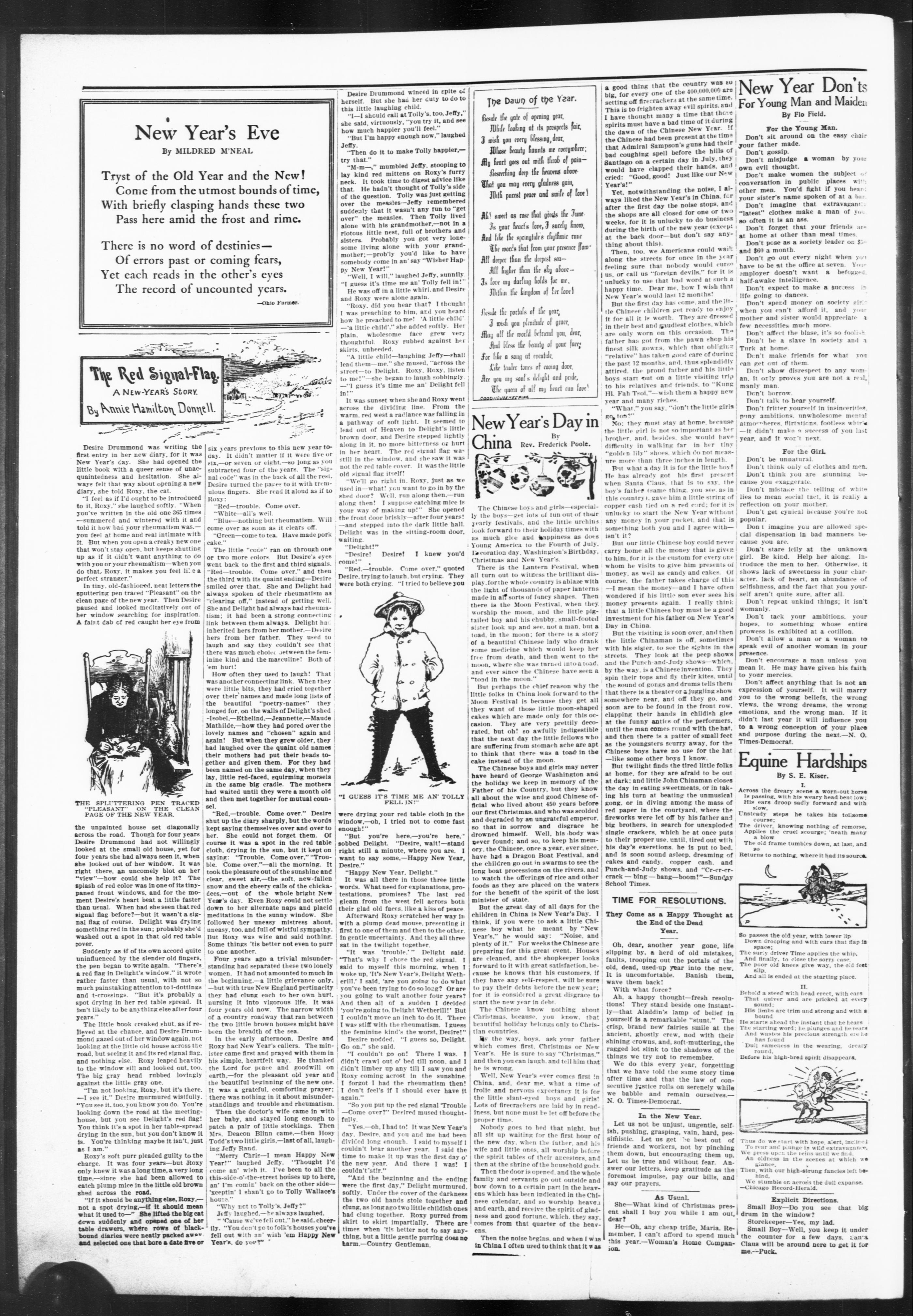
New Year's Eve By MILDRED M'NEAL
Tryst of the Old Year
Come from the un
With briefly clasping
Pass here amid t
There is no word of
Of errors past or
Yet each reads in t
The record of un
The Red Signal-Fl
A NEW-YEAR'S STORY.
By Annie Hamilton Donne
Tryst of the Old Year and the New! Come from the utmost bounds of time, With briefly clasping hands these two Pass here amid the frost and rime.
There is no word of destinies- Of errors past or coming fears, Yet each reads in the other's eyes The record of uncounted years.
The Red Signal-Flag.
A NEW-YEAR'S STORY.
By Annie Hamilton Donnell.
Desire Drummond was writing the first entry in her new diary, for it was New Year's day. She had opened the little book with a queer sense of unacquaintedness and hesitation. She always felt that way about opening a new diary, she told Roxy, the cat.
"I feel as if I'd ought to be introduced to it, Roxy," she laughed softly. "When you've written in the old one 365 times—summered and wintered with it and told it how bad your rheumatism was,—you feel at home and real intimate with it. But when you open a creaky new one that won't stay open, but keeps shutting up as if it didn't want anything to do with you or your rheumatism—when you do that, Roxy, it makes you feel li'le a perfect stranger."
In tiny, old-fashioned, neat letters the sputtering pen traced "Pleasant" on the clean page of the new year. Then Desire paused and looked meditatively out of her window searching for inspiration. A faint dab of red caught her eye from
A woman sitting in a chair, reading a book.
THE SPLUTTERING PEN TRACED "PLEASANT" ON THE CLEAN PAGE OF THE NEW YEAR.
the unpainted house set diagonally across the road. Though for four years Desire Drummond had not willingly looked at the small old house, yet for four years she had always seen it, when she looked out of her window. It was right there, an uncomely blot on her "view"—how could she help it? The splash of red color was in one of its tiny-paned front windows, and for the moment Desire's heart beat a little faster than usual. When had she seen that red signal flag before?—but it wasn't a signal flag of course. Delight was drying something red in the sun; probably she'd washed out a spot in that old red table cover.
Suddenly as if of its own accord quite uninfluenced by the slender old fingers, the pen began to write again. "There's a red flag in Delight's window." it wrote rather faster than usual, with not so much painstaking attention to i-dottings and t-crossings. "But it's probably a spot drying in her red table spread. It isn't likely to be anything else after four years."
The little book creaked shut, as if relieved at the chance, and Desire Drummond gazed out of her window again, not looking at the little old house across the road, but seeing it and its red signal flag, and nothing else. Roxy leaped heavily to the window sill and looked out, too. The big gray head rubbed lovingly against the little gray one.
"I'm not looking, Roxy, but it's there. I see it." Desire murmured wistfully. "You see it, too, you know you do. You're looking down the road at the meetinghouse, but you see Delight's red flag! You think it's a spot in her table-spread drying in the sun, but you don't know it is. You're thinking maybe it isn't, just as I am." Roxy's soft purr pleaded guilty to the charge. It was four years—but Roxy only knew it was a long time, a very long time,—since she had been allowed to catch plump mice in the little old brown shed across the road.
"If it should be anything else, Roxy,— not a spot drying,—if it should mean what it used to—" She lifted the big cat down suddenly and opened one of her table drawers, where rows of black-bound diaries were neatly packed away and selected one that bore a date five or
six years previous to this new year today. It didn't matter if it were five or six,—or seven or eight,—so long as you subtracted four of the years. The "signal code" was in the back of all the rest. Desire turned the pages to it with tremulous fingers. She read it aloud as if to Roxy: "Red—trouble. Come over. "White—all's well. "Blue—nothing but rheumatism. Will come over as soon as it clears off. "Green—come to tea. Have made pork cake."
The little "code" ran on through one or two more colors. But Desire's eyes went back to the first and third signals. "Red—trouble. Come over," and then the third with its quaint ending—Desire smiled over that. She and Delight had always spoken of their rheumatism as "clearing off," instead of getting well. She and Delight had always had rheumatism; it had been a strong connecting link between them always. Delight had inherited hers from her mother.—Desire hers from her father. They used to laugh and say they couldn't see that there was much choice between the feminine kind and the masculine! Both of 'em hurt!
How often they used to laugh! That was another connecting link. When they were little bits, they had cried together over their names and made long lists of the beautiful "poetry-names" they longed for, on the walls of Delight's shed -Isobel,-Ethelind,-Jeannette,-Maude Mathilde,-how they had pored over the lovely names and "chosen" again and again! But when they grew older, they had laughed over the quaint old names their mothers had put their heads together and given them. For they had been named on the same day, when they lay, little red-faced, squirming morsels in the same big cradle. The mothers had waited until they were a month old and then met together for mutual counsel.
"Red,—trouble. Come over." Desire shut up the diary sharply, but the words kept saying themselves over and over to her. She could not forget them. Of course it was a spot in the red table cloth, drying in the sun, but it kept on saying: "Trouble. Come over," "Trouble. Come over,"—all the morning. It took the pleasure out of the sunshine and clear, sweet air—the soft, new-fallen snow and the cheery calls of the chickadees,—out of the whole bright New Year's day. Even Roxy could not settle down to her alternate naps and placid meditations in the sunny window. She followed her uneasy mistress about, uneasy, too, and full of wistful sympathy. But Roxy was wise and said nothing. Some things 'tis better not even to purr to one another.
Four years ago a trivial misunderstanding had separated these two lonely women. It had not amounted to much in the beginning, a little grievance only, but with true New England pertinacity they had clung each to her own hurt, nursing it into vigorous life. It was four years old now. The narrow width of a country roadway that ran between the two little brown houses might have been the breadth of the sea.
In the early afternoon, Desire and Roxy had New Year's callers. The minister came first and prayed with them in his simple, heartfelt way. He thanked the Lord for peace and goodwill on earth,—for the pleasant old year and the beautiful beginning of the new one. It was a grateful, comforting prayer; there was nothing in it about misunderstandings and trouble and rheumatism. Then the doctor's wife came in with her baby, and stayed long enough to patch a pair of little stockings. Then Mrs. Deacon Blinn came,—then Hosy Todd's two little girls,—last of all, laughing Jeffy Rand.
"Merry Chris—I mean Happy New Year!" laughed Jeffy. "Thought I'd come an' wish it. I've been to all the this-side-o'the-street houses up to here, an' I'm comin' back on the other side—'xceptin' I shan't go to Tolly Wallace's house."
"Why not to Tolly's, Jeffy?"
Jeffy laughed,—he always laughed.
"Cause we've fell out," he said, cheerily. "You don't go to folk's houses you've fell out with an' wish 'em Happy New Year's, do you?"
Desire Drummond winced in spite of herself. But she had her duty to do to this little laughing child.
"I—I should call at Tolly's, too, Jeffy," she said, virtuously, "you try it, and see how much happier you'll feel."
now much happier, "But I'm happy enough now," laughed Jeffy. "Then do it to make Tolly happier,— try that."
"M-m—," mumbled Jeffy, stooping to lay kind red mittens on Roxy's furry neck. It took time to digest advice like that. He hadn't thought of Tolly's side of the question. Tolly was just getting over the measles—Jeffy remembered suddenly that it wasn't any fun to "get over" the measles. Then Tolly lived alone with his grandmother,—not in a riotous little nest, full of brothers and sisters. Probably you got very lonesome living alone with your grandmother;—prob'ly you'd like to have somebody come in an' say "Wisher Happy New Year!"
"Well, I will," laughed Jeffy, sunnily. "I guess it's time me an' Tolly fell in!" He was off in a little whirl, and Desire and Roxy were alone again.
"Roxy, did you hear that? I thought I was preaching to him, and you heard how he preached to me! 'A little child'. —'a littie child'," she added softly. Her plain, wholesome face grew very thoughtful. Roxy rubbed against her skirts, unheeded.
"A little child—laughing Jeffy—shall lead them—me." she mused, "across the street—to Delight. Roxy, Roxy, listen to me!"—she began to laugh sobbingly. —'I guess it's time me an' Delight fell in!"
It was sunset when she and Roxy went across the dividing line. From the warm, red west a radiance was falling in a pathway of soft light. It seemed to lead out of Heaven to Delight's little brown door, and Desire stepped lightly along in it, no more bitterness or hurt in her heart. The red signal flag was still in the window, and she saw it was not the red table cover. It was the little old signal flag itself!
"We'll go right in. Roxy, just as we used in—what! you want to go in by the shed door? Well, run along then,—run along then! I suppose catching mice is your way of making up!" She opened the front door briskly—after four years!—and stepped into the dark little hall. Delight was in the sitting-room door, waiting.
"Delight!"
"Desire! Desire! I knew you'd come!"
"Red.—trouble. Come over," quoted Desire, trying to laugh, but crying. They were both crying. "I tried to believe you
A
"I GUESS IT'S TIME ME AN' TOLLY FELL IN!"
were drying your red table cloth in the window,-oh, I tried not to come fast enough!"
"But you're here,-you're here," sobbed Delight. "Desire, wait!-stand right still a minute, where you are. I want to say some,-Happy New Year, Desire."
"Happy New Year, Delight."
It was all there in those three little words. What need for explanations, protestations, promises? The last red gleam from the west fell across both their glad old faces, like a kiss of peace. Afterward Roxy scratched her way in with a plump dead mouse, presenting it first to one of them and then to the other, in gentle uncertainty. And they all three sat in the twilight together.
"It was 'trouble.'" Delight said. "That's why I chose the red signal. I said to myself this morning, when I woke up. 'It's New Year's, Delight Wetherill.' I said, 'are you going to do what you've been trying to do so long? Or are you going to wait another four years? And then all of a sudden I decided 'you're going to, Delight Wetherill!' But I couldn't move an inch to do it. There I was stiff with the rheumatism. I guess the feminine kind's the worst, Desire!' Desire nodded. "I guess so, Delight. Go on," she said.
"I couldn't go on! There I was. I didn't crawl out o' bed till noon, and I didn't limber up any till I saw you and Roxy coming acrost in the sunshine. I forgot I had the rheumatism then! I don't feel's if I should ever have it again."
"So you put up the red signal 'Trouble—Come over?' Desired mused thoughtfully.
"Yes.—oh, I had to! It was New Year's day. Desire, and you and me had been divided long enough. I said to myself I couldn't bear another year. I said the time to make it up was the first day of the new year. And there I was! I couldn't 'stir.'
"And the beginning and the ending were the first day," Delight murmured, softly. Under the cover of the darkness the two old hands stole together and clung, as long ago two little childish ones had clung together. Roxy purred from skirt to skirt impartially. There are times when 'tis better not to say anything, but a little gentle purring does no harm.—Country Gentleman.
The Dawn of the Year.
Beside the gate of opening year,
While looking at its prospects fair,
I wish you every blessing, dear,
Whose beauty haunts me everywhere;
My heart goes out with throb of pain—
All sweet as rose that greets the June
Is your heart's love, I surely know.
And like the springtide's rhythmic rune
The word's that from your presence flow.
All deeper than the deepest sea—
All higher than the sky above—
Is love my darling holds for me,
Within the kingdom of her love!
Beside the portals of the year,
I wish you plenitude of grace,
May all the world befriend you, dear,
And bless the beauty of your face;
For like a song at eventule,
Like tender tones of cooing dove,
Are you my soul's delight and pride,
The queen of all my heart can love!
New Year's Day in China By Rev. Frederick Poole.
The Chinese boys and girls—especially the boys—get lots of fun out of their yearly festivals, and the little urchins look forward to their holiday times with as much glee and happiness as does Young America to the Fourth of July. Decoration day, Washington's Birthday, Christmas and New Year's.
There is the Lantern Festival, when all turn out to witness the brilliant display, for the whole country is ablaze with the light of thousands of paper lanterns made in all sorts of fancy shapes. Then there is the Moon Festival, when they worship the moon, and the little pigtailed boy and his chubby, small-footed sister look up and see, not a man, but a toad, in the moon; for there is a story of a beautiful Chinese lady who drank some medicine which would keep her free from death, and then went to the moon, where she was turned into a toad, and ever since the Chinese have seen a "toad in the moon."
But perhaps the chief reason why the little folks in China look forward to the Moon Festival is because they get all they want of those little moon-shaped cakes which are made only for this occasion. They are very prettily decorated, but oh! so awfully indigestible that the next day the little fellows who are suffering from stomach ache are apt to think that there was a toad in the cake instead of the moon.
The Chinese boys and girls may never have heard of George Washington and the holiday we keep in memory of the Father of his Country, but they know all about the wise and good Chinese official who lived about 450 years before our first Christmas, and who was scolded and degraded by an ungrateful emperor, so that in sorrow and disgrace he drowned himself. Well, his body was never found; and so, to keep his memory, the Chinese, once a year, ever since, have had a Dragon Boat Festival, and the children go out in swarms to see the long boat processions on the rivers, and to watch the offerings of rice and other foods as they are placed on the waters for the benefit of the spirit of the lost minister of state.
But the great day of all days for the children in China is New Year's Day. I think, if you were to ask a little Chinese boy what he meant by "New Year's," he would say: "Noise, and plenty of it." For weeks the Chinese are preparing for this great event. Houses are cleaned, and the shopkeeper looks forward to it with great satisfaction, because he knows that his customers, if they have any self-respect, will be sure to pay their debts before the new year; for it is considered a great disgrace to start the new year in debt.
The Chinese know nothing about Christmas, because, you know, that beautiful holiday belongs only to Christian countries.
By the way, boys, ask your father which comes first, Christmas or New Year's. He is sure to say "Christmas," and then you can laugh, and tell him that he is wrong.
Well, New Year's ever comes first in China, and, dear me, what a time of frolic and nervous expectancy it is for the little slant-eyed boys and girls! Lots of firecrackers are laid by in readiness, but none must be let off before the proper time.
Nobody goes to bed that night, but all sit up waiting for the first hour of the new day, when the father, and his wife and little ones, all worship before the spirit tables of their ancestors, and then at the shrine of the household gods. Then the door is opened, and the whole family and servants go out outside and bow down to a certain part in the heavens which has been indicated in the Chinese calendar, and so worship heaven and earth, and receive the spirit of gladness and good fortune, which, they say, comes from that quarter of the heavens. Then the noise begins, and when I was in China I often used to think that it was
a good thing that the country was so big, for every one of the 400,000,000 are setting off firecrackers at the same time. This is to frighten away evil spirits, and I have thought many a time that those spirits must have a bad time of it during the dawn of the Chinese New Year. If the Chinese had been present at the time that Admiral Sampson's guns had their bad coughing spell before the hills of Santiago on a certain day in July, they would have clapped their hands, and cried: "Good, good! Just like our New Year's!"
Yet, notwithstanding the noise, I always liked the New Year's in China, for after the first day the noise stops, and the shops are all closed for one or two weeks, for it is unlucky to do business during the birth of the new year (except at the back door—but don't say anything about this).
Then, too, we Americans could wait along the streets for once in the year feeling sure that nobody would curse us, or call us "foreign devils," for it is unlucky to use that bad word at such a happy time. Dear me, how I wish that New Year's would last 12 months!
But the first day has come, and the little Chinese children get ready to enjoy it for all it is worth. They are dressed in their best and gaudiest clothes, which are only worn on this occasion. The father has got from the pawn shop his finest silk gowns, which that obliging "relative" has taken good care of during the past 12 months, and, thus splendidly attired, the proud father and his little boys start out on a little visiting trip to his relatives and friends, to "Kung Hi. Fah Tsol."—wish them a happy new year and many riches.
"What," you say, "don't the little girls go to?"
No; they must stay at home, because the little girl is not so important as her brother, and, besides, she would have difficulty in walking far in her tiny "golden lily" shoes, which do not measure more than three inches in length.
But what a day it is for the little boy! He has already got his first present when Santa Claus, that is to say, the boy's father (same thing, you see, as in this country), gave him a little string of copper cash tied on a red cord; for it is unlucky to start the New Year without any money in your pocket, and that is something both you and I agree with—isn't it?
But our little Chinese boy could never carry home all the money that is given to him, for it is the custom for every one whom he visits to give him presents of money, as well as candy and cakes. Of course, the father takes charge of this I mean the money—and I have often wondered if his little son ever sees his money presents again. I really think that a little Chinees boy must be a good investment for his father on New Year's Day in China.
But the visiting is soon over, and then the little Chinaman is off, sometimes with his sister, to see the sights in the streets. They look at the peep shows and the Punch-and-Judy shows—which, by the way, is a Chinese invention. They spin their tops and fly their kites, until the sound of gongs and drums tells them that there is a theater or a juggling show somewhere near, and off they go, and soon are to be found in the front row, clapping their hands in childish glee at the funny antics of the performers, until the man comes round with the hat, and then there is a patter of small feet as the youngsters scurry away, for the Chinese boys have no use for the hat—like some other boys I know.
But twilight finds the tired little folks at home, for they are afraid to be out at dark; and little John Chinaman closes the day in eating sweetmeats, or in taking his turn at beating the unmusical gong, or in diving among the mass of red paper in the courtyard, where the fireworks were let off by his father and big brothers, in search for unexploded single crackers, which he at once puts to their proper use, until, tired out with his day's exeretions, he is put to bed, and is soon sound asleep, dreaming of cakes and candy, copper cash, and Punch-and-Judy shows, and "Cr-cr-cr-crack — bing — bang—boom!"—Sunday School Times.
TIME FOR RESOLUTIONS
They Come as a Happy Thought at the End of the Dead
Year.
Oh, dear, another year gone, life slipping by, a herd of old mistakes, faults, trooping out the portals of the old, dead, used-up year into the new. It is uncomfortable. Banish them, wave them back!
With what force?
Ah, a happy thought—fresh resolutions! They stand beside one instantly—that Aladdin's lamp of belief in yourself is a remarkable "stunt." The crisp, brand new fairies smile at the ancient, ghostly crew, nod with their shining crowns, and, soft-muttering, the ragged lot slink to the shadows of the things we try not to remember.
We do this every year, forgetting that we have told the same story time after time and that the law of consecutive justice rolls on serenely while we babble and remain ourselves.—N. O. Times-Democrat.
In the New Year
Let us not be unjust, ungentle, selfish, pushing, grasping, vain, hard, pessimistic. Let us get the best out of friends and workers, not by pinching them down, but encouraging them up. Let us be true and without fear. Answer our letters, keep gratitude as the foremost impulse, pay our bills, and say our prayers.
As Usual.
She—What kind of Christmas present shall I buy you while I am out, dear?
He—Oh, any cheap trifle, Maria. Remember, I can't afford to spend much this year.—Woman's Home Companion.
New Year Don'ts For Young Man and Maiden
For the Young Man.
Don't sit around on the easy chair your father made.
Don't gossip.
Don't misjudge a woman by your own evil thought.
Don't make women the subject of conversation in public places with other men. You'd fight if you heard your sister's name spoken of at a bar.
Don't imagine that extravagantly "latest" clothes make a man of you so often it is an ass.
Don't forget that your friends are at home at other than meal times.
Don't pose as a society leader on $50 and $60 a month.
Don't go out every night when you have to be at the office at seven. Your employer doesn't want a befogged, half-awake intelligence. Don't expect to make a success in life going to dances. Don't spend money on society girls when you can't afford it, and your mother and sister would appreciate a few necessities much more. Don't affect the blase, it's so foolish. Don't be a slave in society and a Turk at home. Don't make friends for what you can get out of them.
Don't show disrespect to any woman. it only proves you are not a real, manly man.
Don't borrow.
Don't talk to hear yourself.
Don't fritter yourself in insincerities, puny ambitions, unwholesome mental atmospheres, flirtations, footless whir'—it didn't make a success of you last year, and it won't next.
For the Girl
Don't be unnatural.
Don't think only of clothes and men.
Don't think you are stunning because you exaggerate.
Don't mistake the telling of white lies to mean social tact, it is really a reflection on your mother.
Don't get cynical because you're not popular.
Don't imagine you are allowed special dispensation in bad manners because you are.
Don't stare icily at the unknown girl. Be kind. Help her along. Introduce the men to her. Otherwise, it shows lack of sweetness in your character, lack of heart, an abundance of selfishness, and the fact that you yourself aren't quite sure, after all.
Don't repeat unkind things; it isn't womanly.
Don't tack your ambitions, your hopes, to something whose entire prowess is exhibited at a cotillon.
Don't allow a man or a woman to speak evil of another woman in your presence.
Don't encourage a man unless you mean it. He may have given his faith to your mercies.
Don't affect anything that is not an expression of yourself. It will marry you to the wrong beliefs, the wrong views, the wrong dreams, the wrong emotions, and the wrong man. If it didn't last year it will influence you to a wrong conception of your place and purpose during the next.—N. O. Times-Democrat.
Equine Hardships
Across the dreary scene a worn-out horse
Is passing, with his weary head bent low;
His ears droop sadly forward and with
slow.
Unsteady steps he takes his toliosome
course;
The driver, knowing nothing of remorse,
Applies the cruel scourge; 'neath many
a blow
The old frame tumbles down, at last, and
so
So passes the old year, with lower lip Down drooping and with ears that flap in space:
The poor old knees give way, the old feet slip.
Behold a steed with head erect, with ears
That quiver and are pricked at every
sound;
His limbs are trim and strong and with a
bound
He starts ahead the instant that he hears
The starting word; he plunges and he rears
And wastes his precious strength ere he
has found
Dull sameness in the wearing, dreary
round,
Before his high-bred spirit disappears.
Thus do we start with hope, alert, inclined
To rear and punge is wild extravagance,
We press upon the reins until we find.
An oldness in the scenes at which we
glance,
Then, with our high-strung fancies left be-
hind,
We stumble on across the dull expanse.
—Chicago Record-Herald.
Explicit Directions
Small Boy—Do you see that big drum in the window?
Storekeeper—Yes, my lad.
Small Boy—Well, you keep it under the counter for a few days. Santa Claus will be around here to get it for me.—Puck.
ANNUAL REPORT OF MISSION WO
IN SESSION AT GALESBURG,
To the Bishop of the 4th Episcopal
District and Members of the Iowa
Conference:
Rt. Reverend Sir and Brethren:
I rejoice that God has again granted
to me the pleasure of presenting for
your consideration the annual report
of my missionary work.
As usual this record of the past year embraces not only my services in the church as generally understood, but also the official phase of my work as a Probation Officer, dealing with dependent and delinquent children of the Juvenile Court of Cook County. This work has been fully described in my previous report. From these reports you know that my duties bring me in contact with the officers and inmates of the various charitable penal and reformatory institutions of the city, county and state.
My field of labor broadens as the years go by, and most surely does God reveal to me that "The Harvest is White." At His command I have thrust in the sickle to reap as best I could.
In Chicago alone I have held 85 cottage and jail prayer meetings, 55 of these were held in the jail, the remaining 50 were held in homes in the slums. As a result of the meetings we are able to point to nine conver-
S.
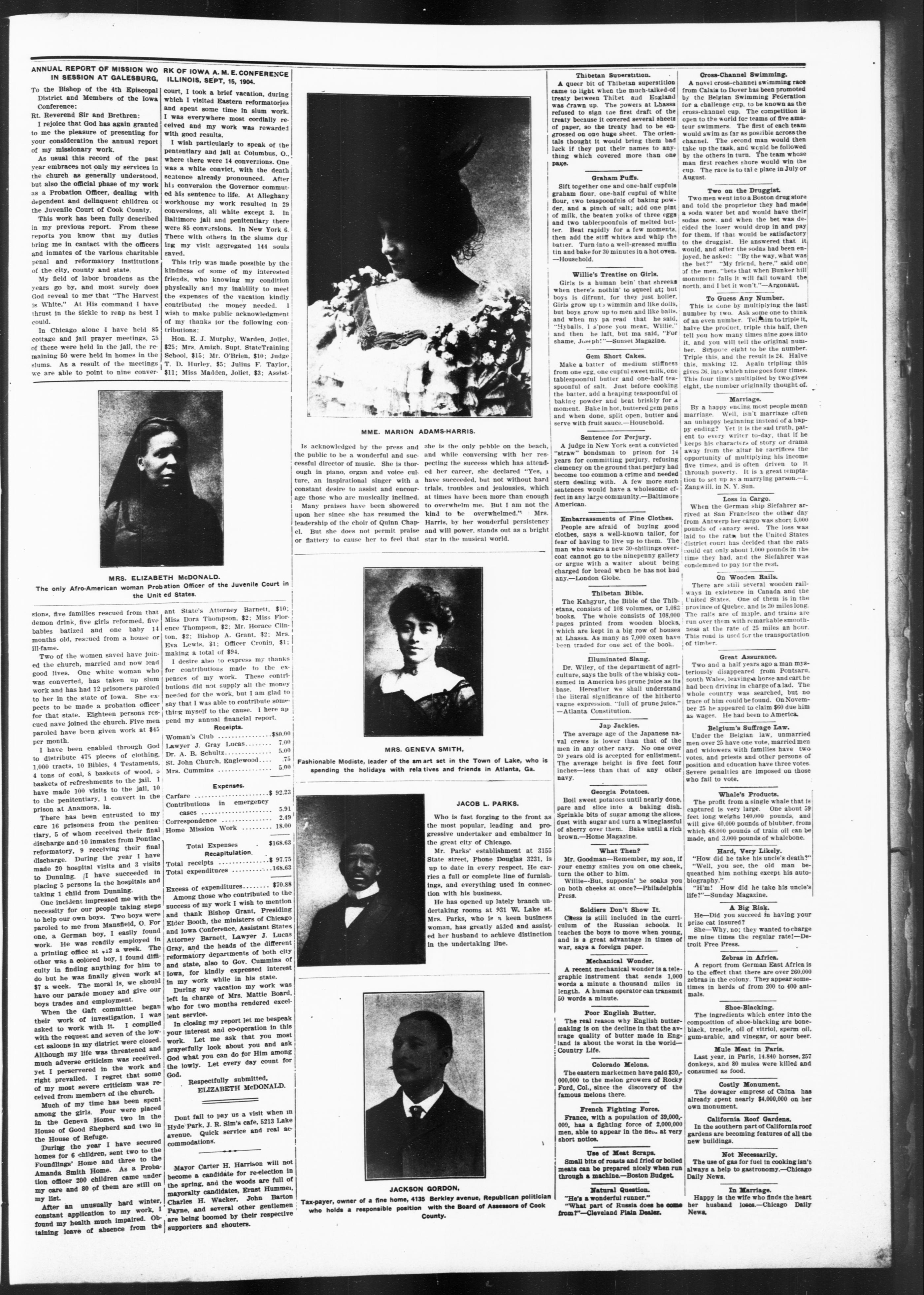
MRS. ELIZABETH McDONALD.
The only Afro-American woman Probation Officer of the Juvenile Court in the United States.
sions, five families rescued from that demon drink, five girls reformed, five babies batized and one baby 14 months old, rescued from a house or ill-fame.
Two of the women saved have joined the church, married and now lead good lives. One white woman who was converted, has taken up slum work and has had 12 prisoners paroled to her in the state of Iowa. She expects to be made a probation officer for that state. Eighteen persons rescued nave joined the church. Five men paroled have been given work at $45 per month.
I have been enabled through God to distribute 475 pieces of clothing, 1,000 tracts, 10 Bibles, 4 Testaments, 4 tons of coal, 8 baskets of wood, 8 baskets of refreshments to the jail. I have made 100 visits to the jail, 10 to the penitentiary, 1 convert in the prison at Anamosa, Ia.
There has been entrusted to my care 16 prisoners from the penitentiary, 5 of whom received their final discharge and 10 inmates from Pontiac reformatory, 9 receiving their final discharge. During the year I have made 20 hospital visits and 3 visits to Dunning. I have succeeded in placing 5 persons in the hospitals and taking 1 child from Dunning.
taking I child One incident impressed me with the necessity for our people taking steps to help our own boys. Two boys were paroled to me from Mansfield, O. For one, a German boy, I easily found work. He was readily employed in a printing office at 12 a week. The other was a colored boy, I found difficulty in finding anything for him to do but he was finally given work at $7 a week. The moral is, we should have our parade money and give our boys trades and employment.
When the Gaft committee began their work of investigation, I was asked to work with it. I complied with the request and seven of the lowest saloons in my district were closed. Although my life was threatened and much adverse criticism was received, yet I perservered in the work and right prevailed. I regret that some of my most severe criticism was received from members of the church.
Much of my time has been spent among the girls. Four were placed in the Geneva Home, two in the House of Good Shepherd and two in the House of Refuge. During the year I have secured homes for 6 children, sent two to the Foundlings' Home and three to the Amanda Smith Home. As a Probation officer 200 children came under my care and 80 of them are still on my list.
After an unusually hard winter, constant application to my work, I found my health much impaired. Obtaining leave of absence from the
RK OF IOWA A.M.E. CONFERENCE ILLINOIS, SEPT, 15, 1904. court, I took a brief vacation, during which I visited Eastern reformatories and spent some time in slum work. I was everywhere most cordially received and my work was rewarded with good results.
I wish particularly to speak of the pententiary and jail at Columbus, O., where there were 14 conversions. One was a white convict, with the death sentence already pronounced. After his conversion the Governor commuted his sentence to life. At Alleghany workhouse my work resulted in 29 conversions, all white except 3. In Baltimore jail and penitentiary there were 85 conversions. In New York 6. These with others in the slums during my visit aggregated 144 souls saved.
This trip was made possible by the kindness of some of my interested friends, who knowing my condition physically and my inability to meet the expenses of the vacation kindly contributed the money needed. I wish to make public acknowledgment of my thanks for the following contributions:
Hon. E. J. Murphy, Warden, Joliet, $25; Mrs. Amigh, Supt. StateTraining School, $15; Mr. O'Brien, $10; Judge T. D. Hurley, $5; Julius F. Taylor, $11; Miss Madden, Joliet, $3; Assist-
ant State's Attorney Barnett, $10; Miss Dora Thompson, $2; Miss Florence Thompson, $2; Mr. Horace Clinton, $2; Bishop A. Grant, $2; Mrs. Eva Lewis, $1; Officer Cronin, $1; making a total of $94.
I desire also to express my thanks for contributions made to the expenses of my work. These contributions did not supply all the money needed for the work, but I am glad to say that I was able to contribute something myself to the cause. I here ap pend my annual financial report.
Woman's Club ..... $80.00
Lawyer J. Gray Lucas..... 7.00
Dr. A. B. Schultz..... 5.00
St. John Church, Englewood..... .75
Mrs. Cummins ..... 5.00
Carfare ..... $ 92.23
Contributions in emergency cases ..... 5.91
Correspondence ..... 2.49
Home Mission Work ..... 18.00
Total receipts ..... $ 97.75
Total expenditures ..... 168.63
Excess of expenditures..... $ 70.88
Among those who contributed to the success of my work I wish to mention and thank Bishop Grant, Presiding Elder Booth, the ministers of Chicago and Iowa Conference, Assistant States Attorney Barnett, Lawyer J. Lucas Gray, and the heads of the different reformatory departments of both city and state, also to Gov. Cummins of Iowa, for kindly expressed interest in my work while in his state. During my vacation my work was left in charge of Mrs. Mattie Board, who for two months rendered excellent service.
In closing my report let me bespeak your interest and co-operation in this work. Let me ask that you most prayerfully look about you and ask God what you can do for Him among the lowly. Let every day count for God.
Dont fail to pay us a visit when in Hyde Park, J. R. Sim's cafe, 5213 Lake avenue. Quick service and real accommodations.
Mayor Carter H. Harrison will not become a candidate for re-election in the spring, and the woods are full of mayoralty candidates, Ernst Hummei, Charles H. Wacker, John Barton Payne, and several other gentlemen are being boomed by their respective supporters and shouters.
Receipts
Expenses.
THE LADY OF THE ROOM
Is acknowledged by the press and the public to be a wonderful and successful director of music. She is thorough in piano, organ and voice culture, an inspirational singer with a constant desire to assist and encourage those who are musically inclined. Many praises have been showered upon her since she has resumed the leadership of the choir of Quinn Chapel. But she does not permit praise or flattery to cause her to feel that she is the only and while conjecting the succeed her career, have succeeded, trials, troubles at times have be to overwhelm kind to be of Harris, by her and will power, star in the mus
M. H.
MRS. GENEVA SMITH, Fashionable Modiste, leader of the smart set in the Town of Lake, who is spending the holidays with relatives and friends in Atlanta, Ga.
J
M. H.
JACKSON GORDON, Tax-payer, owner of a fine home, 4135 Berkley avenue, Republican politician who holds a responsible position with the Board of Assessors of Cook County.
Tax-payer, owner of a fine home, 4135 Berkley avenue, Republican politician who holds a responsible position with the Board of Assessors of Cook County.
she is the only pebble on the beach, and while conversing with her respecting the success which has attended her career, she declared "Yes, I have succeeded, but not without hard trials, troubles and jealousies, which at times have been more than enough to overwhelm me. But I am not the kind to be overwhelmed." Mrs. Harris, by her wonderful persistency and will power, stands out as a bright star in the musical world.
art set in the Town of Lake, who is tives and friends in Atlanta, Ga.
JACOB L. PARKS.
Who is fast forging to the front as the most popular, leading and progressive undertaker and embalmer in the great city of Chicago. Mr. Parks' establishment at 3155 State street, Phone Douglas 3231, is up to date in every respect. He carries a full or complete line of furnishings, and everything used in connection with his business.
He has opened up lately branch undertaking rooms at 931 W. Lake st. Mrs. Parks, who is a keen business woman, has greatly aided and assisted her husband to achieve distinction in the undertaking line.
1 GORDON,
5 Berkley avenue, Republican politician
with the Board of Assessors of Cook
County.
Thibetan Superstition.
A queer bit of Thibetan superstition came to light when the much-talked-of treaty between Thibet and England was drawn up. The powers at Lhassa refused to sign the first draft of the treaty because it covered several sheets of paper, so the treaty had to be engrossed on one huge sheet. The orientals thought it would bring them bad luck if they put their names to anything which covered more than one page.
Graham Puffs.
Sift together one and one-half cupfuls graham flour, one-half cupful of white flour, two teaspoonfuls of baking powder, and a pinch of salt; add one pint of milk, the beaten yolks of three eggs and two tablerpoonfuls of melted butter. Beat rapidly for a few moments, then add the stiff whites and whip the batter. Turn into a well-greased muffin tin and bake for 30 minutes in a hot oven. —Household.
Willie's Treatise on Girls.
Girls is a human bein' that shreeks when there's nothin' to squeel at; but boys is difrunt, for they just holler. Girls grow up to wimmin and like dolls, but boys grow up to men and like balls, and when my pa read that he said, "Hyballs. I s'pose you mear, Willie," and then he laft, but ma said, "For shame, Joseph!"—Sunset Magazine.
Gem Short Cakes.
Make a batter of medium stiffness from one egg, one cupful sweet milk, one tablespoonful butter and one-half teaspoonful of salt. Just before cooking the batter, add a heaping teaspoonful of baking powder and beat briskly for a moment. Bake in hot, buttered gem pans and when done, split open, butter and serve with fruit sauce.—Household.
Sentence for Periury
A judge in New York sent a convicted "straw" bondsman to prison for 14 years for committing perjury, refusing clemency on the ground that perjury had become too common a crime and needed stern dealing with. A few more such sentences would have a wholesome effect in any large community.—Baltimore American.
Emphasements of Fine
People are afraid of buying good clothes, says a well-known tailor, for fear of having to live up to them. The man who wears a new 30-shillings overcoat cannot go to the ninepenny gallery or argue with a waiter about being charged for bread when he has not had any.—London Globe.
Thibetan Bible.
The Kahgyur, the Bible of the Thibetans, consists of 108 volumes, or 1,083 books. The whole consists of 108,000 pages printed from wooden blocks, which are kept in a big row of houses at Lhassa. As many as 7,000 oxen have been traded for one set of the book.
Illuminated Slang
Dr. Wiley, of the department of agriculture, says the bulk of the whisky consumed in America has prune juice as its base. Hereafter we shall understand the literal significance of the hitherto vague expression. "full of prune juice." Atlanta Constitution.
Jap Jackies.
The average age of the Japanese naval crews is lower than that of the men in any other navy. No one over 20 years old is accepted for enlistment. The average height is five feet four inches—less than that of any other navy.
Georgia Potatoes
Boil sweet potatoes until nearly done, pare and slice into a baking dish. Sprinkle bits of sugar among the slices, dust with sugar and turn a wineglassful of sherry over them. Bake until a rich brown.—Home Magazine.
What Then?
Mr. Goodman—Remember, my son, if your enemy smites you on one cheek, turn the other to him.
Willie--But, supposin' he soaks you on both cheeks at once?—Philadelphia Press.
Soldiers Don't Show It.
Chess is still included in the curriculum of the Russian schools. It teaches the boys to move when young, and is a great advantage in times of war, says a foreign paper.
Mechanical Wonder
A recent mechanical wonder is a telegraphic instrument that sends 1,000 words a minute a thousand miles in length. A human operator can transmit 50 words a minute.
Poor English Butter
The real reason why English buttermaking is on the decline in that the average quality of butter made in England is about the worst in the world Country Life.
Colorado Melons
The eastern marketmen have paid $30,000,000 to the melon growers of Rocky Ford, Col., since the discovery of the famous melons there.
French Fighting Force
France, with a population of 39,000,000, has a fighting force of 2,000,000 men, able to appear in the nien at very short notice.
Use of Meat Scraps
Small bits of roasts and fried or boiled meats can be prepared nicely when run through a machine.—Boston Budget.
Natural Question.
"What part of Russia does he come from?"—Cleveland Plain Dealer.
Cross-Channel Swimming.
A novel cross-channel swimming race from Calais to Dover has been promoted by the Belgian Swimming Federation for a challenge cup, to be known as the cross-channel cup. The competition is open to the world for teams of five amateur swimmers. The first of each team would swim as far as possible across the channel. The second man would then take up the task, and would be followed by the others in turn. The team whose man first reaches shore would win the cup. The race is to take place in July or August.
Two on the Druggist.
Two men went into a Boston drug store and told the proprietor they had made a soda water bet and would have their sodas now, and when the bet was decided the loser would drop in and pay for them, if that would be satisfactory to the druggist. He answered that it would, and after the sodas had been enjoyed, he asked: "By the way, what was the bet?" "My friend, here," said one of the men. "bets that when Bunker hill monument falls it will fall toward the north, and I bet it won't."—Argonaut.
To Guess Any Number
This is done by multiplying the last number by two. Ask some one to think of an even number. Tell him to triple it, halve the product, triple this half, then tell you how many times nine goes into it, and you will tell the original number. Suppose eight to be the number. Triple this, and the result is 24. Halve this, making 12. Again tripling this gives 36, into which nine goes four times. This four times multiplied by two gives eight, the number originally thought of.
Marriage.
By a happy ending most people mean marriage. Well, isn't marriage often an unhappy beginning instead of a happy ending? Yet it is the sad truth, patient to every writer to-day, that if he keeps his characters of story or drama away from the altar he sacrifices the opportunity of multiplying his income five times, and is often driven to it through poverty. It is a great temptation to set up as a marrying parson.—I. Zangwill, in N. Y. Sun.
Loss in Cargo.
When the German ship Siefahrer arrived at San Francisco the other day from Antwerp her cargo was short 5,000 pounds of canary seed. The loss was laid to the rats, but the United States district court has decided that the rats could eat only about 1,000 pounds in the time they had, and the Siefahrer was condemned to pay for the rest.
On Wooden Rails.
There are still several wooden railways in existence in Canada and the United States. One of them is in the province of Quebec, and is 30 miles long. The rails are of maple, and trains are run over them with remarkable smoothness at the rate of 25 miles an hour. This road is used for the transportation of timber.
Great Assurance.
Two and a half years ago a man mysteriously disappeared from Pontsaru, south Wales, leaving a horse and cart he had been driving in charge of a lad. The whole country was searched, but no trace of him could be found. On November 25 he appeared to claim $60 due him as wages. He had been to America.
Belgium's Suffrage Law.
Under the Belgian law, unmarried men over 25 have one vote, married men and widowers with families have two votes, and priests and other persons of position and education have three votes. Severe penalties are imposed on those who fail to vote.
Whale's Products
The profit from a single whale that is captured is very large. One about 59 feet long weighs 140,000 pounds, and will give 60,000 pounds of blubber, from which 48,000 pounds of train oil can be made, and 3,000 pounds of whalebone.
Hard. Very Likely.
"How did he take his uncle's death?" "Well, you see, the old man bequeathed him nothing except his autobiography." "H'm! How did he take his uncle's life?"—Sunday Magazine.
A Big Risk.
He—Did you succeed in having your prize cat insured?
She—Why, no; they wanted to charge me nine times the regular rate!—Detroit Free Press.
Zebras in Africa.
A report from German East Africa is to the effect that there are over 260,000 zebras in the colony. They appear sometimes in herds of from 200 to 400 animals.
Shoe-Blacking.
The ingredients which enter into the composition of shoe-blacking are boneblack, treacle, oil of vitriol, sperm oil, gum-arabic, and vinegar, or sour beer.
Mule Meat in Paris.
Last year, in Paris, 14.840 horses, 257 donkeys, and 80 mules were killed and consumed as food.
Costly Monument
The dowager empress of China has already spent nearly $4,000,000 on her own monument.
California Roof Gardens
In the southern part of California roof gardens are becoming features of all the new buildings.
Not Necessarily.
The use of gas for fuel in cooking isn't always a help to gastronomy.—Chicago Daily News.
In Marriage.
Happy is the wife who finds the heart her husband loses.—Chicago Dally Newa.
Will promulgate and at all times uphold the true principles of Democracy, but Catholic, Protestants, Priests, Infidels, Farmers, Single Taxers, Republicans, Knights of Labor, or any one else can have their say, so long as their language is proper and responsibility is fixed.
The Broad AX is a newspaper whose platform is broad enough for all, ever claiming the editorial right to speak its own mind.
Local communications will receive attention. Write only on one side of the paper.
Subscriptions must be paid in advance.
One Year..... $2.00
Six Months..... 1.00
Advertising rates made known on application.
Address all communications to
THE BROAD AX
5040 Armour Avenue, Chicago.
JULIUS F. TAYLOR, Editor and Publisher.
Entered at the Post Office at Chicago as Second-class Matter.
CHICAGO'S GREAT NEED-A NEW CHARTER.
by Frank D. Comerford.
At the last session of the Illinois legislature an amendment to the constitution was passed, granting the legislature the right to pass special laws for the City of Chicago. This resolution for a constitutional amendment was ratified by the people of the State of Illinois on election day last. Under this resolution we have a definite and positive authority to devise for Chicago a scheme or charter of local municipal government. The question has no political significance. Every good citizen of Chicago anxious to see our city with a good economical progressive and adequate system of government, is in favor of a new charter. In the discussion of the question by the lawyers and the press a large amount of technical language has been used, causing many of our citizens some confusion in understanding definitely the intention and purpose of the constitutional amendment.
Briefly, my purpose is to simply and directly explain the question.
The constitution of 1870 of the State of Illinois insists upon the uniform application of laws, and expressly prohibits special legislation.
In 1872 the legislature passed a law known as the Cities and Villages Act.
THE CITY OF NEW YORK AND THE WESTERN STATES
1910
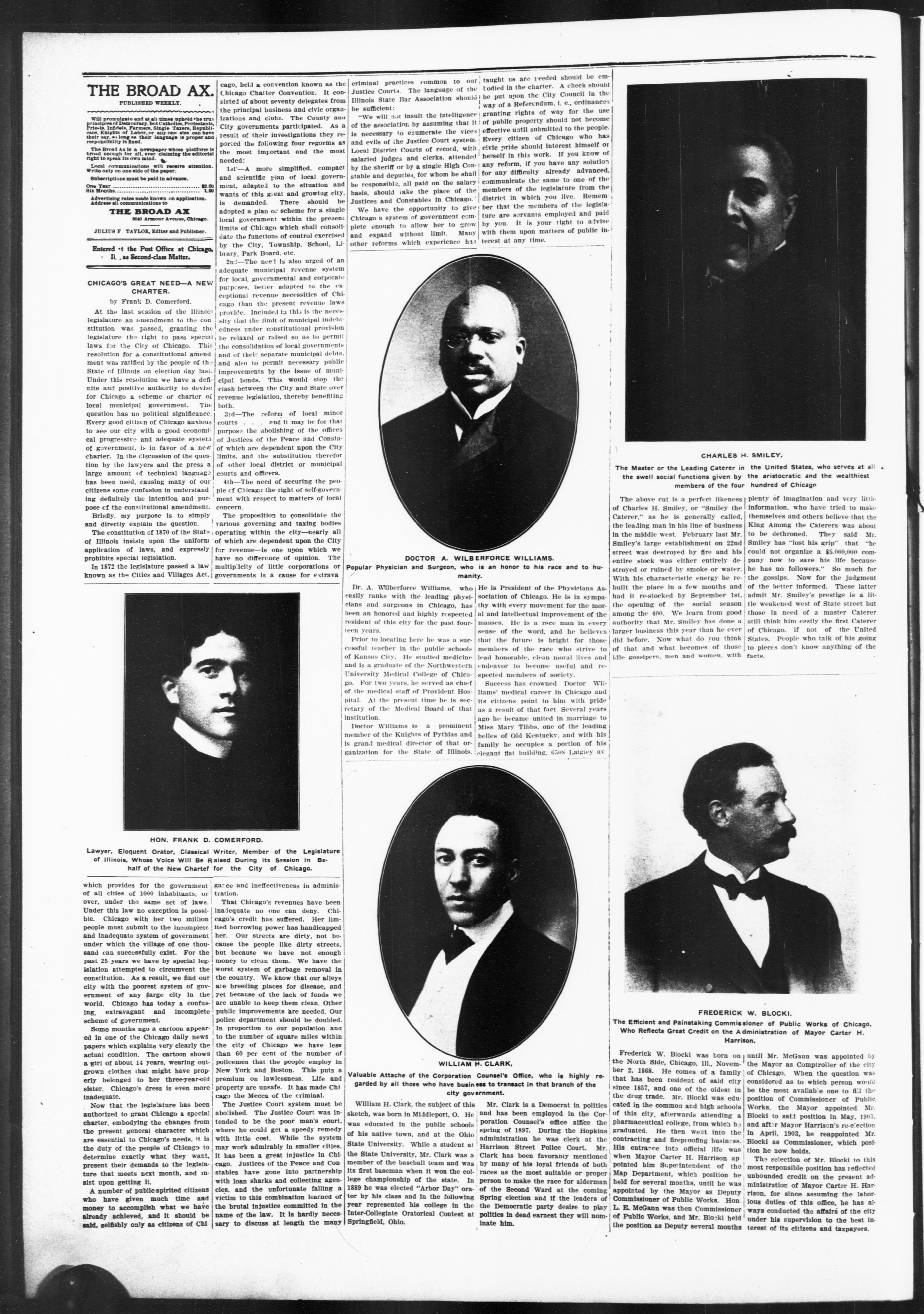
HON. FRANK D. COMERFORD. Lawyer, Eloquent Orator, Classical Writer, Member of Illinois, Whose Voice Will Be Raised During half of the New Chartef for the City
Lawyer, Eloquent Orator, Classical Writer, Member of the Legislature of Illinois, Whose Voice Will Be Raised During its Session in Behalf of the New Chartef for the City of Chicago.
Lawyer, Eloquent Orator, Classical Writer, Member of the Legislature of Illinois, Whose Voice Will Be Raised During its Session in Behalf of the New Chartef for the City of Chicago.
which provides for the government of all cities of 1000 inhabitants, or over, under the same set of laws. Under this law no exception is possible. Chicago with her two million people must submit to the incomplete and inadequate system of government under which the village of one thousand can successfully exist. For the past 25 years we have by special legislation attempted to circumvent the constitution. As a result, we find our city with the poorest system of government of any large city in the world. Chicago has today a confusing, extravagant and incomplete scheme of government.
Some months ago a cartoon appeared in one of the Chicago daily newspapers which explains very clearly the actual condition. The cartoon shows a girl of about 14 years, wearing outgrown clothes that might have properly belonged to her three-year-old sister. Chicago's dress is even more inadequate.
Now that the legislature has been authorized to grant Chicago a special charter, embodying the changes from the present general character which are essential to Chicago's needs, it is the duty of the people of Chicago to determine exactly what they want, present their demands to the legislature that meets next month, and insist upon getting it. A number of public-spirited citizens who have given much time and money to accomplish what we have already achieved, and it should be said, selfishly only as citizens of Chi
---
cago, held a convention known as the Chicago Charter Convention. It consisted of about seventy delegates from the principal business and civic organizations and clubs. The County and City governments participated. As a result of their investigations they reported the following four regorms as the most important and the most needed:
1st'-A more simplified, compact and scientific plan of local government, adapted to the situation and wants of this great and growing city, is demanded. There should be adopted a plan or scheme for a single local government within the present limits of Chicago which shall consolidate the functions of control exercised by the City, Township, School, Library, Park Board, etc.
2nd-The need is also urged of an adequate municipal revenue system for local, governmental and corporate purposes, better adapted to the exceptional revenue necessities of Chicago than the present revenue laws provide. Included in this is the necessity that the limit of municipal indebtedness under constitutional provision be relaxed or raised so as to permit the consolidation of local governments and of their separate municipal debts, and also to permit necessary public improvements by the issue of municipal bonds. This would stop the clash between the City and State over revenue legislation, thereby benefiting both.
3rd—The reform of local minor courts and it may be for that purpose the abolishing of the offices of Justices of the Peace and Consta of which are dependent upon the City limits, and the substitution therefor of other local district or municipal courts and officers. 4th—The need of securing the people of Chicago the right of self-government with respect to matters of local concern
The proposition to consolidate the various governing and taxing bodies operating within the city—nearly all of which are dependent upon the City for revenue—is one upon which we have no difference of opinion. The multiplicity of little corporations or governments is a cause for extrava
1930
Writer, Member of the Legislature aised During its Session in Befor the City of Chicago. gance and ineffectiveness in administration.
That Chicago's revenues have been inadequate no one can deny. Chicago's credit has suffered. Her limited borrowing power has handicapped her. Our streets are dirty, not because the people like dirty streets, but because we have not enough money to clean them. We have the worst system of garbage removal in the country. We know that our alleys are breeding places for disease, and yet because of the lack of funds we are unable to keep them clean. Other public improvements are needed. Our police department should be doubled. In proportion to our population and to the number of square miles within the city of Chicago we have less than 60 per cent of the number of policemen that the people employ in New York and Boston. This puts a premium on lawlessness. Life and property are unsafe. It has made Chicago the Mecca of the criminal.
The Justice Court system must be abolished. The Justice Court was intended to be the poor man's court, where he could get a speedy remedy with little cost. While the system may work admirably in smaller cities, it has been a great injustice in Chicago. Justices of the Peace and Constables have gone into partnership with loan sharks and collecting agencies, and the unfortunate falling a victim to this combination learned of the brutal injustice committed in the name of the law. It is hardly necessary to discuss at length the many
```markdown
```
criminal practices common to our Justice Courts. The language of the Illinois State Bar Association should be sufficient:
"We will not insult the intelligence of the association by assuming that it is necessary to enumerate the vices and evils of the Justice Court system. Local District Courts of record, with salaried judges and clerks, attended by the sheriff or by a single High Constable and deputies, for whom he shall be responsible, all paid on the salary basis, should take the place of the Justices and Constables in Chicago."
We have the opportunity to give Chicago a system of government complete enough to allow her to grow and expand without limit. Many other reforms which experience has
n m e x d i s s t n it s, c i e r g r t s. w r l
[Name not provided]
[Portrait of a man in formal attire, facing forward, with a serious expression. The background is plain and light-colored, emphasizing the subject.]
DOCTOR A. WILBERFORCE WILLIAMS. Popular Physician and Surgeon, who is an honor to his race and to humanity.
Dr. A. Wilberforce Williams, who easily ranks with the leading physicians and surgeons in Chicago, has been an honored and highly respected resident of this city for the past fourteen years.
He is President of the Physicians Association of Chicago. He is in sympathy with every movement for the moral and intellectual improvement of the masses. He is a race man in every sense of the word, and he believe
Prior to locating here he was a successful teacher in the public schools of Kansas City. He studied medicine and is a graduate of the Northwestern University Medical College of Chicago. For two years, he served as chief of the medical staff of Provident Hospital. At the present time he is secretary of the Medical Board of that institution.
Doctor Williams is a prominent member of the Knights of Pythias and is grand medical director of that organization for the State of Illinois.
1910
[Name]
WILLIAM H. BURKE
WILLIAM H. CLARK. Valuable Attache of the Corporation Counsel's guarded by all those who have business to trans city government.
of the Corporation Counsel's Office, who those who have business to transact in that b city government.
Valuable Attache of the Corporation Counsel's Office, who is highly regarded by all those who have business to transact in that branch of the city government.
William H. Clark, the subject of this sketch, was born in Middleport, O. He was educated in the public schools of his native town, and at the Ohio State University. While a student at the State University, Mr. Clark was a member of the baseball team and was its first baseman when it won the college championship of the state. In 1889 he was elected "Arbor Day" orator by his class and in the following year represented his college in the Inter-Collegiate Oratorical Contest at Springfield, Ohio.
---
---
taught us are needed should be embodied in the charter. A check should be put upon the City Council in the way of a Referendum, i. e., ordinances granting rights of way for the use of public property should not become effective until submitted to the people. Every citizen of Chicago who has civic pride should interest himself or herself in this work. If you know of any reform, if you have any solution for any difficulty already advanced, communicate the same to one of the members of the legislature from the district in which you live. Remember that the members of the legislature are servants employed and paid by you. It is your right to advise with them upon matters of public interest at any time.
[Name]
He is President of the Physicians Association of Chicago. He is in sympathy with every movement for the moral and intellectual improvement of the masses. He is a race man in every sense of the word, and he believes that the future is bright for those members of the race who strive to lead honorable, clean moral lives and endeavor to become useful and respected members of society.
Success has crowned Doctor Williams' medical career in Chicago and its citizens point to him with pride as a result of that fact. Several years ago he became united in marriage to Miss Mary Tibbs, one of the leading belles of Old Kentucky, and with his family he occupies a portion of his elegant flat building, 6508 Laigley av.
H. CLARK,
Counsel's Office, who is highly re-ess to transact in that branch of the government.
Mr. Clark is a Democrat in politics and has been employed in the Corporation Counsel's office since the spring of 1897. During the Hopkins administration he was clerk at the Harrison Street Police Court. Mr. Clark has been favorably mentioned by many of his loyal friends of both races as the most suitable or proper person to make the race for alderman of the Second Ward at the coming Spring election and if the leaders of the Democratic party desire to play politics in dead earnest they will nominate him.
---
1920
CHARLES H. SMILEY. The Master or the Leading Caterer in the United the swell social functions given by the aristoc members of the four hundred
The above cut is a perfect likeness of Charles H. Smiley, or "Smiley the Caterer," as he is generally called, the leading man in his line of business in the middle west. February last Mr. Smiley's large establishment on 22nd street was destroyed by fire and his entire stock was either entirely destroyed or ruined by smoke or water. With his characteristic energy he rebuilt the place in a few months and had it re-stocked by September 1st, the opening of the social season among the 400. We learn from good authority that Mr. Smiley has done a larger business this year than he ever did before. Now what do you think of that and what becomes of those idle gossipers, men and women, with
FREDERICK
The Efficient and Painstaking Commis-
Who Reflects Great Credit on the A
Harris
The Efficient and Painstaking Commissioner of Public Works of Chicago, Who Reflects Great Credit on the Administration of Mayor Carter H. Harrison.
Frederick W. Blocki was born on the North Side, Chicago, Ill., November 2, 1868. He comes of a family that has been resident of said city since 1857, and one of the oldest in the drug trade. Mr. Blocki was educated in the common and high schools of this city, afterwards attending a pharmaceutical college, from which he graduated. He then went into the contracting and fireproofing business. His entrance into official life was when Mayor Carter H. Harrison appointed him Superintendent of the Map Department, which position he held for several months, until he was appointed by the Mayor as Deputy Commissioner of Public Works. Hon. L. E. McGann was then Commissioner of Public Works, and Mr. Blocki held the position as Deputy several months
---
the United States, who serves at all the aristocratic and the wealthiest hundred of Chicago
plenty of imagination and very little information, who have tried to make themselves and others believe that the King Among the Caterers was about to be dethroned. They said Mr. Smiley has "lost his grip" that "he could not organize a $5,000,000 company now to save his life because he has no followers." So much for the gossips. Now for the judgment of the better informed. These latter admit Mr. Smiley's prestige is a little weakened west of State street but those in need of a master Caterer still think him easily the first Caterer of Chicago, if not of the United States. People who talk of his going to pieces don't know anything of the facts.
W. BLOCKI.
President of Public Works of Chicago,
Administration of Mayor Carter H.
son.
until Mr. McGann was appointed by the Mayor as Comptroller of the city of Chicago. When the question was considered as to which person would be the most available one to fill the position of Commissioner of Public Works, the Mayor appointed Mr. Blocki to said position in May, 1901, and after Mayor Harrison's re-election in April, 1903, he reappointed Mr. Blocki as Commissioner, which position he now holds.
The selection of Mr. Blocki to this most responsible position has reflected unbounded credit on the present administration of Mayor Carter H. Harrison, for since assuming the laborious duties of this office, he has always conducted the affairs of the city under his supervision to the best interest of its citizens and taxpayers.
---
c
"THE HEALTH OR THE SANITARY CONDITION OF THE NEGRO IN CHICAGO.
By Doctor George C. Hall.
Ladies and Gentlemen:
In attempting to address myself to the subject, "The Health of the Negro in Chicago," there at once opens before me a theme deserving of larger notice that there is time at my disposal.
In consideration of this most important subject, health, I call your attention to the fact that in Chicago, the one city of the United States, that prides itself upon its low morality, the Negro death rate is more than double the death rate of the whites.
This condition of itself should not only alarm the Negroes, but all other classes of citizens. It not only appeals to the thoughtful Negro, but to his friends and neighbors in all sections of the country where he resides. The measures adopted to eradicate the cause of the rapid depletion of the ranks of any class of citizens should be the concern of all.
That the death rate of the Negro in Chicago has been on the increase, is a fact known to all who take the most superficial interests in vital statistics. In some instances it is shown that there are more deaths-than births, a situation at once grave, and threatening the perpetuity of the race.
When one class of people live, thrive and are seemingly immune from a certain class of maladies and another class in the same city are becoming rapidly extinct, it becomes the duty of every citizen to seek out the causes which have led to the betterment of the one, and the destruction of the other, and to apply whatever remedy there seems to be indicated to extirpate the evil.
Acting upon this proposition the Negro of Chicago and his friends cannot longer shut their eyes to the conditions surrounding him in this city.
Anyone familiar with the facts knows that in Chicago the colored residents are herded together in sections where none but the color live.
Negro settlements, as a rule, are entirely undesirable as residences.
1st, they are usually in the poorer sections of the city and without the improvements necessary to sanitation
2nd, buildings are old and in ill repair, and in no way modern, and yet, every Negro, no matter what his condition may be, how much culture or refinement he may possess, is offered by all the real estate agents a house in just such sections. Prejudice of landlords and agents render it almost impossible for him to take up his residence in a more select quarter of the city or in more healthful or enjoyable surroundings.
Again, compulsory Negro settlements are undesirable because those of the race who are desirous of improving their general condition are prevented to a great extent by being compelled to live with those of their color who are shiftless, dissolute and immoral. For the younger generation now growing up, this is especially bad, and there can be no question that as long as these conditions exist the Negro population will make but little advancement along moral, ethical or sanitary lines.
With such surroundings and a continual influx of Negroes from the South, for, every burning, every act of violence and intimidation of the Negro there, means an addition to the problem here.
How great an extent is this true will be realized when I tell you that the Negro population has increased 110 per cent in the past ten years. A large proportion of these people have no idea of ventilation, sanitation or even the rudiments of the simple rules of health, and while the Negro physicians of Chicago by public lectures and private teachings are doing a good work, and while the nurses from Provident Hospital and from the Visiting Nurses Association are daily teaching practical lessons of hygeine and sanitation, they reach comparatively a small number. Personally, and I speak as one who in the past 17 years has come in contact and visited thousands of the people of my race in their homes, I am appalled at the fearful ravages diseases are sometimes allowed to make and the apparent unconcern of those in authority whose business it is to prevent such conditions and who do nothing except issue now and then statements to the Negro's disadvantage and offer no solution or assistance.
While I have no disposition to criticise the publication of facts, even though they prove detrimental to us as a race, I do most seriously object to the methods generally employed by the Health Department in not publishing all the facts concerning the Negro if it should publish any. For example—In the spring of 1902 there was considerable smallpox in Chicago and following the usual conditions, with Dearborn
street and Armour avenue in a filth condition; great pools of stagnant water in the streets; the alleys strewn with the winter's accumulation of filth and rubbish, it was only natural that the germ should flourish. The Secretary of the Health Department called a number of the colored ministers and physicians to his office and pointed out the large percentage of smallpox furnished by so small a percentage of population. I called his attention to the conditions of the houses, streets and alleys, and particularly the unsanitary conditions of the houses and asked that some steps be taken to compel the owners to put them in a more habitable condition. His reply was that most of the houses were in the hands of agents, and that the owners being out of town it was impossible to reach them. Having received this valuable information, I left the office. The next morning I saw in the newspapers a notice from the Health Department warning all persons employing Negroes to see that they were vaccinated. It said nothing about the thousands of followers of Dr. Dowie, who absolutely refused to be vaccinated, or our Christian Science Brethren, who very recently furnished whole families with the disease. He simply held up the
[Name]
DOCTOR GEORGE C. HALL. Chief of the Medical Staff of Provident hospital, whose learned address on "The Health of the Negro in Chicago," delivered before the Frederick Douglass Center at Kimball Hall, recently, is produced for the benefit of the readers of The Broad Ax.
Chief of the Medical Staff of Provident hospital, whose learned address on "The Health of the Negro in Chicago," delivered before the Frederick Douglass Center at Kimball Hall, recently, is produced for the benefit of the readers of The Broad Ax.
Negro as the promoter of the horrible disease and by implication, that it was a disease peculiar to the Negro. At once a crusade was begun and Negroes were sought out by the guardians of the health in all places where they might be employed in any number; so busy did they get that while at present the Negro is furnishing very few cases, a large number of white people are ill with the plague. While the disease is always from the same germ, and therefore, from the same cause, I am expecting now to hear a new theory regarding this disease, possibly the 1902 germ was of the Ben Tillman variety.
The truth is that a law of physics applies to society with almost scientific exactness—"Action and reaction are equal and in opposite directions." In other words, that while they were so busy hunting Negroes they apparently overlooked a few whites.
For underneath all the problems of the average Negro is the problem of the average white. The failings and weaknesses of one are the failings and weaknesses of the other in like conditions; the degree may be debatable, but the likeness and kind are unmistakable and true.
I take it that the health of the Negro is not of itself a thing apart, but an integral factor of the general equation. Race physiology and hygiene have not as yet been formulated, and no reputable authority has yet proven on scientific lines just where the two races naturally differ in any essential physical feature. All theories based upon racial lines should be intensely interesting wherever the Negro is concerned since, it would be impossible today to find an Afro-American man of pure African descent. The Negro blood is about as much diluted as that of any class of people in this or any other country.
Theories on Religion and Education may be treated from a standpoint of race expediency, but that first earthly blessing. Health, must be based upon the broad lines of humanity.
Infant mortality among the Negroes, while it is usually very large, is much larger among the Negroes of these districts, it should be remembered, that under normal conditions from 30 to 40 per cent of children die in the first year and that an equal percentage suffer severe illness. These conditions in addition to lack of the proper knowledge of the preparation of food and the crowded and unsanitary conditions of the house—and when I say unsanitary condition I do not want it understood that I mean lack of cleanliness—but the inability to keep clean in an alley or over
a barn or down in a basement next the coal bins and along dirty, dusty streets—under these conditions, and the mother in many instances compelled to work, leaving the child wherever she can — the child catches cold and the conditions around him render him liable to plumonary complications and an easy prey to the ravages of tuberculosis.
At present the Negro's special enemy is tuberculosis, and yet, this is not as is so thought, the Negro's inherent weakness, it has followed the changed conditions since the freedom of the slave.
A recent writer in the Journal of the American Medical Association under the caption of "Slavery as a Prevention of Pulmonary Consumption," says:
"Mays calls attention to the fact that plumonary consumption was comparatively unknown among the slaves in the South before the war. The death rate among the Negroes from consumption in Charleston, S C., in 1860 was the same as among whites, 1.75 per thousand. In 1902 the death rate among the whites was 1.43 and among the Negroes 5.74. The same condition obtained in other of the southern cities. Why, says Mays, should the death rate from com
sumption be from 200 to 400 per cent larger among the Negroes than among the whites of the South at the present time, and this in spite of the fact that they were on an even basis in this respect in 1860. The reason is that since they attained their freedom, their entire social, economic and industrial being has been revolutionized. The author believes that the prevention of plumary consumption resolves itself into such efforts of education as will impress the masses with the importance of leading a life similar to that (excepting slavery) which made the slave population of the South practically immune from this disease before the Civil War. Such efforts of prevention mean the inculcation of sound principles of hygiene; the eating of wholesome and properly prepared food; and wearing of suitable and seasonable clothing; the avoidance of damp, insanitary and overcrowded dwellings; the abstinence from nerve strain and overwork; the shunning of strong drink and other vices; the teaching of the value of useful labor; training in physical development; encouragement of agricultural and mechanical pursuits; the supervision of proper convalescence from what seems the trivial cold or cough, or from acute illness or injury, etc. As a means toward the end, the taking hold of this work among the masses by charitable organizations, as is being done in some of the larger cities at the present time."
Again I call attention to the fact that the disease not only is the black man's enemy, but the white man's plague—and Chicago the plague spot say the charity workers. The law of human impulse requires and impels the rescue of a person in peril without stopping to inquire as to his color, race or future relation to society—and so the conditions of the Negro in the black belts of Chicago should appeal to philanthropists and statesmen alike for an immediate rescue.
See to it that he has a man's chance to live and live right; give him a chance, and who will seriously contend that he has had a chance—don't judge him too harshly until he has had some measure of a chance. No pilgrim ever started out with such a homeless, starless journey before him than the Negro started toward freedom and citizenship, without experience, learning his lessons as he went along.
Mistakes were made as must have been expected and with all the obstacles in his way he has done marvelously well in the past and he is going to do much better in the future.
No sensible people ever attempted to settle great questions by running away from them.
Let us not imperil a multitude of people of all races through our failure to do our duty to one race.
THE GREAT TRIUMPH OF DOCTOR SCULTZ OVER INPSECTOR LAVIN, EDWARD H. MORRIS, LOUIS WEBER & CO.
Anna Beatrice Schultz, physician and surgeon, was born May 28, 1869, during the first administration of President Grant, and she indeed shows a spirit of the times of that period. Up to the age of 12 years she attended the public schools of Washington, her first teacher being the wife of one of our leading surgeons. At the death of her father, when she was 12 years old she was sent to Howard University remaining in the boarding department until 15 years of age, when she was sent to the Fisk University at Nashville, Tenn. Not being able to finish her last year at Fisk University she started teaching, first in Georgia, after which she went to New Orleans and was principal of the normal department of Columbia University, resigning this position to become first assistant in one of the largest public schools there. From New Orleans she came to Chicago to enter Provident Hospital and Training School, after which she was acting superintendent for five months from which institution she resigned to begin her study of medicine and surgery. She graduated in 1898, being the first colored woman in this State to graduate from the regular school of medicine. Dr. Golden being the first from the Eclectic School. Dr. Schultz has been medical expert for the Union Traction Co., when it was the old North and West Chicago, and for the Chicago City Railway. She is a woman of wonderful self-control and undominable will power, which was shown by her action in the recent case of hers which resulted in her victory before Judge Barnes. The history of the dishonorable and untruthful charges against the doctor, which we had occasion to hear last week in court, and the mo
t
t
s
t
n
of
s
e
r)
of
m
r.
of
ne
nd
p.
ll-
ve
ng
he
r;
Mary E.
DOCTOR A. BEATRICE SCHULTZ. One of the Most Successful Women Doctors in the United States Who Lately Triumphed Over Her Persecuters in the Supreme Court of Illinois and in the Criminal Court of Cook County.
One of the Most Successful Women Lately Triumphed Over Her Pers of Illinois and in the Criminal tive which was so apparent to all present, is as follows:
On the morning of August 11, 1903, Officer David Smith (alias Big 6), a man on our police force who was caught red-handed on last Thursday offering a bribe of twenty-five ($25) dollars to get a poor old honest colored woman to swear falsely against Dr. Schultz, called at the doctor's office and residence, 2719 State St., and requested the doctor to come with him to tell what she knew of a man attempting to sell some jewelry which had been stolen from Weber & Co. While very ill she readily consented and accompanied "Big 6," who, when she arrived at Inspector Lavin's office in the Harrison Street Station, informed the Inspector that Dr. Schultz was the woman who had won the suit against the Chief of Police at Pittsburg, and had three detectives turned off of the force.
Inspector Lavin heaped all kinds of abuse upon her and threw her into a dirty filthy cell although her husband called his attention to her illness. Office Smith dragged her down the steps and after turning a trap full of rats in on her tried to force her to sign a confession saying she had bought two diamond rings, but Dr. Schultz insisted upon reading this paper and positively refused to sign it. After keeping her imprisoned for seven hours, without any charge against her In-
whereby any thing
spector Lavin offered to let her go if she gave him the large diamond she wore on her right hand and which she was held up and robbed of last winter by one of the thieves who testified against her on her trial. At Harrison street the doctor was dismissed of the charge and the police with the Webers then went before the grand jury and indicted her. She employed Edward H. Morris for a lawyer and was found guilty, but she took an appeal to the Supreme Court remaining in the County Jail for five months, waiting for the Supreme Court to meet, although Mr. Morris had promised to go to Springfield and she had paid his expenses there, and he had assured her she would only be there in prison three days. She finally had to employ a white lawyer, James Graham, of Springfield, who went to the Supreme Court and argued her case orally from Mr. Morris' brief and secured her a new trial. During all of this time, 5 months, taken from an active, large and lucrative practice, never was there one hard word or complaint, but this self-reliant woman assisted in every way possible to make some one else's life in prison brighter and easier to bear, unmindful of self and her sufferings. Pneumonia threatened her life and for three weeks she lay at death's door, and still she never gave up her fight. When she was asked to plead guilty and take one hour, her reply was, "Tell the State that I fight for honor and I will stay here until I die before I will so plead."
June, the great month of roses, came and after five months of suffering and injustice, the Supreme Court said she should be tried again. She was tried again by twelve honest men and under the skillful management of attorneys Gash and Hooper, who, as the doctor so characteristically put it, the gold of the shylock could not reach, nor the reprehensible methods of the State and Police effect. She more than gained a victory and has not only shown what courage and tenacity of purpose can do, but her manner, her actions throughout that trial convinced many white people, for the court room was crowded, that
The secure team
en Doctors in the United States Who ers ecuters in the Supreme Court of Final Court of Cook County. all there are, thanks to the Gods, some Negroes who will not be trodden upon and who prefer death to dishonor.
Every colored woman should take Dr. Schultz for an example of a woman who has risen in spite of opposition, without assistance or support from those persons in her own race and sex, who should be proud of her as a woman and a member of the colored race. The doctor, however, can still be found at home, 2719 State St., where she has been since the State of Illinois in 1898 said she had the right to an M. D. and you will meet the same charming person, whose smile never wears off and she is likely if you mention the case to say: "Well, one meets lots of unpleasant things in an active, busy life."
The doctor feels that she owes it to the public, to her race, to her sex, and last to herself, to bring action against these human monsters in the form of a damage suit.
Mr. Gustavus A. Nevels was elected Chancellor Commander of Hannibal Lodge last Tuesday evening, to succeed Mr. Albert B. George, who has held the office for the past seven terms. A public installation service will be held at Appolo Hall Tuesday evening. January 10.
```markdown
```
---
A. E.
DOCTOR W. A. BUCKNER. Has been engaged in the practice of medicine for the past five years. He is a graduate from the Harvey Medical College of this city. From the time that he hung out his shingle five years ago down to the present, his office has been located at the corner of 29th street and Armour avenue, Phone South 526. He is holding his own with the older physicians and surgeons and he knows how to make and retain friends.
HYDE PARK NOTES.
Mr. and Mrs. W. W. Sloan was highly entertained at the residence of Mr. and Mrs. John Lowes, Wednesday, Dec. 28, 106. 52d street. Miss Sarah A. Hendrix and her niece, Miss Ella May Hendrix, are at present visiting their parents at Sullivan, Ala. They will be gone three weeks. The Broad Ax extends the sympathy of its columns to Mr. and Mrs. Geo. W. Perkins of 5135 Lake avenue, upon the death of her sister, Emma Donerson.
Congratulation is due the Rev. Andrew N. Webb and wife of the successful gift of a 14 pound bouncing boy. The mother is doing nicely, likewise Baby Webb.
Mr. A. L. Williams is still on the sick list and would be pleased to see his many friends.
Mr. and Mrs. J. W. Sims, 5213 Lake avenue, entertained a number of their friends from the city in a whist party last Thursday eve. Everybody was so well pleased that they voted unanimously to return.
Of all the people in this great city the people of Hyde Park has the best of them all as to entertainments. Mr. and Mrs. R. E. Taylor gave an afternoon luncheon to a party of twenty-six Tuseday.
Mrs. P. S. Hotchkis Conducts An Up To Date and Neat Confectionary and Notion Store.
One of the neatest and up-to-date confectionery and notion stores in Chicago is conducted by Mrs. P. S. Hotchkis, 131 W. 51st street, between Dearborn and Armour avenue. She only handles first class goods, such as staple and fancy groceries, milk and cream, candies, tobacco, cigars, stationery etc., which she sells at reasonable prices. Mrs. Hotchkis also sells the leading daily papers as well as The Broad Ax. She is polite and attentive to her customers and her store is well patronized by the Afro-Americans residing in the neighborhood.
WILLIAM L. MARTIN.
Ex-South Town Clerk, ex-Member of the Legislature of Illinois, Attorney at Law, Mr. Martin, who is well known as a barrister, occupies a fine suite of law offices at 155 Washington street. He numbers among his clients well-to-do members of both races and he is very resourceful when he is pitted against his fellow lawyers in a law suit. He never fails to contest every inch of the ground and at all times he has the courage to stand by his honest convictions while presenting his case to the court and the manliness to inform the court of the fact whenever he thinks he is not getting a square deal.
Notwithstanding the inclement weather The Charity Ball given by the Triangle and Inner Circle clubs on Monday night, was the greatest seccess the clubs have ever had. Good cheer and the best of order reigned throughout the evening and early morn.
SOME OF THE AIMS AND THE OBJECTS OF THE COLORED WOMEN'S 20TH CENTURY PENNY CLUB OF CHICAGO.
By Mrs. Fanny Ralston.
Do we need such an organization as the Colored Women's 20th Cenutry Penny Club? This will be left for the mass to answer. It is one of the ways for us to help each other and also to help ourselves. It is one of the ways to help our children. One of the strange features with our people is that we have patterned after our superior brother in every way but one or two, and these are the things that we need most. With the exception of an education, he has seen the need of this, but he does not execute it like his brother. It seems that we cannot make up our minds that two hundred can do more than one hundred, and this means that we have not learned that organizations is the road to wealth and success.
The second is that we have not learned to wait till we have the finance before we attempt high living, which would naturally seem that we were putting the cart before the horse and one of the sad characteristics with us is lack of system in business, punctuality and discipline and being incompetent causes us to be unfinancial, and this is a very uncomfortable state for a man or woman to be found and that is the sad condition of our people at large in Chicago, but the Penny Club has set the example for those that desire to follow. We have organized a strictly business club try-
1914
MRS. FANNY RALSTON
The Energetic and Progressive President of the Colored Women's 20th Century Penny Club of Chicago.
ing to aggregate finance to build a home for our women who work out by the day and are not able to pay rent, and also a woman's exchange, which will give the housewife a chance to dispose of any kind of work that she may do at home. that the world may be benefited by it, and if your time is too valuable for this kind of work and you do not care for its honor, then you can donate to the Colered Woman's 20th Century Penny Club, for this is what we are doing and I am sure that God will
This is one of the things that we are not provided with in Chicago, and these are the things that we must provide for ourselves. Why should we wait longer for others to do it? We all work and make our money, then let us organize financial clubs instead of so many pleasure clubs. Then, we, as mothers and fathers, will be able when our children come to maturity to start them out in life with some prospects before them. Today our wealthy men in Chicago could easily form a syndicate and open a large apartment house and call for worthy and competent young men and women to fill the positions in such a place, but we as a people do not think for the welfare of each other as God so intended that we should. We, the Colored Women's Penny Club have started this work for the good of our
[Name]
MRS. J. C. STEWART.
Prominent in church work and secret society circles, who with her honest and hard working husband, Mr. St ewart, own a lovely home at 5434 Normal Avenue.
Prominent in church work and secret society and hard working husband, Mr. St ewa Normal Ave
race and ask all who may read this article to help us, The Colored Woman's Penny Club. Just imagine if all the colored people today in Chicago should give us just one penny a week we would receive 30,000 pennies in a week. Do you think that we would be long building a home for our poor women, who are left alone to find living apartments the best they can. A penny is not much, but that is our plan to get a start for this organization and will receive all that is given us. Read our bills then you can see what the work is and the necessity of its existence and we hope soon to hear of similar organizations among our wealthy colored gentlemen of this city for many of its kind is needed to bring the colored population to the realization of what they should do for the weaker sex, and for those who have not had the same opportunities as others more fortunate. Visit the slums and see if you, as wealthy men, are not spiritually advised to build a home of reformation for these beautiful creatures of God which by discouragement and hardship has driven them by our unfortunate ignorance, in not organizing such clubs years before, that our children might have had the benefit of them. There is a great deal expected of the educated and wealthy man and woman, therefore, these should always set an example
that the world may be benefited by it, and if your time is too valuable for this kind of work and you do not care for its honor, then you can donate to the Colered Woman's 20th Century Penny Club, for this is what we are doing and I am sure that God will bless you in your noble and much needed donations.
The Colored Woman's 20th Century Penny Club was organized October 30, 1902, and at the present time has more than forty active members who are deeply interested in its success financially and otherwise. It meets every Monday evening at the homes of its various members. At its meetings live topics are discussed which are of practical benefit to the race. So far three public entertainments have been given by our club, each one has been exceedingly successful and as a result of these entertainments the club has more than one hundred dollars in its treasury and as its president I feel that much good will be accomplished this coming year by The Colored Woman's 20th Century Penny Club of Chicago.
In selecting a whiskey three qualificatiions should be considered the age, the purity and the flavor.
Old Underoof Rye
Possesses these qualifications in a greater degree than any other whiskey CHAS. DENNEHY & COMPANY, Chicago,
Origin of Petroleum.
Until recently it was almost universally believed that petroleum, like coal, was derived from fossil vegetation or possibly from animals or fishes of some long past age. Now it is asserted by many scientific men that it may not be of any organic origin, but may be due to subterranean chemical action.
The Little Things
Life is made up of little things—words, acts, duties, pleasures. They come to us one after another, calling us out of ourselves, or seem to rush hurriedly past us, and they leave an impress on our spirit, and our characters are made or marred by their influence.—Rev. B. Lowry.
British Territory.
It is possible to go round the world and touch on British territory all the way-viz., from England to Halifax (Nova Scotia). across Canada to Vancouver, across the Pacific to Hong-Kong, thence to Singapore. Penang, Cape Town, St. Helena and England.
White Pepper.
In French kitchens white pepper is preferred over black, partly for the flavor and partly because there is a dislike to black specks showing in the food. The idea is worth adopting.—N. Y. Post.
Cracks in Plaster.
To fill cracks in plaster mix plaster of paris with vinegar instead of water, and it will not "set" for 20 or 30 minutes. Push it into the cracks and smooth off evenly with a table knife.—Household.
Animals Detest This Plant
There is no plant which animals so detest as the castor-oil plant. A goat will starve rather than eat it, and even that destroyer of everything green, the locust, will not feed upon it.
Revivals in Wales
A mania for religious revivals pervades Wales. Often the revivals last all night, and the people go from them to their work singing hymns.
Reason Enough
The Parrot—Why did the crow leave his last place?
The Owl—He was discharged for caws.—Illinois State Journal.
Rubber in Africa
Rubber is now successfully being cultivated on the gold coast of Africa. Several companies have recently started work on a large scale.
Where Kiss Insults
The women of Finland regard a kiss on the lips as the greatest insult to which they can be subjected, even from their husbands.
London Strand
About 80,000 people pass along the Strand in the course of every workingday.
None of the Title.
It is a curious fact that there has never been a duke or lord of London.
Private Graveyard
The family of a member of parliament from Yorkshire has a private graveyard and has had it for several generations. The founder of it was a Quaker, and the rector of the parish in which he lived said to him after a dispute on religious matters: "Well, if you don't come to church when you are alive, you will when you are dead." But the Quaker thought otherwise, and founded the burial place, which is used to this day.
Games of the Czarina
The czarina has, from early childhood, been naturally clever with her pencil, and possesses a rare ability for pictorial portraying, with just a touch of humorous exaggeration, little personal peculiarities of those around her. It is said, though, that none more enjoy an inspection of these caricatures than those who are the subjects of them.
Mrs. Anna L. Newby.
First class furnished rooms for rent to gentleman, with bath and gas. 2628 Wabash avenue.
Nicely furnished rooms to rent for gentlemen. Reasonable rates, 2252 Indiana aveuna.
Fifty-First St. and Armour Ave.
RAIL YARDS: 51st St. & L. S. & M. S. Ry.
52nd St. and Armour Ave.
CHJCAGO
Phone 194 South
A. B. SCHULTZ, M. D.
PHYSICIAN AND SURGEON.
2719 State Street
Hours: 9 to 12 A. M.
3 to 5 and after 6 P. M. CHICAO
Central 5768.
L. BLANCHE WRIGHT
PUBLIC STENOGRAPHER
167 Dearborn St., Room 611
A REAL CHANCE ENTERPRISING CANVASSERS FOR
The demand for Professor W. E. B. DuBois' great book
The Souls of Black Folk
has been so remarkable, especially among those who do not buy many books, that we have just issued a Special Subscription Edition This powerful study of the Negro Question stands ahead of all others.
Every one who has the future of the colored race at heart will want to buy it and read it.
Is one of the easiest books to interest people in that has ever been published, and we are anxious to secure live, intelligent canvassers everywhere.. Send to us for information, terms, etc.
A. C. McCLURG & CO., Publishers,
215-221 Wabash Ave., Chicago.
☕☕☕☕☕☕☕☕☕☕☕☕☕☕☕☕☕☕☕☕☕☕☕☕
WONDERFUL DISCOVERY Curly Hair Made Straight By
TAKEN FROM LIFE:
BEFORE AND AFTER TREATMENT.
ORIGINAL
OZONIZED OX MARROW
(Copyrighted.)
This wonderful hair pomade is the only safe preparation in the world that makes kinky or curly hair straight as shown above. It may imbish the scalp, prevents the hair from falling out or breaking off, cures dandruff and makes the hair grow long and silky. Sold over forty years and used by thousands. Warranted harmless. It was the first preparation ever sold for straightening kinky hair. Beware of the Original Ozonized Ox Marrow. It is the best hair straight, soft and beautiful, giving it that healthy, life-like appearance so much desired. A toilet necessity for ladies, gentlemen and children. Elegantly perfumed. Owing to its superior and lasting qualities it is the best and most economical. It is not usable for anybody to produce a preparation qualifying for full directions with every bottle. Only 50 cents. Sold by druggists and dealers or send us 50 cents for one bottle or $1.40 for three bottles. We pay all express charges. Send postal or express money order. Please mention name of this paper when ordering. Write your name and address plainly to
OZONIZED OX MARROW CO.,
76 Wabash Ave., Chicago, Illinois.
iskey three quali- be considered — y and the flavor.
Teeth Extracted Without Pain
TRE SAVED
NICKERSON DENTIST'S
NICKERSON DENTIST'S
246
OUR LOW PRICES UNTIL OCT. 1.
Set of Teeth ... $2
Best Set of Teeth ... $3
22k Gold Crown ... $3
Porcelain Crowns ... $2
Gold Fillings, 50c to ... $1
Silver Fillings, ... 25c to 50c
Our plate work is unexcelled. When others fail call on us. We will make a beautiful, substantial and perfectly fitting plate, one with which you may enjoy a good meal. Our gold crowns guaranteed equal to any high-priced dentist's. Ten years' guaranty on all work. Consultation and examination free.
plaines-st.
Special attention given to pain extraction of children's teeth.
We will give $100.00 Reward for case of bad teeth we cannot e Absolutely without Pain.
We guarantee Positively Pa Opretaions in each and every Our Original Easy Payment erative Plan with our patients en of Dentistry by our perfected sy anyone to have their work done out delay or pay at your convien
and have gained their Confidence. Our $3.00 and $3.75 Gold Crowns and Bridge Work per Tooth are what you are paying elsewhere $5.00 and more per tooth. We manufacture nearly all our material and save you time and money.
Dr. Kickerson's Dental Parlors,
248 STATE STREET.
Between Jackson-bd. & Van Buren-st.
Hours—8 a. m. to 9 p. m. Sundays,
10 to 4.
METROPOLE DANCING
METROPOLE HALL, 31st Street near 5th
METROPOLE DANCING CLUB
METROPOLE DANCING CLUB
METROPOLE HALL, 31st Street near 5th Avenue. SEASON OF 1904 AND 1905. Every Tuesday and Friday. Dancing and Vaudeville, first attractions. Excellent service. Good order. Metropolitan and Orchestra. Prof. J. W. Hall, Splendid cafe in connection
Every Tuesday and Friday. Dancing and Vaudeville, first class attractions. Excellent service. Good order. Metropolitan Band and Orchestra. Prof. J. W. Hall, Splendid cafe in connection.
ADMISSION 25 CTS.
The Pekin Ten
The finest family resort in America
The hotel
Robert T. Motts
Fred T. Carey,
27TH & STATE STREETS,
-- American I
President and Treasurer, THC
Vice-President, JOHN
Secretary
MANUFATU
Common and S
Office and
45th and R
Yards running winter and with the latest improved
Output of Winter Yards
Output of Summer Yards
Telephone Y
TEL. SOUTH 6-
The Pekin Temple of Music
The finest family resort in America.
The home of high class Vaudeville.
Robert T. Motts, Prop.
Fred T. Carey, Mg'r.
27TH & STATE STREETS, CHICAGO.
-- American Brick Co. --
President and Treasurer, THOMAS CAREY. Vice-President, JOHN SHELHAMER, Secretary, WILLIAM SULLIVAN. MANUFATURERS OF Common and Sewer Brick Office and Yards: 45th and Robey Sts.
Yards running winter and summer, equipped with the latest improved Wolf Dryer.
Output of Winter Yards ..... 140,0.0 per day
Output of Summer Yards..... 391000 per day
Telephone Yards 128.
Is for sale at the following news stands:
The Afro-American News Office, 3104 State Street.
J. C. Campbell, cigars, tobacco and fancy groceries, 4710 State street.
A. F. Tervalon's Cigar Store and News Stand, 2826 State street.
Edward Felix's Cigar Store, 358 30th street, N. E. Corner Armour Ave.
T. B. Hall's Cigar Store and Laundry office, 281 29th St.
Turner William's Cigar and News Stand, 2903 Armour Ave.
Mrs. B. Williams, Cigars, Notions and News Stand, 486 $ \frac{1}{2} $ State street.
B. K. King, cigars and news stand,
3010 State St.
B. Davis, cigars, tobacco, and con-
fectionery, 3532 State st.
C. J. Chambers and Company, dea-
lers in fine cigars, 2958 State street.
The Stationery, 1970 State street.
$3.00
THE BROAD AX.
TEETH WITHOUT PLATES
A SPECIALIST
Who uses the latest scientific methods
SAFE AND HARMLESS
ABSOLUTELY
We will give $100.00 Reward for any case of bad teeth we cannot extract Absolutely without Pain.
We guarantee Positively Painless Opretaiions in each and every branch
Our Original Easy Payment Co-operative Plan with our patients enables of Dentistry by our perfected system.
anyone to have their work done without delay or pay at your convenience
DANCING CLUB
st Street near 5th Avenue.
Dancing and Vaudeville, first class Good order. Metropolitan Band all, Splendid cafe in connection.
Temple of Music
America.
The home of high class Vaudeville.
Notts, Prop.
Bey, Mg'r.
CHICAGO.
Brick Co. --
THOMAS CAREY.
JOHN SHELHAMER.
Mary, WILLIAM SULLIVAN.
TURERS OF
Sewer Brick
and Yards:
Robey Sts.
and summer, equipped
served Wolf Dryer.
140,00 per day
300,00 per day
Yards 128.
P. S. Hotchkis's Cigars, Notions and News Stand, 131 W. 51st Street. Woodfolk and Mitchell Cigars, Tobacco and News Stand, 4902 State Street. News items and advertisements left at these places will find their way into the columns of The Broad Ax.
THE WAY TO LOOK NEAT.
And Comfortable is to have your hair nicely combed and put up in the latest style. If your hair is kinky and harsh it looks untidy and hurts when you try to comb it. You can easily change all that and make your hair straight, soft, beautiful and easy to comb by using the Original Ozonized Ox Marrow, it also gives that healthy glow to the hair so much desired. One bottle will do it. For over forty years ladies of refinement have been using it with great success. Warranted harmless, and never falls. Only 50 cents a bottle. Sold by durgists, or send us 50 cents for a bottle. We pay all express charges. Address Ozonized Ox Marrow Co., 76 Wabash
---
$3.75
Past Year in Review
Chronological Record of Most Important Happenings
at Home and Abroad During 1904
Feb. 6—Diplomatic relations severed by action of Japan.
8-Japan wins first naval engagement. ....Issues official statement setting forth position.... Sec'y Hay sends note inviting France, England and Germany to join U. S. in perserving China's integrity.
16-Russians capture Newchwan g.... Russian cruiser Boyarin blown up. 197 of crew lost.... 600 Russians frozen to death crossing Lake Baikal.
native engagement.
...Issues official
statement setting
forth position...
Sec'y Hay sends
note inviting
France, England
and Germany to
join U. S. in servicing China's
integrity.
16—Russians capture Newchwan g.... Russian cruiser Boyarin blown up. 197 of crew lost.... 600 Russians frozen to death crossing Lake Baikal. 17—Japan agrees to Hay note.
MARSHAL OYAMA.
18—Russia issues proclamation declaring she was unprepared for war. Charges Japan with treachery.
19—5,000 Russians drowned by breaking trough ice on Lake Baikal.
21—In preliminary Yalu river battles 2,500 Russians are killed.
22—Four Russian torpedo boat destroyers taken by Japs.
29—Russian torpedo boat sunk, Port Arthur.
7—Two Jap cruisers sunk off Vladivostok.
11—Russia and Japan each lose torpedo boat in Port Arthur battle.
Apr. 13—Russian battleship Petropavlovsk sunk off Port Arthur; 800 of crew drowned, including Vice Admiral Makaroff and Vassili Verestichagin.
14—Skrydloff succeeds Makaroff, in command of Black sea fleet.
15—Russian torpedo boat destroyer Brezatrashni destroyed....Popedia badly damaged.
19-Alexieff relieved by Skrydioff.
27—Russian submarine boat sunk by Japanese, 600 lives lost.
May 1—Japs rout Russians in Yalu river battle. Jap losses, 900; Russian over 2,000.
2—Russia loses in battle of Khluiencheng 2,000 men and 40 officers.....73 Japanese officers and men killed and drowned in sinking of transport by Russians.
3—Attempt by Togo to bottle Port Arthur fails.
5-Togo's fleet bombards Port Arthur for two days. Viceroy Alexieff escapes from Port Arthur.
16-Japanese dispatch boat Miyako sunk
17-Russians evacuate Newchwang...Russian cruiser sunk by Japanese fleet off Katsumoto.
20-Japanese routed in advance on Mukden.
24-Anju destroyed by Russians....Togo sinks Russian battleship in assault on Port Arthur.
26-Kinchou and Nanshan taken by Japs. Japanese loss, 744; Russian, 830.
30-Dalny captured by Japs.
Jun 5-Russian gunboat Giliak sunk.
8-Russians take Slamtsza....Japanese attack on Port Arthur repulsed.
10-Japs take Suiyen.
2-Two Jap battalions slain in ambush.
16-Two Jap transports sunk; 1,000 die.
18-Japanese transport Idzumi sunk.
Kineton.
26—Admiral and 750
Russians drowned
in battle.
29—Kaiping taken by
Japan.
Japan.
30-Russian regiment
annihilated n e a r
Port Arthur.
Jul. 12—Port Arthur attack repulsed; 30,000 killed, wounded.
14—Yinkow occupied by Japs....Japs take Kiaotung and Liaoyang.
GEN. KUROPAT-
KIN. by Japs...Jap s
take Kiaotung and
Liaoyang.
11—Lieut, Count Keller killed, Yamse pass.
15—Russians defeated in 14-hour battle at
Tatchekiao.
$6—Big twelve-day battle near Liaoyang results in great Jap victory.
Sep. 22—Ta pass taken by Japs.
13—Czar virtually deposes Kuropatkin as commander-in-chief by giving Gripenberg a second army.
berg second in Oct. 1944 congress asks for end of war.
Occlin — Peace congress takes Mukden and Bentziaputze.
Jap gumboat Helyen wrecked at Pigeon bay, 1947 drowned.
19—Great battle of Shakhe river ends in overwhelming Jap victory.
£3 — Russian Battle fleet fires on fleet of English vessels in North Sea, killing a captain and mate, wounding a score and slapping ship.
25-Oyama reports casualties in Shakne river battle to be 15,879. Alexieff appoints Kuropatkin commander-in-chief of all land forces. Uzai expresses re-
gret the Japanese capture village of Jerdagan after long fight.
Nov. 2-Week's attack on Port Arthur results in great damage to fort.... Departure of Russian Baltic fleet from Vigo, Spain, in England
10-Japan offers through England to end war. Offer spurned by Russia.....Mine explosion at Port Arthur kills 700 Russians.....Gen. Stoeus asks armistice.
13-Kuroki reported killed by shell. Report declared, false.
decalred
[to Russian destroyer Rastoropny blown up
by USN officers.
22-Gen. Kuroki reported killed
30-Japanese capture 203-Meter Hill at Port
Arthur, losing 15,000 men...Russian
Gunpowder by mine
cruiser Saiyen sunk by mine.
Dec.7—Russian battleship Peresviet sunk by Japanese shells in Port Arthur harbor.
1—Reported that all Russian battleships and cruisers are sunk or destroyed.
1—Czar recalls Baltic fleet from far east.
1—Russian battleship Sevastopol, last of Port Arthur fleet, torpedoed.
16—Seven Russians escape from Port Arthur with dispatches for czar.
18—Japs torpedo Russian battleship Sevastopol, losing two torpedo boats.
Business Failures
Jan. 14-Auburn (Ind.) bank; $450,000.
16-Mt. Ayr (la.) Citizens' bank; $450,000.
12-Cleveland (O.) Produce Exchange bank and branches at Beiford, Hudson and Defiance.
12-Elkhart (Ind.) Nat. bank.
10-New York, A. B. Baxter & Co., cotton
Va.) Trader.....McGruder (Tex.) Citizens' Nat. bank.
10-New York Equitable Nat. bank....Bank
Durn. N. C.
of Dunn, N. C.
11-Syracuse (N. Y.) Exchange Nat. bank;
$500,000.
15-Peila (Ia.) Savings bank.
16-Opelika (Ala.) bank; $150,000....Tanton
(Mass.) bank; $600,000.
Mar. 2-Le Sueur (Minn.) bank; $95,000.
11-Garden Grove and Coin (Ia.) banks.
18-Daniel Sully, New York cotton king;
$17,000,000.
21-Lonaconing (Md.) Savings bank.
22-Riverside (Cal.) bank....E. O. Miller,
banker, Providence, Ia....National bank
of Holdenville, Ind. T., suspends opera-
tions.
21-Union Trust, Boston; $1,600,000....Fed-
fort, Cleveland; $1,000,000.
eral Trust, Clea
Apr. 4--Capital Nat. bank, Guthrie, Okla.;
$1,033,000....W. B. Mack, New York.
5- Citizens' bank, McLeod Okla.....Akron
(O.) Savings bank.....Chicago Women's
Business club.
6-
July 12—Farmers State bank, Nardin, Okla.
24. Fire.
Oct. 11-Bank of Painfield, Wis., closed by state commissioner
Nov. 11, Bank of Painfield and Crain Co.
33-Davenport, Wash., national bank de-
cared insolvent.
20—First national bank, Conneaut, and Marine bank, Conneaut Harbor, O., suspend. 22—Decham savings bank, Decham, Ia., closed. Foreign
Foreign
Jan. 12-Persia recognizes independence of Panama.
17—Dr. Amador elected first pres. of Panama... Port of Wiju opered by Korean government to world's commerce.
18—20,000 Abjians rout 2,500 Turks at Babajosl, 800 Turks killed...Port Arthur fires on and detains British steamer.
21—14 killed, 20 injured, in Paris celluloid factory.
29—12 die in St. Felicien, Quebec fire.
Mar. 6—Field Marshal Waldersee, Germany, dies.
16—27 die in Madagascar magazine explosion.
Apr. 4—Earthquake kills 25, injures 40 and destroys 1,500 homes in Macedonia.
8—French-English treaty signed giving various rights.
9—Isabella, queen of Spain, dies.
12—Premier Maura, Spain, attacked in Barcelona.
20—100 miners buried by avalanche near Pragelato, Italy.
23—Africans killed in fall of 2,000 feet in Johannesburg mine.
24—Captain of Sailor mute.
19-00 the in cave-in of seveine mine.
May 12- In attack on Kawang colony in British North Borneo, 150 massacred by rebels.
18- Chinese imperial edict opens 3 ports....
Attempt made to assassinate czar of Russia.
20- Second anniversary of Cuba's independence.
16-Count Bobrikoff of Finland assassinated.
19- Swedish revolutionists at Helsingfors, Finland, attack governor's office, killing 18.
21-Perdicaris and Variey released by Bandit Raisuli.....30 perish in train wreck in Spain.
Jul. 1—Diaz elected pres. of Mexico.
6—7.000 Thibetans sain in battle with British.
12—31 crowned off New South Wales.
14—Paul Kruger dies at Clarens, Switzerland.
18—500 die from cholera at Teheran, Russia.
19—Germany demands explanation of Russia for seizure of mail steamers.
21—English steamer Mallacca captured by Russians is released.
24—German steamer Scandia, captured by Russian volunteer fleet, released. Fleet ordered to desist... British steamer Knight Commander sunk by Russians.
28—M. von Pchehve, Russian minister of foreign affairs, assassinated.
12—Son and heir born to czar of Russia.
14—20 drown off coast of Iceland.
23—Czar makes large gifts to Finlanders.
24—Czar's heir christened with great pomp.
26—Assassin of Von Piehve sentenced to death.
30—Massacre of Americans by Chinese boxers threatened...70 drowned at Lodz, Poland...9 die in Richmond (Que.) train wreck.
Sep. 4—Von Piehve's assassin escapes.
15—Queen Helena, Italy, gives birth to heir.
18—Germans massacre 50 Jews at Sasnovitch.
21—Peter crowned king of Servia
Oct. 1—Sir Harcourt dies at Oxford, England
27—Extradition treaty between Belgium and Cuba concluded.
Nov. 3—Liberals sweep Canada, sustaining Sir Wilfrid Laurier.
4—Fierce riot in French deputy chamber following assault on Gen. Andre....Hundred drowned, French steamer Gironde sinks off maritime coast.
25—Swiss confederation signs arbitration treaties with United States, Great Britain and Italy.
Dec. 1—Diaz inaugurated president of Mexico for seventh time.
20—Storm on north coast of Portugal kills 37.
21—Admiral Ommanney, "father of British navy." dies at Portsmouth, Eng.
26—Czar rejects zemstvos' appeal for constitution.
Casualities
Casualities
Jan. 2-As result of fire in Iroquois theater, Chicago, in which 601 persons per
railroad wreck.
8—In Straits of Juan de Fuca, 52 drowned by sinking of steamer Calian.
11—Hicks Lake, Mich., 6 by boiler explosion.
13—St Louis, 8 by failing down elevator shaft., Pratt City, Aia., 5 in burning jall.
18—James City, N. C., 7 by boiler explosion.
20—Johnstown, Pa., 14 in steam pipe ex-
Augustus Hume
25-Cheswick, Pa., 180 by explosion in mine
26-Victor, Col., 15 by falling of cage in
mine.
30—Mahony City, Pa., 5 by boiler explosion.
Feb. 1—Council Buffs, Ia., 5 in burning home.
5—Trenton, Pa., 6 burned to death.
9—Sand Point, Ont., 14 in railway collision.
17—Family of 6 in Croton (N. Y.) fire.
19—29 in Jackson (Utah) explosion.
22—Ehrenfeld, Pa., 5 in locomotive explosion.
24—Waukegon (Ill.) sugar refinery, 5 in explosion.
25—Dyersville (Ia.) railway wreck, 5.
Mar. 2—20 in collapse of New York building.
6—6 in collapse of Yellow Creek bridge in Ohio.
8—Kewanee, Miss., 9 in collision.
11—Priceburg, Pa., 11 in explosion.
Apr. 3—Albia, Ia., 3 in explosion at Citizen's national bank....At Locust, Ind., 3 in collision of Vandalia freight trains.
10—Santa Barbara, Cal., 5 in derailing of street car.
13—On battleship Missouri, 32 by explosion during target practice.
14—Indianapolis, Ind., 7 as result of fire
panic in St. Vincent's hospital.
24—Winona, Minn., 4 tramps. ground to pieces by train.
29—Lansing, Mich., 4 in hotel fire.
May 1—Council Bluffs, Ia., 4 tramps in burning box car.
4—Newport, Ind., 4 in blowing up of Northwestern Powder company's mill.
6—Locust Gap, Pa., 5 miners as result of burning of colliery.
11—Herrin, Ill., 9 in powder explosion.
20—Findlay( O.) explosion; 12.
25—10 miners suffocated by gas in Williamstown, Pa.
20—Near Warwick, Tenn., 6 in dynamite explosion...Salida, Col., 5 drowned in collapse of Arkansas river bridge.
Jun. 2—Near Norwalk, O., 6 in railroad wreck.
5—Independence, Col., 13 by dynamite.
13—Glenwood (Ill.) picnic train wrecked, 19. Blame on engineer.
15—1,020 persons perished by burning, crushing and drowning on excursion steamer Slocum in East river, New York.
20—Teal lake, Mich., 4 drowned.
30—Near Ehrenfeld, Pa., 4 in locomotive boiler explosion.
4-Muskegon, Mich., 4 drowned in capsizing of sailboat.
8- Near Rockford, Canada, 7 in dynamite explosion....Thebes, Ill., 7 on Mississippi bridge.
10—In New Jersey excursion train wreck, 17.
Aug. 5—In Mississippi at Alton, Ill., 8 drowned.
10—Train wreck at Pueblo, Col., 100.
11—Gold Hill, N. C., 8 in flooded mine.
14—In Potomac river, 10.
15—Steamer Penguin on African coast is wrecked; 25 die.
Sep. 2—Yellow Creek, W. Va., 7 in oil explosion.
4—St. Louis, Mo., 7 in train wreck...5 in nitro-glycerin explosion near Sandusky, O., 5 in capsizing launch on Lake Erie.
5—Near Bryce, in Minn., 5 in boiler explosion.
6—Pendleton, Mo., in train wreck, 8.
11—Delaware river in steamer crash, 8.
21—Melrose, Mass., 10 in dynamite explosion.
22—Near Grove, I. T., 6 in collapse of scaffold on bridge.
23—Pleasant Ridge, O., 9 girls in collapse of school.
24—Near Newmarket, Tenn., 58 in collision on Southern railway.
Oct. 3—Cartersville, Ky., 4 crushed under 100 tons of earth.
9-6 suffocated in St. Clair river (Mich.)
tunnel.....5 drowned in Pensacola bay,
Fla.
10- Near Warrensburg, Mo., 29 in railroad
collision.
14- Steamer Wentworth sunk off Cape Cod;
12 drowned.
13- Near Green River, Wyo., 11 in head-on collision of passenger and freight trains.
18- Grand Crossing, L.I., 4 in gas explosion.
20- Brooklyn, N. Y., 12 in burning terment.
Dec. 8- Burnett, Wash., 14 miners in explosion of fire damp
15 walls at Amphitheatre, Minne-
22-In mine near Bolivar, Pa., 7 suffocated.
26-In wrecks at Maud's Station and
Charlesson, Ill., ten.
Lynchings
Jan. 7—Buena Vista, Ark., negro attempted assault on white girl.
14-Buten Riley (negro), near Tallulah, Miss.; murder. Elmore Moseley (negro), in Sussex county, Va., after being acquitted of crime. Jumbo Clark (negro), at White Springs, Ea., assault.
7-Luther Holbert and wife (negroes), burned at stake at Doddsville, Miss., for murder of James Eastland.... Two C. Eveland (Miss.) negroes for murder.... Rickmond Dixon (negro) taken from jail by Springfield (O.) mob.
20-Fayette Sawyer and Burke Harris, negroes, charged with murder, at Cleveland, Miss.
21-Montgomery (Tex.) negro for robbery.
15-13 negroes during week's race war at St. Charles, Ark.
Jun. 1-A Thompson (negro), at Arlington.
Ga : murder.
Ga.; murder.
4- T. M. Myers (negro), near Crooks Covial
Idaho.
15- Woods (negro), near La Grange, Ga.
2- S. Donham (negro), at Europa, Miss.
Jul. 1- John Jones (negro), near Carters
villie, Ga.
13-Negro, for assault on white man at
Ciavog, La
Aug 16-2 negroes during race war at
Strtesboro, Ga.
Hickman, Ky.
Sep. 1 - Negro for assault near Crossett,
Okla.
Government and Politics
Jan. 4-Wm. H. Taft (O.) nominated for sec'y of war and Luke Wright (Tenn.) for civil gov. of Philippine s.... Pres. sends congress special message on Panama resolution.
A.
PHILANDER C.
KNOX.
9-Gen. Chaffee becomes chief of staff U. S. A., succeeding Young.
11-Gov. Herrick (O.) inaugurated.
12-Ex-Cong. Driggs convicted in New York of accepting money for contract while in congress. Sentenced to one day in jail and fine of $10,000...U. S. Sen. Hanna reelected.
13-Gov. Edwin Warfield (Md.) inaugurated.
19-U. S. Sens. A. J. McLaurin and H. D. Money (Miss.) reelected...Gov. Vardaman (Miss.) inaugurated.
23—U. S. Sen. Burton indicted in St. Louis for accepting bribe.
71-U. S. Sen. John W. Daniel (Va.) re-elected.
4-American occupation of Cuba ended by withdrawal of troops.
16-W. C. Forbes, Boston, takes Taft's office of civil, gov. of Philippines....George A. Caster ejected from 3d Pennsylvania district to occupy vacancy of Henry Burk deceased.
23—Panama canal treaty ratified by senate.
Mar. 2—Maryland house of delegates passes bill providing separate cars for negroes on railroad trains.
14—Northern Securities company declared unlawful.
2Dick, Hanna's successor, takes oath.
24—Charges filed against Judge Swayne.
28—U. S. Sen. Burton (Kan.) convicted of bribery.
Apr. 12—McCall committee clears members of house of Bristow charges.
15—Panama canal bill passed in senate.
18—Chinese exclusion bill passed in senate
19—House passes statehood bill creating states of Arizona, New Mexico, Oklahoma and Indian Territory.
27—Tite to Panama canal given to U. S. on payment of $10,000,000.
Panama commission.
9-Atty. Gen. Knox selected for Quay's place.
23-Republicans nominate Fairbanks and Roosevelt at convention in Chicago.
29-Tenth national prohibition convention held at Indianapolis, Ind.
30-Prohibitionists nominate Swallow and Carroll at Indianapolis.
Jul. 1-Treaty between U. S. and Cuba ratified.
5-Populists nominate Watson and Tibbles at Springfield, Ill.
9-Democrats nominate Parker and Davis at St. Louis.
27-Roosevelt notified of nomination.... Thos. Taggart (Ind.) elected democratic chairman.
Aug. 3—Fairbanks notified.
19-Davis nomined.
Sep. 6-Cuban senate ratifies extradition treaty....Vermont gives republican plurality.
Oct. 5-La Follette faction wins decision in Wisconsin fight.
Nov. 1-Arbitration treaty between United States and France signed in Washington.
7-U. S. Supreme court upholds Wisconsin anti-trust law.
8-Roosevelt and Fairbanks, republican nominees for president and vice-president defeat Parker and Davis, democratic nominees by over two million plurality. Entire country participates in republican landslide.
22—American-German arbitration treaty signed in Washington.
23—American-Portugal arbitration treaty signed in Washington.
Dec. 6—Presideat's message read in both houses.
12—Arbitration treaty between United States and Great Britain signed.
13—House of representatives passes resolution for impeachment of Judge Swayne for "high crimes and misdemeanors."
14—Arbitration between Italy and United States signed.
27—Minnesota by big vote abolishes grand jury system.
Sporting
Jan. 12—Joe Gans successfully defends title to lightweight championship against Fitzgerald, of Brooklyn, at Detroit.... Henry Ford, automobile, covers mike in 0:39 2:5, at Detroit.
26—Steamer Deutschland makes trip from New York to Gibraltar in 5 days, 23 hours.
28—Barney O'Diefield wins American auto championship at Ormond, Fla. Time, 46 3:5.
Feb. 1-Abe Attel knocks out Harry Forbes in fight for featherweight championship at St. Louis.
12-Krauss and Spies, Washington, D. C., win 2-men team bowling championship.
13-National bowling championship won by Martin Kern, St. Louis.
Mar. 25-Jimmle Britt whips Young Corbett.
25-G. F. Slosson breaks world's billiard 18-inch back line record; runs 291.
Apr. 14-National and American League baseball seasons opened.
May 2-Elwood wins Kentucky Derby.
Jun. 5-Oregon first in target practice.... Michigan wins conference meet.
18-Highball wins American Derby; time. 2:33.
28-Syracuse wins intercollegiate 8-oared race.
Ju. 1-Yale wins 8-oared race from Harvard.
10-win. Anderson captures national golf championship on Glen View (Ill.) links.
24-Yale-Harvard defeat Oxford-Cambridge in athletic meet. Score, 6 to 3.
Aug. 22-Earl, Kiser breaks world's auto record. Mile in 0:54.
27-Jeffries whips Munroe in 2 rounds at Frisco.
30-T Hicks wins St. Louis marathon race.
Sep. 24-Omata wins Western League pentant.
Oct. 10-Boston wins American League pentant...New York wins National League pentant.
21-Prince Direct and Morning Star driven to pose at Memphis, Tenn., go half-mile in 1994, breaking record.
24--Maj Demar circes mile track at Memphis in 2:01 $ _{4} $ , breaking record for unpaced trotters.
26--Dan Patch at Memphis paced mile in 1:56, fastest ever paced by harness horse.
Nov. 11--Lou Dilion sets world's record (2:01) for unpaced mile.
12-Michigan defeats Chicago at Ann Arbor, 22 to 12, capturing football championship of west
Dec. 20-James Britt defeats Battling Nelson in 20 rounds in 'Frisco.
Fires
Jan. 8-Pisek (N. D.) business section destroyed.
20-Sheiby (O.) Steel Tube Co.'s plant;
$3,000,000.
business section.
4—Lake Valley, Ark., almost totally destroyed.
8—Baltimore, Md., almost 75 blocks devastated, including post office, courthouse, banks and newspaper offices.
One dead, 59 injured. Loss, $125,000,
000.
10—Oswego, N. Y., three buildings of corn
products; $1,000,000.
16—Business section Greenup, Ill., destroyed.
25- Conneaut Harbor (O.) business section wiped out.
sroyeo.
Mar. 2-Oklahoma prairie; loss, $500,000;
three dead...Large portion of Rock
Mount, N.C., swept away.
7-Lyceum and Auditorium theaters in
Elmira, N.Y., destroyed.
Apr. 19-Toronto, Can., flame swept; loss,
$13,000,000.
29-Jersey City, N. J., $1,000,000 on piers.
Jun. 5-Peoria (Ill.) distillery. Loss, $1,000,
.000: 15 klied.
6—Danville, Va. Loss $600,000.
16—Entire business section Norton, Va., destroyed.
21—Part of business section Macomb City, Miss., destroyed.
24—Almost entire business section Union Grove, Wis., destroyed.
27—Main portion Sisson, Cal., destroyed.
Jul. 5—Pier and elevator, Boston, Loss,
$1,250,000.
11—Walworth, Wis., 3 die....Robison, Ia., 3 children perish.
15—Nearly entire village of Kimball, Mich.
....Duluth, Minn., Omaha docks and warehouses swept away, loss $4,000,000.
15—Rhlnlander, Wis., over half destroyed.
Aug. 8—2 die at Gildden, Ia....Buffalo (N. Y.) business building destroyed, causing $400,000 loss.
29—100 die at Binang, Luzon. Loss, $200,000.
Sep. 2—Business portion Gem, Idaho, swept.
4—14 die in New York tenement.
9—$1,000,000 loss at Progresso, Mex.
12—Business section Idaho Fails, Idaho, wiped out.
17—6 lives lost in New York tenement.
21—Oakley, Kan., destroyed.
Oct. 7—St. Joseph, Mo., 4 die in hotel fire.
Nov. 4—West side of Marion, Mich., destroyed, causing $200,000 loss.
16—Entire business district, Dublin, Miss., wined out.
Dec. 13—Business district Minneapolis nearly destroyed, 2 killed, loss $30,000.
23—Sloux City, Ia., 25 buildings destroyed, fireman killed, loss $2,000,000.
Crimes
Feb. S-E. S. Blydenburg, Eldora, la. sentenced to life imprisonment for killing wife
16-J. Cluck, Rockville, Mo., kills rival and self for hand of sweetheart.
19—W. Laning kills Emma Bueglar and self at Ripon, Wis.
22—S. Mauck, Sioux City, Ia., kills daughter and self.
24—F. Lewandowski, Chicago, killed wife and self.
band, son and self.
14—Wm. Gunsauer killed Mrs. Anna Palmer
(colored) and self, at Leavenworth, Kan
....McDorald indicted for Sarah Scna-
24-Geo. Keich. Georgetown. O., kills Isa
Matthews and sef.
Apr. 6—W. P. Saylor killed Mrs. Hoggemeyer, his paramour, and self, at Meyers-dale, Pa.
15—Louis Pesant, murderer of Mrs. Mary Spilka, hanged in Chicago.
21—Bank at Clay City, Ind., robbed of $6,000 by safe blowers.
22—Frank Rose, wife murderer, shot to death at Salt Lake City, Utah.
23—H. E. Osgood, Hiram, Me., kills wife and self.
Jun. 6-J. M. Pouch, Roselle, N. J., kills 4 children and self.
24-J. Merigan, Chicago, kills wife, threw acid in acid of sister-in-law and committed suicide.
26-Mrs. Anna Kolodizk, Chicago, killed three children and self by asphyxiation.
29-H. Hodges, wife and three children killed at Statesboro, Ga., in burning of home by rogues.
Aug. 1—Illinois Central train held up outside Chicago.
22—Negro publicly burned at Cedartown, Ga.
29—G. Benneway, Madison, Wis., kills wife and self.
Sept. 7—Joseph Regnet, Irving Park, Ill., killed wife and self.
29—Buffalo aldermen indicted on bribery charges.
Oct. 2—Chas. Geitrell, Obrien's Landing, Mo., kills 5.
9—Freeland (Ind.) bank destroyed by dynamite; $20,000 taken.
23—Frank Loos, Elgin, Ill., kills wife and self.
27—Mrs. Rae Krauss, Hartford City, Ind., confesses murder of stepdaughter, receiving life sentence.
28—Wm. Peddicord, near Perry, Ia., killed wife and self.
Nov. 4—Wm. Muthart, near Munger, Mich., killed sweetheart and self.
13—Adolph Hummel, Hamilton, O., killed son and self.
20—Wm. Bate, Chicago chauffeur, murdered in auto near Lemont, Ill., by unknown.
23—Frank Saylor killed Henry Henderson and uncle, Geo. Henderson, at Philadelphia.
Dec. 4—Dr. Tucker, Des Moines, Ia., killed domestic and self because of wife's jealousy.
6- W. Banes, Rochester, Ind., killed wife, her employer and self. Jeaquess the cause.
8- Trenton, S. C., B. B. Hughes, wife and two daughters murdered by unknown persons.
11- Hardits rob Peoria, Ill., national bank of $2,000.
14—Robbers looted Rice Station, Minn. bank securing $17.000.
Industrial
Industrial
Jan. 26-John Mitchell reelected pres. of United Mine Workers at Indianapolis convention.
Feb. 7-4 men shot to death at Coal Creek, Tenn., in fight between union and non-union miners.
Mar. 7-More than 2000 laborers employed on building in construction in New York go out on strike.
14-Peter St. Paul elected president of national Window Glass Workers' association.
22-Martial law deceased in Trinidad mining section in
Feb. 7-4 men shot to death at Coal Creek, Tenn., in fight between union and nonunion miners. Mar. 7-More than 2000 laborers employed on building in construction in New York go out on strike. i4 Peter St. Paul elected president of national Window Glass Workers' association.
union and nonunion miners
21-13,000 Iowa miners vote to walk out and
all strike.
Apr. 18- Coal operators and miners sign
2-year agreement at Des Moines, Ia.
24-11 Minneapolis flour mills shut down.
2-12,000 Santa Fe railroad employs strike.
5-10,000 Chicago teamsters made idle by lookout.
12- Lake strike declared in Chicago threatens disaster; 100,000 men idle.
24-900 hardware handlers strike in Chicago, Jun. 1-Hanging Rock, O., declared under martial law because of threatening attitude of striking miners.
10- Colorado strikes since Jan., 1903, cost
$23,036,000.
14-Tie-up on great lakes ended by conference in Cleveland.
refrence in Cleveland
21 stork New York clothing trades men
strike
Ju.. 12-50,000 meat packers all over U. S. strike.
29- Truce in meat strike.
22- Strike of meat packers again resumed.
25- 30,000 cotton millers strike at Fall River, Mass.... Sympathetic strike in Chicago packing houses, involving all allied trades.
26- Military rule in Teller county, Col., called off.
Aug. 3-5,000 strike rioters clash with Chicago police in long battle.
18- Fierce food riot of meat strikers in
6-New England cotton millers resume work.
26-Pennsylvania miners win checkweighman fight.
Oct. 31-Hoisting engineers numbering 800 strike in Illinois mines rendering 10,000 idle.
Nov. 4-Illinois mines resume operations.
7-Illinois hoisting engineers lose strike, working at reduced wage.
77-Gompers uraniumously chosen president American Federation.
Dec. 1-St. Louis world's fair closed. Total attendance. 18,741,973.
Meteorological
Jan. 22—Moundsville, Ala., swept by torna-
do; 37 ki..ed.
21-Higginsville. Mo., tornado razes 50 buildings; kills 1...Floods cause great damage at Grand Rapids, Mich., and throughout state causing loss of $1,000,000.
25-Wind and flood in middle west cost 5 lives and property loss of $3,000,000.
27-Caruthersville (Mo.) cyclone kills 6.
28-Floods in Indiana cost 12 lives; $10,000,000 loss...10 die in Arkansas storm...Michigan floods cost 5 lives, $5,000,000 loss.
Apr. 1-Ottawa river submerges Lima, O., 3 drowned at Ottawa, O.
27-Tornado destroys New Liberty, Ill.
Jun, 2-4 killed, 2 injured by lightning at
Tennyson, Ind....Flood renders 000 Newton,
Kan., homeless.
10-9 die in Indian territory floods.
16-Over 50 die in destruction of El Cobre,
Cuba, by tornado
8-Kansas City, Kan., inundated.
13-Cloudburst at Manila, 200 die. Loss, $2
-600,000.
31-Douglas and Silver Star, Nev., swept
wetly floods.
Aug. 19-Tornado sweeps Illinois and Missi-
cau, killing $3.
20--Minnesota tornado kills 15. Loss, $3,-
000,000.
20—Trinidad, Col., struck by flood. Loss,
$1,000,000.
Oct. 2—Half Watrous, N. Mex., razed by
flood; 12 drowned.
Dec. 4—Kahn breaks long drought through-
out country.
Miscellaneous
Jan. 16—Drastic theater fire ordinance passed by city council, permanently closes several, Chicago payhouses.
25—Mayor Harrison, Chicago; Fire Chief Musham, Building Commissioner Williams, Manager Davis, Ed Laughlin, Wm. Sailers, Jas, E. Cummings and Wm. McMullen held responsible for firoquois theater disaster by coroner's jury.
26—Whitaker Wright, promoter of defunct Loncon and Globe corporation, commits suicide in London after being convicted of fraud and sentenced to 7 yrs. imprisonment.
27—Mayor Harrison, Chicago, released from custody by habeas corpus proceeding.
16—Russia abandons St. Louis exhibit....
Rev. Anna H. Shaw elected president National American Woman's Suffrage association.
19—Russian telegram censorship abolished.
20—Building Commissioner Williams, Inspector Laughlin, Mgr. Davis, T. J
22-Battleship Kentucky salis from HongKong to New York in 53 days, breaking record. Apr. 18-13th annual continental congress of National Society of American Revolution meets in Washington.
20-Bandit Roeske given life sentence for murder of Otto Bauder in Chicago.
22-Car-barn bandits Nedermeier, Marx and Van Dine danged in Chicago.
28-Armored cruiser California launched at San Francisco.
29-Michigan Central train runs 109.4 miles an hour.
May 3-Methodist Episcopal conference meets at Los Angeles.
6-Senior Bishop Merrill resigns in conference.
17-Battleship Rhode Island successfully launched at Quincy, Mass.
Jun. 8-Two battles fought near $V^4$ or, Col., between troops and union mine ... Office Victor Record demolished.
14-130 miners deported.
Jul. 10-Marblehead, O., wrecked by dynamite.
20-Mrs. Maybrick released from English prison.
Aug. 14-Issues between Turkey and U. S. settled....National encampment of Grand Army of the Republic meets in Boston.
18-Gen. Blackman elected commander-in-chief G. A. R....Shivey elected supreme chancellor Knights of Pythias.
21-Turkey repudiates verbal pedges for rights of Americans.
22-President Castro of Venezuela refuses to surrender asphalt property to U. S.
Sep. 9-Signaas flashed around earth in opposite directions meet at Adealde, Australia, in 14 seconds.
15-Russian cruiser Leha, which took shelter at San Francisco, disarmed to remain till end of war.
22-Conductor Casper, Brakeman Wright and Engineer Hoxie indicted for Glenwood (Ill.) wreck.
22-Letter scoring labor signed "Theodore Roosevelt" causes excitement. Was satirical in N. Y. Post.
Oct. 7-Battleship Neoraska launched at Seattle.
9-Boston peace conference adjourned.
10-Robbers destroy bank at Freeland, Ind., taking $20,000.
11-Battleship Georgia launched at Bath, Me.
14-Amendment to canon of Episcopal church rejected.
17-Episcopal convention. Boston, adopted amendment forbidding remarriage of divorced persons.
21-U. S. court-martial finds Capt. Hitch and 2 lieutenants guilty in connection with lynching of 2 legroes at Statesboro, Ga.
24—Amended canon on divorce restricting remarriages adopted by Episcopal convention. Boston...Cruiser Colorado breaks all speed records for shaps of her class by going 88 m at 22.26 knots an hour.
27—Much heralded New York subway system opens...Russia and France cease Roosevelt's invitation for another peace conference.
30—Ten vessels wrecked. 20 lives lost in year at Gloucester, Mass., fisheries.
31—Baudwin's airship, Arrow, makes most successful flight ever accomplished at St. Louis, covering $3_{2}$ miles.
Nov. 1—Arrow makes second successful flight, landing on exact spot chosen.
2—Eva Booth elected commander of Salvation Army of United States...Baldwin airship escapes and disappears.
3—Ancient ecclesiastical cope stolen from Italian cathedral, presented to Italy by J Pierpont Morgan, who purchased it.
10—Battleship New Jersey launched at Quincy, Mass...Year's corn production
24.53.000.000 bwk) breaks record.
20—Statue of Frederick the Great, gift of kaiser, unveiled in Washington.
23—Cruiser Pennsylvania makes 22.43 knots an hour. Declared fastest in navy
24—Lake Bluff, Ill., selected for site of great lakes naval training station.
30—42 hunters killed, 19 wounded during deer season just closed....Joseph Leiter indicted at Duquoin, Ill., charged with bringing armed men into state.
Dec. 1—Peter Nissen, Chicago, who attempted to cross Lake Michigan in aquatic bailoon, found dead on Michigan shore.
4—Cruiser Tennessee, most powerful in world, launched at Philadelphia.
23—Nan Patterson jury, New York, disagrees and is discharged.
Necrology
Necrology
Jan. 2—Gen. Longstreet, famous confederate leader, at Gainesville, Ga.; aged 83.
7—Parke Godwin, editor Evening Post, in New York; aged 88...Gen. Gordon, noted confederate, at Miami, Fla.; aged 72...Ex-Gov. Chas. Foster, at Springfield, O.; aged 76.
11—Ex-Gov. J. Y. Brown, at Henderson, Ky.
12—Jean Jerome, noted French painter, in Paris.
13—Ex. U. S. Minister to China; Col. Chas. Penby (Ind.), at J. town, N. Y.
Train, enius, in
1- Parke Godwin,
editor Evening
Post, in New York;
aaged 88....Gen.
Gordon, noted confederate, at Miami,
Fla.; aged 72....
Ex-Gov. Chas.
Foster, at Springfield,
O.; aged 78.
11- Ex-Gov. J. Y.
Brown, at Henderson,
Ky.
12- Jean Jerome,
noted French
painter, in Paris.
13- Ex. U. S. Minister to China; Col.
Chas. Penby (Ind.)
at a town, N.
Y.... Train,
ecco genius, in
Whitney in New York; aged 63.
15-U. S. Sen. Hanna (O.) at Washington; aged 67.
Mar. 29-Gen. W. H. Payne, at Washington; aged 73.
Apr. 17-Judge A. H. Ward, in Cynthia, Ky.; aged 90.
4-Sam Parks, labor leader, in Sing Sing prison, N. Y.
8-A. McNally, in California, of pneumonia.
...Ex-Cong, Sparks, in St. Louis....Brig
Gen. Groesbeck, in St. Louis.
Gen. Groesbeck, in St. Louis.
9—Sir H. M. Stanley, explorer, in London.
24—Former Cong. Carlos D. Sheldon, at Houghton, Mich.
Jan. 1-Ex-Lieut,
Gov. Gue (la.), at
Des Moines.
A. H.
Jul. 7—Gen. Howard, noted confederate, at Washington.
12—"Golden Rule Sam" Jones, mayor, Toledo, O.
Aug. 14—E. Pattison, twice governor of Pennsylvania.
2—Mrs. N. A. Miles, at West Point, N. Y.
4—Ex-Gov. Lewis, at Columbus, WIs.
Oct. 4—H. C. Payne, postmaster general, at Washington.
in Columbus, O.
Nov. 7—Judge E. H. Thayer, Clinton, Ia. editor and politician.
11—Alex Sutherland, last survivor of famous Baakiava "Six Hundred," at Denver.
16—Clara Conway, southern educator, at Memphis....James Cooney, ex-Missouri congressman, at Marshall Mo.
18—Ex-Judge Moran, Chicago, in New York, aged 64.
20—Col. Breckinridge, soldier, statesman, editor and lawyer, at Lexington, Ky....H. S. Thompson, ex-governor South Carolina.
22—Ex-Rear Admiral Bartlett, at St. Louis.
Dec. 5—Rev. Dorse, pioneer minister of northwest, at La Crosse, Wis....James Tyner, postmaster general under Grant,
in Washington.
18—Rev. Luther H. Trowbridge, Detroit, Mich., at Los Angeles, Cal.
21—Mrs. Mary Anderson, temperance worker and suffragist, at Laporte, Ind.
CHIPS.
Hon. Ed. H. Morris looked in and said "It might have been."
Dr. Schultz says "God forgive them, the leopard cannot cange its spots."
Dr. Mary Waring is pending the holidays with her relatives in Louisville, Ky.
The Appomattox Club entertained its friends at a Cotillion last evening. Society was out in force.
Mr. William Carroll is spending the holiday week with his father in Cleveland, Ohio.
The Phyllis Wheatly Woman's Club will receive New Year's Day at the home of Mrs. Jessie Johnson, 4847 Armour avenue.
Dr. A. L. Smith, 3530 Dearborn street, County Physician presented his estimable wife with an elegant piano for her Christmas gift.
Mr. Henry Bartlett, one of the oldest Odd Fellows in Chicago, is quite ill at the residence of Mrs. Peacock, 2438 Dearborn street.
Professor Monroe W. Work, the well known student of sociology at the University of Chicago, was married last week in Georgia.
F. L. Barnett wept bitter tears when he found out after rehearsing the witness against Dr. Schultz that they missed their pieces.
The ladies of the S. S. S. Whist Club entertained their husbands at whist Tuesday evening, Dec. 24th at the residence of Mrs. Jas. Townsend, 435 E. 35th street.
Mr. and Mrs. Noah D. Thompson, 6532 Champlain avenue, are still undecided where to spend their annual vacation—in California or Washington, D. C., during the inauguration.
Justice Theodore C. Mayer has an army of friends who would be tickled nigh unto death to see him selected as one of the new judges of the Muncipal Court of Chicago.
Mrs. Simon Ford, 5042 Dearborn street, who would just as leave do without his Bible as to be without The Broad Ax received several nice Christmas presents.
Henry C. Bomar and son, 4956 Dearborn street is meeting with great success with his storage and express and furniture moving with padded vans.
Mr. Willis Brown, well known painter and decorator, has a crow to pick with Wesley Plummer for lies he told on him because he was Dr. Schultz' witness.
County Commissioner DePriest made nearly two hundred of his constituents happy by remembering them with a brick of Smiley's best cream for Xmas.
Mr. and Mrs. J. Hockley Smiley, 71 E. 22d street, will entertain at a family dinner sometime during the holiday season-every member of their respective families-a large affair is expected.
"Big Six" promised Mrs. Julia Robinson and Owen Bracken and Bro. Yancey a 20 lb. turkey if they landed Dr. Schultz in Joliet, but they were run out of court before they got the turkey.
The Eureka Pleasure Club entertained Christmas Eve at the residence of Mr. and Mrs. L. R. Murray, 2715 Armour avenue. His absence will be greatly felt by the club and friends while visiting in Detroit.
B. H. Johnson, 4846 Armour avenue, is the most enterprising dealer in coal, wood and ice in the Town of Lake. He also has the finest funiture vans on wheels and being full of business he is on easy street.
Mrs. Emma Thompson Jones was recently united in marriage to Mr. E. L. Austin and she has gone to housekeeping at 4853 Armour avenue and she is happy in her lovely furnished flat as a sweet singing bird. The Law firm of Devine and O'Connell, Reaper Block, have split in two. Mr. Devine will retain the old quarters and Mr. O'Connell has opened up law offices in suite 420, Ashland Block. Success to both gentlemen.
Louis B. Anderson, assistant county attorney, is an honor to his chosen profession, an obliging official and a substantial citizen, whose word is his bond and a credit to the Afro-American race.
Miss Lizzie Johnston, 32d and Wabash ave., gave an informal reception Sunday afternoon in honor of her cousin, Miss Smith, of Detroit, Mich. Miss Smith is the daughter of Bishop Smith of the A. M. E Connection. A large number of the young folks called to meet her.
Humming Wires.
Herr Bock, of Babenhausen, in Germany, has been carrying on observations of the humming of telegraph and telephone wires. The humming of wires running east and west is said to presage a fall of temperature often ten or more hours in advance of the thermometer. The humming of wires running north and south advises a rise in temperature almost always several hours in advance of the thermometer.
Girls in French Banks.
Employment of girls in banks is no new experiment. The bank of France took women into its employment as long ago as 1852. This beginning only consisted of four girls in very minor positions. Before a year was finished the four had become 12. Twenty years later the number was 100, and to-day 300 women work in the bank, of whom three are among the principal cashiers.
Rifles and Rum.
The Nyam-Nyams, of the upper Nile valley, used to be very harmless, amiable people, whose amusements were to smoke and hold nightly concerts. But rifles and rum changed them, and now a British expedition is marching to punish them for shooting at British "patrols," though what British patrols were doing in the Nyam-Nyam country is not explained.
"Dog Eat Dog."
The greatest case of "dog eat dog" yet recorded was that of a smart young man who bought 2,000 cigars, insured them against fire, smoked them up and then claimed their full value, claiming they had been destroyed by fire. The company retaliated by having the foxy youth arrested for incendiarism, and they are still fighting it out in the courts.—Real Estate.
Live Stock in Missouri
Missouri has more live stock farmers than any other state in the union. Its live stock is worth $200,000,000. While it has only four and one-half per cent. of the live stock of the country, it has five per cent. of the total value of live stock in the United States, a striking commentary on the high quality of Missouri live stock. Kansas City Journal.
To Keep Cider.
Where cider is used from the cask, to prevent spoiling in the partly empty cask, pour upon the cider a quart of some tasteless oil, such as olive or peanut oil. The oil will form a thin film on the surface of the cider and prevent access of the acetic and putrefactive ferments always present in the air. Southern Farm Magazine.
The Chin Dimple.
Not one girl in ten thousand has a dimple in her chin. Indeed, this kind of dimple seems to be more frequent in men than in women. It has another peculiarity—namely, that it is permanent, whereas other dimples of the face come and go with changes of expression.
Ancient Bond.
Recent excavations in Egypt have revealed a bond—dated A. D. 100—apprenticing a slave for two years to the "semiograph." to be taught to read and write shorthand, or "the signs that your son Dionysics knows," the teacher receiving in all 120 drachmas—about $23.
Extensive Irrigation.
Irrigation plans already outlined in California, Oregon and the Dakotas will involve the expenditure, in round numbers, of $27,000,000, and reclaim a million of acres of land, capable of supporting a population of 500,000.
Porkless Sausage
Of 68 samples of sausages examined by the government analyst at Melbourne, Australia, not one was found unadulterated. In the so-called pork sausage not a particle of pork could be discovered.
She Didn't Start It
Mistress (excitedly)—Jane! Jane! the house is on fire!
Jane (calmly)—Yes, I know. It's the first fire in this house that I haven't had to light.—Cassell's Journal.
Brief But Strenuous.
Tomdix—Bumpkin's political career was of short duration, wasn't it?
Hojax—Yes; he went up like a rocket and came down like a flying machine.—Chicago Daily News.
Unsympathetic
Bridget (not very sympathetic)— Shure, ye'll die if ye live long enough.— N. Y. Times.
Big Striped Bass
A striped bass three feet six inches in length and weighing $ 2 5 \frac{1}{2} $ pounds, was caught in Russian river, California, recently. It took several hours to land him.
Rice in Siam.
Siam is becoming one of the greatest rice-producing countries in the world. In the year 1903 the exports of rice from Siam exceeded $15,000,000.
Man at Forty.
"At 40 a man is either a fool or a physician."
"And the fool is the physician's patient."—Sunday Magazine.
Antiquity of Pins.
Antiquity of Pins. Pins have been found among the Egyptian mummies, and in the prehistoric caves of Switzerland.
Like the Widow's Mite
The greatness of our gifts may often depend on the smallness of our resources.—Chicago Tribune.
Always.
A woman's shoe is usually large for its size.—Chicago Daily News.
Open for engagements, Church and Concert Singing a Specialty.
J.R.SIMS
RESTAURANT AND CAFE
5218 Lake Ave.
CHICAGO.
TELEPHONE BLUE 6572
B.H.Johnson
VAN AND
EXPRESS
Furniture Moving a Specialty COAL, WOOD AND ICE. Office. 4846 Armour Av., CHICAGO.
Office 'Phone South 185. Residence
3530 Dearborn Street
'Phone Douglas 1165
Hours: Until 9 a.m. and after 9 p.m.
Dr. A. L. Smith
PHYSICIAN nd SURGEON
County Physician
Hours: 10 to 12 a.m.; 2 to 4 p.m.; 7 to 9 p.m.
Cor. 29th and State Sts., CHICAGO.
TEL. DREXEL 10773
HENRY C. BOMAR & SON
Furniture Moving in Padded Vans
STORAGE and EXPRESS
Piano Moving a Specialty
Coal by Ton or Half Tons
4956 DEARBORN ST. CHICAGO.
High Grade Goods Only
Quick Service
WILLIAMS'
RESTAURANT
148 CLARK STREET, CHICAGO
Open All Night
The Park Cafe
Dinner Bill of Fare. 11:30 a. m. to p. m. First Class Service. Call and See Us. Wm. Blevins 481 LAKE AVENUE, CHICAGO.
Kitchen Hint.
Do not pour boiling water over teatrays, particularly japanned ones, as it will make the varnish crack and peel off, but use a sponge, wetted with warm water, and a little soap if the tray be dirty; then rub it with a cloth. If it looks smeary, dust on a little flour; then rub it with a cloth again. If the paper tray gets marked, take a piece of woolen cloth, with a little sweet oil, and rub it over the marks. If anything will take them out this will.—Household.
Mythology.
When Ulysses came home he found Helen absent, and being hungry, he set about getting supper. Before the coffee boiled the potatoes were burned, and then the steak was not ready for the broiler.
"Well, this is a horse on me," muttered Ulysses, viewing the ruins.
It was in this wise that we ascertained that there was more than one horse in the days of the Trojans.—The Commoner.
The Metric System.
Strong pressure is being brought at the present time upon the British empire to adopt the mertic system compulsorily. Unless action is soon taken by our congress, the initiative will fall to Great Britain, and we shall then be placed in the position of being compelled by the force of circumstances to supinely follow where we might have led. The emtric system sooner or later must become universal.—Electrical World.
Annoying!
Wife—John, I had a fearful fall this morning.
Husband—How was that?
"I was going down the cellar stairs—"
"And I s'pose you slipped and fell?"
"Yes."
"Well, you'll have to be more careful.
I just paid ten dollars to have that staircase painted and repaired, and if you keep on you'll have it all scratched and spoilt."—Smith's Weekly.
Japs in 'Frisco
Six thousand people, 5,000 of them Japanese, crowded Mechanics' pavilion, San Francisco, on the night of November 3 and celebrated the mikado's birthday. There were speeches, sword dances, fights with heavy bamboos and with broadswords, moving pictures of Liaoyang and Port Arthur and songs. The shouts of "Banzai!" could be heard for blocks.
New Salad.
A new salad which is being exploited at the present time is made with cream cheese and bar-le-duc jelly. This is a well-known combination, but in the new salad the jelly and the cheese are mixed together and frozen in a mold, then cut into small squares and served with mayonnaise on lettuce leaves.—N. Y Post.
Joseph A.O'Donnell. Henry D.Coghlin.
O'Donnell & Coghlin
Attorneys at Law
Phone 264 Main Metropolitan Block
N. W. Cor. LaSalle & Randolph Sts.
Chicago
James J. Gray. M. J. Moran.
Chicago
GRAY & MORAN ATTORNEYS AT LA N Suite 1114 Ashland Block, Clark and Randolph Sts. Tel. Central 569. CHICAGO.
A. D. GASH
Attorney at Law,
84-86 La Salle Street, Chicago.
Suite 615 30 619,
Telephone Main 3077.
DEVINE & O'CONNELL
ATTORNEYS AT LAW
SUITE 318-320 REAPER BLOCK
Clark and Washington Sta.
JOHN E. OWENS
ATTORNEY & COUNSELOR
AT LAW
323 ASHLAND BLOCK
TELEPHONE CENTNAL 998 CHICAGO
PHONES { Office, Main 1157
Res. Brown 42
STEPHEN A. BOUGLAS
LAWYER
Suite 200, 123-125 La Salle Street
CHICAGO
Telephone Yard 791 Residence, 123 Garfield Rd
JOHN FITZGERALD
JUSTICE OF THE PEACE
4767 A. HALSTED STREET.
....CHICAGO
Phone 1364 Central.
JOHN G. JONES
LAWYER
185 Dearborn Street
Adams Express Building
Room 607
J. GRAY LUCAS
Attorney at Law
Suite 611 167 Dearborn St., Cor. Monroe.
Chicago.
Tel. Cent. 3768. Res. Tel. Went. 4892.
J. J. HENNESSY,
Justice-of-the-Peace,
6301 S. Halsted St.
WILLIAM TREXLER, CLERK.
TELEPHONE WENTWORTH 4403.
Police Magistrate Englewood Police Court.
Telephone Main 3558.
P. J. O'SHEA
ATTORNEY AT LAW
Suite 1444 Unity Building
79 Dearborn St. Chicago.
Robert M. Mitchell
Attorney at Law Suite 9, No. 77 South Clark St. CHICAGO
ALBERT B. GEORGE
LAWYER.
423 Ashland Block, Chicago.
— Tel. M. 2035. —
MARCUS RUBEN,
(Incorporated)
Manufacturer of
Outfits for Waiters and Cooks,
BARBERS, :: DENTISTS,7
BARKEEPERS AND BUTCHERS,7
o State St., - - - Chicago.
Phone Harrison 417
HILLMAN'S
112-114-116
STATE STREET.
Clearing Stocks. Reducing Prices. A New Building Under Way.
Market and Grocery Telephone 565 South
John J. Bradley
Real Estate, Insurance and Loans
Property managed. Abstracts examined. Renting. Legal papers prepared.
4709 South Halsted Street Chicago
ALEX. STEPHENS THOS. W. PRICE
ILLINOIS BRICK CO.
WILLIAM C. KUESTER. SUPERINTENDENT.
1994 N. Western Ave., Chicago. Telephone Lake View 270.
M. JUNK, Proprietor JOS. P. JUNK, Manager 3700-3710 South Halsted Street and 897 to 929 Thirtyseventh Street CHICAGO
Jas. J. McCormick.
SAMPLE ROOM
IMPORTED AND DOMESTIG
WINES, LIQUORS AND CIGARS
8482 SOUTH HALSTED STREET. OHIO
NOW is the time to subscribe for
The Broad Ax