The Broad Ax
Saturday, June 24, 1905
Chicago, Illinois
Page text (machine-generated)
THE BROAD AX
The Afro-Americans
Their Oddities and Eccentricities in Relation to Newspapers Published in the Interest of the Race
The Afro-A
Their Oddities
cities in Relat
papers Pub
the Intere
Ra
There is no other race of people in
the civilized world possessing so many
oddities and eccentricities in relation to
the true mission of newspapers pub-
lished in the interest of their race,
like unto the Afro-American race.
This plain statement can be verified in instances too numerous to mention. In order to adduce further proof of this undisputable fact references will only be made to several incidents which are still fresh in the minds of the public, and the attitude of the vast majority of the Afro-Americans in relation to them, is positive proof that they are full of oddities and eccentricities respecting the true mission of newspapers published in the interest of the race; the incidents in question are as follows:
Some two or three years ago quite a number of those composing the four hundred among the Afro-Americans gave a Bal Poudre, and The Record-Herald at that time devoted one whole column to ridiculing it and the result was that all the Afro-Americans in this city tumbled over each other in a mad effort to obtain that paper so that they could read and discuss its account of the Bal Poudre, they were tickled near unto death with it, and no words of condemnation fell from their lips upon the editors or the owners of The Record-Herald for publishing it, but when The Broad Ax made its appearance the Saturday following the Bal Poudre, and because it failed to slober all over those who participated in it, its promoters and their followers were loud in their condemnation of The Broad Ax, and many of them were in favor of mobbing and lynching its editor.
Does not this incident prove that the Afro-Americans are perfectly willing to permit editors of newspapers published in the interest of the Anglo-Saxon race to give expression to their honest opinion concerning the doings or the conduct of those composing the Afro-American race, but if an Afro-American editor attempts to do the same thing a mighty shout will ascend up to the heavens: "crush him out or put him to death!" These are some of the oddities and eccentricities which effect the Afro-American more than any other race of people in existence at the present time.
Not so long after this incident The Record-Herald, and several other daily papers contained an account of a select party which was given by a colored lady residing at 29th and Calumet ave., and its account of the affair did not bring forth one word of protest from those who were interested in it, but the writer happened to come in contact with the lady referred to on the streets, and she emphatically informed us that "in case anything appeared in The Broad Ax respecting her party that she would horse-whip or end our existence" and not having one drop of the coward's blood in our veins, a short comment appeared in the columns of this paper on her party, then the husband and lady came running after us with their Christian tongues hanging out demanding "that everything which had appeared in The Broad Ax in reference to the party should be retracted," but the lady and her husband who were delighted to see their names in the white newspapers, did not request The Record-Herald to retract nor to modify its views in connection with her party. This is further evidence as to the oddities and eccentricities of the Afro-Americans in relation to newspapers published in the interest of the race.
Later on an honest effort on our
part was made to familiarize the members of Bethel church, and the people of Chicago in general with the unfitness, the immoral conduct, and the rascality of Rev. Abraham Lincoln Murray, and we all know the result of our effort in that respect. The people assembled in Bethel church and raised hundred of dollars for the purpose of prosecuting us, for adhering or telling the truth. They did not attempt to assert for themselves whether or not their pastor was living an ideal Christian life, but they contended that he was one of God's appointed and was incapable of sining or doing anything wrong. But time has proven that he was even worse than what we had pictured him out to be. With three or four honorable exceptions, the Afro-American preachers rushed to the rescue of Rev. Abraham Lincoln Murray and they assumed the position, that "even if the things were true concerning him, that we had no right to publish them, that it would hurt the race, that it will not do to proclaim the truth, and that the whites would entertain the idea that all colored preachers are immoral, and that the true mission of the Afro-American newspaper is to cover up dirt and rascality instead of exposing it. It never occurred to them that every day in the week the white newspapers contain accounts of the wrongful acts and immoral conduct of white preachers, and such newspapers receive the highest commendation for pulling the mask from the faces of such wolves in sheep's clothing and the whites in general are indifferent as to whether or not the colored people read of the scandalous dongs of their preachers who have brought disgrace upon their calling. They are simply satisfied to get rid of their bad preachers.
While on the other hand the majority of the Afro-American preachers and those professing to believe in righteousness, labor under the impression that it is impossible for preachers to do wrong, and that if one should happen to commit notorious acts of every description the best way to reform him is to elevate him in the church and that the newspapers ought not to refer to his disgraceful acts. This is stronger evidence of the oddities and eccentricities of the Afro-American preachers in relation to the true mission of the Negro newspapers. Without the silighest desire to do any preacher an injustice or to place them in a false light or position, but judging them from their utterances and actions. It seems to us that the great bulk of them are in favor of exalting immorality, dishonesty and schoundrelism, over virtue, decency and morality. They fall to take into consideration the great fundamental truth, that far above and way beyond all dogmas, creeds, doctrines and religions, that an honest man in every sense of the word is the noblest work of the gods.
WATER PURIFICATION
In the last Christmas number of The Century is an article showing how by use of a very small quantity of copper sulphate (blue vitrol) all Lake Michigan can be purified of all disease-breeding germs. A small quantity in a sack allowed to dissolve at the source of the objectionable waters flowing from Chicago into the Mississippi would make it impossible to detect the faintest sign of any typhoid or other pest-breeding germs at St. Louis. The government authorities will give full instruction on the subject. C. I.
HEW TO THE LINE.
CHICAGO, JUNE 24, 1905.
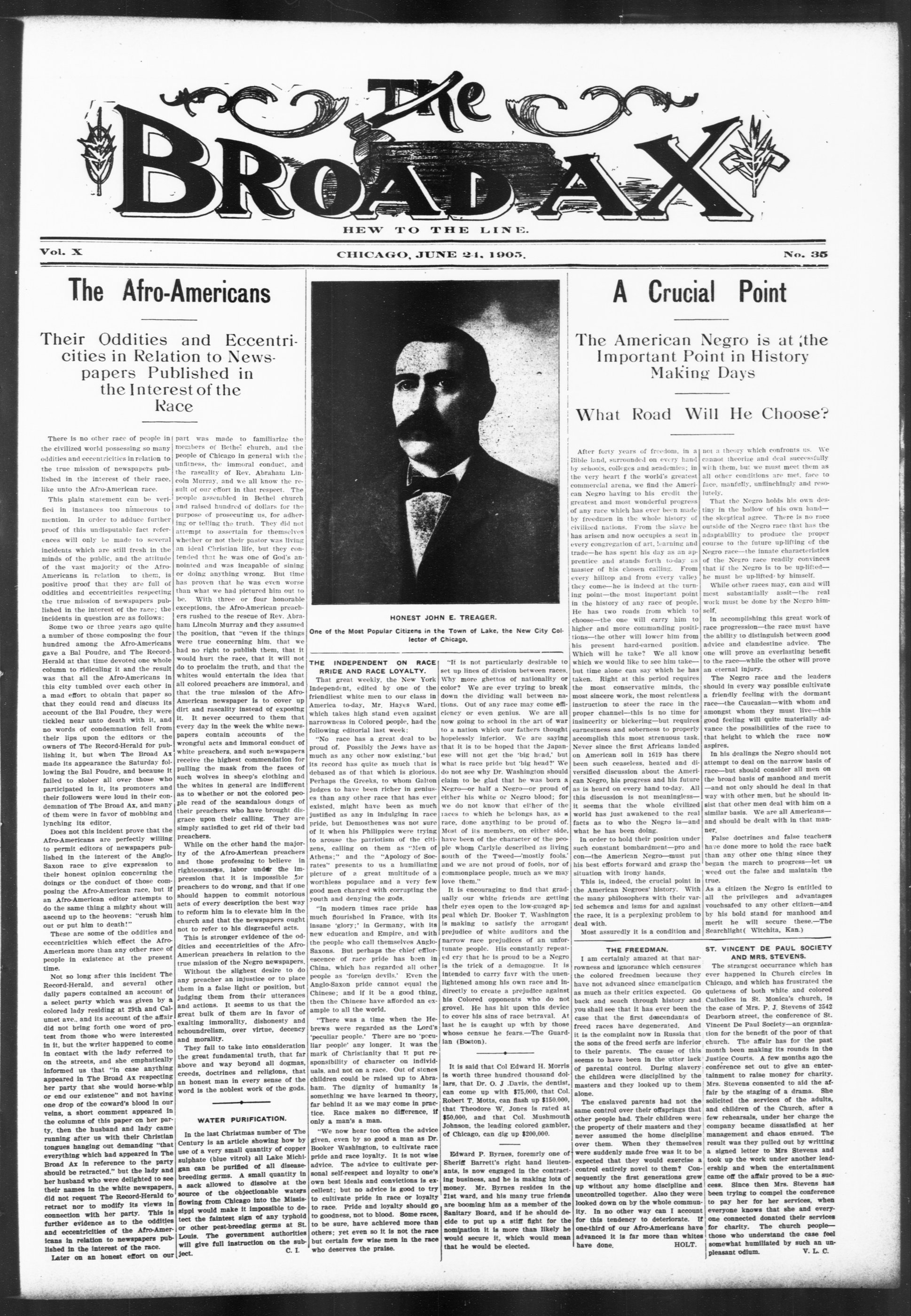
One of the Most Popular Citizens in the Town of Lake, the New City Collector of Chicago.
THE INDEPENDENT ON RACE
RIDE AND RACE LOYALTY.
That great weekly, the New York
Independent, edited by one of the
friendliest white men to our class in
America to-day, Mr. Hayes Ward,
which takes high stand even against
narrowness in Colored people, had the
following editorial last week:
"No race has a great deal to be
proud of. Possibly the Jews have as
much as any other now existing,'but
its record has quite as much that is
debased as of that which is glorious.
Perhaps the Greeks, to whom Galton
judges to have been richer in genius
than any other race that has ever
existed, might have been as much
justified as any in indulging in race
pride, but Demosthenes was not sure
of it when his Phillipses were trying
to arouse the patriotism of the
citizens, calling on them as "Men of
Athens;" and the "Apology of Socrates" presents to us a humiliating
picture of a great multitude of a
worthless populace and a very few
good men charged with corrupting the
youth and denying the gods.
"In modern times race pride has much flourished in France, with its insane 'glory,' in Germany, with its new education and Empire, and with the people who call themselves Anglo-Saxons. But perhaps the chief efflorescence of race pride has been in China, which has regarded all other people as 'foreign devils.' Even the Anglo-Saxon pride cannot equal the Chinese; and if it be a good thing, then the Chinese have afforded an example to all the world.
"There was a time when the Hebrews were regarded as the Lord's 'peculiar people.' There are no 'peculiar people' any longer. It was the mark of Christianity that it put responsibility of character on individuals, and not on a race. Out of stones children could be raised up to Abraham. The dignity of humanity is something we have learned in theory, far behind it as we may come in practice. Race makes no difference, if only a man's a man.
"We now hear too often the advice given, even by so good a man as Dr. Booker Washington, to cultivate race pride and race loyalty. It is not wise advice. The advice to cultivate personal self-respect and loyalty to one's own best ideals and convictions is excellent; but no advice is good to try to cultivate pride in race or loyalty to race. Pride and loyalty should go to goodness, not to blood. Some races, to be sure, have achieved more than others; yet even so it is not the race but certain few wise men in the race who deserves the praise.
"It is not particularly desirable to set up lines of division between races. Why more ghettoes of nationality or color? We are ever trying to break down the dividing wall between nations. Out of any race may come efficiency or even genius. We are all now going to school in the art of war to a nation which our fathers thought hopelessly inferior. We are saying that it is to be hoped that the Japanese will not get the 'big head,' but what is race pride but 'big head?' We do not see why Dr. Washington should claim to be glad that he was born a Negro—or half a Negro—or proud of either his white or Negro blood; for we do not know that either of the races to which he belongs has, as a race, done anything to be proud of. Most of its members, on either side, have been of the character of the people whom Carlyle described as living south of the Tweed—mostly fools. and we are not proud of fools, nor of commonplace people, much as we may love them."
It is encouraging to find that gradually our white friends are getting their eyes open to the low-guaged appeal which Dr. Booker T. Washington is making to satisfy the arrogant prejudice of white auditors and the narrow race prejudices of an unfun-tunate people. His constantly repeated cry that he is proud to be a Negro is the trick of a demagogue. It is intended to carry favir with the unenlightened among his own race and indirectly to create a prejudice against his Colored opponents who do not grovel. He has hit upon this device to cover his sins of race betraval. At last he is caught up with by those whose censure he fears—The Guardian (Boston).
It is said that Col Edward H. Morris is worth three hundred thousand dollars, that Dr. O. J. Davis, the dentist, can come up with $75,000, that Col. Robert T. Motts, can flash up $150,000, that Theodore W. Jones is rated at $50,000, and that Col. Mushmouth Johnson, the leading colored gambler, of Chicago, can dig up $200,000.
Edward P. Byrnes, foremly one of Sheriff Barrett's right hand lieutenants, is now engaged in the contracting business, and he is making lots of money. Mr. Byrnes resides in the 21st ward, and his many true friends are booming him as a member of the Sanitary Board, and if he should decide to put up a stiff fight for the nomination it is more than likely he would secure it, which would mean that he would be elected.
A Crucial Point
The American Negro is at the Important Point in History Making Days
What Road Will He Choose?
After forty years of freedom, in a Bible land, surrounded on every hand by schools, colleges and academies; in the very heart f the world's greatest commercial arena, we find the American Negro having to his credit the greatest and most wonderful progress of any race which has ever been made by freedmen in the whole history of civilized nations. From the slave he has arisen and now occupies a seat in every congregation of art, learning and trade—he has spent his day as an apprentice and stands forth to-day as master of his chosen calling. From every hilltop and from every valley they come—he is indeed at the turning point—the most important point in the history of any race of people. He has two roads from which to choose—the one will carry him to higher and more commanding positions—the other will lower him from his present hard-carned position. Which will he take? We all know which we would like to see him take—but time alone can say which he has taken. Right at this period requires the most conservative minds, the most sincere work, the most relentless instruction to steer the race in the proper channel—this is no time for insincerity or bickering—but requires earnestness and soberness to properly accomplish this most strenuous task. Never since the first Africans landed on American soil in 1619 has there been such ceaseless, heated and diversified discussion about the American Negro, his progress and his future as is heard on every hand to-day. All this discussion is not meaningless—it seems that the whole civilized world has just awakened to the real facts as to who the Negro is—and what he has been doing.
In order to hold their position under such constant bombardment—pro and con—the American Negro—must put his best efforts forward and grasp the situation with irony hands.
This is, indeed, the crucial point in the American Negroes' history. With the many philosophers with their varied schemes and isms for and against the race, it is a perplexing problem to deal with.
Most assuredly it is a condition and
THE FREEDMAN.
I am certainly amazed at that narrowness and ignorance which censures the colored freedmen because they have not advanced since emancipation as much as their critics expected. Go back and seach through history and you shall see that it has ever been the case that the first descendants of freed races have degenerated. And it is the complaint now in Russia that the sons of the freed serfs are inferior to their parents. The cause of this seems to have been in the utter lack of parental control. During slavery the children were disciplined by the masters and they looked up to them alone.
The enslaved parents had not the same control over their offsprings that other people had. Their children were the property of their masters and they never assumed the home discipline over them. When they themselves were suddenly made free was it to be expected that they would exercise a control entirely novel to them? Consequently the first generations grew up without any home discipline and uncontrolled together. Also they were looked down on by the whole community. In no other way can I account for this tendency to deteriorate. If one-third of our Afro-Americans have advanced it is far more than whites have done. HOLT.
Real Point
Negro is at the point in History long Days
Will He Choose?
not a theory which confronts us. We cannot theorize and deal successfully with them, but we must meet them as all other conditions are met, face to face, manfully, unflinchingly and resolutely
That the Negro holds his own destiny in the hollow of his own hand—the skeptical agree. There is no race outside of the Negro race that has the adaptability to produce the proper course to the future up-lifting of the Negro race—the innate characteristics of the Negro race readily convinces that if the Negro is to be uplifted—he must be up-lifted by himself.
While other races may, can and will most substantially assist—the real work must be done by the Negro himself.
In accomplishing this great work of race progression—the race must have the ability to distinguish between good advice and clandestine advice. The one will prove an everlasting benefit to the race—while the other will prove an eternal injury.
The Negro race and the leaders should in every way possible cultivate a friendly feeling with the dormant race—the Caucasian—with whom and amongst whom they must live—this good feeling will quite materially advance the possibilities of the race to that height to which the race now aspires.
In his dealings the Negro should not attempt to deal on the narrow basis of race—but should consider all men on the broad basis of manhood and merit—and not only should he deal in that way with other men, but he should insist that other men deal with him on a similar basis. We are all Americans—and should be dealt with in that manner.
False doctrines and false teachers have done more to hold the race back than any other one thing since they began the march to progress—let us weed out the false and maintain the true.
As a citizen the Negro is entitled to all the privileges and advantages vouchsafed to any other citizen—and by his bold stand for manhood and merit he will secure these.—The Searchlight( Witchita, Kan.)
ST. VINCENT DE PAUL SOCIETY AND MRS. STEVENS.
The strangest occurrence which has ever happened in Church circles in Chicago, and which has frustrated the quietness of both white and colored Catholics in St. Monica's church, is the case of Mrs. P. J. Stevens of 3542 Dearborn street, the conference of St. Vincent De Paul Society—an organization for the benefit of the poor of that church. The affair has for the past month been making its rounds in the Justice Courts. A few months ago the conference set out to give an entertainment to raise money for charity. Mrs. Stevens consented to aid the affair by the staging of a drama. She solicited the services of the adults, and children of the Church, after a few rehearsals, under her charge the company became dissatisfied at her management and chaos ensued. The result was they pulled out by writing a signed letter to Mrs Stevens and took up the work under another leadership and when the entertainment came off the affair proved to be a success. Since then Mrs. Stevens has been trying to compel the conference to pay her for her services, when everyone knows that she and every one connected donated their services for charity. The church people—those who understand the case feel somewhat humiliated by such an unpleasant odium. V. L. C.
---
Will promulgate and at all times uphold the true principles of Democracy, but Catholicism, Protestantism, Republicans, Enkights of Labor, or any one else can have theirs; and their language is proper and responsibility is hard.
The Broad Ax is a newspaper whose platform is broad enough for all, ever claiming the editorial right to speak its own mind.
Work closely on one side of the paper. Receive attention.
Subscriptions must be paid in advance.
One Year.....$2.00
Six Months.....1.00
Advertising rates made known on application.
JULIUS F. TAYLOR, Editor and Publisher.
Entered at the Post Office at Chicago
Ill. as second-claim Matter.
FEAST."
The twenty-seventh recital of the pupils of Mr. Pedro T. Tinsley was heard at Grace Presbyterian Church on Thursday evening, June 15th, and, by request, repeated on last Sunday afternoon at the Institutional Church, to the great enjoyment of a large and select audiences, both sympathetic and critical
Most of Mr. Tinsley's pupils had been heard upon other occasions in recital, and the audience was, therefore, prepared for the usual vocal treat they have learned to anticipate when this careful and most competent maestro offers a recital of some of the work accomplished in his study in Handel Hall. His work as a conductor of the Choral Study Club has otherwise done for that organization, which he founded, what Prof. Tomlin's has done for the Apollo Club of Chicago, for though a much larger and older organization, with ample capital and facilities, the Choral Study Club has done as representative work of equally high class; for example, the production next Monday night of The Blind Girl of Castle Culle and Hiawatha's Wedding Feast, entirely different in treatment—the first named very difficult—and the first production of it in the West, if not the first in this country. These have an added interest to us, because the composer is S. Coleridge-Taylor, of London, England, the greatest of all Negro composers and one of the world's greatest, of any race or nation.
There were fourteen participants upon the program, representing to the critic several grades of study; all more or less fairly excellent in the class of work essayed, which ranged from Speak's pretty ballad, "When Mable Sings" to that of Tschalkowsky's "Through the Still Night" so delightfully and effectively phrased and sung by Miss L Blanche Wright, and that peculiarly difficult aria, "Spring Song" from Hiawatha, the many pitfalls of which were successfully eluded and the whole effectively rendered in both voice and technique—ample and to spare-by Mrs. Virginia Green. Mrs. Green's is a clear and penetrating soprano voice which renders the trill with the case and certainty of the sustained passage. Her "Damon" was, however, to the audience, her most grateful number, while her Butterfly Song was exquisite.
Miss Wright, possibly, showed the most remarkable growth in breadth and quality over her former good work of almost a year since. A treat, is therefore, in store for those fortunate to hear her in the role of Margaret—"The Blind Girl of Castle Cuille"—on Monday night next. Hers is a pure and limpid soprano, singing easily two octavos to "C" in alto. Her friends are glad too, that on this occasion she will have opportunity to prove (what a sereve cold and hoarseness would not permit on the previous occasion) her ability to sing the difficult solos of the "Blind Girl" with beauty and strength.
Space will not permit a more extended account in detail, quite a number of which deserve extended notice; however, great interest was excited over the expected debut of Mr. Sadler, the new tenor, who is to sing the great solo "Onaway, Aawake Beloved" in "Hiawatha's Wedding Feast" on next Monday night the 26th; but he failed to materialize. Otherwise, the audience looked with pleasant experience it had enjoyed and all trust the next recital will not be next; but this season.
St. Thomas.
Beginning with last Sunday the Catholic Church entered into the longest season in the Church's year, the Octavo of Trinity this year having twenty-three Sundays, ending at Advent. The Doctrine of the Trinity is so truly believed and taught that at every turn we either invoke praise, or feel to bless His presence. At home, at work, at worship, or even in our
pleasures, we ask his presence when we trace upon our forehead the sign of the cross and mention the blessed Trinity Satan fears and flees.
The color for this season is green, which is also the color great nature has given mother earth. Next Sunday at 7:30 a. m., the Holy Communion and at 11 a. m. morning prayer. Litany and the Sacrament of Holy Baptism will be administered and sermon by Father Lealted.
CALENDAR FOR WEEK.
June 25, 1st Sunday after Trinity; color of vestments green.
June 29, St. Peter's day; red.
June 30, Friday, fast.
PETER H. BURGESS
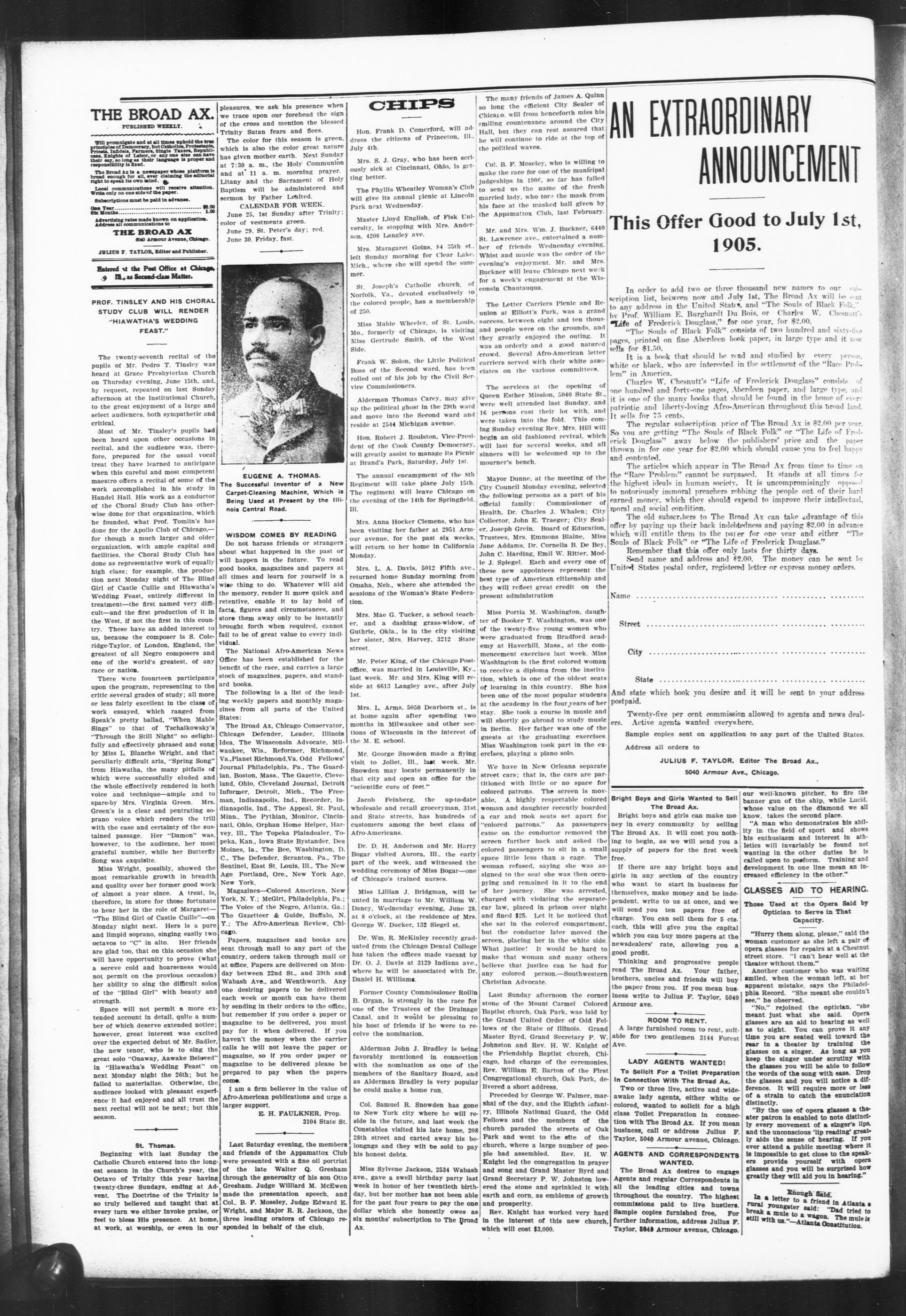
The Successful Inventor of a New Carpet-Cleaning Machine, Which is Being Used at Present by the Illinois Central Road.
WISDOM COMES BY READING Do not harass friends or strangers about what happened in the past or will happen in the future. To read good books, magazines and papers at all times and learn for yourself is a wise thing to do. Whatever will aid the memory, render it more quick and retentive, enable it to lay hold of facts, figures and circumstances, and store them away only to be instantly brought forth when required, cannot fail to be of great value to every individual. The National Afro-American News Office has been established for the benefit of the race, and carries a large stock of magazines, papers, and standard books.
The following is a list of the leading weekly papers and monthly magazines from all parts of the United States:
The Broad Ax, Chicago Conservator, Chicago Defender, Leader, Illinois Idea, The Winsconsin Advocate, Milwaukee, Wis., Reformer, Richmond, Va., Planet Richmond, Va. Odd Fellows' Journal Philadelphia, Pa., The Guardian, Boston, Mass., The Gazette, Cleveland, Ohio, Cleveland Journal, Detroit Informer, Detroit, Mich., The Freeman, Indianapolis, Ind., Recorder, Indianapolis, Ind., The Appeal, St. Paul, Minn., The Pythian, Monitor, Cincinnati, Ohio, Orphan Home Helper, Harvey, Ill., The Topeka Plaindealer, Topeka, Kan, Iowa State Bystander, Des Moines, Ia., The Bee, Washington, D.C., The Defender, Scranton, Pa., The Sentinel, East St. Louis, Ill., The New Age Portland, Ore., New York Age, New York.
Magazines—Colored American, New York, N. Y.; McGirt, Philadelphia, Pa.; The Voice of the Negro, Atlanta, Ga.; The Gazetteer & Guide, Buffalo, N. Y.; The Afro-American Review, Chicago.
Papers, magazines and books are sent through mail to any part of the country, orders taken through mail or at office. Papers are delivered on Monday between 22nd St., and 39th and Wabash Ave., and Wenthworth. Any one desiring papers to be delivered each week or month can have them by sending in their orders to the office, but remember if you order a paper or magazine to be delivered, you must pay for it when delivered. If you haven't the money when the carrier calls he will not leave the paper or magazine, so if you order paper or magazine to be delivered please be prepared to pay when the papers come.
I am a firm believer in the value of Afro-American publications and urge a larger support.
E. H. FAULKNER, Prop.
3104 State St.
Last Saturday evening, the members and friends of the Appamattox Club were presented with a fine oil portrait of the late Walter Q. Gresham through the generosity of his son Otto Gresham. Judge Williard M. McEwen made the presentation speech, and Col., B. F. Moseley, Judge Edward E. Wright, and Major R. R. Jackson, the three leading orators of Chicago responded in behalf of the club.
CHIPS
Hon. Frank D. Comerford, will address the citizens of Princeton, Ill., July 4th.
Mrs. S. J. Gray, who has been seriously sick at Cincinnati, Ohio, is getting better.
The Phyllis Wheatley Woman's Club will give its annual picnic at Lincoln Park next Wednesday.
Master Lloyd English, of Fisk University, is stopping with Mrs. Anderson, 4208 Langley ave.
Mrs. Maragaret Goins, 84 35th st. left Sunday morning for Clear Lake, Mich., where she will spend the summer.
St. Joseph's Catholic church, of Norfolk, Va., devoted exclusively to the colored people, has a membership of 250.
Miss Mable Wheeler, of St. Louis, Mo., formerly of Chicago, is visiting Miss Gertrude Smith, of the West Side.
Frank W. Solon, the Little Political Boss of the Second ward, has been rolled out of his job by the Civil Service Commissioners.
Alderman Thomas Carey, may give up the political ghost in the 29th ward and move into the Second ward and reside at 2544 Michigan avenue.
Hon. Robert J. Roulston, Vice-President of the Cook County Democracy, will greatly assist to manage its Picnic at Brand's Park, Saturday, July 1st.
The annual encampment of the 8th Regiment will take place July 15th. The regiment will leave Chicago on the evening of the 14th for Springfield, Ill.
Mrs. Anna Hocker Clemens, who has been visiting her father at 2951 Armour avenue, for the past six weeks, will return to her home in California Monday.
Mrs. L. A. Davis, 5012 Fifth ave., returned home Sunday morning from Omaha, Neb., where she attended the sessions of the Woman's State Federation.
Mrs. Mae G. Tucker, a school teacher, and a dashing grass-widow, of Guthrie, Okla., is in the city visiting her sister, Mrs. Harvey, 3212 State street
Mr. Peter King, of the Chicago Post-office, was married in Louisville, Ky., last week. Mr. and Mrs. King will reside at 6613 Langley ave., after July 1st.
Mrs. L. Arms, 5050 Dearborn st., is at home again after spending two months in Milwaukee and other sections of Wisconsin in the interest of the M. E. school.
Mr. George Snowden made a flying visit to Joliet, Ill., last week. Mr. Snowden may locate permanently in that city and open an office for the "scientific cure of feet."
Jacob Feinberg, the up-to-date wholesale and retail groceryman, 31st and State streets, has hundreds of customers among the best class of Afro-Americans.
Dr. D. H. Anderson and Mr. Harry Bogar visited Aurora, Ill., the early part of the week, and witnessed the wedding ceremony of Miss Bogar—one of Chicago's trained nurses.
Miss Lillian J. Bridgman, will be united in marriage to Mr. William W. Dancy, Wednesday evening, June 28, at 8 o'clock, at the residence of Mrs. George W. Ducker, 132 Siegel st.
Dr. Wm. R. McKinley recently graduated from the Chicago Dental College has taken the offices made vacant by Dr. O. J. Davis at 3129 Indiana ave., where he will be associated with Dr. Daniel H. Williams.
Former County Commissioner Rollin B. Organ, is strongly in the race for one of the Trustees of the Drainage Canal, and it would be pleasing to his host of friends if he were to receive the nomination.
Alderman John J. Bradley is being favorably mentioned in connection with the nomination as one of the members of the Sanitary Board, and as Alderman Bradley is very popular he could make a home run.
Col. Samuel R. Snowden has gone to New York city where he will reside in the future, and last week the Constables visited his late home, 208 28th street and carted away his belongings and they will be sold to pay his honest debts.
Miss Sylvene Jackson, 2534 Wabash ave., gave a swell birthday party last week in honor of her twentieth birthday, but her mother has not been able for the past four years to pay the one dollar which she honestly owes as six months' subscription to The Broad Ax.
The many friends of James A. Quinn so long the efficient City Sealer of Chicago, will from henceforth miss his smiling countenance around the City Hall, but they can rest assured that he will continue to ride at the top of the political waves.
Col. B. F. Moseley, who is willing to make the race for one of the municipal judgeships in 1906, so far has failed to send us the name of the fresh married lady, who tore the mask from his face at the masked ball given by the Appamattox Club, last February.
Mr. and Mrs. Wm. J. Buckner, 6440 St. Lawrence ave., entertained a number of friends Wednesday evening. Whist and music was the order of the evening's enjoyment. Mr. and Mrs. Buckner will leave Chicago next week for a week's engagement at the Wisconsin Chautauqua.
The Letter Carriers Picnic and Reunion at Elliott's Park, was a grand success, between eight and ten thousand and people were on the grounds, and they greatly enjoyed the outing. It was an orderly and a good natured crowd. Several Afro-American letter carriers served with their white associates on the various committees.
The services at the opening of Queen Esther Mission, 5040 State St., were well attended last Sunday, and 16 persons cast their lot with, and were taken into the fold. This coming Sunday evening Rev, Mrs. Hill will begin an old fashioned revival, which will last for several weeks, and all sinners will be welcomed up to the mourner's bench.
Mayor Dunne, at the meeting of the City Council Monday evening, selected the following persons as a part of his official family: Commissioner of Health, Dr. Charles J. Whalen; City Collector, John E. Traeger; City Sealer, Joseph Grein. Board of Education, Trustees, Mrs. Emmons Blaine, Miss Jane Addams, Dr. Cornelia B. De Bey, John C. Harding, Emil W. Ritter, Modie J. Splegel. Each and every one of these new appointees represent the best type of American citizenship and they will reflect great credit on the present administration
Miss Porta M. Washington, daughter of Booker T. Washington, was one of the twenty-five young women who were graduated from Bradford academy at Haverhill, Mass., at the commencement exercises last week. Miss Washington is the first colored woman to receive a diploma from the institution, which is one of the oldest seats of learning in this country. She has been one of the most popular students at the academy in the four years of her stay. She took a course in music and will shortly go abroad to study music in Berlin. Her father was one of the guests at the graduating exercises. Miss Washington took part in the exercises, playing a piano solo.
We have in New Orleans separate street cars; that is, the cars are partitioned with little or no space for colored patrons. The screen is movable. A highly respectable colored woman and daughter recently boarded a car and took seats set apart for "colored patrons." As passengers came on the conductor removed the screen further back and asked the colored passengers to sit in a small space little less than a cage. The woman refused, saying she was assigned to the seat she was then occupying and remained in it to the end of her journey. She was arrested, charged with violating the separate-car law, placed in prison over night and fined $25. Let it be noticed that she sat in the colored compartment, but the conductor later moved the screen, placing her in the white side. What justice! It would be hard to make that woman and many others believe that justice can be had for any colored person.—Southwestern Christian Advocate.
Last Sunday afternoon the corner stone of the Mount Carmel Colored Baptist church, Oak Park, was laid by the Grand United Order of Odd Fellows of the State of Illinois. Grand Master Byrd, Grand Secretary P. W. Johnston and Rev. H. W. Knight of the Friendship Baptist church, Chicago, had charge of the ceremonies. Rev. William E. Barton of the First Congregational church, Oak Park, delivered a short address.
Preceded by George W. Palmer, marshal of the day, and the Eighth infantry, Illinois National Guard, the Odd Fellows and the members of the church paraded the streets of Oak Park and went to the site of the church, where a large number of people had assembled. Rev. H. W. Knight led the congregation in prayer and song and Grand Master Byrd and Grand Secretary P. W. Johnston lowered the stone and sprinkled it with earth and corn, as emblems of growth and prosperity. Rev. Knight has worked very hard in the interest of this new church, which will cost $3,000.
AN EXTRAORDINARY ANNOUNCEMENT
This Offer Good to July 1st, 1905.
In order to add two or three thousand new names to our subscription list, between now and July 1st, The Broad Ax will be sent to any address in the United States, and "The Souls of Black Folk," by Prof. William E. Burghardt Du Bois, or Charles W. Chesnutt's "Life of Frederick Douglass," for one year, for $2.00.
"The Souls of Black Folk" consists of two hundred and sixty-five pages, printed on fine Aberdeen book paper, in large type and it now sells for $1.50.
It is a book that should be read and studied by every person, white or black, who are interested in the settlement of the "Race Problem" in America.
Charles W. Chesnutt's "Life of Frederick Douglass" consists of one hundred and forty-one pages, Aberdeen paper, and large type, and it is one of the many books that should be found in the home of every patriotic and liberty-loving Afro-American throughout this broad land. It sells for 75 cents.
The regular subscription price of The Broad Ax is $2.00 per year. So you are getting "The Souls of Black Folk" or "The Life of Frederick Douglass" away below the publishers' price and the paper thrown in for one year for $2.00 which should cause you to feel happy and contented.
The articles which appear in The Broad Ax from time to time on the "Race Problem" cannot be surpassed. It stands at all times for the highest ideals in human society. It is uncompromisingly opposed to notoriously immoral preachers robbing the people out of their hard earned money, which they should expend to improve their intellectual, moral and social condition.
The old subscribers to The Broad Ax can take advantage of this offer by paying up their back indebtedness and paying $2.00 in advance which will entitle them to the payer for one year and either "The Souls of Black Folk" or "The Life of Frederick Douglass."
Remember that this offer only lasts for thirty days.
Send name and address and $2.00. The money can be sent by United States postal order, registered letter or express money orders.
And state which book you desire and it will be sent to your address postpaid.
Twenty-five per cent commission allowed to agents and news dealers. Active agents wanted everywhere.
Sample copies sent on application to any part of the United States.
Address all orders to
JULIUS F. TAYLOR, Editor The Broad Ax.,
5040 Armour Ave., Chicago.
Bright Boys and Girls Wanted to Sell The Broad Ax.
Bright boys and girls can make money in every community by selling The Broad Ax. It will cost you nothing to begin, as we will send you a supply of papers for the first week free.
If there are any bright boys and girls in any section of the country who want to start in business for themselves, make money and be independent, write to us at once, and we will send you ten papers free of charge. You can sell them for 5 cts. each, this will give you the capital which you can buy more papers at the newdealers' rate, allowing you a good profit.
Thinking and progressive people read The Broad Ax. Your father, brothers, uncles and friends will buy the paper from you. If you mean business write to Julius F. Taylor, 5040 Armour ave.
ROOM TO RENT
A large furnished room to rent, suitable for two gentlemen 3144 Forest Ave.
LADY AGENTS WANTED
To Solicit For a Toilet Preparation In Connection With The Broad Ax. Two or three live, active and wideawake lady agents, either white or colored, wanted to solicit for a high class Toilet Preparation in connection with The Broad Ax. If you mean business, call or address Julius F. Taylor, 5040 Armour avenue, Chicago
AGENTS AND CORRESPONDENTS WANTED.
The Broad Ax desires to engage Agents and regular Correspondents in all the leading cities and towns throughout the country. The highest commissions paid to live hustlers. Sample copies furnished free, For further information, address Jullus F. Taylor, 5049 Armour avenue, Chicago.
our well-known pitcher, to fire the banner gun of the ship, while Lucid, whose value on the diamond we all know, takes the second place. "A man who demonstrates his ability in the field of sport and shows his enthusiasm and interest in athletics will invariably be found not wanting in the other duties he is called upon to perform. Training and development in one line mean an increased efficiency in the other."
GLASSES AID TO HEARING.
Those Used at the Opera Said by Optician to Serve in That Capacity.
"Hurry them along, please," said the woman customer as she left a pair of opera glasses for repairs at a Chestnut street store. "I can't hear well at the theater without them."
Another customer who was waiting smiled, when the woman left, at her apparent mistake, says the Philadelphia Record. "She meant she couldn't see," he observed.
"No," rejoined the optician, "she meant just what she said. Opera glasses are an aid to hearing as well as to sight. You can prove it any time you are seated well toward the rear in a theater by training the glasses on a singer. As long as you keep the singer under scrutiny with the glasses you will be able to follow the words of the song with ease. Drop the glasses and you will notice a difference. It will require more or less of a strain to catch the enunciation distinctly.
"By the use of opera glasses a theater patron is enabled to note distinctly every movement of a singer's lips, and the unconscious 'lip reading' greatly aids the sense of hearing. If you ever attend a public meeting where it is impossible to get close to the speakers provide yourself with opera glasses and you will be surprised how greatly they will aid you in hearing."
Enough Said
In a letter to a friend in Atlanta a rural youngster said: "Dad tried to break a mule to a wagon. The mule is still with us."—Atlanta Constitution
CHARLES BONAPARTE NOT OF
ARISTOCRATIC TENDENCIES.
DECLARATION OF MR. LOEB
What Impressed Admiral Dewey in
Busso-Japanese Conflict — Sen-
ator Hale, of Maine, Is
Differently Taught.
W
ASHINGTON. HERE may be some "little Americans" who will criticise the appointment of Charles J. Bonaparte to be secretary of the navy on the ground that he is of royal blood. He is a grand nephew of the great Napoleon Bonaparte and a
grandson of Jerome Bonaparte, whom Napoleon made king of Westphalia. This is a great chance for the anti-imperialists. They will doubtless point to the selection of a grandson of a king as sure proof of the imperialistic tendencies of Theodore Roosevelt. And Theodore Roosevelt will just laugh. So will Charles J. Bonaparte, who, though an aristocrat, is a democrat in principle and practice.
Mr. Bonaparte does not rest his claim to fame upon his family. He has made his own reputation, and if the truth were told, he is probably not proud of his royal ancestors. His grandfather, Jerome Bonaparte, was under the thumb of Napoleon, and at the latter's command was divorced from his American wife, the beautiful Elizabeth Patterson, of Baltimore. Mrs. Bonaparte, it is said, lies buried in a Baltimore cemetery under a stone marked "Elizabeth Patterson." She had one son, whom she named Jerome, and the latter had two sons, Jerome and Charles Joseph, the latter being the new secretary of the navy. Charles Joseph's brother inherited royal tendencies. He did not become an American citizen, but had an ambition to regain the French throne. He became a soldier in the French army and was known as Prince Napoleon. Charles Joseph, however, is an American in thought and feeling, and is a lawyer of great ability.
Secretary to the President.
MONG the cabinet rumors that have been circulated recently is one to the effect that Secretary to the President Loeb is to follow in the footsteps of Col. Lamont and Mr. Cortelyou and reach a seat in the cabinet. This rumor has not affected Mr. Loeb, who is an imper-
MONG the cabinet rumors that have been circulated recently is one to the effect that Secretary to the President Loeb is to follow in the foot-steps of Col. La-mont and Mr. Cortelyou and reach a seat in the cabinet. This rumor has not affected Mr. Loeb, who is an imper- turbable gentleman, not easily fooled and who would not be likely to confirm the rumor by even so much as a nod, even if it were true.
"Do you enjoy the office of secretary to the president?" he was asked the other day when the cabinet rumor was first circulated.
"I like it best of anything I ever did," was his reply. "It is the center of things. I would not trade it for any other job under the government."
"Not for a cabinet office?"
"No."
Mr. Loeb is a hard worker, and says that he has no time to consider the stories that have been put into circulation. He entered life with the idea of working, and he has had plenty of opportunity to indulge his ambition. He picked out as his profession that of stenography, which involves plenty of activity. When he decided to become a stenographer, he also made up his mind that he would be one of the best in the country. That he succeeded in his determination is evidenced by the fact that he became one of the official stenographers of the New York legislature at Albany.
It was while in pursuit of his official work in the New York capitol that he came under the notice of Mr. Roosevelt, who was governor of the state. There were four official stenographers attached to the executive offices at Albany, and the new governor had his choice. During the first week of his administration Mr. Roosevelt tackled a big pile of correspondence one morning, and said: "Send me that man I had the first day." This was after he had tried all the men, and the man he referred to was William Loeb, Jr., who has been with him ever since, as governor, vice president and president.
Increase in the Navy.
DMIRAL DEWEY and the general board of the navy department of which he is the head, with President Roosevelt and the secretary of the navy and the officials of the navigation bureau will form a formidable body to appeal to congress at the next session for
DMIRAL DEWEY and the general board of the navy department of which he is the head, with President Roosevelt and the secretary of the navy and the officials of the navigation bureau will form a formidable body to appeal to congress at the next session for increases in the navy, particularly in the line of building battleships. These distinguished officials declare that one lesson above all others that has been taught by the battle of the Sea of Japan is the necessity of the battleship in the modern navy. Admiral Dewey has always contended that these big men of
war constitute the supreme factor in naval operations. Probably no naval officer in the world watched with more intense interest the movements of the Russian and Japanese fleets or studied more closely the performance of the vessels in those fleets in the engagements at Port Arthu and in the Korean straits than did Admiral Dewey. Since his great victory in Manila bay, seven years ago, the admiral has been absolutely convinced of the superiority of the battleship, and he now declares that the virtual annihilation of the Russian fleet in the Korean straits was accomplished by the gun fire and masterly maneuvering of Admiral Togo's battleships. The reported exploits of the torpedo boats the admiral claims were only rendered possible by the fact that the battleships had crippled the big vessels of the Russian navy and left them at the mercy of the little torpedo boats.
President Roosevelt has had many a discussion with the admiral regarding the performance of the different types of vessels in the recent fight between the Japanese and Russians. He agrees with the admiral that the policy of building more battleships must be kept up, especially now since Japan is likely to become the queen of the Pacific through her victory over the Russians and the capture of so many of the latter's vessels of war.
Against More Battlesins
T
HERE is one man who can be depended upon to contest the administration's battle-ship policy, and that is Senator Hale, of Maine, chairman of the senate committee on naval affairs. Mr. Hale is conscious and honest in his contention that naval development is too uncer-
tain to warrant the government putting so many millions into one type of vessel. A battleship fully armored and equipped represents an expenditure of over $7,000,000. Mr. Hale contends that this expensive floating arsenal is at the mercy of a torpedo boat costing three-quarters of a million dollars. He, too, is likely to draw lessons from the Russian-Japanese war, but on the side of the smaller vessel and in favor of going slow in building big vessels until it is absolutely demonstrated that they are the dominant factors in a modern navy.
Senator Hale has never been in thorough accord with the enthusiasm of Mr. Roosevelt on the subject of the navy. It is well remembered that before the breaking out of the Spanish war Mr. Roosevelt, as assistant secretary of the navy, had the foresight to prepare for that war. Admiral Dewey freely and frankly gives him the credit of making it possible for the United States vessels to annihilate the Spaniards in the Bay of Manila. This he did by ordering supplies of ammunition and coal to Dewey's fleet in the orient so that when war was declared that fleet was in condition to leave neutral ports and seek the enemy.
Secretary of the Navy Long was absent about this time, and Senator Hale, in nosing about the departments, learned what Mr. Roosevelt, as acting secretary, was doing. He learned that Mr. Roosevelt expected a war with Spain, and was so startled that he rushed over to the white house and secured an audience with President McKinley, to whom he declared: "For goodness sake call Long back. That crazy man over in the department will get us into war with Spain." President Roosevelt often refers to this scare of Senator Hale, and laughs about it. He is willing to bear the charge of being "a crazy man" in the light of what his foresight accomplished in preparing the navy for the war that was inevitable.
Attracting Men to the Army.
RMY officers are doing what they can to make it more attractive for young men to enlist in the army. The various recruiting stations are being renovated and at the barrack throughout the country improvements are recommended that will be for the comfort
RMY officers are doing what they can to make it more attractive for young men to enlist in the army. The various recruiting stations are being renovated and at the barracks throughout the country improvements are recommended that will be for the comfort and pleasure of the men. One recommendation is that a band be established at each recruiting depot. Army officers declare that the influence of music will add much to the military spirit.
It has further been recommended that barbers be furnished at government expense, to be paid out of the company or general mess fund. There has been some talk of requiring soldiers who were barbers to act in that capacity at army posts, but it is probable that they would object to doing so unless they received extra compensation.
extra care.
This post exchange building will be built of brick and will be paid for out of the appropriation for army public buildings of the current fiscal year. It will have a gymnasium fitted with all modern appliances for athletic work; a large public hall, where the entertainments of the enlisted men can be held, including their dances; a reading room, where will be kept the weekly and monthly periodicals, together with a small library; lockers where the men will keep their gymnasium clothing; bowling alleys and an administration room, where the officers in charge will have their desks. If this building seems to meet all the wants of the enlisted men it will be duplicated at other posts and army life will be made as attractive as is comportable with discipline and strict discharge of duties.
A WASTE-PAPER BASKET.
As One Needs Many of These Articles Directions Are Given for a Home-Made One.
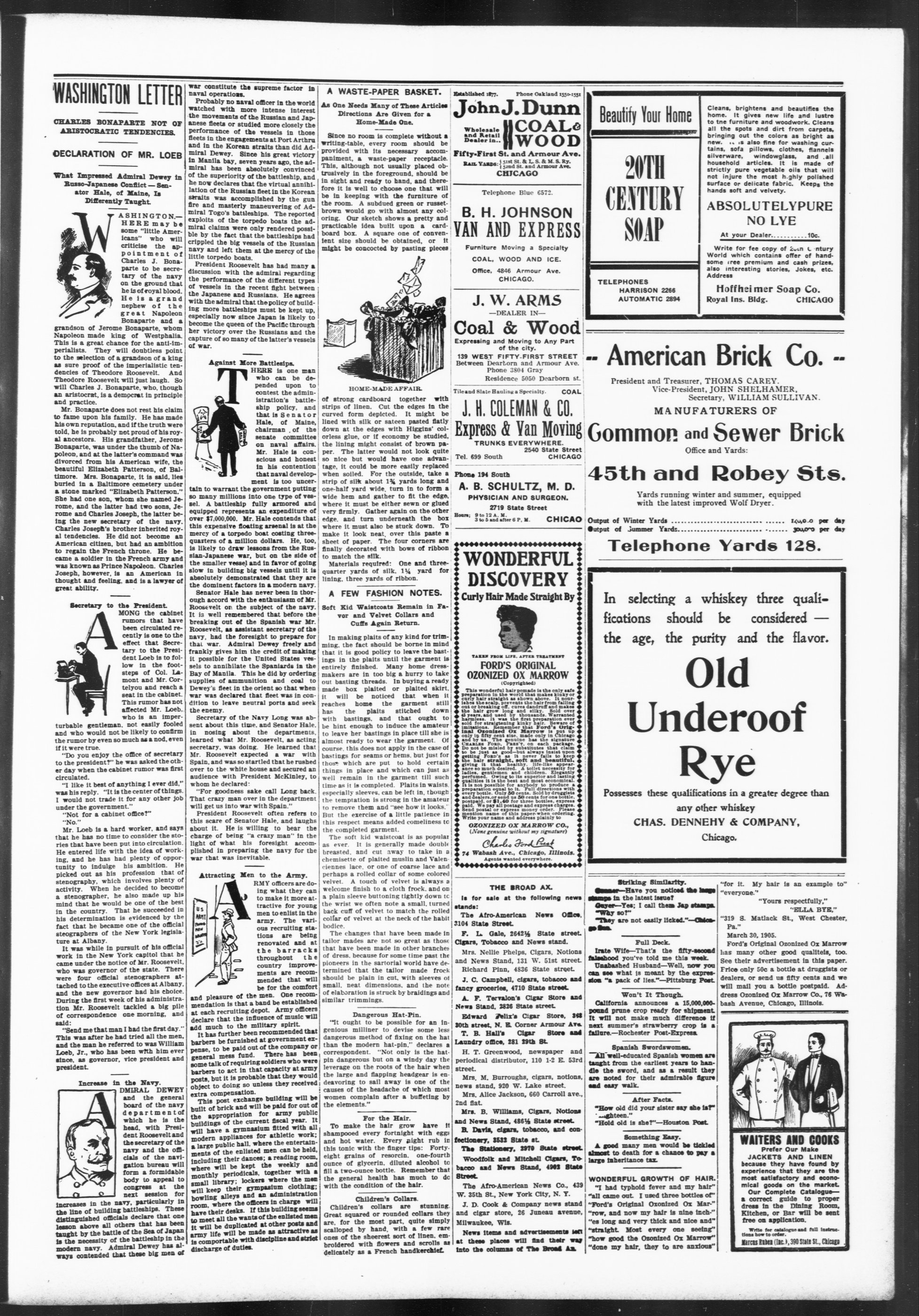
Since no room is complete without a writing-table, every room should be provided with its necessary accompaniment, a waste-paper receptacle. This, although not usually placed obtrusively in the foreground, should be in sight and ready to hand, and therefore it is well to choose one that will be in keeping with the furniture of the room. A subdued green or russet-brown would go with almost any coloring. Our sketch shows a pretty and practicable idea built upon a cardboard box. A square one of convenient size should be obtained, or it might be concocted by pasting pieces
100
HOME-MADE AFFAIR
of strong cardboard together with strips of linen. Cut the edges in the curved form depicted. It might be lined with silk or sateen pasted flatly down at the edges with Higgins' colorless glue, or if economy be studded, the lining might consist of brown paper. The latter would not look quite so nice but would have one advantage, it could be more easily replaced when soiled. For the outside, take a strip of silk about $1\frac{1}{4}$ yards long and one-half yard wide, turn in to form a wide hem and gather to fit the edge, where it must be either sewn or glued very firmly. Gather again on the other edge, and turn underneath the box where it must also be stuck down. To make it look neat, over this paste a sheet of paper. The four corners are finally decorated with bows of ribbon to match the silk.
Materials required: One and three-quarter yards of silk. $1\frac{1}{4}$ yard for lining, three yards of ribbon.
A FEW FASHION NOTES.
Soft Kid Waistcats Remain in Fac vor and Velvet Collars and Cuffs Again Return.
In making plaits of any kind for trimming, the fact should be borne in mind that it is good policy to leave the bastings in the plaits until the garment is entirely finished. Many home dress-makers are in too big a hurry to take out basting threads. In buying a ready made box plaited or plaited skirt, it will be noticed that when it reaches home the garment still has the plaits stitched down with bastings, and that ought to be hint enough to induce the amateur to leave her bastings in place till she is almost ready to wear the garment. Of course, this does not apply in the case of bastings for seams or hems, but just for those which are put to hold certain things in place and which can just as well remain in the garment till such time as it is completed. Plaits in waists, especially sleeves, can be left in, though the temptation is strong in the amateur to remove them and "see how it looks." But the exercise of a little patience in this respect means added comeliness to the completed garment.
The soft kid waistcoat is as popular as ever. It is generally made double breasted, and cut away to take in a chemisette of plaited muslin and Valenciennes lace, or one of coarse lace and perhaps a rolled collar of some colored velvet. A touch of velvet is always a welcome finish to a cloth frock, and on a plain sleeve buttonting tightly down to the wrist we often note a small, turned back cuff of velvet to match the rolled collar of velvet at the neck of the habit bodice.
The changes that have been made in tailor mades are not so great as those that have been made in other branches of dress, because for some time past the pioneers in the sartorial world have determined that the tailor made frock should be plain in cut, with sleeves of small, neat dimensions, and the note of elaboration is struck by braidings and similar trimmings.
Dangerous Hat-Pin
"It ought to be possible for an ingenious milliner to devise some less dangerous method of fixing on the hat than the modern hat-pin." declares a correspondent. "Not only is the hat-pin dangerous but on a windy day the leverage on the roots of the hair when the large and flapping headgear is endevouring to sall away is one of the causes of the headache of which most women complain after a buffeting by the elements."
For the Hair
To make the hair grow have it shampooed every fortnight with eggs and hot water. Every night rub in this tonic with the finger tips: Forty-eight grains of resorcin. one-fourth ounce of glycerin, diluted alcohol to fill a two-ounce bottle. Remember that the general health has much to do with the condition of the hair.
Children's Collars
Children's collars are stunning. Great squared or rounded collars they are, for the most part, quite simply scalloped by hand, with a few rare ones of the sheerest sort of linen, embroidered with flowers and scrolls as delicately as a French handkerchief.
Fifty-First St. and Armour Ave.
RAIL YARDS: {1st St. & L. S. & M. S. Ry.
2nd St. and Armour Ave.
CHJCAGO
Telephone Blue 6572.
B. H. JOHNSON VAN AND EXPRESS
Furniture Moving a Specialty
COAL, WOOD AND ICE.
Office, 4846 Armour Ave.
CHICAGO.
J. W. ARMS
—DEALER IN—
Expressing and Moving to Any Part
of the city.
139 WEST FIFTY-FIRST STREET
Between Dearborn and Armour Ave.
Phone 3804 Gray
Residence 5050 Dearborn st.
Tile and Slate Hauling a Specialty. COAL
J. H. COLEMAN & CO.
Express & Van Moving
TRUNKS EVERYWHERE.
2540 State Street
Tel. 699 South
CHICAGO
A. B. SCHULTZ, M. D.
PHYSICIAN AND SURGEON.
2719 State Street
Hours: 9 to 12 A.M.
3 to 6 and after 6 P.M. CHICAG
WONDERFUL
DISCOVERY
Curly Hair Made Straight By
TAKEN FROM LIFE, AFTER TREATMENT
FORD'S ORIGINAL
OZONIZED OX MARROW
(Copyrighted)
This wonderful hair pomade is the only safe preparation in the world that makes kinky or in the best place. It is a very good one for the person who is the scalp, prevents the hair from falling out or breaking off, cures dandruff and makes the hair grow and is a good one for the person who is the first year. Warranted harmless, is was the first preparation ever sold for straightening kinky hair. Beware of impartial vandalism.
The Ozonized Ozer Marrow is put up only in fifty cent sise, made only in Chicago and by us. The genuine has the signature U.S. Code of Practice and each of the others has the same name. No. Do not be misled by subtutes that claim to be just as good—but always insist upon getting the hair straight, soft, and beautiful.
The hair straight, soft, and beautiful, is the best one for the person who is the only safe preparation in the world that makes kinky or in the best place. Ozer Marrow is put up only in fifty cent sise, made only in Chicago and by us. The genuine has the signature U.S. Code of Practice and each of the others has the same name. No. Do not be misled by subtutes that claim to be just as good—but always insist upon getting the hair straight, soft, and beautiful.
The Ozonized OX MARROW CO., (None genuine without my signature)
THE BROAD AX.
Is for sale at the following news stands:
The Afro-American News Office,
3104 State Street.
F. L. Gale, 2642½ State street.
Cigars, Tobacco and News stand.
Mrs. Nellie Phelps, Cigars, Notions and News Stand, 131 W. 51st street.
Richard Pinn, 4836 State street.
J. C. Campbell, cigars, tobacco and fancy groceries, 4710 State street.
A. F. Tervalon's Cigar Store and News Stand, 2826 State street.
Edward Felix's Cigar Store, 368 30th street, N. E. Corner Armour Ave.
T. B. Hall's Cigar Store and Laundry office, 281 29th St.
H. T. Greenwood, newspaper and periodical distributor, 110 1-2 E. 53rd street.
Mrs. M. Burroughs, cigars, notions, news stand, 920 W. Lake street.
Mrs. Alice Jackson, 660 Carroll ave., 2nd flat.
Mrs. B. Williams, Cigars, Notions and News Stand, 486½ State street.
B. Davis, cigars, tobacco, and confectionery, 3532 State st.
The Stationery, 2970 State street.
Woodfolk and Mitchell Cigars, Tobacco and News Stand, 4902 State Street.
The Afro-American News Co., 439 W. 35th St., New York City, N. Y.
J. D. Cook & Company news stand and cigar store, 26 Juneau avenue, Milwaukee, Wis.
News items and advertisements left at these places will find their way into the columns of The Broad An.
---
American Brick Co.
President and Treasurer, THOMAS CAREY.
Vice-President, JOHN SHELHAMER,
Secretary, WILLIAM SULLIVAN.
MANUFATURERS OF
Common and Sewer Brick
Office and Yards:
45th and Robey Sts.
Yards running winter and summer, equipped
with the latest improved Wolf Dryer.
Output of Winter Yards ..... 14,400.0 per day
Output of Summer Yards..... 30,400.0 per day
Telephone Yards 128.
In selecting a whiskey three qualifications should be considered the age, the purity and the flavor.
Old Underoof Rye
Possesses these qualifications in a greater degree than any other whiskey CHAS. DENNEHY & COMPANY, Chicago.
Beautify Your Home
20TH
CENTURY
SOAP
TELEPHONES
HARRISON 2266
AUTOMATIC 2894
American
President and Treasurer, THE
Vice-President, JOHN
Secretary
MANUFAT
Common and S
Office and
45th and 1
Yards running winter
with the latest improv
Output of Winter Yards
Output of Summer Yards.
Telephone
In selecting a wh
fications should
the age, the puri
O
Under
Ry
Possesses these qualification
any other
CHAS. DENNEH
Chi
Striking Similarity.
Gunner—Have you noticed the large
stamps in the latest issue?
Guyer—Yes; I call them Jap stamps.
"Why so?"
"They are not easily licked."—Chicago Sun.
Full Deck
Irate Wife-That's the fifty-second
falsehood you've told me this week.
I mean you've told me this week.
Unabashed Husband—Well, now you
can see what is meant by the expression
"a pack of lies."—Pittsburgh Post
Won't It Though
California announces a 15,000,000- pound prune crop ready for shipment. It will not make much difference if next summer's strawberry crop is a failure.—Rochester Post-Express.
Spanish Swordswomen.
All well-educated Spanish women are taught from the earliest years to handle the sword, and as a result they are noted for their admirable figure and easy walk.
After Facts.
"How old did your sister say she is?"
"eighteen."
"Hold old is she?"—Houston Post
Something Easy.
A good many men would be tickled almost to death for a chance to pay a large inheritance tax.
WONDERFUL GROWTH OF HAIR.
"I had typhoid fever and my hair"
"all came out. I used three bottles of"
"Ford's Original Oxonized Ox Mar"
"row, and now my hair is nine inch."
"es long and very thick and nice and"
"straight. Most every one seeing"
"how good the Ozonized Ox Marrow"
"done my hair, they to are anxious"
Cleans, brightens and beautifies the home. It gives new life and lustre to the furniture and woodwork. Cleans all the spots and dirt from carpets, bringing out the colors as bright as new. It is also fine for washing curtains, sofa pillows, clothes, flannels silverware, windowglass, and all household articles. It is made of strictly pure vegetable oils that will not injure the most h.ghighly polished surface or delicate fabric. Keeps the hands soft and velvety.
ABSOLUTELYPURE
NO LYE
At your Dealer.....10c.
Write for fee copy of 20th Century World which contains offer of handsome free premium and cash prizes, also interesting stories, Jokes, etc. Address
Hoffheimer Soap Co.
Royal Ins. Bldg. CHICAGO
Brick Co. --
THOMAS CAREY.
JOHN SHELHAMER,
Secretary, WILLIAM SULLIVAN.
ATURERS OF
Sewer Brick
and Yards:
Robey Sts.
ater and summer, equipped
proved Wolf Dryer.
1,400.0 per day
3,040.0 per day
Yards 128.
whiskey three quali-
be considered —
urity and the flavor.
Old
Meroof
Rye
ations in a greater degree than
her whiskey
EHY & COMPANY,
Chicago.
"for it. My hair is an example to"
"everyone."
"119 S. Matlack St., West Chester, Pa."
March 30, 1905.
Ford's Original Ozonized Ox Marrow has many other good qualities, too.
See their advertisement in this paper.
Price only 50c a bottle at druggists or dealers, or send us fifty cents and we will mail you a bottle postpaid. Address Ozonized Ox Marrow Co., 76 Wabash Avenue, Chicago, Illinois.
COOK
WAITERS AND COOKS
Prefer Our Make
JACKETS AND LINEN because they have found by experience that they are the most satisfactory and economical goods on the market.
Our Complete Catalogue—a correct guide to proper dress in the Dining Room, Kitchen, or Bar will be sent free on application.
Write for catalogue and full instructions how to order.
Marcus Ruben (Inc.), 390 State St., Chicago
Advice to Ambassador.
At the farewell banquet tendered Ambassador Reid by the New York Lotus club ex-Mayor Low said the best advice he could offer the new ambassador was that given to St. Clair McKelway by two negroes who found the Brooklyn editor hemmed in a very close space by pieces of wreckage in the south a few weeks ago. "Now, boss," said the negroes to Mr. McKelway, who, Mr. Low pointed out, is of generous girth, "you just push yourself ahead, but don't spread yourself."
Sorry He Spoke.
A young man started in the livery business, and the first thing he did was to have a sign painted representing himself holding a mule by the bridle. He was particularly proud of this stroke of business enterprise, and asked of his wife: "Is that not a good likeness of me?" "Yes," she replied, "it is a perfect picture of you; but who is the fellow holding the bridle?"—N. Y. Globe.
Prison Sentences
Lord Justice Mathew, of England, speaking at a meeting of the Catholic Prisoners' Aid society the other day, said that when he first became a judge he asked a certain prison governor what it really meant to a man to be sent to a convict prison. The reply was: "Five years do not hurt him much, especially if he is a young man. But seven years means utter ruin to him. He very rarely recovers from that."
He Got Off Easy.
Him—How can you be so cruel as to throw me down in this manner?
Her—I thought it better to hurt your feelings than risk seeing you hobble around on crutches.
"Why, what do you mean?"
"Papa said if I didn't throw you down he would, and papa's terribly strenuous, you know."—Chicago Daily News.
Romance of the Wind Belt
"You met my husband in Kansas. I believe? " "Well, you could hardly call it meeting him. You see, a cyclone came along, and when I recovered consciousness I was sitting on John back of what had once been a pumping station. Isn't it strange how fate brings people together sometimes?" -Chicago Record-Herald.
The Sense of Humor.
Every man or woman born believes that, whatever other quality he may lack or possess, he is endowed with an unfailing judgment as to what is the proper object of laughter, what is really funny; but he is convinced that this unnerving sense of humor is granted to very few indeed besides himself. —Academy (London).
Sultan's War Drum
The Niam-Niam expedition, which has returned to Khartum after putting down the revolt of the Bahr-el-Gazel has brought back a curious trophy in the shape of the sultan's great war drum. It is cut out of the trunk of a tree, stands four feet high, and is carved to represent a buffalo.
Life's Woes and Comforts.
For the dissatisfied man all life is unsatisfactory, and for one that is contented the world is full of comforts. And for the cheerful man even the easterly wind is musical in the window crevices, and it makes solemn anthems for him in the woods.—William Mountford.
Converted Indians
Atherthe recent meeting of Baptists north and south in St. Louis among those who attended were a number of Indian chiefs who have been converted to Christianity, including White Arm and Bread, from the Crow reservation. They appeared in full uniform.
Pop's Proposition
"What would your father do if we should elope?"
"Just what I wished to speak to you about, dear; he says he will give us what the wedding would cost to start housekeeping on." - Houston Post.
First Negro.
The first appearance of the negro in the English colonies in America was in 1619, when a cargo of negro slaves was landed at Jamestown. By 1714 the number had increased to 58,850 (estimated).
Opium Cure Institute
An institute for the treatment of sufferers from chest complaints, neuralgia, catarrh and other maladies, by means of opium smoking, has been opened by London physicians.
"I named six of my children after big men," said the Billville father, "and so fur I've been quite lucky. Only three of the big men went wrong!"—Atlanta Constitution.
Good Advertising
There is no advertisement for a business house like having its men go around bragging because they are working for it. - Success Magazine.
Royal Show
In three days 60,000 people inspected the gorgeous court train of the German crown prince's betrothed, which is on view in Berlin.
Largest Island.
The largest island in the world is New Guinea, 306,000 square miles; Great Britain is 83,826.
Talking and Thinking.
Some men think without talking and some talk without thinking.—Chicago Daily News.
1
Strange Inguests.
In England when hidden treasure is found the law requires the coroner to hold an inquest over it. Formerly it was a coroner's duty to hold an inquest in case of a burglary. A statute of Edward I. decrees that "when coroners are commanded by the king's ballifaill or by the honest men of the county they shall go to the places where any be slain or suddenly dead or wounded or where houses are broken or where treasure is said to be found, and shall forthwith command four of the next towns, or five, or six, to appear before him in such a place."
Fooled the Censor.
During the South African war the censorship of soldiers' letters home was very strict. One soldier, who always sent an account of the doings of the regiment, which account was always blotted out by the censor, laid a plan for revenge. At the foot of his next letter he wrote: "Look under the stamp." The censor did so, after spending considerable time in steaming the stamp from the envelope. And he found these words: "Was it hard to get off?"
Jang at School.
The Japanese have adopted a compulsory system of national education. A boy and girl must attend school as soon as they attain the age of six, and remain there until the age of 14. The first four years they teach them the Japanese and Chinese languages, and the latter four years they add English; when a boy and girl are graduated from the Japanese common schools they can read and speak English.
Duty Well Performed.
No kind word ever spoken has brought a moment of regret, and no gentle act of kindness ever performed has failed to bring its blessing to recipient and giver. Words of appreciation fully repay the most laborious effort—and there is always the sunshiny approval of a duty well performed, and a mind at peace with the world and its Omnipotent Ruler. —Detroit Free Press.
College and Common Sense.
Prof. H. C. Annsling, in a recent address in London, said that school and college education were mostly destructive of common sense. The classical school was not a school of thought, but of prejudice; and under the present unfortunate system of education it was chiefly the games which promoted alertness, individuality and common sense.
Poor Pay in the Pulpit
Somebody has hunted up the figures and found that the average salary of a Harvard professor is $3,980, while the average minister in the vicinity of Boston draws $600. This may partially explain why the theological schools are not turning away applicants.—Minneapolis Journal.
Cheap Brides.
In one district near Uganda, East Africa, most of the natives profess Christianity, have formed parliaments of their own and made laws. Considerable discussion was raised lately by a law fixing the price of all brides at $3.30, irrespective of their beauty and accomplishments.
The Great Lesson of Life
To accept the inevitable; neither to struggle against it nor murmur at it, simply to bear it—that is the great lesson of life—above all to a woman. It may come late or early; but she will never be a really happy woman until she has learned it.—Dublin Mullock Craik.
Sleep Promoter.
If the muscles are not tired there cannot be a full demand for sleep; unless, of course, the brain has been overworked. Healthy bodily exercise, carried to the point of rendering rest sweetly welcome, is one natural means of promoting sleep.
Max Was Mixed.
After promising to get some fish for dinner, Max Hartmann, having gone mad, went to the Hamburg Zoo, removed a young alligator from a pond and took it home for his wife to cook.
Good Word for False Teeth
Say what you please about false teeth, there is this in their favor. You do not have to cut them in the first place or have them pulled in the end. -Atchison (Kan.) Globe.
Took All.
Bill—I suppose you took off your winter clothing when you went to Florida?
Jill—Oh, yes; the landlord got that, too!—Yonkers Statesman.
Not the Wav
Few men acquire the habit of throwing the cloak of charity over the faults of others by the practice of hiding their own sins.—Chicago Tribune.
Not Trustworthy
The fellow who can be late when his own interests are at stake is pretty sure to be late when yours are.—Success Magazine.
Gold in Japan.
Japan's gold production in the year ended February 28, was $5,976,000, or double that of the preceding year.
Good Medicine
The bitterest of all good medicines is work—Chicago Record-Herald.
Money in Whales
A single Greenland whale is worth over $13,000.
North While.
Whatever adds in even the smallest way to the world's brightness and cheer is worth while. One who says an encouraging word to a disheartened neighbor, gives a look of love to a lonely one, or speaks a sentence which may become strength, guidance and comfort to another, does something worth while. It is always worth while to live nobly, victoriously, struggling to do right, showing the world even the smallest fragments of divine beauty.—Chicago Daily News.
French Matchmakers.
A recent writer says of the commercial side of matchmaking in France: "In most French marriages money plays the important part. The first question asked by the young man is 'How much?' As a rule, it is an easy matter to ascertain without applying directly to the papa, but even when no question of dowry is raised at the formal demand there is always a contract, drawn up by a notary, which specifies the exact sum the girl receives."
American Word.
"Schooner is a word of American manufacture. At Gloucester, Mass., about 1713 Capt. Andrew Robinson built the first vessel called by that name. As it slid off the stocks into the water a bystander shouted: "Oh, how she scoons!" (skims). Robinson instantly said: "A scooner let her be." The name has been universally adopted, but, singularly enough, is spelled in the Dutch manner, though it is provincial English.
Cocoanut Rafts.
Cocoanuts, being lighter than water, are transported along waterways in the same manner that timber is floated. Thousands of them are thrown together and the whole mass surrounded by long strands of bark fiber. One native can tow a number of such rafts, and the fiber is tough enough to stand considerable rough treatment.
Hung Fire.
B. F. Benson, addressing a meeting of the Dramatic Debaters in London the other day said his company was playing "Romeo and Juliet," and in the balcony scene a cannon went off. He sent for the property man, who explained that it was a cannon that should have gone off in the performance of "Henry V." two days before.
Historic Character
H. B. Blackwell, the venerable reformer and publicist, lately celebrated his eightieth birthday in Boston. He was a potent factor in the free soil movement and married Lucy Stone, a leader in the woman suffrage movement, in 1855. He has been a persistent advocate of suffrage for women.
He Knew Better.
Weary Willie—Dis paper sez dat yer kin tell be de bark at de foot of a tree how old it is.
Frayed Freddie—Huh! I guess de man dat wrote dat wuzn't never up a tree under dem circumstances. Daint no way ter tell a dog's age.—Philadelphia Press.
Versatile Lady.
Her grace of Somerset is one of the most versatile ladies in English society. She is a daring rider to hounds, drives a four-in-hand "like a man" and is a capital shot. She is a first-rate cyclist, drives a motor car well, writes very interestingly and composes songs.
Professional Best Man
In London is a man who has been "best man" at 300 weddings. The explanation is that he has been a city missionary for many years and in that time has befriended hundreds of young couples, helping them to enter the married state.
A Rival.
"The old professor's one hobby is entomology. They say he's got the greatest collection of insects in the world."
"I don't know about that. Did you ever see my dog?"—Philadelphia Press.
Radiating Sunshine.
Good manners pay even if they do not make friends, because we cannot try to make others happy and to radiate sunshine without feeling better and purer ourselves.—Success Magazine.
Woman Suffrage in Vienna.
Ellen Kay, one of the foreign leaders of the movement for equal rights for women, expressed her regrets in a recent lecture in Vienna at the "Americanization" of that movement.
Nuts as Nutriment
Walnuts, butternuts, almonds and Spanish peanuts are full of oils and nutriment. Are much more sustaining than meats and easily digested if thoroughly masticated.
Must Have Nerve
No man who is ashamed to act as motor to a baby carriage has any business to butt into the matrimonial game.-Chicago Daily News.
Divorce Preventive
Honesty between husbands and wives is the best insurance against divorce.—Chicago Daily News.
Jap "Hello."
The Japanese "Hello!" at the telephone is "Moshi!" or "Ano ne!" with the accent on the "nay."
Where Praver Fails.
You cannot prevent the pieces from flying by praying over the boiler.—Chicago Tribune.
Chicago
CRAY & MORAN
ATTORNEYS AT LAW
Suite 1114 Ashland Block, Clark and Randolph Sts. Tel. Central 569.
CHICAGO.
Residence 57 Macallister Place
Telephone Ashland 363
Office Telephones
Central 1239 Automatic 5940
MILES J. DEVINE
ATTORNEY AT LAW
Suite 318-320 Reaper Block
CLARK AND WASHINGTON STS.
CHICAGO.
Telephone Central 3089
Res. 904 W. 12th Street Blvd. Tel.
1626 Morgon
FRANK D. COMERFORD
ATTORNEY AND COUNSELOR AT
LAW.
806 Tribune Building
8. E. Cor. Dearborn and Madison Sts.
CHICAGO
A. D. GASH
Attorney at Law,
84-86 La Salle Street, Chicago.
Suite 615 to 619.
Telephone Main 3077.
JOHN E. OWENS
ATTORNEY & COUNSELOR.
AT LAW
323 ASHLAND BLOCK
TELEPHONE CENTNAL 908 CHICAGO
PHONES {Office, Main 1157
Res. Brown 42
STEPHEN A. DOUGLAS
LAWYER
Room 813, 115 Dearborn Street.
CHICAGO
John Fitzgerald
JUSTICE OF THE PEACE
4737 SOUTH HALSTED STREET.
Residence
113 W. Garfield Boul. CHICAGO
'Phone 1364 Central.
JOHN G. JONES
LAWYER
185 Dearborn Street
Adams Express Building
Room 607
Res. 3717 Armour Ave. CHICAGO
J. GRAY LUCAS
Attorney at Law
Suite 614 167 Dearborn St., Cor. Monroe.
Chicago.
Tel. Cent. 5763. Res. Tel. Went. 4892.
J. J. HENNESSY, Justice of the Peace.
WILLIAM TREXLER, CLERK.
TELEPHONE WENTWORTH 287
Police Magistrate Englewood Police
Court.
Office Phone: Res. Phone:
South 1412 Douglas 8236
W. D. ALEXANDER
REAL ESTATE, MORTGAGE LOANS
Renting, Insurance and Collecting
2605 Satte Street CHICAGO
Robert M. Mitchell
Attorney at Law
Suite 9, No. 77 South Clark St.
CHICAGO
HILLMAN'S STATE & WASHINGTON STS. Chicago's Most Modern,
Most Complete and Most Convenient
Department Store
Jacob Feinberg
MARKET AND GROCERY TELEPHONE DOUGLAS 565 81st and State Streets
J. J. Bradley Telephone Yards 693 J. M. Fields BRADLEY & FIELDS REAL ESTATE, LOANS AND INSURANCE
Theodore C. Mayer
JUSTICE OF THE PEACE
Mortgages, Deeds, Notes and Legal Documents Drawn and Acknowledged. Room 22, 27 North Clark Street.
POLICE MAGISTRATE RESIDENCE
East Chicago Ave., Police Court 337 Burling Street
CHICAGO
ILLINOIS BRICK CO.
CHICAGO NOIS BRICK
ILLINOIS BRICK CO.
WILLIAM C. KUESTER.
SUPERINTENDENT.
1994 N. Western Ave., CI
N. Western Ave., Ch
1994 N. Western Ave., Chicago.
Telephone Lake View 270. Telephone Yards: 718
M. JUNK, Proprietor JOS. P. JUNK, Manager 3700-3710 South Halsted Street and 897 to 929 Thirtyseventh Street CHICAGO
SAMPLE ROOM
IMPORTER AND DOMESTIC WINES, LIQUORS AND CIGARS 9463 SOUTH HALSTED STREET.
NOW is the time to subscribe for The Broad Ax
CHICAGO
RESIDENCE
337 Burling Street