The Broad Ax
Saturday, July 1, 1905
Chicago, Illinois
Page text (machine-generated)
NINTH ATLANTA CONFERENCE REPORT ON "NEGRO CRIME"
Vol. X
Carlyle is reported to have called a gentleman to the window and pointing to a drove of fatten oxen going to the shambles of the butcher, expressed the opinion that sympathy and sorrow for the slaves of America were as useless and foolish as tears for the drove of cattle. The utter callousness of great groups of apparently good men and women of character, culture and refinement to the sufferings of a class or caste of people different from their own is one of the mysterious marvels of our poor human nature. An aristocrat in France just before the reign of terror, when told that the proletariat were starving and were begging him for bread, replied: "Let them eat grass;" and when later his head fell into the basket under the guillotine.
a peasant woman with the fires of vengeance blazing in her eye, rammed a sheaf of dry grass into the dead and gastly open mouth. Selfishness and avarice, and lust for power in certain places and periods, and among great groups of people seem to have utterly extirpated the gentler human feelings of mercy, sympathy and benevolence. The ninth Atlanta conference report on crime among the Colored people in the South is a revelation of the fact and the manner of those who make the laws, and govern and control the community, using their power as makers and administrators of the laws to oppress and victimize and rob the helpless Colored people. The bare recitals of established and admitted facts in this connection in that authentic report of indisputable evidence for cold-blooded and deliberate cruelty is appalling to any one whose humane sesibilities have not been entirely destroyed by contact with such a system of bare, bald and hideous tyranny. Inoffensive young Colored women are accused of some petty offense, arrested, summarily convicted and assigned to a convict labor camp and there raped by white guards, beaten and abused, herded with male prisoners in chains, assaulted and made to bear children to the brutes, who hold them prisoners in their pens of torture.
Men are torn from their families—children from their parents and sent to these places of forced labor in chains, until exhausted by the dehumanizing and bone-breaking toll and exposure, and brutality, and neglect, death mercifully releases them from their sufferings. Like Caligula of Rome, who wrote laws on small papyrus tablets and hung them on high columns so that the people could not reach or read them, and then confiscated their property for not observing laws they knew nothing about, these Southern people enact laws and ordinances skilfully conceived and framed as traps and pitfalls for the Colored people, who are nefariously accused of crime, seized, imprisoned, sold to cruel taskmasters, who rob them of liberty, torture their bodies by every kind of abuse until death or disease ends their power longer to labor. The whole administrative and judicial establishments of the Southern States are effective conspiracies to utterly reduce to penal servitude the Colored people of those communities. And this goes on year by year, decade by decade, until all restraint is thrown to the winds, and all semblance of concealment dispensed with and no effort is made to stop the abuse or to punish the fiends in human form, who brazenly do these things and share the profits that are made by these practices.
This subterfuge of accusing Colored people of crime in order to despoil them of every right belonging to them as human beings—to say nothing of their rights as American citizens, is so clumsily put forward that it no longer declares any one North or South, East or West. The facts are no longer even controverted or denied or paHLated or excused. And
yet the old friends of justice and decency and law and liberty are being taken through the South in the Ogden parties and seduced into sympathy with the South in its carnival of crimes against humanity and against the constitution of our republic. How long, how long, O Lord, wilt thou turn a deaf ear to the cry of thy poor Colored children?
Booker T. Washington's influence is with Odgen. He goes through the North crying peace, peace, when there is no peace, but oppression and destruction and death everywhere for the Colored people. The old-time friends are giving up and the younger generation of the descendants of the abolitionists are throwing the weight of their influence and benevolence against us, thus Booker T. Washington cools the friends and heats the enemies of his people. But that noble scholar and gentleman, W. E. B. Dubois, uncovers the witch's cauldron of crime and exposes the poison in the pot of the 9th conference "Negro crime." All honor to Dubois—all honor and praise to Dubois! "Negro crime" is a misnomer. In that section it is not "Negro crime," but crime against the Negro—The Guardian (Boston).
A STUPENDOUS FRAUD!
Unless conditions change the idea that industrial education is the great panacea for the amelioration of the condition of the Negro, is a fraud and a humbug. There are now more Negroes having trades, and skilled in mechanism, than are able to find employment, by reason of the existing prejudices.
In the North the unionized whites will not work in the shops and industrial institutions with Colored men, and the Colored men have not the capital to build industrial institutions to provide employment for those of the race who have been educated specifically along those lines. In the South the Negro mechanic and laborer is gradually being supplanted with foreign white mechanics and laborers. In a few years a vast number of Negroes, graduates from industrial institutions—save those who will find jobs to teach—will be tramping over the country trying to find something to do.
The truth is, what the Colored man needs more than he does industrial education is an equal opportunity, and if he cannot get this then his industrial training is in vain. So far as the material progress of the Colored man is concerned what he needs most is an abatement of the beastly prejudice in this country, and this could be accomplished in a very brief time if the press and pulpit would unite in proclaiming against it.
Thousands of dollars of the taxpayers' money have been expended in establishing and maintaining an industrial school at Quindaro for Negroes. For what? Is it to give them an equal opportunity and abate the existing prejudice, or to segregate them and build up a mountain of prejudice between them and the white man? The politicians know or ought to know that there are Colored men, who are skilled workmen and mechanics, who are not now and never have been employed in any of the shops and industrial institutions of the North, and from the present outlook there are no immediate prospects of its being done. The establishment of the Quindaro industrial school for Negroes is the result of certain political conditions regardless of the consequences to the race. To give Negroes political positions where they are to occupy desks and come in contact with white people have always been objectionable. It, therefore, became apparent to the politicians that it would be a great deal better to create and maintain a "Jim Crow" industrial school to provide places for the Colored politicians
HEW TO THE LINE.
[Name not visible in the image]
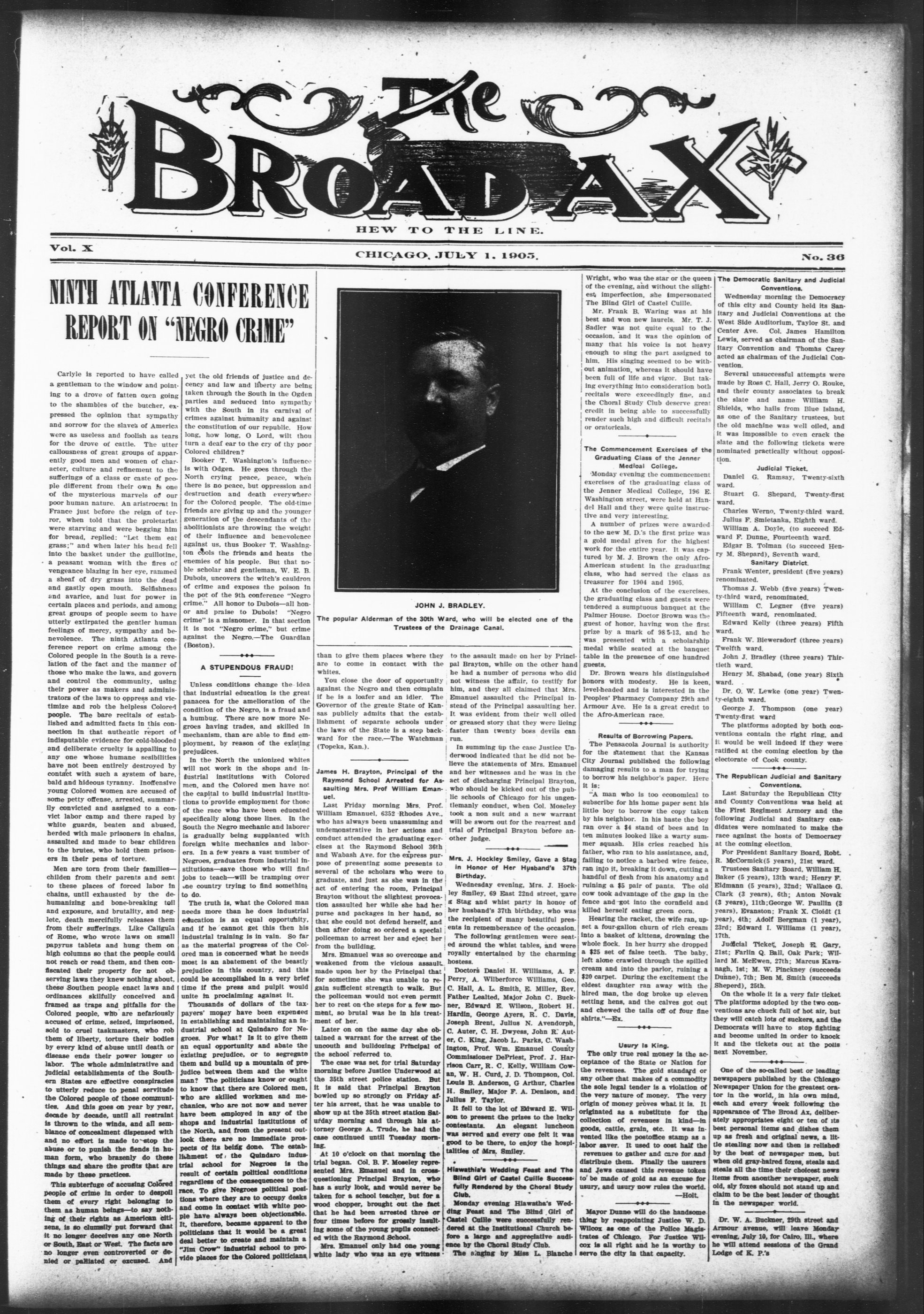
JOHN J. BRADLEY. The popular Alderman of the 30th Ward, who will be elected one of the Trustees of the Drainage Canal.
The popular Alderman of the 30th Ward, who will be elected one of the Trustees of the Drainage Canal.
than to give them places where they are to come in contact with the whites. You close the door of opportunity against the Negro and then complain if he is a loafer and an idler. The Governor of the greater State of Kansas publicly admits that the establishment of separate schools under the laws of the State is a step backward for the race.—The Watchman (Topeka, Kan.)
James H. Brayton, Principal of the Raymond School Arrested for Assaulting Mrs. Prof William Emanuel.
Last Friday morning Mrs. Prof. William Emanuel, 6352 Rhodes Ave., who has always been unassuming and undemonstrative in her actions and conduct attended the graduating exercises at the Raymond School 36th and Wabash Ave. for the express purpose of presenting some presents to several of the scholars who were to graduate, and just as she was in the act of entering the room, Principal Brayton without the slightest provocation assaulted her while she had her purse and packages in her hand, so that she could not defend herself, and then after doing so ordered a special policeman to arrest her and eject her from the building.
Mrs. Emanuel was so overcome and weakened from the vicious assault made upon her by the Principal that for sometime she was unable to regain sufficient strength to walk. But the policeman would not even permit her to rest on the steps for a few moment, so brutal was he in his treatment of her.
Later on on the same day she obtained a warrant for the arrest of the uncoach and bulldozer Principal of the school referred to.
The case was set for trial Saturday morning before Justice Underwood at the 35th street police station. But it is said that Principal Brayton bowled up so strongly on Friday after his arrest, that he was unable to show up at the 35th street station Saturday morning and through his attorney George A. Trude, he had the case continued until Tuesday morning.
At 10 o'clock on that morning the trial began. Col. B. F. Moseley represented Mrs. Emanuel and in crossquestioning Principal Brayton, who has a surly look, and would never be taken for a school teacher, but for a wood chopper, brought out the fact that he had been arrested three or four times before for grossly insulted with the Raymond School.
Mrs. Emanuel only had one young white lady who was an eye witness
---
to the assault made on her by Principal Brayton, while on the other hand he had a number of persons who did not witness the affair, to testify for him, and they all claimed that Mrs. Emanuel assaulted the Principal instead of the Principal assaulting her. It was evident from their well oiled or greased story that they were lieing faster than twenty boss devils can run. In summing tip the case Justice Underwood indicated that he did not believe the statements of Mrs. Emanuel and her witnesses and he was in the act of discharging Principal Brayton, who should be kicked out of the public schools of Chicago for his ungentlemanly conduct, when Col. Moseley took a non suit and a new warrant will be sworn out for the rearrest and trial of Principal Brayton before another judge.
Mrs. J. Hockley Smiley, Gave a Stag in Honor of Her Husband's 37th Birthday.
Wednesday evening, Mrs. J. Hockley Smiley, 69 East 22nd street, gave a Stag and whist party in honor of her husband's 37th birthday, who was the recipient of many beautiful presents in rememberance of the occasion. The following gentlemen were seated around the whist tables, and were royally entertained by the charming hostess.
Doctors Daniel H. Williams, A. F. Perry, A. Wilberforce Williams, Geo. C. Hall, A. L. Smith, E. Miller, Rev. Father Lealted, Major John C. Buckner, Edward E. Wilson, Robert H. Hardin, George Ayers, R. C. Davis, Joseph Brent, Julius N. Avendorph, C. Auter, C. H. Dwyess, John R. Auter, C. King, Jacob L. Parks, C. Washington, Prof. Wm. Emanuel County Commissioner DePriest, Prof. J. Harrison Carr, R. C. Kelly, William Cowan, W. H. Curd, J. D. Thompson, Col. Louis B. Anderson, G Arthur, Charles H. Smiley, Major F. A. Denison, and Julius F. Taylor.
It fell to the lot of Edward E. Wilson to present the prizes to the lucky contestants. An elegant luncheon was served and every one felt it was good to be there, to enjoy the hospitalities of Mrs. Smiley.
Hlawathia's Wedding Feast and The Blind Girl of Castel Cuilie Successfully Rendered by the Choral Study Club.
Monday evening Hlawatha's Wedding Feast and The Blind Girl of Castel Cuilie were successfully rendered at the Institutional Church before a large and appreciative audience by the Choral Study Club.
The singing by Miss L. Blanche
Wright, who was the star or the queen of the evening, and without the slightest imperfection, she impersonated The Blind Girl of Castel Cullie.
Mr. Frank B. Waring was at his best and won new laurels. Mr. T. J. Sadler was not quite equal to the occasion, and it was the opinion of many that his voice is not heavy enough to sing the part assigned to him. His singing seemed to be without animation, whereas it should have been full of life and vigor. But taking everything into consideration both recitals were exceedingly fine, and the Choral Study Club deserve great credit in being able to successfully render such high and difficult recitals or oratoricals.
The Commencement Exercises of the Graduating Class of the Jenner Medical College.
Monday evening the commencement exercises of the graduating class of the Jenner Medical College, 196 E Washington street, were held at Handel Hall and they were quite instructive and very interesting.
A number of prizes were awarded to the new M. D.'s the first prize was a gold medal given for the highest work for the entire year. It was captured by M. J. Brown the only Afro-American student in the graduating class, who had served the class as treasurer for 1904 and 1905.
At the conclusion of the exercises, the graduating class and guests were tendered a sumptuous banquet at the Palmer House. Doctor Brown was the guest of honor, having won the first prize by a mark of 985-13, and he was presented with a scholarship medal while seated at the banquet table in the presence of one hundred guests.
Dr. Brown wears his distinguished honors with modesty. He is keen, level-headed and is interested in the Peoples' Pharmacy Company 29th and Armour Ave. He is a great credit to the Afro-American race.
Results of Borrowing Papers
The Pensacola Journal is authority for the statement that the Kansas City Journal published the following damaging results to a man for trying to borrow his neighbor's paper. Here it is:
"A man who is too economical to subscribe for his home paper sent his little boy to borrow the copy taken by his neighbor. In his haste the boy ran over a $4 stand of bees and in ten minutes looked like a warty summer squash. His cries reached his father, who ran to his assistance, and, falling to notice a barbed wire fence, ran into it, breaking it down, cutting a handful of flesh from his anatomy and ruining a $5 pair of pants. The old cow took advantage of the gap in the fence and got into the cornfield and killed herself eating green corn.
Hearing the racket, the wife ran, upset a four-gallon churn of rich cream into a basket of kittens, drowning the whole flock. In her hurry she dropped a $25 set of false teeth. The baby, left alone crawled through the spilled cream and into the parlor, ruining a $20 carpet. During the excitement the eldest daughter ran away with the hired man, the dog broke up eleven setting hens, and the calves got out and chewed the tails off of four fine shirts."—Ex.
Usury Is King.
The only true real money is the acceptance of the State or Nation for the revenues. The gold standard or any other that makes of a commodity the sole legal tender is a violation of the very nature of money. The very origin of money proves what it is. It originated as a substitute for the collection of revenues in kind—in goods, cattle, grain, etc. It was invented like the postoffice stamp as a labor saver. It used to cost half the revenues to gather and care for and distribute them. Finally the usurers and Jews caused this revenue token to be made of gold as an excuse for usury, and usury now rules the world.
—Holt.
Mayor Dunne will do the handsome thing by reappointing Justice W. D. Wilcox as one of the Police Magistrates of Chicago. For Justice Wilcox is all right and he is worthy to serve the city in that capacity.
The Democratic Sanitary and Judicial Conventions.
Wednesday morning the Democracy of this city and County held its Sanitary and Judicial Conventions at the West Side Auditorium, Taylor St. and Center Ave. Col. James Hamilton Lewis, served as chairman of the Sanitary Convention and Thomas Carey acted as chairman of the Judicial Convention.
Several unsuccessful attempts were made by Ross C. Hall, Jerry O. Rouke, and their county associates to break the slate and name William H. Shields, who halls from Blue Island, as one of the Sanitary trustees, but the old machine was well oiled, and it was impossible to even crack the slate and the following tickets were nominated practically without opposition.
Judicial Ticket
Daniel G. Ramsay, Twenty-sixth ward.
Stuart G. Shepard, Twenty-first ward.
Charles Werno, Twenty-third ward.
Julius F. Smietanka, Eighth ward.
William A. Doyle, (to succeed Edward F. Dunne, Fourteenth ward.
Edgar B. Tolman (to succeed Henry M. Shepard), Seventh ward.
Sanitary District.
Frank Wenter, president (five years) renominated.
Thomas J. Webb (five years) Twenty-third ward, renominated.
William C. Legner (five years) Fifteenth ward, renominated.
Edward Kelly (three years) Fifth ward.
Frank W. Biewersdorf (three years) Twelfth ward.
John J. Bradley (three years) Thirtieth ward.
Henry M. Shabad, (one year) Sixth ward.
Dr. O. W. Lewke (one year) Twenty-eighth ward.
George J. Thompson (one year) Twenty-first ward
The platforms adopted by both conventions contain the right ring, and it would be well indeed if they were ratified at the coming election by the electorate of Cook county.
The Republican Judicial and Sanitary Conventions.
Last Saturday the Republican City and County Conventions was held at the First Regiment Armory and the following Judicial and Sanitary candidates were nominated to make the race against the hosts of Democracy at the coming election.
For President Sanitary Board, Robt. R. McCormick (5 years), 21st ward.
Trustees Sanitary Board, William H. Baker (5 years), 13th ward; Henry F. Eldmann (5 years), 32nd; Wallace G. Clark (3 years), 6th; Anton Novak (3 years), 11th; George W. Paullin (3 years), Evanston; Frank X. Cloidt (1 year), 4th; Adolf Bergman (1 year), 23rd; Edward I. Williams (1 year), 17th.
Judicial Ticket, Joseph E. Gary, 21st; Farlin Q. Ball, Oak Park; Willard M. McEwen, 27th; Marcus Kavanagh, 1st; M. W. Pinckney (succeeds Dunne), 7th; Ben M. Smith (succeeds Sheperd), 25th.
On the whole it is a very fair ticket The platforms adopted by the two conventions are chuck full of hot air, but they will catch lots of suckers, and the Democrats will have to stop fighting and become united in order to knock it and the tickets out at the polls next November.
---
One of the so-called best or leading newspapers published by the Chicago Newspaper Union for the greatest orator in the world, in his own mind, each and every week following the appearance of The Broad Ax, deliberately appropriates eight or ten of its best personal items and dishes them up as fresh and original news, a little stealing now and then is relished by the best of newspaper men, but when old gray-haired foxes, steals and steals all the time their choicest news items from another newspaper, such old, sly foxes should not stand up and claim to be the best leader of thought in the newspaper world.
Dr. W. A. Buckner, 29th street and Armour avenue, will leave Monday evening, July 10, for Cairo, Ill., where he will attend sessions of the Grand Lodge of K. P.'s
---
THE BROAD AX.
Will promulgate and at all times uphold the true principles of Democracy, but Catholic, Protestant, Roman Catholic, and Anglican. Knights of Labor, or any one else can have their say, so long as their language is proper and responsibility is fixed.
The Broad Ax is a newspaper whose platform is broad enough for all, ever claiming the editorial right to speak its own mind.
Local communication must receive attention.
Write only on one side of the paper.
Subscriptions must be paid in advance.
One Year.....$2.00
Six Months.....1.00
Advertising rates made known on application.
THE BROAD AX
800 Armour Avenue, G
JULIUS F. TAYLOR, Editor and Publisher.
Entered at the Post Office at Chicago,
M., as Second-class Matter.
Mayor Dunne Re-Appoints Chief
O'Neill, the Majority of the Police
Magistrates Retained in office.
Justice John Richardson Succeeds
Justice Underwood at the 35th St.
Police Station.
Mayor Dunne, at the meeting of the
City Council Monday evening, to the
delight of' the vast majority of the
citizens of Chicago, re-appointed
Francis O'Neill Chief of Police, at
the same time selecting the following
Police Magistrates and City officials:
It was a wise act on the part of Mayor Dunne to "can" Justice Underwood, at the 35th Street Police Station, and to name Justice John Richardson to serve in his stead for he is full of honest convictions, while on the other hand Justice Underwood is a cold-blooded trimmer.
St. Thomas.
On last Sunday after the 7:30 mass which was plain Father Lealted sang the morning prayer. Baptized two persons and preached an interesting sermon on Dives the rich man and Lazarus the poor afflicted one, being from the lesson for the day the first Sunday after Trinity. Mr. F. B. Waring sang for the offeratory, "I heard the voice of Jesus say". Vespers was sung at 8 p. m. and again the sacrament of baptism was administered.
On next Sunday there will be two celebrations of the blessed sacrament 7:30 and 11 a. m.
CALENDAR FOR WEEK.
July 2—Visitation of Blessed Virgin Mary. Second Sunday after Trinity green.
July 4th—Trans. of St. Martin, A. D.473.
July 7th—Friday—Fast
CHIPS
If you pray less and pay more, the people might form a different opinion of you.—Ex.
Dr. Daniel H. Williams was in Baltimore, Md., and Washington, D.C., last week on biz
Several young colored men are employed as motormen by the street railway company in Cleveland, O.
Henry Leon Smith, of Lockport, N. Y., is the only colored pharmacist in the State of New York.
Mr. and Mrs. Arthur Woodward are now residing in Highland Park, where they expect to remain all summer.
Jackson Gordon, who is connected with the Board of Assessors, left last night for Springfield, Ill., with the Second Regiment.
Miss Virginia Lively and Miss Lilian Granberry, 3144 Indiana Ave., are
.
among the many graduates who acquitted, themselves so creditably throughout the school term just ended.
Out of the seven mail carriers at Muskogee, I. T., six are colored. The one substitute is also colored.
Mrs. J. Hockley Smiley is keeping two dressmakers busy preparing her elaborate wardrobe for he eastern tip this summer.
Rev. Jordon Chavis, pastor of Her man Baptist Church, 759 N. Clark st. is in the midst of a $1,000 rally which starts on Sunday.
B. H. Johnson, 4846 Armour ave. returned home Tuesday morning from Hot Springs, Ark, and he has entirely regained his health.
N. A. Harbin the head Afro-American Republican politician in the 31st ward, has removed from 6221 Loomis St., to 6153 Ada St.
John G. Jones, the greatest Afro-American Mason in the world, is a candidate for Recorder of Deeds for the District of Columbia.
Mr. Clarence M. Auter of the Harvey Medical College is among the graduates this year. "Dr. Auter" is the proper address now.
Mr. David Manson has returned from a week's vacation in Cleveland, where he enjoyed his leisure hours with his mother and sisters.
Rumor has it that Wm. Clark is married to a wealthy North Side widow. Mr. Clark firmly denies the rumor, and adds—"I wish it were so."
There are twenty colored compositors at the Government Printing office in Washington, all of whom learned their trade in Negro printing offices.
Mrs. Nelson Williams, 4838 Armour ave., leaves tomorrow afternoon for New Yok City, where she will spend two months in visiting with relatives and friends.
Mrs. Jessie Johnson, 4857 Armour Ave., left with her two sons, Fenton and Albert, yesterday morning for Glencoe, Ill., where they will spend their vacation.
Miss Cecelia Johnson, 5050 Wabash Ave., was awarded a teacher's certificate at the graduating exercises of the Chicago Conservatory of Music Thursday evening.
Mr and Mrs. Samuel Thompson and family will leave Chicago for their summer vacation in Atlantic City and other eastern points about the middle of August
Mrs. Virginia Green, of 4762 Dearborn St., left last evening for Missouri Valley, Iowa, where she will commence her six weeks' engagement with the Iowa Chautauqua.
Booker T. Washington has been to the White House again. He might save time and railroad fares by boarding there regularly.-Boston Globe, Monday, June 19, 1905, Nuf sed.
A man who favors putting upon the statute book a law which compels him, because of the color of his skin, to do that which is not required of other citizens is worse than a traitor. —Ex.
The annual picnic by the Young Men's Club of the St. Thomas Episcopal Church, at Rasches' Grove Tuesday afternoon and evening was well attended in spite of the very cold weather.
Miss Bride one of the trained nurses was united in wedlock Wednesday evening to Mr. Virgil Mackey, a prosperous young merchant tailor. They will reside at 3714 Dearborn St., after July 5th.
Attorney W. W. Johnson, 167 Dearborn St., is working up a nice business in the commercial law, and lately he has successfully conducted bankruptcy cases in the courts for some of the leading merchants in this city, and in other sections of the United States.
Mrs. Dr. W. A Buckner expects to start this coming Monday evening on a trip through Oregon, Southern California and New Mexico. She will take in the sights of the Exposition now being held at Portland and she will spend next winter on her ranch in New Mexico.
The idiot who orders his paper stopped because it says something that he doesn't like would be willing to believe that the sun had ceased to shine because he had seen fit to close his eyes. Eternal truth is not silenced because some fool refuses to be pleased with it.—Ex.
Mrs. Hattie Kyle, 4918 Dearborn St., who is still young and very beautiful, separated from her husband sometime ago, and on last Monday she went to the Washington Park Club to see him while in conversation with him she became exceedingly wryth, and she drew a gun and took a shot at his head, but her aim being bad she missed him, and she was finally ar-
rested and locked up at the Hyde Park police station.
Wednesday evening, Miss Lillian J. Bridgman and William Daney were united in marriage by Rev. Jordon Chavis at the home of Mrs. George W. Ducker, 132 Siegel street. The newly married couple received many handsome presents. They will spend their honeymoon in Denver, Colo.
Graeme Stewart, one of the most prominent business men and influential and leading Republican politicians passed away at his home, 181 Lincoln Park Blvd., early Tuesday morning. Comparatively speaking, Mr. Stewart was still a young man and his death is a great loss to this city.
Mrs. Robert H. Hardin and Mrs. Joseph Brent, quietly slipped into the home of Mrs. Smiley's Wednesday evening, and being stored away in one of the bed-rooms on the second floor, their husbands and the other gentlemen were not aware of their presence until after the stag and whist games were concluded.
Mrs. Adams, mother of Mr. Jas, Neusome, 430 E. 30th St., departed this life suddenly on the morning of the 24th. Mrs. Adams was one of Chicago's old landmarks a member of Grace Presbyterian Church, and a much loved woman by the many who knew her. The funeral took place from Grace Church Monday, the 26th. Rey Moses Jackson officiating.
---
Bright Boys and Girls Wanted to Sell
The Broad Ax.
Bright boys and girls can make money in every community by selling The Broad Ax. It will cost you nothing to begin, as we will send you a supply of papers for the first week free.
If there are any bright boys and girls in any section of the country who want to start in business for themselves, make money and be independent, write to us at once, and we will send you ten papers free of charge. You can sell them for 5 cts. each, this will give you the capital which you can buy more papers at the newsdealers' rate, allowing you a good profit.
Thinking and progressive people read The Broad Ax. Your father, brothers, uncles and friends will buy the paper from you. If you mean business write to Julius F. Taylor, 5040 Armour ave.
Furnished Rooms to Rent.
Nearly furnished rooms, all modern improvements, to rent to single ladies and gentlemen or married couples. Mrs. Malline Vaneer. 2806 Wabash Ave.. 'phone 5354 Calumet.
ROOM TO RENT.
A large furnished room to rent, suitable for two gentlemen 3144 Forest Ave.
LADY AGENTS WANTED!
To Solicit For a Toilet Preparation in Connection With The Broad Ax.
Two or three live, active and wide-awake lady agents, either white or colored, wanted to solicit for a high class Toilet Preparation in connection with The Broad Ax. If you mean business, call or address Julius F. Taylor, 5040 Armour avenue, Chicago.
AGENTS AND CORRESPONDENTS WANTED.
The Broad Ax desires to engage Agents and regular Correspondents in all the leading cities and towns throughout the country. The highest commissions paid to live hustlers. Sample copies furnished free, For further information, address Julius F. Taylor, 5044 Armour avenue, Chicago.
SUMMER TIME IN ALASKA.
The Days Are So Long That There Is No Time in Which
"When I tell my friends that in Alaska during the months of June, July and August we have almost continual sunlight and that it never gets dark in the summer months they invariably ask when we sleep," said F. A. Cross, a merchant from Council, Alaska, reports the Portland Oregonian.
"Well, we sleep whenever we have the opportunity. Very few of us have a regular time for going to bed and arising, except the miners, who work on shifts and have to be more methodical.
"In the winter there is practically nothing doing, and the few people who stay there can sleep all they desire. But when spring opens up business flourishes. Every one has to work all he possibly can, because the summer is very short and a great deal has to be accomplished to make up for the stagnation during the winter months.
"The verdure and brush grow with a rapidity that is astonishing in the warm months. Plants grow so rapidly that we can raise berries and the hardier vegetables before frost sets in."
Where Praver Fails
You cannot prevent the pieces from flying by praying over the boiler.—Chicago Tribune.
SAY BRIDE CLINGS TO VEIL
Artists Declare Newly Married Woman Loves Her Costume and Always Wears It.
Artists say that only on rare occasions will a bride take her veil from her head and lay it aside when she is photographed. They assert that probably once in a hundred times will such a thing happen, for they want the veil to show up prominently in the photograph.
H. W. Mills, of Wheaton, Ill., says a bride and groom came into his studio the other day, and he was surprised to see the bride remove her veil and, with the flowers she carried, arrange it on a table. Then she drew the table close beside her and told the artist she was ready.
Nothing will tempt a bride to part with a veil that she has once had photographed as a part of her wedding dress. In Du Page county, Illinois, a singular custom regarding the preservation of the veil prevails. A large, box-like frame is constructed and a cabinet portrait is placed in the center of the background. Then the veil is neatly arranged around the picture, and the outer edge of the frame is entwined with artificial flowers to represent the ones that the bride held or wore when she was married.
Such frames adorn hundreds of walls in Du Page county farms and other homes. A wedding frame will occupy one part of the wall, and another frame will hold the silver nameplate that has been taken from the coffin of some member of the family of either the groom or bride.
TIE IN BRITISH COMMONS
An Unusual Occurrence in This Famous Body—Has Happened Three Times in a Century.
London journalists were reminded of an interesting bit of political history by a recent incident at the British house of commons. A division in the house upon a question relating to London street railways resulted in a tie—171 members on each side. Thereupon the speaker gave the casting vote in the negative. A tie in the house of commons is unusual, for this was the first time in many years that one had occurred. The last important division previously that called for the vote of the speaker took place in 1861. But just a century ago, in April, 1805, a resolution aimed at Lord Melville, a leading member of the cabinet, receive 216 votes, and an equal number was given in opposition. The speaker gave the casting vote in favor of the resolution. In consequence of this vote, Lord Melville was impeached the next year, 1806. He was accused of appropriating public funds, but was finally acquitted. He was a great friend of Mr. Pitt, the prime minister, who did his utmost to protec him, and who was greatly grieved at the vote of the speaker.
WEAK CAN BEAR PAIN BEST
Physical Power Not Always Best in Severe Operations, Declares Famous Surgeon.
Dr. J. P. Lockart Mummery, the famous British surgeon, says it is often extremely difficult to estimate the condition of a patient with regard to his power of standing a severe operation. Often a weakly looking individual, who looks as if he would not stand a severe operation well, stands it quite well, and vice versa.
This is accounted for by the fact that a person of poor physique who leads a strenuous life has often much more highly developed nerve centers than one of robust physique who leads a life of ease and indulence, which makes but slight calls upon his nerve centers for great or sudden activity.
The mental condition of a patient prior to operation has a considerable influence upon the development of shock. Patients who dread an operation and who are in a state of considerable mental anxiety before the anaesthetic is administered are more liable, other things being equal, to develop shock than those whose mental equilibrium is undisturbed.
Color Treatment of Disease.
In long experimenting with grass solutions; an English biologist has noticed that putrefaction does not occur in strong red or blue light, is only simulated in clear yellow, but really takes place in dirty yellow light or in darkness. He has also seen that workers behind dirty yellow screens are subject to skin eruptions. This has suggested to him the novel idea of color treatment of disease, a dirty yellow of the skin being assumed to indicate a degeneration of the yellow fluids of the body—the bile, etc—and to require a yellow restorative, like dandelion, lemon or sulphur, while lack of healthful redness shows the need of a red tonic and massage with a red stone. Blue is needed for "black blood," congestion, chills and to destroy mold fungus.
She Was It
Miss Gaddie—Your brother and I were partners in a little game of whist at Hoyle's house last evening.
Miss Knox—Oh! I thought it might be you.
Miss Gaddie—Why? What did he tell you about it?
Miss Knox—He just said he had had a rubber at twist.—Philadelphia Press.
An Obligation.
"Do you think that we are descended from monkeys?" asked the off-hand scientist.
"I am not worried about that," answered Miss Cayenne. "What we should do is to prevent our own posterity from feeling that war."—Washington Star.
WASHINGTON LETTER
PRESIDENT HAS REGULAR BOUT-
INE OF WORK IN SUMMER.
HIS INFORMAL HOSPITALITY
Joint Army and Navy Board May
Favor Submerged Mines—President Real Commander-in-
Chief Army and Navy.
WASHINGTON.—President Roosevelt in his summer home at Oyster Bay is not an idle man. He performs virtually the same routine duties there that he does in the executive offices here in Washington. When he leaves this city
W
he does not leave behind him the cares of office nor does he lay aside consideration of the great questions that demand his attention. In one way he gets relief at Oyster Bay, and that is the restriction there naturally is upon the number of his daily callers. The executive offices are located in the village of Oyster Bay, some two or three miles away from the president's own home. In those offices Secretary Loeb conducts the routine business, and occasionally the president calls and looks over some papers, but most of the business is carried by the secretary to Sagamore Hill, where the president can attend to it untroubled by persistent visitors.
This will be a very busy season with Mr. Roosevelt, and he will have many questions to determine before congress meets. At his country home he will take up the study of the tariff and reach a decision as to whether he will recommend that congress undertake a remodeling of the schedules. In the comfortable quarters of his summer residence he will meet such men as Senator Aldrich, Senator Burrows, Senator Allison, Congressman Payne, and others who are admittedly experts on this question, and will confer with them upon the tariff. Between his holiday diversions the president<sup>e</sup> will give attention to the railway rate question. It is not unlikely that from the humble village of Oyster Bay will also issue orders and decisions that will have an important bearing upon international affairs.
With all the time he will devote to public matters, however, the president will still be able to enjoy a vacation and the outdoor pastimes of which he is so fond. His home at Sagamore Hill offers full facilities for such indulgences.
At Sagamore Hill.
T
HE Roosevelt boys
welcome t h e
change from Washington to Oyster Bay and Sagamore Hill. It means to them still closer companionship with their father, and, as they all inherit his love of nature and outdoor life, there
will be many happy experiences during the present summer. One favorite pastime for the president and his four boys is to go off to the woods or along the bay shore, away from any sign of human habitation, and have a genuine camping-out party. Simple provisions are taken along, and these, with the fish they take from the bay, affords food for the outing. The president instructs his boys how to build camps, make camp fires and cook. The latter he has to do himself if a bite properly prepared is to be had. He knows all about camp cooking, and can broil a steak or fish to a turn. His boys declare that no white house cook can approach their father in the preparation of a dinner.
At Sagmore Hill the president has all sorts of callers. It is his home, and he delights in having men from all walks of life call to see him there. The most dignified statesman and learned financier is apt to sit down to the table in the Rosevelt home with the cowboy from the west or an eccentric genius from anywhere. The president pays no attention to the outward appearance of his guests, and the flannel shirt is just as welcome as the dinner coat.
Fond of Proverba.
T
HIS city has among her citizens a perfect Solomon in the way of proverb making and quotations. Mr. Robert Christy, who is now in the "sear and yellow leaf," is famous for his collection of proverbs from the world, and with which he
every nation in for the aptness quotes them. He
quotes them. He is a lawyer by profession, but his avocation has been the study and compilation of proverbs, maxims and epigrams of all sorts. He has a system of making important and interesting passages in every book that he reads. The very important passages he marks twice, so that in a second reading he can get through very rapidly. In this way he picks out the nuggets of wisdom in the works of great authors.
Mr. Christy has already published a book of proverbs and has in manuscript a compilation of exclusively
oriental proverbs and epigrams. in discussing his hobby the other day the old gentleman said: "I have made a specialty of some subjects in which I have gathered a great number of proverbs. For instance, I have over 200 on fools and the best of this collection is, I think, 'the fool is the wise man's ladder,' then 'if wise men never erred it would go hard with the fool.' A fool should study Latin or as the Spanish say 'a fool unless he knows Latin is never a great fool.' This is a little harsh on some of us who have to know it. A fool is usually young or looks young, you know, for 'a fool's head never whitens.'
Mr. Christy has found a rich field among the Chinese and Japanese for striking proverbs and maxims. He says: "The Chinese maxims are practical and their beautiful conceptions are preserved even in the translations. The Chinese advise you to 'keep company with good men and good men you will imitate.' Another one of their proverbs is applicable to the great class questions of the day where one class is being absorbed by another. It is 'the big fish eat the little fish, the little fish eat the shrimp and the shrimp are compelled to eat mud.' The Japanese have a number of fine proverbs and maxims. The progress of that country is expressed in one of their figures of speech which goes, 'those who are opposed to the advancement of Japan are frogs in a well.'"
Coast Defense
HE authorities of the war department have studied the Russo-Japanese war with great industry, one of the objects being to observe particularly the efficiency or the inefficiency of coast defenses. A joint army and navy
HE authorities of the war department have studied the Russo-Japanese war with great industry, one of the objects being to observe particularly the efficiency or the inefficiency of coast defenses. A joint army and navy board has been convoked to revive the so-called Endicott plan for coast defense. It is believed that some of the lessons learned by our military observers in the orient will be very valuable if a remodeling of the fortifications of this country is to be made. Adequate coast defense vessels are also to be considered.
Among other things that have been under consideration by the joint army and navy board, is the proposition to do away with the submerged mine as a means of harbor defense and to substitute for it the newest submarine boat. This suggestion has been made by the naval members of the board, but no decision has been reached. The army members will probably insist that the submerged mine be retained. The experience off Port Arthur and in the battle of the Sea of Japan it is argued teaches the virtue of this old style of defense.
The army officers contend that the submarine boat is still in an experimental stage, despite the report that it did good execution in the last fight between the Russian and Japanese fleets. They believe that the final report of that engagement will show that much of the destruction attributed to submarine boat operations was effected by floating mines skillfully placed by Admiral Togo. While the submarine boat is likely to occupy a prominent and an increasingly important place in the plans of the coast defense, it is probable that the joint board will decide in favor of the submerged mine. There mines may be placed in certain and known positions, which may be avoided by the home fleet, and which may be controlled by the observers on shore.
President's Study of Navy.
S PRESIDENT, Mr. Rooveel is commander in chief of the army and navy. This is not an empty title with him. He is the head of these branches of the government service in fact as well as in name. The versatility with
A
which the president discusses naval and military matters in the minuteest detail is a matter of wonder to the experts in both services. It is not more wonderful, however, than the thoroughness with which he masters questions in every department of the government. His recent conduct of state affairs without the intervention of the secretary of state is one of the surprises of his administration. He entered upon the delicate peace negotiations between Russia and Japan with the assurance and tact of an old trained diplomat
In all his varied lines of public activity, Mr. Roosevelt probably takes more interest and delight in naval affairs than in anything else. He has written a history of the navy, knows its traditions, and is acquainted with its development, from the old wood-fridge to the modern battleship as well as any of the most experienced naval officers. His study of the navy has borne practical fruit, and his theories put into use have made the United States navy the most effective in the world. The principal of these theories is that the man behind the gun is the main dependence in a naval conflict. While assistant secretary of the navy he insisted that the men must be taught how to shoot, and that government money could be expended in no better way than in purchasing powder and shells for target practices. The system of target practice that he inaugurated enabled the American gunners to win the great naval victories in the war with Spain.
MODEST TROUSSEAUS
THE CLOTHES AND LINEN THAT ARE REALLY NEEDFUL.
White Mualin Makes Attractive Dress for Summer Bride—Brides Usually Prettier Without Vells—Married in Her "Going Away" Gown—Multiplying Gowns Which Will Only Grow Old-Fashioned—Underclothing Hand-Made or Ready-Made—Advantages of Bride Who Does Her Own Work.
BY MARGARET E. SANGSTER.
(Copyright, 1906, by Joseph B. Bowles.)
(Copyright, 1905, by Joseph B. Bowley). Polly, bless her dear heart, is getting ready to be married. It will be the first wedding in the family, and the family current sets strongly and swiftly toward the happy event. Naturally Polly, her mother and her sisters are much occupied over the trouseau. "Spare no expense," says the father, whose pride in this dear girl knows no bounds.
Notwithstanding this liberal carte blanche on his part, the mother is aware that too lavish outlay now will mean a reckoning day hereafter, with most undesirable pinching and skimping. Still, the family is a unit, as to the necessity that Polly shall have a creditable outfit, and her brothers and sisters are not reluctant to practice economy that she may have everything she needs.
What does an intending bride really need? This is a closer inquiry than it would be were it differently worded. We are not considering what an intending bride may wish. There is a wide distance between need and want. Poll: if she is as we suppose a sensible American girl, with a wise head on her shoulders, means to conform to her circumstances with perfect contentment. She is going to marry a young fellow whose home is in a small inland town, whose business prospects are good, and whose habits are steady. As yet, he is only living on a salary which warrants him in setting up a simple home, but which leaves no margin for display. Looking forward with brave hearts to their blended future, John and Polly are dwelling in one of those charming dreams that come true for self-respecting young people like themselves.
Put the emphasis on the adjective. The younger they are, the more years they will have to be happy together, the more courage and enthusiasm they will have, the more spontaneity of enjoyment. The rose-colored days are before them in which to climb the hill together.
---
To return to the trousseau, let us take the gowns first, though they are not the most important. They are, rather, the most conspicuous. A summer bride should, if possible, be married in white, and in white attire there is a great variety of fabrics from which to choose. A bride looks as lovely in white muslin, white wool or white net, as in brocade, silk or satin, and her white wedding gown, of whatever material it be fashioned, will furnish her prettiest evening dress for any occasion which may arise during the next year or two.
A bride need not wear a veil unless she chooses. If she does choose, it may be of inexpensive net, and will then be as becoming as if it were point lace. Bridal veils are heirlooms in some families. A girl likes to be married in a veil that her mother and her grandmother wore on their respective wedding days. Vells are, however, not in themselves especially attractive adjuncts. A girl usually looks prettier without one.
Some brides prefer to be married in what is now called the going away gown. We used to call it the traveling dress. When this is chosen, the bride who, like Polly, must study economy, will select a soft gray or brown stuff, which will serve later for church or visiting, or an afternoon reception. It must include a skirt, jacket and waist, should be tailor-made and very smart in every detail. To relieve and save this costume, a short black walking skirt and a jacket of either black or covert cloth are desirable for second best. The bride should have one black silk of etamine gown, beautifully made, in her trousseau as this will be suitable for functions of every kind, both in winter and summer. If in addition to this, she can have a simple gown of gray volle she will be beautifully fitted out. One or two pique or linen skirts, a supply of cotton shirt waists sufficient to enable the wearer to be always fresh, cool and dainty in appearance, and two or three print or gingham frocks for working about the house, are requisite. If Polly can manage it, she should have a raincoat and a golf cap, and she will need two hats—one for best and one for every day. Of course, there are brides and brides; some will get on with much less than the bride which I have indicated. Others will provide much more, but for many reasons a too elaborate trousseau is a great mistake. There is no sense or use in multiplying gowns which only grow old-fashioned.
For underclothing, let Polly provide a half dozen of each piece. It is well to have the underclothing made at home, and very fastidious brides like it made by hand. But it may be bought ready-made in the shops and be quite as satisfactory. Stockings, shoes, gloves and handkerchiefs, belts and stocks are to be considered as the finishings of the bride's wearing apparel. As Polly will supply the household linen, she must consider how many beds she will have and think over the requisites for her table. If her mother is of a provident turn, the household
linen was ready some little time ago. Two pairs of sheets and four pairs of pillow slips must be allowed for each bed, but as company or illness make extra demands on the linen closet, it is best not to be thus limited. To have as many sheets and pillow slips as one can afford, is the best rule. They need not actually be of linen, which is a term used by courtesy. Linen sheets are very nice, but fine cotton ones answer every purpose, and are preferred by many people. Four dozen towels inclusive of those for hands, face and bath are not too many. Beside these, there must be three dozen of different kinds of towels for kitchen use. Blankets, comfortables and spreads are also provided by the bride.
Polly's girl friends sometimes get together before the wedding and give her a linen shower. Nothing in the line of dainty linen comes amiss at such a time, and it is much better for a group of friends to combine and thus fully furnish a linen chest, than to scatter their gifts over many costly articles of ornament that give a passing pleasure, or are of little use. Exquisite center pieces and dolls, tray cloths, carving cloths and luncheon cloths, napkins of different sizes and everything that belongs to delicate napery fill a bride's heart with pleasure. Polly's trousseau should have only sweet thoughts associated with it. It is the most beautiful time of her young life.
Let us hope that our bride will for awhile do her own work. Unless she does, it is likely that her beautiful linens and dainty underclothing will suffer many things at the hands of incompetent and careless women, who work devastation when fine linen comes to the wash board and the tub. If Polly is going to employ a maid, let us hope that she will begin by being mistress in her kitchen. A girl who is about to marry should not let her color fade or her health wane over her trouseau. But she will do well to learn some of those simple arts of housekeeping which save money and bring comfort in the new home. No matter how rich she may be, her personal supervision will be needful, and if she is comfortably poor, she will have the greater independence.
HANDKERCHIEF BORDER.
Real Lace Is Expensive to Buy, But Can Be Made at Home by One That Has Some Skill.
Exactly half one side is shown from the top to the lower edge of this illustration. Good Brussels net is used for the foundation, the design being worked out in muslin and Honiton braids. The braid must be very neat
2
HONITON LACE.
ly sewn down to the net with cotton
No. 100, the lace, stitches being
worked with thread No. 70.
Materials required for the complete
border: A square of net. $ \frac{1}{2} $ yard
Honiton braid, 4 yards point braid, 2
yards purl edge, 2 skeins thread Nos.
100 and 70.
Avoid Stiffness.
Beware of allowing your joints to grow stiff. Take enough exercise outside of housework to keep yourself supple, or take such pains to move lightly about the house that the suppleness will last without other aid. In bending or rising do not allow yourself to feel or appear stiff. If your work is really so hard that you go to bed aching, get some one to rub you, and if this is impossible, rub yourself. This is less restful, but it is, nevertheless, of some use. Pour out a little alcohol into the palm of the hand, then rub briskly, repeating until the skin glows. Finish with the flesh brush, and go to bed with the determination to sleep—or rather, that sleep will come of itself, for this is a more restful wood.
A Cure for Colds.
Here is a cure for colds of any kind. It has been tested repeatedly and has never failed, and as I used to catch cold, which resulted in a bad attack of bronchitis, I can speak from experience, says a writer in the Woman's Home Companion. In cases of pneumonia it will not fail to cure if taken in time. Make a ball of cotton batting about the size of a small marble, saturation it well with alcohol, then drop on to it six drops of chloroform; cover it lightly with a thin piece of cotton batting, hold to the mouth, and inhale the fumes, inflating the lungs well. It will open and expand every lung cell instantly.
A. Harsh Skin.
A dry, harsh skin needs a cold cream and almond oil. If the skin is red and chapped leave all creams alone and first apply a paste of almond meal mixed with oil.
In High Favor.
Black velvet cuffs and collars distinguish some of the smartest white linen coats.
Butler Gives Reason Why Wealthy People's Servants Go the Wrong Road.
"You see, air," began the old butler, according to Everybody's Magazine, "my son took service with Mr. Lingard. As honest and well-meaning a young man he was as ever lived when he started, and that's why I want to speak out now and tell you gentlefolks that it ain't altogether a servant's fault when he goes wrong. You don't mean it, but you're careless in your talk, and it's all heard and repeated and set store in a way you'd hardly believe. Your fathers and mothers, gentlemen and ladies, they were different, and looked after their servants and their houses different. But you don't care what we are like if things run smooth and give you no trouble. The tradesmen, maybe, bid to the butler and cook for your custom, and the higher the bills are the better it is for them both, and half the time you don't take no notice, and it gets kind of easy to pick up things in little ways. Everybody's too rich and too reckless and that's the whole trouble. What do these young men that's waiting on the table hear talked at all the time? Why, money, and how much you can do with it, and how mean you look without it. That's not just what you say, but that's how they hear it. They see extravagance all round them, and hear it talked all the time, and they go and do the same. If you boast of how much you've made playing cards and betting on the races, why they'll think it a grand thing to do, and they'll do it once too often and be caught like my poor boy. I ain't defending William, but, if you will excuse me, you stole his conscience, sir, before he stole his silver. You'll get back your property, but he'll never get back what he lost—and if you send him to prison, he—he'll come out worse than he went in. He was a good lad when he went to you, but you do keep a rather fast house, sir, and it's hard for an ignorant man to see higher than his betters. If you'd give him a chance—if you'd let him off—"
CHINA A POULTRY COUNTRY
Farmers of the Orient Handle Enormous Consignments of Eggs at One Time.
The keenest of poultry farmers is, as Mr. Chamberlain once said of himself in another connection, "a child in these matters" as compared with the poultry farmers of China. A traveler passing through the province of Chekiang a few weeks ago was struck with the enormous number of young chickens carried in the farmers' carts he met in the T'intal country. He made inquiries on the subject, and at length he was asked by a poultry farmer to go and inspect his rearing arrangements. The plant deals with 10,000 eggs at a time and the average product is 5,000 chicks. The arrangements are simple and inexpensive, but they include opportunities for the scientific examination of the eggs in the course of incubation, and it is amusing to hear that where the eggs on examination through the testing holes do not show signs of fertilization at the end of the fourth day, "they are immediately discarded to be sold cheap."
FISH BANK IS INTERESTING
Discovered Four Hundred Years Ago by Cabot, St. John's Is Base of World Industry.
St. John's is a place teeming with interest. It is over 400 years old, having been discovered by Cabot in 1497 and settled by Devon fisherfolk a few years later, since when it has been always the base for the world's greatest fishing industry, that for "cod on the bank," says P. T. McGrath, in FourTrack News. In its harbor will be found argosies from France, Spain, Portugal, New England and Nova Scotia, all engaged in reaping the harvest from the ocean, while the British industry was permanently transferred there as the colony, the oldest in the empire, became settled. Along the water front, on each side of the spacious land-locked harbor, which opens through a gap in the beetling cliffs, are stores and warehouses filled with cod, while at every wharf steamers and sailors are loading this staple commodity for transport to the markets of the world.
Grave of the "Improver."
One of the employees of a small manufacturing concern in Gotham, says the New York Sun, has a craze for taking apart new bits of machinery and seeing the "how" of their operation. As a rule, he assembles them again without much difficulty. The other day, however, he assisted in taking down a small electric motor. He overhauled it and laboriously put it together and then gravely announced that the blamed thing won't run." His employer and the rest of the force worked for the better part of the day in a vain attempt to get the motor to work, and then began to quiz the "improver," as he is known. "What did I do to it?" he replied. "I didn't do a blame thing to it but improve it. I got it all together again the first try, and saved these two pieces out of it."
His Weather Eye
"Now," said the employer, "you will have to keep your weather eye on our competitors."
"I'm afaid I can't," answered the new man. "My weather eye has been poked out by an umbrella rib."—Judge.
The Waterloo of Wealth
you have undertaken. "Yes," answered Mr. Dustin Stax, "but I haven't yet tried to give any large sums of money to a church."—Washington Star.
Fifty-First St. and Armour Ave.
RAIL YARDS: 1st St. & L. S. & M. S. Ry.
2nd St. and Armour Ave.
CHICAGO
J. W. ARMS
—DEALER IN—
Coal & Wood
Expressing and Moving to Any Part
of the city.
139 WEST FIFTY-FIRST STREET
Between Dearborn and Armour Ave.
Phone 3804 Gray
Residence 5050 Dearborn st.
Tileand Slate Hauling a Specialty. COAL
J. H. COLEMAN & CO.
Express & Van Moving
TRUNKS EVERYWHERE.
2540 State Street
Tel. 699 South CHICAGO
Peoples Pharmacy
Pure Drugs and Chemicals
Prescriptions Promptly Filled at All Hours
29th St. and Armour Av.
Phone 526 South
CHICAGO, ILLINOIS
A. B. SCHULTZ, M. D.
PHYSICIAN AND SURGEON.
2719 State Street
Hours: 9 to 12 A.M.
3 to 5 and after 6 P.M. CHICAG
WONDERFUL
DISCOVERY
Curly Hair Made Straight By
TAKEN FROM LIFE, AFTER TREATMENT
FORD'S ORIGINAL
OZONIZED OX MARROW
This wonderful hair pomade is the only safe preparation in the world that makes kinky or curly hair straight as shown above. It nourishes the scalp, prevents the hair from falling out or breaking off, cures dandruff and makes the hair grow long and silky. Sold over 45 years, and used by thousands. Warranted hair-and-breeze hair-and-breeze hair-and-breeze sold for straightening kinky hair. Beware of imitations. Remember that Ford's Original Ozonized Ox Marrow is put up only in fifty cents time, made only in Chicago and by us. The genuine has the signature CHARLES FORD, PERS't, on each package. Do not be misled by substitutes that claim to be just as good—but always insist upon the best quality. The best quality is the hair straight, soft and beautiful, giving it that healthy, life-like appearance so much desired. A toilet necessity for ladies, gentlemen and children. Elegantly perfumed. Owing to its superior and lasting qualities it is the best and most economical. It is not possible for anybody to produce a preparation equal to it. Full directions with every detail are available. All the materials and dealers, or send us 50 cents for one bottle, postpaid, or $1.40 for three bottles, express paid. We pay all postage and express charges. Send postal or express money order. Please mention name of this paper when ordering. Write your name and address plainly to OZONIZED OX MARROW CO., (None genuine without my signature)
Charles Ford Past
74 Wabash Ave., Chicago, Illinois.
Agents wanted everywhere.
THE BROAD AX.
Is for sale at the following news stands:
The Afro-American News Office,
3104 State Street.
F. L. Gale, 2642½ State street.
Cigars, Tobacco and News stand.
Mrs. Nellie Phelps, Cigars, Notions and News Stand, 131 W. 51st street.
Richard Pinn, 4836 State street.
J. C. Campbell, cigars, tobacco and fancy groceries, 4710 State street.
A. F. Tervalon's Cigar Store and News Stand, 2826 State street.
Edward Felix's Cigar Store, 368 20th street, N. E. Corner Armour Ava.
T. B. Hall's Cigar Store and Laundry office, 281 29th St.
H. T. Greenwood, newspaper and periodical distributor, 110 1-2 E. 53rd street.
Mrs. M. Burroughs, cigars, notions, news stand, 920 W. Lake street.
Mrs. Alice Jackson, 660 Carroll ave., 2nd flat.
Mrs. B. Williams, Cigars, Notions and News Stand, 486½ State street.
B. Davis, cigars, tobacco, and confectionery, 3532 State st.
The Stationery, 3870 State street.
Woodfolk and Mitchell Cigars, Tobacco and News Stand, 4902 State Street.
The Afro-American News Co., 439 W. 35th St., New York City, N. Y.
J. D. Cook & Company news stand and cigar store, 26 Juneau avenue, Milwaukee, Wis.
News items and advertisements left at these places will find their way into the columns of The Broad An.
---
-- American Brick Co. --
President and Treasurer, THOMAS CAREY. Vice-President, JOHN SHELHAMER, Secretary, WILLIAM SULLIVAN. MANUFATURERS OF Common and Sewer Brick Office and Yards:
Yards running winter and summer, equipped with the latest improved Wolf Dryer.
Output of Winter Yards ..... 14,000 per day
Output of Summer Yards..... 30,000 per day
Telephone Yards 128.
In selecting a whiskey three qualifications should be considered the age, the purity and the flavor.
Old Underoof Rye
Possesses these qualifications in a greater degree than any other whiskey CHAS. DENNEHY & COMPANY, Chicago.
Beautify Your Home
20TH
CENTURY
SOAP
TELEPHONES
HARRISON 2266
AUTOMATIC 2894
-- American
President and Treasurer, The
Vice-President, J
Secretary
MANUFAT
Common and
Office and
45th and
Yards running winter
with the latest improv
Output of Winter Yards
Output of Summer Yards.
Telephone
In selecting a wh
fications should
the age, the puri
O
Unde
Ry
Possesses these qualification
any other
CHAS. DENNEH
Chi
Striking Similarity.
Gunner—Have you noticed the large
stamps in the latest issue?
Guyer—Yes; I call them Jap stamps.
"Why so?"
"They are not easily licked."—Chicago go sun
Full Deck.
Irate Wife-That's the fifty-second
falsely you've told me this week.
Unabashed Husband—Well, now you
can see what is meant by the expression "a pack of lies."-Pittsburgh Fest
Won't It Though
California announces a 15,000,000- pound prune crop ready for shipment. It will not make much difference if next summer's strawberry crop is a failure.—Rochester Post-Express
Spanish Swordswomen
All well-educated Spanish women are taught from the earliest years to handle the sword, and as a result they are noted for their admirable figure and easy walk.
After Facta.
"How old did your sister say she is?"
"...eighteen."
"Hold old is she?"—Houston Post.
Something Easy
A good many men would be tickled almost to death for a chance to pay a large inheritance tax.
WONDERFUL GROWTH OF HAIR.
"I had typhoid fever and my hair"
"all came out. I used three bottles of"
"Ford's Original Oxonized Ox Mar"
"row, and now my hair is nine inch."
"es long and very thick and nice and"
"straight. Most every one seeing"
"how good the Oxonized Ox Marrow"
"done my hair, they to are anxious"
Cleans, brightens and beautifies the home. It gives new life and lustre to the furniture and woodwork. Cleans all the spots and dirt from carpets, bringing out the colors as bright as new. It is also fine for washing curtains, sofa pillows, clothes, flannels silverware, windowglass, and all household articles. It is made of strictly pure vegetable oils that will not injure the most highly polished surface or delicate fabric. Keeps the hands soft and velvety.
At your Dealer.....10c.
Write for fee copy of 20th Century
World which contains offer of hand-
some tree premium and cash prizes,
also interesting stories, Jokes, etc.
Address
Hoffheimer Soap Co.
Royal Ins. Bldg. CHICAGO
Brick Co. -
THOMAS CAREY.
JOHN SHELHAMER,
Secretary, WILLIAM SULLIVAN.
ATURERS OF
Sewer Brick
and Yards:
Robey Sts.
ater and summer, equipped
proved Wolf Dryer.
14,000 per day
30,000 per day
Yards 128.
whiskey three quali-
be considered —
urity and the flavor.
Old
eroof
Rye
tions in a greater degree than
ner whiskey
EHY & COMPANY,
Chicago.
"for it. My hair is an example to"
"everyone."
"319 S. Matlack St., West Chester, Pa."
March 30, 1905.
Ford's Original Ozonized Ox Marrow has many other good qualiteis, too. See their advertisement in this paper. Price only 50c a bottle at druggists or dealers, or send us fifty cents and we will mail you a bottle postpaid. Address Ozonized Ox Marrow Co. 76 Wabash Avenue, Chicago, Illinois.
COOK
WAITERS AND COOKS
Prefer Our Make
JACKETS AND LINEN
because they have found by
experience that they are the
most satisfactory and economical goods on the market.
Our Complete Catalogue—
a correct guide to proper
dress in the Dining Room,
Kitchen, or Bar will be sent free on application.
Write for catalogue and full instrue-
tions how to order.
Marcus Ruben (Inc.), 390 Sidle St., Chicago
---
Two Views.
An English prelate, the bishop of Ipswich, was discussing Sunday outdoor games in a liberal way. "Would anyone say his prayers the worse because he had made a good drive at cricket that morning?" asked the bishop. One of his hearers remarked: "That is a very good point, my lord, but there is another to be considered. Suppose the cricketer makes a bad drive, then his moral welfare is likely to be badly jarred."
An Indian's Opinion
Some Indians from the southwest went on a sightseeing tour of Washington in one of the big automobiles devoted to that purpose. They listened gravely to the man with the megaphone as he described the many places of interest. At the end of the journey one of the travelers summed it all up thus: "Heap ride, heap talk, heap smell"—the last referring to the whiff of gasoline which occasionally reached him.
Scrap-Book History
Gov. Warfield of Maryland has had made a large scrapbook of newspaper clippings on the death of Lloyd Lowndes, of his state, to be filed in the state archives at Annapolis. He says: "I believe it is the first time that any history of the death of a governor of Maryland has ever been compiled, and I propose to take care of predecessors, and trust that my example may be followed by my successors."
A Young Astronomer.
Dr. Ralph Hamilton Curtiss, lately Carnegie assistant at Lick observatory, has been chosen assistant professor of astronomy by the University of Western Pennsylvania. Dr. Curtis, though only 24 years old, recently took his doctor's degree at the University of California, where he received his astronomical training, supplemented by graduate work there and at Lick observatory.
Servant Problem in England
Evidently the servant problem is driving people crazy in England, too. The following advertisement is from the London Morning Post:
Wanted—Immediately for Brighton, a superior old-fashioned woman as good cook; age between 30 and 45; wages £25 to begin with; washing money, but no beer; working in a restaurant; strong between male; age about 18; wages £12 and rise; washing money.
The Riddle of the Sphinx
The Sphinx had just propounded her riddle.
"What goes on four legs in the morning, two at noon, and three in the evening?" she demanded.
"An auto," they answered, readily.
With a heavy groan, she realized that the moderns had gone her one better.—N. Y. Sun.
Don't Wear Them
The pressure of a stiff high collar on the pneumogastric nerve has been found by Dr. F. B. Brubaker to produce unpleasant symptoms, like numbness, nausea, lassitude and depression of spirits. He believes that prolonged pressure by a close-fitting collar would tend to serious disease, such as lung disease.
Propelled by a Boot
Farmer Geehaw—Waal, I caught that young city spark last night that's been hangin' around the Mandy.
Farmer Glddap—An' what happened, Jabez.
Farmer Geehaw—Oh, the spark flew upward—Louisville Courier-Journal.
A Safe Average.
Mrs. Ferguson—Why do you wear those ridiculously high collars, George? What are they good for, anyhow? Mr. Ferguson—They are good for about four washings, Laura. That's my experience with the average laundry.
Not Worth Mentoring.
"What kind of a dinner did the Huxleys have? I heard it was to be an elaborate affair."
"No. It didn't amount to much. I felt just as well the next morning as I ever did in my life."
Reasonable Request
Doctor (to pressing creditor) — If you must bring your bill every day, at least you might come with your head tied up, so that people would think you were a patient! — London Tit-Bits.
Good Reason.
Of the 20 graduates this year from Haskell institute, the government school for Indians at Lawrence, only six are football players. The rest are girls.
Grin and Bear It.
There's a lot more religion in gritting your teeth and grinning at trouble than there is in a sanctified, sour submission.
Often.
It sometimes happens that when a girl rejects a young man's proposal he celebrates his lucky escape by getting full.
Attract the Lady
In every man there is a disposition to do the grand where women are concerned.—Chicago Daily News.
There is the accounting for tastes—judging by the number of people whose long suit is self-admiration.
Opportunity has an exasperating way of calling on a man when he's out—Chicago Daily News.
100
Joke on the Inguisitor.
During the South African war the censorship of soldiers' letters home was very strict. One soldier, who always sent an account of the doings of the regiment, which account was always blotted out by the censor, laid a plan for revenge. At the foot of his next letter he wrote: "Look under the stamp." The censor did so, after spending considerable time in steaming the stamp from the envelope. And he found these words: "Was it hard to get off?"
Keep Women Out
In most of the dog hospitals in New York there is a rule against admitting women to the wards. No small part of the science of doctoring dogs lies in keeping them cheerful away from home. The sight of a woman seems to make them think of home and the fireside; they get excited when a skirt blows in sight, and correspondingly depressed when it disappears. So no dog doctor who understands dog psychology lets his patients see a woman if he can help it.
China's Wealth of Coal.
According to an estimate issued by the British royal commission, China has 282,000 square miles of coal-producing lands, the United States, 200,000; Canada, 65,000; Great Britain, 12,000; France, 3,000, and Germany, 1,700. With all its claims of ancient civilization, China has never yet waked up to the productive uses of coal, though it seems to have more of it than exists in any other country.
Munificent Benefaction
William H. Laird, the wealthy Winona (Minn.) lumberman, has given $50,000 for the construction and equipment of a new science hall at Carleton college. Northfield. When the building shall be ready for occupation he will give an equal amount as an endowment fund. Mr. Laird has just celebrated the fifteenth anniversary of his entry into the lumber business.
Rank Heresy.
"I sometimes think," said Deacon Ironside, "we shall have to summon Brother Hardesty before the church board."
"What is the trouble with Brother Hardesty?" asked Elder Keepalong.
"He is finding fault with the plan of creation. He says there are too many carp and dogfish and too few black bass."—Chicago Tribune.
Brilliant Billy
A tale of financial difficulties, but having a happy ending, is thus told by the Yale Record:
Bill had a bill-board. Bill also had a board bill. The board bill bored Bill. so that Bill sold the bill-board to pay his board bill. So after Bill sold his bill-board to pay his board bill, the board bill no longer bored Bill.
Time Works Changes
When a woman is first married she folds the paper so her husband will be sure to see where some other man has eloped with his stenographer. After she has been married awhile she reads it out loud and gets mad at everybody in the household.—Springfield (O. J.) Sun.
Many Years of Music
Prof. John K. Paine, who has retired from the chair of music at Harvard, is 66 years old. For just half his life he was connected with the department of music at Harvard, first as instructor and afterward as full professor, having been the first occupant of the chair.
Could Feel It Coming On.
"Are you going to take a vacation this year, Addemup?" "From the way old Spotcash looked when he saw me at the ball game yesterday, for the second time this week, I'm afraid I am."—Chicago Tribune.
Lesson from Japan
Nknicker—Yes, my wife won the fight, but the credit belongs to the spirit of her ancestors.
Bocker—You don't say?
Nknicker—Yes, her mother was with her.-N. Y. Sun.
Took Too Long.
Whistler is said to have had 100 sittings for one portrait. Three sisters in succession sat for a picture he was painting and each in succession grew too old, so that the picture remained unfinished at the last.
Work of the Wind
A farmer at Alden, Okla., 40 miles from Snyder, found a number of photographs in a good state of preservation that had been carried to his farm by the recent tornado at Snyder.
Looking to the Future.
Many a man is compelled to starve his family almost to death in order to keep up the premiums on his own life insurance.
Slippery Consciences
Billiard players put chalk on the cue to keep it from slipping. Some men need chalk on their consciences.
A Good Example
Nearly every sort of villainy is associated with gravity and grimness. Look at the humorist, for example.
Japanese Disapproval.
When a Japanese audience wishes to express disapproval of a play, they turn their backs to the 'stage'.
One Way to Fame.
The only way some people are able to see their name in print is by getting on the delinquent'tax list.
Success in Music.
Caruso, the celebrated Italian opera tenor, is the son of an engineer in Naples. His father, on finding that the lad preferred music to mechanics, turned him out of doors, remarking: "Follow your fancy, and when it brings you to grief do not count on me." When he entered upon his term of military service an officer with a musical taste took him in hand and he was allowed to practice in peace. At that time he could barely read and write. Now he is the most famous tenor of the day, never singing for less than $500 a performance.
The Truthful Guide.
It is told of a lady that while touring in the Scottish highlands one summer she was taken to a cave in which Macbeth was said to have been born. She examined the cave attentively, and listened to the eloquent speech of her guide. At the end she said to the man: "Come, now, tell me truly, is this really the place where Macbeth was born?" The guide smiled awkwardly. He shifted about a little. "Well," he said, "it's one of the places."—Glasgow Herald.
Quite "Slangy."
In a recent article on political conditions in England, Justin McCarthy quotes the expression: "By the skip of his teeth," and parenthetically apologizes for using what he calls "such a vulgar expression." Humorous writers are enjoying a laugh at Mr. McCarthy's expense, calling his attention to the nineteenth chapter of Job, twentieth verse, where he may find the words: "I am escaped with the skin of my teeth."
Bluebird Nest in Mail Box
A bluebird which took possession of a mail box on the South road in Woodstock last year and successfully raised two broods of little ones promptly returned this spring, rebuilt her home, deposited five eggs therein and is now waiting patiently for the appearance of her little family. The owners of the box have abdicated in her favor, putting up another box for their own accommodation.
Toast to the Auto.
In Evanston, Ill., the other evening the parents of a bright little girl had some of their friends in to dinner and a number of toasts were given. After the older ones had finished, the young lady stood up, held her glass of water high—water is always used for toasting purposes in Evanston—and said: "Here's to the auto. May we hear its toot in time to scoot."
Built Nest on a Drawbar
Wabash car inspectors of Peru, Ind., found a robin's nest containing four eggs on a drawbar of a passenger cotch of a fast train the other day. The nest was made at Buffalo and was carried all the way from that city to Peru without being damaged. The nest and eggs are on exhibition at the office of the trainmaster.
Long in Service
Earl Nelson, who is in his eighty-second year, is the only living peer who was a member of the house of lords when Queen Victoria came to the throne. His lordship is not a direct descendant of the great Lord Nelson, who left no sons, but is a grandson of his sister, Mrs. Bolton.
Up from the Ranks
William Watt, who has been appointed director of the Dusseldorf Science and Art institute, is the second son of a blacksmith of Port Glasgow, Scotland. Starting with no advantage of birth or money or influence, he has largely educated himself. He is 32 years old.
Weather on Mars.
Astronomers state that the first snow of the season fell on Mars, May 18. As far as scientists are able to carry their observations, our neighboring planet, like the earth, has the weather for a leading tople of conversation.
Not Nourishing.
Bumps—Hardup says he's living on hope.
Humps—I wondered why he looked so thin! Why doesn't he get to work and earn enough to get fat on?—Detroit Free Press.
Mercenary.
"Yes," tittered the homely heiress, "Mr. Skeem proposed to me last night and kissed me—"
"O!" interrupted Miss Snappe, "he'd do anything for money."—Philadelphia Ledger.
Again the Imp.
Desdemona was breathing her last. "Well," she said, "I suppose I can blame this on the Black Imp." And Othello, stung by the allusion, wept with remorse.—N. Y. Mail.
The End.
"Blank had a mania for proposing. What cured him?" "His wife. She married him."—Detroit Free Press.
Precautions.
Before calling a man a liar be sure you are right—then use a telephone.
A Sure Sign.
The sure sign of a fool is that he forgets his folly.—Chicago Tribune.
Keep It Down.
Don't cultivate your conscience; it will only make you uncomfortable.
Good Advice.
Cultivate a thick skin if you propose
to be independent.—N. Y. Times.
Phone 264 Main Metropolitan Block
N. W. Cor. LaSalle & Randolph Sts.
Chicago
James J. Gray. M. J. Moran.
Chicago
GRAY & MORAN
ATTORNEYS AT LAW
Suite 1114 Ashland Block, Clark and
Randolph Sts. Tel. Central 569.
CHICAGO.
Residence 57 Macallister Place
Telephone Ashland 263
Office Telephones
Central 1239 Automatic 5940
MILES J. DEVINE
ATTORNEY AT LAW
Suite 318-320 Reaper Block
CLARK AND WASHINGTON STS.
CHICAGO.
Telephone Central 3089
Res. 904 W. 12th Street Blvd. Tel.
1626 Morgon
ATTORNEY AND COUNSELOR AT
LAW.
806 Tribune Building
B. E. Cor. Dearborn and Madison Sts.
CHICAGO
A. D. GASH
Attorney at Law,
84-86 La Salle Street, Chicago.
Suite 615 to 619.
Telephone Main 3077.
JOHN E. OWENS
ATTORNEY & J COUNSELOR;
AT LAW
323 ASHLAND BLOCK
TELEPHONE CENTNAL 908 CHICAGO
PHONES { Office, Main 1157
Res. Brown 42
STEPHEN A. DOUGLAS
LAWYER
Room 813, 115 Dearborn Street.
CHICAGO
Telephone Yards 6016.
John Fitzgerald
JUSTICE OF THE PEACE
4737 SOUTH HALSTED STREET.
Residence
113 W. Garfield Boul.
CHICAGO
JOHN G. JONES
LAWYER
185 Dearborn Street
Adams Express Building
Room 607
Res. 3717 Armour Ave. CHICAGO
J. GRAY LUCAS
Attorney at Law
Suite 611 167 Dearborn St., Cor. Monroe.
Chicago.
Tel. Cent. 5788. Res. Tel. Went. 4892.
J. J. HENNESSY, Justice of the Peace.
6301 S. Halsted St.
WILLIAM TREXLER, CLERK.
TELEPHONE WENTWORTH 287
Police Magistrate Engleweed Pellee
Court.
Office Phone: Res. Phone:
South 1412 Douglas 8236
W. D. ALEXANDER
REAL ESTATE, MORTGAGE LOANS
Renting, Insurance and Collecting
2605 Satte Street CHICAGO
Robert M. Mitchell
Attorney at Law
Suite 9, No. 37 South Clark St.
CHICAGO
HILLMAN'S STATE & WASHINGTON STS. Chicago's Most Modern, Most Complete and Most Convenient Department Store
Jacob Feinberg
J. J. Bradley Telephone Yards 693 J. M. Fields BRADLEY & FIELDS REAL ESTATE, LOANS AND INSURANCE CHICAGO
Theodore C. Mayer
JUSTICE OF THE PEACE
Mortgages, Deeds, Notes and Legal Documents Drawn and Acknowledged. Room 22, 27 North Clark Street.
POLICE MAGISTRATE RESIDENCE
East Chicago Ave.* Police Court 337 Burling Street
CHICAGO
ILLINOIS BRICK CO.
CHICAGO NOIS BRICK
ILLINOIS BRICK CO.
WILLIAM C. KUESTER.
SUPERINTENDENT.
1994 N. Western Ave., C
N. Western Ave., Ch
1994 N. Western Ave., Chicago.
Telephone Lake View 270. Telephone Yards: 718
M. JUNK, Proprietor JOS. P. JUNK, Manager 3700-3710 South Halsted Street and 897 to 929 Thirtyseventh Street CHICAGO Jas. J. McCormick.
SAMPLE ROOM
IMPORTED AND DOMESTIC WINES, LIQUORS AND CIGARS 8462 SOUTH HALSTED STREET.
NOW is the time to subscribe for The Broad Ax
CHICAGO