The Broad Ax
Saturday, July 8, 1905
Chicago, Illinois
Page text (machine-generated)
BROADAX
THE AFRO=AMERICAN HIS EMOTIONAL RELIGION
And His Terrible or Appalling Horror of Death
THE AFRO HIS EMOTION And His Te palling De
Without the slightest exaggeration or misrepresentation of the truth, it can be reasonably asserted that there is not another human being or individual claiming to be thoroughly civilized on the face of the earth who spends as much valuable time preparing for death, and who entertains such a terrible or appalling horror of it, like unto the Afro-American. Since emerging from the house of bondage, the Afro-American has made remarkable progress in many directions, but up to the present time his progress in the religious or in the political world has been almost imperceptible; hence he entertains narrow or contracted ideas in regard to his politics, and he is full of crude or childish impressions as to his final destiny after death.
The religious and the political leaders of the Afro-American are largely responsible for his unprogressiveness in this respect, for his political representatives have simply used him to add to their wealth and to further their own political aspirations, without the least thought of improving his, and for years the vast majority of his religious teachers have plucked him of the greater portion of his hard-earned money, in order to maintain great religious institutions with out putting forth the slightest effort to improve his morals or to expand or enlarge his mental ideas pertaining to his moral obligations to his fellow-men and as to his existence in the future world.
Under the guidance of such religious leaders, who delight in tickling the vanity of the Afro-American for the sole purpose of wiggling him out of his money, it is therefore not strange that the highest ambition of the Afro-American is to expand the most of his valuable time in getting ready to die, or to fall asleep in the arms of Jesus, and that he entertains such an awful and appalling horror of death. His emotional religion leads him at all times to believe that he is amply prepared to die; that he knows that there is an ever-living God; that he will wear his golden crown, and dwell with him forever more in heaven, where the weary shall be at rest, free from all sin, sorrow and corruption, where they will sing and play upon golden strung harps, feast on sweet milk and honey, peramulate up and down the streets which are paved with gold and other precious stones, and bask in the warm sunshine to their hearts' content.
Eloquently he will paint the grandeur and the everlasting beauty of his imaginary or illusionary heaven to those who do not possess wisdom like himself; but let the Afro-American who is always easily swayed by his emotional religion accidentally cut his little finger or become indisposed, and he will summons all the doctors in town to pull him through, all the time exclaiming that he wants to live and that he is not ready to die and stand in the presence of his hand-made God. He will frankly tell you when he recovers form a slight spell of sickness that he was so afraid he would die, that he knows what this world is but he is not so sure how he will fare in the next world, which would seem to imply that his so-called religion is good enough to live
by, but that it is not good enough to die by, and that it utterly fails to console him or to guide him through the dark valley of death.
Finally, when the cold hand of death is laid upon him and there is no escaping it, his last request is that a big funeral be held over his remains in some church so that a half or a dozen preachers and as many leaders of the various secret societies to which he belonged may have the opportunity of lauding him to the heavens, dwelling at length on his last testimony. Then the preachers will at the same time admonish those under the sound of their voices that unless they then and there make up their minds to repent of their past sins, and give their hearts to God, that the devil and his hosts of fallen angels may in the twinkling of an eye grab them by the nape of the neck and drag them down to the lowest depths of an everlasting sheol where they will suffer indescribable turtles of every kind for as many billion years as there are grains of sand upon the seashore. Then after they have succeeded in causing the relatives and friends of the departed one to faint and scream out in agony and pain, and many other persons, mostly tight-laced women, to swoon away and moan or take on as though they had been stricken by the power of the Lord from on high, while the excitement and commotion is at high water mark in the church, the lid on the coffin is removed and the people are requested to march by it in single file and gaze on the face of the dead.
In many instances hundreds of people will join in these grand solemn processions who never knew or heard of the deceased, and many times some of them as they pass by the coffin place their hands on the forehead of the dead in order, so they say, that they may not see ghosts nor dream of the dead. In the majority of cases the funerals of the Afro-American are conducted in such a manner so as to inspire in him an appalling horror of death, which at the very best is merely the bursting of a cell.
In the far distant future, when the Afro-American becomes familiar with the solar system and with the laws which govern and regulate the movements of the heavenly bodies in their orderly procession around this planet, and the vast systems of other worlds which are far beyond our earthly vision, and the relation which they all sustain to the universe which is in constant motion or revolution, when he also familiarizes himself with the laws of nature, he will learn that they are immutable, that they are no respecters of persons, that they never have nor cannot be suspended in the interest of one single individual, that every species of the animal kingdom, and in fact everything that breathes the breath of life, meets with instant death if there is the slightest attempt made to ascend five thousand miles above the horizon line.
When the Afro-American drinks in enlarged ideas as to the immensity of the universe, then he will refrain from entertaining such an appalling horror of death. Then he will fully realize the fact—
That we do not regret that we did not live before we were born,
HEW TO THE LINE.
CHICAGO, JULY 8, 1905.
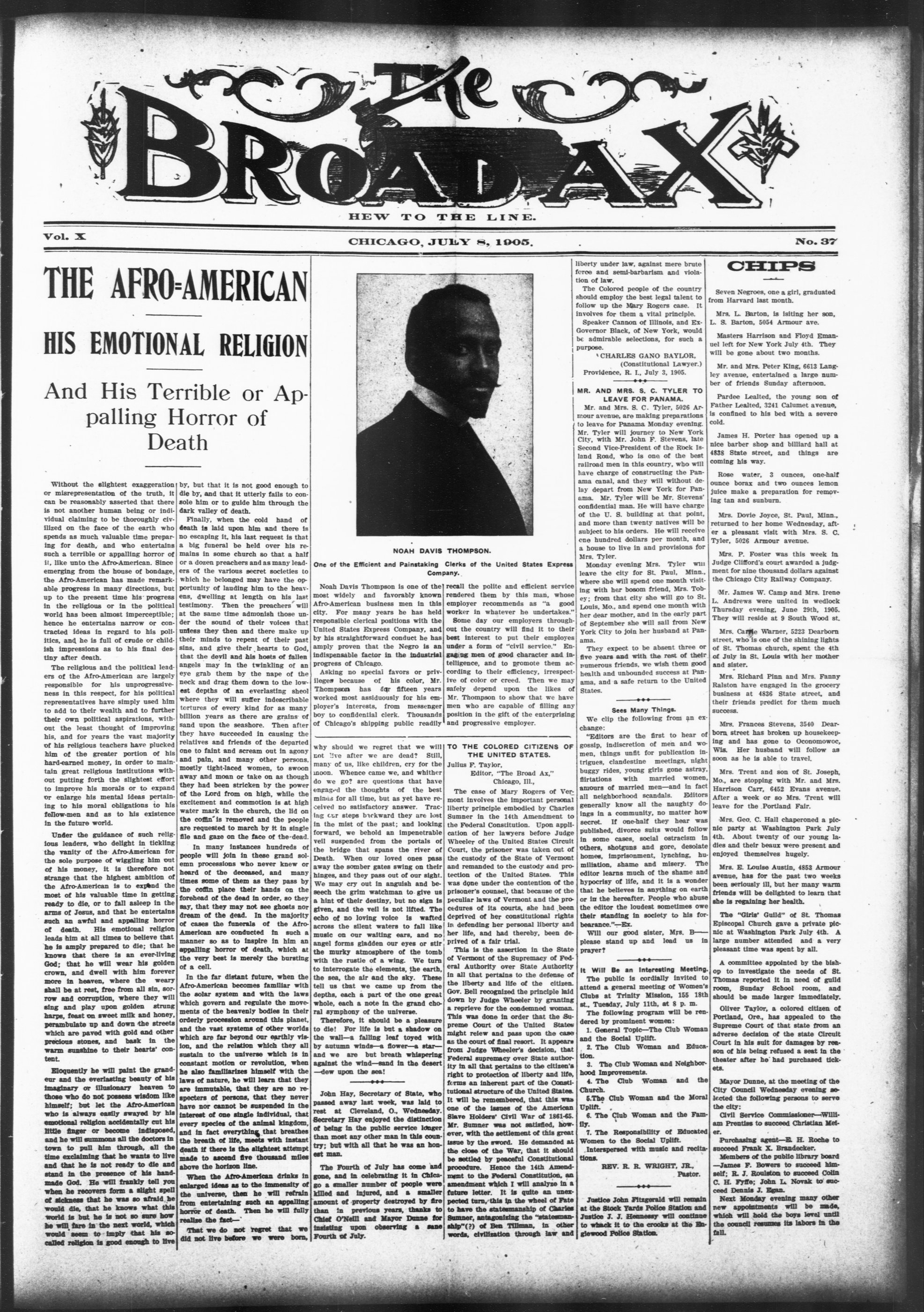
NOAH DAVIS THOMPSON.
One of the Efficient and Painstaking Clerks of the United States Express Company.
Noah Davis Thompson is one of the most widely and favorably known Afro-American business men in this city. For many years he has held responsible clerical positions with the United States Express Company, and by his straightforward conduct he has amply proven that the Negro is an indispensable factor in the industrial progress of Chicago.
Asking no special favors or privileges because of his color, Mr. Thompson has for fifteen years worked most assiduously for his employer's interests, from messenger boy to confidential clerk. Thousands of Chicago's shipping public readily recall the polite and efficient service rendered them by this man, whose employer recommends as "a good worker in whatever he undertakes."
Some day our employers through out the country will find it to their best interest to put their employer under a form of "civil service." Engaging men of good character and intelligence, and to promote them according to their efficiency, irrespective of color or creed. Then we may safely depend upon the likes of Mr. Thompson to show that we have men who are capable of filling any position in the gift of the enterprising and progressive employer.
why should we regret that we will not live after we are dead? Still, many of us, like children, cry for the moon. Whence came we, and whither do we go? are questions that have engaged the thoughts of the best minus for all time, but as yet have received no satisfactory answer. Tracing our steps backward they are lost in the mist of the past; and looking forward, we behold an impenetrableell suspended from the portals of the bridge that spans the river of Death. When our loved ones pass away the somber gates swing on their hinges, and they pass out of our sight. We may cry out in anguish and beseech the grim watchman to give us a hint of their destiny, but no sign is given, and the veil is not lifted. The echo of no loving voice is wafted across the silent waters to fall like music on our waiting ears, and no angel forms gladden our eyes or stir the murky atmosphere of the tomb with the rustle of a wing. We turn to interrogate the elements, the earth, the sea, the air and the sky. These tell us that we came up from the depths, each a part of the one great whole, each a note in the grand choral symphony of the universe.
Therefore, it should be a pleasure to die! For life is but a shadow on the wall—a falling leaf toyed with by autumn winds—a flower—a star—and we are but breath whispering against the wind—sand in the desert—dew upon the sea!
John Hay, Secretary of State, who passed away last week, was laid to rest at Cleveland, O., Wednesday. Secretary Hay enjoyed the distinction of being in the public service longer than most any other man in this country; but with all that he was an honest man.
The Fourth of July has come and gone, and in celebrating it in Chicago a smaller number of people were killed and injured, and a smaller amount of property destroyed by fire than in previous years, thanks to Chief O'Neill and Mayor Dunne for insisting upon observing a sane Fourth of July.
recall the polite and efficient service rendered them by this man, whose employer recommends as "a good worker in whatever he undertakes." Some day our employers throughout the country will find it to their best interest to put their employees under a form of "civil service." Engaging men of good character and intelligence, and to promote them according to their efficiency, irrespective of color or creed. Then we may safely depend upon the likes of Mr. Thompson to show that we have men who are capable of filling any position in the gift of the enterprising and progressive employer.
TO THE COLORED CITIZENS OF THE UNITED STATES.
The case of Mary Rogers of Vermont involves the important personal liberty principle embodied by Charles Sumner in the 14th Amendment to the Federal Constitution. Upon application of her lawyers before Judge Wheeler of the United States Circuit Court, the prisoner was taken out of the custody of the State of Vermont and remanded to the custody and protection of the United States. This was done under the contention of the prisoner's counsel, that because of the peculiar laws of Vermont and the procedures of its courts, she had been deprived of her constitutional rights in defending her personal liberty and her life, and had thereby, been deprived of a fair trial.
This is the assertion in the State of Vermont of the Supremacy of Federal Authority over State Authority in all that pertains to the defense of the liberty and life of the citizen. Gov. Bell recognized the principle laid down by Judge Wheeler by granting a reprieve for the condemned woman. This was done in order that the Supreme Court of the United States might reew and pass upon the case as the court of final resort. It appears from Judge Wheeler's decision, that Federal supremacy over State authority in all that pertains to the citizen's right to protection of liberty and life, forms an inherent part of the Constitutional structure of the United States. It will be remembered, that this was one of the issues of the American Slave Holders' Civil War of 1861-65. Mr. Sumner was not satisfied, however, with the settlement of this great issue by the sword. He demanded at the close of the War, that it should be settled by peaceful Constitutional procedure. Hence the 14th Amendment to the Federal Constitution, an amendment which I will analyze in a future letter. It is quite an unexpected turn, this in the wheel of Fate to have the statesmanship of Charles Sumner, antagonizing the "statesmanship"(?) of Ben Tillman, in other words, civilization through law and
liberty under law, against mere brute force and semi-barbarism and violation of law.
The Colored people of the country should employ the best legal talent to follow up the Mary Rogers case. It involves for them a vital principle.
Speaker Cannon of Illinois, and Ex-Governor Black, of New York, would be admirable selections, for such a purpose.
CHARLES GANO BAYLOR,
(Constitutional Lawyer.)
Providence, R. I., July 3, 1905.
MR. AND MRS. S. C. TYLER TO LEAVE FOR PANAMA.
Mr. and Mrs. S. C. Tyler, 5026 Armour avenue, are making preparations to leave for Panama Monday evening. Mr. Tyler will journey to New York City, with Mr. John F. Stevens, late Second Vice-President of the Rock Island Road, who is one of the best railroad men in this country, who will have charge of constructing the Panama canal, and they will without delay depart from New York for Panama. Mr. Tyler will be Mr. Stevens' confidential man. He will have charge of the U. S. building at that point, and more than twenty natives will be subject to his orders. He will receive one hundred dollars per month, and a house to live in and provisions for Mrs. Tyler.
Monday evening Mrs. Tyler will leave the city for St. Paul, Minn., where she will spend one month visiting with her bosom friend, Mrs. Toby; from that city she will go to St. Louis, Mo., and spend one month with her dear mother, and in the early part of September she will sail from New York City to join her husband at Panama.
They expect to be absent three or five years and with the rest of their numerous friends, we wish them good health and unbounded success at Panama, and a safe return to the United States.
Sees Many Things.
We clip the following from an exchange:
"Editors are the first to hear of gossip, indiscretion of men and women, things unfit for publication intrigues, clandestine meetings, night buggy rides, young girls gone astray, flirtations with married women, amours of married men—and in fact all neighborhood scandals. Editors generally know all the naughty doings in a community, no matter how secret. If one-half they hear was published, divorce suits would follow in some cases, social ostracism in others, shotguns and gore, desolate homes, imprisonment, lynching, humiliation, shame and misery. The editor learns much of the shame and hypocrisy of life, and it is a wonder that he believes in anything on earth or in the hereafter. People who abuse the editor the loudest sometimes owe their standing in society to his forbearance."—Ex.
Will our good sister, Mrs. B—please stand up and lead us in prayer?
It Will Be an Interesting Meeting.
The public is cordially invited to attend a general meeting of Women's Clubs at Trinity Mission, 155 18th st., Tuesday, July 11th, at 8 p. m.
The following program will be rendered by prominent women:
1. General Topic—The Club Woman and the Social Uplift.
2. The Club Woman and Education.
3. The Club Woman and Neighborhood Improvements.
4. The Club Woman and the Church.
5. The Club Woman and the Moral Uplift.
6. The Club Woman and the Family.
7. The Responsibility of Educated Women to the Social Uplift.
Interspersed with music and recitations.
REV. R. R. WRIGHT, JR., Pastor.
Justice John Fitzgerald will remain at the Stock Yards Police Station and Justice J. J. Hennessy will continue to whack it to the crooks at the Englewood Police Station.
No.37
CHIPS
Seven Negroes, one a girl, graduated from Harvard last month.
Mrs. L. Barton, is isiting her son,
L. S. Barton, 5054 Armour ave.
Masters Harrison and Floyd Emanuel left for New York July 4th. They will be gone about two months.
Mr. and Mrs. Peter King, 6613 Langley avenue, entertained a large number of friends Sunday afternoon.
Pardee Lealted, the young son of Father Lealted, 3241 Calumet avenue, is confined to his bed with a severe cold.
James H. Porter has opened up a nice barber shop and billiard hall at 4838 State street, and things are coming his way.
Rose water, 3 ounces, one-half ounce borax and two ounces lemon juice make a preparation for removing tan and sunburn.
Mrs. Dovie Joyce, St. Paul, Minn., returned to her home Wednesday, after a pleasant visit with Mrs. S. C. Tyler, 5026 Armour avenue.
Mrs. P. Foster was this week in Judge Clifford's court awarded a judgment for nine thousand dollars against the Chicago City Railway Company.
Mr. James W. Camp and Mrs. Irene L. Andrews were united in wedlock Thursday evening, June 29th, 1905. They will reside at 9 South Wood st.
Mrs. Carrie Warner, 5223 Dearborn street, who is one of the shining lights of St. Thomas church, spent the 4th of July in St. Louis with her mother and sister.
Mrs. Richard Pinn and Mrs. Fanny Ralston have engaged in the grocery business at 4836 State street, and their friends predict for them much success.
Mrs. Frances Stevens, 3540 Dearborn street has broken up housekeeping and has gone to Oconomowoc, Wis. Her husband will follow as soon as he is able to travel.
Mrs. Trent and son of St. Joseph, Mo., are stopping with Mr. and Mrs. Harrison Carr, 6452 Evans avenue. After a week or so Mrs. Trent will leave for the Portland Fair.
Mrs. Geo. C. Hall chaperoned a picnic party at Washington Park July 4th. About twenty of our young ladies and their beaux were present and enjoyed themselves hugely.
Mrs. E. Louise Austin, 4853 Armour avenue, has for the past two weeks been seriously ill, but her many warm friends will be delighted to learn that she is regaining her health.
The "Girls' Guild" of St. Thomas Episcopal Church gave a private picnic at Washington Park July 4th. A large number attended and a very pleasant time was spent by all.
A committee appointed by the bishop to investigate the needs of St. Thomas reported it in need of guild room, Sunday School room, and should be made larger immediately.
Oliver Taylor, a colored citizen of Portland, Ore., has appealed to the Supreme Court of that state from an adverse decision of the state Circuit Court in his suit for damages by reason of his being refused a seat in the theater after he had purchased tickets.
Mayor Dunne, at the meeting of the City Council Wednesday evening selected the following persons to serve the city:
Civil Service Commissioner—William Prentiss to succeed Christian Meier.
Purchasing agent—E. H. Roche to succeed Frank X. Brandecker.
Members of the public library board—James F. Bowers to succeed himself; R. J. Roulston to succeed Colin C. H. Fyffe; John L. Novak to succeed Dennis J. Egan.
Next Monday evening many other new appointments will be made, which will hold the boys level until the council resumes its labors in the fall.
Will promulgate and at all times uphold the true principles of Democracy, but Catholicism, Protestantism, Inside, Farmers, Single Taxes, Republic, their say, so long as their language is proper and responsibility is fixed. The Broad Arist is a newspaper whose platform is broad enough for all, ever claiming the editorial right to speak its own mind.
Local communications will receive attention.
Write only on one side of the paper.
Subscriptions must be paid in advance.
One Year.....$8.00
Six Months.....1.00
Advertising rates made known on application.
Address all communications to
THE BROAD AX
604 Armour Avenue, Chicago.
JULIA F. TAYLOR, Editor and Publisher.
Entered at the Post Office at Chicago,
IL, as second-class Master.
St. Thomas'.
On last Sunday, July 2, being the second Sunday after Trinity, there were two celebrations of the Blessed Sacrament. It also being the Feast of the Visitation of the Blessed Virgin Mary, a name very dear to all Catholics, the color of the vestments of priest and the altar hangings are green. It is a fact worth mentioning that many of the religious bodies that used to point the finger at the Catholic Church for using the Prayer Book Service are now trying to adopt the same, also trying to use the same vestments. Would it not be better to come over and get the real thing? Our blessed Lord only established one church, and that nearly two thousand years ago.
The Infant department of the Sunday School took a 'bus ride and picnic at Washington Park Thursday.
Calendar of week:
July 9—Third Sunday after Trinity.
July 14—Friday fast.
July 15—Translation of St. Swithin
A. D. 971.
What is Man?
Man is like a sausage.
Very fair upon the skin;
But you never know exactly
How much hog there is within
—Ex.
NOTICE.
A reception will be tendered the graduates of the various High Schools at Bethesda Baptist church, 3232 State street, Wednesday evening, at 8 o'clock, July 12. A fine program has been arranged. Admission 10 cents.
Colored Business Directory.
Mr. D. A. C. Bethea is compiling a Colored People's Blue Book and Business Directory. It will contain the names, addresses and telephone numbers of all Colored business and professional men and women. To avoid any possible error, and to make sure that your name is inserted, you should call at 3434 State street at once. Mr. Harry Robinson is the publisher.
Special Notice.
Last week the writer received $1 in a letter to pay for publishing an unsigned article which it contained, in reference to the shortcomings of a certain undertaker. But as it is not our intention to publish the article in question the $1 will be returned to the party sending it by supplying us with their address.
St. Mark Literary
The subject before the St. Mark Literary next Sunday will be, "What Shall the Colored Graduate Do After Leaving College?"
CHIPS
S. A. T. Watkins leaves Monday evening for Cairo, Ill., to attend the Grand Lodge of K. P.'s.
The Phyllis Wheatley Club will meet Wednesday, July 12, at the residence of Mrs. Anna Dunmore, 4120 South Campbell avenue. Transfer to Archer avenue car and get off at 38th street.
Mrs. Louise Montgomery, 4743 Shields avenue, left Tuesday morning for Denver, Colo., where she will attend the sessions of the International Epworth League convention, representing the St. Mark Literary.
Randall Woodfolk who was for a long time a member of the firm of Woodfolk & Mitchell, 4902 State st., has branched out for himself and last Saturday he opened up an elegant buffet at 4920 State street, and he is doing a land office business.
The Broad Ax of Saturday, June 24, made reference to the movements of Mrs. L. Arms, 5050 Dearborn St. Mrs. Margaret Golns, 84 35th St.; Mrs. Anna Hocker Clemens, of California; Master Lloyd English, of Fisk University; the Lillian J. Bridgman and Wm. W. Dancy wedding and all these items
---
P
and several others which only appeared in the columns of this paper, were all stoicken by the gray hairred sly old foxes and dished up in the columns of the last issue of their so-called best Leader.
There are thirteen Negro savings banks in the Southern states, four at Richmond, and the others at Birmingham, Vicksburg, Little Rock, Nashville, Jacksonville, Pine Bluff, Ark. Mound Bayou, Miss., Kingston, N. C. and Muscogee, I. T.
Mrs. M. J. Dogherty, 946 Garfield Blvd., and her interesting little daughter, left the city Wednesday bound for Europe where they will spend three months, and in the meantime the popular Superintendent of Streets will maintain bachelor quarters.
Last Sunday Rev. Joseph A. Melburn, pastor of the Plymouth Congregational church, preached a long to be remembered charitable sermon at the Queen Esther Mission, 5040 State St., and eight dollars and fifty cents was taken up to assist to place Mrs. Mary Dotson, 2827 State St., in the Old Folks' Home. Services will be held all day this coming Sunday. In the evening an old fashioned Love Feast will be conducted. So far Rev. Mrs. Hill has added more than 30 members to her mission.
Strange it is that the colored people, with all their boasted intelligence, cannot realize how powerful an agency for good their newspapers are and how important it is that they support them. No class of people stand more in need of just such service as newspapers only can give than do the colored people; and yet, perhaps no other class treat their papers with more contempt. How easy a thing it would be to give good support to the worthy papers published in the interest of the race if the people could only appreciate the fact. Not only do our people withhold their financial support, but their moral support as well, and do not hesitate to oppose their papers because the editor is not able to please everybody—a thing utterly impossible. Ex.
Bright Boys and Girls Wanted to Sell The Broad Ax.
Bright boys and girls can make money in every community by selling The Broad Ax. It will cost you nothing to begin, as we will send you a supply of papers for the first week free.
If there are any bright boys and girls in any section of the country who want to start in business for themselves, make money and be independent, write to us at once, and we will send you ten papers free of charge. You can sell them for 5 cts. each, this will give you the capital which you can buy more papers at the newsdealers' rate, allowing you a good profit.
Thinking and progressive people read The Broad Ax. Your father, brothers, uncles and friends will buy the paper from you. If you mean business write to Julius F. Taylor, 5040 Armour ave.
Furnished Rooms to Rent:
Nearly furnished rooms, all modern improvements, to rent to single ladies and gentlemen or married couples. Mrs. Malline Vaneer, 2806 Wabash Ave., 'phone 5354 Calumet.
ROOM TO RENT
A large furnished room to rent, suitable for two gentlemen 3144 Forest Ave.
LADY AGENTS WANTED!
To Select For a Toilet Preparation In Connection With The Broad Ax. Two or three live, active and wideawake lady agents, either white or colored, wanted to solicit for a high class Toilet Preparation in connection with The Broad Ax. If you mean business, call or address Julius F. Taylor, 5040 Armour avenue, Chicago
AGENTS AND CORRESPONDENTS WANTED.
The Broad Ax desires to engage Agents and regular Correspondents in all the leading cities and towns throughout the country. The highest commissions paid to live hustlers. Sample copies furnished free. For further information, address Julius F. Taylor, 5640 Armour avenue, Chicago
American Word.
"Sohooner is a word of American manufacture. At Gloucester, Mass., about 1713 Capt. Andrew Robinson built the first vessel called by that name. As it silk off the stocks into the water a bystander shouted: "Oh, how she scoons!" (skimers). Robinson instantly said: "A soooner let her be." The name has been universally adopted, but, singularly enough, is applied in the Dutch manner, though it is provincial English.
Strange Inquests.
In England when hidden treasure is found the law requires the coroner to hold an inquest, over it. Formerly it was a coroner's duty to hold an inquest in case of a burglary. A statute of Edward I. decrees that "when coroners are commanded by the king's balliffs or by the honest men of the county they shall go to the places where any be slain or suddenly dead or wounded or where houses are broken or where treasure is said to be found, and shall forthwith command four of the next towns, or five, or six, to appear before him in such a place."
Fooled the Censor.
During the South African war the censorship of soldiers' letters home was very strict. One soldier, who always sent an account of the doings of the regiment, which account was always blotted out by the censor, laid a plan for revenge. At the foot of his next letter he wrote: "Look under the stamp." The censor did so, after spending considerable time in steaming the stamp from the envelope. And he found these words: "Was it hard to get off?"
Japs at School.
The Japanese have adopted a compulsory system of national education. A boy and girl must attend school as soon as they attain the age of six, and remain there until the age of 14. The first four years they teach them the Japanese and Chinese languages, and the latter four years they add English; when a boy and girl are graduated from the Japanese common schools they can read and speak English.
Duty Well Performed.
No kind word ever spoken has brought a moment of regret, and no gentle act of kindness ever performed has failed to bring its blessing to recipient and giver. Words of appreciation fully repay the most laborious effort—and there is always the sunshine approval of a duty well performed, and a mind at peace with the world and its Omnipotent Ruler. —Detroit Free Press.
College and Common Sense
Prof. H. C. Annsling, in a recent address in London, said that school and college education were mostly destructive of common sense. The classical school was not a school of thought, but of prejudice; and under the present unfortunate system of education it was chiefly the games which promoted alertness, individuality and common sense.
Poor Pay in the Pulpit
Somebody has hunted up the figures and found that the average salary of a Harvard professor is $3,980, while the average minister in the vicinity of Boston draws $600. This may partially explain why the theological schools are not turning away applicants.—Minneapolis Journal.
Cheap Brides
In one district near Uganda, East Africa, most of the natives profess Christianity, have formed parliaments of their own and made laws. Considerable discussion was raised lately by a law fixing the price of all brides at $3.30, irrespective of their beauty and accomplishments.
The Great Lesson of Life
To accept the inevitable; neither to struggle against it nor murmur at it, simply to bear it—that is the great lesson of life—above all to a woman. It may come late or early; but she will never be a really happy woman until she has learned it.—Dublin Mullock Craik.
Sleep Promoter.
If the muscles are not tired there cannot be a full demand for sleep; unless, of course, the brain has been overworked. Healthy bodily exercise, carried to the point of rendering rest sweetly welcome, is one natural means of promoting sleep.
Max Was Mixed
After promising to get some fish for dinner, Max Hartmann, having gone mad, went to the Hamburg Zoo, removed a young alligator from a pond and took it home for his wife to cook.
Good Word for False Teeth.
Say what you please about false teeth, there is this in their favor. You do not have to cut them in the first place or have them pulled in the end. —Aitchison (Kan.) Globe.
Took All.
Bill—I suppose you took off your winter clothing when you went to Florida?
Jill—Oh, yes; the landlord got that, tool—Yonkers Statesman.
Not the Way.
Few men acquire the habit of throwing the cloak of charity over the faults of others by the practice of hiding their own sins—Chicago Tribune.
Not Trustworthy
The fellow who can be late when his own interests are at stake is pretty sure to be late when yours are.—Success Magazine.
Gold in Japan.
Japan's gold production in the year ended February 28, was $5,976,000, or double that of the preceding year.
The bittestest of all good medicines is work—Chicago Record-Herald.
Money in Whales.
A single Greenland whale is worth over $125,000.
SAY BRIDE CLINGS TO VEIL
Artists Declare Newly Married Woman
on Love, Her Costume and
Artists say that only on rare occasions will a bride take her veil from her head and lay it aside when she is photographed. They assert that probably once in a hundred times will such a thing happen, for they want the veil to show up prominently in the photograph. H. W. Mills, of Wheaton, Ill., says a bride and groom came into his studio the other day, and he was surprised to see the bride remove her veil and, with the flowers she carried, arrange it on a table. Then she drew the table close beside her and told the artist she was ready.
Nothing will tempt a bride to part with a veil that she has once had photographed as a part of her wedding dress. In Du Page county, Illinois, a singular custom regarding the preservation of the veil prevails. A large, box-like frame is constructed and a cabinet portrait is placed in the center of the background. Then the veil is neatly arranged around the picture, and the outer edge of the frame is entwined with artificial flowers to represent the ones that the bride held or wore when she was married.
Such frames adorn hundreds of walls in Du Page county farms and other homes. A wedding frame will occupy one part of the wall, and another frame will hold the silver nameplate that has been taken from the coffin of some member of the family of either the groom or bride.
TIE IN BRITISH COMMONS
An Unusual Occurrence in This Famous Body—Has Happened Three Times in a Century.
London journalists were reminded of an interesting bit of political history by a recent incident at the British house of commons. A division in the house upon a question relating to London street railways resulted in a tie—171 members on each side. Thereupon the speaker gave the casting vote in the negative. A tie in the house of commons is unusual, for this was the first time in many years that one had occurred. The last important division previously that called for the vote of the speaker took place in 1861. But just a century ago, in April, 1805, a resolution aimed at Lord Melville, a leading member of the cabinet, receive 216 votes, and an equal number was given in opposition. The speaker gave the casting vote in favor of the resolution. In consequence of this vote, Lord Melville was impeached the next year, 1806. He was accused of appropriating public funds, but was finally acquitted. He was a great friend of Mr. Pitt, the prime minister, who did his utmost to protect him, and who was greatly grieved at the vote of the speaker.
WEAK CAN BEAR PAIN BEST
Physical Power Not Always Best in Severe Operations, Declares Famous Surgeon.
Dr. J. P. Lockart Mummery, the famous British surgeon, says it is often extremely difficult to estimate the condition of a patient with regard to his power of standing a severe operation. Often a weakly looking individual, who looks as if he would not stand a severe operation well, stands it quite well, and vice versa. This is accounted for by the fact that a person of poor physique who leads a strenuous life has often much more highly developed nerve centers than one of robust physique who leads a life of ease and indulence, which makes but slight calls upon his nerve centers for great or sudden activity.
The mental condition of a patient prior to operation has a considerable influence upon the development of shock. Patients who dread an operation and who are in a state of considerable mental anxiety before the anaesthetic is administered are more liable, other things being equal, to develop shock than those whose mental equilibrium is undisturbed.
Color Treatment of Disease
In long experimenting with grass solutions, an English biologist has noticed that putrefaction does not occur in strong red or blue light, is only simulated in clear yellow, but really takes place in dirty yellow light or in darkness. He has also seen that workers behind dirty yellow screens are subject to skin eruptions. This has suggested to him the novel idea of color treatment of disease, a dirty yellow of the skin being assumed to indicate a degeneration of the yellow fluids of the body—the bile, etc—and to require a yellow restorative, like dandelion, lemon or sulphur, while lack of healthful redness shows the need of a red tonic and massage with a red stone. Blue is needed for "black blood," congestion, chills and to destroy mold fungus.
She Was It
Miss Gaddie—Your brother and I were partners in a little game of whist at Hoyle's house last evening.
Miss Knox—Oh! I thought it might be you.
Miss Gaddie—Why? What did he tell you about it?
Miss Knox—He just said he had had a rubber at wist—Philadelphia Press.
An Obligation.
"Do you think that we are descended from monkeys?" asked the off-hand scientist.
"I am not worried about that," answered Miss Cayenne. "What we should do is to prevent our own posterity from feeling that war."—Washington Star.
PRESIDENT HAS REGULAR ROUTINE OF WORK IN SUMMER.
HIS INFORMAL HOSPITALITY
Joint Army and Navy Board May Favor Submerged Mines—President Real Commander-in-Chief Army and Navy.
WASHINGTON.—President Roosevelt in his summer home at Oyster Bay is not an idle man. He performs virtually the same routine duties there that he does in the executive offices here in Washington. When he leaves this city
W
he does not leave behind him the cares of office nor does he lay aside consideration of the great questions that demand his attention. In one way he gets relief at Oyster Bay, and that is the restriction there naturally is upon the number of his daily callers. The executive offices are located in the village of Oyster Bay, some two or three miles away from the president's own home. In those offices Secretary Loeb conducts the routine business, and occasionally the president calls and looks over some papers, but most of the business is carried by the secretary to Sagamore Hill, where the president can attend to it untroubled by persistent visitors.
This will be a very busy season with Mr. Roosevelt, and he will have many questions to determine before congress meets. At his country home he will take up the study of the tariff and reach a decision as to whether he will recommend that congress undertake a remodeling of the schedules. In the comfortable quarters of his summer residence he will meet such men as Senator Aldrich, Senator Burrows, Senator Allison, Congressman Payne, and others who are admittedly experts on this question, and will confer with them upon the tariff. Between his holiday diversions the president will give attention to the railway rate question. It is not unlikely that from the humble village of Oyster Bay will also issue orders and decisions that will have an important bearing upon international affairs.
With all the time he will devote to public matters, however, the president will still be able to enjoy a vacation and the outdoor pastimes of which he is so fond. His home at Sagamore Hill offers full facilities for such indulgences.
At Sagamore Hill.
T
HE ROosevelt boys
welcome t he
change from Washington to Oyster Bay and Sagamore Hill. It means to them still close companionship with their father, and, as they all inherit his love of nature and outdoor life, there
will be many happy experiences during the present summer. One favorite pastime for the president and his four boys is to go off to the woods or along the bay shore, away from any sign of human habitation, and have a genuine camping-out party. Simple provisions are taken along, and these, with the fish they take from the bay, affords food for the outing. The president instructs his boys how to build camps, make camp fires and cook. The latter he has to do himself if a bite properly prepared is to be had. He knows all about camp cooking, and can broil a steak or fish to a turn. His boys declare that no white house cook can approach their father in the preparation of a dinner.
At Sagmore Hill the president has all sorts of callers. It is his home, and he delights in having men from all walks of life call to see him there. The most dignified statesman and learned financier is apt to sit down to the table in the Roseveit home with the cowboy from the west or an eccentric genius from anywhere. The president pays no attention to the outward appearance of his guests, and the flannel shirt is just as welcome as the dinner coat.
Fond of Proverbs.
T
HIS city has among her citizens a perfect Solomon in the way of proverb making and quotations. Mr. Robert Christy, who is now in the "sear and yellow leaf," is famous for his collection of proverbs from the world, and with which he
every nation in the world, and for the aptness with which he quotes them. He is a lawyer by profession, but his avocation has been the study and compilation of proverbs, maxims and epigrams of all sorts. He has a system of making important and interesting passages in every book that he reads. The very important passages he marks twice, so that in a second reading he can get through very rapidly. In this way he picks out the nuggets of wisdom in the works of great authors.
Mr. Christy has already published a book of proverbs and has in manuscript a compilation of etiquers.
A WASTE-PAPER BASKET.
As One Needs Many of These Articles Directions Are Given for a Home-Made One.
Since no room is complete without a writing-table, every room should be provided with its necessary accompaniment, a waste-paper receptacle. This, although not usually placed obtrusively in the foreground, should be in sight and ready to hand, and therefore it is well to choose one that will be in keeping with the furniture of the room. A subdued green or russet brown would go with almost any coloring. Our sketch shows a pretty and practical idea built upon a cardboard box. A square one of convenient size should be obtained, or it might be concocted by pasting pieces
HOME-MADE AFFAIR.
of strong cardboard together with strips of linen. Cut the edges in the curved form depleted. It might be lined with silk or sateen pasted flatly down at the edges with Higgins' colorless glue, or if economy be studied, the lining might consist of brown paper. The latter would not look quite so nice but would have one advantage, it could be more easily replaced when soiled. For the outside, take a strip of silk about $1\frac{1}{4}$ yards long and one-half yard wide, turn in to form a wide hem and gather to fit the edge, where it must be either sewn or glued very firmly. Gather again on the other edge, and turn underneath the box where it must also be stuck down. To make it look neat, over this paste a sheet of paper. The four corners are finally decorated with bows of ribbon to match the silk.
Materials required: One and three-quarter yards of silk, $1 \frac{1}{4}$ yard for lining three yards of ribbon.
A FEW FASHION NOTES.
Soft Kid Waistcoats Remain in Favor and Velvet Collars and Cuffs Again Return.
In making plaits of any kind for trimming, the fact should be borne in mind that it is good policy to leave the bastings in the plaits until the garment is entirely finished. Many home dress-makers are in too big a hurry to take out basting threads. In buying a ready made box plaited or plaited skirt, it will be noticed that when it reaches home the garment still has the plaits stitched down with bastings, and that ought to be hint enough to induce the amateur to leave her bastings in place till she is almost ready to wear the garment. Of course, this does not apply in the case of bastings for seams or hems, but just for those which are put to hold certain things in place and which can just as well remain in the garment till such time as it is completed. Plaits in waists, especially sleeves, can be left in, though the temptation is strong in the amateur to remove them and "see how it looks". But the exercise of a little patience in this respect means added comeliness to the completed garment.
The soft kid waistcoat is as popular as ever. It is generally made double breasted, and cut away to take in a chemisette of plaited muslin and Valenciennes lace, or one of coarse lace and perhaps a rolled collar of some colored velvet. A touch of velvet is always a welcome finish to a cloth frock, and on a plain sleeve buttonting tightly down to the wrist we often note a small, turned back cuff of velvet to match the rolled collar of velvet at the neck of the habit bodice.
The changes that have been made in tailor mades are not so great as those that have been made in other branches of dress, because for some time past the pioneers in the sartorial world have determined that the tailor made frock should be plain in cut, with sleeves of small, neat dimensions, and the note of elaboration is struck by braidings and similar trimmings.
Dangerous Hat-Pin
"It ought to be possible for an ingenious milliner to devise some less dangerous method of fixing on the hat than the modern hat-plin," declares a correspondent. "Not only is the hatpin dangerous but on a windy day the leverage on the roots of the hair when the large and flapping headgear is endeavoring to sail away is one of the causes of the headache of which most women complain after a buffeting by the elements."
For the Hair.
To make the hair grow have it shampooed every fortnight with eggs and hot water. Every night rub in this tonic with the finger tips: Forty-eight grains of resorcin, one-fourth ounce of glycerin, diluted alcohol to fill a two-ounce bottle. Remember that the general health has much to do with the condition of the hair.
Children's Collars
Children's collars are stunning. Great squared or rounded collars they are, for the most part, quite simply scalloped by hand, with a few rare ones of the sheerest sort of fine, embroidered with flowers and scrolls as delicately as a French handkerchief.
MODEST TROUSSEAUS
THE CLOTHES AND LINEN THAT ARE REALLY NEEDFUL.
White Muslim Makes Attractive Dress for Summer Bride—Brides Usually Prettier Without Veils—Married in Her "Going Away" Gown—Multiplying Gowns Which Will Only Grow Old-Fashioned—Underclothing Hand-Made or Ready-Made—Advantages of Bride Who Does Her Own Work.
BY MARGARET E. SANGSTER
(Copyright, 1906, by Joseph B. Bowles.)
Polly, bless her dear heart, is getting ready to be married. It will be the first wedding in the family, and the family current sets strongly and swiftly toward the happy event. Naturally Polly, her mother and her sisters are much occupied over the trousseau. "Spare no expense," says the father, whose pride in this dear girl knows no bounds.
Notwithstanding this liberal carte blanche on his part, the mother is aware that too lavish outlay now will mean a reckoning day hereafter, with most undesirable pinching and skimping. Still, the family is a unit, as to the necessity that Polly shall have a creditable outfit, and her brothers and sisters are not reluctant to practice economy that she may have everything she needs.
What does an intending bride really need? This is a closer inquiry than it would be were it differently worded. We are not considering what an intending bride may wish. There is a wide distance between need and want Polly, if she is as we suppose a sensible American girl, with a wise head on her shoulders, means to conform to her circumstances with perfect contentment. She is going to marry a young fellow whose home is in a small inland town, whose business prospects are good, and whose habits are steady. As yet, he is only living on a salary which warrants him in setting up a simple home, but which leaves no margin for display. Looking forward with brave hearts to their blended future, John and Polly are dwelling in one of those charming dreams that come true for self-respecting young people like themselves.
Put the emphasis on the adjective. The younger they are, the more years they will have to be happy together, the more courage and enthusiasm they will have, the more spontaneity of enjoyment. The rose-colored days are before them in which to climb the hill together.
. . .
To return to the trousseau, let us take the gowns first, though they are not the most important. They are, rather, the most conspicuous.
A summer bride should, if possible, be married in white, and in white attire there is a great variety of fabrics from which to choose. A bride looks as lovely in white muslin, white wool or white net, as in brocade, silk or satin, and her white wedding gown, of whatever material it be fashioned, will furnish her prettiest evening dress for any occasion which may arise during the next year or two.
A bride need not wear a veil unless she chooses. If she does choose, it may be of inexpensive net, and will then be as becoming as if it were point lace. Bridal veils are heirlooms in some families. A girl likes to be married in a veil that her mother and her grandmother wore on their respective wedding days. Veils are, however, not in themselves especially attractive adjuncts. A girl usually looks prettier without one.
Some brides prefer to be married in what is now called the going away gown. We used to call it the traveling dress. When this is chosen, the bride who, like Polly, must study economy, will select a soft gray or brown stuff, which will serve later for church or visiting, or an afternoon reception. It must include a skirt, jacket and waist, should be tailor-made and very smart in every detail. To relieve and save this costume, a short black walking skirt and a jacket of either black or covert cloth are desirable for second best. The bride should have one black silk of etamine gown, beautifully made, in her trousseau as this will be suitable for functions of every kind, both in winter and summer. If in addition to this, she can have a simple gown of gray wool she will be beautifully fitted out. One or two plique or linen skirts, a supply of cotton shirt waists sufficient to enable the wearer to be always fresh, cool and dainty in appearance, and two or three print or gingham frocks for working about the house, are requisite. If Polly can manage it, she should have a raincoat and a golf cap, and she will need two hats—one for best and one for every day. Of course, there are brides and brides; some will get on with much less than the bride which I have indicated. Others will provide much more, but for many reasons a too elaborate tousseau is a great mistake. There is no sense or use in multiplying gowns which only grow old-fashioned.
For underclothing, let Polly provide a half dozen of each piece. It is well to have the underclothing made at home, and very fastidious brides like it made by hand. But it may be bought ready-made in the shops and be quite as satisfactory. Stockings, shoes, gloves and handkerchiefs, belts and stocks are to be considered as the finishings of the bride's wearing apparel. As Polly will supply the household linen, she must consider how many beds she will have and think over the requisites for her table. If her mother is of a provident turn, the household
linen, was ready some little time ago. Two pairs of sheets and four pairs of pillow slips must be allowed for each bed, but as company or illness make extra demands on the linen closet, it is best not to be thus limited. To have as many sheets and pillow slips as one can afford, is the best rule. They need not actually be of linen, which is a term used by courtesy. Linen sheets are very nice, but fine cotton ones answer every purpose, and are preferred by many people. Four dozen towels inclusive of those for hands, face and bath are not too many. Beside these, there must be three dozen of different kinds of towels for kitchen use. Blankets, comfortables and spreads are also provided by the bride.
Polly's girl friends sometimes get together before the wedding and give her a linen shower. Nothing in the line of dainty linen comes amiss at such a time, and it is much better for a group of friends to combine and thus fully furnish a linen chest, than to scatter their gifts over many costly articles of ornament that give a passing pleasure, but are of little use. Exquisite center pieces and dollies, tray cloths, carving cloths and luncheon cloths, napkins of different sizes and everything that belongs to delicate napery fill a bride's heart with pleasure. Polly's trousseau should have only sweet thoughts associated with it. It is the most beautiful time of her young life.
Let us hope that our bride will for awhile do her own work. Unless she does, it is likely that her beautiful linens and dalinity underclothing will suffer many things at the hands of incompetent and careless women, who work devastation when fine linen comes to the wash board and the tub. If Polly is going to employ a maid, let us hope that she will begin by being mistress in her kitchen. A girl who is about to marry should not let her color fade or her health wane over her trousseau. But she will do well to learn some of those simple arts of housekeeping which save money and bring comfort in the new home. No matter how rich she may be, her personal supervision will be needful, and if she is comfortably poor, she will have the greater independence.
HANDKERCHIEF BORDER.
Real Lace Is Expensive to Buy, But Can Be Made at Home by One That Has Some Skill.
Exactly half one side is shown from the top to the lower edge of this illustration. Good Brussels net is used for the foundation, the design being worked out in muslin and Honiton braids. The braid must be very neat-
HONITON LACE.
ly sewn down to the net with cotton No. 100, the lace stitches being worked with thread No. 70. Materials required for the complete border: A square of net. $ \frac{1}{2} $ yard Honiton braid, 4 yards point braid, 2 yards purl edge, 2 skeins thread Nos. 100 and 70.
Avoid Stiffness.
Beware of allowing your joints to grow stiff. Take enough exercise outside of housework to keep yourself supple, or take such pains to move lightly about the house that the suppleness will last without other aid. In bending or rising do not allow yourself to feel or appear stiff. If your work is really so hard that you go to bed aching, get some one to rub you, and if this is impossible, rub yourself. This is less restful, but it is, nevertheless, of some use. Pour out a little alcohol into the palm of the hand, then rub briskly, repeating until the skin glows. Finish with the flesh brush, and go to bed with the determination to sleep—or rather, that sleep will come of itself, for this is a more restful mood.
A Cure for Colds
Here is a cure for colds of any kind. It has been tested repeatedly and has never failed, and as I used to catch cold, which resulted in a bad attack of bronchitis, I can speak from experience, says a writer in the Woman's Home Companion. In cases of pneumonia it will not fail to cure if taken in time. Make a ball of cotton batting about the size of a small marble, saturate it well with alcohol, then drop on to it six drops of chloroform; cover it lightly with a thin piece of cotton batting, hold to the mouth, and inhale the fumes, inflating the lungs well. It will open and expand every lung cell instantly.
A. Harsh Skin.
A dry, harsh skin needs a cold cream and almond oil. If the skin is red and chapped leave all creams alone and first apply a paste of almond meal mixed with oil.
In High Favor.
Black velvet cuffs and collars distinguish some of the smartest white linen coats.
TOO RICH AND RECKLESS
Butler Gives Reason Why Wealthy People's Servants Go the Wrong Road.
"You see, sir," began the old butler, according to Everybody's Magazine, "my son took service with Mr. Lingard. As honest and well-meaning a young man he was as ever lived when he started, and that's why I want to speak out now and tell you gentlefolks that it ain't altogether a servant's fault when he goes wrong. You don't mean it, but you're careless in your talk, and it's all heard and repeated and set store by in a way you'd hardly believe. Your fathers and mothers, gentlemen and ladies, they were different, and looked after their servants and their houses different. But you don't care what we are like if things run smooth and give you no trouble. The tradesmen, maybe, bld to the butler and cook for your custom, and the higher the bills are the better it is for them both, and half the time you don't take no notice, and it gets kind of easy to pick up things in little ways. Everybody's too rich and too reckless and that's the whole trouble. What do these young men that's waiting on the table hear talked at all the time? Why, money, and how much you can do with it, and how mean you look without it. That's not just what you say, but that's how they hear it. They see extravagance all round them, and hear it talked all the time, and they go and do the same. If you boast of how much you've made playing cards and betting on the races, why they'll think it's a grand thing to do, and they'll do it once too often and be catched like my poor boy. I ain't defending William, but, if you will excuse me, you stole his conscience, sir, before he stole his silver. You'll get back your property, but he'll never get back what he's lost—and if you send him to prison, he—he'll come out worse than he went in. He was a good lad when he went to you, but you do keep a rather fast house, sir, and it's hard for an ignorant man to see higher than his betters. If you'd give him a chance—if you'd let him off—"
CHINA A POULTRY COUNTRY
Farmers of the Orient Handle Enormous Consignments of Eggs at One Time.
The keenest of poultry farmers is, as Mr. Chamberlain once said of himself in another connection, "a child in these matters" as compared with the poultry farmers of China. A traveler passing through the province of Chekiang a few weeks ago was struck with the enormous number of young chickens carried in the farmers' carts he met in the T'intal country. He made inquiries on the subject, and at length he was asked by a poultry farmer to go and inspect his rearing arrangements. The plant deals with 10,000 eggs at a time and the average product is 5,000 chicks. The arrangements are simple and inexpensive, but they include opportunities for the scientific examination of the eggs in the course of incubation, and it is amusing to hear that where the eggs on examination through the testing holes do not show signs of fertilization at the end of the fourth day, "they are immediately discarded to be sold cheap."
FISH BANK IS INTERESTING
Discovered Four Hundred Years Ago by Cabot, St. John's Is Base of World Industry.
St. John's is a place seeming with interest. It is over 400 years old, having been discovered by Cabot in 1497 and settled by Devon fisherfolk a few years later, since when it has been always the base for the world's greatest fishing industry, that for "cod on the bank," says P. T. McGrath, in Four-Track News. In its harbor will be found argosies from France, Spain, Portugal, New England and Nova Scotia, all engaged in reaping the harvest from the ocean, while the British industry was permanently transferred there as the colony, the oldest in the empire, became settled. Along the water front, on each side of the spacious land-locked harbor, which opens through a gap in the beating cliffs, are stores and warehouses filled with cod, while at every wharf steamers and sailors are loading this staple commodity for transport to the markets of the world.
Graze of the "Improver."
GRACE OF THE IMPROVED
One of the employees of a small manufacturing concern in Gotham, says the New York Sun, has a craze for taking apart new bits of machinery and seeing the "how" of their operation. As a rule, he assembles them again without much difficulty. The other day, however, he assisted in taking down a small electric motor. He overhauled it and laboriously put it together and then gravely announced that the blamed thing won't run." His employer and the rest of the force worked for the better part of the day in a vain attempt to get the motor to work, and then began to quiz the "improver," as he is known. "What did I do to it?" he replied. "I didn't do a blame thing to it but improve it. I got it all together again the first try, and saved these two pieces out of it."
His Weather Eve.
"Now," said the employer, "you will have to keep your weather eye on our competitors."
"I'm afraid I can't," answered the new man. "My weather eye has been poked out by an umbrella rib."—Judge.
The Waterloo of Wealth
"The Waterloo of Wearmouth
"You have succeeded in everything you have undertaken."
"Yes," answered Mr. Dustin Stax, "but I haven't yet tried to give any large sums of money to a church."—Washington Star.
Fifty-First St. and Armour Ave.
RAIL YARDS: 51st St. & L. S. & M. S. Ry.
52nd St. and Armour Ave.
CHICAGO
J. W. ARMS
—DEALER IN—
Coal & Wood
Expressing and Moving to Any Part
of the city.
139 WEST FIFTY-FIRST STREET
Between Dearborn and Armour Ave.
Phone 3804 Gray
Residence 5050 Dearborn st.
Tile and Slate Hauling a Specialty. COAL
J. H. COLEMAN & CO.
Express & Van Moving
TRUNKS EVERYWHERE.
2540 State Street
Tel. 699 South CHICAGO
Peoples Pharmacy
Pure Drugs and Chemicals
Prescriptions Promptly Filled at All Hours
29th St. and Armour Av.
Phone 526 South
CHICAGO
A. B. SCHULTZ, M. D.
PHYSICIAN AND SURGEON.
2719 State Street
Hours: 9 to 12 A. M.
3 to 5 and after 6 P. M.
CHICAG
WONDERFUL
DISCOVERY
Curly Hair Made Straight By
TAKEN FROM LIFE, AFTER TREATMENT
FORD'S ORIGINAL
OZONIZED OX MARROW
This wonderful hair pomade is the only safe preparation in the world that makes kinky or curly hair stand out, shines the scalp, prevents the hair from falling out or breaking off, cures dandruff and makes hair shine. It is available for 45 years, and used by thousands. Warranted harmless. It was the first preparation ever made for hair extensions. Remember that Ford's Original Ozonized Ox Marrow is put up and by us. The genuine has the signature CHARLEE FORD. "WEEK," on each package. Ozonized Ox Marrow is to be just as good—but always insist upon being Ford's. The night, soft and beautiful giving is that healthy, life-like appearance ladies, gentlemen and children. Elegantly perfumed. Owing to its superior and lasting qualities it is not possible for anybody to produce a preparation to it. Fail directions with it. Send your order to 50 cents for one bottle, postpaid, or $1.40 for three bottles, express and dealers, or send us 50 cents for one bottle. Send postal or express money order. Please mention name of this paper when ordering. Warranted name of this paper is placed here.
OZONIZED OX MARROW CO.,
(None genuine without my signature)
Charles Ford Post
74 Wabash Ave., Chicago, Illinois.
Agents wanted everywhere.
THE BROAD AX.
Is for sale at the following news stands:
The Afro-American News Office,
3104 State Street.
F. L. Gale, 2642½ State street.
Cigars, Tobacco and News stand.
Mrs. Nellie Phelps, Cigars, Notions and News Stand, 131 W. 51st street.
Richard Pinn, 4836 State street.
J. C. Campbell, cigars, tobacco and fancy groceries, 4710 State street.
Edward Felix's Cigar Store, 368 30th street, N. E. Corner Armour Ava.
T. B. Hall's Cigar Store and Laundry office, 281 29th St.
H. T. Greenwood, newspaper and periodical distributor, 110 1-2 E. 53rd street.
Mrs. M. Burroughs, cigars, notions, news stand, 920 W. Lake street.
James H. Porter's Barber Shop,
4838 State St.
Turner Williams' Shaving Parlor
and News Stand, 2903 Armour ave.
Mrs. B. Williams, Cigars, Notions
and News Stand, 486½ State street.
B. Davis, cigars, tobacco, and con-
fectionery, 3532 State st.
The Stationery, 2870 State street
Woodfolk and Mitchell Cigars, Tobacco and News Stand, 4902 State Street.
The Afro-American News Co., 439
W. 35th St., New York City, N. Y.
J. D. Cook & Company news stand
and cigar store, 26 Juneau avenue,
Milwaukee, Wis.
News items and advertisements left
at these places will find their way
into the columns of The Brand An
---
Beautify Your Home
20TH CENTURY SOAP
TELEPHONES
HARRISON 2256
AUTOMATIC 2894
-- American
President and Treasurer, T
Vice-President, J
Secret
MANUFAT
Gommon and
Office a
45th and
American Brick Co. -
Agent and Treasurer, THOMAS CAREY.
Vice-President, JOHN SHELHAMER,
Secretary, WILLIAM SULLIVAN.
MANUFATURERS OF
Lemon and Sewer Brick
Office and Yards:
-- American Brick Co.
President and Treasurer, THOMAS CAREY.
Vice-President, JOHN SHELHAMER,
Secretary, WILLIAM SULLIVAN.
MANUFATURERS OF
Common and Sewer Brick
Office and Yards:
45th and Robey Sts.
Yards running winter and summer, equipped with the latest improved Wolf Dryer.
Output of Winter Yards
Output of Summer Yards
Telephone
In selecting a w
fications should
the age, the pur
O
Unde
R
Possesses these qualification
any other
CHAS. DENNEH
Striking Similarity.
Gunner—Have you noticed the large
stamps in the latest issue?
Guyer—Yes; I call them Jap stamps.
"Why so?"
selecting a whiskey three quali-
ons should be considered —
age, the purity and the flavor.
Old
Underoof
Rye
is these qualifications in a greater degree than
any other whiskey
CHAS. DENNEHY & COMPANY,
Chicago.
Output of Winter Yards ..... 14,400.0 per day
Output of Summer Yards..... 30,400.0 per day
Telephone Yards 128.
In selecting a whiskey three qualifications should be considered the age, the purity and the flavor.
Old Underoof Rye
Possesses these qualifications in a greater degree than any other whiskey CHAS. DENNEHY & COMPANY, Chicago.
"They are not easily licked."—Chicago sun
Irate Wife—That's the fifty-second falsehood you've told me this week.
Unashed Husband—Well, now you can see what is meant by the expression "a pack of lies."—Pittsburgh Post
Won't It Though
California announces a 15,000,000-pound prune crop ready for shipment. It will not make much difference if next summer's strawberry crop is a failure.-Rochester Post-Expressa
All well-educated Spanish women are taught from the earliest years to handle the sword, and as a result they are noted for their admirable figure and easy walk.
After Facts.
"How old did your sister say she is?"
"...seven."
"Hold your is she?"—Houston Post.
A good many men would be tickled almost to death for a chance to pay a large inheritance tax.
WONDERFUL GROWTH OF HAIR.
"I had typhoid fever and my hair"
"all came out. I used three bottles of"
"Ford's Original Oxonized Ox Mar"
"row, and now my hair is nine inch."
"es long and very thick and nice and"
"straight. Most every one seeing"
"how good the Oxonized Ox Marrow"
"done my hair, they to are anxious"
---
Full Deck.
After Facts.
Something Easy.
Cleans, brightens and beautifies the home. It gives new life and lustre to the furniture and woodwork. Cleans all the spots and dirt from carpets, bringing out the colors as bright as hew. It is also fine for washing curtains, sofa pillows, clothes, flannels silverware, windowglass, and all household articles. It is made of strictly pure vegetable oils that will not injure the most highly polished surface or delicate fabric. Keeps the hands soft and velvety.
ABSOLUTELYPURE
NO LYE
At your Dealer.....10c.
Write for fee copy of 20th Century
World which contains offer of hand-
some tree premium and cash prizes,
also interesting stories, Jokes, etc.
Address
Hoffheimer Soap Co.
Royal Ins. Bldg. CHICAGO
"for it. My hair is an example to"
"everyone."
"319 S. Matlack St., West Chester, Pa."
March 30.1905.
Ford's Original Ozonized Ox Marrow has many other good qualities, too. See their advertisement in this paper. Price 50c a bottle at druggists or dealers, or send us fifty cents and we will mail you a bottle postpaid. Address Ozonized Ox Marrow Co. 76 Wabash Avenue, Chicago, Illinois.
COOK
Our Complete Catalogue—a correct guide to proper dress in the Dining Room, Kitchen, or Bar will be sent free on application.
Write for catalogue and full instructions how to order.
(Inc.): 300 State St., Glendale
‘Two Views,
An English prelate, the bishop of
Epewich, was discussing Sunday out-
door games in a liberal way. “Would
‘anyone say his prayers the worse be
coum be bad mate 9 soot trive
‘ericket that morning?” asked the bish-
op. One of his hearers remarked:
“That is a very good point, my lord,
‘but there is another to be considered.
Buppose the cricketer makes 2 bed
rive, then his moral welfare is Mkely
to be badly jarred.”
An Indian’s Opinion.
Some Indians from the southwest
went on s sightseeing tour of Wash-
ington in one of the big sutomebiles
devoted to that purpose. They listened
gravely to the man with the meg-
aphone as he described the many
places of interest. At the end ef the
journey one of the travelers summed
it all up thus: “Heap ride, heap talk,
heap smell”—the last referring to the
whiff of gasoline which occasionally
reached him.
Seran-Rook History.
, Gov. Warfield of Maryland has bad
made @ large scrapbook of newspaper
clippings on the death of Lloyd
Lowndes, of his state, to be filed in
the state archives at Annapolis. He
says: “I believe it is the first time
‘ that any Aistory of the death of @ gov-
ernor of Maryland has ever been com-
piled, and I propose to take care of
predecessors, and trust that my exam-
ple may be followed by my suc-
eessors.”
A Young Astronomer.
Dr. Ralph Hamilton Curtiss, lately
Carnegie assistant at Lick observatory,
has been chosen assistant professor of
astronomy by the University of West-
ern Pennsylvania. Dr. Curtis, though
only 24 years old, recently took his
doctor’s degree at the University of
California, where he received his
astronomical training, supplemented
by graduate work there and at Lick
observatory.
Servant Problem in England. ~
Evidently the servant problem is
@riving people crazy in England, too.
The following advertisement is from
the London Morning Post:
‘Wanted.—Immediately for Brighton, «
superior ol¢-fashioned woman as good
Pook: age between 9) and 4; wages £55 to
begin with; washing money, but no beer;
Protestant: also for the same situation a
strong between maid; age about 18; wages
aes eds cone
The Riddle of the Sphinx.
The Sphinx had just prepounded her
riddle.
“What goes on four kegs in the
morning, two at noon, and three in the
evening?” she demanded.
“An auto,” they answered, readily.
‘With a heavy groan, she. realized
that the moderns had gone her one
better—N. ¥. Sun.
a
‘Don’t Wear Them.
The pressure of a stiff high collar on
the pneumogastric nerve has been
found by Dr.-F. B. Brubaker to pro-
duce unpleasant symptoms. like numb-
ness, nausea, lassitude and depression
of spirits. He believes that prolonged
pressure by a close-fitting collar would
tend to serious disease, such as lung
disease.
Propelled by a Boot.
Farmer Geechaw—Waal, I caught that
young city spark last night that’s been
bangin’ around our Mandy.
Farmer Giddap—An’ what happened,
Jabez?
Farmer Geehaw—Oh, the spark flew
upward.—Louisville Courier-Journal.
A Gefe Averacce
‘Mrs. Ferguson—Why do you wear
those ridiculously high collars, George?
‘What are they good for, anyhow?
Mr. Ferguson—They are good for
about four washings, Laura. That's
my experience with the average
laundry.
Not Worth Mentioning.
“What kind of a dinner did the Hux-
leys have? I heard it was to be an
“No. It didn’t amount to much. I
felt just as well the next morning as
I ever did in my life.”
Reasonable Request.
Doctor (to pressing - creditor) — If
you must bring your bill every day, at
Jeast you might come with your head
tied up, so that people would think
you were a patient!—London TitBite
: Good Reason.
Of the 20 graduates this year from
Haskell institute, the government
echool for Indians at Lawrence, only
etx are football players. The vest are
etris.
Grin and Bear It.
‘There's a lot more religion in grit-
ting your teeth and grinning at trouble
than there is in a sanctified, sour sub-
mmission.
etn
‘It sometimes happens that when a
(girl rejects a young man’s proposal he
‘eslebrates his lucky escape hy getting
ta x
Attract the Ladies.
‘In every man there is a disposition
fo Ge the grand where women are con-
eqned—Chicage Daily News,
‘Biind.
‘There is ho accounting for tastes—
gadging by the number ef people whose
ions watt is sott-admiration
: ‘Misses Him.
Pp mesenger mtpernp bya
Joke on the Inquisitor.
During the South African war the
censorship of saldiers’ letters home
was very strict. One soldier, who al-
‘ways sent an account of the doings of
the regiment, which account was al-
ways blotted eut by the censor, laid
@ plan for revenge. At the foot of
his next letter he wrote: “Look under
the stamp.” The censor did so, after
spending considerable time in steam-
ing the stamp from the envelope. And
he found these words: “Was it hard
to get oft” a
‘Keep Women Out.
In most of the dog hospitals in New
York there is a rule against admitting
women to the wards. No small part of
the scienee of doctoring dogs Hes in
keeping them cheerful away from home.
‘The sight of a woman seems to make
them think of home and the fireside;
they get excited when a skirt blows in
sight, and correspondingly depressed
‘when it disappears. So no dog doctor
who understands dog psychology lets
his patients see a woman if he can
help it.
Ghine’s Wealth of Coal
According to an estimate issued by
the British royal commission, China
has 282,000 square miles of coal-pro-
ducing lands, the United States, 200,-
(000; Canada, 65,000; Great Britain, 12,-
000; France, 8,000, and Germany, 1,700.
‘With all its claims of ancient civiiiza-
tion, China has never yet waked up to
the productive uses of coal, though it
seems to have more of it than ex-
ists in any other country.
Munificent Benefaction.
William H. Laird, the wealthy
Winona (Minn.) lumberman, has
given $50,000 for the construction and
equipment of a new science hall at
Carleton college, Northfield. When
the building shall be ready for occu-
pation he will give an equal amount
as an endowment fund. »Mr. Laird
has just celebrated the fiftieth anni-
versary of his entry into the lumber
business.
“Rank Heresy.
“I sometimes think,” said Deacon
Ironside, “we shall have to summon
Brother Hardesty before the church
board.”
“What is the trouble with Brother
Hardesty?” asked Elder Keepalong.
“He is finding fault with the plan
of creation. He says there are too
many carp and dogfish and too few
black bass.”—Chicago Tribune.
Brilliant Billy.
A tale of financial difficulties, but hav-
ing a happy ending, 1s thus told by the
‘Yale Record:
Bill had a bill-board. Bill also had a
‘board Bill. The board bill bored Bill.
‘so that Bill sold the bill-board to pay
‘his board bill. Soafter Bill sold his bill
board to pay his board bill, the board bill
no longer boret! Bill.
‘Time Works Changes.
‘When a woman is first married she
folds the paper so her husband will
‘be sure to see where some other man
ees eloped with his stenographer. Aft-
er she has been married awhile she
reads it out loud and gets mad at
everybody in the household.—Spring-
field (0.) Sun.
Many Years of Music.
Prof. Jobn K. Paine, who has re-
tired from the chair of music at Har-
vard, is 66 years old. For just half
his life he was connected with the de-
partment of music at Harvard, first as
instructor and afterward as full pro-
fessor, having been the first occupant
of the chair.
Gould Feel It @mine On.
“Are you going to take a vacation
this year, Addemup?”
“From the way old Spoteash looked
when he saw me at the ball game yes-
terday, for the second time this week,
T'm afraid I am."—Chicago Tribune.
Lesson from Japen.
Knicker—Yes, my wife won the
fight, but the credit belongs to the
spirit of her ancestors.
‘Bocker—You don’t say?
Yes, her mother was with
peril Y, Ben.
: Took Too Long.
* ‘Whistler is said to have had 100 sit-
tings for one portrait. Three sisters in
succession sat fer a picturebe was paiat-
mg and each in succession grew tooold,
so that the picture remained un@nished
‘at the last.
‘Work of the Wind.
A farmer at Alden, Okie, 40 miles
from Snyder, found a number of photo-
graphs in a good state of preservation
that had been carried te his farm by
the recent tornado at Snyder.
Looking to the Future.
Many 8 man is compelled to starve
Ris famfly almost to death in order
to keep up the premiums on his own
life insurance.
PRS SS
Billard players put chalk en the
cue to keep it from slipping. Some
men need chalk on thelr consciences,
* — X Good Bxample.
Nearly every sort of villainy 1s asso
ciated with gravity and grimness
Look at the humorist, for example.
‘Japanese Disapproval.
‘When's Japanese audience wishes
to express disapproval of a play, they
turn thelr backs to the stage.
| ‘The énly way some people are able
f sce their name in print is by seb
- ting bn the Gelinguent tax List.
Success in Music.
Caruso, the celebrated Italian opers
tenor, is the son of an engineer in
Naples. His father, on finding thal
the lad preferred music to mechanics
turned him out of doors, remarking:
“Follow your fancy, and when i
brings you to grief do not count ot
me.” When he entered upon his tern!
of military service an officer with
musical taste took him in hand and he
was allowed to practice in peace. At
that time he could barely read and
write. Now he is the most famous
tenor of the day, never singing for
less than $500 a performance.
The Truthful Guide,
It ts told of a lady that while tour
tng in the Scottish highlands one
summer she was taken to a cave in
which Macbeth was said to have beer
dorm. She examined the cave atten
tively, and listened to the eloquent
speech of her guide. At the end she
said to the man: “Comm, now, tell
me truly, is this really thé place where
Macbeth was born?”
‘The guide smiled awkwardly. He
shifted about a little. “Well,” he said,
“it's one of the places.”—Glasgow
Herald.
Quite “Slancy.”
In 8 recent article on politcal condi-
tions in England, Justin McCarthy
quotes the expression: “By the skin of
his teeth,” and parenthetically apolo-
gizes for using what he calls “such a
vulgar expression.” Humorous writers
are enjoying a laugh at Mr. McCarthy's
expense, calling his attention to the
nineteenth chapter of Job, twentieth
verse, where he may find the words: “I
‘ami escaped with the skin of my teeth.”
Bluebird Nest in Mail Box.
‘A bluebird which took possession of
@ mail box on the South road in
Woodstock last year and successfully
raised two broods of little ones
promptly returned this spring, rebuilt
her home, depostted five eggs therein
‘and is now waiting patiently for the
‘appearance of her little family. The
owners of the box have abdicat-
ed in her favor, putting up another box
for their own accommodation,
‘Toast to the Auto.
In Evanston, Ill., the other evening
the parents of a bright little girl had
some of their friends in to dinner and
‘a number of toasts were given. After
the older ones had fished, the young
lady stood up, held her glass of water
‘high—water is always used for toasting
purposes in Evanston—@nd said:
“Here's to the auto. May we hear its
‘toot in time to scoot.”
Built Nest on a Drawbar.
‘Wabash car inspectors of Peru, Ind.
found a robin’s nest containing four
eggs on a draw-bar of a passenger
cotch of a fast train the other day.
The nest was made at Buffalo and
was carried all the way from that city
to Peru without being damaged. The
nest and eggs are on exhibition at the
office of the trainmaster.
Long in Service.
Earl Nelson, who is in his eighty-
second year, is the only living peer
who was a member of the house of
lords when Queex Victoria came to the
throne. His lordship is not @ direct
descendant of the great Lord Nelson,
who left no sons, but is a grandson of
his sister, Mrs. Bolton.
Up from the Ranks.
‘William Watt, who has been ap-
pointed director of the Dusseldorf Sci-
‘ence and <Art institute, is the second
‘son of a blacksmith of Port Glasgow,
Scotland. Starting with no advantage
of birth or money or influence, he has
largely educated himself. He is 32
years old.
Siti an Sie
Astronomers state that the first snow
of the season fell on Mars, May 18.
‘As far as scientists are able to carry
their observations, our neighboring
planet, like the earth, has the weather
for @ leading topic of conversation.
Not Nourishing.
Bumps—Hardup says he’s living on
hope.
‘Humpe—tI wondered why he looked
‘so thin! Why doesn't he get to work
‘and earn enough to get fat.on?—De
trott Free Press.
_ ‘Merosnary.
“Yes, tittered the homely hetress,
“Mr. Skeem proposed to me last night
and kissed me—"
“O!" interrupted Miss Snappe, “he'd
o anything for money.”—Philadelphia
Ledger.
Again the Imp.
Desdemens was breathing her last.
“Well,” she said, “I suppose I can
biame this on the Black Imp.”
And Othello, stung by the allusion,
wept with remorse—N. Y. Mail.
—
‘The End.
“Biank had a mania for proposing.
‘What cured him?”
“His wife. She married him."—De-
twott Pree Press.
‘atin
| Before calling s man a liar be sure
you are right—then use a telephone.
A Sure Siena.
‘The sure sign of s fool is that he
Feertigenl~ sharia tna
| Sep tae
Doe't cultivate your conscience; tt
‘will only make you uncemfortable.
: Good Advis.
|. Oulttvate « thick alin if you propose
bo be independent. Y. Race
4. A. O'Donnell, H. D. Coghtin,
O'Donnell & Coghlin
Attorneys at Law
Phone 264 Maio ‘Metropolitan Block
IN. W. Cor. LaSalle & Randolph Sts.
Chicago
aja eee eee ea
James J. Gray. M. J. Moran,
GRAY & MORAN
ATTORNEYS AT LAW
Suite 1114 Ashland Block, Clark and
Randolph Sts. Tel, Central 569.
CHICAGO.
H STATE & WASHINGTON NS
: Chicago’s Most Modern,
Most Complete and Most Convenient
Department Store
Jacob F'einbers
MARKET AND GROCERY
TELEPHONE DOUGLAS 565
Blst and State Streets
——— Telephone Yards 698 a
BRADLEY & FIELDS
REAL ESTATE, LOANS
AND INSURANCE
CHIGASS.
er acerca a iE ae
Residence 07 Macalister Place
‘Telephone Ashland 363
cutra: 1209" 7? *Stomatic 6040
ATTORNEY AT LAW
Suite 318-320 Reaper Block
CLARK AND WASHINGTON STS.
CHICAGO.
Se
‘Telephone Central 3089
Res. 904 W. 12th Street Bivd. Tel.
1628 Morgon
FRANK 0, COMERFORD
ATTORNEY AND COUNSELOR AT
LAW.
806 Tribune Building
@ EB. Cor. Dearborn and Madison Sts.
CHICAGO
A. D. GASH
Attorncy at Law,
84-86 La Galle Street, Chicaro.
‘Subne 61500 619,
‘Telephone Main 3077.
JOHN E. OWENS
ATTORNEY 4&1 COUNSELOR]
aT Law
923 ASHLAND:ZBLOcK
TELEPHONE CENTMAL 988 cmicago
ruonns Syma 87
STEPHEN A. DOUGLAS
LAWYER
Room 813, 115 Dearborn Street.
CHICAGO
Telephone Yards 6016.
John Fitzgerald
JUSTICE OF THE PEACE
4737 SOUTH HALSTED STREET.
13 W. Garleld Bout, curcaco
"Phone 1364 Central.
JOHN G. JONES
LAWYER
185 Dearbora Street
Adams Express Building
Room 607
Res, 8717 Armour Ave. (CHICAGO
Attorney at Law
Suite 611 167 Dearborn St., Cor. Monroe.
. Chicago.
‘Tel, Cont. 6768. Bes, Tol, Went. sun.
J. J. HENNESSY,
Justice-ofthe-Peace,
a a
Theodore C. Mayer
JUSTICE OF THE PEACE
| Stn womracariecmeaen,
es 7 Se
ILLINOIS BRICK CO.
_ WILLIAM C. KUESTER.
1994 N. Western Ave., Chicago.
Telephone Lake View 270.
Telephone Yards: 718
Roe 4. TO eat
Jas. J. McCormiek,
= PLE ROOM
J. J. HENNESSY,
Justice-of the Peace,
6301 S. Halsted St.
WILLIAM TREXLER, CLERK.
TELEPHONE WENTWORTH 287
Police Magistrate Englewood Poles
Court.
Offce Phone: Res. Phone:
South 1412 Douglas #238
W. D. ALBXANDER
REAL ESTATE, MORTGAGE LOANS
Renting, Insurance and Collecting
2805 Satte Street CHICAGO
Rebert Pi. Mitchell
dthornwy 82 Le
Gio 9, He, W South Ct 5
The Broad Ax