The Broad Ax
Saturday, July 22, 1905
Chicago, Illinois
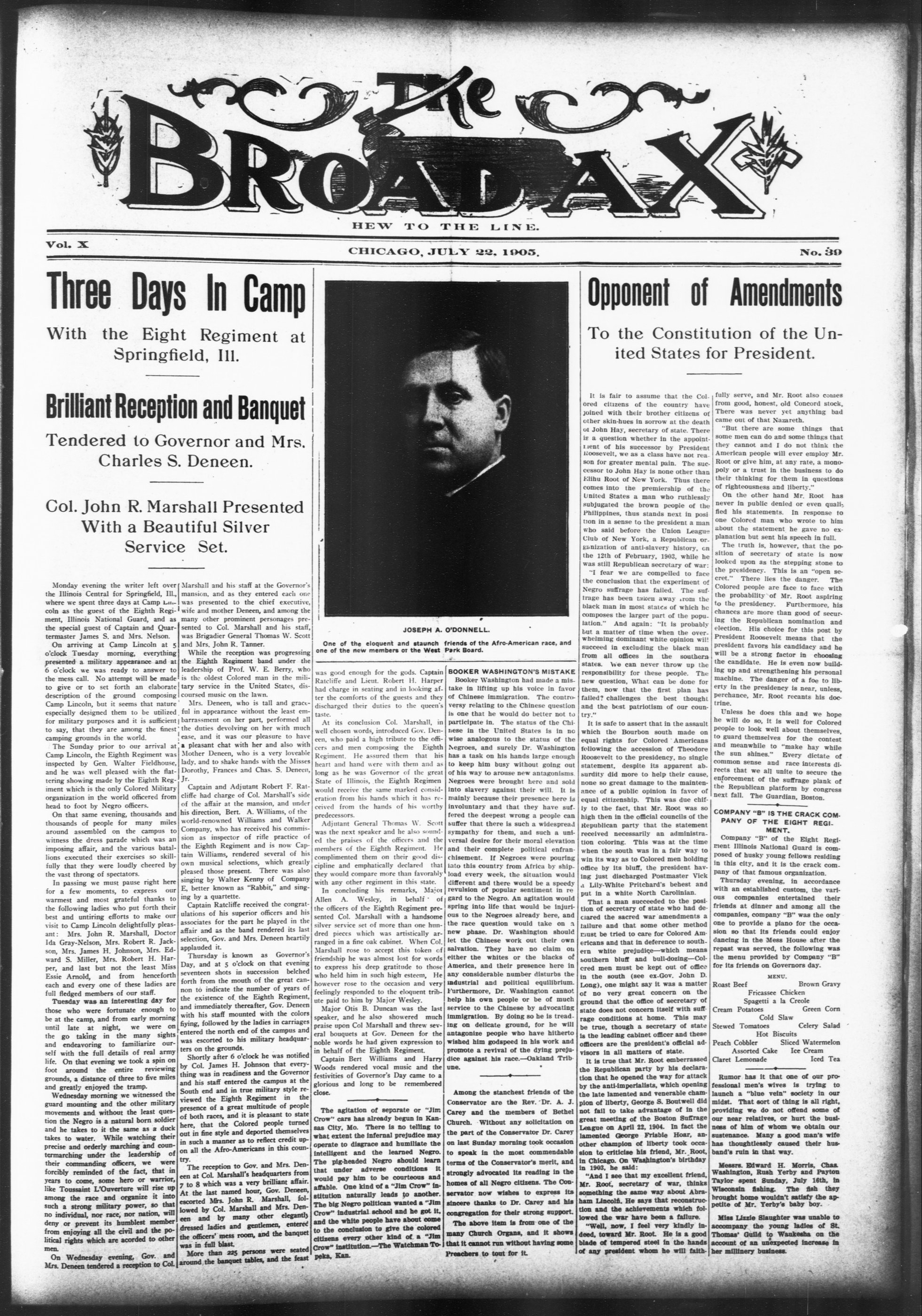
Page text (machine-generated)
BROAD AX
Three Days In Camp
With the Eight Regiment at Springfield, Ill.
Tendered to Governor and Mrs. Charles S. Deneen.
Col. John R. Marshall Presented With a Beautiful Silver Service Set.
Vol. X
Three Days
With the Eight
Springfi
Brilliant Reception
Tendered to Go
Charles S
Col. John R. Mar
With a Beaut
Service
Monday evening the writer left over the Illinois Central for Springfield, Ill., where we spent three days at Camp Lincoln as the guest of the Eighth Regiment, Illinois National Guard, and as the special guest of Captain and Quartermaster James S. and Mrs. Nelson.
On arriving at Camp Lincoln at 5 o'clock Tuesday morning, everything presented a military appearance and at 6 o'clock we was ready to answer to the mess call. No attempt will be made to give or to set forth an elaborate description of the ground composing Camp Lincoln, but it seems that nature especially designed them to be utilized for military purposes and it is sufficient to say, that they are among the finest camping grounds in the world.
The Sunday prior to our arrival at Camp Lincoln, the Eighth Regiment was inspected by Gen. Walter Fieldhouse, and he was well pleased with the flattering showing made by the Eighth Regiment which is the only Colored Military organization in the world officered from head to foot by Negro officers.
On that same evening, thousands and thousands of people for many miles around assembled on the campus to witness the dress parade which was an imposing affair, and the various battalions executed their exercises so skillfully that they were loudly cheered by the vast throng of spectators.
In passing we must pause right here for a few moments, to express our warmest and most grateful thanks to the following ladies who put forth their best and untiring efforts to make our visit to Camp Lincoln delightfully pleasant: Mrs. John R. Marshall, Doctor Ida Gray-Nelson, Mrs. Robert R. Jackson, Mrs. James H. Johnson, Mrs. Edward S. Miller, Mrs. Robert H. Harper, and last but not the least Miss Essie Arnold, and from henceforth each and every one of these ladies are full fledged members of our staff.
Tuesday was an interesting day for those who were fortunate enough to be at the camp, and from early morning until late at night, we were on the go taking in the many sights and endeavoring to familiarize yourself with the full details of real army life. On that evening we took a spin on foot around the entire reviewing grounds, a distance of three to five miles and greatly enjoyed the tramp.
Wednesday morning we witnessed the guard mounting and the other military movements and without the least question the Negro is a natural born soldier and he takes to it the same as a duck takes to water. While watching their precise and orderly marching and countermarching under the leadership of their commanding officers, we were forcibly reminded of the fact, that in years to come, some hero or warrior, like Toussaint L'Ouverture will rise up among the race and organize it into such a strong military power, so that no individual, nor race, nor nation, will deny or prevent its humblest member from enjoying all the civil and the political rights which are accorded to other men.
On Wednesday evening, Gov. and Mrs. Deneen tendered a reception to Col.
Marshall and his staff at the Governor's mansion, and as they entered each one was presented to the chief executive, wife and mother Deneen, and among the many other prominent personages presented to Col. Marshall and his staff, was Brigadier General Thomas W. Scott and Mrs. John R. Tanner. While the reception was progressing the Eighth Regiment band under the leadership of Prof. W. E. Berry, who is the oldest Colored man in the military service in the United States, discoursed music on the lawn.
Captain and Adjutant Robert F. Ratcliffe had charge of Col. Marshall's side of the affair at the mansion, and under his direction, Bert. A. Williams, of the world-renowned Williams and Walker Company, who has received his commission as inspector of rifle practice of the Eighth Regiment and is now Captain Williams, rendered several of his own musical selections, which greatly pleased those present. There was also singing by Walter Kenny of Company E, better known as "Rabbit," and singing by a quartette.
Captain Ratcliffe received the congratulations of his superior officers and his associates for the part he played in the affair and as the band rendered its last selection, Gov. and Mrs. Deneen heartily applauded it.
Thursday is known as Governor's Day, and at 5 o'clock on that evening seventeen shots in succession belched forth from the mouth of the great cannon to indicate the number of years of the existence of the Eighth Regiment, and immediately thereafter, Gov. Deneen with his staff mounted with the colors flying, followed by the ladies in carriages entered the north end of the campus and was escorted to his military headquarters on the grounds.
Shortly after 6 o'clock he was notified by Col. James H. Johnson that everything was in readiness and the Governor and his staff entered the campus at the South end and in true military style reviewed the Eighth Regiment in the presence of a great multitude of people of both races, and it is pleasant to state here, that the Colored people turned in fine style and deported themselves in such a manner as to reflect credit upon all the Afro-Americans in this country.
The reception to Gov. and Mrs. Deneen at Col. Marshall's headquarters from 7 to 8 which was a very brilliant affair. At the last named hour, Gov. Deneen, escorted Mrs. John R. Marshall, followed by Col. Marshall and Mrs. Deneen and by many other elegantly dressed ladies and gentlemen, entered the officers' mess room, and the banquet was in full blast.
More than 225 persons were seated around the banquet tables, and the feast
HEW TO THE LINE.
CHICAGO, JULY 22, 1905.
P. J.
JOSEPH A. O'DONNELL.
One of the eloquent and staunch one of the new members or the West was good enough for the gods. Captain Ratcliffe and Lieut. Robert H. Harper had charge in seating and in looking after the comforts of the guests and they discharged their duties to the queen's taste.
At its conclusion Col. Marshall, in well chosen words, introduced Gov. Deneen, who paid a high tribute to the officers and men composing the Eighth Regiment. He assured them that his heart and hand were with them and as long as he was Governor of the great State of Illinois, the Eighth Regimen would receive the same marked consideration from his hands which it has received from the hands of his worthy predecessors.
Adjutant General Thomas W. Scott was the next speaker and he also sounded the praises of the officers and the members of the Eighth Regiment. He complimented them on their good discipline and emphatically declared that they would compare more than favorably with any other regiment in this state.
In concluding his remarks, Major Allen A. Wesley, in behalf of the officers of the Eighth Regiment presented Col. Marshall with a handsome silver service set of more than one hundred pieces which was artistically arranged in a fine oak cabinet. When Col. Marshall rose to accept this token of friendship he was almost lost for words to express his deep gratitude to those who held him in such high esteem. He however rose to the occasion and very feelingly responded to the eloquent tribute paid to him by Major Wesley.
Major Otis B. Duncan was the last speaker, and he also showered much praise upon Col Marshall and threw several bouquets at Gov. Deneen for the noble words he had given expression to in behalf of the Eighth Regiment.
Captain Bert Williams and Harry Woods rendered vocal music and the festivities of Governor's Day came to a glorious and long to be remembered close.
The agitation of separate or "Jim Crow" cars has already begun in Kansas City, Mo. There is no telling to what extent the infernal prejudice may operate to disgrace and humiliate the intelligent and the learned Negro. The pig-headed Negro should learn that under adverse conditions it would pay him to be courteous and affable. One kind of a "Jim Crow" institution naturally leads to another. The big Negro politician wanted a "Jim Crow" industrial school and he got it, and the white people have about come to the conclusion to give the colored citizens every other kind of a "Jim Crow" institution—The Watchman Topeka, Kan.
friends of the Afro-American race, and Park Board.
BOOKER WASHINGTON'S MISTAKE
Booker Washington had made a mistake in lifting up his voice in favor of Chinese immigration. The controversy relating to the Chinese question is one that he would do better not to participate in. The status of the Chinese in the United States is in no wise analogous to the status of the Negroes, and surely Dr. Washington has a task on his hands large enough to keep him busy without going out of his way to arouse new antagonisms. Negroes were brought here and sold into slavery against their will. It is mainly because their presence here is involuntary and that they have suffered the deepest wrong a people can suffer that there is such a widespread sympathy for them, and such a universal desire for their moral elevation and their complete political enfranchisement. If Negroes were pouring into this country from Africa by shipload every week, the situation would different and there would be a speedy revulsion of popular sentiment in regard to the Negro. An agitation would spring into life that would be injurious to the Negroes already here, and the race question would take on a new phase. Dr. Washington should let the Chinese work out their own salvation. They have no claim on either the whites or the blacks of America, and their presence here in any considerable number disturbs the industrial and political equilibrium. Furthermore, Dr. Washington cannot help his own people or be of much service to the Chinese by advocating immigration. By doing so he is treading on delicate ground, for he will antagonize people who have hitherto wished him godspice in his work and promote a revival of the dying prejudice against his race.—Oakland Tribune.
Among the stanchest friends of the Conservator are the Rev. Dr. A. J. Carey and the members of Bethel Church. Without any solicitation on the part of the Conservator Dr. Carey on last Sunday morning took occasion to speak in the most commendable terms of the Conservator's merit, and strongly advocated its reading in the homes of all Negro citizens. The Conservator now wishes to express its sincere thanks to Dr. Carey and his congregation for their strong support. The above item is from one of the many Church Organs, and it shows that it cannot run without having some Preachers to tout for it.
Opponent of Amendments
To the Constitution of the United States for President.
It is fair to assume that the Colored citizens of the country have joined with their brother citizens or other skin-hues in sorrow at the death of John Hay, secretary of state. There is a question whether in the appointment of his successor by President Hoosevelt, we as a class have not reason for greater mental pain. The successor to John Hay is none other than Elihu Root of New York. Thus there comes into the premiership of the United States a man who ruthlessly subjugated the brown people of the Philippines, thus stands next in position in a sense to the president a man who said before the Union League Club of New York, a Republican organization of anti-slavery history, on the 12th of February, 1903, while he was still Republican secretary of war: "I fear we are compelled to face the conclusion that the experiment of Negro suffrage has failed. The suffrage has been taken away from the black man in most states of which he composes the larger part of the population." And again: "It is probably but a matter of time when the overwhelming dominant white opinion will succeed in excluding the black man from all offices in the southern states. We can never throw up the responsibility for these people. The new question, What can be done for them, now that the first plan has failed? challenges the best thought and the best patriotism of our country."
It is safe to assert that in the assault which the Bourbon south made on equal rights for Colored Americans following the accession of Theodore Roosevelt to the presidency, no single statement, despite its apparent absurdity did more to help their cause, none so great damage to the maintenance of a public opinion in favor of equal citizenship. This was due chily to the fact, that Mr. Root was so high then in the official councils of the Republican party that the statement received necessarily an administration coloring. This was at the time when the south was in a fair way to win its way as to Colored men holding office by its bluff, the president having just discharged Postmaster Vick a Lily-White Pritchard's behest and put in a white North Carolinian.
That a man succeeded to the position of secretary of state who had declared the sacred war amendments a failure and that some other method must be tried to care for Colored Americans and that in deference to southern white prejudice—which means southern bluff and bull-dozing—Colred men must be kept out of office in the south (see ex-Gov. John D. Long), one might say it was a matter of no very great concern on the ground that the office of secretary of state does not concern itself with suffrage conditions at home. This may be true, though a secretary of state is the leading cabinet officer and these officers are the president's official advisors in all matters of state.
It is true that Mr. Root emberrassed the Republican party by his declaration that he opened the way for attack by the anti-imperialists, which opening the late lamented and venerable champion of liberty, George S. Boutwell did not fail to take advantage of in the great meeting of the Boston Suffrage League on April 22, 1904. In fact the lamented George Frisbie Hoar, another champion of liberty took occasion to criticise his friend, Mr. Root, in Chicago. On Washington's birthday in 1903, he said:
"And I see that my excellent friend, Mr. Root, secretary of war, thinks something the same way about Abraham Lincoln. He says that reconstruction and the achievements which followed the war have been a failure.
"Well, now, I feel very kindly indeed, toward Mr. Root. He is a good blade of tempered steel in the hands of any president whom he will faith-
Amendments
station of the Un-
for President.
fully serve, and Mr. Root also comes from good, honest, old Concord stock. There was never yet anything bad came out of that Nazareth.
"But there are some things that some men can do and some things that they cannot and I do not think the American people will ever employ Mr. Root or give him, at any rate, a monopoly or a trust in the business to do their thinking for them in questions of righteousness and liberty."
On the other hand Mr. Root has never in public denied or even qualified his statements. In response to one Colored man who wrote to him about the statement he gave no explanation but sent his speech in full. The truth is, however, that the position of secretary of state is now looked upon as the stepping stone to the presidency. This is an "open secret." There lies the danger. The Colored people are face to face with the probability of Mr. Root aspiring to the presidency. Furthermore, his chances are more than good of securing the Republican nomination and election. His choice for this post by President Roosevelt means that the president favors his candidacy and he will be a strong factor in choosing the candidate. He is even now building up and strengthening his personal machine. The danger of a foe to liberty in the presidency is near, unless, perchance, Mr. Root recants his doctrine.
Unless he does this and we hope he will do so, it is well for Colored people to look well about themselves, to guard themselves for the contest and meanwhile to "make hay while the sun shines." Every dictate of common sense and race interests directs that we all unite to secure the enforcement of the suffrage plank of the Republican platform by congress next fall. The Guardian, Boston.
COMPANY "B" IS THE CRACK COMPANY OF THE EIGHT REGIMENT.
Company "B" of the Eight Regiment Illinois National Guard is composed of husky young fellows residing in this city, and it is the crack company of that famous organization.
Thursday evening, in accordance with an established custom, the various companies entertained their friends at dinner and among all the companies, company "B" was the only one to provide a piano for the occasion so that its friends could enjoy dancing in the Mess House after the repast was served, the following was the menu provided by Company "B" for its friends on Governors day.
MENU.
Roast Beef Brown Gravy
Fricassee Chicken
Spagetti a la Creole
Cream Potatoes Green Corn
Cold Slaw
Stewed Tomatoes Celery Salad
Hot Biscuits
Peach Cobbler Sliced Watermelon
Assorted Cake Ice Cream
Claret Lemonade Iced Tea
Rumor has it that one of our professional men's wives is trying to launch a "blue vein" society in our midst. That sort of thing is all right, providing we do not offend some of our near relatives, or hurt the business of him of whom we obtain our sustenance. Many a good man's wife has thoughtlessly caused their husband's ruin in that way.
Messrs. Edward H. Morris, Chas Washington, Rush Yerby and Payton Taylor spent Sunday, July 16th, in Wisconsin fishing. The fish they brought home wouldn't satisfy the appetite of Mr. Yerby's baby boy.
Miss Lizzie Slaughter was unable to accompany the young ladies of St. Thomas' Guild to Wankesha on the account of an unexpected increase in her millinery business.
Will promulgate and at all times uphold the true principles of Democracy, but Castellano, Protestants, Freists, Infideles, Farmers, Single Taxes, Republicans, Knights, and any one of us can long as their language is prefer and responsibility is fixed.
The Broad *Ar* is a newspaper whose platform is broad enough for all, ever claiming the editorial right to speak its own mind.
Local communications will receive attention. Write only on one side of the paper.
JULIUS F. TAYLOR, Editor and Publisher.
Entered the Post Office at Chicago
Ill. as Second-class Matter.
SPECIAL NEW YORK LETTER AND COMMENT
It was with profound sorrow that hundreds of our Chicago friends in New York were informed through the columns of the stauch and reliable "Broad Ax" of Mr. Frederick T. Carey's unexpected demise. Many of us learned to know Col. Carey as a real gentleman, and in the Pythian Legion as a friend and a brother, strong and loyal, others of us knew him in a business way and as a professional man and an actor. The part he originated in Philip R. Miller's "Hottest Coon Dixie Co." will be recalled as clever and worthy of a gentleman of such diverse talent and accomplishments as those of Col. Carey. And now that he has gone from among us, and seems to stay so long We will all from time to time prepare our final departure and join him, there, where there is peace and happiness forevowed.
The New York Pullman Co. Supt. has engaged the services of Mr. Geo K. Vernon, possibly the most noted young colored chef in the west to cater to the palates of his most fastidious patrons of the Pullman private cars. Mr. Vernon was chef for Mr. Peabody the Chicago coal king for several years, and earned an indelible record as a specialist in genuine French cuisine and the best Southern menus as well. It would be a grand move if Mr. G. K. Vernon could be establish a first class cooking school in Chicago or New York for the education of our colored youth whose ideals often trend to excel in this most indispensable art. Mr. Vernon carries a book of his best testimonials which would make the king chef blush with envy.
Mr. Bert A. Williams our famous American dialect comedian and composer has gone to Chicago, also to encamp with his regiment at Springfield, Ill. Bert is with the "8th" and his New York followers hope he'll return with a marksman's larels at least, and all the dignity of an Adjutant's calling. Mr. William's late song hit is "Nobody." Mr. French R. Bell, formerly manager of the Keystone Hotel in Chicago, is in the city for a short stay, and is at Nail Brothers' Hotel often.
The unabated boiling Old Sol has given New Yorkers has turned to an unmerciful roasting with no rainfall the name, people in the poorer East Side and on the streets for the last ten days have suffered terribly. Nearly 600 deaths are recorded as a result of this lingering hot wave. If the Master don't send some relief to us soon the death rate will be appalling.
Hereafter The Broad Ax, with full news comment of New York and vicinity will be found on sale at 5 cents per copy at Mr. Jones' shop in 31st street, and at Carle Browne Cooke's new office at 57 West 134 street, Harlem. Also at the N. Y. Rep. Club. Subscription rates $2.00 per year or $1.00 for six months; advertisements in The Broad Ax are sure to pay. All high class performers watch and read our professional mention and vaudeville comment.
The crying need of our race, as a race, is to establish a literature—one worthy of the name. It must touch all vocations of life and all the ideal and real emotions. We have a mere nucleus just now. But if the young authors and philosophers as well as our journalists can receive half the encouragement they need and deserve, they will spur on, and with renewed vigor and inspiration together with their ability and noble impulse will give our coming generation at least an American Negro literature in all its diversion of beauty, wealth and truth, worthy of the name literature:a great word, a power, and the making of a nation.
It is to be hoped Mr. D. E. Tobias will see fit to visit New York and honor our Lyceum, and other clubs of advanced ideas and ideals with a portion of his views on the various phases of this civilization of which we learn he is wont to apply the white man's civilization. His reputation preceded him from London and Paris, and Gotham years to hear this fearless, truthful and worthy man of our race, orate and expostulate.
Mr. George W. Walker has returned from a business trip to Philadelphia and Baltimore where he had gone to locate some new material in the line of cultured voiced sopranos for his new comic-opera "Abbesynia" to be produced next season. He is also managing director of the Williams & Walker Glee Club. The latter are heading the bill at B. F. Keith's theatre, Union Square, N. Y., having just finished the Proctor House, where they were unanimously acclaimed an instantaneous hit and one really new feature in the vaudevilles.
Hammerstein's Paradise Gardens are still drawing with Mr. Ernest Hogan and his 25 Nashville Students (socalled), Abble Mitchel, soprano (Mrs. Will Marion Croke), is also with Mr. Hogan's Co. Mr. Hogan will star in his new play "Ethiopia" next season. Rehearsals begin soon.
The Entre-Nous Pub. Co., is turning out some excellent compositions by several of our young song writers. They are in Music Row, 53 W. 28th st., Messrs. Mooney and Greinfart are the firm.
Carle Browne Cooke, National Correspondent The Broad Ax, New York City.
Eternal Hell Is Scouted.
The doctrine that there is an everlasting punishment was excoriated in an address delivered at Philadelphia by Rev. Charles T. Russell of Allegheny, Pa. "To Hell and Back," was the subject announced and the hall was crowded with people anxious to hear the man who has so strenuously opposed the belief in eternal punishment. "There are thousands of people in insane asylums today because they were taught to have faith in the doctrine of an everlasting hell, where millions suffer roasting," said Mr. Russell. "The common doctrine is simply this: God first prepared great abysses, stocked with fuel to last through the eternal ages, some fireproof devils with pitchforks. He then created man and condemned the greater portion of mankind to roast forever in this place. The ministers are responsible for this error. They know that that doctrine is false, but it suits their purpose and they do not care to tell the truth."
ST. THOMAS
Go ye therefore and teach all nations is the commission given to the twelve Apostles nearly two thousand years ago which plainly shows that the church is the Divine teacher and the office of her Priest is to explain the revealed word of God to Baptize and hear confessions and to lift up the fallen in Christ's name, and His Promise Lo I am with you always stands as firm today in the Apostolic Church and it did when first spoken the Church doors stand open and Christ bids you "Come" next Sunday 5th Sunday after Trinity Low Celebration at 7:30 a. m., and morning Prayer and Sermon at 11 a. m., Calendar for Week.
July 23. 5th Sunday after Trinity.
July 25. St. James (Martyr) altar.
Red
July 26. St. Anne, Mother of Bl. Vir.
Mary.
July 28. Friday, fast.
AGENTS AND CORRESPONDENTS WANTED.
The Broad AX-desires to engage Agents and regular Correspondents in all the leading cities and towns throughout the country. The highest commissions paid to live hustlers. Sample copies furnished free. For further information, address Julius F. Taylor, 5049 Armour avenue, Chicago.
Bright Boys and Girls Wanted to Sell
The Broad Ax.
Bright boys and girls can make money in every community by selling The Broad Ax. It will cost you nothing to begin, as we will send you a supply of papers for the first week free.
If there are any bright boys and girls in any section of the country who want to start in business for themselves, make money and be independent, write to us at once, and we will send you ten papers free of charge. You can sell them for 5 cts. each, this will give you the capital which you can buy more papers at the newsdealers' rate, allowing you a good profit.
Thinking and progressive people read The Broad Ax. Your father, brothers, uncles and friends will buy the paper from you. If you mean business write to Julius F. Taylor, 5040 Armour ave.
Invitations are out for the Appamotox Club picnic.
Mr. R. A. J. Shaw is out of town on legal business. He will return about the 25th inst.
Mrs. Ida B. Wells-Barnett and family are spending these hot days on a farm in Michigan.
Dr. A. W. Williams has returned from Cairo, Ill., where he attended the K. P. convention.
Mrs. Moses Jackson is visiting Cincinnati, O., for a few weeks the guest of Mrs. Hattie Fisher.
The "Old Folks' Home" picnic at Rasch's Grove Tuesday evening was a great success in every respect.
Mrs. Rush Yerby & Son will spend two weeks in Glencoe, Ill., where they hope to escape the severe heat.
Miss Cecelia Johnson, 5846 Wabash ave., is spending her vacation from the University of Chicago in Glencoe, Ill.
Mrs. J. H. Smiley and daughter returned from Normal, Ill., Wednesday, where they spent a pleasant time, the guests of Mrs. Andrew Smith.
Mr. Wm. Akers, of the 8th Illinois National Guard, returned from Cuba recently minus a hand and an eye. He is stopping with his sister at 1949 Marshfield ave.
Word reaches us from St. Paul that the next social event looked forward to is the wedding of Miss James to Mr. Bobbie Taylor of the Election Commissioner's office.
Miss Blanche Wright was the guest of Col. and Mrs. James H. Johnson at Camp Lincoln, Springfield, Ill., and she looked very chaming at the Governor's reception and banquet Thursday evening.
Mrs. Sadie Scott, 135 W. 51st street and Master Dewey and Claude Scott will leave on July 27th, on a six weeks visit with friends at Niagara Falls, Buffalo, N. Y., Cleveland, O., and Detroit, Mich.
Mrs. Wm. Emanuel entertained eight babies and their mothers at her residence, 6352 Rhodes ave., Saturday afternoon. Not a baby was over 5 months old, and all save one were boys. Lunch was served to the parents, while babies were permitted to amuse themselves as usual.
Thos. P. Flynn the most efficient Deputy Sheriff of Cook County will take his departure on July 29th for Boston, Mass. As a delegate to the Order of Foresters Convention to be held in that city and from there before returning home he will visit New York City and Washington, D. C.
There are several so-called leading Afro-American newspapers in this city, in their minds eye, but The Broad Ax, which outranks them all was the only newspaper among the entire lot whose editor had the wherewith and sufficient enterprise to visit Camp Lincoln during the encampment there of the Eighth Regiment.
Mrs. Doctor George C. Hall, Mrs. Charles H. Pickett, Washington D. C., and Miss Ida M. Hall, New Orleans La., accompanied by, Doctor Bert Anderson, Doctor York, and Mr. White the popular druggist, arrived at Camp Lincoln, Thursday morning to join in the ceremonies on Governor's day. Mrs. Hall and her party returned home that same evening.
Gov. Deneen, has selected the following gentlemen to serve as members of the West Park Board. Bernard A. Eckhart, Twentieth ward; Frederick W. Dreckman, Thirty-fifth ward; Frederick F. Bullen, Thirteenth ward; Frank Kirchman, Twelfth ward; William C. Eggert, Fifteenth ward; Addison E. Wells, Twentieth ward; Joseph A. O'Donnell, Seventeenth ward.
To Rent.
To Rent.
A large basement with furnace heat. Suitable for living rooms for a small family. Cheap rent. 3236 Wabash ave.
Furnished Rooms to Rent.
Nearly furnished rooms, all modern improvements, to rent to single ladies and gentlemen or married couples. Mrs. Malline Vaneer, 2806 Wabash Ave. 'phone 5254 Calumet
LADY AGENT8 WANTED!
To Sollicit For a Toilet Preparation in Connection With The Broad Ax.
Two or three live, active and wide awake lady agents, either white or colored, wanted to solicit for a high class Toilet Preparation in connection with The Broad Ax. If you mean business, call or address Julius F. Taylor, 5040 Armour avenue, Chicago.
ETIOUETTE OF CALLS
KINDNESS THE FOUNDATION
STONE OF SOCIAL EDIFICE.
May a Man Ask Permission to Call?—
If the Caller Is Bashful, Believe
Him of His Hat—The Minute
Conversation Drags, Depart—The Hostess May Not End a Call—Driblets
of Talk Unnecessary on the Door-
Sill.
(Copyright, 1905, by Joseph B. Bowles).
I am often asked by young people who are anxious to do just right, whether a lady should invite a man to call upon her, or whether he should ask her permission to call. In ordinary intercourse the matter is not momentous. If two persons meet casually, find each other agreeable, and wish further acquaintance, they usually find a way of bringing about what they desire. According to strictly conventional rules, the gentleman should seek the acquaintance of the lady, and he may properly pay her the homage of asking if he may call on her, or he may suggest to a friend who knows her that he would like to be taken to call. There are no insurmountable barriers in a country like ours, to prevent the pleasant social mingling of those who are mutually attracted. Nor is there the slightest reason why, in most cases, a young woman should hesitate to say, frankly: "I will be pleased to see you at my home if you have an evening free," or "Mother will be glad to meet you at any time," or "Mother and I are always happy to see our friends," or any other formula that is sincere and cordial.
Girls are learning the true value of mothers. In the more exclusive circles of society mothers spread protecting wings over their unmarried daughters till the latter have evidently and definitely entered on the privileges of spinsterhood. A young woman who has reached her thirtieth year no longer needs the hovering pinion of maternal supervision at every step. Girls, however, are saved many embarrassments and rescued from many predicaments by treating their mothers with consideration, and putting them as a shield between themselves and any confusing situation. The days are over, I trust forever, when on the announcement of a masculine caller, a callow youth or boy about as old as her own son, a mother scuttles out of the parlor like a frightened hen and leaves the entertainment and the field to her daughters. She may not wish to give up her entire evening to the boy or the man, but if she be well-bred, she greets him and stays awhile, and retires in no disorder. Nor, while she remains, is her presence a handicap on the group. Her girls wish mother to know their friends.
How late may a man linger when he calls is another query solicitously propounded. Of course the length of a call depends somewhat on the familiarity of the caller in the family. An intimate friend will not trespass against any accepted code if he remain until almost the ordinary bedtime of the family. This time, as everyone knows, differs widely in different households. Ten o'clock is late for some. Others do not break the evening camp until 11. But, broadly speaking, few callers should stay beyond half-past ten, and ten is the better hour for leave-taking in most instances. A first call should not be more than a half hour long. From eight to nine o'clock in town calls are in order. In country homes calling may begin and end an hour earlier than is feasible in town. Never protract a call after it grows wearisome. When conversation drags like a sleigh on bare ground for pity's sake arise and depart. Don't monopolize the conversation, you who receive, or you who call. Good talk is not a monologue. It must needs show fair play.
"Shall I relieve a young man of his hat, his stick, his umbrella?" inquires a young woman, whose earnest desire is to be courteous. Fashion says, let a man look after his paraphernia himself. The duty of a hostess does not oblige her to take any trouble in the matter. But here intervenes common sense. Should you happen to have a bashful visitor, or a near-sighted one, why not tell him that there is a table, a hat-rack, or some other convenient place where he may lay his outdoor things? The clever guest, accustomed to society, will need no such intimation, and the instinct of amiability is to assist the opposite one, whose shyness is making him wretched.
There are men who cling desperately to hat and stick, as if should they let them go they would be unarmed in a hostile country. By all means let such sufferers possess their souls, and their hats, too, in peace. In the case of an aged or infirm visitor rules are laid aside. Such a one is to be cared for and aided in every way. Before age and weakness politeness bows the knee. Indeed, the foundation stone underlying the social edifice and holding it up, is kindness, and hard by that is another stone, called common sense. If you build your good manners on these you will not be found wanting in a king's court, or in a rear tenement.
"May the hostess terminate a call?" Certainly not, unless she has some excellent reason for doing so, as, for instance, illness in the family, a child with the croup, a husband with rheumatism, a hungry man waiting for his supper, when the maid is out
on her evening off. Ordinarily, the hostess sits, attentive and interested, until her visitor rises to go. She also rises and goes with him to the door. Town etiquette dictates leave-taking at the door of the drawing-room. Old-fashioned people, of whom I am one, go to the house-door and say good-by to a guest there. Politeness does not require dribbles of talk on the door-sill, nor any prolonged farewell, with the wind blowing in the face of the hostess. She need not incur pneumonia and influenza through such folly as this.
"I hate," says pretty Mabel, "to introduce people." My dear child, why? It's the simplest thing on earth. You mention names very clearly, you present the younger person to the older, the gentleman to the lady. Do it once or twice and your dread will vanish. It's the same about offering refreshments, which Almira loathes. From the earliest antiquity hospitality has been illustrated by the offered loaf. A man or a woman who is your friend is never wholly yours until he or she has broken bread beneath your roof. There is never any difficulty if you have light refreshments suitable to the hour, if you proffer them without nervousness, and, if you contrive a table or stand whereon a guest may rest a glass, a tea cup or a plate. To hold these things in the hand is not always convenient.
About visiting cards. Remember that a card left at the door always counts as a call. Don't waste your visiting cards. It is not necessary, except very occasionally, to leave a card for every member of a household. In the matter of visiting cards, use common sense. Do not, for instance, send cards in to friends with whom you are on terms of dropping in without formality. If you ever do blunder, don't worry. The sky won't fall. Forget it and do right next time.
NEAT SCALLOPED DOILEY.
A Pretty Color Combination Is Delft Blue and White and Another Nile Green and White.
It is not necessary for the dolly to match the centerpiece, so I have drawn a set of dolllies that can be embroidered either to white mercerized cotton or in floos floss, says Sarah Hale Hunter, in the Philadelphia Press. It would be very pretty to work them in shades of delft blue, using the darker blue for the stems and leaves, and the lighter for the flowers. The middle shade should be used for the scallops. Nile green and white also make a very good combination, or three
A NEAT FATTERN.
shades of yellow. Embroider the scallops in the buttonhole stitch, first running them with white darning cotton. The stems should be done in the outline stitch and the flowers in the solid satin stitch. A rather fine linen should be used of not too heavy a quality.
ETIQUETTE OF GIFTS.
Not Considered Good Form for Girl to Accept Handsome and Expensive Gifts from Men.
It is always best for a young girl to accept only flowers and bon-bons from men. I know that nowadays girls very frequently accept much handsome presents, but I think a safe rule for you to make is to always refuse all gifts from men but flowers and candy and perhaps books and music. Of course, if you have known a young man for years, or if he is an intimate friend of the family, a "special dispensation" might sometimes be granted. Otherwise I would advise you to return any very handsome gift which is sent you by a young man, and with it send a gracious and cordial note, showing your friend that you appreciate most sincerely his kind thought of you, and assuring him that you return the gift only because you make it a rule never to accept from any man anything beyond the conventional gift of flowers, books or bon-bons.
Bosy Cheeks
Imperfect circulation is often the cause of colorless cheeks. Be careful to eat nourishing food, drink six or seven glasses of water during the day, live in the open air as much as possible, breathe deeply and practice light gymnastics. Do not use cosmetics on the face, but bathe it frequently. Scrub it good with hot water and soap at night, and bathe it with cold water several times during the day. This will tone up the skin and improve circulation.
For Weak Eyes
Lotion for weak, tired or inflamed eyes: Fifteen drops of spirits of camphor, one teaspoonful of powdered boric acid, two-thirds of a cup of boiling water. Cool, strain through muslin and apply several times a day with an eyecup. Don't wear spotted veils and never read in a dim light. Bad eyes are usually the result of abuse or neglect.
THE MANDARIN'S BUTTONS
Emblems of High Rank and Their Significance Among the Chinese.
"A collection of buttonholes was the pride of a certain queen in one of Stockton's fairy tales," said a Milwaukee millionaire. "I collect the next thing to buttonholes, namely, buttons. And I can tell you when buttons and buttonholes first came into use, who invented them, how they spread gradually over the world, together with many other things of interest."
The millionaire's glass cases contained many beautiful, many historical buttons. He turned to the case labeled "Chinese."
"Here," he said, "are the buttons which the mandarins of China wear on their caps to indicate their rank. This silver button is the emblem of the mandarin of the ninth class—the lowest class. The plain gold button denotes the eighth class mandarin. The seventh class wears the gold button to the right, the one ornately carved. That beautiful button of jade belongs to the sixth class, and the fifth wears a button of pure rock crystal. The fourth class mandarin's button is that one of dark purple crystal. The third class' is the sapphire. The second's is coral red.
"With each of the buttons an official bird goes. The bird is embroidered on the breast of the official coat. The mandarin of the second class has for his bird the cock; the third class has the peacock, the fourth has the pelican, the fifth has the silver peasant, the sixth has the story, the seventh has the partridge, the eighth has the quail and the ninth has the sparrow."
FASHION'S COLOR FREAKS.
Transformations in Woman's Complexion Productive of Connubial Confusion.
"I'm glad I'm not my wife," said the dyspeptic, according to the Philadelphia Record, as he settled down to his hygienic luncheon of rare roast beef, creamed onions and boiled rice; "I'd be dead if I were. I have trouble enough keeping alive as it is. Fancy the shape I'd be in if I had to change my spots—I mean my color—as often as fickle fashion dictates. Why, I've forgotten what color my wife originally was, she's undergone so many beauty transformations. And now she's got to do it again. A friend just back from the other side has told her that though red hair continues to be the proper cap it must now be backed up by green eyes and a dead white skin. The hair and skin are easy enough, but eve my wife is a little afraid of the beauty specialist who is willing to undertake to make her eyes look green. There's just one grain of comfort in it all for me—though she achieve the pallid skin, the green eyes and the red hair it will not give her a temperament to correspond. I shall yet enjoy the modium of peace it is in her capricious nature to allow me."
HER MANNER MAY CHANGE
When a Woman Is Displeased She Is Not Forgetful of Society
She was plainly irritated about something and sat pouting as she ate in a downtown restaurant, and not saying a word to the man with her, evidently her husband, relates the Chicago Tribune. Before the luncheon was finished another man came in. The husband knew him and called him over to their table and introduced him. The woman was then all smirks and smiles. Her anger disappeared completely, and she even included her husband in her sunny views of life.
"That's society manners all right," said a girl at another table, "but did you ever see anything so foolish. It's a good guess she wants a hat or money to buy something of the sort from her husband and is going to pout till she gets it, but what a contrast her manner is to the man she's never seen before and isn't likely to see again! It must look as absurd to the husband as it does to us. If ever I have a husband I'll not set about it that way when I want to get something out of him."
Bridling the Tongue
There is more than mere cynicism in Talleyrand's remark that "speech was given to man to conceal his thoughts." If we are to live in peace and harmony with our fellows we must conceal many thoughts, unless we are endowed with a mind in which no unkind or unpleasant thought can find lodgment. We may think that Neighbor X is more agreeable than Neighbor Y, and that Mrs. A's daughter is more beautiful than Mrs. B's, and that Dr. Pill is a better physician than Dr. Pellet; but what unpleasantness it would create if we were to say these things to Dr. Pellet, or to Mrs. B, or to Neighbor Y! - Youth's Companion.
Spain's Linguistic King.
King Alfonso has a fair claim to be regarded as the best educated of our crowned heads. He is a linguist, being familiar with French, Italian, German and English. He never travels without Goethe, Schiller and the Austrian poet, Grillarzer, whose name will be new to most people. Of the ancient classics King Alfonso prefers Horace, many of whose odes he has translated into Spanish. Moreover, he revels in mathematics and history, and adores drawing. What attention he has paid to English literature is not made public—London Chronicle.
Easily Arranged.
"The lady ain't got the money now," said Bridget; "but ye kin'ave the ice an' she'll on Saturday." "But," protested the new iceman, "a'posin' she ain't got the money then?" "Well, if she ain't ye kin take yer ice back." -Philadelphia Press.
WASHINGTON LETTER
THE WORK OF SURGEON-GEN-
ERAL WALTER WEYMAN.
Is Broad Field of Work and Value to the Country at Large—Sir Mortimer Durand "A Good Fellow."
WASHINGTON. — In a big stone mansion on Capitol hill, just south of the capitol building, a genial, florid complexioned sandy - mustached gentleman, decid-
ASHINGTON. — In a big stone mansion on Capitol hill, just south of the capitol building, a genial, florid-complexioned, sandy - mustached gentleman, decidedly stout and of medium height, has his headquarters. There is nothing unusual about his appearance, but his name is known throughout the length and breadth of this land, and for that matter throughout the world, wherever disease and infection exist. This is Surgeon-General Walter Wyman, the conservator of the nation's health. He is at the head of the public health and marine hospital service, and his name is associated with every important movement looking to the control of epidemics and the prevention of diseases and plagues entering the borders of the United States.
Dr. Wyman is a modest gentleman, who never intrudes himself on public notice, but his position at the head of the health department of the government brings him into prominence, and the work of his bureau has been so important and at times almost sensational that it necessarily has made him one of the best-known of public officials. Dr. Wyman has worked, during the 14 years he has occupied his present place, in favor of national health laws and regulations and quarantine. He has successfully opposed the old regimes of shotgun quarantine that obtained in the south. The United States health officers are now recognized everywhere, and no longer opposed in the discharge of their duties. Dr. Wyman has been able during his administration to so police the frontiers with inspectors of his bureau as to reduce to the minimum the danger of the introduction of yellow fever and cholera.
Surgeon-General Wyman was in the marine hospital service before he was called to his present position. He was four years at the head of the marine hospital in Baldimore, and in addition to looking after the health of American seamen, he found time to take up the fight against the cruelty practiced on crews of oyster vessels. He was also in the marine hospital in New York.
URING the administration of Surgeon General Wyman, the marine hospital service has made great strides, because congress has been awakened to the necessity of na-
D
tional safeguards to the health of the people. This public health service has a rather interesting history, as it is unique in the governments of the world. No such organization exists in any other country, and probably no function of our federal government carries with it more arbitrary and far reaching powers than the enforcement of health regulations. The marine hospital service was established by act of congress July 16, 1798. Within two years there was established isolated hospitals at Norfolk, Boston, Newport and Charleston. Up to 1871, when the service was reorganized under a single head, a dozen hospitals had been established, including those at Baltimore, New York and Evansville, Ind. For three-quarters of a century there was a very lax administration of these isolated hospitals. When the service was reorganized, Surgeon General Woodworth became its head, and improvement at once followed.
The upbuilding of the service is slow work, however, but under Dr. Wyman, who took charge 14 years ago, this service, which then only looked after the sick merchant sailors, was transformed into a national health service, controlling national and interstate quarantine, and the inspection of the millions of immigrants who come to this country. The bureau also handles epidemics, state, national and insular, and controls the production and distribution of serums, viruses, toxins and analagous products. It conducts scientific research along hygienic lines, either in the finely equipped laboratory in this city or in some part of the territory or possessions of the United States.
The hygienic laboratory which now occupies the old naval observatory, is engaged in most important investigations. It promises in time to become one of the great institutions of the United States devoted to medical research. Of the 350 doctors connected with the bureau some of the brightest are assigned to work in this laboratory. It is studying leprosy, spotted fever and looking after the purity of drugs, as well as inspecting the serums of anti-toxins.
Soil Inoculation.
T
EN years ago the proposition that soils could be inoculated and made more productive would have been laughed at by the average farmer in the country. Today it is a recognized fact that bacteriological inoculation of the soil for leguminous plants will work a revolution in the worn-out
fields of the eastern states. The department of agriculture developed this idea, and although its practical application is less than three years old, it has now passed the experimental stage. That the agriculturists of the country believe In this theory is evidenced by the deluge of applications that has come to the department here for cultures of soil-inoculating bacteria. The great majority of these applicants are apt to be disappointed, as the department has not the ability to supply all the demands.
Secretary Wilson does not claim that the cultures are beneficial to the soil or to crops under all circumstances. They must be applied to legumes. The direct benefit is reported in more than 75 per cent. of the cases where the cultures have been used.
Since the first of the year a company has established a plant in Pennsylvania for the purpose of cultivation of soil inoculating bacteria, and another plant is in operation in Vermont. There promises to grow up a very considerable industry in this line, and as the agricultural department is also supplying these cultures a monopoly of the business by any one firm or combination will be prevented. It has been demonstrated by the department that the cost of the material for a culture capable of inoculating an acre is but four cents. Commercial concerns are charging from $1.50 to two dollars an acre for cultures.
Secretary of State
WAY off in southern France there is one of the most useful of our public officials enjoying himself to his heart's content after his own fashion. He is a small, undersized man.
WAY off in southern France there is one of the most useful of our public officials enjoying himself to his heart's content after his own fashion. He is a small, undersized man, deaf almost as a post and afflicted with a stoppage in his speech. This does not prevent him, however, extracting a maximum of enjoyment out of his vacation, which he annually takes in southern France and northern Spain, historical and pleasant regions which he explores on a bicycle. This is a rather inadequate description of Hon. Alvey A. Adee, whose official designation is the second assistant secretary of state, but it will suffice to picture him to the hundreds of people who have had to do business at the state department.
Secretary Adee's whole life has been devoted to diplomacy, and if the truth were known, the majority of the able state papers that have appeared over the names of much more famous men than he during the last 20 years have been of his composition. He is an expert in the use of diplomatic language, and in the construction of correspondence that will carry harsh truths in the softest terma.
Not long ago Mr. Adee presided at the meeting of the directors of the bureau of American republics. As he could not hear any motion made or speeches delivered, he worked out a programme which he had typewritten and given to each member. In this programme the order of business was indicated and the time to be allotted to each subject. The number of minutes each member was to be allowed to speak was also indicated. Mr. Adee called the meeting to order exactly on time and then with a split-second watch before him proceeded to carry out the programme. Some of the grandiloquent South and Central American ministers were much astounded to be cut off in the midst of their speeches by the sharp pounding of Mr. Adee's gavel. The latter never let on for a moment that he knew he was interfering with speeches, but immediately announced the next order of business, and in this way the meeting was conducted on schedule time and according to the Adee programme.
New British Ambassador.
HE new British ambassador, Sir Mortimer Durand, is already voted a "jolly good fellow" by those with whom he has come in contact in Washington's social and official circles.
T
There is nothing of the aristocrat about him, and he takes the keenest interest in American manners, customs and sports. Like his predecessor, Sir Michael Herbert, and also like the late Lord Pauncefoote, Sir Mortimer seems destined to increase the entente cordiale between Great Britain and the United States. He is a welcome visitor at the white house, and President Roosevelt is really very fond of him. The fact is that Mr. Roosevelt enjoys an actual comradeship with several of the ambassadors, notably Durand, Sternberg and Jusserand. The latter is a prime favorite with all the officials. Secretary Taft says he likes him because he is really the one diplomat who can thoroughly appreciate the subtlety of American humor.
Ambassador Durand has a sort of fad in the study of child life. Wherever he has been stationed he has gathered some interesting data about the manners and methods of the juvenile population. He has been greatly amused in observing the newsbots of New York and also the young colored and white arabs of the streets of Washington, but he thinks that for juvenile intelligence the little folks of Persia take the palm. As an illustration of this, he relates an incident that occurred when he represented Great Britain at Teheran. He and some of the legation people got up a picnic and told the cook to prepare a luncheon. The latter said that his children would pack the basket, as they were well acquainted with British ways. When Sir Mortimer himself unpacked the drinkables, where were claret and brandy, he found a package of peppermint drops tied to each bottle. He was a little startled to find how closely the Persian youngsters had studied English ways.
WAYS OF WILD ANIMALS:
Actions of the Skunk, Coon and Otter Are at Times Very Interesting.
Own cousin in foolishness to the rabbit is the skunk. Confident of his awful weapon of defense, a skunk is only equaled in reckless bravery by the porcupine, and both are too stupid to take any warning, says a Washington Star writer. Around army camps, where the cooks cut open canned food with a hatchet, it is not an uncommon thing to catch skunks near by. The top of the can being cut in quarters by two blows from the hatchet, it is emptied of its contents and thrown on the waste pile. If that can happened to have held salmon, it is irresistible to any skunk or coon that passes to leeward of it. A little investigation locates it, a paw is tried and then a nose. The yielding top allows an entrance, but forbids an exit, and so, with the can as a hood, the prowler falls a victim to those in the camp.
It is interesting to note the actions of an otter when he finds the tracks of a man near his home. He stops and his hair bristles up and he casts a furtive look around as if he had been caught in the act of stealing chickens. Little by little he edges away, and if he has a wife and children, sneaks off to them and hustles them out and away from the place. He knows the dangers of civilization.
The wildcat and mountain lion, after one experience with a trap, become very wise and hence correspondingly hard to trap, but a strange thing about most animals that are wise in avoiding steel traps is that they seem to know that when a trap is sprung it is no longer dangerous and will go right up to it and eat the bait.
So it is with all wild animals I have seen on the plains. The horse and the dog of civilization may be mighty intelligent and smart, but those animals that are compelled to live by their wits are not very far behind if at all.
TALE OF A FICKLE SAILOR.
Used as an Example to Illustrate the Instability of a Politician.
Mayor Weaver, of the awakened city of Philadelphia, was talking to a reporter about a very saint and wily politician, relates the Buffalo Enquirer.
"It is difficult," said the mayor, "to get this man to do anything he doesn't want to do. Cornered, he advances argument after argument against the course you desire him to pursue. He begins with weak arguments. You think you've got him. But just as victory appears assured, he puts forth a final argument that is insuperable, a final argument that floors you thoroughly.
"The fellow is like a fickle sailor of the old romance. This sailor was strong, handsome and gay. The girls liked him, and he, I fear, liked the girls. The following conversation, one moonlight night, in the tropics, passed between him and a young woman:
"Then, Jack, when shall we be married?"
"But I promised my wife, sweet heart, that I would never marry a second time.
"The young girl, beautiful in the flattering moonlight, murmured:
"Would you cast me off for the sake of a promise to a dead woman?"
of a promise to a dead woman:
"But she isn't dead yet,' said the
fickle sailor."
THE SURVIVAL OF ANIMALS
How the Various Species Manage to Escape Extermination by Natural Enemies.
How is the balance of life on the globe maintained? Why have not species exterminated species? Why have not the birds exterminated the insects, and the hawks and owls exterminated the birds? Because the insects are so much more prolific than the hawks and owls. The hawks and owls are also more restricted as to food. The more adaptive an animal is the greater are the chances of surviving, writes John Burroughs, in Outing. If wolves and foxes could browse like deer and sheep and rabbits, they would be as numerous as these latter species.
The potato bug has unduly increased in the east because its food is abundant and its enemies have not appeared. The forest worms threatened to destroy the maple woods of some sections till its enemy, the ichneumon fly, appeared. Rabbits have increased unduly in Australia because their natural enemies have not kept pace.
Secret of Violin Varnish.
It has long been suspected that the master makers of violins in Italy in the seventeenth and eighteenth centuries knew of some remarkable gum which they employed in making the varish for their instruments. Mr. George Fry, of the Chemical society, London, who has carefully investigated the subject, concludes, after showing that the varnish exercises a decided influence over the tone of a violin, that Stradivarius and other famous makers probably used only linseed oil and resin rather than some mystical gum. The resin was oxidized with nitric acid. It is doubted whether the popular idea that age is advantageous rather than detrimental to a violin is well founded. Youth's Companion.
Couldn't Identify Himself.
The body of an unknown man was found in Carthage, Mo., recently. It was hastily identified as that of a certain Carthaginian. He was a man of grim humor. Hearing the report, he went to the morgue, looked at the body with care, then solemnly and positively declared the dead man was not himself.—N. Y. Tribune.
Fifty-First St. and Armour Ave.
RAIL YARDS: 1st St. & L. S. & M. S. Rv.
2nd St. and Armour Ave.
CHICAGO
J. W. ARMS
—DEALER IN—
Coal & Wood
Expressing and Moving to Any Part
of the city.
139 WEST FIFTY-FIRST STREET
Between Dearborn and Armour Ave.
Phone 3804 Gray
Residence 5050 Dearborn st.
Tileand Slate Hauling a Specialty. COAL
J. H. COLEMAN & CO.
Express & Van Moving
TRUNKS EVERYWHERE.
2540 State Street
Tel. 699 South CHICAGO
Peoples Pharmacy
Pure Drugs and Chemicals
Prescriptions Promptly Filled at All Hours
29th St. and Armour Av.
Phone 526 South
CHICAGO
Phone 194 South
A. B. SCHULTZ, M. D.
PHYSICIAN AND SURGEON.
2719 State Street
Hours: 9 to 12 A. M.
3 to 5 and after 6 P. M. CHICAO
Telephone South 1579 MORGUE
C. JOHNSON
UNDERTAKER, EMBALMER,
AND LIVERY,
2712 State Street
CHICAGO
Private Chapel in Connection
WONDERFUL
DISCOVERY
Curly Hair Made Straight By
TAKEN FROM LIFE, AFTER TREATMENT
FORD'S ORIGINAL
OZONIZED OX MARROW
(Copyrighted)
This wonderful hair pomade is the only safe preparation in the world that makes kinky or curly hair straight as shown above. It nourishes the scalp, prevents the hair from falling out or breaking off, cures dandruff and makes the hair grow long and silky. Sold over 1000 times, it is the only hair pomade that is the only safe, it was the first preparation ever sold for straightening kinky hair. Beware of imitations. Remember that Ford's Original Ozonized Ox Marrow is put up only in fifty cents, made only in Chicago and as far as the genuine has the signature Charles P. P. P. 1984. The genuine has the signature Charles P. P. P. 1984. Do not be misled by substitutes that claim to be just as good—but always insist upon getting Ford's as it never falls to keep the hair straight, soft and beautiful, giving it that healthy life-like appearance. The only solution to some of the problems of a straight-up lady, gentlemen and children. Elegantly perfumed. Owing to its superior and lasting qualities it is the best and most economical. It is not possible for anybody to produce a preparation equal to it. Full directions with every bottle. Only 30 cents. Sold by druggiers, sold in a local shop, sold in a postpaid, or $1.40 for three bottles, express paid. We pay all postage and express charges. Send postal or express money order. Please mention name of this paper when ordering. Write your name and address plainly to OZONIZED OX MARROW CO.,
Charles Ford Park
74 Wabash Ave., Chicago, Illinois.
Agents wanted everywhere.
THE BROAD AX.
is for sale at the following news stands:
The Afro-American News Office,
3104 State Street.
F. L. Gale, 2642½ State street.
Cigars, Tobacco and News stand.
Mrs. Nellie Phelps, Cigars, Notions and News Stand, 131 W. 51st street.
Richard Pinn, 4836 State street.
J. C. Campbell, cigars, tobacco and fancy groceries, 4710 State street.
Edward Felix's Cigar Store, 368 30th street. N. E. Corner Armour Ave.
T. B. Hall's Cigar Store and Laundry office, 281 29th St.
H. T. Greenwood, newspaper and periodical distributor, 110 1-2 E. 53rd street.
Mrs. M. Burroughs, cigars, notions, news stand, 920 W. Lake street.
James H. Porter's Barber Shop,
4838 State St.
Turner Williams' Shaving Parlor
and News Stand, 2903 Armour ave.
Mrs. B. Williams, Cigars, Notions
The Stationery, 2970 State street. Woodfolk and Mitchell Cigars, To
-- American Brick Co. --
President and Treasurer, THOMAS CAREY.
Vice-President, JOHN SHELHAMER,
Secretary, WILLIAM SULLIVAN.
MANUFATURERS OF
Common and Sewer Brick
Office and Yards:
45th and Robey Sts.
Yards running winter and summer, equipped
with the latest improved Wolf Dryer.
Output of Winter Yards ..... 14,400.0 per day
Output of Summer Yards..... 300,000 per day
Telephone Yards 128.
In selecting a whiskey three qualifications should be considered the age, the purity and the flavor.
Old Underoof Rye
Possesses these qualifications in a greater degree than any other whiskey CHAS. DENNEHY & COMPANY, Chicago.
Beautify Your Home
20TH
CENTURY
SOAP
TELEPHONES
HARRISON 2266
AUTOMATIC 2894
-- American
President and Treasurer, The
Vice-President, J
Secretary
MANUFAT
Common and
Office and
45th and
Yards running winter
with the latest improv
Output of Winter Yards
Output of Summer Yards
Telephone
In selecting a wh
fications should
the age, the puri
O
Unde
Ry
Possesses these qualification
any other
CHAS. DENNEH
bacco and News Stand, 4902 State Street.
The Afro-American News Co., 439
W. 35th St., New York City, N. Y.
J. D. Cook & Company news stand
and cigar store, 26 Juneau avenue,
Milwaukee, Wis.
News items and advertisements left
at these places will find their way
into the columns of The Broad Am.
Full Deck.
Irate Wife-That's the fifty-second
falsely you've told me this week.
Unabashed Husband—Well, now you
can see what is meant by the expression
"a pack of lies."-Pittsburgh Post.
Won't It Though
California announces a. 15,000,000- pound prune crop ready for shipment. It will not make much difference if next summer's strawberry crop is a failure.—Rochester Post-Express
Spanish Swordswomen
All well-educated Spanish women are taught from the earliest years to handle the sword, and as a result they are noted for their admirable figure and easy walk.
After Facts.
"How old did your sister say she is?"
"eighteen."
"Hold old is she?"—Houston Post.
WONDERFUL GROWTH OF HAIR.
"I had typhoid fever and my hair"
"all came out. I used three bottles of"
"Ford's Original Oxonized Ox Mar"
"row, and now my hair is nine inch."
"es long and very thick and nice and"
"straight. Most every one seeing"
"how good the Oxonized Ox Marrow"
"done my hair, they to are anxious"
Cleans, brightens and beautifies the home. It gives new life and lustre to the furniture and woodwork. Cleans all the spots and dirt from carpets, bringing out the colors as bright as new. It is also fine for washing curtains, sofa pillows, clothes, flannels silverware, windowglass, and all household articles. It is made of strictly pure vegetable oils that will not injure the most highly polished surface or delicate fabric. Keeps the hands soft and velvety.
ABSOLUTELYPURE
NO LYE
At your Dealer.....10c.
Write for fee copy of 20th Century World which contains offer of handsome tree premium and cash prizes, also interesting stories, Jokes, etc. Address
Hoffheimer Soap Co.
Royal Ins. Bldg. CHICAGO
Brick Co. -
THOMAS CAREY.
JOHN SHELHAMER,
veterary, WILLIAM SULLIVAN.
FEATURES OF
Sewer Brick
and Yards:
Robey Sts.
ater and summer, equipped
proved Wolf Dryer.
140,000 per day
300,000 per day
Yards 128.
whiskey three quali-
be considered —
rity and the flavor.
Old
eroof
ye
tions in a greater degree than
mer whiskey
EHY & COMPANY,
Chicago.
"for it. My hair is an example to"
"everyone."
"319 S. Matlock St., West Chester, Pa."
March 30, 1905.
Ford's Original Ozonized Ox Marrow has many other good qualitels, too. See their advertisement in this paper. Price only 50c a bottle at druggists or dealers, or send us fifty cents and we will mail you a bottle postpaid. Address Ozonized Ox Marrow Co., 76 Wabash Avenue, Chicago, Illinois.
COOK
JACKETS AND LINEN
because they have found by
experience that they are the
most satisfactory and economical goods on the market.
Our Complete Catalogue—a correct guide to proper dress in the Dining Room, Kitchen, or Bar will be sent free on application.
Write for catalogue and full instructions how to order.
Marcus Ruben (Inc.), 390 State St., Chicago
Costly Footgear.
Probably the most remarkable shoes
ever produced within recent times were
those worn at a function in London
the other day by a woman well known
in society. In keeping with a gorgeous
gown, which is said to have cost a
fabulous sum, she wore a pair of shoes
‘that were literally covered with flash-
ing jewels—diamonds, rubies and
pearls. The style of decoration was of
a remarkably striking character. Five
‘hundred dollars was the price of vach
shoe.
Seventeen Wills.
Mrs. Eliza Roche, widow of a bank
manager who resided at Kildorrey,
County Cork, had £2,700 to dispose
of at the time of her death. During
five years before her demise she made
‘as many as 17 wills. and the last will,
being contested in court, probate has
Deen granted on terms of a settleemnt.
All of which goes to prove that’ man
Proposes and the court finally dis-
poses.
Methine New.
Is the phrase “nothing doing” slang?
In the “Crevy Papers,” edited by Sir
‘Herbert Maxwell, there is a letter writ-
ten to Thomas Creevy by a Dr. Currie,
dated May 1, 1803. He is referring to
Napoleon: “We are all cursed fiat three
about the spunnet negotiations. Noth-
ing doing. Everything stagnated. We
shall have war, because it is just the
‘most absurd thing in creation.”
Only « Slight Difference.
A northwest automobile enthusiast
has returned from a visit to the Fiji
islands and says that the natives pros-
trated themselves before the machine
and called it the “father of all devils.”
‘The only difference between us and the
natives is that we leap sidewise when we
denominate it —Minneapolis Tribune.
Beards in Birmingham.
Mr. Holyoke, a British writer, re
members a timé when “only four men
in Birmingham had the courage to
‘wear beards,” and only military of-
cers were allowed to wear a mustache.
In the good old days, one pump in a
yard had to serve working class fam-
ilies.
Shisneiaieain
Major Rippab—You can lead a hoss
‘to water, sub, but you can’t make him
@rink.
Colonel Cyatah—Yes, sub. That is
‘the reason hosses are so popular in
Kaintucky, sub. A noble and sagacious
animal!—Cleveland Leader.
Florida Coffee.
“The coffee has run out,” said the
Florida boarding house woman, as the
New Yorker passed back his cup for
more of the beverage.
“Indeed,” said the boarder; “I didn’t
‘think it was strong enough for that!”
—Yonkers Statesman.
Survival of Children.
Out of every thousand children born,
889 survive their fifth year in New
Zealand, 850 in New South Wales,
and 84 in Victoria, as against 837 in
Ireland, 762 in England and Wales,
751 in France, 614 in Austria and 571
im Spain.
“Alphonse the Brave.”
‘Since his return to Spain, King Al-
fonso has become popularly known
‘among his subjects as “Alfonso the
Brave,” on account of the coolness
‘with which he behaved when the bomb
‘was thrown at him in Paris.
Wonder!
‘When a man is thinking of all the
mean things he can say in his bill for
divorce does he ever remember the
nice things he said before marriage?
One is probably as true as the other.—
Detroit Free Press.
Electric Mail Wagons.
In Paris the post office aepartment is
Bow using several electric mail wagons
‘which are designed to transport the mail
matter in larger quantities and at a
greater speed than the old horse-drawn
vehicles.
Quicker Than Thought
The eyelids close involuntarily
‘whenever the human eye is threatened
‘with injury. If s man had to think be-
fore shutting his eyes on such occas-
fons, he would be too slow to save the
ee.
‘Truly Bural.
‘The most outofthe-way village in
England is said to be that of Farley-
cum-Pitton. This truly rural spot is
over 30 miles from the nearest railway
tation.
In Planting Trees.
No tree should be planted nearer to
@ house than its own length when
fully grown. Sunshine should have ac-
eas to @ house at all times.
‘Knew Too Much. |
‘Mr. Lodger—Why do you always lock
your door when you go out?
‘Mr. Boarder—How do you know I al-
‘ways do?—Cleveland Leader.
5 Schools and Prisons.
In 1870 England had 8,121 schools
‘and 135 prisons. In 1898 there were
20,022 schools and only 66 prisons.
‘Horses in Norway.
Norway has more reindeer - thas
‘horses, more sheep than cows.
“Brings Divorces.
Jealousy furnishes big grists for the
‘Givorce mills —Chicago Sun.
ti ‘Lendon’s Poor.
people sleep in the opes
meceeeeend pevate sees
Carefully Led Up To.
Yonder,” said the party of the first
‘part, “is the house in which I was
‘born. We lived on the first floor. Mc
Booth Rantington, the great tragedian,
occupied the upper apartments. He
‘was not only a famous actor, but
singularly fertunate man.”
“Then,” responded the party of the
second part, “you were born under @
lucky star, eh?”
N. B—The management begs to
state that it considers this one of the
most elaborately worked-out jokes we
have produced this season.—Pittsburg
Post.
Startling Result.
“Hold up yer hands!” demanded the
footpad, suddenly emerging from an
alley.
The victim lost no time in comply-
ing.
“Great Scott, old chap!” exclaimed
the foodpad, lost in wonder and aston-
ishment as he looked at the hands, and
forgetting entirely the object of the
meeting, “What baseball club are you
ketchin’ fur?”—Chicago Tribune.
Se Sctend Als.
Evidently the servant problem is driv-
ing people crazy in England, too. The
following advertisement is from the
London Morning Post: Wanted—Im-
mediately for Brighton, a superior old-
fashioned woman as cook; age between
30 and 45; wages £28 to begin with,
‘washing money, but no beer; Protest-
“ant; also for the same situation a strong
between maid; age about 18; wages £12
and rise, washing money.
‘Free Lunch in Church.
After having long been monopolized
by the corner saloon, the “free lunch”
has been adopted by a church in Crip-
ple Creek, Col. The pastor of the First
Christian church places among his
Sunday noNces the following: “Lunch
will be served immediately after
church, in the Endeavor rooms. Free
to all who attend services.”
‘Talented Princess.
It is said that Princess Charles of Den-
mark can bind a book, steer a boat, pull
an oar, knit a stocking, take a photo-
graph, play chess and speak five lan-
guages. We would be obliged to the
princess if she would kindly find some
word to rhyme with silver—Chicago
Record-Herald.
‘ Qualified
Chief—So you want a place on the
police force. What are your recom-
mendations?
Applicant—T've been henpecked for
20 years, and can listen to troubles by
the yard, without ever turning @
hair—Detroit Free Press.
Experience to Come.
Tha man who invented negligee
shirts with cuffs attached never lived
in a warm climate. But he will, says
the St. Louis GlobeDemocrat. | Yes,
and when he gets there he will be re-
ceived by the man who invented the
bell top trousers.
Cause of the Delay. -
Friend—Haven't you named the
baby yet?
Proud mother—No; we must be very
careful to give him a nice one, be
cause there will be so many named
after him when he is president—N.
Y. Sun.
Plenty There.
Noting the fact that the sultan has
ordered a pack of British man-track-
ing dogs, with which to chase ani-
mals in Turkey, the London Globe pre-
dicts that the poor animals will be
worked to death in a week.
Tf She Had Known
No doubt if Pharaoh's daughter could
have foreseen that Alma Tadema was
going to get 14,000 pounds for his picture
of “The Finding of Moses” she would
have primped up a little more for the
occasion. —Kansas City Star.
‘Mutual.
Servant (on the stage)—Madam, the
marquis is without and desires an au-
dience.
Star Actress (surveying a nearly
empty house)—So0 do I—Chieago Jour-
nal.
Poor Treat.
A Hamburg school teacher treated
her pupils to a dinner in a restaurant
the other day, and then found she had
forgotten her purse. So she and they
were locked up in the nearest prison.
In Munich.
A six-yearcld girl, the daughter of =
stage manager, failed to obtain admis-
sion to a Munich girls’ school, because
her father’s profefsion is considered
“immoral.” .
| Drink of Savages.
A ceremonial drink called assine of
‘the American Aborigines was prepared
by the women in stone vessels, and
boiled by means of heated stones
FOIE RES NE
Knicker—So Henpekt is going to sue
for breach of promise?
‘Becker—Yes; Mrs. H——once prom-
ised to marry him—W. Y. Sun.
Knocks the Proverb.
A statistician affirms that the major.
ity of people who attain old age have
‘Sept late hours.
Land in Italy.
In Italy the value of much of the
land is reckoned at nearly 34 times the
annual rental.
‘Mo Trouble.
It is dead easy to keep up a $10 appear.
once os an $18 salary —Chicags Daily
‘Well-Pata Speaker.
‘The speaker of the British house of
commons fares well. While the mem-
bers of parliament serve without pay,
the speaker receives a salary of $20,000
& year and substantial perquisites. His
fees amount annually to $15,000. He re-
coives $5,000 equipment money and
2,000 ounces of plate. According to an-
cient custom, he is allowed two hogs-
heads of claret wine and $500 for sta-
tionery every year. This isnot all. He
4s provided with a handsome residence
near the house of commons.
‘He Laid Bricks.
It was nature lesson in a West side
public school m New York, and the
subject was birds and their ways. The
teacher asked the pupils to name such
fowls as they knew that lay esgs
Chickens, ducks, turkeys and others
were quickly named. Then a little girl,
who for several minutes had been eag-
erly waving her hand, was called on.
She proudly announced: “My father,
he lays bricks.”—Kansas City Star.
=Then Bentiles Dic.
A Viennese naturalist declares that
nearly all reptiles that die from natural
causes close their lives between night-
fall and morning, and fewer still in day-
light. Most reptiles seem aware of thelr
approaching death, seeking out particu:
lar places and there awaiting the end.
while those whose lives are spent under.
ground come to the surface before death.
Life.
Life fs a strange combination. Be-
fore a boy is old enough to go to schoo!
he awakens before daylight and wants
to get the whole family up. Later it
requires the whole family to get the
boy up. Still later on he gets back to
the early rising period, and again dis-
turbs the peace of the family.—Spring-
field, O., Sun.
Sold His Hat.
A clergyman at Yarmouth, England,
who was attending a “rummage sale”
that was being held for a charity laid a
new straw hat on tRe stall, and when he
turned around to get it a minute or two
later found that the energetic stall-
keeper had sold it for four cents to an
unknown purchaser.
i ee
| A story with a moral comes from
Uganda. A lion, thinking it about time
to lunch, seized a white man and bit
iS His teeth went through a bottle
of whisky which them an was carrying
‘in bis pocket, and this gave-him such
‘a shock that he turned tail.—London
Globe.
| German Housekeeping Schools
| A report on the German traveling
‘schools for teaching scientific house-
‘keeping, cooking and farm work tothe
"women connected with the agricultural
districts of Baden, Bavaria, Thuringen
‘and Hesse declares them to have given
great satisfaction.
Gentlemen.
It has been legally decided in England
that 2 man who works for his living is
not a gentleman. This is rather rough,
but let us give the English court credit
for one thing. It didn't decide that men
who toll are gents.—Chicago Record-
Herald.
Students in Blind Asylums.
Students in blind asylums now take
art in foot races, football, and many
other outdoor sports. In the races the
competitors do not run towards a tape,
‘as do those who can see, but towards a
bell which is kept constantly ringing.
———_,,
i
‘The plants of the Bahama islands
have been found by Dr. W. C. Coker to
embrace 580 species, including 20 use-
ful woods, six medicinal plans, ten in-
@igenous fruits, 25 cultivated fruits
and ten ornamental trees.
‘Within His Rights,
‘The Judge—Was the chauffeur guilty
in this accident?
‘The Prisoner—No, your honor, the
victim was run over in entire compli-
ance with the ordinance —Meggenderf-
er Blatter.
Dangers of Riding.
Running a mile in 44 seconds is
going some on a railroad. It is almost
hair-raising to think of it, and yet it is
Jess dangerous than riding © Mexican
pony.—Memphis News-Scimitar.
A Last Hope.
“Do you think éur Jo’s inventions will
work?" asked Mrs. Corne. .
“I hope so,” answered her husband;
“I know mighty well that Jo won’t.”"—
Tir Bits,
Surely Stubborn.
The stubbornness of the mule cannot
be disputed when he will deliberately
be burned to death rather than be dis-
turbed at night —Detroit Free Press.
Blich+ Mictake |
A Maine newspaper inadvertently got
the headline “News About Lobsters”
over the “local mention” or personals
about the prominent citizens,
Famous Hound.
Record, 8 famous foxhound, died the
other day in Cumberland, England, at
the age of ten. He had been in at tie
death of 500 foxes. 3
Mt Always.
A wrinkled forehead is no siga of deap
thought —Chicago Sun.
Weight of the Penny.
A new penny weighs exactly one
third of an ounce.
It Is Made.
ae = age
a & WASHINGTON aM
Chicago’s Most Modern,
Most Complete and Most Convenient
Department Store
Jacob Feinberg
Wholesale and Retail
MARKET AND GROCERY
TELEPHONE DOUGLAS 565
Bist and State Streets
4. J. Bradley rresaphans vende 8 4. M. Fields
- BRADLEY & FIELDS
REAL ESTATE, LOANS
AND INSURANCE
Telephone Central 2089
Res. 904 W. 12th Street Bivd. Tel.
1626 Morgon
FRANK 0, COMERFORD
Theodore C. Mayer
eaniet OF THE PEACE
Mortgages, Deeds, Notes and Legal Documents Drawn
| and Acknowledged. Room 22, 27 North Clark Street.
ee eee ree
CHICAGO
A. D. GASH
aS
84-86 La Salle Street, Chicago,
‘Suite 615 00 619,
‘Telephone Main 3077.
JOHN E. OWENS
ATTORNEY 4&1 COUNSELOR!
aT Law
323 ASHLAND jeLOCK
TELEPHONE CENTMAL 998 cwicago
ILLINOIS BRICK CO.
WILLIAM C. KUESTER.
| SUPERINTENDENT.
1994 N. Western Ave., Chicago.
Telephone Lake View 270.
PHONES { {0 tuows 4a
STEPHEN A. DQUGLAS
LAWYER
Room 813, 115 Dearborn Street.
CHICAGO
Telephone Yards 6016.
John Fitzgerald
JUSTICE OF THE PEACE
éra7 SOUTH HALSTED STREET.
Residence
ua We Garteld Bowl, CHICAGO
Telephone Yards: 718
| k f
| M, JUNK, Proprietor J
JOS. P, JUNK, Manager
3700-3710 South Halsted Street
and 897 to 929 Thirtyseventh Street
CHICAGO
JOHN GC. JONES
LAWYER
sent Soe ae
J. GRAY LUCAS
Attorney at Law
fale 614167 Dearborn S, Cor. Meare.
Chicago.
‘Tel, Cont. sree. Ree, Tek, Went. soa.
Jas. J. McCormiek,
SAM PLE ROOM
| J. J. HENNESSY,
Justice-ofthe-Peace,
6301 S. Halsted St.
WHLIAM TREXLER, CLERK.
TELEPHONE WENTWORTH 387
Police Magistrate Engleweed Police
Court.
Offce Phone: Res. Phone:
South 1412 Douglas 8236
W. D. ALEXANDER
REAL ESTATE, MORTGAGE LOANS
Renting, Insurance and Collecting
2805 Satte Street CHICAGO
poate)
9
Hall's Laundry
Main Office
281 23TH STREET
Phone, Douglas 3258
Phone, Douglas 1235
; CHICAGO
The Broad Ax