The Broad Ax
Saturday, October 21, 1905
Chicago, Illinois
Page text (machine-generated)
THE BROAD AX
Lynch Law: Its Causes and Remedy
By His Eminence Cardinal John Gibbons
In The October Number of The North-American Review
Vol. X
The following article contributed to the October number of The North American Review, by Card. Gibbons of Baltimore, Md., is full of solid facts and it should cause wide spread discussion.
"Whosoever sheddeth man's blood, his blood shall be shed." It is a law of all Christian and civilized nations, based on the Mosaic ordinance, that all deliberate murders and other atrocious criminals shall expiate their transgressions by the death penalty. The blood of the innocent victim, like the voice of the blood of Abel, calleth to heaven for vengeance. (Gen. iv.) But private individuals, how exalted soever may be their station and influence in the community, or how grievous soever the offence, cannot constitute themselves the agents for punishing the guilty. A claim of this kind would destroy or imperial security of life, and lead to indiscriminate bloodshed.
The perogative of exacting life for life, and blood for blood, is vested exclusively in the public authorities, who are charged with maintaining the peace and good order of the commonwealth. The power of the civil functionaries and the source of their authority are thus stated by the Apostle of the Gentiles: "The civil magistrate beareth not the sword in vain. For he is God's minister, an avenger to execute wrath upon him that doth evil." He acts in the capacity of the representative and delegate of God. Who has the power of life and death over all His creatures. But even civil rulers are forbidden to make an arbitrary use of their prerogatives, at least in times of peace. Their powers are strictly defined. They can pronounce sentence of death only after a judicial verdict has been rendered. The Constitution of the United States expressly provides that no man may be condemned to death till declared guilty after a judicial trial.
The Fifth Amendment to the Constitution declares that "no person shall be deprived of life, liberty, or property, without due process of law." This beneficent clause is most comprehensive in its scope, for it guarantees a fair trial to every culprit, no matter how atrocious his crime, or humble his situation in life.
All executions by Lynch Law are therefore a direct and flagrant violation of the Constitution. Every lover of his country's fair name must feel a sense of shame ad sorrow when he is forced to admit that the murder of criminals by popular violence is of frequent and alomst weekly occurrence in the United States. Nor are these acts of vengeance confined to one particular section of the land.
According to a report by a responsible writer, whose statements have not been questioned, there have been two thousand eight hundred and seventy-five lynchings from 1885 to 1903, inclusive; and there are but five States in the Union in which these illegal acts did not occur. The States exempted from the crime of lynching are Massachusetts, New Hampshire, Vermont, Rhode Island and Utah.
Lynching is a blot on our American civilization. It lowers our civic and moral standard in the estimation of foreign nations; it is a standing insult and menace to the majority of the law of the land; it usurps the sword of authority from the constituted powers, and places it in the hands of a reckless and irresponsible mob. It arouses a bloodhysteria spirit in
man; it inflames the savage element in our nature. You might as well attempt to chain the lightning, and hush the thunderbolt of heaven, as to repress a crowd, once their fury is excited to wreak vengeance on an alleged malefactor. I admit that there are exceptional times and circumstances, when summary executions may be tolerated and condoned; when, for instance, a territory is suddenly occupied by a mixed and heterogeneous population, and is in a formative state; when the civil law and the usual machinery and appliances of a stable government are not yet established. On occasions like this, the recognized leaders of the people may punish notorious criminals in the interests of social order. Upwards of fifty years ago such a state of things existed in California, when gold was first discovered in that region, and when adventurers flocked thither from various parts of the globe
A Vigilance Committee was organized to punish outlaws without due forms of law. But it is manifest that this method of chastising offenders cannot be tolerated in a State where the courts of justice are in free operation.
Lynchings, and all arbitrary deeds of murder by irresponsible persons without legal proceedings, have been the fruitful source of feuds and sanctuary conflicts in some sections of our country. We are familiar with the bloody struggles carried on for a generation between two families on the borders of Kentucky and West Virginia. The partisans of one clan began by murdering a member of the other to avenge some grievance. The aggrieved family retaliated by killing one or more of the other tribe; and they in turn made reprisals by the massacre of some of their adversales. And so the contest has been kept almost to the present day, until both clans have been well-nigh exterminated.
How much bloodshed and violence would have been spared if the contending parties had recourse to the established tribunals, or had observed the law of forgiveness of injuries inculcated by the Founder of the Christian religion!
What aggravates the crime of Lynch Law is the circumstance that not unfrequently it sentences to death an innocent person, while the guilty party escapes. Cases of mistaken identity and ungrounded suspicion are liable to occur when we consider the excited frame of mind of the unhappy victim of violence and lust, and the eagerness of an outraged community to avenge an atrocious and brutal crime. In May, 1902, the wife of a stationmaster was found murdered in a small town in South Carolina. Three Negroes were suspected of the crime. They were hanged to trees and their bodies were riddled with bullets. Some time afterward, the husband of the murdered woman, overcome by remorse, confessed on his death-bed in the resence of his physician and several witnesses that he was the murderer, and that the accused Negroes were a solitely innocent of the
deed.
If it is a grave miscarriage of justice to allow the guilty to go unpunished, it is far more criminal to deprive of life an unoffending man. The legalized murder of a guiltless individual is an act of violence to Justice herself. Better that ten guilty men should escape than that one man (discontinued on Page 2.)
[Name]
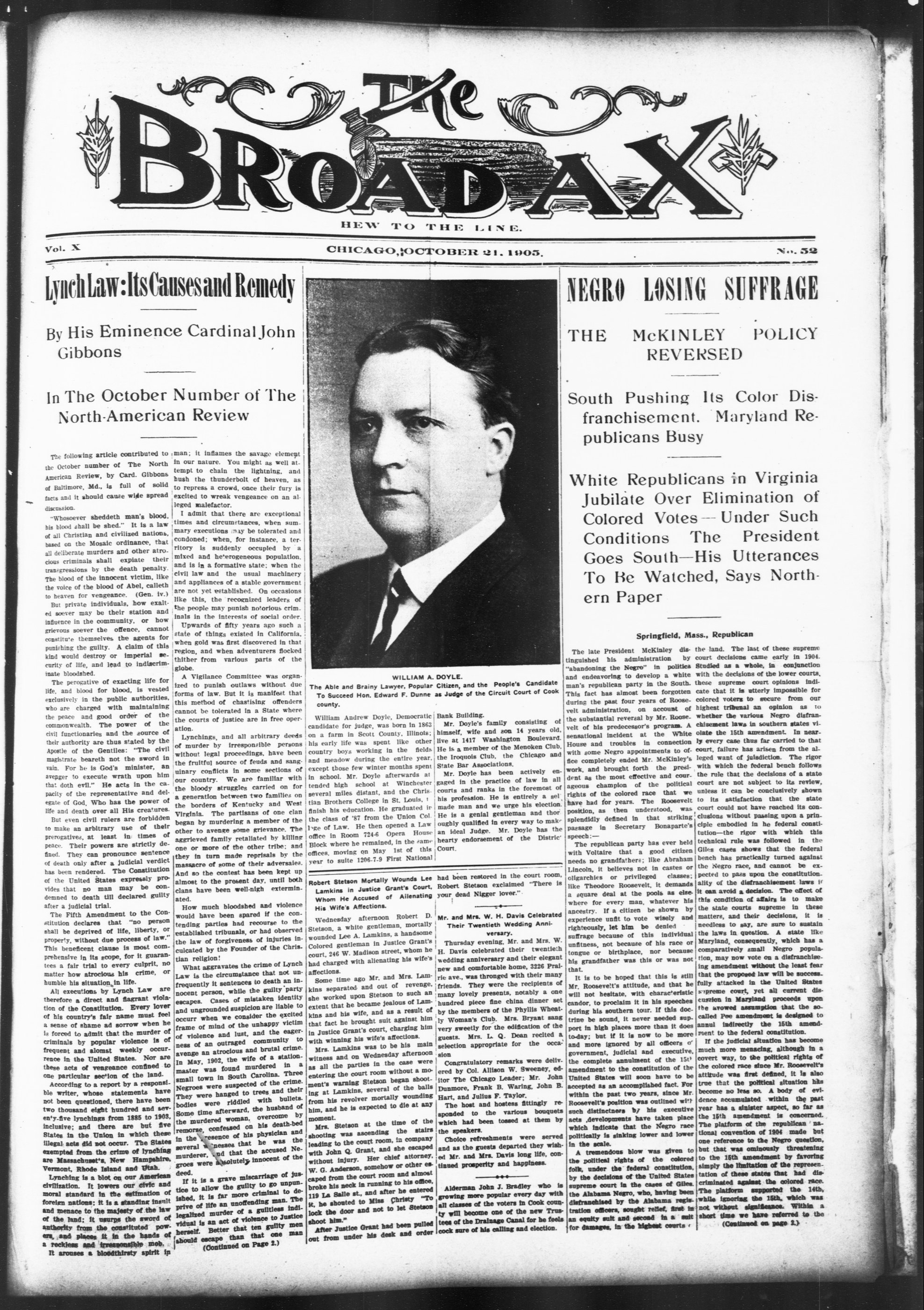
The Able and Brainy Lawyer, Popular Citizen, and the People's Candidate To Succeed Hon. Edward F. Dunne as Judge of the Circuit Court of Cook county.
William Andrew Doyle, Democratic candidate for judge, was born in 1863 on a farm in Scott County, Illinois; his early life was spent like other country boys working in the fields and meadow during the entire year, except those few winter months spent in school. Mr. Doyle afterwards at tended high school at Winchester several miles distant, and the Christian Brothers College in St. Louis, finish his education. He graduated in the class of '87 from the Union College of Law. He then opened a Law office in Room 724-6 Opera House Block where he remained, in the same Bank Building.
Mr. Doyle's family consisting of himself, wife and son 14 years old, live at 1417 Washington Boulevard. He is a member of the Menoken Club, the Iroquois Club, the Chicago and State Bar Associations.
Mr. Doyle has been actively engaged in the practice of law in all courts and ranks in the foremost of his profession. He is entirely a self made man and we urge his election. He is a genial gentleman and thoroughly qualified in every way to make an ideal Judge. Mr. Doyle has the hearty endorsement of the District Court.
had been restored in the court room, Robert Stetson exclaimed "There is your dead Nigger lover."
Mr. and Mrs. W. H. Davis Celebrated Their Twentieth Wedding Anniversary.
Thursday evening, Mr. and Mrs. W. H. Davis celebrated their twentieth wedding anniversary and their elegant new and comfortable home, 3226 Prairie ave., was thronged with their many friends. They were the recipients of many lovely presents, notably a one hundred piece fine china dinner set by the members of the Phyllis Wheatly Woman's Club. Mrs. Bryant sang very sweetly for the edification of the guests. Mrs. L. Q. Dean recited a selection appropriate for the occasion.
Congratulatory remarks were delivered by Col. Allison W. Sweeney, editor The Chicago Leader; Mr. John Dunmore, Frank B. Waring, John B. Hart, and Julius F. Taylor.
The host and hostess fittingly responded to the various bouquets which had been tossed at them by the speakers.
Choice refreshments were served and as the guests departed they wished Mr. and Mrs. Davis long life, continued prosperity and happiness.
Alderman John J. Bradley who is growing more popular every day with all classes of the voters in Cook county will become one of the new Trustees of the Drainage Canal for he feels cook sure of his calling and election.
William Andrew Doyle, Democratic candidate for judge, was born in 1863 on a farm in Scott County, Illinois; his early life was spent like other country boys working in the fields and meadow during the entire year, except those few winter months spent in school. Mr. Doyle afterwards attended high school at Winchester several miles distant, and the Christian Brothers College in St. Louis, finish his education. He graduated in the class of '87 from the Union College of Law. He then opened a Law office in Room 724-6 Opera House Block where he remained, in the same offices, moving on May 1st of this year to suite 1206-7-9 First National
Robert Stetson Mortally Wounds Lee Lamkins in Justice Grant's Court, Whom He Accused of Ailenating His Wife's Affections.
Wednesday afternoon Robert D. Stetson, a white gentleman, mortally wounded Lee A. Lamkins, a handsome Colored gentleman in Justice Grant's court, 246 W. Madison street, whom he had charged with alienating his wife's frictions.
Some time ago Mr. and Mrs. Lamkins separated and out of revenge, she worked upon Stetson to such an extent that he became jealous of Lamkins and his wife, and as a result of that fact he brought suit against him in Justice Grant's court, charging him with winning his wife's affections.
Mrs. Lamkins was to be his main witness and on Wednesday afternoon as all the parties in the case were entering the court room without a moment's warning Stetson began shooting at Lamkins, several of the balls from his revolver mortally wounding him, and he is expected to die at any moment.
Mrs. Stetson at the time of the shooting was ascending the stairs leading to the court room, in company with John Q. Grant, and she escaped without injury. Her chief attorney, W. G. Anderson, somehow or other escaped from the court room and almost broke his neck in running to his office, 119 La Salle st., and after he entered it, he shouted to Miss Christy "To lock the door and not to let Stetson shoot him."
After Justice Grant had been pulled out from under his desk and order
NEGRO LOSING SUFFRAGE
THE McKINLEY POLICY REVERSED
South Pushing Its Color Disfranchisement. Maryland Republicans Busy
White Republicans in Virginia Jubilate Over Elimination of Colored Votes Under Such Conditions The President Goes South-His Utterances To Be Watched, Says Northern Paper
Springfield, Mass., Republican
The late President McKinley distinguished his administration by "abandoning the Negro" in politics and endeavoring to develop a white man's republican party in the South. This fact has almost been forgotten during the past four years of Roosevelt administration, on account of the substantial reversal by Mr. Roosevelt of his predecessor's program. A sensational incident at the White House and troubles in connection with some Negro appointments to office completely ended Mr. McKinley's work, and brought forth the president as the most effective and courageous champion of the political rights of the colored race that we have had for years. The Roosevelt position, as then understood, was splendidly defined in that striking passage in Secretary Bonaparte's speech:—
The republican party has ever held with Voltaire that a good citizen needs no grandfathers; like Abraham Lincoln, it believes not in castes or oligarchies or privileged classes; like Theodore Roosevelt, it demands a square deal at the pools as else where for every man, whatever his ancestry. If a citizen be shown by experience unfit to vote wisely and righteously, let him be denied suffrage because of this individual unfitness, not because of his race or tongue or birthplace, nor because his grandfather was this or was not that.
It is to be hoped that this is still Mr. Roosevelt's attitude, and that he will not hesitate, with characteristic candor, to proclaim it in his speeches during his southern tour. If this doctrine be sound, it never needed support in high places more than it does to-day; but if it is now to be more and more ignored by all officers of government, judicial and executive, the complete annulment of the 15th amendment to the constitution of the United States will soon have to be accepted as an accomplished fact. For within the past two years, since Mr. Roosevelt's position was outlined with such distinctness by his executive acts, developments have taken place which indicate that the Negro race politically is sinking lower and lower in the scale.
A tremendous blow was given to the political rights of the colored folk, under the federal constitution, by the decisions of the United States supreme court in the cases of Giles, the Alabama Negro, who, having been disfranchised by the Alabama registration officers, sought relief, first in an equity suit and second in a suit for damages, in the highest courts
G SUFFRAGE
LEY POLICY
CURSED
Its Color Dis-
t. Maryland Re-
ans in Virginia
Elimination of
s—Under Such
The President
His Utterances
used, Says North-
the land. The last of these supreme court decisions came early in 1904. Studied as a whole, in conjunction with the decisions of the lower courts, these supreme court opinions indicate that it is utterly impossible for colored voters to secure from our highest tribunal an opinion as to whether the various Negro disfranchisement laws in southern states violate the 15th amendment. In nearly every case thus far carried to that court, failure has arisen from the alleged want of julsidiction. The rigor with which the federal bench follows the rule that the decisions of a state court are not subject to its review, unless it can be conclusively shown to its satisfaction that the state court could not have reached its conclusions without passing upon a principle embodied in he federal constitution—the rigor with which this technical rule was followed in the Giles cases shows that the federal bench has practically turned against the Negro race, and cannot be expected to pass upon the constitutionality of the disfranchisement laws if it can avoid a decision. The effect of this condition of affairs is to make the state courts supreme in these matters, and their decisions, it is needless to say, are sure to sustain the laws in question. A state like Maryland, consequently, which has a comparatively small Negro population, may now vote on a disfranchisement amendment without the least fear that the proposed law will be successful. fully attacked in the United States supreme court, yet all current discussion in Maryland proceeds upon the avowed assumption that the so-called Pee amendment is designed to annul indirectly the 15th amendment to the federal constitution.
If the judicial situation has become much more menacing, although in a covert way, to the political rights of the colored race since Mr. Roosevelt's attitude was first defined, it is also true that the political situation has become no less so. A body of evidence accumulated within the past year has a sinister aspect, so far as the 15th amendment is concerned. The platform of the republican national convention of 1904 made but one reference to the Negro question, but that was ominously threatening to the 15th amendment by favoring simply the limitation of the representation of these states that had discriminated against the colored race. The platform supported the 14th, while ignoring the 15th, which was not without significance. Within a short time we have referred to the (Continued on page 2.)
No.52
THE BROAD AX.
Will promigrate and at all times uphold the truth
principles of Democracy, but Oathless, Protesta-
tive, Indelible, Farmers, Single Taxes, Republic-
al Laws, and even the language their
say, so long as their language is proper and
responsibility is fixed.
The Broad. 14. is a newspaper whose platform is
broad enough for all, ever claiming the editorial
right to speak on all issues. Each communication will receive attention.
Write only on one side of the paper.
Subscriptions must be paid in advance.
One Year. $2.00
Six Months. 1.00
Advertising rates made known on application.
Address all communications to
THE BROAD AX
600 Armour Avenue, Chicago.
JULIUS F. TAYLOR, Editor and Publisher.
Entered at the Post Office at Chicago,
II, as second-class Matter.
CHIPS
Miss Mamie Selden, 6428 Evans avenue, enttained a few friends at whist Wednesday evening in honor of Mr. G. W. Carroll, of Cleveland, Ohio.
Mrs. J. Harrison Carr 6452 Evans ave., who is one of the faithful workers in St. Thomas church, is one of the many new readers of The Broad A...
Hon. Edward D. Green author of the "Anti Lynching Law of Illinois," has presented the writer with a copy of the Laws of State of Illinois enacted by the Forty-Fourth General Assembly and we are greatly trankful to Representative Green for the same.
Thomas J. Webb has in the past faithfully discharged his duties as one of the Drainage Canal Trustees and there is not the least doubt in the minds of those who are up to the snuff in politics as to his re-election as a member of the Board.
Hon. Lawrence A. Young, who made a gallant race for one of the Superior Court Judgeships in 1900, occupies an elegant suite of law offices on the tenth floor of the Ashland blk. Mr. Young is a public spirited citizen and he never deserts his true friends.
Miss May Hamilton, of Bay City, Mich., has adopted Chicago as her home. Doubtless she will become one of our school teachers as that was her vocation in Michigan. She will live with her sister, Mrs. Baker, 3617 Dearborn St.
Captain James S. Nelson, 8th I. N. G. Regimental Quartermaster, whose ad. appears in another column of this paper, owns a nice home at 3652 Wabash avenue, which is artistically presided over by his highly accomplished wife, Doctor Ida Gray-Nelson.
The Lady Ellott Circle, 199 C. O. F. will give a reception in honor of Court General Robert Elliott, 7895 A. O. F. Thursday evening, Oct. 26, 1905 at the beautiful Douglas Club House. The hall will be tastefully decorated with palms and ferns. N. Clark Smith's full orchestra will furnish the music and Smiley will serve.
Little Dorothy Perry, youngest daughter of Dr. and Mrs. Perry, 4808 Langley ave., entertained about 30 little friends on Wednesday afternoon in honor of her 4th birthday. Many handsome and useful presents were received by the happy little hostess of her guests.
Miss Minnie Lindell was united in marriage to Mr. Charles Kendricks last Sunday evening at o'clock at the home of the bride's parents, 325 E. 27th street. Rev. McCoo performed the ceremony. The newly married couple will be at home to their friends at the above number after November 8th.
Mrs. M. J. Doherty 946 Garfield Blvd, and her little daughter, returned home Friday from their European tour of four months. They had a delightful trip and our popular townman and superintendent of streets M. J. Doherty extended a royal welcome to his better half and little daughter.
The officers and members of the Triangle and Inner Circle Clubs are putting forth a strong effort to obtain that $5,000.00 with which they intend to endow the "Old Folks Home." Every man and woman in town should assist them in their noble efforts.
The "Red City," an unique entertainment will be given by the ladies of St. Thomas church for the benefit of its Remodeling Fund, at Smiley's Hall. 76 E. 22d st., Monday and Tuesday evening, Oct. 30-31. Admission, one night, 25 cts., two nights 35 cts. Mrs. C. C. Lewis, manager; Mrs. J. Hockley-Smiley, assistant manager.
Alderman John A. Richert, is one of the valuable members of the City Council. He is a hard working member of the Judiciary streets and al- loys South, Building Department, Special Assessment and General Taxa.
tion Committees and he is hand to hand with Mayor Edward F. Dunne in his fight for Municipal Ownership and the people of the Fourth Ward, have already made up their minds to return him to the City Council in 1906.
Hon. Frank Wenter ran 29,000 votes ahead of his ticket in 1900 and as he has always stood by the people and favors extending the Drainage Canal to. Blue Island, the citizens of that thriving town will join hands with the voters in other sections of Cook County and assist to roll up a large majority in favor of honest Frank Wenter, as the new President of the Drainage Canal Board.
On last Sunday there was organized in Bethel Church a young men's club for the purpose of discussing all subjects of interest to the race. Being the only one of its kind in this section of the country. Its name is Bethel Literary, and meets every Sunday at 4 p. m. Geo. T. Kersey, Pres.; Dr. M. J. Brown, V. P.; A. G. F. Slime, Sec'y.; Abner Jones, Treas.; E. Henderson, Serg't at Arms; John Washington, Chaplain; A. J. Carey, Pastor and member of Executive Com.
Mr. D. E. Tobias the eminent literary scholar and critic who has spent much time abroad and contributed articles to the leading foreign publications on the "Race Problem," and economic questions left the city Thursday evening for New York where he will spend the next two or three months. He will be welcomed to that city by those who profess to oar in the literary and professional world.
Alderman Michael Zimmer, who is always at his post in the City Council, batting in behalf of his constituents in the 12th ward and in the interest of the common people in general, in this city, will on Friday evening, Oct. 27, be presented with a diamond star as a token of the esteem in which he is held in by the citizens of his ward. On that same evening a reception and ball will be held in his honor at Turner Hall, 1168 W. 12th St. Frank Bewersdorf, candidate for Drainage Canal Trustee and all of the politicians on the West Side will join in the affair.
The board or education of McMahon borough, a suburb of Pittsburg, Pa., have established a "Jim Crow" school and the colored people are up in arms against the school officials and they have secured a writ of mandamus compelling them to show cause why Negro children should not be permitted to attend the public schools. The actions of the Republican members of that school board in the good old Republican state of Pennsylvania indicates which way the wind is blowing in the North in reference to "Jim Crowing" Afro-Ameican children in the public schools.
Next Week at the Coliseum Theatre.
What promises to be an extreme novelty in this season's theatrical, is the musical comedy, "The Smart Set," which will be the attraction at the Columbus Theatre, 19th street and Wabash avenue next week, beginning matinee, Sunday, Oct. 22. It will be remembered that this company played two engagements at this theatre last season, and at no performance could any seats be had fifteen minutes after the doors were opened. The entire house was always sold out.
This year there are fifty in the company, headed by the popular comedian, S. H. Dudley, and others equally well known; John Bailey, Billy Young, Jerry Mills, Miss Marion Smart, Ella Anderson, Alberta Ormes, and all the old fayotes of last season. To say that this colored organization will render a good account of itself would be putting the matter mildly, for the principles are known to be "the very best entertainers in the colored show business." The dances, songs, choruses and costumes are all new this season and every attention to detail has been made. It would be advisable to order seats in advance as the sale is already very large. The Columbus' telephone number is, South 1559.
ST. THOMAS'S
A great deal has been said and written about Worship and what is worship? does it mean simply to go in and sit and listen to some individual pray, preach, or sing? The Catholic religion teaches us to worship with the mind, voice, and body, to kneel in prayer; to stand in praise: to bow the head as an act of reverence—towards the Altar on entering and on leaving a Church also at the mention of the sacred name of Jesus and if in the presence of the Blessed Sacrament we make still more profound reverence or adoration these are only a few of the plious acts of worship that have come down to us from the Mother Church in her purest times how different the atmosphere
of a Church to those of a meeting house, how solemn is the place dedicated to the worship of God compared to the other where concerts and political meetings and every kind of entertainments are held. These words are Christs "My House shall be a House of Prayer." Calendar. Oct. 22. 18th Sunday after Trinity (Green)
PRESIDENT ROSSEVELT.
(Concluded from page 1.)
attitude of the republican party of Virginia in conducting the present state campaign with a frank confession that the white republicans on Old Dominion were rejoiced to have the Negroes disfranchised virtually on race lines, and have called attention to the Virginia stumping tour of Secretary Shaw in aid of the local republicans. We have also called attention recently to the attitude of the republican party in Maryland toward the pending Poe amendment—an attitude which virtually abandons the Negro race in politics, and place that party almost alongside the democrats, in regarding with indifference o annulment of the 15th amendment to the federal constitution. Mr. Bonaparte, finding the discrepancy between his own speech, from which we have quoted, and the republican state convention's platform so marked as to attract public attention, has with in a week declared that he was no personally responsible for the convention's utterance, yet he has avoided any repudiation of its sentiments.
Closer study of the present Maryland campaign reveals a drift which merely emphasizes the tendencies to which attention is called. The independent Baltimore News., the ablest and most influential opponent of the Poe amendment, in answer to a series of questions has shown that its hostility was caused not by any desire to protect the Negroes from the loss of constitutional rights, but from the ear that the amendment would so strengthen the Gorman democratic machine as to make Maryland permanently a one-party state, and thus tend to degrade the politics of the commonwealth. The News distinctly declares its belief that the 15th amendment "was a deplorable error," and its main concern now is the white voter's probable status under the proposed election laws.
President Roosevelt will go South under conditions such as have herein been outlined. Eeverywhere in that section, even in Maryland, which is ovrwhelmingly white, the tendency is to abandon the Negro and to drive him absolutely from the enjoyment of his political rights under the constitution. The courts, high and low, refuse to come to the support of the 15th amendment. Wherefore, it may freely be said that the president's utterances, so far as they concern his own position regarding the status of the colored race, will be observed with much watchfulness and interest throughout the land.
THE HYDE PARK COLORED RE-
PUBLIC CLUB.
Thursday evening October 26, the Hyde Park Colored Republican Club will give a grand Campaign Ball, at Rosalie Hall. Friends of the club invited to join in the festivities. Speaking by the leading Republican candidates, Officers in charge A. L. Williams, Doctor George C. Hall, S. Laing Williams, Jackson Cordon and others. Music by the 8th Regiment Band, Admission 50 cents.
At the Autumn Wedding
At the Autumn wedding. Empire styles will be a popular note for the fall wedding, as more than one bridal gown is planned in short waisted effect, and it is a particularly picturesque style for the bridesmaids or maid of honor of the tall and slender type. It also gives a pretty chance to substitute the little Juliet cap for the hat at an evening wedding. This is a little three-cornered contrivance which fits in between the front and back of the hair and reaches from ear to ear. They are seen at many evening weddings, and are especially pretty with the Juliet style of gown. They may be made of wired lace or silver cords sewed to tiny wires, or of Roman pearl beads strung in the same way, and are so simple that they can easily be home made, although being as yet an imported novelty they are expensive to buy. At one wedding the maids wore long Italian gowns of soft cream satin, with square neck and high puffed sleeves, and wore with them these little caps made in silver lace.
Fat Shoulder-Blades
It is difficult to reduce fat shoulder blades. You might try a system of physical culture. Lift your shoulders as high as you can. Wag them two or three times, work the shoulder in its sockets and lower them. This if done 15 minutes a day may reduce your fat shoulders. It is a system being tried by a physical culture clinic.
should unjustly suffer.
Unfortunately, also, the lynching of one individual is sometimes attended by the accidental and promiscuous alaying or wounding of bystanders in the conflict which arises between the mob and the officers of the law.
If Lynch Law were substituted for the Law of the Land, no citizen would be secure from violence or death. The leading men of the community, if not restrained by conscience, would wield an influence like that which was swayed by the Barons of the Middle Ages, who could assassinate with impunity every harmless commoner that stood in the way of their lawless ambition or lascivious passions. They could easily trump up charges against the object of their hatred or malice, and suborn a hired band of retainers to avenge a fancied crime.
Another deplorable result of lynching is that public sympathy is sometimes withdrawn from the innocent victim of lust and murder, and is transferred for the time being to the brute who outraged and killed her. Her defenceless condition, her agonies and cries for help, her valentreaties, her dishonor worse than death, culminating often in toture and murder in order to cover the clime,—all this horrible picture fades form view and is almost fogotten, while the iniquity of the human fiend is condensed or palliated on account of the lawless manner in which his crime was exploded. He often becomes the hero of the hour, and is regarded by some even as a martyr. And, while the malefactor's crime is almost lost sight of, and he becomes the object of morbid pity, popular denunciation falls on the heads of those who participated in his summary execution.
Had the wretch explicated his offence by the ordinary process of the civil courts, his trial, conviction and execution, attended with all the solemnity of judicial proceedings, would have appeased the righteous indignation of the community, would have vindicated the majesty of the law, and would have served as a terror and salutary warning to evil-doers.
If, indeed, the illegal and violent infliction of the death penalty on criminals had a deterrent effect on other evil-disposed persons, and acted as a warning to them, that clermustance, while not justifying Lynch Law, might at least offer some excuse or palliation for its exercise. But experience shows that it rather increases instead of diminishing the calendar of crime. Far from terrorizing he colored race who are the usual sufferers from hasty executions, it inflames them with indignation, and incites them to perpetrate deeds of violence on the weaker sex as much from a spirit of revenge, and from a triumph in the humiliation of their victims, as from a desire to gratify their animal passions.
Let us now examine into the principal grounds of excuse for the exercise of Lynch Law, and suggest a remedy for this social evil.
One of the causes of hasty and violent executions without the forms of law is the needless and often irritating delay in bringing a notorious criminal to the bar of justice, and the infliction of punishment inadecide to the enormity of the offence.
An infamous Negro, named George White, violated and then butchered almost beyond recognition a young lady in Delaware. A prompt trial of the self-accused malefactor was reasonably expected to appease the public, exasperated as they were by the horrible outrage. But they were grievously disappointed by the announcement that the culprit would not be tried for three months, and the result was a summary execution attended with the most revolving circumstances.
It appears that this same White had been twice before convicted for rape in Pennsylvania. If he had received a due measure of penalty for his former transgressions, he would not have been le loose to prey like a wolf on o'her folds ;and, if he had been accorded a speedy trial in Delaware, the community would have been spared the awful scenes which occurred when he was burned at the stake.
The difficulty of procuring a sentence of conviction against the accused after he is tried, and the frequency with which noted criminals are known to escape the meshes of the law, especially in jury trials, have created in the public mind a distrust of our criminal jurisprudence, and offer an incentive and temptation to have recourse to the wild justice of revenge. In 1900, the Mafia, a lawless secret society of Sicilian origin, spread terror among the inhabitants of New Orleans by their frequent deeds of bloodshed. The members of the society considered it dishonorable to seek redress by appealing to
the established courts of justice, but always avenged a wrong by secret murder. They assassinated the chief of police at his own door. Nine members of this infamous band were arrested and tried for the murder of the brave and popular guardian of the law. They were all acquitted.
Some of the leading citizens, incensed at the miscarriage of justice, shot down these nine members of the Mafia; and, how much soever we may reprobate the drastic remedies applied by the citizens, it is gratifying to say that, since these violent measures were adopted, the hydra-headed monster has never again lifted its head in the Crescent City.
Yet another crying evil and incentive to lynching is the wide interval that so often interposes between a criminal's conviction and the execution of the sentence, and the defeat of justice by needless procrastination. Human life is indeed precious and sacred, but the effort to guard it has gone beyond reasonable bounds. It is blessed to be merciful, but mercy should not be exercised at the expense of justice and social order. Misplaced clemency often works infinite harm to the community.
Of late years, the difficulty of carrying out the judgment of the court (in murder trials especially) has greatly increased from the widened application of pleas in bar,—notably that of insanity. When a coviction has been reached, innumerable obstacles generally stay the execution. The many grounds of exception allowed to counsel, the appeals from one court to anther of higher jurisdiction, involving an enormous expense to the commonwealth, the long periods of time intervening between the terms of the lower ad higher courts, the impossibility of recalling the original witnesses by reason of their death or removal to distant parts of the country, the apathy or fading interest of the friends of the prosecution, the untiring efforts of the advocates and friends of the accused, the facility with which signatures for pardon are obtained, with the final application for mercy to the Governor,—all these circumstances have combined to throw around the transgressor an extravagant protective system, and have gone far to rob jury trials of their substance and efficacy.
When the crime of the accused has been manifestly proved, and no extenuating circumstances can be advanced, the lawyers for the defence have often recourse to the plea of insanity as a last resource. Medical experts are always available to testify to the moral irresponsibility of the culprit, bewildering the jury by their technical phrases. This subterfuge not unfrequently succeeds in defeating the ends of justice, though the sanity of the guilty party had never before been called in question.
I can recall a recent instance in which a man was convicted of a heinous crime. The insanity dodge was successfully availed of. He was committed to an asylum, from which he soon afterward escaped with the aid of his relatives, and no effort has since been made to rearrest him at his home.
A sovereign remedy for the suppression of lynching and for the restoration of the law's supremacy is found in a speedy trial and conviction of the accussed, if he is found guilty, followed by the rigorous execution of the sentence.
It would be a great blessing for society if our lawmakers were to revise the criminal code now in force, and to awe away, or at least considerably diminish, the barriers which interpose between the crime and its punishment. A prompt execution of the verdict would strike terror into evil-doers, and satisfy the public conscience.
But it is far more merciful to stop crime than to punish it by legislation. It is better to remove a cause than to repair its evil effects. From data before me, I infer that about seventy per cent. of those who perished by lynching in the Southern States between 1885 and 1903 belonged to the colored population. If the deep-rooted antipathy between the white and the black races were removed, or assuaged, these violent executions would be considerably diminished.
This blessed result can be accomplished only by submission to the Gospel, which proclaims the equality of all men before God, with Whom "there is neither Gentile nor Jew, circumcision nor uncircumcision, Barbarian nor Scythian, bond nor free, but Christ is all in all."
If the America people were religiously impressed with the Gospel truth that we are all, without distinction of color, children of the same God, brothers of the same Christ, that we are redeemed by His precious blood, that we are all descended from the same aboriginal parents, that we were created for the same eternal desi-ny, that Christ is our "Peacemaker, breaking down the wall of partition"
which divides nation from nation, tribe from tribe, so that we might be al' one family guided by the supreme law of charity,—if we were all controlled by these principles, then, Indeed, the reign of vengeance would exercise less sway among us. In the two lower counties of Maryland, the white and the black populations are nearly equally divided, and the great majority of both races profess the Catholic religion. I have had frequent occasions to visit these counties in the exercise of the sacred ministry.
Before divine service began, I have been delighted to observe the whites and the blacks assembled together in the church grounds, and engaged in friendly and familiar intercourse. Then they repaired to the church, worshipping unde the same roof, kneeling before the same altar, receiving the Sacrament at the same ralling, and listening to the words of the same Gaoel.
This equal participation in spiritual gifts and privileges has fostered the feeling of good-will and benevolence, which no human legislation could accomplish. I never witnessed anywhere else the white race so kind and considerate to the colored, nor the colored race, so respectful and deferential to the white; for there was no attempt in these weekly gatherings to level the existing social distinctions. As far as my memory serves me, the records of these two counties have never been stained by a single instance of an outrage and a lynching. J. CARD. GIBBONS.
By Far the Most Costly Building Is That of the Municipality of Philadelphia.
The recent awarding of plans for a new courthouse and county building for Chicago recalls the fact that an immense sum is invested in public buildings by municipalities in the United States. The 175 chief cities of America have $100,000,000 invested in city halls. Philadelphia leads with a $27,000,000 city hall and San Francisco follows with one worth $3,800,000. After these cities come Boston, with a city hall representing $7,500,000; New York, with one standing for $7,000,000, and Baltimore with a $5,000,000 structure and grounds. The value in each case is based upon the value of the city hall itself and the park or grounds surrounding it.
Every American city of over $30,000 population has at least a $1,000,000 city hall, with the exception of New Orleans. St. Louis, Cincinnati and Detroit have buildings worth more than $2,000,000 each. Chicago falls $250,000 below that figure. Pittsburgh and Milwaukee follow.
Among minor American cities which have elaborate city halls are Richmond, Va.: Minneapolis and Providence. Indianapolis, which has a stately statehouse, has an inferior city hall. Toledo and Atlanta have small municipal buildings. The Denver city hall is valued at $265,000; that of East St. Louis, a place of much less importance, has one that cost $425,000. Houston, Tex., has a $550,000 city hall and Memphis one costing only $35,000.
BREATHING WELL SECRET.
Sounds Found to Be Due to Atmospheric Pressure or Changes in Temperature.
The United States Geological Survey has on hand the investigation of curious phenomena known as "blowing" or "breathing" wells. In the course of collecting well records, the hydrologists of the survey have observed many wells that emit currents of air with more or less force, sometimes accompanied by a whistling sound which can be heard for a long distance.
The best known examples of this type of well are found throughout the state of Nebraska. Blowing wells are also known to occur in Rapides Parish, in southern Louisiana. The force of the air currents in one of the southern Louisiana wells is sufficient to keep a man's hat suspended above it.
The cause of such phenomena is mainly due to changes in atmospheric pressure or to changes in temperature. During the progress of a low barometer storm over these regions, the air is expelled from the blowing wells. With a rising barometer the blowing becomes rapidly less until the current is finally reversed. Differences in the temperature of the surface air and the air in the soil also produce similar effects. When the interests between the grains of sand, gravel, etc., in which the well is driven are filled with water, the phenomena of blowing is much less noticeable.
The Woman in Black
"I'm glad to see these here insurance companies gittin' hauled over the coals," said the woman in black. "W'y are ye?" asked Mrs. Gamp. "Because they ain't no good any how. When poor Adoniram lay a-dyin', I sent word to the Gibraltar to come and insure his life at once—and I'm tellin' it the truth—they wouldn't do it." Minneapolis Journal
Such a Slam
Cholly Shallowpate—I make it a rule, dontcherknow, to never speak unless I know what I'm talking about. Miss Caustique—You should be careful. You may lose your voice from want of practice—Chicago Sun.
May Have to Increase Force in Bureau of Engraving and Printing—Old Washington Home of Old-Timb Southerners.
WASHINGTON.—One of the visitors at the white house who has little trouble in getting an audience with the president is John Mitchell, president of the United Mine Workers. Mr. Roosevelt has never forgotten the loyal, honest aid that Mitchell
W
gave him in that historic controversy in the fall of 1902, when the president intervened between the mine owners and mine workers and brought to a close the most expensive and dangerous strike ever inaugurated in the coal fields. The president was struck with Mitchell's honesty of purpose and sincere desire to act upon his own principle of a "square deal" to everybody. It is not too much to say that had the mine workers been represented by a man possessed of less common sense and fair-mindedness the result at that time would have been different.
John Mitchell is not a frequent visitor in Washington, but when he does come to this city he makes it a rule to pay his respects to the president, and he is always welcomed. For the first time he appeared as a politician a few weeks ago. He has made it a rule to keep out of politics and has frequently refused to use his influence with the president in favor of anyone seeking office, but a particular friend of his, who acted as his secretary during the coal strike, Mr. Louis Hammerling, is seeking to be made an internal revenue collector in Pennsylvania, and has elitized Mitchell's sympathies.
The president likes to talk with Mitchell on many subjects, particularly those relating to labor and labor unions, as he can get from him and from President Gompers, of the Federation of Labor, a more conservative idea of what the workingman wants than comes from the professional agitators. Both these labor leaders have implicit confidence in the president.
Secretary Root and the Press.
CRETARY OF
State Root has
fallen into his dues
naturally and
gracefully. He has
been welcomed
back to the big
state, war and
navy building by
many of the sub-
ordinate government
officials who
learned to admire
direct business
LS
his methods and direct business way when he was secretary of war. Mr. Root came to Washington with a good deal of the narrow-mindedness of a New York lawyer, and it is admitted that the men on Manhattan island are about as provincial a set as is to be found in the United States. He brought with him a prejudice against newspaper men, having at times been the victim of writers who cared more for sensation and space than they did for absolute accuracy. He was very cold and distant for some months after he became head of the war department, but gradually he began to recognize the important part that newspaper men at the national capital play in national affairs, and he was not slow in acknowledging their position when he did recognize them.
When Mr. Root came to Washington this month and brought with him Mr. Bacon, first assistant secretary of state, he introduced the latter to a group of newspaper men and proceeded to instruct him as to how he was to treat the press. "These men can be of the utmost assistance to you and to the government if you give them your confidence," said the secretary. "Tell them everything that it is legitimate to make public, and if you tell them what they are not to publish you will find your confidence respected. Start right with the newspaper correspondents and your administration will be successful."
Mr. Root finds himself hampered by an act he did while secretary of war, and the other day laughingly admitted it. "Do you know," he said to a friend, "there is one act of my career as secretary of war I very much regret?"
that so?" the friend inquired.
Yee; while i was secretary of war," said Mr. Root, "I stole a room from the state department. I wish now I had that room back."
Dirty Dollar Bill.
T
HE demand for clean money is somewhat embarrassing to the treasury. Officials of that department claim that paper money is being used up too fast. It is being destroyed at the rate of about $2,000,000 a day. This is in response to the that is not reeking When John Wes-
agitation for money with disease germa
ley Gaines, the strenuous congressman from Tennessee, discovered that there were several thousand dangerous germs lurking in a dirty dollar bill people all over the country began to insist on having brand, new, crisp currency.
Treasury officials take little stock in the germ theory, and question whether anyone has ever really suffered from a disease contracted in handling old bills. They cite the experience of the money counters in the treasury. Down in the basement of this building there are many women who have been counting money for the past eight or ten years and they handle the very worst bills in circulation. Currency that is not considered fit to remain in use is put up in bundles and sent to Washington for redemption. These bundles must be counted by the women and it is declared that not a single case is on record of disease contagion growing out of handling this money.
The national banks are complaining about the expense they are put to for the printing of new notes in response to this clean money craze. Within the past four years the volume of redemptions have doubled. In 1900 there was redeemed daily about $1,000,000, but now the redemptions run over $2,000,000 each day. It will be necessary to increase the force in the bureau of engraving and printing to keep up with the printing of new notes unless the secretary decides to prolong the life of a bank note and thus reduce the amount that is turned in for redemption.
Task of Signing Name.
I
T IS difficult to judge of a man's character and appearance by his hand writing, although it is maintained by some experts that nothing is easier. 'The signature of Assistant Secretary of the Treasury Reynolds is ample proof that no one
is able always to judge a man by the way he writes. That signature is a wonder. It resembles a Chinese puzzle in its angularity. It appears like a bunch of triangles fastened together. Mr. Reynolds is proud of his signature and defies anyone to counterfeit it. Its sharp angles would never in the world suggest the jolly, rotund form of the assistant secretary, who is the personification of good nature and good humor. He is just as genial in his character as he is in appearance, and that funny jumble of triangles which he calls his signature is by no means an index to that character.
Mr. Reynolds has the knack of dashing off that Chinese puzzle very readily, and that is the main desideratum in his daily routine of work. Like other assistant secretaries and high government officials, he has to spend two or three hours each day in attaching his name to vouchers, warrants and other important papers. The more rapidly he can sign his name the less irksome is this duty, and Mr. Reynolds has solved the problem. Secretary of the Treasury Shaw writes his name out in full, except he uses the initial for the middle name, but as there are only 11 letters in the whole signature it does not occupy very much time.
President Roosevelt signs his name in full to all documents, writing the "Theodore Rocsevelt" in a rather small, straggling hand. When he was assistant secretary of the navy, however, he had so many papers to sign that it was a burden to spell his name in full; so he cut out the "Theodore" and used the initial "T."
"Just look at that," he said to a friend one day. "Isn't that the limit? T. Roosevelt! T. Roosevelt! Isn't that the worst? But I've got to write it that way or get pen paralysis."
Old Metropolitan Hotel.
HE southern colony in the old Metropolitan hotel in Washington will lose one of its shining lights this winter. John Sharp Williams, the democratic leader in the house, has decided to forsake this hostelry and go to housekeeping. The Metro-
BOW TO FRIEND
politan has been the home of old-time southerners from time immemorial. The Brown hotel, which was its predecessor, was headquarters for the great statesman from Dixie land in antebellum days, and there still clings to the old building an atmosphere of the sunny south. There are yet to be seen in its corridors a few of the typically-dressed southerners in long-skirted, black coats, low-cut vests and broad-brimmed soft felt hats.
brimmed bore Mr. Williams is looking for a house where he can have more home life than he has enjoyed at the hotel. This brilliant southerner is one of the most absent-minded men, and needs the attention of his good wife. It is related that last winter his wife came from Mississippi to visit him for a couple of weeks, and stopped with him at the Metropolitan. One morning he left her sitting in the room, closed the door, and as he had been in the habit of doing when occupying the room by himself, locked the door.
seir, locked the Mrs. Williams delights to tell how her husband in their early married days had her prepare an elaborate linner for a party of his lawyer friends, and then came home in the evening without having invited one of them. He had to scurry around at the eleventh hour in order to get a sufficient company to do justice to the splendid meal that had been prepared.
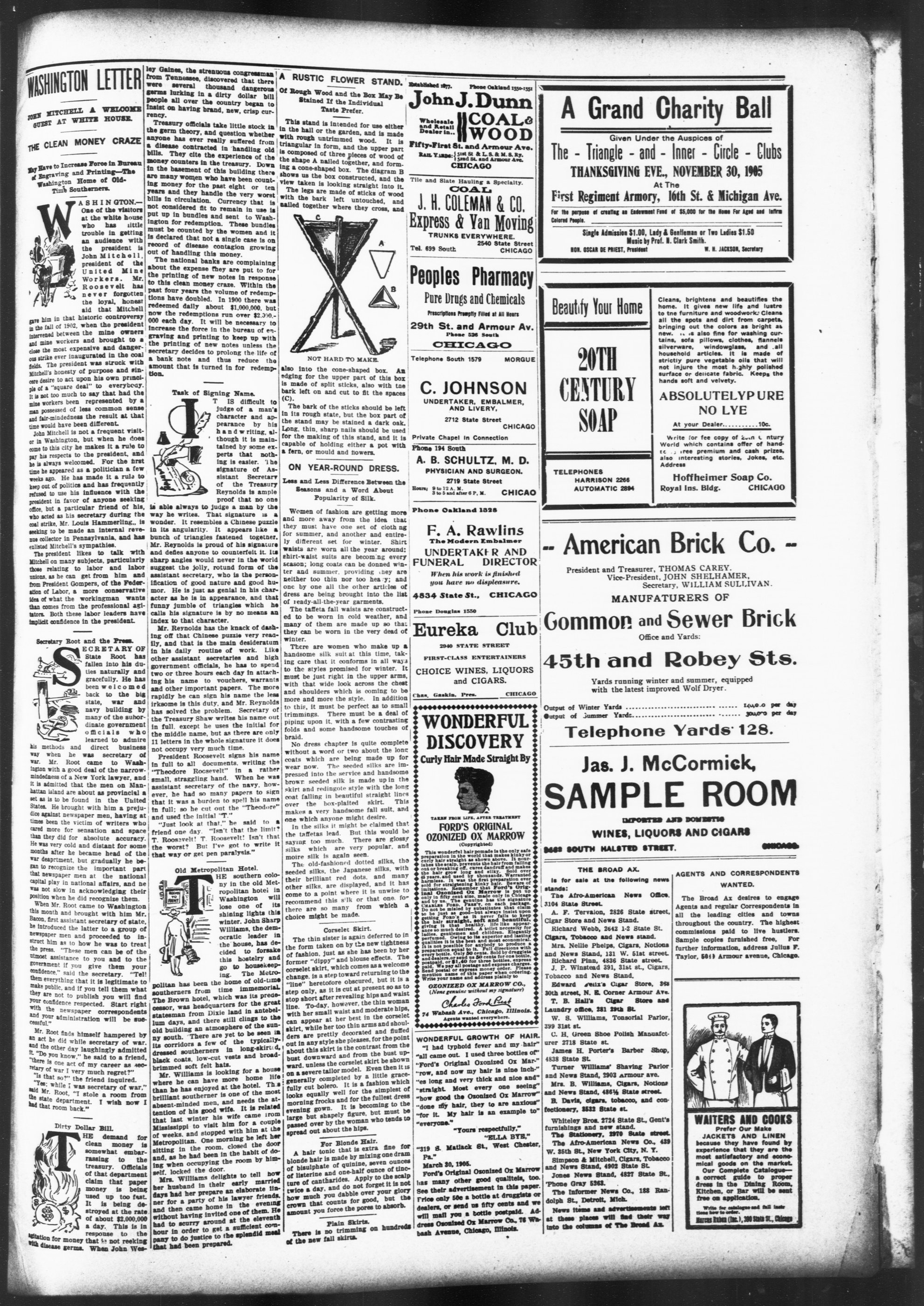
A RUSTIC FLOWER STAND.
Of Bough Wood and the Box May Be Stained If the Individual Taste Prefer.
This stand is intended for use either in the hall or the garden, and is made with rough untrimmed wood. It is triangular in form, and the upper part is composed of three pieces of wood of the shape A nailed together, and forming a cone-shaped box. The diagram B shows us the box constructed, and the view taken is looking straight into it. The legs are made of sticks of wood with the bark left untouched, and nailed together where they cross, and
A
B
NOT HARD TO MAKE.
also into the cone-shaped box. And edging for the upper part of this box is made of split sticks, also with the bark left on and cut to fit the spaces (C).
The bark of the sticks should be left in its rough state, but the box part of the stand may be stained a dark oak. Long, thin, sharp nails should be used for the making of this stand, and it is capable of holding either a pot with a fern, or mould and flowers.
ON YEAR-ROUND DRESS.
Less and Less Difference Between the Seasons and a Word About Popularity of Silk.
Women of fashion are getting more and more away from the idea that they must have one set of clothing for summer, and another and entirely different set for winter. Shirt waists are worn all the year around; shirt-waist suits are becoming every season; long coats can be donned winter and summer, providing they are neither too thin nor too heavy; and one by one all the other articles of dress are being brought into the list of ready-all-the-year garments.
The taffetta fall waists are constructed to be worn in cold weather, and many of them are made up so that they can be worn in the very dead of winter.
There are women who make up a handsome silk suit at this time, taking care that it conforms in all ways to the styles promised for winter. It must be just right in the upper arms, with that wide look across the chest and shoulders which is coming to be more and more the style. In addition to this, it must be perfect as to small trimmings. There must be a deal of piping upon it, with a few contrasting folds and some handsome touches of braid.
No dress chapter is quite complete without a word or two about the long coats which are being made up for wear now. The seeded silks are impressed into the service and handsome brown seeded silk is made up in the skirt and redingote style with the long coat falling in beautiful straight lines over the box-plaited skirt. This makes a very handsome fall suit, and one which anyone might desire.
In the silks it might be claimed that the taffetas lead. But this would be saying too much. There are glossy silks which are very popular, and moore silk is again seen.
The old-fashioned dotted silks, the seeded silks, the Japanese silks, with their brilliant red dots, and many other silks, are displayed, and it has come to a point where it is unwise to recommend this silk or that one, for there are so many from which a choice might be made.
Corselet Skirt.
The thin sister is again deferred to in the form taken on by the new tightness of fashion, just as she has been by her former "dipy" and blouse effects. The corselet skirt, which comes as a welcome change, is a step toward returning to the "line" heretofore obscured, but it is a step only, as it is cut at present so as a stop short after revealing hips and waist line. To-day, however, the thin woman with her small waist and moderate hips, can appear at her best in the corselet skirt, while her too thin arms and shoulders are pretty decorated and fuffed out in any style she pleases, for the point about this skirt is the contrast from the bust downward and from the bust upward, unless the corselet skirt be shown on a severe tailor model. Even then it is generally completed by a little gracefully cut bolero. It is a fashion which looks equally well for the simplest of morning frocks and for the fullest dress evening gown. It is becoming to the large but shapely figure, but must be passed over by the woman who tends to spread out about the hips.
For Blonde Hair.
A hair tonic that is extra fine for blonde hair is made by mixing one dram of bisulphate of quinine, seven ounces of listerine and one-half ounce of tincture of cantharides. Apply to the scalp twice a day, and do not forget it is not how much you dabble over your glory crown that counts for good, but the amount you force the pores to absorb.
Plain Skirts.
There is no trimming on hundreds of the new fall skirts.
Fifty-First St. and Armour Ave.
BRAIL YARD: 51st St. & L. S. & M. S. RY.
52nd St. and Armour Ave.
CHICAGO
Tile and Slate Hauling a Specialty.
COAL
J. H. COLEMAN & CO.
Express & Van Moving
TRUNKS EVERYWHERE.
2540 State Street
Tel. 699 South
CHICAGO
Peoples Pharmacy
Pure Drugs and Chemicals
Prescriptions Promptly Filled at All Hours
29th St. and Armour Av.
Phone 526 South
CHICAGO
Telephone South 1579 MORGUE
UNDERTAKER, EMBALMER,
AND LIVERY,
2712 State Street
CHICAGO
A. B. SCHULTZ, M. D.
PHYSICIAN AND SURGEON.
2719 State Street
Hours: 9 to 12 A. M.
3 to 5 and after 6 P. M. CHICAO
Phone Oakland 1328
UNDERTAKIR AND
FUNERAL DIRECTOR
4834 State St., CHICAGO
Phone Douglas 1550
Eureka Club
2040 STATE STREET
FIRST-CLASS ENTERTAINERS
CHOICE WINES, LIQUORS
and CIGARS.
WONDERFUL
DISCOVERY
Curly Hair Made Straight By
TAKEN FROM LIFE, AFTER TREATMENT
FORD'S ORIGINAL
OZONIZED OX MARROW
This wonderful hair pomade is the only safe preparation in hair for infants shown above. It nourishes the scalp, prevents the hair from falling by keeping it of light dripping and the hair grow long and silky. Sold over 15 years, and used by those with hair problems, it is the ideal preparation ever sold for straightening kinky hair. Beware of initial damage. Ozonized OX Marrow is put up only in fifty cents also, made only by the signature CHARLES FORD, PERRY, on each package. Do not be misled by the word "good"—but always insist upon getting Fords as it never fails to drop. Fords are a good gift, giving it that healthy, life like appearance so much desired. It is made for children. Elegantly perfumed. Owing to its superior and lasting quality it is not possible for anybody to produce a preparation equal to it. Sold by druggists and dealers, or send us 50 cents for one bottle, postpaid, or good for all postage and express charges. Send postal or express money order. Mail your name and address plainly to OZONIZED OX MARROW CO., (None genuine without my signature)
Charles Ford Press
74 Wabash Ave., Chicago, Illinois.
Agents wanted everywhere.
WONDERFUL GROWTH OF HAIR
"I had typhoid fever and my hair"
"all came out. I used three bottles of"
"Ford's Original Oxonized Ox Mar"
"row, and now my hair is nine inch"
"es long and very thick and nice and"
"straight. Most every one seeing"
"how good the Oxonized Ox Marrow"
"done my hair, they to are anxious"
"for it. My hair is an example to"
"everyone."
"319 S. Matlack St., West Chester, Pa."
March 30, 1905.
Ford's Original Ozonized Ox Marrow has many other good qualiteis, too. See their advertisement in this paper. Price only 50c a bottle at druggists or dealers, or send us fifty cents and we will mail you a bottle postpaid. Address Ozonized Ox Marrow Co., 76 Wabash Avenue, Chicago, Illinois.
A Grand Charity Ball
A Grand Charity Ball
The - Triangle - and - Inner - Circle - Clubs THANKSGIVING EVE., NOVEMBER 30, 1905
Single Admission $1.00, Lady & Gentleman or Two Ladies $1.50
Music by Prof. N. Clark Smith.
HON. OSCAR DE PRIEST, President
W. H. JACKSON, Secretary
-- American Brick Co. --
President and Treasurer, THOMAS CAREY. Vice-President, JOHN SHELHAMER, Secretary, WILLIAM SULLIVAN. MANUFATURERS OF Common and Sewer Brick Office and Yards:
45th and Robey Sts.
Yards running winter and summer, equipped with the latest improved Wolf Dryer.
Output of Winter Yards ..... 14,000 per day
Output of Summer Yards..... 30,000 per day
Telephone Yards 128.
Jas. J. McCormick, SAMPLE ROOM
Beautify Your Home
20TH
CENTURY
SOAP
TELEPHONES
HARRISON 2266
AUTOMATIC 2894
American E
President and Treasurer, THO
Vice-President, JOHN
Secretary
MANUFATU
Common and S
Office and
45th and R
Yards running winter and
with the latest improve
Output of Winter Yards ...
Output of Summer Yards...
Telephone
Jas. J. McG
SAMPLE
IMPORTED AND
WINES, LIQUOR
B148 SOUTH HALSTED STREET.
THE BROAD AX.
is for sale at the following news stands:
The Afro-American News Office 3104 State Street.
A. F. Tervalon, 2826 State street
Cigar Store and News Stand.
Richard Webb, 2642 12 State St.
Cigars, Tobacco and News stand.
Mrs. Nellie Phelps, Cigars, Notions and News Stand, 131 W. 51st street.
Richard Pinn, 4836 State street.
J. P. Winstead 391, 31st st., Cigars, Tobacco and News Stand.
Edward Seix's Cigar Store, 395 30th street, N. E. Corner Armour Ave.
T. B. Hall's Cigar Store and Laundry office, 281 29th St.
W. S. Williams, Tonsorial Parlor, 399 31st st.
C. H. Green Shoe Polish Manufac-turer 2718 State st.
James H. Porter's Barber Shop, 4838 State St.
Turner Williams' Shaving Parlor and News Stand, 2002 armour are
B. Davis, cigars, tobacco, and confectionery, 3832 State st.
Whiteley Bros. 2724 State St. Gent's furnishings and new stand.
The Stationery, 2970 State street.
The Afro-American News Co., 439
W. 35th St., New York City, N. Y.
Simpson & Mitchell, Cigars, Tobacco
and News Stand, 4902 State St.
Jones News Stand, 4827 State St.
Phone Gray 5263.
The Informer News Co., 188 Rand-
olph St., Detroit, Mich.
News items and advertisements left
at these places will find their way
into the columns of The Broad Az.
Cleans, brightens and beautifies the home. It gives new life and lustre to the furniture and woodworks. Cleans all the spots and dirt from carpets, bringing out the colors as bright as new. It is also fine for washing curtains, sofa pillows, clothes, flannels silverware, windowglass, and all household articles. It is made of stricty pure vegetable oils that will not injure the most highly polished surface or delicate fabric. Keeps the hands soft and velvety.
ABSOLUTELY PURE
NO LYE
At your Dealer.....10c.
Write for fee copy of 20th century World which contains offer of hand- free premium and cash prizes, also interesting stories, Jokes, etc. Address
Hoffheimer Soap Co.
Royal Ins. Bldg. CHICAGO
In Brick Co. --
THOMAS CAREY.
ST, JOHN SHELHAMER,
Secretary, WILLIAM SULLIVAN.
FEATURES OF
and Sewer Brick
e and Yards:
Robey Sts.
inter and summer, equipped
proved Wolf Dryer.
14,400.0 per day
30,040.0 per day
e Yards' 128.
McCormick,
LE ROOM
BED AND DONESTIG
JUORS AND CIGARS
STREET.
CHICAGO
AGENTS AND CORRESPONDENTS WANTED.
The Broad Ax desires to engage Agents and regular Correspondents in all the leading cities and towns throughout the country. The highest commissions paid to live hustlers. Sample copies furnished free, For further information, address Julius F. Taylor, 5011 Armour avenue, Chicago.
CHEF
JACKETS AND LINEN because they have found by experience that they are the most satisfactory and economical goods on the market. Our Complete Catalogue—a correct guide to proper dress in the Dining Room, Kitchen, or Bar will be sent free on application.
Write for catalogue and full instructions how to order.
Marcus Ruben (Inc.), 300 State St., Chicago
» ‘Gigns ‘2 Japan. fn
"GQlarence Ludlow Srownell, im his
book, “The Heart of Japan,” tells
amusingly of some signs he saw fp
dxpan on the shops of merchants who
were bidding gor English and Améri-
can trade: “Barber to Shave Beard or
to Dress Hairs Away,” “The Genuine-
ly Bier Buy the Health for Drink,” “Of
smokes our tobacco is pressure to Our
tongue and give the healthiness to
Hers and Hes! Also All People by It,”
“Cowmeat and Pigmeat and Ramune
Souda Sasupre Zinsinbiys Jinjyael.”
This last means lemon soda, sarsapa-
rilla, ginger beer and ginger ale.
arien of the Mike4e”
‘When the mikado is seen in public
Re manifests no in.erest ia his sub-
jects, néither smiling nor bowing as he
pass~s along. He sits seemingly pas-
Sionless, the accentuated type of the
Japanese. Indeed, Le hardly seems to
bear the applause of the crowds. This
manner is to some extent perhaps a
matter of etiquette, for the mikado
must show that he remembers the dl-
vinity of his ancestors, who were
‘s0ds 3,000 years ago.”
Strange Rainstorms.
In the Colorado desert there are rain-
storms during which not a drop of wa-
ter touches the earth. The rain can
be seen falling from the clouds high
above, but when it reaches the hot, dry
air beneath the clouds it ts entirely
absorbed. These strange rainstorms
take place in regions where the ther-
mometer often registers 128 degrees in
the shade.
London Zoo Gorilla.
‘Miss Crowther, the largest and flere-
est gorilla ever captured, lately arrived
at the London zoological gardens. She
is five feet six inches in height, meas-
tures 42 inches around the chest and
possesses great strength. Occasionally
she has fit of rage, but usually she ‘8
very shy and hides her face from vis
itors with her hands.
CGevtain Death.
An English master mariner name
‘Death has had his name changed. He
said, in explanation, that he was now
acting as first officer, but expected
‘soon to have command of a ship. Hc
was afraid that few passengers would
care about risking a voyage in a shir
captained by Death—Kansas City
‘Times.
‘Too Much Trousers.
In feudal days Japanese courtiers
wore wide trousers twice a3 long as
their legs, so that they trailed after
the wearer. Belasco introduced them
in “The Darling of the Gods,” but they
80 convulsed the managerial audience
at the first dress rehearsal that liter-
‘ily he had to “cut them out”—and off.
Crown of the Virgin.
‘The pope has ordered a firm of Flor-
ence jewelers to manufacture a crown
‘set with imitation stones for the image
of the virgin in the basilica of the vat-
ican, in place of a crown containing
gems valued at $7,500,000, which is to
be deposited in the vaults of the vati-
can.
Sa ee
“Here, Maria, here is a story about
3 Buffalo women who cooked on one
stove for more than a year and didn’t
Bave a single quarrel in all that time.”
“What an amiably stupid lot they
must have been.”—Cleveland Plain
Dealer.
‘Hard to Down.
‘When the goo’ man seems to be con-
quered, the powers of evil have still
to rue their shortlived triumph, and to
say as Pyrrhus said when be defeated
the Romans: “Three such victorles
would ruin me.”"—Archdeacon Farrar.
Helping the World.
Make yourself a necessity to the
world by what you contribute in the
way of personal comfort, by what you
are in embodying before men all that
is gentle, generous snd pure—M.
Dena
Only « Bluff.
Why does a woman, after making
such a solemn promise to obey at the
‘altar, give her husband such a cold
and hollow laugh when he merely hints
that it would be the proper thing
to do?
eile ian tet ata
‘The old local costumes are still
‘worn in many parts of Russia. There
is great variety in them, but rich em-
broidery and an imposing head dress
ef some sort are common to all.
Even.
He—You married me for my money.
She—Well, what if I did? I didn’t
get it. Isn't that punishment enough?
Detroit Free Press.
Fact About Insects.
‘Musio-making insects are all males.
‘The females are silent, using neither
their wings nor their body scales or
plates to produce musical sounds.
‘A Good Looker.
Amm—Do you like his looks?
‘Jape—Yes, whenever he looks my
‘way—Cieveland Pisin Dealer.
Couldn't Stand Bloomers.
Susan B. Anthony wore bloomers
eck in the fifties, but declared it
“mental erveifixion,’ ‘and gave it up.
‘The Only One.
He—t Greamt lest night I proposed
8 pretty girl
‘Ghe—What 4id | say?—New Yorker.
‘ag Salmon Crop.
Alaska’s canned salmon output 18 es
(Qeeated this year at $10,000,000,
— cae aa oe
one was
Ble to find his body.
Finally some old-fashioned man
threw the boy's shirt om the water. It
floated around on the surface a few
‘seconds and then suddenly sank. To
the amazement of the scoffers the body
was found within two feet of where
the shirt went down—Brimsor
Booster.
‘Misguided Politeness.
Pusey is nothing if not gallant Mrs
Brown is exactly the same age as her
husband, but she will not admit it.
“My husband {s 40,” she said to some
friends the other day; “you won't be-
sve it, but there's actually ten years’
difference in our ages.”
“Impossible, dear madam,” hastily
interposed Pusey, anxious to say some-
thing agreeable, “I'm sure you look
every day as young as he does.”—Bos-
ton Globe.
BSeved by Love Notes.
A packet of love letters, carried next
bis heart, saved the life of a young
man of Berlin. The young person was
fespondent and chose a strest car as
the scene for his suicide. He drew a
revolver and shot himself, apparently
through the heart. The bullet, how-
ever, glanced off. At the police sta-
tion it was found that it had been
stopped by the layer of billets-doux.
First Milwaukee Child.
Peter J. Vieau, last surviving son cf
Jacques Vieau, Milwaukee's first fur
trader of whom any record remains, is
dead at his home in Muskego Center,
‘Wis, aged 85. He was the first child
dorm in Milwaukee of white parents.
Mr. Vieau went to Muskego Center in
1856 and was for many years justice
of the peace there.
Largest Sun Dial.
Greece boasts the largest sun dial on
the planet. There isa large promor-
tory in the Aegean sea, looking to the
east, which extends 3,000 feet abov>
the level of the water. As the sun
swings around, the shadow of the
mountain touches one by one a circte
of isiands separated by regular inter-
vals, which act as hour marks,
Scene Se een
A Kansas farmer placed 70 young
chickens, just hatched, near the bauk
of a pond, tying the old hens with
strings so that they could get to the
water's edge. In three days his 70
chickens dwindled to six. An investi-
gation revealed the fact that frogs had
eaten the chickens,
Another Thing.
- Trate Customer—Look here, young
‘man, I bought this hair tonic from you,
and it is absolutely worthless.
Barber—We can't help that, sir.
“But you guaranteed each bottle.”
| “Exactly, sir, but we didn’t guaran-
tee the tonic.”"—Stray Stories.
Temperance Annivesrary.
i
‘The seventy-third anniversary of the
first teetotal pledge taken in England
was celebrated in many Lancashire
towns on September 1. The document
(signed by seven men), which is stil!
preserved, was drafted in Preston on
September 1, 1832.
Hard to Do.
‘Though they may wound your feel-
Ings, these three you have only to for-
give—the breeze that scatters your
flowers, the cloud that hides your
moon, and the man who tries to pick
quarrels with you—From the Japan-
230.
| “Princess cf Peace.”
‘The Grand Duchess Olga of Russia is
known as “The Princess of Peace.”
3he is the czar’s youngest sister, is 24
years of age, and was married four
years ago to Prince Peter, duke of Old-
enburg.
Gast Go Ot Dente
& high authority holds that among
the simple health measures beneficial
to old people are deep breathing, care-
tally regulated, and the drinking of
am abundance of pure water.
Remarkable Memories.
The Hindoo priests in India have re-
markable memories, and it is said to
be easy to find one who can repeat the
300,000 lines of the Mahabharata with-
outa mistake, -
Russia's Smart Shoes,
‘St. Petersburg and Warsaw possess
shoe factories and shops equal to those
of London or New York, whilst smart-
er goods are not produced even in
Paris, -
Favored Tourists.
Tourists in Switzerland have . been
extraordinarily favored this gummer.
From: early in June to the middle of
‘August there was hardly any rain.
Safety in Work.
‘Byery man's task is his life-preserv-
er. The conviction thet his work is
Gear to God, and cannot be spared, de-
fends him—R. W. Emerson.
‘The World's Peoula
Of the 1,600,000,000 of people believed
to inhabit the world, only three-fifths
are known by censuses, ©
Make It Too Strong.
Few young men are really as bad as
the girls try to make them think they
ore.
Ceuee and Bifect.
“What drove Smith to the ‘D. T..w'?”
“His wife's Pa rere o
Times-Democrat. ~—
‘Intensely Exclish
‘ ‘The Canadians are said to be more
British than the English themselves
Bo they are doubtless in political senti-
ment. but in matters of business that
feeling is never allowed to interfere.
A correspondent of the London Mail
‘writes that “No English need apply"
Js & common addendum to advertise:
ments in Canada. He attributes it to
the “Yankee leaven” in the Canadian
population. Probably the reason is 4
certain lack of adaptability in the Eng-
Leh character, se compart with the
elevisi or the American
Sawyer Had » Name Meaay.
‘The Stephen 8. Sawyers, of Millbury,
had 12 children. Mr. Sawyer, being
particularly fond of alliteration, gave
all of them names beginning with 8.
They had Stephen, Jr.; Susan, Samuel,
Sarah, Seth, Sophie, Solon, Sally, Sa
mantha, Salome, Saul and Sandy.
‘When the stork was about to hover
for the thirteenth time, Mrs. Sawyer
said: “My dear, what are we to call
a
“I should suggest Sufficient,” be re-
plied.—Boston Herald.
Chemistry in Minine,
‘So great is the service which chem-
istry has rendered mining in the ex.
traction of gold from ores, by the use
of @ dilute solution of cyanide of po
tassium, that in the short period from
1889 to 1905 the quantity of that com
pound consumed has increased from
Bot more than 50 tons a year to about
10,000 tons. The Transvaal mines
alone require from 3,000 to 3,500 tom
of cyanide annually.
Cold Storage Romance. ¢
He—Had an odd experience the
other day. One morning my break
fast boiled egg had an inscription on
it. It said: “The finder may write to
me,” signed “Mary Smith.”
‘She—What reply did you get?
“The postmaster replied. He said
that Miss Smith died of old age sev-
eral years ago.”—Louisville Courier
Journal.
Family Record.
A century ago there died in Jamaics
@ woman named Mills. Her age was
givea as 118 acd she was followed tc
the grave by 295 of her children
grandchildren, great - grandchildren
and great-great grandchYidren — nc
fewer than 69 of whom, all name:
Ebanks. belo.g d to the reg ment ol
miiitio for S:. Elizabeth's parish.
Wo Sundav Funerals.
The vicar of All Hallows, a British
village, objects to Sunday funerals on
the ground that they keep people from
the higher duties of worship, cast +
shadow of sorrow on the brightest day
of the week; break the day of res:
and lead people to seek comfort In ta.
Poor consolation of a big funeral.
Shrimping in Germany.
| Ten million pounds of shrimp arc
‘caught annually on the German coast
“Most of them are netted at depths o!
30 or 40 feet, but a great many men
and women still earn a living by gath-
ering shrimps from the flat beaches at
low tide.
Shah’s Kot:on.
During the recent sojourn of the
shah of Persia in Paris one of his fa
vorite amusements is said to have
been to have his secretary read to him
the oddest of the begging letters. ct
which vast numbers were sent to him
daily. -
True to His First Love.
Father—But Iam afraid he is a
young man of fickle character.
Daughter—Oh, no, he isn't papa
Why, he has smoked the same brand
of cigarettes for nearly six months—
Stray Stories.
Os ai
‘When a man goes to an afternoon
tea and thinks what a good time he
could be having smoking an old pipe
at home he has been married long
enough to talk plain English about
it on the way home.—N. Y. Press.
Exercise.
Billington—I supose that old Got-
rox’s troubles are at an end, now that
he has got that daughter off his hands.
Wiliington—Not at all. He will soon
find that he will have to put her hu»
band on his feet—Town Topics,
Not Covetous.
Poet—This, sir, is the only poem I
ever wrote.
Editor—Well, cheer up. Nobody's go-
ing to take it away from you.—Cleve-
land Leader.
‘The Cheerful Mind.
The mind that is truly cheerful to-
@ay will have no solicitude for to-
morrow, and will meet the bitter oc-
currences of life ds they come, with a
smile.
‘Two Classes.
‘Women may be divided into two dis-
tinet classes; those who are married
and those who are still hopeful.
WU! Live Hich.
‘Mrs. Stoessel, wife of Gen. Stoessel.
of Port Arthur fame, recently paid
{$120,000 for house in St. Petersburg
This Is Troe,
A man wishes for sons, but be gets
his happiness out of daughters—N. Y.
Press,
Lenden’s Cameteries,
‘There are 28 cemeteries in the coun-
ty of London.
Praise is the fuel which keeps up the
™,
fire of enthusisam.
“EA Opennelt, (HD: Cosh,
O'Donnell & Coghlin
Attorneys at Law ~ |
Phoae 24 Maia -‘etropolitan Bloc
NN. W. Cor. LaSalle & Randotoh Ste |
Chicago |
GRAY & MORAN >
| ATTORNEYS AT LAW
‘Suite 1114 Ashland Block, Clark and
| Randolph Sts. Tel, Central 56%
CHICAGO.
| nase Of Mosier Piece
‘Telephone Ashland 363
Guna sane Te ematio oe
MILES J. DEVINE
ATTORNEY AT LAW
| Suite 318-220 Reaper BEBE
CLARK AND WASHINGTON sTs.
‘CHICAGO.
‘Telephone Central 3089
Res. 904 W. 12th Street Bivd. Tel.
| 1626 Morgon
| ATTORNEY AND COUNSELOR AT
| caw
| 806 Tribune Building
| @ BE. Cor, Dearborn and Madison Sts.
CHICAGO .
A. D. GASH
as
84-86 Le Salle Street, Chicaco.
Seine 615 0 639,
‘Telephone Main 3077.
JOHN E. OWENS
ATTORNEY 41 COUNSELOR
aT Law
ee
Telephone Yards 6016.
John Fitzgerald |
JUSTICE OF THE PEACE
(rar soUTH HALSTED sTREBT.
us We Garsela Beal, cmicaco
J. GRAY LUCAS
Attorney at Low
Suite 611 467 Dearborn St, Cor. Monroe.
‘Chicago.
Tel, Cont, 5768. Bes, Tel, Wont. s000.
mec eaie Sth LHS. |
H CSP aeeaa/ iO Ae ay
Zhicage s Most Modern,
flost Complete and Most Convenient
Department Store |
Jacob Feinberg
MARKET AND GROCERY
TELEPHONE DOUGLAS 565
Bist anda State Streets
BRADLEY & FIELDS
REAL ESTATE, LOANS
AND INSURANCE
Theodore C. Mayer
eames OF THE PEACE
Tlortgages, Deeds, Notes and Legal Documents Drawn
and Acknowledged. Room 22, 27 North Clark ‘Street.
a ae
CHICAGO
GM, Smiley, Pres, and Treas. J. Hockley Smiley, See’.
& CS : :
eZ
cease
ee as
Phone Douglas 6581.
|
SANDY W. TRICE & COMPANY
INCORPORATED UNDER THE LAWS OF ILLINOIS.
2918 STATE STREET, CHICAGO.
Now is your chance. A joint stock company.
_ ‘The Company will open a Department Store in the near future at 2918
‘State St. Namely Sandy W. Trice & Company. The company will carry «
complete line of Men and Womens Furnishing Goods Shoes, Hats and No
em ‘Shares tvn dollars. A limited number of shares are on sale at the
Company's Sec’y. office.
indy W. T Pret ‘ ‘Treas.
Sica Fo Tice: Vice Pres Fe ot Dest
A. T. Henry, 2nd Vice Pres. A W. Williams, MD.
R. R. Wright. 3rd Vice Pres. Sec’y Office 2840 State
Dee Parker, Trustee. i Phone South 1023,
ck eebthe Seok, = Sages OE E-Ten a
Captain seh 1, X. .
norte Seatitae
JAMES S. NELSON
com
=
ome SEES pve
=a
sures tt, pesnmens rae
er
rons ae Me
STEPHEN A. DOUGLAS
LAWYER
Room 813, 115 Dearborn Street.
CHICAGO
ILLINOIS BRICK CO.
JUNK Brewery
|
W.Kemper Harreld
TEACHER OF
VIOLIN
5259 Dearborn St., Chicago |
Telephone Gray 3980 |