The Broad Ax
Saturday, November 25, 1905
Chicago, Illinois
Page text (machine-generated)
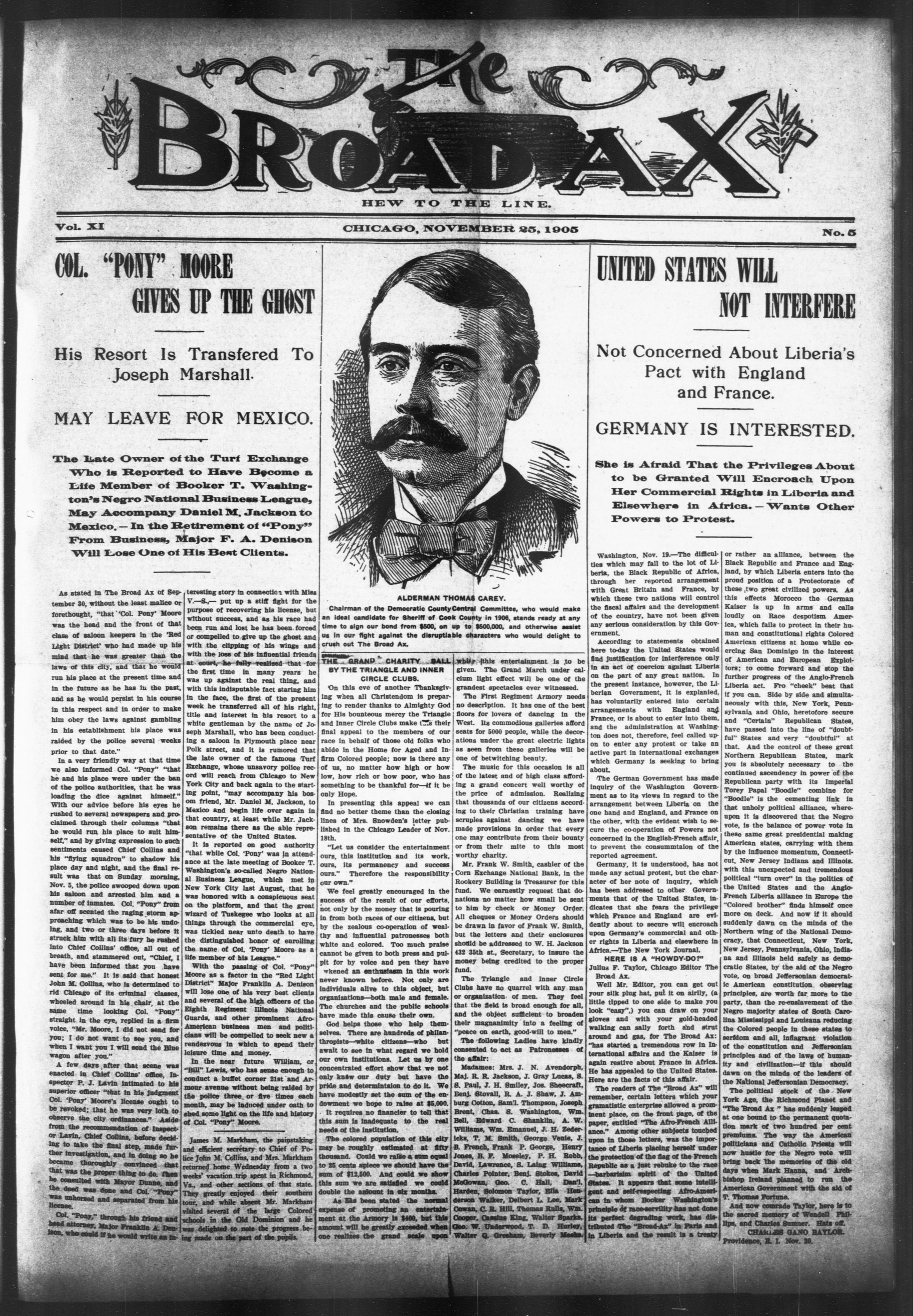
COL. "PONY" MOORE GIVES UP THE GHOST
His Resort Is Transfered To Joseph Marshall.
MAY LEAVE FOR MEXICO.
The Late Owner of the Turf Exchange Who is Reported to Have Become a Life Member of Booker T. Washington's Negro National Business League, May Accompany Daniel M. Jackson to Mexico. - In the Retirement of "Pony" From Business, Major F. A. Denison Will Lose One of His Best Clients.
Vol. XI
COL. "PONY" GIVES
His Resort Is Joseph
MAY LEAVE
The Late Owner of Who is Reported Life Member of Ton's Negro Nation May Accompany Mexico. - In the From Business, Will Lose One of
As stated in The Broad Ax of September 30, without the least malice or forethought, "that 'Col. Pony' Moore was the head and the front of that class of saloon keepers in the 'Red Light District' who had made up his mind that he was greater than the laws of this city, and that he would run his place at the present time and in the future as he has in the past, and as he would persist in his course in this respect and in order to make him obey the laws against gambling in his establishment his place was raided by the police several weeks prior to that date."
In a very friendly way at that time we also informed Col. "Pony" "that he and his place were under the ban of the police authorities, that he was loading the dice against himself." With our advice before his eyes he rushed to several newspapers and proclaimed through their columns "that he would run his place to suit himself," and by giving expression to such sentiments caused Chief Collins and his "flying squadron" to shadow his place day and night, and the final result was that on Sunday morning, Nov. 5, the police swooped down upon his saloon and arrested him and a number of inmates. Col. "Pony" from afar off scented the raging storm approaching which was to be his undoing, and two or three days before it struck him with all its fury he rushed into Chief Collins' office, all out of breath, and stammered out, "Chief, I have been informed that you have sent for me." It is said that honest John M. Collins, who is determined to rid Chicago of its criminal classes, wheeled around in his chair, at the same time looking Col. "Pony" straight in the eye, replied in a firm voice, "Mr. Moore, I did not send for you; I do not want to see you, and when I want you I will send the Blue wagon after you."
A few days after that scene was enacted in Chief Collins' office, Inspector P. J. Lavin intimated to his superior officer "that in his judgment Col. 'Pony' Moore's license ought to be revoked; that he was very loth to observe the city ordinances." Aside from the recommendation of Inspector Lavin, Chief Collins, before deciding to take the final step, made further investigation, and in doing so he became thoroughly convinced that that was the proper thing to do. Then he consulted with Mayor Dunne, and the dead was done and Col. "Pony" was unhorsed and separated from his license.
Col. "Pony," through his friend and head attorney, Major Franklin A. Denison, who could if he would write an in-
teresting story in connection with Miss V.—S.,— put up a stiff fight for the purpose of recovering his license, but without success, and as his race had been run and lost he has been forced or compelled to give up the ghost and with the clipping of his wings and with the loss of his influential friends at court, he fully realized that for the first time in many years he was up against the real thing, and with this indisputable fact staring him in the face, the first of the present week he transferred all of his right, title and interest in his resort to a white gentleman by the name of Joseph Marshall, who has been conducting a saloon in Plymouth place near Polk street, and it is rumored that the late owner of the famous Turf Exchange, whose unsavory police record will reach from Chicago to New York City and back again to the starting point, "may accompany his bosom friend, Mr. Daniel M. Jackson, to Mexico and begin life over again in that country, at least while Mr. Jackson remains there as the able representative of the United States.
It is reported on good authority "that while Col. 'Pony' was in attendance at the late meeting of Booker T. Washington's so-called Negro National Business League, which met in New York City last August, that he was honored with a conspicuous seat on the platform, and that the great wizard of Tuskegee who looks at all things through the commercial eye, was tickled near unto death to have the distinguished honor of enrolling the name of Col. 'Pony' Moore as a life member of his League." With the passing of Col. "Pony" Moore as a factor in the "Red Light District" Major Franklin A. Denison will lose one of his very best clients and several of the high officers of the Eighth Regiment Illinois National Guards, and other prominent Afro-American business men and politicians will be compelled to seek new rendezvous in which to spend their leisure time and money.
In the near future William, or "Bill" Lewis, who has sense enough to conduct a buffet corner 21st and Armour avenue without being raided by the police three or five times each month, may be induced under oath to abed some light on the life and history of Col. "Pony" Moore.
James M. Markham, the painstaking and efficient secretary to Chief of Police John M. Collins, and Mrs. Markham returned home Wednesday from a two weeks' vacation trip spent in Richmond, Va., and other sections of that state. They greatly enjoyed their southern tour, and while absent Mr. Markham visited several of the large Colored schools in the Old Dominion and he was delighted to note the progress being made on the part of the pupils.
CHICAGO, NOVEMBER 25, 1905
J.
ALDERMAN THOMAS CAREY.
Chairman of the Democratic CountyCentral Committee, who would make an ideal candidate for Sheriff of Cook County in 1906, stands ready at any time to sign our bond from $500, on up to $500,000, and otherwise assist us in our fight against the disruptive characters who would delight to crush out The Broad Ax.
On this eve of another Thanksgiving when all Christendom is preparing to render thanks to Almighty God for His bounteous mercy the Triangle and Inner Circle Clubs make their final appeal to the members of our race in behalf of those old folks who abide in the Home for Aged and Inform Colored people; now is there any of us, no matter how high or how low, how rich or how poor, who has something to be thankful for—if it be only Hope.
In presenting this appeal we can find no better theme than the closing lines of Mrs. Snowden's letter published in the Chicago Leader of Nov. 18th.
"Let us consider the entertainment our, this institution and its work, ours, its permanency and success ours." Therefore the responsibility our own."
We feel greatly encouraged in the success of the result of our efforts, not only by the money that is pouring in from both races of our citizens, but by the zealous co-operation of wealthy and influential patronesses both white and colored. Too much praise cannot be given to both press and pulpit for by voice and pen they have wkened an enthusiasm in this work never known before. Not only are individuals alive to this object, but organizations—both male and female. The churches and the public schools have made this cause their own.
God helps those who help themselves. There are hundreds of philanthropists—white citizens—who but await to see in what regard we hold our own institutions. Let us by one concentrated effort show that we not only know our duty but have the pride and determination to do it. We have modestly set the sum of the endowment we hope to raise at $5,000. It requires no financier to tell that this sum is inadequate to the real needs of the institution.
The colored population of this city may be roughly estimated at fifty thousand. Could we raise a sum equal to 25 cents spice we should have the sum of $12,500. And could we show this sum we are satisfied we could double the amount in six months. As has been stated the normal expense of promoting an entertainment at the Armory is $400, but this amount will be greatly exceeded when one realizes the grand scale upon
while this entertainment is to be given. The Grand March under calcium light effect will be one of the grandest spectacles ever witnessed.
The First Regiment Armory needs no description. It has one of the best floors for lovers of dancing in the West. Its commodious galleries afford seats for 5000 people, while the decorations under the great electric lights as seen from these galleries will be one of betwitching beauty.
The music for this occasion is all of the latest and of high class affording a grand concert well worthy of the price of admission. Realizing that thousands of our citizens according to their Christian training have scruples against dancing we have made provisions in order that every one may contribute from their bounty or from their mite to this most worthy charity.
Mr. Frank W. Smith, cashier of the Corn Exchange National Bank, in the Rookery Building is Treasurer for this fund. We earnestly request that donations no matter how small be sent to him by check or Money Order. All cheques or Money Orders should be drawn in favor of Frank W. Smith, but the letters and their enclosures should be addressed to W. H. Jackson 432 35th st., Secretary, to insure the money being credited to the proper fund.
The Triangle and Inner Circle Clubs have no quarrel with any man or organization of men. They feel that the field is broad enough for all, and the object sufficient to broaden their magnanimity into a feeling of "peace on earth, good-will to men."
The following Ladies have kindly consented to act as Patronesses of the affair:
Madames: Mrs. J. N. Avendorph,
Maj. R. R. Jackson, J. Gray Lucas, S.
S. Paul, J. H. Smiley, Jos. Sheecraft,
Benj. Stovall, R. A. J. Shaw, J. Amburg Cotton, Sam'l. Thompson, Joseph Brent, Chas. S. Washington, Wm.Bell, Edward C. Shanklin, A. W. Williams, Wm. Emanuel, J. H. Zedericks, T. M. Smith, George Vemle, J. B. French, Frank P. George, Henry Jones, B. F. Moseley, P. H. Robb, David, Lawrence, S. Laing Williams, Charles Pointer, Benj. Stokes, David McDowan, Geo. C. Hall, Danl, Harden, Solomon Taylor, Ella Henderson Walker, Delbert L. Lee, Mark Cowan, C. R. Hill, Thomas Rulla, Wm. Cooper, Cassius King, Walter Sparks, Geo. W. Underwood, T. D. Hurley, Walter G. Gresham, Beverly Moes
UNITED STATES WILL NOT INTERFERE
Not Concerned About Liberia's Pact with England and France.
GERMANY IS INTERESTED.
She is Afraid That the Privileges About to be Granted Will Encroach Upon Her Commercial Rights in Liberia and Elsewhere in Africa. - Wants Other Powers to Protest.
Washington, Nov. 19.—The difficulties which may fall to the lot of Liberia, the Black Republic of Africa, through her reported arrangement with Great Britain and France, by which these two nations will control the fiscal affairs and the development of the country, have not been given any serious consideration by this Government.
According to statements obtained here to-day the United States would find justification for interference only in an act of coercion against Liberia on the part of any great nation. In the present instance, however, the Liberian Government, it is explained, has voluntarily entered into certain arrangements with England and France, or is about to enter into them, and the administration at Washington does not, therefore, feel called upon to enter any protest or take an active part in international exchanges which Germany is seeking to bring about.
The German Government has made inquiry of the Washington Government as to its views in regard to the arrangement between Liberia on the one hand and England, and France on the other, with the evident wish to secure the co-operation of Powers not concerned in the English-French affair, to prevent the consummation of the reported agreement.
Germany, it is understood, has not made any actual protest, but the character of her note of inquiry, which has been addressed to other Governments that of the United States, indicates that she fears the privilege which France and England are evidently about to secure will encroach upon Germany's commercial and other rights in Liberia and elsewhere in Africa.—The New York Journal.
HERE IS A "HOWDY-DO?" Julius F. Taylor, Chicago Editor The Broad Ax
Well Mr. Editor, you can get out your silk plug hat, put it on airlily, (a little tipped to one side to make you look "easy"), you can draw on your gloves and with your gold-headed walking can sally forth and strut around and gas, for The Broad Ax: "has started a tremendous row in International affairs and the Kaiser is again restive about France in Africa. He has appealed to the United States. Here are the facts of this affair.
The readers of The "Broad Ax" will remember, certain letters which your gramatistic enterprise allowed a prominent place, on the front page, of the paper, entitled "The Afro-French Alliance." Among other subjects touched upon in those letters, was the importance of Liberia placing herself under the protection of the flag of the French Republic as a just rebuke to the race—barbarism spirit of the United States. It appears that some intelligent and self-respecting Afro-American in whom Booker Washington's principle of race degrading work, has distributed The "Broad-Ax" in Paris and in Liberia and the result is a treaty
No.5
The political stock of the New York Age, the Richmond Planet and "The Broad Ax." has suddenly leaped at one bound to the permanent quotation mark of two hundred per cent premiums. The way the American politicians and Catholic Priests will now hustle for the Negro vote will bring back the memories of the old days when Mark Hanna, and Archbishop Ireland planned to run the American Government with the aid of T. Thomas Fortune.
And now comrade Taylor, here is to the sacred memory of Wendell Phillips, and Charles Summer. Hats off, CHARLES GANO BAYLOR.
THE BROAD AX.
‘PUBLISHED WEEKLY.
wee
ant at a Bpbold the |
eee
so SST nee poe aot
Taos! communications will recatve stteation.
wim taly en one cde of a papers
‘Bebscriptions mast be paid in etvanee.
SS
‘are ate mae Enos on aplication.
THE BROAD AX
0m Armonr Avenue, Chisage.
‘JULIUS ¥. TAYLOR, Ratterand Pubtisner. ,
———
Batered wt the Pest Office at Chicagn,
Ti as Second-lam Matter,
—X—X—_—K[____=
CHiPs
umn party which was largely attended
last Friday evening at 3220 Wabash ave.
Doctor W. H. Davis, 3226 Prairie
avenue, left for Frederick, Md, Monday
evening for the purpose of being at the
bedside of his sick mother.
Mr. and Mrs. J. S. Tandy, 5145
Grove avenue, will celebrate their twen-
tieth wedding anniversary Saturday ev-
ening, December 2.
Former City Attorney Miles J. De-
vine has accepted an invitation to be
present and address the Tammany braves
of New York City December 4.
‘Mrs. M. K. Bowles, 4765 Dearborn st.
left Tuesday evening for Champaign,
Ill., and Indianapolis, Ind. She will be
absent six weeks,
Rev. Pap. Jasper F. Thomas has mal-
ice in his Christian heart and he would
be delighted to see Col. “Pony” Moore
put The Broad Ax off watch!
Mr. Samuel W. Thompson, who was
operated upon for appendicitis at“Prov-
tdent Hospital last Sunday by Dr. Danl.
H. Williams is convalescent.
‘This evening Brig-Gen. A. F. Terva-
lon and staff will be tendered a recep-
tion and stagg to be given in his honor
by Brig-Gen. J. E. Wright, at his 48th
anniversary, at home, 3538 State street.
Miss Mae Mendenhall and Miss Cor-
delia Jackson, who have been visiting
their cousin, Mrs. M. K. Bowles, 4765
Dearborn streét, have returned to their
homes in Ohio after a vey pleasant stay.
‘Mr. and Mrs. James A. Warren an-
‘ounce the engagement of their daughter
Miss Bessie, to Mr. Fernando Weisiger.
The wedding will take place the early
part of February.
‘Mr. and Mrs. Julius N. Avendorf and
son, and Mr. and Mrs. Adolf Harris left
Chicago Friday evening to witness the
football game in St. Paul Saturday.
While in St. Paul they will be the guests
of Mr. and Mrs. McGhee.
Mr. John Hamilton Rosenberg, the
affable and efficient manager of the art
department at Hillman’s, State and Wa-
shington streets, where the best good:
are always sold at rock-bottom prices,
is an up-to-date businesse man in every
respect.
Doctor and Mrs. A. H. Kenniebrew
of Jacksonville, Ill, spent a few day:
in the city the past week visiting friends.
They were the guests of Mr. and Mrs.
W. H. Davis, 3226 Prairie avenue
Mrs. Kenniebrew is president of the
State Federation of Women’s Clubs
and the Doctor who has a large prac
tice among the very best class of th
whites in Jcksonville has become a sup
porter of The Broad Ax.
‘The reception given by Mrs. Mary
Hudlum-Watkins, 115 W. stst st., Mon
fay evening in honor of the recent mar:
siage of her son, Mr. Joseph R. Wat
kins to Miss Jennie C. Clark, was a ver
brilliant affair. It was largely attende
by the cream of the four hundred wh
inspected the numerous presents whicl
were displayed and wished the newl;
married conple an abundence of joy an
happiness, while sailing over the matri
‘monial sea.
Chief of Police John M. Collins ha
began shaking up the boys in grea
_ Shape. This week he transferred In
‘spectors P. J. Lavin, from the Harrisor
street station to East Chicago avenue
George M. Shippy from East Chicag
‘avenue to West Chicago avenue, Johi
L. Revere, from West Chicago avenu
to Desplaines street, John Wheeler from
Desplaines street to Harrison street. In
‘spector Nicholas Hunt was permitted t
tontinue to discharge his duties in th
. Attorney W. W. Johnson, 167 Dear
‘bor street, who has more clients amon
Seton tego = Oe ob cot
American lay ‘
cs et eee spe)
cen -
- tree of charge in our fight against the
money by robbing all men out of their
inoney who hapuen Yo enter their low
dives, and who are ever ready to en-
deavor to crush out Afro-American
newspapers, for publishing the truth
concerning their bushwhacking transac-
tions. We desire to thank Mr. Johnson
for his kind offer.
N. A. Harbin, who was well and fav-
orably known in Englewood, died last
Sunday at the Ugion Hospital, and Gov.
Deneen requested the executive commit-
tee of the 31st Ward Republican Club
to assist in conducting his funeral which
was held Wednesday morning at his
late home, 6253 Ada St. For years Mr.
Harbin had been steadfast in his sup-
port of Charles S. Deneen, who failed
to appreciate his worth, and who never
permitted him to earn enough money
to support his wife and three children
jin decent shape. He died from broken
heart more than anything else, by wor-
tying over the cold and shabby treat-
‘ment which he had received at the hands
of his political godfather.
——_—_-—_—
“THE CIVILIZATION OF THE ANC
1ENT EGYPTIANS.
Last Sunday afternoon, the writer
delivered his lecture on “The Civiliza-
tion of The Ancient Egyptians” be
fore the Literary and Historical socie
ty of Bethel church.
Prior to referring to our introduc
tory remarks or the main subject we
urged upon those who were under the
sound of our voice to cultivate the
habit of buying and reading the lt
erary productions of Afro-American
authors and that it was the duty of
the Uterary society of Bethel to ac
quire a number of such works and
rent them out to the members of the
church and those surrounding it for
15 to 25 cents per month; that by in-
ducing our boys and girls as well as
the older members of the race to fa:
miliarize themselves with the writings
or the works of its authors would in-
still into thelr minds, higher ideals
and a greater amount of race love.
That it would deter them from rac
ing the sfreets at unseeming hours of
the night and frequenting vile dens
of vice. “That good books are an
index to the character of men and
women.”
At the conclusion of our address
which seemed to be highly appreciat
ed. Col. Allison W. Sweeney recited
one of Cooper's poems, and Rev. A.
J. Carey very ably and eloquently dia.
lated on our lecture.
‘The following letter indicates that
our weak effort in elaborating on the
wonderful achievements and the high
state of civilization attained by the
“Ancienf Egyptians,” has born fruit.
6908 Cornell Ave., Chicago
Nov. 21, 1905.
Mr, Julius F. Taylor Editor, The
Broad Ax, Chicago.
Dear Bir:
[desire through this to extend you
‘my personal thanks, as well as those
of our club unanimously voted, for the
intellectual and inspiring address, de
livered for us last Sabbath afternoon
Plans are under way to begin the
work of establishing a library, {1
which we trust to also be benefittes
by suggestions and advice from you
from time to time. Again thanking
you, Tam Sir,
‘Respectfully Yours,
GEO. T. KERSEY, Pres.
Bethel Literary and Historical Society
Bethel Chureh, Chicago.
THE ALL CHICAGOS, FOOT BALL
TEAM, WILL PLAY IN ST.
LOUIS ON THANKSGIVING
DAY.
‘The All Chicagos, a first class foot
ball team win leave Chicago the
morning of the 29th to play the team
from Lincoln Institute (Jefferson City,
Mo.), at St. Louis on Thanksgiving
Day.
This will be a great event and en-
‘thusiasm is at the highest piteh in St.
‘Louis over the prospects of the two
cities coming together in a game of
this kind.
‘The management have arranged
with the Alton Railroad for an excur-
sion rate and the prospects ‘loox
bright for carrying down a special
train from Chicago on the night be
fore Thanksgiving.
For rates, information ete. telephone
or address J. W. Spence, Manager,
4838 State St, Telephone Oakland 958,
—
DR. LOUIS M. FENWICK GRANTED
A DIVORCE FROM HIS WIFE
MRS. NETTIE FENWICK ON
‘THE GROUND OF ADUL-
eer
On November fourteenth Dr. Louis
M. Fenwick 6226 S. Halsted st, and
his former w..e Mrs. Nettie Fenwick,
had their day in court and after hear-
ing all the evidence in their divorce
case Judge Honore granted Dr. Fen-
wick a divorce from his former wife
Mrs. Nettle Fenwick on the grounds of
adutlery and thus their domestic tro-
blues or differences have come to an
end.
KING JEFFERSON THE YOUNG
POET, WAS WELL -PLEASED
WITH OUR LECTURE.
King Jefferson the rising Afro
American Poet, was #0 well pleased
with our Lecture on “The Civilisation
of The Ancient Egyptians” that he
penned us the following letter:
Chicago Nov. 23, '05 Julius F. Tay-
lor, Esq.,
My Dear Sir:
“allow me to compliment you on
your very excelient and honorably es-
teemed ability'as an essayist and lect-
urer, I was blessed with the treat of
hearing you deliver your almost
matchless discourse. “The Civilization
of the Ancient Egyptians,” at the
Literary and Historical Club which
meets at Bethel. It reflected wisdom
and learning on your part and impart-
ed inspiration to all who witnessed
this wonderful production of your in-
tellect.”
‘Again I am yours Respectfully,
K. J, 2971 ua Salle St.
—___.,,__
ST. THOMAS’S.
Noy. 19th being the 22nd Sunday
after Trinity Father Lealted precahed
‘at 11 a, m. from St, John 8 chap. and
lithe verse taking Charity for his
theme Miss Davis sang the Offertory
solo the Sunday School weeks at 1
P. m, on next Sunday Father Lealted
lovingly calls the Communtcants to at-
tend Mass at 7:30 or the High Cele-
bration at 11 @, m, as we are soon to
enter into the solemn season of Ad-
vent it is also Father Lealted’s last
Sunday before leaving the city. Now
lets come together and talk organiza-
tion and Building” also Union.
Calender for Week.
Nov. 26. Sunday next betore Ad-
vent.
Nov. 29. Vigil of St. Andrew.
Nov. 30, St. Andrew's Apostle.
Martyr (Red.)
Fri, Dee, 1. Fast.
FREDERICK DOUGLASS CENTRE
NO. 3032 WABASH AVENUE.
Rev. A. J. Carey will speak on Sun-
day the 26th, inst, at 3 p. m. subject,
“Character, Environment, Happiness.”
‘The Forum will meet on Monday at
8 p.m.
On Dec. 5th Mrs. Woolley will give
a lectur on Ibsen's Drama-Peer Gynt.”
The lecture will be illustrated on the
plano by Mrs. Vincent. Proceeds for
the benefit of the sewing class. Ad-
mission-15 cents. All invited.
Calendars for the winter months
will be issued next week. D"—
. ‘Well Done Duty. be
‘The London World tells of Fran-
eiscan monk who a few years ago in
Ireland was accosted by & blackguard
‘who thrust a lighted cigar-end into the
friar’s mouth. On the latter resenting
the act the hooligan hit the worthy
father on the cheek, who thereupon
turned the other and requested to be
hit again. A second blow was calmly
received by him, when he said: “I
have done my duty,” anu immediately
proceeded to give the scoundrel a tre
mendous thrashing.
‘New Building Material
‘The latest building material is
“kremite,” which is made at a factory
near St. Petersburg, and consists of
powdered clay, sand and fluorspar
melted together at = high tempera-
ture. The molten mass may be used
Uke fron for molding castings for
architectural and artistic purposes,
yielding hollow bricks for buildings
and stoves, fancy marblelike bricks,
tiles for floors and sidewalks, and
even thin, corrugated plates for roots.
‘Woman Soldier.
Women, disguised as men, often
served as soldiers. The following
inscription is on a tombstone in the
English town of Brighton: “In mem-
ory of Phoebe Hassel; born 1718, died
1821, aged 108 years. She served for
many years as a private soldier in
many parts of Europe, and at the bat
tle of Fontenoy, fighting bravely, she
recelved @ bayonet wound in the left
on.”
Whenerresh Teaches Parret.
A Philadelphia woman charges @
phonograph with the word of praise she
wants the parrot to learn, and then shuts
him in a room alone with the machine
TRe bird listens to the oft-repeated
sound and tries to outdo the brazes
throated trumpet, so that with no ex
penditure of human strength, and is
shorter time than personal attentios
would consume, he masters one Jessop
‘nd then is put upon another.
Salvation Army Work.
‘The Salvation Army is at workin 4!
countries and colonies, speaking 31 lan-
guages, has 1,210 corps, “circles” and
societies; 13,493 officers and cadets;
employs 2,566 persons, and has 45,331
Jeeal officers. It has, 63 periodicals in
‘1% languages, with an issue of 1,208,000
‘There are 644 institutions for its social
work and in 12 months the army sup-
plied 4,573,399 beds and 7,213,506 meals,
‘Back at Her.
‘Nell—1 told Miss Sharpe what you
‘said about her literary club; that you
wouldn't join because it was too full of
stupid old maids.
Belle—Did you? What did she say?
“She caid you were mistaken; that
‘there was always room for one mora”
—Oatholic Standard aad Times.
COCKTAIL AT THREE FORKS
Decoction That Was Too Much for
Cowboys and the Mixer Had
‘to Drink It
“I was standing in the barroom in a
resort at Three Forks,” sid a travel-
ing man, “waiting for the proprietor
to arrive, in the hope of placing
small order. While I was waiting,
‘two cowboys, wrapped in fur coats,
their own dignity and a reputation as
the top riders of the country which
stretches away toward the head of
‘Willow Creek, came into the saloon
and, marching up to the bar, demand-
ed a cocktail.
‘The bartender looked nonplussed
for a moment, but he was not to be
shut out, 80 he grabbed the biggest
glass he could find behind the bar and
immediately got busy. If there was
anything there he missed putting into
that glass, from the gilt and pepper
sauce used to flavor the beer, to the
snippings from the ends of the cigars
which he found in the cigar cutter, I
could not see {t, and. when he had
finally finished he had two big bee>
glasses full of the mixture.
“The boys both tasted the beverage,
and it did not taste good. Each had
unlimbered a big gun and, playfully
toying with the weapons, they sug-
gested that the bartender drinke his
own mixture. It required some per-
suasion, but finally, to avoid trouble,
he swallowed the contents of both
glasses. ‘Now, make your will, you
‘would-be poisoner,’ shouted the punch-
ers, and solemnly they put their guns
back where they belonged, treated the
house to the cigars and faded away
into the distance, their horses hitting
only the high spots as they disap-
peared up the valley.
“And I tell you, the impromptu bar-
tender had good occasion to make his
will. For three or four hours he was
the sickest man I ever saw, and it
took the services of a doctor, who
worked over him for an hour or two,
to bring him back to life again.”
CASTE IN THE KITCHEN.
Case of a Cook Who Couldn’t Afford
‘to Reside on Just a Plain
‘Street.
‘The Lindsay family was moving out
of the old house on an avenue into a
new house on a fashionable street. At
that critical period the Lindsay cook
gave notice of leaving. The mistress
was in despair, for the cook was a
model one, and had lived with them
for years, relates the Chicago Record-
Herald.
“It will be so much more convenient
in the new house, Nora, and we have
depended on you so long I don't see
how we can part with you now. At
Jeast tell me why you are going?”
Mrs. Lindsay pleaded.
“Well, mem, I have @y own reputa-
tion to look after.” answered Nora,
“and if I went agin the rules of the
Intelligence sassiety I-belongs to they
wouldn't give me a reecond in the best
houses, an’ then I'd be down and out—
see?”
“No, I don't see,” retorted her mis
tress, “tell me exactly why you are
gtving up a place that has always
suited you for an uncertainty.”
“Sure, mem, it's because of the mov-
ing. You are going to live on a street.”
“Yes; wone of the finest in the city.”
“An’ I've always lived on @ avenue,
mem. If it was a terrace, or a boule.
vard, I might be willin’ to change, but
when me friends foun@ that I was liv-
ing on just a street they'd all cut me;
they would, indeed, mem. I draw the
line at a street.”
BOOKS WRITTEN IN PRISON
Some of the Most Famous Writers
Did Their Best Work Be-
hind Bars,
A publisher was talking about Oscar
Wilde's strange book, “De Profundis,”
with its pathetic decoration of a bird
beating its wings egainst the bars of a
cell.
“Wilde's is not the first good book to
have been written in jail,” he said.
“Jail, in fact, seems to be a good place
to write books in. Literary men sur-
pass themselves thera,
“John Bunyan wrote ‘Pilgrim's Prog-
ress’ in jail.
“Cervantes wrote ‘Don Quixote’ in
prison.
“Defoe laid the plans for “Robinson
Crusoe’ during a term of confinement
imposed on him for the writing of a
pamphlet called ‘The Shortest Way
with the Dissenters.”
“Leigh Hunt wrote ‘Rimint’ in jail.
“Sir Water Raleigh, during his 14
years’ imprisonment in the tower of
London, wrote his excellent ‘History
of the World.”
“Bilvio Pellico and Tasso both did
‘their best work in jail.”
Ghee tm Genin
‘There are about 10,000,000 of migrat-
ory sheep in Spain, which each year|
travel some 200 miles from the plains|
to the mountains. Their march, rest-
ing places and behavior are governed,
pie eae eens
fourteenth century. At certain times
no one may travel the same route as
the sheep, which bave the right to
graze on all open and common land on
the way. For this purpose a road 90
yards wide must be left on all enclosed
and private property. The shepherds
lead theirflocks,which are accompanied
by provision mules, and by large dogs,
to guard against s night attack by
Wolves.
‘Theater Banks.
New York is to have a bank, near
the chief theaters, which will be open
all night, so that ladies attending en-
tertainments will be able to deposit
their jewels for safekeeping ere re-
‘tarntng home.
DOG PROUD OF CLOTHES.
Canine That Is Very Much Dis-
tressed When Deprived of
Correct Apparel.
‘There is a dog in Augusta whe
dresses just like a man, wearing the
regulation coat, vest, collar and cravat
and is very proud of his apparel, seem-
ingly, being very much distressed and
‘ashamed whenever his busy master
does not have time to rig him up in
his clothes, reports the Augusta (Ge.)
Chronicle.
“It there are any who are “from
Missouri,” they may be satisfied by
calling at a blacksmith shop on Ellis
street, near the city hall, where they
can be introduced to him by his mas
ter, George Bailey, a negro employe of
the smithy.
He wears them with a conscious dig-
nity and is hugely delighted when any-
one stops to notice his attire and com-
ment thereon. He will gaze intently
‘at each speaker and joyously wag his
tail when complimented upon his ap-
pearance.
It is not known what whim induced
the blacksmith to thus clothe his ca-
nine pet “in all points like as we are.”
But he certainly devised the dog's
dress most ingeniously. No detail is
wanting. The cut of his coat is after
the latest mode—has pockets, too—
the collar 1s nicely laundered and the
cravat is tied with correct smartness.
‘The first thing in the morning he
must be properly dresséd, or else he
whines piteously. After he has been
elothed according to his usual custom
his joy knows no bounds, and he dis
plays his pleasure with much bark-
ing and wagging of his tail. He has
the utmost contempt for the host of
naked dogs who roam about the street
‘and absolutely refuses to associate
‘with: them, manifesting a spirit of out-
raged indignation at their immod-
ety.
“PAGAN” TOWN IN ENGLAND
‘Village of 1,700 People Who Seem
to Have Gpne Spiritually
‘to Sleep.
“Pagan Hook” is the name now en-
foyed by the quiet little village of
Hook, which is situated some three
miles from Kingston-on-Thames.
So lost in indifference is this village
that the vicar, the Rev. W. M. Ding-
well, has thrown up the cure of the
parish in despair, says a recent Lon-
don report.
“I have worked hard here for nearly
three years,” said the vicar, in an in-
terview, “and it seems largely in vain.
T have spoken to the people personally
‘ard have implored them to come to
church, but they will not do it.
“No effort, either spiritual or ma-
terial, no concert, whether high-class
‘or extremely ‘popular,’ no branch of
church activity that I have been able
to devise or carry on will induce thé
People of Hook to come to church.
“There is a population of 1,700 peo-
ple, but many of them absolutely re-
fuse to attend church. In fact, only
200 out of the 1,700 have attended
church, and some of these even are not
‘Hook people.
“The fact is that the village is spir-
Itually asleep. They do not go to non-
conformist places of worship, nor do
they go golfing or motoring. They
have simply gone to sleep and they do
‘not give a thought to spiritual things.”
‘The vicar has now departed for the
West Indies on holiday voyage.
Some of the more enlightened inhab-
Itants of “Pagan Hook” are taking
‘around a large memorial paper asking
Christian and pagan alike to sign an
‘earnest entreaty to the reverend gen-
Geman @ retern to them.
THE FUR-LINED OVERCOAT.
‘Dressy Gentleman Will Carry the
) Garment Inside Out on
‘His Arm.
The precise and high-priced tailor
drew a chalk picture on the customer
who was “trying on,” relates the Prov-
idence Journal, stuck three pins in
him and said:
“The most radical change in gar-
ments for gentlemen for winter wear
this year will come in the furlined
overcoat. We have been driven to it
by @ detachable fur collar which has
made its appearance and which can be
fastened on to the permanent collar
of @ $16 ready-made topcoat in a way
that will puzzle an expert to detect its
on and off features. Of course, that
kills the fur collar for the righ and
‘dressy’ gentleman who has a genuine
fur coat. We shall make the collar of
the expensive coat of the same ma-
terial as the cloth of the coat, or of
velvet, cut a little wider than the col-
lar of the ordinary coat.
“And muffs will not be sewed on the
Sleeves of the first-class fur-lined coat
this season. They were always sug-
gestive of the crushed tragedian.”
“How will people know that ‘dressy’
‘and wealthy gentlemen have fur-lined
coats?” inquired the custodian, anxi-
ously.
|, They will carry them inside out oz
their arms,” replied the precise tailor.
| ‘Wat the Clam
Clam diggers are predicting @ cold
winter because the clags are burrow-
ing deep. Just way a clam should be
given credit for knowing more about
the weather than human beings is not
clear. Some animals may be credited
with superior instinctive impressions—
but not a clam—Washington Star.
‘Exchange of Confidences.
Husband (during the honeymoon)—
I was awfully nervous when I pro
posed to you. I was afraid you
wouldn't accept me.
‘Wite—And I was awfully nervous
for weeks before you proposed. 1 was
afraid you wouldn’t—Sphere.
WHEN. CLIMBING STAIRS.
‘Remember the Exercise Is Most Bene
ficial When the Right Methods
Are Observed.
Stair-climbing can never ¥e made s0
éasy that it will cease to be work, and
hence a certain amount of it daily is sure
to be beneficial, says Mary Butler, in the
Philadelphia Press.
First, stair-climbing is fine exercise
for the muscles of the legs, both for
the high flexors and thigh and knee ex-
‘tensors, and if judiciously used as a
daily exercise it will tend to develop the
muscles of the leg and thigh, reducing
‘at the same time any superfluous flesh
‘that may have settled there through
‘lack of proper use. Hence we use lad-
der-climbing exercises in the gymna-
sium for all such cases.
Second, stair-climbing when done
‘slowly, becomes excellent balance work
‘and is good for the brain. To increase
this mental effect in the gymnasium we
use ladder rounds instead of steps and
‘the slower a pupil can walk up the
‘finer the balance and the stronger the
desired effect.
Third, stair-climbing is good work
for heart and lungs; weak hearts may
be strengthened by judicious lessons in
it, no other apparatus being necessary
than one’s own footsteps.
In all stair or ladder work the weight
ts not only transferred from one foot to
the other in succession more or less rap-
fd, as in the walk, but the whole body-
weight is lifted from one step to
Trotter by the first leg and then the
other, and this means quite heavy work
‘at times.
For example, if you weigh 150 pounds
“and with the right foot step up one step
(that step being exactly 12 inches
high), you have lifted your Gody-weight
of 150 pounds exactly one foot higher;
or, a8 we say, you have done 150 “foot-
“pounds” of work. If the step chances
‘to be 24 inches high, then having lifted
‘yourself two feet you have done
‘twice as. much work, or 300 foot
‘pounds.
‘Thus, when you, weighing just 100
pounds, climb ten stairs, each step
only 12 inches high, yeu have done
Just 1,000 foot pounds of work, good
strong, muscular work that if done well
‘will surely do you good and if done bad-
ly may injure.
Do you stout ladies wonder any long-
er at your breathless condition when
after eating a hearty dinner you climb
to the third-story front room to také
your afternoon nap? Do you not see
that with every step you must do from
one-half as much again to twice as
much work as your wiry little neigh-
dor?
‘You have no right to run up just be-
cause you can trip up one filght and
not feel it. You perforce must take
it slowly and should rest after each
flight of steps, at least till the breath-
ing becomes quiet and regular once
more.
Believe me, instead of being bad for
you, stair-climbing taken slowly and
Properly will do you good, strength-
‘ening the muscles of legs, abdomen and
spine, stimulating the heart and lungs,
clearing the brain, aiding the cireula-
tion and thus improving the digestion;
jut there is a correct and am incor-
rect way of climbing stairs, a hard
and an easy one, a safe and a dangerous
aa.
A CASE FOR THE PIPES.
A Quite Effective Finck May Be Made
at Home and Not Involve
Much Outlay.
Either a piece of board or very stout
cardboard should be used for the foun-
dation of this rack; it should then be
covered with art serge, cloth or vel-
veteen. The foundation may, of course,
be made any size to hold any number
of pipes, but for one such as we illus-
trate, about 15 inches in length and
eight in depth will be sufficient. The
covering shouid be cut with one-inch
turnings, which may be glued down at
the back of the foundation. Trim the
PIPE RACK.
edge with any pretty furniture gal-
loon, or else sew a silk cord round.
A good firm ribbon, rather more than
an inch wide, should be used for the
strap; it is caught down to the cov-
ering by a few firm stitches at regular
intervals. If wood is used aoe
foundations, small brass tacks
be used for fixing this instead of sew;
ing; finish each end by a bow of rib-
bon, sew ribbon to each end to form a
loop to hang it up by; in the center
of this loop put a bow.
‘Relaxed Facial Muscles.
Relaxed muscles of the face may be
toned up by bathing the face with =
mixture of equal parts of milk and
whisky. First wash the face thoreugh-
ly, then apply the lotion with « soft
cloth. ‘This may have tobe used for
six weeks or three months before good
results are noticeable, but it will re
‘ward the persevering woman in the
end for the time expended.
‘Yokes Abound.
Everything points to s return of
yokee—yokes of all sizes and shapes,
curiously contrived, involved looking
affairs, or just the simple embryonic
yoke itself.
Length of Coat.
‘The extrs tall woman can wear ber
coat to the knees; the short woman
‘wants to have it touch the hem.
THE PRESIDENT'S MESSAGE A
MOST IMPORTANT ONE.
Diminishing Number Ex-Confederates in Congress—Passing of Distinct Southern Type—Home Spirit in Middle West.
ASHINGTON—President Roosevelt has his annual message completed, a finely engrossed copy ready for filing away and carefully typewritten copies, tied with ribbon, to be presented to the house and senate and read before those bodies and
ASHINGTON. President Roosevelt has his annual message completed, a finely engrossed copy ready for filing away and carefully typewritten copies, tied with ribbon, to be presented to the house and senate and read before those bodies and about 10,000 copies printed and ready for distribution as soon as the important document has been read in congress. This is probably the most important message the president has ever sent to congress and is the longest. It contains from 20,000 to 25,000 words, which is an unusually lengthy communication for an executive to send to congress.
As the country knows pretty generally, Mr. Roosevelt makes railway legislation the chief feature of his message. When congress adjourned last winter without doing anything on this subject the president announced that he would take every opportunity to keep it alive and he has done so. In his own speeches he has told very clearly what he will ask congress to do and Secretary of War Taft and Senator Knox, of Pennsylvania, former attorney general, have aided in promulgating the administration policy. The president proposes that congress authorize the interstate commerce commission or some other governmental body to declare when a railroad rate is unreasonable and then to fix a rate which is reasonable. The railroads are to be given recourse to the federal courts if they are not satisfied.
The president will treat of a great number of subjects in his message in addition to railroad matters, prominent among them being federal control of insurance companies, the Santo Domingan treaty, the Panama canal, preserving the Niagara falls, our relations with foreign governments, but it is said he will not have any observations to make on the tariff.
Retirement of Senator Blackburn.
NE of the results of the recent elections, it is said will be the retirement of Senator Jo Blackburn, of Kentucky. His term expires in 1907, but the contest this fall has shown that the control of the legislature is in danger of passing
NE of the results of the recent elections, it is said, will be the retirement of Senator Jo Blackburn, of Kentucky. His term expires in 1907, but the contest this fall has shown that the control of the legislature is in danger of passing away from his friends. Senator Blackburn is one of the old-time southern orators and a man of unique character and manners. He will be greatly missed if the wheel of politics should throw him out of public life.
Blackburn served for ten years in the hpuse and most of his reputation he made for oratory was achieved in that body. He was then in the prime of life and vigor and his fine resonant voice was frequently heard in debate. He was never known for the profundity of his arguments, but he had a way of speaking that was impressive. He is one of those orators who can take a self-evident proposition and restate it in complex sentences so as to make it appear as an entirely new discovery and something of wonderful meaning and depth. He could argue on the floor of the senate for five minutes that two and two make four and to the ordinary listener it would sound as though he were demonstrating a most abtrue problem.
The Kentucky senator is one of the diminishing number of ex-confederates now in congress. He served all through the war in the confederate army and has an excellent record for bravery. He served two terms in the senate, beginning in '85 and then was retired for four years when the republicans controlled the legislature, but in 1900 succeeded former Senator William Lindsey, who had turned gold democrat in '96 and refused to support Bryan in 1900. New leaders have sprung up in Kentucky, however, and Mr. Blackburn is said to be slated for retirement. He will have reached within one year of the scriptural limit of life of three score and ten when his term expires.
The Old Southerners
T
HE retirement of Senator Blackburn reduces still further the group of senators from the south who have in these modern days retained many of the characteristics and mannerisms ante-bellum days. The death of Senator, Bate, of Tennessee, last spring removed an old-time and old-style southerner from public life. There are not a great many of this type left. Money, of Mississippi; Morgan and Pettus, of Alabama; Berry, of Arkansas; McCreary, of Kentucky; and McBary, of Louisiana, are about all who
could now be classed as typical southernners in dress and manners, with the exception of Bailey, of Texas, a comparatively young man, who affects even more than his seniors the old-style southern dress. This uniform is the long-skirted black coat, low-cut vest and black slouched hat.
The other senators from the south cannot be distinguished from their northern colleagues and look, for the most part, like prosperous business men and usually attend the sessions of the senate dressed in business clothes. On state occasions the whole senate dresses in the black Prince Albert coat, although the cut of the garments worn by the old southerners is not so stylistic as that of the other members. This uniformity of black, closely-buttoned frock coat adds very much to the appearance of the senate and the body seems to lose some of its dignity when in every day routine of work senators appear in sack coats, cutaways and other styles of garments of various colors.
Another decade will probably see the last of the ante-bellum type of southerner in Washington. The numerous railroads that bind the south to the north and the interchange of commerce has done wonders in amalgamating the sections and destroying the distinctive types of citizens. This is nowhere so apparent as in the congress of the United States, where men from the most remote sections of the south and west meet.
Our "Home" Country.
T
HE great Mississippi valley and the middle west is becoming the section of American homes," said Mr. Babcock, of Wisconsin, the other day in commenting on the changes that are being worked by the increasing population of the coun-
try. It had been suggested that the American people were not a home people. The ancestral homes of England, about which poets have sung, do not abound in this country, and even in the old settlements of the east comparatively few homesteads are found where more than one generation has lived. On this point Mr. Babcock declared that the middle west, the great states of Illinois, Wisconsin, Iowa and others, were now the great home country of America.
"Out in this delightful section," said Mr. Babcock, "you find the home spirit more deeply established than in the rich and prosperous east. In many of these states you find a strong German element, and wherever that is you find the love of home and the ambition to found a home that will remain in the same family for generations. Of course the country is too new to show any very long established homesteads, but I can point to you in my own state and in adjoining states scores and hundreds of places where the head of the household established himself 30, 40 and 50 years ago and where the original estate has been preserved, a substantial house built and occupied first by the original owner and then by his oldest son, while surrounding the homestead are the homes of other children of the family. There are many of these patriarchial establishments and in them I think you will find the hope for the stability and conservatism necessary to a safe government."
It is not known whether Mr. Babcock has followed the example of the good people whom he describes, but he has purchased enough homes in Washington to insure places for all his heirs if they wish to locate here.
"Wise Man of the East."
W
ASHINGTON has within its borders this winter a very distinguished East Indian in the person of Mr. Ramanathan, his Brittanic majesty's solicitor general of the island of Ceylon. In the religious life of India Mr. Ramanathan is classified as a Jnana
Yogi, which means literally, "a wise man of the east." This title will insure him great consideration at the national capital. This distinguished personage, lawyer, statesman and philosopher was invited to this country by a number of American scholars and students who are interested in the religion and philosophy of the orient. He expects to deliver a few public and a number of private lectures while here. He comes from a long line of high-caste Hindus and his family for many generations have been the leaders of Ceylon in wealth, education and social requirements. He is reputed to be the best equipped Hindu lawyer in southern India.
The position of Mr. Ramanathan and his family in the religious life of Ceylon has been even more important than in the secular. His father erected the chief temple or cathedral of Colombo in which six daily services are performed, besides the monthly festivities. He has made a life study of various religions, with a view of reaching a harmony of the eastern and western religious ideals. He has made a critical and expensive study of the Christian Scriptures in addition to the sacred books of the Hindu religion. While in Washington this winter he will endeavor to find time to translate into English the original Sanscrit and Tamil, the celebrated Indian epics, known as "The Maha-Bharats" and the "Ramayana," which are considered the gems of the spiritual literature of the Aryan race.
TO RENOVATE OLD MUFF.
Muffs are to be purchased in every kind of fur and in a variety of patterns and shapes, and are very largely used, but the adjoining sketch shows an excellent idea for the renovation of an old one, which can be built upon so as to look completely new, the worn-out muff merely serving as a foundation for a fresh outside.
The old lining must first be removed. The interlacing strips depicted might be of one of the many kinds of velvet now to be obtained, such as miroir,
THE DIFFERENT PARTS.
panne or chiffon velvet. The latter would be particularly effective, especially if two shades were employed. Each of these strips, measuring about nine inches wide, should be turned in at the edges and tacked invisibly. They should then be gathered at each end and sewn transversely to the muff from right to left with one shade, and then should be threaded in and out in the opposite direction with the other shade.
Five strips of each would be needed.
Purple and mauve, or two shades of gray or green would look extremely well; but if only one shade were preferred, brown, mouse or gray should be selected. A frill of ribbon lined with the other shade decided upon is then sewn in, and peeping from beneath this should be a frill of cream lace—the real old lace, if possible, but if not obtainable, then one of those varieties which so cleverly imitate it. Finally, place in position the lining.
Materials required: Five yards ribbon, four inches wide; two yards velvet, on the cross; two and a half yards lace, one-half yard ponge for lining.
SOCIAL REQUIREMENTS.
What Constitutes the Ideal Hostess and About the Proper Selection of Dinner Guests.
The ideal hostess will possibly differ from the points of view of different minds, but she who comes nearest to satisfying every taste will cause all guests to feel at ease and perfectly at home while in her house. She must possess great tact and endeavor to make each one feel individually the favored guest. She must be quick to see everything while seeming to see nothing, never looking bored and keeping the conversational ball rolling without any apparent effort or even seeming to do so. An ideal hostess must be entirely unselfish and let no one be alighted or overlooked.
Now that vacation days are over and the world has returned from the summer outing which has possibly been spent in the woods or where much freedom in behavior is allowed, be careful to modulate the voice and tone down actions to fit city life and customs.
No right-thinking mother wishes her son to choose a boisterous, flippant wife, so be careful that your love of fun and the summer's freedom do not lead you too far. As we have so often repeated, be kind and thoughtful and "do unto others as you would that they should do to you."
A visiting card may be used for informal invitations. No call is necessary after a tea or afternoon reception, though very often at home days are given in the invitation to a large reception when a call is quite in order. These at home days are often as elaborately prepared for as the original reception with a caterer, but it is perfectly admissible to have the serving done by the house servants. Many times a caterer's service is employed to relieve the regular help, who have all they can do in the daily routine, without anything additional.
It is necessary to be most careful in choosing your guests for a dinner party that they should be congenial. Not necessarily friends or even acquaintances, but whose tastes are similar, otherwise your dinner will not be a success. To make it so the conversation must be pleasant and sustained and a good story-teller is a great assistance.
Art of Tea Making
Practice the art of tea making when you are all alone. Take a cup of tea and pass it across the table. See if you can do it without forgetting anything and without upsetting it. Then try to do it and to listen at the same time. Pretend you are holding a conversation. Don't look at the cup too steadily. Practice tea making until you can do it without more than glancing at the cup. It is easy. And when you have learned it—be you rich or poor, a great hostess or a small one—you will have acquired a pretty art which will serve you in good stead all your life. Even when you are a great mother of it will come in good, for a cup of tea from an elderly person is not only a very graceful compliment, but a very great one.
Keep Mouth Clean.
The mouth being the gateway to the entire system, as a prominent physician puts it, the matter of absolute cleanliness here cannot be made too important. Teach the small child this, and her health will be established according.
Fifty-First St. and Armour Ave.
Rail Yard: 1st St. & L. & M. & R. Ry.
2nd St. and Armour Ave.
CHICAGO
Tile and State Hauling a Specialty.
COAL
J. H. COLEMAN & CO.
Express & Van Moving
TRUNKS EVERYWHERE.
2540 State Street
Tel. 699 South
CHICAGO
C. JOHNSON
UNDERTAKER, EMBALMER,
AND LIVERY,
2712 State Street
CHICAGO
Private Chapel In Connection
Phone 194 South
A. B. SCHULTZ, M. D.
PHYSICIAN AND SURGEON.
2719 State Street
Hours: 9 to 12 A. M.
3 to 5 and after 6 P. M.
CHICAO
Phone Oakland 1828
F. A. Rawlins
The Modern Embalmer
UNDERTAKER AND
FUNERAL DIRECTOR
When his work is finished
you have no displeasure.
4834 State St., CHICAGO
Phone Douglas 1550
Eureka Club
2940 STATE STREET
FIRST-CLASS ENTERTAINERS
CHOICE WINES, LIQUORS
and CIGARS.
Chas, Gaskin, Pres. CHICAGO
J. GARNER Tel. Douglas 3256
THE ELITE BUFFET
FINE WINES, LIQUORS AND CIGARS
3030 State Street
8030 State Street CHICAGO
WONDERFUL
DISCOVERY
Curly Hair Made Straight By
TAKEN FROM LIFE, AFTER TREATMENT
FORD'S ORIGINAL
OZONIZED OX MARROW
(Copyrighted)
This wonderful hair pomade is the only safe preparation in the world that makes kinky or surly hair straight as shown above. It nourishes the scalp, prevents the hair from falling out or breaking off, cures dandruff and makes the hair grow long and silky. Sold over 40 years, and used by thousands. Warranted harmless. It was the first preparation ever made in the United States. It is a popular item of imitation. Remember that Ford's Original Oxonized Ox Marrow is put up only 150 cents size, made only in Chicago and by us. The genuine has the signature CHARLES FORD, PRIS's, on each package. Do not be misled by substitutes that claim to be just as good—but always insist upon getting Ford's as it is never fails to keep the hair straight, soft and beautiful, give the best to the best. A little more fine, the same as much desired. A toilet necessity for ladies, gentlemen and children. Elegantly perfumed. Owing to its superior and lasting qualities it is the best and most economical. It is not possible for anybody to produce a preparation equal to it. Full directions with every bottle. Only 30 cents. Sold by druggists and dealers, or send us 50 cents for one bottle, postage, and coupon. In the best condition, you may send us 50 cents and express charges. Send postal or express money order. Please mention name of this paper when ordering. Write your name and address plainly to
OXONIZED OX MARROW CO. (None genuine without my signature)
74 Wabash Ave., Chicago, Illinois.
Agents wanted everywhere.
WONDERFUL GROWTH OF HAIR.
"I had typhoid fever and my hair"
"all came out. I used three bottles of"
"Ford's Original Oxonized Ox Mar"
"row, and now my hair is nine inch"
"es long and very thick and nice and"
"straight. Most every one seeing"
"how good the Ozonized Ox Marrow"
"done my hair, they to are anxious"
"for it. My hair is an example to"
"everyone."
"$19 S. Matlack St., West Chester,
Pa."
March 20, 1905.
Ford's Original Ozonized Ox Marrow
has many other good qualitein, too.
See their advertisement in this paper.
Price only 50c a bottle at druggists or
dealers, or send us fifty cents and we
will mail you a bottle postpaid. Address
Ozonised Ox Marrow Ox., 70 Wabash
Avenue, Chicago, Illinois.
A Grand Charity Ball
The - Triangle - and - Inner - Circle - Clubs
THANKSGIVING EVE., NOVEMBER 30, 1905
At The
First Regiment Armory, 16th St. & Michigan Ave.
For the purpose of creating an Endowment Fund of $5,000 for the Home For Aged and Infirm Colored People.
Single Admission $1.00, Lady & Gentleman or Two Ladies $1.50
MUSIC BY PROF. N. CLARK SMITH.
MON. OSCAR DE PRIEST, President
W. H. JACKSON, Secretary
Beautify Your Home
20TH
CENTURY
SOAP
ABSOLUTELY NO LYE
TELEPHONES
HARRISON 2286
AUTOMATIC 2294
-- American I
President and Treasurer, THC
Vice-President, JOHN
Secretary
MANUFATU
Common and S
Office and
45th and R
Yards running winter and with the latest improve
Output of Winter Yards ...
Output of Summer Yards...
Telephone
Jas. J. McG
SAMPLE
American Brick Co.
Agent and Treasurer, THOMAS CAREY.
Vice-President, JOHN SHELHAMER,
Secretary, WILLIAM SULLY.
MANUFATURERS OF
Lemon and Sewer B
Office and Yards:
H and Robey
Yards running winter and summer, equipped
with the latest improved Wolf Dryer.
Water Yards ..... 14
Summer Yards..... 3
Telephone Yards 12
as. J. McCormick
EMPLE ROO
IMPORTED AND DOMESTIC
- American Brick Co. -
President and Treasurer, THOMAS CAREY. Vice-President, JOHN SHELHAMER, Secretary, WILLIAM SULLIVAN. MANUFATURERS OF Common and Sewer Brick Office and Yards:
Yards running winter and summer, equipped with the latest improved Wolf Dryer.
Output of Winter Yards ..... 1440.0 per day
Output of Summer Yards..... 300,000 per day
Telephone Yards 128.
Jas. J. McCormick, SAMPLE ROOM
WINES, LIQUORS AND CIGARS 2000 SOUTH HALSTED STREET.
THE BROAD AX.
IS FOR SALE AT THE FOLLOWING NEWS
stande:
The Afro-American News Office,
3104 State Street.
A. F. Tervalon, 2826 State street,
Cigar Store and News Stand.
Richard Webb, 4836 1-2 State St.
Cigar, Tobacco and News stand.
Mrs. Nellie Phelps, Cigars, Notions
and News Stand, 121 W. 51st street.
Richard Pinn, 4836 State street.
J. P. Winstead 391, 31st St., Cigars,
Tobacco and News Stand.
Edward Felix's Cigar Store, 363
30th street, N. E. Corner Armour Ave.
T. B. Hall's Cigar Store and
Laundry office, 321 39th St.
C. H. Green Shoe Polish Manufac-turer 2718 State st.
J. H. Harris, cigars, tobacco and news stand, 2508½ State St.
Turner Williams' Shaving Parlor and News Stand, 2903 Armour ave.
Mrs. B. Williams, Cigars, Notions and News Stand, 486½ State street.
B. Davis, cigars, tobacco, and confectionery, 3833 State st.
Whitley Bros. 2724 State St, Gent's furnishings and new stand.
The Stationery, 2970 State street.
The Afro-American News Co., 439 W. 35th St., New York City, N. Y.
Simpson & Mitchell, Cigars, Tobacco and News Stand, 4903 State St.
Jones News Stand, 4827 State St.,
WAITERS AN
Prefer Our
JACKETS AND
because they have
experience that t
most satisfactory
mical goods on
Our Complete
a correct guide
dress in the Dh
Kitchen, or Bar
free on application
Write for catalogue
home how to use
Marcus Kahn (Inc.) 300
2724 State St., Gent's
and new stand.
2970 State street
American News Co., 439
New York City, N. Y.
Mitchell, Cigars, Tobacco
and 4902 State St.
Stand, 4827-State St.
263.
News Co., 183 Ban-
rott, Mich.
and advertisements not
will find their way
Cleans, brightens and beautifies the home. It gives new life and lustre to the furniture and woodwork. Cleans all the spots and dirt from carpets, bringing out the colors as bright as new. It is also fine for washing curtains, sofa pillows, clothes, flannels silverware, windowglass, and all household articles. It is made of strictly pure vegetable oils that will not injure the most highly polished surface or delicate fabric. Keeps the hands soft and velvety.
ABSOLUTELYPURE
NO LYE
At your Dealer.....10c.
Write for fee copy of 20th Century World which contains offer of hands-on, free premium and cash prizes, also interesting stories, Jokes, etc. Address
Hoffheimer Soap Co.
Royal Ins. Bldg. CHICAGO
Brick Co. -
THOMAS CAREY.
JOHN SHELHAMER,
metary, WILLIAM SULLIVAN.
ATURERS OF
Sewer Brick
and Yards:
Robey Sts.
ater and summer, equipped
proved Wolf Dryer.
14,000 per day
30,000 per day
e Yards 128.
McCormick,
LE ROOM
AND DOMESTIC
AGENTS AND CORRESPONDENTS WANTED.
The Broad Ax desires to engage Agents and regular Correspondents in all the leading cities and towns throughout the country. The highest commissions paid to live hustlers. Sample copies furnished free, For further information, address Julius F. Taylor, 5049 Armour avenue, Chicago.
COOKS
WAITERS AND COOKS
Prefer Our Make
JACKETS AND LINEN
because they have found by
experience that they are the
most satisfactory and econom-
mical goods on the market.
Our Complete Catalogue—
a correct guide to proper
dress in the Dining Room,
Kitchen, or Bar will be sent
free on application.
Write for catalogue and full issue
items here to be sent.
Marcus Eaton (Inc.), 300 Route St., Chicago
Literally Taken.
Dr. Barnardo, the London, philanthropist, who died recently, used to tell the following sory: "At the door of one of the boys' homes was a mat with the words, 'Wipe your feet.' One day as Dr. Barnardo was entering the house he saw a new boy removing his shoes and stockings and wiping his feet on the mat. He had taken the instructions in a literal sense." A London paper comments gravely: "The anecdote reminds one of the notices at American doors, 'Wipe your gums,' referring to the galoches universally worn in winter."
Why His Head Didn't Ring.
Two Scottsmen turning a corner came into collision. The shock stunned one of them. He pulled off his hat, and laying his hand on his brow said: "Sie a blow. My held his a ringing again." "Nae wonder," said his companion, "your held was a empty—that maks it ring; my held disna ring a bit." "How could it ring," said the other, "sein' it was aye crackit?"—Scottish American.
London Statistics
London has 1,000 ships and 9,000 sailors in its port every day. It has on an average upwards of 75,000 persons annually taken into custody by the police, 27,000 persons living in its common lodging houses, 25,000 persons annually arrested as drunk and disorderly, and more than one third of all the crime of the country is committed within its radius.
Prolific Fruit
The producing power of the bananas is 44 times as great as that of the potato. The dried fruit is readily converted into nutritious flour; it may also be manufactured into sausages; beer can be made from it; while the skin can be turned into cloth, and the juice made to do service either as ink or vinegar.
Royal Reception.
London's leading fireworks firm has shipped enormous quantities of its wares to India, for display in honor of the prince and princess of Wales When they arrive at Bombay several warships will make a pyrotechnic display, which will be in the hands of professionals from London on each ship.
"Solan Geese."
Richard Bell in his new book, "My Strange Pets," tells of the solan geese, which, in Great Britain, in bygone days used to be salted and dried for human food: "Many years ago these dried geese found their way to the lowlands of Scotland and were used as an appetizer."
The Squirrel Fish.
In color the squirrel fish is a brilliant red, which makes it a conspicuous inhabitant of the sea as it darts here and there with quick, alert movements. The body of the squirrel fish shows a few stripes and is well covered with sharp spines.
Joint Stock Banks
When the bank of England was established by charter in 1694 it alone was allowed to do banking business in the kingdom, and it was not until the passing of the banks bill of 1826 that joint stock banks began to be established.
Telephone Speeds.
Where the telephone wires are overland the speed of transmission is at the rate of about 16,000 miles a second; where the wires are through cables under the sea the speed is not more than 6,020 miles a second.
Information Wanted.
"Want some nice eggplants, lady?" asked the huckster.
"How long will it be," queried Mrs. Newed, "till they begin to bear eggs after I set them out?"—Chicago Daily News.
Only Music Daily
America is the only country which can boast of a daily musical paper. It is called the 'Fresta,' is published on all seven days of the week, and has its headquarters at Chicago.
new photographs are so horrid?
Gladys—All my girl friends ask for
one and my male friends don't.—Stray
Stories.
Largest Land Owner
John S. Bilbey, of Miltman, Mo., is the largest land owner in this country, his property in seven different states aggregating 180,000 acres.
Chinese Lucky Color.
Most of the numerous temples throughout China are painted red; everything lucky and pleasant among the Chinese is of vermillion color.
Elephants' Tusks.
Among elephants both sexes of the African species have ivory tusks, while in Asia these are generally restricted to the male.
Money in Doga.
A dog show which opened at the Crystal palace, London, recently, contained 3,503 entries, valued at $1,250,000.
High-Friend Onions.
Onions are so scarce in New Zealand that recently they were selling at $85 to $55 a ton at Wellington.
As a result of the second day's drive of the herd of wild elk which for years have made their feeding grounds on the Miller & Lux ranch at Button-wallow, 30 miles south of Bakersfield, Cal, 23 perfect specimens were captured with the lariat, and of these 20 lived to be transferred to the government reserve at Sequoia park. At least 175 animals are still at large. The task of transferring the herd is to be abandoned for the present.
Ought to Work.
Here is an old recipe for making the hair grow "where you will have it." Take two ounces of boar's grease, one drachm of the ashes of burnt bees, one drachm of the ashes of southern wood, one drachm of the juice of a white lily root, one drachm of oil of sweet almonds and six drachms of pure musk, make an ointment of these and the day before the fall moon shave the place and anoint it every day."
Africans in Africa.
At the recent meeting of the German colonial congress in Berlin, Dr. Marensky, formerly a missionary in South Africa, said, in speaking of the negro propaganda of "Africa for the Africans," there was no doubt whatever that a great Ethiopian uprising would take place sooner or later in South Africa, menacing alike British, German and Portuguese authority.
The "Lion" Sermon.
Canon Newbelt preached the annual "Lion" sermon before the lord mayor of London and the sheriffs recently. Two hundred and fifty years ago Sir John Gayer, afterward lord mayor, was purified by a lion in an Arabian desert, but was delivered by prayer. In his will he left funds for an annual service as a thank offering.
Rival Attraction.
Jinks—Were you ever in Niaagra Falls?
Blinks—Yes, once.
"What do you think of the place?"
"Didn't see it."
"Didn't see it! How's that?"
"I was there while on my honeymoon trip."—Chicago Dally News.
Why He Loved Her.
"Darling," said she, "do you love me as much as ever?" "Yes, dearie," said he, with his nose buried in his newspaper.
That ought to have satisfied her, but she had to ask: "Why?"
"Oh, I dunno. Habit, I suppose."—
Stray Stories.
Togo's Religion.
While a dispute was going on in London as to whether Admiral Togo, while a cadet at Gravesend, was baptized a Catholic or Protestant, Togo was visiting the temple at Ise to thank the spirits of his ancestors for his success in the war.
Wireless Towers.
The top of the wireless telegraph tower being erected on Mount Tamalpais, San Francisco bay, will be 2,000 feet above sea level, and so will the pole on a tower to be erected near Honolulu. Aue mesages will be sent 2,100 miles.
Anxiety.
Tramp outside the gate)—Does your dog bite?
Mrs. Weptonwish (on the porch)—Yes, he does, and—oh, please don't come in! We are particular what we feed him on!—Somerville Journal.
Imaginary Ill.
The Paris correspondent of the Pall Mall Mall Gazette writes that, thanks to the recent anti-tuberculosis congress there, half the people of Paris are at this moment suffering from imaginary tuberculosis.
Would Please Father
Jasper—What do you suppose your father will say when I speak to him? Beryl (sure of him now)—He won't say anything. He'll be speechless with joy.—Chicago Tribune.
Not Quite Clear.
Borem—I say, old man, do you consider life worth living?
Busyman-That depends. Do you mean my life or yours?-Chicago Daily News.
Long Stories.
Japanese books contain scarcely more material than the average magazine article, but a single story may consist of more than 100 volumes.
Only One.
"The persistent fellow! What's his name?"—Cleveland Leader.
Captive Gorilla.
Captive Gorilla.
The record for keeping a gorilla in captivity is held by the Breslau zoological gardens, where one lived for a little over seven years.
Matter for Thanks.
Optimist—God gives us our friends.
Pesimist—But, praise be, we can make our own enemies.—N. Y. Times.
Well Dressed Soldiers.
The annual clothing bill of the British army is more than three times that of the navy.
Another of those old Pacific coast stage drivers has passed away. "Jock" Morgan of Oregon crossed the plains with his parents from Iowa in 1850, and they were seven months reaching Albany, Ore. The boy engaged as driver for the old California Stage company when 16 years old and he was the lord of the coach until the locomotive reached Salem. This was in 1872, and thereafter Morgan became a ranchman.
Odd Walking Match.
Recently a turkey and a goose were matched to walk a race of 100 yards in London. There was great excitement, hundreds of people witnessing the affair. After one false start the goose got well away, leaving the turkey at the post, and, following his master in good style, won easily amid great applause. Before and after the race the goose, with a box on his back, collected money for a local hospital.
Sex of Angels.
Referring to the discussion in New York over the sex of angels, the London Standard remarks: "In old English paintings and stained glass, in the works of Orcagna, and in the engraving by Albrecht Duerer, the angels are depicted as robust masculine figures, magnificent in their sturdy strength, irresistible power and unspeakable solemnity.
Made Britishers.
Certificates of admission to British nationality were granted in the course of last month to 25 Russians, 14 Germans, six Austro-Hungarians, six swedes, three Dutchmen, three Norwegians, two Danes, two Greeks, two Turks, two Persians, one American, one Italian, one Spaniard and one Roumanian.
Shipping of Snakes
Of all the creatures to be seen at zoological gardens, snakes are probably the most easy to ship from one country to another. Snakes take very little room, and throughout a long voyage give not the least trouble. They do not require to be fed, nor do they require looking after in any other way.
Danger in Chairs.
The Skibbereen (Ireland) board of guardians has decided to replace the chairs in the board room with substantial benches, but vetoed a suggestion to fasten them to the floor after the clerk had pointed out that in that case they would be of no use in a fight.
Honored a Hen.
The Swiss village of Zofingen, in the canton of Aargau, was decorated with flags recently in honor of a hen which had laid her thousandth egg. Five adjacent villages sent deputations, accompanied by bands, which serenaded the industrious hen.
Extensive Cab Rank.
The largest cab rank in the world is situated in London-viz., at Waterloo station, the terminus of the London & Southwestern railway. It is a quarter of a mile in length. More than 1,000 cabs are called in the course of 24 hours.
Bear's Toothache.
Some time ago a brown bear in the Bronx zoological park, New York, was suffering from toothache. It took the combined strength of four men to pull the molar, after which the bear's former amiability returned.
Laying Cables.
Atlantic cables are always laid from west to east, because the prevailing winds in the summer months on the Atlantic are from the west, and ships make much better weather going eastward.
Quite Likely.
He—I think the numerous marriages must have something to do with it—Chicago Daily News.
Harps Long Silent
Harps have occasionally been found in Egyptian tombs. In some, even the strings were intact, and gave forth distinct sounds after 3,000 years" silence.
Not Worth While
A man who has to marry five times in order to convince himself that marriage is a failure is likely to finish his career in a padded cell—Chicago Sun.
Hidden House.
A farmhouse near Minehead, England, is situated in so deep a hollow that for three months of the year the sun's rays do not fall upon it.
Somebody Knows
The average woman would rather have a husband who tells her all he hears than a house with 17 closets.—Chicago Dally News.
Old Wooden Pipes.
Oak water pipes as sound as when first used hundreds of years ago have been found in a coal mine near Swansea.
J. A. O'Donnell, H. D. Coghlin,
O'Donnell & Coghlin
Attorneys at Law
Phone 264 Main Metropolitan Block
N. W. Cor. LaSalle & Randolph Sts.
Chicago
GRAY & MORAN
ATTORNEYS AT LAW
Suite 1114 Ashland Block, Clark and
Randolph Sts. Tel. Central 568.
CHICAGO.
Residence 87 Macallister Place
Telephone Ashland 363
Office Telephones
Central 1239 Automatic 5940
MILES J. DEVINE
ATTORNEY AT LAW
Suite 518-520 Reaper Block
CLARK AND WASHINGTON STS.
CHICAGO.
Telephone Central 3089
Res. 904 W. 12th Street Blvd. Tel.
1626 Morgon
ATTORNEY AND COUNSELOR AT
LAW.
806 Tribune Building
S. E. Cor. Dearborn and Madison Sts.
CHICAGO
A. D. GASH
A. D. GASH
Attorney at Law,
84-86 La Salle Street, Chicago.
Suite 615 to 619.
Telephone Main 3077.
JOHN E. OWENS
ATTORNEY & COUNSELOR
AT LAW
888 ABHLAND BLOCK
TELEPHONE CENTRAL 888 CHICAGO
Telephone Yards 6016.
John Fitzgerald
JUSTICE OF THE PEACE
4727 SOUTH HALSTED STREET.
Residence
112 W. Garfold Boul.
CHICAGO
J. GRAY LUCAS
Attorney at Law
Suite 611 167 Dearborn St., Cor. Monroe.
Chicago.
Tel. Cust. 3703. Res. Tel. Went. 4592.
Captain 8th L. N. G.
Regimental Quartermaster
JAMES S. NELSON
LAWYER
Residence
3652 WARASH AVE.
Tel. 6342 Douglas
SUITE 611, 167 DEARBORN STREET
Tel. 5763 Central
PHONES Office, Main 1157
Rea. Brown 42
STEPHEN A. DOUGLAS
LAWYER
Room 813, 115 Dearborn Street.
CHICAGO
Hall's Laundry
2975-77 STATE ST.
Phone, Douglas 1385
CHICAGO
W.Kempe Harreld
CHICAGO
TEACHER OF
VIOLIN
6626 CHAMPLAIN AVE.
Tel. Went. 2821.
HILLMAN'S STATE & WASHINGTON STS. Chicago's Most Modern, Most Complete and Most Convenient Department Store
Jacob Feinberg
81st and State Streets
J. J. Bradley Telephone Yards 696 J. M. Fields BRADLEY & FIELDS REAL ESTATE, LOANS AND INSURANCE 4709 S. Halsted Street CHICAGO
Theodore C. Mayer
JUSTICE OF THE PEACE
Mortgages, Deeds, Notes and Legal Documents Drawn and Acknowledged. Room 22, 27 North Clark Street.
POLICE MAGISTRATE RESIDENCE
East Chicago Ave. Police Court 337 Burling Street
C. H. Smiley, Pres. and Treas.
76 E. TWENTY
Two Phones, South 584.
Phone
SANDY W. TR
INCORPORATED UNDER
2918 STATE S
Now is your chance.
The Company will open a Depa-
State St. Namely Sandy W. Trice
complete line of Men and Womens
tions. Shares ten dollars. A lim-
Company's Sec'y. office.
CHICAGO
Pres, and Treas.
J. Hockley
76 E. TWENTY-SECOND STREET,
south 584.
C. H. Smiley, Pres. and Treas.
J. Hockley Smiley, See'y,
Smiley
Caterer
76 E. TWENTY-SECOND STREET,
Two Phones, South 584.
CHICAGO.
Phone Douglas 6581.
W. W. TRICE & COMP
CORPORATED UNDER THE LAWS OF ILLINOIS
2918 STATE STREET, CHICAGO.
is your chance. A joint stock com
will open a Department Store in the near-
ly Sandy W. Trice & Company. The compa-
men and Womens Furnishing Goods Shoes,
ten dollars. A limited number of shares are
y. office.
SANDY W. TRICE & COMPANY
INCORPORATED UNDER THE LAWS OF ILLINOIS. 2918 STATE STREET, CHICAGO.
Now is your chance. A joint stock company.
The Company will open a Department Store in the near future at 2918 State St. Namely Sandy W. Trice & Company. The company will carry a complete line of Men and Womens Furnishing Goods Shoes, Hats and Notions. Shares ten dollars. A limited number of shares are on sale at the Company's Sec'y. office.
DIRECTORS:
Sandy W. Trice, Pres.
Milton J. Trice, Vice Pres.
A. T. Henry, 2nd Vice Pres.
R. R. Wright, 3rd Vice Pres.
Dee Parker, Trustee.
A. J. Carey, D. D. Treas.
2151 Forest Ave.
A. W. Williams, M. D.
Sec'y Office 2840 State St. Phone South 1032, Chicago.
NOIS BRICK
ILLINOIS BRICK CO.
WILLIAM G. KUESTER,
SUPERINTENDENT.
1994 N. Western Ave., C
Telephone Lake View 270
I. Western Ave., C Telephone Lake View 290
M. JUNK, Proprietor JOS. P. JUNK, Manager 3700-3710 South Halsted Street and 897 to 929 Thirtyseventh Street CHICAGO
FIELDS
LOANS
NCE
CHICAGO
Mayer
E PEACE
Documents Drawn
2, 27 North Clark Street.
J. Hockley Smiley, See'y,
Smiley
Caterer
STREET,
CHICAGO.
COMPANY
OF ILLINOIS.
CHICAGO.
stock company.
In the near future at 2918
The company will carry a
goods Shoes, Hats and No-
f shares are on sale at the
A. J. Carey, D. D., Treas.
3151 Forest Ave.
A W. Williams, M. D.
Secy Office 2840 State
St. Phone South 1032,
Chicago.
e., Chicago.
new 270.
ds: 718
CHICAGO
J. M. Fields
RESIDENCE
337 Burling Street