The Broad Ax
Saturday, December 9, 1905
Chicago, Illinois
Page text (machine-generated)
THE BROAD AX
HEW TO THE LINE.
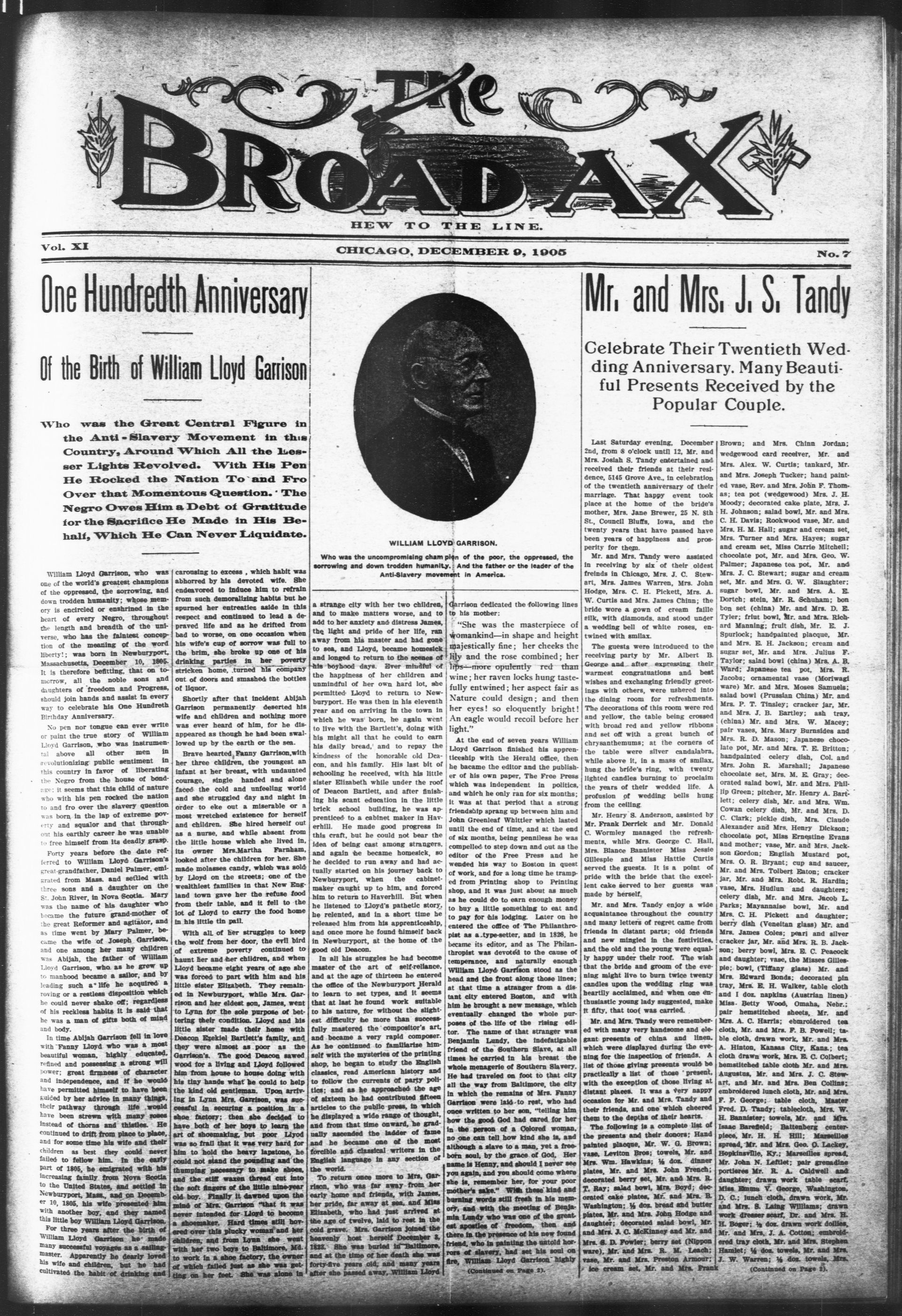
One Hundredth Anniversary
Of the Birth of William Lloyd Garrison
Who was the Great Central Figure in the Anti-Slavery Movement in this Country, Around Which All the Lesser Lights Revolved. With His Pen He Rocked the Nation To and Fro Over that Momentous Question. The Negro Owes Him a Debt of Gratitude for the Sacrifice He Made in His Behalf. Which He Can Never Liquidate.
Vol. XI
One Hundred
Of the Birth of W
Who was the Great
the Anti-Slaver
Country, Around
ser Lights Revo
He Rocked the
Over that Moment
Negro Owes Him
for the Sacrifice
half, Which He
William Lloyd Garrison, who was one of the world's greatest champions of the oppressed, the sorrowing, and down trodden humanity; whose memory is encircled or enshrined in the heart of every Negro, throughout the length and breadth of the universe, who has the faintest conception of the meaning of the word liberty!; was born in Newburyport, Massachusetts, December 10, 1805. It is therefore beftaking, that on tomorrow, all the noble sons and daughters of freedom and Progress, should join hands and assist in every way to celebrate his One Hundreth Birthday Anniversary.
No pen nor tongue can ever write or paint the true story of William Lloyd Garrison, who was instrumental above all other men in revolutionizing public sentiment in this country in favor of liberating the Negro from the house of bondage; it seems that this child of nature who with his pen rocked the nation to and fro over the slavery question was born in the lap of extreme poverty and squalor and that throughout his earthly career he was unable to free himself from its deadly grasp.
Forty years before the date referred to William Lloyd Garrison's great-grandfather, Daniel Palmer, emigrated from Mass. and settled with three sons and a daughter on the St. John River, in Nova Scotia. Mary was the name of his daughter who became the future grand-mother of the great Reformer and agitator, and as time went by Mary Palmer, became the wife of Joseph Garrison, and one among her many children was Abijah, the father of William Lloyd Garrison, who as he grew up to manhood became a sailor, and by leading such a life he acquired a roving or a restless disposition which he could never shake off; regardless of his reckless habits it is said that he was a man of gifts both of mind and body.
In time Abijah Garrison fell in love with Fanny Lloyd who was a most beautiful woman, highly educated, refined and possessing a strong will power; great firmness of character and independence, and if he would have permitted himself to have been guided by her advice in many things, their pathway through life would have been strewn with many roses instead of thorns and thistles. He continued to drift from place to place, and for some time his wife and their children as best they could never failed to fellow him. In the early part of 1805, he emigrated with his increasing family from Nova Scotia to the United States, and settled in Newburyport, Mass, and on December 10, 1805, his wife presented him with another boy, and they named this little boy William Lloyd Garrison. For three years after the birth of William Lloyd Garrison he made many successful voyages as a sailing-master. Apparently he dearly loved his wife and children, but he had cultivated the habit of drinking and
carousing to excess, which habit was abhorred by his devoted wife. She endeavored to induce him to refrain from such demoralizing habits but he spurned her entreaties aside in this respect and continued to lead a depraved life and as he drifted from bad to worse, on one occasion when his wife's cup of sorrow was full to the brim, she broke up one of his drinking parties in her poverty stricken home, turned his company out of doors and smashed the bottles of liquor.
Shortly after that incident Abijah Garrison permanently deserted his wife and children and nothing more was ever heard of him, for he disappeared as though he had been swallowed up by the earth or the sea.
Brave hearted Fanny Garrison, with her three children, the youngest an infant at her breast, with undaunted courage, single handed and alone faced the cold and unfeeling world and she struggled day and night in order to eke out a miserable or a most wretched existence for herself and children. She hired herself out as a nurse, and while absent from the little house which she lived in, its owner Mrs.Martha Farnham, looked after the children for her. She made molasses candy, which was sold by Lloyd on the streets; one of the wealthiest families in that New England town gave her the refuse food from their table, and it fell to the lot of Lloyd to carry the food home in his little tin pail.
With all of her struggles to keep the wolf from her door, the evil bird of extreme poverty continued to haunt her and her children, and when Lloyd became eight years of age she was forced to part with him and his little sister Elizabeth. They remained in Newburyport, while Mrs. Garrison and her eldest son, James, went to Lynn for the sole purpose of bettering their condition. Lloyd and his little sister made their home with Deacon Ezekiel Bartlett's family, and they were almost as poor as the Garrison's. The good Deacon sawed wood for a living and Lloyd followed him from house to house doing with his tiny hands what he could to help the kind old gentleman. Upon arriving in Lynn Mrs. Garrison, was successful in securing a position in a shoe factory; then she decided to have both of her boys to learn the art of shoemaking, but poor Lloyd was so frail that it was very hard for him to hold the heavy lappstone, he could not stand the pounding and the thumping necessary to make shoes, and the stiff waxen thread cut into the soft fingers of the little nine-year old boy. Finally it dawned upon the mind of Mrs. Garrison "that it was never intended for Lloyd to become a shoemaker. Hard times still hovered over this plucky woman and her children, and from Lynn she went with her two boys to Baltimore, MD. to work in a shoe factory, the owner of which failed just as she was getting on her feet. She was alone in
CHICAGO, DECEMBER 9, 1905
WILLIAM LLOYD GARRISON.
Who was the uncompromising champion of the poor, the oppressed, the sorrowing and down trodden humanity. And the father or the leader of the Anti-Slavery movement in America.
a strange city with her two children, and to make matters worse, and to add to her anxiety and distress James, the light and pride of her life, ran away from his master and had gone to sea, and Lloyd, became homesick and longed to return to the scenes of his boyhood days. Ever mindful of the happiness of her children and unmindful of her own hard lot, she permitted Lloyd to return to Newburyport. He was then in his eleventh year and on arriving in the town in which he was born, he again went to live with the Bartlett's, doing with his might all that he could to earn his daily bread, and to repay the kindness of the honorable old Deacon, and his family. His last bit of schooling he received, with his little sister Elizabeth while under the roof of Deacon Bartlett, and after finishing his scant education in the little brick school building, he was apprenticed to a cabinet maker in Haverhill. He made good progress in this craft, but he could not bear the idea of being cast among strangers, and again he became homesick, so he decided to run away and had actually started on his journey back to Newburyport, when the cabinet-maker caught up to him, and forced him to return to Haverhill. But when he listened to Lloyd's pathetic story, he relented, and in a short time he released him from his apprenticeship, and once more he found himself back in Newburyport, at the home of the good old Deacon.
In all his struggles he had become master of the art of self-reliance, and at the age of thirteen he entered the office of the Newburyport Herald to learn to set types, and it seems that at last he found work suitable to his nature, for without the slightest difficulty he more than successfully mastered the compositor's art, and became a very rapid composer. As he continued to familiarize himself with the mysteries of the printing shop, he began to study the English classics, read American history and to follow the currents of party politics; and as he approached the age of sixteen he had contributed fifteen articles to the public press, in which he displayed a wide range of thought, and from that time onward, he gradually ascended the ladder of fame and he became one of the most forcible and classical writers in the English language in any section of the world.
To return once more to Mrs. Garrison, who was far away from her early home and friends, with James, her pride, far away at sea, and Miss Elizabeth, who had just arrived at the age of twelve, laid to rest in the cold grave. Mrs. Garrison joined the heavenly host herself December 8, 1823. She was buried in Baltimore, and at the time of her death she was forty-five years old, and many years after she passed away. William Lloyd
Garrison dedicated the following lines to his mother:
"She was the masterpiece of womankind—in shape and height majestically fine; her cheeks the lily and the rose combined; her lips—more opulently red than wine; her raven locks hung tastefully entwined; her aspect fair as Nature could design; and then her eyes! so eloquently bright! An eagle would recoil before her light"
At the end of seven years William Lloyd Garrison finished his apprenticeship with the Herald office, then he became the editor and the publisher of his own paper, The Free Press which was independent in politics, and which he only ran for six months; it was at that period that a strong friendship sprang up between him and John Greenleaf Whittler which lasted until the end of time, and at the end of six months, being penniless he was compelled to step down and out as the editor of the Free Press and he wended his way to Boston in quest of work, and for a long time he tramped from Printing shop to Printing shop, and it was just about as much as he could do to earn enough money to buy a little something to eat and to pay for his lodging. Later on he entered the office of The Philanthropist as a type-setter, and in 1828, he became its editor, and as The Philanthropist was devoted to the cause of temperance, and naturally enough William Lloyd Garrison stood as the head and the front along those lines; at that time a stranger from a distant city entered Boston, and with him he brought a new message, which eventually changed the whole purposes of the life of the rising editor. The name of that stranger was Benjamin Lundy, the indefatigable friend of the Southern Slave, at all times he carried in his breast the whole menagerie of Southern Slavery. He had traveled on foot to that city all the way from Baltimore, the city in which the remains of Mrs. Fanny Garrison were laid to rest, who had once written to her son, "telling him how the good God had cared for her in the person of a Colored woman, no one can tell how kind she is, and although a slave to a man, yet a freeborn soul, by the grace of God, Her name is Henry, and should I never see you again, and you should come where she is, remember her, for your poor mother's sake." With these kind and burning words still fresh in his memory, and with the meeting of Benjamin Lundy who was one of the greatest apostles of freedom, then and there in the presence of his new found friend, who in painting the untold horrors of slavery, had set his soul on fire, William Lloyd Garrison highly
(Continued on Page 2.)
Mr. and Mrs. J. S. Tandy
Celebrate Their Twentieth Wedding Anniversary. Many Beautiful Presents Received by the Popular Couple.
Last Saturday evening, December 2nd, from 8 o'clock until 12, Mr. and Mrs. Josiah S. Tandy entertained and received their friends at their residence, 5145 Grove Ave., in celebration of the twentieth anniversary of their marriage. That happy event took place at the home of the bride's mother, Mrs. Jane Brewer, 25 N. 8th St., Council Bluffs, Iowa, and the twenty years that have passed have been years of happiness and prosperity for them.
Mr. and Mrs. Tandy were assisted in receiving by six of their oldest friends in Chicago, Mrs. J. C. Stewart, Mrs. James Warren, Mrs. John Hodge, Mrs. C. H. Pickett, Mrs. A. W. Curtis and Mrs. James Chinn; the bride wore a gown of cream faille silk, with diamonds, and stood under a wedding bell of white roses, entwined with sililax.
The guests were introduced to the receiving party by Mr. Albert B. George and after expressing their warmest congratulations and best wishes and exchanging friendly greetings with others, were ushered into the dining room for refreshments. The decorations of this room were red and yellow, the table being crossed with broad red and yellow ribbons and set off with a great bunch of chrysanthemums; at the corners of the table were silver candalabra, while above it, in a mass of smilax, hung the bride's ring, with twenty lighted candles burning to proclaim the years of their wedded life. A profusion of wedding bells hung from the ceiling.
Mr. Henry S. Anderson, assisted by Mr. Frank Derrick and Mr. Donald C. Wormley managed the refreshments, while Mrs. George C. Hall, Mrs. Blance Bannister Miss Jessie Gillespie and Miss Hattie Curtis served the guests. It is a point of pride with the bride that the excellent cake served to her guests was made by herself.
Mr. and Mrs. Tandy enjoy a wide acquaintance throughout the country and many letters of regret came from friends in distant parts; old friends and new mingled in the festivities, and the old and the young were equally happy under their roof. The wish that the bride and groom of the evening might live to burn twice twenty candles upon the wedding ring was heartily acclaimed, and when one enthusiastic young lady suggested, make it fifty, that too (was carried.
Mr. and Mrs. Tandy were remembered with many very handsome and elegant presents of china and linen, which were displayed during the evening for the inspection of friends. A list of those giving presents would be practically a list of those present, with the exception of those living at distant places. It was a very nappy occasion for Mr. and Mrs. Tandy and their friends, and one which cheered them to the depths of their hearts.
The following is a complete list of the presents and their donors; Hand painted placque, Mr. W. G. Brown; vase, Leviton Bros; towels, Mr. and Mrs. Wm. Hawkins; ½ doz. dinner plates, Mr. and Mrs. John French; decorated berry set, Mr. and Mrs. R. T. Ray; salad bowl, Mrs. Boyd; decorated cake plates, Mr. and Mrs. B. Washington; ½ doz. bread and butter plates, Mr. and Mrs. John Hodge and daughter; decorated salad bowl, Mr. and Mrs. J. C. McKinney and Mr. and Mrs. S. D. Fowler; berry set (Nippon ware), Mr. and Mrs. R. M. Leach; vase, Mr. and Mrs. Preston Armour; ice cream set, Mr. and Mrs. Fran
No.7
Will promulgate and at all times uphold the true principles of Democracy, but Catholic, Protestant, Priest, Infidel, Farmar, Single Taxer, Republican, Knight, Christian, long as their language is proper and responsibility is fixed.
The Broad *A* is a newspaper whose platform is broad enough for all, ever claiming the editorial right to speak its own mind.
Local communications will receive attention. Write only on one side of the paper.
THE BROAD AX
6040 Armour Avenue, Chicago.
JULIUS F. TAYLOR, Editor and Publisher.
Entered at the Post Office at Chicago
Ill. as second-class Matter.
WILLIAM LLOYD GARRISON.
Up from the famous Bay State glen
Sprung Garrison of world renoun,
To lift the bars of slav'ry down
And liberate a race of men.
His energies and life were spent
The Negro to emancipate,
And furthermore to demonstrate
The judgement of Omnipotent.
The first to dare to agitate
The abolition cult in days
When reason met with curse and
praise
From coast to coast and state to
state.
But brave as Nelson on the deck
His voice for Independence spoke.
His strength was lent to raise the
yoke.
Can never prove a mark for shame
By those form its con and pro.
As near the cruix or turn it leans
A strain people prays for God
To usher in an episode
When men shall be what freedom
means.
I know not what the world may,
judge
About the fit and proper place
For this great champion of a race,
Who wrong defied without a budge.
Of eulogies to match John Brown,
I rate the worth of Garrison.
Let freedom's sentries light their
flames
And touch the eagle's starry wing.
Look up' ye sons of Ham, and sing
The honors that a hero claims.
KING JEFFERSON,
2971 La Salle St., Chicago.
THE WEST SIDE SUNDAY CLUB OF
ST. STEPHENS CHURCH.
Sunday December 3, the following interesting program was rendered at the West Side Sunday Club, which meets at St. Stephens Church, song, by the choir, recitation, Ben C. Winfrey paper on "Training of The Mind," Doctor Anna R. Cooper, selectoin, the choir. Address, Julius F. Taylor, "Four years Among The Mormons." The church was well filled, and at the conclusion of the program our highly esteemed friend, Rev. W. S. Brooks, moved that a rising vote of thanks be extended to Doctor Cooper and the writer for the excellent papers which were very edifying to those who heard them.
President Zederick, vice President Thomas Secretary Frank Stewart and many others joined in declaring, that they had learned more about the Mormon people, than they had ever knew before.
The ladies, were at their best, and many of them were favorably impressed with our suggestion in reference to the importance of acquiring, good and wholesome books for the younger and the older members of the race to read, which will inculcate into their minds higher ideals, and cause them in every way to become better men and women.
Both branches of Congress convened on Monday, and on the following day President Roosevelt's long message was read. In it the President touched upon a thousand and one things, which if adopted would redown to the benefit of the majority of the American people. But in all of his numerous recohenditions to the law making bodies of this great nation, he had not one word to say, in favor of restoring the ballot to the disfranchised Negro in the South.
Mr. Bert Lucky who has been very slick with appendicitis is improving
```markdown
```
(Concluded from Page 1).
resolved to dip his pen in gall and burning fire, and enter the arena, and to do battle unto death with that hydra-headed monster slavery!
Immediately after William Lloyd Garrison took upon himself a solemn vow of perpetual consecration to the slave; which was as follows: "Before God and our country, we give our pledge that the liberation of the enslaved Africans shall always be uppermost in our pursuits:" he left Boston, and became a resident of Bennington Vermont, where he assumed the editorship of The Journal of the Times, and in closing his connection with that paper in 1829, he declared "that he had been invited to occupy a broader field, and to engage in a higher enterprise: that field embraces the whole country—that enterprise is in behalf of the slave population."
On August 29th 1829, William Lloyd Garrison, bid farewell to his friends in Boston and set out for Baltimore where he was to assist Ben. Lundy in the editorship of his paper The Genius of Universal Emancipation, for the first two or three months they progressed very nicely; but at the end of that time, William Lloyd Garrison bitterly assailed Francis Todd, a merchant of Newburyport, for allowing one of his vessels to sail for New Orleans, with a gang of seventy-five slaves; at the instance of Francis Todd, William Lloyd Garrison was arrested for publishing a "gross and malicious libel." He was indicted by the Grand Jury for Baltimore, and one the first of March 1830, he was convicted, and not being able to pay his fine of fifty dollars and cost which amounted to almost one hundred dollars, he was suspended, and just forty-nine days after entering the Baltimore jail as a priosner, Arthur Tappan, a rich New York, merchant sent him one hundred dollars to pay his fine, and he was willing to advance another hundred dollars for the further purpose of reviving the paper which had suspended, but as William Lloyd Garrison aptly, put it "he could knock a dozen subscribers off, while friend Lundy could secure one," and on March 5 1830 The Genius, went glimmering through the dream of things that were no more, after his second failure in the Journalistic world he again returned to Boston, and on January 1, 1831, his new paper The Liberator made its first appearance in the world. It was an insignificant sheet, consisting of four columns to the page, measuring fourteen inches one way and nine and a quarter the other.
Oliver Johnson, has left behind him a vivid description of the office of The Liberator, "It's dingy walls: the small windows in the merchant's hall building bespattered with printer's ink; the press standing in one corner; the composing stands opposite; the long editorial and mailing table, covered with newspapers; the bed of the editor and publisher on the floor; a Negro boy who cleaned up the office his chief camplon," and for the first two years every one connected with The Liberator which ran for thirty-five years, labored fourteen hours each day, subsisted mostly upon bread and milk, a few cakes, and a little fruit, which they obtained from a baker's shop near by.
Within a few weeks after The Liberator had blazed forth, within sight of Bunker Hill, where Crispus Attucks fell, it contained the following sentiments:
"I solicit no man's praise."
"I fear no man's censure."
"Our trust for victory is solely in God. We may be personally defeated, but our principles, never!"
"I am in earnest."
"I will not equivocate."
"I will not retreat a single inch."
"And I Will Be Heard."
The Southern slave-holders and their sympathizers throughout the North suddenly became alarmed at his bold or daring declarations, and the legislature of the state of Georgia, offered a reward of "five thousand dollars for the body of William Lloyd Garrison, dead or alive:" the head officials of many other Southern states were perfectly willing to follow suit, and while the people in the north were hotly clamming for his warm liberty—loving blood, he was attacked by a mob composed of Christian gentlemen, and dragged through the streets of Boston with a rope around his neck, and in order to save his life, the Mayor of that city with the aid of officers rescued him from the mob and placed him in jail, when he emerged from prison he was still cool and collected, and he continued to thunder forth through the columns of The Libearator in favor of Immediate and Unconditional Emancipation.
tion. He in conection with Oliver Johnson, Robert B. Hall, Arnold Buffum, William J. Snelling, John E. Fuller Moses Thatcher, Joshua Coffin Stillman, B. Newcomb, Benjamin C. Bacon, Isaac Knapp, and Henry K. Stockton, met one dismal night in the African Baptist Church on Belknap street and organized the first Garrisonian Society for the abolition of slavery in the United States; he and his apostolic band also founded the New England Anti-Slavery Society, The Liberator become the official organ of both bodies and its editor was chosen as their general agent, and chief lecture, and as such he raised his eloquent voice in behalf, of the slave in chains, throughout the North and in England, and he never faltered in his labors until slavery was no more.
In December 1865 he discontinued the publication of The Liberator, after the completion of its thirty-fifth volume, but until the day of his death which occurred at the home of his daughter Mrs. Henry Villard, in New York City may 24, 1879; he breathed words of hope and encouragement for the ex-slave, and among the last words spoken by the great apostle of liberty were: "My country is the world! my countrymen are all mankind!"
In celebrating the one hundredth anniversary of his birth, it is well to remember, that his breast was full of the milk of human kindness, that his love for his fellow creatures was as broad as the universe, that he wore himself out in the service of his country, and that among the greatest champions of the rights of man, who have been sprawned upon the face of the earth, none of them were born greater than William Llyod Garrison.
(Concluded from Page 1).
A. W. Curtis; 2 linen dresser scarfs, Mr. and Mrs. Scott; embroidered lunch cloth, Mr. and Mrs. A. J. Wethington; drawn work side-broad scarf, Mr. and Mrs. W. A. Stewart, Washington, D. C.; towels, Mr. and Mrs. Frank Johnson; hemstitched linen towels, Mrs. Nancy Pierslau; sofa pillow, Mr. and Mrs. E. G. Clark; drawn work tray cloth, Miss Hattle Curtis; fancy stock collar, Miss Anna Nelson; center piece of Bavarian lace, Mr. and Mrs. Henry S. Anderson; battenberg centerpiece, Mr. Albert Sloan; ½ doz. French lingerie, Dr. and Mrs. Geo. C. Hall; Jardinierle, Mr. and Mrs. M. K. Bowles; 2 boxes linen handkerchiefs, Mr. and Mrs. J. Gray Lucas; hemstitched lunch cloth, Dr. Ida Gray Nelson; hand painted motto card, Mrs. S. D. Brown; silver pickle fork, Miss Ida M. Hall, New Orleans, La.; pair vases, Mr. and Mrs. Thomas Dirsh, Bohemian wine set, Misses Estella C. and Victoria D. Bonds; ½ doz. silver oyster forks, Mr. P. Logwood; salad dish, Mr. and Mrs. Peter French; placque, Mr. and Mrs. J. C. Wilson; pair vases, Mr. Howard Clark; ½ doz. Japanese bread and butter plates, Mr. and Mrs. James Blas, Palmyra, Mo.; ½ doz. dinner plates, Mr. and Mrs. Charles Cassidy, Palmyra, Mo.; celery dish Mr. and Mrs. Thomas Smith; celery dish, Mrs. Willa McKinney; ash tray, Miss Laura V. French; ½ doz. silver spoons, Mr. and Mrs. R. D. Foster; hand painted plate, Mr. and Mrs. Vrigl Cook; hand painted salad bowl, Mr. James Newsome; ½ doz. Japanese bread and butter plates, Mr. and Mrs. Taylor Nolan and daughter, Palmyra, Mo.; berry set, (china) Mr. Walter Smith, San Francisco, Cal.; salad bowl (china) Mr. and Mrs. H. M. Bowen; ½ doz. dinner plates, Mr. and Mrs. Arthur A. Wells; hand painted placque, Prof. and Mrs. S. I. Lee; fruit bowl, Miss Lula N. Jones; cake plate, Mr. and Mrs. F. L. Barnett; salad bowl (china) Mr. and Mrs. Martin French; handpainted cake plate, Mr. and Mrs. Frank Brown; ½ doz. after dinner cups, Mr. and Mrs. W. M. Thomas; sugar and cream set, Mr. and Mrs. H. Bell; Japanese placque, Mr. W. R. Sobers; Japanese cups and saucers, Mrs. Geo. T. Townsend and mother; olive dish (china) Dr. and Mrs. A. W. Williams; cream pitcher, Mr. and Mrs. F. P. White; salad bowl (china) Mr. and Mrs. J. H. Carr; hand painted placque Mr. J. H. Young; china tea pot, Mr. and Mrs. E. E. Wilson.
ST THOMAS
Sunday Dec. 3rd being the 1st Sunday in Advent the Rev. Mr. Davls now in the Seminary took morning prayer and preached a very interesting Sermon also touching on the season of Advent so solemn and so dear to all Catholics this Advent is also sad because of our beloved Priest's depart-
ure to another City but He is only full-filling the command of Him to "Go ye into all the World." The Priest to succeed Father Lealted is reputed to be a man of great ability as a preacher and a church builder, a man of means and a thorough Catholic the Bishop says he is one of the finest Priest's in the United States we do not know just who He is though there are just about five who we would be glad to get. There is work in Chicago for at least three missolins the Sunday School is preparing for a joyous Christmas and the choir hopes to render monks full mass at the Celebration Christmas the hours of Service will be announced later as we expect the new Priest by next Sunday. Dec. 10. 2nd Sunday in Advent.
Dec. 15. Friday, Fast.
FREDERICK DOUGLASS CENTER,
3032 WABASH AV.
Sunday 3 p. m. Mrs. Woolley will speak on Eating with Sinners.
Monday evening 8 p. m. The Men's Forum meets. Subject for discussion, The President's Message.
Wednesday 2 p. m. Prof. W. Thurston chief Probation officer of the Juvenile Court will speak on the Needs of Co-operation in work for Colored children. Club women, teachers and parents are cordially invited.
Thursday evening 8 p. m. The class is Sociology meets.
The class made a very promising beginning two weeks ago and it is hoped the interest will increase. All are invited.
Friday evening 8 p. m. The Young People's Lyceum will meet.
Saturday morning at 10 a. m. The children's sewing class meets.
GARRISON THE NON-RESISTANT.
The great apostle of abolition, Willian Lloyd Garrison, was born in Newburyport, Mass., December 10, 1805. The centenary of his birth is suitably marked by the publication of Ernest Grosby's notable book "Garrison the Non-Resistant."
It is a sympathetic sketch of Garrison's career which considers slavery and the Civil War from an entirely original point of view. In the opinion of the author President Lincoln made a radical mistake in undertaking to coerce the seceding States, and the enthusiasm for the "Union" of sections which hated each other he regards as immoral in itself and the source of prolific subsequent evils, including the growth of the sentiments of imperialism and militarism, together with the foundation of the trusts and the aggravation of the labor problem. That the war failed to settle the race question is obvious. If the "erring sisters" had been allowed to go, slavery would, he thinks, have died a natural death, and the States would have reunited, the race question having been peacefully and genuinely solved.
Even, those who fail to accept this view of history will find it interesting and full of suggestion and the acount of Garrison's life and the record of the personal observations of the author in the South of today are both vivid and entertaining. Published by The Public Publishing Company, First National Bank Building, Chicago. 16 mo. 144 pages, with photogravure portrait of Garrison. 50 cents net.
CHIPS
Mr. James Maxie 221 26th st is on the sick list.
Dr. A. York, 4711 State st., is on the sick list.
Mrs. Chas. Rasser 3117 Dearborn St. is on the sick list.
Mrs. A. Howard of 3612 Calumet ave., will leave for Wisconsin on a visit Dec. 8th Friday.
Mr. Frank Gohart of Evansville, Ind., is in city visiting Mr. John Meyer 4238 Evans ave.
Dr. C. Auter of Washington, D. C. recently passed the Illinois examination to practice medicine.
Mrs. Fannie Jameson of Huron, Wls., is visiting city the guest of Mrs. Fred Libraut, 6328 Ellis Ave.
Mr. Al. Barnett and Mr. Oneal spent three weeks travelling through Canada and the East have returned to the city.
Dr. Chester Howard, who has been visiting the city for the past two months left for Hot Springs, Ark., to remain the winter.
Mrs. Deillah Young of 5138 Indiana ave., passed a successful operation at Provident Hospital and returned to her home Saturday Dec. 2nd.
Miss M. West who has been the guest of Mrs. Jas. Madden, for the past two months leaves the city for her home Brooklyn next week., (
Mr. Clifton M. Weaver 3144 Indiana Ave., has returned from Baltimore, Md., where he was highly entertained by many of his childhood friends.
Richard Pinn 4836 State street, has been disabled from work, owing to a scalded hand, but the first of the week, he will resume his run on the road.
Mrs. Gertrude Blackwell 3238 State st., who for the past six weeks has been visiting her mother Mrs. Jenifer in Baltimore has returned to the city.
A threatening attack of peutonites, greatly alarmed the parents and friends of young Julius N. Avendorf, Jr., At this writing the little fellow is safe.
The Inner Circle of Crispus Attucks Club announce their Third Annual Ball to be given Monday, Feb. 5th, at Central Hall. Watch the papers for particulars.
Mr. Frank Armstrong 2502 Wabash ave., is rapidly recovering from the effects of an injury which he received while working in the steel mills at Jollet, Ill.
Mrs. Catherine Thompson mother of Mr. J. Marck Weaver has given up her residence in Baltimore, and will reside with her daughter at 3144 Indiana, Av.
George J. Terrell who has charge of the Democratic Headquarters 70 Washington street, returned home Friday morning from a pleasant visit at Covington, Ky.
The Rev. Mr. Davis of St. Thomas Church entered the Western theological Seminary of this Diocese he hopes to aid in the Catholic work of the Episcopal church.
Rev. Father Lealted passed through the city last Friday the 1st from Cleveland, O., enroute to St. Paul, Minn. His new field of labor will be at the Church of St. Phillips.
Mrs. Ella Norman 4560 Gross ave., passed away the latter part of last week, and F. A. Rawlins, the up to date undertaker 4834 State street, shipped her body to Frankfort, Ky., for burial.
A large party of friends gathered at the home of Mrs. Zedricks 754 West Madison st., and had a delightful surprise party on Mrs Will Green who is soon to leave for Muskogee, I. T., where her husband is located.
Mr. Samuel Thompson of 6552 Champlain ave., is much improved from the operation for appendicitis at Provident Hospital and expects to leave for home Saturday Dec. 9th. Father Lealted was his spiritual adviser and consoler.
Mr. and Mrs. Sam'l. Carter 32nd and Forest Ave., have for the past two weeks been entertaining Mrs. Beatrice Thompson, daughter and son in their palatial residence, thus enabling the children to be near enough to pay daily visits to their father during his confinement at Provident Hospital.
The Willing Workers Club under the very efficient management of Mrs. R. A. William meets every Monday afternoon at appointed places. Mrs. R. J. Miller one of the active members of St. Thomas church also a fine cateress offers a dinner to the member who attends the most regular for a given period the dinner to be served in her beautiful private dining room.
Mr. and Mrs. Perry Bates 6410 Morgan st., very elegantly entertained a few of their most intimate friends at a Thanksgiving dinner covers were laid for 16. Those present had a most enjoyable time owing chiefly to Mrs. Bates who can not be excelled as a hostess. Those present were: Mr. and Mrs. W. B. Kenedy, Mr. and Mrs. W. C. Maxfield, Mr. and Mrs. E. G. Smith, Mr. and Mrs. A. A. Williams, Mrs. B. F. Brown & Son, Miss Lee Mirer of Logansport, Ind., Norman Kenedy. Music furnished by Diamond Trio, H. C. Winn, mandolinist; R. Larkins, guitarist; H. L. Porter, cello.
WISDOM COMES BY READING.
Before purchasing books, etc., for the HOLIDAY SEASON, I cordially invite you to visit my store and examine my assortment, consisting of all the NEW and POPULAR COPYRIGHT BOOKS by FAMOUS AUTHORS of the RACE. Remember the place.
E. H. FAULKNER'S NEWS AND BOOK STORE, 3104 STATE ST., CHICAGO
GOWNS FOR TRAVELING.
A Three-Piece Suit of Gun-Metal Silk and Mohair Very Attractive and Also Practical.
Three-piece suits are always suitable for sightseeing. Thin silk blouses matching in color the rest of the costume are convenient, in that they do not require constant laundering. Worn with fine lingerie sets, especially with the high cuffs so much in vogue, these blouses are very modish and becoming. A gun-metal mohair, with a raised figure, made a very stylish three-piece suit. The skirt is box-plaited, and quite severely stitched, and the simple little Eton jacket was relieved from plainness only by the beautiful lingerie collar which fell over the shoulders and down the front. The jacket was closed to the waist line with fastenings of black braid, and the folded girdle of the material was also fastened with braid ornaments. The blouse was of gun-metal radium silk, and was heart-shaped in front, with a guilme to match the coat collar. The blouse was shirred on heavy cords on the shoulders, and was very full over the bust. The full sleeves were longer than the jacket sleeves, and were decorated with high white cuffs like the collar and guilme.
Cashmere in light weight makes excellent gowns for traveling. Cashmere is the ideal material for designs using drapery, being very pliable, and yet very substantial. A lovely model in tobacco-brown was perhaps a little elaborate for a utility gown, but was too attractive to pass over. The skirt was full and plain, and was rather longer than walking gowns usually are. It barely escaped the ground, and would have to be held up wherever the ground was wet or dusty. The length was made necessary, from the aesthetic point of view, on account of the length of the redingote, which reached within eight inches of the hem. The skirt of the redingote was full and plain, and all met in the front. The points were rounded, which gave a more open effect, but the general effect was of a double skirt. The blouse part of the redingote was full, and rather loose in effect. It opened in front over a short waist-coat of brown satin elaborately embroidered in dull oriental colors, fastened with small gold buttons. The blouse was broad, square revers of the satin, the embroidery partly covered with very loose meshed lace, coffee-colored in hue. The full sleeves ended at the elbow in cuffs, which matched the revers, and a fall of coffee-colored lace. The girdle was of the cashmere, and was narrow rather than wide.
FOR BATHING COSTUME.
Case Made of Waterproof Material
This Is of Practical Value to
Offer as a Present.
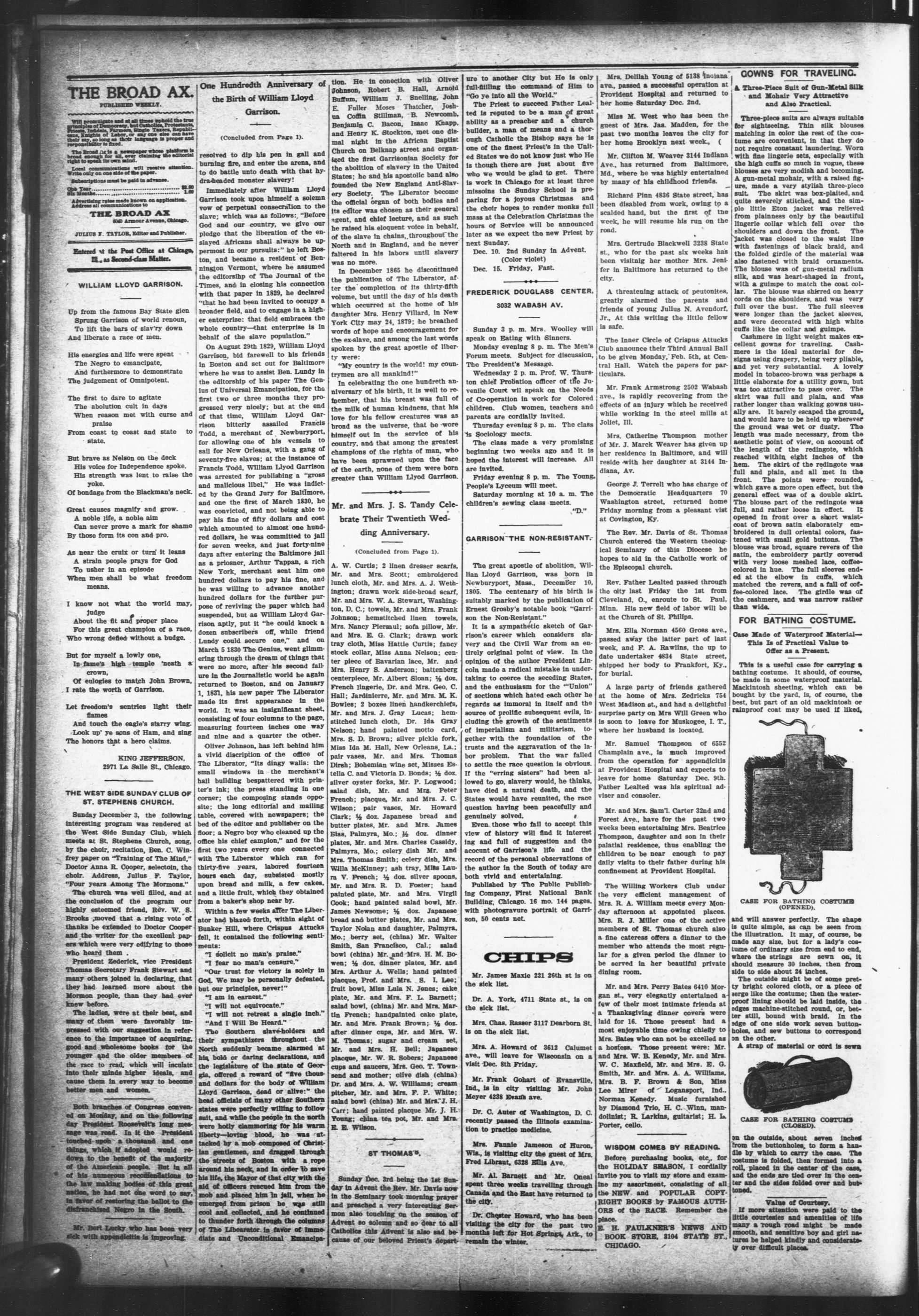
This is a useful case for carrying a bathing costume. It should, of course, be made in some waterproof material. Mackintosh sheeting, which can be bought by the yard, is, of course, the best, but part of an old mackintosh or rainproof coat may be used if liked.
```markdown
```
CASE FOR BATHING COSTUME
(OPENED).
and will answer perfectly. The shape is quite simple, as can be seen from the illustration. It may, of course, be made any size, but for a lady's costume of ordinary size from end to end, where the strings are sewn on, it should measure 30 inches, then from side to side about 24 inches.
The outside might be of some pretty bright colored cloth, or a piece of serge like the costume; then the waterproof lining should be laid inside, the edges machine-stitched round, or better still, bound with braid. In the edge of one side work seven buttonholes, and sew buttons to correspond on the other.
A strap of material or cord is sewn
CASE FOR BATHING COSTUMB
(CLOSED).
on the outside, about seven inches
from the buttonholes, to form a handle
by which to carry the case. The
costume is folded, then formed into a roll, placed in the center of the case, and the ends are tied over in the center and the sides folded over and buttoned.
Value of Courtesy
If more attention were paid to the little courtesies and amenities of life many a rough road might be made smooth, and sensitive boy and girl natures be helped kindly and considerably over difficult places.
WASHINGTON GOSSIP
LEGISLATIVE CHAMBER LIKE
FLORISTS' EXHIBIT.
A Man with Happy Faculty in Denying Applications and Requests—Patron Saint of the Harassed Rural Mail Carrier.
WASHINGTON.—Congress has finally abolished the practice of having flowers presented to the members of the house and senate on the first day of the session. The senate took the initiative last year when it passed a resolution for bidding
WASHINGTON. Congress has finally abolished the practice of having flowers presented to the members of the house and senate on the first day of the session. The senate took the initiative last year when it passed a resolution for bidding the placing of flowers in the senate chamber. Speaker Cannon took the matter into his own hands so far as the house is concerned this year and instructed the employees not to allow any floral display on the floor of the house.
The giving of flowers had been carried to a ridiculous extent. The desks of members were so piled up with floral pieces that nothing else could be seen and the crowded hall looked more like a floral exhibit than a legislative chamber. It got to be so that the friends of various statesmen attempted to outdo each other in the size and gorgeousness of the floral gifts that were sent in on the first day of the session.
It became a common practice that secretaries to members and senators would institute a regular campaign for funds from clerks in the departments who were from the district or state, and these contributions were in a small way a sort of blackmail. The poor clerks believed they could improve their standing with the senator or member by giving up from their hard-earned stipends one to five dollars for flowers. This practice became known to leaders in congress and they determined to put a stop to it, and there will be no more ostentatious display of flowers on the members' desks. The exhibit always detracted from the dignity of congress, and it was a common remark that men of the least prominence and ability usually secured the biggest bouquet.
An Old Man of Vigor.
ENATOR MORGAN of Alabama is now in his twenty-ninth year of service in congress, and in the eighty-second year of his age. He comes to this congress with a vigor and determination that might characterize a man 20 years younger than he is. He
S
has no idea of allowing four score and two years to bar him from the most active participation in the legislation of the country. He has come prepared to debate all the important questions what will be before congress. He is giving particular attention to the railway rate question and has the independence to hold views that are contrary to those of a majority of his democratic colleagues.
Senator Morgan was always noted for his independence of action. This he demonstrated most effectively during President Cleveland's last administration, when he, as one of the democratic leaders in the senate, caused a good deal of astonishment by opposing many of the administration policies. It was he who made famous the term "cuckoo statesman." One day in answering Senator Vilas of Wisconsin, who was the administration's spokesman on the floor, Senator Morgan referred to those who answered "cuckoo" every time the white house clock struck. The application was so pertinent and humorous that the senate fairly roared, especially as Mr. Morgan seldom indulged in wit or humor.
The Alabama senator proposes to have a voice in public affairs as long as his brain is able to conceive ideas and his tongue to utter them. His speeches and his statements in the public press are usually of a very illuminating character and the young men of the senate are ready to accord Mr. Morgan a hearing, although it requires a good deal of patience to sit out his speeches, which sometimes last for days.
S
ENATOR PETTUS,
of Alabama, a colleague of Senator
Morgan, continues
to be probably
the most picture-
que character in
public life. He is
now in his eighty-
fifth year, and is
really possessed
of more physical
vigor than his colleague, although
he does not put so much strain upon it. Mr. Pettus is not one of those who indulge in "Long talks" in the senate. He generally has some pertinent and illuminating observations to make on the principal subjects before that body, but he has no difficulty in defining his position in one-tenth the time that Mr. Morgan occupies in the same duty.
Senator Pettus is known as the "Chinese Mandarin" because of his remarkable physical appearance to the late Chinese statesman, Li Hung Chang. He is a trifle over six feet in height, like the late Earl Li, and wears a mustache and imperial that give him the facial expression of the Chinaman. To augment the resemblance the senator wears a pair of very large spectacles with steel bows. Senator Pettus attributes his long life and his ability to stand hard work to early rising and regularity of habits. He is up by five o'clock in the morning at all seasons of the year, breakfasts between six and seven and does his work in daylight. He is ready to retire at "early candle light," and only on rare occasions does he put on his evening clothes and attend a dinner or other society function.
Senator Pettus is almost a connecting link between revolutionary times and the present. His grandfather, on his mother's side, was Capt. Anthony Winston, of Virginia, a revolutionary soldier of distinction. The senator's own activities extend over two-thirds of a century. He began the study of law about 66 years ago and was admitted to the bar 64 years ago and has practiced ever since except for the term he served as a lieutenant in the Mexican war and as an officer of the confederacy in the civil war, which he entered as a lieutenant colonel and came out as a brigadier general. Mr. Pettus has over three years to serve and the prospects are that at the end of the term he will be vigorous enough to seek a reelection.
The Right Man.
F
FOURTH ASSISTANT Postmaster General De Graw is proving to be the one man in 10,000 for the place. He is the buffer between congressmen and the postmaster general and the man to whom a thousand and one complaints and protests come, which he must answer in a way to placate all parties. Mr. De Graw is a great, big man, physically, with a wonderful fund of good nature and the very happy faculty of denying applications and requests in a way that gives no offense, but rather tickles the pride and humor of the congressman or postmaster.
As the official who has in charge the rural free delivery service, Mr. De Graw comes in contact with some odd people and hears some very unique experiences. He is looked on as the patron saint of the rural mail carrier, and they relate to him all their trials and tribulations. The life of the rural carrier is full of unique experiences, and all is not "beer and skittles" in their daily existence. They unfortunately make enemies on their routes, who try to interfere with their performance of duty. A carrier up in Pennsylvania wrote to Mr. eD Graw the other day, detailing his recent experience as follows:
"As I was on my way from Leraysville to Rummerfield with the maf they had a lot of sticks in the roadway, and one stuck in one of my wag on wheels. I got out to remove it and found one end fast with wire and, somewhat vexed, I removed it, and began to remove the others. John Blank's wife ran from the house with a large dipper full of water and threw it on me, also the second one, and then hit me on the back with the dipper and then grabbed up a hoe which was on the yard fence, or near it, and hit me across my back three times, and the last time she hit she broke the handle. By that time I had removed all the sticks I could get loose."
Mr. De Graw could send no great comfort to this badly misused mail carrier.
Speaker Cannon Busy.
PEAKER CANON has his hands full nowadays trying to find places for all the new members of the present house of repre sentatives. He has been compelled to take from the demo-
PEAKER CANON has his hands full nowadays trying to find places for all the new members of the present house of representatives. He has been compelled to take from the demo crats some 12 or 15 places, in order to accommodate the increased republican membership. In the last house there were 210 republicans and 176 democrats. With a membership of 54 per cent. the republicans enjoyed 62 per cent. of the committee appointments, numbering all told 759.
Speaker Cannon has figured out that in the present house the republicans have nearly 64 per cent of the membership, and if they were given the same proportion of committee assignments as in the last house they would receive 73 per cent, or the total committee membership. This is too much and would require too great a reduction of the democratic membership to appear absolutely fair. So the speaker has taken another basis for committee assignments. He finds that while there will be 66 new republican members to be taken care of in the coming congress there will be but 15 new democratic members.
Under this plan he has been compelled to disappoint a great many republicans, and democrats are kicking because they have lost a dozen committee places. The speaker advises Mr. John Sharp Williams, of Mississippi, the minority leader on the floor, to take out his penell and do a little figuring. He says he believes that "John Sharp," as he affectionately calls his democratic friend, will find that the democrats have been most intensely treated.
ON GAIT AND POSTURE.
Habit In Everything in These Matter-ers—One Should Zealously Work for Good Style.
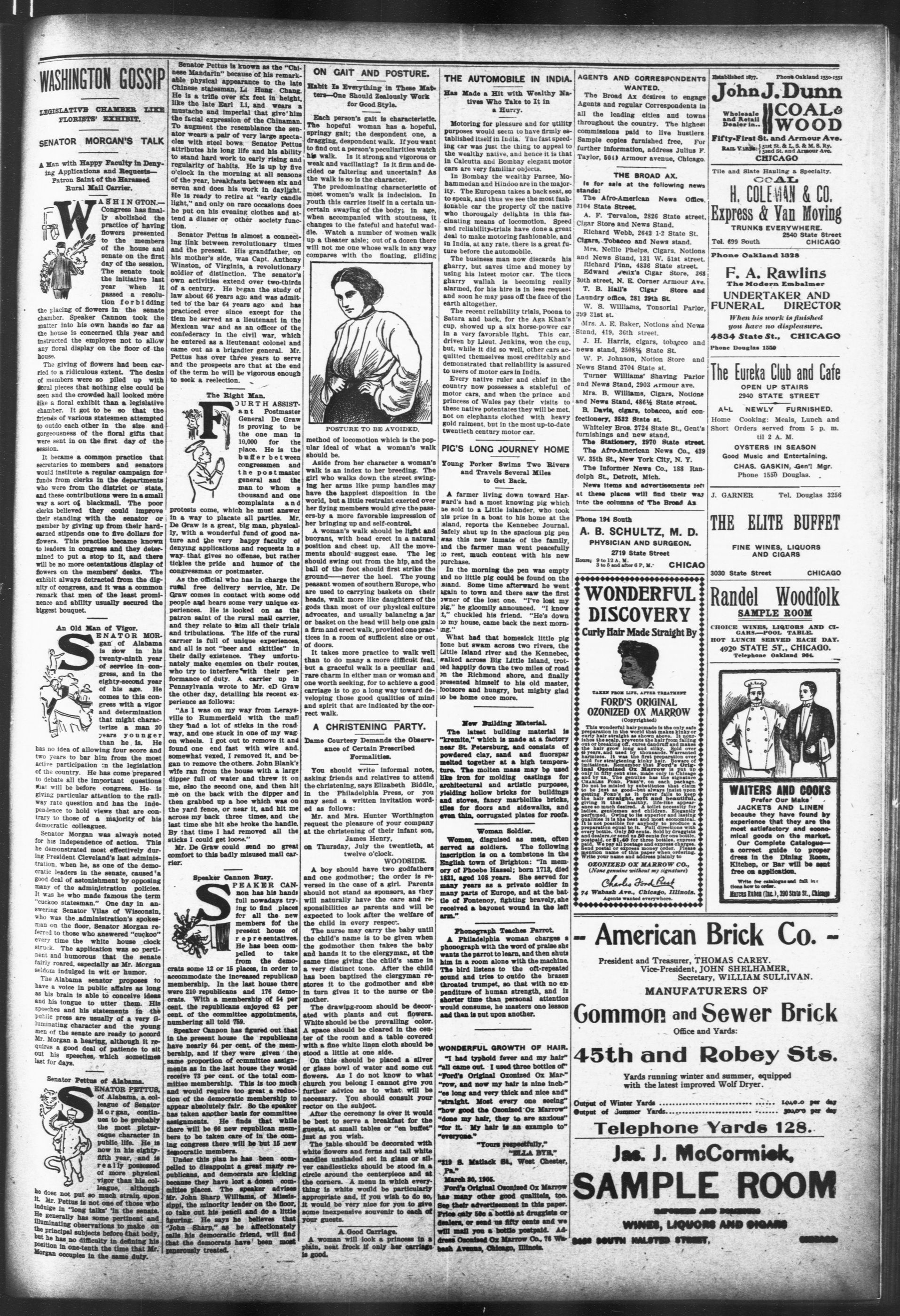
Each person's gait is characteristic. The hopeful woman has a hopeful, springy gait; the despondent one, a dragging, despondent walk. If you want to find out a person's peculiarities watch his walk. Is it strong and vigorous or weak and vacillating? Is it firm and decided or faltering and uncertain? As the walk is so is the character. The predominating characteristic of most women's walk is indecision. In youth this carries itself in a certain uncertain swaying of the body; in age, when accompanied with stoutness, it changes to the fateful and hateful waddle. Watch a number of women walk up a theater aisle; out of a dozen there will not me one whose walk in any way compares with the floating, gliding
POSTURE TO BE AVOIDED
method of locomotion which is the popular ideal of what a woman's walk should be.
Aside from her character a woman's walk is an index to her breeding. The girl who walks down the street swinging her arms like pump handles may have the happiest disposition in the world, but a little restraint exerted over her flying members would give the passers-by a more favorable impression of her bringing up and self-control.
A woman's walk should be light and buoyant, with head erect in a natural position and chest up. All the movements should suggest ease. The leg should swing out from the hip, and the ball of the foot should first strike the ground—never the heel. The young peasant women of southern Europe, who are used to carrying baskets on their heads, walk more like daughters of the gods than most of our physical culture advocates, and usually balancing a jar or basket on the head will help one gain a firm and erect walk, provided one practices in a room of sufficient size or out of doors.
It takes more practice to walk well than to do many a more difficult feat, but a graceful walk is a peculiar and rare charm in either man or woman and one worth seeking, for to achieve a good carriage is to go a long way toward developing those good qualities of mind and spirit that are indicated by the correct walk.
A CHRISTENING PARTY.
Dame Courtesy Demands the Observance of Certain Prescribed Formalities.
You should write informal notes, asking friends and relatives to attend the christening, says Elizabeth Biddle, in the Philadelphia Press, or you may send a written invitation worded as follows:
Mr. and Mrs. Hunter Worthington request the pleasure of your company at the christening of their infant son, James Henry, on Thursday, July the twentieth, at twelve o'clock.
WOODSIDE.
A boy should have two godfathers and one godmother; the order is reversed in the case of a girl. Parents should not stand as sponsors, as they will naturally have the care and responsibilities as parents and will be expected to look after the welfare of the child in every respect.
The nurse may carry the baby until the child's name is to be given when the godmother then takes the baby and hands it to the clergyman, at the same time giving the child's name in a very distinct tone. After the child has been baptized the clergyman restores it to the godmother and she in turn gives it to the nurse or the mother.
The drawing-room should be decorated with plants and cut flowers. White should be the prevailing color. A space should be cleared in the center of the room and a table covered with a fine white linen cloth should be stood a little at one side.
On this should be placed a silver or glass bowl of water and some cut flowers. As I do not know to what church you belong I cannot give you further advice as to what will be necessary. You should consult your rector on the subject.
After the ceremony is over it would be best to serve a breakfast for the guests, at small tables or "en buffet" just as you wish.
The table should be decorated with white flowers and ferns and tall white candles unshaded set in glass or silver verdantlesticks should be stood in a circle around the centerpiece and at the corners. A menu in which everything is white would be particularly appropriate and, if you wish to do so, it would be very nice for you to give some inexpensive souvenir to each of your guests.
A Good Carriage.
A woman will look a princess in a plain, neat frock if only her carriage is good.
THE AUTOMOBILE IN INDIA
Has Made a Hit with Wealthy Natives Who Take to It in a Hurry.
Motoring for pleasure and for utility purposes would seem to have firmly established itself in India. The fast speeding car was just the thing to appeal to the wealthy native, and hence it is that in Calcutta and Bombay elegant motor cars are very familiar objects.
In Bombay the wealthy Parsee, Mohammedan and Hindoo are in the majority. The European takes a back seat, so to speak, and thus we see the most fashionable car the property of the native who thoroughly delights in this fascinating means of locomotion. Speed and reliability-trials have done a great deal to make motoring fashionable, and in India, at any rate, there is a great future before the automobile.
The business man now discards his gharry, but saves time and money by using his latest motor car. The ticca gharry wallah is becoming really alarmed, for his hire is in less request and soon he may pass off the face of the earth altogether.
The recent reliability trials, Poona to Satara and back, for the Aga Khan's cup, showed up a six horse-power car in a very favorable light. This car, driven by Lieut. Jenkins, won the cup, but, while it did so well, other cars acquitted themselves most creditibly and demonstrated that reliability is assured to users of motor cars in India.
Every native ruler and chief in the country now possesses a stableful of motor cars, and when the prince and princess of Wales pay their visits to these native potentates they will be met, not on elephants clothed with heavy gold raiment, but in the most up-to-date twentieth century motor car.
PIG'S LONG JOURNEY HOME
Young Porker Swims Two Rivers and Travels Several Miles to Get Back.
A farmer living down toward Harvard's had a most knowing pig which he sold to a Little Islander, who took his prize in a boat to his home at the island, reports the Kennebec Journal. Safety shut up in the spacious pig pen was this new inmate of the family, and the farmer man went peacefully to rest, much content with his new purchase.
In the morning the pen was empty and no little pig could be found on the island. Some time afterward he went again to town and there saw the first owner of the lost one. "I've lost my pig," he gloomily announced. "I know it," chuckled his friend. "He's down to my house, came back the next morning."
What had that homesick little pig lone but swam across two rivers, the Little Island river and the Kennebec, walked across Big Little Island, trotied happily down the two miles of road on the Richmond shore, and finally presented himself to his old master, footsore and hungry, but might glad to be home once more.
New Building Material.
The latest building material is "kremite," which is made at a factory near St. Petersburg, and consists of powdered clay, sand and fluorspar melted together at a high temperature. The molten mass may be used like iron for molding castings for architectural and artistic purposes, yielding hollow bricks for buildings and stoves, fancy marblelike bricks, tiles for floors and sidewalks, and even thin, corrugated plates for roofs.
Women Soldier.
Women, disguised as men, often served as soldiers. The following inscription is on a tombstone in the English town of Brighton: "In memory of Phoebe Hassel; born 1713, died 1821, aged 108 years. She served for many years as a private soldier in many parts of Europe, and at the battle of Fontenoy, fighting bravely, she received a bayonet wound in the left arm."
Phonograph Teaches Parrot
A Philadelphia woman charges a phonograph with the word of praise she wants the parrot to learn, and then shuts him in a room alone with the machine. The bird listens to the oft-repeated sound and tries to outdo the brazen throated trumpet, so that with no expenditure of human strength, and in shorter time than personal attention would consume, he masters one lesson and then is put upon another.
WONDERFUL GROWTH OF HAIR.
"I had typhoid fever and my hair"
"all came out. I used three bottles of"
"Ford's Original Oxonized Ox Mar"
"row, and now my hair is nine inch."
"es long and very thick and nice and"
"straight. Most every one seeing"
"how good the Ozonized Ox Marrow"
"done my hair, they to are anxious"
"for it. My hair is an example to"
"everyone."
"819 S. Matlack S4, West Chester,
Pa."
March 30, 1905.
Ford's Original Ozonized Ox Marrow
has many other good qualities, too.
See their advertisement in this paper.
Price only 50c a bottle at druggists or
dealers, or send us fifty cents and we
will mail you a bottle postpaid. Address
Ozonized Ox Marrow Co., 76 Wabash
Avenue, Chicago, Illinois.
American Brick Co.
Yards running winter and summer, equipped with the latest improved Wolf Dryer.
AGENTS AND CORRESPONDENTS WANTED.
The Broad Ax desires to engage Agents and regular Correspondents in all the leading cities and towns throughout the country. The highest commissions paid to live hustlers Sample copies furnished free, For further information, address Julius F. Taylor, 501) Armour avenue, Chicago
THE BROAD AX.
Is for sale at the following news stand:
The Afro-American News Office.
3104 State Street.
A. F. Tervalon, 2826 State street,
Cigar Store and News Stand.
Richard Webb, 2642 1-2 State St.
Cigars, Tobacco and News stand.
Mrs. Nelle Phelps, Cigars, Notions
and News Stand, 131 W. 51st street.
Richard Pinn, 4836 State street.
Edward Neix's Cigar Store, 368
30th street, N. E. Corner Armour Ave.
T. B. Hall's Cigar Store and
Laundry office, 281 29th St.
W. S. Williams, Tonsorial Parlor,
299 31st st.
Mrs. A. E. Baker, Notions and News
Stand, 419, 36th street.
J. H. Harris, cigars, tobacco and
news stand, 25081 State St.
W. P. Johnson, Notion Store and News Stand 3704 State st.
Turner Williams' Shaving Parlor and News Stand, 2903 Armour ave.
Mrs. B. Williams, Cigars, Notions and News Stand, 486½ State street.
B. Davis, cigars, tobacco, and confectionery, 3532 State st.
Whitley Bros. 2724 State St., Gent's furnishings and new stand.
The Informer News Co., 188 Randolph St., Detroit, Mich.
News items and advertisements left at these places will find their way into the columns of The Broad Ax
Phone 194 South
A. B. SCHULTZ, M. D.
PHYSICIAN AND SURGEON.
2719 State Street
Hours: 9 to 12 A. M.
3 to 5 and after 6 P. M. CHICAO
WONDERFUL
DISCOVERY
Curly Hair Made Straight By
TAKEN FROM LIFE, AFTER TREATMENT
FORD'S ORIGINAL
OZONIZED OX MARROW
(Copyrighted)
This wonderful hair pomade is the only safe preparation in the world, and it makes stirpers curly hair straight as shown above. It nourishes the scalp, prevents the hair from falling in the air. The hair is very long and silky. Gold over 5 years, and used by thousands. Warranted for the use of the hair and long and silky hair. Warranted for straightening, kinky hair. Beware of imitations. Remember that Ford's Origins are only in fifty cents area, made only in Chinese and by us. The genuine has the signature Charles Ford. Pass's on each package. Definitely has been designed and has been used to be just as good—but always insist upon getting Ford's as it never fails to keep it from dismantling. The high-quality life-like appearance is that healthy, life-like appearance, and a better health, is a good and healthy, and a good and healthy, is the best and most economical. On its not-possible or anybody's notice preparation, the total is. Full directions with every bottle. Only 50 cents. Gold by druggists and dealers, or 50 cents for one bottle.
For the price of $1.40 per瓶, the cost of the price paid. We pay all postage and express charges. Send postal or express money order. Please write your name and address plainly to.
OZONIZED OX MARROW CO.,
(None genuine without my signature)
Charles Ford Past
74 Wabash Ave., Chicago, Illinois.
Agents wanted everywhere.
-- American
President and Treasurer, TH
Vice-President, JC
Fifty-First St. and Armour Ave.
Rail Yard. Girt St. & L. S. & M. S. Ry.
Gard St. and Armour Ave.
CHJCAGO
Tile and Slate Hauling a Specialty.
COAL
H. COLEMAN & CO.
Express & Van Moving
TRUNKS EVERYWHERE.
2540 State Street
Tel. 699 South
CHICAGO
Phone Oakland 1328
F. A. Rawlins
The Modern Embalmer
UNDERTAKER AND
FUNERAL DIRECTOR
When his work is finished
you have no displeasure.
4834 State St., CHICAGO
Phone Douglas 1550
The Eureka Club and Cafe
OPEN UP STAIRS
2940 STATE STREET
ALL NEWLY FURNISHED.
Home Cooking: Meals, Lunch and
Short Orders served from 5 p. m.
til 2 A. M.
OYSTERS IN SEASON
Good Music and Entertaining.
CHAS. GASKIN, Gen'l Mgr.
Phone 1550 Douglas.
J. GARNER Tel. Douglas 3256
THE ELITE BUFFET
FINE WINES, LIQUORS
AND CIGARS
3030 State Street CHICAGO
Randel Woodfolk
CHOICE WINES, LIQUORS AND CI-
GARS—POOL TABLE.
HOT LUNCH SERVED EACH DAY.
4920 STATE ST., CHICAGO.
Telephone Oakland 984.
WAITERS AND COOKS
Prefer Our Make'
JACKETS AND LINEN
because they have found by
experience that they are the
most satisfactory and economical goods on the market.
Our Complete Catalogue—a correct guide to proper dress in the Dining Room,
Kitchen, or Bar will be sent free on application.
Write for catalogue and fall in items how to order.
Marcs Ruben (Inc.), 390 State St., Chicago
Brick Co. -
THOMAS CAREY.
JOHN SHELHAMER,
y, WILLIAM SULLIVAN.
URERS OF
Sewon Brick
The All Important Thing.
The freshman's luggage, neatly packed, lay below, and while the hansom waited, the youth hurried in to bid his father good-by. "My son," said the old man, solemnly, "this occasion is a momentous one. The doors of life ile open before you. There are many things on which I might advise you. But I will say only this: Don't, under any circumstances, allow your studies to interfere with your athletics."—Detroit Free Press.
Weariman—Is this the office of Quigley's quick cure?
Patent Medicine Man—Yes.
"Gimme six bottles for my wife."
"Tried all other remedies without success—eh?"
"No, she ain't ill at all; but I saw in your advertisement where a woman wrote after taking six bottles: 'I am a different woman,' and I have hopes."
—Stray Stories.
Paper Materials
"This paper is made of banana skins," said the salesman. "This is made of seaweed. The yellow in the corner is made of corn husks. Almost anything that you can reduce into pulp will do for paper," he went on. "I have seen paper made of beanstalks, peastalks, weeds, straw, coconut fiber, hair, fur and wool waste."
Idea of the Turbine
The modern steam turbine was in some respects anticipated by an invention of an Italian architect named Branca, who lived in the seventeenth century. In far more distant times the engine devised by Hero was at least a hint of the turbine which is now making headway against the familiar reciprocating steam engine.
Thirty Hours at the Piano.
Herr Berg, the "iron pianist," who set himself the task of playing the piano continuously for 30 hours at the Brighton aquarium, successfully completed the feat. In the course of his performance he played between 500 and 600 pieces, including the march from "Tannhauser" and Lizst's "Rhapsody."
Confined Sound.
The intensity of confined sound is well demonstrated at Carlsbrooke castle, isle of Wight, where there is a well 200 feet deep and 12 feet in diameter, lined with smooth masonry. If a pin is dropped into it the sound of it striking the surface of the water, 182 feet below, can be distinctly heard.
Careless Observation
Careless, indifferent observation does not go back of the eye. If the mind is not focussed, the image is not clear-cut, and is not carried with force and distinctness enough to the brain to enable it to get at the truth and draw accurate conclusions.—Success Magazine.
Chinese Wind Wagon
The "wind cart" used for irrigation purposes by the Chinese consists of eight tall mat sails, fixed perpendicularly on a wooden frame. The sails go round with the wind, which causes the water from the river to be pumped through a trough.
Maligned Empress
According to Miss Katherine Carl, who painted a portrait of the dowager empress of China, the impression that she is a bloodthirsty wretch is erroneous. Miss Cal found he not only pleasing but also a vey intellectual woman.
Accomplished Butcher
August Forster, who is more than a millionaire, and a son of a recently deceased St. Louis packer, is slaughtering hogs at ten dollars a week. He is 22 years old, and a graduate of the University of Missouri.
First Single Rail System.
On the Coney Island meadows there still stand sections of the structure of the first single rail system built in this country, which was to convey holiday seekers to the seashore at the rate of a mile a minute.
Sheet iron can now be rolled so thin that it takes 15,000 sheets to make a single inch in thickness. Light shines as clearly through one of these sheets as through ordinary tissue paper.
Sign of Domestic Storm.
Bart Haswell, who was married last week, came out on his front porch the other morning and kicked the dog twice—Wolleburg (Mo.) Record.
The transport Logan, which arrived at San Francisco from Manila recently, had a somewhat eventful trip, as it included an attempted murder, a typhoon, a suicide and a series of thefts from staterooms. The Logan was in Manila bay during the great typhoon and rescued many Filipinos. In one native boat was a Filipino, his wife, a baby and a pig. The kampino first sent the pig up the Logan's side, then the baby, and was coming up next himself, but at that point the Logan's crew drew the line and insisted on precedence for Mrs. Filipino.
Loubet's Retirement
President Loubet says he will probably withdraw from politics altogether when his present term expires. He could have a reelection, but will not. "I could be of use," he adds, naively, "as a member of the senate, but while my district would probably send me to the chamber of deputies the department would not elect me senator. I am considered too conservative and not sufficiently republican."
Right and Left-Handed.
In all right-handed persons the strength of the left hand is found by Prof. Caster, a French physiologist, to be about nine-tenths of that of the right hand. Quite curiously, the movement of supination, or turning the palm upward by rotating the forearm, is more powerful than the opposite pronation, or turning the palm down by outward rotation.
A Hard Rider.
Among Lord Roberts' countless claims to distinction it is little known that he is one of the best and hardiest riders in the British army. In his younger days he was nicknamed "Jehu" "because he rideth furiously," and even to-day his staff must be good riders and well mounted in order to keep pace with him.
Good Reason.
She-You are depressed. I didn't know you cared so much for your uncle.
He-I didn't; but I was the means of keeping him in an insane asylum the last year of his life, and now that he has left me all his money I've got to prove that he was of sound mind.—Tit-Bits.
Man's Proverba
Men and men only are responsible for proverbs. By far the greater number of proverbs relating to women are calumnies, gross perversions of fact neither appropriate nor self-entailed, but due to the malice, stupidity and inaccuracy of—those who made them.—London Gentlewoman.
Titled Gardener.
The duke of Bedford, the ground landlord of Covent Garden market, London, derives over $75,000 a year from that space alone. It came into the possession of the Befford family three centuries ago, at a time when its yearly value was estimated at about $32.
In Mitigation.
Gwilliams—Your favorite authors are Rudyard Kipling and Henry James? Thaw's the oddest combination I ever heard of.
Shift—O, I don't know, I find Henry James admirable as a chaser.—Chicago Tribune.
Various Man.
How various is man! One of him was shot for a bear out in Michigan the other day; another was killed for a rabbit down in South Carolina, and one bit the dust in Maine because he resembled a deer—Newark News.
Got Back at Editor
For revenge on the editor of the Neuesten Nachrichten, Bamberg, Germany, who had published an unappreciative account of their exploits, some burglaries entered his house and smashed everything on the premises.
Doctor Work Wanted.
In the "Situations Wanted" in the London Express was this advertisement: "Galloping consumption of means; Dr. Work wanted. Address, Patient, Bed 648, Dally Express, Tudor street."
Fifth Cardinal
It is considered probable that the Most Rev. Francis Bourne, archbishop of Westminster, will be chosen as the fifth cardinal to be appointed at the next consistory in Rome.
Largest Grain Cargo.
Chicago shipped the largest single cargo of grain, consisting of 235,000 bushels of corn and 58,000 bushels of barley, aggregating 7,972 tons.
Tobacco in Ireland.
Sir Conan Doyle and other public-spirited men have started in to ascertain whether tobacco can be grown profitably in Ireland.
Good Supply.
She—Where do you get your inspiration from?
The Author—From my creditors—Life.
Eaten by Celestials.
Bracken, like that to be found all over England, is much used in China and Japan as an artifice of food.
People Affect.
About 2,500,000 people are on the sea, either as passengers or seamen, every day in the year.
Tiger Meat Edible.
Beasts of prey are not good for food. The tiger is the one exception to this rule.
Bakers in France are subjected to several unusual rules and regulations. In large fortified towns, for instance, they must always have a certain stock in hand in case of war. Not only this, but everywhere they have to deposit a sum of money in the hands of the municipal authorities as a surety of good conduct; and the law, not content with merely looking after their weights and measures, actually decides the price at which bread is sold.
His Regret Sincere
"Have you got to perform an operation on me, doctor?"
"I am sorry to say I have."
"What ails me?"
"Before I answer that question, my dear sir, let me ask you one. What is your financial condition?"
"I am as poor as Job's turkey."
"Then, sir, I—er—regret still more deeply to say that your aliment is appendicitis."—Chicago Tribune.
Paper Saucepans.
Compressed paper pulp, impregnated with certain salts, is molded into the form of saucepans, which, on account of their lightness, were used largely by the Japanese army in Manchuria. They stand the fire well, provided they be kept full of liquid. They have been adopted by the German army and have been introduced into Antwerp.
No Mistake Here
"We all laugh at the story of the man who took a bath every Fourth o' July whether he needed it or not," remarked the Old Codger, "but there's a whole lot of prosperous business men that think they've done their full duty by their Heavenly Father if they go to church regularly every Thanksgiving day."—Chicago Sun.
Statue Too Bulky
The equestrian statue of "Physical Energy," made in London, to be erected on the Matoppo hills, South Africa, as a memorial to Cecil Rhodes, has been found too bulky and heavy for the journey. It now lies in an express company's yard until a decision is reached as to what shall be done with it.
Disastrous Oversight
In a Berlin music hall one night lately a conjurer was pretending to catch heavy iron balls on his face. But his assistant forgot to change one of the iron balls exhibited for a light globe, and after the conjurer had received the ball in his face he had to be taken to a hospital.
Pays to Be Quick Witted.
"It has come to my ears," remarked Miss Dre Playan, "that you said my face would make a man climb a fence." "Yes, that's what I said," replied the diplomatic one; "but, of course, I meant if he happened to be on the other side of the fence."-Stray Stories.
Old Prescriptions
A London coroner remarked recently that a law should be passed against the use of old medical prescriptions. Prescriptions useful at one time, he said, may be readily when used again by people whose physical condition has wholly changed.
"Walking King" Halted
John Clarke, "the walking king," was walking around the world for a wager till-November 4. On that day he was arrested at Grimsby, England, for stealing two rings, and will not be able to walk for eight months.
- Aged Zulu.
A Zulu named Kwezi, living in Alfred county, Natal, has died at the advanced age of 117 years. Meat and milk were the principal articles of his diet. His sister, three years older than himself, still lives.
Chauffeur's Big Pay.
It is declared on the authority of a leading member of the Automobile club of America that there is one chauffeur in New York city who is receiving an annual salary of $6,000.
The "Apaches," the roughs of Paris, are being instructed in jiu-jitsu by an ex-conflict and ex-prize fighter, so as to be on even terms with the police, who are also being instructed in the art.
Russia's Dark Days.
The long rigor of a Russian winter lies just before a land miserable and poverty-stricken in the mild weather of autumn—Cleveland Leader.
Deepest Bog.
The deepest bog in Great Britain is to be found at Tregaron, in Cardigan-shire, where the peat is from 20 to 25 feet in thickness.
J. A. O'Donnell, H. D. Coghlin,
O'Donnell & Coghlin
Attorneys at Law
Phone 264 Main Metropolitan Block
N. W. Cor. LaSalle & Randolph St.
Chicago
GRAY & MORAN
ATTORNEYS AT LAW
Suite 1114 Ashland Block, Clark and Randolph Sts. Tel. Central 569.
CHICAGO.
Residence 57 Macallister Place
Telephone Ashland 363
Office Telephones
Central 1239 Automatic 5040
MILES J. DEVINE
ATTORNEY AT LAW
Suite 315-320 Renper Block
CLARK AND WASHINGTON STS.
CHICAGO.
Telephone Central 3089
Res. 904 W. 12th Street Blvd. Tel.
1626 Morgon
FRANK D. COMERFORD
ATTORNEY AND COUNSELOR AT
LAW.
806 Tribune Building
S. E. Cor. Dearborn and Madison Sts.
CHICAGO
A. D. GASH
Attorney at Law,
84-86 La Salle Street, Chicago.
Suite 615 to 619,
Telephone Main 3077.
JOHN E. OWENS
ATTORNEY & COUNSELOR
AT LAW
823 ASHLAND BLOCK
TELEPHONE CENTRAL 698 CHICAGO
Telephone Yards 6016.
John Fitzgerald
JUSTICE OF THE PEACE
4737 SOUTH HALSTED STREET.
Residence
112 W. Garfield Boul. CHICAGO
J. GRAY LUCAS
Attorney at Law
Suite 611 167 Dearborn St., Cor. Monroe.
Chicago.
Tel. Cent. 5703. Rec. Tel. Went. 6523.
Captain Sth L. N. G.
Regimental Quartermaster
JAMES S. NELSON
LAWYER
Residence
3653 WABASH AVE.
Tel. 6242 Douglas
SUITE 611, 167 DEARBORN STREET
Tel. 5768 Central
PHONES { Office, Main 1157
Rea. Brown 42
STEPHEN A. DOUGLAS
LAWYER
Room 813, 115 Dearborn Street.
CHICAGO
Hall's Laundry
2975-77 STATE ST.
Phone, Douglas 1235
CHICAGO
W.Kemper Harreld
TEACHER OF
VIOLIN
6626 CHAMPLAIN AVE.
Tel. Went. 2221.
HILLMAN'S STATE & WASHINGTON STS. Chicago's Most Modern, Most Complete and Most Convenient Department Store
Jacob Feinberg
BRADLEY & FIELDS REAL ESTATE, LOANS AND INSURANCE
Theodore C. Mayer
JUSTICE OF THE PEACE
Mortgages, Deeds, Notes and Legal Documents Drawn
and Acknowledged. Room 22, 27 North Clark Street.
POLICE MAGISTRATE RESIDENCE
East Chicago Ave., Police Court 337 Burling Street
C. H. Smiley, Pres. and Treas.
76 E. TWENTY
Two Phones, South 584.
Phone D
SANDY W. TRI
INCORPORATED UNDER
2918 STATE S
Now is your chance.
The Company will open a Depar-
State St. Namely Sandy W. Trice,
complete line of Men and Womens R
tions. Shares ten dollars. A limit
Company's Sec'y. office.
CHICAGO
Treaa.
TWENTY-SECOND $
C. H. Smiley, Pres. and Treas.
J. Hockley Smiley, Sec'y.
Smiley
Caterer
76 E. TWENTY-SECOND STREET,
Two Phones, South 564.
CHICAGO.
Phone Douglas 6581.
SANDY W. TRICE & COMPANY
INCORPORATED UNDER THE LAWS OF ILLINOIS.
2918 STATE STREET, CHICAGO.
Now is your chance. A joint stock company.
The Company will open a Department Store in the near future at 2918 State St. Namely Sandy W. Trice & Company. The company will carry a complete line of Men and Womens Furnishing Goods Shoes, Hats and Notions. Shares ten dollars. A limited number of shares are on sale at the Company's Secy. office.
ILLINOIS
ILLINOIS BRICK CO.
M. JUNK, Proprietor JOS. P. JUNK, Manager 3700-3710 South Halsted Street and 897 to 929 Thirtyseventh Street CHICAGO
Sandy W, Trice, Pres.
Milton J, Trice, Vice Pres.
R. R, Wright, 3rd Vice Pres.
Doe Parker, Trustee.
J. M. Fields
FIELDS
MANS
E
CHICAGO
Mayer
PEACE
Events Drawn
North Clark Street.
RESIDENCE
337 Burling Street