The Broad Ax
Saturday, December 23, 1905
Chicago, Illinois
Page text (machine-generated)
THE BROAD AX
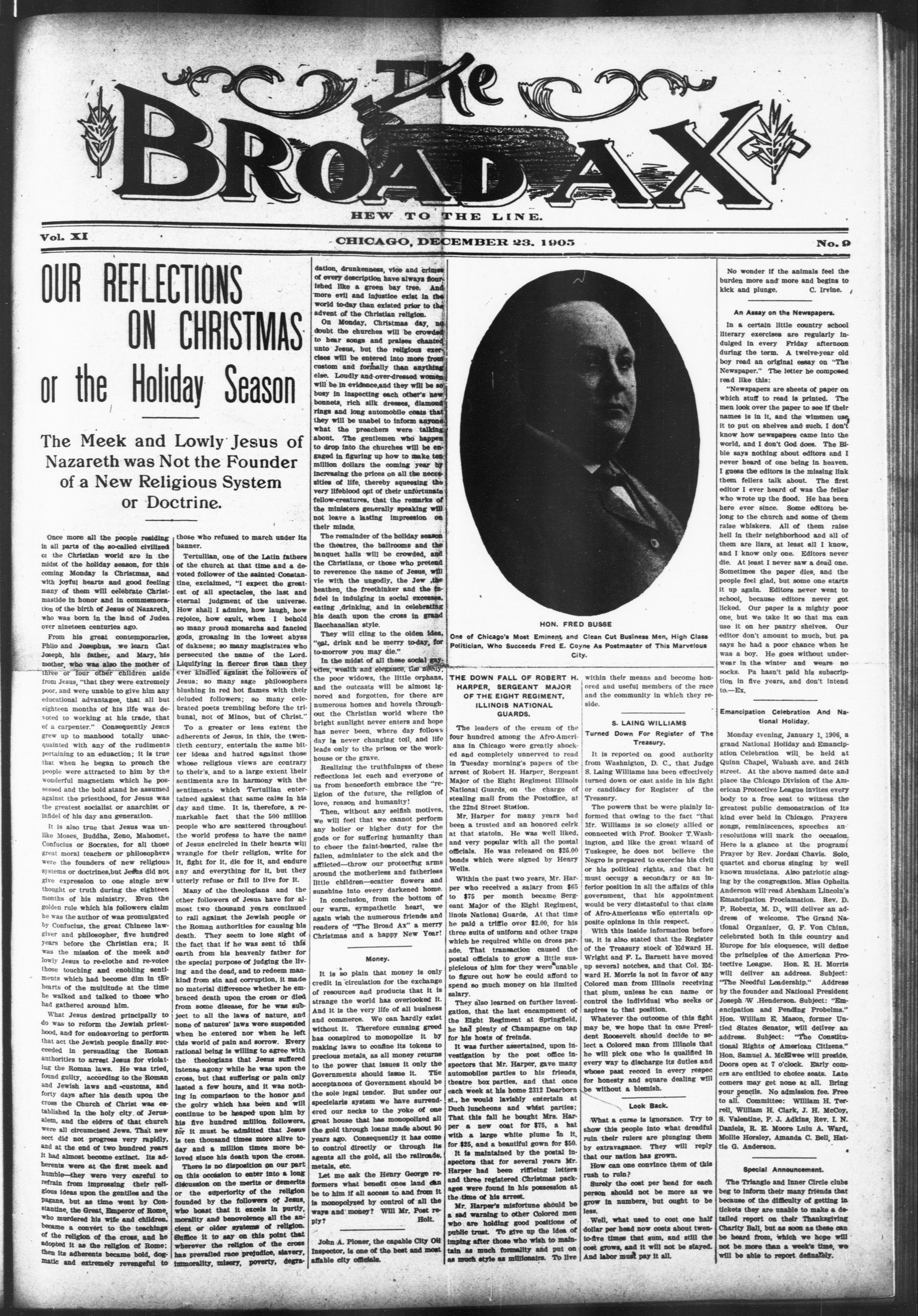
OUR REFLECTIONS ON CHRISTMAS or the Holiday Season
The Meek and Lowly Jesus of Nazareth was Not the Founder of a New Religious System or Doctrine.
Vol. XI
OUR REFLECTION
or the Holi
The Meek and
Nazareth was N
of a New Reli
or Do
Once more all the people residing in all parts of the so-called civilized or the Christian world are in the midst of the holiday season, for this coming Monday is Christmas, and with joyful hearts and good feeling many of them will celebrate Christ-mastide in honor and in commemoration of the birth of Jesus of Nazareth, who was born in the land of Judea over nineteen centuries ago.
From his great contemporaries, Philo and Josephus, we learn that Joseph, his father, and Mary, his mother, who was also the mother of three or four other children aside from Jesus, "that they were extremely poor, and were unable to give him any educational advantages, that all but eighteen months of his life was devoted to working at his trade, that of a carpenter." Consequently Jesus grew up to manhood totally unacquainted with any of the rudiments pertaining to an education; it is true that when he began to preach the people were attracted to him by the wonderful magnetism which he possessed and the bold stand he assumed against the priesthood, for Jesus was the greatest socialist or anarchist or infidel of his day and generation.
It is also true that Jesus was unlike Moses, Buddha, Zeno, Mabometh, Confucius or Socrates, for all those great moral teachers or philosophers were the founders of new religious systems or doctrines, but Jesus did not give expression to one single new thought or truth during the eighteen months of his ministry. Even the golden rule which his followers claim he was the author of was promulgated by Confucius, the great Chinese lawgiver and philosopher, five hundred years before the Christian era; it was the mission of the meek and lowly Jesus to re-clothe and re-voice those touching and enobling sentiments which had become dim in the hearts of the multitude at the time he walked and talked to those who had gathered around him.
What Jesus desired principally to do was to reform the Jewish priesthood, and for endeavoring to perform that act the Jewish people finally succeeded in persuading the Roman authorities to arrest Jesus for violating the Roman laws. He was tried, found guilty, according to the Roman and Jewish laws and customs, and forty days after his death upon the cross the Church of Christ was established in the holy city of Jerusalem, and the elders of that church were all circumcised Jews. That new sect did not progress very rapidly, and at the end of two hundred years it had almost become extinct. Its adherents were at the first meek and humble—they were very careful to refrain from impressing their religious ideas upon the gentiles and the pagans, but as time went by Constantine, the Great, Emperor of Rome, who murdered his wife and children, became a convert to the teachings of the religion of the cross, and he adopted it as the religion of Rome; then its adherents became bold, dogmatic and extremely revengeful to
---
those who refused to march under its banner. Tertullian, one of the Latin fathers of the church at that time and a devoted follower of the sainted Constantine, exclaimed, "I expect the greatest of all spectacles, the last and eternal judgment of the universe. How shall I admire, how laugh, how rejoice, how exult, when I behold so many proud monarchs and fancied gods, groaning in the lowest abyss of dakness; so many magistrates who persecuted the name of the Lord. Liquifying in fiercer fires than they ever kindled against the followers of Jesus; so many sage philosophers blushing in red hot flames with their deluded followers; so many celebrated poets trembling before the tribunal, not of Minos, but of Christ."
To a greater or less extent the adherents of Jesus, in this, the twentieth century, entertain the same bitter ideas and hatred against those whose religious views are contrary to their's, and to a large extent their sentiments are in harmony with the sentiments which Tertullian entertained against that same calss in his day and time. It is, therefore, a remarkable fact that the 500 million people who are scattered throughout the world profess to have the name of Jesus encircled in their hearts will wrangle for their religion, write for it, fight for it, die for it, and endure any and everything for it, but they utterly refuse or fall to live for it.
Many of the theologians and the other followers of Jesus have for almost two thousand years continued to rail against the Jewish people on the Roman authorities for causing his death. They seem to lose sight of the fact that if he was sent to this earth from his heavenly father for the special purpose of judging the living and the dead, and to redeem mankind from sin and corruption, it made no material difference whether he embraced death upon the cross or died from some disease, for he was subject to all the laws of nature, and none of natures' laws were suspended when he entered nor when he left this world of pain and sorrow. Every rational being is willing to agree with the theologians that Jesus suffered intense agony while he was upon the cross, but that suffering or pain only lasted a few hours, and it was nothing in comparison to the honor and the golgy which has been and will continue to be heaped upon him by his five hundred million followers, for it must be admitted that Jesus is ten thousand times more alive today and a million times more beloved since his death upon the cross.
There is no disposition on our parity on this occasion to enter into a long discussion on the merits or demerits or the superiority of the religion founded by the followers of Jesus, who boast that it excels in purity, morality and benovolence all the ancient or older systems of religion. Suffice it to say on this point that wherever the religion of the cross has prevailed race prejudice, slavery, immorality, misery, poverty, degra-
HEW TO THE LINE.
CHICAGO, DECEMBER 23. 1905
dation, drunkenness, vice and crimes of every description have always flourished like a green bay tree. And more evil and injustice exist in the world to-day than existed prior to the advent of the Christian religion.
On Monday, Christmas day, no doubt the churches will be crowded to hear songs and praises chanted unto Jesus, but the religious exercises will be entered into more from custom and formally than anything else. Loudly and over-dressed women will be in evidence, and they will be so busy in inspecting each other's new bonnets, rich silk dresses, diamond rings and long automobile coats that they will be unabel to inform anyone what the preachers were talking about. The gentlemen who happen to drop into the churches will be engaged in figuring up how to make ten million dollars the coming year by increasing the prices on all the necessities of life, thereby squeezing the very lifeblood out of their unfortunate fellow-creatures, that the remarks of the ministers generally speaking will not leave a lasting impression on their minds.
The remainder of the holiday season the theatres, the ballrooms and the banquet halls will be crowded, and the Christians, or those who pretend to reverence the name of Jesus, will vie with the ungodly, the Jew the heathen, the freethinker and the infidel in indulging in social excesses, eating drinking, and in celebrating his death upon the cross in grand Bacchanalian style.
They will cling to the olden idea, "eat, drink and be merry to-day, for to-morrow you may die."
In the midst of all these social gayeties, wealth and elegance, the needy, the poor widows, the little orphans, and the outcasts will be almost ignored and forgotten, for there are numerous homes and hovels throughout the Christian world where the bright sunlight never enters and hope has never been, where day follows day in never changing toil, and life leads only to the prison or the workhouse or the grave.
Realizing the truthfulness of these reflections let each and everyone of us from henceforth embrace the "religion of the future, the religion of love reason and humanity!
Then, without any selfish motives, we will feel that we cannot perform any holier or higher duty for the gods or for suffering humanity than to cheer the faint-hearted, raise the fallen, administer to the sick and the afflicted—throw our protecting arms around the motherless and fatherless little children—scatter flowers and sunshine into every darkened home. In conclusion, from the bottom of our warm, sympathetic heart, we again wish the numerous friends and readers of "The Broad Ax" a merry Christmas and a happy New Year!
Money.
It is so plain that money is only credit in circulation for the exchange of resources and products that it is strange the world has overlooked it. And it is the very life of all business and commerce. We can hardly exist without it. Therefore cunning greed has conspired to monopolize it by making laws to confine its tokens to precious metals, as all money returns to the power that issues it only the Governments should issue it. The acceptances of Government should be the sole legal tender. But under our specularis system we have surrendered our necks to the yoke of one great house that has monopolized all the gold through loans made about 90 years ago. Consequently it has come to control directly or through its agents all the gold, all the railroads, metals, etc.
Let me ask the Henry George reformers what benefit ones land can be to him if all access to and from it is monopolized by control of all the ways and money? Will Mr. Post reply? Holt.
John A. Ploner, the capable City Old Inspector, is one of the best and most affable city officials.
[Picture of a man in a suit with a tie, looking slightly to the right. The background is dark, and the man is centered in the frame. The image is oval-shaped.]
HON. FRED BUSSE
One of Chicago's Most Eminent and Clean Cut Business Men, High Class Politician, Who Succeeds Fred E. Coyne As Postmaster of This Marvelous City.
THE DOWN FALL OF ROBERT H. HARPER, SERGEANT MAJOR OF THE EIGHT REGIMENT, ILLINOIS NATIONAL GUARDS.
The leaders of the cream of the four hundred among the Afro-Americans in Chicago were greatly shocked and completely unnerved to read in Tuesday morning's papers of the arrest of Robert H. Harper, Sergeant Major of the Eight Regiment Illinois National Guards, on the charge of stealing mail from the Postoffice, at the 22nd Street Station.
Mr. Harper for many years had been a trusted and an honored celrk at that statoin. He was well liked, and very popular with all the postal officials. He was released on $25.00 bonds which were signed by Henry Wells.
Within the past two years, Mr. Harper who received a salary from $65 to $75 per month became Sergeant Major of the Eight Regiment, Illinois National Guards. At that time he paid a trifle over $2.00, for his three suits of uniform and other traps which he required while on dress parade. That transaction caused the postal officials to grow a little suspicious of him for they were unable to figure out how he could afford to spend so much money on his limited salary. They also learned on further investigation, that the last encampment of the Eight Regiment at Springfield, he had plenty of Champagne on tap for his hosts of freinds.
It was further assertained, upon investigation by the post office inspectors that Mr. Harper, gave many automobiles parties to his friends, theatre box parties, and that once each week at his home 2312 Dearborn st., he would lavishly entertain at Duch luncheons and whist parties; That this fall he bought Mrs. Harper a new coat for $75, a hat with a large white plume in it, for $25, and a beautiful gown for $50. It is maintained by the postal inspectors that for several years Mr. Harper had been riffling letters and three registered Christmas packages were found in his possession at the time of his arrest.
Mr. Harper's misfortune should be a sad warning to other Colored men who are holding good positions of public trust. To give up the idea of imping after those who wish to maintain as much formality and put on as much style as millionaires. To live
within their means and become honored and useful members of the race and the community in which they reside
Turned Down For Register of The Treasury.
It is reported on good authority from Washington, D. C., that Judge S. Laing Williams has been effectively turned down or cast aside in his fight or candidacy for Register of the Treasury.
The powers that be were plainly informed that owing to the fact "that Mr. Williams is so closely allied or connected with Prof. Booker T.Washington, and like the great wizard of Tuskegee, he does not believe the Negro is prepared to exercise his civil or his political rights, and that he must occupy a secondary or an inferior position in all the affairs of this government, that his appointment would be very distasteful to that class of Afro-Americans who entertain opposite opinions in this respect.
With this inside information before us, it is also stated that the Register of the Treasury stock of Edward H. Wright and F. L. Barnett have moved up several notches, and that Col. Edward H. Morris is not in favor of any Colored man from Illinois receiving that plum, unless he can name or control the individual who seeks or aspires to that position.
Whatever the outcome of this fight may be, we hope that in case President Roosevelt should decide to select a Colored man from Illinois that he will pick one who is qualified in every way to discharge its duties and whose past record in every respect for honesty and square dealing will be without a blemish.
What a curse is ignorance. Try to show this people into what dreadful ruin their rulers are plunging them by extravagance. They will reply that our nation has grown.
How can one convince them of this rush to ruin?
Surely the cost per head for each person should not be more as we grow in numbers, but ought to be less.
Well, what used to cost one half dollar per head now costs about twenty-five times that sum, and still the cost grows, and it will not be stayed. And labor must pay it all.
S. LAING WILLIAMS
Look Back.
No.9
No wonder if the animals feel the burden more and more and begins to clck and plunge. C. Irvine.
An Assay on the Newspapers.
In a certain little country school literary exercises are regularly indulged in every Friday afternoon during the term. A twelve-year old boy read an original essay on "The Newspaper." The letter he composed read like this:
"Newspapers are sheets of paper on which stuff to read is printed. The men look over the paper to see if their names is in it, and the wimmen use it to put on shelves and such. I don't know how newspapers came into the world, and I don't God does. The Bible says nothing about editors and I never heard of one being in heaven. I guess the editors is the missing link them fellers talk about. The first editor I ever heard of was the feller who wrote up the flood. He has been here ever since. Some editors belong to the church and some of them raise whiskers. All of them raise hell in their neighborhood and all of them are liars, at least all I know, and I know only one. Editors never die. At least I never saw a dead one. Sometimes the paper dies, and the people feel glad, but some one starts it up again. Editors never went to school, because editors never got licked. Our paper is a mighty poor one, but we take it so that ma can use it on her pantry shelves. Our editor don't amount to much, but pa says he had a poor chance when he was a boy. He goes without underwear in the winter and wears no socks. Pa hasn't paid his subscription in five years, and don't intend to.—Ex.
Emancipation Celebration And National Holiday.
Monday evening, January 1, 1906, a grand National Holiday and Emancipation Celebration will be held at Quinn Chapel, Wabash ave. and 24th street. At the above named date and place the Chicago Division of the American Protective League invites every body to a free seat to witness the greatest public demonstration of its kind ever held in Chicago. Prayers songs, reminiscences, speeches and resolutions will mark the occasion. Here is a glance at the program: Prayer by Rev. Jordan Chavis. Solo, quartet and chorus singing by well known musicians. Also patriotic singing by the congregation. Miss Ophelia Anderson will read Abraham Lincoln's Emancipation Proclamation. Rev. D. P. Roberts, M. D., will deliver an address of welcome. The Grand National Organizer, G. F. Von Chinn, celebrated both in this country and Europe for his eloquence, will define the principles of the American Protective League. Hon. E. H. Morris will deliver an address. Subject: "The Needful Leadership." Address by the founder and National President Joseph W. Henderson. Subject: "Emancipation and Pending Probelms." Hon. William E. Mason, former United States Senator, will deliver an address. Subject: "The Constitutional Rights of American Citizens." Hon. Samuel A. McElwee will preside. Doors open at 7 o'clock. Early comers are entitled to choice seats. Late comers may get none at all. Bring your pencils. No admission fee. Free to all. Committee: William H. Terrell, William H. Clark, J. H. McCoy, S. Valentine, P. J. Adkins, Rev. I. N. Daniels, R. E. Moore Lulu A. Ward, Mollie Horsley, Amanda C. Bell, Hattie G. Anderson.
Special Announcement
The Triangle and Inner Circle clubs beg to inform their many friends that because of the difficulty of getting in tickets they are unable to make a detailed report on their Thanksgiving Charity Ball, but as soon as these can be heard from, which we hope will not be more than a week's time, we will be able to report defensively.
THE BROAD AX.
Will promulgate and at all times uphold the true principles of Democracy, but Catholicism, Protestantism, Prima, Infidel, Farmers, Single Taxes, Respawn, and so on, have their way, so long as their language is proper and responsibility is fixed.
The Broad, $M$, is a newspaper whose platform is broad enough for all, ever claiming the editorial right to speak its own mind.
Local communications will receive attention.
Write only on one side of the paper.
Advertising rates made known on application.
Address all communications to
THE BROAD AX
5040 Armour Avenue, Chicago.
JULIUS F. TAYLOB, Editor and Publisher.
Entered at the Post Office at Chicago
ill as Second-class Matter.
FREDERICK DOUGLASS CENTRE
3032 WABASH AVENUE.
There will be a Christmas song
service at 3 p. m. in charge of Prof.
N. Clark Smith. The singers who
will take part are Miss Anna Garrett
Mrs. Della Blake Ridgeway, Mr.
Charles Huggins and Prof. Smith. The
program also includes an instrumental
selection by the orchestra. Reading
of Milton's Nativity Hymn by
Mrs. Woolley.
Thursday evening at 8 p. m. the
class in Sociology studying Ruskin's
'Unto His Last' will meet. All interested in the study of this book are cordially invited to attend. "D."
ST. MARK LITERARY.
Last Sunday afternoon a great crowd came out to the St. Mark Literary to witness the programme. Mr. A. H. Roberts delivered the address, subject "Booker T. Washington and His Foes." Mr. Roscoe Whaley spoke on "The Work of Tuskegee." Among those who took part in the heated discussion were Mrs. Ida B. Wells Barnett, Mrs. S. D. Brown, Dr. D. R. Wilkins, editor of the "Conservator." Messrs. French, Hoyt, Henry Goff, Fowler, Whaley, Jefferson and others. Next Sunday the subject will be "The Literary Aspect of the Bible." The speakers will be Messrs. R. G. Bell, L. A. H. Caldwell and B. F. Smith. The address will be short in order to give time for the discussion.
ST. THOMAS'.
The Rev. Father Ghere of Trinity church, celebrated the Holy Eucharist at 8 a. m., and said morning prayer and preached a very interesting and helpful sermon at 11 a. m. There are no evening services at present, but the Sunday school is called at 1 p. m., and on next Sunday evening at 7:30 they will have their Christmas exercises. Madame Kelloge Davis is to give a number on the programme. She is a teacher in the primary department. There will be a high mass at 11 o'clock Christmas evening will be omitted this year but the regular 7:30 celebration will be at 8 every Sunday a. m. According to dance runner Father Massiah of Detroit is elected to Arch-Deacon of this Diocese and will be Priest of St. Thomas's will build a $25,000 edifice and establish other mission work Father Massiah will come to Chicago the latter part of January.
Calendar of Week.
Sunday Dec. 24. Eve of Nativity.
(Color White.)
Monday Dec. 25. Christmas Day.
(Color White.)
Tuesday Dec. 26. St. Steven. Red.
Thursday Dec. 28. Holy Innocents
(Violet.)
Friday. Fast.
Douglas Club Dancing School.
Yourself and friends are cordially invited to attend the fashionable Douglas Club Dancing School, 3516 Ellis ave. Every Friday evening for the purpose of learning The New Three Step miss Daisie Hoggett and Prof. Thomas Russel will see that all of our patrons are properly taught. A private place where you may meet with your friends to enjoy a social few hours. All respectable people. Full orchestra. Mrs. N. C. Smith, Manager; Prof. N. C. Smith, Musical Director.
WISDOM COMES BY READING.
Before purchasing books, etc., for the HOLIDAY SEASON, I cordially invite you to visit my store and examine my assortment, consisting of all the NEW and POPULAR COPYRIGHT BOOKS by FAMOUS AUTHORS of the RACE. Remember the place.
E. H. FAULKNER'S NEWS AND BOOK STORE, 3104 STATE ST., CHICAGO.
[Name]
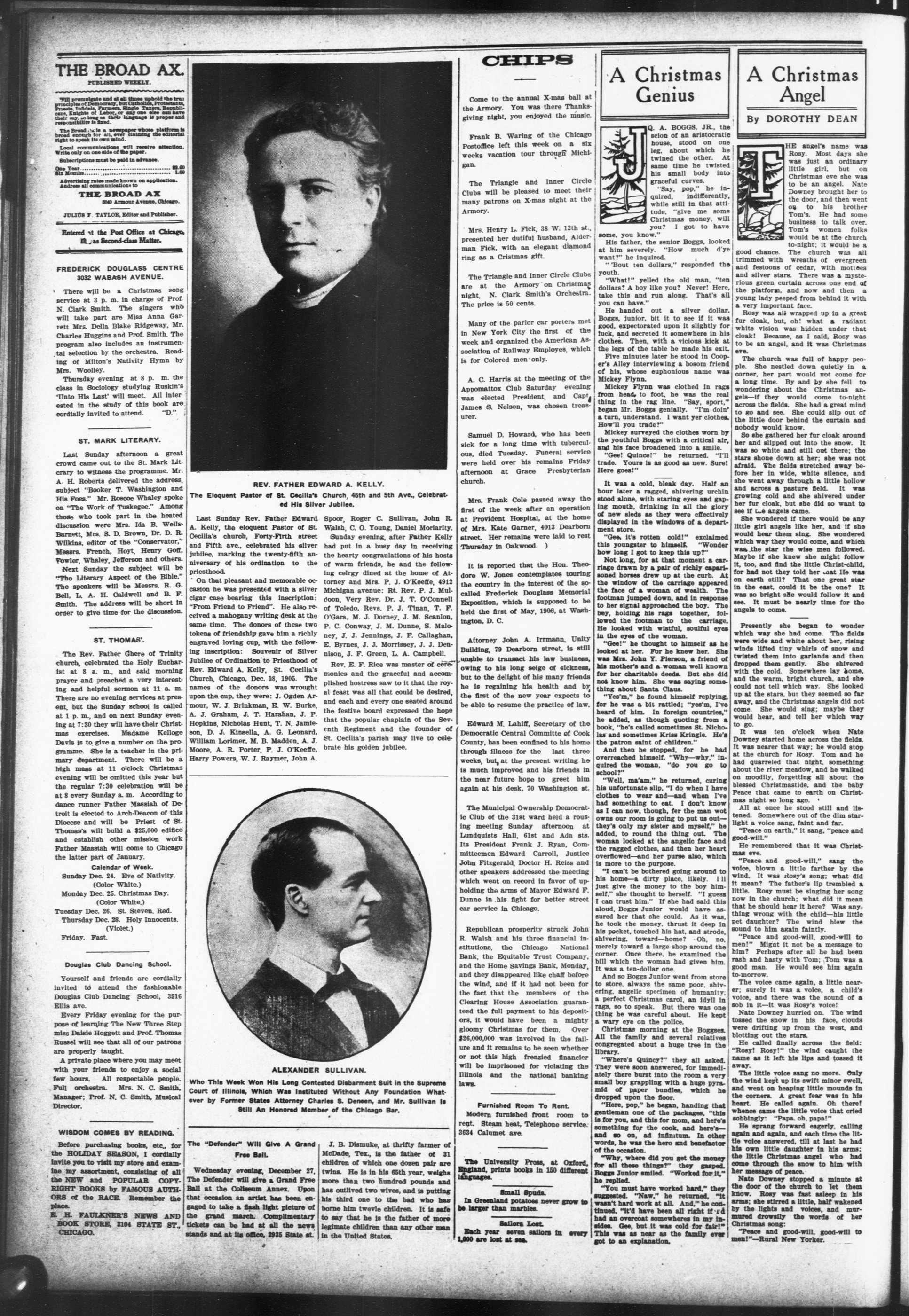
REV. FATHER EDWARD A. KELLY.
The Eloquent Pastor of St. Cecilia's Church, 45th and 5th Ave., Celebrated His Silver Jubilee.
Last Sunday Rev. Father Edward Spoor, Roger C. Sullivan, John H. A. Kelly, the eloquent Pastor of St. Walsh, C. O. Young, Daniel Morlarity, Cecilia's church, Forty-Firth street Sunday evening, after Father Kelly and Fifth ave., celebrated his silver had put in a busy day in receiving jubilee, marking the twenty-fifth anniversary of his ordination to the hearty congratulations of his host of warm friends, he and the follow-
On that pleasant and memorable occasion he was presented with a silver cigar case bearing this inscription: "From Friend to Friend". He also received a mahogany writing desk at the same time. The donors of these two tokens of friendship gave him a richly engraved loving cup, with the following inscription: Souvenir of Silver Jubilee of Ordination to Priesthood of Rev. Edward A. Kelly, St. Cecilia's Church, Chicago, Dec. 18, 1905. The names of the donors was wrought upon the cup, they were: J. Ogden Armour, W. J. Brinkman, E. W. Burke, A. J. Graham, J. T. Harahan, J. P. Hopkins, Nicholas Hunt, T. N. Jamison, D. J. Kinsella, A. G. Leonard, William Lorimer, M. B. Madden, A. J. Moore, A. R. Porter, P. J. O'Keeffe, Harry Powers, W. J. Raymer, John A.
```markdown
```
[Image of a man in a suit and bow tie, facing left, with a serious expression.]
ALEXANDER SULLIVAN.
Who This Week Won His Long Conti Court of Illinois, Which Was Institute ever by Former States Attorney Ch Still An Honored Mem
Who This Week Won His Long Contested Disbarment Suit in the Supreme Court of Illinois, Which Was Instituted Without Any Foundation Whatever by Former States Attorney Charles S. Deneen, and Mr. Sullivan Is Still An Honored Member of the Chicago Bar.
The "Defender" Will Give A Grand Free Ball.
Wednesday evening, December 27,
The Defender will give a Grand Free Ball at the Coliseum Annex. Upon that occasion an artist has been engaged to take a flash light picture of the grand march. Complimentary tickets can be had at all the news stands and at its office, 2935 State st.
Spoor, Roger C. Sullivan, John R.
Walsh C. O. Young, Daniel Mortlary
Walsh, C. O. Young, Daniel Mortimer.
Sunday evening, after Father Kelly had put in a busy day in receiving the hearty congrulations of his hosts of warm friends, he and the following celgry dined at the home of Attorney and Mrs. P. J. O'Keeffe, 4912 Michigan avenue: Rt. Rev. P. J. Muldoon, Very Rev. Dr. J. T. O'Connell of Toledo, Revs. P. J. Tinan, T. F. O'Gara, M. J. Dorney, J. M. Scanlon, P. C. Conway, J. M. Dunne, S. Maloney, J. J. Jennings, J. F. Callaghan, E. Byrnes, J. J. Morrissey, J. D. Nison, J. F. Green L. A. Campbell.
Rev. E. F. Rice was master of ceremonies and the graceful and accomplished hostress saw to it that the royal feast was all that could be desired, and each and every one seated around the festive board expressed the hope that the popular chaplain of the Seventh Regiment and the founder of St. Cecilia's parish may live to celebrate his golden jubilee.
---
Tested Disbarment Suit in the Supreme
ated Without Any Foundation What-
aries S. Deneen, and Mr. Sullivan is
ber of the Chicago Bar.
J. B. Dismuke, at thrifty farmer of
McDade, Tex., is the father of 31
children of which one dozen pair are
twins. He is in his 65th year, weighs
more than two hundred pounds and
has outlived two wives, and is putting
his third one to the bad who has
borne him twevle children. It is safe
to say that he is the father of more
legimate children than any other man
in the United States.
---
CHIPS
Come to the annual X-mas ball at the Armory. You was there Thanksgiving night, you enjoyed the music.
Frank B. Waring of the Chicago Postoffice left this week on a six weeks vacation tour through Michigan.
The Triangle and Inner Circle Clubs will be pleased to meet their many patrons on X-mas night at the Armory.
Mrs. Henry L. Fick, 38 W. 12th st., presented her dutiful husband, Alderman Fick, with an elegant diamond ring as a Christmas gift.
The Triangle and Inner Circle Clubs are at the Armory on Christmas night, N. Clark Smith's Orchestra. The price is 50 cents.
Many of the parlor car porters met in New York City the first of the week and organized the American Association of Railway Employes, which is for Colored men only.
A. C. Harris at the meeting of the Appomattox Club Saturday evening was elected President, and Capt James S. Nelson, was chosen treasurer.
Samuel D. Howard, who has been sick for a long time with tuberculous, died Tuesday. Funeral service were held over his remains Friday afternoon at Grace Presbyterian church.
Mrs. Frank Cole passed away the first of the week after an operation at Provident Hospital, at the home of Mrs. Kate Garner, 4013 Dearborn street. Her remains were laid to rest Thursday in Oakwood. )
It is reported that the Hon. Theodore W. Jones contemplates touring the country in the interest of the so-called Frederick Douglass Memorial Exposition, which is supposed to be held the first of May, 1906, at Washington, D. C.
Attorney John A. Irrmann, Unity Building, 79 Dearborn street, is still unable to transact his law business, owing to his long seige of sickness, but to the delight of his many friends he is regaining his health and by the first of the new year expects to be able to resume the practice of law.
Edward M. Lahiff, Secretary of the Democratic Central Committee of Cook County, has been confined to his home through illness for the last three weeks, but at the present writing he is much improved and his friends in the near future hope to greet him again at his desk, 70 Washington st.
The Municipal Ownership Democratic Club of the 31st ward held a rousing meeting Sunday afternoon at Lundquists Hall, 61st and Ada sts. Its President Frank J. Ryan, Committeeen Edward Carroll, Justice John Fitzgerald, Doctor H. Reiss and other speakers addressed the meeting which went on record in favor of upholding the arms of Mayor Edward F. Dunne in his fight for better street car service in Chicago.
Republican prosperity struck John R. Walsh and his three financial institutions, the Chicago National Bank, the Equitable Trust Company, and the Home Savings Bank, Monday, and they disappeared like chaff before the wind, and if it had not been for the fact that the members of the Clearing House Association guaranteed the full payment to his depositors, it would have been a mighty gloomy Christmas for them. Over $26,000,000 was involved in the failure and it remains to be seen whether or not this high frenzied financier will be imprisoned for violating the Illinois and the national banking laws.
Pursigned Room to Rent.
Modern furnished front room to rent.
Steam heat, Telephone service.
3634 Calumet ave.
The University Press, at Oxford, England, prints books in 150 different languages.
Small Spuds.
In Greenland potatoes never grow to be larger than marbles.
Sailors Lost.
Each year seven sailors in every 1,000 are lost at sea.
A Christmas Genius
Q. A. BOGGS, JR., the selon of an aristocratic house, stood on one leg, about which he twined the other. At same time he twisted his small body into graceful curves.
J
"Say, pop," he inquired, indifferently, while still in that attitude, "give me some Christmas money, will you? I got to have
some, you know."
His father, the senior Boggs, looked at him severely. "How much d'ye want?" he inquired. "Bout ten dollars," responded the youth. "What!" yelled the old man, "ten dollars? A boy like you? Never! Here, take this and run along. That's all you can have." He handed out a silver dollar. Boggs, junior, bit it to see if it was good, expectorated upon it slightly for luck, and secreted it somewhere in his clothes. Then, with a vicious kick at the legs of the table he made his exit. Five minutes later he stood in Cooper's Alley interviewing a bosom friend of his, whose euphonious name was Mickey Flynn.
Mickey Flynn was clothed in rags from head to foot, he was the real thing in the rag line. "Say, sport," began Mr. Boggs genially. "I'm doin' a turn, understand. I want yer clothes. How'll you trade?" Mickey surveyed the clothes worn by the youthful Boggs with a critical air, and his face broadened into a smile. "Gee! Quince!" he returned. "I'll trade. Yours is as good as new. Sure! Here goes!" It was a cold, bleak day. Half an hour later a ragged, shivering urchin stood alone, with staring eyes and gaping mouth, drinking in all the glory of new sleds as they were effectively displayed in the windows of a department store. "Gee, it's rotten cold!" exclaimed this youngster to himself. "Wonder how long I got to keep this up?"
Not long, for at that moment a carriage drawn by a pair of richly caparisoned horses drew up at the curb. At the window of the carriage appeared the face of a woman of wealth. The footman jumped down, and in response to her signal approached the boy. The boy, holding his rags together, followed the footman to the carriage. He looked with wistful, soulful eyes in the eyes of the woman.
"Gee!" he thought to himself as he looked at her. For he knew her. She was Mrs. John Y. Pierson, a friend of his mother's and a woman well known for her charitable deeds. But she did not know him. She was saying something about Santa Claus.
"Yes'm," he found himself replying, for he was a bit rattled; "yes'm, I've heard of him. In foreign countries," he added, as though quoting from a book, "he's called sometimes St. Nicholas and sometimes Kriss Kringle. He's the patron saint of children."
And then he stopped, for he had overreached himself. "Why—why," inquired the woman, "do you go to school?"
"Well, ma'am," he returned, curing his unfortunate slip, "I do when I have clothes to wear—and when I've had something to eat. I don't know as I can now, though, for the man wot owns our room is going to put us out—they's only my sister and myself," he added, to round the thing out. The woman looked at the angelic face and the ragged clothes, and then her heart overflowed—and her purse also, which is more to the purpose.
"I can't be bothered going around to his home—a dirty place, likely. I'll just give the money to the boy himself," she thought to herself. "I guess I can trust him." If she had said this aloud, Boggs Junior would have assured her that she could. As it was, he took the money, thrust it deep in his pocket, touched his hat, and strode, shivering, toward—home? ·Oh, no, merely toward a large shop around the corner. Once there, he examined the bill which the woman had given him. It was a ten-dollar one. And so Boggs Junior went from store to store, always the same poor, shivering, angelic specimen of humanity, a perfect Christmas carol, an idyll in rags, so to speak. But there was one thing he was careful about. He kept a wary eye on the police. Christmas morning at the Boggses. All the family and several relatives congregated about a huge tree in the library.
"Where's Quincy?" they all asked. They were soon answered, for immediately there burst into the room a very small boy grappling with a huge pyramid of paper bundles, which he dropped upon the floor.
"Here, pop," he began, handing that gentleman one of the packages, "this is for you, and this for mom, and there's something for the cook, and here's—and so on, ad infinitum. In other words, he was the hero and benefactor of the occasion.
"Why, where did you get the money for all these things?" they gasped. Bogge Junior smiled. "Worked for it," he replied.
"You must have worked hard," they suggested. "Naw," he returned, "it wasn't hard work at all. And." he continued, "it'd have been all right if I'd had an overcoat somewhere in my insides. Gee, but it was cold for fair!" This was as near as the family ever got to an explanation.
A Christmas Angel
By DOROTHY DEAN
HE angel's name was Rosy. Most days she was just an ordinary little girl, but on Christmas eve she was to be an angel. Nate Downey brought her to the door, and then went on to his brother Tom's. He had some business to talk over. Tom's women folks would be at the church to-night; it would be a the church was all
HE angel's name was Rosy. Most days she was just an ordinary little girl, but on Christmas eve she was to be an angel. Nate Downey brought her to the door, and then went on to his brother Tom's. He had some business to talk over. Tom's women folks would be at the church to-night; it would be a good chance. The church was all trimmed with wreaths of evergreen and festoons of cedar, with mottoes and silver stars. There was a mysterious green curtain across one end of the platform, and now and then a young lady peeped from behind it with a very important face.
Rosy was all wrapped up in a great fur cloak, but, oh! what a radiant white vision was hidden under that cloak! Because, as I said, Rosy was to be an angel, and it was Christmas eve.
The church was full of happy people. She nestled down quietly in a corner, her part would not come for a long time. By and by she fell to wondering about the Christmas angels—if they would come to-night across the fields. She had a great mind to go and see. She could slip out of the little door behind the curtain and nobody would know.
So she gathered her fur cloak around her and slipped out into the snow. It was so white and still out there; the stars shone down at her; she was not afraid. The fields stretched away before her in wide, white silence, and she went away through a little hollow and across a pasture field. It was growing cold and she shivered under her fur cloak, but she did so want to see if the angels came.
She wondered if there would be any little girl angels like her, and if she would hear them sing. She wondered which way they would come, and which was, the star the wise men followed. Maybe if she knew she might follow it, too, and find the little Christ-child, for had not they told her what He was on earth still? That one great star in the east, could it be the one? It was so bright she would follow it and see. It must be nearly time for the angels to come.
Presently she began to wonder which way she had come. The fields were wide and white about her, rising winds lifted tiny whirls of snow and twisted them into garlands and then dropped them gently. She shivered with the cold. Somewhere lay some, and the warm, bright church, and she could not tell which way. She looked up at the stars, but they seemed so far away, and the Christmas angels did not come. She would sing; maybe they would hear, and tell her which way to go.
It was ten o'clock when Nate Downey started home across the fields. It was nearer that way; he would stop at the church for Rosy. Tom and he had quarreled that night, something about the river meadow, and he walked on moodily, forgetting all about the blessed Christmasmastide, and the baby Peace that came to earth on Christmas night so long ago.
All at once he stood still and listened. Somewhere out of the dim starlight a voice sang, faint and far.
"Peace on earth," it sang, "peace and good-will."
He remembered that it was Christmas eve.
"Peace and good-will," sang the voice, blown a little farther by the wind. It was rosy's song; what did it mean? The father's lip trembled a little. Rosy must be singing her song now in the church; what did it mean that he should hear it here? Was anything wrong with the child—his little pet daughter? The wind blew the sound to him again faintly.
"Peace and good-will, good-will to men!" Migit not be a message to him? Perhaps after all he had been rash and hasty with Tom; Tom was a good man. He would see him again to-morrow.
The voice came again, a little nearer; surely it was a voice, a child's voice, and there was the sound of a sob in it—it was Rosy's voice!
Nate Doney hurried on. The wind tossed the snow in his face, clouds were drifting up from the west, and blotting out the stars.
He called finally across the field: "Rosy! Rosy!" the wind caught the name as it left his lips and tossed it away.
The little voice sang no more. Only the wind kept up its swift minor swell, and went on heaping little mounds in the corners. A great fear was in his heart. He called again. Oh there! whence came the little voice that cried sobbingly: "Papa, oh papa!"
He sprang forward eagerly, calling again and again, and each time the little voice answered, till at last he had his own little daughter in his arms; the little Christmas angel who had come through the snow to him with her message of peace.
Nate Downey stopped a minute at the door of the church to let them know. Rosy was fast asleep in his arms; she stirred a little, half waked by the lights and voices, and murmured drowsily the words of her Christmas song:
"Peace and good-will, good-will to man!"—Rural New Yorker
The Mistletoe
Girl:
= IZOLA L. FORRESTER
SABEL paused on the
last step and drew on
her gray suede gloves
thoughtfully. ‘The only
touch of relief in her
gray costume was the
spray of scarlet holly
berries that lay against
her squirrel stole.
“But if he should
come while we are
gone,” she said.
‘Mrs. Dexter looked
i
iA
Fee eee a ent ee
er may look at a debutante daughter
who has fulfilled every expectation.
He might wait,’ she suggested
Isabel frowned slightly.
“He doesn’t like to be kept waiting.”
“Not by others,” murmured Mrs
Dexter, discreetly, “but when it is you,
éear—"
Isabet laughed and shrugged her
shoulders as she fastened the last but.
ton,
As the carriage went down the ay.
enue Isabel bent forward to watch the
crowd of Christmas promenaders.
“I ordered the holly and mistletoe
yesterday,” Mrs. Dexter was saying.
ruminatively. “The flowers came last
night, all except the table decorations.
They are to be there by 11. Betty said
she would look after them.”
“She has my chiffon dress to change
before dinner,” said Isabel.
Mrs. Dexter bowed .her head in com.
fortable abstraction.
“She can do both.”
Isabel smiled quizzically at her tone.
Suddenly the smile vanished and she
leaned toward the window eagerly to
catch a glimpse of a tall figure as it
turned into Fifth avenue.
“There is Mr. Wade now,” she said.
“Shall we go back?”
She hesitated, a slight flush tinting
‘her face as she sank back against the
‘maroon cushions.
“No,” she continued, “I think he will
wait” :
‘The carriage passed without Wade's
recognition of ite occupants. He
walked on up the avenue, his hands
oe ia ae Pockets, his chin uplifted
tly.
He would see her at all costs. If he
asked for her alone, they could not
keep her from.him. Heretofore in his
alls it had been Isabel, as a matter of
course, who received him. But to-day
was Christmas, and he carried a
Christmas greeting to the girl he
loved.
‘The ladies were bath out, Gifford
told him at the door. Would he wait?
“Miss Betty is hanging mistletoe in
the study for the ball to-night,” ex-
plained Gifford.
“I will wait there,” said Wade, and
Gifford stood alone in the hall, ooking
ata $5 gold piece which had reached
his palm suddenly.
She was trying to hammer a small
brass hook into the archway, and was
Singing softly. Wade thought as he
Jet the portieres fall behind him that
he had never heard “Hark, the Herald
Angels Sing,” sound quite so sweet in
all his life. s
“Merry Christmas,” he said, and
Betty dropped the hammer.
“I said Merry Christmas,” he re-
Deated, laughing up at her.
“Please pick up the hammer,” said
Betty, sedately. “You mustn't bother
me.”
Wade laid the hammer on the table.
“You can't hammer in a hook. It
‘Screws in. Let me do it.”
Betty sat down on top of the ladder.
“Everybody's out,” she remarked,
irrelevantly.
“I'm glad of it,” responded Wade,
composediy.
“Isabel's out, too.”
There was a long silence. Betty's
chin was resting on one hand. The
Other held a bunch of mistletoe ready
for hanging on the hook, and she
looked down at the tiay, pearly berries
meditatively. Wade walked to the
Window and back again to the base of
the footladder.
“Don't you know that I want to see
only you, Betty?” he asked.
Betty hung the bunch of mistletoe in
Place with unsteady fingers. He could
‘Rot see her face.
“Tm very busy, Mr. Wade. You
know Aunt Octavia gives a ball to-
Right. The decorators did all the
Tooms except for the mistletoe, and i
4m to put all of that up.”
“You are always busy.”
A trace of sadness came over the
lovely girlish face.
“They are all very kind to me,” she
said, bravely. “I like to help, and feel
that Iam needed.”
There was the cound of carriage
*heels on the avenue outside. As they
Stopped before the house Wade's jaws
Sauared with determination. He held
¥p bis arms to the figure in black on
the stepladder.
“Betty, I need you most, sweetheart,”
he sald. “Won't you come to me?”
‘The portieres at the end of the room
Darted, and for an instant Mrs. Dexter
24 Isabef paused at sight of the.ple-
ttre before them. At thé foot of the
‘adder stood Wade, with Betty held
ress in his arms, his lips pressed to
“Elizabeth!” exclaimed Mrs. Dexter,
% she caught her breath.
Wade raised his head, his eyes brim-
ful of merriment.
Its all right, Mra. Dexter,” he said,
cheerily. “We're under the mistletoe,
and Betty's just promised to be the
@ahy mtettese ceae fel ee, ee
A Christmas
Souvenir
Sos
S. BIGELOW STEVENS
was walking slowly on
Ormond Beach, gazing
Ustlessly at the white
sand dunes or out
across the sea, and oc-
casionally pausing to
pick up a shell, which
she was almost sure
to cast aside inditfer-
ently & moment later.
She was stopping at
the Ormond, and a car-
plage was ane qoltiae
Ly
M
ens
oan
ie ce er ree et ee
| which marked the road. On the sand
Tidge above the road was the Coquins
hotel, isolated and lacking paint, but
having a reputation for good viands
| and excellent table service. It was
Popular with those who desired quiet
and bathing, and there were even now
& number enjoying the surf just as
though it wére not the day before
Christmas, dnd along the beach be.
tween them and the hotel were a dozer
or morg children, some playing in the
water ami some in the sand.
Mrs. Bigelow Stevens paused, and
gazed at them with dimming eyes.
She had lost her owm little girl but 1
few months before, and for that rea.
son she was here; not to forget, but
to find new scenes to awaken her in-
terest. Presently a child of five or six
separated from her companions, and
came racing up the beach in pursuit of
@ hat which was rolling merrily along
before a gust of wind. Mrs. Stevens
Teached out her parasol and intercept-
ed the runaway.
“Thank you!” gasped the little girl,
‘out of breath, but looking up with a
Toguish smile on her bright face. “I
shall whip it when I get home.” Then,
[toed of returning to her compan-
fons, she grasped # finger of her new
friend. “May I walk with you?” she
‘asked, beginning to swing along as
though the permission was granted.
She was silent for some minutes, her
Ups tremulous with recollections of the
past, and during that time the little
girl made excursions from her finger
to investigate escaping crabs and cu-
rious shells, and eves the last efforts
of waves that sent long lines of shallow
water curving up toward thelr feet. At
length Mrs. Stevens’ lips grew firmer,
and she looked down.
“I suppose your mother is here,”
she said.
The child in her turn became grave.
“I haven't any mamma,” she an-
swered; “and my papa doesn’t walk
with me like he used to.” She hest-
tated a little, and then went on, with
childish frankness: “He—he talks
loud to me sometimes, and bis face
gets red, and—and he strikes me. I
don’t have anybody to play with now.”
‘That evening Mr. Stevens was look-
ing over some new curiosities he had
purchased. He did not care much for
such things, but this winter he was
trying to cultivate an enthusiasm for
them in hope of interesting his wife.
“There are some really fine Florida
sketches in that studio in the new
block,” he said, presently, looking up
from a nautilus shell he had been ex-
amining. “One of them will make a
nice souventr of Ormond. However,
if you do not care for them, you may
select anything else you like. This
year I am going to give you two pres-
ents—my usual one and one of your
own choosing as an Ormond souvenir.”
He turned back to his shell, only to
raise his head again quickly. “By the
way, I forgot to tell you about a man
I met on the street to-day. You re-
member Seaton, the bookkeeper, who
ran away with $2,000?”
“Yes.”
“Well, it was he, but so changed I
hardly recognized the man. In his
dase, crime has certainly proved its
own punishment. Two years ago he
was reckless, but was very scrupulous
‘about his personal appearance; now
he is only a slovenly, red-faced toper.”
Mr. Stevens paused, and ran his fingers
through his hair in an irritable, dis-
gusted sort of way. “It isn't the man
I care for,” he grumbled, “but a fel-
low of his stamp seems to drag so
much good into the mire with him.
Fostunately his wife is dead, but there
1s a child left.”
“Did you have him arrested?” Mrs.
Stevens asked.
“No; what was the use?” a little
apologetically. “He has gone through
the money—and through himself al-
most. When he saw me he was too
scared to speak, and Just stood there
trembling. I asked a few questions
and found that the money was all gone
and that he owed a month's board at
the Coquina. He even confessed that
he was thinking of running away and
leaving the child.”
| “How old is the child?” Mrs. Stevens
asked, eagerly.
“Oh, five or six; and she is very
‘nice little girl.”
Mrs. Stevens rose from her chair
with an unwonted light in her eyes.
“Yes, she is @ nice little girl. Now
may I hold you to your word, and take
whatever I lie for my present—my
Christmas souvenir?”
“Why, certainly, dear,” with gisd
tenderness, as he detected the new in-
terest in her eyes and voice, “whatever
you like.”
“Then I will take the little girl to
be our pwn.”
‘He half rose in his astonishment,
Dut the look on her face prevented
even the appearance of expostulation.
“Very well, dear,” he said; “we will so
for her in the morning.”"—Farm and
Sammie’s Uncle
Dick
EVIRUBY DOU GIAK
LEXIA stood over the
Kitchen range popping
corn, and the refection
of the crimson coals in
her cheeks was like a
full-blown blush rose.
Tt was the day before
Christmas and, save
for the long strands of
Popcorn Alexia was
Preparing, her great
Christmas tree was
dressed. It stood in
the dinine.rnam ite
At.
TY
Sd
A
Pranches projecting about the windows
heavily laden with mysterious berib.
boned parcels and rainbow-hued orna.
ments.
“A real Christmas, after all,” cried
Alexia, and the smile which accom:
Panied the words would have led one
to believe that she was in her sixth
winter instead of in her three-times:
that-many with a few years added—
Just a few years, though! The fam.
ily Bible said Alexia was two-and.
twenty.
A great gust of wind drew her at.
tention suddenly without. She stood
by the window wondering if it was to
be @ real blizzard like they had in
the west.
The heap of snow was growing
larger and larger, and she watched the
feathery flakes pile up on each other
affectionately. All at once a white
something, larger and more substan-
tial than @ snowflake, was drifted onto
the heap. It was a tiny white en-
velope.
‘When she had finished the popper of
corn Alexia opened the window and
Picked up the damp little paper. One
short word was written in a much-
blurred and childish hand: “God.”
Alexia would not have been so sur-
Drised if it had been Santa Claus.
Children often write to him.
Out of the envelope she pulled a
Piece of note paper—probably surrep-
titiously borrowed—on which was writ-
ten in the undeveloped hand of a little
one:
__ “Dear God, please make me a Christ-
mas tree like the one in the window
‘across the court. I can see it. I will
put this on the roof so’s you'll get it
Sooner. Yours truly, Sammie.”
So Sammie was the name of the lit-
tle boy she had seen so often in the
‘opposite window. He seemed lonely;
she judged that his mother was dead
and that the child's father was a busy,
thoughtless man. An old housekeeper
was the only person she ever saw
about the apartment.
It was because Alexia had been a Iit-
tle lonely herself as Christmas drew
near—her first Yuletide in the eity—
that she bad gathered this little circle
©f poor children and planned a party
for them. Her reasons were not purely
philanthropic.
There was no need of two persons
being lonely, Alexia philosophized, and
she straightway went over to inter-
view the old housekeeper in regard to
Sammie. She did not mention the
note, for, should the child find out,
his faith would be shattered.
On Christmas morning, before Alexia
was fully dressed, a small young male
visitor was announced. No name was
given, and she wondered if some of the
poor little children. in his joyful an-
ticipation of the day, had been unable
to restrain himself until the appointed
hour of the party.
But it was Sammie. He stood breath-
Jessly in the hall without either coat
or hat, his little cheeks bright with
the nipping breath of Jack Frost.
“Uncle Dick's come,” he said, by
way of introduction to his mission.
“My Uncle Dick came last night, and—
and I can’t leave him all alone. Please
can’t he come, too?”
“Of course, Sammie, bring Uncle
Dick along,” she said, taking his little
round face in her hands.
Alexia’s children had all arrived but
Sammie, and thé dining-room was
Giled with ejaculations of delight at
each new view of the splendid tree.
She was beginning to wonder wheth-
er or not Uncle Dick had prevented
Samrie’s coming when an impatient
tingle of the bell seemed to say “Sam-
mie.”
Alexia answered the ring herself.
“Here's Uncle Dick,” said her small
friend before she could open the door
for him. “Where's the tree?” he cried,
his childish excitement and importance
at bringing a visitor running away
with his patience.
‘Without a sign of an introduction,
Sammie scampered down the hall
toward the dining-room, leaving Uncle
Dick standing in the doorway.
“Uncle Dick!” gasped Alexia when
she could get her breath.
“Yes, Alexia,” said Uncle Dick—but
he was not old. “Sammie said I was.
invited. Am I?” He put out his hand.
“It must be Fate, dear. Shall we defy
ir
“Or was it Sammie?” asked Alexia,
putting her hand in his.
But before he could continue the
argument the young man in question
appeared.
“Aren't you coming, Uncle Dick?”
he asked, astonished that anyone could
remain so long away from such entic-
ing sights as the dining-room held.
“Yes, Sammie, but, I say, come here.”
Sammie came, reluctantly.
And, because he was very young and.
very much interested in a Christmas
tree, he did not notice how tenderly
his Uncle Dick kissed him, and how
many times Alexia took him in her
Kept Her Word.
‘Tess—So you're really engaged to
him? I thought you said you wouldn't
marry him if he were the last man in
the world.
Jess—Well, he isn't, is he?—Philadel-
| pila Public Ledger.
Scarcity of Copper.
__ Two years ago the United States had
& Surplus of copper. Now it is the re-
rene A constantly increasing demand
and a constantly decreasing visible
‘supply is the present state of the cop-
| per industry.
. Double Capacity.
“That looks like a fine incubator,”
said the farmer.
“Fine!” replied the agent. “Why,
it’s guaranteed to hatch two chickens
out of one egg!”—Detroit Free Press.
ee '
Swiss Woman Engineer. |
The first European woman to adopt
engineering as a profession is Cecile
Butticar, a Swiss, 24 years old, who re-
cently passed her examination at the
Sniversity of Lausanne with honors. |
TWniformed Health Officers
| The sanitary officials in southern
"Italy who try to protect the natives
“against malarial mosquitoes, wear mili-
tary uniforms in order to inspire respect
in the stubborn peasants.
Getting Used to It.
Sometimes one is almost tempted to
wonder whether the world is really get-
ting better or whether he is merely.
with the passage of years, getting ac-
customed to it.—Puck.
‘Which Is Worse?
__ It Is becoming a question to the chil-
‘dren which looks worse, father’s bald
‘head or the little door’ knob of hair
on mother’s head.—Atchison Globe.
Postcards of Peat.
Postcards made of irish peat from
the bog of Allen formed one of the fea-
tures of the Irish exhibition in Lon-
don.
Not Likely.
No vehicle which moves on wheels
‘will, in the opinion of many scientists,
attain the speed of 200 miles an hour.
‘Keeps Him to Herself.
A young man is ace high with a girl
when she refuses to introduce him to
& girl who is prettier than she is.
iteen Qenk Sen
About $5,000,000 worth of tar colors
‘are sent from Germany to the United
States every year.
‘Will Play on Sunday.
Shop assistants in Birmingham, Eng-
land, declare that unless they get a
‘weekly half-holiday they will form a
Sunday sports club and play football,
cricket and tennis on that day.
‘Low Dresses Barred.
Notice in an Australian ballroom:
“No lady shall wear a dress cut lower
than from point to point of the shoul-
‘der, the committee to be judges of the
matter.”
Aged Mountaineer.
Franz Defregger, though 70 years of
‘age, spent part of the past summer in
climbing Tyrolean peaks, some of them
‘over 10,000 feet in altitude.
Quick Awakening.
| ‘There's nothing half so swift in lite
as the awakening from love's young
dream.—N. 0. Picayune.
| Healthiest Exercise.
Digging is said to be the healthiest
of all outdoor exercises.
| Punish Themselves.
Impatient people water their miseries
‘and hoe up their comforts.—Spurgeon.
WONDERFUL GROWTH OF HAIR.
“I had typhoid fever and my hair”
“all came out. I used three bottles of”
“Ford's Original Oxonized Ox Mar”
“row, and now my hair is nine inch-”
“es long and very thick and nice and”
“straight. Most every one seeing”
“bow good the Ozonized Ox Marrow”
“done my hair, they to are anxious”
“for it. My bair is an example to”
“everyone.”
“Yours respectfully,”
“BLLA BYE,”
“319 & Matlack Gt, West Chester,
Pa”
March 30, 1905.
Ford's Original Ozonized Ox Marrow
has many other good qualitels, too.
See their advertisement in this paper.
Price only 50¢ a bottle at druggists or
dealers, or send us fifty cents and we
‘will mail you a bottle postpaid. Adé-
ress Ozonized Ox Marrow Co., 76 We-
bash Avenne, Chicago, [lincis.
SF < ers
©) ’ jo
ry ul RS
oe APS» fi
Se
‘agate Mecnstn OSes
Epiope bean
a igty Agwets Wenig, Mentone
SS geomet karen
- American Brick Co. -
President and Treasurer, THOMAS CAREY.
Vice-President, JOHN SHELHAMER,
Secretary, WILLIAM SULLIVAN.
MANUFATURERS OF
Gommor and Sewer Brick
Office and Yards:
45th and Robey Sts.
Yards running winter and summer, equipped
with the latest improved Wolf Dryer.
Output of Winter Yards .....cccccececscessesseere cesses 1QQO0 per dag
@utput of Summer’ Yarde...........ceceeeceecesees -oeees JUD per dap
Telephone Yards 128.
Jas. J. McCormiek,
MPG? 25D SEES
WINES, LIQUORS AND 6tGaee
eees SOUTH NALOTED SvRaET. PR
AGENTS AND CORRESPONDENTS
WANTED.
| The Broad Ax desires to engage
Agents and regular Correspondents tn
all the leading cities and towns
throughout the country. The highest
commissions paid to live hustlers
Sample copies furnished free, For
further information, address Julius F.
Taylor, 601) Armour avenue, Chicago.
THE BROAD AX.
te for sale at the following news
stands:
The Afro-American News Office
2104 State Street.
A. F. Tervalon, 2826 State street
Cigar Store and News Stand.
Richard Webb, 2642 1-2 State St.
Cigars, Tobacco and News stand.
Mrs. Nellie Phelps, Cigars, Notions
and News Stand, 131 W. 5ist street.
Richard Pinn, 4836 State street.
Edward seilx's Cigar Store, 341
30th atreet, N. E. Corner Armour Ave.
T. B. Hal's Cigar Store an¢
Laundry office, 281 79th St.
W. 8. Williams, Tonsorial Parlor
399 Slst st
‘Mrs. A. E. Baker, Notions and News
Stand, 419, 36th street.
J. H. Harris, cigars, tobacco and
pews stand, 2508% State St
W. P. Johnson, Notion Store and
News Stand 3704 State st.
Turner Williams’ Shaving Parlor
and News Stand, 2903 armour ave.
Mrs. B. Williams, Cigars, Notions
and News Stand, 486% State street.
B. Davis, cigars, tobacco, and con-
fectionery, State st.
‘Whiteley Bros. 2724 State St, Gent's
furnishings and new stand.
‘The Stationery, 2970 State strest
The Afro-American News Co. 439
‘W. 35th St, New York City, N.Y.
The Informer News Co, 188 Ran-
dolph St, Detroit, Mich.
News items and advertisements jeft
at these places will find their way
into the columns of The Broaé Az
Phone 194 South
A. B. SCHULTZ, M. D.
PHYSICIAN AND SURGEON.
2719 State Street
Hem Fe oasistwer.u. CHICAO
COVERY
Curly Hair Made Straight
a
mentees are
FORD'S ORIGINAL
INAL
OZONIZED OX MARROW
Conrniset
eset barnett
Rigceneeeer ice
pd ap. beerents the Mat from ‘ating
fiveere se Bes
eet eres =
Sehr Seite
SoS ee eae oes
E ererereal pesos mince
San aes Sa pe heen
eter gece
= sees taes see
aie eta
ee pe aS
ier pass
(owe pouatnetheet my agra
roi
cece
en
‘Ratablished 1877. Phone Oakland 1350-1551
JohnJ. Dunn
waeieoare HCOALG
sit] WOOD
Fifty-First St. and Armour Ave.
a Yae SRGAE MEE
CHICAGO
frees = Site aug = 6 a
Express & Yan Moving
‘TRUNKS eee ane aaae
| Ted. 699 South =— CHICAGO
Phone Oakland 1828 il a:
|
_ F. A. Rawlins
The Modern Embalmer
| UNDERTAKER AND
FUNERAL DIRECTOR
| When his work is finished
you have no displeasure.
4834 State St., CHICAGO
Pome Douglas 1550
. OPEN UP STAIRS
2940 STATE STREET
ALL NEWLY FURNISHED.
Home Cooking: Meals, Lunch and
Short Orders served from 5 p. m.
ti 2 AM.
OYSTERS IN SEASON -
Good Music and Entertaining.
CHAS. GASKIN, Gen’l Mgr.
Phone 1550 Douglas.
J. GARNER Tel. Douglas 3256
FINE WINES, LIQUORS
AND CIGARS
3030 State Street CHICAGO
Randel Woodfolk
SAMPLE ROOM
Py
jh cs) ee
ap
\a ho
Pr — J _\|
WAITERS AND COOKS
Prefer Our Make
JACKETS AND LINEN
experience that they are the
most satisfactory and econe-
mical goods on the market.
Our Complete Catalogue—
@ correct guide to proper
dress in the Dining Room,
Kitchen, or Bar will be sent
free om application.
econ
moneeues
‘Marcus Ruben ([ne.), 390 Stats St, Chicage
Tarned Squaw.
She who was Grace Wetherbee, of New York, is now an Arapahoe squaw. Carrying her papoose strapped to her back, wearing a brilliant parti-colored shawl and moccasins, she dwells on the Shoshone Indian reservation, near Fort Washakie, Wyoming. Six years ago Mies Wetherbee came from her home in New York to visit the family of the post-trader there. Miss Wetherbee met Coolidge, a full-blooded Indian, who was conducting a mission. They fell in love at sight, were married, and have lived happily.
The Oyster Fork.
A helpful idea in table setting when there are to be a number of elaborate courses, necessitating various forks and knives, is to have the small oyster fork laid across the others ready for the first course. This precludes the possibility of any mistake either through ignorance of the intricacies of modish serving or absent-mindedness. Then, as each succeeding course is brought on, the deft fingers of the maid or discreet butler can give a slight tilt to the correct fork to use for that particular dish.
Municipal Telescope.
Cardiff is the first place to cater for its amateur astronomers by the provision of a municipal telescope. This instrument, which has just been dedicated to the public use, is a fine 12-inch equatorial reflector and was bequeathed to the citizens by the late Dr. Franklen Evans. The city council has borne the expenses incidental to the suitable disposal of the gift, which is erected in an observatory outside the city.
Will Bar Japa.
Mr. Seldon, the premier of New Zealand, announced in a speech recently that Japanese would not be allowed to come to New Zealand and that the colony would refuse to be dictated to in the matter. This is in reference to a circular from the British colonial office, addressed to the colonies and demanding the repeal of laws that are repugnant to the feelings of nations with which Great Britain is at peace.
Trying Net to Be Spoiled.
Tailor—You have recently inherited a nice lump of money from your uncle; why don't you pay me?
Customer—I hate all outward show. I don't want it to be said that my newly-acquired wealth has caused a departure from my former simple habita.—Stray Stories.
Farm Poultry Instead.
One result of the work of quail hunters has been to increase the depredations of coyotes in western Oklahoma. Rabbits and quail form their regular food supply and since these are being thinned out by hunters they are beginning to raid the unprotected farm poultry yards.
His Conquering Career
"I wonder what has become of Smasham, who used to play center in the college eleven years ago. I remember him as one of the greatest ground galners I ever saw."
"He is yet. He went into the real estate business, and now he owns a whole suburb."—Chicago Tribune.
Wonderful Machinery
The smallest holes pierced by modern machinery are one-thousandth of an inch in diameter. They are bored through sapphires, rubles and diamonds by a machine which makes 22,000 revolutions a minute.
Guardians of the Pope
The pope's Swiss guard will celebrate the fourth centenary of their institute in January next. Their history, which is interesting, is to be told in a special volume about to be published by Prof. Durrer.
Futile
Fortune Teller (examining her palm)
—Beware of a strikingly handsome,
tall, dark-haired young man.
Fair Customer—it's too late for that,
I've married him—Chicago Tribune.
Gullible Farmers
Thousands of farmers answered the advertisement of a man who offered to sell "a recipe for making a pound of butter from a plint of milk and a teaspoonful of our preparation."
Dust Settler.
Akonia is the name of a substance manufactured in England which, dissolved in the water with which the streets are sprinkled, is said to prevent dust from rising.
Mean Thing to Say
Ida—George is so poetical. He says my ears are like shells.
Irene—Did he say whether he meant coconut or oyster shells?—Stray Stories.
Russians in London
Russian immigrants to the number of 33,440 arrived in London during the first nine months of this year. Of these 18,556 remained in the city.
Big Charity Fund.
London's lord mayors have during the past decade collected more than £20,000,000 for charitable and benevolent purposes.
The Ingrate.
He has little gratitude who seeks only to gratify himself.
No Admirera.
The braggart is only popular with himself.
Leppy's Christmas Carol BY MYRTLE KOON CHERRYMAN
"God rest ye, merry gentlemen,
Let nothing you dismay."
It was the voice of Leppy Sanders, errand boy for Hardman & Son, who was practicing a carol for the choirboys' Christmas festival at St. Luke's. Leppy had the sweetest of voices, the most restless of bodies, and the most freckled of faces. The first had won him a place in St. Luke's vested choir; the sec-
I was the voice of Leppy Sanders, errand boy for Hardman & Son, who was practicing a carol for the choirboys' Christmas festival at St. Luke's. Leppy had the sweetest of voices, the most restless of bodies, and the most freckled of faces. The first had won him a place in St. Luke's vested choir; the second had kept him from learning his carol until he was in danger of being discharged by the long-suffering choir master; and the third had won him the name of Leppy, which is the diminutive of "Leopard," and was given him by his friends because of the spots which he could not change—those enduring freckles.
As he opened the door of Hardman & Son's office, and sang, "God Rest ye, Merry Gentlemen," the sense of humor which sometimes accompanies freckles brought a whimsical look to his face, for the idea of calling Hardman & Son "merry gentlemen" was distinctly incongruous.
Hardman was rubbing his eyes and saying to himself: "To be blind—blind! To be shut in darkness, and one's life work not half done. I shall never get the courage to see an oculist and hear that doom pronounced." Son, at his desk, was looking fixedly out of the window, and saying to himself: "To be dishonored! To have gotten the firm's affairs into such a muddle that there's no clear way out unless I throw myself on father's mercy, and I shall never get the courage to tell him."
"Let nothing you dismay," sang Leppy, stumbling on, boy fashion, toward the rear office.
Hardman suddenly looked up, and with unusual interest in his voice, said:
"Come back here, Leppy. Can you sing the whole of that?"
"Do'n know if I can, Mr. Hardman, but I'm tryin' to get it, 'cause if I don't have it straight by to-night, I'll be discharged from the choir. It's the last rehearsal, you see. I don't want to be bounced, because I get a quarter a week, and that helps out."
"Well, I'll give you a quarter now, if you'll sing it through for me. I used to sing that thing myself when I was a kid, and—"
Hardman had stopped speaking, and seemed to have forgotten all about Leppy, who hardly knew what to do, until Son nodded to him, and said, kindly:
"Sing it, Lep, if you can."
Then Leppy began, and—marvel of marvels—he sang it perfectly from beginning to end. What would the choir-master have said if he could have heard it? Leppy was much impressed with his achievement, and when he stopped, his look of mingled pride and astonishment would have been funny, if there had been anybody to see it. Hardman partially roused himself and handed the boy a silver dollar, then turned back to his desk without a word.
"Shall—shall I get it changed, Mr. Hardman?"
There was no answer from Hardman, and Son, coming once more to the rescue, said:
"No, Leppy—it's all right. Run along."
"Gee! exclaimed the boy. And then, without thinking to say "m thank you," so appalled was he by this sudden affluence—he went out of the office, and soon his silvery tones could be heard echolong down the wide hall:
"God rest ye, merry gentlemen, Let nothing you dismay."
Son rose suddenly from his chair, and laid his hand on Hardman's shoulder. "Father," he said, "I have something to tell you."
"Son," said Hardman, unsteadily but bravely, "I have something to tell you."
It doesn't matter who began first, or how much each one hesitated and looked out of the window to hide the embarrassment of a man's confidence to a man. At last, both stories were told, somehow, and when Hardman and Son started out to lunch together, they looked several degrees more like "merry gentlemen" than they had two hours before.
Hardman was saying: "We'll straighten that out in a week's time, Son. You did right to tell me now. And in the meantime—"
"In the meantime, dad, we'll see that oculist together, and I know your sight can be saved."
And so it was—not only the physical sight, but that finer sense which makes us see the struggles of those we love, and understand and help them. At that moment there was only the hope of this in Hardman's eyes, but that was enough to make the world already brighter, and when they encountered Leppy near the street door, Hardman said: "Oh, by the way, Leppy, I forgot to give you that quarter—here it is," and to the boy's astonishment, another silver coin was slipped into his hand.
This time Leppy fairly choked with amusement; but as he scampered away, he found voice to trill out again, in a veritable pacon of joy:
"God rest ye, merry gentlemen.
And nothing did dimmy them!
Great Truth.
Privilege is the root of all evils in politics and business, says the Boston Globe. It is one of the oldest sources of wrong in the world and has wrought more ruin than all the piked mobs of the unprivileged, who, blinded by poverty, ignorance and injustice, have stormed the citadels of privilege and power. All experience shows that human nature is too frail to bear the stain of privilege. The sense of might overwhelms the sense of fright.
Flouts the Thirteen
Gov. Edwin Warfield, of Maryland, laughs at the 13 superstition, though according to the common view he ought to regard it with respect. He is the thirteenth governor of Maryland to occupy the executive mansion at Annapolis. He was elected by a majority of 13,000 votes, has 13 letters in his name and was inaugurated January 13, 1904. So far nothing has occurred in his political career to warrant any fear for the 13 superstition.
Out of Data.
Some sensation was caused during a Sunday school address the other day by a little girl who had overheard her parents discuss the non-eternity of punishment. The curate made a feeling allusion to the unpleasant character of the lower regions, and then paused, when in the dead silence the little girl observed in an explanatory tone, "Please, they don't use it now."
Swearing a Hangman.
The death of Bifington recalls the fact that formerly it was usual in appointing a public hangman to make him take the Bible in his hand and swear solemnly that he would dispatch every criminal condemned to death without favoring father, mother, or any other relation or friend. When he had taken the oath he was dismissed with the word: "Get thee hece, wretch!"
Manchurian Products
Millet, Indian corn and wheat are among the chief farm products of Manchuria. Apples and grapes do well, although the native supply is soft and lacks flavor. Tomatoes grow in great abundance, particularly in southern Manchuria, where asparagus also flourishes. All vegetables, as a rule, can be grown in abundance.
All the Way.
"Did you ever see such long gloves as that woman is wearing? Why, she buttons them from her wrist to her elbow."
"Ho, that's not much. Why, my wife buttons her gloves from the front door to the theater."—Cleveland Leader.
Lived and Died Together
While several guests were celebrating the diamond wedding of a couple named Bader, at Konigswalde, Germany, the wife was seized with syncope and dropped dead at the table. Within ten minutes the aged widower also fell dead.
PHONES Office, Main 1157
Res. Brown 42
STEPHEN A. DOUGLAS
LAWYER
Room 813, 115 Dearborn Street.
CHICAGO
W.Kemper Harreld
TEACHER OF
VIOLIN
6626 CHAMPLAIN AVE.
Tel. Went. 2821.
All that is best in whiskey you will find in
Old Underoof Rye
It is thoroughly matured, soft and rich.
CHAS. DENNEHY
Chicago
CHAS. DENNEHY & COMPANY Chicago.
O'Donnell & Coghlin
Attorneys at Law
Phone 264 Main Metropolitan Block
N. W. Cor. LaSalle & Randolph Sts.
Chicago
GRAY & MORAN
ATTORNEYS AT LAW
Suite 1114 Ashland Block, Clark and Randolph Sts. Tel. Central 569.
CHICAGO.
Residence 87 Macallister Place
Telephone Ashland 363
Office Telephones
Central 1239 Automatic 5840
MILES J. DEVINE
ATTORNEY AT LAW
Suite 315-320 Reaper Block
CLARK AND WASHINGTON STS.
CHICAGO.
Telephone Central 3089
Rea. 904 W. 12th Street Blvd. Tel.
1626 Morgon
ATTORNEY AND COUNSELOR AT
LAW.
806 Tribune Building
S. E. Cor. Dearborn and Madison Sta.
CHICAGO
A. D. GASH
Attorney at Law,
84-86 La Salle Street, Chicago,
Suite 615 to 619,
Telephone Main 3077.
JOHN E. OWENS
ATTORNEY & COUNSELOR
AT LAW
323 ABHLAND BLOCK
TELEPHONE CENTRAL 800 CHICAGO
Telephone Yards 6016.
John Fitzgerald
JUSTICE OF THE PEACE
4737 SOUTH HALSTED STREET.
Residence
113 W. Garfield Boul. CHICAGO
Attorney at Law
Suite 611 167 Dearborn St., Cor. Monroe.
Chicago.
Tel. Cont. 5703. Res. Tel. Went. 4392.
Captain 8th L. N. G.
Regimental Quartermaster
JAMES S. NELSON
LAWYER
SUITE 611, 167 DEARBORN STREET
Tel. 5708 Central
Hall's Laundry
2975-77 STATE ST.
Phone, Douglas 1235
CHICAGO
eroof ve
& COMPANY,
go.
Chicago
CHICAGO
HILLMAN'S STATE & WASHINGTON STS. Chicago's Most Modern, Most Complete and Most Convenient Department Store
MARKET AND GROCERY
TELEPHONE DOUGLAS 565
81st and State Streets
BRADLEY
REAL ESTATE
AND IN
4709 S. Halsted Street
Theodore
JUSTICE OF
Mortgages, Deds, Notes
and Acknowledged.
BADLEY & FIER
REAL ESTATE, LOAN
AND INSURANCE
United Street
Theodore C. Ma
VICE OF THE P
Images, Deeds, Notes and Legal Documents
acknowledged. Room 22, 27 North
BRADLEY & FIELDS REAL ESTATE, LOANS AND INSURANCE
Theodore C. Mayer
JUSTICE OF THE PEACE
Mortgages, Dedss, Notes and Legal Documents Drawn and Acknowledged. Room 22, 27 North Clark Street.
POLICE MAGISTRATE RESIDENCE
East Chicago Ave., Police Court 337 Burling Street
C. H. Smiley, Pres. and Treas.
76 E. TWENTY
Two Phones, South 584.
Phone D
SANDY W. TRI
INCORPORATED UNDER
2918 STATE S
Now is your chance.
The Company will open a Department State St. Namely Sandy W. Trice, complete line of Men and Womens Factions. Shares ten dollars. A limit Company's Sec'y. office.
CHICAGO
P. Pres. and Treas.
J. Hockley
76 E. TWENTY-SECOND STREET,
South 584.
Phone Douglas 6581.
BY W. TRICE & COMP
CORPORATED UNDER THE LAWS OF ILLINOIS
2918 STATE STREET, CHICAGO.
Is your chance. A joint stock company will open a Department Store in the near-
ly Sandy W. Trice & Company. The company will Men and Womens Furnishing Goods Shoes, ten dollars. A limited number of shares are by office.
C. H. Smiley, Pres. and Treas.
J. Hockley Smiley, Sec'y.
Smiley
Caterer
76 E. TWENTY-SECOND STREET,
Two Phones, South 584.
CHICAGO.
SANDY W. TRICE & COMPANY
INCORPORATED UNDER THE LAWS OF ILLINOIS. 2918 STATE STREET, CHICAGO.
The Company will open a Department Store in the near future at 2918 State St. Namely Sandy W. Trice & Company. The company will carry a complete line of Men and Womens Furnishing Goods Shoes, Hats and Notions. Shares ten dollars. A limited number of shares are on sale at the Company's Sec'y. office.
DIRECTORS:
Sandy W. Trice, Pres.
Milton J. Trice, Vice Pres.
A. T. Henry, 2nd Vice Pres.
R. R. Wright, 3rd Vice Pres.
Dee Parker, Trustee.
A. J. Carey, D. D., Treas.
3151 Forest Ave.
A. W. Williams, M. D.
Sec'y Office 3840 State St. Phone South 1023, Chicago.
NOIS BRICK
ILLINOIS BRICK CO.
WILLIAM C. KUESTER.
SUPERINTENDENT.
1994 N. Western Ave., CH
Telephone Lake View 270
Telephone Yards: 718
N. Western Ave., CH
Telephone Lake View 270
Telephone Yards: 718
M. JUNK, Proprietor JOS. P. JUNK, Manager 3700-3710 South Halsted Street and 897 to 929 Thirtyseventh Street CHICAGO
J. J. Bradley
Telephone Yards 693
CHICAGO
J. M. Fields
HELDS
ANS
E
CHICAGO
Mayer
PEACE
Events Drawn
North Clark Street.
RESIDENCE
337 Burling Street