The Broad Ax
Saturday, January 6, 1906
Chicago, Illinois
Page text (machine-generated)
THE BROAD AX
HEW TO THE LINE.
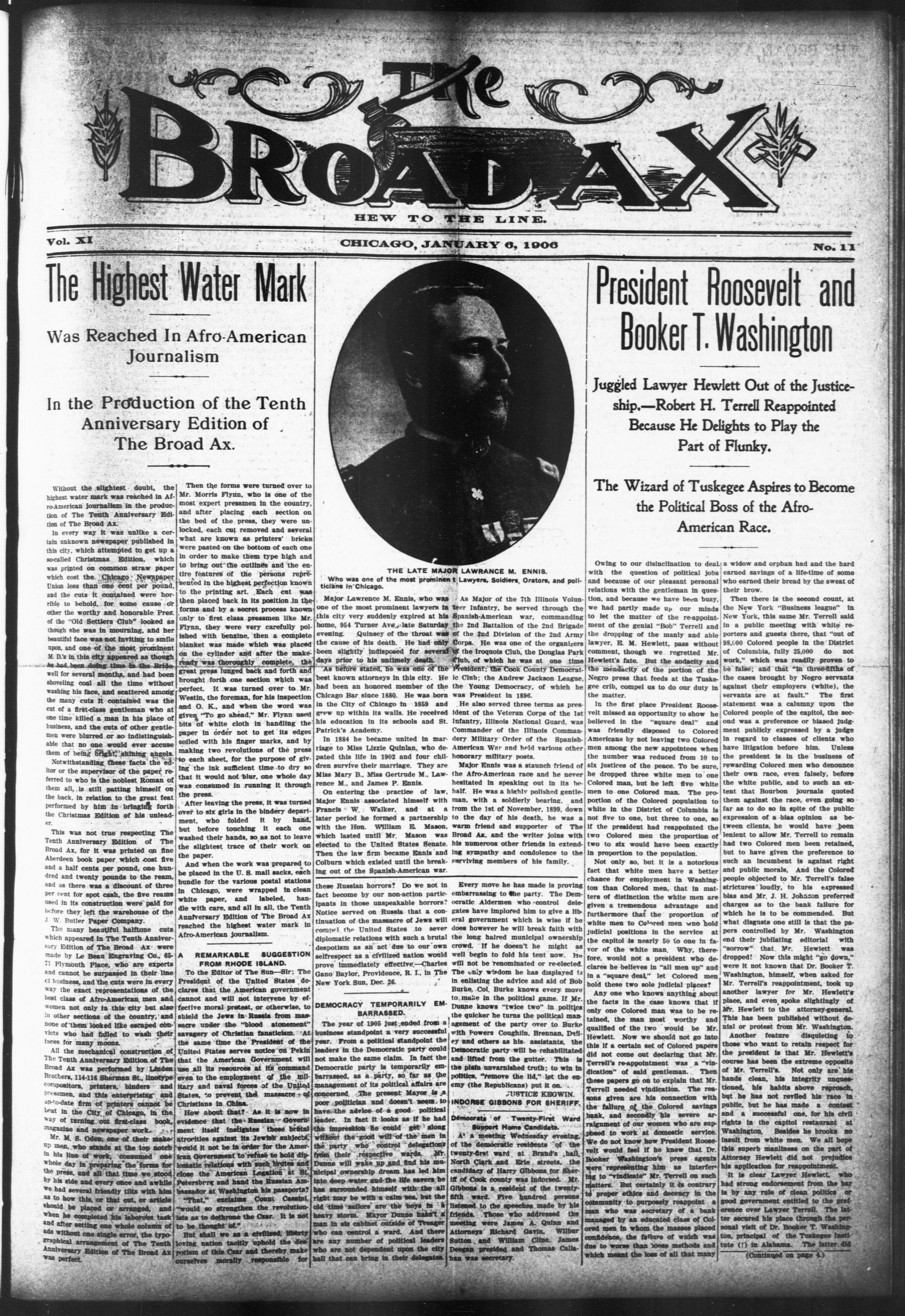
The Highest Water Mark
Was Reached In Afro-American Journalism
In the Production of the Tenth Anniversary Edition of The Broad Ax.
Without the alightest doubt, the highest water mark was reached in Afro-American journalism in the production of The Tenth Anniversary Edition of The Broad Ax. In every way it was unlike a certain unknown newspaper published in this city, which attempted to get up a so-called Christmas Edition, which was printed on common straw paper which cost the Chicago Newspaper Union less than one cent per pound, and the cuts it contained were horrible to behold, for some cause or other the worthy and honorable Press. of the "Old Settlers Club" looked as though she was in mourning, and her beautiful face was not inviting to smile upon, and one of the most prominent M.D.'s in this city appeared as though he had been doing time in the Bridgewell for several months, and had been shoveling coal all the time without washing his face, and scattered among the many cuts it contained was the cut of a first-class gentleman who at one time killed a man in his place of business, and the cuts of other gentlemen were blurred or so indistinguishable that no one would ever accuse them of being bright shining angels.
Notwithstanding these facts the editor or the supervisor of the paper referred to who is the noblest Roman of them all, is still patting himself on the back, in relation to the great feat performed by him in bringing forth the Christmas Edition of his unleader.
This was not true respecting The Tenth Anniversary Edition of The Broad Ax, for it was printed on fine Aberdeen book paper which cost five and a half cents per pound, one hundred and twenty pounds to the ream, and as there was a discount of three per cent for spot cash, the five reams used in its construction were paid for before they left the warehouse of the J. W. Butler Paper Company.
The many beautiful halftone cuts which appeared in The Tenth Anniversary Edition of The Broad Ax were made by Le Beau Engraving Co., 65-71 Plymouth Place, who are experts and cannot be surpassed in their line of business, and the cuts were in every way the exact representations of the best class of Afro-American men and women not only in this city but also in other sections of the country, and none of them looked like escaped convicts who had failed to wash their faces for many moons.
All the mechanical construction of The Tenth Anniversary Edition of The Broad Ax was performed by Linden Brothers, 114-116 Sherman St., limetype compositors, printers, binders and pressmen, and this enterprising and up-to-date firm of printers cannot be beat in the City of Chicago, in the way of turning out first-class book, magazine and newspaper work.
Mr. M. S. Oden, one of their make-up men, who stands at the top notch in his line of work, consumed one whole day in preparing the forms for the press, and all that time we stood by his side and every once and awhile we had several friendly tilts with him as to how this, or that cut, or article should be placed or arranged, and when he completed his isaborous task and after setting one whole column of ads without one single error, the typographical arrangement of The Tenth Anniversary Edition of The Broad Ax was perfect.
Then the forms were turned over to Mr. Morris Flyin, who is one of the most expert pressmen in the country, and after placing each section on the bed of the press, they were unlocked, each cut removed and several what are known as printers' bricks were pasted on the bottom of each one in order to make them type high and to bring out the outlines and the entire features of the persons represented in the highest perfection known to the printing art. Each cut was then placed back in its position in the forms and by a secret process known only to first class pressmen like Mr. Flynn, they were very carefully polished with benzine, then a complete blanket was made which was placed on the cylinder and after the make-ready was thoroughly complete, the great press lunged back and forth and brought forth one section which was perfect. It was turned over to Mr. Westin, the foreman, for his inspection and O. K., and when the word was given "To go ahead," Mr. Flynn used bits of white cloth in handling the paper in order not to get its edges solled with his finger marks, and by making two revolutions of the press to each sheet, for the purpose of giving the ink sufficient time to dry so that it would not blur, one whole day was consumed in running it through the press.
After leaving the press, it was turned over to six girls in the bindery department, who folded it by hand, but before touching it each one washed their hands, so as not to leave the slightest trace of their work on the paper.
And when the work was prepared to be placed in the U. S. mail sacks, each bundle for the various postal stations in Chicago, were wrapped in clean white paper, and labeled, handle with care, and all in all, the Tenth Anniversary Edition of The Broad Ax reached the highest water mark in Afro-American journalism.
A REMARKABLE SUGGESTION
FROM PHORE ISLAND.
To the Editor of The Sun—Sir: The President of the United States declares that the American government cannot and will not intervene by effective moral pretest, or otherwise, to shield the Jews in Russia from massacre under the "blood atonement" savagery of Christian fanaticism. At the same time the President of the United States serves notice on Pekin that the American Government will use all its resources at its command even to the employment of the military and naval forces of the United States, to prevent the massacre of Christians in China.
How about that? As it is now in evidence that the Russian Government itself instigates these brutal atrocities against its Jewish subjects, would it not be in order for the American Government to refuse to hold diplomatic relations with such brutes and close the American Legation at St. Petersburg and hand the Russian Ambassador at Washington his passports? "That," exclaims Count Cassini, "would so strengthen the revolutionists as to dethrone the Czar. It is not to be thought of." But shall we as a civilized, liberty loving nation tacitly uphold the despotism of this Czar and thereby make ourselves morally responsible for
HEW TO THE LINE.
CHICAGO, JANUARY 6, 1906
V.
THE LATE MAJOR LAWRANCE M. ENNIS.
Who was one of the most prominent Lawyers, Soldiers, Orators, and politicians in Chicago.
Major Lawrence M. Ennis, who was As Major of the 7th Illinois Volunteer one of the most prominent lawyers in teer Infantry, he served through the this city very suddenly expired at his Spanish-American war, commanding home, 954 Turner Ave., late Saturday the 2nd Battalion of the 2nd Brigade evening. Quinsey of the throat was of the 2nd Division of the 2nd Army the cause of his death. He had only Corps. He was one of the organizer been slightly indisposed for several of the Iroquois Club, the Douglas Park days prior to his untimely death. Club, of which he was at one time As before stated, he was one of the President; the Cook County Democrat best known attorneys in this city. He is Club; the Andrew Jackson League had been an honored member of the the Young Democracy, of which he Chicago Bar since 1880. He was born was President in 1896. in the City of Chicago in 1859 and He also served three terms as pres grew up within its walls. He received ident of the Veteran Corps of the 1st his education in its schools and St. Infantry, Illinois National Guard, was Patrick's Academy.
Commander of the Illinois Command In 1884 he became united in mar- dery Military Order of the Spanishriage to Miss Lizzie Quinlan, who de- American War and held various other pated this life in 1902 and four chil- honorary military posts. dren survive their marriage. They are Major Ennis was a staunch friend of Miss Mary B., Miss Gertrude M. Law- the Afro-American race and he never rence M. and James P. Ennis.
On entering the practice of law, Major Ennis associated himself with Francis W. Walker, and at a later period he formed a partnership with the Hon. William E. Mason, which lasted until Mr. Mason was elected to the United States Senate. Then the law firm became Ennis and Colburn which existed until the breaking out of the Spanish-American war. these Russian horrors? Do we not in fact become by our non-action participants in those unspeakable horrors? Notice served on Russia that a continuation of the massacre of Jews will compel the United States to sever diplomatic relations with such a brutal despotism as an act due to our own selfrespect as a civilized nation would prove immediately effective. Charles Gano Baylor, Providence, R. I., in The New York Sun, Dec. 26.
DEMOCRACY TEMPORARILY EM-
BARRASSED.
The year of 1905 just ended from a business standpoint a very successful year. From a political standpoint the leaders in the Democratic party could not make the same claim. In fact the Democratic party is temporarily embarrassed, as a party, so far as the management of its political affairs are concerned. The present Mayor is a poor politician and doesn't seem to have the advice of a good political leader. In fact it looks as if he had the impression he could get along without the good will of the men in the party who control delegations from their respective wards. Mr. Dunne will wake up and find his municipal ownership dream has led him into deep water and the life savers he has surrounded himself with the all right may be with a calm sea, but the old time sailors are the boys in a heavy storm. Mayor Dunne hadn't a man in his cabinet outside of Tveager who can control a ward. And there are any number of political leaders who are not dependent upon the city hall that can bring in their delegates.
As Major of the 7th Illinois Volunteer Infantry, he served through the Spanish-American war, commanding the 2nd Battalion of the 2nd Brigade of the 2nd Division of the 2nd Army Corps. He was one of the organizers of the Iroquois Club, the Douglas Park Club, of which he was at one time President; the Cook County Democratic Club; the Andrew Jackson League, the Young Democracy, of which he was President in 1896.
He also served three terms as president of the Veteran Corps of the 1st Infantry, Illinois National Guard, was Commander of the Illinois Commandery Military Order of the Spanish-American War and held various other honorary military posts.
Major Ennis was a staunch friend of the Afro-American race and he never hesitated in speaking out in its behalf. He was a highly polished gentleman, with a soldierly bearing, and from the 1st of November, 1899, down to the day of his death, he was a warm friend and supporter of The Broad Ax, and the writer joins with his numerous other friends in extending sympathy and condolence to the surviving members of his family.
Every move he has made is proving embarrassing to the party. The Democratic Aldermen who control delegates have implored him to give a liberal government which is wise if he does however he will break faith with the long haired municipal ownership crowd. If he doesn't he might as well begin to fold his tent now. He will not be renominated or re-elected. The only wisdom he has displayed is in enlisting the advice and aid of Bob Burke, Col. Burke knows every move to make in the political game. If Mr. Dunne knows "twice two" in politics the quicker he turns the political management of the party over to Burke with Powers Coughlin, Brennan, Dalley and others as his assistants, the Democratic party will be rehabilitated and lifted from the gutter. This is the plain unvarnished truth; to win in politics, "remove the lid," let the enemy (the Republicans) put it on.
Democrate of Twenty-First Ward Support Home Candidate.
A' a meeting Wednesday evening, of the democratic residents of the twenty-first ward at Brand's hall, North Clark and Erie streets, the candidacy of Harry Gibbons for Sheriff of Cook county was indorsed. Mr. Gibbons is a resident of the twenty-fifth ward. Five hundred persons listened to the speeches made by his friends. Those who addressed the meeting were James A. Quinn and Attorneys Richard Gavin, Wilbur Sutton and William Cline. James Deegan presided and Thomas Callahan was secretary.
President Roosevelt and Booker T. Washington
Juggled Lawyer Hewlett Out of the Justice ship.—Robert H. Terrell Reappointed Because He Delights to Play the Part of Flunky.
The Wizard of Tuskegee Aspires to Become the Political Boss of the Afro- American Race.
Owing to our disinclination to deal with the question of political jobs and because of our pleasant personal relations with the gentleman in question, and because we have been busy, we had partly made up our minds to let the matter of the re-appointment of the genial "Bob" Terrell and the dropping of the manly and able lawyer, E. M. Hewlett, pass without comment, though we regretted Mr. Hewlett's fate. But the andacity and the mendacity of the portion of the Negro press that feeds at the Tuskegee crib, compel us to do our duty in the matter.
In the first place President Roosevelt missed an opportunity to show he believed in the "square deal" and was friendly disposed to Colored Americans by not leaving two Colored men among the new appointees when the number was reduced from 10 to six justices of the peace. To be sure, he dropped three white men to one Colored man, but he left five white men to one Colored man. The proportion of the Colored population to white in the District of Columbia is not five to one, but three to one, so if the president had reappointed the two Colored men the proportion of two to six would have been exactly in proportion to the population.
Not only so, but it is a notorious fact that white men have a better chance for employment in Washington than Colored men, that in matters of distinction the white men are given a tremendous advantage and furthermore that the proportion of white men to Colored men who hold judicial positions in the service at the capitol is nearly 50 to one in favor of the white man. Why, therefore, would not a president who declares he believes in "all men up" and in a "square deal," let Colored men hold these two sole judicial places?
Any one who knows anything about the facts in the case knows that if only one Colored man was to be retained, the man most worthy and qualified of the two would be Mr. Hewlett. Now we should not go into this if a certain set of Colored papers did not come out declaring that Mr. Terrell's re-appointment was a "vindication" of said gentleman. Then these papers go on to explain that Mr. Terrell needed vindication. The reasons given are his connection with the failure of the Colored savings bank, and secondly his severe arraignment of our women who are supposed to work at domestic service. We do not know how President Roosevelt would feel if he knew that Dr. Booker Washington's press agents were representing him as interfering to "vindicate" Mr. Terrell on such matters. But certainly it is contrary to proper ethics and decency in the community to purposely reappoint a man who was secretary of a bank managed by an educated class of Colored men in whom the masses placed confidence, the failure of which was due to worse than loose methods and which meant the loss of all that many
a widow and orphan had and the hard earned savings of a life-time of some who earned their bread by the sweat of their brow.
Then there is the second count, at the New York "Business league" in New York, this same Mr. Terrell said in a public meeting with white reporters and guests there, that "out of 98,000 Colored people in the District of Columbia, fully 25,000 do not work," which was readily proven to be false; and that "in three-fifths of the cases brought by Negro servants against their employers (white), the servants are at fault." The first statement was a calumny upon the Colored people of the capitol, the second was a preference or biased judgment publicly expressed by a judge in regard to classes of clients who have litigation before him. Unless the president is in the business of rewarding Colored men who denounce their own race, even falsely, before the white public, and to such an extent that Bourbon journals quoted them against the race, even going so far as to do so in spite of the public expression of a bias opinion as between clients, he would have been lenient to allow Mr. Terrell to remain had two Colored men been retained, but to have given the preference to such an incumbent is against right and public morals. And the Colored people objected to Mr. Terrell's false strictures loudly, to his expressed bias and Mr. J. H. Johnson preferred charges as to the bank failure for which he is to be commended. But what disgusts one still is that the papers controlled by Mr. Washington end their jubilating editorial with "sorrow" that Mr. Hewlett was dropped! Now this might "go down," were it not known that Dr. Booker T. Washington, himself, when asked for Mr. Terrell's reappointment, took up another lawyer for Mr. Hewlett's place, and even spoke slightly of Mr. Hewlett to the attorney-general. This has been published without denial or protest from Mr. Washington. Another feature disquieting to those who want to retain respect for the president is that Mr. Hewlett's course has been the extreme opposite of Mr. Terrell's. Not only are his hands clean, his integrity unquestioned, his habits above reproach, but he has not reviled his race in public, but he has made a contest and a successful one, for his civil rights in the capitol restaurant at Washington. Besides he brooks no insult from white men. We all hope this superb manliness on the part of Attorney Hewlett did not prejudice his application for reappointment. It is clear Lawyer Hewlett, who had strong endorsement from the bar is by any rule of clean politics or good government entitled to the preference over Lawyer Terrell. The latter secured his place through the personal visit of Dr. Booker T. Washington, principal of the Tuskegee Institute (!) in Alabama. The latter did
(Continued on page 4.)
THE BROAD AX.
Will promulgate and at all times uphold the true principles of Democracy, but皂饽饽, Protestants, Presidents, Indians, Partners, Single Taxes, Republic and the State. We are here to help the child who is long on their language is proper and responsibilities is kind.
The Broad AX is a newspaper whose platform is broad enough for all, ever claiming the editorial right to speak its own mind.
Local communications will receive attention. Write only on one side of the paper.
Subscriptions must be paid in advance.
One Year ..... $2.20
Six Months ..... 1.00
Advertising rates made known on application.
Address all communications to
THE BROAD AX
900 Armour Avenue, Chicago.
JULIUS F. TAYLOR, Editor and Publisher.
Entered at the Post Office at Chicago,
IL., as Second-class Mailer.
THE PROGRESSIVE PHILOLAETI TIAN WHIST CIRCLE ENTER- TAINS ITS FRIENDS.
A brilliant reception and card party was given onday evening, at 3436 Wabash Ave., by the Progressive Philo laetitia Whist Circle. The guests were received by Miss Edna Brown and Mrs. J. Elmer Pankey, in the reception hall, in a bower of beautifully arranged palms and ferns. The parlors were artistically decorated in green and white, a very natural effect being secured by the profuse display of palms, ferns, chrysanthemums and white carnations. The dining hall was decorated in red and green and resembled a garden of roses. The walls and tables were solid masses of fragrant American beauties. The center piece was a beautiful candelsbra with red glass shades resembling red tulips. The chandelier which was also decorated with red shades, made a subdued red light on the red and green of the American beauties and produced a charming effect. The table cover was of heavy Battenberg lace, of a beautiful design.
During the evening Miss Edna Brown and Mr. I. R. Roberts, rendered two pleasing solos. Dr. Birch made some timely remarks in behalf of the club. Refreshments were served, and the orchestra rendered beautiful selections, while entirely obscured from the guests behind a bank of palms. The decorations were seldom equaled for beauty.
The officers of the Progressive Philoletitian Circle are:
Mrs. Jennie Watts Brown Pres.;
Mrs. J. Elmer Pankey, Secretary; Mrs. Spencer Cotton, Treasurer.
The guests present were:
Mr. and Mrs. James Clark, Mr. and Mrs. S. Hamlet, Mr. and Mrs. Clarence Brown, Mr. and Mrs. M. Weavey, Mr. and Mrs. F. W. King, Mr. and Mrs. Daughtry, Mr. and Mrs. J. B. Combe, Mr. and Mrs. Nesley, Mr. and Mrs. Spencer Cotton, Mr. and Mrs. E. E. Stone, Mesdames Mittie Phillips, F. D. Hunt, Bessie Nance, John McCollough, Grace Hart Alexander, Henry Hart—Dickson, J. Elmer Pankey; Mrs. Anna Hayman, Mrs. Julia M. McDowell, Misses Beulah Wright, Lillian Jones, Mayme Lewis, Grace Todd, Virgile Lewly, Leon Daughtry, Edna Brown, Lillian Pankey, Mernle Huey, Messrs. Emmett Miller, James French, Wm. Nelson, F. Douglas Banks, Leon Harris, Dr. J. N. Birch, Kansas City, Mo.; Thomas Elam, I. A. Roberts.
FREDERICK DOUGLASS CENTER,
3032 Wabash Ave.
Sunday, 3 p. m., Judge A. N. Waterman, who has long been a friend of the Colored people, will speak on the subject, "God Helps Those Who Help Themselves." All are invited.
Last Tuesday afternoon the Douglass Center Woman's Club held its regular meeting. The members are taking such an active interest in the work that the meetings will be held twice a month, the next meeting to be Tuesday, Jan. 16, at 2 p. m. All ladies invited."
Thursday, 2 p. m., the I. B. W. Club meets. On the same evening the class in sociology holds its regular meeting. This class is of unusual interest as its subject matter deals with questions of the hour. The interest and numbers are increasing.
Friday evening, 8 p. m. the Physicians and Surgeons meet. The Office Symposium which occupies the first half hour is most interesting and helpful. Also the clinical feature is very beneficial. A symposium on the Treatment of Tuberculosis will be held at an early date. Many physicians believe it can be cured in this climate. The interest is growing and the numbers increasing. The sewing class, in charge of Mrs. Alice E. Hampton, will resume work Saturday morning, at 10 a. m. The girls are doing good work. The Center entertained the class with a Christmas party. Candy bags were sent us by Mira John Jones of California. Refreshments were served. Last Sunday after the usual afternoon meeting a collection was taken for this department and a good sum was real-
ted.—"D."
19
DEMOCRATIC AND REPUBLICAN CANDIDATES FOR MUNICIPAL JUDGES.
The following are some of the most prominent Democratic candidates for Judges of the Municipal Court: Aldermen Nicholas R. Finn, J. F. Kohout, William E. Dever, Ex-Alderman Ernest Herrmann, Representatives John P. McGoorty, Richard E. Burke, Major E. B. Tolman, John P. O'Shaughnessy, Attorney J. B. O'Connell, J. J. O'Connor, Hiram T. Gilbert, John A. Poulton, Robert Redfield, Philip J. McKenna, former Justice W. D. Wilcox, Col. A. D. Gash, Thomas A. Moran, Dan Morgan Smith, Justices John Fitgerald, Theodore C. Mayer, John R. Caverly, John K. Prindiville, and James C. Martin
James C. Barbour, former Alderman Charles Alling, Kickam Scanlan, Brode B. Davis, Fletcher Dobyns and Edward R. Litzinger are the leading Republican candidates for Judges of the Municipal Court.
NOW IS THE TIME TO CONNECT
The Cook County Civil Service Commission will hold original entrance examinations as follows:
Class A—Resident Pathologist, Jan.
17, 1906.
Scope of above examination will be technical knowledge, assumed state of facts or practical test, and experience tending to qualify.
Class C—Attendants (male and female), January 16, 1906.
Scope of above examinations will be duties, experience and technical knowledge.
Class D—Cooks (general) January
17, 1906.
Scope of above examination will be technical knowledge and experience.
Scope of above examination will be technical knowledge and experience, and in the case of uniformed officers the subject of physical test will be added.
Laborers, Class F, Domestics, Class G. January 16, 1906.
Those desiring to take any of the above examinations must file their application with the Civil Service Commission, room 312, 218 LaSalle St., prior to date of examination.
Chas. D. Gastfield,
Secretary
COFFEE OF ARIZONA
If Mocha is the best of all the coffees there is no reason why it may not be produced in Arizona in some districts. For in climate, soil, situation, it duplicates the regions of Arabia and Abysinia where the true Mocha was developed. Why does not our Agricultural Department encourage it there? Ah, why? Our coffee syndicate knows. It might take the bread from the poor fellows to grow coffee here. But they could buy up all the land and control the market as they do now.—H.
MRS. BROWN ENTERTAINED TEN LADY FRIENDS AT DINNER.
A dinner party was given last Thursday afternoon by Mrs. Jennie Watts Brown, 4813 Dearborn Street. The invited guests numbered ten.
Mimes. Richie Coles, of Kansas City, Mo., Spencer Cotton, Frank King, Bertha Clark, Elmer Pankey, Katie Hamlet, Estella Lucas, May Weasley, Grace Nichols.
The menu—Blue points, Pim-oias, olives, salted almonds, boulon in cup, roast turkey, cranberry sauce, potatoes, celery, spagetti, chicken salad, champagne, wafers, bon-bons, assorted fruit, fruit cake, egg-nog, cheese, crackers, coffee.
Before the guests departed Mesa Brown presented each lady with a souvenir of her photograph on a 1906 calendar. The ladies were delighted, with the charming hostess indeed.
The following officers have been elected for the ensuing term by Pythias Lodge No. 2, Knights of Pythias of N. A. S. A. E. A. A. and A.
Stuart D. Fowler, C. C.
Wm. Thomas, V. C.
Luther Moore, K. R. S.
Harry Knight, P.
A. F. Tervalon, M. P.
Robt. R. Jackson, M. E.
Justine Carter, M. A.
Installation next Thursday evening.
AN EDITOR'S TOAST.
At an editorial convention one of the country editors offered the following toast:
"To save an editor from starvation take his newspaper and pay him for it promptly. To save him from bankruptcy advertise in his paper liberaUv. To save him from despair send him every item of news of which you can get hold. To save him from profanity write your correspondence plainly on one side of the sheet and send it in as early as possible. To save him from
mistakes bury him. Dead people are the only ones that never make mistakes. Newspaper readers would do well to remember that there are no perfect people, editors or readers."—Ex.
DEATH MAY END ALL
In a sermon Bishop Foster paused and exclaimed:
"However much it may avaken surprise, candor and truth compel me to make this confession: When we die I do not know but what death ends all. Where man is, or that he exists at all after death is unknown to me. He does not return to us nor we go to him. Doubtless this is the experience of mankind."—Beyond the Grave.
MAN BY NATURE IS AN ATHEIST.
"After all that has been so plainly written concerning the 'innate idea of God,' after all that has been said of its being common to all men in all ages and nations, it does not appear that man has naturally any more idea of God than any of the beasts of the field. He has no knowledge of God at all; neither is God in all his thoughts. Whatever change may afterward be wrought (whether by the grace of God, or by his own reflection, or by education) he is, by nature, a mere atheist."—Wesley's Sermons, vol. ii, p. 309.
SPECIAL NOTICE.
I wish to say to the public to relieve their minds of many thoughts, and false impressions that seem to surround them, that I have not given up my work as Probation Officer. I am answering all calls as usual and can be seen at the Institutional Church on Wednesday from 10 a. m. to 12 noon. Any messages can be left in care of the pastor for me at all times. Mrs. Chilton also holds her position as Probation officer and we expect to continue.
ELIABETH McDONALD.
6130 Ada St.
CHIPS
Mr. S. W. Thompson has recovered from recent illness sufficiently to resume his duties.
Andrew Watkins, a colored undertaker of Paducah, Ky., is said to be worth $50,000.
Mrs. Esther Manley Milwaukee. Wis., spent the holiday season in visiting with her friend, Mrs. Mary Harsh 2963 Armour ave.
Mrs. Sarah P. Hart 4841 Armour ave., was elected M. H. Matron of Eureka Court No. 11 at their last electoin of officers.
Attorney Walter M. Farmer, suite 12, 155 Washington st., spoke at Hermon Baptist church last Monday evening.
The private "Subscription dancing party" at Oakland Music Hall Friday evening was a grand success there being about 100 couples present.
Little Ethel Mitchell 6346 Rhodes Ave., entertained many of her little friends Wednesday evening, with dancing and games from 5 to 6 o'clock.
Rumor has it that the prosperous widower owning a five flat building on the South side, is soon to wed a South end belle of sweet voice and manner.
Col. Edw. H. Morris entertained a few of his friends to a 10 coursed dinner, New Years eve., after which cards were played until late New Years morning.
About 30 little girls and boys chaperoned by Mrs. L. Jones called on little Hockletta Smiley Tuesday afternoon and were royally entertained, with music and song and the best of refreshments.
Mrs. Wm. Emanuel 6350 Rhodes ave., kept open house Jan. 1st to her many friends, who called and wished her a continuation of prosperity for herself and family.
Mr. and Mrs. R. H. Hardin 6349 Rhodes ave., entertained at a large family dinner Dec. 31st many of their relatives and friends who remained past midnight to bid farewell to the old and greet the New Year enter with joy.
Garden City, Chapter recently elected the following officers, Mrs. Cora Johnson R. M. Mrs. Lillian Bell, associate M. Mrs. Florence Gaston Secretary; Mrs. Sarah Randolph Treasurer; Mr. R. G. Bell, Patron.
Editor C. S. Muse of The Western Enterprise Colorado Springs, Col., deliberately reproduced our article in full last week without giving this paper the credit for it. The article in question "was S. Laing Williams turned down for Register of the Treasury" which shows that brother muse is not above stealing.
Miss Carrie Michell 5263 Dearborn st., on New Years Day, entertained at a six course dinner. Mrs. Richard Pinn and little Miss Baby Pinn, Mr. and Mrs. F. A. Rawlins, Miss Lizzie Michell, Rev. Borwinee. The hostess displayed rare taste in preparing the repast and in tastefully decorating the table and house.
The Rev. P. A. Hubert, of malodorous memory in this vicinity, has turned up in Buffalo, N. Y., where he was convicted in police court for obtaining money under false pretenses. Sooner or later men of his lik get their deserts. Beware of grafting.—The Enterprise, Omaha, Neb.
This is the same Rev. Ple-eating Hubert who used to strut around the streets as though he was God Almighty Himself, and after sporting all night and most of the day, on Sunday he would frequent some of the churches, lay aside his silk plug hat, and assist the preachers to dish up the Lord's supper.
There are many Negroes who have not respect enough to subscribe and pay for a Negro paper although it defends their cause and gives them representation. In Memphis there are many homes in which Negro papers are unknown, yet these same Negroes are always whining, sitting around shedding crocodile tears as to how they are being treated. They will pay from 10 to 15 cents per week with great delight for papers that call them "coons" and "Negro cats," papers that think they are not fit for anything but to hew wood and draw water, papers that boldly declare in thunder tones that they are not published for the Negro, papers that will give whole columns to a Negro rapist and scarcely one line to a Negro author or Negro social affair. When will the Negro learn to discriminate—The Citizen, Memphis, Tenn.
There are many of this same class of Negroes in Chicago.
Furnished Room To Rent
Modern furnished front room to rent. Steam heat, Telephone service. 3634 Calumet ave.
Some Silver
On board the Pacific Mall liner China, which sailed from San Francisco recently for the orient, are 50 tons of Mexican silver dollars, worth $750,000 gold.
Lengthy Job.
About 100 years more will be required to complete the work of making a topographical map of the country, which was begun by the United States government in 1882.
A French explorer has found in the interior of Borneo a singular and grewsome wedding gift. It was the skull of a Negrito-Papon, carved by the Dayaks.
The Pure Stuff.
"Yes," replied the milkman, "we sell the cream separately."—Detroit Free Press.
Hard to Tell.
It is easier to be仁 than to be happy; but nobody ever got any satisfaction cut of that thought.—N. Y. Press.
Ostentatious.
Charity says nothing and saws wood, but philanthropy employs a press agent—Chicago Daily News.
Mushrooms grow wild all over the world, and are as beautiful in Siberia as in the tropics.
Very True.
No one can recognize his own voice in a phonograph.
Kept Her Word.
Tess-- You're really engaged to him? I thought you said you wouldn't marry him if he were the last man in the world.
Jess--Well, he isn't, is he?—Philadelphia Public Ledger.
Two years ago the United States had a surplus of copper. Now it is the reverse. A constantly increasing demand and a constantly decreasing visible supply is the present state of the copper industry.
"Fine!" replied the agent. "Why, it's guaranteed to batch two chickens out of one egg!"—Detroit Free Press.
Swiss Woman Engineer.
The first European woman to adopt engineering as a profession is Cecile Butticar, a Swiss, 24 years old, who recently passed her examination at the University of Lausanne with honors.
Uniformed Health Officers.
The sanitary officials in southern Italy who try to protect the natives against malarial mosquitoes, wear military uniforms in order to inspire respect in the stubborn pessants.
---
Substitute for Tinfoll.
Aluminum paper is now manufactured in Germany and recommended as a substitute for tinfoll. It is not the so-called leaf aluminum, but real paper coated with powdered aluminum and is considered to possess very favorable qualities for preserving articles of food for which it is used as a covering.
Aluminum paper is much cheaper than tinfoll and will become a strong competitor thereof.
Auto Road in Manitoba.
A movement is afoot to construct a 100-mile road for automobiles near Winnipeg, Man. It will be oval in form and the expense of construction will be met from the toils collected from those who use it. It is proposed to run some big races on the road, which will be oiled to keep down the fast.
Circular Love-Letter
A recent candidate for parliament in England wrote an address to the electors of the town he wished to represent and a love letter to his best girl. He put the two effusions in the wrong envelopes. The printer was quite surprised at receiving an order to print 10,000 copies of the love letter in circular form.
Boycott in Bengal
The boycott of British goods in Bengal has, since the division of the province, taken a more serious form, and assaults on Europeans are frequent, particularly in Calcutta. The students have been warned that if they join in the political agitation they will be barred from government employment.
Had Two Funerals
Augustin Poole, a veteran trainer, who fought in the Crimea in 1854-56, was thrown into a burial trench while wounded after the battle at Tchernaya, but made a slight movement that was noticed and was pulled out again, died in England the other day. He lived just 50 years after his first funeral.
Wives All Around
An Arkansas City man who had twice been divorced took his third wife to the theater recently. His two earlier wives have become good friends, and when the couple took their seats the man looked around, and to his consternation saw he had three wives in a row beside him.
"Running" All Right
Mrs. Backwoods.—Our Henry's doin' real well in town. He's runin' a hotel now, an' it's a big one, too.
"He surely is. Got a letter from him this mornin' an' he sex: 'I'm a hotel runner now, an' it's a real swell place."—Philadelphia Public Ledger.
Pretty Icelandic Custom
In Iceland, that country of gentle and old-fashioned customs, it has always been the fashion to present to the baby when its first tooth appeared a lamb, to be its very own, cared for and tended as no other pet could be, and never to be parted with.
Criticism
"Now, 'Little Sunshine,' the heroine of my play," said the dramatist, "is the daughter of an illicit distiller." "In that case," remarked the coarse manager, "you'd better call her 'Little Moonshine.'"—Louisville Courier-Journal.
Liberally Tasted.
The other day in London half a million bottles of wine, the stock of a dead wine merchant, were sold by auction. Three thousand bottles were consumed in preliminary tasting operations.
From Bad to Worse
She—I wish I could induce you to cease your attentions to me.
- y marrying me."—Columbus Dispatch.
An Easy One.
"A lady whose hair is falling out writes to ask what she shall do with it," said the snake editor.
"Tell her to throw it away," replied the receipt editor.—Milwaukee Sentinel.
Cheerfulness.
When a person who is deaf and dumb and paralyzed can be cheerful what excuse has the healthy person for being otherwise?
Largest Islands.
The largest islands in the world are Greenland, New Guinea, Borneo, Madagascar, Sumatra, Nipon, Great Britain and Celebes.
Big Sheep Owner.
Gov. Miguel Otero, of New Mexico, is the most extensive sheep owner in the southwest, owning a sock numbering 45,000.
Pawnships in Italy.
The government runs the pawnships of Italy and no interest is required on loans.
Unyielding.
Many a man feels that he could be quite comfortable if his conscience would meet him halfway.—Puck.
Very Often.
"Evil is wrought by want of thought,
As well as by want of heart."
Trousered Women.
In many parts of the Alps girls wear
trousers when coasting.
NEW YORK
TIMES
O ANY of us in
these stressful
days find time for
introspection, for
glance ahead? In
the slower past we
seemed to have,
even the most in-
dustrious of us,
time for the "go-
ing apart alone,"
the inquiry how is
it with you, my
soul: but now we
O ANY of us in these stressful days find time for introspection, for glance ahead? In the slower past we seemed to have, even the most industrious of us, time for the "going apart alone," the inquiry how is it with you, my soul; but now we have little inclination for that, meditation is put away with the rest of the old-fashioned, un-modern.
An editor friend of mine was asked if they turned out much work in her office. "O, yes," she said; "we don't think we just typewrite."
On the eve of the New Year let us be old-fashioned once more; look back into Time, and look forward. What has been the loss the last twelve-month, what the outlook for the twelvemonth to come. Let us take stock. What resolutions should we venture on?
Weary of present materialism, we will look to character first of all. What retrogression here the past year? Have we grown a shade more selfish, lax, unsympathetic? And do we hypocritically call our selfishness "the proper looking out for our own interests?" Do we look with increased pride on the laxity and term it "tolerance," an advance in worldly wisdom? Are we satisfied with the narrowing of our sympathies, and do we speak of this as "more philosophy"? Quite likely.
And now comes the contemplation. How far do we want this to go on? Shall we let self-interest, a letting down of standards, unsocialism go on to an old age ruled by mercenary motives, marked by low principles, by inhumanity? Heigh! Just this calling of things by their right names has brought us up short; we tremble a little over the careless past; are afraid of that unsavory old age. Maybe it would be well on New Year's Day to old-fashionedly put up some old-fashioned mottoes:
"For selfishness is death."
"I had a very unpleasant conversation with my conscience."
"Every man takes care that his neighbor shall not cheat him. But a day comes when he begins to care that he do not cheat his neighbor. Then all goes well. He has changed his market cart into a charlot of the sun."
Let us go on taking stock. How is it with the health of the body? Has that been neglected, has it been over-considered—one evil no less than the other? Have we jealously guarded the share of sleep its due, not stolen therefrom in mistaken ambition, mistaken pleasures? Has the daily generous gift of air and sunshine and flying cloud and fair sky been unregarded; the "world too much with us"? Have we been neglectful, with gross carelessness paid no need to building up wasted tissues; expended energy at the price of health? Or have we been intemperate of wine and meat?—the one evil no greater than the other. Have we thought and talked nothing but symptoms, been wholly concerned with the carnal? So many omissions, so many over-anxieties we may have been guilty of. Let us put in prominence on New Year's Day:
"A sound mind in a sound body."
Have we been cross, irritable, irritating? "Let a man practice the minor virtues." Have we been inaccurate, untruthful? "In all the superior people I have met, I notice directness, truth spoken more truly, as if everything of obstruction, of malformation, had been trained away."
Have we been hermit, or frivolous; one extreme or the other? Have we shut ourselves away from mankind, lived a life of selfish seclusion, untroubled ourselves with civic and social responsibilities, got ourselves into a state where any reminder of the great seething life outside seems unpardonably intrusive, unwarrantably impudent? Look out, look out.
He prayed best to lovest best
All things both great and small."
And the over-frivolity. What has it
all amounted to; the late hours, the
night-of-it piled upon night-of-it? No
books, no thoughtfulness, no time for
charitable deed, for hunting up neg-
lected friend, for the kindly homely
duties. True, "We must have society,
We cannot spare variety;" but like-
wise true we must have some variety
from Society. Body and soul need
quiet, repose, an escape from jar and
fret. And what is the New Year guide
for this blundering?
"Tis the fine souls who serve us, and not what is called fine society." Have we been too busy, too hurried to be kind, gentle, responsive; have we exalted "business," underrated friendliness? Let us hang this where the light will shine on it full and bright: "Life is not so short but that there is always time for courtyard." Have we been unrelenting; unforgiving, retaliatory? Dare we so continue, so be little ourselves? "His heart was as great as the world, but there was no room in it for the memory of a wrong." Helgo! All the walls of all the rooms will be covered with motto; with adage and admonition. Let us see them with a seeing eye once in earl
WASHINGTON LETTER
PRESIDENT HAS LEARNED LESSON ALL PRESIDENTS MUST.
Man That Has Been Long Service—A Representative That Has Decided Views on the Training of Children.
WASHINGTON.—Those who anticipated a row between President Roosevelt and congress have been disap pointed so far this session. It takes two to make a quarrel, and in the present instance the man in the White House refrains
WASHINGTON. Those who anticipated a row between President Roosevelt and congress have been disappointed so far this session. It takes two to make a quarrel, and in the present instance the man in the White House refrains from getting into any strenuous controversy with the coordinate branch of the government up on Capitol hill. This does not mean that the president is not insisting upon his ideas and policies, for he is most emphatically, but he is proving that he is a diplomat as well as a constructive statesman.
The president has learned the lesson that all presidents have learned in the past that congress is just as powerful as the executive, and the purposes and policies of the latter can be completely thwarted if the president works at cross purposes with congress. Mr. Roosevelt has set out to accomplish certain things, and he recognizes the necessity of having congress with him to accomplish these purposes. This is true in railroad rate legislation, but he worked, up such a tremendous popular sentiment that he has brought congress around to his way of thinking by the influence of that sentiment, and now he and the majority in both houses are working harmoniously to the same end where two years ago there was scarcely a corporal's guard in congress that would have stood for the present administration policy.
Splendid Corps of Clerks.
P
OSTMASTER GENERAL Cortelyou has a splendidly trained corps of clerks and messengers in his own immediate office. On one point they are especially well taught and that is to aid in saving the time of this cabinet officer. The average citizen
who calls on the head of a department falls to realize how he trenches on the latter's time. After transacting his business he is liable to engage in a general conversation with the cabinet officer. The manner in which Mr. Cortelyou gets rid of this class of callers was clearly shown the other day. A citizen from out west was introduced by his congressman and after transacting the business they had come upon this western gentleman began a general conversation.
The postmaster general moved uneasily in his chair as the man went on from one more or less interesting topic to another, but the visitor did not take the hint. Pressing a button and giving a certain number of rings, the full import of which is understood in the outer office, Mr. Cortelyou secured relief. George Pitts, the efficient messenger who has been with Mr. Cortelyou in various positions for years, softly entered the room, looked around and stepped out again. He went to the desk of Mr. Cortelyou's secretary, Mr. Weaver, and gathered up a big bundle of papers. With these he hurried into the postmaster general's room and advanced to where the western citizen was occupying the official's time.
"These cases are from the president and have just come in," Mr. Postmaster General," said the messenger, "and they are urgent."
Postmaster General Cortelyou rose quickly and looked at his visitor with an expression that plainly held: "You see how very busy I am and you must really excuse me, much as I am enjoying your conversation." After the congressman and his constituent had left the room the bundle of papers were taken back to Secretary Weaver's desk to be again used when needed.
O
NE of the bright
lights, mentally
and physically,
in congress is the
Hon. William Sulser,
of the house.
He has a bright,
open countenance,
surmounted by an
aurore of sun-
hiscled locks, that
fairly entitle him
to the name of
"read-head." He is
menally bright, quick-witted and somewhat of an orator. He is a long, lank specimen, who would more naturally be supposed to hail from the mountains of Tennessee than from "Little Old New York." It is a pity that Mr. Sulzer did not come Kentucky, as it would have aided still further to identify him with that great Blue Grass statesman, Henry Clay. The resemblance of the New York Tammany congressman, in the shape of his face and head, to the pictures of Henry Clay is really remarkable and is a
source of great pride to this red-headed and hopeful statesman.
Mr. Sulser is a strong man in his district and has represented it for over ten years. It is Republican normally and, except in congressional elections, gives a Republican majority, but Mr. Sulser carries it usually by big majorities, running as high as 11,000 in some years. In state elections and city elections the Republicans carry it, but when Sulser is up for reelection he carries the people with him.
Mr. Sulser is now dean of the New York city delegation, and has been in the house longer, continuously, than any other Democrat north of Mason and Dixon's line. There are only seven other Democrats in the house who have served longer than he has.
The New York statesman is independent in his thought and action, and when a Republican policy appeals to him he does not hesitate to support it. He is heart and soul with the prefident on the latter's proposed remedy for unjust railroad rates and in speaking about it the other day Mr. Sulzer said: "I am with the president in this railroad rate legislation, because the president is right and the house will give him the right kind of a bill. I have been giving some study to the question and expect to have something to say when the bill comes up in the house."
Boughing It.
R
E P R E S E N T A N t A l e George Gilmore Gilbert, of Kentucky, has little patience with the modern system of coddling children. He thinks that youngsters ought to be made to rough it and they ought not to be submitted to too frequent
bathing. In discussing the question of healthy children and how the young ones should be brought up to make strong men and women, Mr. Gilbert said to a group of his colleagues the other day: "Well-to-do mothers, I mean mothers who employ nurses to attend to their babies, often ask why the children of their hard-working neighbors and mothers of large families are as a rule healthy and rosy-cheeked. Those who are not mothers have frequently commented on the fact that the children whose parents have to work hard to make both ends meet are so rugged and healthy, while the little ones of well-to-do parents are puny and sickly. The cause of this condition is easy to explain.
"The mothers of large families do not have time to be always looking after the little ones, who are thus free to play in the back yards and roll around in the dirt. Once a week is about as often as they get a scrub. But the little pet of the well-to-do woman cannot play and roll around in the dirt, and the bath is administered about twice a day. Thus nature suffers and the little helpless thing is subjected to colds from slight drafts. A certain amount of dirt is good for the babies. They thrive on it and grow fat and strong. A baby should not be treated and handled like a hothouse plant. Let the little things have plenty of air and let them roll on the floor of the house and on the grass.
The Exposition Business.
T
HERE is one committee of the house which it was expected would be merely temporary when created, but it now seems to be as permanent as the committee on appropriations. This body is the committee on "Industrial Arts and Ex-
positions. It has had to deal with some big propositions, the largest since its creation being the Louisiana Purchase exposition at St. Louis last year. Then it had charge of the national legislation needed in connection with the Lewis and Clark exposition at Portland, Oregon, this year, and now it is beginning to consider matters connected with the next big exposition which is to be held in Virginia in 1907 to celebrate the founding of the town of Jamestown.
Some staemen are of the opinion that the exposition business is being carried too far. The government is asked to make loans of money and exhibits from various departments and is put to a good deal of expense, although it always gets back any funds that are advanced. The opinion has prevailed that the people are getting tired of expositions, but that is disproven at St. Louis last year and at Portland this year. Ex-Congressman Charles Joy, of St. Louis, had a good deal to do with the big expositions in that city, and in talking with a group of congressmen the other day he made this declaration:
"World fairs and expositions not only help the city and state in which they are held, but they help the country and are worth every dollar they cost. St. Louis to-day is enjoying a big business boom, which is attributable to the world's fair. There is twice as much building going on now as there was a year ago. There never was such a demand for skilled and unskilled labor, and wages are high. There is more money in circulation and better prices prevail. The world's fair at St. Louis advertised on a grand scale the resources of our wonderful country and we are receiving returns on our investment by the increasing foreign trade which has followed. I am a believer in the Jamestown exposition and know it will be a success."
Hogan Reviews the Year 1905
By HENRY M. HYDE
"Ladies an' gints," said Old Man Hogan, "bayfure enterin' th' new show which has jist been opened across th' way, I'd advise ye all to take a final luck at th' freaks an' curiosities which have been exhibited for th' last year undher th' old canvas, which is now bein' taken down an' rolled up for good.
"In th' first cage to th' right as ye enther ye'll observe Cassie, th' Magnetic Marvel, th' greatest wonder av modern times. Ar-rmed only wid a sweet smile an' a stub pin she fearlessly enters a den av wild an' savage bankers an' be a simple wave av th' hand extracts their money an' rinders thim perfectly harmless an' obedient to her slightest wish. So potint is the
$
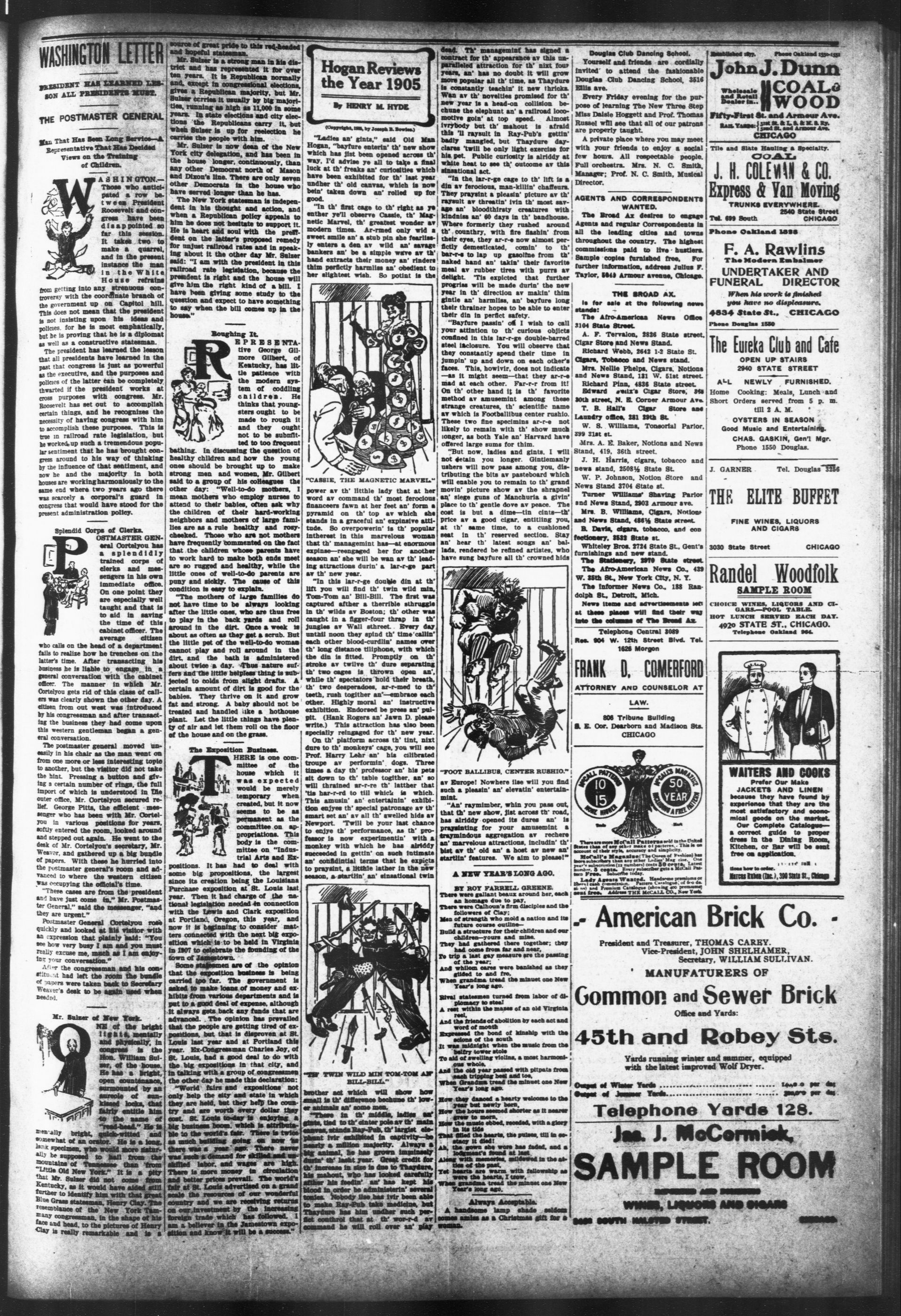
"CASSIE, THE MAGNETIC MARVEL"
power av th' littie lady that at her
word av command th' most ferocious
financeers fawn at her feet an' form a
pyramid on th' top av which she
stands in a graceful an' expinsive attitude.
So powerinin' is th' popular
intherest in this marvelous woman
that th' managemint has—at enormous
expinse—reengaged her for another
season an' she will be wan av th' leading
attractions durin' a lar-r-ge part
av th' new year.
"In this lar-r-ge double din at th' lift you will find th' twin wild min, Tom-Tom an' Bill-Bill. The first was captured after a terrible struggle in th' wilds av Boston; th' other was caught in a finger-four thrap in th' jungles av Wall street. Every day until noon they spind th' time' callin' each other blood-curdilla names over th' long distance tiliphone, with which the din is fitted. Promptly on th' stroke av twelve th' dure separating th' two cages is thrown open an', while th' spectators' hold their breath, th' two desperadoes, ar-r-med to th' teeth, rush together an—embrace each other. Highly moral an' instructive exhibition. Endorsed be press an' pulpit. (Hank Rogers an' Jaw D. please write.) This attraction has also been specially reingaged for th' new year.
On th' platform across th' tint, nikt
dure to th' monkeys' cage, you will see
Prof. Harry Lehr an' his cilibrated
troupe av performin' dogs. Three
times a day th' professor an' his pets
sit down to th' table together, an' so
will thrained an-r-re th' lathter that
'tis har-r-rd to till which is which.
This amusin' an' entertainin' exhibition
enjoys th' special patronage av th'
smart set an' av all th' swelled hids av
Newport. Twill be your last chance
to enjee th' performance, as th' professor
is now experimentin' with a
monkey with which he has alriddy
succeeded in gettin' on such intimate
an' confidential terms that he expicts
to praysin' a little lathter in the new
season, a startin' an' insational twin
A
"There in th' middle, ladies ar' ginte, to th' tinter pole vole ar' th' main canne, stands Ray-Pub, th' largest elephant ivir exhibited in captivity—be nearly a million major. Always a big animal, he has grown imminely dunse th' last year. Great credit for th' increase in size in due to Thaydure, his mahout, who has looked carefully after his feedin' ar' has kept his blood in order he administerin' several tonies. Nobody else has ivir been able to make Ray-Pub take medicine, but Thaydure has him under such parlet control that at th' wor-r-d ar' command he will roll over ar' play
dead. Th' management has signed a contract for th' appearance av this unparalleled attraction for th' nixt four years, an' has no doubt it will grow more popular all th' time, as Thaydure is constantly teachin' it new thricka. Wan av th' novelties promised for th' new year is a head-on collision bechune the elephant an' a railroad locomotive goln' at top speed. Almost ivrybody but th' mahout is afraid this 'll raysuit in Ray-Pub's gettin' badly mangled, but Thaydure day-clares 'twill be only light exercise for his pet. Public curiosity is alriddy at white heat to see th' outcome av this sinusal act.
"In the lar-r-ge cage to th' lift is a din av ferocious, man-kilin' chafeura. They praysint a pleasin' picture av th' raysuit av threatin' ivin th' most savage an' bloodthirsty creatures with kindniss an' 60 days in th' bandhouse. Where formerly they rushed around th' country, with fire flashin' from their eyes, they ar-r-e now almost perfectly demesticated, comin' to th' bar-r-s to lap up gasoline from th' naked hand an' takin' their favorite meal av rubber tires with purrs av delight. 'Tis explicted that further progress will be made durin' the new year in th' direction av makin' thim gentle an' harmless, an' harfure long their trainer hopes to be able to enter their din in perfect safety.
"Bayfey passin' off I wish to call your attention to th' curious objects confined in this lar-r-ge double-barred steel flaschure. You will observe that they constantly spend their time in jumpin' up and down on each other's faces. This, howliv, does not indicate—as it might seem—that they ar-r-e mad at each other. Far-r-r from it! On th' other hand it is th' favorite method av amusemint among these strange creatures, th' scientific name av which is Footballibus center rushio. These two fine specimens ar-r-e not likely to remain with th' show much longer, as both Yale an Harvard have offered large sums for thim.
"But now, ladies and gints. I will not detain you longer. Gintiemlyan ushers will now pass among you, distributing the bits av pasteboard which will enable you to remain to th' grand movin' picture show av the shrapnel an' siege guns of Manchuria a givin' place to th' gentle dove av peace. The cost is but a dime—tin cints—th' price av a good cigar, entitling you, at th' same time, to a cushioned seat in th' reserved section. Stay an' hear th' latest songs an' ballads, rendered be refined artists, who have sung bayfure all th' crowned hides
A
"FOOT BALLIBUS, CENTER RUSHIO."
**av Europe! Nowhere else will you find such a pleasin' an' elevatin' entertainmint.**
"An' raymmber, whin you pass out, that th' new show, jist across th' road, has alriddy opened its dures an' is praysinting for your amusemint a traymindous aggregation av rechere an' marvelous attractions, includin' th' bist av th' old an' a host av new an' startlin' features. We aim to please!"
A NEW YEAR'S LONG AGO.
BY ROY FARRELL GREENE.
There were gallant beaux around her, each wearing due to pay.
There were Calhoun's firm disciples and the followers of Clay;
Men of strength who mold a nation and its future course outline—
Build a structure for their children and our children—yours and mine.
They had gathered there together; they had come from far and near.
To trip a last gay measure are the passing of the year;
And whilom cares were banished as they gilded to and fro.
When grandma tread the minuet one New Year's long ago.
Rival statesmen turned from labor of diplomacy to steal
A rest within the masses of an old Virginia reel.
And the friends of abolition by each act and word of mouth
Expressed the bond of kinship with the saints of the south
It was midnight when the music from the fiery choir came to aid of swelling violins, a most harmonious whole.
And the old year passed with pitpats from each tripping beat and soot.
When Grandma tread the minuet one New Year's long ago.
How they danced a hearty welcome to the year but newly born.
How the hours seemed shorter as it nearer to midnight.
How the music obbed, recorded, with a glory in its tide.
That dilled the hearts, the pulses, till in sentiency it died!
Ah, the gown she wore has faded, and a lodgerman's found at last.
Along with memories, mildwed in the attics of the past.
Yet hearts are warm with fellowship as we were the hearts, I tawd.
When grandma tread the minuet one New Year's long ago.
Always Acceptable.
A handsome lamp shade seldom comes amiss as a Christmas gift for a
American Brick Co.
Yards running winter and summer, equipped with the latest improved Wolf Dryer.
Douglas Club Dancing School.
Yourself and friends are cordially invited to attend the fashionable Douglas Club Dancing School, 3516 Ellis ave.
Every Friday evening for the purpose of learning The New Three Step Miss Daisie Hoggett and Prof. Thomas Russel will see that all of our patrons are properly taught.
A private place where you may meet with your friends to enjoy a social few hours. All respectable people.
Full orchestra. Mrs. N. C. Smith, Manager; Prof. N. C. Smith, Musical Director.
AGENTS AND CORRESPONDENTS WANTED.
The Broad Ax desires to engage Agents and regular Correspondents in all the leading cities and towns throughout the country. The highest commissions paid to live hustlers. Sample copies furnished free. For further information, address Julius F. Taylor, 5043 Armour avenue, Chicago.
THE BROAD AX.
The Afro-American News Office
3104 State Street.
A. F. Tervalon, 2826 State street,
Cigar Store and News Stand.
Richard Webb, 2642 1-2 State St.
Cigars, Tobacco and News stand.
Mrs. Nellie Phelps, Cigars, Notions
and News Stand, 131 W. 51st street.
Richard Pinn, 4836 State street.
W. S. Williams, Tonsorial Parlor,
399 31st st.
Mrs. A. E. Baker, Notions and News
Stand, 419, 36th street.
J. H. Harris, cigars, tobacco and
news stand, 2508 $ \frac{1}{2} $ State St.
W. P. Johnson, Notion Store and
News Stand 3704 State st.
Turner Williams' Shaving Parlor
and News Stand, 2903 Armour ave.
Whitley Bros. 2724 State St., Gent's furnishings and new stand.
The Stationery, 2970 State street
The Afro-American News Co., 438
W. 35th St., New York City, N. Y.
The Informer News Co., 188 Randolph St., Detroit, Mich.
News items and advertisements left at these places will find their way into the columns of The Brand Ax.
Telephone Central 3089
Res. 904 W. 12th Street Blvd. Tel.
1628 Morgon
FRANK D. COMERFORD
ATTORNEY AND COUNSELOR AT
806 Tribune Building
S. E. Cor. Dearborn and Madison Sta.
CHICAGO
MCCALL PATTERN
10
15
MORE HOURS
MCCALL MAGAZINE
50
YEAR
MOVING A FREE PATTERN
There are more McCall Patterns sold in the United
States today of all kinds of patterns. This is on
account of their style, accuracy and simplicity.
McCall's Magazine (The Queen of Fashion) has more subscribers than any other Ladies' Magazine. One year's subscription (22 numbers) costs $89. You can subscribe to McCall's Magazine @ a McCall Pattern Free. Subscribe today.
Lady Agents Wanted. Handsome premiums or
liberal cash commission. Fare and wages (6 o'clock
and 10 o'clock) and Premium Catalogue (shopping go premium)
sent free. Address THE McCALL CO., New York.
American
President and Treasurer, THE
Vice-President, J
Secretra
MANUFAT
Common and
Office an
Fifty-First St. and Armour Ave.
Rail. Yard. 191 St. & L. B. & N. & Rv.
Sand St. and Armour Ave.
CHICAGO
Tile and Slate Hauling a Specialty.
COAL
J. H. COLEMAN & CO.
Express & Van Moving
TRUNKS EVERYWHERE.
2540 State Street
Tel. 699 South
CHICAGO
Phone Oakland 1828
F. A. Rawlins
The Modern Embalmer
UNDERTAKER AND
FUNERAL DIRECTOR
When his work is finished
you have no displeasure.
4834 State St., CHICAGO
Phone Douglas 1550
The Eureka Club and Cafe
OPEN UP STAIRS
2940 STATE STREET
ALL NEWLY FURNISHED.
Home Cooking: Meals, Lunch and
Short Orders served from 5 p. m.
till 2 A. M.
OYSTERS IN SEASON
Good Music and Entertaining.
CHAS. GASKIN, Gen'l Mgr.
Phone 1550 Douglas.
J. GARNER Tel. Douglas 3256
THE ELITE BUFFET
FINE WINES, LIQUORS
AND CIGARS
3030 State Street CHICAGO
Randel Woodfolk
SAMPLE ROOM
CHOICE WINES, LIQUORS AND CIGARS—POOL TABLE.
HOT LUNCH SERVED EACH DAY.
4920 STATE ST., CHICAGO.
Telephone Oakland 964.
COOK
JACKETS AND LINEN
because they have found by
experience that they are the
most satisfactory and economical goods on the market.
Our Complete Catalogues—a correct guide to proper dress in the Dining Room,
Kitchen, or Bar will be sent free on application.
tions to how order.
Merrick House (Inc.), 390 State St., Chicago
Brick Co. -
THOMAS CAREY.
JOHN SHELHAMER,
BY, WILLIAM SULLIVAN.
URERS OF
Sewor Brick
Leppy's Christmas Carol
By MYRTLE KOON CHERRYMAN
"God rest ye,' merry gentlemen,
Let nothing you dismay."
T was the voice of Leppy Sanders, errand boy for Hardman & Son, who was practicing a carol for the choirboys' Christmas festival at St. Luke's. Leppy had the sweetest of voices, the most restless of bodies, and the most freckled of faces. The first had won him a place in St. Luke's vested choir; the secbim from learning us
I was the voice of Leppy Sanders, errand boy for Hardman & Son, who was practicing a carol for the choirboys' Christmas festival at St. Luke's. Leppy had the sweetest of voices, the most restless of bodies, and the most freckled of faces. The first had won him a place in St. Luke's vested choir; the second had kept him from learning his carol until he was in danger of being discharged by the long-suffering choir master; and the third had won him the name of Leppy, which is the diminutive of "Leopard," and was given him by his friends because of the spots which he could not change—those enduring freckles.
As he opened the door of Hardman & Son's office, and sang, "God Rest Ye, Merry Gentlemen," the sense of humor which sometimes accompanies freckles brought a whimsical look to his face, for the idea of calling Hardman & Son "merry gentlemen" was distinctly incongruous.
Hardman was rubbing his eyes and saying to himself: "To be blind—blind! To be shut in darkness, and one's life work not half done. I shall never get the courage to see an oculist and hear that doom pronounced." Son, at his desk, was looking fixedly out of the window, and saying to himself: "To be dishonored! To have gotten the firm's affairs into such a muddle that there's no clear way out unless I throw myself on father's mercy, and I shall never get the courage to tell him."
"Let nothing you dismay," sang Leppy, stumbling on, bby fashion, toward the rear office.
Hardman suddenly looked up, and with unusual interest in his voice, said:
"Come back here, Leppy. Can you sing the whole of that?"
"Don't know if I can, Mr. Hardman, but I'm tryin' to get it,'cause if I don't have it straight by to-night, I'll be discharged from the choir. It's the last rehearsal, you see. I don't want to get bounced, because I get a quarter a week, and that helps out."
"Well, I'll give you a quarter now, if you'll sing it through for me. I used to sing that thing myself when I was a kid, and—"
Hardman had stopped speaking, and seemed to have forgotten all about Leppy, who hardly knew what to do, until Son nodded to him, and said, kindly:
"Sing it, Lep, if you can."
Then Leppy began, and—marvel of marvels—he sang it perfectly from beginning to end. What would the choirmaster have said if he could have heard it? Leppy was much impressed with his achievement, and when he stepped, his look of mingled pride and astonishment would have been funny, if there had been anybody to see it. Hardman partially roused himself and handed the boy a silver dollar, then turned back to his desk without a word.
"Shall--shall I get it changed, Mr. Hardman?"
There was no answer from Hardman, and Son, coming once more to the rescue, said:
"No, Leppy—it's all right. Run along."
"Gee!' exclaimed the boy. And then, without thinking to say "thank you," so appalled was he by this sudden affluence—he went out of the office, and soon his silvery tones could be heard echoing down the wide hall:
"God rest ye, merry gentleman, Let nothing you dismay."
Son rose suddenly from his chair, and laid his hand on Hardman's shoulder. "Father," he said, "I have something to tell you."
"Son," said Hardman, unsteadily but bravely, "I have something to tell you."
It doesn't matter who began first, or how much each one hesitated and looked out of the window to hide the embarrassment of a man's confidence to a man. At last, both stories were told, somehow, and when Hardman and Son started out to lunch together, they looked several degrees more like "merry gentlemen" than they had two hours before. Hardman was saying: "We'll straighten that out in a week's time, son. You did right to tell me now. And in the meantime—"
"In the meantime, dad, we'll see that ooohit together, and I know your sight can be saved."
And so it was—not only the physical sight, but that inner sense which makes us see the struggles of those we love and understand and help them. At that moment, there was only the hope of this in Hardman's eyes, but that was enough to make the world already brighter, and when they encountered Loppy near the street door Hardman said: "Oh, by the way, Loppy; I forgot to give you that quarter—here it is," and to the boy's astonishment, another silver coin was slipped into his hand.
This time Loppy fairly choked with amusement; but as he scampered away, he found voice to trill out again, in a veritable paon of joy:
"God rest my merry gentleman. Let nothing you dismay."
And nothing did dismay them!
19
turned squaw.
She who was Grace Wetherbee, of New York, is now an Arapahoe squaw. Carrying her pappoose strapped to her back, wearing a brilliant parti-colored shawl and moccasins, she dwells on the Shoshone Indian reservation, near Fort Washakie, Wyoming. Six years ago Miss Wetherbee came from her home in New York to visit the family of the post-trader there. Miss Wetherbee met Coolidge, a full-blooded Indian, who was conducting a mission. They fell in love at sight, were married, and have lived happily.
The Oyster Fork.
A helpful idea in table setting when there are to be a number of elaborate courses, necessitating various forks and knives, is to have the small oyster fork laid across the others ready for the first course. This precludes the possibility of any mistake either through ignorance of the intricacies of modish serving or absent-mindedness. Then, as each succeeding course is brought on, the deft fingers of the maid or discreet butler can give a slight tilt to the correct fork to use for that particular dish.
Municipal Telescope.
Cardiff is the first place to cater for its amateur astronomers by the provision of a municipal telescope. This instrument, which has just been dedicated to the public use, is a fine 12-inch equatorial reflector and was bequeathed to the citizens by the late Dr. Franklen Evans. The city council has borne the expenses incidental to the suitable disposal of the gift, which is erected in an observatory outside the city.
Will Bar Japs.
Mr. Seddon, the premier of New Zealand, announced in a speech recently that Japanese would not be allowed to come to New Zealand and that the colony would refuse to be dictated to in the matter. This is in reference to a circular from the British colonial office, addressed to the colonies and demanding the repeal of laws that are repugnant to the feelings of nations with which Great Britain is at peace.
Trying Net to Be Spoiled
Tailor--You have recently inherited a nice jump of money from your uncle; why don't you pay me?
Customer--I hate all outward show. I don't want it to be said that my newly-acquired wealth has caused a departure from my former simple habits.—Stray Stories.
Farm Poultry Instead.
One result of the work of quail hunters has been to increase the depredations of coyotes in western Oklahoma. Rabbits and quail form their regular food supply and since these are being thinned out by hunters they are beginning to raid the unprotected farm poultry yards.
His Conquering Career.
"I wonder what has become of Smashum, who used to play center in the college eleven years ago. I remember him as one of the greatest ground gainers I ever saw." "He is yet. He went into the real estate business, and now he owns a whole suburb."—Chicago Tribune.
Wonderful Machinery
The smallest holes pierced by modern machinery are one-thousandth of an inch in diameter. They are bored through sapphires, rubles and diamonds by a machine which makes 22,000 revolutions a minute.
Guardians of the Pope.
The pope's Swiss guard will celebrate the fourth centenary of their institute in January next. Their history, which is interesting, is to be told in a special volume about to be published by Prof. Durrer.
Futile.
Fortune Teller (examining her palm)
—Beware of a strikingly handsome, tall, dark-haired young man.
Fair Customer—It's too late for that, I've married him—Chicago Tribune.
Gullible Farmers.
Thousands of farmers answered the advertisement of a man who offered to sell "a recipe for making a pound of butter from a pint of milk and a teaspoonful of our preparation."
Dust Settler.
Akonia is the name of a substance manufactured in England which, dissolved in the water with which the streets are sprinkled, is said to prevent dust from rising.
Mean Thing to Say.
Ida—George is so poetical. He says my ears are like shells.
Irene—Did he say whether he meant coconut or oyster shells?—Stray Stories.
Russian immigrants to the number of 23,440 arrived in London during the first nine months of this year. Of these 19,156 remained in the city.
Big Charity Fund.
London's lord mayors have during the past decade collected more than £20,000,000 for charitable and benevolent purposes.
The Ingrata.
He has little gratitude who seeks only to gratify himself.
No Admirera.
The braggart is only popular with himself.
not (notice) save both places for his race. Mr. Hewlett has made a good living at law for years. Mr. Terrell never succeeded at law but has been a school teacher, etc., etc. This relation is brought out by the witticism handed out as a consolation to Mr. Hewlett that he can get along without the justice-ship, but hardly so with his rival. So here is a case which shows the ethics that obtain under Booker Washington's political "bosship."
All this is true and should be said. We might have spared Mr. Terrell, however, if his friends had not been so impudent and dishonest.—The Guardian, Boston, Mass.
The above able article, unmistakably indicates that President Roosevelt and Booker T. Washington only favor that class of Negroes for office who are willing to play the flunky at all times and to throw cold water on every manly Negro who dares to assert or to contend for his manhood rights. This is true in the case of Judge S. Laing Williams, who favors only industrial education for the Negro and strongly intimates that he is not yet ready for self government.
Holding such views as to the inferiority of the Negro and without any special fitness or training on his part, for the position, President Roosevelt favors him above all the other candidates for Registry of the Treasury.
Getting Used to It.
Sometimes one is almost tempted to wonder whether the world is really getting better or whether he is merely, with the passage of years, getting accustomed to it.—Puck.
Which Is Worse?
It is becoming a question to the child which looks worse, father's bald head or the little door knob of hair on mother's head. - Atchison Globe.
Postcards of Peat.
Postcards made of Irish peat from the bog of Allen formed one of the features of the Irish exhibition in London.
Not Likely.
No vehicle which moves on wheels will, in the opinion of many scientists, attain the speed of 200 miles an hour.
Keeps Him to Herself.
A young man is ace high with a girl when she refuses to introduce him to a girl who is prettier than she is.
Colors from Tar.
About $5,000,000 worth of tar colors are sent from Germany to the United States every year.
W.Kemper Harreld
TEACHER OF
VIOLIN
6626 CHAMPLAIN AVE.
Tel. Went. 2821.
Racards of Peat.
made of Irish peat from
men formed one of the fea-
rish exhibition in Lon-
Not Likely.
which moves on wheels
union of many scientists,
need of 200 miles an hour.
Him to Herself.
is ace high with a girl
uses to introduce him to
prettier than she is.
Racors from Tar.
1,000 worth of tar colors
Germany to the United
Wear.
Super Harreld
TEACHER OF
COLIN
HAMPLAIN AVE.
Went. 2821.
SHULTZ, M. D.
MAN AND SURGEON.
90 State Street
M.
Attorney 6 P. M. CHICAO
J. GRAY L.
Attorney s
Suite 611 167 Dearborn
Chicago
Tel. Cent. 5768.
Captain 8th I. N.
Regimental Quartermaster
JAMES S. N.
LAWYER
Residence
3633 WABAS
Tel. 634 D
SUITE 611, 167 DEAH
Tel. 5768 C
A. E. Whiteley
Whiteley
IMPORTED and DOMIN
GENT'S FURN
Fine Laundry Office
2724
J. W. Hagan, Mgr.
Hall's L
2975-77 STATE
Phone, Dough
CHICAO
A. B. SCHULTZ, M. D.
PHYSICIAN AND SURGEON.
2719 State Street
Hours: 9 to 12 A. M.
3 to 5 and after 6 P. M. . CHICAO
All that is best in whiskey
you will find in
O
Unde
R
Old Underoof Rye
Phone 194 South
A. D. GASH
Attorney at Law.
84-86 La Salle Street, Chicago
Suite 615, p. 619.
Telephone Main 3077.
JOHN E. OWENS
ATTORNEY & COUNSELOR
AT LAW
Telephone Yards 6016.
John Fitzgerald
JUSTICE OF THE PEACE
4737 SOUTH HALSTED STREET.
Residence
113 W. Garfield Boul.
CHICAGO
J. GRAY LUCAS
Attorney at Law
Suite 614 167 Dearborn St., Cor. Monroe.
Chicago.
Tel. Cent. 5768. Res. Tel. Went. 4892.
Captain 8th I. N. G.
Regimental Quartermaster
JAMES S. NELSON
LAWYER
Residence
3632 WABASH AVE.
Tel. 6342 Douglas
SUITE 611, 167 DEARBORN STREET
Tel. 5768 Central
A. E. Whiteley C. E. Whiteley
Whiteley Bros.
IMPORTED and DOMESTIC CIGARS
GENT'S FURNISHINGS
Fine Laundry Office in Connection.
2724 STATE STREET
J. W. Hagan, Mgr.
CHICAGO.
Hall's Laundry
2975-77 STATE ST.
Phone, Douglas 1335
CHICAGO
eroof
HILLMAN'S STATE & WASHINGTON STS. Chicago's Most Modern, Most Complete and Most Convenient Department Store
Jacob Feinberg
81st and State Streets
Bradley
Telephone Yards 693
J. M. Fields
BRADLEY & FIELDS
REAL ESTATE, LOANS
AND INSURANCE
Theodore C. Mayer
JUSTICE OF THE PEACE
Mortgages, Deeds, Notes and Legal Documents Drawn and Acknowledged. Room 22, 27 North Clark Street.
C. H. Smiley, Pres. and Trena. J. Hockley Smiley, Sec'y.
Smiley
Caterer
76 E. TWENTY-SECOND STREET,
Two Phones, South 584.
CHICAGO.
SANDY W. TRICE & COMPANY
INCORPORATED UNDER THE LAWS OFILLINOIS. 2918 STATE STREET, CHICAGO.
Now is your chance. A joint stock company.
The Company will open a Department Store in the near future at 2918
State St. Namely Sandy W. Trice & Company. The company will carry a
complete line of Men and Womens Furnishing Goods Shoes, Hats and Notions.
Shares ten dollars. A limited number of shares are on sale at the
Company's Sec'y. office.
DIRECTORS:
Sandy W. Trice, Pres.
Milton J. Trice, Vice Pres.
A. T. Henry, 2nd Vice Pres.
R. R. Wright, 3rd Vice Pres.
Dee Parker, Trustee.
A. J. Carey, D. D., Treas.
Milton Forest Ave.
A. W. Williams, M. D.
Secy Office 2840 State
St. Phone South 1828
ILLINOIS BRICK CO.
M. JUNK, Proprietor JOS. P. JUNK, Manager 3700-3710 South Halsted Street and 897 to 929 Thirtyseventh Street CHICAGO