The Broad Ax
Saturday, January 13, 1906
Chicago, Illinois
Page text (machine-generated)
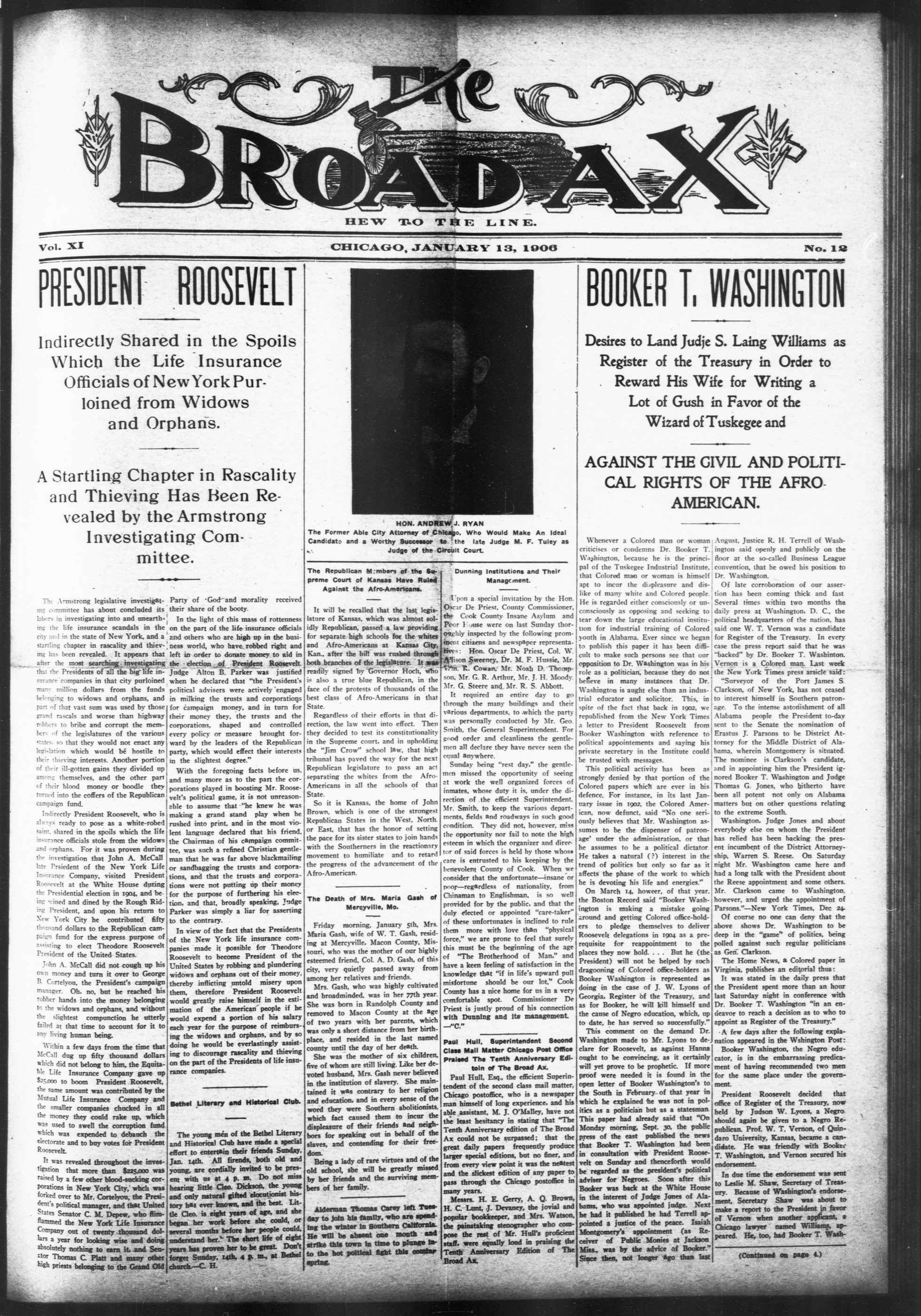
PRESIDENT ROOSEVELT
Indirectly Shared in the Spoils Which the Life Insurance Officials of NewYork Purloined from Widows and Orphans.
A Startling Chapter in Rascality and Thieving Has Been Revealed by the Armstrong Investigating Committee.
Vol. XI
PRESIDENT
Indirectly Share Which the L Officials of N loined from and Or
A Startling Chap and Thieving vealed by the Investigator mit
The Armstrong legislative investigating committee has about concluded its labors in investigating into and unearthing the life insurance scandals in the city and in the state of New York, and a startling chapter in rascality and thieving has been revealed. It appears that after the most searching investigating that the Presidents of all the big life insurance companies in that city purloined many million dollars from the funds belonging to widows and orphans, and part of that vast sum was used by those grand rascals and worse than highway robbers to bribe and corrupt the members of the legislatures of the various states, so that they would not enact any legislation which would be hostile to their thieving interests. Another portion of their ill-gotten gains they divided up among themselves, and the other part of their blood money or boodle they turned into the coffers of the Republican campaign fund.
Indirectly President Roosevelt, who is always ready to pose as a white-robed saint, shared in the spoils which the life insurance officials stole from the widows and orphans. For it was proven during the investigation that John A. McCall late President of the New York Life Insurance Company, visited President Roosevelt at the White House during the Presidential election in 1904, and being wined and dined by the Rough Riding President, and upon his return to New York City he contributed fifty thousand dollars to the Republican campaign fund for the express purpose of assisting to elect Theodore Roosevelt President of the United States.
John A. McCall did not cough up his own money and turn it over to George B. Cortelyou, the President's campaign manager. Oh, no, but he reached his robber hands into the money belonging to the widows and orphans, and without the slightest compunction he utterly failed at that time to account for it to any living human being.
Within a few days from the time that McCall dug up fifty thousand dollars which did not belong to him, the Equitable Life Insurance Company gave up $25,000 to boom President Roosevelt, the same amount was contributed by the Mutual Life Insurance Company and the smaller companies chucked in all the money they could rake up, which was used to swell the corruption fund which was expended to debauch the electorate and to buy votes for President Roosevelt. It was revealed throughout the investigation that more than $225,000 was raised by a few other blood-sucking corporations in New York City, which was forked over to Mr. Cortelyou, the President's political manager, and that United States Senator C. M. Depew, who flim-flammed the New York Life Insurance Company out of twenty thousand dollars a year for looking wise and doing absolutely nothing to earn it. and Senator Thomas C. Platt and many other high priests belonging to the Grand Old
Party of God and morality received their share of the booty.
In the light of this mass of rottenness on the part of the life insurance officials and others who are high up in the business world, who have robbed right and left in order to donate money to aid in the election of President Roosevelt. Judge Alton B. Parker was justified when he declared that "the President's political advisers were actively engaged in milking the trusts and corporations for campaign money, and in turn for their money they, the trusts and the corporations, shaped and controlled every policy or measure brought forward by the leaders of the Republican party, which would effect their interests in the slightest degree."
With the foregoing facts before us, and many more as to the part the corporations played in boosting Mr. Roosevelt's political game, it is not unreasonable to assume that "he knew he was making a grand stand play when he rushed into print, and in the most violent language declared that his friend, the Chairman of his campaign committee, was such a refined Christian gentleman that he was far above blackmailing or sandbagging the trusts and corporations, and that the trusts and corporations were not putting up their money for the purpose of furthering his election, and that, broadly speaking, Judge Parker was simply a liar for asserting to the contrary.
In view of the fact that the Presidents of the New York life insurance companies made it possible for Theodore Roosevelt to become President of the United States by robbing and plundering widows and orphans out of their money, thereby inflicting untold misery upon them, therefore President Roosevelt would greatly raise himself in the estimation of the American people if he would expend a portion of his salary each year for the purpose of reimbursing the widows and orphans, and by so doing he would be everlastingly assisting to discourage rascality and thieving on the part of the Presidents of life insurance companies.
Bethel Literary and Historical Club.
The young men of the Bethel Literary and Historical Club have made a special effort to entertain their friends Sunday, Jan. 14th. All firends, both old and young, are cordially invited to be present with us at 4 p. m. Do not miss hearing little Cleo. Dickson, the young and only natural gift elocutionist history has ever known, and the best. Little Cleo. is eight years of age, and she began her work before she could, or several months before her people could, understand her. The short life of eight years has proven her to be great. Don't forget Sunday, 14th, 4 p. m., at Bethel church—C. H.
HEW TO THE LINE.
```markdown
```
The Former Able City Attorney of Chicago, Who Would Make An Ideal Candidate and a Worthy Successor to the late Judge M. F. Tuley as Judge of the Circuit Court.
The Republican M:mbers of the Supreme Court of Kansas Have Ruled Against the Afro-Americans.
It will be recalled that the last legislature of Kansas, which was almost solidly Republican, passed a law providing for separate high schools for the whites and Afro-Americans at Kansas City, Kan., after the bill was rushed through both branches of the legislature. It was readily signed by Governor Hoch, who is also a true blue Republican, in the face of the protests of thousands of the best class of Afro-Americans in that State.
Regardless of their efforts in that direction, the law went into effect. Then they decided to test its constitutionality in the Supreme court, and in upholding the "Jim Crow" school law, that high tribunal has paved the way for the next Republican legislature to pass an act separating the whites from the Afro-Americans in all the schools of that State.
Dunning Institutions and Their Management.
Upon a special invitation by the Hon. Oscar De Priest, County Commissioner the Cook County Insane Asylum and Poor House were on last Sunday thoroughly inspected by the following prominent citizens and newspaper representatives: Hon. Oscar De Priest, Col. W. Allison Sweeney, Dr. M. F. Hussie, M. Vinn. R. Cowan, Mr. Noah D. Thompson, Mr. G. R. Arthur, Mr. J. H. Mood, Mr. G. Steere and Mr. R. S. Abbott.
It required an entire day to go through the many buildings and the various departments, to which the part was personally conducted by Mr. Ge Smith, the General Superintendent. For good order and cleanliness the gentlemen all declare they have never seen the equal anywhere.
Sunday being "rest day," the gentlemen missed the opportunity of seeing at work the well organized forces of inmates, whose duty it is, under the d
So it is Kansas, the home of John Brown, which is one of the strongest Republican States in the West. North or East, that has the honor of setting the pace for its sister states to join hands with the Southerners in the reactionary movement to humiliate and to retard the progress of the advancement of the Afro-American.
The Death of Mrs. Maria Gash of Mercyville, Mo.
Friday morning, January 5th, Mrs. Maria Gash, wife of W. T. Gash, residing at Mercyville, Macon County, Missouri, who was the mother of our highly esteemed friend, Col. A. D. Gash, of this city, very quietly passed away from among her relatives and friends.
Mrs. Gash, who was highly cultivated and broadminded, was in her 77th year. She was born in Randolph County and removed to Macon County at the age of two years with her parents, which was only a short distance from her birthplace, and resided in the last named county until the day of her death.
She was the mother of six children, five of whom are still living. Like her devoted husband, Mrs. Gash never believed in the institution of slavery. She maintained it was contrary to her religion and education, and in every sense of the word they were Southern abolitionists, which fact caused them to incur the displeasure of their friends and neighbors for speaking out in behalf of the slaves, and contending for their freedom.
Being a lady of rare virtues and of the old school, she will be greatly missed by her friends and the surviving members of her family.
Alderman Thomas Carey left Tuesday to join his family, who are spending the winter in Southern California. He will be absent one month and strike this town in time to plunge into the hot political fight this coming spring.
Upon a special invitation by the Hon. Oscar De Priest, County Commissioner, the Cook County Insane Asylum and Poor House were on last Sunday thoroughly inspected by the following prominent citizens and newspaper representatives: Hon. Oscar De Priest, Col. W. Allison Sweeney, Dr. M. F. Hussie, Mr. Win. R. Cowan, Mr. Noah D. Thompson, Mr. G. R. Arthur, Mr. J. H. Moody, Mr. G. Steere and Mr. R. S. Abbott.
It required an entire day to go through the many buildings and their various departments, to which the party was personally conducted by Mr. Geo. Smith, the General Superintendent. For good order and cleanliness the gentlemen all declare they have never seen the coul anywhere.
Sunday being "rest day," the gentlemen missed the opportunity of seeing at work the well organized forces of inmates, whose duty it is, under the direction of the efficient Superintendent, Mr. Smith, to keep the various departments, fields and roadways in such good condition. They did not, however, miss the opportunity nor fail to note the high esteem in which the organizer and director of said forces is held by those whose care is entrusted to his keeping by the benevolent County of Cook. When we consider that the unfortunate—insane or poor—regardless of nationality, from Chinaman to Englishman, is so well provided for by the public, and that the duly elected or appointed "care-taker" of these unfortunates is inclined to rule them more with love than "physical force," we are prone to feel that surely this must be the beginning of the age of "The Brotherhood of Man," and have a keen feeling of satisfaction in the knowledge that "if in life's upward pull misfortune should be our lot," Cook County has a nice home for us in a very comfortable spot. Commissioner De Priest is justly proud of his connection with Dunning and its management.—"C."
Paul Hull, Superintendent Second Class Mail Matter Chicago Post Office Praised The Tenth Anniversary Editioin of The Broad Ax.
Paul Hull, Esq., the efficient Superintendent of the second class mail matter, Chicago postoffice, who is a newspaper man himself of long experience, and his able assistant, M. J. O'Malley, have not the least hesitancy in stating that "The Tenth Anniversary edition of The Broad Ax could not be surpassed; that the great daily papers frequently produce larger special editions, but no finer, and from every view point it was the nestest and the slickest edition of any paper to pass through the Chicago postoffice in many years.
Messrs. H. E. Gerry, A. Q. Brown, H. C. Lunt, J. Devaney, the jovial and popular bookkeeper, and Mrs. Watson, the painstaking stenographer who compose the rest of Mr. Hull's proficient staff, were equally loud in praising the Tenth Anniversary Edition of The Broad Ax.
BOOKER T. WASHINGTON
Desires to Land Judje S. Laing Williams as Register of the Treasury in Order to Reward His Wife for Writing a Lot of Gush in Favor of the Wizard of Tuskegee and
AGAINST THE GIVIL AND POLITICAL RIGHTS OF THE AFRO AMERICAN.
Whenever a Colored man or woman criticises or condemns Dr. Booker T. Washington, because he is the principal of the Tuskegee Industrial Institute, that Colored man or woman is himself apt to incur the displeasure and dislike of many white and Colored people. He is regarded either consciously or unconsciously as opposing and seeking to tear down the large educational institution for industrial training of Colored youth in Alabama. Ever since we began to publish this paper it has been difficult to make such persons see that our opposition to Dr. Washington was in his role as a politician, because they do not believe in many instances that Dr. Washington is aught else than an industrial educator and solicitor. This, in spite of the fact that back in 1902, we republished from the New York Times a letter to President Roosevelt from Booker Washington with reference to political appointments and saying his private secretary in the Institute could be trusted with messages.
This political activity has been as strongly denied by that portion of the Colored papers which are ever in his defence. For instance, in its last January issue in 1902, the Colored American, now defunct, said "No one seriously believes that Mr. Washington assumes to be the dispenser of patronage' under the administration, or that he assumes to be a political dictator. He takes a natural (?) interest in the trend of politics but only so far as it affects the phase of the work to which he is devoting his life and energies." On March 14, however, of that year, the Boston Record said "Booker Washington is making a mistake going around and getting Colored office-holders to pledge themselves to deliver Roosevelt delegations in 1904 as a prerequisite for reappointment to the places they now hold. . . . But he (the President) will not be helped by such dragooning of Colored office-holders as Booker Washington is represented as doing in the case of J. W. Lyons of Georgia, Register of the Treasury, and as for Booker, he will kill himself and the cause of Negro education, which, up to date, he has served so successfully."
This comment on the demand Dr. Washington made to Mr. Lyons to declare for Roosevelt, as against Hanna ought to be convincing, as it certainly will yet prove to be prophetic. If more proof were needed it is found in the open letter of Booker Washington's to the South in February of that year in which he explained he was not in politics as a politician but as a statesman. This paper had already said that "On Monday morning, Sept. 30, the public press of the east published the news that Booker T. Washington had been in consultation with President Roosevelt on Sunday and thenceforth would be regarded as the president's political adviser for Negroes. After soon this Booker was back at the White House in the interest of Judge Jones of Alabama, who was appointed judge. Next he had it published he had Terrell appointed a justice of the peace. Isaiah Montgomery's appointment (as Receiver of Public Monies at Jackson Miss, was by the advice of Booker." Since then, not longer ago than last
No.12
WASHINGTON
S. Laing Williams as treasury in Order to life for Writing a in Favor of the Tuskegee and
CIVIL AND POLITI-OF THE AFRO- RICAN.
August, Justice R. H. Terrell of Washington said openly and publicly on the floor at the so-called Business League convention, that he owed his position to Dr. Washington.
Of late corroboration of our assertion has been coming thick and fast. Several times within two months the daily press at Washington, D. C., the political headquarters of the nation, has said one W. T. Vernon was a candidate for Register of the Treasury. In every case the press report said that he was "backed" by Dr. Booker T. Washinton. Vernon is a Colored man. Last week the New York Times press article said: "Surveyor of the Port James S. Clarkson, of New York, has not ceased to interest himself in Southern patronage. To the intense astonishment of all Alabama people the President to-day sent to the Senate the nomination of Erastus J. Parsons to be District Attorney for the Middle District of Alabama, wherein Montgomery is situated. The nominee is Clarkson's candidate, and in appointing him the President ignored Booker T. Washington and Judge Thomas G. Jones, who hitherto have been all potent not only on Alabama matters but on other questions relating to the extreme South.
Washington, Judge Jones and about everybody else on whom the President has relied has been backing the present incumbent of the District Attorneyship, Warren S. Reese. On Saturday night Mr. Washington came here and had a long talk with the President about the Reese appointment and some others. Mr. Clarkson came to Washington, however, and urged the appointment of Parsons."—New York Times, Dec 24. Of course no one can deny that the above shows Dr. Washington to be deep in the "game" of politics, being polled against such regular politicians as Gen. Clarkson.
The Home News, a Colored paper in Virginia, publishes an editorial thus: It was stated in the daily press that the President spent more than an hour last Saturday night in conference with Dr. Booker T. Washington "in an endeavor to reach a decision as to who to appoint as Register of the Treasury."
A few days after the following explanation appeared in the Washington Post: Booker Washington, the Negro educator, is in the embarrassing predicament of having recommended two men for the same place under the government.
President Roosevelt decided that office of Register of the Treasury, now held by Judson W. Lyons, a Negro should again be given to a Negro Republican. Prof. W. T. Vernon, of Quindaro University, Kansas, became a candidate. He was friendly with Booker T. Washington, and Vernon secured his endorsement.
In due time the endorsement was sent to Leslie M. Shaw, Secretary of Treasury. Because of Washington's endorsement, Secretary Shaw was about to make a report to the President in favor of Vernon when another applicant, a Chicago lawyer named Williams, appeared. He, too, had Booker T. Wash-
(Continued on page 4.)
THE BROAD AX
PUBLISHED WEEKLY.
Will promulgate and at all times uphold the true principles of Democracy, but Othello, Protesta Prae- ta, Infidel, Farmers, Single Taxes, Republics Knightly, or, say one else can have their work as long as their language is proper and responsiblity is fixed. The Broad is a newspaper whose platform is broad enough for all, ever claiming the editorial right to speak its own mind.
Local communications will receive attention. Write only on one side of the paper.
Subscriptions must be paid in advance.
One Year ..... 3
Total ..... $8.00
www.creditcard.com
THE BROAD AX
6000 Armour Avenue, Chicago.
JULIUS F. TAYLOR, Editor and Publisher.
Entered at the Post Office at Chicago
II. as second-class Matter.
CHIPS
Mrs. Maymle Carr, Newport, Ky., is visiting Mrs. Fred T. Carey, 2637 La Salle street.
Alderman Peter Hoffman, will be returned to the city council this spring from the Eleventh ward.
Percy Turner, 364—27th st., is now holding a responsible position with the Chicago Cash Register Company.
Mr. R. S. Abbott, the founder and editor of The Chicago Defender, has severed his connection with that paper.
Mrs. Doctor Edward S. Miller, 3664 Wabash avenue, is under the weather from the effect of celebrating Christmas and New Year.
W. L. Alexander, an Afro-American, has been appointed and confirmed by the United States Senate as revenue collector at Montgomery, Ala.
Mrs. J. H. Coleman, 2540 State st., who is a practical business woman, says "The Tenth Anniversary Edition of The Broad Ax was a real Gem."
Mr. and Mrs. L. W. Cummings, 6554 Champlain ave., entertained a large number of young folks last Sunday afternoon in complimentary to their daughters.
Fred Busse began his labors as Postmaster of Chicago Monday morning, and as he is a thorough business man, it will not take him very long to learn the ins and outs of his office.
Anyone looking for two nicely furnished rooms where they can enjoy all the home comforts, can find what they want by calling at 3022 Indiana ave., 2nd flat, phone Douglas 2472.
Marcus Ruben, 390 State st., the most extensive manufacturer of walters' coats, jackets, aprons and white vests in Chicago, was well pleased with the Tenth Anniversary edition of The Broad Ax.
Mrs. Phillip Green and Mrs. Rosa Lively are making great preparation for an extensive eastern trip early next summer. Two months will be passed at the various summer resorts. New York City, Philadelphia and Baltimore, Md.
Wm. R. Harper, President of the University of Chicago, is no more. President Harper was an unseasing worker. He was universally beolved, and in his death the world has lost one of its most profound and greatest educators.
Rev. J. Madison Mason, 3627 Dearborn street, I want to say, that The Broad Ax is all right, I enjoy reading it and I am willing to cheerfully pay out my money to assist to support or maintain it.
Attorney William G. Anderson has through Judge Chytraus obtained a judgment for $10,000 against Captain George W. Streeter, which sum is for legal services which Mr. Anderson rendered in freeing him from the Pen at Jollet.
Rev. A. J. Carey, Pastor of Bethesda church, does not hesitate in declaring that "The Tenth Anniversary Edition of The Broad Ax was the most magnificent newspaper in every respect so far gotten up by an Afro-American" and that "he has carefully perversed his copy for further reference."
The Fraternal Union Fort Smith, Ark., in its last issue reproduced our article "Judge S. L. Williams Turned Down For register of Treasury" which shows that our comment on the cowardly attitude he has assumed in relatoln to the manhood rights of th Afro-American in attracting considerable attentoin.
Mrs. Deborah Prichard mother of Mrs. S. J. Hart, 4841 Armour avenue, who has been seriously ill for the past three weeks, is under the skillful treatment of Doctor W. E. Mackey gradually improving, and her host of friends hope to soon see her restored to health.
Alderman Stanley H. Kunze, who has spent the past several months on his fine stock farm in Tennessee, where he is training a string of fast race horses for the coming racing season, arrived home the latter part of last week, so as to train himself down in order to take a hand in the coming political fight.
Edward R. Diederich will from henceforth serve as City Gas Inspector instead of Edward M. Cummings, who resigned as such. Mr. Cummings will be greatly missed around the city hall, for he was an honest, hardworking city official, and Mr. Diederich, who is full of pluck and business, will have to get up and git in order to fill his shoes.
Mr. GEO. E. Henderson who has been employed by the Associated Press for a number of years, will read a paper on "The Associated Press" before the Bethel Literary and Historical Club at Bethel Church, Sunday Jan. 14, at 4 p. m. Anyone who desires to learn how the news which they read in the daily papers is gathered may do so by attending this meeting.
Alderman Thomas J. Dixon, who is exceedingly popular with all of the voters residing in the second ward regardless of their political affiliations, has decided after being urged by a vast majority of his constituency to again make the race for the City Council, and as the Alderman has a good record and is a hard worker in the interest of all the people in Chicago, the electoin is over with him right now all but the shouting.
It was stated in The Broad Ax of December 30, "tnat Doctor and Mrs. Charles E. Bentley, a week prior to that date gave a dancing party in honor of Miss Candance M. Parker that John G. Jones had returned home from a visit to Pittsburg, Pa., that James McDonald was visiting friends at Bridgeport, Ind.," all of which and several other items from The Broad Ax of that date were dished up as fresh news in e unleader Saturday, Jan. 6.
Peter Bartzen, one of the most practical building contractors in this city, who is very popular on the Northwest Side, has been selected by Mayor Dunne Building Commissioner, in place of George Williams, who was so puffed up that it was hard for a common person to touch him with a ten foot pole, and the mayor is to be commended for kicking him out the city hall and selecting a man in the person of Peter Bartzen to succeed him as Building Commissioner.
Attorney William W. Johnson, 167
Dearborn street, returned home Friday morning from spending the holiday season with friends in Connerville and Pittsburg, Pa., in the last named city he was lavishly entertained at the palatial home of lawyer and Mrs. J. W. Holmes, where he feasted on the best in the land. He was also royally entertained at the home of Attorney Randolph, and the two leading social clubs in that city held receptions in his honor, and he will long remember his pleasant visit to Old Pa.
Major Edgar B. Tolman, formerly Corporation Counsel of Chicago, Robert Redfield, late attorney for the Board of Local Improvement, and William H. Sexton, for the past four years first assistant Corporation Counsel, have formed a partnership for the general practice of the law, under the firm of Tolman, Redfield and Sexton, with offices at 1310 to 1314 Stock Exchange Building. Each member of this strong legal team ranks among the brainiest lawyers in this city and it will receive its share of the law business.
Thomas J. Sutherland, Assistant Corporatoin Counsel of Chicago, deserves to be presented with a large gold medal for possessing the courage to appear before the Graft Investigating Committee and turn the electric light on the high city officials who have in the past and at the present time aided the thieving contractors ring to rob the city out of many milfoin dollars. Without the least delay Mayor Dunne should call for the resignations of City Comptroller Lawrence McGann, and City Engineer John Ericson, who it appears were cognizant of the stealing and grafting but lacked the courage or the honesty to stand up against the contractors ring and assist Mr. Sutherland to protect the city and the tax payers' interest, and as it seems that they are unable to look an honest man in the face, they should be kicked out of their positions and prosecuted to the fullest extent of the law, for violating the trust imposed in them by the people of Chicago.
In the preliminary report of the Municipal Voters' League which was issued the first of this week, it classifies the outgoing Aldermen who are
all candidates for re-election this spring, in the following manner:
The aldermen condemned are: Coughlin, D., Kunz, D., J. J. McCormick, D., Conlon, D., Fick, D.
Aldermen definitely placed in the doubtful column are: Hurt, D., Butler, R.
Aldermen ranked as fairly efficient are: Richert, D., Dougherty, D., Reinberg, D., Ruxton, R., Hoffman, D., P. Schmidt, R., Roberts, R., Considine, D., Ryan, D., G. H. Schmidt, R., Bihl, R.
Aldermen ranked high and commended are: Dixon, R., Snow, R., Maypole, D., Finn, D., Raymer, R., Badenoch R. Pringle, R., Jones, R., Bellfuss, R., R. R. McCormick, R., CaCarey, D., Hunter, R., Potter, Ind., Uhlr, R., Dever, D., Williston, R., Bradley, D.
Hitting the Nail on the Head.
People often justify themselves in not paying for and reading The Advocate on the ground that paying for the daily paper is about all they can afford, and that they must have that to get the news. Is the excuse good? How much real "news" of "real" interest to $\alpha$ self-respecting Negro does one ever come across in a daily newspaper? Look this question squarely in the teeth and answer it honestly. Is it not more than half of what is palmed off on us as "news" only wild guesses and surmises while the other half is trimmed, cut and colored so that it looks like an elephant? The fact is, the reason why the average Negro is such a big fool and good for nothing is because about all he ever reads and puts faith in is a lying daily newspaper.—The Advocate, Portland, Ore.
Frederick Douglass Center, 3032 Wabash Avenue.
Sunday, 3 p. m., Mr. Robert S. Iles will speak on Paul Laurence Dunbar. Tuesday, 2 p. m., the Woman's Club meets. Wednesday at 2 p. m. the Phyllis Wheatley Club holds its regular meeting. The programme will be in charge of the Educational department. Thursday, 2 p. m., the I. B. W. Club wishes to meet the Presidents and members of other clubs at the Center parlors. An excellent programme has been prepared. At 8 p. m. the fiction class meets, and will begin the study of "The Mill on the Floss," by "George Eliot. Saturday at 10 a. m. the sewing class meets.--"D."
Kept Her Word.
Tess—So you're really engaged to him? I thought you said you wouldn't marry him if he were the last man in the world.
Jess—Well, he isn't, is he?—Philadelphia Public Ledger.
Scarcity of Copper.
Two years ago the United States had a surplus of copper. Now it is the reverse. A constantly increasing demand and a constantly-decreasing visible supply is the present state of the copper industry.
Double Capacity
"That looks like a fine incubator," said the farmer.
"Fine!" replied the agent. "Why, it's guaranteed to hatch two chickens out of one egg!"—Detroit Free Press.
Swiss Woman Engineer.
The first European woman to adopt engineering as a profession is Cecile Butticar, a Swiss, 24 years old, who recently passed her examination at the University of Lausanne with honors.
Uniformed Health Officers
The sanitary officials in southern Italy who try to protect the natives against malarial mosquitoes, wear military uniforms in order to inspire respect in the stubborn peasants.
Substitute for Tinfoil
Aluminum paper is now manufactured in Germany and recommended as a substitute for tinfoli. It is not the so-called leaf aluminum, but real paper coated with powdered aluminum and is considered to possess very favorable qualities for preserving articles of food for which it is used as a covering. Aluminum paper is much cheaper than tinfoli and will become a strong competitor thereof.
Auto Road in Manitoba.
A movement is afoot to construct a ibs-mile road for automobiles near Winnipeg, Man. It will be oval in form and the expense of construction will be met from the toils collected from those who use it. It is proposed to run some big races on the road, which will be oiled to keep down the crust.
Two Nicely Furnished Rooms To Rent.
Two elegantly furnished rooms, steam heat and bath, to rent to single gentleman. Phone Douglas 2472. Second flat. 3022 Indiana avenue.
Modern furnished front room to rent. Steam heat, Telephone service. 3634 Calumet ave.
Resisting Disease.
"First, last and all the time, if you you wish to avoid catching cold," says a writer in a medical journal, "keep your strength at the maximum. Whenever the vitality is lowered by overwork, poor food, worry or by any other cause, your power of resistance is impaired and an opening is made for the thousand and one agencies of disease which are continually seeking to break in."
Can't Stand English.
The Calcutta Bengalee evidently is considerably worked up over something, for it remarks editorially: "We cannot, even with all the blasting influences of passive resistance, stand against the corroding action of British domination and save ourselves from the pounding operation of politico-commercial administration."
Long Wireless Message
Commander Beehler, of the Key West naval station, has officially reported the receipt at the wireless station at that point of an eight-word message from Colon, a distance of 1,000 nautical miles. The achievement is particularly interesting, as the island of Cuba directly intervenes between the two points.
Look to the Sneeze
A doctor remarks: "What strikes one most at a Bengal hospital is the lack of sense of proportion in the estimation of diseases. A man is gravely perturbed because he has not sneezed for three months, but he is comparatively indifferent to the fact that he exhibits the early signs of leprosy."
Milk "Squeezers."
Evidences of the influences of the Anglo-Japanese treaty multiply. A Tokio journal issued a special number commemorating the war. In the advertisement of a milk dealer, under a cut representing cows assembled at the milking hour, we have: "The squeeze-out place of the milk dealers."
Ancient Clock.
The oldest working clock in Great Britain is that of Peterborough cathedral, which dates from 1320, and is conceded to have been made by a monastic clockmaker. It is the only one now known that is wound up over an old wooden wheel.
Jews as Drinkers.
In applying to a London magistrate for a transfer of his license, a saloon keeper said that he wanted to move because the district in which he then was had become a "New Jerusalem," and Jews did not drink as much as Christians.
Invest Your Money.
The day for turning over a new leaf is at hand. Head the new page with a resolution to invest your surplus, instead of wasting it, and you will have stepped on the threshold of your fortune, for the waste of the thoughtless would make him rich.—Cent per Cent.
Good Dog.
William Easton, a hospital steward at the Mare Island navy yard, fell into San Pablo bay from a boat and would have drowned but for his hunting dog which seized a drifting car at his master's command and brought it to him.
Odd Ornaments
The men of the Naga tribe, in Central Africa, stick wads of cotton wool into their ears. These wads are spread out on a frame into a fan shape several inches deep on each side of the face.
The Very Kind.
The Sunday-school teacher asked the class: "What kind of boys go to heaven?" And one little urchin yelled out: "Dead boys!"—Lippincott's Magazine.
Small Start.
Mayor-Elect Tracy, of Taunton Mass., started out in life as a boot black, and now is a self-educated lawyer, with a practice of $12,000 a year
In the Raising
Teacher-What do you have napkins for?
Class (in unison)—For company.—Philadelphia Bulletin.
To Color a Flower
A hyacinth can be easily colored a delicate pink by putting the stem in a bottle of red ink and leaving it there for an hour.
Questions Answered.
"You are wrong, Edith. They don't build dry docks to put horses in when docking their tails."—Cincinnati Enquirer.
Whistle Down Dinner
"Whistling for half an hour after meals," says a well-known lady whistler, "is the best possible aid to digestion."
Blond Jews
Of the 50,000 inhabitants of Jerusalem two-thirds are Jews; many of them have blond hair.
Neptune's Year
A year on the planet Neptune is a little longer than 166 earth years—it is 8,000 days long.
Scarce Article
Modesty is the art of keeping your opinion of yourself to yourself—N. O. Picayune.
WASHINGTON LETTER
FACTORY SMOKE THREATENS TO MAR THE CITY.
THE PEOPLE ARE INDIGNANT
Congress Slow to Grant Improvements
If Town Is to Become Manufacturing Place—Blunder in Decoration.
A SHINGTON.—Many good friends in Washington are alarmed by the fact that a big manufacturing plant is to be located within the borders of the District of Columbia, and just across the river from the city itself. They fear that this is
A SH I N G T O N. Many good friends in Washington are alarmed by the fact that a big man a n u f a c turing plant is to be located within the borders of the District of Columbia, and just across the river from the city itself. They fear that this is the beginning of manufacturing enterprises at the capital city which will mean the defacement of its beauty and its destruction as a desirable city of residence.
The Firth-Sterling Steel company, that furnishes the greater part of the shells and projectiles used in the navy, and whose works are now located in the murky atmosphere of Pittsburg, has purchased 30 acres of land in the District opposite Washington, and proposes to locate its shell factory there. The object is to be within easy reach of the Indian Head proving grounds of the navy department, located some 20 miles down the Potomac. The establishment of this factory in the District means the use of bituminous coal and consequent clouds of smoke which are certain to mar the beauty of Washington's great public buildings and fine residences.
One of Washington's greatest charms as a residence city and as a center where the wealthy, the literary, the scientific and artistic elements of American society could find the best atmosphere has been its clear air and, in winter, its beautiful Italian blue skies. These natural beauties have been guarded jealously by congress, and stringent laws have been passed forbidding the emission of black or gray soft coal smoke from chimneys, and President Roosevelt has lent his great influence toward the enactment of these laws and toward their enforcement. It has been the purpose to keep the city clean and spotless.
Noble New Buildings.
N
NOW that a big manufacturing plant is to be located in the District, Washington will no longer be known as the "spotless town." It is generally regarded as a mistake to encourage manufacturing near the capital city. Congressmen are up in arms against this innovation. For years that body has been authorizing big public improvements and the erection of splendid governmental buildings with the object of beautifying Washington and eventually making it the finest seat of government in the world.
Mr. Babcock, of Wisconsin, who is chairman of the house committee on the District of Columbia, is very indignant at the encroachment of the big steel plant upon the exclusive capital city. "Those business men and real estate men who are inviting manufacturing plants here are making a great mistake," says Mr. Babcock. "The theory on which congress has been so liberal in public improvements in Washington has been that the city would be retained for governmental purposes and for a residence city. Big manufacuring establishments will bring to the District a class of people entirely foreign to the citizenship Washington now has. That will not be the most objectionable feature, however, as the introduction of dirt, grease and smoke will mean the destruction of the unique character of the capital of the nation.
"There are now under way public buildings and improvements representing a value approximating $50,000,000. Most of this is in the way of magnificent public buildings. The two office buildings for the house and senate will be splendid marble structures in keeping with the capitol and the new Union railroad station will be of white granite. In addition to these, there is the beautiful war college, just opposite to where this factory is to be located, the new agricultural building, the $4,000,000 structure for the Smithsonian Institution and the new municipal building for the District. This will mean a group of the finest buildings" in the world whose beauty will be sadly marred by the smoke of factories.
The Brumidi Frieze
T
HE joint committee on library of the two houses is a gain wrestling with the question of what to do with the Brumidi frieze in the rotunda of the capitol. A sub-committee consisting of Chairman McCleary and Senator Wetmore has been apointed to consider what subjects shall be recommended for the
completion of this frieze. These gentlemen are open to suggestions, and the most pertinent one that has yet been made is that the whole frieze be eliminated and the caricatures stuck up on the wall of the rotunda be wiped out and some really artistic decoration be substituted.
No one seems to know exactly who initiated the idea of putting the fresco groups of figures supposed to represent important scenes in the history of the new world, but the idea was adopted and Brumidii, an Italian artist, was given the contract. He "executed" several of these scenes, but in 1880 died, after having depicted in his style important events down to Penn's treaty with the Indians. His work was then taken up by Costaggini, another Italian, who brought the events down to the discovery of gold in California. This left two panels remaining to complete the circle, and congress has never agreed as to subjects to fill this space.
The figures in this fresco appear ridiculous as seen from the floor of the rotunda. They are suggestive of old-time wood cuts or the rudely executed pictures in the "Farmers' Almanac." There are impossible horses and still more impossible men in the jumble of figures. They do not appeal to the artistic sense of anyone and without a guidebook the subjects can only be guessed at. The fresco has cost a pretty sum, and the only objection to wiping the whole picture out is the fact that it has cost money. In contrast with the fine oil paintings that decorate the walls of the rotunda near the floor this fresco is very amusing.
A Misrepresentation.
M
R. PAUL MORTON, now president of the Equitable Life Assurance Society of the United States, left a host of friends in Washington who are delighted with the clean bill of health which the United States circuit court in Missouri gave him
in regard to his connection with alleged violations of the anti-rebate law by the Santa Fe railroad, of which he was vice president. President Roosevelt called him from this railroad position to be secretary of the navy because he had infinite confidence in his honesty and in his executive ability. It was not possible that the son of that consistent and loyal Democrat, J. Sterling Morton, could be otherwise than an honest man. When the suits were brought against the Santa Fe there was a hue and cry raised against Mr. Morton that he was implicated in the violation of the law. President Roosevelt did not have his faith in the secretary the least bit shaken and was confident that a trial in court would vindicate the latter.
This vindication has come through the decision of a Democratic United States judge, and it shows Mr. Morton to have misrepresented and sustains his character as a law-abiding citizen and railroad official. This decision was welcomed in Washington by people who had known Paul Morton for many years. They regard it as particularly gratifying at this time when he is at the head of a great insurance corporation that has been subjected to the scathing fires of a legislative investigation. The confidence the president feels in his old cabinet officer, it is believed, will be reflected in the minds of the American people, and Mr. Morton's character will do much towards reestablishing faith in the insurance company.
"From Indiana."
T
HE state of Indiana is perhaps more thoroughly in the limelight in national affairs than any of her sister commonwealths. It is on the Hoosier contingent in congressional life that public attention is most strongly fixed at present.
The prominence of her statesmen is unusual when compared with the figure that other state delegations cut in governmental affairs. First is Vice President Fairbanks, probably the leading candidate just now for the Republican presidential nomination in 1908, and he has associated with him in Washington some brilliant Indiana colleagues.
Senator Albert J. Beveridge, another Indiana boy, holds first place as orator in the senate. He has a rival in one of his colleagues in the house, James E. Watson, recently selected as the Republican "whip" in that body. Beveridge and Watson were classmates in the early '80s. They were then rivals for class honors in elocution, and so close was the race that neither could be called the winner. Young Fred Landis of Indiana has added new reputation to the state by a brilliant speech in the house. Judge Crumpacker, another representative, is known throughout the land for his persistent efforts to secure representation in congress according to the number of votes cast in the states. The southern brothers regard this as a blow at them and their opposition has centered much attention upon Mr. Crumpacker.
There are other able and brilliant men in the Indiana congressional delegation and the prominence that state has achieved in national life is the result of her people sending good men to congress. There are several larger and older commonwealths that might emulate Indiana's example with advantage to their reputations.
PAIR OF WARM TIGHTS. | LAST CARGO OF SLAVES. \KEEP YOUTH AND GeAUTIT STOVE SET_UP ON POSTS.) _oeuges cub Dancing Scho. jmaubtetien. rewind r
— = ee phat on “
+ Vey Mice Present to « Child) Were Tanded on the Ooast of Geor-|Ralaxation Urged on the Weary and | ping Was Short and Tt Had to Be seihak” We atin (tbe Sakae | JohnJ. Dunn
_ and Does Not Soon Wear. gia Some Thirty-Five the Lazy Equilly Urged to Go Elevated to Reach i a, a a ee ee nee hae
‘Out. Tien Ado. i ee ae
‘This useful little garment may be
worked in almost any kind of wool,
pot Andalusian or three-ply vest wool
will usually be of sufficient thickness,
‘and of which about three ounces and
@ No. § bone hook will be needed.
Work a chain of eight inches, turn
and work a double crochet in each
stitch, turn with one chain.
second row: A double crochet tn
the back thread of each stitch, turn
with one chain, and work back again
(back thread only to be used through-
out), turn with one chain.
Third row: A double crochet in
each stitch of previous row, then work
three chain, turn and pass the nearest,
a double crochet in each of the other
two, and finish the row as before.
Fourth row: A double crochet in
each double crochet of previous row,
‘and one into the turning chain, three
coain, ture, and work back as before.
Fifth to eleventh rows: Same as
jag. (Another row or two may be
Be Soe ae
Coy ae > ieee
Pa Las a\
Et es lead ea
Semesters
rt ame
ke 3:3:
seehee: ga
pit tee ess
eae Peres
ae FE
sie peed
atey Pers
eg i
Be Eta 7
2 es
= aieiaeieeine aaa
added here should a longer leg be re-
quired.)
Twelfth to twenty-fourth rows:
Same length as 11.
‘Tweniy-fifth row: Decrease by leav-
ing the last two stitches unworked
and passing over the last made double
crochet when turning, instead of mak-
ing a chain, thus decreasing three
stitches. Continue decreasing each
row until the row is of the same
length as the first one. Work another
row same as last, and repeat from
row 2. Join the last row to the foun-
dation chain with single crochet, place
the sides of the legs together, and join
with single crochet.
Commence from the seam and work
one double crochet with one chain be-
tween into each rib (or row) round
the ankle,
Second row: One double crochet
into each stitch all round.
Tuird row: One double crochet in
each stitch half way round, 11 chain,
turn and work a double crochet in
each chain, and then work round the
other half the leg like the first; work
4 double crochet im eacia stiteh (back
thread) all round for ten times, pass-
ing over one stitch at heel and toe in
each of the last two rows; join on
‘Wrong side with single crochet.
Tie round the ankle with chain and
tassels of the wook.
For the Top.—A double treble with
one chain between in each row all
round; a single crochet through both
threads of each stitch all round;
thread the double trebles with a chain
of wool and tie at one side.
A New Game of Authors.
‘This is a new version of the old
game of authors, and will delight those
who are well acquainted with books.
All the questions must be answered by
the name of an author.
1. A kind of linen—Holland.
2A name that means such fiery
things, one can't describe its pains and
stings.—Burns.
3. Kind of a bonnet—Hood.
4.4 high church official—Pope.
5. Part of a hospital.—Ward.
6. What @ host said when the meat
Was tough. —Chaucer.
7. Something hard to bear—Payne.
8. A kind of bread and a preposition.
Ruskin,
§. An artisan—Either Goldsmith or
Cooper.
10. What Oliver Twist called for.—
Moore.
UL. A breakfast dish —Bacon.
12. A domestic animal and @ con-
tented noise—Cowper.
13. A dress lining —Wiggin.
pat, An obstruction to navigation —
15. Something on a foot—Bunyan.
16. A blossom.—Hawthorne.
17. A game and a preposition —Ten-
Ryson.
18. An adjective. —Grand.
19. A fraction of currency and
‘Reavy weight —Milton.
20. Badly wounded.—Alcott.
21. What the fox dreads—Hunt.
22. That which is more than a sandy
shore—Shelley.
23. The name of a river.—Poe.
4. The way we will look after this
mental strain —Haggard.
‘The prize for this contest should be
& framed photograph of some author.
Candy boxes may be had to represent
books, and could be used as favors.
Tucks Fashionable.
A noticeable feature of the winters
skirts is the prevalence of the tuck.
Most of the circular skirts are fitted
with tiny tucks at the top, and some
Styles have tucks at the bottom, run-
ning around. Sometimes the tucks are
Wide, and again they are mot ‘more
{han half an inch deep. In some skirts
{hey cre grouped close at the foot, and
{in others they are wide. apart, one at
the hem, another at about knee length,
‘With a third between.
LAST CARGO OF SLAVES.
Were Landed on the Coast of Geor-
gia Some Thirty-Five
Years Ago.
“The very last vessel to bring a car
0 of African slaves into this country
landed on the coast of Georgia in 1860,”
said Col. William Youngblood, of At-
lanta, according te the Washington
“The vessel, whose name I do not re-
call, was operated by two southern
men, Corrie and Lamar. I think Cor-
rie was trom Charleston and his part-
ner was from Savannah, and a member
of the celebrated Lamar family. They
brought over between 500 and 600 ne-
groes from the shores of Africa, and
proceeded up the Savannah river to
Augusta before attempting to get rid
of the slaves. There was lively bidding
for the blacks by the planters of Geor-
gia and South Carolina, and they sold
like hot cakes at prices ranging from
$300 to $800. Gen. Dearing, a promi-
nent citizen of Edgefield county, South
Carolina, bought 20 of them.
“At that time I was going to school
in South Carolina, and happened to
pay a visit to the home of Mrs. Till-
man, the mother of the present United
States senator from that state, who
also lived in Edgefield county. It seems
that Mrs. Tillman had been a purchas-
er at the sale of Corrie and Lamar, and
I have a distinct recollection of being
shown one of the young Senegambians
that she had bought of them. He was
black as midnight, and when spoken
to could only grin and gesticulate. He
bad not learned a word of English.”
REGENERATION OF RUBBER
Process by Which Resilience and
Body Are Restored to Old
‘Material.
A European process for regenerating
ld rubber has for its principle the sep-
aration of the caoutchoue proper con-
tained in vulcanized rubber from the
mineral and other matters which have
deen incorporated into it, such as sul-
phur, etc. The first operation, says
the ‘Scientific American, consists in
dissolving the vulcanized rubber in
one of the usual solvents, using pe-
troleum preferably either alone or
‘with benzine added to it. After treat-
ing for a certain time the insoluble
matter is separated by filtering under
pressure, or by a centrifugal machine.
‘The solution when separated from the
insoluble matter is evaporated to the
consistence of syrup under a reduced
pressure and is then taken up by ace-
tone. The liquid which is thus ob-
tained is first boiled and then decant-
ed off and the rubber is again taken
up by an alcoholic soda solution. Af-
ter boiling and pouring off a second
time, the rubber is treated with boil-
ing alcohol. After the alcohol is
taker: off, the rubber is washed with
water and then dried by superheated
steam, which removes the last trace of
alcohol and water it may contain.
PILES BURST INTO FLAME.
Friction Produced by Driving
‘Through Sand Sets Them
Afire.
A remarkable case of spontaneous
ignition that recently occurred in erect-
ing the walls of the new Rotterdam
quay is related by the Technische
Rundschau.
Rams had been used there for some
time, which by 180 or 200 strokes per
minute caused a steady advance of the
piles. The foundation was such that
the pillars had to be driven through
the quicksand down to the solid
ground.
On withdrawing some piles, the
points of the latter were found, owing
to the enormous friction, to have been
charred-entirely and heated to such a
point as to begin burning spentoneous-
iy on coming in contact with the air;
aor could iron shoes prevent this spon-
taneous ignition.
‘When leaving the piles in the ground
this ignition would not result in any
damage, the charring remaining con-
fined to the surface, and the heat rap-
idly carried away in the moist sur-
roundings.
MASSACHUSETTS MAYORS.
‘All Sorts of Occupations Represented
| by the Bulers of Her
Cities.
Massachusetts elects its mayors on
the second Tuesday in December, and
elects them largely on issues not’ con-
‘Rected with national politics, says the
‘New York Sun. Each mayor of Massa-
‘chusetts is expected to be engaged in
“some gainful occupation.”
Thus, the new mayor of Gloucester
is a telegrapher; the mayor of Wo-
burn, a heel manufacturer; the mayor
of Springfield, an undertaker; the
mayor of Chelsea, agent for he sale
of wall paper; the mayor of Haverhill,
‘auctioneer; the mayor of Worcester, @
physician; the mayor of Malden, a
manufacturer of spring mattresses;
the mayor of Medford, a plumber; the
mayor of Lowell, a bookkeeper; the
‘mayor of Brockton, a foreman in a
‘shoe factory, and the mayor of Salem,
'& tin roofer.
‘The mayor-elect of Marlborough is a
‘ative of New York city—an unusual
thing in « Masachusetts mayor.
| Wecket Sevines Banks.
Every hired girl in Germany has a
ite blank book, wherein is pasted
every week a stamp worth sbout five
cents, the gift of her mistress, says
Bverybody’s Magazine. The govern-
ment, the all-doing government, will
redeem these stamps st their face
value. If the hired girl falls ill her
stamp book will help pay her ex-
penses. Or she can keep it as pre-
vision for ber old age.
KEEP YOUTH AND BEAUTY.
Relaxation Urged on the Weary and
the Lazy Equilly Urged to Go
Out and Walk.
ts not your youth, your beauty (and
mer means your health) worth keep-
Can 2m with complaisance look for.
ward to being faded, haggard or peer:
ish and ailing at 30 or 357
Will you not be frank with yourself
—now before it is too Iate—and 80
plan your life that a rest period may
be yours each day? Take a time to
call your own, when, closeted in your
own pretty boudoir and clad in a loose,
warm dressing gown, you may fling up
your windows, indulge in a dozen deep
restful breaths, lifting the chest and
head high, and then after taking a few
gentle trunk turnings to right and
left—bending and twisting in all direc-
tions to keep the waist line supple and
the figure youthful—fiing the arms up
over the head and make great sweep-
ing circles with them to help the clr-
cula:ion at important nerve centers.
After indulging in a few deep knee
bendings and half a dozen more deep
breaths as a finish, throw yourself on
your couch—relaxing every muscle and
driving all thoughts end worries from
your brain—simply rest mind and
body. You may even sleep, if you
will, for from 20 minutes to an hour.
This relaxed rest will do you more
good than two hours’ sleep taken un-
der different circumstances, declares
Mme Hebe, in the Chicago Inter
‘Ocean.
But see to tt that your window is
|open a little both top and bottom dur-
ing your rest and that you have a light
warm covering thrown over you, as
you must avoid chill after exercise and
during the rest peried.
Again, you who are sick, do not al-
ways order your carriage when you
have but six or seven blocks to go, for
a brisk walk in the open air will help
keep you young and is often actually
necessary to your health.
I Lelieve it to be 3 fact that the so-
called rich often fall into dangerously
lazy habits through the conveniences
and luxuries that their wealth sur-
rounds them with.
And so to the girl who is forced to
walk from six to ten blocks daily, 1
say, be thankful, and do not waste
your time in envying your wealthy
neighbor. Fate decrees that you must
take this life-giving, health-retaining
exercise each day,
When fatigued after a “trying” day
or tired out from social duties, throw
youfself upon a bed or couch and re
main in the first position for five full
minutes without removing hand or
foot. The body is suddenly relaxed
and a sense of compiete rest takes the
place of the strain that results from
being too long upon the feet.
Perfect repose may be gained by ly:
ing on the flat of the back for half an
hour at a time, with hands out.
stretched. Let the head rest upon
pillow that is not too high. If you
cannot sleep, close your eyes and pu!
body and mind in a quiescent state
For an afternoon siesta treatment o!
this sort is a good restorer of over-
wasted nerves.
TIE END; POINT LACE.
Pattern Suitable for » Narrow Tie of
‘Silk or Muslin and May Be
Otherwise Used.
This isa pretty finish toa narrow tie
of hem-stitchied silk or muslin. The
design may also be used as an applique
tor trimming jresses, blouses, etc.
Materials required for a pair of
arp ae ie
ear a Nese |
2 gs eae
as Es
ss ea Fs zr
Se Sig 6) Pe
ees Sera
eg ¥ ee
_ lee”
at aaeeein
ends: Two yards braid, one skein of
thread, one yard purl edge.
‘The stitches are not difficult, the work
can easily be accomplished by one st
ail skilled in this kind of needlework.
Borie Acid.
Every housekeeper should have on
hand a supply of boric acid, which i
a very useful antiseptic. For burns i
is unusually excellent. Drop two ounces
of the boric crystals in # glass quart
jar and fill with water. This makes s
saturate solution. Take a piece of
gauze or cheesecloth and saturate with
the solution and lay on the burn. Ap-
ply very moist, covering with absorb
‘ent cotton and then with oiled silk
‘This will keep moist for 12 hours, for
the olled silk will prevent evaporation
If you haven't the boric acid use @ 80-
lution of bicarbonate of soda, which is
early as good. *
Ugly Nails.
‘The ugliest nails can be improved by
taking the trouble daily to push beck
the hard skin that grows at the base
of the nails. This should be done
‘after the hands have been washed in
warm soap and water and are still
moist. A soft towel is the best thing
to use for the purpose, or an ivory oF
bone implement such as is sold ia
‘manicure seta.
STOVE SET UP ON POSTS.
Pipe Was Short and It Had to Be
Elevated to Reach
the Roof.
During the college days of ex-Mayor
Beesom, of Lynn, he had two of the
Professors of the college as guests at
@ bunting camp in the Maine woods,
relates the Boston Herald. When they
entered the camp their attention was
dittracted to the unusual position of the
Stove, which was set on posts about
four feet high.
One of the professors bégan to com-
ment upon the knowledge woodsmen
gain by observation. “Now,” said he,
“this man has discovered ' that the
heat radiating from the stove strikes
‘the roof and the circulation is so quick-
‘ened that the camp is warmed in much
Jess time than would be required if
the stove was in its regular place on
‘the floor.”
|The other professor was of the opin-
fon that the stove was elevated to be
above the window, in order that cool
and pure air could be had at night.
Mr. Bessom, being more practical,
contended that the stove was elevated
im order that a good supply of green
‘Wood could be placed beneath it to dry.
After considerable argument, each man
placed a dollar bill upon the table, and
it was agreed taht the one whose opin-
jon was nearest the guide's reason for
elevating the stove should take the
Pool. The guide was called and asked
why the stove was placed in such an
unusual position.
“Well,” said he, “when I brought the
stove up the river I lost most of the
Stovepipe overboard and had to set
the stove up there so as to have the
pipe reach through the roof.”
‘He got the money.
REFRESHING HIS MEMORY.
When the Clerk Heard That Smith
Had Money He Remem-
bered Him.
At ten o'clock a traveling man step-
ped up to the clerk's desk at the Hill-
man, relates the Birmingham (Ala)
Herald, and with some agitation said
to Clerk Graves:
“Mr. Graves, I have just come from
@ man who says he is one of your old
schoolmates. He told me you and he
were old friends. His name is Joan
‘Smith, and he used to live at Pump-
kinville. Do you know him?”
“Smith! Smith!” said Graves won-
deringly. “John Smich, of Pumpkin-
ville, I don't recall him just now.
What's the matter with him? Is he in
jail?”
“In jail!” exclaimed the traveling
‘man. “Why, no. He's just home from
Alaska, where he made $200,000 dig-
ging gold in the Klondike and he's
coming back to Alabama to spend the
money.”
| “Oh, yes, to be sure!” said Graves.
“Why, what was I thinking about!
Smith—Johnny Smith, of Pumpkin-
ville, three miles from Sassafras? Why,
I should say I do know him! Johnny
and I used to fish together in the creek
for minnows and hang our clothes on
the same stump when we went in
swimming. Say, if you see Johnny,
give him my love, and tell him I'm
coming round to see him when I get off
in the morning.”
USE MADE OF OLD SHOES.
Worked Up Into Imitation Leather
‘Novelties of Various De-
scriptions.
Janitors collect the shoes cast away
by tenants and send them to auction
rooms, where they are sorted into piles
marked “Men,” “Women,” “Caildren.”
Several poor people made fair bids,
relates the Shoe Retailer, but the auc-
tloneer did not seem eager to sell. Fi-
nally, a red-faced man pushed his way
through the crowd and offered ten
cents apiece for the whole lot. His
bid was successful.
“I was killing time with talk waiting
for that fellow,” said the auctioneer
afterward. “He always pays high for
these shoes, and he does not want them
for wearing, either. He wants to beat
them out for the leather in them. He
gets what material there is, puts it
through ® process and makes stamped
imitation leather novelties, such as pic-
ture frames, bags, pocketbooks, pen-
knife holders, and even chair backs and
seats. He finds a ready sale for these
novelties and gets @ good price for
them.”
aah On i Wea
A naval officer, according to the
Buffalo Commercial, told of the trials
of © colleague in marrying of tis
many daughters. In the same family
was @ son, an observant lad of ten
years. Toward the close of the winter
the officer informed his son that he
was going to lose his sister, Ethel,
who was engaged to wed a young
Meutenant. “I'm sorry to hear that,
dad,” said the youngster, “because I'm
awfully fond of Ethel. Still, we'll have
Alice and Eva and Maud and Susie,
won't we?” Then, after a moment's
reflection, he added: “By the way,
dad, this arrangement will advance
Alice @ number, won't it?”
Not Cordial.
“Your new boss isn’t very sociable,
is he?” asked Crumley.
“Well,” replied Digley, “he's a great
old band-shaker.”
“Is that sot”
“Yes, he has shaken nearly all the
old hands who were in the shop when
he took charge.”—Catholic Standard
and Times,
Zanecistic Parrot.
A parrot which can talk in two lan-
guages and which has 17 phrases has
‘Deen added to the London soological
gardens. It is a native of northern
- American Brick Co. -
| MANUFATURERS OF :
Gommor and Sewer Brick
45th and Robey Sts.
Ss eens eaetvel Woke nyes
pet ee ee es ee
Telephone. Yards 128.
Jas. J. MoCormiek,
BPE Me BATES 3
| WINES, LIQUORS AND CIGARS
gses SOYTH HALSTED TV SEET Bsa
Douglas Club Dancing School.
‘Yourself and friends are cordially
invited to attend the fashionable
Douglas Club Dancing School, 3516
Ellis ave.
Bvery Friday evening for the pur
pose of learning The New Three Step
Miss Daisie Hoggett and Prof. Thomas
Russel will see that all of our patrons
are properly taught.
A private place where you may meet
with your friends to enjoy a social
few hours. All respectable people.
Full orchestra. Mrs. N. C. Smith,
Manager; Prof. N. C. Smith, Musical
Director.
AGENTS AND CORRESPONDENTS
WANTED.
The Broad Ax desires to engage
Agents and regular Correspondents in
all the leading cities and towns
throughout the country. The highest
commissions paid to live hustlers.
Sample copies furnished free, For
further information, address Julius F-.
Taylor, 601) Armour avenue, Chicago.
THE BROAD ax.
1s for sale at the following news
stands:
The Afro-American News Office.
2104 State Street.
A. F. Tervalon, 2826 State street,
Cigar Store and News Stand.
Richard Webb, 2642 1-2 State St.
Mrs. Nellie Phelps, Cigars, Notions
and News Stand, 131 W. 5ist street.
Richard Pinn, 4836 State street.
T. B. Ball's Cigar Store and
Laundry office, 281 29th St
W. S. Williams, Tonsorial Parlor,
399 ist st.
J. R. Peters Cigars, Tobacco and
News Stand, 338 E. 27th street.
Mrs. A. E. Baker, Notions and News
Stand, 419, 36th street.
J. H. Harris, cigars, tobacco and
news stand, 2508% State St.
W. P. Johnson, Notion Store and
News Stand 3704 State st.
Turner Williams’ Shaving Parlor
and News Stand, 2903 armour ave.
Mrs. B. Williams, Cigars, Notione
and News Stand, 486% State street.
B. Davis, cigars, tobacco, and con-
feetionery, 3532 State st.
Whiteley Broa. $794 State 8t., Gent’
The Stationery, 2970 State street.
Cigars, Tobacco and News stand.
‘The Afro-American News Co., 433
W. 35th St, New York City, N. Y.
‘The Informer News Co, 188 Ran-
dolph St, Detroit, Mich.
News items and advertisements seft
At these places will find their way
into the columns of The Broad Az
¢ { Office, Main 1157
PHONES {fos lirows 42
LAWYER
Room 813, 115 Dearborn Street.
CHICAGO
ey '
ans
Ear Serie (og: mo
A
eA RY Ve
ey
ene we RE are
= iwwZ
LAMA
pmeneersnnte pens, ee
Sees Lg ctrcy snd sir
nisGete Memnsten. 0 Sree see ot
pores senior merle uct
Seo oa ci.
bate been tee Rtien Cane eae
Sead BSP eeS ve acca 60— Row Yom
F. A. Rawlins
‘The Modern Embalmer
UNDERTAKER AND
FUNERAL DIRECTOR
When his work is finished
you have no displeasure,
4834 State St., CHICAGO
poets
The Eureka Club and Cafe
OPEN UP STAIRS
2940 STATE STREET
AML NEWLY FURNISHED,
Home Cooking: Meals, Lunch and
Short Orders served from 5 p. m.
ti 2 A. M.
OYSTERS IN SEASON
Good Music and Entertaining.
CHAS. GASKIN, Gen’l Mgr.
Phone 1550 Douglas.
J. GARNER Tel. Douglas $256
THE ELITE BUFFET
Randel Woodfolk
SAMPLE ROOM
rom Stand By cmicnon”
<=)
i t/) p
) Ne
, & 1
Pr —t \\
WAITERS AND COOKS
Prefer Our Make
JACKETS AND LINEN
because they have found by-
experience that they are the
most satisfactory and econe-
| mical goods on the market.
| Our Complete Catalogue—
@ correct guide to proper
Kitchen, or Bar will be sent
free om application. ,
ee
‘Marcas Ruben ([ie.), 390 Stats St, Chiang
Venturesome Women
In the North Borneo Herald it is recorded that two Englishwomen, Mrs. McEnroe and Mrs. Darby, recently paid a visit to the lonely island of Taganac. Among other adventures there the two sat up one night to watch for turtles, and at midnight saw a large one come out of the sea on to the sands. When it was returned to the water first Mrs. Darby and then Mrs. McEnroe mounted on its back and rode for some distance.
Distant Target
While attempting to shoot the sky full of holes Saturday night so the rain could fall easily, says the Wilburton, L. I., Journal, Louie Goolbasin, a Russian, was reported by some folks who didn't have umbrellas with them. Some say Louie's experiment cost him about $60 besides the three days' ammunition he wasted. Shootemupski gotenufski!
Bringing It Home
"The beauty doctor has got the parson beat when it comes to curin' ladies of the liquor habit," remarked the Pohick philosopher.
"How's that?"
"The parson tells 'em it's bad for the soul, but the beauty doctor tells 'em it's bad for the complexion."—Louisville Courier-Journal.
He Got the Job.
On December 6, 1877, a young French doctor sent in an -application for a small post under the government and heard nothing more of the matter till a few days ago, when he was required to fill up a blank in order to get a nomination for the position he had applied for nearly 28 years before.
Quoting an Ancestor
Lord Shaftesbury was sharppenning a pencil one day, the lead of which continually broke. At about the tenth failure he remarked: "D— the pencil!" Perceiving one of his sons to be present, he saved the situation by adding: "As your poor grandfather would have said."-London Globe.
Didn't Know His Name.
Subeditor—Here's another letter from the man who signs himself "Vox Populi."
Editor—What's he want now?
"He wants to know if we will kindly inform him what 'vox populi' means."—N. Y. Mail.
Tip to Song Writers
The insurance investigation in New York should suggest a new line of titles to our popular song writers. There would not be much the matter with "The Man Up the River," "The Little Yearly Roll" or "The Rantankerous Friend."-Chicago Inter Ocean.
Jews in Africa.
The first Jewish services ever held in British East Africa were held on Yom Kippur at the Masonic hall, of Nairobi, and resulted in the formation of a congregation. There are about 30 Jews in the protectorate, most of them engaged in dairy farming.
Policy Versus Principle.
"Honesty is the best policy," did you say? Honesty that is merely a policy would scuttle the ship if that paid better than sailing it. Only the honesty that is a principle will save the cargo at all hazards of personal loss.—Cent per Cent.
All for Himself.
"Of course," said the political reformer, "you believe in the greatest good to the greatest number." "Oh, sure," replied the politician, "and with me the 'greatest number' is always number one."—Philadelphia Press.
Confirmed in Pairs
In a class of 14 confirmed by Bishop Spalding on his first visitation to St. James', Meeker, Col., a town of 800 people, there were five pairs of brothers and one pair of sisters.
Built on Canes.
In Lima, Peru, there are still many buildings which on account of earthquakes are constructed of canes set upright and liberally plastered with clay, then painted over.
British East India
The British East Indies comprise 1,766,597 square miles, with a population of 294,000,000, almost 41,000,000 more than 20 years ago. This population lives in 2,148 cities and 728,605 villages, with 55,841,315 dwellings. Two hundred and sixty-five million live in the country and of these 192,000,000 support themselves entirely by agricultural pursuits. Of the population 207,000,000 are Hindus and 62,000,000 Mohammedans. The total number of Christians is 2,923,241, of whom 2,600,000 are natives, an increase of 700,000 in ten years.
Cheap Gauntlet.
The other day one or two furnishing goods men at Butte, Mont., after a fierce rate war of some days' duration, marked buckskin gauntlets down to one cent a pair. The other then placarded his gauntlets at five pairs for one cent. Thereupon No. 1 threw five cases of gauntlets into the street to be scrambled for. A little later the police reserves proceeded to quell a riot and disperse a mob.
Gruesome Gifts
Prince Lanilo of Montenegro sent his father the head of a notorious bandit as a birthday present. A king of Naples, whose life had been attempted several times, had each assailant put to death. From their skins he had made pocketbooks, cigar cases and other articles, which he was accustomed to send to other rulers as birthday presents.
Mrs. Young—John, dear, I wish you'd get another tailor.
Mr. Young—Why, dearest?
"The one you have is so dreadfully careless about sewing on the buttons. This is the fourth time I've had to sew this same button on for you."—Cleveland Leader.
Hint to Women:
No woman is so beautiful as our half-satisfied image of her . . . and I look forward to the day when some stage princess, wiser than her sister, shall win a matchless reputation for mysterious beauty by never allowing herself quite to be seen.—English Review.
"Cooked" the Cook.
A cook has been going around a station in the south of India with the following "character," and is somewhat surprised he is not engaged: "Abdul has been my cook for about three months; it seems much longer. He leaves on account of ill-health—my ill-health."
Homes in Texas.
Of 6,000,000 acres put on the market by the state of Texas in September, homemakers have already taken about 1,000,000 acres, at prices ranging from five to ten times the minimum of a dollar an acre, fixed by the state land commission.
Couldn't Stand Anything Vulgar.
Mr. Nuritch-I think I'll take this watch. You are sure it's made of refined gold?
Jeweler—It is.
"Because I detest anything that ain't refined."—Stray Stories.
Free Dwellings.
The practice of providing free dwellings for workingmen and their families is quite common in Austria. Where this is done the wages are a little lower, but there is a decided saving for the laborer.
Paradise for Girl Students.
Switzerland is the paradise of women students at universities, so far as Europe is concerned. There are at present about 5,000 of them, making 23.7 per cent of the total number of students.
Narrow Squeeze.
With a narrow margin of six feet, the steamer Ayrahire passed through the Manchester ship canal, being the largest vessel that has navigated the canal and locks.
An Easy One.
There are lucky Nicholases and unlucky Nicholases. Here's an easy one—which is the lucky one, the csar or Longworth?—N. Y. Mall.
To Protect Elephants.
"Friends of the Elephant" is the title of a society just formed in Paris to combat the gradual extinction of the animal by hunters.
(Concluded from page 1.)
ington's endorsement for the office of Register of the Treasury.
One of the reasons given for the endorsement of Williams is that for some time past the Negroes of the United States have been accusing Booker T. Washington of becoming a "boss" and of professing to speak for the entire Negro race on all questions. These men made attacks on Washington. He was most ably defended by Mrs. Williams, the wife of the applicant for Register of the Treasury, who is a writer of considerable note.
Out of regard for her work in his behalf, Booker T. Washington indorsed her husband, although he had previously indorsed Vernon. How the matter will be finally settled is not known.
And yet Mr. Washington's newspaper claque roll their eyes heavenward, cross their breasts, and declare that he is not in politics, never voted, and does not aspire to "boss" the race.
If this isn't bossism of the most galling kind—the sort that rewards not party service, but personal service—pray tell us what it is!
We deem it entirely unnecessary to give any further evidence that Dr Booker T. Washington, Principal of Tuskegee Industrial Institute, is playing the role of a Negro politician, and playing it hard, for all it is worth. In fact these press notices show clearly that he is a politician in the lower sense of the word, being busied chiefly to control patronage and to get the "plums" for his friends who do him a favor in return.
The press reports further in other columns of this issue dealing with Dr Washington's indorsement of two men tor the same job but strengthen this contention.
In conclusion we would say that we have marshalled this evidence somewhat hurriedly perhaps to settle once for all the facts. Dr. Washington being now admitted an active patronage dispensing politician, his friends, Colored and white, cannot charge every move against him to opposition to his school work We believe they will admit our right to take sides as to any man who is in politics. A question that is pertinent is whether Dr. Washington, whose expressed views on his race in office-seeking are well known is consistent. Another question is whether he has the time to give to such matters and do justice to the enormous school for which he gets so much money, whether to manage such a school is not enough for one man to attend to? And really, do these friends blame any of us for opposin such politics on the Tuskegeen's part?—The Guardian, Boston, Mass.
Hard to Tell.
It is easier to be rich than to be happy; but nobody ever got any satisfaction cut of that thought.—N. Y. Press.
Ostentatious.
Charity says nothing and saws wood, but philanthropy employs a press agent.—Chicago Daily News.
Grow the World Over.
Mushrooms grow wild all over the world, and are as beautiful in Siberia as in the tropics.
Very True.
No one can recognize his own voice in a phonograph.
Phone 194 South
A. B. SCHULTZ, M. D.
PHYSICIAN AND SURGEON.
2719 State Street
Hours: 9 to 12 A. M.
3 to 5 and after 6 P. M. CHICAO
All that is best in whiskey
you will find in
Old Underoof Rye
It is thoroughly matured, soft and rich.
CHAS. DENNEHY Chica
J. A. O'Donnell, H. D. Coghlin,
O'Donnell & Coghlin
Attorneys at Law
Phone 264 Main Metropolitan Block
N. W. Cor. LaSalle & Randolph Sta.
GRAY & MORAN
ATTORNEYS AT LAW
Suite 1114 Ashland Block, Clark and Randolph Sts. Tel. Central 569.
CHICAGO.
Residence 57 Macallister Place
Telephone Ashland 863
Office Telephones
Central 1239 Automatic 5940
MILES J. DEVINE
ATTORNEY AT LAW
Suite 315-320 Reaper Block
CLARK AND WASHINGTON STS.
CHICAGO.
A. D. GASH
A. D. GASH
Attorney at Law,
84-86 La Salle Street, Chicago,
Suite 615 to 619,
Telephone Main 3077.
JOHN E. OWENS
ATTORNEY & COUNSELOR
AT LAW
323 ASHLAND BLOCK
John Fitzgerald
JUSTICE OF THE PEACE
4737 SOUTH HALSTED STREET.
Residence
113 W. Garfield Boul. CHICAGO
J. GRAY LUCAS
Attorney at Law
Suite 611 167 Dearborn St., Cor. Monroe.
Chicago.
Tel. Conf. 5769. Res. Tel. Went. 4892.
Captain 8th L. N. G.
Regimental Quartermaster
JAMES S. NELSON
LAWYER
Residence
2652 WARASIN AVE.
Tel. 6342 Douglas
SUITE 611, 167 DEARBORN STREET
Tel. 5763 Central
W. Kemper Harreld
TEACHER OF
VIOLIN
6626 CHAMPLAIN AVE.
Tel. Went. 2821.
Hall's Laundry
2975-77 STATE ST.
Phone, Douglas 1235
CHICAGO
d
eroof
ve
& COMPANY, go.
HILLMAN'S STATE & WASHINGTON STS. Chicago's Most Modern, Most Complete and Most Convenient Department Store
Jacob Feinberg
81st and State Streets
BRADLEY
REAL EST
AND IN
4709 S. Halsted Street
Theodore
JUSTICE OF
Mortgages, Deeds, Notes
and Acknowledged.
BADLEY & FIELD
REAL ESTATE, LOANS
AND INSURANCE
Red Street
Theodore C. Mae
PACE OF THE F
Images, Deeds, Notes and Legal Documents
Knowledged. Room 22, 27 North
BRADLEY & FIELDS REAL ESTATE, LOANS AND INSURANCE
Theodore C. Mayer
JUSTICE OF THE PEACE
Mortgages, Deeds, Notes and Legal Documents Drawn and Acknowledged. Room 22, 27 North Clark Street.
POLICE MAGISTRATE RESIDENCE
East Chicago Ave. Police Court 337 Burling Street
C. H. Smiley, Pres. and Treas.
76 E. TWENTY
Two Phones, South 584.
Phone D
SANDY W. TR
INCORPORATED UNDER
2918 STATE S
Now is your chance.
The Company will open a Depar-
State St. Namely Sandy W. Trice
complete line of Men and Womens L
tions. Shares ten dollars. A limi-
Company's Sec'y. office.
CHICAGO
Pres. and Treas.
J. Hockley
S
Smith
76 E. TWENTY-SECOND STREET,
South 584.
C. H. Smiley, Pres. and Treas.
J. Hoekley Smiley, See'y.
Smiley
Caterer
76 E. TWENTY-SECOND STREET,
Two Phones, South 584.
CHICAGO.
Phone Douglas 6581.
Y W. TRICE & COMP
CAPRATED UNDER THE LAWS OF ULLING
2918 STATE STREET, CHICAGO.
Is your chance. A joint stock con
y will open a Department Store in the near-
ely Sandy W. Trice & Company. The compa-
men and Womens Furnishing Goods Shoes,
ten dollars. A limited number of shares are
y. office.
SANDY W. TRICE & COMPANY
INCORPORATED UNDER THE LAWS OF ULLINOIS.
2918 STATE STREET, CHICAGO.
Now is your chance. A joint stock company.
The Company will open a Department Store in the near future at 2918 State St. Namely Sandy W. Trice & Company. The company will carry a complete line of Men and Womens Furnishing Goods Shoes, Hats and Notions. Shares ten dollars. A limited number of shares are on sale at the Company's Sec'y. office.
DIRECTORS:
Sandy W. Trice, Pres.
Milton J. Trice, Vice Pres.
A. T. Henry, 2nd Vice Pres.
R. R. Wright, 3rd Vice Pres.
Dee Parker, Trustee.
A. J. Carey, D. D. Treas.
2151 Forest Ave.
A. W. Williams, M. D.
Sec'y Office 2340 State St. Phone South 1023, Chicago.
NOIS BRICK
ILLINOIS BRICK CO.
WILLIAM G. KUESTER.
SUPERINTENDENT.
1994 N. Western Ave., CH
Telephone Lake View 270
Telephone Yards: 718
N. Western Ave., CH
Telephone Lake View 270
Telephone Yards 718
M. JUNK, Proprietor JOS. P. JUNK, Manager 3700-3710 South Halsted Street and 897 to 929 Thirtyseventh Street CHICAGO
J. J. Bradley
Telephone Yards 693
CHICAGO
J. M. Fields
FIELDS
ANS
E
CHICAGO
Mayer
PEACE
uents Drawn
North Clark Street.
RESIDENCE
337 Burling Street