The Broad Ax
Saturday, March 24, 1906
Chicago, Illinois
Page text (machine-generated)
AN Interest
On How Justice Wit
Grossdale, Shuff
dicial Cards In
Moore.
Ed. Wilson, the "Sh
the Mastery-Br
Be Arrested for
AN Interesting Chapter
On How Justice Willis Melville, of West Grossdale, Shuffled and Cut His Judicial Cards In Favor of "Pony" Moore.
Ed. Wilson, the "Sham Reformer," and the Mastery-Brained Lawyer May Be Arrested for Conspiracy.
On Sunday evening, October 1, 1905, someone connected with this paper blew into Col. "Pony" Moore's resort, 173 E. Twenty-first street, which was at that time headquarters for all the sports or old rounders in the "Red Light District," and first among the distinguished gentlemen present on that occasion to grasp the representative of The Broad Ax by the hand was Major Franklin A. Denison, and not fully realizing who he was talking to, the gallant major did not hesitate in declaring during the conversation which followed while they were engaged in drinking a whisky cocktail "that the man from Missouri had no business to put his name in his little 'Nigger' newspaper in connection with the death of "Jack" Turnley, and that he ought to be arrested for writing up his friend "Pony" Moore and his first-class resort, which was a great credit to the Afro-American race." At that point Col. "Pony," who was standing near the pretty major, butted into the conversation and exclaimed, "That is the proper thing to do," and in accordance with the legal advice imparted to him by the brilliant major-lawyer from Texas, while standing at the bar on that Sunday evening drinking and cussing and damning Mayor Dunne and Chief Collins for raiding his establishment, Col. "Pony" Moore made up his mind to take the bull by the horns, and have the man from Missouri arrested for libeling him, and on or about November 14th, Col. "Pony" went before Justice Willis Melville, of West Grossdale, who also runs a cheap lawshop on the eleventh floor of the Unity Building, 79 Dearborn street, and swore out a warrant for the arrest of the man from Missouri, charging him with criminal libel, and on Thursday morning, November 16, 1905, a big, burly constable hailing from La Grange, arrested the man from Missouri, who forthwith appeared before Justice Melville at his office in the Unity Building, and furnished bond for five hundred dollars, which was signed by Col, Robert M. Mitchell.
The case was set for trial the following Friday afternoon at West Grossdale, but the "Jackleg" Justice contended "that he was very busy with other matters; that he could not try the case on that date, and with the payment of another dollar he continued it to the last Friday in November," and when that Friday rolled around he declared "that he had just returned home from Springfield, Ill, and as Major Denison was away on a ten days' hunting trip, and as Mr. Orr, a white lawyer who was to assist him, was sick from the effects of eating too much turkey for his Thanksgiving dinner, he was forced to continue the case one more week," and he held up the man from Missouri for another dollar.
By this lying method on the part, of Justice Melville, the case was continued to the first Friday afternoon in December, and after plucking another dollar out of the pocket of the man from Missouri on that date, "he declared that he did not want to try the case, and that it ought to be settled out of court, and intimated that Mr. Moore felt very sore, so against the portents of the man from Missouri and his attorneys, Cols. A. D. Gash and Robert M. Mitchell, it was continued to the second Friday in December, and the man from Missouri felt cocksure when that day hoved in sight that he would have his day in
Vol. XI
It will be seen from the foregoing that once each week, from November 16th to the fourth Friday in December, the man from Missouri appeared before Justice Melville and signed a new bond for his appearance in court, and each and every time he "intimated that it ought to be settled out of court, as he did not want to try it, and that Mr. Moore was a fine gentleman. Several times the foxy-eyed Justice seemed to experience much pleasure in addressing the man from Missouri as "Sport," until finally one day the man from Missouri informed him "that in no sense of the word was he a 'sport' like his friend Mr. Moore, but he was a plain business man, and that if he would not address the man from Missouri by his proper name, he would learn the reason why he refused to do so." Like Ed. Wilson, the "sham reformer," he was anxious to read the chapter on Col. "Pony" in Clifton R. Wooldridge's book, "Hands Up in the World of Crime," and after reading he naturally thought that Col. "Pony" Moore was a mighty rotten egg.
In the meantime Ed. Wilson, whose small legal brain seems to curl up in the top of his "sham reform" head like a pigtail, who may later on be arrested for conspiracy, and who seemingly is willing to commit almost any crime in order to earn a dollar, and to bow down and serve the former boss of the "Red Light District," was putting in all his time in cussing and damning Col. "Pony," and denouncing Justice Willis Melville, claiming "that he had no right to drag the case against the man from Missouri out so long, and prostitute Justice in such a base manner in the name of the people of Illinois.
Alderman M. D. Dougherty who has faithfully served all of his constituents in the 22nd Ward for the past four years, has many warm friends among the Afro-Americans in his neck of the woods, and Mr. Bird is the president of the 22nd Ward Colored Democratic Club, which is loyally supporting him, and Rev. Anderson pastor of Wayman chapel with Alderman Dougherty tooth and toe nail in his fight for reelection to the City Council and feels it is all over now but the shouting.
(To be Continued.)
CHICAGO, MARCH 24, 1906
[Name]
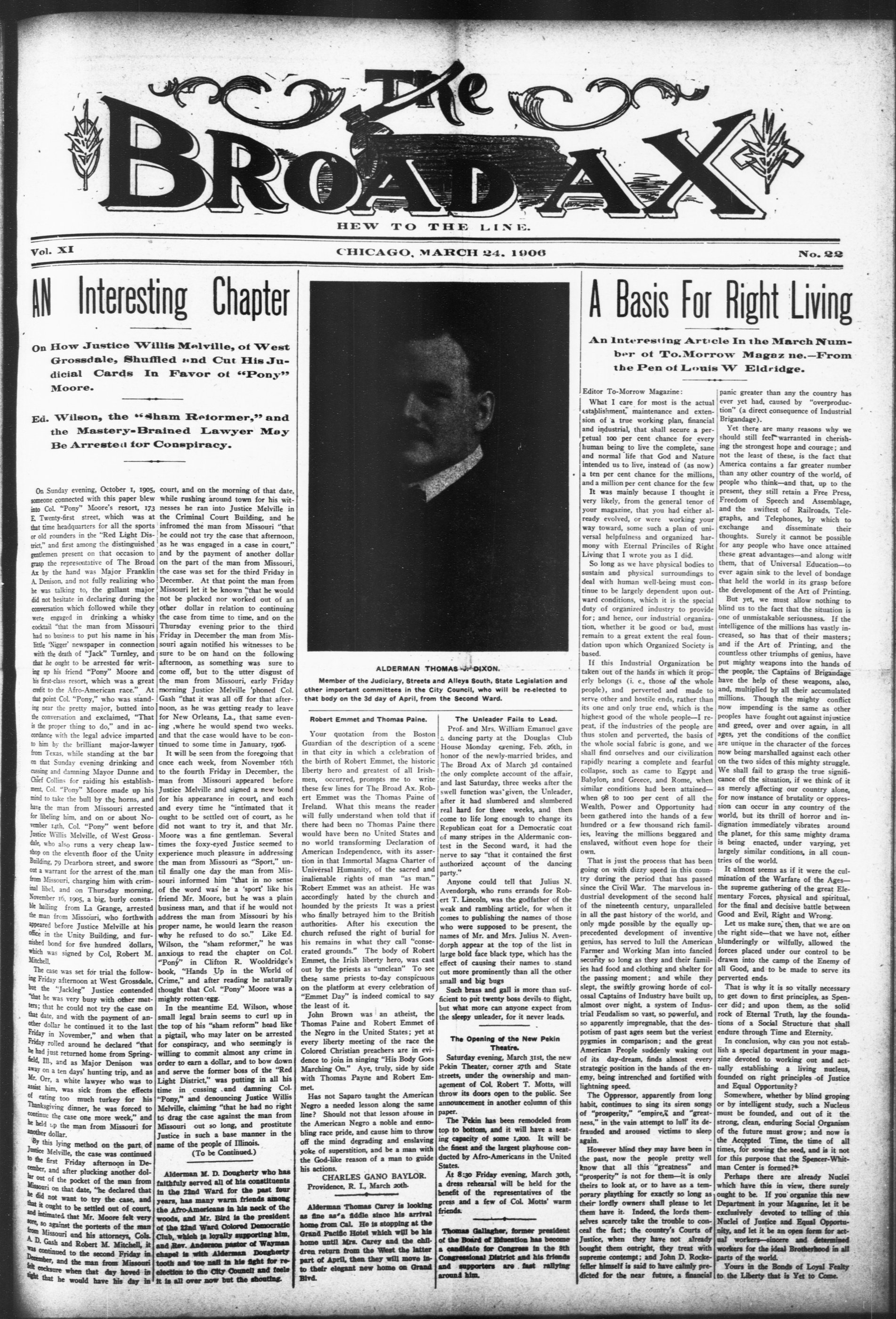
Member of the Judiciary, Streets and Alleys South, State Legislation and other important committees in the City Council, who will be re-elected to that body on the 3d day of April, from the Second Ward.
Robert Emmet and Thomas Paine.
Your quotation from the Boston Guardian of the description of a scene in that city in which a celebration of the birth of Robert Emmet, the historic liberty hero and greatest of all Irishmen, occurred, prompts me to write these few lines for The Broad Ax. Robert Emmet was the Thomas Paine of Ireland. What this means the reader will fully understand when told that if there had been no Thomas Paine there would have been no United States and no world transforming Declaration of American Independence, with its assertion in that Immortal Magna Charter of Universal Humanity, of the sacred and inalienable rights of man "as man." Robert Emmet was an atheist. He was accordingly hated by the church and hounded by the priests. It was a priest who finally betrayed him to the British authorities. After his execution the church refused the right of burial for his remains in what they call "conserated grounds." The body of Robert Emmet, the Irish liberty hero, was cast out by the priests as "unclean." To see these same priests to-day conspicuous on the platform at every celebration of "Emmet Day" is indeed comical to say the least of it.
John Brown was an atheist, the Thomas Paine and Robert Emmet of the Negro in the United States; yet at every liberty meeting of the race the Colored Christian preachers are in evidence to join in singing "His Body Goes Marching On." Aye, truly, side by side with Thomas Payne and Robert Emmet.
Has not Saparo taught the American Negro a needed lesson along the same line? Should not that lesson aforest in the American Negro a noble and ennobling race pride, and cause him to throw off the mind degrading and enslaving yoke of superstition, and be a man with the God-like reason of a man to guide his actions.
CHARLES GANO BAYLOR.
Providence, R. I, March 20th.
Alderman Thomas Carey is looking as fine as a fiddle since his arrival home from Cal. He is stopping at the Grand Pacific Hotel which will be his home until Mrs. Carey and the children return from the West the latter part of April, then they will move into their elegant new home on Grand Blvd.
Prof. and Mrs. William Emanuel gave a dancing party at the Douglas Club House Monday evening, Feb. 26th, in honor of the newly-married brides, and The Broad Ax of March 3d contained the only complete account of the affair, and last Saturday, three weeks after the swell function was given, the Unleader, after it had slumbered and slumbered real hard for three weeks, and then come to life long enough to change its Republican coat for a Democratic coat of many stripes in the Aldermanic contest in the Second ward, it had the nerve to say "that it contained the first authorized account of the dancing party."
Anyone could tell that Julius N. Avendorph, who runs errands for Robert T. Lincoln, was the godfather of the weak and rambling article, for when it comes to publishing the names of those who were supposed to be present, the names of Mr. and Mrs. Julius N. Avendorph appear at the top of the list in large bold face black type, which has the effect of causing their names to stand out more prominently than all the other small and big bugs
Such brass and gall is more than sufficient to put twenty boss devils to flight, but what more can anyone expect from the sleepy unleader, for it never leads.
The Opening of the New Pekin Theatre.
Saturday evening, March 31st, the new Pekin Theater, corner 27th and State streets, under the ownership and management of Col. Robert T. Motts, will throw its doors open to the public. See announcement in another column of this paper.
The Pekin has been remodeled from top to bottom, and it will have a seating capacity of some 1,200. It will be the finest and the largest playhouse conducted by Afro-Americans in the United States.
At 8:30 Friday evening, March 30th, a dress rehearsal will be held for the benefit of the representatives of the press and a few of Col. Motts' warm friends.
Thomas Gallagher, former president of the Board of Education has become a candidate for Congress in the 8th Congressional District and his friends and supporters are fast rallying around him.
A Basis For Right Living
An Interesting Article In the March Number of To.Morrow Magazne.—From the Pen of Louis W Eldridge.
What I care for most is the actual establishment, maintenance and extension of a true working plan, financial and industrial, that shall secure a perpetual 100 per cent chance for every human being to live the complete, sane and normal life that God and Nature intended us to live, instead of (as now) a ten per cent chance for the millions, and a million per cent chance for the few. It was mainly because I thought it very likely, from the general tenor of your magazine, that you had either already evolved, or were working your way toward, some such a plan of universal helpfulness and organized harmony with Eternal Princiles of Right Living that I wrote you as I did.
So long as we have physical bodies to sustain and physical surroundings to deal with human well-being must continue to be largely dependent upon outward conditions, which it is the special duty of organized industry to provide for; and hence, our industrial organization, whether it be good or bad, must remain to a great extent the real foundation upon which Organized Society is based.
If this Industrial Organization be taken out of the hands in which it properly belongs (i.e. those of the whole people), and perverted and made to serve other and hostile ends, rather than its one and only true end, which is the highest good of the whole people—I repeat, if the industries of the people are thus stolen and perverted, the basis of the whole social fabric is gone, and we shall find ourselves and our civilization rapidly nearing a complete and fearful collapse, such as came to Egypt and Babylon, and Greece, and Rome, when similar conditions had been attained—when 98 to 100 per cent of all the Wealth, Power and Opportunity had been gathered into the hands of a few hundred or a few thousand rich families, leaving the millions beggared and enslaved, without even hope for their own.
That is just the process that has been going on with dizzy speed in this country during the period that has passed since the Civil War. The marvelous industrial development of the second half of the nineteenth century, unparalleled in all the past history of the world, and only made possible by the equally unprecedented development of inventive genius, has served to lull the American Farmer and Working Man into fancied security so long as they and their families had food and clothing and shelter for the passing moment; and while they slept, the swiftly growing horde of colossal Captains of Industry have built up almost over night, a system of Industrial Feudalism so vast, so powerful, and so apparently impregnable, that the despotism of past ages seem but the veriest pygmies in comparison; and the great American People suddenly waking out of its day-dream, finds almost every strategic position in the hands of the enemy, being intrenched and fortified with lightning speed.
The Oppressor, apparently from long habit, continues to sing its siren songs of "prosperity," "empire," and "greatness," in the vain attempt to lull' its defrauded and aroused victims to sleep again.
However blind they may have been in the past, now the people pretty well know that all this "greatness" and "prosperity" is not for them—it is only theirs to look at, or to have as a temporary plaything for exactly so long as their lordly owners shall please to let them have it. Indeed, the lords themselves scarcely take the trouble to conceal the fact; the country's Courts of Justice, when they have not already bought them outright, they treat with supreme contempt; and John D. Rockefeller himself is said to have calmly predicted for the near future, a financial
No.22
panic greater than any the country has ever yet had, caused by "overproduction" (a direct consequence of Industrial Brigandage). Yet there are many reasons why we should still feel warranted in cherishing the strongest hope and courage; and not the least of these, is the fact that America contains a far greater number than any other country of the world, of people who think—and that, up to the present, they still retain a Free Press, Freedom of Speech and Assemblage, and the swiftest of Railroads, Telegraphs, and Telephones, by which to exchange and disseminate their thoughts. Surely it cannot be possible for any people who have once attained these great advantages—and along with them, that of Universal Education—to ever again sink to the level of bondage that held the world in its grasp before the development of the Art of Printing.
But yet, we must allow nothing to blind us to the fact that the situation is one of unmistakable seriousness. If the intelligence of the millions has vastly increased, so has that of their masters; and if the Art of Printing, and the countless other triumphs of genius, have put mighty weapons into the hands of the people, the Captains of Brigandage have the help of these weapons, also, and multiplied by all their accumulated millions. Though the mighty conflict now impending is the same as other peoples have fought out against injustice and greed, over and over again, in all ages, yet the conditions of the conflict are unique in the character of the forces now being marshalled against each other on the two sides of this mighty struggle. We shall fail to grasp the true significance of the situation, if we think of it as merely affecting our country alone, for now instance of brutality or oppression can occur in any country of the world, but its thrill of horror and indignation immediately vibrates around the planet, for this same mighty drama is being enacted, under varying, yet largely similar conditions, in all countries of the world.
It almost seems as if it were the culmination of the Warfare of the Ages—the supreme gathering of the great Elementary Forces, physical and spiritual, for the final and decisive battle between Good and Evil, Right and Wrong.
Let us make sure, then, that we are on the right side—that we have not, either blunderingly or wilfully, allowed the forces placed under our control to be drawn into the camp of the Enemy of all Good, and to be made to serve its perverted ends.
That is why it is so vitally necessary to get down to first principles, as Spencer did; and upon them, as the solid rock of Eternal Truth, lay the foundations of a Social Structure that shall endure through Time and Eternity.
In conclusion, why can you not establish a special department in your magazine devoted to working out and actually establishing a living nucleus, founded on right principles of Justice and Equal Opportunity?
Somewhere, whether by blind groping or by intelligent study, such a Nucleus must be founded, and out of it the strong, clean, enduring Social Organism of the future must grow; and now is the Accepted Time, the time of all times, for sowing the seed, and is it not for this purpose that the Spencer-Whitman Center is formed?* Perhaps there are already Nuclei which have this in view, there surely ought to be. If you organize this new Department in your Magazine, let it be exclusively devoted to telling of this Nuclei of Justice and Equal Opportunity, and let it be an open form for actual workers—sincere and determined workers for the ideal Brotherhood in all parts of the world.
Yours in the Bonds of Loyal Fealty to the Liberty that is Yet to Come.
THE BROAD AX.
PUBLISHED WEEKLY.
Will promulgate and at all times uphold the true principles of Democracy, but Ostobele, Protesta, Praetex, Imbele, Farmers, Single Taxes, Republicans, Knights of Eagle, or any one of their language is proper and responsibility is Exed.
The Broad A is a newspaper whose platform is broad enough for all, ever claiming the editorial right to speak its own mind.
Local communications will receive attention. Write only on one side of the paper.
Subscriptions must be paid in advance.
One Year.....$2.00
Six Months.....1.00
Advertising rates made known on application.
JULIUS F. TAYLOR, Editor and Publisher.
Entered at the Post Office at Chicago,
M., as Second-class Matter.
CHIPS
C. W. Alexander and G. H. Moore of Nashville are in the city at 2622 Wabash.
Mr. S. R. Blackwell of Birmingham, Ala., is visiting the city for a few weeks stopping at 3401 State St.
Mr. E. Mackintosh, of Macon, Miss., is spending the summer in the city, stopping at 3401 State St.
Mr. A. D. Dickerson of Natchez, Miss., is spending the summer in the city stopping at 2414 Wabash ave.
Out of the one hundred and ten drug stores in Washington, D. C., eleven are owned by Afro-Americans.
Mrs. Will Miller 2755 Wabash Ave., is spending two months in Vicksburg, Miss., and the South, visiting friends.
Mr. Joe Jenkins, 4715 Dearborn St., is pending a two weeks' vacation in French Lick Springs, for his health.
Mr. Geo. Smith 3322 Dearborn St who has been spending a month's vacation in Hot Springs has returned to the city.
Mr. John Cowan 3511 Armour Ave., and Mr. Joe Hudlin returned from Hot Springs where they have been spending the last month.
Mr. Williams, the popular 29th st restaurant man, after a two months trip through the West and Mexico, has returned to the city.
W. H. Crogman, Jr., son of President Crogman of Clark University is spending the summer in the city, stopping at 3401 State St.
Mrs. T. H. Carr and Mrs. James E. Thompson will leave Chicago the latter part of the month for a few weeks visit to friends in St. Joseph, Mo.
Ernst Hummel, the popular ex-city treasurer of Chicago, is more than likely to receive the nomination for Treasurer of Cook County.
Alderman Peter Reinberg is having quite a hard fight on his hands, but he will be returned to the city council from the 26th Ward just the same
Alderman James J. McCormick is still riding the storm in the 5th Ward, and he will come in under the wire ahead of his competitors on the day of election.
Dr. D. H. Anderson has moved his office to the elegant suite of rooms on the cor. of 31st and State Sts. W. T. Jefferson, dentist, also has apartments in the same suite.
Edith, Robie and Reginald, children of Mr. and Mrs. Robt. Hardin, 6349 Rhodes Ave., have been confined to their home for the past week or so on account of sickness—will soon be able to be out again.
The many friends of Mr. Alphonso Lee of 3124 Armour Ave were pleased to learn that he was successful in passing the Illinois State Board Examination for embalming and undertaking.
Dr. H. C. Newton, the Prohibition candidate for alderman in the Second Ward, has withdrawn from the race in favor of Alderman Thomas J. Dixon, who will be re-elected to the City Council with both hands down.
Alderman John H. Jones gave a smoker to his Afro-American friends in the 8th Ward last Friday evening and they will fight to the lastditch in order to assist him to return to the City Council.
James J. Gray, who honorably served as a member of the Board of Assessors of Cook County, occupies a fine suite of law offices on the 11th floor of the Ashland Block. He has lately acquired one of the finest and most extensive law libraries in this city and The Broad Ax will cheerfully support Mr. Gray for Sheriff of Cook County.
13
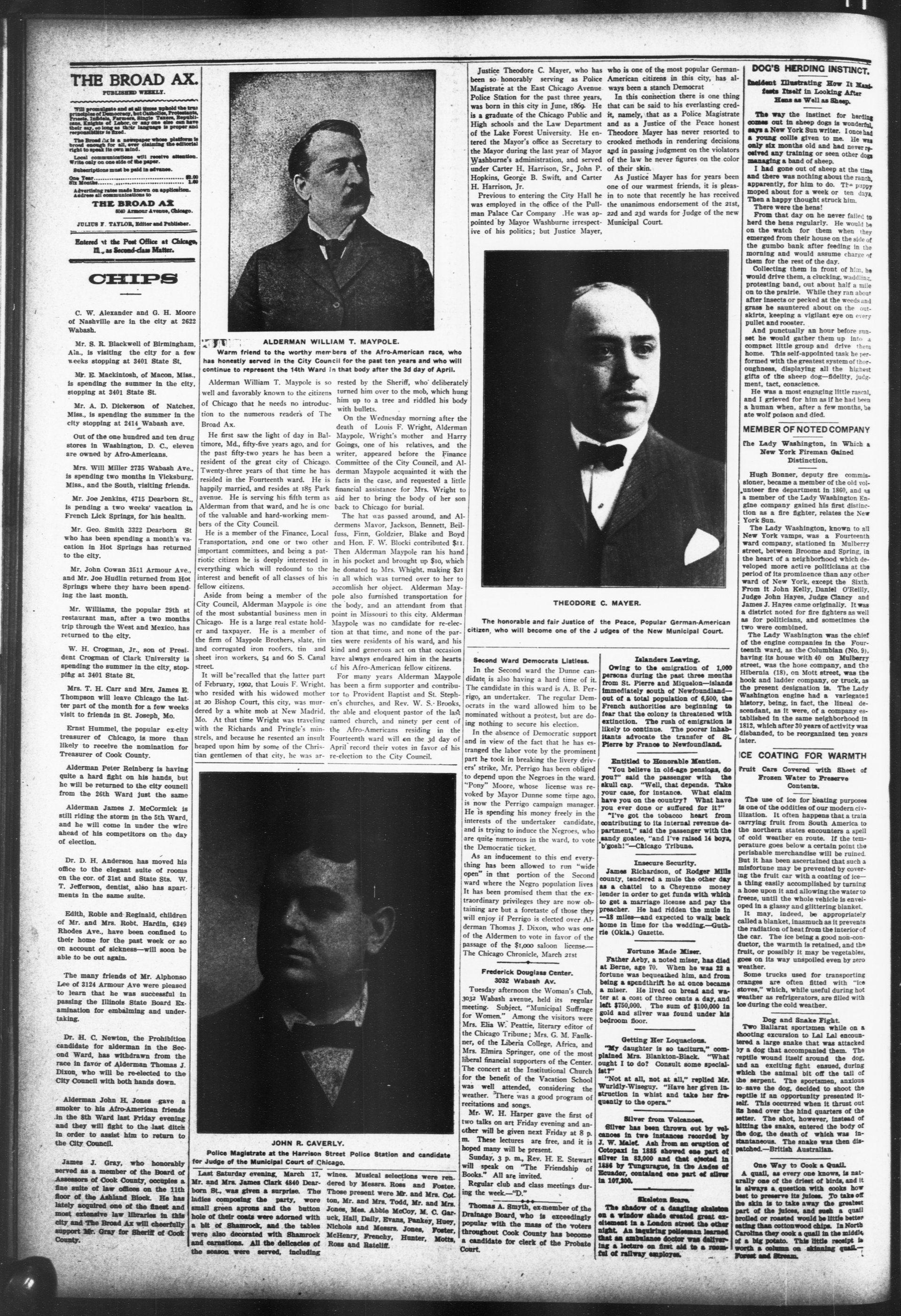
ALDERMAN WILLIAM T. MAYPOLE. Warm friend to the worthy members of the Afro-American race, who has honestly served in the City Council for the past ten years and who will continue to represent the 14th Ward in that body after the 3d day of April. Alderman William T. Maypole is so rested by the Sheriff, who deliberate well and favorably known to the citizens of Chicago that he needs no introduction to the numerous readers of The Broad Ax.
He first saw the light of day in Baltimore, Md., fifty-five years ago, and for the past fifty-two years he has been a resident of the great city of Chicago Twenty-three years of that time he has resided in the Fourteenth ward. He is happily married, and resides at 185 Park avenue. He is serving his fifth term as Alderman from that ward, and he is one of the valuable and hard-working members of the City Council. He is a member of the Finance, Local Transportation, and one or two other important committees, and being a patriotic citizen he is deeply interested in everything which will redound to the interest and benefit of all classes of his fellow citizens.
Aside from being a member of the City Council, Alderman Maypole is one of the most substantial business men in Chicago. He is a large real estate holder and taxpayer. He is a member of the firm of Maypole Brothers, slate, tin and corrugated iron roofers, tin and sheet iron workers, 54 and 60 S. Canal street.
It will be recalled that the latter part of February, 1902, that Louis F. Wright, who resided with his widowed mother at 20 Bishop Court, this city, was murdered by a white mob at New Madrid, Mo. At that time Wright was traveling with the Richards and Pringle's minstrels, and because he resented an insult heaped upon him by some of the Christian gentlemen of that city, he was ar-
[Image of a man in a suit with a bow tie].
```markdown
```
Last Saturday evening, March 17, wines. Musical selections were rendered by Messrs. Ross and Foster. Those present were Mr. and Mrs. Cotton, Mr. and Mrs. Todd, Mr. and Mrs. Jones, Mes. Abble McCoy, M. C. Garuck, Hall, Dally, Evans, Pankey, Huey, Nichols and Messrs. Jones, Foster, McHenry, Frenchy, Hunter, Mottrick, Ross and Ratcliff.
Police Magistrate at the Harrison Street Police Station and candidate for Judge of the Municipal Court of Chicago.
rested by the Sheriff, who deliberately turned him over to the mob, which hung him up to a tree and riddled his body with bullets.
On the Wednesday morning after the death of Louis F. Wright, Alderman Maypole, Wright's mother and Harry Goings, one of his relatives, and the writer, appeared before the Finance Committee of the City Council, and Alderman Maypole acquainted it with the facts in the case, and requested a little financial assistance for Mrs. Wright to aid her to bring the body of her son back to Chicago for burial.
The hat was passed around, and Aldermens Mavor, Jackson, Bennett, Beilfuss, Finn, Goldzier, Blake and Boyd and Hon. F. W. Blocki contributed $11. Then Alderman Maypole ran his hand in his pocket and brought up $10, which he donated to Mrs. Whight, making $21 in all which was turned over to her to accomplish her object. Alderman Maypole also furnished transportation for the body, and an attendant from that point in Missouri to this city. Alderman Maypole was no candidate for re-election at that time, and none of the parties were residents of his ward, and his kind and generous act on that occasion have always endeared him in the hearts of his Afro-American fellow citizens.
For many years Alderman Maypole has been a firm supporter and contributor to Provident Baptist and St. Stephen's churches, and Rev. W. S. Brooks, the able and eloquent pastor of the last named church, and ninety per cent of the Afro-Americans residing in the Fourteenth ward will on the 3d day of April record their votes in favor of his re-election to the City Council.
ERLY.
Street Police Station and candidate Chicago.
wines. Musical selections were rendered by Messrs. Ross and Foster. Those present were Mr. and Mrs. Cotton, Mr. and Mrs. Todd, Mr. and Mrs. Jones, Mes. Abble McCoy, M. C. Garuck, Hall, Daily, Evans, Pankey, Huey, Nichols and Messrs. Jones, Foster, McHenry, Frenchy, Hunter, Motts, Ross and Rateliff.
Justice Theodore C. Mayer, who has been so honorably serving as Police Magistrate at the East Chicago Avenue Police Station for the past three years, was born in this city in June, 1869. He is a graduate of the Chicago Public and High schools and the Law Department of the Lake Forest University. He entered the Mayor's office as Secretary to the Mayor during the last year of Mayor Washburne's administration, and served under Carter H. Harrison, Sr., John P. Hopkins, George B. Swift, and Carter H. Harrison, Jr.
Previous to entering the City Hall he was employed in the office of the Pullman Palace Car Company. He was appointed by Mayor Washburne irrespective of his politics; but Justice Mayer,
ely
ang
ody
the
man
erry
the
once
Al-
the
tle
to
on
Al-
il-
yd
.,
nd
ch
21
to
THEODORE C. MAYER.
The honorable and fair Justice of the Peace, citizen, who will become one of the J udges of the
The honorable and fair Justice of the Peace, Popular German-American citizen, who will become one of the Judges of the New Municipal Court.
Second Ward Democrats Listless
In the Second ward the Dunne candidate is also having a hard time of it. The candidate in this ward is A. B. Perrigo, an undertaker. The regular Democrats in the ward allowed him to be nominated without a protest, but are doing nothing to secure his election.
In the absence of Democratic support and in view of the fact that he has estranged the labor vote by the prominent part he took in breaking the livery drivers' strike, Mr. Perrigo has been obliged to depend upon the Negroes in the ward. "Pony" Moore, whose license was revoked by Mayor Dunne some time ago, is now the Perrigo campaign manager. He is spending his money freely in the interests of the undertaker candidate, and is trying to induce the Negroes, who are quite numerous in the ward, to vote the Democratic ticket.
As an inducement to this end everything has been allowed to run "wide open" in that portion of the Second ward where the Negro population lives. It has been promised them that the extraordinary privileges they are now obtaining are but a foretaste of those they will enjoy if Perrigo is elected over Alderman Thomas J. Dixon, who was one of the Aldermen to vote in favor of the passage of the $1,000 saloon license—The Chicago Chronicle, March 21st
Frederick Douglass Center.
3032 Wabash Av.
Tuesday afternoon the Woman's Club, 3032 Wabash avenue, held its regular meeting. Subject, "Municipal Suffrage for Women." Among the visitors were Mrs. Elia W. Peattie, literary editor of the Chicago Tribune; Mrs. G. M. Faulkner, of the Liberia College, Africa, and Mrs. Elmira Springer, one of the most liberal financial supporters of the Center. The concert at the Institutional Church for the benefit of the Vacation School was well attended, considering the weather. There was a good program of recitations and songs.
Mr. W. H. Harper gave the first of two talks on art Friday evening and another will be given next Friday at 8 p.m. These lectures are free, and it is hoped many will be present.
Sunday, 3 p. m., Rev. H. E. Stewart will speak on "The Friendship of Books." All are invited.
Regular club and class meetings during the week.—"D."
Thomas A. Smyth, ex-member of the Drainage Board, who is exceedingly popular with the mass of the voters throughout Cook County has become a candidate for clerk of the Probate Court.
who is one of the most popular German-American citizens in this city, has always been a stanch Democrat
In this connection there is one thing that can be said to his everlasting credit, namely, that as a Police Magistrate and as a Justice of the Peace honest Theodore Mayer has never resorted to crooked methods in rendering decisions and in passing judgment on the violators of the law he never figures on the color of their skin.
As Justice Mayer has for years been one of our warmest friends, it is pleasan to note that recently he has received the unanimous endorsement of the 21st, 22d and 23d wards for Judge of the new Municipal Court.
er,
Islanders Leaving.
Owing to the emigration of 1,000 persons during the past three months from St. Pierre and Miquelon—islands immediately south of Newfoundland—out of a total population of 6,500, the French authorities are beginning to fear that the colony is threatened with extinction. The rush of emigration is likely to continue. The poorer inhabitants advocate the transfer of St. Pierre by France to Newfoundland.
Entitled to Honorable Mention.
"You believe in old-age pension, do you?" said the passenger with the skull cap. "Well, that depends. Take your case, for instance. What claim have you on the country? What have you ever done or suffered for it?" "I've got the tobacco heart from contributing to its internal revenue department," said the passenger with the sandy goatte, "and I've raised 14 boys, b'gosh!"—Chicago Tribune.
James Richardson, of Rodger Mills county, tendered a mule the other day as a chattel to a Cheyenne money lender in order to get funds with which to get a marriage license and pay the preacher. He had ridden the mule in -18 miles—and expected to walk back home in time for the wedding.-Guthrie (Okla.) Gazette.
Father Aeby, a noted miser, has died at Berne, age 70. When he was 22 a fortune was bequeathed him, and from being a spendthrift he at once became a miser. He lived on bread and water at a cost of three cents a day, and left $750,000. The sum of $100,000 in gold and silver was found under his bedroom floor.
Getting Her Loguacious.
"My daughter is so taciturn." complained Mrs. Blankton-Black. "What ought I to do? Consult some specialist." "Not at all, not at all," replied Mr. Wurldly-Wiseguy. "Have her given instruction in whist and take her frequently to the opera."
Silver from Volcanoes
Silver has been thrown out by volcanoes in two instances recorded by J. W. Malet. Ash from an eruption of Cotopaxi in 1885 showed one part of silver in 83,000 and that ejected in 1886 by Tungurague, in the Andes of Ecuador, contained one part of silver in 107,300.
The shadow of a dangling skeleton on a window shade created great excitement in a London street the other night. An inquiring policeman learned that an ambulance doctor was delivering a lecture on first aid to a roomful of railway employees.
Islanders Leaving.
Insecure Security.
Fortune Made Miser
Skalston Scare
DOG'S HERDING INSTINCT
The way the instinct for herding comes out in sheep dogs is wonderful, says a New York Sun writer. I once had a young collie given to me. He was only six months old and had never received any training or seen other dogs managing a band of sheep.
I had gone out of sheep at the time and there was nothing about the ranch, apparently, for him to do. The puppy moped about for a week or ten days. Then a happy thought struck him.
There were the heps!
From that day on he never failed to herd the hens regularly. He would be on the watch for them when they emerged from their house on the side of the gumbo bank after feeding in the morning and would assume charge of them for the rest of the day.
Collecting them in front of him, he would drive them, a clucking, waddling, protesting band, out about half a mile on to the prairie. While they ran about after insects or pecked at the weeds and grass he sauntered about on the outskirts, keeping a vigilant eye on every pullet and rooster.
And punctually an hour before sunset he would gather them up into a compact little group and drive them home. This self-appointed task he performed with the greatest system of thoroughness, displaying all the highest gifts of the sheep dog—fidelity, judgment, tact, conscience.
He was a most engaging little rascal, and I grieved for him as if he had been a human when, after a few months, he ate wolf poison and died.
MEMBER OF NOTED COMPANY
The Lady Washington, in Which a New York Fireman Gained Distinction.
Hugh Bonner, deputy fire commissioner, became a member of the old volunteer fire department in 1860, and as a member of the Lady Washington Engine company gained his first distinction as a fire fighter, relates the New York Sun.
The Lady Washington, known to all all New York vamps, was a Fourteenth ward company, stationed in Mulberry street, between Broome and Spring, in the heart of a neighborhood which developed more active politicians at the period of its prominence than any other ward of New York, except the Sixth. From it John Kelly, Daniel O'Reilly, Judge John Hayes, Judge Clancy and James J. Hayes came originally. It was a district noted for fire fighters as well as for politicians, and sometimes the two were combined.
The Lady Washington was the chief of the engine companies in the Fourteenth ward, as the Columbian (No. 9), having its house with 40 on Mulberry street, was the hose company, and the Hibernia (18), on Mott street, was the hook and ladder company, or truck, as the present designation is. The Lady Washington engine had a variegated history, being, in fact, the lineal descendant, as it were, of a company established in the same neighborhood in 1812, which after 30 years of activity was disbanded, to be reorganized ten years later.
ICE COATING FOR WARMTH
Fruit Cars Covered with Sheet of Frozen Water to Preserve Contents.
The use of ice for heating purposes is one of the oddities of our modern civilization. It often happens that a train carrying fruit from South America to the northern states encounters a spell of cold weather en route. If the temperature goes below a certain point the perishable merchandise will be ruined. But it has been ascertained that such a misfortune may be prevented by covering the fruit car with a coating of ice—a thing easily accomplished by turning a hose upon it and allowing the water to freeze, until the whole vehicle is enveloped in a glassy and glittering blanket. It may, indeed, be appropriately called a blanket, inasmuch as it prevents the radiation of heat from the interior of the car. The ice being a good non-conductor, the warmth is retained, and the fruit, or possibly it may be vegetables, goes on its way unspoiled even by zero weather.
Some trucks used for transporting oranges are often fitted with "ice stoves," which, while useful during hot weather as refrigerators, are filled with ice during the cold weather.
Dog and Snake Fight
Two Ballarat sportsmen while on a shooting excursion to Lal Lal encountered a large snake that was attacked by a dog that accompanied them. The reptile wound itself around the dog, and an exciting fight ensued, during which the animal bit off the tail of the serpent. The sportsmen, anxious to save the dog, decided to shoot the reptile if an opportunity presented itself. This occurred when it thrust its head over the hind quarters of the setter. The shot, however, instead of hitting the snake, entered the body of the dog, the death of which was instantaneous. The snake was then dispatched—British Australian.
One Way to Cook a Quail.
A quail, as every one knows, is naturally one of the driest of birds, and it is always a question with cooks how best to preserve its juices. To take off the skin is to take away the greatest part of the juices, and such a quail broiled or roasted would be little better eating than cottonwood chips. In North Carolina they cook a quail in the middle of a big potato. This little receipt is worth a column on skinning quail. Forest and Stream
TO ROUND HOLLOW CHEEKS
Woman with Segging Face Should
Use Skin-Food or Try Suction-
On to Improve Contour.
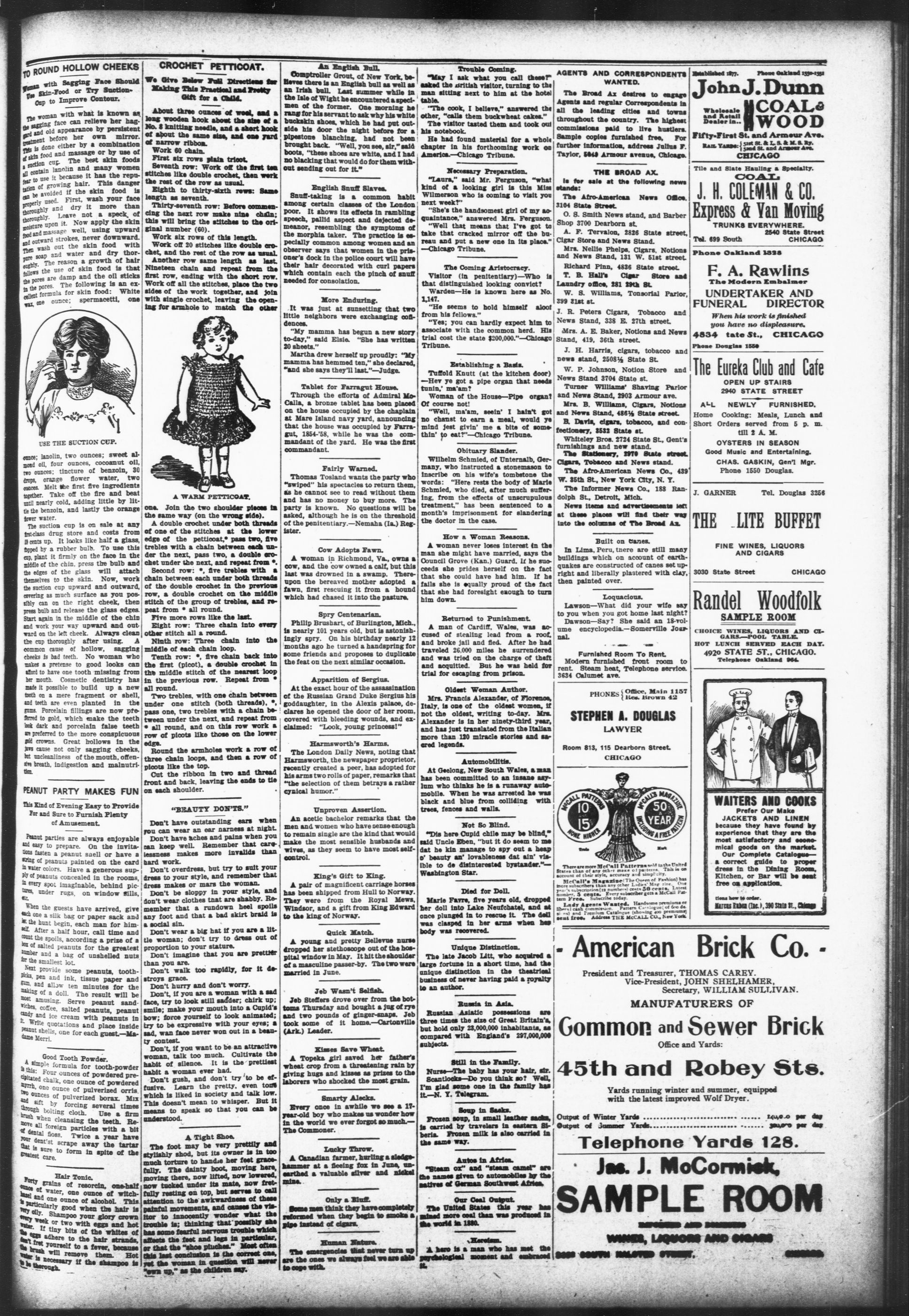
The woman with what is known as the sagging face can relieve her haggard and old appearance by persistent treatment before her own mirror. This is done either by a combination of skin food and massage or by use of a suction cup. The best skin foods all contain lanolin and many women fear to use it because it has the reputation of growing hair. This danger can be avoided if the skin food is properly used. First, wash your face thoroughly and dry it more than thoroughly. Leave not a speck of moisture upon it. Now apply the skin food and massage well, using upward and outward strokes, never downward. Then wash out the skin food with pure soap and water and dry thoroughly. The reason a growth of hair follows the use of skin food is that the pores are damp and the oil sticks in the pores. The following is an excellent formula for skin food: White wax one ounce; spermacetti, one
USE THE SUCTION CUP.
ounce; lanolin, two ounces; sweet almond oil, four ounces, cocoanut oil, two ounces; tincture of benzoin, 30 drops, orange flower water, two ounces. Melt the first five ingredients together. Take off the fire and beat until nearly cold, adding little by little the benzoin, and lastly the orange power water.
The suction cup is on sale at any first-class drug store and costs from 35 cents up. It looks like half a glass, tipped by a rubber bulb. To use this cup, plant it firmly on the face in the middle of the chin, press the bulb and the edges of the glass will attach themselves to the skin. Now, work the suction cup upward and outward, covering as much surface as you possibly can on the right cheek, then press bulb and release the glass edges. Start again in the middle of the chin and work your way upward and outward on the left cheek. Always clean the cup thoroughly after using. A common cause of hollow, sagging cheeks is bad teeth. No woman who makes a pretense to good looks can afford to have one tooth missing from her mouth. Cosmetic dentistry has made it possible to build up a new tooth on a mere fragment or shell, and teeth are even planted in the gums. Porcelain fillings are now preferred to gold, which make the teeth look dark and porcelain false teeth are preferred to the more conspicuous gold crowns. Great hollows in the jaw cause not only sagging cheeks, but uncleanness of the mouth, offensive breath, indigestion and malnutrition.
PEANUT PARTY MAKES FUN
This Kind of Evening Easy to Provide
For and Sure to Furnish Plenty
of Amusement.
Peanut parties are always enjoyable and easy to prepare. On the invitations fasten a peanut snail or have a string of peanuts painted on the card in water colors. Have a generous supply of peanuts concealed in the rooms, in every spot imaginable, behind pictures, under rugs, on window sills, etc.
When the guests have arrived, give each one a silk bag or paper sack and let the hunt begin, each man for himself. After a half hour, call time and count the spoils, according a prize of a box of salted peanuts for the greatest number and a bag of unshelled nuts for the smallest lot.
Next provide some peanuts, tooth-
plucks, pen and ink, tissue paper and
gum and allow ten minutes for the
making of a doll. The result will be
most amusing. Serve peanut sand-
wiches, coffee, salted peanuts, peanut
candy and ice cream with peanuts in
it. Write quotations and place inside
peanut shells, one for each guest.—Madame Merri.
Good Tooth Powder
A simple formula for tooth-powder is this. Four ounces of powdered precipitated chalk, one ounce of powdered myrrh, one ounce of pulverized orris, two ounces of pulverized borax. Mix and sift by forcing several times through bolting cloth. Use a firm brush when cleansing the teeth. Remove all foreign particles with a bit of dental floss. Twice a year have your dent's scrape away the tartar that is sure to form in spite of the greatest care.
Hair Tonic
Forty grains of resorcin, one-half ounce of water, one ounce of witch-halel and one ounce of alcohol. This is particularly good when the hair is very oily. Shampoo your glory crown every week or two with eggs and hot water. If tiny bits of the whites of the eggs adhere to the hair strands, don't brush yourself to a fever, because the brush will remove them. Hot water is necessary if the shampoo is to be thorough.
CROCHET PETTICOAT.
We Give Below Full Directions for Making This Practical and Pretty Gift for a Child.
About three ounces of wool, and a long wooden hook about the size of a No. 8 knitting needle, and a short hook of about the same size, and one yard of narrow ribbon.
Work 60 chain
First six rows plain tricolor
Seventh row: Work off the first ten stitches like double crochet, then work the rest of the row as usual. Eighth to thirty-sixth rows: Same length as seventh. Thirty-seventh row: Before commencing the next row make nine chin; this will bring the stitches to the original number (60). Work six rows of this length. Work off 20 stitches like double crochet, and the rest of the row as usual. Another row same length as last. Nineteen chain and repeat from the first row, ending with the short row. Work off all the stitches, place the two sides of the work together, and join with single crochet, leaving the opening for armhole to match the other
A WARM PETTICOAT
one. Join the two shoulder pieces in the same way (on the wrong side).
A double crochet under both threads of one of the stitches at the lower edge of the petticoat.* pass two, five trebles with a chain between each under the next, pass two, a double crochet under the next, and repeat from *.
Second row: *, five trebles with a chain between each under both threads of the double crochet in the previous row, a double crochet on the middle stitch of the group of trebles, and repeat from * all round.
Five more rows like the last.
Eight row: Three chain into every other stitch all a round.
Ninth row: Three chain into the middle of each chain loop.
Tenth row: * five chain back into the first (picot), a double crochet in the middle stitch of the nearest loop in the previous row. Repeat from * all round.
Two trebles, with one chain between under one stitch (both threads), * pass one, two trebles with a chain between under the next, and repeat from * all round, and on this row work a row of picots like those on the lower edge.
Round the armholes work a row of three chain loops, and then a row of picots like the top.
Cut the ribbon in two and thread front and back, leaving the ends to tie on each shoulder.
"BEAUTY DON'TS."
Don't have outstanding ears when you can wear an ear narness at night.
Don't have aches and pains when you can keep well. Remember that carelessness makes more invalids than hard work.
Don't overdress, but try to suit your dress to your style, and remember that dress makes or mars the woman.
Don't be sloppy in your style, and don't wear clothes that are shabby. Remember that a rundown heel spoils any foot and that a bad skirt braid is a social sin.
Don't wear a big hat if you are a little woman; don't try to dress out of proportion to your stature.
Don't imagine that you are prettier than you are.
Don't walk too rapidly, for it destroys grace.
Don't hurry and don't worry.
Don't, if you are a woman with a sad face, try to look still sadder; chirk up; smile; make your mouth into a Cupid's bow; force yourself to look animated; try to be expressive with your eyes; a sad, wan face never won out in a beauty contest.
Don't, if you want to be an attractive woman, talk too much. Cultivate the habit of silence. It is the prettiest habit a woman ever had.
Don't gush, and don't try to be effusive. Learn the pretty, even tone which is liked in society and talk low. This doesn't mean to whisper. But it means to speak so that you can be understood.
A Tight Shoe
The foot may be very prettily and stylishly shod, but its owner is in too much torture to hande her feet gracefully. The dainty boot, moving here, moving there, now lifted, now lowered, now tucked under its mate, now fretfully resting on top, but serves to call attention to the awkwardness of these painful movements, and causes the visitor to innocently wonder what the trouble is; thinking that possibly she has some fearful nervous trouble which affects the feet and legs in particular, or that the "shoe pluches." Most often this last conclusion is the correct one, yet the woman in question will never "own up," as the children say.
An English Bull
Comptroller Grout, of New York, believes there is an English bull as well as an Irish bull. Last summer while in the Isle of Wight he encountered a specimen of the former. One morning he rang for his servant to ask why his white buckskin shoes, which he had put outside his door the night before for a pipestone blanching, had not been brought back. "Well, you see, sir," said boots, "these shoes are white, and I had no blacking that would do for them without sending out for it."
English Snuff Slaves
Snuff-taking is a common habit among certain classes of the London poor. It shows its effects in rambling speech, pallid aspect and dejected demeanor, resembling the symptoms of the morphia taker. The practice is especially common among women and an observer says that women in the prisoner's dock in the police court will have their hair decorated with curl papers which contain each the pinch of snuff needed for consolation.
More Enduring.
It was just at sunsetting that two little neighbors were exchanging confidences.
"My mamma has begun a new story to-day," said Elsie. "She has written 20 sheets."
Martha drew herself up proudly: "My mamma has hemmed ten," she declared, "and she says they'll last."—judge.
Tablet for Farragut House
Through the efforts of Admiral McCalla, a bronze tablet has been placed on the house occupied by the chaplain at Mare Island navy yard, announcing that the house was occupied by Farragut, 1854-58, while he was the commandant of the yard. He was the first commandant.
Fairly Warned.
Thomas Tosland wants the party who "swiped" his spectacles to return them, as he cannot see to read without them and has no money to buy more. The party is known. No questions will be asked, although he is on the threshold of the penitentiary.—Nemaha (la.) Register.
Cow Adopts Fawn.
A woman in Richmond, Va., owns a cow, and the cow owned a calf, but this last was drowned in a swamp. Thereupon the bereaved mother adopted a fawn, first rescuing it from a hound which had chased it into the pasture.
Spry Centenarian
Philip Brushart, of Burlington, Mich., is nearly 101 years old, but is astonishingly spry. On his birthday nearly 12 months ago he turned a handspring for some friends and proposes to duplicate the feat on the next similar occasion.
Apparition of Sergius
At the exact hour of the assassination of the Russian Grand Duke Sergius his goddaughter, in the Alexis palace, declares he opened the door of her room, covered with bleeding wounds, and exclaimed: "Look, young princess!"
Harmsworth's Harms.
The London Daily News, noting that Harmsworth, the newspaper proprietor, recently created a peer, has adopted for his arms two rolls of paper, remarks that "the selection of them betrays a rather cynical humor."
An acetic bachelor remarks that the men and women who have sense enough to remain single are the kind that would make the most sensible husbands and wives, as they seem to have most self-control.
King's Gift to King.
A pair of magnificent carriage horses has been shipped from Hull to Norway. They were from the Royal Mews, Windsor, and a gift from King Edward to the king of Norway.
Quick Match.
A young and pretty Bellevue nurse dropped her stethoscope out of the hospital window in May. It hit the shoulder of a masculine passer-by. The two were married in June.
Jeb Wasn't Selfish.
Jeb Staffers drove over from the bottoms Thursday and bought a jug of rye and two pounds of ginger-naps. Jeb took some of it home—Cartonville (Ark.) Leader.
Kisses Save Wheat
A Topeka girl saved her father's wheat crop from a threatening rain by giving hugs and kisses as prizes to the laborers who shocked the most grain.
Smarty Alecka.
Every once in awhile we see a 17-year-old boy who makes us wonder how in the world we ever forgot so much.—The Commoner.
Lucky Throw.
A Canadian farmer, hurling a sledge hammer at a fieeing fox in June, unerthed a valuable silver and nickel mine.
Only a Bluff.
Some men think they have completely reformed when they begin to smoke a pipe instead of cigars.
Human Nature.
The emergencies that never turn up are the ones we always feel we are able to cone with.
Trouble Coming.
"May I ask what you call these?" asked the british visitor, turning to the man sitting next to him at the hotel table.
"The cook, I believe," answered the other, "calls them buckwheat cakes." The visitor tasted them and took out his notebook.
He had found material for a whole chapter in his forthcoming work on America.—Chicago Tribune.
Necessary Preparation
"Laura," said Mr. Ferguson, "what kind of a looking girl is this Miss Wilmerson who is coming to visit you next week?" "She's the handsome girl of my acquaintance," answered Mrs. Ferguson. "Well that means that I've got to take that cracked mirror off the bureau and put a new one in its place." —Chicago Tribune.
The Coming Aristocracy
Visitor (in penitentiary)—Who is that distinguished known convict? Warden—He is known here as No. 1,147. "He seems to hold himself aloof from his fellows." "Yes; you can hardly expect him to associate with the common herd. His trial cost the state $200,000."—Chicago Tribune.
Establishing a Basics
Tuffold Knutt (at the kitchen door)
—Hev ye got a pipe organ that needs tunin,' ma'am?
Woman of the House—Pipe organ?
Of course not!
"Well, ma'm, seein' I hain't got no chanst to earn a meal, would ye mind jest givin' me a bite of something' to eat?"—Chicago Tribune.
Obituary Slander.
Wilhelm Schmied, of Unternalb, Germany, who instructed a stonemason to inscribe on his wife's tombstone the words: "Here rests the body of Marle Schmied, who died, after much suffering, from the effects of unscrupulous treatment," has been sentenced to a month's imprisonment for slandering the doctor in the case.
How a Woman Reasons
A woman never loses interest in the man she might have married, says the Council Grove (Kan.) Guard. If he succeeds she prides herself on the fact that she could have had him. If he fails she is equally proud of the fact that she had foresight enough to turn him down.
Returned to Punishment
A man of Cardiff, Wales, was accused of stealing lead from a roof, and broke jail and fled. After he had traveled 26,000 miles he surrendered and was tried on the charge of theft and acquitted. But he was held for trial for escaping from prison.
Oldest Woman Author.
Mrs. Francis Alexander, of Florence, Italy, is one of the oldest women, if not the oldest, writing to-day. Mrs. Alexander is in her ninety-third year, and has just translated from the Italian more than 120 miracle stories and sacred legends.
Automobiles
At Geelong, New South Wales, a man has been committed to an insane asylum who thinks he is a runaway automobile. When he was arrested he was black and blue from colliding with trees, fences and walls.
Not So Blind.
"Dis here Cupid chile may be blind," said Uncle Eben, "but it do seem to me dat he kin manage to spy out a heap o' beauty an' lovableness dat ain' visible to de disinterested bystander."—Washington Star.
Died for Doll
Marie Favre, five years old, dropped her doll into Lake Neufchatel, and as once plunged in to rescue it. The doll was clasped in her arms when her body was recovered.
Unique Distinction
The late Jacob Litt, who acquired a large fortune in a short time, had the unique distinction in the theatrical business of never having paid a royalty to an author.
Russia in Asia.
Russian Asiatic possessions are three times the size of Great Britain's, but hold only 23,000,000 inhabitants, as compared with England's 297,000,000 subjects.
Still in the Family.
Nurse—The baby has your hair, sir.
Scantiooks—Do you think so? Well,
I'm glad some one in the family has
it—N. Y. Telegram.
Frozen soup, in small leather sack,
is carried by travelers in eastern
Siberia. Frozen milk is also carried in
the same way.
Autos in Africa.
"Steam ox" and "steam camel" are the names given to automobiles by the natives of German Southwest Africa.
Our Coal Output.
The United States this year has mined more coal than was produced in the world in 1880.
Heroism.
A here is a man who has met the psychological moment and embraced it.
- American Brick Co. -
President and Treasurer, THOMAS CAREY.
Vice-President, JOHN SHELHAMER,
Secretary, WILLIAM SULLIVAN.
Yards running winter and summer, equipped with the latest improved Wolf Dryer.
AGENTS AND CORRESPONDENTS WANTED.
The Broad Ax desires to engage Agents and regular Correspondents in all the leading cities and towns throughout the country. The highest commissions paid to live hustlers. Sample copies furnished free, For further information, address Julius F. Taylor, 5649 Armour avenue, Chicago.
THE BROAD AX
is for sale at the following news stands:
The Afro-American News Office,
3104 State Street.
O. S. Smith News stand, and Barber Shop 3700 Dearborn st.
A. F. Tervalon, 2826 State street,
Cigar Store and News Stand.
Mrs. Nellie Phelps, Cigars, Notions and News Stand, 131 W. 51st street.
Richard Pinn, 4836 State street.
T. B. Hall's Cigar Store and Laundry office, 281 29th St.
W. S. Williams, Tonsorial Parlor, 399 21st st.
J. R. Peters Cigars, Tobacco and News Stand, 338 E. 27th street.
Mrs. A. E. Baker, Notions and News Stand, 419, 36th street.
J. H. Harris, cigars, tobacco and news stand, 2508½ State St.
W. P. Johnson, Notion Store and News Stand 3704 State st.
B. Davia, cigars, tobacco, and confectionery, 3532 State st.
Whitley Bros. 2724 State St., Gent's furnishings and new stand.
The Stationery, 2970 State street.
Cigars, Tobacco and News stand.
The Afro-American News Co., 439
W. 35th St., New York City, N. Y.
The Informer News Co., 188 Randolph St., Detroit, Mich.
News items and advertisements left at these places will find their way into the columns of The Broad Az.
Built on Ganes.
In Lima, Peru, there are still many buildings which on account of earthquakes are constructed of canes set upright and liberally plastered with clay, then painted over.
Loguacious.
Lawson—What did your wife say to you when you got home last night? Dawson—Say? She said an 18-volume encyclopedia.—Somerville Journal.
Modern furnished front room to rent. Steam heat, Telephone service. 3634 Calumet ave.
PHONES { Office, Main 1157
Lie, Brunn 42
STEPHEN A. DOUGLAS
LAWYER
Room 813, 115 Dearborn Street.
CHICAGO
McCALL PATTERN
10
15
HONE HIGHER
McCALL MAGAZINE
50
A YEAR
INCLUDING A FREE PATTERN
Trade Mark
There are more McCall Patterns sold in the United
States than of any other make of pattern. This is on
amount of business and simplicity.
McCull's Magazine (The Queen of Fashion) has more subscribers than any other Ladies' Magazine. One year's subscriptions are handled costing £49. Last number 5 cents. Every subscriber gets a McCull Pattern Free. Subscribe today.
Lady Agents Wanted. Handwomen premium or IIH trade commission. Pattern Catalogue (of 600 designs) and Premium Catalogue (showing 600 premium sent free). Address THE McCALL CO., New York.
- American
President and Treasurer, The Vice-President, J. Secreta
MANUFAT
Common and
Fifty-First St. and Armour Ave.
RAIL YARD: 1st St. & L. S. & M. S. RY.
2nd St. and Armour Ave.
CHICAGO
Tile and State Hauling a Specialty.
COAL
J. H. COLEMAN & CO.
Express & Van Moving
TRUNKS EVERYWHERE.
2540 State Street
Tel. 699 South
CHICAGO
Phone Oakland 1328
F. A. Rawlins
The Modern Embalmer
UNDERTAKER AND
FUNERAL DIRECTOR
When his work is finished
you have no displeasure.
4834 tate St., CHICAGO
Phone Douglas 1550
The Eureka Club and Cafe
OPEN UP STAIRS
2940 STATE STREET
ALL NEWLY FURNISHED.
Home Cooking: Meals, Lunch and
Short Orders served from 5 p. m.
till 2 A. M.
OYSTERS IN SEASON
Good Music and Entertaining.
CHAS. GASKIN, Gen'l Mgr.
Phone 1550 Douglas.
J. GARNER Tel. Douglas 3256
THE LITE BUFFET
FINE WINES, LIQUORS
AND CIGARS
3030 State Street CHICAGO
Randel Woodfolk
CHOICE WINES, LIQUORS AND CIGARS—POOL TABLE.
HOT LUNCH SERVED EACH DAY.
4920 STATE ST., CHICAGO.
Telephone Oakland 964.
COOK
JACKETS AND LINEN because they have found by experience that they are the most satisfactory and economical goods on the market. Our Complete Catalogue—a correct guide to proper dress in the Dining Room, Kitchen, or Bar will be sent free on application. tions how to order. Maraus Nuben (Inc.), 390 State St., Chicago
Brick Co. -
THOMAS CAREY.
DHN SHELHAMER,
ry, WILLIAM SULLIVAN.
URERS OF
Sewor Brick
STOVE SET UP ON POSTS
During the college days of ex-Mayor Bessom, of Lynn, he had two of the professors of the college as guests at a hunting camp in the Maine woods, relates the Boston Herald. When they entered the camp their attention was attracted to the unusual position of the stove, which was set on posts about four feet high.
One of the professors began to comment upon the knowledge woodsmens gain by observation. "Now," said he, "this man has discovered that the heat radiating from the stove strikes the roof and the circulation is so quickened that the camp is warmed in much less time than would be required if the stove was in its regular place on the floor."
The other professor was of the opinion that the stove was elevated to be above the window, in order that cool and pure air could be had at night.
Mr. Bessom, being more practical, contended that the stove was elevated in order that a good supply of green wood could be placed beneath it to dry. After considerable argument, each man placed a dollar bill upon the table, and it was agreed taht the one whose opinion was nearest the guide's reason for elevating the stove should take the pool. The guide was called and asked why the stove was placed in such an unusual position. "Well," said he, "when I brought the stove up the river I lost most of the stovepipe overboard and had to set the stove up there so as to have the pipe reach through the roof."
REFRESHING HIS MEMORY.
When the Clerk Heard That Smith Had Money He Remembered Him.
At ten o'clock a traveling man stepped up to the clerk's desk at the Hillman, relates the Birmingham (Ala.) Herald, and with some agitation said to Clerk Graves:
"Mr. Graves, I have just come from a man who says he is one of your old schoolmates. He told me you and he were old friends. His name is John Smith, and he used to live at Pumpkinville. Do you know him?"
"Smith! Smith!" said Graves wonderingly. "John Smith, of Pumpkinville, I don't recall him just now. What's the matter with him? Is he in jail?"
"In jail!" exclaimed the traveling man. "Why, no. He's just home from Alaska, where he made $200,000 digging gold in the Klondike and he's coming back to Alabama to spend the money."
"Oh, yes, to be sure!" said Graves. "Why, what was I thinking about! Smith—Johnny Smith, of Pumpkinville, three miles from Sassafras? Why, I should say I do know him! Johnny and I used to fish together in the creek for minnows and hang our clothes on the same stump when we went in swimming. Say, if you see Johnny, give him my love, and tell him I'm coming round to see him when I get off in the morning."
USE MADE OF OLD SHOES.
Worked Up Into Imitation Leather Novelties of Various Descriptions
Janitors collect the shoes cast away by tenants and send them to auction rooms, where they are sorted into plies marked "Men," "Women," "Children." Several poor people made fair bids, relates the Shoe Retailer, but the auctioneer did not seem eager to sell. Finally, a red-faced man pushed his way through the crowd and offered ten cents a piece for the whole lot. His bid was successful.
"I was killing time with talk waiting for that fellow," said the auctioneer afterward. "He always pays high for these shoes, and he does not want them for wearing, either. He wants to beat them out for the leather in them. He gets what material there is, puts it through a process and makes stamped imitation leather novelties, such as picture frames, bags, pocketbooks, penknife holders, and even chair backs and seats. He finds a ready sale for these novelties and gets a good price for them."
Moved Up a Pez
A naval officer, according to the Buffalo Commercial, told of the trials of a colleague in marrying off His many daughters. In the same family was a son, an observant lad of ten years. Toward the close of the winter the officer informed his son that he was going to lose his sister, Ethel, who was engaged to wed a young lieutenant. "I'm sorry to hear that, dad," said the youngster, "because I'm awfully fond of Ethel. Still, we'll have Alice and Eva and Maud and Susie, won't we?" Then, after a moment's reflection, he added: "By the way, dad, this arrangement will advance Alice a number, won't it?"
Net Cordial
"Your new boss isn't very sociable, is he?" asked Crumley.
"Well," replied Digley, "he's a great old hand-shaker."
"Is that so?"
"Yes, he has shaken nearly all the old hands who were in the shop when he took charge"—Catholic Standard and Times.
First Stereotyper.
The first man to stereotype a newspaper was Charles Craske, formerly of St. Marks avenue who died the other day in Woodbridge, N. J., at the age of 33. He did this great thing in 1852, at the suggestion of Horace Greeley, and the result, of course, was a great though gradual change in newspaper printing, for it was years before it was the general practice. Mr. Craske had carried on the craft of stereotyping and electrotyping in New York for more than 50 years, his company being in Pearl street.
History of Coal.
The history of coal is comparatively modern. It seems to have been used first in England in the ninth century. London has no record of it until the thirteenth century and that is in the form of opposition. Parliament in 1318 petitioned the king, the second of the Edwards, to prohibit the burning of an article claimed to be injurious to health and a royal proclamation was issued forbidding it. But the high price of wood compelled the Londoners to resort to it again.
Channel Tunnel Scheme
According to the London Graphite, the present year will witness a revival, on the part of French engineers and commercial men, of the channel tunnel scheme. The engineers and their scientific friends in the Institute of France have just given the first symptom of it, in celebrating the memory of M. Potier, the engineer who initiated the project, now more than 30 years ago.
Bightful King of Poland.
Though an American citizen now, Col. John Sobieski, once Prohibition candidate for governor of Missouri, indisputably is rightful king of Poland. He lives at present in California. He was born in Poland in 1842 and he and his daughter are the only known direct descendants of the warrior king of Poland, John Sobieski.
Thickness of Human Skin
The skin of the men and women of some nations is much thicker than that of others, particularly in hot countries. The Central African negro has a skin about half as thick again as that of a European. That of a negro is thickest over the head and back—evidently to form a protection against the sun.
Football Did It.
A young man of Gloucester, England, received such a shock on hearing of his father's death that he lost the power of speech. Recently he went to a football game. In his excitement he tried to cheer and succeeded in doing so. He can speak as fluently as ever now.
Contact
"As a poet and literary man," said the grasping publisher with enthusiasm, "I'll put you against the world." "That isn't necessary," muttered the struggling author. "I'm up against it already, good and hard."—Chicago Tribune.
Absent-Minded.
"How's the market to-day?" inquired the senior partner, who hadn't been down town.
"Bullish on violets," answered the junior partner, who was in love. "On theater tickets and candies, normal."
"Does de white foks dat lib in youah neighborhood keep eny chickens, Brother Rastus?" "Well, Brother Johnsing," after considerable deliberation, "dey does keep a few."
Exclusive.
Cordella—How is it that Mrs. Crush always has so many people at her functions?
Amelia—Because her functions are so exclusive.—N. Y. World.
Exclusive
Famine in Japan.
A grievous famine is reported in Japan, in three of the northern provinces. A population of nearly 2,000,000 has been reduced to the necessity of living on shrubs, roots and bark.
Playing a Return.
"What! Drunk again? I thought on New Year's day you said farewell to the flowing bowl."
"I did, but it was a Patti farewell."
Great Apple Country.
British Columbia promises to become a dangerous rival of Oregon an apple-growing region. During last season 600,000 trees were planted.
Dr. Laurence I. Flick, an expert on tuberculosis, is planning an international convention, to be held in Washington, in 1908.
Somewhat Swift.
A ray of light, it is said, could move eight times around the globe between the ticks of a watch.
Popularity of Dian.
Out of 1,646,654 votes polled in the recent election in Mexico only 82,173 were against Dian.
Theories Don't Count.
The woman that raises children to reject her does it without any theories.
N. Y. Press.
Oral for Coke.
Coke calls for $4,000,000 tons of oil this year.
Venturesome Women.
In the North Borneo Herald it is recorded that two Englishwomen, Mrs. McEnroe and Mrs. Darby, recently paid a visit to the lonely island of Taganac. Among other adventures there the two sat up one night to watch for turtles, and at midnight saw a large one come out of the sea on to the sands. When it was returned to the water first Mrs. Darby and then Mrs. McEnroe mounted on its back and rode for some distance.
Distant Target.
While attempting to shoot the sky full of holes Saturday night so the rain could fall easily, says the Wilburton, L. I., Journal, Louie Goobasin, a Russian, was reported by some folks who didn't have umbrellas with them. Some say Louie's experiment cost him about $60 besides the three days' ammunition he wasted. Shootemupski gotenuffski!
Bringing It Home
"The beauty doctor has got the parson beat when it comes to curin' ladies of the liquor habit," remarked the Pohick philosopher. "How's that?" "The parson tells 'em it's bad for the soul, but the beauty doctor tells 'em it's bad for the complexion."—Louisville Courier-Journal.
He Got the Job.
On December 6, 1877, a young French doctor sent in an application for a small post under the government and heard nothing more of the matter till a few days ago, when he was required to fill up a blank in order to get a nomination for the position he had applied for nearly 28 years before.
Quoting an Ancestor.
Lord Shaitesbury was sharpenning a pencil one day, the lead of which continually broke. At about the tenth failure he remarked: "D—the pencil!" Penceeling one of his sons to be present, he saved the situation by adding: "As your poor grandfather would have said"—London Globe.
Didn't Know His Name.
Subeditor—Here's another letter from the man who signs himself "Vox Popul."
Editor—What's he want now?
"He wants to know if we will kindly inform him what 'vox popul' means."—N. Y. Mall.
Tip to Song Writers.
The insurance investigation in New York should suggest a new line of titles to our popular song writers. There would not be much the matter with "The Man Up the River," "The Little Yearly Roll" or "The Rantankerous Friend."-Chicago Inter Ocean.
Jews in Africa.
The first Jewish services ever held in British East Africa were held on Yom Kippur at the Masonic hall, of Nalrobi, and resulted in the formation of a congregation. There are about 30 Jews in the protectorate, most of them engaged in dairy farming.
Policy Versus Principle
"Honesty is the best policy," did you say? Honesty that is merely a policy would scuttle the ship if that paid better than sailing it. Only the honesty that is a principle will save the cargo at all hazards of personal loss.-Cent per Cent.
All for Himself
"Of course," said the political reformer, "you believe in the greatest good to the greatest number."
ANNOUN
Extraord
The New Pe
TWENTY-SEVENTH
Open
Saturday, May
MR. ROBERT
PRESENT
AN ALL ST
IN T
THREE ACT MUSI
"THE MAN F
THE FIRST TIME
ANNOUNCEMENT
ANNOUNCEMENT
Extraordinary!
Book by Collin Davis,
Lyrics by Arthur Gillepie,
Music by Joe Jordan.
Produced under the stage direction of
Mr. Chas. S. Sager.
EVERY NIGHT AT 8:30.
MATINEES - Saturday, Sundays and
Holidays at 2:15.
Everythi
New Music! New Comedy! New Fas
AN UP-TO-DATE FA
ABSOLUTELY FIREPROOF AND THE
ED AMUSEMENT HOUSE ON THE
Robert T. Motts, Prog
Tickets will be on sale at the Box
morning, March 29th.
AN UP-TODATE FAMILY THEATER
ABSOLUTELY FIREPROOF AND THE MOST ELEGANTLY APPOINTED AMUSEMENT HOUSE ON THE SOUTH SIDE.
Tickets will be on sale at the Box office at 11 o'clock Thursday morning, March 29th.
J. A. O'Donnell, H. D. Coghlin,
O'Donnell & Coghlin
Attorneys at Law
Phone 264 Main Metropolitan Block
N. W. Cor. LaSalle & Randolph Sts.
GRAY & MORAN
ATTORNEYS AT LAW
Suite 1114 Ashland Block, Clark and
Randolph Sts. Tel. Central 569.
CHICAGO.
Residence 57 Macallister Place
Telephone Ashland 363
Office Telephones
Central 1239 Automatic 5940
MILES J. DEVINE
ATTORNEY AT LAW
Suite 315-320 Reaper Block
CLARK AND WASHINGTON STS.
CHICAGO.
A. D. GASH
Attorney at Law,
84-86 La Salle Street, Chicago,
Suite 615 to 619,
Telephone Main 3077.
JOHN E. OWENS
ATTORNEY & COUNSELOR
AT LAW
323 ASHLAND BLOCK
TELEPHONE CENTNAL 508 CHICAGO
Telephone Yards 6016.
John Fitzgerald
JUSTICE OF THE PEACE
4737 SOUTH HALSTED STREET.
Residence
113 W. Garfield Boul. CHICAGO
J. GRAY LUCAS
Attorney at Law
Suite 611 167 Dearborn St., Cor. Monroe.
Chicago.
Tel. Cent. 5763. Res. Tel. Went. 4892.
Phone 194 South
A. B. SCHULTZ, M. D.
PHYSICIAN AND SURGEON.
2719 State Street
Hours: 9 to 12 A.M.
3 to 5 and after 6 P.M. CHICAO
W. Kemper Harreld
TEACHER OF VIOLIN
6626 CHAMPLAIN AVE.
ACEMENT
inary!
kin Theatre
and STATE Sts.
March 31st, 1906
T T. MOTTS
ENTS
AR CAST
HE
MICAL COMEDY
"FROM BAM"
ON ANY STAGE
ng New!
Access! New Theatre! New Policy!
FAMILY THEATER
THE MOST ELEGANTLY APPOINT-
SOUTH SIDE.
Societor and Manager.
office at 11 o'clock Thursday
Chicago
Tel. Went. 2821.
HILLMAN'S STATE & WASHINGTON STS. Chicago's Most Modern, Most Complete and Most Convenient Department Store
Jacob Feinberg
Wholesale and Retail
MARKET AND GROCERY
TELEPHONE DOUGLAS 565
81st and State Streets
BRADLEY REAL ESTATE AND IN
BADLEY & FIELD
REAL ESTATE, LOANS
AND INSURANCE
ested Street
Theodore C. May
VICE OF THE P
ages, Deeds, Notes and Legal Documents
Acknowledged. Room 22, 27 North
BRADLEY & FIELDS REAL ESTATE, LOANS AND INSURANCE 4709 S. Halsted Street CHI
Theodore
JUSTICE OF
Mortgages, Deeds, Notes
and Acknowledged.
Theodore C. Mayer
JUSTICE OF THE PEACE
Mortgages, Deeds, Notes and Legal Documents Drawn and Acknowledged. Room 22, 27 North Clark Street.
POLICE MAGISTRATE RESIDENCE
East Chicago Ave. Police Court 337 Burling Street
C. H. Smiley, Pres. and Treas.
76 E. TWENTY
Two Phones, South 584.
Phone M
SANDY W. TR
INCORPORATED UNDER
2918 STATE S
Now is your chance.
The Company will open a Depa-
State St. Namely Sandy W. Trice
complete line of Men and Womens L
tions. Shares ten dollars. A limi-
Company's Sec'y. office.
CHICAGO
y, Pres. and Trena.
J. Hookley
S
Smith Cat
76 E. TWENTY-SECOND STREET,
South 584.
C. H. Smiley, Pres. and Treas.
J. Hookley Smiley, See'y.
Smiley
Caterer
76 E. TWENTY-SECOND STREET,
Two Phones, South 584.
CHICAGO.
Phone Douglas 6581.
TY W. TRICE & COMP
CORPORATED UNDER THE LAWS OF ILLINOIS
2918 STATE STREET, CHICAGO.
is your chance. A joint stock com-
pany will open a Department Store in the near-
ly Sandy W. Trice & Company. The compa-
sion of Men and Womens Furnishing Goods Shoes,
is ten dollars. A limited number of shares are
loc'y. office.
SANDY W. TRICE & COMPANY
INCORPORATED UNDER THE LAWS OF ILLINOIS
2918 STATE STREET, CHICAGO.
Now is your chance. A joint stock company.
The Company will open a Department Store in the near future at 2918 State St. Namely Sandy W. Trice & Company. The company will carry a complete line of Men and Womens Furnishing Goods Shoes, Hats and Notions. Shares ten dollars. A limited number of shares are on sale at the Company's Sec'y. office.
DIRECTORS:
Sandy W. Trice, Pres.
Milton J. Trice, Vice Pres.
A. T. Henry, 2nd Vice Pres.
R. R. Wright, 3rd Vice Pres.
Dee Parker, Trustee.
A. J. Carey, D. D. Treas.
2151 Forest Ave.
A. W. Williams, M. D.
Sec'y Office 2840 State St. Phone South 1033, Chicago.
NOIS BRICK
ILLINOIS BRICK CO.
WILLIAM G. KUESTBR.
SUPERINTENDENT.
1994 N. Western Ave., C
1994 N. Western Ave., Ch
Telephone Lake View 290
Telephone Yards: 718
Junk's Brew
Telephone Yards 718 k's Brew
Telephone Yards: 718
M. JUNK, Proprietor JOE. P. JUNK, Manager 3700-3710 South Halsted Street and 897 to 929 Thirtyseventh Street CHICAGO
J. J. Bradley
FIELDS LOANS NCE
Mayer
E PEACE
Documents Drawn
22, 27 North Clark Street.
J. Heckley Smiley, Sec'y.
Smiley
Caterer
STREET,
CHICAGO.
COMPANY
OF ILLINOIS.
CHICAGO.
stock company.
in the near future at 2918
The company will carry a
goods Shoes, Hats and No-
f shares are on sale at the
A. J. Carey, D. D., Treas.
2151 Forest Ave.
A. W. Williams, M. D.
Sec'y Office 2840 State
St. Phone South 1023,
Chicago.
e., Chicago.
ow 270.
is: 718
ewery
Telephone Yards 693
CHICAGO
J. M. Fields
CHICAGO
RESIDENCE
337 Burling Street