The Broad Ax
Saturday, March 31, 1906
Chicago, Illinois
Page text (machine-generated)
THE BROAD AX
HEW TO THE LINE.
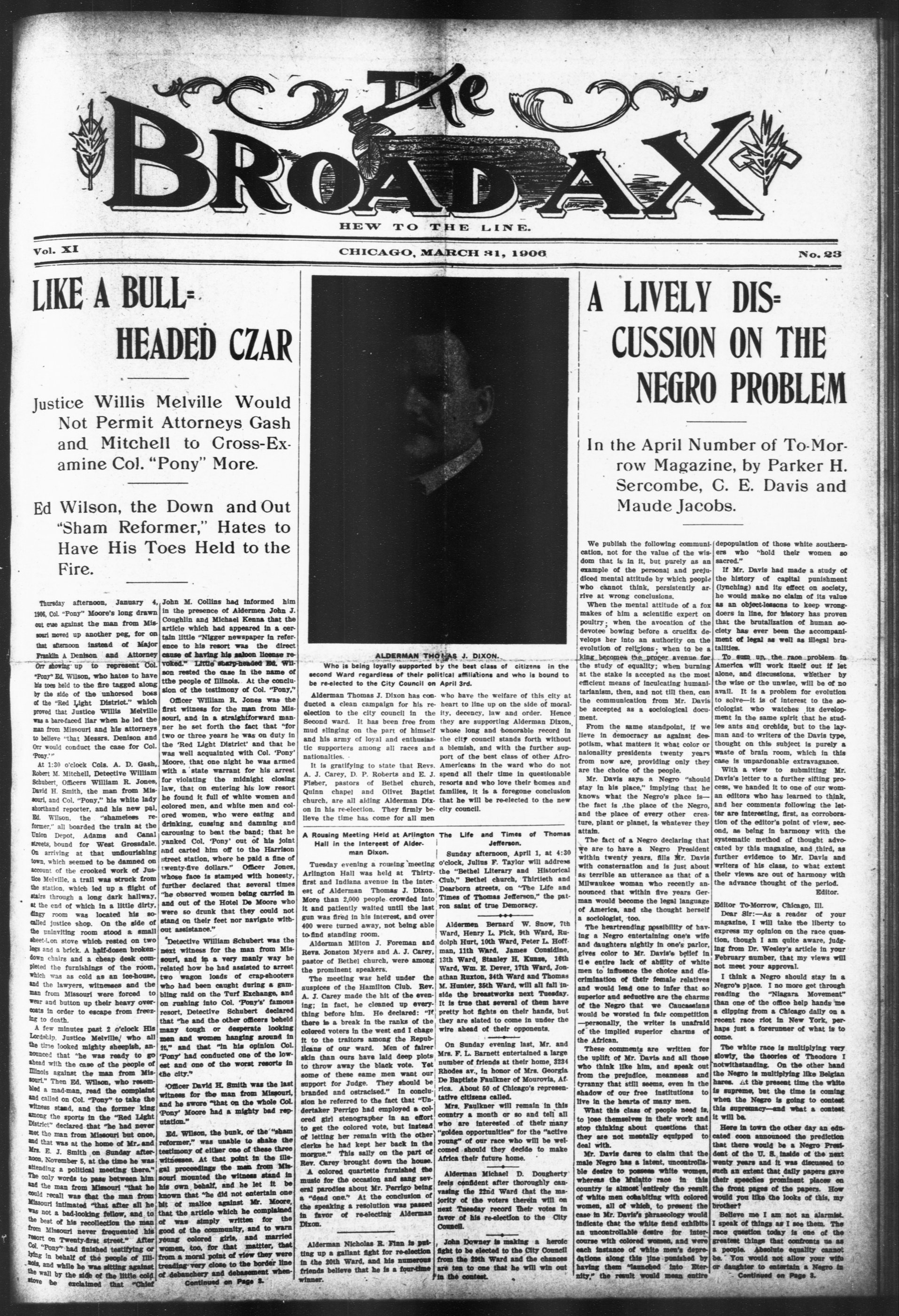
LIKE A BULL= HEADED CZAR
Justice Willis Melville Would Not Permit Attorneys Gash and Mitchell to Cross-Examine Col. "Pony" More.
Ed Wilson, the Down and Out "Sham Reformer," Hates to Have His Toes Held to the Fire.
Thursday afternoon, January 4, 1906, Col. "Pony" Moore's long drawn out case against the man from Missouri moved up another peg, for on that afternoon instead of Major Franklin A Denison and Attorney Orr showing up to represent Col. "Pony" Ed. Wilson, who hates to have his toes held to the fire tagged along by the side of the unhorsed boss of the "Red Light District," which proved that Justice Willis Melville was a bare-faced liar when he led the man from Missouri and his attorneys to believe "that Messrs. Denison and Orr would conduct the case for Col. Pony."
At 1:30 o'clock Cols. A. D. Gash, Robert M. Mitchell, Detective William Schubert, Officers William R. Jones David H. Smith, the man from Missouri, and Col. "Pony," his white lady shorthand reporter, and his new pal Ed. Wilson, the "shameless reformer," all boarded the train at the Union Depot, Adams and Canal streets, bound for West Grossdale. On arriving at that unfurlishing town, which seemed to be damned on account of the crooked work of Justice Melville, a trail was struck from the station, which led up a flight of stairs through a long dark hallway, at the end of which in a little dirty, dingy room was located his so-called justice shop. On the side of the uninviting room stood a small sheet-on stove which rested on two legs and a brick. A half-dozen broken-down chairs and a cheap desk completed the furnishings of the room, which was as cold as an ice-house, and the lawyers, witnesses and the man from Missouri were forced to wear and button up their heavy overcoats in order to escape from freezing to death.
John M. Collins had informed him in the presence of Aldermen John J. Coughlin and Michael Kenna that the article which had appeared in a certain little "Nigger newspaper in reference to his resort was the direct cause of having his saloon license revoked." Little sharp-headed Ed. Wilson rested the case in the name of the people of Illinois. At the conclusion of the testimony of Col. "Pony,"
Officer William R. Jones was the first witness for the man from Missouri, and in a straightforward manner he set forth the fact that "for two or three years he was on duty in the 'Red Light District' and that he was well acquainted with Col. 'Pony' Moore, that one night he was armed with a state warrant for his arrest for violating the midnight closing law, that on entering his low resort he found it full of white women and colored men, and white men and colored women, who were eating and drinking, cussing and damning and carousing to beat the band; that he yanked Col. 'Pony' out of his joint and carted him off to the Harrison street station, where he paid a fine of twenty-five dollars." Officer Jones, whose face is stamped with honesty, further declared that several times "he observed women being carried in and out of the Hotel De Moore who were so drunk that they could not stand on their feet nor navigate without assistance."
'Detective William Schubert was the next witness for the man from Missouri, and in a very manly way he related how he had assisted to arrest two wagon loads of crap-shooters who had been caught during a gambling raid on the Turf Exchange, and on rushing into Col. 'Pony's' famous resort, Detective Schubert declared that "he and the other officers behold many tough or desperate looking men and women hanging around in it," and that "in his opinion Col. 'Pony' had conducted one of the lowest and one of the worst resorts in the city."
'Officer David H. Smith was the last witness for the man from Missouri, and he swore "that on the whole Col. 'Pony' Moore had a mighty bad reputation."
Ed. Wilson, the bunk, or the "sham reformer," was unable to shake the testimony of either one of these three witnesses. At that point in the illegal proceedings the man from Missouri mounted the witness stand in his own behalf, and he let it be known that "he did not entertain one hit of malice against Mr. Moore, that the article which he complained of was simply written for the good of the community, and to warn young colored girls, and married women, too, for that matter, that from a moral point of view they were treading very close to the border line of debauchery and debasement when questioned on Page 8.
HEW TO THE LINE.
CHICAGO, MARCH 31, 1906
```markdown
```
Who is being loyally supported by the best class of citizens in the second Ward regardless of their political affiliations and who is bound to be re-elected to the City Council on April 3rd.
Alderman Thomas J. Dixon has con- who have the welfare of this city at ducted a clean campaign for his re-heart to line up on the side of moral election to the city council in the ity, decency, law and order. Hence Second ward. It has been free from they are supporting Alderman Dixon mud slinging on the part of himself whose long and honorable record in and his army of loyal and enthusias- the city council stands forth without tic supporters among all races and a blemish, and with the further sup- port of the best class of other Afro- nationalties.
It is gratifying to state that Revs. Americans in the ward who do not A. J. Carey, D. P. Roberts and E. J. spend all their time in questionable Fisher, pastors of Bethel church, resorts and who love their homes and Quinn chapel and Olivet Baptist families, it is a foregone conclusion church, are all aiding Alderman Dix- that he will be re-elected to the new on in his re-election. They firmly be- city council. ilieve the time has come for all men
A Rouaing Meeting Held at Arlington Hall in the Interest of Alderman Dixon.
Tuesday evening a rousing meeting Arlington Hall was held at Thirty first and Indiana avenue in the interest of Alderman Thomas J. Dixon. More than 2,000 people crowded into it and patiently waited until the last gun was fired in his interest, and over 400 were turned away, not being able to find standing room. Alderman Milton J. Foreman and Revs. Jonston Myers and A. J. Carey, pastor of Bethel church, were among the prominent speakers.
The meeting was held under the auspices of the Hamilton Club. Rev. A. J. Carey made the hit of the evening; in fact, he cleaned up everything before him. He declared: "If there is a break in the ranks of the colored voters in the west end I chage it to the traitors among the Republicans of our ward. Men of fairer skin than ours have laid deep plots to throw away the black vote. Yet some of these same men want our support for Judge. They should be branded and ostracised." In conclusion he referred to the fact that "Undertaker Perrigo had employed a colored girl stenographer in an effort to get the colored vote, but instead of letting her remain with the other clerks he had kept her back in the morgue." This sally on the part of Rev. Carey brought down the house. A colored quartette furnished the music for the occasion and sang several parodies about Mr. Perrigo being a "dead one." At the conclusion of the speaking a resolution was passed in favor of re-electing Alderman Dixon.
Alderman Nicholas R. Finn is putting up a gallant fight for re-election in the 20th Ward, and his numerous friends believe that he is a four-time winner.
who have the welfare of this city at heart to line up on the side of morality, decency, law and order. Hence they are supporting Alderman Dixon, whose long and honorable record in the city council stands forth without a blemish, and with the further support of the best class of other Afro-Americans in the ward who do not spend all their time in questionable resorts and who love their homes and families, it is a foregone conclusion that he will be re-elected to the new city council.
Sunday afternoon, April 1, at 4:30 o'clock, Julius F. Taylor will address the "Bethel Literary and Historical Club," Bethel church, Thirtieth and Dearborn streets, on "The Life and Times of Thomas Jefferson," the patron saint of true Democracy.
Aldermen Bernard W. Snow, 7th Ward, Henry L. Flick, 9th Ward, Rudolph Hurt, 10th Ward, Peter L. Hoffman, 11th Ward, James Considine, 13th Ward, Stanley H. Kunze, 16th Ward, Wm. E. Dever, 17th Ward, Jonathan Ruxton, 24th Ward and Thomas M. Hunter, 36th Ward, will all fall inside the breastworks next Tuesday. It is true that several of them have pretty hot fights on their hands, but they are slated to come in under the wire ahead of their opponents.
On Sunday evening last, Mr. and Mrs. F. L. Barnett entertained a large number of friends at their home, 3234 Rhodes av., in honor of Mrs. Georgia De Baptiste Faulkner of Mourovia, Africa. About 50 of Chicago's representative citizens called.
Mrs. Faulkner will remain in this country a month or so and tell all who are interested of their many "golden opportunities" for the "active young" of our race who will be welcomed should they decide to make Africa their future home.
Alderman Michael D. Dougherty feels confident after thoroughly canvasing the 22nd Ward that the majority of the voters therein will on next Tuesday record their votes in favor of his re-election to the City Council.
John Downey is making a heroic fight to be elected to the City Council from the 29th Ward and the chances are ten to one that he will win out in the contest.
A LIVELY DIS= CUSSION ON THE NEGRO PROBLEM
In the April Number of To-Morrow Magazine, by Parker H. Sercombe, C. E. Davis and Maude Jacobs.
We publish the following communication, not for the value of the wisdom that is in it, but purely as an example of the personal and prejudiced mental attitude by which people who cannot think, persistently arrive at wrong conclusions.
When the mental attitude of a fox makes of him a scientific expert on poultry; when the avocation of the devotee bowing before a crucifix develops her into an authority on the evolution of religions; when to be a king becomes the proper avenue for the study of equality; when burning at the stake is accepted as the most efficient means of inculcating humanitarianism, then, and not till then, can the communication from Mr. Davis be accepted as a sociological document.
From the same standpoint, if we live in democracy as against despotism, what matters it what color or nationality presidents twenty years from now are, providing only they are the choice of the people.
Mr. Davis says a Negro "should stay in his place," implying that he knows what the Negro's place is—the fact is: the place of the Negro, and the place of every other creature, plant or planet, is whatever they attain.
The fact of a Negro declaring that we are to have a Negro President within twenty years, fills Mr. Davis with consternation and is just about as terrible an utterance as that of a Milwaukee woman who recently announced that within five years German would become the legal language of America, and she thought herself a sociologist, too.
The heartrending possibility of having a Negro entertaining one's wife and daughters nightly in one's parlor, gives color to Mr. Davis's belief in the entire lack of ability of white men to influence the choice and discrimination of their female relatives and would lead one to infer that so superior and seductive are the charms of the Negro that we Caucasians would be worsted in fair competition—personally, the writer is unafraid of the implied superior charms of the African.
These comments are written for the uplift of Mr. Davis and all those who think like him, and speak out from the prejudice, meanness and tyranny that still seems, even in the shadow of our free institutions to live in the hearts of many men.
What this class of people need is, to lose themselves in their work and stop thinking about questions that they are not mentally equipped to deal with.
Mr. Davis dares to claim that the male Negro has a latent, uncontrollable desire to possess white women, whereas the Mulatto race in this country is almost entirely the result of white men cohabiting with colored women, all of which, to present the case in Mr. Davis's phraseology would indicate that the white flend exhibits an uncontrollable desire for intercourse with colored women, and were each instance of white men's depredations along this line punished by having them "launched into Eternity," the result would mean entire
No.23
DIS=
N ON THE
PROBLEM
number of To-Mor-
ine, by Parker H.
C. E. Davis and
obs.
depopulation of those white southerners who "hold their women so sacred."
If Mr. Davis had made a study of the history of capital punishment (lynching) and its effect on society, he would make no claim of its value as an object-lessons to keep wrong-doers in line, for history has proven that the brutalization of human society has ever been the accompaniment of legal as well as illegal brutalities.
To sum up, the race problem in America will work itself out if let alone, and discussions, whether by the wise or the unwise, will be of no avail. It is a problem for evolution to solve—it is of interest to the sociologist who watches its development in the same spirit that he studies ants and orchids, but to the layman and to writers of the Davis type, thought on this subject is purely a waste of brain room, which in this case is unpardonable extravagance.
With a view to submitting Mr. Davis's letter to a further sifting process, we handed it to one of our woman editors who has learned to think, and her comments following the letter are interesting, first, as corroboration of the editor's point of view, second, as being in harmony with the systematic method of thought advocated by this magazine, and third, as further evidence to Mr. Davis and writers of his class, to what extent their views are out of harmony with the advance thought of the period.
Editor To-Morrow, Chicago, Ill.
Dear Sir:—As a reader of your magazine, I will take the liberty to express my opinion on the race question, though I am quite aware, judging from Dr. Wesley's article in your February number, that my views will not meet your approval.
I think a Negro should stay in a Negro's place. I no more get through reading the "Niagara Movement" than one of the office help hands me a clipping from a Chicago daily on a recent race riot in New York, perhaps just a forerunner of what is to come.
The white race is multiplying very slowly, the theories of Theodore I notwithstanding. On the other hand the Negro is multiplying like Belgian hares. At the present time the white is supreme, but the time is coming when the Negro is going to contest this supremacy—and what a contest it will be.
Here in town the other day an educated coon announced the prediction that there would be a Negro President of the U. S. inside of the next twenty years and it was discussed to such an extent that daily papers gave their speeches prominent places on the front pages of the papers. How would you like the looks of this, my brother?
Believe me I am not an alarmist. I speak of things as I see them. The race question today is one of the greatest things that confronts us as a people. Absolute equality cannot be. You would not allow your wife or daughter to entertain a Negro in Continued on Page 8.
Till promulgate and at all times uphold the true principles of Democracy, but Catholic, Protestant, Presbyterian, Include, Farmers, Single Taxes, Republican, have their say, so long as their language is proper and responsibility is fixed.
The Broad: It is a newspaper whose platform is broad enough for all, ever claiming the editorial right to speak its own mind.
Local communications will receive attention.
Write only on one side of the paper.
1 Subscriptions must be paid in advance.
THE BROAD AX
6000 Armour Avenue, Chicago.
JULIUS F. TAYLOR, Editor and Publisher.
Entered at the Post Office at Chicago,
Ill., as Second-class Matter.
Alderman James J. McCormiek is putting up the sight of his life to be re-elected to the city council from the Fifth ward, and if all signs do not fail he will on next Tuesday outdistance all of his rivals and win the Aldermanc prize. From his boyhood days down to the present time he has resided in the Fifth ward, and he is familiar with the wants and needs of its residents much better than an inexperienced man would be.
His long experience in the council and in other public position which he has honorably held will redound to his advantage, for it generally takes a new man several years to learn the ins and outs of the City Hall, while Alderman McCormick can accomplish many things for his ward without waiting so long. He is ever ready and willing to hustle for all the people residing in his ward, be they Democrats or Republicans. He is one of those open-handed and free-hearted men who delight to see all the people in his ward prosper and get everything that they are entitled to receive in the way of street paving, small
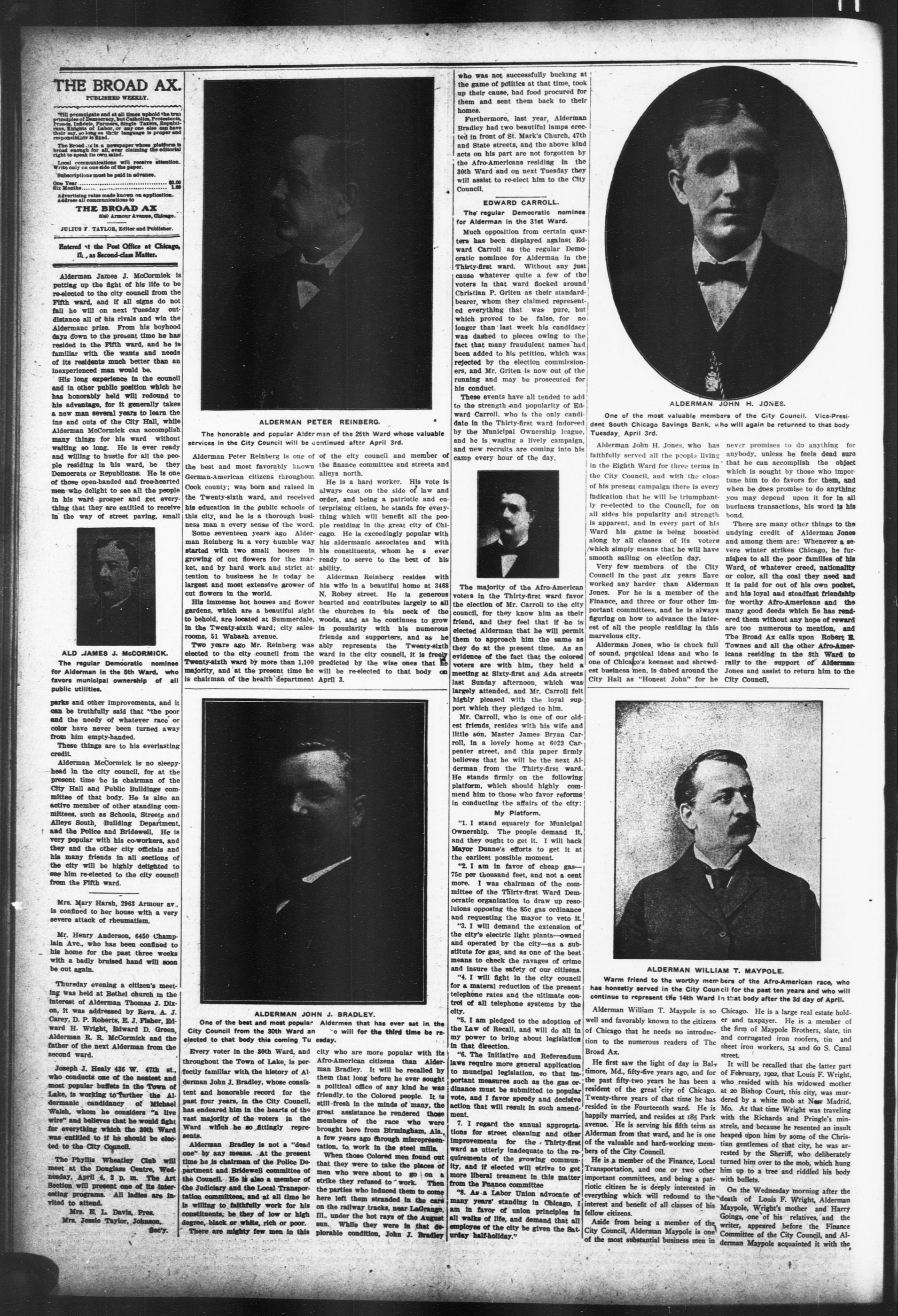
ALD JAMES J. McCORMICK.
The regular Democratic nominee
for Alderman in the 5th Ward, who
favors municipal ownership of all
public utilities.
parks and other improvements, and it can be truthfully said that "the poor and the needy of whatever race or color have never been turned away from him empty-handed. These things are to his everlasting credit. Alderman McCormick is no sleepyhead in the city council, for at the present time he is chairman of the City Hall and Public Buildings committee of that body. He is also an active member of other standing committees, such as Schools, Streets and Alleys South, Building Department, and the Police and Bridewell. He is very popular with his co-workers, and they and the other city officials and his many friends in all sections of the city will be highly delighted to see him re-elected to the city council from the Fifth ward.
Mrs. Mary Harsh, 2963 Armour av., is confined to her house with a very severe attack of rheumatism.
Mr. Henry Anderson, 6450 Champlain Ave., who has been confined to his home for the past three weeks with a badly bruised hand will soon be out again.
Thursday evening a citizen's meeting was held at Bethel church in the interest of Alderman Thomas J. Dixon, it was addressed by Revs. A. J. Carey, D. P. Roberts, E. J. Fisher, Edward H. Wright, Edward D. Green, Alderman R. R. McCormick and the father of the next Alderman from the second ward.
Joseph J. Healy 436 W. 47th st., who conducts one of the neatest and most popular buffets in the Town of Lake, is working to Further the Aldermanic candidacy of Michael Walsh, whom he considers "a live wire" and believes that he would fight for everything which the 30th Ward was entitled to if he should be elected to the City Council.
The Phyllis Wheatley Club will meet at the Donglass Centre, Wednesday, April 4, 2 p. m. The Art Section will present one of its interesting programs. All ladies are invited to attend.
Mrs. E. L. Davis, Pres.
Mrs. Jessie Taylor, Johnson.
Seev.
[Name not visible]
ALDERMAN PETER REINBERG.
The honorable and popular Alderman of the 26th Ward whose valuable services in the City Council will be continued after April 3rd.
Alderman Peter Reinberg is one of the best and most favorably known German-American citizens throughout Cook county; was born and raised in the Twenty-sixth ward, and received his education in the public schools of this city, and he is a thorough business man in every sense of the word.
Some seventeen years ago Alderman Reinberg in a very humble way started with two small houses in growing of cut flowers for the market, and by hard work and strict attention to business he is today the largest and most extensive grower of cut flowers in the world.
of the city council and member of the finance committee and streets and alleys north.
He is a hard worker. His vote is always cast on the side of law and order, and being a patriotic and enterprising citizen, he stands for every thing which will benefit all the people residing in the great city of Chicago. He is exceedingly popular with his alderman associates and with his constituents, whom he s ever ready to serve to the best of his ability.
Alderman Reinberg resides with his wife in a beautiful home at 346 N. Robey street. He is generous
His immense hot houses and flower gardens, which are a beautiful sight to behold, are located at Summerdale, in the Twenty-sixth ward; city salewsrooms, 51 Wabash avenue.
Two years ago Mr. Reinberg was elected to the city council from the Twenty-sixth ward by more than 1,100 majority, and at the present time he is chairman of the health department
[Image of a man with a serious expression, wearing a suit and tie].
[Name]
ALDERMAN JOHN J. BRADLEY.
One of the best and most popular City Council from the 30th Ward are elected to that body this coming Tu Every voter in the 30th Ward, and throughout the Town of Lake, is perfectly familiar with the history of Alderman John J. Bradley, whose consistent and honorable record for the past four years, in the City Council, has endeared him in the hearts of the vast majority of the voters in the Ward which he so fittingly represents.
Alderman Bradley is not a "dead one" by any means. At the present time he is chairman of the Police Department and Bridewell committee of the Council. He is also a member of the Judiciary and the Local Transportation committees, and at all time he is willing to faithfully work for his constituents; be they of low or high degree, black or white, rich or poor. There are mighty few men in this
of the city council and member of the finance committee and streets and alleys north.
He is a hard worker. His vote is always cast on the side of law and order, and being a patriotic and enterprising citizen, he stands for everything which will benefit all the people residing in the great city of Chicago. He is exceedingly popular with his aldermanic associates and with his constituents, whom he s ever ready to serve to the best of his ability.
Alderman Reinberg resides with his wife in a beautiful home at 3468 N. Robey street. He is generous hearted and contributes largely to all the churches in his neck of the woods, and as he continues to grow in pauularity with his numerous friends and supporters, and as he ably represents the Twenty-sixth ward in the city council, it is freely predicted by the wise ones that he will be re-elected to that body on April 3.
[Image of a man's face with a serious expression, wearing a suit and tie].
Aldermen that has ever sat in the office will for the third time be reseday.
city who are more popular with its Afro-American citizens than Alderman Bradley. It will be recalled by them that long before he ever sought a political office of any kind he was friendly, to the Colored people. It is still-fresh in the minds of many, the great assistance he rendered those members of the race who were brought here from Birmingham, Ala., a few years ago through misrepresentation, to work in the steel mills.
When those Colored men found out that they were to take the places of men who were about to go on a strike they refused to work. Then the parties who induced them to come here left them stranded in the cars on the railway tracks, near LaGrange, Ill., under the hot rays of the August sun. While they were in that deplorable condition, John J. Bradley
who was not successfully bucking at the game of politics at that time, took up their cause, had food procured for them and sent them back to their homes. Furthermore, last year, Alderman Bradley had two beautiful lamps erected in front of St. Mark's Church, 47th and State streets, and the above kind acts on his part are not forgotten by the Afro-Americans residing in the 30th Ward and on next Tuesday they will assist to re-elect him to the City Council.
EDWARD CARROLL.
The regular Democratic nominee for Alderman in the 31st Ward.
Much opposition from certain quarters has been displayed against Edward Carroll as the regular Democratic nominee for Alderman in the Thirty-first ward. Without any just cause whatever quite a few of the voters in that ward flocked around Christian P. Griten as their standard-bearer, whom they claimed represented everything that was pure, but which proved to be false, for no longer than last week his candidacy was dashed to pieces owing to the fact that many fraudulent names had been added to his petition, which was rejected by the election commissioners, and Mr. Griten is now out of the running and may be prosecuted for his conduct.
These events have all tended to add to the strength and popularity of Edward Carroll, who is the only candidate in the Thirty-first ward indorsed by the Municipal Ownership league, and he is waging a lively campaign, and new recruits are coming into his camp every hour of the day.
The majority of the Afro-American voters in the Thirty-first ward favor the election of Mr. Carroll to the city council, for they know him as their friend, and they feel that if he is elected Alderman that he will permit them to approach him the same as they do at the present time. As an evidence of the fact that the colored voters are with him, they held a meeting at Sixty-first and Ada streets last Sunday afternoon, which was largely attended, and Mr. Carroll felt highly pleased with the loyal support which they pledged to him.
Mr. Carroll, who is one of our oldest friends, resides with his wife and little son, Master James Bryan Carroll, in a lovely home at 6023 Carpenter street, and this paper firmly believes that he will be the next Alderman from the Thirty-first ward. He stands firmly on the following platform, which should highly commend him to those who favor reforms in conducting the affairs of the city:
My Platform.
"1. I stand squarely for Municipal Ownership. The people demand it, and they ought to get it. I will back Mayor Dunne's efforts to get it at the earliest possible moment.
"2. I am in favor of cheap gas—75c per thousand feet, and not a cent more. I was chairman of the committee of the Thirtv-first Ward Democratic organization to draw up resolutions opposing the 85c gas ordinance and requesting the mayor to veto it.
"3. I will demand the extension of the city's electric light plants—owned and operated by the city—as a substitute for gas, and as one of the best means to check the ravages of crime and insure the safety of our citizens."
"4. I will fight in the city council for a material reduction of the present telephone rates and the ultimate control of all telephone systems by the city.
"5. I am pledged to the adoption of the Law of Recall, and will do all in my power to bring about legislation in that direction.
"6. The Initiative and Referendum laws require more general application to municipal legislation, so that important measures such as the gas ordinance must be submitted to popular vote, and I favor speedy and decisive action that will result in such amendment.
7. I regard the annual appropriations for street cleaning and other improvements for the Thirty-first ward as utterly inadequate to the requirements of the growing community, and if elected will strive to get more liberal treatment in this matter from the Finance committee "8. As a Labor Union advocate of many years' standing in Chicago, I am in favor of union principles in all walks of life, and demand that all employees of the city be given the Saturday half-holiday."
[Picture of a man in a suit with a bow tie].
ALDERMAN JOHN H. JONES.
One of the most valuable members of the City Council. Vice-President South Chicago Savings Bank, who will again be returned to that body Tuesday, April 3rd.
Alderman John H. Jones, who has faithfully served all the people living in the Eighth Ward for three terms in the City Council, and with the close of his present campaign there is every indication that he will be triumphantly re-elected to the Council, for on all sides his popularity and strength is apparent, and in every part of his Ward his game is being boosted along by all classes of its voters which simply means that he will have smooth sailing on election day never promises to do anything for anybody, unless he feels dead sure that he can accomplish the object which is sought by those who impose him to do favors for them, and when he does promise to do anything you may depend upon it for in a business transactions, his word is his bond.
There are many other things to the undying credit of Alderman Jones and among them are: Whenever a severe winter strikes Chicago, he furishes to all the poor families of
Very few members of the City Council in the past six years Have worked any harder than Alderman Jones. For he is a member of the Finance, and three or four other important committees, and he is always figuring on how to advance the interest of all the people residing in this marvelous city.
Alderman Jones, who is chuck full of sound, practical ideas and who is one of Chicago's keenest and shrewdest business men, is dubed around the City Hall as "Honest John" for he
```markdown
```
ALDERMAN WILLIAM T. MAYPOLE.
Warm friend to the worthy members of the Afro-American race, who has honestly served in the City Council for the past ten years and who will continue to represent the 14th Ward In that body after the 3d day of April.
Alderman William T. Maypole is so well and favorably known to the citizens of Chicago that he needs no introduction to the numerous readers of The Broad Ax.
He first saw the light of day in Baltimore, Md., fifty-five years ago, and for the past fifty-two years he has been a resident of the great city of Chicago. Twenty-three years of that time he has resided in the Fourteenth ward. He is happily married, and resides at 185 Park avenue. He is serving his fifth term as Alderman from that ward, and he is one of the valuable and hard-working members of the City Council.
He is a member of the Finance, Local Transportation, and one or two other important committees, and being a patriotic citizen he is deeply interested in everything which will redound to the interest and benefit of all classes of his fellow citizens.
Aside from being a member of the City Council, Alderman Maypole is one of the most substantial business men in
---
never promises to do anything for anybody, unless he feels dead sure that he can accomplish the object which is sought by those who importune him to do favors for them, and when he does promise to do anything you may depend upon it for in all business transactions, his word is his bond.
There are many other things to the undying credit of Alderman Jones and among them are: Whenever a severe winter strikes Chicago, he furnishes to all the poor families of his Ward, of whatever creed, nationality or color, all the coal they need and it is paid for out of his own pocket, and his loyal and steadfast friendship for worthy Afro-Americans and the many good deeds which he has rendered them without any hope of reward are too numerous to mention, and The Broad Ax calls upon Robert E. Townes and the other Afro-Americans residing in the 8th Ward to rally to the support of Alderman Jones and assist to return him to the City Council.
M.
Chicago. He is a large real estate holder and taxpayer. He is a member of the firm of Maypole Brothers, slate, tin and corrugated iron roofers, tin and sheet iron workers, 54 and 60 S. Canal street.
It will be recalled that the latter part of February, 1902, that Louis F. Wright, who resided with his widowed mother at 20 Bishop Court, this city, was murdered by a white mob at New Madrid, Mo. At that time Wright was traveling with the Richards and Pringle's minstrels, and because he resented an insult heaped upon him by some of the Christian gentlemen of that city, he was arrested by the Sheriff, who deliberately turned him over to the mob, which hung him up to a tree and riddled his body with bullets.
On the Wednesday morning after the death of Louis F. Wright, Alderman Maypole, Wright's mother and Harry Goings, one of his relatives, and the writer, appeared before the Finance Committee of the City Council, and Alderman Maypole acquainted it with the
ee... and reouested a little
facts in the case, and requested a little
Geancial assistance for Mrs. Wright to
4 her to bring the body Of ‘her son
feck to Chicago for barial. .
‘The hat was passed around, and Al-
dermens Mavor, Jackson, Bennett, Beil-
foss, Finn, Goldzier, ‘Blake and Boyd
and Hon. F. W. Blocki contributed $r1.
Then Alderman Maypole ran his hand
ja his pocket and brought up $10, which
fe donated to Mrs, Whight, making $2r
jp all which was turned over to her to
accomlish her object. Alderman May-
foie also farnished transportation for
the body, and an attendant from that
print in “Tissouri to this city. Alderman
Mtrpole was no candidate for re-elec-
tion at that time, and none of the par-
tes were residents of his ward, and his
kind and generous act on that occasion
ave always endeared him in the hearts
Giiis Airo-American fellow citizens,
For mary years Alderman Maypole
tas bees = firm supporter and contribu-
tor to Provident Baptist and St. Steph-
fais cinrehes, and Rev. W. S. Brooks,
de able and eloquent pastor of the last
‘gmed church, and ninety per cent of
fe Airo-Americans residing in the
Foorteenth ward will on the 3d day of
April record their votes in favor of his
ae eection to the City Council,
attorney Charles M. Foell, Candidate
for Alderman of the Twenty.
first Wad.
‘The Aldermanic contest in the
qeenty-first ward between Attorney
(haries M. Foell and Harry R. Eagle
tas been quite lvely, but unfortu-
sately for Mr. Eagle, he has driven
many of its good substantial voters
away from him. It seems that every
meeting which has been held for him
some of his lightheaded speakers
tare delighted to unbosom them-
selves of insulting remarks concern-
fag the Irish, the German and Mr.
Negro.
‘At a meeting held in his interest at
the North Side Turner Hall, Wednes-
tay evening, Attorney Shackleford,
who hails from somewhere away
forn South before the war, put in
the most of his time while attempt.
tng to address the meeting in railing
tgunst the Negro criminals who were
brought here during the teamsters’
trike. and he was so abusive and
coarse in his attacks on the Negro
fist colored man in the hall pro-
tested and declared that all the men
‘brought here to break the strike did
20 belong to the colored race. Then
‘some ove shouted to “throw the ‘Ni:
‘ger ont of the hall!”
Mr. Eagle is not entitled to receive
‘the vores of the 150 colored men who
have always afflicted with the Dem-
veratic party in that ward, nor the
‘votes of decent and respectable Irish-
men and German-Americans, as long
as be stands idly by and permits his
meakers and shouters to insult hon-
‘rable citizens on account of their
Tice or nationality.
Tt can be said to the credit of Mr.
Foell, who is a member of the law
firm of Gemmill & Foell, Atwood
‘Building, and who has honorabls
served for two terms as President of
the Marquette Club, and makes his
dome at the Virginia Hotel, that he
‘ants the votes of all classes of cit
izens in his ward, be they German,
Irish or Negro, and as he is extremely
Popular and a polished gentleman, it
4s the firm opinion of the North Side
Politicians that he will be the next
Alderman from the Twenty-first ward.
PERRIGO’S RECORD 18 GIVEN.
The Municipal Voters’ league yes-
terday evening gave out a bulletin
concerning the career of Undertaker
4 B. Perigo, who ts a candidate for
alderman in the Second ward against
Ald Dixon. The bulletin warns the
ters against Perrigo and advises
them to vote for Dixon. It follows:
“To the Voters of the Second
‘Ward: The candidacy of A. B. Per
Ngo, an undertaker who is the Dem-
eratic nominee for alderman in your
‘Ward creates a situation so dangerous
‘0 pubite interests as to éall for spe
a] attention. The circumstances
Swrounding Perrigo’s connection
With the will and affairs of Michael
+. OBrien, and the efforts of the Gen-
eal Electric company to secure 4
fanchiso in Wabash avenue, should
be euficient to insure his defeat.
Connection with O'Brien's Will.
“In 1690 Judge Batten of the Pro
bete court, refused to admit to pro
ate because of the testator’e mental
Condition an alleged will signed by
Michzel J. O'Brien, which was draws
by Perrigo and under which he haé
nade himself the sole beneficiary,
although in nowise related te
OBrien.
“At the time of O'Brien's death: Per
"go was an officer in a local lodge
o the Order of Foresters in which
OBrien held a $1,000 poliey, the pay
ment of which was,.under-the rules
of the order, limited to persons com
‘Re within contain ‘designated. classes
cthenefictaries. With Perrigo’s know!
“tse and consent O”Brem designed Jit
Polley to the woman in whose house
Re ‘wes lodging at the time. of Di
teeth and to which he haf gone wher
‘a sick man, only about’ fifteen days
before, under arrangements made
through Perrigo. In order to come
within the terms of the policy the
assignment was made on the alleged
ground that the woman was O’Brien's
‘affianced’ wife and dependent upon
‘him for support, although Perrigo has
admitted to the officers of the league
‘that this allegation was made merely
to circumvent the provisions of the
Policy. Perrigo then understood that
the Foresters would have been under
Ro obligation to pay this policy if no
Such assignment had been made. His
complete inability to recognize his
uty end obligation to the Order of
Foresters to prevent such a subter-
fuge demonstrates his unfitness to
Serve as the representative of the
Deople in the city council.
Fight on Franchise Dropped,
“When the property owners in Wa-
Dash avenue organized to keep the
‘General Electric off that street a few
years ago, Perrigo was a vigorous op-
ponent of the franchise and chairman
of one of the principal committees.
But his ardor cooled and he admits
having visited the office of the com-
pany. The suspicions of his associates
were aroused when his lack of inter-
est became marked and he was
known to have been with Perry Hull,
the chief promoter of the street rail-
way project. Perrigo cannot be given
the confidence of either the advocates
or the opponents of municipal owner-
Ship, for which he 1s now vocifer-
ously shouting. [
“It ts significant that in the cam-
paign Perrigo is actively supported
by the worst elements in the ward.
One of his meetings, held at 2250
State street, and presided over by Sol
Van Praag, was addressed by him-
self, ‘Pony’ Moore, ‘Coxey’ Cantwell,
and the Hon. ‘Indignation’ Jones.
“Thomas J. Dixon, Perrigo's op-
ponent, has served three terms in the
council with a clean record. He
should be elected not only on ac-
count of his record, but also to defeat
Perrigo."—The Chicago Tribune,
‘Tuesday, March 27.
Justice Willis Medville.
Concluded From Page 1.
ever they permit themselves to fre-
quent s:ch places as the Hotel De
Moore.”
"Ba. Wilson, who seemingly has an
itching desire to become the head at-
‘torney for all the gambling and crap-
shooting gentlemen in town, endesv-
ored to make the man from Missouri
admit while on the witness stand
that “he tried to press five dollars
out of Mr. Moore before the article
was written in relation to his first-
class establishment or family resort.”
In responding to his insulting ques-
tion the man from Missouri simply
said that “he was no blackmailer nor
sandbagger, and that be did not as-
sociate with ner solicit any kind of
business from immoral men.”
| It was a sickening sight to behold
‘Wilson and Moore standing so close
to each other that their heads touched
and they looked Ifke a pair of beau-
tiful white and black twins or black
and white angels. To prove that he
is a first-water sport Col. “Pony”
wanted to bet $25 right in court that
he “was never arrested for conduct-
ing a gambling house.”
From the beginning to the end of
the sham trial Justice Melville plainly
showed his band in favor of Col.
“Pony,” but he did not become real
raw until Cols. A. D. Gash and Robert
‘M. Mitchell attempted to cross-exam-
ine CoL“Pony.” Then like a bull-head-
ed Czar, Justice Melville; after being
driven from every legal proposition
he attempted to light on arbitrarily
ruled that “the attorneys for the man
from Missouri would not be per
mitted to propound one word to Mr.
Moore touching upon his character,
‘his past or present life, or his mode
of conducting his iste resort on
‘Twenty-first street for fear that Mr.
‘Moore: might’ say something which
would impair his consitutional
rights.”
Regardless of the stiff fight which
‘Cols. Gash and Mitchell put up for
the man from Missouri, the bull
headed and squinteyed misJustice
could not be budged from the illogical
position which, to say the least, was
an ‘abortion on’ justice in order to
have ® little more time to further
shufflo his dishonest judicial cards in
the dark in favor of Col. “Pony.”
Justice Melville requested the attor-
neys to furnish him with briefs cov-
ering the points of law involved in
the case, and he continued it until
‘Thursday afternoon, January 11. ,
‘That same Thursday evening (Jan
‘wary 4), after all bands had returned
from the sq-called trial at Wes
Grosséale; aiid while Ool. “Pony” was
drinking wine with Col. Robert T.
‘Motts and several other gentlemen in
the Pekin, 2700 Stete St, be “deciared
‘he ‘knew what he was talking
ahout; and that he wosld bet #500
that his friend, Justice Melville,
would in the end hold the man from
| Missouri over 10 the Grand Jury.
(Bo be Continued.)
we
E * Eas p ap i
i ge Meee tens
st - |.
Bes - 7
ee = et ]
Be se Sa a
Ree. 7p. xo
Bese iaea “gi
eee eats 2
“ee ae ON
is
BR : Pe
[a oe
eee oy
an he . 5
eae”
a. >
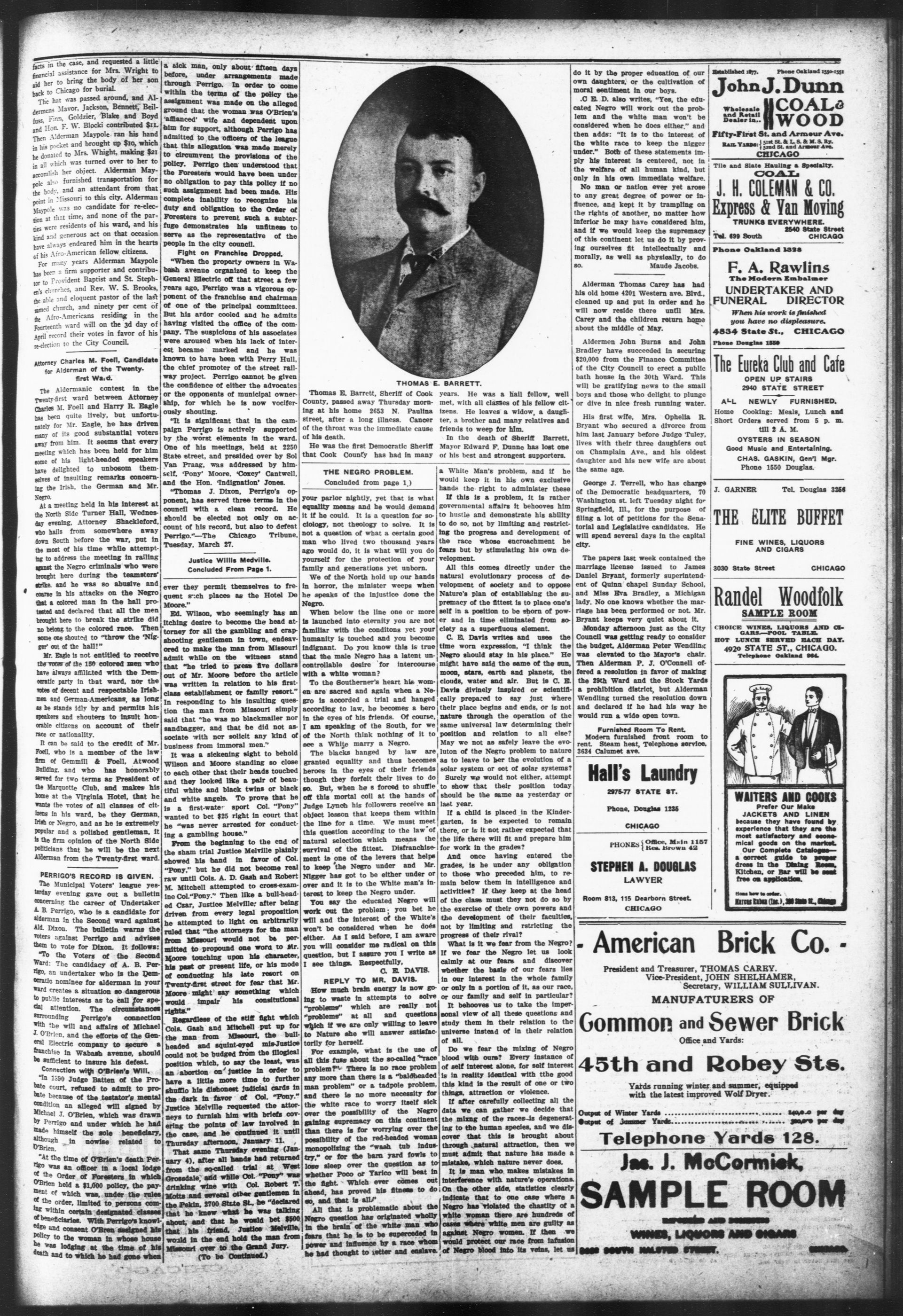
THOMAS E. BARRETT.
‘Thomas E, Barrett, Sheriff of Cook
County, passed away Thursday morn-
ing at his home 2653 N. Paulina
street, after a long illness. Cancer
of the throat was the immediate cause
of his death.
‘He was the first Democratic Sheriff
that Cook County has had in many
£_Conetaiel tom vean 3)
your parlor nightly, yet that is what
equality means and he would demand
it if he could. It is a question for so-
clology, not theology to solve. It is
Rot a question of what a certain good
man who lived two thousand years
ago would do, it is what will you do
yourself for the protection of your
family and generations yet unborn.
‘We of the North hold up our hands
fn horror, the minister weeps when
he speaks of the injustice done the
‘Negro.
‘When below the line one or more
is launched into eternity you are not
familiar with the conditons yet your
humanity is touched and you become
indignant. Do you know this is true
that the male Negro has a latent un-
controllable desire ‘for intercourse
with a white woman?
To the Southerner's heart hie wom-
en are sacred and again when a Ne-
gro 1s accorded a trial and hanged
according to law, he becomes a hero
in the eyes of his friends. Of course,
I am speaking of the South, for we
of the North think nothing of it to
eee a White marry a Negro.
‘The blacks hanged by law are
granted equality and thus becomes
heroes in the eyes of their friends
though they forfeit their lives to de
s0. But, when he 8 forced to shuffle
off this mortal coll at the hands of
‘Judge Lynob his followers receive an
‘object lesson that keeps them within
the line for a time. We must meet
this question according to the law of
natural selection which means the
survival of the fittest. Disfranchise
ment is one of the levers that helps
to keep ‘the Negro under and Mr.
‘Nigger has got to be elther under or
‘over and it is to the White man’s in-
terest to keep the Negro under.
You say the educated Negro will
work out the problem; you bet he
‘will and the interest of the White's
won't be considered when he doés
either. As I said before, I am aware
you will consider me radical on this
question, but I assure you I write as
I see things, Respectfully,
c B DAVIS.
REPLY TO MR. DAVIS.
‘How much brain energy is now go
ing to waste in attempts to solve
“problems” which are really no
"problems” at all and question:
‘which if we are only willing to lear
to Nature she will answer satisfac
| torily for herself.
For example, what is the use o
‘all this fuss about the socalled “rac
| problem? There is no race problem
any more than there is s “baldheade<
|man problem” or a tadpole problem
land there is no more necessity fo:
|the white race to worry itself sich
Jover the possibility of the Negr
gaining supremacy on this continen
| than there is for worrying over thi
possibility of the red-headed womal
| monopolizing the “wash tub indus
try,” or for the barn yard fowls t¢
}1ose sleep over the question as ti
| whether Poco or Yarico will beat f
‘|the fight. Which ever comes ou
ahead, has proved his fitness to d¢
| 90, and thet is all/” ‘
; ‘All that is problematic about thi
|| Negro question has originated wholly
[im the brain of the white man we
tears, that he te to be superceded
| power and influence by s race
he bad thought to ietter and enslave
years. He was a Hail fellow, well
met, with all classes of his fellow cit-
izens. He leaves a widow, a daugh-
ter, a brother and many relatives and
friends to weep for him.
In the death of Sherif? Barrett,
Mayor Edward F. Dunne has lost one
of his best and strongest supporters.
a White Man's problem, and if he
outa keep it in his own exclusive
hands the: right to administer these
| If this te a problem, it ts rather
governmental affaira ft behooves him
to hustle and demonstrate his ability
‘to do so, not by limiting and restrict.
ing the progress and development of
‘the race whose encroachment he
fears but by stimulating his own de
velopment.
All this comes directly under the
natural evolutionary process of de
velopment of society and to oppose
Nature's plan of establishing the su-
premacy of the fittest is to place one’s
self in a position to be shorn of pow.
er and in time eliminated from so
clety as a superfluous element.
C. B Davis writes and uses the
time worn expression, “I think the
[Negro should stay in his place” He
might have saia the same of the sun
moon, stars, earth and planets, the
clouds, water and air. But is C. E
Davis divinely inspired or scientifi
jeally Prepared to say just where
[their place begins and ends, or is no}
nature through the operation of th¢
|same universal law determining thet
position and relation to all else’
|May we not as safely leave the evo
jluton of the Negro problem to nature
as to leave to her the evolution of :
| solar system or set of solar systems’
"Surety we would not either, attemp
to show that their position toda;
should be the same as yesterday of
last year.
If a child is placed in the Kinder
garten, is he expected to remalz
there, or is it not rather expected tha
| he tife there will fit and prepare him
|for work in the grades?
Amd once having entered the
grades, is he under any obiigatior
to those who preceded him, to re
main below them in intelligence an¢
activities? If they keep at the heat
of the class must they not do so by
the exercise of their own powers an¢
the development of their faculties
not by limiting and rstricting th
progress of their rival? =
‘What is it we fear from the Negro
If we fear the Negro let us 100)
calmly at our fears and discove
whether the basis of our fears lle
in our interest in the whole famil
or only in a portion of it, as our race
or our family and self in particular
It behooves us to take the imper
sonal view of all these questions ani
study them in their relation to th
universe instead of in their relatio
of all.
| Do we fear the mixing of Negr
blood with ours? Every instance o
|of sett interest alone, for soit interes
is in reality identical with tthe goo
this kind is the result of one or tw
things, attraction or violence.
If after carefully collecting all th
data we can gather we decide tha
|the mixng of the racesis degenera’
ing to the human species, and we di
Jeover that this is brought abou
| through natural attraction, then w
| must admit that nature has made |
mistake, which nature never does.
| Tt is man who. makes mistakes
| interference with nature's operation:
iOn the other side, statistics clear!
indicate that to one case where
| Negro has Violated the chastity of
‘| white a there are hundreds <
Cente are white men aro eutty «
| eae eae soe om 7
|| would protect our race from infusic
of Negro blood into its veins, let «
- American Brick Co. -
Pee 0 ese OL SHELEAMER,
nie
Gommon and Sewer Brick
45th and Robey Sts.
SE nS ee weet
See of Wat Yan venience MO
Telephone Yards 128. __
Jas. J. MoCormiek,
WINES, LIQUORS AND QIGARS rf
do it by the proper education of our
own daughters, or the cultivation of
mora] sentiment in our boys.
.C BD. also writes, “Yes, the edu-
cated Negro will work out the prob-
Jem and the white man won't be
considered when he does elther.” and
then adds: “It is to the interest of
the white race to keep the nigger
under.” Bott of these statements im-
ply his interest is centered, not in
the welfare of all human kind, but
only in his own immediate welfare.
‘No man or nation ever yet arose
to any great degree of power or in-
fluence, and kept it by trampling on
the rights of another, no matter how
inferior he may have considered him,
and if we would keep the supremacy
of this continent let us do it by prov-
ing ourselves fit intellectually and
morally, as well as physically, to do
80. Maude Jacobs.
Alderman Thomas Carey has had
his old home 4201 Western ave. Blvd,
cleaned up and put in order and he
will now reside there until Mrs.
Carey and the children return home
about the middle of May. .
Aldermen John Burns and John
Bradley have succeeded in securing
$20,000 from the Finance Committee
of the City Council to erect a public
bath house in the 30th Ward. This
will be gratifying news to the small
boys and those who delight to plunge
or dive in nice fresh running water.
His first wife, Mrs. Ophella R.
Bryant who secured a divorce from
him last January before Judge Tuley,
lives with their three daughters out
on Champlain Ave., and his oldest
daughter and his new wife are about
the same age.
George J. Terrell, who has charge
ot the Democratic headquarters, 70
Washington st. left Tuesday night for
‘Soringtel, TIL, for the purpose of
filing a lot of petitions for the Sena-
torial and Legislative candidates. He
will spend several days in the capital
city.
‘The papers last week contained the
marriage license issued to James
Daniel Bryant, formerly superintend-
ent of Quinn’ chapel Sunday School,
and Miss Eva Bradley, a Michigan
lady. No one knows whether the mar-
riage has been performed or not. Mr.
Bryant keeps very quiet about it.
‘Monday afternoon just as the City
Council was getting ready to consider
the budget, Alderman Peter Wendling
was elevated to the Mayor’s chair.
Then Alderman P. J. O'Connell of-
fered a resolution in favor of making
the 29th Ward and the Stock Yards
& prohibition district, but Alderman
Wendling turned the resolution down
and declared if he had his way he
would run a wide open town.
Furnished Room To Rent.
Modern furnished front room to
rent. Steam heat, Telephone service,
3634 Calumet ave.
Hall’s Laundry
2976-77 STATE ST.
Phone, Douglas 1235
CHICAGO
pusones | 2m Mae gge7
LAWYER
Room 813, 115 Dearborn Street.
CHICAGO
‘Matabllshed st7, _Phone Oakland 1550561
JohnJ. Dunn
Dealer in.- wo OD
Fifty-First St. and Armeur Ave.
Rass Yampe:| Son Gi and Arwen Are
CHICAGO
‘Tile and Slate Hauling & Specialty.
COAL
J. H. COLEMAN & CO.
Express & Van Moving
‘TRUNKS EVERYWHERE.
| alone) ss maee
Phone Oakland 15238 7
F. A. Rawlins
‘The Modern Embalmer
UNDERTAKER AND
FUNERAL DIRECTOR
When his work is finished
you have no displeasure.
4834 State St., CHICAGO
Phone Douglas 1550 -
The Eureka Club and Cafe
OPEN UP STAIRS \
2940 STATE STREET
| AtL NEWLY FURNISHED,
‘Home Cooking: Meals, Lunch and
‘Short Orders served from 5 p. m
| tm 2 AM.
| OYSTERS IN SEASON
Good Music and Entertaining.
CHAS. GASKIN, Gen’l Mgr.
Phone 1850 Douglas.
GARNER Tel. Douglas 3266
FINE WINES, LIQUORS
AND CIGARS
3090 State Street CHICAGO
Randel Woodfolk
SAMPLE ROOM
EP
Py
a a
A R —
4 \
WAITERS AND COOKS
Prefer Our Make
JACKETS AND LINEN
‘experience that they are the
Seas
Our Complete Catalogue—
a correct guide to proper
dress in the Dining Reem,
Kitchen, or Bar will be sent
free om appiication.
aoe nane
arvas Raden (Ine, ), 200 Stamp 8, Chiengp
‘Not Extravagant Praise.
“What did the editor say about your
Story?” asked the young man's friend
“I don’t believe he liked it very
well”
“Well, there are differences in the
‘appreciative faculty as well as in the
ability to create. The same man's
taste will vary according to circum-
stances.”
“T suggested that, and he agreed with
me. He said that if a man found him-
self on a desert island with nothing
to read except my story and a back
umber city directory, ne might read
my story.”—Stray Stories.
Benignant Soul.
‘The following advertisement recent-
ly appeared im a London paper:
“Milk—It the individual who stole the
silk off my doorstep this morning
will be good enough to knock at the
door on the occasion of his next pro-
fessional visit I'll give him a drop
of rum to put in it. Milk taken nest
on cold moraings and an empty stom-
‘ach fs likely to injure the internal
economy of outdoor workers. Address,
poor
Chinese Millionaire.
Foon Chuck, a naturalized China-
man in Mexico, is estimated to be
‘Worth over $1,000,000 in gold. He wen:
to Mexico from Caiifornia 20 years ago
with less than $20, and went to work
as cook for the railway construction
company. He now owns three truck
farms and raises all vegetables used in
his line of hotels." He also owns a
farm of 11,000 acres in the state of
‘Tamauipas. He employs 100 Mexicana
and 25 Chinese coolies.
Aid to Swimmers,
A new float in the form of # tube,
three yards long, is intlated by the
swimmer and wound around his body.
At each end is a tube which is stopped
‘up with a plug, and a leather strap,
which serves to fasten the float to
the body. It is wound around the
waist, then the neck, and finally
around the arms.
First Wall Paper.
‘The manor house at Saltfleet, Lin-
colnshire, England, has what is said
to be the first wall paper used in Eng-
land. The paper, which is like blotting
paper in texture, and has a cream-
colored ground and chocolate design.
is fastened to the wail with small
tacks.
ak Site Doe
A splendid funeral procession was
Proceeding from Hongo, Japan, to
Dury the remains of Tarof, the head
of & gambling den, when the police
stopped the ceremony, as the dead ma
was believed to be an escaped con-
Vict. This was found to be true, and
the body was taken to the prison burial
ground.
Simulate Sickness.
Many animals feign illness. In mili-
tary stables cases are recorded of
Rorses pretending to be lame in order
to avoid going to a military exercise.
A certain chimpanzee had been accus-
tomed to receive cake when Mi. Afte-
his recovery, he often feigned cough-
ing, in order to procure dainties.
Sacred Gate.
‘When the prince and princess of
‘Wales desired the other day to inspect
the golden temple, at Amritsir, in the
Punjab, the sikhs declined te allow
‘them to enter the main gate, because
they were not sikhs, but said they
could enter by a side door. The offer
‘was declined.
aay
‘Miss Grace Brenneman, of Lindsey,
©., is m telegraph lineman. She can
splice, put on a new insulator, re-
place's fuse or repair a dropped
Switchboard. Climbing a pole is
ebild’s play to her. She is just 20
years old.
Prestdent’s Cravat. 4
M. Fallieres, the new president of
France, wears 2 butterfly tie fastened
to his collar button with = piece of
Gastic. He says that be bas worn that
Kind of tie for 30 years, and is not
going to change, presidency or 20
presidency.
Getting Fiippant. :
“Londen,” says the queen, “formier-
Jy wplenstic and morose, has totally
@anged tts character. Everything js
looked at lightly, sirlly, and we make
fum even of such tragedies as our cli-
mate and the county council.”
Jewel Trade.
Impertations of precious stones at
‘Mew York in the
‘Were appraised at
‘with $2,407,089 tm
—— ee
Gccasionally 2 woman marries her
‘ideal man, but in most enses ft not
‘Jeng until her aircastie ts tenstormed
fete 8 fat
‘Wert Slice,
‘Dolly—The second time I sew him
1 was engaged to him.
‘Fred—What caused the éelay?—2-
tastrated Bits.
Pe
‘Busts leads the world tm planting
fevests; America in devastating them
Tough Carpets,
ee aAGh Ghee $0. mene auh.
‘Menu of the Eagle.
The voracity of the eagie is a well-
known fact, but it has been left to a
Swiss hunter to define exactly the va-
riations which take place in its daily
menu. In a nest in the Alps, side by
sied with an eaglet, he found a hare,
freshly killed; 27 chamois’ feet, four
pigeons’ feet, 30 pheasants’ feet, 11
heads of fowls, 18 heads of grouse, and
the remnants of rabbits, marmots and
squirrels.
Coin for Mexico.
‘The Mexican government lately con-
eluded « contract with the Philadelphia
mint for the cotnage of about $4,000,000
worth of gold which Mexico has beea
accumulating for about two years.
The mint has already begun coining
$1,000,000 on a rush order. Since the
eetablishment of the gold standard 1
that country the capacity of their
mints has been overtaxed.
i ie Mie
A reunion of the Weewee family wes
held recently at the home of Leonard
‘Weowee, west of town, reports the
Rushville (Ind.) Republican. There ar)
nine brothers, and their aggregate
weight {s 1,780 pounds, an aver-
age of 178 pounds to the man. All
are six-footers. This s probably the
“largest family” of boys in this coun-
try.
Isolated Danish Colony.
A curious circumstance in connec-
tion with the death of the king of Den-
mark is the fact that one of the Danisn
colonies, Greenland, would not learn
the news for three months, owing to
the difficulty of ships reaching the
land. In ignorance of the event, the
Greenlanders will celebrate King
Christian's birthday on April § im the
usual manner.
New Lawnmower.
A lawnmower has made fts appear-
ance built on the lines of the agricul-
tural reaper, which in itself suggests
to the average mind the familiar bar-
ber’s clippers. It is said for this ma-
chine that it does not mutilate the
grass so much as the usual rotary
knife lawn mower, which has a ten-
dency to drag the roots and feeders.
Got Chummy.
Henry St. George Tucker, presi-
dent of the Jamestown exhibition, told
@ congressional committee about his
audience with King Edward. He said
he and the king had a very pleasant
talk. “As near as I can gather,” said
® committee member, “the king waa
calling him “Tuck, old boy,’ before he
left.”
‘Naturalistic Notations.
Fishes have no eyelids, and neces-
sarily sleep with their eyes open; they
‘swallow their food whole, having no
dental machinery. Frogs, toads and
serpents never take food except that
which they are certain is alive. Ser-
ents are so tenacious of life that they
‘Will live for six months or longer
without food.
Crater-Dwellers.
About 20,000 people live in the crater
of an extinct volcano, 30 miles from
Kumamotu, Japan. They dwell in thie
Dit-like town, surrounded by a vertical
wall 800 feet high. The inhabitants
rarely make a journey into the outer
world, and practically they form a
little community all by themselves.
Scotland’s “Plichtine Stone”
‘The “plighting stone” was used unti!
quite recently in parts of Scotland.
Troths were pligbted by grasping
hands through the stone. These trots
and promises were inviolate in mat-
ters of love, business and all secial re-
lations.
Limedrop’s Finish.
“So Smitherby married Limedrop's
widow. Good friend of the husband's,
‘wasn't he?”
“Yes, indeed. Said he couldn't bear
to see him suffer, and, the widow be-
ing willing, euthanaziated him”—N
'Y. Times.
Getting Dangerous.
‘The market for American poker
‘chips is said to’be seriously threaten-
od by undervaluation @ the Japanese
article. Many patriots will new be-
gin to believe in the reality of the yel-
low peril.
Deecevet 2
“Hist!” whispered the stage villain,
creeping stealthily away. =
“T expected you would be,” rejoined
‘the callboy, making a belt round the
Deck of the stage—Stray Stories.
She Turns to Whininc.
“Many © marriage turss out = sail-
‘we” said the philesopher, “mainly
ee ee ee he
Decame the whining ways of the
vite”
‘The Real Thing.
“De she’ nuff fnancier,” said Uncle
‘Mhea, “is de woman wif only a two
Geller bill an’ 2 family of sight to
far."—Washington Star.
Use Their Hoses.
‘The negroes. of Tahiti, one of the
Society islands in the south Paeliic,
pisy the flute with the nose instead
eof the month.
- ‘Small Minded
Bb yhipo a Eben,
make up
son aur crn shorcominte by scold
at de ebiléera.”—Washington Star.
aE a
Extraordinary!
The New Pekin Theatre
splat pede STATE Sts.
Saturday, [arch 31st, 1906
MR. ROBERT T. MOTTS
PRESENTS
AN ALL STAR CAST a
IN THE
‘THREE ACT MUSICAL COMEDY
“THE MAN FROM BAM”
/ THE FIRST TIME ON ANY STAGE
Book by Collin Davis,
tis ty Sea sereen
omer
EVERY NIGHT AT 8:30.
MATURED —cromrtaye Sundays and
Bverything MNevt
New Music New Comedy! New Facts! New Theatre! Now Policy
AN UP-TO-DATE FAMILY THEATER
ED AMUSEMENT HOUSE ON THE SOUTH SIDES TTY APPOINT.
Robert T. Notts, Propictor and Manager.
Tickets will be on sale at the Box OMice at 11 o'clock ‘Thureday
morning, March 29th. ce
‘Sousa’s Short Speech.
Sousa, the famous conductor, hates
public oratory and never, if he, can
help it, makes a speech im public.
‘After one of his performances in Cork
his audience kept clamoring for 9
‘speech and refused to be satisfied with
the usual bow. Finally Sousa stepped
to the front of the platform and, rais-
ing his hand, said impressively: “La-
dies and gentlemen, can you all hear
me?” There was the usual “Yes.”
“Then I wish you good-night.” ~
‘When Conversation Lagged.
‘They werg at the theater together,
‘and conversation lagged. At last, dur-
ing the entr'acte, he turned to her and
‘ventured: i
“Don’t—don’t you think the acous-
tics here are very bad?” She hesitate!
an instant.
“Why, no,” she said, a little unces
tainly, “I don't smell anything.”—N.
¥. Times.
@hrewd Rov.
‘Tommy (at the breakfast table)—!
Greamed last night 1 found a bag o!
gold in a cave.
‘Mr. Tucker—And just as you were
about to grab it you woke, did you’
“Bet your life I didn't! 1 kind o
thought it was a dream, and I jus:
Kept on dreamin’, and had a mighty
good time with that money ‘fore |
waked up.”—Chicago Tribune,
Dickens Character Dead.
Joseph Jennings died lately at Col-
chester, England, at the age of 100
years. A lawsuit in his family over
& disputed will was the foundation of
Dickens’ “Jarndyce vs. Jarndyce.” On
the tombstone of one of the litigants,
in a Colchester churchyard, is the text,
from Jeremiah: “Though decent, they
refused to know me.”
Olive Oil in Algiers.
Consul Johnson, of Algiers, writes
that the adulteration of olive oll with
cottonseed ofl has caused -a law to
be promulgated there requiring all ad-
mixtures to be so marked, plainly, and
with the proportions of adulteration.
Any deception in its sale will be pun-
ished according to law.
Ss Stole Can Dee,
English Guide—The echo ‘ere ip
these mountains is very fine, sir.
Tourist (after shouting “Hello!”)—
‘Well, there is an echo, but tt isn't in-
telligible.
“You don’t understand the languidge,
sir. These are Welsh mountains, y’
know.”—Philadelphia Press.
‘Rat-Catching Horse.
‘There is a horse that catches rate
and mice in Manchester, England. ‘If
@ rat or mouse runs across his man-
ger, he will grab at it and if success-
ful in getting it will drop it into his
Ducket of water, which is always left
with him.
Good Guess.
Young Borem (in the parior)—
Tommy, does your sister know I am
here?
Tommy—I think so. She told
mamma this morning she had @ pre-
sentiment that trouble was coming—
Btray Stories.
Suited Him Just as Well.
Araminta (exhibiting the family
cherub)—Is there anything sweeter
than a baby?
Young Spoonall—Why, I sometimes
thing a baby’s 18-year-old sister is just
a little—er.—Stray Stories.
H AYP Vike ORLY aM
Chicago s Yost Modern,
[lost Complete and Most Convenient
Af Department Store
- Sacob Feinberg
MARKET AND GROCERY
| TELEPHONE DOUGLAS 565
| Slist and State Streets
| 4. J. Bradley ripen naons J. M. Fields
BRADLEY & FIELDS
‘REAL ESTATE, LOANS
‘AND INSURANCE
| 4709 8. Halsted Street CHICAGO
_ A. D. GASH
Attorney at Taw,
eapeambenicn cer’ ome
“Telephooe Maia 3077.
Theodore C. Mayer
JUSTICE OF THE PEACE
Tlortgages, Deeds, Notes and Legal Decuments Drawn
and Acknowledged. Room 22, 27 North Clark Street.
Py ened
sy
7
Phone 194 South
A. B. SCHULTZ, M. D.
PHYSICIAN AND SURGEON.
2719 State Street
Ham 3eiiaisieer a =CHICAO
W. Kemper Harreld
TEACHER OF
VIOLIN
6626 CHAMPLAIN AVE.
Tel. Went. 2821.
SANDY W. TRICE & COMPANY
” heewaaoenuee CHICAGO. ,
Now is your chance. A joint stock company.
‘The Company will open a Department Store in the near future at 2918
State St. Namely Sandy W. Trice 2 Company. The company will carry a
complete line of Men and Womens Furnishing Goods Shoes, Hats and No
tions. Shares ten dollars. A limited number of shares are on sale at the
Company's Sec’y. office.
epee ee fier ens mt a 3, gaeyy BB, trae
£ i Beis ite Vi om. * Wedge ie hae
Dee Parker, Trustee. oo Gouth 1032,
ILLINOIS BRICK CO.
WILLIAM C. KUESTBR.
SUPERINTENDENT.
1994 N. Western Ave., Chicago.
Telephone Lake View 276.
‘Telephone Yards 718
| k f
«ML, JUNE, Propristor
JOS. P. JUNE, Manager
3700-3710 South Halsted Street
and 897 to 929 Thirtyseventh Sireet
CHICAGO