The Broad Ax
Saturday, April 21, 1906
Chicago, Illinois
Page text (machine-generated)
BROAD AX
The Man From Missouri Charged With Attempt of Subornation of Perjury
Col. "Pony" Moore, Little Round-Headed Ed. Wilson, Grace Raymond and Addie Or Hattie Caine Put to Flight. Judge S. Laing Williams Fell Short In His Wisdom and Judgement. Justice Adams Was Sound In His Decision.--Willis Melville of West Grossdale Not Wanted In Court.
Vol. XI
The Man From
Charged With Attempt of
Col. "Pony" Moore, Ed Ed. Wilson, Addie Or Hattie Judge S. Laing In His Wisdom as tice Adams Was sion.--Willis Mel dale Not Wanted
Without the least reserve she declared "that for a long time she and Mr. Moore had been lovers or fast friends; that he had failed to treat her right, and that she was in a position to ruin him if she would take the witness stand against him. But she intimated that she would not care to do so." The man from Missouri very plainly informed her "that he would not want her to give expression to one word not to do one thing which would tend to lower herself in the esteem of Mr. Moore. With these friendly remarks the man from Missouri brought the conversation to a close, and as he was in the act of bidding her good evening, like a true lady, she said "she would see Mr. Young and talk with him about the matter, and that the man from Missouri must be sure and call again."
---
Raymond; that he did not need her testimony and that he would not leave his happy home at that moment or hour for love nor money, and future developments have revealed the fact that if the man from Missouri would have wended his way to the home of Grace Raymond on that fateful night his reputation for honesty and truthfulness would have been forever ruined.
As further proof that there was a deep-laid plot on the part of Ed Wilson, Col. (Pony) Moore, Grace Raymond and several other persons, to cover the man from Mo. over with infamy which would cling to him as long as he lived, on Feb. 21 Col. (Pony) Moore appeared before Justice Edwin J. Rhodes, 3902 State street, and secured a state warrant for the arrest of the man from Mo. charging him with the awful crime, "with the attempt of subordination perjury," which means that the man from Mo. had actually endeavored to bribe or induce Grace Raymond to swear to something he and she knew to be absolutely false in every particular.
On Monday morning, March 5, George C. Pfeifer, county constable, hailed the man from Mo. before Justice Rhodes, where he cheerfully furnished a bond for three hundred dollars, which was signed by Col. Robert M. Mitchell, and the case was set for trial Wednesday afternoon, March 14. In the meantime, Grace Raymond, Addie or Hattie Caine, who is much whiter than many whitet women, and Mrs. Patterson had made several trips to the law office of Ed Wilson, and without taking them into his little dark or blind room, he in the presence of Judge S. Laing Williams, coached them and put words in their mouths and in everyway assisted them to weave out a true story against them from Mo. He reduced their lies to writing and then asked them if they had stated all the facts, leading on up to the point where the man from Mo. had offered to give Grace Raymond money, and to secure them police protection so that they would be able to conduct or run any kind of a house that they wanted to, and when he had finished his statement and handed it to them to sign, Grace Raymond, who is a stunning looking woman, could hardly write her name on the paper.
Judge S. Laing Williams all the time sat perfectly still, looked very wise, and when all the finishing touches had been added to the black or damnable hatched up plot or cathop, he was of the opinion that his friend Wilson had worked up a very strong case against the man from Mo., who had no right to say one word against Mr. Moore in the columns of his little "Nigger" newspaper, for, like himself, he is an honored member of Booker T. Washington's "Negro National Business League."
Wednesday afternoon, March 14, all the parties directly interested in the trial filed into Justice Rhodes' court rooms, and when he announced that he was ready to sit in judgment in the case of the People of Illinois against the man from Mo., the man from Mo. and his attorneys, Cols. A. D. Gash and Robert M. Mitchell, ducked him and transferred the case
HEW TO THE LINE. CHICAGO, APRIL 21, 1906
[Name not provided]
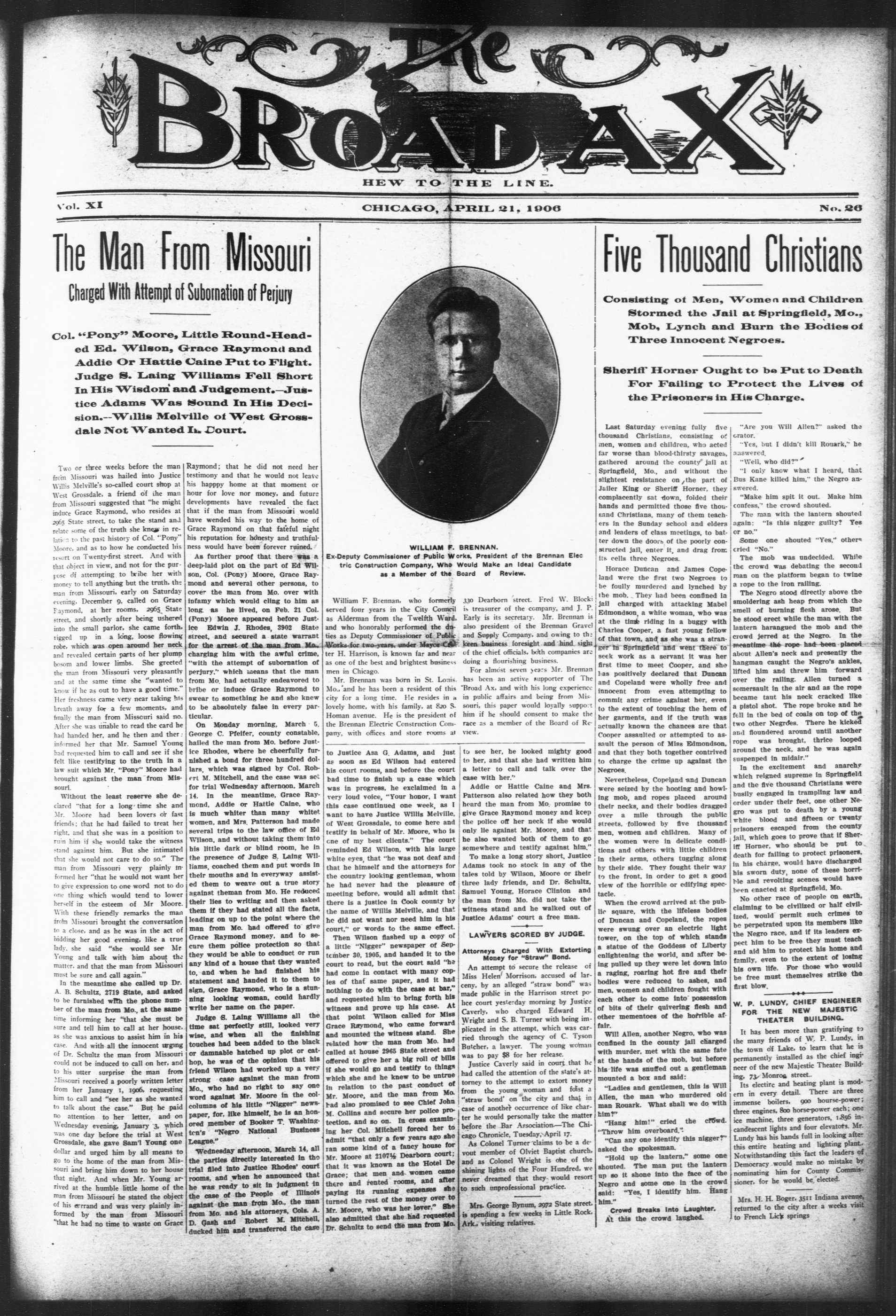
WILLIAM F. BRENNAN.
Ex-Deputy Commissioner of Public Works, President of the Brennan Electric Construction Company, Who Would Make an Ideal Candidate as a Member of the Board of Review.
William F. Brennan, who formerly served four years in the City Council as Alderman from the Twelfth Ward and who honorably performed the duties as Deputy Commissioner of Public Works for two years, under Mayor Center H. Harrison, is known far and near as one of the best and brightest business men in Chicago.
Mr. Brennan was born in St. Louis Mo., and he has been a resident of this city for a long time. He resides in a lovely home, with his family, at 820 S. Homan avenue. He is the president of the Brennan Electric Construction Company, with offices and store rooms at
to Justice Asa G. Adams, and just as soon as Ed Wilson had entered his court rooms, and before the court had time to finish up a case which was in progress, he exclaimed in a very loud voice, "Your honor, I want this case continued one week, as I want to have Justice Willis Melville, of West Grossdale, to come here and testify in behalf of Mr. Moore, who is one of my best clients." The court reminded Ed Wilson, with his large white eyes, that "he was not deaf and that he himself and the attorneys for the country looking gentleman, whom he had never had the pleasure of meeting before, would all admit that there is a justice in Cook county by the name of Willis Melville, and that he did not want nor need him in his court," or words to the same effect. Then Wilson flashed up a copy of a little "Nigger" newspaper of September 30, 1905, and handed it to the court to read, but the court said "he had come in contact with many copies of that same paper, and it had nothing to do with the case at bar," and requested him to bring forth his witness and prove up his case. At that point Wilson called for Miss Grace Raymond, who came forward and mounted the witness stand. She related how the man from Mo. had called at house 2965 State street and offered to give her a big roll of bills if she would go and testify to things which she and he knew to be untrue in relation to the past conduct of Mr. Moore, and the man from Mo. had also promised to see Chief John M. Collins and secure her police protection, and so on. In cross examining her Col. Mitchell forced her to admit "that only a few years ago she ran some kind of a fancy house for Mr. Moore at 2107½ Dearborn court; that it was known as the Hotel De Grace; that men and women came there and rented rooms, and after paying its running expenses she turned the rest of the money over to Mr. Moore, who was her lover." She also admitted that she had requested Dr. Schultz to send the man from Mo.
330 Dearborn street. Fred W. Blocki is treasurer of the company, and J. P. Early is its secretary. Mr. Brennan is also president of the Brennan Gravel and Supply Company, and owing to the keen business foresight and hind sight of the chief officials, both companies are doing a flourishing business.
For almost seven years Mr. Brennan has been an active supporter of The 'Broad Ax, and with his long experience in public affairs and being from Missouri, this paper would loyalty support him if he should consent to make the race as a member of the Board of Review.
to see her, he looked mighty good to her, and that she had written him a letter to call and talk over the case with her."
Addle or Hattle Caine and Mrs. Patterson also related how they both heard the man from Mo, promise to give Grace Raymond money and keep the police off her neck if she would only lie against Mr. Moore, and that he also wanted both of them to go somewhere and testify against him."
To make a long story short, Justice Adams took no stock in any of the tales told by Wilson, Moore or their three lady friends, and Dr. Schultz, Samuel Young, Horace Clinton and the man from Mo. did not take the witness stand and he walked out of Justice Adams' court a free man.
LAWYERS SCORED BY JUDGE.
Attorneys Charged With Extorting
Money for "Straw" Bond.
An attempt to secure the release of Miss Helen Morrison, accused of larceny, by an alleged "straw bond" was made public in the Harrison street police court yesterday morning by Justice Caverly, who charged Edward H. Wright and S. B. Turner with being implicated in the attempt, which was carried through the agency of C. Tyson Butcher, a lawyer. The young woman was to pay $8 for her release.
Justice Caverly said in court that he had called the attention of the state's attorney to the attempt to extort money from the young woman and foist a "straw bond" on the city and that in case of another occurrence of like charter he would personally take the matter before the Bar Association—The Chicago Chronicle, Tuesday, April 17.
As Colonel Turner claims to be a devout member of Oliviet Baptist church and as Colonel Wright is one of the shining lights of the Four Hundred, we never dreamed that they would resort to such unprofessional practice.
Mrs. George Bynum, 2072 State streets, is spending a few weeks in Little Rock, Ark., visiting relatives.
Five Thousand Christians
Consisting of Men, Women and Children Stormed the Jail at Springfield, Mo., Mob, Lynch and Burn the Bodies of Three Innocent Negroes.
Sheriff Horner Ought to be Put to Death For Failing to Protect the Lives of the Prisoners in His Charge.
Last Saturday evening fully five thousand Christians, consisting of men, women and children, who acted far worse than blood-thirsty savages, gathered around the county jail at Springfield, Mo., and without the slightest resistance on the part of Jailer King or Sheriff Horner, they complacently sat down, folded their hands and permitted those five thousand Christians, many of them teachers in the Sunday school and elders and leaders of class meetings, to batter down the doors of the poorly constructed jail, enter it, and drag from its cells three Negroes.
Horace Duncan and James Copeland were the first two Negroes to be fouly murdered and lynched by the mob. They had been confined in jail charged with attacking Mabel Edmondson, a white woman, who was at the time riding in a buggy with Charles Cooper, a fast young fellow of that town, and as she was a stranger in Springfield and went there to seek work as a servant it was her first time to meet Cooper, and she has positively declared that Duncan and Copeland were wholly free and innocent from even attempting to commit any crime against her, even to the extent of touching the hem of her garments, and if the truth was actually known the chances are that Cooper assaulted or attempted to assault the person of Miss Edmondson, and that they both together contrived to charge the crime up against the Negroes.
Nevertheless, Copeland and Duncan were seized by the hooting and howling mob, and ropes placed around their necks, and their bodies dragged over a mile through the public streets, followed by five thousand men, women and children. Many of the women were in delicate conditions and others with little children in their arms, others tugging along by their side. They fought their way to the front, in order to get a good view of the horrible or edifying spectacle.
When the crowd arrived at the public square, with the lifeless bodies of Duncan and Copeland, the ropes were swung over an electric light tower, on the top of which stands a statue of the Goddess of Liberty enlightening the world, and after being pulled up they were let down into a raging, roaring hot fire and their bodies were reduced to ashes, and men, women and children fought with each other to come into possession of bits of their quivering flesh and other mementoes of the horrible affair.
Will Allen, another Negro, who was confined in the county jail charged with murder, met with the same fate at the hands of the mob, but before his life was snuffed out a gentleman mounted a box and said:
"Ladies and gentlemen, this is Will Allen, the man who murdered old man Rouark. What shall we do with him?"
"Hang him!" cried the crowd.
"Throw him overboard."
"Can any one identify this nigger?" asked the spokesman.
"Hold up the lantern," some one shouted. The man put the lantern up so it shone into the face of the Negro and some one in the crowd said: "Yes, I identify him. Hang him."
Crowd Breaks Into Laughter.
At this the crowd laughed.
and Christians
Women and Children
il at Springfield, Mo.,
I Burn the Bodies of
Negroes.
ht to be Put to Death
Protect the Lives of
His Charge.
"Are you Will Allen?" asked the
crator.
"Yes, but I didn't kill Rouark," he
answered.
"Well, who did?"
"I only know what I heard, that Bus Kane killed him," the Negro answered.
"Make him spit it out. Make him confess," the crowd shouted.
The man with the lantern shouted again: "Is this nigger guilty? Yes or no."
Some one shouted "Yes," others cried "No."
The mob was undecided. While the crowd was debating the second man on the platform began to twine a rope to the iron railing.
The Negro stood directly above the smoldering ash heap from which the smell of burning flesh arose. But he stood erect while the man with the lantern harangued the mob and the crowd jerred at the Negro. In the meantime the rope had been placed about Allen's neck and presently the hangman caught the Negro's ankles, lifted him and threw him forward over the railing. Allen turned a somersault in the air and as the rope became taut his neck cracked like a pistol shot. The rope broke and he fell in the bed of coals on top of the two other Negroes. There he kicked and floundered around until another rope was brought, thrice looped around the neck, and he was again suspenned in midair."
In the excitement and anarchy which reigned supreme in Springfield and the five thousand Christians were busily engaged in trampling law and order under their feet, one other Negro was put to death by a young white blood and fifteen or twenty prisoners escaped from the county jail, which goes to prove that if Sheriff Horner, who should be put to death for failing to protect prisoners, in his charge, would have discharged his sworn duty, none of these horrible and revolting scenes would have been enacted at Springfield, Mo. No other race of people on earth, claiming to be civilized or half civilized, would permit such crimes to be perpetrated upon its members like the Negro race, and if its leaders expect him to be free they must teach and aid him to protect his home and family, even to the extent of losing his own life. For those who would be free must themselves strike the first blow.
W. P. LUNDY, CHIEF ENGINEER FOR THE NEW MAJESTIC THEATER BUILDING.
It has been more than gratifying to the many friends of W. P. Lundy, in the town of Lake, to learn that he is permanently installed as the chief engineer of the new Majestic Theater Building, 73 Monroe street.
Its electric and heating plant is modern in every detail. There are three immense boilers, 900 hourse-power; three engines, 800 horse-power each; one ice machine, three generators, 1,856 incandescent lights and four elevators. Mr. Lundy has his hands full in looking after this entire heating and lighting plant. Notwithstanding this fact the leaders of Democracy would make no mistake by nominating him for County Commissioner, for he would be elected.
Mrs. H. H. Boger, 3511 Indiana avenue, returned to the city after a weeks visit to French Lick springs
THE BROAD AX.
*Will promulgate and at all times uphold the true principles of Democracy, but Gasoline, Protestant, Prairie, Imbeled, Single, Singular, Labored, Labor, one also can have their say, long on their language is proper and responsibility is fixed.*
*The Broad. is a newspaper whose platform is broad enough, ever claiming the editorial work is owned and held.*
*Local communications will receive attention. Write only on one side of the paper.*
*Subscriptions must be paid in advance.*
*One Year. $2.00. Six Months. 1.00.*
THE BROAD AX
5040 Armour Avenue, Chicago.
JULIUS F TAYLOR, Editor and Publisher.
Entered at the Post Office at Chicago
II, as second-class Matter.
CHIPS
Mr. Sherman Blackwell, 4328 Forrestville avenue, left Tuesday for Omaha where he will organize the Elks' lodge.
The Appomattox Club entertained number of their friends with a dancing party at the club quarters Tuesday evening.
Miss Fannie Spint, of Des Moines, spent several days in the city last week the guest of Mrs. James Fuller 371 Leavitt street.
Mrs. Carrie Lewis and daughter, who have been spending a few weeks in Vicksburg, Miss., returned to the city Monday.
Mr. Frank Harper, of Washington, D.C., is spending a week in the city, visiting his father, Mr. Wood Harper. 4330 Langley avenue.
Rev. and Mrs. Horace S. Graves have removed from Des Moines, Ia., to St. Paul, Minn., where he will continue his labor on behalf of his Lord.
Justice Theodore C. Mayer is still favored by the great majority of the leaders of the Democratic party for one of the municipal judgeships.
The graduate nurses of Provident Hospital entertained a few of their friends with an informal dancing party at Freer Home Tuesday night.
Attorney Walter M. Farmer, 155 Washington street, returned to the city Monday morning after spending Sunday at his former home, St. Louis, Mo.
Mrs. A. J. Humphrey of Detroit, Mich., is visiting her friends, Mrs. George Hunter, Mrs. F. Wallace and Sadie Scott, 5010 Fifth avenue.
Colonel and Mrs. A. D. Gash, 1183 Douglas boulevard, are the proud parents of a bouncing nine-pound baby boy, which arrived at their home last week.
James J. Gray, the new clerk of the Circuit Court, has resigned as master in chancery for Judge Kersten, who has selected Mr. Gray"s law partner, M. J. Moran, to succeed him.
The Fannie Hall-Clint Dramatic Club will give a select program at the Berean Baptist church, 4838 Dearborn street, Monday evening, April 23, for the benefit of the church. Admission 25 cents.
The ball given by a number of Chicago's young men at Douglas club house Easter Monday night, was largely attended by a large number of the pleasure seeking class of our city. Many beautiful gowns were worn by the young ladies present.
Frank Jansen, manager for Alderman Henry L. Fick, 38 W. 12th street, who is the owner of the fast race horse. E. C. Runte, bet 100 on his trotter the first of this week, and he won at 15 to 1 and in one shot Mr. Jansen came out fifteen hundred dollars ahead of the sports.
Thomas Gallagher, who is one of the most popular citizens on the West Side is away in the lead in his race for the nomination for Congresss in the Eighth District, and if it is left to the voters at the primaries, and not the party bosses, he will be the choice of the convention.
At the Pelkin Saturday night Mr. and Mrs. Edgar Gray, Mr. and Mrs. Burr Jamieson, Mr. and Mrs. Claude Alexander, Mr. James Newson and Miss Lindsey occupied one of the lower boxes. The ladies being attired so as to form a beautiful party while enjoying the performance.
Mr. and Mrs. S. J. Carter gave an "at home" Sunday afternoon in honor of Miss E. Keeze and Mr. and Mrs. Monroe, of Quincy, Ill. The occasion was also a "house-warming of the beautiful residence, which Mr. and Mrs. Carter have purchased and magnificently furnished at 169 East Thirty-second street.
Mrs. Eliza Tucker, grandmother of lawyer J. Gray Lucas, 626 Champlain avenue, died suddenly Saturday night,
```markdown
```
after a lingering illness, due to 'gastritis and old age. Funeral services were held from Mr. Lucas' home Last Monday Rev. Moses Jackson officiated and interment at Oakwood. The deceased was about seventy two years of age and had lived a long and useful Christian life.
Neither Tillman, Vardaman nor Dixon, all of them together can harm our race so much as can a few men wrapped in black skins, but wanting in morals and manhood—The Advocate, Portland, Ore.
Mrs. L. A. Davis, 3226 Prairie avenue, who is one of the many warm lady admirers of The Broad Ax, has been for the past two weeks confined to the elegant new home from the effects of a very severe cold, but it is pleasing to announce that she is slowly regaining her health.
The earthquake which visited San Francisco and other sections of the Pacific slope this week is the greatest in extent which has so far occurred in the history of the world. Many thousand people have lost their lives, other thousands have been rendered homeless, and millions upon millions worth of property destroyed.
In addition to the four Afro-Americans assigned to typesetting machines in the Government Printing, Office Public Printer Stilling has appointed about ten colored men as caster operators. They have charge of the spools of perforated paper from the keyboard operators, and through some intricate process cast the same into type. The men are giving satisfaction—Ex.
Ex-Alderman Fred Hart, 5408 Aberdeen street: "I want to say that lately I have been so absorbed with my business affairs that I have not had time to read The Broad Ax, but Mrs. Hart never fails to read it each Saturday. Then it is read by the colored woman who works for us. And after doing so she sends it South to some of her friends. So you see that we are doing our share in order to keep The Broad Ax in circulation.
From all appearances something will be doing at Springfield next winter, for Colonel Edward H. Morris seems to be willing to sacrifice the income of his great law practice and run the risk of being unable to collect his rents from his numerous flat buildings, in order to make the race for the legislature in the First District. And some of his friends say—those who can always touch him for a large bundle of money—"that there is nothing to it," that he will be the main cock of the walk. When the roll is called in the legislature halls at the State capital.
Last Wednesday evening Mrs. S. S. Barton, 5054 Armour avenue, gave a birthday party in honor of Mr S. S. Barton.
Dancing and speaking was the topic of the evening, luncheon was served at 11 p.m., consisting of three courses: George McCoy and Mrs Walter Lipsiomb assisted. Those being present were as follows: Mr. and Mrs. Eugene Barton, Mrs. Sherman Barton, Mr. and Mrs. J. B. Hope, Mr. and Mrs. Hain, Mrs. E. Burrows, Mr. and Mrs. C. W. Green, Mrs. R. Antisey, Mr. William Franklin, Mrs. C. W. Duncan, Mr. and Mrs. Spotswood, Mr. C. Broorkins, Mrs. R. C. Crawford, Mr. M. Bramlett, Mrs. M. Eldrige, Miss C. Bergeon and Mrs. J. Green, Mrs. M. Davis, Mr. and Mrs. T. M. Huoston, Miss A. Smithon, Miss E. Smith, Miss M. Robbison, Mr. S. J. Kerk, Mr. Smith, Mr. Hall, Mr. Kud, Mr. E. Franklin, Mrs. M. Manning, Mr. Walkins, Mr. Smith, Mr. Williams, Mr. and Mrs. O. Barton, Mr. and Mrs. Sheldon, Mr. and Mrs. Truesdall, Mrs. J. Bryant, W. W. C. Lipsiomb, B. Manning. A most delightful evening was passed. Mr. Barton received many beautiful and useful presents.
INTERNATIONAL THEATER. CHI
CAGO, CLEVELAND'S GREAT-
ER VAUDEVILLE.
The unprecedented business enjoyed by the International Theater during Easter week was the cause of much gossip in theatrical circles, and in view of the facts it cannot be denied that W. S. Cleveland and his famous "greater vaudeville" shows have made the house the most popular vaudeville theatre in Chicago. For the week beginning Monday, April 23, another big bill is announced, with the famous Elinore Sisters occupying the position of honor. This team of funny women is acknowledged to be the best and most popular women in vaudeville. They have just closed a starring season in "Mrs. DeLancey of Newport,' and this is their first vaudeville engagement in the west in two years. A star who has been brought from Europe to entertain the International patrons is Maroosielle Deeda, the tight wire artist, who created such a sensation at the Cirque D'Hiver in Paris. The Yale trio of dexterous club swingers and jugglers, and the Musical Reeds with instrumental and vocal specialties, are also billed, while the great Lucados, an aggregation of Italian heavyweight balancers, will be seen for
the first time in Chicago. Davis and McCauley, who have been drawing capacity houses during the past week, will continue to present their thrilling one act melodrama "Pals," a feature of which is the great fight scene. Marshall and Loraine, in singing, talking and dancing specialties, together with a number of other strong acts will round out a most remarkable program.
APRIL GRAND JURY IS RUNNING
FULL BLAST.
Bright and early Monday morning Judge Kersten swore in the members of the April Grand Jury, and Mr. John Jay Abbott, vice president of the American Trust and Savings Bank, was chosen by the court as its foreman, and it will run in full blast until Saturday. May 5. The jury is composed of the following citizens:
John Jay Abbott, 3224 Michigan avenue; Albert C. Bettolph, 4822 Michigan avenue; Owen, H. Fay, 3205 Carmet avenue; John A. Linder, 120 Townsend street; John S. Leander, 743 Warren avenue; William J. Greene, 43, 409 Lowe avenue; Charles G. Bellman, 814 Troy street; Albert Barge, 3444 Berkley avenue; Dwight J. Sharpe, 6018 Princeton avenue; Robert Rogerson, 7220 Jackson avenue; Samuel A. Low, 5510 Washington avenue; Frank G. Morse, 219 Michigan avenue; Eugene J. Adams, 1416 Millard avenue; William J. Brownlow, 516 Evergreen avenue; Christopher Keegan, 78 Morgan street; Isaac R. Wobd, 440 Oakley avenue; John H. Van Arsdale, 567 Sixty-second street; William H. Timberlake, 6508 Harvard avenue; Joseph Jiran 5351 Justine street; E. F. Quinn, 6223 Greenwood avenue; Paul Dana, 20 Adeline square; Eldridge R. Colby, 525 Sixty-first street.
THE INSTITUTIONAL CHURCH AND SOCIAL SETTLEMENT, 3825 DEARBORN STREET
The services Sunday will be of the usual character..
Rev. H. E. Stewart will preach from the subject: "Some Causes Which Have Led to the Downfall of Nations." Also from the subject: "Joshua and Jesus."
Prof. N. Clark Smith will give another orchestra concert on the 26th of April (next Thursday night.) This will be a grand affair.
Miss Hallie Q. Brown will return to the city on the 7th of May, and will deliver an address "Songs and Sorrows of the Negro."
On the 7th of May the Educational and Musical Symposium (Prof. Smith"s Orchestra) will furnish music, rendering several selections. This promises to be a grand affair.
IT WILL BE AN INTERESTING MEETING.
Program for Bethel Literary and Historical Club, Sunday, April 21: Historical essay, "Character Gen. U S Grant," by Mr. J. Army. Floor discussion—topic: "The Merits of Secretary Taft's Address at Tuskegee." Dr. M. A. Majors will open in defense of the article and will be followed by Assistant County Attorney Louis B. Anderson, who will criticize. Two leading speakers fifteen minute; each Others five Mr. Hale G. Parker will address the club the following Sunday, subject: "Education." Splendid music. Everybody welcome. Services at 4 o'clock.
Special Notice.
The case of Dr. A. B. McKissack and Green Smith, now pending before Justice Keeney, has been continued until 3 o'clock Tuesday afternoon, April 24.
Getting Dangerous
The market for American poker chips is said to be seriously threatened by undervaluation the Japanese article. Many patriots will now begin to believe in the reality of the yellow peril.
Deserved It
"Histi!" whispered the stage villain, creeping stealthily away.
"I expected you would be," rejoined the callboy, making a bolt round the back of the stage—Stray Stories.
She Turns to Whining
"Many a marriage turns out a failure," said the philosopher, "mainly because the winning ways of the sweetheart became the whining ways of the wife."
"Do sho' nuff financier," said Unade Eben, "is de woman wif only a two dollar bill an' a family of eight to maktur kset."—Washington Star.
The negroes of Tahiti, one of the Society islands in the south Pacific, play the flute with the nose instead of the mouth.
Small Minded.
"Some folks," said Uncle Ebben,
"seems to 'magine dey kin make up
oh det尔 shortcomin's by scoldin'
at de childern." - Washington Star.
"Looping the Loop" as a Crime
"Looping the Loop" as a Crime. Such exhibitions as "looping the loop," including lion den entries, and the like, should be made criminal to all promoters of the same, agents and principals alike. At common law the individual who aids and abets a suicide is guilty of murder. The principle might well be extended to apply to all who, in their own greed, induce, or even solicit, performers in search of a live!hood, to risk life or even bodily harm for public entertainment and harvest of gate money.—London Field.
Village of Cripples
The strangest village in the world is undoubtedly the little hamlet of Jatte, near Culez, in France, not far from the Italian frontier, where dwell about 200 defamed men, women and children, who in Paris go by the name of "Culs-de-Jatte." They are deprived of the use of their legs and thighs, and push themselves along in primitive wooden carts with wooden wheels, which they propel by means of a flatiron-shaped block of wood in either hand.
Men Who Act Like Sheep.
Some men can be likened unto a sheep. On the hottest day of summer the sheep that can find enough shade to cover its head imagines that it is fully protected and perfectly comfortable, paying no attention to the burning rays on the rest of its body. Man can deceive himself fully as easily, says the Indianapolis Star, hiding behind technicalities, imagining that he is protected from the gaze and censure of his kind.
The Grand Manner.
No one will be a martyr and reintroduce the grand manner into a scoffing world. Yet one occasionally escapes in fancy into the older world dead a century or more, wherein human beings had time and inclination for something more than the scrappy politeness which is all we deal out to-day.—Week's Survey.
Sousa's Short Speech.
Sousa, the famous conductor, hates public oratory and never, if he can help it, makes a speech in public. After one of his performances in Cork his audience kept clamoring for a speech and refused to be satisfied with the usual bow. Finally Sousa stepped to the front of the platform and, raising his hand, said impressively: "Ladies and gentlemen, can you all hear me?" There was the usual "Yes." "Then I wish you good-night."
When Conversation Lagged.
They were at the theater together; and conversation lagged. At last, during the entr'acte, he turned to her and ventured: "Don't—don't you think the acoustics here are very bad?" She hesitated an instant. "Why, no," she said, a little uncertainly, "I don't smell anything."—N. Y. Times.
Shrewd Bov.
Tommy (at the breakfast table)—I dreamed last night I found a bag of gold in a cave.
Mr. Tucker—And just as you were about to grab it you woke. did you?
about to grab it you woke, did you?
"Bet your life I didn't! I kind o'
thought it was a dream, and I just
kept on dreamin', and had a mighty
good time with that money 'fore I
waked up."—Chicago Tribune.
Dickens Character Dead.
Joseph Jennings died lately at Colchester, England, at the age of 100 years. A lawsuit in his family over a disputed will was the foundation of Dickens' "Jandryce vs. Jandryce." On the tombstone of one of the litigants, in a Colchester churchyard, is the text, from Jeremiah: "Though decent, they refused to know me."
Olive Oil in Algiers.
Consul Johnson, of Algiers, writes that the adulteration of olive oil with cottonseed oil has caused a law to be promulgated there requiring all admixtures to be so marked, plainly, and with the proportions of adulteration. Any deception in its sale will be punished according to law.
In Their Own Tongue
English Guide—The echo 'ere in these mountains is very fine, sir.
Tourist (after shouting "Hello!")—Well, there is an echo, but it isn't intelligible.
"You don't understand the language, sir. These are Welsh mountains, y'know."—Philadelphia Press.
Rat-Catching Horse
There is a horse that catches rats and mice in Manchester, England. If a rat or mouse runs across his manager, he will grab at it and if successful in getting it will drop it into his bucket of water, which is always left with him.
Young Borem (in the parier)—Tommy, does your sister know I am here?
Tommy—I think so. She told mamma this morning she had a presentiment that trouble was coming.—Stray Stories.
Suited Him Just as Well
Araminta (exhibiting the family cherub)—Is there anything sweeter than a baby?
Young Spoonall—Why, I sometimes thing a baby's 18-year-old sister is just a little—Stray Stories.
TELEPHONE ETIQUETTE.
"Helle" No Longer Good Form When Speaking Over the Wire—Code Developing.
"When answering the telephone do not say 'Hello!' but answer by giving the firm's name," is a rule insisted upon by many large business houses in New York. If this rule were made applicable to private persons as well there would be less confusion and "Central's" nerves would be in better condition. "Central" is blamed for every mistake made, but after all even "Central" is human, temperately remarks the World Magazine.
A great many women either pitch their voice too high or too low, shout into the mouthpiece or stand at a long distance from it, as if it were a high explosive capable of going off in a moment. As almost all telephone girls have pleasant voices, except when calling out "Busy!" speaking through the 'phone is merely a matter of practice. To be heard distinctly at the other end of the wire one must speak in tones that will not cause a reverberation or buzzing sound at one's own end. Distinct enunciation saves time and worry.
A private telephone often becomes a great expense to the owner if guests use it ad libitum, forgetting to pay for their calls. It is curious that the man or woman who would hesitate to borrow a two-cent stamp of you will use a dollar's worth of calls on your 'phone without blinking.
To be called away from the dinner table to answer some trivial question is an everyday occurrence. But fortunately the telephone habitues are gradually evolving a certain code of etiquette among themselves which governs the use of this necessary mode of communication. Some of the rules are: Never telephone to a private house too early in the morning or too late at night. The hours are governed by the customs of the household. Never telephone during meal hours. Never use the 'phone of a person of slender means without at least offering to pay for its use. Employees should never use the wire in a business office for long and protracted conversations with personal friends. Don't forget that even if you are not seen across the 'phone wire you are probably being overheard by a third party, and possibly by others.
Don't shout our your private affairs over a public 'phone.
Don't blame the 'phone or "Central" for your own forgetfulness.
Don't, when some one is speaking at the 'phone within your hearing, stop your conversation. Go on talking or get out of hearing distance.
Don't talk for effect. Your conversation may be amusing to the friends beside you, but will prove puzzling to the person at the other end of the wire.
Learn to speak in well-modulated musical tones.
An invitation delivered over the 'phone is most informal and is only possible between good friends.
Don't act languid or lackadaisical when " 'phoning." Speak up in a healthy tone of voice.
Keep the mouthpiece and the telephone receiver clean and sterilized by swabbing both off with a cloth dipped in alcohol.
Don't be in a hurry.
Don't lose your temper.
When answering the 'phone, give your
name, or the name of the house or person
whom you represent instead of saying
"Hello!"
HANDY BOOK CARRIER
There Is Nothing More Inconvenient to Carry Than Books—This Case Practical.
Books are inconvenient things to carry any distance in one's hand, and if we have three or four that, perhaps, we have to take back to a library each week to change. It becomes almost a necessity to have some kind of case in which to carry them.
In our illustration we show a very simple and useful form of book carrier, that can be constructed out of almost any odd piece of material, art serge, cloth, or velveteen being really
QUITE A CONVENIENCE
the most suitable. It should be cut rather wider than the length of an ordinary size book; the length must be regulated by the number of books that will usually be carried in it, as it is wrapped round the books and is fastened by ribbon across the ends of books and ends of material. On the top is a handle maize of double material, stitched firmly at the edges. The case will be much firmer if it has an interlining of linen put in before the sateen lining.
Wants Thinner Lips
To reduce the size of one's lips requires an effort of the mind and will. Hold your lips in constantly—pinch them as it were, by contracting the muscles. Learn to speak with precision and learn to enunciate clearly and you will find your lips forming in the beautiful lines of the oratorical mouth as it is called in physiognomy.
For the Thin Person
I would recommend taking a tablespoonful of olive oil right after each meal. Take only the best. I would recommend drinking with meals and munching things between meals. Eat plenty of pure sugar and don't worry.
WHY HE COULDN'T SIT DOWN
Physical Impossibility with His Nether Limbs Ciothed as They Were.
"I beg your pardon, but I'm in trouble," said a man who was well dressed and plainly excited to Sergei. Temperely at No. 3 police station, Armand, mourales the Kansas City Journal. "Can you help me out?" "I'll do my best," answered the obliging sergeant. "Sit down and tell me about it." "No, I simply can't sit down," said the man, nervously. "Must be serious to affect you like that." said the sergeant. "What is it?"
"You see, it is this way," said the man. "I came in on an early train from the west; and as I got up late, when the train was but a few minutes from the Union depot, I dressed in all haste. I had some business to attend to in Armourdale right away, and I paid my street car fare from some change I had in my overcoat pocket. But when I was standing at the corner of Fifth and Kansas a moment ago, for the first time I unbutoned my overcoat and looked inside, and found—"
"That you had been robbed while on the train?" broke in the sergeant, interested.
"No," said the man, "I found that I had put my trousers on backward, and I can't sit down. What I want is a private place to change 'em."
He got it.
SWEDISH SPIES IN NORWAY
Sent for the Purpose of Reporting on Work in Military Cooters.
A spy, who is reported by the authorities to be a Swede, had been detected in Fredrikshald, where he was particularly interested in Fredriksten and Hjelmkollen. At the latter place he was seen by a guard, who recognized him as a man who had been hanging around the fortifications at Kongsvingser last winter. When he was discovered he made his way to Swedish territory. The guard was instructed to keep watch of the man. Late at night he appeared again in Norwegian territory and was met by the guard. When they separated the guard took the footpath to Hjelmkollen and was not surprised to meet the spy again. The latter than disappeared.
The Swedes allege that Norway is preparing to erect a number of fortifications along Glommen, outside of the neutral zone established by the Klarstad treaty, and to replace the fortified points which were dismantled in accordance with the treaty. The Swedes declared that these plans show a distrust of Sweden and are uncalled for when no preparations of a similar nature are being made on the Swedish side of the border.
WOULDN'T ROB THE BISHOP
Pacific Coast Bandit Returned Valuables Taken from the
"Not a great while ago there was as bold a bandit as ever bade men stan' and deliver operating between Fairbanks and the mines tributary to that town," B. B. McGinn of Alaska, according to the Washington Post.
"This modern Dick Turpin, one Hendrickson by name, kept up his robberies for months and made many a good haul. He was a courteous brigand and not altogether mercenary.
"On one occasion Bishop Rowe of Alaska was confronted by Hendrickson and relieved of all his valuable. As the good man was about to depart the robber, noticing his garb, asked him if he were not a minister of the Gospel. 'Yes,' said the victim, 'I am Bishop Rowe.' 'Well, then,' replied Hendrickson, 'I can't think of despoiling you. I used to be a member of your church, and however bad I may be, I can't rob you.' With that he returned to the bishop all his property.
"A little while later Hendrickson was captured by the United States authorities, and is now in jail at Fairbanks."
Alarm Clock for Drinkers
A pretty little device of the wicked which is attracting a good deal of attention in restaurants, cabaret, posadas, cafes and hospices these days is called the "jag indicator." It was invented for the benefit of good fellows who do not know when they have had enough to drink. It is a green frog, with pink specks upon its body, and is about three-quarters of an inch long. The customer receives one from the barman, which he is asked to put in his pocket and to place upon the bar before each subsequent drink. After a drink Mr. Crapaud is returned to the pocket. As soon as the customer sees upon the bar more than one frog, or thinks he sees the frog move, he is expected—nay, required—to quit drinking for the day.—N. Y. Press.
The Bodleian Library
The Bodleian library, which was established in 1445, takes its name from Sir Thomas Bodley, who reestablished the library in 1597-1602, and presented it to the University of Oxford. It contains more than 500,000 printed volumes, 30,000 volumes of manuscripts, a great many first editions and early printings, and collections of coins and pictures.
"Blind Tiger" in a Church
The Methodist pastor in the "dry" town of Waverly, Tenn., assisted the police to locate a "blind tiger" and was surprised to find that the illegal gin mill was in the church basement and conducted by two of the apparently most devout members of his congregation, a doctor and a justice of the peace.
WASHINGTON GOSSIP
COL EDWARDS WILL BECOME
BRIGADIER GENERAL.
Practical Civil Service Recommended—Swamp Lands as Well as Arid Lands Need Attention—Queer Atmospheric Conditions.
ASHINGTON.—It is now the purpose of congress to give the rank of brigadier general to the officer holding the position of chief of the bureau of insular affairs in the war department. This means that Col. Clarence, whose real
W
ranks that of captain, but who has been at the head of this bureau since it was established and has done the work of three men, will become brigadier general. This bureau deals with so many interests and its head is the executive for so many branches of government that it has often been seriously considered as deserving to be raised to the rank of a department, with its chief one of the cabinet officers. It has to deal with matters in the Philippines, Hawaii and Porto Rico and is a little government within itself.
Col. Edwards, who has been chief of the bureau so long is one of the most energetic and popular officers in the service. He served in the Philippines and was on the staff of Gen. Lawton when the latter was killed, and he knows the affairs of that archipelago as thoroughly and in as great detail as anyone in the government. He has served under Secretaries Root and Taft and has been the trusted confident and assistant to both. They have relied upon him for information and for advice regarding the Philippines and have trusted the administration of insular affairs almost exclusively to him. While Col. Edwards is a hard worker he is also fond of play. He and Secretary Taft take a good deal of their diversion together in the way of horseback riding.
Better Consular Service.
T LAST there will be some reform in the consular service. A bill has been passed and is soon to become a law that reorganizes this service, does away with all fees and is calculated to improve the personnel of the consuls and the con-
A
PRIVATO
suls general. While congress did not authorize in this measure the practical civil service recommended by Secretary Root, it is understood that the policy of the administration will be to adopt civil service methods in future appointments. Already they have required candidates for appointments to pass an examination fully as rigid as the civil service commission would devise. The president has let it be known also that after this bill becomes a law the appointments in the future will be only to the lower grades of consul and that the higher places will be filled by promotion as vacancies occur.
There is another reform that has not yet been accomplished, but which is being strongly urged by business organizations and those who demand that the American consular service shall be filled by Americans. In an address recently submitted to congress by Minister Barratt on the subject of "Americans needed as vice and deputy consuls," he tells the following rather startling facts: Of 60 consulates general, 20, or one-third, have vice or deputy consuls who are not Americans. Of 225 consulates, 113, or half, have vice or deputy consuls who are not Americans either by birth, naturalization or residence. Of 11 commercial agencies, nine, or two-thirds, have none-resident vice and deputy commercial agents. Of six consulates where the incumbents are permitted to engage in business, two have foreign or deputy vice consuls and one has a consul who is not an American. Of 41 consulates and commercial agencies where the officers are paid by fees and allowed to engage in business, 25, or over one-half, have vice or deputy consuls who are not Americans, while in six cases the consuls or agents are foreigners.
Our Swamp Lands
N
OW that irrigation has attained so much importance in the west and attention is attracted to the wonderful fertility of desert lands when water is turned upon them, interest has been revived in great sections in the east that have been unproductive
been unproductive and untillable because they are covered with water. For every acre of western desert land which can be subdued by irrigation, there is an acre of eastern swamp which can be drained and made highly productive.
The drainage so necessary to reclaim millions of acres will have to be handled by the government and Representative Steenerson, of Minnesota, has introduced a bill for the reclamation of swamps.
It is estimated that there are 100,000,000 acres of swamp lands in the United States, some 70,000,000 of which have been surveyed and the great bulk of which would make splendid farms if the excess of water were drawn off. In the Kankakee river basin in Indiana and Illinois, there are 400,000 acres of the very richest bottom lands that are subject to overflow. Where they have been reclaimed through expensive private drainage works, they are worth as high as $150 an acre. It has been estimated that this whole track could be drained effectively at a cost of not more than $10 an acre.
In Florida, the Everglades alone would afford an empire of some 7,000,000 acres. In New Jersey and Virginia are vast swamps, among them the famous Dismal swamp. In Illinois there are 4,000,000 acres of swamp land: in Michigan about 6,000,000; in Iowa, 2,000,000 acres; in Minnesota, 5,000,000 have been surveyed and there are huge areas not yet surveyed. The Steenerson bill demonstrates that the government can transform swamps into fertile farm lands and that the settler or owner will pay back to the government the relatively small cost of the improvement.
Pesky Postage Stamp
HERE has been more complaint during the past winter about postage stamps than has been heard for years. The pesky things just would not stick half the time, and the postal authorities have been roundly abused. Third Assistant Post-
T
master General Madden says if your stamps don't stick, don't blame the post office department; blame the weather bureau. It is not the mucilage that is responsible, but the peculiar atmospheric conditions prevalent this winter and spring. If the little red stamp will not adhere to the envelope there is no comfort until a better brand of climate is dealt out by Chief Moore, of the weather bureau. There is also another trouble. The post office department issues two styles of stamps, the summer stamp and the winter stamp.
Mr. Madden admitted the other day that there was an unequal number of complaints about the stamps not sticking, while he said upon investigation of these complaints were found to be unjust. "For instance," he said, "there is a complaint from a business man in New York. We sent an agent to investigate, and found that in his establishment a man had been in the habit of wetting the stamp by taking a big sponge and drawing it across the back of the sheet of stamps, wiping the mucilage completely off.
"While every complaint we have run down has turned out to be without sufficient foundation, there must be something wrong or we wouldn't get so many. The gum is exactly the same as that used last year, when there were practically no complaints; so the fault can't be there. My opinion is that there is something in the atmospheric conditions which causes this."
Indians in Town.
N THE boarding house for Indians kept by B. F. Beveridge, and of which mention was made in these dispatches recently, there is at present quite a delegation of the red men. It is interesting to visit this place and notice their habits
N THE boarding house for Indians kept by B. F. Beveridge, and of which mention was made in these dispatches recently, there is at present quite a delegation of the red men. It is interesting to visit this place and notice their habits and manners. "They are just like other folks in their habits of living." Mr. Beveridge said the other day. "Most of them are as regular in their hours as the Virginia farmers—and most of them are farmers. Practically all those from the Indian Territory follow that.
Probably the star boarder of this establishment is the chief of the Senecas, Andrew John. He spends a great deal of his time here every winter in the interest of his people. The Senecas are a nation independent of the United States, and have made several treaties with the federal government. Chief John said the other day that it is a puzzle to the lawyers to determine just what the Senecas are as a tribe and what they are as individuals. Under the laws of New York they are a corporation existing by a special act. The chief tells some interesting traditions of the Indians, speaking of whom the other day he said:
"Several winters ago some 20 of us representing half a dozen tribes used to assemble here evenings with interpreters and relate legends of the various tribes. I was struck with this, that each tribe adopted as the favorite animal of their tales that most frequent in its own country.
"The Greeks and Chchoaets, originally from the south, were fond of the 'possum and the rabbit. Our Geneca legends have to do with animals we hunted, especially the deer. The favorite Seneca legend is of a child of our tribe that overcame giants and evil spirits. The Sioux told tales of marvelous battles with the buffalo and the Chippewas, from northern Minnesota, filled their stories with fur-bearing animals."
Good Blood Is the Great Beautifier and Fresh Air Most Important in Making It.
Good health is a positive necessity to good looks. Beauty is a thing that shines through the face, and is not on the surface. If you lack color, which is the cliff point of beauty, and put it on, no matter how skillfully and daintily, there is yet the surrounding flesh, minus the flesh tints.
How often do we see women wearing a little color on their cheeks when the rest of the face shows that unhealthy lack of color, and so the effect is neither pretty nor pleasing. The healthy tinge must come from within, and the blood must be healthy and good to give the redness, and the skin must be healthy and clean to give the proper chance for the health to shine through. On the same principle, that to have a good light, you must have clean, clear windows.
Another feature of woman's beauty is her hair. This will look lifeless and dull and no vitality, unless the roots are well fed and nourished properly. This nourishment comes from the blood, so that to have pretty hair it is necessary for the blood to be in good condition.
The color of a woman's eyes she cannot help; the expression in them she can help, and the expression has much to do with her looks. Uncomfortable clothes, tight shoes or corsets, an ugly disposition, all tend to spoil the expression of a woman's eyes. Also a rundown vitality will dull a naturally bright eye; hence again the beauty comes from within.
Good-looking teeth, firm, white and clean, another important factor for beauty, are dependent, of course, largely on external care, but they get their life from the roots' nourishment, so it is important that they are fed by healthy blood. So it is that after all, the blood is the chief promoter of health and beauty. What makes healthy blood? How to keep it so after you get it?
The most important thing is clean air, as that is one of the chief things of the blood's diet. In the savage state, when humankind slept out of doors, in the forest, they were physically more perfect, healthier and consequently better looking than civilization can make them, even with "beauty doctors" and all the other means of artificial aid to improve woman's looks.
A PRETTY LOUNGING ROBE
One Made of Flowered White Silk with Net Chemistte Would Be Attractive.
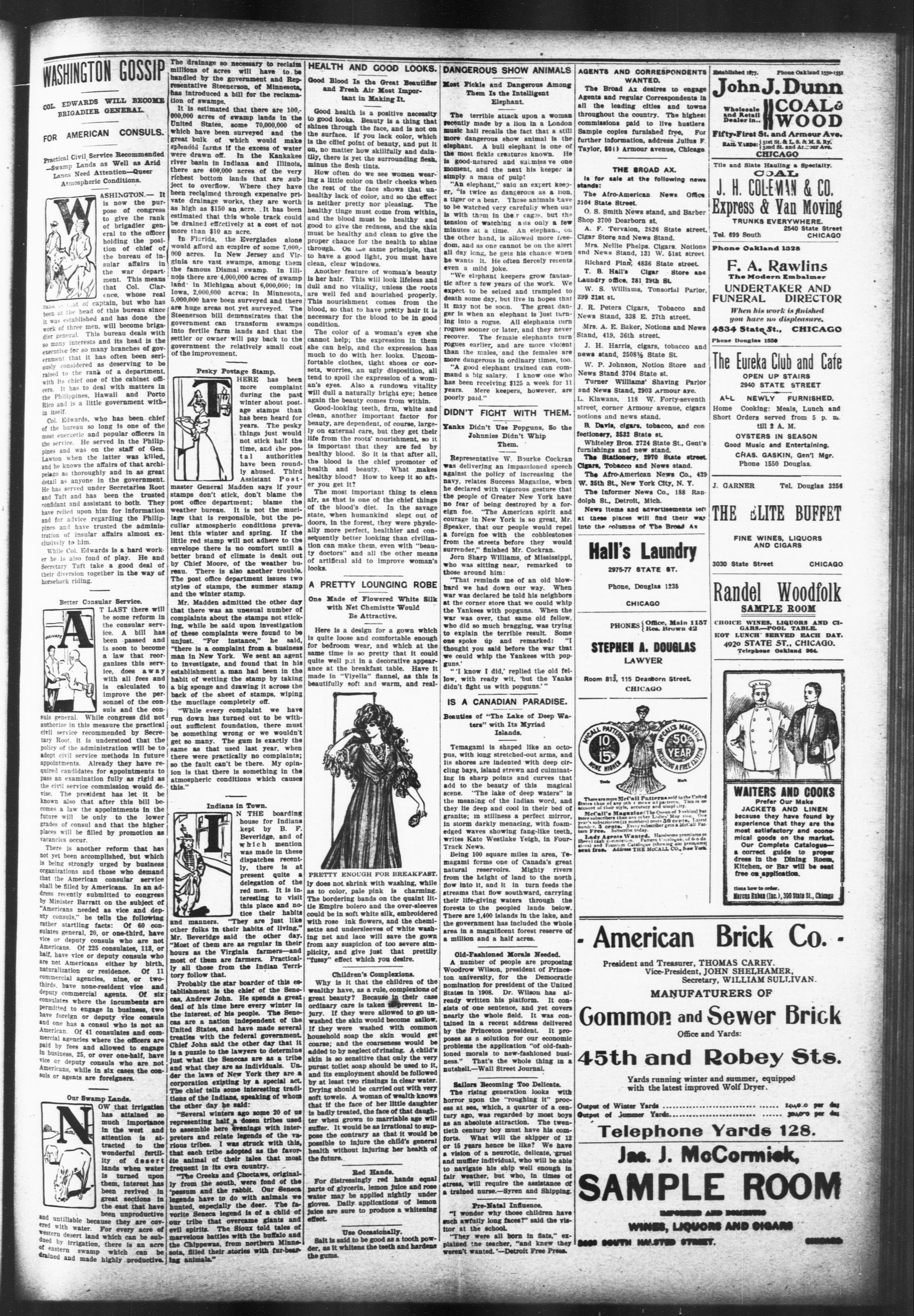
Here is a design for a gown which is quite loose and comfortable enough for bedroom wear, and which at the same time is so pretty that it could quite well put in a decorative appearance at the breakfast table. Have it made in "Viyella" flannel, as this is beautifully soft and warm, and real-
1
PRETTY ENOUGH FOR BREAKFASTly does not shrink with washing, while as to color, pale pink is charming. The bordering bands on the quaint little Empire bolero and the over-sleeves could be in soft white silk, embroidered with rose ink flowers, and the chemi-sette and undersleeves of white washing net and lace will save the gown from any suspicion of too severe simplicity, and give just that prettily "fussy" effect which you desire.
Children's Complexions
Why is it that the children of the wealthy have, as a rule, complexions of great beauty? Because in their case ordinary care is taken to prevent injury. If they were allowed to go unwashed the skin would become sallow. If they were washed with common household soap the skin would get coarse; and the coarseness would be added to by neglect of rinsing. A child's skin is so sensitive that only the very purest toilet soap should be used to it, and its employment should be followed by at least two rinsings in clear water. Drying should be carried out with very soft towels. A woman of wealth knows that if the face of her little daughter is badly treated, the face of that daughter when grown to marriable age will suffer. It would be as irrational to suppose the contrary as that it would be possible to injure the child's general health without injuring her health of the future.
Red Hands.
For distressingly red hands equal parts of glycerin, lemon juice and rose water may be applied nightly under gloves. Daily applications of lemon juice are sure to produce a whitening effect.
Use Occasionally
Salt is said to be good as a tooth powder, as it whitens the teeth and hardens the gums.
DANGEROUS SHOW ANIMALS
Most Fickle and Dangerous Among Them Is the Intelligent Elephant.
The terrible attack upon a woman recently made by a lion in a London music hall recalls the fact that a still more dangerous show animal is the elephant. A bull elephant is one of the most fickle creatures known. He is good-natured and submissive one moment, and the next his keeper is simply a mass of pulp!
"An elephant," said an expert keeper, "is twice as dangerous as a aion, a tiger or a bear. Those animals have to be watched very carefully when one is with them in their cages, but the tension of watching acts only a few minutes at a time. An elephant, on the other hand, is allowed more freedom, and as one cannot be on the alert all day long, he gets his chance when he wants it. He often fiercely resents even a mild joke.
"We elephant keepers grow fautastic after a few years of the work. We expect to be seized and trampled to death some day, but live in hopes that it may not be soon. The great danger is when an elephant is just turning into a rogue. All elephants turn rogues sooner or later, and they never recover. The female elephants turn rogues earlier, and are more violent than the males, and the females are more dangerous in ordinary times, too. "A good elephant trained can command a big salary. I know one who has been receiving $125 a week for 11 years. Mere keepers, however, are poorly paid."
DIDN'T FIGHT WITH THEM.
Yanks Didn't Use Popguns, So the Johnnies Didn't Whip Them.
Representative W. Bourke Cockran was delivering an impassioned speech against the policy of increasing the navy, relates Success Magazine, when he declared with vigorous gesture that the people of Greater New York have no fear of being destroyed by a foreign foe. "The American spirit and courage in New York is so great, Mr. Speaker, that our people would repel a foreign foe with the cobblestones from the streets before they would surrender," finished Mr. Cockran. Jorn Sharp Williams, of Mississippi, who was sitting near, remarked to those around him:
"That reminds me of an old blow-hard we had down our way. When war was declared he told his neighbors at the corner store that we could whip the Yankees with popguns. When the war was over, that same old fellow, who did so much bragging, was trying to explain the terrible result. Some one spoke up and remarked: "I thought you said before the war that we could whip the Yankees with popguns."
"I know I did,' replied the old fellow, with ready wit, 'but the Yanks didn't fight us with popguns.'"
IS A CANADIAN PARADISE.
Beauties of "The Lake of Deep Waters" with Its Myriad Islands.
Temagami is shaped like an octopus, with long stretched-out arms, and its shores are indented with deep circling bays, island strewn and culminating in sharp points and curves that add to the beauty of this magical scene. "The lake of deep waters" is the meaning of the Indian word, and they lie deep and cool in their bed of granite; in stillness a perfect mirror, in storm darkly menacing, with foameded waves showing fang-like teeth, writes Kate Westlake Yeigh, in Four-Track News.
Being 100 square miles in area, Temagami forms one of Canada's great natural reservoirs. Mighty rivers from the height of land to the north flow into it, and it in turn feeds the streams that flow southward, carrying their life-giving waters through the forests to the peopled lands below. There are 1,400 islands in the lake, and the government has included the whole area in a magnificent forest reserve of a million and a half acres.
Old-Fashioned Morals Needed
A number of people are proposing Woodrow Wilson, president of Princeton university, for the Democratic nomination for president of the United States in 1908. Dr. Wilson has already written his platform. It consists of one sentence, and yet covers nearly the whole field. It was contained in a recent address delivered by the Princeton president. It proposes as a solution for our economic problems the application "of old-fashioned morals to new-fashioned business." That's the whole thing in a nutshell.—Wall Street Journal.
Sailors Becoming Too Delicate
The rising generation looks with horror upon the "roughing it" process at sea, which, a quarter of a century ago, was regarded by most boys as an absolute attraction. The twenteth century boy must have his comforts. What will the skipper of 12 or 15 years hence be like? We have a vision of a neurotic, delicate, gruel and muffler individual, who will be able to navigate his ship well enough in fair weather, but who, in times of stress, will require the assistance of a trained nurse.—Syren and Shipping.
Pre-Natal Influence
"I wonder why those children have such awfully long faces?" said the visitor at the school.
"They were all born in flats," explained the teacher, "and knew they weren't wanted."—Detroit Free Press.
American Brick Co.
Yards running winter and summer, equipped with the latest improved Wolf Dryer.
AGENTS AND CORRESPONDENTS WANTED.
The Broad Ax desires to engage Agents and regular Correspondents in all the leading cities and towns throughout the country. The highest commissions paid to live hustlers Sample copies furnished free. For further information, address Julius F. Taylor, 501) Armour avenue, Chicagol
THE BROAD AX.
Is for sale at the following news stands:
The Afro-American News Office
3104 State Street.
O. S. Smith News stand, and Barber Shop 3700 Dearborn st.
A. F. Tervalon, 2826 State street, Cigar Store and News Stand.
Mrs. Nellie Phelps, Cigars, Notions and News Stand, 131 W. 51st street
Richard Pinn, 4836 State street.
T. B. Hall's Cigar Store and Laundry office, 281 29th St.
W. S. Williams, Tonsorial Parlor, 399 21st st.
J. R. Peters Cigars, Tobacco and News Stand, 338 E. 27th street.
Mrs. A. E. Baker, Notions and News Stand, 419, 36th street.
J. H. Harris, cigars, tobacco and news stand, 2508½ State St.
W. P. Johnson, Notion Store and News Stand 3704 State st.
Turner Williams' Shaving Parlor and News Stand, 2903 Armour aye.
L. Klawans, 118 W. Forty-seventh street, corner Armour avenue, cigars notions and news stand.
B. Davis, cigars, tobacco, and confectionery, 3532 State st.
Whitley Bros. 2724 State St., Gent's furnishings and new stand.
The Stationery, 2970 State street
Cigars, Tobacco and News stand.
The Afro-American News Co., 439 W. 35th St., New York City, N. Y.
The Informer News Co., 188 Randolph St., Detroit, Mich.
News items and advertisements left at these places will find their way into the columns of The Broad Az
2975-77 STATE ST.
Phone, Douglas 1235
CHICAGO
PHONES {Office, Main 1157
Res. Brown 42
STEPHEN A. DOUGLAS
LAWYER
Room 813, 115 Deanborn Street.
CHICAGO
McCALL PATTERN
10
15
NONE HIGHER
McCALL MAGAZINE
50
YEAR
INCLUDING A FREE PATTERN
Trade Mark
There are more McCall Patterns sold to the United States than of any other more of patterns. This is on account of their style. The McCall Magazine (The Queen of Fashion) has more subscribers than any other Ladies Magazine. One year's subscription (22 numbers) costs 30 cents. Latest number 5 cents. Every subscriber gets a McCall Pattern Free. Subscribe today.
Lady Agents Wanted. Handmade premiums or liberal cash commission. Pattern Catalogue (including any depreciated premiums) free. Address: THE McCALL CO., New York
- American
President and Treasurer, T
Fifty-First St. and Armour Ave.
RAIL YARD: 51st St. & L. S. & M. S. RY.
25nd St. and Armour Ave.
CHICAGO
Tile and Slate Hauling a Specialty.
COAL
J. H. COLEMAN & CO.
Express & Van Moving
TRUNKS EVERYWHERE.
2540 State Street
Tel. 699 South
CHICAGO
Phone Oakland 1328
F. A. Rawlins
The Modern Embalmer
UNDERTAKER AND
FUNERAL DIRECTOR
When his work is finished
you have no displeasure.
4834 State St., CHICAGO
Phone Douglas 1550
The Eureka Club and Cafe
OPEN UP STAIRS
2940 STATE STREET
ALL NEWLY FURNISHED.
Home Cooking: Meals, Lunch and
Short Orders served from 5 p. m.
till 2 A. M.
OYSTERS IN SEASON
Good Music and Entertaining.
CHAS. GASKIN, Gen'l Mgr.
Phone 1550 Douglas.
J. GARNER Tel. Douglas 3256
THE ELITE BUFFET
FINE WINES, LIQUORS AND CIGARS
3030 State Street CHICAGO
Randel Woodfolk
SAMPLE ROOM
CHOICE WINES, LIQUORS AND CIGARS—POOL TABLE.
KOT LUNCH SERVED EACH DAY.
4920 STATE ST., CHICAGO.
Telephone Oakland 864.
COOKS
Prefer Our Make
JACKETS AND LINEN
because they have found by
experience that they are the
most satisfactory and economical goods on the market.
Our Complete Catalogue—a correct guide to proper dress in the Dining Room, Kitchen, or Bar will be sent free on application.
tions how to order.
Marcus Ruben (Inc.), 390 State St., Chicago
Brick Co. -
THOMAS CAREY.
JOHN SHELHAMER,
ry, WILLIAM SULLIVAN.
URERS OF
Sewor Brick
Trade of the United States with the United Kingdom in the fiscal year 1905 aggregated $700,000,000, and formed more than one-fourth of our total foreign commerce. Statistics show that the exports from the United States to the United Kingdom in 1905 aggregated $523,000,000 out of a total of $1,518,000,000, and thus formed one-third of our total exports. Imports from the United Kingdom aggregated $176,000,000, out of a total importation of $1,117,000,000, and thus formed one-sixth of our total imports.
Expensive Antics.
Two young men who played the part of ghosts in Galway, Ireland, with extraordinary success, found it an expensive pastime. An elderly woman was acting as caretaker of a vacant house, and the young men gained an entrance to the upper rooms, where their antics so convinced the woman that the house was haunted that she left the place. The owner on his return found feather beds and pictures missing, and for these the two lively ghosts have been sentenced to six months' hard labor.
Dramatist's Opinion.
An opinion from Bronson Howard, the well-known dramatist: "Like almost everyone else who has seen 40 years' of theatrical life, I think the stage just now is overburdened with scenery and swamped with extravagant clothes. This condition cannot be kept up much longer. The managers cannot stand it. It is too expensive and the rivalry between them, each trying to outdo the other, must bring about a reaction that will do away with the whole scheme."
Wonderful Device
Prof. P. E. Shaw, of University college, Nottingham, England, is credited with inventing an instrument of such wonderful delicacy that one seventy-millionth part of an inch can be measured. The apparatus is suspended by rubber bands from a frame in a felt-covered box, and it can be used only at night, when all the factory machinery of the city is still.
Duchess' Benefaction
To-help the Scottish fishwives and lasses, who have been put to much distress by the failure of the herring fishery, the duchess of Sutherland has introduced the manufacture of carpets at Helmsdale, on the Sutherland estate. Material and dye, as well as labor, will be of local production, and experts will supply the necessary instruction.
One Woman's Work
Hannah Riddell, an English missionary at work among the lepers of Japan, has just received the Order of the Blue Ribbon from the emperor and her request for better care of the lepers by the government is to be dealt with by the diet now in session.
First Woman Voter
Beatrice Sacchi, a professor at Mantua and the holder of a doctor's degree, is the first woman to vote in Italy. It seems that there is no law there to prevent a woman from voting. Miss Sacchi discovered this and went to the polls and voted.
Thirteen Eliminated.
Application No. 13 to practice law in the state of Missouri will be issued no longer to aspiring law students. Recently a would-be barrister tore it up when it was given to him, and the state board of examiners has since eliminated the number.
Bcars Ruin Poles
Telegraph poles in the remote districts of Norway have to be continually watched on account of the bears, which have a liking for climbing them and sitting on the cross-beams, swaying backward and forward until the poles finally fall.
"Sunbonnet Boss"
Mrs. W. E. Morgan, of Missouri, is "boss" of one of the richest zinc mines in that state. The employees call her the "sunbonnet boss," and they are said to like her and work well under her direction.
Bedouin Diet
The Bedouln Arabs are small eaters. Six or seven dates soaked in melted butter serve a man a whole day, with a very small quantity of coarse flour or a little ball of rice.
Costly Seeds
Alfalfa seed is worth eight dollars per bushel. It will soon be so that a farmer can come to town with enough alfalfa seed in his pockets to buy a new suit of clothes.
Russian Conscripts
Every year about 280,000 conscripts are added to the Russian army. In times of peace it numbers 1,000,000 men, and is the largest standing army in existence.
Grill the He's.
There is one way the women get revenge on the men. When they want a fried chicken they always wring the young rooster's neck and save the pullets.
Noble Benefaction
The fund to perpetuate Dr. Barnardo's noblest work for English walfs has reached $200,000, which it is hoped to increase by $1,000,000 more.
Goes Quickly.
The trouble with income is that right away it becomes outgo.—N. Y. Press.
.
Philanthropist's Plan.
Bolton Hall, philanthropist, lawyer, sociologist and tax reformer, prpmted by the good results that have attended his experiments in Philadelphia and other cities, is preparing to open a farm for the poor near New York city on the same lines that have met with success elsewhere. By arrangement with the Astor estate he has secured control of a farm adjoining the Morris park race, track and will use it for the purpose he has in view.
German Export Rates
The German railroads give quick transit of goods for export at favored rates. The rates from Plauen to Bremen, American Consul Hurst reports, for export, express, are only 38 cents per 100 pounds for a distance of 315 miles, and to Hamburg 37 cents per 100 for 300 miles. If the goods are not for export, the usual rate for express, taking a longer time, costs nearly three times as much.
Sent Forth to Die.
It was at the Port Ajthur siege during the assault on the celebrated 103-meter hill which cost the Japanese so many men. Before sending forth to certain death a regiment held until then in reserve Gen. Nogi, addressing the colonel, said: "Your regiment is the first in all this world!" "General," replied the officer, gravely, "it will be the first in the other!"
Fruit Diet Hospital
For three years a hospital has been in existence at Bromley, near London, where only a fruit diet is allowed to the patients, and where during that time there have been only two deaths among the 500 patients who have received treatment. The institution is known as the Lady Margaret Fruitarian hospital.
Odd Society Pet.
A baby rhinoceros is being shown at all the social functions at Nairobi, British East Africa. At a children's party the other day the quaint pet played till, he was tired, drank the milk of three cows and then went to sleep. According to the local newspaper, he is shortly to be sent to London.
Harvard Student's Honor.
Vilhjalmur Stefansson, now a sturent at Harvard, has been appointed a member of the newest expedition in search of the north pole, which will leave Vancouver early in May under command of Capt. Ejner Mikkelsen. The Harvard student will be the youngest member of the expedition.
Looking Ahead.
Angry Creditor—What's the use of offering me a check? It wouldn't be worth a cent at the bank.
Struggling Genius—Perhaps not, sir, but some day in the future, when I am dead and gone, my autograph will make that check worth hundreds of dollars—Chicago Tribune.
Honored German.
Chancellor von Buelow has had showered upon him princely rank by the kaiser and bequests from admirers and other unexpected honors, among them the printing over his name of the pictures of Hans von Buelow, the pianist, in American newspapers.
Hope Deferred.
Madge—Don't worry about a husband, dear. A pretty girl is certain to marry.
Marjorie—It would be all right if there wasn't such an uncertainty about the certain things of this world.—Smart Set.
Pie Capital.
A lumber firm in Maine has shipped 2,000,000 fiber ple plates to a ple baker in Providence. This seems to settle the question as to what city may be regarded as the capital of the Ple Belt.
Prize Offered.
Philadelphia is to have rapid transit. A prize will be given to any person who can offer a suggestion as to what Philadelphia will do with such a thing as rapid transit—N. Y. Mail.
Energetic Monarch.
The king of Italy is one of the most energetic of monarchs; he was taught by his tutor never to be idle for a moment and was always punished if caught doing nothing.
Underground Road
The longest underground thoroughfare in Great Britain is in central Derbyshire, where you can walk seven miles upon a road connecting several coal mines.
Hungry Bunch.
The new British parliament drinks half as much wine as its predecessor, but eats twice as much, and the kitchen committee is losing money on its restaurant.
Uncle Allen.
"I know men," said Uncle Allen Sparks, "who talk about the good, the beautiful and the true, and chew tobacco in church." -Chicago Tribune.
Vicious Hound.
While handing a dead fox after a run in the Belvoir country, the marquis of Exeter was severely bitten by one of his hounds.
Engine's Power
An ordinary railway engine is equal in strength to 800 horses.
"It's easy to pick out the bankrupt," said the unsophisticated reporter at the creditors' meeting. "Yes?" replied the other. "See how shabby and careworn he looks."
"That's the principal creditor. The bankrupt is the man with the fur overcoat and diamonds."
The editor of a Leipzig paper has gone to jail for six months for criticising some kings of Saxony who had been dead several hundred years. The paper will not suspend publication, however, as the editor is merely a person employed to serve in prison the sentences which may be imposed for what the paper prints.
Kaiser's Novel Gift
The silver wedding present that is said to have most pleased the kaiser was from the combined rowing and sailing clubs in Germany. It consisted of six silver models, representing the different styles of shipbuilding from the Viking galley to the emperor's yacht Meteor.
Skulls Preserved.
It is the custom in Brittany to dig up the bones of the dead after a certain timg and preserve the skull only in a small box with a heart-shaped opening in its front. Each box is marked with the name and date of the dead.
Queer English League.
There is a Compulsory Character league in England, the business of which is to urge on parliament the passage of a bill making it compulsory for all employers to give a written character to their employees when leaving.
Liquid Measure.
The Secretary—I find that your property in Swampville cost you four dollars a foot, sir. What price are you willing to sell it for?
The Rich Victim—Oh, I'll let it go for two dollars a gallon.—Life.
"King's Weather."
The recent visit of King Edward to France has given the French another English phrase, which they have added to "high life," "sportsman," "fashionable" and the rest. They now call fine weather "king's weather."
"Ah, darling," remarked Mr. Newed,
"I see you have prepared some pudding with your own little hands
What kind is it, pet?" "Th—that,"
sobbed Mrs. Newed, "is b—bread!"—London Tit-Bits.
Colored Y. M. C. A.
The Y. M. C. A. in the United States has 106 branches for colored members, 74 of which are in educational institutions and 32 in cities. Their aggregate membership exceeds 8,000.
Where It Landed Him.
"What a penchant young Goldrox has for getting at the inside of things."
"What now?" "Bank, then jail."—Milwaukee Sentinel.
Neglect Husbands
When one sees a woman making love to a dog, it isn't hard to understand why there are some divorces. N. Y. Times.
Meals to Tramps
Last year 3,585 tramps were fed at the county home at Carlisle, Pa., the meals numbering 9,333.
BARG
For The C
SANDY W. TR
2918 Sta
Announce their Special S
Monday 23 a
A great Reduction on all furnis
We carry a complete line of wea
head to foot.
As an inducement to the public t
cellent line of goods, we quote you th
Handsome Souvenir with purchases
Don't forget the days, Saturday,
BARGAINS For The Coming Week
Announce their Special Sales for Saturday, April 21, Monday 23 and Friday 27.
A great Reduction on all furnishings for male, female, boys and girls. We carry a complete line of wearing apparel and can clothe you from head to foot.
As an inducement to the public to inspect our New Store and most excellent line of goods, we quote you the prices below. We will also give our Handsome Souvenir with purchases of $1.00.
Don't forget the days, Saturday, Monday and Friday.
SPECIAL
Ladies' $1.50 Shirt waists at $1.00 and
50c Corset at 39c.
Ladies' Hosiery worth 50c at 35c or
Ladies' & Gents' shoes from $1.25 to
Boys' knee pants 19c.
Buster Brown Suits worth $3.50, we s
Boy's $2.00 suits for $1.50.
Men's New Spring Trousers from $1
style.
Men and Boy's Suspenders at 5c and
We make a specialty of Ladies' $1
to $3.00.
THE NEW PS
Tells of a Practical Mode of
Ladies' $1.50 Shirt waists at $1.00 and $1.25.
50c Corset at 39c.
Ladies' Hosiery worth 50c at 35c or 3 pair for $1.00.
Ladies' & Gents' shoes from $1.25 to $4.50
Boys' knee pants 19c.
Buster Brown Suits worth $3.50, we sell for $3.00.
Boy's $2.00 suits for $1.50.
Men's New Spring Trousers from $1.25 to $3.00. Best make and Latest
style.
Men and Boy's Suspenders at 5c and 15c and up.
We make a specialty of Ladies' Silk and Kid Gloves, all colors from 25c
to $3.00.
THE NEW PSYCHOLOGY
Only a Buffer.
Bread Was Sad.
J. A. O'Donnell, H. D. Coghlin,
O'Donnell & Coghlin
Attorneys at Law
Phone 264 Main Metropolitan Block
N. W. Cor. LaSalle & Randolph Sts.
Chicago
GRAY & MORAN
ATTORNEYS AT LAW
Suite 1114 Ashland Block, Clark and
Randolph Sts. Tel. Central 569.
CHICAGO.
Residence 57 Macallister Place
Telephone Ashland 363
Office Telephones
Central 1239 Automatic 5940
MILES J. DEVINE
ATTORNEY AT LAW
Suite 318-320 Reaper Block
CLARK AND WASHINGTON STS.
CHICAGO.
A. D. GASH
Attorney at Law,
84-86 La Salle Street, Chicago.
Suite 615 w 619.
Telephone Main 3077.
JOHN E. OWENS
ATTORNEY & COUNSELOR
AT LAW
323 ASHLAND BLOCK
TELEPHONE CENTRAL 998 CHICAGO
Telephone Yards 6016.
John Fitzgerald
JUSTICE OF THE PEACE
4737 SOUTH HALSTED STREET.
Residence
113 W. Garfield Boul. CHICAGO
J. GRAY LUCAS
Attorney at Law
Suite 611 167 Dearbern St., Cor. Monroe.
Chicago.
Tel. Cent. 5769. Res. Tel. Went. 4392.
Phone 194 South
A. B. SCHULTZ, M. D.
PHYSICIAN AND SURGEON.
2719 State Street
Hours: 9 to 12 A.M.
3 to 5 and after 6 P. h.
CHICAO
W. Kemper Harreld
VIOLIN
6626 CHAMPLAIN AVE.
Tel. Went. 2821.
GAINS
coming Week
PRICE & COMP.
State Street
Sales for Saturday, April 21,
and Friday 27.
Selling for male, female, boys and girls.
Giving apparel and can clothe you from
inspect our New Store and most ex-
prices below. We will also give our
of $1.00.
Monday and Friday.
$1.25.
repair for $1.00.
$4.50
ill for $3.00.
$2.5 to $3.00. Best make and Latest
$5c and up.
ilk and Kid Gloves, all colors from 25c
YCHOLOGY
Life, Bringing Health, Hap-
Life NOW and HERE
TEACHER OF
HILLMAN'S
STATE & WASHINGTON STS.
Chicago's Most Modern,
Most Complete and Most Convenient
Department Store
Jacob Feinberg
MARKET AND GROCERY TELEPHONE DOUGLAS 565 81st and State Streets
BRADLEY & FIELDS REAL ESTATE, LOANS AND INSURANCE 4709 S. Halsted Street CHI
POLICE MAGISTRATE
Hyde Park.
Tele
South C
Charles H. Callahan
JUSTICE OF THE PEACE
EVIDENCE: Greenwood Ave. 9206 Commune CHICA
Theodore C. May
VICE OF THE P
Mages, Deeds, Notes and Legal Documents
acknowledged. Room 22, 27 North
MAGISTRATE R
Ave. Police Court 337
CHICAGO
RESIDENCE:
6448 Greenwood Ave.
Theodore
JUSTICE OF
Mortgages, Deeds, Notes
and Acknowledged.
POLICE MAGISTRATE
East Chicago Ave. Police Court
Phone I
SANDY W. TR
INCORPORATED UNDER
MEN AND WOM
DRY GOODS
2918 STATE S
Here is your chance.
We carry a complete line of Men
Hats and Notions. A limited
at the Sec
Theodore C. Mayer
JUSTICE OF THE PEACE
Mortgages, Deeds, Notes and Legal Documents Drawn and Acknowledged. Room 22, 27 North Clark Street.
RY W. TRICE & COM
CORPORATED UNDER THE LAWS OF ILLINOIS
WOMEN AND WOMEN'S FURNISHERS,
DRY GOODS AND NOTIONS
2918 STATE STREET, CHICAGO.
is your chance. A joint stock com-
plete line of Men's and Women's Furnis-
d Notions. A limited number of shares are
at the Secretary's office.
DIRECTORS:
SANDY W. TRICE & COMPANY
INCORPORATED UNDER THE LAWS OF ILLINOIS
MEN AND WOMEN'S FURNISHERS
DRY GOODS AND NOTIONS
2918 STATE STREET, CHICAGO.
Here is your chance. A joint stock company.
We carry a complete line of Men's and Women's Furnishings, Shoes, Hats and Notions. A limited number of shares are on sale at the Secretary's office.
DIRECTORS:
Sandy W. Trice, President.
Milton J. Trice, Vice President.
H. T. Henry, 2nd Vice President.
James M. Lee, 3rd Vice President.
C. C. Watson, Trustee.
Dee Parker, Trustee.
A. J. Carey, Treasurer.
A. W. Williams, Secretary.
NOIS BRICK
ILLINOIS BRICK CO.
WILLIAM C. KUESTER.
SUPERINTENDENT.
1994 N. Western Ave., C
N. Western Ave., Ch
1994 N. Western Ave., Chicago.
Telephone Lake View 270 Telephone Yards 718 Junk's Brew
Telephone Yards: 718
Telephone Yards: 718
Junk's Brewery
M. JUNK, Proprietor JOS. P. JUNK, Manager 3700-3710 South Halsted Street and 897 to 929 Thirtyseventh Street CHICAGO
FIELDS LOANS NCE
9206 Commercial Ave. CHICAGO.
Mayer
E PEACE
Documents Drawn
27 North Clark Street.
COMPANY
OF ILLINOIS.
PENISHERS
NATIONS
CHICAGO.
stock company.
men's Furnishings, Shoes.
shares are on sale.
C. C. Watson, Trustee.
Dee Parker, Trustee.
A. J. Carey, Treasurer.
A. W. Williams, Secretary
CK CO.
e., Chicago.
w 270.
Is: 718
ewery
J. M. Fields
CHICAGO
Telephone
South Chicago 2582
RESIDENCE
337 Burling Street