The Broad Ax
Saturday, April 28, 1906
Chicago, Illinois
Page text (machine-generated)
Col. "Pony" Moore Failed
In His Attempt to Have The Broad Ax Excluded From the United States Mails.
Little Ed Wilson, Grace Raymond, Addie or Hattle Caine and the former Boss of the "Red Light District" May Appear before the April Grand Jury.
Vol. XI
Col. "Pony" M
In His Attempt to H
Excluded From
Mails.
Little Ed Wilson, Gra
or Hattle Caine a
of the "Red Light
pear before the Ap
It will be recalled that the latter part of September, 1905, an article appeared in the columns of The Broad Ax in reference to Col. "Pony" Moore and the resort he ran on Twenty-first street, and the article in question was nothing in comparison to some of those which had from time to time appeared in the columns of the leading white daily newspapers in this city respecting his well known reputation as a dead game sport, and as to the class of people who generally frequented his resort, nevertheless at no time did he ever manifest the slightest outward displeasure at anything which those papers contained in connection with his past career; but just as soon as the writer attempted to exercise his right in this direction he flew into a rage and declared over and over again "that he would spend one thousand dollars and crush The Broad Ax down and out, and put his editor out of business or in the clock
With this object in view, shortly after the 1st of December, 1905, Col. "Pony," in company with some of his lawyers, called on Capt. James E. Stuart, inspector of the Chicago postoffice, and they endeavored to induce that worthy official to put his seal of condemnation on The Broad Ax, and not permit it to be transported through the United States mails, on the ground "that it was obscene or objectionable literature," but it is said that Capt. Stuart informed Col. "Pony" and his brilliant attorneys that none of the United States postal laws had been violated by the editor and publisher of The Broad Ax," and that if he himself, and they strongly labored under the impression that he had been libelled and grossly misrepresented through its columns, and held up to ridicule, scorn and contempt, that he had the right to lock horns with its editor and fight the case out in the State court of Illinois, and it is not the mission or the business of the Federal, government to
An Immortal Act
To Andrew Carnegie: Sir—Macauley in one of his essays bewails the loss of the vast amount of precious learning now wasting away in the great libraries of Europe. If he knew any one would establish a commission for the purpose of rescuing this learning he would immortalize his name. Every scholar conversant with history knows that many old books now deemed lost, and manuscripts, letters, etc., are hidden away in not only the great public libraries, but may be found in the neglected private collections of old castles.
Thousands of facts connected with the discovery of America, the true origin of its name and of the names of hundred of places and districts and of the settlements of the two continents can yet be found. It would require a volume to tell of all that might be discovered and rescued. Moreover, the enterprise could be made to pay immensely in time. HOLT. Oregon, Mo.
James A. Quinn, who generally comes out ahead in his political fights in the 21st ward, some way or other happened to get on the outside of the contents of some can goods which bore the name of Harry R. Eagle on the label, and the result was that they put Mr. Quinn out of the running for three or four days.
assist private citizens in their fights against newspapers who have not violated the rules and regulations of the postal laws of the land."
Col. "Pony" did not believe Capt. Stuart, for he thought he was talking through his hat; and in the meantime, with the assistance of our good friend, William A. Moran, he bought up all the copies of The Broad Ax of Sept. 30th that he could find, and sent them all to the general postoffice officials at Washington, D. C., and to the United States District Attorney in this city and to the Federal Judges, but each and every one of these representatives of Uncle Sam requested Col. "Pony" to tell his troubles to a policeman or to some Judge in the State court of Illinois.
So after all of his fuss and fury or madness and puffing and blowing as to what he could and would do, and as to the amount of money he would expend for the sole purpose of crushing out The Broad Ax, for no reason whatever, except that it had the courage to pull the curtain aside and let the world gaze upon him in his true light. All his efforts fell flat in that direction, and it has been intimated "that Col. 'Pony' is just beginning to fully realize the fact that it is a mighty bad thing to get tangled up with a little 'Nigger' newspaper."
It may not be true, but it is reported that Col. "Pony" and little Ed Wilson, the sham reformer, who seems to be perfectly willing to do anything that is low and debasing in order to earn a little blood money from gamblers and their followers, and Grace Raymond and Addle or Hattie Caine will all appear before the present April grand jury, and pour their tales of woe into the ears of its members, and implore each and every one of them, including the Assistant States Attorney, to assist them to have The Broad Ax excluded from the United States malls.
Dr. M. A. Majors, of Chicago, has published in pamphlet form the very able and eloquent address delivered a few weeks ago before the Frederick Douglass Center of the Illinois metropolis by Attorney Adelbert H. Roberts on "Booker T. Washington and his work."—The Freeman, Indianapolis, Ind.
It is amusing to note how the newspapers whose editors have their names on Booker T. Washington's pay roll continue to puff and blow, respecting All Hash Roberts and the great speech he was supposed to deliver before St. Mark Literary Society some time ago in defense of the great wizard of Tuskegee (who is the greatest beggar for himself in the world) and his work, but as a matter of fact Mr. Roberts has never conducted a law case in any court in the city of Chicago or the State of Illinois in his life and at the present time and for some time past he has been weighing coal or performing some other political labor at Springfield, Ill. Notwithstanding this fact Booker T. Washington's shouters and retainers will persist in dubbing Hon. Adelbert H. Roberts one of the eminent lawyers of Chicago.
Mrs. Henrietta P. Lee, 3159 State street, announces the engagement of her daughter, Genevieve Clorine, to Mr. Edward D. Wimp, marriage to take place the latter part of June.
HEW TO THE LINE.
CHICAGO, APRIL 28, 1906
[Name]
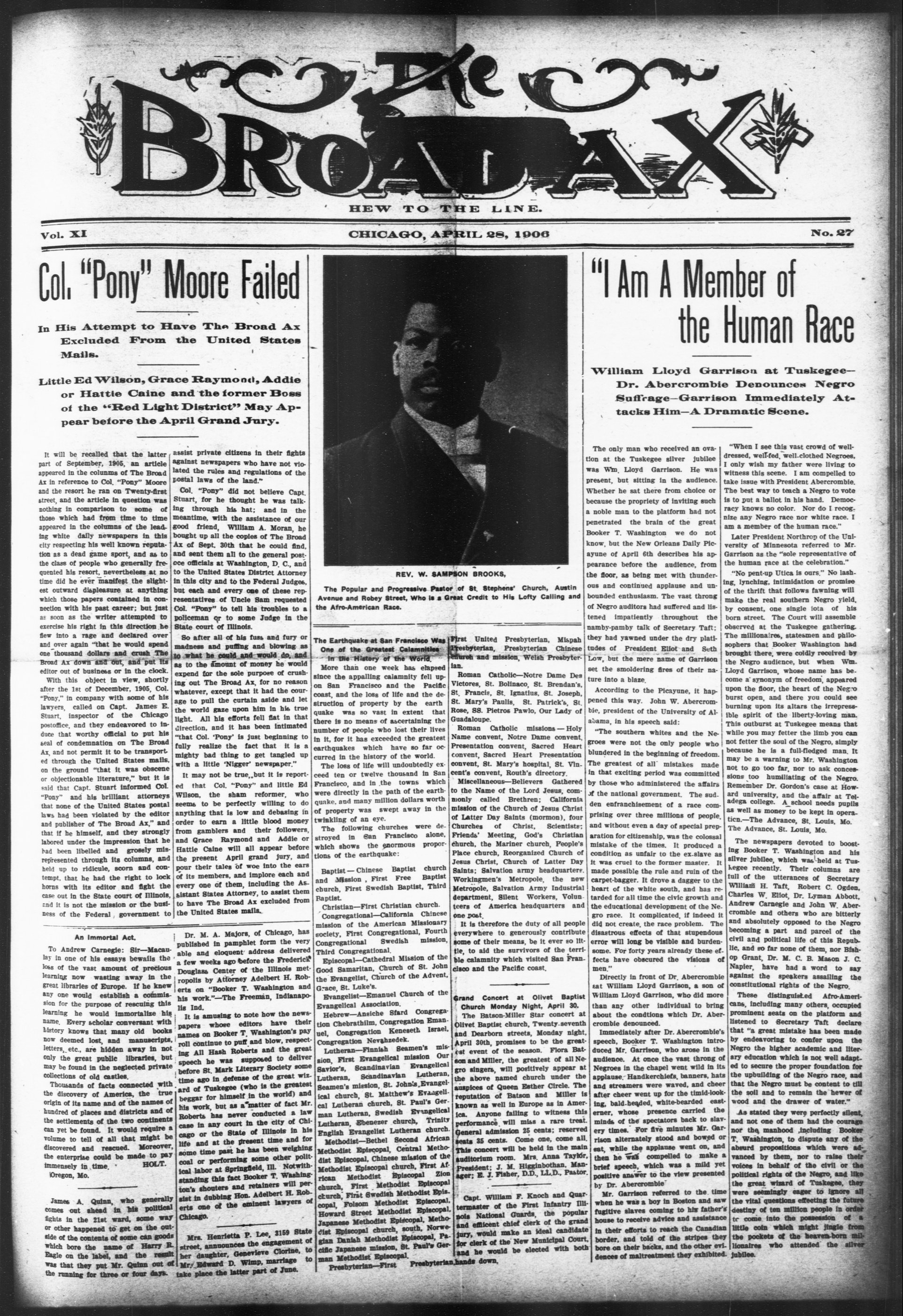
REV. W. SAMPSON BROOKS,
The Popular and Progressive Pastor of St. Stephens' Church, Austin Avenue and Robey Street, Who is a Great Credit to His Lofty Calling and the Afro-American Race.
The Earthquake at San Francisco Was One of the Greatest Calamities in the History of the World.
More than one week has elapsed since the appalling calamity fell upon San Francisco and the Pacific coast, and the loss of life and the destruction of property by the earthquake was so vast in extent that there is no means of ascertaining the number of people who lost their lives in it, for it has exceeded the greatest earthquakes which have so far occurred in the history of the world.
The loss of life will undoubtedly exceed ten or twelve thousand in San Francisco, and in the towns which were directly in the path of the earthquake, and many million dollars worth of property was swept away in the twinkling of an eye.
The following churches were destroyed in San Francisco alone, which shows the enormous proportions of the earthquake:
Baptist—Chinese Baptist church and Mission, First Free Baptist church, First Swedish Baptist, Third Baptist.
Christian—First Christian church.
Congregational—California Chinese mission of the American Missionary society, First Congregational, Fourth Congregational Swedish mission, Third Congregational.
Episcopal—Cathedral Mission of the Good Samaritan, Church of St. John the Evangelist, Church of the Advent, Grace, St. Luke's.
Evangelist—Emanuel Church of the Evangelical Association.
Hebrew—Ansiche Sfard Congregation Chebrathilm, Congregation Emanuel, Congregation Keneseth Israel, Congregation Nevahzedek.
First United Presbyterian, Mispah Presbyterian, Presbyterian Chinese church and mission, Weish Presbyterian.
Roman Catholic—Notre Dame Des Victores, St. Bolinaco, St. Brendan's, St. Francis, St. Ignatius, St. Joseph, St. Mary's Paulis, St. Patrick's, St. Rose, SS. Pietros Pawlo, Our Lady of Guadaloupe.
Roman Catholic missions—Holy Name convent, Notre Dame convent, Presentation convent, Sacred Heart convent, Sacred Heart Presentation convent, St. Mary's hospital, St. Vincent's convent, Routh's directory.
Miscellaneous—Believers Gathered to the Name of the Lord Jesus, commonly called Brethren; California mission of the Church of Jesus Christ of Latter Day Salts (mormon), four Churches of Christ, Scientists; Friends' Meeting, God's Christian church, the Mariner church, People's Place church, Reorganized Church of Jesus Christ, Church of Latter Day Salts; Salvation army headquarters, Working Men's Metropole, the new Metropole, Salvation Army Industrial department, Silent Workers, Volunteers of America headquarters and one post.
It is therefore the duty of all people everywhere to generously contribute some of their means, be it ever so little, to aid the survivors of the terrible calamity which visited San Francisco and the Pacific coast.
Grand Concert at Olivet Baptist Church Monday Night, April 30.
The Batson-Miller Star concert at Olivet Baptist church, Twenty-seventh and Dearborn streets, Monday night, April 30th, promises to be the greatest event of the season. Flora Batson and Miller, the greatest of all Negro singers, will positively appear at the above named church under the auspices of Queen Esther Circle. The reputation of Batson and Miller is known as well in Europe as in America. Anyone failing to witness this performance, will miss a rare treat. General admission 25 cents; reserved seats 35 cents. Come one, come all. This concert will be held in the main auditorium room. Mrs. Anna Taylor, President; J. M. Higginbothan, Manager; E. J. Fisher, D.D., LL.D., Pastor.
Capt. William F. Knoch and Quartermaster of the First Infantry Illinois National Guards, the popular and efficient chief clerk of the grand jury, would make an ideal candidate for clerk of the New Municipal Court, and he would be elected with both hands down.
"I Am A Member of the Human Race
William Lloyd Garrison at Tuskegee Dr. Abercrombie Denounces Negro Suffrage-Garrison Immediately Attacks Him-A Dramatic Scene.
The only man who received an ovation at the Tuskegee silver jubilee was Wm. Lloyd Garrison. He was present, but sitting in the audience. Whether he sat there from choice or because the propriety of inviting such a noble man to the platform had not penetrated the brain of the great Booker T. Washington we do not know, but the New Orleans Daily Picayune of April 6th describes his appearance before the audience, from the floor, as being met with thunderous and continued applause and unbounded enthusiasm. The vast throng of Negro auditors had suffered and listened impatiently throughout the namby-pamby talk of Secretary Taft; they had yawned under the dry flatitudes of President Eilot and Seth Low, but the mere name of Garrison set the smoldering fires of their nature into a blaze.
According to the Picayune, it happened this way. John W. Abercrombie, president of the University of Alabama, in his speech said:
"The southern whites and the Negroes were not the only people who blundered in the beginning of freedom. The greatest of all mistakes made in that exciting period was committed by those who administered the affairs of the national government. The sudden enfranchisement of a race comprising over three millions of people, and without even a day of special preparation for citizenship, was the colossal mistake of the times. It produced a condition as unfair to the ex-slave as it was cruel to the former master. It made possible the rule and ruin of the carpet-bagger. It drove a dagger to the heart of the white south, and has retarded for all time the clvlc growth and the educational development of the Negro race. It complicated, if indeed it did not create, the race problem. The disastrous effects of that stupendous error will long be visible and burdensome. For forty years already these effects have obscured the visions of men"
Directly in front of Dr. Abercrombie sat William Lloyd Garrison, a son of William Lloyd Garrison, who did more than any other individual to bring about the conditions which Dr. Abercrombie denounced.
Immediately after Dr. Abercrombie's speech, Booker T. Washington introduced Mr. Garrison, who arose in the audience. At once the vast throng of Negroes in the chapel went wild in its applause. Handkerchiefs, banners, hats and streamers were waved, and cheer after cheer went up for the timid-looking, bald-headed, white-bearded easterner, whose presence carried the minds of the spectators back to slavery times. For five minutes Mr. Garrison alternately stood and bowed on sat, while the applause went on, and then he was compelled to make a brief speech, which was a mild yet positive answer to the view presented by Dr. Abercrombie.
Mr. Garrison referred to the time when he was a boy in Boston and saw fugitive slaves coming to his father's house to receive advice and assistance in their efforts to reach the Canadian border, and told of the stripes they bore on their backs, and the other evidences of maltreatment they exhibited.
No. 27
member of
Human Race
errison at Tuskegee—
e Denounces Negro
on Immediately At-
amatic Scene.
"When I see this vast crowd of well-dressed, well-fed, well-clothed Negroes, I only wish my father were living to witness this scene. I am compelled to take issue with President Abercrombie. The best way to teach a Negro to vote is to put a ballot in his hand. Democracy knows no color. Nor do I recognize any Negro race nor white race. I am a member of the human race."
Later President Northrop of the University of Minnesota referred to Mr. Garrison as the "sole representative of the human race at the celebration."
"No pent-up Utica is ours." No lashing, lynching, intimidation or promise of the thrift that follows fawning will make the real southern Negro yield, by consent, one single iota of his born street. The Court will assemble observed at the Tuskegee gathering. The millionaires, statesmen and philosophers that Booker Washington had brought there, were coldly received by the Negro audience, but when Wm. Lloyd Garrison, whose name has become a synonym of freedom, appeared upon the floor, the heart of the Negro burst and, there you could see burning upon its altars the irrepressible spirit of the liberty-loving man. This outburst at Tuskegee means that while you may fetter the limb you can not fetter the soul of the Negro, simply because he is a full-fledged man. It may be a warning to Mr. Washington not to go too far, nor to ask concessions too humiliating of the Negro Remember Dr. Gordon's case at Howard university, and the affair at Tel adega college. A school needs pupils as well as money to be kept in operation.—The Advance, St. Louis, Mo. The Advance, St. Louis, Mo.
The newspapers devoted to boosting Booker T. Washington and his silver jubilee, which was held at Tuskegee recently. Their columns are full of the utterances of Secretary William H. Taft, Robert C. Ogden, Charles W. Ellot, Dr. Lyman Abbott, Andrew Carnegie and John W. Abercrombie and others who are bitterly and absolutely opposed to the Negro becoming a part and parcel of the civil and political life of this Republic, and so far none of them, nor Bishop Grant, Dr. M. C. B. Mason J. C. Napier, have had a word to say against the speakers assailing the constitutional rights of the Negro.
These distinguished Afro-Americans, including many others, occupied prominent seats on the platform and listened to Secretary Taft declare that "a great mistake has been made by endeavoring to confer upon the Negro the higher academic and literary education which is not well adapted to secure the proper foundation for the upbuilding of the Negro race, and that the Negro must be content to till the soil and to remain the hewer of wood and the drawer of water."
As stated they were perfectly silent, and not one of them had the courage nor the manhood, including Booker T. Washington, to dispute any of the absurd propositions which were advanced by them, nor to raise their voices in behalf of the civil or the political rights of the Negro, and like the great wizard of Tuskegee, they were seemingly eager to ignore all the vital questions effecting the future destiny of ten million people in order to come into the possession of a little coin which might jingle from the pockets of the heaven-born millionaires who attended the silver jubilee.
a . sa ene ae oe LL a a em
ee ee Pee Rr a ee ae Pee eee oy ea = ’
es cr = eae Paes ee :
ae HE BROAD Be Se ew rte er eee ore Doctor George C, Hall returned THE WIDOW SPOILED IT. (poling tt ae
ao | DF ‘swift and courageous attion will be | concerts, have been reengaged for an- ‘Tuesday morning from an ex- <a Green a. Whe] See he eee © entionen” ould
Bo? PUBLISHED WEEKIT. Sunished'to the fintt of the law. The | other week, and will offer several new | tensive pleasure and professional trip NS et eae “One moment,” sald a thin your,
Renae PESAEONSCEEA hotheaded ‘and irresponsible element 'specialtios and songs. Other clever | through the South. . ee nae. in the. back part of the room. +1
Po Sette SRE Race of our society needs a salutary lesson, | Performers to be seen on the same eee would like to ask If the gentieman
eS "aie sr say oon Sot oo ‘and now 1s a most appropriate time | bill are Swan and Westbrook, novelty Mr. Frank Gillespie, 3030 Deatborn| among the Fariea oo Ee reat
Sssss Saas Sacoeant | for It to be administered."—Chicago | entertainers; Malcolm and Cl ty} etreet, who has been spending the| yarshall Field was s pension list of eS cae
eo easices a | Chronicle, Monday, April 234. Huropetn comedy duoy de ShieldsenatTwimer in Hot Springs, Ark, returned | persons to whom & stated sum wat] o7 ae women could
es ae ares Rev. Straton deserves to be highly |Mehring, singers and dancers; Brows,|"° ‘he “i Thursday. sent regularly each erorg "Kindly let us know.” sald thi. s
& idiveeaieea commended for his noble and manly |42¢ Wilmot, marvelous instrumental {..Mr. Thomas these he was generous, man,|seker for information, “1 eae
© wiigealyen scsmascl we parr. ssrention. | expressions in oa orderly ad- | sts, and a number of others. a H, Williams, of Jersey | inked being imposed upon. | O88 Ushman wore black or white t _ |
—_eaeertpione mest be pa fn adres, ministration of justice. So: city, ts the only Colored boy who is a| who had in some way impremed MZ) ‘The lecturer gasped. . |
= Rise - - | tre th Siar “sina i ‘member of the old and well known| Field with his — bad (Mere “another thing,” sald a third ques
# = Same =; Gen me a | @ saa Secial} Plerian Society of that city. Sram 30 days for $26, relates tioner, “did the gentleman affect any
Seer ae Ottcet Wiptict Charsh Omitay 520 Saabie Will Dresch ct 10:65 9]. Is D. Reston and ber dogh| Ue rad gone far from Mr. Field's — ae |
a THE BROAD Ax Afternoon, April 29th, m. Subject, “Some Reason Why. ter, Miss Katherine; of Cincinnat!, O..| memory, but remained on > ‘Then a fourth man suet
E BArmoarawane,Chiegs | Court Gen. Robert Biliott, 7895,| Tere Should be » Judgment.” are the guests of Mrs, Gertrade Han-| His peasion made hiv cate nen he| , “Were bis patent leathers tarot
as. | Ancient Order of Foresters, will cele- Sunday night therewill be given am}eock Carter, $424 Dearborn street. gible party” in the peas ded to the buttoned?” he shouted. «
fe a === rate their fifteenth anniversary by | Uustrated sermon, subject, “Pilgrim a ee aan lite sees eee aes meee: male
DF —Matered xt the Post Office at Chicagn Daving a parade Sunday, April 20th, |Frosess.” | Twenty-two views sbow.{c Mr m4 Mra, Stmon Wilson, of Diandeneroaperous widow, and MAE —
E Th as Second-class Matter. | followed by a sermon at Olivet Bap. |'6 the life and progress of the Chrisy atvitle, Tenn, are spending 2 few req ber. : aie mee a
si tich church, Twenty-seventh and Dear.|@2- The closing of the service will @ays in the city, the guest of Mr.| “Now, Henry,” she said to him 2€3t) joweq, @ crush hat?” he pe}
toa Raherteon. 6724 Aberdeen strect.|day, “we'll just be having your P&¥/ «<anq spats” screeched the sixth
REV. JOHN ROACH STRATON
‘SPEAKS OF MOBS AND
LYNCHINGS.
“Recent Lawiessness Held a Degrada
‘tion and Disgrace to Nation.
nc ne ere Re ees
and Springfield, Mo. were made the
theme for a sermon by Rev. John
Reach Straton last Sunday morning at
the Second Baptist church. He en-
titled his subject “The Reign of Law-
lessness.” Next Sunday a second ser-
mon will be preached on “The Rea-
sons and the Remedies for Lawleas-
ness.” Pastor Straton took as his
text the sixteenth verse of the thira
chapter of Ecclesiastes: “I saw un-
der the sun the place of judgment,
that wickedness was there; and the
place of righteousness, that iniquity
was there.”
In tracing the origin of law it was
shown how it moved up through de-
sire for vengeance until the beautiful
idea of justice was reached. The
speaker said that American law was
the most just and glorious that the
earth had seen, and yet, strange to
say, violations of law were becoming
more fiagrant and more universal in
our country than in, perhaps, any
land under the sun. Population is in-
creasing rapidly, but crime is increas-
ing still more rapidly. The official
records show that there have been
the appalling number of 132,000 mur
ders and homicides in the United
States in the last twenty years. More
Americans have died by each other's
hands in these twenty years than the
number of Russians and Japanese
‘Killed in the campaign of Mookden.
‘The annual crop of murders increased
from 1,800 in 1885 to 8,400 in 1904.
Crimes in high places were referred
to.
Characteristic Lawlessness.
“But,” said the speaker, “perhaps
our most characteristic form of law-
Jessness is labor riots and [ynching.
Lynching is a distinctively American
institution. In all the years of Eng:
lish history there never has been a
lynching, while our brethren of Can-
ada, just atross the line from us, are
free from this disgraceful custom,
which is becoming more and more 2
menace to the highest and most sa.
ered things for which our country
stands. If the present deplorable ten-
dencies be not checked the custom of
burning particularly obnoxious crim-
inals promises to become as popular
& spectacle in the United States as
‘the blody bull fights of Spain Al-
ready, as at Newman, Ga, and Corsi.
cana, Tex. special trains have been
run to these burning bees, while the
scene of the burning of the Negro at
‘Derte Haute, Ind, an event stiil fresh
im Oar “minds, was actually photo
Sraphed, the picture selling at fancy
prices, We are told in the descriptio:
‘of the photographs that ‘between the
two groups of the mob can be sect
fe eee ee
Degradation of Citizens.
“The fiendish passion which fired
the hearts of the mobs at Springfield
‘Q., and Springfield, Mo., show to what
of degradation many of our cit
dzens ave fallen. In the long and
Bloody annals of savagery there has
t-been a more diabolical flustra
Hon ‘of the tree play of blood lust and
the | elementary passions.
= fit is indeed a sad state of affairs
phen Citizens of our free,country are
uted ané driven out like rats
from their holes and then burned at
atake, while their fellow citizens
lance around the human bonfire in
endish giec. Law is beneficence dl
sted by reason; mob action
me om impulse. Law is the
udiaaid of justice; the mob, is the
sh gratification of personal ven
mee. Law is the security of civill
on; mob action is treason and 2
fof barbariam, For crime under
pe state Se respe tor crime
er. mob rule nothing under heaven
eoale, Governor Polk wa
tt sry anh
wield wasra murderer, and {t
been already apprehended by his
swift and courageous action will be
punished-to the limit of the law. The
hot-headed and irresponsible element
of our society needs a salutary lesson,
and now 1s a most appropriate time
for it to’ be administered."—Chicago
Chronicle, Monday, April 234.
Rev. Gtraton deserves to be highly
=
expressions in favor of the orderly ad-
ministration of justice. ‘
at Olivet Baptist Church Sunday
Afternoon, April 29th,
Court Gen. Robert Biliott, 7895,
Ancient Order of Foresters, will cele-
brate their fifteenth anniversary by
having a parade Sunday, April 29th,
followed by a sermon at Olivet Bap-
tish chureh, Twenty-seventh and Dear-
orn street. The Court will ‘assembie
at the Odd Fellows’ new hall, 3335
and 3337 State street, at 2p. m. Line
of march south on State street to
Thirty-eighth street, west on Thirty-
eighth street to Dearborh street, north
on Dearborn street to Twenty-seventh
street, then to assemble in Olivet Bap.
tist church, where a program will be
rendered consisting of music by the
choir, solo by Forester N, Clark Smith.
Remarks pertaining to Forestry by
the following speakers: M. M. Roan,
Deputy High Chief Ranger; A. G. F.
Sims, Chief Ranger; Mrs. Rosa Jones,
Chief Companion of the Companions
of the Forest; sermon, Dr. E, J. Fish-
er, DD. LL.D, The Foresters will
then resume thejr line of March in
Dearborn street north to Twenty-sixth
street, east in Twenty-sixth street to
‘Wabash avenue, south in Wabash
avenus to Thirty-fourth street, west
in Thirtyfourth street to the Stat
street hall.
Jeseph ©. Lane the Practical Watch.
maker, Will Remove to New and
Enlarged Quarters.
The first of the coming week Jos-
ph ©. Lane, the practical and up-to-
Gate watchmaker, who has been suc
cessfully established in business since
1876 at 369 S_ Clark street, will re-
move to new and enlarged quarters,
264 E. Thirty-first street near Michi-
gan avenue,
_ His new jewelry store will be mod-
ern and up to date in every respect.
Tt will be fitted up with first-class
show cases and other fixtures, and he
will carry a first class line of watches
and other jewelry. As an expert
watchmaker and repairer of fine jew:
etry of every description, tneleding
clocks, Mr. Lane cannot be excelled,
and he will be more than gratified to
meet his old friends and patrons at
‘his new place of business 264 E. 31st
street, near Michigan avenue,
;
Bethel Literary and Historical Society
| ‘Will present a special program Sun.
day afternoon, April 29th, for the ben.
ae
gram is as follows:
Special music by Prof, Gates’ select
orchestra.
pending by Mrs. Jackson.
| Address by Attorney Hale G. Par
eer, =
‘Voeal solo by Mrs, Fannie Yelzer.
‘The Club Quartette will render 5
special selection for this occasion
Breryboty welcome. 4 p.m. Geo
7. Kersey, President; M. L. Bensen
Vice-President; C. A. Grifin, Assist
ot Secretary. _
BASIS
eremaTionns THEATRE, CHI
‘AGO.
W. 8. Cleveland's Big Show.
‘The feature in theatrical circles
ast woek was the announcement of
a radical change In prices at the In-
ternat-onal Theatre, which since W.
S. Cleveland returned ss manager,
has gaiued the reputation of being the
highest class vaudeville theatre in
Chieago. The reduction went into ef-
fect last Monday when the regular
spring and summer season was inau-
guarted at this popular theatre. The
management has announced that here-
after at all weekday matinees re-
served seats will be sold throughout
the entire house at one price, 10 cents,
while for the Sunday, holiday and
evening performances the prices will
range from 10’cents to 30 cents, The
seme high standard will be main-
tained in the acts presented in W. 8.
Cleveland's original greater vaude-
ville, This is really a declaration of
war on the vaudeville trust. Another
star bill has been prepared for thie
Dacre, a singer of world-wide reputa-
tion, will:come ‘fresh from an entire
winter’s engagement in London, and
will bring with her the latest English
song. snecesses. “Cdl” Billy Link,
the minstrel, accompanied by Willette
Chartres, will be seen in a highly.
amusing sketch in which are intro-
duced “The Colonel's” famous “hobo-
can soldiers.” Evans Lioyd and Caro-
fyn Church will present their latest
sketch entitled “The Man’ Across the
Way.” ‘The furiously funny Elinore
Sisters, who have set all Chicago
laughing with their original comedy
concerts, have been reengaged for an
other week, and will offer several new
specialties and songs. Other clever
performers to be seen on the same
Dill are Swan and Westbrook, novelty
entertainers; Malcolm and Chevett,
European comedy duo; de Shields and
Mehring, singers and dancers; Brown.
‘and Wilmot, marvelous instrumental
ists, and a number of others,
‘The Institutional Church and Social
Settlement, 3825 Dearborn Street.
_ The pastor will preach at 10:45 a
m. Subject, “Some Reason Why
‘Thére Should be a Judgment.”
Sunday night therewill be given an
Mustrated sermon, subject, “Pilgrim's
Progress,” Twenty-two views show-
ing the life and progress of the Chris.
tian. The closing of the service will
be twelve views illustrating the song
“Holy City.”
‘Qnested Anieumaenend
From on and after this date all an-
Rouncements of entertainments, ete,
for which an admission ts charged
will be considered advertising, and
‘will be charged for at the rate of 12
cents a line, seven words to a line.
‘The money must accompany the mat.
ter and reach the editor no later than
Thursday morning of the week in
tended for publication. This rule wil
‘also apply to all personal items and
fetter for wich no charges il
made. In other words, all news mat-
ter must reach us either on Wednes.
@ay evening or early Thursday morn-
ing in order to find its way into the
columns of this paper the same week
it is written, :
Write plainly on one side of the
paper only, and address all ‘commun.
cations to The Broad Ax, 5040 Armour
avenue.
Removal Notice,
‘On and after May ist B. W. Fitts
will remove the “Crystal Printing
House” from 2803 State street to
3315 State street where he will be
pleased to meet.his old customers.
———
@eesish Metien
All readers of The Broad Ax who
for any cause whatever fail to receve
thelr paper regularly each Saturday
are requested to drop a postal card
to the editor, 5040 Armour avenue,
notifying him of that fact,
—--—_.
Personal Mention. ‘
_ Owing to the rush of business Jus:
tice Keeney has. continued the Gress:
‘Smith and Dr. A.B, McKissack -cése
to Monday afternoon, April 0th, at
Se ears. °
CHIiPps
Louisville, Ky, has thirty-five Ne-
gro doctors.
Mr. Will Clark spent Saturday and
Gunday in Waukesha, Wis, visiting
friends. :
| Mrs. Mary A. Williams and broth-
‘ers will reside at 6618 Vernon avenue
after April 30th,
Mr. Geo, Lee, 2622 Wabash avenue,
left the elty Monday to spend a month
in St, Paul, Minn.
‘Miss M. Aberns, superintendent of
Provident Hospital, is spending a
week in Quiney, Ill
Cole and Johnson, the song writers,
left New York on Monday to spend
ten weeks in Europe,
‘Mr, Wm. Simmons, 3208 State street,
left the city Wednesday to spend a
week in Memphis, Tenn.
Mrs, Eva Roman has removed from
4007 Dearborn street into an elegant
fiat at 2420 Prairie avenue, ‘
Sunday parades of societies should
be orderly and without unnecessary
obstruction to the street cars.
Mr. Richard Kelley and family
have moved from 6609" Vincennes
avenue to 6345 Rhodes avenue.
Mr. Chas. Washington, 6324 Cham.
plain avenue, who has been on the
‘Sick lst, has reported for duty again,
Mr, ‘Thos, Daley, 1515 State street,
‘who has been on the sick lst for the
last month, is again able to resume
his duties. °
| “Mr. W. Harper, the artist, gave
chalk talk tothe nurses’ of Provident
Hospital Wednesday evening at the
Freer home.
‘Mr. Henry Cole, who has been trav.
sling for the past four months with
Madam Mojeska, will return to Chi
cago May 1st. Z
_ Mr. and Mrs. James Furber ,of To.
peks, Kan, are visiting in the city,
the guests of Mrs. J. S. Monroe, 3847
ee ee ee ee
through the South. :
Mr. Frank Gillespie, 3030 Deatborn
street, who has been spending the
im Hot Springs, Ark., returned
fto the city Thursday.
|< Mr, Thomas H_ Williams, of Jersey
‘City, is the only Colored boy who is a
Fmember of the old and well known
|Plerian Society of that city.
Mrs, L. D. Easton and her daugh-
Mer, Miss Katherine; of Cincinnatl, 0..
‘are the guests of Mrs, Gertrude Han-
jeock Carter, $424 Dearborn street.
. Mr. and Mrs, Stmon Wilson, of
ville, Tenn., are spending a few
@ays in the city, the guest of Mr.
Fred Robertson, 6724 Aberdeen street.
Mr. and Mrs, Childs have moved
in thelr residence, 6618 Vernon aven-
ue, where it is sald the finest flats
cwned and ocupled by Negroes are
lecated.
Mr. Jack Freldricks of St, Louls,
but formerly of Chicago, is spending
two weeks here renewing old acquaint:
anceship, stopping at 341 W. Thirty-
fifth street.
Mr. and Mrs. Frank Mallory, who
fare touring the country in vaudeville,
will spend the coming week in Chi-
, the guest of Mrs, Lett, 3213
‘Wabash avenue.
Mr, and Mrs, Philip Green 343 W.
Forty-seventh street, enjoyed a few
days’ visit of thelr brother, who, with
Mr. Wm. Morcell, of Baltimore, Md.,
is en route West on a pleasure trip.
Mrs. Geneva Smith, 4764 Dearborn
street, will on May Ist move into her
own new home, 5363 Dearborn street,
and her sister, Mrs. Dave Jenkins,
‘will continue to occupy their present
home,
F. L. Barnett, Assistant State's At-
torney, has a strong following and
by the leading Republican
iticlans for the nomination as one
of the Judges of the new municipal
court,
Rev. T. A. Clark, superintendent of
‘Trinity Mission and Social Settlement
155 E. Eighteenth street, much
ito the delight of its friends and well
is meeting with success in
work.
In honor of the fifth birthday of
ar Wn danabone, Mery Bs. ona
Mrs. Gee, 421 W. Pifty-eighth street,
entertained about twenty little boys
‘and girls Tuesday afternoon from 2
to 5 o'clock.
Mrs. L. B. Barnett is arranging to
have Monday, May 7th, a benefit per-
formance at the Pekin Theatre to aid
the Frederick Douglass Center. Over
a hundred of Chicago's best families
Mhave subscribed thelr names to be
seeeeents
Soclety folk are to have two out.
ings early next month for charity.
May 34 they will dance at the Armory
and May 7th they will witness a spe-
‘cial performance at the Pekin. The
‘Old Folks’ Home and Douglass Cen.
tre, respectively, are the beneficiaries.
8. A. T. Watkins, Assistant Prose
euting Attorney, has for the past two
weeks suffered with a defect or sensi
tiveness of the eyes to such an extent
that he has been unable to perform
his labors for the city, but at this
‘writing they are improving, and he is
gradually regaining his sight again.
R. M. Harvey, 164 E. Twenty-ninth
‘street, chairman of the program com.
mittee of the Standard Literary Soci
ety which meets in Olivet Baptist
Chureh, is one of the most popular
young men and tonsorial artists in the
elty, and he holds down the front
chair in the well appointed barber
Shop at 139 W. Forty. seventh street.
The Colored men of Hartford, Conn,
who have been faithful Republicans
all their lives, struck last month be.
cause of being ignored, and ran a Col:
Ored man as an independent candidate
for mayor. He received only a hun-
dred votes, owing to the timidity of
jeome of the Colored men, but nearly
The tite Gree Goon etn. 5
HELP! HELP!
Sen
The citizens of Chicago are
urged ‘to make immediate cash
contributions for the sufferers in
San Francisco and other stricken
towns. Z
Contributions may be depos-
ited at the State Street Stores, the
Deespaper Offices, or sent to
Vid R. Fo: First National
Bank, Tscastoer of the
Chicago Commercial
__ Association.
—«c«*"
THE WIDOW SPOILED IT.
Pensioner of Marshall Field Whe
Was Persuaded to Ask
for a Raise
‘Among the charities of ie
Marshall Field was a pension list of
persons to whom a stated sum was
sent regularly each month. With
these he was generous, but he dis
Mked being imposed upon. One mad,
who had in some way impremed Mr.
Field with his deserts, bad a check
each 30 days for $25, relates Youth's
‘Companion.
‘He had gone far from Mr. Field's
memory, but remained on the list.
His pension made him quite “an éll-
‘gible party” in the circle in which he
fived, and at last he yielded to the
blandishments of his landlady, an
elderly, prosperous widow, and mar
ried her.
“Now, Henry,” she said to him next
day, “we'll just be having your pay
raised. You can't keep two as easily
‘as you can one. Mr. Field is @ rich
man, and he will understand ‘that.
You go down and tell kim you need
$50 & month now.”
‘Away went Henry, and after much
argument and persuasion obtained ac
cess to the inner office of the great
merchant, where he stated his case.
Mr. Field became Interested at once.
“A widow, eh?” he inquired, smil-
ing. “pid she ask you—or you her?”
“Well, sir,” stammered Henry, “I
guess she did lead up to it.”
“How old is she?”
“about 40, str.”
“Did she support herself?”
“Yes, sir. She has a big boarding
house. I boarded with her. I do yet,
fn tact.”
“qb, yes." said Mr. Field. “So you
want a raise, do you? Let me see—
how much was your pension? Twen-
ty-five dollars? Well, you won't have
to pay any board now, so suppose we
make it $12.50? That will keep you fn
spending money.”
TURKS’ CRUELTY TO HORSES
Prefecture of the Ottoman Capital
‘Will Take Steps to Re-
strain It.
A laudable decision has been arrived
at by the prefecture of the Ottoman
capital, with the view of protecting
horses from misuse and ill-treatment,
says the Constantinople correspondent
of the London Lancet. The Turks are,
on the whole, very kind to animals,
and shield them from injury by every
possible means. At almost every Turk
ish house in Stamboul there is to be
found a small receptacle where water
is poured in every day for the use of
the innumerable street dogs. A Mus-
suman, building his dwelling place,
rarely forgets to attach some contriv-
ance for sheltering birds, pigeons, spar-
rows, etc.
I am assured that a cabman who
overruns a dog, heedlessly enjoying
its dolce far niente in the middle of
the street, has to pay a fine of several
piastres, while the sultan is believed
to spend a large sum on the feeding
of the numerous canine scavengers
around his kiosks and palaces. There
are, however, a good many employers
of horse labor who use their animals
In a cruel or thoughtless manner.
To prevent this the employment of
senile, debilitated or diseased horses
has been forbidden. Municipal agents
will have difficulty in Constantinople
in insuring that the measure {s strict-
ly adhered to—that the load never ex-
ceeds the amount proportionate the
horse’s strength, and so on—but, any-
how, the spirit which has influenced
the mew enactment is laudable.
WANTED MINOR DETAILS.
The Audience Was Sympathetic and
Interrogated the Able
Lecturer.
The lecturer was talking on the “In-
fluence of Surroundings.”
“There was an Englishman,” he
said, “who went to Australia and
sought his fortune in the bush. He
was quite alone and yet every night
‘peforé he ate his frugal meal he py
fon evening clothes 80 that he wou)
remember he was a gentleman.”
“One moment,” said a thin your,
fm the back part of the room +;
would Uke to ask if the gentleman
wore a dinner coat with conventiona,
swallowtails?”
Before the startled lecturer couig
reply another questioner faced him.
“Kindly let us know,” said this new
seeker for information. “if the Eng
Ushman wore a black or white tie"
‘The lecturer gasped.
“another thing,” said a third ques.
tioner, “did the gentleman affect any
jewelry, and {f 80, were bis shirt study
pearls or roman gold?”
‘Then @ fourth man ayose.
“Were his patent leathers lace or
buttoned?” he shouted.
‘The fourth man was thrust asi py
the fifth.
“Were bis cuffs round-cornered, ang
did he wear a crush hat?” he je
lowed.
“and spats” screeched the sixth
man.
| And in the confusion which followey
this last query the lecturer took his
hat and fled.
Frenchman’s Queer Stee
It ts reported from Paris that un in-
genious inhabitant of Monthucon, in
France, has tamed a wild boar. which
he cwg t young im the fores, ang
now drives it in a small gig oF “boar
chaise,” with intens> gratification ang
enjoyment. The enimal between siintis
fs said to appear more ecceatric than
stylish.
A Difference.
‘What constitutes a rood dog In a
show is vastly different from thst
which makes @ good dog in the house.
‘Wrong Implement.
“One of de dificulties "bou de pres-
‘ent time,” said Uncle Eben, “is dat too
many men wants to be carryin’ canes,
when dey ought to be totin’ whitewash
Drushes.”—Washington Star.
‘Trolley in Japan.
It costs 13 conts to go by trolley cars
from Tokto to Yokohama, the port of
the Japanese capital. Cars start every
five minutes from five fn the morning
to 11 at night.
Base Inuendo.
Most of the women who attended the
ressmakers’ convention went “with
| pads and pencils.” But why pencts?
—Kansas City Star.
Sadly Unmusical.
It has been said that the drum was
the first musical instrument in use, but
how anyone discovered that it is a mu-
sical instrument is still a mystery.
Small Pay.
Beigtum gives the members of her
lower house of parliament $800 a year
and free railway tickets.
Small Armies.
South American republics can among
themselves muster about 90,000 drilled
soldiers.
Power for Food.
Anyone can be a power for evil—it
takes character to bea power for good.
‘Blind Stadent.
One of the most interesting figures
im Harvard university is Edward Ray,
& Dliind student who hails from
small country town in North Carolina
He has mastered the most difficult
courses in higher mathematics, in se
ology, won a degree from the Univer-
sity of North Carolina, and is 20¥
working for the degree of M. A. at
Harvard. Here he is taking some of
the hardest courses in the curriculum,
Gothic and Anglo-Saxon.
‘Too Often Sucoseds.
‘The more desperate, abandonei and
‘notorious the criminal the harder bis
lawyer always works to turn him
loose on society again.—Chicago Trit-
mae
ee eS eee eee -
- RE Pe ba > re
ey ‘PUBLISHED WEEKIT.
aia cangresrroir arn
= end ct oll time sphnid the tra:
Seppe
ns Tee, ant coe Ses eet
‘Ths Droste 0 pewepapar whose platforn
————.
Caan
‘(Subscriptions must be paid in advance.
a
Soe seteomate nore eee.
‘THE BROAD AX
‘S00 Armour Avenne, Chicago.
SBLIUS ¥. TAYLOR, Réiter and Putiisner.
ee oe cae
‘Batered xt the Post Office at Chicage,
Th, as Second-clams Matter.
ee
REV. JOHN ROACH STRATON
SPEAKS OF MOBS AND
LYNCHINGS.
- a /
Recent Lawlessness Held a Degrada-
tion and Disgrace to Nation.
ee ne
and Springfield, Mo., were made the
theme for 2 sermon by Rev. John
Reach Straton last Sunday morning at
the Second Baptist church. He en-
titled his subject “The Relgn of Law-
lessness.” Next Sunday a second ser-
‘mon will be preached on “The Rea-
sons and the Remedies for Lawless-
ness.” Pastor Gtraton took as his
text the sixteenth verse of the thira
chapter of Ecclesiastes: “I saw un-
der the sun the place of judgment,
that wickedness was there; and the
Place of righteousness, that iniquity
was there.”
In tracing the origin of law it was
shown how it moved up through de-
sire for vengeance until the beautiful
idea of justice was reached. The
speaker said that American law was
the most just and glorious that the
earth had seen, and yet, strange to
say, violations of law were becoming
more fiagrant and more universal in
our country than in, perhaps, any
land under the sun. Popalation is in-
creasing rapidly, but crime is increas-
ing still more rapidly. The official
records show that there have been
the appalling number of 132,000 mur-
ders and homicides in the United
States in the last twenty years. More
Americans have died by each other's
ands in these twenty years than the
number of Russians and Japanese
killed in the campaign of Mookden.
‘The annual crop of murders increased
from 1,800 in 1885 to 8,400 in 1904.
Crimes in high places were referred
to.
Characteristic Lawiessness.
“But,” said the speaker, “perhaps
our most characteristic form of law-
lesmness is labor riots and [ynching.
Lynching is a distinctively American
institution. In all the years of -Eng-
lish history there never has been &
lynching, while our brethren of Can-
ada, just atross the line from us, are
free from this disgraceful custom,
which is becoming more and more a
menace to the highest and most sa-
cred things for which our country
stands. If the present deplorable ten-
dencies be not checked the custom of
burning particularly obnoxious crim-
inals promises to become as popular
@ spectacle in the United States as
the blody bull fights of Spain. Al-
ready, as at Newman, Ga, and Corsi-
cana, Tex. special trains have been
run to these burning bees, while the
scene of the burning of the Negro at
Terre Haute, Ind, an event still fresh
in Our ‘minds, was actually photo
graphed, the picture selling at fancy
prices, We are told in the description
of the photographs that ‘between the
two groups of the mob can be seen
the body of the Negro lying upon the
fire.”
Degradation of Citizens.
“The fiendish passion which fired
the hearts of the mobs at Springfield.
O., and Springfield, Mo. show to what
depths of degradation many of our cit-
zens have fallen. in the long and
bloody annals of savagery there has
got'been a more diabolical flustra-
Hon ‘of the free play of blood lust and
the other clementary passions.
ss a oe st state
hes citizens of our free,country are
ated down and driven out like rats
jom their holes and then burned at
he stake, while thelr fellow citizens
Hoes szomnd tho human bonfire tn
ke glee. Law is beneficence di-
pected by reason; mob action ts
aatred on impulse. Law is the
pdmaid of ° mob, is the
jance. Law 5 ‘of civill-
on; mob is-treason and a
ec cmenenn For erime under
@ state is responsible; for crime
tod rule nothing under heaven
sponsible, Governor Folk was
ht when he said in a recent
that every man who pertici
in the burning of these Negroes
nateld wa réerer, and it
be hoped that those who have
Reine a he
‘been already apprehended by his
switt and courageous action will be
punishet-to the limit of the law. The
‘hot-headed ‘and irresponsible element
of our society needs a salutary lesson,
and now {s a most appropriate time
for it to be administered.”"—Chicago
Chronicle, Monday, April 234.
Rev. Straton deserves to be highly
a et
expressions in favor of the orderly ad-
ministration of justice. $
Parade by the Foresters and Sermon
at Olivet Baptist Church Sunday
Qiteracen, Aart Sth.
ene leg aaa eee
Court Gen. Robert BBillott, 7895
Ancient Order of Foresters, will cele
brate their fifteenth anniversary by
having a parade Sunday, April 29th,
followed by a sermon at Olivet Bap.
tish church, Twenty-seventh and Dear.
‘Lorn street. The Court will assemble
at the Odd Fellows’ new hall, 3335
and 3337 State street, at 2 p, m. Line
of march south on State street to
‘Thirty-eighth street, west on Thirty-
eighth street to Dearborn street, north
on Dearborn street to Twenty-seventh
street, then to assemble in Olivet Bap.
tist church, where a program will be
rendered consisting of music by the
chotr, solo by Forester N. Clark Smith.
Remarks pertaining to Forestry by
the following speakers: M. M. Roan,
Deputy High Chief Ranger; A. G. F.
Sims, Chief Ranger; Mrs. Rosa Jones,
Chief Companion of the Companions
of the Forest; sermon, Dr. E. J. Fish-
er, DD. LL.D, The Foresters will
then resume thejr line of March in
Dearborn street north to Twenty-sixth
street, east in Twenty-sixth street to
Wabash avenue, south in Wabash
avenus to Thirty-fourth street, west
in Thirty-fourth street to the Stat
street hall.
Seseph 0. Lane the Practical Watch.
maker, Will Remove to New and
Enlarged Quarters.
The first of the coming week Jos.
€ph ©. Lane, the practical and up-to.
@ate watchmaker, who has been suc.
cessfully established in business since
1876 at 369 S, Clark street, will re-
Move to new and enlarged quarters,
264 E, Thirty-first street near Michi-
gan avenue.
His new jewelry store will be mod-
ern and up to date in every respect.
It will be fitted up with firstclass
show cases and other fixtures, and he
will carry a first class line of watches
and other jewelry. As an expert
watchmaker and repairer of fine jew-
eiry of every- description; sncinding
clocks, Mr. Lane cannot be excelled,
and he will be more than gratified to
meet his old friends and patrons at
his new place of business 264 E. 3ist
street, near Michigan avenue,
Bethel Literary and Historical Society.
‘Will present a special program Sun-
day afternoon, April 29th, for the ben.
efit of the sufferers in California. Pro
gram ig as follows:
Special music by Prof, Gates’ select
orchestra.
Reading by Mrs. Jackson,
Address by Attorney Hale G. Par
ker.
‘Vocal solo by Mrs, Fannie Yelzer.
‘The Club Quartette will render a
special selection for this occasion.
Everybody welcome. 4 p. m. Geo.
T. Kersey, President; M. L, Bensen,
Viee-President; C. A, Griffin, Assist:
ent Secretary. _
7 CAGO.
| W. 8. Cleveland's Big Show.
‘The feature in theatrical circies
‘ast woek was the announcement of
‘a radical change in prices at the In-
ternat‘onal Theatre, which since W.
8. Cleveland returned ss manager,
has gakued the reputation of being the
highest class vaudeville theatre in
Chicago. The reduction went into ef-
fect last Monday when the regular
spring and summer season was inau-
pete Pee ee ‘The
management has announced that here-
after at all weekday matinees re-
‘served seats will be sold throughout
the entire house at one price, 10 cents,
while for the Sunday, holiday and
evening performances the prices will
range from 10’cents to 30 cents, The
seme high standard will be main-
tained in the acts presented in W. 8.
Cleveland's original greater vaude-
ville, This is really a declaration of
war on the vaudeville trust, Another
star bill has been prepared for thie
Dacre, a singer of world-wide reputa-
tion, will:come fresh from an entire
winter's engagement in London, and
will bring with her the latest Engtish
Bong. successes. “Col.” Billy Link,
the minstrel, accompanied by Willette
Chartres, will be seen in a highly,
amusing sketch in which are intro-
duced “The Colonel's” famous “hobo-
can soldiers.” Evans Lloyd and Caro-
{yn Chureh will present their latest
sketch entitled “The Man‘ Across the
Way.” The furiously. fanny Eltnore
Sisters, who have set ali Chicago
laughing with their original comedy
concerts, have been reengaged for an-
other week, and will offer several new
specialties and songs. Other clever
performers to be seen on the same
bill are Swan and Westbrook, novelty
entertainers; Malcolm and ~Chevett,
European comedy duo; de Shields and
Mehring, singers and dancers; Brown
and Wilmot, marvelous instrumental
ists, and a number of others,
The Institutional Church and Social
Settlement, 3825 Dearborn Street.
‘The pastor will preach at 10:45 a
m. Subject, “Some Reason Why
There Should be a Judgment.”
Sunday night there4will be given an
illustrated sermon, subject, “Pilgrim's
Progress.” Twenty-two views show-
ing the life ang progress of the Chris.
tian. The closing of the service will
be twelve views illustrating the song
“Holy City.”
Guestet Amacumesnend
From on and after this date all an-
nouncements of entertainments, ete,
for which an admission ts charged
will be considered advertising, and
will be charged for at the rate of 12
cents a line, seven words to a line.
‘The money must accompany the mat
ter and reach the editor no later than
Thursday morning of the week in
tended for publication. This rule will
‘also apply to all personal items and
qatter for which no charges will be
made. In other words, all news mat.
ter must reach us either on Wednes-
day evening or early Thursday morn-
ing in order to find its way into the
‘columns of this paper the same week
it is written, a
Write plainly on one side of the
Paper only, and address all communi-
cations to The Broad Ax, 5040 Armour
avenue,
Removal Notice.
On and after May ist B. W. Fitts
will remove the “Crystal Printing
House” from 2803 State street to
3315 State street where he will be
Pleased to meet his old customers.
——
Special Notice
All readers of The Broad Ax who
for any cause whatever fail to receve
‘their paper regularly each Saturday
are requested to drop a postal card
to the editor, 6040 Armour avenne,
notifying him of that fact,
oe
Personal -Mention.
Owing to the rush of business Jus:
tice Keeney has. continued the Greee:
Smith and Dr. A. B, McKissack cise
to Monday afternoon, April 30th, at
2 o'clock sharp.
CHIPps
Louisville, Ky,, has thirty-five Ne.
gro doctors,
| Mr. Will Clark spent Saturday and
Ganday in Waukesha, Wis, visiting
friends, =
Mrs. Mary A. Williams and broth.
ers will reside at 6618 Vernon avenue
after April 30th,
Mr, Geo, Lee, 2622 Wabash avenue,
left the city Monday to spend a month
fm St, Paul, Minn.
Miss M. Aherns, superintendent of
Provident Hospital, is spending 2
week in Quincy, Ill.
Cole and Johnson, the song writers,
left New York on Monday to spend
ten weeks in Europe,
Mr, Wm. Simmons, $208 State street,
left the city, Wednesday to spend a
week in Memphis, Tenn.
‘Mrs,’ Eva Roman has removed from
4007 Dearborn street into an elegant
flat at 3420 Prairie avenue, :
Sunday parades of societies should
be orderly and without unnecessary
obstruction to the street cars.
Mr, Richard Kelley and family
have moved from 6609" Vincennes
avenue to 6245 Rhodes avenue.
‘Mr. Chas. Washington, 6324 Cham.
plain avenue, who has been on the
sick list, has reported for duty again.
Mr, Thos, Dailey, 1515 State street,
who has been on the sick list for the
last month, is again able to resume
his duties. .
“Mr. W. Harper, the artist, gave a
chalk talk to the nurses’ of Provident
Hospital Wednesday evening at the
Freer home.
Mr. Henry Cole, who has been trav.
eling for the past four months with
Madam Mojeska, will return to Chf-
cago May ist. Z .
‘Mr, and Mrs. James Furber of To-
peka, Kar, are visiting in the
the guests of Mrs. J. S. Monroe, 3847
Forest avenue. o
tensive pleasure and professions! trip
through the South. .
Mr. Frank Gillespie, 3030 Dearborn
street, who has been spending the
in Hot Springs, Ark, returned
fto the city Thureday.
« Mr, Thomas H, Williams, of Jersey
‘City, is the only Colored boy who is a
‘member of the old and well known
[Plerian Society of that city.
Mra, L. D. Easton and her daugh-
fter, Miss Katherine; of Cincinnatt, 0.,
‘are the guests of Mrs, Gertrude Han-
jeock Carter, 3424 Dearborn street.
. Mr. and Mrs, Stmon Wilson, of
shville, Tenn., are spending a few
days in the city, the guest of Mr.
Fred Robertson, 6724 Aberdeen street.
Mr. and Mrs, Childs have moved
in their residence, 6618 Vernon aven-
ue, where it is said the finest flats
cwned and ocupled by Negroes are
Iceated.
Mr. Jack Freldricks of St, Louis,
but formerly of Chicago, is spending
two weeks here renewing old acquaint-
anceship, stopping at 341 W. Thirty-
fifth street,
Mr. and Mrs. Frank Mallory, who
are touring the country in vaudeville,
will spend the coming week in Chi-
peago, the guest of Mrs, Lett, 3213
Wabash avenue.
Mr, and Mrs, Philip Green 243 W.
Forty-seventh street, enjoyed a few
days’ visit of their brother, who, with
Mr. Wm. Morcell, of Baltimore, Md.,
is en route West on a pleasure trip.
Mrs, Geneva Smith, 4764 Dearborn
street, will on May Ist move into her
‘own new home, 5363 Dearborn street,
and her sister, Mrs. Dave Jenkins,
will continue to occupy their present
home,
~ F. L, Barnett, Assistant State's At-
torney, has a strong following and
by the leading Republican
politicians for the nomination as one
of the Judges of the new municipal
court, :
Rev. T. A. Clark, superintendent of
‘Trinity Mission and Social Settlement
155 EB. Eighteenth street, much
‘to the delight of its friends and well
is meeting with success in
work. |
In honor of the ffth birthday of
fr tte causes Mary B. ar. end
Mes. Geo, 421 W. Pifty-eighth street,
entertained about twenty little boys
‘and girls Tuesday afternoon from 2
to 5 o'clock.
‘Mrs. I. B. Barnett is arranging to
have Monday, May 7th, a benefit per-
formance at the Pekin Theatre to aid
the Frederick Dougiass Center. Over
a hundred of Chicago's best families
have subscribed thelr names to be
present,
Society folk are to have two out-
ings early next month for charity.
May 34 they will dance at the Armory
and May 7th they will witness a spe-
cial performance at the Pekin. The
Old Folks’ Home and Douglass Cen-
tre, respectively, are the beneficiaries.
8. A. T. Watkins, Assistant Prose-
cuting Attorney, has for the past two
Weeks suffered with a defect or sensi-
tiveness of the eyes to such an extent
that he has been unable to perform
his labors for the city, but at this
writing they are improving, and he is
gradually regaining his sight again.
R, M. Harvey, 164 E. Twenty-ninth
street, chairman of the program com.
mittee of the Standard Literary Soci-
ety which meets in Oltvet Baptist
Chureh, is one of the most popular
young men and tonsorial artists in the
eity, and he holds down the front
chair in the well appointed barber
shop at 139 W. Forty. seventh street.
‘The Colored men of Hartford, Conn,
who have been faithful Republicans
all thelr lives, struck Inst month be-
cause of being ignored, and ran a Col-
Ored man as an independent candidate
for mayor. He received only a hun-
dred votes, owing to the timidity of
some of the Colored men, but nearly
half his votes Were from white voters.
A principle was established at least.
HELP! HELP!
The citizens of Chicago are
urged to make immediate cash
contributions for the sufferers in
San Francisco and other stricken
towns. :
Contributions may be depos-
ited at the State Street Stores, the
News Offices, or sent to
David ie Fo First National
Bank, Treasurer of the
Chicago Commercial
__ Association.
THE WIDOW SPOILED IT.
Pensionsr of Marshall Fislé Whe
‘Was Persuaded to Ask
for a Raise
‘Among the charities of the iat
Marshall Field was s pension list of
persons to whom a stated sum was
seat regularly each month. With
these he was generous, but he dis
Mfked being imposed upon. One man,
who had in some way impressed Mr.
Field with his deserts, bad a check
each 30 days for $25, relates Youth's
‘Companion.
He had gone far from Mr. Field's
memory, but remained on the list
His pension made him quite “an ell-
“gible party” in the circle in which he
lived, and at last he yielded to the
dlandishments of his landlady, am
elderly, prosperous widow, and mar
ried her. :
“Now, Henry,” she said to him next
day, “we'll just be having your pay
raised. You can't keep two as easily
as you can one. Mr. Field is @ rich
man, and he will understand that
You go down and tell im you need
$50 a month now.”
‘Away went Henry, and after much
argument and persuasion obtained ac
cess to the inner office of the great
merchant, where he stated his case.
Mr. Field became interested at once.
“A widow, eh?” he inquired, smil-
ing. “Did she ask you—or you her?”
“Well, sir,” stammered Henry, “I
guess she did lead up to it.”
“How old is she?”
“about 40, sir.”
“Did she support herself?”
“Yes, sir. She has a big boarding
house. I boarded with her. i do yet,
tm fact.”
“Ab, yes,” sald Mr. Field. “So you
want a raise, do you? Let me see—
how much was your pension? Twen-
ty-five dollars? Well, you won't have
to pay any board now, so suppose we
make it $12.50? That will keep you in
spending money.”
TURKS’ CRUELTY TO HORSES
Prefecture of the Ottoman Capital
‘Will Take Steps to Be-
strain It
A laudable decision has been arrived
at by the prefecture of the Ottoman
capital, with the view of protecting
horses from misuse and ill-treatment,
says the Constantinople correspondent
of the London Lancet. The Turks are,
on the whole, very kind to animals,
and shield them from injury by every
possible means. At almost every Turk-
ish house in Stamboul there is to be
found a small receptacle where water
fs poured in every day for the use of
the innumerable street dogs. A Mus-
suman, building his dwelling place,
rarely forgets to attach some contriv-
ance for sheltering birds, pigeons, spar-
Tows, etc.
I am assured that a cabman who
overruns = dog, heedlessly enjoying
tts dolce far niente in the middle of
the street, has to pay s fine of several
piastres, while the sultan is believed
to spend a large sum on the feeding
of the numerous canine scavengers
around his kiosks and palaces. There
are, however, a good many employers
of horse labor who use their animals
in a cruel or thoughtless manner.
To prevent this the employment of
senile, debilitated or diseased horses
has been forbidden. Municipal agents
will have difficulty in Constantinople
in insuring that the measure is strict-
ly adhered to—that the load never ex-
ceeds the amount proportionate to the
horse's strength, and so on—but, any-
how, the spirit which has influenced
the new enactment is laudable.
WANTED MINOR DETAILS.
The Audience Was Sympathetic and
Interrogated the Able
Lecturer.
The lecturer was talking on the “In-
fluence of Surroundings.”
“There was an Englishman,” he
said, “who went to Australia and
sought his fortune in the bush. He
was quite alone and yet every night
deforé he ate his frugal meal he pq;
on evening clothes 80 that he wouig
remember he was @ gentleman.”
“One moment,” sald a thin youn
im the back part of the room
would lke to ask {f the gentiemay
wore a dinner coat with conventional
swallowtails?”
Before the startled lecturer couig
reply another questioner faced him.
“Kindly let us know,” sald this new
seeker for information, “if the Eng.
Ushman wore a black or white tie”
‘The lecturer gasped.
“another thing,” sald a third ques.
toner, “did the gentleman affect any
jewelry, and if so, were his shirt eruis
pearls or roman gold?”
‘Then @ fourth man ayose.
“Were his patent leathers lace or
buttoned?” he shouted.
‘The fourth man was thrust asi« jy
the fifth. i‘
“Were his cuffs round-cornered, and
did he wear a crush hat?” he’ ix
lowed.
“and spats” screeched the sixth
man.
‘And in the confusion which folioxwet
this last query the lecturer took tis
hat and fied.
i ceiieciaate Mines aia
It is reported from Paris that un in-
genious inhabitant of Monthucon, in
France, has tamed a wild doar, which
he ewg t young im the fores, and
now drives it in a small gig or “hour
chaise,” with inten» gratification ani
‘en{oyment. The animal between shoiis
is said to appear more ecceatric than
stylish.
‘A Difference.
‘What constitute: a rood dog in a
show is vastly different from that
which makes a good dog in the house.
‘Wrong Implement.
“One of de diMiculties "dou de pres-
‘ent time,” said Uncle Eben, “is dat too
many men wants to be carryin’ canes,
when dey ought to be totin’ whitewash
brushes.”—Washington Star.
‘Trolley tn Japan.
| It coats 13 cents to go by trolley cars
from Tokio to Yokohama, the port of
‘the Japanese capital. Cars start every
five minutes from five in the morning
‘to 11 at night
Base Inuendo.
Most of the women who attended the
Gressmakers’ convention went “with
pads and pencils.” But why pencis?
—Kansas City Star.
Sadly Unmusical.
It has been said that the drum was
the first musical instrument in use, but
how anyone discovered that it is a mu-
sical instrument is still a mystery.
Small Pay.
Belgium gives the members of her
lower house of parliament $800 a year
and free railway tickets.
Small Armies.
South American republics can among
themselves muster about 90,000 drilled
soldiers.
Power for Food.
Anyone can be a power for evil—it
takes character to bea power for good.
Blind Stedent.
One of the most interesting figures
im Harvard university is Edward Ray,
& blind student who halls from 8
small country town in North Carolina.
‘He has mastered the most dificult
courses in higher mathematics, in g9-
ology, won a degree from the Univer-
sity of North Carolina, and is now
working for the degree of M. A. st
Harvard. Here he is taking some of
the hardest courses in the curriculum,
Gothic and Anglo-Saxon.
‘Too Often Succeeds.
‘The more desperate, abandoned and
notorious the criminal the harder his
lawyer always works to turn him
loose on seciety again.—Chicago Trib-
me
WASHINGTON LETTER
PROPOSALS IN REGARD TO WI
AGABA FALLS,
FRAMING NEW LEGISLATION
Interesting Theory of a Former U. &.
‘Consul—Boot of All Languages
in Samoan Tongue—De-
natured Alcohol. :
<2
[CRGWIMIL! as Deon made to
elon ay the river and har.
Dor committee ol
¥ the house, which
Bs is engaged just
= now in framing
neo legislation to pre-
he serve the” beauty
Ti’ of, Niagara Fall
A One of the powa:
a
e
tie
°
& 2
companies, which bas s charter to use
water from the Niagara river and
which would be cut off from the en-
joyment of this charter by the enact-
ment of Chairman Burton's bill, has
offered, in ease it is permitted to use
‘a portion of the water conceded by ite
charter, to perform ap engineering
feat which, instead of diminishing the
glory of the falls, will greatly enhance
its spectacutar beauty.
‘This company, known as the Ni-
agara County Irrigation & Water Sup-
ply company, plans, at Its own erx-
pense, to excavate the bed of Niagara
river above the falls so that nearly 50
per cent. more water will flow over
the American falls every second than
now flows over the same spot and that,
too, after all the water needed has
been diverted for mechanical purposes.
At present, according to the engineers,
the average fall of water over the
American falls is 27,900 cubic feet of
water a second. After the proposed
excavation the fall will be 40,000 cubic
feet.
According to the same engineers,
who have been living near the falls for
20 years, the present use of power has
not affected the spectacular appear-
ance of the falls so that it could be
visible to the eye and they declare
that if all companies now under char-
ter should be permitted to use water
to the mit of thelr charters the dif.
ference in the spectacular appearance
of the cateract would still be unap-
preciable—not nearly as great 1
change as is wrought by an ordinary
wind on Lake Erie from the south-
west or northeast which varies the
depth of water on the crest of the falls
frequently as much as three feet.
For Utilitarian Purposes.
OME interesting
Ges) comparisons hav.
a bees. iaid-. befor
a ‘the river and har-
. bor commities
100005) One the com.
wear panies, for in
TDs stance, proposes
—s., that it be permit
S ted to use 17,90
(4 cuble feet of wate
_ g@ second. This.
2
is figured, at a fall of 295 feet would
produce 450,000 horse power. The use
of this amount of horse power means
new employment for 228,000 men, rep-
resenting a population of 1,140,000.
Based upon the census population of
1900 it would yield gross annual prod-
ucts to the amount of $514,000,000. The
value of all the farm property in the
state of New York in 1900 was $1,069,-
000,000, the ineome from which at 20
per cent. would be $213,000,000, which
is only about 40 per cent. of $514,000,-
00.
It ts also estimated that the use of
Power to this extent will save 3,000,-
000 tons of coal a year, representing
an annual disbursement of §7,500,w00.
If this could be accomplished by the
use of 17,900 cubic feet of water per
ot 5 ee
could be accomplished by use
the entire force of the falls, which is
222,000 cuble feet per second. Of
course, that will never be realized; be-
cause it is plain that the people will
ot permit the entire force of the falls
to be devoted to utilitarian purposes;
but something of what it signifies may
be judged from the words of Daniel
Webster who said at Rochester in
1844: “If the Thames had a fall of
250 feet within the limits of London,
London would not be a town, bat
would be the whole world.”
Philological Research.
HE Carnegie insti-
tute is going to
make it possible
. to discover the
x= | root of ail lan-
re guages if money
5-| ¢ a2 accomplish
=F} that result, Rep-
; ZF] resentations have
been made. to it
that have com
annie’ st Gime
a. SS Carnegee tase
Ee tute is going ta
x make it possible
») to discover _ the
2) root of all lan
guages if money
a2 accomplish
M that result, Rep-
resentations have
A} been made. to i
that have com-
manded at once
$15,000 for the presecution of @ re-
search into this interesting @ubject.
At the instance of the Washington
Philological society the Carnegie -in-
stitute has anthorized William Chureh-
ill, of New York, formerly United
States consul in Samoa, to complete a
most interesting investigation ~ which
he has been presecuting and which he
believes will unquestionably prove
that the root of all language is in the
Samoan tongue. a :
The Washington Philological society
's of recent origin and owes its being
to the interest exelted by Mr. Church-
il’s most interesting “researches. . Not
mer cm ase
mer classmate
Yale, Mr. James i 2 ite
Which he seemed to prove most.
“Rat In Samoa he had discovered the
earliest reducible language. Mr. Rice
seut this letter to Senator aittredge,
& member of the United ‘States senate
from South Dakota, ‘that
some means be found, by which Mr.
Churchill could devote his life work
to the prosecution of his philological
researches. Senator Kittredge brought
fhe matter to the attention of Mr. 1.
Coolidge, formerly a leading jour-
nalist of Washington and a man of
sclentific knowledge and attainments
Mr. Rice's rare discovery was dis-
cussed and it at once excited the deep-
est interest among scientific’ men in
this city. It was determined to or-
ganize a philological society for the
purpose of encouraging Mr. Caurchill's
work.
The society was organized by the
slection of Hon. W. L. Chambers, for-
merly chief justice of the - Samoan
court, as president; Mr. Westcott, sec-
retary; Mr. L. A. Coolidge, treasurer.
Judge Chambers knew Mr. Churchill
when the latter was in the consular
service in Samoa and knew of his de-
votion to the study of the Samoan
language and has great confidence in
his ability to establish the theory that
the Samoan language is the father of
ail languages. In union with the Na-
tional Geographical society the Wash-
ington Philological society brought
Mr. Churchill to Washington a few
Gays ago and the latter delivered a
most instructive and illuminating ad-
Gress embodying his favorite . theory
under the title of “The Reduction of
the Samoan Root.”
Compete with Gasoline.
Pee, «HERE has passed
es in the house of
1d revrescatatives
PK | Dil, the friends of
BQH which are trying
i to persuade the
\| farmers ana frat
growers of the
i ¢| country will mean
untold nilllions of
a4 wealth to them
from a new inéss-
eel-
mes
ENS
eras
try. This the bill removing the tax
from denatyyed alcohol. By making
alcohol free from internal revenue tax,
that is alcohol manufactured from po-
tatoes, corn and other products afier
it has beea rendered unfit for beverage
or medicinal uses and by mixture with
suitable dénaturing materals a new
industry has been established. This
alcohol is expected to form @ staple
Product of the country and be used as
fuel and in the manufactures and in
the running of explosive engines.
In Germany the bulk of denatured
alcohol is used for the purpose of light,
fuel and heat. A iamp is made which
produces a very strong, steady and
high grade light by the use of alco-
hol. Experiments have been mage
with this lamp which show that one
gallon of alcohol is equal to two gal-
lons of kerosene for lighting purposes.
During the past few manths experi-
ments have been made in adapting
‘Basoline power engines to the use of
alcohol. In Germany this has been
successfully done for a number of
years. There they mix 25 per cent. of
the gasoline with the aleohol and o>-
tain @ more ready ignition of the fluid.
‘The experiments in this country show
that aleohol can be used by iteelf and
the operation of the engine with its
use is perfect.
It is estimated that there are 300,-
000 motor engines in use in this coun-
try and the number is growing greatly
every year, the annual output being
more than 100,000. ‘These engines are
used on the farm for pumping water,
cutting feed, filling silos, threshing
grain and all the uses to which a sta-
tlonary power on a farm is adapted.
The objection to the use of gasoline is
the danger of fire to farm buildings.
The gasoline fire cannot be quenched
with water. This danger is minimized
by the use of alcohol, as an alcohol fire
can be extinguished by use of water.
‘Waste of Crops.
2 POssDtes OF
this -new indus-
try read like-the
dreams of Mulber-
ry Sellers. By
turning pota toes
and corn into al-
cohol a better
price for those
crops can be ob-
tained and at the
aame time the
farmer can have at hand a convent-
ent fuel and light and material for
ronaing all bis farm machinery. A
bushel of corn will make almost five
proot gallons of alcohol. The corn has
averaged in price for some years past
about 43 cents @ bushel. Alcohol after
it has been denatured by the use of
exude wood alcohol is worth about 20
cents a gallon. This would mean that
a bushel of corn could be turned into
about 90 cents worth of denatured al-
cohol.
‘At the same time where corn ts
cheap and where potatoes are cheap
this aleohol can be made cheaper than
the price for which gasoline and kero-
sene sell. In Burope the principal ma-
terial for the manufacture of dens-
tured alcohol, is the potato, but corm
seems to be the best material: found
in this country. It does not need to be
the highest grade of corn or potatoes,
go that the farmer expects to be able
to utilise a great deal of what has
uitherto been waste in his crops. He
can sell for food bis largest and best
potatoes and then tura the smaller
and immature frait into alcohol. If his
corn should not all be perfect he can
use it up in a profitable way by mak-
ing it into alcoho! to run his antomo-
Sicha gre igo progres
sry. Other grain, such as oats
and wheat, that does not come up to
Che standard, fan aloo be sitions 8
WHEN MY LADY MOTORS.
& Superior Material for the Coat Is
2 Olive Tweed with Hair
‘Line of Black.
‘The chief point wosthy of note at the
ert ee oe modes
seems waning of the popular-
Sty of leather for coats, the general
‘eoaclusion being that it is too reminis-
gent of the chauffeur. Apart from
this, there is also the question of the
‘way in which it shows the dirt, and,
although it is, of course, quite possible
to have such a coat cleaned, this ts
‘an extensive and expensive business.
4s 2 lining, however, leather is more
to be desired than ever it was, and in
this capacity it is much used. Under
Such circumstances it is possible to
employ the. most delicate tones, and
champagne, pale blue and the palest
Green, are among the shades most fre-
‘queatly employed.
‘The outer part of the coats thus
Umed is tweed, either self-colored or
& mixture, and in the mixtures green
is the’ predominant color. i
The particular tone in favor just
Bow is an olive shade, and an ideal
cost is of tweed, in which this predom-
fpates. It has collar and revers faced
‘with plain cloth to match, and a
bang of the same drawing in the full-
Ress at the back. The lining is 8
much paler shade of green leather,
‘with a suggestion of spring about it
This Olive green tweed with a biack
ebeck in it is quite the most desir-
able of all the tweeds of the moment,
and a very superior motoring sult is
made of it, trimmed lightly with black
kid. The suit is double-breasted, and
tmstead of the ordinary roll-over col-
lar, the collar is simulated in the kid
stitched flat on to the coat, and deco-
Fated at the rounded corners with
three little kid-covered buttons. The
cuffs follow the same idea, making the
garment particularly suitable for slip-
KY | :
A
si
ping in and out of a big coat, as there
1s nothing to cause incomvenient ruck-
ing.
In the instances where the coats are
themselves made of leather, the new-
est idea is Danish leather, a sheep-
skin used on the rough suede side, and
differing very little save in name,
from ordinary leather. The real éis-
tinction, however, lies in the fact that
it is prepared in a new way, which
makes it lighter, more supple and
more comfortable to wear than any-
thing else of the kind.
One novel mackintosh seen the other
day was entirely box plaited, both the
sleeves and the coat itself, and, of
course, delightfully roomy for putting
on over another coat. The waterproof
coats looked charming, with the re-
Nef of facings of colored cloth, gen-
erally green, on collar and cuffs. There
is a peculiar shade of red that is very
successfully used in this way.
THE PLAY UNIFORM.
It Adds Very Much to the Child’s
Comfort to Have Overall Like
One Here Described.
Holland is used for this overall,
which will be found a very useful style
for outing wear, as it is easily washed
and froned. It is tucked at the top, both
front and back, the tucks being shorter
at the sides than in the center. The
tucks are divided in series of fours by
pointed straps of red and holland-
colored embroidery. The lower edge is
turned up with a hem one inch wide.
The sleeves are gathered into straight
wristbands, which, like the small turn-
over collar, are edged with embroidery.
‘Leghorn hat trimmed with cream silk
spotted with red.
‘Materials required: 3 yards holland
28 inches wide, 2 yards embroidery.
Fashionable Buttons.
‘The making of buttons for spring
gowns is something a woman should
study, for the styles are changing fast
and the little simple button, worked
with a tiny design on top, has given
way in the march of fashion to the
one with an elaborate design, mostly
conventional and always artistic. It
is a very good thing to purchase two or
three buttons of Parisian or Indian de-
sign in order that they may serve as
copies. They will be of much assist-
ance when one is embroidering one’s
button tops.
Wendine Gloves.
‘When you mend gloves use fine cot-
fon and as fine 2 needle as possible.
Those long-eyed embroidery needles
‘are splendid unless you're supplied
with the short, satisfactory little things
Which come for the sewing of gloves.
Por the Hair. $
‘Decorations for the-bair are growing
larger. Huge birds of paradise, algret-
tes of great height and enormous but-
HOW TO USE A CHAIR.
Very Few Women Seat Themseives
Gracefally—A Few Purtinent
i Points Thereon.
‘The little woman looks odd ina high
ehsir, With her feet dangling and her
beck ill-fitting, sbe has a misfit look
‘Which is as uncomfortable to the behold-
‘Was it is to herself. She looks and feels
‘and is out of place.
In order to appear to the best possible
‘advantage it is essential that my lady
‘sbould be seated upon a chair that is
‘either too high wor too low. In her
‘own house she easily can arrange it 90
‘she has a chair just suited to her. It
follows that every drawing room should
de furnished with chairs of diversified
heights. When this is the case guests
of all statures will be able to find chairs
that are exactly suited to them.
‘The subject is of much greater conse-
quence than the average matron or 80-
ES
ey.
(a
clety belle has considered it—that is, if
she has considered it at all. “But once
awakened to its importance she will de-
Vote to it some time and attention that
she will find to be by no means misspent
The resourceful woman can do much
toward acquiring the desired accom-
plishment. So far the comprehensive
correspondence school genius has not
added the study to his curriculum, but
in most large cities there are exclusive
finishing schools where they give you
lessons in sitting down. They divide
the lessons into four parts: First, en-
tering the room; second, the greeting;
third, the selection of a chair; and,
fourth, the being seated.
In the fourth class there are many
things to be grasped. The first is that
you must not lean forward, when you
sit down. It looks awkward. Don’t sit
with the body inclined forward. It gives
one a look as though one were about to
start.
Don't sit with ome foot doubled in
under your chair; and, of course, don’t
siton your feet. Place your feet in front
of you, mot extended too far, and don’t
spread them too far apart. Let them
Test easily upon the carpet.
‘When you sit down, don't loll; don’t
Jean way back; don't cross your feet,
and don’t look too uncomfortable. Rest
comfortably, but don’t be too comfort-
able. Moderation in this matter is as
important as moderation in anything
else.
| THE COURTEOUS PERSON.
‘Even Reproof Need Not Be Given
| Budely—About Various Points
P of Etiquette.
‘There is never an excuse for rude-
ness; a perfectly well-bred person is
never rude. If occasion demands, and
Teproot must be given, it need not be
given rudely; rather with a dignity
‘that makes it all the more effective.
‘To be curious about other people's
affairs is to be rude; to intrude when
‘one is not quite sure that a conversa.
tion is private, is to be rude; to make
direct personal allusions is rude; to
turn remarks into a personal applica.
tion is rude. In short, anything that
in any way seems in the least calcu
Inted to make others uncomfortable is
absolute rudeness, for which there is
no excuse.
A very rude thing is to interrupt
with @ contradiction or correction,
either of pronunciation or of. state
ment; tm the first the person may be
purposely misstating with some ulte
rior object, with which ome has no
concern: if this is not the case, it
is ‘better to take the opportunity to
call attention in an aside, rather than
before others.
‘To correct 1s to confuse: If it ts
im the matter of pronunciation, re
member that different localities bave
‘different pronunciations of the same
‘word, and yours might sound quite ss
bad, even worse, in such localities.
Some very wellinformed people
have pecullar ways of pronouncing
‘simple words; the close “u” of the
‘Virginfan is an example. This can
by.no means be considered incorrect;
it Is habit and the custom; therefore,
it {s rude to notice # in a faultfinding
oF corrective spirit.
© Miso, in the matter of pronouncing
words that are a little out of the or
dimary; it is never so much the accent
‘on, the right syllable that is to be
noted as that the word itself is cor-
rectly applied. Many Jearn from rest
img, and yet may not have opportuni.
Se eet ee ee yee
23 they be. It is not the place
of ;the Listener to correct, unless re
geated a then oly in the ot
Honey Ointment.
‘Take equal parts of honey and white
flour and stir together with a little soft
water, just enough to make a thick
paste, solid, not liguid. ‘This ia one of
the good old-fashioned remedies for
sores and bolle.
- American Brick Co. -
eo TT a
MANUFATURERS OF
Gommon and Sewer Brick
45th and Robey Sts.
ree een
ae ot Wie ee et ee
Telephone Yards 128.
| Jas. J. MoCormiek,
ecto coum mueveD ovEmNT. = il NRT
AGENTS AND CORRESPONDENTS
WANTED.
‘The Broad Ax desires to engage
Agents and regular Correspondents in
all the leading cities and towns
throughout the country. The highest
commissions paid to live hustlers
Sample copies furaished free, For
further information, address Jultus F.
Taylor, 6849 Armour avenue, Chicage
TME BROAD AX.
te for sale at the follewing news
otande:
The Afro-American News Ofice,
3104 State Street.
©. 8. Smith News stand, and Barber
Shop 3700 Dearborn st,
A. F. Tervalon, 2826 State street
Cigar Store and News Stand.
Mrs. Nellie Phelps, Cigars, Notions
and News Stand, 131 W. Sist street.
Richard Pinn, 4836 State street.
T. B Ball's Cigar Store. and
‘Laundry office, 251 29th St.
-_W. 8, Cole, 354 Thirty-first street,
cigars, tobacco and news stand.
W. 'S. Williams, Tonsorial Parlor,
‘399 Bist st.
J. R. Peters Cigars, Tobacco and
News Stand, 338 E. 27th street.
"irs. A. E. Baker, Notions and News
Stand, 419, 36th street,
| J. H. Harris, cigars, tobacco and
news stand, 2508% State St.
W. P. Johnson, Notion Store and
News Stand 2704 State st.
Turner Williams’ Shaving Parlor
and News Stand, 2903 armour ave.
‘L, Klawans, 118 W. Forty-seventh
street, corner Armour avenue, cigars
notions and news stand.
_ B. Davis, cigars, tobacco, and con.
fectionery, 2532 State st.
caer Reem: S86 Risa OE Gents
furnishings and new
The Stationery, 3970 Sisto strest
Cigars, Tobacco aad News stand.
‘The Afro-American News Co. 431
W. 35th St, New York City, N. ¥.
The Informer News Co, 188 Rao:
Golph St, Detrott, Mich.
News items an@ advertisements tof!
Qt these places will find their war
tate the columns of The Bread 42
Hall's Laundry
‘276-77 STATE ST.
Phone, Douglas 1235
CHICAGO
PRONES [25°5 ues aa
STEPHEN A. DOUGLAS
LAWYER
Room 813, 115 Dearborn Street.
CHICaGo
gre , je >
= LADO =
Sse
se iggesen Gorge
Sr feo
|
|
John J. Dunn
men SOAs
me WOOD™
"oui
J. H. COLEMAN & CO.
is 2 Yu ong
F. A. Rawlins
UNDERTAKER AND
FUNERAL DIRECTOR
Sakae ae eae
4834 State St., CHICAGO
The Eureka Club and Cafe
“tone sue ake
THE ELITE BUFFET
Randel Woodfolk
=
Pe ee \
WAITERS AND COOKS
Prefer Our Make
JACKETS AND LINEN
mical goods on the market.
a correct guide to proper
Kitchen, or Bar will be seat
‘free om application. E
ouaa ee
‘areas Tides (ie, ), 298 Seats 8, Ching
A writer in the London Chronicle says: "Our language's trick of decapitating words, as 'bus', 'phone' and 'wig', is not at all a modern falling. Take the common words 'spend' and 'sport'. Cur very early ancestors had the verb 'spendan', and yet 'spend' is really a disguising abbreviation of the Latin 'dis-pendere', to pay out. 'Sport' is another very old English word, yet it is really 'disport'—'dis-port', to carry apart, which acquired the metaphorical sense of pleasure or amusement precisely as 'divert' and 'transport.
The Dark for His
"Ah, doctor," said the student, "it must have been a touching and dramatic moment when the bandages were taken from the poor fellow's eyes and he saw again for the first time in 16 years."
"It wan," said the doctor. "The man groaned, wept and reached for the bandages again. You see, the first thing his eyes rested on happened to be a girl in one of those new spring hats with the paradise plume." — Washington Star.
Tree's Grewsome History.
The little village of Aldworth, which is close to Streathay-on-Thames, possesses one of the largest yew trees in England, and one which has a greewaste history. The yew tree is nine yards in circumference, and hanging from one of the lower branches is an ancient rusty chain, in which the lifeless bodies of the daring highwaymen of the Berkshire downs have swung and frod as a warning to their fellows.—London Graphic.
Eagles in British Isles
The eagle has grown scarce in the British isles. The eggs of the bird grow nearly higher priced. A couple of eggs from Scotland recently brought ten dollars apiece. An old record states that in the seasons of 1831-'34, inclusive, no fewer than 171 mature specimens of the eagle, together with 53 young and eggs, were destroyed in a single county of Scotland.-Sutherland.
Improved by Fires.
Of the 958 lots burned over by the fire of two years ago in Baltimore, building permits covering 820 have been issued. As in the case of the Chicago fire in 1871 and of Boston's in 1872, the valuation of the burned district is increased largely in Baltimore, the gain being put at fully $100,000,000.
Annoving Letters.
All member of parliament are more or less burdened with letters from constituents, but the labor members are the greatest sufferers. One of them the other day received a letter of 1,700 closely-written pages, about a personal grievance of the writer, in which he thought parliament should intervene.
Failure of Wireless
In the recent British naval maneuvers off Lagos wireless telegraphy was found unreliable in the existing circumstances. Several cases of friends firing on friends occurred, and it is announced that visual signaling will be adhered to in the British navy till wireless telegraphy is much improved.
Autos in Germany
German firms are unable to fill all foreign orders for automobiles. Vice Consul Schemmer, of Mannheim, writes that the German motor production for 1905 was $10,000,000, the export to England and France increasing 400 per cent.
So Distinguished Looking.
Pardon me," said the guest to the hostess, "but won't you kindly permit me to meet those distinguished-looking gentlemen in the library?" "Oh, they aren't guests. They're the waiters."—Milwaukee Sentinel.
Value of Regular Habita.
A writer in a Washington paper says that sleeping late on Sunday morning is injurious. Certainly. Any irregularity may be said to be injurious. A person should sleep late every morning--Buffalo Express.
What Class?
Miss Marie Hall, the talented young violinist, who has returned to England from her American tour, sums up her American experiences in four words: "Iced water; hot hotels."
Smallest Potted Plants
German women collect what are supposed to be the smallest potted plants in the world. They are cacti growing in pots about the size of a thimble.
Flower-Shop Town.
In proportion to its size and the number of its inhabitants, Stockholm has more flower shops than any other town in Europe.
The Irish linen industry in booming as it has not flourished in years, largely on the expanding exports to the United States.
It is foolish to fix an age at which men become comparatively useless. Some men are young at 70, others are old at 35.—Business Magazine.
People can enjoy doing most anything unless they make their living by R.—N. Y. Press.
First $1,000,000 Policy.
The first $1,000,000 policy ever issued was taken out in 1897 by George Vanderbilt, at the age of 35, in the Mutual. It was a 20-payment life, 20-year distribution policy, that is, he is to pay a yearly premium of $35,000 for 20 years. At the end of that time he will receive a paid-up policy of $1,000,000 and a cash dividend. If the policy had been taken out 20 years ago, at the same age, he would have paid by this time the sum of $700,000 in premiums, which at four per cent. compound interest would amount to nearly $1,085,000.—World's Work.
His Pull.
Larist Lem, of Gory Gulch, who had been elected to the legislature, had attended his first session and returned to his admiring constituents.
"You don't seem to have had any trouble in catching the speaker's eye, Lem." said one of them.
"You bet I didn't!" answered the rising statesman, setting down his glass. "He knew blamed well that if I failed to catch his eye I'd catch his nose the fust time I saw him on the street."—Chicago Tribune.
The Third Term.
Concerning a third term for president of the United States, De Tocqueville said: "President Washington established the practice of declining a third election, and every one of his successors, either from a sense of its propriety or from apprehensions of the force of public opinion, has followed the example. So that it has become as much a part of the constitution that no citizen can a third time be elected president if it were expressed in that instrument in words."
Microbe of Morbidness
The mass of people are morbid enough about their food. It is not advisable to seek to add to their terrors by exaggeration. If all could reach the comfortable frame of mind of the man who declared that he could stand it if the microbe could people would be less finicky and perhaps there would be less stomach trouble.—Minneapolis Tribune.
California's Salt.
A great California industry is the manufacture of salt from sea water. In Alameda county 100,000 tons were produced last year. Only a few years ago the state imported all its salt. Now it produces enough for its own use—which is enormous, owing to the fisheries and packing houses—and exports large quantities as well.
Turkish Postage Stamps.
The Turkish government offers a bargain to stamp collectors through its minister at Vienna. Rather more than a million Thessalonian stamps are to be withdrawn from circulation. They are of all categories and colors—red, blue, green, etc—and an open offer is made to sell the lot for $8,000.
Jack Has Arrived.
Jack Walters, of South Georgia, has made his arrival and didn't bring but seven dogs; said he didn't have room for his family, but that they would come later. You bet Jack will make one more industrious and good neighbor.—Lavonia (Ga.) Times.
Business Basis
The count's wife had asked for divorce.
"Am I to understand," he asked,
"that the arrangement I supposed was a sale was merely a lease"
This proved to be about the idea.—Philadelphia Ledger.
Boer Claims Awarded.
The British commission appointed to examine into claims for compensation put forward by noncombatants whose property was injured or destroyed in the Boer war, has finished its labors, after awarding $47,500,000 in damages.
Dog in Snake.
A New South Wales farmer went out the other day and tied his small dog to a fence. On his return he found a large carpet snake attached to the end of the leash and no signs of the dog.
Busy Bill
For the fourth time "Swiftwater" Bill Gates has established an entente cordiale with fortune in the Klondike. It is said his clean-up for this season will be $500,000.
Tea in Ireland.
Urging the parents to give their children a potato and oatmeal diet instead of tea, the bishop of Galway says if his advice were carried out there would be less lunacy in the country.
Giving Too Much
When the heart runs away with the head there is sure to follow a feeling of resentment toward the world in general.
He Is Numerous.
The man who unexpectedly gets two dollars and celebrates by spending five dollars lives in your neighborhood; also in your neighbor's neighborhood.
Our Export Trade
The United States export trade in South America is but a dollar annually for each of the inhabitants of that continent.
Use American Machinery.
Artificial ice is being manufactured in Athens with machinery shipped to Greece from western Pennsylvania.
An old novelty in incandescent electric lamps is one with the bulb, of frosted glass, in the shape of a pig. Another oddity in such lamps is one with the bulb in the shape of an elk's head, with antlers and all complete. Such novel little electric lamps are used in store windows to catch the eye, and elsewhere they may be used for the sake of their novelty or for their decorative effect.
"How shall I word this recommendation, Marie?" her mistress asked. "You know I can't touch upon industry, and on the question of neatness, the less said the better, while as for culinary skill—"
"Well, ma'am," the cook cut in, "suppose you just say I stood this place tour weeks. That will be sufficient, I think."—Washington Star.
Sir William Harcourt was entertaining Joseph Chamberlain at Malwood while the home rule controversy was on in the house of parliament. A cynical humorist commented on the fact as a pleasing phase of political controversy. "Oh," replied Sir William, "Joe and I are almost like brothers." "Yes," responded the cynical one, "so were Cain and Abel."
Japanese agents are said to be in London rummaging dealers' shops for specimens of old pottery art treasurers, of which collectors have taken from Japan immense numbers in the last 20 years. They have recovered a large number, but the discovery of their mission has sent up the prices of Japanese ware.
When the pope received the French bishops recently, they could not understand his discourse, so strong is his Venetian accent. But it is the thing now in the Vatican to speak with a little of that accent. Venetian dishes are in vogue, and in the houses of rich Romans Venetian antiquities are made prominent.
Careful as the Japanese are in the use of food, they have neglected the sardines abundant off their coasts, using many of the little fishes for fertilizers. Now they have begun to can sardines in oil and they hope to compete successfully with France in foreign markets.
The "jury mast" has nothing in common with a jury except its derivation from the same word "jour," the French word meaning day. The jury mast is one which is put up temporarily—for a day—just as a jury in its legal term meant a tribunal summoned for a short period only.
Tommy—Papa, don't fish go about in schools?
Papa—Yes, Tommy. Why?
"Oh, I was just wondering what would become of the school if some fisherman happened to catch the teacher."
A widow, accused in a London police court of drunkenness, said that, not having eaten anything in 14 days, a glass of beer she had taken had gone to her head. "I have also," she added, "apologized to the police."
Bargai
SANDY W. T.
2918 St
Tuesday, May 1st,
2 Gold Trading Stamps
these days only. Read
age of these special pri
2 Gold Trading Stamps with each 1oc purchase on these days only. Read the list and take advantage of these special prices.
SHOES
Infants' Moccasins and Soft Sole S
Children's $1.00 Shoes
Ladies' Fine Ties, French or Medium
Shoes selling at $1.75, Special
Children's Initial Belts latest fad
Boys' Buster Brown Suits
Boys' Play Suits
Boys' Pants
Boys' Suspenders
Ladies' $2.00 and $1.50 Shirtwaists
Ladies' Gold Belts
Ladies' Fancy Hosiery
Ladies' Fancy Stocke
Ladies' Hand-bags
Men's Derby or Florodora Hats
Men's Trousers
Infants' Moccasins and Soft Sole Shoes 19c and 25c
Children's $1.00 Shoes 59c
Ladies' Fine Ties, French or Medium Heel $1.50 to $3.00
Shoes selling at $1.75, Special $1.49
Children's Initial Belts latest fad 25c
Boys' Buster Brown Suits $3.25
Boys' Play Suits 50c
Boys' Pants 19c
Boys' Suspenders 5c
Ladies' $2.00 and $1.50 Shirtwaists $1.00, $1.19 and $1.25
Ladies' Gold Belts 25c, 50c and $1.00
Ladies' Fancy Hosiery 25c, 35c, 50c and $1.00
Ladies' Fancy Stocks 50c
Ladies' Hand-bags 25c and $1.50
Men's Derby or Fiorodora Hats $1.00
Men's Trousers 15c to $3.00
Men's Suspenders 15c up
Men's Underwear, formerly 75c, slightly soiled, per garment 25c
FAIR FIGURES IN DESIGN AND PRICE. NECESSARY NEGLIGEES, NEW, NEAT AND NATTY. HALF - HOSE COST TO MATCH WARM WEATHER WEARABLES.
THE NEW PSYCHOLOGY
Tells of a Practical Mode of Life, Bringing Health, Happiness and Success. It Teaches to Live NOW and HERE
Send Postal for a Magazine of
THE NEW PSYCHOLOGY,
4020 DREXEL BOULEVARD CHICAGO
Incandescent Novelty.
Then the Cook`Cut In.
Doubtful Simila.
Seeking Their Own
The Pope's Accent
Sardines in Japan.
Temporary Mast.
Mitigating.
J. A. O'Donnell, H. D. Coghlin,
O'Donnell & Coghlin
Attorneys at Law
Phone 264 Main Metropolitan Block
N. W. Cor. LaSalle & Randolph Sts.
Chicago
GRAY & MORAN
ATTORNEYS AT LAW
Suite 1114 Ashland Block, Clark and
Randolph Sts, Tel. Central 569.
CHICAGO.
Residence 87 Macallister Place
Telephone Ashland 363
Office Telephones
Central 1339 Automatic 5940
MILES J. DEVINE
ATTORNEY AT LAW
Suite 315-330 Reeper Block
CLARK AND WASHINGTON STS.
CHICAGO.
A. D. GASH
Attorney at Law,
84-86 La Salle Street, Chicago
Suite 615 to 619,
Telephone Main 3077.
JOHN E. OWENS
ATTORNEY & COUNSELOR
AT LAW
323 ASHLAND BLOCK
TELEPHONE CENTRAL 908 CHICAGO
Telephone Yards 6016.
John Fitzgerald
JUSTICE OF THE PEACE
4737 SOUTH HALSTED STREET.
Residence
113 W. Garfield Beul. CHICAGO
J. GRAY LUCAS
Attorney at Law
Suite 611 167 Dearborn St., Cor. Monroe.
Chicago.
Tel. Cent. 7000. Res. Tel. West. 6200.
Phone 194 South
A. B. SCHULTZ, M. D.
PHYSICIAN AND SURGEON.
2719 State Street
Hours: 9 to 12 A. M.
3 to 5 and after 6 P. M.
CHICAO
W. Kemper Harreld
VIOLIN
6626 CHAMPLAIN AVE.
in Day
WITH
PRICE & COMP.
State Street
and Friday, May 4th
with each 10c purchase on
the list and take advan-
ces.
shoes ..... 19c and 25c
m Heel ..... 59c
m Heel ..... $1.50 to $3.00
..... $1.49
..... 25c
..... $3.25
..... 50c
..... 19c
..... 5c
..... $1.00, $1.19 and $1.25
..... 25c, 50c and $1.00
..... 25c, 35c, 50c and $1.00
..... 50c
..... 25c and $1.50
..... $1.00
..... 15c to $3.00
TEACHER OF
Tel. Went. 2821.
HILLMAN'S STATE & WASHINGTON STS. Chicago's Most Modern, Most Complete and Most Convenient Department Store
MARKET AND GROCERY
TELEPHONE DOUGLAS 565
BRADLEY & FIELDS REAL ESTATE, LOANS AND INSURANCE
POLICE MAGISTRATE
Hyde Park.
Tele
South Ch
Charles H. Callahan
JUSTICE OF THE PEACE
RESIDENCE:
6448 Greenwood Ave.
Theodore
JUSTICE OF
Mortgages, Debts, Notes
and Acknowledged.
POLICE MAGISTRATE
East Chicago Ave. Police Court
Phone D
SANDY W. TR
INCORPORATED UNDER
MEN AND WOMEN
DRY GOODS
2918 STATE S
Here is your chance.
We carry a complete line of Men
Hats and Notions. A limited
at the Sea
EODORE C. MAYER
VICE OF THE PR
AGES, DEDS, NOTES and Legal Documents
KNOWLEDGED. Room 22, 27 North G
MAGISTRATE RE
Ave. Police Court 337 B
CHICAGO
Theodore C. Mayer
JUSTICE OF THE PEACE
Flortgagas, Deeds, Notes and Legal Documents Drawn and Acknowledged. Room 22, 27 North Clark Street.
Phone Douglas 6581.
RY W. TRICE & COMP
CORPORATED UNDER THE LAWS OF ILLINOIS
WEN AND WOMEN'S FURNISHERS
DRY GOODS AND NOTIONS
2918 STATE STREET, CHICAGO.
Is your chance. A joint stock comp
complete line of Men's and Women's Furnish
Notions. A limited number of shares are
at the Secretary's office.
DIRECTORS:
SANDY W. TRICE & COMPANY
INCORPORATED UNDER THE LAWS OF ILLINOIS
MEN AND WOMEN'S FURNISHERS
DRY GOODS AND NOTIONS
2918 STATE STREET, CHICAGO.
Here is your chance. A joint stock company.
We carry a complete line of Men's and Women's Furnishings, Shoes, Hats and Notions. A limited number of shares are on sale at the Secretary's office.
DIRECTORS:
Sandy W. Trice, President.
Milton J. Trice, Vice President.
H. T. Henry, 2nd Vice President.
James M. Lee, 3rd Vice President.
C. C. Watson, Trustee.
Dee Parker, Trustee.
A. J. Carey, Treasurer.
A. W. Williams, Secretary.
NOIS BRICK
ILLINOIS BRICK CO.
WILLIAM C. KUESTER.
SUPERINTENDENT.
1994 N. Western Ave., C
1994 N. Western Ave., Ch
Telephone Lake View 270.
Telephone Yards: 718
Junk's Brew
Telephone Yards: 718
Telephone Yards: 718
Junk's Brewery
M. JUNK, Proprietor JOS. P. JUNK, Manager 3700-3710 South Halsted Street and 897 to 929 Thirtyseventh Street CHICAGO
Telephone
South Chicago 2582
9206 Commercial Ave.,
CHICAGO.
Mayer
E PEACE
Documents Drawn
27 North Clark Street.
COMPANY
OF ILLINOIS.
FURNISHERS
MOTIONS
CHICAGO.
stock company.
Men's Furnishings, Shoes.
Shares are on sale
C. C. Watson, Trustee.
Dee Parker, Trustee.
A. J. Carey, Treasurer.
A. W. Williams, Secretary
CK CO.
o., Chicago
ow 270.
11s 718
ewerv
RESIDENCE
337 Burling Street