The Broad Ax
Saturday, June 9, 1906
Chicago, Illinois
Page text (machine-generated)
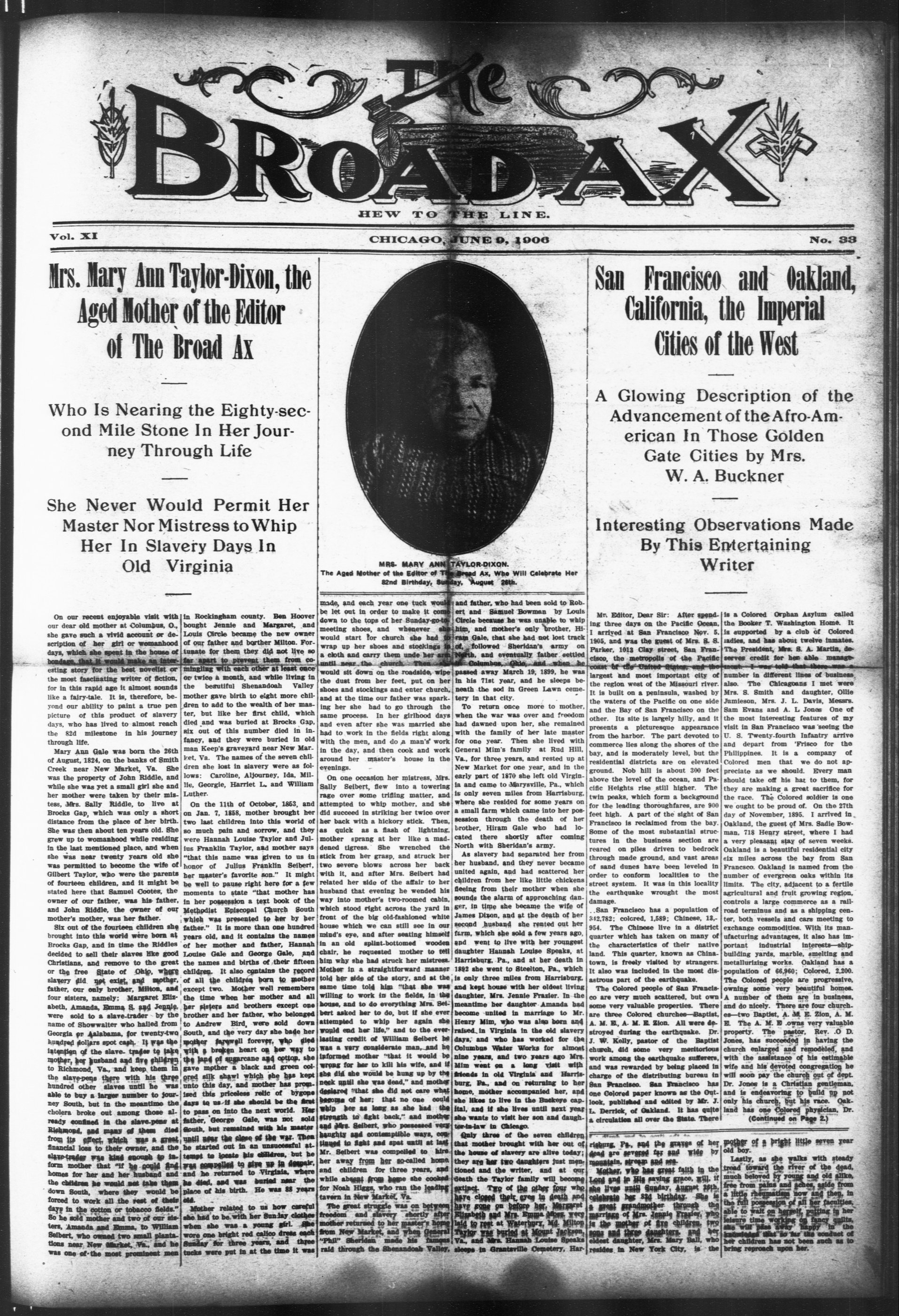
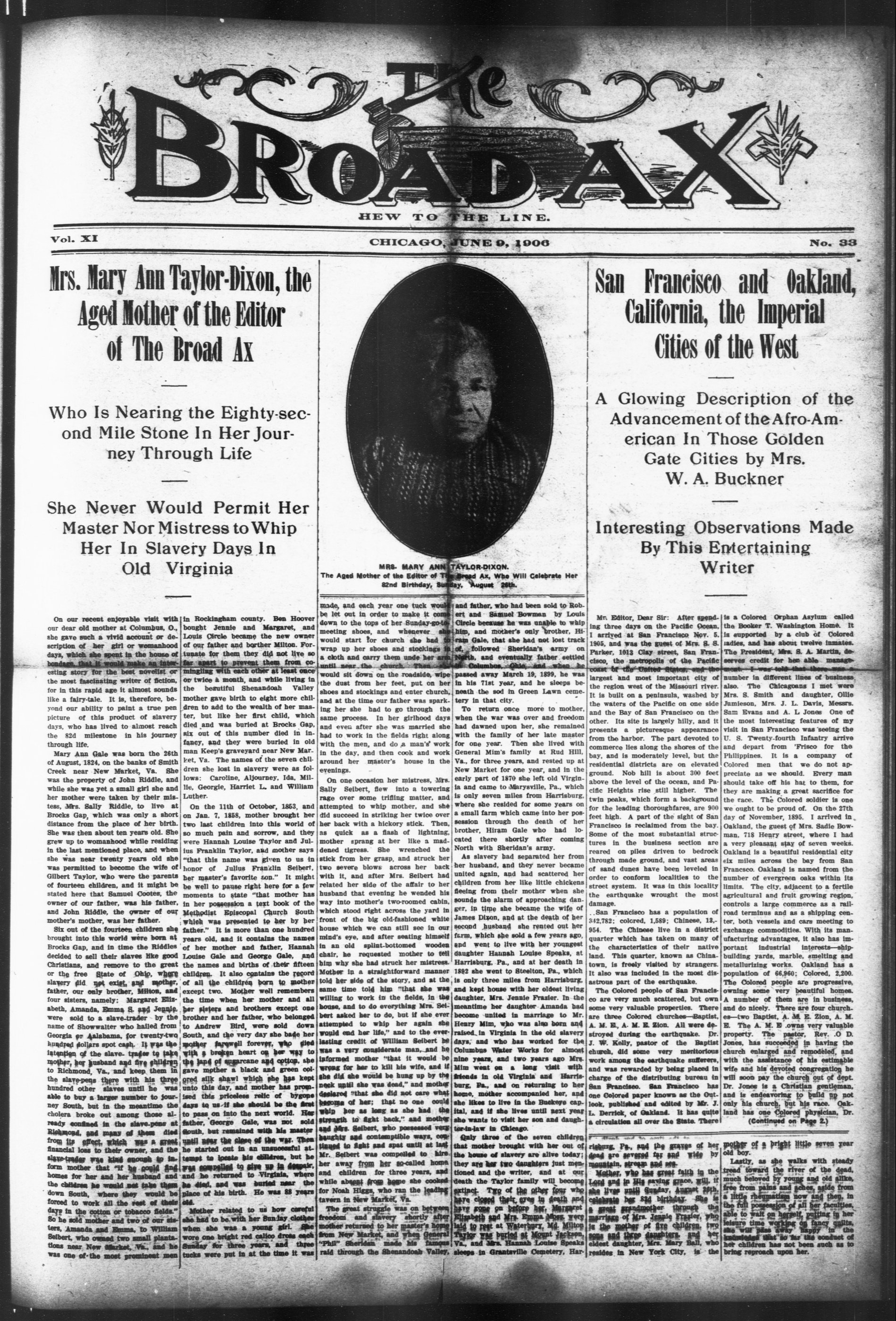
Mrs. Mary Ann Taylor-Dixon, the Aged Mother of the Editor of The Broad Ax
Who Is Nearing the Eighty-second Mile Stone In Her Journey Through Life
She Never Would Permit Her Master Nor Mistress to Whip Her In Slavery Days In Old Virginia
Vol. XI
Mrs. Mary Ann T
Aged Mother
of The I
Who Is Nearing
ond Mile Stone
ney Thro
She Never Wou
Master Nor Mi
Her In Slav
Old V
On our recent enjoyable visit with our dear old mother at Columbus, O., she gave such a vivid account or description of her girl or womanhood days, which she spent in the house of bondage, that it would make an interesting story for the best novelist or the most fascinating writer of fiction, for in this rapid age it almost sounds like a fairy-tale. It is, therefore, beyond our ability to paint a true pen picture of this product of slavery days, who has lived to almost reach the 82d milestone in his journey through life.
Mary Ann Gale was born the 26th of August, 1824, on the banks of Smith Creek near New Market, Va. She was the property of John Riddle, and while she was yet a small girl she and her mother were taken by their mistress, Mrs. Sally Riddle, to live at Brocks Gap, which was only a short distance from the place of her birth. She was then about ten years old. She grew up to womanhood while residing in the last mentioned place, and when she was near twenty years old she was permitted to become the wife of Gilbert Taylor, who were the parents of fourteen children, and it might be stated here that Samuel Cootes, the owner of our father, was his father, and John Riddle, the owner of our mother's mother, was her father.
Six out of the fourteen children she brought into this world were born at Brocks Gap, and in time the Riddles decided to sell their slaves like good Christians, and remove to the great or the free State of Ohio, where slavery did not exist, and mother, father, our only brother, Milton, and four sisters, namely: Margaret Elizabeth, Amanda, Emma S. and Jennie, were sold to a slave-trader by the name of Showwalter who hailed from Georgia or Alabama, for twenty-two hundred dollars spot cash. It was the intention of the slave-trader to take mother, her husband and five children to Richmond, Va., and keep them in the slave-pens there with his three hundred other slaves until he was able to buy a larger number to journey South, but in the meantime the cholera broke out among those already confined in the slave-pens at Richmond, and many of them died from its effect, which was a great financial loss to their owner, and the slave-trader was kind enough to inform mother that "if he could find homes for her and her husband and the children he would not take them down South, where they would be forced to work all the rest of their days in the cotton or tobacco fields." So he sold mother and two of our sisters, Amanda and Emma, to William Selbert, who owned two small plantations near New Market, Va., and he was one of the most prominent men
---
in Rockingham county. Ben Hoover bought Jennie and Margaret, and Louis Circle became the new owner of our father and borer Milton. Fortunate for them they did not live so far apart to prevent them from comingling with each other at least once or twice a month, and while living in the beautiful Shenandoah Valley mother gave birth to eight more children to add to the wealth of her master, but like her first child, which died and was buried at Brocks Gap, six out of this number died in infancy, and they were buried in old man Keep's graveyard near New Market, Va. The names of the seven children she lost in slavery were as follows: Caroline, Aljourney, Ida, Millle, Georgie, Harriet L. and William Luther.
On the 11th of October, 1853, and on Jan. 7, 1858, mother brought her two last children into this world of so much pain and sorrow, and they were Hannah Louise Taylor and Julius Franklin Taylor, and mother says "that this name was given to us in honor of Julius Franklin Sel伯, her master's favorite son." It might be well to pause right here for a few moments to state "that mother has in her possession a text book of the Methodist Episcopal Church South which was presented to her by her father." It is more than one hundred years old, and it contains the names of her mother and father, Hannah Louise Gale and George Gale, and the names and births of their fifteen children. It also contains the record of all the children born to mother except two. Mother well remembers the time when her mother and all her sisters and brothers except one brother and her father, who belonged to Andrew Bird, were sold down South, and the very day she bade her mother farewell forever, who died with a broken heart on her way to the land of sugarcane and cotton, she gave mother a black and green colored silk shawl which she has kept unto this day, and mother has promised this priceless relic of bygone days to us if she should be the first to pass on into the next world. Her father, George Gale, was not sold South, but remained with his master until near the close of the war. Then he started out in an unsuccessful attempt to locate his children, but he was compelled to give up in despair, and he returned to Virginia, where he died, and was buried near the place of his birth. He was 88 years old.
Mother related to us how careful she had to be with her Sunday clothes when she was a young girl. She wore one bright red calico dress each Sunday for three years, and three turtles were put in at the time it was
Mary E.
made, and each year one tuck would be let out in order to make it come down to the tops of her Sunday-go-to meeting shoes, and whenever she would start for church she had to wrap up her shoes and stockings in a cloth and carry them unde her arm until near the church. Then she would sit down on the roadside, wipe the dust from her feet, put on her shoes and stockings and enter church, and at the time our father was sparking her she had to go through the same process. In her girlhood days and even after she was married she had to work in the fields right along with the men, and do a man's work in the day, and then cook and work around her master's house in the evenings.
and father, who had been sold to Robert and Samuel Bowman by Louise Circle because he was unable to whip him, and mother's only brother, Herman Gale, that she had not lost traction of, followed Sheridan's army in North, and eventually father settled in Columbus, Ohio, and when he passed away March 19, 1899, he was in his 71st year, and he sleeps beneath the sod in Green Lawn cemetery in that city.
To return once more to mother when the war was over and freedom had dawned upon her, she remained with the family of her late master for one year. Then she lived with General Mim's family at Rud Hill Va., for three years, and rested up a New Market for one year, and in the
On one occasion her mistress, Mrs. Sally Selbert, flew into a towering rage over some trifling matter, and attempted to whip mother, and she did succeed in striking her twice over her back with a hickory stick. Then, as quick as a flash of lightning, mother sprang at her like a maddened tigress. She wrenched the stick from her grasp, and struck her two severe blows across her back with it, and after Mrs. Selbert had related her side of the affair to her husband that evening he wended his way into mother's two-roomed cabin, which stood right across the yard in front of the big old-fashioned white house which we can still see in our mind's eye, and after seating himself in an old splint-bottomed wooden chair, he requested mother to tell him why she had struck her mistress. Mother in a straightforward manner told her side of the story, and at the same time told him "that she was willing to work in the fields, in the house, and to do everything Mrs. Selbert asked her to do, but if she ever attempted to whip her again she would end her life," and to the everlasting credit of William Selbert he was a very considerate man, and he informed mother "that it would be wrong for her to kill his wife, and if she did she would be hung up by the neck until she was dead," and mother declared "that she did not care what become of her; that no one could whip her as long as she had the strength to fight back," and mother and Mrs. Selbert, who possessed very haughty and contemptible ways, continued to fight and spat until at last Mr. Selbert was compelled to hire her away from her so-called home and children for three years, and while absent from home she cooked for Noah Higgs, who ran the leading tavern in New Market, Va.
The great struggle was on between freedom and slavery shortly after mother returned to her master's home from New Market, and when General "Phil" Sheridan made his famous raid through the Shenandoah Valley,
and father, who had been sold to Robert and Samuel Bowman by Louis Circle because he was unable to whip him, and mother's only brother, Hiram Gale, that she had not lost track of, followed Sheridan's army on North, and eventually father settled in Columbus, Ohio, and when he passed away March 19, 1899, he was in his 71st year, and he sleeps beneath the sod in Green Lawn cemetery in that city.
To return once more to mother, when the war was over and freedom had dawned upon her, she remained with the family of her late master for one year. Then she lived with General Mim's family at Rud Hill, Va., for three years, and rested up at New Market for one year, and in the early part of 1870 she left old Virginia and came to Marysville, Pa., which is only seven miles from Harrisburg, where she resided for some years on a small farm which came into her possession through the death of her brother, Hiram Gale who had located there shortly after coming North with Sheridan's army.
As slavery had separated her from her husband, and they never became united again, and had scattered her children from her like little chickens fleeing from their mother when she sounds the alarm of approaching danger, in time she became the wife of James Dixon, and at the death of her second husband she rented out her farm, which she sold a few years ago, and went to live with her youngest daughter Hainah Louise Speaks, at Harrisburg, Pa., and at her death in 1892 she went to Steelton, Pa., which is only three miles from Harrisburg, and kept house with her oldest living daughter, Mrs. Jennie Frazier. In the meantime her daughter Amanda had become united in marriage to Mr. Henry Mim, who was also born and raised in Virginia in the old slavery days, and who has worked for the Columbus Water Works for almost nine years, and two years ago Mrs. Mim went on a long visit with friends in old Virginia and Harrisburg, Pa., and on returning to her home, mother accompanied her, and she likes to live in the Buckeye capital, and if she lives until next year she wants to visit her son and daughter-in-law in Chicago.
Only three of the seven children that mother brought with her out of the house of slavery are alive today; they are her two daughters just mentioned and the writer, and at our death the Taylor family will become extinct. Two of the other four who have closed their eyes in death and have gone on before her, Margaret Elizabeth and Mrs. Emma does, were laid to rest at Waterbury, Md. Milton Taylor was buried at Mount Jackson, Va., and Mrs. Hannah Louise Speaks to Granteeville Cemetery, Her
San Francisco and Oakland California, the Imperial Cities of the West
A Glowing Description of the Advancement of the Afro-American In Those Golden Gate Cities by Mrs. W. A. Buckner
Interesting Observations Made By This Entertaining Writer
Mr. Editor, Dear Sir: After spending three days on the Pacific Ocean, I arrived at San Francisco Nov. 5. 1905, and was the guest of Mrs. S. S. Parker, 1013 Clay street, San Francisco, the metropolis of the Pacific coast of the United States, and the largest and most important city of the region west of the Missouri river. It is built on a peninsula, washed by the waters of the Pacific on one side and the Bay of San Francisco on the other. Its site is largely hilly, and it presents a picturesque appearance from the harbor. The part devoted to commerce lies along the shores of the bay, and is moderately level, but the residential districts are on elevated ground. Nob hill is about 300 feet above the level of the ocean, and Pacific Heights rise still higher. The twin peaks, which form a background for the leading thoroughfares, are 900 feet high. A part of the sight of San Francisco is reclaimed from the bay. Some of the most substantial structures in the business section are reared on piles driven to bedrock through made ground, and vast areas of sand dunes have been leveled in order to conform localities to the street system. It was in this locality the earthquake wrought the most damage.
San Francisco has a population of 342,782; colored, 1,589; Chinese, 13,954. The Chinese live in a district quarter which has taken on many of the characteristics of their native land. This quarter, known as Chinatown, is freely visited by strangers. It also was included in the most disastrous part of the earthquake. The Colored people of San Francisco are very much scattered, but own some very valuable properties. There are three Colored churches—Baptist, A. M. E. A. M. E. Zion. All were destroyed during the earthquake. Dr. J. W. Kelly, pastor of the Baptist church, did some very meritorious work among the earthquake sufferers, and was rewarded by being placed in charge of the distributing bureau in San Francisco. San Francisco has one Colored paper known as the Outlook, published and edited by Mr. J. L. Derrick, of Oakland. It has quilted a circulation all over the State. There
rishburg, Pa., and the graves of her dead are severed for and wide by mountain, stream and sea.
Mother, who has great faith in the Lord and in His saving grace, will, if she lives until Sunday, August 26th, celebrate her $24 birthday. She is a great grandmother through the marriage of Mrs. Jennie Fraser, who is the mother of five children, two sons and three daughters, and her eldest daughter, Mrs. Mary Ball, who resides in New York City, is the
is a Colored Orphan Asylum called the Booker T. Washington Home. It is supported by a club of Colored ladies, and has about twelve inmates. The President, Mrs. S. A. Martin, deserves credit for her able management. I was told that there was a number in different lines of business also. The Chicagoans I met were Mrs. S. Smith and daughter, Ollie Jamieson, Mrs. J. L. Davis, Messrs. Sam Evans and A. L. Jones One of the most interesting features of my visit in San Francisco was 'seeing the U. S. Twenty-fourth Infantry arrive and depart from 'Frisco for the Philippines. It is a company of Colored men that we do not appreciate as we should. Every man should take off his hat to them, for they are making a great sacrifice for the race. The Colored soldier is one we ought to be proud of. On the 27th day of November, 1895. I arrived in Oakland, the guest of Mrs. Sadie Bowman, 718 Henry street, where I had a very pleasant stay of seven weeks. Oakland is a beautiful residential city six miles across the bay from San Francisco. Oakland is named from the number of evergreen oaks within its limits. The city, adjacent to a fertile agricultural and fruit growing region, controls a large commerce as a railroad terminus and as a shipping center, both vessels and cars meeting to exchange commodities. With its manufacturing advantages, it also has important industrial interests—shipbuilding yards, marble, smelting and metallurizing works. Oakland has a population of 66,960; Colored, 2,200. The Colored people are progressive, owning some very beautiful homes. A number of them are in business, and do nicely. There are four churches—two Baptist, A. M. E. Zion, A. M. E. The A. M. E. owns very valuable property. The pastor, Rev. O. D. Jones, has succeeded in having the church enlarged and remodeled, and with the assistance of his estimable wife and his devoted congregation he will soon pay the church out of dept. Dr. Jones is a Christian gentleman, and is endeavoring to build up not only his church, but his race. Oakland has one Colored physician, Dr. (Continued on Page 2.)
mother of a bright little seven year old boy.
Lastly, as she walks with steady trend toward the river of the dead, much beloved by young and old alike, free from pains and aches, aside from a little rheumatism now and then, in the full possession of all her faculties, able to wait on herself putting in her leisure time working on fancy quilts, she will pass away happy in the knowledge that so far the conduct of her children has not been such as to bring reproach upon her.
Mrs. Mary Ann Taylor-Dixon, the Aged Mother of the Editor of The Broad Ax
Who Is Nearing the Eighty-second Mile Stone In Her Journey Through Life
She Never Would Permit Her Master Nor Mistress to Whip Her In Slavery Days In Old Virginia
Vol. XI
Mrs. Mary Ann T
Aged Mother
of The I
Who Is Nearing
ond Mile Stone
ney Thro
She Never Wou
Master Nor Mi
Her In Slav
Old V
On our recent enjoyable visit with our dear old mother at Columbus, O., she gave such a vivid account or description of her girl or womanhood days, which she spent in the house of bondage, that it would make an interesting story for the best novelist or the most fascinating writer of fiction, for in this rapid age it almost sounds like a fairy-tale. It is, therefore, beyond our ability to paint a true pen picture of this product of slavery days, who has lived to almost reach the 82d milestone in his journey through life.
Mary Ann Gale was born the 26th of August, 1824, on the banks of Smith Creek near New Market, Va. She was the property of John Riddle, and while she was yet a small girl she and her mother were taken by their mistress, Mrs. Sally Riddle, to live at Brocks Gap, which was only a short distance from the place of her birth. She was then about ten years old. She grew up to womanhood while residing in the last mentioned place, and when she was near twenty years old she was permitted to become the wife of Gilbert Taylor, who were the parents of fourteen children, and it might be stated here that Samuel Cootes, the owner of our father, was his father, and John Riddle, the owner of our mother's mother, was her father.
Six out of the fourteen children she brought into this world were born at Brocks Gap, and in time the Riddles decided to sell their slaves like good Christians, and remove to the great or the free State of Ohio, where slavery did not exist, and mother, father, our only brother, Milton, and four sisters, namely: Margaret Elizabeth, Amanda, Emma S. and Jenny, were sold to a slave-trader by the name of Showwatter who hailed from Georgia or Alabama, for twenty-two hundred dollars spot cash. It was the intention of the slave-trader to take mother, her husband and five children to Richmond, Va., and keep them in the slave-pens there with his three hundred other slaves until he was able to buy a larger number to journey South, but in the meantime the cholera broke out among the already confined in the slave-pens at Richmond, and many of them died from its effect, which was a great financial loss to their owner, and the slave-trader was kind to inform mother that "if he could find homes for her and her husband and the children he would not take them down South, where they would be forced to work all the rest of their days in the cotton or tobacco fields." So he sold mother and two of our sisters, Amanda and Emma, to Seibert, who owned two small plantations near New Market, Va., and he was one of the most prominent men
---
in Rockingham county. Ben Hoover bought Jennie and Margaret, and Louis Circle became the new owner of our father and borer Milton. Fortunate for them they did not live so far apart to prevent them from comingling with each other at least once on twice a month, and while living in the beautiful Shenandoah Valley mother gave birth to eight more children to add to the wealth of her master, but like her first child, which died and was buried at Brocks Gap, six out of this number died in infancy, and they were buried in old man Keep's graveyard near New Market, Va. The names of the seven children she lost in slavery were as follows: Caroline, Aljourney, Ida, Millie, Georgie, Harriet L. and William Luther.
On the 11th of October, 1853, and on Jan. 7, 1858, mother brought her two last children into this world of so much pain and sorrow, and they were Hannah Louise Taylor and Julius Franklin Taylor, and mother says "that this name was given to us in honor of Julius Franklin Selbert, her master's favorite son." It might be well to pause right here for a few moments to state "that mother has in her possession a text book of the Methodist Episcopal Church South which was presented to her by her father." It is more than one hundred years old, and it contains the names of her mother and father, Hannah Louise Gale and George Gale, and the names and births of their fifteen children. It also contains the record of all the children born to mother except two. Mother well remembers the time when her mother and all her sisters and brothers except one brother and her father, who belonged to Andrew Bird, were sold down South, and the very day she bade her mother farewell forever, who died with a broken heart on her way to the land of sugarcane and cotton, she gave mother a black and green colored silk shawl which she has kept unto this day, and mother has promised this priceless relic of bygone days to us if she should be the first to pass on into the next world. Her father, George Gale, was not sold south, but remained with his master until near the close of the war. Then he started out in an unsuccessful attempt to locate his children, but he was compelled to give up in despair, and he returned to Virginia, where he died, and was buried near the place of his birth. He was 88 years old.
Mother related to us how careful she had to be with her Sunday clothes when she was a young girl. She wore one bright red calico dress each Sunday for three years, and three tucks were put in at the time it was
MRS. MARY ANN TAYLOR-DIXQN.
The Aged Mother of the Editor of The Broad Ax, Who Will Celebrate Her
82nd Birthday, Sunday, August 26th.
made, and each year one tuck would be let out in order to make it come down to the tops of her Sunday go-to-meeting shoes, and whenever she would start for church she had to wrap up her shoes and stockings in a cloth and carry them unde her arm until near the church. Then she would sit down on the roadside, wipe the dust from her feet, put on her shoes and stockings and enter church, and at the time our father was sparking her she had to go through the same process. In her girlhood days and even after she was married she had to work in the fields right along with the men, and do a man's work in the day, and then cook and work around her master's house in the evenings.
On one occasion her mistress, Mrs. Sally Seibert, flew into a towering rage over some trifling matter, and attempted to whip mother, and she did succeed in striking her twice over her back with a hickory stick. Then, as quick as a flash of lightning, mother sprang at her like a maddened tigress. She wrenched the stick from her grasp, and struck her two severe blows across her back with it, and after Mrs. Seibert had related her side of the affair to her husband that evening he wended his way into mother's two-roomed cabin, which stood right across the yard in front of the big old-fashioned white house which we can still see in our mind's eye, and after seating himself in an old splint-bottomed wooden chair, he requested mother to tell him why she had struck her mistress. Mother in a straightforward manner told her side of the world, and at the same time told him "that she was willing to work in the fields, in the house, and to do everything Mrs. Seibert asked her to do, but if she ever attempted to whip her again she would end her life," and to the everlasting credit of William Seibert he was a very considerate man, and he informed mother "that it would be wrong for her to kill his wife, and if she did she would be hung up by the neck until she was dead," and mother declared "that she did not care what becomes of her; that no one could whip her as long as she had the strength to fight back," and mother and Mrs. Seibert, who possessed very haughty and contemptible ways, continued to fight and spat until at last Mr. Seibert was compelled to hire her away from her so-called home and children for three years, and while absent from home she cooked for Noah Higgs, who ran the leading tavern in New Market, Va.
The great struggle was on between freedom and slavery shortly after mother returned to her master's home from New Market, and when General "Phil" Sheridan made his famous raid through the Shenandoah Valley,
and father, who had been sold to Robert and Samuel Bowman by Louis Circle because he was unable to whip him, and mother's only brother, Hiram Gale, that she had not lost track of, followed Sheridan's army on North, and eventually father settled in Columbus, Ohio, and when he passed away March 19, 1899, he was in his 71st year, and he sleeps beneath the sod in Green Lawn cemetery in that city.
To return once more to mother, when the war was over and freedom had dawned upon her, she remained with the family of her late master for one year. Then she lived with General Mim's family at Rud Hill, Va., for three years, and rested up at New Market for one year, and in the early part of 1870 she left old Virginia and came to Marysville, Pa., which is only seven miles from Harrisburg, where she resided for some years on a small farm which came into her possession through the death of her brother, Hiram Gale who had located there shortly after coming North with Sheridan's army.
As slavery had separated her from her husband, and they never became united again, and had scattered her children from her like little chickens fleeing from their mother when she sounds the alarm of approaching danger, in time she became the wife of James Dixon, and at the death of her second husband she rented out her farm, which she sold a few years ago, and went to live with her youngest daughter Hainahah Louise Speaks, at Harrisburg, Pa., and at her death in 1892 she went to Steelton, Pa., which is only three miles from Harrisburg, and kept house with her oldest living daughter, Mrs. Jennie Frazier. In the meantime her daughter Amanda had become united in marriage to Mr. Henry Mim, who was also born and raised in Virginia in the old slavery days, and who has worked for the Columbus Water Works for almost nine years, and two years ago Mrs. Mim went on a long visit with friends in old Virginia and Harrisburg, Pa., and on returning to her home, mother accompanied her, and she likes to live in the Buckeye capital, and if she lives until next year she wants to visit her son and daughter-in-law in Chicago.
Only three of the seven children that mother brought with her out of the house of slavery are alive today; they are her two daughters just mentioned and the writer, and at our death the Taylor family will become extinct. Two of the other four who have closed their eyes in death and have gone on before her, Margaret Elizabeth and Mrs. Emma Moss, were laid to rest at Waterbury, Md. Milton Taylor was buried at Mount Jackson, Va., and Mrs. Hannah Louise Speaks leaves in Grantville Cemetery, Her
San Francisco and Oakland California, the Imperial Cities of the West
A Glowing Description of the Advancement of the Afro-American In Those Golden Gate Cities by Mrs. W. A. Buckner
Interesting Observations Made By This Entertaining Writer
Mr. Editor, Dear Sir: After spending three days on the Pacific Ocean, I arrived at San Francisco Nov. 5. 1905, and was the guest of Mrs. S. S. Parker, 1013 Clay street, San Francisco, the metropolis of the Pacific coast of the United States, and the largest and most important city of the region west of the Missouri river. It is built on a peninsula, washed by the waters of the Pacific on one side and the Bay of San Francisco on the other. Its site is largely hilly, and it presents a picturesque appearance from the harbor. The part devoted to commerce lies along the shores of the bay, and is moderately level, but the residential districts are on elevated ground. Nob hill is about 300 feet above the level of the ocean, and Pacific Heights rise still higher. The twin peaks, which form a background for the leading thoroughfares, are 900 feet high. A part of the sight of San Francisco is reclaimed from the bay. Some of the most substantial structures in the business section are reared on piles driven to bedrock through made ground, and vast areas of sand dunes have been leveled in order to conform localities to the street system. It was in this locality the earthquake wrought the most damage.
San Francisco has a population of 842,782; colcred, 1,589; Chinese, 13,954. The Chinese live in a district quarter which has taken on many of the characteristics of their native land. This quarter, known as Chinatown, is freely visited by strangers. It also was included in the most disastrous part of the earthquake.
The Colored people of San Francisco are very much scattered, but own some very valuable properties. There are three Colored churches—Baptist, A. M. E., A. M. E. Zion. All were destroyed during the earthquake. Dr. J. W. Kelly, pastor of the Baptist church, did some very mortorious work among the earthquake sufferers, and was rewarded by being placed in charge of the distributing bureau in San Francisco. San Francisco has one Colored paper known as the Outlook, published and edited by Mr. J. L. Derrick, of Oakland. It has quite a circulation all over the State. There
is a Colored Orphan Asylum called the Booker T. Washington Home. It is supported by a club of Colored ladies, and has about twelve inmates. The President, Mrs. S. A. Martin, deserves credit for her able management. I was told that there was a number in different lines of business also. The Chicagoans I met were Mrs. S. Smith and daughter, Ollie Jamieson, Mrs. J. L. Davis, Messrs. Sam Evans and A. L. Jones One of the most interesting features of my visit in San Francisco was 'seeing the U. S. Twenty-fourth Infantry arrive and depart from 'Frisco for the Philippines. It is a company of Colored men that we do not appreciate as we should. Every man should take off his hat to them, for they are making a great sacrifice for the race. The Colored soldier is one we ought to be proud of. On the 27th day of November, 1895. I arrived in Oakland, the guest of Mrs. Sadie Bowman, 718 Henry street, where I had a very pleasant stay of seven weeks. Oakland is a beautiful residential city six miles across the bay from San Francisco. Oakland is named from the number of evergreen oaks within its limits. The city, adjacent to a fertile agricultural and fruit growing region, controls a large commerce as a railroad terminus and as a shipping center, both vessels and cars meeting to exchange commodities. With its manufacturing advantages, it also has important industrial interests—shipbuilding yards, marble, smelting and metallurizing works. Oakland has a population of 66,960; Colored, 2,200. The Colored people are progressive, owning some very beautiful homes. A number of them are in business, and do nicely. There are four churches—two Baptist, A. M. E. Zion, A. M. E. The A. M. E owns very valuable property. The pastor, Rev. O. D. Jones, has succeeded in having the church enlarged and remodeled, and with the assistance of his estimable wife and his devoted congregation he will soon pay the church out of dept. Dr. Jones is a Christian gentleman, and is endeavoring to build up not only his church, but his race. Oakland has one Colored physician, Dr. (Continued on Page 2.)
mother of a bright little seven year old boy.
Lastly, as she walks with steady tread toward the river of the dead, much beloved by young and old allie, free from pains and aches, aside from a little rheumatism now and then, in the full possession of all her faculties, able to wait on herself, putting in her leisure time working on fancy quilts, she will pass away happy in the knowledge that so far the conduct of her children has not been such as to bring reproach upon her.
oe. ‘PUBLISHED WEEE! T.
os i
ant | tres
Sas
wae language is proper.
Se
eS ee
‘Sebecriptions met be pald tn advance.
oS
$y
THE BROAD AX
0 Armour Avene, Chiou.
FOLIOS F. TAYLOR, Batter and Pubitsber.
———
‘Eatered xt the Post Office at Chicaga,
Th, as Second-clas Matter.
——— Ss
A Great Chautauqua at Englewood.
‘Under the management of 8t
John’s A. M. E. church and the pat
ronage of the citizens of Englewood
‘The Chautanqua and silver jubilee
will open Thursday, June 2ist, and
continue ten days, closing July 1st.
From the elabofate arrangements
now about completed, the affair prom
ises to be one of the greatest ever un.
dertaken by the Afro-Amrican citizens
in Englewood.
The affair will be held in a large
tabernacle that will accommodate
3,000 people. It will Ge situated on
Throop street, near Sixty-third street
‘Aside from preaching and evangelis.
tic services each afternoon, splendid
musical, dramatic and literary enter-
tainments will be presented by the
best talent of the city upon a large
‘stage in the Tabernacle each evening.
‘Among the special days and even-
ings is the opening day, Thursday,
June 2ist;a children's afternoon, Sat-
urday, June 23; all day services, Sun-
day, June 24th, St. John’s Day, at
which time the Masonic fraternity,
will have their annual sermon at 2:30
Pp. m., to be followed by a great plat-
form meeting participated in by the
pastors of the several churches, and
their visiting congregations. Monday,
clergyman’s day, silver jubliee and
triple anniversary of the pastor, Rev.
J. 8, Woods, AB, DD,
A public reception on this occasion
will be the principal feature of the af-
ternoon and evening. Wednesday,
mother's day. The deaconesses, stew-
wrdesses, purses and missionary
ladies of the city will meet on this
ay, and @iscuss questions of vital
tmportance to childhood and woman-
hood. eee =
‘Thursday, Women's Club Day, an
elaborate program will be presented
by representatives from the nineteen
women’s clubs of the city and vicin-
ity. Saturday, fraternity and men’s
club day. Members of every ftater-
nity and‘of every club in the city will
hold forth from 12 m. to 11 p. m. “A
great campfire congress is arranged
for the evening program.
The above are the special days
arranged for during the Chautauqua.
Members and friends of the several
churches and clubs. may secure their
tickets from their respective pastors
and presidents —“S.”
‘The Illincis College of Law Held
Graduating Exercises Last Mon.
‘Gy Beenien,
Monday evening, June 4th, the Iilt-
Rois College of Law, which has more
Afro-American students than all the
other law schoois in Illinois put to-
gether, held graduating exercises at
Kimball Hall, 243 Wabash avenue,
which was well filled by the friends
of those who received their new sheep
skins.
The following lawyers were turned
loose upon the public:. Edward ‘.
Barnard, Francis J. Berry, Homer D.
Bruck, William Capesius, Joel C. Carl-
son, John W. Cherry, Jamés L. De-
Yeney, John EH Erickson, Joseph A.
Graber, Andrew W. Heligeth, John
‘Bilgers, Jr, Warra Kibbey, Harry H.
Krinsky, William B. Lowe, Emil J.
Malmberg, Howard H. MoCormick, E.
©. Frank Meier, Stephen F. Novotny,
‘Henry W. Olschner, Herbert L. Owen,
R Weston Pollard, William Reeda,
‘Henry L. Reishardt, Oscar A. Ross,
‘William C. Smith, Marshall Solberg,
‘Thurston B. Swanson, H. Boyd
‘Weeks, August R. Wollenberg, Angus.
tus L. Williams.
Post Graduates, Master's Degree—
‘Witlam L. Barnum, Jr, C.. Oscar
‘Carlson, John N. Haageson, Einar C.
Howard, John W. Joos, Gosoburo
‘Kawaguchi, Oscar A. Ross.
Frederick Douglass Center, 2032 We-
bash Avencs.
An overcrowded house met at the
Douglass Center Monday, June 4th, to
attend the City Federation of Wom.
en'e Clubs. Beports were read- from
the following clube: Frederick Doug-
Jans Conter, I. B. W.,. Cornell Charity
Glad, Phyilis “Wheatley, Narth ,
‘Woman's Chub, Julia Gesion wresea
ters, Civic League, Mothers’ Union of
‘Bhebezer, Chicago Centennial Charity
‘Club, Volunteer Workers, Dearborn
Center, Workers for the King, Ladies’
L and E Club of Bethel, Koffee
Klutch, Woman's Aid, Girls’ Culture
Club.
‘A very interesting paper, “The Par-
agon of Animals,” was read by Dr. Bf.
A. Majors. Several musical numbers
were rendered, and remarks made by
Dr. Henry C. Cress—Mrs. Cordelia
West, Pres.; Miss Clara Slater, Secy.
Dp."
a ee Ser eee Nt ge ee
Dr. E. 8 Miller Tells Coroner That
He Left Corpse on a Car.
Dr. BS. Miller, 3160 State street,
eto itt tho body of «baby on State
‘st. car where it was found Tuesday,
visited Coroner Hoffman yesterday, to
whom he told of the circumstances
surrounding the death of the baby. He
sald that it belonged to Mrs. Ray
Sexton, a Colored lady living at 3522
Calumet avenue.
“I was called to the house yester-
day morning when the child was
born,” the physician said. “I asked
permission to take the body to my of-
fice, where I could make an examina-
tion. I boarded .a State street car,
where’ I forgot it and where it was
later found.”
Coroner Hoffman ordered that 2
death certificate be issued.—The Chi-
cago Chrinicle, June 7.
Doctor Miller, being an honorable
member of his profession, no one took
any stock in the wild ghost story to
the effect “that a red-haired woman
wearing a plaid skirt left the baby in
the car, and that it was alive at the
time it was found by the conductor.
‘The Todd.Hunter Wedding.
‘Wednesday evening, June 6, Miss
Grace Todd, daughter of Mr. and Mrs.
George W. Todd, 4803 Armour ave.,
was united in marriage to Mr. Clark
Hunter. Rev. R. L. Dickerson, per-
formed the beautiful’ wedding cere-
mony.
‘The bride's trousseau was furnished
by her mother, which was a white
pearline silk trimmed in French
vale. She carried a large bouquet of
bridal roses.
Miss Blanche Turner was the maid
of honor, and she wore a blue silk
mullle trimmed in German valen-
cienne and a large bunch of tea roses
rested in her hand.
‘The house was beautifully decora-
ted for the occasion and the elaborate
bridal supper was greatly enjoyed by
the many friends of the contracting
parties, who received many useful and
handsome presents. ‘The newly mar-
ried couple will be at home, 5002 Ar-
mour ave., from on and after June 10.
A Young Men’s Sunday Club in Hyde
Park.
On June 3, 1906, a number of young
men met at the A. M. E. church on
Jefferson avenue, near Fifty-sixth
street, and organized a club known as
“The Young Men's Hyde Park Sun.
day Club.” The pastor, Rev. Goggin,
acted as chairman. The~ following
officers were elected: President, L.
W. Washington; Vice-President, J. T.
Mahoney; Secretary, Geo. W. Lee;
‘Treasurer, Frank Long.
Bethel Literary and Historical Club—
Floor Day.
Discussion gf Hon. Thomas Allen's
speech, “Am I Mly Brother's Keeper?”
especially the part where he states
that “modern civilization is a potent
destroyer of morals.”
Doctors Majors and Brown . vs.
Messrs. Fisher and Lacey. Each will
speak fifteen minutes. Splendid mu-
sical program. All invited: Sunday,
June 9th, 4 p. m—Geo. T. Kersey,
Pres
Settiement, 3625 Dearborn Street.
The services to-morrow at the In.
stitutional chureh will be of the usual
character. Preaching at 10:45 a. m
and 7:45 p. m. ‘The pastor began last
Sunday a series of sermons on “Pen.
tacost and Power.” The second of
the series will be preached at morning
services. The choir, under the direc
tion of Prof. Johnston, is making ex-
cellent progress. The singing and
music is a special pleasing feature of
the eervices.
‘Mrs. Mary Ann Shaw, 5755 Lafay-
ette avenue, the highly esteemed
widow of J. John Ghaw, who was at
one time one of the leading caterers
in Chicago, died very suddenly Satur-
day, June 2. She was im her 57th
year st the time of her death. ~ Fu-
neral services were held over her re-
mains Tuesday from her tate resi.
dence, conducted by Rev. Mosts H.
Jackson. Interment at Oakwood cem-
etery. Jacob L. Parks had charge of
the funeral, Mrs Shaw is survived
by three sons and two danghters, R.
SoS
haw, who have many
ds to lament with them over the
loss of their highly esteemed motiier.
ie
ls
b=
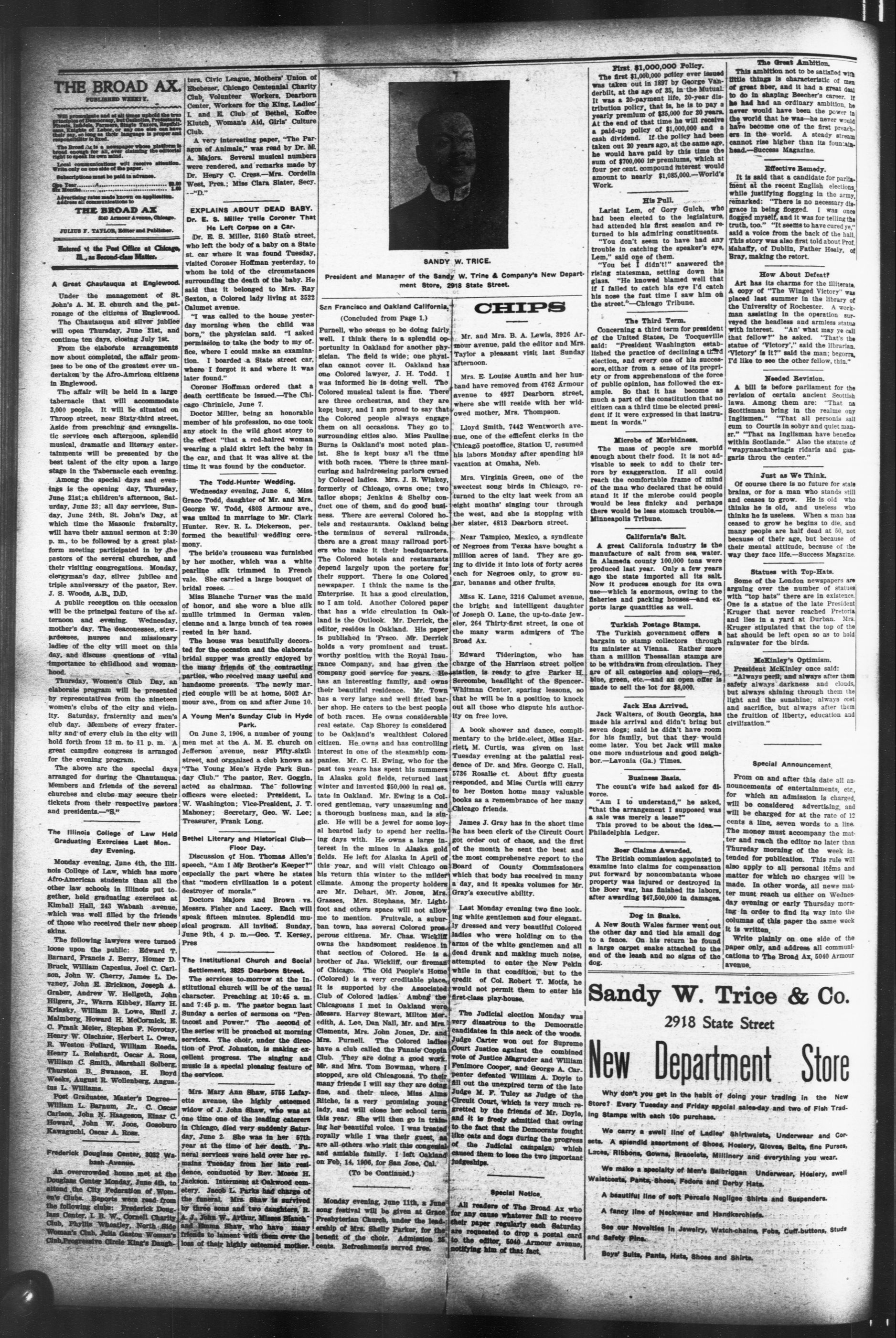
SANDY w. TRICE.
President and Manager of the Sandy W. Trine & Company's New Depart-
ment Store, 2918 State Street.
a Ee
Sen Francisco and Oakland California, CHiPs
(Concluded from Page 1.)
Purnell, who seems to be doing fairly
well. I think there is a splendid op
portunity in Oakland for another phy:
sician. The field ts wide; one physi-
clan cannot cover it. Oakland has
one Colored lawyer, J. H. Todd. 1
was informed he is doing well. The
Colored musical talent is fine. There
are three orchestras, and they are
kept busy, and I am proud to say that
the Colored people always engage
them on all occasions. They go to
surrounding cities also. Miss Pauline
Burns is Oakland's most noted plan-
ist. She is kept busy all the time
with both races. There is three mani-
curing and hairdressing parlors cwned
by Colored ladies. Mrs. J. B. Winkey,
formerly of Chicago, owns one; two
tailor shops; Jenkins & Shelby con-
duet one of them, and do good busi-
ness. There are several Colored ho-
tele and restaurants. Oakland being
the terminus of several railroads,
there are a great many railroad port-
ers who make it their headquarters.
The Colored hotels and restaurants
depend largely upon the portere for
their support. There is one Colored
newspaper. I think the name is the
Enterprise. It has a good circulation,
80 I am told. Another Colored paper
that has a wide circulation in Oak-
land {s the Outlook. Mr. Derrick, the
editor, resides in Oakland. His paper
{s published in ‘Frsco. Mr. Derrick
holds a very prominent and trust.
worthy position with the Royal Insu-
rance Company, and has given the
‘company good service for years. He
has an interesting family, and owns
their beautiful residence. Mr. Town
has a very large and well fitted bar-
ber shop. He eaters to the best people
of both races. He owns considerable
real estate. Cap Shorey is considered
to be Oakland’s wealthiest Colored
citizen. He owns and has controlling
interest in one of the steamship com-
panies. Mr. C. H. Ewing, who for the
past ten years has spent his summers
in Alaska gold fields, returned last
winter and invested $50,000 in real es.
tate in Oakland. Mr. Ewing is a Col-
ored gentleman, very unassuming and
@ thorough business man, and is sin-
gle. He will be a jewel for some loy-
‘al hearted lady to spend her reclin.'
ing days with. He owns a large in-
terest in the mines in Alaska gold
fields. He left for Alaska in April of
this year, and will visit Chicago on!
his return this winter to the
climate. Among the property holders,
are Mr. Dehart, Mr. Jones, Mrs.
Grasses, Mrs. Stephans, Mr. Light-
foot and others space will not allow:
me to mention. Fruitvale, a subur
ban town, has several Colored
perous citizens. Mr. Chas. Wickliff
owns the handsomest residence. in|
that section of Colored. He is
brother of Jas. Wickliff, our
of Chicago. The Old People’s Home|
(Colored) is a very creditable
It is supported by the
Ciub of Colored ladies Ambng the’
Chicagoans I met in Oakiand were,
Messrs. Harvey Stewart, Milton Mer.
edith, A. Lee, Dan Nall, Mr. and Mrs.
Clements, Mrs. John Jones, Dr.
Mrs. Purnell. The Colored
have a club called the Fannie’ Coppin
Club. They ate doing a good work.
Mr. and Mrs. Tom Bowman, where I
stopped, are old Chicagoans. To
many friends I will say they are
fine, and their niece, Miss Alms
Ritche, is @ very promising
this year, She will then go in trhim|
ing her beautiful voice. I was
royally while I was thelr guest,
are all-others who visit thie
and amiable family. 1 left D
on Feb, 14, 1906, for San Jose, Cal.’
Monday evening, Jane Lith, = Jane
song festival will be given at Grace
Presbyterian Church, under the
cai So. Say Pe,
benefit of the choir, Admission
cents. Refreshments served fres.
CHIPs
fmour avenue, paid the editor and Mrs.
‘Taylor a pleasant visit last Sunday
Fatternoon.
Mrs. E. Loulse Austin and her hus-
band have removed from 4762 Armour
lavenue to 4927 Dearborn street,
where she will reside with her wid-
‘owed mother, Mrs. Thompson.
Lioyd Smith, 7442 Wentworth ave-
nue, one of the efficfent clerks in the
Chicags postoffice, Station U, resumed
his Inbors Monday after spending his
vacation at Omaha, Neb.
Mrs. Virginia Green, one of the
sweetest song birds in Chicago, re-
Hturned to the city last week from an
reight months’ singing tour through
‘the west, and she is stopping with
wher sister, 4813 Dearborn street.
- Near Tampico, Mexico, a syndicate
jot Negroes from Texas have bought
‘million acres of land. They are go
ing to divide it into lots of forty acres
leach for Negroes only, to grow su-
gar, bananas and other fruits.
Miss K. Lane, 3216 Calumet avenue,
the bright and intelligent daughter
‘ot Joseph O. Lane, the up-to-date jew-
eler, 264 Thirty-first street, is one of
the many warm admigers of The
Brosd Ax. F
Edward Tiderington, who has
charge of the Harrison street police
station, is ready to give Parker H.
Sercombe, headlight of the Spencer-
Whitman Center, sparing lessons, so
that he will be in a position to knock
out all those who dispute his author-
ity on free love.
A book shower and dance, compli-
mentary to the bride-elect, Mics Har-
rlett, M. Curtis, was given on last
Tuesday evening at the palatial rest-
dence of Dr. and Mrs. George C. Hall,
5736 Rosalie ct. About fifty guests
responded, and Miss Curtis will carry
to her Boston home many valuable
books as a remembrance of her many
Chicago friends.
James J. Gray has in the short time
he has been clerk of the Circuit Court
Bot order out of chaos, and the first
of the month he sent the best and
the most comprehensive report to the
Board of County Commissioners
which that body has received in many
@ day, and it speaks volumes for Mr.
Gray's executive ability.
Last Monday evening two fine look.
ing white gentlemen and four elegant.
ly dressed and very beautiful Colored
ladles who were holding on to the
arms of the white gentlemen and all
dead drunk and making much noise,
attempted to enter the New Pekin
while in that condition, but to the
gredit of Col. Robert T. Motis, he
would not permit them to enter his
first-class play-house,
_ The Judicial election Monday was
very disastrous to the Democratic
candidates in this neck of the woods.
Judge Carter won out for Supreme
Court Justice against the combined
vote of Justice Magruder and William
Fenimore Cooper, and George A. Car-
penter defeated William A. Doyle to
Al out the unexpired term of the late
Jadge M. F. Tuley as Judge of the
Cireult Court, ‘which is very much re-
gretted by the friends of Mr. Doyle,
and it te freely admitted that owing
to the fact that the Democrats fought
Uke cats and dogs during the
eta ae
to lose the two
judgeshipe. important
All readers of The Broad Ax who
for any cause whatever fail to receve
thelr paper regularity each Saturda;
ate requested to drop = postal card
to. the efiitor, 6040 Armour avenue,
notifying him of that fact
‘Special Notice
°
Sandy W. Trice & Co.
2918 State Street
Why don’t you get in the habit of doing your trading in the New
Store? Every Tuesday and Friday spgcial saleeday and two of Fish Trad-
ing Stamps with each 100 purchase.
‘We carry @ swell ling of Ladies’ Shirtwaists, Underwear and Cor
sete. A spisndid assortment of Shoes Hosiery, Gloves, Belts, fine Purset,
Laces, Ribbons, Gowns, Bracelets, Millinery and everything you wear.
‘We make a specialty of Men's Balbriggan Underwear, Hosiery, swell
| A Peautiful line of soft Percale Negliges ‘Shirts and Suspenders.
A fancy line of Neckwear and Hondkerchiefe.-
- See cur Novelties In Jewelry, Watch-chaing, Fobs, Cuffbuttons, Stud
‘First, $1,000,000 Policy.
‘The first $1,000,000 policy ever issued
was taken out in 1897 by George Van-
derbilt, at the age of 35, in-the Mutual.
It was a 20-payment life, 20-year dis-
tribution policy, that ts, he ls $0 DAY
yearly premium of $35,000 —
A te ea oc non ane.
& paid-up Lf -
cash dividend. If-the policy had been
taken out 20 years ago, at the same age,
he would have paid by this time the
sum of $700,000 irr premiums, which at
four per cent. compound interest would
‘amount to nearly $1,085,000.—World’s
‘Work.
His Pull. -
Lariat Lem, of Gory Gulch, whe
had been elected to the legislature,
bad attended his first session and re
turned to his admiring constituents.
“You don't seem to have had any
trouble in catching the speaker's eye,
ay eres
“You bet f didn't!” answered the
rising statesman, setting down his
glass, “He knowed blamed well that
if I fafled to catch bis eye I'd catch
his nose the fust time I saw him of
the street."—Chicago Tribune.
‘The Third Term.
Concerning # third term for president
of the United States, De Tocqueville
said: “President Washington estab-
lished the practice of declining a tra
election, and every one of his succes-
sors, either from a sense of its propri-
ety or from apprehensions of the force
of public opinion, has followed the ex-
ample. So that it has become as
much a part of the constitution that no
citizen can a third time be elected presi-
dent if it were expressed in that instru-
ment in words.”
Microbe of Morbidness.
‘The mass of people are morbid
‘enough about their food. It is not ad-
visable to seek to add to their ter-
rors by exaggeration. If all could
reach the comfortable frame of mind
‘of the maa who declared that he could
stand it if the microbe could people
would be less finicky and perhaps
there would be less stomach trouble.—
Minneapolis Tribune.
California’s Salt.
A great California industry is the
manufacture of salt from sea water.
In Alameda county 100,000 tons were
produced last year. Only a few years
ago the state imported all its salt.
Now it produces enough for its own,
use—which is enormous, owing to the
fisheries and packing houses—and ex-
ports large quantities as well. .
Turkish Postage Stamps.
‘The Turkish government offers
Dargain to stamp collectors through
fts minister at Vienna. Rather more
than a million Thessalian stamps are
to be withdrawn from circulation. They
‘gre of all categories and colors—red,
Diue, green, etc.—and am open offer is
made to sell the lot for $8,000.
Jack Has Arrived.
‘Jack Walters, of South Georgia, has
made his arrival and didn’t bring but
seven dogs; said he didn't have room
for his famfly, but that they- would
come later. You bet Jack will make
‘one more industrious and good neigh-
dor.—Lavonia (Ga.) Times.
Business Basis,
The count's wife had asked for 4
vorce. i
“am I to understand,” he asked,
“that the arrangement I supposed was
‘a sale was merely a lease?”
This proved to be about the idea—
Philadelphia Ledger.
Boer Claims Awarded.
‘The British commission appointed to
examine into claims for compensation
Dut forward by noncombatants whose
Droperty was injured or destroyed in
the Boer war, has finished tts labors,
after awarding $47,500,000 in damages
Dog in Snake. :
A New South Wales farmer went out
the other day and tied his small dog
to a fence. On. his return ‘he found
& large carpet snake attached to the
end of the leash and no signs of the
dog. oe
‘The Great Ambitin, =
‘This ambition not to be satiated win,
Gttle things is characteristic of men
of great fer, and it had a great de
to do im shaping Beecher’s carcer, ty
be Rad had an ordinary ambition. hy
Rever would have been the pow:r is
the world that he was—he never woui4
hate become one of the first preach.
ers in the world. A steady stream
cannot rise higher than its foun-aiy.
head.—Success Magazine. |
a |
Bffective Remedy. |
It ts said that a candidate for parila.
fient at the recent English clections,
while justifying flogging in the army.
feinarked: “There is no necessary ai
grace pe being flogged. I was once
flogged f, and it was for telling the!
truth, too.” “It seems to have cured ye,"
said @ voice from the back of the hall,
This story was also frst told about Prot!
Mahaffy, of Dublin, Father Healy, of
Bray, making the retort.
Stee About Tefente
Art has its charms for the {illiterate
A copy of “The Winged Victory” way
placed last summer in the library of
the University of Rochester. A work.
man assisting in the operation sur.
veyed the headless and armless statug
with interest. “An what may ye call
that fellow?” he asked. “That's the
statue of “Victory’,” said the librarian,
‘Victory’ fs it?” said the man; becorra,
T'd like to see the other fellow, thin.”
Needed Revision.
A Dill is before parliament for the
revision of certain ancient Seottish
laws. Among them are: “That na
Scottisman bring in the realme ony
Ingiismen.” “That all personis sall
eum to Courtis in sobyr and quiet man-
er.” “That na Inglisman have benefice
within Scotlande.” Also the statute of
“wapynaschawingis ridaris and gan-
garis throu the center.”
Just as We Think.
Of course there is no future for stale
brains, or for a man who stands still
and ceases to grow. He is old who
thinks he fs old, and useless who
thinks he fs useless. When a man has
ceased to grow he begins to die, and
many people are half dead at 50, not
because of their age, but because of
their mental attitude, because of the
way they face life.—Success Magazine.
Statues with Top-Hats.
Some of the London newspapers are
arguing over the number of statues
with “top hats” there are in existence,
One is a statue of the late President
Kruger that never reached Pretoria
and lies in a yard at Durban. Mrs.
Kruger stipulated that the top of the
hat should be left open so a3 to bold
rainwater for the birds.
‘McKinley’s Optimism.
President McKinley once sald:
~ “Always perit, and always after them
safety always darkness and clouds,
but always shining through them the
light and the sunshine; always cost
and sacrifice, but always after them
the fruition of liberty, education and
civilization” (
Special Announcement.
From on and after this date all az-
Rouncements of entertainments, etc,
for which an admission is charged,
will be considered advertising, and
will be charged for at the rate of 12
cents a line, seven words to a line.
The money must accompany the mat-
ter and reach the editor no later than
Thursday morning of the week in
tended for publication. This rule will
also apply to all personal itéms and
matter for which no charges will be
made. In other words, all news mst-
ter must reach us either on Wednes-
day evening or early Thursday moro-
ing in order to find its way into the
columns of this paper the same week
it is written,
Write plainly on one side of the
paper only, and address all commun!
cations to The Broad Ax, 5040 Armour
avenue,
BUSGIP FROM THE -MAIONAL CAPITAL
The Sting of the Ex-Senatorial Wasp---
Senator from Peni syivania Brings
That State MuociHonor.
A rs xf
\) oe f into’ his natural element,
1) ScSuty rohan aera Col. “Tac Sonor
| Wi ay tunity to have tg fun was too great for Mr.
ei everybody who epg ag
| FANS ee eer ere
); SS times extravagantly about those with whom he
talked very freely about Senators Spooner, Knox
men, "Spooner snd-Foruter; have been, in Str
‘Chemiters- tat aie Gee aah: eee on tee
<atter did not hesitate to report to Senator Tiimaz some things which the
Dresident said about these senators that sounded rather harsh in private
Conversation, but were absolutely offensive when delivered in public. Sen-
ator Tillman felt called upon to make @ statement on the floor of the
senate giving his version of the negotiations that had been in progress
detween the president and the Democrats through Mr. Chandler, the inter-
mediary. In that statement he quoted what Senator Chandler had said that
the president bad said about Knox, Spooner and Foraker.
aa :
SENATOR KNOX REMAINS COOL.
Senator Knox, one of the trio named by ex
§ Senator Chandler'ns having been criticised by
(\j the president, refused to get excited over the
(QY] report as he ‘said that the president knew him
too well and knew his desire to enact consti-
tutional legislation too well ever to have charged
him even in private with having a purpose to
has defeat the bill. Mr. Knox is one of the well-tried
Q friends of President Roosevelt who can talk
. to the latter like a “Dutch uncle,” and the pres-
ident takes bis lecture in good part. It is re-
membered that @ year or two ago a fulsome
magazine article was published by a wall
known writer in which the present Secretary
Root was lauded to the skies and President
Roosevelt quoted as saying that Mr. Root could
fill any position ty the cabinet and would make
@ better secretary of state than Mr. Hay or a
better rane 2 general than Mr. Knox.
mae ‘This artic! caused some comment and the
especially as it was shortly after the attorney general's successful credit to
the administration. The president got worried over the article, and as Mr.
Knox did not go to the White House for several days the president sent for
him, and in an embarrassed sort of way denied that there had been any war
rant for the quotation attributed to him in the magazine article. “Ob, Mr.
President,” said Mr. Knox, “I never gave that matter a second thought, be-
cause I knew that you were not fool enough to make such a remark.” The
President, who is apt to be carried away by the enthusiasm of the moment,
‘and who doubtless had spoken in most laudatory terms of Mr. Root, saw the
point of his attorney general's remark at onee.
Two new members tn the senate are getting
a large share of credit for securing a sane and
constitutional measure through that body. These
are Senators Knox, of Pennsylvania, and Crane,
of Massachusetts. Mr. Knox has taken high place
in the senate during his first term because of the
reputation he had when -he entered that body.
His advice has been sought and his opinion re
spected far beyond that which is accorded to new
members. He has made but one set speech, but
his interruptions have been frequent and always
on some vital point in the rate bill. Mr. Crane
entered the same time that Mr. Knox did and
brought with him the reputation of being a superb
organizer.
‘When it seemed imperative that an amend-
ment should be made to the rate bill to make it
constitutional in the judgment of the majority of
lawyers im the senate, Mr. Knox was given the
task of convincing his colleagues that the amend-
ir. Crane was given the task of lining up the sen-
The two men worked together and were about
\t body. They are both small men physically, and
; so much they were dubbed by some of their cob
rins of the Senate.”
jence in his first term and the high position that
s brought unusual honor to his state of Pennsy
ng talk of making him governor of that state. He
aggestion, as he does not care for » busy political
s are urging htm tp accept a nomination, believing
1 ideal administration as governor as to force him
dential candidate in 1908. Secretary Shaw, of the
is himself a candidate for the presidency, stated
nsylvania elected an exceptionally able man for
in would be « formidable dark horse in the presi
ment was necessary. To Mr. Crane was given the task of lining up ‘ne sen
ators for this amendment. ‘The two men worked together and were about
the busiest members in that body. They are both small men physically, and
as they were seen together so much they were dubbed by some of thelr cob
Teagues the “Gold Dust Twins of the Senate.”
‘Senator Knox's prominence in his first term and the high position that
has been accorded him, has brought unusual honor to his state of Pennsy+
vania so that there is strong talk of making him governor of that state. He
Will not listen to such a suggestion, as he does not care for a busy political
life, but many of his friends are urging him tp accept a nomination, believing
that he would give such an ideal administration as governor as to force him
to the forefront as a presidential candidate in 1908. Secretary Shaw, of the
treasury department, who is himself a candidate for the presidency, stated
the other day that if Pennsylvania elected an exceptionally able man for
governor this year that man would be a formidable dark horse in the presi
dential race.
THE WEARY CONGRESSMEN NEED REST.
c) Congress is getting tired. It has now been
a in session nearly six months and that is consid-
ered a pretty long time for these $5,000 officials
to attend to public business. ‘There are the
inevitable signs. of approaching adjournment.
— Passages on steamships abroad have been en-
Lx | gaged, tours of the United States, Canada and
x New Mexico are projected and many congress-
men are studying rallway maps and steamship
\ itineraries much more closely than they are
legislation. ‘Thé hot weather is approaching
and that always has a deteriorating effect upon
> enthusiastic statesmanship. After a long win
Se ter’s work it is pretty hard for the average con-
gressman to keep up the pace with the mercury
fn the 90's and old “General Humidity” dominat-
ing the climate of Washington.
‘The house has been going along in an or
dinary sort of way and is pretty well clear of
| or”) 3 on aut of tetitien, & wen Ge wetler al
Speaker Cannon and the house leaders to pass the important bills and throw
them into the senate in order to direct the attention of the country to this
upper branch of the national legislature and.bring criticism upon it as be
fg a dilatory body. The senate pays about as much attention to this sort
of criticism as a duck does to a.stream of water turned upon its back. The
senate takes its own good time in disposing of any piece of legislation, but
this time varies. It has spent about three months on the rate bill. it is
liable to spend three hours on an important appropriation bill.
THE FISHERMEN EAGER FOR THEIR SPORT.
When the gray heads of the senate have
reached a conclusion the word goes out that by
such and such ® date congress ought to ad-
journ. Then the committees get very busy and
P report the bills that ‘are to pass and they are
i taken up and disposed of in ample time to allow
yy congress to get away on the date fixed. It is
then that the eathualastic Sahermen, a4, wall as
BAAS thee papa,” My Noobs ars Serhan Tas
} | | into sbip shape for the senators’ summer
\ hAy | Senstor ‘of Vermont; Senator Du Bots,
of Idaho; Senator Spooner, ‘of Wisconsin, and
half s dozen other lovers of nature, and the de
Lights of ashing, am ‘Rardly wait until the day
DS ie eC tummnes, onion t
pre
served in the almost unknown land ‘of Cameta Hs foes
mare with hia friends and is isolated from. sateen Sande.
gerved te the almost. uakacts. leet on Dwooa. hie Tire ta joke
there with his friends and is isolated from world. They live ta primitive
style and. enjoy the real sport of salmon ‘and occasionally hunting
the mooss and the caribou Senator loves the northern Wisconsis
lakes and would rather have a four-pound Site ook of 3s Sno fen fe
Dest Bafley on 2 constitutional point. ‘Bois goes after the trout
up im Idaho and Wyoming and is an expezt Lae a toatl
oe
Co eS.
in de =
“1
a) + a
ci ‘ 2 oa
WN
Ws ay
eee
irtment
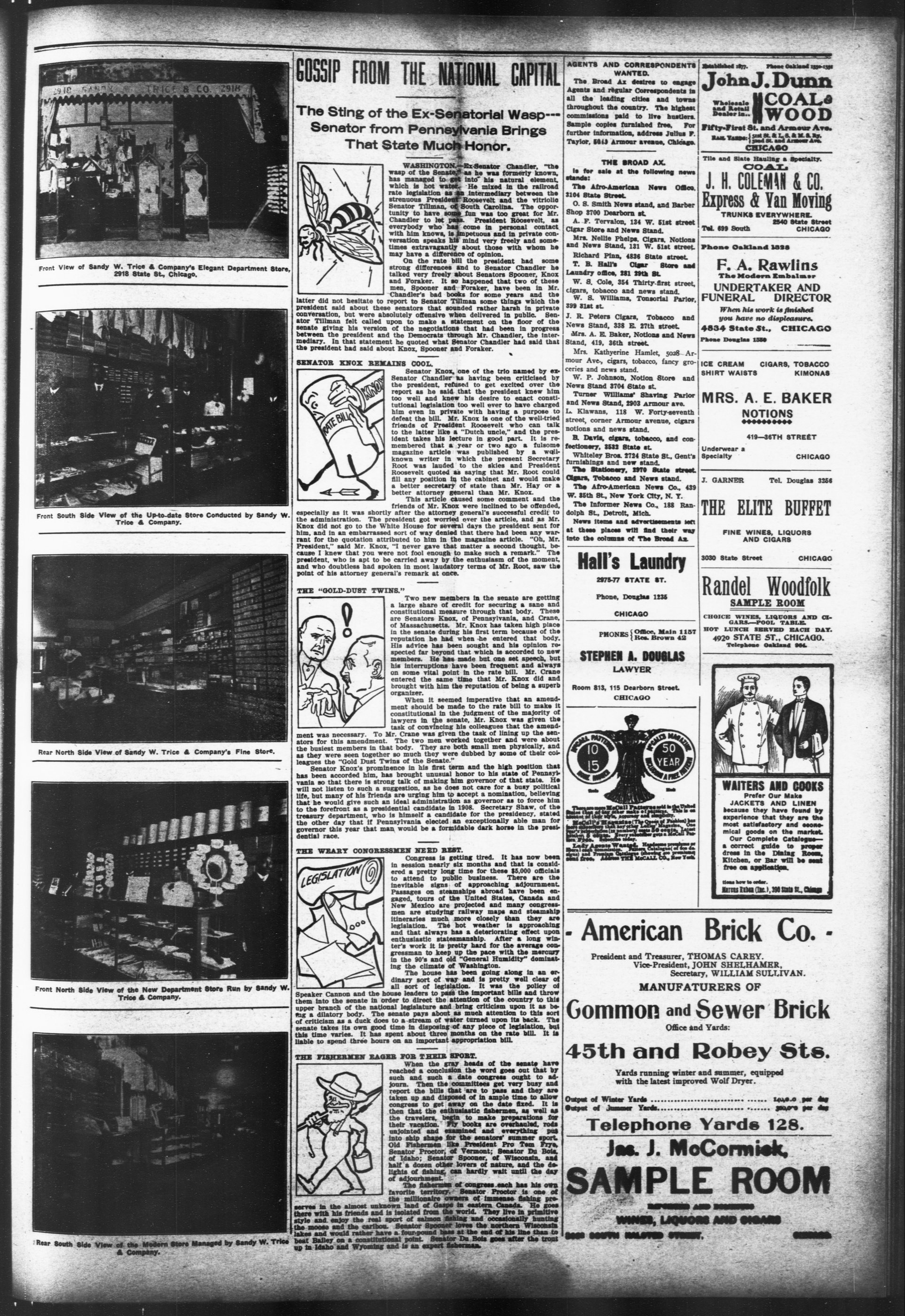
Front View teat ae mrs enene Doge Store
Te meh 4
Sa
er ae
—_ ae Me |
Ake
‘Front South Side View of the Up-to-date Store Conducted by Sandy W.
Trice & Company.
= S | Bete. Gees a4 gas —— e
Fi |
ae ee
. eget
= Ya ee ee
pS ae a
agli) in Reeser ae
= a ee ne ea
oa. Si ee et ee '
a
aa el. SS
art eee
Bh eks S55
3 Te
ses So ee ees
THE “GOLD-DUST TWINS.”
a ia
cons
ff or
5 in th
Nn Zf7 ie.
nem
y @}| his 1
OVE BE
brow
A
[W | p meat
LN cons
Rear North Side View of Sandy W. Trice & Company's Fine Store.
-: PT al
ae a me
(aay)
cS
Front North Side View of the New Department Store Run by Sandy W
‘Trice & Company.
> = hme
fp Z = co :
= a.
Rear South Side View of the. Modern ,
cn eemeenants Bosses eee
- American Brick Co. -
pty “Vice JON SMEAR,
MANUFATURERS OF
Gommon and Sewer Brick
Office and Yards:
45th and Robey Sts.
ee ee ee
Se eee ee oe eee
__Telephone Yards 128. _
| Jas. J. MoCormiek,
$ AR > eeremie sum necmmne ne
AGENTS AND CORRESPONDENTS
WANTED.
‘The Broad Ax desires to engage
Agents and regular Correspondents in
all the leading cities and towns
throughout the country. The highest
commissions paid to live hustlers.
Sample copies furnished free, For
further information, address Julius F.
Taylor, 6649 Armour avenue, Chicage
‘TME BROAD AX.
te for sale at the following news
standa:
‘The Afro-American News Office.
2104 State Street.
©. 8. Smith News stand, and Barber
Shop 3700 Dearborn st.
A..F. Tervalon, 134 W. Sist street
Cigar Store and News Stand.
Mra. Nellie Phelps, Cigars, Notions
and News Stand, 131 W. Gist street.
Richard Pina, 4836 State street
T. B Ball's Cigar Store and
Laundry office, 281 29th Bt.
W. 8. Cole, 354 Thirty-first street,
cigars, tobacco and news stand.
W. 8. Williams, Tonsorial Parlor
399 Bist st.
J. R. Peters Cigars, Tobacco and
News Stand, 338 E. 27th street.
Mrs. A. E. Baker, Notions and News
Stand, 419, 36th street.
_ Mrs. Kathyerine Hamlet, so28- Ar
mour Ave, cigars, tobacco, fancy gro
ceries and news stand.
W. P. Johnson, Notion Store and
‘News Stand 3704 State st.
| Turner Williams’ Shaving Parlor
‘and News Stand, 2903 armour ave.
1. Klawans, 118 W. Forty-seventh
‘street, corner Armour avenue, cigars
‘notions and news stand.
_ B. Davis, cigars, tobacco, and con
fectionery, 3532 State st.
_, Whiteley Bros. 2724 State St, Gent's
furnishings and new stand.
The Stationery, 2970 State strest
cars Tenn ind ove se
The Afro-American News Co., 43:
W. 35th St, New York City, N. ¥.
The Informer News Co, 188 Ran-
doiph Bt, Detroit, Mich.
‘News items and a¢vertisements sett
at these places will find their way
inte the columns of The Broad Az
Hall's Laundry |
2976-77 STATE 8T.
Phone, Douglas 1235
CHICAGO
wows Qtey, Mate 3387
STEPHEN A. DOUGLAS
LAWYER
Room 813, 115 Dearborn Street.
CHICAGO
See A? Ree
Doss oe anes
Metabiiched 177. Phone Oakland ss90-c358
Sone
3
mez IGVop
Fifty-Firet St. and Armeur Ave.
nan tae SER
JH. COLEMAN & C0.
Express & Yan Moving
Phone Oskiand 1538
F. A. Rawlins
‘The Modern Embalmer
UNDERTAKER AND
FUNERAL DIRECTOR
When his work is finished
you have no displeasure,
4834 State St., CHICAGO
Phone Douglas 1550 =
ICE CREAM CIGARS, TOBACCO
SHIRT WAISTS KIMONAS
MRS. A. E. BAKER
NOTIONS
OO0eeoooee
419—36TH STREET
Underwear a
Specialty CHICAGO
THE ELITE BUFFET
Randel Woodfolk
ae
=
\ jsp
tt) v
A —e i
WAITERS AND COOKS
Prefer Our Make
JACKETS AND LINEN
Seatac Tiago ae
most satisfactory and esone
mical goods on the market.
Our Complete Catalegue—
a correct guide to proper
Kitchen, or Bar will be seat
free om application.
cence
Mareus Rtbea (Ine. ), 390 Stata $2, Chienge
With nearly three times as many points to her credit as her nearest competitor, Greece, the United States emerges an easy winner from the greatest and latest of the international atheletic "meets" of the world. A possible reason for American success in this as in other fields is the fact that we are a highly composite breed. We have incorporated into our national body representatives of nearly every race on earth. It is not at all surprising, therefore, that we do more things well than the purer racial strains. N. Y. Globe.
Tabooed by Moslems
The ulemas of the University of Al Azhar have decided as to the phonograph and insurance that there is nothing in Islamic doctrine to forbid Moslems to listen to the phonograph, and that, if the verses of the koran are suitably intouled from the phonograph the listener may be justly considered to be performing an act of worship. Fire and life insurance are, however, condemned by the sheik as a gambling transaction contrary in spirit, to the teaching of the koran.
"Oooo!" Says the Iceman.
The largest mass of ice in the world is probably the one which fills up nearly the whole of the interior of Greenland, where it has accumulated since before the dawn of history. It is believed now to form a block about 600,000 square miles in area, and averaging a mile and a half in thickness. According to these statistics the lump of ice is larger in volume than the whole body of water in the Mediterranean.
Japan's Catholic Church
The Nippon Sei Kokwai, or holy Catholic church is Japan, includes all the missions of the American Protestant Episcopal church and the Church of England. In this church there are now more than 12,000 baptized members, of whom 5,985 are communicants. The growth of the church has been very rapid, 1,600 baptisms, two-thirds of them those of adults, having been recorded in a single year.
Lace Makers' Complaint
A singular complaint is made by 230 people employed in a lace factory at Long Eaton, near Nottingham, England. Opposite the factory are a number of trees in a cemetery. The workmen say that whenever there is the slightest breeze the movement of the branches causes a blinking light, which seriously injures their eyes, the lace work demanding the closest attention.
Use of Sugar in Arabia
In Arabia the higher classes use sugar in tea and coffee in their houses, but in the coffee shops in the bazar, where hundreds of people gather in the evening to talk and drink coffee, a cheaper grade of coffee is generally consumed, made of coffee husks principally, and in this drink sugar is seldom used.
Roast Reptile.
In Australia several kinds of snacks are eaten roasted. They are said to be equal in delicacy and flavor to the finest stewed ecls. An English traveler declares the steam from the roasting reptiles is by no means unsavory.
Atlantic Fisheries
The New England fisheries are the most important branch of the American fishing industry, the aggregate value of their annual catch being about $10,000,000, or one-fourth of the value of the total catch of the United States.
African Delicacy.
The aborigines of South America and Africa consider the guana, a large lizard, a great delicacy. These lizards are not unlike a small crocodile, but are more unsightly than that creature.
Swallowed by the Sea
Since the sixteenth century 12 churches, a convent, a hospital and many hundreds of acres of land have been swallowed by the sea in the vicinity of Aldeburgh, England.
An Old Story.
"Did you ever experience a change of heart?" asked the kind old lady. "Well, I should say!" laughed the girl. "I've been engaged four times." -Detroit Free Press.
A Saving Host
The Salvation Army has 17,333 workers among children. It comprises 7,219 corps and societies and it has 13,962 officers wholly employed in its service.
Thease of Tilden.
The late Samuel J. Tilden was the originator of the phrase, "Peace in politics; why, you might just as well expect harmony in Hades."
Profane Bubbles.
The Small Boy—Look sharp!
There's a man fallen in the pond, and his bubbles is the worst language you ever heard—London Spritch.
England's Land Owners.
Fully one-third of the land in Great Britain is owned by members of the house of lords.
#
She Hadn't Seen It
A West Philadelphia family was at supper, one night, talking about the engagement of one of the daughters, whose wedding was soon to be. The negro servant, who acted as waltress, laundress, etc., had just brought into the dining room the dessert, when one of the girls asked: "Virginia, have you seen Edith's fiance?" "Laws! I doan know, honey," she replied, "hitn't been in de wasy itt"
Lucid as Mud.
A woman canvasser in a recent British election campaign asked a laborer whether he was in favor of protection, and he replied by inquiring what it was. The question embarrassed the woman somewhat. She replied: "I cannot go into precise details at the moment, but it is a subject of vital importance to all who care for wild birds."
An Odd Ad.
The following advertisement comes from the London Times: "Man, K. C., M. P., well known professionally and called a good companion, over 61, desirous to be received as sociable guest. He wishes to be accepted genially by those who would not receive him entirely for gain, and as possibly a small contributor to expenses."
Not an Easy Driver.
An Atchison man, The Globe says, was showing a fine horse that attracted the attention of a man who was looking for a family horse. "Can a woman drive him?" inquired the would-be purchaser. "Yes, a woman might drive him," replied the owner, "but I would hate to live with the woman that can drive him."
Lime Prevents Rust.
Unslaked lime is useful in preventing rust because of its extraordinary capacity for absorbing moisture. Some careful workmen who take pains that their tools shall always be in the best condition, make a practice of keeping a piece of lime in their tool boxes to absorb any moisture which might otherwise cause rust.
Horrible Recollections
Doctor—I am certain I could cure Smith of his indigestion if he would only live on bread and water for a while. But he positively refuses.
Friend—You know why, don't you? "No."
"He was arrested for fast driving once, and spent two weeks in jail."—Detroit Free Press.
Sarasate's Treasure.
Senor Sarasate's most precious possession is a Stradivari violin. When he was 12 years old he played before Queen Isabella II. of Spain and her majesty was so pleased with his exquisite music that she presented him with the instrument.
No Resistance.
"I had expected there would be a great splurge at Miss Fawtyfore's wedding, but it seems to have passed off quietly."
"Oh, yes; the ycung man submitted to the operation without a murmur."—Chicago Tribune.
Bible from the Kaiser
Kaiser William has presented a Bible in a silver-mounted cabinet to the New Germain Lutheran church in New York city, with the inscription: "Wilhelm, I. R., Heb. 11:1, 'Now faith is the substance of things hoped for, the evidence of things not seen.'"
Engine Hint.
The gasoline engine, like the steam engine, in fact, like all engines, is all the better for being run light for a few minutes before it is called upon to exert its full power, says the Automobile Magazine.
No Checks in Erse.
The Bank of Ireland declines to honor checks written in Erse. The Gaels are indignant. If, they say, the bank accepts checks in Japanese and Russian, why should it reject those in Erse?
Railway in Mocha Land.
A railway is to be built to the region where the Mocha coffee grows. It will extend from Hodeidah, on the Red sea, to Sanna, the largest city in southern Arabia, with a population of 75,000.
William. Bill and Will.
Three brothers, sons of Blue Foxman, of Tablequah, bear the Christian names of William, Bill and Will, and they have never gotten mixed in the bathtub, either.—Kansas City Journal.
Bridge Versus Golf.
The Mid-Surrey (Eng.) Golf club has forbidden its members to play bridge whilst on Sundays. This is not a religious measure. It was found that bridge playing "interfered with golf."
Chinese Volunteers
In China volunteer militants are being formed. The majority of young men are enlisting and meet twice a week for drill.
"I tell you," said the tall man with the carroty whiskers, "the Chinese are getting wiser every day."
"I should say they are," replied the short man in th' green suspenders. "Why, my laundryman has actually taken up pyrography." "You don't mean it?" "Yes, his specialty now is burning designs on shirts."—Chicago 'Dally News.
Buns Losing Favor
Only 5,000,000 "hot-cross buns" were consumed in London on Good Friday, indicating the dying out of the custom. The cross-bun is the modern equivalent of the cakes eaten in honor of the Saxon goddess Bostre, from whose name the word Easter comes. Her worshipers became Christians, but, unwilling to give up the buns, compromised by making them with a cross.
Salman in British Columbia
All of the hatcheries of British Columbia have secured a full supply of salmon spawn and by the erection of fish ladders a very large district has been opened that had been cut off from the salmon for a number of years. The number of young salmon that will go to the ocean this year will be far greater than in any previous year, and an exceedingly large run may be expected in 1907.
The Way It Looked
"And what are you going to be when you grow up, any little man?" asked the caller.
The unfortunate child shook his golden curls savagely and gazed in anger at his lace cuffs.
"I want to be a man," he said, "out I think mamma's bringin' me up to be a lady."-Cleveland Leader.
Rajputana Reservoir.
One of the largest works of man's hands is the artificial lake, or reservoir, in India, at Rajputant. This reservoir, said to be the largest in the world, known as the great tank of Dhebar, and used for irrigating purposes, covers an area of 21 square miles.
Chance to Swim.
"I hear that your suburban place is for sale, Harker. Do you think if would suit me?"
"Yes, if you have the proper kind of feet."
"What kind of feet will I need?"
"Web."—Chicago Daily News.
Have Pretty Women.
A recent traveler in Poland writes that, in his view, Warsaw and London have the most beautiful women in the world. The Polish girl is said, as a rule, to have good taste, to know how to blend colors artistically, and make a graceful appearance.
Lightning Flashes
Recent efforts to measure the duration of flashes of lightning seem to show that it is often as brief as one forty-thousandth part of a second. A flash lasting the fiftieth part of a second is considered about the extreme duration.
Benign Earthquake.
A New England newspaper of 1727 announced that "a considerable town in this province has been so awakened by the awful providence in the earthquake that the women have generally laid aside their hoop petticoats."
Value of Elephants.
An African elephant is of value only for its ivory, of which a full-grown animal yields from $250 to $300 worth. On the other hand, a working Indian elephant cannot be bought for less than $2,500 to $3,500.
Swelling Niagara Falls.
When strong westerly winds pile up the water of Lake Erie at its eastern end, where the outlet is, the flow over the Niagara cataract is sometimes increased 40 per cent. above the normal volume.
Happy Parish.
The parish of Abbeyfeall, in County Limerick, has the distinction of being without a landlord. All the land has been purchased by the occupiers under the Irish land acts.
In Fishing Time.
She—I agree with Cowper—I hate a man who needlessly sets foot upon a worm.
He—So do I. It spoils 'em for bait.
—Cleveland Leader.
Porous Glass.
In porous glass, which is made in France, the holes are so small that neither dust nor draught can enter, and set the ventilation is safe so be excellent.
One Good Word for XI.
The automobile did its work nohily in San Francisco, and we do not read that any of the gasoline variety lacks fire or blew up—Philadelphia, Bulletin.
Odd Exports.
The two little Spanish towns of Palamos and San Felipe Animals shipped more than 14,000,000 pounds of cork dust and shavings just twice.
Butterflies Cross Seas.
Butterflies are frequently migrants, and, fruit as they are, they grow, for example, the seeds that separate Great Britain from the continent.
J. A. O'Donnell, H. D. Coghlin,
O'Donnell & Coghlin
Attorneys at Law
Phone 264 Main Metropolitan Block
N. W. Cor. LaSalle & Randolph Sts.
Chicago
GRAY & MORAN
ATTORNEYS AT LAW
Suite 1114 Ashland Block, Clark and
Randolph Sta. Tel. Central 569.
CHICAGO.
Residence 57 Macallister Place
Telephone Ashland 363
Office Telephones
Central 1239 Automatic 5949
MILES J. DEVINE
ATTORNEY AT LAW
Suite 318-330 Reaper Block
CLARK AND WASHINGTON STS.
CHICAGO.
A. D. GASH
Attorney at Law,
84-86 La Salle Street, Chicago.
Suite 615 to 619.
Telephone Main 3077.
JOHN E. OWENS
ATTORNEY & COUNSELOR
AT LAW
323 ABHLAND BLOCK
TELEPHONE CENTRAL 900 CHICAGO
Telephone Yards 6016.
John Fitzgerald
JUSTICE OF THE PEACE
617 SOUTH HALSTER STREET.
Telephone Main 4839
Residence, 6826 Champlain Ave.
Tel. Wentworth 2821
J. GRAY LUCAS Attorney At Law
SUITE 51, 119-121 LA SALLE ST.,
CHICAGO
Tel. Douglas 1565 Notary Public
Jesse Binga
REAL ESTATE, LOANS AND
RENTING
FIRE INSURANCE
Bates Building
3637 STATE STREET CHICAGO
Phone 194 South
A. B. SCHULTZ, M. D. PHYSICIAN AND SURGEON.
2719 State Street
Hours: 9 to 12 A. M.
3 to 5 and after 6 P. M.
CHICAO
Townsmen and Countrymen.
That the townman is shorter lived than the countryman is incontrovertible. Dr. Tatham calculated that in the rural districts of England the average expectation of life at birth is 51.48 years for males and 54.04 for females, whereas in Manchester it is only 28.78 for males and 22.67 for females, which means that each male has to sacrifice 10.48 years, or 89 per cent. of his life, and each female 9.82 years, or 34 per cent. of her life for the privilege of being born in an urban area—Popular Science Monthly.
When Ambition Wanes
It is the perpetual effort to attain the ideal that enlarges the whole life. The moment the ambition begins to wane or tends to become sordid or selfish the individual begins to shrivel.—Success Magazine.
The Orange Crop.
Last year's production of oranges in this country was 10,000,000 boxes, or probably 1,600,000,000 oranges. That is an allowance of 20 to each inhabitant.
Mistakes of Matrimony.
Many a man who thinks he is marrying an angel may find that she is equipped with a pair of aesthetos wings a few months later.
Silent and Noisy Letters
Reform our spelling. Cut out the silent letters. Then cut out the ones that make a noise. After that we can have some peace.—N. Y. Mall.
Keeping Young.
As long as the heart is young and the thought is youthful, old age cannot touch you.—Success Magazine.
Not Occupy.
Mr. Will Crooks, M. P., speaking at Kent Ham, said the labor party did not spell "Empire" with a big "B"
WHERE EVERY PATRON Saves ON EVERY PURCHASE
BRADLEY & FIELDS REAL ESTATE, LOANS AND INSURANCE
POLICE MAGISTRATE
Hyde Park.
Tele
South Cl
Charles H. Callahan
JUSTICE OF THE PEACE
RESIDENCE:
6448 Greenwood Ave.
Theodore
JUSTICE OF
Mortgages, Deds, Notes
and Acknowledged.
POLICE MAGISTRATE
East Chicago Ave. Police Court
Phone
SANDY W. TR
INCORPORATED UNDER
MEN AND WOMEN
DRY GOODS
2918 STATE S
Here is your chance.
We carry a complete line of Men
Hats and Notions. A limited
at the Se
ENCE:
Kenwood Ave.
9206 Comm
CHIC
Seodore C. May
PICE OF THE P
ages, Deeds, Notes and Legal Documents
knowledged. Room 22, 27 North
MAGISTRATE
Ave. Police Court
337
CHICAGO
Phone Douglas 6581.
Y W. TRICE & COM
CORPORATED UNDER THE LAWS OF ILLINOIS
MEN AND WOMEN'S FURNISHERS
DRY GOODS AND NOTIONS
2918 STATE STREET, CHICAGO.
Is your chance. A joint stock com-
plete line of Men's and Women's Furni-
Notions. A limited number of shares are
at the Secretary's office.
DIRECTORS:
Theodore C. Mayer
JUSTICE OF THE PEACE
Flortgages, Deeds, Notes and Legal Documents Drawn and Acknowledged. Room 22, 27 North Clark Street
SANDY W. TRICE & COMPANY
INCORPORATED UNDER THE LAWS OF ILLINOIS
MEN AND WOMEN'S FURNISHERS
DRY GOODS AND NOTIONS
2918 STATE STREET, CHICAGO.
We carry a complete line of Men's and Women's Furnishings, Shoes, Hats and Notions. A limited number of shares are on sale at the Secretary's office.
DIRECTORS:
Sandy W. Trice, President.
Milton J. Trice, Vice President.
H. T. Henry, 2nd Vice President.
James M. Lee, 3rd Vice President.
C. C. Watson, Trustee.
Dee Parker, Trustee.
A. J. Carey, Treasurer.
A. W. Williams, Secretary.
NOIS BRICK
ILLINOIS BRICK CO.
WILLIAM G. KUESTER.
SUPERINTENDENT.
1994 N. Western Ave., C
Telephone Lake View 270
N. Western Ave., Ch
Telephone Lake View 270.
M. JUNK, Proprietor JOH. P. JUNK, Manager 3700-8710 South Halsted Street and 897 to 929 Thirtyseventh Street CHICAGO
9206 Commercial Ave.
CHICAGO.
Mayer
E PEACE
Documents Drawn
27 North Clark Street.
COMPANY
OF ILLINOIS
FURNISHERS
MOTIONS
CHICAGO.
stock company.
Men's Furnishings, Shoes,
shares are on sale.
C. C. Watson, Trustee.
Dee Parker, Trustee.
A. J. Carey, Treasurer.
A. W. Williams, Secretary
CK CO.
o., Chicago. w 270.
RESIDENCE
337 Burtling Street