The Broad Ax
Saturday, June 23, 1906
Chicago, Illinois
Page text (machine-generated)
THE BROAD AX HEW TO THE LINE.
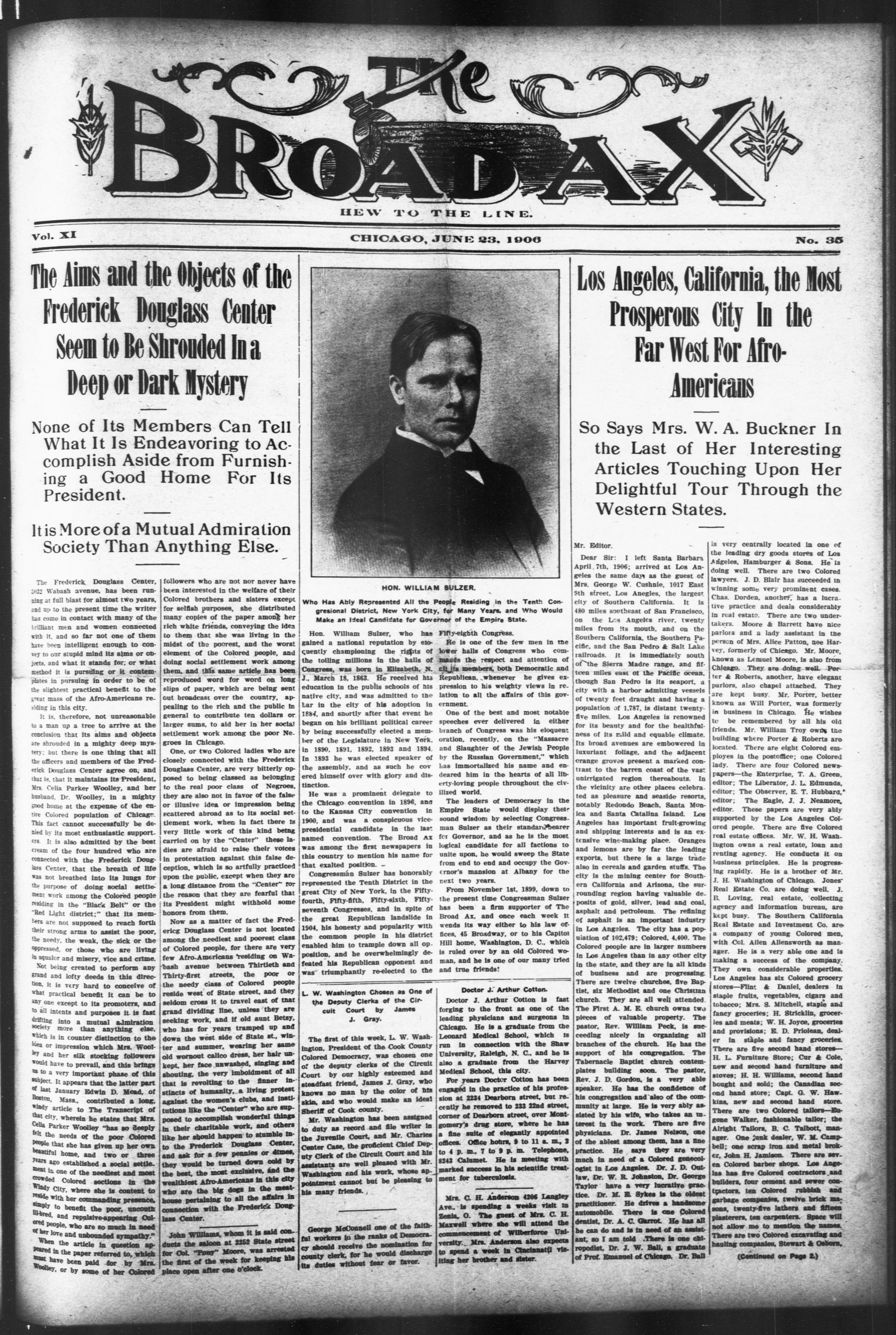
The Aims and the Objects of the Frederick Douglass Center Seem to Be Shrouded In a Deep or Dark Mystery
None of Its Members Can Tell What It Is Endeavoring to Accomplish Aside from Furnishing a Good Home For Its President.
It is More of a Mutual Admiration Society Than Anything Else.
Vol. XI
The Aims and the Frederick Do Seem to Be Deep or Da None of Its Me What It Is En complish Asi ing a Good President. It is More of a Mu Society Than
The Frederick, Douglass Center, 3032 Wabash avenue, has been running at full blast for almost two years, and up to the present time the writer has come in contact with many of the brilliant men and women connected with it, and so far not one of them have been intelligent enough to convey to our stupid mind its aims or objects, and what it stands for; or what method it is pursuing or it contemple plates in pursuing in order to be of the slightest practical benefit to the great mass of the Afro-Americans residing in this city.
It is, therefore, not unreasonable to a man up a tree to arrive at the conclusion that its aims and objects are shrouded in a mighty deep mystery; but there is one thing that all the officers and members of the Frederick Douglass Center agree on; and that is, it maintains its President, Mrs. Celia Parker Woolley, and her husband, Dr. Woolley, in a mighty good home at the expense of the entire Colored population of Chicago. This fact cannot successfully be denied by its most enthusiastic supporters. It is also admitted by the best cream of the four hundred who are connected with the Frederick Douglass Center, that the breath of life was not breathed into its lungs for the purpose of doing social settlement work among the Colored people residing in the "Black Belt" or the "Red Light district;" that its members are not supposed to reach forth their strong arms to assist the poor, the needy, the weak, the sick or the oppressed, or those who are living in sinner and misery, vice and grime
Not being created to perform any grand and lofty deeds in this direction, it is very hard to conceive of what practical benefit it can be to any one except to its promoters, and to all intents and purposes it is fast drifting into a mutual alimination society more than anything else, which is in counter distinction to the idea or impression which Mrs. Woolley and her silk stocking followers would have to prevail, and this brings us to a very important phase of this subject. It appears that the latter part of last January Edwin D. Mead, of Boston, Mass., contributed a long, windy article to The Transcript of that city, wherein he states that Mrs. Celia Parker Woolley "has so deeply felt the needs of the poor Colored people that she has given up her own beautiful home, and two or three years ago established a social settlement in one of the neediest and most crowded Colored sections in the Windy City, where she is content to reside with her commanding presence, simply to benefit the poor, uncount ill-bred, and repulsive appearing Colored people, who are so much in need of her love and unbound sympathy." When the article in question appeared in the paper referred to, which must have been paid for by Mrs. Woolley, or by some of her Colored
---
followers who are not nor never have been interested in the welfare of their Colored brothers and sisters except for selfish purposes, she distributed many copies of the paper among her rich white friends, conveying the idea to them that she was living in the midst of the poorest, and the worst element of the Colored people, and doing social settlement work among them, and this same article has been reproduced word for word on long slips of paper, which are being sent out broadcast over the country, appealing to the rich and the public in general to contribute ten dollars or larger sums, to aid her in her social settlement work among the poor Negroes in Chicago.
One, or two Colored ladies who are closely connected with the Frederick Douglass Center, are very bitter opposed to being classed as belonging to the real poor class of Negroes, they are also not in favor of the false or illusive idea or impression being scattered abroad as to its social settlement work, when in fact there is very little work of this kind being carried on by the "Center" these ladies are afraid to raise their voices in protestation against this false deception, which is so artfully practiced upon the public, except when they are a long distance from the "Center" for the reason that they are fearful that its President might withhold some honors from them.
Now as a matter of fact the Fredericg Douglass Center is not located among the neediest and poorest class of Colored people, for there are very few Afro-Americans residing on Wabash avenue between Thirtieth and Thirty-first streets, the poor or the needy class of Colored people reside west of State street, and they seldom cross it to travel east of that grand dividing line, unless they are seeking work, and if old aunt Betsy, who has for years tramped up and down the west side of State st., winter and summer, wearing her same old wornout calico dress, her hair unkept, her face unwashed, singing and shouting, the very imboldment of all that is revolting to the finner instincts of humanity, a living protest against the women's clubs, and institutions like the "Center" who are supposed to accomplish wonderful things in their charitable work, and others like her should happen to stumble into the Frederick Douglass Center, and ask for a few pennies or dimes, they would be turned down cold by the best, the most exclusive, and the wealthiest Afro-Americans in this city who are the big dogs in the meathouse pertaining to all the affairs in connection with the Frederick Douglass Center.
John Williams, whom it is said conducts the saloon at 2252 State street for Col. "Bony" Moore, was arrested the first of the week for keeping his place open after one o'clock.
HEW TO THE LINE.
CHICAGO, JUNE 23, 1906
[Picture of a man with dark hair and a white shirt. He is facing the camera, looking directly at the viewer. The background is a plain, light color. The man's face is centered in the frame, and his expression is neutral. The image is black and white. There are no visible texts or markings on the image.
HON. WILLIAM SULZER.
Who Has Ably Represented All the People Residing in the Tenth Congressional District, New York City, for Many Years, and Who Would Make an Ideal Candidate for Governor of the Empire State.
Hon. William Sulzer, who has gained a national reputation by eloquently championing the rights of the tolling millions in the halls of Congress, was born in Elizabeth, N. J., March 18, 1863. He received his education in the publis schools of his native city, and was admitted to the bar in the city of his adoption in 1884, and shortly after that event he began on his brilliant political career by being successfully elected a member of the Legislature in New York, in 1890, 1891, 1892, 1893 and 1894. In 1893 he was elected speaker of the assembly, and as such he covered himself over with glory and distinction.
He was a prominent delegate to the Chicago convention in 1896, and to the Kansas City convention in 1900, and was a conspicuous vice-presidential candidate in the last named convention. The Broad Ax was among the first newspapers in this country to mention his name for that exalted position.
Fifty-eighth Congress.
He is one of the few men in lower halls of Congress who congratulate the respect and attention of its members, both Democratic and Republican, whenever he gives expression to his weighty views in relation to all the affairs of this government.
One of the best and most notable speeches ever delivered in either branch of Congress was his eloquation, recently, on the "Massacre and Slaughter of the Jewish People by the Russian Government," which has immortalized his name and deferred him in the hearts of all life-loveful people throughout the civilized world.
The leaders of Democracy in the Empire State would display the sound wisdom by selecting Congressman Sulzer as their standard bearer for Governor, and as he is the most logical candidate for all factions of unite upon, he would sweep the State from end to end and occupy the Go
Congressmán Sulzer has honorably represented the Tenth District in the great City of New York, in the Fifty-fourth, Fifty-fifth, Fifty-sixth, Fifty-seventh Congresses, and in spite of the great Republican landslide in 1904, his honesty and popularity with the common people in his district enabled him to trample down all opposition, and he overwhelmingly defeated his Republican opponent and was triumphantly re-elected to the
L. W. Washington Chosen as One of the Deputy Clerks of the Circuit Court by James J. Gray.
The first of this week, L. W. Washington, President of the Cook County Colored Democracy, was chosen one of the deputy clerks of the Circuit Court by our highly esteemed and steadfast friend, James J. Gray, who knows no man by the color of his skin, and who would make an ideal Sheriff of Cook county.
Mr. Washington has been assigned to duty as record and file writer in the Juvenile Court, and Mr. Charles Center Case, the proficient Chief Deputy Clerk of the Circuit Court and his assistants are well pleased with Mr. Washington and his work, whose appointment cannot but be pleasing to his many friends.
George McConnell one of the faithful workers in the ranks of Democracy should receive the nomination for county clerk, for he would discharge its duties without fear or favor.
He is one of the few men in the lower halls of Congress who commands the respect and attention of all its members, both Democratic and Republican, whenever he gives expression to his weighty views in relation to all the affairs of this government.
One of the best and most notable speeches ever delivered in either branch of Congress was his eloquent oration, recently, on the "Massacre and Slaughter of the Jewish People by the Russian Government," which has immortalized his name and endeared him in the hearts of all liberty-loving people throughout the civilized world.
The leaders of Democracy in the Empire State would display their sound wisdom by selecting Congressman Sulzer as their standard bearer for Governor, and as he is the most logical candidate for all factions to unite upon, he would sweep the State from end to end and occupy the Governor's mansion at Albany for the next two years.
From November 1st, 1899, down to the present time Congressman Sulzer has been a firm supporter of The Broad Ax, and once each week it wends its way either to his law offices, 45 Broadway, or to his Capitol Hill home, Washington, D. C., which is ruled over by an old Colored woman, and he is one of our many tried and true friends!
Doctor J. Arthur Cotton is fast forging to the front as one of the leading physicians and surgeons in Chicago. He is a graduate from the Leonard Medical School, which is run in connection with the Shaw University, Raleigh, N. C., and he is also a graduate from the Harvey Medical School, this city.
For years Doctor Cotton has been engaged in the practice of his profession at 2224 Dearborn street, but recently he removed to 233 22nd street, corner of Dearborn street, over Montgomery's drug store, where he has a fine suite of elegantly appointed offices. Office hours, 9 to 11 a.m., 2 to 4 p.m., 7 to 9 p.m. Telephone, 8243 Calumet. He is meeting with marked success in his scientific treatment for tuberculosis.
Mrs. C. H. Anderson 4206 Langley Ave. is spending a weeks visit in Zenia, O. The guest of Mrs. C. H. Maxwell where she will attend the commencement of Wilberforce University. Mrs. Anderson also expects to spend a week in Cincinnati visiting her brother and sister.
Los Angeles, California, the Most Prosperous City In the Far West For Afro- Americans
So Says Mrs. W. A. Buckner In the Last of Her Interesting Articles Touching Upon Her Delightful Tour Through the Western States.
Mr. Editor
Dear Sir: I left Santa Barbara April, 7th, 1906; arrived at Los Angeles the same day as the guest of Mrs. George W. Cushnie, 1017 East 9th street, Los Anegles, the largest city of Southern California. It is 480 miles southeast of San Francisco, on the Los Angeles river, twenty miles from its mouth, and on the Southern California, the Southern Pacific, and the San Pedro & Salt Lake railroads. It is immediately south of the Sierra Madre range, and fifteen miles east of the Pacific ocean, though San Pedro is its seaport, a city with a harbor admitting vessels of twenty feet draught and having a population of 1,787, is distant twenty-five miles. Los Angeles is renowned for its beauty and for the healthfulness of its mild and equable climate. Its broad avenues are embowered in luxuriant foliage, and the adjacent orange groves present a marked contrast to the barren coast of the vast unirrigated region thereabouts. In the vicinity are other places celebrated as pleasure and seaside resorts, notably Redondo Beach, Santa Monica and Santa Catalina Island. Los Angeles has important fruit-growing and shipping interests and is an extensive wine-making place. Oranges and lemons are by far the leading exports, but there is a large trade also in cereals and garden stuffs. The city is the mining center for Southern California and Arizona, the surrounding region having valuable deposits of gold, silver and coal asphalt and petroleum. The refining of asphalt is an important industry in Los Angeles. The city has a population of 102,479; Colored, 4,400. The Colored people are in larger numbers in Los Angeles than in any other city in the state, and they are in all kinds of business and are progressing. There are twelve churches, five Baptist, six Methodist and one Christian church. They are all well attended. The First A. M. E. church owns two pieces of valuable property. The pastor, Rev. William Peck, is succeeding nicely in organizing all branches of the church. He has the support of his congregation. The Tabernacle Baptist church contemplates building soon. The pastor, Rev. J. D. Gordon, is a very able speaker. He has the confidence of his congregation and also of the community at large. He is very ably assisted by his wife, who takes an interest in the work. There are five physicians. Dr. James Nelson, one of the ablest among them, has a fine practice. He says they are very much in need of a Colored genecologist in Los Angeles. Dr. J. D. Outlaw, Dr. W. R. Johnston, Dr. George Taylor have a very lucrative practice. Dr. M. E. Sykes is the oldest practitioner. He drives a handsome automobile. There is one Colored dentist, Dr. A. C. Garrot. He has all he can do and is in need of an assistant, so I am told. There is one chiropodist, Dr. J. W. Ball, a graduate of Empanada of Chicago, Dr. Ball
Doctor J. Arthur Cotton.
No. 35
California, the Most City In the For Afro- Americans
V. A. Buckner In Her Interesting Thing Upon Her Jour Through the States.
is very centrally located in one of the leading dry goods stores of Los Angeles, Hamburger & Sons. He is doing well. There are two Colored lawyers. J. D. Blair has succeeded in winning some very prominent cases. Chas. Dorden, another, has a lucrative practice and deals considerably in real estate. There are two undertakers. Moore & Barrett have nice parlors and a lady assistant in the person of Mrs. Alice Patton, nee Harvey, formerly of Chicago. Mr. Moore, known as Lemuel Moore, is also from Chicago. They are doing well. Porter & Roberts, another, have elegant parlors, also chapel attached. They are kept busy. Mr. Porter, better known as Will Porter, was formerly in business in Chicago. He wishes to be remembered by all his old friends. Mr. William Troy owns the building where Porter & Roberts are located. There are eight Colored employees in the postoffice; one Colored lady. There are four Colored newspapers—the Enterprise, T. A. Green, editor; The Liberator, J. L. Edmunds, editor; The Observer, E. T. Hubbard, editor; The Eagle, J. J. Neamore, editor. These papers are very aly supported by the Los Angeles Colored people. There are five Colored real estate offices. Mr. W. H. Washington owns a real estate, loan and renting agency. He conducts it on business principles. He is progressing rapidly. He is a brother of Mr. J. H. Washington of Chicago. Jones Real Estate Co. are doing well. J. B. Loving, real estate, collecting agency and information bureau, are kept busy. The Southern California Real Estate and Investment Co. are a company of young Colored men, with Col. Allen Allensworth as manager. He is a very able one and is making a success of the company. They own considerable properties. Los Angeles has six Colored grocery stores—Flint & Daniel, dealers in staple fruits, vegetables, cigars and tobacco; Mrs. S. Mitchell, staple and fancy groceries; H. Stricklin, groceries and meats; W. H. Wachce, groceries and provisions; E. D. Priolean, dealer in staple and fancy groceries. There are five second hand stores—H. L. Furniture Store; Cur & Cole, new and second hand furniture and stoves; H. H. Williams, second hand bought and sold; the Canadian second hand store; Capt. G. W. Hawkins, new and second hand store. There are two Colored tailors—Eugene Walker, fashionable tailor; the Alright Tailors, B. C. Tailbott, manager. One junk dealer, W. M. Campbell; one scrap iron and metal broker, John H. Jamison. There are seven Colored barber shops. Los Angeles has five Colored contractors and builders, four cement and sewer contractors, ten Colored rubbish and garbage companies, twelve brick masonies, twenty-five lathers and fifteen plasterers, ten carpenters. Space will not allow me to mention the names. There are two Colored excavating and hauling companies, Stewart & Osborn,
(Continued on Page 2.)
THE BROAD AX.
Viii promulgate and at all times uphold the principles of Democracy, but Catholics, Protestants, Fruits, Inside, Farmers, Single Taxers, Republicans, Knights of Labor, or any one else can have their say, so long as their language is proper and responsible is fixed.
The Broad is a newspaper whose platform is broad enough for all, ever claiming the editorial right to speak its own mind.
JULIUS F. TAYLOR, Editor and Publisher.
Entered at the Post Office at Chicago
IL, as second-class Matter.
He for Detroit.
All persons desiring to visit Detroit during the session of the National Association of Colored Women are requested to take advantage of the reduced rates secured on the certificate plan over all roads. One fare and one-third for the round trip. Many pleasant features have been planned by the Detroit Club Women for the entertainment of the delegates and visitors during the week of July 9 to 14. See notice in the next issue of this paper.
Do not fail to attend the unique entertainment given by the industrial section of the Phyllis Wheatley Club at the beautiful home of the chairman, Mrs. W. M. Farmer, 4856 Langley avenue, Friday evening, June 29th. A country supper, barn dance, Gypsy camp, muscial and literary program and other unique features will mark the evening's pleasure. Admission 25 cents. Come out and help this enterprising club in its efforts to buy a home for working girls and a woman's exchange.
Thursday, June 28th, is National Woman's Day at the great Chautauqua Tabernacle, 63rd and Throop streets, Englewood. Half of the proceeds will be devoted to the National Kindergarten fund to assist in needed districts in the south. Hear the cry of the children and help as the Lord hath prophesed you.—"D."
St. Mark Literary, State, Near 47th Street
The St. Mark Lyceum last Sunday afternoon was very well attended. Mr. Torrence, a student of Dearborn Medical College, read a paper on the "Model Young Man." Miss Anderson read a paper on the "Modern Woman." Mr. Fox gave a reading. Others who made short talks were Drs. Thos. S. Officer, W. S. Baldwin, Revs. J. B. Redmond, J. W. Simpson and Mr. Prussie.
Next Sunday ex-Congressman Geo. W. Murray will speak. Subject, "The Opportunities of the Literary Societies for Race Development." Mr. C. C. Banks will sing. Press comments and discussions on "The Clansman" will occupy the first part of the program.
Bethel Literary and Historical Club, Program for Sunday, June 24th
Address by W. H. A. Moore, the noted author. Topic, "The Race Question from a Literary Point of View." Reading, entitled "At Heaven's Gate," by W. E. Wright. The Club Quartette, Messrs. Huggins, Brown, Wright and Walker, assisted by other musical talent, will render an excellent musical program.
· Mrs. Lucas will recite.
Mrs. Lucas will recite.
The Executive Committee resolved to suspend the meetings from July 15th to September 15th, in order that the members be given an opportunity to take vacations.
Meeting at 4 p. m. All invited to attend. Geo. T. Kersey, Pres.
GRABS GIRL'S FOOT; 999 YEARS.
Severe Punishment Meted Out to Negro by Texas Court.
Fort Worth, Texas,—Nine hundred and ninety-nine years in the penitentiary is the penalty imposed upon Snow Williams, a Negro, for catching a young white woman by the foot. The Negro entered the girl's room at Belton a few nights ago and seized her by the foot, but her screams brought aid and he was arrested. The grand jury was in session and quick punishment followed.
This was the only interesting bit of news in The Record-Herald-Sunday June 17, pertaining to the Afro-Americans.
Institutional Church, 3825 Dearborn Street.
Special services at both hours, 10:45 a.m. and 3 p.m. 10:45 a.m.:
1. Organ vol.
2. Choir and congregation.
3. Hymn and prayer, Lord's Pray-
4. Interlude, organ.
5. Scripture reading and decalogue,
etc.
6. Special anthem by the choir, "Gloria," twenty voles.
7. Sermon by the pastor. Subject, "A Lesson from the Contrast of Characters." Text, Peter, 4:18.
Evening service, the usual opening exercises. Sermon by the pastor. Subject, "The Most Excellent Way to Obtain the Best Gift." The choir has special music for this service, assisted by some of the best musicians of the city. It is the object to make the evening services helpful and beneficial. Also, the services will not hold longer than 9:15 o'clock.
There will be given another illustrated sermon on the first Sunday in July. Songs and illustrations.—"S."
WHATES KISS NEGO SISTERS
New York.—The novel spectacle of colored elders kissing white sisters and white elders kissing colored sisters was witnessed at the general conference of the Church of God in session in Tabernacle No. 3, Hudson avenue, near De Kalb avenue, Brooklyn, to-day. It was the ceremony known as the "holy kiss." The church draws no color line, and about half of those present were colored.
Many of those present had taken only the first step leading to admission to the church—the washing of their feet by an elder. The next step was the "holy kiss." One after another the white converts kissed colored and white elders, and then the colored converts did the same.—The Chicago American June 20.
Where Oh! where is Rev. Thomas Dixon Jr.; Ben Tillman;; Gov. Vardaman, Thomas Nelson Pagé, John Temple Graves, and Old Jeff Davis of Ark.!?
They will run off and froth at the mouth like mad dogs when they come in contact with this report of the white and colored kissing match.
LOS ANGELES, CALIFORNIA, AND ITS PROSPEROUS AFRO- AMERICANS.
(Concluded from page 1.)
another Williams & Moulton; one Colored horse dealer, horses bought and sold by A. Snow; two blacksmith shops, P. Hooker and H. E. Edwards; one Colored poultry ranch, Holden & Co. There are two wrecking of building companies, L. A. Hunt & Co., the American Wrecking Co., R. Thompson manager; two laundries, one run and owned by G. W. Snell, formerly of Chicago, who runs two wagons, M. Slayton the other; four shoemakers and repairing. There are seventeen Colored expressmen; two transfer, van and truck companies, the Los Angeles Van, Truck and Storage Co., R. H. Dunston, proprietor. Mr. Dunston owns the storage building and other valuable property. He runs five vans and fifteen express wagons, so I was told. The Vernon Transfer Co. also runs several vans and wagons. There is one dealer in cigars and tobacco, Mr. Patrick Jones; one fruit dealer, W. Glasco. The above are people of note who are striving to better themselves, and are progressing in all of these lines of business. They are ably supported by the people of both races in the vicinities where they are located. The Colored Women are in several kinds of business, caterers, milliners, hairdressers and teachers of music, dressmaking. Space will not allow me to mention names. There are three hotels and several restaurants and boarding houses. They all live and do business on their own property. There is one Colored orchestra, of which I. S. McVea is instructor; one Colored lady stenographer, Miss Helen Warper. The Colored people own very beautiful homes. Col. Allen Allensworth owns one of the handsomest, in a retired location of millionaires. The Colonel has won these laurels, having a lovely home, a devoted wife, two very attractive daughters, and retired as lieutenant-colonel of the U. S. army is something that is not done in a day. It has taken him twenty years of struggle. Col. Allensworth has done this with his never-tiring efforts to rise. With the confidence and the assistance of his devoted wife he has won. It was to her he confided all his troubles, and it was she that stood in the background and encouraged him to go forward, arising from country school teacher to lieutenant-colonel in the U. S. army. Miss Eva Allensworth is an accomplished musician, also a graduate from the San Francisco high school for girls. She is also a good cook and housekeeper. Miss Nellie is also a graduate from the high school and is a milliner by trade. She is now taking a course in vocal music, training her lovely voice. Mrs. Allensworth, a very lovely and unassuming lady, is an able assistant to the Colonel and the girls. I was royally entertained in
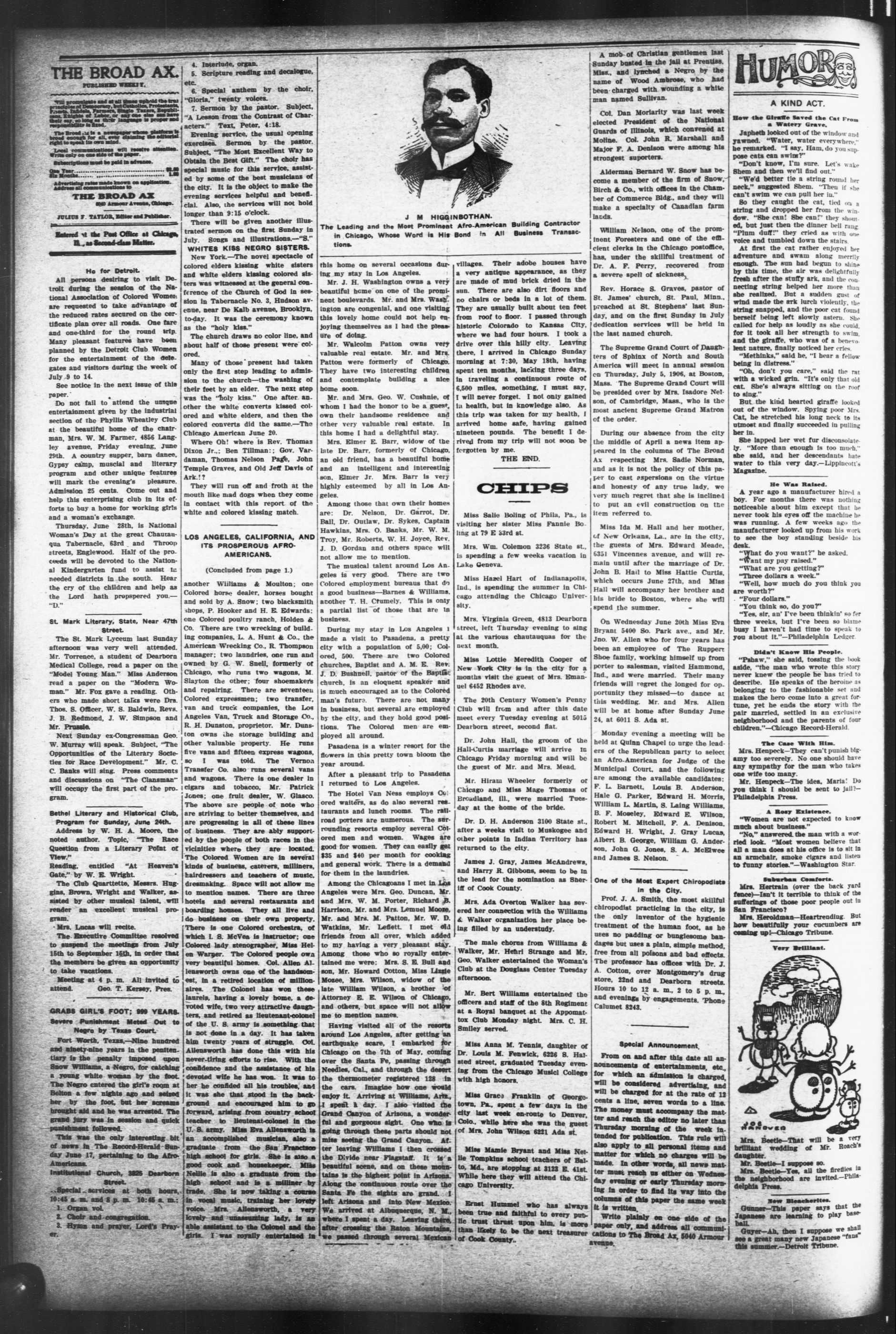
J. M. HIGGINBOTHAN.
this home on several occasions during my stay in Los Angeles. Mr. J. H. Washington owns a very beautiful home on one of the prominent boulevards. Mr. and Mrs. Washington are congenial, and one visiting this lovely home could not help enjoying themselves as I had the pleasure of doing. Mr. Walcolm Patton owns very valuable real estate. Mr. and Mrs. Patton were formerly of Chicago. They have two interesting children and contemplate building a nice home soon.
villages. Their adobe houses have a very antique appearance, as they are made of mud brick dried in the sun. There are also dirt floors and no chairs or beds in a lot of them. They are usually built about ten feet from roof to floor. I passed through historic Colorado to Kansas City where we had four hours. I took drive over this hilly city. Leaving there, I arrived in Chicago Sundays morning at 7:30, May 18th, having spent ten months, lacking three days in traveling a continuous route of 6,500 miles, something. I must say
Mr. and Mrs. Geo. W. Cushnie, of whom I had the honor to be a guest, own their handsome residence and other very valuable real estate. In this home I had a delightful stay. Mrs. Elmer E. Barr, widow of the late Dr. Barr, formerly of Chicago, an old friend, has a beautiful home and an intelligent and interesting son, Elmer Jr. Mrs. Barr is very highly esteemed by all in Los Angeles. Among those that own their homes are: Dr. Nelson, Dr. Garrot, Dr. Ball, Dr. Outlaw, Dr. Sykes, Captain Hawkins, Mrs. O. Banks, Mr. W. M. Troy, Mr. Roberts, W. H. Joyce, Rev. J. D. Gordon and others space will not allow me to mention.
The musical talent around Los Angeles is very good. There are two Colored employment bureaus that do a good business—Barnes & Williams, another T. H. Crumely. This is only a partial list of those that are in business.
During my stay in Los Angeles I made a visit to Pasadena, a pretty city with a population of 5,00; Colored, 500. There are two Colored churches, Baptist and A. M. E. Rev. J. D. Bushnell, pastor of the Baptist church, is an eloquent speaker and is much encouraged as to the Colored man's future. There are not many in business, but several are employed by the city, and they hold good positions. The Colored men are employed all around.
Pasadena is a winter resort for the flowers in this pretty town bloom the year around.
After a pleasant trip to Pasadena I returned to Los Angeles.
The Hotel Van Ness employs Colored waiters, as do also several restaurants and lunch rooms. The railroad porters are numerous. The surrounding resorts employ several Colored men and women. Wages are good for women. They can easily get $35 and $40 per month for cooking and general work. There is a demand for them in the laundries.
Among the Chicagoans I met in Los Angeles were Mrs. Geo. Duncan, Mr. and Mrs. W. M. Porter, Richard B. Harrison, Mr. and Mrs. Lemuel Moore, Mr. and Mrs. M. Patton, Mr. W. D. Watkins, Mr. Leffett. I met old friends from all over, which added to my having a very pleasant stay. Among those who so royally entertained me were: Mrs. S. E. Bull and son, Mr. Howard Cotton, Miss Lizzie Mozee, Mrs. Wilson, widow of the late William Wilson, a brother of Attorney E. E. Wilson of Chicago, and others, but space will not allow me to mention names.
Having visited all of the resorts around Los Angeles, after getting an earthquake scare, I embarked for Chicago on the 7th of May, coming over the Santa Fe, passing through Needles, Cal, and through the desert the thermometer registered 128 in the cars. Imagine how one would enjoy it. Arriving at Williams, Artoz, I spent a day. I also visited the Grand Canyon of Arizona, a wonderful and gorgeous sight. One who is going through these parts should not miss seeing the Grand Canyon. After leaving Williams I then crossed the Divide near Flagstaff. It is a beautiful scene, and on these mountains is the highest point in Arizona. Along the continuous route over the Santa Fe the sights are grand. I left Arizona and into New Mexico. We arrived at Albuquerque, N. M., where I spent a day. Leaving there, after crossing the Raton Mountains, we passed through several Mexico
NBOTHAN.
Afro-American Building Contractor
Bond in All Business Transac-
villages. Their adobe houses have a very antique appearance, as they are made of mud brick dried in the sun. There are also dirt floors and no chairs or beds in a lot of them. They are usually built about ten feet from roof to floor. I passed through historic Colorado to Kansas City, where we had four hours. I took a drive over this hilly city. Leaving there, I arrived in Chicago Sunday morning at 7:30, May 18th, having spent ten months, lacking three days, in traveling a continuous route of 6,500 miles, something, I must say, I will never forget. I not only gained in health, but in knowledge also. As this trip was taken for my health, I arrived home safe, having gained nineteen pounds. The benefit I derived from my trip will not soon be forgotten by me.
CHIPS
Miss Salie Boling of Phila, Pa., is visiting her sister Miss Fannie Boling at 79 E 33rd st.
Mrs. Wm. Colemon 3236 State st., is spending a few weeks vacation in Lake Geneva.
Miss Hazel Hart of Indianapolis, Ind., is spending the summer in Chicago attending the Chicago University.
Mrs. Virginia Green, 4813 Dearborn street, left Thursday evening to sing at the various chautauquas for the next month.
Miss Lottie Meredith Cooper of New York City is in the city for a months visit the guest of Mrs. Emanuel 6452 Rhodes ave.
The 20th Century Women's Penny Club will from and after this date meet every Tuesday evening at 5015 Dearborn street, second flat.
Dr. John Hall, the groom of the Hall-Curtis marriage will arrive in Chicago Friday morning and will be the guest of Mr. and Mrs. Mead.
Mr. Hiram Wheeler formerly of Chicago and Miss Mage Thomas of Broadland, Ill., were married Tuesday at the home of the bride.
Dr. D. H. Anderson 3100 State st., after a weeks visit to Muskogee and other points in Indian Territory has returned to the city.
James J. Gray, James McAndrews, and Harry R. Gibbons, seem to be in the lead for the nomination as Sheriff of Cook County.
Mrs. Ada Overton Walker has severed her connection with the Williams & Walker organization her place being filled by an understudy.
The male chorus from Williams & Walker, Mr. Hehrl Strange and Mr. Geo. Walker entertained the Woman's Club at the Douglass Center Tuesday afternoon.
Mr. Bert Williams entertained the officers and staff of the 8th Regiment at a Royal banquet at the Appomattox Club Monday night. Mrs. C. H. Smiley served.
Miss Anna M. Tennis, daughter of Dr. Louis M. Fenwick, 6226 S. Halsted street, graduated Tuesday evening from the Chicago Musicl College with high honors.
Miss Grace Franklin of Georgotown, Pa., spent a few days in the city last week en-route to Denver, Colo., while here she was the guest of Mrs. John Wilson 6221 Ada st.
Miss Mamie Bryant and Miss Nettle Tompkins teachers of Balto, Md., are stopping at 3123 E. 41st. While here they will attend the Chicago University.
Ernst Hummel who has always been true and faithful to every public trust thrust upon him, is more than likely to be the next treasurer of Cook County.
THE END.
一
A mob of Christian gentlemen last Sunday busted in the jail at Prentiss, Miss., and lynched a Negro by the name of Wood Ambrose, who had been charged with wounding a white man named Sullivan.
Col. Dan Morlarity was last week elected President of the National Guards of Illinois, which convened at Moline. Col. John R. Marshall and Major F. A. Denison were among his strongest supporters.
Alderman Bernard W. Snow has become a member of the firm of Snow, Birch & Co., with offices in the Chamber of Commerce Bldg., and they will make a specialty of Canadian farm lands.
William Nelson, one of the prominent Foresters and one of the efficient clerks in the Chicago postoffice, has, under the skillful treatment of Dr. A. F. Perry, recovered from a severe spell of sickness.
Rev. Horace S. Graves, pastor of St. James' church, St. Paul, Minn., preached at St. Stephens' last Sunday, and on the first Sunday in July dedication services will be held in the last named church.
The Supreme Grand Court of Daughters of Sphinx of North and South America will meet in annual session on Thursday, July 5, 1906, at Boston, Mass. The Supreme Grand Court will be presided over by Mrs. Isadore Nelson, of Cambridge, Mass., who is the most ancient Supreme Grand Matron of the order.
During our absence from the city the middle of April a news item appeared in the columns of The Broad Ax respecting Mrs. Sadle Norman, and as it is not the policy of this paper to cast aspersions on the virtue and honesty of any true lady, we very much regret that she is inclined to put an evil construction on the item referred to.
Miss Ida M. Hall and her mother, of New Orleans, La., are in the city, the guests of Mrs. Edward Meade, 6351 Vincennes avenue, and will remain until after the marriage of Dr. John B. Hail to Miss Hattie Curtis, which occurs June 27th, and Miss Hall will accompany her brother and his bride to Boston, where she will spend the summer.
On Wednesday June 20th Miss Eva Bryant 5400 So. Park ave., and Mr. Jno. W. Allen who for four years has been an employee of The Ruppere Shoe family, working himself up from porter to salesman, visited Hammond, Ind., and were married. Their many friends will regret the longed for opportunity they missed—to dance at this wedding. Mr. and Mrs. Allen will be at home after Sunday June 24, at 6011 S. Ada st.
Monday evening a meeting will be held at Quinn Chapel to urge the leaders of the Republican party to select an Afro-American for Judge of the Municipal Court, and the following are among the available candidates: F. L. Barnett, Louis B. Anderson, Hale G. Parker, Edward H. Morris, William L. Martin, S. Laing Williams, B. F. Moseley, Edward E. Wilson, Robert M. Mitchell, F. A. Denison, Edward H. Wright, J. Gray Lucas, Albert B. George, William G. Anderson, John G. Jones, S. A. McElwee and James S. Nelson.
One of the Most Expert Chiropodists in the City.
Prof. J. A. Smith, the most skillful chiropodist practicing in the city, is the only inventor of the hygienic treatment of the human foot, as he uses no padding or bunglesome bandages but uses a plain, simple method, free from all poisons and bad effects. The professor has offices with Dr. J. A. Cotton, over Montgomery's drug store, 22nd and Dearborn streets. Hours 10 to 12 a. m., 2 to 5 p. m., and evenings by engagements. Phone Calumet 8242.
Special Announcement
From on and after this date all announcements of entertainments, etc., for which an admission is charged, will be considered advertising, and will be charged for at the rate of 12 cents a line, seven words to a line. The money must accompany the matter and reach the editor no later than Thursday morning of the week intended for publication. This rule will also apply to all personal items and matter for which no charges will be made. In other words, all news matter must reach us either on Wednesday evening or early Thursday morning in order to find its way into the columns of this paper the same week it is written.
Write plainly on one side of the paper only, and address all communications to The Broad Ax, 5040 Armour
HUMOR
A KIND ACT.
How the Giraffe Saved the Cat From a Watery Grave.
Japheth looked out of the window and yawned. "Water, water everywhere," he remarked. "I say, Ham, do you suppose cats can swim?"
"Don't know, I'm sure. Let's wake Shem and then we'll find out."
"We'd better tie a string round her neck," suggested Shem. "Then if she can't swim we can pull her in."
So they caught the cat, tied on a string and dropped her from the window. "She can! She can!" they shouted, but just then the dinner bell rang "Plum duff!" they cried as with one voice and tumbled down the stairs.
At first the cat rather enjoyed her adventure and swam along merrily enough. The sun had begun to shine by this time, the air was delightfully fresh after the stuffy ark, and the connecting string helped her more than she realized. But a sudden gust of wind made the ark lurch violently, the string snapped, and the poor cat found herself being left slowly astern. She called for help as loudly as she could, for it took all her strength to swim, and the giraffe, who was of a benevolent nature, finally noticed her cries. "Methinks," said he, "I hear a fellow being in distress."
"Oh, don't you care," said the rat with a wicked grin. "It's only that old cat. She's always sitting on the roof to sing."
But the kind hearted giraffe looked out of the window. Spying poor Mrs. Cat, he stretched his long neck to its utmost and finally succeeded in pulling her in.
She lapped her wet fur disconsolately. "More than enough is too much," she said, and her descendants hate water to this very day.-Lippincott's Magazine.
He Was Raised.
A year ago a manufacturer hired a boy. For months there was nothing noticeable about him except that he never took his eyes off the machine he was running. A few weeks ago the manufacturer looked up from his work to see the boy standing beside his desk.
"What do you want?" he asked.
"Want my pay raised."
"What are you getting?"
"Three dollars a week."
"Well, how much do you think you are worth?"
"Four dollars."
"You think so, do you?"
"Yes, sir, an I've been thinkin' so for three weeks, but I've been so blame busy I haven't had time to speak to you about it."—Philadelphia Ledger.
Didn't Know His People.
"Pahaw," she said, tossing the book aside, "the man who wrote this story never knew the people he has tried to describe. He speaks of the heroine as belonging to the fashionable set and makes the hero come into a great fortune, yet he ends the story with the pair married, settled in an exclusive neighborhood and the parents of four children."-Chicago Record-Herald.
The Care With Him
Mrs. Henpeck—They can't punish big-amy too severely. No one should have any sympathy for the man who takes one wife too many.
Mr. Henpeck—The idea, Marla! Do you think I should be sent to jail—Philadelphia Press.
A Boss Existence
"Women are not expected to know much about business." "No," answered the man with a worried look. "Most women believe that all a man does at his office is to sit in an armchair, smoke cigars and listen to funny stories."—Washington Star.
Suburban Comforts
Mrs. Hertrain (over the back yard fence)—Isn't it terrible to think of the sufferings of those poor people out in San Francisco?
Mrs. Heroldman—Hearttrending. But how beautifully your cucumbers are coming up—Chicago Tribune.
Very Brilliant.
JOE HANDVER
Mrs. Beetle-That will be a very brilliant wedding of Mr. Roach's daughter.
Mr. Beetle-I suppose so.
Mrs. Beetle-Yes, all the fireflies in the neighborhood are invited.-Philadelphia Press.
New Bleacherites.
Gunner-This paper says that the Japanese are learning to play baseball.
Guyer-Ah, then I suppose we shall see a great many new Japanese "fans" this summer-Detroit Tribune.
SELECTIONS
Sensible Suggestions to Follow During the Coming Summer.
When the hot summer days are upon us and it is impossible to change our environment the best help toward keeping cool is to learn to adapt ourselves to it. But with all of us habit is so strong that few of us think of adaptation, and as a consequence we suffer from a way of living which is suited only to the cold winter months.
The cultivation of peace of mind is the first requisite. A cool bath taken on rising is the best tonic to prepare one for the day's labor and exposure. A tepid, cool bath or a short hot bath may be taken in the evening, and if greatly fatigued it is one of the most effective means of bringing refreshing sleep. Another necessity to keeping cool is not only in the exercise of body, but in the matter of diet as well. All bodily heat arises from the oxidation or burning of the food we eat. So when the temperature rises the body needs less fuel. A warm weather breakfast should be a very light meal. As four-fifths of our food is used for fuel it is easily seen that in summer we need only a small quantity to supply vitality for bodily and mental work. The ideal breakfast would be whole wheat bread or zwleback, with some wholesome ripe fruit, such as strawberries, plums, melons or apples.
By giving ourselves the benefit of our store of common sense many of us would go forth to the trials of a day in the heat prepared for it by a diet conducive to health. How many a man prepares for such a day with a breakfast made up of griddlecakes, soda biscuit, fried eggs and bacon, sauages, worcestershire sauce and strong coffee? By noon he feels the heat to such an extent that he feels compelled to drink large quantities of ice water, beer or other cooling beverages. Contrast the discomforts of such a one in the temperate zone with a cooly working bareheaded in the direct rays of the sun in a climate 20 degrees hotter. The cooly is not uncomfortable because he has adapted his diet to his environment. Any man who excites his heart and irritates his nerves by a diet of flesh foods must expect to need all sorts of artificial means to make his life bearable in the hot weather.—New York Herald.
Saving Niagara.
The question as to whether Niagara should be used solely as a source of mechanical power or be preserved as a beautiful and wonderful natural feature has come up in our day for permanent decision. There are some minds that have decided for themselves in favor of the former proposition, but they seem fortunately to be in a minority both in Canada and in the United States. Niagara is to be preserved both in what have been called its "little loveliness" and in its grandeurs. America is "practical." It has allowed its forests to be dangerously diminished, it has allowed Niagara to be seriously threatened, but American sentiment when once aroused is irresistible, and American sentiment has declared in favor of Niagara as Niagara—Century.
Collecting Fares In Montreal.
The manner of collecting the fare on street cars in Montreal is decidedly unique. Under no circumstances can the conductor touch the fare, which must be deposited by the passenger in a fare box, which is presented as the passenger enters the door of the car. The conductor will make change or sell tickets, but the passenger deposits the fare, whichever it may be, in the box. The coin or ticket does not fall until the conductor presses a button. This gives opportunity to see if the amount is correct and the coin genuine. When once the coin drops it cannot be removed except in the company's office. After the cashiers count the day's receipts the count is checked by weighing the different coins and also the tickets.
A Viper and a Bottle
Canon Tristam, the distinguished English ornithologist, who died recently, kept among his treasures an ordinary soda water bottle that once served him in good stead, according to the Buffalo Commercial. Once on his travels he seized upon what he thought was a lizard in the sand, but which proved to be a deadly horned viper. His Greek boatman, scared almost to death, offered no assistance. Suddenly spying an empty soda water bottle, the canon, with great presence of mind, forced the head of the reptile down the neck and slowly uncoiled the remainder of its anatomy from his hand.
Years ago Bernard Shaw furnished a biographical sketch of himself to an English newspaper. It is said to be still correct except as to his bachelorhood, and it runs thus: "I am a bachelor, an Irishman, a vegetarian, an atheist, a teetotaler, a fanatic, a humorist, a fluent liar, a social democrat, a lecturer and debater, a lover of music, a fierce opponent of the present status of women and an insister on the serious in art."
As In Her Dream
Says a recent news item in an English newspaper: "A Mrs. Howling of Penge dreamed that she saw her little girl washed up on Hastings beach and the body taken away on a tarpaulin. Two days later the child was knocked down by a pantechnicon and its wheels passed over her. Bystanders brought a tarpaulin, upon which the child was taken to the Beckenham cottage hospital."
And, lo, the droway whippoorwill
Doth murmur to his droway mate.
While I am e-c-catching quite a ch-ch-
chill.
My f-f-faithful heart for thee doth b-b-beat.
For ne'er hath it affection lacked.
I fain would sing to thee, my sweet,
But, oh, my d-d-doggoned voice is
c-c-c-cracked!
C-c-come to me, l-l-love. My k-k-qul-
lime's gone,
But still my heart is t-t-t-true to you.
My overcome is yet in p-p-pawn,
But love is e'e'en sa— Achew!
Sweet C-Cupid stands b-beside me here,
B-b-but, oh, he ought to g-g-get some
clothes!
Then hasten with a b-b-blanket, d-d-d-
dear,
Or, dren it all, I will b-b-be f-f-frosel-
—San Francisco Call
"I'd have you know I always weigh my words."
"Yes, you're right, and you don't forget to give good measure."
He Kent the Nutton.
A colonel in one of the Pennsylvania regiments during the war was particularly opposed to the soldiers foraging and stealing supplies. But the boys would forage in spite of everything, trusting to luck to run the blockade and safely reach their tent with the captured prize.
A jolly young soldier was caught one night sneaking into camp with a juicy blind quarter of mutton impaled on his bayonet. "Where did you get that meat?" demanded the colonel sternly.
"Killed it in self defense," was the unblushing reply.
"In self defense, eh?"
"Yes, sir. You see, colonel, the critter flew at me out here in the woods a ways, an' I wasn't golin' to let no wild animal get the best of me while I was fully armed an' able to defend myself, so I—
"That'll do; you're excusable this time, young man," said the colonel relaxing into a smile, "and, by the way, I've got a little errand for you."
"Yes, sir," answered the culprit saluting.
"When you have turned that game over to your messmates you can go and get the other hind quarter and bring it to my tent." - New York Times.
A Warning
The poet awakened with a shuddering scream.
"What is it?" cried his wife. "What is it?
"A terrible dream," he said. "I spent an hour last evening writing a poem about the glory of the good old times, and I dreamed just now that by some magical influence I had been set back some eighty years. No telephone, no telegraph, no gas, no electric light, no plumbing in the house—no modern convenience whatever!"
"But that needn't have frightened you," said his wife soothingly.
"That wasn't the worst of it. There were no magazines to which to sell poems about the good old times."—Judge.
Daily Planting.
"I understand," said the tourist on top of the coach, "that this settlement raises more horse thieves than any community in the west."
"We ought to raise a few of them," replied Amber Pete as he touched his gun. "We certainly plant enough of them, pard."-Chicago News.
One Remedy.
"Gracious!" exclaimed Miss Passy,
"I know I must look a perfect fright.
I can't do anything with my hair at all."
"No?" said Miss Pepprey. "Surely
you can take it back and get it ex-
changed, can't you?" — Philadelphia
Ledger.
Painful Points Too.
"You're a queer looking thing to
want to fight with me," said the young
building contemptuously. "You're not
in my class."
"Perhaps not," replied the porcupine
quietly, "but I think I can give you a
few points."—Brooklyn Life.
What She Noticed.
"They haven't a picture that is worth
while," he said, "and their library
shives are practically bare."
"That may be so," she replied, "but you ought to see the beautiful diamonds the ladies of the family have." —Chicago Record-Herald.
Cause For Action.
Brown—Newpop is suing his wife for divorce.
"That man is so honest he wouldn't stal a pin," said the admiring friend. "I never thought much of the pin text." answered Miss Cayenne. "Try him with an umbrella."—Washington Star.
OUR NATIONAL TREASURY
Curious Facts About the People's
Fiscal Agency.
The treasury department is the most important branch of the government next to the state department. It is the fiscal agency of the people. At its head is the secretary of the treasury, who, for a salary of $22 a day, is responsible for the collecting and disbursement of $1,500,000 every day in the year and for the custody all the time of more than $1,000,000,000 in cash and bonds. The various secretaries of the last forty years have handled altogether the incomprehensible sum of $45,000,000. What is more, during all that time less than $250,000 was lost in the treasury department.
During any one week of the present year the treasury officials expended more than was required to maintain the entire public service for the whole year 1805. The money collected by the treasury last year, in round figures, was $540,000,000. The total amount expended in the same twelfement was $582,000,000. We spent thus $42,000,000 more than we took in, but full $40,000,000 of the excess of expenditure over revenue is accounted for in the single check given in payment for the Panama canal property.
The biggest bill collected by the treasury was $261,000,000 for customs, the second largest bill collected was for $232,000,000 for internal revenue, then $9,000,000 was taken in for the sale of public lands and $77,000,000 for various small matters. The largest bill paid in the same time was $142,000,000 for pensions, then $115,000,000 for our army and $102,000,000 for our navy. To Indians there was paid a little matter of $10,000,000 and for the interest on the public debt $24,000,000. Finally, the treasury expended $186,000,000 for mere miscellaneous "items." If we count all the dollars paid out by the treasury since Mr. Roosevelt entered the White House we find that the sum is equal to the sum of all the money in the country at the present time, or about $2,000,000,000—Gilson Willets in Leslie's Weekly.
Objects to Slipshod English
The well of Judge Bacon's court at Whitechapel is to be a well of English undefiled. During a recent discussion with counsel on the absence of one of the parties to an action on a previous occasion this dialogue took place:
Judge Bacon—The defendant was not present?
Counsel—No, your honor, he did not turn up.
Judge Bacon—What! "Turn up!"
Pray do not use such slipshod expressions!
Counsel—I apologize, your honor. I should have said the defendant failed to enter an appearance at your court. These are high pressure days, and since your honor was at the bar we have no longer time to indulge in perfect English.
Judge Bacon—Oh!—London News.
North River Nautical Terms.
Dwight Elmendorf, the famous traveler, told recently of some nautical terms that he overheard on the North river, New York. That they are a new brand and that their use is restricted to that class of seagling liners known as "Jersey ferry boats" cannot be doubted. "About two weeks ago," said Mr. Elmendorf. "I went over from Jersey City. The tide was running rather strong in the river and our pilot missed his mark at Twenty-third street. In some way our boat got wedged almost at right angles in the ferry slip. Of a sudden we heard the sonorous voice of the pilot as he bellowed to the roustabouts on the dock to 'Heave a line.' Aye, aye, sir' came back from the dock, followed by the query, 'Which side der yer want de line on, de uptown or downtown side?"
Petrified Schoolhouse.
New England, N. D., possesses what is probably the most remarkable schoolhouse in the country. The structure is twenty-four feet square, one story in height and built entirely of petrified wood except the roof, which is shingled. The wood of the ancient forests which covered the prairies of Hettinger county has become agitated, and in the absence of other building material the people of this place determined to erect their primitive educational institution of this beautiful petrification. Great care has been exercised in the construction of the schoolhouse, so that the material shows off to the best advantage, and when the sun shines the building glistens like crystal.
A Dog and a Telephone.
An up to date dog is one that answers the telephone. The senior partner of an influential London firm has taught his dog not only to guard the office during his absence, but also to report "All's well" during the time the premises are closed at week enda. One of the old fashioned telephone, which does not require that the receiver should be taken off its holder, is fixed up in the office, and under this the dog stands. His master rings up the office and then calls until the attention of the dog is aroused, when the canine caretaker kicks loudly to show that all is well with him and with the office.
Cork in its natural state is considered the most perfect nonconductor of heat and cold. A composition board consisting of cork and some adhesive materials to hold it together and render the product damp proof is now made. These boards come in sizes a foot wide, three feet long and from an inch to four inches thick. They can be easily sawed to fit—in fact, can be worked up like ordinary lumber. The cork board is used in insulating all kinds of cold storage rooms, pipes, etc., and in houses, especially those constructed of cement.
FACTS IN FEW LINES
No bird of prey has the gift of song.
The smallest quadruped in the world is the pygmy mouse of Siberia.
It is now proposed to make suits of clothes of paper, which can be thrown away when solled.
It is thought that the game of whist was first played in the time of King Henry VIII of England.
Edinburgh has adopted a scheme for collecting for charity through a central office on lines of the Liverpool system.
Brazil's chamber of commerce has offered a prize of $2,000,000 to the physician who shall discover a permanent cure for cancer.
From Paris comes the news that the best people are taking snuff again and giving it. A medical paper bolsters up the fad by saying that a few pinches a day will guard against influenza.
It is the custom in Brittany to dig up the bones of the dead after a certain time and preserve the skull only in a small box with a heart shaped opening in its front. Each box is marked with the name and date of the dead.
The will of a Natick (Masa.) man who died recently provides a large sum of money, the interest of which is to be expended every year in buying electric car rides for school children between the ages of six and ten years.
Ladies seeldom rise in Spain to receive a male visitor, and they rarely accompany him to the door. For a Spaniard to give a lady, even his wife, his arm when out walking is looked upon as a decided violation of propriety.
One of the results of the last German census was the discovery that the village of Boerbusch, in the district of Burgdorf, in Hanover, has only four inhabitants, two males and two females, and is therefore the smallest municipality in the world.
A good many men judge the quality of cigars by the little yellow specks on the wrappers. A dealer declared that these spots are due to drops of dew acting as burning glasses and making small spots on the tobacco leaves. It is not a test of quality at all.
There are no white soldiers or police in British New Guinea, where the natives number 300,000. The government consists of a British administrator, an executive council and the magistrates stationed at centers near the coast. There are 500 nonofficial white residents.
Some of the large paper machines of the country supply a stream of paper at the rate of a mile in ten minutes. Great difficulty is experienced when this sheet of paper breaks, for the broken shreds come so fast that the room is filled before the machine can be stopped.
At the Austrian court perishable articles never appear twice on the imperial table. Thus there are large perquisites for the various attendants. To one man fall all the uncorked bottles, to another the wine left in the glasses, to another joints and to another the game or the sweets.
In an endeavor to foster home industry the Canadian government has established a number of bounties to be paid to manufacturers and miners who last year aggregated $1,900,000 on iron and steel products, $334,000 on lead, $333,000 on crude petroleum and $18,000 on manila fiber.
Among the most precious-books in the library of congress is a copy of "A Revised System of Cavalry Tactics For the Use of the Cavalry and Mounted Infantry, C. S. A.," by Major General Joseph Wheeler, C. S. A. The book was published in Mobile, Ala., in 1863. The book was picked up at an auction sale for 65 cents.
Sir Robert Ball, who has been making careful study of the glacial period, announces that the next great frigid epoch in the northern hemisphere will come about 200,000 years from now and cover all northern Europe and the northern part of North America with ice thick enough to overtop the highest mountains and fill the deepest valleys.
Dr. Daniel Bella, a New York minister, has compromised his claim against the New York Central railroad for the fracture of twenty bones in a viaduct collision last fall. Figuring on the basis of $1,000 a bone, the company has agreed to pay him $20,000 for his injuries. This is considered to be quite a step in advance in regard to the basis for personal injury claims. Locked up in a bank vault at Redding, Cal., is the flag which Fremont unfurled on the summit of the Rockies in 1841. The banner was made with Mrs. Fremont's own hands previous to her husband's start on his exploring tour in the far west. The flag differs from the standard United States flag in field only, where a large American eagle, surrounded by twenty-six stars, is skillfully wrought in hand embroidery.
Judge J. T. Fleming of Oklahoma is one of the unique characters of that territory. He served for several years in the Confederate army and voted the first time in his life for Grant and the last time for Harrison. He is proud of his record as a Confederate soldier, but at the same time he believes that every Union soldier should be paid a pension of $50 a month, for the reason that they saved the greatest union of states on earth.
Recent discoveries indicate that moths do not fly about candles out of more curiosity, but simply because there is an irresistible power compelling them to flutter to the flame. This force is called hellotropism and is exactly the same attraction that makes flowers turn toward the sun. The blind earthworm, because of its well known tendency to crawl away from the light, is said to have negative hellotropism. The stronger the source of light the greater is the attraction or repulsion.
President and Treasurer, THOMAS CAREY.
Vice-President, JOHN SHELHAMER,
Secretary, WILLIAM SULLIVAN.
Common and Sewer Brick Office and Yards:
Yards running winter and summer, equipped with the latest improved Wolf Dryer.
AGENTS AND CORRESPONDENTS WANTED.
The Broad Ax desires to engage Agents and regular Correspondents in all the leading cities and towns throughout the country. The highest commissions paid to live hustlers. Sample copies furnished free. For further information, address Julius F. Taylor, 561) Armour avenue, Chicago
THE BROAD AX.
Is for sale at the following news stands:
The Afro-American News Office
004 State Street.
O. S. Smith News stand, and Barber Shop 3700 Dearborn st.
A. F. Tervalon, 134 W. 51st street Cigar Store and News Stand.
Mrs. Nellie Phelps, Cigars. Notions and News Stand, 131 W. 51st street.
Richard Pinn, 4836 State street.
T. R. Hall's Cigar Store and Laundry office, 281 29th St.
W. S. Cole, 354 Thirty-first street, cigars, tobacco and news stand.
W. S. Williams, Tonsorial Parlor, 399 21st st.
J. R. Peters Cigars, Tobacco and News Stand, 338 E. 27th street.
Mrs. A. E. Baker, Notions and News Stand, 419, 36th street.
Mrs. Kathyine Hamlet, 5028 Armour Ave., cigars, tobacco, fancy groceries and news stand.
W. P. Johnson, Notion Store and News Stand 3704 State st.
Turner Williams' Shaving Parlor and News Stand, 2903 Armour ave.
Thompson Bros., Cigars, Tobacco and News Stand, 2636½ State street.
R. Davia, cigars, tobacco, and confectionery, 8532 State st.
Whitley Bros. 2724 State St., Gent's furnishings and new stand.
The Stationery, 2970 State street. Cigars, Tobacco and News stand.
The Afro-American News Co., 439 W. 35th St., New York City, N. Y.
The Informer News Co., 188 Randolph St., Detroit, Mich.
News items and advertisements left at these places will find their way into the columns of The Broad Ax
Hall's Laundry
Phone, Douglas 1235
CHICAGO
PHONES {Office, Main 1157
Res. Brown 42
STEPHEN A. DOUGLAS
LAWYER
Room 813, 115 Dearborn Street.
CHICAGO
McCALL PATTERN
10
15
MINE WORLD
McCALL MORGAN
50
YEAR
BILLION AYING BILLION
There are now McCall Patterns sold to the Public Punish that of any other make of pattern. This is on account of the loss of the original McCall Pattern.
McCall Pd Mounting (The Queen of Punish) has been subservient to any other Lady Magazine. So their interest in its presentation is paramount. Any member gets a McCall pattern Prize. Send the today.
Lady Agents Wanted. Hardware products go
through the warehouse. Warehouse Cashholders (of the
dealer) and President Custodian (showing no prescind-
ent and Stock. ADMIN THE McCALL CO., New York
- American
President and Treasurer, TE
Vice-President, J
Secreta
Established 1877. Phone Gustavus 1330-1335
John J. Dunn
COAL
WOOD
Wholesale
and Retail
Dealer in..
Fifty-First St. and Armour Ave.
RAIL YARDS: 518 St. & I. B. & M. S. Bg.
518 St. and Armour Ave.
CHICAGO
J. H. COLEMAN & CO.
Express & Van Moving
TRUNKS EVERYWHERE.
2540 State Street
Tel. 699 South
CHICAGO
F. A. Rawlins
The Modern Embalmer
UNDERTAKER AND
FUNERAL DIRECTOR
When his work is finished
you have no displeasure.
4834 State St., CHICAGO
Phone Douglas 1850
ICE-CREAM CIGARS, TOBACCO
SHIRT WAISTS KIMONAS
MRS. A E. BAKER
NOTIONS
419-36TH STREET
Underwear a
Specialty CHICAGO
J. GARNER Tel. Douglas 3256
THE ELITE BUFFET
FINE WINES, LIQUORS
AND CIGARS
3030 State Street CHICAGO
Randel Woodfolk
SAMPLE ROOM
CHOICE WINES, LIQUORS AND CIGARS—POOL TABLE,
HOT LUNCH SERVED EACH DAY.
4920 STATE ST., CHICAGO.
Telephone Oakland 964.
COOK
WAITERS AND COOKS
Prefer Our Make
JACKETS AND LINEN
because they have found by
experience that they are the
most satisfactory and economical goods on the market.
Our Complete Catalogue—a correct guide to proper dress in the Dining Room, Kitchen, or Bar will be sent free on application.
BREVITIES
THE HALL OF FAME.
George Cabot Lodge, Egyptologist, poet and student, is his father's private secretary in the United States senate.
The present chief of police of San Francisco, Jeremiah Dinan, was born in Boston and went to San Francisco in 1870.
Sergeant Horatio J. Homer is the only colored man in the Boston police department, where he has been since 1878. He is proficient on eleven different musical instruments.
Chaplain Rev. Francis Doherty of the Seventeenth United States infantry, stationed at Fort McPherson, edits a little paper called the Haversack, which is widely read among soldiers and is frequently copied.
Major General Frederick Dent Grant, commander of the eastern division of the United States army, has asked the international committee of the Young Men's Christian association to place its branches in every post under his command.
Sheriff William P. Hays of Hamilton county, Tenn., says he has more sons without having other kind of children than any man in the country. Nine lusty youngsters are in this interesting family, and their ages range from six months to eighteen years.
Few presiding officers of the senate have been as popular as Vice President Fairbanks with the officials of the senate. He has co-operated with them so as to expedite the business of the senate, and that is an important matter to the clerks, who desire to have the business closed up every day.
William C. Brown, first vice president of the New York Central lines, with a salary of $75,000, the best paid vice president of a railroad in the United States, was in the early seventies a telegraph operator and messenger boy in Sioux City, Ia., receiving messages and delivering them himself,
David C. St. Charles, an engineer of San Francisco, has invented a repeater which will make it possible to telephone clear across the continent. What the so called "repeater" has done for telegraphy St. Charles' invention, it is now claimed, has done for the telephone. The combining of the echo in nature with the sounding board of a violin furnished the clew to the discovery.
FLY CATCHES
Richard Croker is furnishing the money to launch a baseball league in Dublin.
Although the season has just started some fans are inquiring about double headers.
Donovan's Brooklyn team is weak, and the weakest spots are first base and shortstop.
Bill Donovan advises young pitchers to avoid using the split ball and stick to the out curve.
Napoleon Lajole's health is such that he is said to be in no danger of breaking down this year.
Baltimore is pleased with the general appearance of Pitcher Starkell, secured from Washington.
The St. Louis Americans have sent Pitcher Buchanan to their St. Paul farm for more experience.
Brooklyn may give up the drop in the box system Sunday games. Mutilated coin and buttons come too fast.
James Potter, former president and now director of the Philadelphia Nationals, is convalescing from an attack of blood poisoning.
EDITORIAL FLINGS
That Russian official who caught a bomb thrown at him would make a valuable man for the czar to have behind the bat.—Baltimore Sun.
Jerome K. Jerome says, "You can't be funny all the time." It requires considerable effort for an Englishman to be funny any of the time.—Baltimore Sun.
Professor Moore has no reason to brag of predicting the weather for a month ahead. Some of the almanacs predict it for the whole year.—New York American.
Rhode Island is planning a connected landscape gardening system that will take in three-fourths of the dwellings in the state. What a cute miniature park Little Rhody will make.—St. Louis Globe-Democrat.
Some ingenious person has discovered that the word "separator," by making a few changes in the order of the letters composing it, becomes treason." But it also makes "a nestor." And there you are.-Chicago Tribune.
FACTS FROM FRANCE
French farmers are glad to get $1.83 for 100 liters (about twenty-six gallons) of common red wine.
A Frenchman cannot be a deputy until he is twenty-five years of age, while no Italian can legislate for his country before the age of thirty.
Jean d'Oresay, discussing in the Paris Matin a proposition that swimming should be taught to Parisian school children, quotes a statistical return showing that the average number of baths taken a year by each person in France is four.
With the exception of the larger towns the precautions against fire in France are remarkably inadequate. Many towns of from 500 to 3,000 people have no water supply other than ordinary wells, operated generally by bucket draws instead of pumps, and no fire apparatus except occasionally a hand force pump.
PLAYS AND PLAYERS.
Sam Bernard has decided to remain with Charles Frohman next season.
Mrs. James Brown Potter has been engaged for an American tour of twelve weeks.
Lew Fields has secured control of the Herald Square theater, New York, and will turn it into a music hall by next September.
A new corporation started in New York, with the idea of encouraging native born plays is called the Playlovers' association.
Charles Dalton is to play the role of Ahaseurus in P. J. Kennedy's production of "Mizpah," which is to open early in September in Chicago.
Haddon Chambers, the English playwright, is paying a visit to this side for the purpose of arranging for the production of his "Sir Anthony."
It is now said that Ada Rehan will hold consultation while in Europe with A. W. Pinero with a view to having that dramatist write her a play.
The production of the new play which J. M. Barrie is writing for Maude Adams is to be postponed two years, during which she will continue in "Peter Pan."
SHORT STORIES.
There are now 303 schools in Canada for Indians, who number 107,637.
It is stated that the conscience fund in the United States treasury department has reached a total of $300,000.
For a finger nail to reach its full length, an average of seven-twelfths of an inch, from 121 to 138 days of growth are necessary.
China is said to have more sulcides than any other country in the world. In one year 500,000 cases were reported, although these figures may not be regarded as authentic.
An experiment was made some time ago by a woman who, in order to test the sustaining powers of chocolate, lived upon it for sixty days and lost but fifteen pounds in weight in the interval.
Some enthusiastic person has recently figured it out that American women have within a few years captured twenty-three titled Englishmen, twenty-three titled Germans, fourteen titled Frenchmen, seventeen titled Italians and six titled Russians.
GERMAN GLEANINGS.
The German empire is composed of twenty-five states and the reichsland of Alsace-Lorraine. Prussia is the largest of the states.
The town council of Berlin now issues licenses for cats, and each cat is by law compelled to wear a metal badge with a number.
The collections made by the girl pupils in the secondary schools in Germany as a gift to the German navy have reached a total of 30,000 marks.
A leading characteristic of the people of Germany, according to one of their own authors, is delibereate slowness, and they view with suspicion the stranger who displays haste in his actions.
In Germany during the five years 1900-04 each inhabitant consumed yearly $6\%$ quarts of wine, $129\%$ quarts of beer and 9 quarts of brandy. The per capita cost was $11.20$, including children and women. The average for male citizens over fifteen years would be $87.86$.
ENGLISH ETCHINGS.
Attentive is the name of Britain's latest twenty-five knot scout ship. In Reddington, England, hot oatmeal mush is delivered with the milk each morning to those who desire it. So many of London's motor buses break down that a service of "tugs" has been organized for the towing home of derelicts. Members of the new house of commons have started a prayer meeting. It is held on Tuesday afternoons in one of the committee rooms. A new party has been formed in the house of commons, but its object is not political. What it hopes to effect is a reduction in the parliamentary barber shop of the price of shaving from 24 cents to 12 cents.
MODES OF THE MOMENT.
Scalloped linen ruching is a novelty. Steel beaded purses are the thing for the gray gown. Paquin green is a dark, heavy looking leaf green, almost the color of ivy. Velvet ribbons of all colors and widths are to be a great deal used this summer. A pretty feature of muslin gowns is the prevalence of little linen jackets to wear with them. Mohair in its soft, improved quality and lovely colorings is one of the best possible choices for a princess dress. A charming little bolero may be made of wide pompadour ribbon, one width forming the jacket fronts and another width the ruffled sleeve tops, the whole edged with fluffy ruche.
POINTED PARAGRAPHS
Have a good time, but don't make it your business.
Idlers spend their time going nowhere and coming back.
He who burns his money never enlightens the world.
Feeling sorry for a friend in hard luck is the average man's limit.
Don't expect any man to thank you for trying to induce him to do what he doesn't want to do.
Trace your bad luck back a few blocks and the chances are that you will discover it is due to your bad management—Chicago News.
CHOICE MISCELLANY
Origin of "twenty-three."
I suppose you have heard or read more or less of the mystic meaning of the word "thirty" as used by telegraphers and press correspondents. When placed at the end of a dispatch it means that the day's or night's work is ended. There is nothing more to come. I did not know until recently that race track men also have a mystic word—"twenty-three." If you and a race track man both reach at the same time for the same thing and he gets it—which would be natural—he will almost certainly say, "Twenty-three for you."
"Why twenty-three?" I asked a track follower. "What is the meaning and what is the origin of the mystic number?"
"Well, in the old days at Brighton Beach," he said, "not more than twenty-two horses were permitted to run in any race. They were taken in the order in which they were entered. If twenty-two ponies lined up for a race the twenty-third entry was barred. He was out of it; hence the expression when your friend gets left, Twenty-three for him! for he is out of it." Oh, the race track people are great mathematicians. Maybe they can neither read nor write, but they have great heads for figures.—San Francisco News Letter.
What the Navy Needs.
The tone of the naval personnel depends almost entirely on the higher officers, those of command and flag rank. The ideals which they hold up to the younger officers are the ones that are eagerly followed. In the decade following the civil war, when Admiral Porter was supreme, this ideal was the bold sailor who carried canvas till it blew away. As Commodore Foxhall Parker said a little later, "Not to talk rope was not to be a seaman, in the opinion of most officers." As a result the midshipmen "talked and thought rope" continually and exerted every effort to become fine seamen.
One would expect that if no officer with actual engineering training is available the one detailed would at least be a man of considerable experience and chosen from near the top of the list of those on board. In many cases the exact reverse is true, and the nominal chief engineer is one of the juniors with scarcely any experience of any kind. The unfortunate lad who was in charge of the Bennington's machinery was next to the lowest commissioned officer.-W. M. McFarland in Engineering Magazine.
Prehistoric Tracks.
Of more than unusual interest are the old prehistoric "bird tracks" of the Connecticut valley to either active sportsmen or students of natural history, signs of what is called the triassic period, says J. E. McLwain in Recreation. Just outside the city of Holyoke, Mass., between the old road and the new state road to Northampton, there is a patch about 50 by 100 feet which has been cleared of all surface earth by parties interested in geology and which is now protected by the state. This patch is completely covered with well defined tracks and most of which will measure twelve to fourteen inches in the longest parts and eight to ten inches wide, while in depth they are from one to two and one-half inches.
Bugs, Modern and Antique.
Rugs, Modern and Antique.
Because many antiques are admirable is no reason for denying the merit of modern rugs. There are more rugs of high quality being woven today than ever before, and this is due principally to the fact that there is a better market for them than ever before. The United States alone imports $4,000,000 worth a year, about two and a half millions before the duty is paid. No wonder that the shah of Persia nurses the rug weaving industry tenderly, bestowing orders and honorable rewards on successful rug merchants and inflicting the most severe penalties for the use of aniline dyes or anything calculated to bring Persian rug into disrepute.—Country Life In America.
Rainfall and Tree Growth
A report has recently been published which shows how closely the growth of trees is dependent upon rainfall. Not only was this seen in the case of one and two year old trees, but in an investigation extending over a period of twelve years, during which time the annual rings of growth were carefully examined. With an annual precipitation of from thirty to thirty-five inches a width of ring was produced varying from .11 to .15 inch. If, on the other hand, there was either an unusually large or small rainfall in any given year this was followed by a corresponding tree growth in the following year.—Harper's Weekly.
The Library of Congress.
The library of congress now contains 1,844,618 books, 410,352 pieces of music, 188,724 prints and 82,744 maps and charts, according to the annual report of the librarian, Herbert Putnam, recently presented to congress. The library gained 68,951 books and about 50,000 pictures and pieces of music during the last year. There were bought 22,998 books, 16,348 were received by gift, 11,768 by copyright and 6,474 gained by exchange with foreign governments.
Three Lessons
The value of a thickly populated community of a well organized military body under capable and resourceful leaders, the wisdom and expediency of some system for providing a reserve water supply and the resistance of carefully built "anchored" steel structures to earthquake blocks of average violence are three lessons impressed upon the public mind by the San Francisco disaster.-Louisville, Courier-Jour-
Chicago
GRAY & MORAN
ATTORNEYS AT LAW
Suite 1114 Ashland Block, Clark and Randolph Sts. Tel. Central 569.
CHICAGO.
Residence 57 Macallister Place
Telephone Ashland 363
Office Telephones
Central 1339 Automatic 5940
MILES J. DEVINE
ATTORNEY AT LAW
Suite 318-320 Reaper Block
CLARK AND WASHINGTON STS.
CHICAGO.
A. D. GASH
Attorney at Law,
84-86 La Salle Street, Chicago.
Suite 615 in 619.
Telephone Main 3077.
JOHN E. OWENS
ATTORNEY & COUNSELOR
AT LAW
323 ASHLAND BLOCK
John Fitzgerald
JUSTICE OF THE PEACE
4737 SOUTH HALSTED STREET.
Residence
113 W. Garfield Boul.
CHICAGO
Telephone Main 4839
Residence, 6626 Champlain Ave.
T. Wentworth 2821
J.GRAY LUCAS Attorney At Law
SUITE 51, 119-121 LA. SALLE ST.
CHICAGO
Tel. Douglas 1565 Notary Public
Jesse Binga
REAL ESTATE, LOANS AND
RENTING
FIRE INSURANCE
Bates Building
3637 STATE STREET CHICAGO
Phone 194 South
A. B. SCHULTZ, M. D.
PHYSICIAN AND SURGEON.
2719 State Street
Hours: 9 to 12 A. M.
3 to 5 and after 6 P. M.
CHICAO
Writing a Head.
Assistant Editor—I see here that an English general was badly cut in opening a wine bottle. What sort of a head shall I put on it?
Managing Editor—Oh, just say, "Serious Accident to British Man of War In attempting to Get Into Port"—American Spectator.
Linguistic Ability.
"I once knew a man who talked seven languages, and the most he ever could earn was $11 a week." "That's nothing. I know a woman who can talk your arm off, and I don't believe she ever earned 10 cents."—Chicago Herald
"There's lots of sunshine in the world," remarked the optimistic boarder. "True," replied the cynic. "But what the world needs is not so many people who carry awnings."—Milwaukee Sentinel.
Driver--I be, mum. He don't mind it a bit. Would yer kindly hand me dat fence rail?--Judge.
"How do you know your husband really works hard at his office at night?" asked the suspicious woman. "Because he hasn't any headache the next morning." answered Mrs. Wise.—Washington Star.
Biggs—I understand that Higgins is quite a clever financier.
Biggs—Well, he isn't. Why, that man never beat anybody out of a cent in his life.—Chicago News.
Quieted Down.
"Have you had any trouble with your heart?"
"Not lately. I'm living with my third wife."—Cleveland Plain Dealer.
HILLMAN'S STATE & WASHINGTON STS. WHERE EVERY PATRON Saves ON EVERY PURCHASE
Jacob Feinberg
81st and State Streets
BRADLEY & FIELDS REAL ESTATE, LOANS AND INSURANCE
POLICE MAGISTRATE Hyde Park.
Charles H. Ca
JUSTICE OF THE P
Charles H. Callahan
JUSTICE OF THE PEACE
ENCE:
Brownwood Ave.
9206 Comm
CHIC
eodore C. May
CE OF THE P
ages, Deeds, Notes and Legal Documents
knowledged. Room 22, 27 North
RESIDENCE:
6448 Greenwood Ave.
Theodore C.
JUSTICE OF THE
Mortgages, Deeds, Notes and Legal
and Acknowledged. Room 2
Theodore C. Mayer
JUSTICE OF THE PEACE
Mortgages, Deeds, Notes and Legal Documents Drawn and Acknowledged. Room 22, 27 North Clark Street.
POLICE MAGISTRATE RESIDENCE
East Chicago Ave. Police Court 337 Burling Street
CHICAGO
Sandy W. Trick
2918 State St
New Department
Why don't you get in the habit of doing y
Store? Every Tuesday and Friday special sales
ing Stamps with each 10c purchase.
We carry a swell line of Ladies' Shirtw
sets. A spendid assortment of Shoes, Hosiery
Laces, Ribbons, Gowns, Bracelets, Millinery and
We make a specialty of Men's Balbriggan
Waistcoats, Pants, Shoes, Fedora and Derby Ha
A beautiful line of soft Percale Negligee Sh
A fancy line of Neckwear and Handkerchie
See our Novelties in Jewelry, Watch-chain
and Safety Pins.
LY W. Trice &
2918 State Street
Department
you get in the habit of doing your trading
tuesday and Friday special sales-day and two
each 10c purchase.
s swell line of Ladies' Shirtwaists, Underw
and assortment of Shoes, Hosiery, Gloves, Belt
Gowns, Bracelets, Millinery and everything
specialty of Men's Balbriggan Underwear, P
s, Shoes, Fedora and Derby Hats.
line of soft Percale Negligee Shirts and Sus
of Neckwear and Handkerchiefs.
Veltiles in Jewelry, Watch-chains, Fobs, Cuff-
CHICAGO
Why don't you get in the habit of doing your trading in the New Store? Every Tuesday and Friday special sales-day and two of Fish Trading Stamps with each 10c purchase.
We carry a swell line of Ladies' Shirtwaists, Underwear and Corrsets. A spendiid assortment of Shoes, Hosiery, Gloves, Belts, fine Purses, Laces, Ribbons, Gowns, Bracelets, Millinery and everything you wear.
We make a specialty of Men's Balbriggan Underwear, Hosiery, swell Walistcoats, Pants, Shoes, Fedora and Derby Hats.
A beautiful line of soft Percale Negligee Shirts and Suspenders.
A fancy line of Neckwear and Handkerchiefs.
See our Novelties in Jewelry, Watch-chains, Fobs, Cuff-buttons, Studs and Safety Pins.
Boys' Suits, Pants, Hats, Shoes and Shirts.
ILLINOIS BR
NOIS BRICK
ILLINOIS BRICK CO.
WILLIAM G. KUESTER
SUPERINTENDENT.
1994 N. Western Ave., C
Telephone Lake View 279
Telephone Yards 718
N. Western Ave., CH Telephone Lake View 270 Telephone Yards: 718
1994 N. Western Ave., Chicago.
Junk's Brewery
M. JUNK, Proprietor JOS. P. JUNK, Manager 3700-3710 South Halsted Street and 897 to 929 Thirtyseventh Street CHICAGO
4709 S. Haisted Street
FIELDS LOANS NCE
lahan
CE
9206 Commercial Ave.,
CHICAGO.
Mayer
E PEACE
Documents Drawn
, 27 North Clark Street.
e & Co.
our trading in the New Day and two of Fish Trad- usts, Underwear and Cor- Gloves, Belts, fine Purses, everything you wear. Underwear, Hosiery, swell usts and Suspenders.
Fobs, Cuff-buttons, Studs
CK CO.
o., Chicago.
ow 270.
ls: 718
J. M. Fields
CHICAGO
Telephone
South Chicago 2582
RESIDENCE
337 Burling Street
Store