The Broad Ax
Saturday, December 29, 1906
Chicago, Illinois
Page text (machine-generated)
THE BROAD AX
The Eleventh Anniversary Edition of The Broad Ax Still Looking Backward
IT HAS PERFORMED A GREAT SERVICE FOR THE AFRO AMERICAN RACE.
ITS MEMORABLE FIGHT ON SENATOR FRANK J. CANNON IN CONNECTION WITH LOCATING THE TWENTY-FOURTH REGIMENT AT FORT DOUGLAS HAS BECOME A PART OF THE HISTORY OF UTAH.
FINE MINERAL COLLECTION PRESENTED TO THE FISK UNIVERSITY, NASHVILLE, TENN., BY THE EDITOR AND MRS. TAYLOR IN 1897.
ITS RECENT TERRIFIC ONSLAUGHT ON SENATOR BENJAMIN R. TILLMAN CAN NEVER BE EFFACED FROM THE PAGES OF THE HISTORY OF THIS MIGHTY NATION.
ol. XII
The Eleventh Edition of The Still Looking
IT HAS PERFORMED A GREAT AMERICAN RACE.
ITS MEMORABLE FIGHT ON NON IN CONNECTION WITH FOURTH REGIMENT TO BECOME A PART OF THE
FINE MINERAL COLLECTION FISK UNIVERSITY, NASHITOR AND MRS. TAYLOR
ITS RECENT TERRIFIC ONSE JAMIN R. TILLMAN CAN THE PAGES OF THE H NATION.
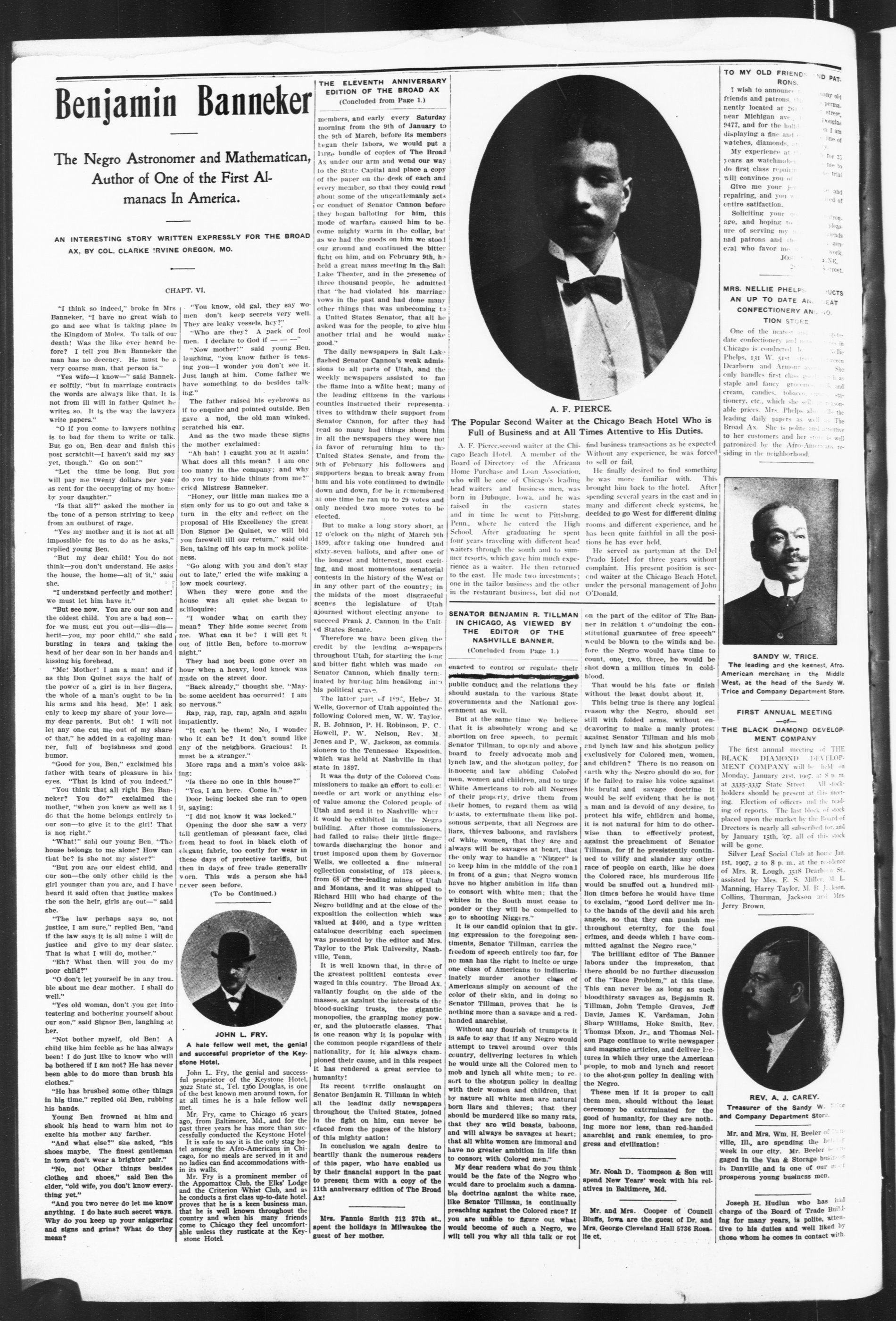
October 20, 1906 The Broad Ax completed its eleventh year in the journalistic world. Eleven years ago or more, properly speaking, the 31st of August, 1895, we began its publication in Salt Lake City, Utah, and continued to do so each week until June 1, 1899. Then we discontinued its publication there and removed to this great metropolis, where we had formerly resided seven years prior to 1895, and began its publication here in this city July 15, 1899, and from that time to the present it has made its appearance once each week.
In the former "Anniversary Editions of The Broad Ax" we have called the attention of its many readers to the various underhand methods which have been resorted to by numerous individuals who hate to hear the truth, for the purpose of retarding its onward march or progress, but on this occasion we will as briefly as possible review a few of the past achievements of The Broad Ax, and the great service it has performed in behalf of the Afro-American race and mankind in general.
Those who are familiar with the past history of the 24th Regiment are cognizant of the fact that in the latter part of July 1896, Daniel Lamont Secretary of War under the second administration of President Grover Cleveland, issued an order removing the famous 24th Regiment from Silver City, New Mexico, to Fort Douglas, Utah, which is located near Salt Lake City, and immediately after the order was promulgated by Secretary Lamont, the Salt Lake Tribune which has for many years been the leading Republican daily newspaper between Omaha, Nebr., and San Francisco, Cal., began to bitterly oppose locating the 24th Regiment at that Fort. Every day on its editorial page it painted revolting pictures of half drunken Negro soldiersaggering up and down the streets of Salt Lake, insulting white ladies, and young girls, it repeatedly declared that "when the Negro troops displaced the white soldiers at that Fort they should not be permitted to ride on the street cars, as the whites did not want to come in such close contact with a lot of half drunken "Niger soldiers."
As The Tribune favored the reelection of Frank J. Cannon to the United States Senate at the expiration of his first term March 4th 1899, early in September in 1896, it induced him to call on Secretary Lamont, and present him with a petition which was signed by the chairman of the Republican State Committee of Utah and by many other leading Republicans and Democrats residing in Salt Lake, protesting against permitting the 24th Regiment locating at Fort Douglas, in the meantime we began to fire hot shot into Senator Cannon, and The Tribune, and all the daily and weekly newspapers throughout Utah joined in the fight, the majority of them lining up
on the side of The Broad Ax and against Senator Cannon and The Tribune; in the midst of that memorable fight which has become a part of the history of Utah, we induced a prominent official of the Mormon Church to send a telegram to United States Senator Joseph L. Rawlins, who was a dyed in the wool Democrat, requesting him to call on Secretary Lamont, and urge him not to revoke his order, and several days after the visit of Senator Rawlins, Senator Cannon again called on the Democratic Secretary of war, and he was firmly but politely informed by Mr. Lrmont, that the order had gone forth transferring the 24th Regiment to Fort Douglas that he could not, recall nor revoke it," in spite of the efforts of The Tribune and Senator Cannon, on October 21, 1896, the 24th Regiment marched through the streets of Salt Lake city on its way to Fort Douglas.
One year after this incident The Tribune in a long editorial admitted that it had made a mistake in fighting and opposing the locating of the 24th Regiment at Fort Douglas, that not one white lady had been insulted on the streets, nor on the street cars; that each and everyone of its members had conducted themselves like true gentlemen and orderly and well disciplined soldiers, that they were a great improvement over the white soldiers who were always fighting and shooting at each other on the street cars, scaring the wits out of the fair white ladies; that they had always seemed to take much delight in drinking whisky, and cursing or swearing while they were walking up and down the streets, and it wound up by saying, that the members of the 24th Regiment did not resort to such habits and so on.
Senator Frank J. Cannon, was so stiff necked that he was unwilling to admit that he had made a mistake in fighting against permitting the 24th Regiment to locate at Fort Douglas; and shortly after the November election in 1898, we met him face to face in one of the leading hotels in Salt Lake City, and during our short conversation we informed him we would do everything in our power to prevent his re-election to the United States Senate. He simply laughed at us and exclaimed "go ahead and crack your whip for I like opposition and in the end I will win in spite of all the friends of the 24th Regiment" at this invitation on his part to continue the fight on him, we started in rather slow at first but as the pot began to boll, the fight became a little warmer, and as we had been keeping cases on his movements at nights in Washington, D. C., and at other places and when the legislature convened Jan. 9th 1899 for the purpose of electing a United States Senator, we began to dish up his past unmoral record through the columns of The Broad Ax, for the edification of its (Continued on page 6.)
HEW TO THE LINE.
CHICAGO, DECEMBER 29, 1906.
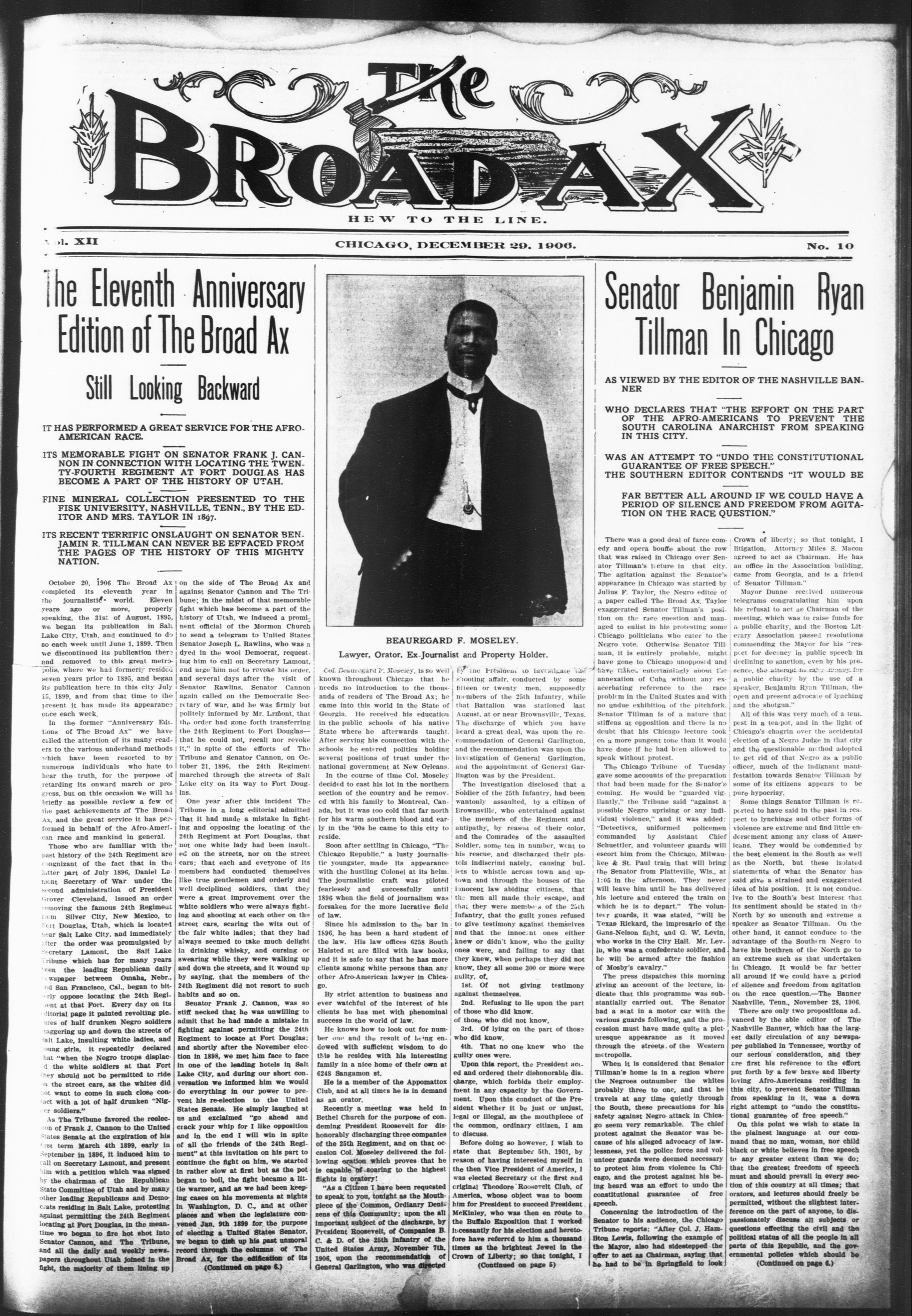
Col. Deaurogard P. Moseley, is so well known throughout Chicago that he needs no introduction to the thousands of readers of The Broad Ax; he came into this world in the State of Georgia. He received his education in the public schools of his native State where he afterwards taught. After serving his connection with the schools he entered politics holding several positions of trust under the national government at New Orleans. In the course of time Col. Moseley decided to cast his lot in the northern section of the country and he removed with his family to Montreal, Canada, but it was too cold that far north for his warm southern blood and early in the '90s he came to this city to reside. Soon after settling in Chicago, "The Chicago Republic," a lusty journalistic youngster, made its appearance with the hustling Colonel at its helm. The journalistic craft was piloted fearlessly and successfully until 1896 when the field of journalism was forsaken for the more lucrative field of law.
Since his admission to the bar in 1896, he has been a hard student of the law. His law offices 6258 South Halsted st are filled with law books, and it is safe to say that he has more clients among white persons than any other Afro-American lawyer in Chicago.
By strict attention to business and ever watchful of the interest of his clients he has met with phenominal success in the world of law.
He knows how to look out for number one and the result of being endowed with sufficient wisdom to do this he resides with his interesting family in a nice home of their own at 6248 Sangamon st.
He is a member of the Appomattox Club, and at all times he is in demand as an orator.
Recently a meeting was held in Bethel Church for the purpose of condeming President Roosevelt for dishonorably discharging three companies of the 25th Regiment, and on that occasion Col. Moseley delivered the following eration which proves that he is capable of soaring to the highest flights in oratory!
"As a Citizen I have been requested to speak to you, tonight as the Mouthpiece of the Common, Ordianry Denizens of this Community; upon the all important subject of the discharge, by President Roosevelt, of Companies B.C. & D. of the 25th Infantry of the United States Army, November 7th, 1906, upon the recommendation of General Garlington, who was directed
by one President to investigate the shooting affair, conducted by some fifteen or twenty men, supposedly members of the 25th Infantry, while that Battalion was stationed last August, at or near Brownsville, Texas. The discharge of which you have heard a great deal, was upon the recommendation of General Garlington, and the recommendation was upon the investigation of General Garlington, and the appointment of General Garlington was by the President.
The investigation disclosed that a Soldier of the 25th Infantry, had been wantonly assaulted, by a citizen of Brownsville, who entertained against the members of the Regiment and antipathy, by reason of their color, and the Comrades of the assaulted Soldier, some ten in number, went to his rescue, and discharged their pistols indiscriminately, causing bullets to whistle across town and uptown and through the houses of the innocent law abiding citizens, that the men all made their escape, and that they were members of the 25th Infantry, that the guilt yones refused to give testimony against themselves and that the innocent ones either knew or didn't know, who the guilty ones were, and failing to say that they knew, when perhaps they did not know, they all some 300 or more were guilty, of,
1st. Of not giving testimony against themselves.
2nd. Refusing to lie upon the part of those who did know.
of those who did not know,
3rd. Of lying on the part of those who did know.
4th. That no one knew who the guilty ones were.
Upon this report, the President acted and ordered their dishonorable discharge, which forbids their employment in any capacity by the Government. Upon this conduct of the President whether it be just or unjust, legal or illegal, as the mouthpiece of the common, ordinary citizen, I am to discuss.
Before doing so however, I wish to state that September 5th, 1901, by reason of having interested myself in the then Vice President of America, I was elected Secretary of the first and original Theodore Roosevelt Club, of America, whose object was to boom him for President to succeed President McKinley, who was then en route to the Buffalo Exposition that I worked incessantly for his election and heretofore have referred to him a thousand times as the brightest Jewel in the Crown of Liberty; so that tonight, I
(Continued on page 5)
Senator Benjamin Ryan Tillman In Chicago
AS VIEWED BY THE EDITOR OF THE NASHVILLE BANNER
WHO DECLARES THAT "THE EFFORT ON THE PART OF THE AFRO-AMERICANS TO PREVENT THE SOUTH CAROLINA ANARCHIST FROM SPEAKING IN THIS CITY.
WAS AN ATTEMPT TO "UNDO THE CONSTITUTIONAL GUARANTEE OF FREE SPEECH."
THE SOUTHERN EDITOR CONTENDS "IT WOULD BE
FAR BETTER ALL AROUND IF WE COULD HAVE A PERIOD OF SILENCE AND FREEDOM FROM AGITATION ON THE RACE QUESTION."
There was a good deal of farce comedy and opera bouffe about the row that was raised in Chicago over Senator Tillman's lecture in that city. The agitation against the Senator's appearance in Chicago was started by Julius F. Taylor, the Negro editor of a paper called The Broad Ax. Taylor exaggerated Senator Tillman's position on the race question and managed to enlist in his protesting some Chicago politicians who cater to the Negro vote. Otherwise Senator Tillman, it is entirely probable, might have gone to Chicago unopposed and have taken, entertainingly about the annexation of Cuba without any exacerbating reference to the race problem in the United States and with no undue exhibition of the pitchkick. Senator Tillman is of a nature that stiffens at opposition and there is no doubt that his Chicago lecture took on a more pungent tone than it would have done if he had been allowed to speak without protest.
The Chicago Tribune of Tuesday gave some accounts of the preparation that had been made for the Senator's coming. He would be "guarded vigilantly," the Tribune said "against a possible Negro uprising or any individual violence," and it was added: "Detectives, uniformed policemen commanded by Assistant Chief Schuettler, and volunteer guards will escort him from the Chicago, Milwaukee & St. Paul train that will bring the Senator from Platteville, Wis., at 1:05 in the afternoon. They never will leave him until he has delivered his lecture and entered the train on which he is to depart." The volunteer guards, it was stated, "will be Texas Rickard, the impresario of the Gans-Nelson fight, and G. W. Levin, who works in the City Hall. Mr. Levin, who was a confederate soldier, and he will be armed after the fashion of Mosby's cavalry."
The press dispatches this morning giving an account of the lecture, indicate that this programme was substantially carried out. The Senator had a seat in a motor car with the various guards following, and the procession must have made quite a picturesque appearance as it moved through the streets of the Western metropolis.
When it is considered that Senator Tillman's home is in a region where the Negroes outnumber the whites probably three to one, and that he travels at any time quietly through the South, these precautions for his safety against Negro attack in Chicago seem very remarkable. The chief protest against the Senator was because of his alleged advocacy of lawlessness, yet the police force and volunteer guards were deemed necessary to protect him from violence in Chicago, and the protest against his being heard was an effort to undo the constitutional guarantee of free sneech.
Concerning the introduction of the Senator to his audience, the Chicago Tribune reports; "After Col. J. Hamilton Lewis, following the example of the Mayor, also had sidestepped the offer to act as Chairman, saying that he had to be in Springfield to look
No. 10
Benjamin Ryan
In Chicago
FOR OF THE NASHVILLE BAN-
THE EFFORT ON THE PART
RICANS TO PREVENT THE
NARCHIST FROM SPEAKING
INDO THE CONSTITUTIONAL
SPEECH."
CONTENDS "IT WOULD BE
OUND IF WE COULD HAVE A
AND FREEDOM FROM AGITA-
QUESTION."
Crown of liberty; so that tonight, I litigation, Attorney Miles S. Macon agreed to act as Chairman. He has an office in the Association building, came from Georgia, and is a friend of Senator Tillman."
Mayor Dunne received numerous telegrams congratulating him upon his refusal to act as Chairman of the meeting, which was to raise funds for a public charity, and the Boston Literary Association passed resolutions commending the Mayor for his "respect for decency in public speech in declining to sanction, even by his presence, the attempt to raise money for a public charity by the use of a speaker, Benjamin Ryan Tillman, the open and present advocate of lynching and the shotgun."
All of this was very much of a tempest in a tea-pot, and in the light of Chicago's chagrin over the accidental election of a Negro Judge in that city and the questionable method adopted to get rid of that Negro as a public officer, much of the indignant manifestation towards Senator Tillman by some of its citizens appears to be pure hypocrisy.
Some things Senator Tillman is reported to have said in the past in respect to lynchings and other forms of violence are extreme and find little endorsement among any class of Americans. They would be condemned by the best element in the South as well as the North, but these isolated statements of what the Senator has said give a strained and exaggerated idea of his position. It is not conducive to the South's best interest that its sentiment should be stated in the North by so uncouth and extreme a speaker as Senator Tillman. On the other hand, it cannot conduce to the advantage of the Southern Negro to have his brethren of the North go to an extreme such as that undertaken in Chicago. It would be far better all around if we could have a period of silence and freedom from agitation on the race question.-The Banner Nashville, Tenn., November 28, 1906.
There are only two propositions advanced by the able editor of The Nashville Banner, which has the largest daily circulation of any newspaper published in Tennessee, worthy of our serious consideration, and they are first his reference to the effort put forth by a few brave and liberty loving Afro-Americans residing in this city, to prevent Senator Tillman from speaking in it, was a down right attempt to "undo the constitutional guarantee of free speech." On this point we wish to state in the plainest language at our command that no man, woman, nor child black or white believes in free speech to any greater extent than we do; that the greatest freedom of speech must and should prevail in every section of this country at all times; that orators, and lectures should freely be permitted, without the slightest interference on the part of anyone, to dispassionately discuss all subjects or questions effecting the civil and the political status of all the people in all parts of this Republic, and the governmental policies which should be
(Continued on page 6.)
Clarence S. Darrow's Great Ora tion In Bethel Church Sunday Afternoon, December 16.
THE SPEAKER CLAIMS THAT LIBERTY AND JUSTICE IS RAPIDLY DYING OUT IN THE HEARTS OF THE AMERICAN PEOPLE IN THEIR MAD RUSH TO ACCUMULATE WEALTH.
BOOKER T. WASHINGTON AND HIS FALSE THEORIES PERTAINING TO THE CIVIL AND THE POLITICAL STATUS OF THE NEGRO TOSSED IN THE AIR.
Reported by Charles E. Webb.
I am a little afraid to speak after the extravagant words coming from Mr. Morris. Still, I suppose you all know him so well that you would not pay much attention to what he says.
While I was listening to what the chairman was saying of me and wishing it might be true. I thought perhaps that instead of being 25 years ahead of my day, on the Negro question at least I was 25 years behind; and that is the most discouraging thing in the Negro question. When I was a boy, 25 or 30 years ago there was some feeling for justice and freedom toward the Negro. There is none to-day. I still have the convictions as to the Negro question that I had 25 or 30 years ago. But the friends of the Negro have all passed away. They are either dead or they have grown tired. I can remember when the name of John Brown was a hallowed name throughout the North. To-day if he was advertised to speak down town the hall would be empty and everybody would go and hear Ben Tillman abuse the Negro. If Wendell Phillips were to come to Chicago and speak upon the rights of the black man he would not have a corporal's guard to listen to him and what he would get would be Colored people and a few cranks like myself; but a man who would advocate that a black man should be lynched because he is accused of doing something that might not even indict a white man would get all the crowd.
It's all right to give over a day to the memory of the abolitionists who fought the great fight from 1845 and 50 up to 1865; the Colored people ought not to forget them; but the whites have forgotten them and they have forgotten what those men stood for. And all the eloquence of Phillips and all the power and earnestness of Garrison and all the logic of Sumner would not stir even the people of Chicago to-day in behalf of the Negro
I am rather a pessimist on this question, as I am on some others. I never think of the race problem these days without growing doubtful and more than sad over this problem, because I was born in a section of the United States where I honestly believe that if ever there was any difference between the white and Colored people it was in favor of the Colored people; they were engaged in the underground railroad and everybody would give them money and help when they would not give it to a white man because he did not need it as much. They would risk their lives for them and we knew no difference intellectually and very few knew much difference socially in those abolition days in Northern Ohio; and when I look at the conditions to-day not only in the South but in the North and compare the feeling that exists in this county now with what is was 30 years ago, it makes me doubtful and sad as to the whole race problem; for I never some how could think that a man's nationality made any difference with him; that the color of his skin made any difference with him; that anybody should have any rights or privileges, either financial or social, on account of the place he was born or the color or tinge of his skin; whether white or black looks best is purely a matter of taste; the world has never agreed and it probably never will. I never could think that any of those questions could make any difference; and I came from an environment where people did not think it or believe it, so if there's any credit or discredit about it is isn't mine for I caught it, as most people do.
And to-day I see everything changed. I know something of the fury and the frenzy there was at the time of Lincoln's nomination in Chicago in the '60s; because while Lincoln had not declared and never did declare until late in the war in favor of abolitionism, still everybody that knew him knew that he was an abolitionist at heart, knew he did not believe in slavery; they knew he wanted to help the black man because
his was the unpopular cause and I know something of the sentiments that swept through this city and this state and throughout the North and elected him president of the United States which was the beginning of the end of that species of chattel slavery, although not the end by any means. In this city where he was dominated political enthusiasm reached its highest tide and then for years thereafter there was a great uprising in favor of human rights when it applied to black men, or the man who has one drop of Negro blood in his veins, of course one drop is just as bad as all the drops.
But I have seen in the last thirty days in this same city—in this same city where Lincoln was nominated—where the people rose enmasse. I have seen a lawyer whom I know and whom I regard highly, nominated for judge—a man who stood higher, both as a lawyer and as a man, in character and ability than three-fourths of all the men on his ticket (Applause) I don't owe Mr. Barnett anything either. I'm just telling you what I think about it. Not one-fourth of the men on that ticket are his equals in ability, in courtesy, in learning and yet from one end of Chicago to the other he was abused and voted against and deprived of an office just because the Lord happened to make his skin a little darker than that of some other people. And this in Chicago, a Northern city and once the home of abolitionists; and when it was supposed he was elected—whether he was or not I do not know or care, it makes no difference so far as the case is concerned. When he was elected it was said that it was a disgrace, an insult, an outrage. Think of a white man being tried by a Colored judge! That is pretty bad; but it isn't any worse for a Colored man to be tried by a white judge. (Applause). It's bad enough to be tried by any judge. (Applause.)
But the life and the history the suffering and the adversity of the Colored race ought to teach them to be more kind and merciful at least two qualities which should become a judge. I have seen in this city in the last few weeks hundreds of people flock to hear the coarsest brutality by a United States Senator, uttered against the weak defenceless black—not Southerners, not than any more than Northerners, for there may be here and there some little difference between the attitude of the white man in the South and the white man in the North, but they are getting fearfully close together.
Let us not deceive ourselves about any of those questions; if there's anything to do we want to do it; if there's any way to help we want to help it; but the first thing is to know the actual facts. Mr. Barnett was defeated, when his republican ticket received some thirty thousand majority there were a whole lot of Northern men who were descendants of that party which once stood for human liberty who voted against him; and I know there were some democrats who voted for him into the bargain. The race question might once have been a Southern question but it is not so any longer. It is a national question. And Mr. Tillman may say to you and to the people who like to hear that sort of talk (and he would rather abuse the weak than the strong, for its always easier). He may say they propose to protect their homes against the black man, who does all the work down South and whom they would be satisfied with if he were willing to keep on working. But the real estate agent in Chicago will tell you that he won't rent his flats to Colored people and the owner of a house along Indiana av. will stay up nights worrying if a decent, well-behaved, industrious, intelligent black man, although he may not be any blacker than the other fellow, should happen to rent a house across the street from him or a block away; and it does hurt the value of the property as all of you know. Is there any difference in the one sentiment and in the other? Is
there any difference in the feeling of the mob when they tie a black man to the stake down in Mississippi or when they do it in Ohio, which was once almost the home of liberty? It may be more intense there than it is here but we are learning and we are learning fast in these days of telegraphs and newspapers and railroads it is not very far from Georgia to Chicago and a whole lot of our merchants sell goods down in Georgia and commerce binds our people together a good deal tighter than anything else does, because after all when dollars come in all other sentiments go out.
Still more deplorable than all of this, which I will speak to you a little later. Perhaps it isn't pleasant for an audience of this sort to listen to it, deplorable as it is, that whites all over the United States have forgotten all the precepts of liberty and have practically denied the blacks any rights. What is the right to vote? Most anybody can do that. What is it if you haven't the right to life, to make a living; if you haven't the social equality; if you are not a man or are not a woman; or if you are to be discriminated against and distinguished because of your color? The ballot cuts little figure in all of that; but more deplorable still are the growing sentiments among a considerable part of the Colored people, that their business is to learn to work and to leave this question of equality alone and to take the place in the community where the white man sees fit to put him.
Now, its all well enough to talk about raising three thousand dollars to hire a lawyer to carry a case to the Supreme Court of the United States. That's a good thing for the lawyer and I'm a lawyer. It's all well enough to talk about legal rights:
1910
[Name]
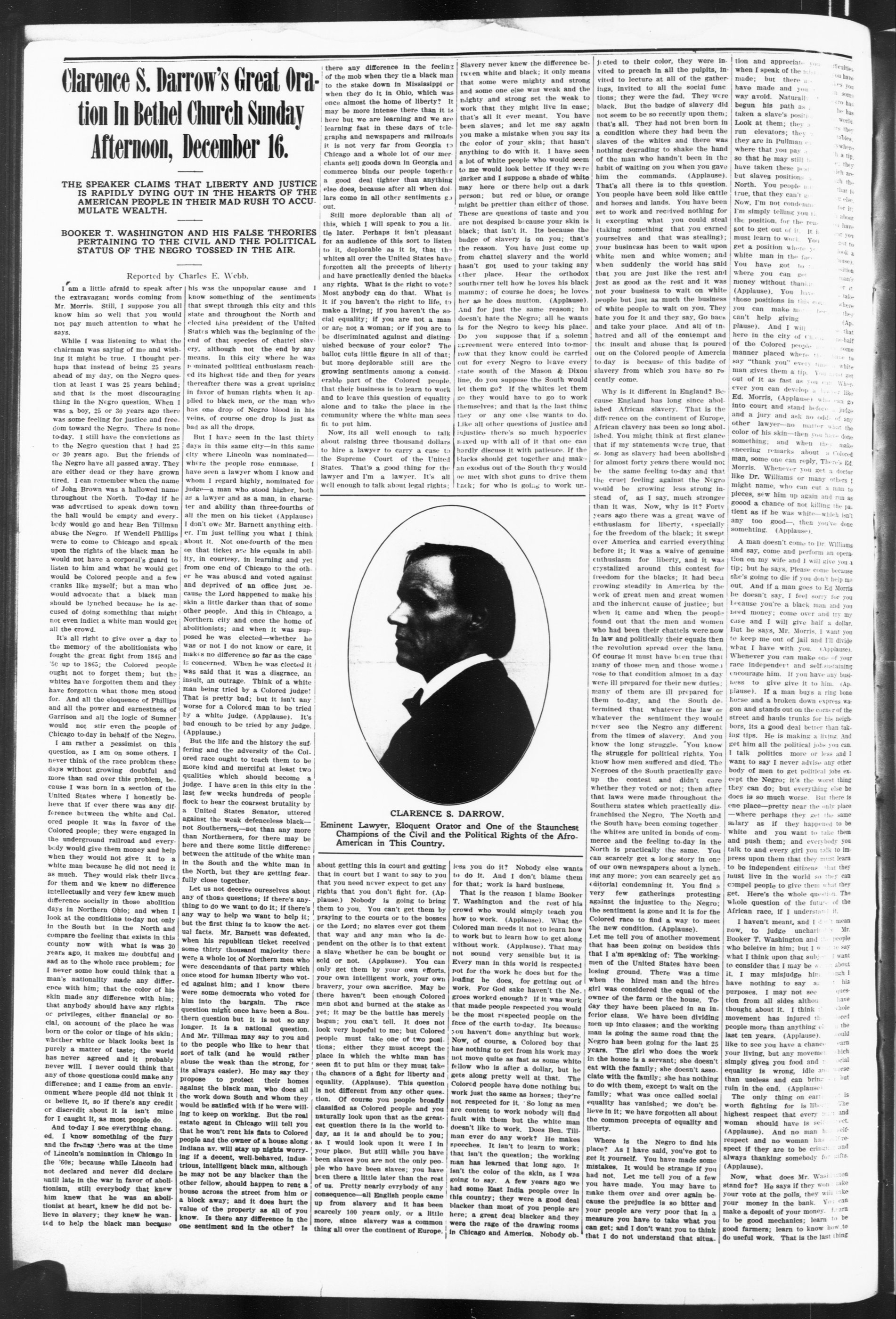
CLARENCE S. DARROW. Eminent Lawyer, Eloquent Orator and One Champions of the Civil and the Political American in This Country.
Eminent Lawyer, Eloquent Orator and One of the Staunchest Champions of the Civil and the Political Rights of the Afro-American in This Country.
Eminent Lawyer, Eloquent Orator and One of the Staunchest Champions of the Civil and the Political Rights of the Afro-American in This Country.
about getting this in court and getting that in court but I want to say to you that you need never expect to get any rights that you don't fight for. (Applause.) Nobody is going to bring them to you. You can't get them by praying to the courts or to the bosses or the Lord; no slaves ever got them that way and any man who is dependent on the other is to that extent a slave whether he can be bought or sold or not. (Applause). You can only get them by your own efforts, your own intelligent work, your own bravery, your own sacrifice. May be there haven't been enough Colored men shot and burned at the stake as yet; it may be the battle has merely begun; you can't tell. It does not look very hopeful to me; but Colored people must take one of two positions; either they must accept the place in which the white man has seen fit to put him or they must take the chances of a fight for liberty and equality. (Applause). This question is not different from any other question. Of course you people broadly classified as Colored people and you naturally look upon that as the greatest question there is in the world today, as it is and should be to you; as I would look upon it were I in your place. But still while you have been slaves you are not the only people who have been slaves; you have been there a little later than the rest of us. Pretty nearly everybody of any consequence—all English people came up from slavery and it has been scarcely 100 years only, or a little more, since slavery was a common thing all over the continent of Europe.
---
Slavery never knew the difference between white and black; it only means that some were mighty and strong and some one else was weak and the mighty and strong set the weak to work that they might live in ease; that's all it ever meant. You have been slaves; and let me say again you make a mistake when you say its the color of your skin; that hasn't anything to do with it. I have seen a lot of white people who would seem to me would look better if they were darker and I suppose a shade of white may here or there help out a dark person; but red or blue, or orange might be prettier than either of those. These are questions of taste and you are not despised because your skin is black; that isn't it. It is because the badge of slavery is on you; that's the reason. You have just come up from chattel slavery and the world hasn't got used to your taking any other place. Hear the orthodox southerner tell how he loves his black mammy; of course he does; he loves her as he does mutton. (Applause). And for just the same reason; he doesn't hate the Negro; all he wants is for the Negro to keep his place. Do you suppose that if a solemn agreement were entered into to-morrow that they know could be carried out for every Negro to leave every state south of the Mason and Dixon line, do you suppose the South would let them go? If the whites let them go they would have to go to work themselves; and that is the last thing they or any one else wants to do. Like all other questions of justice and injustice there's so much hypocrisy naked up with all of it that one can hardly discuss it with patience. If the blacks should get together and make an exodus out of the South they would be met with shot guns to drive them back; for who is going to work un-
---
ator and One of the Staunchest the Political Rights of the Afro- less you do it? Nobody else wants to do it. And I don't blame them for that; work is hard business.
That is the reason I blame Booken T. Washington and the rest of his crowd who would simply teach you how to work. (Applause). What the Colored man needs it not to learn how to work but to learn how to get along without work. (Applause). That may not sound very sensible but it is. Every man in this world is respected not for the work he does but for the loafing he does, for getting out of work. For God sake haven't the Negroes worked enough? If it was work that made people respected you would be the most respected people on the face of the earth to-day. Its because you haven't done anything but work. Now, of course, a Colored boy that has nothing to get from his work may not move quite as fast as some white fellow who is after a dollar, but he gets along pretty well at that. The Colored people have nothing but work just the same as horses; they're not respected for it. 'So long as men are content to work nobody will find fault with them but the white man doesn't like to work. Does Ben. Tillman ever do any work? He makes speeches. It isn't to learn to work; that isn't the question; the working man has learned that long ago. It isn't the color of the skin, as I was going to say. A few years ago we had some East India people over in this country; they were a good deal blacker than most of you people are here; a great deal blacker and they were the rage of the drawing rooms in Chicago and America. Nobody ob-
---
jected to their color, they were invited to preach in all the pulpits, invited to lecture at all of the gatherings, invited to all the social functions; they were the fad. They were black. But the badge of slavery did not seem to be so recently upon them; that's all. They had not been born in a condition where they had been the slaves of the whites and there was nothing degrading to shake the hand of the man who handn't been in the habit of waiting on you when you gave him the commands. (Applause). That's all there is to this question. You people have been sold like cattle and horses and lands. You have been set to work and received nothing for it excepting what you could steal (taking something that you earned yourselves and that was stealing); your business has been to wait upon white men and white women; and when suddenly the world has said that you are just like the rest and just as good as the rest and it was not your business to wait on white people but just as much the business of white people to wait on you. They hate you for it and they say, Go back and take your place. And all of them hatred and all of the contempt and the insult and abuse that is poured out on the Colored people of America to-day is because of this badge of slavery from which you have so recently come.
Why is it different in England? Because England has long since abolished African slavery. That is the difference on the continent of Europe. African clavery has been so long abolished. You might think at first glance that if my statements were true, that so long as slavery had been abolished for almost forty years there would not be the same feeling to-day and that the cruel feeling against the Negro would be growing less strong instead of, as I say, much stronger than it was. Now, why is it? Forty years ago there was a great wave of enthusiasm for liberty, especially for the freedom of the black; it swept over America and carried everything before it; it was a waive of genuine enthusiasm for liberty, and it was crystalized around this contest for freedom for the blacks; it had been growing steadily in America by the work of great men and great women and the inherent cause of justice; but when it came and when the people found out that the men and women who had been their chattels were now in law and politically their equals then the revolution spread over the land. Of course it must have been true that many of those men and those women rose to that condition almost in a day were ill prepared for their new duties; many of them are ill prepared for them to-day, and the South determined that whatever the law or whatever the sentiment they would never see the Negro any different from the times of slavery. And you know the long struggle. You know the struggle for political rights. You know how men suffered and died. The Negroes of the South practically gave up the contest and didn't care whether they voted or not; then after that laws were made throughout the Southern states which practically disfranchised the Negro. The North and the South have been coming together, the whites are united in bonds of commerce and the feeling to-day in the North is practically the same. You can scarcely get a long story in one of our own newspapers about a lynching any more; you can scarcely get an editorial condemning it. You find a very few gatherings protesting against the injustice to the Negro; the sentiment is gone and it is for the Colored race to find a way to meet the new condition. (Apollase.)
Let me tell you of another movement that has been going on besides this that I a'm speaking of: The workings men of the United States have been losing ground. There was a time when the hired man and the hired girl was considered the equal of the owner of the farm or the house. Today they have been placed in an inferior class. We have been dividing men up into classes; and the working man is going the same road that the Negro has been going for the last 25 years. The girl who does the work in the house is a servant; she doesn't eat with the family; she doesn't associate with the family; she has nothing to do with them, except to wait on the family; what was once called social equality has vanished; we don't believe in it; we have forgotten all about the common precepts of equality and liberty.
Where is the Negro to find his place? As I have said, you've got to get it yourself. You have made some mistakes. It would be strange if you had not. Let me tell you of a few you have made. You may have to make them over and over again because the prejudice is so bitter and your people are very poor that in a measure you have to take what you can get; and I don't want you to think that I do not understand that situs.
tion and appreciate you difficulties,
when I speak of the man you have
made; but there are times you
have made and you can some
way avoid. Naturally you have
begun his path as, the he has
taken a slave's position, the world.
Look at them; they are tables,
run elevators; they are tables,
they are in Pullman cars where
where that you pay a tip, a tip,
so that he may still be there, they
have taken these positions which
but slaves positions with the
North. You people move that is
true, that they can't get else.
Now, I'm not condemn for it.
I'm simply telling you this about
the position, for the reason you
got to get out of it. It is not
must learn to work. You got to
get a position where you look a
white man in the face (huse).
You have got to position
where you can get man's
money without thank you (Applause). You have to take those positions in this con, where
you can make money because they
can't help giving (Applause). And I will see that here in the city of Chicago half of the Colored people some manner placed where the house to say "thank you" every time white man gives them a tip. You must get out of it as fast as you can. Wherever you can develop a lawyer like Ed. Morris (Applause) who can go into court and stand before a judge and a jury and ask no odds of any other lawyer—no matter what the color of his skin—then you have done something; and when they make sneering remarks about a Colored man, some one can reply, There's Ed. Morris. Whenever you get a doctor like Dr. Williams or many others I might name, who can cut a man to pieces, sew him up again and run as good a chance of not killing the patient as if he was white—which isn't any too good—, then you've done something. (Applause).
A man doesn't come to Dr. Williams and say, come and perform an operation on my wife and I will give you a tip; but he says, Please come because she's going to die if you don't help me out. And if a man goes to Ed Morris he doesn't say, I feel sorry for you because you're a black man and you need money; come over and try my case and I will give half a dollar. But he says, Mr. Morris, I want you to keep me out of jail and I will divide what I have with you. (Applause). Whenever you can make one of your race independent and self-sustaining encouragement him. If you have any business to give give it to him. (Applause). If a man buys a ring bone horse and a broken down express wagon and stands out on the corner of the street and hauls trunks for his neighbors, its a good deal better than taking tips. He is making a living. And get him all the political jobs you can. I talk politics more or less and I want to say I never advise any other body of men to get political jobs except the Negro; it's the worst thing they can do; but everything else he does is so much worse. But there is one place—pretty near the only place
—where perhaps they get the same salary as if they happened to be white and you want to take them and push them; and everybody you talk to and every girl you talk to impress upon them that they must learn to be independent citizens that they must live in the world so they can compel people to give them what they get. Here's the whole question. The whole question of the future of the African race, if I understand it.
I haven't meant, and I don't mean now, to judge uncharity. Mr. Booker T. Washington and the people who believe in him; but I won't say what I think upon that subject I want to consider that I may be宽 about it. I may misjudge him, though I have nothing to say about his purposes. I may not see a question from all sides although I have thought about it. I think the whole movement has injured the poor people more than anything else in the last ten years. (Applause). I would like to see you have a chance to learn your living, but any movement which simply gives you food and social equality is wrong, idle and worse than useless and can bring about but ruin in the end. (Applause)
The only thing on earth is worth fighting for is liberty. The highest respect that every man and woman should have is self-respect. (Applause). And no man has self-respect and no woman has self-respect if they are to be crushed and always thanking somebody for gifts. (Applause).
Now, what does Mr. Washington stand for? He says if they won take your vote at the polls, they will take your money in the bank. You can make a deposit of your money. Learn to be good mechanics; learn to be good farmers; learn to know how to do useful work. That is the last thing
I ought to have Colored people do, haven't you known how to work? Do Colored people know how to pick on? Don't they know how to raise car cane? That isn't the kind of car they have got to raise before will be independent. (Applause) A white man who hates the Nerace loves Booker T. Washington. (plause). Every one of them loves because they believe that he is the Colored men to accept the unjust, cruel conditions that the race imposes on him; because leading them back to be content; an inferior position and the in- position is nothing but slavery the end. They love him becauseaches you to be contented; and a red man who can look over the stice of the United States; a Col- man who can see men, women
children outraged, not for crime, for color—who can see them deceived of work, of social equality; a colored man who can do this ought to be a slave. (Applause). I read a account now and then of a Negro who is supposed to have done some terrible deed and is taken out and burned at the stake. The charge against him makes no impression on me. I know that man was burned at the stake because he was a Colored man. I wouldn't take the time to find out whether the charges were true or false; that has nothing to do with it. If I pick up a paper and find out that whenever a white man assaults a black or white woman he is taken out and burned at the stake, then I will begin to investigate the question of whether he is innocent or guilty. (Applause). But when it is only the black man who is punished in this way then I know the cause of it. The cause is that the lord made his face black and that is the only cause.
I do not like this Booker Washington movement I have spoken of. If I did not think this matter was such an urgent one to the Colored people I would not take the responsibility of saying what I do against a great work such as Mr. Washington's in the South. But I have read his book; there's nothing ennobling in it. (Applause). The thoughts are sordid, crude, materialistic to the core. I know he has many contributors through the North and through the South but it isn't everybody who gives you a contribution that does you good, it isn't the money, its the spirit that goes with the money that counts (Applause). The Negro question is not a question of knowing how to work; its a question of knowing how to get wages; its a question of equality; but when it gets down to it I tell you, however much you may deny it, the whole question is a question of social equality and it will never be solved until this is reached. I'm not interested in any scheme to teach Negroes to be better servants. (Applause). And what is true of Negroes is true of everybody else. I would like to teach every worthy man and woman in the United States to be very much worse servants than they are. I can't think anybody ought to serve another unless that other is willing to do the same service to them. (Applause). Unless I'm willing to take you your dinner I have no right to ask you to bring me mine. You must settle the question on that line or you never will settle it while the word lasts.
Now, I'll speak of something a little closer home. I remember one time I came over on the boat from Europe—and Mr. Armour was on the same boat and we discussed the Negro; and I must say that Mr. Philip Armour was a real friend of the Negro race, but he said, I like the Negroes because they are loyal to me in times of strikes. Now, I'm going to get after your people some; and here again I don't want any of you to think that I do not know the hardships of Colored people. It has been hard for Colored people to get decent jobs to do and if they can serve as "scabs" its difficult for them to take the job.
I'm talking of that justice which you can not get; what you probably don't hope for, for yourselves but that some of you hope, for the children and the grandchildren that you will leave behind. So far as this generation is concerned I don't believe that any person who is listening my voice now will live long enough to see it. You will be compelled to receive these insults, this justice these wrongs at the hands of white people down to the grave, but or the children that are coming after you and the grandchildren and the generations following I know that you are willing to make these sacrifices. The cause of the black man is the cause of labor. You cannot act as scabs": I don't say that many of you do it. You must not oppress the poor white; he is the only friend who will remain true to your cause for you have more in common with him than with any other class of the community and no other class can or will help you in the end.
Another thing that I did not like. The chairman may disagree with me. I don't know. He stayed at home during the war. I think every Colored man should have stayed at home during the war. (Applause). I have no respect for a black American who would go and shoot down a black Philippino fighting for his liberty. (Applause). And when the Colored people allow themselves to be placed in the front rank for a little miserable paltry glory they degrade themselves; you can't afford to fight slaves; you can't afford to fight against liberty even if so strong and powerful and despicable a nation as this should take sides against human liberty. The cause of the Philippinos was the cause of the poor and the weak and the black fighting for liberty. Don't be used as ammunition for the white people. Whenever you get a regiment and go and help the white man for unjust causes they will give you the place of honor right where the bullets are the thickest.
There will come a day in this world—you all will be dead; our descendants up to five generations may be dead; but there will come a time when all men, black or white, all people on earth will be considered social and political equals and when only courage and worth and true character will count in the judgment of your fellow men. (Applause).
[Name]
Who is fast forging to the front as the most popular, leading and progressive undertaker and embalmer in the great city of Chicago.
Mr. Parks' establishment at 3155 State street, Phone Douglas 3231, is up to date in every respect. He carries a full or complete line of furnishings, and everything used in connection with his business.
Mr. and Mrs. S. R. Jones 4431 Champlain ave., entertained a number of young people Wednesday eve., in honor of their guest, Mrs. Frank Robbins of Racine, Wis.
An Indiana editor printed the following: "The fellow who is courting a certain married woman would better leave town, as the husband is onto him." The paper had not been out long before every man in town had left except three old cripples and a man who had not read the paper.
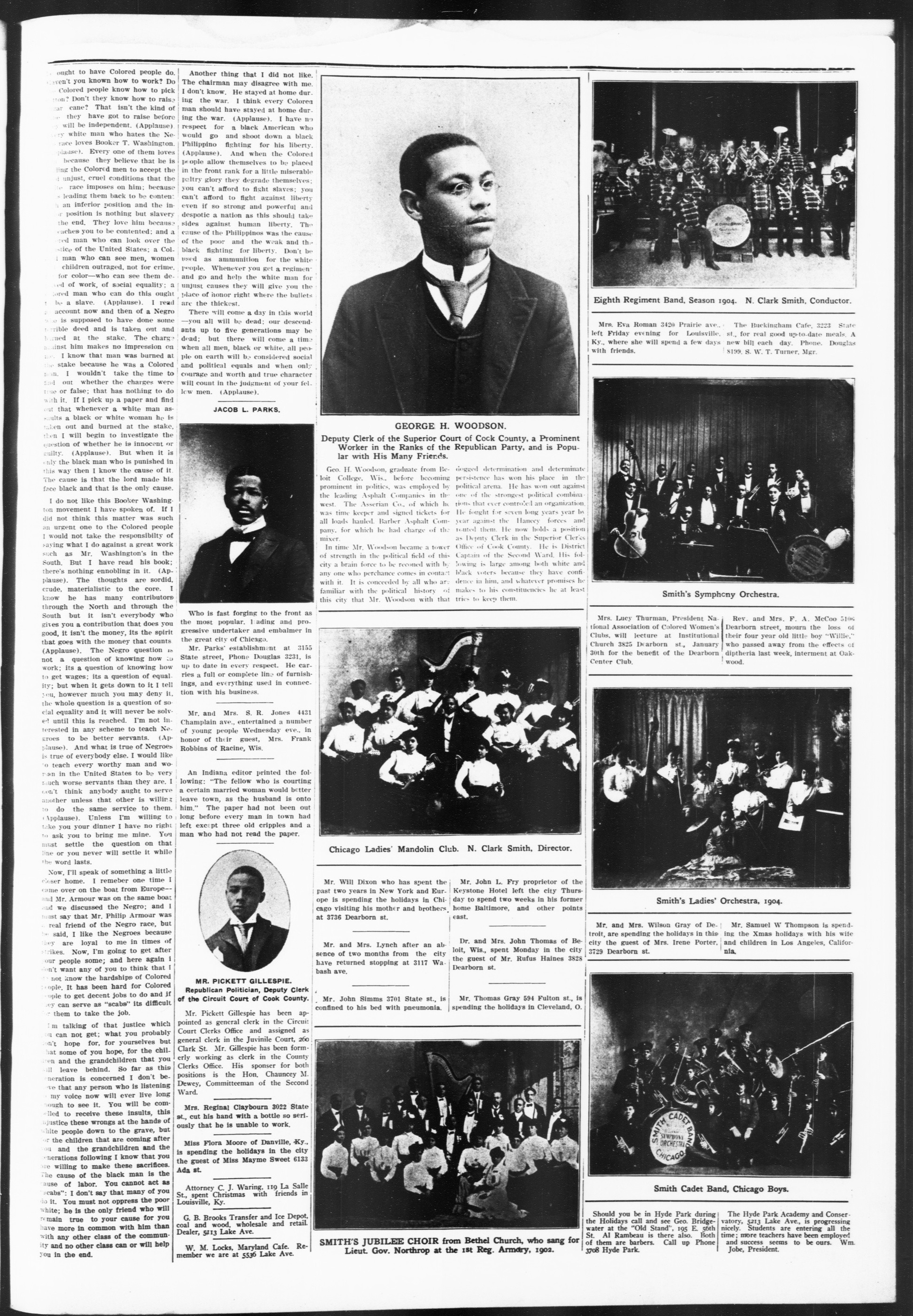
MR. PICKETT GILLESPIE.
Republican Politician, Deputy Clerk
of the Circuit Court of Cook County.
Mr. Pickett Gillespie has been appointed as general clerk in the Circuit Court Clerks Office and assigned as general clerk in the Juvinile Court, 266 Clark St. Mr. Gillespie has been formerly working as clerk in the County Clerks Office. His sponsor for both positions is the Hon. Chauncey M Dewey, Committeeman of the Second Ward.
Mrs. Reginal Claybourn 3022 State st., cut his hand with a bottle so seriously that he is unable to work.
Miss Flora Moore of Danville, Ky., is spending the holidays in the city the guest of Miss Mayme Sweet 6133 Ada st.
Attorney C. J. Waring, 119 La Salle St., spent Christmas with friends in Louisville, Ky.
G. B. Brooks Transfer and Ice Depot, coal and wood, wholesale and retail. Dealer, 5113 Lake Ave.
W. M. Locks, Maryland Cafe. Remember we are at 5536 Lake Ave.
[Name not visible]
GEORGE H. WOODSON.
Geo. H. Woodson, graduate from Beloit College, Wis., before becoming prominent in politics, was employed by the leading Asphalt Companies in the west. The Asserian Co., of which he was time keeper and signed tickets for all loads hauled. Barber Asphalt Company, for which he had charge of the mixer.
In time Mr. Woodson became a tower of strength in the political field of this city a brain force to be recoined with by any one who perchance comes in contact with it. It is conceded by all who are familiar with the political history of this city that Mr. Woodson with that
Chicago Ladies' Mandolin Club
Mandolin Club. N. Clark
THE ORCHESTRA
Chicago Ladies' Mandolin Club. N. Clark Smith, Director.
Mr. Will Dixon who has spent the past two years in New York and Europe is spending the holidays in Chicago visiting his mother and brothers at 3736 Dearborn st.
Mr. and Mrs. Lynch after an absence of two months from the city have returned stopping at 3117 Wabash ave.
Mr. John Simms 3701 State st., is confined to his bed with pneumonia.
THE HARP
THE ORCHESTRA
SMITH'S JUBILEE CHOIR from Bethel Church, who sang for Lieut. Gov. Northrop at the 1st Reg. Armory, 1902.
dogged determination and determine persistence has won his place in the political arena. He has won out against one of the strongest political combinations that ever controled an organization. He fought for seven long years year by year against the Hanacey forces and routed them. He now holds a position as Deputy Clerk in the Superior Clerks Office of Cook County. He is District Captain of the Second Ward. His following is large among both white and black voters because they have confidence in him, and whatever promises he makes to his constituencies he at least tries to keep them.
b. N. Clark Smith, Director.
Mr. John L. Fry proprietor of the Keystone Hotel left the city Thursday day to spend two weeks in his former home Baltimore, and other points east.
Dr. and Mrs. John Thomas of Beloit, Wis., spent Monday in the city the guest of Mr. Rufus Haines 3828 Dearborn st.
Mr. Thomas Gray 594 Fulton st., is spending the holidays in Cleveland, O.
R. C. CINCINNATI
CINCINNATI
1910
Eighth Regiment Band, Season 1904. N. Clark Smith. Conductor
Mrs. Eva Roman 3420 Prairie ave. left Friday evening for Louisville, Ky., where she will spend a few days with friends.
THE BROADWAY ORCHESTRA
THE ORCHESTRA OF THE MUSICIAN
THE ORCHESTRA
Smith's Symphony Orchestra
Mrs. Lucy Thurman, President National Association of Colored Women's Clubs, will lecture at Institutional Church 3825 Dearborn st., January 30th for the benefit of the Dearborn Center Club.
THE MUSIC OF THE MUSICIAN
THE MUSIC FESTIVAL
THE ORCHESTRA
Smith's Ladies' Orchestra, 1904.
Mr. and Mrs. Wilson Gray of Detroit, are spending the holidays in this city the guest of Mrs. Irene Porter, 3729 Dearborn st.
Wilson Gray of De-
the holidays in this
Mrs. Irene Porter.
Mr. Samuel W T
ing the Xmas holi-
and children in Lo-
nia.
SMITH CADET BAND
SYNTHEAT
ORCHESTRA
CHICAGO
Mr. and Mrs. Wilson Gray of De Mr. Samuel W Thompson is spend trot, are spending the holidays in this ing the Xmas holidays with his wife city the guest of Mrs. Irene Porter, and children in Los Angeles, California 3729 Dearborn st.
SMITH CADET BAND
SMITHWILLY
ORCHESTRA
CHICAGO
Smith Cadet Band, Chicago Boys.
Should you be in Hyde Park during the Holidays call and see Geo. Bridge-water at the "Old Stand", 195 E. 50th St. Al Rambeau is there also. Both of them are barbers. Call up Phone 3708 Hyde Park.
---
The Buckingham Cafe, 3223 State st., for real good up-to-date meals. A new bill each day. Phone. Douglas 8199. S.W.T. Turner, Mgr.
THE ORCHESTRA
Rev. and Mrs. F. A. McCoo 5106 Dearborn street, mourn the loss of their four year old little boy "Willie," who passed away from the effects of diptheria last week, interment at Oakwood.
Mr. Samuel W Thompson is spending the Xmas holidays with his wife and children in Los Angeles, California.
The Hyde Park Academy and Conservatory, 5213 Lake Ave., is progressing nicely. Students are entering all the time; more teachers have been employed and success seems to be ours. Wm. Jobe, President.
THE BROAD AX.
PUBLISHED WEEKLY.
Will promulgate and at all times uphold the true principles of Democracy, but Catholics, Protestants, Pentecost, Infidels, Farmers, Single Taxes, Republicans, Anglicans, Labor, or any one else can have their say without their language is proper and responsibility is fixed.
The Broad, *a* newspaper whose platform is broad enough for all, ever claiming the editorial right to speak its own mind.
Local communications will receive attention.
Write only on one side of the paper.
Subscriptions must be paid in advance.
One Year ..... $2.00
Six Months ..... 1.00
Advertising rates known on application.
Additional communications.
JULIUS F. TAYLOR, Editor and Publisher.
Entered at the Post Office at Chicago
IL, as Second-class Matter.
PERSONAL MEN' ON.
Walter M. Farmer, for 16 years an honored member of the bar in St. Louis, Mo., is now engaged in the general practice of law. Suite 708, 171 Washington street, Phone Main 4153. Residence 4856 Langley avenue. Phone Drexel 6302.
Man—when savage is the most savage of all the animal creation. His most savage actions are against his own kind. He gratifies his hate where he has power. His most vindictive hate is provoked at beholding the rise of his once inferior to his level, or above him. Few men are able to rise entirely above this low, but natural spirit. Napoleon Bonaparte murdered Toussaint L. Ouverture because the latter was called the "black Bonaparte. The more ignorant, the more savage man becomes. Also, the more ignorant: the more easily he is defeated and conquered. Ignorant followers of wise leaders have achieved myracles as it were, but ignorant followers of ignorant leaders have rushed to their own distruction. Wise followers of wise leaders often outrun their leaders. Such was the case of the Federal soldiers at Missionary Ridge. They were ordered forward to a certain place near the foot of the ridge. There they found themselves under a hot fire. With one impulse the whole line rushed up the ridge and charged over the rebel breast works. This indifference of an added order to stand at the designated place. Grant, when he came to the place saw that the men were right.
In the past, white men have hated white men quite as much as some of them now hate the Negro, and have vented their hatred with as much savagery as they ever have against the Negro. The best educated people have the least race prejudice. In the United States the poor white were encouraged to hate the Negroes because they could then be used to help hold the Negroes in slavery. The Negroes were taught to show contempt for the poor whites because this would increase the hatred between them and each side could be used by the master to control the other. The real interest of the poor whites and the Negroes were the same, that of resisting the oppression of the master class. But ignorance stood in the way. This race hatred was at first used to perpetuate salvery. It is now used to perpetuate white supremacy in politics in the South. The poor whites are almost as much injured by it as are the Negroes. Senator Tillman is a distinguished poor white. Governor Vardaman is another.
The Negroes are acquiring knowledge more rapidly than the poor whites in the South and are fully up with the poor whites in the North. If a race war can be averted a few years longer the Negroes will not want to associate with the poor whites in the South. The "Jim Crow" car will be the aristocratic car of the future. Poor whites will then want to ride in it, and will be refused.
As the Negroes grow in knowledge, they organize into societies and move solidly for or against men and measures which may be working for or against their interests. The Negro vote in Pennsylvania is so strong and so persistent in demanding the just rights of their race, that Senator Penrose of that state introduced a resolution of inquiry into the Senate demanding an investigation into the cause for discharging the Negro soldiers at Fort Reno. Senator Foraker of Ohio did the same thing in deference to the Negro vote of his state. The solid Negro vote can turn the
ction in several Northern states. At first they were merely voting cattle Anything labeled Republican got their solid vote the first few years of their enfranchisement. The Republican party in many states grew careless of the
[Name]
Negro interest, believing they were sure of that vote. White Republicans and Democrats too, are waking up to the fact that they must treat the Negro vote with respect and justice. Let the Negroes see to it that they are kept awake. Many of the young generation of Republicans have no more friendship for the Negro than have the Democrats. Is a dead friend much better than a live enemy? In the event of a Tillman war of extermination, the 300 Negro soldiers lately discharged dishonorably for an offence they did not commit may become dangerous generals. A Toussaint L. Ouverture may turn up among them. Teddy let himself away down in that matter.
JOHN T. CAMPBELL
Mrs. Wm. Emanuel 6352 Rhodes ave. will receive New Year's day 2 to 10 p. m., assisted by Mrs. Manning, Mrs. Lee Harding. Miss Murty Collins, Miss Mabel Botts, Miss Leona Daughtry Miss Walcutt will pour.
[Name]
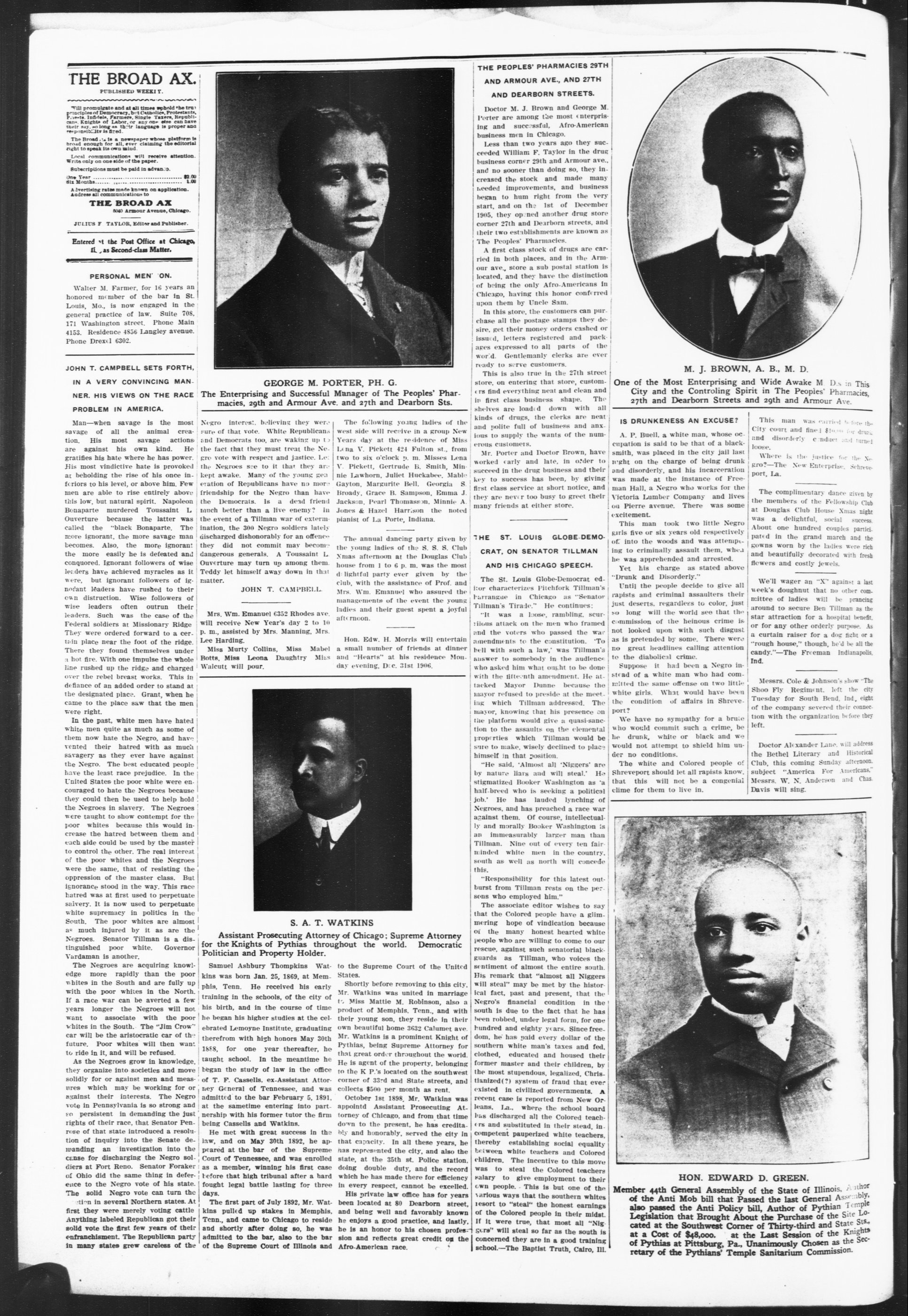
S. A. T. WATKINS Assistant Prosecuting Attorney of Chicago; Supreme Attorney for the Knights of Pythias throughout the world. Democratic Politician and Property Holder.
Samuel Ashbury Thompkins Watkins was born Jan. 25, 1869, at Memphis, Tenn. He received his early training in the schools, of the city of his birth, and in the course of time he began his higher studies at the celebrated Lemoyne Institute, graduating therefrom with high honors May 30th 1888, for one year thereafter, he taught school. In the meantime he began the study of law in the office of T. F. Cassells, ex-Assistant Attorney General of Tennessee, and was admitted to the bar February 5, 1891, at the sametime entering into partnership with his former tutor the firm being Cassells and Watkins.
He met with great success in the law, and on May 30th 1892, he appeared at the bar of the Supreme Court of Tennessee, and was enrolled as a member, winning his first case before that high tribunal after a hard fought legal battle lasting for three days.
The first part of July 1892, Mr. Watkins pulled up stakes in Memphis, Tenn., and came to Chicago to reside and shortly after doing so, he was admitted to the bar, also to the bar of the Supreme Court of Illinois and
The following young ladies of the west side will receive in a group New Years day at the residence of Miss Lena V. Pickett 424 Fulton st., from two to six o'clock p. m. Misses Lena V. Pickett, Gertrude B. Smith, Minnie Lawhorn, Juliet Huckabee, Mable Gayton, Margurite Bell, Georgia S. Broady, Grace B. Sampson, Emma J. Jackson, Pearl Thomasson, Minnie A. Jones & Hazel Harrison the noted pianist of La Porte, Indiana.
The annual dancing party given by the young ladies of the S. S. S. Club Xmas afternoon at the Douglas Club house from 1 to 6 p. m. was the most delightful party ever given by the club, with the assistance of Prof. and Mrs. Wm. Emanuel who assured the managements of the event the young ladies and their guest spent a joyful afternoon.
Hon. Edw. H. Morris will entertain a small number of friends at dinner and "Hearts" at his residence Monday evening, Dec. 31st 1906.
to the Supreme Court of the United States.
Shortly before removing to this city, Mr. Watkins was united in marriage to Miss Mattie M. Robinson, also a product of Memphis, Tenn., and with their young son, they reside in their own beautiful home 3632 Calumet ave. Mr. Watkins is a prominent Knight of Pythias, being Supreme Attorney for that great order throughout the world. He is agent of the property, belonging to the K P.'s located on the southwest corner of 33rd and State streets, and collects $500 per month as rent.
October 1st 1898, Mr. Watkins was appointed Assistant Prosecuting Attorney of Chicago, and from that time down to the present, he has creditably and honorably, served the city in that capacity. In all these years, he has represented the city, and also the state, at the 35th st. Police station, doing double duty, and the record which he has made there for efficiency in every respect, cannot be excelled. His private law office has for years been located at 80 Dearborn street, and being well and favorably known he enjoys a good practice, and lastly, he is an honor to his chosen profession and reflects great credit on the Afro-American race.
---
Doctor M. J. Brown and George M. Porter are among the most enterprising and successful, Afro-American business men in Chicago. Less than two years ago they succeeded William F. Taylor in the drug business corner 29th and Armour ave., and no sooner than doing so, they increased the stock and made many needed improvements, and business began to hum right from the very start, and on the 1st of December 1905, they opened another drug store corner 27th and Dearborn streets, and their two establishments are known as The People's Pharmacies.
A first class stock of drugs are carried in both places, and in the Armour ave., store a sub postal station is located, and they have the distinction of being the only Afro-Americans In Chicago, having this honor conferred upon them by Uele Sam. In this store, the customers can purchase all the postage stamps they desire, get their money orders cashed or issued, letters registered and packages expressed to all parts of the world. Gentlemanly clerks are ever ready to serve customers.
This is also true in the 27th street store, on entering that store, customers find everything neat and clean and in first class business shape. The shelves are loaded down with all kinds of drugs, the clerks are neat and polite full of business and anxious to supply the wants of the numerous customers. Mr. Porter and Doctor Brown, have worked early and late, in order to succeed in the drug business and their key to success has been, by giving first class service at short notice, and they are never too busy to greet their many friends at either store.
THE ST. LOUIS GLOBE-DEMO-
The St. Louis Globe-Democrat editor characterizes Pitchfork Tillman's Parrague in Chicago as "Senator Tillman's Tirade." He continues: "It was a loose, rambling, scurrious attack on the men who framed and the voters who passed the war amendments to the constitution. 'To bell with such a law,' was Tillman's answer to somebody in the audience who asked him what ought to be done with the fifteenth amendment. He attacked Mayor Dunne because the mayor refused to preside at the meeting which Tillman addressed. The mayor, knowing that his presence on the platform would give a quasi-sanction to the assaults on the elemental properties which Tillman would be sure to make, wisely declined to place himself in that position.
"He said, 'Almost all 'Niggers' are by nature liars and will steal.' He stigmatized Booker Washington as a 'half-breed who is seeking a political job.' He has lauded lynching of Negroes, and has preached a race war against them. Of course, intellectually and morally Booker Washington is an immeasurably larger man than Tillman. Nine out of every ten fair-minded white men in the country, south as well as north will concede this.
"Responsibility for this latest outburst from Tillman rests on the persons who employed him."
The associate editor wishes to say that the Colored people have a glimmering hope of vindication because of the many honest hearted white people who are willing to come to our rescue, against such senatorial blackguards as Tillman, who voices the sentiment of almost the entire south. His remark that "almost all Niggers will steal" may be met by the historical fact, past and present, that the Negro's financial condition in the south is due to the fact that he has been robbed, under legal form, for one hundred and eighty years. Since freedom, he has paid every dollar of the southern white man's taxes and fed, clothed, educated and housed their former master and their children, by the most stupendous, legalized, Christianized (?) system of fraud that ever existed in civilized governments. A recent case is reported from New Orleans, La., where the school board has discharged all the Colored teachers and substituted in their stead, incompetent pauperized white teachers, thereby establishing social equality between white teachers and Colored children. The incentive to this move was to steal the Colored teachers salary to give employment to their own people. This is but one of the various ways that the southern whites resort to "steal" the honest earnings of the Colored people in their midst. If it were true, that most all "Niggers" will steal so far as the south is concerned they are in a good training school.—The Baptist Truth, Calro, Ill
[Name not visible]
M. J. BROWN. A. B., M. D.
One of the Most Enterprising a City and the Controling Sp 27th and Dearborn Streets
One of the Most Enterprising and Wide Awake M.D.s in This City and the Controling Spirit in The Peoples' Pharmacies, 27th and Dearborn Streets and 29th and Armour Ave.
IS DRUNKENESS AN EXCUSE?
A. P. Buell, a white man, whose occupation is said to be that of a blacksmith, was placed in the city jail last night on the charge of being drunk and disorderly, and his incarceration was made at the instance of Freeman Hall, a Negro who works for the Victoria Lumber Company and lives on Pierre avenue. There was some excitement.
This man took two little Negro girls five or six years old respectively of, into the woods and was attempting to criminally assault them, when he was apprehended and arrested.
Yet his charge as stated above "Drunk and Disorderly."
Until the people decide to give all rapists and criminal assaulters their just deserts, regardless to color, just so long will the world see that the commission of the heinous crime is not looked upon with such disgust as is pretended by some. There were no great headlines calling attention to the diabolical crime.
Suppose it had been a Negro instead of a white man who had committed the same offense on two little white girls. What would have been the condition of affairs in Shreveport?
We have no sympathy for a bruise who would commit such a crime, be he drunk, white or black and we would not attempt to shield him under no conditions.
The white and Colored people of Shreveport should let all rapists know, that this will not be a congenial clime for them to live in.
HON. EDWARD D. GREEN.
Member 44th General Assembly of the State of of the Anti Mob bill that Passed the last G also passed the Anti Policy bill, Author of Legislation that Brought About the Purchased at the Southwest Corner of Thirty-third at a Cost of $48,000. at the Last Session of Pythias at Pittsburg, Pa., Unanimously Ch retary of the Pythians' Temple Sanitarium
Member 44th General Assembly of the State of Illinois, Author of the Anti Mob bill that Passed the last General Assembly, also passed the Anti Policy bill, Author of Pythian Temple Legislation that Brought About the Purchase of the Site Located at the Southwest Corner of Thirty-third and State Sts, at a Cost of $48,000. at the Last Session of the Knights of Pythias at Pittsburg, Pa., Unanimously Chosen as the Secretary of the Pythians' Temple Sanitarium Commission.
This man was carried before the City court and finel $1000 for drugs and disorderly conduct and turned loose. Where is the justice for the Negro?-The New Enterprise, Schreveport, La.
The complimentary dance given by the members of the Fellowship Club at Douglas Club House Xmas night was a delightful, social success. About one hundred couples participated in the grand march and the gowns worn by the ladies were rich and beautifully decorated with fresh flowers and costly jewels.
We'll wager an "X" against a last week's doughnut that no other committee of ladies will be prancing around to secure Ben Tillman as the star attraction for a hospital benefit, or for any other orderly purpose. As a curtain raiser for a dog night or a "rough house," though, he'd be all the candy."—The Freeman Indianapolis, Ind.
Messrs. Cole & Johnson's show "The Shoo Fly Regiment, left the city Tuesday for South Bend, Ind, eight of the company severed their connection with the organization before they left.
Doctor Alexander Lane, will address the Bethel Literary and Historical Club, this coming Sunday afternoon, subject "America For Americans." Messrs. W. N. Anderson and Chas. Davis will sing.
of the State of Illinois, Author passed the last General Assembly, bill, Author of Pythian Temple out the Purchase of the Site Loor of Thirty-third and State Sts., the Last Session of the Knights Unanimously Chosen as the Secle Sanitarium Commission.
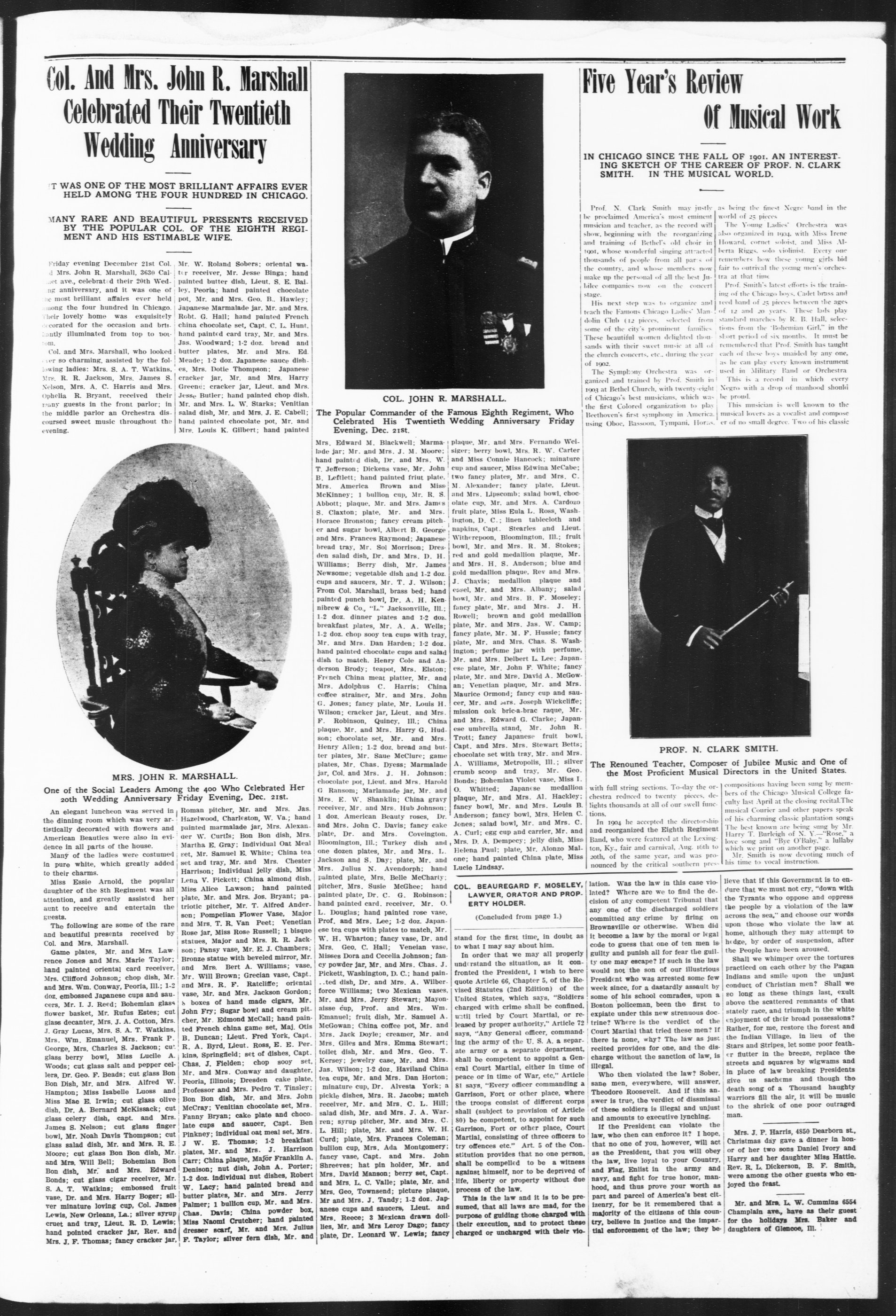
Col. And Mrs. John R. Marshall Celebrated Their Twentieth Wedding Anniversary
T WAS ONE OF THE MOST BRILLIANT AFFAIRS EVER
HELD AMONG THE FOUR HUNDRED IN CHICAGO.
MANY RARE AND BEAUTIFUL PRESENTS RECEIVED BY THE POPULAR COL. OF THE EIGHTH REGIMENT AND HIS ESTIMABLE WIFE.
Friday evening December 21st Col. and Mrs. John R. Marshall, 3630 Calmau ave., celebrated their 20th Wedding anniversary, and it was one of the most brilliant affairs ever held among the four hundred in Chicago. Their lovely home was exquisitely decorated for the occasion and brilliantly illuminated from top to bottom.
Col. and Mrs. Marshall, who looked over so charming, assisted by the following ladies: Mrs. S. A. T. Watkins, Mrs. R. R. Jackson, Mrs. James S. Nelson, Mrs. A. C. Harris and Mrs. Ophelia R. Bryant, received their many guests in the front parlor; in the middle parlor an Orchestra discoursed sweet music throughout the evening.
```markdown
```
Maria de la Cruz
MRS. JOHN R. MARSHALL.
One of the Social Leaders Among the 400 Who Celebrated Her 20th Wedding Anniversary Friday Evening, Dec. 21st.
An elegant luncheon was served in the dinner room which was very artistically decorated with flowers and American Beauties were also in evidence in all parts of the house.
Many of the ladies were costumed in pure white, which greatly added to their charms.
Miss Essie Arnold, the popular daughter of the 8th Regiment was all attention, and greatly assisted her aunt to receive and entertain the guests.
The following are some of the rare and beautiful presents received by Col. and Mrs. Marshall.
Roman pitcher, Mr. and Mrs. Jas Hazelwood, Charleston, W. Va.; hand painted marmalade jar, Mrs. Alexander W. Curtts; Bon Bon dish, Mr. Martha E. Gray; Individual Oat Meet, Mr. Samuel E. White; China to set and tray, Mr. and Mrs. Chester Harrison; Individual jelly dish, Miss Lena V. Pickett; China almond dish Miss Alice Lawson; hand paint plate, Mr. and Mrs. Jos. Bryant; patriotic pitcher, Mr. T. Alfred Anderson; Pompeian Flower Vase, Majors and Mrs. T. R. Van Peet; Venetia Rose jar, Miss Rose Russell; 1 bisquats, Major and Mrs. R. R. Jace
Game plates, Mr. and Mrs. Lawrence Jones and Mrs. Marle Taylor; hand painted oriental card receiver; Mrs. Clifford Johnson; chop dish, Mr. and Mrs. Wm. Conway, Peoria, Ill.; 1-2 doz, embossed Japanese cups and saucers, Mr. I. J. Reed; Bohemian glass flower basket, Mr. Rufus Estes; cut glass decanter, Mrs. J. A. Cotton, Mrs. J. Gray Lucas, Mrs. S. A. T. Watkins, Mrs. Wm. Emanuel, Mrs. Frank P. George, Mrs. Charles S. Jackson; cut glass berry bowl, Miss Lucile A. Woods; cut glass salt and pepper cellers, Dr. Geo. F. Beads; cut glass Bon Dish, Mr. and Mrs. Alfred W. Hampton; Miss Isabelle Luoss and Miss Mae E. Irwin; cut glass olive dish, Dr. A. Bernard McKissack; cut glass celery dish, capt. and Mrs. James S. Nelson; cut glass finger bowl, Mr. Noah Davis Thompson; cut glass salad dish, Mr. and Mrs. R. E. Moore; cut glass Bon Bon dish, Mr. and Mrs. Well Bell; Bohemian Bon Bon dish, Mr. and Mrs. Edward Bonds; cut glass clgar receiver, Mr. S. A. T. Watkins; embossed fruit vase, Dr. and Mrs. Harry Boger; silver miniature loving cup, Col. James Lewis, New Orleans, La.; silver syrup cruet and tray, Lieut. R. D. Lewis; hand pointed cracker jar, Rev. and Mrs. J. F. Thomas; fancy cracker jar
---
Mr. W. Roland Sobers; oriental water receiver, Mr. Jesse Binga; hand painted butter dish, Lieut. S. E. Bailey, Peoria; hand painted chocolate pot, Mr. and Mrs. Geo B. Hawley; Japanese Marmalade jar, Mr. and Mrs. Robt. G. Hall; hand painted French china chocolate set, Capt. C. L. Hunt; hand painted card tray, Mr. and Mrs. Jas. Woodward; 1-2 doz. bread and butter plates, Mr. and Mrs. Ed Meade; 1-2 doz. Japanese sauce dishes, Mrs. Dotle Thompson; Japanese cracker jar, Mr. and Mrs. Harry Greene; cracker jar, Lieut. and Mrs. Jesse Butler; hand painted chop dish, Mr. and Mrs. L. W. Starks; Venitian salad dish, Mr. and Mrs. J. E. Cabell; hand painted chocolate pot, Mr. and Mrs. Louis K. Gilbert; hand painted
```markdown
```
Roman pitcher, Mr. and Mrs. Jas. Hazelwood, Charleston, W. Va.; hand painted marmalade jar, Mrs. Alexander W. Curtls; Bon Bon dish, Mrs. Martha E. Gray; Individual Oat meal set, Mr. Samuel E. White; China tea set and tray, Mr. and Mrs. Chester Harrison; Individual jelly dish, Miss Lena V. Pickett; China almond dish, Miss Alice Lawson; hand painted plate, Mr. and Mrs. Jos. Bryant; patriotic pitcher, Mr. T. Alfred Anderson; Pompeian Flower Vase, Major and Mrs. T. R. Van Peet; Venetian Rose jar, Miss Rose Russell; 1 bisque statues, Major and Mrs. R. R. Jackson; Pansy vase, Mr. E. J. Chambers; Bronze statue with beveled mirror, Mr. and Mrs. Bert A. Williams; vase, Mr. Will Brown; Grecian vase, Capt. and Mrs. R. F. Ratcliffe; oriental vase, Mr. and Mrs. Jackson Gordon; 8 boxes of hand made cigars, Mr. John Fry; Sugar bowl and cream pitcher, Mr. Edmond McCall; hand painted French china game set, Maj. Otis B. Duncan; Lleut. Fred York, Capt. R. A. Byrd, Lleut. Ross, E. E. Perkins, Springfield; set of dishes, Capt. Chas. J. Fielden; chop sooy set, Mr. and Mrs. Conway and daughter, Peoria, Illinois; Dresden cake plate, Professor and Mrs. Pedro T. Tinsley; Bon Bon dish, Mr. and Mrs. John McCray; Venitian chocolate set, Mrs. Fanny Bryan; cake plate and chocolate cups and saucer, Capt. Ben Pinkney; individual oat meal set, Mrs. J W. E. Thomas; 1-2 breakfast plates, Mr. and Mrs. J. Harrison Carr; China plaque, Major Franklin A. Denison; nut dish, John A. Porter; 1-2 doz individual nut dishes, Robert W. Lacy; hand painted bread and butter plates, Mr. and Mrs. Jerry Palmer; 1 bullion cup, Mr. and Mrs. Chas. Davis; China powder box Miss Naomi Crutcher; hand painted dresser scarf, Mr. and Mrs. Julius F. Taylor; silver fern dish, Mr. and
---
---
1
COL. JOHN R. MARSHALL.
The Popular Commander of the Famous Eighth Regiment, Who Celebrated His Twentieth Wedding Anniversary Friday Evening. Dec. 21st.
Mrs. Edward M. Blackwell; Marmalade jar; Mr. and Mrs. J. M. Moore; hand painted dish, Dr. and Mrs. W. T. Jefferson; Dickens vase, Mr. John B. Lefflett; hand painted frist plate, Mrs. America Brown and Miss McKinney; 1 bullion cup, Mr. R. S. Abbott; plaque, Mr. and Mrs. James S. Claxton; plate, Mr. and Mrs. Horace Bronston; fancy cream pitcher and sugar bowl, Albert B. George and Mrs. Frances Raymond; Japanese bread tray, Mr. Sol Morrison; Dresden salad dish, Dr. and Mrs. D. H. Williams; Berry dish, Mr. James Newsome; vegetable dish and 1-2 doz. cups and saucers, Mr. T. J. Wilson; From Col. Marshall, brass bed; hand painted punch bowl, Dr. A. H. Kennibrew & Co., "L." Jacksonville, Ill.; 1-2 doz. dinner plates and 1-2 doz. breakfast plates, Mr. A. A. Wells; 1-2 doz. chop sooy tea cups with tray, Mr. and Mrs. Dan Harden; 1-2 doz. hand painted chocolate cups and salad dish to match. Henry Cole and Anderson Brody; teapot, Mrs. Elston; French China meat platter, Mr. and Mrs. Adolphine C. Harris; China coffee strainer, Mr. and Mrs. John G. Jones; fancy plate, Mr. Louis H. Wilson; cracker jar, Lieut. and Mrs. F. Robinson, Quincy, Ill.; China plaque, Mr. and Mrs. Harry G. Johnson; chocolate set, Mr. and Mrs. Henry Allen; 1-2 doz. bread and butter plates, Mr. Saue McClure; game plates, Mr. Chas. Dyess; Marmalade jar, Col. and Mrs. J. H. Johnson; chocolate pot, Lieut. and Mrs. Harold G Ransom; Marlamade jar, Mr. and Mrs. E. W. Shanklin; China gravity receiver, Mr. and Mrs. Hub Johnson; 1 doz. American Beauty roses, Dr. and Mrs. John C. Davis; fancy cake plate, Dr. and Mrs. Coveington, Blooming, Ill.; Turkey dish and one dozen plates, Mr. and Mrs. L. Jackson and S. Day; plate, Mr. and Mrs. Julius N. Avendorph; hand painted plate, Mrs. Belle McCharty; pitcher, Mrs. Susie McGhee; hand painted plate, Dr. C. G. Robinson; hand painted card, receiver, Mr. O. L. Douglas; hand painted rose vase Prof. and Mrs. Lee; 1-2 doz. Japanese tea cups with plates to match, Mr. W. H. Wharton; fancy vase, Dr. and Mrs. Geo. C. Hall; Veneian vase Misses Dora and Cecella Johnson; fancy powder jar, Mr. and Mrs. Chas. J. Pickett, Washington, D.C.; hand pain
..ted dish, Dr. and Mrs. A. Wilberforce Williams; two Mexican vases, Mr. and Mrs. Jerry Stewart; Mayonaisse cup, Prof. and Mrs. Wm. Emanuel; fruit dish, Mr. Samuel A. McGowan; China coffee pot, Mr. and Mrs. Jack Doyle; creamer, Mr. and Mrs. Giles and Mrs. Emma Stewart; toilet dish, Mr. and Mrs. Geo. T. Kersey; jewelry case, Mr. and Mrs. Jas. Wilson; 1-2 doz. Haviland China tea cups, Mr. and Mrs. Dan Horton; miniature cup, Dr. Alvesta York; a pickle dishes, Mrs. R. Jacobs; match receiver, Mr. and Mrs. C. L. Hill; salad dish, Mr. and Mrs. J. A. Warren; syrup pitcher, Mr. and Mrs. C. L. Hill; plate, Mr. and Mrs. W. H. Curd; plate, Mrs. Frances Coleman; bullion cup, Mrs. Ada Montgomery; fancy vase, Capt. and Mrs. John Shreeves; hat pin holder, Mr. and Mrs. David Manson; berry set, Capt. and Mrs. L. C. Valle; plate, Mr. and Mrs. Geo, Townsend; picture plaque, Mr and Mrs. J. Tandy; 1-2 doz. Jap anese cups and saucers, Lieut. and Mrs. Reece; 3 Mexican drawn dollies, Mr. and Mrs Leroy Dago; fancy plate, Dr. Leonard W. Lewis; fancy
plaque, Mr. and Mrs. Fernando Weisiger; berry bowl, Mrs. R. W. Carter and Miss Connie Hancock; miniature cup and saucer, Miss Edwina McCabe; two fancy plates, Mr. and Mrs. C. M. Alexander; fancy plate, Lleut. and Mrs. Lipscomb; salad bowl, chocolate cup, Mr. and Mrs. A. Cardozo fruit plate, Miss Eula L. Ross, Washington, D. C.; linen tablecloth and napkins, Capt. Stearles and Lieut. Witherepoon, Bloomington, Ill.; fruit bowl, Mr. and Mrs. R. M. Stokes; red and gold medallion plaque, Mr. and Mrs. H. S. Anderson; blue and gold medallion plaque, Rev and Mrs. J. Chavis; medallion plaque and casel, Mr. and Mrs. Albany; salad bowl, Mr. and Mrs. B. F. Moseley; fancy plate, Mr. and Mrs. J. H. Rowell; brown and gold medallion plate, Mr. and Mrs. Jas. W. Camp; fancy plate, Mr. M. F. Hussie; fancy plate, Mr. and Mrs. Chas. S. Washington; perfume jar with perfume, Mr. and Mrs. Delbert L. Lee; Japanese plate, Mr. John F. White; fancy plate, Mr. and Mrs. David A. McGowan; Venetian plaque, Mr. and Mrs. Maurice Ormond; fancy cup and saucer, Mr. and Mrs. Joseph Wickcliffe; mission oak brica-brac raque, Mr. and Mrs. Edward G. Clarke; Japanese umbrella stand, Mr. John R. Trott; fancy Japanese fruit bowl, Capt. and Mrs. Mrs. Stewart Betts; chocolate set with tray, Mr. and Mrs. A. Williams, Metropolis, Ill.; silver crumb scoop and tray, Mr. Geo. Bonds; Boheman Violet vase, Miss I. O. Whitted; Japanese medallion plaque, Mr. and Mrs. Al. Hackley; fancy bowl, Mr. and Mrs. Louis B. Anderson; fancy bowl, Mrs. Helen C. Jones; salad bowl, Mr. and Mrs. C. A. Curl; egg cup and carrier, Mr. and Mrs. D. A. Dempey; jelly dish, Miss Helena Paul; plate, Mr. Alonzo Malone; hand painted China plate, Miss Lucie Lindsay.
COL. BEAUREGARD F. MOSELEY,
LAWYER, ORATOR AND PROP-
ERTY HOLDER.
(Concluded from page 1.)
stand for the first time, in doubt as to what I may say about him.
In order that we may all properly understand the situation, as it confronted the President, I wish to here quote Article 66, Chapter 5, of the Revised Statutes (2nd Edition) of the United States, which says, "Soldiers charged with crime shall be confined, until tried by Court Martial, or released by proper authority," Article 72 says, "Any General officer, commanding the army of the U. S. A. a separate army or a separate department, shall be competent to appoint a General Court Martial, either in time of peace or in time of War, etc," Article 81 says, "Every officer commanding a Garrison, Fort or other place, where the troops consist of different corps shall (subject to provision of Article 80) be competent, to appoint for such Garrison, Fort or other place, Court Martial, consisting of three officers to try offences etc." Art. 5 of the Constitution provides that no one person, shall be compelled to be a witness against himself, nor to be deprived of life, liberty or property without due process of the law.
This is the law and it is to be presumed, that all laws are mad, for the purpose of guiding those charged with their execution, and to protect these charged or uncharged with their vio-
Five Year's Review Of Musical Work
IN CHICAGO SINCE THE FALL OF 1901. AN INTEREST. ING SKETCH OF THE CAREER OF PROF. N. CLARK SMITH. IN THE MUSICAL WORLD.
Prof. N. Clark Smith may justly be proclaimed America's most eminent musician and teacher, as the record will show, beginning with the reorganizing and training of Bethel's old choir in 1901, whose wonderful singing attracted thousands of people from all parts of the country, and whose members now make up the personal of all the best Jubilee companies now on the concert stage.
His next step was to organize and teach the Famous Chicago Ladies' Mandolin Club (12 pieces, selected from some of the city's prominent families. These beautiful women delighted thousands with their sweet music at all of the church concerts, etc., during the year of 1902
The Symphony Orchestra was organized and trained by Prof. Smith in 1003 at Bethel Church, with twenty-eight of Chicago's best musicians, which was the first Colored organization to play Beethoven's first symphony in America using Oboe, Bassoon, Tympani, Horus
[Name of the man in the photograph]
[Image of a man in a formal suit holding a sword].
PROF. N. CLARK SMITH.
The Renouned Teacher, Composer of Jubilee Music and One of the Most Proficient Musical Directors in the United States.
with full string sections. To-day the orchestra reduced to twenty pieces, delights thousands at all of our swell functions.
In 1904 he accepted the directorship and reorganized the Eighth Regiment Band, who were featured at the Lexington, Ky., fair and carnival, Aug. 16th to 20th, of the same year, and was pronounced by the critical southern press compositions having been sung by members of the Chicago Musical College for nearly last April at the closing recital. The musical Courier and other papers speak of his charming classic plantation song. The best known are being sung by M. Harry T. Burleigh of N. Y.—"Rose," love song and "Bye O'Baby," a lullaby which we print on another page.
Mr. Smith is now devoting much of his time to vocal instruction.
lation. Was the law in this case violated? Where are we to find the decision of any competent Tribunal that any one of the discharged soldiers committed any crime by firing on Brownsville or otherwise. When did it become a law by the moral or legal code to guess that one of ten men is guilty and punish all for fear the guilty one may escape? If such is the law would not the son of our illustrious President who was arrested some few week since, for a dastardly assault by some of his school comrades, upon a Boston policeman, been the first to explain under this new strenuous doctrine? Where is the verdict of the Court Martial that tried these men? If there is none, why? The law as just recited provides for one, and the discharge without the sanction of law, is illegal.
Who then violated the law? Sober, sane men, everywhere, will answer, Theodore Roosevelt. And if this answer is true, the verdict of dismissal of these soldiers is illegal and unjust and amounts to executive lynching. If the President can violate the law, who then can enforce it? I hope, that no one of you, however, will act as the President, that you will obey the law, live loyal to your Country, and Flag, Enlist in the army and navy, and fight for true honor, manhood, and thus prove your worth as part and parcel of America's best citizenry, for be it remembered that a majority of the citizens of this country, believe in justice and the impartial enforcement of the law; they be
---
as being the finest Negre band in the world of 25 pieces
The Young Ladies' Orchestra was also organized in 1924, with Miss Irene Howard, cornet soloist, and Miss Alberta Riggs, solo violinist. Every one remembers how these young girls bid fair to outrival the young men's orchestra at that time
Prof. Smith's latest efforts is the training of the Chicago boys, Cadet brass and reed band of 25 pieces between the ages of 12 and 20 years. These labs play standard marches by R. B. Hall, selections from the "Bohemian Girl" in the short period of six months. It must be remembered that Prof. Smith has taught each of these boys maimed by any one, as he can play every known instrument used in Military Band or Orchestra. This is a record in which every Negro with a drop of manhood should be proud. This musician is well known to the musical lovers as a vocalist and composer of no small degree. Two of his classic
THE MUSICIAN
compositions having been sung by members of the Chicago Musical College faculty last April at the closing recital.The musical Courier and other papers speak of his charming classic plantation songs. The best known are being sung by Mr. Harry T. Burleigh of N. Y.—"Rose," a love song and "Bye O'Baby," a lullaby which we print on another page.
Mr. Smith is now devoting much of his time to vocal instruction.
Iieve that if this Government is to endure that we must not cry, "down with the Tyrants who oppose and oppress the people by a violation of the law across the sea," and choose our words upon those who violate the law at home, although they may attempt to hedge, by order of suspension, after the People have been aroused.
Shall we whimper over the tortures practiced on each other by the Pagan Indians and smile upon the unjust conduct of Christian men? Shall we so long as these things last, exult above the scattered remnants of that stately race, and triumph in the white enjoyment of their broad possessions? Rather, for me, restore the forest and the Indian Village, in lieu of the Stars and Stripes, let some poor feather flutter in the breeze, replace the streets and squares by wigwams and in place of law breaking Presidents give us sachems and though the death song of a Thousand haughty warriors fill the air, it will be music to the shriek of one poor outraged man.
Mrs. J. P. Harris, 4850 Dearborn st., Christmas day gave a dinner in honor of her two sons Daniel Ivory and Harry and her daughter Miss Hattie. Rev. R. L. Dickerson, B. F. Smith, were among the other guests who enjoyed the feast.
Mr. and Mrs. L. W. Cummins 6554 Champlain ave., have as their guest for the holidays Mrs. Baker and daughters of Glencoe, Ill.
---
1
Benjamin Banneker
The Negro Astronomer and Mathematican, Author of One of the First Almanacs In America.
AN INTERESTING STORY WRITTEN EXPRESSLY FOR THE BROAD AX. BY COL. CLARKE !RVINE OREGON, MO.
CHAPT. VI.
"I think so indeed," broke in Mrs Banneker, "I have no great wish to go and see what is taking place in the Kingdom of Moles. To talk of our death! Was the like ever heard before? I tell you Ben Banneker the man has no decency. He must be a very coarse man, that person is."
"Yes wife—I know—" said Banneker softly, "but in marriage contracts the words are always like that. It is not from ill will in father Quinet he writes so. It is the way the lawyers write papers."
"O if you come to lawyers nothing is to bad for them to write or talk. But go on, Ben dear and finish this post scratchit—I haven't said my say yet, though." Go on son!
"Let the time be long. But you will pay me twenty dollars per year as rent for the occupying of my home by your daughter."
"Is that all?" asked the mother in the tone of a person striving to keep from an outburst of rage.
"Yes my mother and it is not at all impossible for us to do as he asks," replied young Ben.
"But my dear child! You do not think—you don't understand. He asks the house, the home—all of it," said she.
"I understand perfectly and mother! we must let him have it."
"But see now. You are our son and the oldest child. You are a bad son—for we must cut you out—dis—dis—herit—you, my poor child," she said bursting in tears and taking the head of her dear son in her hands and kissing his forehead.
"Me! Mother! I am a man! and if as this Don Quinet says the half of the power of a girl is in her fingers, the whole of a man's ought to be in his arms and his head. Me! I ask only to keep my share of your love—my dear parents. But oh! I will not let any one cut me out of my share of that," he added in a cajoling manner, full of boyishness and good humor.
"Good for you, Ben," exclaimed his father with tears of pleasure in his eyes. "That is kind of you indeed."
"You think that all right Ben Banneker? You do?" exclaimed the mother, "when you knew as well as I do that the home belongs entirely to our son—to give it to the girl! That is not right."
"What!?" said our young Ben. "The house belongs to me alone? How can that be? Is she not my sister?"
"But you are our eldest child, and our son—the only other child is the girl younger than you are, and I have heard it said often that justice makes the son the heir, girls are out—" said she.
"The law perhaps says so, not justice, I am sure," replied Ben, "and if the law says it is all mine I will do justice and give to my dear sister. That is what I will do, mother."
"Eh? What then will you do my poor child?"
"O don't let yourself be in any trouble about me dear mother. I shall do well."
"Yes old woman, don't you get into testering and bothering yourself about our son," said Signor Ben, langling at her.
"Not bother myself, old Ben! A child like him feeble as he has always been! I do just like to know who will be bothered if I am not? He has never been able to do more than brush his clothes."
"He has brushed some other things in his time," replied old Ben, rubbing his hands.
Young Ben frowned at him and shook his head to warn him not to excite his mother any farther.
"And what else?" she asked, "his shoes maybe. The finest gentleman in town don't wear a brighter pair."
"No, no! Other things besides clothes and shoes," said Ben the elder, "old wife, you don't know every thing yet."
"And you two never do let me know anything. I do hate such secret ways. Why do you keep up your sniggering and signs and grins? What do they mean?
---
---
"You know, old gal, they say women don't keep secrets very well. They are leaky vessels, hey?"
"Who are they? A pack of fool men. I declare to God if — —"
"Now mother!" said young Ben, laughing, "you know father is teasing you—I wonder you don't see it. Just laugh at him. Come father we have something to do besides talking."
The father raised his eyebrows as if to enquire and pointed outside. Ben gave a nod, the old man winked, scratched his ear.
And as the two made these signs the mother exclaimed:
"Ah hah! I caught you at it again! What does all this mean? I am one too many in the company; and why do you try to hide things from me?" crief Mistress Banneker.
"Honey, our little man makes me a sign only for us to go out and take a turn in the city and reflect on the proposal of His Excellency the great Don Signor De Quinet, we will bid you farewell till our return," said old Ben, taking off his cap in mock politeness.
"Go along with you and don't stay out to late," cried the wife making a low mock courtesy.
When they were gone and the house was all quiet she began to scilioquire:
"I wonder what on earth they mean? They hide some secret from me. What can it be? I will get it out of little Ben, before to-morrow night."
They had not been gone over an hour when a heavy, loud knock was made on the street door.
"Back already," thought she. "May be some accident has occurred! I am so nervous."
Rap, rap, rap, rap, again and again impatiently.
"It can't be them! No, I wonder who it can be? It don't sound like any of the neighbors. Gracious! It must be a stranger."
More raps and a man's voice asking:
"Is there no one in this house?"
"Yes, I am here. Come in."
Door being locked she ran to open it, saying:
"I did not know it was locked."
"I did not know it was locked.
Opening the door she saw a very tall gentleman of pleasant face, clad from head to foot in black cloth of elegant fabric, too costly for wear in these days of protective tariffs, but then in days of free trade generally vorn. This was a person she had never seen before.
(To be Continued.)
```markdown
```
JOHN L. FRY.
A hale fellow well met, the genial and successful proprietor of the Keystone Hotel.
John L. Fry, the genial and successful proprietor of the Keystone Hotel
3022 State st., Tel. 1360 Douglas, is one of the best known men around town, for at all times he is a hale fellow well met.
Mr. Fry, came to Chicago 16 years ago, from Baltimore, Md., and for the past three years he has more than successfully conducted the Keystone Hotel
It is safe to say it is the only stag hotel among the Afro-Americans in Chicago, for no meals are served in it and no ladies can find accommodations within its walls.
Mr. Fry is a prominent member of the Appomattox Club, the Elks' Lodge and the Criterion Whist Club, and as he conducts a first class up-to-date hotel proves that he is a keen business man that he is well known throughout the country and when his many friends come to Chicago they feel uncomfortable unless they rusticate at the Keystone Hotel.
THE ELEVENTH ANNIVERSARY EDITION OF THE BROAD AX
members, and early every Saturday morning from the 9th of January to the 9th of March, before its members began their labors, we would put a large bundle of copies of The Broad Ax under our arm and wend our way to the State Capital and place a copy of the paper on the desk of each and every member, so that they could read about some of the ungeatlemany acts or conduct of Senator Cannon before they began balloting for him, this mode of warfare caused him to become mighty warm in the collar, but as we had the goods on him we stood our ground and continued the bitter fight on him, and on February 9th, he held a great mass meeting in the Salt Lake Theater, and in the presence of three thousand people, he admitted that "he had violated his marriage vows in the past and had done many other things that was unbecoming to a United States Senator, that all he asked was for the people, to give him another trial and he would make good."
The daily newspapers in Salt Lake flashed Senator Cannon's weak admissions to all parts of Utah, and the weekly newspapers assisted to fan the flame into a white heat; many of the leading citizens in the various counties instructed their representatives to withdraw their support from Senator Cannon, for after they had read so many bad things about him in all the newspapers they were not in favor of returning him to the United States Senate, and from the 9th of February his followers and supporters began to break away from him and his vote continued to dwindle down, and down, for be it remembered at one time he ran up to 29 votes and only needed two more votes to be elected.
But to make a long story short, at 12 o'clock on the night of March 9th 1899, after taking one hundred and sixty-seven ballots, and after one of the longest and bitterest, most exciting, and most momentous senatorial contests in the history of the West or in any other part of the country; in the midsts of the most disgraceful scenes the legislature of Utahajourned without electing anyone to succeed Frank J. Cannon in the United States Senate. Therefore we have been given the credit by the leading newspapers throughout Utah, for starting the long and bitter fight which was made on Senator Cannon, which finally terminated by hurting him headlong into his political grave.
The latter part of 1895, Heber M. Wells, Governor of Utah appointed the following Colored men, W. W. Taylor, R. B. Johnson, P. H. Robinson, P. C. Howell, P. W. Nelson, Rev. M. Jones and P. W. Jackson, as commissioners to the Tennessee Exposition, which was held at Nashville in that state in 1897.
It was the duty of the Colored Commissioners to make an effort to collect needle or art work or anything else of value among the Colored people of Utah and send it to Nashville when it would be exhibited in the Negro building. After those commissioners, had failed to raise their little finger towards discharging the honor and trust imposed upon them by Governor Wells, we collected a fine mineral collection consisting, of 178 pieces, from 68 of the leading mines of Utah and Montana, and it was shipped to Richard Hill who had charge of the Negro building and at the close of the exposition the collection which was valued at $400, and a type written catalogue describing each specimen was presented by the editor and Mrs. Taylor to the Fisk University, Nashville, Tenn.
It is well known that, in three of the greatest political contests ever waged in this country. The Broad Ax, valiantly fought on the side of the masses, as against the interests of the blood-sucking trusts, the gigantic monopolies, the grasping money power, and the plutocratic classes. That is one reason why it is popular with the common people regardless of their nationality, for it his always championed their cause, and in this respect it has rendered a great service to humanity!
Its recent terrific onslaught on Senator Benjamin R. Tillman in which all the leading daily newspapers throughout the United States, joined in the fight on him, can never be faced from the pages of the history of this mighty nation!
In conclusion we again desire to heartily thank the numerous readers of this paper, who have enabled us by their financial support in the past to present them with a copy of the 11th anniversary edition of The Broad Ax!
Mrs. Fannie Smith 212 37th st., spent the holidays in Milwaukee the guest of her mother.
[Name]
A. F. PIERCE.
A. F. Pierce, second waiter at the Chicago Beach Hotel. A member of the Board of Directory of the Africana Home Purchase and Loan Association, who will be one of Chicago's leading head waiters and business men, was born in Dubuque, Iowa, and he was raised in the eastern states and in time he went to Pittsburg, Penn., where he entered the High School. After graduating he spent four years traveling with different head waiters through the south and to summer resorts, which gave him much experience as a waiter. He then returned to the east. He made two investments; one in the tailor business and the other in the restaurant business, but did not
SENATOR BENJAMIN R. TILLMAN
IN CHICAGO, AS VIEWED BY
THE EDITOR OF THE
NASHVILLE BANNER.
(Concluded from Page 1.)
enacted to control or regulate their
public conduct and the relations they
should sustain to the various State
governments and the National government as well.
But at the same time we believe that it is absolutely wrong and an abortion on free speech, to permit Senator Tillman, to openly and above board to freely advocate mob and lynch law, and the shotgun policy, for innocent and law abiding Colored men, women and children, and to urge White Americans to rob all Negroes of their property, drive them from their homes, to regard them as wild beasts, to exterminate them like polio-sous serpents, that all Negroes are liars, thieves baboons, and ravishers of white women, that they are and always will be savages at heart, that the only way to handle a "Nigger" is to keep him in the middle of the roal in front of a gun; that Negro women have no higher ambition in life than to consort with white men; that the whites in the South must cease to ponder or they will be compelled to go to shooting Niggers."
It is our candid opinion that in giving expression to the foregoing sentiments, Senator Tillman, carries the freedom of speech entirely too far, for no man has the right to incite or urge one class of Americans to indiscriminately murder another class of Americans simply on account of the color of their skin, and in doing so Senator Tillman, proves that he is nothing more than a savage and a red-handed anarchist.
Without any flourish of trumpets it is safe to say that if any Negro would attempt to travel around over this country, delivering lectures in which he would urge all the Colored men to mob and lynch all white men; to resort to the shotgun policy in dealing with their women and children, that by nature all white men are natural born liars and thieves; that they should be murdered like so many rats, that they are wild beasts, baboons, and will always be savages at heart; that all white women are immoral and have no greater ambition in life than to consort with Colored men."
My dear readers what do you think would be the fate of the Negro who would dare to proclaim such a damnable doctrine against the white race, like Senator Tillman, is continually preaching against the Colored race? If you are unable to figure out what would become of such a Negro, we will tell you why all this talk or rot
find business transactions as he expected Without any experience, he was forced to sell or fail. He finally desired to find something he was more familiar with. This brought him back to the hotel. After spending several years in the east and in many and different check systems, he decided to go West for different dining rooms and different experience, and he has been quite faithful in all the positions he has ever held. He served as partyman at the Del Prado Hotel for three years without complaint. His present position is second waiter at the Chicago Beach Hotel, under the personal management of John O'Donald.
on the part of the editor of The Banner in relation t o"undoing the constitutional guarantee of free speech" would be blown to the winds and before the Negro would have time to count, one, two, three, he would be shot down a million times in cold-blood.
That would be his fate or finish without the least doubt about it.
This being true is there any logical reason why the Negro, should set still with folded arms, without endeavoring to make a manly protest against Senator Tillman and his mob and lynch law and his shotgun policy exclusively for Colored men, women, and children? There is no reason on earth why the Negro should do so, for if he failed to raise his voice against his brutal and savage doctrine it would be self evident that he is not a man and is devoid of any desire, to protect his wife, children and home, it is not natural for him to do otherwise than to effectively protest, against the preachment of Senator Tillman, for if he persistently continued to vilify and slander any other race of people on earth, like he does the Colored race, his murderous life would be snuffed out a hundred million times before he would have time to exclaim, "good Lord deliver me into the hands of the devil and his arch angels, so that they can punish me throughout eternity, for the foul crimes, and deeds which I have committed against the Negro race."
The brilliant editor of The Banner labors under the impression, that there should be no further discussion of the "Race Problem," at this time. This can never be as long as such bloodthirsty savages as, Bepjamin R. Tillman, John Temple Graves, Jeff Davis, James K. Vardaman, John Sharp Williams, Hoke Smith, Rev. Thomas Dixon, Jr., and Thomas Nelson Page continue to write newspaper and magazine articles, and deliver lectures in which they urge the American people, to mob and lynch and resort to the shot-gun policy in dealing with the Negro.
These men if it is proper to call them men, should without the least ceremony be exterminated for the good of humanity, for they are nothing more nor less, than red-handed anarchist and rank enemies, to progress and civilization!
Mr. Noah D. Thompson & Son will spend New Years' week with his relatives in Baltimore, Md.
Mr. and Mrs. Cooper of Council Bluffs, Iowa are the guest of Dr. and Mrs. George Cleveland Hall 5736 Rosalie ct.
I wish to announce to many old friends and patrons, the perma-
nently located at 261 street, near Michigan ave., douglas 9477, and for the hold on I am displaying a fine and fine of watches, diamonds, at my.
My experience at the for 35 years as watchmaker time to do first class repair in trial will convince you of.
Give me your jewelry and repairing, and you will need of entire satisfaction.
Soliciting your education, and hoping to please of serving my friends nad patrons and the general who favor me work.
MRS. NELLIE PHELPS PRODUCTS
AN UP TO DATE AND HEAT
CONFECTIONERY AND NO.
TION STORE
One of the nearest and most important confectionery and notheries in Chicago is conducted by Nellie Phelps, 131 W. 51st street, between Dearborn and Armour avenues. She only handles first class goods such as staple and fancy groceries, biscuits and cream, candies, tobacco, canned stationery, etc., which she sells at reasonable prices. Mrs. Phelps also sells the leading daily papers as well as The Broad Ax. She is polite and attentive to her customers and her stock is well patronized by the Afro-Americans residing in the neighborhood.
[Name]
SANDY W. TRICE.
The leading and the keenest, Afro-American merchant in the Middle West, at the head of the Sandy W. Trice and Company Department Store.
FIRST ANNUAL MEETING
THE BLACK DIAMOND DEVELOPMENT COMPANY
The first annual meeting of THE BLACK DIAMOND DEVELOPMENT COMPANY will be held on Monday, January 21st, 1907, at 8 p.m. at 3335-3337 State Street All stockholders should be present at this meeting. Election of officers and the reading of reports. The last block of stock placed upon the market by the Board of Drectors is nearly all subscribed for, and by January 15th, 07, all of this stock will be gone.
Silver Leaf Social Club at home Jan 1st, 1907, 2 to 8 p.m. at the residence of Mrs. R. Lough, 3518 Dearborn St. assisted by M. E. S. Miller, M. L. Manning, Harry Taylor, M. B. Jackson Collins, Thurman, Jackson and Mrs. Jerry Brown.
REV. A. J. CAREY.
REV. A. J. CAREY.
Treasurer of the Sandy W. Yale and Company Department Store.
Mr. and Mrs. Wm. H. Beeler of Danville, Ill., are spending the holiday week in our city. Mr. Beeler is engaged in the Van & Storage business in Danville, and is one of our most prosperous young business men.
Joseph H. Hudlun who has had charge of the Board of Trade Building for many years, is polite, attentive to his duties and well liked by those whom he comes in contact with.
2918 SANDY W. TRICE & CO. 2918
PLAYS AND PLAYERS.
Ethel Barrymore is on tour in "Allee-Sit-by-the-Fire," the J. M. Barrie comedy.
Margaret Dale, who for some seasons has been leading woman for John Drew, holds the same position in William H. Crane's company this year.
Sydney C. Mather, formerly of Washington, who was prominent in the support of E. H. Sothern and played his parts several times as his understudy, has taken up character work this season.
"Toddles" is the name which Charles Frohnan gave to the play "Trippel-patte," in which he presented Cyril Maude under his management as a star in London at the Duke of York's theater.
A real Japanese assumes the part of the Japanese servant in "The Heir to the Hoorah." His name is H. S. Hashida, and he is a graduate of the University of Nippon. He fought as a volunteer in the mikado's forces during the siege of Port Arthur.
Front View of Sandy W. Trice & Company's Elegant Department Store, 2018 State St., Chicago.
Old Daly's theater in New York city is to be a musical comedy house. Frank McKee has announced a fixed policy for this theater during his management of it. It will be musical comedy only, and the new policy was inaugurated with Marie Cahill in "Marrying Mary."
SHORT STORIES.
An average man needs 1,000 pounds weight of food yearly.
Over 4,000,000 bottles of pickles are eaten weekly in the United States.
General Leonard Wood having recommended the change, our troops in the Philippines are now allowed to do duty in their shirt sleeves.
When Hawaii was discovered by Captain Cook in 1778 it had a population of 200,000. There are now only 31,000 natives on the island.
Every working day of the year there is printed at Washington an average of more than $3,000,000 of new paper money. Every day there is destroyed practically the same amount.
Beer drinking in the United States is on the increase. The total consumption in the past year amounted to 54,651,636 barrels, or thirty-one gallons for each inhabitant. In the previous year 49,459,539 barrels were consumed. Even when orchid flowers are fully developed they may remain uncut on the plant two or three weeks without apparent deterioration. This gives them manifest advantage over most of the flowers that have to be cut immediately on reaching maturity.
Front South Side View of the Up-to-date Store Conducted by Sandy W. Trice & Company.
THE BOTTLE SHOP
ENGLISH ETCHINGS.
An average of 742 persons visit the reading room of the British museum daily.
In proportion to its size Sheffield consumes about eight times as much coal as London.
Three separate societies in England are agitating for the abolition of the opium trade in India.
It is stated that the incomes of physicians in England have decreased 25 per cent during the last three years.
More than 11,000 people were imprisoned in England last year for debt. Most were victims of the installment plan.
Rear North Side View of Sandy W. Trice & Company's Fine Store.
A woman who recently secured a warrant against her husband in a London police court said to the judge, "have been married twenty-seven years, and I have had ten children and sixteen black eyes."
EDITORIAL FLINGS
Come to think of it, where are the insurance agents that bothered you so two years ago?—New York Mall.
The opposition of Hetty Green to the trusts is not likely to take the form of large donations to fight them. — St. Louis Post-Dispatch.
War may be the greater, but next to it at least there is no game in the world like the great game of politics.—New York Evening Sun.
Inspectors have discovered that Pullman employees have been putting formaldehyde in the milk. Let the inspection go on until we find out what they put in the ham sandwiches. — Champaign News.
PICTURE DON'TS.
Don't have a frame more prominent than picture.
Front North Side View of the New Department Store Run by Sandy W. Trice & Company.
Don't attempt to give perspective with a flat frame.
Don't use a frame that will take light or life from subject.
Don't select a frame that does not harmonize with subject.
THE CAFE
Don't get a frame that is too large for size of picture or one that is too small.
Don't put an oval frame on a square picture nor a square frame on one that is oval.
Don't use a wide frame with a wide mat nor a narrow frame with a narrow mat.
FACTS FROM FRANCE.
The majority of the pawnbrokers in the French government pawnshops are women.
The use of snuff has again become popular in Paris. The excuse is made that a few pinches a day will prevent influenza.
The new French cabinet is a rather remarkable instance of what journalism may lead to. Of the dozen ministers who compose it no fewer than eight have been regular writers for the Paris press. M. Clemenceau, the premier, has been perhaps the most extensive contributor.
Rear South Side View of the Modern Store Managed by Sandy W. Trice & Company.
NEW SHORT STORIES
Unantimous Action:
Davies Herkimer, the noted political economist, said of modern politics in an address on reform that he recently delivered in Cincinnati:
"Modern politics are entirely too tricky. The average candidate when he enters the political struggle lets plain dealing go by the board. What, then, is the result? The result is something altogether worthless, something that reminds me of a western clergyman.
"This clergyman was very fond of cider. His congregation, meeting secretly last autumn, decided that it would surprise him with a hogshead of
C
THE MAID RETURNED WITH THE PITCHER the beverage he loved and arranged to hold a surprise party at the manse, each guest to bring a demijohn of elder and to empty it into a huge hoghead in the garden. The party duly came off. The guests brought their demijohns, emptied them into the hoghead and feasted afterward in the manse on apples, nuts and gingerbread.
"At the height of the feasting the clergyman host was told of the full hoghead that stood without the door, and, overjoyed, the good man said to his servant:
"Jane, take a pitcher, fill it at the hoghead and bring it in that we may sample it."
"The maid withdrew into the darkness and soon returned with a pitcher brimming with—clear water!"
"Each tricky guest had filled his demljohn at the pump, thinking that amid so much cider his aqueous contribution would escape unnoticed. But this trickery, like the trickery of modern politics, had been a little too unanimous."
Helping Out a Young Lawyer:
Attorney A. S. Trude of Chicago tells the following anecdote of the late Judge Gary's early days on the bench:
"Away back when I was a cotton-seed lawyer, a boy just coming of age," he said, "I had to conduct a suit for some $300 in Judge Gary's court. There was a good deal of responsibility on me, and I needed to win the suit.
"On the day it was called the lawyer on the other side got up and made a long argument for a demurrer. I had been working nights on the case and had a pile of law books as big as a house in front of me.
"When the other man got through I got up.
"I don't want to hear you,' young man,' said Judge Gary.
"I thought that because of my youthful appearance the court failed to see that I had a right to a hearing and insisted.
"I've brought all these books into court, judge, and I've worked night and day on this case," I said. "I want to be heard."
"Young man," he said, looking at me sternly, "if you want to read all those books to me come up in front of my house and I'll get up on the balcony. I'll be there sure, and we'll have a little Romeo and Juliet service, barring my sex. But I don't want to hear you here. I quash the demurrier." And we proceeded with the case." — Chicago Tribune.
Never Give Reasons.
When the late William C. Whitney was corporation counsel of New York city he was introduced to a young man who had assumed an office semiljudicial in its character.
"Will you let me give you a word of advice?" asked Mr. Whitney.
"I shall be glad to receive it," was the answer, "unless it is a suggestion that I resign."
"It is this," said Mr. Whitney. "In making your decisions use the fewest possible words for making your meaning clear, but never give your reasons for the same.
"I knew a judge on Long Island who had more shrewd common sense than knowledge of the law. Case after case that he had passed upon was called to the higher courts, but in not one of them was he reversed.
"This made him so valent that he decided to give his reasons in his decisions for making the same, and in every case in which he did so the higher courts sent it back for a second trial. The more learned judges could find no flaws in his cold and bare decisions, but when he set forth the reasons that led to them every one of them fell upon him tooth and nail."
ROSE.
A PLANTATION LOVE SONG.
Poem by
RUTH MCHENRY STEWART.
Music by
N. CLARK SMITH
Modify?
Not fast
Oh, my Rose ain't white an' my
Logato
Rose ain't red, An' my Rose don't grow. On de vine on deshed. But she
poco animato
lives in de cab-in whar de ros - as twines An' she rings out 'er cloës in de
Poco animato.
Copyright 1806 by Clapton P. Summa Co.
FURNITURE & PIANOS
Moved With
J. H. COLEMAN & CO
NEW YORK
2540 State St.
J. H. Coleman and Company, 2540 State street, are amply prepared at all times, to transfer your trunks to all depots, and to move your fine furniture in padded vans to all parts of the city, and to pack it for shipping to all parts of the country.
By Elizabeth McDonald.
To the Right Reverend Bishop and Members of the Annual Conference:
In bringing my report to this Conference of Church workers, I desire to express my earnest conviction, that the hard work of our brothers and sisters, together with the influence of their self sacrificing endeavor for the benefit of needy, dependent, and delinquent humanity, has been crowned with most encouraging success. At times we have been disappointed at immediate results, but we find that patient waiting together with confidence in the All Wise Father, will reap its deserved reward.
The detail of my work, as far as it relates to our church may be stated in a few brief words. I have visited 250 homes, some of the visits of my own will, others at the request of unfortunate men and women, who wanted Christian advise and help. It was always a labor of love and I trust the results are greater than the figures indicate.
Prayer meetings have been held to the member of 198 and the results have been 89 converts. Of this number 58 embraced religion during my work in Keokuk, Iowa, at Bethel Church. Under the successful pastorate of the earnest Christian leader, Elder Lewis. The next largest gathering of souls was at Pontiac, Ill., where Elder Webb is doing such good work. There we gathered 21 into the fold.
I have held services in my own home with the results of seven converts. In Cook County Jail we had three conversions, two of these were convicted of murder.
The prison work has been prosecuted in Police Stations, in the Jail, House of Correction, and penal institutions. Nine persons have parole from the prison and I now have on my parole list four men and three women, all of whom are doing well. My prison visitations for the year number 226 of which 6 were to the House of Correction, 21 to the Penitentiary, 60 to Police Stations, and 136 to Jails.
In the line of Christian and charitable work I have distributed 770 pieces of Christian literature including 10 bibles, 2 testaments, 8 hymn books, and 750 tracts. I have also collected and distributed 775 pieces of clothing including 15 pairs of shoes, 50 pairs of stockings, 10 hats. Working among the sick, I have supplied six families with doctors and nurses and placed nine children in hospitals. During the next year, I hope to be able to do work on a still different plan, in connection with the work I am now doing. Efforts are now being made to organize Juvenile Protective Leagues for the purpose of preventing delinquency by bettering environments of our children. We want to drive saloons away from our
church doors and prevent wicked men and women from planting their vile houses in the midst of our children. Not long ago a girl ran away from a good home in Michigan, came to Chicago, drifted into one of our bad districts started upon a downward course, was overtaken by sorrow over her acts and tried to kill herself. She was rescued, saved, and sent home to her people. Two bright children were half starved, half clothed and brutally beaten by a step grandmother. They were rescued, taken to the hospital, cured, and are now happy in good homes. They attend our Institutional Church.
I have had hearty co-operation and support of Rev. Jesse Woods, of St. John's A. M. E. Church, our Presiding Elder, my pastor Elder Stewart of the Institutional Church, also other pastors, and Mr. F. L. Barnett, Assistant State's Attorney, Bishop Schafer, Mr. Thurston of the Juvenile court. In closing this report, I desire to extend my heartfelt thanks to all who have assisted me in my work and beg for the prayers of all that the good work may prosper. I submit also for your consideration, a null statement of all the financial aid I have received and the expenses which I have met with the money thus received.
Financial Statement.
Collection from A. M. E. Church,
Pontiac, Elder Webb, pastor $19.50;
Collection from A. M. E. Church,
Keokuk, Ia., Elder Lewis, pastor
$35.00.—Contributions: Floyd Turner
$6.00; Ella Jones $4.00; A lady friend
who wishes to remain unknown $5.00;
Julius F. Taylor $6.00; Mr. Thompson
$10.00; M. M. Lynch, Supt. Bridewell
$1.50; Mrs. Maggie Johnson $5.00;
M. W. B. Keene $2.00; Clara Brown
$6.00; Nathan Cook $1.00; Mr. Fred
Henzie $25.00. Total collections
$141.00.
Expenses.
For care fare $50.00; Charity $39.10;
Correspondence $1400; Home Mission
work, $4.00; work $19.00; Foreign
Mission work, $25.00. Total expenses,
$122.75.
Recapitulation:
Total Receipts ..... $170.00
Total Expenses ..... 151.75
Balance on hand ..... $18.25
Respectively submitted,
ELIZABETH McDONALD.
6130 Ada st.
T. Brazelton, Shoe Shining Parlor
and News Dealer, 5506 Jefferson Ave.
Also Cigar Store. Phone 7635 Hyde
Park.
B. H. Johnson, 4915 State St., has
done a rushing furniture moving business
the past season, and he is ready
to figure with those who contemplate
moving this coming spring.
The Smith Cadet Band will give a Ladies' Carnation Party, concert and hop, at Odd Fellows' Hall, Monday evening, December 31st. The proceeds are to be used to make the last payment on the new uniforms purchased by the cadets. Admission, 35 cents.
Fifty-First St. and Armour Ave.
151st St. & L. S. & M. S. RY.
232nd St. and Armour Ave.
CHICAGO
Tile and Slate Hauling & Specialty.
COAL
J. H. COLEMAN & CO.
Express & Van Moving
TRUNKS EVERYWHERE.
2540 State Street
Tel. 699 South
CHICAGO
Phone Oakland 1528
F. A. Rawlins
The Modern Embalmer
UNDERTAKER AND
FUNERAL DIRECTOR
When his work is finished
you have no displeasure.
4834 State St., CHICAGO
Phone Douglas 1550
ICE CREAM CIGARS, TOBACCO
ICE CREAM CIGARS, TOBACCO
SHIRT WAIST$ KIMONAS
MRS. A. E. BAKER
NOTIONS
419-36TH STREET
Underwear a
Specialty
CHICAGO
J. GARNER Tel. Douglas 325
THE ELITE BUFFET
FINE WINES, LIQUORS
AND CIGARS
Pool and Cigars and
Billlards Tobaccos
WILLIAM LEWIS
THE FORGENTIC CLUB
UP STAIRS 239 E. 22ND ST.
Tel. Calumet 2940 CHICAGO
UP STAIRS 239 E. 22ND ST.
Tel. Calumet 2940 CHICAGO
McCALL PATTERN 10
15
NONE MUSEUM
McCALL PATTERN 50
YEAR
INCLUDING A FREE OUTLET
There are more McCALL PATTERNs sold in the United
States than of any other make of patterns. This is an
account of their style, accuracy and simplicity.
McCall's Magazine (The Queen of Fashion) has
featured the magazine since the Ladies Magazine. One
year's subscription (22 numbers) costs 50 cents. Latest
number, 5 cents. Every subscriber gets a McCall's
Pamper. Subscribe today.
Lady Agents Wanted. Handmade proms or
literal cash commission. Pattern Catalogue of 600
designs. Red. Address: Queen Street, New York
10001. Address THE McCALL CO. New York
CHEF
Waters and Cooks
Prefer Our Make
JACKETS AND LINEN
because they have found them
satisfactory.
Write for complete Catalogue
FREE.
giving full instructions how
to order.
Marcus Ruben (Inc.)
390 State St., CHICAGO.
READY FOR THE PRESS
CHICAGO CAVE DWELLERS
Not for Preachers
820 Pages, Cloth, $1.00
PORT PAID
A Story of the Underworld
and the Overworld
By Parker H. Sercombe,
Editor To-Morrow
Magazine, Chicago.
Only a limited edition of this remarkable book will be printed. Each copy will be signed by Serccombe Himself and automatically numbered from 1 up. First orders in will get the low numbers in rotation except No. 1, which goes to Mrs. Serccombe.
Address
TO-MORROW MAGAZINE,
For the Supervisor and Supervisee and The New Civilization,
2220 Calumet Ave., Chicago, IL.
10 CENTS THE COPY. $1 A YEAR.
EMANUEL'S WONDERFUL.
Foot Lotion—Ointment cures corn and perspiratinol. Sore feet, etc. Ask the druggist, ointment 50 cents, per box. Lotion on bottle 50 cents.
A Good Home for Children.
Wanted children, either White or Colored to board and room, they will receive the care of a good mother;
charges reasonable. Mrs. L. Coleman,
880 Armour Ave., 2d flat.
L. W. Washington, General Agent for The Broad Ax In the Hyde
From on and after this date until further notice to the contrary, L. W. Washington, 5613 Jefferson avenue will act as the general agent for The Broad Ax, and news items and advertisements left with him not later than Wednesday evening or early Thursday morning prior to the day of publication, will find their way into its columns.
Special Announcement
From on and after this date all announcements of entertainments, etc., for which an admission is charged, will be considered advertising, and will be charged for at the rate of 12 cents a line, seven words to a line. The money must accompany the matter and reach the editor no later than Thursday morning of the week intended for publication. This rule will also apply to all personal items and matter for which no charges will be made. In other words, all news matter must reach us either on Wednesday evening or early Thursday morning in order to find its way into the columns of this paper the same week it is written
Write plainly on one side of the paper only, and address all communications to The Broad Ax, 5040 Armour avenue.
AGENTS AND CORRESPONDENT$ WANTED.
The Broad Ax desires to engage Agents and regular Correspondents in all the leading cities and towns throughout the country. The highest commissions paid to live hustlers. Sample copies furnished free. For further information, address Julius F. Taylor, 504) Armour avenue, Chicago.
THE BROAD AX.
Is for sale at the following news stands:
The Afro-American News Office. 3104 State Street.
O. S. Smith News stand, and Barber Shop 3700 Dearborn st.
A. F. Tervalon, 134 W. 51st street
Cigar Store and News Stand.
Mrs. Nellie Phelps, Cigars, Notions and News Stand, 131 W. 51st street.
Richard Pinn, 4836 State street.
T. B. Hall's Cigar Store and Laundry office, 281 29th St.
W. S. Cole, 354 Thirty-first street.
Cigars, tobacco and news stand.
W. S. Williams, Tonsorial Parlor, 399 31st st.
J. R. Peters Cigars, Tobacco and News Stand, 338 E. 27th street.
Mrs. A. E. Baker, Notions and News Stand, 419, 36th street.
Mrs. Kathyere Hamlet, 5028 Armour Ave., cigars, tobacco, fancy groceries and news stand.
W. P. Johnson, Notion Store and News Stand 3704 State st.
Turner Williams' Shaving Parlor and News Stand, 2903 Armour ave.
Thompson Bros., Cigars, Tobacco and News Stand, 2636½ State street.
B. Davis, cigars, tobacco, and confectionery, 3832 State st.
Whitley Bros. 2724 State St, Gent's furnishings and new stand.
The Stationery, 2970 State street.
Cigars, Tobacco and News stand.
The Afro-American News Co., 439 W. 35th St., New York City, N. Y.
The Informer News Co., 188 Randolph St., Detroit, Mich.
News items and advertisements left at three places will find their way into the columns of The Broad Ax.
Office 'Phone Calumet 185
Residence, 3421 Dearborn St.
'Phone Douglas 1165
Hours, Until 9 a. m
and after 9 p. m.
DR A. L. SMITH PHYSICIAN AND SURGEON
Assistant County Physician
COR. 29TH AND STATE STS.
CHICAGO
Hours: 10 to 12 a. m. 2 to 4 p. m.
7 to 9 p. m.
HENRY & JOHN ERICSSON
Masonry a Specialty Office: Room 805...84 La Salle Street
Telephone Blue 4601
B. H. JOHNSON
Furniture Moving a Specialty
FIREPROOF STORAGE
OFFICE
4915 STATE ST. CHICAGO
Office Phone, Douglas 3706
FUNERAL DIRECTOR
Lady Assistant
3604 STATE STREET
Res. 450 E. 37th St.
Phone Douglas 2331 CHICAGO
KATHERINE R. HAMLET
Cigars, Tobaccos and Confectionery Notions, Groceries and Bakery 5028 ARMOUR AVE. CHICAGO
C. J. Waring
ATTORNEY AT LAW
Room 51 119 LA SALLE ST.
Phone Main 4839 CHICAGO
DR. D. H. ANDERSON
PHYSICIAN AND SURGEON
3100 STATE STREET
Hours:
8 to 9 a. m
1 to 3, 7 to 8 p. m.
Sunday, 10 to 12 a. m. CHICAGO
Dr. A. Wilberforce Williams
Treasurer Black Diamond Develop. Co.
Office: 2840 STATE ST., CHICAGO
Tel. Calumet 1412
Office Hours: 10 to 12 m.
2 to 4 and 6:30 p. m.
Sunday 1 to 4 p. m.
Residence, 6510 LANGLEY AVE.
Res. Phone Wentworth 302
Hours: 7 to 9 p. m.
Phone Market 1024
Res. 3232 WABASH AVE.
J. Q. Grant & Co.
COLLECTIONS
119 LA SALLE ST., ROOM 68
CHICAGO
Wages, Notes, Judgements, Merchants
Accounts, Professional Men's Bills and
Bad Debts of all kinds collected without delay; Personal Injury and Damage Cases prosecuted.
Dr. W. A. Richardson
Office Phone Douglas 3522
Res. Phone Douglas 250
Hours: 9 to 12, 1 to 6
3160 STATE STREET
Cor. 32nd Street
CHICAGO
Telephone Calumet 185
E. A. STACK
Druggist and Chemist
2842 South State Street
Cor. Twenty-Ninth CHICAGO
Tel. Central 5122 Automatic 3478
Albert B. George
LAWYER
Ashland Block
400, 59 CLARK ST. CHICAGO
CHICAGO BEACH and WIND-
ERMERE HOTEL TAILOR
W. R. SOBERS
Cleaning, Pressing and Repairing For Ladies and Gentlemen. We call for and deliver work promptly. Our work is First Class and at Reasonable Prices. Call us by Phone 1626 Hyde Park.
Dr. D. E. Burrows
Physician and Surgeon
OFFICE, 3221 STATE STREET
CHICAGO
Office Phone Douglas 1222
Home Phone Drexel 633
Office hours: 10 to 12 a. m., 2 to 4 and
6 to 10 p. m. Sundays 2 to 4 p. m.
Except Wed. and Sat. at Provident
Hospital 9 to 11 a. m.
J. J. Bradley
BRADLEY &
REAL ESTATE,
AND INSURA
709 8. Halsted Street
Sandy W. Tri
2918 State St
New Department
Why don't you get in the habit of doing you
re? Every Tuesday and Friday special sales
Stamps with each 10c purchase.
We carry a swell line of Ladies' Shirtw
s. A spierdid assortment of Shoes Hosiery
es, Ribbons, Gowns, Bracelets, Millinery and
We make a specialty of Men's Balbriggan
istcoats, Pants, Shoes, Fedora and Derby Hat
A beautiful line of soft Percale Necligee Sh
A fancy line of Neckwear and Hardkerchie
See our Novelties in Jewelry, Watch-chain
Safety Pins.
Sandy W. Trice & Co. 2918 State Street
Why don't you get in the habit of doing your trading in the New Store? Every Tuesday and Friday special sales-day and two of Fish Trading Stamps with each 10c purchase.
We carry a swell line of Ladies' Shirtwaists, Underwear and Corrects. A spierd assortment of Shoes Hosiery, Gloves, Belts, fine Purses, Laces, Ribbons, Gowns, Bracelets, Millinery and everything you wear.
Tel. Douglas 1565 Notary Public Jesse Binga
See our Novelties in Jewelry, Watch-chains. Fobs, Cuff-buttons, Studs and Safety Pins.
Boys' Suits, Pants, Hats, Shoes and Shirts.
American Br
President and Treasurer, THOMAS S.
Vice-President, JOHN SE
Secretary, WILLIAM
MANUFATURER
Common and Sew
Office and Yards
45th and Rol
Yards running winter and sum
with the latest improved Wolfe
output of Winter Yards
output of Summer Yards
Telephone Yards
ILLINOIS BR
American Brick Co.
45th and Robey Sts.
Output of Winter Yards ..... 120000 per day
Output of Summer Yards ..... 300000 per day
ILLINOIS BRICK CO.
994 N. Western Av
1994 N. Western Ave., Chicago
Telephone Yar unk's Br
Junk's Brewery
M. JUNK, Proprietor JOS. P. JUNK, Manager 3700-3710 South Halsted Street and 897 to 929 Thirtyseventh Street CHICAGO
---
Chicago
GRAY & MORAN
ATTORNEYS AT LAW
Suite 1114 Ashland Block, Clark and
Randolph Sts. Tel. Central 569.
CHICAGO.
Residence 57 Macallister Place
Telephone Ashland 363
Office Telephones
Central 1239 Automatic 5940
MILES J. DEVINE
ATTORNEY AT LAW
Suite 318-320 Reaper Block
CLARK AND WASHINGTON STS.
CHICAGO.
A. D. GASH
Attorney at Law,
84-86 La Salle Street, Chicago
Suite 615 w.619.
Telephone Main 3077.
JOHN E. OWENS
ATTORNEY & COUNSELOR
AT LAW
323 ASHLAND BLOCK
Telephone Main 4839
Residence, 6626 Champlain Ave.
Tel. Wentworth 2821
J. GRAY LUCAS Attorney At Law
SUITE 51, 119-121 LA SALLE ST-
CHICAGO
REAL ESTATE, LOANS AND
RENTING
FIRE INSURANCE
Bates Building
3637 STATE STREET CHICAGO
L. L. JONES. S. GRAY.
The Twentieth Century
Barber Shop
Agent for the Black Diamond De-
velopmen Company, Stock for
sale now 25c Per Share.
Fine Stock of Cigars.
3842 State Street, CHICAGO.
Phone Douglas 7434.
DR. J. ARTHUR COTTON
PHYSICIAN AND
SURGEON
Hours: Office:
9 to 11 a. m. 233—22ND ST.
2 to 4 p. m. Tel. 8243 Calumet
7 to 9 p. m. CHICAGO
PHONE { OFFICE DOUGLAS 8009
RES. DOUGLAS.
Physician and Surgeon
Yours—10 to 12 A. M. 2 to 5:30 P. M.
and nights—Sundays, 3 to 5 P. M.
Special Hours by Appointment.
3432 STATE STREET CHICAGO
Medical Examiner and Court Physician
for the Foresters No. 7895.
Phone 194 South
A. B. SCHULTZ, M. D.
PHYSICIAN AND SURGEON.
2719 State Street
Hours: 9 to 12 A. M.
3 to 5 and after 6 P. h.
CHICAG
Dr. M. J. Brown
holds tree clinics at Provident Hospital free dispensary eye, ear, nose and throat department, Monday, Wednesday and Friday. Hours 2 to 4
SOUTH SIDE TAILORING CO.
Not Incorporated.
George M. Oatts, Prop.
SUITS made to Order $15.00 up.
PANTS made to Order $4.00 up.
Cleaning, Dyeing and Repairing.
Strict Attention paid Ladies' work.
Telephone Hyde Park 5927.
5501 LAKE AVE. CHICAGO
WHERE EVERY PATR Saves ON EVERY PURCHA
Jacob Feinb
MARKET AND GROCERY TELEPHONE DOUGLAS 565 81st and State Streets
Telephone Yards 693
RADLEY & FIELDS
REAL ESTATE, LOANS
AND INSURANCE
Ested Street
CHICAGO
Dy W. Trice & Co.
2918 State Street
Department Store
It you get in the habit of doing your trading in the New
Tuesday and Friday special sales-day and two of Fish Trad-
with each 10c purchase.
A swell line of Ladies' Shirtwaists, Underwear and Cor-
rid assortment of Shoes Hosiery, Gloves, Belts, fine Purses,
Sis, Gowns, Bracelets, Millinery and everything you wear.
A specialty of Men's Balbriggan Underwear, Hosiery, swell
ants, Shoes, Fedora and Derby Hats.
A line of soft Percale Negligee Shirts and Suspenders.
Line of Neckwear and Hardkerchiefs.
Novelties in Jewelry, Watch-chains. Fobs, Cuff-buttons, Stude
ins.
BRADLEY & FIELDS REAL ESTATE, LOANS AND INSURANCE
American Brick Co..
Agent and Treasurer, THOMAS CAREY.
Vice-President, JOHN SHELHAMER,
Secretary, WILLIAM SULLIVAN.
MANUFATURERS OF
Lemon and Sewer Brick
Office and Yards:
H and Robey Sts.
Yards running winter and summer, equipped
with the latest improved Wolf Dryer.
Water Yards ..... 14400 per day
Summer Yards ..... 30400 per day
Telephone Yards 128.
INOIS BRICK CO.
President and Treasurer, THOMAS CAREY. Vice-President, JOHN SHELHAMER, Secretary, WILLIAM SULLIVAN. MANUFATURERS OF
Yards running winter and summer, equipped with the latest improved Wolf Dryer.
Telephone Yards 128.
WILLIAM G. KUESTER. SUPERINTENDENT. N. Western Ave., Chicago. Telephone Lake View 270.
Telephone Yards 718 k's Brewery
Telephone Yards: 718
J. M. Fields
CHICAGO