The Broad Ax
Saturday, January 12, 1907
Chicago, Illinois
Page text (machine-generated)
The Afro-Americans Residing In Shreveport, La.
APPEAL TO THE CITY AUTHORITIES TO PREVENT WHITE MEN FROM CONSORTING WITH NEGRO WOMEN.
THE HOMES OF MANY COLORED MEN IN THE SOUTH ARE BROKEN UP AND RUINED BY CHRISTIAN WHITE GENTLEMEN WHO PERSIST IN MAKING LOVE TO MARRIED AND SINGLE COLORED WOMEN.
DOWN WITH THIS CLASS OF WHITE RASCALS AND LIBERTINES WHO ARE CONTINUALLY HARPING ON THE NEGRO "SEEKING SOCIAL EQUALITY" WITH THE DEGENERATE EX-SLAVE HOLDERS OF THE SOUTH!
Vol. XII
The Afro-America siding In S
APPEAL TO THE CITY AU
WHITE MEN FROM CO
WOMEN.
THE HOMES OF MANY COL
ARE BROKEN UP AND
WHITE GENTLEMEN WH
LOVE TO MARRIED AND
DOWN WITH THIS CLASS
LIBERTINES WHO ARE CO
THE NEGRO "SEEKING S
THE DEGENERATE EX-S
SOUTH!
To the race loving Negroes of Shreveport: Let us get together and request, by petition that the incoming city administration break up the unlawful cohabitation of white men with Negro women. We are with Senator Ben Tillman of South Carolina; "The line must be drawn as sternly between white men and Negro women as between black men and white women." We say 'amen' to the above and only wish the better class of white men everywhere would rise up and put a stop to the hellish practice of white men living with Negro women and defying Negroes to say anything about it. We believe when this is stopped many of the crimes committed by Negroes will cease.
Lynching, burning and every other punishment known to savages or civilization have been resorted to and from all accounts, to no avail, suppose this remedy be applied.
It is often said, that there are only two free people in this South land—The Negro woman and the white man. Make the white man stay on his side of the fence and the Negro woman will be compelled to associate with her own race. The young Negro tanked up with whisky goes to a Negro woman's house, and white man comes along and orders him out, he goes out, but with revenge in him, next thing, we hear of some hellish crime he has committed.
Gentlemen; get at the root of this thing. I do not believe that it is the midnight dreams of the Negro for social equality with the whites. Let the ruling class be just as earnest in keeping white men from mixing with Negro women as they are in keeping the purity of their own race, and the problem along this line is solved.—The News-Enterprise Sheveport, La.
The editor of the News-Enterprise is on the right track and we hope he will keep up his fight along this line until he drives all the white Christian gentlemen out of Shreveport who delight to consort with Negro women in the dead hours of the night, and in the day time they are the very first ones to lead a mob to lynch the first Negro who may happen to look at a white women as they pass on the streets.
It is well known to every one who has resided in the South for any length of time or who have traveled through it, if their eyes are not closed like blind bats, that "the vast majority of the white Christian gentlemen always have and still persist in making love to Colored women, that this class of white rascals and libertines have ruined and broken up the homes of hundreds, yea, of thousands of honest, industrious and peaceable Colored men residing in all parts of the South.
At the same time these low bred hypocrites and immoral beasts are continually harping on the Negro seeking social equality with the white degenerate ex-slave holders of the South.
Two or three illustrations, are more than sufficient to prove that we are right in our contention in this respect. Several years ago a Colored mall carrier and his wife resided in a nice little home of their own in Memphis, Tenn.; she was a fine looking woman, and one day while returning to her
home from shopping in the main part of that old slow Southern town, she was followed by a white Christian gentleman, and, just as she was in the act of entering her home, the white beast in wolf's clothing attempted to rush into the house at the sametime, she bravely repulsed his advances and succeeded in slamming the door shut in his face; that womanly act on her part caused him to became extremely angry for he had been taught to believe that all Colored women were devoid of virtue, and several days after the first incident he again endeavored to make advances towards, her and he was again rebuked for his freshness, then he made up his mind that he would not be insulted by a Colored woman, so he continued to hang around her house while her husband was away attending to his duties, and finally one day as she was in the act of leaving her home to call on some friends, she was shot down in her tracks by the white Christian gentleman, and returning home from his work that evening the mail carrier found his wife dead and his little home broken up.
Several Colored persons at the time saw the white gentleman while he was in the act of shooting the Colored woman, and in time he was arrested, he had his trial continued from time to time, in the meantime two Colored men the main witnesses against him had been mobbed and lynched for insulting not assaulting a real white lady, and finally when the Colored mail carrier had his day in court, the Judge and Jury decided that "the white Christian gentleman was not guilty of committing any crime, that he had been grossly insulted by the Colored woman; that he was justified in murdering her in order to teach other Colored men and women to keep in their place and not attempt to put themselves on social equality with white ladies and gentlemen.
In Florence, Ala., a few years ago a Colored school teacher on returning to his home, found a white gentleman in it making love to his wife who was homely as a mud fence, and when the Colored school teacher had finished demonstrating with the white gentleman for entering and destroying the happiness of his home, he was shot down right in his own house and when the white gentleman was brought into court for this cold-blooded murder, he declared that "he had gone to the home of the Colored school teacher to engage his wife to do some washing for his wife, that her stuck up husband who should have been ploughing corn instead of teaching 'Niggers' that they are as good as white people, had insulted him, and in order to protect his honor and the honor of other Southern gentlemen he simply shot the Colored man," and the Christian white gentleman was highly commended by a Judge and Jury for ridding the beautiful city of Florance, Ala., of one more insolent Negro.
Some six or seven years ago, one of the prominent white citizens, in a little town near Vicksburg, Miss., suddenly expired in the home which he had provided for a Colored woman, and in order to ward off any talk about his death in such a manner and under those circumstances, several of his
HEW TO THE LINE.
CHICAGO, JANUARY 12, 1907.
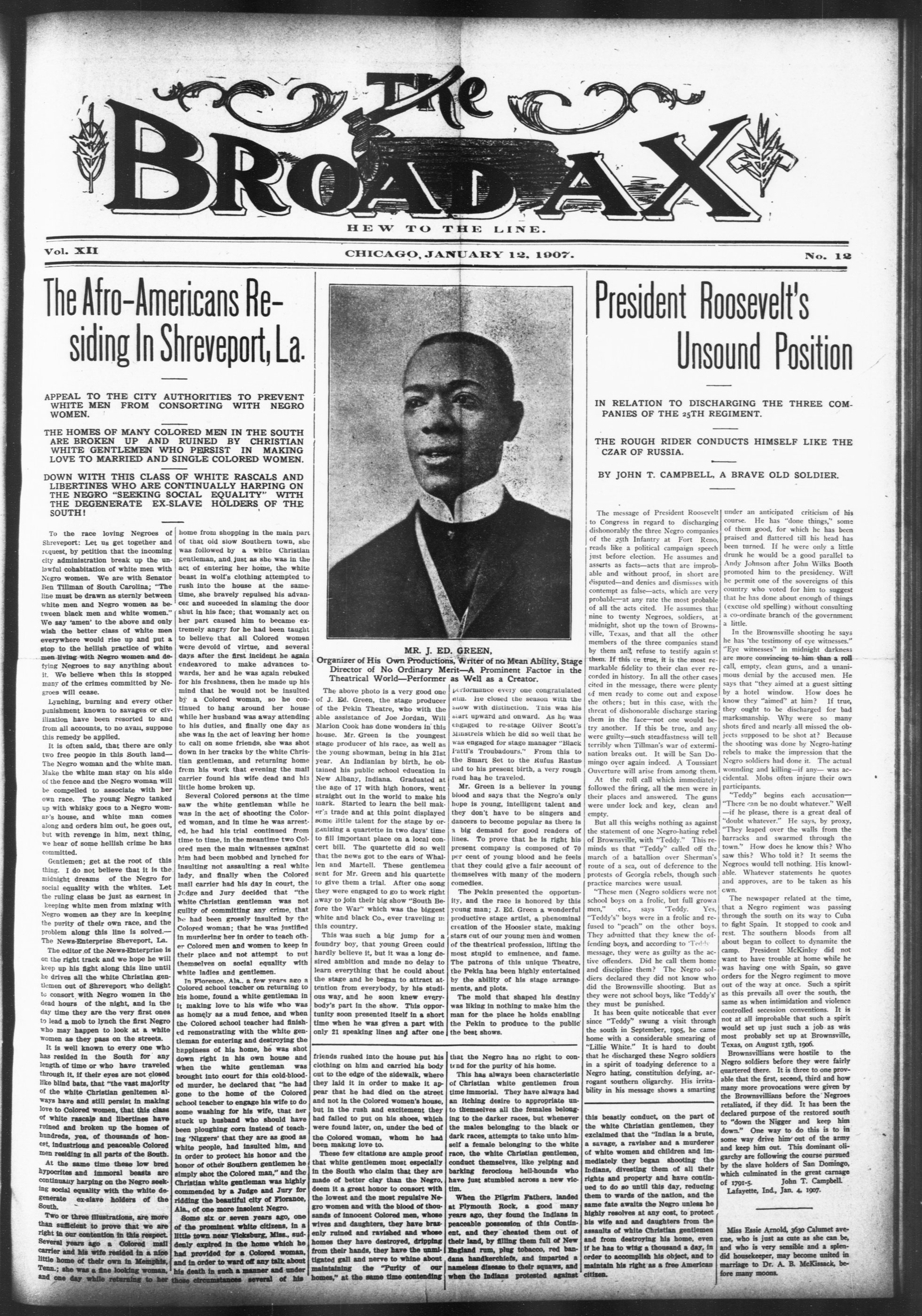
MR. J. ED. GREEN,
Organizer of His Own Productions, Writer of no Mean Ability, Stage Director of No Ordinary Merit-A Prominent Factor in the Theatrical World-Performer as Well as a Creator.
The above photo is a very good one of J. Ed. Green, the stage producer of the Pekin Theatre, who with the able assistance of Joe Jordan, Will Marlon Cook has done wonders in this house. Mr. Green is the youngest stage producer of his race, as well as the young showman, being in his 31st year. An Indianian by birth, he obtained his public school education in New Albany, Indiana. Graduated at the age of 17 with high honors, went straight out in the world to make his mark. Started to learn the bell maker's trade and at this point displayed some little talent for the stage by organizing a quartette in two days' time to fill important place on a local concert bill. The quartette did so well that the news got to the ears of Whallen and Martell. These gentlemen sent for Mr. Green and his quartette to give them a trial. After one song they were engaged to go to work right away to join their big show "South Before the War" which was the biggest white and black Co., ever traveling in this country.
This was such a big jump for a foundry boy, that young Green could hardly believe it, but it was a long desired ambition and made no delay to learn everything that he could about the stage and he began to attract attention from everybody, by his studious way, and he soon knew everybody's part in the show. This opportunity soon presented itself in a short time when he was given a part with only 21 speaking lines and after one
friends rushed into the house put his clothing on him and carried his body out to the edge of the sidewalk, where they laid it in order to make it appear that he had died on the street and not in the Colored women's house, but in the rush and excitement they had failed to put on his shoes, which were found later, on, under the bed of the Colored woman, whom he had been making love to.
These few citations are ample proof that white gentlemen most especially in the South who claim that they are made of better clay than the Negro, deem it a great honor to consort with the lowest and the most repulsive Negro women and with the blood of thousands of innocent Colored men, whose wives and daughters, they have brazenly ruined and ravished and whose homes they have destroyed, dripping from their hands, they have the unmitigated gall and nerve to whine about maintaining the "Purity of our homes," at the same time contending
performance every one congratulated him. He closed the season with the show with distinction. This was his start upward and onward. As he was engaged to re-stage Oliver Scott's Minstrels which he did so well that he was engaged for stage manager "Black Patti's Troubadours." From this to the Smart Set to the Rufus Rastus and to his present birth, a very rough road has he traveled.
Mr. Green is a believer in young blood and says that the Negro's only hope is young, intelligent talent and they don't have to be singers and dancers to become popular as there is a big demand for good readers of lines. To prove that he is right his present company is composed of 70 per cent of young blood and he feels that they could give a fair account of themselves with many of the modern comedies.
The Pekin presented the opportunity, and the race is honored by this young man; J. Ed. Green a wonderful productive stage artist, a phenomenal creation of the Hoosier state, making stars out of our young men and women of the theatrical profession, lifting the most stupid to eminence, and fame. The patrons of this unique Theatre, the Pekin has been highly entertained by the ability of his stage arrangements, and plots.
The mold that shaped his destiny was liking in nothing to make him the man for the place he holds enabling the Pekin to produce to the public the best shows.
that the Negro has no right to contend for the purity of his home. This has always been characteristic of Christian white gentlemen from time immorial. They have always had an itching desire to appropriate unto threemelves all the females belonging to the darker races, but whenever the males belonging to the black or dark races, attempts to take unto himself a female belonging to the white race, the white Christian gentlemen, conduct themselves, like yelping and barking ferocious hell-hounds who have just stumbled across a new victim. When the Pilgrim Fathers, landed at Plymouth Rock, a good many years ago, they found the Indians in peaceable possession of this Continent, and they cheated them out of their land, by filling them full of New England rum, plug tobacco, red bandana handkerchiefs, and imparted a nameless disease to their squaws, and when the Indians protested against
President Roosevelt's Unsound Position
IN RELATION TO DISCHARGING THE THREE COMPANIES OF THE 25TH REGIMENT.
THE ROUGH RIDER CONDUCTS HIMSELF LIKE THE CZAR OF RUSSIA.
BY JOHN T. CAMPBELL, A BRAVE OLD SOLDIER.
The message of President Roosevelt to Congress in regard to discharging dishonorably the three Negro companies of the 25th Infantry at Fort Reno reads like a political campaign speech just before election. He assumes and asserts as facts—acts that are improbable and without proof, in short are disputed—and denies and dismisses with contempt as false—acts, which are very probable—at any rate the most probable of all the acts cited. He assumes than nine to twenty Negroes, soldiers, at midnight, shot up the town of Brownsville, Texas, and that all the other members of the three companies stand by them and refuse to testify against them. If this be true, it is the most remarkable fidelity to their clan ever recorded in history. In all the other cases cited in the message, there were plenty of men ready to come out and expose the others; but in this case, with the threat of dishonorable discharge staring them in the face—not one would betry another. If this be true, and any were guilty—such steadfastness will tell terribly when Tillman's war of extinction breaks out. It will be San Domingo over again indeed. A Toussaint Ouverture will arise from among them.
At the roll call which immediately followed the firing, all the men were in their places and answered. The guns were under lock and key, clean and empty.
But all this weighs nothing as against the statement of one Negro-hating rebel of Brownsville, with "Teddy." This reminds us that "Teddy" called off the march of a battalion over Sherman's route of a sea, out of deference to the protests of Georgia rebels, though such practice marches were usual.
"These men (Negro soldiers were not school boys on a frolic, but full grown men," etc., says "Teddy. Yes, Teddy's" boys were in a frolic and refused to "peach" on the other boys. They admitted that they knew the offending boys, and according to "Teddy" message, they were as guilty as the active offenders. Did he call them home and discipline them? The Negro soldiers declared they did not know who did the Brownsville shooting. But as they were not school boys, like "Teddy's" they must be punished.
It has been quite noticeable that ever since "Teddy" swung a visit through the south in September, 1905, he came home with a considerable smearing of "Lillie White." It is hard to doubt that he discharged these Negro soldiers in a spirit of toadying deference to a Negro hating, constitution defying, arrogant southern oligarchy. His irritability in his message shows a smarting
this beastly conduct, on the part of the white Christian gentlemen, they exclaimed that the "Indian is a brute, a savage, a ravisher and a murderer of white women and children and immediately they began shooting the Indians, divesting them of all their rights and property and have continued to do so until this day, reducing them to wards of the nation, and the same fate awaits the Negro unless he highly resolves at any cost, to protect his wife and daughters from the assaults of white Christian gentlemen and from destroying his home, even if he has to wing a thousand a day, in order to accomplish his object, and to maintain his right as a free American citizen.
Roosevelt's Ground Position
CHARGING THE THREE COM-
GIMENT.
DUCTS HIMSELF LIKE THE
A BRAVE OLD SOLDIER.
---
under an anticipated criticism of his course. He has "done things," some of them good, for which he has been praised and flattered till his head has been turned. If he were only a little drunk he would be a good parallel to Andy Johnson after John Wilks Booth promoted him to the presidency. Will he permit one of the sovereigns of this country who voted for him to suggest that he has done about enough of things (excuse old spelling) without consulting a co-ordinate branch of the government a little.
In the Brownsville shooting he says he has 'the testimony of eye witnesses." "Eye witnesses" in midnight darkness are more convincing to him than a roll call, empty, clean guns, and a unanimous denial by the accused men. He says that "they aimed at a guest sitting by a hotel window. How does he know they "aimed" at him? If true, they ought to be discharged for bad marksmanship. Why were so many shots fired and nearly all missed the objects supposed to be shot at? Because the shooting was done by Negro-hating rebels to make the impression that the Negro soldiers had done it. The actual wounding and killing—if any—was accidental. Mobs often injure their own participants.
"Teddy" begins each accusation—"There can be no doubt whatever." Well—if he please, there is a great deal of "doubt whatever." He says, by proxy, "They leaped over the walls from the barracks and swarmed through the town." How does he know this? Who saw this? Who told it? It seems the Negroes would tell nothing. His knowlable. Whatever statements he quotes and approves, are to be taken as his own.
The newspaper related at the time, that a Negro regiment was passing through the south on its way to Cuba to fight Spain. It stopped to cook and rest. The southern bloods from all about began to collect to dynamite the camp. President McKinley did not want to have trouble at home while he was having one with Spain, so gave orders for the Negro regiment to move out of the way at once. Such a spirit as this prevails all over the south, the same as when intimidation and violence controlled secession conventions. It is not at all improbable that such a spirit would set up just such a job as was most probably set up at Brownsville, Texas, on August 13th, 1906.
Brownsvillians were hostile to the Negro soldiers before they were fairly quartered there. It is three to one provable that the first, second, third and how many more provocations were given by the Brownsvillians before the Negroes retaliated, if they did. It has been the declared purpose of the restored south to "down the Nigger and keep him down." One way to do this is to in some way drive him out of the army and keep him out. This dominant oligarchy are following the course pursued by the slave holders of San Domingo, which culminated in the great carnage of 1791-5. John T. Campbell. Lafayette Ind. Jan. 4. 1907.
Miss Essie Arnold, 3630 Calumet avenue, who is just as cute as she can be, and who is very sensible and a splendid housekeeper, may become united in marriage to Dr. A. B. McKissack, before many moons.
Will promulgate and at all times uphold the true principles of Democracy, but Catholic, Protestants, Presidents, Infants, Farmers, Single, and many others. They can also have their way, so long as their language is proper and responsibility is fixed.
The Broad *i* is a newspaper whose platform is broad enough for all, ever claiming the editorial right to speak its own mind.
Local communications will receive attention. Write only on one side of the paper.
JULIUS F. TAYLOR, Editor and Publisher.
Entered at the Post Office at Chicago
Ill. as Second-class Matter.
PERSONAL MENTION.
Walter M. Farmer, for 16 years an honored member of the bar in St. Louis, Mo., is now engaged in the general practice of law. Suite 708, 171 Washington street, Phone Main 4153. Residence 4856 Langley avenue. Phone Drexel 6302.
THE FREEMAN TAKES ANOTHER SHOT AT BENJAMIN R. TILLMAN.
Chicago had a taste of Tillmanism that will last it a lifetime, and the Windy City wants no more of him. We do not believe that even Mrs. Adele Keeler, who, out of a sense of pride, maintained a stiff upper lip to the last for the South Carolinian's appearance, would go through such a nerve-racking siege for the sake of maintaining her "Anglo-Saxon independence of Negro domination." Her assertion that "if the committee backed down at the demand of the Negroes the blacks would become so arrogant that the white people would not be able to stay in Chicago," was the veriest rot, and wholly unbecoming in one who claimed to be the "daughter of a soldier who fought to free the slaves." She has heard her Tillman, and we sincerely hope she got enough of his blackguardism and low billingsgate, that neither instructs nor amuses. The country at large has taken his measure long ago, and it is a notorious fact that he is not welcome in the homes of the refined members of the Senate in Washington; he has no serious standing as a law-maker among his colleagues at the capitol, and even the Democrats pay no attention to anything he may have to say on the floor of the Senate or anywhere else, for he invariably allows his beastly temper to get the better of his judgment and makes a sorry mess of all he undertakes. The Louisville Courier-Journal, which represents the decency and aristocratic instinct in the Democratic party, spews him out as an unclean thing and a menace to the reputation of the party in the eyes of right-thinking Americans. It is well known that he was a positive burden to the party managers in the Northern states all through the last campaign, and lost votes for Parker wherever the liberal element abided in any considerable numbers. Not a few Democratic chairmen actually refused to let him speak in their counties. They knew the demoralizing effect of Tillmanism upon the restable voters, white and black.
Mayor Dunne showed good sense and a rightful conception of his high office in declining to lend himself to the Tillman propaganda, although it was thinly disguised under the mantle of charity. As a conserver of law and order, he could not have sat silently by and permitted even so distinguished a personage as a United States Senator—God save the mark!—to yell out, like a barroom tout. "To hell with the law!"
The demonstration made by the Colored people did them proud. Their protest was dignified and orderly; at no time did it approach the mob deadline. They exhausted the resources of the law—and abided by the result. That the authorities were frightened at the possible consequences was amply attested by the extraordinary precautions to avoid an outbreak, and by the impregnable guard they placed around the speaker. It is a safe guess that Tillman will not be invited to Chicago again for many moons, and it is doubtful if he can secure an engagement under reputable auspices anywhere, for no charity or educational institution cares to have an orator on their hands who is so distasteful to any large element of the population that it is necessary to surround him as though he were the Czar of Russia traveling through a hostile section of his empire.
The Negroes of Chicago have scotched Tillmanism, if they have not killed it—and that is something.—The Freeman, Indianapolis, Ind., Jan. 5, 07.
Miss Mabel Botts, assisted by her sister, Miss Rachel Demby, 6440 Champlain avenue, entertained a number of their friends Sunday afternoon and evening. A musical folowed by a seven coursed dinner was the form of enjoyment, which delighted guest and hostess alike.
NEGRO TROOPS ALL EXILED.
Secretary Taft Orders Colored Regiments to Philippines.
Washington, D. C., Jan. 5.—(Special.)—All Negro troops in the United States army are to be sent to the Philippines for service. Orders to this effect have been issued by Secretary Taft, with the full approval of the president.
The regiments affected by the order issued by Secretary Taft are the Twenty-fifth infantry, three companies of which were dismissed on consequence of the Brownsville affair, and which is now distributed among Oklahoma posts; the Twenty-fourth infantry, which is in the Moro country; the Ninth cavalry, which is divided up among Forts Sheridan, Riley, and Leavenworth, and the Tenth cavalry, which is distributed among Forts Robinson, D. A. Russell, and Washakie. Regarding the action taken, Mr. Taft issued the following statement:
"The present assignment of the Colored regiments to the Philippines is merely for an equal distribution of foreign service. They have not been there for four years. It now becomes fair to them and to the other regiments that they be assigned to the Philippines in due order.
"Foreign service, it should be stated increases the pay of the men 20 per cent and counts double time for retirement. It was pointed out at the department, therefore, that the idea that these orders were prejudicial to the Colored troops or were made on account of the Brownsville affair, was utterly absurd."
Sailing Dates Arranged.
The Twenty-fifth infantry will sail from San Francisco for Manila on April 5. The Nineteenth infantry, which will be relieved by the Twenty-fifth, sails from Manila for home on May 15.
The Tenth cavalry, with the exception of two troops, will sail on March 5. The two remaining troops will go on June 5. The headquarters band and First squadron of the Ninth cavalry, now at Fort Riley, Kas., three troops of the regiment: now at Fort Leavenworth, and three troops now at Fort Sheridan, will depart on May 5. This leaves one troop at Leavenworth and one at Sheridan, both of which will sail on Aug. 5.
The outgoing regiments will sail as follows: Twenty-fifth on April, Twenty-sixth on June 5, Thirty-ninth on July 5, Twenty-ninth on Aug. 5, and Sixteenth on Oct. 5.
BULLETIN NO. 6
GAS WELL NO. VI. JAN. 10TH, 1907. BLACK DIAMOND DEVELOPMENT COMPANY.
To all Stockholders in the Black Diamond Development Company: Greetings—I am pleased to inform you that Well No. 6 was brought in today on Black Diamond Development Company's gas and oil fields in Southeastern Kansas near the City of Chanute.
This is a splendid gas well. This is indeed a most remarkable record for any Company to have drilled in less time than one year six (6) good Dividend, paying gas wells without even one failure. The success of the company is assured. The Company has let the contract and is drilling 24 more Wells.
Mr. Fred A. Wescott the manager, will leave in a few days for the gas fields of Kansas, to complete our pipe line.
So that in less time then (30) days Kansas City, Mo., will be burning Black Diamond Development Company gas.
There are just a few more shares of stock for sale at 25c. Stock can be had of Dr. A J. Carey 30th and Dearborn streets. Mr. L. L. Jones, 3842 State street, Mr. S. L. Williams, 184 Dearborn street. Mr. W. R. Cowan, 260 Clark street. Rev. J. F. Thomas, 35th and Dearborn street. Dr. A. W. Williams 29th and State streets, phone Calumet 1412. Mr. Fred A. Wescott, 188 Madison street, Room 1207, phone Main 3887. Prof. H. T. Kealing, 631 Pine street, Philadelphia, Pa. All persons connected with the Black Diamond Development Co. have every reason to be proud of this Company's success.
I have put my money in this company on my judgment to win.
I am deeply sensible of my responsibility. But I know a good thing once in awhile. Yours for success.
A. WILBERFORCE WILLIAMS.
HEADQUARTERS FOR THE BROAD AX IN NEW YORK CITY.
From on and after this date THE BROAD AX will be handled in New York City by The Standrad News Company, 323 West 37th street, where it can be found on sale each week.
The Standard News Company is one of the most extensive concerns of its kind among the Afro-Americans in this country.
They handle all the latest publications pertaining to the race, in the way of books and so on, and they will push THE BROAD AX in the East, and throughout the South for all that it is worth.
Alderman Harding will be returned to the city council this spring from the Second ward.
[Name]
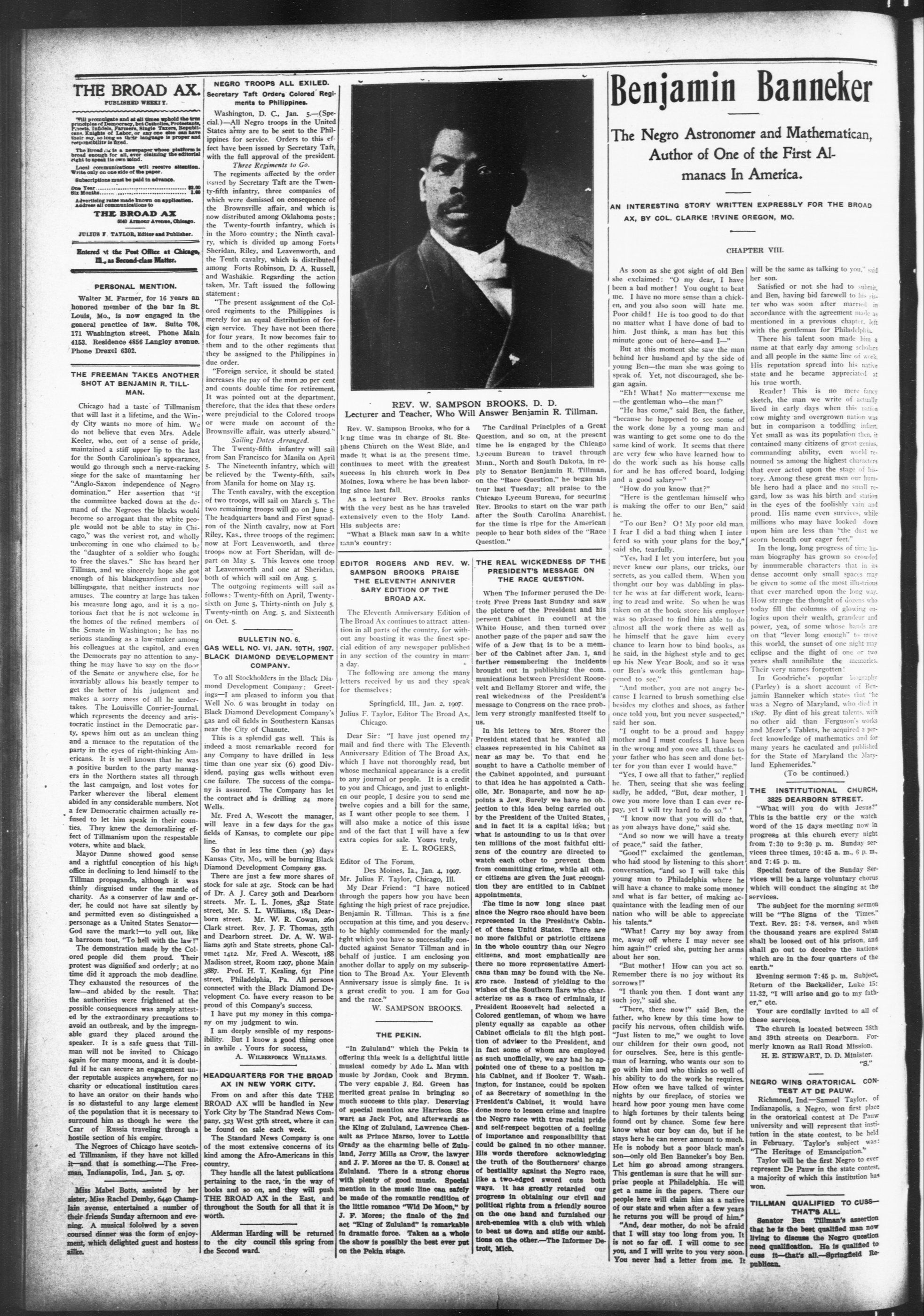
REV. W. SAMPSON BROOKS, D. D.
Lecturer and Teacher, Who Will Answer Benjamin R. Tillman.
Rev. W. Sampson Brooks, who for a long time was in charge of St. Stephens Church on the West Side, and made it what is at the present time, continues to meet with the greatest success in his church work in Des Moines, Iowa where he has been laboring since last fall.
As a lecturer Rev. Brooks ranks with the very best as he has traveled extensively even to the Holy Land. His subjects are:
"What a Black man saw in a white man's country:
The Cardinal Principles of a Great Question, and so on, at the present time he is engaged by the Chicago Lyceum Bureau to travel through Minn., North and South Dakota, in order to Senator Benjamin R. Tillman on the "Race Question," he began to tour last Tuesday; all praise to the Chicago Lyceum Bureau, for security. Rev. Brooks to start on the war after the South Carolina Anarchist for the time is ripe for the American people to hear both sides of the "Race Question."
EDITOR ROGERS AND REV. W
SAMPSON BROOKS PRAISE
THE ELEVENTH ANNIVER
SARY EDITION OF THE
BROAD AX.
The Eleventh Anniversary Edition of The Broad Ax continues to attract attention in all parts of the country, for without any boasting it was the finest special edition of any newspaper published in any section of the country in many a day.
The following are among the many letters received by us and they speak for themselves:
Springfield, Ill., Jan. 2, 1907.
Julius F. Taylor, Editor The Broad Ax,
Chicago.
Dear Sir: "I have just opened my mail and find there with The Eleventh Anniversary Edition of The Broad Ax, which I have not thoroughly read, but whose mechanical appearance is a credit to any journal or people. It is a credit to you and Chicago, and just to enlighten our people, I desire you to send me twelve copies and a bill for the same, as I want other people to see them. I will also make a notice of this issue and of the fact that I will have a few extra copies for sale. Yours truly, E. L. ROGERS
Editor of The Forum
Des Moines, Ia., Jan. 4. 1997.
Mr. Iulius F. Taylor, Chicago. Ill.
My Dear Friend: "I have noticed through the papers how you have been fighting the high priest of race prejudice. Benjamin R. Tillman. This is a fine occupation at this time, and you deserve to be highly commended for the manly fight which you have so successfully conducted against Senator Tillman and in behalf of justice. I am enclosing you another dollar to apply on my subscription to The Broad Ax. Your Eleventh Anniversary issue is simply fine. It is a great credit to you. I am for God and the race." W. SAMPSON BROOKS.
THE PEKIN.
"In Zululand" which the Pekin is offering this week is a delightful little musical comedy by Ade L. Man with music by Jordan, Cook and Brymn. The very capable J. Ed. Green has merited great praise in bringing so much success to this play. Deserving of special mention are Harrison Stewart as Jack Pot, and afterwards as the King of Zululand, Lawrence Chenault as Prince Marso, lover to Lotte Grady as the charming belle of Zululand, Jerry Mills as Crow, the lawyer and J. F. Mores as the U. S. Consul at Zululand. There is a strong chorus with plenty of good music. Special mention in the music line can safely be made of the romantic rendition of the little romance "Wid De Moon," by J. F. Mores; the finale of the 2nd act "King of Zululand" is remarkable in dramatic force. Taken as a whole the show is possibly the best ever put on the Pekin stage.
The Cardinal Principles of a Great Question, and so on, at the present time he is engaged by the Chicago Lyceum Bureau to travel through Minn., North and South Dakota, in reply to Senator Benjamin R. Tillman, on the "Race Question," he began his tour last Tuesday; all praise to the Chicago Lyceum Bureau, for securing Rev. Brooks to start on the war path after the South Carolina Anarchist, for the time is ripe for the American people to hear both sides of the "Race Question."
THE REAL WICKEDNESS DF THE PRESIDENT'S MESSAGE ON THE RACE QUESTION.
When The Informer perused the Detroit Free Press last Sunday and saw the picture of the President and his persent Cabinet in council at the White House, and then turned over another page of the paper and saw the wife of a Jew that is to be a member of the Cabinet after Jan. 1, and further remembering the incidents brought out in publishing the communications between President Roosevelt and Bellamy Storer and wife, the real wickedness of the President's message to Congress on the race problem very strongly manifested itself to us.
In his letters to Mrs. Storer the President stated that he wanted all classes represented in his Cabinet as near as may be. To that end he sought to have a Catholic member of the Cabinet appointed, and pursuant to that idea he has appointed a Catholic, Mr. Bonaparte, and now he appoints a Jew. Surely we have no objection to this idea being carried out by the President of the United States, and in fact it is a capital idea; but what is astounding to us is that over ten millions of the most faithful citizens of the country are directed to watch each other to prevent them from committing crime, while all other citizens are given the just recognition they are entitled to in Cabinet appointments.
The time is now long since past since the Negro race should have been represented in the President's Cabinet of these Unified States. There are no more faithful or patriotic citizens in the whole country than our Negro citizens, and most emphatically are there no more representative Americans than may be found with the Negro race. Instead of yielding to the wishes of the Southern flars who characterize us as a race of criminals, if President Roosevelt had selected a Colored gentleman, of whom we have plenty equally as capable as other Cabinet officials to fill the high position of adviser to the President, and in fact some of whom are employed as such unofficially, we say had he appointed one of these to a position in his Cabinet, and if Booker T. Washington, for instance, could be spoken of as Secretary of something in the President's Cabinet, it would have done more to lessen crime and inspire the Negro race with true racial pride and self-respect begotten of a feeling of importance and responsibility that could be gained in no other manner. His words therefore acknowledging the truth of the Southerners' charge of bestiality against the Negro race, like a two-edged sword cuts both ways. It has greatly retarded our progress in obtaining our civil and political rights from a friendly source on the one hand and furnished our arch-enemies with a club with which to beat us down and stifle our ambitions on the other.—The Informer Detroit, Mich.
Benjamin Banneker
The Negro Astronomer and Mathematican, Author of One of the First Almanacs In America.
AN INTERESTING STORY WRITTEN EXPRESSLY FOR THE BROAD AX. BY COL. CLARKE !RVINE OREGON, MO.
As soon as she got sight of old Ben she exclaimed: "O my dear, I have been a bad mother! You ought to beat me. I have no more sense than a chicken, and you also soon will hate me. Poor child! He is too good to do that no matter what I have done of bad to him. Just think, a man has but this minute gone out of here—and I—" But at this moment she saw the man behind her husband and by the side of young Ben—the man she was going to speak of. Yet, not discouraged, she began again. "Eh! What! No matter—excuse me—the gentleman who—the man!"
"He has come," said Ben, the father, "because he happened to see some of the work done by a young man and was wanting to get some one to do the same kind of work. It seems that there are very few who have learned how to do the work such as his house calls for and he has offered board, lodging and a good salary—"
"How do you know that?"
"Here is the gentleman himself who is making the offer to our Ben," said he.
"To our Ben? O! My poor old man. I fear I did a bad thing when I interfered so with your plans for the boy," said she, tearfully.
"Yes, had I let you interfere, but you never knew our plans, our tricks, our secrets, as you called them. When you thought our boy was dabbling in plaster he was at far different work, learning to read and write. So when he was taken on at the book store his employer was so pleased to find him able to do almost all the work there as well as he himself that he gave him every chance to learn to bind books, as he said, in the highest style and to get up his New Year Book, and so it was our Ben's work this gentleman happened to see."
"And mother, you are not angry because I learned to brush something else besides my clothes and shoes, as father once told you, but you never suspected," said her son.
"I ought to be a proud and happy mother and I must confess I have been in the wrong and you owe all, thanks to your father who has seen and done better for you than ever I would have."
"Yes, I owe all that to father," replied he. Then, seeing that she was feeling sadly, he added, "But, dear mother, I owe you more love than I can ever repay, yet I will try hard to do so." "I know now that you will do that, as you always have done," said she.
"And so now we will have a treaty of peace," said the father.
"Good!" exclaimed the gentleman, who had stood by listening to this short conversation, "and so I will take this young man to Philadelphia where he will have a chance to make some money and what is far better, of making acquaintance with the leading men of our nation who will be able to appreciate his talents."
"What! Carry my boy away from me, away off where I may never see him again!" cried she, putting her arms about her son.
"But mother! How can you act so. Remember there is no joy without its sorrows!"
"I thank you then. I dont want any such joy," said she.
"There, there now!" said Ben, the father, who knew by this time how to pacify his nervous, often childish wife. "Just listen to me," we ought to love our children for their own good, not for ourselves. See, here is this gentleman of learning, who wants our son to go with him and who thinks so well of his ability to do the work he requires. How often we have talked of winter nights by our fireplace, of stories we heard how poor young men have come to high fortunes by their talents being found out by chance. Some few here know what our boy can do, but if he stays here he can never amount to much. He is nobody but a poor black man's son—only old Ben Bannecker's boy Ben. Let him go abroad among strangers. This gentleman is sure that he will surprise people at Philadelphia. He will get a name in the papers. There our people here will claim him as a native of our state and when after a few years he returns you will be proud of him."
"And, dear mother, do not be afraid that I will stay too long from you. It is not so far off. I will come to see you, and I will write to you very soon. You never had a letter from me. It
"How do you know that?"
and Ben have to beat chick- me. so that road to this " man side of going to the be- will be the same as talking to you," said her son. Satisfied or not she had to submit, and Ben, having bid farewell to his sister who was soon after married in accordance with the agreement made as mentioned in a previous chapter, left with the gentleman for Philadelphia. There his talent soon made him a name at that early day among scholars and all people in the same line of work. His reputation spread into his native state and he became appreciated at his true worth.
Reader! This is no mere fancy sketch, the man we write of actually lived in early days when this nation now mighty and overgrown nation was but in comparison a toddling infant. Yet small as was its population then, it contained many citizens of great genius, commanding ability, even world renounced as among the highest characters that ever acted upon the stage of history. Among these great men our humble hero had a place and no small regard, low as was his birth and station in the eyes of the foolishly vain and proud. His name even survives, while millions who may have looked down upon him are less than "the dust we scorn beneath our eager feet."
In the long, long progress of time human biography has grown so crowded by innumerable characters that in its dense account only small spaces may be given to some of the most illustrious that ever marched upon the long way. How strange the thought of dozens who today fill the columns of glowing eulogies upon their wealth, grandeur and power, yea, of some whose hands are on that "lever long enough" to move this world, the sunset of one night may eclipse and the flight of one or two years shall annihilate the memories. Their very names forgotten!
In Goodriche's popular biography (Parley) is a short account of Benjamin Banneker which states that she was a Negro of Maryland, who died in 1807. By dint of his great talents, with no other aid than Ferguson's works and Mezer's Tablets, he acquired a perfect knowledge of mathematics and for many years he caculated and published for the State of Maryland the Maryland Ephemerides."
THE INSTITUTIONAL CHURCH,
2025 DEARBURST STREET
"What will you do with Jesus?"
This is the battle cry or the watch word of the 15 days meeting now in progress at this church every night from 7:30 to 9:30 p. m. Sunday services three times, 10:45 a. m., 6 p. m., and 7:45 p. m.
Special feature of the Sunday Services will be a large voluntary chorus which will conduct the singing at the services.
The subject for the morning sermon will be "The Signs of the Times." Text. Rev. 25: 7-8. verses, and when the thousand years are expired Satan shall be loosed out of his prison, and shall go out to deceive the nations which are in the four quarters of the earth."
Evening sermon 7:45 p. m. Subject, Return of the Backslider, Luke 15: 11:32, "I will arise and go to my father," etc.
Your are cordially invited to all of these services.
The church is located between 38th and 39th streets on Dearborn. Formerly known as Rail Road Mission.
H. E. STEWART, D. D. Minister.
"S."
NEGRO WINS ORATORICAL CONTEST AT DE PAUW.
Richmond, Ind.—Samuel Taylor, of Indianapolis, a Negro, won first place in the oratorical contest at De Pauw university and will represent that institution in the state contest, to be held in February. Taylor's subject was: "The Heritage of Emancipation."
Taylor will be the first Negro to ever represent De Pauw in the state contest, a majority of which this institution has won.
TILLMAN QUALIFIED TO CUSS
THAT'S ALL
Senator Ben Tillman's assertion that he is the best qualified man now living to discuss the Negro question need qualification. He is qualified to cuss it—that's all.—Springfield Republican.
一
(To be continued.)
CHIPS
Mrs. Alexander, 3223 Wabash avenue, is serving five o'clock dinners at her home.
Mr. Walter Quinn, of New York spent a few days in the city last week en route for the West.
Mr. Jas. H. Wilson of Los Angeles, Cal., spent a week in the city last week stopping at The Keystone Hotel.
Dr. A. Wilberforce Williams left Thursday evening on a flying business and professional trip to Buxton, Iowa.
Attorney C. J. Waring, 119 La Salle street, arrived home Monday morning from Louisville, Ky., where he spent the holidays.
James A. Quinn, who is still a power in politics on the North side, continues to boom Carter H. Harrison for mayor of Chicago.
Mrs. Carrie Warner, 5223 Dearborn street, after spending New Year's day with her sister in St. Louis, Mo., returned home the first of the week.
Attorney John A. Irrmann, has entirely regained his health and strength and he is doing a rushing law business on the tenth floor of the Unity Building.
Mr. and Mrs. Frank Seefing of Clinton, Iowa, are spending a two weeks visit in the city, the guest of Mrs. J. A. Downs, 3641 Dearborn street.
Mr. "Frenchy" Bell, popularly known in Chicago, while on a western trip was so ill at Omaha that he was taken from the train and has since been reported that he died.
David J. Kinghten, who has for years worked for the success of the Democratic party in the Second ward, has been appointed to a good position in the City Attorney's office.
John G. Jones returned home Monday from a pleasant trip to Boston and New York City, while in the East he was entertained by many of the big masons.
Grafted white skin on a black man has turned black. We can understand now why miscegenating with the Negro is so bitterly opposed by many Caucasians — the Negro part would soon eat up the Caucasian part. Next—The Republican, Seattle, Wash.
Mrs. Wm. Mack, 2230 Dearborn St., formerly of Baltimore, Md., entertained a large number of Baltimoreians at a midnight lunch in honor of Mr. Joseph Gans the pugilist, Wednesday evening. January 6th. Many toasts were responded to by the guests, who drank to the continued success of the Baltimore fighter.
Mrs. Valdo Turner, of St. Paul, Minnesota, spent three days in Chicago, en route home after a stay of several weeks in Springfield, Ohio, with relatives. Mrs. Turner, was the guest of Mr. and Mrs. Julius N. Avendorph, while in Chicago. Mrs. Turner, left for St. Paul Monday morning, Jan. 7.
A theatre party was arranged last Saturday for Mrs. Valdo Turner, of St. Paul, Minn., by Messrs. A. C. Harris and R. L. Taylor. The party consisted of the following Mrs. Turner, Mrs. Avendorph,Mrs. Taylor and Mrs. Harris. Mr. Otis Skinner, in "The Duel" was the play.
John R. Caverly, former justice of the peace and police magistrate at the Harrison street police station, was appointed assistant corporation counsel and acting city attorney by Corporation Lewis Thursday. Alfred Johnson was named as first assistant city attorney and Frank McGovern, W. R. Harris, Charles H. Barnes and James T. McDermott were chosen as investigators.
Booker T. Washington's constant twaddle in advising southern Negroes to be tame and not "resent" the cracker's murderous assaults, is enough to make ambitious race men and women throw up. He hasn't enough educated manhood and culture to be a man, and only advises his people to incur favors of Southerners whose contention is that the Negro has a place.-The Pioneer Press, Martinsburg, W. Va.
A popular young south side tailor carries in his left breast vest pocket a beautiful diamond bracelet, which he desires to place on the wrist of some pretty girl. At present he is undecided which girl—there being so many on his calling list. The girl who gets the bracelet may reign queen over the tailor shop, where many joyful, convivial events are pulled off about twice a month. Who will be the lucky girl?
Mrs. Lucy Churchill, 3445 Armour avenue, recently sold one of her buildings located at 762 Custom House place, for $27,000, and she has purchased two other pieces of valuable property, 3010-3012 Vernon avenue and 322 Bowen avenue for $18,000. Mrs. Churchill, who is a sharp business woman, now owns seven houses in this city and through her agent, John H. Howard, she collects three hundred dollars per month rent from her real estate holdings.
WASHINGTON LETTER
[Special Correspondence]
The White House staff was busy for several days after Christmas returning presents sent to President Roosevelt and his family by strangers. Of course no gifts from friends were returned.
"If a total stranger to the president sends him a Christmas present it is likely that he is after something" observed an official at the White House.
"To accept such gifts would not only be very bad taste on the part of the president, but would probably give the sender reason to believe that he might look for a return. The president is not running his office in that way."
No More White Horses.
The war department has issued orders that in purchasing horses for the cavalry arm of the service those of white or gray color be excluded, because animals of those colors offset all the work of the department in trying by means of dress and equipment to make the men as inconspicuous as possible. Such a regulation has existed for a long time in the artillery branch.
Nobel Prize Commission.
John Mitchell, president of the United Mine Workers of America, and Marvin Hughitt, president of the Chicago and Northwestern railroad, representing labor and capital, respectively, have accepted appointments offered by President Roosevelt as trustees of the Nobel peace prize fund, which will be devoted to the maintenance of a commission to settle disputes between labor and capital. The other members of the commission will be the chief justice of the supreme court, the secretary of agriculture and the secretary of commerce and labor.
President For Beveridge Bill.
President For Beveridge Bill.
The president recently received Dr. Felix Adler, chairman of the national child labor committee; Dr. S. M. Lindsay, secretary, and Dr. Neill, commissioner of labor, who called on behalf of the national committee to obtain the president's views with respect to the Beveridge-Parsons bill for a national child labor law. The president stated that he considered this bill an excellent one and that he would give it his hearty support.
For Public Baths.
The commissioners recently received from General John M. Wilson, president of the Washington board of trade, a resolution which has been adopted by that organization requesting the commissioners to include in their estimates for the fiscal year ending June 30, 1908, an item to provide two public bathhouses for the city of Washington. The members of the board of trade believe that the establishment of public baths in the District is healthful and necessary and that the commissioners should lose no time in securing a sufficient sum of money to enable these bathhouses to be built in different sections of the city.
The House Santa Claus.
Colonel John E. Andrus, who represents the Yonkers (N. Y.) district in the house, has for several years taken great delight in playing the role of Santa Claus to the pages, telephone and telegraph boys of the house. His gifts to the boys consisted of new crisp two and five dollar bills. Colonel Andrus is a very wealthy man. His fortune is estimated at something like $20,000,-000.
The Supreme Court.
The ceremony of the supreme court judges marching from their robing room across the corridor to take their seats on the bench, which occurs at high noon every week day while the court is holding session, is always a matter of interest to the average visitor at the capitol. As a rule a small crowd gathers on either side of the spot where the dignified judges emerge from the robing room on their journey to the court chamber, but after a new justice has been sworn in, as in the case of Mr. Moody, the number of spectators is augmented for several days out of a desire to see the new recruit to the nation's highest judicial tribunal. The incident is quite impressive and fills the ordinary citizen who has never beheld it before with considerable awe.
An August Procession.
A few minutes before the appointed time a couple of court attendants come forth, bearing two ropes of red cording about an inch in diameter, which they attach to hooks that are fastened to the door jambs on either side of the corridor. As the door swings open and the grave face of the chief justice appears the ropes are snapped into place with a click, making a lane for the eminent jurists to walk through. No one, not even the president of the United States, would be permitted to crawl under the ropes and interrupt the transit of the court in its solemn course. He would be a bold man, indeed, who would attempt it, and probably life imprisonment would be the least punishment that he would receive for contempt of court should he venture on this forbidden ground.
Order of March.
The chief justice is followed by the other justices in the order of seniority, the youngest member in length of service bringing up the rear. Mr. Moody is now the last man in the procession, trailing along after Justice Holmes. The justices walk in single file and with a slow, stately tread, looking nelther to the right nor the left. Their long waving black robes add to the picturesqueness and solemnity of the scene. On the first day that he made the trip the flicker of a smile was noted on Mr. Justice Moody's face as he stepped out into the corridor, but since then he seems to have found his bearings and kept as solemn and grave a visage as the most seasoned member of that angust court.
CARL SCHOFIELD.
WOMAN AND FASHION
A Pleasing Waist.
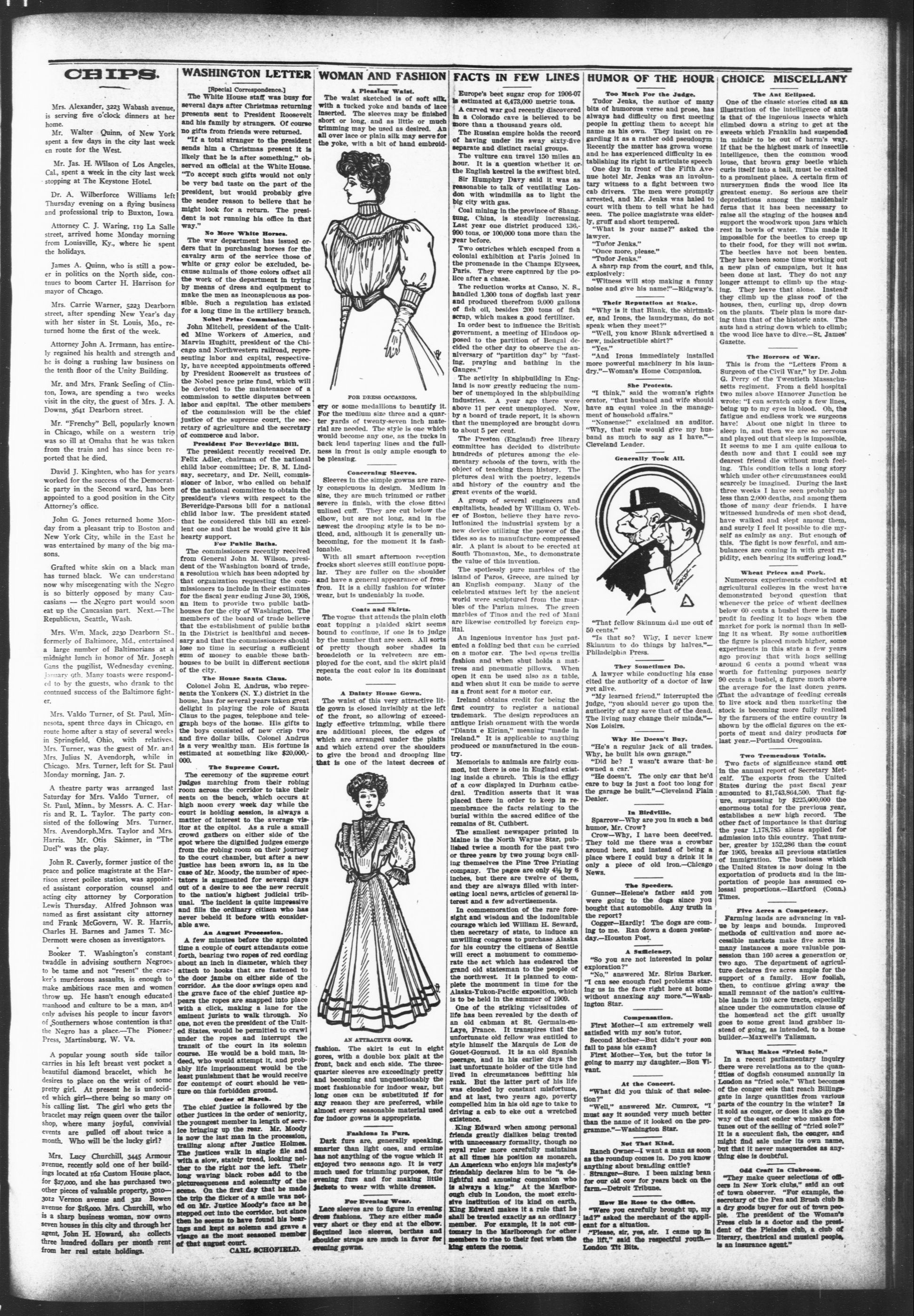
The waist sketched is of soft silk, with a tucked yoke and bands of lace inserted. The sleeves may be finished short or long, and as little or much trimming may be used as desired. An all over lace or plain silk may serve for the yoke, with a bit of hand embroid-
W
FOR DRESS OCCASIONS.
ery or some medallions to beautify it.
For the medium size three and a quarter yards of twenty-seven inch material are needed. The style is one which would become any one, as the tucks in back lend tapering lines and the fullness in front is only ample enough to be pleasing.
Concerning Sleeves.
Sleeves in the simple gowns are rarely conspicuous in design. Medium in size, they are much trimmed or rather severe in finish, with the close fitted unlined cuff. They are cut below the elbow, but are not long, and in the newest the drooping style is to be noticed, and, although it is generally unbecoming, for the moment it is fashionable.
With all smart afternoon reception frocks short sleeves still continue popular. They are fuller on the shoulder and have a general appearance of froufron. It is a chilly fashion for winter wear, but is undeniably la mode.
Coats and Skirts.
The vogue that attends the plain cloth coat topping a plaid skirt seems bound to continue, if one is to judge by the number that are seen. All sorts of pretty though sober shades in broadcloth or in velvetteen are employed for the coat, and the skirt plaid repeats the coat color in its dominant note.
A Dainty House Gown.
The waist of this very attractive little gown is closed invisibly at the left of the front, so allowing of exceedingly effective trimming, while there are additional pieces, the edges of which are arranged under the plaits and which extend over the shoulders to give the broad and drooping line that is one of the latest decrees of
22
AN ATTRACTIVE GOWN.
fashion. The skirt is cut in eight gores, with a double box plait at the front, back and each side. The three-quarter sleeves are exceedingly pretty and becoming and unquestionably the most fashionable for indoor wear, but long ones can be substituted if for any reason they are preferred, while almost every seasonable material used for indoor gowns is appropriate.
Fashions In Furs
Dark furs are, generally speaking, smarter than light ones, and ermine has not anything of the vogue which it enjoyed two seasons ago. It is very much used for trimming purposes, for evening furs and for making little jackets to wear with white dresses.
For Evening Wear.
Lace sleeves are to figure in evening dress fashions. They are either made very short or they end at the elbow. Sequined lace sleeves, berthas and shoulder straps are much in favor for evening gowns.
Europe's beet sugar crop for 1906-07 is estimated at 6,473,000 metric tons. A carved war god recently discovered in a Colorado cave is believed to be more than a thousand years old. The Russian empire holds the record of having under its sway sixty-five separate and distinct racial groups. The vulture can travel 150 miles an hour. It is a question whether it or the English kestrel is the swiftest bird. Sir Humphry Davy said it was as reasonable to talk of ventilating London with windmills as to light the big city with gas. Coal mining in the province of Shangtung, China, is steadily increasing. Last year one district produced 136,900 tons, or 100,000 tons more than the year before.
Two ostriches which escaped from a colonial exhibition at Paris joined in the promenade in the Champs Elysees, Paris. They were captured by the police after a chase.
The reduction works at Canso, N. S., handled 1,300 tons of dogfish last year and produced therefrom 9,000 gallons of fish oil, besides 200 tons of fish scrap, which makes a good fertilizer.
In order best to influence the British government, a meeting of Hindoos opposed to the partition of Bengal decided the other day to observe the anniversary of "partition day" by "fasting, praying and bathing in the Ganges."
The activity in shipbuilding in England is now greatly reducing the number of unemployed in the shipbuilding industries. A year ago there were above 11 per cent unemployed. Now, by a board of trade report, it is shown that the unemployed are brought down to about 5 per cent. The Preston (England) free library committee has decided to distribute hundreds of pictures among the elementary schools of the town, with the object of teaching them history. The pictures deal with the poetry, legends and history of the country and the great events of the world.
A group of several engineers and capitalists, headed by William O. Weber of Boston, believe they have revolutionized the industrial system by a new device utilizing the power of the tides so as to manufacture compressed air. A plant is about to be erected at South Thomaston, Me., to demonstrate the value of this invention.
The spotlessly pure marbles of the island of Paros, Greece, are mined by an English company. Many of the celebrated statues left by the ancient world were sculptured from the marbles of the Parian mines. The green marbles of Tinos and the red of Mani are likewise controlled by foreign capital.
An ingenious inventor has just patented a folding bed that can be carried on a motor car. The bed opens trellis fashion and when shut holds a mattress and pneumatic pillows. When open it can be used also as a table, and when shut it can be made to serve as a front seat for a motor car.
Ireland obtains credit for being the first country to register a national trademark. The design reproduces an antique Irish ornament with the words "Diana e Eirinn," meaning "made in Ireland." It is applicable to anything produced or manufactured in the country.
Memorials to animals are fairly common, but there is one in England existing inside a church. This is the effigy of a cow displayed in Durham cathedral. Tradition asserts that it was placed there in order to keep in remembrance the facts relating to the burial within the sacred edifice of the remains of St. Cuthbert.
The smallest newspaper printed in Maine is the North Wayne Star, published twice a month for the past two or three years by two young boys calling themselves the Pine Tree Printing company. The pages are only $4\frac{1}{2}$ by 6 inches, but there are twelve of them, and they are always filled with interesting local news, articles of general interest and a few advertisements.
In commemoration of the rare foresee and wisdom and the indomitable courage which led William H. Seward, then secretary of state, to induce an unwilling congress to purchase Alaska for his country the citizens of Seattle will erect a monument to commemorate the act which has endeared the grand old statesman to the people of the northwest. It is planned to complete the monument in time for the Alaska-Yukon-Pacific exposition, which is to be held in the summer of 1900.
One of the striking vicissitudes of life has been revealed by the death of an old cabman at St. Germain-en-Laye, France. It transpires that the unfortunate old fellow was entitled to style himself the Marquis de Loz de Gouet-Gourand. It is an old Spanish peerage, and in his earlier days the last unfortunate holder of the title had lived in circumstances befitting his rank. But the latter part of his life was clouded by constant misfortune, and at last, two years ago, poverty compelled him in his old age to take driving a cab to eke out a wretched existence.
King Edward when among personal friends greatly dislikes being treated with unnecessary formality, though no royal ruler more carefully maintains at all times his position as monarch. An American who enjoys his majesty's friendship declares him to be "a delightful and amusing companion who is always a king." At the Marlborough club in London, the most exclusive institution of its kind on earth, King Edward makes it a rule that he shall be treated exactly as an ordinary member. For example, it is not customary in the Marlborough for other members to rise to their feet when the king enters the rooms.
Too Much For the Judge.
Tudor Jenks, the author of many bits of humorous verse and prose, has always had difficulty on first meeting people in getting them to accept his name as his own. They insist on regarding it as a rather odd pseudonym Recently the matter has grown worse and he has experienced difficulty in establishing its right in articulate speech
One day in front of the Fifth Avenue hotel Mr. Jenks was an involuntary witness to a fight between two cab drivers. The men were promptly arrested, and Mr. Jenks was hailed to court with them to tell what he had seen. The police magistrate was elderly, gruff and short tempered.
"What is your name?" asked the lawyer.
"Tudor Jenks."
"Once more, please."
"Tudor Jenks."
A sharp rap from the court, and this, explosively:
"Witness will stop making a funny noise and give his name!"—Ridgway's.
Their Reputation at Stake.
"Why is it that Blank, the shirtmaker, and Irons, the laundryman, do not speak when they meet?"
"Well, you know Blank advertised a new, indestructible shirt?"
"Yes."
"And Irons immediately installed more powerful machinery in his laundry."—Woman's Home Companion.
She Protests
"I think," said the woman's rights orator, "that husband and wife should have an equal voice in the management of household affairs."
"Nonsense!" exclaimed an auditor.
"Why, that rule would give my husband as much to say as I have."—Cleveland Leader.
Generally Took All.
"That fellow Skinnum did me out of 50 cents."
"Is that so? Why, I never knew Skinnum to do things by halves."—Philadelphia Press.
Thex Sometimes Do:
A lawyer while conducting his case cited the authority of a doctor of law yet alive.
"My learned friend." interrupted the judge, "you should never go upon the authority of any save that of the dead.
The living may change their minds."—Nos Loisirs.
Why He Doesn't Buy.
"He's a regular jack of all trades. Why, he built his own garage." "Did he? I wasn't aware that he owned a car." "He doesn't. The only car that he'd care to buy is just a foot too long for the garage he built."—Cleveland Plain Dealer.
In Birdville.
Sparrow—Why are you in such a bad humor, Mr. Crow?
Crow—Why, I have been deceived. They told me there was a crowbar around here, and instead of being a place where I could buy a drink it is only a piece of old iron.—Chicago News.
The Speeders.
Gunner-Helene's father said you were going to the dogs since you bought that automobile. Any truth in the report?
Cogger-Hardly! The dogs are coming to me. Ran down a dozen yesterday-Houston Post.
A. Sufficiency
"So you are not interested in polar exploration?" "No," answered Mr. Sirius Barker. "I can see enough fuel problems staring us in the face right here at home without annexing any more."—Washington Star.
Compensation.
First Mother—I am extremely well satisfied with my son's tutor.
Second Mother—But didn't your son fall to pass his exam?
First Mother—Yes, but the tutor is going to marry my daughter.—Bon Viant.
At the Concert.
"What did you think of that selection?"
"Well," answered Mr. Cumrox, "I must say it sounded very much better than the name of it looked on the programme."-Washington Star.
Not That Kind.
Ranch Owner—I want a man as soon as the roundup comes in. Do you know anything about branding cattle? Stranger—Sure. I been mixing bran for our old cow for years back on the farm—Detroit Tribune.
How He Rose to the Office.
"Were you carefully brought up, my lad?" asked the merchant of the applicant for a situation. "Please, sir, yes, sir. I came up in the lift," said the respectful youth—London Tit Bits.
The Ant Eclipsed.
One of the classic stories cited as an illustration of the intelligence of ants is that of the ingenious insects which climbed down a string to get at the sweets which Franklin had suspended in midair to be out of harm's way. If that be the highest mark of insectile intelligence, then the common wood louse, that brown gray beetle which curls itself into a ball, must be exalted to a prominent place. A certain firm of nurserymen finds the wood lice its greatest enemy. So serious are their depredations among the maidenhair ferns that it has been necessary to raise all the staging of the houses and support the woodwork upon jaws which rest in bowls of water. This made it impossible for the beetles to creep up to their food, for they will not swim. The beetles have not been beaten. They have been some time working out a new plan of campaign, but it has been done at last. They do not any longer attempt to climb up the staging. They leave that alone. Instead they climb up the glass roof of the houses, then, curling up, drop down on the plants. Their plan is more daring than that of the historic ants. The ants had a string down which to climb; the wood lice have to dive.—St. James' Gazette.
The Horrors of War:
This is from the "Letters From a Surgeon of the Civil War." by John G. Perry of the Twentieth Massachusetts regiment. From a field hospital two miles above Hanover Junction he wrote: "I can scratch only a few lines, being up to my eyes in blood. Oh, the fatigue and endless work we surgeons have! About one night in three to sleep in, and then we are so nervous and played out that sleep is impossible. It seems to me I am quite callous to death now and that I could see my dearest friend die without much feeling. This condition tells a long story which under other circumstances could scarcely be imagined. During the last three weeks I have seen probably no less than 2,000 deaths, and among them those of many dear friends. I have witnessed hundreds of men shot dead, have walked and slept among them, and surely I feel it possible to die myself as calmly as any. But enough of this. The fight is now fearful, and ambulances are coming in with great rapidity, each bearing its suffering load."
Wheat Prices and Pork
Numerous experiments conducted at agricultural colleges in the west have demonstrated beyond question that whenever the price of wheat declines below 60 cents a bushel there is more profit in feeding it to hogs when the market for pork is normal than in selling it as wheat. By some authorities the figure is placed much higher, some experiments in this state a few years ago proving that with hogs selling around 6 cents a pound wheat was worth for fattening purposes nearly 90 cents a bushel, a figure much above the average for the last dozen years. That the advantage of feeding cereals to live stock and then marketing the stock is becoming more fully realized by the farmers of the entire country is shown by the official figures on the exports of meat and dairy products for last year—Portland Oregonian.
Two Tremendous Totals.
Two facts of significance stand out in the annual report of Secretary Metcalf. The exports from the United States during the past fiscal year amounted to $1,743,804,500. That figure, surpassing by $225,000,000 the enormous total for the previous year, establishes a new high record. The other fact of importance is that during the year 1,178,785 aliens applied for admission into this country. That number, greater by 152,286 than the count for 1905, breaks all previous statistics of immigration. The business which the United States is now doing in the exportation of products and in the importation of people has assumed colossal proportions.—Hartford (Conn.) Times.
Five Acres a Competency.
Farming lands are advancing in value by leaps and bounds. Improved methods of cultivation and more accessible markets make five acres in many instances a more valuable possession than 160 acres a generation or two ago. The department of agriculture declares five acres ample for the support of a family. How foolish, then, to continue giving away the small remnant of the nation's cultivable lands in 160 acre tracts, especially since under the commutation clause of the homestead act the gift usually goes to some great land grabber instead of going, as intended, to a home builder.—Maxwell's Talisman.
What Makes "Fried Sole."
In a recent parliamentary inquiry there were revelations as to the quantities of dogfish consumed annually in London as "fried sole." What becomes of the conger eels that reach Billingsgate in large quantities from various parts of the country in the winter? Is it sold as conger, or does it also go the way of the east ender who makes fortunes out of the selling of "fried sole"? It is a succulent fish, the conger, and might find sale under its own name, but that it never masquerades as anything else is doubtful.
044 Craft In Clubroom
"They make queer selections of officers in New York clubs," said an out of town observer. "For example, the secretary of the Pen and Brush club is a dry goods buyer for out of town people. The president of the Woman's Press club is a doctor and the president of the Pleides club, a club of literary, theatrical and musical people, is an insurance agent."
Fifty-First St. and Armour Ave.
RAIL YARDS: 1st St. & I. S. & M. S. Ry.
2nd St. and Armour Ave.
CHICAGO
Tile and Slate Hauling a Specialty.
The and State Hauling a Specialty.
COAL
J. H. COLEMAN & CO.
Express & Van Moving
TRUNKS EVERYWHERE.
2540 State Street
Tel. 699 South
CHICAGO
Phone Oakland 1328
F. A. Rawlins
The Modern Embalmer
UNDERTAKER AND
FUNERAL DIRECTOR
When his work is finished
you have no displeasure.
4834 State St., CHICAGO
Phone Douglas 1550
ICE CREAM CIGARS, TOBACCO
SHIRT WAISTS KIMONAS
MRS. A. E. BAKER
NOTIONS
419-36TH STREET
Underwear a
Specialty CHICAGO
J. GARNER Tel. Douglas 3256
THE ELITE BUFFET
FINE WINES, LIQUORS
AND CIGARS
3030 State Street CHICAGO
Pool and Billiards
Pool and
Billlards
Cigars and
Tobaccos
WILLIAM LEWIS
THE FORGENTIC CLUB
UP STAIRS
239 E. 22ND ST.
Tel. Calumet 2940
CHICAGO
10
15
50
YEAR
WELCOME A FREE MARRIAGE
Three women McCall Paterson sold to the United States in 1849 by gay other men and simplicity. This is an embodiment of their innate humanity and simplicity.
McCall's Magazine (The Queen of Public) has been subscribed to than any other Ladyln's Magazine. One hundred and seventy-five subscribers of 60,000 just subscribed, 5 copies. Every subscriber gets a McCall Paterson Free. Subscribe today.
Lady Agnes Wanted. Hardcover premium set of 100 Ladyln's Magazine Catalogs of 50,000 and Premium Catalogs (shopping are premium sets) free. Address THE McCALL CO., New York.
Waiters and Cooks
Prefer Our Make
JACKETS AND LINEN
because they have found them
satisfactory.
Write for complete Catalogue
FREE.
giving full instructions how
to order.
Marcus Ruben (Inc.)
390 State St., CHICAGO.
READY FOR THE PRESS
CHICAGO CAVE DWELLERS
Not for Preachers
320 Pages, Cloth, $1.00
POST PAID
A Story of the Underworld
and the Overworld
By Parker H. Sercombe,
Editor To-Morrow
Magazine, Chicago.
Only a limited edition of
this remarkable book will be
printed. Each copy will be
signed by Sercombe Him-
self and automatically num-
bered from 1 up. First
orders in will get the low
numbers in rotation except
No. 1, which goes to Mrs.
Sercombe.
Address
TO-MORROW MAGAZINE,
For the Squirrels and superwomen and The New Criticism,
2228 Calumet Ave., Chicago, Ill.
10 CENTS THE COPY. $1 A YEAR.
---
Why YOU Should Buy Black Diamond Development Co's Stock
It is a Corporation
It is not a Scheme.
It is a Business Enterprise.
Every Share is FULLY PAID.
There is no Personal Liability.
All Shares participate alike.
There is no Preferred Stock.
It has FIVE large GAS WELLS.
The Wells produce 12,000,000 cubic feet of Gas per day.
Its Success is MADE.
It has contracted for the sale of all its Gas.
It has contracted for 25 more Wells.
It now owns 630 Acres of Gas Leases.
The Pipe Line will be finished Feb. 1st.
Kansas City will be burning BLACK DIAMOND Gas February 3rd.
It will be paying Dividends Aug. 1st.
Dividends will be paid on $1.00 (PAR) for every Share you own.
There is but one block of Fifty Thousand Shares for sale.
There will NEVER be another Share for sale by the Company.
CONCLUSION
BUY NOW OR NEVER!
Stock 25c Per Share
BLACK DIAMOND
184 Dearborn Street,
BLACK DIAMOND DEVELOPMENT CO.,
Room 27—
184 Dearborn Street, —:— —:— Chicago.
A Good Home for Children.
Wanted children, either White or Colored to board and room, they will receive the care of a good mother; charges reasonable. Mrs. L. Coleman, 2839 Armour Ave., 2d flat.
L. W. Washington, General Agent for The Broad Ax In the Hyde Park District
From on and after this date until further notice to the contrary, L. W. Washington, 5613 Jefferson avenue will act as the general agent for The Broad Ax, and news items and advertisements left with him not later than Wednesday evening or early Thursday morning prior to the day of publication, will find their way into its columns.
Special Announcement
From on and after this date all announcements of entertainments, etc. for which an admission is charged, will be considered advertising, and will be charged for at the rate of 12 cents a line, seven words to a line. The money must accompany the matter and reach the editor no later than Thursday morning of the week intended for publication. This rule will also apply to all personal items and matter for which no charges will be made. In other words, all news matter must reach us either on Wednesday evening or early Thursday morning in order to find its way into the columns of this paper the same week it is written
Write plainly on one side of the paper only, and address all communications to The Broad Ax, 5040 Armour avenue.
$100.00
FRED. A. WESCOTT, M.
Development Company will give
development Company Certificate
UE $100.00, to the Stockholder
ber of words using the 30 let
"BLACK DIAMOND DEVEN
Not using any letter more than
words: "Black Diamond Deven
FOR EXAMPLE:—Bat
Clock, Command, Diamond
Man, Money, Moment, Ec
Your list of words must be
one side of paper only, and you
and must be on hand in my day
the Pipe Line is finished c
Wells with Kansas City."
No abbreviations, profanity
If you are not a Stockholder
once and compete for this prize
This Offer is open to ma
Stockholder in Black Diamond
February 1st, 1907.
$100.00 Prize!
FRED. A. WESCOTT, Manager of the Black Diamond Development Company will give One Black Diamond Development Company Certificate of 100 SHARE, PAR VALUE $100.00, to the Stockholder composing the greatest number of words using the 30 letters contained in the words
"BLACK DIAMOND DEVELOPMENT COMPANY"
Not using any letter more times than they appear in the words: "Black Diamond Development Company."
FOR EXAMPLE:—Back, Black, Book, Cook, Clock, Command, Diamond, Demand, Development, Man, Money, Moment, Etc.
Your list of words must be PLAINLY WRITTEN on one side of paper only, and your Name and Address attached, and must be on hand in my office on Feb. 1st, 1907—"The day the Pipe Line is finished connecting Black Diamond Gas Wells with Kansas City."
No abbreviations, profanity or proper names allowed.
If you are not a Stockholder NOW, buy some Stock at once and compete for this prize of $100.00.
This Offer is open to man, woman or child who is a Stockholder in Black Diamond Development Company on February 1st, 1907.
CONTEST CLOSES FEB. 1ST, 1907.
FRED. A. WESCOTT,
1207 Security Building, 188 Madison Street
CHICAGO, ILLS.
FRED. A. WESCOTT,
1207 Security Building, 188 Madison Street
CHICAGO, ILLS.
DEVELOPMENT CO.,
from 27----
----:---- Chicago.
THE BROAD AX.
Is for sale at the following news stands:
George M. Oatts, 5501 Lake ave.
Mrs. E. L. Holmes, 2508½ State st.
Cigars, tobacco and news stand.
J. W. McKiney, news stand, Northeast corner State and 47th st.
L. W. Washington, 5613 Jefferson ave., General agent.
L. L. Jones, barber shop and news stand, 3842 State st.
A. F. Tervalon, 134 W. 51st street
Cigar Store and News Stand.
Mrs. Nellie Phelps, Notions and News Stand, 131 W. 51st street.
T. B. Hall's Cigar Store and Laundry office, 261 29th St.
W. S. Cole, 354 Thirty-first street. cigars, tobacco and news stand. J. R. Peters Cigars, Tobacco and News Stand, 338 E. 27th street. Mrs. A. E. Baker, Notions and News Stand, 419, 36th street. W. P. Johnson, Notion Store and News Stand 3704 State st. Turner Williams' Shaving Parlor and News Stand, 2903 Armour ave. B. Davis, cigars, tobacco, and confectionery, 5532 State st. Whiteley Bros. 2724 State St., Gent's furnishings and new stand. The Stationery, 2970 State street. Cigars, Tobacco and News stand. Mrs. Katherine R. Hamlet, Cigars, tobacco, and fancy groceries and news stand 5028 Armour ave.
The Informer News Co., 188 Randolph St., Detroit, Mich.
Howard Music & Art Company, Buxton, Iowa.
News items and advertisements left at these places will find their way into the columns of The Broad Az.
10 Prize!
Manager of the Black Diamond Active One Black Diamond De- ce of 100 SHARE, PAR VAL- er composing the greatest num- ters contained in the words
DEVELOPMENT COMPANY"
names than they appear in the development Company."
Clock, Black, Book, Cook,
Demand, Development,
Cc.
The PLAINLY WRITTEN on
Your Name and Address attached,
office on Feb. 1st, 1907—"The
Connecting Black Diamond Gas
by or proper names allowed.
Order NOW, buy some Stock at
price of $100.00.
n, woman or child who is a
d Development Company on
WESCOTT,
188 Madison Street
D, ILLS.
HILLMAN'S STATE & WASHINGTON STS.
J. J. Bradley
BRADLEY & REAL ESTATE, AND INSURANCE
1709 S. Halsted Street
Sandy W. Trick
2918 State St
New Department
Why don't you get in the habit of doing you here? Every Tuesday and Friday special sales Stamps with each 10c purchase.
We carry a swell line of Ladies' Shirtwaits. A spiendid assortment of Shoes. Hosiery,ees, Ribbons, Gowns, Bracelets, Millinery and We make a specialty of Men's Balbrigganistcoats, Pants, Shoes, Fedora and Derby Hat. A beautiful line of soft Percale Negligee Shirts A fancy line of Neckwear and Handkerchiefs See our Novelties in Jewelry, Watch-chains, Safety Pins.
BRADLEY & FIELDS REAL ESTATE, LOANS AND INSURANCE
323 ASHLAND BLOCK TELEPHONE CENTRAL 998 CHICAGO
J. GRAY LUCAS New Attorney At Law Why don't Store? Every
Why don't you get in the habit of doing your trading in the New Store? Every Tuesday and Friday special sales-day and two of Fish Trading Stamps with each 10c purchase.
We carry a swell line of Ladies' Shirtwaists, Underwear and Corsets. A spiendid assortment of Shoes. Hosiery, Gloves, Belts, fine Purses, Laces, Ribbons, Gowns, Bracelets, Millinery and everything you wear.
We make a specialty of Men's Baibriggan Underwear, Hosiery, swell Waistcoats, Pants, Shoes, Fedora and Derby Hats.
See our Novelties in Jewelry, Watch-chains, Fobs, Cuff-buttons, Studs and Safety Pins.
Boys' Suits, Pants, Hats, Shoes and Shirts.
American Br
President and Treasurer, THOMAS
Vice-President, JOHN SE
Secretary, WILLIAM
MANUFATURED
Common and Sev
Office and Yards:
45th and Rol
Yards running winter and sum
with the latest improved Wolf
output of Winter Yards
output of Summer Yards
Telephone Yard
ILLINOIS BR
American Brick Co.
Fine Stock of Cigars.
3842 State Street, CHICAGO.
Phone Douglas 7434.
Over Montgomery's
Drug Store.
Common and Sewer Brick Office and Yards:
45th and Robey Sts.
ILLINOIS BRICK CO.
994 N. Western Av
1994 N. Western Ave., Chicago.
unk's Br
M. JUNK, Proprietor JOS. P. JUNK, Manager 3700-3710 South Halsted Street and 897 to 929 Thirtyseventh Street CHICAGO
---
J. A. O'Donnell, H. D. Coghlin,
O'Donnell & Coghlin
Attorneys at Law
Phone 264 Main Metropolitan Block
N. W. Cor. LaSalle & Randolph Sts.
Chicago
GRAY & MORAN
ATTORNEYS AT LAW
Suite 1114 Ashland Block, Clark and Randolph Sts. Tel. Central 569.
CHICAGO.
Residence 57 Macallister Place
Telephone Ashland 363
Office Telephones
Central 1239 Automatic 5940
MILES J. DEVINE
ATTORNEY AT LAW
Suite 315-320 Reaper Block
CLARK AND WASHINGTON STS.
CHICAGO.
A. D. GASH
Attorney at Law,
84-86 La Salle Street, Chicago
Suite 615 to 619,
Telephone Main 3077.
JOHN E. OWENS
ATTORNEY & COUNSELOR.
AT LAW
Telephone Main 4839
Residence, 6826 Champlain Ave.
Tel. Wentworth 2821
SUITE 51, 119-121 LA SALLE ST.
CHICAGO
Tel. Douglas 1565 Notary Public
Jesse Binga
REAL ESTATE, LOANS AND
RENTING
FIRE INSURANCE
FIRE INSURANCE
Bates Building
3637 STATE STREET CHICAGO
L. L. JONES. S. GRAY.
The Twentieth Century
Barber Shop
Agent for the Black Diamond De-
velopment Company. Stock for
sale now 25c Per Share.
DR. J. ARTHUR COTTON
PHYSICIAN AND
SURGEON
Hours: Office:
9 to 11 a. m. 233—22ND ST.
2 to 4 p. m. Tel. 8243 Calumet
7 to 9 p. m. CHICAGO
PHONE { OFFICE DOUGLAS 8009
RES. DOUGLAS
Dr. W. H. Marshall
Physician and Surgeon
Hours—10 to 12 A. M. 2 to 5:30 P. M.
and nights—Sundays, 3 to 5 P. M.
Special Hours by Appointment.
3432 STATE STREET CHICAGO
Medical Examiner and Court Physician
for the Foresters No. 7895.
Phone 194 South
A. B. SCHULTZ, M. D. PHYSICIAN AND SURGEON.
2719 State Street
Hours: 9 to 12 A. M.
3 to 5 and after 6 P. B.
CHICAG
holds free clinics at Provident Hospital free dispensary eye, ear, nose and throat department, Monday, Wednesday and Friday. Hours 2 to 4
SOUTH SIDE TAILORING CO.
George M. Oatts, Prop.
SUITS made to Order $15.00 up.
PANTS made to Order $4.00 up.
Cleaning, Dyeing and Repairing.
Strict Attention paid Ladies' work.
Telephone Hyde Park 5927.
5501 LAKE AVE. CHICAGO
WHERE EVERY PATRON
ON EVERY PURCHASE
Jacob Feinberg
MARKET AND GROCERY TELEPHONE DOUGLAS 565 81st and State Streets
Telephone Yards 693
BADLEY & FIELDS
REAL ESTATE, LOANS
AND INSURANCE
Ested Street CHICAGO
Lady W. Trice & Co.
2918 State Street
Department Store
Let you get in the habit of doing your trading in the New
York Tuesday and Friday special sales-day and two of Fish Trad-
with each 10c purchase.
On a swell line of Ladies' Shirtwaists, Underwear and Cor-
ridid assortment of Shoes. Hosiery, Gloves, Belts, fine Purses,
Isis, Gowns, Bracelets, Millinery and everything you wear.
A specialty of Men's Balbriggan Underwear, Hosiery, swell
ants, Shoes, Fedora and Derby Hats.
A line of soft Percale Negligee Shirts and Suspenders.
Line of Neckwear and Handkerchiefs.
Novelties in Jewelry, Watch-chains, Fobs, Cuff-buttons, Studs
ins.
American Brick Co..
Agent and Treasurer, THOMAS CAREY.
Vice-President, JOHN SHELHAMER,
Secretary, WILLIAM SULLIVAN.
MANUFATURERS OF
Lemon and Sewer Brick
Office and Yards:
H and Robey Sts.
Yards running winter and summer, equipped
with the latest improved Wolf Dryer.
Water Yards ..... 144,00 per day
Summer Yards ..... 304,00 per day
Telephone Yards 128.
NOIS BRICK CO.
President and Treasurer, ThOMAS CAREY.
Vice-President, JOHN SHELHAMER,
Secretary, WILLIAM SULLIVAN.
MANUFATURERS OF
Yards running winter and summer, equipped with the latest improved Wolf Dryer.
WILLIAM G. KUESTER. SUPERINTENDENT. N. Western Ave., Chicago. Telephone Lake View 270.
Telephone Yards 718 k's Brewery
Telephone Yards: 718
J. M. Fields