The Broad Ax
Saturday, January 26, 1907
Chicago, Illinois
Page text (machine-generated)
THE BROAD AX
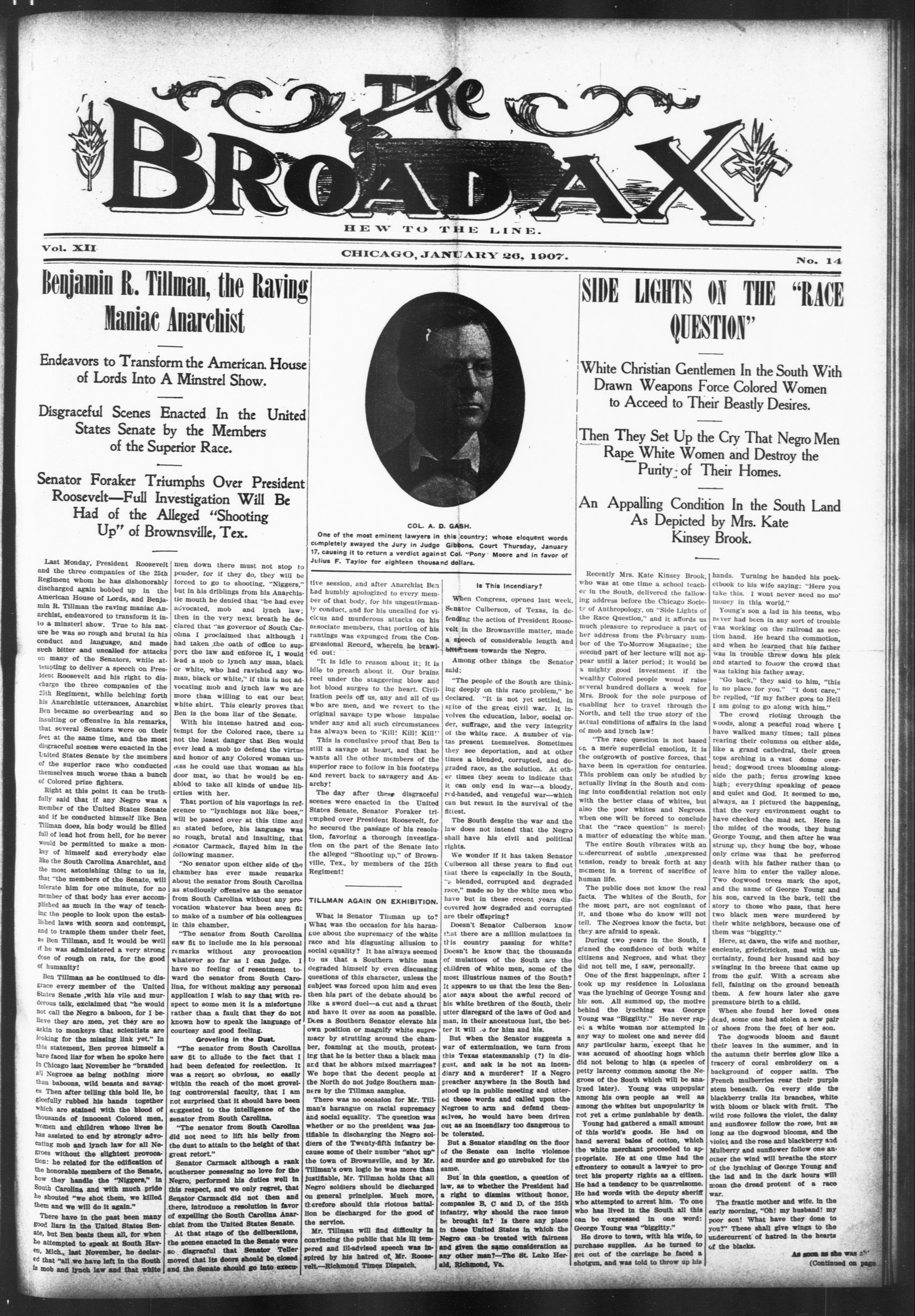
Benjamin R. Tillman, the Raving Maniac Anarchist
Endeavors to Transform the American. House of Lords Into A Minstrel Show.
Disgraceful Scenes Enacted In the United States Senate by the Members of the Superior Race.
Senator Foraker Triumphs Over President Roosevelt—Full Investigation Will Be Had of the Alleged "Shooting Up" of Brownsville. Tex.
Vol. XII
Benjamin R. Tillman
Maniac A
Endeavors to Transform
of Lords Into A
Disgraceful Scenes En-
States Senate by
of the Super
Senator Foraker Trium-
Roosevelt—Full Inve-
Had of the Alle-
Up" of Brown
Last Monday, President Roosevelt and the three companies of the 25th Regiment whom he has dishonorably discharged again bobbed up in the American House of Lords, and Benjamin R. Tillman the raving maniac Anarchist, endeavored to transform it into a minsterl show. True to his nature he was so rough and brutal in his conduct and language, and made such bitter and uncalled for attacks on many of the Senators, while attempting to deliver a speech on President Roosevelt and his right to discharge the three companies of the 25th Regiment, while belching forth his Anarchistic utterances, Anarchist Ben became so overbearing and so insulting or offensive in his remarks, that several Senators were on their feet at the same time, and the most disgraceful scenes were enacted in the United States Senate by the members of the superior race who conducted themselves much worse than a bunch of Colored prize fighters.
Right at this point it can be truthfully said that if any Negro was a member of the United States Senate and if he conducted himself like Ben Tillman does, his body would be filled full of lead hot from hell, for he never would be permitted to make a monkey of himself and everybody else like the South Carolina Anarchist, and the most astonishing thing to us is, that "the members of the Senate, will tolerate him for one minute, for no member of that body has ever accomplished as much in the way of teaching the people to look upon the established laws with scorn and contempt, and to trample them under their feet, as Ben Tillman, and it would be well if he was administered a very strong dose of rough on rats, for the good of humanity!
Ben Tillman as he continued to disgrace every member of the United States Senate, with his vile and murderous talk, exclaimed that "he would not call the Negro a baboon, for I believe they are men, yet they are so askin to monkeys that scientists are looking for the missing link yet." In this statement, Ben proves himself a bare faced liar for when he spoke here in Chicago last November he "branded all Negroes as being nothing more than baboons, wild beasts and savages. Then after telling this bold lie, he gleefully rubbed his hands together which are stained with the blood of thousands of innocent Colored men, women and children whose lives he has assisted to end by strongly advocating mob and lynch law for all Negroes without the slightest provocation: he related for the edification of the honorable members of the Senate, how they handle the "Niggers," in South Carolina and with much pride he shouted "we shot them, we killed them and we will do it again."
There have in the past been many good liars in the United States Senate, but Ben beats them all, for when he attempted to speak at South Haven, Mich., last November, he declared that "all we have left in the South is mob and lynch law and that white
men down there must not stop to powder, for if they do, they will be forced to go to shooting, "Niggers," but in his driblings from his Anarchistic mouth he denied that "he had ever advocated, mob and lynch law; then in the very next breath he declared that "as governor of South Carolina I proclaimed that although I had taken the oath of office to support the law and enforce it, I would lead a mob to lynch any man, black or white, who had ravished any woman, black or white," if this is not advocating mob and lynch law we are more than willing to eat our best white shirt. This clearly proves that Ben is the boss liar of the Senate. With his intense hatred and contempt for the Colored race, there is not the least danger that Ben would ever lead a mob to defend the virtue and honor of any Colored woman unless he could use that woman as his door mat, so that he would be enabled to take all kinds of undue liberties with her.
That portion of his vaporings in reference to "lynchings not like bees," will be passed over at this time and as stated before, his language was so rough, brutal and insulting, that Senator Carmack, flayed him in the following manner.
"No senator upon either side of the chamber has ever made remarks about the senator from South Carolina as studiously offensive as the senator from South Carolina without any provocation whatever has been seen fit to make of a number of his colleagues in this chamber.
"The senator from South Carolina saw fit to include me in his personal remarks without any provocation whatever so far as I can judge. I have no feeling of resentment toward the senator from South Carolina, for without making any personal application I wish to say that with respect to some men it is a misfortune rather than a fault that they do not known how to speak the language of courtesy and good feeling.
Groveling in the Dust.
"The senator from South Carolina saw fit to allude to the fact that I had been defeated for reelection. It was a retort so obvious, so easily within the reach of the most groveling controversial faculty, that I am not surprised that it should have been suggested to the intelligence of the senator from South Carolina.
"The senator from South Carolina did not need to lift his belly from the dust to attain to the height of that great retort."
Senator Carmack although a rank southerner possessing no love for the Negro, performed his duties well in this respect, and we only regret, that Senator Carmack did not then and there, introduce a resolution in favor of expelling the South Carolina Anarchist from the United States Senate.
At that stage of the deliberations, the scenes enacted in the Senate were so disgracful that Senator Teller moved that its doors should be closed and the Senate should go into execu-
HEW TO THE LINE.
CHICAGO, JANUARY 26, 1907.
COL. A. D. GASH.
One of the most eminent lawyers in this country; whose eloquent words completely swayed the Jury in Judge Gibbons, Court Thursday, January 17, causing it to return a verdict against Col. "Pony" Moore and in favor of Julius F. Taylor for eighteen thousand dollars.
tive session, and after Anarchist Ben had humbly apologized to every member of that body, for his ungentlemanly conduct, and for his uncalled for vicious and murderous attacks on his associate members, that portion of his rantings was expunged from the Congressional Record, wherein he brawled out:
"It is idle to reason about it; it is idle to preach about it. Our brains reel under the staggering blow and hot blood surges to the heart. Civilization peels off us, any and all of us who are men, and we revert to the original savage type whose impulse under any and all such circumstances has always been to 'Kill! Kill! Kill!'
This is conclusive proof that Ben is still a savage at heart, and that he wants all the other members of the superior race to follow in his footsteps and revert back to savagery and Anarchy!
Is This Incendiary?
When Congress, opened last week Senator Culberson, of Texas, in defending the action of President Roosevelt in the Brownsville matter, made a speech of considerable length and blitheness towards the Negro.
Among other things the Senator said:
"The people of the South are thinking deeply on this race problem," he declared. "It is not yet settled, in spite of the great civil war. It involves the education, labor, social order, suffrage, and the very integrity of the white race. A number of victims present themselves. Sometimes they see deportation, and at other times a blended, corrupted, and degraded race, as the solution. At other times they seem to indicate that it can only end in war, a bloody
The day after these disgraceful scenes were enacted in the United States Senate, Senator Foraker triumphed over President Roosevelt, for he secured the passage of his resolution, favoring a thorough investigation on the part of the Senate into the alleged "Shooting up," of Brownville, Tex., by members of the 25th Regiment!
TILLMAN AGAIN ON EXHIBITION.
What is Senator Tillman up to? What was the occasion for his harangue about the supremacy of the white race and his disgusting allusion to social equality? It has always seemed to us that a Southern white man degraded himself by even discussing questions of this character, unless the subject was forced upon him and even then his part of the debate should be like a sword duel—a cut and a thrust and have it over as soon as possible. Does a Southern Senator elevate his own position or magnify white supremacy by strutting around the chamber, foaming at the mouth, protesting that he is better than a black man and that he abhors mixed marriages? We hope that the decent people at the North do not judge Southern manners by the Tillman samples.
There was no occasion for Mr. Tillman's harangue on racial supremacy and social equality. The question was whether or no the president was justifiable in discharging the Negro soldiers of the Twenty-fifth infantry because some of their number "shot up" the town of Brownsville, and by Mr. Tillman's own logic he was more than justifiable, Mr. Tillman holds that all Negro soldiers should be discharged on general principles. Much more, therefore should this riotous battalion be discharged for the good of the service.
Mr. Tillman will find difficulty in convincing the public that his ill tempered and ill-advised speech was inspired by his hatred of Mr. Roosevelt—Richmond Times Dispatch.
Is This Incendiary?
When Congress, opened last week, Senator Culberson, of Texas, in defending the action of President Roosevelt in the Brownsville matter, made a speech of considerable length and bitterness towards the Negro.
Among other things the Senator said:
"The people of the South are thinking deeply on this race problem," he declared. "It is not yet settled, in spite of the great civil war. It involves the education, labor, social order, suffrage, and the very integrity of the white race. A number of visas present themselves. Sometimes they see deportation, and at other times a blended, corrupted, and degraded race, as the solution. At other times they seem to indicate that it can only end in war—a bloody, red-handed, and vengeful war—which can but result in the survival of the fittest.
The South despite the war and the law does not intend that the Negro shall have his civil and political rights.
We wonder if it has taken Senator Culberson all these years to find out that there is especially in the South, "blended, corrupted and degraded race," made so by the white men who have but in these recent years discovered how degraded and corrupted are their offspring?
Doesn't Senator Culberson know that there are a million mulattoes in this country passing for white? Doesn't he know that the thousands of mulattoes of the South are the children of white men, some of the most illustrious names of the South? It appears to us that the less the Senator says about the awful record of his white brethren of the South, their utter disregard of the laws of God and man, in their ancestuous lust, the better it will be for him and his.
But when the Senator suggests a war of extermination, we turn from this Texas statesmanship (?) in disgust, and ask is he not an incendiary and a murderer? If a Negro preacher anywhere in the South had stood up in public meeting and uttered these words and called upon the Negroes to arm and defend themselves, he would have been driven out as an incendiary too dangerous to be tolerated.
But a Senator standing on the floor of the Senate can incite violence and murder and go unrebuked for the same.
But in this question, a question of law, as to whether the President had a right to dismiss without honor, companies B, C and D, of the 25th infantry, why should the race issue be brought in? Is there any place in these United States in which the Negro can be treated with fairness and given the same consideration as any other man?—The St. Luke Herald, Richmond, Va.
SIDE LIGHTS ON THE "RACE QUESTION"
White Christian Gentlemen In the South With Drawn Weapons Force Colored Women to Acceed to Their Beastly Desires.
Then They Set Up the Cry That Negro Men Rape White Women and Destroy the Purity of Their Homes.
An Appalling Condition In the South Land As Depicted by Mrs. Kate Kinsey Brook.
Recently Mrs. Kate Kinsey Brook, who was at one time a school teacher in the South, delivered the following address before the Chicago Society of Anthropology, on "Side Lights of the Race Question," and it affords us much pleasure to reproduce a part of her address from the February number of the To-Morrow Magazine; the second part of her lecture will not appear until a later period; it would be a mighty good investment if the wealthy Colored people would raise several hundred dollars a week for Mrs. Brook for the sole purpose of enabling her to travel through the North, and tell the true story of the actual conditions of affairs in the land of mob and lynch law!
"The race question is not based on a mere superficial emotion, it is the outgrowth of positive forces, that have been in operation for centuries. This problem can only be studied by actually living in the South and coming into confidential relation not only with the better class of whites, but also the poor whites and Negroes. when one will be forced to conclude that the "race question" is merely a matter of educating the white man
The entire South vibrates with an undercurrent of subtle, unexpressed tension, ready to break forth at any moment in a torrent of sacrifice of human life.
The public does not know the real facts. The whites of the South, for the most part, are not cognizant of it, and those who do know will not tell. The Negroes know the facts, but they are afraid to speak.
During two years in the South, I glanced the confidence of both white citizens and Negroes, and what they did not tell me, I saw, personally.
One of the first happenings, after I took up my residence in Loliusiana was the lynching of George Young and his son. All summed up, the motive behind the lynching was George Young was "Biggitty." He never raped a white woman nor attempted in any way to molest one and never did any particular harm, except that he was accused of shooting hogs which did not belong to him (a species of petty larceny common among the Negroes of the South which will be analyzed later). Young was unpopular among his own people as well as among the whites but unpopularity is not yet a crime punishable by death.
Young had gathered a small amount of this world's goods. He had on hand several bales of cotton, which the white merchant proceeded to appropriate. He at one time had the effrontery to consult a lawyer to protect his property rights as a citizen. He had a tendency to be quarrelsome. He had words with the deputy sheriff who attempted to arrest him. To one who has lived in the South all this can be expressed in one word: George Young was "biggitty." He drove to town, with his wife, to purchase supplies. As he turned to get out of the carriage he faced a shotgun, and was told to throw up his
No.14
ON THE "RACE
STION"
Women In the South With
Force Colored Women
their Beastly Desires.
The Cry That Negro Men
men and Destroy the
Their Homes.
ion In the South Land
by Mrs. Kate
by Brook.
hands. Turning he handed his pocketbook to his wife saying: "Here you take this. I wont never need no mo'money in this world." Young's son a lad in his teens, who never had been in any sort of trouble was working on the railroad as section hand. He heard the commotion, and when he learned that his father was in trouble threw down his pick and started to follow the crowd that was taking his father away. "Go back," they said to him, "this is no place for you." "I dont care," he replied, "If my father goes to Hell I am going to go along with him."
The crowd rioting through the woods, along a peaceful road where I have walked many times; tall pines rearing their columns on either side, like a grand cathedral, their green tops arching in a vast dome overhead; dogwood trees blooming alongside the path; ferns growing knee high; everything speaking of peace and quiet and God. It seemed to me, always, as I pictured the happening, that the very environment ought to have checked the mad act. Here in the midst of the woods, they hung George Young, and then after he was strung up, they hung the boy, whose only crime was that he preferred death with his father rather than to leave him to enter the valley alone. Two dogwood trees mark the spot, and the name of George Young and his son, carved in the bark, tell the story to those who pass, that here two black men were murdered by their white neighbors, because one of them was "biggitty."
Here, at dawn, the wife and mother, enclente, griefstricken, mad with uncertainty, found her husband and boy swinging in the breeze that came up from the gulf. With a scream she fell, fainting on the ground beneath them. A few hours later she gave premature birth to a child. When she found her loved ones dead, some one had stolen a new pair of shoes from the feet of her son. The dogwoods bloom and faunt their leaves in the summer, and in the autumn their berries glow like a tracery of coral embroidery on a background of copper satin. The French mulberries rear their purple stem beneath. On every side the blackberry trails its branches, white with bloom or black with fruit. The wild rose follows the violet, the daisy and sunflower follow the rose, but as long as the dogwood blooms, and the violet and the rose and blackberry and Mulberry and sunflower follow one another the wind will breathe the story of the lynching of George Young and the lad and in the dark hours will moan the dread protent of a race war.
The frantic mother and wife, in the early morning, "Oh! my husband! my poor son! What have they done to you?" These shall give wings to the undercurrent of hatred in the hearts of the blacks.
As soon as she
(Continue)
THE BROAD AX.
Will promulgate and at all times uphold the true principles of Democracy, but Catholic, Protestant, Priest, Imdele, Farmers, Single Taxes, Republicans, and any one else can have their say, so long as their language is proper and responsibility is fixed.
The Broad is a newspaper whose platform is broad enough for all, ever claiming the editorial right to speak its own mind.
Local communications will receive attention. Write only on one side of the paper.
Subscriptions must be paid in advance.
One Year ..... $2.00
Six Months ..... 1.00
Advertising rates made known on application.
JULIUS F. TAYLOR, Editor and Publisher.
Entered at the Post Office at Chicago
Ill. as Second-class Matter.
PERSONAL MENTION.
Walter M. Farmer, for 16 years an honored member of the bar in St. Louis, Mo., is now engaged in the general practice of law. Suite 708, 171 Washington street, Phone Main 4153. Residence 4856 Langley avenue. Phone Drexel 6302.
A SOUTH CAROLINA NEGRO'S OPINION ABOUT PRESIDENT ROOSEVELT'S MESSAGE TO CONGRESS IN REFERENCE TO RAPE AND LYNCH LAW.
Editor of the Mystic Conservator. I have read the President's Message to Congress, and was particularly interested in its definition of what he conceives to be the proper estimate feeling and method of procedure for a Colored man who happens to be in a neighborhood, or place, where one of his race is being sought to answer to the charge of rape.
In his treatment of the matter, Mr. Roosevelt has striven to be calm, cool, dispassionate and above all logically fair.
I must express my belief that in so far as it lies in the power of a white man to accomplish such a purpose he has attained—but His Excellency, together with the majority of the men of his color, who attempt to furnish a panacea to cure the ills of rape and lynch law, will always lack somewhat, through inability to comprehend exactly what his seemingly incontrovertible assertions conveys to the mind of one who regards the subject from the point of view of an average man of color.
In the first place, we fail to see why a Colored criminal should be reckoned so much more an enemy to his race than the white is considered an enemy to his. As to rape, we poor, poverty stricken, and generally written down as degraded Negroes, when we go home and look around our firesides and take account of the thousands and thousands of "hastard half-white children, who have been abandoned by their white fathers," and have been set down upon our shoulders to carry along from time immemorial—we admit the possibility that long acquaintance may have dulled somewhat for us the horror that the white man is so eager to express when brought into conjunction with crimes, necessitating a use of the words rape and prostitution.
Lastly: It seems rather a risky thing to advise Negroes, individual or collective, to jump in and exercise power, official and judicial, to which they have been neither nominated, elected or deputized.
There are Colored men who have ventured to do this very thing, who after risking their lives in stopping the escape of a criminal, have had to stand by and see white men reap the honor and reward.—Boston Allen, The Mystic Conservator, Washington, D. C.
A DEMOCRATIC PRESIDENT FOR 1908.
Let the Negro awake and take the alarm which is sounded from the Nation's White House. Sign No. 1—The president is a democrat; sign No. 2—The president dislikes the Negro; sign No. 3—The president has closed his open door of nope; sign No. 4—Mr. "Nigger" look out for yourself, and sign No. 5—Is Wm. J. Bryan for president in 1908 If Foraker is not nominated by the National Republican convention, every Negro in the country should vote the democratic ticket. The Negro is largely responsible for his treatment by the republican party, for he has been party blind and party foolish, President Roosevelt, however, is opening his blinded eyes by using the big stick over his head.—S. S. Monitor.
Prof. and Mrs. N. Clark Smith informally entertained a few friends at their home, Wednesday evening in honor of Mrs. Ora Dunlap of Indianapolis, Indiana.
THE SUBSCRIPTION DANCING PARTY.
A Most Delightful Affair.
The Subscription Dancing Party given Tuesday evening, January 22 at Rosalie Hall, Rosalie Ct., and 57th street, which was the sixth dance under the personal management of Mr. Julius N. Avendorph was a most delightful affair, and all present expressed themselves as having spent a most enjoyable evening. The hall is without a doubt the prettiest in the city, and the floor is all that the most perfect dancer could wish for. The grand march was led by Mr. Julius N. Avendorph and Mrs. Adolphus C. Harris. Those present were Mr. W. R. Sobers, Mr. and Mrs. Ed Mead, Mr. A. P. Perry, Evanston, Ill.; Mr. and Mrs. Monroe Manning, Mr. and Mrs. M. R. Orman, Mr. J. N. Blackshaer, Mr. James Newsome, A. R Brodie, Mr. and Mrs. A. C Harris, Mr. W. D. Moore, Mr. G. B. P. Hancock, Mr. and Mrs. James Madden, Mr. T. A. Palmer, Major F. A. Denison, Mr. A. G. Wilson, Mr. and Mrs. James Nelson, Prof. and Mrs. Wm. Emanuel, Mr. and Mrs. Delbert Lawrence Lee, Mr. and Mrs. Harry Hudson, Mr. A. A. Wells, Mr. and Mrs. Chas, Webb, Mr. John Trott, Mr. and Mrs. Robert Howard, Mr. Turner, Mr. John Auter, Mr. Chas. C. Taylor, Mr. Wm. Whorton, Mr. and Mrs. Virgil Pumphry, Mr. and Mrs. Vance Anderson, Mr. Wm. Clark, Mr. and Mrs. J. S. Knight, Mr. George Thompson, Mr. D. B. Hawley, Mr. and Mrs. J. A. Cotton, Mr. I. Dunlop, Dr. and Mrs. A. L. Smith, Mr. W. H. Douglas, Mr. and Mrs. James Bryant, Mr. and Mrs. John Morton, Austin, Ill.; Mrs. Geo. Blackwell, Mr. and Mrs. B. F. Moseley, Mr. John Fry, Mr. and Mrs. Geo. Ayers, Mrs. Julius N. Avendorph, Mr. Alex. Taylor, Mr. and Mrs. Frank Brown, Mr. and Mrs. George Hawley, Mr. Ricks of Minneapolis, Minn.; Mr. and Mrs. Sam, Carter, Mr. and Mrs. J. P. Henderson, Mrs. Chas, Scales, Mr. W. K. Harreld, Mrs. Chas Jackson, Mr. Chas. Dyess, Mr. and Mrs. N. Clark Smith, Miss Lilian Johnson, Mrs. Erina Jones, Miss G. Sawyer, Mrs. Dunlop, Indianapolis, Ind.; Miss Helen Jackson, Miss Myrtle Hart, Indianapolis, Ind.; Miss Julia West, Brooklyn, N. Y.; Mrs. M. Whie, Indianapolis, Ind.; Miss E. Murphy, Miss Thomas Detroit, Mich.; Miss G. O'Neal, Evanston, Ill.; Mrs. Stella Kelly, Toledo, O.; Miss M. Morgan, Miss R. Dortch. N. Clark Smith's orchestra furnished the music for the occasion. Mrs. Ann Smiley served.
INSTITUTIONAL CHURCH
3825 Dearborn St.
The regular services Sunday morning, the minister will preach at 10:45 a. m.
There will be an illustrated service at evening service. This service will be one of an unique character. Illustrating the wonderful and mysterious operations of God in the creation of the world. Showing the various stages of formation and changes in the world until the land appears.
Man the Master: His Triumph and His Fall. Conditions leading up to the flood and some of the prime causes for the flood.
How the Ark was Constructed: Where it Rested. This is to be an unusual service, as all the views are new and show the popular trend of the mind of the masters of today.
Church doors open at 6:30; service begins at 7:30 p. m.
Rev. H. E. Stewart,
Pastor.
MILLION CATHOLICS IN CITY
Official Church Directory Gives Data
of Chicago Archdiocese.
Advance sheets of the official Catholic directory published by the M. H. Miltbius Company of Milwaukee show the following statistics of the Chicago archdiocese:
Population (Catholic).
about ..... 1,200,000
Archbishop ..... 1
Bishops ..... 2
Clergy ..... 684
Churches with resident priests ..... 308
Missions with churches ..... 37
Parishes with schools ..... 191
Children attending ..... 78,177
Orphan asylums ..... 6
Orphans ..... 1,316
Charitable institutions ..... 43
Mr. F. L. Cuffee, 3942 Dearborn st. who has been confined to his home for the past week is able to be about again.
Mr. Will H. Jackson, 345 35th st.,
was compelled to leave his desk and
work in the office of the United
States Engineer department Saturday
on the account of slackness.
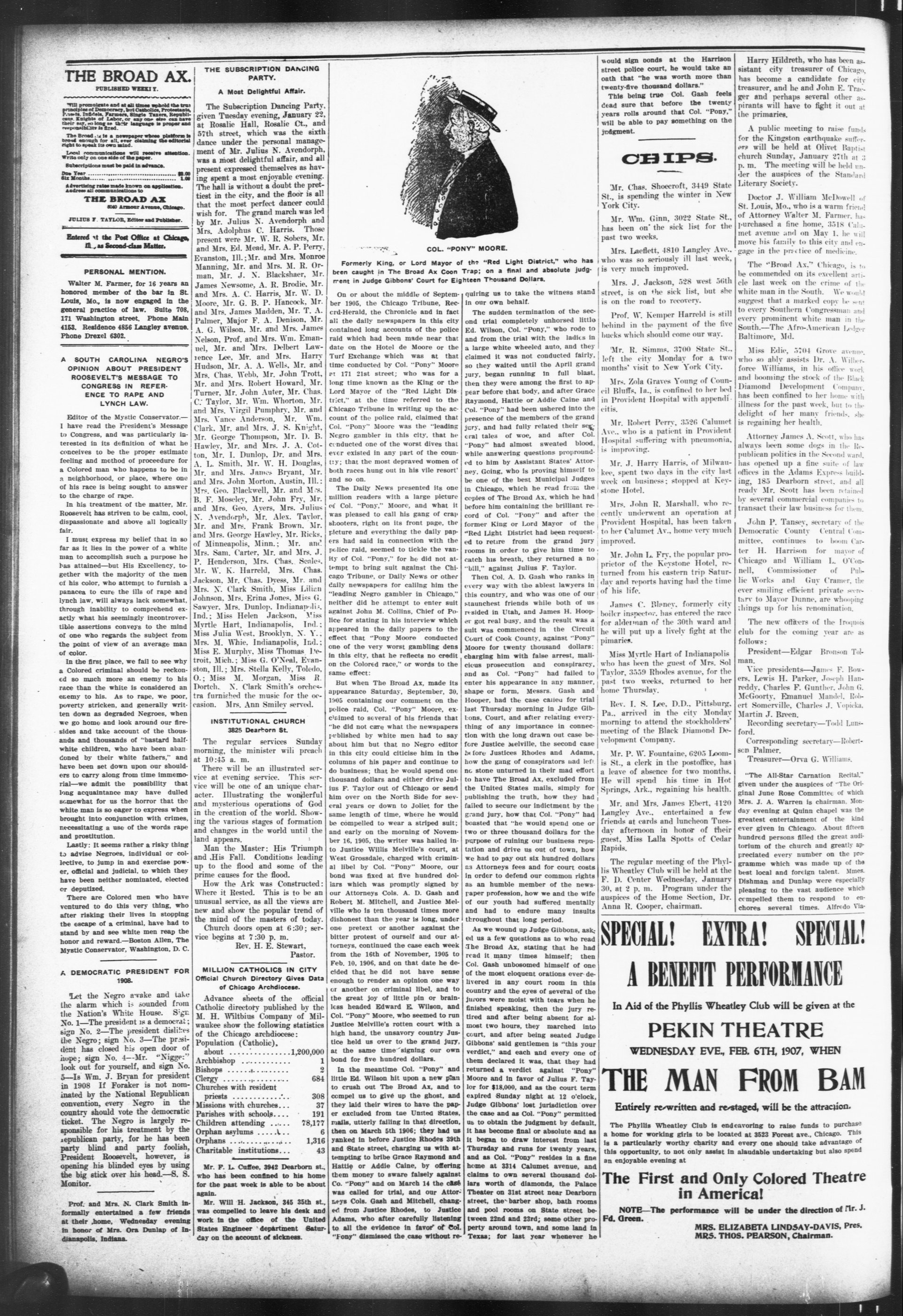
COL. "PONY" MOORE.
Formerly King, or Lord Mayor of the "Red Light District," who has been caught in The Broad Ax Coon Trap; on a final and absolute judgment in Judge Gibbons' Court for Eighteen Thousand Dollars.
On or about the middle of September 1905, the Chicago Tribune, Recrd-Herald, the Chronicle and in fact all the daily newspapers in this city contained long accounts of the police raid which had been made near that date on the Hotel de Moore or the Turf Exchange which was at that time conducted by Col. "Pony" Moore at 171 21st street; who was for a long time known as the King or the Lord Mayor of the "Red Light District," at the time referred to the Chicago Tribune in writing up the account of the police raid, claimed that Col. "Pony" Moore was the "leading Negro gambler in this city, that he conducted one of the worst dives that ever existed in any part of the country; that the most depraved women of both races hung out in his vile resort" and so on.
The Daily News presented its one million readers with a large picture of Col. "Pony," Moore, and what it was pleased to call his gang of crap shooters, right on its front page, the picture and everything the daily papers had said in connection with the police raid, seemed to tickle the vanity of Col. "Pony," for he did not attempt to bring suit against the Chicago Tribune, or Daily News or other daily newspapers for calling him the "leading Negro gambler in Chicago," neither did he attempt to enter suit against John M. Collins, Chief of Police for stating in his interview which appeared in the daily papers to the effect that "Pony Moore conducted one of the very worst gambling dens in this city, that he reflects no credit on the Colored race," or words to the same effect:
But when The Broad Ax, made its appearance Saturday, September, 30, 1905 containing our comment on the police raid, Col. "Pony" Moore, excised to several of his friends that "he did not care what the newspapers published by white men had to say about him but that no Negro editor in this city could citicise him in the columns of his paper and continue to do business; that he would spend one thousand dollars and either drive Julius F. Taylor out of Chicago or send him over on the North Side for several years or down to Joliet for the same length of time, where he would be compelled to wear a striped suit; and early on the morning of November 16, 1905, the writer was hailed into Justice Willis Melville's court, at West Grossdale, charged with criminal libel by Col. "Pony" Moore, our bond was fixed at five hundred dollars which was promptly signed by our attorneys Cols. A. D. Gash and Robert M. Mitchell, and Justice Melville who is ten thousand times more dishonest than the year is long, under one pretext or another against the bitter protest of ourselves and our attorneys, continued the case each week from the 16th of November, 1905 to Feb. 10, 1906, and on that date he decided that he did not have sense enough to render an opinion one way or another on criminal libel, and to the great joy of little pin or brailess headed Edward E. Wilson, and Col. "Pony" Moore, who seemed to run Justice Melville's rotten court with a high hand, the unsavory country Justice held us over to the grand jury, at the same time signing our own bond for five hundred dollars.
In the meantime Col. "Pony" and little Ed. Wilson hit upon a new plan to crush out The Broad Ax, and to compel us to give up the ghost, and they laid their wires to have the paper excluded from the United States, mails, utterly falling in that direction, then on March 5th 1906; they had us yanked in before Justice Rhodes 39th and State street, charging us with attempting to bribe Grace Raymond and Hattie or Addie Caine, by offering them money to sware falsely against Co. "Pony" and on March 14 the case was called for trial, and our Attorney's Cols. Gash and Mitchell, changed from Justice Rhodes, to Justice Adams, who after carefully listening to all the evidence in favor of Col. "Pony" dismissed the case without re
quiring us to take the witness stand in our own behalf.
The sudden termination of the second trial completely unhorsed little Ed. Wilson, Col. "Pony," who rode to and from the trial with the ladies in a large white wheeled auto, and they claimed it was not conducted fairly, so they waited until the April grand jury, began running in full blast, then they were among the first to appear before that body, and after Grace Raymond, Hattie or Addie Caine and Col. "Pony" had been ushered into the presence of the members of the grand jury, and had fully related their several tales of woe, and after Col. "Pony" had almost sweated blood, while answering questions propounded to him by Assistant States' Attorney, Going, who is proving himself to be one of the best Municipal Judges in Chicago, which he read from the copies of The Broad Ax, which he had before him containing the brilliant record of Col. "Pony" and after the former King or Lord Mayor of the "Red Light District had been requested to retire from the grand jury rooms in order to give him time to catch his breath, they returned a no "bill" against Julius F. Taylor.
Then Col. A. D. Gash who ranks in every way with the ablest lawyers in this country, and who was one of our staunchest friends while both of us resided in Utah, and James H. Hooper got real busy, and the result was a suit was commenced in the Circuit Court of Cook County, against "Pony" Moore for twenty thousand dollars: charging him with false arrest, malicious prosecution and conspiracy, and as Col. "Pony" had failed to enter his appearance in any manner, shape or form, Messrs. Gash and Hooper, had the case caused for trial last Thursday morning in Judge Gibbons, Court, and after relating everything of any importance in connection with the long drawn out case before Justice Melville, the second case before Justices Rhodes and Adams, how the gang of conspirators had left no stone unturned in their mad effort to have The Broad Ax, excluded from the United States mails, simply for publishing the truth, how they had failed to secure our indictment by the grand jury, how that Col. "Pony" had boasted that "he would spend one or two or three thousand dollars for the purpose of ruining our business reputation and drive us out of town, how we had to pay out six hundred dollars as Attorneys fees and for court costs in order to defend our common rights as an humble member of the newspaper profession, how we and the wife of our youth had suffered mentally and had to endure many insults throughout that long period.
As we wound up Judge Gibbons, asked us a few questions as to who read The Broad Ax, stating that he had read it many times himself; then Col. Gash unbosomed himself of one of the most eloquent orations ever delivered in any court room in this country and the eyes of several of the jurors were moist with tears when he finished speaking, then the jury retired and after being absent for almost two hours, they marched into court, and after being seated Judge Gibbons' said gentlemen is "this your verdict," and each and every one of them declared it was, that they had returned a verdict against "Pony" Moore and in favor of Julius F. Taylor for $18,000, and as the court term expired Sunday night at 12 o'clock, Judge Gibbons' lost jurisdiction over the case and as Col. "Pony" permitted us to obtain the judgment by default, it has become final or absolute and as it began to draw interest from last Thursday and runs for twenty years, and as Col. "Pony" resides in a fine home at 3314 Calumet avenue, and claims to own several thousand dollars worth of diamonds, the Palace Theater on 31st street near Dearborn street, the-barber shop, bath rooms and pool rooms on State street between 22nd and 23rd; some other property around town, and some land in Texas; for last year whenever he
SPECIAL! EXTRA! SPECIAL! A BENEFIT PERFORMANCE
In Aid of the Phyllis Wheatley Club will be given at the
Entirely re-written and re-staged, will be the attraction. The Phyllis Wheatley Club is endeavoring to raise funds to purchase a home for working girls to be located at 3523 Forest ave., Chicago. This is a particularly worthy charity and every one should take advantage of this opportunity, to not only assist in alaudable undertaking but also spend an enjoyable evening at
The First and Only Colored Theatre in America!
NOTE-The performance will be under the direction of Mr. J. Fd. Green. MRS. ELIZABETA LINDSAY-DAVIS, Pres. MRS. THOS. PEARSON, Chairman.
would sign oonds at the Harrison street police court, he would take an oath that "he was worth more than twenty-five thousand dollars."
This being true Col. Gash feels dead sure that before the twenty years rolls around that Col. "Pony," will be able to pay something on the judgment.
CHIPS
Mr. Chas. Shoecroft, 3449 State St., is spending the winter in New York City.
Mr. Wm. Ginn, 3022 State St., has been on the sick list for the past two weeks.
Mrs. Laeflett, 4810 Langley Ave., who was so seriously ill last week, is very much improved.
Mrs. J. Jackson, 528 west 56th street, is on the sick list, but she is on the road to recovery.
Prof. W. Kemper Harreld is still behind in the payment of the five bucks which should come our way.
Mr. R. Simms, 3700 State St., left the city Monday for a two months' visit to New York City.
Mrs. Zola Graves Young of Council Bluffs, Ia., is confined to her bed in Provident Hospital with appendicitis.
Mr. Robert Perry, 3526 Calumet Ave., who is a patient in Provident Hospital suffering with pneumonia, is improving.
Mr. J. Harry Harris, of Milwaukee, spent two days in the city last week on business; stopped at Keystone Hotel.
Mrs. John R. Marshall, who recently underwent an operation at Provident Hospital, has been taken to her Calumet Av., home very much improved.
Mr. John L. Fry, the popular proprietor of the Keystone Hotel, returned from his eastern trip Saturday and reports having had the time of his life.
James C. Bleney, formerly city boiler inspector, has entered the race for alderman of the 30th ward and he will put up a lively fight at the pimaries.
Miss Myrtle Hart of Indianapolis who has been the guest of Mrs. Sol Taylor, 3559 Rhodes avenue, for the past two weeks, returned to her home Thursday.
Rev. I. S. Lee, D.D., Pittsburg, Pa., arrived in the city Monday morning to attend the stockholders' meeting of the Black Diamond Development Company.
Mr. P. W. Fountaine, 6205 Loomis St., a clerk in the postoffice, has a leave of absence for two months. He will spend his time in Hot Springs, Ark., regaining his health.
Mr. and Mrs. James Ebert, 4120 Langley Ave., entertained a few friends at cards and luncheon Tuesday afternoon in honor of their guest, Miss Lalla Spotts of Cedar Rapids.
The regular meeting of the Phyllis Wheatley Club will be held at the F. D. Center Wednesday, January 30, at 2 p. m. Program under the auspices of the Home Section, Dr. Anna R. Cooper, chairman.
Harry Hildreth, who has been assistant city treasurer of Chicago, has become a candidate for city treasurer, and he and John E. Traeger and perhaps several other aspirants will have to fight it out at the primaries.
A public meeting to raise funds for the Kingston earthquake sufferers will be held at Olivet Baptist church Sunday, January 27th at 3 p.m. The meeting will be held under the auspices of the Standard Literary Society.
Doctor J. William McDowell of St. Louis, Mo., who is a warm friend of Attorney Walter M. Farmer, has purchased a fine home, 3518 Calumet avenue and on May 1, he will move his family to this city and engage in the practice of medicine.
The "Broad Ax." Chicago, is to be commended on its excellent article last week on the crime of the white man in the South. We would suggest that a marked copy be sent to every Southern Congressman and every prominent white man in the South.—The Afro-American Ledger Baltimore, Md.
Miss Edie, 5704 Grove avenue, who so ably assists Dr. A. Wilberforce Williams, in his office work and booming the stock of the Black Diamond Development Company, has been confined to her home with illness for the past week, but to the delight of her many friends, she is regaining her health.
Attorney James A. Scott, who has always been some dogs in the Republican politics in the Second ward, has opened up a fine suite of law offices in the Adams Express building, 185 Dearborn street, and all ready Mr. Scott has been retained by several commercial companies to transact their law business for them.
John P. Tansey, secretary of the Democratic County Central Committee, continues to boom Carter H. Harrison for mayor of Chicago and William L. O'Connell, Commissioner of Public Works and Guy Cramer, the ever smiling efficient private secretary to Mayor Dunne, are whooping things up for his renomination.
The new officers of the Iroquois club for the coming year are as follows:
President—Edgar Bronson Tolman.
Vice presidents—James F. Bowers, Lewis H. Parker, Joseph Hanreddy, Charles F. Gunther, John G. McGoorty, Emanuel Mandel, Robert Somerville, Charles J. Vopicka, Martin J. Breen.
Recording secretary—Todd Lunsford.
Corresponding secretary—Robertson Palmer.
Treasurer—Orva G. Williams.
"The All-Star Carnation Recital," given under the auspices of "The Original June Rose Committee of which Mrs. J. A. Warren is chairman. Monday evening at Quinn chapel was the greatest entertainment of the kind ever given in Chicago. About fifteen hundred persons filled the great auditorium of the church and greatly appreciated every number on the programme which was made up of the best local and foreign talent. Mimes, Dishman and Dunlap were especially pleasing to the vast audience which compelled them to respond to enchores several times. Alfredo Via
let the Cuban Violinist was at his best, while Mrs. C. C. Lewis pleased as usual. About four hundred dollars was realized by the church.
W. L. Ricks a prominent lawyer of Minneapolis is visiting the city on his way south on legal business. Mr. and Mrs. J. N. Avendorph, will give a dinner in his honor Sunday afternoon.
SIDE LIGHTS ON THE RACE PROBLEM IN THE SOUTH.
(Concluded from page 1.)
ter her baby was Born, George Young's widow went far away from the scene of her woe, homeless, povety-stricken (for the merchants seized everything of value) and half crazed with the shock; but always as she recounts the story of the two forms swinging from the dogwoods, black fingers clutch tighter around their ax handles, crow-bars, and lead pencils, and Negro heart-throbs quicken as they declare "This shall not be so always."
It does not require the rape of a white woman to furnish the excuse for lynching in the South. Whenever a Negro accumulates a little property and is able to keep out of debt, that minute he faces danger. He lives in a universe of fear, haunted by the thought of the fate that may be his not knowing what moment he may feel the noose around his neck.
Taking up the question of rape which is harped on by white men of the South and editorial writers of the North, nothing has ever been said about the rape of Negro women by white men.
As a matter of fact, few of the so-called rapes of white women, really are assaults. Let a Negro muddled with liquor offer to shake hands with a white woman and it is likely as not exaggerated into a just cause for lynching especially if the Negro is prosperous and in business competition with the white. Let a Negro jostle against a white woman by accident, and according to the unwritten law of the South he would be signing his death warrant. The mayor of a Southern city, talking to me on this point, said: "If a Nigger should come to my house and offer to shake hands with my wife, I would pour the contents of my shot-gun into his heart. There would be nothing left of him to lynch." This same mayor had, in my presence, just a few minutes previous, shaken hands most effusively with an old Colored man whom he met on the street. The inconsistency of these astute reasoners of the South was ever cause of wonderment to me.
It may come as a shock to the white women of the South to be told that, in many instances, they are the instigators of murder. Shocking as this sounds, it is true. Many of the lynchings that have stained the pages of Southern history have been caused by woman's hysteria, and her desire for sympathy.
The real difficulty lies in the fact that the South has never looked upon the Negro as a human being. The black man is their beast of burden. White men can commit "rape" constantly and nothing be thought of it. In many instances it is not even looked upon as an insult.
With a "Negro" the case is entirely different. He cannot make the slightest move which a hysterical woman can twist into an insult, without cutting the leash that holds the Hellhounds of race hatred, and turning them loose upon himself. If the women of the South would think calmly over the situation, the number of Negro lynchings would rapidly decrease. Southern women are on the lookout for trouble of this kind, all the time, and it is just like trouble of any other character, if you go around with a chip on your shoulder looking for it you are always sure to find it.
I can illustrate this by an experience of my own. One Saturday afternoon (or evening they call it in the South one of the two Negroes who had been working for me, cultivating my crop came out from town somewhat the worse for wear, Prohibition had just gone out, and the saloon proved an enticing bate for the Negroes, of the locality. He had looked on the wine when it was red, and was not himself. That Negro was a church member, a man of sterling qualities at other times. Had I been a Southern woman, hysterical, obsessed with the thought that he meant me harm, I would have raised the alarm, and before night he would have been hanging to a tree.
What terrible crime did this Negro commit The liquor had made him feel that he was a brother to the whole world through an excess of religious emotion. He saw in me a window struggling to get along, and he wanted to express his sympathy for me. He came and sat down beside me on the settee. I rose at once, and he did not realize that he had done a thing which might have meant death to him. He
went on to express his sympathy for me and told me that anything in the world that he could do to help me, he would do if I would just send him word. This really was more than the white men of the South ever thought of, for with one exception, they let me go out in the woods with an ax and chop my own wood. One man, alone, among the whites, when he found by wood-pile was low, turned in and chopped some wood for me.
Many Negro has been hung for the rape of a white woman, when the rape was of no worse a character than the circumstance I have just described; the Negro in his stumbling, ignorant way, merely wanted to express his sympathy. Many an inoffensive victim has been lynched, just as many an affectionate dog has been shot, when the cry of "Mad dog" has been raised. The hands of the white women of the South are covered with blood as much as those of the white men. The white woman raises the cry, the white man holds the rope.
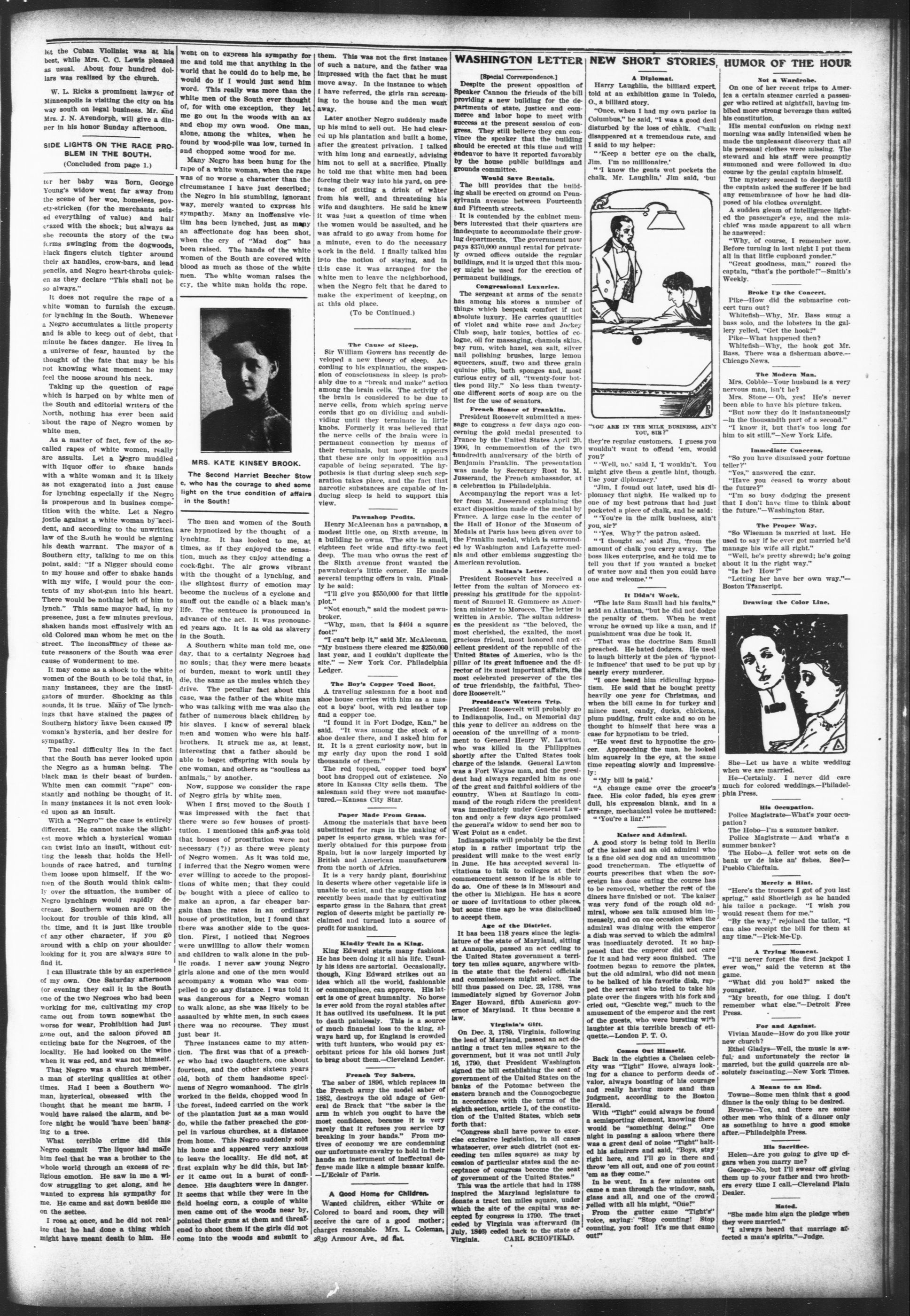
MRS. KATE KINSEY BROOK
The Second Harriet Beecher Stowe, who has the courage to shed some light on the true condition of affairs in the South!
The men and women of the South are hypnotized by the thought of a lynching. It has looked to me, at times, as if they enjoyed the sensation, much as they enjoy attending a cock-fight. The air grows vibrant with the thought of a lynching, and the slightest furry of emotion may become the nucleus of a cyclone and snuff out the candle of a black man's life. The sentence is pronounced in advance of the act. It was pronounced years ago. It is as old as slavery in the South.
A Southern white man told me, one day, that to a certainty Negroes had no souls; that they were mere beasts of burden, meant to work until they die, the same as the mules which they drive. The peculiar fact about this case, was the father of the white man who was talking with me was also the father of numerous black children by his slaves. I knew of several black men and women who were his half-brothers. It struck me as, at least, interesting that a father should be able to beget offspring with souls by one woman, and others as "soulless as animals," by another.
Now, suppose we consider the rape of Negro girls by white men.
When I first moved to the South I was impressed with the fact that there were so few houses of prostitution. I mentioned this and was told that houses of prostitution were not necessary (?) as there were plenty of Negro women. As it was told me, I inferred that the Negro women were ever willing to accede to the propositions of white men; that they could be bought with a piece of calico to make an apron, a far cheaper bargain than the rates in an ordinary house of prostitution, but I found that there was another side to the question. First, I noticed that Negroes were unwilling to allow their women and children to walk alone in the public roads. I never saw young Negro girls alone and one of the men would accompany a woman who was compelled to go any distance. I was told it was dangerous for a Negro woman to walk alone, as she was likely to be assaulted by white men, in such cases there was no recourse. They must just bear it.
Three instances came to my attention. The first was that of a preacher who had two daughters, one about fourteen, and the other sixteen years old, both of them handsome specimens of Negro womanhood. The girls worked in the fields, chopped wood in the forest, indeed carried on the work of the plantation just as a man would do, while the father preached the gospel in various churches, at a distance from home. This Negro suddenly sold his home and appeared very anxious to leave the locality. He did not, at first explain why he did this, but later it came out in a burst of confidence. His daughters were in danger. It seems that while they were in the field hoeing corn, a couple of white men came out of the woods near by, pointed their guns at them and threatened to shoot them if the girls did not come into the woods and submit to
them. This was not the first instance of such a nature, and the father was impressed with the fact that he must move away. In the instance to which I have referred, the girls ran screaming to the house and the men went away.
Later another Negro suddenly made up his mind to sell out. He had cleared up his plantation and built a home, after the greatest privation. I talked with him long and earnestly, advising him not to sell at a sacrifice. Finally he told me that white men had been forcing their way into his yard, on pretense of getting a drink of water from his well, and threatening his wife and daughters. He said he knew it was just a question of time when the women would be assaulted, and he was afraid to go away from home for a minute, even to do the necessary work in the field. I finally talked him into the notion of staying, and in this case it was arranged for the white men to leave the neighborhood, when the Negro felt that he dared to make the experiment of keeping, on at this old place.
(To be Continued.)
The Cause of Sleep.
Sir William Gowers has recently developed a new theory of sleep. According to his explanation, the suspension of consciousness in sleep is probably due to a "break and make" action among the brain cells. The activity of the brain is considered to be due to nerve cells, from which spring nerve cords that go on dividing and subdividing until they terminate in little knobs. Formerly it was believed that the nerve cells of the brain were in permanent connection by means of their terminals, but now it appears that these are only in opposition and capable of being separated. The hypothesis is that during sleep such separation takes place, and the fact that narcotic substances are capable of inducing sleep is held to support this view.
Pawnshop Profits.
Henry McAleenan has a pawnshop, a modest little one, on Sixth avenue, in a building he owns. The site is small, eighteen feet wide and fifty-two feet deep. The man who owns the rest of the Sixth avenue front wanted the pawnbroker's little corner. He made several tempting offers in vain. Finally he said:
"I'll give you $550,000 for that little plot."
"Not enough," said the modest pawnbroker.
"Why, man, that is $464 a square foot."
"I can't help it," said Mr. McAleenan, "My business there cleared me $250,000 last year, and I couldn't duplicate the site." — New York Cor. Philadelphia Ledger.
The Boy's Copper Toed Boot
A traveling salesman for a boot and shoe house carries with him as a mascot a boys' boot, with red leather top and a copper toe.
"I found it in Fort Dodge, Kan," he said. "It was among the stock of a shoe dealer there, and I asked him for it. It is a great curiosity now, but in my early day upon the road I sold thousands of them."
The red topped, copper toed boys' boot has dropped out of existence. No store in Kansas City sells them. The salesman said they were not manufactured.—Kansas City Star.
Paper Made From Grass.
Among the materials that have been substituted for rags in the making of paper is esparto grass, which was formerly obtained for this purpose from Spain, but is now largely imported by British and American manufacturers from the north of Africa.
It is a very hardy plant, flourishing in deserts where other vegetable life is unable to exist, and the suggestion has recently been made that by cultivating esparto grass in the Sahara that great region of deserts might be partially reclaimed and turned into a source of profit for mankind.
Kindly Trait In a King:
King Edward starts many fashions. He has been doing it all his life. Usually his ideas are sartorial. Occasionally, though, King Edward strikes out an idea which all the world, fashionable or commonplace, can approve. His latest is one of great humanity. No horse is ever sold from the royal stables after it has outlived its usefulness. It is put to death painlessly. This is a source of much financial loss to the king, always hard up, for England is crowded with turt hunters, who would pay exorbitant prices for his old horses just to brag about them.—Cleveland Leader.
French Toy Sabers.
The saber of 1896, which replaces in the French army the model saber of 1882, destroys the old adage of General de Brack that "the saber is the arm in which you ought to have the most confidence, because it is very rarely that it refuses you service by breaking in your hands." From motives of economy we are condemning our unfortunate cavalry to hold in their hands an instrument of ineffectual defense made like a simple bazaar knife. U'Eclair of Paris.
A Good Home for Children
Wanted children, either White or Colored to board and room, they will receive the care of a good mother; charges reasonable. Mrs. L. Coleman, 230 Armour Ave., 2d flat.
WASHINGTON LETTER
[Special Correspondence]
Despite the present opposition of Speaker Cannon the friends of the bill providing a new building for the departments of state, justice and commerce and labor hope to meet with success at the present session of congress. They still believe they can convince the speaker that the building should be erected at this time and will endeavor to have it reported favorably by the house public buildings and grounds committee.
Would Save Rentals.
The bill provides that the building shall be erected on ground on Pennsylvania avenue between Fourteenth and Fifteenth streets.
It is contended by the cabinet members interested that their quarters are inadequate to accommodate their growing departments. The government now pays $370,000 annual rental for privately owned offices outside the regular buildings, and it is urged that this money might be used for the erection of permanent buildings.
Congressional Luxuries
The sergeant at arms of the senate has among his stores a number of things which bespeak comfort if not absolute luxury. He carries quantities of violet and white rose and Jockey Club soap, hair tonics, bottles of cologne, oil for massaging, chamois skins, bay rum, witch hazel, sea salt, silver nail polishing brushes, large lemon squeezers, snuff, two and three grain quinine pills, bath sponges and, most curious entry of all, "twenty-four bottles pond lily". No less than twenty-one different sorts of soap are on the list for the use of senators.
French Honor of Franklin
President Roosevelt submitted a message to congress a few days ago concerning the gold medal presented to France by the United States April 20, 1906, in commemoration of the two hundredth anniversary of the birth of Benjamin Franklin. The presentation was made by Secretary Root to M. Jusserand, the French ambassador, at a celebration in Philadelphia. Accompanying the report was a letter from M. Jusserand explaining the exact disposition made of the medal by France. A large case in the center of the Hall of Honor of the Museum of Medals at Paris has been given over to the Franklin medal, which is surrounded by Washington and Lafayette medals and other emblems suggesting the American revolution.
A. Sultan's Letter:
President Roosevelt has received a letter from the sultan of Morocco expressing his gratitude for the appointment of Samuel R. Gummere as American minister to Morocco. The letter is written in Arabic. The sultan addresses the president as "the beloved, the most cherished, the exalted, the most gracious friend, most honored and excellent president of the republic of the United States of America, who is the pillar of its great influence and the director of its most important affairs, the most celebrated preserver of the ties of true friendship, the faithful, Theodore Roosevelt."
President Roosevelt will probably go to Indianapolis, Ind., on Memorial day this year to deliver an address on the occasion of the unveiling of a monument to General Henry W. Lawton, who was killed in the Philippines shortly after the United States took charge of the islands. General Lawton was a Fort Wayne man, and the president had always regarded him as one of the great and faithful soldiers of the country. When at Santiago in command of the rough riders the president was immediately under General Lawton and only a few days ago promised the general's widow to send her son to West Point as a cadet.
Indianapolis will probably be the first stop in a rather important trip the president will make to the west early in June. He has accepted several invitations to talk to colleges at their commencement season if he is able to do so. One of these is in Missouri and the other in Michigan. He has a score or more of invitations to other places, but some time ago he was disinclined to accept them.
Age of the District.
It has been 118 years since the legislature of the state of Maryland, sitting at Annapolis, passed an act ceding to the United States government a territory ten miles square, anywhere within the state that the federal officials and commissioners might select. The bill thus passed on Dec. 23, 1788, was immediately signed by Governor John Eager Howard, fifth American governor of Maryland. It thus became a law.
Virginia's Gift.
On Dec. 3, 1789, Virginia, following the lead of Maryland, passed an act donating a tract ten miles square to the government, but it was not until July 16, 1790, that President Washington signed the bill establishing the seat of government of the United States on the banks of the Potomac between the eastern branch and the Connagogue in accordance with the terms of the eighth section, article 1, of the constitution of the United States, which sets forth that:
"Congress shall have power to exercise exclusive legislation, in all cases whatsoever, over such district (not exceeding ten miles square) as may by cession of particular states and the acceptance of congress become the seat of government of the United States."
This was the article that had in 1788 inspired the Maryland legislature to donate a tract ten miles square, under which the site of the capital was accepted by congress in 1790. The tract ceded by Virginia was afterward (in July, 1846) ceded back to the state of Virginia. CARL SCHOFIELD.
NEW SHORT STORIES
A. Diplomat.
Harry Laughlin, the billiard expert, told at an exhibition game in Toledo, O., a billiard story.
"Once, when I had my own parlor in Columbus," he said, "I was a good deal disturbed by the loss of chalk. Chalk disappeared at a tremendous rate, and I said to my helper:
"Keep a better eye on the chalk, Jim. I'm no millionaire."
"I know the gents pockets the chalk, Mr. Laughlin." Jim said, "bu
3
"YOU ARE IN THE MILE BUSINESS, AIN'T YOU, SUR?"
"YOU ARE IN THE MILK BUSINESS, AIN'T YOU, SIR?"
they're regular customers. I guess you wouldn't want to offend 'em, would you?
"Well, no.' said I, 'I wouldn't. You might give them a gentle hint, though. Use your diplomacy.'
"Jim, I found out later, used his diplomacy that night. He walked up to one of my best patrons that had just pocketed a piece of chalk, and he said: 'You've in the milk business, right'
"You're in the milk business, ain't you, sir?"
"Yes. Why? the patron asked.
"I thought so," said Jim, 'from the amount of chalk you carry away. The boss likes enterprise, and he told me to tell you that if you wanted a bucket of water now and then you could have one and welcome.'"
It Didn't Work.
"The late Sam Small had his faults," said an Atlantan, "but he did not dodge the penalty of them. When he went wrong he owned up like a man, and if punishment was due he took it.
"That was the doctrine Sam Small preached. He hated dodgers. He used to laugh bitterly at the plea of 'hypnotic influence' that used to be put up by nearly every murderer.
"I once heard him ridiculing hypnotism. He said that he bought pretty heavily one year for Christmas, and when the bill came in for turkey and mince meat, candy, ducks, chickens, plum pudding, fruit cake and on so he thought to himself that here was a case for hypnotism to be tried.
"He went first to hypnotize the grocer. Approaching the man, he looked him squarely in the eye, at the same time repeating slowly and impressively:
"My bill is paid."
"A change came over the grocer's face. His color faded, his eyes grew dull, his expression blank, and in a strange, mechanical voice he muttered: "You're a liar."
Kaiser and Admiral
A good story is being told in Berlin of the kaiser and an old admiral who is a fine old sea dog and an uncommon good trencherman. The etiquette of courts prescribes that when the sovereign has done eating the course has to be removed, whether the rest of the diners have finished or not. The kaiser was very fond of the rough old admiral, whose sea talk amused him intensely, and on one occasion when the admiral was dining with the emperor a dish was served to which the admiral was inordinately devoted. It so happened that the emperor did not care for it and had very soon finished. The footmen began to remove the plates, but the old admiral, who did not mean to be balked of his favorite dish, rapped the servant who tried to take his plate over the fingers with his fork and cried out, "Geschte weg," much to the amusement of the emperor and the rest of the guests, who were bursting with laughter at this terrible breach of etiquette—London P. T. O.
Comes Out Himself.
Back in the eighties a Chelsea celebrity was "Tight" Howe, always looking for a chance to perform deeds of valor, always boasting of his courage and really having more sand than judgment, according to the Boston Herald.
With "Tight" could always be found a semisporting element, knowing there would be "something doing." One night in passing a saloon where there was a great deal of noise "Tight" halted his admirers and said, "Boys, stay right here, and I'll go in there and throw 'em all out, and one of you count 'em as they come."
In he went. In a few minutes out came a man through the window, sash, glass and all, and one of the crowd yelled with all his might, "One!"
From the gutter came "Tight's" voice, saying: "Stop counting! Stop counting, you fool! It's me that came out!"
HUMOR OF THE HOUR
Not a Wardrobe.
On one of her recent trips to America a certain steamer carried a passenger who retired at nightfall, having imbibed more strong beverage than suited his constitution.
His mental confusion on rising next morning was sadly intensified when he made the unpleasant discovery that all his personal clothes were missing. The steward and his staff were promptly summoned and were followed in due course by the genial captain himself.
The mystery seemed to deepen until the captain asked the sufferer if he had any remembrance of how he had disposed of his clothes overnight.
A sudden gleam of intelligence lighted the passenger's eye, and the mischief was made apparent to all when he answered:
"Why, of course, I remember now. Before turning in last night I put them all in that little cupboard vonder."
"Great goodness, man," roared the captain, "that's the porthole!"—Smith's Weekly.
Broke Up the Concert.
Pike-How did the submarine concert turn out?
Whitefish-Why, Mr. Bass sung a bass solo, and the lobsters in the gallery yelled, "Get the hook!"
Pike-What happened then?
Whitefish-Why, the hook got Mr. Bass. There was a fisherman above...Chicago News.
The Modern Man.
Mrs. Cobbie—Your husband is a very nervous man, isn't he?
Mrs. Stone—Oh, yes! He's never been able to have his picture taken.
"But now they do it instantaneously—in the thousand part of a second."
"I know it, but that's too long for him to sit still."—New York Life.
Immediate Concerns.
"So you have dismissed your fortune teller?"
"Yes," answered the czar.
"Have you ceased to worry about the future?"
"I'm so busy dodging the present that I don't have time to think about the future."-Washington Star.
The Proper Way.
"So Wiseman is married at last. He used to say if he ever got married he'd manage his wife all right."
"Well, he's pretty shrewd; he's going about it in the right way."
"Is he? How?"
"Letting her have her own way."—Boston Transcript.
Drawing the Color Line.
She—Let us have a white wedding when we are married.
He—Certainly. I never did care much for colored weddings.—Philadelphia Press.
His Occupation.
Police Magistrate—What's your occupation?
The Hobo—A feller wot sets on de bank uv de lake an' fishes. See?—Pueblo chieftain.
Merely a Hint
"Here's the trousers I got of you last spring," said Shortleigh as he handed his tailor a package. "I wish you would resheat them for me." "By the way," rejoined the tailor, "I can also receipt the bill for them at any time." -Plick-Me-Up.
A Trying Moment.
"I'll never forget the first jackpot I ever won," said the veteran at the game.
"What did you hold?" asked the youngster.
"My breath, for one thing. I don't remember what else."—Detroit Free Press.
For and Against.
Vivian Maude—How do you like your new church? Ethel Gladys—Well, the music is awful; and unfortunately the rector is married, but the guild quarrels are absolutely fascinating—New York Times.
A Means to an End.
Towne—Some men think that a good dinner is the only thing to be desired.
Browne—Yes, and there are some other men who think of a dinner only as something to have a good smoke after—Philadelphia Press.
Win Services
Helen—Are you going to give up cigars when you marry me?
George—No, but I'll swear off giving them up to your father and two brothers every time I call—Cleveland Plain Dealer.
Mated.
"She made him sign the pledge when they were married."
"I always heard that marriage affected a man's spirits."—Judge.
Fifty-First St. and Armour Ave.
RAIL YARDS: 1st St. & L. S. & M. S. Ry.
2nd St. and Armour Ave.
CHJCAGO
50,000
BOOKS FREE By Mail
treating all the
50,000
BOOKS FREE By
Mail
THIS BOOK contains many illustrations and is a storehouse of knowledge for both old and young who are suffering from excesses, lost vitality, nervous disorders, blood poison, stomach, kidney and burydiseases. It explains how you can successfully cure yourself at home.
Tile and Slate Hauling a Specialty.
COAL
J. H. COLEMAN & CO.
Express & Van Moving
TRUNKS EVERYWHERE.
2540 State Stree
Tel. 699 South
CHICAGO
Phone Oakland 1328
F. A. Rawlins
The Modern Embalmer
UNDERTAKER AND
FUNERAL DIRECTOR
When his work is finished
you have no displeasure.
4834 State St., CHICAGO
Phone Douglas 1550
ICE CREAM CIGARS, TOBACCO SHIRT WAIST$ KIMONAS MRS. A. E. BAKER
419-36TH STREET
Underwear a
Specialty CHICAGO
J. GARNER Tel. Douglas 3256
THE ELITE BUFFET
FINE WINES, LIQUORS AND CIGARS
HEQALL PATTERN
10
15
MINE INDUSTRIES
HEQALL MAGAZINE
50
YEAR
EXCELLENCE A FREE CULTURE
There are open HeQall Patterns sold to the United
Pacific by HeQall Patterns. This is an
amount of their style, summary and simplicity.
HeQall's magazine (The Queen of Patterns) has
heated debates on the best patterns. Our
party subscribes (inember) ages 50+ years.
Lady Anness Wanted. Handmade products or
luxury and co-creation. Fashion Catalogue of 60 da-
rived and Production Catalogue are on promo
website.
COOK
Waiters and Cooks
Prefer Our Make
JACKETS AND LINEN
because they have found them
satisfactory.
Write for complete Catalogue
FREE.
giving full instructions how
to order.
Marcus Ruben (Inc.)
390 State St., CHICAGO.
READY FOR THE PRESS
CHICAGO CAVE DWELLERS
Not for Preachers
320 Pages, Cloth, $1.00
POST PAID
A Story of the Underworld
and the Overworld
By Parker H. Sercombe,
Editor To-Morrow
Magazine, Chicago.
Only a limited edition of
this remarkable book will be
printed. Each copy will be
signed by Sercombe Him-
self and automatically num-
bered from 1 up. First
orders in will get the low
numbers in rotation except
No. 1, which goes to Mrs.
Sercombe.
Address
TO-MORROW MAGAZINE,
For the Supermarket and Improvement and The New Criticism.
2328 Calumet Ave., Chicago, Illinois.
10 CENTS THE COPY. $1 A YEAR.
Why YOU Should Buy Black Diamond Development Co's Stock
It is a Corporation
It is not a Scheme.
It is a Business Enterprise.
Every Share is FULLY PAID.
There is no Personal Liability.
All Shares participate alike.
There is no Preferred Stock.
It has FIVE large GAS WELLS.
The Wells produce 12,000,000 cubic feet of Gas per day.
Its Success is MADE.
It has contracted for the sale of all its Gas.
It has contracted for 25 more Wells.
It now owns 630 Acres of Gas Leases.
The Pipe Line will be finished Feb. 1st.
Kansas City will be burning BLACK DIAMOND Gas February 3rd.
It will be paying Dividends Aug. 1st.
Dividends will be paid on $1.00 (PAR) for every Share you own.
There is but one block of Fifty Thousand Shares for sale.
There will NEVER be another Share for sale by the Company,
CONCLUSION
BUY NOW OR NEVER!
Stock 25c Per Share
BLACK DIAMOND
184 Dearborn Street,
BLACK DIAMOND DEVELOPMENT CO.,
Room 27—
184 Dearborn Street, —:— —:— Chicago.
THE BROAD AX.
Is for sale at the following news stands:
George M. Oatts, 5501 Lake ave.
Mrs. E. L. Holmes, 2508½ State st.
Cigars, tobacco and news stand.
J. W. McKiney, news stand, Northeast corner State and 47th st.
L. W. Washington, 5613 Jefferson ave., General agent.
L. L. Jones, barber shop and news stand, 3842 State st.
A. F. Tervalon, 134 W. 51st street
Cigar Store and News Stand.
Mrs. Nellie Phelps, Cigars, Notions and News Stand, 131 W. 51st street.
T. B. Hall's Cigar Store and Laundry office, 281 29th St.
W. S. Cole, 354 Thirty-first street, cigars, tobacco and news stand.
J. R. Peters Cigars, Tobacco and News Stand, 338 E. 27th street.
Mrs. A. E. Baker, Notions and News Stand, 419, 36th street.
W. P. Johnson, Notion Store and News Stand 3704 State st.
Turner Williams' Shaving Parlor and News Stand, 2903 Armour ave.
R. Davis, cigars, tobacco, and confectionery, 3832 State st.
Whitelee Bros. 2724 State St., Gent's furnishings and new stand.
The Stationery, 2970 State street, Cigars, Tobacco and News stand.
C. C. McLain, cigars, tobacco and news stand, 2906 State street.
W. H. Gans, news stand, 2805 State street.
J. H. Hadley, cigars, tobacco and news stand, 110 W. 47th street, near State. Mrs. Katherine R. Hamlet, Cigars, tobacco, and fancy groceries and news stand 5028 Armour cve. The Informer News Co., 188 Randolph St. Detroit, Mich.
$100.00
FRED. A. WESCOTT, M. Development Company will develop Company Certification UE $100.00, to the Stockholder of words using the 30 letter
"BLACK DIAMOND DEVOT
Not using any letter more than words: "Black Diamond Devot
FOR EXAMPLE:—Bs Clock, Command, Diamond Man, Money, Moment, E
Your list of words must one side of paper only, and you and must be on hand in my day the Pipe Line is finished on Wells with Kansas City."
No abbreviations, profanity
If you are not a Stockholder once and compete for this prize
And in case of a tie, each person or an equal division of the prize.
This Offer is open to man Stockholder in Black Diamond February 1st, 1907.
$100.00 Prize!
FRED. A. WESCOTT, Manager of the Black Diamond Development Company will give One Black Diamond Development Company Certificate of 100 SHARE, PAR VALUE $100.00, to the Stockholder composing the greatest number of words using the 30 letters contained in the words
FOR EXAMPLE:—Back, Black, Book, Cook, Clock, Command, Diamond, Demand, Development, Man, Money, Moment, Etc.
Your list of words must be PLAINLY WRITTEN on one side of paper only, and your Name and Address attached, and must be on hand in my office on Feb. 1st, 1907—"The day the Pipe Line is finished connecting Black Diamond Gas Wells with Kansas City."
No abbreviations, profanity or proper names allowed.
If you are not a Stockholder NOW, buy some Stock at once and compete for this prize of $100.00.
And in case of a tie, each person so tying shall receive the same prize, or an equal division of the prize.
This Offer is open to man, woman or child who is a Stockholder in Black Diamond Development Company on February 1st, 1907.
CONTEST CLOSES FEB. 1ST, 1907.
FRED. A. V.
1207 Security Building.
CHICAGO
FRED. A. WESCOTT,
1207 Security Building,
CHICAGO, ILLS.
DEVELOPMENT CO.,
from 27----
:---- Chicago.
Howard Music & Art Company,
Buxton, Iowa.
News items and advertisements left
at these places will find their way
into the columns of The Broad Ax.
L. W. Washington, General Agent for The Broad Ax in the Hyde Park District.
From on and after this date until further notice to the contrary, L. W. Washington, 5613 Jefferson avenue will act as the general agent for The Broad Ax, and news items and advertisements left with him not later than Wednesday evening or early Thursday morning prior to the day of publication. will find their way into its columns.
Special Announcement
From on and after this date all announcements of entertainments, etc., for which an admission is charged, will be considered advertising, and will be charged for at the rate of 12 cents a line, seven words to a line. The money must accompany the matter and reach the editor no later than Thursday morning of the week intended for publication. This rule will also apply to all personal items and matter for which no charges will be made. In other words, all news matter must reach us either on Wednesday evening or early Thursday morning in order to find its way into the columns of this paper the same week it is written
Write plainly on one side of the paper only, and address all communications to The Broad Ax, 5040 Armour avenue.
10 Prize!
Manager of the Black Diamond
Drive One Black Diamond De-
te of 100 SHARE, PAR VAL-
or composing the greatest num-
ters contained in the words
DEVELOPMENT COMPANY"
names than they appear in the
Development Company."
Black, Black, Book, Cook,
Demand, Development,
etc.
Ope PLAINLY WRITTEN on
our Name and Address attached,
office on Feb. 1st, 1907—"The
Connecting Black Diamond Gas
by or proper names allowed.
Order NOW, buy some Stock at
price of $100.00.
so tying shall receive the same prize,
an, woman or child who is a
Development Company on
WESCOTT,
188 Madison Street
D, ILLS.
HILLMAN'S STATE & WASHINGTON STS.
MARKET AND GROCERY TELEPHONE DOUGLAS 565 81st and State Streets
Sandy W. Trice & Co.
2918 State Street
Why don't you get in the habit of doing your trading in the New Store? Every Tuesday and Friday special sales-day and two of Fish Trading Stamps with each 10c purchase.
We carry a swell line of Ladies' Shirtwaists, Underwear and Corsets. A spendid assortment of Shoes, Hosiery, Gloves, Belts, fine Purses, Laces, Ribbons, Gowns, Bracelets, Millinery and everything you wear.
We make a specialty of Men's Balbriggan Underwear, Hosiery, swell Walstcoats, Pants, Shoes, Fedora and Derby Hats.
A beautiful line of soft Percale Negligee Shirts and Suspenders.
A fancy line of Neckwear and Hardkerchiefs.
See our Novelties in Jewelry, Watch-chains, Fobs, Cuff-buttons, Studs and Safety Pins.
Boys' Suits, Pants, Hats, Shoes and Shirts.
American Brick Co..
President and Treasurer, THOMAS CAREY.
Vice-President, JOHN SHELHAMER,
Secretary, WILLIAM SULLIVAN.
MANUFATURERS OF
Common and Sewer Brick
Office and Yards:
45th and Robey Sts.
Yards running winter, and summer, equipped
with the latest improved Wolf Dryer.
Input of Winter Yards ..... 14,400 per day
Input of Summer Yards..... 30,400 per day
Telephone Yards 128.
ILLINOIS BRICK CO.
American Brick Co.
Common and Sewer Brick Office and Yards:
45th and Robey Sts.
Output of Winter Yards ..... 14,400 per day
Output of Summer Yards ..... 30,400 per day
ILLINOIS BRICK CO.
94 N. Western Ave., Chicago.
1994 N. Western Ave., Chicago.
Telephone Yards 718
M. JUNK, Proprietor JOS. P. JUNK, Manager 3700-3710 South Halsted Street and 897 to 929 Thirtyseventh Street CHICAGO
At the celebration of a marriage in the Roman Catholic Church, Dungiven, recently a gun accident was attended by deplorable consequences. It would appear that as the bridesmaids were proceeding to the residence of the bride, a young man named James M'Closkey borrowed a gun, which he proceeded to load with powder for the purpose of saluting the wedding party. As the bridesmaids were driving past M'Closkey, who had just finished loading the gun, it was by some means discharged. Unfortunately, unknown to M'Closkey, the weapon had contained a previous charge of powder and shot, and one of the girls, Cassie Gilderson, of Crebarkey, received the charge full in the neck and face, at a distance of about five yards. Miss Gilderson sustained shocking injuries, the left side of the neck being partially blown away, while the sight of the left eye was also destroyed and the jugular vein injured. It is feared that some of the pellets have lodged in the brain, and very little hope is entertained of her recovery.
GRAY & MORAN
ATTORNEYS AT LAW
Suite 1114 Ashland Block, Clark and
Randolph Sts. Tel. Central 569.
CHICAGO.
J. J. Bradley
Residence 57 Macallister Place
Telephone Ashland 363
Office Telephones
Central 1239 Automatic 5940
MILES J. DEVINE
ATTORNEY AT LAW
Suite 318-320 Reaper Block
CLARK AND WASHINGTON STS.
CHICAGO.
A. D. GASH
Attorney at Law,
84-86 La Salle Street, Chicago
Suite 615 to 619,
Telephone Main 3077.
JOHN E. OWENS
ATTORNEY & COUNSELOR
AT LAW
323 ASHLAND .BLOCK
Telephone Main 4839
Residence, 6626 Champlain Ave.
Tel. Wentworth 2821
J. GRAY LUCAS
Attorney At Law
SUITE 51, 119-121 LA SALLE ST-
CHICAGO
Tel. Douglas 1565 Notary Public
REAL ESTATE, LOANS AND
RENTING
FIRE INSURANCE
Bates Building
3637 STATE STREET CHICAGO
The Twentieth Century
Barber Shop
Agent for the Black Diamond De-
velopment Company. Stock for
sale now 25c Per Share.
Fine Stock of Cigars.
3842 State Street,
CHICAGO.
Phone Douglas 7434.
PHONE { OFFICE DOUGLAS 8009
REFS. DOUGLAS
Dr. W. H. Marshall Physician and Surgeon
Hours—10 to 12 A. M. 2 to 5:30 P. M.
and nights—Sundays, 3 to 5 P. M.
Special Hours by Appointment
3432 STATE STREET CHICAGO
Medical Examiner and Court Physician
for the Foresters No. 7895.
A. B. SCHULTZ, M. D. PHYSICIAN AND SURGEON.
2719 State Street
Hours: 9 to 12 A. M.
3 to 5 and after 6 P. M.
CHICAG
holds tree clinics at Provident Hospital free dispensary eye, ear, nose and throat department, Monday, Wednesday and Friday. Hours 2 to 4.
SOUTH SIDE TAILORING CO.
Not Incorporated.
George M. Oatts, Prop.
SUITS made to Order $15.00 up.
PANTS made to Order $4.00 up.
Cleaning, Dyeing and Repairing.
Strict Attention paid Ladies' work.
Telephone Hyde Park 5927.
3444 COTTAGE GROVE AVENUE
5501 LAKE AVE. CHICAGO
---
WHERE EVERY PATRON Saves ON EVERY PURCHASE
Jacob Feinberg Wholesale and Retail
J. M. Fields
TELEPHONE YARDS 693 BRADLEY & FIELDS REAL ESTATE, LOANS AND INSURANCE
CHICAGO
President and Treasurer, THOMAS CARRY.
Vice-President, JOHN SHELHAMER,
Secretary, WILLIAM SULLIVAN.
MANUFATURERS OF
Yards running winter and summer, equipped with the latest improved Wolf Dryer.
Telephone Yards 128.
WILLIAM C. KUESTER. SUPERINTENDENT.
Telephone Lake View 270.
Telephone Yards: 718